EP2796581A1 - Alloy composition - Google Patents
Alloy composition Download PDFInfo
- Publication number
- EP2796581A1 EP2796581A1 EP14161529.4A EP14161529A EP2796581A1 EP 2796581 A1 EP2796581 A1 EP 2796581A1 EP 14161529 A EP14161529 A EP 14161529A EP 2796581 A1 EP2796581 A1 EP 2796581A1
- Authority
- EP
- European Patent Office
- Prior art keywords
- alloy
- composition
- niobium
- alloy composition
- hafnium
- Prior art date
- Legal status (The legal status is an assumption and is not a legal conclusion. Google has not performed a legal analysis and makes no representation as to the accuracy of the status listed.)
- Granted
Links
- 229910045601 alloy Inorganic materials 0.000 title claims abstract description 66
- 239000000956 alloy Substances 0.000 title claims abstract description 66
- 239000000203 mixture Substances 0.000 title claims abstract description 58
- 229910052758 niobium Inorganic materials 0.000 claims abstract description 17
- 239000010955 niobium Substances 0.000 claims abstract description 17
- GUCVJGMIXFAOAE-UHFFFAOYSA-N niobium atom Chemical compound [Nb] GUCVJGMIXFAOAE-UHFFFAOYSA-N 0.000 claims abstract description 17
- ZOKXTWBITQBERF-UHFFFAOYSA-N Molybdenum Chemical compound [Mo] ZOKXTWBITQBERF-UHFFFAOYSA-N 0.000 claims abstract description 15
- 229910052750 molybdenum Inorganic materials 0.000 claims abstract description 15
- 239000011733 molybdenum Substances 0.000 claims abstract description 15
- OKTJSMMVPCPJKN-UHFFFAOYSA-N Carbon Chemical compound [C] OKTJSMMVPCPJKN-UHFFFAOYSA-N 0.000 claims abstract description 10
- 229910052799 carbon Inorganic materials 0.000 claims abstract description 10
- 229910052735 hafnium Inorganic materials 0.000 claims description 14
- VBJZVLUMGGDVMO-UHFFFAOYSA-N hafnium atom Chemical compound [Hf] VBJZVLUMGGDVMO-UHFFFAOYSA-N 0.000 claims description 13
- WFKWXMTUELFFGS-UHFFFAOYSA-N tungsten Chemical compound [W] WFKWXMTUELFFGS-UHFFFAOYSA-N 0.000 claims description 12
- 229910052721 tungsten Inorganic materials 0.000 claims description 12
- 239000010937 tungsten Substances 0.000 claims description 12
- RTAQQCXQSZGOHL-UHFFFAOYSA-N Titanium Chemical compound [Ti] RTAQQCXQSZGOHL-UHFFFAOYSA-N 0.000 claims description 11
- 239000010936 titanium Substances 0.000 claims description 11
- 229910052719 titanium Inorganic materials 0.000 claims description 11
- QVGXLLKOCUKJST-UHFFFAOYSA-N atomic oxygen Chemical compound [O] QVGXLLKOCUKJST-UHFFFAOYSA-N 0.000 claims description 4
- 229910052760 oxygen Inorganic materials 0.000 claims description 4
- 239000001301 oxygen Substances 0.000 claims description 4
- 239000012535 impurity Substances 0.000 claims description 3
- 229910044991 metal oxide Inorganic materials 0.000 claims description 3
- 150000004706 metal oxides Chemical class 0.000 claims description 3
- 238000005728 strengthening Methods 0.000 description 12
- 238000000034 method Methods 0.000 description 6
- UNASZPQZIFZUSI-UHFFFAOYSA-N methylidyneniobium Chemical compound [Nb]#C UNASZPQZIFZUSI-UHFFFAOYSA-N 0.000 description 5
- 239000006185 dispersion Substances 0.000 description 4
- 238000005242 forging Methods 0.000 description 4
- WHJFNYXPKGDKBB-UHFFFAOYSA-N hafnium;methane Chemical compound C.[Hf] WHJFNYXPKGDKBB-UHFFFAOYSA-N 0.000 description 4
- 229910052702 rhenium Inorganic materials 0.000 description 4
- WUAPFZMCVAUBPE-UHFFFAOYSA-N rhenium atom Chemical compound [Re] WUAPFZMCVAUBPE-UHFFFAOYSA-N 0.000 description 4
- 229910001182 Mo alloy Inorganic materials 0.000 description 3
- GWEVSGVZZGPLCZ-UHFFFAOYSA-N Titan oxide Chemical compound O=[Ti]=O GWEVSGVZZGPLCZ-UHFFFAOYSA-N 0.000 description 3
- 230000015572 biosynthetic process Effects 0.000 description 3
- 239000006104 solid solution Substances 0.000 description 3
- 230000000694 effects Effects 0.000 description 2
- 238000001513 hot isostatic pressing Methods 0.000 description 2
- 239000002245 particle Substances 0.000 description 2
- 238000009700 powder processing Methods 0.000 description 2
- 239000002244 precipitate Substances 0.000 description 2
- 230000008569 process Effects 0.000 description 2
- UONOETXJSWQNOL-UHFFFAOYSA-N tungsten carbide Chemical compound [W+]#[C-] UONOETXJSWQNOL-UHFFFAOYSA-N 0.000 description 2
- 238000007545 Vickers hardness test Methods 0.000 description 1
- QCWXUUIWCKQGHC-UHFFFAOYSA-N Zirconium Chemical compound [Zr] QCWXUUIWCKQGHC-UHFFFAOYSA-N 0.000 description 1
- 210000001787 dendrite Anatomy 0.000 description 1
- 230000004992 fission Effects 0.000 description 1
- 230000004927 fusion Effects 0.000 description 1
- 238000009689 gas atomisation Methods 0.000 description 1
- -1 hafnium carbides Chemical class 0.000 description 1
- 230000006872 improvement Effects 0.000 description 1
- 238000004519 manufacturing process Methods 0.000 description 1
- 239000011159 matrix material Substances 0.000 description 1
- 238000002844 melting Methods 0.000 description 1
- 230000008018 melting Effects 0.000 description 1
- 238000012986 modification Methods 0.000 description 1
- 230000004048 modification Effects 0.000 description 1
- 239000000843 powder Substances 0.000 description 1
- 238000004663 powder metallurgy Methods 0.000 description 1
- 238000001953 recrystallisation Methods 0.000 description 1
- 239000000243 solution Substances 0.000 description 1
- OGIDPMRJRNCKJF-UHFFFAOYSA-N titanium oxide Inorganic materials [Ti]=O OGIDPMRJRNCKJF-UHFFFAOYSA-N 0.000 description 1
- 229910052726 zirconium Inorganic materials 0.000 description 1
Images

Classifications
-
- C—CHEMISTRY; METALLURGY
- C22—METALLURGY; FERROUS OR NON-FERROUS ALLOYS; TREATMENT OF ALLOYS OR NON-FERROUS METALS
- C22C—ALLOYS
- C22C27/00—Alloys based on rhenium or a refractory metal not mentioned in groups C22C14/00 or C22C16/00
- C22C27/04—Alloys based on tungsten or molybdenum
Definitions
- the present invention relates to an alloy composition, particularly though not exclusively, to an alloy composition suitable for use in refractory (i.e. high temperature) applications.
- the invention further relates to a forging die comprising the alloy composition.
- Prior alloy compositions comprising molybdenum are known, particularly for use in refractory applications such as fusion and fission reactors, rocket engine nozzles, furnace structural component and forging dies. Such applications require high hardness (as measured according to the Vickers hardness test) at a particular operating temperature.
- known molybdenum based alloy compositions have insufficient strength for some applications, particularly at high temperatures such as 1000 to 1100 °C, and may have a high cost of production.
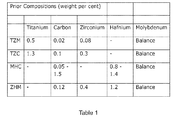
- compositions of prior molybdenum based alloys are given in table 1, given in terms of weight percentages.
- TZM is described in further detail in US patent 3275434 .
- Further prior molybdenum based alloys are described in "The Engineering Properties of Molybdenum Alloys" by F F Schmidt and H R Ogden.
- Rhenium containing alloys may therefore have an unacceptably high cost.
- the present invention describes an alloy composition and an article comprising the alloy composition which seeks to overcome some or all of the above problems. All percentage amounts are given in terms of weight percentages unless otherwise specified.
- an alloy composition comprising molybdenum, wherein the composition comprises between 15% and 20% niobium and 0.05% and 0.25% carbon.
- the described alloy has a high hardness at temperatures of between 1,000 and 1,100 °C, and is consequently suitable for a wide range of uses, including for example refractory articles.
- the relatively high amount of niobium compared to prior compositions has been found to form niobium carbide (HfC), which acts as a strengthener.
- niobium is a relatively inexpensive element in comparison to other strengtheners, resulting in an alloy composition having a high strength at the required temperatures, and a relatively low overall cost.
- the alloy composition may comprise between 16% and 17% niobium, and may comprise between 16.1 and 16.5% niobium, and preferably may comprise approximately 16.3% niobium.
- the alloy composition may further comprise hafnium, and may further comprise between 0.5% and 4% hafnium, and may comprise between 0.7% and 0.9% hafnium, and preferably may comprise approximately 0.8% hafnium.
- hafnium carbide acts as a strengthener in addition to the strengthening provided by the niobium carbide.
- HfC hafnium carbide
- sufficient strengthening may be provided only by niobium.
- hafnium can be used to provide further strengthening, though at a comparatively high cost.
- the alloy may further comprise titanium, and may comprise between 1% and 3% titanium, may comprise between 1.3% and 1.5% titanium, and may comprise substantially 1.42% titanium.
- the titanium may be in the form of titanium oxide (TiO 2 ). TiO 2 has been found to further increase the strength of the alloy by providing dispersion strengthening, and / or solid solution strengthening.
- the alloy may further comprise tungsten, and may comprise between 1% and 10% tungsten, may comprise between 2.7% and 2.9% tungsten, and may comprise substantially 2.8% tungsten.
- tungsten is thought to act as a solid solution strengthener, thereby increasing the strength of the alloy.
- the balance of the composition may comprise molybdenum.
- the alloy may further comprise incidental impurities.
- the alloy may consist substantially only of molybdenum, niobium, titanium, carbon, hafnium, tungsten, oxygen and incidental impurities.
- the alloy composition may further comprise oxygen or metal oxides.
- the presence of metal oxides in the alloy composition is thought to provide dispersion solution strengthening, which will further increase the strength of the alloy.
- the alloy composition may have an ultimate tensile strength of between approximately 380 MPa and 460 MPa at a temperature of 1,000 °C.
- an article comprising an alloy composition in accordance with the first aspect of the invention.
- the article may comprise a forging die.
- the alloy is particularly suitable for in use in a forging die, since the alloy provides a very high strength at high temperatures.
- Table 2 shows the compositional ranges of an alloy composition
- table 3 shows an example composition of the first alloy composition.
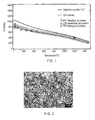
- a back scattered electron image of the microstructure of the composition of table 3 is shown in Fig. 2 .
- the nominal alloy composition is thought to have an ultimate tensile strength (UTS) of between approximately 380 MPa and 460 MPa at a temperature of 1,000 °C, which is supported by evidence from Vicker's hardness tests. This is an improvement in UTS of approximately 50 to 250 MPa at a temperature of 1,000 °C compared to prior molybdenum based alloy compositions such as TZM.
- UTS ultimate tensile strength
- This is an improvement in UTS of approximately 50 to 250 MPa at a temperature of 1,000 °C compared to prior molybdenum based alloy compositions such as TZM.
- an alloy composition comprising molybdenum, between 15% and 20% niobium and 0.05% and 0.25% carbon provides advantages over prior molybdenum alloy compositions.
- niobium carbide NbC
- the niobium carbide in the composition is responsible for the majority of the strengthening effects.
- hafnium in the amounts specified in table 2 is thought to further increase the strength of the composition at both high and low temperatures, both by forming hafnium carbides (HfC) and solid solution strengthening.
- titanium in the specified amounts promotes the formation of dispersion strengthening titanium dioxide (TiO 2 ), which has the effect of further increasing the strength of the alloy composition.
- tungsten carbide has a relatively small contribution to the strengthening of the composition, and so may optionally be omitted from the composition, particularly in view of the increased processing costs inherent in tungsten containing alloy compositions. Indeed, an alloy comprising only molybdenum, hafnium and carbon in the amounts specified is necessary to provide an alloy having superior tensile strength at high temperatures relative to prior alloys.
- the composition may further comprise a trace amount of zirconium.
- the alloy is produced by a powder processing method.
- the powder processing method comprises melting and gas atomisation to form particles having a diameter of less than approximately 5 ⁇ m.
- a billet is then formed by hot isostatic pressing (HIP) of the particles.
- HIP hot isostatic pressing
- the powder is subjected to heat at temperatures of approximately 2000°C at approximately 100 Mpa for approximately 4 hours.
- Fig. 2 shows a sample of alloy having the composition described in table 3.
- the sample was produced using an arc-cast method.
- the lighter areas of the sample are hafnium carbide precipitates within the alloy matrix.
- the hafnium carbide precipitates are segregated to the interdentritic regions with molybdenum rich primary dendrites in the sample. More uniform, fine dispersions of hafnium carbide can be produced using a powder metallurgy process. This will be expected to improve the properties of the alloy further.
- the composition may comprise further elements.
- the alloy may be formed using different processes.
Landscapes
- Chemical & Material Sciences (AREA)
- Engineering & Computer Science (AREA)
- Materials Engineering (AREA)
- Mechanical Engineering (AREA)
- Metallurgy (AREA)
- Organic Chemistry (AREA)
- Powder Metallurgy (AREA)
Abstract
Description
- The present invention relates to an alloy composition, particularly though not exclusively, to an alloy composition suitable for use in refractory (i.e. high temperature) applications. The invention further relates to a forging die comprising the alloy composition.
- Prior alloy compositions comprising molybdenum are known, particularly for use in refractory applications such as fusion and fission reactors, rocket engine nozzles, furnace structural component and forging dies. Such applications require high hardness (as measured according to the Vickers hardness test) at a particular operating temperature. However, known molybdenum based alloy compositions have insufficient strength for some applications, particularly at high temperatures such as 1000 to 1100 °C, and may have a high cost of production.
- Examples of compositions of prior molybdenum based alloys are given in table 1, given in terms of weight percentages. TZM is described in further detail in
US patent 3275434 . Further prior molybdenum based alloys are described in "The Engineering Properties of Molybdenum Alloys" by F F Schmidt and H R Ogden. - Each of these prior alloys may also comprise an amount of Rhenium. The inclusion of rhenium in a molybdenum alloy is thought to improve ductility, recrystallization temperature and strength. However, rhenium is an expensive elemental addition, due to its relative scarcity in the earth's crust. Rhenium containing alloys may therefore have an unacceptably high cost.
- The present invention describes an alloy composition and an article comprising the alloy composition which seeks to overcome some or all of the above problems. All percentage amounts are given in terms of weight percentages unless otherwise specified.
- According to a first aspect of the invention, there is provided an alloy composition comprising molybdenum, wherein the composition comprises between 15% and 20% niobium and 0.05% and 0.25% carbon.
- Advantageously, the described alloy has a high hardness at temperatures of between 1,000 and 1,100 °C, and is consequently suitable for a wide range of uses, including for example refractory articles. The relatively high amount of niobium compared to prior compositions has been found to form niobium carbide (HfC), which acts as a strengthener. Furthermore, niobium is a relatively inexpensive element in comparison to other strengtheners, resulting in an alloy composition having a high strength at the required temperatures, and a relatively low overall cost.
- Preferably, the alloy composition may comprise between 16% and 17% niobium, and may comprise between 16.1 and 16.5% niobium, and preferably may comprise approximately 16.3% niobium.
- The alloy composition may further comprise hafnium, and may further comprise between 0.5% and 4% hafnium, and may comprise between 0.7% and 0.9% hafnium, and preferably may comprise approximately 0.8% hafnium. The inclusion of hafnium in the alloy composition has been found to form hafnium carbide (HfC), which acts as a strengthener in addition to the strengthening provided by the niobium carbide. Depending on the application, sufficient strengthening may be provided only by niobium. However, hafnium can be used to provide further strengthening, though at a comparatively high cost.
- The alloy may further comprise titanium, and may comprise between 1% and 3% titanium, may comprise between 1.3% and 1.5% titanium, and may comprise substantially 1.42% titanium. The titanium may be in the form of titanium oxide (TiO2). TiO2 has been found to further increase the strength of the alloy by providing dispersion strengthening, and / or solid solution strengthening.
- The alloy may further comprise tungsten, and may comprise between 1% and 10% tungsten, may comprise between 2.7% and 2.9% tungsten, and may comprise substantially 2.8% tungsten. The addition of tungsten is thought to act as a solid solution strengthener, thereby increasing the strength of the alloy.
- The balance of the composition may comprise molybdenum. The alloy may further comprise incidental impurities. The alloy may consist substantially only of molybdenum, niobium, titanium, carbon, hafnium, tungsten, oxygen and incidental impurities.
- The alloy composition may further comprise oxygen or metal oxides. The presence of metal oxides in the alloy composition is thought to provide dispersion solution strengthening, which will further increase the strength of the alloy.
- The alloy composition may have an ultimate tensile strength of between approximately 380 MPa and 460 MPa at a temperature of 1,000 °C.
- According to a second aspect of the invention there is provided an article comprising an alloy composition in accordance with the first aspect of the invention.
- The article may comprise a forging die. The alloy is particularly suitable for in use in a forging die, since the alloy provides a very high strength at high temperatures.
-
- Table 1 describes prior alloy compositions;
- Table 2 describes an alloy composition in accordance with the present invention;
- Table 3 describes an example of an alloy composition in accordance with the present invention;
-
Figure 1 is a graph comparing the relationship between the temperature and the ultimate tensile strength of compositions described in tables 1 and 3; and -
Figure 2 shows a back scattered electron image of the microstructure of the composition described in table 3. - Table 2 shows the compositional ranges of an alloy composition, while table 3 shows an example composition of the first alloy composition. A back scattered electron image of the microstructure of the composition of table 3 is shown in
Fig. 2 . As shown inFig. 1 , the nominal alloy composition is thought to have an ultimate tensile strength (UTS) of between approximately 380 MPa and 460 MPa at a temperature of 1,000 °C, which is supported by evidence from Vicker's hardness tests. This is an improvement in UTS of approximately 50 to 250 MPa at a temperature of 1,000 °C compared to prior molybdenum based alloy compositions such as TZM. In general, it has been found that an alloy composition comprising molybdenum, between 15% and 20% niobium and 0.05% and 0.25% carbon provides advantages over prior molybdenum alloy compositions. - The presence of niobium in the amounts specified in table 2 is thought to increase the strength of the composition by the formation of strengthening niobium carbide (NbC). In the example composition, it is thought that the niobium carbide in the composition is responsible for the majority of the strengthening effects.
- The presence of hafnium in the amounts specified in table 2 is thought to further increase the strength of the composition at both high and low temperatures, both by forming hafnium carbides (HfC) and solid solution strengthening.
- The presence of titanium in the specified amounts promotes the formation of dispersion strengthening titanium dioxide (TiO2), which has the effect of further increasing the strength of the alloy composition.
- The presence of tungsten in the amounts specified in table 2 is also thought to further increase the strength of the composition by the formation of strengthening tungsten carbide (WC). However, it is thought that the tungsten carbide has a relatively small contribution to the strengthening of the composition, and so may optionally be omitted from the composition, particularly in view of the increased processing costs inherent in tungsten containing alloy compositions. Indeed, an alloy comprising only molybdenum, hafnium and carbon in the amounts specified is necessary to provide an alloy having superior tensile strength at high temperatures relative to prior alloys.
- The composition may further comprise a trace amount of zirconium.
- A method of forming the alloy is described below. The alloy is produced by a powder processing method. The powder processing method comprises melting and gas atomisation to form particles having a diameter of less than approximately 5 µm. A billet is then formed by hot isostatic pressing (HIP) of the particles. During the hot HIP step, the powder is subjected to heat at temperatures of approximately 2000°C at approximately 100 Mpa for approximately 4 hours.
-
Fig. 2 shows a sample of alloy having the composition described in table 3. The sample was produced using an arc-cast method. The lighter areas of the sample are hafnium carbide precipitates within the alloy matrix. As can be seen, the hafnium carbide precipitates are segregated to the interdentritic regions with molybdenum rich primary dendrites in the sample. More uniform, fine dispersions of hafnium carbide can be produced using a powder metallurgy process. This will be expected to improve the properties of the alloy further. - While the invention has been described in conjunction with the exemplary embodiments described above, many equivalent modifications and variations will be apparent to those skilled in the art when given this disclosure. Accordingly, the exemplary embodiments of the invention set forth above are considered to be illustrative and not limiting. Various changes to the described embodiments may be made without departing from the spirit and scope of the invention.
- For example, the composition may comprise further elements. The alloy may be formed using different processes.
Claims (11)
- An alloy composition comprising molybdenum, wherein the composition comprises between 15% and 20% niobium and 0.05% and 0.25% carbon.
- An alloy composition according to claim 1, wherein the alloy composition comprises between 16% niobium and 16.5% niobium, and may comprise between 16.1 and 16.5% niobium, and may comprise approximately 16.3% niobium.
- An alloy composition according to any of the preceding claims, wherein the composition comprises between 0.19% carbon and 0.21% carbon, and may comprise approximately 0.2% carbon.
- An alloy composition according to any of the preceding claims further comprising between 0.5% and 4% hafnium, and may comprise between 0.7% and 0.9% hafnium, and may comprise substantially 0.8% hafnium.
- An alloy composition according to any of the preceding claims further comprising between 1% and 3% titanium, and may comprise between 1.3% and 1.5% titanium, and may comprise substantially 1.42% titanium.
- An alloy according to any of the preceding claims, wherein the alloy comprises between 1% and 10% tungsten, and may comprise between 2.7% and 2.9% tungsten, and may comprise substantially 2.8% tungsten.
- An alloy according to any of the preceding claims wherein the balance of the composition comprises molybdenum.
- An alloy according to any of the preceding claims, wherein the alloy consists essentially only of molybdenum, niobium, titanium, carbon, hafnium, tungsten, oxygen and incidental impurities.
- An alloy according to any of the preceding claims, wherein the alloy composition comprises oxygen or metal oxides.
- An alloy according to any of the preceding claims having an ultimate tensile strength of between approximately 380 MPa and 460 MPa at a temperature of 1,000 °C.
- An article comprising an alloy composition according to any of the preceding claims.
Applications Claiming Priority (1)
| Application Number | Priority Date | Filing Date | Title |
|---|---|---|---|
| GBGB1307535.3A GB201307535D0 (en) | 2013-04-26 | 2013-04-26 | Alloy composition |
Publications (2)
| Publication Number | Publication Date |
|---|---|
| EP2796581A1 true EP2796581A1 (en) | 2014-10-29 |
| EP2796581B1 EP2796581B1 (en) | 2018-05-09 |
Family
ID=48626870
Family Applications (1)
| Application Number | Title | Priority Date | Filing Date |
|---|---|---|---|
| EP14161529.4A Not-in-force EP2796581B1 (en) | 2013-04-26 | 2014-03-25 | Molybdenum Alloy Composition |
Country Status (3)
| Country | Link |
|---|---|
| US (1) | US9347118B2 (en) |
| EP (1) | EP2796581B1 (en) |
| GB (1) | GB201307535D0 (en) |
Families Citing this family (1)
| Publication number | Priority date | Publication date | Assignee | Title |
|---|---|---|---|---|
| WO2016003520A2 (en) * | 2014-04-23 | 2016-01-07 | Questek Innovations Llc | Ductile high-temperature molybdenum-based alloys |
Citations (2)
| Publication number | Priority date | Publication date | Assignee | Title |
|---|---|---|---|---|
| DE3530837A1 (en) * | 1985-08-29 | 1987-03-05 | Soudbrase Schweisstech Gmbh | Welding rod |
| EP2065479A2 (en) * | 2007-11-23 | 2009-06-03 | ROLLS-ROYCE plc | A ternary nickel eutectic alloy |
Family Cites Families (12)
| Publication number | Priority date | Publication date | Assignee | Title |
|---|---|---|---|---|
| GB670555A (en) | 1946-04-12 | 1952-04-23 | Jessop William & Sons Ltd | Improvements in or relating to nickel-chromium steels |
| US2850385A (en) * | 1955-08-29 | 1958-09-02 | Universal Cyclops Steel Corp | Molybdenum-base alloy |
| US3184834A (en) * | 1961-12-19 | 1965-05-25 | Du Pont | Selected mo-nb-si-ti compositions and objects thereof |
| AT245269B (en) | 1962-11-20 | 1966-02-25 | Plansee Metallwerk | High temperature material |
| US3275434A (en) | 1964-04-13 | 1966-09-27 | Gen Electric | Molybdenum-base alloy |
| JPS63174798A (en) | 1987-01-14 | 1988-07-19 | Toyota Motor Corp | Corrosion resistant alloy for build-up welding |
| JP2776103B2 (en) | 1991-12-26 | 1998-07-16 | 住友金属工業株式会社 | Ni-W alloy with excellent corrosion resistance and wear resistance |
| JP2819906B2 (en) | 1991-12-27 | 1998-11-05 | 住友金属工業株式会社 | Ni-base alloy for tools with excellent room and high temperature strength |
| US5316723A (en) | 1992-07-23 | 1994-05-31 | Reading Alloys, Inc. | Master alloys for beta 21S titanium-based alloys |
| EP0882806B1 (en) * | 1997-05-21 | 2002-01-02 | Kabushiki Kaisha Toyota Chuo Kenkyusho | Hard molybdenum alloy, wear resistant alloy and method for manufacturing the same |
| JP2970670B1 (en) * | 1998-02-25 | 1999-11-02 | トヨタ自動車株式会社 | Hardfacing alloys and engine valves |
| US8449817B2 (en) * | 2010-06-30 | 2013-05-28 | H.C. Stark, Inc. | Molybdenum-containing targets comprising three metal elements |
-
2013
- 2013-04-26 GB GBGB1307535.3A patent/GB201307535D0/en not_active Ceased
-
2014
- 2014-03-25 EP EP14161529.4A patent/EP2796581B1/en not_active Not-in-force
- 2014-03-25 US US14/224,885 patent/US9347118B2/en active Active
Patent Citations (2)
| Publication number | Priority date | Publication date | Assignee | Title |
|---|---|---|---|---|
| DE3530837A1 (en) * | 1985-08-29 | 1987-03-05 | Soudbrase Schweisstech Gmbh | Welding rod |
| EP2065479A2 (en) * | 2007-11-23 | 2009-06-03 | ROLLS-ROYCE plc | A ternary nickel eutectic alloy |
Also Published As
| Publication number | Publication date |
|---|---|
| GB201307535D0 (en) | 2013-06-12 |
| US20140322068A1 (en) | 2014-10-30 |
| US9347118B2 (en) | 2016-05-24 |
| EP2796581B1 (en) | 2018-05-09 |
Similar Documents
| Publication | Publication Date | Title |
|---|---|---|
| JP6793689B2 (en) | Manufacturing method of Ni-based alloy member | |
| JP5442857B2 (en) | High-strength near β-type titanium alloy and method for producing the same | |
| Fan et al. | Martensite decomposition during post-heat treatments and the aging response of near-α Ti–6Al–2Sn–4Zr–2Mo (Ti-6242) titanium alloy processed by selective laser melting (SLM) | |
| Kafkas et al. | Metallurgical and mechanical properties of Ti–24Nb–4Zr–8Sn alloy fabricated by metal injection molding | |
| CN105143482B (en) | Nickel-Cobalt Alloy | |
| EP2479302B1 (en) | Ni-based heat resistant alloy, gas turbine component and gas turbine | |
| JP6719216B2 (en) | α-β type titanium alloy | |
| KR102403029B1 (en) | Precipitation hardenable cobalt-nickel based superalloys and articles made therefrom | |
| US20100326571A1 (en) | Titanium-containing article and method for making | |
| WO2020203460A1 (en) | Ni-BASED SUPER-HEAT-RESISTANT ALLOY AND METHOD FOR MANUFACTURING Ni-BASED SUPER-HEAT-RESISTANT ALLOY | |
| JP2008266773A (en) | Alpha-plus-beta type titanium alloy | |
| JP5855435B2 (en) | α + β-type or β-type titanium alloy and method for producing the same | |
| Jabbar et al. | Improvement of the creep properties of TiAl alloys densified by spark plasma sintering | |
| US20220080501A1 (en) | Oxygen solid solution titanium material sintered compact and method for producing same | |
| EP3904548A1 (en) | Co-BASED ALLOY STRUCTURE AND PRODUCTION METHOD THEREFOR | |
| US20170260609A1 (en) | Precipitate strengthened nanostructured ferritic alloy and method of forming | |
| JP6230885B2 (en) | α + β type titanium alloy and method for producing the same | |
| US20190084888A1 (en) | Eutectic cermets | |
| JPWO2016013566A1 (en) | Titanium alloy member having shape change characteristics in the same direction as the machining direction and method for producing the same | |
| US20160145723A1 (en) | Fusion carbide of refractory metal cementing | |
| KR102913484B1 (en) | Microstructure of NbC-based cemented carbide | |
| US9347118B2 (en) | Alloy composition | |
| EP2796580A1 (en) | Alloy composition | |
| EP4605575A1 (en) | An alloy | |
| Li et al. | The hot forging behaviour and its effects on the oxidation behaviour of W–Cr alloy |
Legal Events
| Date | Code | Title | Description |
|---|---|---|---|
| PUAI | Public reference made under article 153(3) epc to a published international application that has entered the european phase |
Free format text: ORIGINAL CODE: 0009012 |
|
| 17P | Request for examination filed |
Effective date: 20140325 |
|
| AK | Designated contracting states |
Kind code of ref document: A1 Designated state(s): AL AT BE BG CH CY CZ DE DK EE ES FI FR GB GR HR HU IE IS IT LI LT LU LV MC MK MT NL NO PL PT RO RS SE SI SK SM TR |
|
| AX | Request for extension of the european patent |
Extension state: BA ME |
|
| R17P | Request for examination filed (corrected) |
Effective date: 20141103 |
|
| RBV | Designated contracting states (corrected) |
Designated state(s): AL AT BE BG CH CY CZ DE DK EE ES FI FR GB GR HR HU IE IS IT LI LT LU LV MC MK MT NL NO PL PT RO RS SE SI SK SM TR |
|
| RAP1 | Party data changed (applicant data changed or rights of an application transferred) |
Owner name: ROLLS-ROYCE PLC |
|
| 17Q | First examination report despatched |
Effective date: 20160912 |
|
| GRAP | Despatch of communication of intention to grant a patent |
Free format text: ORIGINAL CODE: EPIDOSNIGR1 |
|
| STAA | Information on the status of an ep patent application or granted ep patent |
Free format text: STATUS: GRANT OF PATENT IS INTENDED |
|
| GRAS | Grant fee paid |
Free format text: ORIGINAL CODE: EPIDOSNIGR3 |
|
| INTG | Intention to grant announced |
Effective date: 20180208 |
|
| GRAA | (expected) grant |
Free format text: ORIGINAL CODE: 0009210 |
|
| STAA | Information on the status of an ep patent application or granted ep patent |
Free format text: STATUS: THE PATENT HAS BEEN GRANTED |
|
| AK | Designated contracting states |
Kind code of ref document: B1 Designated state(s): AL AT BE BG CH CY CZ DE DK EE ES FI FR GB GR HR HU IE IS IT LI LT LU LV MC MK MT NL NO PL PT RO RS SE SI SK SM TR |
|
| REG | Reference to a national code |
Ref country code: GB Ref legal event code: FG4D |
|
| REG | Reference to a national code |
Ref country code: CH Ref legal event code: EP Ref country code: AT Ref legal event code: REF Ref document number: 997628 Country of ref document: AT Kind code of ref document: T Effective date: 20180515 |
|
| REG | Reference to a national code |
Ref country code: IE Ref legal event code: FG4D |
|
| REG | Reference to a national code |
Ref country code: DE Ref legal event code: R096 Ref document number: 602014025114 Country of ref document: DE |
|
| REG | Reference to a national code |
Ref country code: NL Ref legal event code: MP Effective date: 20180509 |
|
| REG | Reference to a national code |
Ref country code: LT Ref legal event code: MG4D |
|
| PG25 | Lapsed in a contracting state [announced via postgrant information from national office to epo] |
Ref country code: LT Free format text: LAPSE BECAUSE OF FAILURE TO SUBMIT A TRANSLATION OF THE DESCRIPTION OR TO PAY THE FEE WITHIN THE PRESCRIBED TIME-LIMIT Effective date: 20180509 Ref country code: NO Free format text: LAPSE BECAUSE OF FAILURE TO SUBMIT A TRANSLATION OF THE DESCRIPTION OR TO PAY THE FEE WITHIN THE PRESCRIBED TIME-LIMIT Effective date: 20180809 Ref country code: SE Free format text: LAPSE BECAUSE OF FAILURE TO SUBMIT A TRANSLATION OF THE DESCRIPTION OR TO PAY THE FEE WITHIN THE PRESCRIBED TIME-LIMIT Effective date: 20180509 Ref country code: ES Free format text: LAPSE BECAUSE OF FAILURE TO SUBMIT A TRANSLATION OF THE DESCRIPTION OR TO PAY THE FEE WITHIN THE PRESCRIBED TIME-LIMIT Effective date: 20180509 Ref country code: FI Free format text: LAPSE BECAUSE OF FAILURE TO SUBMIT A TRANSLATION OF THE DESCRIPTION OR TO PAY THE FEE WITHIN THE PRESCRIBED TIME-LIMIT Effective date: 20180509 Ref country code: BG Free format text: LAPSE BECAUSE OF FAILURE TO SUBMIT A TRANSLATION OF THE DESCRIPTION OR TO PAY THE FEE WITHIN THE PRESCRIBED TIME-LIMIT Effective date: 20180809 |
|
| PG25 | Lapsed in a contracting state [announced via postgrant information from national office to epo] |
Ref country code: GR Free format text: LAPSE BECAUSE OF FAILURE TO SUBMIT A TRANSLATION OF THE DESCRIPTION OR TO PAY THE FEE WITHIN THE PRESCRIBED TIME-LIMIT Effective date: 20180810 Ref country code: RS Free format text: LAPSE BECAUSE OF FAILURE TO SUBMIT A TRANSLATION OF THE DESCRIPTION OR TO PAY THE FEE WITHIN THE PRESCRIBED TIME-LIMIT Effective date: 20180509 Ref country code: NL Free format text: LAPSE BECAUSE OF FAILURE TO SUBMIT A TRANSLATION OF THE DESCRIPTION OR TO PAY THE FEE WITHIN THE PRESCRIBED TIME-LIMIT Effective date: 20180509 Ref country code: LV Free format text: LAPSE BECAUSE OF FAILURE TO SUBMIT A TRANSLATION OF THE DESCRIPTION OR TO PAY THE FEE WITHIN THE PRESCRIBED TIME-LIMIT Effective date: 20180509 Ref country code: HR Free format text: LAPSE BECAUSE OF FAILURE TO SUBMIT A TRANSLATION OF THE DESCRIPTION OR TO PAY THE FEE WITHIN THE PRESCRIBED TIME-LIMIT Effective date: 20180509 |
|
| REG | Reference to a national code |
Ref country code: AT Ref legal event code: MK05 Ref document number: 997628 Country of ref document: AT Kind code of ref document: T Effective date: 20180509 |
|
| PG25 | Lapsed in a contracting state [announced via postgrant information from national office to epo] |
Ref country code: DK Free format text: LAPSE BECAUSE OF FAILURE TO SUBMIT A TRANSLATION OF THE DESCRIPTION OR TO PAY THE FEE WITHIN THE PRESCRIBED TIME-LIMIT Effective date: 20180509 Ref country code: PL Free format text: LAPSE BECAUSE OF FAILURE TO SUBMIT A TRANSLATION OF THE DESCRIPTION OR TO PAY THE FEE WITHIN THE PRESCRIBED TIME-LIMIT Effective date: 20180509 Ref country code: AT Free format text: LAPSE BECAUSE OF FAILURE TO SUBMIT A TRANSLATION OF THE DESCRIPTION OR TO PAY THE FEE WITHIN THE PRESCRIBED TIME-LIMIT Effective date: 20180509 Ref country code: EE Free format text: LAPSE BECAUSE OF FAILURE TO SUBMIT A TRANSLATION OF THE DESCRIPTION OR TO PAY THE FEE WITHIN THE PRESCRIBED TIME-LIMIT Effective date: 20180509 Ref country code: RO Free format text: LAPSE BECAUSE OF FAILURE TO SUBMIT A TRANSLATION OF THE DESCRIPTION OR TO PAY THE FEE WITHIN THE PRESCRIBED TIME-LIMIT Effective date: 20180509 Ref country code: SK Free format text: LAPSE BECAUSE OF FAILURE TO SUBMIT A TRANSLATION OF THE DESCRIPTION OR TO PAY THE FEE WITHIN THE PRESCRIBED TIME-LIMIT Effective date: 20180509 Ref country code: CZ Free format text: LAPSE BECAUSE OF FAILURE TO SUBMIT A TRANSLATION OF THE DESCRIPTION OR TO PAY THE FEE WITHIN THE PRESCRIBED TIME-LIMIT Effective date: 20180509 |
|
| REG | Reference to a national code |
Ref country code: DE Ref legal event code: R097 Ref document number: 602014025114 Country of ref document: DE |
|
| PG25 | Lapsed in a contracting state [announced via postgrant information from national office to epo] |
Ref country code: IT Free format text: LAPSE BECAUSE OF FAILURE TO SUBMIT A TRANSLATION OF THE DESCRIPTION OR TO PAY THE FEE WITHIN THE PRESCRIBED TIME-LIMIT Effective date: 20180509 Ref country code: SM Free format text: LAPSE BECAUSE OF FAILURE TO SUBMIT A TRANSLATION OF THE DESCRIPTION OR TO PAY THE FEE WITHIN THE PRESCRIBED TIME-LIMIT Effective date: 20180509 |
|
| PLBE | No opposition filed within time limit |
Free format text: ORIGINAL CODE: 0009261 |
|
| STAA | Information on the status of an ep patent application or granted ep patent |
Free format text: STATUS: NO OPPOSITION FILED WITHIN TIME LIMIT |
|
| 26N | No opposition filed |
Effective date: 20190212 |
|
| PG25 | Lapsed in a contracting state [announced via postgrant information from national office to epo] |
Ref country code: SI Free format text: LAPSE BECAUSE OF FAILURE TO SUBMIT A TRANSLATION OF THE DESCRIPTION OR TO PAY THE FEE WITHIN THE PRESCRIBED TIME-LIMIT Effective date: 20180509 |
|
| PG25 | Lapsed in a contracting state [announced via postgrant information from national office to epo] |
Ref country code: MC Free format text: LAPSE BECAUSE OF FAILURE TO SUBMIT A TRANSLATION OF THE DESCRIPTION OR TO PAY THE FEE WITHIN THE PRESCRIBED TIME-LIMIT Effective date: 20180509 |
|
| REG | Reference to a national code |
Ref country code: CH Ref legal event code: PL |
|
| PG25 | Lapsed in a contracting state [announced via postgrant information from national office to epo] |
Ref country code: AL Free format text: LAPSE BECAUSE OF FAILURE TO SUBMIT A TRANSLATION OF THE DESCRIPTION OR TO PAY THE FEE WITHIN THE PRESCRIBED TIME-LIMIT Effective date: 20180509 Ref country code: LU Free format text: LAPSE BECAUSE OF NON-PAYMENT OF DUE FEES Effective date: 20190325 |
|
| REG | Reference to a national code |
Ref country code: BE Ref legal event code: MM Effective date: 20190331 |
|
| PG25 | Lapsed in a contracting state [announced via postgrant information from national office to epo] |
Ref country code: IE Free format text: LAPSE BECAUSE OF NON-PAYMENT OF DUE FEES Effective date: 20190325 Ref country code: CH Free format text: LAPSE BECAUSE OF NON-PAYMENT OF DUE FEES Effective date: 20190331 Ref country code: LI Free format text: LAPSE BECAUSE OF NON-PAYMENT OF DUE FEES Effective date: 20190331 |
|
| PG25 | Lapsed in a contracting state [announced via postgrant information from national office to epo] |
Ref country code: BE Free format text: LAPSE BECAUSE OF NON-PAYMENT OF DUE FEES Effective date: 20190331 |
|
| PG25 | Lapsed in a contracting state [announced via postgrant information from national office to epo] |
Ref country code: TR Free format text: LAPSE BECAUSE OF FAILURE TO SUBMIT A TRANSLATION OF THE DESCRIPTION OR TO PAY THE FEE WITHIN THE PRESCRIBED TIME-LIMIT Effective date: 20180509 |
|
| PG25 | Lapsed in a contracting state [announced via postgrant information from national office to epo] |
Ref country code: MT Free format text: LAPSE BECAUSE OF NON-PAYMENT OF DUE FEES Effective date: 20190325 Ref country code: PT Free format text: LAPSE BECAUSE OF FAILURE TO SUBMIT A TRANSLATION OF THE DESCRIPTION OR TO PAY THE FEE WITHIN THE PRESCRIBED TIME-LIMIT Effective date: 20180910 |
|
| PGFP | Annual fee paid to national office [announced via postgrant information from national office to epo] |
Ref country code: FR Payment date: 20210326 Year of fee payment: 8 |
|
| PG25 | Lapsed in a contracting state [announced via postgrant information from national office to epo] |
Ref country code: CY Free format text: LAPSE BECAUSE OF FAILURE TO SUBMIT A TRANSLATION OF THE DESCRIPTION OR TO PAY THE FEE WITHIN THE PRESCRIBED TIME-LIMIT Effective date: 20180509 |
|
| PGFP | Annual fee paid to national office [announced via postgrant information from national office to epo] |
Ref country code: GB Payment date: 20210326 Year of fee payment: 8 |
|
| PG25 | Lapsed in a contracting state [announced via postgrant information from national office to epo] |
Ref country code: IS Free format text: LAPSE BECAUSE OF FAILURE TO SUBMIT A TRANSLATION OF THE DESCRIPTION OR TO PAY THE FEE WITHIN THE PRESCRIBED TIME-LIMIT Effective date: 20180909 |
|
| PG25 | Lapsed in a contracting state [announced via postgrant information from national office to epo] |
Ref country code: HU Free format text: LAPSE BECAUSE OF FAILURE TO SUBMIT A TRANSLATION OF THE DESCRIPTION OR TO PAY THE FEE WITHIN THE PRESCRIBED TIME-LIMIT; INVALID AB INITIO Effective date: 20140325 |
|
| PGFP | Annual fee paid to national office [announced via postgrant information from national office to epo] |
Ref country code: DE Payment date: 20210527 Year of fee payment: 8 |
|
| PG25 | Lapsed in a contracting state [announced via postgrant information from national office to epo] |
Ref country code: MK Free format text: LAPSE BECAUSE OF FAILURE TO SUBMIT A TRANSLATION OF THE DESCRIPTION OR TO PAY THE FEE WITHIN THE PRESCRIBED TIME-LIMIT Effective date: 20180509 |
|
| REG | Reference to a national code |
Ref country code: DE Ref legal event code: R119 Ref document number: 602014025114 Country of ref document: DE |
|
| GBPC | Gb: european patent ceased through non-payment of renewal fee |
Effective date: 20220325 |
|
| PG25 | Lapsed in a contracting state [announced via postgrant information from national office to epo] |
Ref country code: GB Free format text: LAPSE BECAUSE OF NON-PAYMENT OF DUE FEES Effective date: 20220325 Ref country code: FR Free format text: LAPSE BECAUSE OF NON-PAYMENT OF DUE FEES Effective date: 20220331 Ref country code: DE Free format text: LAPSE BECAUSE OF NON-PAYMENT OF DUE FEES Effective date: 20221001 |