EP2796455A1 - Method for producing sulfonate - Google Patents
Method for producing sulfonate Download PDFInfo
- Publication number
- EP2796455A1 EP2796455A1 EP12859632.7A EP12859632A EP2796455A1 EP 2796455 A1 EP2796455 A1 EP 2796455A1 EP 12859632 A EP12859632 A EP 12859632A EP 2796455 A1 EP2796455 A1 EP 2796455A1
- Authority
- EP
- European Patent Office
- Prior art keywords
- formula
- acid ester
- sulfonic acid
- represented
- ester represented
- Prior art date
- Legal status (The legal status is an assumption and is not a legal conclusion. Google has not performed a legal analysis and makes no representation as to the accuracy of the status listed.)
- Withdrawn
Links
Classifications
-
- C—CHEMISTRY; METALLURGY
- C07—ORGANIC CHEMISTRY
- C07C—ACYCLIC OR CARBOCYCLIC COMPOUNDS
- C07C303/00—Preparation of esters or amides of sulfuric acids; Preparation of sulfonic acids or of their esters, halides, anhydrides or amides
- C07C303/26—Preparation of esters or amides of sulfuric acids; Preparation of sulfonic acids or of their esters, halides, anhydrides or amides of esters of sulfonic acids
- C07C303/30—Preparation of esters or amides of sulfuric acids; Preparation of sulfonic acids or of their esters, halides, anhydrides or amides of esters of sulfonic acids by reactions not involving the formation of esterified sulfo groups
-
- C—CHEMISTRY; METALLURGY
- C07—ORGANIC CHEMISTRY
- C07C—ACYCLIC OR CARBOCYCLIC COMPOUNDS
- C07C303/00—Preparation of esters or amides of sulfuric acids; Preparation of sulfonic acids or of their esters, halides, anhydrides or amides
- C07C303/26—Preparation of esters or amides of sulfuric acids; Preparation of sulfonic acids or of their esters, halides, anhydrides or amides of esters of sulfonic acids
- C07C303/28—Preparation of esters or amides of sulfuric acids; Preparation of sulfonic acids or of their esters, halides, anhydrides or amides of esters of sulfonic acids by reaction of hydroxy compounds with sulfonic acids or derivatives thereof
-
- C—CHEMISTRY; METALLURGY
- C07—ORGANIC CHEMISTRY
- C07D—HETEROCYCLIC COMPOUNDS
- C07D317/00—Heterocyclic compounds containing five-membered rings having two oxygen atoms as the only ring hetero atoms
- C07D317/08—Heterocyclic compounds containing five-membered rings having two oxygen atoms as the only ring hetero atoms having the hetero atoms in positions 1 and 3
- C07D317/10—Heterocyclic compounds containing five-membered rings having two oxygen atoms as the only ring hetero atoms having the hetero atoms in positions 1 and 3 not condensed with other rings
- C07D317/14—Heterocyclic compounds containing five-membered rings having two oxygen atoms as the only ring hetero atoms having the hetero atoms in positions 1 and 3 not condensed with other rings with substituted hydrocarbon radicals attached to ring carbon atoms
- C07D317/18—Radicals substituted by singly bound oxygen or sulfur atoms
- C07D317/24—Radicals substituted by singly bound oxygen or sulfur atoms esterified
-
- C—CHEMISTRY; METALLURGY
- C07—ORGANIC CHEMISTRY
- C07C—ACYCLIC OR CARBOCYCLIC COMPOUNDS
- C07C2601/00—Systems containing only non-condensed rings
- C07C2601/02—Systems containing only non-condensed rings with a three-membered ring
Definitions
- the present invention relates to a method for producing a sulfonate and the like.
- a sulfonate represented by formula (7A): is a compound useful as a precursor for a chemotherapeutic medicament (see, for example, WO 2009/018238 and WO 2011/009541 ).
- Example 8 (Step A) and Example 9 of WO 2011/009541 , a method for producing the sulfonate represented by formula (7A) according to the scheme shown below is described.
- the present invention provides a new method for producing a sulfonate represented by formula (7) shown in the following scheme and an intermediate used in the production method.
- X 1 and X 2 each independently represent a chlorine atom, a bromine atom or an iodine atom, and R 1 represents a C 4 to C 6 branched alkyl group.
- the sulfonate represented by formula (7) can be produced from a sulfonic acid ester represented by formula (6) according to Step E.
- the sulfonic acid ester represented by formula (6) can be produced from a sulfonic acid ester represented by formula (5) according to Step D
- the sulfonic acid ester represented by formula (5) can be produced from a sulfonic acid ester represented by formula (4) according to Step C.
- the sulfonic acid ester represented by formula (4) can be produced from a sulfonic acid ester represented by formula (2) according to Step B or Step B'-1 and Step B'-2.
- the sulfonic acid ester represented by formula (2) can be produced from a sulfonyl halide represented by formula (1) according to Step A.
- the sulfonate represented by formula (7) can be produced from the sulfonyl halide represented by formula (1), by a route including:
- the C 4 to C 6 branched alkyl group represented by R 1 is, for example, isobutyl, sec-butyl, tert-butyl, isopentyl, neopentyl, 1-ethylpropyl, isohexyl, 1,1-dimethylbutyl, 2,2-dimethylbutyl, 3,3-dimethylbutyl or 2-ethylbutyl, and preferably isobutyl or neopentyl.
- Examples of the protecting group of a hydroxyl group represented by R 2 include benzyl ether type protecting groups such as benzyl group, 1-phenylethyl group, 1-phenylpropyl group, 1-phenylbutyl group, 2-methyl-1-phenylpropyl group, 1-phenylpentyl group, 2-methyl-1-phenylbutyl group, 3-methyl-1-phenylbutyl group, diphenylmethyl group, 1,1-diphenylethyl group, triphenylmethyl group, naphthylmethyl group and 1-naphthylethyl group; alkyl ether type protecting groups such as methyl group, tert-butyl group, 1-ethoxyethyl group, 3,4,5,6-tetrahydro-2H-pyran-2-yl group, triphenylmethyl group, 1-methoxy-1-methylethyl group, methoxymethyl group and 2-methoxyethoxymethyl group; silyl type protecting groups such as trimethyl
- the C 1 to C 6 alkyl group represented by R 3 may be either linear or branched, and examples thereof include methyl, ethyl, propyl, isopropyl, butyl, isobutyl, sec-butyl, tert-butyl, pentyl, isopentyl, neopentyl, 1-ethylpropyl, hexyl, isohexyl, 1,1-dimethylbutyl, 2,2-dimethylbutyl, 3,3-dimethylbutyl and 2-ethylbutyl.
- the present step can also be carried out without solvent, but is preferably carried out in a solvent in that the reaction mixture easily flows and it is good in handling.
- the solvent used in the step examples include aromatic hydrocarbon solvents such as benzene, toluene, xylene and chlorobenzene; aliphatic hydrocarbon solvents such as hexane, pentane and cyclohexane; ether solvents such as diethyl ether, diisopropyl ether, tert-butyl methyl ether, tetrahydrofuran, 1,4-dioxane and 1,2-dimethoxyethane; halogenated hydrocarbon solvents such as dichloromethane, chloroform, 1,2-dichloroethane and carbon tetrachloride; nitrile solvents such as acetonitrile and propionitrile; aprotic polar solvents such as N,N-dimethylformamide, N,N-dimethylacetamide, N-methylpyrrolidone and dimethyl sulfoxide; ester solvents such as methyl acetate, ethyl
- the amount of the solvent used is preferably a ratio of 0.3 to 10 mL and more preferably 0.4 to 2.0 mL based on 1 mmol of the sulfonyl halide represented by formula (1).
- the amount of the alcohol represented by formula (11) used is preferably a ratio of 0.8 to 2.0 mol and more preferably 0. 9 to 1.1 mol based on 1 mol of the sulfonyl halide represented by formula (1).
- Examples of the base used in the present step include inorganic bases such as sodium hydroxide, potassium hydroxide, lithium hydroxide, barium hydroxide, sodium carbonate, potassium carbonate, sodium bicarbonate and potassium bicarbonate; and organic bases, for example, amine compounds such as triethylamine, diisopropylethylamine, N-methylmorpholine, 1,8-diazabicyclo[5.4.0]undec-7-ene (DBU), 1,5-diazabicyclo[4.3.0]non-5-ene (DBN), pyridine and 2,6-lutidine.
- weak bases particularly amine compounds are preferred, and triethylamine is particularly preferred, in that a side reaction can be well suppressed.
- the amount of the base used is preferably a ratio of 0.8 to 2.0 mol and more preferably 0.9 to 1.1 mol based on 1 mol of the sulfonyl halide represented by formula (1).
- the present step is carried out by a method of adding the sulfoyl halide represented by formula (1) to a mixture of the alcohol represented by formula (11), the base and the solvent; a method of adding the base to a mixture of the alcohol, the sulfonyl halide and the solvent; a method of adding the alcohol to a mixture of the sulfonyl halide, the base and the solvent; or the like, and a method of adding the sulfonyl halide to a mixture of the alcohol, the base and the solvent is preferred in that the reactivity of the sulfonyl halide is better.
- the reaction temperature is preferably within a range from 0 to 40°C and more preferably 0 to 10°C.
- the reaction time is usually 1 to 10 hours and preferably 1 to 3 hours, while it also depends on the types of the sulfonyl halide represented by formula (1), the alcohol represented by formula (11) and the base, and the reaction temperature.
- the sulfonic acid ester represented by formula (2) thus obtained can be isolated and purified by an ordinary method.
- the sulfonic acid ester can be isolated and purified after performing an extraction operation or by subjecting the reaction mixture directly to silica gel column chromatography.
- the reaction mixture can also be subjected to the next step without isolation or purification.
- the sulfonic acid ester represented by formula (4) can be produced by reacting the sulfonic acid ester represented by formula (2) with the epoxy compound represented by formula (31) in the presence of a base.
- the present step can also be carried out without solvent, but is preferably carried out in a solvent in that the reaction mixture easily flows and it is good in handling.
- Examples of the solvent used in the step include aromatic hydrocarbon solvents such as benzene, toluene, xylene and chlorobenzene; aliphatic hydrocarbon solvents such as hexane, pentane and cyclohexane; ether solvents such as diethyl ether, diisopropyl ether, tert-butyl methyl ether, tetrahydrofuran, 1,4-dioxane and 1,2-dimethoxyethane; and halogenated hydrocarbon solvents such as dichloromethane, chloroform, 1, 2-dichloroethane and carbon tetrachloride.
- aromatic hydrocarbon solvents such as benzene, toluene, xylene and chlorobenzene
- aliphatic hydrocarbon solvents such as hexane, pentane and cyclohexane
- ether solvents such as diethyl ether, diisopropyl ether,
- the base is an alkylalkali metal
- ether solvents, aromatic hydrocarbon solvents and aliphatic hydrocarbon solvents are preferred, and tetrahydrofuran, toluene and hexane are particularly preferred, in that the alkylalkali metal is not remarkably decomposed.
- the amount of the solvent used is preferably a ratio of 0.3 to 10 mL and more preferably 0.5 to 2.0 mL based on 1 mmol of the sulfonic acid ester represented by formula (2).
- the amount of the epoxy compound represented by formula (31) used is preferably a ratio of 0.8 to 2.0 mol and more preferably 0.9 to 1.1 mol based on 1 mol of the sulfonic acid ester represented by formula (2).
- Examples of the base used in the present step include alkali metal hydrides such as lithium hydride, sodium hydride and potassium hydride; alkali metal amides such as lithium amide, sodium amide and lithium diisopropylamide; alkylalkali metals such as n-butyllithium, sec-butyllithium and tert-butyllithium; and alkali metal alkoxides such as sodium methoxide, sodium ethoxide, potassium tert-butoxide and sodium tert-butoxide.
- strong bases particularly, alkylalkali metals are preferred, alkyllithium is more preferred, and n-butyllithium is particularly preferred, from the viewpoint of having good reactivity.
- n-Butyllithium is usually used in the form of a hexane solution.
- the amount of the base used is preferably a ratio of 1.8 to 3.0 equivalents and more preferably 2.0 to 2.2 equivalents based on 1 equivalent of the sulfonic acid ester represented by formula (2).
- the present step is carried out by a method of adding the base to a mixture of the sulfonic acid ester represented by formula (2), the epoxy compound represented by formula (31) and the solvent; a method of adding the epoxy compound to a mixture of the sulfonic acid ester, the base and the solvent; a method of adding the sulfonic acid ester to a mixture of the epoxy compound, the base and the solvent; or the like, and a method of adding the base to a mixture of the sulfonic acid ester, the epoxy compound and the solvent is preferred in that a side reaction can be well suppressed.
- the reaction temperature is preferably within a range from -80 to 0°C and more preferably -40 to -20°C.
- the reaction time is usually 0.5 to 15 hours and preferably 1 to 5 hours, while it also depends on the types of the sulfonic acid ester represented by formula (2), the epoxy compound represented by formula (31) and the base, and the reaction temperature.
- the sulfonic acid ester represented by formula (4) thus obtained can be isolated and purified by an ordinary method.
- the sulfonic acid ester compound (4) can be isolated and purified after performing an extraction operation or by subjecting the reaction mixture directly to silica gel column chromatography.
- the reaction mixture can also be subjected to the next step without isolation and purification.
- the sulfonic acid ester represented by formula (4) can also be produced by a method through a step of reacting the sulfonic acid ester represented by formula (2) with a base to obtain the cyclopropanesulfonic acid ester represented by formula (3) (Step B'-1) and a step of reacting the cyclopropanesulfonic acid ester represented by formula (3) with the epoxy compound represented by formula (31) in the presence of a base (Step B'-2).
- the present step is a step of reacting the sulfonic acid ester represented by formula (2) with a base to obtain the cyclopropanesulfonic acid ester represented by formula (3).
- Examples of the base used in the present step include alkali metal hydrides such as lithium hydride, sodium hydride and potassium hydride; alkali metal amides such as lithium amide, sodium amide and lithium diisopropylamide; alkylalkali metals such as n-butyllithium, sec-butyllithium and tert-butyllithium; and alkali metal alkoxides such as sodium methoxide, sodium ethoxide, potassium tert-butoxide and sodium tert-butoxide.
- strong bases particularly, alkylalkali metals are preferred, alkyllithium is more preferred, and n-butyllithium is particularly preferred, from the viewpoint of having good reactivity.
- n-Butyllithium is usually used in the form of a hexane solution.
- the amount of the base used is preferably a ratio of 0.9 to 1.5 equivalents and more preferably 1.0 to 1.2 equivalents based on 1 equivalent of the sulfonic acid ester represented by formula (2).
- the present step can also be carried out without solvent, but is preferably carried out in a solvent in that the reaction mixture easily flows and it is good in handling.
- Examples of the solvent used in the step include aromatic hydrocarbon solvents such as benzene, toluene, xylene and chlorobenzene; aliphatic hydrocarbon solvents such as hexane, pentane and cyclohexane; ether solvents such as diethyl ether, diisopropyl ether, tert-butyl methyl ether, tetrahydrofuran, 1,4-dioxane and 1,2-dimethoxyethane; and halogenated hydrocarbon solvents such as dichloromethane, chloroform, 1, 2-dichloroethane and carbon tetrachloride.
- aromatic hydrocarbon solvents such as benzene, toluene, xylene and chlorobenzene
- aliphatic hydrocarbon solvents such as hexane, pentane and cyclohexane
- ether solvents such as diethyl ether, diisopropyl ether,
- the base is a preferable alkylalkali metal
- ether solvents and aliphatic hydrocarbon solvents are preferred, and tetrahydrofuran and hexane are particularly preferred, in that the alkylalkali metal is not remarkably decomposed.
- the amount of the solvent used is preferably a ratio of 0.3 to 10 mL and more preferably 0.5 to 2.0 mL based on 1 mmol of the sulfonic acid ester compound (2).
- the present step is carried out by a method of adding the base to a mixture of the sulfonic acid ester represented by formula (2) and the solvent; a method of adding the sulfonic acid ester to a mixture of the base and the solvent; or the like, and a method of adding the base to a mixture of the sulfonic acid ester and the solvent is preferred in that a side reaction can be well suppressed.
- the reaction temperature is preferably within a range from -80 to 0°C and more preferably -80 to -20°C.
- the reaction time is usually 0.5 to 15 hours and preferably 1 to 5 hours, while it also depends on the types of the sulfonic acid ester represented by formula (2) and the base, and the reaction temperature.
- the cyclopropanesulfonic acid ester represented by formula (3) thus obtained can be isolated and purified by an ordinary method.
- the cyclopropanesulfonic acid ester represented by formula (3) can be isolated and purified after performing an extraction operation or by subjecting the reaction mixture directly to silica gel column chromatography.
- the reaction mixture can also be subjected to the following step B'-2 without isolation or purification.
- the present step is a step of reacting the cyclopropanesulfonic acid ester represented by formula (3) with the epoxy compound represented by formula (31) in the presence of a base to obtain the sulfonic acid ester represented by formula (4).
- Examples of the base used in the present step include alkali metal hydrides such as lithium hydride, sodium hydride and potassium hydride; alkali metal amides such as lithium amide, sodium amide and lithium diisopropylamide; alkylalkali metals such as n-butyllithium, sec-butyllithium and tert-butyllithium; and alkali metal alkoxides such as sodium methoxide, sodium ethoxide, potassium tert-butoxide and sodium tert-butoxide.
- strong bases particularly, alkylalkali metals are preferred, alkyllithium is more preferred, and n-butyllithium is particularly preferred, from the viewpoint of having good reactivity.
- n-Butyllithium is usually used in the form of a hexane solution.
- the amount of the base used is preferably a ratio of 0.9 to 1.5 equivalents and more preferably 1.0 to 1.2 equivalents based on 1 equivalent of the cyclopropanesulfonic acid ester represented by formula (3).
- the present step can also be carried out without solvent, but is preferably carried out in a solvent in that the reaction mixture easily flows and it is good in handling.
- Examples of the solvent used in the step include aromatic hydrocarbon solvents such as benzene, toluene, xylene and chlorobenzene; aliphatic hydrocarbon solvents such as hexane, pentane and cyclohexane; ether solvents such as diethyl ether, diisopropyl ether, tert-butyl methyl ether, tetrahydrofuran, 1,4-dioxane and 1,2-dimethoxyethane; and halogenated hydrocarbon solvents such as dichloromethane, chloroform, 1, 2-dichloroethane and carbon tetrachloride.
- aromatic hydrocarbon solvents such as benzene, toluene, xylene and chlorobenzene
- aliphatic hydrocarbon solvents such as hexane, pentane and cyclohexane
- ether solvents such as diethyl ether, diisopropyl ether,
- the base is a preferable alkylalkali metal
- ether solvents, aromatic hydrocarbon solvents and aliphatic hydrocarbon solvents are preferred, and tetrahydrofuran, toluene and hexane are particularly preferred, in that the alkylalkali metal is not remarkably decomposed.
- the amount of the solvent used is preferably a ratio of 0.3 to 10 mL and more preferably 0.5 to 2.0 mL based on 1 mmol of the cyclopropanesulfonic acid ester represented by formula (3).
- the amount of the epoxy compound represented by formula (31) used is preferably a ratio of 0.8 to 2.0 mol and more preferably 0.9 to 1.1 mol based on 1 mol of the cyclopropanesulfonic acid ester represented by formula (3).
- the present step is carried out by a method of adding the epoxy compound represented by formula (31) to a mixture of the cyclopropanesulfonic acid ester represented by formula (3), the base and the solvent; a method of adding the cyclopropanesulfonic acid ester to a mixture of the epoxy compound, the base and the solvent; a method of adding the base to a mixture of the cyclopropanesulfonic acid ester, the epoxy compound and the solvent; or the like, and a method of adding the base to a mixture of the cyclopropanesulfonic acid ester, the epoxy compound and the solvent is preferred in that a side reaction can be well suppressed.
- the reaction temperature is preferably within a range from -80 to 0°C and more preferably -80 to -20°C.
- the reaction time is usually 0.5 to 15 hours and preferably 1 to 5 hours, while it also depends on the types of the cyclopropanesulfonic acid ester represented by formula (3), the epoxy compound represented by formula (31) and the base, and the reaction temperature.
- the sulfonic acid ester represented by formula (4) thus obtained can be isolated and purified by an ordinary method.
- the sulfonic acid ester represented by formula (4) can be isolated and purified after performing an extraction operation or by subjecting the reaction mixture directly to silica gel column chromatography.
- the reaction mixture can also be subjected to the next step without isolation or purification.
- Configuration of the carbon atom to which * is attached in the sulfonic acid ester represented by formula (4) may be either the S configuration or the R configuration.
- the sulfonic acid ester represented by formula (5) can be produced by deprotecting the sulfonic acid ester represented by formula (4).
- the method of deprotecting the sulfonic acid ester represented by formula (5) is selected depending on the protecting group of a hydroxyl group of R 2 , and when R 2 is a benzyl ether protecting group, deprotection can be performed by catalytic reduction. Catalytic reduction is performed by reacting the sulfonic acid ester represented by formula (4) in a solvent in the presence of a metal catalyst and a hydrogen source.
- metal catalyst used examples include palladium-carbon, palladium black, palladium chloride, palladium hydroxide, rhodium-carbon, platinum oxide, platinum black, platinum-palladium, Raney nickel, and Raney cobalt.
- palladium-carbon is preferred from the viewpoint of reactivity of the sulfonic acid ester represented by formula (4).
- the amount of the metal catalyst used is usually a ratio of 0.01 to 0. 30 times by weight and preferably 0. 03 to 0.10 times by weight based on that of the sulfonic acid ester represented by formula (4).
- Examples of the hydrogen source used include hydrogen gas.
- the present step can also be carried out without solvent, but is preferably carried out in a solvent in that the reaction mixture easily flows and it is good in handling.
- Examples of the solvent used in the present step include alcohol solvents such as methanol, ethanol, propanol, 2-propanol, butanol, isobutanol, tert-butanol and cyclohexanol; ether solvents such as diethyl ether, diisopropyl ether, tert-butyl methyl ether, tetrahydrofuran, 1,4-dioxane and 1,2-dimethoxyethane; aromatic hydrocarbon solvents such as benzene, toluene, xylene and chlorobenzene; aliphatic hydrocarbon solvents such as hexane, pentane and cyclohexane; and halogenated hydrocarbon solvents such as dichloromethane, chloroform, 1,2-dichloroethane and carbon tetrachloride.
- alcohol solvents are preferred, and ethanol is particularly preferred, from the viewpoint of reactivity.
- the amount of the solvent used is preferably a ratio of 0.3 to 10 mL and more preferably 0.5 to 2.0 mL based on 1 mmol of the sulfonic acid ester represented by formula (4).
- the present step is carried out by a method of adding the hydrogen source to a mixture of the sulfonic acid ester represented by formula (4), the metal catalyst and the solvent.
- the reaction temperature is preferably within a range from 10 to 50°C and more preferably 20 to 30°C.
- the reaction time is, for example, 1 to 10 hours and preferably 3 to 5 hours, while it also depends on the type of the sulfonic acid ester represented by formula (4) and the reaction temperature.
- the sulfonic acid ester represented by formula (5) thus obtained can be isolated and purified by an ordinary method.
- the sulfonic acid ester compound (5) can be isolated and purified after performing an extraction operation or by subjecting the reaction mixture directly to silica gel column chromatography.
- the reaction mixture can also be subjected to the next step without isolation or purification.
- Configuration of the carbon atom to which * is attached in the sulfonic acid ester compound (5) may be either the S configuration or the R configuration.
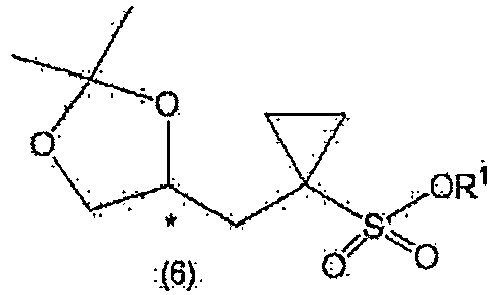
- the sulfonic acid ester represented by formula (6) can be produced by reacting the sulfonic acid ester represented by formula (5) with the2,2-dialkoxypropane represented by formula (51) in the presence of an acid.
- the present step can also be carried out without solvent, but is preferably carried out in a solvent in that the reaction mixture easily flows and it is good in handling.
- Examples of the solvent used in the step include ketone solvents such as acetone and methyl ethyl ketone; aromatic hydrocarbon solvents such as benzene, toluene, xylene and chlorobenzene; aliphatic hydrocarbon solvents such as hexane, pentane and cyclohexane; halogenated hydrocarbon solvents such as dichloromethane, chloroform, 1,2-dichloroethane and carbon tetrachloride; and ester solvents such as methyl acetate, ethyl acetate, butyl acetate and tert-butyl acetate.
- ketone solvents are preferred, and acetone is particularly preferred, from the viewpoint of reactivity.
- the amount of the solvent used is preferably a ratio of 0.5 to 10 mL and more preferably 1 to 5 mL based on 1 mmol of the sulfonic acid ester represented by formula (5).
- the amount of the 2,2-dialkoxypropane represented by formula (51) used is usually a ratio of 1.0 to 2.0 mol and preferably 1.3 to 1.7 mol based on 1 mol of the sulfonic acid ester represented by formula (5).
- Examples of the acid used in the present step include hydrochloric acid, sulfuric acid, nitric acid and acetic acid. Among them, sulfuric acid is preferred because of excellence in reactivity of the sulfonic acid ester represented by formula (5).
- the amount of the acid used is usually a ratio of 0.0001 to 0.01 equivalents and preferably 0.0005 to 0.002 equivalents based on 1 equivalent of the sulfonic acid ester represented by formula (5).
- the present step is carried out by a method of adding the acid to a mixture of the sulfonic acid ester represented by formula (5), the 2,2-dialkoxypropane represented by formula (51) and the solvent; a method of adding the 2, 2-dialkoxypropane to a mixture of the sulfonic acid ester, the acid and the solvent; a method of adding the sulfonic acid ester to a mixture of the 2,2-dialkoxypropane, the acid and the solvent; or the like, and a method of adding the acid to a mixture of the sulfonic acid ester, the 2, 2-dialkoxypropane and the solvent is preferred in that a side reaction can be well suppressed.
- the reaction temperature is preferably within a range from 0 to 50°C and more preferably 20 to 30°C.
- the reaction time is usually 1 to 20 hours and preferably 2 to 10 hours, while it also depends on the types of the sulfonic acid ester represented by formula (5), the 2,2-dialkoxypropane represented by formula (51) and the acid, and the reaction temperature.
- the sulfonic acid ester represented by formula (6) thus obtained can be isolated and purified by an ordinary method.
- the sulfonic acid ester represented by formula (6) can be isolated and purified after performing an extraction operation or by subjecting the reaction mixture directly to silica gel column chromatography.
- the reaction mixture can also be subj ected to the next step without isolation or purification.
- Configuration of the carbon atom to which * is attached in the sulfonic acid ester represented by formula (6) may be either the S configuration or the R configuration.
- the sulfonate represented by formula (7) can be produced by reacting the sulfonic acid ester represented by formula (6) with sodium iodide.
- the present step can also be carried out without solvent, but is preferably carried out in a solvent in that the reaction mixture easily flows and it is good in handling.
- ketone solvents such as acetone and methyl ethyl ketone, and water.
- ketone solvents are preferred, and acetone is particularly preferred, from the viewpoint of reactivity.
- the amount of the solvent used is preferably a ratio of 0.5 to 10 mL and more preferably 1 to 5 mL based on 1 mmol of the sulfonic acid ester represented by formula (6).
- the amount of sodium iodide used is usually a ratio of 1.0 to 2.0 mol and preferably 1.1 to 1.7 mol based on 1 mol of the sulfonic acid ester represented by formula (6).
- the present step is carried out by a method of adding sodium iodide to a mixture of the sulfonic acid ester represented by formula (6) and the solvent; a method of adding the sulfonic acid ester to a mixture of sodium iodide and the solvent; or the like, and a method of adding sodium iodide to a mixture of the sulfonic acid ester and the solvent is preferred in that a side reaction can be well suppressed.
- the reaction temperature is preferably within a range from 30 to 55°C and more preferably 45 to 55°C.
- the reaction time is usually 20 to 40 hours and preferably 20 to 30 hours, while it also depends on the type of the sulfonic acid ester represented by formula (6) and the reaction temperature.
- the sulfonate represented by formula (7) can also be produced by reacting the sulfonic acid ester represented by formula (6) with sodium hydroxide.
- the present step can also be carried out without solvent, but is preferably carried out in a solvent in that the reaction mixture easily flows and it is good in handling.
- Examples of the solvent used in the step include ketone solvents such as acetone and methyl ethyl ketone; and water. Among them, ketone solvents are preferred, and acetone is particularly preferred, from the viewpoint of reactivity.
- the amount of the solvent used is preferably a ratio of 0.5 to 10 mL and more preferably 1 to 5 mL based on 1 mmol of the sulfonic acid ester represented by formula (6).
- the amount of sodium hydroxide used is usually a ratio of 1.0 to 2.0 mol and preferably 1.1 to 1.7 mol based on 1 mol of the sulfonic acid ester represented by formula (6).
- the present step is carried out by a method of adding sodium hydroxide to a mixture of the sulfonic acid ester represented by formula (6) and the solvent; a method of adding the sulfonic acid ester to a mixture of sodium hydroxide and the solvent; or the like, and a method of adding sodium hydroxide to a mixture of the sulfonic acid ester and the solvent is preferred in that a side reaction can be well suppressed.
- the reaction temperature is preferably within a range from 0 to 55°C and more preferably 0 to 30°C.
- the reaction time is usually 1 to 10 hours and preferably 1 to 5 hours, while it also depends on the type of the sulfonic acid ester represented by formula (6) and the reaction temperature.
- the sulfonate represented by formula (7) thus obtained can be isolated and purified by an ordinary method.
- the sulfonate can be isolated and purified after performing an extraction operation or by subjecting the reaction mixture directly to silica gel column chromatography.
- Configuration of the carbon atom to which * is attached in the sulfonate represented by formula (7) may be either the S configuration or the R configuration.
- Example 3 Production of Compound Represented by Formula (3A)
- Example 5 Production of Compound Represented by Formula (4A)
- the resulting reaction mixture was kept at a temperature ranging from -30°C to -25°C for about 1.5 hours.
- the resulting reaction mixture was added dropwise to aqueous acetic acid prepared by diluting 14.7 g of acetic acid with 141 g of water, at a temperature ranging from 3°C to 10°C over 20 minutes.
- To the resulting mixture was added 52 g of toluene, the mixture was stirred at a temperature ranging from 20°C to 25°C for 30 minutes, and an organic layer obtained by separation was washed with an aqueous sodium bicarbonate solution, followed by water.
- the resulting organic layer was concentrated under reduced pressure to obtain a compound represented by formula (4A).
- Example 5 The compound represented by formula (4A) obtained in Example 5 (66.5 g), 26.3 g of ethanol and 86.4 g of cyclohexane were mixed at about 20°C, and a mixture obtained by suspending 2.78 g of activated carbon in 17.5 g of ethanol was added to the resulting mixture at about 25°C. The resulting mixture was stirred at about 25°C for 1 hour and then filtered. A solid content removed by filtration was washed with a mixed liquid of 11 g of ethanol and 22 g of cyclohexane, and the obtained washing liquid and the previously obtained filtrate were mixed.
- the resulting mixed liquid was adjusted to be at around 20°C in an autoclave under a nitrogen gas atmosphere, and 5.55 g of 10% by weight palladium carbon was added thereto.
- the inside of the autoclave was pressurized with hydrogen gas to be at 0. 2 MPa to 0. 3 MPa.
- the mixture was stirred under a pressure of hydrogen gas of 0.2 MPa to 0.3 MPa at a temperature ranging from 23°C to 26°C for about 3.5 hours, and then the gas phase part in the autoclave was replaced with nitrogen gas.
- the resulting reaction mixture was filtered, and the solid content removed by filtration was washed with a mixed liquid of 11 g of ethanol and 22 g of cyclohexane, and.the obtained washing liquid and the previously obtained filtrate were mixed.
- Water and toluene were added to the resulting mixed liquid, the mixture was separated, and then the resulting aqueous layer was extracted with a mixed liquid of toluene and cyclohexane.
- a common salt was added to the resulting aqueous layer, and the mixture was further extracted twice with ethyl acetate.
- the organic layers extracted with ethyl acetate were combined and then concentrated under reduced pressure to obtain a compound represented by formula (5A).
- Example 11 Production of Compound Represented by Formula (7A)
- Example 9 The compound represented by formula (6A) obtained in Example 9 (776 g) (about 12% by weight acetone solution) and 65.2 mg of triethylamine (0.002 times by mol to the compound represented by formula (6A)) were mixed at 25°C, and 72.4 g of sodium iodide (1.5 times by mol to the compound represented by formula (6A)) was added to the resulting mixture at a temperature ranging from 25°C to 30°C. The resulting mixture was adjusted to be at about 50°C, and stirred for 25 hours. The resulting reaction mixture was cooled to around 20°C, and triethylamine was added thereto to adjust the pH of the mixture to 10.
- the compound represented by formula (7) is a compound useful as a precursor for a chemotherapeutic medicament.
- the present invention is industrially applicable as a novel compound that can be used in producing the compound represented by formula (7) and a production method thereof.
Landscapes
- Chemical & Material Sciences (AREA)
- Organic Chemistry (AREA)
- Chemical Kinetics & Catalysis (AREA)
- Organic Low-Molecular-Weight Compounds And Preparation Thereof (AREA)
Abstract


with sodium iodide or sodium hydroxide to obtain the sulfonate represented by formula (7).
Description
- The present invention relates to a method for producing a sulfonate and the like.
- A sulfonate represented by formula (7A):
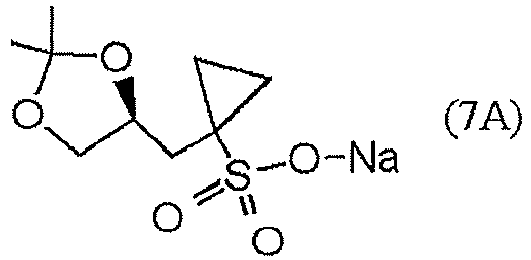
WO 2009/018238 andWO 2011/009541 ). - In Example 8 (Step A) and Example 9 of
WO 2011/009541 , a method for producing the sulfonate represented by formula (7A) according to the scheme shown below is described.
- The present invention provides a new method for producing a sulfonate represented by formula (7) shown in the following scheme and an intermediate used in the production method.
- The summary of the production method of the present invention is represented by the following scheme:

- More specifically, according to the present invention, the sulfonate represented by formula (7) can be produced from a sulfonic acid ester represented by formula (6) according to Step E. The sulfonic acid ester represented by formula (6) can be produced from a sulfonic acid ester represented by formula (5) according to Step D, and the sulfonic acid ester represented by formula (5) can be produced from a sulfonic acid ester represented by formula (4) according to Step C. The sulfonic acid ester represented by formula (4) can be produced from a sulfonic acid ester represented by formula (2) according to Step B or Step B'-1 and Step B'-2. The sulfonic acid ester represented by formula (2) can be produced from a sulfonyl halide represented by formula (1) according to Step A.
- Furthermore, according to the present invention, the sulfonate represented by formula (7):

- (Step A)
a step of reacting a sulfonyl halide represented by formula (1) :
X1- (CH2)3-SO2-X2 (1)
wherein X1 and X2 each independently represent a chlorine atom, a bromine atom or an iodine atom,
with an alcohol represented by formula (11):
R1-OH (11)
wherein R1 represents a C4 to C6 branched alkyl group,
in the presence of a base to obtain a sulfonic acid ester represented by formula (2):
X1- (CH2) 3-SO2-O-R1 (2)
wherein X1 represents a chlorine atom, a bromine atom or an iodine atom, and R1 represents a C4 to C6 branched alkyl group, - (Step B)
a step of reacting the sulfonic acid ester represented by formula (2) with a base to obtain a cyclopropanesulfonic acid ester represented by formula (3):
reacting the cyclopropanesulfonic acid ester with an epoxy compound represented by formula (31):

a step of reacting the sulfonic acid ester represented by formula (2) with the epoxy compound represented by formula (31) in the presence of a base to obtain the sulfonic acid ester represented by formula (4), - (Step C)
a step of deprotecting the sulfonic acid ester represented by formula (4) to obtain a sulfonic acid ester represented by formula (5):
- (Step D)
a step of reacting the sulfonic acid ester represented by formula (5) with a 2,2-dialkoxypropane represented by formula (51):
in the presence of an acid to obtain a sulfonic acid ester represented by formula (6):
- (Step E)
a step of reacting the sulfonic acid ester represented by formula (6) with sodium iodide or sodium hydroxide to obtain a sulfonate represented by formula (7):
- The C4 to C6 branched alkyl group represented by R1 is, for example, isobutyl, sec-butyl, tert-butyl, isopentyl, neopentyl, 1-ethylpropyl, isohexyl, 1,1-dimethylbutyl, 2,2-dimethylbutyl, 3,3-dimethylbutyl or 2-ethylbutyl, and preferably isobutyl or neopentyl.
- Examples of the protecting group of a hydroxyl group represented by R2 include benzyl ether type protecting groups such as benzyl group, 1-phenylethyl group, 1-phenylpropyl group, 1-phenylbutyl group, 2-methyl-1-phenylpropyl group, 1-phenylpentyl group, 2-methyl-1-phenylbutyl group, 3-methyl-1-phenylbutyl group, diphenylmethyl group, 1,1-diphenylethyl group, triphenylmethyl group, naphthylmethyl group and 1-naphthylethyl group; alkyl ether type protecting groups such as methyl group, tert-butyl group, 1-ethoxyethyl group, 3,4,5,6-tetrahydro-2H-pyran-2-yl group, triphenylmethyl group, 1-methoxy-1-methylethyl group, methoxymethyl group and 2-methoxyethoxymethyl group; silyl type protecting groups such as trimethylsilyl group, triethylsilyl group, tripropylsilyl group, triisopropylsilyl group, tributylsilyl group, tert-butyldimethylsilyl group and tert-butyldiphenylsilyl group; and ester type protecting groups such as acetyl group, propanoyl group, butanoyl group, isobutanoyl group, pivaloyl group, benzoyl group, 4-nitrobenzoyl group, 4-methoxybenzoyl group, 4-methylbenzoyl group, 4-tert-butylbenzoyl group, 4-fluorobenzoyl group, 4-chlorobenzoyl group, 4-bromobenzoyl group, 3-nitrobenzoyl group, 3-methoxybenzoyl group, 3-methylbenzoyl group, 3-tert-butylbenzoyl group, 3-fluorobenzoyl group, 3-chlorobenzoyl group, 3-bromobenzoyl group, 2-nitrobenzoyl group, 2-methoxybenzoyl group, 2-methylbenzoyl group, 2-tert-butylbenzoyl group, 2-fluorobenzoyl group, 2-chlorobenzoyl group, 2-bromobenzoyl group, 3,5-dinitrobenzoyl group, 3,5-dimethoxybenzoyl group, 3,5-dimethylbenzoyl group, 3,5-di-tert-butylbenzoyl group, 3,5-difluorobenzoyl group, 3,5-dichlorobenzoyl group, 3,5-dibromobenzoyl group, 2,4-dinitrobenzoyl group, 2,4-dimethoxybenzoyl group, 2,4-dimethylbenzoyl group, 2,4-di-tert-butylbenzoyl group, 2,4-difluorobenzoyl group, 2,4-dichlorobenzoyl group, 2,4-dibromobenzoyl group, 2,5-dinitrobenzoyl group, 2,5-dimethoxybenzoyl group, 2,5-dimethylbenzoyl group, 2,5-di-tert-butylbenzoyl group, 2,5-difluorobenzoyl group, 2,5-dichlorobenzoyl group, 2,5-dibromobenzoyl group, 4-phenylbenzoyl group, 2-phenylbenzoyl group, 4-methoxycarbonylbenzoyl group, 3-methoxycarbonylbenzoyl group and 2-methoxycarbonylbenzoyl group; and among them, benzyl ether type protecting groups are preferred, and benzyl group is particularly preferred.
- The C1 to C6 alkyl group represented by R3 may be either linear or branched, and examples thereof include methyl, ethyl, propyl, isopropyl, butyl, isobutyl, sec-butyl, tert-butyl, pentyl, isopentyl, neopentyl, 1-ethylpropyl, hexyl, isohexyl, 1,1-dimethylbutyl, 2,2-dimethylbutyl, 3,3-dimethylbutyl and 2-ethylbutyl.
- Next, each step will be described in more detail.
- For the sulfonyl halide represented by formula (1) and the alcohol represented by formula (11) in Step A, commercially available products can be used as they are, and they can also be prepared by a known method.
- The present step can also be carried out without solvent, but is preferably carried out in a solvent in that the reaction mixture easily flows and it is good in handling.
- Examples of the solvent used in the step include aromatic hydrocarbon solvents such as benzene, toluene, xylene and chlorobenzene; aliphatic hydrocarbon solvents such as hexane, pentane and cyclohexane; ether solvents such as diethyl ether, diisopropyl ether, tert-butyl methyl ether, tetrahydrofuran, 1,4-dioxane and 1,2-dimethoxyethane; halogenated hydrocarbon solvents such as dichloromethane, chloroform, 1,2-dichloroethane and carbon tetrachloride; nitrile solvents such as acetonitrile and propionitrile; aprotic polar solvents such as N,N-dimethylformamide, N,N-dimethylacetamide, N-methylpyrrolidone and dimethyl sulfoxide; ester solvents such as methyl acetate, ethyl acetate, butyl acetate and tert-butyl acetate; and ketone solvents such as acetone and methyl ethyl ketone. Among them, aromatic hydrocarbon solvents are preferred, and toluene is particularly preferred, in that the post-treatment is easier.
- The amount of the solvent used is preferably a ratio of 0.3 to 10 mL and more preferably 0.4 to 2.0 mL based on 1 mmol of the sulfonyl halide represented by formula (1).
- The amount of the alcohol represented by formula (11) used is preferably a ratio of 0.8 to 2.0 mol and more preferably 0. 9 to 1.1 mol based on 1 mol of the sulfonyl halide represented by formula (1).
- Examples of the base used in the present step include inorganic bases such as sodium hydroxide, potassium hydroxide, lithium hydroxide, barium hydroxide, sodium carbonate, potassium carbonate, sodium bicarbonate and potassium bicarbonate; and organic bases, for example, amine compounds such as triethylamine, diisopropylethylamine, N-methylmorpholine, 1,8-diazabicyclo[5.4.0]undec-7-ene (DBU), 1,5-diazabicyclo[4.3.0]non-5-ene (DBN), pyridine and 2,6-lutidine. Among them, weak bases, particularly amine compounds are preferred, and triethylamine is particularly preferred, in that a side reaction can be well suppressed.
- The amount of the base used is preferably a ratio of 0.8 to 2.0 mol and more preferably 0.9 to 1.1 mol based on 1 mol of the sulfonyl halide represented by formula (1).
- The present step is carried out by a method of adding the sulfoyl halide represented by formula (1) to a mixture of the alcohol represented by formula (11), the base and the solvent; a method of adding the base to a mixture of the alcohol, the sulfonyl halide and the solvent; a method of adding the alcohol to a mixture of the sulfonyl halide, the base and the solvent; or the like, and a method of adding the sulfonyl halide to a mixture of the alcohol, the base and the solvent is preferred in that the reactivity of the sulfonyl halide is better.
- The reaction temperature is preferably within a range from 0 to 40°C and more preferably 0 to 10°C.
- The reaction time is usually 1 to 10 hours and preferably 1 to 3 hours, while it also depends on the types of the sulfonyl halide represented by formula (1), the alcohol represented by formula (11) and the base, and the reaction temperature.
- The sulfonic acid ester represented by formula (2) thus obtained can be isolated and purified by an ordinary method. For example, the sulfonic acid ester can be isolated and purified after performing an extraction operation or by subjecting the reaction mixture directly to silica gel column chromatography. In addition, the reaction mixture can also be subjected to the next step without isolation or purification.
- The sulfonic acid ester represented by formula (4) can be produced by reacting the sulfonic acid ester represented by formula (2) with the epoxy compound represented by formula (31) in the presence of a base.
- The present step can also be carried out without solvent, but is preferably carried out in a solvent in that the reaction mixture easily flows and it is good in handling.
- Examples of the solvent used in the step include aromatic hydrocarbon solvents such as benzene, toluene, xylene and chlorobenzene; aliphatic hydrocarbon solvents such as hexane, pentane and cyclohexane; ether solvents such as diethyl ether, diisopropyl ether, tert-butyl methyl ether, tetrahydrofuran, 1,4-dioxane and 1,2-dimethoxyethane; and halogenated hydrocarbon solvents such as dichloromethane, chloroform, 1, 2-dichloroethane and carbon tetrachloride. Among them, when the base is an alkylalkali metal, ether solvents, aromatic hydrocarbon solvents and aliphatic hydrocarbon solvents are preferred, and tetrahydrofuran, toluene and hexane are particularly preferred, in that the alkylalkali metal is not remarkably decomposed.
- The amount of the solvent used is preferably a ratio of 0.3 to 10 mL and more preferably 0.5 to 2.0 mL based on 1 mmol of the sulfonic acid ester represented by formula (2).
- The amount of the epoxy compound represented by formula (31) used is preferably a ratio of 0.8 to 2.0 mol and more preferably 0.9 to 1.1 mol based on 1 mol of the sulfonic acid ester represented by formula (2).
- Examples of the base used in the present step include alkali metal hydrides such as lithium hydride, sodium hydride and potassium hydride; alkali metal amides such as lithium amide, sodium amide and lithium diisopropylamide; alkylalkali metals such as n-butyllithium, sec-butyllithium and tert-butyllithium; and alkali metal alkoxides such as sodium methoxide, sodium ethoxide, potassium tert-butoxide and sodium tert-butoxide. Among them, strong bases, particularly, alkylalkali metals are preferred, alkyllithium is more preferred, and n-butyllithium is particularly preferred, from the viewpoint of having good reactivity. n-Butyllithium is usually used in the form of a hexane solution.
- The amount of the base used is preferably a ratio of 1.8 to 3.0 equivalents and more preferably 2.0 to 2.2 equivalents based on 1 equivalent of the sulfonic acid ester represented by formula (2).
- The present step is carried out by a method of adding the base to a mixture of the sulfonic acid ester represented by formula (2), the epoxy compound represented by formula (31) and the solvent; a method of adding the epoxy compound to a mixture of the sulfonic acid ester, the base and the solvent; a method of adding the sulfonic acid ester to a mixture of the epoxy compound, the base and the solvent; or the like, and a method of adding the base to a mixture of the sulfonic acid ester, the epoxy compound and the solvent is preferred in that a side reaction can be well suppressed.
- The reaction temperature is preferably within a range from -80 to 0°C and more preferably -40 to -20°C.
- The reaction time is usually 0.5 to 15 hours and preferably 1 to 5 hours, while it also depends on the types of the sulfonic acid ester represented by formula (2), the epoxy compound represented by formula (31) and the base, and the reaction temperature.
- The sulfonic acid ester represented by formula (4) thus obtained can be isolated and purified by an ordinary method. For example, the sulfonic acid ester compound (4) can be isolated and purified after performing an extraction operation or by subjecting the reaction mixture directly to silica gel column chromatography. Alternatively, the reaction mixture can also be subjected to the next step without isolation and purification.
- The sulfonic acid ester represented by formula (4) can also be produced by a method through a step of reacting the sulfonic acid ester represented by formula (2) with a base to obtain the cyclopropanesulfonic acid ester represented by formula (3) (Step B'-1) and a step of reacting the cyclopropanesulfonic acid ester represented by formula (3) with the epoxy compound represented by formula (31) in the presence of a base (Step B'-2).
- The present step is a step of reacting the sulfonic acid ester represented by formula (2) with a base to obtain the cyclopropanesulfonic acid ester represented by formula (3).
- Examples of the base used in the present step include alkali metal hydrides such as lithium hydride, sodium hydride and potassium hydride; alkali metal amides such as lithium amide, sodium amide and lithium diisopropylamide; alkylalkali metals such as n-butyllithium, sec-butyllithium and tert-butyllithium; and alkali metal alkoxides such as sodium methoxide, sodium ethoxide, potassium tert-butoxide and sodium tert-butoxide. Among them, strong bases, particularly, alkylalkali metals are preferred, alkyllithium is more preferred, and n-butyllithium is particularly preferred, from the viewpoint of having good reactivity. n-Butyllithium is usually used in the form of a hexane solution.
- The amount of the base used is preferably a ratio of 0.9 to 1.5 equivalents and more preferably 1.0 to 1.2 equivalents based on 1 equivalent of the sulfonic acid ester represented by formula (2).
- The present step can also be carried out without solvent, but is preferably carried out in a solvent in that the reaction mixture easily flows and it is good in handling.
- Examples of the solvent used in the step include aromatic hydrocarbon solvents such as benzene, toluene, xylene and chlorobenzene; aliphatic hydrocarbon solvents such as hexane, pentane and cyclohexane; ether solvents such as diethyl ether, diisopropyl ether, tert-butyl methyl ether, tetrahydrofuran, 1,4-dioxane and 1,2-dimethoxyethane; and halogenated hydrocarbon solvents such as dichloromethane, chloroform, 1, 2-dichloroethane and carbon tetrachloride. Among them, when the base is a preferable alkylalkali metal, ether solvents and aliphatic hydrocarbon solvents are preferred, and tetrahydrofuran and hexane are particularly preferred, in that the alkylalkali metal is not remarkably decomposed.
- The amount of the solvent used is preferably a ratio of 0.3 to 10 mL and more preferably 0.5 to 2.0 mL based on 1 mmol of the sulfonic acid ester compound (2).
- The present step is carried out by a method of adding the base to a mixture of the sulfonic acid ester represented by formula (2) and the solvent; a method of adding the sulfonic acid ester to a mixture of the base and the solvent; or the like, and a method of adding the base to a mixture of the sulfonic acid ester and the solvent is preferred in that a side reaction can be well suppressed.
- The reaction temperature is preferably within a range from -80 to 0°C and more preferably -80 to -20°C.
- The reaction time is usually 0.5 to 15 hours and preferably 1 to 5 hours, while it also depends on the types of the sulfonic acid ester represented by formula (2) and the base, and the reaction temperature.
- The cyclopropanesulfonic acid ester represented by formula (3) thus obtained can be isolated and purified by an ordinary method. For example, the cyclopropanesulfonic acid ester represented by formula (3) can be isolated and purified after performing an extraction operation or by subjecting the reaction mixture directly to silica gel column chromatography. Alternatively, the reaction mixture can also be subjected to the following step B'-2 without isolation or purification.
- The present step is a step of reacting the cyclopropanesulfonic acid ester represented by formula (3) with the epoxy compound represented by formula (31) in the presence of a base to obtain the sulfonic acid ester represented by formula (4).
- Examples of the base used in the present step include alkali metal hydrides such as lithium hydride, sodium hydride and potassium hydride; alkali metal amides such as lithium amide, sodium amide and lithium diisopropylamide; alkylalkali metals such as n-butyllithium, sec-butyllithium and tert-butyllithium; and alkali metal alkoxides such as sodium methoxide, sodium ethoxide, potassium tert-butoxide and sodium tert-butoxide. Among them, strong bases, particularly, alkylalkali metals are preferred, alkyllithium is more preferred, and n-butyllithium is particularly preferred, from the viewpoint of having good reactivity. n-Butyllithium is usually used in the form of a hexane solution.
- The amount of the base used is preferably a ratio of 0.9 to 1.5 equivalents and more preferably 1.0 to 1.2 equivalents based on 1 equivalent of the cyclopropanesulfonic acid ester represented by formula (3).
- The present step can also be carried out without solvent, but is preferably carried out in a solvent in that the reaction mixture easily flows and it is good in handling.
- Examples of the solvent used in the step include aromatic hydrocarbon solvents such as benzene, toluene, xylene and chlorobenzene; aliphatic hydrocarbon solvents such as hexane, pentane and cyclohexane; ether solvents such as diethyl ether, diisopropyl ether, tert-butyl methyl ether, tetrahydrofuran, 1,4-dioxane and 1,2-dimethoxyethane; and halogenated hydrocarbon solvents such as dichloromethane, chloroform, 1, 2-dichloroethane and carbon tetrachloride. Among them, when the base is a preferable alkylalkali metal, ether solvents, aromatic hydrocarbon solvents and aliphatic hydrocarbon solvents are preferred, and tetrahydrofuran, toluene and hexane are particularly preferred, in that the alkylalkali metal is not remarkably decomposed.
- The amount of the solvent used is preferably a ratio of 0.3 to 10 mL and more preferably 0.5 to 2.0 mL based on 1 mmol of the cyclopropanesulfonic acid ester represented by formula (3).
- The amount of the epoxy compound represented by formula (31) used is preferably a ratio of 0.8 to 2.0 mol and more preferably 0.9 to 1.1 mol based on 1 mol of the cyclopropanesulfonic acid ester represented by formula (3).
- The present step is carried out by a method of adding the epoxy compound represented by formula (31) to a mixture of the cyclopropanesulfonic acid ester represented by formula (3), the base and the solvent; a method of adding the cyclopropanesulfonic acid ester to a mixture of the epoxy compound, the base and the solvent; a method of adding the base to a mixture of the cyclopropanesulfonic acid ester, the epoxy compound and the solvent; or the like, and a method of adding the base to a mixture of the cyclopropanesulfonic acid ester, the epoxy compound and the solvent is preferred in that a side reaction can be well suppressed.
- The reaction temperature is preferably within a range from -80 to 0°C and more preferably -80 to -20°C.
- The reaction time is usually 0.5 to 15 hours and preferably 1 to 5 hours, while it also depends on the types of the cyclopropanesulfonic acid ester represented by formula (3), the epoxy compound represented by formula (31) and the base, and the reaction temperature.
- The sulfonic acid ester represented by formula (4) thus obtained can be isolated and purified by an ordinary method. For example, the sulfonic acid ester represented by formula (4) can be isolated and purified after performing an extraction operation or by subjecting the reaction mixture directly to silica gel column chromatography. Alternatively, the reaction mixture can also be subjected to the next step without isolation or purification.
- Configuration of the carbon atom to which * is attached in the sulfonic acid ester represented by formula (4) may be either the S configuration or the R configuration.

- In order to obtain an optically active sulfonic acid ester represented by formula (4), depending on the desired configuration of the carbon atom to which * is attached in the above formula, one having a configuration of the carbon atom to which * is attached in the epoxy compound (31) represented by formula (31) may be selected as a raw material.

- The sulfonic acid ester represented by formula (5) can be produced by deprotecting the sulfonic acid ester represented by formula (4).
- The method of deprotecting the sulfonic acid ester represented by formula (5) is selected depending on the protecting group of a hydroxyl group of R2, and when R2 is a benzyl ether protecting group, deprotection can be performed by catalytic reduction. Catalytic reduction is performed by reacting the sulfonic acid ester represented by formula (4) in a solvent in the presence of a metal catalyst and a hydrogen source.
- Examples of the metal catalyst used include palladium-carbon, palladium black, palladium chloride, palladium hydroxide, rhodium-carbon, platinum oxide, platinum black, platinum-palladium, Raney nickel, and Raney cobalt. Among them, palladium-carbon is preferred from the viewpoint of reactivity of the sulfonic acid ester represented by formula (4).
- The amount of the metal catalyst used is usually a ratio of 0.01 to 0. 30 times by weight and preferably 0. 03 to 0.10 times by weight based on that of the sulfonic acid ester represented by formula (4).
- Examples of the hydrogen source used include hydrogen gas.
- The present step can also be carried out without solvent, but is preferably carried out in a solvent in that the reaction mixture easily flows and it is good in handling.
- Examples of the solvent used in the present step include alcohol solvents such as methanol, ethanol, propanol, 2-propanol, butanol, isobutanol, tert-butanol and cyclohexanol; ether solvents such as diethyl ether, diisopropyl ether, tert-butyl methyl ether, tetrahydrofuran, 1,4-dioxane and 1,2-dimethoxyethane; aromatic hydrocarbon solvents such as benzene, toluene, xylene and chlorobenzene; aliphatic hydrocarbon solvents such as hexane, pentane and cyclohexane; and halogenated hydrocarbon solvents such as dichloromethane, chloroform, 1,2-dichloroethane and carbon tetrachloride. Among them, alcohol solvents are preferred, and ethanol is particularly preferred, from the viewpoint of reactivity.
- The amount of the solvent used is preferably a ratio of 0.3 to 10 mL and more preferably 0.5 to 2.0 mL based on 1 mmol of the sulfonic acid ester represented by formula (4).
- The present step is carried out by a method of adding the hydrogen source to a mixture of the sulfonic acid ester represented by formula (4), the metal catalyst and the solvent.
- The reaction temperature is preferably within a range from 10 to 50°C and more preferably 20 to 30°C.
- The reaction time is, for example, 1 to 10 hours and preferably 3 to 5 hours, while it also depends on the type of the sulfonic acid ester represented by formula (4) and the reaction temperature.
- The sulfonic acid ester represented by formula (5) thus obtained can be isolated and purified by an ordinary method. For example, the sulfonic acid ester compound (5) can be isolated and purified after performing an extraction operation or by subjecting the reaction mixture directly to silica gel column chromatography. Alternatively, the reaction mixture can also be subjected to the next step without isolation or purification.
- Configuration of the carbon atom to which * is attached in the sulfonic acid ester compound (5) may be either the S configuration or the R configuration.

- In order to obtain an optically active sulfonic acid ester represented by formula (5), depending on the desired configuration of the carbon atom to which * is attached in the above formula, one having a configuration of the carbon atom to which * is attached in the sulfonic acid ester represented by formula (4) may be selected as a raw material.

- The sulfonic acid ester represented by formula (6) can be produced by reacting the sulfonic acid ester represented by formula (5) with the2,2-dialkoxypropane represented by formula (51) in the presence of an acid.
- The present step can also be carried out without solvent, but is preferably carried out in a solvent in that the reaction mixture easily flows and it is good in handling.
- Examples of the solvent used in the step include ketone solvents such as acetone and methyl ethyl ketone; aromatic hydrocarbon solvents such as benzene, toluene, xylene and chlorobenzene; aliphatic hydrocarbon solvents such as hexane, pentane and cyclohexane; halogenated hydrocarbon solvents such as dichloromethane, chloroform, 1,2-dichloroethane and carbon tetrachloride; and ester solvents such as methyl acetate, ethyl acetate, butyl acetate and tert-butyl acetate. Among them, ketone solvents are preferred, and acetone is particularly preferred, from the viewpoint of reactivity.
- The amount of the solvent used is preferably a ratio of 0.5 to 10 mL and more preferably 1 to 5 mL based on 1 mmol of the sulfonic acid ester represented by formula (5).
- The amount of the 2,2-dialkoxypropane represented by formula (51) used is usually a ratio of 1.0 to 2.0 mol and preferably 1.3 to 1.7 mol based on 1 mol of the sulfonic acid ester represented by formula (5).
- Examples of the acid used in the present step include hydrochloric acid, sulfuric acid, nitric acid and acetic acid. Among them, sulfuric acid is preferred because of excellence in reactivity of the sulfonic acid ester represented by formula (5). The amount of the acid used is usually a ratio of 0.0001 to 0.01 equivalents and preferably 0.0005 to 0.002 equivalents based on 1 equivalent of the sulfonic acid ester represented by formula (5).
- The present step is carried out by a method of adding the acid to a mixture of the sulfonic acid ester represented by formula (5), the 2,2-dialkoxypropane represented by formula (51) and the solvent; a method of adding the 2, 2-dialkoxypropane to a mixture of the sulfonic acid ester, the acid and the solvent; a method of adding the sulfonic acid ester to a mixture of the 2,2-dialkoxypropane, the acid and the solvent; or the like, and a method of adding the acid to a mixture of the sulfonic acid ester, the 2, 2-dialkoxypropane and the solvent is preferred in that a side reaction can be well suppressed.
- The reaction temperature is preferably within a range from 0 to 50°C and more preferably 20 to 30°C.
- The reaction time is usually 1 to 20 hours and preferably 2 to 10 hours, while it also depends on the types of the sulfonic acid ester represented by formula (5), the 2,2-dialkoxypropane represented by formula (51) and the acid, and the reaction temperature.
- The sulfonic acid ester represented by formula (6) thus obtained can be isolated and purified by an ordinary method. For example, the sulfonic acid ester represented by formula (6) can be isolated and purified after performing an extraction operation or by subjecting the reaction mixture directly to silica gel column chromatography. Alternatively, the reaction mixture can also be subj ected to the next step without isolation or purification.
- Configuration of the carbon atom to which * is attached in the sulfonic acid ester represented by formula (6) may be either the S configuration or the R configuration.

- In order to obtain an optically active sulfonic acid ester represented by formula (6), depending on the desired configuration of the carbon atom to which * is attached in the above formula, one having a configuration of the carbon atom to which * is attached in the sulfonic acid ester represented by formula (5) may be selected as a raw material.

- The sulfonate represented by formula (7) can be produced by reacting the sulfonic acid ester represented by formula (6) with sodium iodide.
- The present step can also be carried out without solvent, but is preferably carried out in a solvent in that the reaction mixture easily flows and it is good in handling.
- Examples of the solvent used include ketone solvents such as acetone and methyl ethyl ketone, and water. Among them, ketone solvents are preferred, and acetone is particularly preferred, from the viewpoint of reactivity.
- The amount of the solvent used is preferably a ratio of 0.5 to 10 mL and more preferably 1 to 5 mL based on 1 mmol of the sulfonic acid ester represented by formula (6).
- The amount of sodium iodide used is usually a ratio of 1.0 to 2.0 mol and preferably 1.1 to 1.7 mol based on 1 mol of the sulfonic acid ester represented by formula (6).
- The present step is carried out by a method of adding sodium iodide to a mixture of the sulfonic acid ester represented by formula (6) and the solvent; a method of adding the sulfonic acid ester to a mixture of sodium iodide and the solvent; or the like, and a method of adding sodium iodide to a mixture of the sulfonic acid ester and the solvent is preferred in that a side reaction can be well suppressed.
- The reaction temperature is preferably within a range from 30 to 55°C and more preferably 45 to 55°C.
- The reaction time is usually 20 to 40 hours and preferably 20 to 30 hours, while it also depends on the type of the sulfonic acid ester represented by formula (6) and the reaction temperature.
- The sulfonate represented by formula (7) can also be produced by reacting the sulfonic acid ester represented by formula (6) with sodium hydroxide.
- The present step can also be carried out without solvent, but is preferably carried out in a solvent in that the reaction mixture easily flows and it is good in handling.
- Examples of the solvent used in the step include ketone solvents such as acetone and methyl ethyl ketone; and water. Among them, ketone solvents are preferred, and acetone is particularly preferred, from the viewpoint of reactivity.
- The amount of the solvent used is preferably a ratio of 0.5 to 10 mL and more preferably 1 to 5 mL based on 1 mmol of the sulfonic acid ester represented by formula (6).
- The amount of sodium hydroxide used is usually a ratio of 1.0 to 2.0 mol and preferably 1.1 to 1.7 mol based on 1 mol of the sulfonic acid ester represented by formula (6).
- The present step is carried out by a method of adding sodium hydroxide to a mixture of the sulfonic acid ester represented by formula (6) and the solvent; a method of adding the sulfonic acid ester to a mixture of sodium hydroxide and the solvent; or the like, and a method of adding sodium hydroxide to a mixture of the sulfonic acid ester and the solvent is preferred in that a side reaction can be well suppressed.
- The reaction temperature is preferably within a range from 0 to 55°C and more preferably 0 to 30°C.
- The reaction time is usually 1 to 10 hours and preferably 1 to 5 hours, while it also depends on the type of the sulfonic acid ester represented by formula (6) and the reaction temperature.
- The sulfonate represented by formula (7) thus obtained can be isolated and purified by an ordinary method. For example, the sulfonate can be isolated and purified after performing an extraction operation or by subjecting the reaction mixture directly to silica gel column chromatography.
- Configuration of the carbon atom to which * is attached in the sulfonate represented by formula (7) may be either the S configuration or the R configuration.

- In order to obtain an optically active sulfonate represented by formula (7), depending on the desired configuration of the carbon atom to which * is attached in the above formula, one having a configuration of the carbon atom to which * is attached in the sulfonic acid ester represented by formula (6) may be selected as a raw material.
- Hereinafter, the present invention will be described in further detail by Examples.
-

- Under a nitrogen gas atmosphere, 242.2 g of toluene, 30.8 g of isobutyl alcohol (1.05 times by mol to 3-chloropropanesulfanyl chloride) and 41.2 g of triethylamine (1.03 times by mol to 3-chloropropanesulfonyl chloride) were mixed at room temperature, and the resulting mixture was cooled to 3°C. Thereto was added dropwise 70 g of 3-chloropropanesulfonyl chloride while keeping the temperature of the resulting mixture in a range from 3°C to 8°C. About 3 hours were taken for the dropwise addition. After completion of the dropwise addition, 30.3 g of toluene was added to the resulting mixture, and the resulting mixture was stirred at a temperature ranging from 2°C to 5°C for 1 hour. After completion of the reaction, 140 g of water was added dropwise to the resulting mixture while keeping the temperature of the resulting mixture in a range from 0°C to 10°C, and 2.1 g of 35% by weight of hydrochloric acid was further added dropwise. The temperature of the resulting mixture was adj usted within a range from 20°C to 25°C, the resulting mixture was stirred at that temperature for 30 minutes, and then an organic layer obtained by separation was washed with an aqueous sodium bicarbonate solution. The separated organic layer was concentrated under reduced pressure to obtain 90 g of a compound represented by formula (2A). The chemical purity of the compound represented by formula (2A) was 95.1%, and the yield was 100%.
1H-NMR (400MHz,CDCl3)δ: 4.02(2H,d), 3.70(2H,t), 3.30(2H,t), 2.34(2H,m), 2.05(1H,m), 0.99(6H,d) - The same experiment as in Example 1 is carried out except for replacing isobutyl alcohol in Example 1 with neopentyl alcohol, and thus a compound represented by formula (2) wherein X1 is a chlorine atom and R1 is a neopentyl group can be produced. Example 3: Production of Compound Represented by Formula (3A)
-

- The compound represented by formula (2A) obtained in Example 1 (130 g) and 920 mL of tetrahydrofuran were mixed at room temperature, and the mixture was cooled to -72°C. A 2.5 mol/L n-butyllithium/hexane solution (the amount of n-butyllithium was 1.1 times by mol that of the compound represented by formula (2A)) was added dropwise thereto at a temperature ranging from -72°C to -67°C over 1 hour. After the dropwise addition, the resulting mixture was stirred at a temperature ranging from -77°C to -72°C for 3 hours, and the resulting mixture was heated to around 0°C. Thereto were added 130 mL of water, 650 mL of methyl tert-butyl ether and 130 mL of aqueous 5% by weight acetic acid, and the mixture was stirred at a temperature ranging from -18°C to -11°C for 30 minutes. After separation, the resulting aqueous layer was mixed with 390 mL of methyl tert-butyl ether, and the organic layer obtained by separation was combined with the organic layer obtained by the previous separation. The combined organic layers were concentrated under reduced pressure to obtain 103 g of a compound represented by formula (3A). The chemical purity of the compound represented by formula (3A) was 96.7%, and the yield was 93%.
(1H-NMR(400MHz),CDCl3)δ: 4.01(2H,d), 2.47(1H,m), 2.04(1H,m), 1.27(2H,m), 1.07(2H,m), 0.99(6H,d) - The same experiment as in Examples 1 and 3 is carried out except for replacing isobutyl alcohol in Example 1 with neopentyl alcohol, and thus a compound represented by formula (3) wherein R1 is a neopentyl group can be produced. Example 5: Production of Compound Represented by Formula (4A)
-

- Under a nitrogen gas atmosphere, 42.4 g of the compound represented by formula (2A) obtained in Example 1, 71.3 g of tetrahydrofuran, 30.8 g of (S)-benzyl glycidyl ether (1 time by mol that of the compound represented by formula (2A)) and 69.7 g of toluene were mixed at room temperature, and the resulting mixture was cooled to -30°C. Thereto was added dropwise 167 g of a 15% by weight n-butyllithium/hexane solution (the amount of n-butyllithium was 2.1 times by mol that of the compound represented by formula (2A)) at a temperature ranging from -30°C to -25°C over about 6 hours. After completion of the dropwise addition, the resulting reaction mixture was kept at a temperature ranging from -30°C to -25°C for about 1.5 hours. The resulting reaction mixture was added dropwise to aqueous acetic acid prepared by diluting 14.7 g of acetic acid with 141 g of water, at a temperature ranging from 3°C to 10°C over 20 minutes. To the resulting mixture was added 52 g of toluene, the mixture was stirred at a temperature ranging from 20°C to 25°C for 30 minutes, and an organic layer obtained by separation was washed with an aqueous sodium bicarbonate solution, followed by water. The resulting organic layer was concentrated under reduced pressure to obtain a compound represented by formula (4A). The chemical purity of the compound represented by formula (4A) was 83%, and the yield was 87%.
1H-NMR(400MHz,CDCl3)δ: 7.30-7.37(5H,m), 4.55(2H,d), 4.20(1H,m), 4.00(2H,m), 3.51(1H,dd), 3.41(1H,dd), 2.61(1H,d), 2.13(1H,dd), 2.03(1H,m), 1.83(1H,dd), 1.45(2H,m), 1.20(1H,m), 0.98(6H,d), 0.96(1H,m) - The same experiment as in Examples 1, 3 and 5 is carried out except for replacing isobutyl alcohol in Example 1 with neopentyl alcohol, and thus a compound represented by formula (4) wherein R1 is a neopentyl group and R2 is a benzyl group can be produced.
-

- The compound represented by formula (4A) obtained in Example 5 (66.5 g), 26.3 g of ethanol and 86.4 g of cyclohexane were mixed at about 20°C, and a mixture obtained by suspending 2.78 g of activated carbon in 17.5 g of ethanol was added to the resulting mixture at about 25°C. The resulting mixture was stirred at about 25°C for 1 hour and then filtered. A solid content removed by filtration was washed with a mixed liquid of 11 g of ethanol and 22 g of cyclohexane, and the obtained washing liquid and the previously obtained filtrate were mixed. The resulting mixed liquid was adjusted to be at around 20°C in an autoclave under a nitrogen gas atmosphere, and 5.55 g of 10% by weight palladium carbon was added thereto. After sealing the autoclave, the inside of the autoclave was pressurized with hydrogen gas to be at 0. 2 MPa to 0. 3 MPa. The mixture was stirred under a pressure of hydrogen gas of 0.2 MPa to 0.3 MPa at a temperature ranging from 23°C to 26°C for about 3.5 hours, and then the gas phase part in the autoclave was replaced with nitrogen gas. The resulting reaction mixture was filtered, and the solid content removed by filtration was washed with a mixed liquid of 11 g of ethanol and 22 g of cyclohexane, and.the obtained washing liquid and the previously obtained filtrate were mixed. Water and toluene were added to the resulting mixed liquid, the mixture was separated, and then the resulting aqueous layer was extracted with a mixed liquid of toluene and cyclohexane. A common salt was added to the resulting aqueous layer, and the mixture was further extracted twice with ethyl acetate. The organic layers extracted with ethyl acetate were combined and then concentrated under reduced pressure to obtain a compound represented by formula (5A). The chemical purity of the compound represented by formula (5A) was 97%, and the yield was 99%.
1H-NMR(400MHz, CDCl3)δ: 4.12(1H,m), 4.02(2H,m), 3.66(1H,dd), 3.47(1H,dd), 3.15(1H,br s), 2.44(1H,br s), 2.03(2H,m), 1.86(1H,dd), 1.49(2H,m), 1.15(1H,m), 1.00(6H,d), 0.96(1H,m) Example 8: Production of Compound Represented by Formula (5) - The same experiment as in Examples 1, 3, 5 and 7 is carried out except for replacing isobutyl alcohol in Example 1 with neopentyl alcohol, and thus a compound represented by formula (5) wherein R1 is a neopentyl group can be produced.
-

- The compound represented by formula (5A) obtained in Example 7 (83.8 g), 642 g of acetone and 50.3 g (1.5 mol based on 1 mol of the compound represented by formula (5A)) of 2,2-dimethoxypropane were mixed, and the resulting mixture was adjusted to be at about 25°C. Thereto was added dropwise 31.6 mg (0.001 mol based on 1 mol of the compound represented by formula (5A)) of concentrated sulfuric acid, and the resulting mixture was stirred at 24°C to 28°C for 8 hours to obtain a compound represented by formula (6A).
1H-NMR(400MHz,CDCl3)δ: 4.41(1H,m), 4.12(1H,dd), 4.00(2H,m), 3.47(1H,dd), 2.35(1H,dd), 2.04(1H,m), 1.83(1H,dd), 1.45(2H,m), 1.38(3H,s), 1.34(3H,s), 1.23(1H,m), 0.98(7H,m) - The same experiment as in Examples 1, 3, 5, 7 and 9 is carried out except for replacing isobutyl alcohol in Example 1 with neopentyl alcohol, and thus a compound represented by formula (6) wherein R1 is a neopentyl group can be produced. Example 11: Production of Compound Represented by Formula (7A)
-

- The compound represented by formula (6A) obtained in Example 9 (776 g) (about 12% by weight acetone solution) and 65.2 mg of triethylamine (0.002 times by mol to the compound represented by formula (6A)) were mixed at 25°C, and 72.4 g of sodium iodide (1.5 times by mol to the compound represented by formula (6A)) was added to the resulting mixture at a
temperature ranging from 25°C to 30°C. The resulting mixture was adjusted to be at about 50°C, and stirred for 25 hours. The resulting reaction mixture was cooled to around 20°C, and triethylamine was added thereto to adjust the pH of the mixture to 10. The mixture of which pH was adjusted was stirred at 20°C for 10 minutes and then filtered, and the resulting solid was washed with acetone. The solid washed was concentrated under reduced pressure to obtain a compound represented by formula (7A). The yield was 77%.
1H-NMR(400MHz, DMSO-d6)δ: 4.43(1H,m), 4.01(1H, dd), 3.47(1H,dd), 1.96(1H,dd), 1.69(1H,dd), 1.25(3H,s), 1.21(3H,s), 0.84(2H,dd), 0.44(2H,m) - The same experiment as in Examples 1, 3, 5, 7, 9 and 11 is carried out except for replacing isobutyl alcohol in Example 1 with neopentyl alcohol, and thus a compound represented by formula (7) can be produced.
- The compound represented by formula (7) is a compound useful as a precursor for a chemotherapeutic medicament. The present invention is industrially applicable as a novel compound that can be used in producing the compound represented by formula (7) and a production method thereof.
Claims (10)
- A method for producing a sulfonate represented by formula (7) :
 (Step E)
a step of reacting a sulfonic acid ester represented by formula (6):
with sodium iodide or sodium hydroxide to obtain the sulfonate represented by formula (7). - The method for producing the sulfonate according to claim 1, which comprises:(Step D)
a step of reacting a sulfonic acid ester represented by formula (5):

in the presence of an acid to obtain a sulfonic acid ester represented by formula (6):
and(Step E)
a step of reacting the sulfonic acid ester represented by formula (6) with sodium iodide or sodium hydroxide to obtain the sulfonate represented by formula (7) :
- The method for producing the sulfonate according to claim 1, which comprises(Step B)
a step of reacting a sulfonic acid ester represented by formula (2):
X1- (CH2) 3-SO2-O-R1 (2)
wherein X1 represents a chlorine atom, a bromine atom or an iodine atom, and R1 represents a C4 to C6 branched alkyl group,
with an epoxy compound represented by formula (31):
 (Step C)
a step of deprotecting the sulfonic acid ester represented by formula (4) to obtain a sulfonic acid ester represented by formula (5): (Step D)
a step of reacting the sulfonic acid ester represented by formula (5) with a 2, 2-dialkoxypropane represented by formula (51):
in the presence of an acid to obtain a sulfonic acid ester represented by formula (6)
and(Step E)
a step of reacting the sulfonic acid ester represented by formula (6) with sodium iodide or sodium hydroxide to obtain the sulfonate represented by formula (7) :
- The method for producing the sulfonate according to claim 1, which comprises:(Step B'-1)
a step of reacting a sulfonic acid ester represented by formula (2):
X1- (CH2)3-SO2-O-R1 (2)
wherein X1 represents a chlorine atom, a bromine atom or an iodine atom, and R1 represents a C4 to C6 branched alkyl group, with a base to obtain a cyclopropanesulfonic acid ester represented by formula (3): (Step B'-2)
a step of reacting the cyclopropanesulfonic acid ester represented by formula (3) with an epoxy compound represented by formula (31):
 (Step C)
a step of deprotecting the sulfonic acid ester represented by formula (4) to obtain a sulfonic acid ester represented by formula (5): (Step D)
a step of reacting the sulfonic acid ester represented by formula (5) with a 2,2-dialkoxypropane represented by formula (51):
in the presence of an acid to obtain a sulfonic acid ester represented by formula (6):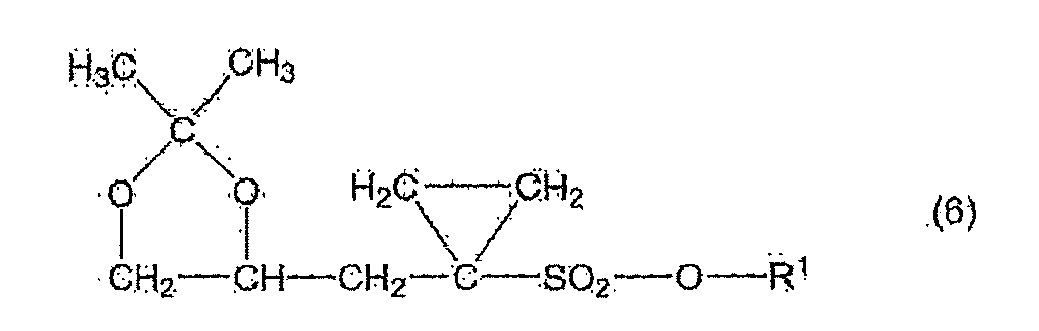
and
(Step E)
a step of reacting the sulfonic acid ester represented by formula (6) with sodium iodide or sodium hydroxide to obtain the sulfonate represented by formula (7):
- The method for producing the sulfonate according to claim 1, which comprises:(Step A)
a step of reacting a sulfonyl halide represented by formula (1) :
X1- (CH2)3-SO2-X2 (1)
wherein X1 represents a chlorine atom, a bromine atom or an iodine atom,
with an alcohol represented by formula (11):
R1-OH (11)
wherein R1 represents a C4 to C6 branched alkyl group,
in the presence of a base to obtain a sulfonic acid ester represented by formula (2):
X1- (CH2)3-SO2-O-R1 (2)
wherein X1 represents a chlorine atom, a bromine atom or an iodine atom, and R1 is defined above,(Step B)
a step of reacting the sulfonic acid ester represented by formula (2) with a base to obtain a cyclopropanesulfonic acid ester represented by formula (3):
and then
reacting the cyclopropanesulfonic acid ester represented by formula (3) with an epoxy compound represented by formula (31):
in the presence of a base to obtain a sulfonic acid ester represented by formula (4):
or
a step of reacting the sulfonic acid ester represented by formula (2) with the epoxy compound represented by formula (31) in the presence of a base to obtain the sulfonic acid ester represented by formula (4)(Step C)
a step of deprotecting the sulfonic acid ester represented by formula (4) to obtain a sulfonic acid ester represented by formula (5): (Step D)
a step of reacting the sulfonic acid ester represented by formula (5) with a 2,2-dialkoxypropane represented by formula (51):
in the presence of an acid to obtain a sulfonic acid ester
represented by formula (6):
and(Step E)
a step of reacting the sulfonic acid ester represented by formula (6) with sodium iodide or sodium hydroxide to obtain the sulfonate represented by formula (7) :
- A sulfonic acid ester represented by formula (6):

- A sulfonic acid ester represented by formula (5):

- A sulfonic acid ester represented by formula (4):

- A cyclopropanesulfonic acid ester represented by formula (3):

- A sulfonic acid ester represented by formula (2):
X1- (CH2) 3-SO2-O-R1 (2)
wherein X1 represents a chlorine atom, a bromine atom or an iodine atom, and R1 represents a C4 to C6 branched alkyl group.
Applications Claiming Priority (7)
| Application Number | Priority Date | Filing Date | Title |
|---|---|---|---|
| JP2011277700 | 2011-12-19 | ||
| JP2011277701 | 2011-12-19 | ||
| JP2011277697 | 2011-12-19 | ||
| JP2011277702 | 2011-12-19 | ||
| JP2011277699 | 2011-12-19 | ||
| JP2011277698 | 2011-12-19 | ||
| PCT/JP2012/082588 WO2013094546A1 (en) | 2011-12-19 | 2012-12-10 | Method for producing sulfonate |
Publications (2)
| Publication Number | Publication Date |
|---|---|
| EP2796455A1 true EP2796455A1 (en) | 2014-10-29 |
| EP2796455A4 EP2796455A4 (en) | 2015-08-19 |
Family
ID=48668437
Family Applications (1)
| Application Number | Title | Priority Date | Filing Date |
|---|---|---|---|
| EP12859632.7A Withdrawn EP2796455A4 (en) | 2011-12-19 | 2012-12-10 | PROCESS FOR PRODUCING SULFONATE |
Country Status (4)
| Country | Link |
|---|---|
| EP (1) | EP2796455A4 (en) |
| JP (1) | JPWO2013094546A1 (en) |
| CN (1) | CN104011039A (en) |
| WO (1) | WO2013094546A1 (en) |
Family Cites Families (8)
| Publication number | Priority date | Publication date | Assignee | Title |
|---|---|---|---|---|
| SI1912636T1 (en) * | 2005-07-21 | 2014-08-29 | Ardea Biosciences, Inc. | N-(arylamino)-sulfonamide inhibitors of mek |
| CA2618218C (en) * | 2005-07-21 | 2015-06-30 | Ardea Biosciences, Inc. | N-(arylamino)-sulfonamide inhibitors of mek |
| US8101799B2 (en) * | 2005-07-21 | 2012-01-24 | Ardea Biosciences | Derivatives of N-(arylamino) sulfonamides as inhibitors of MEK |
| CA2924436A1 (en) | 2007-07-30 | 2009-02-05 | Ardea Biosciences, Inc. | Pharmaceutical combinations of n-(3,4-difluoro-2-(2-fluoro-4-iodophenylamino)-6-methoxyphenyl)-1-(2,3-dihydroxypropyl)cyclopropane-1-sulfonamide as inhibitors of mek and methods of use |
| CN102134218A (en) * | 2009-06-15 | 2011-07-27 | 凯美隆(北京)药业技术有限公司 | 6-aryl amino pyridone sulfamide and 6-aryl amino pymetrozine sulfamide methyl ethyl ketone (MEK) inihibitor |
| TWI524890B (en) * | 2009-07-24 | 2016-03-11 | 亞德生化公司 | Preparation of (r)-n-(3,4-difluoro-2-(2-fluoro-4-iodophenylamino)-6-methoxyphenyl)-1-(2,3-dihydroxypropyl)cyclopropane-1-sulfonamide and (s)-n-(3,4-difluoro-2-(2-fluoro-4-iodophenylamino)-6-methoxyphenyl)-1-(2,3-dihydroxypropyl)cyclopropane-1-sulfonamide |
| AU2012264884B2 (en) * | 2011-05-27 | 2017-03-09 | Bayer Intellectual Property Gmbh | Chiral synthesis of N-{3,4-difluoro-2-[(2-fluoro-4-iodophenyl)amino]-6-methoxyphenyl}-1-[2,3-dihydroxy-propyl]cyclopropanesulfonamides |
| EA201391820A1 (en) * | 2011-06-09 | 2014-12-30 | Новартис Аг | HETEROCYCLIC SULPHONAMIDE DERIVATIVES |
-
2012
- 2012-12-10 CN CN201280062479.0A patent/CN104011039A/en active Pending
- 2012-12-10 WO PCT/JP2012/082588 patent/WO2013094546A1/en not_active Ceased
- 2012-12-10 JP JP2013510423A patent/JPWO2013094546A1/en active Pending
- 2012-12-10 EP EP12859632.7A patent/EP2796455A4/en not_active Withdrawn
Also Published As
| Publication number | Publication date |
|---|---|
| CN104011039A (en) | 2014-08-27 |
| JPWO2013094546A1 (en) | 2015-04-27 |
| EP2796455A4 (en) | 2015-08-19 |
| WO2013094546A1 (en) | 2013-06-27 |
Similar Documents
| Publication | Publication Date | Title |
|---|---|---|
| EP2938609B1 (en) | Process for the preparation of 1-([1,3]dioxolan-4-ylmethyl)-1h-pyrazol-3-ylamine | |
| IL271974B (en) | New intermediates useful for the synthesis of aminopyrimidine derivatives, a process for their preparation and a process for preparing aminopyrimidine derivatives using them | |
| CN102712593B (en) | Method for producing 2-amino-4-(trifluoromethyl)pyridine | |
| WO2016161826A1 (en) | Method for preparing 4-isopropylamino-1-butanol | |
| EP2796455A1 (en) | Method for producing sulfonate | |
| JP2009035513A (en) | Process for producing 4-N- (methylbenzoyl) amino-2-methylbenzoic acid | |
| US10774093B2 (en) | Synthetic processes and synthetic intermediates | |
| JP4032861B2 (en) | Process for producing β-oxonitrile derivative or alkali metal salt thereof | |
| JP6158168B2 (en) | Process for producing optically active 2-vinylcyclopropane-1,1-dicarboxylic acid ester | |
| JP5918624B2 (en) | Optically active fluorine-containing 5,6-dihydropyridone derivative and process for producing the same | |
| JP2009242243A (en) | alpha-HYDROXYIMINO CARBOXYLIC ACID ESTER DERIVATIVE AND METHOD FOR PRODUCING alpha-AMINO-alpha-HALOALKYL CARBOXYLIC ACID ESTER DERIVATIVE BY USING THE SAME | |
| KR100968576B1 (en) | Method for preparing 2-acyl-3-amino-2-alkenoate | |
| JP5396841B2 (en) | Process for producing α-trifluoromethyl-β-substituted-β-amino acids | |
| JP4929717B2 (en) | Process for producing N, N'-dialkoxy-N, N'-dialkyloxamide | |
| JP5695434B2 (en) | Optically active fluorine-containing 2,3-dihydropyridone derivative and production method thereof. | |
| US20190135725A1 (en) | Process for preparing substituted crotonic acids | |
| EP3498690A1 (en) | Method for preparing intermediate of 6-arylaminopyridonecarboxamide compound as mek inhibitor | |
| WO2013168780A1 (en) | Method for producing optically active 2-vinylcyclopropane-1,1-dicarboxylic acid ester | |
| CN108358780B (en) | Method for synthesizing highly diastereoselective α-acyl-oxygenated cyclic ketones | |
| JP5631741B2 (en) | Process for producing pyrazine derivatives and intermediates thereof | |
| CN117551042A (en) | A method for preparing uracil compounds containing carboxylic acid ester fragments under alkaline conditions | |
| JP2008247835A (en) | Process for producing β-diketone compound having methoxy group | |
| KR20100114777A (en) | Synthetic methods of 4-cyanobenzylbromide | |
| JP2006347888A (en) | Process for producing 2-aralkyl or heteroaralkylmalonic acid compounds | |
| HK1213262B (en) | Process for the preparation of 1-([1,3]dioxolan-4-ylmethyl)-1h-pyrazol-3-ylamine |
Legal Events
| Date | Code | Title | Description |
|---|---|---|---|
| PUAI | Public reference made under article 153(3) epc to a published international application that has entered the european phase |
Free format text: ORIGINAL CODE: 0009012 |
|
| 17P | Request for examination filed |
Effective date: 20140527 |
|
| AK | Designated contracting states |
Kind code of ref document: A1 Designated state(s): AL AT BE BG CH CY CZ DE DK EE ES FI FR GB GR HR HU IE IS IT LI LT LU LV MC MK MT NL NO PL PT RO RS SE SI SK SM TR |
|
| DAX | Request for extension of the european patent (deleted) | ||
| RA4 | Supplementary search report drawn up and despatched (corrected) |
Effective date: 20150720 |
|
| RIC1 | Information provided on ipc code assigned before grant |
Ipc: C07D 317/24 20060101AFI20150714BHEP Ipc: C07C 309/65 20060101ALI20150714BHEP Ipc: C07C 309/71 20060101ALI20150714BHEP |
|
| STAA | Information on the status of an ep patent application or granted ep patent |
Free format text: STATUS: THE APPLICATION IS DEEMED TO BE WITHDRAWN |
|
| 18D | Application deemed to be withdrawn |
Effective date: 20160217 |