EP2793862B1 - Co-processing method and formulation for hiv attachment inhibitor prodrug compound and excipients - Google Patents
Co-processing method and formulation for hiv attachment inhibitor prodrug compound and excipients Download PDFInfo
- Publication number
- EP2793862B1 EP2793862B1 EP12809969.4A EP12809969A EP2793862B1 EP 2793862 B1 EP2793862 B1 EP 2793862B1 EP 12809969 A EP12809969 A EP 12809969A EP 2793862 B1 EP2793862 B1 EP 2793862B1
- Authority
- EP
- European Patent Office
- Prior art keywords
- solvent
- compound
- hpmc
- formulation
- solution
- Prior art date
- Legal status (The legal status is an assumption and is not a legal conclusion. Google has not performed a legal analysis and makes no representation as to the accuracy of the status listed.)
- Active
Links
Images





Classifications
-
- C—CHEMISTRY; METALLURGY
- C07—ORGANIC CHEMISTRY
- C07D—HETEROCYCLIC COMPOUNDS
- C07D471/00—Heterocyclic compounds containing nitrogen atoms as the only ring hetero atoms in the condensed system, at least one ring being a six-membered ring with one nitrogen atom, not provided for by groups C07D451/00 - C07D463/00
- C07D471/02—Heterocyclic compounds containing nitrogen atoms as the only ring hetero atoms in the condensed system, at least one ring being a six-membered ring with one nitrogen atom, not provided for by groups C07D451/00 - C07D463/00 in which the condensed system contains two hetero rings
- C07D471/04—Ortho-condensed systems
-
- A—HUMAN NECESSITIES
- A61—MEDICAL OR VETERINARY SCIENCE; HYGIENE
- A61K—PREPARATIONS FOR MEDICAL, DENTAL OR TOILETRY PURPOSES
- A61K31/00—Medicinal preparations containing organic active ingredients
- A61K31/66—Phosphorus compounds
- A61K31/675—Phosphorus compounds having nitrogen as a ring hetero atom, e.g. pyridoxal phosphate
-
- A—HUMAN NECESSITIES
- A61—MEDICAL OR VETERINARY SCIENCE; HYGIENE
- A61K—PREPARATIONS FOR MEDICAL, DENTAL OR TOILETRY PURPOSES
- A61K9/00—Medicinal preparations characterised by special physical form
- A61K9/14—Particulate form, e.g. powders, Processes for size reducing of pure drugs or the resulting products, Pure drug nanoparticles
-
- A—HUMAN NECESSITIES
- A61—MEDICAL OR VETERINARY SCIENCE; HYGIENE
- A61K—PREPARATIONS FOR MEDICAL, DENTAL OR TOILETRY PURPOSES
- A61K9/00—Medicinal preparations characterised by special physical form
- A61K9/14—Particulate form, e.g. powders, Processes for size reducing of pure drugs or the resulting products, Pure drug nanoparticles
- A61K9/141—Intimate drug-carrier mixtures characterised by the carrier, e.g. ordered mixtures, adsorbates, solid solutions, eutectica, co-dried, co-solubilised, co-kneaded, co-milled, co-ground products, co-precipitates, co-evaporates, co-extrudates, co-melts; Drug nanoparticles with adsorbed surface modifiers
- A61K9/146—Intimate drug-carrier mixtures characterised by the carrier, e.g. ordered mixtures, adsorbates, solid solutions, eutectica, co-dried, co-solubilised, co-kneaded, co-milled, co-ground products, co-precipitates, co-evaporates, co-extrudates, co-melts; Drug nanoparticles with adsorbed surface modifiers with organic macromolecular compounds
-
- A—HUMAN NECESSITIES
- A61—MEDICAL OR VETERINARY SCIENCE; HYGIENE
- A61P—SPECIFIC THERAPEUTIC ACTIVITY OF CHEMICAL COMPOUNDS OR MEDICINAL PREPARATIONS
- A61P31/00—Antiinfectives, i.e. antibiotics, antiseptics, chemotherapeutics
- A61P31/12—Antivirals
- A61P31/14—Antivirals for RNA viruses
- A61P31/18—Antivirals for RNA viruses for HIV
-
- C—CHEMISTRY; METALLURGY
- C07—ORGANIC CHEMISTRY
- C07F—ACYCLIC, CARBOCYCLIC OR HETEROCYCLIC COMPOUNDS CONTAINING ELEMENTS OTHER THAN CARBON, HYDROGEN, HALOGEN, OXYGEN, NITROGEN, SULFUR, SELENIUM OR TELLURIUM
- C07F9/00—Compounds containing elements of Groups 5 or 15 of the Periodic Table
- C07F9/02—Phosphorus compounds
- C07F9/547—Heterocyclic compounds, e.g. containing phosphorus as a ring hetero atom
- C07F9/6561—Heterocyclic compounds, e.g. containing phosphorus as a ring hetero atom containing systems of two or more relevant hetero rings condensed among themselves or condensed with a common carbocyclic ring or ring system, with or without other non-condensed hetero rings
-
- A—HUMAN NECESSITIES
- A61—MEDICAL OR VETERINARY SCIENCE; HYGIENE
- A61K—PREPARATIONS FOR MEDICAL, DENTAL OR TOILETRY PURPOSES
- A61K9/00—Medicinal preparations characterised by special physical form
- A61K9/20—Pills, tablets, discs, rods
- A61K9/2004—Excipients; Inactive ingredients
- A61K9/2022—Organic macromolecular compounds
- A61K9/205—Polysaccharides, e.g. alginate, gums; Cyclodextrin
- A61K9/2054—Cellulose; Cellulose derivatives, e.g. hydroxypropyl methylcellulose
-
- A—HUMAN NECESSITIES
- A61—MEDICAL OR VETERINARY SCIENCE; HYGIENE
- A61K—PREPARATIONS FOR MEDICAL, DENTAL OR TOILETRY PURPOSES
- A61K9/00—Medicinal preparations characterised by special physical form
- A61K9/20—Pills, tablets, discs, rods
- A61K9/2095—Tabletting processes
Definitions
- the present invention relates to a process for the production of an HIV attachment inhibitor compound formulation with excipients, as defined by the claims and more specifically, to a process for producing a diketo piperazine-based prodrug attachment inhibitor compound embedded with one or more excipients in spherical-shaped agglomerates having improved physical characteristics.
- the invention also relates to the crystallized formulation so produced.
- HIV-1 human immunodeficiency virus -1 infection
- HIV-1 human immunodeficiency virus -1 infection
- RT nucleoside reverse transcriptase
- ZT zidovudine
- VIDEX didanosine
- stavudine or ZERIT®
- lamivudine or 3TC or EPIVIR®
- zalcitabine or DDC or HIVID®
- abacavir succinate or ZIAGEN®
- Tenofovir disoproxil fumarate salt or VIREAD®
- emtricitabine or FTC - EMTRIVA®
- COMBIVIR® contains -3TC plus AZT
- TRIZIVIR® contains abacavir, lamivudine, and zidovudine
- Epzicom contains abacavir and lamivudine
- TRUVADA® contains VIREAD® and EMTRIVA®
- non-nucleoside reverse transcriptase inhibitors ril
- HIV attachment inhibitors are a novel subclass of antiviral compounds that bind to the HIV surface glycoprotein gp120, and interfere with the interaction between the surface protein gp120 and the host cell receptor CD4. Thus, they prevent HIV from attaching to the human CD4 T-cell, and block HIV replication in the first stage of the HIV life cycle.
- the properties of HIV attachment inhibitors have been improved in an effort to obtain compounds with maximized utility and efficacy as antiviral agents.
- This compound is 1-benzoyl-4-[2-[4-methoxy-7-(3-methyl-1 H -1,2,4-triazol-1-yl)-1-[(phosphonooxy)methyl]-1 H -pyrrolo[2,3- c ]pyridin-3-yl]-1,2-dioxoethyl]-piperazine. It is set forth and described in U.S. Patent No. 7,745,625 . The compound is represented by the formula below:
- the invention is directed to a process for the production of a formulation of HIV attachment inhibitor piperazine tris salt prodrug compound, as defined by the claims comprising:
- next step comprise the filtering and washing of the crystallized compound/HPMC with an additional amount of the first anti-solvent, followed by agitated drying in vacuum to remove substantially all used solvents.
- the invention is directed to a process for the production of a formulation of HIV attachment inhibitor piperazine tris salt prodrug compound, as defined by the claims comprising:
- the invention is further directed to the formulation so produced by the processes herein set forth.
- the invention is also directed to the use of the formulation for producing pharmaceutical grade tablets.
- the present invention is directed to these, as well as other important ends, hereinafter described.
- the prodrug is first dissolved in a solvent so as to form a solution.
- the solvent is preferably water in the range of about 1.67 to 2.67 volume (mL) with respect to the prodrug weight (grams).
- a first quantity of a first anti-solvent is added to the prodrug solution.
- This first anti-solvent is preferably acetone in the range of about 4.0 to 5.0 volume (mL), more preferably about 4.66 volume (mL), with respect to the prodrug weight (grams).
- acetonitrile is one possible alternative as a first anti-solvent herein.
- a first quantity ofHPMC is dispersed in the solution.
- the first quantity ofHPMC will preferably be approximately 40-60%, and even more preferably, about 50% of the total amount ofHPMC utilized in the co-processing method with the phosphate ester prodrug. It is further preferred that the ratio of the prodrug compound to the HPMC after the method of the invention is completed be about 3:1. Put another way, the HPMC will comprise about 20-30% of the final formulation, more preferably about 25% thereof.
- the solution is preferably allowed to stand for at least 20 minutes, and more preferably, up to about an hour or so.
- a second quantity of the first anti-solvent of about 4.0 to 5.0 volume (mL), more preferably about 4.66 volume (mL), with respect to the prodrug weight (grams) is then added to the prodrug solution containing the dispersed HPMC.
- the remaining HPMC is dispersed in the solution.
- This quantity represents about 60-40%, and even more preferably, about 50% of the total amount of HPMC utilized herein.
- the solution containing the HPMC is preferably allowed to stand or age for 20 minutes, and preferably, for up to an hour or so.
- a second anti-solvent with the quantity of about 11.0 to 12.0 volume (mL), more preferably about 11.65 volume (mL), with respect to the prodrug weight (grams) is added to the solution containing the prodrug and dispersed HPMC.
- the second anti-solvent is a mixture of acetone and isopropyl acetate (IPAC).
- the mixture is about 22:78 to 18:82 v/v acetone : IPAC, and even more preferably, about 20:80 v/v acetone : IPAC ratio.
- the second anti-solvent should be substantially free of additional compounds, for example, compounds such as ethyl acetate and n-butyl acetate.
- the second anti-solvent is added to the solution over the course of approximately 1 to 5 hours.
- the entire solution is slowly agitated and allowed to age for an extended period, preferably no less than about 12 hours, and more preferably, for about 16 hours. Without being bound by any particular theory, it appears that this extended time period permits the growth of prodrug crystals on the inside and on the surface of the HPMC polymers.
- the prodrug and HPMC slurry mixture is diluted with acetone and filtered on a filter dryer.
- the formulation mixture is again washed, preferably twice washed, preferably with acetone.
- the formulation may be densified for several minutes under agitation.
- the formulation is then allowed to either tray dry under vacuum, or dry with optional agitation.
- the formulation may then be sieved or co-milled using apparatus and procedures available in the art.
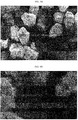
- Figure 2A shows the resulting formulation after it has been tray dried, while Figure 2B shows a similar formulation after agitation drying.
- Figures 3A, 3B and 3C illustrate the formulation of the invention at progressively higher magnification. The spherical-shaped agglomerates are clearly shown in each scanning electron microscope image.
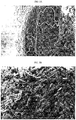
- Figures 4A, 4B and 4C illustrate the individual crystallized needles present in the formulation agglomerates. In particular, the images of Figures 4A-4C should be contrasted with the image presented in Figure 1 .
- Figures 5A and 5B illustrate the composition profile of the formulation under agitated drying.
- Figures 6A and 6B while also part of the invention, illustrate the slightly less preferred method of tray drying without agitation. All the Figures 5 and 6 were characterized by FIB-SEM (focused ion beam SEM). The FIB-SEM instrument applies a high energy ion beam to carve out the surface of a sample particle, and then applies an X-ray probe to scan the element composition on the inner surface to obtain a cross-sectional composition profile.
- FIB-SEM focused ion beam SEM
- the FIB-SEM characterization indicates two points: 1) the API needles are embedded inside and on the surface of a skeleton structure formed by the HPMC; and 2) the tray dried particles have more voids inside the structure, while the particles from agitated drying are more closely packed with less observable voids.
- the polymer phases are outlined in bold.
- the API is indicated with arrows.
- crystallization sequence can be changed as another example depicted below:
- the ester phosphate prodrug formulation obtained according to the various process embodiments herein described contains very high API content.
- the formulation is also characterized by improved bulk density, good flow characteristics and high compactability.
- the resulting tablets exhibit excellent extended release properties. Charaterization results from Example 1 (Batches 1-5) to reflect the formulation properties from typical batches are provided below for illustration.
Landscapes
- Health & Medical Sciences (AREA)
- Chemical & Material Sciences (AREA)
- Life Sciences & Earth Sciences (AREA)
- Organic Chemistry (AREA)
- General Health & Medical Sciences (AREA)
- Public Health (AREA)
- Veterinary Medicine (AREA)
- Medicinal Chemistry (AREA)
- Pharmacology & Pharmacy (AREA)
- Animal Behavior & Ethology (AREA)
- Epidemiology (AREA)
- Bioinformatics & Cheminformatics (AREA)
- Engineering & Computer Science (AREA)
- Molecular Biology (AREA)
- Virology (AREA)
- Biochemistry (AREA)
- Communicable Diseases (AREA)
- Nuclear Medicine, Radiotherapy & Molecular Imaging (AREA)
- General Chemical & Material Sciences (AREA)
- Chemical Kinetics & Catalysis (AREA)
- Oncology (AREA)
- Tropical Medicine & Parasitology (AREA)
- AIDS & HIV (AREA)
- Pharmaceuticals Containing Other Organic And Inorganic Compounds (AREA)
- Medicinal Preparation (AREA)
Description
- The present invention relates to a process for the production of an HIV attachment inhibitor compound formulation with excipients, as defined by the claims and more specifically, to a
process for producing a diketo piperazine-based prodrug attachment inhibitor compound embedded with one or more excipients in spherical-shaped agglomerates having improved physical characteristics. The invention also relates to the crystallized formulation so produced. - HIV-1 (human immunodeficiency virus -1) infection remains a major medical problem, with an estimated 45-50 million people infected worldwide at the end of 2011. The number of cases of HIV and AIDS (acquired immunodeficiency syndrome) has risen rapidly. In 2005, approximately 5.0 million new infections were reported, and 3.1 million people died from AIDS. Currently available drugs for the treatment of HIV include nucleoside reverse transcriptase (RT) inhibitors: zidovudine (or AZT or RETROVIR®), didanosine (or VIDEX®), stavudine (or ZERIT®), lamivudine (or 3TC or EPIVIR®), zalcitabine (or DDC or HIVID®), abacavir succinate (or ZIAGEN®), Tenofovir disoproxil fumarate salt (or VIREAD®), emtricitabine (or FTC - EMTRIVA®), COMBIVIR® (contains -3TC plus AZT), TRIZIVIR® (contains abacavir, lamivudine, and zidovudine), Epzicom (contains abacavir and lamivudine), TRUVADA® (contains VIREAD® and EMTRIVA®); non-nucleoside reverse transcriptase inhibitors: rilpivirine (or Edurant), nevirapine (or VIRAMUNE®), delavirdine (or RESCRIPTOR®) and efavirenz (or SUSTIVA®), Atripla (TRUVADA® + SUSTIVA®), Complera (TRUVADA® + Edurant), and etravirine, and peptidomimetic protease inhibitors or approved formulations: saquinavir, indinavir, ritonavir, nelfinavir, amprenavir, lopinavir, KALETRA® (lopinavir and Ritonavir), darunavir, atazanavir (REYATAZ®) and tipranavir (APTIVUS®), and integrase inhibitors such as raltegravir (Isentress), and entry inhibitors such as enfuvirtide (T-20) (FUZEON®) and maraviroc (Selzentry). Other drugs are slated for approval within the next few years, or are earlier on in various stages of development.
- In addition to the foregoing, HIV attachment inhibitors are a novel subclass of antiviral compounds that bind to the HIV surface glycoprotein gp120, and interfere with the interaction between the surface protein gp120 and the host cell receptor CD4. Thus, they prevent HIV from attaching to the human CD4 T-cell, and block HIV replication in the first stage of the HIV life cycle. The properties of HIV attachment inhibitors have been improved in an effort to obtain compounds with maximized utility and efficacy as antiviral agents.
- One HIV attachment inhibitor compound, in particular, has now shown considerable prowess against HIV. This compound is known as 1-(4-benzoyl-piperazin-1-yl)-2-[4-methoxy-7-(3-methyl-[1,2,4]triazol-1-yl)-1H-pyrralo[2,3-c]pyridine-3-yl]-ethane-1,2-dione, which is set forth and described in
U.S. Patent No. 7,354,924 :
- Further, a phosphate ester prodrug of the above parent compound has now been developed. This compound is 1-benzoyl-4-[2-[4-methoxy-7-(3-methyl-1H-1,2,4-triazol-1-yl)-1-[(phosphonooxy)methyl]-1H-pyrrolo[2,3-c]pyridin-3-yl]-1,2-dioxoethyl]-piperazine. It is set forth and described in
U.S. Patent No. 7,745,625 . The compound is represented by the formula below:
- A formulation with the above phosphate ester prodrug in tris salt form, together with hydroxypropyl methyl cellulose (HPMC), has been set forth and described in
U.S. Publication No. 2010/0056540 A1 . - In certain other instances, however, there have been issues with formulating the API prodrug with excipients. The crystalline form of the input, unprocessed prodrug is typically characterized by highly chargeable, fragile needles with high aspect ratio, low bulk density and very poor flow capability, whether as API alone or when further mixed with excipients. Comparative
Figure 1 is a photograph of the unprocessed, crystalline phosphate ester prodrug compound. These characteristics can present significant challenges with either dry or wet granulation techniques. For dry granulation, poor powder flow presents a major challenge in controlling the hopper flow and feed into the roller compactor. With wet granulation, it has been difficult to control the change in form associated with the overall process, thereby often resulting in poor stability of the final product formulation. - What is now needed in the art is a new processing method for formulating the HIV attachment inhibitor phosphate ester prodrug compound with excipients, including HPMC. This method should produce a formulation with high API content with good release characteristics, as well as good flow, improved bulk density, and high compactability.
- In a first embodiment, the invention is directed to a process for the production of a formulation of HIV attachment inhibitor piperazine tris salt prodrug compound, as defined by the claims comprising:
- a) dissolving said prodrug compound in a solvent to form a solution;
- b) adding a first quantity of a first anti-solvent to said solution;
- c) dispersing a first quantity of HPMC in said solution;
- d) adding a second quantity of said first anti-solvent to said solution;
- e) dispersing a second quantity of HPMC in said solution; and
- f) adding a second anti-solvent to said solution so as to crystallize said compound with said HPMC and thereby form said formulation, wherein said second anti-solvent is a combination consisting essentially of acetone and isopropyl acetate (IPAC).
- It is further preferred that the next step comprise the filtering and washing of the crystallized compound/HPMC with an additional amount of the first anti-solvent, followed by agitated drying in vacuum to remove substantially all used solvents.
- In a further embodiment, the invention is directed to a process for the production of a formulation of HIV attachment inhibitor piperazine tris salt prodrug compound, as defined by the claims comprising:
- a) adding a first anti-solvent to a first vessel;
- b) dispersing HPMC in said first vessel;
- c) dissolving said prodrug compound in a solvent to form a solution, and adding said solution to said first vessel;
- d) adding a second anti-solvent to said solution in said first vessel so as to crystallize said compound with said HPMC and thereby form said formulation, wherein said second anti-solvent is a combination consisting essentially of acetone and isopropyl acetate (IPAC). In this embodiment, the next step involves filtering and washing of the crystallized compound/HPMC, followed by agitated drying to remove substantially all solvents.
- The invention is further directed to the formulation so produced by the processes herein set forth.
- In a further embodiment, the invention is also directed to the use of the formulation for producing pharmaceutical grade tablets.
- The present invention is directed to these, as well as other important ends, hereinafter described.
-
-
Figure 1 (comparative) is a scanning electron microscope (SEM) image of input, unprocessed API HIV attachment inhibitor piperazine phosphate ester prodrug compound at 650X magnification. -
Figure 2A is a SEM image of tray-dried prodrug/ HPMC formulation at 50X magnification according to an embodiment of the invention. -
Figure 2B is a SEM image of agitation-dried prodrug/ HPMC formulation at 50X magnification according to a further embodiment of the invention. -
Figure 3A is the same image presented inFigure 2A for comparison purposes withFigures 3B and3C below. -
Figure 3B is a SEM image of the formulation shown inFigure 3A , but at 100X magnification. -
Figure 3C is a SEM image of the formulation shown inFigure 3A , but at 250X magnification. -
Figure 4A is a SEM image of the surface of the formulation set forth inFigure 3A showing individual needles at 1000X magnification. -
Figure 4B is a SEM image of the formulation shown inFigure 4A at 2500X magnification. -
Figure 4C is a SEM image of the formulation shown inFigure 4A at 5000X magnification. -
Figure 5A is a FIB-SEM cross-sectional image of the formulation of the invention according to one embodiment at 696X magnification. -
Figure 5B is a FIB-SEM surface image of the formulation of the invention set forth inFigure 5A at 4340X magnification. -
Figure 6A is a FIB-SEM cross-sectional image of the formulation of the invention according to a further embodiment at 500X magnification. -
Figure 6B is a FIB-SEM surface image of the formulation of the invention as set forth inFigure 6A at 500X magnification. - While a range of alternative water soluble salts of the phosphate ester prodrug may be employed, the tris salt form of 1-benzoyl-4-[2-[4-methoxy-7-(3-methyl-1H-1,2,4-tnazol-l-yl)-1-[(phosphonooxy)methyl]-1H-pyrrolo[2,3-c]pyridin-3-yl]-1,2-dioxoethyl]-piperazine, in particular, is preferred for use herein.
- The prodrug is first dissolved in a solvent so as to form a solution. The solvent is preferably water in the range of about 1.67 to 2.67 volume (mL) with respect to the prodrug weight (grams).
- Next, a first quantity of a first anti-solvent is added to the prodrug solution. This first anti-solvent is preferably acetone in the range of about 4.0 to 5.0 volume (mL), more preferably about 4.66 volume (mL), with respect to the prodrug weight (grams). Those skilled in the art may find that acetonitrile is one possible alternative as a first anti-solvent herein.
- Thereafter, a first quantity ofHPMC is dispersed in the solution. The first quantity ofHPMC will preferably be approximately 40-60%, and even more preferably, about 50% of the total amount ofHPMC utilized in the co-processing method with the phosphate ester prodrug. It is further preferred that the ratio of the prodrug compound to the HPMC after the method of the invention is completed be about 3:1. Put another way, the HPMC will comprise about 20-30% of the final formulation, more preferably about 25% thereof. After addition of the HPMC, the solution is preferably allowed to stand for at least 20 minutes, and more preferably, up to about an hour or so.
- A second quantity of the first anti-solvent of about 4.0 to 5.0 volume (mL), more preferably about 4.66 volume (mL), with respect to the prodrug weight (grams) is then added to the prodrug solution containing the dispersed HPMC.
- Next, the remaining HPMC is dispersed in the solution. This quantity represents about 60-40%, and even more preferably, about 50% of the total amount of HPMC utilized herein. Again, the solution containing the HPMC is preferably allowed to stand or age for 20 minutes, and preferably, for up to an hour or so.
- At this point, a second anti-solvent with the quantity of about 11.0 to 12.0 volume (mL), more preferably about 11.65 volume (mL), with respect to the prodrug weight (grams) is added to the solution containing the prodrug and dispersed HPMC. The second anti-solvent is a mixture of acetone and isopropyl acetate (IPAC). Preferably, the mixture is about 22:78 to 18:82 v/v acetone : IPAC, and even more preferably, about 20:80 v/v acetone : IPAC ratio. The second anti-solvent should be substantially free of additional compounds, for example, compounds such as ethyl acetate and n-butyl acetate. Both the particular combination of the second anti-solvents utilized, and their respective ratios, are important aspects of the method herein. The second anti-solvent is added to the solution over the course of approximately 1 to 5 hours. Upon addition of the second anti-solvent, the entire solution is slowly agitated and allowed to age for an extended period, preferably no less than about 12 hours, and more preferably, for about 16 hours. Without being bound by any particular theory, it appears that this extended time period permits the growth of prodrug crystals on the inside and on the surface of the HPMC polymers.
- Finally, the prodrug and HPMC slurry mixture is diluted with acetone and filtered on a filter dryer. The formulation mixture is again washed, preferably twice washed, preferably with acetone. Thereafter, the formulation may be densified for several minutes under agitation. The formulation is then allowed to either tray dry under vacuum, or dry with optional agitation. The formulation may then be sieved or co-milled using apparatus and procedures available in the art.
-
Figure 2A shows the resulting formulation after it has been tray dried, whileFigure 2B shows a similar formulation after agitation drying.Figures 3A, 3B and3C illustrate the formulation of the invention at progressively higher magnification. The spherical-shaped agglomerates are clearly shown in each scanning electron microscope image.Figures 4A, 4B and4C illustrate the individual crystallized needles present in the formulation agglomerates. In particular, the images ofFigures 4A-4C should be contrasted with the image presented inFigure 1 . - As set forth above, in some embodiments it may be preferable to allow the formulation to densify and dry under agitation.
Figures 5A and 5B illustrate the composition profile of the formulation under agitated drying.Figures 6A and 6B , while also part of the invention, illustrate the slightly less preferred method of tray drying without agitation. All theFigures 5 and6 were characterized by FIB-SEM (focused ion beam SEM). The FIB-SEM instrument applies a high energy ion beam to carve out the surface of a sample particle, and then applies an X-ray probe to scan the element composition on the inner surface to obtain a cross-sectional composition profile. The FIB-SEM characterization indicates two points: 1) the API needles are embedded inside and on the surface of a skeleton structure formed by the HPMC; and 2) the tray dried particles have more voids inside the structure, while the particles from agitated drying are more closely packed with less observable voids. In bothFigures 5A and6A , the polymer phases are outlined in bold. In addition, inFigure 6A , the API is indicated with arrows. - The following examples illustrate preferred aspects of the invention, but should not be construed as limiting the scope thereof:
- 105gm Scale as an Example
-
- 1. Dissolve 105.0 g API in 245 ml DI water in a 4L reactor.
- 2. Dilute by 490 ml acetone agitate at 160 rpm and 35 °C.
- 3. Slowly add in 21 g HPMC at agitation 160 rpm and 35 °C. (Note: Avoid forming any lumps of polymer in the suspension when adding polymer.)
- 4. Wait for 30 min., then add 490 ml acetone in 5 min (∼100 ml/min) with 160 rpm agitation.
- 5. Add 14 g HPMC (same lot) and agitate at 125 rpm for 30 min.
- 6. Add 1225 ml acetone/IPAC (1:4) in 280 min (addition rate 4.4 ml/min) starting at 45 °C and with agitator speed at 100-105 rpm.
(Note: Scale-up based on mixing time of 70 min from 15 g. batch, and 4x longer needed to scale-up from 70 ml to 2450 ml working volume.) - 7. Bath temp lowered from 45 °C to 20 °C in 280 min during acetone/IPAC addition (cooling rate 25 °C / 280 min).
- 8. After addition of all acetone/IPAC solvent, age the slurry at 20 °C and with 90-95 rpm agitation for 12-16 hr.
- 9. Retain slurry for HPLC and Karl-Fisher instrument, retain ML (mother liquor) and wash liquid for yield check.
- Alternatively, the crystallization sequence can be changed as another example depicted below:
- 1. Add 980 mL acetone (as first anti-solvent) to a 4L reactor.
- 2. Add 35 g HPMC and agitate at 160 RPM at 45C.
- 3. Dissolve 105.0 g API in 245 ml DI water in separate vessel, add solution to reactor.
- 4. Wait 40 min.
- 5. Add 1225 ml acetone/IPAC (1:4) (as second anti-solvent) in 280 min (addition rate 4.4 ml/min) starting at 45 °C and with agitator speed at 100-105 rpm.
(Note: Scale-up based on mixing time of 70 min from 15 g. batch, and 4x longer needed to scale-up from 70 ml to 2450 ml working volume.) 6. Bath temp lowered from 45 °C to 20 °C in 280 min during acetone/IPAC addition (cooling rate 25 °C 1280 min). - 7. After addition of all acetone/IPAC solvent, age the slurry at 20 °C and with 90-95 rpm agitation for 12-16 hr.
- 8./9. Retain slurry for HPLC and Karl-Fisher instrument, retain ML (mother liquor) and wash liquid for yield check.
-
- 10. Charge 315 ml acetone to the slurry in the crystallizer while agitating.
-
- 11. Filter slurry.
- 12. Deliquor the cake completely. Do not blow dry.
- 13. Reslurry wash with 525 ml acetone. Agitate for 5-10 min at 10-40 rpm.
- 14. Deliquor the cake completely. Do not blow dry.
- 15. Displacement wash with 210 ml acetone.
- 16. Deliquor the cake completely. Do not blow dry.
-
- 17. Agitate the cake.
- RPM = 10-40, agitate by lowering and raising agitator for complete mixing at RPM = 3-10 rpm.
- Continue agitation until cake volume is constant (∼10-30 minutes).
-
- 18. Vacuum dry with periodic agitation.
- Ramp the jacket temperature from 25 °C to up to 50 °C over 2-4 hrs.
- Agitate for 2-5 minutes every 15 to 30 minutes until dry.
- Dry until LOD (loss on drying) < 3% LOD.
- The ester phosphate prodrug formulation obtained according to the various process embodiments herein described contains very high API content. The formulation is also characterized by improved bulk density, good flow characteristics and high compactability. When further compressed and formulated into tablets using methods and apparatus available in the art, the resulting tablets exhibit excellent extended release properties. Charaterization results from Example 1 (Batches 1-5) to reflect the formulation properties from typical batches are provided below for illustration.
Batch Scale (kg) Bulk Density (g/cc) Tapped Density (g/cc) Flow (s/100g) Volumetric Flow (mL/s) API 120 0.13 0.23 incomplete incomplete 1 0.5 0.31 0.40 19.1 17.0 2 0.5 0.39 0.48 12.8 19.9 3 3.8 0.30 0.39 26.7 12.4 4 3.8 0.34 0.43 24.2 12.3 5 14.5 0.33 0.43 33.6 9.2
Claims (20)
- A process for the production of a formulation of HIV attachment inhibitor piperazine tris salt prodrug compound, wherein said compound is 1-benzoyl-4-[2-[4-methoxy-7-(3-methyl-1H-1,2,4-triazol-1-yl)-1-[(phosphonooxy)methyl]-1H-pyrrolo[2,3-c]pyridine-3-yl]-1,2-dioxoethyl]-piperazine, said process comprising:a) dissolving said prodrug compound in solvent to form a solution;b) adding a first quantity of a first anti-solvent to said solution;c) dispersing a first quantity of HPMC in said solution;d) adding a second quantity of said first anti-solvent to said solution;e) dispersing a second quantity of HPMC in said solution; andf) adding a second anti-solvent to said solution so as to crystallize said compound with said HPMC and thereby form said formulation, wherein said second anti-solvent is a combination consisting essentially of acetone and isopropyl acetate (IPAC).
- The process of claim 1, further comprising the steps of filtering, washing and drying said crystallized compound.
- The process of claim 1, wherein said solvent is water.
- The process of claim 3, wherein said first anti-solvent is acetone.
- The process of claim 1, wherein said first quantity of HPMC is approximately 40 to 60% of the total quantity.
- The process of claim 4, wherein said second anti-solvent is a combination of acetone and IPAC in about a 20:80 v/v ratio.
- The process of claim 6, wherein said second anti-solvent is substantially free of additional compounds.
- The process of claim 7, wherein said additional compounds comprise ethyl acetate and n-butyl acetate.
- The process of claim 2, wherein said filtering and washing is done with acetone.
- The process of claim 9, wherein said drying is done under agitation.
- The process of claim 10, wherein said crystallized compound has improved powder flow and compactability.
- The process of claim 11, wherein said crystallized compound is in the form of spherical shaped agglomerates.
- The process of claim 12, wherein said compound is substantially crystallized within said HPMC.
- The process of claim 1, wherein in step a) said compound is substantially crystalline and is characterized by highly chargeable, fragile needles with high aspect ratio and poor flow characteristics.
- The process of claim 6, wherein in step f) said second anti-solvent is added over the course of approximately 1 to 5 hours.
- The process of claim 1, wherein after step f) the ratio of said compound to said HPMC is approximately 3:1.
- The formulation obtained according to the process of claim 1.
- A process for the production of a formulation of HIV attachment inhibitor piperazine tris salt prodrug compound, wherein said compound is 1-benzoyl-4-[2-[4-methoxy-7-(3-methyl-1H-1,2,4-triazol-1-yl)-1-[(phosphonooxy)methyl]-1H-pyrrolo[2,3-c]pyridine-3-yl]-1,2-dioxoethyl]-piperazine, said process comprising:a) adding a first anti-solvent to a first vessel;b) dispersing HPMC in said vessel;c) dissolving said prodrug compound in a solvent to form a solution, and adding said solution to said first vessel;d) adding a second anti-solvent to said solution in said first vessel so as to crystallize said compound with said HPMC and thereby form said formulation, wherein said second anti-solvent is a combination consisting essentially of acetone and isopropyl acetate (IPAC).
- The process of claim 18, wherein said first anti-solvent is acetone.
- The process of claim 18, wherein said solvent is water.
Priority Applications (5)
| Application Number | Priority Date | Filing Date | Title |
|---|---|---|---|
| SM20170126T SMT201700126T1 (en) | 2011-12-21 | 2012-12-18 | Co-processing method and formulation for hiv attachment inhibitor prodrug compound and excipients |
| PL12809969T PL2793862T3 (en) | 2011-12-21 | 2012-12-18 | Co-processing method and preparation of a prodrug compound of the HIV attachment inhibitor and excipients |
| SI201230878A SI2793862T1 (en) | 2011-12-21 | 2012-12-18 | Co-processing method and formulation for hiv attachment inhibitor prodrug compound and excipients |
| HRP20170164TT HRP20170164T1 (en) | 2011-12-21 | 2012-12-18 | CO-OPERATION PROCEDURE AND FORMULATION OF COMPOUNDS PREFERRED TO HIV-BREAKING INHIBITORS AND EXCIPIENTS |
| RS20170131A RS55685B1 (en) | 2011-12-21 | 2012-12-18 | PROCESS OF CO-PROCESSING AND FORMULATION OF THE COMPOUNDS AND EXPERIMENTS FOR HIV BINDING INHIBITOR |
Applications Claiming Priority (3)
| Application Number | Priority Date | Filing Date | Title |
|---|---|---|---|
| US201161578689P | 2011-12-21 | 2011-12-21 | |
| US13/716,306 US9248139B2 (en) | 2011-12-21 | 2012-12-17 | Co-processing method and formulations for HIV attachment inhibitor prodrug compound and excipients |
| PCT/US2012/070229 WO2013096239A1 (en) | 2011-12-21 | 2012-12-18 | Co-processing method and formulation for hiv attachment inhibitor prodrug compound and excipients |
Publications (2)
| Publication Number | Publication Date |
|---|---|
| EP2793862A1 EP2793862A1 (en) | 2014-10-29 |
| EP2793862B1 true EP2793862B1 (en) | 2016-12-07 |
Family
ID=48654800
Family Applications (1)
| Application Number | Title | Priority Date | Filing Date |
|---|---|---|---|
| EP12809969.4A Active EP2793862B1 (en) | 2011-12-21 | 2012-12-18 | Co-processing method and formulation for hiv attachment inhibitor prodrug compound and excipients |
Country Status (16)
| Country | Link |
|---|---|
| US (2) | US9248139B2 (en) |
| EP (1) | EP2793862B1 (en) |
| JP (1) | JP6120876B2 (en) |
| CN (1) | CN104023709B (en) |
| CY (1) | CY1118507T1 (en) |
| DK (1) | DK2793862T3 (en) |
| ES (1) | ES2617512T3 (en) |
| HR (1) | HRP20170164T1 (en) |
| HU (1) | HUE031758T2 (en) |
| LT (1) | LT2793862T (en) |
| PL (1) | PL2793862T3 (en) |
| PT (1) | PT2793862T (en) |
| RS (1) | RS55685B1 (en) |
| SI (1) | SI2793862T1 (en) |
| SM (2) | SMT201700126T1 (en) |
| WO (1) | WO2013096239A1 (en) |
Families Citing this family (1)
| Publication number | Priority date | Publication date | Assignee | Title |
|---|---|---|---|---|
| WO2013130785A2 (en) * | 2012-03-01 | 2013-09-06 | Bristol-Myers Squibb Company | Extended release pharmaceutical formulations of water-soluble active pharmaceutical ingredients and methods for making the same |
Family Cites Families (7)
| Publication number | Priority date | Publication date | Assignee | Title |
|---|---|---|---|---|
| AU2002249836B2 (en) * | 2000-12-22 | 2006-12-14 | Baxter International Inc. | Method for preparing submicron particle suspensions |
| US20040110785A1 (en) | 2001-02-02 | 2004-06-10 | Tao Wang | Composition and antiviral activity of substituted azaindoleoxoacetic piperazine derivatives |
| DE10153934A1 (en) * | 2001-11-06 | 2003-05-22 | Basf Ag | Process for the crystallization of profenes |
| WO2005023242A1 (en) * | 2003-09-11 | 2005-03-17 | Tibotec Pharmaceuticals Ltd. | Entry inhibitors of the hiv virus |
| EP1727520A2 (en) * | 2003-12-09 | 2006-12-06 | Medcrystalforms, Llc | Method of preparation of mixed phase co-crystals with active agents |
| US7745625B2 (en) * | 2004-03-15 | 2010-06-29 | Bristol-Myers Squibb Company | Prodrugs of piperazine and substituted piperidine antiviral agents |
| EP2323633B1 (en) | 2008-09-04 | 2012-03-21 | Bristol-Myers Squibb Company | Stable pharmaceutical composition for optimized delivery of an hiv attachment inhibitor |
-
2012
- 2012-12-17 US US13/716,306 patent/US9248139B2/en active Active
- 2012-12-18 ES ES12809969.4T patent/ES2617512T3/en active Active
- 2012-12-18 PT PT128099694T patent/PT2793862T/en unknown
- 2012-12-18 CN CN201280063776.7A patent/CN104023709B/en not_active Expired - Fee Related
- 2012-12-18 WO PCT/US2012/070229 patent/WO2013096239A1/en not_active Ceased
- 2012-12-18 HR HRP20170164TT patent/HRP20170164T1/en unknown
- 2012-12-18 PL PL12809969T patent/PL2793862T3/en unknown
- 2012-12-18 JP JP2014549189A patent/JP6120876B2/en active Active
- 2012-12-18 RS RS20170131A patent/RS55685B1/en unknown
- 2012-12-18 SM SM20170126T patent/SMT201700126T1/en unknown
- 2012-12-18 SI SI201230878A patent/SI2793862T1/en unknown
- 2012-12-18 HU HUE12809969A patent/HUE031758T2/en unknown
- 2012-12-18 LT LTEP12809969.4T patent/LT2793862T/en unknown
- 2012-12-18 EP EP12809969.4A patent/EP2793862B1/en active Active
- 2012-12-18 DK DK12809969.4T patent/DK2793862T3/en active
-
2015
- 2015-12-18 US US14/974,644 patent/US20160102093A1/en not_active Abandoned
-
2016
- 2016-12-19 CY CY20161101318T patent/CY1118507T1/en unknown
-
2017
- 2017-02-24 SM SM201700126T patent/SMT201700126B/en unknown
Non-Patent Citations (1)
| Title |
|---|
| None * |
Also Published As
| Publication number | Publication date |
|---|---|
| HUE031758T2 (en) | 2017-07-28 |
| RS55685B1 (en) | 2017-07-31 |
| WO2013096239A1 (en) | 2013-06-27 |
| HRP20170164T1 (en) | 2017-04-07 |
| SMT201700126T1 (en) | 2017-03-08 |
| US9248139B2 (en) | 2016-02-02 |
| SI2793862T1 (en) | 2017-03-31 |
| JP6120876B2 (en) | 2017-04-26 |
| CN104023709A (en) | 2014-09-03 |
| SMT201700126B (en) | 2017-03-08 |
| PL2793862T3 (en) | 2017-06-30 |
| ES2617512T3 (en) | 2017-06-19 |
| PT2793862T (en) | 2017-02-20 |
| US20160102093A1 (en) | 2016-04-14 |
| EP2793862A1 (en) | 2014-10-29 |
| US20130164345A1 (en) | 2013-06-27 |
| CY1118507T1 (en) | 2017-07-12 |
| DK2793862T3 (en) | 2017-01-16 |
| CN104023709B (en) | 2016-06-29 |
| LT2793862T (en) | 2017-03-27 |
| JP2015503522A (en) | 2015-02-02 |
Similar Documents
| Publication | Publication Date | Title |
|---|---|---|
| KR101953270B1 (en) | Amorphous letermovir and solid pharmaceutical formulations thereof for oral administration | |
| WO2020230028A1 (en) | New crystalline forms of n-(3-(2-(2-hydroxyethoxy)-6-morpholinopyridin-4-yl)-4-methvlphenyl)-2 (trifluoromethyl)isonicotinamide as raf inhibitors for the treatment of cancer | |
| EP2238979A1 (en) | Active pharmaceutical ingredient adsorbed on solid support | |
| HK1218080A1 (en) | Heterocyclic compounds and their uses | |
| US20170105937A1 (en) | Olaparib co-precipitate and preparation method thereof | |
| US20250236630A1 (en) | Crystalline forms of cabotegravir sodium | |
| EP2000139A1 (en) | Stabilized amorphous forms of imatinib mesylate | |
| JP6174218B2 (en) | Anti-diabetic solid pharmaceutical composition | |
| EP3749673B1 (en) | Crystalline form of bictegravir sodium | |
| US9248139B2 (en) | Co-processing method and formulations for HIV attachment inhibitor prodrug compound and excipients | |
| EP3363802B1 (en) | Crystalline form of cabotegravir sodium | |
| KR20140114406A (en) | Stable amorphous raltegravir potassium premix and process for the preparation thereof | |
| US20260096994A1 (en) | Solid dispersions having stabilized emulsion particles | |
| EP3653629A1 (en) | Acid addition salts of an integrase strand transfer inhibitor | |
| JP2018168080A (en) | Amorphized 7-chloro-5-hydroxy-1-[2-methyl-4-(2-methylbenzoylamino) benzoyl]-2,3,4,5-tetrahydro-1h-benzoazepine and method for producing the same | |
| WO2025153768A1 (en) | Composition comprising crystalline nanosized apalutamide | |
| EA042594B1 (en) | CRYSTALLINE FORM OF BITEGRAVIR SODIUM | |
| EP3661944A1 (en) | Sofosbuvir hydrate | |
| EA043692B1 (en) | AMORPHOUS LETERMOVIR AND SOLID PHARMACEUTICAL PREPARATIONS CONTAINING IT, INTENDED FOR ORAL ADMINISTRATION |
Legal Events
| Date | Code | Title | Description |
|---|---|---|---|
| PUAI | Public reference made under article 153(3) epc to a published international application that has entered the european phase |
Free format text: ORIGINAL CODE: 0009012 |
|
| 17P | Request for examination filed |
Effective date: 20140630 |
|
| AK | Designated contracting states |
Kind code of ref document: A1 Designated state(s): AL AT BE BG CH CY CZ DE DK EE ES FI FR GB GR HR HU IE IS IT LI LT LU LV MC MK MT NL NO PL PT RO RS SE SI SK SM TR |
|
| DAX | Request for extension of the european patent (deleted) | ||
| REG | Reference to a national code |
Ref country code: DE Ref legal event code: R079 Ref document number: 602012026381 Country of ref document: DE Free format text: PREVIOUS MAIN CLASS: A61K0009140000 Ipc: A61K0031675000 |
|
| GRAP | Despatch of communication of intention to grant a patent |
Free format text: ORIGINAL CODE: EPIDOSNIGR1 |
|
| RIC1 | Information provided on ipc code assigned before grant |
Ipc: A61K 31/675 20060101AFI20160706BHEP Ipc: A61K 9/20 20060101ALI20160706BHEP Ipc: A61K 9/14 20060101ALI20160706BHEP Ipc: C07F 9/6561 20060101ALI20160706BHEP Ipc: C07D 471/04 20060101ALI20160706BHEP |
|
| INTG | Intention to grant announced |
Effective date: 20160725 |
|
| RAP1 | Party data changed (applicant data changed or rights of an application transferred) |
Owner name: VIIV HEALTHCARE UK(NO.4) LIMITED |
|
| GRAS | Grant fee paid |
Free format text: ORIGINAL CODE: EPIDOSNIGR3 |
|
| GRAA | (expected) grant |
Free format text: ORIGINAL CODE: 0009210 |
|
| STAA | Information on the status of an ep patent application or granted ep patent |
Free format text: STATUS: THE PATENT HAS BEEN GRANTED |
|
| AK | Designated contracting states |
Kind code of ref document: B1 Designated state(s): AL AT BE BG CH CY CZ DE DK EE ES FI FR GB GR HR HU IE IS IT LI LT LU LV MC MK MT NL NO PL PT RO RS SE SI SK SM TR |
|
| REG | Reference to a national code |
Ref country code: GB Ref legal event code: FG4D |
|
| REG | Reference to a national code |
Ref country code: CH Ref legal event code: EP Ref country code: AT Ref legal event code: REF Ref document number: 851137 Country of ref document: AT Kind code of ref document: T Effective date: 20161215 |
|
| REG | Reference to a national code |
Ref country code: IE Ref legal event code: FG4D |
|
| REG | Reference to a national code |
Ref country code: FR Ref legal event code: PLFP Year of fee payment: 5 |
|
| REG | Reference to a national code |
Ref country code: DK Ref legal event code: T3 Effective date: 20170112 |
|
| REG | Reference to a national code |
Ref country code: DE Ref legal event code: R096 Ref document number: 602012026381 Country of ref document: DE |
|
| REG | Reference to a national code |
Ref country code: CH Ref legal event code: NV Representative=s name: ISLER AND PEDRAZZINI AG, CH |
|
| REG | Reference to a national code |
Ref country code: HR Ref legal event code: TUEP Ref document number: P20170164 Country of ref document: HR Ref country code: NL Ref legal event code: FP |
|
| REG | Reference to a national code |
Ref country code: RO Ref legal event code: EPE |
|
| REG | Reference to a national code |
Ref country code: PT Ref legal event code: SC4A Ref document number: 2793862 Country of ref document: PT Date of ref document: 20170220 Kind code of ref document: T Free format text: AVAILABILITY OF NATIONAL TRANSLATION Effective date: 20170213 |
|
| REG | Reference to a national code |
Ref country code: SE Ref legal event code: TRGR |
|
| REG | Reference to a national code |
Ref country code: HR Ref legal event code: T1PR Ref document number: P20170164 Country of ref document: HR |
|
| REG | Reference to a national code |
Ref country code: EE Ref legal event code: FG4A Ref document number: E013295 Country of ref document: EE Effective date: 20170208 |
|
| REG | Reference to a national code |
Ref country code: NO Ref legal event code: T2 Effective date: 20161207 |
|
| REG | Reference to a national code |
Ref country code: ES Ref legal event code: FG2A Ref document number: 2617512 Country of ref document: ES Kind code of ref document: T3 Effective date: 20170619 |
|
| REG | Reference to a national code |
Ref country code: HU Ref legal event code: AG4A Ref document number: E031758 Country of ref document: HU |
|
| REG | Reference to a national code |
Ref country code: SK Ref legal event code: T3 Ref document number: E 23513 Country of ref document: SK |
|
| REG | Reference to a national code |
Ref country code: DE Ref legal event code: R097 Ref document number: 602012026381 Country of ref document: DE |
|
| PLBE | No opposition filed within time limit |
Free format text: ORIGINAL CODE: 0009261 |
|
| STAA | Information on the status of an ep patent application or granted ep patent |
Free format text: STATUS: NO OPPOSITION FILED WITHIN TIME LIMIT |
|
| 26N | No opposition filed |
Effective date: 20170908 |
|
| REG | Reference to a national code |
Ref country code: FR Ref legal event code: PLFP Year of fee payment: 6 |
|
| PGFP | Annual fee paid to national office [announced via postgrant information from national office to epo] |
Ref country code: TR Payment date: 20171211 Year of fee payment: 6 |
|
| PGFP | Annual fee paid to national office [announced via postgrant information from national office to epo] |
Ref country code: SM Payment date: 20180927 Year of fee payment: 7 Ref country code: PL Payment date: 20180926 Year of fee payment: 7 |
|
| REG | Reference to a national code |
Ref country code: HR Ref legal event code: ODRP Ref document number: P20170164 Country of ref document: HR Payment date: 20181204 Year of fee payment: 7 |
|
| PGFP | Annual fee paid to national office [announced via postgrant information from national office to epo] |
Ref country code: SK Payment date: 20181029 Year of fee payment: 7 Ref country code: LU Payment date: 20181207 Year of fee payment: 7 Ref country code: AT Payment date: 20181128 Year of fee payment: 7 Ref country code: DK Payment date: 20181127 Year of fee payment: 7 Ref country code: NO Payment date: 20181128 Year of fee payment: 7 Ref country code: EE Payment date: 20181203 Year of fee payment: 7 Ref country code: IE Payment date: 20181128 Year of fee payment: 7 Ref country code: CZ Payment date: 20181126 Year of fee payment: 7 Ref country code: SE Payment date: 20181210 Year of fee payment: 7 Ref country code: GR Payment date: 20181128 Year of fee payment: 7 Ref country code: LT Payment date: 20181207 Year of fee payment: 7 Ref country code: RO Payment date: 20181122 Year of fee payment: 7 Ref country code: FI Payment date: 20181128 Year of fee payment: 7 Ref country code: IS Payment date: 20181113 Year of fee payment: 7 Ref country code: MC Payment date: 20181129 Year of fee payment: 7 |
|
| REG | Reference to a national code |
Ref country code: AT Ref legal event code: UEP Ref document number: 851137 Country of ref document: AT Kind code of ref document: T Effective date: 20161207 |
|
| PGFP | Annual fee paid to national office [announced via postgrant information from national office to epo] |
Ref country code: AL Payment date: 20181127 Year of fee payment: 7 Ref country code: BG Payment date: 20181025 Year of fee payment: 7 Ref country code: LV Payment date: 20181212 Year of fee payment: 7 |
|
| PGFP | Annual fee paid to national office [announced via postgrant information from national office to epo] |
Ref country code: CY Payment date: 20181130 Year of fee payment: 7 |
|
| PGFP | Annual fee paid to national office [announced via postgrant information from national office to epo] |
Ref country code: MK Payment date: 20181127 Year of fee payment: 7 |
|
| REG | Reference to a national code |
Ref country code: HR Ref legal event code: PBON Ref document number: P20170164 Country of ref document: HR Effective date: 20191218 |
|
| REG | Reference to a national code |
Ref country code: EE Ref legal event code: MM4A Ref document number: E013295 Country of ref document: EE Effective date: 20191231 Ref country code: FI Ref legal event code: MAE |
|
| REG | Reference to a national code |
Ref country code: DK Ref legal event code: EBP Effective date: 20191231 Ref country code: NO Ref legal event code: MMEP |
|
| REG | Reference to a national code |
Ref country code: SE Ref legal event code: EUG |
|
| PG25 | Lapsed in a contracting state [announced via postgrant information from national office to epo] |
Ref country code: CY Free format text: LAPSE BECAUSE OF NON-PAYMENT OF DUE FEES Effective date: 20191218 Ref country code: FI Free format text: LAPSE BECAUSE OF NON-PAYMENT OF DUE FEES Effective date: 20191218 Ref country code: CZ Free format text: LAPSE BECAUSE OF NON-PAYMENT OF DUE FEES Effective date: 20191218 Ref country code: RO Free format text: LAPSE BECAUSE OF NON-PAYMENT OF DUE FEES Effective date: 20191218 |
|
| REG | Reference to a national code |
Ref country code: AT Ref legal event code: MM01 Ref document number: 851137 Country of ref document: AT Kind code of ref document: T Effective date: 20191218 |
|
| PG25 | Lapsed in a contracting state [announced via postgrant information from national office to epo] |
Ref country code: LV Free format text: LAPSE BECAUSE OF NON-PAYMENT OF DUE FEES Effective date: 20191218 Ref country code: MC Free format text: LAPSE BECAUSE OF NON-PAYMENT OF DUE FEES Effective date: 20200102 |
|
| REG | Reference to a national code |
Ref country code: SK Ref legal event code: MM4A Ref document number: E 23513 Country of ref document: SK Effective date: 20191218 |
|
| REG | Reference to a national code |
Ref country code: LT Ref legal event code: MM4D Effective date: 20191218 |
|
| PG25 | Lapsed in a contracting state [announced via postgrant information from national office to epo] |
Ref country code: SM Free format text: LAPSE BECAUSE OF NON-PAYMENT OF DUE FEES Effective date: 20200702 Ref country code: LU Free format text: LAPSE BECAUSE OF NON-PAYMENT OF DUE FEES Effective date: 20191218 Ref country code: SK Free format text: LAPSE BECAUSE OF NON-PAYMENT OF DUE FEES Effective date: 20191218 Ref country code: LT Free format text: LAPSE BECAUSE OF NON-PAYMENT OF DUE FEES Effective date: 20191218 Ref country code: IE Free format text: LAPSE BECAUSE OF NON-PAYMENT OF DUE FEES Effective date: 20191218 Ref country code: GR Free format text: LAPSE BECAUSE OF NON-PAYMENT OF DUE FEES Effective date: 20200707 Ref country code: NO Free format text: LAPSE BECAUSE OF NON-PAYMENT OF DUE FEES Effective date: 20191231 Ref country code: EE Free format text: LAPSE BECAUSE OF NON-PAYMENT OF DUE FEES Effective date: 20191231 Ref country code: SE Free format text: LAPSE BECAUSE OF NON-PAYMENT OF DUE FEES Effective date: 20191219 |
|
| PG25 | Lapsed in a contracting state [announced via postgrant information from national office to epo] |
Ref country code: AT Free format text: LAPSE BECAUSE OF NON-PAYMENT OF DUE FEES Effective date: 20191218 Ref country code: BG Free format text: LAPSE BECAUSE OF NON-PAYMENT OF DUE FEES Effective date: 20200630 Ref country code: HR Free format text: LAPSE BECAUSE OF NON-PAYMENT OF DUE FEES Effective date: 20191218 Ref country code: SI Free format text: LAPSE BECAUSE OF NON-PAYMENT OF DUE FEES Effective date: 20191219 Ref country code: RS Free format text: LAPSE BECAUSE OF NON-PAYMENT OF DUE FEES Effective date: 20191218 Ref country code: HU Free format text: LAPSE BECAUSE OF NON-PAYMENT OF DUE FEES Effective date: 20191219 |
|
| REG | Reference to a national code |
Ref country code: SI Ref legal event code: KO00 Effective date: 20201015 |
|
| PG25 | Lapsed in a contracting state [announced via postgrant information from national office to epo] |
Ref country code: DK Free format text: LAPSE BECAUSE OF NON-PAYMENT OF DUE FEES Effective date: 20191231 |
|
| PG25 | Lapsed in a contracting state [announced via postgrant information from national office to epo] |
Ref country code: IS Free format text: LAPSE BECAUSE OF NON-PAYMENT OF DUE FEES Effective date: 20200101 |
|
| PG25 | Lapsed in a contracting state [announced via postgrant information from national office to epo] |
Ref country code: MT Free format text: LAPSE BECAUSE OF FAILURE TO SUBMIT A TRANSLATION OF THE DESCRIPTION OR TO PAY THE FEE WITHIN THE PRESCRIBED TIME-LIMIT Effective date: 20191218 Ref country code: AL Free format text: LAPSE BECAUSE OF NON-PAYMENT OF DUE FEES Effective date: 20191218 |
|
| PG25 | Lapsed in a contracting state [announced via postgrant information from national office to epo] |
Ref country code: TR Free format text: LAPSE BECAUSE OF NON-PAYMENT OF DUE FEES Effective date: 20191218 |
|
| PG25 | Lapsed in a contracting state [announced via postgrant information from national office to epo] |
Ref country code: PL Free format text: LAPSE BECAUSE OF NON-PAYMENT OF DUE FEES Effective date: 20191218 |
|
| P01 | Opt-out of the competence of the unified patent court (upc) registered |
Effective date: 20230331 |
|
| REG | Reference to a national code |
Ref country code: BE Ref legal event code: PD Owner name: VIIV HEALTHCARE UK (NO.4) LIMITED; GB Free format text: DETAILS ASSIGNMENT: CHANGE OF OWNER(S), OTHER; FORMER OWNER NAME: KIRKPATRICK Effective date: 20240924 |
|
| PGFP | Annual fee paid to national office [announced via postgrant information from national office to epo] |
Ref country code: PT Payment date: 20251121 Year of fee payment: 14 |
|
| PGFP | Annual fee paid to national office [announced via postgrant information from national office to epo] |
Ref country code: NL Payment date: 20251119 Year of fee payment: 14 |
|
| REG | Reference to a national code |
Ref country code: CH Ref legal event code: U11 Free format text: ST27 STATUS EVENT CODE: U-0-0-U10-U11 (AS PROVIDED BY THE NATIONAL OFFICE) Effective date: 20260101 |
|
| PGFP | Annual fee paid to national office [announced via postgrant information from national office to epo] |
Ref country code: DE Payment date: 20251126 Year of fee payment: 14 |
|
| PGFP | Annual fee paid to national office [announced via postgrant information from national office to epo] |
Ref country code: GB Payment date: 20251119 Year of fee payment: 14 |
|
| PGFP | Annual fee paid to national office [announced via postgrant information from national office to epo] |
Ref country code: IT Payment date: 20251119 Year of fee payment: 14 |
|
| PGFP | Annual fee paid to national office [announced via postgrant information from national office to epo] |
Ref country code: FR Payment date: 20251119 Year of fee payment: 14 |
|
| PGFP | Annual fee paid to national office [announced via postgrant information from national office to epo] |
Ref country code: BE Payment date: 20251119 Year of fee payment: 14 |
|
| PGFP | Annual fee paid to national office [announced via postgrant information from national office to epo] |
Ref country code: ES Payment date: 20260102 Year of fee payment: 14 |
|
| PGFP | Annual fee paid to national office [announced via postgrant information from national office to epo] |
Ref country code: CH Payment date: 20260101 Year of fee payment: 14 |