EP2793235A1 - Organic transparent electrode, method for producing organic transparent electrode, touch panel, display, organic metal, method for producing organic metal, compound or salt thereof, electric wire and electronic device - Google Patents
Organic transparent electrode, method for producing organic transparent electrode, touch panel, display, organic metal, method for producing organic metal, compound or salt thereof, electric wire and electronic device Download PDFInfo
- Publication number
- EP2793235A1 EP2793235A1 EP13845891.4A EP13845891A EP2793235A1 EP 2793235 A1 EP2793235 A1 EP 2793235A1 EP 13845891 A EP13845891 A EP 13845891A EP 2793235 A1 EP2793235 A1 EP 2793235A1
- Authority
- EP
- European Patent Office
- Prior art keywords
- transparent electrode
- functional group
- acid functional
- organic
- salt
- Prior art date
- Legal status (The legal status is an assumption and is not a legal conclusion. Google has not performed a legal analysis and makes no representation as to the accuracy of the status listed.)
- Granted
Links
Images







Classifications
-
- C—CHEMISTRY; METALLURGY
- C07—ORGANIC CHEMISTRY
- C07D—HETEROCYCLIC COMPOUNDS
- C07D495/00—Heterocyclic compounds containing in the condensed system at least one hetero ring having sulfur atoms as the only ring hetero atoms
- C07D495/02—Heterocyclic compounds containing in the condensed system at least one hetero ring having sulfur atoms as the only ring hetero atoms in which the condensed system contains two hetero rings
- C07D495/04—Ortho-condensed systems
-
- G—PHYSICS
- G06—COMPUTING OR CALCULATING; COUNTING
- G06F—ELECTRIC DIGITAL DATA PROCESSING
- G06F3/00—Input arrangements for transferring data to be processed into a form capable of being handled by the computer; Output arrangements for transferring data from processing unit to output unit, e.g. interface arrangements
-
- H—ELECTRICITY
- H01—ELECTRIC ELEMENTS
- H01B—CABLES; CONDUCTORS; INSULATORS; SELECTION OF MATERIALS FOR THEIR CONDUCTIVE, INSULATING OR DIELECTRIC PROPERTIES
- H01B1/00—Conductors or conductive bodies characterised by the conductive materials; Selection of materials as conductors
- H01B1/06—Conductors or conductive bodies characterised by the conductive materials; Selection of materials as conductors mainly consisting of other non-metallic substances
- H01B1/12—Conductors or conductive bodies characterised by the conductive materials; Selection of materials as conductors mainly consisting of other non-metallic substances organic substances
-
- H—ELECTRICITY
- H01—ELECTRIC ELEMENTS
- H01B—CABLES; CONDUCTORS; INSULATORS; SELECTION OF MATERIALS FOR THEIR CONDUCTIVE, INSULATING OR DIELECTRIC PROPERTIES
- H01B1/00—Conductors or conductive bodies characterised by the conductive materials; Selection of materials as conductors
- H01B1/06—Conductors or conductive bodies characterised by the conductive materials; Selection of materials as conductors mainly consisting of other non-metallic substances
- H01B1/12—Conductors or conductive bodies characterised by the conductive materials; Selection of materials as conductors mainly consisting of other non-metallic substances organic substances
- H01B1/124—Intrinsically conductive polymers
- H01B1/127—Intrinsically conductive polymers comprising five-membered aromatic rings in the main chain, e.g. polypyrroles, polythiophenes
-
- H—ELECTRICITY
- H10—SEMICONDUCTOR DEVICES; ELECTRIC SOLID-STATE DEVICES NOT OTHERWISE PROVIDED FOR
- H10K—ORGANIC ELECTRIC SOLID-STATE DEVICES
- H10K30/00—Organic devices sensitive to infrared radiation, light, electromagnetic radiation of shorter wavelength or corpuscular radiation
- H10K30/80—Constructional details
- H10K30/81—Electrodes
-
- H—ELECTRICITY
- H10—SEMICONDUCTOR DEVICES; ELECTRIC SOLID-STATE DEVICES NOT OTHERWISE PROVIDED FOR
- H10K—ORGANIC ELECTRIC SOLID-STATE DEVICES
- H10K50/00—Organic light-emitting devices
- H10K50/80—Constructional details
- H10K50/85—Arrangements for extracting light from the devices
- H10K50/852—Arrangements for extracting light from the devices comprising a resonant cavity structure, e.g. Bragg reflector pair
-
- H—ELECTRICITY
- H10—SEMICONDUCTOR DEVICES; ELECTRIC SOLID-STATE DEVICES NOT OTHERWISE PROVIDED FOR
- H10K—ORGANIC ELECTRIC SOLID-STATE DEVICES
- H10K85/00—Organic materials used in the body or electrodes of devices covered by this subclass
- H10K85/60—Organic compounds having low molecular weight
- H10K85/611—Charge transfer complexes
Definitions
- the present invention relates to an organic transparent electrode or a synthetic metal.
- Transparent electrodes such as indium tin oxide (ITO) electrodes, for example, are very useful materials that are used in electronic devices, such as in mobile telephone displays.
- ITO indium tin oxide
- indium which is the central element, is a rare metal whose price has recently increased dramatically. Considering future demand, it is desirable to replace indium with another, less expensive substance.
- a metal synthetic metal
- a first aspect of the present invention is an organic transparent electrode characterized by being formed from an organic molecule having a Br ⁇ nsted acid functional group, an electron-donating ability, and a ⁇ -conjugated plane, and being self-assembling.
- a second aspect of the present invention is the organic transparent electrode according to claim 1, characterized in that the Br ⁇ nsted acid functional group is any of a carboxylic acid functional group, a sulfonic acid functional group, a phosphonic acid functional group, and a thiophosphonic acid functional group.
- a third aspect of the present invention is the organic transparent electrode according to claim 2, characterized in that a hydrogen bond is formed to the Br ⁇ nsted acid functional group in a self-assembled state.
- a fourth aspect of the present invention is an organic transparent electrode characterized by being formed from a compound that comprises a fused tetrathiafulvalene derivative moiety in a skeleton and has a protonic acid functional group.
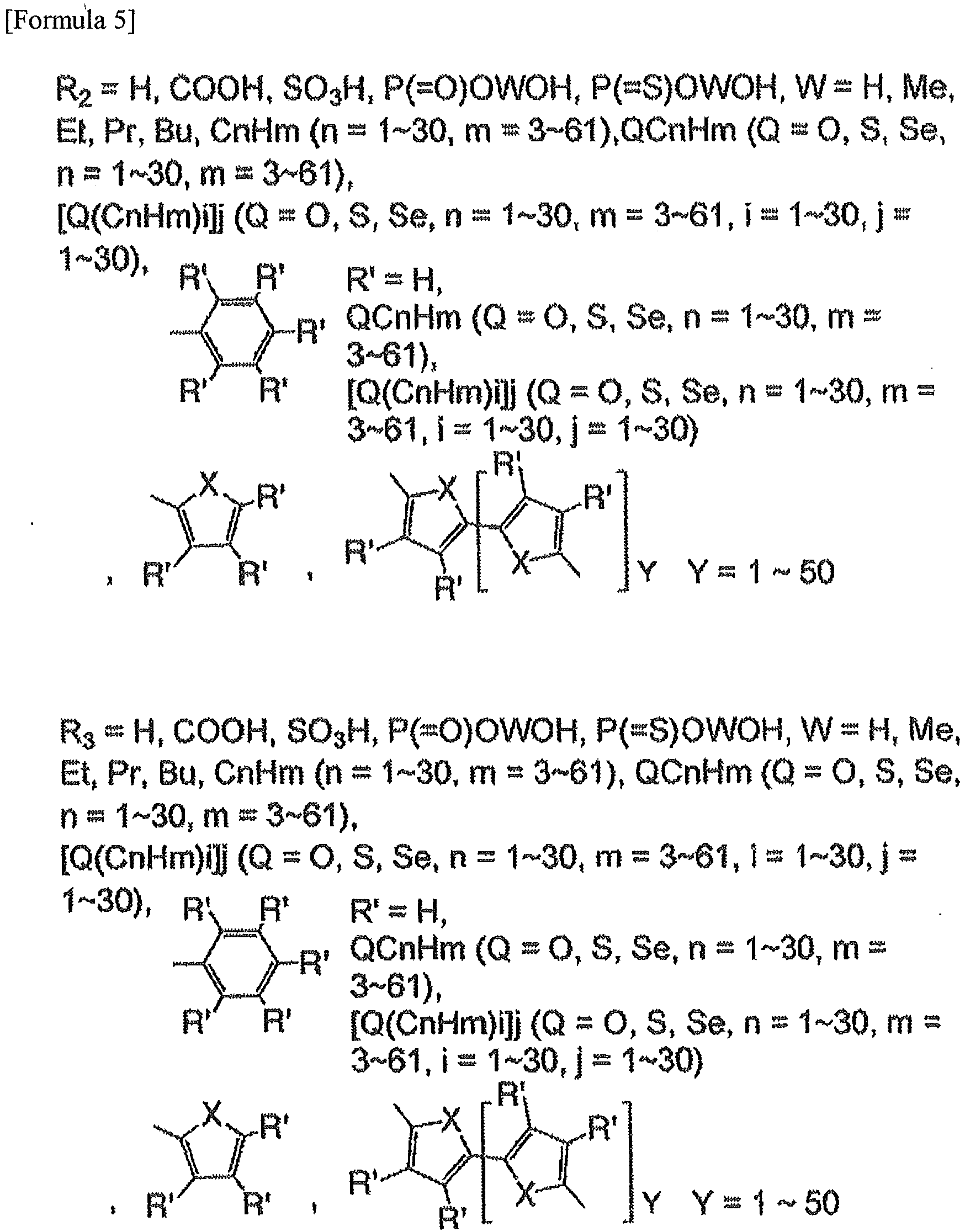
- a fifth aspect of the present invention is an organic transparent electrode characterized by being formed from any of the compounds represented by the following general formulae, wherein R 1 , R 2 , R 3 , R 4 , and R' may be the same or different, or a salt thereof.
- a sixth aspect of the present invention is an organic transparent electrode characterized by being formed from any of the compounds represented by the following general formulae, wherein R 1 , R 2 , R 3 , R 4 , and R' may be the same or different, or a salt thereof.
- a seventh aspect of the present invention is an organic transparent electrode characterized by being formed from a compound represented by Formula 1 or a salt thereof.
- An eighth aspect of the present invention is an organic transparent electrode characterized by being formed from a compound represented by Formula 2 or a salt thereof.
- a ninth aspect of the present invention is an organic transparent electrode characterized by being formed from a compound represented by Formula 3 or a salt thereof.
- a tenth aspect of the present invention is an organic transparent electrode characterized by being formed from an anilinium tetrathiafulvalene-2-carboxylate salt.
- An eleventh aspect of the present invention is an organic transparent electrode characterized by being formed from a hydroxyammonium tetrathiafulvalene-2-carboxylate salt.
- a twelfth aspect of the present invention is an organic transparent electrode characterized by being formed from a compound represented by the following formula: [(TTPCOO - NH 4 + )(TTPCOOH)] 1-x (TTP ⁇ + COO - NH 3 ) x , wherein x is 0.06.
- a thirteenth aspect of the present invention is a method for producing an organic transparent electrode, comprising recrystallizing from an organic solvent a fused sulfur-containing ⁇ compound to which a carboxylic acid functional group has been introduced.
- a fourteenth aspect of the present invention is a method for producing an organic transparent electrode, comprising recrystallizing a fused tetrathiafulvalene to which a carboxylic acid functional group has been introduced, from an organic solvent to which an ammonia solution has been added.
- a fifteenth aspect of the present invention is a touch panel comprising the organic transparent electrode according to claim 10 or 11.
- a sixteenth aspect of the present invention is a display comprising the organic transparent electrode according to claim 10 or 11.
- a seventeenth aspect of the present invention is an electronic device comprising the organic transparent electrode according to claim 10 or 11.
- An eighteenth aspect of the present invention is an organic transparent electrode comprising an organic compound having protonic defects in a hydrogen bond network, wherein a radical cation or a radical anion is generated to replenish a lost charge.
- a nineteenth aspect of the present invention is an organic transparent electrode wherein charges are not in equilibrium due to a ratio of a cation and an anion present in a hydrogen bond network not being 1:1, and a radical cation or a radical anion is generated to replenish a lost charge.
- a twentieth aspect of the present invention is a synthetic metal characterized by being formed from an organic molecule having a Br ⁇ nsted acid functional group, an electron-donating ability, and a ⁇ -conjugated plane, and being self-assembling.
- a twenty-first aspect of the present invention is the synthetic metal according to claim 20, characterized in that the Br ⁇ nsted acid functional group is any of a carboxylic acid functional group, a sulfonic acid functional group, a phosphonic acid functional group, and a thiophosphonic acid functional group.
- a twenty-second aspect of the present invention is the synthetic metal according to claim 21, characterized in that a hydrogen bond is formed to the Br ⁇ nsted acid functional group in a self-assembled state.
- a twenty-third aspect of the present invention is a synthetic metal characterized by being formed from a compound that comprises a fused tetrathiafulvalene derivative moiety in a skeleton and has a protonic acid functional group.
- a twenty-fourth aspect of the present invention is a synthetic metal characterized by being any of the compounds represented by Formula 4A, wherein R 1 , R 2 , R 3 , and R 4 may be the same or different, or a salt thereof.
- a twenty-fifth aspect of the present invention is a synthetic metal that is any of the compounds represented by Formula 5A, wherein R 1 , R 2 , R 3 , and R 4 may be the same or different, or a salt thereof.
- a twenty-sixth aspect of the present invention is a compound represented by Formula 1A or a salt thereof.
- a twenty-seventh aspect of the present invention is a compound represented by Formula 2A or a salt thereof.
- a twenty-eighth aspect of the present invention is a compound represented by Formula 3 A or a salt thereof.
- a twenty-ninth aspect of the present invention is a synthetic metal characterized by being a compound represented by Formula 1A or a salt thereof.
- a thirtieth aspect of the present invention is a synthetic metal characterized by being a compound represented by Formula 2A or a salt thereof.
- a thirty-first aspect of the present invention is a synthetic metal characterized by being a compound represented by Formula 3A or a salt thereof.
- a thirty-second aspect of the present invention is a synthetic metal characterized by being a compound represented by the following formula: [(TTPCOO - NH 4 + )(TTPCOOH)] 1-x (TTP ⁇ + COO - NH 3 ) x , wherein x is 0.06.
- a thirty-third aspect of the present invention is a method for producing a synthetic metal, comprising recrystallizing from an organic solvent a fused sulfur-containing ⁇ compound to which a carboxylic acid functional group has been introduced.
- a thirty-fourth aspect of the present invention is a method for producing a synthetic metal, comprising recrystallizing a fused tetrathiafulvalene to which a carboxylic acid functional group has been introduced from an organic solvent to which an ammonia solution has been added.
- a thirty-fifth aspect of the present invention is a wire comprising the synthetic metal according to claim 30.
- a thirty-sixth aspect of the present invention is an electronic device comprising the synthetic metal according to claim 30.
- a thirty-seventh aspect of the present invention is a synthetic metal comprising an organic compound having a proton defect in a hydrogen bond network, wherein a radical cation or a radical anion is generated to replenish a lost charge.
- a thirty-eighth aspect of the present invention is a synthetic metal wherein charges are not in equilibrium due to a ratio of a cation and an anion present in a hydrogen bond network not being 1:1, and a radical cation or a radical anion is generated to replenish a lost charge.
- examples of inorganic acids include HBF 4 , HClO 4 , HCl, HBr, HI, DBF 4 , DClO 4 , DCl, DBr, and DI.
- metal refers to a conductor through which electricity passes well.
- the electrical conductivity of a pressure-formed pellet is greater than about 1 S/cm.
- transparent refers to, for example, a transmittance of around 80% or more over a wide wavelength region (e.g.: 500 to 2000 nm).
- An electrode is a material having a conductivity of around 0.0001 S/cm or more at around room temperature, for example.
- donor refers to an electron donator, i.e., an electron donating molecule or an electron donating group.
- acceptor refers to an electron acceptor, i.e., an electron accepting molecule or an electron accepting group.
- room temperature refers to a temperature of 300 K (27°C), and the term “around room temperature” means that room temperature ⁇ about 10°C.
- the compounds in the specification and the claims include compounds having an equivalent structure in which an element is substituted with an elemental isotope, such as deuterium.
- a compound or the like is obtained that is capable of forming an organic transparent electrode or a synthetic metal. Further objectives, characteristics, and advantages of the present invention will become apparent from the detailed description that is based on the following embodiments of the present invention and the attached drawings.
- the present embodiment relates to a method and the like for producing an electrode material having a high transmittance from an organic substance that is formed only from typical elements without using rare metals.
- Organic substances have large industrial advantages, since their raw materials are not only inexpensive, but also organic substances are light and flexible. According to the present method, an organic transparent electrode can be obtained just by metallizing.
- the compound according to the present embodiment has a high transmittance to light across a wide wavelength range.
- the material of the organic transparent electrode is not necessarily limited to a synthetic metal, if the material is a synthetic metal, the electrode can be used as an organic transparent electrode. Therefore, a method for producing a synthetic metal will be described below in more detail.
- the present embodiment uses a new production method for synthesizing a synthetic metal without employing an electrolytic oxidation method or a chemical doping method.
- a metallized organic substance can be obtained simply by introducing a carboxylic acid functional group into a fused sulfur-containing ⁇ compound (fused tetrathiafulvalene) and recrystallizing from an organic solvent to which an ammonia solution has been added.
- This production method makes it possible to obtain a large amount of a stable synthetic metal easily at a time, since this method not only makes a large-scale apparatus for electrolytic oxidation unnecessary, but also avoids the degradation and instability of the substances that are produced during chemical doping. Accordingly, this method is a revolutionary production method that enables production of large amounts of a synthetic metal on an industrial scale. Consequently, this method will greatly broaden the possibilities of organic materials as a substitute substance for metal resources.
- the present inventors synthesized an organic ammonium salt having a high conductivity without electrolytic oxidation or addition of a dopant. Based on electron transportation and spectroanalysis, this salt acts as a metal until at least 4 K, has a magnetic susceptibility at room temperature that is ten-times higher than a typical charge transfer complex, and exhibits an antiferromagnetic behavior at 25 K or less.
- Synthetic metals formed purely from light elements are attracting a lot of attention both academically and industrially. However, considering industrial-scale applications, it is desirable to synthesize a synthetic metal without electrolytic oxidation.
- the present inventors have recently found that an ammonium salt co-existing with a certain electron donor molecule is spontaneously doped, thereby generating hole carriers at the ammonium salt forming stage.
- TTFCOO - NH 4 + tetrathiafulvalene carboxylic acid ammonium salt 1-x (TTF ⁇ + COO - NH 3 ) x , wherein x is 0.16 (herein abbreviated as TTFCOONH 4 ), is the first reported hole-doped semiconductor, on which the carrier generation mechanism and the source for exhibiting conductivity, etc. have been explained.
- the present inventors designed tetrathiapentalene (fused tetrathiafulvalene) carboxylic acid ammonium salt (TTPCOO) 2 NH 4 as a novel molecule, which is intended to widen the band width of the valence band by expanding the overlap in the ⁇ orbital.
- TTPCOO carboxylic acid ammonium salt
- Fig. 1 is a diagram illustrating a synthesis scheme.
- the precursor TTPCOOH was synthesized without using a metal catalyst even once at any stage of the synthesis pathway.
- a salt is obtained as a black-brown solid in a yield of 92% by recrystallizing an ammonium salt of TTPCOOH from an aqueous ammonia solution of TTPCOOH with an organic solvent (THF/1,4-dioxane/diethyl ether).
- the composition has a 2:1 ratio of acid:base. It was confirmed based on the 1 H-NMR spectrum that all of the TTPCOOH was converted into the ammonium salt. Measurement of the N (Is) core level of this salt by X-ray photoemission spectroscopy showed that the salt had peaks at 401.3 eV and 399.6 eV, which were identified as ammonium ions and ammonia, respectively. Since the ammonia is about 6%, the correct formula is [(TTPCOO - NH 4 + )(TTPCOOH)] 1-x (TTP ⁇ + COONH 3 ) x , wherein x is 0.06. On the other hand, the ESR spectrum shows a large radical spin density of 32%. This was identified from the g value of 2.00575 as coming from TTP radical cations.
- Fig. 2 is a diagram illustrating the temperature dependence of the electrical resistance of Formula 1, Formula 2, and Formula 3. Among these, for Formula 2 and Formula 3, it was confirmed that a pellet specimen formed by pressure-forming a powder was metallized. Since the deuterium-substituted specimen exhibits almost the same behavior, only the example of Formula 2 is shown.
- Fig. 3 is a diagram illustrating the ESR spectra at room temperature of Formula 1, Formula 2, and Formula 3.
- the spin densities of Formula 1, Formula 2, and Formula 3 are determined as 37%, 32%, and 12%, respectively, by electron spin resonance (ESR) at room temperature based on the standard substance DPPH.
- ESR electron spin resonance
- Fig. 4 is a diagram illustrating the XPS spectra at room temperature of nitrogen atom N 1 s core level of Formula 3.
- the source of metallization is attributed to self doping for replenishing the lost charges from proton defects that occur in a salt bridge bond. This fact was confirmed by X-ray photoemission spectroscopy for Formula 3 (TTPCOO) 2 NH 4
- Fig. 4 illustrates the bond energy of N 1 s of Formula 3.
- the amount of proton defects in Formula 3, which is the most representative substance, can be estimated by photoemission spectroscopy (XPS) as being 6% from the mixed ratio of NH 3 species in the nitrogen 1s orbital. The presence of these proton defects causes molecular spin in the crystal.
- XPS photoemission spectroscopy
- Fig. 5 is a diagram illustrating the normalized near-infrared absorption spectra of (TTPCOO) 2 NH 4 and TTPCOOH. Both of these substances exhibit a large absorption showing intermolecular transitions of the TTP moiety, which is in a mixed valence state at 800 nm or more. This is related to the delocalized amphoteric ion radical species [(TTP) 0.5+ ]COO - in the molecular arrangement, as both substances have a free carrier. It is thought that the self-protonated species TTPH + COO - , which is generated in TTPCOOH, replaces the role that was borne by the proton defects for the ammonium salt.
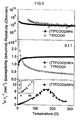
- Fig. 6 is a diagram illustrating the electrical properties of (TTPCOO) 2 NH 4 and TTPCOOH. Electrical resistance was measured using a pressure-formed sample from 4 to 320 K by a four-terminal method using a gold paste for the contact terminals ( Fig. 6a ). The TTPCOOH resistance suddenly increases at 100 K or less, exhibiting a semiconductor-like nature. On the other hand, the (TTPCOO) 2 NH 4 resistance value hardly changes over the measurement temperature range. The slight increase in the resistance value at 25 K or less is attributed to the increase in grain boundary resistance in the pellet sample. The direct current conductivity (dc conductivity) at room temperature is 2.3 S/cm for (TTPCOO) 2 NH 4 and 1.2 S/cm for TTPCOOH. These conductivity values are four orders of magnitude greater than the TTFCOONH 4 pellet sample.
- Fig. 6b illustrates the temperature dependence of magnetic susceptibility when a 0.1 T magnetic field is applied.
- the antiferromagnetic effect derived from the inner shell electrons of the organic substance has been subtracted.
- the absolute value of the magnetic susceptibility at room temperature is 4.0 x 10 -4 emu/mol for TTPCOOH and 1.5 x 10 -3 emu/mol for (TTPCOO) 2 NH 4
- the latter value is an order of magnitude greater than a typical charge transfer complex formed from a pure organic substance.
- (TTPCOO) 2 NH 4 exhibits an antiferromagnetic behavior at 25 K or less. From broad-line solid-state 1 H-NMR measurement, the temperature dependence of relaxation time of the nuclear spin of (TTPCOO) 2 NH 4 is in line with T 1 -1 , thus proving that the substance was metallized.
- TTP skeleton tends to assemble two-dimensionally due to the expanded ⁇ -conjugated moiety of the TTP skeleton, which causes delocalization of the amphoteric ion radical species in the molecular arrangement, thereby enabling metallization.
- Fig. 7 is a schematic diagram illustrating a steric structure that focuses on intermolecular bonding and the interactions among molecules. As illustrated in the drawing, a hydrogen bond network is formed.
- Ammonium not only serves as the key for exhibiting the physical properties, but also plays a role in making the TTF (donor) molecules effectively self-assemble into a molecular arrangement that is suited to the carrier transport phenomenon.
- These compounds are organic substances that are carrier-doped in order to replenish the lost charges of the proton defects mainly produced in the salt bridge bonds.
- Organic radical species are highly reactive due to having a radical spin electron state that is in the HOMO level. Therefore, organic radical species exhibit a strong tendency to be degraded by external factors, such as oxygen in the air. Accordingly, to put an organic radical species in a chemically stable electron state, it is common to introduce an electron-withdrawing group, such as a cyano group or a nitro group, into the molecule to stabilize the species. Accordingly, the state in which radical spin has been produced by subjecting a radical species to measures to obtain an electron state such that the composition and electron state of the initially-synthesized molecules are retained and the radical species is not easily degraded even when stored for an extended period in air, is herein referred to as the "radical species is stably produced.”
- the d orbital of a transition metal element and the f orbital of a rare earth metal element are atomic orbitals that are positioned in a more inner shell than the s orbital and the p orbital of the outermost shell and have a high localization, and thus have a lower orbital energy.
- the electron state of the d orbital and the f orbital is called a quasi closed-shell configuration.
- the d electrons and the f electrons occupying these orbitals tend not to become involved in chemical bonding, so that odd electrons are stabilized.
- the nature of such odd electrons which have a quasi closed-shell configuration, do not participate in chemical bonding, and are strongly stabilized, often becomes a cause of magnetism.
- the quasi closed-shell configuration will be described in more detail later.
- Examples of preferred synthetic metals include the following.
- a salt bridge substance that has multiple bonds capable of being protonated in an electron donor or an electron acceptor molecule, in which 0.1% or more of a radical species based on the whole is stably produced during salt bridge formation. More preferred is a synthetic metal in which the radical spin electron state has a quasi closed-shell configuration.
- a substance that includes a hydrogen bond self-assembling moiety in which 0.1% or more of a radical species based on the whole is stably produced by adding a Br ⁇ nsted acid or base to a low-molecular weight organic compound having a molecular weight of 20,000 or less. More preferred is the substance in which the radical spin electron state has a quasi closed-shell configuration.
- the molecular weight is 20,000 or less. In order to sufficiently exhibit magnetic properties, it is desirable that the proton defects have been uniformly introduced throughout the substance, so that a uniform doping state can be obtained. If the molecular weight is extremely large, the difficulty level is likely to increase, so it is even more preferred that the molecular weight is 10,000 or less.
- Fig. 13 is a diagram illustrating light transmittance in the ultraviolet/visible/near-infrared regions of Compound A and Compound B. According to the diagram, both compounds exhibit a high transmittance at about 500 nm or more, and a high transmittance exceeding 80% at 530 nm. Further, since transmittance of about 70% is exhibited from the visible to near-infrared region, the light transmittance is at a practical level.
- Fig. 14 is a diagram illustrating the temperature dependence of the electrical conductivity of Compound A and Compound B. According to the diagram, both compounds have an electrical conductivity of about 0.1 S/cm at room temperature. Both compounds exhibit a heat-activated type temperature dependence with a band gap of 0.11 eV (1) and 0.13 eV (2), respectively.
- Fig. 15 is a diagram illustrating light transmittance in the ultraviolet/visible/near-infrared regions of Formula 2. According to the diagram, a high transmittance of 80% or more is exhibited for all of the regions of about 350 nm or more. This compound also has a practical level of light transmittance.
- the specimen used for measuring light transmittance was a thin film.
- the method for fabricating the TTP(COOH) 2 organic transparent thin film is as follows.
- a solution prepared by dissolving TTP(COOH) 2 (0.47 mg, 1 mmol) in dimethyl sulfoxide (DMSO, 5 mL) was dropped in an amount of 0.1 ⁇ L to 1 ⁇ L onto a glass substrate to obtain a transparent thin-film electrode having a transmittance of more than 80% in a wavelength region of 300 to 2000 nm.
- the photograph in the drawing is of a thin-film electrode fabricated by dropping 2 ⁇ L.
- a quasi closed-shell configuration is realized due to self-assembly of open-shell radicals in closed-shell molecules with a hydrogen bond network composed of an acid and a base, which are the key to carrier generation.
- the term quasi closed-shell configuration refers to an electron configuration that is seen, for example, in the transition metal d orbital and especially in the rare earth metal f orbital.
- spin is not involved in chemical bonding, has a low orbital energy, and is isolated and localized inside the atomic orbital due to being shielded by other electrons having a higher energy state.
- This induces a strong electron correlation effect in a solid state, which is a source of the exhibition of high physical properties peculiar to strongly-correlated system metals.
- This system is also called a "heavy electron system” because it increases the effective mass of electrons due to the strong electron correlation effect.
- a series of compounds that have been described above belong to the f electron system metal that has for the first time been realized in the state of organic solid.
- R 1 , R 2 , R 3 , and R 4 may be the same or different.
- R 1 , R 2 , R 3 , and R 4 may be the same or different.
- the reasons why these compounds, like the above-described synthesized compounds, exhibit an effect as a synthetic metal is that it is thought that these substances are capable of self-assembly due to hydrogen bonds, and that there is a high likelihood that proton defects may be produced there, and this fact means that delocalized molecular spin is generated in a similarly-expanded ⁇ -conjugated site, whereby the substances act as a synthetic metal.
- the substance is a material that can act as a synthetic metal, then the substance can be used as an organic transparent electrode.
- the substituent groups, such as R 1 , R 2 , R 3 , R 4 , and R', in the respective compounds may be the same or different.
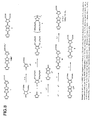
- Fig. 8 is a diagram illustrating a synthesis scheme.
- Finely crushed 1 (140 mg, 0.330 mmol) was suspended in a mixed solvent of 1,4-dioxane (31.5 ml), THF (31.5 ml), and Et 2 O (7.0 ml), and the resultant mixture was irradiated with ultrasonic waves for 15 seconds.
- the mixture was further charged with 28% aq. NH 3 (2.8 ml), and irradiated with ultrasonic waves for 15 seconds.
- the mixture was vigorously stirred for 14 hours at room temperature, and then left to stand for 1 hour at 5°C.
- the reaction mixture was then filtered using a membrane filter (H010A047A, Advantec). The filtered product was successively washed with water, THF, and Et 2 O, and dried under reduced pressure to obtain the target product Compound 1-NH 4 + (134 mg, 92%) as a dark red solid.
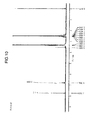
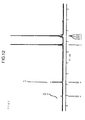
- Figs. 9 , 10 , 11 , and 12 are diagrams illustrating NMR spectra, in which the structure of the compounds is also shown.
- ESR measurement was performed under room temperature conditions on a small specimen obtained by pressure-forming and pelletizing a polycrystal of a spontaneously carrier doped salt, and the spin was quantified by comparing that ESR signal with the peak area of 2,2-diphenyl-1-picrylhydrazyl (commonly referred to as DPPH), which is a standard substance.
- DPPH 2,2-diphenyl-1-picrylhydrazyl
- the substituted TTP carboxylic acid derivative according to the present invention can be produced, for example, by the following production method.
- R 2 represents a hydrogen atom, an alkyl group, an aryl group or the like.
- Compound (IV) can be produced by reacting Compound (II) and Compound (III) in the presence or absence of an inert solvent, in the presence of a reducing agent.
- Compound (II) may be commercially available or produced by the known method (e.g., P. Wu, G. Saito, K. Imaeda, Z. Shi, T. Mori, T. Enoki, H. Inokuchi, Chem. Lett., 15, 441-444 (1086 ), E. Gomar-Nadal, C. Rovira, D. B. Amabilino, Tetrahedron, 62, 3370-3379 (2006 )), or a method described therein.
- Compound (III) may be commercially available or produced by the known method (e.g., H. Muller, C. Jouan, F. Salhi, Synth. Met., 85, 1457-1458 (1997 )), or a method described therein.
- the inert solvent optionally used include a hydrocarbon such as benzene, toluene or xylene, an ether such as tetrahydrofuran, diethyl ether or dioxane, a polar organic solvent such as acetonitrile, N,N-dimethylformamide or hexamethylphosphoric triamide, or a mixed solvent of these organic solvents.
- a hydrocarbon such as benzene, toluene or xylene
- an ether such as tetrahydrofuran, diethyl ether or dioxane
- a polar organic solvent such as acetonitrile, N,N-dimethylformamide or hexamethylphosphoric triamide, or a mixed solvent of these organic solvents.
- Preferred examples of the reducing agent include an organic reducing substance such as trimethyl phosphite, triethyl phosphite, triphenyl phosphine or trimethyl phosphine, a metal such as zinc, tin or aluminum, or an inorganic salt.
- reaction temperature mainly depends on the raw material compound or the type of the solvent used, usually, the reaction temperature is 0°C to 200°C, preferably from room temperature to 120°C.
- reaction time mainly depends on the reaction temperature, the raw material compound, or the type of the solvent used, usually, the reaction time is 1 hour to 48 hours, preferably 2 hours to 12 hours.
- Compound (V) can be produced by reacting Compound (IV) obtained from Step 1 in an inert solvent in the presence of a base, and then reacting them in an inert solvent in the presence of a carbonylating agent.
- Preferred examples of the inert solvent used herein include a hydrocarbon such as benzene, toluene or xylene, an ether such as tetrahydrofuran, diethyl ether or dioxane, a halogenated hydrocarbon such as chloroform or methylene chloride, a polar organic solvent such as acetonitrile, N,N-dimethylformamide or hexamethylphosphoric triamide, or a mixed solvent of these organic solvents.
- a hydrocarbon such as benzene, toluene or xylene
- an ether such as tetrahydrofuran, diethyl ether or dioxane
- a halogenated hydrocarbon such as chloroform or methylene chloride
- a polar organic solvent such as acetonitrile, N,N-dimethylformamide or hexamethylphosphoric triamide, or a mixed solvent of these organic solvents.
- the base include an organic base such as triethylamine, diisopropylethylamine or pyridine, an inorganic base such as potassium carbonate, sodium hydrogen carbonate, cesium hydroxide, sodium hydroxide or tetrabutylammonium hydroxide, and a metal alkoxide such as sodium methoxide or potassium t-butoxide.
- organic base such as triethylamine, diisopropylethylamine or pyridine
- an inorganic base such as potassium carbonate, sodium hydrogen carbonate, cesium hydroxide, sodium hydroxide or tetrabutylammonium hydroxide
- a metal alkoxide such as sodium methoxide or potassium t-butoxide.
- Preferred examples of the carbonylating agent include bis(trichloromethyl) carbonate, bis(4-nitrophenyl) carbonate, and N,N'-carbonyldiimidazole.
- reaction temperature mainly depends on the raw material compound or the type of the solvent used, usually, the reaction temperature is 0°C to 200°C, preferably from room temperature to 60°C.
- reaction time mainly depends on the reaction temperature, the raw material compound, or the type of the solvent used, usually, the reaction time is 1 hour to 48 hours, preferably 2 hours to 24 hours.
- Compound (VII) can be produced by reacting Compound (V) obtained from Step 2 and Compound (VI) in the same manner as in Step 1, in the presence or absence of an inert solvent, in the presence of a reducing agent.
- Compound (VI) may be commercially available or produced by the known method (e.g., M. Ngounda, H. L. Bozec, P. Dixneuf, J. Org. Chem., 47, 4000-4002 (1982 ), F. M. Benitez, J. R. Grunwell, J. Org. Chem., 43, 2917-2918 (1978 ), L. R. Melby, H. D. Hartzler, W. A. Sheppard, J. Org. Chem., 39, 2456-2458 (1974 )), or a method described therein.
- Compound (VIII) can be produced by reacting Compound (VII) obtained from Step 3 in an inert solvent in the presence of a base.
- the inert solvent examples include an alcohol such as methanol or ethanol, an ether such as tetrahydrofuran, diethyl ether or dioxane, a hydrocarbon such as benzene, toluene or xylene, a halogenated hydrocarbon such as chloroform or methylene chloride, a polar organic solvent such as N,N-dimethylformamide or hexamethylphosphoric triamide, or a mixed solvent of these organic solvents and water.
- an alcohol such as methanol or ethanol
- an ether such as tetrahydrofuran, diethyl ether or dioxane
- a hydrocarbon such as benzene, toluene or xylene
- a halogenated hydrocarbon such as chloroform or methylene chloride
- a polar organic solvent such as N,N-dimethylformamide or hexamethylphosphoric triamide
- the base include an organic base such as triethylamine, diisopropylethylamine or pyridine, an inorganic base such as potassium carbonate, sodium hydrogen carbonate, cesium hydroxide, sodium hydroxide or tetrabutylammonium hydroxide or a metal alkoxide such as sodium methoxide or potassium t-butoxide.
- organic base such as triethylamine, diisopropylethylamine or pyridine
- an inorganic base such as potassium carbonate, sodium hydrogen carbonate, cesium hydroxide, sodium hydroxide or tetrabutylammonium hydroxide or a metal alkoxide such as sodium methoxide or potassium t-butoxide.
- reaction temperature mainly depends on the raw material compound or the type of the solvent used, usually, the reaction temperature is 0°C to 200°C, preferably from room temperature to 60°C.
- reaction time mainly depends on the reaction temperature, the raw material compound, or the type of the solvent used, usually, the reaction time is 1 hour to 120 hours, preferably 12 hours to 72 hours.
- Trimethyl phosphite (124 ml) was mixed with 4,5-bis(methylthio)-1,3-dithiol-2-thione (3.26 g, 14.4 mmol) (corresponding to Compound (II)) and 4,5-bis(2-cyanoethylthio)-1,3 dithiol-2-one (5.0 g, 17.3 mmol) (corresponding to Compound (III)) at room temperature.
- the resultant mixture was stirred for 3 hours at 120°C, and then insoluble matter was removed by filtration.
- the dried solid mater was added to tetrahydrofuran (25 ml) to form a suspension, cooled to 0°C, and then mixed with bis(trichloromethyl) carbonate (520 mg, 1.75 mmol) that had been previously dissolved in tetrahydrofuran (5 ml).
- the mixture was stirred overnight at room temperature, then diluted by adding toluene (30 ml) and methanol (10 ml), and stirred for 10 minutes, after which the solvent was removed by distillation under reduced pressure. Then, the mixture was mixed with non-ionized water (20 ml) and methanol (20 ml), and stirred for 20 minutes at room temperature.
- the formed suspension was filtered, and the solid matter obtained on the funnel was washed with non-ionized water and methanol, then collected and vacuum-dried.
- the dried solid mater was added to diethyl ether (250 ml), irradiated with ultrasonic waves for 20 seconds, and stirred for 10 minutes at room temperature.
- the formed suspension was filtered, and the solid matter obtained on the funnel was washed with diethyl ether, then collected and vacuum-dried to obtain the subject compound (b) (388 mg, 46.9%) as a brown powder.
- Trimethyl phosphite 50 ml was mixed with compound (b) (1.00 g, 2.59 mmol) (corresponding to Compound (V)) and 1,3-dithiol-2-thione-4,5-dicarboxylate (1.00 g, 3.99 mmol) (corresponding to Compound (VI)) at room temperature.
- the resultant mixture was stirred for 14 hours at 120°C, then the temperature was returned to room temperature, and the solvent was removed by distillation under reduced pressure.
- the residue was suspended in diethyl ether (50 ml), and the resultant suspension was stirred for 30 minutes at room temperature. This suspension was filtered, and the solid matter obtained on the funnel was washed with diethyl ether.
- the washed solid mater was collected, dissolved in chloroform (350 ml), and purified by silica gel column chromatography (eluted with toluene) to obtain the subject Compound (1) (413 mg, 27.0%). Further, umber brown, plate-shaped crystals of Compound (2) were obtained by recrystallizing from chloroform. m.p.
- a pellet sample (A) was prepared by crushing powder crystals with a pestle in a mortar and pressure-forming using a hydraulic pump.
- a single crystal sample (B) was obtained by gently evaporating the organic solvent.
- a gold wire having a diameter of 0.01 mm and a purity of 99% or more was arranged in a line at four locations on each test sample using a gold paste to provide terminals. Then, evaluation was carried out by measuring under room temperature conditions the voltage across the two middle points when a current of about 0.1 ⁇ A was applied. The value standardized based on sample size was taken as the test value.
- Compounds 1 to 10 all exhibit excellent charge transport properties and solubility in an organic solvent, and can be formed as a thin film, while each is still a single molecule and a simple substance. Therefore, Compounds 1 to 10 hold promise for industrial applications in touch panels, transparent electrodes, and organic field-effect transistors.
- the compounds according to the present embodiment can be used in various applications. Examples include in wiring, an information transmission medium, an electronic device, an electrode utilized in an electronic device, a spintronics device, an information communication device, a memory device, a magnetic shield, a medical magnetic shield, a magnet, a magnetic semiconductor, a field-effect transistor (FET), a sticking plaster that includes a magnet, a hard disk drive head, a high sensitivity playback GMR head, a solid-state magnetic memory, a magnetoresistive memory (MRAM), a fiber communication optical isolator, a material that changes color in a magnetic field, and a material that utilizes the interaction between conduction electron spin and atomic magnetic moment.
- FET field-effect transistor
- Further examples include a touch panel, a display, an electronic device, a liquid crystal display, a flat-screen TV, a plasma display, electronic ink, an anode in an organic EL (hole injection layer), a solar cell, an antistatic agent, an electromagnetic shielding material, an optical coating, an infrared reflective material, a gas sensor, an antireflection film, a surface processing agent, a semiconductor laser, an optical device, an optical element, a device that utilizes bending resistance, an electrolytic capacitor, an electronic component, a lithium ion battery electrode, a light-emitting device, an organic transistor, and a printable circuit for directly forming a pattern on a substrate by utilizing ink-jet technology or the like using a conductive polymer for ink.
- a touch panel a display, an electronic device, a liquid crystal display, a flat-screen TV, a plasma display, electronic ink, an anode in an organic EL (hole injection layer), a solar cell, an antistatic agent, an electromagnetic shielding
- the compounds according to the present embodiment are not a single crystal, since they still exhibit high physical property values in a microcrystal pressure-formed state, it is suggested that the compounds according to the present embodiment can be converted into polymers and liquid crystals, and be formed into thin films. Thin-film forming carried out by coating opens up possibilities to many applications.
Landscapes
- Chemical & Material Sciences (AREA)
- Organic Chemistry (AREA)
- Physics & Mathematics (AREA)
- Spectroscopy & Molecular Physics (AREA)
- Engineering & Computer Science (AREA)
- Theoretical Computer Science (AREA)
- General Engineering & Computer Science (AREA)
- General Physics & Mathematics (AREA)
- Human Computer Interaction (AREA)
- Organic Low-Molecular-Weight Compounds And Preparation Thereof (AREA)
- Heterocyclic Carbon Compounds Containing A Hetero Ring Having Oxygen Or Sulfur (AREA)
- Non-Insulated Conductors (AREA)
- Manufacturing Of Electric Cables (AREA)
- Electrodes Of Semiconductors (AREA)
Abstract
Description
- The present invention relates to an organic transparent electrode or a synthetic metal.
- Transparent electrodes such as indium tin oxide (ITO) electrodes, for example, are very useful materials that are used in electronic devices, such as in mobile telephone displays. However, indium, which is the central element, is a rare metal whose price has recently increased dramatically. Considering future demand, it is desirable to replace indium with another, less expensive substance. To obtain a metal (synthetic metal) from typical elements such as carbon, nitrogen, oxygen, hydrogen, and sulfur atoms, there are two types of method, i.e., a method carried out with a charge transfer complex using an electrolytic oxidation method, and a method carried out with a conductive polymer by a chemical doping method that adds a doping agent.
- Conventionally, it has not been possible to obtain an organic transparent electrode other than by these methods.
- It is an object of the present invention, which was created in view of the above-described background art, to provide a compound capable of becoming an organic transparent electrode, a compound capable of becoming an organic transparent electrode and the like.
- According to the present invention, the configurations as described in the claims are employed in order to achieve the above-described objects. This invention will now be described in more detail.
- A first aspect of the present invention is an organic transparent electrode characterized by being formed from an organic molecule having a Brønsted acid functional group, an electron-donating ability, and a π-conjugated plane, and being self-assembling.
- A second aspect of the present invention is the organic transparent electrode according to
claim 1, characterized in that the Brønsted acid functional group is any of a carboxylic acid functional group, a sulfonic acid functional group, a phosphonic acid functional group, and a thiophosphonic acid functional group. - A third aspect of the present invention is the organic transparent electrode according to
claim 2, characterized in that a hydrogen bond is formed to the Brønsted acid functional group in a self-assembled state. - A fourth aspect of the present invention is an organic transparent electrode characterized by being formed from a compound that comprises a fused tetrathiafulvalene derivative moiety in a skeleton and has a protonic acid functional group.
- A fifth aspect of the present invention is an organic transparent electrode characterized by being formed from any of the compounds represented by the following general formulae, wherein R1, R2, R3, R4, and R' may be the same or different, or a salt thereof.
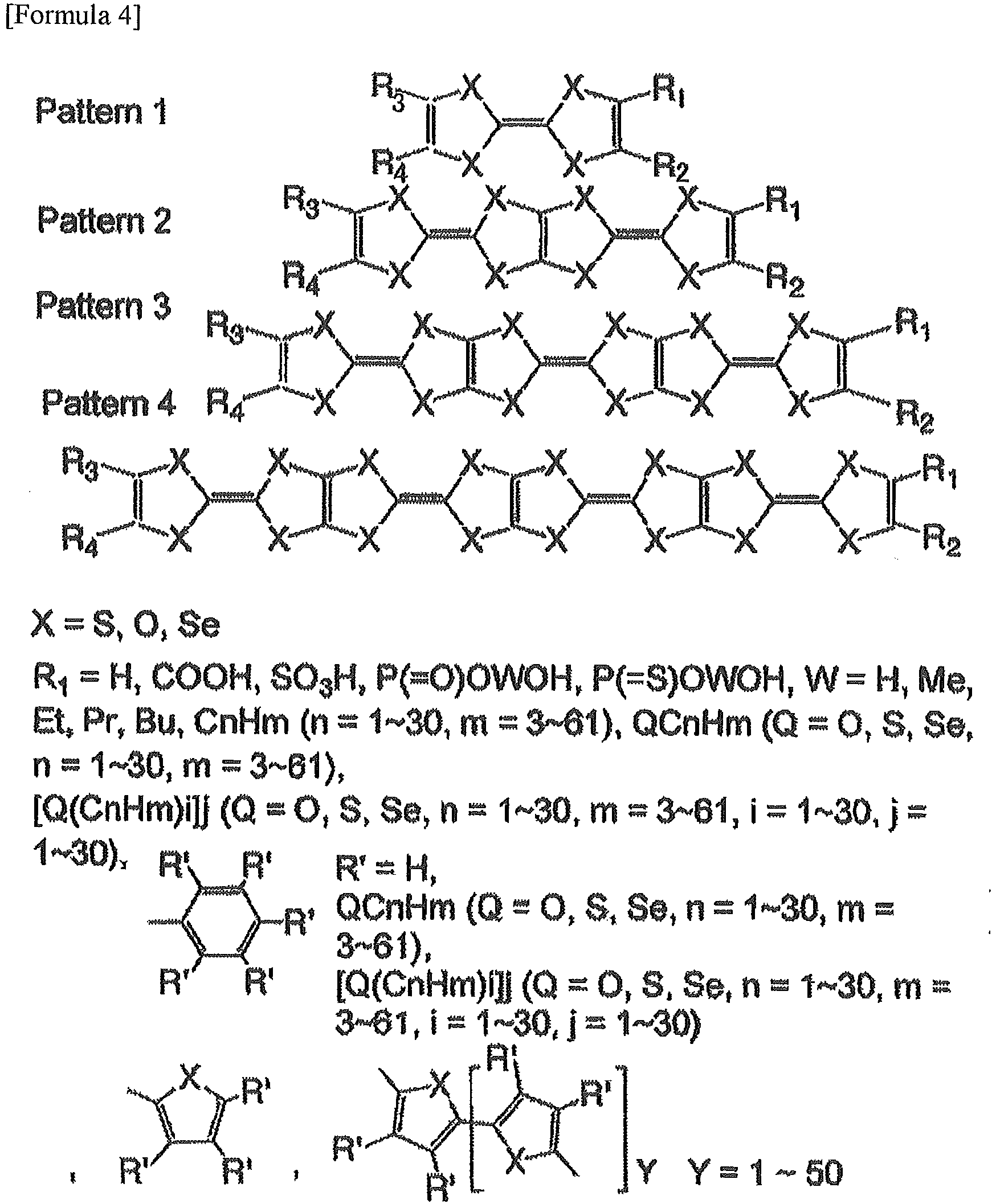

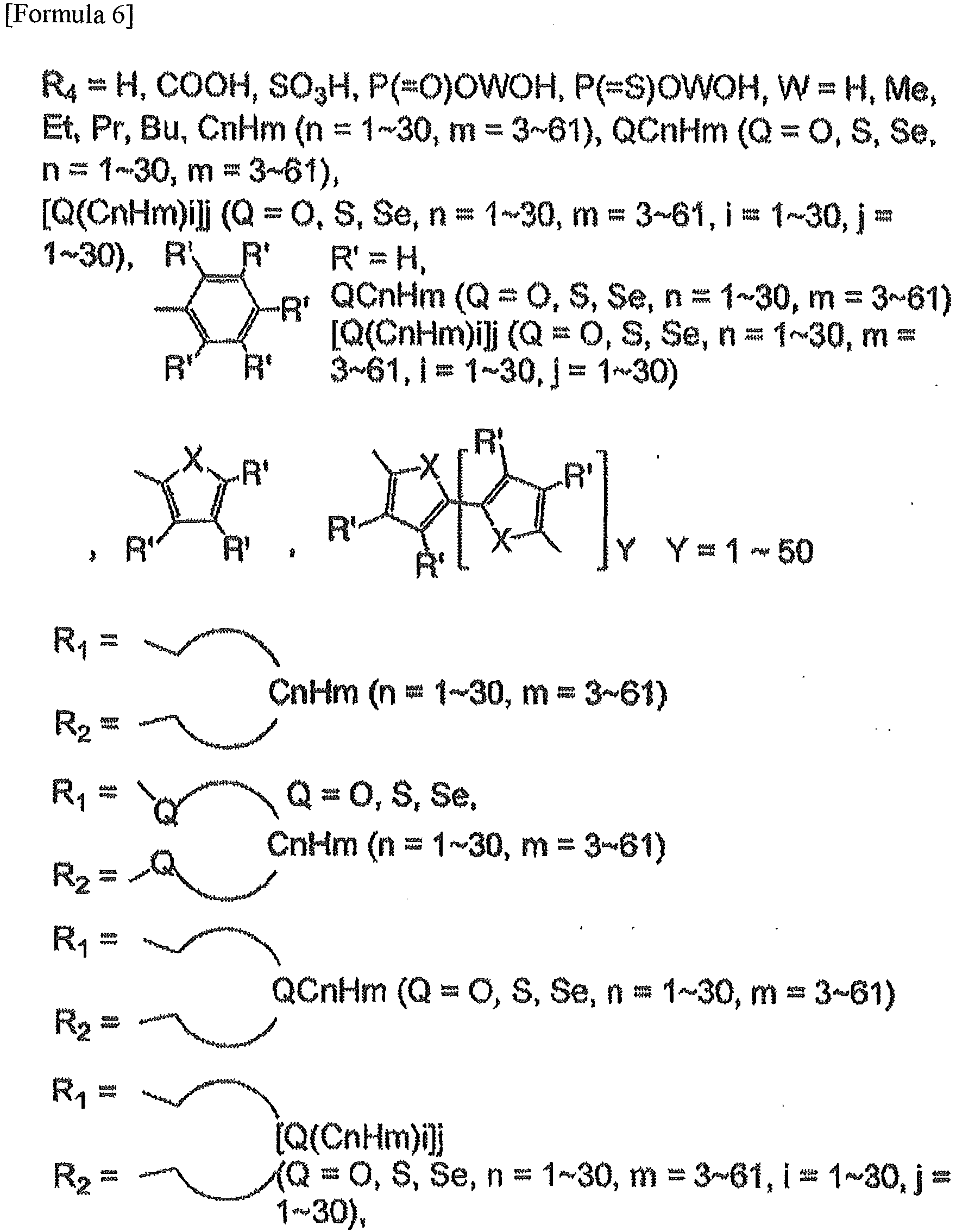

- A sixth aspect of the present invention is an organic transparent electrode characterized by being formed from any of the compounds represented by the following general formulae, wherein R1, R2, R3, R4, and R' may be the same or different, or a salt thereof.


- A seventh aspect of the present invention is an organic transparent electrode characterized by being formed from a compound represented by Formula 1 or a salt thereof.

- An eighth aspect of the present invention is an organic transparent electrode characterized by being formed from a compound represented by Formula 2 or a salt thereof.

- A ninth aspect of the present invention is an organic transparent electrode characterized by being formed from a compound represented by Formula 3 or a salt thereof.

- A tenth aspect of the present invention is an organic transparent electrode characterized by being formed from an anilinium tetrathiafulvalene-2-carboxylate salt.
- An eleventh aspect of the present invention is an organic transparent electrode characterized by being formed from a hydroxyammonium tetrathiafulvalene-2-carboxylate salt.
- A twelfth aspect of the present invention is an organic transparent electrode characterized by being formed from a compound represented by the following formula:
[(TTPCOO-NH4 +)(TTPCOOH)]1-x(TTP·+COO-NH3)x,
wherein x is 0.06.
- A thirteenth aspect of the present invention is a method for producing an organic transparent electrode, comprising recrystallizing from an organic solvent a fused sulfur-containing π compound to which a carboxylic acid functional group has been introduced.
- A fourteenth aspect of the present invention is a method for producing an organic transparent electrode, comprising recrystallizing a fused tetrathiafulvalene to which a carboxylic acid functional group has been introduced, from an organic solvent to which an ammonia solution has been added.
- A fifteenth aspect of the present invention is a touch panel comprising the organic transparent electrode according to
claim 10 or 11. - A sixteenth aspect of the present invention is a display comprising the organic transparent electrode according to
claim 10 or 11. - A seventeenth aspect of the present invention is an electronic device comprising the organic transparent electrode according to
claim 10 or 11. - An eighteenth aspect of the present invention is an organic transparent electrode comprising an organic compound having protonic defects in a hydrogen bond network, wherein a radical cation or a radical anion is generated to replenish a lost charge.
- A nineteenth aspect of the present invention is an organic transparent electrode wherein charges are not in equilibrium due to a ratio of a cation and an anion present in a hydrogen bond network not being 1:1, and a radical cation or a radical anion is generated to replenish a lost charge.
- A twentieth aspect of the present invention is a synthetic metal characterized by being formed from an organic molecule having a Brønsted acid functional group, an electron-donating ability, and a π-conjugated plane, and being self-assembling.
- A twenty-first aspect of the present invention is the synthetic metal according to
claim 20, characterized in that the Brønsted acid functional group is any of a carboxylic acid functional group, a sulfonic acid functional group, a phosphonic acid functional group, and a thiophosphonic acid functional group. - A twenty-second aspect of the present invention is the synthetic metal according to claim 21, characterized in that a hydrogen bond is formed to the Brønsted acid functional group in a self-assembled state.
- A twenty-third aspect of the present invention is a synthetic metal characterized by being formed from a compound that comprises a fused tetrathiafulvalene derivative moiety in a skeleton and has a protonic acid functional group.
- A twenty-fourth aspect of the present invention is a synthetic metal characterized by being any of the compounds represented by Formula 4A, wherein R1, R2, R3, and R4 may be the same or different, or a salt thereof.

- A twenty-fifth aspect of the present invention is a synthetic metal that is any of the compounds represented by Formula 5A, wherein R1, R2, R3, and R4 may be the same or different, or a salt thereof.

- A twenty-sixth aspect of the present invention is a compound represented by Formula 1A or a salt thereof.

- A twenty-seventh aspect of the present invention is a compound represented by Formula 2A or a salt thereof.

- A twenty-eighth aspect of the present invention is a compound represented by Formula 3 A or a salt thereof.

- A twenty-ninth aspect of the present invention is a synthetic metal characterized by being a compound represented by Formula 1A or a salt thereof.

- A thirtieth aspect of the present invention is a synthetic metal characterized by being a compound represented by Formula 2A or a salt thereof.

- A thirty-first aspect of the present invention is a synthetic metal characterized by being a compound represented by Formula 3A or a salt thereof.

- A thirty-second aspect of the present invention is a synthetic metal characterized by being a compound represented by the following formula:
[(TTPCOO-NH4 +)(TTPCOOH)]1-x(TTP·+COO-NH3)x,
wherein x is 0.06.
- A thirty-third aspect of the present invention is a method for producing a synthetic metal, comprising recrystallizing from an organic solvent a fused sulfur-containing π compound to which a carboxylic acid functional group has been introduced.
- A thirty-fourth aspect of the present invention is a method for producing a synthetic metal, comprising recrystallizing a fused tetrathiafulvalene to which a carboxylic acid functional group has been introduced from an organic solvent to which an ammonia solution has been added.
- A thirty-fifth aspect of the present invention is a wire comprising the synthetic metal according to claim 30.
- A thirty-sixth aspect of the present invention is an electronic device comprising the synthetic metal according to claim 30.
- A thirty-seventh aspect of the present invention is a synthetic metal comprising an organic compound having a proton defect in a hydrogen bond network, wherein a radical cation or a radical anion is generated to replenish a lost charge.
- A thirty-eighth aspect of the present invention is a synthetic metal wherein charges are not in equilibrium due to a ratio of a cation and an anion present in a hydrogen bond network not being 1:1, and a radical cation or a radical anion is generated to replenish a lost charge.
- Examples of the Brønsted acid functional group include -COOH, -SO3H, and - P(=X)OROH (X = O or S, R = H, Me, Et, Pr, Bu). A primary amine is represented by -NHnD3-n (n = 2 to 0, and D is deuterium), for example. Further, examples of inorganic acids include HBF4, HClO4, HCl, HBr, HI, DBF4, DClO4, DCl, DBr, and DI. Examples of inorganic bases include NHnD3-n (n = 3 to 0), NHnD2-nOH (n = 2 to 0), and NHnD2-nOD (n = 2 to 0).
- Further, the term "metal" refers to a conductor through which electricity passes well. For example, at around room temperature, the electrical conductivity of a pressure-formed pellet is greater than about 1 S/cm. The term "transparent" refers to, for example, a transmittance of around 80% or more over a wide wavelength region (e.g.: 500 to 2000 nm). An electrode is a material having a conductivity of around 0.0001 S/cm or more at around room temperature, for example.
- The term "donor" refers to an electron donator, i.e., an electron donating molecule or an electron donating group. Further, the term "acceptor" refers to an electron acceptor, i.e., an electron accepting molecule or an electron accepting group.
- The term "room temperature" refers to a temperature of 300 K (27°C), and the term "around room temperature" means that room temperature ± about 10°C.
- Further, the compounds in the specification and the claims include compounds having an equivalent structure in which an element is substituted with an elemental isotope, such as deuterium.
- According to the present invention, a compound or the like is obtained that is capable of forming an organic transparent electrode or a synthetic metal. Further objectives, characteristics, and advantages of the present invention will become apparent from the detailed description that is based on the following embodiments of the present invention and the attached drawings.
-
- [
Fig. 1] Fig. 1 is a diagram illustrating a synthesis scheme. - [
Fig. 2] Fig. 2 is a diagram illustrating the temperature dependence of the electrical resistance ofFormula 1,Formula 2, andFormula 3. - [
Fig. 3] Fig. 3 is a diagram illustrating the ESR spectra at room temperature ofFormula 1,Formula 2, andFormula 3. - [
Fig. 4] Fig. 4 is a diagram illustrating the XPS spectra at room temperature of the nitrogen atom inner-shell level (Is) ofFormula 3. - [
Fig. 5] Fig. 5 is a diagram illustrating the normalized near-infrared absorption spectra of (TTPCOO)2NH4 and TTPCOOH. - [
Fig. 6] Fig. 6 is a diagram illustrating the electrical properties of (TTPCOO)2NH4 and TTPCOOH. - [
Fig. 7] Fig. 7 is a schematic diagram illustrating a steric structure that focuses on intermolecular bonding and the interactions among molecules. - [
Fig. 8] Fig. 8 is a diagram illustrating a synthesis scheme. - [
Fig. 9] Fig. 9 is a diagram illustrating an NMR spectrum. - [
Fig. 10] Fig. 10 is a diagram illustrating an NMR spectrum. - [
Fig. 11] Fig. 11 is a diagram illustrating an NMR spectrum. - [
Fig. 12] Fig. 12 is a diagram illustrating an NMR spectrum. - [
Fig. 13] Fig. 13 is a diagram illustrating light transmittance in the ultraviolet/visible/near-infrared regions of Compound A and Compound B. - [
Fig. 14] Fig. 14 is a diagram illustrating temperature dependence of electrical conductivity of Compound A and Compound B. - [
Fig. 15] Fig. 15 is a diagram illustrating light transmittance in the ultraviolet/visible/near-infrared regions ofFormula 2. - Embodiments of the present invention will now be described in more detail with reference to the drawings.
- The present embodiment relates to a method and the like for producing an electrode material having a high transmittance from an organic substance that is formed only from typical elements without using rare metals. Organic substances have large industrial advantages, since their raw materials are not only inexpensive, but also organic substances are light and flexible. According to the present method, an organic transparent electrode can be obtained just by metallizing.
- Further, the compound according to the present embodiment has a high transmittance to light across a wide wavelength range.
- Although the material of the organic transparent electrode is not necessarily limited to a synthetic metal, if the material is a synthetic metal, the electrode can be used as an organic transparent electrode. Therefore, a method for producing a synthetic metal will be described below in more detail.
- The present embodiment uses a new production method for synthesizing a synthetic metal without employing an electrolytic oxidation method or a chemical doping method. According to the method, a metallized organic substance can be obtained simply by introducing a carboxylic acid functional group into a fused sulfur-containing π compound (fused tetrathiafulvalene) and recrystallizing from an organic solvent to which an ammonia solution has been added.
- This production method makes it possible to obtain a large amount of a stable synthetic metal easily at a time, since this method not only makes a large-scale apparatus for electrolytic oxidation unnecessary, but also avoids the degradation and instability of the substances that are produced during chemical doping. Accordingly, this method is a revolutionary production method that enables production of large amounts of a synthetic metal on an industrial scale. Consequently, this method will greatly broaden the possibilities of organic materials as a substitute substance for metal resources.
- Specifically, the present inventors synthesized an organic ammonium salt having a high conductivity without electrolytic oxidation or addition of a dopant. Based on electron transportation and spectroanalysis, this salt acts as a metal until at least 4 K, has a magnetic susceptibility at room temperature that is ten-times higher than a typical charge transfer complex, and exhibits an antiferromagnetic behavior at 25 K or less.
- Synthetic metals formed purely from light elements are attracting a lot of attention both academically and industrially. However, considering industrial-scale applications, it is desirable to synthesize a synthetic metal without electrolytic oxidation.
- Non Patent Literature 1: (a) Mulliken, R. S. J. Am. Chem. Soc. 1952, 74, 811-824.
- Non Patent Literature 2: (b) Akamatsu, H.; Inokuchi, H.; Matsunaga, Y. Nature 1954, 4395, 168-169.
- Non Patent Literature 3: (c) Shirakawa, H.; Louis, E. J.; MacDiarmid, A. G.; Chiang, C. K.; Heeger, A. J. J. Chem. Soc., Chem. Commun. 1977, 578.
- Non Patent Literature 4: (d) Batail, P. Ed. Chem. Rev. 2004, 104, 11 (special issue for molecular conductors), 4887-5782.
- Non Patent Literature 5: (e) Walzer K.; Maennig, B.; Pfeiffer M.; Leo, K. Chem. Rev. 2007, 107, 1233-1271.
- Non Patent Literature 6: (f) Kirtley, J. R.; Mann-hart, J. Nature Mat. 2008, 7, 520-521.
- The present inventors have recently found that an ammonium salt co-existing with a certain electron donor molecule is spontaneously doped, thereby generating hole carriers at the ammonium salt forming stage.
- Non Patent Literature 7: (a) Kobayashi, Y.; Yoshioka, M.; Saigo, K.; Hashizume, D.; Ogura, T. J. Am. Chem. Soc. 2009, 131, 9997-10002.
- Non Patent Literature 8: (b) Kobayashi, Y; Yoshioka, M.; Saigo, K.; Hashizume, D.; Ogura, .
- Non Patent Literature 9: (c) Kobayashi, Y; Suzuki, A.; Yamada, Y; Saigo, K.; Shibue, T. Syn. Met. 2010, 160, 575-583,
- Non Patent Literature 10: (d) Furukawa, K.; Nakamura, T.; Kobayashi, Y; Ogura, T. J. Phys. Soc. Jpn. 2010, 79, 053701-4.
- Non Patent Literature 11: (e) Terauchi, T.; Kobayashi, Y; Iwai, H.; Tanaka, A. Syn. Met. 2012, 162, 531-535.
- In this doping method, charge neutrality is ensured by having a partial proton deficit in the ammonium ion moiety, instead of adding a dopant in the same way as the conventional conductive polymers. The tetrathiafulvalene carboxylic acid ammonium salt (TTFCOO-NH4 +)1-x(TTF·+COO-NH3)x, wherein x is 0.16 (herein abbreviated as TTFCOONH4), is the first reported hole-doped semiconductor, on which the carrier generation mechanism and the source for exhibiting conductivity, etc. have been explained. Further, just recently, a single crystal of tetrathiafulvalene carboxylic acid anilinium salt was obtained, from which it was clear that this doping phenomenon was not just due to surface effects, but a bulk property of the substance. These facts illustrate the high likelihood that a "charge deficit" dopant will create a new synthetic metal without the use of electrolytic oxidation.
- The present inventors designed tetrathiapentalene (fused tetrathiafulvalene) carboxylic acid ammonium salt (TTPCOO)2NH4 as a novel molecule, which is intended to widen the band width of the valence band by expanding the overlap in the π orbital.
- Specific compounds will be mentioned below and described in more detail for their physical properties and the like.
-
Fig. 1 is a diagram illustrating a synthesis scheme. The precursor TTPCOOH was synthesized without using a metal catalyst even once at any stage of the synthesis pathway. A salt is obtained as a black-brown solid in a yield of 92% by recrystallizing an ammonium salt of TTPCOOH from an aqueous ammonia solution of TTPCOOH with an organic solvent (THF/1,4-dioxane/diethyl ether). - The composition has a 2:1 ratio of acid:base. It was confirmed based on the 1H-NMR spectrum that all of the TTPCOOH was converted into the ammonium salt. Measurement of the N (Is) core level of this salt by X-ray photoemission spectroscopy showed that the salt had peaks at 401.3 eV and 399.6 eV, which were identified as ammonium ions and ammonia, respectively. Since the ammonia is about 6%, the correct formula is [(TTPCOO-NH4 +)(TTPCOOH)]1-x(TTP·+COONH3)x, wherein x is 0.06. On the other hand, the ESR spectrum shows a large radical spin density of 32%. This was identified from the g value of 2.00575 as coming from TTP radical cations.
- Next, three fused tetrathiafulvalene derivatives synthesized by the present inventors will be shown.
- 1, TTPCOOH, TTPCOOD

- 2, TTP(COOH)2, TTP(COOD)2

- 3, (TTPCOO)2NH4, (TTPCOO)2ND4

-
Fig. 2 is a diagram illustrating the temperature dependence of the electrical resistance ofFormula 1,Formula 2, andFormula 3. Among these, forFormula 2 andFormula 3, it was confirmed that a pellet specimen formed by pressure-forming a powder was metallized. Since the deuterium-substituted specimen exhibits almost the same behavior, only the example ofFormula 2 is shown. -
Fig. 3 is a diagram illustrating the ESR spectra at room temperature ofFormula 1,Formula 2, andFormula 3. The spin densities ofFormula 1,Formula 2, andFormula 3 are determined as 37%, 32%, and 12%, respectively, by electron spin resonance (ESR) at room temperature based on the standard substance DPPH. -
Fig. 4 is a diagram illustrating the XPS spectra at room temperature ofnitrogen atom N 1s core level ofFormula 3. The source of metallization is attributed to self doping for replenishing the lost charges from proton defects that occur in a salt bridge bond. This fact was confirmed by X-ray photoemission spectroscopy for Formula 3 (TTPCOO)2NH4 - In other words,
Fig. 4 illustrates the bond energy ofN 1s ofFormula 3. The amount of proton defects inFormula 3, which is the most representative substance, can be estimated by photoemission spectroscopy (XPS) as being 6% from the mixed ratio of NH3 species in thenitrogen 1s orbital. The presence of these proton defects causes molecular spin in the crystal. -
Fig. 5 is a diagram illustrating the normalized near-infrared absorption spectra of (TTPCOO)2NH4 and TTPCOOH. Both of these substances exhibit a large absorption showing intermolecular transitions of the TTP moiety, which is in a mixed valence state at 800 nm or more. This is related to the delocalized amphoteric ion radical species [(TTP)0.5+]COO- in the molecular arrangement, as both substances have a free carrier. It is thought that the self-protonated species TTPH+COO-, which is generated in TTPCOOH, replaces the role that was borne by the proton defects for the ammonium salt. -
Fig. 6 is a diagram illustrating the electrical properties of (TTPCOO)2NH4 and TTPCOOH. Electrical resistance was measured using a pressure-formed sample from 4 to 320 K by a four-terminal method using a gold paste for the contact terminals (Fig. 6a ). The TTPCOOH resistance suddenly increases at 100 K or less, exhibiting a semiconductor-like nature. On the other hand, the (TTPCOO)2NH4 resistance value hardly changes over the measurement temperature range. The slight increase in the resistance value at 25 K or less is attributed to the increase in grain boundary resistance in the pellet sample. The direct current conductivity (dc conductivity) at room temperature is 2.3 S/cm for (TTPCOO)2NH4 and 1.2 S/cm for TTPCOOH. These conductivity values are four orders of magnitude greater than the TTFCOONH4 pellet sample. -
Fig. 6b illustrates the temperature dependence of magnetic susceptibility when a 0.1 T magnetic field is applied. The antiferromagnetic effect derived from the inner shell electrons of the organic substance has been subtracted. The absolute value of the magnetic susceptibility at room temperature is 4.0 x 10⁻⁴ emu/mol for TTPCOOH and 1.5 x 10⁻³ emu/mol for (TTPCOO)2NH4 The latter value is an order of magnitude greater than a typical charge transfer complex formed from a pure organic substance. In addition, (TTPCOO)2NH4 exhibits an antiferromagnetic behavior at 25 K or less. From broad-line solid-state 1H-NMR measurement, the temperature dependence of relaxation time of the nuclear spin of (TTPCOO)2NH4 is in line with T1 -1, thus proving that the substance was metallized. - It is thought that the TTP skeleton tends to assemble two-dimensionally due to the expanded π-conjugated moiety of the TTP skeleton, which causes delocalization of the amphoteric ion radical species in the molecular arrangement, thereby enabling metallization.
- Next, the outline of the molecular assembly structure and the like will be described.
-
Fig. 7 is a schematic diagram illustrating a steric structure that focuses on intermolecular bonding and the interactions among molecules. As illustrated in the drawing, a hydrogen bond network is formed. - Regarding electrical conductivity, from the frequency dependence in the dielectric dispersion of the deuterium sample, it is clear that the hydrogen bonds are barely contributing to electrical conductivity.
- Ammonium not only serves as the key for exhibiting the physical properties, but also plays a role in making the TTF (donor) molecules effectively self-assemble into a molecular arrangement that is suited to the carrier transport phenomenon.
- These compounds are organic substances that are carrier-doped in order to replenish the lost charges of the proton defects mainly produced in the salt bridge bonds.
- Organic radical species are highly reactive due to having a radical spin electron state that is in the HOMO level. Therefore, organic radical species exhibit a strong tendency to be degraded by external factors, such as oxygen in the air. Accordingly, to put an organic radical species in a chemically stable electron state, it is common to introduce an electron-withdrawing group, such as a cyano group or a nitro group, into the molecule to stabilize the species. Accordingly, the state in which radical spin has been produced by subjecting a radical species to measures to obtain an electron state such that the composition and electron state of the initially-synthesized molecules are retained and the radical species is not easily degraded even when stored for an extended period in air, is herein referred to as the "radical species is stably produced."
- The d orbital of a transition metal element and the f orbital of a rare earth metal element are atomic orbitals that are positioned in a more inner shell than the s orbital and the p orbital of the outermost shell and have a high localization, and thus have a lower orbital energy. The electron state of the d orbital and the f orbital is called a quasi closed-shell configuration. In such a configuration, because of the high localization of these orbitals, the d electrons and the f electrons occupying these orbitals tend not to become involved in chemical bonding, so that odd electrons are stabilized. The nature of such odd electrons, which have a quasi closed-shell configuration, do not participate in chemical bonding, and are strongly stabilized, often becomes a cause of magnetism. The quasi closed-shell configuration will be described in more detail later.
- Examples of preferred synthetic metals include the following.
- (1) A salt bridge substance that has multiple bonds capable of being protonated in an electron donor or an electron acceptor molecule, in which 0.1% or more of a radical species based on the whole is stably produced during salt bridge formation. More preferred is a synthetic metal in which the radical spin electron state has a quasi closed-shell configuration.
- The grounds for this are that, as confirmed experimentally, when radical spin is produced in a density of 0.1% or more, and that electron state is a quasi closed-shell configuration, the radical spin electrons act as free carriers, so that an electron conductivity of about 10-5 S/cm or more is exhibited.
- (2) A substance that includes a hydrogen bond self-assembling moiety, in which 0.1% or more of a radical species based on the whole is stably produced by adding a Brønsted acid or base to a low-molecular weight organic compound having a molecular weight of 20,000 or less. More preferred is the substance in which the radical spin electron state has a quasi closed-shell configuration.
- Even for a polymer, it is preferred to have a self-assembling site partially by the hydrogen bond functional groups. To achieve this, it is desirable for the molecular weight to be 20,000 or less. In order to sufficiently exhibit magnetic properties, it is desirable that the proton defects have been uniformly introduced throughout the substance, so that a uniform doping state can be obtained. If the molecular weight is extremely large, the difficulty level is likely to increase, so it is even more preferred that the molecular weight is 10,000 or less.
- Next, the physical properties of the following two compounds will be described.
- Compound A: Tetrathiafulvalene-2-carboxylic acid aniline salt single crystal (TTFCOONH3Ph)
- Compound B: Tetrathiafulvalene-2-carboxylic acid hydroxyamine salt single crystal (TTFCOONH3OH)
-
Fig. 13 is a diagram illustrating light transmittance in the ultraviolet/visible/near-infrared regions of Compound A and Compound B. According to the diagram, both compounds exhibit a high transmittance at about 500 nm or more, and a high transmittance exceeding 80% at 530 nm. Further, since transmittance of about 70% is exhibited from the visible to near-infrared region, the light transmittance is at a practical level. -
Fig. 14 is a diagram illustrating the temperature dependence of the electrical conductivity of Compound A and Compound B. According to the diagram, both compounds have an electrical conductivity of about 0.1 S/cm at room temperature. Both compounds exhibit a heat-activated type temperature dependence with a band gap of 0.11 eV (1) and 0.13 eV (2), respectively. - Next, the physical properties of the following compound will be described.

-
Fig. 15 is a diagram illustrating light transmittance in the ultraviolet/visible/near-infrared regions ofFormula 2. According to the diagram, a high transmittance of 80% or more is exhibited for all of the regions of about 350 nm or more. This compound also has a practical level of light transmittance. - The specimen used for measuring light transmittance was a thin film. The method for fabricating the TTP(COOH)2 organic transparent thin film is as follows.
- A solution prepared by dissolving TTP(COOH)2 (0.47 mg, 1 mmol) in dimethyl sulfoxide (DMSO, 5 mL) was dropped in an amount of 0.1 µL to 1 µL onto a glass substrate to obtain a transparent thin-film electrode having a transmittance of more than 80% in a wavelength region of 300 to 2000 nm. The photograph in the drawing is of a thin-film electrode fabricated by dropping 2 µL.
- A quasi closed-shell configuration is realized due to self-assembly of open-shell radicals in closed-shell molecules with a hydrogen bond network composed of an acid and a base, which are the key to carrier generation. The term quasi closed-shell configuration refers to an electron configuration that is seen, for example, in the transition metal d orbital and especially in the rare earth metal f orbital. In this configuration, spin is not involved in chemical bonding, has a low orbital energy, and is isolated and localized inside the atomic orbital due to being shielded by other electrons having a higher energy state. This induces a strong electron correlation effect in a solid state, which is a source of the exhibition of high physical properties peculiar to strongly-correlated system metals. This system is also called a "heavy electron system" because it increases the effective mass of electrons due to the strong electron correlation effect. A series of compounds that have been described above belong to the f electron system metal that has for the first time been realized in the state of organic solid.
- The electron state according to an unlimited Hartree-Fock method (UHF)/6-31G* that uses a model in which one molecule of radical species TTP·+COO·NH4 is embedded in a tetramer of TTPCOO·NH4 salt will now be described. It was learned that the singly occupied molecular orbital (SOMO) of the radical species was not present at the frontier orbital but localized at a more stabilized orbital. This quasi closed-shell configuration is exhibited for compounds having an arrangement in which a radical species is embedded in a supermolecular sequence that utilizes hydrogen bonds.
- Examples of such substances that can be considered to exhibit an effect as a synthetic metal are listed below. In the following formulae, R1, R2, R3, and R4 may be the same or different. Based on the past knowledge about material science, the reasons why these compounds, like the above-described synthesized compounds, exhibit an effect as a synthetic metal is that it is thought that these substances are capable of self-assembly due to hydrogen bonds, and that there is a high likelihood that proton defects may be produced there, and this fact means that delocalized molecular spin is generated in a similarly-expanded π-conjugated site, whereby the substances act as a synthetic metal.


- If the substance is a material that can act as a synthetic metal, then the substance can be used as an organic transparent electrode.
- In addition, there are compounds that act as an organic transparent electrode even if they do not have the properties of a synthetic metal. The reason why such compounds can also be used as an organic transparent electrode is because they can maintain a conductivity of about 0.0001 S/cm or more, which allows a material to be widely applicable around room temperature.
- Examples of such compounds that can be considered to exhibit an effect as an organic transparent electrode are listed below.



- The substituent groups, such as R1, R2, R3, R4, and R', in the respective compounds may be the same or different.
- Next, a specific synthesis method of the compounds will be described.
-
Fig. 8 is a diagram illustrating a synthesis scheme. - 41) (45.8 mg, 0.238 mmol) and 92) (58.4 mg, 0.198 mmol) were suspended in a mixed solvent of trimethyl phosphite (3 ml) and toluene (3 ml). The resultant mixture was heated to reflux for 15 hours at 120°C, then left to cool to room temperature, and charged with n-hexane (6 ml). The mixture was left to stand for 2 hours at 5°C, and the deposit was filtered using a membrane filter (H010A047A, Advantec). The filtered product was successively washed with toluene, methanol, and chloroform. The filtered product was dried under reduced pressure to obtain a brown solid 10 (35.8 mg, yield based on 9 of 41%).
- 1H NMR (600 MHz, DMSO-d6): δ 3.76 (s, 3H), 6.80 (s, 2H), 7.88 (s, 1H); Anal. calcd. for C12H6O2S8: C, 32.85; H, 1.38. Found: C, 32.47; H, 1.18.
- 10 (125 mg, 0.285 mmol) was suspended in a mixed solvent of 1,4-dioxane (50 ml), THF (50 ml), and MeOH (50 ml). The resultant mixture was charged with 2 N LiOH (28.5 ml, 57.0 mmol). The mixture was vigorously stirred for 15 hours at room temperature, then 2 N HCl (28.5 ml) was gradually added dropwise, and the mixture was adjusted to a pH of 2 to 3 by further adding 2 N HCl (2.0 ml) while checking the pH. The mixture was stirred for 20 minutes at room temperature, and then filtered using a membrane filter (H010A047A, Advantec). The filtered product was successively washed with water, methanol, and then chloroform, and dried under reduced pressure to obtain the target product Compound 1 (110 mg, 91%) as a glossy silvery-red film-like solid.
- 1H NMR (600 MHz, DMSO-d6): δ 6.80 (s, 2H), 7.73 (s, 1H); Anal. calcd. for C11H4O2S8: C, 31.11; H, 0.95. Found: C, 30.76; H, 0.82.
- Finely crushed 1 (140 mg, 0.330 mmol) was suspended in a mixed solvent of 1,4-dioxane (31.5 ml), THF (31.5 ml), and Et2O (7.0 ml), and the resultant mixture was irradiated with ultrasonic waves for 15 seconds. The mixture was further charged with 28% aq. NH3 (2.8 ml), and irradiated with ultrasonic waves for 15 seconds. The mixture was vigorously stirred for 14 hours at room temperature, and then left to stand for 1 hour at 5°C. The reaction mixture was then filtered using a membrane filter (H010A047A, Advantec). The filtered product was successively washed with water, THF, and Et2O, and dried under reduced pressure to obtain the target product Compound 1-NH4 + (134 mg, 92%) as a dark red solid.
- 1H NMR (600 MHz, DMSO-d6): δ 6.69 (brs, 1H), 6.79 (s, 2H), 6.96 (brs, 4H); Anal. calcd. for (TTFCOOH: NH3 = 2:1; C22H11O4NS16): C, 30.50; H, 1.28; N, 1.62. Found: C, 30.56; H, 1.03; N, 1.41.
- 112a) (20 mg, 0.0403 mmol) was suspended in a mixed solvent of 1,4-dioxane (4 ml), THF (2 ml), MeOH (2 ml), toluene (2 ml), and DMF (1 ml). The resultant mixture was charged with 2 N LiOH (800 µl, 1.60 mmol). The mixture was vigorously stirred for 3 days at room temperature, then 2 N HCl (800 µl) was gradually dropwise added thereto, and the mixture was adjusted to a pH of 4 by further adding thereto 2 N HCl (100 µl) while checking the pH. The mixture was stirred for 20 minutes at room temperature, and then filtered using a membrane filter (H010A047A, Advantec). The filtered product was successively washed with water, methanol, and chloroform, and dried under reduced pressure to obtain the target product Compound 2 (17.2 mg, 91%) as an umber brown solid.
- 1H NMR (600 MHz, DMSO-d6): δ 6.79 (s, 2H); Anal. calcd. for C12H4O4S8: C, 30.75; H, 0.86. Found: C, 30.79; H, 1.19.
- 1) Pittman, Jr. C. U.; Narita, M.; Liang, Y F. J. Org. Chem. 1976, 41, 2855-2860.
- 2)
- (a) Misaki Y,; Matsui, T.; Kawakami, K.; Nishikawa, H.; Yamabe, T.; Shiro, M. Chem. Lett. 1993, 1337-1340.
- (b) Misaki Y,; Matsui, T.; Kawakami, K.; Fujiwara, H.; Yamabe, T.; Mori, T.; Mori, H.; Tanaka, S.; Shiro, M. Synth. Met. 1995, 70, 1149-1150.
- (c) Aragaki, M.; Mori, T.; Misaki Y,; Tanaka, K.; Yamabe, T. Synth. Met. 1999, 102, 1601-1602.
- (d) Bartlett, P. N.; Booth, S.; Caruana, D. J.; Kilburn, J. D.; Santamaria, C. Anal. Chem. 1997, 69, 734-742.
- e) Olivier, J.; Golhen, S.; Swietlik, R.; Cador, O.; Pointillart, F.; Ouahab, L. Eur. J. Inorg. Chem. 2009, 3282-3290.
-
Figs. 9 ,10 ,11 , and12 are diagrams illustrating NMR spectra, in which the structure of the compounds is also shown. - In the experiments, ESR measurement was performed under room temperature conditions on a small specimen obtained by pressure-forming and pelletizing a polycrystal of a spontaneously carrier doped salt, and the spin was quantified by comparing that ESR signal with the peak area of 2,2-diphenyl-1-picrylhydrazyl (commonly referred to as DPPH), which is a standard substance. The amounts of samples used are all normalized.
- Next, the method for producing the substituted TTP carboxylic acid derivative according to the present invention will be described. The substituted TTP carboxylic acid according to the present invention can be produced, for example, by the following production method.
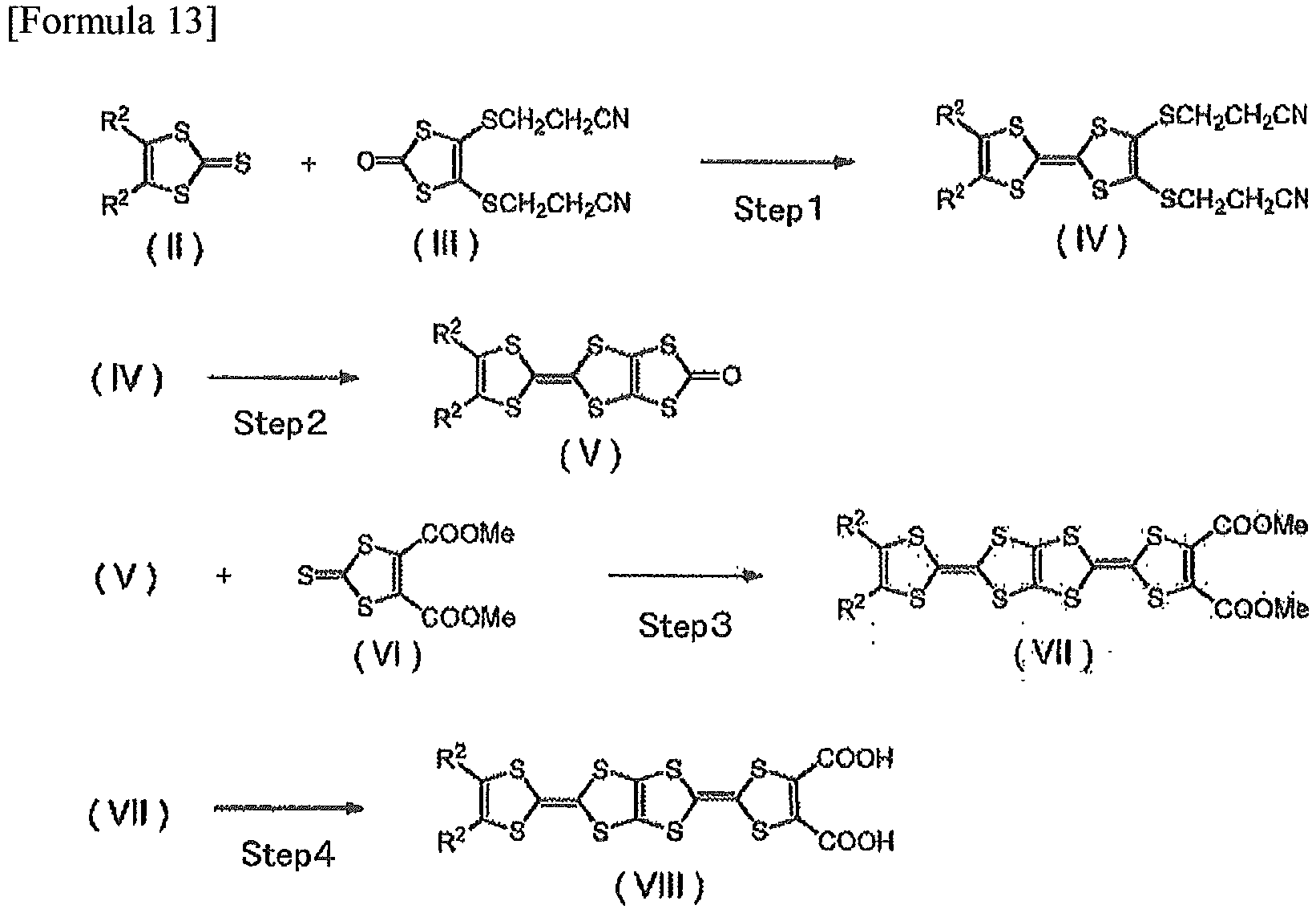
- Compound (IV) can be produced by reacting Compound (II) and Compound (III) in the presence or absence of an inert solvent, in the presence of a reducing agent. Compound (II) may be commercially available or produced by the known method (e.g., P. Wu, G. Saito, K. Imaeda, Z. Shi, T. Mori, T. Enoki, H. Inokuchi, Chem. Lett., 15, 441-444 (1086), E. Gomar-Nadal, C. Rovira, D. B. Amabilino, Tetrahedron, 62, 3370-3379 (2006)), or a method described therein. Compound (III) may be commercially available or produced by the known method (e.g., H. Muller, C. Jouan, F. Salhi, Synth. Met., 85, 1457-1458 (1997)), or a method described therein.
- Preferred examples of the inert solvent optionally used include a hydrocarbon such as benzene, toluene or xylene, an ether such as tetrahydrofuran, diethyl ether or dioxane, a polar organic solvent such as acetonitrile, N,N-dimethylformamide or hexamethylphosphoric triamide, or a mixed solvent of these organic solvents.
- Preferred examples of the reducing agent include an organic reducing substance such as trimethyl phosphite, triethyl phosphite, triphenyl phosphine or trimethyl phosphine, a metal such as zinc, tin or aluminum, or an inorganic salt.
- Although the reaction temperature mainly depends on the raw material compound or the type of the solvent used, usually, the reaction temperature is 0°C to 200°C, preferably from room temperature to 120°C.
- Although the reaction time mainly depends on the reaction temperature, the raw material compound, or the type of the solvent used, usually, the reaction time is 1 hour to 48 hours, preferably 2 hours to 12 hours.
- Compound (V) can be produced by reacting Compound (IV) obtained from
Step 1 in an inert solvent in the presence of a base, and then reacting them in an inert solvent in the presence of a carbonylating agent. - Preferred examples of the inert solvent used herein include a hydrocarbon such as benzene, toluene or xylene, an ether such as tetrahydrofuran, diethyl ether or dioxane, a halogenated hydrocarbon such as chloroform or methylene chloride, a polar organic solvent such as acetonitrile, N,N-dimethylformamide or hexamethylphosphoric triamide, or a mixed solvent of these organic solvents.
- Preferred examples of the base include an organic base such as triethylamine, diisopropylethylamine or pyridine, an inorganic base such as potassium carbonate, sodium hydrogen carbonate, cesium hydroxide, sodium hydroxide or tetrabutylammonium hydroxide, and a metal alkoxide such as sodium methoxide or potassium t-butoxide.
- Preferred examples of the carbonylating agent include bis(trichloromethyl) carbonate, bis(4-nitrophenyl) carbonate, and N,N'-carbonyldiimidazole.
- Although the reaction temperature mainly depends on the raw material compound or the type of the solvent used, usually, the reaction temperature is 0°C to 200°C, preferably from room temperature to 60°C.
- Although the reaction time mainly depends on the reaction temperature, the raw material compound, or the type of the solvent used, usually, the reaction time is 1 hour to 48 hours, preferably 2 hours to 24 hours.
- Compound (VII) can be produced by reacting Compound (V) obtained from
Step 2 and Compound (VI) in the same manner as inStep 1, in the presence or absence of an inert solvent, in the presence of a reducing agent. Compound (VI) may be commercially available or produced by the known method (e.g., M. Ngounda, H. L. Bozec, P. Dixneuf, J. Org. Chem., 47, 4000-4002 (1982), F. M. Benitez, J. R. Grunwell, J. Org. Chem., 43, 2917-2918 (1978), L. R. Melby, H. D. Hartzler, W. A. Sheppard, J. Org. Chem., 39, 2456-2458 (1974)), or a method described therein. - Compound (VIII) can be produced by reacting Compound (VII) obtained from
Step 3 in an inert solvent in the presence of a base. - Preferred examples of the inert solvent include an alcohol such as methanol or ethanol, an ether such as tetrahydrofuran, diethyl ether or dioxane, a hydrocarbon such as benzene, toluene or xylene, a halogenated hydrocarbon such as chloroform or methylene chloride, a polar organic solvent such as N,N-dimethylformamide or hexamethylphosphoric triamide, or a mixed solvent of these organic solvents and water.
- Preferred examples of the base include an organic base such as triethylamine, diisopropylethylamine or pyridine, an inorganic base such as potassium carbonate, sodium hydrogen carbonate, cesium hydroxide, sodium hydroxide or tetrabutylammonium hydroxide or a metal alkoxide such as sodium methoxide or potassium t-butoxide.
- Although the reaction temperature mainly depends on the raw material compound or the type of the solvent used, usually, the reaction temperature is 0°C to 200°C, preferably from room temperature to 60°C.
- Although the reaction time mainly depends on the reaction temperature, the raw material compound, or the type of the solvent used, usually, the reaction time is 1 hour to 120 hours, preferably 12 hours to 72 hours.
- The present invention will now be described in more detail with reference to the following working examples and test examples. However, the present invention should not be limited in any way to these working examples and test examples. Further, m.p. is an abbreviation for melting point.
- Trimethyl phosphite (124 ml) was mixed with 4,5-bis(methylthio)-1,3-dithiol-2-thione (3.26 g, 14.4 mmol) (corresponding to Compound (II)) and 4,5-bis(2-cyanoethylthio)-1,3 dithiol-2-one (5.0 g, 17.3 mmol) (corresponding to Compound (III)) at room temperature. The resultant mixture was stirred for 3 hours at 120°C, and then insoluble matter was removed by filtration. The filtrate was dried under reduced pressure, and then purified by silica gel column chromatography (eluted with 100% toluene to toluene:ethyl acetate = 10:1) to obtain the subject compound (a) (4.59 g, 68.3%) as a brown solid. Further, red-brown needle-like crystals of the subject compound (a) were obtained by recrystallizing from toluene/ethyl acetate. m.p. 118-121°C; 1H NMR (600 MHz, CDCl3) δ 3.09 (t, J = 7.1 Hz, 4H), 2.75 (t, J = 7.1 Hz, 4H), 2.44 (s, 6H); 13C NMR (125 MHz, CDCl3): δ = 128.0, 127.6, 117.4, 114.6, 107.7, 31.3, 19.2, 18.9; IR (KBr) 2921, 2246, 1499, 1427, 1314, 1276, 1231, 975, 957, 896, 774 cm-1; Anal. calcd. for C14H14N2S8: C, 36.02; H, 3.02; N, 6.00; Found: C36.09; H, 2.70; N, 5.86.
- A mixed suspension of compound (a) (1.00 g, 2.14 mmol) (corresponding to Compound (IV)), acetone (10 ml), and methanol (10 ml) was mixed with a solution of 28%c sodium methoxide in methanol (1.0 ml, 5.0 mmol). The resultant mixture was stirred for 30 minutes at room temperature, and then the obtained red solution was cooled to 0°C. To the solution, anhydrous zinc chloride (175 mg, 1.28 mmol) that had been previously dissolved in methanol (5 ml) and tetrabutylammonium bromide (830 mg, 2.57 mmol) that had been previously dissolved in methanol (5 ml) were added, and the mixture was then stirred for 20 minutes at room temperature. The solvent was removed by distillation under reduced pressure, then non-ionized water (30 ml) was added thereto to form a suspension. The suspension was filtered, then the solid matter obtained on the funnel was washed with non-ionized water and methanol, collected, and vacuum-dried. The dried solid mater was added to tetrahydrofuran (25 ml) to form a suspension, cooled to 0°C, and then mixed with bis(trichloromethyl) carbonate (520 mg, 1.75 mmol) that had been previously dissolved in tetrahydrofuran (5 ml). The mixture was stirred overnight at room temperature, then diluted by adding toluene (30 ml) and methanol (10 ml), and stirred for 10 minutes, after which the solvent was removed by distillation under reduced pressure. Then, the mixture was mixed with non-ionized water (20 ml) and methanol (20 ml), and stirred for 20 minutes at room temperature. The formed suspension was filtered, and the solid matter obtained on the funnel was washed with non-ionized water and methanol, then collected and vacuum-dried. The dried solid mater was added to diethyl ether (250 ml), irradiated with ultrasonic waves for 20 seconds, and stirred for 10 minutes at room temperature. The formed suspension was filtered, and the solid matter obtained on the funnel was washed with diethyl ether, then collected and vacuum-dried to obtain the subject compound (b) (388 mg, 46.9%) as a brown powder.
1H NMR (600 MHz, CDCl3) δ 2.44 (s, 6H); IR (KBr) 2918, 1667, 1618, 1428, 967, 893, 881, 764, 749 cm-1; Anal. Calcd for C9H6OS8: C, 27.96; H, 1.56; Found: C 27.65; H, 1.21. - Trimethyl phosphite (50 ml) was mixed with compound (b) (1.00 g, 2.59 mmol) (corresponding to Compound (V)) and 1,3-dithiol-2-thione-4,5-dicarboxylate (1.00 g, 3.99 mmol) (corresponding to Compound (VI)) at room temperature. The resultant mixture was stirred for 14 hours at 120°C, then the temperature was returned to room temperature, and the solvent was removed by distillation under reduced pressure. The residue was suspended in diethyl ether (50 ml), and the resultant suspension was stirred for 30 minutes at room temperature. This suspension was filtered, and the solid matter obtained on the funnel was washed with diethyl ether. The washed solid mater was collected, dissolved in chloroform (350 ml), and purified by silica gel column chromatography (eluted with toluene) to obtain the subject Compound (1) (413 mg, 27.0%). Further, umber brown, plate-shaped crystals of Compound (2) were obtained by recrystallizing from chloroform.
m.p. 188°C (dec.); 1H NMR (600 MHz, CDCl3) δ 3.85 (s, 6H), 2.43(s, 6H); 13C NMR (125 MHz, CDCl3): δ = 159.7, 131.9, 127.7, 116.3, 115.9, 115.3, 113.7, 113.0, 53.5, 19.3; IR (KBr) 2953, 1730, 1709, 1574, 1433, 1295, 1263, 1189, 1090, 1034, 764 cm-1; Anal. Calcd for C16H12O4S10: C, 32.63; H, 2.05; Found: C 32.60; H, 1.72; HRMS (ESI-TOF) m/z: [M + H]+ Calcd for C16H13O4S10 588.8015; Found 588.8024. - Compound 1 (200 mg, 0.340 mmol) was suspended in a mixed solvent of tetrahydrofuran (40 ml) and methanol (4 ml), and the resultant suspension was mixed with an aqueous solution of 2 N sodium hydroxide (6.8 ml, 13.6 mmol). The mixture was stirred for 3 hours at 20°C, then 2 N aqueous hydrochloric acid (6.8 ml) was gradually added dropwise, and the mixture was adjusted to a pH of 2 to 3 by further adding 2 N aqueous hydrochloric acid (0.2 ml) while checking the pH. The mixture was stirred for 3 minutes at room temperature, and this suspension was filtered. The solid matter obtained on the funnel was successively washed with water, methanol, and then a small amount of toluene, collected and vacuum-dried to obtain the subject Compound 7 (159 mg, 83.2%) as a glossy silvery-red film-like solid. 1H NMR (400 MHz, CDCl3) δ 2.43 (s, 6H).
- The structure of compounds obtained in the same manner as in the above-described Examples is shown in Table 1. In the table, Me is an abbreviation for a methyl group, and nBu is an abbreviation for a normal butyl group.
[Table 1] 
Compound No. R1 R2 1 Me H 2 Me S- Me 3 Me S-OH2-CH2- S 4 Me S- nBu 5 Me S-nC12H25 6 H H 7 H S-Me 8 H S-CH2-CH2-S 9 H S-nBu 10 H S-nC12H25 - The 1H-NMR spectra of the above compounds are shown in the following Table 2.
[Table 2] Compound No. Measurement Solvent 1H NMR [δ (ppm)] 2 CDCl3 3.85 (s, 6H), 2.43 (s. 6H) 3 CDCl3 3.85 (s, 6H), 3.30 (s, 4H) 4 CDCl3 3.85 (s, 6H), 2.82 (t, J = 7.4 Hz, 4H), 1.61 (quin. J = 7.4 Hz, 4H), 1.44 (sext, J = 7.4 Hz, 4H), 0.93 (t, J = 7.4 Hz, 6H) 5 CDCl3 3.85 (s, 6H), 2.81 (brt, J = 7.4 Hz, 4H), 1.65-1.58 (m, 4H), 1.42-1.36 (m, 4H), 1.32-1.22 (m, 32H), 0.88 (ddd, J = 7.1, 7.1, 1.6 Hz, 6H) 7 CDCl3 2.43 (s, 6H) 8 DMSO-d 6 3.40 (s, 4H) 9 CDCl3 2.82 (brt, J= 7.3 Hz, 4H), 1.70-1.52 (m, 4H), 1.52-1.38 (m, 4H), 0.93 (brt, J = 7.3 Hz, 6H) 10 CDCl3 2.81 (br, 4H), 1.68-1.57 (m, 4H), 1.44-1.34 (m, 4H), 1.33-1.21 (m, 32H), 0.88 (brt, 6H) - For
Compounds Compounds - Terminals were provided by arranging two gold wires each having a diameter of 0.01 mm and a purity of 99% or more with gold paste on either end of sample A or B, and in an orthogonal direction to the line linking those two points, arranging two further gold wires with gold paste. Then, evaluation was carried out by measuring under room temperature conditions the voltage across the two middle points when a current of about 0.1 µA was applied across the terminals at either end. Hole mobility (µh) is related to conductivity (σ), electric charge (e), and carrier density (n) based on the following formula. The value calculated using these was taken as the test value.
σ = e*n*µh - The results from the above tests are shown in Table 3 shown below. In the table, regarding the sample shape symbols, A represents a pellet formed by pressure-forming of a powder crystal, and B represents a single crystal.
[Table 3] Compound No. Sample Shape Room Temperature Electrical Conductivity Room Temperature Mobility µ RT σRT(S/om) (cm2/V•s) 1 A 2.0 x 10⁻³ 0.0866 2 B 5.0 x 10⁻⁵ 0.786 3 B 2.0 x 10⁻⁴ 7 A 8.6 x 10⁻² 8 A 4.0 9 A 15 x 10-2 10 A 1.5 x 10⁻³ -
Compounds 1 to 10 all exhibit excellent charge transport properties and solubility in an organic solvent, and can be formed as a thin film, while each is still a single molecule and a simple substance. Therefore, Compounds 1 to 10 hold promise for industrial applications in touch panels, transparent electrodes, and organic field-effect transistors. - The compounds according to the present embodiment can be used in various applications. Examples include in wiring, an information transmission medium, an electronic device, an electrode utilized in an electronic device, a spintronics device, an information communication device, a memory device, a magnetic shield, a medical magnetic shield, a magnet, a magnetic semiconductor, a field-effect transistor (FET), a sticking plaster that includes a magnet, a hard disk drive head, a high sensitivity playback GMR head, a solid-state magnetic memory, a magnetoresistive memory (MRAM), a fiber communication optical isolator, a material that changes color in a magnetic field, and a material that utilizes the interaction between conduction electron spin and atomic magnetic moment. Further examples include a touch panel, a display, an electronic device, a liquid crystal display, a flat-screen TV, a plasma display, electronic ink, an anode in an organic EL (hole injection layer), a solar cell, an antistatic agent, an electromagnetic shielding material, an optical coating, an infrared reflective material, a gas sensor, an antireflection film, a surface processing agent, a semiconductor laser, an optical device, an optical element, a device that utilizes bending resistance, an electrolytic capacitor, an electronic component, a lithium ion battery electrode, a light-emitting device, an organic transistor, and a printable circuit for directly forming a pattern on a substrate by utilizing ink-jet technology or the like using a conductive polymer for ink.
- Further, even if the compounds according to the present embodiment are not a single crystal, since they still exhibit high physical property values in a microcrystal pressure-formed state, it is suggested that the compounds according to the present embodiment can be converted into polymers and liquid crystals, and be formed into thin films. Thin-film forming carried out by coating opens up possibilities to many applications.
- The present invention are described above with reference to specific embodiments. However, it is obvious that a person skilled in the art could make modifications and replacements to the embodiments within the scope of the present invention. Namely, the present invention is disclosed above in the form of examples, which should not be construed as limiting the subject matter of the specification. To determine the scope of the present invention, due consideration should be given to the claims described at the top.
- Further, although it is clear that the embodiments for describing the invention achieve the above-described objectives, it should be understood that a person skilled in the art could implement many changes and other working examples. The elements and components in the claims, the specification, and the drawings, and each of the embodiments for description may be used with another one or a combination of other ones. The claims are intended to include such changes and other embodiments, which are included in the technical concept and the technical scope of this invention.
Claims (38)
- An organic transparent electrode characterized by being formed from an organic molecule having a Brønsted acid functional group, an electron-donating ability, and a π-conjugated plane, and being self-assembling.
- The organic transparent electrode according to claim 1, characterized in that the Brønsted acid functional group is any of a carboxylic acid functional group, a sulfonic acid functional group, a phosphonic acid functional group, and a thiophosphonic acid functional group.
- The organic transparent electrode according to claim 2, characterized in that a hydrogen bond is formed to the Brønsted acid functional group in a self-assembled state.
- An organic transparent electrode characterized by being formed from a compound that comprises a fused tetrathiafulvalene derivative moiety in a skeleton and has a protonic acid functional group.
- An organic transparent electrode characterized by being formed from any of compounds represented by following general formulae, wherein R1, R2, R3, R4, and R' may be the same or different, or a salt thereof.


- An organic transparent electrode characterized by being formed from any of compounds represented by following general formulae, wherein R1, R2, R3, R4, and R' may be the same or different, or a salt thereof.


- An organic transparent electrode characterized by being formed from a compound represented by Formula 1 or a salt thereof.

- An organic transparent electrode characterized by being formed from a compound represented by Formula 2 or a salt thereof.

- An organic transparent electrode characterized by being formed from a compound represented by Formula 3 or a salt thereof.

- An organic transparent electrode characterized by being formed from a tetrathiafulvalene-2-carboxylic acid aniline salt.
- An organic transparent electrode characterized by being formed from a tetrathiafulvalene-2-carboxylic acid hydroxyamine salt.
- An organic transparent electrode characterized by being formed from a compound represented by the following.
[(TTPCOO-NH4 +)(TTPCOOH)]1-x(TTP·+COO-NH3)x,
wherein x is 0.06.
- A method for producing an organic transparent electrode, comprising recrystallizing from an organic solvent a fused sulfur-containing π compound to which a carboxylic acid functional group has been introduced.
- A method for producing an organic transparent electrode, comprising recrystallizing a fused tetrathiafulvalene to which a carboxylic acid functional group has been introduced from an organic solvent to which an ammonia solution has been added.
- A touch panel comprising an organic transparent electrode according to claim 10 or 11.
- A display comprising an organic transparent electrode according to claim 10 or 11.
- An electronic device comprising an organic transparent electrode according to claim 10 or 11.
- An organic transparent electrode comprising an organic compound having a proton defect in a hydrogen bond network, wherein a radical cation or a radical anion is generated to replenish a lost charge.
- An organic transparent electrode wherein charges are not in equilibrium due to a ratio of a cation and an anion present in a hydrogen bond network not being 1:1, and a radical cation or a radical anion is generated to replenish a lost charge.
- A synthetic metal characterized by being formed from an organic molecule having a Brønsted acid functional group, an electron-donating ability, and a π-conjugated plane, and being self-assembling.
- The synthetic metal according to claim 20, characterized in that the Brønsted acid functional group is any of a carboxylic acid functional group, a sulfonic acid functional group, a phosphonic acid functional group, and a thiophosphonic acid functional group.
- The synthetic metal according to claim 21, characterized in that a hydrogen bond is formed to the Brønsted acid functional group in a self-assembled state.
- A synthetic metal characterized by being formed from a compound that comprises a fused tetrathiafulvalene derivative moiety in a skeleton and has a protonic acid functional group.
- A synthetic metal characterized by being any of compounds represented by Formula 4A, wherein R1, R2, R3, and R4 may be the same or different, or a salt thereof.

- A synthetic metal that is any of compounds represented by Formula 5A, wherein R1, R2, R3, and R4 may be the same or different, or a salt thereof.

- A compound represented by Formula 1A or a salt thereof.

- A compound represented by Formula 2A or a salt thereof.

- A compound represented by Formula 3 A or a salt thereof.

- A synthetic metal characterized by being a compound represented by Formula 1A or a salt thereof.

- A synthetic metal characterized by being a compound represented by Formula 2A or a salt thereof.

- A synthetic metal characterized by being a compound represented by Formula 3 A or a salt thereof.
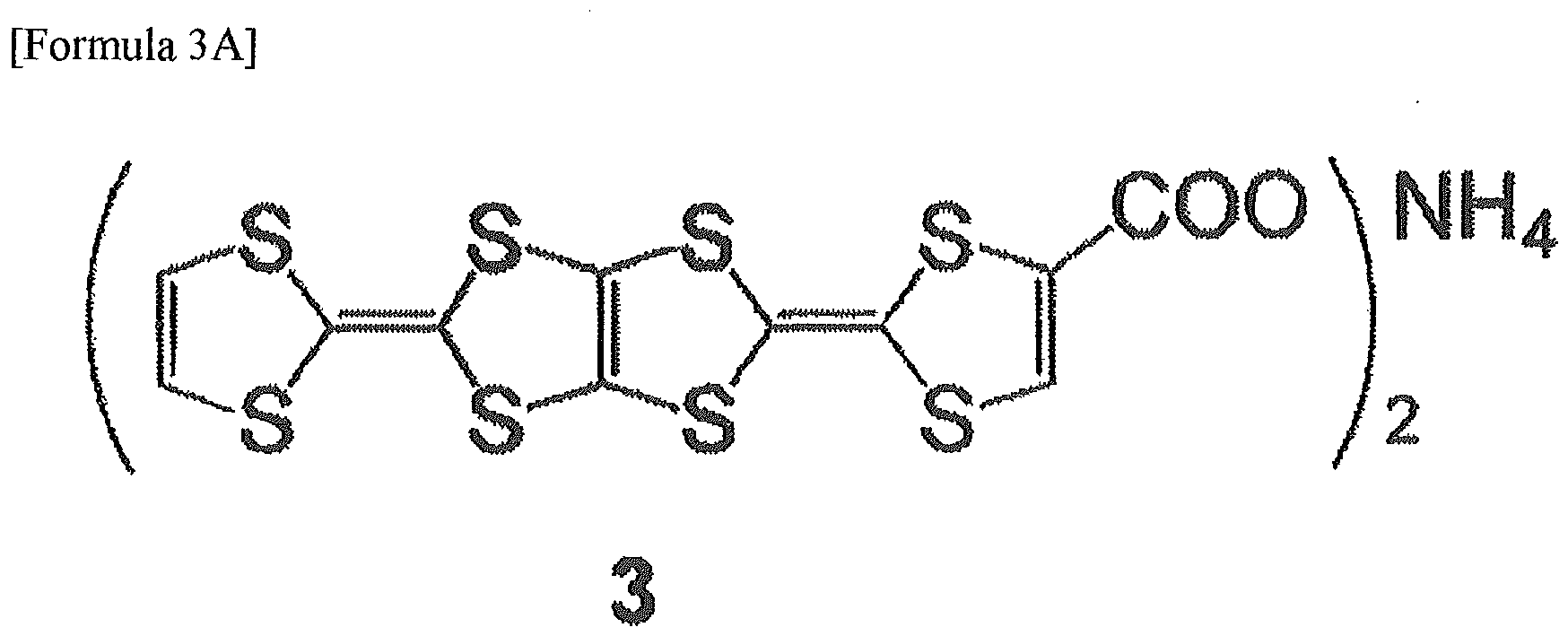
- A synthetic metal characterized by being a compound represented by the following formula:
[(TTPCOO-NH4 +)(TTPCOOH)]1-x(TTP·+COO-NH3)x,
wherein x is 0.06.
- A method for producing a synthetic metal, comprising recrystallizing from an organic solvent a fused sulfur-containing π compound to which a carboxylic acid functional group has been introduced.
- A method for producing a synthetic metal, comprising recrystallizing a fused tetrathiafulvalene to which a carboxylic acid functional group has been introduced, from an organic solvent to which an ammonia solution has been added.
- A wire comprising a synthetic metal according to claim 30.
- An electronic device comprising a synthetic metal according to claim 30.
- A synthetic metal comprising an organic compound having a proton defect in a hydrogen bond network, wherein a radical cation or a radical anion is generated to replenish a lost charge.
- A synthetic metal wherein charges are not in equilibrium due to a ratio of a cation and an anion present in a hydrogen bond network not being 1:1, and a radical cation or a radical anion is generated to replenish a lost charge.
Applications Claiming Priority (3)
| Application Number | Priority Date | Filing Date | Title |
|---|---|---|---|
| JP2012227532 | 2012-10-13 | ||
| JP2012232451 | 2012-10-21 | ||
| PCT/JP2013/069451 WO2014057721A1 (en) | 2012-10-13 | 2013-07-17 | Organic transparent electrode, method for producing organic transparent electrode, touch panel, display, organic metal, method for producing organic metal, compound or salt thereof, electric wire and electronic device |
Publications (3)
| Publication Number | Publication Date |
|---|---|
| EP2793235A1 true EP2793235A1 (en) | 2014-10-22 |
| EP2793235A4 EP2793235A4 (en) | 2015-07-15 |
| EP2793235B1 EP2793235B1 (en) | 2018-01-10 |
Family
ID=50477197
Family Applications (1)
| Application Number | Title | Priority Date | Filing Date |
|---|---|---|---|
| EP13845891.4A Not-in-force EP2793235B1 (en) | 2012-10-13 | 2013-07-17 | Organic transparent electrode |
Country Status (4)
| Country | Link |
|---|---|
| US (1) | US9202605B2 (en) |
| EP (1) | EP2793235B1 (en) |
| JP (2) | JP5943285B2 (en) |
| WO (1) | WO2014057721A1 (en) |
Cited By (2)
| Publication number | Priority date | Publication date | Assignee | Title |
|---|---|---|---|---|
| EP2928005A1 (en) * | 2014-04-02 | 2015-10-07 | Panax Etec Co., Ltd. | Electrolyte for long cycle life secondary battery and secondary battery containing the same |
| EP4431514A4 (en) * | 2021-11-10 | 2025-11-05 | Nat Inst Materials Science | MOLECULAR METAL-BASED SINGLE-CRYSTALLINE THIN LAYER, COMPONENTS THEREBY AND METHOD FOR PRODUCING A SINGLE-CRYSTALLINE THIN LAYER |
Families Citing this family (5)
| Publication number | Priority date | Publication date | Assignee | Title |
|---|---|---|---|---|
| WO2017141692A1 (en) * | 2016-02-19 | 2017-08-24 | 国立研究開発法人物質・材料研究機構 | Hydrogen generating agent, hydrogen generation method, and method of producing substance |
| US10379540B2 (en) * | 2016-10-17 | 2019-08-13 | Waymo Llc | Light detection and ranging (LIDAR) device having multiple receivers |
| JP7082406B2 (en) * | 2018-07-05 | 2022-06-08 | 国立研究開発法人物質・材料研究機構 | Compositions, conductive coatings, touch panels, and display devices |
| JP7082407B2 (en) * | 2018-07-25 | 2022-06-08 | 国立研究開発法人物質・材料研究機構 | Molecular sheet, manufacturing method of molecular sheet, transparent electrode, display device, and touch panel |
| JP7721078B2 (en) * | 2021-07-15 | 2025-08-12 | 国立研究開発法人物質・材料研究機構 | Metallized ring-fused tetrathiafulvalene dicarboxylic acid monolayer and its preparation method |
Family Cites Families (7)
| Publication number | Priority date | Publication date | Assignee | Title |
|---|---|---|---|---|
| JPS51100079A (en) * | 1975-03-03 | 1976-09-03 | Mitsubishi Chem Ind | TETORACHIAFURUBARENRUINOSEIZOHOHO |
| FR2610928B1 (en) | 1987-02-13 | 1989-05-05 | Thomson Csf | TETRATHIAFULVALENE-LIKE ORGANIC COMPOUNDS FOR THE PREPARATION OF CONDUCTIVE LANGMUIR-BLODGETT FILMS AND THEIR MANUFACTURING METHOD |
| JPH0240378A (en) * | 1988-07-29 | 1990-02-09 | Idemitsu Kosan Co Ltd | Novel tetrathiafulvalene derivative and electroconductive charge transfer complex using the same derivative |
| JPH02258778A (en) * | 1989-03-30 | 1990-10-19 | Idemitsu Kosan Co Ltd | Tetraselenafulvalene derivative and electrically conductive complex using same derivative |
| JP2008094781A (en) * | 2006-10-13 | 2008-04-24 | Sharp Corp | Tetrathiafulvalene derivative and electronic device using the same |
| JP2010027600A (en) * | 2008-06-19 | 2010-02-04 | Panasonic Corp | Electrode active material and power storage device using the same |
| JP5471324B2 (en) * | 2009-11-10 | 2014-04-16 | 株式会社デンソー | Secondary battery |
-
2013
- 2013-07-17 EP EP13845891.4A patent/EP2793235B1/en not_active Not-in-force
- 2013-07-17 JP JP2014511666A patent/JP5943285B2/en active Active
- 2013-07-17 WO PCT/JP2013/069451 patent/WO2014057721A1/en not_active Ceased
- 2013-07-17 US US14/373,256 patent/US9202605B2/en not_active Expired - Fee Related
-
2016
- 2016-01-20 JP JP2016009287A patent/JP6145660B2/en active Active
Non-Patent Citations (1)
| Title |
|---|
| See references of WO2014057721A1 * |
Cited By (2)
| Publication number | Priority date | Publication date | Assignee | Title |
|---|---|---|---|---|
| EP2928005A1 (en) * | 2014-04-02 | 2015-10-07 | Panax Etec Co., Ltd. | Electrolyte for long cycle life secondary battery and secondary battery containing the same |
| EP4431514A4 (en) * | 2021-11-10 | 2025-11-05 | Nat Inst Materials Science | MOLECULAR METAL-BASED SINGLE-CRYSTALLINE THIN LAYER, COMPONENTS THEREBY AND METHOD FOR PRODUCING A SINGLE-CRYSTALLINE THIN LAYER |
Also Published As
| Publication number | Publication date |
|---|---|
| JP5943285B2 (en) | 2016-07-05 |
| JP6145660B2 (en) | 2017-06-14 |
| EP2793235B1 (en) | 2018-01-10 |
| EP2793235A4 (en) | 2015-07-15 |
| WO2014057721A1 (en) | 2014-04-17 |
| US20150005511A1 (en) | 2015-01-01 |
| JPWO2014057721A1 (en) | 2016-09-05 |
| US9202605B2 (en) | 2015-12-01 |
| JP2016129137A (en) | 2016-07-14 |
Similar Documents
| Publication | Publication Date | Title |
|---|---|---|
| EP2793235B1 (en) | Organic transparent electrode | |
| Yao et al. | Control of π–π stacking via crystal engineering in organic conjugated small molecule crystals | |
| Araki et al. | Bridging nanogap electrodes by in situ electropolymerization of a bis (terthiophenylphenanthroline) ruthenium complex | |
| EP2361915B1 (en) | Novel heterocyclic compound and use thereof | |
| Tao et al. | Asymmetrical/symmetrical D− π–A/D− π–D thiazole-containing aromatic heterocyclic fluorescent compounds having the same triphenylamino chromophores | |
| Lu et al. | Amphiphilic (phthalocyaninato)(porphyrinato) europium triple-decker nanoribbons with air-stable ambipolar OFET performance | |
| Yang et al. | Toward an Air-Stable Triradical with Strong Spin Coupling: Synthesis of Substituted Truxene-5, 10, 15-triyl | |
| Perepichka et al. | Engineering a remarkably low HOMO–LUMO gap by covalent linkage of a strong π‐donor and a π‐acceptor—Tetrathiafulvalene‐σ‐polynitrofluorene diads: Their amphoteric redox behavior, electron transfer and spectroscopic properties | |
| Ramkumar et al. | Novel heterocyclic based blue and green emissive materials for opto-electronics | |
| KR20120081106A (en) | Oligo- and polyfurans, preparation and uses thereof | |
| Kataoka et al. | S, C, C-and O, C, C-Bridged triarylamines and their persistent radical cations | |
| JP2011517701A (en) | Selenophene and selenophene polymers, their preparation, and uses thereof | |
| Dabuliene et al. | Enhancement of efficiency of perovskite solar cells with hole-selective layers of rationally designed thiazolo [5, 4-d] thiazole derivatives | |
| Kim et al. | A novel n-type organic semiconductor comprising a 1, 5-naphthyridine-2, 6-dione unit | |
| JP2008258592A (en) | Field effect transistor | |
| Büyükekşi et al. | Electrochemical and photovoltaic studies on water soluble triads: Metallosupramolecular self-assembly of ditopic bis (imidazole) perylene diimide with platinum (II)-, and palladium (II)-2, 2′: 6′, 2 ″-terpyridyl complex ions | |
| Büyükekşi et al. | Electrochemical, photovoltaic and DFT studies on hybrid materials based on supramolecular self-assembly of a ditopic twisted perylene diimide with square-planar platinum (II)-and/or palladium (II)-2, 2′: 6′, 2 ″-terpyridyl complex ions | |
| Zhu et al. | Triadic intramolecular charge transfer compound of tetrathiafulvalene exhibiting multicolor solvatochromism | |
| Balandier et al. | N-aryl pyrrolo-tetrathiafulvalene based ligands: synthesis and metal coordination | |
| Meti et al. | Unveiling the photophysical and morphological properties of an acidochromic thiophene flanked dipyrrolopyrazine-based chromophore for optoelectronic application | |
| Sumida et al. | Dithienoarsinines: stable and planar π-extended arsabenzenes | |
| Kobayashi | Pure organic conductors based on protonic-defect induction: from semiconductors to organic metals | |
| EP1361244B1 (en) | Poly(5-aminoquinoxalines); preparation and use thereof | |
| Morita et al. | Introduction of amino groups into the dibenzo-TTF π-system: enhanced electron-donating ability and intermolecular hydrogen bonding | |
| WO2001091202A1 (en) | Electric component and method for producing the same |
Legal Events
| Date | Code | Title | Description |
|---|---|---|---|
| PUAI | Public reference made under article 153(3) epc to a published international application that has entered the european phase |
Free format text: ORIGINAL CODE: 0009012 |
|
| 17P | Request for examination filed |
Effective date: 20140718 |
|
| AK | Designated contracting states |
Kind code of ref document: A1 Designated state(s): AL AT BE BG CH CY CZ DE DK EE ES FI FR GB GR HR HU IE IS IT LI LT LU LV MC MK MT NL NO PL PT RO RS SE SI SK SM TR |
|
| RIC1 | Information provided on ipc code assigned before grant |
Ipc: C07D 495/04 20060101ALI20150128BHEP Ipc: H01L 51/00 20060101ALI20150128BHEP Ipc: H01B 1/12 20060101AFI20150128BHEP Ipc: H01L 21/28 20060101ALI20150128BHEP |
|
| RA4 | Supplementary search report drawn up and despatched (corrected) |
Effective date: 20150616 |
|
| RIC1 | Information provided on ipc code assigned before grant |
Ipc: C07D 495/04 20060101ALI20150610BHEP Ipc: H01L 21/28 20060101ALI20150610BHEP Ipc: H01B 1/12 20060101AFI20150610BHEP Ipc: H01L 51/00 20060101ALI20150610BHEP |
|
| RIN1 | Information on inventor provided before grant (corrected) |
Inventor name: KOBAYASHI, YUKA Inventor name: TERAUCHI, TAKESHI Inventor name: SUMI, SATOSHI |
|
| DAX | Request for extension of the european patent (deleted) | ||
| 17Q | First examination report despatched |
Effective date: 20160502 |
|
| STAA | Information on the status of an ep patent application or granted ep patent |
Free format text: STATUS: EXAMINATION IS IN PROGRESS |
|
| GRAP | Despatch of communication of intention to grant a patent |
Free format text: ORIGINAL CODE: EPIDOSNIGR1 |
|
| STAA | Information on the status of an ep patent application or granted ep patent |
Free format text: STATUS: GRANT OF PATENT IS INTENDED |
|
| INTG | Intention to grant announced |
Effective date: 20170512 |
|
| GRAJ | Information related to disapproval of communication of intention to grant by the applicant or resumption of examination proceedings by the epo deleted |
Free format text: ORIGINAL CODE: EPIDOSDIGR1 |
|
| STAA | Information on the status of an ep patent application or granted ep patent |
Free format text: STATUS: EXAMINATION IS IN PROGRESS |
|
| INTC | Intention to grant announced (deleted) | ||
| GRAP | Despatch of communication of intention to grant a patent |
Free format text: ORIGINAL CODE: EPIDOSNIGR1 |
|
| STAA | Information on the status of an ep patent application or granted ep patent |
Free format text: STATUS: GRANT OF PATENT IS INTENDED |
|
| INTG | Intention to grant announced |
Effective date: 20170920 |
|
| GRAS | Grant fee paid |
Free format text: ORIGINAL CODE: EPIDOSNIGR3 |
|
| GRAA | (expected) grant |
Free format text: ORIGINAL CODE: 0009210 |
|
| STAA | Information on the status of an ep patent application or granted ep patent |
Free format text: STATUS: THE PATENT HAS BEEN GRANTED |
|
| AK | Designated contracting states |
Kind code of ref document: B1 Designated state(s): AL AT BE BG CH CY CZ DE DK EE ES FI FR GB GR HR HU IE IS IT LI LT LU LV MC MK MT NL NO PL PT RO RS SE SI SK SM TR |
|
| REG | Reference to a national code |
Ref country code: AT Ref legal event code: REF Ref document number: 963243 Country of ref document: AT Kind code of ref document: T Effective date: 20180115 Ref country code: CH Ref legal event code: EP |
|
| REG | Reference to a national code |
Ref country code: IE Ref legal event code: FG4D |
|
| REG | Reference to a national code |
Ref country code: DE Ref legal event code: R096 Ref document number: 602013032181 Country of ref document: DE |
|
| REG | Reference to a national code |
Ref country code: NL Ref legal event code: MP Effective date: 20180110 |
|
| REG | Reference to a national code |
Ref country code: FR Ref legal event code: PLFP Year of fee payment: 6 |
|
| REG | Reference to a national code |
Ref country code: AT Ref legal event code: MK05 Ref document number: 963243 Country of ref document: AT Kind code of ref document: T Effective date: 20180110 |
|
| PG25 | Lapsed in a contracting state [announced via postgrant information from national office to epo] |
Ref country code: NL Free format text: LAPSE BECAUSE OF FAILURE TO SUBMIT A TRANSLATION OF THE DESCRIPTION OR TO PAY THE FEE WITHIN THE PRESCRIBED TIME-LIMIT Effective date: 20180110 |
|
| PG25 | Lapsed in a contracting state [announced via postgrant information from national office to epo] |
Ref country code: CY Free format text: LAPSE BECAUSE OF FAILURE TO SUBMIT A TRANSLATION OF THE DESCRIPTION OR TO PAY THE FEE WITHIN THE PRESCRIBED TIME-LIMIT Effective date: 20180110 Ref country code: FI Free format text: LAPSE BECAUSE OF FAILURE TO SUBMIT A TRANSLATION OF THE DESCRIPTION OR TO PAY THE FEE WITHIN THE PRESCRIBED TIME-LIMIT Effective date: 20180110 Ref country code: NO Free format text: LAPSE BECAUSE OF FAILURE TO SUBMIT A TRANSLATION OF THE DESCRIPTION OR TO PAY THE FEE WITHIN THE PRESCRIBED TIME-LIMIT Effective date: 20180410 Ref country code: LT Free format text: LAPSE BECAUSE OF FAILURE TO SUBMIT A TRANSLATION OF THE DESCRIPTION OR TO PAY THE FEE WITHIN THE PRESCRIBED TIME-LIMIT Effective date: 20180110 Ref country code: HR Free format text: LAPSE BECAUSE OF FAILURE TO SUBMIT A TRANSLATION OF THE DESCRIPTION OR TO PAY THE FEE WITHIN THE PRESCRIBED TIME-LIMIT Effective date: 20180110 Ref country code: ES Free format text: LAPSE BECAUSE OF FAILURE TO SUBMIT A TRANSLATION OF THE DESCRIPTION OR TO PAY THE FEE WITHIN THE PRESCRIBED TIME-LIMIT Effective date: 20180110 |
|
| PG25 | Lapsed in a contracting state [announced via postgrant information from national office to epo] |
Ref country code: AT Free format text: LAPSE BECAUSE OF FAILURE TO SUBMIT A TRANSLATION OF THE DESCRIPTION OR TO PAY THE FEE WITHIN THE PRESCRIBED TIME-LIMIT Effective date: 20180110 Ref country code: RS Free format text: LAPSE BECAUSE OF FAILURE TO SUBMIT A TRANSLATION OF THE DESCRIPTION OR TO PAY THE FEE WITHIN THE PRESCRIBED TIME-LIMIT Effective date: 20180110 Ref country code: BG Free format text: LAPSE BECAUSE OF FAILURE TO SUBMIT A TRANSLATION OF THE DESCRIPTION OR TO PAY THE FEE WITHIN THE PRESCRIBED TIME-LIMIT Effective date: 20180410 Ref country code: GR Free format text: LAPSE BECAUSE OF FAILURE TO SUBMIT A TRANSLATION OF THE DESCRIPTION OR TO PAY THE FEE WITHIN THE PRESCRIBED TIME-LIMIT Effective date: 20180411 Ref country code: PL Free format text: LAPSE BECAUSE OF FAILURE TO SUBMIT A TRANSLATION OF THE DESCRIPTION OR TO PAY THE FEE WITHIN THE PRESCRIBED TIME-LIMIT Effective date: 20180110 Ref country code: IS Free format text: LAPSE BECAUSE OF FAILURE TO SUBMIT A TRANSLATION OF THE DESCRIPTION OR TO PAY THE FEE WITHIN THE PRESCRIBED TIME-LIMIT Effective date: 20180510 Ref country code: SE Free format text: LAPSE BECAUSE OF FAILURE TO SUBMIT A TRANSLATION OF THE DESCRIPTION OR TO PAY THE FEE WITHIN THE PRESCRIBED TIME-LIMIT Effective date: 20180110 Ref country code: LV Free format text: LAPSE BECAUSE OF FAILURE TO SUBMIT A TRANSLATION OF THE DESCRIPTION OR TO PAY THE FEE WITHIN THE PRESCRIBED TIME-LIMIT Effective date: 20180110 |
|
| REG | Reference to a national code |
Ref country code: DE Ref legal event code: R097 Ref document number: 602013032181 Country of ref document: DE |
|
| PG25 | Lapsed in a contracting state [announced via postgrant information from national office to epo] |
Ref country code: EE Free format text: LAPSE BECAUSE OF FAILURE TO SUBMIT A TRANSLATION OF THE DESCRIPTION OR TO PAY THE FEE WITHIN THE PRESCRIBED TIME-LIMIT Effective date: 20180110 Ref country code: AL Free format text: LAPSE BECAUSE OF FAILURE TO SUBMIT A TRANSLATION OF THE DESCRIPTION OR TO PAY THE FEE WITHIN THE PRESCRIBED TIME-LIMIT Effective date: 20180110 Ref country code: RO Free format text: LAPSE BECAUSE OF FAILURE TO SUBMIT A TRANSLATION OF THE DESCRIPTION OR TO PAY THE FEE WITHIN THE PRESCRIBED TIME-LIMIT Effective date: 20180110 Ref country code: IT Free format text: LAPSE BECAUSE OF FAILURE TO SUBMIT A TRANSLATION OF THE DESCRIPTION OR TO PAY THE FEE WITHIN THE PRESCRIBED TIME-LIMIT Effective date: 20180110 |
|
| PLBE | No opposition filed within time limit |
Free format text: ORIGINAL CODE: 0009261 |
|
| STAA | Information on the status of an ep patent application or granted ep patent |
Free format text: STATUS: NO OPPOSITION FILED WITHIN TIME LIMIT |
|
| PG25 | Lapsed in a contracting state [announced via postgrant information from national office to epo] |
Ref country code: DK Free format text: LAPSE BECAUSE OF FAILURE TO SUBMIT A TRANSLATION OF THE DESCRIPTION OR TO PAY THE FEE WITHIN THE PRESCRIBED TIME-LIMIT Effective date: 20180110 Ref country code: SK Free format text: LAPSE BECAUSE OF FAILURE TO SUBMIT A TRANSLATION OF THE DESCRIPTION OR TO PAY THE FEE WITHIN THE PRESCRIBED TIME-LIMIT Effective date: 20180110 Ref country code: CZ Free format text: LAPSE BECAUSE OF FAILURE TO SUBMIT A TRANSLATION OF THE DESCRIPTION OR TO PAY THE FEE WITHIN THE PRESCRIBED TIME-LIMIT Effective date: 20180110 Ref country code: SM Free format text: LAPSE BECAUSE OF FAILURE TO SUBMIT A TRANSLATION OF THE DESCRIPTION OR TO PAY THE FEE WITHIN THE PRESCRIBED TIME-LIMIT Effective date: 20180110 |
|
| 26N | No opposition filed |
Effective date: 20181011 |
|
| PG25 | Lapsed in a contracting state [announced via postgrant information from national office to epo] |
Ref country code: SI Free format text: LAPSE BECAUSE OF FAILURE TO SUBMIT A TRANSLATION OF THE DESCRIPTION OR TO PAY THE FEE WITHIN THE PRESCRIBED TIME-LIMIT Effective date: 20180110 |
|
| REG | Reference to a national code |
Ref country code: CH Ref legal event code: PL |
|
| GBPC | Gb: european patent ceased through non-payment of renewal fee |
Effective date: 20180717 |
|
| PG25 | Lapsed in a contracting state [announced via postgrant information from national office to epo] |
Ref country code: MC Free format text: LAPSE BECAUSE OF FAILURE TO SUBMIT A TRANSLATION OF THE DESCRIPTION OR TO PAY THE FEE WITHIN THE PRESCRIBED TIME-LIMIT Effective date: 20180110 Ref country code: LU Free format text: LAPSE BECAUSE OF NON-PAYMENT OF DUE FEES Effective date: 20180717 |
|
| REG | Reference to a national code |
Ref country code: BE Ref legal event code: MM Effective date: 20180731 |
|
| REG | Reference to a national code |
Ref country code: IE Ref legal event code: MM4A |
|
| PG25 | Lapsed in a contracting state [announced via postgrant information from national office to epo] |
Ref country code: CH Free format text: LAPSE BECAUSE OF NON-PAYMENT OF DUE FEES Effective date: 20180731 Ref country code: LI Free format text: LAPSE BECAUSE OF NON-PAYMENT OF DUE FEES Effective date: 20180731 Ref country code: IE Free format text: LAPSE BECAUSE OF NON-PAYMENT OF DUE FEES Effective date: 20180717 Ref country code: GB Free format text: LAPSE BECAUSE OF NON-PAYMENT OF DUE FEES Effective date: 20180717 |
|
| PG25 | Lapsed in a contracting state [announced via postgrant information from national office to epo] |
Ref country code: BE Free format text: LAPSE BECAUSE OF NON-PAYMENT OF DUE FEES Effective date: 20180731 |
|
| PG25 | Lapsed in a contracting state [announced via postgrant information from national office to epo] |
Ref country code: MT Free format text: LAPSE BECAUSE OF NON-PAYMENT OF DUE FEES Effective date: 20180717 |
|
| PG25 | Lapsed in a contracting state [announced via postgrant information from national office to epo] |
Ref country code: TR Free format text: LAPSE BECAUSE OF FAILURE TO SUBMIT A TRANSLATION OF THE DESCRIPTION OR TO PAY THE FEE WITHIN THE PRESCRIBED TIME-LIMIT Effective date: 20180110 |
|
| PG25 | Lapsed in a contracting state [announced via postgrant information from national office to epo] |
Ref country code: HU Free format text: LAPSE BECAUSE OF FAILURE TO SUBMIT A TRANSLATION OF THE DESCRIPTION OR TO PAY THE FEE WITHIN THE PRESCRIBED TIME-LIMIT; INVALID AB INITIO Effective date: 20130717 Ref country code: PT Free format text: LAPSE BECAUSE OF FAILURE TO SUBMIT A TRANSLATION OF THE DESCRIPTION OR TO PAY THE FEE WITHIN THE PRESCRIBED TIME-LIMIT Effective date: 20180110 |
|
| PG25 | Lapsed in a contracting state [announced via postgrant information from national office to epo] |
Ref country code: MK Free format text: LAPSE BECAUSE OF NON-PAYMENT OF DUE FEES Effective date: 20180110 |
|
| PGFP | Annual fee paid to national office [announced via postgrant information from national office to epo] |
Ref country code: FR Payment date: 20210629 Year of fee payment: 9 |
|
| PGFP | Annual fee paid to national office [announced via postgrant information from national office to epo] |
Ref country code: DE Payment date: 20210719 Year of fee payment: 9 |
|
| REG | Reference to a national code |
Ref country code: DE Ref legal event code: R119 Ref document number: 602013032181 Country of ref document: DE |
|
| PG25 | Lapsed in a contracting state [announced via postgrant information from national office to epo] |
Ref country code: FR Free format text: LAPSE BECAUSE OF NON-PAYMENT OF DUE FEES Effective date: 20220731 |
|
| PG25 | Lapsed in a contracting state [announced via postgrant information from national office to epo] |
Ref country code: DE Free format text: LAPSE BECAUSE OF NON-PAYMENT OF DUE FEES Effective date: 20230201 |