EP2789645A1 - Engine cover - Google Patents
Engine cover Download PDFInfo
- Publication number
- EP2789645A1 EP2789645A1 EP20120855051 EP12855051A EP2789645A1 EP 2789645 A1 EP2789645 A1 EP 2789645A1 EP 20120855051 EP20120855051 EP 20120855051 EP 12855051 A EP12855051 A EP 12855051A EP 2789645 A1 EP2789645 A1 EP 2789645A1
- Authority
- EP
- European Patent Office
- Prior art keywords
- fibers
- vegetable
- fiber
- weight
- brightness
- Prior art date
- Legal status (The legal status is an assumption and is not a legal conclusion. Google has not performed a legal analysis and makes no representation as to the accuracy of the status listed.)
- Withdrawn
Links
- 239000000835 fiber Substances 0.000 claims abstract description 191
- 235000013311 vegetables Nutrition 0.000 claims abstract description 99
- 238000010137 moulding (plastic) Methods 0.000 claims abstract description 51
- 229920001169 thermoplastic Polymers 0.000 claims abstract description 19
- 239000004416 thermosoftening plastic Substances 0.000 claims abstract description 16
- 238000002834 transmittance Methods 0.000 claims description 20
- 239000012784 inorganic fiber Substances 0.000 claims description 6
- 229920002994 synthetic fiber Polymers 0.000 claims description 6
- 239000012209 synthetic fiber Substances 0.000 claims description 6
- 239000000523 sample Substances 0.000 description 37
- 238000012360 testing method Methods 0.000 description 18
- -1 polypropylene Polymers 0.000 description 15
- 238000000465 moulding Methods 0.000 description 13
- 239000000463 material Substances 0.000 description 12
- 229920003023 plastic Polymers 0.000 description 12
- 239000004033 plastic Substances 0.000 description 12
- 229920000728 polyester Polymers 0.000 description 10
- 238000000034 method Methods 0.000 description 9
- 240000008564 Boehmeria nivea Species 0.000 description 8
- 239000000203 mixture Substances 0.000 description 8
- 229920000139 polyethylene terephthalate Polymers 0.000 description 8
- 239000005020 polyethylene terephthalate Substances 0.000 description 8
- 238000005259 measurement Methods 0.000 description 7
- 238000002844 melting Methods 0.000 description 6
- 230000008018 melting Effects 0.000 description 6
- 229920001778 nylon Polymers 0.000 description 6
- 238000004383 yellowing Methods 0.000 description 6
- 239000004743 Polypropylene Substances 0.000 description 5
- 239000003365 glass fiber Substances 0.000 description 5
- 230000003287 optical effect Effects 0.000 description 5
- 229920001155 polypropylene Polymers 0.000 description 5
- 241000196324 Embryophyta Species 0.000 description 4
- 240000006248 Broussonetia kazinoki Species 0.000 description 3
- 229920003043 Cellulose fiber Polymers 0.000 description 3
- LYCAIKOWRPUZTN-UHFFFAOYSA-N Ethylene glycol Chemical compound OCCO LYCAIKOWRPUZTN-UHFFFAOYSA-N 0.000 description 3
- 229920002430 Fibre-reinforced plastic Polymers 0.000 description 3
- 239000011151 fibre-reinforced plastic Substances 0.000 description 3
- 235000006716 Broussonetia kazinoki Nutrition 0.000 description 2
- OKTJSMMVPCPJKN-UHFFFAOYSA-N Carbon Chemical compound [C] OKTJSMMVPCPJKN-UHFFFAOYSA-N 0.000 description 2
- 239000004677 Nylon Substances 0.000 description 2
- 239000004698 Polyethylene Substances 0.000 description 2
- KKEYFWRCBNTPAC-UHFFFAOYSA-N Terephthalic acid Chemical compound OC(=O)C1=CC=C(C(O)=O)C=C1 KKEYFWRCBNTPAC-UHFFFAOYSA-N 0.000 description 2
- NIXOWILDQLNWCW-UHFFFAOYSA-N acrylic acid group Chemical group C(C=C)(=O)O NIXOWILDQLNWCW-UHFFFAOYSA-N 0.000 description 2
- 239000000654 additive Substances 0.000 description 2
- 230000004075 alteration Effects 0.000 description 2
- 229910052799 carbon Inorganic materials 0.000 description 2
- 206010061592 cardiac fibrillation Diseases 0.000 description 2
- 229920001577 copolymer Polymers 0.000 description 2
- 230000003247 decreasing effect Effects 0.000 description 2
- 238000013461 design Methods 0.000 description 2
- 230000002600 fibrillogenic effect Effects 0.000 description 2
- 239000011521 glass Substances 0.000 description 2
- 239000007924 injection Substances 0.000 description 2
- 238000001746 injection moulding Methods 0.000 description 2
- 238000004898 kneading Methods 0.000 description 2
- 239000011159 matrix material Substances 0.000 description 2
- 125000005395 methacrylic acid group Chemical group 0.000 description 2
- 229920003207 poly(ethylene-2,6-naphthalate) Polymers 0.000 description 2
- 229920002647 polyamide Polymers 0.000 description 2
- 229920001707 polybutylene terephthalate Polymers 0.000 description 2
- 239000004417 polycarbonate Substances 0.000 description 2
- 229920000515 polycarbonate Polymers 0.000 description 2
- 229920000573 polyethylene Polymers 0.000 description 2
- 239000011112 polyethylene naphthalate Substances 0.000 description 2
- 229920000642 polymer Polymers 0.000 description 2
- 239000012783 reinforcing fiber Substances 0.000 description 2
- 238000011160 research Methods 0.000 description 2
- 238000006467 substitution reaction Methods 0.000 description 2
- 229920002972 Acrylic fiber Polymers 0.000 description 1
- 241001599832 Agave fourcroydes Species 0.000 description 1
- 244000198134 Agave sisalana Species 0.000 description 1
- 241000609240 Ambelania acida Species 0.000 description 1
- 241000218236 Cannabis Species 0.000 description 1
- 244000025254 Cannabis sativa Species 0.000 description 1
- 235000012766 Cannabis sativa ssp. sativa var. sativa Nutrition 0.000 description 1
- 235000012765 Cannabis sativa ssp. sativa var. spontanea Nutrition 0.000 description 1
- 244000146553 Ceiba pentandra Species 0.000 description 1
- 235000003301 Ceiba pentandra Nutrition 0.000 description 1
- 244000060011 Cocos nucifera Species 0.000 description 1
- 235000013162 Cocos nucifera Nutrition 0.000 description 1
- 240000000491 Corchorus aestuans Species 0.000 description 1
- 235000011777 Corchorus aestuans Nutrition 0.000 description 1
- 235000010862 Corchorus capsularis Nutrition 0.000 description 1
- 229920000742 Cotton Polymers 0.000 description 1
- 241001265525 Edgeworthia chrysantha Species 0.000 description 1
- 240000003133 Elaeis guineensis Species 0.000 description 1
- 235000001950 Elaeis guineensis Nutrition 0.000 description 1
- 239000004593 Epoxy Substances 0.000 description 1
- 241000219146 Gossypium Species 0.000 description 1
- 240000000797 Hibiscus cannabinus Species 0.000 description 1
- 240000006240 Linum usitatissimum Species 0.000 description 1
- 235000004431 Linum usitatissimum Nutrition 0.000 description 1
- 229920000877 Melamine resin Polymers 0.000 description 1
- 240000000907 Musa textilis Species 0.000 description 1
- 239000004952 Polyamide Substances 0.000 description 1
- 239000004793 Polystyrene Substances 0.000 description 1
- 229920001131 Pulp (paper) Polymers 0.000 description 1
- XSQUKJJJFZCRTK-UHFFFAOYSA-N Urea Chemical compound NC(N)=O XSQUKJJJFZCRTK-UHFFFAOYSA-N 0.000 description 1
- ORLQHILJRHBSAY-UHFFFAOYSA-N [1-(hydroxymethyl)cyclohexyl]methanol Chemical compound OCC1(CO)CCCCC1 ORLQHILJRHBSAY-UHFFFAOYSA-N 0.000 description 1
- 239000006096 absorbing agent Substances 0.000 description 1
- 238000010521 absorption reaction Methods 0.000 description 1
- 125000005907 alkyl ester group Chemical group 0.000 description 1
- 125000000217 alkyl group Chemical group 0.000 description 1
- 239000003963 antioxidant agent Substances 0.000 description 1
- 239000002216 antistatic agent Substances 0.000 description 1
- 239000010905 bagasse Substances 0.000 description 1
- 239000012496 blank sample Substances 0.000 description 1
- 239000004566 building material Substances 0.000 description 1
- 235000009120 camo Nutrition 0.000 description 1
- 239000004202 carbamide Substances 0.000 description 1
- 239000004917 carbon fiber Substances 0.000 description 1
- 239000000919 ceramic Substances 0.000 description 1
- 235000005607 chanvre indien Nutrition 0.000 description 1
- 239000003795 chemical substances by application Substances 0.000 description 1
- 235000019646 color tone Nutrition 0.000 description 1
- 239000002270 dispersing agent Substances 0.000 description 1
- 230000000694 effects Effects 0.000 description 1
- 230000007613 environmental effect Effects 0.000 description 1
- 238000001125 extrusion Methods 0.000 description 1
- 239000000796 flavoring agent Substances 0.000 description 1
- 235000019634 flavors Nutrition 0.000 description 1
- 244000144992 flock Species 0.000 description 1
- 235000021189 garnishes Nutrition 0.000 description 1
- 238000010438 heat treatment Methods 0.000 description 1
- 239000011487 hemp Substances 0.000 description 1
- 238000002347 injection Methods 0.000 description 1
- 229910010272 inorganic material Inorganic materials 0.000 description 1
- 239000011147 inorganic material Substances 0.000 description 1
- 238000009434 installation Methods 0.000 description 1
- 239000004611 light stabiliser Substances 0.000 description 1
- 239000000314 lubricant Substances 0.000 description 1
- 238000004519 manufacturing process Methods 0.000 description 1
- JDSHMPZPIAZGSV-UHFFFAOYSA-N melamine Chemical compound NC1=NC(N)=NC(N)=N1 JDSHMPZPIAZGSV-UHFFFAOYSA-N 0.000 description 1
- 239000002184 metal Substances 0.000 description 1
- 238000012986 modification Methods 0.000 description 1
- 230000004048 modification Effects 0.000 description 1
- 239000006082 mold release agent Substances 0.000 description 1
- 239000000178 monomer Substances 0.000 description 1
- 239000011368 organic material Substances 0.000 description 1
- 239000005022 packaging material Substances 0.000 description 1
- 229920001568 phenolic resin Polymers 0.000 description 1
- 239000000049 pigment Substances 0.000 description 1
- 239000004014 plasticizer Substances 0.000 description 1
- 229920003229 poly(methyl methacrylate) Polymers 0.000 description 1
- 229920000058 polyacrylate Polymers 0.000 description 1
- 239000004926 polymethyl methacrylate Substances 0.000 description 1
- 229920000098 polyolefin Polymers 0.000 description 1
- 229920002223 polystyrene Polymers 0.000 description 1
- 239000000843 powder Substances 0.000 description 1
- 229920005653 propylene-ethylene copolymer Polymers 0.000 description 1
- 239000002994 raw material Substances 0.000 description 1
- 230000002787 reinforcement Effects 0.000 description 1
- 230000000717 retained effect Effects 0.000 description 1
- 239000003381 stabilizer Substances 0.000 description 1
- 239000010902 straw Substances 0.000 description 1
- 229920001059 synthetic polymer Polymers 0.000 description 1
- 238000009757 thermoplastic moulding Methods 0.000 description 1
- 229920001187 thermosetting polymer Polymers 0.000 description 1
- 229920002554 vinyl polymer Polymers 0.000 description 1
Images
Classifications
-
- B—PERFORMING OPERATIONS; TRANSPORTING
- B62—LAND VEHICLES FOR TRAVELLING OTHERWISE THAN ON RAILS
- B62D—MOTOR VEHICLES; TRAILERS
- B62D25/00—Superstructure or monocoque structure sub-units; Parts or details thereof not otherwise provided for
- B62D25/08—Front or rear portions
- B62D25/10—Bonnets or lids, e.g. for trucks, tractors, busses, work vehicles
- B62D25/105—Bonnets or lids, e.g. for trucks, tractors, busses, work vehicles for motor cars
-
- C—CHEMISTRY; METALLURGY
- C08—ORGANIC MACROMOLECULAR COMPOUNDS; THEIR PREPARATION OR CHEMICAL WORKING-UP; COMPOSITIONS BASED THEREON
- C08K—Use of inorganic or non-macromolecular organic substances as compounding ingredients
- C08K7/00—Use of ingredients characterised by shape
- C08K7/02—Fibres or whiskers
- C08K7/04—Fibres or whiskers inorganic
- C08K7/14—Glass
-
- C—CHEMISTRY; METALLURGY
- C08—ORGANIC MACROMOLECULAR COMPOUNDS; THEIR PREPARATION OR CHEMICAL WORKING-UP; COMPOSITIONS BASED THEREON
- C08J—WORKING-UP; GENERAL PROCESSES OF COMPOUNDING; AFTER-TREATMENT NOT COVERED BY SUBCLASSES C08B, C08C, C08F, C08G or C08H
- C08J5/00—Manufacture of articles or shaped materials containing macromolecular substances
- C08J5/04—Reinforcing macromolecular compounds with loose or coherent fibrous material
- C08J5/047—Reinforcing macromolecular compounds with loose or coherent fibrous material with mixed fibrous material
-
- F—MECHANICAL ENGINEERING; LIGHTING; HEATING; WEAPONS; BLASTING
- F02—COMBUSTION ENGINES; HOT-GAS OR COMBUSTION-PRODUCT ENGINE PLANTS
- F02B—INTERNAL-COMBUSTION PISTON ENGINES; COMBUSTION ENGINES IN GENERAL
- F02B77/00—Component parts, details or accessories, not otherwise provided for
- F02B77/11—Thermal or acoustic insulation
- F02B77/13—Acoustic insulation
-
- B—PERFORMING OPERATIONS; TRANSPORTING
- B60—VEHICLES IN GENERAL
- B60R—VEHICLES, VEHICLE FITTINGS, OR VEHICLE PARTS, NOT OTHERWISE PROVIDED FOR
- B60R13/00—Elements for body-finishing, identifying, or decorating; Arrangements or adaptations for advertising purposes
- B60R13/08—Insulating elements, e.g. for sound insulation
- B60R13/0838—Insulating elements, e.g. for sound insulation for engine compartments
-
- C—CHEMISTRY; METALLURGY
- C08—ORGANIC MACROMOLECULAR COMPOUNDS; THEIR PREPARATION OR CHEMICAL WORKING-UP; COMPOSITIONS BASED THEREON
- C08J—WORKING-UP; GENERAL PROCESSES OF COMPOUNDING; AFTER-TREATMENT NOT COVERED BY SUBCLASSES C08B, C08C, C08F, C08G or C08H
- C08J2300/00—Characterised by the use of unspecified polymers
- C08J2300/22—Thermoplastic resins
Definitions
- the present invention relates to plastic moldings including fibers, and in particular to an engine cover formed of white plastic molding of Japanese paper style.
- fiber-reinforced plastics As plastic molding with embedded fibers, there is conventionally known fiber-reinforced plastics.
- the fiber-reinforced plastics typically contains rigid fibers, such as carbon or glass fibers, are widely known as the reinforcing fibers.
- fiber-reinforced plastics have also been proposed that have fibers consisting of organic material as reinforcing fibers in place of carbon, glass and other inorganic fibers, which may be a residue after incineration.
- thermoplastic molding that includes cellulose fiber such as wood pulp in combination with one or more other organic fibers selected from polyester, nylon and acrylic fibers, thereby increasing the strength of the molding.
- the Document states that for 100 parts by weight of thermoplastic, the cellulose fiber content is preferably 3 to 30 parts by weight, and the polyester or other organic fiber content is preferably 1 to 300 parts by weight. It also discloses, in a specific embodiment, a polypropylene molding containing pulp, as cellulose fibers, with fiber length of about 2 mm and polyester fibers with fiber length of 2.5 or 5 mm. In terms of percentage by mass in the molding, the pulp fiber content is 15% to 41%, the polyester fiber content is 5% to 15%, and the total fiber content is 30% to 46%.
- Plastic moldings are often used in interior materials of an automobile. While functionality is of course required in the interior materials, expansion of the design variations is also desired since the design may have great influence on the appearance around the installation space. Accordingly, the present inventors have attempted to develop a plastic molding that has the appearance of white Japanese paper as a new variant based on the concept of "flavor of Japan (or Japanese style)."
- Japanese paper is typically handcrafted from long vegetable fibers of kozo (or paper mulberry), mitsumata and gampi shrubs. It produces at least a fibrous texture suggesting that some fibers are contained as a raw material, although the feel and appearance of fibers may not be retained.
- Japanese paper exhibits whiteness with a hazy, pale impression, which is quite different from, for example, that of a plastic molding painted white with pigment. If the texture unique to the Japanese paper could be realized in plastic moldings, it would create a novel impression that evokes a Japanese style.
- the plastic molding of the above-mentioned Document might be able to present fibrous texture to an uncertain degree according to its fiber content.
- the fibers of the Document have a relatively large content for the purpose of reinforcement; the polyester and pulp fibers together amounts 30% to 46% in total.
- the polyester and pulp fibers both have relatively long length.
- the increased flow resistance when being mixed with plastic can easily raise the temperature, causing yellowing of the pulp fibers.
- the pulp fiber content in the molding is as much as 15% to 41%, which is equal to or more than half of the total fibers, so the whole molding can possibly be yellowed.
- the above-mentioned Document considers nothing about designing color tones at all, and thus has no particular mention to preferred conditions for assuredly obtaining a white molding, let alone for presenting whiteness with a hazy, pale impression of Japanese paper. Therefore, it can not possibly generate the texture unique to Japanese paper, even if it provides fibrous feeling to some extent.
- a plastic molding having a thermoplastic, 1% to 5% by weight of vegetable fibers with fiber length of less than 1 mm, and 1% to 20% by weight of non-vegetable fibers with fiber length of 1 mm to 5 mm.
- the plastic molding may be used to form automobile interior materials, such as an engine cover.
- the non-vegetable fibers may be at least one of inorganic fibers and synthetic fibers.
- the non-vegetable fiber content of 1% to 20% by weight with fiber length of 1 mm to 5 mm provides moderate fibrous texture.
- 1% to 5% by weight of vegetable fibers with fiber length of less than 1 mm allows for expressing the whiteness of the light impression of Japanese paper.
- the total content and moderate proportion of vegetable and non-vegetable fibers provide a moderate transmittance of light. In this way, the plastic molding can be evocative of Japanese paper. It is also excellent in heat resistance since it contains not only the non-vegetable fibers but the vegetable fibers as well.
- the content of relatively long, non-vegetable fibers that are hard to be yellowed by heat provide the plastic molding with fibrous texture while controlling yellowing.
- those non-vegetable fibers alone are insufficient to express the whiteness of pale impression of Japanese paper.
- the vegetable fibers included together with non-vegetable fibers increase scattering of light in the plastic molding to a moderate level, thereby producing a feeling of Japanese paper. Having a fiber length of less than 1 mm and the limited content of 1% to 5% by weight, the vegetable fibers can present texture of Japanese paper while controlling yellowing.
- non-vegetable fibers which themselves are hard to be yellowed, but the lowered content of 20% or less by weight and the limited fiber length of 5 mm or shorter can reduce flow resistance during kneading process to produce fibrous texture while controlling yellowing of vegetable fibers. As a result, the whiteness of Japanese paper effectively expressed.
- the plastic composition may have brightness of 70% or more, scattering factor of 3 m2/kg or more, and transmittance of 50% to 65%. In this case, the appearance will more closely resemble that of Japanese paper.
- the brightness may be ISO brightness as defined in JIS P 8148 that is measured by means of diffuse reflectance.
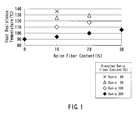
- Fig. 1 is a plot showing the measurement results of the heat resistance temperature of the sample plastic moldings that have different contents of ramie fibers and nylon fibers.
- thermoplastic, vegetable fiber, plastic molding of the present invention includes non-vegetable fibers.
- Translucent or transparent synthetic plastics are preferably used as the thermoplastic, because the use of opaque plastics would provide a weaker presence of fibers and thus not an appearance like that of Japanese paper.
- Transparent or translucent thermoplastics include for example: polypropylene, polyethylene and other polyolefins; polycarbonates; polyethylene terephthalate, polybutylene terephthalate, poly(ethylene 2,6-naphthalate) and other polyesters; propylene ethylene copolymers; polystyrene; copolymers of aromatic vinyl monomers and acrylic (or methacrylic) alkyl esters with lower alkyl groups; copolymers of terephthalic acid, ethylene glycol and cyclohexanedimethanol; and poly(methyl methacrylate) and other acrylic (or methacrylic) polymers.
- thermoplastics may be used alone or as a mixture of two or more together.
- Thermoplastics with a higher melting point require heating at a higher temperature, which may cause the vegetable fibers to be easily discolored. This means that a lower melting point is preferable.
- polypropylene is the most preferred as the thermoplastic to be used, and polyethylene, polyester or polycarbonate plastics may also be preferably used.
- Vegetable fibers include, for example, pulp, ramie, cotton, kapok, kenaf, linen (flax), abacá (Manila hemp), henequen, sisal, jute, hemp (cannabis), coconut palm, oil palm, kozo, straw and bagasse.
- One of these fibers may be used alone, or two or more may be used in combination.
- the vegetable fibers may preferably have as high a brightness as possible because the resulting plastic molding will have accordingly higher brightness. Particularly, the brightness may preferably be at least 70%, and more preferably 75% or more.
- the vegetable fibers may have lengths of less than 1 mm, and a content of 1% to 5% by weight in the plastic molding. They can effectively increase the scattering of light inside the plastic molding, to express the whiteness with a hazy, pale impression of Japanese paper.
- a fiber length of 1 mm or longer is undesirable because it would become easily yellowed through the significantly warmer thermal history due to friction and flow resistance between fibers at the time of kneading. This will result in lowered brightness of the plastic molding.
- the fiber length has no particular lower limit because light tends to be easily scattered inside a plastic molding with shorter fibers.
- the fiber length may be a few ten micrometers, which is largely powder.
- At least 1% by weight of vegetable fiber content can increase the scattering coefficient to thereby express whiteness giving a hazy, pale impression of Japanese paper.
- the scattering coefficient tends to decrease as the vegetable fiber content increases.
- More than 5% by weight of vegetable fiber content would not contribute to any further improvement of the molding's texture similar to Japanese paper.
- Such vegetable fiber content is undesirable because the plastic molding is easily yellowed through the significantly warmer thermal history due to friction and flow resistance between fibers during being kneaded.
- 1% to 5% by weight of vegetable fiber content also effectively enhances the heat resistance of the plastic molding.
- the diameter of the vegetable fibers is not particularly limited. Fibers taken from natural plants may be used as they are, or the fiber diameter may be altered as desired through a fibrillation process. However, the fibers preferably used are obtained from natural plants since fibrillation is time consuming. Depending on the plant, its fibers are obtained in either individual fiber or fiber bundle form. Accordingly, the diameter of the vegetable fibers may be referred to as the diameter of fibrillated fibers, as well as the diameter of fiber bundles and individual fibers. Note that the non-fibrillated vegetable fibers will have limited fineness of fiber, so vegetable fibers with the smallest fiber diameter would have a diameter of about 10 micrometers.
- the non-vegetable fiber may be any fiber other than plant-based natural fibers.
- the non-vegetable fibers includes inorganic fibers, which are made of inorganic materials and synthetic fibers, which are made from synthetic polymers.
- Non-vegetable fibers may be used alone, or used as a mixture of two or more kinds.
- the material of the synthetic fibers may preferably be thermoplastic polymers when the forming of fibers is taken into consideration.
- a plastic fibers should have a melting point higher than that of the matrix thermoplastic of the plastic molding. If the melting point is lower than that of the matrix thermoplastic, the synthetic plastic fibers would melt during the molding process.
- the thermoplastics for the fibers include, for example, polyethylene terephthalate, polybutylene terephthalate, poly(ethylene 2,6-naphthalate) and other polyesters, nylon and other polyamides, and polyacrylates. Polyamides and polyesters are particularly preferred among them. Fibers of thermosetting plastics, such as phenolic plastics, epoxy plastics, melamine plastics and urea plastics may also be used.
- the use of inorganic fibers is advantageous for higher impact resistance and mechanical strength, and enhanced heat resistance.
- the inorganic fibers include glass, ceramic and metal fibers. Glass fibers are particularly preferred in that they hardly affect the brightness of the plastic molding.
- the non-vegetable fibers may preferably have fiber lengths of 1 mm to 5 mm, and a content of 1% to 20% by weight in the plastic molding.
- a fiber length of more than 5 mm might reduce the fluidity of the molten plastic being kneaded, thereby worsening the moldability of the plastic molding.
- the scattering coefficient of the plastic molding tends to decrease.
- the scattering coefficient would be lowered below that of Japanese paper, thereby making the appearance different from Japanese paper.
- Such a fiber content is unfavorable also because the formability might be worsened, and the vegetable fibers might be yellowed.
- the plastic molding may be made from the thermoplastic and the vegetable and non-vegetable fibers that are kneaded and then formed by injection or extrusion molding.
- injection molding can apply any desired shape to the plastic molding.
- the molding temperature should be above the melting point of the thermoplastic, and, in case of synthetic fibers used as non-vegetable fibers, below the melting point of the synthetic fibers.
- it is important that the molding temperature should be such that the vegetable fibers do not yellow.
- the molding temperature should be lower than the yellowing temperature of the vegetable fibers.
- the molding temperature may be 220 °C or lower, preferably 200 °C or lower, and more preferably 180 °C or lower. In such a temperature, the plastic molding can be formed while keeping the white fibers white.
- a plastic molding obtained in the manner described above has an appearance suggestive of Japanese paper, with ISO brightness of 70%, scattering coefficient of 3 or more, and light transmittance of 50% to 65%.
- the transmittance and scattering coefficients are measured by the optical characteristic measuring method which is generally used in papermaking science.
- the plastic molding can be used to manufacture a cover that covers interior materials of an automobile, particularly the engine.
- the automobile interior materials may include not only the engine cover but also the door trims, inner panels, pillar garnishes, rear parcel tray, sun visors, and interior light lenses.
- the plastic molding may be used to form not only the automobile interior materials but also building materials, civil engineering materials, packaging materials, and daily necessities.
- embodiments of the present invention have been described with reference to the embodiments described above, it should be apparent to those skilled in the art that many substitutions, improvements, alterations are possible without departing from the scope of the present invention. Accordingly, embodiments of the present invention may include any substitutions, modifications and alterations that do not depart from the spirit and scope of the appended claims.
- the additives that can be added include dispersing agents, stabilizers, plasticizers, modifying agents, ultraviolet absorbers, light stabilizers, antioxidants, antistatic agents, lubricants, and mold release agents.
- sample plastic moldings were prepared from the materials specified below that were mixed according to the compositions defined in Table 1, and then formed by injection at 200 °C into a flat plate sized 55 mm x 50 mm x 1 mm.
- Thermoplastic polymer :
- the brightness was evaluated by measuring ISO brightness as defined in JIS P 8148 using a spectrophotometer, CMS-35SP, made by Murakami Color Research Laboratory.
- the measurement conditions are as follows.
- Light source Illuminant D65 Vision angle: 10°
- Color space CIE L*a*b*
- Optical conditions SCE (Specular Component Excluded) method Measurement area: 12 x 17
- Samples 1-6 contained only either one of vegetable and non-vegetable fibers. When each sample was visually observed, it was determined that the variation of the content did not become visually suggestive of Japanese paper. In contrast, Samples 7 and 8, which contained both short vegetable fibers and relatively long non-vegetable fibers, had a significantly closer appearance to that of Japanese paper regardless of the type of non-vegetable fiber.
- Test 2 in addition to Sample 7 used in Test 1, sample plastic moldings with different contents of the PET and vegetable fibers was prepared according to the composition shown in Table 2, in the same manner as in Test 1. An additional plastic molding containing no fibers was also prepared as a blank sample.
- Table 2 Vegetable Fibers (% by weight) PET Fibers (%by weight) Brightness (%) Scattering Coefficient (m 2 /kg) Transmittance (%) Loss Rate (%) Heat Resistance Temperature (°C) Blank 0 0 80.4 67.3 0.7 87.8 Sample 7 1 5 79.8 10.2 62.9 1.4 90.9 Sample 9 3 10 78.0 5.5 59.1 2.0 95.9 Sample 10 3 25 66.6 2.0 47.2 6.5 98.4 Sample 11 5 10 72.6 4.6 57.9 3.3 97.5 Sample 12 5 20 71.1 3.2 52.0 5.0 99.6 Sample 13 6 15 68.9 2.4 49.0 5.0 97.0
- the reflectance was also measured by a known method commonly used in papermaking science or the like field using the same spectrophotometer CMS-35SP as above. The measurement conditions were the same as those of brightness.
- the heat resistance was measured according to ISO 75-1,75-2 and 75-3.
- the scattering coefficient, loss rate and transmittance were also the same as those of standard Japanese paper,.
- the vegetable fiber content is required to be 5% or less by weight, and the non-vegetable fiber content is required to be 20% or less by weight.
- Test 3 Similar vegetable fibers used in Sample 8 from Test 1 were used. However, glass fibers having a length of 5 mm were added and the content of each fiber was varied according to the compositions shown in Table 3. The brightness and optical properties (i.e. scattering coefficient, transmittance, loss rate) were then evaluated for each prepared sample in the same manner as in Test 2. The results are also shown together in Table 3.
- Table 3 clearly shows that when the vegetable fiber content was 5% or less by weight and the non-vegetable fiber content was 20% or less by weight, then the brightness, scattering coefficient, transmittance and loss rate were all at the same level as the reference based on the standard Japanese paper even though the non-vegetable fibers had the fiber length of 5 mm. From above, it has been found that the non-vegetable fibers preferably have a fiber length of 5 mm or shorter.
- sample plastic moldings were prepared from the materials specified below that were mixed according to the compositions and fiber lengths specified in Table 4. They were then kneaded and extruded at 190 °C by a twin-screw extruder into a shape of flat plate sized 55 mm x 50 mm x 1 mm. The brightness and optical properties (i.e. scattering coefficient, transmittance and loss rate) were then evaluated for each prepared sample in the same manner as in Test 2. The results are shown in Table 4.
- Thermoplastic polymer i.e. scattering coefficient, transmittance and loss rate
- ramie fibers were used as vegetable fibers and nylon fibers as non-vegetable fibers.
- Sample plastic moldings were prepared while ramie fiber content varied from 0% to 20%, and the heat resistance temperature was measured for each sample by the method described above. From the results shown in Fig. 1 , it was found that the more the ramie fiber content, the higher the heat resistance temperature.
- the nylon fiber content of 10% by weight raised the heat resistance temperature by only about 5 °C, while the additional ramie fiber content of 10% by weight further elevated the heat resistance temperature by about 30 °C. It has been thus confirmed that the heat resistance of the plastic molding will effectively improve by inclusion of a large amount of vegetable fibers in addition to the non-vegetable fibers.
- a heat resistance temperature of 110 °C or higher requires a vegetable fiber content of 5% or more in the plastic molding. It was also found that the heat resistance temperature of the plastic molding will increase at a greater rate when the ramie fiber content is small. Specifically, the increase in the heat resistance temperature was greater when the nylon fiber content increased from 0% to 5% than when it increased from 5% to 10%.
Landscapes
- Chemical & Material Sciences (AREA)
- Engineering & Computer Science (AREA)
- Polymers & Plastics (AREA)
- Medicinal Chemistry (AREA)
- Health & Medical Sciences (AREA)
- Organic Chemistry (AREA)
- Physics & Mathematics (AREA)
- Acoustics & Sound (AREA)
- Chemical Kinetics & Catalysis (AREA)
- Combustion & Propulsion (AREA)
- Mechanical Engineering (AREA)
- General Engineering & Computer Science (AREA)
- Manufacturing & Machinery (AREA)
- Materials Engineering (AREA)
- Transportation (AREA)
- Compositions Of Macromolecular Compounds (AREA)
- Paper (AREA)
- Reinforced Plastic Materials (AREA)
Abstract
Description
- The present invention relates to plastic moldings including fibers, and in particular to an engine cover formed of white plastic molding of Japanese paper style.
- As plastic molding with embedded fibers, there is conventionally known fiber-reinforced plastics. The fiber-reinforced plastics typically contains rigid fibers, such as carbon or glass fibers, are widely known as the reinforcing fibers. In view of the recent increased awareness of environmental conservation, fiber-reinforced plastics have also been proposed that have fibers consisting of organic material as reinforcing fibers in place of carbon, glass and other inorganic fibers, which may be a residue after incineration. For example, Japanese Laid-open Patent Application Publication No.
2007-056202 - Plastic moldings are often used in interior materials of an automobile. While functionality is of course required in the interior materials, expansion of the design variations is also desired since the design may have great influence on the appearance around the installation space. Accordingly, the present inventors have attempted to develop a plastic molding that has the appearance of white Japanese paper as a new variant based on the concept of "flavor of Japan (or Japanese style)."
- Japanese paper is typically handcrafted from long vegetable fibers of kozo (or paper mulberry), mitsumata and gampi shrubs. It produces at least a fibrous texture suggesting that some fibers are contained as a raw material, although the feel and appearance of fibers may not be retained. In addition, with a myriad of voids between and inside of the fibers where light is scattered, Japanese paper exhibits whiteness with a hazy, pale impression, which is quite different from, for example, that of a plastic molding painted white with pigment. If the texture unique to the Japanese paper could be realized in plastic moldings, it would create a novel impression that evokes a Japanese style.
- The plastic molding of the above-mentioned Document, in contrast, might be able to present fibrous texture to an uncertain degree according to its fiber content. However, the fibers of the Document have a relatively large content for the purpose of reinforcement; the polyester and pulp fibers together amounts 30% to 46% in total. In addition, the polyester and pulp fibers both have relatively long length. The increased flow resistance when being mixed with plastic can easily raise the temperature, causing yellowing of the pulp fibers. Moreover, the pulp fiber content in the molding is as much as 15% to 41%, which is equal to or more than half of the total fibers, so the whole molding can possibly be yellowed. The above-mentioned Document considers nothing about designing color tones at all, and thus has no particular mention to preferred conditions for assuredly obtaining a white molding, let alone for presenting whiteness with a hazy, pale impression of Japanese paper. Therefore, it can not possibly generate the texture unique to Japanese paper, even if it provides fibrous feeling to some extent.
- In one aspect of the present invention, there is provided a plastic molding having a thermoplastic, 1% to 5% by weight of vegetable fibers with fiber length of less than 1 mm, and 1% to 20% by weight of non-vegetable fibers with fiber length of 1 mm to 5 mm. The plastic molding may be used to form automobile interior materials, such as an engine cover. In a preferred embodiment, the non-vegetable fibers may be at least one of inorganic fibers and synthetic fibers.
- In such a composition, the non-vegetable fiber content of 1% to 20% by weight with fiber length of 1 mm to 5 mm provides moderate fibrous texture. In addition, 1% to 5% by weight of vegetable fibers with fiber length of less than 1 mm allows for expressing the whiteness of the light impression of Japanese paper. In addition, the total content and moderate proportion of vegetable and non-vegetable fibers provide a moderate transmittance of light. In this way, the plastic molding can be evocative of Japanese paper. It is also excellent in heat resistance since it contains not only the non-vegetable fibers but the vegetable fibers as well.
- In the present invention, the content of relatively long, non-vegetable fibers that are hard to be yellowed by heat provide the plastic molding with fibrous texture while controlling yellowing. However, those non-vegetable fibers alone are insufficient to express the whiteness of pale impression of Japanese paper. The vegetable fibers included together with non-vegetable fibers increase scattering of light in the plastic molding to a moderate level, thereby producing a feeling of Japanese paper. Having a fiber length of less than 1 mm and the limited content of 1% to 5% by weight, the vegetable fibers can present texture of Japanese paper while controlling yellowing. Further, the non-vegetable fibers, which themselves are hard to be yellowed, but the lowered content of 20% or less by weight and the limited fiber length of 5 mm or shorter can reduce flow resistance during kneading process to produce fibrous texture while controlling yellowing of vegetable fibers. As a result, the whiteness of Japanese paper effectively expressed.
- In another preferred embodiment, the plastic composition may have brightness of 70% or more, scattering factor of 3 m2/kg or more, and transmittance of 50% to 65%. In this case, the appearance will more closely resemble that of Japanese paper. The brightness may be ISO brightness as defined in JIS P 8148 that is measured by means of diffuse reflectance.
-
Fig. 1 is a plot showing the measurement results of the heat resistance temperature of the sample plastic moldings that have different contents of ramie fibers and nylon fibers. - A thermoplastic, vegetable fiber, plastic molding of the present invention includes non-vegetable fibers. In the following, embodiments of the present invention will be explained in detail.
- Translucent or transparent synthetic plastics are preferably used as the thermoplastic, because the use of opaque plastics would provide a weaker presence of fibers and thus not an appearance like that of Japanese paper. Transparent or translucent thermoplastics include for example: polypropylene, polyethylene and other polyolefins; polycarbonates; polyethylene terephthalate, polybutylene terephthalate, poly(ethylene 2,6-naphthalate) and other polyesters; propylene ethylene copolymers; polystyrene; copolymers of aromatic vinyl monomers and acrylic (or methacrylic) alkyl esters with lower alkyl groups; copolymers of terephthalic acid, ethylene glycol and cyclohexanedimethanol; and poly(methyl methacrylate) and other acrylic (or methacrylic) polymers. These thermoplastics may be used alone or as a mixture of two or more together. Thermoplastics with a higher melting point require heating at a higher temperature, which may cause the vegetable fibers to be easily discolored. This means that a lower melting point is preferable. Considering ensuring a certain degree of heat resistance in the molding, and moldability as well as material costs, polypropylene is the most preferred as the thermoplastic to be used, and polyethylene, polyester or polycarbonate plastics may also be preferably used.
- Vegetable fibers include, for example, pulp, ramie, cotton, kapok, kenaf, linen (flax), abacá (Manila hemp), henequen, sisal, jute, hemp (cannabis), coconut palm, oil palm, kozo, straw and bagasse. One of these fibers may be used alone, or two or more may be used in combination. The vegetable fibers may preferably have as high a brightness as possible because the resulting plastic molding will have accordingly higher brightness. Particularly, the brightness may preferably be at least 70%, and more preferably 75% or more.
- The vegetable fibers may have lengths of less than 1 mm, and a content of 1% to 5% by weight in the plastic molding. They can effectively increase the scattering of light inside the plastic molding, to express the whiteness with a hazy, pale impression of Japanese paper. A fiber length of 1 mm or longer is undesirable because it would become easily yellowed through the significantly warmer thermal history due to friction and flow resistance between fibers at the time of kneading. This will result in lowered brightness of the plastic molding. The fiber length has no particular lower limit because light tends to be easily scattered inside a plastic molding with shorter fibers. For example, the fiber length may be a few ten micrometers, which is largely powder.
- At least 1% by weight of vegetable fiber content can increase the scattering coefficient to thereby express whiteness giving a hazy, pale impression of Japanese paper. However, the scattering coefficient tends to decrease as the vegetable fiber content increases. More than 5% by weight of vegetable fiber content would not contribute to any further improvement of the molding's texture similar to Japanese paper. Such vegetable fiber content is undesirable because the plastic molding is easily yellowed through the significantly warmer thermal history due to friction and flow resistance between fibers during being kneaded. 1% to 5% by weight of vegetable fiber content also effectively enhances the heat resistance of the plastic molding.
- The diameter of the vegetable fibers is not particularly limited. Fibers taken from natural plants may be used as they are, or the fiber diameter may be altered as desired through a fibrillation process. However, the fibers preferably used are obtained from natural plants since fibrillation is time consuming. Depending on the plant, its fibers are obtained in either individual fiber or fiber bundle form. Accordingly, the diameter of the vegetable fibers may be referred to as the diameter of fibrillated fibers, as well as the diameter of fiber bundles and individual fibers. Note that the non-fibrillated vegetable fibers will have limited fineness of fiber, so vegetable fibers with the smallest fiber diameter would have a diameter of about 10 micrometers.
- The non-vegetable fiber may be any fiber other than plant-based natural fibers. The non-vegetable fibers includes inorganic fibers, which are made of inorganic materials and synthetic fibers, which are made from synthetic polymers. Non-vegetable fibers may be used alone, or used as a mixture of two or more kinds.
- The material of the synthetic fibers may preferably be thermoplastic polymers when the forming of fibers is taken into consideration. When thermoplastic fibers are used, a plastic fibers should have a melting point higher than that of the matrix thermoplastic of the plastic molding. If the melting point is lower than that of the matrix thermoplastic, the synthetic plastic fibers would melt during the molding process. The thermoplastics for the fibers include, for example, polyethylene terephthalate, polybutylene terephthalate, poly(ethylene 2,6-naphthalate) and other polyesters, nylon and other polyamides, and polyacrylates. Polyamides and polyesters are particularly preferred among them. Fibers of thermosetting plastics, such as phenolic plastics, epoxy plastics, melamine plastics and urea plastics may also be used.
- The use of inorganic fibers is advantageous for higher impact resistance and mechanical strength, and enhanced heat resistance. The inorganic fibers include glass, ceramic and metal fibers. Glass fibers are particularly preferred in that they hardly affect the brightness of the plastic molding.
- The non-vegetable fibers may preferably have fiber lengths of 1 mm to 5 mm, and a content of 1% to 20% by weight in the plastic molding. A fiber length of more than 5 mm might reduce the fluidity of the molten plastic being kneaded, thereby worsening the moldability of the plastic molding. There is another concern of yellowing of vegetable fibers through significantly warmer thermal history due to lowered fluidity. As the fiber content increases, the scattering coefficient of the plastic molding tends to decrease. When the fiber content exceeds 20% by weight, the scattering coefficient would be lowered below that of Japanese paper, thereby making the appearance different from Japanese paper. Such a fiber content is unfavorable also because the formability might be worsened, and the vegetable fibers might be yellowed.
- The plastic molding may be made from the thermoplastic and the vegetable and non-vegetable fibers that are kneaded and then formed by injection or extrusion molding. In particular, injection molding can apply any desired shape to the plastic molding. The molding temperature should be above the melting point of the thermoplastic, and, in case of synthetic fibers used as non-vegetable fibers, below the melting point of the synthetic fibers. In addition, it is important that the molding temperature should be such that the vegetable fibers do not yellow. In other words, the molding temperature should be lower than the yellowing temperature of the vegetable fibers. For this purpose, the molding temperature may be 220 °C or lower, preferably 200 °C or lower, and more preferably 180 °C or lower. In such a temperature, the plastic molding can be formed while keeping the white fibers white.
- A plastic molding obtained in the manner described above has an appearance suggestive of Japanese paper, with ISO brightness of 70%, scattering coefficient of 3 or more, and light transmittance of 50% to 65%. The transmittance and scattering coefficients are measured by the optical characteristic measuring method which is generally used in papermaking science. The plastic molding can be used to manufacture a cover that covers interior materials of an automobile, particularly the engine. The automobile interior materials may include not only the engine cover but also the door trims, inner panels, pillar garnishes, rear parcel tray, sun visors, and interior light lenses. The plastic molding may be used to form not only the automobile interior materials but also building materials, civil engineering materials, packaging materials, and daily necessities.
- While embodiments of the present invention have been described with reference to the embodiments described above, it should be apparent to those skilled in the art that many substitutions, improvements, alterations are possible without departing from the scope of the present invention. Accordingly, embodiments of the present invention may include any substitutions, modifications and alterations that do not depart from the spirit and scope of the appended claims. For example, it is possible to add various additives into the plastic molding as long as they do not impede the effects of the present invention. Specifically, the additives that can be added include dispersing agents, stabilizers, plasticizers, modifying agents, ultraviolet absorbers, light stabilizers, antioxidants, antistatic agents, lubricants, and mold release agents.
- In Test 1, sample plastic moldings were prepared from the materials specified below that were mixed according to the compositions defined in Table 1, and then formed by injection at 200 °C into a flat plate sized 55 mm x 50 mm x 1 mm.
Thermoplastic polymer: - Polypropylene (AZ864 produced by Sumitomo Chemical Co., Ltd.)
- Pulp fibers (KC FLOCK W-50 produced by Nippon Paper Chemicals Co., Ltd.; fiber length: 80-200 µm)
- Polyethylene terephthalate (PET) fibers (fiber diameter: 14.3 µm; fiber length: 3 mm)
- Glass fibers (fiber diameter: 22 µm; fiber length: 5 mm)
- Then, the brightness was evaluated for each prepared sample by the measuring method described below. The results are shown together in Table 1 above.
- The brightness was evaluated by measuring ISO brightness as defined in JIS P 8148 using a spectrophotometer, CMS-35SP, made by Murakami Color Research Laboratory. The measurement conditions are as follows.
Light source: Illuminant D65
Vision angle: 10°
Color space: CIE L*a*b*
Optical conditions: SCE (Specular Component Excluded) method
Measurement area: 12 x 17 - Referring to Table 1, it was confirmed that the brightness decreased as either vegetable or non-vegetable fiber content increased, but the decrease in brightness was rather gradual during the increase of the non-vegetable fiber content. In addition, when the non-vegetable fiber content is 20% or less by weight regardless of the kind of fiber, the brightness stayed at substantially the same level as the target brightness which is that of standard Japanese paper (i.e. 70% or higher). It was confirmed that the vegetable fiber content, in contrast, had more influence on the brightness, which was the same as that of standard Japanese paper when the vegetable fiber content was 3% by weight, but went away from that of standard Japanese paper in the case of 10% by weight. When only the brightness is focused on, it was equal to the brightness of Japanese paper when either vegetable or non-vegetable fiber was included and its content was below a certain level. Samples 1-6 contained only either one of vegetable and non-vegetable fibers. When each sample was visually observed, it was determined that the variation of the content did not become visually suggestive of Japanese paper. In contrast, Samples 7 and 8, which contained both short vegetable fibers and relatively long non-vegetable fibers, had a significantly closer appearance to that of Japanese paper regardless of the type of non-vegetable fiber.
- In Test 2, in addition to Sample 7 used in Test 1, sample plastic moldings with different contents of the PET and vegetable fibers was prepared according to the composition shown in Table 2, in the same manner as in Test 1. An additional plastic molding containing no fibers was also prepared as a blank sample.
Table 2 Vegetable Fibers (% by weight) PET Fibers (%by weight) Brightness (%) Scattering Coefficient (m2/kg) Transmittance (%) Loss Rate (%) Heat Resistance Temperature (°C) Blank 0 0 80.4 67.3 0.7 87.8 Sample 7 1 5 79.8 10.2 62.9 1.4 90.9 Sample 9 3 10 78.0 5.5 59.1 2.0 95.9 Sample 103 25 66.6 2.0 47.2 6.5 98.4 Sample 11 5 10 72.6 4.6 57.9 3.3 97.5 Sample 12 5 20 71.1 3.2 52.0 5.0 99.6 Sample 13 6 15 68.9 2.4 49.0 5.0 97.0 - Brightness was then measured in the same manner as in Test 1, and optical properties (scattering coefficient, transmittance, loss rate), which are indicative of the unique texture of the Japanese paper, was also measured. Heat resistance was also evaluated. The results are shown together in Table 2.
- Transmittance and scattering coefficient were measured and calculated by a known method commonly used in papermaking science or the like field, using a spectrophotometer, CMS-35SP, made by Murakami Color Research Laboratory. The measurement conditions were the same as those of brightness. Loss rates (or absorption rates) were calculated by the following equation:

- The reflectance was also measured by a known method commonly used in papermaking science or the like field using the same spectrophotometer CMS-35SP as above. The measurement conditions were the same as those of brightness.
- The heat resistance was measured according to ISO 75-1,75-2 and 75-3.
- A comparison of
Samples 9 and 10 has shown that the brightness decreased as the non-vegetable fiber content increased, and when the non-vegetable fiber content was 25% by weight, the brightness was lower than that of standard Japanese paper (which is 70% or more). Also, when the non-vegetable fiber content was 25% by weight, the scattering coefficient, transmittance and loss rate were all out of the target range that is determined on the basis of the measurements for standard Japanese paper (i.e. a scattering coefficient of 3 m2/kg or more, a transmittance of 50% to 65%, and a loss rate of 5% or less). It should be noted that although the standard Japanese paper that was subjected to measurement had a scattering coefficient of 30 m2/kg, the target value was set to 3 m2/kg because existing lamp shade materials made of plastic in combination with Japanese paper have a scattering coefficient of about a tenth that of the raw Japanese paper while apparently retaining a suggestion of Japanese paper. - It was also observed that the increase in the vegetable fiber content had more influence on the decrease in the brightness of the plastic molding than the increase in the non-vegetable fiber content. Specifically, comparison of
Samples 10 and 13 has shown that when the vegetable fiber content was 6% or more by weight, the brightness was lower than that of standard Japanese paper despite that the non-vegetable fibers content was 15% by weight, which was reduced by 10 percentage points as compared to that ofSample 10. The transmittance and scattering coefficient were also out of the target range of standard Japanese paper. In contrast, the results of Sample 12 shows that when vegetable fiber content was 5% by weight, the brightness was equal to that of standard Japanese paper, even though the non-vegetable fiber content was 20% by weight. The scattering coefficient, loss rate and transmittance were also the same as those of standard Japanese paper,. In conclusion, it has been found that the vegetable fiber content is required to be 5% or less by weight, and the non-vegetable fiber content is required to be 20% or less by weight. - A comparison of Samples 7, 9 and 11 has shown that the vegetable fiber content of 3% or less by weight is preferable, since it provided a plastic molding with a higher brightness, and the non-vegetable fiber content of 10% or less by weight is more preferable since it more effectively enhanced the brightness. With regard to heat resistance (or heat resistance temperature), it has been confirmed that the heat resistance improves when vegetable and non-vegetable fibers are both included.
- In Test 3, similar vegetable fibers used in Sample 8 from Test 1 were used. However, glass fibers having a length of 5 mm were added and the content of each fiber was varied according to the compositions shown in Table 3. The brightness and optical properties (i.e. scattering coefficient, transmittance, loss rate) were then evaluated for each prepared sample in the same manner as in Test 2. The results are also shown together in Table 3.
Table 3 Vegetable Fibers (% by weight) Glass Fibers (%by weight) Brightness (%) Scattering Coefficient (m2/kg) Transmittance (%) Loss Rate (%) Blank 0 0 80.4 67.3 0.7 Sample 8 3 10 73.8 4.2 64.3 2.3 Sample 14 3 25 65.1 1.5 63.0 4.0 Sample 15 5 20 70.1 3.1 62.5 4.5 Sample 16 6 10 65.6 3.4 61.6 4.7 - Table 3 clearly shows that when the vegetable fiber content was 5% or less by weight and the non-vegetable fiber content was 20% or less by weight, then the brightness, scattering coefficient, transmittance and loss rate were all at the same level as the reference based on the standard Japanese paper even though the non-vegetable fibers had the fiber length of 5 mm. From above, it has been found that the non-vegetable fibers preferably have a fiber length of 5 mm or shorter.
- In Test 4, sample plastic moldings were prepared from the materials specified below that were mixed according to the compositions and fiber lengths specified in Table 4. They were then kneaded and extruded at 190 °C by a twin-screw extruder into a shape of flat plate sized 55 mm x 50 mm x 1 mm. The brightness and optical properties (i.e. scattering coefficient, transmittance and loss rate) were then evaluated for each prepared sample in the same manner as in Test 2. The results are shown in Table 4.
Thermoplastic polymer: - Polypropylene (J106G produced by Prime Polymer Co., Ltd.)
- Ramie fibers (fiber brightness: 84.1%)
- Polyethylene terephthalate (PET) fibers (fiber diameter: 14.3 µm)
- From comparison of Samples 17 and 18, it has been confirmed that when the vegetable fiber content was 5 mm or shorter, the brightness, scattering coefficient, transmittance and loss rate all satisfied the criterion based on the standard Japanese paper, as found from the results of Test 2, even though the vegetable fiber length of 0.3 mm which was longer than in Test 2. Comparison of
Samples 17, 19 and 20, however, has clarified that in the case of the vegetable fiber lengths of 0.3 mm and 0.7 mm, there was found no difference between the brightnesses, which were both equivalent to that of Japanese paper. In contrast, when the fibers of vegetable fibers had the length of 1.5 mm, the brightness dropped below the reference based on Japanese paper even though the fiber content was 5% or less by weight. Further comparison of Samples 17 and 21 shows that the non-vegetable fiber length of 1.5 mm satisfied the criterion based on Japanese paper, while the reduced fiber length of 0.5 mm resulted in an increased transmittance that was out of the reference of standard Japanese paper. In other words, the fibrous feeling faded and the appearance went away from that of Japanese paper. In conclusion, it has been found that the vegetable fiber length may preferably be shorter than 1 mm, and the non-vegetable fiber length may preferably be 1 mm or longer. - For Test 5, ramie fibers were used as vegetable fibers and nylon fibers as non-vegetable fibers. Sample plastic moldings were prepared while ramie fiber content varied from 0% to 20%, and the heat resistance temperature was measured for each sample by the method described above. From the results shown in
Fig. 1 , it was found that the more the ramie fiber content, the higher the heat resistance temperature. Specifically, the nylon fiber content of 10% by weight raised the heat resistance temperature by only about 5 °C, while the additional ramie fiber content of 10% by weight further elevated the heat resistance temperature by about 30 °C. It has been thus confirmed that the heat resistance of the plastic molding will effectively improve by inclusion of a large amount of vegetable fibers in addition to the non-vegetable fibers. For example, a heat resistance temperature of 110 °C or higher requires a vegetable fiber content of 5% or more in the plastic molding. It was also found that the heat resistance temperature of the plastic molding will increase at a greater rate when the ramie fiber content is small. Specifically, the increase in the heat resistance temperature was greater when the nylon fiber content increased from 0% to 5% than when it increased from 5% to 10%.
| Vegetable Fibers (% by weight) | Non-vegetable Fibers (% by weight) | Brightness (%) | ||
| | Glass | |||
| Blank | ||||
| 0 | 0 | 0 | 80.4 | |
| Sample 1 | 3 | 0 | 0 | 76.4 |
| Sample 2 | 10 | 0 | 0 | 66.2 |
| Sample 3 | 0 | 10 | 80.0 | |
| Sample 4 | 0 | 20 | 75.4 | |
| Sample 5 | 0 | 10 | 76.2 | |
| Sample 6 | 0 | 20 | 72.5 | |
| Sample 7 | 1 | 5 | 79.8 | |
| Sample 8 | 3 | 10 | 73.8 | |
| Vegetable Fibers | Non-vegetable Fibers | Brightness (%) | Scattering Coefficient (m2/kg) | Transmittance (%) | Loss Rate (%) | |||
| Length (mm) | Content (% by weight) | Length (mm) | Content (%by weight) | |||||
| Sample 17 | 0.3 | 5 | 1.5 | 10 | 70.2 | 3.9 | 52.7 | 4.2 |
| Sample 18 | 0.3 | 10 | 1.5 | 10 | 65.4 | 5.0 | 43.6 | 4.9 |
| Sample 19 | 0.7 | 5 | 1.5 | 10 | 71.2 | 7.7 | 63.5 | 4.8 |
| | 1.5 | 5 | 1.5 | 10 | 64.4 | 4.1 | 50.9 | 5.1 |
| Sample 21 | 0.3 | 5 | 0.5 | 10 | 69.4 | 3.4 | 84.8 | 2.8 |
Claims (5)
- An automobile engine cover comprising a plastic molding, the plastic molding comprising thermoplastic, 1% to 5% by weight of vegetable fibers with a fiber length of less than 1 mm, and 1% to 20% by weight of non-vegetable fibers with a fiber length of 1 mm to 5 mm.
- The engine cover of claim 1 wherein the plastic molding has a brightness of 70 or more.
- The engine cover according to claim 1 or 2 wherein the non-vegetable fibers comprise at least one inorganic fiber or synthetic fiber.
- The engine cover according to any one of claims 1 to 3 wherein the plastic molding has a scattering coefficient of 3 or more.
- The engine cover according to any one of claims 1 to 4 wherein the plastic molding has a transmittance of 50% to 65%.
Applications Claiming Priority (2)
| Application Number | Priority Date | Filing Date | Title |
|---|---|---|---|
| JP2011267751 | 2011-12-07 | ||
| PCT/JP2012/081607 WO2013084976A1 (en) | 2011-12-07 | 2012-12-06 | Engine cover |
Publications (2)
| Publication Number | Publication Date |
|---|---|
| EP2789645A1 true EP2789645A1 (en) | 2014-10-15 |
| EP2789645A4 EP2789645A4 (en) | 2015-05-27 |
Family
ID=48574334
Family Applications (1)
| Application Number | Title | Priority Date | Filing Date |
|---|---|---|---|
| EP12855051.4A Withdrawn EP2789645A4 (en) | 2011-12-07 | 2012-12-06 | Engine cover |
Country Status (4)
| Country | Link |
|---|---|
| US (1) | US20140354014A1 (en) |
| EP (1) | EP2789645A4 (en) |
| JP (1) | JPWO2013084976A1 (en) |
| WO (1) | WO2013084976A1 (en) |
Families Citing this family (5)
| Publication number | Priority date | Publication date | Assignee | Title |
|---|---|---|---|---|
| KR20160001877A (en) | 2014-06-27 | 2016-01-07 | 제일모직주식회사 | Thermoplastic resin composition for exterior parts and molded article for exterior parts using thereof |
| EP3494175B1 (en) * | 2016-08-03 | 2020-06-10 | Borealis AG | Fiber reinforced polypropylene composite |
| JP2019172797A (en) * | 2018-03-28 | 2019-10-10 | 古河電気工業株式会社 | Fiber reinforced resin composite material, laminate thereof, composition for fiber reinforced resin composite material, and method for producing fiber reinforced resin composite material |
| AT521301B1 (en) * | 2018-05-29 | 2020-04-15 | Miba Ag | Stator with insulation layer |
| CN116457375A (en) * | 2021-01-08 | 2023-07-18 | 古河电气工业株式会社 | Cellulose fiber-reinforced thermoplastic resin molded article and method for producing same |
Family Cites Families (7)
| Publication number | Priority date | Publication date | Assignee | Title |
|---|---|---|---|---|
| JP3588383B2 (en) * | 1995-04-18 | 2004-11-10 | 旭化成ケミカルズ株式会社 | Polyamide resin composition and engine cover material comprising the same |
| GB0315042D0 (en) * | 2003-06-27 | 2003-07-30 | Excel Ind Ltd | Composite material |
| JP4818662B2 (en) | 2005-08-26 | 2011-11-16 | ダイセルポリマー株式会社 | Thermoplastic resin composition |
| JP5482321B2 (en) * | 2010-03-12 | 2014-05-07 | トヨタ車体株式会社 | Interior light lens |
| JP2011189532A (en) * | 2010-03-12 | 2011-09-29 | Toyota Auto Body Co Ltd | White molded body |
| JP5589465B2 (en) * | 2010-03-17 | 2014-09-17 | トヨタ車体株式会社 | Fiber reinforced plastic for automotive parts |
| JP2012188570A (en) * | 2011-03-11 | 2012-10-04 | Toyota Auto Body Co Ltd | Resin molded product |
-
2012
- 2012-12-06 JP JP2013548288A patent/JPWO2013084976A1/en active Pending
- 2012-12-06 EP EP12855051.4A patent/EP2789645A4/en not_active Withdrawn
- 2012-12-06 US US14/362,286 patent/US20140354014A1/en not_active Abandoned
- 2012-12-06 WO PCT/JP2012/081607 patent/WO2013084976A1/en not_active Ceased
Also Published As
| Publication number | Publication date |
|---|---|
| WO2013084976A1 (en) | 2013-06-13 |
| US20140354014A1 (en) | 2014-12-04 |
| JPWO2013084976A1 (en) | 2015-04-27 |
| EP2789645A4 (en) | 2015-05-27 |
Similar Documents
| Publication | Publication Date | Title |
|---|---|---|
| Kwon et al. | Tensile properties of kenaf fiber and corn husk flour reinforced poly (lactic acid) hybrid bio-composites: Role of aspect ratio of natural fibers | |
| US20140354014A1 (en) | Engine cover | |
| Mantia et al. | Processing and mechanical properties of organic filler–polypropylene composites | |
| JP6815867B2 (en) | Polyolefin resin compositions, articles and vehicle skins | |
| CN105377521A (en) | A composite structure with surface roughness | |
| KR102176842B1 (en) | The lightweight extrusion foam deck for floor | |
| CN102918104A (en) | Resin composition and molded product thereof | |
| WO2015193533A1 (en) | A method to provide composite comprising a desiccating process agent and composites thereof | |
| Ariño et al. | Processing and mechanical properties of thermoplastic composites based on cellulose fibers and ethylene—acrylic acid copolymer | |
| KR20090120985A (en) | Polypropylene-Bamboo Fiber Biocomposite for Automobile Interior and Exterior Materials | |
| CA3156705C (en) | Toilet seat assembly | |
| JP6873275B2 (en) | Polycarbonate resin composition and an optically molded product comprising the polycarbonate resin composition | |
| KR101180906B1 (en) | Fiber Plastic Composite and Method for Manufacturing Thereof | |
| KR102176692B1 (en) | Polycarbonate-abs alloy resin composition with reduced gloss and light resistance and molded article comprising the same | |
| JP4818662B2 (en) | Thermoplastic resin composition | |
| EP4471079A1 (en) | Cellulosic composite | |
| EP4471080A1 (en) | Cellulosic composite | |
| JP2012188570A (en) | Resin molded product | |
| JP2020082371A (en) | Molded article and method for manufacturing the same | |
| WO2014076353A1 (en) | A method and a system for manufacturing a composite product and a composite product | |
| JP2011189532A (en) | White molded body | |
| Bastida et al. | Printability versus durability in 3D-printed biocomposites: Unraveling the distinct roles of flax and hemp fibers in PLA-based filaments | |
| KR102880557B1 (en) | Eco-friendly composition material containing hardwood and softwood | |
| KR102473244B1 (en) | Non-painting thermoplastic resin composition molded article prepared using the same | |
| WO2012165286A1 (en) | Fiber-reinforced plastic |
Legal Events
| Date | Code | Title | Description |
|---|---|---|---|
| PUAI | Public reference made under article 153(3) epc to a published international application that has entered the european phase |
Free format text: ORIGINAL CODE: 0009012 |
|
| 17P | Request for examination filed |
Effective date: 20140530 |
|
| AK | Designated contracting states |
Kind code of ref document: A1 Designated state(s): AL AT BE BG CH CY CZ DE DK EE ES FI FR GB GR HR HU IE IS IT LI LT LU LV MC MK MT NL NO PL PT RO RS SE SI SK SM TR |
|
| DAX | Request for extension of the european patent (deleted) | ||
| RA4 | Supplementary search report drawn up and despatched (corrected) |
Effective date: 20150428 |
|
| RIC1 | Information provided on ipc code assigned before grant |
Ipc: C08J 5/04 20060101AFI20150417BHEP Ipc: C08L 101/00 20060101ALI20150417BHEP Ipc: C08K 7/02 20060101ALI20150417BHEP |
|
| STAA | Information on the status of an ep patent application or granted ep patent |
Free format text: STATUS: THE APPLICATION IS DEEMED TO BE WITHDRAWN |
|
| 18D | Application deemed to be withdrawn |
Effective date: 20151201 |