EP2789601A1 - Method for producing fatty acid monoglyceride containing mixture - Google Patents
Method for producing fatty acid monoglyceride containing mixture Download PDFInfo
- Publication number
- EP2789601A1 EP2789601A1 EP12855771.7A EP12855771A EP2789601A1 EP 2789601 A1 EP2789601 A1 EP 2789601A1 EP 12855771 A EP12855771 A EP 12855771A EP 2789601 A1 EP2789601 A1 EP 2789601A1
- Authority
- EP
- European Patent Office
- Prior art keywords
- fatty acid
- mixture
- glycerin
- acid monoglyceride
- mass
- Prior art date
- Legal status (The legal status is an assumption and is not a legal conclusion. Google has not performed a legal analysis and makes no representation as to the accuracy of the status listed.)
- Granted
Links
- 239000000203 mixture Substances 0.000 title claims abstract description 141
- LDVVTQMJQSCDMK-UHFFFAOYSA-N 1,3-dihydroxypropan-2-yl formate Chemical compound OCC(CO)OC=O LDVVTQMJQSCDMK-UHFFFAOYSA-N 0.000 title claims abstract description 130
- 235000014113 dietary fatty acids Nutrition 0.000 title claims abstract description 120
- 239000000194 fatty acid Substances 0.000 title claims abstract description 120
- 229930195729 fatty acid Natural products 0.000 title claims abstract description 120
- 150000004665 fatty acids Chemical class 0.000 title claims abstract description 108
- 238000004519 manufacturing process Methods 0.000 title claims abstract description 37
- PEDCQBHIVMGVHV-UHFFFAOYSA-N Glycerine Chemical compound OCC(O)CO PEDCQBHIVMGVHV-UHFFFAOYSA-N 0.000 claims abstract description 226
- 235000011187 glycerol Nutrition 0.000 claims abstract description 113
- 239000003054 catalyst Substances 0.000 claims abstract description 35
- 125000002252 acyl group Chemical group 0.000 claims abstract description 26
- 150000001875 compounds Chemical class 0.000 claims abstract description 21
- 239000007788 liquid Substances 0.000 claims abstract description 15
- 238000010438 heat treatment Methods 0.000 claims abstract description 8
- 238000001816 cooling Methods 0.000 claims description 73
- 238000006243 chemical reaction Methods 0.000 claims description 50
- 238000000926 separation method Methods 0.000 claims description 21
- 238000002156 mixing Methods 0.000 claims description 7
- 150000008044 alkali metal hydroxides Chemical class 0.000 claims description 2
- 229910001860 alkaline earth metal hydroxide Inorganic materials 0.000 claims description 2
- 239000003921 oil Substances 0.000 description 41
- 235000019198 oils Nutrition 0.000 description 41
- 238000003756 stirring Methods 0.000 description 33
- 238000000354 decomposition reaction Methods 0.000 description 24
- 238000004458 analytical method Methods 0.000 description 19
- CKQVRZJOMJRTOY-UHFFFAOYSA-N octadecanoic acid;propane-1,2,3-triol Chemical compound OCC(O)CO.CCCCCCCCCCCCCCCCCC(O)=O CKQVRZJOMJRTOY-UHFFFAOYSA-N 0.000 description 18
- AXCZMVOFGPJBDE-UHFFFAOYSA-L calcium dihydroxide Chemical compound [OH-].[OH-].[Ca+2] AXCZMVOFGPJBDE-UHFFFAOYSA-L 0.000 description 12
- 239000000920 calcium hydroxide Substances 0.000 description 12
- 229910001861 calcium hydroxide Inorganic materials 0.000 description 12
- 230000001965 increasing effect Effects 0.000 description 11
- 230000000052 comparative effect Effects 0.000 description 8
- HEMHJVSKTPXQMS-UHFFFAOYSA-M Sodium hydroxide Chemical compound [OH-].[Na+] HEMHJVSKTPXQMS-UHFFFAOYSA-M 0.000 description 6
- 125000004185 ester group Chemical group 0.000 description 6
- 238000000034 method Methods 0.000 description 6
- 238000002360 preparation method Methods 0.000 description 6
- 239000002994 raw material Substances 0.000 description 6
- 238000004821 distillation Methods 0.000 description 5
- 235000019482 Palm oil Nutrition 0.000 description 4
- 239000007795 chemical reaction product Substances 0.000 description 4
- 230000003247 decreasing effect Effects 0.000 description 4
- 238000005886 esterification reaction Methods 0.000 description 4
- 239000002540 palm oil Substances 0.000 description 4
- 238000000746 purification Methods 0.000 description 4
- 239000000243 solution Substances 0.000 description 4
- IJGRMHOSHXDMSA-UHFFFAOYSA-N Atomic nitrogen Chemical compound N#N IJGRMHOSHXDMSA-UHFFFAOYSA-N 0.000 description 3
- KWYUFKZDYYNOTN-UHFFFAOYSA-M Potassium hydroxide Chemical compound [OH-].[K+] KWYUFKZDYYNOTN-UHFFFAOYSA-M 0.000 description 3
- 125000004432 carbon atom Chemical group C* 0.000 description 3
- 230000000694 effects Effects 0.000 description 3
- 230000002708 enhancing effect Effects 0.000 description 3
- 238000004817 gas chromatography Methods 0.000 description 3
- VLKZOEOYAKHREP-UHFFFAOYSA-N n-Hexane Chemical compound CCCCCC VLKZOEOYAKHREP-UHFFFAOYSA-N 0.000 description 3
- 238000003860 storage Methods 0.000 description 3
- 239000000126 substance Substances 0.000 description 3
- -1 Fatty acid monoglycerides Chemical class 0.000 description 2
- ZQPPMHVWECSIRJ-UHFFFAOYSA-N Oleic acid Natural products CCCCCCCCC=CCCCCCCCC(O)=O ZQPPMHVWECSIRJ-UHFFFAOYSA-N 0.000 description 2
- 235000019484 Rapeseed oil Nutrition 0.000 description 2
- 239000003513 alkali Substances 0.000 description 2
- 238000009835 boiling Methods 0.000 description 2
- 239000006227 byproduct Substances 0.000 description 2
- 239000003795 chemical substances by application Substances 0.000 description 2
- GHVNFZFCNZKVNT-UHFFFAOYSA-N decanoic acid Chemical compound CCCCCCCCCC(O)=O GHVNFZFCNZKVNT-UHFFFAOYSA-N 0.000 description 2
- 229940105990 diglycerin Drugs 0.000 description 2
- GPLRAVKSCUXZTP-UHFFFAOYSA-N diglycerol Chemical compound OCC(O)COCC(O)CO GPLRAVKSCUXZTP-UHFFFAOYSA-N 0.000 description 2
- UKMSUNONTOPOIO-UHFFFAOYSA-N docosanoic acid Chemical compound CCCCCCCCCCCCCCCCCCCCCC(O)=O UKMSUNONTOPOIO-UHFFFAOYSA-N 0.000 description 2
- SNRUBQQJIBEYMU-UHFFFAOYSA-N dodecane Chemical compound CCCCCCCCCCCC SNRUBQQJIBEYMU-UHFFFAOYSA-N 0.000 description 2
- POULHZVOKOAJMA-UHFFFAOYSA-N dodecanoic acid Chemical compound CCCCCCCCCCCC(O)=O POULHZVOKOAJMA-UHFFFAOYSA-N 0.000 description 2
- ZQPPMHVWECSIRJ-MDZDMXLPSA-N elaidic acid Chemical compound CCCCCCCC\C=C\CCCCCCCC(O)=O ZQPPMHVWECSIRJ-MDZDMXLPSA-N 0.000 description 2
- 150000002148 esters Chemical class 0.000 description 2
- 238000001704 evaporation Methods 0.000 description 2
- 235000019197 fats Nutrition 0.000 description 2
- 238000001914 filtration Methods 0.000 description 2
- 239000012530 fluid Substances 0.000 description 2
- IPCSVZSSVZVIGE-UHFFFAOYSA-N hexadecanoic acid Chemical compound CCCCCCCCCCCCCCCC(O)=O IPCSVZSSVZVIGE-UHFFFAOYSA-N 0.000 description 2
- VKOBVWXKNCXXDE-UHFFFAOYSA-N icosanoic acid Chemical compound CCCCCCCCCCCCCCCCCCCC(O)=O VKOBVWXKNCXXDE-UHFFFAOYSA-N 0.000 description 2
- QXJSBBXBKPUZAA-UHFFFAOYSA-N isooleic acid Natural products CCCCCCCC=CCCCCCCCCC(O)=O QXJSBBXBKPUZAA-UHFFFAOYSA-N 0.000 description 2
- 239000007791 liquid phase Substances 0.000 description 2
- QIQXTHQIDYTFRH-UHFFFAOYSA-N octadecanoic acid Chemical compound CCCCCCCCCCCCCCCCCC(O)=O QIQXTHQIDYTFRH-UHFFFAOYSA-N 0.000 description 2
- WWZKQHOCKIZLMA-UHFFFAOYSA-N octanoic acid Chemical compound CCCCCCCC(O)=O WWZKQHOCKIZLMA-UHFFFAOYSA-N 0.000 description 2
- 230000002265 prevention Effects 0.000 description 2
- 150000003839 salts Chemical class 0.000 description 2
- 238000007711 solidification Methods 0.000 description 2
- 230000008023 solidification Effects 0.000 description 2
- 239000003549 soybean oil Substances 0.000 description 2
- 235000012424 soybean oil Nutrition 0.000 description 2
- 239000007858 starting material Substances 0.000 description 2
- 239000003784 tall oil Substances 0.000 description 2
- UFTFJSFQGQCHQW-UHFFFAOYSA-N triformin Chemical compound O=COCC(OC=O)COC=O UFTFJSFQGQCHQW-UHFFFAOYSA-N 0.000 description 2
- OYHQOLUKZRVURQ-NTGFUMLPSA-N (9Z,12Z)-9,10,12,13-tetratritiooctadeca-9,12-dienoic acid Chemical compound C(CCCCCCC\C(=C(/C\C(=C(/CCCCC)\[3H])\[3H])\[3H])\[3H])(=O)O OYHQOLUKZRVURQ-NTGFUMLPSA-N 0.000 description 1
- WRIDQFICGBMAFQ-UHFFFAOYSA-N (E)-8-Octadecenoic acid Natural products CCCCCCCCCC=CCCCCCCC(O)=O WRIDQFICGBMAFQ-UHFFFAOYSA-N 0.000 description 1
- LQJBNNIYVWPHFW-UHFFFAOYSA-N 20:1omega9c fatty acid Natural products CCCCCCCCCCC=CCCCCCCCC(O)=O LQJBNNIYVWPHFW-UHFFFAOYSA-N 0.000 description 1
- QSBYPNXLFMSGKH-UHFFFAOYSA-N 9-Heptadecensaeure Natural products CCCCCCCC=CCCCCCCCC(O)=O QSBYPNXLFMSGKH-UHFFFAOYSA-N 0.000 description 1
- 235000021357 Behenic acid Nutrition 0.000 description 1
- 239000005632 Capric acid (CAS 334-48-5) Substances 0.000 description 1
- 239000005635 Caprylic acid (CAS 124-07-2) Substances 0.000 description 1
- 239000005639 Lauric acid Substances 0.000 description 1
- 239000005642 Oleic acid Substances 0.000 description 1
- 235000021314 Palmitic acid Nutrition 0.000 description 1
- 235000021355 Stearic acid Nutrition 0.000 description 1
- 239000002253 acid Substances 0.000 description 1
- 239000008186 active pharmaceutical agent Substances 0.000 description 1
- DTOSIQBPPRVQHS-PDBXOOCHSA-N alpha-linolenic acid Chemical compound CC\C=C/C\C=C/C\C=C/CCCCCCCC(O)=O DTOSIQBPPRVQHS-PDBXOOCHSA-N 0.000 description 1
- 235000020661 alpha-linolenic acid Nutrition 0.000 description 1
- 235000015278 beef Nutrition 0.000 description 1
- 229940116226 behenic acid Drugs 0.000 description 1
- 229910052799 carbon Inorganic materials 0.000 description 1
- 239000003240 coconut oil Substances 0.000 description 1
- 235000019864 coconut oil Nutrition 0.000 description 1
- 238000009833 condensation Methods 0.000 description 1
- 230000005494 condensation Effects 0.000 description 1
- 238000012790 confirmation Methods 0.000 description 1
- 238000010924 continuous production Methods 0.000 description 1
- 230000008602 contraction Effects 0.000 description 1
- 239000002537 cosmetic Substances 0.000 description 1
- 238000010586 diagram Methods 0.000 description 1
- 150000005690 diesters Chemical class 0.000 description 1
- 238000010790 dilution Methods 0.000 description 1
- 239000012895 dilution Substances 0.000 description 1
- 229910001873 dinitrogen Inorganic materials 0.000 description 1
- 239000003995 emulsifying agent Substances 0.000 description 1
- 238000005516 engineering process Methods 0.000 description 1
- 230000008020 evaporation Effects 0.000 description 1
- 239000000706 filtrate Substances 0.000 description 1
- 235000021323 fish oil Nutrition 0.000 description 1
- 235000013305 food Nutrition 0.000 description 1
- FUZZWVXGSFPDMH-UHFFFAOYSA-N hexanoic acid Chemical compound CCCCCC(O)=O FUZZWVXGSFPDMH-UHFFFAOYSA-N 0.000 description 1
- 238000002347 injection Methods 0.000 description 1
- 239000007924 injection Substances 0.000 description 1
- 239000010422 internal standard material Substances 0.000 description 1
- 229960004488 linolenic acid Drugs 0.000 description 1
- KQQKGWQCNNTQJW-UHFFFAOYSA-N linolenic acid Natural products CC=CCCC=CCC=CCCCCCCCC(O)=O KQQKGWQCNNTQJW-UHFFFAOYSA-N 0.000 description 1
- 239000000314 lubricant Substances 0.000 description 1
- 238000000199 molecular distillation Methods 0.000 description 1
- WQEPLUUGTLDZJY-UHFFFAOYSA-N n-Pentadecanoic acid Natural products CCCCCCCCCCCCCCC(O)=O WQEPLUUGTLDZJY-UHFFFAOYSA-N 0.000 description 1
- 238000006386 neutralization reaction Methods 0.000 description 1
- 230000003472 neutralizing effect Effects 0.000 description 1
- 229910052757 nitrogen Inorganic materials 0.000 description 1
- OQCDKBAXFALNLD-UHFFFAOYSA-N octadecanoic acid Natural products CCCCCCCC(C)CCCCCCCCC(O)=O OQCDKBAXFALNLD-UHFFFAOYSA-N 0.000 description 1
- 229960002446 octanoic acid Drugs 0.000 description 1
- 239000003346 palm kernel oil Substances 0.000 description 1
- 239000011148 porous material Substances 0.000 description 1
- 239000000376 reactant Substances 0.000 description 1
- 229920006395 saturated elastomer Polymers 0.000 description 1
- 239000007787 solid Substances 0.000 description 1
- 239000008117 stearic acid Substances 0.000 description 1
- 239000003760 tallow Substances 0.000 description 1
- TUNFSRHWOTWDNC-HKGQFRNVSA-N tetradecanoic acid Chemical compound CCCCCCCCCCCCC[14C](O)=O TUNFSRHWOTWDNC-HKGQFRNVSA-N 0.000 description 1
- 238000005809 transesterification reaction Methods 0.000 description 1
- 150000005691 triesters Chemical class 0.000 description 1
- XLYOFNOQVPJJNP-UHFFFAOYSA-N water Substances O XLYOFNOQVPJJNP-UHFFFAOYSA-N 0.000 description 1
Images
Classifications
-
- C—CHEMISTRY; METALLURGY
- C07—ORGANIC CHEMISTRY
- C07C—ACYCLIC OR CARBOCYCLIC COMPOUNDS
- C07C67/00—Preparation of carboxylic acid esters
- C07C67/03—Preparation of carboxylic acid esters by reacting an ester group with a hydroxy group
-
- C—CHEMISTRY; METALLURGY
- C07—ORGANIC CHEMISTRY
- C07C—ACYCLIC OR CARBOCYCLIC COMPOUNDS
- C07C67/00—Preparation of carboxylic acid esters
- C07C67/08—Preparation of carboxylic acid esters by reacting carboxylic acids or symmetrical anhydrides with the hydroxy or O-metal group of organic compounds
-
- C—CHEMISTRY; METALLURGY
- C11—ANIMAL OR VEGETABLE OILS, FATS, FATTY SUBSTANCES OR WAXES; FATTY ACIDS THEREFROM; DETERGENTS; CANDLES
- C11C—FATTY ACIDS FROM FATS, OILS OR WAXES; CANDLES; FATS, OILS OR FATTY ACIDS BY CHEMICAL MODIFICATION OF FATS, OILS, OR FATTY ACIDS OBTAINED THEREFROM
- C11C1/00—Preparation of fatty acids from fats, fatty oils, or waxes; Refining the fatty acids
- C11C1/08—Refining
- C11C1/10—Refining by distillation
-
- C—CHEMISTRY; METALLURGY
- C11—ANIMAL OR VEGETABLE OILS, FATS, FATTY SUBSTANCES OR WAXES; FATTY ACIDS THEREFROM; DETERGENTS; CANDLES
- C11C—FATTY ACIDS FROM FATS, OILS OR WAXES; CANDLES; FATS, OILS OR FATTY ACIDS BY CHEMICAL MODIFICATION OF FATS, OILS, OR FATTY ACIDS OBTAINED THEREFROM
- C11C3/00—Fats, oils, or fatty acids by chemical modification of fats, oils, or fatty acids obtained therefrom
- C11C3/04—Fats, oils, or fatty acids by chemical modification of fats, oils, or fatty acids obtained therefrom by esterification of fats or fatty oils
- C11C3/06—Fats, oils, or fatty acids by chemical modification of fats, oils, or fatty acids obtained therefrom by esterification of fats or fatty oils with glycerol
Definitions
- the present invention relates to a method for producing a mixture containing fatty acid monoglyceride.
- Fatty acid monoglycerides used widely as an oil agent and the like in cosmetics, foods, and industrial emulsifiers or lubricants are produced by esterification reaction of glycerin with fatty acid or by ester exchange reaction of glycerin with fat and oil.
- a purification step is required depending on a purpose.
- purification based on molecular distillation or thin layer distillation is performed.
- Fatty acid diglyceride and fatty acid triglyceride contained in residuals after distillation of monoglyceride can be recovered again as monoglyceride according to a transesterification reaction with glycerin.
- higher purity of the monoglyceride before distillation step is preferred.
- JP-A 57-24327 to neutralizing an alkali catalyst with an acid, after completion of the reaction, to inactivate it, decrease the reaction rate and prevent the concentration of fatty acid monoglyceride from decreasing.
- the present invention relates to a method for producing a mixture containing fatty acid monoglyceride from glycerin and a compound having at least one acyl group, selected from fatty acids and fatty acid glycerides, including:
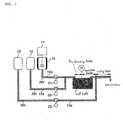
- FIG. 1 is a schematic diagram illustrating a production apparatus used in Example 5.
- salts are produced by neutralization and facilities for purification like filtration are required to remove the produced salts. Further, according to US 2,909,540 , the reaction equilibrium is disturbed and shifts to the side of having decomposition of fatty acid monoglyceride, and thus it is impossible to produce a mixture containing fatty acid monoglyceride having a large content of the fatty acid monoglyceride.
- provided by the present invention is a method for producing a mixture containing fatty acid monoglyceride with a high content of fatty acid monoglyceride.
- a mixture containing fatty acid monoglyceride with a high content of fatty acid monoglyceride can be produced at the final stage of the reaction step, the purification load thereafter can be reduced, and the production amount of monoglyceride per hour can be increased.
- the method for producing a mixture containing fatty acid monoglyceride of the present invention includes
- each of the reaction mode of the step (i) and the cooling mode of the step (ii) can be any of a batch mode and a continuous mode.
- a batch mode it can be any of a batch type and a semi-batch type.
- the compound having an acyl group used in the step (i) of the present invention may have any of branched, linear, saturated, and unsaturated acyl groups, but from the viewpoint of a more evident effect of the present invention, the number of carbon atoms in the acyl group is preferably 8 to 30, more preferably 12 to 22, and even more preferably 14 to 18. From the same point of view, the number of carbon atoms in the acyl group of the compound having an acyl group used in the step (i) of the present invention is preferably 8 or more, 12 or more, or 14 or more, and also 30 or less, 22 or less, or 18 or less.
- fatty acid in the compound having an acyl group which is used in the present invention examples include capronic acid, caprylic acid, capric acid, lauric acid, myristic acid, palmitic acid, stearic acid, eicosanoic acid, behenic acid, oleic acid, elaidic acid, linoleic acid, linolenic acid, soybean oil fatty acid, rapeseed oil fatty acid, and tall oil fatty acid.
- Examples of the fatty acid glyceride in the compound having an acyl group used in the invention include triester and a diester containing fatty acid and glycerin as a constitutional component, and a mixture thereof. There is no problem of containing monoester therein.
- coconut oil palm oil, palm seed oil, soybean oil, rapeseed oil, beef tallow, lard, tall oil, and fish oil.
- glycerin is preferably 1.0 to 5.0 mol, more preferably 1.3 to 4.0 mol, and even more preferably 2.0 to 3.0 mol per mol of an acyl group in the compound having an acyl group.
- glycerin is preferably 1.0 mol or more, 1.3 mol or more, or 2.0 mol or more, and also 5.0 mol or less, 4.0 mol or less, or 3.0 mol or less per mol of an acyl group in the compound having an acyl group
- the temperature for the reaction between glycerin and the compound having an acyl group is, from the viewpoint of enhancing the solubility of glycerin in an oil layer and increasing the rate of esterification reaction and ester exchange reaction, preferably 200°C or higher, more preferably 210°C or higher, and even more preferably 215°C or higher. From the viewpoint of suppressing production of diglycerin as a byproduct, it is preferably 400°C or less, more preferably 350°C or less, and even more preferably 300°C or less. From the same point of view, it is preferably 200 to 400°C, more preferably 210 to 350°C, and even more preferably 215 to 300°C.
- the time for the reaction between glycerin and the compound having an acyl group depends on the reaction temperature and the kind and the amount of the used catalyst or the like. From the viewpoint of enhancing the yield of fatty acid monoglyceride by surely reaching near the reaction equilibrium, it is preferably 5 minutes or longer, more preferably 1 hour or longer, and even more preferably 2 hours or longer. Further, from the viewpoint of the byproduct amount of diglycerin as a condensation of glycerin, it is preferably 12 hours or shorter, more preferably 10 hours or shorter, and even more preferably 5 hours or shorter. Meanwhile, confirmation of the end point can be made by suitably collecting a sample and analyzing it. For example, it can be made by confirming no change in the content of monoglyceride.
- the step for obtaining the mixture containing fatty acid monoglyceride (intermediate mixture) of the present invention is performed in the presence of a catalyst.
- a catalyst include the catalysts that are used for an esterification reaction or an ester exchange reaction.
- a catalyst soluble in fatty acid glyceride and glycerin is preferable.
- an alkali metal hydroxide or an alkaline earth metal hydroxide is preferable.
- Sodium hydroxide, potassium hydroxide, or calcium hydroxide is more preferable.
- Calcium hydroxide is even more preferable.
- the catalyst concentration is preferably 1 ppm (based on mass) or more. More preferably, it is 10 ppm or more. Even more preferably, it is 50 ppm or more. From the viewpoint of increase of the yield of fatty acid monoglyceride by suppressing the reaction from two molecules of fatty acid monoglyceride to fatty acid diglyceride and glycerin during cooling (hereinbelow, referred to as a reverse reaction), the catalyst concentration is preferably 1000 ppm or less, more preferably 750 ppm or less, and even more preferably 500 ppm or less. In the present invention, after adding the catalyst to glycerin and the compound having an acyl group and adjusting the catalyst concentration preferably to the aforementioned range, the step (i) and the step (ii) are performed.
- the step (ii) of the present invention is a step in which, in addition to cooling the reaction product of the step (i) (intermediate mixture) by adding glycerin, a catalyst concentration in the liquid phase is lowered by adding glycerin and, by extracting the catalyst contained in the intermediate mixture, the reverse reaction is suppressed.
- the temperature of the mixture obtained from the step (i) is preferably the reaction temperature of the step (i).
- the temperature of the mixture is preferably 200°C or higher, more preferably 210°C or higher, and even more preferably 215°C or higher, and also preferably 400°C or lower, more preferably 350°C or lower, and even more preferably 300°C or lower. Specifically, it is preferably 200 to 400°C, more preferably 210 to 350°C, and even more preferably 215 to 300°C.
- the step (ii) has lower temperature than the mixture of the step (i), and also liquid glycerin is added thereto.
- Temperature of glycerin (boiling point: 280°C) added in the step (ii) is, from the viewpoint of cooling the reaction product (intermediate mixture) of the step (i), preferably 180°C or lower, more preferably 100°C or lower, and even more preferably 50°C or lower within the range in which the aforementioned temperature is satisfied.
- fluidity it is preferably 0°C or higher, more preferably 10°C or higher, and even more preferably 20°C or higher.
- the addition amount of glycerin in the step (ii) is, from the viewpoint of preventing the reverse reaction, preferably 1 part by mass or more, more preferably 10 parts by mass or more, and even more preferably 50 parts by mass or more per 100 parts by mass of the mixture containing fatty acid monoglyceride (intermediate mixture).
- An addition amount of glycerin in the step (ii) is, from the viewpoint of the capacity of a separation tank and a storage tank that are required for layer separation of the composition layer containing fatty acid monoglyceride and glycerin layer, preferably 1000 parts by mass or less, more preferably 500 parts by mass or less, and even more preferably 150 parts by mass or less per 100 parts by mass of the mixture containing fatty acid monoglyceride (intermediate mixture).
- the addition amount of glycerin in the step (ii) is preferably 1 to 1000 parts by mass, more preferably 10 to 500 parts by mass, and even more preferably 50 to 150 parts by mass per 100 parts by mass of the mixture containing fatty acid monoglyceride (intermediate mixture).
- An addition amount of glycerin in the step (ii) is, from the viewpoint of preventing the reverse reaction, preferably 1 ⁇ 10 3 parts by mass or more, more preferably 1 ⁇ 10 4 parts by mass or more, and even more preferably 1 ⁇ 10 5 parts by mass or more per 100 parts by mass of the catalyst.
- the addition amount of glycerin in the step (ii) is, from the viewpoint of the size of a separation tank and a storage tank that are required for layer separation of the composition layer containing fatty acid monoglyceride and glycerin layer, preferably 1 ⁇ 10 9 parts by mass or less, more preferably 5 ⁇ 10 7 parts by mass or less, and even more preferably 3 ⁇ 10 6 parts by mass or less per 100 parts by mass of the catalyst.
- the addition amount of glycerin in the step (ii) is preferably 1 ⁇ 10 3 to 1 ⁇ 10 9 parts by mass, more preferably 1 ⁇ 10 4 to 5 ⁇ 10 7 parts by mass, and even more preferably 1 ⁇ 10 5 to 3 ⁇ 10 6 parts by mass per 100 parts by mass of the catalyst.
- Rate of cooling the mixture in the step (ii) is, from the viewpoint of preventing the reverse reaction, preferably 1°C/minute or higher, more preferably 5°C/minute or higher, even more preferably 8°C/minute or higher, even more preferably 50°C/minute or higher, and even more preferably 100°C/minute or higher. From the viewpoint of the energetic load, it is preferably 1000°C/minute or lower, more preferably 500°C/minute or lower, and even more preferably 300°C/minute or lower.
- the cooling rate in a region with higher mixture temperature has a greater influence on having improved yield of fatty acid monoglyceride.
- adding glycerin at the cooling rate within the aforementioned range to the mixture at the temperature of 100°C or higher, or 140°C or higher followed by cooling is preferable in that it has a significant effect of preventing the reverse reaction.
- the temperature of the mixture after cooling in the step (ii) is, from the viewpoint of efficiently performing layer separation while preventing solidification of the mixture, preferably 80°C or higher and more preferably 90°C or higher and also preferably 200°C or lower, more preferably 180°C or lower, and even more preferably 150°C or lower.
- the addition of glycerin be performed under mixing such that the cooling rate of the entire mixture is within the aforementioned range.
- a conventionally known method can be used.
- step (ii) is performed in a batch mode reaction by using the stirring tank type reactor, glycerin is added under stirring the mixture such that the cooling rate of the entire mixture is within the aforementioned range.
- a stirring wing such as a three-piece swept wing, a full zone wing, a turbine wing, or a max blend wing can be used.
- the stirring power required per unit volume of the fluid in the reactor is, from the viewpoint of cooling the entire mixture, preferably 0.1 kW/m 3 or higher, more preferably 0.5 kW/m 3 or higher, and even more preferably 2 kW/m 3 or higher. Further, from the viewpoint of the energy load, it is preferably 200 kW/m 3 or lower, more preferably 100 kW/m 3 or lower, and even more preferably 50 kW/m 3 or lower.
- the "stirring power required per unit volume” is a value obtained by calculating a difference between the measured value of stirring power during reaction (unit: kW) and the measured value of idling power before adding the raw materials for the reaction (unit: kW) and dividing the result by the volume of fluid in the reactor (unit: m 3 ).
- addition of glycerin can be either continuous or intermittent as long as the cooling rate of the entire mixture is within the aforementioned range.
- the cooling rate corresponds to the temperature-decreasing amount per unit time.
- the cooling rate can be a value which is obtained by dividing the temperature difference between the entrance and exit of the cooling part by a value obtained by dividing a flow passage length by a linear velocity.
- step (ii) When the step (ii) is continuously performed in a tubular reactor, from the viewpoint of having the cooling rate of the entire mixture within the aforementioned range, mixing the mixture obtained from the step (i) with glycerin is performed at a shear rate U/Dmin of preferably 1 (1/sec) or more, more preferably 10 (1/sec) or more, and even more preferably 100 (1/sec) or more. From the viewpoint of the energy load, it is performed at a shear rate U/Dmin of preferably 100000 (1/sec) or less, more preferably 50000 (1/sec) or less, and even more preferably 10000 (1/sec) or less.
- Dmin minimum inner diameter (mm) of the flow passage in the mixing part and U represents a linear velocity (mm/sec) of the mixture at Dmin.
- Q flow amount of the mixture
- U mm/sec
- n the number of minimum inner diameter of the flow passage
- U the contraction type stirrer of a porous plate
- Cross-sectional shape of the mixing part is not necessarily required to be a circle.
- U means the flow rate in the minimum cross sectional area of the flow passage.
- the diameter of a circle having the same area as the minimum cross sectional area of the flow passage is used for Dmin.
- step (ii) a step of separating the mixture containing fatty acid monoglyceride and glycerin by separating layers is performed as the step (iii).
- a method conventionally known as a method for separating a mixture containing fatty acid monoglyceride and glycerin can be used. Specific examples thereof include stationary separation and centrifugal separation.
- stationary separation and centrifugal separation are preferable, and stationary separation is more preferable.
- the stationary separation include allowing the mixture obtained from the step (ii) to stand in a storage tank and then using a separation device, such as an API type oil separator, a CPI type oil separator or a PPI type oil separator.
- a separation device such as an API type oil separator, a CPI type oil separator or a PPI type oil separator.
- centrifugal separator examples include De Laval type centrifuge and sharpless type centrifuge.
- temperature of the mixture with a mixture containing fatty acid monoglyceride and glycerin, which is subjected to layer separation in the step (iii), is preferably 80°C or higher and more preferably 90°C or higher and also preferably 200°C or lower, more preferably 180°C or lower, and even more preferably 150°C or lower.
- the concentration of the alkali catalyst remaining in the mixture containing fatty acid monoglyceride, obtained in the step (iii), is 0.1% by mass or less, preferably 100 ppm or less.
- Glycerin separated in the step (iii) can be used in the step (i) or the step (ii), and preferably in the step (i).
- Example is set forth for examples of the present invention and does not limit the present invention.
- Dodecane as an internal standard material was weighed and added to a sample containing fatty acid monoglyceride and mixed therein. Meanwhile, when layer separation is performed for the reaction product of the Examples and the Comparative Examples, the sample was collected from an oily layer separated on an upper part.
- a trimethylsilylating agent (trade name: TMSI-H, manufactured by GL Sciences, Inc.) was added to the mixture and then was heated and stirred. After dilution with hexane, the solid matter was separated by filtration and the obtained filtrate was subjected to gas chromatography analysis according to the following conditions.
- Glycerin monostearic acid (monoglyceride content: 98% by mass) (300 g) was dissolved at 90°C, added with 0.27 g of 48% by mass aqueous sodium hydroxide solution, and stirred for 30 minutes to obtain glycerin monostearic acid containing the adjusted catalyst amount.
- the glycerin monostearic acid used in this case can be synthesized according to the following method.
- Hydrogenated palm oil, glycerin, and glycerin containing dispersed calcium hydroxide were continuously fed to a reactor so as to have a flow amount ratio that glycerin is 0.9 mol per mol of the ester group of the hydrogenated palm oil and calcium hydroxide is 0.01% by mass per mass of hydrogenated palm oil and glycerin, and the reaction was allowed to occur at 250°C. Subsequently, under reduced pressure condition, removal of low boiling point components in the reaction solution and distillation removal of unreacted glycerin in the reaction solution were performed. Subsequently, the mixture containing monoglyceride as a main component was separated by distillation. By distilling the remaining glycerin out of the separated mixture, glycerin monostearic acid used in Preparation Example 1 can be produced.
- step (ii) of the production method of the present invention is performed by using glycerin monostearic acid (manufactured by Wako Pure Chemical Industries, Ltd., glycerol monostearic acid, monoglyceride content: 56% by mass) as a starting material, decomposition of the monoglyceride is suppressed so that a mixture having a high content of fatty acid monoglyceride is obtained.
- glycerin monostearic acid manufactured by Wako Pure Chemical Industries, Ltd., glycerol monostearic acid, monoglyceride content: 56% by mass
- the flask was removed from the oil bath, and only the oil bath was heated to 220°C. After confirming that the oil bath temperature is stabilized, the flask was placed in the oil bath and the temperature of the content was increased to 215°C while inside of the flask was stirred at 300 r/min. Once the temperature reaches 215°C, the stirring was temporarily stopped and a sample for analysis was taken, which was used as an intermediate mixture before cooling.
- glycerin monostearic acid glycerol monostearic acid manufactured by Wako Pure Chemical Industries, Ltd., monoglyceride content: 56% by mass
- calcium hydroxide manufactured by Kanto Chemical Co., Inc.
- the flask was removed from the oil bath, and only the oil bath was heated to 220°C. After confirming that the oil bath temperature is stabilized, the flask was placed in the oil bath and the temperature of the content was increased to 215°C while inside of the flask was stirred at 300 r/min. Once the temperature reaches 215°C, the stirring was temporarily stopped and a sample for analysis was taken, which was used as an intermediate mixture before cooling.
- the stirring was resumed and the flask was removed from the oil bath either partially or completely such that the rate for cooling the content is almost constant over time.
- the cooling rate was 4°C/minute at that time.
- glycerin monostearic acid glycerol monostearic acid manufactured by Wako Pure Chemical Industries, Ltd., monoglyceride content: 56% by mass
- calcium hydroxide manufactured by Kanto Chemical Co., Inc.
- the flask was removed from the oil bath, and only the oil bath was heated to 220°C. After confirming that the oil bath temperature is stabilized, the flask was placed in the oil bath and the temperature of the content was increased to 215°C while inside of the flask was stirred at 300 r/min. Once the temperature reaches 215°C, the stirring was temporarily stopped and a sample for analysis was taken, which was used as an intermediate mixture before cooling.
- Example 1 Based on the results of the decomposition ratio of monoglyceride in Example 1 and Comparative Example 1, it was found that the reverse reaction is suppressed by addition of glycerin, but not suppressed by cooling only.
- glycerin purified glycerin manufactured by Kao Corporation
- Kao Corporation purified glycerin manufactured by Kao Corporation
- glycerin manufactured by Kao Corporation, purified glycerin
- the cooling rate was 130°C/minute until the temperature of the content becomes 140°C. After that, it became difficult to have a constant cooling rate and the cooling rate has gradually decreased.
- the overall cooling rate caused by the addition of glycerin, was 48°C/minute.
- Example 3 Example 2
- Example 3 Example 4 feeding amount of monoglyceride [g] 25.0 25.0 25.0 feeding amount of glycerine [g] 12.5 25 125 Cooling rate [°C/minute] 130 130 48 (130* 1 )
- FIG. 1 The production apparatus illustrated in FIG. 1 was used. Each oblique line illustrated in FIG. 1 indicates a ribbon heater (RH).
- reaction vessel 10 was stirred at 300 r/min. After confirming the discharge of water in the dehydrating tube, it was kept for 4 hours to allow the reaction to proceed. The final resultant temperature was 220°C. Based on gas chromatography analysis, it was found that the fatty acid concentration in the reaction product was 1.2% by mass and the ratio of the monoglyceride was 55% by mass to the total amount of esters.
- the reactant was subjected to liquid transfer via the line 10a at 2.5 g/min with an aid of a plunger pump 21.
- Glycerin containing 0.05% by mass of calcium hydroxide in a vessel 12 was liquid-transported at a flow amount of 2.5 g/min via the line 12a with the plunger pump 22, and then both flows were mixed at the mixing point between the line 10a and the line 12a.
- Two liquids, after mixed, were subjected to temperature increase to 270°C and reaction in the pre-heating tube and reaction tube, respectively.
- a pipe for glycerin transfer was connected, and the glycerin at 50°C contained in a vessel 13 was subjected to liquid transfer at a flow amount of 5 g/min via the line 13a with an aid of a plunger pump 23 so that it can merge with the reaction solution.
- the liquid after the merge was recovered from the exit of the cooling tube. Liquid temperature at the exit of the cooling tube was 142°C.
- the pre-heating tube was inner diameter of 1.8 mm ⁇ length of 2 m
- the reaction tube was inner diameter 4.4 mm ⁇ length of 1.5 m
- the cooling tube was inner diameter of 1.8 mm ⁇ length of 1 m SUS316 tube. They are connected to each other in series, and the pre-heating tube and the reaction tube were immersed in an oil bath. Temperature of the oil bath was 270°C. The cooling rate was 260°C/minute.
- the recovered liquid As a result of keeping the recovered liquid which has been recovered from the exit of the cooling tube, the recovered liquid was separated into layers. From the oil layer of the recovered liquid, a sample for analysis was collected. Based on gas chromatography analysis, it was found that the ratio of the monoglyceride at that time was 69% by mass to the esters.
- Example 5 indicate that, by performing the production method of the present invention, the decomposition ratio of monoglyceride in a mixture is lowered and the content of fatty acid monoglyceride is increased.
Landscapes
- Chemical & Material Sciences (AREA)
- Organic Chemistry (AREA)
- Life Sciences & Earth Sciences (AREA)
- General Chemical & Material Sciences (AREA)
- Engineering & Computer Science (AREA)
- Chemical Kinetics & Catalysis (AREA)
- Oil, Petroleum & Natural Gas (AREA)
- Wood Science & Technology (AREA)
- Microbiology (AREA)
- Organic Low-Molecular-Weight Compounds And Preparation Thereof (AREA)
- Fats And Perfumes (AREA)
- Low-Molecular Organic Synthesis Reactions Using Catalysts (AREA)
Abstract
Description
- The present invention relates to a method for producing a mixture containing fatty acid monoglyceride.
- Fatty acid monoglycerides used widely as an oil agent and the like in cosmetics, foods, and industrial emulsifiers or lubricants are produced by esterification reaction of glycerin with fatty acid or by ester exchange reaction of glycerin with fat and oil.
- Those reactions are carried out in the absence or presence of a catalyst, and generally a mixture of glycerin, fatty acid monoglyceride, fatty acid diglyceride, and fatty acid triglyceride is generated.
- For such reasons, a purification step is required depending on a purpose. When it is desired to obtain a fatty acid monoglyceride with high purity, purification based on molecular distillation or thin layer distillation is performed. Fatty acid diglyceride and fatty acid triglyceride contained in residuals after distillation of monoglyceride can be recovered again as monoglyceride according to a transesterification reaction with glycerin. However, from the viewpoint of production efficiency of monoglyceride, higher purity of the monoglyceride before distillation step is preferred.
- As disclosed in
JP-A 57-24327 - However, when time is required for cooling in the presence of a catalyst, it is known that the reaction toward the equilibrium at that temperature, that is, the reaction from two molecules of fatty acid monoglyceride to fatty acid diglyceride and glycerin, becomes larger, so that the concentration of fatty acid monoglyceride is decreased.
- It is then disclosed in
JP-A 57-24327 - It is disclosed in
US 2,909,540 to prevent the concentration of fatty acid monoglyceride from decreasing by lowering the reaction rate by evaporating glycerin at a reduced pressure, after the reaction for producing fatty acid monoglyceride, and cooling the liquid of the completed reaction with heat transfer accompanied with evaporation. - In
US 3,083,216 , production of higher fatty acid monoglyceride is disclosed. InUS 3,079,412 , continuous production of fatty acid monoglyceride is disclosed. - The present invention relates to a method for producing a mixture containing fatty acid monoglyceride from glycerin and a compound having at least one acyl group, selected from fatty acids and fatty acid glycerides, including:
- (i) a step of obtaining a mixture containing fatty acid monoglyceride by heating and reacting glycerin and a compound having at least one acyl group, selected from fatty acids and fatty acid glycerides in the presence of a catalyst,
- (ii) a step including adding glycerin, which is liquid and has a lower temperature than the temperature of the mixture, to the mixture to cool the mixture, and
- (iii) a step of separating the mixture containing fatty acid monoglyceride from glycerin, obtained in the step (ii), by separating layers.
-
FIG. 1 is a schematic diagram illustrating a production apparatus used in Example 5. - According to
JP-A 57-24327 US 2,909,540 , the reaction equilibrium is disturbed and shifts to the side of having decomposition of fatty acid monoglyceride, and thus it is impossible to produce a mixture containing fatty acid monoglyceride having a large content of the fatty acid monoglyceride. - Under the circumstances, provided by the present invention is a method for producing a mixture containing fatty acid monoglyceride with a high content of fatty acid monoglyceride.
- According to the present invention, a mixture containing fatty acid monoglyceride with a high content of fatty acid monoglyceride can be produced at the final stage of the reaction step, the purification load thereafter can be reduced, and the production amount of monoglyceride per hour can be increased.
- The method for producing a mixture containing fatty acid monoglyceride of the present invention (in contrast to the one obtained from the step (i), it may be referred to as a "final mixture") includes
- (i) a step of obtaining a mixture containing fatty acid monoglyceride (intermediate mixture) by heating and reacting glycerin and a compound having at least one acyl group, selected from fatty acids and fatty acid glycerides, (hereinbelow, it may be referred to as a "compound having an acyl group") in the presence of a catalyst,
- (ii) a step including adding glycerin, which is liquid and has a lower temperature than the temperature of the mixture, to the mixture to cool the mixture, and
- (iii) a step of separating the mixture containing fatty acid monoglyceride and glycerin, obtained in the step (ii), by separating layers.
- Meanwhile, each of the reaction mode of the step (i) and the cooling mode of the step (ii) can be any of a batch mode and a continuous mode. In case of a batch mode, it can be any of a batch type and a semi-batch type.
- The compound having an acyl group used in the step (i) of the present invention may have any of branched, linear, saturated, and unsaturated acyl groups, but from the viewpoint of a more evident effect of the present invention, the number of carbon atoms in the acyl group is preferably 8 to 30, more preferably 12 to 22, and even more preferably 14 to 18. From the same point of view, the number of carbon atoms in the acyl group of the compound having an acyl group used in the step (i) of the present invention is preferably 8 or more, 12 or more, or 14 or more, and also 30 or less, 22 or less, or 18 or less.
- Specific examples of the fatty acid in the compound having an acyl group which is used in the present invention include capronic acid, caprylic acid, capric acid, lauric acid, myristic acid, palmitic acid, stearic acid, eicosanoic acid, behenic acid, oleic acid, elaidic acid, linoleic acid, linolenic acid, soybean oil fatty acid, rapeseed oil fatty acid, and tall oil fatty acid.
- Examples of the fatty acid glyceride in the compound having an acyl group used in the invention include triester and a diester containing fatty acid and glycerin as a constitutional component, and a mixture thereof. There is no problem of containing monoester therein.
- Specific examples thereof include coconut oil, palm oil, palm seed oil, soybean oil, rapeseed oil, beef tallow, lard, tall oil, and fish oil.
- With regard to the reaction ratio between glycerin and the compound having an acyl group, from the viewpoint of obtaining a mixture containing fatty acid monoglyceride with a high content of fatty acid monoglyceride and increasing the productivity per batch or unit time, glycerin is preferably 1.0 to 5.0 mol, more preferably 1.3 to 4.0 mol, and even more preferably 2.0 to 3.0 mol per mol of an acyl group in the compound having an acyl group. With regard to the reaction ratio between glycerin and the compound having an acyl group, from the same point of view, glycerin is preferably 1.0 mol or more, 1.3 mol or more, or 2.0 mol or more, and also 5.0 mol or less, 4.0 mol or less, or 3.0 mol or less per mol of an acyl group in the compound having an acyl group
- The temperature for the reaction between glycerin and the compound having an acyl group is, from the viewpoint of enhancing the solubility of glycerin in an oil layer and increasing the rate of esterification reaction and ester exchange reaction, preferably 200°C or higher, more preferably 210°C or higher, and even more preferably 215°C or higher. From the viewpoint of suppressing production of diglycerin as a byproduct, it is preferably 400°C or less, more preferably 350°C or less, and even more preferably 300°C or less. From the same point of view, it is preferably 200 to 400°C, more preferably 210 to 350°C, and even more preferably 215 to 300°C.
- The time for the reaction between glycerin and the compound having an acyl group depends on the reaction temperature and the kind and the amount of the used catalyst or the like. From the viewpoint of enhancing the yield of fatty acid monoglyceride by surely reaching near the reaction equilibrium, it is preferably 5 minutes or longer, more preferably 1 hour or longer, and even more preferably 2 hours or longer. Further, from the viewpoint of the byproduct amount of diglycerin as a condensation of glycerin, it is preferably 12 hours or shorter, more preferably 10 hours or shorter, and even more preferably 5 hours or shorter. Meanwhile, confirmation of the end point can be made by suitably collecting a sample and analyzing it. For example, it can be made by confirming no change in the content of monoglyceride.
- The step for obtaining the mixture containing fatty acid monoglyceride (intermediate mixture) of the present invention is performed in the presence of a catalyst. Examples of the catalyst include the catalysts that are used for an esterification reaction or an ester exchange reaction.
- From the viewpoint of enhancing the yield of fatty acid monoglyceride by dispersing the mixture in a more homogenous state, a catalyst soluble in fatty acid glyceride and glycerin is preferable. Specifically, an alkali metal hydroxide or an alkaline earth metal hydroxide is preferable. Sodium hydroxide, potassium hydroxide, or calcium hydroxide is more preferable. Calcium hydroxide is even more preferable.
- From the viewpoint of ensuring the sufficient rate of esterification reaction and ester exchange reaction, the catalyst concentration is preferably 1 ppm (based on mass) or more. More preferably, it is 10 ppm or more. Even more preferably, it is 50 ppm or more. From the viewpoint of increase of the yield of fatty acid monoglyceride by suppressing the reaction from two molecules of fatty acid monoglyceride to fatty acid diglyceride and glycerin during cooling (hereinbelow, referred to as a reverse reaction), the catalyst concentration is preferably 1000 ppm or less, more preferably 750 ppm or less, and even more preferably 500 ppm or less. In the present invention, after adding the catalyst to glycerin and the compound having an acyl group and adjusting the catalyst concentration preferably to the aforementioned range, the step (i) and the step (ii) are performed.
- The step (ii) of the present invention is a step in which, in addition to cooling the reaction product of the step (i) (intermediate mixture) by adding glycerin, a catalyst concentration in the liquid phase is lowered by adding glycerin and, by extracting the catalyst contained in the intermediate mixture, the reverse reaction is suppressed.
- The temperature of the mixture obtained from the step (i) is preferably the reaction temperature of the step (i). The temperature of the mixture is preferably 200°C or higher, more preferably 210°C or higher, and even more preferably 215°C or higher, and also preferably 400°C or lower, more preferably 350°C or lower, and even more preferably 300°C or lower. Specifically, it is preferably 200 to 400°C, more preferably 210 to 350°C, and even more preferably 215 to 300°C.
- The step (ii) has lower temperature than the mixture of the step (i), and also liquid glycerin is added thereto.
- Temperature of glycerin (boiling point: 280°C) added in the step (ii) is, from the viewpoint of cooling the reaction product (intermediate mixture) of the step (i), preferably 180°C or lower, more preferably 100°C or lower, and even more preferably 50°C or lower within the range in which the aforementioned temperature is satisfied.
- Further, from the viewpoint of fluidity, it is preferably 0°C or higher, more preferably 10°C or higher, and even more preferably 20°C or higher.
- The addition amount of glycerin in the step (ii) is, from the viewpoint of preventing the reverse reaction, preferably 1 part by mass or more, more preferably 10 parts by mass or more, and even more preferably 50 parts by mass or more per 100 parts by mass of the mixture containing fatty acid monoglyceride (intermediate mixture).
- An addition amount of glycerin in the step (ii) is, from the viewpoint of the capacity of a separation tank and a storage tank that are required for layer separation of the composition layer containing fatty acid monoglyceride and glycerin layer, preferably 1000 parts by mass or less, more preferably 500 parts by mass or less, and even more preferably 150 parts by mass or less per 100 parts by mass of the mixture containing fatty acid monoglyceride (intermediate mixture).
- From the same point of view, the addition amount of glycerin in the step (ii) is preferably 1 to 1000 parts by mass, more preferably 10 to 500 parts by mass, and even more preferably 50 to 150 parts by mass per 100 parts by mass of the mixture containing fatty acid monoglyceride (intermediate mixture).
- An addition amount of glycerin in the step (ii) is, from the viewpoint of preventing the reverse reaction, preferably 1 × 10³ parts by mass or more, more preferably 1 × 10⁴ parts by mass or more, and even more preferably 1 × 10⁵ parts by mass or more per 100 parts by mass of the catalyst.
- The addition amount of glycerin in the step (ii) is, from the viewpoint of the size of a separation tank and a storage tank that are required for layer separation of the composition layer containing fatty acid monoglyceride and glycerin layer, preferably 1 × 10⁹ parts by mass or less, more preferably 5 × 10⁷ parts by mass or less, and even more preferably 3 × 10⁶ parts by mass or less per 100 parts by mass of the catalyst.
- From the same point of view, the addition amount of glycerin in the step (ii) is preferably 1 × 10³ to 1 × 10⁹ parts by mass, more preferably 1 × 10⁴ to 5 × 10⁷ parts by mass, and even more preferably 1 × 10⁵ to 3 × 10⁶ parts by mass per 100 parts by mass of the catalyst.
- Rate of cooling the mixture in the step (ii) is, from the viewpoint of preventing the reverse reaction, preferably 1°C/minute or higher, more preferably 5°C/minute or higher, even more preferably 8°C/minute or higher, even more preferably 50°C/minute or higher, and even more preferably 100°C/minute or higher. From the viewpoint of the energetic load, it is preferably 1000°C/minute or lower, more preferably 500°C/minute or lower, and even more preferably 300°C/minute or lower.
- In the step (ii), the cooling rate in a region with higher mixture temperature has a greater influence on having improved yield of fatty acid monoglyceride. In the present invention, adding glycerin at the cooling rate within the aforementioned range to the mixture at the temperature of 100°C or higher, or 140°C or higher followed by cooling is preferable in that it has a significant effect of preventing the reverse reaction. Further, in the step (ii) of the present invention, it is preferable to add glycerin at the cooling rate within the aforementioned range until the temperature of the mixture is 140°C or lower, or 100°C or lower and do cooling, because the effect of prevention of the reverse reaction is remarkable.
- Further, the temperature of the mixture after cooling in the step (ii) is, from the viewpoint of efficiently performing layer separation while preventing solidification of the mixture, preferably 80°C or higher and more preferably 90°C or higher and also preferably 200°C or lower, more preferably 180°C or lower, and even more preferably 150°C or lower.
- It is preferable that the addition of glycerin be performed under mixing such that the cooling rate of the entire mixture is within the aforementioned range. As for the method for mixing, a conventionally known method can be used.
- When the step (ii) is performed in a batch mode reaction by using the stirring tank type reactor, glycerin is added under stirring the mixture such that the cooling rate of the entire mixture is within the aforementioned range.
- As for stirring wings of a stirrer, a stirring wing such as a three-piece swept wing, a full zone wing, a turbine wing, or a max blend wing can be used.
- The stirring power required per unit volume of the fluid in the reactor is, from the viewpoint of cooling the entire mixture, preferably 0.1 kW/m3 or higher, more preferably 0.5 kW/m3 or higher, and even more preferably 2 kW/m3 or higher. Further, from the viewpoint of the energy load, it is preferably 200 kW/m3 or lower, more preferably 100 kW/m3 or lower, and even more preferably 50 kW/m3 or lower.
- As described herein, the "stirring power required per unit volume" is a value obtained by calculating a difference between the measured value of stirring power during reaction (unit: kW) and the measured value of idling power before adding the raw materials for the reaction (unit: kW) and dividing the result by the volume of fluid in the reactor (unit: m3).
- Further, addition of glycerin can be either continuous or intermittent as long as the cooling rate of the entire mixture is within the aforementioned range.
- The cooling rate corresponds to the temperature-decreasing amount per unit time. When the step (ii) is performed continuously in a tubular reactor, the cooling rate can be a value which is obtained by dividing the temperature difference between the entrance and exit of the cooling part by a value obtained by dividing a flow passage length by a linear velocity.
- When the step (ii) is continuously performed in a tubular reactor, from the viewpoint of having the cooling rate of the entire mixture within the aforementioned range, mixing the mixture obtained from the step (i) with glycerin is performed at a shear rate U/Dmin of preferably 1 (1/sec) or more, more preferably 10 (1/sec) or more, and even more preferably 100 (1/sec) or more. From the viewpoint of the energy load, it is performed at a shear rate U/Dmin of preferably 100000 (1/sec) or less, more preferably 50000 (1/sec) or less, and even more preferably 10000 (1/sec) or less.
- Regarding the shear rate U/Dmin, Dmin represents minimum inner diameter (mm) of the flow passage in the mixing part and U represents a linear velocity (mm/sec) of the mixture at Dmin. Meanwhile, when the flow amount of the mixture is Q (mL/sec), U (mm/sec) can be obtained based on the following Equation (1). In the equation, n represents the number of minimum inner diameter of the flow passage, and when a contraction type stirrer of a porous plate is used, for example, it represents the number of pores in the stirrer.

- Cross-sectional shape of the mixing part is not necessarily required to be a circle. When it is a shape other than a circle, U means the flow rate in the minimum cross sectional area of the flow passage. In such case, the diameter of a circle having the same area as the minimum cross sectional area of the flow passage is used for Dmin.
- After the step (ii), a step of separating the mixture containing fatty acid monoglyceride and glycerin by separating layers is performed as the step (iii).
- As for the separation method of the step (iii) by separating layers, a method conventionally known as a method for separating a mixture containing fatty acid monoglyceride and glycerin can be used. Specific examples thereof include stationary separation and centrifugal separation.
- From the viewpoint of the energy efficiency and simplification of facilities, stationary separation and centrifugal separation are preferable, and stationary separation is more preferable.
- Specific examples of the stationary separation include allowing the mixture obtained from the step (ii) to stand in a storage tank and then using a separation device, such as an API type oil separator, a CPI type oil separator or a PPI type oil separator.
- Examples of the centrifugal separator include De Laval type centrifuge and sharpless type centrifuge.
- Further, from the viewpoint of efficiently performing the layer separation with prevention of solidification of mixture, temperature of the mixture with a mixture containing fatty acid monoglyceride and glycerin, which is subjected to layer separation in the step (iii), is preferably 80°C or higher and more preferably 90°C or higher and also preferably 200°C or lower, more preferably 180°C or lower, and even more preferably 150°C or lower.
- From the viewpoint of the stability of fatty acid monoglyceride in the mixture to be obtained, the concentration of the alkali catalyst remaining in the mixture containing fatty acid monoglyceride, obtained in the step (iii), is 0.1% by mass or less, preferably 100 ppm or less.
- Glycerin separated in the step (iii) can be used in the step (i) or the step (ii), and preferably in the step (i).
- Aspects and preferred embodiments of the present invention are described hereinbelow.
- <1>
A method for producing a mixture containing fatty acid monoglyceride from glycerin and a compound having at least one acyl group, selected from fatty acids and fatty acid glycerides, including:- (i) a step of obtaining a mixture containing fatty acid monoglyceride by heating and reacting glycerin and a compound having at least one acyl group, selected from fatty acids and fatty acid glycerides, in the presence of a catalyst,
- (ii) a step including adding glycerin to the mixture and cooling the mixture, adding liquid glycerin having a temperature lower than the temperature of the mixture, and
- (iii) a step of separating the mixture containing fatty acid monoglyceride and glycerin, obtained in the step (ii), by separating layers.
- <2>
The method for producing a mixture containing fatty acid monoglyceride described in <1> above, in which an addition amount of glycerin in the step (ii) is preferably 1 part by mass or more, more preferably 10 parts by mass or more, and even more preferably 50 parts by mass or more and also preferably 1000 parts by mass or less, more preferably 500 parts by mass or less, and even more preferably 150 parts by mass or less per 100 parts by mass of the mixture containing fatty acid monoglyceride obtained from the previous step. - <3>
The method for producing a mixture containing fatty acid monoglyceride described in <1> or <2> above, in which the rate of cooling the mixture in the step (ii) is preferably 1°C/minute or higher, more preferably 5°C/minute or higher, even more preferably 8°C/minute or higher, even more preferably 50°C/minute or higher, and even more preferably 100°C/minute or higher and also preferably 1000°C/minute or lower, more preferably 500°C/minute or lower, and even more preferably 300°C/minute or lower. - <4>
The method for producing a mixture containing fatty acid monoglyceride described in any of <1> to <3> above, in which the addition amount of glycerin in the step (ii) is preferably 1 × 10³ parts by mass or more, more preferably 1 × 10⁴ parts by mass or more, and even more preferably 1 × 10⁵ parts by mass or more and also preferably 1 × 10⁹ parts by mass or less, more preferably 5 × 10⁷ parts by mass or less, and even more preferably 3 × 10⁶ parts by mass or less per 100 parts by mass of the catalyst used in the previous step. - <5>
The method for producing a mixture containing fatty acid monoglyceride described in any of <1> to <4> above, in which the reaction temperature in the step (i) is preferably 200°C or higher, more preferably 210°C or higher, even more preferably 215°C or higher, and also preferably 400°C or lower, even more preferably 350°C or lower, and even more preferably 300°C or lower. - <6>
The method for producing a mixture containing fatty acid monoglyceride described in any of <1> to <5> above, in which the temperature of glycerin to be added in the step (ii) is preferably 0°C or higher, more preferably 10°C or higher, and even more preferably 20°C or higher and also preferably 180°C or lower, more preferably 100°C or lower, and even more preferably 50°C or lower. - <7>
The method for producing a mixture containing fatty acid monoglyceride described in any of <1> to <6> above, in which catalyst concentration of the catalyst used in the step (i) is preferably 1 ppm or more, more preferably 10 ppm or more, and even more preferably 50 ppm or more, and also preferably 1000 ppm or less, more preferably 750 ppm or less, and even more preferably 500 ppm or less. - <8>
The method for producing a mixture containing fatty acid monoglyceride described in any of <1> to <7> above, in which separation method of the step (iii) by separating layers is stationary separation. - <9>
The method for producing a mixture containing fatty acid monoglyceride described in any of <1> to <8> above, in which temperature of the mixture in the step (ii) is preferably 100°C or higher and more preferably 140°C or higher, and the rate of cooling the mixture in the step (ii) is preferably 1°C/minute or higher, more preferably 5°C/minute or higher, even more preferably 8°C/minute or higher, even more preferably 50°C/minute or higher, and even more preferably 100°C/minute or higher and preferably 1000°C/minute or lower, more preferably 500°C/minute or lower, even more preferably 300°C/minute or lower. - Hereinbelow, the present invention is described more in details by reference to Examples and Comparative Examples. Example is set forth for examples of the present invention and does not limit the present invention.
- Dodecane as an internal standard material was weighed and added to a sample containing fatty acid monoglyceride and mixed therein. Meanwhile, when layer separation is performed for the reaction product of the Examples and the Comparative Examples, the sample was collected from an oily layer separated on an upper part.
- A trimethylsilylating agent (trade name: TMSI-H, manufactured by GL Sciences, Inc.) was added to the mixture and then was heated and stirred. After dilution with hexane, the solid matter was separated by filtration and the obtained filtrate was subjected to gas chromatography analysis according to the following conditions.
-
- Apparatus: 6890N Network GC System, manufactured by Agilent Technologies
- Column: Ultra ALLOY-1 (MS/HT), manufactured by Frontier Laboratories Ltd., length 30 m × inner diameter 0.25 mm × film thickness 0.15 µm
- Detector: FID
- Condition for temperature increase: 60°C (kept for 2 minutes) → 10°C/minute → 350°C (kept for 15 minutes)
- Injection temperature: 300°C
- Detector temperature: 350°C
- Glycerin monostearic acid (monoglyceride content: 98% by mass) (300 g) was dissolved at 90°C, added with 0.27 g of 48% by mass aqueous sodium hydroxide solution, and stirred for 30 minutes to obtain glycerin monostearic acid containing the adjusted catalyst amount. The glycerin monostearic acid used in this case can be synthesized according to the following method.
- Hydrogenated palm oil, glycerin, and glycerin containing dispersed calcium hydroxide were continuously fed to a reactor so as to have a flow amount ratio that glycerin is 0.9 mol per mol of the ester group of the hydrogenated palm oil and calcium hydroxide is 0.01% by mass per mass of hydrogenated palm oil and glycerin, and the reaction was allowed to occur at 250°C. Subsequently, under reduced pressure condition, removal of low boiling point components in the reaction solution and distillation removal of unreacted glycerin in the reaction solution were performed. Subsequently, the mixture containing monoglyceride as a main component was separated by distillation. By distilling the remaining glycerin out of the separated mixture, glycerin monostearic acid used in Preparation Example 1 can be produced.
- It was confirmed that, when the step (ii) of the production method of the present invention is performed by using glycerin monostearic acid (manufactured by Wako Pure Chemical Industries, Ltd., glycerol monostearic acid, monoglyceride content: 56% by mass) as a starting material, decomposition of the monoglyceride is suppressed so that a mixture having a high content of fatty acid monoglyceride is obtained.
- To a 100-mL four-neck flask equipped with a stirrer and a thermometer, 25.0 g of the glycerin monostearic acid and 0.0026 g of calcium hydroxide (manufactured by Kanto Chemical Co., Inc.) were fed and the temperature was raised to 100°C. After dissolving glycerin monostearic acid, inside of the flask was stirred at 300 r/min so that calcium hydroxide can also homogeneously get dissolved.
- After that, the flask was removed from the oil bath, and only the oil bath was heated to 220°C. After confirming that the oil bath temperature is stabilized, the flask was placed in the oil bath and the temperature of the content was increased to 215°C while inside of the flask was stirred at 300 r/min. Once the temperature reaches 215°C, the stirring was temporarily stopped and a sample for analysis was taken, which was used as an intermediate mixture before cooling.
- After that, the stirring was resumed and 25.2 g of glycerin (manufactured by Kishida Chemical Co., Ltd.), which has been preheated to 100°C, was added over five minutes while control is made such that the rate for cooling the content is almost constant over time. During and after addition of glycerin, the flask was partially or completely removed from the oil bath. The cooling rate at that time remained constant during and after the addition of glycerin, being 8°C/min. According to the addition of glycerin, the intermediate mixture was cooled to 175°C.
- Even after completion of the addition of glycerin, cooling was continued until the temperature of the content becomes 140°C. After maintaining at 140°C for 30 minutes, the stirring was temporarily terminated and a sample for analysis was taken from the upper layer, which was used as a final mixture after cooling. As a result of stopping the stirring, the content was separated into layers. In Table 1, operating conditions (feeding amount of monoglyceride or the like) and the decomposition ratio of monoglyceride are listed.
- To a 100-mL four-neck flask equipped with a stirrer and a thermometer, 25.0 g of the glycerin monostearic acid (glycerol monostearic acid manufactured by Wako Pure Chemical Industries, Ltd., monoglyceride content: 56% by mass) and 0.0025 g of calcium hydroxide (manufactured by Kanto Chemical Co., Inc.) were fed and the temperature was raised to 100°C. After dissolving glycerin monostearic acid, inside of the flask was stirred at 300 r/min so that calcium hydroxide can also homogeneously get dissolved.
- After that, the flask was removed from the oil bath, and only the oil bath was heated to 220°C. After confirming that the oil bath temperature is stabilized, the flask was placed in the oil bath and the temperature of the content was increased to 215°C while inside of the flask was stirred at 300 r/min. Once the temperature reaches 215°C, the stirring was temporarily stopped and a sample for analysis was taken, which was used as an intermediate mixture before cooling.
- After that, the stirring was resumed and the flask was removed from the oil bath either partially or completely such that the rate for cooling the content is almost constant over time. The cooling rate was 4°C/minute at that time.
- The cooling was continued until the temperature of the content becomes 140°C. After maintaining at 140°C for 30 minutes, the stirring was temporarily terminated and a sample for analysis was taken, which was used as a final mixture after cooling. In Table 1, operating conditions (feeding amount of monoglyceride or the like) and the decomposition ratio of monoglyceride are listed.
- To a 100-mL four-neck flask equipped with a stirrer and a thermometer, 25.0 g of the glycerin monostearic acid (glycerol monostearic acid manufactured by Wako Pure Chemical Industries, Ltd., monoglyceride content: 56% by mass) and 0.0026 g of calcium hydroxide (manufactured by Kanto Chemical Co., Inc.) were fed and the temperature was raised to 100°C. After dissolving glycerin monostearic acid, inside of the flask was stirred at 300 r/min so that calcium hydroxide can also homogeneously get dissolved.
- After that, the flask was removed from the oil bath, and only the oil bath was heated to 220°C. After confirming that the oil bath temperature is stabilized, the flask was placed in the oil bath and the temperature of the content was increased to 215°C while inside of the flask was stirred at 300 r/min. Once the temperature reaches 215°C, the stirring was temporarily stopped and a sample for analysis was taken, which was used as an intermediate mixture before cooling.
- After that, the stirring was re-started and the flask was removed from the oil bath either partially or completely such that the rate for cooling the content is almost constant over time. The cooling rate was 16°C/minute at that time.
- The cooling was continued until the temperature of the content becomes 140°C. After maintaining at 140°C for 30 minutes, the stirring was temporarily terminated and a sample for analysis was taken, which was used as a final mixture after cooling. In Table 1, operating conditions (feeding amount of monoglyceride or the like) and the decomposition ratio of monoglyceride are listed.
[Table 1] Reference example 1 Reference example 1 Reference example 1 feeding amount of monoglyceride [g] 25.0 25.0 25.0 feeding amount of glycerine [g] 25.2 0 0 Cooling rate[°C/minute] 8 4 16 Decomposition ratio of monoglyceride [mol%] 0.80 5.4 3.8 - It was confirmed that, when the production method of the present invention is performed by using as a starting material the glycerin monostearic acid which has been obtained from Preparation Example 1, decomposition of the monoglyceride is suppressed and a mixture having a high content of fatty acid monoglyceride is obtained.
- To a 100-mL four-neck flask equipped with a stirrer and a thermometer, 25.0 g of the glycerin monostearic acid containing the adjusted catalyst amount as obtained from Preparation Example 1 were fed and the temperature was raised to 100°C. After dissolving the raw materials, the flask was removed from the oil bath, and only the oil bath was heated to 220°C. After confirming that the oil bath temperature is stabilized, the flask was placed in the oil bath and the temperature of the content was increased to 215°C while inside of the flask was stirred at 300 r/min. When the temperature reached 215°C, a sample for analysis was taken as an intermediate mixture before cooling.
- After that, the stirring was resumed and 25.1 g of glycerin (purified glycerin manufactured by Kao Corporation), which had been preheated to 100°C, was added over five minutes while such control is made that the cooling rate of the content is almost constant over time. During and after addition of glycerin, the flask was partially or completely removed from the oil bath. The cooling rate at that time remained constant during and after addition of glycerin, which was 8°C/min. According to the addition of glycerin, the intermediate mixture was cooled to 175°C.
- Even after completion of the addition of glycerin, cooling was continued until the temperature of the content becomes 140°C. After maintaining at 140°C for 30 minutes, the stirring was temporarily terminated and a sample for analysis was taken from the top layer as a final mixture after cooling.
- As a result of stopping the stirring, the content was separated into layers. In Table 2, operating conditions (feeding amount of monoglyceride or the like) and the decomposition ratio of monoglyceride are shown.
- To a 100-mL four-neck flask equipped with a stirrer and a thermometer, 25.0 g of the glycerin monostearic acid containing the adjusted catalyst amount, which has been obtained from Preparation Example 1, were fed and the temperature was raised to 100°C. After dissolving the raw materials, the flask was removed from the oil bath, and only the oil bath was heated to 220°C. After confirming that the oil bath temperature is stabilized, the flask was placed in the oil bath and the temperature of the content was increased to 215°C while inside of the flask was stirred at 300 r/min. Once the temperature reaches 215°C, the stirring was temporarily stopped and a sample for analysis was taken as an intermediate mixture before decomposition.
- After that, the stirring was resumed and the flask was removed from the oil bath either partially or completely such that the rate for cooling the content is almost constant over time. The cooling rate was 8°C/minute at that time. The cooling was continued until the temperature of the content becomes 140°C. After maintaining at 140°C for 30 minutes, the stirring was temporarily terminated and a sample for analysis was taken as a final mixture after decomposition. In Table 2, operating conditions (feeding amount of monoglyceride or the like) and the decomposition ratio of monoglyceride are listed.
- To a 100-mL four-neck flask equipped with a stirrer and a thermometer, 25.0 g of the glycerin monostearic acid containing the adjusted catalyst amount as obtained from Preparation Example 1 and 25.0 g of the glycerin (purified glycerin manufactured by Kao Corporation) were fed and the temperature was raised to 100°C. After dissolving the raw materials, the flask was removed from the oil bath, and only the oil bath was heated to 220°C. After confirming that the oil bath temperature is stabilized, the flask was placed in the oil bath and the temperature of the content was increased to 215°C while inside of the flask was stirred at 300 r/min. Once the temperature reaches 215°C, the stirring was temporarily stopped and a sample for analysis was taken as an intermediate mixture before decomposition.
- After that, the stirring was resumed, and after maintaining the content at 215°C for 30 minutes, the stirring was temporarily stopped and a sample for analysis was taken from the top layer as a final mixture after decomposition. As a result of stopping the stirring, the content was separated into layers. In Table 2, operating conditions (feeding amount of monoglyceride or the like) and the decomposition ratio of monoglyceride are listed.
[Table 2] Example 1 Comparative example 1 Comparative example 2 feeding amount of monoglyceride [g] 25.0 25.0 25.0 feeding amount of glycerine [g] 25.1 0 25.0 Cooling rate[°C/minute] 8 8 No cooling Decomposition ratio of monoglyceride [mol%] 6.7 18 20 - Based on the results of the decomposition ratio of monoglyceride in Example 1 and Comparative Example 1, it was found that the reverse reaction is suppressed by addition of glycerin, but not suppressed by cooling only.
- Based on the results of the decomposition ratio of monoglyceride in Comparative Example 2, it was found that the decomposition ratio of monoglyceride becomes higher without cooling even when glycerin is added (that is, content of fatty acid monoglyceride is lowered).
- According to the same operations as Example 1, an intermediate mixture before cooling was obtained.
- To the intermediate mixture, 12.5 g of glycerin (purified glycerin manufactured by Kao Corporation), which has been heated in advance to 40°C, was added over 0.3 minute. Before adding glycerin, the flask was completely removed from the oil bath. The cooling rate at that time was 130°C/minute. The temperature of the content was 175°C when glycerin had been added.
- After the completion of dropwise addition, the stirring was terminated. As a result of stopping the stirring, the content was separated into layers. A sample for analysis was collected from the top layer and used as a final mixture after decomposition. In Table 3, operating conditions (feeding amount of monoglyceride or the like) and the decomposition ratio of monoglyceride are listed.
- According to the same operations as Example 1, an intermediate mixture before cooling was obtained.
- To the intermediate mixture, 25.0 g of the glycerin (manufactured by Kao Corporation, purified glycerin), which has been heated in advance to 40°C, was added over 0.5 minute. Before adding glycerin, the flask was completely removed from the oil bath. The cooling rate at that time was 130°C/minute. The temperature of the content was 150°C when glycerin had been added.
- After the completion of dropwise addition, the stirring was terminated. As a result of stopping the stirring, the content was separated into layers. A sample for analysis was collected from the top layer and used as a final mixture after cooling. In Table 3, operating conditions (feeding amount of monoglyceride or the like) and the decomposition ratio of monoglyceride are listed.
- According to the same operations as Example 1, an intermediate mixture before cooling was obtained.
- To the intermediate mixture, 125 g of the glycerin (manufactured by Kao Corporation, purified glycerin), which has been heated in advance to 40°C, was added over 2.6 minutes. Before adding glycerin, the flask was completely removed from the oil bath. The cooling rate was 130°C/minute until the temperature of the content becomes 140°C. After that, it became difficult to have a constant cooling rate and the cooling rate has gradually decreased. When the addition of glycerin is completed, the temperature of the content was 90°C. The overall cooling rate, caused by the addition of glycerin, was 48°C/minute.
- After the completion of dropwise addition, the stirring was terminated. As a result of stopping the stirring, the content was separated into layers. A sample for analysis was collected from the top layer and used as a final mixture after cooling. In Table 3, operating conditions (feeding amount of monoglyceride or the like) and the decomposition ratio of monoglyceride are listed.
[Table 3] Example 2 Example 3 Example 4 feeding amount of monoglyceride [g] 25.0 25.0 25.0 feeding amount of glycerine [g] 12.5 25 125 Cooling rate [°C/minute] 130 130 48 (130*1) Decomposition ratio of monoglyceride [mol%] 2.0 1.9 2.2 *1 Cooling rate when the temperature of mixture was 140°C or highrer. - The production apparatus illustrated in
FIG. 1 was used. Each oblique line illustrated inFIG. 1 indicates a ribbon heater (RH). - To a 5-L four-
neck reaction vessel 10 equipped with a dehydrating tube-cooling tube, a thermometer, a tube for introducing nitrogen gas in addition to astirrer 11, 538 g of glycerin (manufactured by Kishida Chemical Co., Ltd.) and 1460 g of LUNAC S-70V (mixture of fatty acids with carbon atom number of 16 and 18; manufactured by Kao Corporation) [glycerin/fatty acid (molar ratio) = 1.1/1] were added, 1.00 g of calcium hydroxide (manufactured by Kanto Chemical Co., Inc.) was added, and the temperature was increased using a mantle heater while nitrogen stream was supplied at 20 mL/minute into the space of the liquid phase. - Once the raw materials are dissolved, inside of the
reaction vessel 10 was stirred at 300 r/min. After confirming the discharge of water in the dehydrating tube, it was kept for 4 hours to allow the reaction to proceed. The final resultant temperature was 220°C. Based on gas chromatography analysis, it was found that the fatty acid concentration in the reaction product was 1.2% by mass and the ratio of the monoglyceride was 55% by mass to the total amount of esters. - The reactant was subjected to liquid transfer via the
line 10a at 2.5 g/min with an aid of a plunger pump 21. Glycerin containing 0.05% by mass of calcium hydroxide in avessel 12 was liquid-transported at a flow amount of 2.5 g/min via theline 12a with the plunger pump 22, and then both flows were mixed at the mixing point between theline 10a and theline 12a. Two liquids, after mixed, were subjected to temperature increase to 270°C and reaction in the pre-heating tube and reaction tube, respectively. - At the exit of the reaction tube, a pipe for glycerin transfer was connected, and the glycerin at 50°C contained in a
vessel 13 was subjected to liquid transfer at a flow amount of 5 g/min via theline 13a with an aid of a plunger pump 23 so that it can merge with the reaction solution. The liquid after the merge was recovered from the exit of the cooling tube. Liquid temperature at the exit of the cooling tube was 142°C. - The pre-heating tube was inner diameter of 1.8 mm × length of 2 m, the reaction tube was inner diameter 4.4 mm × length of 1.5 m, and the cooling tube was inner diameter of 1.8 mm × length of 1 m SUS316 tube. They are connected to each other in series, and the pre-heating tube and the reaction tube were immersed in an oil bath. Temperature of the oil bath was 270°C. The cooling rate was 260°C/minute.
- As a result of keeping the recovered liquid which has been recovered from the exit of the cooling tube, the recovered liquid was separated into layers. From the oil layer of the recovered liquid, a sample for analysis was collected. Based on gas chromatography analysis, it was found that the ratio of the monoglyceride at that time was 69% by mass to the esters.
- As it can be confirmed from the comparison with the results listed in Table 2, the results of Example 5 indicate that, by performing the production method of the present invention, the decomposition ratio of monoglyceride in a mixture is lowered and the content of fatty acid monoglyceride is increased.
Claims (11)
- A method for producing a mixture comprising fatty acid monoglyceride from glycerin and a compound having at least one acyl group, selected from the group consisting of fatty acids and fatty acid glycerides, comprising:(i) a step of obtaining a mixture comprising fatty acid monoglyceride by heating and reacting glycerin and a compound having at least one acyl group, selected from the group consisting of fatty acids and fatty acid glycerides in the presence of a catalyst,(ii) a step comprising adding glycerin, which is liquid and has a lower temperature than the temperature of the mixture, to the mixture to cool the mixture, and(iii) a step of separating the mixture comprising fatty acid monoglyceride from glycerin, obtained in the step (ii), by separating layers.
- The method for producing a mixture comprising fatty acid monoglyceride according to claim 1, wherein the addition amount of glycerin in the step (ii) is 1 part by mass or more and 1000 parts by mass or less per 100 parts by mass of the mixture comprising fatty acid monoglyceride obtained in the previous step.
- The method for producing a mixture comprising fatty acid monoglyceride according to claim 1 or 2, wherein the rate of cooling the mixture in the step (ii) is 1°C/minute or higher and 1000°C/minute or lower.
- The method for producing a mixture comprising fatty acid monoglyceride according to any one of claims 1 to 3, wherein the addition amount of glycerin in the step (ii) is 1 × 10³ parts by mass or more and 1 × 10⁹ parts by mass or less per 100 parts by mass of the catalyst used in the previous step.
- The method for producing a mixture comprising fatty acid monoglyceride according to any one of claims 1 to 4, wherein the reaction temperature in the step (i) is 200°C or higher and 400°C or lower.
- The method for producing a mixture comprising fatty acid monoglyceride according to any one of claims 1 to 5, wherein the temperature of glycerin to be added in the step (ii) is 0°C or higher and 180°C or lower.
- The method for producing a mixture containing fatty acid monoglyceride according to any one of claims 1 to 6, wherein the step (ii) is a step for mixing the mixture comprising fatty acid monoglyceride and glycerin while continuously transporting them separately from each other.
- The method for producing a mixture comprising fatty acid monoglyceride according to any one of claims 1 to 7, wherein the glycerin separated in the step (iii) is used in the step (i) or the step (ii).
- The method for producing a mixture comprising fatty acid monoglyceride according to any one of claims 1 to 8, wherein the catalyst used in the step (i) is an alkali metal hydroxide or an alkaline earth metal hydroxide.
- The method for producing a mixture comprising fatty acid monoglyceride according to any one of claims 1 to 9, wherein the catalyst' concentration of the catalyst used in the step (i) is 1 ppm or more and 1000 ppm or less.
- The method for producing a mixture comprising fatty acid monoglyceride according to any one of claims 1 to 10, wherein the separation method of the step (iii) by separating layers is stationary separation.
Applications Claiming Priority (2)
| Application Number | Priority Date | Filing Date | Title |
|---|---|---|---|
| JP2011269137 | 2011-12-08 | ||
| PCT/JP2012/081783 WO2013085031A1 (en) | 2011-12-08 | 2012-12-07 | Method for producing fatty acid monoglyceride containing mixture |
Publications (3)
| Publication Number | Publication Date |
|---|---|
| EP2789601A1 true EP2789601A1 (en) | 2014-10-15 |
| EP2789601A4 EP2789601A4 (en) | 2015-07-29 |
| EP2789601B1 EP2789601B1 (en) | 2017-06-07 |
Family
ID=48574384
Family Applications (1)
| Application Number | Title | Priority Date | Filing Date |
|---|---|---|---|
| EP12855771.7A Not-in-force EP2789601B1 (en) | 2011-12-08 | 2012-12-07 | Method for producing fatty acid monoglyceride containing mixture |
Country Status (6)
| Country | Link |
|---|---|
| US (1) | US9193662B2 (en) |
| EP (1) | EP2789601B1 (en) |
| JP (1) | JP5944303B2 (en) |
| CN (1) | CN103998413B (en) |
| ES (1) | ES2637175T3 (en) |
| WO (1) | WO2013085031A1 (en) |
Cited By (1)
| Publication number | Priority date | Publication date | Assignee | Title |
|---|---|---|---|---|
| EP3184616A4 (en) * | 2014-08-22 | 2018-03-07 | Kao Corporation | Method for producing monoglyceride-containing composition |
Families Citing this family (13)
| Publication number | Priority date | Publication date | Assignee | Title |
|---|---|---|---|---|
| EP3298024B1 (en) | 2015-05-20 | 2020-04-01 | Apeel Technology, Inc. | Plant extract compositions and methods of preparation thereof |
| EP3349589B1 (en) | 2015-09-16 | 2022-12-14 | Apeel Technology, Inc. | Method for forming a protective coating by applying fatty acid glyceride compounds to a surface |
| ES2797697T3 (en) | 2015-12-10 | 2020-12-03 | Apeel Tech Inc | Process to depolymerize cutin |
| WO2017132281A1 (en) | 2016-01-26 | 2017-08-03 | Apeel Technology, Inc. | Method for preparing and preserving sanitized products |
| CN107698447B (en) * | 2016-08-09 | 2021-10-29 | 浙江医药股份有限公司新昌制药厂 | Method for preparing fatty glyceride |
| JP7194678B2 (en) | 2016-11-17 | 2022-12-22 | アピール テクノロジー,インコーポレイテッド | Compositions formed from plant extracts and methods for their preparation |
| US12245605B2 (en) | 2018-09-05 | 2025-03-11 | Apeel Technology, Inc. | Compounds and formulations for protective coatings |
| JP7578707B2 (en) | 2020-03-04 | 2024-11-06 | アピール テクノロジー,インコーポレイテッド | Coated agricultural products and corresponding methods |
| MX2023004343A (en) | 2020-10-30 | 2023-05-08 | Apeel Tech Inc | Compositions and methods of preparation thereof. |
| KR20220154614A (en) * | 2021-05-13 | 2022-11-22 | 니치유 가부시키가이샤 | Stabilizing agent for glycerin fatty acid ester or polyglycerin fatty acid ester, and stabilizing method |
| CN118159138A (en) | 2021-09-08 | 2024-06-07 | 阿比尔技术公司 | Compounds and formulations for protective coatings |
| CN115403466B (en) * | 2022-08-25 | 2024-01-30 | 浙江工业大学 | Synthesis process of monoglyceride |
| WO2024137717A1 (en) * | 2022-12-20 | 2024-06-27 | Bioveritas, Llc | Monoglycerides from fermentation as food preservatives and health supplements |
Family Cites Families (14)
| Publication number | Priority date | Publication date | Assignee | Title |
|---|---|---|---|---|
| US2909540A (en) * | 1956-03-08 | 1959-10-20 | Atlas Powder Co | Monoglyceride preparation |
| US3083216A (en) * | 1960-04-06 | 1963-03-26 | Colgate Palmolive Co | Process for the preparation of higher fatty acid monoglycerides |
| US3079412A (en) | 1960-08-15 | 1963-02-26 | Swift & Co | Continuous manufacture of monoglycerides |
| US3102129A (en) * | 1961-05-19 | 1963-08-27 | Hachmeister Inc | Process for producing monoglycerides of fatty acids |
| DE3020566A1 (en) * | 1980-05-30 | 1981-12-10 | Henkel KGaA, 4000 Düsseldorf | METHOD FOR THE CONTINUOUS PRODUCTION OF FATTY ACID MONOGLYCERIDES |
| CN86104493B (en) * | 1986-06-30 | 1987-12-30 | 江西工业大学 | One-step process for producing fatty acid monoglyceride |
| AT394374B (en) | 1990-06-29 | 1992-03-25 | Wimmer Theodor | METHOD FOR PRODUCING FATTY ACID ESTERS OF LOW ALCOHOLS |
| JP2001031991A (en) | 1999-07-23 | 2001-02-06 | Sumitomo Chem Co Ltd | Method and apparatus for continuous production of fatty acid ester and glycerin |
| US6500974B2 (en) * | 2001-02-28 | 2002-12-31 | Council Of Scientific And Industrial Research | Process for the preparation of a monoglyceride |
| WO2004108872A1 (en) | 2003-06-06 | 2004-12-16 | Kao Corporation | Process for producing monoglyceride-containing composition |
| JP4267377B2 (en) * | 2003-06-06 | 2009-05-27 | 花王株式会社 | Method for producing monoglyceride-containing composition |
| JP4230283B2 (en) * | 2003-06-06 | 2009-02-25 | 花王株式会社 | Method for producing monoglyceride-containing composition |
| CN101691525B (en) * | 2009-10-12 | 2011-11-30 | 河南兴泰科技实业有限公司 | Glycerin fatty acid ester and preparation method thereof |
| CN102241586B (en) * | 2011-05-12 | 2014-04-09 | 暨南大学 | Method for synthesizing and purifying high-purity fatty acyl monoglyceride |
-
2012
- 2012-12-06 JP JP2012266860A patent/JP5944303B2/en not_active Expired - Fee Related
- 2012-12-07 WO PCT/JP2012/081783 patent/WO2013085031A1/en not_active Ceased
- 2012-12-07 CN CN201280060675.4A patent/CN103998413B/en not_active Expired - Fee Related
- 2012-12-07 US US14/355,237 patent/US9193662B2/en active Active
- 2012-12-07 EP EP12855771.7A patent/EP2789601B1/en not_active Not-in-force
- 2012-12-07 ES ES12855771.7T patent/ES2637175T3/en active Active
Cited By (1)
| Publication number | Priority date | Publication date | Assignee | Title |
|---|---|---|---|---|
| EP3184616A4 (en) * | 2014-08-22 | 2018-03-07 | Kao Corporation | Method for producing monoglyceride-containing composition |
Also Published As
| Publication number | Publication date |
|---|---|
| JP2013139433A (en) | 2013-07-18 |
| EP2789601B1 (en) | 2017-06-07 |
| CN103998413B (en) | 2016-06-22 |
| WO2013085031A1 (en) | 2013-06-13 |
| US9193662B2 (en) | 2015-11-24 |
| CN103998413A (en) | 2014-08-20 |
| US20140303388A1 (en) | 2014-10-09 |
| JP5944303B2 (en) | 2016-07-05 |
| EP2789601A4 (en) | 2015-07-29 |
| ES2637175T3 (en) | 2017-10-11 |
Similar Documents
| Publication | Publication Date | Title |
|---|---|---|
| EP2789601B1 (en) | Method for producing fatty acid monoglyceride containing mixture | |
| CA1247130A (en) | Process for the preparation of fatty acid esters of short-chain alcohols | |
| US7812187B2 (en) | Process for production of fatty acid alkyl ester and production apparatus for fatty acid alkyl ester | |
| JP4297267B2 (en) | Method for producing high-purity fatty acid alkyl ester by single-stage continuous process | |
| AU782699B2 (en) | Method for preparing fatty acid esters from seeds or fruits | |
| US6127561A (en) | Process for the production of monoglyceride based on the glycerolysis of methyl ester | |
| US4976892A (en) | Process for the continuous transesterification of fatty acid lower alkyl esters | |
| CA2615712C (en) | Method for production of carboxylic alkyl esters | |
| WO2009081836A1 (en) | Method and apparatus for producing fatty acid alkyl ester and/or glycerin | |
| JPH0132814B2 (en) | ||
| US3313834A (en) | Process for the manufacture of fatty acid esters | |
| EP3184616B1 (en) | Method for producing monoglyceride-containing composition | |
| JP4278302B2 (en) | Process for the production of monoglycerides based on glycerol degradation of methyl esters | |
| JP2002241786A (en) | Method for producing fatty acid esters from plant seeds and / or fruits | |
| WO2004108872A1 (en) | Process for producing monoglyceride-containing composition | |
| JP2006188590A (en) | Method and apparatus for producing fatty acid ester | |
| US20150191409A1 (en) | Process | |
| JP2010280604A (en) | Method for producing glycerin monofatty acid ester | |
| JP2004359885A (en) | Method for producing monoglyceride-containing composition | |
| HK1128724A (en) | Process for production of fatty acid alkyl ester and production apparatus for fatty acid alkyl ester | |
| HK1119430B (en) | Method for production of carboxylate alkyl esters |
Legal Events
| Date | Code | Title | Description |
|---|---|---|---|
| PUAI | Public reference made under article 153(3) epc to a published international application that has entered the european phase |
Free format text: ORIGINAL CODE: 0009012 |
|
| 17P | Request for examination filed |
Effective date: 20140508 |
|
| AK | Designated contracting states |
Kind code of ref document: A1 Designated state(s): AL AT BE BG CH CY CZ DE DK EE ES FI FR GB GR HR HU IE IS IT LI LT LU LV MC MK MT NL NO PL PT RO RS SE SI SK SM TR |
|
| DAX | Request for extension of the european patent (deleted) | ||
| RA4 | Supplementary search report drawn up and despatched (corrected) |
Effective date: 20150629 |
|
| RIC1 | Information provided on ipc code assigned before grant |
Ipc: C07C 69/30 20060101ALI20150623BHEP Ipc: C07C 67/03 20060101AFI20150623BHEP Ipc: C07C 67/08 20060101ALI20150623BHEP Ipc: C11C 3/06 20060101ALI20150623BHEP Ipc: C07B 61/00 20060101ALI20150623BHEP |
|
| GRAP | Despatch of communication of intention to grant a patent |
Free format text: ORIGINAL CODE: EPIDOSNIGR1 |
|
| INTG | Intention to grant announced |
Effective date: 20170224 |
|
| GRAS | Grant fee paid |
Free format text: ORIGINAL CODE: EPIDOSNIGR3 |
|
| AK | Designated contracting states |
Kind code of ref document: B1 Designated state(s): AL AT BE BG CH CY CZ DE DK EE ES FI FR GB GR HR HU IE IS IT LI LT LU LV MC MK MT NL NO PL PT RO RS SE SI SK SM TR |
|
| REG | Reference to a national code |
Ref country code: GB Ref legal event code: FG4D |
|
| GRAA | (expected) grant |
Free format text: ORIGINAL CODE: 0009210 |
|
| REG | Reference to a national code |
Ref country code: CH Ref legal event code: EP Ref country code: AT Ref legal event code: REF Ref document number: 899113 Country of ref document: AT Kind code of ref document: T Effective date: 20170615 |
|
| REG | Reference to a national code |
Ref country code: IE Ref legal event code: FG4D |
|
| REG | Reference to a national code |
Ref country code: DE Ref legal event code: R096 Ref document number: 602012033299 Country of ref document: DE |
|
| REG | Reference to a national code |
Ref country code: ES Ref legal event code: FG2A Ref document number: 2637175 Country of ref document: ES Kind code of ref document: T3 Effective date: 20171011 Ref country code: NL Ref legal event code: MP Effective date: 20170607 |
|
| REG | Reference to a national code |
Ref country code: LT Ref legal event code: MG4D |
|
| PG25 | Lapsed in a contracting state [announced via postgrant information from national office to epo] |
Ref country code: HR Free format text: LAPSE BECAUSE OF FAILURE TO SUBMIT A TRANSLATION OF THE DESCRIPTION OR TO PAY THE FEE WITHIN THE PRESCRIBED TIME-LIMIT Effective date: 20170607 Ref country code: LT Free format text: LAPSE BECAUSE OF FAILURE TO SUBMIT A TRANSLATION OF THE DESCRIPTION OR TO PAY THE FEE WITHIN THE PRESCRIBED TIME-LIMIT Effective date: 20170607 Ref country code: NO Free format text: LAPSE BECAUSE OF FAILURE TO SUBMIT A TRANSLATION OF THE DESCRIPTION OR TO PAY THE FEE WITHIN THE PRESCRIBED TIME-LIMIT Effective date: 20170907 Ref country code: GR Free format text: LAPSE BECAUSE OF FAILURE TO SUBMIT A TRANSLATION OF THE DESCRIPTION OR TO PAY THE FEE WITHIN THE PRESCRIBED TIME-LIMIT Effective date: 20170908 Ref country code: FI Free format text: LAPSE BECAUSE OF FAILURE TO SUBMIT A TRANSLATION OF THE DESCRIPTION OR TO PAY THE FEE WITHIN THE PRESCRIBED TIME-LIMIT Effective date: 20170607 |
|
| REG | Reference to a national code |
Ref country code: AT Ref legal event code: MK05 Ref document number: 899113 Country of ref document: AT Kind code of ref document: T Effective date: 20170607 |
|
| PG25 | Lapsed in a contracting state [announced via postgrant information from national office to epo] |
Ref country code: SE Free format text: LAPSE BECAUSE OF FAILURE TO SUBMIT A TRANSLATION OF THE DESCRIPTION OR TO PAY THE FEE WITHIN THE PRESCRIBED TIME-LIMIT Effective date: 20170607 Ref country code: BG Free format text: LAPSE BECAUSE OF FAILURE TO SUBMIT A TRANSLATION OF THE DESCRIPTION OR TO PAY THE FEE WITHIN THE PRESCRIBED TIME-LIMIT Effective date: 20170907 Ref country code: NL Free format text: LAPSE BECAUSE OF FAILURE TO SUBMIT A TRANSLATION OF THE DESCRIPTION OR TO PAY THE FEE WITHIN THE PRESCRIBED TIME-LIMIT Effective date: 20170607 Ref country code: RS Free format text: LAPSE BECAUSE OF FAILURE TO SUBMIT A TRANSLATION OF THE DESCRIPTION OR TO PAY THE FEE WITHIN THE PRESCRIBED TIME-LIMIT Effective date: 20170607 Ref country code: LV Free format text: LAPSE BECAUSE OF FAILURE TO SUBMIT A TRANSLATION OF THE DESCRIPTION OR TO PAY THE FEE WITHIN THE PRESCRIBED TIME-LIMIT Effective date: 20170607 |
|
| PG25 | Lapsed in a contracting state [announced via postgrant information from national office to epo] |
Ref country code: SK Free format text: LAPSE BECAUSE OF FAILURE TO SUBMIT A TRANSLATION OF THE DESCRIPTION OR TO PAY THE FEE WITHIN THE PRESCRIBED TIME-LIMIT Effective date: 20170607 Ref country code: RO Free format text: LAPSE BECAUSE OF FAILURE TO SUBMIT A TRANSLATION OF THE DESCRIPTION OR TO PAY THE FEE WITHIN THE PRESCRIBED TIME-LIMIT Effective date: 20170607 Ref country code: AT Free format text: LAPSE BECAUSE OF FAILURE TO SUBMIT A TRANSLATION OF THE DESCRIPTION OR TO PAY THE FEE WITHIN THE PRESCRIBED TIME-LIMIT Effective date: 20170607 Ref country code: CZ Free format text: LAPSE BECAUSE OF FAILURE TO SUBMIT A TRANSLATION OF THE DESCRIPTION OR TO PAY THE FEE WITHIN THE PRESCRIBED TIME-LIMIT Effective date: 20170607 Ref country code: EE Free format text: LAPSE BECAUSE OF FAILURE TO SUBMIT A TRANSLATION OF THE DESCRIPTION OR TO PAY THE FEE WITHIN THE PRESCRIBED TIME-LIMIT Effective date: 20170607 |
|
| PG25 | Lapsed in a contracting state [announced via postgrant information from national office to epo] |
Ref country code: SM Free format text: LAPSE BECAUSE OF FAILURE TO SUBMIT A TRANSLATION OF THE DESCRIPTION OR TO PAY THE FEE WITHIN THE PRESCRIBED TIME-LIMIT Effective date: 20170607 Ref country code: PL Free format text: LAPSE BECAUSE OF FAILURE TO SUBMIT A TRANSLATION OF THE DESCRIPTION OR TO PAY THE FEE WITHIN THE PRESCRIBED TIME-LIMIT Effective date: 20170607 Ref country code: IS Free format text: LAPSE BECAUSE OF FAILURE TO SUBMIT A TRANSLATION OF THE DESCRIPTION OR TO PAY THE FEE WITHIN THE PRESCRIBED TIME-LIMIT Effective date: 20171007 Ref country code: IT Free format text: LAPSE BECAUSE OF FAILURE TO SUBMIT A TRANSLATION OF THE DESCRIPTION OR TO PAY THE FEE WITHIN THE PRESCRIBED TIME-LIMIT Effective date: 20170607 |
|
| REG | Reference to a national code |
Ref country code: DE Ref legal event code: R097 Ref document number: 602012033299 Country of ref document: DE |
|
| PLBE | No opposition filed within time limit |
Free format text: ORIGINAL CODE: 0009261 |
|
| STAA | Information on the status of an ep patent application or granted ep patent |
Free format text: STATUS: NO OPPOSITION FILED WITHIN TIME LIMIT |
|
| PG25 | Lapsed in a contracting state [announced via postgrant information from national office to epo] |
Ref country code: DK Free format text: LAPSE BECAUSE OF FAILURE TO SUBMIT A TRANSLATION OF THE DESCRIPTION OR TO PAY THE FEE WITHIN THE PRESCRIBED TIME-LIMIT Effective date: 20170607 |
|
| 26N | No opposition filed |
Effective date: 20180308 |
|
| PG25 | Lapsed in a contracting state [announced via postgrant information from national office to epo] |
Ref country code: SI Free format text: LAPSE BECAUSE OF FAILURE TO SUBMIT A TRANSLATION OF THE DESCRIPTION OR TO PAY THE FEE WITHIN THE PRESCRIBED TIME-LIMIT Effective date: 20170607 |
|
| REG | Reference to a national code |
Ref country code: CH Ref legal event code: PL |
|
| GBPC | Gb: european patent ceased through non-payment of renewal fee |
Effective date: 20171207 |
|
| REG | Reference to a national code |
Ref country code: IE Ref legal event code: MM4A |
|
| PG25 | Lapsed in a contracting state [announced via postgrant information from national office to epo] |
Ref country code: LU Free format text: LAPSE BECAUSE OF NON-PAYMENT OF DUE FEES Effective date: 20171207 Ref country code: MT Free format text: LAPSE BECAUSE OF NON-PAYMENT OF DUE FEES Effective date: 20171207 |
|
| REG | Reference to a national code |
Ref country code: FR Ref legal event code: ST Effective date: 20180831 |
|
| REG | Reference to a national code |
Ref country code: BE Ref legal event code: MM Effective date: 20171231 |
|
| PG25 | Lapsed in a contracting state [announced via postgrant information from national office to epo] |
Ref country code: IE Free format text: LAPSE BECAUSE OF NON-PAYMENT OF DUE FEES Effective date: 20171207 Ref country code: FR Free format text: LAPSE BECAUSE OF NON-PAYMENT OF DUE FEES Effective date: 20180102 |
|
| PG25 | Lapsed in a contracting state [announced via postgrant information from national office to epo] |
Ref country code: BE Free format text: LAPSE BECAUSE OF NON-PAYMENT OF DUE FEES Effective date: 20171231 Ref country code: LI Free format text: LAPSE BECAUSE OF NON-PAYMENT OF DUE FEES Effective date: 20171231 Ref country code: GB Free format text: LAPSE BECAUSE OF NON-PAYMENT OF DUE FEES Effective date: 20171207 Ref country code: CH Free format text: LAPSE BECAUSE OF NON-PAYMENT OF DUE FEES Effective date: 20171231 |
|
| PG25 | Lapsed in a contracting state [announced via postgrant information from national office to epo] |
Ref country code: MC Free format text: LAPSE BECAUSE OF FAILURE TO SUBMIT A TRANSLATION OF THE DESCRIPTION OR TO PAY THE FEE WITHIN THE PRESCRIBED TIME-LIMIT Effective date: 20170607 Ref country code: HU Free format text: LAPSE BECAUSE OF FAILURE TO SUBMIT A TRANSLATION OF THE DESCRIPTION OR TO PAY THE FEE WITHIN THE PRESCRIBED TIME-LIMIT; INVALID AB INITIO Effective date: 20121207 |
|
| PG25 | Lapsed in a contracting state [announced via postgrant information from national office to epo] |
Ref country code: CY Free format text: LAPSE BECAUSE OF FAILURE TO SUBMIT A TRANSLATION OF THE DESCRIPTION OR TO PAY THE FEE WITHIN THE PRESCRIBED TIME-LIMIT Effective date: 20170607 |
|
| PG25 | Lapsed in a contracting state [announced via postgrant information from national office to epo] |
Ref country code: MK Free format text: LAPSE BECAUSE OF FAILURE TO SUBMIT A TRANSLATION OF THE DESCRIPTION OR TO PAY THE FEE WITHIN THE PRESCRIBED TIME-LIMIT Effective date: 20170607 |
|
| PG25 | Lapsed in a contracting state [announced via postgrant information from national office to epo] |
Ref country code: TR Free format text: LAPSE BECAUSE OF FAILURE TO SUBMIT A TRANSLATION OF THE DESCRIPTION OR TO PAY THE FEE WITHIN THE PRESCRIBED TIME-LIMIT Effective date: 20170607 |
|
| PG25 | Lapsed in a contracting state [announced via postgrant information from national office to epo] |
Ref country code: PT Free format text: LAPSE BECAUSE OF FAILURE TO SUBMIT A TRANSLATION OF THE DESCRIPTION OR TO PAY THE FEE WITHIN THE PRESCRIBED TIME-LIMIT Effective date: 20170607 |
|
| PG25 | Lapsed in a contracting state [announced via postgrant information from national office to epo] |
Ref country code: AL Free format text: LAPSE BECAUSE OF FAILURE TO SUBMIT A TRANSLATION OF THE DESCRIPTION OR TO PAY THE FEE WITHIN THE PRESCRIBED TIME-LIMIT Effective date: 20170607 |
|
| PGFP | Annual fee paid to national office [announced via postgrant information from national office to epo] |
Ref country code: ES Payment date: 20220104 Year of fee payment: 10 |
|
| PGFP | Annual fee paid to national office [announced via postgrant information from national office to epo] |
Ref country code: DE Payment date: 20220622 Year of fee payment: 11 |
|
| REG | Reference to a national code |
Ref country code: ES Ref legal event code: FD2A Effective date: 20240129 |
|
| PG25 | Lapsed in a contracting state [announced via postgrant information from national office to epo] |
Ref country code: ES Free format text: LAPSE BECAUSE OF NON-PAYMENT OF DUE FEES Effective date: 20221208 |
|
| PG25 | Lapsed in a contracting state [announced via postgrant information from national office to epo] |
Ref country code: ES Free format text: LAPSE BECAUSE OF NON-PAYMENT OF DUE FEES Effective date: 20221208 |
|
| REG | Reference to a national code |
Ref country code: DE Ref legal event code: R119 Ref document number: 602012033299 Country of ref document: DE |
|
| PG25 | Lapsed in a contracting state [announced via postgrant information from national office to epo] |
Ref country code: DE Free format text: LAPSE BECAUSE OF NON-PAYMENT OF DUE FEES Effective date: 20240702 |
|
| PG25 | Lapsed in a contracting state [announced via postgrant information from national office to epo] |
Ref country code: DE Free format text: LAPSE BECAUSE OF NON-PAYMENT OF DUE FEES Effective date: 20240702 |