EP2789494A2 - Battery charging apparatus for vehicle - Google Patents
Battery charging apparatus for vehicle Download PDFInfo
- Publication number
- EP2789494A2 EP2789494A2 EP14155386.7A EP14155386A EP2789494A2 EP 2789494 A2 EP2789494 A2 EP 2789494A2 EP 14155386 A EP14155386 A EP 14155386A EP 2789494 A2 EP2789494 A2 EP 2789494A2
- Authority
- EP
- European Patent Office
- Prior art keywords
- phase
- signal
- generator
- phase difference
- position detection
- Prior art date
- Legal status (The legal status is an assumption and is not a legal conclusion. Google has not performed a legal analysis and makes no representation as to the accuracy of the status listed.)
- Granted
Links
Images


Classifications
-
- B—PERFORMING OPERATIONS; TRANSPORTING
- B60—VEHICLES IN GENERAL
- B60L—PROPULSION OF ELECTRICALLY-PROPELLED VEHICLES; SUPPLYING ELECTRIC POWER FOR AUXILIARY EQUIPMENT OF ELECTRICALLY-PROPELLED VEHICLES; ELECTRODYNAMIC BRAKE SYSTEMS FOR VEHICLES IN GENERAL; MAGNETIC SUSPENSION OR LEVITATION FOR VEHICLES; MONITORING OPERATING VARIABLES OF ELECTRICALLY-PROPELLED VEHICLES; ELECTRIC SAFETY DEVICES FOR ELECTRICALLY-PROPELLED VEHICLES
- B60L3/00—Electric devices on electrically-propelled vehicles for safety purposes; Monitoring operating variables, e.g. speed, deceleration or energy consumption
- B60L3/0023—Detecting, eliminating, remedying or compensating for drive train abnormalities, e.g. failures within the drive train
- B60L3/0038—Detecting, eliminating, remedying or compensating for drive train abnormalities, e.g. failures within the drive train relating to sensors
-
- B—PERFORMING OPERATIONS; TRANSPORTING
- B60—VEHICLES IN GENERAL
- B60L—PROPULSION OF ELECTRICALLY-PROPELLED VEHICLES; SUPPLYING ELECTRIC POWER FOR AUXILIARY EQUIPMENT OF ELECTRICALLY-PROPELLED VEHICLES; ELECTRODYNAMIC BRAKE SYSTEMS FOR VEHICLES IN GENERAL; MAGNETIC SUSPENSION OR LEVITATION FOR VEHICLES; MONITORING OPERATING VARIABLES OF ELECTRICALLY-PROPELLED VEHICLES; ELECTRIC SAFETY DEVICES FOR ELECTRICALLY-PROPELLED VEHICLES
- B60L50/00—Electric propulsion with power supplied within the vehicle
- B60L50/50—Electric propulsion with power supplied within the vehicle using propulsion power supplied by batteries or fuel cells
- B60L50/51—Electric propulsion with power supplied within the vehicle using propulsion power supplied by batteries or fuel cells characterised by AC-motors
-
- B—PERFORMING OPERATIONS; TRANSPORTING
- B60—VEHICLES IN GENERAL
- B60L—PROPULSION OF ELECTRICALLY-PROPELLED VEHICLES; SUPPLYING ELECTRIC POWER FOR AUXILIARY EQUIPMENT OF ELECTRICALLY-PROPELLED VEHICLES; ELECTRODYNAMIC BRAKE SYSTEMS FOR VEHICLES IN GENERAL; MAGNETIC SUSPENSION OR LEVITATION FOR VEHICLES; MONITORING OPERATING VARIABLES OF ELECTRICALLY-PROPELLED VEHICLES; ELECTRIC SAFETY DEVICES FOR ELECTRICALLY-PROPELLED VEHICLES
- B60L2240/00—Control parameters of input or output; Target parameters
- B60L2240/40—Drive Train control parameters
- B60L2240/42—Drive Train control parameters related to electric machines
- B60L2240/421—Speed
-
- B—PERFORMING OPERATIONS; TRANSPORTING
- B60—VEHICLES IN GENERAL
- B60L—PROPULSION OF ELECTRICALLY-PROPELLED VEHICLES; SUPPLYING ELECTRIC POWER FOR AUXILIARY EQUIPMENT OF ELECTRICALLY-PROPELLED VEHICLES; ELECTRODYNAMIC BRAKE SYSTEMS FOR VEHICLES IN GENERAL; MAGNETIC SUSPENSION OR LEVITATION FOR VEHICLES; MONITORING OPERATING VARIABLES OF ELECTRICALLY-PROPELLED VEHICLES; ELECTRIC SAFETY DEVICES FOR ELECTRICALLY-PROPELLED VEHICLES
- B60L2260/00—Operating Modes
- B60L2260/40—Control modes
- B60L2260/44—Control modes by parameter estimation
-
- Y—GENERAL TAGGING OF NEW TECHNOLOGICAL DEVELOPMENTS; GENERAL TAGGING OF CROSS-SECTIONAL TECHNOLOGIES SPANNING OVER SEVERAL SECTIONS OF THE IPC; TECHNICAL SUBJECTS COVERED BY FORMER USPC CROSS-REFERENCE ART COLLECTIONS [XRACs] AND DIGESTS
- Y02—TECHNOLOGIES OR APPLICATIONS FOR MITIGATION OR ADAPTATION AGAINST CLIMATE CHANGE
- Y02T—CLIMATE CHANGE MITIGATION TECHNOLOGIES RELATED TO TRANSPORTATION
- Y02T10/00—Road transport of goods or passengers
- Y02T10/60—Other road transportation technologies with climate change mitigation effect
- Y02T10/64—Electric machine technologies in electromobility
-
- Y—GENERAL TAGGING OF NEW TECHNOLOGICAL DEVELOPMENTS; GENERAL TAGGING OF CROSS-SECTIONAL TECHNOLOGIES SPANNING OVER SEVERAL SECTIONS OF THE IPC; TECHNICAL SUBJECTS COVERED BY FORMER USPC CROSS-REFERENCE ART COLLECTIONS [XRACs] AND DIGESTS
- Y02—TECHNOLOGIES OR APPLICATIONS FOR MITIGATION OR ADAPTATION AGAINST CLIMATE CHANGE
- Y02T—CLIMATE CHANGE MITIGATION TECHNOLOGIES RELATED TO TRANSPORTATION
- Y02T10/00—Road transport of goods or passengers
- Y02T10/60—Other road transportation technologies with climate change mitigation effect
- Y02T10/70—Energy storage systems for electromobility, e.g. batteries
Definitions
- the present invention relates to a charging apparatus that charges a battery for a vehicle.
- energization control of a stator coil is executed based on an output signal of a rotor sensor arranged corresponding to each phase.
- output timing of a sensor signal shifts due to an error of an attaching position of the rotor sensor, appropriate energization timing of the stator coil is not secured, and accurate motor output control cannot be executed.
- Patent Literature 1 a phase shift between the zero-cross point of an induced voltage of each phase and rising of a sensor signal is detected as an error of an attaching position of a rotor sensor in a regenerative power generation state of a motor. Also, the Patent Literature 1 discloses a technology for highly precisely controlling energization timing of each stator coil based on the detected phase shift.
- energization control of each phase is executed based on the sensor signal that detects rotation of a rotor of a generator. Therefore, similarly to the case of the three-phase brushless motor, it is desirable to detect the error of the attaching position of the sensor.
- An object of the present invention is to detect an error of an attaching position of a sensor that detects rotation of a rotor of a generator.
- the invention of claim 1 includes a position sensor that outputs a position detection signal that expresses a rotation position of a rotor of a three-phase AC generator, a sensor that detects an output current or an output voltage of a predetermined phase of the three-phase AC generator, a regulator that includes a plurality of rectifying elements and a plurality of switching elements and supplies DC power obtained by rectifying three-phase AC outputted from the three-phase AC generator to a battery, and a control circuit that executes energization control of the respective switching elements of the regulator based on a phase of an induced voltage of the three-phase AC generator calculated on the basis of the position detection signal, in which the control circuit includes input means that inputs a revolution speed signal showing the revolution speed of the three-phase AC generator, the position detection signal, and either output signal out of a current signal or a voltage signal detected by the sensor, and estimate means that estimates an error of an attaching position of the position sensor with respect to the induced voltage of the predetermined phase based on the position detection signal and
- the invention of claim 2 includes a position sensor that outputs a position detection signal that expresses a rotation position of a rotor of a three-phase AC generator, a sensor) that detects an output current or an output voltage of a predetermined phase of the three-phase AC generator, a regulator that includes a plurality of rectifying elements and a plurality of switching elements and supplies DC power obtained by rectifying three-phase AC outputted from the three-phase AC generator to a battery, and a control circuit that executes energization control of the respective switching elements of the regulator based on a phase of an induced voltage of the three-phase AC generator calculated on the basis of the position detection signal, in which the control circuit includes input means that inputs a revolution speed signal showing a revolution speed of the three-phase AC generator, the position detection signal, and either output signal out of a current signal or a voltage signal detected by the sensor, a measurement means that measures a first phase difference between the position detection signal and the output signal based on the position detection signal and the output signal, calculation means
- control circuit executes the energization control using the third phase difference.
- control circuit suspends the energization control, estimates the third phase difference, and thereafter restarts the energization control using the estimated third phase difference.
- control circuit executes all phase short circuit in the energization control, estimates the third phase difference, and thereafter restarts the energization control using the estimated third phase difference.
- the input means further inputs a terminal voltage signal that shows a terminal voltage of the battery, and the calculation means corrects the second phase difference based on the terminal voltage signal.
- the calculation means calculates the second phase difference referring to a map that expresses a relation among the revolution speed signal, the terminal voltage signal, and the second phase difference.
- control circuit estimates the third phase difference in a plurality of revolution speed ranges of the three-phase AC generator.
- control circuit uses the third phase difference estimated in the revolution speed range of a higher revolution speed for the energization control.
- an error of the attaching position of the position sensor can be estimated based on the position detection signal, the output signal, and the revolution speed signal.
- the reference timing of the energization control not the output timing of the position detection signal but the phase of the induced voltage of a predetermined phase can be used.
- the attaching error of the position sensor with respect to the induced voltage of a predetermined phase can be estimated.
- the energization control can be precisely executed on the basis of the phase of the induced voltage estimated.
- the attaching error of the position sensor with respect to the induced voltage of a predetermined phase can be estimated.
- the energization control can be precisely executed on the basis of the phase of the induced voltage estimated.
- the third phase difference can be estimated more highly precisely considering the fluctuation of the second phase difference according to the terminal voltage of the battery.
- the third phase difference can be estimated in a plurality of the revolution speed ranges of the three-phase AC generator.
- the third phase difference estimated in a high revolution speed range where rotation of the three-phase AC generator is stabilized more can be used for the energization control.
- the battery charging apparatus of the embodiment is one used for a vehicle such as a motorcycle.
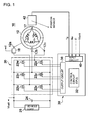
- Fig. 1 is a drawing explaining electrical connection of the three-phase AC generator and the battery charging apparatus.
- a three-phase AC generator (hereinafter referred to as a generator) 10 shown in Fig. 1 is a magnet generator driven by a prime mover such as an internal combustion engine.
- the magnet generator includes a rotator (rotor) 12 in which a magnetic field is formed by attaching permanent magnets to a yoke, and a stationary part (stator) formed of an armature core and armature windings 12u, 12v, 12w wound around the core.
- the rotor is attached to a rotary shaft of the prime mover, and the stator is fixed to an attaching part that is attached to a case, a cover and the like of the prime mover.
- the three-phase power outputted by the armature windings 12u, 12v, 12w of the generator 10 is charged to a battery 24 that is a secondary battery through a regulator 20, and is supplied to a load 26 that is an electrical component in a vehicle.
- a battery 24 that is a secondary battery through a regulator 20
- a load 26 that is an electrical component in a vehicle.
- the regulator 20 formed of a MOS type FET functions as a rectifying/switching circuit that combines a full-wave rectifier and a switching element by a parasitic diode present between the drain and the source of the MOS type FET.
- the regulator 20 applies a control voltage to the armature windings 12u, 12v, 12w through the switching circuit, and controls the output voltage of the generator 10 so as to obtain a voltage appropriate as a charging voltage of the battery 24. Then, the DC voltage obtained by rectifying the three-phase voltage by the full-wave rectifier is supplied to the battery 24 and the load 26.
- Drain terminals of switching elements 22u, 22v, 22w are connected to the positive electrode of the battery 24, and source terminals of these switching elements are connected to output terminals 12a, 12b, 12c of the generator 10 respectively. Also, source terminals of switching elements 22x, 22y, 22z are connected to a negative electrode of the battery 24, and drain terminals of these switching elements are connected to the output terminals 12a, 12b, 12c of the generator 10 respectively.
- a current sensor 18 detecting the current and a voltage sensor detecting the voltage of the phase are disposed. Note that the current sensor and the voltage sensor are provided in the embodiment, however either one of them only has to be provided in implementing the invention.
- An inverter control section 30 includes an input circuit 40 that inputs various signals, a control circuit 32 formed of one-chip microcomputers and the like, and an output circuit 38 that outputs a drive signal driving the switching elements of the regulator 20 to gates of the respective switching elements.
- the input circuit 40 inputs a position detection signal Tp outputted by a position sensor 42, a revolution speed signal Ne of the prime mover, a current signal I1 outputted by the current sensor 18, and a battery voltage signal Vbatt.
- a CPU of the control circuit 32 (hereinafter referred to as a CPU 32) achieves various controls by executing programs stored in a ROM with a RAM being a work memory.
- the CPU 32 supplies an open/close signal of each switching element of the regulator 20 to the output circuit 38 based on a signal inputted to the input circuit 40.
- the output circuit 38 outputs a drive signal that opens/closes (on/off) each switching element of the regulator 20 according to the open/close signal, and the energization control of each switching element of the regulator 20 is achieved.
- the drive signal that is, the timing of energization for each switching element is controlled for example by a microcomputer using an energization control map prepared beforehand.
- the phase control is executed in which, when the required current fluctuates due to fluctuation of the charging state of the battery and the load, the timing of energization with respect to each switching element is changed (advancing and retarding the angle).
- the phase control is a control method in which the energization timing of the switching element corresponding to each phase is advanced or retarded with respect to the position detection signal of each phase.
- the CPU 32 When a control voltage is applied to the armature winding 12u, the CPU 32 turns the switching element 22u on, and turns either one or both of the switching elements 22y and 22z on. Also, when a control voltage is applied to the armature winding 12v, the switching element 22v is turned on and either one or both of the switching elements 22x and 22z are turned on. Further, when a control voltage is applied to the armature winding 12w, the switching element 22w is turned on and either one or both of the switching elements 22x and 22y are turned on.
- a reluctor 17 is fixed to the attaching part of the generator 10 for example so as to oppose the reluctor 17, and generates the position detection signal Tp every time the reluctor 17 that rotates along with the rotor 12 passes nearby.
- the reluctor 17 and the position sensor 42 are disposed so that the position detection signal Tp is outputted at the timing the induced voltage of a predetermined phase (the U-phase of the armature winding 12u for example) shifts from a negative voltage to a positive voltage (zero-cross point). Therefore, usually, the output timing of the position detection signal Tp is deemed to agree to the phase of the induced voltage, and the output timing of the switching element is determined based on the phase of the position detection signal Tp as a reference.
- a predetermined phase the U-phase of the armature winding 12u for example
- the energization control can be executed more highly precisely.
- the battery charging apparatus is formed of the position sensor 42, the current sensor 18 (or the voltage sensor), the regulator 20, the inverter control section 30 and the like.
- Fig. 3 is a drawing showing a relation among the position detection signal Tp, the induced voltage E, and the phase of the voltage V2 and the current I1 of the output terminal 12a of the generator 10.
- the phase difference intended to measure is the phase difference ⁇ 3 (the third phase difference) between the dropping of the position detection signal Tp and the zero-cross point of the induced voltage E which is equivalent to the error of the part dimension and the attaching position of the reluctor 17 and the position sensor 42.
- ⁇ 3 the third phase difference
- phase difference ⁇ 1 the first phase difference
- the phase difference ⁇ 2 the second phase difference
- the voltage V2 (the current I1) is obtained by measuring a waveform outputted from the output terminal of the generator as it is. With this regard, three detection methods are possible.
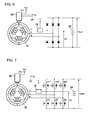
- the energizing control is temporarily suspended (the full-wave rectification state)
- the voltage V2 and the current I1 of Fig. 3 which are the output signals of the predetermined phase can be detected from the voltage sensor or the current sensor.
- the voltage V2 and the current I1 of Fig. 3 which are the output signals of the predetermined phase can be detected from the voltage sensor or the current sensor similarly to the above although height of the waveform becomes shorter compared to those of the time of full-wave rectification.
- phase difference ⁇ 2 (the second phase difference) between the rising of the voltage V2 (the current I1) and the zero-cross point of the induced voltage E will be described.
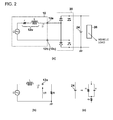
- Fig. 2 is a drawing explaining action of the generator 10 and the battery charging apparatus, and Fig. 2(a) shows only the relation between the U-phase and the battery charging apparatus.
- the voltage E is induced by the change of the magnetic field ⁇ .
- the armature winding 12u is equivalent to the inductance L connected in series to the voltage source (the induced voltage E), and the phase of the current I outputted from the output terminal 12a shows retarding with respect to the phase of the induced voltage E.
- Fig. 2(b) is an equivalent circuit of a configuration shown in Fig. 2(a) , and the resistance value r of the armature winding 12u is ignored because it is sufficiently small (r ⁇ R). Also, because the load side from the regulator 20 is a DC circuit, a reactance component is ignored, and the load side from the regulator 20 is represented by the load resistance value R. That is, the generator 10 and the battery charging apparatus can be deemed as a circuit in which the voltage source E, the inductance L, and the load resistance value R are connected to each other in series. In Fig.
- phase difference ⁇ 3 (the third phase difference) between the dropping of the position detection signal Tp and the zero-cross point of the induced voltage E
- the phase difference ⁇ 1 (the first phase difference) between the dropping of the position detection signal Tp and the rising of the voltage V2 (the current I1)
- the phase difference ⁇ 2 (the second phase difference) between the rising of the voltage V2 (the current I1) and the zero-cross point of the induced voltage E, and the relation therebetween is expressed by the expression below.
- ⁇ ⁇ 3 ⁇ ⁇ 1 - ⁇ ⁇ 2
- phase of the induced voltage E can be detected in a state the output terminal 12a is connected to the regulator 20, and, for the energizing control of each switching element of the regulator 20, precise energizing control based on the position detection signal Tp can be executed.
- the output current of the armature winding shows the maximum.
- the error of the part dimension and the attaching position of the reluctor 17 and the position sensor 42 is included in the position detection signal Tp, and detection of the error is indispensable for execution of precise energization control.
- the voltage V2 between the output terminal 12a of the generator 10 and grounding potential GND generally repeats between the battery voltage and theGND, and it is possible to detect the rising of (or the dropping) of the voltage V2 or the current I1.
- the battery 24 can be deemed to be equivalent to a circuit in which a resistance and a capacitor are combined, and internal impedance of the battery 24 changes according to the charging state, that is, the terminal voltage Vbatt of the battery 24. Therefore, in estimation of the phase difference ⁇ 2, it is desirable to execute correction of the phase difference (hereinafter referred to as the phase difference correction) considering the revolution speed of the generator 10 (the revolution speed signal Ne of the prime mover) and the terminal voltage of the battery 24 (the battery voltage signal Vbatt).
- the phase difference correction considering the revolution speed of the generator 10 (the revolution speed signal Ne of the prime mover) and the terminal voltage of the battery 24 (the battery voltage signal Vbatt).
- Fig. 4 is a drawing showing an example of a correction map for phase difference correction.
- the correction map shows the relation among the revolution speed signal Ne, the battery terminal voltage signal Vbatt, and the phase difference ⁇ 2.
- the battery terminal voltage shown in Fig. 4 has the relation of V1 ⁇ V2 ⁇ V3. That is, the correction map shows the relation between the revolution speed signal Ne and the phase difference ⁇ 2 with the battery terminal voltage signal Vbatt being a parameter, provides the phase difference ⁇ 2 corresponding to the revolution speed signal Ne, and further shows correction of the phase difference ⁇ 2 corresponding to the battery terminal voltage Vbatt.
- the phase difference correction processing is started. It is a matter of course that to start the phase difference correction processing is not necessary when, after the phase difference correction processing is executed in the vicinity of 1,000 rpm for example, the revolution speed signal Ne shows the vicinity of 1,000 rpm again.
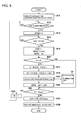
- Fig. 5 is a flowchart explaining the phase difference correction processing.
- the CPU 32 executes initialization (S11). That is, a counter N and array variables described below are initialized (a stored value is made 0), a timer is started, the energization control of the regulator 20 is suspended, and each switching element is made an open state.
- the CPU 32 waits for receipt of the position detection signal Tp (S12), and, when the position detection signal Tp is received, stores a count value t of the timer in the array variable PC[N] (S13).
- the CPU 32 determines whether the current signal I1 has risen or not (S14). When the current signal I1 rises, the CPU 32 stores the count value t of the timer in the array variable I1[N], stores the battery terminal voltage signal Vbatt in the array variable VB[N], and stores the revolution speed signal Ne in the array variable NE[N] (S15).
- ⁇ ⁇ 1 PC N - I ⁇ 1 N / P ⁇ 360
- the CPU 32 refers to a correction map 33 based on the value of the array variables VB[N] and NE[N], and calculates the phase difference ⁇ 2 (S19). Then, the CPU 32 stores the difference between the phase difference ⁇ 1 and ⁇ 2 ( ⁇ 1- ⁇ 2) in the array variable ⁇ [N] (S20).
- the CPU 32 determines the count value of the counter N (S21), and, when N ⁇ Nmax, increments the counter N (S22), and returns the processing to the step S12. Also, when the counter value reaches Nmax, the CPU 32 acquires the phase difference ⁇ 3 that is obtained by averaging ⁇ [1] to ⁇ [N] by the expression below (S23), restarts the energization control of the regulator 20 which uses the acquired phase difference ⁇ 3 (S24), and finishes the phase difference correction processing.
- the phase difference correction processing described above the phase difference ⁇ 3 equivalent to the error of the part dimension and the attaching position of the reluctor 17 and the position sensor 42 can be estimated.
- the CPU 32 can precisely execute the energization control of the regulator 20 for using the region of approximately ⁇ 10 degrees for example for charging with respect to the phase where the output current value of the armature winding shows the peak.
- the reason plural estimate values ⁇ 3[1] to ⁇ 3[N] are averaged and the average is made the phase difference ⁇ 3 is that the rotation of the engine is formed of respective strokes of suction, compression, combustion, and exhaust, and that the variation portion according to the strokes is to be removed. That is, estimate values ⁇ 3[1] to ⁇ 3[N] of plural rotations of the generator 10 are averaged, and the phase difference ⁇ 3 in which the variation portion according to respective strokes are removed is obtained. Nmax (number of times of estimation) showing the upper limit of the count value N for the same is made "8" for example.
- phase difference ⁇ 3 obtained is recorded for every rotation speed signal Ne (the revolution speed region) that becomes a trigger for process start, and the phase difference ⁇ 3 estimated in a high revolution speed region where the rotation of the engine is stabilized more is preferentially used for the energization control.
- the revolution speed at finer timing can be calculated compared with the case the revolution speed Ne is calculated from the position detection signal Tp, the phase difference ⁇ 3 can be estimated more precisely.
- the error of the attaching position of the sensor can be detected in executing the energization control of each phase based on the sensor signal that detects rotation of the rotor of the generator, and therefore the energization control of each phase can be executed appropriately.
Landscapes
- Engineering & Computer Science (AREA)
- Life Sciences & Earth Sciences (AREA)
- Sustainable Development (AREA)
- Sustainable Energy (AREA)
- Power Engineering (AREA)
- Transportation (AREA)
- Mechanical Engineering (AREA)
- Control Of Eletrric Generators (AREA)
Abstract
Description
- The present invention relates to a charging apparatus that charges a battery for a vehicle.
- In a three-phase brushless motor, energization control of a stator coil is executed based on an output signal of a rotor sensor arranged corresponding to each phase. However, when output timing of a sensor signal shifts due to an error of an attaching position of the rotor sensor, appropriate energization timing of the stator coil is not secured, and accurate motor output control cannot be executed.
- In the
Patent Literature 1, a phase shift between the zero-cross point of an induced voltage of each phase and rising of a sensor signal is detected as an error of an attaching position of a rotor sensor in a regenerative power generation state of a motor. Also, thePatent Literature 1 discloses a technology for highly precisely controlling energization timing of each stator coil based on the detected phase shift. - In a battery charging apparatus also that uses a three-phase AC generator, energization control of each phase is executed based on the sensor signal that detects rotation of a rotor of a generator. Therefore, similarly to the case of the three-phase brushless motor, it is desirable to detect the error of the attaching position of the sensor.
- However, in the battery charging apparatus, an output terminal of the generator is connected to a battery and a load through a regulator. Therefore, a method of
JP-A No. 2012-060705 - (<idling revolution speed) at the time of an engine start when a regulator output current does not flow. Also, there is a problem that, in a region of less than the idling revolution speed, fluctuation of rotation of an engine is large, accurate measurement cannot be executed, and measurement can be executed only at a limited timing of immediately after the engine start.
- An object of the present invention is to detect an error of an attaching position of a sensor that detects rotation of a rotor of a generator.
- In the present invention, as means for achieving the above-mentioned object, following configurations are provided.
- The invention of
claim 1 includes a position sensor that outputs a position detection signal that expresses a rotation position of a rotor of a three-phase AC generator, a sensor that detects an output current or an output voltage of a predetermined phase of the three-phase AC generator, a regulator that includes a plurality of rectifying elements and a plurality of switching elements and supplies DC power obtained by rectifying three-phase AC outputted from the three-phase AC generator to a battery, and a control circuit that executes energization control of the respective switching elements of the regulator based on a phase of an induced voltage of the three-phase AC generator calculated on the basis of the position detection signal, in which the control circuit includes input means that inputs a revolution speed signal showing the revolution speed of the three-phase AC generator, the position detection signal, and either output signal out of a current signal or a voltage signal detected by the sensor, and estimate means that estimates an error of an attaching position of the position sensor with respect to the induced voltage of the predetermined phase based on the position detection signal and the output signal. - The invention of claim 2 includes a position sensor that outputs a position detection signal that expresses a rotation position of a rotor of a three-phase AC generator, a sensor) that detects an output current or an output voltage of a predetermined phase of the three-phase AC generator, a regulator that includes a plurality of rectifying elements and a plurality of switching elements and supplies DC power obtained by rectifying three-phase AC outputted from the three-phase AC generator to a battery, and a control circuit that executes energization control of the respective switching elements of the regulator based on a phase of an induced voltage of the three-phase AC generator calculated on the basis of the position detection signal, in which the control circuit includes input means that inputs a revolution speed signal showing a revolution speed of the three-phase AC generator, the position detection signal, and either output signal out of a current signal or a voltage signal detected by the sensor, a measurement means that measures a first phase difference between the position detection signal and the output signal based on the position detection signal and the output signal, calculation means that calculates a second phase difference between the induced voltage of the predetermined phase and the output signal based on the revolution speed signal, and estimate means that estimates a third phase difference between the position detection signal and the induced voltage of the predetermined phase from the first and second phase differences.
- In the invention of claim 3, the control circuit executes the energization control using the third phase difference.
- In the invention of claim 4, the control circuit suspends the energization control, estimates the third phase difference, and thereafter restarts the energization control using the estimated third phase difference.
- In the invention of claim 5, the control circuit executes all phase short circuit in the energization control, estimates the third phase difference, and thereafter restarts the energization control using the estimated third phase difference.
- In the invention of claim 6, the input means further inputs a terminal voltage signal that shows a terminal voltage of the battery, and the calculation means corrects the second phase difference based on the terminal voltage signal.
- In the invention of claim 7, the calculation means calculates the second phase difference referring to a map that expresses a relation among the revolution speed signal, the terminal voltage signal, and the second phase difference.
- In the invention of claim 8, the control circuit estimates the third phase difference in a plurality of revolution speed ranges of the three-phase AC generator.
- In the invention of claim 9, the control circuit uses the third phase difference estimated in the revolution speed range of a higher revolution speed for the energization control.
- According to the inventions of
claims 1, 2, an error of the attaching position of the position sensor can be estimated based on the position detection signal, the output signal, and the revolution speed signal. - According to the invention of claim 3, as the reference timing of the energization control, not the output timing of the position detection signal but the phase of the induced voltage of a predetermined phase can be used.
- According to the invention of claim 4, by detecting the output signal of a predetermined phase in a state the energization control is temporarily suspended, the attaching error of the position sensor with respect to the induced voltage of a predetermined phase can be estimated. Thus, the energization control can be precisely executed on the basis of the phase of the induced voltage estimated.
- According to the invention of claim 5, by detecting the output signal of a predetermined phase in a state of all phase short circuits temporarily in the energization control, the attaching error of the position sensor with respect to the induced voltage of a predetermined phase can be estimated. Thus, the energization control can be precisely executed on the basis of the phase of the induced voltage estimated.
- According to the invention of claim 6, the third phase difference can be estimated more highly precisely considering the fluctuation of the second phase difference according to the terminal voltage of the battery.
- According to the invention of claim 7, it is possible to obtain and correct the second phase difference using the map.
- According to the invention of claim 8, the third phase difference can be estimated in a plurality of the revolution speed ranges of the three-phase AC generator.
- According to the invention of claim 9, the third phase difference estimated in a high revolution speed range where rotation of the three-phase AC generator is stabilized more can be used for the energization control.
-
Fig. 1 is a drawing explaining electrical connection of a three-phase AC generator and a battery charging apparatus. -
Fig. 2 is a drawing explaining action of a generator and the battery charging apparatus. -
Fig. 3 is a drawing showing a relation among a position detection signal, an induced voltage, and a phase of a voltage and a current of an output terminal of the generator. -
Fig. 4 is a drawing showing an example of a correction map for phase difference correction. -
Fig. 5 is a flowchart explaining phase difference correction processing. -
Fig. 6 is a drawing explaining a measuring method of an output signal of a voltage V2 (current I1). -
Fig. 7 is a drawing explaining another measuring method of the output signal of the voltage V2 (current I1). - Below, a battery charging apparatus of an embodiment in relation with the present invention will be described in detail referring to drawings. Note that the battery charging apparatus of the embodiment is one used for a vehicle such as a motorcycle.
-
Fig. 1 is a drawing explaining electrical connection of the three-phase AC generator and the battery charging apparatus. - A three-phase AC generator (hereinafter referred to as a generator) 10 shown in
Fig. 1 is a magnet generator driven by a prime mover such as an internal combustion engine. The magnet generator includes a rotator (rotor) 12 in which a magnetic field is formed by attaching permanent magnets to a yoke, and a stationary part (stator) formed of an armature core andarmature windings - The three-phase power outputted by the
armature windings generator 10 is charged to abattery 24 that is a secondary battery through aregulator 20, and is supplied to aload 26 that is an electrical component in a vehicle. Note that although an example of delta connection of the armature windings is shown inFig. 1 , star connection is also possible. - The
regulator 20 formed of a MOS type FET functions as a rectifying/switching circuit that combines a full-wave rectifier and a switching element by a parasitic diode present between the drain and the source of the MOS type FET. Theregulator 20 applies a control voltage to thearmature windings generator 10 so as to obtain a voltage appropriate as a charging voltage of thebattery 24. Then, the DC voltage obtained by rectifying the three-phase voltage by the full-wave rectifier is supplied to thebattery 24 and theload 26. - Drain terminals of
switching elements battery 24, and source terminals of these switching elements are connected tooutput terminals generator 10 respectively. Also, source terminals ofswitching elements battery 24, and drain terminals of these switching elements are connected to theoutput terminals generator 10 respectively. - Further, in a line that connects an output terminal of a predetermined phase (the
U-phase output terminal 12a in this example) and theregulator 20 to each other, acurrent sensor 18 detecting the current and a voltage sensor detecting the voltage of the phase (the U-phase in this example) are disposed. Note that the current sensor and the voltage sensor are provided in the embodiment, however either one of them only has to be provided in implementing the invention. - An
inverter control section 30 includes aninput circuit 40 that inputs various signals, acontrol circuit 32 formed of one-chip microcomputers and the like, and anoutput circuit 38 that outputs a drive signal driving the switching elements of theregulator 20 to gates of the respective switching elements. Theinput circuit 40 inputs a position detection signal Tp outputted by aposition sensor 42, a revolution speed signal Ne of the prime mover, a current signal I1 outputted by thecurrent sensor 18, and a battery voltage signal Vbatt. - A CPU of the control circuit 32 (hereinafter referred to as a CPU 32) achieves various controls by executing programs stored in a ROM with a RAM being a work memory. The
CPU 32 supplies an open/close signal of each switching element of theregulator 20 to theoutput circuit 38 based on a signal inputted to theinput circuit 40. Theoutput circuit 38 outputs a drive signal that opens/closes (on/off) each switching element of theregulator 20 according to the open/close signal, and the energization control of each switching element of theregulator 20 is achieved. - The drive signal, that is, the timing of energization for each switching element is controlled for example by a microcomputer using an energization control map prepared beforehand. Also, in the energization control, the phase control is executed in which, when the required current fluctuates due to fluctuation of the charging state of the battery and the load, the timing of energization with respect to each switching element is changed (advancing and retarding the angle). The phase control is a control method in which the energization timing of the switching element corresponding to each phase is advanced or retarded with respect to the position detection signal of each phase.
- When a control voltage is applied to the armature winding 12u, the
CPU 32 turns theswitching element 22u on, and turns either one or both of theswitching elements switching element 22v is turned on and either one or both of theswitching elements switching element 22w is turned on and either one or both of the switchingelements - To the rotator (rotor) 12 of the
generator 10, areluctor 17 is fixed. Theposition sensor 42 is fixed to the attaching part of thegenerator 10 for example so as to oppose thereluctor 17, and generates the position detection signal Tp every time thereluctor 17 that rotates along with therotor 12 passes nearby. - The
reluctor 17 and theposition sensor 42 are disposed so that the position detection signal Tp is outputted at the timing the induced voltage of a predetermined phase (the U-phase of the armature winding 12u for example) shifts from a negative voltage to a positive voltage (zero-cross point). Therefore, usually, the output timing of the position detection signal Tp is deemed to agree to the phase of the induced voltage, and the output timing of the switching element is determined based on the phase of the position detection signal Tp as a reference. - However, as described above, because there exists an error of the part dimension and the attaching position in the
reluctor 17 and theposition sensor 42, when the degree of shifting of the phase of the position detection signal Tp with respect to the phase of the induced voltage is measured and the output timing of the switching element is controlled based on the phase of the actual induced voltage, the energization control can be executed more highly precisely. - Note that the battery charging apparatus is formed of the
position sensor 42, the current sensor 18 (or the voltage sensor), theregulator 20, theinverter control section 30 and the like. -
Fig. 3 is a drawing showing a relation among the position detection signal Tp, the induced voltage E, and the phase of the voltage V2 and the current I1 of theoutput terminal 12a of thegenerator 10. InFig. 3 , the phase difference intended to measure is the phase difference Δθ3 (the third phase difference) between the dropping of the position detection signal Tp and the zero-cross point of the induced voltage E which is equivalent to the error of the part dimension and the attaching position of thereluctor 17 and theposition sensor 42. However, as described above, it is difficult to directly measure Δθ3. - On the other hand, it is possible to measure the phase difference Δθ1 (the first phase difference) between the dropping of the position detection signal Tp and the rising of the voltage V2 (the current I1). Therefore, when the phase difference Δθ2 (the second phase difference) between the rising of the voltage V2 (the current I1) and the zero-cross point of the induced voltage E is obtained, the phase difference Δθ3 can be estimated.
- Here, a measuring method for the output signal of the voltage V2 (the current I1) will be described. The voltage V2 (the current I1) is obtained by measuring a waveform outputted from the output terminal of the generator as it is. With this regard, three detection methods are possible.
- For example, as shown in
Fig. 6 , by effecting a state the energizing control is temporarily suspended (the full-wave rectification state), the voltage V2 and the current I1 ofFig. 3 which are the output signals of the predetermined phase can be detected from the voltage sensor or the current sensor. - Or otherwise, as shown in
Fig. 7 , by effecting the all phase short circuit state in which all of the switching elements shown on the upper side ofFig. 7 are turned off and all of the switching elements shown on the lower side ofFig. 7 are turned on temporarily in the energization control, the voltage V2 and the current I1 ofFig. 3 which are the output signals of the predetermined phase can be detected from the voltage sensor or the current sensor similarly to the above although height of the waveform becomes shorter compared to those of the time of full-wave rectification. - Next, a calculating method for the phase difference Δθ2 (the second phase difference) between the rising of the voltage V2 (the current I1) and the zero-cross point of the induced voltage E will be described.
-
Fig. 2 is a drawing explaining action of thegenerator 10 and the battery charging apparatus, andFig. 2(a) shows only the relation between the U-phase and the battery charging apparatus. As known, in the armature winding 12u of thegenerator 10, the voltage E is induced by the change of the magnetic field ϕ. The armature winding 12u is equivalent to the inductance L connected in series to the voltage source (the induced voltage E), and the phase of the current I outputted from theoutput terminal 12a shows retarding with respect to the phase of the induced voltage E. -
Fig. 2(b) is an equivalent circuit of a configuration shown inFig. 2(a) , and the resistance value r of the armature winding 12u is ignored because it is sufficiently small (r〈〈R). Also, because the load side from theregulator 20 is a DC circuit, a reactance component is ignored, and the load side from theregulator 20 is represented by the load resistance value R. That is, thegenerator 10 and the battery charging apparatus can be deemed as a circuit in which the voltage source E, the inductance L, and the load resistance value R are connected to each other in series. InFig. 2(b) , the induced voltage E, the current I, and the angle θ formed by the induced voltage E and the current I (that is, the phase difference Δθ2) are expressed by the expressions below.


where N is the number of turn of the armature windings,
ω is the angular frequency (rad/s), and
R is the load resistance value (Ω). - As described above, the phase difference Δθ3 (the third phase difference) between the dropping of the position detection signal Tp and the zero-cross point of the induced voltage E can be obtained from the phase difference Δθ1 (the first phase difference) between the dropping of the position detection signal Tp and the rising of the voltage V2 (the current I1) and the phase difference Δθ2 (the second phase difference) between the rising of the voltage V2 (the current I1) and the zero-cross point of the induced voltage E, and the relation therebetween is expressed by the expression below.

- Thus, the phase of the induced voltage E can be detected in a state the
output terminal 12a is connected to theregulator 20, and, for the energizing control of each switching element of theregulator 20, precise energizing control based on the position detection signal Tp can be executed. - As the expression (3) shows, when the load resistance value R is sufficiently large (no load for example), the phase difference θ becomes zero degree, and the phase of the induced voltage E and the phase of the voltage of the
output terminal 12a of thegenerator 10 agrees to each other. However, because theoutput terminal 12a is connected to theregulator 20, a state that the load resistance value R is sufficiently large such as no load cannot be expected, and the phase of the voltage V2 (=I1×R) of theoutput terminal 12a follows the phase of the current I1 and shows retarding with respect to the phase of the induced voltage E. - For charging the battery, it is desirable to utilize a range where the output current of the armature winding shows the maximum. For example, it is desirable to utilize a range of approximately ±10 degrees with respect to a phase where the current value shows a peak for charging. However, it is hard to detect the phase of the induced voltage E in a state the
output terminal 12a is connected to theregulator 20, and the energization control of each switching element of theregulator 20 comes to rely on the position detection signal Tp. However, the error of the part dimension and the attaching position of thereluctor 17 and theposition sensor 42 is included in the position detection signal Tp, and detection of the error is indispensable for execution of precise energization control. - In charging the battery, the voltage V2 between the
output terminal 12a of thegenerator 10 and grounding potential GND generally repeats between the battery voltage and theGND, and it is possible to detect the rising of (or the dropping) of the voltage V2 or the current I1. - When the revolution speed of the
generator 10 is made Ne [rpm], ω=2πNe/60 [rad/s], and ωL/R naturally changes according to the revolution speed Ne. The revolution speed Ne is calculated from the position detection signal Tp. - Also, as shown in
Fig. 2(c) , thebattery 24 can be deemed to be equivalent to a circuit in which a resistance and a capacitor are combined, and internal impedance of thebattery 24 changes according to the charging state, that is, the terminal voltage Vbatt of thebattery 24. Therefore, in estimation of the phase difference Δθ2, it is desirable to execute correction of the phase difference (hereinafter referred to as the phase difference correction) considering the revolution speed of the generator 10 (the revolution speed signal Ne of the prime mover) and the terminal voltage of the battery 24 (the battery voltage signal Vbatt). -
Fig. 4 is a drawing showing an example of a correction map for phase difference correction. The correction map shows the relation among the revolution speed signal Ne, the battery terminal voltage signal Vbatt, and the phase difference Δθ2. Note that the battery terminal voltage shown inFig. 4 has the relation of V1<V2<V3. That is, the correction map shows the relation between the revolution speed signal Ne and the phase difference Δθ2 with the battery terminal voltage signal Vbatt being a parameter, provides the phase difference Δθ2 corresponding to the revolution speed signal Ne, and further shows correction of the phase difference Δθ2 corresponding to the battery terminal voltage Vbatt. By developing such a correction map based on the expression (3) or by developing such a correction map from a result measured by changing the charging state of the battery, calculation of the phase difference Δθ2 referring to the correction map becomes possible. - After the engine starts, when the revolution speed signal Ne shows a predetermined revolution speed region (in the vicinity of 1,000 rpm, 2,000 rpm, 4,000 rpm for example), the phase difference correction processing is started. It is a matter of course that to start the phase difference correction processing is not necessary when, after the phase difference correction processing is executed in the vicinity of 1,000 rpm for example, the revolution speed signal Ne shows the vicinity of 1,000 rpm again.
-
Fig. 5 is a flowchart explaining the phase difference correction processing. First, theCPU 32 executes initialization (S11). That is, a counter N and array variables described below are initialized (a stored value is made 0), a timer is started, the energization control of theregulator 20 is suspended, and each switching element is made an open state. - Next, the
CPU 32 waits for receipt of the position detection signal Tp (S12), and, when the position detection signal Tp is received, stores a count value t of the timer in the array variable PC[N] (S13). Next, theCPU 32 determines whether the current signal I1 has risen or not (S14). When the current signal I1 rises, theCPU 32 stores the count value t of the timer in the array variable I1[N], stores the battery terminal voltage signal Vbatt in the array variable VB[N], and stores the revolution speed signal Ne in the array variable NE[N] (S15). - Next, the
CPU 32 determines the count value of the counter N (S16), advances processing to the step S21 when N=0, and advances the processing to the step S17 when N>0. - When N>0, the
CPU 32 calculates a period P (=PC[N]-PC[N-1]) of the position detection signal Tp (S17), and calculates the phase difference Δθ1 between the dropping of the position detection signal Tp and the rising of the current I1 according to the expression below (S18).
- Next, the
CPU 32 refers to a correction map 33 based on the value of the array variables VB[N] and NE[N], and calculates the phase difference Δθ2 (S19). Then, theCPU 32 stores the difference between the phase difference Δθ1 and Δθ2 (Δθ1-Δθ2) in the array variable Δθ[N] (S20). - Next, the
CPU 32 determines the count value of the counter N (S21), and, when N<Nmax, increments the counter N (S22), and returns the processing to the step S12. Also, when the counter value reaches Nmax, theCPU 32 acquires the phase difference Δθ3 that is obtained by averaging Δθ[1] to Δθ[N] by the expression below (S23), restarts the energization control of theregulator 20 which uses the acquired phase difference Δθ3 (S24), and finishes the phase difference correction processing.
- By the phase difference correction processing described above, the phase difference Δθ3 equivalent to the error of the part dimension and the attaching position of the
reluctor 17 and theposition sensor 42 can be estimated. As a result, theCPU 32 can precisely execute the energization control of theregulator 20 for using the region of approximately ±10 degrees for example for charging with respect to the phase where the output current value of the armature winding shows the peak. - The reason plural estimate values Δθ3[1] to Δθ3[N] are averaged and the average is made the phase difference Δθ3 is that the rotation of the engine is formed of respective strokes of suction, compression, combustion, and exhaust, and that the variation portion according to the strokes is to be removed. That is, estimate values Δθ3[1] to Δθ3[N] of plural rotations of the
generator 10 are averaged, and the phase difference Δθ3 in which the variation portion according to respective strokes are removed is obtained. Nmax (number of times of estimation) showing the upper limit of the count value N for the same is made "8" for example. Also, the phase difference Δθ3 obtained is recorded for every rotation speed signal Ne (the revolution speed region) that becomes a trigger for process start, and the phase difference Δθ3 estimated in a high revolution speed region where the rotation of the engine is stabilized more is preferentially used for the energization control. - Note that the revolution speed Ne can be calculated not only by a method for calculating from the position detection signal Tp but also from a temporal interval of the output signal of the output current or the output voltage of a predetermined phase of the three-phase AC generator. For example, as shown in
Fig. 3 , when time t from the falling of the output signal of the V-phase to the rising of the output signal of the U-phase is measured, because the output signal is outputted at every 60 degrees of the crank angle, ω is expressed by the expression below.
- According to it, because the revolution speed at finer timing can be calculated compared with the case the revolution speed Ne is calculated from the position detection signal Tp, the phase difference Δθ3 can be estimated more precisely.
- As described above, in the battery charging apparatus using the three-phase AC generator, the error of the attaching position of the sensor can be detected in executing the energization control of each phase based on the sensor signal that detects rotation of the rotor of the generator, and therefore the energization control of each phase can be executed appropriately.
Claims (9)
- A battery charging apparatus for a vehicle comprising:a position sensor (42) that outputs a position detection signal that expresses a rotation position of a rotor (12) of a three-phase AC generator (10);a sensor (18) that detects an output current or an output voltage of a predetermined phase of the three-phase AC generator;a regulator (20) that includes a plurality of rectifying elements and a plurality of switching elements and supplies DC power obtained by rectifying three-phase AC outputted from the three-phase AC generator to a battery (24); anda control circuit (30) that executes energization control of the respective switching elements of the regulator based on a phase of an induced voltage of the three-phase AC generator calculated on the basis of the position detection signal,wherein the control circuit includes:input means (40) that inputs a revolution speed signal showing the revolution speed of the three-phase AC generator, the position detection signal, and either output signal out of a current signal or a voltage signal detected by the sensor; andestimate means (32) that estimates an error of an attaching position of the position sensor with respect to the induced voltage of the predetermined phase based on the position detection signal and the output signal.
- A battery charging apparatus for a vehicle comprising:a position sensor (42) that outputs a position detection signal that expresses a rotation position of a rotor (12) of a three-phase AC generator (10);a sensor (18) that detects an output current or an output voltage of a predetermined phase of the three-phase AC generator;a regulator (20) that includes a plurality of rectifying elements and a plurality of switching elements and supplies DC power obtained by rectifying three-phase AC outputted from the three-phase AC generator to a battery (24); anda control circuit (30) that executes energization control of the respective switching elements of the regulator based on a phase of an induced voltage of the three-phase AC generator calculated on the basis of the position detection signal,wherein the control circuit includes:input means (40) that inputs a revolution speed signal showing a revolution speed of the three-phase AC generator, the position detection signal, and either output signal out of a current signal or a voltage signal detected by the sensor;measurement means (32) that measures a first phase difference between the position detection signal and the output signal based on the position detection signal and the output signal;calculation means (32) that calculates a second phase difference between the induced voltage of the predetermined phase and the output signal based on the revolution speed signal; andestimate means (32) that estimates a third phase difference between the position detection signal and the induced voltage of the predetermined phase from the first and second phase differences.
- The battery charging apparatus for a vehicle according to claim 2, wherein the control circuit executes the energization control using the third phase difference.
- The battery charging apparatus for a vehicle according to claim 2 or claim 3, wherein the control circuit suspends the energization control, estimates the third phase difference, and thereafter restarts the energization control using the estimated third phase difference.
- The battery charging apparatus for a vehicle according to any one of claim 2 to claim 4, wherein the control circuit executes all phase short circuits in the energization control, estimates the third phase difference, and thereafter restarts the energization control using the estimated third phase difference.
- The battery charging apparatus for a vehicle according to any one of claim 2 to claim 5, wherein
the input means further inputs a terminal voltage signal that shows a terminal voltage of the battery, and
the calculation means corrects the second phase difference based on the terminal voltage signal. - The battery charging apparatus for a vehicle according to claim 6, wherein the calculation means calculates the second phase difference referring to a map that expresses a relation among the revolution speed signal, the terminal voltage signal, and the second phase difference.
- The battery charging apparatus for a vehicle according to any one of claim 2 to claim 7, wherein the control circuit estimates the third phase difference in a plurality of revolution speed ranges of the three-phase AC generator.
- The battery charging apparatus for a vehicle according to claim 8, wherein the control circuit uses the third phase difference estimated in the revolution speed range of a higher revolution speed for the energization control.
Applications Claiming Priority (1)
| Application Number | Priority Date | Filing Date | Title |
|---|---|---|---|
| JP2013080813A JP6117599B2 (en) | 2013-04-08 | 2013-04-08 | Battery charger for vehicle |
Publications (3)
| Publication Number | Publication Date |
|---|---|
| EP2789494A2 true EP2789494A2 (en) | 2014-10-15 |
| EP2789494A3 EP2789494A3 (en) | 2014-11-26 |
| EP2789494B1 EP2789494B1 (en) | 2018-08-22 |
Family
ID=50112804
Family Applications (1)
| Application Number | Title | Priority Date | Filing Date |
|---|---|---|---|
| EP14155386.7A Active EP2789494B1 (en) | 2013-04-08 | 2014-02-17 | Battery charging apparatus for vehicle |
Country Status (4)
| Country | Link |
|---|---|
| US (1) | US9290099B2 (en) |
| EP (1) | EP2789494B1 (en) |
| JP (1) | JP6117599B2 (en) |
| ES (1) | ES2685647T3 (en) |
Families Citing this family (5)
| Publication number | Priority date | Publication date | Assignee | Title |
|---|---|---|---|---|
| JP6301240B2 (en) * | 2014-02-07 | 2018-03-28 | 本田技研工業株式会社 | Battery charger for vehicle |
| WO2016151851A1 (en) * | 2015-03-26 | 2016-09-29 | 新電元工業株式会社 | Battery charging device and battery charging device control method |
| JP6969464B2 (en) * | 2018-03-19 | 2021-11-24 | トヨタ自動車株式会社 | Deterioration state estimation method for secondary battery system and secondary battery |
| DE102019114073A1 (en) * | 2019-05-27 | 2020-12-03 | Ebm-Papst Mulfingen Gmbh & Co. Kg | Sensorless commutation process |
| US12576738B2 (en) * | 2022-06-14 | 2026-03-17 | Universal City Studios Llc | Docked interlock system and method |
Citations (1)
| Publication number | Priority date | Publication date | Assignee | Title |
|---|---|---|---|---|
| JP2012060705A (en) | 2010-09-06 | 2012-03-22 | Honda Motor Co Ltd | Output controller and output control method of electric vehicle driving motor |
Family Cites Families (6)
| Publication number | Priority date | Publication date | Assignee | Title |
|---|---|---|---|---|
| JP4560710B2 (en) * | 2004-05-28 | 2010-10-13 | 富士電機システムズ株式会社 | Power generation system |
| JP2007312469A (en) * | 2006-05-17 | 2007-11-29 | Hitachi Ltd | In-vehicle power supply system, in-vehicle power generator and control device therefor |
| JP4894417B2 (en) * | 2006-08-30 | 2012-03-14 | 国産電機株式会社 | Power generator |
| JP4434217B2 (en) * | 2007-02-14 | 2010-03-17 | 株式会社デンソー | Charge control device |
| US8378623B2 (en) * | 2010-11-05 | 2013-02-19 | General Electric Company | Apparatus and method for charging an electric vehicle |
| WO2013009711A1 (en) * | 2011-07-08 | 2013-01-17 | Timler John P | Insulator based upon one or more dielectric structures |
-
2013
- 2013-04-08 JP JP2013080813A patent/JP6117599B2/en active Active
-
2014
- 2014-02-17 EP EP14155386.7A patent/EP2789494B1/en active Active
- 2014-02-17 ES ES14155386.7T patent/ES2685647T3/en active Active
- 2014-03-28 US US14/228,505 patent/US9290099B2/en active Active
Patent Citations (1)
| Publication number | Priority date | Publication date | Assignee | Title |
|---|---|---|---|---|
| JP2012060705A (en) | 2010-09-06 | 2012-03-22 | Honda Motor Co Ltd | Output controller and output control method of electric vehicle driving motor |
Also Published As
| Publication number | Publication date |
|---|---|
| JP6117599B2 (en) | 2017-04-19 |
| US20140300318A1 (en) | 2014-10-09 |
| EP2789494A3 (en) | 2014-11-26 |
| US9290099B2 (en) | 2016-03-22 |
| ES2685647T3 (en) | 2018-10-10 |
| EP2789494B1 (en) | 2018-08-22 |
| JP2014204620A (en) | 2014-10-27 |
Similar Documents
| Publication | Publication Date | Title |
|---|---|---|
| US7683587B2 (en) | Generation device | |
| US7081738B2 (en) | Generating device having magneto generator | |
| US6940259B2 (en) | Generating device including magneto generator | |
| US7253590B2 (en) | Output control device of generation device | |
| EP2706657B1 (en) | Brushless motor control apparatus and brushless motor control method | |
| EP2789494B1 (en) | Battery charging apparatus for vehicle | |
| US20130271051A1 (en) | Hybrid Electric Vehicle System and Method of Controlling The Same | |
| EP2824826B1 (en) | Power generation device, mobile object and power generation control method | |
| US9614397B2 (en) | Battery charging apparatus for vehicle | |
| JP5569032B2 (en) | Vehicle abnormality detection device | |
| JP4196637B2 (en) | Internal combustion engine drive power generator | |
| US20130257353A1 (en) | Battery charging apparatus | |
| WO2018097014A1 (en) | Fault detection device for rotation sensor | |
| JP6059064B2 (en) | Power generation control device | |
| JP6948845B2 (en) | Electronic control device | |
| JP6967880B2 (en) | Electronic control device | |
| JP6933919B2 (en) | Electronic control device | |
| JP2018204554A (en) | Engine starting device |
Legal Events
| Date | Code | Title | Description |
|---|---|---|---|
| PUAI | Public reference made under article 153(3) epc to a published international application that has entered the european phase |
Free format text: ORIGINAL CODE: 0009012 |
|
| 17P | Request for examination filed |
Effective date: 20140217 |
|
| AK | Designated contracting states |
Kind code of ref document: A2 Designated state(s): AL AT BE BG CH CY CZ DE DK EE ES FI FR GB GR HR HU IE IS IT LI LT LU LV MC MK MT NL NO PL PT RO RS SE SI SK SM TR |
|
| AX | Request for extension of the european patent |
Extension state: BA ME |
|
| PUAL | Search report despatched |
Free format text: ORIGINAL CODE: 0009013 |
|
| AK | Designated contracting states |
Kind code of ref document: A3 Designated state(s): AL AT BE BG CH CY CZ DE DK EE ES FI FR GB GR HR HU IE IS IT LI LT LU LV MC MK MT NL NO PL PT RO RS SE SI SK SM TR |
|
| AX | Request for extension of the european patent |
Extension state: BA ME |
|
| RIC1 | Information provided on ipc code assigned before grant |
Ipc: B60L 3/00 20060101AFI20141022BHEP Ipc: B60L 11/12 20060101ALI20141022BHEP Ipc: B60L 11/02 20060101ALI20141022BHEP Ipc: B60L 11/18 20060101ALI20141022BHEP |
|
| STAA | Information on the status of an ep patent application or granted ep patent |
Free format text: STATUS: EXAMINATION IS IN PROGRESS |
|
| 17Q | First examination report despatched |
Effective date: 20170502 |
|
| GRAP | Despatch of communication of intention to grant a patent |
Free format text: ORIGINAL CODE: EPIDOSNIGR1 |
|
| STAA | Information on the status of an ep patent application or granted ep patent |
Free format text: STATUS: GRANT OF PATENT IS INTENDED |
|
| INTG | Intention to grant announced |
Effective date: 20180312 |
|
| GRAS | Grant fee paid |
Free format text: ORIGINAL CODE: EPIDOSNIGR3 |
|
| GRAA | (expected) grant |
Free format text: ORIGINAL CODE: 0009210 |
|
| STAA | Information on the status of an ep patent application or granted ep patent |
Free format text: STATUS: THE PATENT HAS BEEN GRANTED |
|
| AK | Designated contracting states |
Kind code of ref document: B1 Designated state(s): AL AT BE BG CH CY CZ DE DK EE ES FI FR GB GR HR HU IE IS IT LI LT LU LV MC MK MT NL NO PL PT RO RS SE SI SK SM TR |
|
| REG | Reference to a national code |
Ref country code: GB Ref legal event code: FG4D |
|
| REG | Reference to a national code |
Ref country code: CH Ref legal event code: EP |
|
| REG | Reference to a national code |
Ref country code: AT Ref legal event code: REF Ref document number: 1032045 Country of ref document: AT Kind code of ref document: T Effective date: 20180915 |
|
| REG | Reference to a national code |
Ref country code: IE Ref legal event code: FG4D |
|
| REG | Reference to a national code |
Ref country code: DE Ref legal event code: R096 Ref document number: 602014030713 Country of ref document: DE |
|
| REG | Reference to a national code |
Ref country code: ES Ref legal event code: FG2A Ref document number: 2685647 Country of ref document: ES Kind code of ref document: T3 Effective date: 20181010 |
|
| REG | Reference to a national code |
Ref country code: NL Ref legal event code: MP Effective date: 20180822 |
|
| REG | Reference to a national code |
Ref country code: LT Ref legal event code: MG4D |
|
| PG25 | Lapsed in a contracting state [announced via postgrant information from national office to epo] |
Ref country code: NL Free format text: LAPSE BECAUSE OF FAILURE TO SUBMIT A TRANSLATION OF THE DESCRIPTION OR TO PAY THE FEE WITHIN THE PRESCRIBED TIME-LIMIT Effective date: 20180822 Ref country code: RS Free format text: LAPSE BECAUSE OF FAILURE TO SUBMIT A TRANSLATION OF THE DESCRIPTION OR TO PAY THE FEE WITHIN THE PRESCRIBED TIME-LIMIT Effective date: 20180822 Ref country code: SE Free format text: LAPSE BECAUSE OF FAILURE TO SUBMIT A TRANSLATION OF THE DESCRIPTION OR TO PAY THE FEE WITHIN THE PRESCRIBED TIME-LIMIT Effective date: 20180822 Ref country code: NO Free format text: LAPSE BECAUSE OF FAILURE TO SUBMIT A TRANSLATION OF THE DESCRIPTION OR TO PAY THE FEE WITHIN THE PRESCRIBED TIME-LIMIT Effective date: 20181122 Ref country code: IS Free format text: LAPSE BECAUSE OF FAILURE TO SUBMIT A TRANSLATION OF THE DESCRIPTION OR TO PAY THE FEE WITHIN THE PRESCRIBED TIME-LIMIT Effective date: 20181222 Ref country code: LT Free format text: LAPSE BECAUSE OF FAILURE TO SUBMIT A TRANSLATION OF THE DESCRIPTION OR TO PAY THE FEE WITHIN THE PRESCRIBED TIME-LIMIT Effective date: 20180822 Ref country code: BG Free format text: LAPSE BECAUSE OF FAILURE TO SUBMIT A TRANSLATION OF THE DESCRIPTION OR TO PAY THE FEE WITHIN THE PRESCRIBED TIME-LIMIT Effective date: 20181122 Ref country code: GR Free format text: LAPSE BECAUSE OF FAILURE TO SUBMIT A TRANSLATION OF THE DESCRIPTION OR TO PAY THE FEE WITHIN THE PRESCRIBED TIME-LIMIT Effective date: 20181123 Ref country code: FI Free format text: LAPSE BECAUSE OF FAILURE TO SUBMIT A TRANSLATION OF THE DESCRIPTION OR TO PAY THE FEE WITHIN THE PRESCRIBED TIME-LIMIT Effective date: 20180822 |
|
| REG | Reference to a national code |
Ref country code: AT Ref legal event code: MK05 Ref document number: 1032045 Country of ref document: AT Kind code of ref document: T Effective date: 20180822 |
|
| PG25 | Lapsed in a contracting state [announced via postgrant information from national office to epo] |
Ref country code: LV Free format text: LAPSE BECAUSE OF FAILURE TO SUBMIT A TRANSLATION OF THE DESCRIPTION OR TO PAY THE FEE WITHIN THE PRESCRIBED TIME-LIMIT Effective date: 20180822 Ref country code: AL Free format text: LAPSE BECAUSE OF FAILURE TO SUBMIT A TRANSLATION OF THE DESCRIPTION OR TO PAY THE FEE WITHIN THE PRESCRIBED TIME-LIMIT Effective date: 20180822 Ref country code: HR Free format text: LAPSE BECAUSE OF FAILURE TO SUBMIT A TRANSLATION OF THE DESCRIPTION OR TO PAY THE FEE WITHIN THE PRESCRIBED TIME-LIMIT Effective date: 20180822 |
|
| PG25 | Lapsed in a contracting state [announced via postgrant information from national office to epo] |
Ref country code: RO Free format text: LAPSE BECAUSE OF FAILURE TO SUBMIT A TRANSLATION OF THE DESCRIPTION OR TO PAY THE FEE WITHIN THE PRESCRIBED TIME-LIMIT Effective date: 20180822 Ref country code: EE Free format text: LAPSE BECAUSE OF FAILURE TO SUBMIT A TRANSLATION OF THE DESCRIPTION OR TO PAY THE FEE WITHIN THE PRESCRIBED TIME-LIMIT Effective date: 20180822 Ref country code: AT Free format text: LAPSE BECAUSE OF FAILURE TO SUBMIT A TRANSLATION OF THE DESCRIPTION OR TO PAY THE FEE WITHIN THE PRESCRIBED TIME-LIMIT Effective date: 20180822 Ref country code: PL Free format text: LAPSE BECAUSE OF FAILURE TO SUBMIT A TRANSLATION OF THE DESCRIPTION OR TO PAY THE FEE WITHIN THE PRESCRIBED TIME-LIMIT Effective date: 20180822 Ref country code: CZ Free format text: LAPSE BECAUSE OF FAILURE TO SUBMIT A TRANSLATION OF THE DESCRIPTION OR TO PAY THE FEE WITHIN THE PRESCRIBED TIME-LIMIT Effective date: 20180822 |
|
| PGFP | Annual fee paid to national office [announced via postgrant information from national office to epo] |
Ref country code: ES Payment date: 20190301 Year of fee payment: 6 |
|
| REG | Reference to a national code |
Ref country code: DE Ref legal event code: R097 Ref document number: 602014030713 Country of ref document: DE |
|
| PG25 | Lapsed in a contracting state [announced via postgrant information from national office to epo] |
Ref country code: SM Free format text: LAPSE BECAUSE OF FAILURE TO SUBMIT A TRANSLATION OF THE DESCRIPTION OR TO PAY THE FEE WITHIN THE PRESCRIBED TIME-LIMIT Effective date: 20180822 Ref country code: SK Free format text: LAPSE BECAUSE OF FAILURE TO SUBMIT A TRANSLATION OF THE DESCRIPTION OR TO PAY THE FEE WITHIN THE PRESCRIBED TIME-LIMIT Effective date: 20180822 Ref country code: DK Free format text: LAPSE BECAUSE OF FAILURE TO SUBMIT A TRANSLATION OF THE DESCRIPTION OR TO PAY THE FEE WITHIN THE PRESCRIBED TIME-LIMIT Effective date: 20180822 |
|
| PLBE | No opposition filed within time limit |
Free format text: ORIGINAL CODE: 0009261 |
|
| STAA | Information on the status of an ep patent application or granted ep patent |
Free format text: STATUS: NO OPPOSITION FILED WITHIN TIME LIMIT |
|
| 26N | No opposition filed |
Effective date: 20190523 |
|
| PG25 | Lapsed in a contracting state [announced via postgrant information from national office to epo] |
Ref country code: SI Free format text: LAPSE BECAUSE OF FAILURE TO SUBMIT A TRANSLATION OF THE DESCRIPTION OR TO PAY THE FEE WITHIN THE PRESCRIBED TIME-LIMIT Effective date: 20180822 |
|
| REG | Reference to a national code |
Ref country code: CH Ref legal event code: PL |
|
| GBPC | Gb: european patent ceased through non-payment of renewal fee |
Effective date: 20190217 |
|
| PG25 | Lapsed in a contracting state [announced via postgrant information from national office to epo] |
Ref country code: LU Free format text: LAPSE BECAUSE OF NON-PAYMENT OF DUE FEES Effective date: 20190217 Ref country code: MC Free format text: LAPSE BECAUSE OF FAILURE TO SUBMIT A TRANSLATION OF THE DESCRIPTION OR TO PAY THE FEE WITHIN THE PRESCRIBED TIME-LIMIT Effective date: 20180822 |
|
| REG | Reference to a national code |
Ref country code: BE Ref legal event code: MM Effective date: 20190228 |
|
| REG | Reference to a national code |
Ref country code: IE Ref legal event code: MM4A |
|
| REG | Reference to a national code |
Ref country code: DE Ref legal event code: R084 Ref document number: 602014030713 Country of ref document: DE |
|
| PG25 | Lapsed in a contracting state [announced via postgrant information from national office to epo] |
Ref country code: CH Free format text: LAPSE BECAUSE OF NON-PAYMENT OF DUE FEES Effective date: 20190228 Ref country code: LI Free format text: LAPSE BECAUSE OF NON-PAYMENT OF DUE FEES Effective date: 20190228 |
|
| PG25 | Lapsed in a contracting state [announced via postgrant information from national office to epo] |
Ref country code: IE Free format text: LAPSE BECAUSE OF NON-PAYMENT OF DUE FEES Effective date: 20190217 Ref country code: GB Free format text: LAPSE BECAUSE OF NON-PAYMENT OF DUE FEES Effective date: 20190217 |
|
| PG25 | Lapsed in a contracting state [announced via postgrant information from national office to epo] |
Ref country code: BE Free format text: LAPSE BECAUSE OF NON-PAYMENT OF DUE FEES Effective date: 20190228 Ref country code: FR Free format text: LAPSE BECAUSE OF NON-PAYMENT OF DUE FEES Effective date: 20190228 |
|
| PG25 | Lapsed in a contracting state [announced via postgrant information from national office to epo] |
Ref country code: TR Free format text: LAPSE BECAUSE OF FAILURE TO SUBMIT A TRANSLATION OF THE DESCRIPTION OR TO PAY THE FEE WITHIN THE PRESCRIBED TIME-LIMIT Effective date: 20180822 |
|
| PGFP | Annual fee paid to national office [announced via postgrant information from national office to epo] |
Ref country code: IT Payment date: 20200128 Year of fee payment: 7 |
|
| PG25 | Lapsed in a contracting state [announced via postgrant information from national office to epo] |
Ref country code: PT Free format text: LAPSE BECAUSE OF FAILURE TO SUBMIT A TRANSLATION OF THE DESCRIPTION OR TO PAY THE FEE WITHIN THE PRESCRIBED TIME-LIMIT Effective date: 20181222 Ref country code: MT Free format text: LAPSE BECAUSE OF NON-PAYMENT OF DUE FEES Effective date: 20190217 |
|
| PG25 | Lapsed in a contracting state [announced via postgrant information from national office to epo] |
Ref country code: CY Free format text: LAPSE BECAUSE OF FAILURE TO SUBMIT A TRANSLATION OF THE DESCRIPTION OR TO PAY THE FEE WITHIN THE PRESCRIBED TIME-LIMIT Effective date: 20180822 |
|
| REG | Reference to a national code |
Ref country code: ES Ref legal event code: FD2A Effective date: 20210705 |
|
| PG25 | Lapsed in a contracting state [announced via postgrant information from national office to epo] |
Ref country code: HU Free format text: LAPSE BECAUSE OF FAILURE TO SUBMIT A TRANSLATION OF THE DESCRIPTION OR TO PAY THE FEE WITHIN THE PRESCRIBED TIME-LIMIT; INVALID AB INITIO Effective date: 20140217 |
|
| PG25 | Lapsed in a contracting state [announced via postgrant information from national office to epo] |
Ref country code: ES Free format text: LAPSE BECAUSE OF NON-PAYMENT OF DUE FEES Effective date: 20200218 |
|
| PG25 | Lapsed in a contracting state [announced via postgrant information from national office to epo] |
Ref country code: IT Free format text: LAPSE BECAUSE OF NON-PAYMENT OF DUE FEES Effective date: 20210217 |
|
| PG25 | Lapsed in a contracting state [announced via postgrant information from national office to epo] |
Ref country code: MK Free format text: LAPSE BECAUSE OF FAILURE TO SUBMIT A TRANSLATION OF THE DESCRIPTION OR TO PAY THE FEE WITHIN THE PRESCRIBED TIME-LIMIT Effective date: 20180822 |
|
| PGFP | Annual fee paid to national office [announced via postgrant information from national office to epo] |
Ref country code: DE Payment date: 20260121 Year of fee payment: 13 |