EP2788368B1 - Palladium complexes for organic light-emitting diodes - Google Patents
Palladium complexes for organic light-emitting diodes Download PDFInfo
- Publication number
- EP2788368B1 EP2788368B1 EP12854857.5A EP12854857A EP2788368B1 EP 2788368 B1 EP2788368 B1 EP 2788368B1 EP 12854857 A EP12854857 A EP 12854857A EP 2788368 B1 EP2788368 B1 EP 2788368B1
- Authority
- EP
- European Patent Office
- Prior art keywords
- carbon atoms
- organometallic complex
- oled
- complex
- emitting diode
- Prior art date
- Legal status (The legal status is an assumption and is not a legal conclusion. Google has not performed a legal analysis and makes no representation as to the accuracy of the status listed.)
- Active
Links
- 0 C*C*(C)(C)C=**(C*)=[N+][O-] Chemical compound C*C*(C)(C)C=**(C*)=[N+][O-] 0.000 description 2
Images







Classifications
-
- H—ELECTRICITY
- H10—SEMICONDUCTOR DEVICES; ELECTRIC SOLID-STATE DEVICES NOT OTHERWISE PROVIDED FOR
- H10K—ORGANIC ELECTRIC SOLID-STATE DEVICES
- H10K85/00—Organic materials used in the body or electrodes of devices covered by this subclass
- H10K85/30—Coordination compounds
- H10K85/331—Metal complexes comprising an iron-series metal, e.g. Fe, Co, Ni
-
- C—CHEMISTRY; METALLURGY
- C07—ORGANIC CHEMISTRY
- C07F—ACYCLIC, CARBOCYCLIC OR HETEROCYCLIC COMPOUNDS CONTAINING ELEMENTS OTHER THAN CARBON, HYDROGEN, HALOGEN, OXYGEN, NITROGEN, SULFUR, SELENIUM OR TELLURIUM
- C07F15/00—Compounds containing elements of Groups 8, 9, 10 or 18 of the Periodic Table
-
- C—CHEMISTRY; METALLURGY
- C09—DYES; PAINTS; POLISHES; NATURAL RESINS; ADHESIVES; COMPOSITIONS NOT OTHERWISE PROVIDED FOR; APPLICATIONS OF MATERIALS NOT OTHERWISE PROVIDED FOR
- C09K—MATERIALS FOR MISCELLANEOUS APPLICATIONS, NOT PROVIDED FOR ELSEWHERE
- C09K11/00—Luminescent materials, e.g. electroluminescent or chemiluminescent
- C09K11/06—Luminescent materials, e.g. electroluminescent or chemiluminescent containing organic luminescent materials
-
- C—CHEMISTRY; METALLURGY
- C07—ORGANIC CHEMISTRY
- C07F—ACYCLIC, CARBOCYCLIC OR HETEROCYCLIC COMPOUNDS CONTAINING ELEMENTS OTHER THAN CARBON, HYDROGEN, HALOGEN, OXYGEN, NITROGEN, SULFUR, SELENIUM OR TELLURIUM
- C07F15/00—Compounds containing elements of Groups 8, 9, 10 or 18 of the Periodic Table
- C07F15/0006—Compounds containing elements of Groups 8, 9, 10 or 18 of the Periodic Table compounds of the platinum group
- C07F15/006—Palladium compounds
-
- H—ELECTRICITY
- H10—SEMICONDUCTOR DEVICES; ELECTRIC SOLID-STATE DEVICES NOT OTHERWISE PROVIDED FOR
- H10K—ORGANIC ELECTRIC SOLID-STATE DEVICES
- H10K50/00—Organic light-emitting devices
-
- H—ELECTRICITY
- H10—SEMICONDUCTOR DEVICES; ELECTRIC SOLID-STATE DEVICES NOT OTHERWISE PROVIDED FOR
- H10K—ORGANIC ELECTRIC SOLID-STATE DEVICES
- H10K85/00—Organic materials used in the body or electrodes of devices covered by this subclass
- H10K85/30—Coordination compounds
- H10K85/341—Transition metal complexes, e.g. Ru(II)polypyridine complexes
-
- C—CHEMISTRY; METALLURGY
- C09—DYES; PAINTS; POLISHES; NATURAL RESINS; ADHESIVES; COMPOSITIONS NOT OTHERWISE PROVIDED FOR; APPLICATIONS OF MATERIALS NOT OTHERWISE PROVIDED FOR
- C09K—MATERIALS FOR MISCELLANEOUS APPLICATIONS, NOT PROVIDED FOR ELSEWHERE
- C09K2211/00—Chemical nature of organic luminescent or tenebrescent compounds
- C09K2211/10—Non-macromolecular compounds
- C09K2211/1003—Carbocyclic compounds
- C09K2211/1007—Non-condensed systems
-
- C—CHEMISTRY; METALLURGY
- C09—DYES; PAINTS; POLISHES; NATURAL RESINS; ADHESIVES; COMPOSITIONS NOT OTHERWISE PROVIDED FOR; APPLICATIONS OF MATERIALS NOT OTHERWISE PROVIDED FOR
- C09K—MATERIALS FOR MISCELLANEOUS APPLICATIONS, NOT PROVIDED FOR ELSEWHERE
- C09K2211/00—Chemical nature of organic luminescent or tenebrescent compounds
- C09K2211/10—Non-macromolecular compounds
- C09K2211/1018—Heterocyclic compounds
- C09K2211/1025—Heterocyclic compounds characterised by ligands
- C09K2211/1029—Heterocyclic compounds characterised by ligands containing one nitrogen atom as the heteroatom
-
- C—CHEMISTRY; METALLURGY
- C09—DYES; PAINTS; POLISHES; NATURAL RESINS; ADHESIVES; COMPOSITIONS NOT OTHERWISE PROVIDED FOR; APPLICATIONS OF MATERIALS NOT OTHERWISE PROVIDED FOR
- C09K—MATERIALS FOR MISCELLANEOUS APPLICATIONS, NOT PROVIDED FOR ELSEWHERE
- C09K2211/00—Chemical nature of organic luminescent or tenebrescent compounds
- C09K2211/18—Metal complexes
- C09K2211/185—Metal complexes of the platinum group, i.e. Os, Ir, Pt, Ru, Rh or Pd
-
- H—ELECTRICITY
- H10—SEMICONDUCTOR DEVICES; ELECTRIC SOLID-STATE DEVICES NOT OTHERWISE PROVIDED FOR
- H10K—ORGANIC ELECTRIC SOLID-STATE DEVICES
- H10K2101/00—Properties of the organic materials covered by group H10K85/00
- H10K2101/10—Triplet emission
-
- H—ELECTRICITY
- H10—SEMICONDUCTOR DEVICES; ELECTRIC SOLID-STATE DEVICES NOT OTHERWISE PROVIDED FOR
- H10K—ORGANIC ELECTRIC SOLID-STATE DEVICES
- H10K50/00—Organic light-emitting devices
- H10K50/10—OLEDs or polymer light-emitting diodes [PLED]
- H10K50/11—OLEDs or polymer light-emitting diodes [PLED] characterised by the electroluminescent [EL] layers
-
- H—ELECTRICITY
- H10—SEMICONDUCTOR DEVICES; ELECTRIC SOLID-STATE DEVICES NOT OTHERWISE PROVIDED FOR
- H10K—ORGANIC ELECTRIC SOLID-STATE DEVICES
- H10K85/00—Organic materials used in the body or electrodes of devices covered by this subclass
- H10K85/30—Coordination compounds
- H10K85/321—Metal complexes comprising a group IIIA element, e.g. Tris (8-hydroxyquinoline) gallium [Gaq3]
- H10K85/324—Metal complexes comprising a group IIIA element, e.g. Tris (8-hydroxyquinoline) gallium [Gaq3] comprising aluminium, e.g. Alq3
Definitions
- Subject matter disclosed herein relates to a class of tetradentate palladium(II) complexes, their preparation method and their application in organic light-emitting diodes (OLED).
- OLED organic light-emitting diodes
- OLEDs Organic light-emitting diodes
- phosphorescent materials metal organic materials containing heavy transition metals may exhibit desirable performance in OLED application. Iridium is a commonly used heavy transition metal while platinum is an up-and-coming candidate. Devices fabricated from iridium- and platinum-based materials have good device performance for mass production.
- US20060134461 (A ) discloses tetradentate platinum and palladium complexes.
- Zinc-based materials may provide an advantage related to cost, for example. Nevertheless, efficiency and/or stability of devices fabricated from zinc-based materials may be questionable.
- phosphorescent materials which can be used for OLED applications, comprise palladium as a metal center.
- One advantage associated with palladium over other materials is the relatively low price.
- palladium-based light-emitting materials comprise a molecular structure of Structure I: wherein R 1 -R 14 are independently selected from hydrogen, halogen, oxygen, nitrogen, sulphur, selenium, hydroxyl, an unsubstituted alkyl, a substituted alkyl, cycloalkyl, an unsubstituted aryl, a substituted aryl, acyl, alkoxy, acyloxy, amino, nitro, acylamino, aralkyl, cyano, carboxyl, thio, styryl, aminocarbonyl, carbamoyl, aryloxycarbonyl, phenoxycarbonyl, or an alkoxycarbonyl group, for example.
- R 1 -R 14 are independently selected from hydrogen, halogen, oxygen, nitrogen, sulphur, selenium, hydroxyl, an unsubstituted alkyl, a substituted alkyl, cycloalkyl, an unsubsti
- R 1 -R 14 can independently form 5 to 8 member ring(s) with adjacent R group(s).
- the notation “R 1 -R 14 " means R 1 , R 2 , R 3 , R 4 ... R 11 , R 12 , R 13 , R 14 , for example.
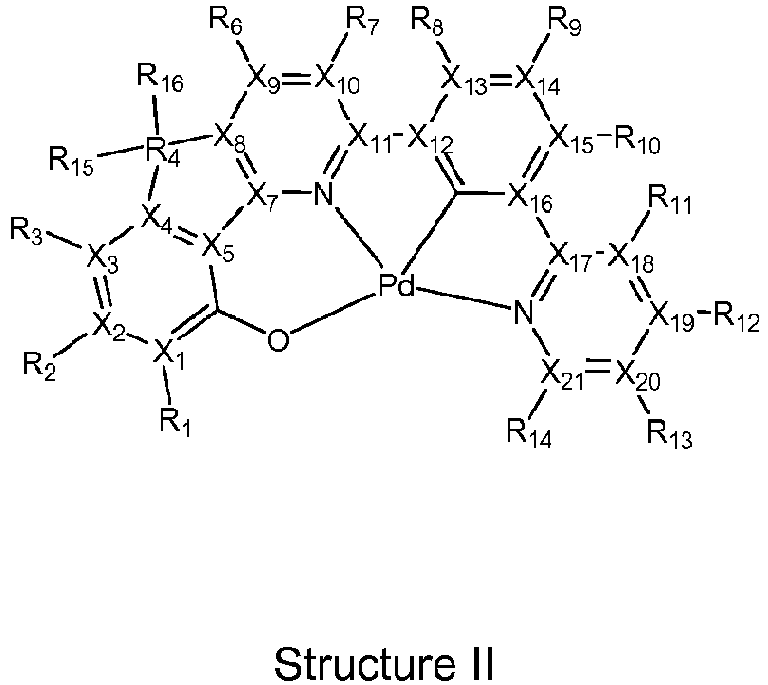
- R 1 -R 14 can independently comprise the same atom(s) as an adjacent R group and form a 5 member ring with four X atoms to form a complex with a chemical structure of Structure II, for example, X 1 -X 20 can be independently selected from boron, carbon, nitrogen, oxygen, or silicon, for example.
- the notation "X 1 -X 20 " means X 1 , X 2 , X 3 , X 4 ... X 17 , X 18 , X 19 , X 20 , for example.
- Structure II is represented as: wherein R 1 -R 14 are independently selected from hydrogen, halogen, oxygen, nitrogen, sulphur, selenium, hydroxyl, an unsubstituted alkyl, a substituted alkyl, cycloalkyl, an unsubstituted aryl, a substituted aryl, acyl, alkoxy, acyloxy, amino, nitro, acylamino, aralkyl, cyano, carboxyl, thio, styryl, aminocarbonyl, carbamoyl, aryloxycarbonyl, phenoxycarbonyl, or an alkoxycarbonyl group and X 1 - X 20 can be independently selected from boron, carbon, nitrogen, oxygen, or silicon.
- the present invention provides an organometallic complex having a chemical structure of Structure I: wherein each R 1 -R 14 is independently selected from hydrogen, halogen, hydroxyl, an unsubstituted alkyl including from 1 to 10 carbon atoms, a substituted alkyl including from 1 to 20 carbon atoms, cycloalkyl including from 3 to 20 carbon atoms, an unsubstituted aryl including from 6 to 20 carbon atoms, a substituted aryl including from 6 to 20 carbon atoms, acyl including from 1 to 20 carbon atoms, alkoxy including from 1 to 20 carbon atoms, acyloxy including from 1 to 20 carbon atoms, amino, nitro, acylamino including from 1 to 20 carbon atoms, aralkyl including from 7 to 20 carbon atoms, cyano, carboxyl including from 1 to 20 carbon atoms, thio, styryl, aminocarbonyl including from 1 to 20 carbon atoms, carbamo
- halogen alkyl, cycloalkyl, aryl, acyl, and alkoxy may have the following meanings:
- the halogen or halo used herein includes fluorine, chlorine, bromine and iodine, preferably F, Cl, Br, particularly preferably F or Cl.
- the aryl group or aryl moiety as used herein includes aryl having from 6 to 30 carbon atoms, preferably from 6 to 18 carbon atoms, and is made up of an aromatic ring or a plurality of fused aromatic rings.
- Suitable aryls are, for example, phenyl, naphthyl, acenaphthenyl, acenaphthylenyl, anthracenyl, fluorenyl, phenalenyl, phenanthrenyl.
- This aryl can be unsubstituted (i.e. all carbon atoms which are capable of substitution bear hydrogen atoms) or be substituted on one, more than one or all substitutable positions of the aryl.
- Suitable substituents are, for example, halogen, preferably F, Br or Cl, alkyl radicals, preferably alkyl radicals having from 1 to 8 carbon atoms, particularly preferably methyl, ethyl, i-propyl or t-butyl, aryl radicals, preferably C 6 -aryl radicals or fluorenyl, which may once again be substituted or unsubstituted, heteroaryl radicals, preferably heteroaryl radicals containing at least one nitrogen atom, particularly preferably pyridyl radicals, alkenyl radicals, preferably alkenyl radicals which have one double bond, particularly preferably alkenyl radicals having a double bond and from 1 to 8 carbon atoms, or groups having a donor or acceptor action.
- alkyl radicals preferably alkyl radicals having from 1 to 8 carbon atoms, particularly preferably methyl, ethyl, i-propyl or t-butyl
- groups having a donor action are groups which display a +1 and/or +M effect
- groups having an acceptor action are groups which display a -I and/or -M effect
- Suitable groups having a donor or acceptor action are halogen radicals, preferably F, Cl, Br, particularly preferably F, alkoxy radicals, carbonyl radicals, ester radicals, amine radicals, amide radicals, CH 2 F groups, CHF 2 groups, CF 3 groups, CN groups, thio groups or SCN groups.
- the aryl radicals very particularly preferably bear substituents selected from the group consisting of methyl, F, Cl and alkoxy, or the aryl radicals are unsubstituted.
- the aryl radical or the aryl group being a C 6 -aryl radical which may optionally be substituted by at least one of the abovementioned substituents.
- the C 6 -aryl radical particularly preferably bears none, one or two of the abovementioned substituents, with the one substituent preferably being located in the para position relative to the further linkage point of the aryl radical and, in the case of two substituents, these are each located in the meta position relative to the further linkage point of the aryl radical.
- the C 6 -aryl radical is very particularly preferably an unsubstituted phenyl radical.
- the aryl or aryl moiety as used herein is preferably fluorenyl or phenyl, which may be unsubstituted or substituted by the abovementioned substituents, preferably halogen, alkyl or unsubstituted or substituted fluorenyl as used herein.
- the alkyl or alkyl moiety used herein includes alkyl having from 1 to 20 carbon atoms, preferably from 1 to 10 carbon atoms, particularly preferably from 1 to 6 carbon atoms.
- This alkyl can be branched or unbranched and may be interrupted by one or more heteroatoms, preferably N, O or S.
- this alkyl may be substituted by one or more of the substituents mentioned in respect of the aryl groups.
- possible substituted alkyl includes trifluoromethyl group.
- the alkyl radical to bear one or more aryl groups. All the mentioned aryl groups are suitable for this purpose.
- the alkyl radicals are particularly preferably selected from the group consisting of methyl, ethyl, i-propyl, n-propyl, i-butyl, n-butyl, t-butyl, sec-butyl, i-pentyl, n-pentyl, sec-pentyl, neopentyl, n-hexyl, i-hexyl and sec-hexyl. Very particular preference is given to methyl, i-propyl and n-hexyl.
- cycloalkyl as used herein contemplates cyclic alkyl radicals.
- Preferred cycloalkyl groups are those containing 3 to 7 carbon atoms and includes cyclopropyl, cyclopentyl, cyclohexyl, and the like. Additionally, the cycloalkyl group may be optionally substituted with one or more substituents selected from halo, CN, CO 2 R, C(O)R, NR 2 , cyclic-amino, NO 2 , and OR.
- acyl or aryl moiety as used herein is an alkyl group as used herein that is attached to the CO group with a single bond.
- the alkoxy is an alkyl group as used herein linked to oxygen.
- Palladium(II) typically has four coordinating sites. Consequently, five types of palladium(II) complexes are observable - PdL 1 L 2 L 3 L 4 ; PdL 1 L 2 L 5 ; PdL 5 L 6 ; PdL 1 L 7 ; and PdL 8 , where L 1 - L 4 comprise monodentate ligands, which comprise the same ligand; L 5 and L 6 comprise bidentate ligands, L 7 comprises a tridentate ligand, and L 8 comprises a tetradentate ligand, for example.
- PdL 8 -type complexes can have relatively strong binding between the ligand and the palladium center since four metal-ligand bonds are involved. Therefore, PdL 8 -type complexes can have relatively high stability, and an OLED fabricated from PdL 8 -type complexes can have relatively high stability and long lifetime.
- a di-anionic ligand can be used for palladium(II) complexes for OLED applications, for example.
- an emissive palladium(II) complex system with a chemical structure of Structure I can be designed for an OLED application, Structure I represented as: wherein R 1 -R 14 , if present, can be independently selected from hydrogen, halogen, oxygen, nitrogen, sulphur, selenium, hydroxyl, an unsubstituted alkyl having 1 to 14 carbon atoms, a substituted alkyl having 1 to 14 carbon atoms, cycloalkyl having 1 to 14 carbon atoms, an unsubstituted aryl having 1 to 14 carbon atoms, a substituted aryl having 1 to 14 carbon atoms, acyl having 1 to 14 carbon atoms, alkoxy having 1 to 14 carbon atoms, acyloxy having 1 to 14 carbon atoms, amino, nitro, acylamino having 1 to 14 carbon atoms, aralkyl having 1 to 14 carbon atoms, cyano, carboxyl, thio, styryl,
- Individual R 1 -R 14 can also independently form 5 to 8 member ring(s) with adjacent R group(s). Individual R 1 -R 14 can independently comprise the same atom(s) as the adjacent R group and form a 5 member ring with four X atoms to form a complex with a chemical structure of Structure II, for example.
- X 1 - X 20 can be independently selected from boron, carbon, nitrogen, oxygen, or silicon, for example.
- each R 1 -R 14 can be independently selected from hydrogen, halogen (such as fluorine, chlorine bromine, and iodine), hydroxyl, an unsubstituted alkyl including from 1 to 10 carbon atoms, a substituted alkyl including from 1 to 20 carbon atoms, cycloalkyl including from 1 to 20 carbon atoms, an unsubstituted aryl including from 1 to 20 carbon atoms, a substituted aryl including from 1 to 20 carbon atoms, acyl including from 1 to 20 carbon atoms, alkoxy including from 1 to 20 carbon atoms, acyloxy including from 1 to 20 carbon atoms, amino, nitro, acylamino including from 1 to 20 carbon atoms, aralkyl including from 1 to 20 carbon atoms, cyano, carboxyl including from 1 to 20 carbon atoms, thio, styryl, aminocarbonyl including from 1 to 20 carbon atoms, carbam
- a total number of carbon atoms provided by R 1 -R 14 groups can be in a range from 1 to 40. In another embodiment, a total number of carbon atoms provided by R 1 -R 14 groups can be in a range from 2 to 30.
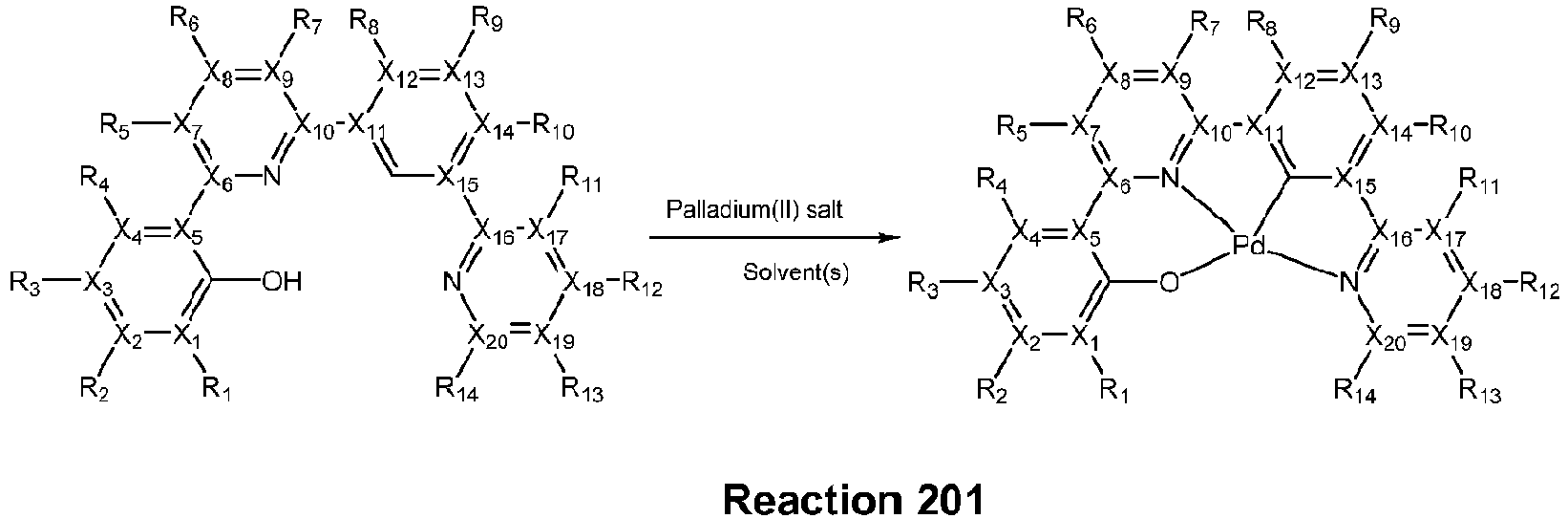
- complexes such as those shown above can be prepared by reacting a palladium(II) salt with a corresponding protonated ligand in the presence of one or more suitable solvents.
- palladium(II) salts include but are not limited to palladium acetate, palladium chloride, dichloro(1,5-cyclooctadiene)platinum(II), and (ethylenediamine) palladium(II) chloride.
- solvents include but are not limited to glacial acetic acid, dichloromethane, chloroform, THF, DMF and DMSO, and mixtures thereof - refer to Reaction 201, for example.
- the product can then be optionally purified by column chromatography using alumina or silica as a stationary phase. Further purification by sublimation can be preformed if desired.
- Ligand 301 (0.30 g, 0.59 mmol) was mixed with palladium acetate (0.14 g, 0.65 mmol) in glacial acetic acid (50 ml), and the reaction mixture was refluxed for 12 hr. The mixture was extracted with CHCl 3 , and the organic layer was dried with MgSO 4 . Purification was performed by alumina chromatography using chloroform as eluent to give Complex 101 as a yellow solid. Yield: 0.22 g (60 %).
- Ligand 302 (0.30 g, 0.53 mmol) was mixed with palladium acetate (0.13 g, 0.59 mmol) in glacial acetic acid (50 ml), and the reaction mixture was refluxed for 12 hr. The mixture was extracted with CHCl 3 , and the organic layer was dried with MgSO 4 . Purification was performed by alumina chromatography using dichloromethane as eluent to give Complex 102 as yellow solid. Yield: 0.21 g (58 %).
- Ligand 303 (0.30 g, 0.52 mmol) was mixed with palladium acetate (0.13 g, 0.57 mmol) in glacial acetic acid (50 ml), and the reaction mixture was refluxed for 12 hr. The mixture was extracted with CHCl 3 , and the organic layer was dried with MgSO 4 . Purification was performed by alumina chromatography using chloroform as eluent to give Complex 103 as pale yellow solid. Yield: 0.26 g (65 %).
- Ligand 304 (0.30g, 0.67 mmol) was mixed with palladium acetate (0.17 g, 0.74 mmol) in glacial acetic acid (50 ml), and the reaction mixture was refluxed for 12 hr. The mixture was extracted with CHCl 3 , and the organic layer may be dried with MgSO 4 . Purification was performed by alumina chromatography using dichloromethane as eluent to give Complex 104 as yellow solid. Yield: 0.22 g (60 %).
- Ligand 305 (0.30 g, 0.59 mmol) was mixed with palladium acetate (0.15 g, 0.65 mmol) in glacial acetic acid (50 ml), and the reaction mixture was refluxed for 12 hr. The mixture was extracted with CHCl 3 , and the organic layer may be dried with MgSO 4 . Purification was performed by alumina chromatography using dichloromethane as eluent to give Complex 105 as pale yellow solid. Yield: 0.22 g (60 %).
- Ligand 306 (0.25 g, 0.54 mmol) was mixed with palladium acetate (0.13 g, 0.59 mmol) in glacial acetic acid (50 ml), and the reaction mixture was refluxed for 12 hr. The mixture was extracted with CHCl 3 , and the organic layer may be dried with MgSO 4 . Purification was performed by alumina chromatography using dichloromethane as eluent to give Complex 106 as yellow solid. Yield: 0.17 g (55 %).
- Example 407 Photophysical data for Complexes 101 -106.
- the absorption spectra of complexes 101-103 show relatively intense transitions with ⁇ max ranging from 250-340 nm, which can be assigned to be intraligand transitions with mainly ligand character, while the transitions ranging from 340-400 nm can be assigned to be metal perturbed intraligand transitions (with considerable metal character).
- Relatively broad absorption at about 400-470 nm ( ⁇ ⁇ 5000-11000 dm 3 mol -1 cm -1 ) for complexes 101-103 can be attributed to a 1 MLCT (5d)Pt ⁇ *(L) transition, although mixing with IL may not be excluded.
- Absorption spectra of complexes 104-106 show relatively intense transitions with ⁇ max ranging from 250-320 nm, which can be assigned to comprise intraligand transitions having substantially ligand character, while transitions ranging from 320-400 nm can be assigned to comprise metal perturbed intraligand transitions having considerable metal character.
- Broad absorption at 400-470 nm ( ⁇ ⁇ 7200-7700 dm 3 mol -1 cm -1 ) for complexes 104-106 can be attributed to 1 MLCT (5d)Pt ⁇ *(L) transition, although mixing with IL need not be excluded. These assignments can be supported by a solvent effect experiment on complex 105.
- UV spectra Upon or after forming UV spectra, with an increase in solvent polarity, blue shifts of ⁇ 6 nm in the regions of 320-400 nm and 400-470 nm can be recorded to show metal involvement in excited states, for example.
- Complexes 101-103 can be emissive in degassed CH 2 Cl 2 . Emission energy listed in descending order: Complex 103 > Complex 101 > Complex 102, which can be due to an effect of fluorine substituent (e.g., lowers the HOMO energy) and extension of pyridine to isoquinoline (e.g., lowers the LUMO energy).
- fluorine substituent e.g., lowers the HOMO energy
- pyridine to isoquinoline e.g., lowers the LUMO energy
- their emission spectra may not be vibronically resolved (an example of which is depicted in Figure 5 ), and emission energy need not be affected by a concentration ranging from 1 x 10 -4 M to 1 x 10 -5 M.
- Complexes 104-106 can be highly emissive in degassed CH 2 Cl 2 .
- Their emission energy which can be similar, can mean that alkyl substituents may not affect emission energy.
- their emission spectra can be vibronically resolved (an example of which is depicted in Figure 6 ), which can possess vibronic spacings of 1200 cm -1 and emission energy may not be affected from the concentration ranging from 1 x 10 -4 M to 1 x 10 -5 M, for example.
- their emissions can be assigned to come from an excited state of 3 IL, and the mixing of 3 MLCT may not be excluded.
- These assignments can be supported by the solvent effect experiment on Complex 105.
- emission energy Upon or after forming emission spectra, with an increase in solvent polarity, emission energy can be similar, which can be a characteristic behaviour for an emission from 3 IL.
- Emission quantum yields of complexes 101-103 can be lower than that of complexes 104-106 ( ⁇ ⁇ 0.11-0.20), which can reveal that complexes 104-106 can possess more rigid structures and can reduce excited state distortions.
- complexes 104-106 can show excimeric emissions due, at least in part, to serious aggregations.
- Complex 104 can show a structured emission with ⁇ max of 500 nm. Such emission can be attributed to originate from 3 IL excited state.
- These emissions can be attributed to come from 3 IL excited states, for example.
- Emission spectra of complex 105 and complex 106 narrowed down upon cooling may still be affected by serious aggregations.
- Such emission specta can comprise mainly excimeric emissions.
- the ⁇ max of complexes 101-103 can vary from 477 to 505 nm, while that of complexes 104-106 can be almost the same at ⁇ 488 nm.
- the term “relatively narrow color emission spectrum” refers to a spectrum that is 30 or fewer nanometers wide, such as that of a "single" color spectrum, for example. In another embodiment, the term “relatively narrow color emission spectrum” refers to a spectrum that is 20 or fewer nanometers wide. In yet another embodiment, the term “relatively narrow color emission spectrum” refers to a spectrum that is 10 or fewer nanometers wide. Of course, a relatively narrow color emission spectrum can be wider or narrower, and claimed subject matter is not limited in this respect. Table 501. Physical properties of illustrative Complexes 101 - 106.
- Example 408 Thermal behaviour for Complexes 101 - 106.
- TGA thermogravimetric analyses
- T d Decomposition temperature of complexes 101 - 106
- T d Decomposition temperature of complexes 101 - 106
- Table 502. Decomposition temperature for 101 - 106.
- OLEDs can be prepared on patterned indium tin oxide (ITO).
- ITO indium tin oxide
- Pre-coated glass slides with a sheet resistance of 10 ⁇ /m 2 can be used as anodic substrates, for example.
- the glass slides can be cleaned with Decon 90 detergent, rinsed in de-ionized water, and dried in an oven before successive film deposition. Glass slides can then be treated in an ultraviolet-ozone chamber before loading into an evaporation chamber. Layers of organic material and metal can be thermally deposited sequentially in a high vacuum evaporator (such as that manufactured by Trovato Mfg., Inc., Fairport, New York, for example) with a base pressure of 10 -6 Torr.
- a high vacuum evaporator such as that manufactured by Trovato Mfg., Inc., Fairport, New York, for example
- Films can be sequentially deposited at a rate of 0.1 - 0.2 nm/s without vacuum break. Film thicknesses can be determined in-situ by calibrated oscillating quartz-crystal sensors. Shadow masks can be used to define organic layers and a cathode may be used to make, for example, four 0.1 cm 2 devices on each substrate.
- CIE Commission Internationale de L'Eclairage
- J-V-L current density-voltage-luminance characteristics
- EL electroluminescence
- the EL ⁇ max (500, 530 nm with a shoulder at ⁇ 580 nm) can be independent of doping concentrations for complex 105.
- Turn on voltages of OLED 601 - 604 are 5.3 V, 4.9 V, 4.6 V, and 4.4 V, respectively.
- an upper current efficiency of 9.2 cd A -1 was obtained at 0.006 mA cm -2 .
- An upper power efficiency (PE) and an upper external quantum efficiency (EQE) were 5.7 lmW -1 and 4.0 %, respectively.
- an upper current efficiency of 12.5 cd A -1 was obtained at 0.029 mA cm -2 .
- An upper power efficiency (PE) and an upper external quantum efficiency (EQE) were 7.8 lmW -1 and 4.7 %, respectively.
- An upper current efficiency of 20.0 cd A -1 was obtained at 0.013 mA cm -2 .
- An upper power efficiency (PE) and an upper external quantum efficiency (EQE) were 13.6 lmW -1 and 7.4 %, respectively.
- An upper current efficiency of 18.0 cd A -1 was obtained at 0.008 mA cm -2 .
- An upper power efficiency (PE) and an upper external quantum efficiency (EQE) were 13.1 lmW -1 and 6.4 %, respectively.
- Figure 16 , Figure 17 , and Figure 18 show examples of an EL spectrum, J - V - B curves, external quantum efficiency, current efficiency, and power efficiency as a function of drive current density for OLEDs 601 - 604, respectively.
- a figure or a parameter from one range may be combined with another figure or a parameter from a different range for the same characteristic to generate a numerical range.
Landscapes
- Chemical & Material Sciences (AREA)
- Organic Chemistry (AREA)
- Engineering & Computer Science (AREA)
- Materials Engineering (AREA)
- Inorganic Chemistry (AREA)
- Crystallography & Structural Chemistry (AREA)
- Physics & Mathematics (AREA)
- Optics & Photonics (AREA)
- Electroluminescent Light Sources (AREA)
Description
- This application claims priority to provisional application Serial No.
61/569,184, filed on December 9, 2011 - Subject matter disclosed herein relates to a class of tetradentate palladium(II) complexes, their preparation method and their application in organic light-emitting diodes (OLED).
- Organic light-emitting diodes (OLEDs) are recognized as a next-generation display and/or lighting technology. Due to the 3:1 triplet to singlet exciton issue, development of emitting materials for OLED application maybe mainly focused on phosphorescent materials. Among phosphorescent materials, metal organic materials containing heavy transition metals may exhibit desirable performance in OLED application. Iridium is a commonly used heavy transition metal while platinum is an up-and-coming candidate. Devices fabricated from iridium- and platinum-based materials have good device performance for mass production.
-
US20060134461 (A ) discloses tetradentate platinum and palladium complexes. - However, prices for iridium- and platinum-based materials may be relatively high. There is a desire to reduce costs for emitting materials. Zinc-based materials may provide an advantage related to cost, for example. Nevertheless, efficiency and/or stability of devices fabricated from zinc-based materials may be questionable.
- In various embodiments, phosphorescent materials, which can be used for OLED applications, comprise palladium as a metal center. One advantage associated with palladium over other materials is the relatively low price.
- In various embodiments, palladium-based light-emitting materials comprise a molecular structure of Structure I:

- Individual R1-R14 can independently comprise the same atom(s) as an adjacent R group and form a 5 member ring with four X atoms to form a complex with a chemical structure of Structure II, for example, X1-X20 can be independently selected from boron, carbon, nitrogen, oxygen, or silicon, for example. The notation "X1-X20" means X1, X2, X3, X4... X17, X18, X19, X20, for example. Structure II is represented as:
In one embodiment, the present invention provides an organometallic complex having a chemical structure of Structure I:
wherein each X1 - X20 is independently selected from the group consisting of boron, carbon, nitrogen, oxygen, and silicon. - For the purposes of the present application, the terms halogen, alkyl, cycloalkyl, aryl, acyl, and alkoxy may have the following meanings:
The halogen or halo used herein includes fluorine, chlorine, bromine and iodine, preferably F, Cl, Br, particularly preferably F or Cl. - The aryl group or aryl moiety as used herein includes aryl having from 6 to 30 carbon atoms, preferably from 6 to 18 carbon atoms, and is made up of an aromatic ring or a plurality of fused aromatic rings. Suitable aryls are, for example, phenyl, naphthyl, acenaphthenyl, acenaphthylenyl, anthracenyl, fluorenyl, phenalenyl, phenanthrenyl. This aryl can be unsubstituted (i.e. all carbon atoms which are capable of substitution bear hydrogen atoms) or be substituted on one, more than one or all substitutable positions of the aryl. Suitable substituents are, for example, halogen, preferably F, Br or Cl, alkyl radicals, preferably alkyl radicals having from 1 to 8 carbon atoms, particularly preferably methyl, ethyl, i-propyl or t-butyl, aryl radicals, preferably C6-aryl radicals or fluorenyl, which may once again be substituted or unsubstituted, heteroaryl radicals, preferably heteroaryl radicals containing at least one nitrogen atom, particularly preferably pyridyl radicals, alkenyl radicals, preferably alkenyl radicals which have one double bond, particularly preferably alkenyl radicals having a double bond and from 1 to 8 carbon atoms, or groups having a donor or acceptor action. For the purposes of the present invention, groups having a donor action are groups which display a +1 and/or +M effect, and groups having an acceptor action are groups which display a -I and/or -M effect. Suitable groups having a donor or acceptor action are halogen radicals, preferably F, Cl, Br, particularly preferably F, alkoxy radicals, carbonyl radicals, ester radicals, amine radicals, amide radicals, CH2F groups, CHF2 groups, CF3 groups, CN groups, thio groups or SCN groups. The aryl radicals very particularly preferably bear substituents selected from the group consisting of methyl, F, Cl and alkoxy, or the aryl radicals are unsubstituted. Preference is given to the aryl radical or the aryl group being a C6-aryl radical which may optionally be substituted by at least one of the abovementioned substituents. The C6-aryl radical particularly preferably bears none, one or two of the abovementioned substituents, with the one substituent preferably being located in the para position relative to the further linkage point of the aryl radical and, in the case of two substituents, these are each located in the meta position relative to the further linkage point of the aryl radical. The C6-aryl radical is very particularly preferably an unsubstituted phenyl radical. The aryl or aryl moiety as used herein is preferably fluorenyl or phenyl, which may be unsubstituted or substituted by the abovementioned substituents, preferably halogen, alkyl or unsubstituted or substituted fluorenyl as used herein.
- The alkyl or alkyl moiety used herein includes alkyl having from 1 to 20 carbon atoms, preferably from 1 to 10 carbon atoms, particularly preferably from 1 to 6 carbon atoms. This alkyl can be branched or unbranched and may be interrupted by one or more heteroatoms, preferably N, O or S. Furthermore, this alkyl may be substituted by one or more of the substituents mentioned in respect of the aryl groups. For example, possible substituted alkyl includes trifluoromethyl group. It is likewise possible for the alkyl radical to bear one or more aryl groups. All the mentioned aryl groups are suitable for this purpose. The alkyl radicals are particularly preferably selected from the group consisting of methyl, ethyl, i-propyl, n-propyl, i-butyl, n-butyl, t-butyl, sec-butyl, i-pentyl, n-pentyl, sec-pentyl, neopentyl, n-hexyl, i-hexyl and sec-hexyl. Very particular preference is given to methyl, i-propyl and n-hexyl.
- The cycloalkyl as used herein contemplates cyclic alkyl radicals. Preferred cycloalkyl groups are those containing 3 to 7 carbon atoms and includes cyclopropyl, cyclopentyl, cyclohexyl, and the like. Additionally, the cycloalkyl group may be optionally substituted with one or more substituents selected from halo, CN, CO2R, C(O)R, NR2, cyclic-amino, NO2, and OR.
- The acyl or aryl moiety as used herein is an alkyl group as used herein that is attached to the CO group with a single bond.
- The alkoxy is an alkyl group as used herein linked to oxygen.
- Non-limiting and non-exhaustive embodiments are described with reference to the following figures, wherein like reference numerals refer to like parts throughout the various figures unless otherwise specified.
-
Figure 1 shows an x-ray crystal structure forillustrative complex 101, according to an embodiment. -
Figure 2 shows an x-ray crystal structure forillustrative complex 104, according to an embodiment. -
Figure 3 shows a UV-visible spectrum of illustrative complexes 101-103 in CH2Cl2 solution, according to an embodiment. -
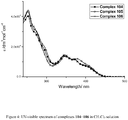
Figure 4 shows a UV-visible spectrum of illustrative complexes 104-106 in CH2Cl2 solution, according to an embodiment. -
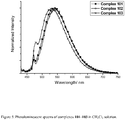
Figure 5 shows photoluminescent spectra of illustrative complexes 101-103 in CH2Cl2 solution, according to an embodiment. -
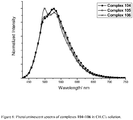
Figure 6 shows photoluminescent spectra of illustrative complexes 104-106 in CH2Cl2 solution, according to an embodiment. -
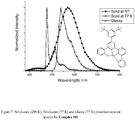
Figure 7 shows solid-state (298 K), solid-state (77 K) and glassy (77 K) photoluminescent spectra forComplex 101, according to an embodiment. -
Figure 8 shows solid-state (298 K), solid-state (77 K) and glassy (77 K) photoluminescent spectra forComplex 102, according to an embodiment. -
Figure 9 shows solid-state (298 K), solid-state (77 K) and glassy (77 K) photoluminescent spectra forComplex 103, according to an embodiment. -
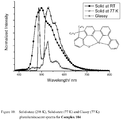
Figure 10 shows solid-state (298 K), solid-state (77 K) and glassy (77 K) photoluminescent spectra forComplex 104, according to an embodiment. -
Figure 11 shows solid-state (298 K), solid-state (77 K) and glassy (77 K) photoluminescent spectra forComplex 105, according to an embodiment. -
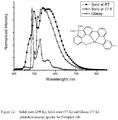
Figure 12 shows solid-state (298 K), solid-state (77 K) and glassy (77 K) photoluminescent spectra forComplex 106, according to an embodiment. -
Figure 13 shows thermograms for illustrative complexes 104-106, according to an embodiment. -
Figure 14 shows EL spectra for OLEDs 601-604, according to an embodiment. -
Figure 15 shows current density-voltage-brightness (J-V-B) relationships for OLEDs 601-604, according to an embodiment. -
Figure 16 shows external quantum efficiency-current density relationships for OLEDs 601-604, according to an embodiment. -
Figure 17 shows current efficiency-current density relationships for OLEDs 601-604, according to an embodiment. -
Figure 18 shows power efficiency-current density relationships for OLEDs 601-604, according to an embodiment. - Palladium(II) typically has four coordinating sites. Consequently, five types of palladium(II) complexes are observable - PdL1L2L3L4; PdL1L2L5; PdL5L6; PdL1L7; and PdL8, where L1 - L4 comprise monodentate ligands, which comprise the same ligand; L5 and L6 comprise bidentate ligands, L7 comprises a tridentate ligand, and L8 comprises a tetradentate ligand, for example. PdL8 -type complexes can have relatively strong binding between the ligand and the palladium center since four metal-ligand bonds are involved. Therefore, PdL8-type complexes can have relatively high stability, and an OLED fabricated from PdL8-type complexes can have relatively high stability and long lifetime.
- Since electronically neutral complexes can be more readily sublimated for thermal deposition OLED fabrication, a di-anionic ligand can be used for palladium(II) complexes for OLED applications, for example.
- In an embodiment, an emissive palladium(II) complex system with a chemical structure of Structure I can be designed for an OLED application, Structure I represented as:

- In another embodiment, in Structure I, each R1-R14 can be independently selected from hydrogen, halogen (such as fluorine, chlorine bromine, and iodine), hydroxyl, an unsubstituted alkyl including from 1 to 10 carbon atoms, a substituted alkyl including from 1 to 20 carbon atoms, cycloalkyl including from 1 to 20 carbon atoms, an unsubstituted aryl including from 1 to 20 carbon atoms, a substituted aryl including from 1 to 20 carbon atoms, acyl including from 1 to 20 carbon atoms, alkoxy including from 1 to 20 carbon atoms, acyloxy including from 1 to 20 carbon atoms, amino, nitro, acylamino including from 1 to 20 carbon atoms, aralkyl including from 1 to 20 carbon atoms, cyano, carboxyl including from 1 to 20 carbon atoms, thio, styryl, aminocarbonyl including from 1 to 20 carbon atoms, carbamoyl including from 1 to 20 carbon atoms, aryloxycarbonyl including from 1 to 20 carbon atoms, phenoxycarbonyl including from 1 to 20 carbon atoms, or an alkoxycarbonyl group including from 1 to 20 carbon atoms.
- In another embodiment, a total number of carbon atoms provided by R1-R14 groups can be in a range from 1 to 40. In another embodiment, a total number of carbon atoms provided by R1-R14 groups can be in a range from 2 to 30.
- In another embodiment, R4 = R5 = carbon atom to form a five member ring with four X atoms to form a complex with a chemical structure of Structure II,


- Some examples of palladium(II) complexes are shown below, though claimed subject matter is not so limited:


- In an implementation, complexes such as those shown above can be prepared by reacting a palladium(II) salt with a corresponding protonated ligand in the presence of one or more suitable solvents. Examples of palladium(II) salts include but are not limited to palladium acetate, palladium chloride, dichloro(1,5-cyclooctadiene)platinum(II), and (ethylenediamine) palladium(II) chloride. Examples of solvents include but are not limited to glacial acetic acid, dichloromethane, chloroform, THF, DMF and DMSO, and mixtures thereof - refer to Reaction 201, for example. The product can then be optionally purified by column chromatography using alumina or silica as a stationary phase. Further purification by sublimation can be preformed if desired.
- Some examples of protonated ligands are shown below, though claimed subject matter is not so limited:


- The following examples illustrate the subject invention. Unless otherwise indicated in the following examples and elsewhere in the specification and claims, all parts and percentages are by weight, all temperatures are in degrees Centigrade, and pressure is at or near atmospheric pressure.
- In one implementation, Ligand 301 (0.30 g, 0.59 mmol) was mixed with palladium acetate (0.14 g, 0.65 mmol) in glacial acetic acid (50 ml), and the reaction mixture was refluxed for 12 hr. The mixture was extracted with CHCl3, and the organic layer was dried with MgSO4. Purification was performed by alumina chromatography using chloroform as eluent to give
Complex 101 as a yellow solid. Yield: 0.22 g (60 %). 1H NMR (500 MHz, CDCl3, 25°C, TMS): δ = 1.44 (s, 18H), 6.67 (t, 3 J(H,H) = 8.0 Hz, 1H), 7.18-7.24 (m, 2H), 7.30-7.34 (m, 2H), 7.47 (d, 3 J(H,H) = 7.6 Hz, 1H), 7.56-7.57 (m, 3H), 7.61 (s, 1H), 7.70-7.72 (m, 2H), 7.90 (t, 3 J(H,H) = 7.8 Hz, 1H), 7.95 (d, 3 J(H,H) = 8.1 Hz, 1H), 8.18 (s, 1H), 8.86 (d, 3 J(H,H) = 4.7 Hz, 1H). FAB-MS (+ve, m/z): 616 [M]+. An example, of the X-ray crystal structure ofComplex 101 is depicted inFigure 1 , for example. - Ligand 302 (0.30 g, 0.53 mmol) was mixed with palladium acetate (0.13 g, 0.59 mmol) in glacial acetic acid (50 ml), and the reaction mixture was refluxed for 12 hr. The mixture was extracted with CHCl3, and the organic layer was dried with MgSO4. Purification was performed by alumina chromatography using dichloromethane as eluent to give
Complex 102 as yellow solid. Yield: 0.21 g (58 %). 1H NMR (500 MHz, CD2Cl2, 25°C, TMS): δ = 1.46 (s, 18H), 6.62 (ddd, 4 J(H,H) = 1.4 Hz, 3 J(H,H) = 6.6 Hz, 3 J(H,H) = 8.1 Hz, 1H,), 7.15 (dd, 4 J(H,H) = 1.3 Hz, 3 J(H,H) = 8.4 Hz, 1H), 7.21 (t, 3 J(H,H) = 7.6 Hz, 1H), 7.29 (ddd, 4 J(H,H) = 1.7 Hz, 3 J(H,H) = 6.6 Hz, 3 J(H,H) = 8.4 Hz, 1H), 7.48 (d, 3J(H,H) = 7.5 Hz, 1H), 7.52 (d, 3 J(H,H) = 7.5 Hz, 1H), 7.59-7.62 (m, 2H), 7.64 (t, 4 J(H,H) = 1.7 Hz, 1H), 7.67 (d, 3 J(H,H) = 1.6 Hz, 1H), 7.74 (dt, 4 J(H,H) = 1.1 Hz, 3 J(H,H) = 8.1 Hz, 1H), 7.81 (d, 3 J(H,H) = 8.1 Hz, 1H), 7.87 (s, 1H), 7.93 (dd, 4 J(H,H)= 1.5 Hz, 3 J(H,H) = 8.4 Hz, 1H), 8.04 (d, 3 J(H,H) = 8.1 Hz, 1H), 8.13 (d, 4 J(H,H) = 1.3 Hz, 1H), 9.35 (s, 1H). FAB-MS (+ve, m/z): 666 [M]+. - Ligand 303 (0.30 g, 0.52 mmol) was mixed with palladium acetate (0.13 g, 0.57 mmol) in glacial acetic acid (50 ml), and the reaction mixture was refluxed for 12 hr. The mixture was extracted with CHCl3, and the organic layer was dried with MgSO4. Purification was performed by alumina chromatography using chloroform as eluent to give
Complex 103 as pale yellow solid. Yield: 0.26 g (65 %). 1H NMR (500 MHz, CD2Cl2, 25 °C): δ = 1.45 (s, 18H), 6.59 (ddd, 4 J(H,H) = 1.4 Hz, 3 J(H,H) = 6.7 Hz, 3 J(H,H) = 8.2 Hz, 1H), 6.85 (dd, 3 J(H,H) = 8.3 Hz, 3 J(F,H) = 11.6 Hz, 1H), 7.11 (dd, 4 J(H,H) = 1.4 Hz, 3 J(H,H) = 8.4 Hz, 1H), 7.26 (ddd, 4 J(H,H) = 1.7 Hz, 3 J(H,H) = 6.7 Hz, 3 J(H,H) = 8.4 Hz, 1H), 7.47 (dd, 4 J(F,H) = 3.8 Hz, 3 J(H,H) = 8.4 Hz, 1H), 7.57 (d, 4 J(H,H) = 1.6 Hz, 1H), 7.60 (d, 4 J(H,H) = 1.8 Hz, 1H), 7.63-7.68 (m, 2H), 7.80 (dt, 4 J(H,H) = 1.1 Hz, 3 J(H,H) = 8.1 Hz, 1H), 7.84 (d, 3 J(H,H) = 8.0 Hz, 1H), 7.88 (dd, 4 J(H,H) = 1.5 Hz, 3 J(H,H) = 8.4 Hz, 1H), 8.06-8.08 (m, 2H), 8.12 (s, 1H), 9.38 (s, 1H). FAB-MS (+ve, m/z): 684 [M]+. - Ligand 304 (0.30g, 0.67 mmol) was mixed with palladium acetate (0.17 g, 0.74 mmol) in glacial acetic acid (50 ml), and the reaction mixture was refluxed for 12 hr. The mixture was extracted with CHCl3, and the organic layer may be dried with MgSO4. Purification was performed by alumina chromatography using dichloromethane as eluent to give
Complex 104 as yellow solid. Yield: 0.22 g (60 %). 1H NMR (500 MHz, CD2Cl2, 25°C, TMS): δ = 0.68-0.82 (m, 10H), 1.09-1.17 (m, 4H), 1.95-2.08 (m, 4H), 6.60 (d, J = 7.1 Hz, 1H), 6.90 (d, J = 8.4 Hz, 1H), 7.25 (t, J = 7.7 Hz, 1H), 7.36-7.29 (m, 2H), 7.50-7.53 (m, 2H), 7.59 (d, J = 7.6 Hz, 1H), 7.79-7.81 (m, 2H), 7.95 (dt, J 1,2 = 1.6 Hz, J 1,3 = 7.8 Hz, 1H), 8.84-8.85 (m, 1H). FAB-MS (+ve, m/z): 552 [M]+. An example, of the x-ray crystal structure ofComplex 104 is depicted inFigure 2 . - Ligand 305 (0.30 g, 0.59 mmol) was mixed with palladium acetate (0.15 g, 0.65 mmol) in glacial acetic acid (50 ml), and the reaction mixture was refluxed for 12 hr. The mixture was extracted with CHCl3, and the organic layer may be dried with MgSO4. Purification was performed by alumina chromatography using dichloromethane as eluent to give
Complex 105 as pale yellow solid. Yield: 0.22 g (60 %). 1H NMR (500 MHz, CD2Cl2, 25 °C, TMS): δ = 0.68-0.79 (m, 10H), 1.09-1.16 (m, 4H), 1.95-2.08 (m, 4H), 6.58 (d, 3 J(H,H) = 7.0 Hz, 1H), 6.88 (d, 3 J(H,H) = 8.3 Hz, 1H), 7.34-7.39 (m, 2H), 7.54 (d, 3 J(H,H) = 7.6 Hz, 1H), 7.62 (d, 4 J(H,H) = 1.6 Hz, 1H), 7.68 (d, 4 J(H,H) = 1.6 Hz, 1H), 7.80 (d, 3 J(H,H) = 7.6 Hz, 1H), 7.85 (d, 3 J(H,H) = 7.9 Hz, 1H), 7.96-7.99 (m, 1H), 8.82-8.84 (m, 1H). FAB-MS (+ve, m/z): 608 [M]+. - Ligand 306 (0.25 g, 0.54 mmol) was mixed with palladium acetate (0.13 g, 0.59 mmol) in glacial acetic acid (50 ml), and the reaction mixture was refluxed for 12 hr. The mixture was extracted with CHCl3, and the organic layer may be dried with MgSO4. Purification was performed by alumina chromatography using dichloromethane as eluent to give
Complex 106 as yellow solid. Yield: 0.17 g (55 %). 1H NMR (500 MHz, CD2Cl2, 25°C, TMS): δ = 0.68-0.80 (m, 10H), 1.09-1.16 (m, 4H), 1.95-2.08 (m, 4H), 2.52 (s, 3H), 6.59 (d, 3 J(H,H) = 6.8 Hz, 1H), 6.88 (d, 3 J(H,H) = 8.2 Hz, 1H), 7.20-7.21 (m, 1H), 7.25 (t, 3 J(H,H) = 7.7 Hz, 1H), 7.36 (dd, 3 J(H,H) = 7.1 Hz, 3 J(H,H) = 8.4 Hz, 1H), 7.49-7.53 (m, 2H), 7.59 (d, 3 J(H,H) = 6.9 Hz, 1H), 7.64 (s, 1H), 7.80 (d, 3 J(H,H) = 7.6 Hz, 1H), 8.67 (d, 3 J(H,H) = 5.6 Hz, 1H). FAB-MS (+ve, m/z): 567 [M]+. - The absorption spectra of complexes 101-103 (an example of which is depicted in
Figure 3 ) show relatively intense transitions with λmax ranging from 250-340 nm, which can be assigned to be intraligand transitions with mainly ligand character, while the transitions ranging from 340-400 nm can be assigned to be metal perturbed intraligand transitions (with considerable metal character). Relatively broad absorption at about 400-470 nm (ε ≈ 5000-11000 dm3 mol-1 cm-1) for complexes 101-103 can be attributed to a 1MLCT (5d)Pt→π*(L) transition, although mixing with IL may not be excluded. These assignments can be supported by a solvent effect experiment oncomplex 101. Upon or after forming UV spectra, with an increase in solvent polarity, blue shifts of ∼8 nm and ∼13 nm in regions of 340-400 nm and 400-470 nm, respectively, can be recorded to show metal involvement in excited states, for example. - Absorption spectra of complexes 104-106 (an example of which is depicted in
Figure 4 ) show relatively intense transitions with λmax ranging from 250-320 nm, which can be assigned to comprise intraligand transitions having substantially ligand character, while transitions ranging from 320-400 nm can be assigned to comprise metal perturbed intraligand transitions having considerable metal character. Broad absorption at 400-470 nm (ε ≈ 7200-7700 dm3 mol-1 cm-1) for complexes 104-106 can be attributed to 1MLCT (5d)Pt→π*(L) transition, although mixing with IL need not be excluded. These assignments can be supported by a solvent effect experiment oncomplex 105. Upon or after forming UV spectra, with an increase in solvent polarity, blue shifts of ∼6 nm in the regions of 320-400 nm and 400-470 nm can be recorded to show metal involvement in excited states, for example. - Complexes 101-103 can be emissive in degassed CH2Cl2. Emission energy listed in descending order:
Complex 103 >Complex 101 >Complex 102, which can be due to an effect of fluorine substituent (e.g., lowers the HOMO energy) and extension of pyridine to isoquinoline (e.g., lowers the LUMO energy). For complexes 101-103, their emission spectra may not be vibronically resolved (an example of which is depicted inFigure 5 ), and emission energy need not be affected by a concentration ranging from 1 x 10⁻⁴ M to 1 x 10⁻⁵ M. Thus their emissions can originate from an excited state of 3ILCT (e.g., lone pair on oxygen atom to other parts of the ligand) mixed with 3MLCT, tentatively. These assignments can be supported by a solvent effect experiment oncomplex 101. Upon or after forming emission spectra, with an increase in solvent polarity, red shifts of ∼20 nm can be recorded, which can be a characteristic behaviour of 3ILCT. - Complexes 104-106 can be highly emissive in degassed CH2Cl2. Their emission energy, which can be similar, can mean that alkyl substituents may not affect emission energy. And their emission spectra can be vibronically resolved (an example of which is depicted in
Figure 6 ), which can possess vibronic spacings of 1200 cm-1 and emission energy may not be affected from the concentration ranging from 1 x 10⁻⁴ M to 1 x 10⁻⁵ M, for example. Thus their emissions can be assigned to come from an excited state of 3IL, and the mixing of 3MLCT may not be excluded. These assignments can be supported by the solvent effect experiment onComplex 105. Upon or after forming emission spectra, with an increase in solvent polarity, emission energy can be similar, which can be a characteristic behaviour for an emission from 3IL. - Emission quantum yields of complexes 101-103 (Φ ≈ 0.0018-0.0030) can be lower than that of complexes 104-106 (Φ ≈ 0.11-0.20), which can reveal that complexes 104-106 can possess more rigid structures and can reduce excited state distortions. For solid state emission at room temperature, all complexes except complex 104, can show excimeric emissions due, at least in part, to serious aggregations.
Complex 104 can show a structured emission with λmax of 500 nm. Such emission can be attributed to originate from 3IL excited state. On cooling to 77 K, emission spectra of complexes 101-104 can show vibronic structures with vibronic spacings of 1300-1400 cm-1 (an example of which is depicted inFigure 7 - Figure 10 ), which may correspond to vibration frequency of C=C and C=N, and the λmax may be in a range from 529 to 557 nm. These emissions can be attributed to come from 3IL excited states, for example. Emission spectra of complex 105 and complex 106 narrowed down upon cooling may still be affected by serious aggregations. Such emission specta can comprise mainly excimeric emissions. Glassy solution (2-MeTHF) of complexes 101-106 can show vibronic structured emissions with vibronic spacings of 1300-1400 cm-1, which can correspond to a vibrational frequency of C=C and C=N (an example of which is depicted inFigure 11 - Figure 12 ). The λmax of complexes 101-103 can vary from 477 to 505 nm, while that of complexes 104-106 can be almost the same at ∼488 nm. - In one embodiment, the term "relatively narrow color emission spectrum" refers to a spectrum that is 30 or fewer nanometers wide, such as that of a "single" color spectrum, for example. In another embodiment, the term "relatively narrow color emission spectrum" refers to a spectrum that is 20 or fewer nanometers wide. In yet another embodiment, the term "relatively narrow color emission spectrum" refers to a spectrum that is 10 or fewer nanometers wide. Of course, a relatively narrow color emission spectrum can be wider or narrower, and claimed subject matter is not limited in this respect.
Table 501. Physical properties of illustrative Complexes 101 - 106. Complexes Medium (T/K) λabs/nma,b (ε/× 104 dm3 mol-1 cm-1) λem/nmc (τ/µs); Φem d 101 CH2Cl2 (298) 246 (7.15), 283 (8.54), 358 (2.53), 415 (1.14) 538 0.002 Solid (298) - 434 (0.31), 571 (0.32), 650 (0.57) - Solid (77) - 539 (62.3), 549 (66.9), 576 (61.5) - 2-MeTHF (77) - 477 (274), 502 (287), 513 (305), 545 (292), 554 (296), 585 (296) - 102 CH2Cl2 (298) 267 (5.92), 280 (6.46), 306 (4.17), 357 (2.06), 386 (1.13), 407 (0.63) 543 (0.18) 0.003 Solid (298) - 426 (0.16), 526 (0.24), 575 (0.27) - Solid (77) - 552 (153), 578 (148) - 2-MeTHF (77) - 504(2761), 519(2883), 545(2816), 587(2659), 638(3008) - 103 CH2Cl2 (298) 240 (5.01), 281 (6.33), 300 (4.16), 354 (1.74), 367 (1.34), 410 (0.50) 535 (0.22) 0.0018 Solid (298) - 525 (0.28), 615 (0.35), 663 (0.24) - Solid (77) - 491 (3.48), 556 (101), 594(65.79) - 2-MeTHF (77) - 493(3309), 509(3313, 534(3351), 576(3593), 624(3679) - 104 CH2Cl2 (298) 252 (4.23), 270 (3.06), 345 (1.44), 372 (1.20), 409 (0.64) 527(82) 0.110 Solid (298) - 483 (0.55), 500 (0.68), 536 (0.43) - Solid (77) - 458 (0.22), 500 (6.11), 530 (591), 558 (553) - 2-MeTHF (77) - 487(775), 517(809), 526(846), 563(828), 601(832) - 105 CH2Cl2 (298) 253 (4.82), 272 (3.36), 295 (2.01), 347 (1.46), 379 (1.33), 407 (0.79) 498 (121) 0.200 Solid (298) - 497 (1.39), 537 (4.03), 554 (4.08), 576 (4.10) - Solid (77) - 490 (4.93), 535 (643), 549 (693) - 2-MeTHF (77) - 486(749), 524(742), 564(735), 604(747) - 106 CH2Cl2 (298) 252 (4.85), 269 (3.69), 347 (1.64), 372 (1.34), 405 (0.81) 527 (122) 0.170 Solid (298) - 498 (0.60), 542 (0.68), 568 (0.62) - Solid (77) - 451 (0.52), 500 (4.60), 515 (5.10), 541 (10.16), 554 (8.55), 567 (7.12), 585 (6.18), 732(1.11) - 2-MeTHF (77) - 487(771), 506(837), 515(832), 526(832), 561(835), 571(845), 601 (841) - aAbsorption maxima. bat 2 × 10⁻⁵ M. cEmission maxima. dEmission Quantum Yield. - Thermal behaviour of some illustrative materials can be measured using thermogravimetric analyses (TGA) at a heating rate of 40 °C min-1, for example. Some examples of thermograms are depicted in
Figure 13 . TGA can measure weight changes in a material as a function of temperature (or time) under a controlled atmosphere. Complexes 101 - 106 may possess relatively high thermal stability and can be stable to air and moisture. Decomposition temperature (T d) of complexes 101 - 106 can range from 414 to 468 °C, as shown in Table 502.Table 502. Decomposition temperature for 101 - 106. Complex Decomposition Temperature / ° C 101 450 102 468 103 444 104 421 105 418 106 414 - In some embodiments, OLEDs can be prepared on patterned indium tin oxide (ITO). Pre-coated glass slides with a sheet resistance of 10 Ω/m2 can be used as anodic substrates, for example. The glass slides can be cleaned with Decon 90 detergent, rinsed in de-ionized water, and dried in an oven before successive film deposition. Glass slides can then be treated in an ultraviolet-ozone chamber before loading into an evaporation chamber. Layers of organic material and metal can be thermally deposited sequentially in a high vacuum evaporator (such as that manufactured by Trovato Mfg., Inc., Fairport, New York, for example) with a base pressure of 10-6 Torr. Films can be sequentially deposited at a rate of 0.1 - 0.2 nm/s without vacuum break. Film thicknesses can be determined in-situ by calibrated oscillating quartz-crystal sensors. Shadow masks can be used to define organic layers and a cathode may be used to make, for example, four 0.1 cm2 devices on each substrate. The Commission Internationale de L'Eclairage (CIE) coordinates, current density-voltage-luminance characteristics (J-V-L), and electroluminescence (EL) spectra wrere measured (at different times or at the same time) with a programmable Keithley model 2400 source-meter measurement unit and a Photoresearch PR-655 spectrascan spectroradiometer. All experiments and measurements can be performed at room temperature under ambient environment without device encapsulation, though claimed subject matter is not so limited.
- OLEDs 601-604 were prepared in the following configuration: ITO / NPB (40 nm) / mCP :
Complex 5, X %, 30 nm) / BAlq3 (40 nm) /LiF (0.5 nm) / Al (80 nm), wherein OLED 601 (X = 2 %), OLED 602 (X = 4 %), OLED 603 (X = 6 %) and OLED 604 (X = 8 %). These devices were CIE coordinates of: OLED 601: 0.22, 0.32; OLED 602: 0.25, 0.40; OLED 603: 0.27, 0.44; OLED 604: 0.28, 0.47. The EL λmax (500, 530 nm with a shoulder at ∼580 nm) can be independent of doping concentrations forcomplex 105. Turn on voltages of OLED 601 - 604 are 5.3 V, 4.9 V, 4.6 V, and 4.4 V, respectively. For OLED 601, an upper current efficiency of 9.2 cd A-1 was obtained at 0.006 mA cm-2. An upper power efficiency (PE) and an upper external quantum efficiency (EQE) were 5.7 lmW-1 and 4.0 %, respectively. For OLED 602, an upper current efficiency of 12.5 cd A-1 was obtained at 0.029 mA cm-2. An upper power efficiency (PE) and an upper external quantum efficiency (EQE) were 7.8 lmW-1 and 4.7 %, respectively. For OLED 603, an upper current efficiency of 20.0 cd A-1 was obtained at 0.013 mA cm-2. An upper power efficiency (PE) and an upper external quantum efficiency (EQE) were 13.6 lmW-1 and 7.4 %, respectively. For OLED 604, an upper current efficiency of 18.0 cd A-1 was obtained at 0.008 mA cm-2. An upper power efficiency (PE) and an upper external quantum efficiency (EQE) were 13.1 lmW-1 and 6.4 %, respectively.Figure 16 ,Figure 17 , andFigure 18 show examples of an EL spectrum, J-V-B curves, external quantum efficiency, current efficiency, and power efficiency as a function of drive current density for OLEDs 601 - 604, respectively. - Some examples of EL spectra, J-V-B relationships, and efficiency curves for OLEDs 601 -604 are depicted in
Figure 13 ,Figure 14 , andFigure 15 , respectively. - With respect to any figure or numerical range for a given characteristic, a figure or a parameter from one range may be combined with another figure or a parameter from a different range for the same characteristic to generate a numerical range.
- Other than in the operating examples, or where otherwise indicated, all numbers, values and/or expressions referring to quantities of ingredients, reaction conditions, etc., used in the specification and claims are to be understood as modified in all instances by the term "about."
- While there has been illustrated and described what are presently considered to be example features, it will be understood by those skilled in the art that various other modifications may be made, and equivalents may be substituted, without departing from claimed subject matter. Additionally, many modifications may be made to adapt a particular situation to the teachings of claimed subject matter without departing from the central concept described herein. Therefore, it is intended that claimed subject matter not be limited to the particular examples disclosed, but that such claimed subject matter may also include all aspects falling within the scope of appended claims.
Claims (9)
- An organometallic complex having a chemical structure of Structure I:

wherein each X1 - X20 is independently selected from the group consisting of boron, carbon, nitrogen, oxygen, and silicon. - The organometallic complex of claim 1, wherein the individual R1-R14 groups independently form 5 to 8 member rings with adjacent R groups.
- The organometallic complex of claim 2, wherein the individual R1-R14 independently comprise a same atom as an adjacent R groups.
- The organometallic complex of claim 1, wherein the individual R1-R14 form a 5 member ring with four of the X atoms to form a complex having a chemical structure of Structure II:

- The organometallic complex of claim 1, further comprising one of the following complexes:


- An organic light-emitting diode (OLED) or a polymer light-emitting diode (PLED) comprising the organometallic complex of claim 1.
- The organic light-emitting diode (OLED) or a polymer light-emitting diode (PLED) of claim 6, wherein the OLED or PLED emits a relatively narrow color emission spectrum originating from the organometallic complex or a white emission comprising an emission from the organometallic complex and one or more different emission components from other emitting materials.
- A method of preparing an organometallic complex according to any one of the preceding claims comprising producing the chemical structure defined in any one of the preceding claims.
- A method of fabrication of the organic light-emitting diode (OLED) or a polymer light-emitting diode (PLED) of claim 6 or 7, wherein the OLED is fabricated by thermal deposition, spin coating or printing, or the PLED is fabricated by spin coating or printing.
Applications Claiming Priority (2)
| Application Number | Priority Date | Filing Date | Title |
|---|---|---|---|
| US201161569184P | 2011-12-09 | 2011-12-09 | |
| PCT/CN2012/086010 WO2013083054A1 (en) | 2011-12-09 | 2012-12-06 | Palladium complexes for organic light-emitting diodes |
Publications (3)
| Publication Number | Publication Date |
|---|---|
| EP2788368A1 EP2788368A1 (en) | 2014-10-15 |
| EP2788368A4 EP2788368A4 (en) | 2015-09-16 |
| EP2788368B1 true EP2788368B1 (en) | 2019-10-02 |
Family
ID=48572584
Family Applications (1)
| Application Number | Title | Priority Date | Filing Date |
|---|---|---|---|
| EP12854857.5A Active EP2788368B1 (en) | 2011-12-09 | 2012-12-06 | Palladium complexes for organic light-emitting diodes |
Country Status (5)
| Country | Link |
|---|---|
| US (1) | US8772485B2 (en) |
| EP (1) | EP2788368B1 (en) |
| KR (1) | KR102032997B1 (en) |
| CN (1) | CN104245713B (en) |
| WO (1) | WO2013083054A1 (en) |
Families Citing this family (5)
| Publication number | Priority date | Publication date | Assignee | Title |
|---|---|---|---|---|
| US10038153B2 (en) * | 2014-04-03 | 2018-07-31 | Versitech Limited | Platinum (II) emitters for OLED applications |
| KR102444785B1 (en) * | 2016-08-17 | 2022-09-19 | 더 유니버시티 오브 홍콩 | Tungsten (VI) complex for OLED application |
| CN110872325B (en) | 2018-09-03 | 2021-05-21 | 广东阿格蕾雅光电材料有限公司 | Organic light-emitting material based on platinum tetradentate ONCN complex, preparation method and application in organic light-emitting diode |
| US20200176691A1 (en) * | 2018-12-04 | 2020-06-04 | The University Of Hong Kong | Transition metal luminescent complexes and methods of use |
| CN114426563B (en) * | 2020-10-29 | 2023-11-28 | 四川阿格瑞新材料有限公司 | A kind of metal complex and its application |
Family Cites Families (5)
| Publication number | Priority date | Publication date | Assignee | Title |
|---|---|---|---|---|
| US6653654B1 (en) * | 2002-05-01 | 2003-11-25 | The University Of Hong Kong | Electroluminescent materials |
| EP1683804B1 (en) * | 2003-11-04 | 2013-07-31 | Takasago International Corporation | Platinum complex and luminescent element |
| US20060134461A1 (en) * | 2004-12-17 | 2006-06-22 | Shouquan Huo | Organometallic materials and electroluminescent devices |
| DE102008057050B4 (en) * | 2008-11-13 | 2021-06-02 | Merck Patent Gmbh | Materials for organic electroluminescent devices |
| US8877353B2 (en) * | 2010-07-21 | 2014-11-04 | Versitech Limited | Platinum (II) tetradentate ONCN complexes for organic light-emitting diode applications |
-
2012
- 2012-11-20 US US13/682,035 patent/US8772485B2/en active Active
- 2012-12-06 EP EP12854857.5A patent/EP2788368B1/en active Active
- 2012-12-06 KR KR1020147018794A patent/KR102032997B1/en active Active
- 2012-12-06 CN CN201280069397.9A patent/CN104245713B/en active Active
- 2012-12-06 WO PCT/CN2012/086010 patent/WO2013083054A1/en not_active Ceased
Non-Patent Citations (1)
| Title |
|---|
| None * |
Also Published As
| Publication number | Publication date |
|---|---|
| KR20140117389A (en) | 2014-10-07 |
| US8772485B2 (en) | 2014-07-08 |
| CN104245713A (en) | 2014-12-24 |
| EP2788368A1 (en) | 2014-10-15 |
| WO2013083054A1 (en) | 2013-06-13 |
| EP2788368A4 (en) | 2015-09-16 |
| CN104245713B (en) | 2017-05-17 |
| KR102032997B1 (en) | 2019-11-29 |
| US20130150580A1 (en) | 2013-06-13 |
Similar Documents
| Publication | Publication Date | Title |
|---|---|---|
| KR102830729B1 (en) | Organic electroluminescent materials and devices | |
| KR102610574B1 (en) | Organic electroluminescent materials and devices | |
| KR102684042B1 (en) | Organic electroluminescent materials and devices | |
| Sun et al. | Synthesis of new europium complexes and their application in electroluminescent devices | |
| Nishida et al. | Preparation, Characterization, and Electroluminescence Characteristics of α-Diimine-type Platinum (II) Complexes with Perfluorinated Phenyl Groups as Ligands | |
| Wong et al. | Amorphous Diphenylaminofluorene‐Functionalized Iridium Complexes for High‐Efficiency Electrophosphorescent Light‐Emitting Diodes | |
| Huang et al. | Mechanoluminescent and efficient white OLEDs for Pt (II) phosphors bearing spatially encumbered pyridinyl pyrazolate chelates | |
| TWI532819B (en) | Phosphorescent materials | |
| US9108998B2 (en) | Dinuclear platinum-carbene complexes and the use thereof in OLEDs | |
| KR20250076503A (en) | Ancillary ligands for organometallic complexes | |
| EP2866273B1 (en) | Organic electrolumiescent materials and devices | |
| KR101485827B1 (en) | Platinum (II) isoquinoline-pyridine-benzene-based complex compounds, a process for producing the same, and organic light emitting diodes | |
| Tagare et al. | Synthesis, photophysical and electroluminescence studies of new triphenylamine-phenanthroimidazole based materials for organic light emitting diodes | |
| JP2005524727A (en) | Electroluminescent material | |
| TWI676671B (en) | Iridium complex and organic electroluminescence device using the same | |
| Ilmi et al. | Single component white-OLEDs derived from tris (β-diketonato) europium (iii) complexes bearing the large bite angle N^ N 2-(4-thiazolyl) benzimidazole ligand | |
| US8772485B2 (en) | Palladium complexes for organic light-emitting diodes | |
| KR20180109950A (en) | Luminescent tetradentate gold (III) compound for organic light emitting device and its manufacture | |
| KR102816443B1 (en) | Luminescent tetradentate ligand-containing gold(III) compound for organic light-emitting devices and its preparation | |
| Tong et al. | High-brightness solution-processed phosphorescent OLEDs with pyrimidine-based iridium (III) complexes | |
| Teng et al. | Efficient organic light-emitting diodes with low efficiency roll-off at high brightness using iridium emitters based on 2-(4-trifluoromethyl-6-fluoro phenyl) pyridine and tetraphenylimidodiphosphinate derivatives | |
| Park et al. | New blue phosphorescent heteroleptic Ir (III) complexes with imidazole-and N-methylimidazole carboxylates as ancillary ligands | |
| He et al. | Light-emitting dyes derived from bifunctional chromophores of diarylamine and oxadiazole: Synthesis, crystal structure, photophysics and electroluminescence | |
| JP2012167028A (en) | Substituted phenylpyridine iridium complex, luminescent material including the same, and organic el element employing the complex | |
| WO2022253220A1 (en) | Dinuclear platinum emitter complexes and methods of making and using thereof |
Legal Events
| Date | Code | Title | Description |
|---|---|---|---|
| PUAI | Public reference made under article 153(3) epc to a published international application that has entered the european phase |
Free format text: ORIGINAL CODE: 0009012 |
|
| 17P | Request for examination filed |
Effective date: 20140606 |
|
| AK | Designated contracting states |
Kind code of ref document: A1 Designated state(s): AL AT BE BG CH CY CZ DE DK EE ES FI FR GB GR HR HU IE IS IT LI LT LU LV MC MK MT NL NO PL PT RO RS SE SI SK SM TR |
|
| RIN1 | Information on inventor provided before grant (corrected) |
Inventor name: CHOW, PUIKEONG Inventor name: KUI, CHIFAI Inventor name: CHE, CHIMING |
|
| DAX | Request for extension of the european patent (deleted) | ||
| RIN1 | Information on inventor provided before grant (corrected) |
Inventor name: CHE, CHIMING Inventor name: KUI, CHIFAI Inventor name: CHOW, PUIKEONG |
|
| RA4 | Supplementary search report drawn up and despatched (corrected) |
Effective date: 20150818 |
|
| RIC1 | Information provided on ipc code assigned before grant |
Ipc: C07F 17/02 20060101AFI20150812BHEP Ipc: C09K 11/06 20060101ALI20150812BHEP Ipc: H01L 51/50 20060101ALI20150812BHEP |
|
| REG | Reference to a national code |
Ref country code: DE Ref legal event code: R079 Ref document number: 602012064613 Country of ref document: DE Free format text: PREVIOUS MAIN CLASS: C07F0017020000 Ipc: H01L0051540000 |
|
| GRAP | Despatch of communication of intention to grant a patent |
Free format text: ORIGINAL CODE: EPIDOSNIGR1 |
|
| STAA | Information on the status of an ep patent application or granted ep patent |
Free format text: STATUS: GRANT OF PATENT IS INTENDED |
|
| RIC1 | Information provided on ipc code assigned before grant |
Ipc: C09K 11/06 20060101ALI20190415BHEP Ipc: C07F 17/02 20060101ALI20190415BHEP Ipc: H01L 51/54 20060101AFI20190415BHEP |
|
| INTG | Intention to grant announced |
Effective date: 20190503 |
|
| GRAS | Grant fee paid |
Free format text: ORIGINAL CODE: EPIDOSNIGR3 |
|
| GRAA | (expected) grant |
Free format text: ORIGINAL CODE: 0009210 |
|
| STAA | Information on the status of an ep patent application or granted ep patent |
Free format text: STATUS: THE PATENT HAS BEEN GRANTED |
|
| AK | Designated contracting states |
Kind code of ref document: B1 Designated state(s): AL AT BE BG CH CY CZ DE DK EE ES FI FR GB GR HR HU IE IS IT LI LT LU LV MC MK MT NL NO PL PT RO RS SE SI SK SM TR |
|
| REG | Reference to a national code |
Ref country code: GB Ref legal event code: FG4D |
|
| REG | Reference to a national code |
Ref country code: CH Ref legal event code: EP Ref country code: AT Ref legal event code: REF Ref document number: 1187176 Country of ref document: AT Kind code of ref document: T Effective date: 20191015 |
|
| REG | Reference to a national code |
Ref country code: DE Ref legal event code: R096 Ref document number: 602012064613 Country of ref document: DE |
|
| REG | Reference to a national code |
Ref country code: IE Ref legal event code: FG4D |
|
| REG | Reference to a national code |
Ref country code: NL Ref legal event code: MP Effective date: 20191002 |
|
| REG | Reference to a national code |
Ref country code: LT Ref legal event code: MG4D |
|
| REG | Reference to a national code |
Ref country code: AT Ref legal event code: MK05 Ref document number: 1187176 Country of ref document: AT Kind code of ref document: T Effective date: 20191002 |
|
| PG25 | Lapsed in a contracting state [announced via postgrant information from national office to epo] |
Ref country code: FI Free format text: LAPSE BECAUSE OF FAILURE TO SUBMIT A TRANSLATION OF THE DESCRIPTION OR TO PAY THE FEE WITHIN THE PRESCRIBED TIME-LIMIT Effective date: 20191002 Ref country code: PT Free format text: LAPSE BECAUSE OF FAILURE TO SUBMIT A TRANSLATION OF THE DESCRIPTION OR TO PAY THE FEE WITHIN THE PRESCRIBED TIME-LIMIT Effective date: 20200203 Ref country code: BG Free format text: LAPSE BECAUSE OF FAILURE TO SUBMIT A TRANSLATION OF THE DESCRIPTION OR TO PAY THE FEE WITHIN THE PRESCRIBED TIME-LIMIT Effective date: 20200102 Ref country code: PL Free format text: LAPSE BECAUSE OF FAILURE TO SUBMIT A TRANSLATION OF THE DESCRIPTION OR TO PAY THE FEE WITHIN THE PRESCRIBED TIME-LIMIT Effective date: 20191002 Ref country code: LT Free format text: LAPSE BECAUSE OF FAILURE TO SUBMIT A TRANSLATION OF THE DESCRIPTION OR TO PAY THE FEE WITHIN THE PRESCRIBED TIME-LIMIT Effective date: 20191002 Ref country code: NO Free format text: LAPSE BECAUSE OF FAILURE TO SUBMIT A TRANSLATION OF THE DESCRIPTION OR TO PAY THE FEE WITHIN THE PRESCRIBED TIME-LIMIT Effective date: 20200102 Ref country code: GR Free format text: LAPSE BECAUSE OF FAILURE TO SUBMIT A TRANSLATION OF THE DESCRIPTION OR TO PAY THE FEE WITHIN THE PRESCRIBED TIME-LIMIT Effective date: 20200103 Ref country code: ES Free format text: LAPSE BECAUSE OF FAILURE TO SUBMIT A TRANSLATION OF THE DESCRIPTION OR TO PAY THE FEE WITHIN THE PRESCRIBED TIME-LIMIT Effective date: 20191002 Ref country code: LV Free format text: LAPSE BECAUSE OF FAILURE TO SUBMIT A TRANSLATION OF THE DESCRIPTION OR TO PAY THE FEE WITHIN THE PRESCRIBED TIME-LIMIT Effective date: 20191002 Ref country code: NL Free format text: LAPSE BECAUSE OF FAILURE TO SUBMIT A TRANSLATION OF THE DESCRIPTION OR TO PAY THE FEE WITHIN THE PRESCRIBED TIME-LIMIT Effective date: 20191002 Ref country code: SE Free format text: LAPSE BECAUSE OF FAILURE TO SUBMIT A TRANSLATION OF THE DESCRIPTION OR TO PAY THE FEE WITHIN THE PRESCRIBED TIME-LIMIT Effective date: 20191002 Ref country code: AT Free format text: LAPSE BECAUSE OF FAILURE TO SUBMIT A TRANSLATION OF THE DESCRIPTION OR TO PAY THE FEE WITHIN THE PRESCRIBED TIME-LIMIT Effective date: 20191002 |
|
| PG25 | Lapsed in a contracting state [announced via postgrant information from national office to epo] |
Ref country code: CZ Free format text: LAPSE BECAUSE OF FAILURE TO SUBMIT A TRANSLATION OF THE DESCRIPTION OR TO PAY THE FEE WITHIN THE PRESCRIBED TIME-LIMIT Effective date: 20191002 Ref country code: IS Free format text: LAPSE BECAUSE OF FAILURE TO SUBMIT A TRANSLATION OF THE DESCRIPTION OR TO PAY THE FEE WITHIN THE PRESCRIBED TIME-LIMIT Effective date: 20200224 Ref country code: HR Free format text: LAPSE BECAUSE OF FAILURE TO SUBMIT A TRANSLATION OF THE DESCRIPTION OR TO PAY THE FEE WITHIN THE PRESCRIBED TIME-LIMIT Effective date: 20191002 Ref country code: RS Free format text: LAPSE BECAUSE OF FAILURE TO SUBMIT A TRANSLATION OF THE DESCRIPTION OR TO PAY THE FEE WITHIN THE PRESCRIBED TIME-LIMIT Effective date: 20191002 |
|
| PG25 | Lapsed in a contracting state [announced via postgrant information from national office to epo] |
Ref country code: AL Free format text: LAPSE BECAUSE OF FAILURE TO SUBMIT A TRANSLATION OF THE DESCRIPTION OR TO PAY THE FEE WITHIN THE PRESCRIBED TIME-LIMIT Effective date: 20191002 |
|
| REG | Reference to a national code |
Ref country code: DE Ref legal event code: R097 Ref document number: 602012064613 Country of ref document: DE |
|
| PG2D | Information on lapse in contracting state deleted |
Ref country code: IS |
|
| PG25 | Lapsed in a contracting state [announced via postgrant information from national office to epo] |
Ref country code: EE Free format text: LAPSE BECAUSE OF FAILURE TO SUBMIT A TRANSLATION OF THE DESCRIPTION OR TO PAY THE FEE WITHIN THE PRESCRIBED TIME-LIMIT Effective date: 20191002 Ref country code: DK Free format text: LAPSE BECAUSE OF FAILURE TO SUBMIT A TRANSLATION OF THE DESCRIPTION OR TO PAY THE FEE WITHIN THE PRESCRIBED TIME-LIMIT Effective date: 20191002 Ref country code: RO Free format text: LAPSE BECAUSE OF FAILURE TO SUBMIT A TRANSLATION OF THE DESCRIPTION OR TO PAY THE FEE WITHIN THE PRESCRIBED TIME-LIMIT Effective date: 20191002 Ref country code: IS Free format text: LAPSE BECAUSE OF FAILURE TO SUBMIT A TRANSLATION OF THE DESCRIPTION OR TO PAY THE FEE WITHIN THE PRESCRIBED TIME-LIMIT Effective date: 20200202 |
|
| REG | Reference to a national code |
Ref country code: CH Ref legal event code: PL |
|
| PLBE | No opposition filed within time limit |
Free format text: ORIGINAL CODE: 0009261 |
|
| STAA | Information on the status of an ep patent application or granted ep patent |
Free format text: STATUS: NO OPPOSITION FILED WITHIN TIME LIMIT |
|
| REG | Reference to a national code |
Ref country code: BE Ref legal event code: MM Effective date: 20191231 |
|
| PG25 | Lapsed in a contracting state [announced via postgrant information from national office to epo] |
Ref country code: MC Free format text: LAPSE BECAUSE OF FAILURE TO SUBMIT A TRANSLATION OF THE DESCRIPTION OR TO PAY THE FEE WITHIN THE PRESCRIBED TIME-LIMIT Effective date: 20191002 Ref country code: IT Free format text: LAPSE BECAUSE OF FAILURE TO SUBMIT A TRANSLATION OF THE DESCRIPTION OR TO PAY THE FEE WITHIN THE PRESCRIBED TIME-LIMIT Effective date: 20191002 Ref country code: SM Free format text: LAPSE BECAUSE OF FAILURE TO SUBMIT A TRANSLATION OF THE DESCRIPTION OR TO PAY THE FEE WITHIN THE PRESCRIBED TIME-LIMIT Effective date: 20191002 Ref country code: SK Free format text: LAPSE BECAUSE OF FAILURE TO SUBMIT A TRANSLATION OF THE DESCRIPTION OR TO PAY THE FEE WITHIN THE PRESCRIBED TIME-LIMIT Effective date: 20191002 |
|
| 26N | No opposition filed |
Effective date: 20200703 |
|
| GBPC | Gb: european patent ceased through non-payment of renewal fee |
Effective date: 20200102 |
|
| PG25 | Lapsed in a contracting state [announced via postgrant information from national office to epo] |
Ref country code: IE Free format text: LAPSE BECAUSE OF NON-PAYMENT OF DUE FEES Effective date: 20191206 Ref country code: LU Free format text: LAPSE BECAUSE OF NON-PAYMENT OF DUE FEES Effective date: 20191206 Ref country code: FR Free format text: LAPSE BECAUSE OF NON-PAYMENT OF DUE FEES Effective date: 20191231 Ref country code: GB Free format text: LAPSE BECAUSE OF NON-PAYMENT OF DUE FEES Effective date: 20200102 |
|
| PG25 | Lapsed in a contracting state [announced via postgrant information from national office to epo] |
Ref country code: BE Free format text: LAPSE BECAUSE OF NON-PAYMENT OF DUE FEES Effective date: 20191231 Ref country code: LI Free format text: LAPSE BECAUSE OF NON-PAYMENT OF DUE FEES Effective date: 20191231 Ref country code: SI Free format text: LAPSE BECAUSE OF FAILURE TO SUBMIT A TRANSLATION OF THE DESCRIPTION OR TO PAY THE FEE WITHIN THE PRESCRIBED TIME-LIMIT Effective date: 20191002 Ref country code: CH Free format text: LAPSE BECAUSE OF NON-PAYMENT OF DUE FEES Effective date: 20191231 |
|
| PG25 | Lapsed in a contracting state [announced via postgrant information from national office to epo] |
Ref country code: CY Free format text: LAPSE BECAUSE OF FAILURE TO SUBMIT A TRANSLATION OF THE DESCRIPTION OR TO PAY THE FEE WITHIN THE PRESCRIBED TIME-LIMIT Effective date: 20191002 |
|
| PG25 | Lapsed in a contracting state [announced via postgrant information from national office to epo] |
Ref country code: MT Free format text: LAPSE BECAUSE OF FAILURE TO SUBMIT A TRANSLATION OF THE DESCRIPTION OR TO PAY THE FEE WITHIN THE PRESCRIBED TIME-LIMIT Effective date: 20191002 Ref country code: HU Free format text: LAPSE BECAUSE OF FAILURE TO SUBMIT A TRANSLATION OF THE DESCRIPTION OR TO PAY THE FEE WITHIN THE PRESCRIBED TIME-LIMIT; INVALID AB INITIO Effective date: 20121206 |
|
| PG25 | Lapsed in a contracting state [announced via postgrant information from national office to epo] |
Ref country code: TR Free format text: LAPSE BECAUSE OF FAILURE TO SUBMIT A TRANSLATION OF THE DESCRIPTION OR TO PAY THE FEE WITHIN THE PRESCRIBED TIME-LIMIT Effective date: 20191002 |
|
| PG25 | Lapsed in a contracting state [announced via postgrant information from national office to epo] |
Ref country code: MK Free format text: LAPSE BECAUSE OF FAILURE TO SUBMIT A TRANSLATION OF THE DESCRIPTION OR TO PAY THE FEE WITHIN THE PRESCRIBED TIME-LIMIT Effective date: 20191002 |
|
| REG | Reference to a national code |
Ref country code: DE Ref legal event code: R079 Ref document number: 602012064613 Country of ref document: DE Free format text: PREVIOUS MAIN CLASS: H01L0051540000 Ipc: H10K0085000000 |
|
| PGFP | Annual fee paid to national office [announced via postgrant information from national office to epo] |
Ref country code: DE Payment date: 20251104 Year of fee payment: 14 |