EP2787447A1 - Method and system for providing an nui - Google Patents
Method and system for providing an nui Download PDFInfo
- Publication number
- EP2787447A1 EP2787447A1 EP11876660.9A EP11876660A EP2787447A1 EP 2787447 A1 EP2787447 A1 EP 2787447A1 EP 11876660 A EP11876660 A EP 11876660A EP 2787447 A1 EP2787447 A1 EP 2787447A1
- Authority
- EP
- European Patent Office
- Prior art keywords
- electronic map
- devices
- network
- browser
- regarding
- Prior art date
- Legal status (The legal status is an assumption and is not a legal conclusion. Google has not performed a legal analysis and makes no representation as to the accuracy of the status listed.)
- Withdrawn
Links
Images




Classifications
-
- G—PHYSICS
- G06—COMPUTING OR CALCULATING; COUNTING
- G06F—ELECTRIC DIGITAL DATA PROCESSING
- G06F3/00—Input arrangements for transferring data to be processed into a form capable of being handled by the computer; Output arrangements for transferring data from processing unit to output unit, e.g. interface arrangements
- G06F3/01—Input arrangements or combined input and output arrangements for interaction between user and computer
- G06F3/048—Interaction techniques based on graphical user interfaces [GUI]
- G06F3/0481—Interaction techniques based on graphical user interfaces [GUI] based on specific properties of the displayed interaction object or a metaphor-based environment, e.g. interaction with desktop elements like windows or icons, or assisted by a cursor's changing behaviour or appearance
-
- G—PHYSICS
- G06—COMPUTING OR CALCULATING; COUNTING
- G06F—ELECTRIC DIGITAL DATA PROCESSING
- G06F9/00—Arrangements for program control, e.g. control units
- G06F9/06—Arrangements for program control, e.g. control units using stored programs, i.e. using an internal store of processing equipment to receive or retain programs
- G06F9/44—Arrangements for executing specific programs
- G06F9/451—Execution arrangements for user interfaces
Definitions
- the present invention relates generally to a method and system for providing a User Interface (UI), and more particularly, to a method and system for providing a Network-based User Interface (NUI), which provides UIs for devices connected to a network.
- UI User Interface
- NUI Network-based User Interface
- a device which requires a user's manipulation should provide a UI for manipulating.
- the UI should be provided through a display or a touch screen, which is a factor in the increase of a manufacturing cost of the device.
- a method for providing a Network-based User Interface includes: selecting one from among devices connected to a network; acquiring a UI regarding the selected device through the network; and interacting with the device by using the acquired UI.
- the acquiring may include acquiring an application which provides the UI regarding the selected device through the network.
- the acquiring may include acquiring a page for a browser which provides the UI regarding the selected device through the network.
- the method may further include: requesting a device search; and receiving a device list of searched devices as a response to the request, and the selecting may include selecting one from among the devices listed in the device list.
- the acquiring may include acquiring the UI regarding the selected device from a server through the network, and the interacting may include interacting with the device directly or indirectly via the server.
- the selecting may include: displaying an electronic map browser on which devices are displayed; and selecting one from among the devices displayed on the electronic map browser.
- the devices may be stratified, and the selecting may include, when a device of a higher level is selected, displaying devices of a lower level which belong to the device of the higher level.
- the method may further include automatically changing a kind of electronic map of the electronic map browser according to a level of devices displayed on the electronic map browser.
- the method may further include changing the electronic map browser to a previous browser screen or a next browser screen according to a user command.
- a display of the devices may be limited according to a distance from a user and a security level of the user.
- the selecting may include displaying an electronic map browser on which graphic items are displayed; and regarding a device which is assigned to a graphic item selected from among the graphic items displayed on the electronic map browser as being selected.
- the graphic item may be one of a person and a place.
- a system for providing an NUI includes: a server configured to retain UIs regarding devices connected to a network; and a terminal configured to acquire a UI regarding a device from the server through the network and interact with the device by using the acquired UI.
- the user terminal can acquire the UI regarding the device connected to the network through the network and interact with the device, so that the user can easily manipulate the device at a remote distance and can easily grasp the statue of the device through the user terminal.
- the UI of the device can be easily changed and can be distributed to many users in a simple method.
- Exemplary embodiments of the present invention provide a method for providing a Network-based User Interface (NUI) in an Internet of Thing (IoT).
- NUI Network-based User Interface
- IoT Internet of Thing
- the NUI suggested in exemplary embodiments of the present invention refers to a User Interface (UI) for an environment in which all things are connected to the Internet.
- UI User Interface
- the NUI is different from a general type of UI, which directly exists in a device, in that the NUI interacts with the UI of the device through a network.
- the UI of the device may be provided not only as an application which is independently executed on an operating system (OS), but also as a web page on a browser.
- OS operating system
- the UI of the device may be manufactured by a device manufacturer and stored in a server or a storage on the network. Accordingly, a user who intends to use the device can acquire the UI of the device through the network.
- the UI of the device may be manufactured by a professional software developer in addition to the device manufacturer.
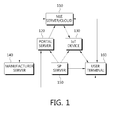
- FIG. 1 is a view illustrating a system for providing an NUI to which the present invention is applicable.
- the system for providing the NUI is established by connecting an NUI server/cloud 110, a portal server 120, an IoT device 130, a manufacturer server 140, a Service Provider (SP) server 150, and a user terminal 160 to one another.
- SP Service Provider
- the NUI server/cloud 110 is a server and/or cloud which owns a UI of the IoT device 130.
- the portal server 120 is a server which manages a portal service, and the service includes an electronic map providing service.
- the IoT device 130 refers to any device which can perform a specific function for a specific purpose. Although only one IoT device 130 is illustrated in FIG. 1 for convenience of illustration and explanation, a plurality of IoT devices 130 may exist in practice.
- the manufacturer server 140 is a server which is managed by a manufacturer of the IoT device 130, and uploads the UI of the IoT device 130 to the NUI server/cloud 110.
- the SP server 150 is a server which manages an NUI providing service and provides information on the IoT device 130 to the portal server 120 to register the information on the IoT device 130 at the electronic map.
- the information on the IoT device 130 which is registered includes a name and an installation location of the IoT device 130, user information, and a hierarchical relationship with other IoT devices.
- the user terminal 160 is a terminal which is carried by the user who intends to use the IoT device 130.
- the user terminal 160 acquires the UI of the IoT device 130 from the NUI server/cloud 110, provides the UI to the user through a display/touch screen, and allows the user to use the IoT device 130.
- FIG. 2 is a view illustrating a method for providing an NUI according to an exemplary embodiment of the present invention.
- the NUI server/cloud 110 when the user terminal 160 requests the NUI server/cloud 110 to search the IoT device by inputting a search term (S210), the NUI server/cloud 110 provides a list of searched IoT devices to the user terminal 160 (S220).
- the user terminal 160 may request the NUI server/cloud 110 to search neighboring IoT devices by inputting location information of the user terminal 160 as a query or may request the NUI server/cloud 110 to search IoT devices located in a specific region by inputting location information of the region as a query.
- the location of the user terminal 160 may be automatically acquired through a Global Positioning System (GPS) module, or may be indicated by the user through the electronic map.
- GPS Global Positioning System
- the specific region may be indicated by the user through the electronic map.
- the list may include images and location information of the searched IoT devices in addition to the names.
- the list of IoT devices provided by the NUI server/cloud 110 in operation S220 is provided to the user through the display/touch screen of the user terminal 160. Accordingly, the user may select a desired IoT device 130 (S230).
- the user terminal 160 requests a UI regarding the IoT device 130 selected by the user in operation S230 from the NUI server/cloud 110 (S240), and receives and acquires the UI regarding the IoT device 130 from the NUI server/cloud 110 as a response to the request (S250).
- the UI regarding the IoT device 130 may be provided not only as an application but also as a web page. Accordingly, the requesting/acquiring in operation S240/S250 may include requesting/acquiring the application for providing the 'IoT device UI' or requesting/acquiring the 'web page on which the IoT device UI is displayed'.
- the UI application is executed independently from other applications on the OS and provides the UI regarding the IoT device 130 when being executed.
- the UI webpage is generated as a UI by a web browser.
- the user terminal 160 interacts with the IoT device 130 by using the UI of the IoT device 130 acquired in operation S250 (S260). Accordingly, the user can manipulate the IoT device, grasp a status of the IoT device, and acquire data from the IoT device through the user terminal 160.
- the user terminal 160 may interact with the IoT device 130 not only through direct communication but also through indirect communication.
- the direct communication refers to a method for directly connecting the user terminal 160 an the IoT device 130 and making them interact with each other
- the indirect communication refers to a method for indirectly connecting the user terminal 160 and the IoT device 130 via the NUI server/cloud 110 and making them interact with each other.
- the user terminal 160 is required to acquire information necessary for connecting to the IoT device 130 from the NUI server/cloud 110 in advance.
- Operations S210 and S220 may be omitted and the method may start from operation S230.
- an ID of the IoT device 130 is acquired through a Quick Response (QR) code, a bar code, a Radio Frequency Identification (RFID) tag, and a Near Field Communication (NFC) chip and the IoT device 130 may be regarded as being selected by the ID of the IoT device 130.
- QR Quick Response
- RFID Radio Frequency Identification
- NFC Near Field Communication
- FIG. 3 is a view illustrating an example of an electronic map browser.
- the electronic map browser shown in FIG. 3 shows a plurality of selectable IoT devices and the user can select one from among the IoT devices.
- the electronic map browser can filter the IoT devices to be displayed on the electronic map browser according to a "distance" and a "security level". Specifically, a distance between the IoT device to be displayed on the electronic map browser and the user may be limited and the selectable IoT devices may be limited according to the security level of the user.
- the electronic map browser shown in FIG. 3 is suitable for selecting the IoT device 130 to manipulate, grasp a status, and acquire data through the user terminal 160, but it should be understood that the electronic map browser is not limited to this purpose.
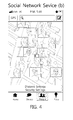
- FIG. 4 is a view illustrating another example of the electronic map browser.
- the electronic map browser shown in FIG. 4 shows a plurality of selectable persons and the user may select one from among the displayed persons.
- the electronic map browser shown in FIG. 4 can filter the persons according to a "distance” and a "security level".
- the electronic map browser of FIG. 4 is suitable for selecting an IoT device 130 of a person to whom the user will make a call or a video call, send an e-mail, send an Short Message Service (SMS) message, perform social networking, or chat through the user terminal 160.
- SMS Short Message Service
- the electronic map browser is not limited to this purpose.
- FIG. 5 is a view illustrating still another example of the electronic map browser.
- the electronic map browser of FIG. 5 shows a plurality of selectable places and the user may one from among the displayed places.
- the electronic map browser of FIG. 5 can filter the places according to a "distance” and a "security level".
- the electronic map browser of FIG. 5 is suitable for selecting an IoT device 130 to shop, reserve, apply, and receive information at a corresponding region through the user terminal 160.
- the electronic map browser is not limited to this purpose.
- the selectable persons and places displayed on the electronic map browser shown in FIGS. 4 and 5 are a kind of selectable graphic items displayed on the electronic map browser and the technical idea of the present invention is applicable to other kinds of graphic items.
- the IoT devices 130 existing on the network may be stratified. That is, IoT devices on a lower level may be configured to belong to IoT devices on a higher level.
- IoT devices of "Level 0" which is the top level
- the selected device of "Level 0" and IoT devices of "Level 1" belonging to the selected device of "Level 0” are displayed on the electronic map browser as shown in the second view of FIG. 6 .
- the selected IoT device of "Level 2" and IoT devices of "Level 3" belonging to the IoT device of "Level 2" are displayed on the electronic map browser as shown in the fourth view of FIG. 6 .
- the IoT devices of the higher level and the IoT devices of the lower level are connected with one another through a line, thereby showing their hierarchical relationship.
- FIG. 7 illustrates a hierarchical structure of IoT devices. As shown in FIG. 7 , the IoT devices are stratified by four levels and the operation of stratifying may be varied.
- the IoT devices shown in FIG. 7 may be really existing devices or virtually existing devices.
- the real device and the virtual device may be distinguished from each other by color.
- Any IoT device which is stratified has a UI, which is retained in the NUI server/cloud 110. Accordingly, the user terminal 160 can acquire the UIs regarding all of the IoT devices from the NUI server/cloud 110 regardless of the levels that the IoT devices belong to and can interact with the IoT devices.
- the kind of the electronic map may be automatically changed according to the level of the IoT devices displayed on the electronic map browser.
- the auto change of the kind of the electronic map may include an auto change of a degree of precision of the electronic map or an auto change of a view type of the electronic map. That is, as shown in FIG. 6 ,
- the electronic map browser may have a 'move-to-previous map function' and a 'move-to-next map function'. That is, when the first, second, third, and fourth electronic map browser screens are shown in sequence by a user's manipulation, it is possible to move to the third electronic map browser screen by calling 'previous map'. Thereafter, it is possible to move to the fourth electronic map browser screen by calling 'next map'.
- FIG. 8 illustrates an example of a method for making the user terminal 160 interact with the IoT device 130 by using the electronic map browser and the NUI.
- a general map is displayed on the top level
- a satellite map is displayed on the higher level
- a road view map is displayed on the lower level.
- a temperature sensor, a locking device, and an electric cutout which are devices of the lower level, belong to "home” which is the higher level.
- the "home” and “locking device” are virtual devices, and the temperature sensor and electricity cutout are real devices.
- the "locking device” is selected by the user and a "gas locking device” and a “door locking device”, which belong to the lower level of the locking device, are displayed on the electronic map browser along with the locking device.
- the door locking device is selected by the user and a UI of the door locking device is acquired through the network and is displayed.
Landscapes
- Engineering & Computer Science (AREA)
- General Engineering & Computer Science (AREA)
- Theoretical Computer Science (AREA)
- Human Computer Interaction (AREA)
- Physics & Mathematics (AREA)
- General Physics & Mathematics (AREA)
- User Interface Of Digital Computer (AREA)
Abstract
Description
- The present application claims the benefit under 35 U.S.C. § 119(a) to a Korean patent application filed in the Korean Intellectual Property Office on December 2, 2011, and assigned Serial No.
10-2011-0128658 - The present invention relates generally to a method and system for providing a User Interface (UI), and more particularly, to a method and system for providing a Network-based User Interface (NUI), which provides UIs for devices connected to a network.
- A device which requires a user's manipulation should provide a UI for manipulating. The UI should be provided through a display or a touch screen, which is a factor in the increase of a manufacturing cost of the device.
- However, in the case of a device which performs a relatively simple function, or a device which is not manipulated by a user very often, the increase in the manufacturing cost due to the above factor is irrational.
- In addition, in order to change the UI of the device or add a new UI, the device itself should be changed. This leads to many works to the extent that a new device is developed.
- To address the above-discussed deficiencies of the prior art, it is a primary aspect of the present invention to provide a method and system for providing an NUI, which acquires a UI regarding a device connected to a network through the network and interacts with the device.
- According to one aspect of the present invention, a method for providing a Network-based User Interface (NUI) includes: selecting one from among devices connected to a network; acquiring a UI regarding the selected device through the network; and interacting with the device by using the acquired UI.
- The acquiring may include acquiring an application which provides the UI regarding the selected device through the network.
- The acquiring may include acquiring a page for a browser which provides the UI regarding the selected device through the network.
- The method may further include: requesting a device search; and receiving a device list of searched devices as a response to the request, and the selecting may include selecting one from among the devices listed in the device list.
- The acquiring may include acquiring the UI regarding the selected device from a server through the network, and the interacting may include interacting with the device directly or indirectly via the server.
- The selecting may include: displaying an electronic map browser on which devices are displayed; and selecting one from among the devices displayed on the electronic map browser.
- The devices may be stratified, and the selecting may include, when a device of a higher level is selected, displaying devices of a lower level which belong to the device of the higher level.
- The method may further include automatically changing a kind of electronic map of the electronic map browser according to a level of devices displayed on the electronic map browser.
- The method may further include changing the electronic map browser to a previous browser screen or a next browser screen according to a user command.
- A display of the devices may be limited according to a distance from a user and a security level of the user.
- The selecting may include displaying an electronic map browser on which graphic items are displayed; and regarding a device which is assigned to a graphic item selected from among the graphic items displayed on the electronic map browser as being selected.
- The graphic item may be one of a person and a place.
- According to another aspect of the present invention, a system for providing an NUI includes: a server configured to retain UIs regarding devices connected to a network; and a terminal configured to acquire a UI regarding a device from the server through the network and interact with the device by using the acquired UI.
- According to the present invention as described above, the user terminal can acquire the UI regarding the device connected to the network through the network and interact with the device, so that the user can easily manipulate the device at a remote distance and can easily grasp the statue of the device through the user terminal.
- In addition, since the electronic map browser and the stratified device structure are used, it is easy to select the device and the user may enjoy manipulating the device.
- In addition, the UI of the device can be easily changed and can be distributed to many users in a simple method.
- For a more complete understanding of the present disclosure and its advantages, reference is now made to the following description taken in conjunction with the accompanying drawings, in which like reference numerals represent like parts:
-
FIG. 1 is a view illustrating a system for providing an NIU to which the present invention is applicable; -
FIG. 2 is a view illustrating a method for providing an NUI according to an exemplary embodiment of the present invention; -
FIG. 3 is a view illustrating an example of an electronic map browser; -
FIG. 4 is a view illustrating another example of the electronic map browser; -
FIG. 5 is a view illustrating another example of the electronic map browser; -
FIG. 6 is a view illustrating a method for showing stratified IoT devices; -
FIG. 7 is a view illustrating a hierarchical structure of IoT devices; and -
FIG. 8 is a view illustrating an example of a method for making a user terminal to interact with an IoT device by using an electronic map browser and an NUI. - Throughout the drawings, like reference numerals will be understood to refer to like parts, components and structures.
- Reference will now be made in detail to the embodiment of the present general inventive concept, examples of which are illustrated in the accompanying drawings, wherein like reference numerals refer to the like elements throughout. The embodiment is described below in order to explain the present general inventive concept by referring to the drawings.
- Exemplary embodiments of the present invention provide a method for providing a Network-based User Interface (NUI) in an Internet of Thing (IoT).
- The NUI suggested in exemplary embodiments of the present invention refers to a User Interface (UI) for an environment in which all things are connected to the Internet. The NUI is different from a general type of UI, which directly exists in a device, in that the NUI interacts with the UI of the device through a network.
- The UI of the device may be provided not only as an application which is independently executed on an operating system (OS), but also as a web page on a browser.
- The UI of the device may be manufactured by a device manufacturer and stored in a server or a storage on the network. Accordingly, a user who intends to use the device can acquire the UI of the device through the network. The UI of the device may be manufactured by a professional software developer in addition to the device manufacturer.
-
FIG. 1 is a view illustrating a system for providing an NUI to which the present invention is applicable. As shown inFIG. 1 , the system for providing the NUI is established by connecting an NUI server/cloud 110, aportal server 120, anIoT device 130, amanufacturer server 140, a Service Provider (SP)server 150, and auser terminal 160 to one another. - The NUI server/
cloud 110 is a server and/or cloud which owns a UI of theIoT device 130. Theportal server 120 is a server which manages a portal service, and the service includes an electronic map providing service. - The
IoT device 130 refers to any device which can perform a specific function for a specific purpose. Although only oneIoT device 130 is illustrated inFIG. 1 for convenience of illustration and explanation, a plurality ofIoT devices 130 may exist in practice. - The
manufacturer server 140 is a server which is managed by a manufacturer of theIoT device 130, and uploads the UI of theIoT device 130 to the NUI server/cloud 110. - The
SP server 150 is a server which manages an NUI providing service and provides information on theIoT device 130 to theportal server 120 to register the information on theIoT device 130 at the electronic map. The information on theIoT device 130 which is registered includes a name and an installation location of theIoT device 130, user information, and a hierarchical relationship with other IoT devices. - The
user terminal 160 is a terminal which is carried by the user who intends to use theIoT device 130. - Hereinafter, a process of using the
IoT device 130 through theuser terminal 160 will be explained in detail. Specifically, theuser terminal 160 acquires the UI of theIoT device 130 from the NUI server/cloud 110, provides the UI to the user through a display/touch screen, and allows the user to use theIoT device 130. -
FIG. 2 is a view illustrating a method for providing an NUI according to an exemplary embodiment of the present invention. - As shown in
FIG. 2 , when theuser terminal 160 requests the NUI server/cloud 110 to search the IoT device by inputting a search term (S210), the NUI server/cloud 110 provides a list of searched IoT devices to the user terminal 160 (S220). - Instead of inputting the search term, the
user terminal 160 may request the NUI server/cloud 110 to search neighboring IoT devices by inputting location information of theuser terminal 160 as a query or may request the NUI server/cloud 110 to search IoT devices located in a specific region by inputting location information of the region as a query. - The location of the
user terminal 160 may be automatically acquired through a Global Positioning System (GPS) module, or may be indicated by the user through the electronic map. The specific region may be indicated by the user through the electronic map. - In operation S220, the list may include images and location information of the searched IoT devices in addition to the names.
- The list of IoT devices provided by the NUI server/
cloud 110 in operation S220 is provided to the user through the display/touch screen of theuser terminal 160. Accordingly, the user may select a desired IoT device 130 (S230). - Thereafter, the
user terminal 160 requests a UI regarding theIoT device 130 selected by the user in operation S230 from the NUI server/cloud 110 (S240), and receives and acquires the UI regarding theIoT device 130 from the NUI server/cloud 110 as a response to the request (S250). - The UI regarding the
IoT device 130 may be provided not only as an application but also as a web page. Accordingly, the requesting/acquiring in operation S240/S250 may include requesting/acquiring the application for providing the 'IoT device UI' or requesting/acquiring the 'web page on which the IoT device UI is displayed'. - The UI application is executed independently from other applications on the OS and provides the UI regarding the
IoT device 130 when being executed. In addition, the UI webpage is generated as a UI by a web browser. - The
user terminal 160 interacts with theIoT device 130 by using the UI of theIoT device 130 acquired in operation S250 (S260). Accordingly, the user can manipulate the IoT device, grasp a status of the IoT device, and acquire data from the IoT device through theuser terminal 160. - In operation S260, the
user terminal 160 may interact with theIoT device 130 not only through direct communication but also through indirect communication. The direct communication refers to a method for directly connecting theuser terminal 160 an theIoT device 130 and making them interact with each other, and the indirect communication refers to a method for indirectly connecting theuser terminal 160 and theIoT device 130 via the NUI server/cloud 110 and making them interact with each other. - To perform direct communication, the
user terminal 160 is required to acquire information necessary for connecting to theIoT device 130 from the NUI server/cloud 110 in advance. - Operations S210 and S220 may be omitted and the method may start from operation S230. For example, an ID of the
IoT device 130 is acquired through a Quick Response (QR) code, a bar code, a Radio Frequency Identification (RFID) tag, and a Near Field Communication (NFC) chip and theIoT device 130 may be regarded as being selected by the ID of theIoT device 130. - Hereinafter, a method for selecting the
IoT device 130 through an electronic map browser will be explained as an example of operation S230. -
FIG. 3 is a view illustrating an example of an electronic map browser. The electronic map browser shown inFIG. 3 shows a plurality of selectable IoT devices and the user can select one from among the IoT devices. - As indicated in a lower portion of
FIG. 3 , the electronic map browser can filter the IoT devices to be displayed on the electronic map browser according to a "distance" and a "security level". Specifically, a distance between the IoT device to be displayed on the electronic map browser and the user may be limited and the selectable IoT devices may be limited according to the security level of the user. - The electronic map browser shown in
FIG. 3 is suitable for selecting theIoT device 130 to manipulate, grasp a status, and acquire data through theuser terminal 160, but it should be understood that the electronic map browser is not limited to this purpose. -
FIG. 4 is a view illustrating another example of the electronic map browser. The electronic map browser shown inFIG. 4 shows a plurality of selectable persons and the user may select one from among the displayed persons. - Like the electronic map browser shown in
FIG. 3 , the electronic map browser shown inFIG. 4 can filter the persons according to a "distance" and a "security level". - The electronic map browser of
FIG. 4 is suitable for selecting anIoT device 130 of a person to whom the user will make a call or a video call, send an e-mail, send an Short Message Service (SMS) message, perform social networking, or chat through theuser terminal 160. However, it should be understood that the electronic map browser is not limited to this purpose. -
FIG. 5 is a view illustrating still another example of the electronic map browser. The electronic map browser ofFIG. 5 shows a plurality of selectable places and the user may one from among the displayed places. - Like the electronic map browser of
FIGS. 3 and4 , the electronic map browser ofFIG. 5 can filter the places according to a "distance" and a "security level". - The electronic map browser of
FIG. 5 is suitable for selecting anIoT device 130 to shop, reserve, apply, and receive information at a corresponding region through theuser terminal 160. However, it should be understood that the electronic map browser is not limited to this purpose. - The selectable persons and places displayed on the electronic map browser shown in
FIGS. 4 and5 are a kind of selectable graphic items displayed on the electronic map browser and the technical idea of the present invention is applicable to other kinds of graphic items. - The
IoT devices 130 existing on the network may be stratified. That is, IoT devices on a lower level may be configured to belong to IoT devices on a higher level. - Accordingly, when IoT devices of "
Level 0", which is the top level, are displayed on the electronic map browser and one of them is selected as shown in the first view ofFIG. 6 , the selected device of "Level 0" and IoT devices of "Level 1" belonging to the selected device of "Level 0" are displayed on the electronic map browser as shown in the second view ofFIG. 6 . - Thereafter, when one of the IoT devices of "
Level 1" displayed on the electronic map browser as shown in the second view ofFIG. 6 is selected, the selected IoT device of "Level 1" and IoT devices of "Level 2" belonging to the IoT device of "Level 1" are displayed on the electronic map browser as shown in the third view ofFIG. 6 . - When one of the IoT devices of "
Level 2" displayed on the electronic map browser as shown in the third view ofFIG. 6 is selected, the selected IoT device of "Level 2" and IoT devices of "Level 3" belonging to the IoT device of "Level 2" are displayed on the electronic map browser as shown in the fourth view ofFIG. 6 . - As shown in
FIG. 6 , The IoT devices of the higher level and the IoT devices of the lower level are connected with one another through a line, thereby showing their hierarchical relationship. -
FIG. 7 illustrates a hierarchical structure of IoT devices. As shown inFIG. 7 , the IoT devices are stratified by four levels and the operation of stratifying may be varied. - The IoT devices shown in
FIG. 7 may be really existing devices or virtually existing devices. The real device and the virtual device may be distinguished from each other by color. Any IoT device which is stratified has a UI, which is retained in the NUI server/cloud 110. Accordingly, theuser terminal 160 can acquire the UIs regarding all of the IoT devices from the NUI server/cloud 110 regardless of the levels that the IoT devices belong to and can interact with the IoT devices. - The kind of the electronic map may be automatically changed according to the level of the IoT devices displayed on the electronic map browser. The auto change of the kind of the electronic map may include an auto change of a degree of precision of the electronic map or an auto change of a view type of the electronic map. That is, as shown in
FIG. 6 , - 1) when the IoT devices of "
Level 0" are displayed on the electronic map browser, the electronic map is displayed as a general map, - 2) when the IoT devices of "Level 0-1" are displayed on the electronic map browser, the electronic map is displayed as a satellite map,
- 3) when the IoT devices of "Level 1-2" are displayed on the electronic map browser, the electronic map is displayed as a road view map, and
- 4) when the IoT devices of "Level 2-3" are displayed on the electronic map browser, the electronic map is displayed as a building interior view map.
- In addition, the electronic map browser may have a 'move-to-previous map function' and a 'move-to-next map function'. That is, when the first, second, third, and fourth electronic map browser screens are shown in sequence by a user's manipulation, it is possible to move to the third electronic map browser screen by calling 'previous map'. Thereafter, it is possible to move to the fourth electronic map browser screen by calling 'next map'.
-
FIG. 8 illustrates an example of a method for making theuser terminal 160 interact with theIoT device 130 by using the electronic map browser and the NUI. As shown inFIG. 8 , a general map is displayed on the top level, a satellite map is displayed on the higher level, and a road view map is displayed on the lower level. - In addition, referring to
FIG. 8 , a temperature sensor, a locking device, and an electric cutout, which are devices of the lower level, belong to "home" which is the higher level. The "home" and "locking device" are virtual devices, and the temperature sensor and electricity cutout are real devices. - In addition, referring to
FIG. 8 , the "locking device" is selected by the user and a "gas locking device" and a "door locking device", which belong to the lower level of the locking device, are displayed on the electronic map browser along with the locking device. - In addition, referring to
FIG. 8 , the door locking device is selected by the user and a UI of the door locking device is acquired through the network and is displayed. - Although the present disclosure has been described with an exemplary embodiment, various changes and modifications may be suggested to one skilled in the art. It is intended that the present disclosure encompass such changes and modifications as fall within the scope of the appended claims.
Claims (13)
- A method for providing a Network-based User Interface (NUI), the method comprising:selecting one from among devices connected to a network;acquiring a UI regarding the selected device through the network; andinteracting with the device by using the acquired UI.
- The method of claim 1, wherein the acquiring comprises acquiring an application which provides the UI regarding the selected device through the network.
- The method of claim 1, wherein the acquiring comprises acquiring a page for a browser which provides the UI regarding the selected device through the network.
- The method of claim 1, further comprising:requesting a device search; andreceiving a device list of searched devices as a response to the request,wherein the selecting comprises selecting one from among the devices listed in the device list.
- The method of claim 1, wherein the acquiring comprises acquiring the UI regarding the selected device from a server through the network, and
wherein the interacting comprises interacting with the device directly or indirectly via the server. - The method of claim 1, wherein the selecting comprises:displaying an electronic map browser on which devices are displayed; andselecting one from among the devices displayed on the electronic map browser.
- The method of claim 1, wherein the devices are stratified, and
wherein the selecting comprises, when a device of a higher level is selected, displaying devices of a lower level which belong to the device of the higher level. - The method of claim 7, further comprising automatically changing a kind of electronic map of the electronic map browser according to a level of devices displayed on the electronic map browser.
- The method of claim 7, further comprising changing the electronic map browser to a previous browser screen or a next browser screen according to a user command.
- The method of claim 1, wherein a display of the devices is limited according to a distance from a user and a security level of the user.
- The method of claim 1, wherein the selecting comprises:displaying an electronic map browser on which graphic items are displayed; andregarding a device which is assigned to a graphic item selected from among the graphic items displayed on the electronic map browser as being selected.
- The method of claim 11, wherein the graphic item is one of a person and a place.
- A system for providing an NUI comprising:a server configured to retain UIs regarding devices connected to a network; anda terminal configured to acquire a UI regarding a device from the server through the network and interact with the device by using the acquired UI.
Applications Claiming Priority (2)
| Application Number | Priority Date | Filing Date | Title |
|---|---|---|---|
| KR1020110128658A KR101373612B1 (en) | 2011-11-24 | 2011-12-02 | Method and system for providing NUI |
| PCT/KR2011/010137 WO2013081239A1 (en) | 2011-12-02 | 2011-12-27 | Method and system for providing an nui |
Publications (2)
| Publication Number | Publication Date |
|---|---|
| EP2787447A1 true EP2787447A1 (en) | 2014-10-08 |
| EP2787447A4 EP2787447A4 (en) | 2015-12-16 |
Family
ID=48535670
Family Applications (1)
| Application Number | Title | Priority Date | Filing Date |
|---|---|---|---|
| EP11876660.9A Withdrawn EP2787447A4 (en) | 2011-12-02 | 2011-12-27 | METHOD AND SYSTEM FOR PROVIDING NUI |
Country Status (2)
| Country | Link |
|---|---|
| EP (1) | EP2787447A4 (en) |
| WO (1) | WO2013081239A1 (en) |
Cited By (1)
| Publication number | Priority date | Publication date | Assignee | Title |
|---|---|---|---|---|
| EP3073709B1 (en) * | 2015-03-25 | 2019-08-14 | Intel Corporation | Accessing service of internet of things |
Family Cites Families (11)
| Publication number | Priority date | Publication date | Assignee | Title |
|---|---|---|---|---|
| EP0626635B1 (en) * | 1993-05-24 | 2003-03-05 | Sun Microsystems, Inc. | Improved graphical user interface with method for interfacing to remote devices |
| US6628304B2 (en) * | 1998-12-09 | 2003-09-30 | Cisco Technology, Inc. | Method and apparatus providing a graphical user interface for representing and navigating hierarchical networks |
| US6885362B2 (en) * | 2001-07-12 | 2005-04-26 | Nokia Corporation | System and method for accessing ubiquitous resources in an intelligent environment |
| US20030210284A1 (en) * | 2002-05-10 | 2003-11-13 | Government Of The United States Of America | Navigational display of hierarchically structured data |
| KR100638207B1 (en) * | 2004-02-23 | 2006-10-25 | 엘지전자 주식회사 | Server-Client system and its method for the same |
| KR100653209B1 (en) * | 2005-11-17 | 2006-12-05 | 주식회사 팬택 | A user interface providing server, a communication terminal device driving the standard MM platform, an operation method of the user interface providing server, and an operation method of the communication terminal device driving the standard MM platform. |
| KR101268602B1 (en) * | 2008-07-03 | 2013-05-28 | 에스케이플래닛 주식회사 | System and method for paying using smart card, and smart card applied to the same |
| KR101531164B1 (en) * | 2008-08-12 | 2015-06-25 | 삼성전자주식회사 | Method and apparatus for providing/receiving user interface using user interface directory |
| KR101542744B1 (en) * | 2009-03-18 | 2015-08-10 | 삼성전자주식회사 | Method and apparatus for controlling controlled device |
| TWI459280B (en) * | 2009-03-23 | 2014-11-01 | Alpha Networks Inc | Setting and modifying method of user's operating interface and digital audio/video playback system using the method |
| KR101531532B1 (en) * | 2010-02-11 | 2015-06-25 | 삼성전자주식회사 | Method and apparatus for using service of home network device based on remote access |
-
2011
- 2011-12-27 EP EP11876660.9A patent/EP2787447A4/en not_active Withdrawn
- 2011-12-27 WO PCT/KR2011/010137 patent/WO2013081239A1/en not_active Ceased
Cited By (4)
| Publication number | Priority date | Publication date | Assignee | Title |
|---|---|---|---|---|
| EP3073709B1 (en) * | 2015-03-25 | 2019-08-14 | Intel Corporation | Accessing service of internet of things |
| US10673959B2 (en) | 2015-03-25 | 2020-06-02 | Intel Corporation | Accessing service of Internet of Things |
| US11272016B2 (en) | 2015-03-25 | 2022-03-08 | Intel Corporation | Accessing service of Internet of Things |
| US12113868B2 (en) | 2015-03-25 | 2024-10-08 | Intel Corporation | Accessing service of internet of things |
Also Published As
| Publication number | Publication date |
|---|---|
| WO2013081239A1 (en) | 2013-06-06 |
| EP2787447A4 (en) | 2015-12-16 |
Similar Documents
| Publication | Publication Date | Title |
|---|---|---|
| US9823812B2 (en) | Method and system for providing NUI | |
| JP5736433B2 (en) | IoT browsing method and apparatus | |
| US9477378B2 (en) | Method and apparatus for providing a user interface | |
| JP5334911B2 (en) | 3D map image generation program and 3D map image generation system | |
| KR102385081B1 (en) | Method, system, and non-transitory computer readable record medium for sharing information in chat room using application added to platform in messenger | |
| CN106716324A (en) | Method, system and medium for launching mobile application using public display device | |
| KR20150071252A (en) | Method and apparatus for controlling a composition of a picture in electronic device | |
| KR20210062095A (en) | Media item attachment system | |
| US10028086B2 (en) | Techniques for implementing location based device services | |
| US9918193B1 (en) | Hybrid electronic navigation and invitation system | |
| CN112818259B (en) | Content recommendation method, electronic device and computer-readable storage medium | |
| US10156446B2 (en) | Facility wayfinding system | |
| JP6832098B2 (en) | Equipment, computer programs and methods | |
| JP2011237597A (en) | Map display device, method, program and map display server | |
| KR20140015737A (en) | Server and terminal device for managing user information and method for controlling each thereof | |
| WO2014186425A2 (en) | Automatic resource scheduling | |
| CN103391278A (en) | Method and system for terminals to connect server | |
| JP2018195339A (en) | System, server, and program for providing electronic manual | |
| JP6030891B2 (en) | An accommodation facility information system for providing vacancy information of an accommodation facility and for a user to communicate with the accommodation facility based on the information | |
| WO2015134302A1 (en) | Context aware commands | |
| JP5444768B2 (en) | Information recommendation device, server, method and program | |
| KR101497994B1 (en) | Multimedia map service system and method of providing it | |
| Siriteanu et al. | Meetyou—Social networking on Android | |
| KR20130116679A (en) | Notice service system for table information of a shop | |
| US20160253771A1 (en) | Centralized Cemetery Data Management Listing System |
Legal Events
| Date | Code | Title | Description |
|---|---|---|---|
| PUAI | Public reference made under article 153(3) epc to a published international application that has entered the european phase |
Free format text: ORIGINAL CODE: 0009012 |
|
| 17P | Request for examination filed |
Effective date: 20140630 |
|
| AK | Designated contracting states |
Kind code of ref document: A1 Designated state(s): AL AT BE BG CH CY CZ DE DK EE ES FI FR GB GR HR HU IE IS IT LI LT LU LV MC MK MT NL NO PL PT RO RS SE SI SK SM TR |
|
| DAX | Request for extension of the european patent (deleted) | ||
| RIC1 | Information provided on ipc code assigned before grant |
Ipc: G06F 3/048 20130101ALI20150714BHEP Ipc: G06F 3/0481 20130101ALI20150714BHEP Ipc: G06F 17/30 20060101ALI20150714BHEP Ipc: G06F 15/16 20060101AFI20150714BHEP Ipc: G06F 9/44 20060101ALI20150714BHEP |
|
| RA4 | Supplementary search report drawn up and despatched (corrected) |
Effective date: 20151117 |
|
| RIC1 | Information provided on ipc code assigned before grant |
Ipc: G06F 9/44 20060101ALI20151111BHEP Ipc: G06F 3/0481 20130101ALI20151111BHEP Ipc: G06F 3/048 20130101ALI20151111BHEP Ipc: G06F 15/16 20060101AFI20151111BHEP Ipc: G06F 17/30 20060101ALI20151111BHEP |
|
| 17Q | First examination report despatched |
Effective date: 20160906 |
|
| STAA | Information on the status of an ep patent application or granted ep patent |
Free format text: STATUS: EXAMINATION IS IN PROGRESS |
|
| STAA | Information on the status of an ep patent application or granted ep patent |
Free format text: STATUS: THE APPLICATION IS DEEMED TO BE WITHDRAWN |
|
| 18D | Application deemed to be withdrawn |
Effective date: 20190702 |