EP2787106A1 - Biosoluble inorganic fiber and method for producing same - Google Patents
Biosoluble inorganic fiber and method for producing same Download PDFInfo
- Publication number
- EP2787106A1 EP2787106A1 EP12853538.2A EP12853538A EP2787106A1 EP 2787106 A1 EP2787106 A1 EP 2787106A1 EP 12853538 A EP12853538 A EP 12853538A EP 2787106 A1 EP2787106 A1 EP 2787106A1
- Authority
- EP
- European Patent Office
- Prior art keywords
- fiber
- surfactant
- biosoluble
- inorganic fiber
- inorganic
- Prior art date
- Legal status (The legal status is an assumption and is not a legal conclusion. Google has not performed a legal analysis and makes no representation as to the accuracy of the status listed.)
- Granted
Links
Images
Classifications
-
- D—TEXTILES; PAPER
- D02—YARNS; MECHANICAL FINISHING OF YARNS OR ROPES; WARPING OR BEAMING
- D02G—CRIMPING OR CURLING FIBRES, FILAMENTS, THREADS, OR YARNS; YARNS OR THREADS
- D02G3/00—Yarns or threads, e.g. fancy yarns; Processes or apparatus for the production thereof, not otherwise provided for
- D02G3/22—Yarns or threads characterised by constructional features, e.g. blending, filament/fibre
- D02G3/36—Cored or coated yarns or threads
-
- C—CHEMISTRY; METALLURGY
- C03—GLASS; MINERAL OR SLAG WOOL
- C03C—CHEMICAL COMPOSITION OF GLASSES, GLAZES OR VITREOUS ENAMELS; SURFACE TREATMENT OF GLASS; SURFACE TREATMENT OF FIBRES OR FILAMENTS MADE FROM GLASS, MINERALS OR SLAGS; JOINING GLASS TO GLASS OR OTHER MATERIALS
- C03C13/00—Fibre or filament compositions
-
- C—CHEMISTRY; METALLURGY
- C03—GLASS; MINERAL OR SLAG WOOL
- C03C—CHEMICAL COMPOSITION OF GLASSES, GLAZES OR VITREOUS ENAMELS; SURFACE TREATMENT OF GLASS; SURFACE TREATMENT OF FIBRES OR FILAMENTS MADE FROM GLASS, MINERALS OR SLAGS; JOINING GLASS TO GLASS OR OTHER MATERIALS
- C03C25/00—Surface treatment of fibres or filaments made from glass, minerals or slags
- C03C25/10—Coating
- C03C25/24—Coatings containing organic materials
- C03C25/25—Non-macromolecular compounds
-
- C—CHEMISTRY; METALLURGY
- C03—GLASS; MINERAL OR SLAG WOOL
- C03C—CHEMICAL COMPOSITION OF GLASSES, GLAZES OR VITREOUS ENAMELS; SURFACE TREATMENT OF GLASS; SURFACE TREATMENT OF FIBRES OR FILAMENTS MADE FROM GLASS, MINERALS OR SLAGS; JOINING GLASS TO GLASS OR OTHER MATERIALS
- C03C3/00—Glass compositions
- C03C3/04—Glass compositions containing silica
- C03C3/076—Glass compositions containing silica with 40% to 90% silica, by weight
- C03C3/083—Glass compositions containing silica with 40% to 90% silica, by weight containing aluminium oxide or an iron compound
- C03C3/085—Glass compositions containing silica with 40% to 90% silica, by weight containing aluminium oxide or an iron compound containing an oxide of a divalent metal
- C03C3/087—Glass compositions containing silica with 40% to 90% silica, by weight containing aluminium oxide or an iron compound containing an oxide of a divalent metal containing calcium oxide, e.g. common sheet or container glass
-
- C—CHEMISTRY; METALLURGY
- C04—CEMENTS; CONCRETE; ARTIFICIAL STONE; CERAMICS; REFRACTORIES
- C04B—LIME, MAGNESIA; SLAG; CEMENTS; COMPOSITIONS THEREOF, e.g. MORTARS, CONCRETE OR LIKE BUILDING MATERIALS; ARTIFICIAL STONE; CERAMICS; REFRACTORIES; TREATMENT OF NATURAL STONE
- C04B35/00—Shaped ceramic products characterised by their composition; Ceramics compositions; Processing powders of inorganic compounds preparatory to the manufacturing of ceramic products
- C04B35/622—Forming processes; Processing powders of inorganic compounds preparatory to the manufacturing of ceramic products
- C04B35/62227—Forming processes; Processing powders of inorganic compounds preparatory to the manufacturing of ceramic products obtaining fibres
- C04B35/62231—Forming processes; Processing powders of inorganic compounds preparatory to the manufacturing of ceramic products obtaining fibres based on oxide ceramics
- C04B35/6224—Fibres based on silica
-
- C—CHEMISTRY; METALLURGY
- C04—CEMENTS; CONCRETE; ARTIFICIAL STONE; CERAMICS; REFRACTORIES
- C04B—LIME, MAGNESIA; SLAG; CEMENTS; COMPOSITIONS THEREOF, e.g. MORTARS, CONCRETE OR LIKE BUILDING MATERIALS; ARTIFICIAL STONE; CERAMICS; REFRACTORIES; TREATMENT OF NATURAL STONE
- C04B35/00—Shaped ceramic products characterised by their composition; Ceramics compositions; Processing powders of inorganic compounds preparatory to the manufacturing of ceramic products
- C04B35/622—Forming processes; Processing powders of inorganic compounds preparatory to the manufacturing of ceramic products
- C04B35/626—Preparing or treating the powders individually or as batches ; preparing or treating macroscopic reinforcing agents for ceramic products, e.g. fibres; mechanical aspects section B
- C04B35/628—Coating the powders or the macroscopic reinforcing agents
- C04B35/62844—Coating fibres
-
- D—TEXTILES; PAPER
- D02—YARNS; MECHANICAL FINISHING OF YARNS OR ROPES; WARPING OR BEAMING
- D02G—CRIMPING OR CURLING FIBRES, FILAMENTS, THREADS, OR YARNS; YARNS OR THREADS
- D02G3/00—Yarns or threads, e.g. fancy yarns; Processes or apparatus for the production thereof, not otherwise provided for
- D02G3/02—Yarns or threads characterised by the material or by the materials from which they are made
- D02G3/04—Blended or other yarns or threads containing components made from different materials
- D02G3/045—Blended or other yarns or threads containing components made from different materials all components being made from artificial or synthetic material
-
- D—TEXTILES; PAPER
- D02—YARNS; MECHANICAL FINISHING OF YARNS OR ROPES; WARPING OR BEAMING
- D02G—CRIMPING OR CURLING FIBRES, FILAMENTS, THREADS, OR YARNS; YARNS OR THREADS
- D02G3/00—Yarns or threads, e.g. fancy yarns; Processes or apparatus for the production thereof, not otherwise provided for
- D02G3/44—Yarns or threads characterised by the purpose for which they are designed
- D02G3/443—Heat-resistant, fireproof or flame-retardant yarns or threads
-
- D—TEXTILES; PAPER
- D06—TREATMENT OF TEXTILES OR THE LIKE; LAUNDERING; FLEXIBLE MATERIALS NOT OTHERWISE PROVIDED FOR
- D06M—TREATMENT, NOT PROVIDED FOR ELSEWHERE IN CLASS D06, OF FIBRES, THREADS, YARNS, FABRICS, FEATHERS OR FIBROUS GOODS MADE FROM SUCH MATERIALS
- D06M13/00—Treating fibres, threads, yarns, fabrics or fibrous goods made from such materials, with non-macromolecular organic compounds; Such treatment combined with mechanical treatment
- D06M13/10—Treating fibres, threads, yarns, fabrics or fibrous goods made from such materials, with non-macromolecular organic compounds; Such treatment combined with mechanical treatment with compounds containing oxygen
- D06M13/224—Esters of carboxylic acids; Esters of carbonic acid
- D06M13/2246—Esters of unsaturated carboxylic acids
-
- D—TEXTILES; PAPER
- D06—TREATMENT OF TEXTILES OR THE LIKE; LAUNDERING; FLEXIBLE MATERIALS NOT OTHERWISE PROVIDED FOR
- D06M—TREATMENT, NOT PROVIDED FOR ELSEWHERE IN CLASS D06, OF FIBRES, THREADS, YARNS, FABRICS, FEATHERS OR FIBROUS GOODS MADE FROM SUCH MATERIALS
- D06M13/00—Treating fibres, threads, yarns, fabrics or fibrous goods made from such materials, with non-macromolecular organic compounds; Such treatment combined with mechanical treatment
- D06M13/322—Treating fibres, threads, yarns, fabrics or fibrous goods made from such materials, with non-macromolecular organic compounds; Such treatment combined with mechanical treatment with compounds containing nitrogen
- D06M13/325—Amines
-
- C—CHEMISTRY; METALLURGY
- C03—GLASS; MINERAL OR SLAG WOOL
- C03C—CHEMICAL COMPOSITION OF GLASSES, GLAZES OR VITREOUS ENAMELS; SURFACE TREATMENT OF GLASS; SURFACE TREATMENT OF FIBRES OR FILAMENTS MADE FROM GLASS, MINERALS OR SLAGS; JOINING GLASS TO GLASS OR OTHER MATERIALS
- C03C2213/00—Glass fibres or filaments
- C03C2213/02—Biodegradable glass fibres
-
- C—CHEMISTRY; METALLURGY
- C04—CEMENTS; CONCRETE; ARTIFICIAL STONE; CERAMICS; REFRACTORIES
- C04B—LIME, MAGNESIA; SLAG; CEMENTS; COMPOSITIONS THEREOF, e.g. MORTARS, CONCRETE OR LIKE BUILDING MATERIALS; ARTIFICIAL STONE; CERAMICS; REFRACTORIES; TREATMENT OF NATURAL STONE
- C04B2235/00—Aspects relating to ceramic starting mixtures or sintered ceramic products
- C04B2235/02—Composition of constituents of the starting material or of secondary phases of the final product
- C04B2235/30—Constituents and secondary phases not being of a fibrous nature
- C04B2235/32—Metal oxides, mixed metal oxides, or oxide-forming salts thereof, e.g. carbonates, nitrates, (oxy)hydroxides, chlorides
- C04B2235/3201—Alkali metal oxides or oxide-forming salts thereof
-
- C—CHEMISTRY; METALLURGY
- C04—CEMENTS; CONCRETE; ARTIFICIAL STONE; CERAMICS; REFRACTORIES
- C04B—LIME, MAGNESIA; SLAG; CEMENTS; COMPOSITIONS THEREOF, e.g. MORTARS, CONCRETE OR LIKE BUILDING MATERIALS; ARTIFICIAL STONE; CERAMICS; REFRACTORIES; TREATMENT OF NATURAL STONE
- C04B2235/00—Aspects relating to ceramic starting mixtures or sintered ceramic products
- C04B2235/02—Composition of constituents of the starting material or of secondary phases of the final product
- C04B2235/30—Constituents and secondary phases not being of a fibrous nature
- C04B2235/32—Metal oxides, mixed metal oxides, or oxide-forming salts thereof, e.g. carbonates, nitrates, (oxy)hydroxides, chlorides
- C04B2235/3205—Alkaline earth oxides or oxide forming salts thereof, e.g. beryllium oxide
- C04B2235/3206—Magnesium oxides or oxide-forming salts thereof
-
- C—CHEMISTRY; METALLURGY
- C04—CEMENTS; CONCRETE; ARTIFICIAL STONE; CERAMICS; REFRACTORIES
- C04B—LIME, MAGNESIA; SLAG; CEMENTS; COMPOSITIONS THEREOF, e.g. MORTARS, CONCRETE OR LIKE BUILDING MATERIALS; ARTIFICIAL STONE; CERAMICS; REFRACTORIES; TREATMENT OF NATURAL STONE
- C04B2235/00—Aspects relating to ceramic starting mixtures or sintered ceramic products
- C04B2235/02—Composition of constituents of the starting material or of secondary phases of the final product
- C04B2235/30—Constituents and secondary phases not being of a fibrous nature
- C04B2235/32—Metal oxides, mixed metal oxides, or oxide-forming salts thereof, e.g. carbonates, nitrates, (oxy)hydroxides, chlorides
- C04B2235/3205—Alkaline earth oxides or oxide forming salts thereof, e.g. beryllium oxide
- C04B2235/3208—Calcium oxide or oxide-forming salts thereof, e.g. lime
-
- C—CHEMISTRY; METALLURGY
- C04—CEMENTS; CONCRETE; ARTIFICIAL STONE; CERAMICS; REFRACTORIES
- C04B—LIME, MAGNESIA; SLAG; CEMENTS; COMPOSITIONS THEREOF, e.g. MORTARS, CONCRETE OR LIKE BUILDING MATERIALS; ARTIFICIAL STONE; CERAMICS; REFRACTORIES; TREATMENT OF NATURAL STONE
- C04B2235/00—Aspects relating to ceramic starting mixtures or sintered ceramic products
- C04B2235/02—Composition of constituents of the starting material or of secondary phases of the final product
- C04B2235/30—Constituents and secondary phases not being of a fibrous nature
- C04B2235/32—Metal oxides, mixed metal oxides, or oxide-forming salts thereof, e.g. carbonates, nitrates, (oxy)hydroxides, chlorides
- C04B2235/3217—Aluminum oxide or oxide forming salts thereof, e.g. bauxite, alpha-alumina
-
- C—CHEMISTRY; METALLURGY
- C04—CEMENTS; CONCRETE; ARTIFICIAL STONE; CERAMICS; REFRACTORIES
- C04B—LIME, MAGNESIA; SLAG; CEMENTS; COMPOSITIONS THEREOF, e.g. MORTARS, CONCRETE OR LIKE BUILDING MATERIALS; ARTIFICIAL STONE; CERAMICS; REFRACTORIES; TREATMENT OF NATURAL STONE
- C04B2235/00—Aspects relating to ceramic starting mixtures or sintered ceramic products
- C04B2235/02—Composition of constituents of the starting material or of secondary phases of the final product
- C04B2235/30—Constituents and secondary phases not being of a fibrous nature
- C04B2235/32—Metal oxides, mixed metal oxides, or oxide-forming salts thereof, e.g. carbonates, nitrates, (oxy)hydroxides, chlorides
- C04B2235/3224—Rare earth oxide or oxide forming salts thereof, e.g. scandium oxide
-
- C—CHEMISTRY; METALLURGY
- C04—CEMENTS; CONCRETE; ARTIFICIAL STONE; CERAMICS; REFRACTORIES
- C04B—LIME, MAGNESIA; SLAG; CEMENTS; COMPOSITIONS THEREOF, e.g. MORTARS, CONCRETE OR LIKE BUILDING MATERIALS; ARTIFICIAL STONE; CERAMICS; REFRACTORIES; TREATMENT OF NATURAL STONE
- C04B2235/00—Aspects relating to ceramic starting mixtures or sintered ceramic products
- C04B2235/02—Composition of constituents of the starting material or of secondary phases of the final product
- C04B2235/30—Constituents and secondary phases not being of a fibrous nature
- C04B2235/32—Metal oxides, mixed metal oxides, or oxide-forming salts thereof, e.g. carbonates, nitrates, (oxy)hydroxides, chlorides
- C04B2235/3224—Rare earth oxide or oxide forming salts thereof, e.g. scandium oxide
- C04B2235/3225—Yttrium oxide or oxide-forming salts thereof
-
- C—CHEMISTRY; METALLURGY
- C04—CEMENTS; CONCRETE; ARTIFICIAL STONE; CERAMICS; REFRACTORIES
- C04B—LIME, MAGNESIA; SLAG; CEMENTS; COMPOSITIONS THEREOF, e.g. MORTARS, CONCRETE OR LIKE BUILDING MATERIALS; ARTIFICIAL STONE; CERAMICS; REFRACTORIES; TREATMENT OF NATURAL STONE
- C04B2235/00—Aspects relating to ceramic starting mixtures or sintered ceramic products
- C04B2235/02—Composition of constituents of the starting material or of secondary phases of the final product
- C04B2235/30—Constituents and secondary phases not being of a fibrous nature
- C04B2235/32—Metal oxides, mixed metal oxides, or oxide-forming salts thereof, e.g. carbonates, nitrates, (oxy)hydroxides, chlorides
- C04B2235/3224—Rare earth oxide or oxide forming salts thereof, e.g. scandium oxide
- C04B2235/3227—Lanthanum oxide or oxide-forming salts thereof
-
- C—CHEMISTRY; METALLURGY
- C04—CEMENTS; CONCRETE; ARTIFICIAL STONE; CERAMICS; REFRACTORIES
- C04B—LIME, MAGNESIA; SLAG; CEMENTS; COMPOSITIONS THEREOF, e.g. MORTARS, CONCRETE OR LIKE BUILDING MATERIALS; ARTIFICIAL STONE; CERAMICS; REFRACTORIES; TREATMENT OF NATURAL STONE
- C04B2235/00—Aspects relating to ceramic starting mixtures or sintered ceramic products
- C04B2235/02—Composition of constituents of the starting material or of secondary phases of the final product
- C04B2235/30—Constituents and secondary phases not being of a fibrous nature
- C04B2235/32—Metal oxides, mixed metal oxides, or oxide-forming salts thereof, e.g. carbonates, nitrates, (oxy)hydroxides, chlorides
- C04B2235/3224—Rare earth oxide or oxide forming salts thereof, e.g. scandium oxide
- C04B2235/3229—Cerium oxides or oxide-forming salts thereof
-
- C—CHEMISTRY; METALLURGY
- C04—CEMENTS; CONCRETE; ARTIFICIAL STONE; CERAMICS; REFRACTORIES
- C04B—LIME, MAGNESIA; SLAG; CEMENTS; COMPOSITIONS THEREOF, e.g. MORTARS, CONCRETE OR LIKE BUILDING MATERIALS; ARTIFICIAL STONE; CERAMICS; REFRACTORIES; TREATMENT OF NATURAL STONE
- C04B2235/00—Aspects relating to ceramic starting mixtures or sintered ceramic products
- C04B2235/02—Composition of constituents of the starting material or of secondary phases of the final product
- C04B2235/30—Constituents and secondary phases not being of a fibrous nature
- C04B2235/32—Metal oxides, mixed metal oxides, or oxide-forming salts thereof, e.g. carbonates, nitrates, (oxy)hydroxides, chlorides
- C04B2235/3231—Refractory metal oxides, their mixed metal oxides, or oxide-forming salts thereof
- C04B2235/3232—Titanium oxides or titanates, e.g. rutile or anatase
-
- C—CHEMISTRY; METALLURGY
- C04—CEMENTS; CONCRETE; ARTIFICIAL STONE; CERAMICS; REFRACTORIES
- C04B—LIME, MAGNESIA; SLAG; CEMENTS; COMPOSITIONS THEREOF, e.g. MORTARS, CONCRETE OR LIKE BUILDING MATERIALS; ARTIFICIAL STONE; CERAMICS; REFRACTORIES; TREATMENT OF NATURAL STONE
- C04B2235/00—Aspects relating to ceramic starting mixtures or sintered ceramic products
- C04B2235/02—Composition of constituents of the starting material or of secondary phases of the final product
- C04B2235/30—Constituents and secondary phases not being of a fibrous nature
- C04B2235/32—Metal oxides, mixed metal oxides, or oxide-forming salts thereof, e.g. carbonates, nitrates, (oxy)hydroxides, chlorides
- C04B2235/3231—Refractory metal oxides, their mixed metal oxides, or oxide-forming salts thereof
- C04B2235/3244—Zirconium oxides, zirconates, hafnium oxides, hafnates, or oxide-forming salts thereof
-
- C—CHEMISTRY; METALLURGY
- C04—CEMENTS; CONCRETE; ARTIFICIAL STONE; CERAMICS; REFRACTORIES
- C04B—LIME, MAGNESIA; SLAG; CEMENTS; COMPOSITIONS THEREOF, e.g. MORTARS, CONCRETE OR LIKE BUILDING MATERIALS; ARTIFICIAL STONE; CERAMICS; REFRACTORIES; TREATMENT OF NATURAL STONE
- C04B2235/00—Aspects relating to ceramic starting mixtures or sintered ceramic products
- C04B2235/02—Composition of constituents of the starting material or of secondary phases of the final product
- C04B2235/30—Constituents and secondary phases not being of a fibrous nature
- C04B2235/32—Metal oxides, mixed metal oxides, or oxide-forming salts thereof, e.g. carbonates, nitrates, (oxy)hydroxides, chlorides
- C04B2235/3262—Manganese oxides, manganates, rhenium oxides or oxide-forming salts thereof, e.g. MnO
-
- C—CHEMISTRY; METALLURGY
- C04—CEMENTS; CONCRETE; ARTIFICIAL STONE; CERAMICS; REFRACTORIES
- C04B—LIME, MAGNESIA; SLAG; CEMENTS; COMPOSITIONS THEREOF, e.g. MORTARS, CONCRETE OR LIKE BUILDING MATERIALS; ARTIFICIAL STONE; CERAMICS; REFRACTORIES; TREATMENT OF NATURAL STONE
- C04B2235/00—Aspects relating to ceramic starting mixtures or sintered ceramic products
- C04B2235/02—Composition of constituents of the starting material or of secondary phases of the final product
- C04B2235/30—Constituents and secondary phases not being of a fibrous nature
- C04B2235/32—Metal oxides, mixed metal oxides, or oxide-forming salts thereof, e.g. carbonates, nitrates, (oxy)hydroxides, chlorides
- C04B2235/327—Iron group oxides, their mixed metal oxides, or oxide-forming salts thereof
- C04B2235/3272—Iron oxides or oxide forming salts thereof, e.g. hematite, magnetite
-
- C—CHEMISTRY; METALLURGY
- C04—CEMENTS; CONCRETE; ARTIFICIAL STONE; CERAMICS; REFRACTORIES
- C04B—LIME, MAGNESIA; SLAG; CEMENTS; COMPOSITIONS THEREOF, e.g. MORTARS, CONCRETE OR LIKE BUILDING MATERIALS; ARTIFICIAL STONE; CERAMICS; REFRACTORIES; TREATMENT OF NATURAL STONE
- C04B2235/00—Aspects relating to ceramic starting mixtures or sintered ceramic products
- C04B2235/02—Composition of constituents of the starting material or of secondary phases of the final product
- C04B2235/30—Constituents and secondary phases not being of a fibrous nature
- C04B2235/34—Non-metal oxides, non-metal mixed oxides, or salts thereof that form the non-metal oxides upon heating, e.g. carbonates, nitrates, (oxy)hydroxides, chlorides
-
- C—CHEMISTRY; METALLURGY
- C04—CEMENTS; CONCRETE; ARTIFICIAL STONE; CERAMICS; REFRACTORIES
- C04B—LIME, MAGNESIA; SLAG; CEMENTS; COMPOSITIONS THEREOF, e.g. MORTARS, CONCRETE OR LIKE BUILDING MATERIALS; ARTIFICIAL STONE; CERAMICS; REFRACTORIES; TREATMENT OF NATURAL STONE
- C04B2235/00—Aspects relating to ceramic starting mixtures or sintered ceramic products
- C04B2235/02—Composition of constituents of the starting material or of secondary phases of the final product
- C04B2235/30—Constituents and secondary phases not being of a fibrous nature
- C04B2235/34—Non-metal oxides, non-metal mixed oxides, or salts thereof that form the non-metal oxides upon heating, e.g. carbonates, nitrates, (oxy)hydroxides, chlorides
- C04B2235/3409—Boron oxide, borates, boric acids, or oxide forming salts thereof, e.g. borax
-
- C—CHEMISTRY; METALLURGY
- C04—CEMENTS; CONCRETE; ARTIFICIAL STONE; CERAMICS; REFRACTORIES
- C04B—LIME, MAGNESIA; SLAG; CEMENTS; COMPOSITIONS THEREOF, e.g. MORTARS, CONCRETE OR LIKE BUILDING MATERIALS; ARTIFICIAL STONE; CERAMICS; REFRACTORIES; TREATMENT OF NATURAL STONE
- C04B2235/00—Aspects relating to ceramic starting mixtures or sintered ceramic products
- C04B2235/70—Aspects relating to sintered or melt-casted ceramic products
- C04B2235/72—Products characterised by the absence or the low content of specific components, e.g. alkali metal free alumina ceramics
-
- D—TEXTILES; PAPER
- D06—TREATMENT OF TEXTILES OR THE LIKE; LAUNDERING; FLEXIBLE MATERIALS NOT OTHERWISE PROVIDED FOR
- D06M—TREATMENT, NOT PROVIDED FOR ELSEWHERE IN CLASS D06, OF FIBRES, THREADS, YARNS, FABRICS, FEATHERS OR FIBROUS GOODS MADE FROM SUCH MATERIALS
- D06M2101/00—Chemical constitution of the fibres, threads, yarns, fabrics or fibrous goods made from such materials, to be treated
-
- D—TEXTILES; PAPER
- D06—TREATMENT OF TEXTILES OR THE LIKE; LAUNDERING; FLEXIBLE MATERIALS NOT OTHERWISE PROVIDED FOR
- D06M—TREATMENT, NOT PROVIDED FOR ELSEWHERE IN CLASS D06, OF FIBRES, THREADS, YARNS, FABRICS, FEATHERS OR FIBROUS GOODS MADE FROM SUCH MATERIALS
- D06M2200/00—Functionality of the treatment composition and/or properties imparted to the textile material
- D06M2200/30—Flame or heat resistance, fire retardancy properties
-
- D—TEXTILES; PAPER
- D06—TREATMENT OF TEXTILES OR THE LIKE; LAUNDERING; FLEXIBLE MATERIALS NOT OTHERWISE PROVIDED FOR
- D06M—TREATMENT, NOT PROVIDED FOR ELSEWHERE IN CLASS D06, OF FIBRES, THREADS, YARNS, FABRICS, FEATHERS OR FIBROUS GOODS MADE FROM SUCH MATERIALS
- D06M2200/00—Functionality of the treatment composition and/or properties imparted to the textile material
- D06M2200/35—Abrasion, pilling or fibrillation resistance
-
- D—TEXTILES; PAPER
- D06—TREATMENT OF TEXTILES OR THE LIKE; LAUNDERING; FLEXIBLE MATERIALS NOT OTHERWISE PROVIDED FOR
- D06M—TREATMENT, NOT PROVIDED FOR ELSEWHERE IN CLASS D06, OF FIBRES, THREADS, YARNS, FABRICS, FEATHERS OR FIBROUS GOODS MADE FROM SUCH MATERIALS
- D06M2200/00—Functionality of the treatment composition and/or properties imparted to the textile material
- D06M2200/40—Reduced friction resistance, lubricant properties; Sizing compositions
-
- D—TEXTILES; PAPER
- D10—INDEXING SCHEME ASSOCIATED WITH SUBLASSES OF SECTION D, RELATING TO TEXTILES
- D10B—INDEXING SCHEME ASSOCIATED WITH SUBLASSES OF SECTION D, RELATING TO TEXTILES
- D10B2101/00—Inorganic fibres
- D10B2101/02—Inorganic fibres based on oxides or oxide ceramics, e.g. silicates
- D10B2101/08—Ceramic
-
- Y—GENERAL TAGGING OF NEW TECHNOLOGICAL DEVELOPMENTS; GENERAL TAGGING OF CROSS-SECTIONAL TECHNOLOGIES SPANNING OVER SEVERAL SECTIONS OF THE IPC; TECHNICAL SUBJECTS COVERED BY FORMER USPC CROSS-REFERENCE ART COLLECTIONS [XRACs] AND DIGESTS
- Y10—TECHNICAL SUBJECTS COVERED BY FORMER USPC
- Y10T—TECHNICAL SUBJECTS COVERED BY FORMER US CLASSIFICATION
- Y10T428/00—Stock material or miscellaneous articles
- Y10T428/29—Coated or structually defined flake, particle, cell, strand, strand portion, rod, filament, macroscopic fiber or mass thereof
- Y10T428/2913—Rod, strand, filament or fiber
- Y10T428/2933—Coated or with bond, impregnation or core
- Y10T428/294—Coated or with bond, impregnation or core including metal or compound thereof [excluding glass, ceramic and asbestos]
Definitions
- the invention relates to biosoluble inorganic fibers and a method for producing the same.
- Inorganic fibers are light in weight, easy to handle, and have excellent heat resistance. Therefore, they are used as a heat-insulating sealing material, for example.
- inorganic fibers are inhaled by a human body and the inhaled fibers invade the lung. Therefore, biosoluble inorganic fibers that do not cause or hardly cause problems even if inhaled by a human body have been developed (Patent Documents 1 and 2, for example).
- biosoluble inorganic fibers are not only used as the raw material of textiles such as a rope, a yarn and a cloth, but also secondarily processed and used as a formed product such as a blanket, a board and a felt or an unshaped product such as a coating material and mortar.
- Patent Documents 3 and 4 state that, in order to suppress elution of fiber components, biosoluble inorganic fibers are covered with a phosphate, a molybdenum compound, a zinc compound or the like.
- An object of the invention is to provide biosoluble inorganic fibers that can be easily processed and a method for producing the same.
- the following inorganic fiber and method for producing the same can be provided.
- Inorganic fiber comprising biosoluble fiber and a cationic surfactant adhering to the biosoluble fiber.
- the inorganic fiber according to 1, wherein the biosoluble fiber has the following composition ratio:
- biosoluble inorganic fiber that can be processed easily and the method for producing the same can be provided.
- the inorganic fiber of the invention is characterized in that a biosoluble fiber is treated by a surfactant. Specifically, a surfactant is adhered to a biosoluble fiber and they are integrated. A surfactant is mainly adhered to the surface of a fiber, and preferably covers the surface thereof.
- a surfactant is adhered to a fiber, friction among fibers is suppressed to allow fibers to be soft. As a result, fibers are hardly bent when processing. In addition, they can be easily mixed uniformly with other components, whereby a secondary product can be produced stably. For example, when a felt is produced, the fiber is pricked with a needle, and when an unshaped product is produced, the fiber is melt-kneaded with a solvent or the like. Due to the adhesion with a surfactant, the fiber is hardly bent during such processing. As a result, the strength can be increased.
- hydrophilicity, hydrophobicity and water repellency of the entire fiber can be adjusted in accordance with the application.
- the amount of a surfactant is normally 0.01 to 2 wt%, preferably 0.01 to 1.5 wt%, and more preferably 0.01 to 1.0 wt% relative to 100 wt% of the entire fiber with a surfactant being adhered thereto.
- the amount may be 0.01 wt% or more and less than 0.25 wt% and may be 0.25 wt% or more and 1.0 wt% or less. According to the application, the amount of a surfactant can be increased or decreased within this range or exceeding this range.
- Preferable surfactants in respect of performance are a cationic surfactant such as alkylamine (primary, secondary, tertiary, diamine, triamine) acetate, alklyldimethyl betaine, polyoxyethylene alkylamine lactate, an alkylamideamine derivative and alkyltrimethylammonium chloride.
- alkylamine primary, secondary, tertiary, diamine, triamine
- alklyldimethyl betaine alklyldimethyl betaine
- polyoxyethylene alkylamine lactate polyoxyethylene alkylamine lactate
- alkylamideamine derivative alkyltrimethylammonium chloride
- ethylenediamine tetraacetic acid a salt portion is Na + (sodium salt) or NH 3 + (ammonium salt).
- the terminal group of EDTA has a structure of acetic acid (CH 3 COO - ), it does not become acetate as a salt (counter ion). Therefore, alkylamine acetate does not include in EDTA.
- a surfactant does not include such a chelating agent.
- the biosoluble fiber is a fiber having a physiological saline dissolution ratio of 1% or more at 40°C.
- the physiological saline dissolution ratio is measured by the following method, for example. Specifically, first, 1 g of the sample obtained by pulverizing inorganic fibers to 200 meshes or less and 150 mL of physiological saline are put in a conical flask (volume: 300 mL). This flask is placed in an incubator of 40°C, and a horizontal vibration (120 rpm) is continuously applied for 50 hours. Thereafter, the concentration (mg/L) of each element contained in a filtrate obtained by filtration is measured by an ICP emission spectrometry apparatus. Based on the measured concentration of each element and the content (wt%) of each element in inorganic fibers before dissolution, the physiological saline dissolution ratio (%) is calculated.
- a1, a2, a3 and a4 are respectively the measured concentration (mg/L) of silicon, magnesium, calcium and aluminum and b1, b2, b3 and b4 are respectively the content (wt%) of silica, magnesium, calcium and aluminum in the inorganic fibers before dissolution.
- the following composition ratio can be specifically given:
- composition ratio can be given:
- the biosoluble fibers can be roughly divided into Mg-silicate fibers containing a large amount of MgO and Ca-silicate fibers containing a large amount of CaO.
- Mg-silicate fibers the following composition ratio can be exemplified.
- the following composition ratio can be exemplified.
- the fibers having this composition ratio have excellent biosolubility and fire resistance after heating.
- the fibers have excellent heat resistance. If CaO and MgO are in the above-mentioned range, the fibers have excellent biosolubility before and after heating.
- the content of Al 2 O 3 can be 3.4 wt% or less or 3.0 wt% or less, for example. Further, it can be 1.1 wt% or more or 2.0 wt% or more. It is preferably 0 to 3 wt%, more preferably 1 to 3 wt%. If Al 2 O 3 is included within this range, the strength is increased.
- the above-mentioned inorganic fiber may or may not include, as other oxides, one or more selected from alkali metal oxides (K 2 O, Na 2 O or the like), Fe 2 O 3 , ZrO 2 , P 2 O 5 , B 2 O 3 , TiO 2 , MnO, R 2 O 3 (R is selected from Sc, La, Ce, Pr, Nd, Sm, Eu, Gd, Tb, Dy, Ho, Er, Tm, Yb, Lu, Y or a mixture thereof).
- the amounts of other oxides may be 0.2 wt% or less or 0.1 wt% or less.
- the alkali metal oxides the amount of each oxide may be 0.2 wt% or less, and the total of the alkali metal oxides may be 0.2 wt% or less.
- the total of SiO 2 , CaO, MgO and Al 2 O 3 may be larger than 98 wt% or larger than 99 wt%.
- a surfactant can be blown from the surrounding area immediately after the formation of a biosoluble fiber.
- a surfactant can be blown before secondary processing; i.e. before the fibers are assembled in the form of a bulk and a blanket.
- a surfactant may be adhered by impregnation.
- a surfactant can be used after diluting with an adequate solvent. Dilution can be conducted appropriately by using water or an organic solvent as the solvent. pH adjustment can be conducted with acetic acid, nitric acid, hydrochloric acid, sulfuric acid, ammonium or the like. Normally, taking equipment, safety or the like into consideration, it is preferable to adjust with water, acetic acid, ammonium or the like. pH is not particularly restricted, but a pH of about 6 to 8 is preferable in respect of safety.
- heating and drying may be conducted at a temperature range in which a surfactant does not totally disappear or its effects are exhibited.
- the fiber of the invention to which a surfactant is adhered can be used as it is as a textile and a bulk.
- they can be processed into a formed product such as a blanket, a board and a felt or an unshaped product such as a coating material, mortar or the like.
- the fiber of the invention may have a configuration in which only a surfactant is adhered. Within a range that does not impair the effects of the invention, other materials may be adhered.
- the fiber of the invention may have a configuration in which phosphates, molybdenum compounds, zinc compounds, polyamidine compounds, ethyleneimine compounds, aluminum compounds, nitrilotriacetic acid, ethylenediaminetetraacetic acid, a hydrophobic agent (silicone or the like), antiseptics (natural) starch, (natural) starch sulfamate or sulfamic acid or the like are not adhered.
- a raw material containing 73 mass% of SiO 2 , 24 mass% of CaO, 0.3 mass% of MgO and 2 mass% of Al 2 O 3 was heated to produce a molten solution.
- an alkyl amine acetate (surfactant) was sprayed from the side to produce inorganic fiber.
- the amount of surfactant attached to the fiber was varied as shown in Table 1.
- the fiber obtained was lightly rubbed with both hands and made into a ball to prepare a sample.
- the sample was dropped into a 200 ml measuring cylinder containing 200 ml of tap water. The time taken until the sample became wet and the time taken until it settled were measured continuously. The results are shown in Table 1.
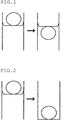
- the wetting time means the time taken from a point in time at which the sample is dropped to the measuring cylinder to a point in time at which the entire sample sinks under the water as shown in FIG 1 .
- the settling time means the time which has passed from a point in time when the sample is dropped to a measuring cylinder to a point in time when the sample settles at the bottom of the measuring cylinder shown in FIG 2 .
- Fiber was produced and evaluated in the same manner as in Example 1, except that a surfactant was not attached. The results are shown in Table 1.
- Table 1 Attached amount Flexibility Water repellency Hydrophilicity Wetting time Settling time Example 1 Less than 0.01 to 0.25% ⁇ ⁇ ⁇ Not wetted Not settled Example 2 0.25 to 1.0% ⁇ ⁇ ⁇ 10 to 25 sec Within 60 sec Com. Ex. 1 None ⁇ ⁇ ⁇ Within 3 sec Within 4 sec
- the fiber in Example 1 is suited for a bulk of textile products. Also, it can be used as a joint filler which is used in an atmosphere with high humidity and thus requires to have high water repellency.
- the fiber in Example 2 has good flexibility, and moderate hydrophilicity and water repellency (i.e. hardly settle down in water but not completely float), and is easily stirred homogeneously without being broken. Therefore, it is suited for an unshaped heat insulating material.
- the inorganic fiber of the invention can be used for various applications as a heat insulator and an alternative to asbestos.
Landscapes
- Engineering & Computer Science (AREA)
- Chemical & Material Sciences (AREA)
- Organic Chemistry (AREA)
- Materials Engineering (AREA)
- Ceramic Engineering (AREA)
- Manufacturing & Machinery (AREA)
- Life Sciences & Earth Sciences (AREA)
- Geochemistry & Mineralogy (AREA)
- General Chemical & Material Sciences (AREA)
- Chemical Kinetics & Catalysis (AREA)
- Textile Engineering (AREA)
- Inorganic Chemistry (AREA)
- Structural Engineering (AREA)
- Mechanical Engineering (AREA)
- General Life Sciences & Earth Sciences (AREA)
- Inorganic Fibers (AREA)
- Glass Compositions (AREA)
- Treatments For Attaching Organic Compounds To Fibrous Goods (AREA)
- Chemical Or Physical Treatment Of Fibers (AREA)
- Surface Treatment Of Glass Fibres Or Filaments (AREA)
Abstract
Description
- The invention relates to biosoluble inorganic fibers and a method for producing the same.
- Inorganic fibers are light in weight, easy to handle, and have excellent heat resistance. Therefore, they are used as a heat-insulating sealing material, for example. On the other hand, in recent years, a problem has been pointed out that inorganic fibers are inhaled by a human body and the inhaled fibers invade the lung. Therefore, biosoluble inorganic fibers that do not cause or hardly cause problems even if inhaled by a human body have been developed (Patent Documents 1 and 2, for example).
- According to applications, biosoluble inorganic fibers are not only used as the raw material of textiles such as a rope, a yarn and a cloth, but also secondarily processed and used as a formed product such as a blanket, a board and a felt or an unshaped product such as a coating material and mortar.
- Patent Documents 3 and 4 state that, in order to suppress elution of fiber components, biosoluble inorganic fibers are covered with a phosphate, a molybdenum compound, a zinc compound or the like.
-
- Patent Document 1: Japan Patent No.
3753416 - Patent Document 2:
JP-T-2005-514318 - Patent Document 3:
JP-A-2007-197264 - Patent Document 4:
JP-A-2008-162853 - An object of the invention is to provide biosoluble inorganic fibers that can be easily processed and a method for producing the same.
- According to the invention, the following inorganic fiber and method for producing the same can be provided.
1. Inorganic fiber comprising biosoluble fiber and a cationic surfactant adhering to the biosoluble fiber.
2. The inorganic fiber according to 1, wherein the biosoluble fiber has the following composition ratio: - the total of SiO2, Al2O3, ZrO2 and TiO2 50 to 82 wt%; and
- the total of CaO and MgO 18 to 50 wt%.
- SiO2 50 to 82 wt%; and
- the total of CaO and MgO 10 to 43 wt%.
- According to the invention, biosoluble inorganic fiber that can be processed easily and the method for producing the same can be provided.
-
-
FIG. 1 is a view for explaining the wetted state in Example 1; and -
FIG. 2 is a view for explaining the settled state in Example 1. - The inorganic fiber of the invention is characterized in that a biosoluble fiber is treated by a surfactant. Specifically, a surfactant is adhered to a biosoluble fiber and they are integrated. A surfactant is mainly adhered to the surface of a fiber, and preferably covers the surface thereof.
- If a surfactant is adhered to a fiber, friction among fibers is suppressed to allow fibers to be soft. As a result, fibers are hardly bent when processing. In addition, they can be easily mixed uniformly with other components, whereby a secondary product can be produced stably. For example, when a felt is produced, the fiber is pricked with a needle, and when an unshaped product is produced, the fiber is melt-kneaded with a solvent or the like. Due to the adhesion with a surfactant, the fiber is hardly bent during such processing. As a result, the strength can be increased.
- Further, depending on the amount of a surfactant to be adhered, hydrophilicity, hydrophobicity and water repellency of the entire fiber can be adjusted in accordance with the application.
- For example, when an unshaped product such as a joint filler is produced, a high hydrophilicity is required. When a textile is produced, the fiber is required to have high flexibility or high hydrophobicity.
- The amount of a surfactant is normally 0.01 to 2 wt%, preferably 0.01 to 1.5 wt%, and more preferably 0.01 to 1.0 wt% relative to 100 wt% of the entire fiber with a surfactant being adhered thereto. The amount may be 0.01 wt% or more and less than 0.25 wt% and may be 0.25 wt% or more and 1.0 wt% or less. According to the application, the amount of a surfactant can be increased or decreased within this range or exceeding this range.
- Preferable surfactants in respect of performance are a cationic surfactant such as alkylamine (primary, secondary, tertiary, diamine, triamine) acetate, alklyldimethyl betaine, polyoxyethylene alkylamine lactate, an alkylamideamine derivative and alkyltrimethylammonium chloride. As for an alkyl group, one derived from beef tallow (C8 to C18) is preferable, with alkylamine acetate being more preferable.
- In ethylenediamine tetraacetic acid (EDTA), a salt portion is Na+(sodium salt) or NH3 +(ammonium salt). Further, since the terminal group of EDTA has a structure of acetic acid (CH3COO-), it does not become acetate as a salt (counter ion). Therefore, alkylamine acetate does not include in EDTA. Normally, a surfactant does not include such a chelating agent.
- The biosoluble fiber is a fiber having a physiological saline dissolution ratio of 1% or more at 40°C.
- The physiological saline dissolution ratio is measured by the following method, for example. Specifically, first, 1 g of the sample obtained by pulverizing inorganic fibers to 200 meshes or less and 150 mL of physiological saline are put in a conical flask (volume: 300 mL). This flask is placed in an incubator of 40°C, and a horizontal vibration (120 rpm) is continuously applied for 50 hours. Thereafter, the concentration (mg/L) of each element contained in a filtrate obtained by filtration is measured by an ICP emission spectrometry apparatus. Based on the measured concentration of each element and the content (wt%) of each element in inorganic fibers before dissolution, the physiological saline dissolution ratio (%) is calculated. That is, if the measurement elements are silicon (Si), magnesium (Mg), calcium (Ca) and aluminum (Al), the physiological saline dissolution ratio C(%) is calculated in accordance with the following formula: C(%)=[Amount of filtrate (L)×(a1+a2+a3+a4)×100]/[Weight (mg) of inorganic fibers before dissolution ×(b1+b2+b3+b4)/100]. In this formula, a1, a2, a3 and a4 are respectively the measured concentration (mg/L) of silicon, magnesium, calcium and aluminum and b1, b2, b3 and b4 are respectively the content (wt%) of silica, magnesium, calcium and aluminum in the inorganic fibers before dissolution.
- As the biosoluble fiber, the following composition ratio can be specifically given:
- Total of SiO2, Al2O3, ZrO2 and TiO2: 50 to 82 wt%
- Total of CaO and MgO: 18 to 50 wt%
- In addition, the following composition ratio can be given:
- SiO2: 50 to 82 wt%
- Total of CaO and MgO: 10 to 43 wt%
- The biosoluble fibers can be roughly divided into Mg-silicate fibers containing a large amount of MgO and Ca-silicate fibers containing a large amount of CaO. As the Mg-silicate fibers, the following composition ratio can be exemplified.
- SiO2: 66 to 82 wt%
- CaO: 1 to 9 wt%
- MgO: 10 to 30 wt%
- Al2O3: 3 wt% or less
- Other oxides: less than 2 wt%
- As the Ca-silicate fibers, the following composition ratio can be exemplified. The fibers having this composition ratio have excellent biosolubility and fire resistance after heating.
- SiO2: 66 to 82 wt% (it can be 68 to 80 wt%, 70 to 80 wt%, 71 to 80 wt% or 71 to 76 wt%, for example) CaO: 10 to 34 wt% (it can be 20 to 30 wt% or 21 to 26 wt%, for example)
- MgO: 3 wt% or less (it can be 1 wt% or less, for example)
- Al2O3: 5 wt% or less (it can be 3.5 wt% or less or 3 wt% or less, for example, or it can be 1 wt% or more or 2 wt% or more)
- Other oxides: less than 2 wt%
- If SiO2 is in the above range, the fibers have excellent heat resistance. If CaO and MgO are in the above-mentioned range, the fibers have excellent biosolubility before and after heating.
- The content of Al2O3 can be 3.4 wt% or less or 3.0 wt% or less, for example. Further, it can be 1.1 wt% or more or 2.0 wt% or more. It is preferably 0 to 3 wt%, more preferably 1 to 3 wt%. If Al2O3 is included within this range, the strength is increased.
- The above-mentioned inorganic fiber may or may not include, as other oxides, one or more selected from alkali metal oxides (K2O, Na2O or the like), Fe2O3, ZrO2, P2O5, B2O3, TiO2, MnO, R2O3(R is selected from Sc, La, Ce, Pr, Nd, Sm, Eu, Gd, Tb, Dy, Ho, Er, Tm, Yb, Lu, Y or a mixture thereof). The amounts of other oxides may be 0.2 wt% or less or 0.1 wt% or less. As for the alkali metal oxides, the amount of each oxide may be 0.2 wt% or less, and the total of the alkali metal oxides may be 0.2 wt% or less.
- In the biosoluble fibers, the total of SiO2, CaO, MgO and Al2O3 may be larger than 98 wt% or larger than 99 wt%.
- Next, an explanation will be made on the method for allowing a surfactant to be adhered to the fiber.
- As for the method for allowing a surfactant to be adhered to the fiber, no specific restrictions are imposed as long as an adequate amount can be adhered. For example, a surfactant can be blown from the surrounding area immediately after the formation of a biosoluble fiber. Alternatively, a surfactant can be blown before secondary processing; i.e. before the fibers are assembled in the form of a bulk and a blanket. A surfactant may be adhered by impregnation. A surfactant can be used after diluting with an adequate solvent. Dilution can be conducted appropriately by using water or an organic solvent as the solvent. pH adjustment can be conducted with acetic acid, nitric acid, hydrochloric acid, sulfuric acid, ammonium or the like. Normally, taking equipment, safety or the like into consideration, it is preferable to adjust with water, acetic acid, ammonium or the like. pH is not particularly restricted, but a pH of about 6 to 8 is preferable in respect of safety.
- Further, heating and drying may be conducted at a temperature range in which a surfactant does not totally disappear or its effects are exhibited.
- The fiber of the invention to which a surfactant is adhered can be used as it is as a textile and a bulk. In addition, they can be processed into a formed product such as a blanket, a board and a felt or an unshaped product such as a coating material, mortar or the like.
- The fiber of the invention may have a configuration in which only a surfactant is adhered. Within a range that does not impair the effects of the invention, other materials may be adhered. The fiber of the invention may have a configuration in which phosphates, molybdenum compounds, zinc compounds, polyamidine compounds, ethyleneimine compounds, aluminum compounds, nitrilotriacetic acid, ethylenediaminetetraacetic acid, a hydrophobic agent (silicone or the like), antiseptics (natural) starch, (natural) starch sulfamate or sulfamic acid or the like are not adhered.
- A raw material containing 73 mass% of SiO2, 24 mass% of CaO, 0.3 mass% of MgO and 2 mass% of Al2O3 was heated to produce a molten solution. Next, when the molten solution was formed into fiber, an alkyl amine acetate (surfactant) was sprayed from the side to produce inorganic fiber. The amount of surfactant attached to the fiber was varied as shown in Table 1.
- The fiber obtained was lightly rubbed with both hands and made into a ball to prepare a sample. The sample was dropped into a 200 ml measuring cylinder containing 200 ml of tap water. The time taken until the sample became wet and the time taken until it settled were measured continuously. The results are shown in Table 1.
- The wetting time means the time taken from a point in time at which the sample is dropped to the measuring cylinder to a point in time at which the entire sample sinks under the water as shown in
FIG 1 . The settling time means the time which has passed from a point in time when the sample is dropped to a measuring cylinder to a point in time when the sample settles at the bottom of the measuring cylinder shown inFIG 2 . - Fiber was produced and evaluated in the same manner as in Example 1, except that a surfactant was not attached. The results are shown in Table 1.
Table 1 Attached amount Flexibility Water repellency Hydrophilicity Wetting time Settling time Example 1 Less than 0.01 to 0.25% ○ ○ × Not wetted Not settled Example 2 0.25 to 1.0% ○ Δ Δ 10 to 25 sec Within 60 sec Com. Ex. 1 None × × ○ Within 3 sec Within 4 sec - The fiber in Example 1 is suited for a bulk of textile products. Also, it can be used as a joint filler which is used in an atmosphere with high humidity and thus requires to have high water repellency.
- The fiber in Example 2 has good flexibility, and moderate hydrophilicity and water repellency (i.e. hardly settle down in water but not completely float), and is easily stirred homogeneously without being broken. Therefore, it is suited for an unshaped heat insulating material.
- The inorganic fiber of the invention can be used for various applications as a heat insulator and an alternative to asbestos.
- Although only some exemplary embodiments and/or examples of this invention have been described in detail above, those skilled in the art will readily appreciate that many modifications are possible in the exemplary embodiments and/or examples without materially departing from the novel teachings and advantages of this invention. Accordingly, all such modifications are intended to be included within the scope of this invention.
- The documents described in this specification and the Japanese application specification claiming priority under the Paris Convention are incorporated herein by reference in its entirety.
3. The inorganic fiber according to 1, wherein the biosoluble fiber has the following composition ratio:
4. The inorganic fiber according to 1, wherein the biosoluble fiber has the following composition ratio 1 or 2:
| [Composition ratio 1] | |
| SiO2 | 70 to 82 wt%; |
| CaO | 1 to 9 wt%; |
| MgO | 10 to 29 wt%; and |
| Al2O3 | less than 3 wt% |
| [Composition ratio 2] | |
| SiO2 | 70 to 82 wt%; |
| CaO | 10 to 29 wt%; |
| MgO | 1 wt% or less; and |
| Al2O3 | less than 5 wt%. |
5. The inorganic fiber according to any of 1 to 4, wherein the surfactant is a cationic surfactant.
6. The inorganic fiber according to any of 1 to 5, wherein the surfactant is an alkyl amine acetate.
7. The inorganic fiber according to any of 1 to 6, wherein the amount of the surfactant is 0.01 to 2 wt%, based on 100 wt% of the whole inorganic fiber comprising the surfactant adhered thereto.
8. A method for producing the inorganic fiber according to any of 1 to 7, comprising spraying a surfactant to biosoluble fiber or impregnating biosoluble fiber with a surfactant.
Claims (10)
- Inorganic fiber comprising biosoluble fiber and a cationic surfactant adhering to the biosoluble fiber.
- Inorganic fiber comprising biosoluble fiber and a surfactant adhering to the biosoluble fiber, wherein
the amount of the surfactant is 0.01 to 2 wt%, based on 100 wt% of the whole inorganic fiber comprising the surfactant adhered thereto. - The inorganic fiber according to claim 1 or 2, wherein the biosoluble fiber has the following composition ratio:the total of SiO2, Al2O3, ZrO2 and TiO2 50 to 82 wt%; andthe total of CaO and MgO 18 to 50 wt%.
- The inorganic fiber according to claim 1 or 2, wherein the biosoluble fiber has the following composition ratio:SiO2 50 to 82 wt%; andthe total of CaO and MgO 10 to 43 wt%.
- The inorganic fiber according to claim 1 or 2, wherein the biosoluble fiber has the following composition ratio 1 or 2:
[Composition ratio 1] SiO2 70 to 82 wt%; CaO 1 to 9 wt%; MgO 10 to 29 wt%; and Al2O3 less than 3 wt% [Composition ratio 2] SiO2 70 to 82 wt%; CaO 10 to 29 wt%; MgO 1 wt% or less; and Al2O3 less than 5 wt%. - The inorganic fiber according to claim 5, wherein the biosoluble fiber has the composition ratio 2.
- The inorganic fiber according to claim 6, wherein Al2O3 is 2 wt% or more.
- The inorganic fiber according to any of claims 1 to 7, wherein the surfactant is an alkyl amine acetate.
- A method for producing the inorganic fiber according to any of claims 1 to 8, comprising spraying a surfactant to biosoluble fiber or impregnating biosoluble fiber with a surfactant.
- A formed product or an unshaped product obtained from the inorganic fiber according to any of claims 1 to 8.
Applications Claiming Priority (2)
| Application Number | Priority Date | Filing Date | Title |
|---|---|---|---|
| JP2011263414A JP5138806B1 (en) | 2011-12-01 | 2011-12-01 | Biologically soluble inorganic fiber and method for producing the same |
| PCT/JP2012/007237 WO2013080458A1 (en) | 2011-12-01 | 2012-11-12 | Biosoluble inorganic fiber and method for producing same |
Publications (3)
| Publication Number | Publication Date |
|---|---|
| EP2787106A1 true EP2787106A1 (en) | 2014-10-08 |
| EP2787106A4 EP2787106A4 (en) | 2014-11-12 |
| EP2787106B1 EP2787106B1 (en) | 2016-05-11 |
Family
ID=47789821
Family Applications (1)
| Application Number | Title | Priority Date | Filing Date |
|---|---|---|---|
| EP12853538.2A Active EP2787106B1 (en) | 2011-12-01 | 2012-11-12 | Biosoluble inorganic fiber and method for producing same |
Country Status (7)
| Country | Link |
|---|---|
| US (1) | US20140356622A1 (en) |
| EP (1) | EP2787106B1 (en) |
| JP (1) | JP5138806B1 (en) |
| KR (1) | KR20140099458A (en) |
| CN (1) | CN103958753B (en) |
| AU (1) | AU2012345334A1 (en) |
| WO (1) | WO2013080458A1 (en) |
Families Citing this family (3)
| Publication number | Priority date | Publication date | Assignee | Title |
|---|---|---|---|---|
| JP5022512B1 (en) * | 2011-12-01 | 2012-09-12 | ニチアス株式会社 | Amorphous composition |
| JP6386232B2 (en) * | 2014-02-10 | 2018-09-05 | ニチアス株式会社 | Surface-modified inorganic fiber and method for producing the same |
| JP5634637B1 (en) * | 2014-08-08 | 2014-12-03 | ニチアス株式会社 | Biosoluble inorganic fiber |
Family Cites Families (18)
| Publication number | Priority date | Publication date | Assignee | Title |
|---|---|---|---|---|
| CH645410A5 (en) * | 1979-01-12 | 1984-09-28 | Akzo Nv | METHOD FOR PRODUCING WATER-BASED FIBERS. |
| JPH01176248A (en) * | 1987-12-29 | 1989-07-12 | Shimadzu Corp | Surface-treatment agent for glass fiber |
| JPH04254429A (en) * | 1991-02-02 | 1992-09-09 | Shimadzu Corp | Glass fiber surface treatment agent and glass fiber coated with the treatment agent |
| NZ246629A (en) | 1992-01-17 | 1997-07-27 | Morgan Crucible Co | Saline soluble fibres for refractory insulation comprising greater than 58 percent by weight of silicon dioxide |
| GB2341607B (en) * | 1998-09-15 | 2000-07-19 | Morgan Crucible Co | Bonded fibrous materials |
| ES2212962T3 (en) * | 1999-04-30 | 2004-08-16 | Ursa International Gmbh | BIOSOLUBLE COMPOSITION OF GLASS FIBERS FOR THE PRODUCTION OF GLASS WOOL AND SIMILAR. |
| US8673229B2 (en) * | 2001-10-09 | 2014-03-18 | 3M Innovative Properties Company | Compositions containing biosoluble inorganic fibers and micaceous binders |
| GB2383793B (en) * | 2002-01-04 | 2003-11-19 | Morgan Crucible Co | Saline soluble inorganic fibres |
| US6998361B2 (en) * | 2002-03-04 | 2006-02-14 | Glass Incorporated | High temperature glass fiber insulation |
| JP2004175649A (en) * | 2002-11-22 | 2004-06-24 | Toho Chem Ind Co Ltd | Softener for glass fiber |
| JP4154727B2 (en) * | 2003-04-22 | 2008-09-24 | 王子製紙株式会社 | Wet method nonwoven fabric and method for producing the same |
| JP4958439B2 (en) * | 2006-01-05 | 2012-06-20 | ニチアス株式会社 | Mesoporous silica precursor solution, production method thereof, and mesoporous silica |
| JP4716883B2 (en) | 2006-01-27 | 2011-07-06 | ニチアス株式会社 | Inorganic fiber molded body |
| FR2901786B1 (en) * | 2006-06-06 | 2008-08-29 | Manfred Buchler | PROCESS FOR THE PREPARATION OF A COMPOSITE MATERIAL FORMABLE BY IMPREGNATION OF A FIBROUS REINFORCEMENT, MATERIAL THUS OBTAINED AND THE PARTS PREPARED THEREFROM |
| JP4761567B2 (en) * | 2006-12-28 | 2011-08-31 | ニチアス株式会社 | Inorganic fiber molded body |
| JP5536353B2 (en) * | 2008-07-31 | 2014-07-02 | 帝人株式会社 | Inorganic fiber and method for producing the same |
| JP5198389B2 (en) * | 2009-08-20 | 2013-05-15 | 花王株式会社 | Liquid softener composition |
| JP4902797B1 (en) * | 2011-03-30 | 2012-03-21 | ニチアス株式会社 | Wet blanket |
-
2011
- 2011-12-01 JP JP2011263414A patent/JP5138806B1/en active Active
-
2012
- 2012-11-12 EP EP12853538.2A patent/EP2787106B1/en active Active
- 2012-11-12 CN CN201280059172.5A patent/CN103958753B/en active Active
- 2012-11-12 KR KR1020147014218A patent/KR20140099458A/en not_active Ceased
- 2012-11-12 AU AU2012345334A patent/AU2012345334A1/en not_active Abandoned
- 2012-11-12 US US14/361,894 patent/US20140356622A1/en not_active Abandoned
- 2012-11-12 WO PCT/JP2012/007237 patent/WO2013080458A1/en not_active Ceased
Also Published As
| Publication number | Publication date |
|---|---|
| CN103958753B (en) | 2016-11-02 |
| AU2012345334A1 (en) | 2014-06-26 |
| JP5138806B1 (en) | 2013-02-06 |
| JP2013112602A (en) | 2013-06-10 |
| KR20140099458A (en) | 2014-08-12 |
| EP2787106B1 (en) | 2016-05-11 |
| US20140356622A1 (en) | 2014-12-04 |
| WO2013080458A1 (en) | 2013-06-06 |
| EP2787106A4 (en) | 2014-11-12 |
| CN103958753A (en) | 2014-07-30 |
Similar Documents
| Publication | Publication Date | Title |
|---|---|---|
| ES2688274T3 (en) | Inorganic phosphate coated fiber and methods of preparation and use | |
| EP2787106B1 (en) | Biosoluble inorganic fiber and method for producing same | |
| EP0502159A1 (en) | Glass fiber compositions. | |
| JP7618550B2 (en) | Glass filler, its manufacturing method, and resin composition containing glass filler | |
| EP2692712B1 (en) | Method of hardening a shaped article | |
| CN1612845A (en) | Brine Soluble Inorganic Fiber | |
| AU2012380565B2 (en) | Heating device | |
| US9434656B2 (en) | Wet blanket | |
| US20180290922A1 (en) | Amino Acid-Containing Sizing Compositions For Glass Fibers And Sized Fiber Glass Products | |
| EP3168200A1 (en) | Biosoluble inorganic fiber | |
| RU2027687C1 (en) | Glass for fiber glass | |
| CA1157325A (en) | Method for improving properties of ceramic fibers | |
| AU5868586A (en) | Low shrinkage kaolin refractory fiber | |
| US20070289494A1 (en) | Size For The Treatment Of Glass Fibers, And Glass Fibers Provided With Said Sizes | |
| WO2013111232A1 (en) | Inorganic fibrous regularly shaped article and method for adjusting hardness thereof | |
| JP2829882B2 (en) | Fiber filler material | |
| CN113666647A (en) | Preparation method of high-performance direct twistless roving | |
| JP2025104995A (en) | Glass fiber sizing agents, glass strands, and cement composites | |
| CN1544730A (en) | Human body fluid dissoluble inorganic ceramic fiber textile material and process of production | |
| JPH0416527A (en) | Glass fiber composition having high dielectric constant | |
| JPH04108631A (en) | Glassfiber composition having high dielectric constant | |
| WO2014020842A1 (en) | Si/Al/Ca-CONTAINING INORGANIC FIBERS |
Legal Events
| Date | Code | Title | Description |
|---|---|---|---|
| PUAI | Public reference made under article 153(3) epc to a published international application that has entered the european phase |
Free format text: ORIGINAL CODE: 0009012 |
|
| 17P | Request for examination filed |
Effective date: 20140602 |
|
| AK | Designated contracting states |
Kind code of ref document: A1 Designated state(s): AL AT BE BG CH CY CZ DE DK EE ES FI FR GB GR HR HU IE IS IT LI LT LU LV MC MK MT NL NO PL PT RO RS SE SI SK SM TR |
|
| A4 | Supplementary search report drawn up and despatched |
Effective date: 20141014 |
|
| RIC1 | Information provided on ipc code assigned before grant |
Ipc: C04B 35/622 20060101ALI20141008BHEP Ipc: D06M 13/463 20060101ALI20141008BHEP Ipc: C03C 25/10 20060101ALI20141008BHEP Ipc: D01F 9/08 20060101AFI20141008BHEP Ipc: C03C 13/00 20060101ALI20141008BHEP Ipc: C04B 35/66 20060101ALI20141008BHEP Ipc: C04B 35/80 20060101ALI20141008BHEP |
|
| DAX | Request for extension of the european patent (deleted) | ||
| 17Q | First examination report despatched |
Effective date: 20150626 |
|
| GRAP | Despatch of communication of intention to grant a patent |
Free format text: ORIGINAL CODE: EPIDOSNIGR1 |
|
| INTG | Intention to grant announced |
Effective date: 20151207 |
|
| GRAS | Grant fee paid |
Free format text: ORIGINAL CODE: EPIDOSNIGR3 |
|
| GRAA | (expected) grant |
Free format text: ORIGINAL CODE: 0009210 |
|
| AK | Designated contracting states |
Kind code of ref document: B1 Designated state(s): AL AT BE BG CH CY CZ DE DK EE ES FI FR GB GR HR HU IE IS IT LI LT LU LV MC MK MT NL NO PL PT RO RS SE SI SK SM TR |
|
| REG | Reference to a national code |
Ref country code: GB Ref legal event code: FG4D |
|
| REG | Reference to a national code |
Ref country code: CH Ref legal event code: EP |
|
| REG | Reference to a national code |
Ref country code: AT Ref legal event code: REF Ref document number: 798748 Country of ref document: AT Kind code of ref document: T Effective date: 20160515 |
|
| REG | Reference to a national code |
Ref country code: IE Ref legal event code: FG4D |
|
| REG | Reference to a national code |
Ref country code: DE Ref legal event code: R096 Ref document number: 602012018413 Country of ref document: DE |
|
| REG | Reference to a national code |
Ref country code: LT Ref legal event code: MG4D |
|
| REG | Reference to a national code |
Ref country code: NL Ref legal event code: MP Effective date: 20160511 |
|
| PG25 | Lapsed in a contracting state [announced via postgrant information from national office to epo] |
Ref country code: LT Free format text: LAPSE BECAUSE OF FAILURE TO SUBMIT A TRANSLATION OF THE DESCRIPTION OR TO PAY THE FEE WITHIN THE PRESCRIBED TIME-LIMIT Effective date: 20160511 Ref country code: NO Free format text: LAPSE BECAUSE OF FAILURE TO SUBMIT A TRANSLATION OF THE DESCRIPTION OR TO PAY THE FEE WITHIN THE PRESCRIBED TIME-LIMIT Effective date: 20160811 Ref country code: FI Free format text: LAPSE BECAUSE OF FAILURE TO SUBMIT A TRANSLATION OF THE DESCRIPTION OR TO PAY THE FEE WITHIN THE PRESCRIBED TIME-LIMIT Effective date: 20160511 Ref country code: NL Free format text: LAPSE BECAUSE OF FAILURE TO SUBMIT A TRANSLATION OF THE DESCRIPTION OR TO PAY THE FEE WITHIN THE PRESCRIBED TIME-LIMIT Effective date: 20160511 |
|
| REG | Reference to a national code |
Ref country code: AT Ref legal event code: MK05 Ref document number: 798748 Country of ref document: AT Kind code of ref document: T Effective date: 20160511 |
|
| REG | Reference to a national code |
Ref country code: FR Ref legal event code: PLFP Year of fee payment: 5 |
|
| PG25 | Lapsed in a contracting state [announced via postgrant information from national office to epo] |
Ref country code: PT Free format text: LAPSE BECAUSE OF FAILURE TO SUBMIT A TRANSLATION OF THE DESCRIPTION OR TO PAY THE FEE WITHIN THE PRESCRIBED TIME-LIMIT Effective date: 20160912 Ref country code: HR Free format text: LAPSE BECAUSE OF FAILURE TO SUBMIT A TRANSLATION OF THE DESCRIPTION OR TO PAY THE FEE WITHIN THE PRESCRIBED TIME-LIMIT Effective date: 20160511 Ref country code: SE Free format text: LAPSE BECAUSE OF FAILURE TO SUBMIT A TRANSLATION OF THE DESCRIPTION OR TO PAY THE FEE WITHIN THE PRESCRIBED TIME-LIMIT Effective date: 20160511 Ref country code: GR Free format text: LAPSE BECAUSE OF FAILURE TO SUBMIT A TRANSLATION OF THE DESCRIPTION OR TO PAY THE FEE WITHIN THE PRESCRIBED TIME-LIMIT Effective date: 20160812 Ref country code: LV Free format text: LAPSE BECAUSE OF FAILURE TO SUBMIT A TRANSLATION OF THE DESCRIPTION OR TO PAY THE FEE WITHIN THE PRESCRIBED TIME-LIMIT Effective date: 20160511 Ref country code: RS Free format text: LAPSE BECAUSE OF FAILURE TO SUBMIT A TRANSLATION OF THE DESCRIPTION OR TO PAY THE FEE WITHIN THE PRESCRIBED TIME-LIMIT Effective date: 20160511 Ref country code: ES Free format text: LAPSE BECAUSE OF FAILURE TO SUBMIT A TRANSLATION OF THE DESCRIPTION OR TO PAY THE FEE WITHIN THE PRESCRIBED TIME-LIMIT Effective date: 20160511 |
|
| PG25 | Lapsed in a contracting state [announced via postgrant information from national office to epo] |
Ref country code: IT Free format text: LAPSE BECAUSE OF FAILURE TO SUBMIT A TRANSLATION OF THE DESCRIPTION OR TO PAY THE FEE WITHIN THE PRESCRIBED TIME-LIMIT Effective date: 20160511 |
|
| PG25 | Lapsed in a contracting state [announced via postgrant information from national office to epo] |
Ref country code: CZ Free format text: LAPSE BECAUSE OF FAILURE TO SUBMIT A TRANSLATION OF THE DESCRIPTION OR TO PAY THE FEE WITHIN THE PRESCRIBED TIME-LIMIT Effective date: 20160511 Ref country code: EE Free format text: LAPSE BECAUSE OF FAILURE TO SUBMIT A TRANSLATION OF THE DESCRIPTION OR TO PAY THE FEE WITHIN THE PRESCRIBED TIME-LIMIT Effective date: 20160511 Ref country code: DK Free format text: LAPSE BECAUSE OF FAILURE TO SUBMIT A TRANSLATION OF THE DESCRIPTION OR TO PAY THE FEE WITHIN THE PRESCRIBED TIME-LIMIT Effective date: 20160511 Ref country code: SK Free format text: LAPSE BECAUSE OF FAILURE TO SUBMIT A TRANSLATION OF THE DESCRIPTION OR TO PAY THE FEE WITHIN THE PRESCRIBED TIME-LIMIT Effective date: 20160511 Ref country code: RO Free format text: LAPSE BECAUSE OF FAILURE TO SUBMIT A TRANSLATION OF THE DESCRIPTION OR TO PAY THE FEE WITHIN THE PRESCRIBED TIME-LIMIT Effective date: 20160511 |
|
| REG | Reference to a national code |
Ref country code: DE Ref legal event code: R097 Ref document number: 602012018413 Country of ref document: DE |
|
| PG25 | Lapsed in a contracting state [announced via postgrant information from national office to epo] |
Ref country code: BE Free format text: LAPSE BECAUSE OF FAILURE TO SUBMIT A TRANSLATION OF THE DESCRIPTION OR TO PAY THE FEE WITHIN THE PRESCRIBED TIME-LIMIT Effective date: 20160511 Ref country code: SM Free format text: LAPSE BECAUSE OF FAILURE TO SUBMIT A TRANSLATION OF THE DESCRIPTION OR TO PAY THE FEE WITHIN THE PRESCRIBED TIME-LIMIT Effective date: 20160511 Ref country code: PL Free format text: LAPSE BECAUSE OF FAILURE TO SUBMIT A TRANSLATION OF THE DESCRIPTION OR TO PAY THE FEE WITHIN THE PRESCRIBED TIME-LIMIT Effective date: 20160511 Ref country code: AT Free format text: LAPSE BECAUSE OF FAILURE TO SUBMIT A TRANSLATION OF THE DESCRIPTION OR TO PAY THE FEE WITHIN THE PRESCRIBED TIME-LIMIT Effective date: 20160511 |
|
| PLBE | No opposition filed within time limit |
Free format text: ORIGINAL CODE: 0009261 |
|
| STAA | Information on the status of an ep patent application or granted ep patent |
Free format text: STATUS: NO OPPOSITION FILED WITHIN TIME LIMIT |
|
| 26N | No opposition filed |
Effective date: 20170214 |
|
| PG25 | Lapsed in a contracting state [announced via postgrant information from national office to epo] |
Ref country code: SI Free format text: LAPSE BECAUSE OF FAILURE TO SUBMIT A TRANSLATION OF THE DESCRIPTION OR TO PAY THE FEE WITHIN THE PRESCRIBED TIME-LIMIT Effective date: 20160511 |
|
| REG | Reference to a national code |
Ref country code: CH Ref legal event code: PL |
|
| PG25 | Lapsed in a contracting state [announced via postgrant information from national office to epo] |
Ref country code: CH Free format text: LAPSE BECAUSE OF NON-PAYMENT OF DUE FEES Effective date: 20161130 Ref country code: LI Free format text: LAPSE BECAUSE OF NON-PAYMENT OF DUE FEES Effective date: 20161130 |
|
| REG | Reference to a national code |
Ref country code: IE Ref legal event code: MM4A |
|
| PG25 | Lapsed in a contracting state [announced via postgrant information from national office to epo] |
Ref country code: LU Free format text: LAPSE BECAUSE OF NON-PAYMENT OF DUE FEES Effective date: 20161130 |
|
| REG | Reference to a national code |
Ref country code: FR Ref legal event code: PLFP Year of fee payment: 6 |
|
| PG25 | Lapsed in a contracting state [announced via postgrant information from national office to epo] |
Ref country code: IE Free format text: LAPSE BECAUSE OF NON-PAYMENT OF DUE FEES Effective date: 20161112 |
|
| PG25 | Lapsed in a contracting state [announced via postgrant information from national office to epo] |
Ref country code: HU Free format text: LAPSE BECAUSE OF FAILURE TO SUBMIT A TRANSLATION OF THE DESCRIPTION OR TO PAY THE FEE WITHIN THE PRESCRIBED TIME-LIMIT; INVALID AB INITIO Effective date: 20121112 |
|
| PG25 | Lapsed in a contracting state [announced via postgrant information from national office to epo] |
Ref country code: MK Free format text: LAPSE BECAUSE OF FAILURE TO SUBMIT A TRANSLATION OF THE DESCRIPTION OR TO PAY THE FEE WITHIN THE PRESCRIBED TIME-LIMIT Effective date: 20160511 Ref country code: CY Free format text: LAPSE BECAUSE OF FAILURE TO SUBMIT A TRANSLATION OF THE DESCRIPTION OR TO PAY THE FEE WITHIN THE PRESCRIBED TIME-LIMIT Effective date: 20160511 Ref country code: IS Free format text: LAPSE BECAUSE OF FAILURE TO SUBMIT A TRANSLATION OF THE DESCRIPTION OR TO PAY THE FEE WITHIN THE PRESCRIBED TIME-LIMIT Effective date: 20160511 Ref country code: MC Free format text: LAPSE BECAUSE OF FAILURE TO SUBMIT A TRANSLATION OF THE DESCRIPTION OR TO PAY THE FEE WITHIN THE PRESCRIBED TIME-LIMIT Effective date: 20160511 |
|
| PG25 | Lapsed in a contracting state [announced via postgrant information from national office to epo] |
Ref country code: BG Free format text: LAPSE BECAUSE OF FAILURE TO SUBMIT A TRANSLATION OF THE DESCRIPTION OR TO PAY THE FEE WITHIN THE PRESCRIBED TIME-LIMIT Effective date: 20160511 |
|
| PG25 | Lapsed in a contracting state [announced via postgrant information from national office to epo] |
Ref country code: MT Free format text: LAPSE BECAUSE OF NON-PAYMENT OF DUE FEES Effective date: 20161112 |
|
| PG25 | Lapsed in a contracting state [announced via postgrant information from national office to epo] |
Ref country code: TR Free format text: LAPSE BECAUSE OF FAILURE TO SUBMIT A TRANSLATION OF THE DESCRIPTION OR TO PAY THE FEE WITHIN THE PRESCRIBED TIME-LIMIT Effective date: 20160511 Ref country code: AL Free format text: LAPSE BECAUSE OF FAILURE TO SUBMIT A TRANSLATION OF THE DESCRIPTION OR TO PAY THE FEE WITHIN THE PRESCRIBED TIME-LIMIT Effective date: 20160511 |
|
| P01 | Opt-out of the competence of the unified patent court (upc) registered |
Effective date: 20230512 |
|
| PGFP | Annual fee paid to national office [announced via postgrant information from national office to epo] |
Ref country code: FR Payment date: 20250930 Year of fee payment: 14 |
|
| PGFP | Annual fee paid to national office [announced via postgrant information from national office to epo] |
Ref country code: DE Payment date: 20250930 Year of fee payment: 14 |
|
| PGFP | Annual fee paid to national office [announced via postgrant information from national office to epo] |
Ref country code: GB Payment date: 20251001 Year of fee payment: 14 |