EP2787076B1 - Method for evaluating drug sensitivity and disease vulnerability by analyzing cyclic amp responsive element binding protein gene - Google Patents
Method for evaluating drug sensitivity and disease vulnerability by analyzing cyclic amp responsive element binding protein gene Download PDFInfo
- Publication number
- EP2787076B1 EP2787076B1 EP12837264.6A EP12837264A EP2787076B1 EP 2787076 B1 EP2787076 B1 EP 2787076B1 EP 12837264 A EP12837264 A EP 12837264A EP 2787076 B1 EP2787076 B1 EP 2787076B1
- Authority
- EP
- European Patent Office
- Prior art keywords
- gene
- dna
- polymorphism
- homo sapiens
- gene polymorphism
- Prior art date
- Legal status (The legal status is an assumption and is not a legal conclusion. Google has not performed a legal analysis and makes no representation as to the accuracy of the status listed.)
- Not-in-force
Links
- 101710105094 Cyclic AMP-responsive element-binding protein Proteins 0.000 title claims description 107
- 230000035945 sensitivity Effects 0.000 title claims description 80
- 238000000034 method Methods 0.000 title claims description 69
- 239000003814 drug Substances 0.000 title description 66
- 229940079593 drug Drugs 0.000 title description 65
- 201000010099 disease Diseases 0.000 title description 39
- 208000037265 diseases, disorders, signs and symptoms Diseases 0.000 title description 39
- 108090000623 proteins and genes Proteins 0.000 claims description 345
- 108020004414 DNA Proteins 0.000 claims description 203
- 230000000202 analgesic effect Effects 0.000 claims description 113
- 102100026359 Cyclic AMP-responsive element-binding protein 1 Human genes 0.000 claims description 101
- 101000855516 Homo sapiens Cyclic AMP-responsive element-binding protein 1 Proteins 0.000 claims description 101
- 102000054766 genetic haplotypes Human genes 0.000 claims description 92
- 229960002428 fentanyl Drugs 0.000 claims description 49
- PJMPHNIQZUBGLI-UHFFFAOYSA-N fentanyl Chemical compound C=1C=CC=CC=1N(C(=O)CC)C(CC1)CCN1CCC1=CC=CC=C1 PJMPHNIQZUBGLI-UHFFFAOYSA-N 0.000 claims description 49
- 239000002773 nucleotide Substances 0.000 claims description 39
- 125000003729 nucleotide group Chemical group 0.000 claims description 39
- 208000011117 substance-related disease Diseases 0.000 claims description 38
- 238000004458 analytical method Methods 0.000 claims description 34
- 108091034117 Oligonucleotide Proteins 0.000 claims description 27
- BQJCRHHNABKAKU-KBQPJGBKSA-N morphine Chemical compound O([C@H]1[C@H](C=C[C@H]23)O)C4=C5[C@@]12CCN(C)[C@@H]3CC5=CC=C4O BQJCRHHNABKAKU-KBQPJGBKSA-N 0.000 claims description 26
- 206010013663 drug dependence Diseases 0.000 claims description 25
- LFQSCWFLJHTTHZ-UHFFFAOYSA-N Ethanol Chemical compound CCO LFQSCWFLJHTTHZ-UHFFFAOYSA-N 0.000 claims description 17
- 102000003840 Opioid Receptors Human genes 0.000 claims description 14
- 108090000137 Opioid Receptors Proteins 0.000 claims description 14
- 229960005181 morphine Drugs 0.000 claims description 13
- ZPUCINDJVBIVPJ-LJISPDSOSA-N cocaine Chemical compound O([C@H]1C[C@@H]2CC[C@@H](N2C)[C@H]1C(=O)OC)C(=O)C1=CC=CC=C1 ZPUCINDJVBIVPJ-LJISPDSOSA-N 0.000 claims description 12
- CGIGDMFJXJATDK-UHFFFAOYSA-N indomethacin Chemical compound CC1=C(CC(O)=O)C2=CC(OC)=CC=C2N1C(=O)C1=CC=C(Cl)C=C1 CGIGDMFJXJATDK-UHFFFAOYSA-N 0.000 claims description 10
- RTZKZFJDLAIYFH-UHFFFAOYSA-N Diethyl ether Chemical compound CCOCC RTZKZFJDLAIYFH-UHFFFAOYSA-N 0.000 claims description 9
- OKKJLVBELUTLKV-UHFFFAOYSA-N Methanol Chemical compound OC OKKJLVBELUTLKV-UHFFFAOYSA-N 0.000 claims description 9
- LEBVLXFERQHONN-UHFFFAOYSA-N 1-butyl-N-(2,6-dimethylphenyl)piperidine-2-carboxamide Chemical compound CCCCN1CCCCC1C(=O)NC1=C(C)C=CC=C1C LEBVLXFERQHONN-UHFFFAOYSA-N 0.000 claims description 7
- DCOPUUMXTXDBNB-UHFFFAOYSA-N diclofenac Chemical compound OC(=O)CC1=CC=CC=C1NC1=C(Cl)C=CC=C1Cl DCOPUUMXTXDBNB-UHFFFAOYSA-N 0.000 claims description 7
- MYWUZJCMWCOHBA-VIFPVBQESA-N methamphetamine Chemical compound CN[C@@H](C)CC1=CC=CC=C1 MYWUZJCMWCOHBA-VIFPVBQESA-N 0.000 claims description 7
- 229960001252 methamphetamine Drugs 0.000 claims description 7
- 229960005301 pentazocine Drugs 0.000 claims description 7
- VOKSWYLNZZRQPF-GDIGMMSISA-N pentazocine Chemical compound C1C2=CC=C(O)C=C2[C@@]2(C)[C@@H](C)[C@@H]1N(CC=C(C)C)CC2 VOKSWYLNZZRQPF-GDIGMMSISA-N 0.000 claims description 7
- 230000004853 protein function Effects 0.000 claims description 7
- 201000006152 substance dependence Diseases 0.000 claims description 7
- MSYGAHOHLUJIKV-UHFFFAOYSA-N 3,5-dimethyl-1-(3-nitrophenyl)-1h-pyrazole-4-carboxylic acid ethyl ester Chemical compound CC1=C(C(=O)OCC)C(C)=NN1C1=CC=CC([N+]([O-])=O)=C1 MSYGAHOHLUJIKV-UHFFFAOYSA-N 0.000 claims description 6
- 208000007848 Alcoholism Diseases 0.000 claims description 6
- 102100040775 CREB-regulated transcription coactivator 1 Human genes 0.000 claims description 6
- 101710094467 CREB-regulated transcription coactivator 1 Proteins 0.000 claims description 6
- ALIVXCSEERJYHU-UHFFFAOYSA-N Flurbiprofen axetil Chemical compound FC1=CC(C(C)C(=O)OC(OC(C)=O)C)=CC=C1C1=CC=CC=C1 ALIVXCSEERJYHU-UHFFFAOYSA-N 0.000 claims description 6
- XADCESSVHJOZHK-UHFFFAOYSA-N Meperidine Chemical compound C=1C=CC=CC=1C1(C(=O)OCC)CCN(C)CC1 XADCESSVHJOZHK-UHFFFAOYSA-N 0.000 claims description 6
- LRHPLDYGYMQRHN-UHFFFAOYSA-N N-Butanol Chemical compound CCCCO LRHPLDYGYMQRHN-UHFFFAOYSA-N 0.000 claims description 6
- GQPLMRYTRLFLPF-UHFFFAOYSA-N Nitrous Oxide Chemical compound [O-][N+]#N GQPLMRYTRLFLPF-UHFFFAOYSA-N 0.000 claims description 6
- 102000011017 Type 4 Cyclic Nucleotide Phosphodiesterases Human genes 0.000 claims description 6
- 108010037584 Type 4 Cyclic Nucleotide Phosphodiesterases Proteins 0.000 claims description 6
- 201000007930 alcohol dependence Diseases 0.000 claims description 6
- RMRJXGBAOAMLHD-IHFGGWKQSA-N buprenorphine Chemical compound C([C@]12[C@H]3OC=4C(O)=CC=C(C2=4)C[C@@H]2[C@]11CC[C@]3([C@H](C1)[C@](C)(O)C(C)(C)C)OC)CN2CC1CC1 RMRJXGBAOAMLHD-IHFGGWKQSA-N 0.000 claims description 6
- 229960001736 buprenorphine Drugs 0.000 claims description 6
- 229960003920 cocaine Drugs 0.000 claims description 6
- OROGSEYTTFOCAN-DNJOTXNNSA-N codeine Chemical compound C([C@H]1[C@H](N(CC[C@@]112)C)C3)=C[C@H](O)[C@@H]1OC1=C2C3=CC=C1OC OROGSEYTTFOCAN-DNJOTXNNSA-N 0.000 claims description 6
- 229960001259 diclofenac Drugs 0.000 claims description 6
- LNEPOXFFQSENCJ-UHFFFAOYSA-N haloperidol Chemical compound C1CC(O)(C=2C=CC(Cl)=CC=2)CCN1CCCC(=O)C1=CC=C(F)C=C1 LNEPOXFFQSENCJ-UHFFFAOYSA-N 0.000 claims description 6
- OROGSEYTTFOCAN-UHFFFAOYSA-N hydrocodone Natural products C1C(N(CCC234)C)C2C=CC(O)C3OC2=C4C1=CC=C2OC OROGSEYTTFOCAN-UHFFFAOYSA-N 0.000 claims description 6
- 229960000482 pethidine Drugs 0.000 claims description 6
- 102000008130 Cyclic AMP-Dependent Protein Kinases Human genes 0.000 claims description 5
- 108010049894 Cyclic AMP-Dependent Protein Kinases Proteins 0.000 claims description 5
- 229950005941 flurbiprofen axetil Drugs 0.000 claims description 5
- 229960000905 indomethacin Drugs 0.000 claims description 5
- KWTSXDURSIMDCE-QMMMGPOBSA-N (S)-amphetamine Chemical compound C[C@H](N)CC1=CC=CC=C1 KWTSXDURSIMDCE-QMMMGPOBSA-N 0.000 claims description 4
- 108020004635 Complementary DNA Proteins 0.000 claims description 4
- VYFYYTLLBUKUHU-UHFFFAOYSA-N dopamine Chemical compound NCCC1=CC=C(O)C(O)=C1 VYFYYTLLBUKUHU-UHFFFAOYSA-N 0.000 claims description 4
- 239000012634 fragment Substances 0.000 claims description 4
- AHOUBRCZNHFOSL-YOEHRIQHSA-N (+)-Casbol Chemical compound C1=CC(F)=CC=C1[C@H]1[C@H](COC=2C=C3OCOC3=CC=2)CNCC1 AHOUBRCZNHFOSL-YOEHRIQHSA-N 0.000 claims description 3
- HPZJMUBDEAMBFI-WTNAPCKOSA-N (D-Ala(2)-mephe(4)-gly-ol(5))enkephalin Chemical compound C([C@H](N)C(=O)N[C@H](C)C(=O)NCC(=O)N(C)[C@@H](CC=1C=CC=CC=1)C(=O)NCCO)C1=CC=C(O)C=C1 HPZJMUBDEAMBFI-WTNAPCKOSA-N 0.000 claims description 3
- RTHCYVBBDHJXIQ-MRXNPFEDSA-N (R)-fluoxetine Chemical compound O([C@H](CCNC)C=1C=CC=CC=1)C1=CC=C(C(F)(F)F)C=C1 RTHCYVBBDHJXIQ-MRXNPFEDSA-N 0.000 claims description 3
- TVYLLZQTGLZFBW-ZBFHGGJFSA-N (R,R)-tramadol Chemical compound COC1=CC=CC([C@]2(O)[C@H](CCCC2)CN(C)C)=C1 TVYLLZQTGLZFBW-ZBFHGGJFSA-N 0.000 claims description 3
- FGHVSEXHEAUJBT-HFNHQGOYSA-N (z)-but-2-enedioic acid;(5r)-8-chloro-3-methyl-5-phenyl-1,2,4,5-tetrahydro-3-benzazepin-7-ol Chemical compound OC(=O)\C=C/C(O)=O.C1([C@@H]2C3=CC(O)=C(Cl)C=C3CCN(C2)C)=CC=CC=C1 FGHVSEXHEAUJBT-HFNHQGOYSA-N 0.000 claims description 3
- ZZQYDYODFHABLC-UHFFFAOYSA-N 1-chloro-1,2,2-trifluorocyclobutane Chemical compound FC1(F)CCC1(F)Cl ZZQYDYODFHABLC-UHFFFAOYSA-N 0.000 claims description 3
- VOXZDWNPVJITMN-ZBRFXRBCSA-N 17β-estradiol Chemical compound OC1=CC=C2[C@H]3CC[C@](C)([C@H](CC4)O)[C@@H]4[C@@H]3CCC2=C1 VOXZDWNPVJITMN-ZBRFXRBCSA-N 0.000 claims description 3
- UYNVMODNBIQBMV-UHFFFAOYSA-N 4-[1-hydroxy-2-[4-(phenylmethyl)-1-piperidinyl]propyl]phenol Chemical compound C1CC(CC=2C=CC=CC=2)CCN1C(C)C(O)C1=CC=C(O)C=C1 UYNVMODNBIQBMV-UHFFFAOYSA-N 0.000 claims description 3
- USSIQXCVUWKGNF-UHFFFAOYSA-N 6-(dimethylamino)-4,4-diphenylheptan-3-one Chemical compound C=1C=CC=CC=1C(CC(C)N(C)C)(C(=O)CC)C1=CC=CC=C1 USSIQXCVUWKGNF-UHFFFAOYSA-N 0.000 claims description 3
- 108700022183 Ala(2)-MePhe(4)-Gly(5)- Enkephalin Proteins 0.000 claims description 3
- 102000004631 Calcineurin Human genes 0.000 claims description 3
- 108010042955 Calcineurin Proteins 0.000 claims description 3
- 102000019025 Calcium-Calmodulin-Dependent Protein Kinases Human genes 0.000 claims description 3
- 108010026870 Calcium-Calmodulin-Dependent Protein Kinases Proteins 0.000 claims description 3
- GDLIGKIOYRNHDA-UHFFFAOYSA-N Clomipramine Chemical compound C1CC2=CC=C(Cl)C=C2N(CCCN(C)C)C2=CC=CC=C21 GDLIGKIOYRNHDA-UHFFFAOYSA-N 0.000 claims description 3
- HCYAFALTSJYZDH-UHFFFAOYSA-N Desimpramine Chemical compound C1CC2=CC=CC=C2N(CCCNC)C2=CC=CC=C21 HCYAFALTSJYZDH-UHFFFAOYSA-N 0.000 claims description 3
- 108010051975 Glycogen Synthase Kinase 3 beta Proteins 0.000 claims description 3
- 102100038104 Glycogen synthase kinase-3 beta Human genes 0.000 claims description 3
- GVGLGOZIDCSQPN-PVHGPHFFSA-N Heroin Chemical compound O([C@H]1[C@H](C=C[C@H]23)OC(C)=O)C4=C5[C@@]12CCN(C)[C@@H]3CC5=CC=C4OC(C)=O GVGLGOZIDCSQPN-PVHGPHFFSA-N 0.000 claims description 3
- PIWKPBJCKXDKJR-UHFFFAOYSA-N Isoflurane Chemical compound FC(F)OC(Cl)C(F)(F)F PIWKPBJCKXDKJR-UHFFFAOYSA-N 0.000 claims description 3
- OZYUPQUCAUTOBP-QXAKKESOSA-N Levallorphan Chemical compound C([C@H]12)CCC[C@@]11CCN(CC=C)[C@@H]2CC2=CC=C(O)C=C21 OZYUPQUCAUTOBP-QXAKKESOSA-N 0.000 claims description 3
- JAQUASYNZVUNQP-USXIJHARSA-N Levorphanol Chemical compound C1C2=CC=C(O)C=C2[C@]23CCN(C)[C@H]1[C@@H]2CCCC3 JAQUASYNZVUNQP-USXIJHARSA-N 0.000 claims description 3
- JUUFBMODXQKSTD-UHFFFAOYSA-N N-[2-amino-6-[(4-fluorophenyl)methylamino]-3-pyridinyl]carbamic acid ethyl ester Chemical compound N1=C(N)C(NC(=O)OCC)=CC=C1NCC1=CC=C(F)C=C1 JUUFBMODXQKSTD-UHFFFAOYSA-N 0.000 claims description 3
- UIQMVEYFGZJHCZ-SSTWWWIQSA-N Nalorphine Chemical compound C([C@@H](N(CC1)CC=C)[C@@H]2C=C[C@@H]3O)C4=CC=C(O)C5=C4[C@@]21[C@H]3O5 UIQMVEYFGZJHCZ-SSTWWWIQSA-N 0.000 claims description 3
- BRUQQQPBMZOVGD-XFKAJCMBSA-N Oxycodone Chemical compound O=C([C@@H]1O2)CC[C@@]3(O)[C@H]4CC5=CC=C(OC)C2=C5[C@@]13CCN4C BRUQQQPBMZOVGD-XFKAJCMBSA-N 0.000 claims description 3
- UQCNKQCJZOAFTQ-ISWURRPUSA-N Oxymorphone Chemical compound O([C@H]1C(CC[C@]23O)=O)C4=C5[C@@]12CCN(C)[C@@H]3CC5=CC=C4O UQCNKQCJZOAFTQ-ISWURRPUSA-N 0.000 claims description 3
- AHOUBRCZNHFOSL-UHFFFAOYSA-N Paroxetine hydrochloride Natural products C1=CC(F)=CC=C1C1C(COC=2C=C3OCOC3=CC=2)CNCC1 AHOUBRCZNHFOSL-UHFFFAOYSA-N 0.000 claims description 3
- 102000003923 Protein Kinase C Human genes 0.000 claims description 3
- 108090000315 Protein Kinase C Proteins 0.000 claims description 3
- 102000009738 Ribosomal Protein S6 Kinases Human genes 0.000 claims description 3
- 108010034782 Ribosomal Protein S6 Kinases Proteins 0.000 claims description 3
- KLBQZWRITKRQQV-UHFFFAOYSA-N Thioridazine Chemical compound C12=CC(SC)=CC=C2SC2=CC=CC=C2N1CCC1CCCCN1C KLBQZWRITKRQQV-UHFFFAOYSA-N 0.000 claims description 3
- 229960003150 bupivacaine Drugs 0.000 claims description 3
- YDSDEBIZUNNPOB-UHFFFAOYSA-N carfentanil Chemical compound C1CN(CCC=2C=CC=CC=2)CCC1(C(=O)OC)N(C(=O)CC)C1=CC=CC=C1 YDSDEBIZUNNPOB-UHFFFAOYSA-N 0.000 claims description 3
- 229950004689 carfentanil Drugs 0.000 claims description 3
- 229960004606 clomipramine Drugs 0.000 claims description 3
- QZUDBNBUXVUHMW-UHFFFAOYSA-N clozapine Chemical compound C1CN(C)CCN1C1=NC2=CC(Cl)=CC=C2NC2=CC=CC=C12 QZUDBNBUXVUHMW-UHFFFAOYSA-N 0.000 claims description 3
- 229960004170 clozapine Drugs 0.000 claims description 3
- 229960004126 codeine Drugs 0.000 claims description 3
- 229960003914 desipramine Drugs 0.000 claims description 3
- 229960002069 diamorphine Drugs 0.000 claims description 3
- XYYVYLMBEZUESM-UHFFFAOYSA-N dihydrocodeine Natural products C1C(N(CCC234)C)C2C=CC(=O)C3OC2=C4C1=CC=C2OC XYYVYLMBEZUESM-UHFFFAOYSA-N 0.000 claims description 3
- BRTSNYPDACNMIP-FAWZKKEFSA-N dihydroetorphine Chemical compound O([C@H]1[C@@]2(OC)CC[C@@]34C[C@@H]2[C@](C)(O)CCC)C2=C5[C@]41CCN(C)[C@@H]3CC5=CC=C2O BRTSNYPDACNMIP-FAWZKKEFSA-N 0.000 claims description 3
- VHJLVAABSRFDPM-QWWZWVQMSA-N dithiothreitol Chemical compound SC[C@@H](O)[C@H](O)CS VHJLVAABSRFDPM-QWWZWVQMSA-N 0.000 claims description 3
- 229960005309 estradiol Drugs 0.000 claims description 3
- 229930182833 estradiol Natural products 0.000 claims description 3
- CAHCBJPUTCKATP-FAWZKKEFSA-N etorphine Chemical compound O([C@H]1[C@@]2(OC)C=C[C@@]34C[C@@H]2[C@](C)(O)CCC)C2=C5[C@]41CCN(C)[C@@H]3CC5=CC=C2O CAHCBJPUTCKATP-FAWZKKEFSA-N 0.000 claims description 3
- 229950004155 etorphine Drugs 0.000 claims description 3
- 229960002464 fluoxetine Drugs 0.000 claims description 3
- 229960003667 flupirtine Drugs 0.000 claims description 3
- 229940089161 ginsenoside Drugs 0.000 claims description 3
- 229930182494 ginsenoside Natural products 0.000 claims description 3
- 229960003878 haloperidol Drugs 0.000 claims description 3
- BCQZXOMGPXTTIC-UHFFFAOYSA-N halothane Chemical compound FC(F)(F)C(Cl)Br BCQZXOMGPXTTIC-UHFFFAOYSA-N 0.000 claims description 3
- 229960003132 halothane Drugs 0.000 claims description 3
- LLPOLZWFYMWNKH-CMKMFDCUSA-N hydrocodone Chemical compound C([C@H]1[C@H](N(CC[C@@]112)C)C3)CC(=O)[C@@H]1OC1=C2C3=CC=C1OC LLPOLZWFYMWNKH-CMKMFDCUSA-N 0.000 claims description 3
- 229960000240 hydrocodone Drugs 0.000 claims description 3
- WVLOADHCBXTIJK-YNHQPCIGSA-N hydromorphone Chemical compound O([C@H]1C(CC[C@H]23)=O)C4=C5[C@@]12CCN(C)[C@@H]3CC5=CC=C4O WVLOADHCBXTIJK-YNHQPCIGSA-N 0.000 claims description 3
- 229960001410 hydromorphone Drugs 0.000 claims description 3
- 229960003998 ifenprodil Drugs 0.000 claims description 3
- BCGWQEUPMDMJNV-UHFFFAOYSA-N imipramine Chemical compound C1CC2=CC=CC=C2N(CCCN(C)C)C2=CC=CC=C21 BCGWQEUPMDMJNV-UHFFFAOYSA-N 0.000 claims description 3
- 229960004801 imipramine Drugs 0.000 claims description 3
- 229960002725 isoflurane Drugs 0.000 claims description 3
- 229960000263 levallorphan Drugs 0.000 claims description 3
- 229960003406 levorphanol Drugs 0.000 claims description 3
- 229960001797 methadone Drugs 0.000 claims description 3
- YNPFMWCWRVTGKJ-UHFFFAOYSA-N mianserin hydrochloride Chemical compound [H+].[Cl-].C1C2=CC=CC=C2N2CCN(C)CC2C2=CC=CC=C21 YNPFMWCWRVTGKJ-UHFFFAOYSA-N 0.000 claims description 3
- 229960000938 nalorphine Drugs 0.000 claims description 3
- 229960004127 naloxone Drugs 0.000 claims description 3
- UZHSEJADLWPNLE-GRGSLBFTSA-N naloxone Chemical compound O=C([C@@H]1O2)CC[C@@]3(O)[C@H]4CC5=CC=C(O)C2=C5[C@@]13CCN4CC=C UZHSEJADLWPNLE-GRGSLBFTSA-N 0.000 claims description 3
- DQCKKXVULJGBQN-XFWGSAIBSA-N naltrexone Chemical compound N1([C@@H]2CC3=CC=C(C=4O[C@@H]5[C@](C3=4)([C@]2(CCC5=O)O)CC1)O)CC1CC1 DQCKKXVULJGBQN-XFWGSAIBSA-N 0.000 claims description 3
- 229960003086 naltrexone Drugs 0.000 claims description 3
- 235000013842 nitrous oxide Nutrition 0.000 claims description 3
- 229960002085 oxycodone Drugs 0.000 claims description 3
- 229960005118 oxymorphone Drugs 0.000 claims description 3
- 229960002296 paroxetine Drugs 0.000 claims description 3
- YVUQSNJEYSNKRX-UHFFFAOYSA-N pimozide Chemical compound C1=CC(F)=CC=C1C(C=1C=CC(F)=CC=1)CCCN1CCC(N2C(NC3=CC=CC=C32)=O)CC1 YVUQSNJEYSNKRX-UHFFFAOYSA-N 0.000 claims description 3
- 229960003634 pimozide Drugs 0.000 claims description 3
- BDERNNFJNOPAEC-UHFFFAOYSA-N propan-1-ol Chemical compound CCCO BDERNNFJNOPAEC-UHFFFAOYSA-N 0.000 claims description 3
- 229960002784 thioridazine Drugs 0.000 claims description 3
- 229960004380 tramadol Drugs 0.000 claims description 3
- TVYLLZQTGLZFBW-GOEBONIOSA-N tramadol Natural products COC1=CC=CC([C@@]2(O)[C@@H](CCCC2)CN(C)C)=C1 TVYLLZQTGLZFBW-GOEBONIOSA-N 0.000 claims description 3
- LLPOLZWFYMWNKH-UHFFFAOYSA-N trans-dihydrocodeinone Natural products C1C(N(CCC234)C)C2CCC(=O)C3OC2=C4C1=CC=C2OC LLPOLZWFYMWNKH-UHFFFAOYSA-N 0.000 claims description 3
- SHXWCVYOXRDMCX-UHFFFAOYSA-N 3,4-methylenedioxymethamphetamine Chemical compound CNC(C)CC1=CC=C2OCOC2=C1 SHXWCVYOXRDMCX-UHFFFAOYSA-N 0.000 claims description 2
- 101710107217 Tertiapin Proteins 0.000 claims description 2
- 229940025084 amphetamine Drugs 0.000 claims description 2
- 229960000632 dexamfetamine Drugs 0.000 claims description 2
- 229960003638 dopamine Drugs 0.000 claims description 2
- 229960004756 ethanol Drugs 0.000 claims description 2
- 230000002596 correlated effect Effects 0.000 claims 2
- 229940106885 marcaine Drugs 0.000 claims 1
- 241000282414 Homo sapiens Species 0.000 description 177
- 238000001356 surgical procedure Methods 0.000 description 134
- 102000054765 polymorphisms of proteins Human genes 0.000 description 104
- 102100027309 Cyclic AMP-responsive element-binding protein 5 Human genes 0.000 description 61
- 101000726193 Homo sapiens Cyclic AMP-responsive element-binding protein 5 Proteins 0.000 description 61
- 108700028369 Alleles Proteins 0.000 description 51
- 102100023033 Cyclic AMP-dependent transcription factor ATF-2 Human genes 0.000 description 36
- 101000974934 Homo sapiens Cyclic AMP-dependent transcription factor ATF-2 Proteins 0.000 description 36
- 101000997829 Homo sapiens Glial cell line-derived neurotrophic factor Proteins 0.000 description 36
- 230000014509 gene expression Effects 0.000 description 34
- 230000008533 pain sensitivity Effects 0.000 description 34
- 230000037324 pain perception Effects 0.000 description 31
- 102100026398 Cyclic AMP-responsive element-binding protein 3 Human genes 0.000 description 25
- 101000855520 Homo sapiens Cyclic AMP-responsive element-binding protein 3 Proteins 0.000 description 25
- 101000895309 Homo sapiens Cyclic AMP-responsive element-binding protein 3-like protein 4 Proteins 0.000 description 25
- 108020005029 5' Flanking Region Proteins 0.000 description 24
- 230000000694 effects Effects 0.000 description 23
- 238000012360 testing method Methods 0.000 description 23
- 108020005065 3' Flanking Region Proteins 0.000 description 22
- 238000005259 measurement Methods 0.000 description 21
- 208000002193 Pain Diseases 0.000 description 20
- 230000036407 pain Effects 0.000 description 20
- 101150005734 CREB1 gene Proteins 0.000 description 19
- 239000008280 blood Substances 0.000 description 19
- 210000004369 blood Anatomy 0.000 description 19
- 238000004364 calculation method Methods 0.000 description 16
- 239000000523 sample Substances 0.000 description 15
- 238000011156 evaluation Methods 0.000 description 14
- 230000009466 transformation Effects 0.000 description 14
- 238000001514 detection method Methods 0.000 description 11
- 239000005457 ice water Substances 0.000 description 11
- 238000007654 immersion Methods 0.000 description 11
- 102000005962 receptors Human genes 0.000 description 11
- 108020003175 receptors Proteins 0.000 description 11
- 101150056237 creB gene Proteins 0.000 description 10
- 239000003550 marker Substances 0.000 description 8
- 108020004999 messenger RNA Proteins 0.000 description 8
- 102000004169 proteins and genes Human genes 0.000 description 8
- 101150084750 1 gene Proteins 0.000 description 7
- 230000001419 dependent effect Effects 0.000 description 7
- 230000002068 genetic effect Effects 0.000 description 7
- 238000002560 therapeutic procedure Methods 0.000 description 7
- IVOMOUWHDPKRLL-KQYNXXCUSA-N Cyclic adenosine monophosphate Chemical compound C([C@H]1O2)OP(O)(=O)O[C@H]1[C@@H](O)[C@@H]2N1C(N=CN=C2N)=C2N=C1 IVOMOUWHDPKRLL-KQYNXXCUSA-N 0.000 description 6
- 206010013654 Drug abuse Diseases 0.000 description 6
- 208000030814 Eating disease Diseases 0.000 description 6
- 208000019454 Feeding and Eating disease Diseases 0.000 description 6
- 108091092724 Noncoding DNA Proteins 0.000 description 6
- IVOMOUWHDPKRLL-UHFFFAOYSA-N UNPD107823 Natural products O1C2COP(O)(=O)OC2C(O)C1N1C(N=CN=C2N)=C2N=C1 IVOMOUWHDPKRLL-UHFFFAOYSA-N 0.000 description 6
- JLCPHMBAVCMARE-UHFFFAOYSA-N [3-[[3-[[3-[[3-[[3-[[3-[[3-[[3-[[3-[[3-[[3-[[5-(2-amino-6-oxo-1H-purin-9-yl)-3-[[3-[[3-[[3-[[3-[[3-[[5-(2-amino-6-oxo-1H-purin-9-yl)-3-[[5-(2-amino-6-oxo-1H-purin-9-yl)-3-hydroxyoxolan-2-yl]methoxy-hydroxyphosphoryl]oxyoxolan-2-yl]methoxy-hydroxyphosphoryl]oxy-5-(5-methyl-2,4-dioxopyrimidin-1-yl)oxolan-2-yl]methoxy-hydroxyphosphoryl]oxy-5-(6-aminopurin-9-yl)oxolan-2-yl]methoxy-hydroxyphosphoryl]oxy-5-(6-aminopurin-9-yl)oxolan-2-yl]methoxy-hydroxyphosphoryl]oxy-5-(6-aminopurin-9-yl)oxolan-2-yl]methoxy-hydroxyphosphoryl]oxy-5-(6-aminopurin-9-yl)oxolan-2-yl]methoxy-hydroxyphosphoryl]oxyoxolan-2-yl]methoxy-hydroxyphosphoryl]oxy-5-(5-methyl-2,4-dioxopyrimidin-1-yl)oxolan-2-yl]methoxy-hydroxyphosphoryl]oxy-5-(4-amino-2-oxopyrimidin-1-yl)oxolan-2-yl]methoxy-hydroxyphosphoryl]oxy-5-(5-methyl-2,4-dioxopyrimidin-1-yl)oxolan-2-yl]methoxy-hydroxyphosphoryl]oxy-5-(5-methyl-2,4-dioxopyrimidin-1-yl)oxolan-2-yl]methoxy-hydroxyphosphoryl]oxy-5-(6-aminopurin-9-yl)oxolan-2-yl]methoxy-hydroxyphosphoryl]oxy-5-(6-aminopurin-9-yl)oxolan-2-yl]methoxy-hydroxyphosphoryl]oxy-5-(4-amino-2-oxopyrimidin-1-yl)oxolan-2-yl]methoxy-hydroxyphosphoryl]oxy-5-(4-amino-2-oxopyrimidin-1-yl)oxolan-2-yl]methoxy-hydroxyphosphoryl]oxy-5-(4-amino-2-oxopyrimidin-1-yl)oxolan-2-yl]methoxy-hydroxyphosphoryl]oxy-5-(6-aminopurin-9-yl)oxolan-2-yl]methoxy-hydroxyphosphoryl]oxy-5-(4-amino-2-oxopyrimidin-1-yl)oxolan-2-yl]methyl [5-(6-aminopurin-9-yl)-2-(hydroxymethyl)oxolan-3-yl] hydrogen phosphate Polymers Cc1cn(C2CC(OP(O)(=O)OCC3OC(CC3OP(O)(=O)OCC3OC(CC3O)n3cnc4c3nc(N)[nH]c4=O)n3cnc4c3nc(N)[nH]c4=O)C(COP(O)(=O)OC3CC(OC3COP(O)(=O)OC3CC(OC3COP(O)(=O)OC3CC(OC3COP(O)(=O)OC3CC(OC3COP(O)(=O)OC3CC(OC3COP(O)(=O)OC3CC(OC3COP(O)(=O)OC3CC(OC3COP(O)(=O)OC3CC(OC3COP(O)(=O)OC3CC(OC3COP(O)(=O)OC3CC(OC3COP(O)(=O)OC3CC(OC3COP(O)(=O)OC3CC(OC3COP(O)(=O)OC3CC(OC3COP(O)(=O)OC3CC(OC3COP(O)(=O)OC3CC(OC3COP(O)(=O)OC3CC(OC3COP(O)(=O)OC3CC(OC3CO)n3cnc4c(N)ncnc34)n3ccc(N)nc3=O)n3cnc4c(N)ncnc34)n3ccc(N)nc3=O)n3ccc(N)nc3=O)n3ccc(N)nc3=O)n3cnc4c(N)ncnc34)n3cnc4c(N)ncnc34)n3cc(C)c(=O)[nH]c3=O)n3cc(C)c(=O)[nH]c3=O)n3ccc(N)nc3=O)n3cc(C)c(=O)[nH]c3=O)n3cnc4c3nc(N)[nH]c4=O)n3cnc4c(N)ncnc34)n3cnc4c(N)ncnc34)n3cnc4c(N)ncnc34)n3cnc4c(N)ncnc34)O2)c(=O)[nH]c1=O JLCPHMBAVCMARE-UHFFFAOYSA-N 0.000 description 6
- 230000004913 activation Effects 0.000 description 6
- 210000004556 brain Anatomy 0.000 description 6
- 229940095074 cyclic amp Drugs 0.000 description 6
- 235000014632 disordered eating Nutrition 0.000 description 6
- 230000006870 function Effects 0.000 description 6
- 102000030621 adenylate cyclase Human genes 0.000 description 5
- 108060000200 adenylate cyclase Proteins 0.000 description 5
- 229940035676 analgesics Drugs 0.000 description 5
- 239000000730 antalgic agent Substances 0.000 description 5
- 238000003205 genotyping method Methods 0.000 description 5
- 101150039504 6 gene Proteins 0.000 description 4
- 238000000018 DNA microarray Methods 0.000 description 4
- 102000004190 Enzymes Human genes 0.000 description 4
- 108090000790 Enzymes Proteins 0.000 description 4
- 102100028647 Mu-type opioid receptor Human genes 0.000 description 4
- 238000012217 deletion Methods 0.000 description 4
- 230000037430 deletion Effects 0.000 description 4
- 238000003780 insertion Methods 0.000 description 4
- 230000037431 insertion Effects 0.000 description 4
- 238000000746 purification Methods 0.000 description 4
- 239000000126 substance Substances 0.000 description 4
- 210000001519 tissue Anatomy 0.000 description 4
- 230000000007 visual effect Effects 0.000 description 4
- 108010040163 CREB-Binding Protein Proteins 0.000 description 3
- 101710178223 Mu-type opioid receptor Proteins 0.000 description 3
- 238000012084 abdominal surgery Methods 0.000 description 3
- 230000036592 analgesia Effects 0.000 description 3
- 101150003525 atf-2 gene Proteins 0.000 description 3
- 210000005013 brain tissue Anatomy 0.000 description 3
- 230000008859 change Effects 0.000 description 3
- 238000006243 chemical reaction Methods 0.000 description 3
- 238000009396 hybridization Methods 0.000 description 3
- 238000002493 microarray Methods 0.000 description 3
- 210000000056 organ Anatomy 0.000 description 3
- 230000026731 phosphorylation Effects 0.000 description 3
- 238000006366 phosphorylation reaction Methods 0.000 description 3
- 102210048409 rs886816 Human genes 0.000 description 3
- 238000012163 sequencing technique Methods 0.000 description 3
- 108091032973 (ribonucleotides)n+m Proteins 0.000 description 2
- 101150000874 11 gene Proteins 0.000 description 2
- 101150082072 14 gene Proteins 0.000 description 2
- 101150076401 16 gene Proteins 0.000 description 2
- 101150028074 2 gene Proteins 0.000 description 2
- 101150085340 241 gene Proteins 0.000 description 2
- 101150055869 25 gene Proteins 0.000 description 2
- 101150033839 4 gene Proteins 0.000 description 2
- 101150096316 5 gene Proteins 0.000 description 2
- 101150101112 7 gene Proteins 0.000 description 2
- 101150106774 9 gene Proteins 0.000 description 2
- 108010085238 Actins Proteins 0.000 description 2
- 102100021975 CREB-binding protein Human genes 0.000 description 2
- 101150003526 CREB3 gene Proteins 0.000 description 2
- 108090000312 Calcium Channels Proteins 0.000 description 2
- 102000003922 Calcium Channels Human genes 0.000 description 2
- 108091006146 Channels Proteins 0.000 description 2
- 238000007400 DNA extraction Methods 0.000 description 2
- 102100031817 Delta-type opioid receptor Human genes 0.000 description 2
- 101710121791 Delta-type opioid receptor Proteins 0.000 description 2
- 206010012239 Delusion Diseases 0.000 description 2
- 102000003688 G-Protein-Coupled Receptors Human genes 0.000 description 2
- 108090000045 G-Protein-Coupled Receptors Proteins 0.000 description 2
- 208000034826 Genetic Predisposition to Disease Diseases 0.000 description 2
- 102000034354 Gi proteins Human genes 0.000 description 2
- 108091006101 Gi proteins Proteins 0.000 description 2
- 208000004547 Hallucinations Diseases 0.000 description 2
- 101100007687 Homo sapiens CREB5 gene Proteins 0.000 description 2
- 102100031819 Kappa-type opioid receptor Human genes 0.000 description 2
- ISWSIDIOOBJBQZ-UHFFFAOYSA-N Phenol Chemical compound OC1=CC=CC=C1 ISWSIDIOOBJBQZ-UHFFFAOYSA-N 0.000 description 2
- 150000001413 amino acids Chemical group 0.000 description 2
- 239000011324 bead Substances 0.000 description 2
- 210000004027 cell Anatomy 0.000 description 2
- 239000003153 chemical reaction reagent Substances 0.000 description 2
- 210000000349 chromosome Anatomy 0.000 description 2
- 230000000295 complement effect Effects 0.000 description 2
- 238000010276 construction Methods 0.000 description 2
- 231100000868 delusion Toxicity 0.000 description 2
- 210000002200 mouth mucosa Anatomy 0.000 description 2
- 239000004081 narcotic agent Substances 0.000 description 2
- 230000003533 narcotic effect Effects 0.000 description 2
- 230000004766 neurogenesis Effects 0.000 description 2
- 108091033319 polynucleotide Proteins 0.000 description 2
- 102000040430 polynucleotide Human genes 0.000 description 2
- 239000002157 polynucleotide Substances 0.000 description 2
- 230000001737 promoting effect Effects 0.000 description 2
- 125000006853 reporter group Chemical group 0.000 description 2
- 102220399485 rs917275 Human genes 0.000 description 2
- 210000003296 saliva Anatomy 0.000 description 2
- 125000003607 serino group Chemical group [H]N([H])[C@]([H])(C(=O)[*])C(O[H])([H])[H] 0.000 description 2
- 210000003491 skin Anatomy 0.000 description 2
- 238000006467 substitution reaction Methods 0.000 description 2
- 230000001629 suppression Effects 0.000 description 2
- 230000007704 transition Effects 0.000 description 2
- 108700026220 vif Genes Proteins 0.000 description 2
- 108020001588 κ-opioid receptors Proteins 0.000 description 2
- QKNYBSVHEMOAJP-UHFFFAOYSA-N 2-amino-2-(hydroxymethyl)propane-1,3-diol;hydron;chloride Chemical compound Cl.OCC(N)(CO)CO QKNYBSVHEMOAJP-UHFFFAOYSA-N 0.000 description 1
- 102000001764 CREB-Binding Protein Human genes 0.000 description 1
- 206010058019 Cancer Pain Diseases 0.000 description 1
- 101710128014 Cyclic AMP-responsive element-binding protein 1 Proteins 0.000 description 1
- 108010014303 DNA-directed DNA polymerase Proteins 0.000 description 1
- 102000016928 DNA-directed DNA polymerase Human genes 0.000 description 1
- 229940098778 Dopamine receptor agonist Drugs 0.000 description 1
- 229940121891 Dopamine receptor antagonist Drugs 0.000 description 1
- KCXVZYZYPLLWCC-UHFFFAOYSA-N EDTA Chemical compound OC(=O)CN(CC(O)=O)CCN(CC(O)=O)CC(O)=O KCXVZYZYPLLWCC-UHFFFAOYSA-N 0.000 description 1
- 241001635598 Enicostema Species 0.000 description 1
- 241000282412 Homo Species 0.000 description 1
- 101001122476 Homo sapiens Mu-type opioid receptor Proteins 0.000 description 1
- ROHFNLRQFUQHCH-YFKPBYRVSA-N L-leucine Chemical compound CC(C)C[C@H](N)C(O)=O ROHFNLRQFUQHCH-YFKPBYRVSA-N 0.000 description 1
- ROHFNLRQFUQHCH-UHFFFAOYSA-N Leucine Natural products CC(C)CC(N)C(O)=O ROHFNLRQFUQHCH-UHFFFAOYSA-N 0.000 description 1
- 108091092878 Microsatellite Proteins 0.000 description 1
- 108020005187 Oligonucleotide Probes Proteins 0.000 description 1
- 229940123932 Phosphodiesterase 4 inhibitor Drugs 0.000 description 1
- 208000028017 Psychotic disease Diseases 0.000 description 1
- 101000633010 Rattus norvegicus Somatostatin Proteins 0.000 description 1
- MTCFGRXMJLQNBG-UHFFFAOYSA-N Serine Natural products OCC(N)C(O)=O MTCFGRXMJLQNBG-UHFFFAOYSA-N 0.000 description 1
- 108010056088 Somatostatin Proteins 0.000 description 1
- 208000011963 Substance-induced psychotic disease Diseases 0.000 description 1
- 231100000393 Substance-induced psychotic disorder Toxicity 0.000 description 1
- 108010006785 Taq Polymerase Proteins 0.000 description 1
- 210000001789 adipocyte Anatomy 0.000 description 1
- 239000000556 agonist Substances 0.000 description 1
- 230000003321 amplification Effects 0.000 description 1
- 239000005557 antagonist Substances 0.000 description 1
- 238000003556 assay Methods 0.000 description 1
- 230000015572 biosynthetic process Effects 0.000 description 1
- 239000000872 buffer Substances 0.000 description 1
- 239000007853 buffer solution Substances 0.000 description 1
- UAIXRPCCYXNJMQ-RZIPZOSSSA-N buprenorphine hydrochlorie Chemical compound [Cl-].C([C@]12[C@H]3OC=4C(O)=CC=C(C2=4)C[C@@H]2[C@]11CC[C@]3([C@H](C1)[C@](C)(O)C(C)(C)C)OC)C[NH+]2CC1CC1 UAIXRPCCYXNJMQ-RZIPZOSSSA-N 0.000 description 1
- 238000000546 chi-square test Methods 0.000 description 1
- 230000003081 coactivator Effects 0.000 description 1
- 238000004590 computer program Methods 0.000 description 1
- 239000000841 delta opiate receptor agonist Substances 0.000 description 1
- 239000000857 delta opiate receptor antagonist Substances 0.000 description 1
- 238000011161 development Methods 0.000 description 1
- 239000000539 dimer Substances 0.000 description 1
- 239000003210 dopamine receptor blocking agent Substances 0.000 description 1
- 239000003136 dopamine receptor stimulating agent Substances 0.000 description 1
- 238000005516 engineering process Methods 0.000 description 1
- 230000001747 exhibiting effect Effects 0.000 description 1
- 238000000605 extraction Methods 0.000 description 1
- 230000037406 food intake Effects 0.000 description 1
- UYTPUPDQBNUYGX-UHFFFAOYSA-N guanine Chemical class O=C1NC(N)=NC2=C1N=CN2 UYTPUPDQBNUYGX-UHFFFAOYSA-N 0.000 description 1
- 238000001802 infusion Methods 0.000 description 1
- 230000002401 inhibitory effect Effects 0.000 description 1
- 230000003834 intracellular effect Effects 0.000 description 1
- 238000001990 intravenous administration Methods 0.000 description 1
- 239000002632 kappa opiate receptor agonist Substances 0.000 description 1
- 239000002618 kappa opiate receptor antagonist Substances 0.000 description 1
- 238000002372 labelling Methods 0.000 description 1
- 210000004165 myocardium Anatomy 0.000 description 1
- 239000013642 negative control Substances 0.000 description 1
- 238000003199 nucleic acid amplification method Methods 0.000 description 1
- 239000002751 oligonucleotide probe Substances 0.000 description 1
- 230000008058 pain sensation Effects 0.000 description 1
- 238000002638 palliative care Methods 0.000 description 1
- 230000007170 pathology Effects 0.000 description 1
- WCNLCIJMFAJCPX-UHFFFAOYSA-N pethidine hydrochloride Chemical compound Cl.C=1C=CC=CC=1C1(C(=O)OCC)CCN(C)CC1 WCNLCIJMFAJCPX-UHFFFAOYSA-N 0.000 description 1
- 239000002587 phosphodiesterase IV inhibitor Substances 0.000 description 1
- 239000013641 positive control Substances 0.000 description 1
- 238000003908 quality control method Methods 0.000 description 1
- 230000014493 regulation of gene expression Effects 0.000 description 1
- 230000001105 regulatory effect Effects 0.000 description 1
- 238000011160 research Methods 0.000 description 1
- 230000011664 signaling Effects 0.000 description 1
- 210000002027 skeletal muscle Anatomy 0.000 description 1
- 210000002460 smooth muscle Anatomy 0.000 description 1
- 239000007790 solid phase Substances 0.000 description 1
- 239000000243 solution Substances 0.000 description 1
- 238000010561 standard procedure Methods 0.000 description 1
- 239000000021 stimulant Substances 0.000 description 1
- 239000000829 suppository Substances 0.000 description 1
- 208000024891 symptom Diseases 0.000 description 1
- 238000003786 synthesis reaction Methods 0.000 description 1
- -1 tertiapine Chemical compound 0.000 description 1
- 229940126585 therapeutic drug Drugs 0.000 description 1
- 238000013518 transcription Methods 0.000 description 1
- 230000035897 transcription Effects 0.000 description 1
- 238000013519 translation Methods 0.000 description 1
- 238000012800 visualization Methods 0.000 description 1
- 229940063674 voltaren Drugs 0.000 description 1
Images


Classifications
-
- G—PHYSICS
- G16—INFORMATION AND COMMUNICATION TECHNOLOGY [ICT] SPECIALLY ADAPTED FOR SPECIFIC APPLICATION FIELDS
- G16B—BIOINFORMATICS, i.e. INFORMATION AND COMMUNICATION TECHNOLOGY [ICT] SPECIALLY ADAPTED FOR GENETIC OR PROTEIN-RELATED DATA PROCESSING IN COMPUTATIONAL MOLECULAR BIOLOGY
- G16B20/00—ICT specially adapted for functional genomics or proteomics, e.g. genotype-phenotype associations
- G16B20/20—Allele or variant detection, e.g. single nucleotide polymorphism [SNP] detection
-
- C—CHEMISTRY; METALLURGY
- C12—BIOCHEMISTRY; BEER; SPIRITS; WINE; VINEGAR; MICROBIOLOGY; ENZYMOLOGY; MUTATION OR GENETIC ENGINEERING
- C12Q—MEASURING OR TESTING PROCESSES INVOLVING ENZYMES, NUCLEIC ACIDS OR MICROORGANISMS; COMPOSITIONS OR TEST PAPERS THEREFOR; PROCESSES OF PREPARING SUCH COMPOSITIONS; CONDITION-RESPONSIVE CONTROL IN MICROBIOLOGICAL OR ENZYMOLOGICAL PROCESSES
- C12Q1/00—Measuring or testing processes involving enzymes, nucleic acids or microorganisms; Compositions therefor; Processes of preparing such compositions
- C12Q1/68—Measuring or testing processes involving enzymes, nucleic acids or microorganisms; Compositions therefor; Processes of preparing such compositions involving nucleic acids
- C12Q1/6876—Nucleic acid products used in the analysis of nucleic acids, e.g. primers or probes
- C12Q1/6883—Nucleic acid products used in the analysis of nucleic acids, e.g. primers or probes for diseases caused by alterations of genetic material
-
- G—PHYSICS
- G16—INFORMATION AND COMMUNICATION TECHNOLOGY [ICT] SPECIALLY ADAPTED FOR SPECIFIC APPLICATION FIELDS
- G16B—BIOINFORMATICS, i.e. INFORMATION AND COMMUNICATION TECHNOLOGY [ICT] SPECIALLY ADAPTED FOR GENETIC OR PROTEIN-RELATED DATA PROCESSING IN COMPUTATIONAL MOLECULAR BIOLOGY
- G16B20/00—ICT specially adapted for functional genomics or proteomics, e.g. genotype-phenotype associations
-
- C—CHEMISTRY; METALLURGY
- C12—BIOCHEMISTRY; BEER; SPIRITS; WINE; VINEGAR; MICROBIOLOGY; ENZYMOLOGY; MUTATION OR GENETIC ENGINEERING
- C12Q—MEASURING OR TESTING PROCESSES INVOLVING ENZYMES, NUCLEIC ACIDS OR MICROORGANISMS; COMPOSITIONS OR TEST PAPERS THEREFOR; PROCESSES OF PREPARING SUCH COMPOSITIONS; CONDITION-RESPONSIVE CONTROL IN MICROBIOLOGICAL OR ENZYMOLOGICAL PROCESSES
- C12Q2600/00—Oligonucleotides characterized by their use
- C12Q2600/106—Pharmacogenomics, i.e. genetic variability in individual responses to drugs and drug metabolism
-
- C—CHEMISTRY; METALLURGY
- C12—BIOCHEMISTRY; BEER; SPIRITS; WINE; VINEGAR; MICROBIOLOGY; ENZYMOLOGY; MUTATION OR GENETIC ENGINEERING
- C12Q—MEASURING OR TESTING PROCESSES INVOLVING ENZYMES, NUCLEIC ACIDS OR MICROORGANISMS; COMPOSITIONS OR TEST PAPERS THEREFOR; PROCESSES OF PREPARING SUCH COMPOSITIONS; CONDITION-RESPONSIVE CONTROL IN MICROBIOLOGICAL OR ENZYMOLOGICAL PROCESSES
- C12Q2600/00—Oligonucleotides characterized by their use
- C12Q2600/156—Polymorphic or mutational markers
Definitions
- the present invention relates to a method for evaluating drug sensitivity and disease vulnerability, comprising analyzing a cyclic AMP responsive element binding protein (cAMP responsive element binding protein; CREB ) gene.
- cAMP responsive element binding protein CREB
- the present invention relates to a method for evaluating drug sensitivity and disease vulnerability, comprising associating a gene polymorphism of a CREB gene or a haplotype constituted by the gene polymorphism with the drug sensitivity and disease vulnerability of an individual. More specifically, the present invention relates to a method for evaluating a tendency in the presence or absence of the drug sensitivity and disease vulnerability of an individual, based on the results from the analysis of the above-described gene polymorphism or haplotype.
- the pain sensation plays an important role in terms of a biological warning system, however, excessive pain would significantly decrease QOL (quality of life) unless it is properly controlled.
- QOL quality of life
- narcotic analgesics including morphine act on a protein known as an "opioid receptor," so as to cause analgesic action.
- the opioid receptor includes three types of receptors, a ⁇ -type opioid receptor, a ⁇ -type opioid receptor, and a ⁇ -type opioid receptor, and all of these receptors are related to analgesic action. Since these receptors are Gi/o protein-coupled receptors, they activate a GIRK channel and suppression of a calcium channel through the mediation of a Gi-o protein. In addition, the receptors suppress adenylate cyclase (Non Patent Literature 1: Pierce K.
- Non Patent Literature 2 Bokoch GM. et al., Purification and properties of the inhibitory guanine nucleotide-binding regulatory component of adenylate cyclase, J Biol Chem, (1984) 259: 3560-3567 ).
- Activation of adenylate cyclase activates cyclic AMP-dependent protein kinase, and it causes activation of a cyclic AMP responsive element binding protein (CREB) through phosphorylation of the serine residue at position 133 of the protein
- Non Patent Literature 3 Gonzalez GA.
- Non Patent Literature 4 Chrivia JC, et al., Phosphorylated CREB binds specifically to the nuclear protein CBP., Nature, (1993) 365: 855-859 ), and it binds to the cyclic AMP responsive element of genomic DNA, thereby promoting gene expression
- Non Patent Literature 5 Montminy MR.
- the objective of the present disclosure is to provide a method for evaluating (predicting, etc.) an individual difference (the tendency of every individual) in terms of drug sensitivity and disease vulnerability, comprising using a gene polymorphism of a cyclic AMP responsive element binding protein (CREB ) gene or the like.
- CREB cyclic AMP responsive element binding protein
- the present inventors focused on the cyclic AMP responsive element binding protein (CREB ) gene and conducted extensive examinations based on conventional findings and clinical data.
- CREB cyclic AMP responsive element binding protein
- the inventors identified several useful gene polymorphisms by analyzing the association of each CREB gene polymorphism with sensitivity to drugs such as analgesics, and with disease vulnerability including pain sensitivity.
- the inventors found linkage disequilibrium among the thus identified gene polymorphisms, and we also revealed a significant correlation between drug sensitivity and disease vulnerability (more specifically, a change in the required administration amount of an analgesic and a change in the threshold value of pain sensitivity due to a difference in specific CREB gene polymorphisms), thereby accomplishing the present invention.
- the present disclosure relates to the following: 1.
- a method for evaluating drug sensitivity comprising associating a gene polymorphism of a cyclic AMP responsive element binding protein gene or a haplotype constituted by the gene polymorphism with an individual drug sensitivity.
- the above-described evaluation method includes a method for evaluating a tendency in the presence or absence of an individual drug sensitivity based on the results from the analysis of the gene polymorphism or the haplotype.
- the method according to 1 above comprising the following steps: (1) a step of performing linkage disequilibrium analysis and haplotype analysis on a healthy subject and selecting gene polymorphisms in a linkage disequilibrium block; (2) a step of analyzing the association between the genotypes of the gene polymorphisms and drug sensitivity in a test subject; and (3) a step of using the gene polymorphism that has been significantly associated with drug sensitivity in the test subject for evaluation of the drug sensitivity.
- a method for evaluating disease vulnerability comprising associating a gene polymorphism of a cyclic AMP responsive element binding protein gene or a haplotype constituted by the gene polymorphism with an individual disease vulnerability.
- the above-described evaluation method includes a method for evaluating a tendency in the presence or absence of an individual disease vulnerability is evaluated based on the results from the analysis of the gene polymorphism or the haplotype. 4.
- the method according to 3 above comprising the following steps: (1) a step of performing linkage disequilibrium analysis and haplotype analysis on a healthy subject and selecting gene polymorphisms in a linkage disequilibrium block; (2) a step of analyzing the association between the genotypes of the gene polymorphisms and pain sensitivity; and (3) a step of using the gene polymorphism that has been significantly associated with pain sensitivity in the test subject for evaluation of the disease vulnerability. 5.
- the disease vulnerability is pain sensitivity or vulnerability to substance dependence (in particular, vulnerability to drug dependence). 6.
- the gene polymorphism is at least one selected from the group consisting of a single nucleotide polymorphism, an insertion polymorphism, a deletion polymorphism, and a nucleotide repeat polymorphism. 7.
- the gene polymorphism is at least one selected from among: rs16839837, rs2360969, rs10932200, rs2253206, rs2551640, rs11904814, rs16839883, rs6740584, rs3770704, rs2254137, rs2551645, rs2551946, rs4234080, rs2952768, rs2709386, rs7591784, and rs7594560 of a CREB1 subtype gene (which is a CREB1 gene as a subtype of the CREB gene (the same shall apply hereafter); rs1243872, rs2145925, rs2025126, rs1885373, rs1885374, GA007473, rs2295794, rs4879926, GA007477, rs867194
- haplotype is at least one selected from the following table. It is to be noted that haplotypes constituted by a combination of any given number and type of various gene polymorphisms according to 7 above can also be selected as haplotypes used in the evaluation method and the like of the present disclosure.
- Table 1 Gene name CREB1 Linkage disequilibrium block No. 1 Gene polymorphism name ( ) 1 2 3 4 5 6 7 8 9 10 11 12 13 14 15 16 17 Haplotype No.
- Haplotypes which are estimated to occur at a frequency of less than 1% 1 ⁇ 17 : (in this order)rs16839837, ra2360989, rs10932200, rs2253206, rs2551640, rs11904814, rs16839883, rs6740584, rs3770704, rs2254137, rs2551645, rs2551946, rs4234080, rs2952768, rs2709386, rs7591784 and rs7594560 9.
- a method for determining the type, amount, and/or frequency of administration of a drug to be administered to an individual comprising using the result from the evaluation by the method according to any one of 1 to 8 above as an index. 10.
- a method for predicting a side effect of a drug to be administered to an individual comprising using the result from the evaluation by the method according to any one of 1 to 8 above as an index.
- 11. The method according to any one of 1, 2, 5, 9, and 10 above, wherein the drug is an opioid receptor function modulator and/or a cyclic AMP responsive element binding protein function modulator. 12.
- the opioid receptor function modulator is at least one selected from the group consisting of methamphetamine, methylenedioxymethamphetamine, amphetamine, dextroamphetamine, dopamine, morphine, DAMGO, codeine, methadone, carfentanil, fentanyl, heroin, cocaine, naloxone, naltrexone, nalorphine, levallorphan, pentazocine, pethidine, buprenorphine, oxycodone, hydrocodone, levorphanol, etorphine, dihydroetorphine, hydromorphone, oxymorphone, tramadol, diclofenac, indomethacin, ethanol, methanol, diethyl ether, propanol, butanol, flupirtine, laughing gas, F3 (1-chloro-1,2,2-trifluorocyclobutane), halothane,
- oligonucleotide consisting of a nucleotide sequence of at least 10 nucleotides comprising the 51 st nucleotide of the nucleotide sequence represented by any one of SEQ ID NOS: 1 to 172, or a complementary nucleotide sequence thereto, which can specifically hybridize to a DNA fragment comprising a gene polymorphism of a cyclic AMP responsive element binding protein gene.
- the oligonucleotide spans a length of 10 to 150 nucleotides.
- oligonucleotide is selected from the group consisting of the nucleotide sequence represented by any one of SEQ ID NOS: 1 to 38 and a complementary nucleotide sequence thereto.
- a gene polymorphism marker for evaluating a tendency in the presence or absence of an individual drug sensitivity comprising a gene polymorphism of a cyclic AMP responsive element binding protein gene or a haplotype constituted by the gene polymorphism. Examples of the drug applied herein are the same as those described in 11 and 12 above.
- a gene polymorphism marker for evaluating a tendency in the presence or absence of an individual disease vulnerability comprising a gene polymorphism of a cyclic AMP responsive element binding protein gene or a haplotype constituted by the gene polymorphism.
- Cyclic AMP responsive element binding protein is a protein, which includes a signaling system downstream of G protein-coupled receptor such as a ⁇ -type opioid receptor, is activated depending on an intracellular cyclic AMP concentration, and binds to a cyclic AMP responsive element (cAMP responsive element) of nuclear genomic DNA, so that it is associated with regulation of gene expression.
- the cyclic AMP responsive element binding protein is present in various tissues and/or organs such as cardiac muscle, various types of smooth muscle, fat cells, skeletal muscle and brain, and it is also associated with neurogenesis, memory, dependence, etc., through the expression of various genes.
- Narcotic analgesics including morphine as a representative example act on a protein known as an "opioid receptor," so as to cause analgesic action.
- the opioid receptor includes three types of receptors, a ⁇ -type opioid receptor, a ⁇ -type opioid receptor, and a ⁇ -type opioid receptor, and all of these receptors are related to analgesic action. Since these receptors are Gi/o protein-coupled receptors, they activate a GIRK channel and suppression of a calcium channel through the mediation of a Gi-o protein. In addition, the receptors suppress adenylate cyclase.
- Activation of adenylate cyclase activates cyclic AMP-dependent protein kinase, and it causes activation of a cyclic AMP responsive element binding protein (CREB) through phosphorylation of the serine residue at position 133 of the protein.
- CREB cyclic AMP responsive element binding protein
- the activated CREB binds to a CREB-binding protein acting as an activation cofactor, and it binds to the cyclic AMP responsive element of genomic DNA, thereby promoting gene expression.
- the cyclic AMP responsive element binding protein is distributed in various tissues and/or organs including brain and heart, and plays an important role for neurogenesis, memory, the expression of dependence, etc., through the expression of various types of genes.
- the cyclic AMP responsive element binding protein has a domain structure comprising a Q-rich domain, a kinase-inducible domain (KID), a basic region/leucine zipper (bZIP), etc.
- KID kinase-inducible domain
- bZIP basic region/leucine zipper
- the cyclic AMP responsive element binding protein functions as a dimer formed from two subunits.
- the type of a receptor subtype is broadly classified into CREB1, CREB3, CREB5, ATF2 and the like, and their homologs have also been known. These subtypes are expressed in various tissues and/or organs including brain and heart.
- the present inventors identified gene polymorphisms (such as SNP) of the subtypes CREB1 , CREB3, CREB5 and ATF2 ( CREB2 ) capable of constituting a cyclic AMP responsive element binding protein in healthy subjects ( Figs. 1 to 8 ). Further, a linkage disequilibrium analysis was carried out as needed, and a block exhibiting a strong linkage disequilibrium (a haplotype block) was identified.
- gene polymorphisms such as SNP
- CREB1 , CREB3, CREB5 and ATF2 CREB2
- the linkage equilibrium means a case where the relationship between two gene polymorphisms on the chromosome is independent
- the linkage disequilibrium means a case where a gene polymorphism is linked to the other gene polymorphism thereby deviating from the equilibrium situation according to Mendel's law of independence
- the haplotype means a genetic structure of such as genes or gene polymorphisms located in the vicinity of each other in one allele of a set of alleles (a gene derived from one of the parents).
- haplotype also refers to a combination of the arrangement of the same gene in this haplotype block.
- the present inventors analyzed the cyclic AMP responsive element binding protein CREB1 subtype gene, and as a result, they found 4 and 6 gene polymorphisms in the 5' and 3' flanking regions, respectively, and also found 7 gene polymorphisms in the intron region (see Table 5).
- the inventors found 25 and 14 gene polymorphisms in the 5' and 3' flanking regions, respectively, and also found 1 gene polymorphism in the intron region (see Table 5).
- the inventors found 9 and 5 gene polymorphisms in the 5' and 3' flanking regions, respectively, and also found 241 gene polymorphisms in the intron region and 2 gene polymorphisms (rs2190305 and rs3735566) in the noncoding region of exon (see Table 6).
- the inventors found 11 and 6 gene polymorphisms in the 5' and 3' flanking regions, respectively, and also found 16 gene polymorphisms in the intron region and 1 gene polymorphism (rs 10497434) in the noncoding region of exon (see Table 5).
- sensitivity to drugs i.e. drug sensitivity
- an effective duration of a drug e.g. the required number of administration of analgesic, the total amount of analgesic, prolongation of stimulant-induced psychosis, etc.
- phenotypes regarding the development of a disease including pain sensitivity, vulnerability to substance dependence (in particular, vulnerability to drug dependence), etc.
- the present invention provides a method for evaluating drug sensitivity and disease vulnerability based on the results obtained by analyzing gene polymorphisms of the cyclic AMP responsive element binding protein or haplotypes constituted by the gene polymorphisms, and specifically, a method for evaluating (specifically, knowing in advance or predicting) a tendency in the presence or absence of drug sensitivity and disease vulnerability (more specifically, the presence or absence of the genetic factor thereof) in an individual (an individual person).
- the present invention also provides a gene polymorphism marker used for evaluating (specifically, knowing in advance or predicting) a tendency in the presence or absence of drug sensitivity and disease vulnerability (more specifically, the presence or absence of the genetic factor thereof) in an individual (an individual person), wherein the gene polymorphism marker comprises gene polymorphisms of the cyclic AMP responsive element binding protein or haplotypes constituted by the gene polymorphisms.
- the present invention is extremely useful for personalized pain therapy or drug dependence therapy.
- the present disclosure by analyzing gene polymorphisms of the cyclic AMP responsive element binding protein or haplotypes constituted by the gene polymorphisms, an individual difference in terms of dependence-prone personality can be easily evaluated.
- the results of evaluating dependence-prone personality can be information for determining whether reward dependence is high or low about the personality of an individual.
- the present invention provides a method for evaluating dependence-prone personality based on the results obtained by analyzing gene polymorphisms of the cyclic AMP responsive element binding protein or haplotypes constituted by the gene polymorphisms, and specifically, a method for evaluating (specifically, knowing in advance or predicting) a tendency in the presence or absence of dependence-prone personality (high reward dependence or low reward dependence) (more specifically, the presence or absence of the genetic factor thereof) in an individual (an individual person).
- the present invention also provides a gene polymorphism marker used for evaluating (specifically, knowing in advance or predicting) a tendency in the presence or absence of dependence-prone personality (high reward dependence or low reward dependence) (more specifically, the presence or absence of the genetic factor thereof) in an individual (an individual person), wherein the gene polymorphism marker comprises gene polymorphisms of the cyclic AMP responsive element binding protein or haplotypes constituted by the gene polymorphisms.
- a gene polymorphism and a haplotype constituted by the gene polymorphism that can be applied to the above-described evaluation of dependence-prone personality
- the same gene polymorphisms and haplotypes as those that can be applied to the above-described method for evaluating drug sensitivity and disease vulnerability can be used.
- the same oligonucleotides as those used for the above-described method for evaluating drug sensitivity and disease vulnerability can be used.
- the present disclosure by analyzing gene polymorphisms of the cyclic AMP responsive element binding protein or haplotypes constituted by the gene polymorphisms, an individual difference in terms of the expression level of a CREB1 gene can be easily evaluated.
- the results of evaluating the expression level of a CREB1 gene can be information for predicting whether the expression level of a CREB1 gene in an individual is high or low.
- the present invention provides a method for evaluating the high or low expression level of a CREB1 gene based on the results obtained by analyzing gene polymorphisms of the cyclic AMP responsive element binding protein or haplotypes constituted by the gene polymorphisms, and specifically, a method for evaluating (specifically, knowing in advance or predicting) a tendency in the presence or absence of the high or low expression level of a CREB1 gene (more specifically, the presence or absence of the genetic factor thereof) in an individual (an individual person).
- the present invention also provides a gene polymorphism marker used for evaluating (specifically, knowing in advance or predicting) a tendency in the presence or absence of the high or low expression level of a CREB 1 gene (more specifically, the presence or absence of the genetic factor thereof) in an individual (an individual person), wherein the gene polymorphism marker comprises gene polymorphisms of the cyclic AMP responsive element binding protein or haplotypes constituted by the gene polymorphisms.
- a gene polymorphism and a haplotype constituted by the gene polymorphism that can be applied to the above-described evaluation of the high or low expression level of a CREB1 gene
- the same gene polymorphisms and haplotypes as those that can be applied to the above-described method for evaluating drug sensitivity and disease vulnerability can be used.
- the same oligonucleotides as those used for the above-described method for evaluating drug sensitivity and disease vulnerability can be used.
- the human cyclic AMP responsive element binding protein gene polymorphisms of the present invention mainly include single nucleotide polymorphisms (hereinafter also referred to as "SNP"), however it is not limited to this, and insertion polymorphisms, deletion polymorphisms, and nucleotide repeat polymorphisms can also be included.
- SNP single nucleotide polymorphisms
- the single nucleotide polymorphism means a gene polymorphism caused by substitution of a specific one nucleotide of a gene with another nucleotide.
- the insertion/deletion polymorphism means a gene polymorphism caused by deletion/insertion of one or more nucleotides.
- nucleotide repeat polymorphism means a gene polymorphism caused by a difference in the number of repeats of nucleotide sequence.
- the nucleotide repeat polymorphism is divided into a microsatellite polymorphism (the number of nucleotides: about 2 to 4 nucleotides) and a VNTR (variable number of tandem repeat) polymorphism (repeated nucleotides: several to several tens of nucleotides) according to the difference in the number of repeated nucleotides, and the number of repeats varies depending on individuals.
- the information of human cyclic AMP responsive element binding protein gene polymorphisms (SNPs in the CREB1 subtype gene, the CREB3 subtype gene, the CREB5 subtype gene and the ATF2 subtype gene observed on the genome of Japanese healthy subjects) elucidated by the present invention is shown in Table 5 and Table 6.
- the gene polymorphisms shown in Table 5 and Table 6 include the cyclic AMP responsive element binding protein gene polymorphisms of the present disclosure.
- CREB1 indicates a CREB1 subtype gene (a CREB1 gene as a subtype of the cyclic AMP responsive element binding protein (CREB ) gene
- CREB3 indicates a CREB3 subtype gene (a CREB3 gene as a subtype of the CREB gene)
- CREB5 indicates a CREB5 subtype gene (a CREB5 gene as a subtype of the CREB gene
- ATF2 indicates an ATF2 subtype gene (an ATF2 gene that is an alias of a CREB2 gene as a subtype of the CREB gene).
- Porition means a position on the genome of a cyclic AMP responsive element binding protein gene, and indicates a 5' flanking region, a 3' flanking region, intron, and exon.
- Gene polymorphism name is the name of SNP at a position on the genome, and it has been registered in the dbSNP database (which is accessible from http://www.ncbi.nlm.nih.gov/projects/SNP/ ) (the same shall apply in the present specification). Basically, the ID “rs” is given before four or more digit numbers, so that the type of SNP can be identified.
- Major allele indicates an allele occurring in the majority of the genomes of Japanese healthy subjects
- minor allele indicates an allele occurring in the minority of the genomes of Japanese healthy subjects.
- a method of obtaining gene polymorphism information is as follows, for example.
- the present disclosure provides an oligonucleotide, which contains any one of CREB1 subtype gene polymorphisms (rs 16839837, rs2360969, rs 10932200, rs2253206, rs2551640, rs11904814, rs16839883, rs6740584, rs3770704, rs2254137, rs2551645, rs2551946, rs4234080, rs2952768, rs2709386, rs7591784 and rs7594560), CREB3 subtype gene polymorphisms (rs1243872, rs2145925, rs2025126, rs1885373, rs1885374, GA007473, rs2295794, rs4879926, GA007477, rs867194, rs11541908, rs741917, rs786248
- the oligonucleotide of the present invention has at least 10 nucleotides, preferably 10 to 150 nucleotides, more preferably 10 to 45 nucleotides, further more preferably 14 to 25 nucleotides.
- oligonucleotide of the present disclosure examples include oligonucleotides having a nucleotide sequence represented by any one of SEQ ID NOS: 1 to 172 containing the above-mentioned gene polymorphism of the cyclic AMP responsive element binding protein gene or a nucleotide sequence complementary to the nucleotide sequence (Tables 7 to 10).
- oligonucleotides of the present disclosure can be used as a probe or a primer specific to a cyclic AMP responsive element binding protein gene in the detection of cyclic AMP responsive element binding protein gene polymorphism described in the below-mentioned 6.
- a haplotype by using SNP among the above-mentioned gene polymorphisms, a haplotype can be constructed.
- the SNP to become a target of a haplotype analysis may be any as long as its gene polymorphism frequency is 0.5% or higher, preferably, those with a gene polymorphism frequency of 1%, more preferably those with a gene polymorphism frequency of 5% or higher can be selected. Further, SNP to become a target of a haplotype analysis may be a full or partial sequence thereof.
- the haplotype analysis can be carried out using various computer programs, and for example, Haploview (available from the following website: http://www.broadinstitute.org/haploview/haploview (the same shall apply hereafter); Barrett JC, Fry B, Maller J, Daly MJ. Haploview: analysis and visualization of LD and haplotype maps. Bioinformatics. 2005Jan 15 [PubMed ID: 15297300 ] Whitehead Institute for Biomedical Research Cambridge, MA 02142, USA.) can be used.
- haplotype analysis among cyclic AMP responsive element binding protein gene polymorphisms in Japanese healthy subjects found as in the above-mentioned 2, with regard to the 17 sites of SNPs which are CREB1 subtype gene polymorphisms, the 40 sites of SNPs which are CREB3 subtype gene polymorphisms, the 64 sites of SNPs which are CREB5 subtype gene polymorphisms, and the 31 sites of SNPs which are ATF2 subtype gene polymorphisms, a haplotype was estimated for each linkage disequilibrium block (haplotype block), using Haploview. The estimated haplotypes are shown in Tables 11 to 14.
- Tag SNP indicates a Tag SNP that is a typical gene polymorphism in the linkage disequilibrium block.
- Table 11 Gene name CREB1 Linkage disequilibrium block No. 1 Gene polymorphism name ( ) 1 2 3 4 5 6 7 8 9 10 11 12 13 14 15 16 17 Haplotype No.
- Haplotypes which are estimated to occur at a frequency of less than 1% 1 ⁇ 17 : (in this order) rs16839637, rs2360969, rs10932200, rs2253206, rs2551640, rs11904814, rs16839883, rs6740584, rs3770704, rs2254137,rs2551645,rs2551946, rs4234080, rs2952768, rs2709386, rs7591784 snd rs7594560
- a haplotype frequency in the population is calculated, and a linkage disequilibrium analysis can be carried out based on the thus obtained haplotype frequency.
- the D' value and r2 value, which indicate measures of linkage disequilibrium, can be calculated based on the following definition.
- SNP A and SNP B there are SNP A and SNP B, and the respective alleles are represented by A and a, and B and b.
- the four haplotypes formed by SNP A and SNP B are represented by AB, Ab, aB and ab, and the respective haplotype frequencies are represented by PAB, PAb, PaB and Pab.
- a haplotype block can be estimated from the results of the linkage disequilibrium analysis.
- a linkage block can be estimated from the results of the haplotype analysis by using, for example, Haploview.
- the information of SNPs indirectly linked to each other in the same block can be obtained. That is, when a gene polymorphism of the cyclic AMP responsive element binding protein gene (specifically, a CREB1 subtype gene, a CREB3 subtype gene, a CREB5 subtype gene, or an ATF2 subtype gene) is examined, it is not necessary to analyze all the SNPs, and it is only necessary to perform typing for several specific SNPs, for example, representative SNPs such as a Tag SNP.
- a gene polymorphism of the cyclic AMP responsive element binding protein gene specifically, a CREB1 subtype gene, a CREB3 subtype gene, a CREB5 subtype gene, or an ATF2 subtype gene
- a phenotype associated with sensitivity to drugs drug sensitivity
- a phenotype associated with occurrence of a disease disease vulnerability
- drug sensitivity an efficacy of drugs, a side effect of drugs, duration of efficacy of drugs and the like
- disease vulnerability pain sensitivity, vulnerability to substance dependence (in particular, vulnerability to drug dependence) and the like can be exemplified.
- the type of the aforementioned drug is not particularly limited, and preferred examples of the drug include opioid receptor function modulators and cyclic AMP responsive element binding protein function modulators.
- modulators include various drugs acting directly or indirectly on the opioid receptor or the cyclic AMP responsive element binding protein.
- Specific examples of various drugs acting directly or indirectly on the opioid receptor include a stimulant such as methamphetamine, a dopamine receptor agonist, a dopamine receptor antagonist, a m-, ⁇ -, or ⁇ -opioid receptor agonist, a m-, ⁇ -, or ⁇ -opioid receptor antagonist, and the like.
- drugs acting directly or indirectly on the cyclic AMP responsive element binding protein include phosphorylated enzyme, a coactivator, a PDE4 inhibitor, dephosphorylated enzyme, an agonist for each subtypes of the cyclic AMP responsive element binding protein, an antagonist for each subtypes of the cyclic AMP responsive element binding protein, and the like.
- opioid receptor function modulator examples include morphine, DAMGO, codeine, methadone, carfentanil, fentanyl, heroin, cocaine, naloxone, naltrexone, nalorphine, levallorphan, pentazocine, pethidine, buprenorphine, oxycodone, hydrocodone, levorphanol, etorphine, dihydroetorphine, hydromorphone, oxymorphone, tramadol, diclofenac, indomethacin, flurbiprofen axetil, marcain, ethanol, methanol, diethyl ether, propanol, butanol, flupirtine, laughing gas, F3 (1-chloro-1,2,2-trifluorocyclobutane), halothane, estradiol, dithiothreitol, thioridazine, pimozide, fluoxetine, paroxetine, desi
- morphine, pentazocine, pethidine, buprenorphine, diclofenac, indomethacin, flurbiprofen axetil and marcain are preferred, and morphine, fentanyl and pentazocine are more preferred.
- Preferred examples of the cyclic AMP responsive element binding protein function modulator include phosphodiesterase 4 (PDE4), calcineurin, protein kinase A, protein kinase C, p90 ribosome S6 kinase 1 (RSK1), calmodulin kinase, glycogen synthase kinase 3 ⁇ , and CREB-regulated transcription coactivator 1 (CRTC1).
- PDE4 phosphodiesterase 4
- RSK1 ribosome S6 kinase 1
- calmodulin kinase calmodulin kinase
- glycogen synthase kinase 3 ⁇ CREB-regulated transcription coactivator 1
- the correlation between a cyclic AMP responsive element binding protein gene polymorphism and a phenotype analyzed can be used as an index in a method of predicting sensitivity to various drugs associated with the opioid receptor and the cyclic AMP responsive element binding protein and also to pain, a method of selecting a method of treating or preventing a disease associated with the opioid receptor and the cyclic AMP responsive element binding protein, a method of determining an appropriate administration amount of therapeutic drugs, a method of predicting side effects, or the like.
- the gene polymorphism or the method of the present invention it is possible to evaluate drug sensitivity and disease vulnerability in different races.
- the subjects are not particularly limited, and examples thereof include Japanese, Europeans, Americans and the like. In the present disclosure, however, they are preferably Japanese or those having a similar gene polymorphism tendency to that of Japanese.
- genomic DNA is purified from a specimen such as the blood, saliva, skin or the like collected from a human using the phenol method or the like.
- a commercially available genomic DNA extraction kit such as GFX Genomic Blood DNA Purification Kit (manufactured by GE Healthcare Bio-Sciences KK) or a device may be used.
- mRNA or total RNA may be extracted instead of genomic DNA.
- the above-mentioned oligonucleotide of the present invention can be used as a probe or a primer.
- an example of the gene polymorphism detection method will be described.
- a high fidelity DNA polymerase for example, KOD Dash polymerase (manufactured by TOYOBO) is used.
- a primer to be used is designed such that a target SNP in the test sample can be amplified and synthesis is carried out. It is preferred that a gene polymorphism or a strand complementary thereto is contained at a given position between the forward and reverse primers. After completion of the amplification reaction, detection of the amplified products is carried out, and the presence or absence of a gene polymorphism is determined by a sequence method or the like.
- the gene polymorphism of the present invention can also be detected by a sequencing method based on the dideoxy method.
- a sequencer to be used for the sequencing a commercially available ABI series (Applied Biosystems (Life Technologies)) can be used.
- a DNA microarray is a microarray in which oligonucleotide probes have been immobilized on a support, and includes a DNA chip, a Gene chip, a microchip, a bead array and the like.
- a polynucleotide of a test sample is isolated and amplified by PCR, and then labeled with a fluorescent reporter group. Then, a labeled DNA/mRNA, or total RNA is incubated along with an array.
- this array is inserted in a scanner, and a hybridization pattern is detected.
- the data of the hybridization is collected as emitted light from the fluorescent reporter group bound to the probe array (i.e., incorporated in a target sequence).
- a probe which is completely identical with the target sequence generates a stronger signal than those having a region which is not identical with the target sequence. Because the sequence and the position of each probe on the array are known, the sequence of the target polynucleotide reacted with the probe array can be determined based on the complementarity.
- the TaqMan PCR method is a method utilizing an allele specific oligonucleotide (also referred to as TaqMan probe) labeled with fluorescence and PCR with Taq DNA polymerase.
- the allele specific oligonucleotide is an oligonucleotide containing a gene polymorphic site.
- the allele specific oligonucleotide to be used in the TaqMan PCR method can be designed based on the above-mentioned gene polymorphism information.
- the invader method is a method of detecting a gene polymorphism by subjecting an allele specific oligonucleotide and a template to hybridization.
- a kit for carrying out the invader method is commercially available (for example, NanoInvader® Array (manufactured by BML, Inc.)), and it is possible to easily detect a gene polymorphism by this method.
- the present disclosure provides a kit for evaluating drug sensitivity and disease vulnerability.
- the kit for detecting a gene polymorphism of the present invention includes one or more components necessary for carrying out the present invention.
- the kit of the present disclosure preferably includes a component for storing or supplying an enzyme and/or a reaction component necessary for detecting a gene polymorphism.
- a component is not limited, and examples thereof include the oligonucleotide of the present disclosure, an enzyme buffer solution, dNTP, a reagent for control (such as a tissue sample or a target oligonucleotide for a positive or negative control), a reagent for labeling and/or detection, a solid phase support, a written instruction manual and the like.
- the kit of the present invention may be a partial kit including only a part of the necessary components. In this case, a user can prepare the other components.
- the kit of the present disclosure can be provided as a microarray in which the above-mentioned oligonucleotide has been immobilized on a support.
- the microarray is one in which the oligonucleotide of the present invention has been immobilized on a support, and includes a DNA chip, a Gene chip, a microchip, a bead array and the like.
- the kit of the present disclosure preferably includes an oligonucleotide which contains a cyclic AMP responsive element binding protein gene polymorphism found in the present invention and is capable of being specifically hybridized to a DNA fragment containing the gene polymorphism.
- a gene polymorphism is determined using the kit of the present disclosure
- the blood is collected before drugs are applied to patients or the like (for example, before surgery, at the time of occurrence of cancer pain or the like), and DNA containing a cyclic AMP responsive element binding protein 1 gene is isolated. Then, this gene is reacted with an oligonucleotide in the kit, and thereby a genotype is determined.
- a dosage regimen such as the type or administration amount of the drugs can be designed.
- an effect of the drugs suitable for an individual can be obtained, which is useful in the personalized medicine.
- morphine it becomes possible to obtain an analgesic effect suitable for an individual, and also to suppress the side effects to the minimum.
- Genomic DNA was extracted from the blood of humans (127 Japanese healthy subjects) by a standard method, and gene polymorphisms were identified in four subtypes ( CREB1, CREB3, CREB5, and ATF2 ) of a human cyclic AMP responsive element binding protein.
- CREB1 subtype gene an entire exon region, 5' and 3' flanking regions, and an intron region were analyzed. In the case of the CREB1 subtype gene, 7 gene polymorphisms in an intron region were identified in the Japanese samples. Further, 4 and 6 gene polymorphisms were found in the 5' and 3' flanking regions, respectively (see Table 15). As a result of linkage disequilibrium analysis, 1 linkage disequilibrium block was found in a region ranging from the 5' flanking region to the 3' flanking region (see Fig. 1 and Fig. 2 ).
- rs1243872, rs2145925, rs2025126, GA007477, rs11541908, rs3763630, rs10814274, rsGA025684, rs10814275, rs4878628 and rs10758321 were suitable as Tag SNPs representing this linkage disequilibrium block.
- minor allele frequency means the ratio of a minor allele. It is to be noted that the number of healthy subjects used as test subjects was 127.
- haplotype analysis with regard to the 17 sites of SNPs which are CREB1 subtype gene polymorphisms, the 40 sites of SNPs which are CREB3 subtype gene polymorphisms, the 83 sites of SNPs which are CREB5 subtype gene polymorphisms, and the 23 sites of SNPs which are ATF2 subtype gene polymorphisms, as shown in Table 15 and Table 16, among the cyclic AMP responsive element binding protein gene polymorphisms in Japanese healthy subjects, a haplotype was estimated for each linkage disequilibrium block (haplotype block), using Haploview. The estimated haplotypes are shown in Tables 17, 18, 19 and 20.
- Tag used in each table means a Tag SNP that is a representative gene polymorphism in the linkage disequilibrium block.
- Table 17 Gene name CREB1 Linkage disequilibrium block No. 1 Gene polymorphism name ( ) 1 2 3 4 5 6 7 8 9 10 11 12 13 14 15 16 17 Haplotype No.
- Haplotypes which are estimated to occur at a frequency of less than 1% 100.0% 1 ⁇ 17 : (in this order) rs16839837, rs2360969, rs10932200, rs2253206, rs2551640, rs11904814, rs16839883, rs6740584, rs3770704, rs2254137, rs2551645. rs2551946, rs4234080, rs2952768, rs2709386, rs7591784 and rs7594560
- haplotypes were estimated as the haplotype of CREB1 subtype gene polymorphism in the Japanese healthy subjects, and among these, there were 6 haplotypes observed at a high frequency of 3% or higher (haplotype Nos. H1 to H6). Incidentally, specific description regarding haplotypes which are estimated to occur at a frequency of less than 1% was omitted from Table 17.
- haplotypes were estimated as the haplotype of CREB3 subtype gene polymorphism in the Japanese healthy subjects, and among these, there were 11 haplotypes observed at a high frequency of 3% or higher (haplotype Nos. H1 to H5, H8 to H10, and H12 to H14). Incidentally, specific description regarding haplotypes which are estimated to occur at a frequency of less than 1% was omitted from Table 18.
- haplotypes were estimated as the haplotype of CREB5 subtype gene polymorphism in the Japanese healthy subjects, and among these, there were 57 haplotypes observed at a high frequency of 3% or higher (haplotype Nos. H1 to H3, H6 to H9, H11 to H22, H24 to H36, H38 to H54, H56, H58, and H60 to H65).
- haplotype Nos. H1 to H3, H6 to H9, H11 to H22, H24 to H36, H38 to H54, H56, H58, and H60 to H65 was omitted from Table 19.
- haplotypes were estimated as the haplotype of ATF2 subtype gene polymorphism in the Japanese healthy subjects, and among these, there were 9 haplotypes observed at a high frequency of 3% or higher (haplotype Nos. H1 to H9). Incidentally, specific description regarding haplotypes which are estimated to occur at a frequency of less than 1% was omitted from Table 20.
- a linkage disequilibrium analysis was carried out. The results are shown in Fig. 1 to Fig. 8 .
- the linkage disequilibrium among the CREB1 subtype gene polymorphisms in the Japanese healthy subjects is shown in Fig. 1 and Fig. 2 .
- the linkage disequilibrium among the CREB3 subtype gene polymorphisms in the Japanese healthy subjects is shown in Fig. 3 and Fig. 4 .
- the linkage disequilibrium among the CREB5 subtype gene polymorphisms in the Japanese healthy subjects is shown in Fig. 5 and Fig. 6 .
- the linkage disequilibrium among the ATF2 subtype gene polymorphisms in the Japanese healthy subjects is shown in Fig. 7 and Fig. 8 .
- a linkage disequilibrium block was estimated from the results of the linkage disequilibrium analysis ( Fig. 1 to Fig. 8 ) using Haploview.
- a D' value which is an index of a linkage disequilibrium between SNP and SNP
- the resulting value (two places of decimals) is written in the square at the intersection of squares continued from each SNP to the lower left direction or the lower right direction.
- an r 2 value which is a more stringent index of the linkage disequilibrium, is calculated in the same manner, and the resulting value is written in the same square as defined above in Fig. 2 .
- the square in which no numbers are written indicates that the D' or r 2 value is 1.
- Tag SNPs representing these linkage disequilibrium blocks are rs4722778, rs177479, rs177486, rs177498, rs10229500, rs10243659, rs4722785, rs11772815, rs16874525, rs17715174, rs6953524, rs10239810, rs17156649, rs1811248, rs887623, rs740988, rs6952227, rs42695, rs1029897, rs10233653, rs6955105, rs17156699, rs177572, rs177573, rs177580, rs177581, rs12666636, rs1008262, rs310353, rs41273, rs1637457, rs17156919, rs41276, rs
- a linkage disequilibrium block was estimated from the results of the linkage disequilibrium analysis ( Fig. 1 to Fig. 8 ) using Haploview.
- SNP in the CREB1 subtype gene shown in Fig. 1 and Fig. 2 one linkage disequilibrium block was confirmed in a region ranging from the 5' flanking region to the 3' flanking region.
- one linkage disequilibrium block was confirmed in the 5' flanking region, and one linkage disequilibrium block was confirmed in a region ranging from the 5' flanking region to the 3' flanking region.
- SNP in the CREB5 subtype gene shown in Fig. 5 and Fig. 6 one linkage disequilibrium block was confirmed in the 5' flanking region, 15 linkage disequilibrium blocks were confirmed in the intron region, and one linkage disequilibrium block was confirmed in a region ranging from the noncoding region of exon to the 3' flanking region.
- SNP in the ATF2 subtype gene shown in Fig. 7 and Fig. 8 one linkage disequilibrium block was confirmed in a region ranging from the 5' flanking region to the intron region, and one linkage disequilibrium block was confirmed in the 3' flanking region.
- fentanyl which is mainly administered intravenously through a PCA (patient-controlled analgesia) pump, was used.
- a patient group with a value smaller than the reference and a patient group with a value larger than the reference were defined as a "high analgesic sensitivity group” and a “low analgesic sensitivity group,” respectively, and the groups were then stratified in terms of the rs10932200 polymorphism of the CREB1 gene.
- 54% and 46% of patients were determined to belong to the high analgesic sensitivity group and the low analgesic sensitivity group, respectively, in the A/A patient group.
- a patient group with a value smaller than the reference and a patient group with a value larger than the reference were defined as a "high pain sensitivity group” and a "low pain sensitivity group,” respectively, and the groups were then stratified in terms of the rs10932200 polymorphism of the CREB1 gene.
- 45% and 55% of patients were determined to belong to the high pain sensitivity group and the low pain sensitivity group, respectively, in the A/A patient group.
- a correlation between a cyclic AMP responsive element binding protein gene polymorphism and pain sensitivity was examined. Genomic DNA was extracted from the blood of 247 patients undergoing surgery (orthognathic surgery), and one gene polymorphism (rs10932200) in the CREB1 subtype gene was determined. Then, a correlation between these results of determination of the gene polymorphism and the measurement of the scale of the intensity of pain (VAS: on visual analogue scale) 24 hours after the surgery was analyzed.
- VAS on visual analogue scale
- a patient group with a value smaller than the reference and a patient group with a value larger than the reference were defined as a "low pain sensitivity group” and a "high pain sensitivity group,” respectively, and the groups were then stratified in terms of the rs10932200 polymorphism of the CREB1 gene.
- 54% and 46% of patients were determined to belong to the low pain sensitivity group and the high pain sensitivity group, respectively, in the A/A patient group.
- Genomic DNA was extracted from the blood of 247 patients undergoing surgery (orthognathic surgery), and one gene polymorphism (rs7583431) in the ATF2 subtype gene was determined. Then, a correlation between these results of determination of the gene polymorphism and the analgesic effect of fentanyl that was evaluated based on the measurement of a difference in threshold of pain perception latency due to finger immersion in ice water after administration of an analgesic before the surgery was analyzed.
- a patient group with a value smaller than the reference and a patient group with a value larger than the reference were defined as a "low analgesic sensitivity group” and a "high analgesic sensitivity group,” respectively, and the groups were then stratified in terms of the rs7583431 polymorphism of the ATF2 gene.
- 40% and 60% of patients were determined to belong to the low analgesic sensitivity group and the high analgesic sensitivity group, respectively, in the A/A patient group.
- Genomic DNA was extracted from the blood of 355 patients undergoing surgery (orthognathic surgery), and gene polymorphisms in the CREB1, CREB3, CREB5 and ATF2 subtype genes (Tag SNPs in linkage disequilibrium blocks and individual SNPs outside of the linkage disequilibrium blocks) were determined.
- fentanyl which is mainly administered intravenously through a PCA (patient-controlled analgesia) pump, was used.
- the gene polymorphisms of the CREB1, CREB3, CREB5 and ATF2 subtype genes showed a statistically significant correlation with any phenotype of the required administration amount of analgesic in 24 hours after the surgery, pain sensitivity before the surgery, pain sensitivity (VAS) 24 hours after the surgery and before the surgery, and the analgesic effect of fentanyl. Accordingly, by analyzing these gene polymorphisms, the sensitivity to analgesic, pain sensitivity, and the analgesic effect of fentanyl can be predicted.
- fentanyl which is mainly administered intravenously through a PCA (patient-controlled analgesia) pump, was used.
- a patient group with a value smaller than the reference and a patient group with a value larger than the reference were defined as a "high analgesic sensitivity group” and a “low analgesic sensitivity group,” respectively, and the groups were then stratified in terms of the rs2952768 polymorphism of the CREB1 gene.
- 53% and 47% of patients were determined to belong to the high analgesic sensitivity group and the low analgesic sensitivity group, respectively, in the T/T or T/C patient group.
- analgesics such as pentazocine and pethidine, which are mainly administered intravenously, buprenorphine, diclofenac and indomethacin, which are mainly administered as a suppository, flurbiprofen axetil, which is injected by intravenous infusion, as well as epidural morphine and marcain were used.
- the total amount of each analgesic in terms of fentanyl means the total amount of analgesic (mg) in the case where the amount of each administered analgesic is converted to a value corresponding to the potency equivalent to fentanyl.
- the conversion of the amount of each analgesic to a value corresponding to the potency of fentanyl was carried out by setting a potency equivalent to 0.3 mg of fentanyl at 90 mg of pentazocine, 360 mg in the case of pethidine (Opystan), 1 mg in the case of buprenorphine (Lepetan), 300 mg in the case of diclofenac (Voltaren), 300 mg in the case of flurbiprofen axetil (Ropion), and 6 mg in the case of epidural morphine.
- a patient group with a value smaller than the reference and a patient group with a value larger than the reference were defined as a "high analgesic sensitivity group” and a “low analgesic sensitivity group,” respectively, and the groups were then stratified in terms of the rs2952768 polymorphism of the CREB1 gene.
- 52% and 48% of patients were determined to belong to the high analgesic sensitivity group and the low analgesic sensitivity group, respectively, in the T/T or T/C patient group.
- Genomic DNA was extracted from the blood of 194 methamphetamine-dependent patients, and one gene polymorphism (rs2952768) in the CREB1 subtype gene was determined. The patients were classified based on the presence or absence of the abuse of many drugs, and a comparison was made among them. The results are shown in the following Table 28.
- the methamphetamine-dependent patients were classified into two groups, namely, a patient group involving the abuse of drugs other than stimulants (two or more types) and a patient group involving the abuse of a single drug (only one type).
- Genomic DNA was extracted from the blood of 436 alcohol-dependent patients, and one gene polymorphism (rs2952768) in the CREB1 subtype gene was determined. The patients were classified based on the presence or absence of drug abuse, and a comparison was made among them. The results are shown in the following Table 29. Here, the alcohol-dependent patients were classified into two groups, namely, a patient group with drug abuse (one or more types) and a patient group without drug abuse (only alcohol ingestion).
- Genomic DNA was extracted from the blood of 221 patients with eating disorder, and one gene polymorphism (rs2952768) in the CREB1 subtype gene was determined. The patients were classified based on the presence or absence of drug dependence, and a comparison was made among them. The results are shown in the following Table 30.
- the eating disorder patients were classified into two groups, namely, a patient group with a complication of drug dependence and a patient group without a complication of drug dependence.
- Genomic DNA was extracted from the blood of 221 patients with eating disorder, and one gene polymorphism (rs2952768) in the CREB1 subtype gene was determined. The patients were classified based on the presence or absence of alcohol dependence, and a comparison was made among them. The results are shown in the following Table 31.
- the eating disorder patients were classified into two groups, namely, a patient group with a complication of alcohol dependence and a patient group without a complication of alcohol dependence.
- RD reward dependence
- TCI Temperament and Character Inventory
- a patient group with a value smaller than the reference and a patient group with a value larger than the reference were defined as a "low reward dependence group” and a "high reward dependence group,” respectively, and the groups were then stratified in terms of the rs2952768 polymorphism of the CREB1 gene.
- 43% and 57% of healthy subjects were determined to belong to the low reward dependence group and the high reward dependence group, respectively, in the T/T patient group.
- 58% and 42% of healthy subjects were determined to belong to the low reward dependence group and the high reward dependence group, respectively.
- the gene expression level the value of the relative mRNA expression level of CREB1, which was standardized with the value of the mRNA expression level of a ⁇ -actin gene ( ACTB ), was used.
- a subject group with a value smaller than the reference and a subject group with a value larger than the reference were defined as a "low gene expression group” and a "high gene expression group,” respectively, and the groups were then stratified in terms of the rs2952768 polymorphism of the CREB1 gene.
- 52% and 48% of subjects were determined to belong to the low gene expression group and the high gene expression group, respectively, in the T/T or T/C subject group.
- 30% and 70% of subjects were determined to belong to the low gene expression group and the high gene expression group, respectively.
- a gene polymorphism of a cyclic AMP responsive element binding protein gene or a haplotype constituted by the gene polymorphism which can evaluate an individual difference in terms of drug sensitivity and disease vulnerability; a method for evaluating drug sensitivity and disease vulnerability using the gene polymorphism or the haplotype; and the like.
- this evaluation method it becomes possible to readily know or predict a proper prescribed amount, a proper prescribed schedule associated with a narcotic drug such as morphine, and the like, and hence the method is extremely useful for personalized pain therapy, drug dependence therapy and the like.
Landscapes
- Life Sciences & Earth Sciences (AREA)
- Chemical & Material Sciences (AREA)
- Health & Medical Sciences (AREA)
- Engineering & Computer Science (AREA)
- Proteomics, Peptides & Aminoacids (AREA)
- Bioinformatics & Cheminformatics (AREA)
- Physics & Mathematics (AREA)
- Analytical Chemistry (AREA)
- Genetics & Genomics (AREA)
- Organic Chemistry (AREA)
- Biophysics (AREA)
- Biotechnology (AREA)
- General Health & Medical Sciences (AREA)
- Molecular Biology (AREA)
- Zoology (AREA)
- Wood Science & Technology (AREA)
- Bioinformatics & Computational Biology (AREA)
- Evolutionary Biology (AREA)
- Medical Informatics (AREA)
- Spectroscopy & Molecular Physics (AREA)
- Theoretical Computer Science (AREA)
- Biochemistry (AREA)
- Microbiology (AREA)
- General Engineering & Computer Science (AREA)
- Immunology (AREA)
- Pathology (AREA)
- Measuring Or Testing Involving Enzymes Or Micro-Organisms (AREA)
Description
- The present invention relates to a method for evaluating drug sensitivity and disease vulnerability, comprising analyzing a cyclic AMP responsive element binding protein (cAMP responsive element binding protein; CREB) gene. Specifically, the present invention relates to a method for evaluating drug sensitivity and disease vulnerability, comprising associating a gene polymorphism of a CREB gene or a haplotype constituted by the gene polymorphism with the drug sensitivity and disease vulnerability of an individual. More specifically, the present invention relates to a method for evaluating a tendency in the presence or absence of the drug sensitivity and disease vulnerability of an individual, based on the results from the analysis of the above-described gene polymorphism or haplotype.
- Pain is a pathology which is most frequently observed in the medical field, and it is often the case that the pain accompanying a disease is serious for the patient rather than the disease itself. The pain sensation plays an important role in terms of a biological warning system, however, excessive pain would significantly decrease QOL (quality of life) unless it is properly controlled. Recently, the importance of pain control has been recognized, and palliative care including pain therapy has remarkably progressed, and there is a tendency of increasing the frequency and amount of use of various analgesics.
- It has been previously known that narcotic analgesics including morphine as a representative example act on a protein known as an "opioid receptor," so as to cause analgesic action. The opioid receptor includes three types of receptors, a µ-type opioid receptor, a δ-type opioid receptor, and a κ-type opioid receptor, and all of these receptors are related to analgesic action. Since these receptors are Gi/o protein-coupled receptors, they activate a GIRK channel and suppression of a calcium channel through the mediation of a Gi-o protein. In addition, the receptors suppress adenylate cyclase (Non Patent Literature 1: Pierce K. et al., Seven-transmembrane receptors, Nat Rev Mol Cell Biol, (2002) 3: 639-650; Non Patent Literature 2: Bokoch GM. et al., Purification and properties of the inhibitory guanine nucleotide-binding regulatory component of adenylate cyclase, J Biol Chem, (1984) 259: 3560-3567). Activation of adenylate cyclase activates cyclic AMP-dependent protein kinase, and it causes activation of a cyclic AMP responsive element binding protein (CREB) through phosphorylation of the serine residue at position 133 of the protein (Non Patent Literature 3: Gonzalez GA. et al., Cyclic AMP stimulates somatostatin gene transcription by phosphorylation of CREB at serine 133, Cell, (1989) 59: 675-680). The activated CREB binds to a CREB-binding protein acting as an activation cofactor (Non Patent Literature 4: Chrivia JC, et al., Phosphorylated CREB binds specifically to the nuclear protein CBP., Nature, (1993) 365: 855-859), and it binds to the cyclic AMP responsive element of genomic DNA, thereby promoting gene expression (Non Patent Literature 5: Montminy MR. et al., Identification of a cyclic-AMP-responsive element within the rat somatostatin gene., Proc Natl Acad Sci U S A, (1986) 83: 6682-6686), and Fukuta et al., PAIN 147,(200)), 194-201, which describes OPRM1 polymorphisms associated with analgesic sensitivity.
- The objective of the present disclosure is to provide a method for evaluating (predicting, etc.) an individual difference (the tendency of every individual) in terms of drug sensitivity and disease vulnerability, comprising using a gene polymorphism of a cyclic AMP responsive element binding protein (CREB) gene or the like.
- The present inventors focused on the cyclic AMP responsive element binding protein (CREB) gene and conducted extensive examinations based on conventional findings and clinical data. As a result, the inventors identified several useful gene polymorphisms by analyzing the association of each CREB gene polymorphism with sensitivity to drugs such as analgesics, and with disease vulnerability including pain sensitivity. Thereafter, the inventors found linkage disequilibrium among the thus identified gene polymorphisms, and we also revealed a significant correlation between drug sensitivity and disease vulnerability (more specifically, a change in the required administration amount of an analgesic and a change in the threshold value of pain sensitivity due to a difference in specific CREB gene polymorphisms), thereby accomplishing the present invention.
- Thus, the present disclosure relates to the following:
1. A method for evaluating drug sensitivity, comprising associating a gene polymorphism of a cyclic AMP responsive element binding protein gene or a haplotype constituted by the gene polymorphism with an individual drug sensitivity.
The above-described evaluation method includes a method for evaluating a tendency in the presence or absence of an individual drug sensitivity based on the results from the analysis of the gene polymorphism or the haplotype.
2. The method according to 1 above, comprising the following steps: (1) a step of performing linkage disequilibrium analysis and haplotype analysis on a healthy subject and selecting gene polymorphisms in a linkage disequilibrium block; (2) a step of analyzing the association between the genotypes of the gene polymorphisms and drug sensitivity in a test subject; and (3) a step of using the gene polymorphism that has been significantly associated with drug sensitivity in the test subject for evaluation of the drug sensitivity.
3. A method for evaluating disease vulnerability, comprising associating a gene polymorphism of a cyclic AMP responsive element binding protein gene or a haplotype constituted by the gene polymorphism with an individual disease vulnerability.
The above-described evaluation method includes a method for evaluating a tendency in the presence or absence of an individual disease vulnerability is evaluated based on the results from the analysis of the gene polymorphism or the haplotype.
4. The method according to 3 above, comprising the following steps: (1) a step of performing linkage disequilibrium analysis and haplotype analysis on a healthy subject and selecting gene polymorphisms in a linkage disequilibrium block; (2) a step of analyzing the association between the genotypes of the gene polymorphisms and pain sensitivity; and (3) a step of using the gene polymorphism that has been significantly associated with pain sensitivity in the test subject for evaluation of the disease vulnerability.
5. The method according to 3 or 4 above, wherein the disease vulnerability is pain sensitivity or vulnerability to substance dependence (in particular, vulnerability to drug dependence).
6. The method according to any one of 1 to 5 above, wherein the gene polymorphism is at least one selected from the group consisting of a single nucleotide polymorphism, an insertion polymorphism, a deletion polymorphism, and a nucleotide repeat polymorphism.
7. The method according to any one of 1 to 6 above, wherein the gene polymorphism is at least one selected from among: rs16839837, rs2360969, rs10932200, rs2253206, rs2551640, rs11904814, rs16839883, rs6740584, rs3770704, rs2254137, rs2551645, rs2551946, rs4234080, rs2952768, rs2709386, rs7591784, and rs7594560 of a CREB1 subtype gene (which is a CREB1 gene as a subtype of the CREB gene (the same shall apply hereafter); rs1243872, rs2145925, rs2025126, rs1885373, rs1885374, GA007473, rs2295794, rs4879926, GA007477, rs867194, rs11541908, rs741917, rs7862485, rs2756894, rs2249250, rs2295795, rs877365, rs2737273, rs2295797, rs2295798, rs1534847, rs7873822, rs2737274, rs10972567, rs3763630, rs10814274, rs3750434, rs1570246, GA025684, rs1570248, rs1570249, rs34478611, rs1322045, rs1951432, GA025687, rs10814275, rs10758320, rs4878628, rs10758321, and rs10758322 of a CREB3 subtype gene (which is a CREB3 gene as a subtype of the CREB gene (the same shall apply hereafter); rs4722778, rs177479, rs177480, rs11981754, rsl77486, rs177498, rs2175738, rs17156579, rs17156603, rs17642145, rs10229500, rs10243659, rs4722785, rs16874503, rs11772815, rs6958133, rs16874525, rs17715174, rs6953524, rs10239810, rs17156649, rs1811248, rs887623, rs740988, rs7794304, rs6952227, rs42695, rs1029897, rs4722793, rs10233653, rs6955105, rs17156685, rs17156694, rs17156699, rs177572, rs177573, rs177574, rs177576, rs13437706, rs177580, rs177581, rs12666636, rs177584, rs177585, rs216715, rs10951197, rs160335, rs1008262, rs310353, rs310359, rs41273, rs1637457, rs17156919, rs41276, rs160375, rs917275, rs41348, rs886816, rs17157048, rs6462098, rs10951201, rs13311248, rs12540480, rs10265166, rs7798774, rs7799246, rs6972081, rs12533079, rs7806547, rs6462100, rs6979352, rs6950574, rs4722835, rs2066979, rs10486591, rs721993, rs2237351, rs3735566, rs11975539, rs6462107, rs2190306, rs4719955, and rs10228137 of a CREB5 subtype gene (which is a CREB5 gene as a subtype of the CREB gene (the same shall apply hereafter); and rs1153711, rs1153702, rs7583431, rs1153699, rs2302663, rs3845744, rs212349, rs212347, rs12693057, rs1153685, rs212360, rs212361, rs2072538, rs1205399, rs1153676, rs7566401, rs7578569, rs3755490, rsl3388308, rs11888507, rs10497434, rs268214, rs166531, rs268228, rs268229, rs268230, rs268231, rs10497435, rs1982235, rs268237, rs13030474, and rs268174 of an ATF2 subtype gene (which is an ATF2 gene as an alias of a CREB2 gene that is a subtype of the CREB gene (the same shall apply hereafter)).
8. The method according to any one of 1 to 7 above, wherein the haplotype is at least one selected from the following table.
It is to be noted that haplotypes constituted by a combination of any given number and type of various gene polymorphisms according to 7 above can also be selected as haplotypes used in the evaluation method and the like of the present disclosure.[Table 1] Gene name CREB1 Linkage disequilibrium block No. 1 Gene polymorphism name ( )
1 2 3 4 5 6 7 8 9 10 11 12 13 14 15 16 17 Haplotype No. Tag Tag Tag Tag Tag Tag H1 C C C A G G G T C C C C C C A A T H2 C C A G A T A C T A T C C T G G T H3 C T C A G G A T T C C C C C A A T H4 T C A G A T A C T A T C A T G G C H5 C C A G A T A C T A T A C C A A T H6 T C A G A T A C T A T C C T G G T H7 T C A G A T A C T A T C A T G G T ......... Haplotypes which are estimated to occur at a frequency of less than 1% 1∼17: (in this order)rs16839837, ra2360989, rs10932200, rs2253206, rs2551640, rs11904814,
rs16839883, rs6740584, rs3770704, rs2254137, rs2551645, rs2551946,
rs4234080, rs2952768, rs2709386, rs7591784 and rs7594560


9. A method for determining the type, amount, and/or frequency of administration of a drug to be administered to an individual, comprising using the result from the evaluation by the method according to any one of 1 to 8 above as an index.
10. A method for predicting a side effect of a drug to be administered to an individual, comprising using the result from the evaluation by the method according to any one of 1 to 8 above as an index.
11. The method according to any one of 1, 2, 5, 9, and 10 above, wherein the drug is an opioid receptor function modulator and/or a cyclic AMP responsive element binding protein function modulator.
12. The method according to 11 above, wherein the opioid receptor function modulator is at least one selected from the group consisting of methamphetamine, methylenedioxymethamphetamine, amphetamine, dextroamphetamine, dopamine, morphine, DAMGO, codeine, methadone, carfentanil, fentanyl, heroin, cocaine, naloxone, naltrexone, nalorphine, levallorphan, pentazocine, pethidine, buprenorphine, oxycodone, hydrocodone, levorphanol, etorphine, dihydroetorphine, hydromorphone, oxymorphone, tramadol, diclofenac, indomethacin, ethanol, methanol, diethyl ether, propanol, butanol, flupirtine, laughing gas, F3 (1-chloro-1,2,2-trifluorocyclobutane), halothane, estradiol, dithiothreitol, thioridazine, pimozide, fluoxetine, paroxetine, desipramine, imipramine, clomipramine, tetramide, isoflurane, ginsenoside, ifenprodil, bupivacaine, tertiapin, clozapine, haloperidol, SCH23390, and cocaine; and the cyclic AMP responsive element binding protein function modulator is at least one selected from the group consisting of phosphodiesterase 4 (PDE4), calcineurin, protein kinase A, protein kinase C, p90 ribosome S6 kinase 1 (RSK1), calmodulin kinase, glycogen synthase kinase 3β, and CREB-regulated transcription coactivator 1 (CRTC1).
13. The method according to any one of 1 to 12 above, comprising using an oligonucleotide consisting of a nucleotide sequence of at least 10 nucleotides comprising the 51st nucleotide of the nucleotide sequence represented by any one of SEQ ID NOS: 1 to 172, or a complementary nucleotide sequence thereto, which can specifically hybridize to a DNA fragment comprising a gene polymorphism of a cyclic AMP responsive element binding protein gene.
14. The method according to 13 above, wherein the oligonucleotide spans a length of 10 to 150 nucleotides.
15. The method according to 13 or 14 above, wherein the oligonucleotide is selected from the group consisting of the nucleotide sequence represented by any one of SEQ ID NOS: 1 to 38 and a complementary nucleotide sequence thereto.
16. A gene polymorphism marker for evaluating a tendency in the presence or absence of an individual drug sensitivity, comprising a gene polymorphism of a cyclic AMP responsive element binding protein gene or a haplotype constituted by the gene polymorphism. Examples of the drug applied herein are the same as those described in 11 and 12 above.
17. A gene polymorphism marker for evaluating a tendency in the presence or absence of an individual disease vulnerability, comprising a gene polymorphism of a cyclic AMP responsive element binding protein gene or a haplotype constituted by the gene polymorphism. - According to the present disclosure, there can be provided: a gene polymorphism of a cyclic AMP responsive element binding protein gene or a haplotype constituted by the gene polymorphism, which is capable of evaluating an individual difference in terms of drug sensitivity and disease vulnerability; a method for evaluating drug sensitivity and disease vulnerability, comprising using the gene polymorphism or the haplotype; etc.
- According to this evaluation method, it becomes possible to readily know or predict a proper prescribed amount, a proper prescribed schedule, and the like, associated with a narcotic drug such as morphine, and hence the method is extremely useful for personalized pain therapy, drug dependence therapy and the like.
-
-
Fig. 1 is a schematic view showing gene polymorphisms identified regarding a CREB1 subtype gene and a linkage disequilibrium found among them. In the figure, high-color squares indicate SNPs showing strong linkage with each other. In addition, the square found at the intersection of squares continued from each SNP to the lower left direction or the lower right direction indicates the calculation value (percentage) of D' that is an index of the linkage disequilibrium of a SNP and another SNP. For example, the calculation value of D' between rs16839837 and rs2551640 is 0.91. -
Fig. 2 is a schematic view showing gene polymorphisms identified regarding a CREB1 subtype gene and a linkage disequilibrium found among them. In the figure, high-color squares indicate SNPs showing strong linkage with each other. In addition, the square found at the intersection of squares continued from each SNP to the lower left direction or the lower right direction indicates the calculation value (percentage) of r2 that is an index of the linkage disequilibrium of a SNP and another SNP. For example, the calculation value of r2 between rs16839837 and rs2551640 is 0.12. -
Fig. 3 is a schematic view showing gene polymorphisms identified regarding a CREB3 subtype gene and a linkage disequilibrium found among them. In the figure, high-color squares indicate SNPs showing strong linkage with each other. In addition, the square found at the intersection of squares continued from each SNP to the lower left direction or the lower right direction indicates the calculation value (percentage) of D' that is an index of the linkage disequilibrium of a SNP and another SNP. For example, the calculation value of D'between rs1243872 and rs2025126 is 0.97. -
Fig. 4 is a schematic view showing gene polymorphisms identified regarding a CREB3 subtype gene and a linkage disequilibrium found among them. In the figure, high-color squares indicate SNPs showing strong linkage with each other. In addition, the square found at the intersection of squares continued from each SNP to the lower left direction or the lower right direction indicates the calculation value (percentage) of r2 that is an index of the linkage disequilibrium of a SNP and another SNP. For example, the calculation value of r2 between rs1243872 and rs2025126 is 0.67. -
Fig. 5 is a schematic view showing gene polymorphisms identified regarding a CREB5 subtype gene and a linkage disequilibrium found among them. In the figure, high-color squares indicate SNPs showing strong linkage with each other. In addition, the square found at the intersection of squares continued from each SNP to the lower left direction or the lower right direction indicates the calculation value (percentage) of D' that is an index of the linkage disequilibrium of a SNP and another SNP. For example, the calculation value of D' between rs4722778 and rs177479 is 0.93. -
Fig. 6 is a schematic view showing gene polymorphisms identified regarding a CREB5 subtype gene and a linkage disequilibrium found among them. In the figure, high-color squares indicate SNPs showing strong linkage with each other. In addition, the square found at the intersection of squares continued from each SNP to the lower left direction or the lower right direction indicates the calculation value (percentage) of r2 that is an index of the linkage disequilibrium of a SNP and another SNP. For example, the calculation value of r2 between rs4722778 and rs177479 is 0.85. -
Fig. 7 is a schematic view showing gene polymorphisms identified regarding a ATF2 subtype gene and a linkage disequilibrium found among them. In the figure, high-color squares indicate SNPs showing strong linkage with each other. In addition, the square found at the intersection of squares continued from each SNP to the lower left direction or the lower right direction indicates the calculation value (percentage) of D' that is an index of the linkage disequilibrium of a SNP and another SNP. For example, the calculation value of D'between rs1153711 and rs1153700 is 0.86. -
Fig. 8 is a schematic view showing gene polymorphisms identified regarding a ATF2 subtype gene and a linkage disequilibrium found among them. In the figure, high-color squares indicate SNPs showing strong linkage with each other. In addition, the square found at the intersection of squares continued from each SNP to the lower left direction or the lower right direction indicates the calculation value (percentage) of r2 that is an index of the linkage disequilibrium of a SNP and another SNP. For example, the calculation value of r2 between rs1153711 and rs1153700 is 0.14. -
Fig. 9 is a graph showing the effect (overall average ± standard deviation) of a polymorphism (rs10932200) of a CREB1 subtype gene on the required administration amount (µg/kg) of analgesic in 24 hours after surgery, in all patients who were administered with analgesic in the surgery (orthognathic surgery). -
Fig. 10 is a graph showing the effect (overall average ± standard deviation) of a polymorphism (rs 10932200) of a CREB1 subtype gene on the measurement results (sec) of pain sensitivity before surgery, in all patients who were administered with analgesic in the surgery (orthognathic surgery). -
Fig. 11 is a graph showing the effect (overall average ± standard deviation) of a polymorphism (rs 10932200) of a CREB1 subtype gene on the measurement results (mm) of VAS (the intensity of pain on a visual analogue scale) 24 hours after surgery, in male patients who were administered with analgesic in the surgery (orthognathic surgery). -
Fig. 12 is a graph showing the effect (overall average ± standard deviation) of a polymorphism (rs7583431) of an ATF2 subtype gene on the measurement results (sec) of a difference in threshold of pain perception latency before surgery, in all patients who were administered with analgesic in the surgery (orthognathic surgery). -
Fig. 13 is a graph showing the effect (overall average ± standard deviation) of a polymorphism (rs2952768) of a CREB1 subtype gene on the required administration amount (µg/kg) of analgesic in 24 hours after surgery, in all patients who were administered with analgesic in the surgery (orthognathic surgery). -
Fig. 14 is a graph showing the effect (overall average ± standard deviation) of a polymorphism (rs2952768) of a CREB1 subtype gene on the required administration amount (µg/kg) of analgesic in 24 hours after surgery, in all patients who were administered with analgesic in the surgery (abdominal surgery). -
Fig. 15 is a graph showing the effect (overall average ± standard deviation) of a polymorphism (rs2952768) of a CREB1 subtype gene on the reward dependence (RD) score (average) of Temperament and Character Inventory (TCI) in all healthy subjects. -
Fig. 16 is a graph showing the effect (overall average ± standard deviation) of a polymorphism (rs2952768) of a CREB1 subtype gene on the expression level of a CREB1 subtype gene in postmortem brain tissue donors at the Stanley Foundation Brain Bank. - It is to be noted that the present specification includes all of the contents as disclosed in the specification and/or drawings of Japanese Patent Application No.
2011-217104 (filed on September 30, 2011 - Cyclic AMP responsive element binding protein (cAMP responsive element binding protein; CREB) is a protein, which includes a signaling system downstream of G protein-coupled receptor such as a µ-type opioid receptor, is activated depending on an intracellular cyclic AMP concentration, and binds to a cyclic AMP responsive element (cAMP responsive element) of nuclear genomic DNA, so that it is associated with regulation of gene expression. The cyclic AMP responsive element binding protein is present in various tissues and/or organs such as cardiac muscle, various types of smooth muscle, fat cells, skeletal muscle and brain, and it is also associated with neurogenesis, memory, dependence, etc., through the expression of various genes.
- Narcotic analgesics including morphine as a representative example act on a protein known as an "opioid receptor," so as to cause analgesic action. The opioid receptor includes three types of receptors, a µ-type opioid receptor, a δ-type opioid receptor, and a κ-type opioid receptor, and all of these receptors are related to analgesic action. Since these receptors are Gi/o protein-coupled receptors, they activate a GIRK channel and suppression of a calcium channel through the mediation of a Gi-o protein. In addition, the receptors suppress adenylate cyclase. Activation of adenylate cyclase activates cyclic AMP-dependent protein kinase, and it causes activation of a cyclic AMP responsive element binding protein (CREB) through phosphorylation of the serine residue at position 133 of the protein. The activated CREB binds to a CREB-binding protein acting as an activation cofactor, and it binds to the cyclic AMP responsive element of genomic DNA, thereby promoting gene expression.
- Herein, the cyclic AMP responsive element binding protein will be described. The cyclic AMP responsive element binding protein is distributed in various tissues and/or organs including brain and heart, and plays an important role for neurogenesis, memory, the expression of dependence, etc., through the expression of various types of genes. The cyclic AMP responsive element binding protein has a domain structure comprising a Q-rich domain, a kinase-inducible domain (KID), a basic region/leucine zipper (bZIP), etc. The protein binds to genomic DNA.
- The cyclic AMP responsive element binding protein functions as a dimer formed from two subunits. The type of a receptor subtype is broadly classified into CREB1, CREB3, CREB5, ATF2 and the like, and their homologs have also been known. These subtypes are expressed in various tissues and/or organs including brain and heart.
- The present inventors identified gene polymorphisms (such as SNP) of the subtypes CREB1, CREB3, CREB5 and ATF2 (CREB2) capable of constituting a cyclic AMP responsive element binding protein in healthy subjects (
Figs. 1 to 8 ). Further, a linkage disequilibrium analysis was carried out as needed, and a block exhibiting a strong linkage disequilibrium (a haplotype block) was identified. - Here, the linkage equilibrium means a case where the relationship between two gene polymorphisms on the chromosome is independent, and the linkage disequilibrium means a case where a gene polymorphism is linked to the other gene polymorphism thereby deviating from the equilibrium situation according to Mendel's law of independence. Further, the haplotype means a genetic structure of such as genes or gene polymorphisms located in the vicinity of each other in one allele of a set of alleles (a gene derived from one of the parents).
- Gene polymorphisms or the like located in the vicinity on a genome are inherited in a haplotype block. In other words, a haplotype also refers to a combination of the arrangement of the same gene in this haplotype block.
- In the case where several gene polymorphisms appear in association with a certain phenotype in the cyclic AMP responsive element binding protein genes, even if not all the respective gene polymorphisms are typed, by analyzing several gene polymorphisms constituting a haplotype, a relationship between the genotype and the phenotype of a patient can be elucidated.
- The present inventors analyzed the cyclic AMP responsive element binding protein CREB1 subtype gene, and as a result, they found 4 and 6 gene polymorphisms in the 5' and 3' flanking regions, respectively, and also found 7 gene polymorphisms in the intron region (see Table 5).
- In addition, with regard to the CREB3 subtype gene, the inventors found 25 and 14 gene polymorphisms in the 5' and 3' flanking regions, respectively, and also found 1 gene polymorphism in the intron region (see Table 5).
- Moreover, with regard to the CREB5 subtype gene, the inventors found 9 and 5 gene polymorphisms in the 5' and 3' flanking regions, respectively, and also found 241 gene polymorphisms in the intron region and 2 gene polymorphisms (rs2190305 and rs3735566) in the noncoding region of exon (see Table 6).
- Furthermore, with regard to the ATF2 subtype gene, the inventors found 11 and 6 gene polymorphisms in the 5' and 3' flanking regions, respectively, and also found 16 gene polymorphisms in the intron region and 1 gene polymorphism (rs 10497434) in the noncoding region of exon (see Table 5).
- According to the present disclosure by analyzing gene polymorphisms of the cyclic AMP responsive element binding protein gene or haplotypes constituted by the gene polymorphisms, an individual difference in phenotypes regarding sensitivity to drugs (i.e. drug sensitivity), such as the effectiveness of a drug, the side effects of a drug, and an effective duration of a drug (e.g. the required number of administration of analgesic, the total amount of analgesic, prolongation of stimulant-induced psychosis, etc.), and in phenotypes regarding the development of a disease including pain sensitivity, vulnerability to substance dependence (in particular, vulnerability to drug dependence), etc., can be easily evaluated. The results of evaluating drug sensitivity and disease vulnerability can be important information for determining the administration number, amount, type or the like of drugs to be administered to an individual, and predicting side effects. Therefore, the present invention provides a method for evaluating drug sensitivity and disease vulnerability based on the results obtained by analyzing gene polymorphisms of the cyclic AMP responsive element binding protein or haplotypes constituted by the gene polymorphisms, and specifically, a method for evaluating (specifically, knowing in advance or predicting) a tendency in the presence or absence of drug sensitivity and disease vulnerability (more specifically, the presence or absence of the genetic factor thereof) in an individual (an individual person). In addition, the present invention also provides a gene polymorphism marker used for evaluating (specifically, knowing in advance or predicting) a tendency in the presence or absence of drug sensitivity and disease vulnerability (more specifically, the presence or absence of the genetic factor thereof) in an individual (an individual person), wherein the gene polymorphism marker comprises gene polymorphisms of the cyclic AMP responsive element binding protein or haplotypes constituted by the gene polymorphisms.
- In particular, because morphine, a stimulant or the like may cause a big social problem depending on the usage, it is important to know in advance an appropriate amount of drugs to be administered to an individual before administering the drugs. Therefore, the present invention is extremely useful for personalized pain therapy or drug dependence therapy.
- Moreover, according to the present disclosure, by analyzing gene polymorphisms of the cyclic AMP responsive element binding protein or haplotypes constituted by the gene polymorphisms, an individual difference in terms of dependence-prone personality can be easily evaluated. The results of evaluating dependence-prone personality can be information for determining whether reward dependence is high or low about the personality of an individual. Therefore, the present invention provides a method for evaluating dependence-prone personality based on the results obtained by analyzing gene polymorphisms of the cyclic AMP responsive element binding protein or haplotypes constituted by the gene polymorphisms, and specifically, a method for evaluating (specifically, knowing in advance or predicting) a tendency in the presence or absence of dependence-prone personality (high reward dependence or low reward dependence) (more specifically, the presence or absence of the genetic factor thereof) in an individual (an individual person). In addition, the present invention also provides a gene polymorphism marker used for evaluating (specifically, knowing in advance or predicting) a tendency in the presence or absence of dependence-prone personality (high reward dependence or low reward dependence) (more specifically, the presence or absence of the genetic factor thereof) in an individual (an individual person), wherein the gene polymorphism marker comprises gene polymorphisms of the cyclic AMP responsive element binding protein or haplotypes constituted by the gene polymorphisms. Herein, with regard to the types of a gene polymorphism and a haplotype constituted by the gene polymorphism that can be applied to the above-described evaluation of dependence-prone personality, the same gene polymorphisms and haplotypes as those that can be applied to the above-described method for evaluating drug sensitivity and disease vulnerability can be used. Moreover, with regard to oligonucleotides used for the above described evaluation of dependence-prone personality as well, the same oligonucleotides as those used for the above-described method for evaluating drug sensitivity and disease vulnerability can be used.
- Furthermore, according to the present disclosure, by analyzing gene polymorphisms of the cyclic AMP responsive element binding protein or haplotypes constituted by the gene polymorphisms, an individual difference in terms of the expression level of a CREB1 gene can be easily evaluated. The results of evaluating the expression level of a CREB1 gene can be information for predicting whether the expression level of a CREB1 gene in an individual is high or low. Therefore, the present invention provides a method for evaluating the high or low expression level of a CREB1 gene based on the results obtained by analyzing gene polymorphisms of the cyclic AMP responsive element binding protein or haplotypes constituted by the gene polymorphisms, and specifically, a method for evaluating (specifically, knowing in advance or predicting) a tendency in the presence or absence of the high or low expression level of a CREB1 gene (more specifically, the presence or absence of the genetic factor thereof) in an individual (an individual person). In addition, the present invention also provides a gene polymorphism marker used for evaluating (specifically, knowing in advance or predicting) a tendency in the presence or absence of the high or low expression level of a CREB1 gene (more specifically, the presence or absence of the genetic factor thereof) in an individual (an individual person), wherein the gene polymorphism marker comprises gene polymorphisms of the cyclic AMP responsive element binding protein or haplotypes constituted by the gene polymorphisms. Herein, with regard to the types of a gene polymorphism and a haplotype constituted by the gene polymorphism that can be applied to the above-described evaluation of the high or low expression level of a CREB1 gene, the same gene polymorphisms and haplotypes as those that can be applied to the above-described method for evaluating drug sensitivity and disease vulnerability can be used. Moreover, with regard to oligonucleotides used for the above described evaluation of the high or low expression level of a CREB1 gene as well, the same oligonucleotides as those used for the above-described method for evaluating drug sensitivity and disease vulnerability can be used.
- The human cyclic AMP responsive element binding protein gene polymorphisms of the present invention mainly include single nucleotide polymorphisms (hereinafter also referred to as "SNP"), however it is not limited to this, and insertion polymorphisms, deletion polymorphisms, and nucleotide repeat polymorphisms can also be included.
- The single nucleotide polymorphism [SNP (SNPs)] means a gene polymorphism caused by substitution of a specific one nucleotide of a gene with another nucleotide. The insertion/deletion polymorphism means a gene polymorphism caused by deletion/insertion of one or more nucleotides.
- Further, the nucleotide repeat polymorphism means a gene polymorphism caused by a difference in the number of repeats of nucleotide sequence. The nucleotide repeat polymorphism is divided into a microsatellite polymorphism (the number of nucleotides: about 2 to 4 nucleotides) and a VNTR (variable number of tandem repeat) polymorphism (repeated nucleotides: several to several tens of nucleotides) according to the difference in the number of repeated nucleotides, and the number of repeats varies depending on individuals.
- The information of human cyclic AMP responsive element binding protein gene polymorphisms (SNPs in the CREB1 subtype gene, the CREB3 subtype gene, the CREB5 subtype gene and the ATF2 subtype gene observed on the genome of Japanese healthy subjects) elucidated by the present invention is shown in Table 5 and Table 6. The gene polymorphisms shown in Table 5 and Table 6 include the cyclic AMP responsive element binding protein gene polymorphisms of the present disclosure.


- In Table 5 and Table 6, "CREB1" (italic form) indicates a CREB1 subtype gene (a CREB1 gene as a subtype of the cyclic AMP responsive element binding protein (CREB) gene), "CREB3" (italic form) indicates a CREB3 subtype gene (a CREB3 gene as a subtype of the CREB gene), "CREB5" (italic form) indicates a CREB5 subtype gene (a CREB5 gene as a subtype of the CREB gene), and "ATF2" (italic form) indicates an ATF2 subtype gene (an ATF2 gene that is an alias of a CREB2 gene as a subtype of the CREB gene).
- "Position" means a position on the genome of a cyclic AMP responsive element binding protein gene, and indicates a 5' flanking region, a 3' flanking region, intron, and exon.
- "Gene polymorphism name" is the name of SNP at a position on the genome, and it has been registered in the dbSNP database (which is accessible from http://www.ncbi.nlm.nih.gov/projects/SNP/) (the same shall apply in the present specification). Basically, the ID "rs" is given before four or more digit numbers, so that the type of SNP can be identified.
- "Major allele" indicates an allele occurring in the majority of the genomes of Japanese healthy subjects, and "minor allele" indicates an allele occurring in the minority of the genomes of Japanese healthy subjects.
- In the present invention, a method of obtaining gene polymorphism information is as follows, for example.
- (1) Genomic DNA is purified from a blood specimen collected from a human using the phenol method and the like. At this time, a commercially available genomic DNA extraction kit such as GFX Genomic Blood DNA Purification Kit (manufactured by GE Healthcare Bio-Sciences KK) or a device may be used.
- (2) Then, the obtained genomic DNA is dissolved in TF buffer (10 mM Tris-HCl, 1 mM EDTA, pH 8.0) and the concentration of the obtained solution is adjusted to 100 ng/µl.
- (3) Total genome genotyping is carried out by an infinium assay II method or the like, using iScan system (manufactured by Illumina, San Diego, CA), in accordance with the protocols provided by the manufacturer.
- (4) Total genome genotyping data are analyzed using BeadStudio Genotyping module v3.3.7 (Illumina) or the like, and the quality of gene polymorphism data of each sample is evaluated (quality control).
- (5) Based on these total genome genotyping data, gene polymorphism included in the gene regions and flanking regions of a gene of interest are selected, using the annotation information of the name of the gene of interest as a key, and all information regarding such gene polymorphisms is extracted using an output function of BeadStudio Genotyping module v3.3.7 (Illumina) or the like.
- The present disclosure provides an oligonucleotide, which contains any one of CREB1 subtype gene polymorphisms (rs 16839837, rs2360969, rs 10932200, rs2253206, rs2551640, rs11904814, rs16839883, rs6740584, rs3770704, rs2254137, rs2551645, rs2551946, rs4234080, rs2952768, rs2709386, rs7591784 and rs7594560), CREB3 subtype gene polymorphisms (rs1243872, rs2145925, rs2025126, rs1885373, rs1885374, GA007473, rs2295794, rs4879926, GA007477, rs867194, rs11541908, rs741917, rs7862485, rs2756894, rs2249250, rs2295795, rs877365, rs2737273, rs2295797, rs2295798, rs1534847, rs7873822, rs2737274, rs10972567, rs3763630, rs10814274, rs3750434, rs1570246, GA025684, rs1570248, rs1570249, rs34478611, rs1322045, rs1951432, GA025687, rs10814275, rs10758320, rs4878628, rs10758321 and rs10758322), CREB5 subtype gene polymorphisms (rs4722778, rs177479, rs177480, rs11981754, rs177486, rs177498, rs2175738, rs17156579, rs17156603, rs17642145, rs10229500, rs10243659, rs4722785, rs16874503, rs11772815, rs6958133, rs16874525, rs17715174, rs6953524, rs10239810, rs17156649, rs1811248, rs887623, rs740988, rs7794304, rs6952227, rs42695, rs1029897, rs4722793, rs10233653, rs6955105, rs17156685, rs17156694, rs17156699, rs177572, rs177573, rs177574, rs177576, rs13437706, rs177580, rs177581, rs12666636, rs177584, rs177585, rs216715, rs10951197, rs160335, rs1008262, rs310353, rs310359, rs41273, rs1637457, rs17156919, rs41276, rs160375, rs917275, rs41348, rs886816, rs17157048, rs6462098, rs10951201, rs13311248, rs12540480, rs10265166, rs7798774, rs7799246, rs6972081, rs12533079, rs7806547, rs6462100, rs6979352, rs6950574, rs4722835, rs2066979, rs10486591, rs721993, rs2237351, rs3735566, rs11975539, rs6462107, rs2190306, rs4719955 and rs10228137), and ATF2 subtype gene polymorphisms (rs1153711, rs1153702, rs7583431, rs1153699, rs2302663, rs3845744, rs212349, rs212347, rs12693057, rs1153685, rs212360, rs212361, rs2072538, rs1205399, rs1153676, rs7566401, rs7578569, rs3755490, rs13388308, rs11888507, rs10497434, rs268214, rs166531, rs268228, rs268229, rs268230, rs268231, rs10497435, rs1982235, rs268237, rs13030474 and rs268174), and which is capable of being specifically hybridized to a DNA fragment containing a gene polymorphism of the cyclic AMP responsive element binding protein gene. The gene polymorphic site is the 51st nucleotide in the nucleotide sequence represented by any one of SEQ ID NOS: 1 to 172.
- It is preferred that the oligonucleotide of the present invention has at least 10 nucleotides, preferably 10 to 150 nucleotides, more preferably 10 to 45 nucleotides, further more preferably 14 to 25 nucleotides.
- Examples of the oligonucleotide of the present disclosure include oligonucleotides having a nucleotide sequence represented by any one of SEQ ID NOS: 1 to 172 containing the above-mentioned gene polymorphism of the cyclic AMP responsive element binding protein gene or a nucleotide sequence complementary to the nucleotide sequence (Tables 7 to 10).
- The oligonucleotides of the present disclosure can be used as a probe or a primer specific to a cyclic AMP responsive element binding protein gene in the detection of cyclic AMP responsive element binding protein gene polymorphism described in the below-mentioned 6.
[Table 7] Gene name Position Gene polymorphism name Sequence SEQ ID NO: CREB1 5' Flanking region rs16839837 
1 rs2360969 
2 rs10932200 
3 rs2253206 
4 Intron rs2551640 
5 rs11904814 
6 rs16839883 
7 rs6740584 
8 rs3770704 
9 rs2254137 
10 rs2551645 
11 3' Flanking region rs2551946 
12 rs4234080 
13 rs2952768 
14 rs2709386 
15 rs7591784 
16 rs7594560 
17 


- In Table 7 to Table 10 (SEQ ID NOS: 1 to 172), 101 nucleotides are shown, and a gene polymorphic site is shown at the 51st nucleotide. For example, one represented by "A/G" means a gene polymorphism associated with transitions between "A" and "G", and "C/T" means a gene polymorphism associated with transitions between "C" and "T".
- In the present invention, by using SNP among the above-mentioned gene polymorphisms, a haplotype can be constructed. The SNP to become a target of a haplotype analysis may be any as long as its gene polymorphism frequency is 0.5% or higher, preferably, those with a gene polymorphism frequency of 1%, more preferably those with a gene polymorphism frequency of 5% or higher can be selected. Further, SNP to become a target of a haplotype analysis may be a full or partial sequence thereof.
- The haplotype analysis can be carried out using various computer programs, and for example, Haploview (available from the following website: http://www.broadinstitute.org/haploview/haploview (the same shall apply hereafter); Barrett JC, Fry B, Maller J, Daly MJ. Haploview: analysis and visualization of LD and haplotype maps. Bioinformatics. 2005Jan 15 [PubMed ID: 15297300] Whitehead Institute for Biomedical Research Cambridge, MA 02142, USA.) can be used.
- As an example of the haplotype analysis, among cyclic AMP responsive element binding protein gene polymorphisms in Japanese healthy subjects found as in the above-mentioned 2, with regard to the 17 sites of SNPs which are CREB1 subtype gene polymorphisms, the 40 sites of SNPs which are CREB3 subtype gene polymorphisms, the 64 sites of SNPs which are CREB5 subtype gene polymorphisms, and the 31 sites of SNPs which are ATF2 subtype gene polymorphisms, a haplotype was estimated for each linkage disequilibrium block (haplotype block), using Haploview. The estimated haplotypes are shown in Tables 11 to 14. It is to be noted that the "Tag" shown in the tables indicates a Tag SNP that is a typical gene polymorphism in the linkage disequilibrium block.
[Table 11] Gene name CREB1 Linkage disequilibrium block No. 1 Gene polymorphism name ( )1 2 3 4 5 6 7 8 9 10 11 12 13 14 15 16 17 Haplotype No. Tag Tag Tag Tag Tag Tag H1 C C C A G G G T C C C C C C A A T H2 C C A G A T A C T A T C C T G G T H3 C T C A G G A T T C C C C C A A T H4 T C A G A T A C T A T C A T G G C H5 C C A G A T A C T A T A C C A A T H6 T C A G A T A C T A T C C T G G T H7 T C A G A T A C T A T C A T G G T ......... Haplotypes which are estimated to occur at a frequency of less than 1% 1∼17: (in this order) rs16839637, rs2360969, rs10932200, rs2253206, rs2551640, rs11904814, rs16839883, rs6740584, rs3770704, rs2254137,rs2551645,rs2551946, rs4234080, rs2952768, rs2709386, rs7591784 snd rs7594560


- Further, from the genotype information of cyclic AMP responsive element binding protein (CREB) genes of the respective individuals in a population, a haplotype frequency in the population is calculated, and a linkage disequilibrium analysis can be carried out based on the thus obtained haplotype frequency. The D' value and r2 value, which indicate measures of linkage disequilibrium, can be calculated based on the following definition.
- It is assumed that there are SNP A and SNP B, and the respective alleles are represented by A and a, and B and b. The four haplotypes formed by SNP A and SNP B are represented by AB, Ab, aB and ab, and the respective haplotype frequencies are represented by PAB, PAb, PaB and Pab.



- Further, a haplotype block can be estimated from the results of the linkage disequilibrium analysis. As for the haplotype block, a linkage block can be estimated from the results of the haplotype analysis by using, for example, Haploview.
- When a specific SNP in the estimated haplotype blocks is examined, the information of SNPs indirectly linked to each other in the same block can be obtained. That is, when a gene polymorphism of the cyclic AMP responsive element binding protein gene (specifically, a CREB1 subtype gene, a CREB3 subtype gene, a CREB5 subtype gene, or an ATF2 subtype gene) is examined, it is not necessary to analyze all the SNPs, and it is only necessary to perform typing for several specific SNPs, for example, representative SNPs such as a Tag SNP.
- It is considered that when a gene polymorphism occurs in the cyclic AMP responsive element binding protein gene, the function or expression level of the cyclic AMP responsive element binding protein might change. Therefore, there is a correlation between a cyclic AMP responsive element binding protein gene polymorphism and various phenotypes associated with the cyclic AMP responsive element binding protein in some cases.
- Here, as the phenotype, a phenotype associated with sensitivity to drugs (drug sensitivity) and a phenotype associated with occurrence of a disease (disease vulnerability) can be exemplified. As the drug sensitivity, an efficacy of drugs, a side effect of drugs, duration of efficacy of drugs and the like can be exemplified. As the disease vulnerability, pain sensitivity, vulnerability to substance dependence (in particular, vulnerability to drug dependence) and the like can be exemplified.
- In the present disclosure, the type of the aforementioned drug is not particularly limited, and preferred examples of the drug include opioid receptor function modulators and cyclic AMP responsive element binding protein function modulators. Examples of such modulators include various drugs acting directly or indirectly on the opioid receptor or the cyclic AMP responsive element binding protein. Specific examples of various drugs acting directly or indirectly on the opioid receptor include a stimulant such as methamphetamine, a dopamine receptor agonist, a dopamine receptor antagonist, a m-, κ-, or δ-opioid receptor agonist, a m-, κ-, or δ-opioid receptor antagonist, and the like. Specific examples of various drugs acting directly or indirectly on the cyclic AMP responsive element binding protein include phosphorylated enzyme, a coactivator, a PDE4 inhibitor, dephosphorylated enzyme, an agonist for each subtypes of the cyclic AMP responsive element binding protein, an antagonist for each subtypes of the cyclic AMP responsive element binding protein, and the like.
- Examples of the opioid receptor function modulator include morphine, DAMGO, codeine, methadone, carfentanil, fentanyl, heroin, cocaine, naloxone, naltrexone, nalorphine, levallorphan, pentazocine, pethidine, buprenorphine, oxycodone, hydrocodone, levorphanol, etorphine, dihydroetorphine, hydromorphone, oxymorphone, tramadol, diclofenac, indomethacin, flurbiprofen axetil, marcain, ethanol, methanol, diethyl ether, propanol, butanol, flupirtine, laughing gas, F3 (1-chloro-1,2,2-trifluorocyclobutane), halothane, estradiol, dithiothreitol, thioridazine, pimozide, fluoxetine, paroxetine, desipramine, imipramine, clomipramine, tetramide, isoflurane, ginsenoside, ifenprodil, bupivacaine, tertiapine, clozapine, haloperidol, SCH23390, cocaine, and the like. In particular, morphine, pentazocine, pethidine, buprenorphine, diclofenac, indomethacin, flurbiprofen axetil and marcain are preferred, and morphine, fentanyl and pentazocine are more preferred.
- Preferred examples of the cyclic AMP responsive element binding protein function modulator include phosphodiesterase 4 (PDE4), calcineurin, protein kinase A, protein kinase C, p90 ribosome S6 kinase 1 (RSK1), calmodulin kinase, glycogen synthase kinase 3β, and CREB-regulated transcription coactivator 1 (CRTC1).
- The correlation between a cyclic AMP responsive element binding protein gene polymorphism and a phenotype can be examined as described in the following (1) to (4), for example.
- (1) A gene polymorphism in a linkage disequilibrium block estimated as a result of a linkage disequilibrium analysis and a haplotype analysis in healthy subjects is selected. For example, a Tag SNP which is a typical gene polymorphism is selected as a cyclic AMP responsive element binding protein gene polymorphism for analyzing a correlation with a phenotype.
- (2) Then, a gene polymorphism frequency of the gene polymorphism in test subjects (patients) is analyzed. In the case where a correlation between a gene polymorphism and disease vulnerability is examined, a comparison is made in terms of gene polymorphisms between the test subjects and the healthy subjects. It is effective to use a statistical technique such as a chi-square test in the comparison.
Here, the test subjects are classified into groups depending on the difference in phenotypes, and a comparison may be made in terms of gene polymorphism frequencies or genotypes between healthy subjects and test subjects in each group. In the case where the phenotype associated with the occurrence of a disease is a stimulant-induced psychotic-like symptom, it can be classified, for example, according to a period of time from the start of the use of a stimulant to the occurrence of delusion or hallucination, a period of duration of delusion or hallucination after termination of the use thereof, the presence or absence of the relapse, and the presence or absence of multiple drug abuse. - (3) If there is a gene polymorphism significantly linked to drug sensitivity in the test subjects, the gene polymorphism can be used for evaluating the genetic predisposition to drug sensitivity. Further, if there is a gene polymorphism with a significant difference in the gene polymorphism frequency between the healthy subjects and the test subjects, the gene polymorphism can be used for evaluating the genetic predisposition to disease vulnerability.
- However, it is suggested that a tendency to gene polymorphism would be affected by the race, birthplace or the like, therefore, it is preferred that in a group showing a similar gene polymorphism to that of a population used for finding an associated gene polymorphism (such as SNP), the above-mentioned evaluation using the gene polymorphism is carried out.
- Specific examples of the correlation between a cyclic AMP responsive element binding protein gene polymorphism and a phenotype will be shown in the following (1) to (4).
- (1) In the correlation with the measurement results of the required total administration amount of analgesic in 24 hours after surgery, in the case of patients who had a minor allele (C) of the CREB1 subtype gene polymorphism (rs10932200) and underwent the surgery, the required administration amount (logarithmic transformation) of analgesic after the surgery was statistically significantly high in correlation with the number of alleles which they had. Thus, by analyzing the CREB1 subtype gene polymorphism (rs10932200), the sensitivity to analgesic can be more easily predicted.
- (2) In the correlation with the measurement results of pain perception latency due to finger immersion in ice water before surgery, the presence or absence of a minor allele (C) of the CREB1 subtype gene polymorphism (rs10932200) and pain perception latency (logarithmic transformation) showed a significant correlation. Thus, by analyzing the CREB1 subtype gene polymorphism (rs 10932200), the sensitivity to pain can be more easily predicted.
- (3) In the correlation with the measurement results of the scale of the intensity of pain (VAS: on visual analogue scale) 24 hours after surgery, in the case of patients who had a minor allele (C) of the CREB1 subtype gene polymorphism (rs10932200) and underwent the surgery, the value of VAS (logarithmic transformation) was statistically significantly high in correlation with the number of alleles which they had. Thus, by analyzing the CREB1 subtype gene polymorphism (rs10932200), the sensitivity to pain or analgesic after the surgery can be more easily predicted.
- (4) In the correlation with the measurement results of a difference in threshold of pain perception latency due to finger immersion in ice water before surgery, in the case of patients who had a minor allele (C) of the ATF2 subtype gene polymorphism (rs7583431) and underwent the surgery, a difference in threshold of pain perception latency (logarithmic transformation) due to finger immersion in ice water was statistically significantly short in correlation with the number of alleles which they had. Thus, by analyzing the ATF2 subtype gene polymorphism (rs7583431), the sensitivity to analgesic before the surgery can be more easily predicted.
- As in the above-mentioned 4, the correlation between a cyclic AMP responsive element binding protein gene polymorphism and a phenotype analyzed can be used as an index in a method of predicting sensitivity to various drugs associated with the opioid receptor and the cyclic AMP responsive element binding protein and also to pain, a method of selecting a method of treating or preventing a disease associated with the opioid receptor and the cyclic AMP responsive element binding protein, a method of determining an appropriate administration amount of therapeutic drugs, a method of predicting side effects, or the like.
- Further, by using the gene polymorphism or the method of the present invention, it is possible to evaluate drug sensitivity and disease vulnerability in different races. The subjects are not particularly limited, and examples thereof include Japanese, Europeans, Americans and the like. In the present disclosure, however, they are preferably Japanese or those having a similar gene polymorphism tendency to that of Japanese.
- A genome sample of a test subject can be extracted from the blood, saliva, skin or the like, however, the origin is not limited to these as long as a genome sample can be collected therefrom. The extraction and purification methods of genomic DNA are publicly well known. For example, genomic DNA is purified from a specimen such as the blood, saliva, skin or the like collected from a human using the phenol method or the like. At this time, a commercially available genomic DNA extraction kit such as GFX Genomic Blood DNA Purification Kit (manufactured by GE Healthcare Bio-Sciences KK) or a device may be used. In the case where SNP to be detected is present in an exon, mRNA or total RNA may be extracted instead of genomic DNA.
- In the detection of a cyclic AMP responsive element binding protein gene polymorphism in a genome sample, the above-mentioned oligonucleotide of the present invention can be used as a probe or a primer. Hereinafter, an example of the gene polymorphism detection method will be described.
- In order to amplify a test sample by PCR, it is preferred that a high fidelity DNA polymerase, for example, KOD Dash polymerase (manufactured by TOYOBO) is used. A primer to be used is designed such that a target SNP in the test sample can be amplified and synthesis is carried out. It is preferred that a gene polymorphism or a strand complementary thereto is contained at a given position between the forward and reverse primers. After completion of the amplification reaction, detection of the amplified products is carried out, and the presence or absence of a gene polymorphism is determined by a sequence method or the like.
- The gene polymorphism of the present invention can also be detected by a sequencing method based on the dideoxy method. As a sequencer to be used for the sequencing, a commercially available ABI series (Applied Biosystems (Life Technologies)) can be used.
- A DNA microarray is a microarray in which oligonucleotide probes have been immobilized on a support, and includes a DNA chip, a Gene chip, a microchip, a bead array and the like. First, a polynucleotide of a test sample is isolated and amplified by PCR, and then labeled with a fluorescent reporter group. Then, a labeled DNA/mRNA, or total RNA is incubated along with an array.
- Then, this array is inserted in a scanner, and a hybridization pattern is detected. The data of the hybridization is collected as emitted light from the fluorescent reporter group bound to the probe array (i.e., incorporated in a target sequence). A probe which is completely identical with the target sequence generates a stronger signal than those having a region which is not identical with the target sequence. Because the sequence and the position of each probe on the array are known, the sequence of the target polynucleotide reacted with the probe array can be determined based on the complementarity.
- The TaqMan PCR method is a method utilizing an allele specific oligonucleotide (also referred to as TaqMan probe) labeled with fluorescence and PCR with Taq DNA polymerase. The allele specific oligonucleotide is an oligonucleotide containing a gene polymorphic site. The allele specific oligonucleotide to be used in the TaqMan PCR method can be designed based on the above-mentioned gene polymorphism information.
- The invader method is a method of detecting a gene polymorphism by subjecting an allele specific oligonucleotide and a template to hybridization. A kit for carrying out the invader method is commercially available (for example, NanoInvader® Array (manufactured by BML, Inc.)), and it is possible to easily detect a gene polymorphism by this method.
- The present disclosure provides a kit for evaluating drug sensitivity and disease vulnerability. The kit for detecting a gene polymorphism of the present invention includes one or more components necessary for carrying out the present invention. For example, the kit of the present disclosure preferably includes a component for storing or supplying an enzyme and/or a reaction component necessary for detecting a gene polymorphism. Such a component is not limited, and examples thereof include the oligonucleotide of the present disclosure, an enzyme buffer solution, dNTP, a reagent for control (such as a tissue sample or a target oligonucleotide for a positive or negative control), a reagent for labeling and/or detection, a solid phase support, a written instruction manual and the like. Further, the kit of the present invention may be a partial kit including only a part of the necessary components. In this case, a user can prepare the other components.
- The kit of the present disclosure can be provided as a microarray in which the above-mentioned oligonucleotide has been immobilized on a support. The microarray is one in which the oligonucleotide of the present invention has been immobilized on a support, and includes a DNA chip, a Gene chip, a microchip, a bead array and the like.
- The kit of the present disclosure preferably includes an oligonucleotide which contains a cyclic AMP responsive element binding protein gene polymorphism found in the present invention and is capable of being specifically hybridized to a DNA fragment containing the gene polymorphism.
- In the case where a gene polymorphism is determined using the kit of the present disclosure, for example, the blood is collected before drugs are applied to patients or the like (for example, before surgery, at the time of occurrence of cancer pain or the like), and DNA containing a cyclic AMP responsive
element binding protein 1 gene is isolated. Then, this gene is reacted with an oligonucleotide in the kit, and thereby a genotype is determined. - From the determined genotype and gene polymorphism, a dosage regimen such as the type or administration amount of the drugs can be designed. As a result, an effect of the drugs suitable for an individual can be obtained, which is useful in the personalized medicine. For example, in the case of using morphine, it becomes possible to obtain an analgesic effect suitable for an individual, and also to suppress the side effects to the minimum.
- Hereinafter, the present disclosure will be described in more detail with reference to Examples. However, the present invention is not limited to these.
- Genomic DNA was extracted from the blood of humans (127 Japanese healthy subjects) by a standard method, and gene polymorphisms were identified in four subtypes (CREB1, CREB3, CREB5, and ATF2) of a human cyclic AMP responsive element binding protein.
- With regard to the CREB1 subtype gene, an entire exon region, 5' and 3' flanking regions, and an intron region were analyzed. In the case of the CREB1 subtype gene, 7 gene polymorphisms in an intron region were identified in the Japanese samples. Further, 4 and 6 gene polymorphisms were found in the 5' and 3' flanking regions, respectively (see Table 15). As a result of linkage disequilibrium analysis, 1 linkage disequilibrium block was found in a region ranging from the 5' flanking region to the 3' flanking region (see
Fig. 1 andFig. 2 ). It was found that rs16839837, rs2360969, rs10932200, rs2551946, rs4234080 and rs7594560 were suitable as Tag SNPs representing this linkage disequilibrium block. - Further, in the same manner as above, with regard to the CREB3 subtype gene, an entire exon region, 5' and 3' flanking regions, and an intron region were analyzed. In the case of the CREB3 subtype gene, 1 gene polymorphism in an intron region, and 25 and 14 gene polymorphisms in the 5' and 3' flanking regions, respectively, were identified in the Japanese samples (see Table 15). As a result of linkage disequilibrium analysis, 1 linkage disequilibrium block was found in the 5' flanking region, and 1 linkage disequilibrium block was found in a region ranging from the 5' flanking region to the 3' flanking region (see
Fig. 3 andFig. 4 ). It was found that rs1243872, rs2145925, rs2025126, GA007477, rs11541908, rs3763630, rs10814274, rsGA025684, rs10814275, rs4878628 and rs10758321 were suitable as Tag SNPs representing this linkage disequilibrium block. - Further, in the same manner as above, with regard to the CREB5 subtype gene, an entire exon region, 5' and 3' flanking regions, and an intron region were analyzed. In the case of the CREB5 subtype gene, 2 gene polymorphisms in a noncoding region of exon, 241 gene polymorphisms in an intron region, and 9 and 5 gene polymorphisms in the 5' and 3' flanking regions, respectively, were identified in the Japanese samples (see Table 16). As a result of linkage disequilibrium analysis performed on some of the aforementioned gene polymorphisms, 1 linkage disequilibrium block was found in the 5' flanking region, 15 linkage disequilibrium blocks were found in the intron region, and 1 linkage disequilibrium block was found in a region ranging from the noncoding region of exon to the 3' flanking region (see
Fig. 5 andFig. 6 ). It was found that rs4722778, rs177479, rs177486, rs177498, rs10229500, rs10243659, rs4722785, rs11772815, rs16874525, rs17715174, rs6953524, rs10239810, rs17156649, rs1811248, rs887623, rs740988, rs6952227, rs42695, rs1029897, rs10233653, rs6955105, rs17156699, rs177572, rs177573, rs177580, rs177581, rs12666636, rs1008262, rs310353, rs41273, rs1637457, rs17156919, rs41276, rs160375, rs17157048, rs6462098, rs10951201, rs13311248, rs10265166, rs6972081, rs12533079, rs7806547, rs6462100, rs6979352, rs721993, rs2237351 and rs3735566 were suitable as Tag SNPs representing this linkage disequilibrium block. - Further, in the same manner as above, with regard to the ATF2 subtype gene, an entire exon region, 5' and 3' flanking regions, and an intron region were analyzed. In the case of the ATF2 subtype gene, 1 gene polymorphism in a noncoding region of
exon Fig. 7 andFig. 8 ). It was found that rs1153711, rs1153702, rs7583431, rs2302663, rs3845744, rs268214 and rs1982235 were suitable as Tag SNPs representing this linkage disequilibrium block.

- In Table 15 and Table 16, there is not found any polymorphism causing amino acid substitution, namely, a polymorphism in which the type of amino acid after translation is changed depending on the gene polymorphism allele.
- Moreover, in Table 15 and Table 16, "minor allele frequency" means the ratio of a minor allele. It is to be noted that the number of healthy subjects used as test subjects was 127.
- As some examples of haplotype analysis, with regard to the 17 sites of SNPs which are CREB1 subtype gene polymorphisms, the 40 sites of SNPs which are CREB3 subtype gene polymorphisms, the 83 sites of SNPs which are CREB5 subtype gene polymorphisms, and the 23 sites of SNPs which are ATF2 subtype gene polymorphisms, as shown in Table 15 and Table 16, among the cyclic AMP responsive element binding protein gene polymorphisms in Japanese healthy subjects, a haplotype was estimated for each linkage disequilibrium block (haplotype block), using Haploview. The estimated haplotypes are shown in Tables 17, 18, 19 and 20. It is to be noted that the "Tag" used in each table means a Tag SNP that is a representative gene polymorphism in the linkage disequilibrium block.
[Table 17] Gene name CREB1 Linkage disequilibrium block No. 1 Gene polymorphism name ( )1 2 3 4 5 6 7 8 9 10 11 12 13 14 15 16 17 Haplotype No. Frequency (%) Tag Tag Tag Tag Tag Tag H1 16.9 C C C A G G G T C C C C C C A A T H2 42.5 C C A G A T A C T A T C C T G G T H3 12.2 C T C A G G A T T C C C C C A A T H4 17.7 T C A G A T A C T A T C A T G G C H5 1.6 C C A G A T A C T A T A C C A A T H6 3.5 T C A G A T A C T A T C C T G G T H7 1.2 T C A G A T A C T A T C A T G G T ......... Haplotypes which are estimated to occur at a frequency of less than 1% 
100.0% 1∼17: (in this order) rs16839837, rs2360969, rs10932200, rs2253206, rs2551640, rs11904814, rs16839883, rs6740584, rs3770704, rs2254137, rs2551645. rs2551946, rs4234080, rs2952768, rs2709386, rs7591784 and rs7594560
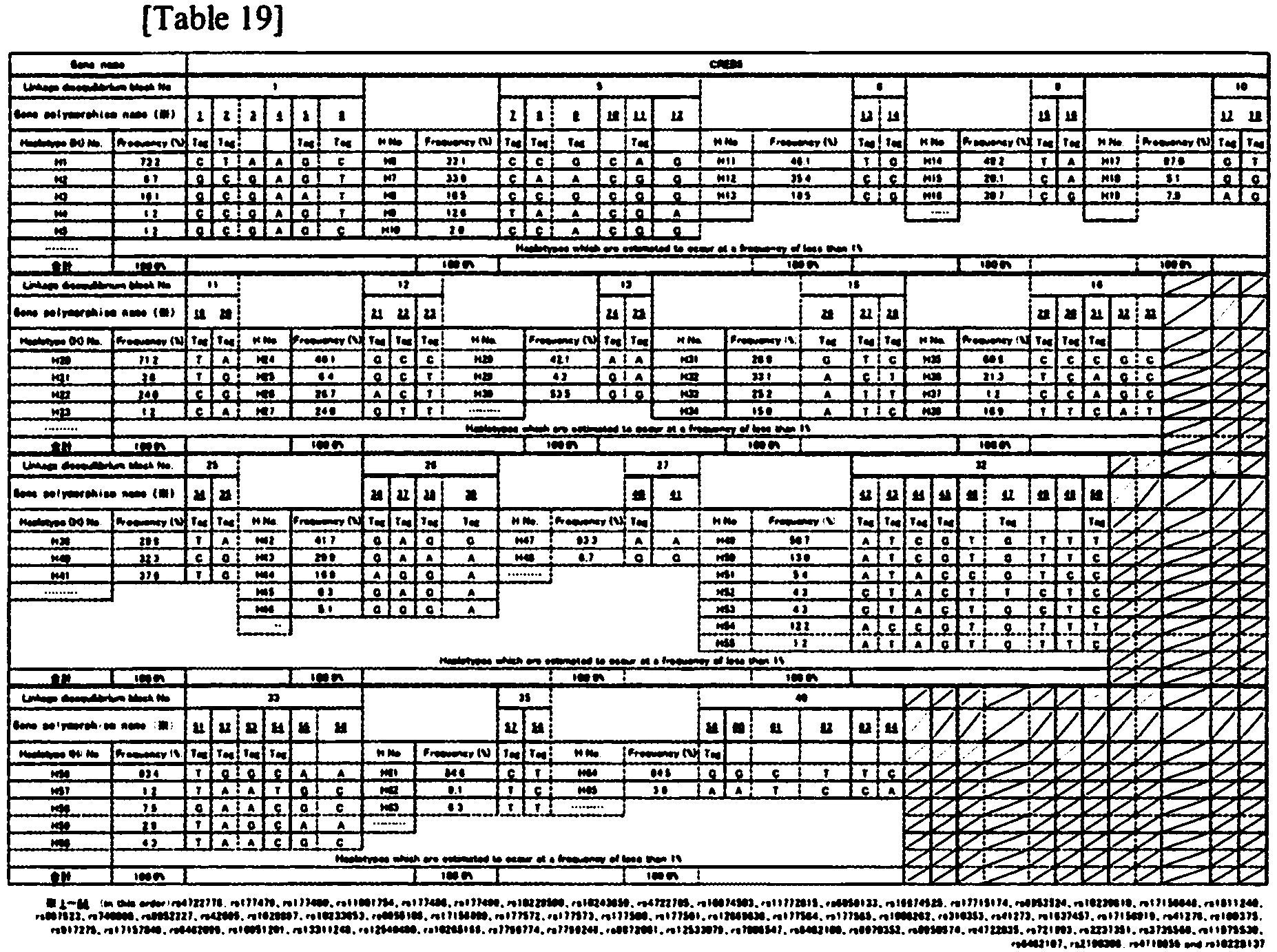

- As shown in Table 17, at least 7 haplotypes were estimated as the haplotype of CREB1 subtype gene polymorphism in the Japanese healthy subjects, and among these, there were 6 haplotypes observed at a high frequency of 3% or higher (haplotype Nos. H1 to H6). Incidentally, specific description regarding haplotypes which are estimated to occur at a frequency of less than 1% was omitted from Table 17.
- In addition, as shown in Table 18, at least 14 haplotypes were estimated as the haplotype of CREB3 subtype gene polymorphism in the Japanese healthy subjects, and among these, there were 11 haplotypes observed at a high frequency of 3% or higher (haplotype Nos. H1 to H5, H8 to H10, and H12 to H14). Incidentally, specific description regarding haplotypes which are estimated to occur at a frequency of less than 1% was omitted from Table 18.
- Moreover, as shown in Table 19, at least 65 haplotypes were estimated as the haplotype of CREB5 subtype gene polymorphism in the Japanese healthy subjects, and among these, there were 57 haplotypes observed at a high frequency of 3% or higher (haplotype Nos. H1 to H3, H6 to H9, H11 to H22, H24 to H36, H38 to H54, H56, H58, and H60 to H65). Incidentally, specific description regarding haplotypes which are estimated to occur at a frequency of less than 1% was omitted from Table 19.
- Furthermore, as shown in Table 20, at least 9 haplotypes were estimated as the haplotype of ATF2 subtype gene polymorphism in the Japanese healthy subjects, and among these, there were 9 haplotypes observed at a high frequency of 3% or higher (haplotype Nos. H1 to H9). Incidentally, specific description regarding haplotypes which are estimated to occur at a frequency of less than 1% was omitted from Table 20.
- As well as an analysis of the haplotype frequencies in the haplotype analysis shown in Tables 17, 18, 19 and 20, a linkage disequilibrium analysis was carried out. The results are shown in
Fig. 1 to Fig. 8 . The linkage disequilibrium among the CREB1 subtype gene polymorphisms in the Japanese healthy subjects is shown inFig. 1 andFig. 2 . In addition, the linkage disequilibrium among the CREB3 subtype gene polymorphisms in the Japanese healthy subjects is shown inFig. 3 andFig. 4 . Moreover, the linkage disequilibrium among the CREB5 subtype gene polymorphisms in the Japanese healthy subjects is shown inFig. 5 andFig. 6 . Furthermore, the linkage disequilibrium among the ATF2 subtype gene polymorphisms in the Japanese healthy subjects is shown inFig. 7 andFig. 8 . - A linkage disequilibrium block was estimated from the results of the linkage disequilibrium analysis (
Fig. 1 to Fig. 8 ) using Haploview. - In
Fig. 1 , a D' value, which is an index of a linkage disequilibrium between SNP and SNP, is calculated, and the resulting value (two places of decimals) is written in the square at the intersection of squares continued from each SNP to the lower left direction or the lower right direction. Further, an r2 value, which is a more stringent index of the linkage disequilibrium, is calculated in the same manner, and the resulting value is written in the same square as defined above inFig. 2 . It is to be noted that the square in which no numbers are written indicates that the D' or r2 value is 1. Also, the same shall apply toFigs 3 and4 ,Figs. 5 and6 , andFigs. 7 and8 . - When focusing attention on the D' values in
Fig. 1 , a complete linkage disequilibrium (D' = 1) was observed in many combinations of gene polymorphisms. Further, when focusing attention on the r2 values inFig. 2 , it was found that several gene polymorphisms showed a strong linkage disequilibrium (r2 = 1). It was found that suitable Tag SNPs representing these linkage disequilibrium blocks are rs16839837, rs2360969, rs10932200, rs2551946, rs4234080 and rs7594560. - In addition, when focusing attention on the D' values in
Fig. 3 , a complete linkage disequilibrium (D' = 1) was observed in many combinations of gene polymorphisms. Further, when focusing attention on the r2 values inFig. 4 , it was found that several gene polymorphisms showed a strong linkage disequilibrium (r2 = 1). It was found that suitable Tag SNPs representing these linkage disequilibrium blocks are rs1243872, rs2145925, rs2025126, GA007477, rs11541908, rs3763630, rs10814274, rsGA025684, rs10814275, rs4878628 and rs10758321. - When focusing attention on the D' values in
Fig. 5 , a complete linkage disequilibrium (D' = 1) was observed in many combinations of gene polymorphisms. Further, when focusing attention on the r2 values inFig. 6 , it was found that several gene polymorphisms showed a strong linkage disequilibrium (r2 = 1). It was found that suitable Tag SNPs representing these linkage disequilibrium blocks are rs4722778, rs177479, rs177486, rs177498, rs10229500, rs10243659, rs4722785, rs11772815, rs16874525, rs17715174, rs6953524, rs10239810, rs17156649, rs1811248, rs887623, rs740988, rs6952227, rs42695, rs1029897, rs10233653, rs6955105, rs17156699, rs177572, rs177573, rs177580, rs177581, rs12666636, rs1008262, rs310353, rs41273, rs1637457, rs17156919, rs41276, rsl160375, rs17157048, rs6462098, rs10951201, rs13311248, rs10265166, rs6972081, rs12533079, rs7806547, rs6462100, rs6979352, rs721993, rs2237351 and rs3735566. - In addition, when focusing attention on the D' values in
Fig. 7 , a complete linkage disequilibrium (D' = 1) was observed in many combinations of gene polymorphisms. Further, when focusing attention on the r2 values inFig. 8 , it was found that several gene polymorphisms showed a strong linkage disequilibrium (r2 = 1). It was found that suitable Tag SNPs representing these linkage disequilibrium blocks are rs1153711, rs1153702, rs7583431, rs2302663, rs3845744, rs268214 and rs1982235. - Further, a linkage disequilibrium block was estimated from the results of the linkage disequilibrium analysis (
Fig. 1 to Fig. 8 ) using Haploview. As a result, with regard to SNP in the CREB1 subtype gene shown inFig. 1 andFig. 2 , one linkage disequilibrium block was confirmed in a region ranging from the 5' flanking region to the 3' flanking region. In a similar manner, with regard to SNP in the CREB3 subtype gene shown inFig. 3 andFig. 4 , one linkage disequilibrium block was confirmed in the 5' flanking region, and one linkage disequilibrium block was confirmed in a region ranging from the 5' flanking region to the 3' flanking region. In a similar manner, with regard to SNP in the CREB5 subtype gene shown inFig. 5 andFig. 6 , one linkage disequilibrium block was confirmed in the 5' flanking region, 15 linkage disequilibrium blocks were confirmed in the intron region, and one linkage disequilibrium block was confirmed in a region ranging from the noncoding region of exon to the 3' flanking region. In a similar manner, with regard to SNP in the ATF2 subtype gene shown inFig. 7 andFig. 8 , one linkage disequilibrium block was confirmed in a region ranging from the 5' flanking region to the intron region, and one linkage disequilibrium block was confirmed in the 3' flanking region. - A correlation between a cyclic AMP responsive element binding protein gene polymorphism and the required administration amount of analgesic was examined. Genomic DNA was extracted from the blood of 247 patients undergoing surgery (orthognathic surgery), and one gene polymorphism (rs 10932200) in the CREB1 subtype gene was determined. Then, a correlation between these results of determination of the gene polymorphism and the required administration amount of analgesic after the surgery was analyzed.
- Incidentally, as the analgesic, fentanyl, which is mainly administered intravenously through a PCA (patient-controlled analgesia) pump, was used.
- As a result, as shown in the following Table 21 and
Fig. 9 , in the case of patients who had a minor allele (C) of the CREB1 subtype gene polymorphism (rs10932200) and underwent the surgery, the required administration amount (logarithmic transformation) of analgesic after the surgery was statistically significantly high in correlation with the number of alleles which they had. Accordingly, by analyzing the CREB1 subtype gene polymorphism (rs10932200), the sensitivity to analgesic can be predicted. - Using the median (2.222 (µg/kg)) of the required administration amounts of fentanyl in 24 hours after the surgery as a reference, a patient group with a value smaller than the reference and a patient group with a value larger than the reference were defined as a "high analgesic sensitivity group" and a "low analgesic sensitivity group," respectively, and the groups were then stratified in terms of the rs10932200 polymorphism of the CREB1 gene. As a result, in terms of this polymorphism, 54% and 46% of patients were determined to belong to the high analgesic sensitivity group and the low analgesic sensitivity group, respectively, in the A/A patient group. In contrast, in the C/C patient group, 23% and 77% of patients were determined to belong to the high analgesic sensitivity group and the low analgesic sensitivity group, respectively.
[Table 21] Effect of CREB1 rs10932200 polymorphism on required amount of analgesic administered in 24 hours after surgery in patients treated with analgesic in surgery (orthognathic surgery) (descriptive statistics by gender) CREB1 rs10932200 Gender Average Standard deviation Number of test subjects (subjects) A/A F 2.47 2.06 77 M 2.42 2.57 36 Total 2.46 2.23 113 A/C F 3.23 2.65 75 M 2.05 1.97 33 Total 2.87 2.51 108 C/C F 4.37 3.32 13 M 4.94 2.70 13 Total 4.65 2.98 26 Total F 2.96 2.50 165 M 2.67 2.54 82 Total 2.87 2.51 247 Required administration amount (µg/kg) of analgesic in 24 hours after surgery - A correlation between a cyclic AMP responsive element binding protein gene polymorphism and pain sensitivity was examined. Genomic DNA was extracted from the blood of 247 patients undergoing surgery (orthognathic surgery), and one gene polymorphism (rs10932200) in the CREB1 subtype gene was determined. Then, a correlation between these results of determination of the gene polymorphism and the measurement of pain perception latency due to finger immersion in ice water before the surgery was analyzed.
- As a result, as shown in the following Table 22 and
Fig. 10 , in the case of patients who had a minor allele (C) of the CREB1 subtype gene polymorphism (rs10932200) and underwent the surgery, the measurement result (logarithmic transformation) of pain perception latency was statistically significantly low in correlation with the number of alleles which they had. Accordingly, by analyzing the CREB1 subtype gene polymorphism (rs 10932200), the sensitivity to pain can be predicted. - Using the median (15 sec) of the measurement results of pain perception latency due to finger immersion in ice water before the surgery as a reference, a patient group with a value smaller than the reference and a patient group with a value larger than the reference were defined as a "high pain sensitivity group" and a "low pain sensitivity group," respectively, and the groups were then stratified in terms of the rs10932200 polymorphism of the CREB1 gene. As a result, in terms of this polymorphism, 45% and 55% of patients were determined to belong to the high pain sensitivity group and the low pain sensitivity group, respectively, in the A/A patient group. In contrast, in the A/C or C/C patient group, 55% and 45% of patients were determined to belong to the high pain sensitivity group and the low pain sensitivity group, respectively.
[Table 22] Effect of CREB1 rs10932200 polymorphism on measurement results of pain sensitivity before surgery in patients treated with analgesic in surgery (orthognathic surgery)
(descriptive statistics by gender)CREB1 rs10932200 Gender Average Standard deviation Number of test subjects (subjects) A/A F 20.95 18.21 76 M 27.96 32.07 36 Total 23.20 23.65 112 A/C F 17.83 15.13 75 M 21.91 17.12 33 Total 19.07 15.80 108 C/C F 12.07 8.03 14 M 17.73 9.86 13 Total 14.80 9.24 27 Total F 18. 78 16.33 165 M 23.90 24.28 82 Total 20.48 19.43 247 Measurement (sec) of pain perception latency due to finger immersion in ice water before surgery - A correlation between a cyclic AMP responsive element binding protein gene polymorphism and pain sensitivity was examined. Genomic DNA was extracted from the blood of 247 patients undergoing surgery (orthognathic surgery), and one gene polymorphism (rs10932200) in the CREB1 subtype gene was determined. Then, a correlation between these results of determination of the gene polymorphism and the measurement of the scale of the intensity of pain (VAS: on visual analogue scale) 24 hours after the surgery was analyzed.
- As a result, as shown in the following Table 23 and
Fig. 11 , in correlation with the measurement result (logarithmic transformation) of the scale of the intensity of pain (VAS) 24 hours after the surgery, patients who had a minor allele (T) of the CREB1 subtype gene polymorphism (rs10932200) and underwent the surgery had a value of VAS (logarithmic transformation) that was statistically significantly high in correlation with the number of alleles which they had. Accordingly, by analyzing the CREB1 subtype gene polymorphism (rs10932200), the sensitivity to pain or analgesic after the surgery can be more easily predicted. - Using the median (24 mm) of the VAS values 24 hours after the surgery as a reference, a patient group with a value smaller than the reference and a patient group with a value larger than the reference were defined as a "low pain sensitivity group" and a "high pain sensitivity group," respectively, and the groups were then stratified in terms of the rs10932200 polymorphism of the CREB1 gene. As a result, in terms of this polymorphism, 54% and 46% of patients were determined to belong to the low pain sensitivity group and the high pain sensitivity group, respectively, in the A/A patient group. In contrast, in the A/C or C/C patient group, 47% and 53% of patients were determined to belong to the low pain sensitivity group and the high pain sensitivity group, respectively.
[Table 23] Effect of CREB1 rs10932200 polymorphism on measurement results of VAS (intensity of pain on visual analogue scale) after surgery in patients administered with analgesic in surgery (orthognathic surgery) (descriptive statistics by Render) CREB1 rs10932200 Gender Average Standard deviation Number of test subjects (subjects) A/A F 24.17 19.35 77 M 21.94 18.59 36 Total 23.46 19.06 113 A/C F 28.51 24.49 75 M 26.33 20.06 33 Total 27.84 23.15 108 C/C F 37.31 17.78 13 M 34.31 21.78 13 Total 35.81 19.54 26 Total F 27.18 21.92 165 M 25.67 19.92 82 Total 26.68 21.25 247 Measurement (mm) of scale of intensity of pain by VAS after surgery - A correlation between a cyclic AMP responsive element binding protein gene polymorphism and pain sensitivity was examined. Genomic DNA was extracted from the blood of 247 patients undergoing surgery (orthognathic surgery), and one gene polymorphism (rs7583431) in the ATF2 subtype gene was determined. Then, a correlation between these results of determination of the gene polymorphism and the analgesic effect of fentanyl that was evaluated based on the measurement of a difference in threshold of pain perception latency due to finger immersion in ice water after administration of an analgesic before the surgery was analyzed.
- As a result, as shown in the following Table 24 and
Fig. 12 , in correlation with the measurement result (logarithmic transformation) of a difference in threshold of pain perception latency due to finger immersion in ice water before the surgery, patients who had a minor allele (C) of the ATF2 subtype gene polymorphism (rs7583431) and underwent the surgery had a difference in threshold of pain perception latency (logarithmic transformation) due to finger immersion in ice water before the surgery that was statistically significantly low in correlation with the number of alleles which they had. Accordingly, by analyzing the ATF2 subtype gene polymorphism (rs758343 1), the sensitivity to analgesic before surgery can be more easily predicted. - Using the median (13 sec) of the measurement results of a difference in threshold of pain perception due to finger immersion in ice water before the surgery as a reference, a patient group with a value smaller than the reference and a patient group with a value larger than the reference were defined as a "low analgesic sensitivity group" and a "high analgesic sensitivity group," respectively, and the groups were then stratified in terms of the rs7583431 polymorphism of the ATF2 gene. As a result, in terms of this polymorphism, 40% and 60% of patients were determined to belong to the low analgesic sensitivity group and the high analgesic sensitivity group, respectively, in the A/A patient group. In contrast, in the C/C patient group, 71% and 29% of patients were determined to belong to the low analgesic sensitivity group and the high analgesic sensitivity group, respectively.
[Table 24] Effect of ATF2 rs7583431 polymorphism on measurement results of difference in threshold of pain sensitivity before surgery in patients treated with analgesic in surgery (orthognathic surgery) (descriptive statistics by gender) ATF2 rs7583431 Gender Average Standard deviation Number of test subjects (subjects) A/A F 26.69 32.69 64 M 34.78 36.28 32 Total 29.39 33.96 96 A/C F 26.97 36.11 76 M 28.73 42.97 44 Total 27.62 38.60 120 C/C F 14.24 25.36 25 M 12.00 19.07 6 Total 13.81 24.00 31 Total F 24.93 33.49 165 M 29.87 39.24 82 Total 26.57 35.50 247 Measurement (sec) of difference in threshold of pain perception latency due to finger immersion in ice water before surgery - In the same manner as Examples 2 to 5 above, a correlation between each gene polymorphism of the cyclic AMP responsive element binding protein gene, and each of the required administration amount of analgesic, pain sensitivity, and the analgesic effect of fentanyl was examined. Genomic DNA was extracted from the blood of 355 patients undergoing surgery (orthognathic surgery), and gene polymorphisms in the CREB1, CREB3, CREB5 and ATF2 subtype genes (Tag SNPs in linkage disequilibrium blocks and individual SNPs outside of the linkage disequilibrium blocks) were determined. Then, a correlation between these results of determination of the gene polymorphisms, and each of the required administration amount of analgesic in 24 hours after the surgery, pain sensitivity before the surgery, pain sensitivity (VAS) 24 hours after the surgery and before the surgery, and the analgesic effect of fentanyl, was analyzed.
- Incidentally, as the analgesic, fentanyl, which is mainly administered intravenously through a PCA (patient-controlled analgesia) pump, was used.
- As a result, the gene polymorphisms of the CREB1, CREB3, CREB5 and ATF2 subtype genes showed a statistically significant correlation with any phenotype of the required administration amount of analgesic in 24 hours after the surgery, pain sensitivity before the surgery, pain sensitivity (VAS) 24 hours after the surgery and before the surgery, and the analgesic effect of fentanyl. Accordingly, by analyzing these gene polymorphisms, the sensitivity to analgesic, pain sensitivity, and the analgesic effect of fentanyl can be predicted.
- The results of the present example, as well as the results of Examples 2 to 5, are collectively shown in the following Table 25.
[Table 25] Tag SNPs in linkage disequilibrium (LD) blocks and SNPs outside of LD blocks found to have significant association with phenotypes Gene region Chromo -some No. LD Block No. Tag SNP Position Minor Allele Frequency Phenotype N Statistics BETA SE R2 P CREB1 2 1 rs16839837 208079256 0.232 Required amount of fentanyl administered in 24 hours after 247 -0.1347 0.06718 0.01613 0.04613 CREB1 2 1 rs2360969 208081241 0.126 Required amount of fentanyl administered in 24 hours after 353 0.1453 0.07182 0.01153 0.04377 CREB1 2 1 rs 10932200 208095930 0.315 Required amount of fentanyl administered in 24 hours after 247 0.2211 0.0597 0.05301 0.000263 CREB1 2 1 rs1093220 208095930 0.315 VAS 24 hours after surgery 247 0.3084 0.1305 0.02228 0.01891 CREB1 2 1 rs1093220 208095930 0.315 pain perception latency before surgery 247 -0.14 0.06043 0.02145 0.02129 CREB1 2 1 rs4234080 208197346 0.193 Required amount of fentanyl administered in 24 hours after 247 -0.2078 0.07133 0.03348 0.003906 CREB3 9 1 rs2145925 35679373 0.39 Required amount of fentanyl administered in 24 hours after 246 -0.1258 0.05884 0.01838 0.03358 CREB3 9 1 rs2025126 35686625 0.366 Required amount of fentanyl administered in 24 hours after 247 -0.1281 0.060 11 0.01821 0.03402 CREB3 9 2 rs4878628 35756561 0.134 VAS 24 hours after surgery 253 -0.4888 0.1739 0.0305 0.005343 CREB5 7 1 rs4722778 28278588 0.256 Required amount of fentanyl administered in 24 hours after 126 -0.2062 0.09913 0.03371 0.03961 CREB5 7 - rs2175738 28304605 0.161 Required amount of fentanyl administered in 24 hours after 126 -0.3309 0.1141 0.06356 0.0044 CREB5 7 - rs2175738 28304605 0.161 VAS 24 hours after surgery 126 -0.5459 0.2322 0.04267 0.0203 CREB5 7 - rs17156579 28327642 0.055 Required amount of fentanyl administered in 24 hours after 253 -0.306 0.1293 0.02184 0.01868 CREB5 7 - rs17156603 28348671 0.398 pain perception latency before surgery 253 -0.1105 0.05533 0.01564 0.04692 CREB5 7 - rs17642 145 28355789 0.008 pain perception latency before surgery 247 -0.7505 0.319 0.02209 0.01943 CREB5 7 5 rs4722785 28356666 0.488 Required amount of fentanyl administered in 24 hours after 253 -0.1142 0.05564 0.01651 0.04114 CREB5 7 6 rs17156649 28357707 0.461 VAS 24 hours after surgery 252 0.2455 0.121 0.01621 0.04345 CREB5 7 10 rs17156649 28386945 0.079 Analgesic effect of fentanyl before surgery 247 -0.6983 0.2917 0.02285 0.01743 CREB5 7 - rs7794304 28394916 0.457 pain perception latency before surgery 354 -0.1154 0.05005 0.01487 0.02175 CREB5 7 12 rs 1029897 28400928 0.409 pain perception latency before surgery 353 -0.09985 0.04979 0.01133 0.04568 CREB5 7 - rs4722793 28404054 0.405 pain perception latency before surgery 252 -0.1225 0.05698 0.01817 0.03246 CREB5 7 13 rs10233653 28406845 0.421 pain perception latency before surgery 354 -0.119 0.05004 0.0158 0.01796 CREB5 7 13 rs6955105 28409814 0.465 pain perception latency before surgery 354 -0.1222 0.0481 0.01802 0.01147 CREB5 7 - rs17156685 28431959 0.087 pain perception latency before surgery 247 -0.2359 0.1053 0.02007 0.02598 CREB5 7 - rs17156694 28451480 0.441 pain perception latency before surgery 235 -0.1379 0.05492 0.02449 0.0127 CREB5 7 15 rs177572 28460820 0.331 pain perception latency before surgery 253 0.1454 0.06446 0.01988 0.02492 CREB5 7 - rs177574 28461566 0.047 Analgesic effect of fentanyl before surgery 247 0.7803 0.3685 0.01798 0.03521 CREB5 7 - rs177576 28463632 0.327 Analgesic effect of fentanyl before surgery 247 0.4179 0.1582 0.02771 0.008764 CREB5 7 - rs13437706 28465016 0.374 Analgesic effect of fentanyl before surgery 253 0.3854 0.1501 0.02559 0.008764 CREB5 7 16 rs177580 28465195 0.382 Analgesic effect of fentanyl before surgery 253 -0.3177 0.1503 0.01749 0.03554 CREB5 7 16 rs12666636 28465748 0.224 VAS 24 hours after surgery 354 -0.2569 0.1182 0.01325 0.03036 CREB5 7 - rs216715 28539407 0.287 VAS 24 hours after surgery 354 -0.2213 0.1069 0.01202 0.03923 CREB5 7 - rs10951197 28540048 0.39 VAS 24 hours after surgery 253 -0.248 0.1181 0.01726 0.03676 CREB5 7 - rs160335 28554342 0.496 VAS 24 hours after surgery 247 0.2437 0.122 0.01602 0.04693 CREB5 7 25 rs310353 28603649 0.299 VAS 24 hours after surgery 247 -0.2846 0.1258 0.02047 0.02451 CREB5 7 - rs310359 28606311 0.217 Required amount of fentanyl administered in 24 hours after 126 0.2233 0.1071 0.0339 0.03904 CREB5 7 26 rs1637457 28615963 0.22 pain perception latency before surgery 253 -0.1327 0.06564 0.01603 0.04422 CREB5 7 - rs41348 28683373 0.386 pain perception latency before surgery 354 -0.1254 0.04985 0.01765 0.01235 CREB5 7 - rs886816 28689932 0.181 Required amount of fentanyl administered in 24 hours after 354 0.1596 0.06074 0.01924 0.008961 CREB5 7 32 rs17157048 28703823 0.087 Required amount of fentanyl administered in 24 hours after 354 -0.2175 0.09867 0.01361 0.02816 CREB5 7 32 rs10951201 28711867 0.154 Required amount of fentanyl administered in 24 hours after 354 -0.2078 0.07776 0.01988 0.007896 CREB5 7 32 rs10265 166 28713821 0.043 Analgesic effect of fentanyl before surgery 253 0.9373 0.4605 0.01624 0.04285 CREB5 7 32 rs6972081 28715571 0.287 pain perception latency before surgery 354 -0.1289 0.05762 0.01402 0.02588 CREB5 7 33 rs6462 100 28720620 0.134 Required amount of fentanyl administered in 24 hours after 354 -0.2022 0.08 0.01782 0.01194 CREB5 7 - rs2066979 28730634 0.276 pain perception latency before surgery 250 -0.1395 0.06557 0.01792 0.0344 CREB5 7 - rs10486591 28733403 0.272 pain perception latency before surgery 354 -0.1231 0.05973 0.01192 0.04007 CREB5 7 35 rs721993 28745985 0.154 Required amount of fentanyl administered in 24 hours after 354 -0.1698 0.07741 0.01348 0.02898 CREB5 7 40 rs3735566 28831314 0.039 Required amount of fentanyl administered in 24 hours after 247 -0.2901 0.1445 0.01618 0.04582 ATF2 2 1 rs1153702 175629003 0.476 Analgesic effect of fentanyl before surgery 354 0.2496 0.1214 0.01188 0.04044 ATF2 2 1 rs7583431 175630628 0.366 Analgesic effect of fentanyl before surgery 247 -0.5442 0.1582 0.04606 0.000685 ATF2 2 - rs1153699 175631032 0.472 Analgesic effect of fentanyl before surgery 247 0.3865 0.1524 0.02558 0.01184 ATF2 2 - rs1153699 175631032 0.472 pain perception latency before surgery 247 0.1173 0.0577 0.01659 0.04312 ATF2 2 2 rs268214 175741461 0.189 Analgesic effect of fentanyl before surgery 247 0.4065 0.1863 0.01907 0.03004 - A correlation between a cyclic AMP responsive element binding protein gene polymorphism and the required administration amount of analgesic was examined. Genomic DNA was extracted from the blood of 354 patients undergoing surgery (orthognathic surgery), and one gene polymorphism (rs2952768) in the CREB1 subtype gene was determined. Then, a correlation between these results of determination of the gene polymorphism and the required administration amount of analgesic after the surgery was analyzed.
- Incidentally, as the analgesic, fentanyl, which is mainly administered intravenously through a PCA (patient-controlled analgesia) pump, was used.
- As a result, as shown in the following Table 26 and
Fig. 13 , in the case of patients who had a minor allele (C) of the CREB1 subtype gene polymorphism (rs2952768) and underwent the surgery, the required administration amount (logarithmic transformation) of analgesic after the surgery was statistically significantly high in correlation with the number of alleles which they had. Accordingly, by analyzing the CREB1 subtype gene polymorphism (rs2952768), the sensitivity to analgesic can be predicted. - Using the median (2.268 (µg/kg)) of the required administration amount of fentanyl in 24 hours after the surgery as a reference, a patient group with a value smaller than the reference and a patient group with a value larger than the reference were defined as a "high analgesic sensitivity group" and a "low analgesic sensitivity group," respectively, and the groups were then stratified in terms of the rs2952768 polymorphism of the CREB1 gene. As a result, in terms of this polymorphism, 53% and 47% of patients were determined to belong to the high analgesic sensitivity group and the low analgesic sensitivity group, respectively, in the T/T or T/C patient group. In contrast, in the C/C patient group, 22% and 78% of patients were determined to belong to the high analgesic sensitivity group and the low analgesic sensitivity group, respectively.
[Table 26] Effect of CREB1 rs2952768 polymorphism on required amount of analgesic administered in 24 hours after surgery in patients treated with analgesic in surgery (orthognathic surgery) (descriptive statistics by gender) CREB1 rs2952768 Gender Average Standard deviation Number of test subjects (subjects) T/T F 2.78 2.43 101 M 2.38 2.46 58 Total 2.64 2.44 159 T/C F 2.99 2.42 108 M 2.38 2.50 52 Total 2.79 2.46 160 C/C F 4.80 3.05 20 M 5.08 2.55 15 Total 4.92 2.81 35 Total F 3.05 2.53 229 M 2.71 2.62 125 Total 2.93 2.57 354 Required amount (µg/kg) of analgesic administered in 24 hours after surgery - A correlation between a cyclic AMP responsive element binding protein gene polymorphism and the required administration amount of analgesic was examined. Genomic DNA was extracted from the blood or the oral mucosa of 112 patients undergoing surgery (abdominal surgery), and one gene polymorphism (rs2952768) in the CREB1 subtype gene was determined. Then, a correlation between these results of determination of the gene polymorphism and the required administration amount of analgesic after the surgery was analyzed.
- Incidentally, as the analgesic, analgesics such as pentazocine and pethidine, which are mainly administered intravenously, buprenorphine, diclofenac and indomethacin, which are mainly administered as a suppository, flurbiprofen axetil, which is injected by intravenous infusion, as well as epidural morphine and marcain were used.
- Incidentally, the total amount of each analgesic in terms of fentanyl means the total amount of analgesic (mg) in the case where the amount of each administered analgesic is converted to a value corresponding to the potency equivalent to fentanyl. The conversion of the amount of each analgesic to a value corresponding to the potency of fentanyl was carried out by setting a potency equivalent to 0.3 mg of fentanyl at 90 mg of pentazocine, 360 mg in the case of pethidine (Opystan), 1 mg in the case of buprenorphine (Lepetan), 300 mg in the case of diclofenac (Voltaren), 300 mg in the case of flurbiprofen axetil (Ropion), and 6 mg in the case of epidural morphine.
- As a result, as shown in the following Table 27 and
Fig. 14 , in the case of patients who did not have a major allele (T) of the CREB1 subtype gene polymorphism (rs2952768) and underwent the surgery, the required administration amount (logarithmic transformation) of analgesic after the surgery was statistically significantly higher compared with patients having the aforementioned allele (T). Accordingly, by analyzing the CREB1 subtype gene polymorphism (rs2952768), the sensitivity to each analgesic can be predicted. - Using the median (2.453 (µg/kg)) of the required total administration amount of each analgesic in terms of fentanyl in 24 hours after the surgery as a reference, a patient group with a value smaller than the reference and a patient group with a value larger than the reference were defined as a "high analgesic sensitivity group" and a "low analgesic sensitivity group," respectively, and the groups were then stratified in terms of the rs2952768 polymorphism of the CREB1 gene. As a result, in terms of this polymorphism, 52% and 48% of patients were determined to belong to the high analgesic sensitivity group and the low analgesic sensitivity group, respectively, in the T/T or T/C patient group. In contrast, in the C/C patient group, 33% and 67% of patients were determined to belong to the high analgesic sensitivity group and the low analgesic sensitivity group, respectively.
[Table 27] Effect of CREB1 rs2952768 polymorphism on required amount of analgesic administered in 24 hours after surgery in patients treated with analgesic in surgery (abdominal surgery) (descriptive statistics by gender) CREB1 rs2952768 Gender Average Standard deviation Number of test subjects (subjects) T/T F 0.93 1.35 18 M 0.43 0.63 26 Total 0.63 1.01 44 T/C F 0.67 1.32 28 M 0. 78 1.01 28 Total 0.72 1.17 56 C/C F 1.12 1.34 6 M 1.78 1.61 6 Total 1.45 1.45 12 Total F 0.81 1.32 52 M 0. 73 1.00 60 Total 0.77 1.15 112 Required total amount (µg/kg) of analgesic administered in terms of fentanyl in 24 hours after surgery - A correlation between a cyclic AMP responsive element binding protein gene polymorphism and vulnerability to drug dependence associated with the severity of drug dependence was examined. Genomic DNA was extracted from the blood of 194 methamphetamine-dependent patients, and one gene polymorphism (rs2952768) in the CREB1 subtype gene was determined. The patients were classified based on the presence or absence of the abuse of many drugs, and a comparison was made among them. The results are shown in the following Table 28. Here, the methamphetamine-dependent patients were classified into two groups, namely, a patient group involving the abuse of drugs other than stimulants (two or more types) and a patient group involving the abuse of a single drug (only one type).
- As a result, as is clear from the following Table 28, a significant difference in genotype frequency was observed in terms of the gene polymorphism (rs2952768), and in methamphetamine-dependent patients having a major allele (T), the number of patients who abused many drugs was statistically significantly higher compared with patient who did not have the aforementioned allele T.
- From the above results, it was demonstrated that drug sensitivity associated with the severity of stimulant dependence can be easily predicted by determining genotype frequency in the cyclic AMP responsive element binding protein gene polymorphism.

- A correlation between a cyclic AMP responsive element binding protein gene polymorphism and vulnerability to drug dependence associated with the severity of drug dependence was examined. Genomic DNA was extracted from the blood of 436 alcohol-dependent patients, and one gene polymorphism (rs2952768) in the CREB1 subtype gene was determined. The patients were classified based on the presence or absence of drug abuse, and a comparison was made among them. The results are shown in the following Table 29. Here, the alcohol-dependent patients were classified into two groups, namely, a patient group with drug abuse (one or more types) and a patient group without drug abuse (only alcohol ingestion).
- As a result, as is clear from the following Table 29, a significant difference in genotype and allele frequencies was observed in terms of the gene polymorphism (rs2952768), and it was demonstrated that the frequency of major allele (T) was statistically significantly higher in the patient group with drug abuse than in the patient group without drug abuse.
- From the above results, it was demonstrated that vulnerability to drug dependence associated with the severity of drug dependence can be easily predicted by determining genotype and allele frequencies in the cyclic AMP responsive element binding protein gene polymorphism.

- A correlation between a cyclic AMP responsive element binding protein gene polymorphism and vulnerability to drug dependence associated with the severity of drug dependence was examined. Genomic DNA was extracted from the blood of 221 patients with eating disorder, and one gene polymorphism (rs2952768) in the CREB1 subtype gene was determined. The patients were classified based on the presence or absence of drug dependence, and a comparison was made among them. The results are shown in the following Table 30. Here, the eating disorder patients were classified into two groups, namely, a patient group with a complication of drug dependence and a patient group without a complication of drug dependence.
- As a result, as is clear from the following Table 30, a significant difference in genotype and allele frequencies was observed in terms of the gene polymorphism (rs2952768), and it was demonstrated that the frequency of major allele (T) was statistically significantly higher in the patient group with a complication of drug dependence than in the patient group without a complication of drug dependence.
- From the above results, it was demonstrated that vulnerability to drug dependence associated with the severity of drug dependence can be easily predicted by determining genotype and allele frequencies in the cyclic AMP responsive element binding protein gene polymorphism.

- A correlation between a cyclic AMP responsive element binding protein gene polymorphism and vulnerability to substance (alcohol) dependence associated with the severity of substance (alcohol) dependence was examined. Genomic DNA was extracted from the blood of 221 patients with eating disorder, and one gene polymorphism (rs2952768) in the CREB1 subtype gene was determined. The patients were classified based on the presence or absence of alcohol dependence, and a comparison was made among them. The results are shown in the following Table 31. Here, the eating disorder patients were classified into two groups, namely, a patient group with a complication of alcohol dependence and a patient group without a complication of alcohol dependence.
- As a result, as is clear from the following Table 31, a significant difference in genotype and allele frequencies was observed in terms of the gene polymorphism (rs2952768), and it was demonstrated that the frequency of major allele (T) was statistically significantly higher in the patient group with a complication of alcohol dependence than in the patient group without a complication of alcohol dependence.
- From the above results, it was demonstrated that vulnerability to substance
- (alcohol) dependence associated with the severity of substance (alcohol) dependence can be easily predicted by determining genotype and allele frequencies in the cyclic AMP responsive element binding protein gene polymorphism.

- A correlation between a cyclic AMP responsive element binding protein gene polymorphism and dependence-prone personality associated with reward dependence was examined. Genomic DNA was extracted from the oral mucosa of 495 healthy subjects, and one gene polymorphism (rs2952768) in the CREB1 subtype gene was determined. Then, a correlation between these results of determination of the gene polymorphism and dependence-prone personality was analyzed.
- It is to be noted that, as a test of dependence-prone personality, a reward dependence (RD) score (average) in the Temperament and Character Inventory (TCI) was used.
- As a result, as is shown in the following Table 32 and
Fig. 15 , healthy subjects having a minor allele (C) in the CREB1 subtype gene polymorphism (rs2952768) had an RD score (logarithmic transformation) that was statistically significantly low in correlation with the number of alleles which they had. Accordingly, by analyzing the CREB1 subtype gene polymorphism (rs2952768), dependence-prone personality can be predicted. - Using the median (0.667) of the RD score as a reference, a patient group with a value smaller than the reference and a patient group with a value larger than the reference were defined as a "low reward dependence group" and a "high reward dependence group," respectively, and the groups were then stratified in terms of the rs2952768 polymorphism of the CREB1 gene. As a result, in terms of this polymorphism, 43% and 57% of healthy subjects were determined to belong to the low reward dependence group and the high reward dependence group, respectively, in the T/T patient group. In contrast, in the C/C patient group, 58% and 42% of healthy subjects were determined to belong to the low reward dependence group and the high reward dependence group, respectively.
- From the above results, it was demonstrated that dependence-prone personality associated with reward dependence can be easily predicted by determining genotype and allele frequencies in the cyclic AMP responsive element binding protein gene polymorphism.
[Table 32] Effect of CREB1 rs2952768 polymorphism on reward dependence (RD) score (average) (descriptive statistics bv gender) CREB1 rs2952768 Gender Average Standard deviation Number of test subjects (subjects) T/T F 0.72 0.18 98 M 0.66 0.18 122 Unknown 0.60 0.09 2 Total 0.68 0.18 222 T/C F 0.70 0.18 103 M 0.62 0.20 98 Unknown 0. 78 0.08 3 Total 0.66 0.19 204 C/C F 0.68 0.22 37 M 0.58 0.18 32 Total 0.63 0.21 69 
F 0.70 0.19 238 M 0.63 0.19 252 Unknown 0.71 0.12 5 Total 0.67 0.19 495 Average in dimension of average score in each subscale - A correlation between a cyclic AMP responsive element binding protein gene polymorphism and a gene expression level was examined. Genomic DNA was extracted from the blood of 100 postmortem brain tissue donors at the Stanley Foundation Brain Bank, and one gene polymorphism (rs2952768) in the CREB1 subtype gene was determined. Then, a correlation between these results of determination of the gene polymorphism and a gene expression level was analyzed.
- Incidentally, as the gene expression level, the value of the relative mRNA expression level of CREB1, which was standardized with the value of the mRNA expression level of a β-actin gene (ACTB), was used.
- As a result, as shown in the following Table 33 and
Fig. 16 , in the case of subjects who did not have a major allele (T) of the CREB1 subtype gene polymorphism (rs2952768), the mRNA expression level (logarithmic transformation) of CREB1 was statistically significantly higher compared with subjects having the aforementioned allele (T). Accordingly, by analyzing the CREB1 subtype gene polymorphism (rs2952768), the gene expression level can be predicted. - Using the median (0.0145) of the relative mRNA expression level as a reference, a subject group with a value smaller than the reference and a subject group with a value larger than the reference were defined as a "low gene expression group" and a "high gene expression group," respectively, and the groups were then stratified in terms of the rs2952768 polymorphism of the CREB1 gene. As a result, in terms of this polymorphism, 52% and 48% of subjects were determined to belong to the low gene expression group and the high gene expression group, respectively, in the T/T or T/C subject group. In contrast, in the C/C subject group, 30% and 70% of subjects were determined to belong to the low gene expression group and the high gene expression group, respectively.
- From the above results, it was demonstrated that the tendency of the expression level of a CREB1 gene (whether the gene tends to be expressed at a high level or at a low level) can be easily predicted by determining genotype and allele frequencies in the cyclic AMP responsive element binding protein gene polymorphism.
[Table 33] Effect of CREB1 rs2952768 polymorphism on gene expression level in postmortem brain tissue donors at Stanley Foundation Brain Bank (descriptive statistics) CREB1 rs2952768 Average Standard deviation Number of test subjects (subjects) T/T 0.015345 0.006618 48 T/C 0.015667 0.005267 42 C/C 0.023360 0.023537 10 Total 0.016282 0.009396 100 Relative mRNA expression level value of CREB1 standardized with mRNA expression level value of β -actin gene (ACTB) - According to the present invention, it becomes possible to provide: a gene polymorphism of a cyclic AMP responsive element binding protein gene or a haplotype constituted by the gene polymorphism, which can evaluate an individual difference in terms of drug sensitivity and disease vulnerability; a method for evaluating drug sensitivity and disease vulnerability using the gene polymorphism or the haplotype; and the like. According to this evaluation method, it becomes possible to readily know or predict a proper prescribed amount, a proper prescribed schedule associated with a narcotic drug such as morphine, and the like, and hence the method is extremely useful for personalized pain therapy, drug dependence therapy and the like.
-
- <110> TOKYO METROPOLITAN INSTITUTE OF MEDICAL SCIENCE
- <120> A METHOD OF EVALUATING DRUG SENSITIVITY AND DISEASE VULNERABILITY WITH ANALYSES OF CREB GENE
- <130> PCT12-0037
- <150>
JP 2011-217104
<151> 2011-09-30 - <160> 172
- <170> PatentIn version 3.4
- <210> 1
<211> 101
<212> DNA
<213> Homo sapiens - <400> 1

- <210> 2
<211> 101
<212> DNA
<213> Homo sapiens - <400> 2

- <210> 3
<211> 101
<212> DNA
<213> Homo sapiens - <400> 3

- <210> 4
<211> 101
<212> DNA
<213> Homo sapiens - <400> 4

- <210> 5
<211> 101
<212> DNA
<213> Homo sapiens - <400> 5

- <210> 6
<211> 101
<212> DNA
<213> Homo sapiens - <400> 6

- <210> 7
<211> 101
<212> DNA
<213> Homo sapiens - <400> 7

- <210> 8
<211> 101
<212> DNA
<213> Homo sapiens - <400> 8

- <210> 9
<211> 101
<212> DNA
<213> Homo sapiens - <400> 9

- <210> 10
<211> 101
<212> DNA
<213> Homo sapiens - <400> 10

- <210> 11
<211> 101
<212> DNA
<213> Homo sapiens - <400> 11

- <210> 12
<211> 101
<212> DNA
<213> Homo sapiens - <400> 12

- <210> 13
<211> 101
<212> DNA
<213> Homo sapiens - <400> 13

- <210> 14
<211> 101
<212> DNA
<213> Homo sapiens - <400> 14

- <210> 15
<211> 101
<212> DNA
<213> Homo sapiens - <400> 15

- <210> 16
<211> 101
<212> DNA
<213> Homo sapiens - <400> 16

- <210> 17
<211> 101
<212> DNA
<213> Homo sapiens - <400> 17

- <210> 18
<211> 101
<212> DNA
<213> Homo sapiens - <400> 18

- <210> 19
<211> 101
<212> DNA
<213> Homo sapiens - <400> 19

- <210> 20
<211> 101
<212> DNA
<213> Homo sapiens - <400> 20

- <210> 21
<211> 101
<212> DNA
<213> Homo sapiens - <400> 21

- <210> 22
<211> 101
<212> DNA
<213> Homo sapiens - <400> 22


- <210> 23
<211> 101
<212> DNA
<213> Homo sapiens - <400> 23

- <210> 24
<211> 101
<212> DNA
<213> Homo sapiens - <400> 24

- <210> 25
<211> 101
<212> DNA
<213> Homo sapiens - <400> 25

- <210> 26
<211> 101
<212> DNA
<213> Homo sapiens - <400> 26

- <210> 27
<211> 101
<212> DNA
<213> Homo sapiens - <400> 27

- <210> 28
<211> 101
<212> DNA
<213> Homo sapiens - <400> 28

- <210> 29
<211> 101
<212> DNA
<213> Homo sapiens - <400> 29

- <210> 30
<211> 101
<212> DNA
<213> Homo sapiens - <400> 30

- <210> 31
<211> 101
<212> DNA
<213> Homo sapiens - <400> 31

- <210> 32
<211> 101
<212> DNA
<213> Homo sapiens - <400> 32

- <210> 33
<211> 101
<212> DNA
<213> Homo sapiens - <400> 33

- <210> 34
<211> 101
<212> DNA
<213> Homo sapiens - <400> 34

- <210> 35
<211> 101
<212> DNA
<213> Homo sapiens - <400> 35

- <210> 36
<211> 101
<212> DNA
<213> Homo sapiens - <400> 36


- <210> 37
<211> 101
<212> DNA
<213> Homo sapiens - <400> 37

- <210> 38
<211> 101
<212> DNA
<213> Homo sapiens - <400> 38

- <210> 39
<211> 101
<212> DNA
<213> Homo sapiens - <400> 39

- <210> 40
<211> 101
<212> DNA
<213> Homo sapiens - <400> 40

- <210> 41
<211> 101
<212> DNA
<213> Homo sapiens - <400> 41

- <210> 42
<211> 101
<212> DNA
<213> Homo sapiens - <400> 42

- <210> 43
<211> 101
<212> DNA
<213> Homo sapiens - <400> 43

- <210> 44
<211> 101
<212> DNA
<213> Homo sapiens - <400> 44

- <210> 45
<211> 101
<212> DNA
<213> Homo sapiens - <400> 45

- <210> 46
<211> 101
<212> DNA
<213> Homo sapiens - <400> 46

- <210> 47
<211> 101
<212> DNA
<213> Homo sapiens - <400> 47

- <210> 48
<211> 101
<212> DNA
<213> Homo sapiens - <400> 48

- <210> 49
<211> 101
<212> DNA
<213> Homo sapiens - <400> 49

- <210> 50
<211> 101
<212> DNA
<213> Homo sapiens - <400> 50

- <210> 51
<211> 101
<212> DNA
<213> Homo sapiens - <400> 51

- <210> 52
<211> 101
<212> DNA
<213> Homo sapiens - <400> 52

- <210> 53
<211> 101
<212> DNA
<213> Homo sapiens - <400> 53

- <210> 54
<211> 101
<212> DNA
<213> Homo sapiens - <400> 54

- <210> 55
<211> 101
<212> DNA
<213> Homo sapiens - <400> 55

- <210> 56
<211> 101
<212> DNA
<213> Homo sapiens - <400> 56

- <210> 57
<211> 101
<212> DNA
<213> Homo sapiens - <400 57

- <210> 58
<211> 101
<212> DNA
<213> Homo sapiens - <400> 58

- <210> 59
<211> 101
<212> DNA
<213> Homo sapiens - <400> 59

- <210> 60
<211> 101
<212> DNA
<213> Homo sapiens - <400> 60

- <210> 61
<211> 101
<212> DNA
<213> Homo sapiens - <400> 61

- <210> 62
<211> 101
<212> DNA
<213> Homo sapiens - <400> 62

- <210> 63
<211> 101
<212> DNA
<213> Homo sapiens - <400> 63

- <210> 64
<211> 101
<212> DNA
<213> Homo sapiens - <400> 64

- <210> 65
<211> 101
<212> DNA
<213> Homo sapiens - <400> 65

- <210> 66
<211> 101
<212> DNA
<213> Homo sapiens - <400> 66

- <210> 67
<211> 101
<212> DNA
<213> Homo sapiens - <400> 67

- <210> 68
<211> 101
<212> DNA
<213> Homo sapiens - <400> 68

- <210> 69
<211> 101
<212> DNA
<213> Homo sapiens - <400> 69

- <210> 70
<211> 101
<212> DNA
<213> Homo sapiens - <400> 70

- <210> 71
<211> 101
<212> DNA
<213> Homo sapiens - <400> 71

- <210> 72
<211> 101
<212> DNA
<213> Homo sapiens - <400> 72

- <210> 73
<211> 101
<212> DNA
<213> Homo sapiens - <400> 73


- <210> 74
<211> 101
<212> DNA
<213> Homo sapiens - <400> 74

- <210> 75
<211> 101
<212> DNA
<213> Homo sapiens - <400> 75

- <210> 76
<211> 101
<212> DNA
<213> Homo sapiens - <400> 76

- <210> 77
<211> 101
<212> DNA
<213> Homo sapiens - <400> 77

- <210> 78
<211> 101
<212> DNA
<213> Homo sapiens - <400> 78

- <210> 79
<211> 101
<212> DNA
<213> Homo sapiens - <400> 79

- <210> 80
<211> 101
<212> DNA
<213> Homo sapiens - <400> 80

- <210> 81
<211> 101
<212> DNA
<213> Homo sapiens - <400> 81

- <210> 82
<211> 101
<212> DNA
<213> Homo sapiens - <400> 82

- <210> 83
<211> 101
<212> DNA
<213> Homo sapiens - <400> 83

- <210> 84
<211> 101
<212> DNA
<213> Homo sapiens - <400> 84

- <210> 85
<211> 101
<212> DNA
<213> Homo sapiens - <400> 85

- <210> 86
<211> 101
<212> DNA
<213> Homo sapiens - <400> 86

- <210> 87
<211> 101
<212> DNA
<213> Homo sapiens - <400> 87


- <210> 88
<211> 101
<212> DNA
<213> Homo sapiens - <400> 88

- <210> 89
<211> 101
<212> DNA
<213> Homo sapiens - <400> 89

- <210> 90
<211> 101
<212> DNA
<213> Homo sapiens - <400> 90

- <210> 91
<211> 101
<212> DNA
<213> Homo sapiens - <400> 91

- <210> 92
<211> 101
<212> DNA
<213> Homo sapiens - <400> 92

- <210> 93
<211> 101
<212> DNA
<213> Homo sapiens - <400> 93

- <210> 94
<211> 101
<212> DNA
<213> Homo sapiens - <400> 94

- <210> 95
<211> 101
<212> DNA
<213> Homo sapiens - <400> 95

- <210> 96
<211> 101
<212> DNA
<213> Homo sapiens - <400> 96

- <210> 97
<211> 101
<212> DNA
<213> Homo sapiens - <400> 97

- <210> 98
<211> 101
<212> DNA
<213> Homo sapiens - <400> 98

- <210> 99
<211> 101
<212> DNA
<213> Homo sapiens - <400> 99

- <210> 100
<211> 101
<212> DNA
<213> Homo sapiens - <400> 100

- <210> 101
<211> 101
<212> DNA
<213> Homo sapiens - <400> 101

- <210> 102
<211> 101
<212> DNA
<213> Homo sapiens - <400> 102

- <210> 103
<211> 101
<212> DNA
<213> Homo sapiens - <400> 103

- <210> 104
<211> 101
<212> DNA
<213> Homo sapiens - <400> 104

- <210> 105
<211> 101
<212> DNA
<213> Homo sapiens - <400> 105

- <210> 106
<211> 101
<212> DNA
<213> Homo sapiens - <400> 106

- <210> 107
<211> 101
<212> DNA
<213> Homo sapiens - <400> 107

- <210> 108
<211> 101
<212> DNA
<213> Homo sapiens - <400> 108

- <210> 109
<211> 101
<212> DNA
<213> Homo sapiens - <400> 109

- <210> 110
<211> 101
<212> DNA
<213> Homo sapiens - <400> 110

- <210> 111
<211> 101
<212> DNA
<213> Homo sapiens - <400> 111

- <210> 112
<211> 101
<212> DNA
<213> Homo sapiens - <400> 112

- <210> 113
<211> 101
<212> DNA
<213> Homo sapiens - <400> 113

- <210> 114
<211> 101
<212> DNA
<213> Homo sapiens - <400> 114

- <210> 115
<211> 101
<212> DNA
<213> Homo sapiens - <400> 115

- <210> 116
<211> 101
<212> DNA
<213> Homo sapiens - <400> 116

- <210> 117
<211> 101
<212> DNA
<213> Homo sapiens - <400> 117

- <210> 118
<211> 101
<212> DNA
<213> Homo sapiens - <400> 118

- <210> 119
<211> 101
<212> DNA
<213> Homo sapiens - <400> 119

- <210> 120
<211> 101
<212> DNA
<213> Homo sapiens - <400> 120

- <210> 121
<211> 101
<212> DNA
<213> Homo sapiens - <400> 121

- <210> 122
<211> 101
<212> DNA
<213> Homo sapiens - <400> 122

- <210> 123
<211> 101
<212> DNA
<213> Homo sapiens - <400> 123

- <210> 124
<211> 101
<212> DNA
<213> Homo sapiens - <400> 124


- <210> 125
<211> 101
<212> DNA
<213> Homo sapiens - <400> 125

- <210> 126
<211> 101
<212> DNA
<213> Homo sapiens - <400> 126

- <210> 127
<211> 101
<212> DNA
<213> Homo sapiens - <400> 127

- <210> 128
<211> 101
<212> DNA
<213> Homo sapiens - <400> 128

- <210> 129
<211> 101
<212> DNA
<213> Homo sapiens - <400> 129

- <210> 130
<211> 101
<212> DNA
<213> Homo sapiens - <400> 130

- <210> 131
<211> 101
<212> DNA
<213> Homo sapiens - <400> 131

- <210> 132
<211> 101
<212> DNA
<213> Homo sapiens - <400> 132

- <210> 133
<211> 101
<212> DNA
<213> Homo sapiens - <400> 133

- <210> 134
<211> 101
<212> DNA
<213> Homo sapiens - <400> 134

- <210> 135
<211> 101
<212> DNA
<213> Homo sapiens - <400> 135

- <210> 136
<211> 101
<212> DNA
<213> Homo sapiens - <400> 136

- <210> 137
<211> 101
<212> DNA
<213> Homo sapiens - <400> 137

- <210> 138
<211> 101
<212> DNA
<213> Homo sapiens - <400> 138


- <210> 139
<211> 101
<212> DNA
<213> Homo sapiens - <400> 139

- <210> 140
<211> 101
<212> DNA
<213> Homo sapiens - <400> 140

- <210> 141
<211> 101
<212> DNA
<213> Homo sapiens - <400> 141

- <210> 142
<211> 101
<212> DNA
<213> Homo sapiens - <400> 142

- <210> 143
<211> 101
<212> DNA
<213> Homo sapiens - <400> 143

- <210> 144
<211> 101
<212> DNA
<213> Homo sapiens - <400> 144

- <210> 145
<211> 101
<212> DNA
<213> Homo sapiens - <400> 145

- <210> 146
<211> 101
<212> DNA
<213> Homo sapiens - <400> 146

- <210> 147
<211> 101
<212> DNA
<213> Homo sapiens - <400> 147

- <210> 148
<211> 101
<212> DNA
<213> Homo sapiens - <400> 148

- <210> 149
<211> 101
<212> DNA
<213> Homo sapiens - <400> 149

- <210> 150
<211> 101
<212> DNA
<213> Homo sapiens - <400> 150

- <210> 151
<211> 101
<212> DNA
<213> Homo sapiens - <400> 151

- <210> 152
<211> 101
<212> DNA
<213> Homo sapiens - <400> 152

- <210> 153
<211> 101
<212> DNA
<213> Homo sapiens - <400> 153

- <210> 154
<211> 101
<212> DNA
<213> Homo sapiens - <400> 154

- <210> 155
<211> 101
<212> DNA
<213> Homo sapiens - <400> 155

- <210> 156
<211> 101
<212> DNA
<213> Homo sapiens - <400> 156

- <210> 157
<211> 101
<212> DNA
<213> Homo sapiens - <400> 157

- <210> 158
<211> 101
<212> DNA
<213> Homo sapiens - <400> 158

- <210> 159
<211> 101
<212> DNA
<213> Homo sapiens - <400> 159

- <210> 160
<211> 101
<212> DNA
<213> Homo sapiens - <400> 160

- <210> 161
<211> 101
<212> DNA
<213> Homo sapiens - <400> 161

- <210> 162
<211> 101
<212> DNA
<213> Homo sapiens - <400> 162

- <210> 163
<211> 101
<212> DNA
<213> Homo sapiens - <400> 163

- <210> 164
<211> 101
<212> DNA
<213> Homo sapiens - <400> 164

- <210> 165
<211> 101
<212> DNA
<213> Homo sapiens - <400> 165

- <210> 166
<211> 101
<212> DNA
<213> Homo sapiens - <400> 166

- <210> 167
<211> 101
<212> DNA
<213> Homo sapiens - <400> 167

- <210> 168
<211> 101
<212> DNA
<213> Homo sapiens - <400> 168

- <210> 169
<211> 101
<212> DNA
<213> Homo sapiens - <400> 169

- <210> 170
<211> 101
<212> DNA
<213> Homo sapiens - <400> 170

- <210> 171
<211> 101
<212> DNA
<213> Homo sapiens - <400> 171

- <210> 172
<211> 101
<212> DNA
<213> Homo sapiens - <400> 172

Claims (6)
- A method for evaluating analgesic sensitivity, comprising associating a gene polymorphism of a cyclic AMP responsive element binding protein gene or a haplotype constituted by the gene polymorphism with an individual analgesic sensitivity, wherein the gene polymorphism is rs2952768 of a CREB1 subtype gene and the C/C or T/C genotype is correlated with a low sensitivity to analgesic.
- The method according to claim 1, wherein the presence or absence of analgesic sensitivity in an individual is evaluated based on the results from the analysis of the gene polymorphism or the haplotype.
- A method for evaluating vulnerability to substance dependence, comprising associating a gene polymorphism of a cyclic AMP responsive element binding protein gene or a haplotype constituted by the gene polymorphism with vulnerability to substance dependence, wherein the gene polymorphism is rs2952768 of a CREB1 subtype gene, and the T/T or T/C genotype is correlated with vulnerability to substance dependence that is alcohol dependence and/or drug dependence.
- The method according to claim 1 or claim 2, wherein the analgesic is an opioid receptor function modulator and/or a cyclic AMP responsive element binding protein function modulator; optionally wherein the opioid receptor function modulator is at least one selected from the group consisting of methamphetamine, methylenedioxymethamphetamine, amphetamine, dextroamphetamine, dopamine, morphine, DAMGO, codeine, methadone, carfentanil, fentanyl, heroin, cocaine, naloxone, naltrexone, nalorphine, levallorphan, pentazocine, pethidine, buprenorphine, oxycodone, hydrocodone, levorphanol, etorphine, dihydroetorphine, hydromorphone, oxymorphone, tramadol, diclofenac, indomethacin, flurbiprofen axetil, marcaine, ethanol, methanol, diethyl ether, propanol, butanol, flupirtine, laughing gas, F3 (1-chloro-1,2,2-trifluorocyclobutane), halothane, estradiol, dithiothreitol, thioridazine, pimozide, fluoxetine, paroxetine, desipramine, imipramine, clomipramine, tetramide, isoflurane, ginsenoside, ifenprodil, bupivacaine, tertiapin, clozapine, haloperidol, SCH23390, and cocaine; and the cyclic AMP responsive element binding protein function modulator is at least one selected from the group consisting of phosphodiesterase 4 (PDE4), calcineurin, protein kinase A, protein kinase C, p90 ribosome S6 kinase 1 (RSK1), calmodulin kinase, glycogen synthase kinase 3β, and CREB-regulated transcription coactivator 1 (CRTC1).
- The method according to any one of claims 1 to 4, comprising using an oligonucleotide consisting of a nucleotide sequence of at least 10 nucleotides comprising the 51st nucleotide of the nucleotide sequence represented by SEQ ID NO: 14, or a complementary nucleotide sequence thereto, which can specifically hybridize to a DNA fragment comprising a gene polymorphism of a cyclic AMP responsive element binding protein gene.
- The method according to claim 5, wherein the oligonucleotide spans a length of 10 to 150 nucleotides and/or the oligonucleotide is selected from the group consisting of the nucleotide sequence represented by SEQ ID NO: 14 and a complementary nucleotide sequence thereto.
Applications Claiming Priority (2)
| Application Number | Priority Date | Filing Date | Title |
|---|---|---|---|
| JP2011217104 | 2011-09-30 | ||
| PCT/JP2012/076054 WO2013047912A1 (en) | 2011-09-30 | 2012-10-01 | Method for evaluating drug sensitivity and susceptibility to diseases by analyzing gene for protein capable of binding to cyclic-amp-responsive sequence |
Publications (3)
| Publication Number | Publication Date |
|---|---|
| EP2787076A1 EP2787076A1 (en) | 2014-10-08 |
| EP2787076A4 EP2787076A4 (en) | 2015-07-01 |
| EP2787076B1 true EP2787076B1 (en) | 2019-08-28 |
Family
ID=47995923
Family Applications (1)
| Application Number | Title | Priority Date | Filing Date |
|---|---|---|---|
| EP12837264.6A Not-in-force EP2787076B1 (en) | 2011-09-30 | 2012-10-01 | Method for evaluating drug sensitivity and disease vulnerability by analyzing cyclic amp responsive element binding protein gene |
Country Status (4)
| Country | Link |
|---|---|
| US (2) | US9727691B2 (en) |
| EP (1) | EP2787076B1 (en) |
| JP (1) | JP6325254B2 (en) |
| WO (1) | WO2013047912A1 (en) |
Families Citing this family (1)
| Publication number | Priority date | Publication date | Assignee | Title |
|---|---|---|---|---|
| CN110734969A (en) * | 2017-04-21 | 2020-01-31 | 武汉科技大学 | A PCR-RFLP method for detecting single nucleotide polymorphism of gene CREB1 |
Family Cites Families (9)
| Publication number | Priority date | Publication date | Assignee | Title |
|---|---|---|---|---|
| CN1261801A (en) * | 1997-04-29 | 2000-08-02 | 肯尼思·布卢姆公司 | Allelic Polygenic Diagnosis and Treatment of Reward Deficiency Syndrome |
| US9931318B2 (en) | 2003-04-08 | 2018-04-03 | Dart Neuroscience (Cayman) Ltd. | Phosphodiesterase 4 inhibitors for cognitive and motor rehabilitation |
| US8153646B2 (en) | 2000-08-10 | 2012-04-10 | Dart Neuroscience (Cayman) Ltd. | Phosphodiesterase 4 inhibitors for cognitive and motor rehabilitation |
| EP2078749A1 (en) * | 2004-03-31 | 2009-07-15 | Tokyo Metropolitan Organization for Medical Research | Method of evaluating drug sensitivity by analyzing the mu-opioid receptor gene |
| EP1799865B1 (en) * | 2004-09-30 | 2012-06-06 | Vanda Pharmaceuticals Inc. | Methods for the administration of iloperidone |
| CN101090912A (en) * | 2004-10-25 | 2007-12-19 | 诺瓦提斯公司 | Torc polynucleotides and polypeptides, and methods of use |
| JP2009537568A (en) * | 2006-05-19 | 2009-10-29 | ヘリコン セラピューティクス,インコーポレイテッド | Phosphodiesterase 4 inhibitors for cognitive and motor rehabilitation |
| US20080248470A1 (en) * | 2007-04-04 | 2008-10-09 | Sungkyunkwan University Foundation For Corporate Collaboration | Genetic screening for predicting antidepressant drug response based on the monoamine transporter gene polymorphism combination |
| US20120022610A1 (en) * | 2010-04-22 | 2012-01-26 | Kenneth Blum | Devices for Delivering Neuro Electro Adaptive Therapy NEAT |
-
2012
- 2012-10-01 US US14/347,500 patent/US9727691B2/en not_active Expired - Fee Related
- 2012-10-01 JP JP2013536481A patent/JP6325254B2/en active Active
- 2012-10-01 WO PCT/JP2012/076054 patent/WO2013047912A1/en not_active Ceased
- 2012-10-01 EP EP12837264.6A patent/EP2787076B1/en not_active Not-in-force
-
2017
- 2017-07-10 US US15/645,739 patent/US20170357750A1/en not_active Abandoned
Non-Patent Citations (1)
| Title |
|---|
| None * |
Also Published As
| Publication number | Publication date |
|---|---|
| WO2013047912A1 (en) | 2013-04-04 |
| EP2787076A4 (en) | 2015-07-01 |
| JPWO2013047912A1 (en) | 2015-03-30 |
| US9727691B2 (en) | 2017-08-08 |
| JP6325254B2 (en) | 2018-05-16 |
| EP2787076A1 (en) | 2014-10-08 |
| US20140243237A1 (en) | 2014-08-28 |
| US20170357750A1 (en) | 2017-12-14 |
Similar Documents
| Publication | Publication Date | Title |
|---|---|---|
| AU2004283235B2 (en) | Use of genetic polymorphisms that associate with efficacy of treatment of inflammatory disease | |
| EP3167080B1 (en) | Genetic addiction risk analysis for rds severity index and kit | |
| JP2012507297A (en) | Method for treating psychosis and schizophrenia based on ERBB4 gene polymorphism | |
| WO2007092221A2 (en) | Method for identifying altered vitamin d metabolism | |
| JP5308644B2 (en) | Drug sensitivity evaluation method by GIRK channel gene analysis | |
| US20180137235A1 (en) | System and method for processing genotype information relating to opioid risk | |
| WO2010111080A2 (en) | Optimized treatment of schizophrenia | |
| EP2151496B1 (en) | Method for evaluation of drug sensitivity by analysis of pomc gene | |
| US9727691B2 (en) | Method for evaluating drug sensitivity and disease vulnerability by analyzing cyclic AMP responsive element binding protein gene | |
| JP4580924B2 (en) | Evaluation method of drug sensitivity by analysis of mu opioid receptor gene | |
| KR101840843B1 (en) | Single nucleotide polymorphism marker in gene for predicting risk of drug induced leukopenia and method for predicting risk of drug induced leukopenia using the same | |
| JP6073682B2 (en) | Drug sensitivity evaluation method by voltage-dependent calcium channel gene analysis | |
| JP5904501B2 (en) | Method for detecting type 2 diabetes | |
| Ehli | Molecular genetic analysis of childhood behavior disorders |
Legal Events
| Date | Code | Title | Description |
|---|---|---|---|
| PUAI | Public reference made under article 153(3) epc to a published international application that has entered the european phase |
Free format text: ORIGINAL CODE: 0009012 |
|
| PUAB | Information related to the publication of an a document modified or deleted |
Free format text: ORIGINAL CODE: 0009199EPPU |
|
| PUAI | Public reference made under article 153(3) epc to a published international application that has entered the european phase |
Free format text: ORIGINAL CODE: 0009012 |
|
| 17P | Request for examination filed |
Effective date: 20140428 |
|
| AK | Designated contracting states |
Kind code of ref document: A1 Designated state(s): AL AT BE BG CH CY CZ DE DK EE ES FI FR GB GR HR HU IE IS IT LI LT LU LV MC MK MT NL NO PL PT RO RS SE SI SK SM TR |
|
| DAX | Request for extension of the european patent (deleted) | ||
| RIC1 | Information provided on ipc code assigned before grant |
Ipc: C12Q 1/68 20060101ALI20150114BHEP Ipc: C12N 15/09 20060101AFI20150114BHEP |
|
| RA4 | Supplementary search report drawn up and despatched (corrected) |
Effective date: 20150601 |
|
| RIC1 | Information provided on ipc code assigned before grant |
Ipc: C12N 15/09 20060101AFI20150526BHEP Ipc: C12Q 1/68 20060101ALI20150526BHEP |
|
| 17Q | First examination report despatched |
Effective date: 20160224 |
|
| STAA | Information on the status of an ep patent application or granted ep patent |
Free format text: STATUS: EXAMINATION IS IN PROGRESS |
|
| REG | Reference to a national code |
Ref country code: DE Ref legal event code: R079 Ref document number: 602012063452 Country of ref document: DE Free format text: PREVIOUS MAIN CLASS: C12N0015090000 Ipc: C12Q0001688300 |
|
| GRAP | Despatch of communication of intention to grant a patent |
Free format text: ORIGINAL CODE: EPIDOSNIGR1 |
|
| STAA | Information on the status of an ep patent application or granted ep patent |
Free format text: STATUS: GRANT OF PATENT IS INTENDED |
|
| RIC1 | Information provided on ipc code assigned before grant |
Ipc: C12Q 1/6883 20180101AFI20190215BHEP |
|
| INTG | Intention to grant announced |
Effective date: 20190321 |
|
| RIN1 | Information on inventor provided before grant (corrected) |
Inventor name: NISHIZAWA, DAISUKE Inventor name: FUKUDA, KENICHI Inventor name: IKEDA, KAZUTAKA |
|
| GRAS | Grant fee paid |
Free format text: ORIGINAL CODE: EPIDOSNIGR3 |
|
| GRAA | (expected) grant |
Free format text: ORIGINAL CODE: 0009210 |
|
| STAA | Information on the status of an ep patent application or granted ep patent |
Free format text: STATUS: THE PATENT HAS BEEN GRANTED |
|
| AK | Designated contracting states |
Kind code of ref document: B1 Designated state(s): AL AT BE BG CH CY CZ DE DK EE ES FI FR GB GR HR HU IE IS IT LI LT LU LV MC MK MT NL NO PL PT RO RS SE SI SK SM TR |
|
| REG | Reference to a national code |
Ref country code: GB Ref legal event code: FG4D |
|
| REG | Reference to a national code |
Ref country code: CH Ref legal event code: EP |
|
| REG | Reference to a national code |
Ref country code: AT Ref legal event code: REF Ref document number: 1172469 Country of ref document: AT Kind code of ref document: T Effective date: 20190915 |
|
| REG | Reference to a national code |
Ref country code: IE Ref legal event code: FG4D |
|
| REG | Reference to a national code |
Ref country code: DE Ref legal event code: R096 Ref document number: 602012063452 Country of ref document: DE |
|
| REG | Reference to a national code |
Ref country code: NL Ref legal event code: MP Effective date: 20190828 |
|
| REG | Reference to a national code |
Ref country code: LT Ref legal event code: MG4D |
|
| PG25 | Lapsed in a contracting state [announced via postgrant information from national office to epo] |
Ref country code: FI Free format text: LAPSE BECAUSE OF FAILURE TO SUBMIT A TRANSLATION OF THE DESCRIPTION OR TO PAY THE FEE WITHIN THE PRESCRIBED TIME-LIMIT Effective date: 20190828 Ref country code: PT Free format text: LAPSE BECAUSE OF FAILURE TO SUBMIT A TRANSLATION OF THE DESCRIPTION OR TO PAY THE FEE WITHIN THE PRESCRIBED TIME-LIMIT Effective date: 20191230 Ref country code: NO Free format text: LAPSE BECAUSE OF FAILURE TO SUBMIT A TRANSLATION OF THE DESCRIPTION OR TO PAY THE FEE WITHIN THE PRESCRIBED TIME-LIMIT Effective date: 20191128 Ref country code: BG Free format text: LAPSE BECAUSE OF FAILURE TO SUBMIT A TRANSLATION OF THE DESCRIPTION OR TO PAY THE FEE WITHIN THE PRESCRIBED TIME-LIMIT Effective date: 20191128 Ref country code: SE Free format text: LAPSE BECAUSE OF FAILURE TO SUBMIT A TRANSLATION OF THE DESCRIPTION OR TO PAY THE FEE WITHIN THE PRESCRIBED TIME-LIMIT Effective date: 20190828 Ref country code: LT Free format text: LAPSE BECAUSE OF FAILURE TO SUBMIT A TRANSLATION OF THE DESCRIPTION OR TO PAY THE FEE WITHIN THE PRESCRIBED TIME-LIMIT Effective date: 20190828 Ref country code: HR Free format text: LAPSE BECAUSE OF FAILURE TO SUBMIT A TRANSLATION OF THE DESCRIPTION OR TO PAY THE FEE WITHIN THE PRESCRIBED TIME-LIMIT Effective date: 20190828 Ref country code: NL Free format text: LAPSE BECAUSE OF FAILURE TO SUBMIT A TRANSLATION OF THE DESCRIPTION OR TO PAY THE FEE WITHIN THE PRESCRIBED TIME-LIMIT Effective date: 20190828 |
|
| PGFP | Annual fee paid to national office [announced via postgrant information from national office to epo] |
Ref country code: DE Payment date: 20191022 Year of fee payment: 8 |
|
| PG25 | Lapsed in a contracting state [announced via postgrant information from national office to epo] |
Ref country code: RS Free format text: LAPSE BECAUSE OF FAILURE TO SUBMIT A TRANSLATION OF THE DESCRIPTION OR TO PAY THE FEE WITHIN THE PRESCRIBED TIME-LIMIT Effective date: 20190828 Ref country code: LV Free format text: LAPSE BECAUSE OF FAILURE TO SUBMIT A TRANSLATION OF THE DESCRIPTION OR TO PAY THE FEE WITHIN THE PRESCRIBED TIME-LIMIT Effective date: 20190828 Ref country code: AL Free format text: LAPSE BECAUSE OF FAILURE TO SUBMIT A TRANSLATION OF THE DESCRIPTION OR TO PAY THE FEE WITHIN THE PRESCRIBED TIME-LIMIT Effective date: 20190828 Ref country code: ES Free format text: LAPSE BECAUSE OF FAILURE TO SUBMIT A TRANSLATION OF THE DESCRIPTION OR TO PAY THE FEE WITHIN THE PRESCRIBED TIME-LIMIT Effective date: 20190828 Ref country code: GR Free format text: LAPSE BECAUSE OF FAILURE TO SUBMIT A TRANSLATION OF THE DESCRIPTION OR TO PAY THE FEE WITHIN THE PRESCRIBED TIME-LIMIT Effective date: 20191129 Ref country code: IS Free format text: LAPSE BECAUSE OF FAILURE TO SUBMIT A TRANSLATION OF THE DESCRIPTION OR TO PAY THE FEE WITHIN THE PRESCRIBED TIME-LIMIT Effective date: 20191228 |
|
| PGFP | Annual fee paid to national office [announced via postgrant information from national office to epo] |
Ref country code: FR Payment date: 20191029 Year of fee payment: 8 |
|
| REG | Reference to a national code |
Ref country code: AT Ref legal event code: MK05 Ref document number: 1172469 Country of ref document: AT Kind code of ref document: T Effective date: 20190828 |
|
| PG25 | Lapsed in a contracting state [announced via postgrant information from national office to epo] |
Ref country code: TR Free format text: LAPSE BECAUSE OF FAILURE TO SUBMIT A TRANSLATION OF THE DESCRIPTION OR TO PAY THE FEE WITHIN THE PRESCRIBED TIME-LIMIT Effective date: 20190828 |
|
| PG25 | Lapsed in a contracting state [announced via postgrant information from national office to epo] |
Ref country code: PL Free format text: LAPSE BECAUSE OF FAILURE TO SUBMIT A TRANSLATION OF THE DESCRIPTION OR TO PAY THE FEE WITHIN THE PRESCRIBED TIME-LIMIT Effective date: 20190828 Ref country code: IT Free format text: LAPSE BECAUSE OF FAILURE TO SUBMIT A TRANSLATION OF THE DESCRIPTION OR TO PAY THE FEE WITHIN THE PRESCRIBED TIME-LIMIT Effective date: 20190828 Ref country code: RO Free format text: LAPSE BECAUSE OF FAILURE TO SUBMIT A TRANSLATION OF THE DESCRIPTION OR TO PAY THE FEE WITHIN THE PRESCRIBED TIME-LIMIT Effective date: 20190828 Ref country code: DK Free format text: LAPSE BECAUSE OF FAILURE TO SUBMIT A TRANSLATION OF THE DESCRIPTION OR TO PAY THE FEE WITHIN THE PRESCRIBED TIME-LIMIT Effective date: 20190828 Ref country code: EE Free format text: LAPSE BECAUSE OF FAILURE TO SUBMIT A TRANSLATION OF THE DESCRIPTION OR TO PAY THE FEE WITHIN THE PRESCRIBED TIME-LIMIT Effective date: 20190828 Ref country code: AT Free format text: LAPSE BECAUSE OF FAILURE TO SUBMIT A TRANSLATION OF THE DESCRIPTION OR TO PAY THE FEE WITHIN THE PRESCRIBED TIME-LIMIT Effective date: 20190828 |
|
| PGFP | Annual fee paid to national office [announced via postgrant information from national office to epo] |
Ref country code: GB Payment date: 20191025 Year of fee payment: 8 |
|
| PG25 | Lapsed in a contracting state [announced via postgrant information from national office to epo] |
Ref country code: SM Free format text: LAPSE BECAUSE OF FAILURE TO SUBMIT A TRANSLATION OF THE DESCRIPTION OR TO PAY THE FEE WITHIN THE PRESCRIBED TIME-LIMIT Effective date: 20190828 Ref country code: CZ Free format text: LAPSE BECAUSE OF FAILURE TO SUBMIT A TRANSLATION OF THE DESCRIPTION OR TO PAY THE FEE WITHIN THE PRESCRIBED TIME-LIMIT Effective date: 20190828 Ref country code: IS Free format text: LAPSE BECAUSE OF FAILURE TO SUBMIT A TRANSLATION OF THE DESCRIPTION OR TO PAY THE FEE WITHIN THE PRESCRIBED TIME-LIMIT Effective date: 20200224 Ref country code: MC Free format text: LAPSE BECAUSE OF FAILURE TO SUBMIT A TRANSLATION OF THE DESCRIPTION OR TO PAY THE FEE WITHIN THE PRESCRIBED TIME-LIMIT Effective date: 20190828 Ref country code: SK Free format text: LAPSE BECAUSE OF FAILURE TO SUBMIT A TRANSLATION OF THE DESCRIPTION OR TO PAY THE FEE WITHIN THE PRESCRIBED TIME-LIMIT Effective date: 20190828 |
|
| REG | Reference to a national code |
Ref country code: CH Ref legal event code: PL |
|
| REG | Reference to a national code |
Ref country code: DE Ref legal event code: R097 Ref document number: 602012063452 Country of ref document: DE |
|
| PLBE | No opposition filed within time limit |
Free format text: ORIGINAL CODE: 0009261 |
|
| STAA | Information on the status of an ep patent application or granted ep patent |
Free format text: STATUS: NO OPPOSITION FILED WITHIN TIME LIMIT |
|
| PG2D | Information on lapse in contracting state deleted |
Ref country code: IS |
|
| PG25 | Lapsed in a contracting state [announced via postgrant information from national office to epo] |
Ref country code: LU Free format text: LAPSE BECAUSE OF NON-PAYMENT OF DUE FEES Effective date: 20191001 Ref country code: LI Free format text: LAPSE BECAUSE OF NON-PAYMENT OF DUE FEES Effective date: 20191031 Ref country code: CH Free format text: LAPSE BECAUSE OF NON-PAYMENT OF DUE FEES Effective date: 20191031 |
|
| 26N | No opposition filed |
Effective date: 20200603 |
|
| REG | Reference to a national code |
Ref country code: BE Ref legal event code: MM Effective date: 20191031 |
|
| PG25 | Lapsed in a contracting state [announced via postgrant information from national office to epo] |
Ref country code: BE Free format text: LAPSE BECAUSE OF NON-PAYMENT OF DUE FEES Effective date: 20191031 Ref country code: SI Free format text: LAPSE BECAUSE OF FAILURE TO SUBMIT A TRANSLATION OF THE DESCRIPTION OR TO PAY THE FEE WITHIN THE PRESCRIBED TIME-LIMIT Effective date: 20190828 |
|
| PG25 | Lapsed in a contracting state [announced via postgrant information from national office to epo] |
Ref country code: IE Free format text: LAPSE BECAUSE OF NON-PAYMENT OF DUE FEES Effective date: 20191001 |
|
| REG | Reference to a national code |
Ref country code: DE Ref legal event code: R119 Ref document number: 602012063452 Country of ref document: DE |
|
| PG25 | Lapsed in a contracting state [announced via postgrant information from national office to epo] |
Ref country code: CY Free format text: LAPSE BECAUSE OF FAILURE TO SUBMIT A TRANSLATION OF THE DESCRIPTION OR TO PAY THE FEE WITHIN THE PRESCRIBED TIME-LIMIT Effective date: 20190828 |
|
| GBPC | Gb: european patent ceased through non-payment of renewal fee |
Effective date: 20201001 |
|
| PG25 | Lapsed in a contracting state [announced via postgrant information from national office to epo] |
Ref country code: MT Free format text: LAPSE BECAUSE OF FAILURE TO SUBMIT A TRANSLATION OF THE DESCRIPTION OR TO PAY THE FEE WITHIN THE PRESCRIBED TIME-LIMIT Effective date: 20190828 Ref country code: HU Free format text: LAPSE BECAUSE OF FAILURE TO SUBMIT A TRANSLATION OF THE DESCRIPTION OR TO PAY THE FEE WITHIN THE PRESCRIBED TIME-LIMIT; INVALID AB INITIO Effective date: 20121001 Ref country code: DE Free format text: LAPSE BECAUSE OF NON-PAYMENT OF DUE FEES Effective date: 20210501 Ref country code: FR Free format text: LAPSE BECAUSE OF NON-PAYMENT OF DUE FEES Effective date: 20201031 |
|
| PG25 | Lapsed in a contracting state [announced via postgrant information from national office to epo] |
Ref country code: GB Free format text: LAPSE BECAUSE OF NON-PAYMENT OF DUE FEES Effective date: 20201001 |
|
| PG25 | Lapsed in a contracting state [announced via postgrant information from national office to epo] |
Ref country code: MK Free format text: LAPSE BECAUSE OF FAILURE TO SUBMIT A TRANSLATION OF THE DESCRIPTION OR TO PAY THE FEE WITHIN THE PRESCRIBED TIME-LIMIT Effective date: 20190828 |