EP2783575A1 - Procédé de décontamination de produits animaux - Google Patents
Procédé de décontamination de produits animaux Download PDFInfo
- Publication number
- EP2783575A1 EP2783575A1 EP14161697.9A EP14161697A EP2783575A1 EP 2783575 A1 EP2783575 A1 EP 2783575A1 EP 14161697 A EP14161697 A EP 14161697A EP 2783575 A1 EP2783575 A1 EP 2783575A1
- Authority
- EP
- European Patent Office
- Prior art keywords
- animal
- weak base
- mixture
- less
- animal products
- Prior art date
- Legal status (The legal status is an assumption and is not a legal conclusion. Google has not performed a legal analysis and makes no representation as to the accuracy of the status listed.)
- Granted
Links
Images

Classifications
-
- A—HUMAN NECESSITIES
- A23—FOODS OR FOODSTUFFS; TREATMENT THEREOF, NOT COVERED BY OTHER CLASSES
- A23J—PROTEIN COMPOSITIONS FOR FOODSTUFFS; WORKING-UP PROTEINS FOR FOODSTUFFS; PHOSPHATIDE COMPOSITIONS FOR FOODSTUFFS
- A23J1/00—Obtaining protein compositions for foodstuffs; Bulk opening of eggs and separation of yolks from whites
- A23J1/001—Obtaining protein compositions for foodstuffs; Bulk opening of eggs and separation of yolks from whites from waste materials, e.g. kitchen waste
- A23J1/002—Obtaining protein compositions for foodstuffs; Bulk opening of eggs and separation of yolks from whites from waste materials, e.g. kitchen waste from animal waste materials
-
- A—HUMAN NECESSITIES
- A23—FOODS OR FOODSTUFFS; TREATMENT THEREOF, NOT COVERED BY OTHER CLASSES
- A23B—PRESERVATION OF FOODS, FOODSTUFFS OR NON-ALCOHOLIC BEVERAGES; CHEMICAL RIPENING OF FRUIT OR VEGETABLES
- A23B4/00—Preservation of meat, sausages, fish or fish products
- A23B4/14—Preserving with chemicals not covered by groups A23B4/02 or A23B4/12
- A23B4/18—Preserving with chemicals not covered by groups A23B4/02 or A23B4/12 in the form of liquids or solids
- A23B4/24—Inorganic compounds
-
- A—HUMAN NECESSITIES
- A23—FOODS OR FOODSTUFFS; TREATMENT THEREOF, NOT COVERED BY OTHER CLASSES
- A23K—FODDER
- A23K10/00—Animal feeding-stuffs
- A23K10/20—Animal feeding-stuffs from material of animal origin
- A23K10/26—Animal feeding-stuffs from material of animal origin from waste material, e.g. feathers, bones or skin
-
- A—HUMAN NECESSITIES
- A23—FOODS OR FOODSTUFFS; TREATMENT THEREOF, NOT COVERED BY OTHER CLASSES
- A23K—FODDER
- A23K40/00—Shaping or working-up of animal feeding-stuffs
-
- A—HUMAN NECESSITIES
- A23—FOODS OR FOODSTUFFS; TREATMENT THEREOF, NOT COVERED BY OTHER CLASSES
- A23L—FOODS, FOODSTUFFS OR NON-ALCOHOLIC BEVERAGES, NOT OTHERWISE PROVIDED FOR; PREPARATION OR TREATMENT THEREOF
- A23L5/00—Preparation or treatment of foods or foodstuffs, in general; Food or foodstuffs obtained thereby; Materials therefor
- A23L5/20—Removal of unwanted matter, e.g. deodorisation or detoxification
- A23L5/27—Removal of unwanted matter, e.g. deodorisation or detoxification by chemical treatment, by adsorption or by absorption
- A23L5/276—Treatment with inorganic compounds
Definitions
- the invention relates to a method for decontaminating animal products, in particular animal by-products intended for the preparation of transformed animal proteins (PAT), in particular with respect to the prion.
- PAT transformed animal proteins
- animal by-products can be used for the production of animal meal (meat and bone meal), now called processed animal protein (PAT), which represents 700,000 tonnes per year (after fat recovery and evaporation of water). ) in France. These figures are multiplied by 5 at the level of Europe.
- PAT processed animal protein
- the present invention results from the unexpected demonstration by the inventors that the consecutive combination of a slightly alkaline treatment using a weak base, preferably a carbonate salt, and a heat treatment at less than 121 ° C was used to decontaminate preparations containing prions while being compatible with the preparation of PAT having suitable organoleptic and nutritional qualities.
- the weak base combines a destabilizing action of the prion, at least by the alkaline pH that it provides, with an action of hydration of the animal product.
- the molecular agitation subsequently induced by moderate heating then leads to a degradation of the prions.
- the main heating of the second stage is a wet heating.
- the concept of wet heating is well known to those skilled in the art. It is preferably a heating during which the water evaporation of the mixture is limited, more preferably a heating performed at saturation with water vapor.
- the present invention also relates to (i) a process for obtaining transformed animal proteins (PAT), comprising the implementation of the decontaminant treatment method defined above, (ii) the PATs that can be obtained by the implementation of of the process for obtaining PAT according to the invention, and (iii) the use of the PATs obtainable by the implementation of the production process according to the invention as a fertilizer or to feed animals, especially fish.
- PAT transformed animal proteins
- an "animal product" within the meaning of the invention comprises, or consists of, all or part of an animal corpse as well as materials secreted or excreted by an animal.
- the animal product according to the invention is an animal by-product.
- an "animal by-product" within the meaning of the invention means an animal product according to the invention, clean or unfit for human consumption, but not intended for human consumption, whether by virtue of compliance with legislation or for commercial reasons.
- an animal by-product according to the invention comprises, or consists of, muscle, viscera, skin, hooves, horns, feathers, bones, shells, greaves, blood, milk, eggs, embryos, sperm, biomass, slurry, methanisation residues or mixtures thereof.
- the animals from which the products or animal by-products are derived in the sense of the invention may be livestock, such as cattle, sheep, goats, pigs, birds or fish, or other animals. animals, such as horses, pets, arthropods, including insects or crustaceans, reptiles, or molluscs.
- the animal product is crushed before the first step (before or after grease extraction) so as to obtain a particle size, or particle size, average less than 100 mm, 50 mm or 30 mm.
- a “decontaminant treatment” or “decontamination” means the reduction of the amount of pathogens that may be present in the animal product.
- the “decontaminating treatment” according to the invention consists preferably to reduce by at least 80%, 90%, 95%, 99%, 99.9%, 99.99%, or 99.999% the amount of pathogen present in the product to be treated according to the invention.
- the decontaminant treatment process according to the invention is not applied to the body of a human or a living animal.
- the "pathogens" according to the invention may be of any type and are especially selected from the group consisting of a prion, a virus, a bacterium, a fungus, a protozoan, and a spore of mushroom or bacteria.
- the pathogen according to the invention is a prion, a bacterial spore, in particular of the genus Bacillus, or a mycobacterium.
- the pathogen according to the invention is a prion.
- the protein constitutive of the prion, or PrP is essentially in its resistant, pathogenic form, PrPres.
- a “base” according to the invention denotes a compound capable of capturing a proton (H + ) and / or of liberating a hydrogenate ion (OH - ) in a solution containing it.
- a base is said to be weak if, when added to a solution, it significantly captures less H + ions and / or generates significantly less OH - ions than the amount of base that is added to the solution. in other words, the weak base does not dissociate completely in solution.
- the weak base according to the invention must be distinguished from a strong base, such as potassium hydroxide (KOH) or sodium hydroxide (NaOH).
- the weak base according to the invention has a pKa of between 9 and 12, that is to say greater than or equal to 9 and less than or equal to 12.
- the pKa is less than or equal to 12, 5, 12, 11, 5 or 11.
- the pKa is greater than or equal to 9, 9.5 or 10.
- the weak base according to the invention can have one or more functions. basic.
- the pKa according to the invention is that of at least one of them.
- the pKa values according to the invention are preferably those measured under laboratory conditions of temperature and pressure, in particular at a temperature of 20 ° C. to 25 ° C. and at the pressure. atmospheric, in particular at a pressure of approximately 1 bar.
- the weak base may be contacted alone or in combination with at least one of the conjugated acidic or basic forms.
- the weak base according to the invention can be of any kind. However, it is preferred that the weak base according to the invention is a carbonate salt, especially sodium carbonate or potassium carbonate. Preferably, and as one skilled in the art will understand, the weak base according to the invention is not calcium carbonate.
- a carbonate salt refers to a salt of CO 3 2- , a salt of HCO 3 - , or a combination of both.
- the amount of the weak base and conjugated acidic or basic forms of the weak base optionally contacted with the animal product together with the weak base, based on the volume of the mixture, is less than 1 mol.L -1 or 0.5 mol.L -1 .
- the amount of the weak base and conjugated acidic or basic forms of the weak base optionally contacted with the animal product together with the weak base, based on the volume of the mixture is at least 50 mmol.L -1 , 100 mmol.L -1 , 200 mmol.L -1 , 300 mmol.L -1 or 400 mmol.L -1 , more preferably at least 100 mmol.L -1 .
- the amount of the weak base and conjugated acidic or basic forms of the weak base possibly contacted with the animal product together with the weak base refers to the amount of all the acid-base forms of the base. weak base.
- the amount of the weak base and conjugated acidic or basic forms of the weak base possibly contacted with the animal product together with the weak base refers to the sum of the number of moles. of CO 3 2- , HCO 3 - , and H 2 CO 3 brought into contact with the animal product relative to the volume of the mixture.
- the weak base is provided in powder form.
- the weak base is provided in the form of a solution.
- a “solution” according to the invention is an aqueous solution.
- the weak basic solution preferably has a pH of at least 9.5, 10, 10.5, 11 or 11.5.
- the solution has a pH of less than 13, 12.5 or 12.
- the volume of the weak base solution according to the invention is 1% (volume / volume or volume / mass) at 33% (volume / volume or volume / mass) of the volume of the mixture according to the invention.
- the pH is measured under laboratory conditions of temperature and pressure, especially at a temperature of 20 ° C to 25 ° C and at atmospheric pressure, particularly at a pressure of about 1 bar .
- the person skilled in the art knows perfectly how to prepare a solution of a given concentration from a weak base to a particular pH.
- the weak base in its basic and / or acidic form ie having fixed a proton
- the pH can be adjusted by adding a strong base, such as potash (KOH) or soda (NaOH).
- KOH potash
- NaOH soda
- the first solution can be prepared by adding Na 2 CO 3 , or K 2 CO 3 , and / or NaHCO 3 , or KHCO 3 , and possibly by adjusting the pH using potash and / or soda.
- the extraction of greases according to the invention preferably comprises a heating step at a temperature below 100 ° C., in particular from 75 ° C. to 85 ° C., optionally in the presence of agents facilitating the extraction of fats, such as acidic agents, followed by pressing.
- this fat extraction can take place before the first step or simultaneously with the first step, the latter case may have industrial advantages.
- the mixture is incubated for at least 1, 2, 3, 4, 5, 10, 20 or 30 minutes prior to carrying out the second step. It is also preferred that the first step has a duration of less than two hours, more preferably less than one hour.
- the incubation temperature of the mixture before the second step is carried out is preferably less than 50 ° C, 45 ° C, 40 ° C, 30 ° C.
- the incubation temperature of the mixture prior to the implementation of the second step is preferably greater than 10 ° C or 15 ° C.
- the incubation of the mixture before the implementation of the second step is carried out at room temperature.
- ambient temperature may vary depending on the geographic region in which it is implemented, the season or the time of day. In a particular definition according to the invention, however, the term "room temperature" is preferably aimed at temperatures of 18 ° C to 25 ° C.
- the incubation temperature can be increased to a temperature greater than 50 ° C., but less than 100 ° C. and preferably from 75 ° C to 85 ° C.
- the contacting of the weak base according to the invention with the animal product can take place completely before the extraction of fat, in full after the extraction of fat, completely during the extraction of fat, or in part before, after, and possibly during the extraction of fat.
- the first step is conducted at atmospheric pressure, that is to say about 1 bar.
- the second step of the decontaminant treatment process comprises a main heating at a core temperature of at least 100 ° C, preferably at a temperature of at least 105 ° C, 110 ° C or 115 ° C. Also preferably, the main heating of the second step is at a core temperature below 121 ° C.
- the skilled person knows how to measure the temperature "at heart” that is to say within the mixture. This can be done, for example, by immersing a temperature probe in the mixture, so as to ensure that essentially all the mixture has reached the target temperature.
- the main heating of the second step has a duration of 1 minute to 30 minutes, more preferably 1 minute to 20 minutes, still more preferably 5 to 15 minutes, and particularly preferably 8 to 12 minutes. minutes.
- the second step may include additional additional heaters than the main heater. It can especially be bearing having a temperature below 100 ° C before reaching the temperature of the main heating.
- the main heating is followed by at least one additional heating at a temperature greater than or equal to 121 ° C, especially at a temperature of 131 ° C to 138 ° C.
- the additional heating preferably has a duration of 1 minute to 20 minutes, more preferably 1 minute to 18 minutes.
- the method of the invention does not include additional heating at a temperature greater than or equal to 121 ° C.
- the decontaminant treatment process according to the invention is conducted under heating conditions such that the amount of water extracted from the animal product is less than 20% (in g per 100 g), more preferably less than 15% (in g per 100 g) of the mass of the animal product brought into contact with the weak base in the first step.
- the possible volume of water provided by a weak base in solution according to the invention is not counted in the calculation of this percentage, that is to say that the amount of water extracted from the animal product refers to the amount of water present in the animal product before contacting a weak solution base according to the invention with the animal product.
- the first step is conducted at a pressure of at least atmospheric pressure and at most 2 bar, more preferably at atmospheric pressure, that is to say about 1 bar.
- the pH of the mixture at the end of the second step is greater than or equal to 9 and less than 11, more preferably greater than or equal to 9.5 and less than or equal to 10.5.
- the pH is measured under laboratory conditions of temperature and pressure, especially at a temperature of 20 ° C to 25 ° C and at atmospheric pressure, particularly at a pressure of about 1 bar .
- the mixture is preferably homogenized, for example by stirring or kneading.
- Processes for obtaining transformed animal proteins (PAT) from animal products, especially animal by-products are well known to those skilled in the art. These processes typically comprise a step of grinding the animal product, in particular the animal by-product, followed by a grease extraction step, by moderate heating, in particular at about 80 ° C., and pressing, the crushed and defatted animal product. obtained is then generally dried, for example by extrusion, to give transformed animal proteins.
- the decontaminant treatment process according to the invention takes place simultaneously with or after the fat extraction step, on the crushed animal product, and before the drying step.
- the process for obtaining PAT according to the invention is carried out from animal products of categories 1, 2 or 3 within the meaning of Regulation (EC) No 1774/2002 of the Parliament. and Council of 3 October 2002, in particular from category 1 animal products, in particular at risk of
- the PATs according to the invention are obtained from animal products of categories 1, 2 or 3 within the meaning of Regulation (EC) No 1774/2002 of the European Parliament and the Council of 3 October 2002. , in particular from animal products of category 1, in particular at risk of prion, then they are used as fertilizer.
- the process for obtaining PAT according to the invention is carried out from insects, in particular fed with animal products of categories 1, 2 or 3 within the meaning of the Regulation (EC ) No 1774/2002 of the European Parliament and of the Council of 3 October 2002, in particular from category 1 animal products, in particular at risk of prion.
- the PATs according to the invention are obtained from insects, in particular fed by animal products of categories 1, 2 or 3 within the meaning of Regulation (EC) No 1774/2002 of the European Parliament and of the Council of 3 October 2002, in particular from category 1 animal products, in particular at risk of prion, then they are used to feed fish.
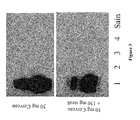
- Lane 1 corresponds to a negative control (treatment of the sample with water); lane 2 illustrates the results obtained in the case of a fat extraction prior to the first step of contacting with a weak base (Na 2 CO 3 / NaHCO 3 pH11 or C11); lanes 3 and 4 correspond to a method according to the invention implementing a fat extraction simultaneously in the first step.
- a weak base Na 2 CO 3 / NaHCO 3 pH11 or C11
- the matrices used to mimic animal by-products correspond to either commercial ground beef (15% fat) or to hamster or mouse SPA obtained by chopping a whole carcass carcass. .
- the weak basic solutions were prepared at 20 ° C using Na 2 CO 3 (sodium carbonate), NaHCO 3 (sodium bicarbonate) and possibly sodium hydroxide (NaOH); the indicated pH values correspond either to the pH of the solution (pH solution) or to the pH measured immediately after mixing of said solution with the sample to be treated (initial pH), or at the pH measured at the end of the treatment in its totality (final pH ).
- Na 2 CO 3 sodium carbonate
- NaHCO 3 sodium bicarbonate
- NaOH sodium hydroxide
- PH is measured by pH meter (Knick 766).
- concentration of the buffers is systematically expressed in final concentration after mixing with the matrix to be treated is (number of moles of Na 2 CO 3 + molar number of NaHCO 3 ) / volume of the mixed.
- the mixtures of the different products to be treated with the different chemical solutions were made in the most homogeneous manner possible, either by mixing with the pipette or by trituration.
- thermocouple Ha Instruments
- the samples were purified as homogenate 20% (w / v). For this, the macerates were milled in 4 volumes of glucose solution at 5%.
- the PrPres contained in these samples was purified using the reagents of the CEA-BioRad assay ( Barret et al. (2003) J. Virol. 77: 8462-8469 ), then detected by western blot, according to the protocol described previously ( Lasmezas et al. (1996) J. Gen. Virol. 77: 1601-1609 ).
- the anesthetized animals were inoculated intracerebrally using 50 .mu.l (hamster) or 20 .mu.l (mouse) of the products to be tested. For each treatment and control group, 4 to 8 animals were inoculated.
- the infectious titer was established on the basis of the dates of death and the finding of the end stage.
- the clinical examination is related to the observation of pathognomonic signs of subacute spongiform transmissible encephalopathies.
- the average survival time of these groups was compared with the average of the survival times of the animals in the control groups (animals inoculated with increasing dilutions of the initial infectious material heated to 100 ° C for 3 minutes). It is then possible to estimate the residual infectious load after treatment, and thus determine the level of reduction provided by this treatment.
- a hamster brain fragment infected with strain 263K (50 mg) was mixed with 5 microliters of water, sodium hydroxide or carbonate / bicarbonate solution. The different mixtures were then incubated for 5 minutes at 60 ° C. and then for 3 minutes at 115 ° C. under 10 bars of pressure.
- the latter is incubated for 20 minutes at room temperature, heated for 2 minutes at 100 ° C. and then for 10 minutes at 115 ° C.
- the pH of the different solutions were measured.
- the pH was measured immediately after mixing, before heating (after 20 minutes of incubation at room temperature), and after heating. After mixing these solutions with minced meat, the pH was measured after heating, and the amount of water removed during the treatment was estimated by measuring the weight loss of the meatball. After mixing these solutions with hamster brain infected with the 263K strain, the amount of residual PrPres was estimated.
- the process of the invention makes it possible to reduce the amount of PrPres in the hamster brain infected with the 263K strain to an undetectable level (Reduction> 3.5 logs).
- the absence of detectable PrPres does not depend on the initial pH of the buffer used, nor on the pH of the matrix after adding said buffer (initial pH) but on the pH obtained after heating (final pH), which is between 9 and 10 in this example.
- the method of the invention makes it possible to maintain a suitable level of hydration of the minced meat, objectified by a small loss of mass after treatment, unlike the control (water).
- the carbonate / bicarbonate solution at an initial pH of 11, was added to a brain macerate at varying concentrations, in the proportion of 33% (w / v). In practice, 25 microliters of solution was added to 50 mg of brain.
- matrices mimicking animal by-products (hamster or mouse SPA, obtained by hashing an entire carcass carcass) were artificially contaminated with a known amount of infectious material (50 mg of brain titrating 10 LD 50 / g for 150 mg of SPA, a matrix containing 25% (mass / mass) of infectious material) homogeneously by trituration.
- Test 1 Degreasing prior to the first step
- This test consisted in adding to 20 grams of animal by-products (multi-species C3 raw material, butchery waste) 2 ml (ie 10% volume / weight) of water or Na 2 CO 3 / NaHCO 3 pH 11 ( C11) at 1.5M (final 150 mM). After heating to the heart for 40 minutes at 80 ° C, the pressing yielded 6 ml of liquid including 1.5 ml of fat.
- PrPres The effect of this protocol on PrPres was studied on 263K hamster brain alone or mixed with beef (1 volume of brain for 3 volumes of meat).
- 50 mg of brain + 150 mg of meat were mixed with 20 ⁇ l of water and then heated at 80 ° C. for 40 minutes.
- Forty microliters of alkaline (or water) was added, and then heated at 115 ° C for 5 minutes.
- Test 2 Simultaneous degreasing at the first stage
Landscapes
- Life Sciences & Earth Sciences (AREA)
- Chemical & Material Sciences (AREA)
- Engineering & Computer Science (AREA)
- Polymers & Plastics (AREA)
- Food Science & Technology (AREA)
- Zoology (AREA)
- Health & Medical Sciences (AREA)
- Molecular Biology (AREA)
- Chemical Kinetics & Catalysis (AREA)
- Physiology (AREA)
- Biotechnology (AREA)
- Biomedical Technology (AREA)
- Biochemistry (AREA)
- Inorganic Chemistry (AREA)
- Animal Husbandry (AREA)
- General Chemical & Material Sciences (AREA)
- Wood Science & Technology (AREA)
- Nutrition Science (AREA)
- Medicines Containing Material From Animals Or Micro-Organisms (AREA)
- Acyclic And Carbocyclic Compounds In Medicinal Compositions (AREA)
- Apparatus For Disinfection Or Sterilisation (AREA)
- Fodder In General (AREA)
Abstract
- une extraction des graisses desdits produits animaux, préalablement ou simultanément à la première étape ;
- une première étape de mise en contact desdits produits animaux dégraissés avec au moins une base faible ayant un pKa compris entre 9 et 12 pour former un mélange ;
- une deuxième étape comprenant au moins un chauffage principal du mélange à une température à coeur d'au moins 100°C et inférieure à 121°C, ledit chauffage principal étant un chauffage humide ;
dans lequel le pH du mélange à l'issue de la deuxième étape est supérieur ou égal à 9 et inférieur à 11.
Description
- L'invention concerne un procédé de décontamination de produits animaux, notamment de sous-produits animaux destinés à la préparation de protéines animales transformées (PAT), en particulier vis-à-vis du prion.
- La France produit chaque année environ 3 millions de tonnes de déchets animaux, depuis les déchets de boucherie (classés C3 et provenant d'aliments propres à l'alimentation humaine) jusqu'aux cadavres des animaux récupérés à la ferme (C2) et les abats à risque de prion (C1).
- Ces sous-produits animaux peuvent être utilisés pour la production de farines animales (farines de viandes et d'os), désormais nommées protéines animales transformées (PAT), qui représentent 700.000 tonnes par an (après récupération des graisses et évaporation de l'eau) en France. Ces chiffres sont à multiplier par 5 au niveau de l'Europe.
- Toutefois, ces protéines à très haute valeur ajoutée sont difficiles à valoriser depuis la crise de la vache folle, même si cette maladie a virtuellement disparu en France et plus largement au niveau européen. En effet, les procédés habituels de transformation des sous-produits animaux en PAT, qui impliquent généralement un broyage, un chauffage à environ 80°C, un pressage pour éliminer la graisse et enfin un séchage, ne permettent pas de détruire le prion. En raison de cette sous-utilisation des PAT, le déficit en protéines de l'Europe s'est accru au profit principalement d'importation de soja génétiquement modifié. Il était ainsi estimé en 2011 que 70% de la consommation de l'Union Européenne (soit 42 millions de tonnes de matières premières riches en protéines végétales en 2009), essentiellement des farines de soja, étaient importés, en particulier pour l'alimentation animale. Qui plus est, d'après des rapports du parlement Européen, ces productions importées ne sont pas soumises aux mêmes contraintes environnementales, sanitaires et de réglementation sur les organismes génétiquement modifiés (OGM) que les productions européennes.
- Par ailleurs, le développement de la pisciculture, qui semble indispensable pour nourrir les populations dans les années qui viennent, butte sur les difficultés d'approvisionnement en protéines de qualité et la situation actuelle aboutit à une surpêche de poissons sauvages transformés en farines de poisson (20 millions de tonnes de poissons sauvages par an) pour fournir des aliments adaptés.
- Dans ce contexte, une revalorisation innovante des sous-produits animaux impliquant leur décontamination vis-à-vis des prions éventuellement présents leur permettrait de passer du statut de déchets à celui de matières premières à haute valeur ajoutée.
- Cependant, les procédés habituels de décontamination du prion, tels qu'une immersion dans une solution d'hydroxyde de sodium (NaOH) 1N et autoclavage à 121°C pendant 30 minutes (recommandation de l'Organisation Mondiale de la Santé) ou ceux définis dans le Règlement (CE) n°1774/2002 du parlement européen et du conseil du 3 octobre 2002 établissant des règles sanitaires applicables aux sous-produits animaux non destinés à la consommation humaine, sont mal adaptées au traitement des sous-produits animaux dans le cadre de la production de PAT car ils induisent une dégradation de leurs qualités organoleptiques et nutritionnelles.
- Ainsi, Brown et al. (2003) Proc. Natl. Acad. Sci. USA 100:6093-6097 ont été amenés à proposer un procédé adapté à la préparation PAT impliquant un chauffage à des températures de 121-137°C et des pulsations à ultra-haute pression (au moins 690 MPa), ce qui rend ce procédé difficilement industrialisable.
- Il reste donc encore à définir un procédé industrialisable de décontamination de sous-produits animaux en vue de la production de PAT, qui combine notamment efficacité vis-à-vis des prions et des autres agents pathogènes attendus dans ces produits, avec le maintien des qualités nutritionnelles et organoleptiques nécessaires à leur utilisation ultérieure.
- La présente invention découle de la mise en évidence inattendue, par les inventeurs, que la combinaison consécutive d'un traitement légèrement alcalin à l'aide d'une base faible, préférentiellement un sel de carbonate, et d'un traitement thermique à moins de 121°C permettait de décontaminer des préparations contenant des prions tout en étant compatible avec la préparation de PAT ayant des qualités organoleptiques et nutritionnelles convenables.
- Sans vouloir être liés à une théorie particulière, les inventeurs pensent que la base faible combine une action déstabilisatrice du prion, au moins par le pH alcalin qu'elle procure, à une action d'hydratation du produit animal. L'agitation moléculaire consécutivement induite par un chauffage modéré conduit alors à une dégradation des prions.
- Ainsi, la présente invention concerne un procédé de traitement décontaminant de produits animaux comprenant les étapes suivantes :
- une extraction des graisses desdits produits animaux, préalablement à la première étape ;
- une première étape de mise en contact desdits produits animaux dégraissés avec au moins une base faible ayant un pKa compris entre 9 et 12 pour former un mélange ;
- une deuxième étape comprenant au moins un chauffage principal du mélange à une température à coeur d'au moins 100°C et inférieure à 121°C, ledit chauffage principal étant un chauffage humide ;
- La présente invention concerne également un procédé de traitement décontaminant de produits animaux comprenant les étapes suivantes :
- une extraction des graisses desdits produits animaux, simultanément à la première étape de mise en contact desdits produits animaux avec au moins une base faible ayant un pKa compris entre 9 et 12 pour former un mélange ;
- une deuxième étape comprenant au moins un chauffage principal du mélange à une température à coeur d'au moins 100°C et inférieure à 121°C, ledit chauffage principal étant un chauffage humide ;
- Le chauffage principal de la deuxième étape est un chauffage humide. La notion de chauffage humide est bien connue de l'homme du métier. Il s'agit de préférence d'un chauffage au cours duquel on limite l'évaporation d'eau du mélange, plus préférablement d'un chauffage réalisé à saturation de vapeur d'eau.
- La présente invention concerne également un procédé de traitement décontaminant de produits animaux comprenant les étapes suivantes :
- une extraction des graisses desdits produits animaux, préalablement ou simultanément à la première étape ;
- une première étape de mise en contact desdits produits animaux avec au moins une base faible ayant un pKa compris entre 9 et 12 pour former un mélange, la quantité de la base faible et des formes acides ou basiques conjuguées de la base faible éventuellement mises en contact avec le produit animal conjointement à la base faible, rapportée au volume du mélange, est inférieure à 1 mol.L-1 et d'au moins 50 mmol.L-1 ;
- une deuxième étape comprenant au moins un chauffage principal du mélange à une température à coeur d'au moins 100°C et inférieure à 121°C.
- La présente invention concerne également (i) un procédé d'obtention de protéines animales transformées (PAT), comprenant la mise en oeuvre du procédé de traitement décontaminant défini ci-dessus, (ii) les PAT susceptibles d'être obtenus par la mise en oeuvre du procédé d'obtention de PAT selon l'invention, et (iii) l'utilisation des PAT susceptibles d'être obtenues par la mise en oeuvre du procédé d'obtention selon l'invention à titre d'engrais ou pour nourrir des animaux, notamment des poissons.
- Un « produit animal » au sens de l'invention comprend, ou est constitué de, tout ou partie d'un cadavre animal ainsi que les matières sécrétées ou excrétées par un animal.
- De préférence, le produit animal selon l'invention est un sous-produit animal.
- Un « sous-produit animal » au sens de l'invention désigne un produit animal selon l'invention, propre ou impropre à la consommation humaine, mais non destiné à la consommation humaine, que ce soit en vertu du respect d'une législation ou pour des raisons commerciales. Ainsi, à titre d'exemple, un sous produit animal selon l'invention comprend, ou consiste en, du muscle, des viscères, de la peau, des sabots, des cornes, des plumes, des os, des coquilles, des cretons, du sang, du lait, les ovules, des embryons, du sperme, de la biomasse, du lisier, des résidus de méthanisation ou des mélanges de ceux-ci.
- Les animaux dont sont issus les produits ou sous-produits animaux au sens de l'invention peuvent être des animaux de rente, tels que les bovins, les ovins, les caprins, les porcins, les oiseaux ou encore les poissons, ou d'autres animaux, tels que les chevaux, les animaux de compagnie, les arthropodes, notamment les insectes ou les crustacés, les reptiles, ou les mollusques.
- De préférence, le produit animal est broyé préalablement à la première étape (avant ou après l'extraction des graisses) de manière à obtenir une taille de particules, ou granulométrie, moyenne inférieure à 100 mm, 50 mm ou 30 mm.
- Comme on l'entend ici, un « traitement décontaminant » ou une « décontamination » désigne la réduction de la quantité d'agents pathogènes éventuellement présents dans le produit animal. En particulier, le « traitement décontaminant » selon l'invention consiste préférablement à réduire d'au moins 80%, 90%, 95%, 99%, 99,9%, 99,99%, ou 99,999% la quantité d'agent pathogène présent dans le produit à traiter selon l'invention.
- Comme cela apparaîtra clairement à l'homme du métier le procédé de traitement décontaminant selon l'invention n'est pas appliqué au corps d'un humain ou d'un animal vivant.
- Les « agents pathogènes » selon l'invention peuvent être de tout type et sont notamment sélectionnés dans le groupe constitué d'un prion, d'un virus, d'une bactérie, d'un champignon, d'un protozoaire, et d'une spore de champignon ou de bactérie. De préférence, l'agent pathogène selon l'invention est un prion, une spore de bactérie, notamment du genre Bacillus, ou une mycobactérie. De manière particulièrement préférée, l'agent pathogène selon l'invention est un prion. Lorsque l'agent pathogène selon l'invention est un prion, la protéine constitutive du prion, ou PrP, se trouve essentiellement sous sa forme résistante, pathogène, PrPres.
- Une « base » selon l'invention désigne un composé susceptible de capter un proton (H+) et/ou de libérer un ion hydrogénate (OH-) dans une solution qui la contient. Une base est dite faible si, lorsqu'elle est ajoutée à une solution, elle capte significativement moins d'ions H+ et/ou qu'elle génère significativement moins d'ions OH- que la quantité de base qui est ajoutée à la solution, autrement dit la base faible ne se dissocie pas complètement en solution. Ainsi, la base faible selon l'invention doit bien être distinguée d'une base forte, telle que la potasse (KOH) ou la soude (NaOH). Par ailleurs, la base faible selon l'invention a un pKa compris entre 9 et 12, c'est-à-dire supérieur ou égal à 9 et inférieur ou égal à 12. De préférence, le pKa est inférieur ou égal à 12,5, 12, 11,5 ou 11. De préférence également, le pKa est supérieur ou égal à 9, 9,5, ou 10. Comme on l'entend ici, la base faible selon l'invention peut avoir une ou plusieurs fonctions basiques. Lorsque la base faible selon l'invention comprend plusieurs fonctions basiques, le pKa selon l'invention est celui d'au moins l'une d'entre elles. Comme cela apparaitra clairement à l'homme du métier les valeurs de pKa selon l'invention sont de préférence celles mesurées dans les conditions de laboratoire de température et de pression, notamment à une température de 20°C à 25°C et à la pression atmosphérique, en particulier à une pression d'environ 1 bar.
- La base faible peut être mise en contact seule ou associée avec au moins une des formes acides ou basiques conjuguées.
- La base faible selon l'invention peut être de toute nature. Toutefois, on préfère que la base faible selon l'invention soit un sel de carbonate, notamment du carbonate de sodium ou du carbonate de potassium. De préférence, et comme l'homme du métier le comprendra bien, la base faible selon l'invention n'est pas du carbonate de calcium. Comme on l'entend ici, un sel de carbonate désigne un sel de CO3 2-, un sel de HCO3 -, ou une combinaison des deux.
- De préférence, la quantité de la base faible et des formes acides ou basiques conjuguées de la base faible éventuellement mises en contact avec le produit animal conjointement à la base faible, rapportée au volume du mélange, est inférieure à 1 mol.L-1 ou 0,5 mol.L-1.
- De préférence également, la quantité de la base faible et des formes acides ou basiques conjuguées de la base faible éventuellement mises en contact avec le produit animal conjointement à la base faible, rapportée au volume du mélange, est d'au moins 50 mmol.L-1, 100 mmol.L-1, 200 mmol.L-1, 300 mmol.L-1 ou 400 mmol.L-1, plus préférentiellement d'au moins 100 mmol.L-1.
- Comme on l'entend ici, la quantité de la base faible et des formes acides ou basiques conjuguées de la base faible éventuellement mises en contact avec le produit animal conjointement à la base faible désigne la quantité de la totalité des formes acido-basiques de la base faible. Par exemple, lorsque la base faible est un sel de carbonate, la quantité de la base faible et des formes acides ou basiques conjuguées de la base faible éventuellement mises en contact avec le produit animal conjointement à la base faible désigne la somme du nombre de moles de CO3 2-, de HCO3 -, et de H2CO3 mis en contact avec le produit animal rapporté au volume du mélange.
- Dans un mode de réalisation particulier de l'invention, la base faible est apportée sous forme de poudre.
- Dans un autre mode de réalisation particulier de l'invention, la base faible est apportée sous forme de solution. Une « solution » selon l'invention est une solution aqueuse. Dans ce cas la solution de base faible présente préférentiellement un pH d'au moins 9,5, 10, 10,5, 11 ou 11,5. De préférence également, la solution présente un pH inférieur à 13, 12,5 ou 12. Par ailleurs, on préfère que le volume de la solution de base faible selon l'invention représente de 1% (volume/volume ou volume/masse) à 33% (volume/volume ou volume/masse) du volume du mélange selon l'invention.
- Comme on l'entend ici, le pH est mesuré dans les conditions de laboratoire de température et de pression, notamment à une température de 20°C à 25°C et à la pression atmosphérique, en particulier à une pression d'environ 1 bar.
- L'homme du métier sait parfaitement préparer une solution d'une concentration donnée d'une base faible à un pH particulier. Selon la base faible et le pH visé, on peut ajouter à la solution la base faible sous sa forme basique et/ou acide (c'est-à-dire ayant fixé un proton) et éventuellement ajuster le pH par l'ajout d'une base forte, telle que la potasse (KOH) ou la soude (NaOH). Ainsi, lorsque la base faible selon l'invention est un sel de carbonate, la première solution peut être préparée en ajoutant du Na2CO3, ou du K2CO3, et/ou du NaHCO3, ou du KHCO3, et éventuellement en ajustant le pH à l'aide de potasse et/ou de soude.
- L'extraction des graisses selon l'invention comprend de préférence une étape de chauffage à une température inférieure à 100°C, notamment de 75°C à 85°C, éventuellement en présence d'agents facilitant l'extraction des graisses, tels que des agents acides, suivie d'un pressage. Selon l'invention, cette extraction des graisses peut avoir lieu préalablement à la première étape ou simultanément à la première étape, ce dernier cas pouvant présenter des avantages industriels.
- De préférence, le mélange est incubé pendant au moins 1, 2, 3, 4, 5, 10, 20 ou 30 minutes avant la mise en oeuvre de la deuxième étape. On préfère également, que la première étape ait une durée de moins de deux heures, plus préférablement de moins d'une heure.
- Par ailleurs, la température d'incubation du mélange avant la mise en oeuvre de la deuxième étape est de préférence inférieure à 50°C, 45°C, 40°C, 30°C. De préférence également, la température d'incubation du mélange avant la mise en oeuvre de la deuxième étape est de préférence supérieure à 10°C ou 15°C. Ainsi, de manière particulièrement préférée l'incubation du mélange avant la mise en oeuvre de la deuxième étape est effectuée à température ambiante. Comme cela apparaitra clairement à l'homme du métier la température ambiante peut varier en fonction de la région géographique dans laquelle il est mis en oeuvre, de la saison ou de l'heure de la journée. Dans une définition particulière selon l'invention, toutefois, l'expression « température ambiante » vise préférentiellement des températures de 18°C à 25°C.
- Par ailleurs, lorsque la première étape comprend une extraction des graisse, et comme l'homme du métier le comprendra bien, la température d'incubation peut être augmentée jusqu'à une température supérieure à 50°C, mais inférieure à 100°C, et de préférence de 75°C à 85°C. En outre, lorsque la première étape comprend une extraction des graisses, la mise en contact de la base faible selon l'invention avec le produit animal peut avoir lieu en totalité avant l'extraction des graisses, en totalité après l'extraction des graisses, en totalité au cours de l'extraction des graisses, ou encore en partie avant, après, et éventuellement pendant l'extraction des graisses.
- De manière préférée également, la première étape est conduite à la pression atmosphérique, c'est-à-dire à environ 1 bar.
- La deuxième étape du procédé de traitement décontaminant, comprend un chauffage principal à une température à coeur d'au moins 100°C, de préférence à une température d'au moins 105°C, 110°C ou 115°C. De préférence également, le chauffage principal de la deuxième étape est à une température à coeur inférieure à 121 °C.
- L'homme du métier sait bien mesurer la température « à coeur » c'est-à-dire au sein du mélange. Cela peut être réalisé, par exemple, en plongeant une sonde de température dans le mélange, de manière à s'assurer qu'essentiellement tout le mélange à atteint la température visée.
- Par ailleurs, on préfère que le chauffage principal de la deuxième étape ait une durée de 1 minute à 30 minutes, plus préférablement de 1 minute à 20 minutes, encore plus préférablement de 5 à 15 minutes, et de manière particulièrement préférée de 8 à 12 minutes.
- Comme l'homme du métier le comprendra bien, la deuxième étape peut comprendre d'autres chauffages additionnels que le chauffage principal. Il peut notamment s'agir de palier ayant une température inférieure à 100°C avant d'atteindre la température du chauffage principal.
- En outre, dans un mode de réalisation préféré de l'invention, le chauffage principal est suivi d'au moins un chauffage additionnel à une température supérieure ou égale à 121°C, notamment à une température de 131°C à 138°C. Le chauffage additionnel a de préférence une durée de 1 minute à 20 minutes, plus préférablement de 1 minute à 18 minutes.
- Dans un autre mode de réalisation préféré de l'invention, le procédé de l'invention ne comprend pas de chauffage additionnel à une température supérieure ou égale à 121°C
- Par ailleurs, on préfère que le procédé de traitement décontaminant selon l'invention soit conduit dans des conditions de chauffage telles que la quantité d'eau extraite du produit animal soit inférieur à 20% (en g pour 100 g), plus préférablement inférieure à 15% (en g pour 100 g) de la masse du produit animal mis en contact avec la base faible dans la première étape. De préférence, l'éventuel volume d'eau apportée par une base faible en solution selon l'invention n'est pas comptabilisé dans le calcul de ce pourcentage, c'est-à-dire que la quantité d'eau extraite du produit animal se réfère à la quantité d'eau présente dans le produit animal avant la mise en contact d'une base faible en solution selon l'invention avec le produit animal.
- Par ailleurs, de manière préférée également, la première étape est conduite à une pression d'au moins la pression atmosphérique et d'au plus 2 bar, plus préférablement à la pression atmosphérique, c'est-à-dire environ 1 bar.
- Le pH du mélange à l'issue de la deuxième étape est supérieur ou égal à 9 et inférieur à 11, plus préférablement supérieur ou égal à 9,5 et inférieur ou égal à 10,5.
- Comme on l'entend ici, le pH est mesuré dans les conditions de laboratoire de température et de pression, notamment à une température de 20°C à 25 °C et à la pression atmosphérique, en particulier à une pression d'environ 1 bar.
- Par ailleurs, comme cela apparaitra clairement à l'homme du métier, le mélange est de préférence homogénéisé, par exemple par agitation ou malaxage.
- Les procédés d'obtention de protéines animales transformées (PAT) à partir de produits animaux, notamment de sous-produits animaux, sont bien connus de l'homme du métier. Ces procédés comprennent typiquement une étape de broyage du produit animal, notamment du sous-produit animal, suivie d'une étape d'extraction de graisse, par chauffage modéré, notamment à environ 80°C, et pressage, le produit animal broyé et dégraissé obtenu est alors généralement séché, par exemple par extrusion, pour donner des protéines animales transformées. Le procédé de traitement décontaminant selon l'invention prend place simultanément à ou après l'étape d'extraction de graisse, sur le produit animal broyé, et avant l'étape de séchage.
- Dans un mode de réalisation préféré de l'invention, le procédé d'obtention de PAT selon l'invention est réalisé à partir de produits animaux de catégories 1, 2 ou 3 au sens du Règlement (CE) n°1774/2002 du parlement européen et du conseil du 3 octobre 2002, notamment à partir de produits animaux de catégorie 1, en particulier à risque de prion.
- A ce titre, on préfère que lorsque les PAT selon l'invention sont obtenues à partir de produits animaux de catégories 1, 2 ou 3 au sens du Règlement (CE) n°1774/2002 du parlement européen et du conseil du 3 octobre 2002, notamment à partir de produits animaux de catégorie 1, en particulier à risque de prion, alors elles sont utilisées à titre d'engrais.
- Dans un autre mode de réalisation préféré de l'invention, le procédé d'obtention de PAT selon l'invention est réalisé à partir d'insectes, notamment nourris par des produits animaux de catégories 1, 2 ou 3 au sens du Règlement (CE) n°1774/2002 du parlement européen et du conseil du 3 octobre 2002, notamment à partir de produits animaux de catégorie 1, en particulier à risque de prion.
- A ce titre, on préfère que lorsque les PAT selon l'invention sont obtenues à partir d'insectes, notamment nourris par des produits animaux de catégories 1, 2 ou 3 au sens du Règlement (CE) n°1774/2002 du parlement européen et du conseil du 3 octobre 2002, notamment à partir de produits animaux de catégorie 1, en particulier à risque de prion, alors elles sont utilisées pour nourrir des poissons.
- L'invention sera davantage explicitée de manière non limitative à l'aide des figures et des exemples qui suivent.
-
-
Figure 1
LaFigure 1 représente la quantité de PrPres, mise en évidence par western blot, extraite d'un macérât de cerveau de hamster infecté par la souche 263K mis en contact avec de l'eau (piste 1), une solution carbonate/bicarbonate pH=11 (piste 2), une solution de soude à 5 M (piste 3) et une solution de soude à 0,5 M (piste 4), et soumis à un chauffage de 5 minutes à 60°C, puis 3 minutes à 115°C sous 10 bars de pression. -
Figure 2
LaFigure 2 représente la quantité de PrPres, mise en évidence par western blot, extraite d'un macérât de cerveau de hamster infecté par la souche 263K mis en contact avec des concentrations variables d'une solution carbonate/bicarbonate pH=11 (de 10 à 500 mM), incubés à température ambiante pendant 20 minutes, chauffés à 100°C pendant 2 minutes, puis à 115°C pendant 10 minutes. -
Figure 3
Lafigure 3 représente la quantité de PrPres mise en évidence par Western Blot, dans des essais comprenant une étape préalable (test 1) ou simultanée à la première étape (test 2) de dégraissage des produits animaux. - La piste 1 correspond à un témoin négatif (traitement de l'échantillon à l'eau) ; la piste 2 illustre les résultats obtenus dans le cas d'une extraction des graisses préalablement à la première étape de mise en contact avec une base faible (Na2CO3/NaHCO3 pH11 ou C11) ; les pistes 3 et 4 correspondent à un procédé selon l'invention mettant en oeuvre une extraction des graisses simultanée à la première étape.
- Les données expérimentales ont été générées au moyen de modèles in vitro (recherche de la PrPres, marqueur spécifique des maladies à prion), et à l'aide de bio-essais (inoculation à l'animal de laboratoire) afin d'augmenter la sensibilité de l'analyse d'une part, et obtenir des réponses en termes d'infectiosité d'autre part. Compte tenu de l'influence que peut avoir l'environnement organique des prions (effet tampon, protection en cas de cuisson), les études ont été réalisées sur des extraits de cerveau plus ou moins concentrés, mais également en présence de matrice animale (viande), pour mimer au mieux la matière première d'intérêt, à savoir des sous-produits animaux (SPA).
- La majorité des études a été réalisée dans le modèle d'infection expérimentale de hamster infecté par la souche de tremblante 263K (Kimberlin & Walker (1977) J. Gen. Virol. 34:295-304). Ce modèle rapide (mortalité au bout de 80 jours après inoculation d'une charge de 108 unités infectieuses) présente l'avantage d'un titre infectieux important, et un spectre de résistance réputé important. Cette souche est utilisée comme modèle de référence pour les études d'inactivation des prions.
- Les études in vivo ont été doublées dans deux modèles de souris transgéniques :
- le premier modèle repose sur l'inoculation d'une souche de tremblante ovine adaptée à la souris transgénique surexprimant la PrP ovine (allèle VRQ/VRQ, souche Tg338, Vilotte et al. (2001) J. Virol. 75:5977-5984). Cette souche (TAC) induit une mortalité au bout de 60 jours chez la souris Tg338 ;
- le second modèle consiste dans l'inoculation de la souche d'ESB bovine à la souris transgénique surexprimant la PrP bovine (Castilla et al. (2003) Arch. Virol. 148:677-691).
- Les sources infectieuses correspondent soit :
- 1- à des macérâts de cerveau, appelés « macérât 100% », obtenus par trituration d'un cerveau entier sans dilution dans un tampon ;
- 2- à des homogénats de cerveau 20% (poids/volume) dans une solution de glucose à 5%, appelés « homogénat 20% glucose », obtenus par broyage mécanique d'un fragment de cerveau (x milligrammes) dans 4x microlitres d'une solution glucosé 5%
- 3- à des homogénats de cerveau 20% (poids/volume) dans l'eau, appelés « homogénat 20% eau», obtenus par broyage mécanique d'un fragment de cerveau (x milligrammes) dans 4x microlitres d'eau
- Les matrices utilisées pour mimer les sous-produits animaux (SPA) correspondent soit à de la viande bovine hachée du commerce (15% de matière grasse), soit à des SPA de hamster ou de souris, obtenus par hachage d'une carcasse dépecée entière.
- La contamination artificielle des SPA avec une quantité connue de matériel infectieux a été réalisée soit de façon homogène par trituration, soit de façon hétérogène par addition d'un fragment de cerveau au sein d'une boulette de matrice.
- Les solutions de base faible ont été préparés à 20°C à l'aide de Na2CO3 (carbonate de sodium), de NaHCO3 (bicarbonate de sodium) et éventuellement de soude (NaOH) ; les pH indiqués correspondent soit au pH de la solution (pH solution), soit au pH mesuré immédiatement après mélange de ladite solution avec l'échantillon à traiter (pH initial), soit au pH mesuré au terme du traitement dans sa totalité (pH final).
- Les pH sont mesurés au pH-mètre (Knick 766). Dans la mesure où les volumes de tampon ajouté peuvent varier, la concentration des tampons est exprimée systématiquement en concentration finale après mélange avec la matrice à traiter soit (nombre de moles de Na2CO3 + nombre de mole de NaHCO3)/volume du mélange.
- Les mélanges des différents produits à traiter avec les différentes solutions chimiques ont été réalisés de la façon la plus homogène possible, soit par mélange à la pipette, soit par trituration.
- Les traitements thermiques sont réalisés sous contrôle permanent de la température à l'aide d'un thermocouple (Hanna Instruments) prenant la température au coeur du produit et dans le tampon de cuisson.
- Les échantillons ont été purifiés sous la forme d'homogénat 20% (poids/volume). Pour cela, les macérâts ont été broyés dans 4 volumes de solution glucosée à 5%. La PrPres contenue dans ces échantillons a été purifiée au moyen des réactifs du test CEA-BioRad (Barret et al. (2003) J. Virol. 77:8462-8469), puis détectée par western blot, selon le protocole décrit précédemment (Lasmezas et al. (1996) J. Gen. Virol. 77:1601-1609). Après purification, les échantillons ont été resuspendus à l'aide d'un tampon Laemmli (Laemmli, (1970) Nature 227:680-685), et l'équivalent de 5 mg de cerveau a été déposé sur un gel de polyacrylamide et transféré sur une membrane de nitrocellulose (Schleicher & Schuell).
- La révélation a été réalisée au moyen d'un anticorps monoclonal reconnaissant spécifiquement la PrP murine (SAF-60, Féraudet et al. (2005) J. Biol. Chem. 280:11247-11258). Un anticorps de chèvre anti-souris couplé à la peroxydase a été utilisé comme anticorps secondaire (Southern Biotechnology Associates), et l'immunoréactivité a été mise en évidence par chimiluminescence au moyen du kit ECL Amersham et détectée par autoradiographie.
- Les animaux anesthésiés ont été inoculés par voie intra-cérébrale à l'aide de 50 µl (hamster) ou 20 µl (souris) des produits à tester. Pour chaque traitement et chaque groupe contrôle, de 4 à 8 animaux ont été inoculés.
- Le titre infectieux a été établi sur la base des dates de décès et du constat du stade terminal. L'examen clinique est relié à l'observation des signes pathognomoniques des encéphalopathies subaiguës spongiformes transmissibles.
- Avant l'apparition des premiers signes cliniques dans les groupes témoins (jusqu'au 50ème jour pour les hamsters et les souris transgéniques sureprimant la PrP ovine, 150ème jour pour les souris surexprimant la PrP bovine), les animaux de tous les groupes ont été observés cliniquement une fois par semaine. À partir de ces dates et jusqu'à la fin de l'étude, les examens cliniques ont été pratiqués trois fois par semaine.
- Les signes cliniques sont de cinq ordres :
- Troubles du comportement (excitabilité, troubles de la nidation et du toilettage),
- Perte du réflexe de positionnement visuel,
- Ataxie cérébelleuse, démarche anormale, prostration,
- Obésité puis amaigrissement,
- Paraplégie puis tétraplégie.
- Les observations ont été consignées après chaque examen clinique, et les signes cliniques et les décès enregistrés. Les animaux au stade terminal de la maladie ont été euthanasiés pour limiter la souffrance.
- En cas de mort des animaux inoculés avec les produits traités, la moyenne du temps de survie de ces groupes a été comparée à la moyenne des temps de survie des animaux dans les groupes contrôles (animaux inoculés avec des dilutions croissantes du matériel infectieux initial chauffé à 100°C pendant 3 minutes). Il est alors possible d'estimer la charge infectieuse résiduelle après traitement, et de déterminer ainsi le niveau de réduction apporté par ce traitement.
- Dix-huit mois après l'inoculation (fin de l'étude) des différents produits, tous les animaux survivants ont été euthanasiés. Les cerveaux de ces animaux ont été prélevés, et la quantité de PrPres éventuellement présente dans ces cerveaux a été estimée au moyen d'une technique biochimique (ELISA ou Western blot). Les cerveaux de certains animaux décédés au cours de l'expérimentation ont également été étudiés à l'aide de ce test biochimique.
- Un fragment de cerveau de hamster infecté par la souche 263K (50 mg) a été mélangé avec 5 microlitres d'eau, de soude ou d'une solution carbonate/bicarbonate. Les différents mélanges ont alors été incubés 5 minutes à 60°C, puis 3 minutes à 115°C sous 10 bars de pression.
- On observe dans la
Figure 1 que la quantité de PrPres détectée au terme du chauffage en eau n'est que peu modifiée (ligne 1), tandis que l'addition d'une solution de soude à 5M initiale (ligne 3), qui permet de monter le pH du cerveau à 13, élimine toute trace de PrPres. En revanche, l'addition de soude à 0,5M de concentration initiale (ligne 4), qui ajuste le pH du cerveau à 11, ne réduit que très peu la quantité de PrPres. De façon surprenante, l'addition de la solution carbonate/bicarbonate (1 M de concentration initiale) (ligne 2) à pH=11 selon le procédé de l'invention, permet également d'éliminer toute trace de PrPres. - Différentes substances chimiques en solution (hydroxyde de sodium NaOH, bicarbonate de sodium NaHCO3, carbonate de sodium Na2CO3), seules ou en association, et à différentes concentrations, ont été additionnées dans la proportion de 33 % (poids/volume) à différentes matrices (cerveau de veau, viande hachée ou cerveau de hamster infecté par la souche 263K). En pratique, 1 ml de solution a été ajouté à 2 grammes de matrice.
- Après mélange homogène, ce dernier est incubé pendant 20 minutes à température ambiante, chauffé 2 minutes à 100°C puis 10 minutes à 115°C.
- Les pH des différentes solutions ont été mesurés. Dans le cas de la matrice correspondant à du cerveau de veau, le pH a été mesuré immédiatement après mélange, avant chauffage (au terme des 20 minutes d'incubation à température ambiante), et après chauffage. Après mélange de ces solutions avec de la viande hachée, le pH a été mesuré après chauffage, et la quantité d'eau éliminée lors du traitement a été estimée par mesure de la perte de poids de la boulette de viande. Après mélange de ces solutions avec du cerveau de hamster infecté par la souche 263K, la quantité de PrPres résiduelle a été estimée.
- Les résultats sont présentés dans le Tableau 1 suivant.
Tableau 1 : Effet de différentes solutions alcalines sur le pH, l'hydratation et la réduction de la PrPres. Les concentrations mentionnées correspondent à la concentration du produit après mélange avec la matrice Cerveau veau Viande hachée 263K Produit pH solution pH initial pH avant chauffage pH final pH final Evolution poids Réduction PrPres Na2CO3/NaHCO3 150 mM pH11 11,00 9,98 9,87 9,96 9,65 +7% > 3,5 logs Na2CO3/NaHCO3 150 mM pH10 9,83 9,56 9,48 9,76 9,30 -3 % > 3,5 logs Na2CO3/NaHCO3 150 mM pH9,5 9,34 8,99 8,94 9,75 9,61 -10% > 3,5 logs NaOH 50 mM + Na2CO3/NaHCO3 100 mM pH10 12,20 9,81 N.D. 9,77 9,58 +7% > 3,5 logs H2O 6,65 6,68 6,75 6,44 -42% 0,5 log - On observe tout d'abord que le procédé de l'invention permet de réduire la quantité de PrPres dans le cerveau de hamster infecté par la souche 263K à un niveau indétectable (Réduction > 3,5 logs). A ce titre, on note que d'une façon surprenante, l'absence de PrPres détectable ne dépend pas du pH initial du tampon utilisé, ni du pH de la matrice après addition dudit tampon (pH initial) mais du pH obtenu après chauffage (pH final), qui est compris entre 9 et 10 dans cet exemple. Par ailleurs, on observe que le procédé de l'invention permet de maintenir un niveau d'hydratation convenable de la viande hachée, objectivée par une faible perte de masse après traitement, contrairement au témoin (eau).
- Les traitements présentés en Tableau 1 conduisent aux effets observés suivants sur la charge infectieuse d'un homogénat de cerveau (Tableau 2) :
Tableau 2 : Effet de différentes solutions alcalines sur l'infectiosité des prions. Les concentrations mentionnées correspondent à la concentration du produit après mélange avec la matrice Produit pH solution Réduction PrPres Animaux % mortalité Période incubation Réduction titre infectieux Na2CO3/NaHCO3 150 mM pH11 11,00 > 3,5 logs 3/7 43 % 490 ± 39 > 5 Na2CO3/NaHCO3 150 mM pH10 9,83 > 3,5 logs Na2CO3/NaHCO3 150 mM pH9,5 9,34 > 3,5 logs 5/6 83 % 352 ± 89 > 5 NaOH 50 mM + Na2CO3/NaHCO3 100 mM pH10 12,20 > 3,5 logs H2O 0,5 log 8/8 100 % 105 ± 6 1,5 - Dans cet exemple, la solution carbonate/bicarbonate, à un pH initial de 11, a été additionnée à un macérât de cerveau à des concentrations variables, dans la proportion de 33% (poids/volume). En pratique, 25 microlitres de solution ont été ajoutés à 50 mg de cerveau.
- Après mélange homogène et incubation à température ambiante pendant 20 minutes, le mélange a été chauffé à 100°C pendant 2 minutes, puis à 115°C pendant 10 minutes. Les résultats sont présentés dans la
Figure 2 . - On observe que pour toutes les conditions avec une concentration de solution carbonate/bicarbonate supérieure ou égale à 50 mM, la disparition de PrPres est complète. Dans ce dispositif expérimental, pour les concentrations de 10 mM et 25 mM, qui ne permettent pas d'atteindre un pH après chauffage de 8,5, la destruction est incomplète.
- Dans cet exemple, des matrices mimant les sous-produits animaux (SPA) (SPA de hamster ou de souris, obtenus par hachage d'une carcasse dépecée entière) ont été contaminées de façon artificielle avec une quantité connue de matériel infectieux (50 mg de cerveau titrant 1010 DL50/g pour 150 mg de SPA, soit une matrice contenant 25% (masse/masse) de matériel infectieux) de façon homogène par trituration. Ces échantillons infectieux ont été mélangés soit avec de l'eau, soit avec un tampon carbonate/bicarbonate à pH=11 à 100 mM pendant 20 minutes à température ambiante (première étape), puis chauffés pendant 3 minutes à 115°C à l'autoclave (deuxième étape).
- Après administration à l'animal, on observe alors une réduction de l'infectiosité, caractérisée par une durée d'incubation longue de 240 ± 88 jours avant la déclaration des signes cliniques (contre 107 ± 4 jours avec une incubation dans l'eau), ce qui correspond à une réduction de l'infectiosité de 5 à 6 log, c'est-à-dire un facteur 10-5-10-6.
- Une expérience similaire réalisée avec le prion de l'encéphalopathie spongiforme bovine à titre d'agent infectieux donne une durée d'incubation longue supérieure à 567 jours (contre 345 ± 24 jours avec une incubation dans l'eau), ce qui correspond à une réduction d'infectiosité de 4 log, c'est-à-dire un facteur 10-4.
- Ce test a consisté à ajouter à 20 grammes de sous-produits animaux (matière crue multi-espèce C3, déchets de boucherie) 2 ml (soit 10 % volume/poids) d'eau ou de Na2CO3/NaHCO3 pH11 (C11) à 1,5M (150 mM final). Après chauffage à coeur pendant 40 minutes à 80°C, le pressage a permis d'obtenir 6 ml de liquide dont 1,5 ml de graisse.
- L'effet de ce protocole sur la PrPres a été étudié sur du cerveau de hamster 263K seul ou mélangé avec de la viande de boeuf (1 volume de cerveau pour 3 volumes de viande). En pratique, 50 mg de cerveau + 150 mg de viande ont été mélangés à 20 µl d'eau, puis chauffés à 80°C pendant 40 minutes. Quarante microlitres de substance alcaline (ou d'eau) ont été ajoutés, puis le tout est chauffé à 115°C pendant 5 minutes.
- Cet essai montre que le dégraissage préalable du produit animal ne modifie pas l'action de la substance alcaline, mise en oeuvre dans les conditions de l'invention, dans la décontamination du prion.
- Les résultats sont illustrés à la
figure 3 , pistes 1 (eau) et 2 (C11). - Le protocole proposé dans ce contexte est le suivant :
- Mélange de la matrice à décontaminer avec une fraction de la substance alcaline ;
- Incubation pendant 20 minutes à température ambiante pour permettre une bonne pénétration du produit à coeur ;
- Chauffage pendant 40 minutes à 80°C à coeur ;
- Pressage et élimination du liquide et des graisses évacuées ;
- Ajout de la fraction restante de la substance alcaline (base faible) identique à celle du test 1 ;
- Chauffage 5 minutes à 115°C.
- En pratique, 50 mg de cerveau + 150 mg de viande ont été mélangés avec 20 microlitres de substance alcaline. Après attente et chauffage à 80°C pendant 40 minutes, 40 microlitres de substance alcaline complémentaire ont été ajoutés, puis le tout est chauffé à 115°C pendant 5 minutes.
- Les résultats sont illustrés à la
figure 3 , pistes 3 et 4. - Cet essai montre que le dégraissage simultané du produit animal ne modifie pas l'action de la substance alcaline, mise en oeuvre dans les conditions de l'invention, (y compris lorsque l'ajout de la base faible est réalisé en deux fois), dans la décontamination du prion.
Tableau 3 résumant les conditions des tests 1 et 2 Pistes figure 3 Premier traitement (au cours dégraissage) Second traitement (après dégraissage, ci-dessus appelé première étape du procédé de décontamination) 1 Eau Eau 2 Eau C11 150 mM 3 C11 150 mM C11 150 mM 4 C11 30 mM C11 170 mM
Claims (16)
- Procédé de traitement décontaminant de produits animaux comprenant les étapes suivantes :- une extraction des graisses desdits produits animaux, préalablement à la première étape ;- une première étape de mise en contact desdits produits animaux dégraissés avec au moins une base faible ayant un pKa compris entre 9 et 12 pour former un mélange ;- une deuxième étape comprenant au moins un chauffage principal du mélange à une température à coeur d'au moins 100°C et inférieure à 121°C, ledit chauffage principal étant un chauffage humide ;dans lequel le pH du mélange à l'issue de la deuxième étape est supérieur ou égal à 9 et inférieur à 11.
- Procédé de traitement décontaminant de produits animaux comprenant les étapes suivantes :- une extraction des graisses desdits produits animaux, simultanément à la première étape de mise en contact desdits produits animaux avec au moins une base faible ayant un pKa compris entre 9 et 12 pour former un mélange ;- une deuxième étape comprenant au moins un chauffage principal du mélange à une température à coeur d'au moins 100°C et inférieure à 121°C, ledit chauffage principal étant un chauffage humide ;dans lequel le pH du mélange à l'issue de la deuxième étape est supérieur ou égal à 9 et inférieur à 11.
- Procédé selon la revendication 1 ou la revendication 2, dans lequel la base faible est un sel de carbonate.
- Procédé selon l'une des revendications 1 à 3, dans lequel la quantité de la base faible et des formes acides ou basiques conjuguées de la base faible éventuellement mises en contact avec le produit animal conjointement à la base faible, rapportée au volume du mélange, est inférieure à 1 mol.L-1.
- Procédé selon l'une des revendications 1 à 4, dans lequel la quantité de la base faible et des formes acides ou basiques conjuguées de la base faible éventuellement mises en contact avec le produit animal conjointement à la base faible, rapportée au volume du mélange, est d'au moins 100 mmol.L-1.
- Procédé selon l'une des revendications 1 à 5, dans lequel la base faible est apportée sous forme de poudre ou sous forme de solution.
- Procédé selon la revendication 6, dans lequel la solution de base faible présente un pH d'au moins 10,5.
- Procédé selon l'une des revendications 1 à 7, dans lequel le mélange est incubé pendant au moins 10 minutes avant la mise en oeuvre de la deuxième étape.
- Procédé selon la revendication 8, dans lequel la température d'incubation du mélange avant la mise en oeuvre de la deuxième étape est inférieure à 50°C.
- Procédé selon l'une des revendications 1 à 9, dans lequel le chauffage principal de la deuxième étape a une durée d'au moins 1 minute et inférieure à 30 minutes.
- Procédé selon l'une des revendications 1 à 10, dans lequel le chauffage principal est suivi d'un chauffage additionnel à une température supérieure ou égale à 121°C.
- Procédé selon l'une des revendications 1 à 11, dans lequel le produit animal est broyé préalablement à la première étape de manière à obtenir une granulométrie moyenne inférieure à 100 mm.
- Procédé selon l'une des revendications 1 à 12, dans lequel le produit animal est un sous-produit animal.
- Procédé selon l'une des revendications 1 à 13, dans lequel le traitement décontaminant est un traitement décontaminant du prion.
- Procédé d'obtention de protéines animales transformées (PAT), comprenant la mise en oeuvre du procédé de traitement décontaminant de produits animaux selon l'une des revendications 1 à 14.
- Procédé d'obtention de protéines animales transformées selon la revendication 15, dans lequel, lesdits produits animaux sont des produits animaux de catégorie 1 au sens du Règlement (CE) n°1774/2002, en particulier des produits animaux à risque de prion.
Priority Applications (1)
| Application Number | Priority Date | Filing Date | Title |
|---|---|---|---|
| PL14161697T PL2783575T3 (pl) | 2013-03-27 | 2014-03-26 | Sposób odkażania produktów pochodzenia zwierzęcego |
Applications Claiming Priority (1)
| Application Number | Priority Date | Filing Date | Title |
|---|---|---|---|
| FR1352773A FR3003728B1 (fr) | 2013-03-27 | 2013-03-27 | Procede de decontamination de produits animaux |
Publications (2)
| Publication Number | Publication Date |
|---|---|
| EP2783575A1 true EP2783575A1 (fr) | 2014-10-01 |
| EP2783575B1 EP2783575B1 (fr) | 2017-05-31 |
Family
ID=48771631
Family Applications (1)
| Application Number | Title | Priority Date | Filing Date |
|---|---|---|---|
| EP14161697.9A Active EP2783575B1 (fr) | 2013-03-27 | 2014-03-26 | Procédé de décontamination de produits animaux |
Country Status (5)
| Country | Link |
|---|---|
| EP (1) | EP2783575B1 (fr) |
| ES (1) | ES2633216T3 (fr) |
| FR (1) | FR3003728B1 (fr) |
| PL (1) | PL2783575T3 (fr) |
| PT (1) | PT2783575T (fr) |
Citations (6)
| Publication number | Priority date | Publication date | Assignee | Title |
|---|---|---|---|---|
| FR2065014A5 (en) * | 1969-10-06 | 1971-07-23 | Monsanto Co | Edible protein prepn for animal foods |
| GB1567773A (en) * | 1976-05-26 | 1980-05-21 | Welwyn Hall Res Assoc | Treatment of animal waste to produce materials for use in animal feedstuffs or on the land |
| US5087474A (en) * | 1991-03-06 | 1992-02-11 | Harmony Products, Inc. | Feed supplement fats from abatoir sludge |
| US5780288A (en) * | 1994-08-31 | 1998-07-14 | Rohwer; Gary L. | Process to destroy biological activity in protein-containing feed |
| WO2002039826A1 (fr) * | 2000-11-15 | 2002-05-23 | Austech Sterile Resource Recovery Pty Ltd | Decontamination d'aliments pour animaux contenant des prions (p.ex. un agent bse) |
| US20040152881A1 (en) * | 2002-11-07 | 2004-08-05 | The Texas A&M University System | Process for solubilizing protein |
-
2013
- 2013-03-27 FR FR1352773A patent/FR3003728B1/fr active Active
-
2014
- 2014-03-26 ES ES14161697.9T patent/ES2633216T3/es active Active
- 2014-03-26 PT PT141616979T patent/PT2783575T/pt unknown
- 2014-03-26 PL PL14161697T patent/PL2783575T3/pl unknown
- 2014-03-26 EP EP14161697.9A patent/EP2783575B1/fr active Active
Patent Citations (6)
| Publication number | Priority date | Publication date | Assignee | Title |
|---|---|---|---|---|
| FR2065014A5 (en) * | 1969-10-06 | 1971-07-23 | Monsanto Co | Edible protein prepn for animal foods |
| GB1567773A (en) * | 1976-05-26 | 1980-05-21 | Welwyn Hall Res Assoc | Treatment of animal waste to produce materials for use in animal feedstuffs or on the land |
| US5087474A (en) * | 1991-03-06 | 1992-02-11 | Harmony Products, Inc. | Feed supplement fats from abatoir sludge |
| US5780288A (en) * | 1994-08-31 | 1998-07-14 | Rohwer; Gary L. | Process to destroy biological activity in protein-containing feed |
| WO2002039826A1 (fr) * | 2000-11-15 | 2002-05-23 | Austech Sterile Resource Recovery Pty Ltd | Decontamination d'aliments pour animaux contenant des prions (p.ex. un agent bse) |
| US20040152881A1 (en) * | 2002-11-07 | 2004-08-05 | The Texas A&M University System | Process for solubilizing protein |
Non-Patent Citations (11)
| Title |
|---|
| ANONYMOUS: "Improvement in technology and quality of edible fats. (translated)", VSESOYUZNYI NAUCHNO, vol. 24, 1970, TRUDY, ISSLEDOVATEL'SKII INSTITUT MYASNOI PROMYSHLENNOSTI, pages 70 - 77 * |
| BARRET ET AL., J. VIROL., vol. 77, 2003, pages 8462 - 8469 |
| BROWN ET AL., PROC. NATL. ACAD. SEI. USA, vol. 100, 2003, pages 6093 - 6097 |
| CASTILLA ET AL., VIROL., vol. 148, 2003, pages 677 - 691 |
| DATABASE FSTA [online] INTERNATIONAL FOOD INFORMATION SERVICE (IFIS), FRANkFURT-MAIN, DE; ANONYMOUS: "Improvement in technology and quality of edible fats. (translated)", XP002726841, Database accession no. FS-1972-09-N-0434 * |
| FÉRAUDET ET AL., J. BIOL. ., vol. 280, 2005, pages 11247 - 11258 |
| KIMBERLIN; WALKER, J GEN. VIROL., vol. 34, 1977, pages 295 - 304 |
| LAEMMLI, NATURE, vol. 227, 1970, pages 680 - 685 |
| LASMEZAS ET AL., J GEN. VIROL., vol. 77, 1996, pages 1601 - 1609 |
| TAYLOR D M: "Inactivation of prions by physical and chemical means", JOURNAL OF HOSPITAL INFECTION, ACADEMIC PRESS, LONDON, GB, vol. 43, no. SUPPL, 1 January 1999 (1999-01-01), pages S69 - S76, XP002977367, ISSN: 0195-6701, DOI: 10.1053/JHIN.1999.0630 * |
| VILOTTE ET AL., J VIROL., vol. 75, 2001, pages 5977 - 5984 |
Also Published As
| Publication number | Publication date |
|---|---|
| PL2783575T3 (pl) | 2017-12-29 |
| FR3003728B1 (fr) | 2016-01-22 |
| ES2633216T3 (es) | 2017-09-19 |
| PT2783575T (pt) | 2017-07-20 |
| EP2783575B1 (fr) | 2017-05-31 |
| FR3003728A1 (fr) | 2014-10-03 |
Similar Documents
| Publication | Publication Date | Title |
|---|---|---|
| Delsart et al. | Pig farming in alternative systems: strengths and challenges in terms of animal welfare, biosecurity, animal health and pork safety | |
| Lawrie et al. | Lawrie's meat science | |
| Asín et al. | Nutritional wasting disorders in sheep | |
| Trushenski et al. | Issues regarding the use of sedatives in fisheries and the need for immediate‐release options | |
| Kimberlin | Bovine spongiform encephalopathy | |
| Iqbal et al. | Identification and prevalence of Paraphistomum cervi in naturally infected water buffaloes of central Punjab, Pakistan | |
| Mylostyvyi et al. | Veterinary, economic and social aspects of cattle welfare: A review | |
| EP2783575B1 (fr) | Procédé de décontamination de produits animaux | |
| Sotirov et al. | Semen lysozyme levels and semen quality in turkeys (Meleagris gallopavo) fed with various dietary protein levels | |
| Pantelić et al. | The phenotypic variability of production traits in the population of Simmental cows | |
| Lazarević et al. | Study of the variability of milk traits in the population of holstein friesian cattle in central Serbia | |
| Pourkhazaei et al. | Arginine effects on biochemical composition of sperm in rainbow trout, Oncorhynchus mykiss | |
| JP2023552494A (ja) | 特定病原体を含まない飼料組成物 | |
| Macpherson et al. | Dogs and cestode zoonoses | |
| EFSA Panel on Contaminants in the Food Chain | Scientific Opinion on the risks for animal and public health related to the presence of phomopsins in feed and food | |
| RU2806136C1 (ru) | Способ повышения физиологической зрелости мяса при откорме бройлеров | |
| Dell’Anno et al. | Effect of Dietary Supplementation of Functional Seaweeds in F4+ Escherichia coli Challenged Piglets | |
| Mainardi et al. | Cooked ham quality parameters from Nero di Lomellina pigs and commercial hybrid pigs: preliminary data | |
| Фаріонік | Methods of determination of trichinelosis in animal origin | |
| Pavlović et al. | Contamination of public places at central Belgrade municipalities with dogs parasites in period 2013-2014 | |
| Savić et al. | Breeds of choice in organic production systems | |
| Morozov et al. | VISUALIZATION OF CLINICAL AND SUBCLINICAL RABIES OF DOGS IN AN URBANIZED AREA | |
| Petrović et al. | THE EFFECT OF CROSSING SIMMENTAL CATTLE WITH FRENCH BEEF CATTLE BREEDS ON SLAUGHTER PROPERTIES AND QUALITY OF MEAT | |
| Aleksić et al. | Eating quality of beef meat | |
| Sederevičius et al. | Possibility to Use Mechanical Vibrations for Prevention and Treatment of Bovine Mastitis |
Legal Events
| Date | Code | Title | Description |
|---|---|---|---|
| 17P | Request for examination filed |
Effective date: 20140326 |
|
| AK | Designated contracting states |
Kind code of ref document: A1 Designated state(s): AL AT BE BG CH CY CZ DE DK EE ES FI FR GB GR HR HU IE IS IT LI LT LU LV MC MK MT NL NO PL PT RO RS SE SI SK SM TR |
|
| AX | Request for extension of the european patent |
Extension state: BA ME |
|
| PUAI | Public reference made under article 153(3) epc to a published international application that has entered the european phase |
Free format text: ORIGINAL CODE: 0009012 |
|
| R17P | Request for examination filed (corrected) |
Effective date: 20150401 |
|
| RBV | Designated contracting states (corrected) |
Designated state(s): AL AT BE BG CH CY CZ DE DK EE ES FI FR GB GR HR HU IE IS IT LI LT LU LV MC MK MT NL NO PL PT RO RS SE SI SK SM TR |
|
| GRAP | Despatch of communication of intention to grant a patent |
Free format text: ORIGINAL CODE: EPIDOSNIGR1 |
|
| RIC1 | Information provided on ipc code assigned before grant |
Ipc: A23J 1/10 20060101ALI20161209BHEP Ipc: A23J 1/00 20060101AFI20161209BHEP Ipc: A23K 10/26 20160101ALI20161209BHEP Ipc: A23K 40/00 20160101ALI20161209BHEP |
|
| STAA | Information on the status of an ep patent application or granted ep patent |
Free format text: STATUS: GRANT OF PATENT IS INTENDED |
|
| INTG | Intention to grant announced |
Effective date: 20170119 |
|
| GRAS | Grant fee paid |
Free format text: ORIGINAL CODE: EPIDOSNIGR3 |
|
| GRAA | (expected) grant |
Free format text: ORIGINAL CODE: 0009210 |
|
| STAA | Information on the status of an ep patent application or granted ep patent |
Free format text: STATUS: THE PATENT HAS BEEN GRANTED |
|
| AK | Designated contracting states |
Kind code of ref document: B1 Designated state(s): AL AT BE BG CH CY CZ DE DK EE ES FI FR GB GR HR HU IE IS IT LI LT LU LV MC MK MT NL NO PL PT RO RS SE SI SK SM TR |
|
| REG | Reference to a national code |
Ref country code: CH Ref legal event code: EP Ref country code: GB Ref legal event code: FG4D Free format text: NOT ENGLISH |
|
| REG | Reference to a national code |
Ref country code: AT Ref legal event code: REF Ref document number: 896628 Country of ref document: AT Kind code of ref document: T Effective date: 20170615 |
|
| REG | Reference to a national code |
Ref country code: IE Ref legal event code: FG4D Free format text: LANGUAGE OF EP DOCUMENT: FRENCH |
|
| REG | Reference to a national code |
Ref country code: DE Ref legal event code: R096 Ref document number: 602014010193 Country of ref document: DE |
|
| REG | Reference to a national code |
Ref country code: PT Ref legal event code: SC4A Ref document number: 2783575 Country of ref document: PT Date of ref document: 20170720 Kind code of ref document: T Free format text: AVAILABILITY OF NATIONAL TRANSLATION Effective date: 20170713 |
|
| REG | Reference to a national code |
Ref country code: NL Ref legal event code: FP |
|
| REG | Reference to a national code |
Ref country code: CH Ref legal event code: NV Representative=s name: GEVERS SA, CH |
|
| REG | Reference to a national code |
Ref country code: ES Ref legal event code: FG2A Ref document number: 2633216 Country of ref document: ES Kind code of ref document: T3 Effective date: 20170919 |
|
| REG | Reference to a national code |
Ref country code: LT Ref legal event code: MG4D |
|
| REG | Reference to a national code |
Ref country code: AT Ref legal event code: MK05 Ref document number: 896628 Country of ref document: AT Kind code of ref document: T Effective date: 20170531 |
|
| PG25 | Lapsed in a contracting state [announced via postgrant information from national office to epo] |
Ref country code: LT Free format text: LAPSE BECAUSE OF FAILURE TO SUBMIT A TRANSLATION OF THE DESCRIPTION OR TO PAY THE FEE WITHIN THE PRESCRIBED TIME-LIMIT Effective date: 20170531 Ref country code: FI Free format text: LAPSE BECAUSE OF FAILURE TO SUBMIT A TRANSLATION OF THE DESCRIPTION OR TO PAY THE FEE WITHIN THE PRESCRIBED TIME-LIMIT Effective date: 20170531 Ref country code: GR Free format text: LAPSE BECAUSE OF FAILURE TO SUBMIT A TRANSLATION OF THE DESCRIPTION OR TO PAY THE FEE WITHIN THE PRESCRIBED TIME-LIMIT Effective date: 20170901 Ref country code: NO Free format text: LAPSE BECAUSE OF FAILURE TO SUBMIT A TRANSLATION OF THE DESCRIPTION OR TO PAY THE FEE WITHIN THE PRESCRIBED TIME-LIMIT Effective date: 20170831 Ref country code: HR Free format text: LAPSE BECAUSE OF FAILURE TO SUBMIT A TRANSLATION OF THE DESCRIPTION OR TO PAY THE FEE WITHIN THE PRESCRIBED TIME-LIMIT Effective date: 20170531 Ref country code: AT Free format text: LAPSE BECAUSE OF FAILURE TO SUBMIT A TRANSLATION OF THE DESCRIPTION OR TO PAY THE FEE WITHIN THE PRESCRIBED TIME-LIMIT Effective date: 20170531 |
|
| PG25 | Lapsed in a contracting state [announced via postgrant information from national office to epo] |
Ref country code: SE Free format text: LAPSE BECAUSE OF FAILURE TO SUBMIT A TRANSLATION OF THE DESCRIPTION OR TO PAY THE FEE WITHIN THE PRESCRIBED TIME-LIMIT Effective date: 20170531 Ref country code: IS Free format text: LAPSE BECAUSE OF FAILURE TO SUBMIT A TRANSLATION OF THE DESCRIPTION OR TO PAY THE FEE WITHIN THE PRESCRIBED TIME-LIMIT Effective date: 20170930 Ref country code: RS Free format text: LAPSE BECAUSE OF FAILURE TO SUBMIT A TRANSLATION OF THE DESCRIPTION OR TO PAY THE FEE WITHIN THE PRESCRIBED TIME-LIMIT Effective date: 20170531 Ref country code: BG Free format text: LAPSE BECAUSE OF FAILURE TO SUBMIT A TRANSLATION OF THE DESCRIPTION OR TO PAY THE FEE WITHIN THE PRESCRIBED TIME-LIMIT Effective date: 20170831 Ref country code: LV Free format text: LAPSE BECAUSE OF FAILURE TO SUBMIT A TRANSLATION OF THE DESCRIPTION OR TO PAY THE FEE WITHIN THE PRESCRIBED TIME-LIMIT Effective date: 20170531 |
|
| PG25 | Lapsed in a contracting state [announced via postgrant information from national office to epo] |
Ref country code: RO Free format text: LAPSE BECAUSE OF FAILURE TO SUBMIT A TRANSLATION OF THE DESCRIPTION OR TO PAY THE FEE WITHIN THE PRESCRIBED TIME-LIMIT Effective date: 20170531 Ref country code: DK Free format text: LAPSE BECAUSE OF FAILURE TO SUBMIT A TRANSLATION OF THE DESCRIPTION OR TO PAY THE FEE WITHIN THE PRESCRIBED TIME-LIMIT Effective date: 20170531 Ref country code: EE Free format text: LAPSE BECAUSE OF FAILURE TO SUBMIT A TRANSLATION OF THE DESCRIPTION OR TO PAY THE FEE WITHIN THE PRESCRIBED TIME-LIMIT Effective date: 20170531 Ref country code: SK Free format text: LAPSE BECAUSE OF FAILURE TO SUBMIT A TRANSLATION OF THE DESCRIPTION OR TO PAY THE FEE WITHIN THE PRESCRIBED TIME-LIMIT Effective date: 20170531 Ref country code: CZ Free format text: LAPSE BECAUSE OF FAILURE TO SUBMIT A TRANSLATION OF THE DESCRIPTION OR TO PAY THE FEE WITHIN THE PRESCRIBED TIME-LIMIT Effective date: 20170531 |
|
| PG25 | Lapsed in a contracting state [announced via postgrant information from national office to epo] |
Ref country code: SM Free format text: LAPSE BECAUSE OF FAILURE TO SUBMIT A TRANSLATION OF THE DESCRIPTION OR TO PAY THE FEE WITHIN THE PRESCRIBED TIME-LIMIT Effective date: 20170531 |
|
| REG | Reference to a national code |
Ref country code: DE Ref legal event code: R097 Ref document number: 602014010193 Country of ref document: DE |
|
| REG | Reference to a national code |
Ref country code: FR Ref legal event code: PLFP Year of fee payment: 5 |
|
| PLBE | No opposition filed within time limit |
Free format text: ORIGINAL CODE: 0009261 |
|
| STAA | Information on the status of an ep patent application or granted ep patent |
Free format text: STATUS: NO OPPOSITION FILED WITHIN TIME LIMIT |
|
| 26N | No opposition filed |
Effective date: 20180301 |
|
| PG25 | Lapsed in a contracting state [announced via postgrant information from national office to epo] |
Ref country code: SI Free format text: LAPSE BECAUSE OF FAILURE TO SUBMIT A TRANSLATION OF THE DESCRIPTION OR TO PAY THE FEE WITHIN THE PRESCRIBED TIME-LIMIT Effective date: 20170531 |
|
| PG25 | Lapsed in a contracting state [announced via postgrant information from national office to epo] |
Ref country code: MT Free format text: LAPSE BECAUSE OF FAILURE TO SUBMIT A TRANSLATION OF THE DESCRIPTION OR TO PAY THE FEE WITHIN THE PRESCRIBED TIME-LIMIT Effective date: 20170531 |
|
| PG25 | Lapsed in a contracting state [announced via postgrant information from national office to epo] |
Ref country code: MC Free format text: LAPSE BECAUSE OF FAILURE TO SUBMIT A TRANSLATION OF THE DESCRIPTION OR TO PAY THE FEE WITHIN THE PRESCRIBED TIME-LIMIT Effective date: 20170531 |
|
| PG25 | Lapsed in a contracting state [announced via postgrant information from national office to epo] |
Ref country code: LU Free format text: LAPSE BECAUSE OF NON-PAYMENT OF DUE FEES Effective date: 20180326 |
|
| REG | Reference to a national code |
Ref country code: CH Ref legal event code: NV Representative=s name: BOVARD SA NEUCHATEL CONSEILS EN PROPRIETE INTE, CH |
|
| PG25 | Lapsed in a contracting state [announced via postgrant information from national office to epo] |
Ref country code: TR Free format text: LAPSE BECAUSE OF FAILURE TO SUBMIT A TRANSLATION OF THE DESCRIPTION OR TO PAY THE FEE WITHIN THE PRESCRIBED TIME-LIMIT Effective date: 20170531 |
|
| PG25 | Lapsed in a contracting state [announced via postgrant information from national office to epo] |
Ref country code: HU Free format text: LAPSE BECAUSE OF FAILURE TO SUBMIT A TRANSLATION OF THE DESCRIPTION OR TO PAY THE FEE WITHIN THE PRESCRIBED TIME-LIMIT; INVALID AB INITIO Effective date: 20140326 |
|
| PG25 | Lapsed in a contracting state [announced via postgrant information from national office to epo] |
Ref country code: MK Free format text: LAPSE BECAUSE OF NON-PAYMENT OF DUE FEES Effective date: 20170531 Ref country code: CY Free format text: LAPSE BECAUSE OF FAILURE TO SUBMIT A TRANSLATION OF THE DESCRIPTION OR TO PAY THE FEE WITHIN THE PRESCRIBED TIME-LIMIT Effective date: 20170531 |
|
| PG25 | Lapsed in a contracting state [announced via postgrant information from national office to epo] |
Ref country code: AL Free format text: LAPSE BECAUSE OF FAILURE TO SUBMIT A TRANSLATION OF THE DESCRIPTION OR TO PAY THE FEE WITHIN THE PRESCRIBED TIME-LIMIT Effective date: 20170531 |
|
| PGFP | Annual fee paid to national office [announced via postgrant information from national office to epo] |
Ref country code: ES Payment date: 20250416 Year of fee payment: 12 |
|
| PGFP | Annual fee paid to national office [announced via postgrant information from national office to epo] |
Ref country code: IT Payment date: 20250331 Year of fee payment: 12 |
|
| PGFP | Annual fee paid to national office [announced via postgrant information from national office to epo] |
Ref country code: CH Payment date: 20250401 Year of fee payment: 12 |
|
| REG | Reference to a national code |
Ref country code: CH Ref legal event code: R18 Free format text: ST27 STATUS EVENT CODE: U-0-0-R10-R18 (AS PROVIDED BY THE NATIONAL OFFICE) Effective date: 20260209 |
|
| REG | Reference to a national code |
Ref country code: CH Ref legal event code: R18 Free format text: ST27 STATUS EVENT CODE: U-0-0-R10-R18 (AS PROVIDED BY THE NATIONAL OFFICE) Effective date: 20260320 |
|
| REG | Reference to a national code |
Ref country code: CH Ref legal event code: U11 Free format text: ST27 STATUS EVENT CODE: U-0-0-U10-U11 (AS PROVIDED BY THE NATIONAL OFFICE) Effective date: 20260401 |
|
| PGFP | Annual fee paid to national office [announced via postgrant information from national office to epo] |
Ref country code: GB Payment date: 20260324 Year of fee payment: 13 |
|
| PGFP | Annual fee paid to national office [announced via postgrant information from national office to epo] |
Ref country code: DE Payment date: 20260320 Year of fee payment: 13 Ref country code: IE Payment date: 20260323 Year of fee payment: 13 |
|
| PGFP | Annual fee paid to national office [announced via postgrant information from national office to epo] |
Ref country code: BE Payment date: 20260323 Year of fee payment: 13 |
|
| PGFP | Annual fee paid to national office [announced via postgrant information from national office to epo] |
Ref country code: NL Payment date: 20260323 Year of fee payment: 13 |
|
| PGFP | Annual fee paid to national office [announced via postgrant information from national office to epo] |
Ref country code: FR Payment date: 20260324 Year of fee payment: 13 |
|
| PGFP | Annual fee paid to national office [announced via postgrant information from national office to epo] |
Ref country code: PT Payment date: 20260313 Year of fee payment: 13 |
|
| PGFP | Annual fee paid to national office [announced via postgrant information from national office to epo] |
Ref country code: PL Payment date: 20260313 Year of fee payment: 13 |