EP2780359B1 - Cationic antibacterial composition - Google Patents
Cationic antibacterial composition Download PDFInfo
- Publication number
- EP2780359B1 EP2780359B1 EP12813463.2A EP12813463A EP2780359B1 EP 2780359 B1 EP2780359 B1 EP 2780359B1 EP 12813463 A EP12813463 A EP 12813463A EP 2780359 B1 EP2780359 B1 EP 2780359B1
- Authority
- EP
- European Patent Office
- Prior art keywords
- radical
- compound
- aliphatic
- pharmaceutically acceptable
- groups
- Prior art date
- Legal status (The legal status is an assumption and is not a legal conclusion. Google has not performed a legal analysis and makes no representation as to the accuracy of the status listed.)
- Not-in-force
Links
- 239000000203 mixture Substances 0.000 title description 44
- 230000000844 anti-bacterial effect Effects 0.000 title description 28
- 125000002091 cationic group Chemical group 0.000 title description 16
- 150000001875 compounds Chemical class 0.000 claims description 147
- 125000002496 methyl group Chemical group [H]C([H])([H])* 0.000 claims description 77
- 241000894006 Bacteria Species 0.000 claims description 44
- 239000003814 drug Substances 0.000 claims description 38
- 150000003839 salts Chemical class 0.000 claims description 37
- 108010059993 Vancomycin Proteins 0.000 claims description 35
- 229960003165 vancomycin Drugs 0.000 claims description 34
- MYPYJXKWCTUITO-UHFFFAOYSA-N vancomycin Natural products O1C(C(=C2)Cl)=CC=C2C(O)C(C(NC(C2=CC(O)=CC(O)=C2C=2C(O)=CC=C3C=2)C(O)=O)=O)NC(=O)C3NC(=O)C2NC(=O)C(CC(N)=O)NC(=O)C(NC(=O)C(CC(C)C)NC)C(O)C(C=C3Cl)=CC=C3OC3=CC2=CC1=C3OC1OC(CO)C(O)C(O)C1OC1CC(C)(N)C(O)C(C)O1 MYPYJXKWCTUITO-UHFFFAOYSA-N 0.000 claims description 34
- 229940079593 drug Drugs 0.000 claims description 30
- 241000588724 Escherichia coli Species 0.000 claims description 22
- 229920006395 saturated elastomer Polymers 0.000 claims description 22
- 125000004432 carbon atom Chemical group C* 0.000 claims description 20
- 238000011282 treatment Methods 0.000 claims description 19
- 208000035143 Bacterial infection Diseases 0.000 claims description 13
- RJQXTJLFIWVMTO-TYNCELHUSA-N Methicillin Chemical compound COC1=CC=CC(OC)=C1C(=O)N[C@@H]1C(=O)N2[C@@H](C(O)=O)C(C)(C)S[C@@H]21 RJQXTJLFIWVMTO-TYNCELHUSA-N 0.000 claims description 11
- 208000022362 bacterial infectious disease Diseases 0.000 claims description 11
- 229960003085 meticillin Drugs 0.000 claims description 11
- 208000015181 infectious disease Diseases 0.000 claims description 10
- 125000001931 aliphatic group Chemical group 0.000 claims description 8
- LMBFAGIMSUYTBN-MPZNNTNKSA-N teixobactin Chemical compound C([C@H](C(=O)N[C@@H]([C@@H](C)CC)C(=O)N[C@@H](CO)C(=O)N[C@H](CCC(N)=O)C(=O)N[C@H]([C@@H](C)CC)C(=O)N[C@@H]([C@@H](C)CC)C(=O)N[C@@H](CO)C(=O)N[C@H]1C(N[C@@H](C)C(=O)N[C@@H](C[C@@H]2NC(=N)NC2)C(=O)N[C@H](C(=O)O[C@H]1C)[C@@H](C)CC)=O)NC)C1=CC=CC=C1 LMBFAGIMSUYTBN-MPZNNTNKSA-N 0.000 claims description 8
- 241000194031 Enterococcus faecium Species 0.000 claims description 7
- 241000191967 Staphylococcus aureus Species 0.000 claims description 7
- 125000002704 decyl group Chemical group [H]C([H])([H])C([H])([H])C([H])([H])C([H])([H])C([H])([H])C([H])([H])C([H])([H])C([H])([H])C([H])([H])C([H])([H])* 0.000 claims description 5
- MYPYJXKWCTUITO-LYRMYLQWSA-O vancomycin(1+) Chemical compound O([C@@H]1[C@@H](O)[C@H](O)[C@@H](CO)O[C@H]1OC1=C2C=C3C=C1OC1=CC=C(C=C1Cl)[C@@H](O)[C@H](C(N[C@@H](CC(N)=O)C(=O)N[C@H]3C(=O)N[C@H]1C(=O)N[C@H](C(N[C@@H](C3=CC(O)=CC(O)=C3C=3C(O)=CC=C1C=3)C([O-])=O)=O)[C@H](O)C1=CC=C(C(=C1)Cl)O2)=O)NC(=O)[C@@H](CC(C)C)[NH2+]C)[C@H]1C[C@](C)([NH3+])[C@H](O)[C@H](C)O1 MYPYJXKWCTUITO-LYRMYLQWSA-O 0.000 claims 3
- -1 aliphatic radical Chemical class 0.000 description 126
- 150000003254 radicals Chemical class 0.000 description 40
- MYPYJXKWCTUITO-LYRMYLQWSA-N vancomycin Chemical compound O([C@@H]1[C@@H](O)[C@H](O)[C@@H](CO)O[C@H]1OC1=C2C=C3C=C1OC1=CC=C(C=C1Cl)[C@@H](O)[C@H](C(N[C@@H](CC(N)=O)C(=O)N[C@H]3C(=O)N[C@H]1C(=O)N[C@H](C(N[C@@H](C3=CC(O)=CC(O)=C3C=3C(O)=CC=C1C=3)C(O)=O)=O)[C@H](O)C1=CC=C(C(=C1)Cl)O2)=O)NC(=O)[C@@H](CC(C)C)NC)[C@H]1C[C@](C)(N)[C@H](O)[C@H](C)O1 MYPYJXKWCTUITO-LYRMYLQWSA-N 0.000 description 34
- OKKJLVBELUTLKV-MZCSYVLQSA-N Deuterated methanol Chemical compound [2H]OC([2H])([2H])[2H] OKKJLVBELUTLKV-MZCSYVLQSA-N 0.000 description 32
- HEDRZPFGACZZDS-MICDWDOJSA-N Trichloro(2H)methane Chemical compound [2H]C(Cl)(Cl)Cl HEDRZPFGACZZDS-MICDWDOJSA-N 0.000 description 28
- 210000004027 cell Anatomy 0.000 description 27
- 239000000243 solution Substances 0.000 description 20
- 201000010099 disease Diseases 0.000 description 19
- 208000037265 diseases, disorders, signs and symptoms Diseases 0.000 description 19
- 238000005160 1H NMR spectroscopy Methods 0.000 description 17
- 125000003342 alkenyl group Chemical group 0.000 description 17
- ZMXDDKWLCZADIW-UHFFFAOYSA-N N,N-Dimethylformamide Chemical compound CN(C)C=O ZMXDDKWLCZADIW-UHFFFAOYSA-N 0.000 description 16
- 230000001580 bacterial effect Effects 0.000 description 16
- XLYOFNOQVPJJNP-UHFFFAOYSA-N water Substances O XLYOFNOQVPJJNP-UHFFFAOYSA-N 0.000 description 16
- 238000001644 13C nuclear magnetic resonance spectroscopy Methods 0.000 description 15
- 230000002209 hydrophobic effect Effects 0.000 description 15
- 125000005647 linker group Chemical group 0.000 description 15
- 125000004429 atom Chemical group 0.000 description 12
- FAPWRFPIFSIZLT-UHFFFAOYSA-M Sodium chloride Chemical compound [Na+].[Cl-] FAPWRFPIFSIZLT-UHFFFAOYSA-M 0.000 description 11
- 150000001408 amides Chemical class 0.000 description 11
- 125000003118 aryl group Chemical group 0.000 description 11
- 230000015572 biosynthetic process Effects 0.000 description 11
- 238000001869 matrix assisted laser desorption--ionisation mass spectrum Methods 0.000 description 11
- 238000000034 method Methods 0.000 description 11
- 239000000546 pharmaceutical excipient Substances 0.000 description 11
- 238000003786 synthesis reaction Methods 0.000 description 11
- HEDRZPFGACZZDS-UHFFFAOYSA-N Chloroform Chemical compound ClC(Cl)Cl HEDRZPFGACZZDS-UHFFFAOYSA-N 0.000 description 10
- 125000000524 functional group Chemical group 0.000 description 10
- 125000000449 nitro group Chemical group [O-][N+](*)=O 0.000 description 10
- 150000002148 esters Chemical class 0.000 description 9
- LFQSCWFLJHTTHZ-UHFFFAOYSA-N Ethanol Chemical compound CCO LFQSCWFLJHTTHZ-UHFFFAOYSA-N 0.000 description 8
- 125000000304 alkynyl group Chemical group 0.000 description 8
- 125000003178 carboxy group Chemical group [H]OC(*)=O 0.000 description 8
- 238000006243 chemical reaction Methods 0.000 description 8
- 210000003743 erythrocyte Anatomy 0.000 description 8
- 230000008823 permeabilization Effects 0.000 description 8
- 239000011541 reaction mixture Substances 0.000 description 8
- 229920001817 Agar Polymers 0.000 description 7
- GUBGYTABKSRVRQ-QKKXKWKRSA-N Lactose Natural products OC[C@H]1O[C@@H](O[C@H]2[C@H](O)[C@@H](O)C(O)O[C@@H]2CO)[C@H](O)[C@@H](O)[C@H]1O GUBGYTABKSRVRQ-QKKXKWKRSA-N 0.000 description 7
- 241001465754 Metazoa Species 0.000 description 7
- OKKJLVBELUTLKV-UHFFFAOYSA-N Methanol Chemical compound OC OKKJLVBELUTLKV-UHFFFAOYSA-N 0.000 description 7
- 125000000217 alkyl group Chemical group 0.000 description 7
- 150000001732 carboxylic acid derivatives Chemical group 0.000 description 7
- IUNMPGNGSSIWFP-UHFFFAOYSA-N dimethylaminopropylamine Chemical compound CN(C)CCCN IUNMPGNGSSIWFP-UHFFFAOYSA-N 0.000 description 7
- 230000000694 effects Effects 0.000 description 7
- 238000009472 formulation Methods 0.000 description 7
- 125000001997 phenyl group Chemical group [H]C1=C([H])C([H])=C(*)C([H])=C1[H] 0.000 description 7
- 239000000843 powder Substances 0.000 description 7
- 239000002904 solvent Substances 0.000 description 7
- WFDIJRYMOXRFFG-UHFFFAOYSA-N Acetic anhydride Chemical compound CC(=O)OC(C)=O WFDIJRYMOXRFFG-UHFFFAOYSA-N 0.000 description 6
- CSCPPACGZOOCGX-UHFFFAOYSA-N Acetone Chemical compound CC(C)=O CSCPPACGZOOCGX-UHFFFAOYSA-N 0.000 description 6
- WEVYAHXRMPXWCK-UHFFFAOYSA-N Acetonitrile Chemical compound CC#N WEVYAHXRMPXWCK-UHFFFAOYSA-N 0.000 description 6
- PEDCQBHIVMGVHV-UHFFFAOYSA-N Glycerine Chemical compound OCC(O)CO PEDCQBHIVMGVHV-UHFFFAOYSA-N 0.000 description 6
- DNIAPMSPPWPWGF-UHFFFAOYSA-N Propylene glycol Chemical compound CC(O)CO DNIAPMSPPWPWGF-UHFFFAOYSA-N 0.000 description 6
- BUGBHKTXTAQXES-UHFFFAOYSA-N Selenium Chemical group [Se] BUGBHKTXTAQXES-UHFFFAOYSA-N 0.000 description 6
- XUIMIQQOPSSXEZ-UHFFFAOYSA-N Silicon Chemical group [Si] XUIMIQQOPSSXEZ-UHFFFAOYSA-N 0.000 description 6
- HEMHJVSKTPXQMS-UHFFFAOYSA-M Sodium hydroxide Chemical compound [OH-].[Na+] HEMHJVSKTPXQMS-UHFFFAOYSA-M 0.000 description 6
- 229920002472 Starch Polymers 0.000 description 6
- NINIDFKCEFEMDL-UHFFFAOYSA-N Sulfur Chemical group [S] NINIDFKCEFEMDL-UHFFFAOYSA-N 0.000 description 6
- DTQVDTLACAAQTR-UHFFFAOYSA-N Trifluoroacetic acid Chemical compound OC(=O)C(F)(F)F DTQVDTLACAAQTR-UHFFFAOYSA-N 0.000 description 6
- 235000010419 agar Nutrition 0.000 description 6
- 239000008272 agar Substances 0.000 description 6
- QGZKDVFQNNGYKY-UHFFFAOYSA-O ammonium group Chemical group [NH4+] QGZKDVFQNNGYKY-UHFFFAOYSA-O 0.000 description 6
- QVGXLLKOCUKJST-UHFFFAOYSA-N atomic oxygen Chemical group [O] QVGXLLKOCUKJST-UHFFFAOYSA-N 0.000 description 6
- 238000010790 dilution Methods 0.000 description 6
- 239000012895 dilution Substances 0.000 description 6
- QUPDWYMUPZLYJZ-UHFFFAOYSA-N ethyl Chemical compound C[CH2] QUPDWYMUPZLYJZ-UHFFFAOYSA-N 0.000 description 6
- 125000001188 haloalkyl group Chemical group 0.000 description 6
- 125000005842 heteroatom Chemical group 0.000 description 6
- HQKMJHAJHXVSDF-UHFFFAOYSA-L magnesium stearate Chemical compound [Mg+2].CCCCCCCCCCCCCCCCCC([O-])=O.CCCCCCCCCCCCCCCCCC([O-])=O HQKMJHAJHXVSDF-UHFFFAOYSA-L 0.000 description 6
- 239000002609 medium Substances 0.000 description 6
- WCYWZMWISLQXQU-UHFFFAOYSA-N methyl Chemical compound [CH3] WCYWZMWISLQXQU-UHFFFAOYSA-N 0.000 description 6
- 125000001624 naphthyl group Chemical group 0.000 description 6
- 229910052757 nitrogen Inorganic materials 0.000 description 6
- IJGRMHOSHXDMSA-UHFFFAOYSA-N nitrogen Substances N#N IJGRMHOSHXDMSA-UHFFFAOYSA-N 0.000 description 6
- QJGQUHMNIGDVPM-UHFFFAOYSA-N nitrogen group Chemical group [N] QJGQUHMNIGDVPM-UHFFFAOYSA-N 0.000 description 6
- 239000003921 oil Substances 0.000 description 6
- 235000019198 oils Nutrition 0.000 description 6
- 229910052760 oxygen Chemical group 0.000 description 6
- 239000001301 oxygen Chemical group 0.000 description 6
- 229910052711 selenium Inorganic materials 0.000 description 6
- 239000011669 selenium Chemical group 0.000 description 6
- 229910052710 silicon Inorganic materials 0.000 description 6
- 239000010703 silicon Chemical group 0.000 description 6
- 235000019698 starch Nutrition 0.000 description 6
- 229910052717 sulfur Inorganic materials 0.000 description 6
- 239000011593 sulfur Chemical group 0.000 description 6
- 239000000725 suspension Substances 0.000 description 6
- 239000001993 wax Substances 0.000 description 6
- OKTJSMMVPCPJKN-UHFFFAOYSA-N Carbon Chemical compound [C] OKTJSMMVPCPJKN-UHFFFAOYSA-N 0.000 description 5
- IAZDPXIOMUYVGZ-UHFFFAOYSA-N Dimethylsulphoxide Chemical compound CS(C)=O IAZDPXIOMUYVGZ-UHFFFAOYSA-N 0.000 description 5
- WQZGKKKJIJFFOK-GASJEMHNSA-N Glucose Natural products OC[C@H]1OC(O)[C@H](O)[C@@H](O)[C@@H]1O WQZGKKKJIJFFOK-GASJEMHNSA-N 0.000 description 5
- 238000002835 absorbance Methods 0.000 description 5
- 125000002252 acyl group Chemical group 0.000 description 5
- 125000003158 alcohol group Chemical group 0.000 description 5
- 125000003172 aldehyde group Chemical group 0.000 description 5
- 125000003277 amino group Chemical group 0.000 description 5
- 238000003556 assay Methods 0.000 description 5
- 239000002775 capsule Substances 0.000 description 5
- 229910052799 carbon Inorganic materials 0.000 description 5
- 125000002843 carboxylic acid group Chemical group 0.000 description 5
- 239000003795 chemical substances by application Substances 0.000 description 5
- 238000000576 coating method Methods 0.000 description 5
- 238000011161 development Methods 0.000 description 5
- 239000002552 dosage form Substances 0.000 description 5
- 125000001033 ether group Chemical group 0.000 description 5
- 239000008103 glucose Substances 0.000 description 5
- 125000000468 ketone group Chemical group 0.000 description 5
- 239000008101 lactose Substances 0.000 description 5
- 239000012528 membrane Substances 0.000 description 5
- 239000006187 pill Substances 0.000 description 5
- 229920001223 polyethylene glycol Polymers 0.000 description 5
- 239000007787 solid Substances 0.000 description 5
- 239000007909 solid dosage form Substances 0.000 description 5
- 239000003826 tablet Substances 0.000 description 5
- 239000000454 talc Substances 0.000 description 5
- 235000012222 talc Nutrition 0.000 description 5
- 229910052623 talc Inorganic materials 0.000 description 5
- 231100000419 toxicity Toxicity 0.000 description 5
- 230000001988 toxicity Effects 0.000 description 5
- 210000000689 upper leg Anatomy 0.000 description 5
- PUPZLCDOIYMWBV-UHFFFAOYSA-N (+/-)-1,3-Butanediol Chemical compound CC(O)CCO PUPZLCDOIYMWBV-UHFFFAOYSA-N 0.000 description 4
- QTBSBXVTEAMEQO-UHFFFAOYSA-N Acetic acid Chemical compound CC(O)=O QTBSBXVTEAMEQO-UHFFFAOYSA-N 0.000 description 4
- GUBGYTABKSRVRQ-XLOQQCSPSA-N Alpha-Lactose Chemical compound O[C@@H]1[C@@H](O)[C@@H](O)[C@@H](CO)O[C@H]1O[C@@H]1[C@@H](CO)O[C@H](O)[C@H](O)[C@H]1O GUBGYTABKSRVRQ-XLOQQCSPSA-N 0.000 description 4
- 241000192125 Firmicutes Species 0.000 description 4
- UFHFLCQGNIYNRP-UHFFFAOYSA-N Hydrogen Chemical compound [H][H] UFHFLCQGNIYNRP-UHFFFAOYSA-N 0.000 description 4
- JGFZNNIVVJXRND-UHFFFAOYSA-N N,N-Diisopropylethylamine (DIPEA) Chemical compound CCN(C(C)C)C(C)C JGFZNNIVVJXRND-UHFFFAOYSA-N 0.000 description 4
- MUBZPKHOEPUJKR-UHFFFAOYSA-N Oxalic acid Chemical compound OC(=O)C(O)=O MUBZPKHOEPUJKR-UHFFFAOYSA-N 0.000 description 4
- 241000295644 Staphylococcaceae Species 0.000 description 4
- 229930006000 Sucrose Natural products 0.000 description 4
- CZMRCDWAGMRECN-UGDNZRGBSA-N Sucrose Chemical compound O[C@H]1[C@H](O)[C@@H](CO)O[C@@]1(CO)O[C@@H]1[C@H](O)[C@@H](O)[C@H](O)[C@@H](CO)O1 CZMRCDWAGMRECN-UGDNZRGBSA-N 0.000 description 4
- 239000002253 acid Substances 0.000 description 4
- 235000010443 alginic acid Nutrition 0.000 description 4
- 229920000615 alginic acid Polymers 0.000 description 4
- 239000006172 buffering agent Substances 0.000 description 4
- HVYWMOMLDIMFJA-DPAQBDIFSA-N cholesterol Chemical compound C1C=C2C[C@@H](O)CC[C@]2(C)[C@@H]2[C@@H]1[C@@H]1CC[C@H]([C@H](C)CCCC(C)C)[C@@]1(C)CC2 HVYWMOMLDIMFJA-DPAQBDIFSA-N 0.000 description 4
- 125000004122 cyclic group Chemical group 0.000 description 4
- 239000008121 dextrose Substances 0.000 description 4
- 229960001760 dimethyl sulfoxide Drugs 0.000 description 4
- 235000019441 ethanol Nutrition 0.000 description 4
- 238000002474 experimental method Methods 0.000 description 4
- 125000005843 halogen group Chemical group 0.000 description 4
- 229910052739 hydrogen Inorganic materials 0.000 description 4
- 239000001257 hydrogen Substances 0.000 description 4
- 238000001727 in vivo Methods 0.000 description 4
- 239000003701 inert diluent Substances 0.000 description 4
- 230000002401 inhibitory effect Effects 0.000 description 4
- 230000002147 killing effect Effects 0.000 description 4
- 239000007788 liquid Substances 0.000 description 4
- 230000028161 membrane depolarization Effects 0.000 description 4
- 125000001570 methylene group Chemical group [H]C([H])([*:1])[*:2] 0.000 description 4
- 231100000252 nontoxic Toxicity 0.000 description 4
- 230000003000 nontoxic effect Effects 0.000 description 4
- 150000007524 organic acids Chemical class 0.000 description 4
- BWHMMNNQKKPAPP-UHFFFAOYSA-L potassium carbonate Chemical compound [K+].[K+].[O-]C([O-])=O BWHMMNNQKKPAPP-UHFFFAOYSA-L 0.000 description 4
- 150000003141 primary amines Chemical class 0.000 description 4
- XJMOSONTPMZWPB-UHFFFAOYSA-M propidium iodide Chemical compound [I-].[I-].C12=CC(N)=CC=C2C2=CC=C(N)C=C2[N+](CCC[N+](C)(CC)CC)=C1C1=CC=CC=C1 XJMOSONTPMZWPB-UHFFFAOYSA-M 0.000 description 4
- 239000011780 sodium chloride Substances 0.000 description 4
- 239000008107 starch Substances 0.000 description 4
- 239000000126 substance Substances 0.000 description 4
- 239000005720 sucrose Substances 0.000 description 4
- 239000000829 suppository Substances 0.000 description 4
- GVJHHUAWPYXKBD-IEOSBIPESA-N α-tocopherol Chemical compound OC1=C(C)C(C)=C2O[C@@](CCC[C@H](C)CCC[C@H](C)CCCC(C)C)(C)CCC2=C1C GVJHHUAWPYXKBD-IEOSBIPESA-N 0.000 description 4
- JKMHFZQWWAIEOD-UHFFFAOYSA-N 2-[4-(2-hydroxyethyl)piperazin-1-yl]ethanesulfonic acid Chemical compound OCC[NH+]1CCN(CCS([O-])(=O)=O)CC1 JKMHFZQWWAIEOD-UHFFFAOYSA-N 0.000 description 3
- YMWUJEATGCHHMB-UHFFFAOYSA-N Dichloromethane Chemical compound ClCCl YMWUJEATGCHHMB-UHFFFAOYSA-N 0.000 description 3
- 239000006144 Dulbecco’s modified Eagle's medium Substances 0.000 description 3
- XEKOWRVHYACXOJ-UHFFFAOYSA-N Ethyl acetate Chemical compound CCOC(C)=O XEKOWRVHYACXOJ-UHFFFAOYSA-N 0.000 description 3
- 239000007995 HEPES buffer Substances 0.000 description 3
- VEXZGXHMUGYJMC-UHFFFAOYSA-N Hydrochloric acid Chemical compound Cl VEXZGXHMUGYJMC-UHFFFAOYSA-N 0.000 description 3
- KFZMGEQAYNKOFK-UHFFFAOYSA-N Isopropanol Chemical compound CC(C)O KFZMGEQAYNKOFK-UHFFFAOYSA-N 0.000 description 3
- AFVFQIVMOAPDHO-UHFFFAOYSA-N Methanesulfonic acid Chemical compound CS(O)(=O)=O AFVFQIVMOAPDHO-UHFFFAOYSA-N 0.000 description 3
- VYPSYNLAJGMNEJ-UHFFFAOYSA-N Silicium dioxide Chemical compound O=[Si]=O VYPSYNLAJGMNEJ-UHFFFAOYSA-N 0.000 description 3
- 230000003213 activating effect Effects 0.000 description 3
- 239000004480 active ingredient Substances 0.000 description 3
- 239000000783 alginic acid Substances 0.000 description 3
- 229960001126 alginic acid Drugs 0.000 description 3
- 150000004781 alginic acids Chemical class 0.000 description 3
- WPYMKLBDIGXBTP-UHFFFAOYSA-N benzoic acid Chemical compound OC(=O)C1=CC=CC=C1 WPYMKLBDIGXBTP-UHFFFAOYSA-N 0.000 description 3
- 239000001913 cellulose Substances 0.000 description 3
- 235000010980 cellulose Nutrition 0.000 description 3
- 229920002678 cellulose Polymers 0.000 description 3
- KRKNYBCHXYNGOX-UHFFFAOYSA-N citric acid Chemical compound OC(=O)CC(O)(C(O)=O)CC(O)=O KRKNYBCHXYNGOX-UHFFFAOYSA-N 0.000 description 3
- 235000019868 cocoa butter Nutrition 0.000 description 3
- 229940110456 cocoa butter Drugs 0.000 description 3
- 238000004440 column chromatography Methods 0.000 description 3
- 239000003937 drug carrier Substances 0.000 description 3
- 125000001495 ethyl group Chemical group [H]C([H])([H])C([H])([H])* 0.000 description 3
- 230000005284 excitation Effects 0.000 description 3
- 239000000945 filler Substances 0.000 description 3
- 239000000796 flavoring agent Substances 0.000 description 3
- 125000002541 furyl group Chemical group 0.000 description 3
- 239000000499 gel Substances 0.000 description 3
- 229920000159 gelatin Polymers 0.000 description 3
- 235000019322 gelatine Nutrition 0.000 description 3
- 239000008187 granular material Substances 0.000 description 3
- 238000004128 high performance liquid chromatography Methods 0.000 description 3
- 229910052740 iodine Inorganic materials 0.000 description 3
- 239000008263 liquid aerosol Substances 0.000 description 3
- 239000000314 lubricant Substances 0.000 description 3
- 235000019359 magnesium stearate Nutrition 0.000 description 3
- 239000000463 material Substances 0.000 description 3
- 244000005700 microbiome Species 0.000 description 3
- 239000002674 ointment Substances 0.000 description 3
- 239000002304 perfume Substances 0.000 description 3
- 238000007747 plating Methods 0.000 description 3
- 229920000642 polymer Polymers 0.000 description 3
- 238000002360 preparation method Methods 0.000 description 3
- 239000003755 preservative agent Substances 0.000 description 3
- 125000004076 pyridyl group Chemical group 0.000 description 3
- 239000000741 silica gel Substances 0.000 description 3
- 229910002027 silica gel Inorganic materials 0.000 description 3
- RMAQACBXLXPBSY-UHFFFAOYSA-N silicic acid Chemical compound O[Si](O)(O)O RMAQACBXLXPBSY-UHFFFAOYSA-N 0.000 description 3
- 235000012239 silicon dioxide Nutrition 0.000 description 3
- 239000007921 spray Substances 0.000 description 3
- 239000008223 sterile water Substances 0.000 description 3
- 125000001424 substituent group Chemical group 0.000 description 3
- 239000003765 sweetening agent Substances 0.000 description 3
- 229940124597 therapeutic agent Drugs 0.000 description 3
- 125000001544 thienyl group Chemical group 0.000 description 3
- 238000004809 thin layer chromatography Methods 0.000 description 3
- 239000000080 wetting agent Substances 0.000 description 3
- OILXMJHPFNGGTO-UHFFFAOYSA-N (22E)-(24xi)-24-methylcholesta-5,22-dien-3beta-ol Natural products C1C=C2CC(O)CCC2(C)C2C1C1CCC(C(C)C=CC(C)C(C)C)C1(C)CC2 OILXMJHPFNGGTO-UHFFFAOYSA-N 0.000 description 2
- RQOCXCFLRBRBCS-UHFFFAOYSA-N (22E)-cholesta-5,7,22-trien-3beta-ol Natural products C1C(O)CCC2(C)C(CCC3(C(C(C)C=CCC(C)C)CCC33)C)C3=CC=C21 RQOCXCFLRBRBCS-UHFFFAOYSA-N 0.000 description 2
- LMDZBCPBFSXMTL-UHFFFAOYSA-N 1-Ethyl-3-(3-dimethylaminopropyl)carbodiimide Substances CCN=C=NCCCN(C)C LMDZBCPBFSXMTL-UHFFFAOYSA-N 0.000 description 2
- VBICKXHEKHSIBG-UHFFFAOYSA-N 1-monostearoylglycerol Chemical compound CCCCCCCCCCCCCCCCCC(=O)OCC(O)CO VBICKXHEKHSIBG-UHFFFAOYSA-N 0.000 description 2
- GJJVAFUKOBZPCB-UHFFFAOYSA-N 2-methyl-2-(4,8,12-trimethyltrideca-3,7,11-trienyl)-3,4-dihydrochromen-6-ol Chemical compound OC1=CC=C2OC(CCC=C(C)CCC=C(C)CCC=C(C)C)(C)CCC2=C1 GJJVAFUKOBZPCB-UHFFFAOYSA-N 0.000 description 2
- OTXNTMVVOOBZCV-UHFFFAOYSA-N 2R-gamma-tocotrienol Natural products OC1=C(C)C(C)=C2OC(CCC=C(C)CCC=C(C)CCC=C(C)C)(C)CCC2=C1 OTXNTMVVOOBZCV-UHFFFAOYSA-N 0.000 description 2
- FPQQSJJWHUJYPU-UHFFFAOYSA-N 3-(dimethylamino)propyliminomethylidene-ethylazanium;chloride Chemical compound Cl.CCN=C=NCCCN(C)C FPQQSJJWHUJYPU-UHFFFAOYSA-N 0.000 description 2
- OQMZNAMGEHIHNN-UHFFFAOYSA-N 7-Dehydrostigmasterol Natural products C1C(O)CCC2(C)C(CCC3(C(C(C)C=CC(CC)C(C)C)CCC33)C)C3=CC=C21 OQMZNAMGEHIHNN-UHFFFAOYSA-N 0.000 description 2
- ZCYVEMRRCGMTRW-UHFFFAOYSA-N 7553-56-2 Chemical compound [I] ZCYVEMRRCGMTRW-UHFFFAOYSA-N 0.000 description 2
- 241000193830 Bacillus <bacterium> Species 0.000 description 2
- 241000606125 Bacteroides Species 0.000 description 2
- 0 CC(C)CCC[C@@](C)CCC[C@@](C)CCC[C@](C)(CCc1c2*)Oc1c(*)c(S)c2OC(CI)=O Chemical compound CC(C)CCC[C@@](C)CCC[C@@](C)CCC[C@](C)(CCc1c2*)Oc1c(*)c(S)c2OC(CI)=O 0.000 description 2
- VTYYLEPIZMXCLO-UHFFFAOYSA-L Calcium carbonate Chemical compound [Ca+2].[O-]C([O-])=O VTYYLEPIZMXCLO-UHFFFAOYSA-L 0.000 description 2
- 241000606161 Chlamydia Species 0.000 description 2
- 241000193403 Clostridium Species 0.000 description 2
- 241000186216 Corynebacterium Species 0.000 description 2
- 241000186427 Cutibacterium acnes Species 0.000 description 2
- DEFJQIDDEAULHB-QWWZWVQMSA-N D-alanyl-D-alanine Chemical compound C[C@@H]([NH3+])C(=O)N[C@H](C)C([O-])=O DEFJQIDDEAULHB-QWWZWVQMSA-N 0.000 description 2
- QOSSAOTZNIDXMA-UHFFFAOYSA-N Dicylcohexylcarbodiimide Chemical compound C1CCCCC1N=C=NC1CCCCC1 QOSSAOTZNIDXMA-UHFFFAOYSA-N 0.000 description 2
- RTZKZFJDLAIYFH-UHFFFAOYSA-N Diethyl ether Chemical compound CCOCC RTZKZFJDLAIYFH-UHFFFAOYSA-N 0.000 description 2
- 241000194032 Enterococcus faecalis Species 0.000 description 2
- DNVPQKQSNYMLRS-NXVQYWJNSA-N Ergosterol Natural products CC(C)[C@@H](C)C=C[C@H](C)[C@H]1CC[C@H]2C3=CC=C4C[C@@H](O)CC[C@]4(C)[C@@H]3CC[C@]12C DNVPQKQSNYMLRS-NXVQYWJNSA-N 0.000 description 2
- LYCAIKOWRPUZTN-UHFFFAOYSA-N Ethylene glycol Chemical compound OCCO LYCAIKOWRPUZTN-UHFFFAOYSA-N 0.000 description 2
- 108010010803 Gelatin Proteins 0.000 description 2
- 206010018910 Haemolysis Diseases 0.000 description 2
- 241000606790 Haemophilus Species 0.000 description 2
- 241000589989 Helicobacter Species 0.000 description 2
- 241000589248 Legionella Species 0.000 description 2
- 208000007764 Legionnaires' Disease Diseases 0.000 description 2
- 241000124008 Mammalia Species 0.000 description 2
- 241000699670 Mus sp. Species 0.000 description 2
- 241000186359 Mycobacterium Species 0.000 description 2
- DEFJQIDDEAULHB-UHFFFAOYSA-N N-D-alanyl-D-alanine Natural products CC(N)C(=O)NC(C)C(O)=O DEFJQIDDEAULHB-UHFFFAOYSA-N 0.000 description 2
- GXCLVBGFBYZDAG-UHFFFAOYSA-N N-[2-(1H-indol-3-yl)ethyl]-N-methylprop-2-en-1-amine Chemical compound CN(CCC1=CNC2=C1C=CC=C2)CC=C GXCLVBGFBYZDAG-UHFFFAOYSA-N 0.000 description 2
- 229910019142 PO4 Inorganic materials 0.000 description 2
- JGSARLDLIJGVTE-MBNYWOFBSA-N Penicillin G Chemical compound N([C@H]1[C@H]2SC([C@@H](N2C1=O)C(O)=O)(C)C)C(=O)CC1=CC=CC=C1 JGSARLDLIJGVTE-MBNYWOFBSA-N 0.000 description 2
- 108010013639 Peptidoglycan Proteins 0.000 description 2
- NBIIXXVUZAFLBC-UHFFFAOYSA-N Phosphoric acid Chemical compound OP(O)(O)=O NBIIXXVUZAFLBC-UHFFFAOYSA-N 0.000 description 2
- CDBYLPFSWZWCQE-UHFFFAOYSA-L Sodium Carbonate Chemical compound [Na+].[Na+].[O-]C([O-])=O CDBYLPFSWZWCQE-UHFFFAOYSA-L 0.000 description 2
- DBMJMQXJHONAFJ-UHFFFAOYSA-M Sodium laurylsulphate Chemical compound [Na+].CCCCCCCCCCCCOS([O-])(=O)=O DBMJMQXJHONAFJ-UHFFFAOYSA-M 0.000 description 2
- 229930182558 Sterol Natural products 0.000 description 2
- QAOWNCQODCNURD-UHFFFAOYSA-N Sulfuric acid Chemical compound OS(O)(=O)=O QAOWNCQODCNURD-UHFFFAOYSA-N 0.000 description 2
- KKEYFWRCBNTPAC-UHFFFAOYSA-N Terephthalic acid Chemical compound OC(=O)C1=CC=C(C(O)=O)C=C1 KKEYFWRCBNTPAC-UHFFFAOYSA-N 0.000 description 2
- DTQVDTLACAAQTR-UHFFFAOYSA-M Trifluoroacetate Chemical compound [O-]C(=O)C(F)(F)F DTQVDTLACAAQTR-UHFFFAOYSA-M 0.000 description 2
- 241000251539 Vertebrata <Metazoa> Species 0.000 description 2
- XLOMVQKBTHCTTD-UHFFFAOYSA-N Zinc monoxide Chemical compound [Zn]=O XLOMVQKBTHCTTD-UHFFFAOYSA-N 0.000 description 2
- 125000002015 acyclic group Chemical group 0.000 description 2
- 108010056243 alanylalanine Proteins 0.000 description 2
- 150000001347 alkyl bromides Chemical class 0.000 description 2
- RZFHLOLGZPDCHJ-DLQZEEBKSA-N alpha-Tocotrienol Natural products Oc1c(C)c(C)c2O[C@@](CC/C=C(/CC/C=C(\CC/C=C(\C)/C)/C)\C)(C)CCc2c1C RZFHLOLGZPDCHJ-DLQZEEBKSA-N 0.000 description 2
- WNROFYMDJYEPJX-UHFFFAOYSA-K aluminium hydroxide Chemical compound [OH-].[OH-].[OH-].[Al+3] WNROFYMDJYEPJX-UHFFFAOYSA-K 0.000 description 2
- 150000001412 amines Chemical class 0.000 description 2
- 150000003863 ammonium salts Chemical class 0.000 description 2
- 125000002178 anthracenyl group Chemical group C1(=CC=CC2=CC3=CC=CC=C3C=C12)* 0.000 description 2
- 239000003242 anti bacterial agent Substances 0.000 description 2
- 239000003963 antioxidant agent Substances 0.000 description 2
- 235000006708 antioxidants Nutrition 0.000 description 2
- 235000012216 bentonite Nutrition 0.000 description 2
- 125000001797 benzyl group Chemical group [H]C1=C([H])C([H])=C(C([H])=C1[H])C([H])([H])* 0.000 description 2
- WQZGKKKJIJFFOK-VFUOTHLCSA-N beta-D-glucose Chemical compound OC[C@H]1O[C@@H](O)[C@H](O)[C@@H](O)[C@@H]1O WQZGKKKJIJFFOK-VFUOTHLCSA-N 0.000 description 2
- 229920002988 biodegradable polymer Polymers 0.000 description 2
- 239000004621 biodegradable polymer Substances 0.000 description 2
- 239000004305 biphenyl Substances 0.000 description 2
- 235000010290 biphenyl Nutrition 0.000 description 2
- 210000004369 blood Anatomy 0.000 description 2
- 239000008280 blood Substances 0.000 description 2
- 210000003123 bronchiole Anatomy 0.000 description 2
- 206010006451 bronchitis Diseases 0.000 description 2
- 239000000872 buffer Substances 0.000 description 2
- 235000019437 butane-1,3-diol Nutrition 0.000 description 2
- 229940041514 candida albicans extract Drugs 0.000 description 2
- 239000001768 carboxy methyl cellulose Substances 0.000 description 2
- 210000000170 cell membrane Anatomy 0.000 description 2
- 210000002421 cell wall Anatomy 0.000 description 2
- 238000012512 characterization method Methods 0.000 description 2
- 235000012000 cholesterol Nutrition 0.000 description 2
- 239000011248 coating agent Substances 0.000 description 2
- 239000003086 colorant Substances 0.000 description 2
- 229940125773 compound 10 Drugs 0.000 description 2
- 235000012343 cottonseed oil Nutrition 0.000 description 2
- 230000008878 coupling Effects 0.000 description 2
- 238000010168 coupling process Methods 0.000 description 2
- 238000005859 coupling reaction Methods 0.000 description 2
- 239000006071 cream Substances 0.000 description 2
- 125000000113 cyclohexyl group Chemical group [H]C1([H])C([H])([H])C([H])([H])C([H])(*)C([H])([H])C1([H])[H] 0.000 description 2
- 230000001086 cytosolic effect Effects 0.000 description 2
- GVJHHUAWPYXKBD-UHFFFAOYSA-N d-alpha-tocopherol Natural products OC1=C(C)C(C)=C2OC(CCCC(C)CCCC(C)CCCC(C)C)(C)CCC2=C1C GVJHHUAWPYXKBD-UHFFFAOYSA-N 0.000 description 2
- 230000003111 delayed effect Effects 0.000 description 2
- 235000014113 dietary fatty acids Nutrition 0.000 description 2
- 239000003085 diluting agent Substances 0.000 description 2
- 239000012153 distilled water Substances 0.000 description 2
- 239000003995 emulsifying agent Substances 0.000 description 2
- 239000000839 emulsion Substances 0.000 description 2
- 239000002702 enteric coating Substances 0.000 description 2
- 238000009505 enteric coating Methods 0.000 description 2
- DNVPQKQSNYMLRS-SOWFXMKYSA-N ergosterol Chemical compound C1[C@@H](O)CC[C@]2(C)[C@H](CC[C@]3([C@H]([C@H](C)/C=C/[C@@H](C)C(C)C)CC[C@H]33)C)C3=CC=C21 DNVPQKQSNYMLRS-SOWFXMKYSA-N 0.000 description 2
- MMXKVMNBHPAILY-UHFFFAOYSA-N ethyl laurate Chemical compound CCCCCCCCCCCC(=O)OCC MMXKVMNBHPAILY-UHFFFAOYSA-N 0.000 description 2
- 239000000194 fatty acid Substances 0.000 description 2
- 229930195729 fatty acid Natural products 0.000 description 2
- 210000001035 gastrointestinal tract Anatomy 0.000 description 2
- 239000008273 gelatin Substances 0.000 description 2
- 235000011852 gelatine desserts Nutrition 0.000 description 2
- 230000008588 hemolysis Effects 0.000 description 2
- 230000002949 hemolytic effect Effects 0.000 description 2
- XMBWDFGMSWQBCA-UHFFFAOYSA-N hydrogen iodide Chemical compound I XMBWDFGMSWQBCA-UHFFFAOYSA-N 0.000 description 2
- 239000012729 immediate-release (IR) formulation Substances 0.000 description 2
- 239000007943 implant Substances 0.000 description 2
- 239000002054 inoculum Substances 0.000 description 2
- 229910052500 inorganic mineral Inorganic materials 0.000 description 2
- 239000011630 iodine Substances 0.000 description 2
- ZLVXBBHTMQJRSX-VMGNSXQWSA-N jdtic Chemical compound C1([C@]2(C)CCN(C[C@@H]2C)C[C@H](C(C)C)NC(=O)[C@@H]2NCC3=CC(O)=CC=C3C2)=CC=CC(O)=C1 ZLVXBBHTMQJRSX-VMGNSXQWSA-N 0.000 description 2
- 239000002502 liposome Substances 0.000 description 2
- 239000008297 liquid dosage form Substances 0.000 description 2
- 230000014759 maintenance of location Effects 0.000 description 2
- 238000004519 manufacturing process Methods 0.000 description 2
- 238000005259 measurement Methods 0.000 description 2
- QPJVMBTYPHYUOC-UHFFFAOYSA-N methyl benzoate Chemical compound COC(=O)C1=CC=CC=C1 QPJVMBTYPHYUOC-UHFFFAOYSA-N 0.000 description 2
- 125000002816 methylsulfanyl group Chemical group [H]C([H])([H])S[*] 0.000 description 2
- 125000004092 methylthiomethyl group Chemical group [H]C([H])([H])SC([H])([H])* 0.000 description 2
- 239000004530 micro-emulsion Substances 0.000 description 2
- 239000011707 mineral Substances 0.000 description 2
- 235000010755 mineral Nutrition 0.000 description 2
- 230000004048 modification Effects 0.000 description 2
- 238000012986 modification Methods 0.000 description 2
- VLKZOEOYAKHREP-UHFFFAOYSA-N n-Hexane Chemical class CCCCCC VLKZOEOYAKHREP-UHFFFAOYSA-N 0.000 description 2
- 239000013642 negative control Substances 0.000 description 2
- 239000004006 olive oil Substances 0.000 description 2
- 239000006072 paste Substances 0.000 description 2
- 239000008194 pharmaceutical composition Substances 0.000 description 2
- ZUOUZKKEUPVFJK-UHFFFAOYSA-N phenylbenzene Natural products C1=CC=CC=C1C1=CC=CC=C1 ZUOUZKKEUPVFJK-UHFFFAOYSA-N 0.000 description 2
- 125000000843 phenylene group Chemical group C1(=C(C=CC=C1)*)* 0.000 description 2
- 239000010452 phosphate Substances 0.000 description 2
- 229910000027 potassium carbonate Inorganic materials 0.000 description 2
- 239000000047 product Substances 0.000 description 2
- 229940055019 propionibacterium acne Drugs 0.000 description 2
- 238000000746 purification Methods 0.000 description 2
- 238000004007 reversed phase HPLC Methods 0.000 description 2
- YGSDEFSMJLZEOE-UHFFFAOYSA-N salicylic acid Chemical compound OC(=O)C1=CC=CC=C1O YGSDEFSMJLZEOE-UHFFFAOYSA-N 0.000 description 2
- 239000000523 sample Substances 0.000 description 2
- 238000013207 serial dilution Methods 0.000 description 2
- 239000008159 sesame oil Substances 0.000 description 2
- 235000011803 sesame oil Nutrition 0.000 description 2
- 235000019333 sodium laurylsulphate Nutrition 0.000 description 2
- 238000001228 spectrum Methods 0.000 description 2
- 150000003431 steroids Chemical class 0.000 description 2
- 150000003432 sterols Chemical class 0.000 description 2
- 235000003702 sterols Nutrition 0.000 description 2
- UCSJYZPVAKXKNQ-HZYVHMACSA-N streptomycin Chemical compound CN[C@H]1[C@H](O)[C@@H](O)[C@H](CO)O[C@H]1O[C@@H]1[C@](C=O)(O)[C@H](C)O[C@H]1O[C@@H]1[C@@H](NC(N)=N)[C@H](O)[C@@H](NC(N)=N)[C@H](O)[C@H]1O UCSJYZPVAKXKNQ-HZYVHMACSA-N 0.000 description 2
- 235000000346 sugar Nutrition 0.000 description 2
- 239000006228 supernatant Substances 0.000 description 2
- 230000004083 survival effect Effects 0.000 description 2
- 239000000375 suspending agent Substances 0.000 description 2
- 238000013268 sustained release Methods 0.000 description 2
- 239000012730 sustained-release form Substances 0.000 description 2
- 208000024891 symptom Diseases 0.000 description 2
- DYHSDKLCOJIUFX-UHFFFAOYSA-N tert-butoxycarbonyl anhydride Chemical compound CC(C)(C)OC(=O)OC(=O)OC(C)(C)C DYHSDKLCOJIUFX-UHFFFAOYSA-N 0.000 description 2
- 230000001225 therapeutic effect Effects 0.000 description 2
- 229930003799 tocopherol Natural products 0.000 description 2
- 239000011732 tocopherol Substances 0.000 description 2
- 235000010384 tocopherol Nutrition 0.000 description 2
- 229960001295 tocopherol Drugs 0.000 description 2
- 229930003802 tocotrienol Natural products 0.000 description 2
- 239000011731 tocotrienol Substances 0.000 description 2
- 235000019148 tocotrienols Nutrition 0.000 description 2
- JOXIMZWYDAKGHI-UHFFFAOYSA-N toluene-4-sulfonic acid Chemical compound CC1=CC=C(S(O)(=O)=O)C=C1 JOXIMZWYDAKGHI-UHFFFAOYSA-N 0.000 description 2
- 230000000699 topical effect Effects 0.000 description 2
- VZCYOOQTPOCHFL-UHFFFAOYSA-N trans-butenedioic acid Natural products OC(=O)C=CC(O)=O VZCYOOQTPOCHFL-UHFFFAOYSA-N 0.000 description 2
- GPRLSGONYQIRFK-MNYXATJNSA-N triton Chemical compound [3H+] GPRLSGONYQIRFK-MNYXATJNSA-N 0.000 description 2
- 239000003981 vehicle Substances 0.000 description 2
- 125000000391 vinyl group Chemical group [H]C([*])=C([H])[H] 0.000 description 2
- 239000012138 yeast extract Substances 0.000 description 2
- WGVKWNUPNGFDFJ-DQCZWYHMSA-N β-tocopherol Chemical compound OC1=CC(C)=C2O[C@@](CCC[C@H](C)CCC[C@H](C)CCCC(C)C)(C)CCC2=C1C WGVKWNUPNGFDFJ-DQCZWYHMSA-N 0.000 description 2
- GZIFEOYASATJEH-VHFRWLAGSA-N δ-tocopherol Chemical compound OC1=CC(C)=C2O[C@@](CCC[C@H](C)CCC[C@H](C)CCCC(C)C)(C)CCC2=C1 GZIFEOYASATJEH-VHFRWLAGSA-N 0.000 description 2
- SZUVGFMDDVSKSI-WIFOCOSTSA-N (1s,2s,3s,5r)-1-(carboxymethyl)-3,5-bis[(4-phenoxyphenyl)methyl-propylcarbamoyl]cyclopentane-1,2-dicarboxylic acid Chemical compound O=C([C@@H]1[C@@H]([C@](CC(O)=O)([C@H](C(=O)N(CCC)CC=2C=CC(OC=3C=CC=CC=3)=CC=2)C1)C(O)=O)C(O)=O)N(CCC)CC(C=C1)=CC=C1OC1=CC=CC=C1 SZUVGFMDDVSKSI-WIFOCOSTSA-N 0.000 description 1
- DQJCDTNMLBYVAY-ZXXIYAEKSA-N (2S,5R,10R,13R)-16-{[(2R,3S,4R,5R)-3-{[(2S,3R,4R,5S,6R)-3-acetamido-4,5-dihydroxy-6-(hydroxymethyl)oxan-2-yl]oxy}-5-(ethylamino)-6-hydroxy-2-(hydroxymethyl)oxan-4-yl]oxy}-5-(4-aminobutyl)-10-carbamoyl-2,13-dimethyl-4,7,12,15-tetraoxo-3,6,11,14-tetraazaheptadecan-1-oic acid Chemical compound NCCCC[C@H](C(=O)N[C@@H](C)C(O)=O)NC(=O)CC[C@H](C(N)=O)NC(=O)[C@@H](C)NC(=O)C(C)O[C@@H]1[C@@H](NCC)C(O)O[C@H](CO)[C@H]1O[C@H]1[C@H](NC(C)=O)[C@@H](O)[C@H](O)[C@@H](CO)O1 DQJCDTNMLBYVAY-ZXXIYAEKSA-N 0.000 description 1
- JNYAEWCLZODPBN-JGWLITMVSA-N (2r,3r,4s)-2-[(1r)-1,2-dihydroxyethyl]oxolane-3,4-diol Chemical compound OC[C@@H](O)[C@H]1OC[C@H](O)[C@H]1O JNYAEWCLZODPBN-JGWLITMVSA-N 0.000 description 1
- WRIDQFICGBMAFQ-UHFFFAOYSA-N (E)-8-Octadecenoic acid Natural products CCCCCCCCCC=CCCCCCCC(O)=O WRIDQFICGBMAFQ-UHFFFAOYSA-N 0.000 description 1
- FGYKUFVNYVMTAM-UHFFFAOYSA-N (R)-2,5,8-trimethyl-2-(4,8,12-trimethyl-trideca-3t,7t,11-trienyl)-chroman-6-ol Natural products OC1=CC(C)=C2OC(CCC=C(C)CCC=C(C)CCC=C(C)C)(C)CCC2=C1C FGYKUFVNYVMTAM-UHFFFAOYSA-N 0.000 description 1
- 229940058015 1,3-butylene glycol Drugs 0.000 description 1
- ASOKPJOREAFHNY-UHFFFAOYSA-N 1-Hydroxybenzotriazole Chemical compound C1=CC=C2N(O)N=NC2=C1 ASOKPJOREAFHNY-UHFFFAOYSA-N 0.000 description 1
- KOFZTCSTGIWCQG-UHFFFAOYSA-N 1-bromotetradecane Chemical compound CCCCCCCCCCCCCCBr KOFZTCSTGIWCQG-UHFFFAOYSA-N 0.000 description 1
- UUFQTNFCRMXOAE-UHFFFAOYSA-N 1-methylmethylene Chemical compound C[CH] UUFQTNFCRMXOAE-UHFFFAOYSA-N 0.000 description 1
- KGRVJHAUYBGFFP-UHFFFAOYSA-N 2,2'-Methylenebis(4-methyl-6-tert-butylphenol) Chemical compound CC(C)(C)C1=CC(C)=CC(CC=2C(=C(C=C(C)C=2)C(C)(C)C)O)=C1O KGRVJHAUYBGFFP-UHFFFAOYSA-N 0.000 description 1
- HCSBTDBGTNZOAB-UHFFFAOYSA-N 2,3-dinitrobenzoic acid Chemical compound OC(=O)C1=CC=CC([N+]([O-])=O)=C1[N+]([O-])=O HCSBTDBGTNZOAB-UHFFFAOYSA-N 0.000 description 1
- 125000003903 2-propenyl group Chemical group [H]C([*])([H])C([H])=C([H])[H] 0.000 description 1
- 125000001494 2-propynyl group Chemical group [H]C#CC([H])([H])* 0.000 description 1
- LQJBNNIYVWPHFW-UHFFFAOYSA-N 20:1omega9c fatty acid Natural products CCCCCCCCCCC=CCCCCCCCC(O)=O LQJBNNIYVWPHFW-UHFFFAOYSA-N 0.000 description 1
- SLRMQYXOBQWXCR-UHFFFAOYSA-N 2154-56-5 Chemical compound [CH2]C1=CC=CC=C1 SLRMQYXOBQWXCR-UHFFFAOYSA-N 0.000 description 1
- ODADKLYLWWCHNB-UHFFFAOYSA-N 2R-delta-tocotrienol Natural products OC1=CC(C)=C2OC(CCC=C(C)CCC=C(C)CCC=C(C)C)(C)CCC2=C1 ODADKLYLWWCHNB-UHFFFAOYSA-N 0.000 description 1
- BMYNFMYTOJXKLE-UHFFFAOYSA-N 3-azaniumyl-2-hydroxypropanoate Chemical compound NCC(O)C(O)=O BMYNFMYTOJXKLE-UHFFFAOYSA-N 0.000 description 1
- PXACTUVBBMDKRW-UHFFFAOYSA-N 4-bromobenzenesulfonic acid Chemical compound OS(=O)(=O)C1=CC=C(Br)C=C1 PXACTUVBBMDKRW-UHFFFAOYSA-N 0.000 description 1
- OBKXEAXTFZPCHS-UHFFFAOYSA-N 4-phenylbutyric acid Chemical compound OC(=O)CCCC1=CC=CC=C1 OBKXEAXTFZPCHS-UHFFFAOYSA-N 0.000 description 1
- 125000004199 4-trifluoromethylphenyl group Chemical group [H]C1=C([H])C(=C([H])C([H])=C1*)C(F)(F)F 0.000 description 1
- QSBYPNXLFMSGKH-UHFFFAOYSA-N 9-Heptadecensaeure Natural products CCCCCCCC=CCCCCCCCC(O)=O QSBYPNXLFMSGKH-UHFFFAOYSA-N 0.000 description 1
- QTBSBXVTEAMEQO-UHFFFAOYSA-M Acetate Chemical compound CC([O-])=O QTBSBXVTEAMEQO-UHFFFAOYSA-M 0.000 description 1
- NIXOWILDQLNWCW-UHFFFAOYSA-M Acrylate Chemical compound [O-]C(=O)C=C NIXOWILDQLNWCW-UHFFFAOYSA-M 0.000 description 1
- 239000005995 Aluminium silicate Substances 0.000 description 1
- 235000003276 Apios tuberosa Nutrition 0.000 description 1
- 244000105624 Arachis hypogaea Species 0.000 description 1
- 235000010777 Arachis hypogaea Nutrition 0.000 description 1
- 235000010744 Arachis villosulicarpa Nutrition 0.000 description 1
- 241000416162 Astragalus gummifer Species 0.000 description 1
- 239000005711 Benzoic acid Substances 0.000 description 1
- LSNNMFCWUKXFEE-UHFFFAOYSA-M Bisulfite Chemical compound OS([O-])=O LSNNMFCWUKXFEE-UHFFFAOYSA-M 0.000 description 1
- 108091003079 Bovine Serum Albumin Proteins 0.000 description 1
- CPELXLSAUQHCOX-UHFFFAOYSA-M Bromide Chemical compound [Br-] CPELXLSAUQHCOX-UHFFFAOYSA-M 0.000 description 1
- WKBOTKDWSSQWDR-UHFFFAOYSA-N Bromine atom Chemical compound [Br] WKBOTKDWSSQWDR-UHFFFAOYSA-N 0.000 description 1
- 206010006458 Bronchitis chronic Diseases 0.000 description 1
- CURLTUGMZLYLDI-UHFFFAOYSA-N Carbon dioxide Chemical compound O=C=O CURLTUGMZLYLDI-UHFFFAOYSA-N 0.000 description 1
- 229920002134 Carboxymethyl cellulose Polymers 0.000 description 1
- 206010008342 Cervix carcinoma Diseases 0.000 description 1
- VEXZGXHMUGYJMC-UHFFFAOYSA-M Chloride anion Chemical compound [Cl-] VEXZGXHMUGYJMC-UHFFFAOYSA-M 0.000 description 1
- ZAMOUSCENKQFHK-UHFFFAOYSA-N Chlorine atom Chemical compound [Cl] ZAMOUSCENKQFHK-UHFFFAOYSA-N 0.000 description 1
- KRKNYBCHXYNGOX-UHFFFAOYSA-K Citrate Chemical compound [O-]C(=O)CC(O)(CC([O-])=O)C([O-])=O KRKNYBCHXYNGOX-UHFFFAOYSA-K 0.000 description 1
- 208000035473 Communicable disease Diseases 0.000 description 1
- 229920002261 Corn starch Polymers 0.000 description 1
- CMSMOCZEIVJLDB-UHFFFAOYSA-N Cyclophosphamide Chemical compound ClCCN(CCCl)P1(=O)NCCCO1 CMSMOCZEIVJLDB-UHFFFAOYSA-N 0.000 description 1
- DYDCUQKUCUHJBH-UWTATZPHSA-N D-Cycloserine Chemical compound N[C@@H]1CONC1=O DYDCUQKUCUHJBH-UWTATZPHSA-N 0.000 description 1
- DYDCUQKUCUHJBH-UHFFFAOYSA-N D-Cycloserine Natural products NC1CONC1=O DYDCUQKUCUHJBH-UHFFFAOYSA-N 0.000 description 1
- FBPFZTCFMRRESA-KVTDHHQDSA-N D-Mannitol Chemical compound OC[C@@H](O)[C@@H](O)[C@H](O)[C@H](O)CO FBPFZTCFMRRESA-KVTDHHQDSA-N 0.000 description 1
- QNAYBMKLOCPYGJ-UWTATZPHSA-N D-alanine Chemical compound C[C@@H](N)C(O)=O QNAYBMKLOCPYGJ-UWTATZPHSA-N 0.000 description 1
- GZIFEOYASATJEH-UHFFFAOYSA-N D-delta tocopherol Natural products OC1=CC(C)=C2OC(CCCC(C)CCCC(C)CCCC(C)C)(C)CCC2=C1 GZIFEOYASATJEH-UHFFFAOYSA-N 0.000 description 1
- FEWJPZIEWOKRBE-JCYAYHJZSA-N Dextrotartaric acid Chemical compound OC(=O)[C@H](O)[C@@H](O)C(O)=O FEWJPZIEWOKRBE-JCYAYHJZSA-N 0.000 description 1
- 235000019739 Dicalciumphosphate Nutrition 0.000 description 1
- 206010059866 Drug resistance Diseases 0.000 description 1
- LVGKNOAMLMIIKO-UHFFFAOYSA-N Elaidinsaeure-aethylester Natural products CCCCCCCCC=CCCCCCCCC(=O)OCC LVGKNOAMLMIIKO-UHFFFAOYSA-N 0.000 description 1
- VGGSQFUCUMXWEO-UHFFFAOYSA-N Ethene Chemical compound C=C VGGSQFUCUMXWEO-UHFFFAOYSA-N 0.000 description 1
- 239000001856 Ethyl cellulose Substances 0.000 description 1
- ZZSNKZQZMQGXPY-UHFFFAOYSA-N Ethyl cellulose Chemical compound CCOCC1OC(OC)C(OCC)C(OCC)C1OC1C(O)C(O)C(OC)C(CO)O1 ZZSNKZQZMQGXPY-UHFFFAOYSA-N 0.000 description 1
- 239000005977 Ethylene Substances 0.000 description 1
- 239000004606 Fillers/Extenders Substances 0.000 description 1
- PXGOKWXKJXAPGV-UHFFFAOYSA-N Fluorine Chemical compound FF PXGOKWXKJXAPGV-UHFFFAOYSA-N 0.000 description 1
- BDAGIHXWWSANSR-UHFFFAOYSA-M Formate Chemical compound [O-]C=O BDAGIHXWWSANSR-UHFFFAOYSA-M 0.000 description 1
- VZCYOOQTPOCHFL-OWOJBTEDSA-N Fumaric acid Chemical compound OC(=O)\C=C\C(O)=O VZCYOOQTPOCHFL-OWOJBTEDSA-N 0.000 description 1
- 206010017964 Gastrointestinal infection Diseases 0.000 description 1
- 239000001828 Gelatine Substances 0.000 description 1
- 241000206672 Gelidium Species 0.000 description 1
- AEMRFAOFKBGASW-UHFFFAOYSA-N Glycolic acid Polymers OCC(O)=O AEMRFAOFKBGASW-UHFFFAOYSA-N 0.000 description 1
- 108010015899 Glycopeptides Proteins 0.000 description 1
- 102000002068 Glycopeptides Human genes 0.000 description 1
- 239000004705 High-molecular-weight polyethylene Substances 0.000 description 1
- 241000282412 Homo Species 0.000 description 1
- JVTAAEKCZFNVCJ-UHFFFAOYSA-M Lactate Chemical compound CC(O)C([O-])=O JVTAAEKCZFNVCJ-UHFFFAOYSA-M 0.000 description 1
- 240000007472 Leucaena leucocephala Species 0.000 description 1
- 235000010643 Leucaena leucocephala Nutrition 0.000 description 1
- 239000006137 Luria-Bertani broth Substances 0.000 description 1
- 231100000002 MTT assay Toxicity 0.000 description 1
- 238000000134 MTT assay Methods 0.000 description 1
- OFOBLEOULBTSOW-UHFFFAOYSA-L Malonate Chemical compound [O-]C(=O)CC([O-])=O OFOBLEOULBTSOW-UHFFFAOYSA-L 0.000 description 1
- 240000003183 Manihot esculenta Species 0.000 description 1
- 235000016735 Manihot esculenta subsp esculenta Nutrition 0.000 description 1
- 229930195725 Mannitol Natural products 0.000 description 1
- 201000009906 Meningitis Diseases 0.000 description 1
- 229920000168 Microcrystalline cellulose Polymers 0.000 description 1
- MSFSPUZXLOGKHJ-UHFFFAOYSA-N Muraminsaeure Natural products OC(=O)C(C)OC1C(N)C(O)OC(CO)C1O MSFSPUZXLOGKHJ-UHFFFAOYSA-N 0.000 description 1
- 241000699666 Mus <mouse, genus> Species 0.000 description 1
- 240000007817 Olea europaea Species 0.000 description 1
- 239000005642 Oleic acid Substances 0.000 description 1
- ZQPPMHVWECSIRJ-UHFFFAOYSA-N Oleic acid Natural products CCCCCCCCC=CCCCCCCCC(O)=O ZQPPMHVWECSIRJ-UHFFFAOYSA-N 0.000 description 1
- 235000019483 Peanut oil Nutrition 0.000 description 1
- 241001494479 Pecora Species 0.000 description 1
- 108090000279 Peptidyltransferases Proteins 0.000 description 1
- 239000001888 Peptone Substances 0.000 description 1
- 108010080698 Peptones Proteins 0.000 description 1
- NBIIXXVUZAFLBC-UHFFFAOYSA-L Phosphate ion(2-) Chemical compound OP([O-])([O-])=O NBIIXXVUZAFLBC-UHFFFAOYSA-L 0.000 description 1
- 206010035664 Pneumonia Diseases 0.000 description 1
- 239000004952 Polyamide Substances 0.000 description 1
- 229920002732 Polyanhydride Polymers 0.000 description 1
- 239000002202 Polyethylene glycol Substances 0.000 description 1
- 229920000954 Polyglycolide Polymers 0.000 description 1
- 229920001710 Polyorthoester Polymers 0.000 description 1
- XBDQKXXYIPTUBI-UHFFFAOYSA-M Propionate Chemical compound CCC([O-])=O XBDQKXXYIPTUBI-UHFFFAOYSA-M 0.000 description 1
- 206010057190 Respiratory tract infections Diseases 0.000 description 1
- 235000004443 Ricinus communis Nutrition 0.000 description 1
- 235000019485 Safflower oil Nutrition 0.000 description 1
- 235000002595 Solanum tuberosum Nutrition 0.000 description 1
- 244000061456 Solanum tuberosum Species 0.000 description 1
- 206010041925 Staphylococcal infections Diseases 0.000 description 1
- KDYFGRWQOYBRFD-UHFFFAOYSA-N Succinic acid Natural products OC(=O)CCC(O)=O KDYFGRWQOYBRFD-UHFFFAOYSA-N 0.000 description 1
- QAOWNCQODCNURD-UHFFFAOYSA-L Sulfate Chemical compound [O-]S([O-])(=O)=O QAOWNCQODCNURD-UHFFFAOYSA-L 0.000 description 1
- LSNNMFCWUKXFEE-UHFFFAOYSA-N Sulfurous acid Chemical compound OS(O)=O LSNNMFCWUKXFEE-UHFFFAOYSA-N 0.000 description 1
- 229920001615 Tragacanth Polymers 0.000 description 1
- 229920004890 Triton X-100 Polymers 0.000 description 1
- 239000013504 Triton X-100 Substances 0.000 description 1
- 208000006105 Uterine Cervical Neoplasms Diseases 0.000 description 1
- ZZXDRXVIRVJQBT-UHFFFAOYSA-M Xylenesulfonate Chemical compound CC1=CC=CC(S([O-])(=O)=O)=C1C ZZXDRXVIRVJQBT-UHFFFAOYSA-M 0.000 description 1
- 240000008042 Zea mays Species 0.000 description 1
- 235000005824 Zea mays ssp. parviglumis Nutrition 0.000 description 1
- 235000002017 Zea mays subsp mays Nutrition 0.000 description 1
- 239000001089 [(2R)-oxolan-2-yl]methanol Substances 0.000 description 1
- 239000002250 absorbent Substances 0.000 description 1
- 230000002745 absorbent Effects 0.000 description 1
- 239000003655 absorption accelerator Substances 0.000 description 1
- 238000010521 absorption reaction Methods 0.000 description 1
- IPBVNPXQWQGGJP-UHFFFAOYSA-N acetic acid phenyl ester Natural products CC(=O)OC1=CC=CC=C1 IPBVNPXQWQGGJP-UHFFFAOYSA-N 0.000 description 1
- DPXJVFZANSGRMM-UHFFFAOYSA-N acetic acid;2,3,4,5,6-pentahydroxyhexanal;sodium Chemical compound [Na].CC(O)=O.OCC(O)C(O)C(O)C(O)C=O DPXJVFZANSGRMM-UHFFFAOYSA-N 0.000 description 1
- 125000002777 acetyl group Chemical group [H]C([H])([H])C(*)=O 0.000 description 1
- YTIVTFGABIZHHX-UHFFFAOYSA-L acetylenedicarboxylate(2-) Chemical compound [O-]C(=O)C#CC([O-])=O YTIVTFGABIZHHX-UHFFFAOYSA-L 0.000 description 1
- 230000002378 acidificating effect Effects 0.000 description 1
- 239000002671 adjuvant Substances 0.000 description 1
- 229940087168 alpha tocopherol Drugs 0.000 description 1
- 229940064063 alpha tocotrienol Drugs 0.000 description 1
- 229910000147 aluminium phosphate Inorganic materials 0.000 description 1
- 235000012211 aluminium silicate Nutrition 0.000 description 1
- 125000005428 anthryl group Chemical group [H]C1=C([H])C([H])=C2C([H])=C3C(*)=C([H])C([H])=C([H])C3=C([H])C2=C1[H] 0.000 description 1
- 230000000840 anti-viral effect Effects 0.000 description 1
- 229940124350 antibacterial drug Drugs 0.000 description 1
- 229940088710 antibiotic agent Drugs 0.000 description 1
- 239000003125 aqueous solvent Substances 0.000 description 1
- 239000012298 atmosphere Substances 0.000 description 1
- 125000003828 azulenyl group Chemical group 0.000 description 1
- 244000052616 bacterial pathogen Species 0.000 description 1
- 230000003385 bacteriostatic effect Effects 0.000 description 1
- 235000015278 beef Nutrition 0.000 description 1
- 230000008901 benefit Effects 0.000 description 1
- 239000000440 bentonite Substances 0.000 description 1
- 229910000278 bentonite Inorganic materials 0.000 description 1
- SVPXDRXYRYOSEX-UHFFFAOYSA-N bentoquatam Chemical compound O.O=[Si]=O.O=[Al]O[Al]=O SVPXDRXYRYOSEX-UHFFFAOYSA-N 0.000 description 1
- 235000010233 benzoic acid Nutrition 0.000 description 1
- SESFRYSPDFLNCH-UHFFFAOYSA-N benzyl benzoate Chemical compound C=1C=CC=CC=1C(=O)OCC1=CC=CC=C1 SESFRYSPDFLNCH-UHFFFAOYSA-N 0.000 description 1
- 239000003782 beta lactam antibiotic agent Substances 0.000 description 1
- 229940066595 beta tocopherol Drugs 0.000 description 1
- FGYKUFVNYVMTAM-YMCDKREISA-N beta-Tocotrienol Natural products Oc1c(C)c2c(c(C)c1)O[C@@](CC/C=C(\CC/C=C(\CC/C=C(\C)/C)/C)/C)(C)CC2 FGYKUFVNYVMTAM-YMCDKREISA-N 0.000 description 1
- 239000011230 binding agent Substances 0.000 description 1
- 230000003115 biocidal effect Effects 0.000 description 1
- 239000006161 blood agar Substances 0.000 description 1
- 230000036760 body temperature Effects 0.000 description 1
- 210000004556 brain Anatomy 0.000 description 1
- GDTBXPJZTBHREO-UHFFFAOYSA-N bromine Substances BrBr GDTBXPJZTBHREO-UHFFFAOYSA-N 0.000 description 1
- 229910052794 bromium Inorganic materials 0.000 description 1
- 125000005998 bromoethyl group Chemical group 0.000 description 1
- 238000002815 broth microdilution Methods 0.000 description 1
- KDYFGRWQOYBRFD-NUQCWPJISA-N butanedioic acid Chemical compound O[14C](=O)CC[14C](O)=O KDYFGRWQOYBRFD-NUQCWPJISA-N 0.000 description 1
- 229910000019 calcium carbonate Inorganic materials 0.000 description 1
- 235000010216 calcium carbonate Nutrition 0.000 description 1
- 239000001506 calcium phosphate Substances 0.000 description 1
- 235000012241 calcium silicate Nutrition 0.000 description 1
- CJZGTCYPCWQAJB-UHFFFAOYSA-L calcium stearate Chemical compound [Ca+2].CCCCCCCCCCCCCCCCCC([O-])=O.CCCCCCCCCCCCCCCCCC([O-])=O CJZGTCYPCWQAJB-UHFFFAOYSA-L 0.000 description 1
- 239000008116 calcium stearate Substances 0.000 description 1
- 235000013539 calcium stearate Nutrition 0.000 description 1
- 125000003917 carbamoyl group Chemical group [H]N([H])C(*)=O 0.000 description 1
- 229940041011 carbapenems Drugs 0.000 description 1
- BVKZGUZCCUSVTD-UHFFFAOYSA-N carbonic acid Chemical compound OC(O)=O BVKZGUZCCUSVTD-UHFFFAOYSA-N 0.000 description 1
- 125000002915 carbonyl group Chemical group [*:2]C([*:1])=O 0.000 description 1
- 235000010948 carboxy methyl cellulose Nutrition 0.000 description 1
- 239000008112 carboxymethyl-cellulose Substances 0.000 description 1
- 239000000969 carrier Substances 0.000 description 1
- 239000004359 castor oil Substances 0.000 description 1
- 150000001767 cationic compounds Chemical class 0.000 description 1
- 229920002301 cellulose acetate Polymers 0.000 description 1
- 150000001782 cephems Chemical class 0.000 description 1
- 201000010881 cervical cancer Diseases 0.000 description 1
- 230000008859 change Effects 0.000 description 1
- 239000003153 chemical reaction reagent Substances 0.000 description 1
- 239000000460 chlorine Substances 0.000 description 1
- 229910052801 chlorine Inorganic materials 0.000 description 1
- KVSASDOGYIBWTA-UHFFFAOYSA-N chloro benzoate Chemical compound ClOC(=O)C1=CC=CC=C1 KVSASDOGYIBWTA-UHFFFAOYSA-N 0.000 description 1
- 125000004775 chlorodifluoromethyl group Chemical group FC(F)(Cl)* 0.000 description 1
- 150000005827 chlorofluoro hydrocarbons Chemical class 0.000 description 1
- 208000007451 chronic bronchitis Diseases 0.000 description 1
- 239000004927 clay Substances 0.000 description 1
- 229940126543 compound 14 Drugs 0.000 description 1
- 239000012059 conventional drug carrier Substances 0.000 description 1
- 235000005822 corn Nutrition 0.000 description 1
- 239000002285 corn oil Substances 0.000 description 1
- 235000005687 corn oil Nutrition 0.000 description 1
- 239000008120 corn starch Substances 0.000 description 1
- 239000002385 cottonseed oil Substances 0.000 description 1
- 238000004132 cross linking Methods 0.000 description 1
- 125000004210 cyclohexylmethyl group Chemical group [H]C([H])(*)C1([H])C([H])([H])C([H])([H])C([H])([H])C([H])([H])C1([H])[H] 0.000 description 1
- 125000001511 cyclopentyl group Chemical group [H]C1([H])C([H])([H])C([H])([H])C([H])(*)C1([H])[H] 0.000 description 1
- 229960004397 cyclophosphamide Drugs 0.000 description 1
- 229960003077 cycloserine Drugs 0.000 description 1
- 231100000433 cytotoxic Toxicity 0.000 description 1
- 230000001472 cytotoxic effect Effects 0.000 description 1
- 238000002784 cytotoxicity assay Methods 0.000 description 1
- 231100000263 cytotoxicity test Toxicity 0.000 description 1
- GHVNFZFCNZKVNT-UHFFFAOYSA-N decanoic acid Chemical compound CCCCCCCCCC(O)=O GHVNFZFCNZKVNT-UHFFFAOYSA-N 0.000 description 1
- 235000010389 delta-tocopherol Nutrition 0.000 description 1
- BTNBMQIHCRIGOU-UHFFFAOYSA-N delta-tocotrienol Natural products CC(=CCCC(=CCCC(=CCCOC1(C)CCc2cc(O)cc(C)c2O1)C)C)C BTNBMQIHCRIGOU-UHFFFAOYSA-N 0.000 description 1
- 238000010511 deprotection reaction Methods 0.000 description 1
- NEFBYIFKOOEVPA-UHFFFAOYSA-K dicalcium phosphate Chemical compound [Ca+2].[Ca+2].[O-]P([O-])([O-])=O NEFBYIFKOOEVPA-UHFFFAOYSA-K 0.000 description 1
- 229940038472 dicalcium phosphate Drugs 0.000 description 1
- 229910000390 dicalcium phosphate Inorganic materials 0.000 description 1
- NBIIXXVUZAFLBC-UHFFFAOYSA-M dihydrogenphosphate Chemical compound OP(O)([O-])=O NBIIXXVUZAFLBC-UHFFFAOYSA-M 0.000 description 1
- IJKVHSBPTUYDLN-UHFFFAOYSA-N dihydroxy(oxo)silane Chemical compound O[Si](O)=O IJKVHSBPTUYDLN-UHFFFAOYSA-N 0.000 description 1
- 238000007865 diluting Methods 0.000 description 1
- XPPKVPWEQAFLFU-UHFFFAOYSA-J diphosphate(4-) Chemical compound [O-]P([O-])(=O)OP([O-])([O-])=O XPPKVPWEQAFLFU-UHFFFAOYSA-J 0.000 description 1
- 235000011180 diphosphates Nutrition 0.000 description 1
- 239000002270 dispersing agent Substances 0.000 description 1
- 231100000673 dose–response relationship Toxicity 0.000 description 1
- 239000006196 drop Substances 0.000 description 1
- 238000012377 drug delivery Methods 0.000 description 1
- 239000003221 ear drop Substances 0.000 description 1
- 229940047652 ear drops Drugs 0.000 description 1
- 230000001804 emulsifying effect Effects 0.000 description 1
- 206010014665 endocarditis Diseases 0.000 description 1
- 239000003623 enhancer Substances 0.000 description 1
- FGYKUFVNYVMTAM-MUUNZHRXSA-N epsilon-Tocopherol Natural products OC1=CC(C)=C2O[C@@](CCC=C(C)CCC=C(C)CCC=C(C)C)(C)CCC2=C1C FGYKUFVNYVMTAM-MUUNZHRXSA-N 0.000 description 1
- 125000002573 ethenylidene group Chemical group [*]=C=C([H])[H] 0.000 description 1
- 235000019325 ethyl cellulose Nutrition 0.000 description 1
- 229920001249 ethyl cellulose Polymers 0.000 description 1
- LVGKNOAMLMIIKO-QXMHVHEDSA-N ethyl oleate Chemical compound CCCCCCCC\C=C/CCCCCCCC(=O)OCC LVGKNOAMLMIIKO-QXMHVHEDSA-N 0.000 description 1
- 229940093471 ethyl oleate Drugs 0.000 description 1
- 239000000284 extract Substances 0.000 description 1
- 150000004665 fatty acids Chemical class 0.000 description 1
- 239000012091 fetal bovine serum Substances 0.000 description 1
- 229910052731 fluorine Inorganic materials 0.000 description 1
- 239000011737 fluorine Substances 0.000 description 1
- 230000004907 flux Effects 0.000 description 1
- 235000013355 food flavoring agent Nutrition 0.000 description 1
- 235000003599 food sweetener Nutrition 0.000 description 1
- 125000002485 formyl group Chemical group [H]C(*)=O 0.000 description 1
- 229960000308 fosfomycin Drugs 0.000 description 1
- YMDXZJFXQJVXBF-STHAYSLISA-N fosfomycin Chemical compound C[C@@H]1O[C@@H]1P(O)(O)=O YMDXZJFXQJVXBF-STHAYSLISA-N 0.000 description 1
- 230000006870 function Effects 0.000 description 1
- OTXNTMVVOOBZCV-YMCDKREISA-N gamma-Tocotrienol Natural products Oc1c(C)c(C)c2O[C@@](CC/C=C(\CC/C=C(\CC/C=C(\C)/C)/C)/C)(C)CCc2c1 OTXNTMVVOOBZCV-YMCDKREISA-N 0.000 description 1
- 235000010382 gamma-tocopherol Nutrition 0.000 description 1
- WIGCFUFOHFEKBI-UHFFFAOYSA-N gamma-tocopherol Natural products CC(C)CCCC(C)CCCC(C)CCCC1CCC2C(C)C(O)C(C)C(C)C2O1 WIGCFUFOHFEKBI-UHFFFAOYSA-N 0.000 description 1
- 239000007903 gelatin capsule Substances 0.000 description 1
- 230000005182 global health Effects 0.000 description 1
- 235000001727 glucose Nutrition 0.000 description 1
- YQEMORVAKMFKLG-UHFFFAOYSA-N glycerine monostearate Natural products CCCCCCCCCCCCCCCCCC(=O)OC(CO)CO YQEMORVAKMFKLG-UHFFFAOYSA-N 0.000 description 1
- SVUQHVRAGMNPLW-UHFFFAOYSA-N glycerol monostearate Natural products CCCCCCCCCCCCCCCCC(=O)OCC(O)CO SVUQHVRAGMNPLW-UHFFFAOYSA-N 0.000 description 1
- 150000002334 glycols Chemical class 0.000 description 1
- 230000036541 health Effects 0.000 description 1
- 231100000206 health hazard Toxicity 0.000 description 1
- MNWFXJYAOYHMED-UHFFFAOYSA-N heptanoic acid Chemical compound CCCCCCC(O)=O MNWFXJYAOYHMED-UHFFFAOYSA-N 0.000 description 1
- KKLGDUSGQMHBPB-UHFFFAOYSA-N hex-2-ynedioic acid Chemical compound OC(=O)CCC#CC(O)=O KKLGDUSGQMHBPB-UHFFFAOYSA-N 0.000 description 1
- 125000004836 hexamethylene group Chemical group [H]C([H])([*:2])C([H])([H])C([H])([H])C([H])([H])C([H])([H])C([H])([H])[*:1] 0.000 description 1
- FUZZWVXGSFPDMH-UHFFFAOYSA-M hexanoate Chemical compound CCCCCC([O-])=O FUZZWVXGSFPDMH-UHFFFAOYSA-M 0.000 description 1
- 125000004051 hexyl group Chemical group [H]C([H])([H])C([H])([H])C([H])([H])C([H])([H])C([H])([H])C([H])([H])* 0.000 description 1
- 239000003906 humectant Substances 0.000 description 1
- 150000002430 hydrocarbons Chemical group 0.000 description 1
- 150000003840 hydrochlorides Chemical class 0.000 description 1
- QAOWNCQODCNURD-UHFFFAOYSA-M hydrogensulfate Chemical compound OS([O-])(=O)=O QAOWNCQODCNURD-UHFFFAOYSA-M 0.000 description 1
- 229940071870 hydroiodic acid Drugs 0.000 description 1
- WGCNASOHLSPBMP-UHFFFAOYSA-N hydroxyacetaldehyde Natural products OCC=O WGCNASOHLSPBMP-UHFFFAOYSA-N 0.000 description 1
- 125000004029 hydroxymethyl group Chemical group [H]OC([H])([H])* 0.000 description 1
- 238000000338 in vitro Methods 0.000 description 1
- 201000007119 infective endocarditis Diseases 0.000 description 1
- 238000001802 infusion Methods 0.000 description 1
- 239000004615 ingredient Substances 0.000 description 1
- 239000007972 injectable composition Substances 0.000 description 1
- 229940102223 injectable solution Drugs 0.000 description 1
- 229940102213 injectable suspension Drugs 0.000 description 1
- 238000011081 inoculation Methods 0.000 description 1
- KQNPFQTWMSNSAP-UHFFFAOYSA-N isobutyric acid Chemical compound CC(C)C(O)=O KQNPFQTWMSNSAP-UHFFFAOYSA-N 0.000 description 1
- QXJSBBXBKPUZAA-UHFFFAOYSA-N isooleic acid Natural products CCCCCCCC=CCCCCCCCCC(O)=O QXJSBBXBKPUZAA-UHFFFAOYSA-N 0.000 description 1
- NLYAJNPCOHFWQQ-UHFFFAOYSA-N kaolin Chemical compound O.O.O=[Al]O[Si](=O)O[Si](=O)O[Al]=O NLYAJNPCOHFWQQ-UHFFFAOYSA-N 0.000 description 1
- 230000000670 limiting effect Effects 0.000 description 1
- 150000002632 lipids Chemical class 0.000 description 1
- 239000006210 lotion Substances 0.000 description 1
- VTHJTEIRLNZDEV-UHFFFAOYSA-L magnesium dihydroxide Chemical compound [OH-].[OH-].[Mg+2] VTHJTEIRLNZDEV-UHFFFAOYSA-L 0.000 description 1
- 239000000347 magnesium hydroxide Substances 0.000 description 1
- 229910001862 magnesium hydroxide Inorganic materials 0.000 description 1
- VZCYOOQTPOCHFL-UPHRSURJSA-N maleic acid Chemical compound OC(=O)\C=C/C(O)=O VZCYOOQTPOCHFL-UPHRSURJSA-N 0.000 description 1
- 210000004962 mammalian cell Anatomy 0.000 description 1
- IWYDHOAUDWTVEP-UHFFFAOYSA-M mandelate Chemical compound [O-]C(=O)C(O)C1=CC=CC=C1 IWYDHOAUDWTVEP-UHFFFAOYSA-M 0.000 description 1
- 239000000594 mannitol Substances 0.000 description 1
- 235000010355 mannitol Nutrition 0.000 description 1
- 239000011159 matrix material Substances 0.000 description 1
- 125000005341 metaphosphate group Chemical group 0.000 description 1
- 229940098779 methanesulfonic acid Drugs 0.000 description 1
- 208000015688 methicillin-resistant staphylococcus aureus infectious disease Diseases 0.000 description 1
- IZYBEMGNIUSSAX-UHFFFAOYSA-N methyl benzenecarboperoxoate Chemical compound COOC(=O)C1=CC=CC=C1 IZYBEMGNIUSSAX-UHFFFAOYSA-N 0.000 description 1
- 229940095102 methyl benzoate Drugs 0.000 description 1
- 125000000325 methylidene group Chemical group [H]C([H])=* 0.000 description 1
- GRVDJDISBSALJP-UHFFFAOYSA-N methyloxidanyl Chemical compound [O]C GRVDJDISBSALJP-UHFFFAOYSA-N 0.000 description 1
- 235000019813 microcrystalline cellulose Nutrition 0.000 description 1
- 239000008108 microcrystalline cellulose Substances 0.000 description 1
- 229940016286 microcrystalline cellulose Drugs 0.000 description 1
- 239000013580 millipore water Substances 0.000 description 1
- 238000002156 mixing Methods 0.000 description 1
- 238000012544 monitoring process Methods 0.000 description 1
- 229940041009 monobactams Drugs 0.000 description 1
- CQDGTJPVBWZJAZ-UHFFFAOYSA-N monoethyl carbonate Chemical compound CCOC(O)=O CQDGTJPVBWZJAZ-UHFFFAOYSA-N 0.000 description 1
- 239000002077 nanosphere Substances 0.000 description 1
- 239000002071 nanotube Substances 0.000 description 1
- PSZYNBSKGUBXEH-UHFFFAOYSA-N naphthalene-1-sulfonic acid Chemical compound C1=CC=C2C(S(=O)(=O)O)=CC=CC2=C1 PSZYNBSKGUBXEH-UHFFFAOYSA-N 0.000 description 1
- KVBGVZZKJNLNJU-UHFFFAOYSA-N naphthalene-2-sulfonic acid Chemical compound C1=CC=CC2=CC(S(=O)(=O)O)=CC=C21 KVBGVZZKJNLNJU-UHFFFAOYSA-N 0.000 description 1
- 239000007922 nasal spray Substances 0.000 description 1
- 229940097496 nasal spray Drugs 0.000 description 1
- 230000007935 neutral effect Effects 0.000 description 1
- 210000000440 neutrophil Anatomy 0.000 description 1
- 231100000344 non-irritating Toxicity 0.000 description 1
- 238000000655 nuclear magnetic resonance spectrum Methods 0.000 description 1
- 235000015097 nutrients Nutrition 0.000 description 1
- WWZKQHOCKIZLMA-UHFFFAOYSA-M octanoate Chemical compound CCCCCCCC([O-])=O WWZKQHOCKIZLMA-UHFFFAOYSA-M 0.000 description 1
- 229920002113 octoxynol Polymers 0.000 description 1
- ZQPPMHVWECSIRJ-KTKRTIGZSA-N oleic acid Chemical compound CCCCCCCC\C=C/CCCCCCCC(O)=O ZQPPMHVWECSIRJ-KTKRTIGZSA-N 0.000 description 1
- 235000008390 olive oil Nutrition 0.000 description 1
- 229940041678 oral spray Drugs 0.000 description 1
- 239000000668 oral spray Substances 0.000 description 1
- 235000005985 organic acids Nutrition 0.000 description 1
- 239000012044 organic layer Substances 0.000 description 1
- 239000003960 organic solvent Substances 0.000 description 1
- 235000006408 oxalic acid Nutrition 0.000 description 1
- FJKROLUGYXJWQN-UHFFFAOYSA-N papa-hydroxy-benzoic acid Natural products OC(=O)C1=CC=C(O)C=C1 FJKROLUGYXJWQN-UHFFFAOYSA-N 0.000 description 1
- 239000012188 paraffin wax Substances 0.000 description 1
- 239000002245 particle Substances 0.000 description 1
- 230000001717 pathogenic effect Effects 0.000 description 1
- 239000000312 peanut oil Substances 0.000 description 1
- 150000002959 penams Chemical class 0.000 description 1
- 150000002961 penems Chemical class 0.000 description 1
- 229940056360 penicillin g Drugs 0.000 description 1
- 235000019319 peptone Nutrition 0.000 description 1
- 230000000737 periodic effect Effects 0.000 description 1
- 230000035699 permeability Effects 0.000 description 1
- DYUMLJSJISTVPV-UHFFFAOYSA-N phenyl propanoate Chemical compound CCC(=O)OC1=CC=CC=C1 DYUMLJSJISTVPV-UHFFFAOYSA-N 0.000 description 1
- WVDDGKGOMKODPV-ZQBYOMGUSA-N phenyl(114C)methanol Chemical compound O[14CH2]C1=CC=CC=C1 WVDDGKGOMKODPV-ZQBYOMGUSA-N 0.000 description 1
- 229940049953 phenylacetate Drugs 0.000 description 1
- WLJVXDMOQOGPHL-UHFFFAOYSA-N phenylacetic acid Chemical compound OC(=O)CC1=CC=CC=C1 WLJVXDMOQOGPHL-UHFFFAOYSA-N 0.000 description 1
- 229950009215 phenylbutanoic acid Drugs 0.000 description 1
- NBIIXXVUZAFLBC-UHFFFAOYSA-K phosphate Chemical compound [O-]P([O-])([O-])=O NBIIXXVUZAFLBC-UHFFFAOYSA-K 0.000 description 1
- 239000008363 phosphate buffer Substances 0.000 description 1
- XNGIFLGASWRNHJ-UHFFFAOYSA-L phthalate(2-) Chemical compound [O-]C(=O)C1=CC=CC=C1C([O-])=O XNGIFLGASWRNHJ-UHFFFAOYSA-L 0.000 description 1
- 230000004260 plant-type cell wall biogenesis Effects 0.000 description 1
- 210000002381 plasma Anatomy 0.000 description 1
- 229920002647 polyamide Polymers 0.000 description 1
- 239000003910 polypeptide antibiotic agent Substances 0.000 description 1
- 229920001296 polysiloxane Polymers 0.000 description 1
- 239000011148 porous material Substances 0.000 description 1
- 229920001592 potato starch Polymers 0.000 description 1
- 239000002243 precursor Substances 0.000 description 1
- 230000002265 prevention Effects 0.000 description 1
- 108090000765 processed proteins & peptides Proteins 0.000 description 1
- KCXFHTAICRTXLI-UHFFFAOYSA-N propane-1-sulfonic acid Chemical compound CCCS(O)(=O)=O KCXFHTAICRTXLI-UHFFFAOYSA-N 0.000 description 1
- 239000003380 propellant Substances 0.000 description 1
- 238000011321 prophylaxis Methods 0.000 description 1
- 125000001436 propyl group Chemical group [H]C([*])([H])C([H])([H])C([H])([H])[H] 0.000 description 1
- UORVCLMRJXCDCP-UHFFFAOYSA-M propynoate Chemical compound [O-]C(=O)C#C UORVCLMRJXCDCP-UHFFFAOYSA-M 0.000 description 1
- 238000000425 proton nuclear magnetic resonance spectrum Methods 0.000 description 1
- 150000003856 quaternary ammonium compounds Chemical class 0.000 description 1
- 125000001453 quaternary ammonium group Chemical group 0.000 description 1
- 238000010791 quenching Methods 0.000 description 1
- 230000000171 quenching effect Effects 0.000 description 1
- 210000000664 rectum Anatomy 0.000 description 1
- 230000009467 reduction Effects 0.000 description 1
- 208000020029 respiratory tract infectious disease Diseases 0.000 description 1
- 239000003340 retarding agent Substances 0.000 description 1
- 239000003813 safflower oil Substances 0.000 description 1
- 235000005713 safflower oil Nutrition 0.000 description 1
- YGSDEFSMJLZEOE-UHFFFAOYSA-M salicylate Chemical compound OC1=CC=CC=C1C([O-])=O YGSDEFSMJLZEOE-UHFFFAOYSA-M 0.000 description 1
- 229960004889 salicylic acid Drugs 0.000 description 1
- 229940116351 sebacate Drugs 0.000 description 1
- CXMXRPHRNRROMY-UHFFFAOYSA-L sebacate(2-) Chemical compound [O-]C(=O)CCCCCCCCC([O-])=O CXMXRPHRNRROMY-UHFFFAOYSA-L 0.000 description 1
- 150000004760 silicates Chemical class 0.000 description 1
- 206010040872 skin infection Diseases 0.000 description 1
- 229910000029 sodium carbonate Inorganic materials 0.000 description 1
- 235000019812 sodium carboxymethyl cellulose Nutrition 0.000 description 1
- 229920001027 sodium carboxymethylcellulose Polymers 0.000 description 1
- 239000001509 sodium citrate Substances 0.000 description 1
- NLJMYIDDQXHKNR-UHFFFAOYSA-K sodium citrate Chemical compound O.O.[Na+].[Na+].[Na+].[O-]C(=O)CC(O)(CC([O-])=O)C([O-])=O NLJMYIDDQXHKNR-UHFFFAOYSA-K 0.000 description 1
- 239000008247 solid mixture Substances 0.000 description 1
- 239000003549 soybean oil Substances 0.000 description 1
- 235000012424 soybean oil Nutrition 0.000 description 1
- 239000011550 stock solution Substances 0.000 description 1
- 229960005322 streptomycin Drugs 0.000 description 1
- TYFQFVWCELRYAO-UHFFFAOYSA-L suberate(2-) Chemical compound [O-]C(=O)CCCCCCC([O-])=O TYFQFVWCELRYAO-UHFFFAOYSA-L 0.000 description 1
- 239000000758 substrate Substances 0.000 description 1
- KDYFGRWQOYBRFD-UHFFFAOYSA-L succinate(2-) Chemical compound [O-]C(=O)CCC([O-])=O KDYFGRWQOYBRFD-UHFFFAOYSA-L 0.000 description 1
- 150000008163 sugars Chemical class 0.000 description 1
- BDHFUVZGWQCTTF-UHFFFAOYSA-M sulfonate Chemical compound [O-]S(=O)=O BDHFUVZGWQCTTF-UHFFFAOYSA-M 0.000 description 1
- 239000004094 surface-active agent Substances 0.000 description 1
- 239000006188 syrup Substances 0.000 description 1
- 235000020357 syrup Nutrition 0.000 description 1
- 229940095064 tartrate Drugs 0.000 description 1
- ILMRJRBKQSSXGY-UHFFFAOYSA-N tert-butyl(dimethyl)silicon Chemical group C[Si](C)C(C)(C)C ILMRJRBKQSSXGY-UHFFFAOYSA-N 0.000 description 1
- 150000003512 tertiary amines Chemical group 0.000 description 1
- 238000012360 testing method Methods 0.000 description 1
- BSYVTEYKTMYBMK-UHFFFAOYSA-N tetrahydrofurfuryl alcohol Chemical compound OCC1CCCO1 BSYVTEYKTMYBMK-UHFFFAOYSA-N 0.000 description 1
- WROMPOXWARCANT-UHFFFAOYSA-N tfa trifluoroacetic acid Chemical compound OC(=O)C(F)(F)F.OC(=O)C(F)(F)F WROMPOXWARCANT-UHFFFAOYSA-N 0.000 description 1
- 229940126585 therapeutic drug Drugs 0.000 description 1
- 125000002813 thiocarbonyl group Chemical group *C(*)=S 0.000 description 1
- 230000036962 time dependent Effects 0.000 description 1
- 238000010610 time kill assay Methods 0.000 description 1
- 210000001519 tissue Anatomy 0.000 description 1
- 229960000984 tocofersolan Drugs 0.000 description 1
- 235000010487 tragacanth Nutrition 0.000 description 1
- 239000000196 tragacanth Substances 0.000 description 1
- 229940116362 tragacanth Drugs 0.000 description 1
- 125000003866 trichloromethyl group Chemical group ClC(Cl)(Cl)* 0.000 description 1
- 125000000026 trimethylsilyl group Chemical group [H]C([H])([H])[Si]([*])(C([H])([H])[H])C([H])([H])[H] 0.000 description 1
- 239000006150 trypticase soy agar Substances 0.000 description 1
- 239000012137 tryptone Substances 0.000 description 1
- 208000019206 urinary tract infection Diseases 0.000 description 1
- 229960001572 vancomycin hydrochloride Drugs 0.000 description 1
- LCTORFDMHNKUSG-XTTLPDOESA-N vancomycin monohydrochloride Chemical compound Cl.O([C@@H]1[C@@H](O)[C@H](O)[C@@H](CO)O[C@H]1OC1=C2C=C3C=C1OC1=CC=C(C=C1Cl)[C@@H](O)[C@H](C(N[C@@H](CC(N)=O)C(=O)N[C@H]3C(=O)N[C@H]1C(=O)N[C@H](C(N[C@@H](C3=CC(O)=CC(O)=C3C=3C(O)=CC=C1C=3)C(O)=O)=O)[C@H](O)C1=CC=C(C(=C1)Cl)O2)=O)NC(=O)[C@@H](CC(C)C)NC)[C@H]1C[C@](C)(N)[C@H](O)[C@H](C)O1 LCTORFDMHNKUSG-XTTLPDOESA-N 0.000 description 1
- 235000019871 vegetable fat Nutrition 0.000 description 1
- 229920002554 vinyl polymer Polymers 0.000 description 1
- 238000012800 visualization Methods 0.000 description 1
- 229940071104 xylenesulfonate Drugs 0.000 description 1
- 239000011787 zinc oxide Substances 0.000 description 1
- 235000014692 zinc oxide Nutrition 0.000 description 1
- RZFHLOLGZPDCHJ-XZXLULOTSA-N α-Tocotrienol Chemical compound OC1=C(C)C(C)=C2O[C@@](CC/C=C(C)/CC/C=C(C)/CCC=C(C)C)(C)CCC2=C1C RZFHLOLGZPDCHJ-XZXLULOTSA-N 0.000 description 1
- 239000002076 α-tocopherol Substances 0.000 description 1
- 235000004835 α-tocopherol Nutrition 0.000 description 1
- 235000019145 α-tocotrienol Nutrition 0.000 description 1
- 239000011730 α-tocotrienol Substances 0.000 description 1
- 239000002132 β-lactam antibiotic Substances 0.000 description 1
- 229940124586 β-lactam antibiotics Drugs 0.000 description 1
- 239000011590 β-tocopherol Substances 0.000 description 1
- 235000007680 β-tocopherol Nutrition 0.000 description 1
- 235000019151 β-tocotrienol Nutrition 0.000 description 1
- 239000011723 β-tocotrienol Substances 0.000 description 1
- FGYKUFVNYVMTAM-WAZJVIJMSA-N β-tocotrienol Chemical compound OC1=CC(C)=C2O[C@@](CC/C=C(C)/CC/C=C(C)/CCC=C(C)C)(C)CCC2=C1C FGYKUFVNYVMTAM-WAZJVIJMSA-N 0.000 description 1
- 239000002478 γ-tocopherol Substances 0.000 description 1
- QUEDXNHFTDJVIY-DQCZWYHMSA-N γ-tocopherol Chemical compound OC1=C(C)C(C)=C2O[C@@](CCC[C@H](C)CCC[C@H](C)CCCC(C)C)(C)CCC2=C1 QUEDXNHFTDJVIY-DQCZWYHMSA-N 0.000 description 1
- 235000019150 γ-tocotrienol Nutrition 0.000 description 1
- 239000011722 γ-tocotrienol Substances 0.000 description 1
- OTXNTMVVOOBZCV-WAZJVIJMSA-N γ-tocotrienol Chemical compound OC1=C(C)C(C)=C2O[C@@](CC/C=C(C)/CC/C=C(C)/CCC=C(C)C)(C)CCC2=C1 OTXNTMVVOOBZCV-WAZJVIJMSA-N 0.000 description 1
- 239000002446 δ-tocopherol Substances 0.000 description 1
- 235000019144 δ-tocotrienol Nutrition 0.000 description 1
- 239000011729 δ-tocotrienol Substances 0.000 description 1
- ODADKLYLWWCHNB-LDYBVBFYSA-N δ-tocotrienol Chemical compound OC1=CC(C)=C2O[C@@](CC/C=C(C)/CC/C=C(C)/CCC=C(C)C)(C)CCC2=C1 ODADKLYLWWCHNB-LDYBVBFYSA-N 0.000 description 1
Images



Classifications
-
- C—CHEMISTRY; METALLURGY
- C07—ORGANIC CHEMISTRY
- C07K—PEPTIDES
- C07K9/00—Peptides having up to 20 amino acids, containing saccharide radicals and having a fully defined sequence; Derivatives thereof
- C07K9/006—Peptides having up to 20 amino acids, containing saccharide radicals and having a fully defined sequence; Derivatives thereof the peptide sequence being part of a ring structure
- C07K9/008—Peptides having up to 20 amino acids, containing saccharide radicals and having a fully defined sequence; Derivatives thereof the peptide sequence being part of a ring structure directly attached to a hetero atom of the saccharide radical, e.g. actaplanin, avoparcin, ristomycin, vancomycin
-
- A—HUMAN NECESSITIES
- A61—MEDICAL OR VETERINARY SCIENCE; HYGIENE
- A61P—SPECIFIC THERAPEUTIC ACTIVITY OF CHEMICAL COMPOUNDS OR MEDICINAL PREPARATIONS
- A61P31/00—Antiinfectives, i.e. antibiotics, antiseptics, chemotherapeutics
-
- A—HUMAN NECESSITIES
- A61—MEDICAL OR VETERINARY SCIENCE; HYGIENE
- A61K—PREPARATIONS FOR MEDICAL, DENTAL OR TOILETRY PURPOSES
- A61K38/00—Medicinal preparations containing peptides
-
- Y—GENERAL TAGGING OF NEW TECHNOLOGICAL DEVELOPMENTS; GENERAL TAGGING OF CROSS-SECTIONAL TECHNOLOGIES SPANNING OVER SEVERAL SECTIONS OF THE IPC; TECHNICAL SUBJECTS COVERED BY FORMER USPC CROSS-REFERENCE ART COLLECTIONS [XRACs] AND DIGESTS
- Y02—TECHNOLOGIES OR APPLICATIONS FOR MITIGATION OR ADAPTATION AGAINST CLIMATE CHANGE
- Y02A—TECHNOLOGIES FOR ADAPTATION TO CLIMATE CHANGE
- Y02A50/00—TECHNOLOGIES FOR ADAPTATION TO CLIMATE CHANGE in human health protection, e.g. against extreme weather
- Y02A50/30—Against vector-borne diseases, e.g. mosquito-borne, fly-borne, tick-borne or waterborne diseases whose impact is exacerbated by climate change
Definitions
- the present disclosure relates to the field of medicinal chemistry and more particularly to the development of antibacterial compounds.
- the present invention relates to the synthesis and characterization of cationic antibacterial compounds designed to exhibit antibacterial activity, for example, against a Gram-positive bacteria and/or a Gram-negative bacteria.
- Vancomycin a narrow spectrum antibacterial compound, is active against Gram-positive bacteria. Vancomycin inhibits bacterial cell wall synthesis by binding to the peptidoglycan peptide terminus D-Ala-D-Ala found in bacterial cell wall precursors, sequestering the substrate from transpeptidase and inhibiting cell wall cross-linking.
- many Gram-positive bacteria have acquired resistance to Vancomycin by modifying their peptidoglycan terminus, changing from D-Ala-D-Ala to D-Ala D-Lac.
- Significant efforts have been directed toward the discovery of next-generation glycopeptide antibiotics that address the emerging drug-resistance of bacteria, especially the vancomycin resistance ( EP-A-1 818 340 ).
- WO 2004/019970 discloses a specific vancomycin type glycopeptide with the lipophilic quaternary ammonium moiety -NH-(CH 2 ) 3 N + Me 2 C 10 H 21 for use as antiviral compound.
- the present invention relates to cationic compounds that exhibit a wide spectrum of antibacterial activity against both wild-type and drug-resistant bacteria.
- the disclosed compounds and compositions comprising the disclosed compounds are active against both Gram-positive bacteria and Gram-negative bacteria.
- the invention describes a compound of formula I: wherein L is a C 2 -C 22 aliphatic radical or a C 3 -C 22 aromatic radical forming an amide bond at the carboxylic group; R 1 , R 2 and R 3 are, independently at each occurrence a C 1 -C 40 aliphatic radical or a C 3 -C 40 aromatic radical; at least one of R 1 , R 2 , or R 3 includes at least 2 carbon atoms; and wherein the compound having only one of R 1 , R 2 or R 3 as C 10 H 21 , the remaining two of R 1 , R 2 or R 3 as methyl groups, and L as -(CH 2 ) 3 -NH- is disclaimed.
- Another embodiment of the invention provides the compound of Formula I, a pharmaceutically acceptable salt, or any composition thereof for use as medicament.
- the invention provides the compound of Formula I, a pharmaceutically acceptable salt or any composition thereof for use in treatment of a bacterial infection.
- Yet another embodiment of the invention provides the compound of Formula II, a pharmaceutically acceptable salt, or any composition thereof for use as medicament.
- the invention provides the compound of Formula II, a pharmaceutically acceptable salt or any composition thereof for use in treatment of a bacterial infection.
- Still another embodiment of the invention provides a method for treatment of a bacterium in a subject the method including steps of administering to the subject an effective amount of compound of Formula I, pharmaceutically acceptable salt, or any composition thereof.
- the present disclosure relates to a compound of formula I: wherein L is a C 2 -C 22 aliphatic radical or a C 3 -C 22 aromatic radical forming an amide bond at the carboxylic group; R 1 , R 2 and R 3 are, independently at each occurrence a C 1 -C 40 aliphatic radical or a C 3 -C 40 aromatic radical; at least one of R 1 , R 2 , or R 3 includes at least 2 carbon atoms; and wherein the compound having only one of R 1 , R 2 or R 3 as C 10 H 21 , the remaining two of R 1 , R 2 or R 3 as methyl groups, and L as -(CH 2 ) 3 -NH- is disclaimed.
- L is a C 2 -C 8 aliphatic radical.
- R 1 , R 2 , and R 3 are, independently at each occurrence, a C 2 -C 24 aliphatic radical.
- R 1 and R 2 are methyl radicals, and wherein R 3 is a C 2 -C 24 aliphatic radical.
- R 3 is a hydrophobic moiety.
- R 3 is a C 8 -C 14 aliphatic radical.
- L is a C 3 aliphatic radical.
- R 3 is a saturated alkyl radical or an unsaturated alkyl radical.
- At least one of R 1 , R 2 , or R 3 comprises a structural moiety selected from the group consisting of: wherein, P is a C 1 -C 24 aliphatic saturated radical or a C 2 -C 24 aliphatic unsaturated radical, and n is an integer ranging from 1 to 4, wherein, P is a C 1 -C 24 aliphatic saturated radical or a C 2 -C 24 aliphatic unsaturated radical, and n is an integer ranging from 1 to 4, wherein, P is a C 1 -C 24 aliphatic saturated radical or a C 2 -C 24 aliphatic unsaturated radical, and n is an integer ranging from 1 to 4, wherein, P is a C 1 -C 24 aliphatic saturated radical or a C 2 -C 24 aliphatic unsaturated radical, and n is an integer ranging from 1 to 4, wherein, P is a C 1 -C 24 aliphatic saturated radical or a C 2 -C 24
- the present disclosure also relates to a pharmaceutically acceptable salt of the compound of any of claims 1-9.
- the present disclosure also relates to a composition
- a composition comprising:
- the pharmaceutically acceptable excipient is selected from the group consisting of sugar, starch, cellulose, malt, gelatine, talc, cocoa butter, suppository wax, oil, glycol, ester, agar, buffering agent, alginic acid, pyrogen-free water, isotonic saline, Ringer's solution, alcohol, lipid, surfactant, coloring agent, releasing agent, coating agent, sweetening agent, flavouring agent, perfuming agent, preservatives, antioxidants and combinations thereof, and their derivatives.
- the present disclosure also relates to a method of making a lipophilic quartenary ammonium derivative of vancomycin comprising:
- the compound or the pharmaceutically acceptable salt or the composition as mentioned above is for use as medicament or is for use in treatment of a bacterial infection or is for use in treatment of a bacterial infection caused by a Gram-positive bacterium or a Gram-negative bacterium.
- the compound or the pharmaceutically acceptable salt or the composition as mentioned above is for use in treatment of a bacterial infection, wherein the bacterium comprises a drug-resistant bacterium or a vancomycin-resistant bacterium or a methicillin-resistant bacterium or a vancomycin-resistant Staphylococcus aureus , a vancomycin-resistant Enterococcus faecium or a methicillin-resistant Staphylococcus aureus .
- the compound or the pharmaceutically acceptable salt or the composition as mentioned above is disclosed for use in treatment of an E. coli infection.
- aliphatic radical refers to an organic radical having a valence of at least one comprising a linear or branched acyclic or non-aromatic cyclic array of atoms.
- the non-aromatic cyclic aliphatic radical may comprise one or more noncyclic components.
- a cyclohexylmethyl group (C 6 H 11 CH 2 -) is a cycloaliphatic radical which comprises a cyclohexyl ring (the array of atoms which is cyclic but which is not aromatic) and a methylene group (the noncyclic component).
- the array of atoms comprising the aliphatic radical may include heteroatoms such as nitrogen; sulfur, silicon, selenium and oxygen or may be composed exclusively of carbon and hydrogen.
- aliphatic radical is defined herein to encompass, as part of the "linear or branched acyclic or non-aromatic cyclic array of atoms” organic radicals substituted with a wide range of functional groups such as alkyl groups, alkenyl groups, alkynyl groups, haloalkyl groups, conjugated dienyl groups, alcohol groups, ether groups, aldehyde groups, ketone groups, carboxylic acid groups, acyl groups (for example carboxylic acid derivatives such as esters and amides), amine groups, nitro groups, and the like.
- the 4-methylpent-1-yl radical is a C 6 aliphatic radical comprising a methyl group, the methyl group being a functional group which is an alkyl group.
- the 4-nitrobut-1-yl group is a C 4 aliphatic radical comprising a nitro group, the nitro group being a functional group.
- non-aromatic cyclic radicals include but are not limited to steroids such as cholesterol and ergosterol.
- An aliphatic radical may be a haloalkyl group which comprises one or more halogen atoms which may be the same or different.
- Halogen atoms include, for example; fluorine, chlorine, bromine, and iodine.
- Aliphatic radicals comprising one or more halogen atoms include the alkyl halides trifluoromethyl, bromodifluoromethyl, chlorodifluoromethyl, hexafluoroisopropylidene, chloromethyl, difluorovinylidene, trichloromethyl, bromodichloromethyl, bromoethyl, 2-bromotrimethylene (e.g.-CH 2 CHBrCH 2 -), and the like.
- a C 1 -C 10 aliphatic radical contains at least one but no more than 10 carbon atoms.
- a methyl group i.e., CH 3 -
- a decyl group i.e., CH 3 (CH 2 ) 9 -
- CH 3 (CH 2 ) 9 - is an example of a C 10 aliphatic radical.
- aromatic radical refers to an array of atoms having a valence of at least one comprising at least one aromatic group.
- the array of atoms having a valence of at least one comprising at least one aromatic group may include heteroatoms such as nitrogen, sulfur, selenium, silicon and oxygen, or may be composed exclusively of carbon and hydrogen.
- aromatic radical includes but is not limited to phenyl, pyridyl, furanyl, thienyl, naphthyl, phenylene, and biphenyl radicals.
- the aromatic radical contains at least one aromatic group.
- the aromatic radical may also include nonaromatic components.
- benzyl C 6 H 5 CH 2 -
- naphthyl-1-methyl C 10 H 7 CH 2 -
- anthracenyl-1-methyl C 14 H 9 CH 2 -
- aromatic radicals which comprise a phenyl ring, a naphthyl ring, an anthracenyl ring (the aromatic group) respectively and a methylene group (the nonaromatic component).
- a tetrahydronaphthyl radical is an aromatic radical comprising an aromatic group (C 6 H 3 ) fused to a nonaromatic component -(CH 2 ) 4 -.
- aromatic radical is defined herein to encompass a wide range of functional groups such as alkyl groups, alkenyl groups, alkynyl groups, haloalkyl groups, haloaromatic groups, conjugated dienyl groups, alcohol groups, ether groups, aldehyde groups, ketone groups, carboxylic acid groups, acyl groups (for example carboxylic acid derivatives such as esters and amides), amine groups, nitro groups, and the like.
- the 4-methylphenyl radical is a C 7 aromatic radical comprising a methyl group, the methyl group being a functional group which is an alkyl group.
- the 2-nitrophenyl group is a C 6 aromatic radical comprising a nitro group, the nitro group being a functional group.
- Aromatic radicals include halogenated aromatic radicals such as 4-trifluoromethylphenyl, hexafluoroisopropylidenebis(4-phen-1-yloxy) (i.e., -OPhC(CF 3 ) 2 PhO-), 4-chloromethylphen-1-yl, 3-trifluorovinyl-2-thienyl, 3-trichloromethylphen-1-yl (i.e., 3-CCl 3 Ph-), 4-(3-bromoprop-1-yl)phen-1-yl (i.e., 4-BrCH 2 CH 2 CH 2 Ph-), and the like.
- aromatic radical examples include but are not limited to, tocopherol and tocotrienol.
- Further examples of aromatic radicals include 4-allyloxyphen-1-oxy, 4-aminophen-1-yl (i.e., 4-H 2 NPh-), 3-aminocarbonylphen-1-yl (i.e., NH 2 COPh-), 4-benzoylphen-1-yl, dicyanomethylidenebis(4-phen-1-yloxy) (i.e.,-OPhC(CN) 2 PhO-), 3-methylphen-1-yl, methylenebis(4-phen-1-yloxy) (i.e.,-OPhCH 2 PhO-), 2-ethylphen-1-yl, phenylethenyl, 3-formyl-2-thienyl, 2-hexyl-5-furanyl, hexamethylene-1,6-bis(4-phen-1-yloxy) (i.e., -OPh(CH 2 ) 6 PhO-), 4-
- a C 3 -C 10 aromatic radical includes aromatic radicals containing at least three but no more than 10 carbon atoms.
- the aromatic radical 1-imidazolyl (C 3 H 2 N 2 -) represents a C 3 aromatic radical.
- the benzyl radical (C 7 H 7 -) represents a C 7 aromatic radical.
- hydrophobic refers to the tendency of the compound or substituent thereon to lack an affinity for, to repel or to fail to absorb water, or to be immiscible in water.
- hydrophobic is not meant to exclude compounds or substituents thereon that are not completely immiscible in water.
- lipophilic and “hydrophobic” may be used interchangeably.
- pharmaceutically acceptable salt refers to salts of the compounds that are substantially non-toxic to living organisms such that it could be effectively used for the treatment of a subject.
- pharmacokinetics and pharmcodynamics properties of a pharmaceutically acceptable salt may be suitable for invivo usage.
- Typical pharmaceutically acceptable salts of the compounds of the subject invention include those salts, which are prepared by reaction of the compounds of the present invention with a pharmaceutically acceptable mineral acid or organic acid. Such salts are classified as acid addition salts.
- treatment includes any treatment of a condition or disease in a subject and includes: (i) preventing the disease or condition from occurring in a subject which may be predisposed to the disease but has not yet been diagnosed as having it; (ii) inhibiting the disease or condition, i.e. arresting its development; relieving the disease or condition, i.e. causing regression of the condition; or relieving the conditions caused by the disease, i.e. symptoms of the disease.
- an effective amount is a concentration at which an active ingredient optimally performs it intended use. For example, it is an amount that is effective to prevent a disease or condition from occurring in a subject and/or inhibit the disease or condition, i.e. arrest its development; relieve the disease or condition, i.e. cause regression of the condition; or relieve the conditions caused by the disease.
- Drug resistant bacterium as used herein is a bacterium which is able to survive exposure to at least one drug.
- the drug resistant bacterium is a bacterium which is able to survive exposure to a single drug or multiple drugs.
- Examples of drug resistant bacterium include but are not limited to vancomycin resistant bacterium or methicillin resistant bacterium.
- subject refers to a multi-cellular living organism.
- subject may be an animal that maybe a vertebrate or an inveterbate.
- the subject may be a mammal.
- the subject may be a human being.
- a compound of Formula I is provided: wherein L is a C 2 -C 22 aliphatic radical or a C 3 -C 22 aromatic radical forming an amide bond at the carboxylic group; R 1 , R 2 and R 3 are, independently at each occurrence a C 1 -C 40 aliphatic radical or a C 3 -C 40 aromatic radical; at least one of R 1 , R 2 , or R 3 includes at least 2 carbon atoms; and wherein the compound having only one of R 1 , R 2 or R 3 as C 10 H 21 , the remaining two of R 1 , R 2 or R 3 as methyl groups, and L as -(CH 2 ) 3 -NH- is disclaimed.
- linker moiety is a linker moiety.
- the linker moiety includes at least 2 carbon atoms. In some other embodiments the linker moiety includes more than 2 carbon atoms.
- linker moiety may be a structural moiety comprising 2 to 22 carbon atoms.
- the linker may be an aliphatic radical having a structural moiety comprising a noncyclic linear, branched or non-aromatic cyclic array of atoms.
- the linker L may be a hydrocarbon moiety, comprising carbon and hydrogen.
- linker may include structural moiety such as -CH 2 CH 2 -, -CH 2 CH 2 CH 2 - and the like.
- the linker may include one or more alkenyl or alkynyl groups.
- the linker may include a structural moiety comprising a non-aromatic cyclic array of atoms.
- the linker may include a cyclohexyl group, a cyclopentyl group, and the like.
- linker may have one or more heteroatoms such as nitrogen, sulfur, silicon, selenium and oxygen.
- linker may include a structural moiety such as -NHCH 2 CH 2 -, -NHCH 2 CH 2 CH 2 -,-NHCH 2 CH 2 OCH 2 CH 2 - and the like.
- the linker may include an aromatic moiety.
- the linker may include a phenyl group, a pyridyl group, a naphthyl group.
- L may include an aliphatic radical comprising 2 to 8 carbon atoms.
- L may include -NHCH 2 CH 2 -, -NHCH 2 CH 2 CH 2 -,-NHCH 2 CH 2 OCH 2 CH 2 -, -NHCH 2 (CH 2 ) 6 CH 2 -.
- R 1 , R 2 , and R 3 includes a structural moiety comprising 1 to 40 carbon atoms.
- R 1 , R 2 , and R 3 may be aliphatic radical including noncyclic linear, branched or non-aromatic cyclic array of atoms.
- R 1 , R 2 , and R 3 may be CH 3 -, CH 3 CH 2 -, CH 3 (CH 2 ) n - where n is an integer ranging from 2 to 39.
- R 1 , R 2 , and R 3 may include one or more alkenyl or alkynyl groups.
- R 1 , R 2 , and R 3 may have one or more heteroatoms such as nitrogen, sulfur, silicon, selenium and oxygen.
- R 1 , R 2 , and R 3 may include a wide range of structural moieties such as haloalkyl groups, conjugated dienyl groups, alcohol groups, ether groups, aldehyde groups, ketone groups, carboxylic acid groups, acyl groups (for example carboxylic acid derivatives such as esters and amides), amine groups, nitro groups, and the like.
- R 1 , R 2 , or R 3 may be: wherein, P is a C 1 -C 24 aliphatic saturated radical or a C 2 -C 24 aliphatic unsaturated radical, and n is an integer ranging from 1 to 4.
- P is a C 1 -C 24 aliphatic saturated radical or a C 2 -C 24 aliphatic unsaturated radical
- n is an integer ranging from 1 to 4, wherein, P is a C 1 -C 24 aliphatic saturated radical or a C 2 -C 24 aliphatic unsaturated radical, and n is an integer ranging from 1 to 4, wherein, P is a C 1 -C 24 aliphatic saturated radical or a C 2 -C 24 aliphatic unsaturated radical, and n is an integer ranging from 1 to 4, wherein, P is a C 1 -C 24 aliphatic saturated radical or a C 2 -C 24 aliphatic unsaturated radical, and n is an integer ranging from 0 to 3, wherein, P is a C 1 -C 24 aliphatic saturated radical or a C 2 -C 24 aliphatic unsaturated radical, and n is an integer ranging from 0 to 3.
- P includes an aliphatic saturated radical comprising 1 to 24 carbon atoms.
- P may include noncyclic linear, branched or non-aromatic cyclic array of atoms.
- P may be CH 3 -, CH 3 CH 2 -, or CH 3 (CH 2 ) n - where n is an integer ranging from 2 to 23.
- P may include aliphatic unsaturated radical comprising 2 to 24 carbon atoms.
- P may include one or more alkenyl or alkynyl groups.
- R 1 , R 2 and R 3 may include non-aromatic cyclic radical having a structural moiety such as steroids (cholesterol, ergosterol etc).
- R 1 , R 2 and R 3 may be or
- R 1 , R 2 , and R 3 may include an aromatic radical having an array of atoms having a valence of at least one comprising at least one aromatic group.
- the aromatic group may include heteroatoms such as nitrogen, sulfur, selenium, silicon and oxygen, or may be composed exclusively of carbon and hydrogen.
- aromatic radical include but are not limited to phenyl, pyridyl, furanyl, thienyl, naphthyl, anthryl, phenylene, and biphenyl radicals.
- the aromatic radical may also include nonaromatic components.
- benzyl C 6 H 5 CH 2 -
- naphthyl-1-methyl C 10 H 7 CH 2 -
- anthracenyl-1-methyl C 14 H 9 CH 2 -
- aromatic radicals which comprise a phenyl ring, a naphthyl ring, an anthracenyl ring (the aromatic group) respectively and a methylene group (the nonaromatic component).
- aromatic radical may include a wide range of functional groups such as alkyl groups, alkenyl groups, alkynyl groups, haloalkyl groups, haloaromatic groups, conjugated dienyl groups, alcohol groups, ether groups, aldehyde groups, ketone groups, carboxylic acid groups, acyl groups (for example carboxylic acid derivatives such as esters and amides), amine groups, nitro groups, and the like.
- the 4-methylphenyl radical is an aromatic radical comprising a methyl group, the methyl group being a functional group which is an alkyl group.
- the 2-nitrophenyl group is an aromatic radical comprising a nitro group.
- Aromatic radicals may include halogenated aromatic radicals.
- R 1 , R 2 and R 3 may include an aromatic radical having a structural moiety such as ⁇ -Tocopherol, ⁇ -Tocopherol, ⁇ -Tocopherol, ⁇ -Tocopherol.
- R 1 , R 2 and R 3 may include an aromatic radical having a structural moiety such as ⁇ -Tocotrienol, ⁇ -Tocotrienol, ⁇ -Tocotrienol, ⁇ -Tocotrienol.
- R 1 , R 2 and R 3 may be a "hydrophobic moiety" comprising non-cyclic linear, branched or cyclic array of atoms with at least six carbon atoms.
- the "hydrophobic moiety” may include an aromatic radical.
- said hydrophobic moiety comprises more than 6 and up to 40 carbon atoms.
- said hydrophobic moiety comprises between 6 and 24 carbon atoms and in a third aspect said hydrophobic moiety comprises between 8 and 14 carbon atoms.
- said hydrophobic moiety may include one or more heteroatoms such as nitrogen, sulfur, silicon, selenium and oxygen.
- said hydrophobic moiety may include one or more alkenyl or alkynyl groups.
- said hydrophobic moiety may include a wide range of functional groups such as alkyl groups, alkenyl groups, alkynyl groups, haloalkyl groups, conjugated dienyl groups, alcohol groups, ether groups, aldehyde groups, ketone groups, carboxylic acid groups, acyl groups (for example carboxylic acid derivatives such as esters and amides), amine groups, nitro groups, and the like.
- the branching of the main chain of said hydrophobic moiety may comprise small building blocks.
- Preferred building blocks comprise methyl-, ethyl-, propyl-, isopropyl-, methoxy-, ethoxy-, methoxymethyl-, ethoxymethyl-, methoxyethyl-, ethoxyethyl- and vinyl- or halogen groups or mixtures thereof.
- said hydrophobic moiety may include sterols, said sterols may further include functional groups.
- R 1 , R 2 , and R 3 are independently selected from an aliphatic radical or an aromatic radical.
- R 1 , R 2 , and R 3 may all be different radicals; for example, R 1 may be methyl radical (CH 3 -), R 2 may be ethyl radical (CH 3 CH 2 -) and R 3 may be propyl radial (CH 3 CH 2 CH 2 -).
- R 1 and R 2 may be a same radical and R 3 may be a different radical from R 1 and R 2 ; for example R 1 and R 2 may be a methyl radical (CH 3 -), and R 3 may be ethyl radical (CH 3 CH 2 -).
- R 1 and R 3 may be a same radical and R 2 may be a different radical from R 1 and R 3 ; for example R 1 and R 3 may be a methyl radical (CH 3 -), and R 2 may be an ethyl radical (CH 3 CH 2 -). In some embodiments R 2 and R 3 may be a same radical and R 1 may be a different radical from R 2 and R 3 ; for example R 2 and R 3 may be a methyl radical (CH 3 -), and R 1 may be an ethyl radical (CH 3 CH 2 -). In some embodiments R 1 , R 2 , and R 3 may all be a same radical; for example R 1 , R 2 , and R 3 may be an ethyl radical (CH 3 CH 2 -).
- R 1 may be a methyl radical (CH 3 -)
- R 2 may be a methyl radical (CH 3 -)
- R 3 may be an ethyl radical (CH 3 CH 2 -).
- R 3 may include CH 3 (CH 2 ) 7 -, CH 3 (CH 2 ) 8 -, CH 3 (CH 2 ) 9 -, CH 3 (CH 2 ) 10 -, CH 3 (CH 2 ) 11 -, CH 3 (CH 2 ) 12 -, or CH 3 (CH 2 ) 13 -.
- a pharmaceutically acceptable salt of the compounds of the present invention with a pharmaceutically acceptable mineral acid or organic acid include hydrochloric acid, hydrobromic acid, hydroiodic acid, sulfuric acid, phosphoric acid, and the like, and organic acids such as p-toluenesulfonic acid, methanesulfonic acid, oxalic acid, p-bromophenylsulfonic acid, carbonic acid, succinic acid, citric acid, benzoic acid, acetic acid, trifluoroacetic acid, salicylic acid, terephthalic acid and the like.
- salts examples include the sulfate, pyrosulfate, bisulfate, sulfite, bisulfite, phosphate, monohydrogenphosphate, dihydrogenphosphate, metaphosphate, pyrophosphate, chloride, bromide, iodide, acetate, trifluoroacetate, propionate, decanoate, caprylate, acrylate, formate, isobutyrate, caproate, heptanoate, propiolate, oxalate, malonate, succinate, suberate, sebacate, fumarate, maleate, butyne-1,4-dioate, hexyne-1,6-dioate, benzoate, chlorobenzoate, methylbenzoate, dinitrobenzoate, hydroxybenzoate, methoxybenzoate, phthalate, sulfonate, xylenesulfonate, phenylacetate, phenylprop
- a pharmaceutically acceptable salt of the compounds of the present invention may be with a pharmaceutically acceptable organic acid such as trifluoroacetic acid and the pharmaceutically acceptable salt may be trifluoroacetate.
- any counterion for example X- as shown in formula 1
- the particular counterion may not be of a critical nature, so long as the salt as a whole is pharmacologically acceptable and as long as the counterion does not contribute undesired qualities to the salt as a whole.
- the "composition” may be a composition comprising drug along with conventional pharmaceutical carriers.
- the excipients formulated for immediate or sustained release. Other time-release profiles, such as combinations of immediate and sustained release are also possible.
- pharmaceutically carrier and/or excipient means a non-toxic, inert solid, semi-solid or liquid filler, diluent, encapsulating material or formulation auxiliary of any type.
- materials which can serve as pharmaceutically acceptable carriers are sugars such as lactose, glucose and sucrose; starches such as corn starch and potato starch; cellulose and its derivatives such as sodium carboxymethyl cellulose, ethyl cellulose and cellulose acetate; malt; gelatin; talc; excipients such as cocoa butter and suppository waxes; oils such as peanut oil, cottonseed oil; safflower oil; sesame oil; olive oil; corn oil and soybean oil; glycols; such a propylene glycol; esters such as ethyl oleate and ethyl laurate; agar; buffering agents such as magnesium hydroxide and aluminum hydroxide; alginic acid; pyrogen-free water; isotonic saline; Ringer's solution; ethyl alcohol, and phosphate buffer solutions, as well as other non-toxic compatible lubricants such as sodium lauryl sulfate and magnesium stearate,
- compositions of this invention can be administered to humans and other animals orally, rectally, parenterally, intracisternally, intravaginally, intraperitoneally, topically (as by powders, ointments, or drops), buccally, or as an oral or nasal spray, or a liquid aerosol or dry powder formulation for inhalation.
- Liquid dosage forms for oral administration include pharmaceutically acceptable emulsions, microemulsions, liposome, solutions, suspensions, syrups and elixirs.
- the liquid dosage forms may contain inert diluents commonly used in the art such as, for example, water or other solvents, solubilizing agents and emulsifiers such as ethyl alcohol, isopropyl alcohol, ethyl carbonate, ethyl acetate, benzyl alcohol, benzyl benzbate, propylene glycol, 1,3-butylene glycol, dimethylformamide, oils (in particular, cottonseed, groundnut, corn, germ, olive, castor, and sesame oils), glycerol, tetrahydrofurfuryl alcohol, polyethylene glycols and fatty acid esters of sorbitan, and mixtures thereof.
- the oral compositions can also include adjuvants such as we
- sterile injectable aqueous or oleaginous suspensions may be formulated according to the known art using suitable dispersing or wetting agents and suspending agents.
- the sterile injectable preparation may also be a sterile injectable solution, suspension or emulsion in a nontoxic parenterally acceptable diluent or solvent, for example, as a solution in 1,3-butanediol.
- acceptable vehicles and solvents that may be employed are water, Ringer's solution, U.S.P. and isotonic sodium chloride solution.
- any oil including mono- or diglycerides or fatty acids such as oleic acid can be used in the preparation of injectables.
- Injectable depot forms can be made by forming microencapsule matrices of the drug in biodegradable polymers such as polylactide-polyglycolide. Depending upon the ratio of drug to polymer and the nature of the particular polymer employed, the rate of drug release can be controlled. Examples of other biodegradable polymers include poly(orthoesters) and poly(anhydrides). Depot injectable formulations may also be prepared by entrapping the drug in liposomes or microemulsions which are compatible with body tissues. Alternatively, the compounds of this invention can be conjugates covalently, encapsulated, or adsorbed onto carbon nanospheres or nanotubes to form slow release compositions.
- compositions for rectal or vaginal administration are preferably suppositories which can be prepared by mixing the compounds of this invention with suitable nonirritating excipients or carriers such as cocoa butter, polyethylene glycol or a suppository wax which are solid at ambient temperature but liquid at body temperature and therefore melt in the rectum or vaginal cavity and release the active compound.
- suitable nonirritating excipients or carriers such as cocoa butter, polyethylene glycol or a suppository wax which are solid at ambient temperature but liquid at body temperature and therefore melt in the rectum or vaginal cavity and release the active compound.
- Solid dosage forms for oral administration include capsules, tablets, pills, powders, and granules.
- the active compound is mixed with at least one inert, pharmaceutically acceptable excipient or carrier such as sodium citrate or dicalcium phosphate and/or a) fillers or extenders such as starches, lactose, sucrose, glucose, mannitol, and silicic acid, b) binders such as, for example, carboxymethylcellulose, alginates, gelatin, polyvinylpyrrolidinone, sucrose, and acacia, c) humectants such as glycerol, d) disintegrating agents such as agar-agar, calcium carbonate, potato or tapioca starch, alginic acid, certain silicates, and sodium carbonate, e) solution retarding agents such as paraffin, f) absorption accelerators such as quaternary ammonium compounds, g) wetting agents such as, acetyl alcohol and glycerol,
- compositions of a similar type may also be employed as fillers in soft and hard-filled gelatin capsules using such excipients as lactose or milk sugar as well as high molecular weight polyethylene glycols and the like.
- the solid dosage forms of tablets, capsules, pills, and granules can be prepared with coatings and shells such as enteric coatings and other coatings well known in the pharmaceutical formulating art. They may optionally contain opacifying agents and can also be of a composition that they release the active ingredient(s) only, or preferentially, in a certain part of the intestinal tract, optionally, in a delayed manner. Examples of embedding compositions which can be used include polymeric substances and waxes.
- the active compounds can also be in micro-encapsulated form with one or more excipients as noted above.
- the solid dosage forms of tablets, capsules, pills, and granules can be prepared with coatings and shells such as enteric coatings, release controlling coatings and other coatings well known in the pharmaceutical formulating art.
- the active compound may be admixed with at least one inert diluent such as sucrose, lactose or starch.
- Such dosage forms may also comprise, as is normal practice, additional substances other than inert diluents, e.g., tableting lubricants and other tableting aids such a magnesium stearate and microcrystalline cellulose.
- the dosage forms may also comprise buffering agents. They may optionally contain opacifying agents and can also be of a composition that they release the active ingredient(s) only, or preferentially, in a certain part of the intestinal tract, optionally, in a delayed manner.
- buffering agents include polymeric substances and waxes.
- Dosage forms for topical or transdermal administration of a compound of this invention include ointments, pastes, creams, lotions, gels, powders, solutions, sprays, inhalants or patches.
- the active component is admixed under sterile conditions with a pharmaceutically acceptable carrier and any needed preservatives or buffers as may be required.
- Ophthalmic formulations, ear drops, and the like are also contemplated as being within the scope of this invention.
- the ointments, pastes, creams and gels may contain, in addition to an active compound of this invention, excipients such as animal and vegetable fats, oils, waxes, paraffins, starch, tragacanth, cellulose derivatives, polyethylene glycols, silicones, bentonites, silicic acid, talc and zinc oxide, or mixtures thereof.
- excipients such as animal and vegetable fats, oils, waxes, paraffins, starch, tragacanth, cellulose derivatives, polyethylene glycols, silicones, bentonites, silicic acid, talc and zinc oxide, or mixtures thereof.
- compositions of the invention may also be formulated for delivery as a liquid aerosol or inhalable dry powder.
- Liquid aerosol formulations may be nebulized predominantly into particle sizes that can be delivered to the terminal and respiratory bronchioles where bacteria reside in patients with bronchial infections, such as chronic bronchitis and pneumonia.
- Compounds of the invention may also be formulated for use as topical powders and sprays that can contain, in addition to the compounds of this invention, excipients such as lactose, talc, silicic acid, aluminum hydroxide, calcium silicates and polyamide powder, or mixtures of these substances.
- Sprays can additionally contain customary propellants such as chlorofluorohydrocarbons.
- Transdermal patches have the added advantage of providing controlled delivery of a compound to the body.
- dosage forms can be made by dissolving or dispensing the compound in the proper medium.
- Absorption enhancers can also be used to increase the flux of the compound across the skin.
- the rate can be controlled by either providing a rate controlling membrane or by dispersing the compound in a polymer matrix or gel.
- the compound or the pharmaceutical composition thereof can also be coated or impregnated into catheters or stents for local drug delivery.
- a method of making a lipophilic quartenary ammonium derivative of vancomycin comprising activating a carboxylic acid moiety of vancomycin to generate an activated vancomycin; and reacting the activated vancomycin with a primary amine comprising a lipophilic quarternary ammonium moiety.
- Lipophilic quarternary ammonium moiety comprises a structural moiety of general formula: wherein L is a C 2 -C 22 aliphatic radical or a C 3 -C 22 aromatic radical forming an amide bond at the carboxylic group; R 1 , R 2 and R 3 are, independently at each occurrence a C 1 -C 40 aliphatic radical or a C 3 -C 40 aromatic radical; at least one of R 1 , R 2 , or R 3 includes at least 2 carbon atoms.
- a method of forming an amide at the carboxyl group of vancomycin comprises forming an activated ester intermediate of the vancomycin followed by reaction with the lipophilic quarternary ammonium moiety.
- Other methods of forming amide linkages known to the ordinarily skilled chemist may be employed as well, subject of course, to suitable protection of other groups in the molecule which might be reactive under the conditions employed to form the amide linkage at the terminal carboxyl group.
- the carboxyl group may be activated by reaction with, e.g., O -Benzotriazole- N,N,N',N -tetramethyl-uronium-hexafluoro-phosphate (HBTU) to form an amine-reactive activated ester intermediate, followed by reaction with lipophilic quarternary ammonium moiety to yield a compound of the present invention which is an amide modification of the terminal carboxyl group.
- HBTU O -Benzotriazole- N,N,N',N -tetramethyl-uronium-hexafluoro-phosphate
- lipophilic quarternary ammonium moiety to yield a compound of the present invention which is an amide modification of the terminal carboxyl group.
- the reaction of the carboxyl group with HBTU and the subsequent reaction with the amine are conducted in a suitable solvent which may be aqueous, organic or a combination of aqueous/organic solvents.
- Exemplary solvents include, but are not limited to DMF, (dimethylformamide), DMSO (dimethylsulphoxide), methylene chloride, hexanes, methanol and mixtures thereof.
- Other compounds which activate the terminal carboxyl group in a manner similar to HBTU include, for example, hydroxybenzotriazole (HOBt), 1-ethyl-3-(3-dimethylaminopropyl)carbodiimide hydrochloride (EDC), or dicyclohexylcarbodiimide (DCC).
- HOBt hydroxybenzotriazole
- EDC 1-ethyl-3-(3-dimethylaminopropyl)carbodiimide hydrochloride
- DCC dicyclohexylcarbodiimide
- Other protocols for activating a carboxyl group to render it more amenable to reaction with an amine to form a peptide linkage are known to the ordinarily skilled chemist and may be employed to form
- the compounds of the present invention, or pharmaceutically acceptable salts or compositions thereof can be formulated for any conventional means of delivery, including oral or parenteral delivery for the therapeutic or prophylactic treatment of infectious diseases, preferably bacterial diseases.
- infectious diseases preferably bacterial diseases.
- bacterial diseases which may be therapeutically or prophylactically treated with the compounds and/or formulations of the present invention include those caused by Gram-positive and/or Gram-negative microorganisms.
- the compounds of the present invention may be administered separately or in combination with any other drug or therapeutic agent.
- examples of other therapeutic agents and/or drugs that can be administered with the compounds and/or formulations of the present invention include, but are not limited to, beta lactam antibiotics, such as penems, penams, cephems, carbapenems, oxacephems, carbacephems, and monobactams, or other antibiotics such as cycloserine and fosfomycin.
- the other therapeutic agent need not be an antibiotic.
- the compound and/or composition are administered to the subject in a therapeutically effective amount.
- the compound of the present invention can be administered to the subject, preferably a human, in an amount ranging from about 0.25 to about 2 grams per day.
- the compound and/or composition of the present invention can be administered in a single daily dosage or in multiple doses per day.
- Other periodic treatment protocols may also be adopted.
- the treatment protocol may require administration over extended periods of time, e.g., for several days or for from about one to six weeks.
- the therapeutically effective amounts of the compound of the invention discussed above are merely exemplary.
- the amount per administered dose or the total amount administered will depend on such factors as the nature and severity of the infection, the age and general health of the patient, the tolerance of the patient to the compounds and/or formulations of the present invention and the microorganism or microorganisms involved in the infection.
- treatment includes preventing a disease or condition from occurring in a subject which may be predisposed to the disease but has not yet been diagnosed as having it.
- treatment includes inhibiting the disease or condition, i.e. arresting its development; relieving the disease or condition, i.e. causing regression of the condition; or relieving the conditions caused by the disease, i.e. symptoms of the disease.
- the desired therapeutic effect would be treatment of a disease condition resulting from gram positive, gram negative, or acid fast bacterial infections.
- diseases such as infective endocarditis, skin infections, meningitis, urinary tract infections, gastrointestinal infections, respiratory tract infections etc caused by pathogenic bacteria such as Staphylococci, Streptococci, Haemophilus, Moraxalla, Chlamydia, Rickettsiae, Mycoplasm, Legionella, Mycobacterium, Helicobacter, Clostridium, Bacteroides, Propionibacterium acnes, Corynebacterium, Bacillus or Enterobactericeae etc.
- bacterial infections may be caused by drug sensitive bacteria, or drug resistant bacteria. In some other embodiments, infections may caused by drug sensitive bacteria, which later become drug resistant once inside the body of the infected host. In some embodiments, infections may be caused by both drug sensitive bacteria and drug resistant bacteria.
- drug sensitive bacteria may include but are not limited to Staphylococci, Streptococci, Enterococci, Haemophilus, Moraxalla, Chlamydia, Rickettsiae, Mycoplasm, Legionella, Mycobacterium, Helicobacter, Clostridium, Bacteroides, Propionibacterium acnes, Corynebacterium, Bacillus or Enterobactericeae etc.
- drug resistant bacteria may include but are not limited to methicillin resistant S. aureus (MRSA), vancomycin resistant S. aureus (VRSA), vancomycin resistant E. faecalis , vancomycin resistant E. faecium .
- MRSA methicillin resistant S. aureus
- VRSA vancomycin resistant S. aureus
- VRE vancomycin resistant E. faecalis
- infection may be caused by Gram-negative bacteria, for example E.coli , which is an inherently vancomycin resistant bacteria.
- E.coli which is an inherently vancomycin resistant bacteria.
- the compounds of the present invention and pharmaceutically acceptable salts thereof show good antibacterial activity against E.coli .
- a subject refers to a multi-cellular living organism.
- subject may be an animal that may be a vertebrate or a inveterbate.
- the subject may be a mammal.
- the subject may be a human being.
- an article comprising a composition comprising the compound of the present invention or pharmaceutically acceptable salt thereof include but are not limited to medical implants, catheters, or stents.
- the compound of the present invention or pharmaceutically acceptable salt thereof may be coated on or impregnated into the medical implants, catheters, or stents.
- Cationic antibacterial compounds ( 1-8 and 14 ) of the instant disclosure were synthesized by coupling carboxylic group of vancomycin with cationic moieties through amide coupling using O -Benzotriazole- N,N,N',N' -tetramethyl-uronium-hexafluorophosphate (HBTU) ( Figure 1 ).
- HBTU O -Benzotriazole- N,N,N',N' -tetramethyl-uronium-hexafluorophosphate
- HBTU O -Benzotriazole- N,N,N',N' -tetramethyl-uronium-hexafluorophosphate
- Figure 1 O -Benzotriazole- N,N,N',N' -tetramethyl-uronium-hexafluorophosphate
- N,N- dimethyl-1,3-propanediamine was protected using Di- t -butylpyrocarbonate then quarternized the
- N,N -Dimethyl 1,3 propanediamine (about 3.27 g, about 31.9 mmol) was dissolved in about 1M NaOH solution (about 100 ml) and four equivalents of (Boc) 2 O (about 27.92 g, about 127 mmol) was added to it.
- the reaction mixture was stirred vigorously at room temperature (20-35°c), atmospheric pressure (1 atm) for about 10 h and from the reaction mixture compound 10 was extracted into the organic layer using chloroform.
- the resultant organic solution was evaporated and dried to afford colourless oily NH-Boc N,N -dimethyl 1,3 propanediamine with about 70% yield.
- MALDI-MS m / z 130.99 (observed); 131.25 (calculated for M + ).
- MALDI-MS m / z 160.31(observed); 159.06(calculated for M + ).
- N , N dimethyl 1,3 propanediamine 9 (about 4.86 g, about 52.8 mmol) and acetic anhydride (about 19.5 g, about 190.9mmol) was stirred at room temperature for about 1 h after which unreacted acetic anhydride was removed by using high vacuum pump at room temperature.
- the acetyl product was neutralized, with about 1N sodium hydroxide solution added dropwise till the pH of the solution becomes neutral (pH 7.0), and extracted into chloroform (about 50 ml). The chloroform was removed to yield 13 with about 79% yield.
- Vancomycin hydrochloride (100 mg, 67 ⁇ mol) was dissolved in 1:1 mixture of dry dimethyl formamide (1 mL) dry dimethyl sulfoxide (1 mL). To this two equivalents of compounds bearing primary amine group ( N , N- Dimethyl 1,3 propanediamine ( 9 ), N- alkyl N,N -dimethyl 1,3 propanediamine hydrochloride ( 12a-12g )) in 1 mL of dry dimethylformamide was added. The reaction mixture was cooled to 0 °C, and 0.22 mL (1.5 equivalents) of 0.45 M HBTU solution in DMF was added followed by 58 ⁇ L (5.0 equivalents) of diisopropylethylamine (DIPEA).
- DIPEA diisopropylethylamine
- reaction mixture was then allowed to warm to room temperature and stirred for 8-12 h.
- product was purified by preparative reversed-phase HPLC using 0.1% trifluoro acetic acid in H 2 O/acetonitrile mixture and then lyophilized to afford tris-(trifluoroacetate) salts of final compounds (50-55 ⁇ mol, 75-80%).
- the cationic antibacterial compounds were purified and characterized by 1 H-NMR and MALDI-MS (Table 1).
- the purification was done by preparative reverse phase HPLC using 0.1% Trifluoro acetic acid (TFA) in water/acetonitrile (0-100%) as mobile phase.
- C 18 column (10mm diameter, 250 mm length) and UV detector (at 270 nm wave length) were used.
- the collected fractions, from HPLC were frozen by liquid N 2 and lyophilized in freeze dryer.
- MIC Minimum Inhibitory Concentration
- MCC Minimum Bactericidal Concentration
- All cationic antibacterial compounds and control were assayed in a micro-dilution broth format. Stock solutions were made by serially diluting the compounds using autoclaved Millipore water or broth media. The antibacterial activity of the compounds was determined against Methicillin sensitiive S. aureus (MSSA), Methicillin resistant S. aureus (MRSA), vancomycin sensitive Enterococcus faecium (VSE), vancomycin resistant Enterococcus faecium (VRE), and E. coli.
- MSSA Methicillin sensitiive S. aureus
- MRSA Methicillin resistant S. aureus
- VSE vancomycin sensitive Enterococcus faecium
- VRE vancomycin resistant Enterococcus faecium
- E. coli E. coli
- MSSA and MRSA Bacteria, to be tested, were grown for about 10 h in the suitable media, MSSA and MRSA were grown in Yeast-dextrose broth (about 1g of beef extract, about 2g of yeast extract, about 5g of peptone and about 5g of NaCl in about 1000mL of sterile distilled water (pH-7)).
- Yeast-dextrose broth about 1g of beef extract, about 2g of yeast extract, about 5g of peptone and about 5g of NaCl in about 1000mL of sterile distilled water (pH-7).
- Yeast-dextrose broth about 1g of beef extract, about 2g of yeast extract, about 5g of peptone and about 5g of NaCl in about 1000mL of sterile distilled water (pH-7)
- Yeast-dextrose broth about 1g of beef extract, about 2g of yeast extract, about 5g of peptone and about 5g of NaCl in about 1000mL of sterile distilled water (
- the bacterial samples were freeze dried and stored at about -80°C. About 5 ⁇ l of these stocks were added to about 3 ml of the nutrient broth and the culture was grown for about 6h at about 37°C prior to the experiments. This 6h grown culture gives about 10 9 cfu/mL for MSSA and MRSA, while it was about 10 8 cfu/mL for E. coli, 10 9 cfu/mL for both VSE and VRE and this was determined by spread plating method. The 6 h grown culture was diluted to give effective cell concentration of about 10 5 cfu/mL which was then used for determining MIC.
- Each concentration had triplicate values and the whole experiment was done at least twice and the MIC value was determined by taking the average of triplicate O. D. values for each concentration and plotting it against concentration. The data was then subjected to sigmoidal fitting. From the curve the MIC value was determined, as the point in the curve where the O.D.was similar to that of control having no bacteria.
- VRSA vancomycin resistant staphylococcus aureus
- MMC-20 vancomycin resistant staphylococcus aureus
- MBC values were determined by plating about 50 ⁇ l of the solution and later counting the colonies after their development.
- MBC of control against MSSA was found to be about 2.5 ⁇ M whereas for other compounds MBC varied from 0.62-10 ⁇ M (Table 3). MBC value for control and compound 4 against MRSA was found to be 2.5 and 0.62 ⁇ M respectively (Table 4).
- Table 3 Antibacterial activities of cationic antibacterial compounds against MSSA .
- Compound MBC ( ⁇ M) Control 2.5 1 1.25 2 0.62 3 0.62 4 0.62 6 1.25 7 2.5 8 10
- Table 4 Antibacterial activities of compound 4 and control against MRSA.
- the bactericidal activity was assessed by the kinetics or the rate at which it affects the killing action of the compound. Briefly MRSA grown in Yeast-Dextrose broth. A starting inoculum of 1.6 ⁇ 10 8 CFU/ml was used as initial bacterial colony count. control and compound 4 having final concentrations of 1 ⁇ MIC, 6 ⁇ MIC, and 12 ⁇ MIC were inoculated with MRSA suspensions having starting inocula of 1.6 ⁇ 10 8 CFU/ml. Bacterial suspension containing specified concentrations of the compound along with negative control (which contains only 0.9% Saline) was incubated at 37°c with shaking.
- Vancomycin showed relatively slow killing or bacteriostatic effect and did not appear to be dose dependent, whereas killing by compound 4 was rapid and the rate of killing increased with the concentration, where we found 4- to 5-log 10 -CFU/ml reduction at 3 h for the concentration 12 ⁇ MIC. ( Figure 4 )
- the outer membrane permeabilization activity of compound 7 was determined by fluorescence spectroscopic study using NPN ( N -phenylnapthylamine) as a probe.
- NPN N -phenylnapthylamine
- Midlog phase E. coli cells were harvested (4000 rpm, about 4 °C, about 10 min), washed, and resuspended in 5 mM glucose/5 mM HEPES buffer pH 7.2. Then about 10 ⁇ L of about 1.875 mM concentration of control and compound 7 in water was added to a cuvette containing about 1.5 mL of cells, followed by addition of about 30 ⁇ L of NPN from about 500 ⁇ M stock in acetone (the final concentration of NPN is about 10 ⁇ M).
- NPN dye has little or no fluorescence in water but once it reaches the hydrophobic environment, its fluorescence increases.
- compound 7 was incubated with bacteria and NPN, a dramatic increase in fluorescence intensity was observed, whereas negligible increase of fluorescence intensity was observed with control ( Figure 5 ). This in turn confirms the disruption of the outer membrane of E. coli by the compound 7.
- Midlog phase bacterial cells were harvested, washed with about 5 mM HEPES and about 5 mM glucose and resuspended in about 5 mM glucose, about 5 mM HEPES buffer and about 100 mM KCl solution in 1:1:1 ratio (about 10 8 cfu/ml). Measurements were made in a cuvette containing about 2 ml of bacterial suspension and about 2 ⁇ M diSC 3 (5). The fluorescence of the dye was monitored for about 10 min (MSSA) to about 20 min ( E. coli ) at R.T. spectrofluorometer at excitation wavelength of about 622 nm and emission wavelength of about 670 nm.
- MSSA MSSA
- E. coli E. coli
- E. coli and MSSA cells were harvested (about 4000 rpm, about 4°C, about 10 min), washed, and resuspended in PBS buffer of about pH 7.2. Then compounds (4 and 7) and control were added (about 2.5 ⁇ M for MSSA and about 10.0 ⁇ M for E. coli to a cuvette containing about 2.0 mL of cells and about 10 ⁇ M propidium iodide (PI).
- Excitation wavelength 535 nm (slit width: 10 nm); emission wavelength: 617 nm (slit width: 10 nm).
- the uptake of PI was measured by the increase in fluorescence of PI for about 10 min as a measure of inner membrane permeabilization.
- Fresh human blood was collected under aseptic conditions in heparinised vacutainers. vancomycin derivatives are serially diluted, in sterile water (about 2 fold dilution is employed) in a way that the working concentration is about 100 ⁇ M. Heparinised blood was centrifuged down at about 3500 rpm for about 5 min in order to separate Red Blood Cells and blood plasma. RBC's are then washed couple of times with PBS pH-7.4 and suspended in PBS such that the final concentration of RBC was about 5 vol%. About 150 ⁇ L of this is mixed with about 50 ⁇ L of serially diluted compound in 96 well plate. The plate was then incubated at about 37 °C for about one hour.
- the plate was centrifuged down at about 3500 rpm for about 5 min.
- the lysed RBC releases haemoglobin which was present in the supernatant.
- the supernatant thus was pipetted out into another fresh 96 well plate and the absorbance was measured at about 540 nm.
- Percentage of hemolysis was determined as ( A - A 0 )/( A total -A 0 ) x 100, where A is the absorbance of the test well, A 0 the absorbance of solution without compound, and A total the absorbance of 100% hemolysis wells (with Triton X-100), all at 540 nm.
- Cytotoxity of compounds 4 and 7 was determined against HeLa cell line following well known MTT assay.
- Cells were grown in DMEM at about 37°C in a humidified-air atmosphere (about 5% CO 2 /95% air) in DMEM complete medium, supplemented with about 10% heat inactivated Fetal Bovine Serum and about 100 units/mL penicillin G, about 100 g/mL streptomycin.
- Cells were seeded into 96 well plate and kept under the above mentioned conditions till they attained about 80% confluency.
- Compounds were serially diluted, in sterile water (2 fold dilution is employed) in a way that the working concentration was 100 ⁇ M.
- Compounds 4 and 7 showed no significant toxicity against either of the cell types (E.C 50 > about 100 ⁇ M for control, 4 and 7 . This shows that the newly synthesized compounds 4 and 7 have preferential toxicity against bacterial cells over mammalian cells (Table 6). Table 6: Toxicity of compounds (4 and 7) and control.
- b HeLa cells cervical cancer cells).
- Mouse neutropenic thigh infection model About six-week-old, specific-pathogen-free female CD-1 mice (weight, about 23g to about 25 g) were obtained from Animal facility (JNCASR, Bangalore). The mice were rendered neutropenic (about 100 neutrophils/ml) by injecting two doses of cyclophosphamide intraperitoneally about 4 days (about 150 mg/kg) and about 1 day (about 100 mg/kg) before the infection experiment. About 50 ⁇ l of ⁇ 10 6 CFU/ml concentration of the bacterial inoculum (MRSA) was injected into the thigh. About one hour after inoculation, animals were treated i.v.
- MRSA bacterial inoculum
Landscapes
- Chemical & Material Sciences (AREA)
- Organic Chemistry (AREA)
- Health & Medical Sciences (AREA)
- Medicinal Chemistry (AREA)
- General Health & Medical Sciences (AREA)
- Life Sciences & Earth Sciences (AREA)
- Biochemistry (AREA)
- Biophysics (AREA)
- Proteomics, Peptides & Aminoacids (AREA)
- Molecular Biology (AREA)
- Genetics & Genomics (AREA)
- Animal Behavior & Ethology (AREA)
- Oncology (AREA)
- Public Health (AREA)
- Veterinary Medicine (AREA)
- Communicable Diseases (AREA)
- Nuclear Medicine, Radiotherapy & Molecular Imaging (AREA)
- Chemical Kinetics & Catalysis (AREA)
- Pharmacology & Pharmacy (AREA)
- General Chemical & Material Sciences (AREA)
- Pharmaceuticals Containing Other Organic And Inorganic Compounds (AREA)
- Medicines That Contain Protein Lipid Enzymes And Other Medicines (AREA)
- Peptides Or Proteins (AREA)
Description
- The present disclosure relates to the field of medicinal chemistry and more particularly to the development of antibacterial compounds. The present invention relates to the synthesis and characterization of cationic antibacterial compounds designed to exhibit antibacterial activity, for example, against a Gram-positive bacteria and/or a Gram-negative bacteria.
- Bacterial infections are a major global health hazard affecting millions of people worldwide. Many antibacterial drugs and articles have been developed over the years for better treatment or prevention of bacterial infections. For example, Vancomycin, a narrow spectrum antibacterial compound, is active against Gram-positive bacteria. Vancomycin inhibits bacterial cell wall synthesis by binding to the peptidoglycan peptide terminus D-Ala-D-Ala found in bacterial cell wall precursors, sequestering the substrate from transpeptidase and inhibiting cell wall cross-linking. However, over the years, many Gram-positive bacteria have acquired resistance to Vancomycin by modifying their peptidoglycan terminus, changing from D-Ala-D-Ala to D-Ala D-Lac. Significant efforts have been directed toward the discovery of next-generation glycopeptide antibiotics that address the emerging drug-resistance of bacteria, especially the vancomycin resistance (
EP-A-1 818 340 ). -
WO 2004/019970 discloses a specific vancomycin type glycopeptide with the lipophilic quaternary ammonium moiety -NH-(CH2)3N+Me2C10H21 for use as antiviral compound. - The options for treating drug-resistant bacteria have not yet realized successfully and the emergence of drug-resistant bacteria strains is on the increase. Thus there is continuous need to identify and/or develop new compounds and/or derivatives that has improved activity against drug-resistant bacterial strains.
- The present invention relates to cationic compounds that exhibit a wide spectrum of antibacterial activity against both wild-type and drug-resistant bacteria. The disclosed compounds and compositions comprising the disclosed compounds are active against both Gram-positive bacteria and Gram-negative bacteria.
- In some embodiments the invention describes a compound of formula I:

wherein the compound having only one of R1, R2 or R3 as C10H21, the remaining two of R1, R2 or R3 as methyl groups, and L as -(CH2)3-NH- is disclaimed. - Another embodiment of the invention provides the compound of Formula I, a pharmaceutically acceptable salt, or any composition thereof for use as medicament. In some embodiments, the invention provides the compound of Formula I, a pharmaceutically acceptable salt or any composition thereof for use in treatment of a bacterial infection.
- Yet another embodiment of the invention provides the compound of Formula II, a pharmaceutically acceptable salt, or any composition thereof for use as medicament. In some embodiments, the invention provides the compound of Formula II, a pharmaceutically acceptable salt or any composition thereof for use in treatment of a bacterial infection.
- Still another embodiment of the invention provides a method for treatment of a bacterium in a subject the method including steps of administering to the subject an effective amount of compound of Formula I, pharmaceutically acceptable salt, or any composition thereof.
- The features of the present disclosure will become more fully apparent from the following description taken in conjunction with the accompanying drawings. Understanding that the drawings depict only several embodiments in accordance with the disclosure, and is therefore, not to be considered limiting of its scope. The disclosure will be described with additional specificity and detail through use of the accompanying drawing:
-
Figure 1 relates to synthesis of cationic antibacterial compounds (1-8). -
Figure 2 relates to synthesis of cationic moieties (12a-12g). -
Figure 3 relates to synthesis ofcompound 14. -
Figure 4 relates to time-kill kinetic study of compound (4) and control (vancomycin) against methicillin-resistant Staphylococcus aureus (MRSA). -
Figure 5 relates to outer membrane permeabilization study of compound (7) and control against E. coli. -
Figure 6 relates to cytoplasmic depolarization study of compounds (4 and 7) and control against methicillin-sensitive Staphylococcus aureus (MSSA). -
Figure 7 relates to cytoplasmic depolarization study of compounds (4 and 7) and control against E. coli. -
Figure 8 relates to inner membrane permeabilization study of compounds (4 and 7) and control against MSSA. -
Figure 9 relates to inner membrane permeabilization study of compounds (4 and 7) and control against E. coli. -
Figure 10 relates to In-vivo antibacterial efficacy of compound (4) and control against MRSA. Red arrow indicates the amount of bacteria used for infection. - The present disclosure relates to a compound of formula I:

wherein the compound having only one of R1, R2 or R3 as C10H21, the remaining two of R1, R2 or R3 as methyl groups, and L as -(CH2)3-NH- is disclaimed. - In an embodiment of the disclosure, L is a C2-C8 aliphatic radical.
- In another embodiment of the disclosure, R1, R2, and R3 are, independently at each occurrence, a C2-C24 aliphatic radical.
- In yet another embodiment of the disclosure, R1 and R2 are methyl radicals, and wherein R3 is a C2-C24 aliphatic radical.
- In still another embodiment of the disclosure, R3 is a hydrophobic moiety.
- In still another embodiment of the disclosure, R3 is a C8-C14 aliphatic radical.
- In still another embodiment of the disclosure, L is a C3 aliphatic radical.
- In still another embodiment of the disclosure, R3 is a saturated alkyl radical or an unsaturated alkyl radical.
- In still another embodiment of the disclosure, at least one of R1, R2, or R3 comprises a structural moiety selected from the group consisting of:


- The present disclosure also relates to a compound of formula II:

wherein said compound of Formula II having m = 10 and n = 1 is disclaimed. - The present disclosure also relates to a pharmaceutically acceptable salt of the compound of any of claims 1-9.
- The present disclosure also relates to a composition comprising:
- the compound of any of claims 1-9 or the pharmaceutically acceptable salt thereof; and
- a pharmaceutically acceptable excipient.
- In an embodiment of the disclosure, the pharmaceutically acceptable excipient is selected from the group consisting of sugar, starch, cellulose, malt, gelatine, talc, cocoa butter, suppository wax, oil, glycol, ester, agar, buffering agent, alginic acid, pyrogen-free water, isotonic saline, Ringer's solution, alcohol, lipid, surfactant, coloring agent, releasing agent, coating agent, sweetening agent, flavouring agent, perfuming agent, preservatives, antioxidants and combinations thereof, and their derivatives.
- The present disclosure also relates to a method of making a lipophilic quartenary ammonium derivative of vancomycin comprising:
- activating a carboxylic acid moiety of vancomycin to generate an activated vancomycin; and
- reacting the activated vancomycin with a primary amine comprising a lipophilic quarternary ammonium moiety.
- In an embodiment of the disclosure, the compound or the pharmaceutically acceptable salt or the composition as mentioned above is for use as medicament or is for use in treatment of a bacterial infection or is for use in treatment of a bacterial infection caused by a Gram-positive bacterium or a Gram-negative bacterium.
- In another embodiment of the disclosure, the compound or the pharmaceutically acceptable salt or the composition as mentioned above is for use in treatment of a bacterial infection, wherein the bacterium comprises a drug-resistant bacterium or a vancomycin-resistant bacterium or a methicillin-resistant bacterium or a vancomycin-resistant Staphylococcus aureus, a vancomycin-resistant Enterococcus faecium or a methicillin-resistant Staphylococcus aureus.
- In yet another embodiment, the compound or the pharmaceutically acceptable salt or the composition as mentioned above is disclosed for use in treatment of an E. coli infection.
- To more clearly and concisely describe and point out the subject matter of the claimed invention, the following definitions are provided for specific terms, which are used in the following description and the appended claims.
- The singular forms "a" "an" and "the" include plural referents unless the context clearly dictates otherwise. Approximating language, as used herein throughout the specification and claims, may be applied to modify any quantitative representation that could permissibly vary without resulting in a change in the basic function to which it is related. Accordingly, a value modified by a term such as "about" is not to be limited to the precise value specified. Unless otherwise indicated, all numbers expressing quantities of ingredients, properties such as molecular weight, reaction conditions, so forth used in the specification and claims are to be understood as being modified in all instances by the term "about." Accordingly, unless indicated to the contrary, the numerical parameters set forth in the following specification and attached claims are approximations that may vary depending upon the desired properties sought to be obtained by the present invention. At the very least each numerical parameter should at least be construed in light of the number of reported significant digits and by applying ordinary rounding techniques.
- As used herein the term "aliphatic radical" refers to an organic radical having a valence of at least one comprising a linear or branched acyclic or non-aromatic cyclic array of atoms. The non-aromatic cyclic aliphatic radical may comprise one or more noncyclic components. For example, a cyclohexylmethyl group (C6H11CH2-) is a cycloaliphatic radical which comprises a cyclohexyl ring (the array of atoms which is cyclic but which is not aromatic) and a methylene group (the noncyclic component). The array of atoms comprising the aliphatic radical may include heteroatoms such as nitrogen; sulfur, silicon, selenium and oxygen or may be composed exclusively of carbon and hydrogen. For convenience, the term "aliphatic radical" is defined herein to encompass, as part of the "linear or branched acyclic or non-aromatic cyclic array of atoms" organic radicals substituted with a wide range of functional groups such as alkyl groups, alkenyl groups, alkynyl groups, haloalkyl groups, conjugated dienyl groups, alcohol groups, ether groups, aldehyde groups, ketone groups, carboxylic acid groups, acyl groups (for example carboxylic acid derivatives such as esters and amides), amine groups, nitro groups, and the like. For example, the 4-methylpent-1-yl radical is a C6 aliphatic radical comprising a methyl group, the methyl group being a functional group which is an alkyl group. Similarly, the 4-nitrobut-1-yl group is a C4 aliphatic radical comprising a nitro group, the nitro group being a functional group. Again, the prop-1-enyl radical (CH3CH=CH-) is a C3 aliphatic radical comprising an alkenyl group. Examples of non-aromatic cyclic radicals include but are not limited to steroids such as cholesterol and ergosterol. An aliphatic radical may be a haloalkyl group which comprises one or more halogen atoms which may be the same or different. Halogen atoms include, for example; fluorine, chlorine, bromine, and iodine. Aliphatic radicals comprising one or more halogen atoms include the alkyl halides trifluoromethyl, bromodifluoromethyl, chlorodifluoromethyl, hexafluoroisopropylidene, chloromethyl, difluorovinylidene, trichloromethyl, bromodichloromethyl, bromoethyl, 2-bromotrimethylene (e.g.-CH2CHBrCH2-), and the like. Aliphatic radicals comprising one or more alkenyl groups may include octadec-9-enyl radical (CH3(CH2)7CH=CH(CH2)7CH2-), which is a C18 aliphatic radical comprising single alkenyl group and octadec-9,12-dienyl radical (CH3(CH2)4CH=CHCH2CH=CH(CH2)7CH2-), which is a C18 aliphatic radical comprising two alkenyl groups. Further examples of aliphatic radicals include allyl (CH2=CHCH2-), propargyl (CH≡CCH2-), aminocarbonyl (i.e., -CONH2), carbonyl, 2,2-dicyanoisopropylidene (i.e., -CH2C(CN)2CH2-), methyl (i.e., -CH3), methylene (i.e.,-CH2-), ethyl, ethylene, formyl (i.e. -CHO), hexyl, hexamethylene, hydroxymethyl (i.e.-CH2OH), mercaptomethyl (i.e., -CH2SH), methylthio (i.e., -SCH3), methylthiomethyl (i.e., -CH2SCH3), methoxy, methoxycarbonyl (i.e., CH3OCO-), nitromethyl (i.e.,-CH2NO2), thiocarbonyl, trimethylsilyl (i.e., (CH3)3Si-), t-butyldimethylsilyl, 3-trimethyoxysilypropyl (i.e., (CH3O)3SiCH2CH2CH2-), vinyl, vinylidene, and the like. By way of further example, a C1-C10 aliphatic radical contains at least one but no more than 10 carbon atoms. A methyl group (i.e., CH3-) is an example of a C1 aliphatic radical. A decyl group (i.e., CH3(CH2)9-) is an example of a C10 aliphatic radical.
- As used herein, the term "aromatic radical" refers to an array of atoms having a valence of at least one comprising at least one aromatic group. The array of atoms having a valence of at least one comprising at least one aromatic group may include heteroatoms such as nitrogen, sulfur, selenium, silicon and oxygen, or may be composed exclusively of carbon and hydrogen. As used herein, the term "aromatic radical" includes but is not limited to phenyl, pyridyl, furanyl, thienyl, naphthyl, phenylene, and biphenyl radicals. As noted, the aromatic radical contains at least one aromatic group. The aromatic group is invariably a cyclic structure having 4n+2 "delocalized" electrons where "n" is an integer equal to 1 or greater, as illustrated by phenyl groups (n=1), thienyl groups (n=1), furanyl groups (n=1), naphthyl groups (n=2), azulenyl groups (n=2), and anthraceneyl groups (n=3). The aromatic radical may also include nonaromatic components. For example, benzyl (C6H5CH2-), naphthyl-1-methyl (C10H7CH2-), anthracenyl-1-methyl (C14H9CH2-) are aromatic radicals, which comprise a phenyl ring, a naphthyl ring, an anthracenyl ring (the aromatic group) respectively and a methylene group (the nonaromatic component). Similarly a tetrahydronaphthyl radical is an aromatic radical comprising an aromatic group (C6H3) fused to a nonaromatic component -(CH2)4-. For convenience, the term "aromatic radical" is defined herein to encompass a wide range of functional groups such as alkyl groups, alkenyl groups, alkynyl groups, haloalkyl groups, haloaromatic groups, conjugated dienyl groups, alcohol groups, ether groups, aldehyde groups, ketone groups, carboxylic acid groups, acyl groups (for example carboxylic acid derivatives such as esters and amides), amine groups, nitro groups, and the like. For example, the 4-methylphenyl radical is a C7 aromatic radical comprising a methyl group, the methyl group being a functional group which is an alkyl group. Similarly, the 2-nitrophenyl group is a C6 aromatic radical comprising a nitro group, the nitro group being a functional group. Aromatic radicals include halogenated aromatic radicals such as 4-trifluoromethylphenyl, hexafluoroisopropylidenebis(4-phen-1-yloxy) (i.e., -OPhC(CF3)2PhO-), 4-chloromethylphen-1-yl, 3-trifluorovinyl-2-thienyl, 3-trichloromethylphen-1-yl (i.e., 3-CCl3Ph-), 4-(3-bromoprop-1-yl)phen-1-yl (i.e., 4-BrCH2CH2CH2Ph-), and the like. Examples of aromatic radical include but are not limited to, tocopherol and tocotrienol. Further examples of aromatic radicals include 4-allyloxyphen-1-oxy, 4-aminophen-1-yl (i.e., 4-H2NPh-), 3-aminocarbonylphen-1-yl (i.e., NH2COPh-), 4-benzoylphen-1-yl, dicyanomethylidenebis(4-phen-1-yloxy) (i.e.,-OPhC(CN)2PhO-), 3-methylphen-1-yl, methylenebis(4-phen-1-yloxy) (i.e.,-OPhCH2PhO-), 2-ethylphen-1-yl, phenylethenyl, 3-formyl-2-thienyl, 2-hexyl-5-furanyl, hexamethylene-1,6-bis(4-phen-1-yloxy) (i.e., -OPh(CH2)6PhO-), 4-hydroxymethylphen-1-yl (i.e., 4-HOCH2Ph-), 4-mercaptomethylphen-1-yl (i.e., 4-HSCH2Ph-), 4-methylthiophen-1-yl (i.e., 4-CH3SPh-), 3-methoxyphen-1-yl, 2-methoxycarbonylphen-1-yloxy (e.g. methyl salicyl), 2-nitromethylphen-1-yl (i.e., 2-NO2CH2Ph), 3-trimethylsilylphen-1-yl, 4-t-butyldimethylsilylphenl-1-yl, 4-vinylphen-1-yl, vinylidenebis (phenyl), and the like. The term "a C3-C10 aromatic radical" includes aromatic radicals containing at least three but no more than 10 carbon atoms. The aromatic radical 1-imidazolyl (C3H2N2-) represents a C3 aromatic radical. The benzyl radical (C7H7-) represents a C7 aromatic radical.
- The term "hydrophobic" as used herein to describe a compound of the present invention or a substituent thereon, refers to the tendency of the compound or substituent thereon to lack an affinity for, to repel or to fail to absorb water, or to be immiscible in water. The term "hydrophobic" is not meant to exclude compounds or substituents thereon that are not completely immiscible in water.
- For the purpose of the present invention, the terms "lipophilic" and "hydrophobic" may be used interchangeably.
- The term "pharmaceutically acceptable salt" as used herein, refers to salts of the compounds that are substantially non-toxic to living organisms such that it could be effectively used for the treatment of a subject. For example, the pharmacokinetics and pharmcodynamics properties of a pharmaceutically acceptable salt may be suitable for invivo usage. Typical pharmaceutically acceptable salts of the compounds of the subject invention include those salts, which are prepared by reaction of the compounds of the present invention with a pharmaceutically acceptable mineral acid or organic acid. Such salts are classified as acid addition salts.
- The term "treatment" as used herein includes any treatment of a condition or disease in a subject and includes: (i) preventing the disease or condition from occurring in a subject which may be predisposed to the disease but has not yet been diagnosed as having it; (ii) inhibiting the disease or condition, i.e. arresting its development; relieving the disease or condition, i.e. causing regression of the condition; or relieving the conditions caused by the disease, i.e. symptoms of the disease.
- The term "effective amount" as used herein is a concentration at which an active ingredient optimally performs it intended use. For example, it is an amount that is effective to prevent a disease or condition from occurring in a subject and/or inhibit the disease or condition, i.e. arrest its development; relieve the disease or condition, i.e. cause regression of the condition; or relieve the conditions caused by the disease.
- "Drug resistant bacterium" as used herein is a bacterium which is able to survive exposure to at least one drug. In some embodiments the drug resistant bacterium is a bacterium which is able to survive exposure to a single drug or multiple drugs. Examples of drug resistant bacterium include but are not limited to vancomycin resistant bacterium or methicillin resistant bacterium.
- A "subject" used herein, refers to a multi-cellular living organism. For example, subject may be an animal that maybe a vertebrate or an inveterbate. In some embodiments the subject may be a mammal. In some embdiments the subject may be a human being.
- In some embodiments a compound of Formula I is provided:

wherein the compound having only one of R1, R2 or R3 as C10H21, the remaining two of R1, R2 or R3 as methyl groups, and L as -(CH2)3-NH- is disclaimed. - L is a linker moiety. In some embodiments, the linker moiety includes at least 2 carbon atoms. In some other embodiments the linker moiety includes more than 2 carbon atoms. For example, linker moiety may be a structural moiety comprising 2 to 22 carbon atoms. The linker may be an aliphatic radical having a structural moiety comprising a noncyclic linear, branched or non-aromatic cyclic array of atoms. In some embodiments, the linker L may be a hydrocarbon moiety, comprising carbon and hydrogen. For example, linker may include structural moiety such as -CH2CH2-, -CH2CH2CH2- and the like. In some embodiments the linker may include one or more alkenyl or alkynyl groups. Example of a linker having an alkenyl group include -CH=CH-CH2-. In some embodiments the linker may include a structural moiety comprising a non-aromatic cyclic array of atoms. For example the linker may include a cyclohexyl group, a cyclopentyl group, and the like. In some other embodiments, linker may have one or more heteroatoms such as nitrogen, sulfur, silicon, selenium and oxygen. For example linker may include a structural moiety such as -NHCH2CH2-, -NHCH2CH2CH2-,-NHCH2CH2OCH2CH2- and the like. In some embodiments, the linker may include an aromatic moiety. For example the linker may include a phenyl group, a pyridyl group, a naphthyl group.
- In some embodiments, L may include an aliphatic radical comprising 2 to 8 carbon atoms. For example, L may include -NHCH2CH2-, -NHCH2CH2CH2-,-NHCH2CH2OCH2CH2-, -NHCH2(CH2)6CH2-.
- In some embodiments R1, R2, and R3 includes a structural moiety comprising 1 to 40 carbon atoms. R1, R2, and R3 may be aliphatic radical including noncyclic linear, branched or non-aromatic cyclic array of atoms. For example R1, R2, and R3 may be CH3-, CH3CH2-, CH3(CH2)n- where n is an integer ranging from 2 to 39. In some embodiments R1, R2, and R3 may include one or more alkenyl or alkynyl groups. Examples include but are not limited to, octadec-9-enyl (CH3(CH2)7CH=CH(CH2)7CH2-), which is a C18 aliphatic structural moiety comprising single alkenyl group and octadec-9,12-dienyl radical (CH3(CH2)4CH=CHCH2CH=CH(CH2)7CH2-), which is a C18 aliphatic radical comprising two alkenyl groups. In some other embodiments, R1, R2, and R3 may have one or more heteroatoms such as nitrogen, sulfur, silicon, selenium and oxygen. In some embodiments R1, R2, and R3 may include a wide range of structural moieties such as haloalkyl groups, conjugated dienyl groups, alcohol groups, ether groups, aldehyde groups, ketone groups, carboxylic acid groups, acyl groups (for example carboxylic acid derivatives such as esters and amides), amine groups, nitro groups, and the like. For example R1, R2, or R3 may be:


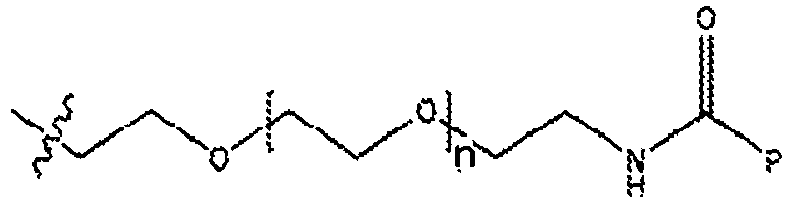
- In some embodiments P includes an aliphatic saturated radical comprising 1 to 24 carbon atoms. P may include noncyclic linear, branched or non-aromatic cyclic array of atoms. For example P may be CH3-, CH3CH2-, or CH3(CH2)n- where n is an integer ranging from 2 to 23. In some embodiments P may include aliphatic unsaturated radical comprising 2 to 24 carbon atoms. P may include one or more alkenyl or alkynyl groups. Examples of aliphatic unsaturated radical include but are not limited to CH3(CH2)7CH=CH(CH2)6CH2-, which is an aliphatic structural moiety comprising single alkenyl group and CH3(CH2)4CH=CHCH2CH=CH(CH2)6CH2-, which is an aliphatic radical comprising two alkenyl groups.
- In some embodiments, R1, R2 and R3 may include non-aromatic cyclic radical having a structural moiety such as steroids (cholesterol, ergosterol etc). For example R1, R2 and R3 may be


- In some embodiments R1, R2, and R3 may include an aromatic radical having an array of atoms having a valence of at least one comprising at least one aromatic group. The aromatic group may include heteroatoms such as nitrogen, sulfur, selenium, silicon and oxygen, or may be composed exclusively of carbon and hydrogen. Examples of aromatic radical include but are not limited to phenyl, pyridyl, furanyl, thienyl, naphthyl, anthryl, phenylene, and biphenyl radicals. The aromatic radical may also include nonaromatic components. For example, benzyl (C6H5CH2-), naphthyl-1-methyl (C10H7CH2-), anthracenyl-1-methyl (C14H9CH2-) are aromatic radicals, which comprise a phenyl ring, a naphthyl ring, an anthracenyl ring (the aromatic group) respectively and a methylene group (the nonaromatic component). In some embodiments, aromatic radical may include a wide range of functional groups such as alkyl groups, alkenyl groups, alkynyl groups, haloalkyl groups, haloaromatic groups, conjugated dienyl groups, alcohol groups, ether groups, aldehyde groups, ketone groups, carboxylic acid groups, acyl groups (for example carboxylic acid derivatives such as esters and amides), amine groups, nitro groups, and the like. For example, the 4-methylphenyl radical is an aromatic radical comprising a methyl group, the methyl group being a functional group which is an alkyl group. Similarly, the 2-nitrophenyl group is an aromatic radical comprising a nitro group. Aromatic radicals may include halogenated aromatic radicals.
- Examples of aromatic radical include but are not limited to, tocopherol or tocotrienol. In some embodiments, R1, R2 and R3 may include an aromatic radical having a structural moiety such as α-Tocopherol, β-Tocopherol, γ-Tocopherol, δ-Tocopherol. For example R1, R2 and R3 may be:

- In some embodiments, R1, R2 and R3 may include an aromatic radical having a structural moiety such as α-Tocotrienol, β-Tocotrienol, γ-Tocotrienol, δ-Tocotrienol. For example R1, R2 and R3 may be
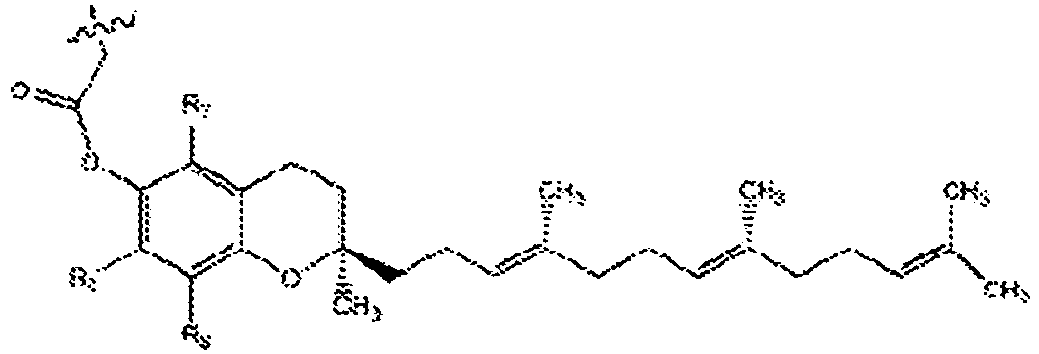
- In some embodiments R1, R2 and R3 may be a "hydrophobic moiety" comprising non-cyclic linear, branched or cyclic array of atoms with at least six carbon atoms. In some embodiments the "hydrophobic moiety" may include an aromatic radical. In one aspect of this embodiment said hydrophobic moiety comprises more than 6 and up to 40 carbon atoms. In a second aspect said hydrophobic moiety comprises between 6 and 24 carbon atoms and in a third aspect said hydrophobic moiety comprises between 8 and 14 carbon atoms. In some embodiments said hydrophobic moiety may include one or more heteroatoms such as nitrogen, sulfur, silicon, selenium and oxygen. In one embodiment said hydrophobic moiety may include one or more alkenyl or alkynyl groups. In other embodiments said hydrophobic moiety may include a wide range of functional groups such as alkyl groups, alkenyl groups, alkynyl groups, haloalkyl groups, conjugated dienyl groups, alcohol groups, ether groups, aldehyde groups, ketone groups, carboxylic acid groups, acyl groups (for example carboxylic acid derivatives such as esters and amides), amine groups, nitro groups, and the like. In some embodiments the branching of the main chain of said hydrophobic moiety may comprise small building blocks. Preferred building blocks comprise methyl-, ethyl-, propyl-, isopropyl-, methoxy-, ethoxy-, methoxymethyl-, ethoxymethyl-, methoxyethyl-, ethoxyethyl- and vinyl- or halogen groups or mixtures thereof. Alternatively, said hydrophobic moiety may include sterols, said sterols may further include functional groups.
- In the compound of Formula I, R1, R2, and R3 are independently selected from an aliphatic radical or an aromatic radical. In some embodiments R1, R2, and R3 may all be different radicals; for example, R1 may be methyl radical (CH3-), R2 may be ethyl radical (CH3CH2-) and R3 may be propyl radial (CH3CH2CH2-). In some embodiments, R1 and R2 may be a same radical and R3 may be a different radical from R1 and R2; for example R1 and R2 may be a methyl radical (CH3-), and R3 may be ethyl radical (CH3CH2-). In some embodiments R1 and R3 may be a same radical and R2 may be a different radical from R1 and R3; for example R1 and R3 may be a methyl radical (CH3-), and R2 may be an ethyl radical (CH3CH2-). In some embodiments R2 and R3 may be a same radical and R1 may be a different radical from R2 and R3; for example R2 and R3 may be a methyl radical (CH3-), and R1 may be an ethyl radical (CH3CH2-). In some embodiments R1, R2, and R3 may all be a same radical; for example R1, R2, and R3 may be an ethyl radical (CH3CH2-).
- In the compound of Formula I, at least one of R1, R2, or R3 comprises at least 2 carbon atoms. For example in some embodiments, R1 may be a methyl radical (CH3-), R2 may be a methyl radical (CH3-), and R3 may be an ethyl radical (CH3CH2-).
- In some embodiments a compound of Formula II is provided:

wherein said compound of Formula II having m = 10 and n = 1 is disclaimed. - In some embodiments R3 may include CH3(CH2)7-, CH3(CH2)8-, CH3(CH2)9-, CH3(CH2)10-, CH3(CH2)11-, CH3(CH2)12-, or CH3(CH2)13-.
- In some embodiments, a pharmaceutically acceptable salt of the compounds of the present invention with a pharmaceutically acceptable mineral acid or organic acid include hydrochloric acid, hydrobromic acid, hydroiodic acid, sulfuric acid, phosphoric acid, and the like, and organic acids such as p-toluenesulfonic acid, methanesulfonic acid, oxalic acid, p-bromophenylsulfonic acid, carbonic acid, succinic acid, citric acid, benzoic acid, acetic acid, trifluoroacetic acid, salicylic acid, terephthalic acid and the like. Examples of such pharmaceutically acceptable salts are the sulfate, pyrosulfate, bisulfate, sulfite, bisulfite, phosphate, monohydrogenphosphate, dihydrogenphosphate, metaphosphate, pyrophosphate, chloride, bromide, iodide, acetate, trifluoroacetate, propionate, decanoate, caprylate, acrylate, formate, isobutyrate, caproate, heptanoate, propiolate, oxalate, malonate, succinate, suberate, sebacate, fumarate, maleate, butyne-1,4-dioate, hexyne-1,6-dioate, benzoate, chlorobenzoate, methylbenzoate, dinitrobenzoate, hydroxybenzoate, methoxybenzoate, phthalate, sulfonate, xylenesulfonate, phenylacetate, phenylpropionate, phenylbutyrate, citrate, lactate, g-hydroxybutyrate, glycollate, tartrate, methanesulfonate, propanesulfonate, naphthalene-1-sulfonate, naphthalene-2-sulfonate, mandelate and the like.
- In some embodiments, a pharmaceutically acceptable salt of the compounds of the present invention may be with a pharmaceutically acceptable organic acid such as trifluoroacetic acid and the pharmaceutically acceptable salt may be trifluoroacetate.
- It should be recognized that the particular counterion (for example X- as shown in formula 1) forming a part of any salt of this invention may not be of a critical nature, so long as the salt as a whole is pharmacologically acceptable and as long as the counterion does not contribute undesired qualities to the salt as a whole.
- In some embodiments, the "composition" may be a composition comprising drug along with conventional pharmaceutical carriers. In some other embodiments, the excipients formulated for immediate or sustained release. Other time-release profiles, such as combinations of immediate and sustained release are also possible. As used herein, the term "pharmaceutically carrier and/or excipient" means a non-toxic, inert solid, semi-solid or liquid filler, diluent, encapsulating material or formulation auxiliary of any type. Some examples of materials which can serve as pharmaceutically acceptable carriers are sugars such as lactose, glucose and sucrose; starches such as corn starch and potato starch; cellulose and its derivatives such as sodium carboxymethyl cellulose, ethyl cellulose and cellulose acetate; malt; gelatin; talc; excipients such as cocoa butter and suppository waxes; oils such as peanut oil, cottonseed oil; safflower oil; sesame oil; olive oil; corn oil and soybean oil; glycols; such a propylene glycol; esters such as ethyl oleate and ethyl laurate; agar; buffering agents such as magnesium hydroxide and aluminum hydroxide; alginic acid; pyrogen-free water; isotonic saline; Ringer's solution; ethyl alcohol, and phosphate buffer solutions, as well as other non-toxic compatible lubricants such as sodium lauryl sulfate and magnesium stearate, as well as coloring agents, releasing agents, coating agents, sweetening, flavoring and perfuming agents, preservatives and antioxidants can also be present in the composition, according to the judgment of the formulator. The pharmaceutical compositions of this invention can be administered to humans and other animals orally, rectally, parenterally, intracisternally, intravaginally, intraperitoneally, topically (as by powders, ointments, or drops), buccally, or as an oral or nasal spray, or a liquid aerosol or dry powder formulation for inhalation.
- Liquid dosage forms for oral administration include pharmaceutically acceptable emulsions, microemulsions, liposome, solutions, suspensions, syrups and elixirs. In addition to the active compounds, the liquid dosage forms may contain inert diluents commonly used in the art such as, for example, water or other solvents, solubilizing agents and emulsifiers such as ethyl alcohol, isopropyl alcohol, ethyl carbonate, ethyl acetate, benzyl alcohol, benzyl benzbate, propylene glycol, 1,3-butylene glycol, dimethylformamide, oils (in particular, cottonseed, groundnut, corn, germ, olive, castor, and sesame oils), glycerol, tetrahydrofurfuryl alcohol, polyethylene glycols and fatty acid esters of sorbitan, and mixtures thereof. Besides inert diluents, the oral compositions can also include adjuvants such as wetting agents, emulsifying and suspending agents, sweetening, flavoring, and perfuming agents.
- Injectable preparations, for example, sterile injectable aqueous or oleaginous suspensions may be formulated according to the known art using suitable dispersing or wetting agents and suspending agents. The sterile injectable preparation may also be a sterile injectable solution, suspension or emulsion in a nontoxic parenterally acceptable diluent or solvent, for example, as a solution in 1,3-butanediol. Among the acceptable vehicles and solvents that may be employed are water, Ringer's solution, U.S.P. and isotonic sodium chloride solution. In addition, any oil including mono- or diglycerides or fatty acids such as oleic acid can be used in the preparation of injectables.
- In order to prolong the effect of a drug, it is often desirable to slow the release of the drug. Slow release of the drug can be accomplished by dissolving or suspending the drug in an oil vehicle. Injectable depot forms can be made by forming microencapsule matrices of the drug in biodegradable polymers such as polylactide-polyglycolide. Depending upon the ratio of drug to polymer and the nature of the particular polymer employed, the rate of drug release can be controlled. Examples of other biodegradable polymers include poly(orthoesters) and poly(anhydrides). Depot injectable formulations may also be prepared by entrapping the drug in liposomes or microemulsions which are compatible with body tissues. Alternatively, the compounds of this invention can be conjugates covalently, encapsulated, or adsorbed onto carbon nanospheres or nanotubes to form slow release compositions.
- Compositions for rectal or vaginal administration are preferably suppositories which can be prepared by mixing the compounds of this invention with suitable nonirritating excipients or carriers such as cocoa butter, polyethylene glycol or a suppository wax which are solid at ambient temperature but liquid at body temperature and therefore melt in the rectum or vaginal cavity and release the active compound.
- Solid dosage forms for oral administration include capsules, tablets, pills, powders, and granules. In such solid dosage forms, the active compound is mixed with at least one inert, pharmaceutically acceptable excipient or carrier such as sodium citrate or dicalcium phosphate and/or a) fillers or extenders such as starches, lactose, sucrose, glucose, mannitol, and silicic acid, b) binders such as, for example, carboxymethylcellulose, alginates, gelatin, polyvinylpyrrolidinone, sucrose, and acacia, c) humectants such as glycerol, d) disintegrating agents such as agar-agar, calcium carbonate, potato or tapioca starch, alginic acid, certain silicates, and sodium carbonate, e) solution retarding agents such as paraffin, f) absorption accelerators such as quaternary ammonium compounds, g) wetting agents such as, acetyl alcohol and glycerol monostearate, h) absorbents such as kaolin and bentonite clay, and i) lubricants such as talc, calcium stearate, magnesium stearate, solid polyethylene glycols, sodium lauryl sulfate, and mixtures thereof. In the case of capsules, tablets and pills, the dosage form may also comprise buffering agents.
- Solid compositions of a similar type may also be employed as fillers in soft and hard-filled gelatin capsules using such excipients as lactose or milk sugar as well as high molecular weight polyethylene glycols and the like.
- The solid dosage forms of tablets, capsules, pills, and granules can be prepared with coatings and shells such as enteric coatings and other coatings well known in the pharmaceutical formulating art. They may optionally contain opacifying agents and can also be of a composition that they release the active ingredient(s) only, or preferentially, in a certain part of the intestinal tract, optionally, in a delayed manner. Examples of embedding compositions which can be used include polymeric substances and waxes.
- The active compounds can also be in micro-encapsulated form with one or more excipients as noted above. The solid dosage forms of tablets, capsules, pills, and granules can be prepared with coatings and shells such as enteric coatings, release controlling coatings and other coatings well known in the pharmaceutical formulating art. In such solid dosage forms the active compound may be admixed with at least one inert diluent such as sucrose, lactose or starch. Such dosage forms may also comprise, as is normal practice, additional substances other than inert diluents, e.g., tableting lubricants and other tableting aids such a magnesium stearate and microcrystalline cellulose. In the case of capsules, tablets and pills, the dosage forms may also comprise buffering agents. They may optionally contain opacifying agents and can also be of a composition that they release the active ingredient(s) only, or preferentially, in a certain part of the intestinal tract, optionally, in a delayed manner. Examples of embedding compositions which can be used include polymeric substances and waxes.
- Dosage forms for topical or transdermal administration of a compound of this invention include ointments, pastes, creams, lotions, gels, powders, solutions, sprays, inhalants or patches. The active component is admixed under sterile conditions with a pharmaceutically acceptable carrier and any needed preservatives or buffers as may be required. Ophthalmic formulations, ear drops, and the like are also contemplated as being within the scope of this invention.
- The ointments, pastes, creams and gels may contain, in addition to an active compound of this invention, excipients such as animal and vegetable fats, oils, waxes, paraffins, starch, tragacanth, cellulose derivatives, polyethylene glycols, silicones, bentonites, silicic acid, talc and zinc oxide, or mixtures thereof.
- Compositions of the invention may also be formulated for delivery as a liquid aerosol or inhalable dry powder. Liquid aerosol formulations may be nebulized predominantly into particle sizes that can be delivered to the terminal and respiratory bronchioles where bacteria reside in patients with bronchial infections, such as chronic bronchitis and pneumonia.
- Compounds of the invention may also be formulated for use as topical powders and sprays that can contain, in addition to the compounds of this invention, excipients such as lactose, talc, silicic acid, aluminum hydroxide, calcium silicates and polyamide powder, or mixtures of these substances. Sprays can additionally contain customary propellants such as chlorofluorohydrocarbons.
- Transdermal patches have the added advantage of providing controlled delivery of a compound to the body. Such dosage forms can be made by dissolving or dispensing the compound in the proper medium. Absorption enhancers can also be used to increase the flux of the compound across the skin. The rate can be controlled by either providing a rate controlling membrane or by dispersing the compound in a polymer matrix or gel.
- Alternatively, the compound or the pharmaceutical composition thereof, can also be coated or impregnated into catheters or stents for local drug delivery.
- In some embodiments a method of making a lipophilic quartenary ammonium derivative of vancomycin is described. The method comprising activating a carboxylic acid moiety of vancomycin to generate an activated vancomycin; and reacting the activated vancomycin with a primary amine comprising a lipophilic quarternary ammonium moiety.
- Lipophilic quarternary ammonium moiety comprises a structural moiety of general formula:

- Examples of lipophilic quarternary ammonium moiety include but are not limited to, CH3(CH2)7N+(CH3)2CH2CH2CH2NH2, CH3(CH2)9N+(CH3)2CH2CH2CH2NH2, CH3(CH2)11N+(CH3)2CH2CH2CH2NH2, CH3(CH2)13N+(CH3)2CH2CH2CH2NH2, CH3(CH2)7CH=CH(CH2)7CH2N+(CH3)2CH2CH2CH2NH2, CH3(CH2)4CH=CHCH2CH=CH(CH2)7CH2N+(CH3)2CH2CH2CH2NH2, CH3(CH2)7OCOCH2N+(CH3)2CH2CH2CH2NH2, CH3(CH2)7NHCOCH2N+(CH3)2CH2CH2CH2NH2, CH3(CH2)7CH=CH(CH2)6COOCH2CH2CH2N+(CH3)2CH2CH2CH2NH2, or CH3(CH2)7CH=CH(CH2)6CONHCH2CH2CH2N+(CH3)2CH2CH2CH2NH2.
- In some embodiments, a method of forming an amide at the carboxyl group of vancomycin is described. The method comprises forming an activated ester intermediate of the vancomycin followed by reaction with the lipophilic quarternary ammonium moiety. Other methods of forming amide linkages, known to the ordinarily skilled chemist may be employed as well, subject of course, to suitable protection of other groups in the molecule which might be reactive under the conditions employed to form the amide linkage at the terminal carboxyl group. Thus, for example, the carboxyl group may be activated by reaction with, e.g., O-Benzotriazole-N,N,N',N-tetramethyl-uronium-hexafluoro-phosphate (HBTU) to form an amine-reactive activated ester intermediate, followed by reaction with lipophilic quarternary ammonium moiety to yield a compound of the present invention which is an amide modification of the terminal carboxyl group. The reaction of the carboxyl group with HBTU and the subsequent reaction with the amine are conducted in a suitable solvent which may be aqueous, organic or a combination of aqueous/organic solvents. Exemplary solvents include, but are not limited to DMF, (dimethylformamide), DMSO (dimethylsulphoxide), methylene chloride, hexanes, methanol and mixtures thereof. Other compounds which activate the terminal carboxyl group in a manner similar to HBTU include, for example, hydroxybenzotriazole (HOBt), 1-ethyl-3-(3-dimethylaminopropyl)carbodiimide hydrochloride (EDC), or dicyclohexylcarbodiimide (DCC). Other protocols for activating a carboxyl group to render it more amenable to reaction with an amine to form a peptide linkage are known to the ordinarily skilled chemist and may be employed to form the amide modification of the terminal carboxyl group.
- The compounds of the present invention, or pharmaceutically acceptable salts or compositions thereof can be formulated for any conventional means of delivery, including oral or parenteral delivery for the therapeutic or prophylactic treatment of infectious diseases, preferably bacterial diseases. The bacterial diseases which may be therapeutically or prophylactically treated with the compounds and/or formulations of the present invention include those caused by Gram-positive and/or Gram-negative microorganisms.
- The compounds of the present invention may be administered separately or in combination with any other drug or therapeutic agent. Examples of other therapeutic agents and/or drugs that can be administered with the compounds and/or formulations of the present invention include, but are not limited to, beta lactam antibiotics, such as penems, penams, cephems, carbapenems, oxacephems, carbacephems, and monobactams, or other antibiotics such as cycloserine and fosfomycin. The other therapeutic agent need not be an antibiotic.
- The compound and/or composition are administered to the subject in a therapeutically effective amount. Thus, the compound of the present invention can be administered to the subject, preferably a human, in an amount ranging from about 0.25 to about 2 grams per day. The compound and/or composition of the present invention can be administered in a single daily dosage or in multiple doses per day. Other periodic treatment protocols may also be adopted. Thus, the treatment protocol may require administration over extended periods of time, e.g., for several days or for from about one to six weeks. The therapeutically effective amounts of the compound of the invention discussed above are merely exemplary. Thus, the amount per administered dose or the total amount administered will depend on such factors as the nature and severity of the infection, the age and general health of the patient, the tolerance of the patient to the compounds and/or formulations of the present invention and the microorganism or microorganisms involved in the infection.
- In some embodiments, treatment includes preventing a disease or condition from occurring in a subject which may be predisposed to the disease but has not yet been diagnosed as having it. In some other embodiments, treatment includes inhibiting the disease or condition, i.e. arresting its development; relieving the disease or condition, i.e. causing regression of the condition; or relieving the conditions caused by the disease, i.e. symptoms of the disease.
- In the present invention, the desired therapeutic effect would be treatment of a disease condition resulting from gram positive, gram negative, or acid fast bacterial infections. These include but are not limited to diseases such as infective endocarditis, skin infections, meningitis, urinary tract infections, gastrointestinal infections, respiratory tract infections etc caused by pathogenic bacteria such as Staphylococci, Streptococci, Haemophilus, Moraxalla, Chlamydia, Rickettsiae, Mycoplasm, Legionella, Mycobacterium, Helicobacter, Clostridium, Bacteroides, Propionibacterium acnes, Corynebacterium, Bacillus or Enterobactericeae etc.
- In some embodiments, bacterial infections may be caused by drug sensitive bacteria, or drug resistant bacteria. In some other embodiments, infections may caused by drug sensitive bacteria, which later become drug resistant once inside the body of the infected host. In some embodiments, infections may be caused by both drug sensitive bacteria and drug resistant bacteria.
- In some embodiments, drug sensitive bacteria may include but are not limited to Staphylococci, Streptococci, Enterococci, Haemophilus, Moraxalla, Chlamydia, Rickettsiae, Mycoplasm, Legionella, Mycobacterium, Helicobacter, Clostridium, Bacteroides, Propionibacterium acnes, Corynebacterium, Bacillus or Enterobactericeae etc.
- In some other embodiments, drug resistant bacteria may include but are not limited to methicillin resistant S. aureus (MRSA), vancomycin resistant S. aureus (VRSA), vancomycin resistant E. faecalis, vancomycin resistant E. faecium. In some embodiments, the compounds of the present invention and pharmaceutically acceptable salts thereof show good antibacterial activity against methicillin resistant S. aureus (MRSA), vancomycin resistant S. aureus (VRSA), vancomycin resistant E. faecalis (VRE).
- In some embodiments, infection may be caused by Gram-negative bacteria, for example E.coli, which is an inherently vancomycin resistant bacteria. In some embodiments, the compounds of the present invention and pharmaceutically acceptable salts thereof show good antibacterial activity against E.coli.
- In some embodiments, a subject refers to a multi-cellular living organism. For example, subject may be an animal that may be a vertebrate or a inveterbate. In some embodimets the subject may be a mammal. In some embdiments the subject may be a human being.
- In some embodiments, an article comprising a composition comprising the compound of the present invention or pharmaceutically acceptable salt thereof, include but are not limited to medical implants, catheters, or stents. For example, the compound of the present invention or pharmaceutically acceptable salt thereof may be coated on or impregnated into the medical implants, catheters, or stents.
- The following examples provide details concerning the synthesis, properties, activities, and applications of the compounds of the present invention. It should be understood the following is representative only, and that the invention is not limited by the details set forth in these examples.
- Materials: All reagents were purchased from Sigma-Aldrich and SD Fine and used without further purification. Analytical thin layer chromatography (TLC) was performed on TLC plates pre-coated with silica gel 60 F254 (250 µm thickness). Visualization was accomplished using UV light and Iodine. Column chromatography was performed on silica gel (60-120 A° pore size). HPLC analysis was performed on a Liquid chromatograph instrument (C18 column, 10 mm diameter, 250 mm length) with UV detector monitoring at 254 nm. Nuclear magnetic resonance spectra were recorded on 400 MHz spectrometer in deuterated solvents. MALDI mass spectra (MALDI-MS) were used to characterize the compounds. Bacterial strains, S. aureus MTCC 737 and E. coli MTCC 443 purchased from MTCC (Chandigarh, India) and MRSA ATCC 33591, Enterococcal strains were obtained from ATCC (Rockvillei, Md). VRSA strain (MMC-20) was isolated from Midnapore Medical College and Hospital, Midnapore, West Bengal, India. Tryptic-soy agar media was used for Staphylococci and sheep blood agar plates were used for Enterococci. Plate Reader was used to measure absorbance. Fluorescence measurements were obtained using a spectrofluorometer. Human RBCs were used for hemolytic assay and HeLa cells were used for cytotoxic studies.
- Cationic antibacterial compounds (1-8 and 14) of the instant disclosure were synthesized by coupling carboxylic group of vancomycin with cationic moieties through amide coupling using O-Benzotriazole-N,N,N',N'-tetramethyl-uronium-hexafluorophosphate (HBTU) (
Figure 1 ). To synthesize the cationic moieties (12a-12g), N,N-dimethyl-1,3-propanediamine was protected using Di-t-butylpyrocarbonate then quarternized the tertiary amine group by various alkyl bromide followed by deprotection of primary amine group under acidic conditions (Figure 2 ). The steps employed in the method of synthesising cationic moeity represented inFigure 2 is further elaborated below in Examples 1.1-1.3. - N,N-
Dimethyl reaction mixture compound 10 was extracted into the organic layer using chloroform. The resultant organic solution was evaporated and dried to afford colourless oily NH-Boc N,N-dimethyl - Compound 10 (about 1 g, about 4.92 mmol) was dissolved in dry ethanol (about 10 ml) in a sealed tube and alkyl bromide (about 9.84 mmol) was added to it. The reaction mixture was refluxed for about 48 h. After that the required compounds were purified by column chromatography using Silica gel of mesh size (about 60-120) and using about 10-20% CH3 OH/CHCl3 as eluant and the quarternised NH-Boc derivatives, (11a-11g) yield was about 60-65 %.
- 1HNMR (400 MHz, CD3OD) δ/ppm: 3.4-3.33 (t, 2H), 3.25-3.1 (t, 2H), 3.2 (s, 6H), 3.05-3.01 (q, 2H), 1.44 (s, 9H), 1.25-1.10 (t, 3H).
- NH-Boc N-butyl N,N-
dimethyl - NH-Boc N-octyl N,N-
dimethyl - 1HNMR (400 MHz, CDCl3) δ/ppm: 5.67 (bs, 1H), 3.48-3.46 (t, 2H), 3.33-3.29 (t, 2H), 3.16 (s, 6H), 1.9-1.86 (m, 2H), 1.55 (m, 2H), 1.25 (s, 9H), 1.17-1.08 (m, 16H), 0.72-0.68 (t, 3H).13CNMR (100 MHz, CDCl3) δ/ppm: 156.18, 78.98, 64.26, 61.92, 51.0, 49.53, 37.25, 31.58, 29.28, 29.13, 29.00, 28.94, 28.18, 26.03, 23.16, 22.53, 13.8.
- NH-Boc N-dodecyl N,N-
dimethyl - NH-Boc N-tetradecyl N,N-
dimethyl - NH-Boc N-octadecyl N,N-
dimethyl - Quarternised NH-Boc compounds 11 (about 1g) were dissolved in about 5 ml of MeOH and about 2 ml of about 37% HCl. The reaction mixture was stirred at room temperature for about 5 h and dried in vacuum to afford N-alkyl N,N-
dimethyl - N-ethyl N,N-
dimethyl - N-butyl N,N-
dimethyl - N-octyl N,N-
dimethyl - 1HNMR (400 MHz, CD3OD) δ/ppm : 3.48-3.44 (t, 3H), 3.37-3.34 (m, 2H), 3.14 (s, 6H), 3.07-3.04 (t, 2H), 2.14-2.2 (m, 2H), 1.83-1.78 (m, 2H), 1.4-1.29 (m, 16H), 0.91-0.88 (t, 3H). 13CNMR (100MHz, CD3OD) δ/ppm: 66.15, 61.99, 51.36, 37.71, 33.01, 30.68, 30.59, 30.54, 30.4, 30.23, 27.39, 23.60, 14.36. MALDI-MS: m/z 244.4324 (observed); 244.552 (calculated for M+).
- N-dodecyl N,N-
dimethyl - N-tetradecyl N,N-
dimethyl - N-octadecyl N,N-
dimethyl - The steps employed in the method of synthesising cationic moeity (14) represented in
Figure 3 is further elaborated below in Examples 2.1-2.2. - A mixture of N,
N dimethyl - A mixture of 13 (about 0.95 g, about 6.56 mmol) and bromotetradecane (about 3.63 g, about 13.13 mmol) were dissolved in 15 ml of dry acetone. Potassium carbonate (about 1.81 g, about 13.15 mmol) was added to the reaction mixture and the reaction mixture was refluxed for about 48 h. Then the solution was filtered to remove potassium carbonate after which the compound was purified by silica gel (about 60-120 mesh size) column chromatography using about 15% of CH3OH: CHCl3 as eluant, to give about 40 % yield. 1HNMR (400 MHz, CDCl3) δ/ppm: 7.9 (bs, 1H), 3.85 (t, 2H), 3.38 (t, 2H), 3.33 (m, 2H), 3.2 (s, 6H), 2.08 (s, 3H), 1.7 (m, 2H), 1.35-1.25 (m, 22H), 0.88 (t, 3H). 13CNMR (100 MHz, CDCl3) δ/ppm: 171.7, 64.9, 63, 51.08, 36.11, 31.9, 29.65, 26.29, 22.6, 14.1.
- Vancomycin hydrochloride (100 mg, 67 µmol) was dissolved in 1:1 mixture of dry dimethyl formamide (1 mL) dry dimethyl sulfoxide (1 mL). To this two equivalents of compounds bearing primary amine group (N,N-
Dimethyl dimethyl - The cationic antibacterial compounds were purified and characterized by 1H-NMR and MALDI-MS (Table 1). The purification was done by preparative reverse phase HPLC using 0.1% Trifluoro acetic acid (TFA) in water/acetonitrile (0-100%) as mobile phase. C18 column (10mm diameter, 250 mm length) and UV detector (at 270 nm wave length) were used. The collected fractions, from HPLC were frozen by liquid N2 and lyophilized in freeze dryer.
Table 1: Characterization of Cationic Antibacterial Compounds Compound Retention Time (HPLC') [minutes] Molecular weight (Cal) [daltons] [M+] Molecular weight (Obs by MALDI-MS) [daltons] [M+] Control (Vancomycin) 7.931 1449.3 1450.23 1 7.723 1533.518 1534.56 2 8.448 1561.479 1561.634 3 8.821 1589.532 1589.646 4 10.584 1645.639 1645.734 5 11.521 1673.695 1673.031 6 12.521 1701.745 1702.031 7 14.05 1730.238 1729.908 8 16.11 1786.638 1786.529 - All cationic antibacterial compounds and control (vancomycin) were assayed in a micro-dilution broth format. Stock solutions were made by serially diluting the compounds using autoclaved Millipore water or broth media. The antibacterial activity of the compounds was determined against Methicillin sensitiive S. aureus (MSSA), Methicillin resistant S. aureus (MRSA), vancomycin sensitive Enterococcus faecium (VSE), vancomycin resistant Enterococcus faecium (VRE), and E. coli. Bacteria, to be tested, were grown for about 10 h in the suitable media, MSSA and MRSA were grown in Yeast-dextrose broth (about 1g of beef extract, about 2g of yeast extract, about 5g of peptone and about 5g of NaCl in about 1000mL of sterile distilled water (pH-7)). For solid media, about 5% agar was used along with above mentioned composition. E. coli was cultured in Luria Bertani broth (about 10 g of tryptone, about 5 g of yeast extract, and about 10 g of NaCl in 1000 mL of sterile distilled water, pH -7). VSE and VRE were cultured in Brain Heart Infusion broth (Himedia). The bacterial samples were freeze dried and stored at about -80°C. About 5µl of these stocks were added to about 3 ml of the nutrient broth and the culture was grown for about 6h at about 37°C prior to the experiments. This 6h grown culture gives about 109cfu/mL for MSSA and MRSA, while it was about 108cfu/mL for E. coli, 109cfu/mL for both VSE and VRE and this was determined by spread plating method. The 6 h grown culture was diluted to give effective cell concentration of about 105cfu/mL which was then used for determining MIC.
- Compounds were serially diluted, in sterile water (2 fold dilution is employed) in a way that the working concentration was about 10 µM for MSSA MRSA, and VSE while for VRE and E. coli it was about 100 µM. About 50 µL of these serial dilutions were added to the wells of 96 well plate followed by the addition of about 150 µL of bacterial solution. The plates were then incubated at about 37 °C, 150 rpm in the incubator and O.D at 600 nm was recorded at an interval of about 10 h and about 24 h using TECAN (Infinite series, M200 pro) Plate Reader. Each concentration had triplicate values and the whole experiment was done at least twice and the MIC value was determined by taking the average of triplicate O. D. values for each concentration and plotting it against concentration. The data was then subjected to sigmoidal fitting. From the curve the MIC value was determined, as the point in the curve where the O.D.was similar to that of control having no bacteria.
- For vancomycin resistant staphylococcus aureus (VRSA; clinical isolate MMC-20), the MIC of compounds was determined by broth dilution method using Mueller-Hinton broth (MHB), as recommended by the National Committee for Clinical Laboratory Standards. About 5×10⁴ bacterial cells in MHB culture were treated with different concentrations of compounds, and shaken for 16 h at 37°C. The minimum concentration at which there was no visible turbidity was taken as the MIC of that compound.
- MBC values were determined by plating about 50 µl of the solution and later counting the colonies after their development.
- The antibacterial activities of compounds against Staphylococci (MSSA, MRSA and VRSA) and Enterococci (VSE, VRE) were summarized in Table 2. In case of wild type bacterial strains MSSA, the MIC varied from 0.31 to 5.03 µM while for VSE it was 0.12 to 0.63 µM. When tested against pathogenic MRSA and VRSA, these compounds exhibited MIC in the range of 0.31 to 2.42 µM and 0.24 to 2.1 µM respectively. Both the compounds (4 and 5) showed MIC of 0.31 µM against MRSA implying 2 fold more activity than control. Interestingly, the activities of the
compounds Table 2: Antibacterial activities of cationic antibacterial compounds MIC (µM) Compound MSSAa MRSAb VRSAc VSEd VREe Vancomycin 0.63 0.63 >86 0.6 >100 1 0.62 0.61 0.53 0.63 >100 2 0.39 2.42 2.1 0.45 >100 3 0.37 0.6 2.0 0.31 >100 4 0.31 0.31 0.25 0.15 12.5 5 0.31 0.31 0.24 0.2 N.Df 6 0.62 0.62 N.Df 0.16 6.3 7 1.25 0.65 1.9 0.12 0.7 8 5.03 N.Df N.Df N.Df 1.9 aMethicillin sensitive S. aureus (MTCC 737). bMethicillin resistant S. aureus (ATCC 33591). cVancomycin restant S. aureus (Clinical isolate, MMC-20, VanA & VanB). dVancomycin sensitive E. faecium (ATCC 19634). eVancomycin resistant E. faecium (VanA, ATCC 51559). fNot determined. - MBC of control against MSSA was found to be about 2.5 µM whereas for other compounds MBC varied from 0.62-10 µM (Table 3). MBC value for control and
compound 4 against MRSA was found to be 2.5 and 0.62 µM respectively (Table 4).Table 3: Antibacterial activities of cationic antibacterial compounds against MSSA. Compound MBC (µM) Control 2.5 1 1.25 2 0.62 3 0.62 4 0.62 6 1.25 7 2.5 8 10 Table 4: Antibacterial activities of compound 4 and control against MRSA.Compound MBC (µM) Control 2.5 4 0.62 - The MIC of compounds and control against E. coli was found to be 4 to >100 µM and 80-100 µM respectively, whereas the MBC was 12.5 to >100 µM for compounds and >100 µM for control (Table 5).
Table 5: Antibacterial activities of cationic antibacterial compounds against E. coli. Compound MIC (µM) MBC (µM) Control 80-100 >100 1 50 50 2 50 50 3 25 25 4 12.4 25 7 5 12.5 8 >100 >100 14 >100 >100 - The bactericidal activity was assessed by the kinetics or the rate at which it affects the killing action of the compound. Briefly MRSA grown in Yeast-Dextrose broth. A starting inoculum of 1.6 × 10⁸ CFU/ml was used as initial bacterial colony count. control and
compound 4 having final concentrations of 1 × MIC, 6 × MIC, and 12 × MIC were inoculated with MRSA suspensions having starting inocula of 1.6 × 10⁸ CFU/ml. Bacterial suspension containing specified concentrations of the compound along with negative control (which contains only 0.9% Saline) was incubated at 37°c with shaking. Aliquots (20 µl) were removed from the cultures at 0,1,2 and 3 h and were serially diluted 10-fold in 0.9% saline and plated onto sterile Yeast-Dextrose agar medium. The number of viable cells was determined by plating the 10-fold serial dilution of each sample onto Yeast-dextrose agar medium. Plates were then incubated for 24 h at 37°c,CFU was counted and the total bacterial log10 CFU/ml was determined. - Vancomycin showed relatively slow killing or bacteriostatic effect and did not appear to be dose dependent, whereas killing by
compound 4 was rapid and the rate of killing increased with the concentration, where we found 4- to 5-log10-CFU/ml reduction at 3 h for theconcentration 12×MIC. (Figure 4 ) - The outer membrane permeabilization activity of
compound 7 was determined by fluorescence spectroscopic study using NPN (N-phenylnapthylamine) as a probe. Midlog phase E. coli cells were harvested (4000 rpm, about 4 °C, about 10 min), washed, and resuspended in 5 mM glucose/5 mM HEPES buffer pH 7.2. Then about 10 µL of about 1.875 mM concentration of control andcompound 7 in water was added to a cuvette containing about 1.5 mL of cells, followed by addition of about 30 µL of NPN from about 500 µM stock in acetone (the final concentration of NPN is about 10 µM). After immediate addition of NPN the fluorescence was recorded using the excitation wavelength at about 350 nm (slit width: about 10 nm) and emission wavelength at about 420 nm (slit width: about 10 nm). The uptake of NPN as a measure of outer membrane permeabilization was monitored by the increase in fluorescence of NPN for about 10 min using Spectrophtometer. Only Bacteria was used for negative control (Figure 5 ). - NPN dye has little or no fluorescence in water but once it reaches the hydrophobic environment, its fluorescence increases. When
compound 7 was incubated with bacteria and NPN, a dramatic increase in fluorescence intensity was observed, whereas negligible increase of fluorescence intensity was observed with control (Figure 5 ). This in turn confirms the disruption of the outer membrane of E. coli by thecompound 7. - Midlog phase bacterial cells were harvested, washed with about 5 mM HEPES and about 5 mM glucose and resuspended in about 5 mM glucose, about 5 mM HEPES buffer and about 100 mM KCl solution in 1:1:1 ratio (about 108 cfu/ml). Measurements were made in a cuvette containing about 2 ml of bacterial suspension and about 2 µM diSC3(5). The fluorescence of the dye was monitored for about 10 min (MSSA) to about 20 min (E. coli) at R.T. spectrofluorometer at excitation wavelength of about 622 nm and emission wavelength of about 670 nm. Dye uptake, and resultant self quenching, was modulated by the membrane potential. After reaching the maximum uptake of the dye by bacteria, which was indicated by a minimum in dye fluorescence, (after about 10 min for S. aureus and about 20 min for E. coli) compounds (4 and 7) and control were added to the cells, and the decrease in potential was monitored by the increase in fluorescence for further about 10 min.
- The results (
Figure 6 ) demonstrate thatcompounds Figure 6 ). Similar results were obtained against E. coli (Figure 7 ). - Midlog phase (grown for about 6 h) E. coli and MSSA cells were harvested (about 4000 rpm, about 4°C, about 10 min), washed, and resuspended in PBS buffer of about pH 7.2. Then compounds (4 and 7) and control were added (about 2.5 µM for MSSA and about 10.0 µM for E. coli to a cuvette containing about 2.0 mL of cells and about 10 µM propidium iodide (PI). Excitation wavelength: 535 nm (slit width: 10 nm); emission wavelength: 617 nm (slit width: 10 nm). The uptake of PI was measured by the increase in fluorescence of PI for about 10 min as a measure of inner membrane permeabilization.
- Unlike control, which did not cause membrane permeability even at the highest concentration of 40 µM tested against MSSA (
Figure 8 ), compounds 4 and 7 showed strong ability to permeabilize the cytoplasmic membrane (Figure 8 ). Similar results were observed against E. coli (Figure 9 ). - Fresh human blood was collected under aseptic conditions in heparinised vacutainers. vancomycin derivatives are serially diluted, in sterile water (about 2 fold dilution is employed) in a way that the working concentration is about 100 µM. Heparinised blood was centrifuged down at about 3500 rpm for about 5 min in order to separate Red Blood Cells and blood plasma. RBC's are then washed couple of times with PBS pH-7.4 and suspended in PBS such that the final concentration of RBC was about 5 vol%. About 150 µL of this is mixed with about 50 µL of serially diluted compound in 96 well plate. The plate was then incubated at about 37 °C for about one hour. Later, the plate was centrifuged down at about 3500 rpm for about 5 min. The lysed RBC releases haemoglobin which was present in the supernatant. The supernatant thus was pipetted out into another fresh 96 well plate and the absorbance was measured at about 540 nm.
- Percentage of hemolysis was determined as (A - A 0)/(A total -A 0) x 100, where A is the absorbance of the test well, A 0 the absorbance of solution without compound, and A total the absorbance of 100% hemolysis wells (with Triton X-100), all at 540 nm.
- Cytotoxity of
compounds X 100 solution were also used. Percentage of cell survival was calculated using the formula:
- A plot of % of survival against concentration of compound was plotted using Origin Pro software.
-
Compounds compounds Table 6: Toxicity of compounds (4 and 7) and control. Compound EC50 (µM) RBCa HeLab Control >100 >100 4 >100 >100 7 >100 >100 aHuman Red Blood Cells (RBC). bHeLa cells (cervical cancer cells). - Mouse neutropenic thigh infection model: About six-week-old, specific-pathogen-free female CD-1 mice (weight, about 23g to about 25 g) were obtained from Animal facility (JNCASR, Bangalore). The mice were rendered neutropenic (about 100 neutrophils/ml) by injecting two doses of cyclophosphamide intraperitoneally about 4 days (about 150 mg/kg) and about 1 day (about 100 mg/kg) before the infection experiment. About 50 µl of ∼106 CFU/ml concentration of the bacterial inoculum (MRSA) was injected into the thigh. About one hour after inoculation, animals were treated i.v. twice with about 12 h intervals with saline, at about 6.45 µmols concentration of vancomycin (about 10 mg/Kg) and
compound 4. At about 24 h post first treatment, cohorts of animals were euthanized (using ether) and the thighs were collected aseptically. The thigh was weighed (about 0.7 g to about 0.9 g range) and placed into about 10 ml of sterile saline and homogenized. The dilutions of the homogenate were plated onto agar plates, which were incubated overnight at about 37 °C. The bacterial titer was expressed as log10 CFU/gram of thigh weight. - The in-vivo experiment showed about 15-fold more activity for
derivative 4 compared to control against MRSA (Figure 10 ). This result also suggests thatcompound 4 showed no in-vivo toxicity at a total concentration of about 25 mg/kg.
Claims (17)
- A compound of formula I:

L is a C2-C22 aliphatic radical or a C3-C22 aromatic radical forming an amide bond at the carboxylic group;
R1, R2 and R3 are, independently at each occurrence, a C1-C40 aliphatic radical or a C3-C40 aromatic radical;
at least one of R1, R2, or R3 comprises at least 2 carbon atoms; and
wherein the compound having only one of R1, R2 or R3 as C10H21, the remaining two of R1, R2, or R3 as methyl groups, and L as -(CH2)3-NH- is disclaimed. - The compound of claim 1, wherein L is a C2-C8 aliphatic radical.
- The compound of claim 2, wherein R1, R2, and R3 are, independently at each occurrence, a C2-C24 aliphatic radical.
- The compound of claim 1, wherein R1 and R2 are methyl radicals, and wherein R3 is a C2-C24 aliphatic radical.
- The compound of claim 4, wherein R3 is a C8-C14 aliphatic radical.
- The compound of claim 5, wherein L is a C3 aliphatic radical.
- The compound of claim 6, wherein R3 is a saturated alkyl radical or an unsaturated alkyl radical.
- The compound of claim 1, wherein at least one of R1, R2, or R3 comprises a structural moiety selected from the group consisting of:


- A compound of formula II:

- A pharmaceutically acceptable salt of the compound of any of claims 1-9.
- The compound of any of claims 1-9 or the pharmaceutically acceptable salt of claim 10, for use as medicament.
- A compound of formula I:

wherein, forming
L is a C2-C22 aliphatic radical or a C3-C22 aromatic radical forming an amide bond at the carboxylic group;
R1, R2 and R3 are, independently at each occurrence, a C1-C40 aliphatic radical or a C3-C40 aromatic radical; and
wherein at least one of R1, R2, or R3 comprises at least 2 carbon atoms. - The compound or the pharmaceutically acceptable salt of claim 12, wherein the bacterial infection is caused by a Gram-positive bacterium or a Gram-negative bacterium.
- The compound or the pharmaceutically acceptable salt of claim 12, wherein the bacterium comprises a drug-resistant bacterium.
- The compound or the pharmaceutically acceptable salt of claim 12, wherein the bacterium comprises vancomycin-resistant bacterium or a methicillin-resistant bacterium.
- The compound or the pharmaceutically acceptable salt of claim 12, wherein the bacterium comprises vancomycin-resistant Staphylococcus aureus, vancomycin-resistant Enterococcus faecium or a methicillin-resistant Staphylococcus aureus.
- The compound or the pharmaceutically acceptable salt of claim 12 for use in treatment of an E. coli infection.
Applications Claiming Priority (2)
| Application Number | Priority Date | Filing Date | Title |
|---|---|---|---|
| IN3889CH2011 | 2011-11-14 | ||
| PCT/IB2012/056373 WO2013072838A1 (en) | 2011-11-14 | 2012-11-13 | Cationic antibacterial composition |
Publications (2)
| Publication Number | Publication Date |
|---|---|
| EP2780359A1 EP2780359A1 (en) | 2014-09-24 |
| EP2780359B1 true EP2780359B1 (en) | 2016-02-03 |
Family
ID=47553275
Family Applications (1)
| Application Number | Title | Priority Date | Filing Date |
|---|---|---|---|
| EP12813463.2A Not-in-force EP2780359B1 (en) | 2011-11-14 | 2012-11-13 | Cationic antibacterial composition |
Country Status (6)
| Country | Link |
|---|---|
| US (1) | US10081655B2 (en) |
| EP (1) | EP2780359B1 (en) |
| KR (1) | KR101816228B1 (en) |
| AU (1) | AU2012338461C1 (en) |
| CA (1) | CA2855753C (en) |
| WO (1) | WO2013072838A1 (en) |
Families Citing this family (4)
| Publication number | Priority date | Publication date | Assignee | Title |
|---|---|---|---|---|
| US20170342110A1 (en) | 2014-12-25 | 2017-11-30 | Jawaharlal Nehru Centre for Advanced Scientific Research (JNCASR) | Glycopeptides and uses thereof |
| CA2975975A1 (en) * | 2015-02-06 | 2016-08-11 | Jawaharlal Nehru Centre for Advanced Scientific Research (JNCASR) | Glycopeptides conjugates and uses thereof |
| EP3532483A4 (en) * | 2016-10-31 | 2020-09-02 | The Scripps Research Institute | PERIPHERAL MODIFICATIONS TO POCKET-MODIFIED VANCOMYCINALOGA FOR SYNERGISTIC IMPROVEMENT OF ANTIMICROBIAL POTENTIAL AND DURABILITY |
| CN121673433B (en) * | 2026-02-09 | 2026-05-12 | 鞍山天雨发展有限公司 | Filter aid for reducing water content of iron ore slurry and preparation method thereof |
Family Cites Families (3)
| Publication number | Priority date | Publication date | Assignee | Title |
|---|---|---|---|---|
| CA2497159A1 (en) * | 2002-08-30 | 2004-03-11 | K.U. Leuven Research And Development | Glycopeptide antibiotic and semisynthetic derivatives thereof and their use as antiviral agents |
| JP4330169B2 (en) | 2004-11-29 | 2009-09-16 | 国立大学法人名古屋大学 | Glycopeptide antibiotic monomer derivatives |
| WO2012129493A1 (en) * | 2011-03-24 | 2012-09-27 | Seachaid Pharmaceuticals, Inc. | Vancomycin derivatives |
-
2012
- 2012-11-13 WO PCT/IB2012/056373 patent/WO2013072838A1/en not_active Ceased
- 2012-11-13 KR KR1020147016259A patent/KR101816228B1/en not_active Expired - Fee Related
- 2012-11-13 AU AU2012338461A patent/AU2012338461C1/en not_active Ceased
- 2012-11-13 CA CA2855753A patent/CA2855753C/en not_active Expired - Fee Related
- 2012-11-13 EP EP12813463.2A patent/EP2780359B1/en not_active Not-in-force
- 2012-11-13 US US14/357,928 patent/US10081655B2/en not_active Expired - Fee Related
Also Published As
| Publication number | Publication date |
|---|---|
| AU2012338461A1 (en) | 2014-07-03 |
| AU2012338461B2 (en) | 2016-04-14 |
| WO2013072838A1 (en) | 2013-05-23 |
| KR20140103952A (en) | 2014-08-27 |
| CA2855753C (en) | 2017-08-22 |
| US20140308347A1 (en) | 2014-10-16 |
| EP2780359A1 (en) | 2014-09-24 |
| KR101816228B1 (en) | 2018-02-21 |
| US10081655B2 (en) | 2018-09-25 |
| AU2012338461C1 (en) | 2019-05-16 |
| CA2855753A1 (en) | 2013-05-23 |
Similar Documents
| Publication | Publication Date | Title |
|---|---|---|
| US20140018312A1 (en) | Steroid alkaloids and uses thereof as antimicrobial agents against electron transport-deficient microbes and as potentiators for antimicrobial agents against pathogenic bacteria | |
| KR101401658B1 (en) | Antibiotic consisting of ginsenoside compound K or derivatives thereof | |
| CA2523651A1 (en) | Antibacterial methods and compositions | |
| JP5843344B2 (en) | Macrocyclic antibiotic compounds and methods for their production and use | |
| KR20150027217A (en) | N-substituted second generation derivatives of antifungal antibiotic amphotericin b and methods of their preparation and application | |
| US10081655B2 (en) | Cationic antibacterial composition | |
| JP6602318B2 (en) | Antibacterial agent | |
| TW200307556A (en) | Cross-linked glycopeptide-cephalosporin antibiotics | |
| EP2739289A1 (en) | Glycopeptide antibiotic analogs effective against vancomycin-resistant bacterial strains | |
| JP5391373B2 (en) | New antibacterial compounds | |
| Bürli et al. | DNA binding ligands with in vivo efficacy in murine models of bacterial infection: optimization of internal aromatic amino acids | |
| US9636356B2 (en) | Nanoparticle compositions of antibacterial compounds and other uses thereof | |
| CN110981888B (en) | N-aryldithiopyrrolidone urea and aminoester derivatives and their preparation and application | |
| JP6130248B2 (en) | Novel compound quinofuracins, process for producing the same, use thereof, and novel microorganism | |
| RU2656595C1 (en) | Cyclic hemin derivative with antimicrobial properties and method for synthesis thereof | |
| Abdelkader et al. | An Antibiofilm Vector Based on a Modified β-Cyclodextrin: Complexation Study and Biological Activity | |
| WO2010099573A1 (en) | Dioxolane norbornane / norbornene compounds suitable as antimicrobial agents to treat bacterial infections | |
| KR20260047779A (en) | Composition for inhibiting biofilm formation and antibacterial against acnes bacteria comprising triphenylphosphonium derivatives as active ingredients | |
| WO2026069995A1 (en) | Be3 auto degradation inducing agent and therapeutic drug for infectious disease containing same | |
| WO2024006811A2 (en) | Antipseudomonal fusidic acid compounds | |
| EP2747771B1 (en) | Cyclic oligosaccharides for use in the treatment and prevention of bacterial infection | |
| CN106317206B (en) | Norvancomycin dimer derivative and preparation method and medicinal application thereof | |
| JP2016069333A (en) | NOVEL COMPOUND, PROCESS FOR PRODUCING THE SAME, USE THEREOF, AND NOVEL MICROBIAL | |
| WO2014053873A1 (en) | Polymeric prodrug conjugates | |
| WO1999052922A1 (en) | ANTIMICROBIAL βGalNAc(1→4)βGal DERIVATIVES AND METHODS OF USE |
Legal Events
| Date | Code | Title | Description |
|---|---|---|---|
| PUAI | Public reference made under article 153(3) epc to a published international application that has entered the european phase |
Free format text: ORIGINAL CODE: 0009012 |
|
| 17P | Request for examination filed |
Effective date: 20140612 |
|
| AK | Designated contracting states |
Kind code of ref document: A1 Designated state(s): AL AT BE BG CH CY CZ DE DK EE ES FI FR GB GR HR HU IE IS IT LI LT LU LV MC MK MT NL NO PL PT RO RS SE SI SK SM TR |
|
| DAX | Request for extension of the european patent (deleted) | ||
| GRAP | Despatch of communication of intention to grant a patent |
Free format text: ORIGINAL CODE: EPIDOSNIGR1 |
|
| RIC1 | Information provided on ipc code assigned before grant |
Ipc: A61P 31/00 20060101ALI20150612BHEP Ipc: A61K 38/14 20060101ALI20150612BHEP Ipc: C07K 9/00 20060101AFI20150612BHEP |
|
| INTG | Intention to grant announced |
Effective date: 20150629 |
|
| RIN1 | Information on inventor provided before grant (corrected) |
Inventor name: VENKATESWARLU, YARLAGADDA Inventor name: HALDAR, JAYANTA Inventor name: PADMA, AKKAPEDDI |
|
| GRAS | Grant fee paid |
Free format text: ORIGINAL CODE: EPIDOSNIGR3 |
|
| GRAA | (expected) grant |
Free format text: ORIGINAL CODE: 0009210 |
|
| AK | Designated contracting states |
Kind code of ref document: B1 Designated state(s): AL AT BE BG CH CY CZ DE DK EE ES FI FR GB GR HR HU IE IS IT LI LT LU LV MC MK MT NL NO PL PT RO RS SE SI SK SM TR |
|
| REG | Reference to a national code |
Ref country code: GB Ref legal event code: FG4D |
|
| REG | Reference to a national code |
Ref country code: AT Ref legal event code: REF Ref document number: 773671 Country of ref document: AT Kind code of ref document: T Effective date: 20160215 Ref country code: CH Ref legal event code: EP |
|
| REG | Reference to a national code |
Ref country code: IE Ref legal event code: FG4D |
|
| REG | Reference to a national code |
Ref country code: DE Ref legal event code: R096 Ref document number: 602012014563 Country of ref document: DE |
|
| REG | Reference to a national code |
Ref country code: NL Ref legal event code: FP |
|
| REG | Reference to a national code |
Ref country code: LT Ref legal event code: MG4D |
|
| REG | Reference to a national code |
Ref country code: AT Ref legal event code: MK05 Ref document number: 773671 Country of ref document: AT Kind code of ref document: T Effective date: 20160203 |
|
| PG25 | Lapsed in a contracting state [announced via postgrant information from national office to epo] |
Ref country code: HR Free format text: LAPSE BECAUSE OF FAILURE TO SUBMIT A TRANSLATION OF THE DESCRIPTION OR TO PAY THE FEE WITHIN THE PRESCRIBED TIME-LIMIT Effective date: 20160203 Ref country code: FI Free format text: LAPSE BECAUSE OF FAILURE TO SUBMIT A TRANSLATION OF THE DESCRIPTION OR TO PAY THE FEE WITHIN THE PRESCRIBED TIME-LIMIT Effective date: 20160203 Ref country code: NO Free format text: LAPSE BECAUSE OF FAILURE TO SUBMIT A TRANSLATION OF THE DESCRIPTION OR TO PAY THE FEE WITHIN THE PRESCRIBED TIME-LIMIT Effective date: 20160503 Ref country code: GR Free format text: LAPSE BECAUSE OF FAILURE TO SUBMIT A TRANSLATION OF THE DESCRIPTION OR TO PAY THE FEE WITHIN THE PRESCRIBED TIME-LIMIT Effective date: 20160504 Ref country code: ES Free format text: LAPSE BECAUSE OF FAILURE TO SUBMIT A TRANSLATION OF THE DESCRIPTION OR TO PAY THE FEE WITHIN THE PRESCRIBED TIME-LIMIT Effective date: 20160203 |
|
| PG25 | Lapsed in a contracting state [announced via postgrant information from national office to epo] |
Ref country code: LT Free format text: LAPSE BECAUSE OF FAILURE TO SUBMIT A TRANSLATION OF THE DESCRIPTION OR TO PAY THE FEE WITHIN THE PRESCRIBED TIME-LIMIT Effective date: 20160203 Ref country code: PL Free format text: LAPSE BECAUSE OF FAILURE TO SUBMIT A TRANSLATION OF THE DESCRIPTION OR TO PAY THE FEE WITHIN THE PRESCRIBED TIME-LIMIT Effective date: 20160203 Ref country code: SE Free format text: LAPSE BECAUSE OF FAILURE TO SUBMIT A TRANSLATION OF THE DESCRIPTION OR TO PAY THE FEE WITHIN THE PRESCRIBED TIME-LIMIT Effective date: 20160203 Ref country code: IS Free format text: LAPSE BECAUSE OF FAILURE TO SUBMIT A TRANSLATION OF THE DESCRIPTION OR TO PAY THE FEE WITHIN THE PRESCRIBED TIME-LIMIT Effective date: 20160603 Ref country code: LV Free format text: LAPSE BECAUSE OF FAILURE TO SUBMIT A TRANSLATION OF THE DESCRIPTION OR TO PAY THE FEE WITHIN THE PRESCRIBED TIME-LIMIT Effective date: 20160203 Ref country code: AT Free format text: LAPSE BECAUSE OF FAILURE TO SUBMIT A TRANSLATION OF THE DESCRIPTION OR TO PAY THE FEE WITHIN THE PRESCRIBED TIME-LIMIT Effective date: 20160203 Ref country code: RS Free format text: LAPSE BECAUSE OF FAILURE TO SUBMIT A TRANSLATION OF THE DESCRIPTION OR TO PAY THE FEE WITHIN THE PRESCRIBED TIME-LIMIT Effective date: 20160203 Ref country code: PT Free format text: LAPSE BECAUSE OF FAILURE TO SUBMIT A TRANSLATION OF THE DESCRIPTION OR TO PAY THE FEE WITHIN THE PRESCRIBED TIME-LIMIT Effective date: 20160603 |
|
| PG25 | Lapsed in a contracting state [announced via postgrant information from national office to epo] |
Ref country code: EE Free format text: LAPSE BECAUSE OF FAILURE TO SUBMIT A TRANSLATION OF THE DESCRIPTION OR TO PAY THE FEE WITHIN THE PRESCRIBED TIME-LIMIT Effective date: 20160203 Ref country code: DK Free format text: LAPSE BECAUSE OF FAILURE TO SUBMIT A TRANSLATION OF THE DESCRIPTION OR TO PAY THE FEE WITHIN THE PRESCRIBED TIME-LIMIT Effective date: 20160203 |
|
| REG | Reference to a national code |
Ref country code: DE Ref legal event code: R097 Ref document number: 602012014563 Country of ref document: DE |
|
| REG | Reference to a national code |
Ref country code: FR Ref legal event code: PLFP Year of fee payment: 5 |
|
| PG25 | Lapsed in a contracting state [announced via postgrant information from national office to epo] |
Ref country code: CZ Free format text: LAPSE BECAUSE OF FAILURE TO SUBMIT A TRANSLATION OF THE DESCRIPTION OR TO PAY THE FEE WITHIN THE PRESCRIBED TIME-LIMIT Effective date: 20160203 Ref country code: SK Free format text: LAPSE BECAUSE OF FAILURE TO SUBMIT A TRANSLATION OF THE DESCRIPTION OR TO PAY THE FEE WITHIN THE PRESCRIBED TIME-LIMIT Effective date: 20160203 Ref country code: RO Free format text: LAPSE BECAUSE OF FAILURE TO SUBMIT A TRANSLATION OF THE DESCRIPTION OR TO PAY THE FEE WITHIN THE PRESCRIBED TIME-LIMIT Effective date: 20160203 Ref country code: SM Free format text: LAPSE BECAUSE OF FAILURE TO SUBMIT A TRANSLATION OF THE DESCRIPTION OR TO PAY THE FEE WITHIN THE PRESCRIBED TIME-LIMIT Effective date: 20160203 |
|
| PLBE | No opposition filed within time limit |
Free format text: ORIGINAL CODE: 0009261 |
|
| STAA | Information on the status of an ep patent application or granted ep patent |
Free format text: STATUS: NO OPPOSITION FILED WITHIN TIME LIMIT |
|
| PG25 | Lapsed in a contracting state [announced via postgrant information from national office to epo] |
Ref country code: BE Free format text: LAPSE BECAUSE OF FAILURE TO SUBMIT A TRANSLATION OF THE DESCRIPTION OR TO PAY THE FEE WITHIN THE PRESCRIBED TIME-LIMIT Effective date: 20160203 |
|
| 26N | No opposition filed |
Effective date: 20161104 |
|
| PG25 | Lapsed in a contracting state [announced via postgrant information from national office to epo] |
Ref country code: SI Free format text: LAPSE BECAUSE OF FAILURE TO SUBMIT A TRANSLATION OF THE DESCRIPTION OR TO PAY THE FEE WITHIN THE PRESCRIBED TIME-LIMIT Effective date: 20160203 Ref country code: BG Free format text: LAPSE BECAUSE OF FAILURE TO SUBMIT A TRANSLATION OF THE DESCRIPTION OR TO PAY THE FEE WITHIN THE PRESCRIBED TIME-LIMIT Effective date: 20160503 |
|
| REG | Reference to a national code |
Ref country code: CH Ref legal event code: PL |
|
| PG25 | Lapsed in a contracting state [announced via postgrant information from national office to epo] |
Ref country code: CH Free format text: LAPSE BECAUSE OF NON-PAYMENT OF DUE FEES Effective date: 20161130 Ref country code: LI Free format text: LAPSE BECAUSE OF NON-PAYMENT OF DUE FEES Effective date: 20161130 |
|
| REG | Reference to a national code |
Ref country code: IE Ref legal event code: MM4A |
|
| REG | Reference to a national code |
Ref country code: FR Ref legal event code: PLFP Year of fee payment: 6 |
|
| PG25 | Lapsed in a contracting state [announced via postgrant information from national office to epo] |
Ref country code: LU Free format text: LAPSE BECAUSE OF NON-PAYMENT OF DUE FEES Effective date: 20161130 |
|
| PG25 | Lapsed in a contracting state [announced via postgrant information from national office to epo] |
Ref country code: IE Free format text: LAPSE BECAUSE OF NON-PAYMENT OF DUE FEES Effective date: 20161113 |
|
| PG25 | Lapsed in a contracting state [announced via postgrant information from national office to epo] |
Ref country code: HU Free format text: LAPSE BECAUSE OF FAILURE TO SUBMIT A TRANSLATION OF THE DESCRIPTION OR TO PAY THE FEE WITHIN THE PRESCRIBED TIME-LIMIT; INVALID AB INITIO Effective date: 20121113 |
|
| PG25 | Lapsed in a contracting state [announced via postgrant information from national office to epo] |
Ref country code: CY Free format text: LAPSE BECAUSE OF FAILURE TO SUBMIT A TRANSLATION OF THE DESCRIPTION OR TO PAY THE FEE WITHIN THE PRESCRIBED TIME-LIMIT Effective date: 20160203 Ref country code: MK Free format text: LAPSE BECAUSE OF FAILURE TO SUBMIT A TRANSLATION OF THE DESCRIPTION OR TO PAY THE FEE WITHIN THE PRESCRIBED TIME-LIMIT Effective date: 20160203 Ref country code: MC Free format text: LAPSE BECAUSE OF FAILURE TO SUBMIT A TRANSLATION OF THE DESCRIPTION OR TO PAY THE FEE WITHIN THE PRESCRIBED TIME-LIMIT Effective date: 20160203 |
|
| REG | Reference to a national code |
Ref country code: FR Ref legal event code: PLFP Year of fee payment: 7 |
|
| PG25 | Lapsed in a contracting state [announced via postgrant information from national office to epo] |
Ref country code: MT Free format text: LAPSE BECAUSE OF NON-PAYMENT OF DUE FEES Effective date: 20161113 |
|
| PG25 | Lapsed in a contracting state [announced via postgrant information from national office to epo] |
Ref country code: AL Free format text: LAPSE BECAUSE OF FAILURE TO SUBMIT A TRANSLATION OF THE DESCRIPTION OR TO PAY THE FEE WITHIN THE PRESCRIBED TIME-LIMIT Effective date: 20160203 Ref country code: TR Free format text: LAPSE BECAUSE OF FAILURE TO SUBMIT A TRANSLATION OF THE DESCRIPTION OR TO PAY THE FEE WITHIN THE PRESCRIBED TIME-LIMIT Effective date: 20160203 |
|
| PGFP | Annual fee paid to national office [announced via postgrant information from national office to epo] |
Ref country code: NL Payment date: 20201127 Year of fee payment: 9 |
|
| PGFP | Annual fee paid to national office [announced via postgrant information from national office to epo] |
Ref country code: FR Payment date: 20201117 Year of fee payment: 9 Ref country code: DE Payment date: 20201127 Year of fee payment: 9 Ref country code: GB Payment date: 20201111 Year of fee payment: 9 Ref country code: IT Payment date: 20201119 Year of fee payment: 9 |
|
| REG | Reference to a national code |
Ref country code: DE Ref legal event code: R119 Ref document number: 602012014563 Country of ref document: DE |
|
| REG | Reference to a national code |
Ref country code: NL Ref legal event code: MM Effective date: 20211201 |
|
| GBPC | Gb: european patent ceased through non-payment of renewal fee |
Effective date: 20211113 |
|
| PG25 | Lapsed in a contracting state [announced via postgrant information from national office to epo] |
Ref country code: NL Free format text: LAPSE BECAUSE OF NON-PAYMENT OF DUE FEES Effective date: 20211201 |
|
| PG25 | Lapsed in a contracting state [announced via postgrant information from national office to epo] |
Ref country code: GB Free format text: LAPSE BECAUSE OF NON-PAYMENT OF DUE FEES Effective date: 20211113 Ref country code: DE Free format text: LAPSE BECAUSE OF NON-PAYMENT OF DUE FEES Effective date: 20220601 |
|
| PG25 | Lapsed in a contracting state [announced via postgrant information from national office to epo] |
Ref country code: FR Free format text: LAPSE BECAUSE OF NON-PAYMENT OF DUE FEES Effective date: 20211130 |
|
| PG25 | Lapsed in a contracting state [announced via postgrant information from national office to epo] |
Ref country code: IT Free format text: LAPSE BECAUSE OF NON-PAYMENT OF DUE FEES Effective date: 20211113 |