EP2778783A1 - Lithographic printing plate precursor and process for producing lithographic printing plate - Google Patents
Lithographic printing plate precursor and process for producing lithographic printing plate Download PDFInfo
- Publication number
- EP2778783A1 EP2778783A1 EP12847446.7A EP12847446A EP2778783A1 EP 2778783 A1 EP2778783 A1 EP 2778783A1 EP 12847446 A EP12847446 A EP 12847446A EP 2778783 A1 EP2778783 A1 EP 2778783A1
- Authority
- EP
- European Patent Office
- Prior art keywords
- printing plate
- lithographic printing
- alkali
- plate precursor
- group
- Prior art date
- Legal status (The legal status is an assumption and is not a legal conclusion. Google has not performed a legal analysis and makes no representation as to the accuracy of the status listed.)
- Granted
Links
- 238000007639 printing Methods 0.000 title claims abstract description 108
- 239000002243 precursor Substances 0.000 title claims abstract description 80
- 238000000034 method Methods 0.000 title description 22
- 230000008569 process Effects 0.000 title description 2
- 239000004814 polyurethane Substances 0.000 claims abstract description 77
- 229920002635 polyurethane Polymers 0.000 claims abstract description 77
- 125000004435 hydrogen atom Chemical group [H]* 0.000 claims abstract description 53
- 239000003513 alkali Substances 0.000 claims abstract description 37
- 230000002378 acidificating effect Effects 0.000 claims abstract description 34
- 125000001424 substituent group Chemical group 0.000 claims abstract description 34
- 229920005989 resin Polymers 0.000 claims abstract description 33
- 239000011347 resin Substances 0.000 claims abstract description 33
- 239000000758 substrate Substances 0.000 claims abstract description 33
- 125000000217 alkyl group Chemical group 0.000 claims abstract description 11
- 125000000547 substituted alkyl group Chemical group 0.000 claims abstract description 10
- 239000004721 Polyphenylene oxide Chemical group 0.000 claims abstract description 8
- 229920000570 polyether Chemical group 0.000 claims abstract description 8
- 150000002009 diols Chemical class 0.000 claims description 34
- 239000000463 material Substances 0.000 claims description 30
- 238000006243 chemical reaction Methods 0.000 claims description 23
- 125000005442 diisocyanate group Chemical group 0.000 claims description 18
- 239000003960 organic solvent Substances 0.000 claims description 15
- 125000003178 carboxy group Chemical group [H]OC(*)=O 0.000 claims description 12
- 238000004519 manufacturing process Methods 0.000 claims description 7
- BPQQTUXANYXVAA-UHFFFAOYSA-N Orthosilicate Chemical compound [O-][Si]([O-])([O-])[O-] BPQQTUXANYXVAA-UHFFFAOYSA-N 0.000 claims description 5
- 125000004432 carbon atom Chemical group C* 0.000 claims description 5
- 229920000642 polymer Polymers 0.000 claims description 3
- 239000010410 layer Substances 0.000 description 154
- 239000000243 solution Substances 0.000 description 111
- ZWEHNKRNPOVVGH-UHFFFAOYSA-N 2-Butanone Chemical compound CCC(C)=O ZWEHNKRNPOVVGH-UHFFFAOYSA-N 0.000 description 39
- 239000011248 coating agent Substances 0.000 description 39
- 238000000576 coating method Methods 0.000 description 39
- 239000000049 pigment Substances 0.000 description 36
- 239000000975 dye Substances 0.000 description 30
- 238000011282 treatment Methods 0.000 description 28
- 238000011161 development Methods 0.000 description 26
- -1 poly(alkyleneoxy) Polymers 0.000 description 20
- 150000001875 compounds Chemical class 0.000 description 16
- 239000004094 surface-active agent Substances 0.000 description 16
- 230000015572 biosynthetic process Effects 0.000 description 14
- FDPIMTJIUBPUKL-UHFFFAOYSA-N pentan-3-one Chemical compound CCC(=O)CC FDPIMTJIUBPUKL-UHFFFAOYSA-N 0.000 description 14
- 238000001035 drying Methods 0.000 description 13
- 239000000178 monomer Substances 0.000 description 13
- 238000003786 synthesis reaction Methods 0.000 description 13
- NBIIXXVUZAFLBC-UHFFFAOYSA-N Phosphoric acid Chemical group OP(O)(O)=O NBIIXXVUZAFLBC-UHFFFAOYSA-N 0.000 description 12
- 229910052782 aluminium Inorganic materials 0.000 description 12
- XAGFODPZIPBFFR-UHFFFAOYSA-N aluminium Chemical compound [Al] XAGFODPZIPBFFR-UHFFFAOYSA-N 0.000 description 12
- ARXJGSRGQADJSQ-UHFFFAOYSA-N 1-methoxypropan-2-ol Chemical compound COCC(C)O ARXJGSRGQADJSQ-UHFFFAOYSA-N 0.000 description 11
- XLYOFNOQVPJJNP-UHFFFAOYSA-N water Substances O XLYOFNOQVPJJNP-UHFFFAOYSA-N 0.000 description 11
- PPBRXRYQALVLMV-UHFFFAOYSA-N Styrene Chemical compound C=CC1=CC=CC=C1 PPBRXRYQALVLMV-UHFFFAOYSA-N 0.000 description 10
- 239000000203 mixture Substances 0.000 description 10
- 239000007787 solid Substances 0.000 description 10
- 239000002253 acid Substances 0.000 description 9
- 239000006229 carbon black Substances 0.000 description 8
- 235000019241 carbon black Nutrition 0.000 description 8
- 230000000052 comparative effect Effects 0.000 description 8
- 239000006185 dispersion Substances 0.000 description 8
- 238000005516 engineering process Methods 0.000 description 8
- 125000000524 functional group Chemical group 0.000 description 8
- LYCAIKOWRPUZTN-UHFFFAOYSA-N Ethylene glycol Chemical compound OCCO LYCAIKOWRPUZTN-UHFFFAOYSA-N 0.000 description 7
- 229920001577 copolymer Polymers 0.000 description 7
- JVICFMRAVNKDOE-UHFFFAOYSA-M ethyl violet Chemical compound [Cl-].C1=CC(N(CC)CC)=CC=C1C(C=1C=CC(=CC=1)N(CC)CC)=C1C=CC(=[N+](CC)CC)C=C1 JVICFMRAVNKDOE-UHFFFAOYSA-M 0.000 description 7
- 125000002887 hydroxy group Chemical group [H]O* 0.000 description 7
- 125000000542 sulfonic acid group Chemical group 0.000 description 7
- 229920002134 Carboxymethyl cellulose Polymers 0.000 description 6
- XEKOWRVHYACXOJ-UHFFFAOYSA-N Ethyl acetate Chemical compound CCOC(C)=O XEKOWRVHYACXOJ-UHFFFAOYSA-N 0.000 description 6
- 239000004115 Sodium Silicate Substances 0.000 description 6
- 125000003368 amide group Chemical group 0.000 description 6
- 239000000987 azo dye Substances 0.000 description 6
- 235000010948 carboxy methyl cellulose Nutrition 0.000 description 6
- 125000005462 imide group Chemical group 0.000 description 6
- FPYJFEHAWHCUMM-UHFFFAOYSA-N maleic anhydride Chemical compound O=C1OC(=O)C=C1 FPYJFEHAWHCUMM-UHFFFAOYSA-N 0.000 description 6
- IWDCLRJOBJJRNH-UHFFFAOYSA-N p-cresol Chemical compound CC1=CC=C(O)C=C1 IWDCLRJOBJJRNH-UHFFFAOYSA-N 0.000 description 6
- LLHKCFNBLRBOGN-UHFFFAOYSA-N propylene glycol methyl ether acetate Chemical compound COCC(C)OC(C)=O LLHKCFNBLRBOGN-UHFFFAOYSA-N 0.000 description 6
- NTHWMYGWWRZVTN-UHFFFAOYSA-N sodium silicate Chemical compound [Na+].[Na+].[O-][Si]([O-])=O NTHWMYGWWRZVTN-UHFFFAOYSA-N 0.000 description 6
- 229910052911 sodium silicate Inorganic materials 0.000 description 6
- CERQOIWHTDAKMF-UHFFFAOYSA-N Methacrylic acid Chemical compound CC(=C)C(O)=O CERQOIWHTDAKMF-UHFFFAOYSA-N 0.000 description 5
- 239000007864 aqueous solution Substances 0.000 description 5
- 238000011156 evaluation Methods 0.000 description 5
- 229910052751 metal Inorganic materials 0.000 description 5
- 239000002184 metal Substances 0.000 description 5
- 238000007788 roughening Methods 0.000 description 5
- 150000003839 salts Chemical class 0.000 description 5
- 239000002356 single layer Substances 0.000 description 5
- QGKMIGUHVLGJBR-UHFFFAOYSA-M (4z)-1-(3-methylbutyl)-4-[[1-(3-methylbutyl)quinolin-1-ium-4-yl]methylidene]quinoline;iodide Chemical compound [I-].C12=CC=CC=C2N(CCC(C)C)C=CC1=CC1=CC=[N+](CCC(C)C)C2=CC=CC=C12 QGKMIGUHVLGJBR-UHFFFAOYSA-M 0.000 description 4
- YEJRWHAVMIAJKC-UHFFFAOYSA-N 4-Butyrolactone Chemical compound O=C1CCCO1 YEJRWHAVMIAJKC-UHFFFAOYSA-N 0.000 description 4
- YMWUJEATGCHHMB-UHFFFAOYSA-N Dichloromethane Chemical compound ClCCl YMWUJEATGCHHMB-UHFFFAOYSA-N 0.000 description 4
- VEXZGXHMUGYJMC-UHFFFAOYSA-N Hydrochloric acid Chemical compound Cl VEXZGXHMUGYJMC-UHFFFAOYSA-N 0.000 description 4
- QAOWNCQODCNURD-UHFFFAOYSA-N Sulfuric acid Chemical compound OS(O)(=O)=O QAOWNCQODCNURD-UHFFFAOYSA-N 0.000 description 4
- 238000010306 acid treatment Methods 0.000 description 4
- 125000003118 aryl group Chemical group 0.000 description 4
- 239000013078 crystal Substances 0.000 description 4
- JHIVVAPYMSGYDF-UHFFFAOYSA-N cyclohexanone Chemical compound O=C1CCCCC1 JHIVVAPYMSGYDF-UHFFFAOYSA-N 0.000 description 4
- 239000003112 inhibitor Substances 0.000 description 4
- 239000004065 semiconductor Substances 0.000 description 4
- 238000000926 separation method Methods 0.000 description 4
- 238000005406 washing Methods 0.000 description 4
- PTBDIHRZYDMNKB-UHFFFAOYSA-N 2,2-Bis(hydroxymethyl)propionic acid Chemical compound OCC(C)(CO)C(O)=O PTBDIHRZYDMNKB-UHFFFAOYSA-N 0.000 description 3
- WFDIJRYMOXRFFG-UHFFFAOYSA-N Acetic anhydride Chemical compound CC(=O)OC(C)=O WFDIJRYMOXRFFG-UHFFFAOYSA-N 0.000 description 3
- CSCPPACGZOOCGX-UHFFFAOYSA-N Acetone Chemical compound CC(C)=O CSCPPACGZOOCGX-UHFFFAOYSA-N 0.000 description 3
- UHOVQNZJYSORNB-UHFFFAOYSA-N Benzene Chemical compound C1=CC=CC=C1 UHOVQNZJYSORNB-UHFFFAOYSA-N 0.000 description 3
- WVDDGKGOMKODPV-UHFFFAOYSA-N Benzyl alcohol Chemical compound OCC1=CC=CC=C1 WVDDGKGOMKODPV-UHFFFAOYSA-N 0.000 description 3
- 235000011960 Brassica ruvo Nutrition 0.000 description 3
- DGAQECJNVWCQMB-PUAWFVPOSA-M Ilexoside XXIX Chemical compound C[C@@H]1CC[C@@]2(CC[C@@]3(C(=CC[C@H]4[C@]3(CC[C@@H]5[C@@]4(CC[C@@H](C5(C)C)OS(=O)(=O)[O-])C)C)[C@@H]2[C@]1(C)O)C)C(=O)O[C@H]6[C@@H]([C@H]([C@@H]([C@H](O6)CO)O)O)O.[Na+] DGAQECJNVWCQMB-PUAWFVPOSA-M 0.000 description 3
- KFZMGEQAYNKOFK-UHFFFAOYSA-N Isopropanol Chemical compound CC(C)O KFZMGEQAYNKOFK-UHFFFAOYSA-N 0.000 description 3
- WMFOQBRAJBCJND-UHFFFAOYSA-M Lithium hydroxide Chemical compound [Li+].[OH-] WMFOQBRAJBCJND-UHFFFAOYSA-M 0.000 description 3
- OKKJLVBELUTLKV-UHFFFAOYSA-N Methanol Chemical compound OC OKKJLVBELUTLKV-UHFFFAOYSA-N 0.000 description 3
- ZMXDDKWLCZADIW-UHFFFAOYSA-N N,N-Dimethylformamide Chemical compound CN(C)C=O ZMXDDKWLCZADIW-UHFFFAOYSA-N 0.000 description 3
- MUBZPKHOEPUJKR-UHFFFAOYSA-N Oxalic acid Chemical compound OC(=O)C(O)=O MUBZPKHOEPUJKR-UHFFFAOYSA-N 0.000 description 3
- KWYUFKZDYYNOTN-UHFFFAOYSA-M Potassium hydroxide Chemical compound [OH-].[K+] KWYUFKZDYYNOTN-UHFFFAOYSA-M 0.000 description 3
- 239000004111 Potassium silicate Substances 0.000 description 3
- DNIAPMSPPWPWGF-UHFFFAOYSA-N Propylene glycol Chemical compound CC(O)CO DNIAPMSPPWPWGF-UHFFFAOYSA-N 0.000 description 3
- HEMHJVSKTPXQMS-UHFFFAOYSA-M Sodium hydroxide Chemical compound [OH-].[Na+] HEMHJVSKTPXQMS-UHFFFAOYSA-M 0.000 description 3
- 229920002125 Sokalan® Polymers 0.000 description 3
- YXFVVABEGXRONW-UHFFFAOYSA-N Toluene Chemical compound CC1=CC=CC=C1 YXFVVABEGXRONW-UHFFFAOYSA-N 0.000 description 3
- ZMANZCXQSJIPKH-UHFFFAOYSA-N Triethylamine Chemical compound CCN(CC)CC ZMANZCXQSJIPKH-UHFFFAOYSA-N 0.000 description 3
- 150000007513 acids Chemical class 0.000 description 3
- 239000000654 additive Substances 0.000 description 3
- 229910000147 aluminium phosphate Inorganic materials 0.000 description 3
- DKPFZGUDAPQIHT-UHFFFAOYSA-N butyl acetate Chemical compound CCCCOC(C)=O DKPFZGUDAPQIHT-UHFFFAOYSA-N 0.000 description 3
- 239000003795 chemical substances by application Substances 0.000 description 3
- KRKNYBCHXYNGOX-UHFFFAOYSA-N citric acid Chemical compound OC(=O)CC(O)(C(O)=O)CC(O)=O KRKNYBCHXYNGOX-UHFFFAOYSA-N 0.000 description 3
- 238000004040 coloring Methods 0.000 description 3
- 239000000470 constituent Substances 0.000 description 3
- 239000003975 dentin desensitizing agent Substances 0.000 description 3
- UAOMVDZJSHZZME-UHFFFAOYSA-N diisopropylamine Chemical compound CC(C)NC(C)C UAOMVDZJSHZZME-UHFFFAOYSA-N 0.000 description 3
- 238000010790 dilution Methods 0.000 description 3
- 239000012895 dilution Substances 0.000 description 3
- 238000000866 electrolytic etching Methods 0.000 description 3
- 235000019441 ethanol Nutrition 0.000 description 3
- 125000001153 fluoro group Chemical group F* 0.000 description 3
- VLKZOEOYAKHREP-UHFFFAOYSA-N n-Hexane Chemical compound CCCCCC VLKZOEOYAKHREP-UHFFFAOYSA-N 0.000 description 3
- SLCVBVWXLSEKPL-UHFFFAOYSA-N neopentyl glycol Chemical compound OCC(C)(C)CO SLCVBVWXLSEKPL-UHFFFAOYSA-N 0.000 description 3
- 229920003986 novolac Polymers 0.000 description 3
- 230000003647 oxidation Effects 0.000 description 3
- 238000007254 oxidation reaction Methods 0.000 description 3
- 150000002989 phenols Chemical class 0.000 description 3
- 239000004584 polyacrylic acid Substances 0.000 description 3
- 230000000379 polymerizing effect Effects 0.000 description 3
- NNHHDJVEYQHLHG-UHFFFAOYSA-N potassium silicate Chemical compound [K+].[K+].[O-][Si]([O-])=O NNHHDJVEYQHLHG-UHFFFAOYSA-N 0.000 description 3
- 229910052913 potassium silicate Inorganic materials 0.000 description 3
- 235000019353 potassium silicate Nutrition 0.000 description 3
- 238000006748 scratching Methods 0.000 description 3
- 230000002393 scratching effect Effects 0.000 description 3
- 230000035945 sensitivity Effects 0.000 description 3
- 229910052708 sodium Inorganic materials 0.000 description 3
- 239000011734 sodium Substances 0.000 description 3
- 239000002904 solvent Substances 0.000 description 3
- 238000003860 storage Methods 0.000 description 3
- 238000004381 surface treatment Methods 0.000 description 3
- VZCYOOQTPOCHFL-UHFFFAOYSA-N trans-butenedioic acid Natural products OC(=O)C=CC(O)=O VZCYOOQTPOCHFL-UHFFFAOYSA-N 0.000 description 3
- 125000000391 vinyl group Chemical group [H]C([*])=C([H])[H] 0.000 description 3
- 229920002554 vinyl polymer Polymers 0.000 description 3
- 125000004178 (C1-C4) alkyl group Chemical group 0.000 description 2
- WSLDOOZREJYCGB-UHFFFAOYSA-N 1,2-Dichloroethane Chemical compound ClCCCl WSLDOOZREJYCGB-UHFFFAOYSA-N 0.000 description 2
- FKTHNVSLHLHISI-UHFFFAOYSA-N 1,2-bis(isocyanatomethyl)benzene Chemical compound O=C=NCC1=CC=CC=C1CN=C=O FKTHNVSLHLHISI-UHFFFAOYSA-N 0.000 description 2
- HIDBROSJWZYGSZ-UHFFFAOYSA-N 1-phenylpyrrole-2,5-dione Chemical compound O=C1C=CC(=O)N1C1=CC=CC=C1 HIDBROSJWZYGSZ-UHFFFAOYSA-N 0.000 description 2
- 150000003923 2,5-pyrrolediones Chemical class 0.000 description 2
- SMZOUWXMTYCWNB-UHFFFAOYSA-N 2-(2-methoxy-5-methylphenyl)ethanamine Chemical compound COC1=CC=C(C)C=C1CCN SMZOUWXMTYCWNB-UHFFFAOYSA-N 0.000 description 2
- JAHNSTQSQJOJLO-UHFFFAOYSA-N 2-(3-fluorophenyl)-1h-imidazole Chemical compound FC1=CC=CC(C=2NC=CN=2)=C1 JAHNSTQSQJOJLO-UHFFFAOYSA-N 0.000 description 2
- HZAXFHJVJLSVMW-UHFFFAOYSA-N 2-Aminoethan-1-ol Chemical compound NCCO HZAXFHJVJLSVMW-UHFFFAOYSA-N 0.000 description 2
- NIXOWILDQLNWCW-UHFFFAOYSA-N 2-Propenoic acid Natural products OC(=O)C=C NIXOWILDQLNWCW-UHFFFAOYSA-N 0.000 description 2
- POAOYUHQDCAZBD-UHFFFAOYSA-N 2-butoxyethanol Chemical compound CCCCOCCO POAOYUHQDCAZBD-UHFFFAOYSA-N 0.000 description 2
- ZPVFWPFBNIEHGJ-UHFFFAOYSA-N 2-octanone Chemical compound CCCCCCC(C)=O ZPVFWPFBNIEHGJ-UHFFFAOYSA-N 0.000 description 2
- UYEMGAFJOZZIFP-UHFFFAOYSA-N 3,5-dihydroxybenzoic acid Chemical compound OC(=O)C1=CC(O)=CC(O)=C1 UYEMGAFJOZZIFP-UHFFFAOYSA-N 0.000 description 2
- UPMLOUAZCHDJJD-UHFFFAOYSA-N 4,4'-Diphenylmethane Diisocyanate Chemical compound C1=CC(N=C=O)=CC=C1CC1=CC=C(N=C=O)C=C1 UPMLOUAZCHDJJD-UHFFFAOYSA-N 0.000 description 2
- NPFYZDNDJHZQKY-UHFFFAOYSA-N 4-Hydroxybenzophenone Chemical compound C1=CC(O)=CC=C1C(=O)C1=CC=CC=C1 NPFYZDNDJHZQKY-UHFFFAOYSA-N 0.000 description 2
- QGZKDVFQNNGYKY-UHFFFAOYSA-N Ammonia Chemical group N QGZKDVFQNNGYKY-UHFFFAOYSA-N 0.000 description 2
- CIWBSHSKHKDKBQ-JLAZNSOCSA-N Ascorbic acid Chemical compound OC[C@H](O)[C@H]1OC(=O)C(O)=C1O CIWBSHSKHKDKBQ-JLAZNSOCSA-N 0.000 description 2
- FEWJPZIEWOKRBE-JCYAYHJZSA-N Dextrotartaric acid Chemical compound OC(=O)[C@H](O)[C@@H](O)C(O)=O FEWJPZIEWOKRBE-JCYAYHJZSA-N 0.000 description 2
- RTZKZFJDLAIYFH-UHFFFAOYSA-N Diethyl ether Chemical compound CCOCC RTZKZFJDLAIYFH-UHFFFAOYSA-N 0.000 description 2
- XTHFKEDIFFGKHM-UHFFFAOYSA-N Dimethoxyethane Chemical compound COCCOC XTHFKEDIFFGKHM-UHFFFAOYSA-N 0.000 description 2
- ROSDSFDQCJNGOL-UHFFFAOYSA-N Dimethylamine Chemical compound CNC ROSDSFDQCJNGOL-UHFFFAOYSA-N 0.000 description 2
- IAZDPXIOMUYVGZ-UHFFFAOYSA-N Dimethylsulphoxide Chemical compound CS(C)=O IAZDPXIOMUYVGZ-UHFFFAOYSA-N 0.000 description 2
- LFQSCWFLJHTTHZ-UHFFFAOYSA-N Ethanol Chemical compound CCO LFQSCWFLJHTTHZ-UHFFFAOYSA-N 0.000 description 2
- QUSNBJAOOMFDIB-UHFFFAOYSA-N Ethylamine Chemical compound CCN QUSNBJAOOMFDIB-UHFFFAOYSA-N 0.000 description 2
- VZCYOOQTPOCHFL-OWOJBTEDSA-N Fumaric acid Chemical compound OC(=O)\C=C\C(O)=O VZCYOOQTPOCHFL-OWOJBTEDSA-N 0.000 description 2
- QIGBRXMKCJKVMJ-UHFFFAOYSA-N Hydroquinone Chemical compound OC1=CC=C(O)C=C1 QIGBRXMKCJKVMJ-UHFFFAOYSA-N 0.000 description 2
- XEEYBQQBJWHFJM-UHFFFAOYSA-N Iron Chemical compound [Fe] XEEYBQQBJWHFJM-UHFFFAOYSA-N 0.000 description 2
- BAPJBEWLBFYGME-UHFFFAOYSA-N Methyl acrylate Chemical compound COC(=O)C=C BAPJBEWLBFYGME-UHFFFAOYSA-N 0.000 description 2
- BAVYZALUXZFZLV-UHFFFAOYSA-N Methylamine Chemical compound NC BAVYZALUXZFZLV-UHFFFAOYSA-N 0.000 description 2
- LRHPLDYGYMQRHN-UHFFFAOYSA-N N-Butanol Chemical compound CCCCO LRHPLDYGYMQRHN-UHFFFAOYSA-N 0.000 description 2
- IMNFDUFMRHMDMM-UHFFFAOYSA-N N-Heptane Chemical compound CCCCCCC IMNFDUFMRHMDMM-UHFFFAOYSA-N 0.000 description 2
- AMQJEAYHLZJPGS-UHFFFAOYSA-N N-Pentanol Chemical compound CCCCCO AMQJEAYHLZJPGS-UHFFFAOYSA-N 0.000 description 2
- PXHVJJICTQNCMI-UHFFFAOYSA-N Nickel Chemical compound [Ni] PXHVJJICTQNCMI-UHFFFAOYSA-N 0.000 description 2
- CTQNGGLPUBDAKN-UHFFFAOYSA-N O-Xylene Chemical compound CC1=CC=CC=C1C CTQNGGLPUBDAKN-UHFFFAOYSA-N 0.000 description 2
- OFOBLEOULBTSOW-UHFFFAOYSA-N Propanedioic acid Natural products OC(=O)CC(O)=O OFOBLEOULBTSOW-UHFFFAOYSA-N 0.000 description 2
- JUJWROOIHBZHMG-UHFFFAOYSA-N Pyridine Chemical compound C1=CC=NC=C1 JUJWROOIHBZHMG-UHFFFAOYSA-N 0.000 description 2
- NRCMAYZCPIVABH-UHFFFAOYSA-N Quinacridone Chemical compound N1C2=CC=CC=C2C(=O)C2=C1C=C1C(=O)C3=CC=CC=C3NC1=C2 NRCMAYZCPIVABH-UHFFFAOYSA-N 0.000 description 2
- SMWDFEZZVXVKRB-UHFFFAOYSA-N Quinoline Chemical compound N1=CC=CC2=CC=CC=C21 SMWDFEZZVXVKRB-UHFFFAOYSA-N 0.000 description 2
- 229910006074 SO2NH2 Inorganic materials 0.000 description 2
- FEWJPZIEWOKRBE-UHFFFAOYSA-N Tartaric acid Natural products [H+].[H+].[O-]C(=O)C(O)C(O)C([O-])=O FEWJPZIEWOKRBE-UHFFFAOYSA-N 0.000 description 2
- KKEYFWRCBNTPAC-UHFFFAOYSA-N Terephthalic acid Chemical compound OC(=O)C1=CC=C(C(O)=O)C=C1 KKEYFWRCBNTPAC-UHFFFAOYSA-N 0.000 description 2
- WYURNTSHIVDZCO-UHFFFAOYSA-N Tetrahydrofuran Chemical compound C1CCOC1 WYURNTSHIVDZCO-UHFFFAOYSA-N 0.000 description 2
- ZFOZVQLOBQUTQQ-UHFFFAOYSA-N Tributyl citrate Chemical compound CCCCOC(=O)CC(O)(C(=O)OCCCC)CC(=O)OCCCC ZFOZVQLOBQUTQQ-UHFFFAOYSA-N 0.000 description 2
- 238000010521 absorption reaction Methods 0.000 description 2
- YRKCREAYFQTBPV-UHFFFAOYSA-N acetylacetone Chemical compound CC(=O)CC(C)=O YRKCREAYFQTBPV-UHFFFAOYSA-N 0.000 description 2
- 150000008065 acid anhydrides Chemical class 0.000 description 2
- WNLRTRBMVRJNCN-UHFFFAOYSA-N adipic acid Chemical compound OC(=O)CCCCC(O)=O WNLRTRBMVRJNCN-UHFFFAOYSA-N 0.000 description 2
- 150000001298 alcohols Chemical class 0.000 description 2
- 125000003545 alkoxy group Chemical group 0.000 description 2
- 150000001412 amines Chemical class 0.000 description 2
- RDOXTESZEPMUJZ-UHFFFAOYSA-N anisole Chemical compound COC1=CC=CC=C1 RDOXTESZEPMUJZ-UHFFFAOYSA-N 0.000 description 2
- 239000001000 anthraquinone dye Substances 0.000 description 2
- 230000008901 benefit Effects 0.000 description 2
- WPYMKLBDIGXBTP-UHFFFAOYSA-N benzoic acid Chemical compound OC(=O)C1=CC=CC=C1 WPYMKLBDIGXBTP-UHFFFAOYSA-N 0.000 description 2
- QUKGYYKBILRGFE-UHFFFAOYSA-N benzyl acetate Chemical compound CC(=O)OCC1=CC=CC=C1 QUKGYYKBILRGFE-UHFFFAOYSA-N 0.000 description 2
- IISBACLAFKSPIT-UHFFFAOYSA-N bisphenol A Chemical compound C=1C=C(O)C=CC=1C(C)(C)C1=CC=C(O)C=C1 IISBACLAFKSPIT-UHFFFAOYSA-N 0.000 description 2
- WERYXYBDKMZEQL-UHFFFAOYSA-N butane-1,4-diol Chemical compound OCCCCO WERYXYBDKMZEQL-UHFFFAOYSA-N 0.000 description 2
- 125000005626 carbonium group Chemical group 0.000 description 2
- MVPPADPHJFYWMZ-UHFFFAOYSA-N chlorobenzene Chemical compound ClC1=CC=CC=C1 MVPPADPHJFYWMZ-UHFFFAOYSA-N 0.000 description 2
- 239000003086 colorant Substances 0.000 description 2
- 239000002131 composite material Substances 0.000 description 2
- LDHQCZJRKDOVOX-NSCUHMNNSA-N crotonic acid Chemical class C\C=C\C(O)=O LDHQCZJRKDOVOX-NSCUHMNNSA-N 0.000 description 2
- 125000004093 cyano group Chemical group *C#N 0.000 description 2
- 125000006165 cyclic alkyl group Chemical group 0.000 description 2
- 125000004122 cyclic group Chemical group 0.000 description 2
- DIOQZVSQGTUSAI-UHFFFAOYSA-N decane Chemical compound CCCCCCCCCC DIOQZVSQGTUSAI-UHFFFAOYSA-N 0.000 description 2
- SWXVUIWOUIDPGS-UHFFFAOYSA-N diacetone alcohol Chemical compound CC(=O)CC(C)(C)O SWXVUIWOUIDPGS-UHFFFAOYSA-N 0.000 description 2
- DOIRQSBPFJWKBE-UHFFFAOYSA-N dibutyl phthalate Chemical compound CCCCOC(=O)C1=CC=CC=C1C(=O)OCCCC DOIRQSBPFJWKBE-UHFFFAOYSA-N 0.000 description 2
- JQVDAXLFBXTEQA-UHFFFAOYSA-N dibutylamine Chemical compound CCCCNCCCC JQVDAXLFBXTEQA-UHFFFAOYSA-N 0.000 description 2
- ZBCBWPMODOFKDW-UHFFFAOYSA-N diethanolamine Chemical compound OCCNCCO ZBCBWPMODOFKDW-UHFFFAOYSA-N 0.000 description 2
- FLKPEMZONWLCSK-UHFFFAOYSA-N diethyl phthalate Chemical compound CCOC(=O)C1=CC=CC=C1C(=O)OCC FLKPEMZONWLCSK-UHFFFAOYSA-N 0.000 description 2
- POULHZVOKOAJMA-UHFFFAOYSA-N dodecanoic acid Chemical compound CCCCCCCCCCCC(O)=O POULHZVOKOAJMA-UHFFFAOYSA-N 0.000 description 2
- 125000004185 ester group Chemical group 0.000 description 2
- LZCLXQDLBQLTDK-UHFFFAOYSA-N ethyl 2-hydroxypropanoate Chemical compound CCOC(=O)C(C)O LZCLXQDLBQLTDK-UHFFFAOYSA-N 0.000 description 2
- XLLIQLLCWZCATF-UHFFFAOYSA-N ethylene glycol monomethyl ether acetate Natural products COCCOC(C)=O XLLIQLLCWZCATF-UHFFFAOYSA-N 0.000 description 2
- 238000003682 fluorination reaction Methods 0.000 description 2
- 229910052731 fluorine Inorganic materials 0.000 description 2
- 229940093915 gynecological organic acid Drugs 0.000 description 2
- 125000005843 halogen group Chemical group 0.000 description 2
- RRAMGCGOFNQTLD-UHFFFAOYSA-N hexamethylene diisocyanate Chemical compound O=C=NCCCCCCN=C=O RRAMGCGOFNQTLD-UHFFFAOYSA-N 0.000 description 2
- QNVRIHYSUZMSGM-UHFFFAOYSA-N hexan-2-ol Chemical compound CCCCC(C)O QNVRIHYSUZMSGM-UHFFFAOYSA-N 0.000 description 2
- AOGQPLXWSUTHQB-UHFFFAOYSA-N hexyl acetate Chemical compound CCCCCCOC(C)=O AOGQPLXWSUTHQB-UHFFFAOYSA-N 0.000 description 2
- 229910052739 hydrogen Inorganic materials 0.000 description 2
- 239000001257 hydrogen Substances 0.000 description 2
- WGCNASOHLSPBMP-UHFFFAOYSA-N hydroxyacetaldehyde Natural products OCC=O WGCNASOHLSPBMP-UHFFFAOYSA-N 0.000 description 2
- 230000006872 improvement Effects 0.000 description 2
- 230000003993 interaction Effects 0.000 description 2
- ZXEKIIBDNHEJCQ-UHFFFAOYSA-N isobutanol Chemical compound CC(C)CO ZXEKIIBDNHEJCQ-UHFFFAOYSA-N 0.000 description 2
- IQPQWNKOIGAROB-UHFFFAOYSA-N isocyanate group Chemical group [N-]=C=O IQPQWNKOIGAROB-UHFFFAOYSA-N 0.000 description 2
- QQVIHTHCMHWDBS-UHFFFAOYSA-N isophthalic acid Chemical compound OC(=O)C1=CC=CC(C(O)=O)=C1 QQVIHTHCMHWDBS-UHFFFAOYSA-N 0.000 description 2
- 125000000468 ketone group Chemical group 0.000 description 2
- 239000007788 liquid Substances 0.000 description 2
- VZCYOOQTPOCHFL-UPHRSURJSA-N maleic acid Chemical compound OC(=O)\C=C/C(O)=O VZCYOOQTPOCHFL-UPHRSURJSA-N 0.000 description 2
- 239000011976 maleic acid Substances 0.000 description 2
- 125000001434 methanylylidene group Chemical group [H]C#[*] 0.000 description 2
- LVHBHZANLOWSRM-UHFFFAOYSA-N methylenebutanedioic acid Natural products OC(=O)CC(=C)C(O)=O LVHBHZANLOWSRM-UHFFFAOYSA-N 0.000 description 2
- DLJMSHXCPBXOKX-UHFFFAOYSA-N n,n-dibutylprop-2-enamide Chemical compound CCCCN(C(=O)C=C)CCCC DLJMSHXCPBXOKX-UHFFFAOYSA-N 0.000 description 2
- 125000000449 nitro group Chemical group [O-][N+](*)=O 0.000 description 2
- BKIMMITUMNQMOS-UHFFFAOYSA-N nonane Chemical compound CCCCCCCCC BKIMMITUMNQMOS-UHFFFAOYSA-N 0.000 description 2
- 150000007524 organic acids Chemical class 0.000 description 2
- 235000005985 organic acids Nutrition 0.000 description 2
- LPNBBFKOUUSUDB-UHFFFAOYSA-N p-toluic acid Chemical compound CC1=CC=C(C(O)=O)C=C1 LPNBBFKOUUSUDB-UHFFFAOYSA-N 0.000 description 2
- XNLICIUVMPYHGG-UHFFFAOYSA-N pentan-2-one Chemical compound CCCC(C)=O XNLICIUVMPYHGG-UHFFFAOYSA-N 0.000 description 2
- XNGIFLGASWRNHJ-UHFFFAOYSA-N phthalic acid Chemical compound OC(=O)C1=CC=CC=C1C(O)=O XNGIFLGASWRNHJ-UHFFFAOYSA-N 0.000 description 2
- IEQIEDJGQAUEQZ-UHFFFAOYSA-N phthalocyanine Chemical compound N1C(N=C2C3=CC=CC=C3C(N=C3C4=CC=CC=C4C(=N4)N3)=N2)=C(C=CC=C2)C2=C1N=C1C2=CC=CC=C2C4=N1 IEQIEDJGQAUEQZ-UHFFFAOYSA-N 0.000 description 2
- 239000001007 phthalocyanine dye Substances 0.000 description 2
- 239000004014 plasticizer Substances 0.000 description 2
- 238000005498 polishing Methods 0.000 description 2
- 229920000515 polycarbonate Polymers 0.000 description 2
- 239000004417 polycarbonate Substances 0.000 description 2
- 229920005862 polyol Polymers 0.000 description 2
- 150000003077 polyols Chemical class 0.000 description 2
- 229920001296 polysiloxane Polymers 0.000 description 2
- BDERNNFJNOPAEC-UHFFFAOYSA-N propan-1-ol Chemical compound CCCO BDERNNFJNOPAEC-UHFFFAOYSA-N 0.000 description 2
- JEXVQSWXXUJEMA-UHFFFAOYSA-N pyrazol-3-one Chemical compound O=C1C=CN=N1 JEXVQSWXXUJEMA-UHFFFAOYSA-N 0.000 description 2
- WQGWDDDVZFFDIG-UHFFFAOYSA-N pyrogallol Chemical compound OC1=CC=CC(O)=C1O WQGWDDDVZFFDIG-UHFFFAOYSA-N 0.000 description 2
- 239000001008 quinone-imine dye Substances 0.000 description 2
- 238000007789 sealing Methods 0.000 description 2
- 238000010583 slow cooling Methods 0.000 description 2
- CDBYLPFSWZWCQE-UHFFFAOYSA-L sodium carbonate Chemical group [Na+].[Na+].[O-]C([O-])=O CDBYLPFSWZWCQE-UHFFFAOYSA-L 0.000 description 2
- 235000019795 sodium metasilicate Nutrition 0.000 description 2
- 239000000126 substance Substances 0.000 description 2
- 125000003107 substituted aryl group Chemical group 0.000 description 2
- 239000011975 tartaric acid Substances 0.000 description 2
- 235000002906 tartaric acid Nutrition 0.000 description 2
- JOXIMZWYDAKGHI-UHFFFAOYSA-N toluene-4-sulfonic acid Chemical compound CC1=CC=C(S(O)(=O)=O)C=C1 JOXIMZWYDAKGHI-UHFFFAOYSA-N 0.000 description 2
- GETQZCLCWQTVFV-UHFFFAOYSA-N trimethylamine Chemical compound CN(C)C GETQZCLCWQTVFV-UHFFFAOYSA-N 0.000 description 2
- ZDPHROOEEOARMN-UHFFFAOYSA-N undecanoic acid Chemical compound CCCCCCCCCCC(O)=O ZDPHROOEEOARMN-UHFFFAOYSA-N 0.000 description 2
- JOYRKODLDBILNP-UHFFFAOYSA-N urethane group Chemical group NC(=O)OCC JOYRKODLDBILNP-UHFFFAOYSA-N 0.000 description 2
- ROVRRJSRRSGUOL-UHFFFAOYSA-N victoria blue bo Chemical compound [Cl-].C12=CC=CC=C2C(NCC)=CC=C1C(C=1C=CC(=CC=1)N(CC)CC)=C1C=CC(=[N+](CC)CC)C=C1 ROVRRJSRRSGUOL-UHFFFAOYSA-N 0.000 description 2
- 239000008096 xylene Substances 0.000 description 2
- DNIAPMSPPWPWGF-VKHMYHEASA-N (+)-propylene glycol Chemical compound C[C@H](O)CO DNIAPMSPPWPWGF-VKHMYHEASA-N 0.000 description 1
- OKJFKPFBSPZTAH-UHFFFAOYSA-N (2,4-dihydroxyphenyl)-(4-hydroxyphenyl)methanone Chemical compound C1=CC(O)=CC=C1C(=O)C1=CC=C(O)C=C1O OKJFKPFBSPZTAH-UHFFFAOYSA-N 0.000 description 1
- ONMLAAZEQUPQSE-UHFFFAOYSA-N (3-hydroxy-2,2-dimethylpropyl) 2-methylprop-2-enoate Chemical compound CC(=C)C(=O)OCC(C)(C)CO ONMLAAZEQUPQSE-UHFFFAOYSA-N 0.000 description 1
- MUTGBJKUEZFXGO-OLQVQODUSA-N (3as,7ar)-3a,4,5,6,7,7a-hexahydro-2-benzofuran-1,3-dione Chemical compound C1CCC[C@@H]2C(=O)OC(=O)[C@@H]21 MUTGBJKUEZFXGO-OLQVQODUSA-N 0.000 description 1
- KMOUUZVZFBCRAM-OLQVQODUSA-N (3as,7ar)-3a,4,7,7a-tetrahydro-2-benzofuran-1,3-dione Chemical compound C1C=CC[C@@H]2C(=O)OC(=O)[C@@H]21 KMOUUZVZFBCRAM-OLQVQODUSA-N 0.000 description 1
- BJEPYKJPYRNKOW-REOHCLBHSA-N (S)-malic acid Chemical compound OC(=O)[C@@H](O)CC(O)=O BJEPYKJPYRNKOW-REOHCLBHSA-N 0.000 description 1
- SVHAMPNLOLKSFU-UHFFFAOYSA-N 1,2,2-trichloroethenylbenzene Chemical compound ClC(Cl)=C(Cl)C1=CC=CC=C1 SVHAMPNLOLKSFU-UHFFFAOYSA-N 0.000 description 1
- AUHKVLIZXLBQSR-UHFFFAOYSA-N 1,2-dichloro-3-(1,2,2-trichloroethenyl)benzene Chemical compound ClC(Cl)=C(Cl)C1=CC=CC(Cl)=C1Cl AUHKVLIZXLBQSR-UHFFFAOYSA-N 0.000 description 1
- LZDKZFUFMNSQCJ-UHFFFAOYSA-N 1,2-diethoxyethane Chemical compound CCOCCOCC LZDKZFUFMNSQCJ-UHFFFAOYSA-N 0.000 description 1
- IRFHAESXJQAGRH-UHFFFAOYSA-N 1,3-dichloro-4-(2,4-dichloro-3-ethenylphenoxy)-2-ethenylbenzene Chemical compound ClC1=C(C=C)C(Cl)=CC=C1OC1=CC=C(Cl)C(C=C)=C1Cl IRFHAESXJQAGRH-UHFFFAOYSA-N 0.000 description 1
- YHMYGUUIMTVXNW-UHFFFAOYSA-N 1,3-dihydrobenzimidazole-2-thione Chemical compound C1=CC=C2NC(S)=NC2=C1 YHMYGUUIMTVXNW-UHFFFAOYSA-N 0.000 description 1
- YPFDHNVEDLHUCE-UHFFFAOYSA-N 1,3-propanediol Substances OCCCO YPFDHNVEDLHUCE-UHFFFAOYSA-N 0.000 description 1
- RYHBNJHYFVUHQT-UHFFFAOYSA-N 1,4-Dioxane Chemical compound C1COCCO1 RYHBNJHYFVUHQT-UHFFFAOYSA-N 0.000 description 1
- AZQWKYJCGOJGHM-UHFFFAOYSA-N 1,4-benzoquinone Chemical compound O=C1C=CC(=O)C=C1 AZQWKYJCGOJGHM-UHFFFAOYSA-N 0.000 description 1
- ALQSHHUCVQOPAS-UHFFFAOYSA-N 1,5-Pentadiol Natural products OCCCCCO ALQSHHUCVQOPAS-UHFFFAOYSA-N 0.000 description 1
- VZXPHDGHQXLXJC-UHFFFAOYSA-N 1,6-diisocyanato-5,6-dimethylheptane Chemical compound O=C=NC(C)(C)C(C)CCCCN=C=O VZXPHDGHQXLXJC-UHFFFAOYSA-N 0.000 description 1
- GDXHBFHOEYVPED-UHFFFAOYSA-N 1-(2-butoxyethoxy)butane Chemical compound CCCCOCCOCCCC GDXHBFHOEYVPED-UHFFFAOYSA-N 0.000 description 1
- KPQOXMCRYWDRSB-UHFFFAOYSA-N 1-(2-chlorophenyl)pyrrole-2,5-dione Chemical compound ClC1=CC=CC=C1N1C(=O)C=CC1=O KPQOXMCRYWDRSB-UHFFFAOYSA-N 0.000 description 1
- SXYRTDICSOVQNZ-UHFFFAOYSA-N 1-(2-methoxyethoxy)ethanol Chemical compound COCCOC(C)O SXYRTDICSOVQNZ-UHFFFAOYSA-N 0.000 description 1
- QYOJZFBQEAZNEW-UHFFFAOYSA-N 1-(2-methylphenyl)pyrrole-2,5-dione Chemical compound CC1=CC=CC=C1N1C(=O)C=CC1=O QYOJZFBQEAZNEW-UHFFFAOYSA-N 0.000 description 1
- DURPTKYDGMDSBL-UHFFFAOYSA-N 1-butoxybutane Chemical compound CCCCOCCCC DURPTKYDGMDSBL-UHFFFAOYSA-N 0.000 description 1
- RWNUSVWFHDHRCJ-UHFFFAOYSA-N 1-butoxypropan-2-ol Chemical compound CCCCOCC(C)O RWNUSVWFHDHRCJ-UHFFFAOYSA-N 0.000 description 1
- JNPCNDJVEUEFBO-UHFFFAOYSA-N 1-butylpyrrole-2,5-dione Chemical compound CCCCN1C(=O)C=CC1=O JNPCNDJVEUEFBO-UHFFFAOYSA-N 0.000 description 1
- XPXMCUKPGZUFGR-UHFFFAOYSA-N 1-chloro-2-(1,2,2-trichloroethenyl)benzene Chemical compound ClC(Cl)=C(Cl)C1=CC=CC=C1Cl XPXMCUKPGZUFGR-UHFFFAOYSA-N 0.000 description 1
- RPWJXFPSRAUGLN-UHFFFAOYSA-N 1-chloro-2-ethenoxybenzene Chemical compound ClC1=CC=CC=C1OC=C RPWJXFPSRAUGLN-UHFFFAOYSA-N 0.000 description 1
- DNJRKFKAFWSXSE-UHFFFAOYSA-N 1-chloro-2-ethenoxyethane Chemical compound ClCCOC=C DNJRKFKAFWSXSE-UHFFFAOYSA-N 0.000 description 1
- BQTPKSBXMONSJI-UHFFFAOYSA-N 1-cyclohexylpyrrole-2,5-dione Chemical compound O=C1C=CC(=O)N1C1CCCCC1 BQTPKSBXMONSJI-UHFFFAOYSA-N 0.000 description 1
- SJLLJZNSZJHXQN-UHFFFAOYSA-N 1-dodecylpyrrole-2,5-dione Chemical compound CCCCCCCCCCCCN1C(=O)C=CC1=O SJLLJZNSZJHXQN-UHFFFAOYSA-N 0.000 description 1
- HWCLMKDWXUGDKL-UHFFFAOYSA-N 1-ethenoxy-2-ethoxyethane Chemical compound CCOCCOC=C HWCLMKDWXUGDKL-UHFFFAOYSA-N 0.000 description 1
- GXZPMXGRNUXGHN-UHFFFAOYSA-N 1-ethenoxy-2-methoxyethane Chemical compound COCCOC=C GXZPMXGRNUXGHN-UHFFFAOYSA-N 0.000 description 1
- ZPGDWJYZCVCMOZ-UHFFFAOYSA-N 1-ethenoxyanthracene Chemical compound C1=CC=C2C=C3C(OC=C)=CC=CC3=CC2=C1 ZPGDWJYZCVCMOZ-UHFFFAOYSA-N 0.000 description 1
- LAYAKLSFVAPMEL-UHFFFAOYSA-N 1-ethenoxydodecane Chemical compound CCCCCCCCCCCCOC=C LAYAKLSFVAPMEL-UHFFFAOYSA-N 0.000 description 1
- HUJODLGYFYJSCD-UHFFFAOYSA-N 1-ethenoxyhexan-2-amine Chemical compound CCCCC(N)COC=C HUJODLGYFYJSCD-UHFFFAOYSA-N 0.000 description 1
- YAOJJEJGPZRYJF-UHFFFAOYSA-N 1-ethenoxyhexane Chemical compound CCCCCCOC=C YAOJJEJGPZRYJF-UHFFFAOYSA-N 0.000 description 1
- OHSFPBQPZFLOKE-UHFFFAOYSA-N 1-ethenoxynaphthalene Chemical compound C1=CC=C2C(OC=C)=CC=CC2=C1 OHSFPBQPZFLOKE-UHFFFAOYSA-N 0.000 description 1
- XXCVIFJHBFNFBO-UHFFFAOYSA-N 1-ethenoxyoctane Chemical compound CCCCCCCCOC=C XXCVIFJHBFNFBO-UHFFFAOYSA-N 0.000 description 1
- OZFIGURLAJSLIR-UHFFFAOYSA-N 1-ethenyl-2h-pyridine Chemical compound C=CN1CC=CC=C1 OZFIGURLAJSLIR-UHFFFAOYSA-N 0.000 description 1
- RRQYJINTUHWNHW-UHFFFAOYSA-N 1-ethoxy-2-(2-ethoxyethoxy)ethane Chemical compound CCOCCOCCOCC RRQYJINTUHWNHW-UHFFFAOYSA-N 0.000 description 1
- CNJRPYFBORAQAU-UHFFFAOYSA-N 1-ethoxy-2-(2-methoxyethoxy)ethane Chemical compound CCOCCOCCOC CNJRPYFBORAQAU-UHFFFAOYSA-N 0.000 description 1
- JOLQKTGDSGKSKJ-UHFFFAOYSA-N 1-ethoxypropan-2-ol Chemical compound CCOCC(C)O JOLQKTGDSGKSKJ-UHFFFAOYSA-N 0.000 description 1
- LIPRQQHINVWJCH-UHFFFAOYSA-N 1-ethoxypropan-2-yl acetate Chemical compound CCOCC(C)OC(C)=O LIPRQQHINVWJCH-UHFFFAOYSA-N 0.000 description 1
- HHVCCCZZVQMAMT-UHFFFAOYSA-N 1-hydroxy-3-phenylpyrrole-2,5-dione Chemical compound O=C1N(O)C(=O)C=C1C1=CC=CC=C1 HHVCCCZZVQMAMT-UHFFFAOYSA-N 0.000 description 1
- FCBZNZYQLJTCKR-UHFFFAOYSA-N 1-prop-2-enoxyethanol Chemical compound CC(O)OCC=C FCBZNZYQLJTCKR-UHFFFAOYSA-N 0.000 description 1
- DABFKTHTXOELJF-UHFFFAOYSA-N 1-propylpyrrole-2,5-dione Chemical compound CCCN1C(=O)C=CC1=O DABFKTHTXOELJF-UHFFFAOYSA-N 0.000 description 1
- KGRVJHAUYBGFFP-UHFFFAOYSA-N 2,2'-Methylenebis(4-methyl-6-tert-butylphenol) Chemical compound CC(C)(C)C1=CC(C)=CC(CC=2C(=C(C=C(C)C=2)C(C)(C)C)O)=C1O KGRVJHAUYBGFFP-UHFFFAOYSA-N 0.000 description 1
- SCBGJZIOPNAEMH-UHFFFAOYSA-N 2,2-bis(4-hydroxyphenyl)acetic acid Chemical compound C=1C=C(O)C=CC=1C(C(=O)O)C1=CC=C(O)C=C1 SCBGJZIOPNAEMH-UHFFFAOYSA-N 0.000 description 1
- HGOUNPXIJSDIKV-UHFFFAOYSA-N 2,2-bis(hydroxymethyl)butyl 2-methylprop-2-enoate Chemical compound CCC(CO)(CO)COC(=O)C(C)=C HGOUNPXIJSDIKV-UHFFFAOYSA-N 0.000 description 1
- SYENVBKSVVOOPS-UHFFFAOYSA-N 2,2-bis(hydroxymethyl)butyl prop-2-enoate Chemical compound CCC(CO)(CO)COC(=O)C=C SYENVBKSVVOOPS-UHFFFAOYSA-N 0.000 description 1
- CYLVUSZHVURAOY-UHFFFAOYSA-N 2,2-dibromoethenylbenzene Chemical compound BrC(Br)=CC1=CC=CC=C1 CYLVUSZHVURAOY-UHFFFAOYSA-N 0.000 description 1
- CISIJYCKDJSTMX-UHFFFAOYSA-N 2,2-dichloroethenylbenzene Chemical compound ClC(Cl)=CC1=CC=CC=C1 CISIJYCKDJSTMX-UHFFFAOYSA-N 0.000 description 1
- PWESSVUYESFKBH-UHFFFAOYSA-N 2,2-dimethoxyethenylbenzene Chemical compound COC(OC)=CC1=CC=CC=C1 PWESSVUYESFKBH-UHFFFAOYSA-N 0.000 description 1
- HTQNYBBTZSBWKL-UHFFFAOYSA-N 2,3,4-trihydroxbenzophenone Chemical compound OC1=C(O)C(O)=CC=C1C(=O)C1=CC=CC=C1 HTQNYBBTZSBWKL-UHFFFAOYSA-N 0.000 description 1
- YHCVYAHUIMOIGE-NSCUHMNNSA-N 2,3-dihydroxypropyl (e)-but-2-enoate Chemical compound C\C=C\C(=O)OCC(O)CO YHCVYAHUIMOIGE-NSCUHMNNSA-N 0.000 description 1
- BUZAXYQQRMDUTM-UHFFFAOYSA-N 2,4,4-trimethylpentan-2-yl prop-2-enoate Chemical compound CC(C)(C)CC(C)(C)OC(=O)C=C BUZAXYQQRMDUTM-UHFFFAOYSA-N 0.000 description 1
- AWBIJARKDOFDAN-UHFFFAOYSA-N 2,5-dimethyl-1,4-dioxane Chemical compound CC1COC(C)CO1 AWBIJARKDOFDAN-UHFFFAOYSA-N 0.000 description 1
- WULAHPYSGCVQHM-UHFFFAOYSA-N 2-(2-ethenoxyethoxy)ethanol Chemical compound OCCOCCOC=C WULAHPYSGCVQHM-UHFFFAOYSA-N 0.000 description 1
- SBASXUCJHJRPEV-UHFFFAOYSA-N 2-(2-methoxyethoxy)ethanol Chemical compound COCCOCCO SBASXUCJHJRPEV-UHFFFAOYSA-N 0.000 description 1
- YEVQZPWSVWZAOB-UHFFFAOYSA-N 2-(bromomethyl)-1-iodo-4-(trifluoromethyl)benzene Chemical compound FC(F)(F)C1=CC=C(I)C(CBr)=C1 YEVQZPWSVWZAOB-UHFFFAOYSA-N 0.000 description 1
- FALRKNHUBBKYCC-UHFFFAOYSA-N 2-(chloromethyl)pyridine-3-carbonitrile Chemical compound ClCC1=NC=CC=C1C#N FALRKNHUBBKYCC-UHFFFAOYSA-N 0.000 description 1
- UIUSRIAANRCPGF-UHFFFAOYSA-N 2-(ethenoxymethyl)oxolane Chemical compound C=COCC1CCCO1 UIUSRIAANRCPGF-UHFFFAOYSA-N 0.000 description 1
- GOXQRTZXKQZDDN-UHFFFAOYSA-N 2-Ethylhexyl acrylate Chemical compound CCCCC(CC)COC(=O)C=C GOXQRTZXKQZDDN-UHFFFAOYSA-N 0.000 description 1
- XNWFRZJHXBZDAG-UHFFFAOYSA-N 2-METHOXYETHANOL Chemical compound COCCO XNWFRZJHXBZDAG-UHFFFAOYSA-N 0.000 description 1
- PTTPXKJBFFKCEK-UHFFFAOYSA-N 2-Methyl-4-heptanone Chemical compound CC(C)CC(=O)CC(C)C PTTPXKJBFFKCEK-UHFFFAOYSA-N 0.000 description 1
- LBLYYCQCTBFVLH-UHFFFAOYSA-N 2-Methylbenzenesulfonic acid Chemical compound CC1=CC=CC=C1S(O)(=O)=O LBLYYCQCTBFVLH-UHFFFAOYSA-N 0.000 description 1
- QQZOPKMRPOGIEB-UHFFFAOYSA-N 2-Oxohexane Chemical compound CCCCC(C)=O QQZOPKMRPOGIEB-UHFFFAOYSA-N 0.000 description 1
- RCSBILYQLVXLJG-UHFFFAOYSA-N 2-Propenyl hexanoate Chemical compound CCCCCC(=O)OCC=C RCSBILYQLVXLJG-UHFFFAOYSA-N 0.000 description 1
- PZGMUSDNQDCNAG-UHFFFAOYSA-N 2-Propenyl octanoate Chemical compound CCCCCCCC(=O)OCC=C PZGMUSDNQDCNAG-UHFFFAOYSA-N 0.000 description 1
- XIHNGTKOSAPCSP-UHFFFAOYSA-N 2-bromo-1-ethenyl-4-(trifluoromethyl)benzene Chemical compound FC(F)(F)C1=CC=C(C=C)C(Br)=C1 XIHNGTKOSAPCSP-UHFFFAOYSA-N 0.000 description 1
- NQBXSWAWVZHKBZ-UHFFFAOYSA-N 2-butoxyethyl acetate Chemical compound CCCCOCCOC(C)=O NQBXSWAWVZHKBZ-UHFFFAOYSA-N 0.000 description 1
- SBYMUDUGTIKLCR-UHFFFAOYSA-N 2-chloroethenylbenzene Chemical compound ClC=CC1=CC=CC=C1 SBYMUDUGTIKLCR-UHFFFAOYSA-N 0.000 description 1
- WHBAYNMEIXUTJV-UHFFFAOYSA-N 2-chloroethyl prop-2-enoate Chemical compound ClCCOC(=O)C=C WHBAYNMEIXUTJV-UHFFFAOYSA-N 0.000 description 1
- MENUHMSZHZBYMK-UHFFFAOYSA-N 2-cyclohexylethenylbenzene Chemical compound C1CCCCC1C=CC1=CC=CC=C1 MENUHMSZHZBYMK-UHFFFAOYSA-N 0.000 description 1
- WBIQQQGBSDOWNP-UHFFFAOYSA-N 2-dodecylbenzenesulfonic acid Chemical compound CCCCCCCCCCCCC1=CC=CC=C1S(O)(=O)=O WBIQQQGBSDOWNP-UHFFFAOYSA-N 0.000 description 1
- JWCDUUFOAZFFMX-UHFFFAOYSA-N 2-ethenoxy-n,n-dimethylethanamine Chemical compound CN(C)CCOC=C JWCDUUFOAZFFMX-UHFFFAOYSA-N 0.000 description 1
- VUIWJRYTWUGOOF-UHFFFAOYSA-N 2-ethenoxyethanol Chemical compound OCCOC=C VUIWJRYTWUGOOF-UHFFFAOYSA-N 0.000 description 1
- ZNQVEEAIQZEUHB-UHFFFAOYSA-N 2-ethoxyethanol Chemical compound CCOCCO ZNQVEEAIQZEUHB-UHFFFAOYSA-N 0.000 description 1
- SVONRAPFKPVNKG-UHFFFAOYSA-N 2-ethoxyethyl acetate Chemical compound CCOCCOC(C)=O SVONRAPFKPVNKG-UHFFFAOYSA-N 0.000 description 1
- DDBYLRWHHCWVID-UHFFFAOYSA-N 2-ethylbut-1-enylbenzene Chemical compound CCC(CC)=CC1=CC=CC=C1 DDBYLRWHHCWVID-UHFFFAOYSA-N 0.000 description 1
- KBKNKFIRGXQLDB-UHFFFAOYSA-N 2-fluoroethenylbenzene Chemical compound FC=CC1=CC=CC=C1 KBKNKFIRGXQLDB-UHFFFAOYSA-N 0.000 description 1
- DILXLMRYFWFBGR-UHFFFAOYSA-N 2-formylbenzene-1,4-disulfonic acid Chemical compound OS(=O)(=O)C1=CC=C(S(O)(=O)=O)C(C=O)=C1 DILXLMRYFWFBGR-UHFFFAOYSA-N 0.000 description 1
- OZPOYKXYJOHGCW-UHFFFAOYSA-N 2-iodoethenylbenzene Chemical compound IC=CC1=CC=CC=C1 OZPOYKXYJOHGCW-UHFFFAOYSA-N 0.000 description 1
- CTHJQRHPNQEPAB-UHFFFAOYSA-N 2-methoxyethenylbenzene Chemical compound COC=CC1=CC=CC=C1 CTHJQRHPNQEPAB-UHFFFAOYSA-N 0.000 description 1
- ODKQUWPWXBWQOM-UHFFFAOYSA-N 2-methyl-n,n-diphenylprop-2-enamide Chemical compound C=1C=CC=CC=1N(C(=O)C(=C)C)C1=CC=CC=C1 ODKQUWPWXBWQOM-UHFFFAOYSA-N 0.000 description 1
- AAYSXEMBWUMDIZ-UHFFFAOYSA-N 2-methyl-n,n-dipropylprop-2-enamide Chemical compound CCCN(CCC)C(=O)C(C)=C AAYSXEMBWUMDIZ-UHFFFAOYSA-N 0.000 description 1
- PTRVLELMDKQITQ-UHFFFAOYSA-N 2-methyl-n-naphthalen-1-ylprop-2-enamide Chemical compound C1=CC=C2C(NC(=O)C(=C)C)=CC=CC2=C1 PTRVLELMDKQITQ-UHFFFAOYSA-N 0.000 description 1
- IJSVVICYGLOZHA-UHFFFAOYSA-N 2-methyl-n-phenylprop-2-enamide Chemical compound CC(=C)C(=O)NC1=CC=CC=C1 IJSVVICYGLOZHA-UHFFFAOYSA-N 0.000 description 1
- CCIDRBFZPRURMU-UHFFFAOYSA-N 2-methyl-n-propylprop-2-enamide Chemical compound CCCNC(=O)C(C)=C CCIDRBFZPRURMU-UHFFFAOYSA-N 0.000 description 1
- BTOVVHWKPVSLBI-UHFFFAOYSA-N 2-methylprop-1-enylbenzene Chemical compound CC(C)=CC1=CC=CC=C1 BTOVVHWKPVSLBI-UHFFFAOYSA-N 0.000 description 1
- QCDWFXQBSFUVSP-UHFFFAOYSA-N 2-phenoxyethanol Chemical compound OCCOC1=CC=CC=C1 QCDWFXQBSFUVSP-UHFFFAOYSA-N 0.000 description 1
- CUZKCNWZBXLAJX-UHFFFAOYSA-N 2-phenylmethoxyethanol Chemical compound OCCOCC1=CC=CC=C1 CUZKCNWZBXLAJX-UHFFFAOYSA-N 0.000 description 1
- 125000003903 2-propenyl group Chemical group [H]C([*])([H])C([H])=C([H])[H] 0.000 description 1
- HXIQYSLFEXIOAV-UHFFFAOYSA-N 2-tert-butyl-4-(5-tert-butyl-4-hydroxy-2-methylphenyl)sulfanyl-5-methylphenol Chemical compound CC1=CC(O)=C(C(C)(C)C)C=C1SC1=CC(C(C)(C)C)=C(O)C=C1C HXIQYSLFEXIOAV-UHFFFAOYSA-N 0.000 description 1
- BCHZICNRHXRCHY-UHFFFAOYSA-N 2h-oxazine Chemical compound N1OC=CC=C1 BCHZICNRHXRCHY-UHFFFAOYSA-N 0.000 description 1
- HKADMMFLLPJEAG-UHFFFAOYSA-N 3,3,3-trifluoroprop-1-enylbenzene Chemical compound FC(F)(F)C=CC1=CC=CC=C1 HKADMMFLLPJEAG-UHFFFAOYSA-N 0.000 description 1
- BYPFICORERPGJY-UHFFFAOYSA-N 3,4-diisocyanatobicyclo[2.2.1]hept-2-ene Chemical compound C1CC2(N=C=O)C(N=C=O)=CC1C2 BYPFICORERPGJY-UHFFFAOYSA-N 0.000 description 1
- DAUAQNGYDSHRET-UHFFFAOYSA-N 3,4-dimethoxybenzoic acid Chemical compound COC1=CC=C(C(O)=O)C=C1OC DAUAQNGYDSHRET-UHFFFAOYSA-N 0.000 description 1
- DANHKIOXYHDDKU-UHFFFAOYSA-N 3-(ethenoxymethyl)pentan-3-amine Chemical compound CCC(N)(CC)COC=C DANHKIOXYHDDKU-UHFFFAOYSA-N 0.000 description 1
- WDGNEDMGRQQNNI-UHFFFAOYSA-N 3-(ethenoxymethyl)pentane Chemical compound CCC(CC)COC=C WDGNEDMGRQQNNI-UHFFFAOYSA-N 0.000 description 1
- JBTDFRNUVWFUGL-UHFFFAOYSA-N 3-aminopropyl carbamimidothioate;dihydrobromide Chemical compound Br.Br.NCCCSC(N)=N JBTDFRNUVWFUGL-UHFFFAOYSA-N 0.000 description 1
- CXJAFLQWMOMYOW-UHFFFAOYSA-N 3-chlorofuran-2,5-dione Chemical compound ClC1=CC(=O)OC1=O CXJAFLQWMOMYOW-UHFFFAOYSA-N 0.000 description 1
- IWTYTFSSTWXZFU-UHFFFAOYSA-N 3-chloroprop-1-enylbenzene Chemical compound ClCC=CC1=CC=CC=C1 IWTYTFSSTWXZFU-UHFFFAOYSA-N 0.000 description 1
- FWLGYSGTHHKRMZ-UHFFFAOYSA-N 3-ethenoxy-2,2-dimethylbutane Chemical compound CC(C)(C)C(C)OC=C FWLGYSGTHHKRMZ-UHFFFAOYSA-N 0.000 description 1
- BJOWTLCTYPKRRU-UHFFFAOYSA-N 3-ethenoxyoctane Chemical compound CCCCCC(CC)OC=C BJOWTLCTYPKRRU-UHFFFAOYSA-N 0.000 description 1
- VCYDIDJFXXIUCY-UHFFFAOYSA-N 3-ethoxyprop-1-enylbenzene Chemical compound CCOCC=CC1=CC=CC=C1 VCYDIDJFXXIUCY-UHFFFAOYSA-N 0.000 description 1
- ULMZOZMSDIOZAF-UHFFFAOYSA-N 3-hydroxy-2-(hydroxymethyl)propanoic acid Chemical compound OCC(CO)C(O)=O ULMZOZMSDIOZAF-UHFFFAOYSA-N 0.000 description 1
- MFKRHJVUCZRDTF-UHFFFAOYSA-N 3-methoxy-3-methylbutan-1-ol Chemical compound COC(C)(C)CCO MFKRHJVUCZRDTF-UHFFFAOYSA-N 0.000 description 1
- CEBRPXLXYCFYGU-UHFFFAOYSA-N 3-methylbut-1-enylbenzene Chemical compound CC(C)C=CC1=CC=CC=C1 CEBRPXLXYCFYGU-UHFFFAOYSA-N 0.000 description 1
- ZTHJQCDAHYOPIK-UHFFFAOYSA-N 3-methylbut-2-en-2-ylbenzene Chemical compound CC(C)=C(C)C1=CC=CC=C1 ZTHJQCDAHYOPIK-UHFFFAOYSA-N 0.000 description 1
- OFNISBHGPNMTMS-UHFFFAOYSA-N 3-methylideneoxolane-2,5-dione Chemical compound C=C1CC(=O)OC1=O OFNISBHGPNMTMS-UHFFFAOYSA-N 0.000 description 1
- QZYCWJVSPFQUQC-UHFFFAOYSA-N 3-phenylfuran-2,5-dione Chemical compound O=C1OC(=O)C(C=2C=CC=CC=2)=C1 QZYCWJVSPFQUQC-UHFFFAOYSA-N 0.000 description 1
- AIMDYNJRXHEXEL-UHFFFAOYSA-N 3-phenylprop-1-enylbenzene Chemical compound C=1C=CC=CC=1CC=CC1=CC=CC=C1 AIMDYNJRXHEXEL-UHFFFAOYSA-N 0.000 description 1
- JIGUICYYOYEXFS-UHFFFAOYSA-N 3-tert-butylbenzene-1,2-diol Chemical compound CC(C)(C)C1=CC=CC(O)=C1O JIGUICYYOYEXFS-UHFFFAOYSA-N 0.000 description 1
- LKVFCSWBKOVHAH-UHFFFAOYSA-N 4-Ethoxyphenol Chemical compound CCOC1=CC=C(O)C=C1 LKVFCSWBKOVHAH-UHFFFAOYSA-N 0.000 description 1
- JLBJTVDPSNHSKJ-UHFFFAOYSA-N 4-Methylstyrene Chemical compound CC1=CC=C(C=C)C=C1 JLBJTVDPSNHSKJ-UHFFFAOYSA-N 0.000 description 1
- WFCQTAXSWSWIHS-UHFFFAOYSA-N 4-[bis(4-hydroxyphenyl)methyl]phenol Chemical compound C1=CC(O)=CC=C1C(C=1C=CC(O)=CC=1)C1=CC=C(O)C=C1 WFCQTAXSWSWIHS-UHFFFAOYSA-N 0.000 description 1
- JMOIDWXRUSAWHV-UHFFFAOYSA-N 4-ethenyl-1-fluoro-2-(trifluoromethyl)benzene Chemical compound FC1=CC=C(C=C)C=C1C(F)(F)F JMOIDWXRUSAWHV-UHFFFAOYSA-N 0.000 description 1
- GVGQXTJQMNTHJX-UHFFFAOYSA-N 4-ethenyl-1-methoxy-2-methylbenzene Chemical compound COC1=CC=C(C=C)C=C1C GVGQXTJQMNTHJX-UHFFFAOYSA-N 0.000 description 1
- DNFUJUFGVPNZMP-UHFFFAOYSA-N 4-hydroxy-2-(2-hydroxyethyl)-2-methylbutanoic acid Chemical compound OCCC(C)(CCO)C(O)=O DNFUJUFGVPNZMP-UHFFFAOYSA-N 0.000 description 1
- YKXAYLPDMSGWEV-UHFFFAOYSA-N 4-hydroxybutyl 2-methylprop-2-enoate Chemical compound CC(=C)C(=O)OCCCCO YKXAYLPDMSGWEV-UHFFFAOYSA-N 0.000 description 1
- VGVHNLRUAMRIEW-UHFFFAOYSA-N 4-methylcyclohexan-1-one Chemical compound CC1CCC(=O)CC1 VGVHNLRUAMRIEW-UHFFFAOYSA-N 0.000 description 1
- BTJIUGUIPKRLHP-UHFFFAOYSA-N 4-nitrophenol Chemical compound OC1=CC=C([N+]([O-])=O)C=C1 BTJIUGUIPKRLHP-UHFFFAOYSA-N 0.000 description 1
- YUCINKYUVOIMER-UHFFFAOYSA-N 5-hydroxy-2-methylpentanoic acid Chemical compound OC(=O)C(C)CCCO YUCINKYUVOIMER-UHFFFAOYSA-N 0.000 description 1
- YGTVWCBFJAVSMS-UHFFFAOYSA-N 5-hydroxypentyl 2-methylprop-2-enoate Chemical compound CC(=C)C(=O)OCCCCCO YGTVWCBFJAVSMS-UHFFFAOYSA-N 0.000 description 1
- INRQKLGGIVSJRR-UHFFFAOYSA-N 5-hydroxypentyl prop-2-enoate Chemical compound OCCCCCOC(=O)C=C INRQKLGGIVSJRR-UHFFFAOYSA-N 0.000 description 1
- LPEKGGXMPWTOCB-UHFFFAOYSA-N 8beta-(2,3-epoxy-2-methylbutyryloxy)-14-acetoxytithifolin Natural products COC(=O)C(C)O LPEKGGXMPWTOCB-UHFFFAOYSA-N 0.000 description 1
- QTBSBXVTEAMEQO-UHFFFAOYSA-M Acetate Chemical compound CC([O-])=O QTBSBXVTEAMEQO-UHFFFAOYSA-M 0.000 description 1
- NLHHRLWOUZZQLW-UHFFFAOYSA-N Acrylonitrile Chemical compound C=CC#N NLHHRLWOUZZQLW-UHFFFAOYSA-N 0.000 description 1
- PLXMOAALOJOTIY-FPTXNFDTSA-N Aesculin Natural products OC[C@@H]1[C@@H](O)[C@H](O)[C@@H](O)[C@H](O)[C@H]1Oc2cc3C=CC(=O)Oc3cc2O PLXMOAALOJOTIY-FPTXNFDTSA-N 0.000 description 1
- LYJHVEDILOKZCG-UHFFFAOYSA-N Allyl benzoate Chemical compound C=CCOC(=O)C1=CC=CC=C1 LYJHVEDILOKZCG-UHFFFAOYSA-N 0.000 description 1
- NOWKCMXCCJGMRR-UHFFFAOYSA-N Aziridine Chemical compound C1CN1 NOWKCMXCCJGMRR-UHFFFAOYSA-N 0.000 description 1
- 239000005711 Benzoic acid Substances 0.000 description 1
- DPUOLQHDNGRHBS-UHFFFAOYSA-N Brassidinsaeure Natural products CCCCCCCCC=CCCCCCCCCCCCC(O)=O DPUOLQHDNGRHBS-UHFFFAOYSA-N 0.000 description 1
- MRABAEUHTLLEML-UHFFFAOYSA-N Butyl lactate Chemical compound CCCCOC(=O)C(C)O MRABAEUHTLLEML-UHFFFAOYSA-N 0.000 description 1
- ISBWNEKJSSLXOD-UHFFFAOYSA-N Butyl levulinate Chemical compound CCCCOC(=O)CCC(C)=O ISBWNEKJSSLXOD-UHFFFAOYSA-N 0.000 description 1
- WPMPUCBMSIBPRE-UHFFFAOYSA-N CCCCCCC=C(C)C(=O)NCC Chemical compound CCCCCCC=C(C)C(=O)NCC WPMPUCBMSIBPRE-UHFFFAOYSA-N 0.000 description 1
- 150000000703 Cerium Chemical class 0.000 description 1
- RYGMFSIKBFXOCR-UHFFFAOYSA-N Copper Chemical compound [Cu] RYGMFSIKBFXOCR-UHFFFAOYSA-N 0.000 description 1
- XDTMQSROBMDMFD-UHFFFAOYSA-N Cyclohexane Chemical compound C1CCCCC1 XDTMQSROBMDMFD-UHFFFAOYSA-N 0.000 description 1
- 239000004375 Dextrin Substances 0.000 description 1
- 229920001353 Dextrin Polymers 0.000 description 1
- MQIUGAXCHLFZKX-UHFFFAOYSA-N Di-n-octyl phthalate Natural products CCCCCCCCOC(=O)C1=CC=CC=C1C(=O)OCCCCCCCC MQIUGAXCHLFZKX-UHFFFAOYSA-N 0.000 description 1
- ZAFNJMIOTHYJRJ-UHFFFAOYSA-N Diisopropyl ether Chemical compound CC(C)OC(C)C ZAFNJMIOTHYJRJ-UHFFFAOYSA-N 0.000 description 1
- VKOUCJUTMGHNOR-UHFFFAOYSA-N Diphenolic acid Chemical compound C=1C=C(O)C=CC=1C(CCC(O)=O)(C)C1=CC=C(O)C=C1 VKOUCJUTMGHNOR-UHFFFAOYSA-N 0.000 description 1
- 239000004593 Epoxy Substances 0.000 description 1
- URXZXNYJPAJJOQ-UHFFFAOYSA-N Erucic acid Natural products CCCCCCC=CCCCCCCCCCCCC(O)=O URXZXNYJPAJJOQ-UHFFFAOYSA-N 0.000 description 1
- JIGUQPWFLRLWPJ-UHFFFAOYSA-N Ethyl acrylate Chemical compound CCOC(=O)C=C JIGUQPWFLRLWPJ-UHFFFAOYSA-N 0.000 description 1
- KIWBPDUYBMNFTB-UHFFFAOYSA-N Ethyl hydrogen sulfate Chemical compound CCOS(O)(=O)=O KIWBPDUYBMNFTB-UHFFFAOYSA-N 0.000 description 1
- PIICEJLVQHRZGT-UHFFFAOYSA-N Ethylenediamine Chemical compound NCCN PIICEJLVQHRZGT-UHFFFAOYSA-N 0.000 description 1
- YCKRFDGAMUMZLT-UHFFFAOYSA-N Fluorine atom Chemical compound [F] YCKRFDGAMUMZLT-UHFFFAOYSA-N 0.000 description 1
- 229920000084 Gum arabic Polymers 0.000 description 1
- 239000005057 Hexamethylene diisocyanate Substances 0.000 description 1
- MZNHUHNWGVUEAT-XBXARRHUSA-N Hexyl crotonate Chemical compound CCCCCCOC(=O)\C=C\C MZNHUHNWGVUEAT-XBXARRHUSA-N 0.000 description 1
- 235000000177 Indigofera tinctoria Nutrition 0.000 description 1
- IMQLKJBTEOYOSI-GPIVLXJGSA-N Inositol-hexakisphosphate Chemical compound OP(O)(=O)O[C@H]1[C@H](OP(O)(O)=O)[C@@H](OP(O)(O)=O)[C@H](OP(O)(O)=O)[C@H](OP(O)(O)=O)[C@@H]1OP(O)(O)=O IMQLKJBTEOYOSI-GPIVLXJGSA-N 0.000 description 1
- 239000005058 Isophorone diisocyanate Substances 0.000 description 1
- 239000005639 Lauric acid Substances 0.000 description 1
- NTIZESTWPVYFNL-UHFFFAOYSA-N Methyl isobutyl ketone Chemical compound CC(C)CC(C)=O NTIZESTWPVYFNL-UHFFFAOYSA-N 0.000 description 1
- UIHCLUNTQKBZGK-UHFFFAOYSA-N Methyl isobutyl ketone Natural products CCC(C)C(C)=O UIHCLUNTQKBZGK-UHFFFAOYSA-N 0.000 description 1
- VVQNEPGJFQJSBK-UHFFFAOYSA-N Methyl methacrylate Chemical compound COC(=O)C(C)=C VVQNEPGJFQJSBK-UHFFFAOYSA-N 0.000 description 1
- GYCMBHHDWRMZGG-UHFFFAOYSA-N Methylacrylonitrile Chemical compound CC(=C)C#N GYCMBHHDWRMZGG-UHFFFAOYSA-N 0.000 description 1
- WHNWPMSKXPGLAX-UHFFFAOYSA-N N-Vinyl-2-pyrrolidone Chemical compound C=CN1CCCC1=O WHNWPMSKXPGLAX-UHFFFAOYSA-N 0.000 description 1
- GHAZCVNUKKZTLG-UHFFFAOYSA-N N-ethyl-succinimide Natural products CCN1C(=O)CCC1=O GHAZCVNUKKZTLG-UHFFFAOYSA-N 0.000 description 1
- HDFGOPSGAURCEO-UHFFFAOYSA-N N-ethylmaleimide Chemical compound CCN1C(=O)C=CC1=O HDFGOPSGAURCEO-UHFFFAOYSA-N 0.000 description 1
- IIGAAOXXRKTFAM-UHFFFAOYSA-N N=C=O.N=C=O.CC1=C(C)C(C)=C(C)C(C)=C1C Chemical compound N=C=O.N=C=O.CC1=C(C)C(C)=C(C)C(C)=C1C IIGAAOXXRKTFAM-UHFFFAOYSA-N 0.000 description 1
- 229930192627 Naphthoquinone Natural products 0.000 description 1
- GRYLNZFGIOXLOG-UHFFFAOYSA-N Nitric acid Chemical compound O[N+]([O-])=O GRYLNZFGIOXLOG-UHFFFAOYSA-N 0.000 description 1
- QLZHNIAADXEJJP-UHFFFAOYSA-N Phenylphosphonic acid Chemical compound OP(O)(=O)C1=CC=CC=C1 QLZHNIAADXEJJP-UHFFFAOYSA-N 0.000 description 1
- LGRFSURHDFAFJT-UHFFFAOYSA-N Phthalic anhydride Natural products C1=CC=C2C(=O)OC(=O)C2=C1 LGRFSURHDFAFJT-UHFFFAOYSA-N 0.000 description 1
- IMQLKJBTEOYOSI-UHFFFAOYSA-N Phytic acid Natural products OP(O)(=O)OC1C(OP(O)(O)=O)C(OP(O)(O)=O)C(OP(O)(O)=O)C(OP(O)(O)=O)C1OP(O)(O)=O IMQLKJBTEOYOSI-UHFFFAOYSA-N 0.000 description 1
- 239000005062 Polybutadiene Substances 0.000 description 1
- 239000004698 Polyethylene Substances 0.000 description 1
- 239000002202 Polyethylene glycol Substances 0.000 description 1
- 229920000388 Polyphosphate Polymers 0.000 description 1
- 239000004372 Polyvinyl alcohol Substances 0.000 description 1
- ZLMJMSJWJFRBEC-UHFFFAOYSA-N Potassium Chemical compound [K] ZLMJMSJWJFRBEC-UHFFFAOYSA-N 0.000 description 1
- 241000978776 Senegalia senegal Species 0.000 description 1
- 239000006087 Silane Coupling Agent Substances 0.000 description 1
- DBMJMQXJHONAFJ-UHFFFAOYSA-M Sodium laurylsulphate Chemical compound [Na+].CCCCCCCCCCCCOS([O-])(=O)=O DBMJMQXJHONAFJ-UHFFFAOYSA-M 0.000 description 1
- YSMRWXYRXBRSND-UHFFFAOYSA-N TOTP Chemical compound CC1=CC=CC=C1OP(=O)(OC=1C(=CC=CC=1)C)OC1=CC=CC=C1C YSMRWXYRXBRSND-UHFFFAOYSA-N 0.000 description 1
- LCXXNKZQVOXMEH-UHFFFAOYSA-N Tetrahydrofurfuryl methacrylate Chemical compound CC(=C)C(=O)OCC1CCCO1 LCXXNKZQVOXMEH-UHFFFAOYSA-N 0.000 description 1
- GSEJCLTVZPLZKY-UHFFFAOYSA-N Triethanolamine Chemical compound OCCN(CCO)CCO GSEJCLTVZPLZKY-UHFFFAOYSA-N 0.000 description 1
- GPVDHNVGGIAOQT-UHFFFAOYSA-N Veratric acid Natural products COC1=CC=C(C(O)=O)C(OC)=C1 GPVDHNVGGIAOQT-UHFFFAOYSA-N 0.000 description 1
- QYKIQEUNHZKYBP-UHFFFAOYSA-N Vinyl ether Chemical class C=COC=C QYKIQEUNHZKYBP-UHFFFAOYSA-N 0.000 description 1
- HCHKCACWOHOZIP-UHFFFAOYSA-N Zinc Chemical compound [Zn] HCHKCACWOHOZIP-UHFFFAOYSA-N 0.000 description 1
- YMOONIIMQBGTDU-VOTSOKGWSA-N [(e)-2-bromoethenyl]benzene Chemical compound Br\C=C\C1=CC=CC=C1 YMOONIIMQBGTDU-VOTSOKGWSA-N 0.000 description 1
- APZPSKFMSWZPKL-UHFFFAOYSA-N [3-hydroxy-2,2-bis(hydroxymethyl)propyl] 2-methylprop-2-enoate Chemical compound CC(=C)C(=O)OCC(CO)(CO)CO APZPSKFMSWZPKL-UHFFFAOYSA-N 0.000 description 1
- ZCZFEIZSYJAXKS-UHFFFAOYSA-N [3-hydroxy-2,2-bis(hydroxymethyl)propyl] prop-2-enoate Chemical compound OCC(CO)(CO)COC(=O)C=C ZCZFEIZSYJAXKS-UHFFFAOYSA-N 0.000 description 1
- DQVUUGHMHQPVSI-UHFFFAOYSA-N [chloro(phenyl)methyl] 2-methylprop-2-enoate Chemical compound CC(=C)C(=O)OC(Cl)C1=CC=CC=C1 DQVUUGHMHQPVSI-UHFFFAOYSA-N 0.000 description 1
- KXBFLNPZHXDQLV-UHFFFAOYSA-N [cyclohexyl(diisocyanato)methyl]cyclohexane Chemical compound C1CCCCC1C(N=C=O)(N=C=O)C1CCCCC1 KXBFLNPZHXDQLV-UHFFFAOYSA-N 0.000 description 1
- UKLDJPRMSDWDSL-UHFFFAOYSA-L [dibutyl(dodecanoyloxy)stannyl] dodecanoate Chemical compound CCCCCCCCCCCC(=O)O[Sn](CCCC)(CCCC)OC(=O)CCCCCCCCCCC UKLDJPRMSDWDSL-UHFFFAOYSA-L 0.000 description 1
- CXSXCWXUCMJUGI-UHFFFAOYSA-N [methoxy(phenyl)methyl] prop-2-enoate Chemical compound C=CC(=O)OC(OC)C1=CC=CC=C1 CXSXCWXUCMJUGI-UHFFFAOYSA-N 0.000 description 1
- 239000006096 absorbing agent Substances 0.000 description 1
- 239000000205 acacia gum Substances 0.000 description 1
- 235000010489 acacia gum Nutrition 0.000 description 1
- 239000011354 acetal resin Substances 0.000 description 1
- DHKHKXVYLBGOIT-UHFFFAOYSA-N acetaldehyde Diethyl Acetal Natural products CCOC(C)OCC DHKHKXVYLBGOIT-UHFFFAOYSA-N 0.000 description 1
- 150000001241 acetals Chemical class 0.000 description 1
- 229940022663 acetate Drugs 0.000 description 1
- 150000001242 acetic acid derivatives Chemical class 0.000 description 1
- 239000000980 acid dye Substances 0.000 description 1
- 150000003926 acrylamides Chemical class 0.000 description 1
- 125000005396 acrylic acid ester group Chemical group 0.000 description 1
- 150000008360 acrylonitriles Chemical class 0.000 description 1
- 239000001361 adipic acid Substances 0.000 description 1
- 235000011037 adipic acid Nutrition 0.000 description 1
- 230000002411 adverse Effects 0.000 description 1
- 238000007754 air knife coating Methods 0.000 description 1
- 229910052910 alkali metal silicate Inorganic materials 0.000 description 1
- 125000002947 alkylene group Chemical group 0.000 description 1
- BJEPYKJPYRNKOW-UHFFFAOYSA-N alpha-hydroxysuccinic acid Natural products OC(=O)C(O)CC(O)=O BJEPYKJPYRNKOW-UHFFFAOYSA-N 0.000 description 1
- 229910021529 ammonia Chemical group 0.000 description 1
- 150000003863 ammonium salts Chemical class 0.000 description 1
- 239000002280 amphoteric surfactant Substances 0.000 description 1
- 229940072049 amyl acetate Drugs 0.000 description 1
- PGMYKACGEOXYJE-UHFFFAOYSA-N anhydrous amyl acetate Natural products CCCCCOC(C)=O PGMYKACGEOXYJE-UHFFFAOYSA-N 0.000 description 1
- 239000003945 anionic surfactant Substances 0.000 description 1
- 238000007743 anodising Methods 0.000 description 1
- PYKYMHQGRFAEBM-UHFFFAOYSA-N anthraquinone Natural products CCC(=O)c1c(O)c2C(=O)C3C(C=CC=C3O)C(=O)c2cc1CC(=O)OC PYKYMHQGRFAEBM-UHFFFAOYSA-N 0.000 description 1
- 150000004056 anthraquinones Chemical class 0.000 description 1
- 235000010323 ascorbic acid Nutrition 0.000 description 1
- 229960005070 ascorbic acid Drugs 0.000 description 1
- 239000011668 ascorbic acid Substances 0.000 description 1
- 239000003637 basic solution Substances 0.000 description 1
- SRSXLGNVWSONIS-UHFFFAOYSA-N benzenesulfonic acid Chemical compound OS(=O)(=O)C1=CC=CC=C1 SRSXLGNVWSONIS-UHFFFAOYSA-N 0.000 description 1
- 229940092714 benzenesulfonic acid Drugs 0.000 description 1
- 235000010233 benzoic acid Nutrition 0.000 description 1
- AOJOEFVRHOZDFN-UHFFFAOYSA-N benzyl 2-methylprop-2-enoate Chemical compound CC(=C)C(=O)OCC1=CC=CC=C1 AOJOEFVRHOZDFN-UHFFFAOYSA-N 0.000 description 1
- 229940007550 benzyl acetate Drugs 0.000 description 1
- 235000019445 benzyl alcohol Nutrition 0.000 description 1
- GCTPMLUUWLLESL-UHFFFAOYSA-N benzyl prop-2-enoate Chemical compound C=CC(=O)OCC1=CC=CC=C1 GCTPMLUUWLLESL-UHFFFAOYSA-N 0.000 description 1
- BJQHLKABXJIVAM-UHFFFAOYSA-N bis(2-ethylhexyl) phthalate Chemical compound CCCCC(CC)COC(=O)C1=CC=CC=C1C(=O)OCC(CC)CCCC BJQHLKABXJIVAM-UHFFFAOYSA-N 0.000 description 1
- 239000001055 blue pigment Substances 0.000 description 1
- 238000009835 boiling Methods 0.000 description 1
- 239000001058 brown pigment Substances 0.000 description 1
- MPMBRWOOISTHJV-UHFFFAOYSA-N but-1-enylbenzene Chemical compound CCC=CC1=CC=CC=C1 MPMBRWOOISTHJV-UHFFFAOYSA-N 0.000 description 1
- HQABUPZFAYXKJW-UHFFFAOYSA-N butan-1-amine Chemical compound CCCCN HQABUPZFAYXKJW-UHFFFAOYSA-N 0.000 description 1
- 239000001191 butyl (2R)-2-hydroxypropanoate Substances 0.000 description 1
- JHIWVOJDXOSYLW-UHFFFAOYSA-N butyl 2,2-difluorocyclopropane-1-carboxylate Chemical compound CCCCOC(=O)C1CC1(F)F JHIWVOJDXOSYLW-UHFFFAOYSA-N 0.000 description 1
- 229940043232 butyl acetate Drugs 0.000 description 1
- HJZGNWSIJASHMX-UHFFFAOYSA-N butyl acetate;ethane-1,2-diol Chemical compound OCCO.CCCCOC(C)=O HJZGNWSIJASHMX-UHFFFAOYSA-N 0.000 description 1
- CQEYYJKEWSMYFG-UHFFFAOYSA-N butyl acrylate Chemical compound CCCCOC(=O)C=C CQEYYJKEWSMYFG-UHFFFAOYSA-N 0.000 description 1
- 229940005460 butyl levulinate Drugs 0.000 description 1
- UDHMTPILEWBIQI-UHFFFAOYSA-N butyl naphthalene-1-sulfonate;sodium Chemical compound [Na].C1=CC=C2C(S(=O)(=O)OCCCC)=CC=CC2=C1 UDHMTPILEWBIQI-UHFFFAOYSA-N 0.000 description 1
- 239000001768 carboxy methyl cellulose Substances 0.000 description 1
- 150000001732 carboxylic acid derivatives Chemical class 0.000 description 1
- 150000001735 carboxylic acids Chemical class 0.000 description 1
- 239000008112 carboxymethyl-cellulose Substances 0.000 description 1
- 239000003093 cationic surfactant Substances 0.000 description 1
- 239000013522 chelant Substances 0.000 description 1
- 238000003486 chemical etching Methods 0.000 description 1
- WJSDHUCWMSHDCR-UHFFFAOYSA-N cinnamyl acetate Chemical compound CC(=O)OCC=CC1=CC=CC=C1 WJSDHUCWMSHDCR-UHFFFAOYSA-N 0.000 description 1
- 235000015165 citric acid Nutrition 0.000 description 1
- FCSHDIVRCWTZOX-DVTGEIKXSA-N clobetasol Chemical compound C1CC2=CC(=O)C=C[C@]2(C)[C@]2(F)[C@@H]1[C@@H]1C[C@H](C)[C@@](C(=O)CCl)(O)[C@@]1(C)C[C@@H]2O FCSHDIVRCWTZOX-DVTGEIKXSA-N 0.000 description 1
- 230000002860 competitive effect Effects 0.000 description 1
- 238000001816 cooling Methods 0.000 description 1
- 150000004696 coordination complex Chemical class 0.000 description 1
- 229910052802 copper Inorganic materials 0.000 description 1
- 239000010949 copper Substances 0.000 description 1
- XCJYREBRNVKWGJ-UHFFFAOYSA-N copper(II) phthalocyanine Chemical compound [Cu+2].C12=CC=CC=C2C(N=C2[N-]C(C3=CC=CC=C32)=N2)=NC1=NC([C]1C=CC=CC1=1)=NC=1N=C1[C]3C=CC=CC3=C2[N-]1 XCJYREBRNVKWGJ-UHFFFAOYSA-N 0.000 description 1
- ILUAAIDVFMVTAU-UHFFFAOYSA-N cyclohex-4-ene-1,2-dicarboxylic acid Chemical compound OC(=O)C1CC=CCC1C(O)=O ILUAAIDVFMVTAU-UHFFFAOYSA-N 0.000 description 1
- OIWOHHBRDFKZNC-UHFFFAOYSA-N cyclohexyl 2-methylprop-2-enoate Chemical compound CC(=C)C(=O)OC1CCCCC1 OIWOHHBRDFKZNC-UHFFFAOYSA-N 0.000 description 1
- 235000019425 dextrin Nutrition 0.000 description 1
- JBSLOWBPDRZSMB-BQYQJAHWSA-N dibutyl (e)-but-2-enedioate Chemical compound CCCCOC(=O)\C=C\C(=O)OCCCC JBSLOWBPDRZSMB-BQYQJAHWSA-N 0.000 description 1
- OGVXYCDTRMDYOG-UHFFFAOYSA-N dibutyl 2-methylidenebutanedioate Chemical compound CCCCOC(=O)CC(=C)C(=O)OCCCC OGVXYCDTRMDYOG-UHFFFAOYSA-N 0.000 description 1
- 238000007607 die coating method Methods 0.000 description 1
- ZEFVHSWKYCYFFL-UHFFFAOYSA-N diethyl 2-methylidenebutanedioate Chemical compound CCOC(=O)CC(=C)C(=O)OCC ZEFVHSWKYCYFFL-UHFFFAOYSA-N 0.000 description 1
- XSBSXJAYEPDGSF-UHFFFAOYSA-N diethyl 3,5-dimethyl-1h-pyrrole-2,4-dicarboxylate Chemical compound CCOC(=O)C=1NC(C)=C(C(=O)OCC)C=1C XSBSXJAYEPDGSF-UHFFFAOYSA-N 0.000 description 1
- 125000004177 diethyl group Chemical group [H]C([H])([H])C([H])([H])* 0.000 description 1
- HPNMFZURTQLUMO-UHFFFAOYSA-N diethylamine Chemical compound CCNCC HPNMFZURTQLUMO-UHFFFAOYSA-N 0.000 description 1
- 229940019778 diethylene glycol diethyl ether Drugs 0.000 description 1
- SBZXBUIDTXKZTM-UHFFFAOYSA-N diglyme Chemical compound COCCOCCOC SBZXBUIDTXKZTM-UHFFFAOYSA-N 0.000 description 1
- 229940043279 diisopropylamine Drugs 0.000 description 1
- BBLSYMNDKUHQAG-UHFFFAOYSA-L dilithium;sulfite Chemical compound [Li+].[Li+].[O-]S([O-])=O BBLSYMNDKUHQAG-UHFFFAOYSA-L 0.000 description 1
- 238000007865 diluting Methods 0.000 description 1
- 239000000539 dimer Substances 0.000 description 1
- ZWWQRMFIZFPUAA-UHFFFAOYSA-N dimethyl 2-methylidenebutanedioate Chemical compound COC(=O)CC(=C)C(=O)OC ZWWQRMFIZFPUAA-UHFFFAOYSA-N 0.000 description 1
- LDCRTTXIJACKKU-ARJAWSKDSA-N dimethyl maleate Chemical compound COC(=O)\C=C/C(=O)OC LDCRTTXIJACKKU-ARJAWSKDSA-N 0.000 description 1
- PPSZHCXTGRHULJ-UHFFFAOYSA-N dioxazine Chemical compound O1ON=CC=C1 PPSZHCXTGRHULJ-UHFFFAOYSA-N 0.000 description 1
- 238000003618 dip coating Methods 0.000 description 1
- ASMQGLCHMVWBQR-UHFFFAOYSA-M diphenyl phosphate Chemical compound C=1C=CC=CC=1OP(=O)([O-])OC1=CC=CC=C1 ASMQGLCHMVWBQR-UHFFFAOYSA-M 0.000 description 1
- BJZIJOLEWHWTJO-UHFFFAOYSA-H dipotassium;hexafluorozirconium(2-) Chemical compound [F-].[F-].[F-].[F-].[F-].[F-].[K+].[K+].[Zr+4] BJZIJOLEWHWTJO-UHFFFAOYSA-H 0.000 description 1
- 238000010494 dissociation reaction Methods 0.000 description 1
- 230000005593 dissociations Effects 0.000 description 1
- 229940060296 dodecylbenzenesulfonic acid Drugs 0.000 description 1
- ODQWQRRAPPTVAG-GZTJUZNOSA-N doxepin Chemical compound C1OC2=CC=CC=C2C(=C/CCN(C)C)/C2=CC=CC=C21 ODQWQRRAPPTVAG-GZTJUZNOSA-N 0.000 description 1
- 230000000694 effects Effects 0.000 description 1
- 238000004070 electrodeposition Methods 0.000 description 1
- 239000008151 electrolyte solution Substances 0.000 description 1
- 230000002708 enhancing effect Effects 0.000 description 1
- 230000003628 erosive effect Effects 0.000 description 1
- DPUOLQHDNGRHBS-KTKRTIGZSA-N erucic acid Chemical compound CCCCCCCC\C=C/CCCCCCCCCCCC(O)=O DPUOLQHDNGRHBS-KTKRTIGZSA-N 0.000 description 1
- NHOGGUYTANYCGQ-UHFFFAOYSA-N ethenoxybenzene Chemical compound C=COC1=CC=CC=C1 NHOGGUYTANYCGQ-UHFFFAOYSA-N 0.000 description 1
- AZDCYKCDXXPQIK-UHFFFAOYSA-N ethenoxymethylbenzene Chemical compound C=COCC1=CC=CC=C1 AZDCYKCDXXPQIK-UHFFFAOYSA-N 0.000 description 1
- YCUBDDIKWLELPD-UHFFFAOYSA-N ethenyl 2,2-dimethylpropanoate Chemical compound CC(C)(C)C(=O)OC=C YCUBDDIKWLELPD-UHFFFAOYSA-N 0.000 description 1
- YMQHXFNDANLQTI-UHFFFAOYSA-N ethenyl 2,3,4,5-tetrachlorobenzoate Chemical compound ClC1=CC(C(=O)OC=C)=C(Cl)C(Cl)=C1Cl YMQHXFNDANLQTI-UHFFFAOYSA-N 0.000 description 1
- MRFOYCQNPPUPGL-UHFFFAOYSA-N ethenyl 2-butoxyacetate Chemical compound CCCCOCC(=O)OC=C MRFOYCQNPPUPGL-UHFFFAOYSA-N 0.000 description 1
- XJELOQYISYPGDX-UHFFFAOYSA-N ethenyl 2-chloroacetate Chemical compound ClCC(=O)OC=C XJELOQYISYPGDX-UHFFFAOYSA-N 0.000 description 1
- ZJIHUSWGELHYBJ-UHFFFAOYSA-N ethenyl 2-chlorobenzoate Chemical compound ClC1=CC=CC=C1C(=O)OC=C ZJIHUSWGELHYBJ-UHFFFAOYSA-N 0.000 description 1
- CMXXMZYAYIHTBU-UHFFFAOYSA-N ethenyl 2-hydroxybenzoate Chemical compound OC1=CC=CC=C1C(=O)OC=C CMXXMZYAYIHTBU-UHFFFAOYSA-N 0.000 description 1
- MPOGZNTVZCEKSW-UHFFFAOYSA-N ethenyl 2-hydroxypropanoate Chemical compound CC(O)C(=O)OC=C MPOGZNTVZCEKSW-UHFFFAOYSA-N 0.000 description 1
- AFIQVBFAKUPHOA-UHFFFAOYSA-N ethenyl 2-methoxyacetate Chemical compound COCC(=O)OC=C AFIQVBFAKUPHOA-UHFFFAOYSA-N 0.000 description 1
- WNMORWGTPVWAIB-UHFFFAOYSA-N ethenyl 2-methylpropanoate Chemical compound CC(C)C(=O)OC=C WNMORWGTPVWAIB-UHFFFAOYSA-N 0.000 description 1
- ZEYMDLYHRCTNEE-UHFFFAOYSA-N ethenyl 3-oxobutanoate Chemical compound CC(=O)CC(=O)OC=C ZEYMDLYHRCTNEE-UHFFFAOYSA-N 0.000 description 1
- MEGHWIAOTJPCHQ-UHFFFAOYSA-N ethenyl butanoate Chemical compound CCCC(=O)OC=C MEGHWIAOTJPCHQ-UHFFFAOYSA-N 0.000 description 1
- JZRGFKQYQJKGAK-UHFFFAOYSA-N ethenyl cyclohexanecarboxylate Chemical compound C=COC(=O)C1CCCCC1 JZRGFKQYQJKGAK-UHFFFAOYSA-N 0.000 description 1
- LZWYWAIOTBEZFN-UHFFFAOYSA-N ethenyl hexanoate Chemical compound CCCCCC(=O)OC=C LZWYWAIOTBEZFN-UHFFFAOYSA-N 0.000 description 1
- BGVWGPMAGMJLBU-UHFFFAOYSA-N ethenyl naphthalene-1-carboxylate Chemical compound C1=CC=C2C(C(=O)OC=C)=CC=CC2=C1 BGVWGPMAGMJLBU-UHFFFAOYSA-N 0.000 description 1
- BLZSRIYYOIZLJL-UHFFFAOYSA-N ethenyl pentanoate Chemical compound CCCCC(=O)OC=C BLZSRIYYOIZLJL-UHFFFAOYSA-N 0.000 description 1
- 150000002170 ethers Chemical class 0.000 description 1
- SUPCQIBBMFXVTL-UHFFFAOYSA-N ethyl 2-methylprop-2-enoate Chemical compound CCOC(=O)C(C)=C SUPCQIBBMFXVTL-UHFFFAOYSA-N 0.000 description 1
- 229940093499 ethyl acetate Drugs 0.000 description 1
- SHZIWNPUGXLXDT-UHFFFAOYSA-N ethyl hexanoate Chemical compound CCCCCC(=O)OCC SHZIWNPUGXLXDT-UHFFFAOYSA-N 0.000 description 1
- 229940116333 ethyl lactate Drugs 0.000 description 1
- 239000011737 fluorine Substances 0.000 description 1
- 238000009472 formulation Methods 0.000 description 1
- 239000001530 fumaric acid Substances 0.000 description 1
- DWXAVNJYFLGAEF-UHFFFAOYSA-N furan-2-ylmethyl 2-methylprop-2-enoate Chemical compound CC(=C)C(=O)OCC1=CC=CO1 DWXAVNJYFLGAEF-UHFFFAOYSA-N 0.000 description 1
- ANSXAPJVJOKRDJ-UHFFFAOYSA-N furo[3,4-f][2]benzofuran-1,3,5,7-tetrone Chemical compound C1=C2C(=O)OC(=O)C2=CC2=C1C(=O)OC2=O ANSXAPJVJOKRDJ-UHFFFAOYSA-N 0.000 description 1
- VOZRXNHHFUQHIL-UHFFFAOYSA-N glycidyl methacrylate Chemical compound CC(=C)C(=O)OCC1CO1 VOZRXNHHFUQHIL-UHFFFAOYSA-N 0.000 description 1
- 238000007756 gravure coating Methods 0.000 description 1
- 239000001056 green pigment Substances 0.000 description 1
- 150000004820 halides Chemical class 0.000 description 1
- CATSNJVOTSVZJV-UHFFFAOYSA-N heptan-2-one Chemical compound CCCCCC(C)=O CATSNJVOTSVZJV-UHFFFAOYSA-N 0.000 description 1
- NGAZZOYFWWSOGK-UHFFFAOYSA-N heptan-3-one Chemical compound CCCCC(=O)CC NGAZZOYFWWSOGK-UHFFFAOYSA-N 0.000 description 1
- MNWFXJYAOYHMED-UHFFFAOYSA-M heptanoate Chemical compound CCCCCCC([O-])=O MNWFXJYAOYHMED-UHFFFAOYSA-M 0.000 description 1
- KETWBQOXTBGBBN-UHFFFAOYSA-N hex-1-enylbenzene Chemical compound CCCCC=CC1=CC=CC=C1 KETWBQOXTBGBBN-UHFFFAOYSA-N 0.000 description 1
- XXMIOPMDWAUFGU-UHFFFAOYSA-N hexane-1,6-diol Chemical compound OCCCCCCO XXMIOPMDWAUFGU-UHFFFAOYSA-N 0.000 description 1
- FUZZWVXGSFPDMH-UHFFFAOYSA-N hexanoic acid Chemical compound CCCCCC(O)=O FUZZWVXGSFPDMH-UHFFFAOYSA-N 0.000 description 1
- LNCPIMCVTKXXOY-UHFFFAOYSA-N hexyl 2-methylprop-2-enoate Chemical compound CCCCCCOC(=O)C(C)=C LNCPIMCVTKXXOY-UHFFFAOYSA-N 0.000 description 1
- 229930195733 hydrocarbon Natural products 0.000 description 1
- 150000002430 hydrocarbons Chemical class 0.000 description 1
- 238000007654 immersion Methods 0.000 description 1
- 229940097275 indigo Drugs 0.000 description 1
- COHYTHOBJLSHDF-UHFFFAOYSA-N indigo powder Natural products N1C2=CC=CC=C2C(=O)C1=C1C(=O)C2=CC=CC=C2N1 COHYTHOBJLSHDF-UHFFFAOYSA-N 0.000 description 1
- 239000001023 inorganic pigment Substances 0.000 description 1
- 229910017053 inorganic salt Inorganic materials 0.000 description 1
- 229910052742 iron Inorganic materials 0.000 description 1
- GJRQTCIYDGXPES-UHFFFAOYSA-N iso-butyl acetate Natural products CC(C)COC(C)=O GJRQTCIYDGXPES-UHFFFAOYSA-N 0.000 description 1
- 229940035429 isobutyl alcohol Drugs 0.000 description 1
- FGKJLKRYENPLQH-UHFFFAOYSA-M isocaproate Chemical compound CC(C)CCC([O-])=O FGKJLKRYENPLQH-UHFFFAOYSA-M 0.000 description 1
- 239000012948 isocyanate Substances 0.000 description 1
- 150000002513 isocyanates Chemical class 0.000 description 1
- PXZQEOJJUGGUIB-UHFFFAOYSA-N isoindolin-1-one Chemical compound C1=CC=C2C(=O)NCC2=C1 PXZQEOJJUGGUIB-UHFFFAOYSA-N 0.000 description 1
- NIMLQBUJDJZYEJ-UHFFFAOYSA-N isophorone diisocyanate Chemical compound CC1(C)CC(N=C=O)CC(C)(CN=C=O)C1 NIMLQBUJDJZYEJ-UHFFFAOYSA-N 0.000 description 1
- 229960004592 isopropanol Drugs 0.000 description 1
- JMMWKPVZQRWMSS-UHFFFAOYSA-N isopropanol acetate Natural products CC(C)OC(C)=O JMMWKPVZQRWMSS-UHFFFAOYSA-N 0.000 description 1
- 229940011051 isopropyl acetate Drugs 0.000 description 1
- JJWLVOIRVHMVIS-UHFFFAOYSA-N isopropylamine Chemical compound CC(C)N JJWLVOIRVHMVIS-UHFFFAOYSA-N 0.000 description 1
- GWYFCOCPABKNJV-UHFFFAOYSA-N isovaleric acid Chemical compound CC(C)CC(O)=O GWYFCOCPABKNJV-UHFFFAOYSA-N 0.000 description 1
- OQAGVSWESNCJJT-UHFFFAOYSA-N isovaleric acid methyl ester Natural products COC(=O)CC(C)C OQAGVSWESNCJJT-UHFFFAOYSA-N 0.000 description 1
- 150000002576 ketones Chemical class 0.000 description 1
- 239000000314 lubricant Substances 0.000 description 1
- JESHZQPNPCJVNG-UHFFFAOYSA-L magnesium;sulfite Chemical compound [Mg+2].[O-]S([O-])=O JESHZQPNPCJVNG-UHFFFAOYSA-L 0.000 description 1
- 229940107698 malachite green Drugs 0.000 description 1
- FDZZZRQASAIRJF-UHFFFAOYSA-M malachite green Chemical compound [Cl-].C1=CC(N(C)C)=CC=C1C(C=1C=CC=CC=1)=C1C=CC(=[N+](C)C)C=C1 FDZZZRQASAIRJF-UHFFFAOYSA-M 0.000 description 1
- 239000001630 malic acid Substances 0.000 description 1
- 235000011090 malic acid Nutrition 0.000 description 1
- 239000006224 matting agent Substances 0.000 description 1
- FQPSGWSUVKBHSU-UHFFFAOYSA-N methacrylamide Chemical class CC(=C)C(N)=O FQPSGWSUVKBHSU-UHFFFAOYSA-N 0.000 description 1
- 125000005397 methacrylic acid ester group Chemical group 0.000 description 1
- UZKWTJUDCOPSNM-UHFFFAOYSA-N methoxybenzene Substances CCCCOC=C UZKWTJUDCOPSNM-UHFFFAOYSA-N 0.000 description 1
- 229940057867 methyl lactate Drugs 0.000 description 1
- CXKWCBBOMKCUKX-UHFFFAOYSA-M methylene blue Chemical compound [Cl-].C1=CC(N(C)C)=CC2=[S+]C3=CC(N(C)C)=CC=C3N=C21 CXKWCBBOMKCUKX-UHFFFAOYSA-M 0.000 description 1
- 229960000907 methylthioninium chloride Drugs 0.000 description 1
- LGCYBCHJTSUDRE-UHFFFAOYSA-N n,2-dimethyl-n-phenylprop-2-enamide Chemical compound CC(=C)C(=O)N(C)C1=CC=CC=C1 LGCYBCHJTSUDRE-UHFFFAOYSA-N 0.000 description 1
- WFKDPJRCBCBQNT-UHFFFAOYSA-N n,2-dimethylprop-2-enamide Chemical compound CNC(=O)C(C)=C WFKDPJRCBCBQNT-UHFFFAOYSA-N 0.000 description 1
- BPSVCCLIDMUQFT-UHFFFAOYSA-N n,n-bis(2-methylpropyl)prop-2-enamide Chemical compound CC(C)CN(CC(C)C)C(=O)C=C BPSVCCLIDMUQFT-UHFFFAOYSA-N 0.000 description 1
- LZMQMUZCPILQGI-UHFFFAOYSA-N n,n-dibutyl-2-methylprop-2-enamide Chemical compound CCCCN(C(=O)C(C)=C)CCCC LZMQMUZCPILQGI-UHFFFAOYSA-N 0.000 description 1
- SAEXFKSTXQREHP-UHFFFAOYSA-N n,n-dicyclohexylprop-2-enamide Chemical compound C1CCCCC1N(C(=O)C=C)C1CCCCC1 SAEXFKSTXQREHP-UHFFFAOYSA-N 0.000 description 1
- KOWLAXQNIPQMAS-UHFFFAOYSA-N n,n-diethyl-2-methylideneoctanamide Chemical compound CCCCCCC(=C)C(=O)N(CC)CC KOWLAXQNIPQMAS-UHFFFAOYSA-N 0.000 description 1
- JMCVCHBBHPFWBF-UHFFFAOYSA-N n,n-diethyl-2-methylprop-2-enamide Chemical compound CCN(CC)C(=O)C(C)=C JMCVCHBBHPFWBF-UHFFFAOYSA-N 0.000 description 1
- OVHHHVAVHBHXAK-UHFFFAOYSA-N n,n-diethylprop-2-enamide Chemical compound CCN(CC)C(=O)C=C OVHHHVAVHBHXAK-UHFFFAOYSA-N 0.000 description 1
- 229940088644 n,n-dimethylacrylamide Drugs 0.000 description 1
- YLGYACDQVQQZSW-UHFFFAOYSA-N n,n-dimethylprop-2-enamide Chemical compound CN(C)C(=O)C=C YLGYACDQVQQZSW-UHFFFAOYSA-N 0.000 description 1
- ICRMQJKSNVCQBG-UHFFFAOYSA-N n-(2-acetamidoethyl)-n-acetylprop-2-enamide Chemical compound CC(=O)NCCN(C(C)=O)C(=O)C=C ICRMQJKSNVCQBG-UHFFFAOYSA-N 0.000 description 1
- BSCJIBOZTKGXQP-UHFFFAOYSA-N n-(2-hydroxyethyl)-2-methylprop-2-enamide Chemical compound CC(=C)C(=O)NCCO BSCJIBOZTKGXQP-UHFFFAOYSA-N 0.000 description 1
- KJWDFJXMZXZWTC-UHFFFAOYSA-N n-(2-hydroxyethyl)-n,2-dimethylprop-2-enamide Chemical compound OCCN(C)C(=O)C(C)=C KJWDFJXMZXZWTC-UHFFFAOYSA-N 0.000 description 1
- VYHUMZYFJVMWRC-UHFFFAOYSA-N n-(2-hydroxyethyl)-n-methylprop-2-enamide Chemical compound OCCN(C)C(=O)C=C VYHUMZYFJVMWRC-UHFFFAOYSA-N 0.000 description 1
- RULNGIPWAOXQFQ-UHFFFAOYSA-N n-(2-methylphenyl)prop-2-enamide Chemical compound CC1=CC=CC=C1NC(=O)C=C RULNGIPWAOXQFQ-UHFFFAOYSA-N 0.000 description 1
- POVITWJTUUJBNK-UHFFFAOYSA-N n-(4-hydroxyphenyl)prop-2-enamide Chemical compound OC1=CC=C(NC(=O)C=C)C=C1 POVITWJTUUJBNK-UHFFFAOYSA-N 0.000 description 1
- OHLHOLGYGRKZMU-UHFFFAOYSA-N n-benzylprop-2-enamide Chemical compound C=CC(=O)NCC1=CC=CC=C1 OHLHOLGYGRKZMU-UHFFFAOYSA-N 0.000 description 1
- VQGWOOIHSXNRPW-UHFFFAOYSA-N n-butyl-2-methylprop-2-enamide Chemical compound CCCCNC(=O)C(C)=C VQGWOOIHSXNRPW-UHFFFAOYSA-N 0.000 description 1
- YRVUCYWJQFRCOB-UHFFFAOYSA-N n-butylprop-2-enamide Chemical compound CCCCNC(=O)C=C YRVUCYWJQFRCOB-UHFFFAOYSA-N 0.000 description 1
- JBLADNFGVOKFSU-UHFFFAOYSA-N n-cyclohexyl-2-methylprop-2-enamide Chemical compound CC(=C)C(=O)NC1CCCCC1 JBLADNFGVOKFSU-UHFFFAOYSA-N 0.000 description 1
- PMJFVKWBSWWAKT-UHFFFAOYSA-N n-cyclohexylprop-2-enamide Chemical compound C=CC(=O)NC1CCCCC1 PMJFVKWBSWWAKT-UHFFFAOYSA-N 0.000 description 1
- NIRIUIGSENVXCN-UHFFFAOYSA-N n-ethyl-2-methyl-n-phenylprop-2-enamide Chemical compound CC(=C)C(=O)N(CC)C1=CC=CC=C1 NIRIUIGSENVXCN-UHFFFAOYSA-N 0.000 description 1
- ZIWDVJPPVMGJGR-UHFFFAOYSA-N n-ethyl-2-methylprop-2-enamide Chemical compound CCNC(=O)C(C)=C ZIWDVJPPVMGJGR-UHFFFAOYSA-N 0.000 description 1
- SWPMNMYLORDLJE-UHFFFAOYSA-N n-ethylprop-2-enamide Chemical compound CCNC(=O)C=C SWPMNMYLORDLJE-UHFFFAOYSA-N 0.000 description 1
- ABUMECXPQVMMIN-UHFFFAOYSA-N n-heptylprop-2-enamide Chemical compound CCCCCCCNC(=O)C=C ABUMECXPQVMMIN-UHFFFAOYSA-N 0.000 description 1
- DAHPIMYBWVSMKQ-UHFFFAOYSA-N n-hydroxy-n-phenylnitrous amide Chemical compound O=NN(O)C1=CC=CC=C1 DAHPIMYBWVSMKQ-UHFFFAOYSA-N 0.000 description 1
- IZXGMKHVTNJFAA-UHFFFAOYSA-N n-methyl-n-phenylprop-2-enamide Chemical compound C=CC(=O)N(C)C1=CC=CC=C1 IZXGMKHVTNJFAA-UHFFFAOYSA-N 0.000 description 1
- SEEYREPSKCQBBF-UHFFFAOYSA-N n-methylmaleimide Chemical compound CN1C(=O)C=CC1=O SEEYREPSKCQBBF-UHFFFAOYSA-N 0.000 description 1
- YPHQUSNPXDGUHL-UHFFFAOYSA-N n-methylprop-2-enamide Chemical compound CNC(=O)C=C YPHQUSNPXDGUHL-UHFFFAOYSA-N 0.000 description 1
- MQDUBLLPBLXPNJ-UHFFFAOYSA-N n-naphthalen-1-ylprop-2-enamide Chemical compound C1=CC=C2C(NC(=O)C=C)=CC=CC2=C1 MQDUBLLPBLXPNJ-UHFFFAOYSA-N 0.000 description 1
- NXURUGRQBBVNNM-UHFFFAOYSA-N n-nitro-2-phenylprop-2-enamide Chemical compound [O-][N+](=O)NC(=O)C(=C)C1=CC=CC=C1 NXURUGRQBBVNNM-UHFFFAOYSA-N 0.000 description 1
- AWGZKFQMWZYCHF-UHFFFAOYSA-N n-octylprop-2-enamide Chemical compound CCCCCCCCNC(=O)C=C AWGZKFQMWZYCHF-UHFFFAOYSA-N 0.000 description 1
- BPCNEKWROYSOLT-UHFFFAOYSA-N n-phenylprop-2-enamide Chemical compound C=CC(=O)NC1=CC=CC=C1 BPCNEKWROYSOLT-UHFFFAOYSA-N 0.000 description 1
- WDFKEEALECCKTJ-UHFFFAOYSA-N n-propylprop-2-enamide Chemical compound CCCNC(=O)C=C WDFKEEALECCKTJ-UHFFFAOYSA-N 0.000 description 1
- QQZXAODFGRZKJT-UHFFFAOYSA-N n-tert-butyl-2-methylprop-2-enamide Chemical compound CC(=C)C(=O)NC(C)(C)C QQZXAODFGRZKJT-UHFFFAOYSA-N 0.000 description 1
- XFHJDMUEHUHAJW-UHFFFAOYSA-N n-tert-butylprop-2-enamide Chemical compound CC(C)(C)NC(=O)C=C XFHJDMUEHUHAJW-UHFFFAOYSA-N 0.000 description 1
- HVYCQBKSRWZZGX-UHFFFAOYSA-N naphthalen-1-yl 2-methylprop-2-enoate Chemical compound C1=CC=C2C(OC(=O)C(=C)C)=CC=CC2=C1 HVYCQBKSRWZZGX-UHFFFAOYSA-N 0.000 description 1
- PSZYNBSKGUBXEH-UHFFFAOYSA-M naphthalene-1-sulfonate Chemical compound C1=CC=C2C(S(=O)(=O)[O-])=CC=CC2=C1 PSZYNBSKGUBXEH-UHFFFAOYSA-M 0.000 description 1
- 150000002791 naphthoquinones Chemical class 0.000 description 1
- 229920005615 natural polymer Polymers 0.000 description 1
- 229910052759 nickel Inorganic materials 0.000 description 1
- 229910017604 nitric acid Inorganic materials 0.000 description 1
- 239000001005 nitro dye Substances 0.000 description 1
- 229910052757 nitrogen Inorganic materials 0.000 description 1
- 125000004433 nitrogen atom Chemical group N* 0.000 description 1
- 125000000018 nitroso group Chemical group N(=O)* 0.000 description 1
- 239000002736 nonionic surfactant Substances 0.000 description 1
- RCALDWJXTVCBAZ-UHFFFAOYSA-N oct-1-enylbenzene Chemical compound CCCCCCC=CC1=CC=CC=C1 RCALDWJXTVCBAZ-UHFFFAOYSA-N 0.000 description 1
- TVMXDCGIABBOFY-UHFFFAOYSA-N octane Chemical compound CCCCCCCC TVMXDCGIABBOFY-UHFFFAOYSA-N 0.000 description 1
- NZIDBRBFGPQCRY-UHFFFAOYSA-N octyl 2-methylprop-2-enoate Chemical compound CCCCCCCCOC(=O)C(C)=C NZIDBRBFGPQCRY-UHFFFAOYSA-N 0.000 description 1
- 229940065472 octyl acrylate Drugs 0.000 description 1
- ANISOHQJBAQUQP-UHFFFAOYSA-N octyl prop-2-enoate Chemical compound CCCCCCCCOC(=O)C=C ANISOHQJBAQUQP-UHFFFAOYSA-N 0.000 description 1
- 239000001053 orange pigment Substances 0.000 description 1
- 229920000620 organic polymer Polymers 0.000 description 1
- 235000006408 oxalic acid Nutrition 0.000 description 1
- RPQRDASANLAFCM-UHFFFAOYSA-N oxiran-2-ylmethyl prop-2-enoate Chemical compound C=CC(=O)OCC1CO1 RPQRDASANLAFCM-UHFFFAOYSA-N 0.000 description 1
- 125000005702 oxyalkylene group Chemical group 0.000 description 1
- 229910052760 oxygen Inorganic materials 0.000 description 1
- NWVVVBRKAWDGAB-UHFFFAOYSA-N p-methoxyphenol Chemical compound COC1=CC=C(O)C=C1 NWVVVBRKAWDGAB-UHFFFAOYSA-N 0.000 description 1
- 239000002245 particle Substances 0.000 description 1
- HVAMZGADVCBITI-UHFFFAOYSA-M pent-4-enoate Chemical compound [O-]C(=O)CCC=C HVAMZGADVCBITI-UHFFFAOYSA-M 0.000 description 1
- GYDSPAVLTMAXHT-UHFFFAOYSA-N pentyl 2-methylprop-2-enoate Chemical compound CCCCCOC(=O)C(C)=C GYDSPAVLTMAXHT-UHFFFAOYSA-N 0.000 description 1
- ULDDEWDFUNBUCM-UHFFFAOYSA-N pentyl prop-2-enoate Chemical compound CCCCCOC(=O)C=C ULDDEWDFUNBUCM-UHFFFAOYSA-N 0.000 description 1
- PNJWIWWMYCMZRO-UHFFFAOYSA-N pent‐4‐en‐2‐one Natural products CC(=O)CC=C PNJWIWWMYCMZRO-UHFFFAOYSA-N 0.000 description 1
- 125000002080 perylenyl group Chemical group C1(=CC=C2C=CC=C3C4=CC=CC5=CC=CC(C1=C23)=C45)* 0.000 description 1
- CSHWQDPOILHKBI-UHFFFAOYSA-N peryrene Natural products C1=CC(C2=CC=CC=3C2=C2C=CC=3)=C3C2=CC=CC3=C1 CSHWQDPOILHKBI-UHFFFAOYSA-N 0.000 description 1
- 229960005323 phenoxyethanol Drugs 0.000 description 1
- QIWKUEJZZCOPFV-UHFFFAOYSA-N phenyl 2-methylprop-2-enoate Chemical compound CC(=C)C(=O)OC1=CC=CC=C1 QIWKUEJZZCOPFV-UHFFFAOYSA-N 0.000 description 1
- 125000001997 phenyl group Chemical group [H]C1=C([H])C([H])=C(*)C([H])=C1[H] 0.000 description 1
- CMPQUABWPXYYSH-UHFFFAOYSA-N phenyl phosphate Chemical compound OP(O)(=O)OC1=CC=CC=C1 CMPQUABWPXYYSH-UHFFFAOYSA-N 0.000 description 1
- WRAQQYDMVSCOTE-UHFFFAOYSA-N phenyl prop-2-enoate Chemical compound C=CC(=O)OC1=CC=CC=C1 WRAQQYDMVSCOTE-UHFFFAOYSA-N 0.000 description 1
- MLCHBQKMVKNBOV-UHFFFAOYSA-N phenylphosphinic acid Chemical compound OP(=O)C1=CC=CC=C1 MLCHBQKMVKNBOV-UHFFFAOYSA-N 0.000 description 1
- 150000003009 phosphonic acids Chemical class 0.000 description 1
- 150000003014 phosphoric acid esters Chemical class 0.000 description 1
- 229940068041 phytic acid Drugs 0.000 description 1
- 235000002949 phytic acid Nutrition 0.000 description 1
- 239000000467 phytic acid Substances 0.000 description 1
- 239000002985 plastic film Substances 0.000 description 1
- 229920006255 plastic film Polymers 0.000 description 1
- 229920002857 polybutadiene Polymers 0.000 description 1
- 229920001610 polycaprolactone Polymers 0.000 description 1
- 239000004632 polycaprolactone Substances 0.000 description 1
- 229920005906 polyester polyol Polymers 0.000 description 1
- 229920001225 polyester resin Polymers 0.000 description 1
- 239000004645 polyester resin Substances 0.000 description 1
- 229920000573 polyethylene Polymers 0.000 description 1
- 229920001223 polyethylene glycol Polymers 0.000 description 1
- 229920000139 polyethylene terephthalate Polymers 0.000 description 1
- 239000005020 polyethylene terephthalate Substances 0.000 description 1
- 239000005056 polyisocyanate Substances 0.000 description 1
- 229920001228 polyisocyanate Polymers 0.000 description 1
- 229920006324 polyoxymethylene Polymers 0.000 description 1
- 239000001205 polyphosphate Substances 0.000 description 1
- 235000011176 polyphosphates Nutrition 0.000 description 1
- 229920001451 polypropylene glycol Polymers 0.000 description 1
- 229920000909 polytetrahydrofuran Polymers 0.000 description 1
- 229920000166 polytrimethylene carbonate Polymers 0.000 description 1
- 229920005749 polyurethane resin Polymers 0.000 description 1
- 229920002451 polyvinyl alcohol Polymers 0.000 description 1
- 229920000036 polyvinylpyrrolidone Polymers 0.000 description 1
- 239000001267 polyvinylpyrrolidone Substances 0.000 description 1
- 235000013855 polyvinylpyrrolidone Nutrition 0.000 description 1
- 239000011591 potassium Substances 0.000 description 1
- 229910052700 potassium Inorganic materials 0.000 description 1
- BHZRJJOHZFYXTO-UHFFFAOYSA-L potassium sulfite Chemical compound [K+].[K+].[O-]S([O-])=O BHZRJJOHZFYXTO-UHFFFAOYSA-L 0.000 description 1
- 235000019252 potassium sulphite Nutrition 0.000 description 1
- 239000000843 powder Substances 0.000 description 1
- 238000012545 processing Methods 0.000 description 1
- CYFIHPJVHCCGTF-UHFFFAOYSA-N prop-2-enyl 2-hydroxypropanoate Chemical compound CC(O)C(=O)OCC=C CYFIHPJVHCCGTF-UHFFFAOYSA-N 0.000 description 1
- FBCQUCJYYPMKRO-UHFFFAOYSA-N prop-2-enyl 2-methylprop-2-enoate Chemical compound CC(=C)C(=O)OCC=C FBCQUCJYYPMKRO-UHFFFAOYSA-N 0.000 description 1
- AXLMPTNTPOWPLT-UHFFFAOYSA-N prop-2-enyl 3-oxobutanoate Chemical compound CC(=O)CC(=O)OCC=C AXLMPTNTPOWPLT-UHFFFAOYSA-N 0.000 description 1
- ZQMAPKVSTSACQB-UHFFFAOYSA-N prop-2-enyl dodecanoate Chemical compound CCCCCCCCCCCC(=O)OCC=C ZQMAPKVSTSACQB-UHFFFAOYSA-N 0.000 description 1
- HAFZJTKIBGEQKT-UHFFFAOYSA-N prop-2-enyl hexadecanoate Chemical compound CCCCCCCCCCCCCCCC(=O)OCC=C HAFZJTKIBGEQKT-UHFFFAOYSA-N 0.000 description 1
- HPCIWDZYMSZAEZ-UHFFFAOYSA-N prop-2-enyl octadecanoate Chemical compound CCCCCCCCCCCCCCCCCC(=O)OCC=C HPCIWDZYMSZAEZ-UHFFFAOYSA-N 0.000 description 1
- BOQSSGDQNWEFSX-UHFFFAOYSA-N propan-2-yl 2-methylprop-2-enoate Chemical compound CC(C)OC(=O)C(C)=C BOQSSGDQNWEFSX-UHFFFAOYSA-N 0.000 description 1
- NHARPDSAXCBDDR-UHFFFAOYSA-N propyl 2-methylprop-2-enoate Chemical compound CCCOC(=O)C(C)=C NHARPDSAXCBDDR-UHFFFAOYSA-N 0.000 description 1
- PNXMTCDJUBJHQJ-UHFFFAOYSA-N propyl prop-2-enoate Chemical compound CCCOC(=O)C=C PNXMTCDJUBJHQJ-UHFFFAOYSA-N 0.000 description 1
- 239000011241 protective layer Substances 0.000 description 1
- 229940079877 pyrogallol Drugs 0.000 description 1
- WVIICGIFSIBFOG-UHFFFAOYSA-N pyrylium Chemical class C1=CC=[O+]C=C1 WVIICGIFSIBFOG-UHFFFAOYSA-N 0.000 description 1
- 150000003242 quaternary ammonium salts Chemical class 0.000 description 1
- IZMJMCDDWKSTTK-UHFFFAOYSA-N quinoline yellow Chemical compound C1=CC=CC2=NC(C3C(C4=CC=CC=C4C3=O)=O)=CC=C21 IZMJMCDDWKSTTK-UHFFFAOYSA-N 0.000 description 1
- 150000004053 quinones Chemical class 0.000 description 1
- 239000011541 reaction mixture Substances 0.000 description 1
- 230000009257 reactivity Effects 0.000 description 1
- 239000001054 red pigment Substances 0.000 description 1
- PYWVYCXTNDRMGF-UHFFFAOYSA-N rhodamine B Chemical compound [Cl-].C=12C=CC(=[N+](CC)CC)C=C2OC2=CC(N(CC)CC)=CC=C2C=1C1=CC=CC=C1C(O)=O PYWVYCXTNDRMGF-UHFFFAOYSA-N 0.000 description 1
- 229940043267 rhodamine b Drugs 0.000 description 1
- 239000012487 rinsing solution Substances 0.000 description 1
- 238000005488 sandblasting Methods 0.000 description 1
- 229910052594 sapphire Inorganic materials 0.000 description 1
- 239000010980 sapphire Substances 0.000 description 1
- 239000000344 soap Substances 0.000 description 1
- 229910000029 sodium carbonate Inorganic materials 0.000 description 1
- 235000019333 sodium laurylsulphate Nutrition 0.000 description 1
- 235000019794 sodium silicate Nutrition 0.000 description 1
- FGDMJJQHQDFUCP-UHFFFAOYSA-M sodium;2-propan-2-ylnaphthalene-1-sulfonate Chemical compound [Na+].C1=CC=CC2=C(S([O-])(=O)=O)C(C(C)C)=CC=C21 FGDMJJQHQDFUCP-UHFFFAOYSA-M 0.000 description 1
- GGCZERPQGJTIQP-UHFFFAOYSA-N sodium;9,10-dioxoanthracene-2-sulfonic acid Chemical compound [Na+].C1=CC=C2C(=O)C3=CC(S(=O)(=O)O)=CC=C3C(=O)C2=C1 GGCZERPQGJTIQP-UHFFFAOYSA-N 0.000 description 1
- 238000005507 spraying Methods 0.000 description 1
- 230000007480 spreading Effects 0.000 description 1
- 238000003892 spreading Methods 0.000 description 1
- 238000010186 staining Methods 0.000 description 1
- 229910001220 stainless steel Inorganic materials 0.000 description 1
- 239000010935 stainless steel Substances 0.000 description 1
- 238000003756 stirring Methods 0.000 description 1
- 150000003440 styrenes Chemical class 0.000 description 1
- 229940014800 succinic anhydride Drugs 0.000 description 1
- 150000005846 sugar alcohols Polymers 0.000 description 1
- 150000003455 sulfinic acids Chemical class 0.000 description 1
- LSNNMFCWUKXFEE-UHFFFAOYSA-L sulfite Chemical class [O-]S([O-])=O LSNNMFCWUKXFEE-UHFFFAOYSA-L 0.000 description 1
- 150000003460 sulfonic acids Chemical class 0.000 description 1
- 229910052717 sulfur Inorganic materials 0.000 description 1
- 229920003002 synthetic resin Polymers 0.000 description 1
- 239000000057 synthetic resin Substances 0.000 description 1
- ISIJQEHRDSCQIU-UHFFFAOYSA-N tert-butyl 2,7-diazaspiro[4.5]decane-7-carboxylate Chemical compound C1N(C(=O)OC(C)(C)C)CCCC11CNCC1 ISIJQEHRDSCQIU-UHFFFAOYSA-N 0.000 description 1
- 238000012360 testing method Methods 0.000 description 1
- AUHHYELHRWCWEZ-UHFFFAOYSA-N tetrachlorophthalic anhydride Chemical compound ClC1=C(Cl)C(Cl)=C2C(=O)OC(=O)C2=C1Cl AUHHYELHRWCWEZ-UHFFFAOYSA-N 0.000 description 1
- ZPKUAUXTKVANIS-UHFFFAOYSA-N tetradec-1-enylbenzene Chemical compound CCCCCCCCCCCCC=CC1=CC=CC=C1 ZPKUAUXTKVANIS-UHFFFAOYSA-N 0.000 description 1
- YLQBMQCUIZJEEH-UHFFFAOYSA-N tetrahydrofuran Natural products C=1C=COC=1 YLQBMQCUIZJEEH-UHFFFAOYSA-N 0.000 description 1
- 239000001016 thiazine dye Substances 0.000 description 1
- 125000000101 thioether group Chemical group 0.000 description 1
- JOUDBUYBGJYFFP-FOCLMDBBSA-N thioindigo Chemical compound S\1C2=CC=CC=C2C(=O)C/1=C1/C(=O)C2=CC=CC=C2S1 JOUDBUYBGJYFFP-FOCLMDBBSA-N 0.000 description 1
- 150000007944 thiolates Chemical class 0.000 description 1
- 125000003944 tolyl group Chemical group 0.000 description 1
- LDHQCZJRKDOVOX-UHFFFAOYSA-N trans-crotonic acid Natural products CC=CC(O)=O LDHQCZJRKDOVOX-UHFFFAOYSA-N 0.000 description 1
- 150000003623 transition metal compounds Chemical class 0.000 description 1
- STCOOQWBFONSKY-UHFFFAOYSA-N tributyl phosphate Chemical compound CCCCOP(=O)(OCCCC)OCCCC STCOOQWBFONSKY-UHFFFAOYSA-N 0.000 description 1
- HQUQLFOMPYWACS-UHFFFAOYSA-N tris(2-chloroethyl) phosphate Chemical compound ClCCOP(=O)(OCCCl)OCCCl HQUQLFOMPYWACS-UHFFFAOYSA-N 0.000 description 1
- 238000001771 vacuum deposition Methods 0.000 description 1
- KOZCZZVUFDCZGG-UHFFFAOYSA-N vinyl benzoate Chemical compound C=COC(=O)C1=CC=CC=C1 KOZCZZVUFDCZGG-UHFFFAOYSA-N 0.000 description 1
- 229920001567 vinyl ester resin Polymers 0.000 description 1
- 229920003169 water-soluble polymer Polymers 0.000 description 1
- 229920003170 water-soluble synthetic polymer Polymers 0.000 description 1
- 239000001018 xanthene dye Substances 0.000 description 1
- 239000001052 yellow pigment Substances 0.000 description 1
- 229910052725 zinc Inorganic materials 0.000 description 1
- 239000011701 zinc Substances 0.000 description 1
Classifications
-
- B—PERFORMING OPERATIONS; TRANSPORTING
- B41—PRINTING; LINING MACHINES; TYPEWRITERS; STAMPS
- B41C—PROCESSES FOR THE MANUFACTURE OR REPRODUCTION OF PRINTING SURFACES
- B41C1/00—Forme preparation
- B41C1/10—Forme preparation for lithographic printing; Master sheets for transferring a lithographic image to the forme
- B41C1/1008—Forme preparation for lithographic printing; Master sheets for transferring a lithographic image to the forme by removal or destruction of lithographic material on the lithographic support, e.g. by laser or spark ablation; by the use of materials rendered soluble or insoluble by heat exposure, e.g. by heat produced from a light to heat transforming system; by on-the-press exposure or on-the-press development, e.g. by the fountain of photolithographic materials
-
- B—PERFORMING OPERATIONS; TRANSPORTING
- B41—PRINTING; LINING MACHINES; TYPEWRITERS; STAMPS
- B41C—PROCESSES FOR THE MANUFACTURE OR REPRODUCTION OF PRINTING SURFACES
- B41C1/00—Forme preparation
- B41C1/10—Forme preparation for lithographic printing; Master sheets for transferring a lithographic image to the forme
- B41C1/1008—Forme preparation for lithographic printing; Master sheets for transferring a lithographic image to the forme by removal or destruction of lithographic material on the lithographic support, e.g. by laser or spark ablation; by the use of materials rendered soluble or insoluble by heat exposure, e.g. by heat produced from a light to heat transforming system; by on-the-press exposure or on-the-press development, e.g. by the fountain of photolithographic materials
- B41C1/1016—Forme preparation for lithographic printing; Master sheets for transferring a lithographic image to the forme by removal or destruction of lithographic material on the lithographic support, e.g. by laser or spark ablation; by the use of materials rendered soluble or insoluble by heat exposure, e.g. by heat produced from a light to heat transforming system; by on-the-press exposure or on-the-press development, e.g. by the fountain of photolithographic materials characterised by structural details, e.g. protective layers, backcoat layers or several imaging layers
-
- G—PHYSICS
- G03—PHOTOGRAPHY; CINEMATOGRAPHY; ANALOGOUS TECHNIQUES USING WAVES OTHER THAN OPTICAL WAVES; ELECTROGRAPHY; HOLOGRAPHY
- G03F—PHOTOMECHANICAL PRODUCTION OF TEXTURED OR PATTERNED SURFACES, e.g. FOR PRINTING, FOR PROCESSING OF SEMICONDUCTOR DEVICES; MATERIALS THEREFOR; ORIGINALS THEREFOR; APPARATUS SPECIALLY ADAPTED THEREFOR
- G03F7/00—Photomechanical, e.g. photolithographic, production of textured or patterned surfaces, e.g. printing surfaces; Materials therefor, e.g. comprising photoresists; Apparatus specially adapted therefor
- G03F7/004—Photosensitive materials
- G03F7/09—Photosensitive materials characterised by structural details, e.g. supports, auxiliary layers
- G03F7/095—Photosensitive materials characterised by structural details, e.g. supports, auxiliary layers having more than one photosensitive layer
-
- B—PERFORMING OPERATIONS; TRANSPORTING
- B41—PRINTING; LINING MACHINES; TYPEWRITERS; STAMPS
- B41C—PROCESSES FOR THE MANUFACTURE OR REPRODUCTION OF PRINTING SURFACES
- B41C2210/00—Preparation or type or constituents of the imaging layers, in relation to lithographic printing forme preparation
- B41C2210/02—Positive working, i.e. the exposed (imaged) areas are removed
-
- B—PERFORMING OPERATIONS; TRANSPORTING
- B41—PRINTING; LINING MACHINES; TYPEWRITERS; STAMPS
- B41C—PROCESSES FOR THE MANUFACTURE OR REPRODUCTION OF PRINTING SURFACES
- B41C2210/00—Preparation or type or constituents of the imaging layers, in relation to lithographic printing forme preparation
- B41C2210/06—Developable by an alkaline solution
-
- B—PERFORMING OPERATIONS; TRANSPORTING
- B41—PRINTING; LINING MACHINES; TYPEWRITERS; STAMPS
- B41C—PROCESSES FOR THE MANUFACTURE OR REPRODUCTION OF PRINTING SURFACES
- B41C2210/00—Preparation or type or constituents of the imaging layers, in relation to lithographic printing forme preparation
- B41C2210/14—Multiple imaging layers
-
- B—PERFORMING OPERATIONS; TRANSPORTING
- B41—PRINTING; LINING MACHINES; TYPEWRITERS; STAMPS
- B41C—PROCESSES FOR THE MANUFACTURE OR REPRODUCTION OF PRINTING SURFACES
- B41C2210/00—Preparation or type or constituents of the imaging layers, in relation to lithographic printing forme preparation
- B41C2210/26—Preparation or type or constituents of the imaging layers, in relation to lithographic printing forme preparation characterised by a macromolecular compound or binder obtained by reactions not involving carbon-to-carbon unsaturated bonds
- B41C2210/266—Polyurethanes; Polyureas
-
- G—PHYSICS
- G03—PHOTOGRAPHY; CINEMATOGRAPHY; ANALOGOUS TECHNIQUES USING WAVES OTHER THAN OPTICAL WAVES; ELECTROGRAPHY; HOLOGRAPHY
- G03F—PHOTOMECHANICAL PRODUCTION OF TEXTURED OR PATTERNED SURFACES, e.g. FOR PRINTING, FOR PROCESSING OF SEMICONDUCTOR DEVICES; MATERIALS THEREFOR; ORIGINALS THEREFOR; APPARATUS SPECIALLY ADAPTED THEREFOR
- G03F7/00—Photomechanical, e.g. photolithographic, production of textured or patterned surfaces, e.g. printing surfaces; Materials therefor, e.g. comprising photoresists; Apparatus specially adapted therefor
- G03F7/26—Processing photosensitive materials; Apparatus therefor
- G03F7/30—Imagewise removal using liquid means
- G03F7/32—Liquid compositions therefor, e.g. developers
- G03F7/322—Aqueous alkaline compositions
Definitions
- the present invention relates to a lithographic printing plate precursor, and particularly to an infrared-sensitive or heat-sensitive lithographic printing plate precursor which is used as a so-called computer-to-plate (CTP) plate capable of directly recording images by irradiation with infrared rays from a solid laser or a semiconductor laser corresponding to digital signals, and a method for forming a lithographic printing plate.
- CTP computer-to-plate
- CTP computer-to-plate
- the CTP system which uses a high-output laser having a maximum intensity within a near infrared or infrared range as a light source for light irradiation, has the following advantages: images having high resolution can be obtained by exposure within a short time and the photosensitive lithographic printing plate used in the system can be handled in daylight.
- solid and semiconductor lasers capable of emitting infrared ray having a wavelength of 760 to 1,200 nm a high-output and portable laser is available with ease.
- a lithographic printing plate precursor which can form images using solid laser or semiconductor laser
- a lithographic printing plate precursor comprising a substrate, an image recording layer formed on the substrate, and a protective layer of the image recording layer so as to prevent scratching of the surface of the lithographic printing plate precursor.
- Japanese Unexamined Patent Publication (Kokai) No. 2004-157459 discloses a lithographic printing plate precursor comprising a lower layer comprising a water-insoluble and alkali-soluble polyurethane resin and an upper layer comprising a m,p-cresol novolac resin, and this lithographic printing plate precursor is excellent in print run length and press life.
- this lithographic printing plate precursor has a problem in that it has narrow development latitude in a developing solution having the pH of 12 or lower, and also the upper layer is peeled off during the development to form deposits on a developing tank, and thus there is room for improvement in its developing properties.
- a lithographic printing plate precursor comprising a substrate, a first image recording layer formed on the substrate, and a second image recording layer formed on the first image recording layer, wherein the first image recording layer a resin which is water-insoluble and alkali-soluble or alkali-dispersible in an aqueous alkali solution, and the second image recording layer comprises a polyurethane which includes a unit comprising a substituent having an acidic hydrogen atom.
- the lithographic printing plate precursor proposed in the specification of Japanese Unexamined Patent Publication (Kokai) No. 2007-17913 exhibits satisfactory developability using a developing solution having the pH of 11 or lower, and also has long print run length and satisfactory scratch resistance. However, an improvement from the viewpoint of ink receptivity is required.
- an object of the present invention is to provide a lithographic printing plate precursor which exhibits satisfactory developability using a developing solution having the pH of 12 or lower, and also has long print run length and satisfactory scratch resistance and exhibits improved inking property.
- the present inventors have intensively studied and found that, when resin, which is water-insoluble and alkali-soluble or alkali-dispersible in an aqueous alkali solution, used in an image forming layer which comprises a polyurethane including a unit comprising a substituent having an acidic hydrogen atom and a unit of the following general formula (I), whereby, all of these problems can be solved, and thus the present invention has been completed.
- the present invention provides a positive-working lithographic printing plate precursor comprising a substrate having thereon an image forming layer comprising a resin, which is water-insoluble and alkali-soluble or alkali-dispersible in an aqueous alkali solution, wherein the image forming layer comprises at least a lower layer and an upper layer, and the resin of one of the lower layer and the upper layer, or both of the lower layer and the upper layer comprises a polyurethane including a unit comprising a substituent having an acidic hydrogen atom and a unit represented by the following general formula (I): wherein
- the present invention also provides a positive-working lithographic printing plate precursor comprising a substrate having thereon an image forming layer comprising a resin, which is water-insoluble and alkali-soluble or alkali-dispersible in an aqueous alkali solution, wherein the positive-working lithographic printing plate precursor further comprises a photothermal conversion material, and a resin, which is water-insoluble and alkali-soluble or alkali-dispersible in an aqueous alkali solution, comprises a polyurethane including a unit comprising a substituent having an acidic hydrogen atom and a unit represented by the following general formula (I): wherein
- the present invention also provides a method for producing a lithographic printing plate, which comprises the steps of: imagewisely exposing the above-mentioned positive-working lithographic printing plate precursor using infrared rays; and developing the exposed positive-working lithographic printing plate precursor with an alkali developing solution to remove the exposed area, and thus forming the image area and the non-image area.
- the lithographic printing plate precursor and the method for producing a lithographic printing plate of the present invention and have long print run length and satisfactory scratch resistance, and also exhibit wide development latitude even to a developing solution having the pH of 12 or lower and have satisfactory ink receptivity.
- a multilayer type lithographic printing plate precursor is less likely to form deposits during the development because lower and upper image forming layers constituting the image area are not peeled off by the developing solution.
- An aspect of the present invention is directed to a multilayer type lithographic printing plate precursor comprising a substrate and an image forming layer formed on the substrate, the image forming layer including at least two layers of a lower layer and an upper layer.
- the "multilayer" type lithographic printing plate precursor means a lithographic printing plate precursor including an image forming layer of at least two layers (a lower layer and an upper layer) for providing images.
- the lower and upper layers are also referred to as image forming layers.
- the multilayer type image forming layer constituting the lithographic printing plate precursor of the present invention comprises a resin which is water-insoluble and alkali-soluble or alkali-dispersible in an aqueous alkali solution, and one of the lower layer and the upper layer, or both of the lower layer and the upper layer comprise(s) a polyurethane including a unit comprising a substituent having an acidic hydrogen atom and a unit of the following general formula (I).
- the polyurethane is also water-insoluble and alkali-soluble or alkali-dispersible in the aqueous alkali solution.
- the multilayer type lithographic printing plate precursor may include, in addition to the image forming layer of at least two layers, a non-image forming layer.
- the multilayer type lithographic printing plate precursor can include, for example, a separation layer between the lower layer and the upper layer.
- the acidic hydrogen atom of the unit comprising a substituent having an acidic hydrogen atom of the polyurethane used in the present invention means those having an acid dissociation constant (pKa) of 7 or less in water, and can belong to an acidic functional group such as a carboxyl group, an -SO 2 NHCOO- group, a -CONHSO 2 -group, a -CONHSO 2 NH- group, or an -NHCONHSO 2 - group. It is particularly preferable that the acidic hydrogen atom is derived from a carboxyl group. Introduction of a substituent having an acidic hydrogen atom enables satisfactory developing properties in an alkali developing solution.
- the polyurethane used in the present invention further includes a unit represented by the following general formula (I): wherein
- R f is an alkyl or polyether group having 1 to 20 carbon atoms, at least 50% of which has been fluorinated. A fluorination ratio of less than 50% may lead to poor either or both of scratch resistance and ink receptivity, unpreferably. Typically, at least 75% of R f is fluorinated. This means that at least 75% of hydrogen atoms constituting R f are substituted with a fluorine atom. In some aspects, R f is completely fluorinated (100% fluorination). For example, R f can be represented by - (CF 2 ) y CF 3 , wherein y is 0 or 1 to 10. Typically, y is 0 or 1 to 4.
- m is 0 or 1 to 10, and typically 0, 1, 2, or 3, n is 1 to 30, and typically 5 to 25.
- x is 1 to 4 and, typically, x is 1 or 2. It is also possible to substitute one, or two or more of hydrogen atoms in a -(CH 2 )- group with one, or two or more other substituent(s), for example, an alkyl group for formation of branching, or an oxyalkylene group.
- R 1 is hydrogen, or a substituted or non-substituted alkyl group each having 1 to 10 carbon atoms, and the group may be branched or linear. It is also possible to substitute such R 1 group with partially or completely fluorinated one, or two or more R f (s) having at most 10 carbon atoms. Typically, R 1 is a substituted or non-substituted alkyl group having 1 to 4 carbon atoms. In the general formula (I), the -O-moiety is linked to the urethane moiety.
- the polyurethane including a unit comprising a substituent having an acidic hydrogen atom and a unit of the formula (I) can be synthesized by a method in which a diol comprising a substituent having an acidic hydrogen atom, a diol including a unit of the formula (I) and, if necessary, the other diol are reacted with a diisocyanate, or a method in which a mixture prepared by optionally combining each diol and each diisocyanate used in the above method is reacted.
- the unit comprising a substituent having an acidic hydrogen atom includes, for example, diols having a carboxyl group.
- diol having a carboxyl group examples include 3,5-dihydroxybenzoic acid, 2,2-bis(hydroxymethyl)propionic acid, 2,2-bis(hydroxyethyl)propionic acid, 2,2-bis(3-hydroxypropylpropionic acid, 2,2-bis(hydroxymethyl)acetic acid, bis-(4-hydroxyphenyl)acetic acid, 4,4-bis-(4-hydroxyphenyl) pentanoic acid, tartaric acid and the like, and of these, 2,2-bis(hydroxymethyl)propionic acid is more preferable in view of reactivity with the isocyanate.
- the diol including a unit of the formula (I) can be a diol represented by the following general formula (II): wherein R f , R 1 , m, n, and x are as defined in the general formula (I).
- the diol contained in the formula (II) includes, for example, the following diol.
- Examples of the other diol include dimethylolpropane, polypropylene glycol, neopentyl glycol, 1,3-propanediol, polytetramethylene ether glycol, polyester polyol, polymerpolyol, polycaprolactone polyol, polycarbonate diol, 1,4-butanediol, 1,5-pentadiol, 1,6-hexanediol, polybutadiene polyol and the like.
- diisocyanate examples include 4,4'-diphenylmethane diisocyanate, xylylene diisocyanate, naphthylene-1,5-diisocyanate, tetramethylxylene diisocyanate, hexamethylene diisocyanate, toluene-2,4-diidocyanate, isophorone diisocyanate, hydrogenated xylylene diisocyanate, dicyclohexylmethane diisocyanate, norbornene diisocyanate, trimethyl hexamethylene diisocyanate, dimer acid diisocyanate and the like.
- the unit of the diol having a carboxyl group accounts for 10 to 70 mol%, and preferably 30 to 50 mol%.
- the unit of the diol accounts for less than 10 mol% may lead to poor development, unpreferably.
- the unit of the diol accounts for more than 70 mol% may lead to poor ink receptivity or poor print run length, unpreferably.
- the unit of the diol represented by the formula (I) accounts for 0.1 to 30 mol%, and preferably 0.3 to 15 mol%.
- the unit of the diol accounts for less than 0.1 mol% may lead to poor scratch resistance or poor ink receptivity, unpreferably.
- the unit of the diol accounts for more than 30 mol% may lead to poor development, unpreferably.
- isocyanate groups remain at the end of the polymer, it is possible to finally synthesize without causing remaining of isocyanate groups by treating with alcohols or amines.
- a weight average molecular weight of the polyurethane including a unit comprising a substituent having an acidic hydrogen atom and a unit of the formula (I) is preferably within a range from 2,000 to 100,000.
- the weight average molecular weight of the polyurethane is less than 2,000, the image area obtained by forming images may tend to be insufficient in durability, resulting in poor ink receptivity.
- the weight average molecular weight of the polyurethane is more than 100,000, sensitivity may tend to be poor.
- the content of the polyurethane including a unit comprising a substituent having an acidic hydrogen atom and a unit of the formula (I) in the image forming layer is preferably within a range from 2 to 99.4% by weight, and more preferably from 10 to 90% by weight, based on the solid content of the layer.
- the content of the polyurethane including a unit comprising a substituent having an acidic hydrogen atom and a unit of the formula (I) of less than 2% by weight may lead to a low developing rate, unpreferably.
- the content of more than 99.4% by weight may lead to poor storage stability, disadvantageously.
- a polyurethane including two or more kinds of units comprising a substituent having an acidic hydrogen atom and two or more kinds of units of the formula (I) may be used in combination.
- the image forming layer of the present invention can comprise, in addition to the above polyurethane including a unit comprising a substituent having an acidic hydrogen atom and a unit of the formula (I), a resin other than the polyurethane, which is water-insoluble and alkali-soluble or alkali-dispersible in an aqueous alkali solution.
- the resin preferably has at least a functional group such as a hydroxyl group, a carboxyl group, a sulfonic acid group, a phosphoric acid group, an imide group, or an amide group, so as to be soluble or dispersible in an aqueous alkali solution.
- the resin which is water-insoluble and alkali-soluble or alkali-dispersible in an aqueous alkali solution, can be preferably produced by polymerizing a monomer mixture comprising one or more ethylenically unsaturated monomers having functional groups such as a hydroxyl group, a carboxyl group, a sulfonic acid group, a phosphoric acid group, an imide group, an amide group, and a combination thereof.
- the ethylenically unsaturated monomer can be a compound represented by the following formula: wherein R 4 is a hydrogen atom, a C 1-22 linear, branched or cyclic alkyl group, a C 1-22 linear, branched or cyclic substituted alkyl group, a C 6-24 aryl group, or a substituted aryl group, and the substituent is selected from a C 1-4 alkyl group, an aryl group, a halogen atom, a keto group, an ester group, an alkoxy group, or a cyano group;
- X is O, S, and NR 5 , in which R 5 is hydrogen, a C 1-22 linear, branched or cyclic alkyl group, a C 1-22 linear, branched or cyclic substituted alkyl group, a C 6-24 aryl group, or a substituted aryl group, and substituent is selected from a C 1-4 alkyl group, an aryl group,
- Examples of the ethylenically unsaturated monomer include, in addition to acrylic acid and methacrylic acid, compounds represented by the following formulas, and a mixture thereof.
- the monomer mixture can include the other ethylenically unsaturated comonomer.
- the other ethylenically unsaturated comonomer includes, for example, the following monomers:
- the lower layer is directly formed on a substrate.
- the lower layer constituting the image forming layer of the lithographic printing plate precursor of the present invention can comprise the above-mentioned resin other than the polyurethane, which is water-insoluble and alkali-soluble or alkali-dispersible in an aqueous alkali solution.
- the resin preferably has at least a functional group such as a hydroxyl group, a carboxyl group, a sulfonic acid group, a phosphoric acid group, an imide group or an amide group so as to be soluble or dispersible in an aqueous alkali solution.
- the resin which is water-insoluble and alkali-soluble or alkali-dispersible in an aqueous alkali solution, can be preferably produced by polymerizing a monomer mixture comprising one or more ethylenically unsaturated monomers having functional groups such as a hydroxyl group, a carboxyl group, a sulfonic acid group, a phosphoric acid group, an imide group, an amide group, and a combination thereof.
- the upper layer constituting the lithographic printing plate precursor of the present invention comprises a polyurethane including a unit comprising a substituent having an acidic hydrogen atom and a unit of the formula (I). It is also possible to comprise, in addition to the polyurethane, a resin, which is water-insoluble and alkali-soluble or alkali-dispersible in an aqueous alkali solution, used in the lower layer.
- the content of the polyurethane including a unit comprising a substituent having an acidic hydrogen atom and a unit of the formula (I) in the upper layer is preferably within a range from 2 to 99.4% by weight, and more preferably from 10 to 90% by weight, based on the solid content of the upper layer.
- the content of the polyurethane of less than 2% by weight may lead to a low developing rate, unpreferably.
- the content of more than 99.4% by weight may lead to poor storage stability, disadvantageously.
- two or more kinds of polyurethanes including a unit comprising a substituent having an acidic hydrogen atom and a unit of the formula (I) may be used in combination.
- Either or both of the lower layer and the upper layer comprise(s) a photothermal conversion material.
- the photothermal conversion material may comprise in either a lower layer or an upper layer, or both a lower layer and an upper layer.
- the photothermal conversion material may also be contained in the layer other than the lower layer and the upper layer.
- the photothermal conversion material may be contained in the separation layer.
- the positive-working lithographic printing plate precursor of the present invention may comprise one, or two or more kinds of photothermal conversion material(s).
- the photothermal conversion material used in the present description means any material capable of converting electromagnetic waves into thermal energy and is a material having a maximum absorption wavelength within a near infrared or infrared range, for example, a material having a maximum absorption wavelength within a range from 760 to 1,200 nm.
- a material having a maximum absorption wavelength within a range from 760 to 1,200 nm includes, for example, various pigments or dyes.
- pigments used in the present invention commercially available pigments and those pigments disclosed in the Color Index Manual "Saishin Ganryou Binran” (New Manual of Pigments) (edited by the Japan Pigment Technology Association, 1977 ), “ Saishin Ganryou Ouyou Gijutsu” (New Applied Technology for Pigment) (CMC Publishing, 1986 ), “ Insatsu Inki Gijutsu” (Printing Ink Technology) (CMC Publishing, 1984 ) and the like.
- the pigment include black pigments, yellow pigments, orange pigments, brown pigments, red pigments, violet pigments, blue pigments, green pigments, fluorescent pigments, and other polymer bond pigments.
- insoluble azo pigments azolake pigments, condensed azo pigments, chelate azo pigments, phthalocyanine pigments, anthraquinone pigments, perylene and perynone pigments, thioindigo pigments, quinacridone pigments, dioxazine pigments, isoindolinone pigments, quinophthalone pigments, staining lake pigments, azine pigments, nitroso pigments, nitro pigments, natural pigments, fluorescent pigments, inorganic pigments, carbon black and the like.
- carbon black is particularly preferred as a material which absorbs near infrared to infrared laser beam to efficiently generate heat, and is economically competitive.
- grafted carbon blacks having various functional groups and having excellent dispersibility are commercially available as such carbon black and include, for example, carbon blacks disclosed in " Carbon Black Manual, 3rd edition, (edited by the Carbon Black Association) 1995, p. 167 ", “ Characteristics of Carbon Black and Optimal Formulation and Applied Technology (Technical Information Association) 1997, p. 111 “ and the like, and all of them are preferably used in the present invention.
- These pigments may be used without subjecting to a surface treatment or may be subjected to a known surface treatment.
- a known include a method of surface-coating a resin or wax, a method of adhering a surfactant, and a method of bonding a reactive material such as a silane coupling agent or an epoxy compound, polyisocyanate to the surface of a pigment.
- the pigment used in the present invention preferably has a particle diameter within the range from 0.01 to 15 ⁇ m, and more preferably from 0.01 to 5 ⁇ m.
- any known conventional dye and examples thereof include those disclosed in " Senryou Binran” (Dye Manual) (edited by the Organic Synthesis Chemistry Association, 1970 ), “ Shikizai Kougaku Handobukku” (Coloring Material Engineering Handbook) (edited by the Coloring Material Association, Asakura Shoten, 1989 ), “ Kougyouyou Shikiso no Gijutsu to Shijyou” (Technology and Market of Industrial Coloring Matter) (edited by CMC, 1983 ), and “ Kagaku Binran Ouyou Kagaku Hen” (Chemistry Manual-Applied Chemistry Version) (edited by the Japan Chemistry Society, Maruzen Shoten, 1986 ).
- More specific dyes thereof are azo dyes, metal complex azo dyes, pyrazolone azo dyes, anthraquinone dyes, phthalocyanine dyes, carbonium dyes, quinoneimine dyes, methine dyes, cyanine dyes, indigo dyes, quinoline dyes, nitro dyes, xanthene dyes, thiazine dyes, azine dyes, and oxazine dyes.
- azo dyes capable of efficiently absorbing near infrared rays or infrared rays
- metal complex salt azo dyes for example, pyrazolone azo dyes, naphthoquinone dyes, anthraquinone dyes, phthalocyanine dyes, carbonium dyes, quinoneimine dyes, methine dyes, cyanine dyes, squalirium dyes, pyrylium salt, and metal thiolate complexs (for example, nickel thioate complex).
- cyanine dyes are preferred and examples thereof include cyanine dyes represented by the general formula (I) disclosed in Japanese Unexamined Patent Publication (Kokai) No. 2001-305722 and compounds disclosed in [0096] to [0103] of Japanese Unexamined Patent Publication (Kokai) No. 2002-079772 .
- the photothermal conversion materials are particularly preferably dyes of the following formula: wherein Ph represents a phenyl group.
- the photothermal conversion material can be added to the image forming layer including an upper layer and a lower layer (including a separation layer between an upper layer and a lower layer, as needed) in an amount within a range from 0.01 to 50% by weight, preferably from 0.1 to 20% by weight, and particularly preferably from 1 to 15% by weight. When the amount is less than 0.01% by weight, sensitivity may decrease. When the amount is more than 50% by weight, stains may be formed at the non-image area upon printing.
- These photothermal conversion materials may be used alone, or two or more kinds of them may be used in combination.
- the substrate examples include metal plates made of aluminum, zinc, copper, stainless steel, and iron; plastic films made of polyethylene terephthalate, polycarbonate, polyvinyl acetal, polyethylene, etc.; composite materials obtained by forming a metal layer on a paper, which is melt-coated or coated with a synthetic resin solution, using technologies such as vacuum deposition and laminate; and a material used as the substrate of the printing plate. It is particularly preferred to use a substrate made of aluminum or a composite substrate coated with aluminum.
- the surface of the aluminum substrate is surface-treated for the purpose of enhancing water retentivity and improving adhesion with a image forming layer or an optionally formed intermediate layer.
- the surface treatment include roughening treatments such as brush polishing method, ball polishing method, electrolytic etching, chemical etching, liquid honing, and sandblasting, and a combination thereof. Of these, a roughening treatment including the use of electrolytic etching is particularly preferred.
- an electrolytic bath in the case of electrolytic etching for example, an aqueous solution comprising an acid, an alkali or a salt thereof, or an aqueous solution comprising an organic solvent is used.
- an electrolytic solution comprising hydrochloric acid, nitric acid, or a salt thereof is particularly preferred.
- the aluminum substrate subjected to the roughening treatment is subjected to a desmutting treatment using an aqueous solution of an acid or an alkali, if necessary. It is preferred that the aluminum substrate thus obtained is subjected to an anodic oxidation treatment. It is particularly preferred that the anodic oxidation treatment is performed using a bath comprising sulfuric acid or phosphoric acid.
- the aluminum substrate can be subjected to a silicate treatment (for example, sodium silicate, potassium silicate), a potassium fluorozirconate treatment, a phosphomolybdate treatment, an alkyl titanate treatment, a polyacrylic acid treatment, a polyvinylsulfonic acid treatment, a polyvinylphosphonic acid treatment, a phytic acid treatment, a treatment using a salt of a hydrophilic organic polymer compound and a divalent metal, a hydropholization treatment by undercoating of a water-soluble polymer having a sulfonic acid group, a coloration treatment using an acid dye, and a treatment of silicate electrodeposition.
- a silicate treatment for example, sodium silicate, potassium silicate
- a potassium fluorozirconate treatment for example, sodium silicate, potassium silicate
- a phosphomolybdate treatment for example, sodium silicate, potassium silicate
- a phosphomolybdate treatment for example, sodium silicate, potassium silicate
- An aluminum substrate which was subjected to a sealing treatment after subjecting to the roughening treatment (graining treatment) and the anodic oxidation treatment, is also preferred.
- the sealing treatment is performed by immersing an aluminum substrate in a hot aqueous solution comprising hot water and an inorganic salt or an organic salt, or performed using a steam bath.
- the present invention is directed to a single layer type lithographic printing plate precursor, comprising a substrate and one image forming layer formed on the substrate. It is essential that the single image forming layer, which constitutes the lithographic printing plate precursor of the present invention, comprises a resin which is water-insoluble and alkali-soluble or alkali-dispersible in an aqueous alkali solution, and also comprises a polyurethane including a unit comprising a substituent having an acidic hydrogen atom and a unit of the following general formula (I).
- the "single layer" type lithographic printing plate precursor means a lithographic printing plate precursor including only one layer required to provide images (image forming layer).
- the image forming layer of the single layer type lithographic printing plate precursor comprises a polyurethane including a unit comprising a substituent having an acidic hydrogen atom and a unit of the formula (I). Since the polyurethane including a unit comprising a substituent having an acidic hydrogen atom and a unit of the formula (I) was described in detail, the description is not repeated here. It is also possible to comprise, in addition to the polyurethane, the above-mentioned resin which is water-insoluble and alkali-soluble or alkali-dispersible in an aqueous alkali solution.
- the resin preferably comprises at least a functional group such as a hydroxyl group, a carboxyl group, a sulfonic acid group, a phosphoric acid group, an imide group, or an amide group, so as to be soluble or dispersible in an aqueous alkali solution.
- a functional group such as a hydroxyl group, a carboxyl group, a sulfonic acid group, a phosphoric acid group, an imide group, or an amide group
- the resin which is water-insoluble and alkali-soluble or alkali-dispersible in an aqueous alkali solution, can be preferably produced by polymerizing a monomer mixture comprising one or more ethylenically unsaturated monomers having functional groups such as a hydroxyl group, a carboxyl group, a sulfonic acid group, a phosphoric acid group, an imide group, an amide group, and a combination thereof. Since details of these resins were described in the multilayer type image forming layer, the description is not repeated here.
- the content of the polyurethane including a unit comprising a substituent having an acidic hydrogen atom and a unit of the formula (I) in the image forming layer is preferably within a range from 2 to 99.4% by weight, and more preferably from 10 to 90% by weight, based on the solid content of the layer.
- the content of the polyurethane including a unit comprising a substituent having an acidic hydrogen atom and a unit of the formula (I) of less than 2% by weight may lead to a low developing rate, disadvantageously.
- the content of more than 99.4% by weight may lead to poor storage stability, unpreferably.
- a polyurethane including two or more kinds of units comprising a substituent having an acidic hydrogen atom and two or more kinds of units of the formula (I) may be used in combination.
- the image forming layer can comprise one, or two or more photothermal conversion material(s).
- the photothermal conversion material can be added in the image forming layer in the proportion of 0.01 to 50% by weight, preferably 0.1 to 20% by weight, and particularly preferably 1 to 15% by weight, based on the image forming layer. When the amount is less than 0.01% by weight, sensitivity may decrease. When the amount is more than 50% by weight, stains may be formed at the non-image area upon printing.
- These photothermal conversion materials may be used alone, or two or more kinds of them may be used in combination.
- the photothermal conversion material is contained in the image forming layer, and may be contained in the additional non-image forming layer. Namely, the photothermal conversion material may be disposed in a non-image forming layer which is in contact with a single image forming layer. Since specific examples of the photothermal conversion material were described in detail in the multilayer type image forming layer, the description is not repeated here.
- the lithographic printing plate precursor of the present invention is produced by dissolving or dispersing components of an image forming layer in an organic solvent, coating the resultant solution or dispersion on a substrate, and drying the solution or dispersion to form an image forming layer on the substrate.
- the multilayer type lithographic printing plate precursor is produced by dissolving or dispersing constituent components of a lower layer and an upper layer in an organic solvent, sequentially coating the resultant solution or dispersion on a substrate, and drying the solution or dispersion to form a lower layer on the substrate and to form an uppermost layer thereon.
- any conventionally known organic solvent As the organic solvent in which constituent components of the image forming layer are dissolved or dispersed, any conventionally known organic solvent.
- an organic solvent having a boiling point within a range from 40 to 200°C, particularly from 60 to 160°C is selected.
- the image forming layer is composed of a lower layer and an upper layer, the same organic solvent can be used.
- organic solvent examples include alcohols such as methyl alcohol, ethyl alcohol, n- or iso-propyl alcohol, n- or iso-butyl alcohol, and diacetone alcohol; ketones such as acetone, methyl ethyl ketone, methyl propyl ketone, methyl butyl ketone, methyl amyl ketone, methyl hexyl ketone, diethyl ketone, diisobutyl ketone, cyclohexanone, methylcyclohexanone, and acetylacetone; hydrocarbons such as hexane, cyclohexane, heptane, octane, nonane, decane, benzene, toluene, xylene, and methoxybenzene; acetate esters such as ethyl acetate, nor iso-propyl acetate, n- or iso-butyl acetate
- the coating amount is preferably within a range from 10 to 100 ml/m 2 .
- the solution or dispersion coated on the substrate is usually dried by heated air.
- the drying temperature temperature of heat air
- the solution or dispersion can also be dried by not only a method of maintaining the drying temperature at a given temperature during drying, but also a method of stepwisely raising the drying temperature.
- the dry air is preferably supplied to the surface to be coated at a wind velocity within a range from 0.1 to 30 m/sec, and particularly preferably from 0.5 to 20 m/sec.
- the coating amount of the image forming layer is usually within the range from about 0.5 to about 5 g/m 2 in terms of dry weight.
- each coating amount of the lower layer and the upper layer is usually within the range from about 0.1 to about 5 g/m 2 in terms of dry weight.
- additives for example, colorants (dyes, pigments), surfactants, plasticizers, stability improvers, development accelerators, development inhibitors and lubricants (silicone powder, etc.) can be added, if necessary.
- Examples of preferred dye include basic oil-soluble dyes such as Crystal Violet, Malachite Green, Victoria Blue, Methylene Blue, Ethyl Violet, Rhodamine B and the like.
- Examples of commercially available products include "Victoria Pure Blue BOH” [manufactured by Hodogaya Kagaku Kogyo K.K.], “Oil Blue #603” [manufactured by Orient Chemical Industries, Ltd.], “VPB-Naps (naphthalene sulfonate of Victoria Pure Blue)” [manufactured by Hodogaya Kagaku Kogyo K.K.], “D11” [manufactured by PCAS].
- Examples of the pigment include Phthalocyanine Blue, Phthalocyanine Green, Dioxadine Violet, Quinacridone Red and the like.
- surfactant examples include fluorinated surfactants, silicone surfactants and the like.
- plasticizer examples include diethyl phthalate, dibutyl phthalate, dioctyl phthalate, tributyl phosphate, trioctyl phosphate, tricresyl phosphate, tri(2-chloroethyl)phosphate, tributyl citrate and the like.
- Examples of other stability improvers include known phenolic compounds, quinones, N-oxide compounds, amine based compounds, sulfide group-containing compounds, nitro group-containing compounds, and transition metal compounds. Specific examples thereof include hydroquinone, p-methoxyphenol, p-cresol, pyrogallol, t-butyl catechol, benzoquinone, 4,4'-thiobis(3-methyl-6-t-butylphenol), 2,2'-methylenebis(4-methyl-6-t-butylphenol), 2-mercaptobenzimidazole, N-nitrosophenylhydroxyamine primary cerium salt and the like.
- Examples of the development accelerator include acid anhydrides, phenols, organic acids and the like.
- Acid anhydrides are preferably cyclic acid anhydrides. It is possible to use, as the cyclic acid anhydride, those disclosed in the specification of U.S. Patent No. 4,115,128 , for example, phthalic anhydride, tetrahydrophthalic anhydride, hexahydrophthalic anhydride, 3,6-endoxy-tetrahydrophthalic anhydride, tetrachlorophthalic anhydride, maleic anhydride, chloromaleic anhydride, ⁇ -phenylmaleic anhydride, succinic anhydride, pyromellitic anhydride and the like.
- non-cyclic anhydride examples include acetic anhydride and the like.
- phenols include bisphenol A, 2,2'-bishydroxysulfon, p-nitrophenol, p-ethoxyphenol, 2,4,4'-trihydroxybenzophenone, 2,3,4-trihydroxybenzophenone, 4-hydroxybenzophenone, 4,4',4"-trihydroxytriphenylmethane, 4,4',3",4"-tetrahydroxy-3,5,3',5'-tetramethyltriphenylmethane and the like.
- organic acids include those disclosed in Japanese Unexamined Patent Publication (Kokai) No. 60-88942 and Japanese Unexamined Patent Publication (Kokai) No. 2-96755 , for example, sulfonic acids, sulfinic acids, alkylsulfuric acids, phosphonic acids, phosphate esters and carboxylic acids, and specific examples thereof include p-toluenesulfonic acid, dodecylbenzenesulfonic acid, p-toluenesulfinic acid, ethylsulfuric acid, phenylphosphonic acid, phenylphosphinic acid, phenyl phosphate, diphenyl phosphate, benzoic acid, isophthalic acid, adipic acid, p-toluic acid, 3,4-dimethoxybenzoic acid, phthalic acid, terephthalic acid, 4-cyclohexene-1,2-dicarboxylic acid, erucic
- the development inhibitor is not particularly limited as long as it causes an interaction with the alkali-soluble resin and substantially lowers solubility of the alkali-soluble resin in the developing solution in the unexposed area, and also becomes soluble in the developing solution as a result of the weakened interaction in the exposed area.
- quaternary ammonium salts and polyethylene glycol-based compounds are used particularly preferably.
- some compounds function as the development inhibitor and are preferably exemplified.
- the development inhibitor further includes substances, which are heat-decomposable and substantially lowers solubility of the alkali-soluble resin in a non-decomposable state, for example, onium salts, O-quinonediazide compounds, aromatic sulfone compounds, aromatic sulfonate ester compounds and the like.
- the amount of these various additives varies depending on the purposes, and is preferably within a range from 0 to 30% by weight based on the solid content of the image forming layer. In the case of a multilayer type, the amount of additives is preferably within a range from 0 to 30% by weight based on the total solid content of the lower layer and the upper layer.
- alkali-soluble or dispersible resins can be optionally used in combination in the image forming layer of the lithographic printing plate precursor of the present invention.
- the other alkali-soluble or dispersible resin include copolymers of alkali-soluble group-containing monomers such as acrylic acid, methacrylic acid, maleic acid, maleic anhydride, itaconic acid and itaconic anhydride with other monomers, polyester resins, acetal resins and the like.
- the upper layer may comprise matting agents or a matte layer may be formed on the upper layer for the purpose of improving de-interleaving paper property and improving plate transportation properties of an automatic plate loader.
- the infrared-sensitive or thermosensitive lithographic printing plate precursor of the present invention can be used as a so-called computer-to-plate (CTP) plate which can directly write an image on a plate based on digital information from a computer, using a laser.
- CTP computer-to-plate
- a high-output laser having a maximum strength in a near infrared to infrared range is used most preferably.
- the high-output laser having a maximum intensity in the near infrared to infrared range include various lasers, each having a maximum intensity in the near infrared to infrared range of 760 to 1200 nm, for example, a semiconductor laser and a YAG laser.
- the lithographic printing plate precursor of the present invention is treated by an image formation method in which the non-image area is removed by a development treatment using a wet process.
- the method for forming a lithographic printing plate of the present invention comprises the steps of imagewisely exposing the lithographic printing plate precursor of the present invention using infrared rays; and developing the exposed lithographic printing plate precursor to remove the exposed area, thus forming an image area and a non-image area.
- Examples of the developing solution used in the development treatment include an aqueous alkali solution (aqueous basic solution).
- the pH of the aqueous alkali solution is preferably low pH (pH of 12 or lower). Specifically, the pH is preferably from 6 to 12, more preferably from 8 to 11.5, and particularly preferably from 10 to 11.
- alkali agent used in the developing solution examples include inorganic alkali compounds such as sodium silicate, potassium silicate, potassium hydroxide, sodium hydroxide, lithium hydroxide, sodium, potassium or ammonium salt of secondary or tertiary phosphoric acid, sodium metasilicate, sodium carbonate and ammonia; and organic alkali compounds such as monomethylamine, dimethylamine, trimethylamine, monoethylamine, diethylamine, triethylamine, monoisopropylamine, diisopropylamine, n-butylamine, di-n-butylamine, monoethanolamine, diethanolamine, triethanolamine, ethyleneimine, and ethylenediamine.
- inorganic alkali compounds such as sodium silicate, potassium silicate, potassium hydroxide, sodium hydroxide, lithium hydroxide, sodium, potassium or ammonium salt of secondary or tertiary phosphoric acid, sodium metasilicate, sodium carbonate and ammonia
- organic alkali compounds such as monomethyl
- a developing solution substantially comprising no silicate is preferable.
- Substantially comprising no silicate means that the content of alkali silicates such as sodium silicate, potassium silicate and sodium metasilicate in a developing solution is 0.1% by weight or less.
- the content of the alkali agent in the developing solution is preferably within a range from 0.005 to 10% by weight, and particularly preferably from 0.05 to 5% by weight.
- the content of the alkali agent in the developing solution is less than 0.005% by weight, development may tend to become inferior.
- the content of more than 10% by weight may tend to exert an adverse influence such as erosion of the image area tends upon development, unpreferably.
- an organic solvent can also be added to the developing solution.
- the organic solvent which can be added to the developing solution, include ethyl acetate, butyl acetate, amyl acetate, benzyl acetate, ethylene glycol monobutyl acetate, butyl lactate, butyl levulinate, methyl ethyl ketone, ethyl butyl ketone, methyl isobutyl ketone, cyclohexanone, ethylene glycol monobutyl ether, ethylene glycol monobenzyl ether, ethylene glycol monophenyl ether, benzyl alcohol, methyl phenyl carbitol, n-amyl alcohol, methylamyl alcohol, xylene, methylene dichloride, ethylene dichloride, monochlorobenzene and the like.
- the amount of the organic solvent is preferably 20% by weight or less, and particularly preferably 10% by weight or
- water-soluble sulfites such as lithium sulfite, sodium, potassium sulfite and magnesium sulfite; hydroxyaromatic compounds such as alkali-soluble pyrazoline compound, alkali-soluble thiol compound and methylresolcin; water softeners such as polyphosphates and aminopolycarboxylic acids; anionic surfactants such as sodium isopropyl naphthalene sulfonate, sodium n-butyl naphthalene sulfonate, sodium N-methyl-N-pentadecyl aminoacetate and sodium lauryl sulfate; various surfactants such as nonionic surfactants, cationic surfactants, amphoteric surfactants and fluorine based surfactants; and various defoamers, in the developing solution.
- water softeners such as polyphosphates and aminopolycarboxylic acids
- anionic surfactants such as sodium isopropyl naphthal
- the developing solution a commercially available developing solution for a negative-working or positive-working PS plate is practically used. Specifically, a solution prepared by diluting a commercially available concentrated developing solution for a negative-working or positive-working PS plate by 1 to 1,000 times can be used as the developing solution in the present invention.
- the temperature of the developing solution is preferably within a range from 15 to 40°C, and the immersion time is preferably within a range from 1 second to 2 minutes. If necessary, it is also possible to slightly rub the surface during development.
- the developed lithographic printing plate is subjected to either or both of washing with water and a treatment using a desensitizing agent (finishing gum).
- the desensitizing agent includes, for example, a water-soluble natural polymer such as gum arabic, dextrin, or carboxymethyl cellulose; and an aqueous solution comprising a water-soluble synthetic polymer such as polyvinyl alcohol, polyvinyl pyrrolidone, or polyacrylic acid. If necessary, acids and surfactants are added to these aqueous desensitizing agents. After subjecting to a treatment using a surface protecting solution, the lithographic printing plate was dried and used for printing as the printing plate.
- the lithographic printing plate can also be subjected to a baking treatment after the development treatment.
- a baking treatment is carried out by the steps of (i) washing the lithographic printing plate obtained by the above treating method to remove a rinsing solution or a gum solution, followed by squeezing, (ii) spreading a baking solution over the entire plate without causing unevenness, followed by drying, (iii) performing baking under the temperature conditions of 180 to 300°C in an oven for 1 to 30 minutes, and (iv) washing the plate with water to remove the baking solution, followed by gumming and further drying.
- the lithographic printing plate precursor of the present invention as mentioned above can provide a high resolution positive image using an infrared laser, and is also excellent in resistance to a UV ink washing solvent and is suited for UV ink printing since a lower layer itself has solvent resistance.
- a surface of an aluminum sheet was subjected to an electrolytic roughening treatment using 2% hydrochloric acid.
- An average roughness Ra was 0.5 ⁇ m.
- the aluminum sheet was subjected to an anodizing treatment in an aqueous 20% sulfuric acid solution to form 2.7 g/m 2 of an oxide film.
- the anodized aluminum sheet was dipped in an aqueous 2.5% by weight sodium silicate solution at 70°C for 30 minutes, washed with water and then dried.
- a coating solution 1 for a lower layer shown in Table 2 was coated in a coating weight of 1.4 g/m 2 using a bar coater, followed by drying at 135°C for 40 seconds and further cooling to 35°C. Furthermore, a coating solution 1 for an upper layer shown in Table 3 was coated in a coating weight of 0.6 g/m 2 using a bar coater, followed by drying at 140°C for 40 seconds and further slow cooling to a temperature of 20 to 26°C. Thus, a lithographic printing plate precursor was obtained.
- Example 1 of the present invention In the same manner as in Example 1 of the present invention, except that the polyurethanes (2) to (9) obtained in Synthesis Examples 2 to 9 were used in place of the polyurethane (1), lithographic printing plate precursors were obtained.
- Example 4 In the same manner as in Example 1 of the present invention, except that a coating solution 2 for an upper layer shown in Table 4 was used in place of the coating solution 1 for an upper layer, a lithographic printing plate precursor was obtained.
- Table 4 Coating solution 2 for upper layer Components Amount Polyurethane (10) of Synthesis Example 10 (25% solution) 15.00 g Polyurethane (11) of Synthesis Example 11 (25% solution) 15.00 g Ethyl Violet 0.03 g Fluorinated surfactant (30% methyl ethyl ketone solution) 0.05 g 3-Pentanone 40.00 g Propylene glycol monomethyl ether 22.50 g Propylene glycol 1-monomethyl ether 2-acetate 7.42 g
- Example 5 In the same manner as in Example 1 of the present invention, except that a coating solution 2 for an upper layer shown in Table 5 was used in place of the coating solution 1 for an upper layer, a lithographic printing plate precursor was obtained.
- Table 5 Coating solution 3 for upper layer Components Amount Polyurethane (1) of Synthesis Example 1 (25% solution) 30.00 g Infrared absorbing dye of Formula (3) 0.15 g Ethyl Violet 0.03 g Fluorinated surfactant (30% methyl ethyl ketone solution) 0.05 g 3-Pentanone 62.40 g Propylene glycol 1-monomethyl ether 2-acetate 7.37 g
- Example 11 of the present invention In the same manner as in Example 11 of the present invention, except that the polyurethanes (2) and (3) obtained in Synthesis Examples 2 and 3 were used in place of the polyurethane (1), lithographic printing plate precursors were obtained.
- Example 6 In the same manner as in Example 1 of the present invention, except that a coating solution 4 for an upper layer shown in Table 6 was used in place of the coating solution 1 for an upper layer, a lithographic printing plate precursor was obtained.
- Example 7 In the same manner as in Example 1 of the present invention, except that a coating solution 5 for an upper layer shown in Table 7 was used in place of the coating solution 1 for an upper layer, a lithographic printing plate precursor was obtained.
- Table 7 Coating solution 5 for upper layer Components Amount Polyurethane (1) of Synthetic Example 1 (25% solution) 17.60 g Styrene/maleic anhydride copolymer (molar ratio of styrene:maleic anhydride 3:1, molecular weight: 10,000) 1.40 g Infrared absorbing dye of Formula (3) 0.15 g Ethyl Violet 0.03 g Fluorinated surfactant (30% methyl ethyl ketone solution) 0.05 g 3-Pentanone 48.27 g Propylene glycol monomethyl ether 25.00 g Propylene glycol 1-monomethyl ether 2-acetate 7.50 g
- Example 11 In the same manner as in Example 1 of the present invention, except that a polyurethane (11) obtained in Synthesis Example 11 was used in place of the polyurethane (1), a lithographic printing plate precursor was obtained.
- Example 8 In the same manner as in Example 1 of the present invention, except that a coating solution 6 for an upper layer shown in Table 8 was used in place of the coating solution 1 for an upper layer, a lithographic printing plate precursor was obtained.
- Example 1 of the present invention In the same manner as in Example 1 of the present invention, except that no upper layer was formed, a lithographic printing plate precursor was obtained.
- Example 1 of the present invention On the substrate obtained in the same manner as in Example 1 of the present invention, a coating solution 1 shown in Table 9 was coated in a coating weight of 1.5 g/m 2 using a bar coater, followed by drying at 135°C for 40 seconds and further slow cooling to a temperature of 20 to 26°C. Thus, a lithographic printing plate precursor was obtained.
- Example 10 In the same manner as in Example 16 of the present invention, except that a coating solution 2 shown in Table 10 was used in place of the coating solution 1, a lithographic printing plate precursor was obtained.
- Table 11 Composition of Developing Solution Components Amount Water 72.64 g Monoethanolamine 0.66 g Diethanolamine 3.45 g Pelex NBL (aqueous 35% solution, manufactured by Kao Corporation) 17.72 g Benzyl alcohol 5.53 g
- a lithographic printing plate precursor was exposed at a rate of 120 mJ/cm 2 and then developed with developing solutions each having a different dilution rate.
- Developability of the laser exposed area and the state of the image area were evaluated.
- Development latitude was evaluated by the range of the dilution rate which exhibits good image properties.
- Optimum dilution rate of the developing solution is present in the center of the development latitude width.
- a lithographic printing plate precursor was exposed at a rate of 120 mJ/cm 2 and then developed with an optimum developing solution.
- the lithographic printing plate thus obtained was mounted to a printing press Roland R-201 and then ink receptivity was evaluated.
- a lithographic printing plate precursor was exposed at a rate of 120 mJ/cm 2 and then developed with an optimum developing solution.
- the lithographic printing plate thus obtained was mounted to a printing press Roland R-201 and then print run length was evaluated.
- Example 1 of the present invention Polyurethane 1 1:4-1:7 6 5 180,000
- Example 2 of the present invention Polyurethane 2 1:5-1:8 5 5 170,000
- Example 3 of the present invention Polyurethane 3 1:4.5-1:7.5 6 5 170,000
- Example 4 of the present invention Polyurethane 4 1:4.5-1:7.5 5 5 180,000
- Example 5 of the present invention Polyurethane 5 1:4-1:7 6 5 180,000
- Example 6 of the present invention Polyurethane 6 1:3.5-1:6.5 6 4 190,000
- Example 7 of the present invention Polyurethane 7 1:3.5-1:6.5 6 4 200,000
- Example 8 of the present invention Polyurethane 8 1:4-1:7 6 4
- the lithographic printing plate precursors of Examples 1 to 17 exhibit satisfactory developability using a developing solution having the pH of 12 or lower, and also have satisfactory scratch resistance, satisfactory inking property, and long print run length, as compared with the lithographic printing plate precursors of Comparative Examples 1 to 3.
Landscapes
- Physics & Mathematics (AREA)
- Engineering & Computer Science (AREA)
- Optics & Photonics (AREA)
- Thermal Sciences (AREA)
- Manufacturing & Machinery (AREA)
- General Physics & Mathematics (AREA)
- Architecture (AREA)
- Structural Engineering (AREA)
- Materials For Photolithography (AREA)
- Photosensitive Polymer And Photoresist Processing (AREA)
- Polyurethanes Or Polyureas (AREA)
- Spectroscopy & Molecular Physics (AREA)
Abstract
wherein the image forming layer comprises at least a lower layer and an upper layer, and
the resin of one of the lower layer and the upper layer, or both of the lower layer and the upper layer comprises a polyurethane including a unit comprising a substituent having an acidic hydrogen atom and a unit represented by the following general formula (I):

Rf is an alkyl or polyether group in which at least 50% of hydrogen atoms have been fluorinated,
R1 is a hydrogen atom, or a substituted or non-substituted alkyl group,
m is 0 or 1 to 10, n is 1 to 30, and
x is 1 to 4.
Description
- The present invention relates to a lithographic printing plate precursor, and particularly to an infrared-sensitive or heat-sensitive lithographic printing plate precursor which is used as a so-called computer-to-plate (CTP) plate capable of directly recording images by irradiation with infrared rays from a solid laser or a semiconductor laser corresponding to digital signals, and a method for forming a lithographic printing plate.
- With the progress of computer image processing techniques, there has recently been developed a method in which images can be directly written on a photosensitive layer by light irradiation corresponding to digital signals. Thus, an intense interest has been shown toward a computer-to-plate (CTP) system in which images are directly formed on a photosensitive lithographic printing plate precursor without outputting onto a silver salt mask film, by employing the method. The CTP system, which uses a high-output laser having a maximum intensity within a near infrared or infrared range as a light source for light irradiation, has the following advantages: images having high resolution can be obtained by exposure within a short time and the photosensitive lithographic printing plate used in the system can be handled in daylight. Regarding solid and semiconductor lasers capable of emitting infrared ray having a wavelength of 760 to 1,200 nm, a high-output and portable laser is available with ease.
- By the way, as a lithographic printing plate precursor which can form images using solid laser or semiconductor laser, there has been proposed a lithographic printing plate precursor comprising a substrate, an image recording layer formed on the substrate, and a protective layer of the image recording layer so as to prevent scratching of the surface of the lithographic printing plate precursor.
- For example, Japanese Unexamined Patent Publication (Kokai) No.
2004-157459 - In order to solve these problems, the inventors of the present application have proposed, in the specification of Japanese Unexamined Patent Publication (Kokai) No.
2007-17913 - The lithographic printing plate precursor proposed in the specification of Japanese Unexamined Patent Publication (Kokai) No.
2007-17913 -
- Patent Document 1: Japanese Unexamined Patent Publication (Kokai) No.
2004-157459 - Patent Document 2: Japanese Unexamined Patent Publication (Kokai) No.
2007-17913 - In light of these circumstances, an object of the present invention is to provide a lithographic printing plate precursor which exhibits satisfactory developability using a developing solution having the pH of 12 or lower, and also has long print run length and satisfactory scratch resistance and exhibits improved inking property.
- The present inventors have intensively studied and found that, when resin, which is water-insoluble and alkali-soluble or alkali-dispersible in an aqueous alkali solution, used in an image forming layer which comprises a polyurethane including a unit comprising a substituent having an acidic hydrogen atom and a unit of the following general formula (I), whereby, all of these problems can be solved, and thus the present invention has been completed.
- That is, the present invention provides a positive-working lithographic printing plate precursor comprising a substrate having thereon an image forming layer comprising a resin, which is water-insoluble and alkali-soluble or alkali-dispersible in an aqueous alkali solution, wherein the image forming layer comprises at least a lower layer and an upper layer, and
the resin of one of the lower layer and the upper layer, or both of the lower layer and the upper layer comprises a polyurethane including a unit comprising a substituent having an acidic hydrogen atom and a unit represented by the following general formula (I):
- Rf is an alkyl or polyether group in which at least 50% of hydrogen atoms have been fluorinated,
- R1 is a hydrogen atom, or a substituted or non-substituted alkyl group,
- m is 0 or 1 to 10, n is 1 to 30, and
- x is 1 to 4.
- The present invention also provides a positive-working lithographic printing plate precursor comprising a substrate having thereon an image forming layer comprising a resin, which is water-insoluble and alkali-soluble or alkali-dispersible in an aqueous alkali solution, wherein the positive-working lithographic printing plate precursor further comprises a photothermal conversion material, and
a resin, which is water-insoluble and alkali-soluble or alkali-dispersible in an aqueous alkali solution, comprises a polyurethane including a unit comprising a substituent having an acidic hydrogen atom and a unit represented by the following general formula (I):
- Rf is a fluorinated alkyl or polyether group in which at least 50% of hydrogen atoms have been fluorinated,
- R1 is a hydrogen atom, or a substituted or non-substituted alkyl group,
- m is 0 or 1 to 10, n is 1 to 30, and
- x is 1 to 4.
- The present invention also provides a method for producing a lithographic printing plate, which comprises the steps of: imagewisely exposing the above-mentioned positive-working lithographic printing plate precursor using infrared rays; and developing the exposed positive-working lithographic printing plate precursor with an alkali developing solution to remove the exposed area, and thus forming the image area and the non-image area.
- The lithographic printing plate precursor and the method for producing a lithographic printing plate of the present invention and have long print run length and satisfactory scratch resistance, and also exhibit wide development latitude even to a developing solution having the pH of 12 or lower and have satisfactory ink receptivity. A multilayer type lithographic printing plate precursor is less likely to form deposits during the development because lower and upper image forming layers constituting the image area are not peeled off by the developing solution.
- The present invention will be specifically described below. An aspect of the present invention is directed to a multilayer type lithographic printing plate precursor comprising a substrate and an image forming layer formed on the substrate, the image forming layer including at least two layers of a lower layer and an upper layer. As used herein, the "multilayer" type lithographic printing plate precursor means a lithographic printing plate precursor including an image forming layer of at least two layers (a lower layer and an upper layer) for providing images. The lower and upper layers are also referred to as image forming layers. The multilayer type image forming layer constituting the lithographic printing plate precursor of the present invention comprises a resin which is water-insoluble and alkali-soluble or alkali-dispersible in an aqueous alkali solution, and one of the lower layer and the upper layer, or both of the lower layer and the upper layer comprise(s) a polyurethane including a unit comprising a substituent having an acidic hydrogen atom and a unit of the following general formula (I). The polyurethane is also water-insoluble and alkali-soluble or alkali-dispersible in the aqueous alkali solution. The multilayer type lithographic printing plate precursor may include, in addition to the image forming layer of at least two layers, a non-image forming layer. The multilayer type lithographic printing plate precursor can include, for example, a separation layer between the lower layer and the upper layer.
- The acidic hydrogen atom of the unit comprising a substituent having an acidic hydrogen atom of the polyurethane used in the present invention means those having an acid dissociation constant (pKa) of 7 or less in water, and can belong to an acidic functional group such as a carboxyl group, an -SO2NHCOO- group, a -CONHSO2-group, a -CONHSO2NH- group, or an -NHCONHSO2- group. It is particularly preferable that the acidic hydrogen atom is derived from a carboxyl group. Introduction of a substituent having an acidic hydrogen atom enables satisfactory developing properties in an alkali developing solution.
- The polyurethane used in the present invention further includes a unit represented by the following general formula (I):

- Rf is a fluorinated alkyl or polyether group in which at least 50% of hydrogen atoms have been fluorinated, R1 is a hydrogen atom, or a substituted or non-substituted type alkyl group,
- m is 0 or 1 to 10, n is 1 to 30, and
- x is 1 to 4.
- In the above formula, Rf is an alkyl or polyether group having 1 to 20 carbon atoms, at least 50% of which has been fluorinated. A fluorination ratio of less than 50% may lead to poor either or both of scratch resistance and ink receptivity, unpreferably. Typically, at least 75% of Rf is fluorinated. This means that at least 75% of hydrogen atoms constituting Rf are substituted with a fluorine atom. In some aspects, Rf is completely fluorinated (100% fluorination). For example, Rf can be represented by - (CF2) yCF3, wherein y is 0 or 1 to 10. Typically, y is 0 or 1 to 4.
- In the general formula (I), m is 0 or 1 to 10, and typically 0, 1, 2, or 3, n is 1 to 30, and typically 5 to 25. x is 1 to 4 and, typically, x is 1 or 2. It is also possible to substitute one, or two or more of hydrogen atoms in a -(CH2)- group with one, or two or more other substituent(s), for example, an alkyl group for formation of branching, or an oxyalkylene group.
- In the general formula (I), R1 is hydrogen, or a substituted or non-substituted alkyl group each having 1 to 10 carbon atoms, and the group may be branched or linear. It is also possible to substitute such R1 group with partially or completely fluorinated one, or two or more Rf (s) having at most 10 carbon atoms. Typically, R1 is a substituted or non-substituted alkyl group having 1 to 4 carbon atoms. In the general formula (I), the -O-moiety is linked to the urethane moiety.
- The polyurethane including a unit comprising a substituent having an acidic hydrogen atom and a unit of the formula (I) can be synthesized by a method in which a diol comprising a substituent having an acidic hydrogen atom, a diol including a unit of the formula (I) and, if necessary, the other diol are reacted with a diisocyanate, or a method in which a mixture prepared by optionally combining each diol and each diisocyanate used in the above method is reacted. The unit comprising a substituent having an acidic hydrogen atom includes, for example, diols having a carboxyl group.
- Examples of the diol having a carboxyl group include 3,5-dihydroxybenzoic acid, 2,2-bis(hydroxymethyl)propionic acid, 2,2-bis(hydroxyethyl)propionic acid, 2,2-bis(3-hydroxypropylpropionic acid, 2,2-bis(hydroxymethyl)acetic acid, bis-(4-hydroxyphenyl)acetic acid, 4,4-bis-(4-hydroxyphenyl) pentanoic acid, tartaric acid and the like, and of these, 2,2-bis(hydroxymethyl)propionic acid is more preferable in view of reactivity with the isocyanate.
- The diol including a unit of the formula (I) can be a diol represented by the following general formula (II):
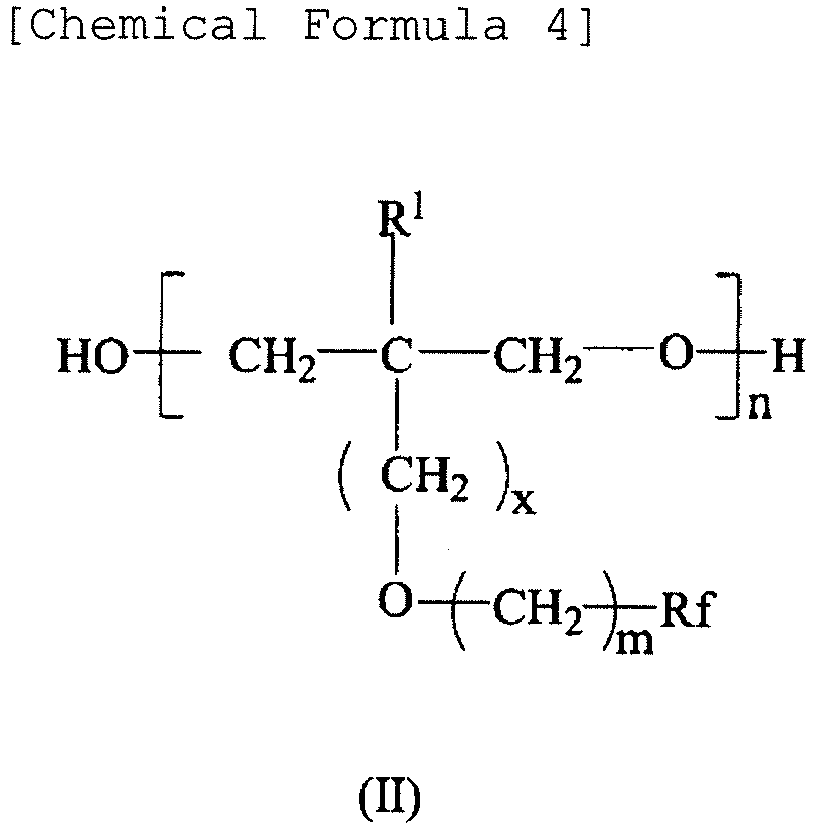
- The diol contained in the formula (II) includes, for example, the following diol.

- Examples of the other diol include dimethylolpropane, polypropylene glycol, neopentyl glycol, 1,3-propanediol, polytetramethylene ether glycol, polyester polyol, polymerpolyol, polycaprolactone polyol, polycarbonate diol, 1,4-butanediol, 1,5-pentadiol, 1,6-hexanediol, polybutadiene polyol and the like.
- Examples of the diisocyanate include 4,4'-diphenylmethane diisocyanate, xylylene diisocyanate, naphthylene-1,5-diisocyanate, tetramethylxylene diisocyanate, hexamethylene diisocyanate, toluene-2,4-diidocyanate, isophorone diisocyanate, hydrogenated xylylene diisocyanate, dicyclohexylmethane diisocyanate, norbornene diisocyanate, trimethyl hexamethylene diisocyanate, dimer acid diisocyanate and the like.
- In the polyurethane used in the present invention, the unit of the diol having a carboxyl group accounts for 10 to 70 mol%, and preferably 30 to 50 mol%. The unit of the diol accounts for less than 10 mol% may lead to poor development, unpreferably. The unit of the diol accounts for more than 70 mol% may lead to poor ink receptivity or poor print run length, unpreferably. In the polyurethane used in the present invention, the unit of the diol represented by the formula (I) accounts for 0.1 to 30 mol%, and preferably 0.3 to 15 mol%. The unit of the diol accounts for less than 0.1 mol% may lead to poor scratch resistance or poor ink receptivity, unpreferably. The unit of the diol accounts for more than 30 mol% may lead to poor development, unpreferably. When isocyanate groups remain at the end of the polymer, it is possible to finally synthesize without causing remaining of isocyanate groups by treating with alcohols or amines.
- A weight average molecular weight of the polyurethane including a unit comprising a substituent having an acidic hydrogen atom and a unit of the formula (I) is preferably within a range from 2,000 to 100,000. When the weight average molecular weight of the polyurethane is less than 2,000, the image area obtained by forming images may tend to be insufficient in durability, resulting in poor ink receptivity. On the other hand, when the weight average molecular weight of the polyurethane is more than 100,000, sensitivity may tend to be poor.
- The content of the polyurethane including a unit comprising a substituent having an acidic hydrogen atom and a unit of the formula (I) in the image forming layer is preferably within a range from 2 to 99.4% by weight, and more preferably from 10 to 90% by weight, based on the solid content of the layer. The content of the polyurethane including a unit comprising a substituent having an acidic hydrogen atom and a unit of the formula (I) of less than 2% by weight may lead to a low developing rate, unpreferably. The content of more than 99.4% by weight may lead to poor storage stability, disadvantageously. If necessary, a polyurethane including two or more kinds of units comprising a substituent having an acidic hydrogen atom and two or more kinds of units of the formula (I) may be used in combination.
- The image forming layer of the present invention can comprise, in addition to the above polyurethane including a unit comprising a substituent having an acidic hydrogen atom and a unit of the formula (I), a resin other than the polyurethane, which is water-insoluble and alkali-soluble or alkali-dispersible in an aqueous alkali solution. The resin preferably has at least a functional group such as a hydroxyl group, a carboxyl group, a sulfonic acid group, a phosphoric acid group, an imide group, or an amide group, so as to be soluble or dispersible in an aqueous alkali solution. Therefore, the resin, which is water-insoluble and alkali-soluble or alkali-dispersible in an aqueous alkali solution, can be preferably produced by polymerizing a monomer mixture comprising one or more ethylenically unsaturated monomers having functional groups such as a hydroxyl group, a carboxyl group, a sulfonic acid group, a phosphoric acid group, an imide group, an amide group, and a combination thereof.
- The ethylenically unsaturated monomer can be a compound represented by the following formula:


- Examples of the ethylenically unsaturated monomer include, in addition to acrylic acid and methacrylic acid, compounds represented by the following formulas, and a mixture thereof.


- The monomer mixture can include the other ethylenically unsaturated comonomer. The other ethylenically unsaturated comonomer includes, for example, the following monomers:
- acrylic acid esters such as methyl acrylate, ethyl acrylate, propyl acrylate, butyl acrylate, amyl acrylate, ethylhexyl acrylate, octyl acrylate, t-octyl acrylate, chloroethyl acrylate, 2,2-dimethyl hydroxypropyl acrylate, 5-hydroxypentyl acrylate, trimethylolpropane monoacrylate, pentaerythritol monoacrylate, glycidyl acrylate, benzyl acrylate, methoxybenzyl acrylate, and
- tetrahydroacrylate; aryl acrylates such as phenyl acrylate and furfuryl acrylate;
- methacrylic acid esters such as methyl methacrylate, ethyl methacrylate, propyl methacrylate, isopropyl methacrylate, allyl methacrylate, amyl methacrylate, hexyl methacrylate, cyclohexyl methacrylate, benzyl methacrylate, chlorobenzyl methacrylate, octyl methacrylate, 4-hydroxybutyl methacrylate, 5-hydroxypentyl methacrylate, 2,2-dimethyl-3-hydroxypropyl methacrylate, trimethylolpropane monomethacrylate, pentaerythritol monomethacrylate, glycidyl methacrylate, furfuryl methacrylate, and tetrahydrofurfuryl methacrylate;
- aryl methacrylates such as phenyl methacrylate, cresyl methacrylate, and naphthyl methacrylate;
- N-alkylacrylamides such as N-methylacrylamide, N-ethylacrylamide, N-propylacrylamide, N-butylacrylamide, N-t-butylacrylamide, N-heptylacrylamide, N-octylacrylamide, N-cyclohexylacrylamide, and N-benzylacrylamide;
- N-arylacrylamides such as N-phenylacrylamide, N-tolylacrylamide, N-nitrophenylacrylamide, N-naphthylacrylamide, and N-hydroxyphenylacrylamide;
- N,N-dialkylacrylamides such as N,N-dimethylacrylamide, N,N-diethylacrylamide, N,N-dibutylacrylamide, N,N-dibutylacrylamide, N,N-diisobutylacrylamide, N,N-diethylhexylacrylamide, and N,N-dicyclohexylacrylamide;
- N,N-arylacrylamides such as N-methyl-N-phenylacrylamide, N-hydroxyethyl-N-methylacrylamide, and N-2-acetamidoethyl-N-acetylacrylamide;
- N-alkylmethacrylamides such as N-methylmethacrylamide, N-ethylmethacrylamide, N-propylmethacrylamide, N-butylmethacrylamide, N-t-butylmethacrylamide, N-ethylhexylmethacrylamide, N-hydroxyethylmethacrylamide, and N-cyclohexylmethacrylamide;
- N-arylmethacrylamides such as N-phenylmethacrylamide and N-naphthylmethacrylamide;
- N,N-dialkylmethacrylamides such as N,N-diethylmethacrylamide, N,N-dipropylmethacrylamide, and N,N-dibutylmethacrylamide;
- N,N-diarylmethacrylamides such as N,N-diphenylmethacrylamide;
- methacrylamide derivatives such as N-hydroxyethyl-N-methylmethacrylamide, N-methyl-N-phenylmethacrylamide, and N-ethyl-N-phenylmethacrylamide;
- allyl compounds such as allyl acetate, allyl caproate, allyl caprylate, allyl laurate, allyl palmitate, allyl stearate, allyl benzoate, allyl acetoacetate, allyl lactate, and allyloxyethanol;
- vinyl ethers such as hexyl vinyl ether, octyl vinyl ether, dodecyl vinyl ether, ethyl hexyl vinyl ether, methoxyethyl vinyl ether, ethoxyethyl vinyl ether, chloroethyl vinyl ether, 1-methyl-2,2-dimethyl propyl vinyl ether, 2-ethyl butyl vinyl ether, hydroxyethyl vinyl ether, diethylene glycol vinyl ether, dimethyl aminoethyl vinyl ether, diethyl aminoethyl vinyl ether, butyl aminoethyl vinyl ether, benzyl vinyl ether, tetrahydrofurfuryl vinyl ether, vinyl phenyl ether, vinyl tolyl ether, vinyl chlorophenyl ether, vinyl-2,4-dichlorophenyl ether, vinyl naphthyl ether, and vinyl anthracenyl ether;
- vinyl esters such as vinyl butyrate, vinyl isobutyrate, vinyl trimethyl acetate, vinyl diethyl acetate, vinyl valerate, vinyl caproate, vinyl chloroacetate, vinyl methoxyacetate, vinyl butoxyacetate, vinyl phenylacetate, vinyl acetoacetate, vinyl lactate, vinyl-β-phenyl butyrate, vinyl cyclohexyl carboxylate, vinyl benzoate, vinyl salicylate, vinyl chlorobenzoate, vinyl tetrachlorobenzoate, and vinyl naphthoate;
- styrenes such as styrene, methylstyrene, dimethylstyrene, trimethylstyrene, ethylstyrene, diethylstyrene, isopropylstyrene, butylstyrene, hexylstyrene, cyclohexylstyrene, dodecylstyrene, benzylstyrene, chloromethylstyrene, trifluoromethylstyrene, ethoxymethylstyrene, acetoxymethylstyrene, methoxystyrene, 4-methoxy-3-methylstyrene, dimethoxystyrene, chlorostyrene, dichlorostyrene, trichlorostyrene, tetrachlorostyrene, pentachlorostyrene, bromostyrene, dibromostyrene, iodostyrene, fluorostyrene, 2-bromo-4-trifluoromethylstyrene, and 4-fluoro-3-trifluoromethylstyrene;
- crotonic acid esters such as butyl crotonate, hexyl crotonate, crotonic acid, and glycerol monocrotonate;
- itaconic acid dialkyls such as dimethyl itaconate, diethyl itaconate, and dibutyl itaconate;
- dialkyls of maleic acid or fumaric acid, such as dimethyl maleate and dibutyl fumarate;
- maleimides such as N-methylmaleimide, N-ethylmaleimide, N-propylmaleimide, N-butylmaleimide, N-phenylmaleimide, N-2-methylphenylmaleimide, N-2,6-diethylphenylmaleimide, N-2-chlorophenylmaleimide, N-cyclohexylmaleimide, N-laurylmaleimide, and N-hydroxyphenylmaleimide; and
- other nitrogen atom-containing monomers such as N-vinylpyrrolidone, N-vinylpyridine, acrylonitrile, and methacrylonitrile.
- Of these other ethylenically unsaturated comonomers, for example, (meth)acrylic acid esters, (meth)acrylamides, maleimides, and (meth)acrylonitriles are preferably used.
- In the image forming layer of the multilayer type lithographic printing plate precursor used in the present invention, the polyurethane including a unit comprising a substituent having an acidic hydrogen atom and a unit of the formula (I) may be included in either a lower layer or an upper layer, or both a lower layer and an upper layer. While a description will be made below with respect to an aspect in which the polyurethane including a unit comprising a substituent having an acidic hydrogen atom and a unit of the formula (I) is contained in the upper layer, it is apparent that the multilayer type lithographic printing plate precursor of the present invention is not limited to this aspect.
- Typically, the lower layer is directly formed on a substrate. The lower layer constituting the image forming layer of the lithographic printing plate precursor of the present invention can comprise the above-mentioned resin other than the polyurethane, which is water-insoluble and alkali-soluble or alkali-dispersible in an aqueous alkali solution. The resin preferably has at least a functional group such as a hydroxyl group, a carboxyl group, a sulfonic acid group, a phosphoric acid group, an imide group or an amide group so as to be soluble or dispersible in an aqueous alkali solution. Therefore, the resin, which is water-insoluble and alkali-soluble or alkali-dispersible in an aqueous alkali solution, can be preferably produced by polymerizing a monomer mixture comprising one or more ethylenically unsaturated monomers having functional groups such as a hydroxyl group, a carboxyl group, a sulfonic acid group, a phosphoric acid group, an imide group, an amide group, and a combination thereof.
- The upper layer constituting the lithographic printing plate precursor of the present invention comprises a polyurethane including a unit comprising a substituent having an acidic hydrogen atom and a unit of the formula (I). It is also possible to comprise, in addition to the polyurethane, a resin, which is water-insoluble and alkali-soluble or alkali-dispersible in an aqueous alkali solution, used in the lower layer.
- The content of the polyurethane including a unit comprising a substituent having an acidic hydrogen atom and a unit of the formula (I) in the upper layer is preferably within a range from 2 to 99.4% by weight, and more preferably from 10 to 90% by weight, based on the solid content of the upper layer. The content of the polyurethane of less than 2% by weight may lead to a low developing rate, unpreferably. The content of more than 99.4% by weight may lead to poor storage stability, disadvantageously. If necessary, two or more kinds of polyurethanes including a unit comprising a substituent having an acidic hydrogen atom and a unit of the formula (I) may be used in combination.
- Either or both of the lower layer and the upper layer comprise(s) a photothermal conversion material. The photothermal conversion material may comprise in either a lower layer or an upper layer, or both a lower layer and an upper layer. The photothermal conversion material may also be contained in the layer other than the lower layer and the upper layer. For example, when a separation layer is present between the lower layer and the upper layer, the photothermal conversion material may be contained in the separation layer. The positive-working lithographic printing plate precursor of the present invention may comprise one, or two or more kinds of photothermal conversion material(s). The photothermal conversion material used in the present description means any material capable of converting electromagnetic waves into thermal energy and is a material having a maximum absorption wavelength within a near infrared or infrared range, for example, a material having a maximum absorption wavelength within a range from 760 to 1,200 nm. Such material includes, for example, various pigments or dyes.
- It is possible to use, as the pigment used in the present invention, commercially available pigments and those pigments disclosed in the Color Index Manual "Saishin Ganryou Binran" (New Manual of Pigments) (edited by the Japan Pigment Technology Association, 1977), "Saishin Ganryou Ouyou Gijutsu" (New Applied Technology for Pigment) (CMC Publishing, 1986), "Insatsu Inki Gijutsu" (Printing Ink Technology) (CMC Publishing, 1984) and the like. Examples of the pigment include black pigments, yellow pigments, orange pigments, brown pigments, red pigments, violet pigments, blue pigments, green pigments, fluorescent pigments, and other polymer bond pigments. Specifically, it is possible to use insoluble azo pigments, azolake pigments, condensed azo pigments, chelate azo pigments, phthalocyanine pigments, anthraquinone pigments, perylene and perynone pigments, thioindigo pigments, quinacridone pigments, dioxazine pigments, isoindolinone pigments, quinophthalone pigments, staining lake pigments, azine pigments, nitroso pigments, nitro pigments, natural pigments, fluorescent pigments, inorganic pigments, carbon black and the like.
- Of these specific examples, carbon black is particularly preferred as a material which absorbs near infrared to infrared laser beam to efficiently generate heat, and is economically competitive. At present, grafted carbon blacks having various functional groups and having excellent dispersibility are commercially available as such carbon black and include, for example, carbon blacks disclosed in "Carbon Black Manual, 3rd edition, (edited by the Carbon Black Association) 1995, p. 167", "Characteristics of Carbon Black and Optimal Formulation and Applied Technology (Technical Information Association) 1997, p. 111" and the like, and all of them are preferably used in the present invention.
- These pigments may be used without subjecting to a surface treatment or may be subjected to a known surface treatment. Examples of a known include a method of surface-coating a resin or wax, a method of adhering a surfactant, and a method of bonding a reactive material such as a silane coupling agent or an epoxy compound, polyisocyanate to the surface of a pigment. These surface treating methods are disclosed in "Kinzoku Sekken no Seishitsu to Ouyou" (Properties of Metal Soaps and Their Application) (Saiwai Shobo), "Saishin Ganryou Ouyou Gijutsu" (New Applied Technology for Pigment) (CMC Publishing, 1986), and "Insatsu Inki Gijutsu" (Printing Ink Technology) (CMC Publishing, 1984). The pigment used in the present invention preferably has a particle diameter within the range from 0.01 to 15 µm, and more preferably from 0.01 to 5 µm.
- It is possible to use, as the dye used in the present invention, any known conventional dye and examples thereof include those disclosed in "Senryou Binran" (Dye Manual) (edited by the Organic Synthesis Chemistry Association, 1970), "Shikizai Kougaku Handobukku" (Coloring Material Engineering Handbook) (edited by the Coloring Material Association, Asakura Shoten, 1989), "Kougyouyou Shikiso no Gijutsu to Shijyou" (Technology and Market of Industrial Coloring Matter) (edited by CMC, 1983), and "Kagaku Binran Ouyou Kagaku Hen" (Chemistry Manual-Applied Chemistry Version) (edited by the Japan Chemistry Society, Maruzen Shoten, 1986). More specific dyes thereof are azo dyes, metal complex azo dyes, pyrazolone azo dyes, anthraquinone dyes, phthalocyanine dyes, carbonium dyes, quinoneimine dyes, methine dyes, cyanine dyes, indigo dyes, quinoline dyes, nitro dyes, xanthene dyes, thiazine dyes, azine dyes, and oxazine dyes.
- It is possible to use, as the dye capable of efficiently absorbing near infrared rays or infrared rays, for example, azo dyes, metal complex salt azo dyes, pyrazolone azo dyes, naphthoquinone dyes, anthraquinone dyes, phthalocyanine dyes, carbonium dyes, quinoneimine dyes, methine dyes, cyanine dyes, squalirium dyes, pyrylium salt, and metal thiolate complexs (for example, nickel thioate complex). Of these dyes, cyanine dyes are preferred and examples thereof include cyanine dyes represented by the general formula (I) disclosed in Japanese Unexamined Patent Publication (Kokai) No.
2001-305722 2002-079772 - The photothermal conversion materials are particularly preferably dyes of the following formula:


- The photothermal conversion material can be added to the image forming layer including an upper layer and a lower layer (including a separation layer between an upper layer and a lower layer, as needed) in an amount within a range from 0.01 to 50% by weight, preferably from 0.1 to 20% by weight, and particularly preferably from 1 to 15% by weight. When the amount is less than 0.01% by weight, sensitivity may decrease. When the amount is more than 50% by weight, stains may be formed at the non-image area upon printing. These photothermal conversion materials may be used alone, or two or more kinds of them may be used in combination.
- Examples of the substrate include metal plates made of aluminum, zinc, copper, stainless steel, and iron; plastic films made of polyethylene terephthalate, polycarbonate, polyvinyl acetal, polyethylene, etc.; composite materials obtained by forming a metal layer on a paper, which is melt-coated or coated with a synthetic resin solution, using technologies such as vacuum deposition and laminate; and a material used as the substrate of the printing plate. It is particularly preferred to use a substrate made of aluminum or a composite substrate coated with aluminum.
- It is preferred that the surface of the aluminum substrate is surface-treated for the purpose of enhancing water retentivity and improving adhesion with a image forming layer or an optionally formed intermediate layer. Examples of the surface treatment include roughening treatments such as brush polishing method, ball polishing method, electrolytic etching, chemical etching, liquid honing, and sandblasting, and a combination thereof. Of these, a roughening treatment including the use of electrolytic etching is particularly preferred.
- As an electrolytic bath in the case of electrolytic etching, for example, an aqueous solution comprising an acid, an alkali or a salt thereof, or an aqueous solution comprising an organic solvent is used. Of these, an electrolytic solution comprising hydrochloric acid, nitric acid, or a salt thereof is particularly preferred.
- Furthermore, the aluminum substrate subjected to the roughening treatment is subjected to a desmutting treatment using an aqueous solution of an acid or an alkali, if necessary. It is preferred that the aluminum substrate thus obtained is subjected to an anodic oxidation treatment. It is particularly preferred that the anodic oxidation treatment is performed using a bath comprising sulfuric acid or phosphoric acid.
- If necessary, the aluminum substrate can be subjected to a silicate treatment (for example, sodium silicate, potassium silicate), a potassium fluorozirconate treatment, a phosphomolybdate treatment, an alkyl titanate treatment, a polyacrylic acid treatment, a polyvinylsulfonic acid treatment, a polyvinylphosphonic acid treatment, a phytic acid treatment, a treatment using a salt of a hydrophilic organic polymer compound and a divalent metal, a hydropholization treatment by undercoating of a water-soluble polymer having a sulfonic acid group, a coloration treatment using an acid dye, and a treatment of silicate electrodeposition.
- An aluminum substrate, which was subjected to a sealing treatment after subjecting to the roughening treatment (graining treatment) and the anodic oxidation treatment, is also preferred. The sealing treatment is performed by immersing an aluminum substrate in a hot aqueous solution comprising hot water and an inorganic salt or an organic salt, or performed using a steam bath.
- Another aspect of the present invention is directed to a single layer type lithographic printing plate precursor, comprising a substrate and one image forming layer formed on the substrate. It is essential that the single image forming layer, which constitutes the lithographic printing plate precursor of the present invention, comprises a resin which is water-insoluble and alkali-soluble or alkali-dispersible in an aqueous alkali solution, and also comprises a polyurethane including a unit comprising a substituent having an acidic hydrogen atom and a unit of the following general formula (I). The "single layer" type lithographic printing plate precursor means a lithographic printing plate precursor including only one layer required to provide images (image forming layer).
- The image forming layer of the single layer type lithographic printing plate precursor comprises a polyurethane including a unit comprising a substituent having an acidic hydrogen atom and a unit of the formula (I). Since the polyurethane including a unit comprising a substituent having an acidic hydrogen atom and a unit of the formula (I) was described in detail, the description is not repeated here. It is also possible to comprise, in addition to the polyurethane, the above-mentioned resin which is water-insoluble and alkali-soluble or alkali-dispersible in an aqueous alkali solution. The resin preferably comprises at least a functional group such as a hydroxyl group, a carboxyl group, a sulfonic acid group, a phosphoric acid group, an imide group, or an amide group, so as to be soluble or dispersible in an aqueous alkali solution. Therefore, the resin, which is water-insoluble and alkali-soluble or alkali-dispersible in an aqueous alkali solution, can be preferably produced by polymerizing a monomer mixture comprising one or more ethylenically unsaturated monomers having functional groups such as a hydroxyl group, a carboxyl group, a sulfonic acid group, a phosphoric acid group, an imide group, an amide group, and a combination thereof. Since details of these resins were described in the multilayer type image forming layer, the description is not repeated here.
- The content of the polyurethane including a unit comprising a substituent having an acidic hydrogen atom and a unit of the formula (I) in the image forming layer is preferably within a range from 2 to 99.4% by weight, and more preferably from 10 to 90% by weight, based on the solid content of the layer. The content of the polyurethane including a unit comprising a substituent having an acidic hydrogen atom and a unit of the formula (I) of less than 2% by weight may lead to a low developing rate, disadvantageously. The content of more than 99.4% by weight may lead to poor storage stability, unpreferably. If necessary, a polyurethane including two or more kinds of units comprising a substituent having an acidic hydrogen atom and two or more kinds of units of the formula (I) may be used in combination.
- The image forming layer can comprise one, or two or more photothermal conversion material(s). The photothermal conversion material can be added in the image forming layer in the proportion of 0.01 to 50% by weight, preferably 0.1 to 20% by weight, and particularly preferably 1 to 15% by weight, based on the image forming layer. When the amount is less than 0.01% by weight, sensitivity may decrease. When the amount is more than 50% by weight, stains may be formed at the non-image area upon printing. These photothermal conversion materials may be used alone, or two or more kinds of them may be used in combination.
- The photothermal conversion material is contained in the image forming layer, and may be contained in the additional non-image forming layer. Namely, the photothermal conversion material may be disposed in a non-image forming layer which is in contact with a single image forming layer. Since specific examples of the photothermal conversion material were described in detail in the multilayer type image forming layer, the description is not repeated here.
- The lithographic printing plate precursor of the present invention is produced by dissolving or dispersing components of an image forming layer in an organic solvent, coating the resultant solution or dispersion on a substrate, and drying the solution or dispersion to form an image forming layer on the substrate. In an aspect, the multilayer type lithographic printing plate precursor is produced by dissolving or dispersing constituent components of a lower layer and an upper layer in an organic solvent, sequentially coating the resultant solution or dispersion on a substrate, and drying the solution or dispersion to form a lower layer on the substrate and to form an uppermost layer thereon.
- It is possible to use, as the organic solvent in which constituent components of the image forming layer are dissolved or dispersed, any conventionally known organic solvent. In view of an advantage upon drying, an organic solvent having a boiling point within a range from 40 to 200°C, particularly from 60 to 160°C is selected. When the image forming layer is composed of a lower layer and an upper layer, the same organic solvent can be used.
- Examples of the organic solvent include alcohols such as methyl alcohol, ethyl alcohol, n- or iso-propyl alcohol, n- or iso-butyl alcohol, and diacetone alcohol; ketones such as acetone, methyl ethyl ketone, methyl propyl ketone, methyl butyl ketone, methyl amyl ketone, methyl hexyl ketone, diethyl ketone, diisobutyl ketone, cyclohexanone, methylcyclohexanone, and acetylacetone; hydrocarbons such as hexane, cyclohexane, heptane, octane, nonane, decane, benzene, toluene, xylene, and methoxybenzene; acetate esters such as ethyl acetate, nor iso-propyl acetate, n- or iso-butyl acetate, ethylbutyl acetate, and hexyl acetate; halides such as methylene dichloride, ethylene dichloride, and monochlorobenzene; ethers such as isopropyl ether, n-butyl ether, dioxane, dimethyldioxane, and tetrahydrofuran; polyhydric alcohols such as ethylene glycol, ethylene glycol monomethyl ether, ethylene glycol monomethyl ether acetate, ethylene glycol monoethyl ether, ethylene glycol monoethyl ether acetate, ethylene glycol monobutyl ether, ethylene glycol monobutyl ether acetate, ethylene glycol dimethyl ether, ethylene glycol diethyl ether, ethylene glycol dibutyl ether, methoxyethoxyethanol, diethylene glycol monomethyl ether, diethylene glycol dimethyl ether, diethylene glycol methylethyl ether, diethylene glycol diethyl ether, propylene glycol, propylene glycol monomethyl ether, propylene glycol monomethyl ether acetate, propylene glycol monoethyl ether, propylene glycol monoethyl ether acetate, propylene glycol monobutyl ether, 3-methyl-3-methoxybutanol, and 1-methoxy-2-propanol, and a derivative thereof; and special solvents such as dimethyl sulfoxide, N,N-dimethylformamide, methyl lactate, and ethyl lactate. These organic solvents are used alone or in combination. The solid content of the solution or dispersion to be coated is preferably from 2 to 50% by weight. The solid content as used herein means components excluding the organic solvent.
- It is possible to use, as the method of coating the solution or dispersion of constituent components of the image forming layer, for example, methods such as roll coating, dip coating, air knife coating, gravure coating, gravure offset coating, hopper coating, blade coating, wire doctor coating, spray coating, and die coating methods. The coating amount is preferably within a range from 10 to 100 ml/m2.
- The solution or dispersion coated on the substrate is usually dried by heated air. The drying temperature (temperature of heat air) is preferably within a range from 30 to 200°C, and particularly from 40 to 140°C. The solution or dispersion can also be dried by not only a method of maintaining the drying temperature at a given temperature during drying, but also a method of stepwisely raising the drying temperature.
- Preferred results may be sometimes obtained by dehumidifying drying air. The dry air is preferably supplied to the surface to be coated at a wind velocity within a range from 0.1 to 30 m/sec, and particularly preferably from 0.5 to 20 m/sec.
- The coating amount of the image forming layer is usually within the range from about 0.5 to about 5 g/m2 in terms of dry weight. In the case of the multilayer type, each coating amount of the lower layer and the upper layer is usually within the range from about 0.1 to about 5 g/m2 in terms of dry weight.
- To the image forming layer (also including a multilayer type) of the lithographic printing plate precursor of the present invention, known additives, for example, colorants (dyes, pigments), surfactants, plasticizers, stability improvers, development accelerators, development inhibitors and lubricants (silicone powder, etc.) can be added, if necessary.
- Examples of preferred dye include basic oil-soluble dyes such as Crystal Violet, Malachite Green, Victoria Blue, Methylene Blue, Ethyl Violet, Rhodamine B and the like. Examples of commercially available products include "Victoria Pure Blue BOH" [manufactured by Hodogaya Kagaku Kogyo K.K.], "Oil Blue #603" [manufactured by Orient Chemical Industries, Ltd.], "VPB-Naps (naphthalene sulfonate of Victoria Pure Blue)" [manufactured by Hodogaya Kagaku Kogyo K.K.], "D11" [manufactured by PCAS]. Examples of the pigment include Phthalocyanine Blue, Phthalocyanine Green, Dioxadine Violet, Quinacridone Red and the like.
- Examples of the surfactant include fluorinated surfactants, silicone surfactants and the like.
- Examples of the plasticizer include diethyl phthalate, dibutyl phthalate, dioctyl phthalate, tributyl phosphate, trioctyl phosphate, tricresyl phosphate, tri(2-chloroethyl)phosphate, tributyl citrate and the like.
- It is possible to use, as the known stability improver, phosphoric acid, phosphorous acid, oxalic acid, tartaric acid, malic acid, citric acid, dipicolic acid, polyacrylic acid, benzenesulfonic acid and toluenesulfonic acid in combination.
- Examples of other stability improvers include known phenolic compounds, quinones, N-oxide compounds, amine based compounds, sulfide group-containing compounds, nitro group-containing compounds, and transition metal compounds. Specific examples thereof include hydroquinone, p-methoxyphenol, p-cresol, pyrogallol, t-butyl catechol, benzoquinone, 4,4'-thiobis(3-methyl-6-t-butylphenol), 2,2'-methylenebis(4-methyl-6-t-butylphenol), 2-mercaptobenzimidazole, N-nitrosophenylhydroxyamine primary cerium salt and the like.
- Examples of the development accelerator include acid anhydrides, phenols, organic acids and the like. Acid anhydrides are preferably cyclic acid anhydrides. It is possible to use, as the cyclic acid anhydride, those disclosed in the specification of
U.S. Patent No. 4,115,128 , for example, phthalic anhydride, tetrahydrophthalic anhydride, hexahydrophthalic anhydride, 3,6-endoxy-tetrahydrophthalic anhydride, tetrachlorophthalic anhydride, maleic anhydride, chloromaleic anhydride, α-phenylmaleic anhydride, succinic anhydride, pyromellitic anhydride and the like. Examples of the non-cyclic anhydride include acetic anhydride and the like. Examples of phenols include bisphenol A, 2,2'-bishydroxysulfon, p-nitrophenol, p-ethoxyphenol, 2,4,4'-trihydroxybenzophenone, 2,3,4-trihydroxybenzophenone, 4-hydroxybenzophenone, 4,4',4"-trihydroxytriphenylmethane, 4,4',3",4"-tetrahydroxy-3,5,3',5'-tetramethyltriphenylmethane and the like. - Examples of organic acids include those disclosed in Japanese Unexamined Patent Publication (Kokai) No.
60-88942 2-96755 - The development inhibitor is not particularly limited as long as it causes an interaction with the alkali-soluble resin and substantially lowers solubility of the alkali-soluble resin in the developing solution in the unexposed area, and also becomes soluble in the developing solution as a result of the weakened interaction in the exposed area. In particular, quaternary ammonium salts and polyethylene glycol-based compounds are used particularly preferably. Of the above infrared absorbers and colorants, some compounds function as the development inhibitor and are preferably exemplified. The development inhibitor further includes substances, which are heat-decomposable and substantially lowers solubility of the alkali-soluble resin in a non-decomposable state, for example, onium salts, O-quinonediazide compounds, aromatic sulfone compounds, aromatic sulfonate ester compounds and the like.
- The amount of these various additives varies depending on the purposes, and is preferably within a range from 0 to 30% by weight based on the solid content of the image forming layer. In the case of a multilayer type, the amount of additives is preferably within a range from 0 to 30% by weight based on the total solid content of the lower layer and the upper layer.
- In addition, other alkali-soluble or dispersible resins can be optionally used in combination in the image forming layer of the lithographic printing plate precursor of the present invention. Examples of the other alkali-soluble or dispersible resin include copolymers of alkali-soluble group-containing monomers such as acrylic acid, methacrylic acid, maleic acid, maleic anhydride, itaconic acid and itaconic anhydride with other monomers, polyester resins, acetal resins and the like.
- In the lithographic printing plate precursor of the present invention, the upper layer may comprise matting agents or a matte layer may be formed on the upper layer for the purpose of improving de-interleaving paper property and improving plate transportation properties of an automatic plate loader.
- The infrared-sensitive or thermosensitive lithographic printing plate precursor of the present invention can be used as a so-called computer-to-plate (CTP) plate which can directly write an image on a plate based on digital information from a computer, using a laser.
- As a laser beam source in the present invention, a high-output laser having a maximum strength in a near infrared to infrared range is used most preferably. Examples of the high-output laser having a maximum intensity in the near infrared to infrared range include various lasers, each having a maximum intensity in the near infrared to infrared range of 760 to 1200 nm, for example, a semiconductor laser and a YAG laser.
- After writing an image on an image forming layer using a laser, the lithographic printing plate precursor of the present invention is treated by an image formation method in which the non-image area is removed by a development treatment using a wet process. Namely, the method for forming a lithographic printing plate of the present invention comprises the steps of imagewisely exposing the lithographic printing plate precursor of the present invention using infrared rays; and developing the exposed lithographic printing plate precursor to remove the exposed area, thus forming an image area and a non-image area.
- Examples of the developing solution used in the development treatment include an aqueous alkali solution (aqueous basic solution). The pH of the aqueous alkali solution is preferably low pH (pH of 12 or lower). Specifically, the pH is preferably from 6 to 12, more preferably from 8 to 11.5, and particularly preferably from 10 to 11.
- Examples of the alkali agent used in the developing solution include inorganic alkali compounds such as sodium silicate, potassium silicate, potassium hydroxide, sodium hydroxide, lithium hydroxide, sodium, potassium or ammonium salt of secondary or tertiary phosphoric acid, sodium metasilicate, sodium carbonate and ammonia; and organic alkali compounds such as monomethylamine, dimethylamine, trimethylamine, monoethylamine, diethylamine, triethylamine, monoisopropylamine, diisopropylamine, n-butylamine, di-n-butylamine, monoethanolamine, diethanolamine, triethanolamine, ethyleneimine, and ethylenediamine. In the method for producing a lithographic printing plate of the present invention, a developing solution substantially comprising no silicate is preferable. Substantially comprising no silicate means that the content of alkali silicates such as sodium silicate, potassium silicate and sodium metasilicate in a developing solution is 0.1% by weight or less.
- The content of the alkali agent in the developing solution is preferably within a range from 0.005 to 10% by weight, and particularly preferably from 0.05 to 5% by weight. When the content of the alkali agent in the developing solution is less than 0.005% by weight, development may tend to become inferior. The content of more than 10% by weight may tend to exert an adverse influence such as erosion of the image area tends upon development, unpreferably.
- To the developing solution, an organic solvent can also be added. Examples of the organic solvent, which can be added to the developing solution, include ethyl acetate, butyl acetate, amyl acetate, benzyl acetate, ethylene glycol monobutyl acetate, butyl lactate, butyl levulinate, methyl ethyl ketone, ethyl butyl ketone, methyl isobutyl ketone, cyclohexanone, ethylene glycol monobutyl ether, ethylene glycol monobenzyl ether, ethylene glycol monophenyl ether, benzyl alcohol, methyl phenyl carbitol, n-amyl alcohol, methylamyl alcohol, xylene, methylene dichloride, ethylene dichloride, monochlorobenzene and the like. When the organic solvent is added to the developing solution, the amount of the organic solvent is preferably 20% by weight or less, and particularly preferably 10% by weight or less.
- Furthermore, it is possible to optionally add water-soluble sulfites such as lithium sulfite, sodium, potassium sulfite and magnesium sulfite; hydroxyaromatic compounds such as alkali-soluble pyrazoline compound, alkali-soluble thiol compound and methylresolcin; water softeners such as polyphosphates and aminopolycarboxylic acids; anionic surfactants such as sodium isopropyl naphthalene sulfonate, sodium n-butyl naphthalene sulfonate, sodium N-methyl-N-pentadecyl aminoacetate and sodium lauryl sulfate; various surfactants such as nonionic surfactants, cationic surfactants, amphoteric surfactants and fluorine based surfactants; and various defoamers, in the developing solution.
- As the developing solution, a commercially available developing solution for a negative-working or positive-working PS plate is practically used. Specifically, a solution prepared by diluting a commercially available concentrated developing solution for a negative-working or positive-working PS plate by 1 to 1,000 times can be used as the developing solution in the present invention.
- The temperature of the developing solution is preferably within a range from 15 to 40°C, and the immersion time is preferably within a range from 1 second to 2 minutes. If necessary, it is also possible to slightly rub the surface during development.
- The developed lithographic printing plate is subjected to either or both of washing with water and a treatment using a desensitizing agent (finishing gum). The desensitizing agent includes, for example, a water-soluble natural polymer such as gum arabic, dextrin, or carboxymethyl cellulose; and an aqueous solution comprising a water-soluble synthetic polymer such as polyvinyl alcohol, polyvinyl pyrrolidone, or polyacrylic acid. If necessary, acids and surfactants are added to these aqueous desensitizing agents. After subjecting to a treatment using a surface protecting solution, the lithographic printing plate was dried and used for printing as the printing plate.
- For the purpose of improving print run length of the resultant lithographic printing plate, the lithographic printing plate can also be subjected to a baking treatment after the development treatment.
- A baking treatment is carried out by the steps of (i) washing the lithographic printing plate obtained by the above treating method to remove a rinsing solution or a gum solution, followed by squeezing, (ii) spreading a baking solution over the entire plate without causing unevenness, followed by drying, (iii) performing baking under the temperature conditions of 180 to 300°C in an oven for 1 to 30 minutes, and (iv) washing the plate with water to remove the baking solution, followed by gumming and further drying.
- The lithographic printing plate precursor of the present invention as mentioned above can provide a high resolution positive image using an infrared laser, and is also excellent in resistance to a UV ink washing solvent and is suited for UV ink printing since a lower layer itself has solvent resistance.
- The present invention will be described in more detail by way of Examples. However, the present invention is not limited to the following Examples.
- In a 500 ml round-bottom three-necked flask equipped with a concentrator and a stirrer, 29.1 g of 4,4'-diphenylmethane diidocyanate, 20.2 g of toluene-2,4-diidocyanate, 6.3 g of neopentyl glycol, 23.7 g of 2,2-bis(hydroxymethyl)propionic acid, 10.7 g of polyneopentyl glycol having a fluorine group represented by the following Formula, and 270 g of 3-pentanone were charged. After adding 0.3 g of dibutyltin didodecanoate, the reaction mixture was heated to 80°C while stirring. The reaction was continued at 80°C for 6 hours. Thus, a polyurethane (1) was obtained. A weight average molecular weight as determined by GPC was 22,000. An acid value was 110.

- In the same manner as in Synthesis Example 1, except that diisocyanates and diols shown in Table 1 were used, polyurethanes (2) to (11) were obtained.
Table 1 Diisocyanate and Diol of Urethane Synthesis Examples 2 to 11 No. Diisocyanate Diol 
ratio (2) 
94mol% 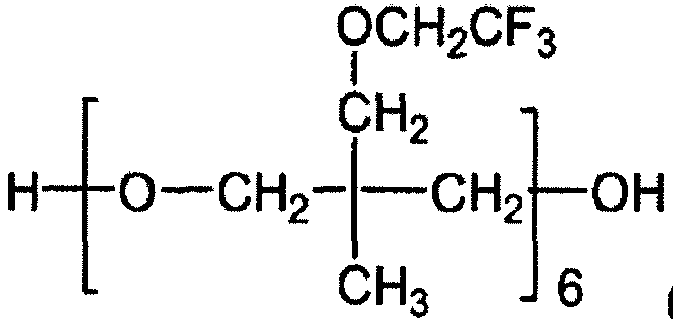
6mol% Diisocyanate:Diol = 1:0.8 Molec ular weight: 8,000 
ratio (3) 
82mol% 
15mol% 
3mol% Diisocyanate:Diol = 1:1.1 Molec cular weight: 13,000 (4) 
ratio 
88mol% 
9mol% 
3mol% Diisocyanate:Diol = 1:1.1 Molecular weight: 14,000 (5) ratio ratio 
80mol% 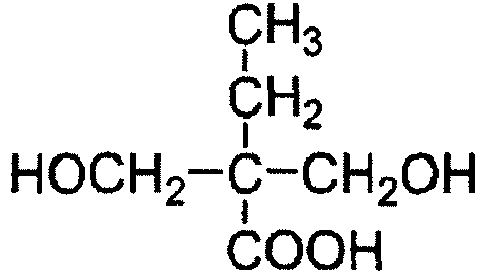
75mol% 
20mol% 
20mol% 
5mol% Diisocyanate:Diol = 1:1.07 Molecular weight: 20,000 (6) ratio ratio 
50mol% 
77mol% 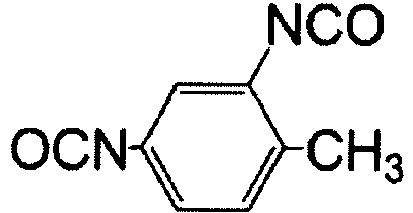
50mol% 
18mol% 
5mol% Diisocyanate:Diol = 1:1.05 Molecular weight: 22,000 (7) ratio ratio 
50mol% 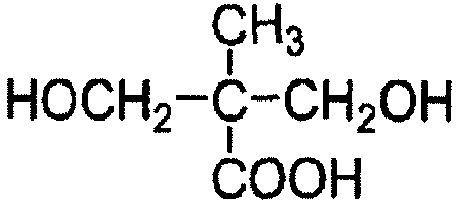
77mol% HO-(CH2)6-OH 20mol% 
50mol% 
3mol% Diisocyanate:Diol = 1:1.05 Molecular weight: 24,000 (8) ratio ratio 
80mol% 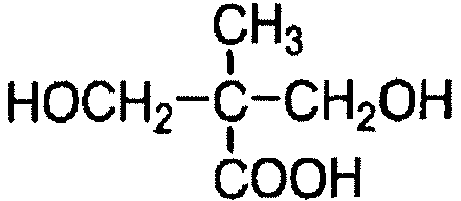
88mol% OCN-(CH2)6-NCO 20mol% 
9mol% 
3mol% Diisocyanate:Diol = 1:1.05 Molecular weight: 19,000 (9) ratio ratio 
80mol% 
88mol% 
20mol% 
9mol% 
3mol% Diisocyanate:Diol = 1:1.1 Molecular weight: 18,000 (10) ratio ratio 
100mol 
75mol% 
14mol% 
11mol% Diisocyanate:Diol = 1:1.07 Molecular weight: 20,000 (11) ratio ratio 
50mol% 
65mol% 
50mol% 
35mol% Diisocyanate:Diol = 1:1.06 Molecular weight: 23,000 - A surface of an aluminum sheet was subjected to an electrolytic roughening treatment using 2% hydrochloric acid. An average roughness Ra was 0.5 µm. Furthermore, the aluminum sheet was subjected to an anodizing treatment in an aqueous 20% sulfuric acid solution to form 2.7 g/m2 of an oxide film. The anodized aluminum sheet was dipped in an aqueous 2.5% by weight sodium silicate solution at 70°C for 30 minutes, washed with water and then dried.
- On the substrate thus obtained, a coating solution 1 for a lower layer shown in Table 2 was coated in a coating weight of 1.4 g/m2 using a bar coater, followed by drying at 135°C for 40 seconds and further cooling to 35°C. Furthermore, a coating solution 1 for an upper layer shown in Table 3 was coated in a coating weight of 0.6 g/m2 using a bar coater, followed by drying at 140°C for 40 seconds and further slow cooling to a temperature of 20 to 26°C. Thus, a lithographic printing plate precursor was obtained.
Table 2 Coating solution 1 for lower layer Components Amount N-phenymaleimide/methacrylic acid/methacrylamide copolymer Weight ratio: 59/15/26 Mw: 50,000 5.21 g Infrared absorbing dye of the following Formula (3) 0.94 g Crystal Violet (manufactured by HODOGAYA CHEMICAL Co., Ltd.) 0.08 g BYK307 (BYK Chemie) 0.03 g Methyl ethyl ketone 60.00 g Propylene glycol monomethyl ether 15.00 g γ-Butyrolactone 9.40 g Water 9.34 g 
Table 3 Coating solution 1 for upper layer Components Amount Polyurethane (1) of Synthesis Example 1 (25% solution) 30.00 g Ethyl Violet 0.03 g Fluorinated surfactant (30% methyl ethyl ketone solution) 0.05 g 3-Pentanone 40.00 g Propylene glycol monomethyl ether 22.50 g Propylene glycol 1-monomethyl ether 2-acetate 7.42 g - In the same manner as in Example 1 of the present invention, except that the polyurethanes (2) to (9) obtained in Synthesis Examples 2 to 9 were used in place of the polyurethane (1), lithographic printing plate precursors were obtained.
- In the same manner as in Example 1 of the present invention, except that a coating solution 2 for an upper layer shown in Table 4 was used in place of the coating solution 1 for an upper layer, a lithographic printing plate precursor was obtained.
Table 4 Coating solution 2 for upper layer Components Amount Polyurethane (10) of Synthesis Example 10 (25% solution) 15.00 g Polyurethane (11) of Synthesis Example 11 (25% solution) 15.00 g Ethyl Violet 0.03 g Fluorinated surfactant (30% methyl ethyl ketone solution) 0.05 g 3-Pentanone 40.00 g Propylene glycol monomethyl ether 22.50 g Propylene glycol 1-monomethyl ether 2-acetate 7.42 g - In the same manner as in Example 1 of the present invention, except that a coating solution 2 for an upper layer shown in Table 5 was used in place of the coating solution 1 for an upper layer, a lithographic printing plate precursor was obtained.
Table 5 Coating solution 3 for upper layer Components Amount Polyurethane (1) of Synthesis Example 1 (25% solution) 30.00 g Infrared absorbing dye of Formula (3) 0.15 g Ethyl Violet 0.03 g Fluorinated surfactant (30% methyl ethyl ketone solution) 0.05 g 3-Pentanone 62.40 g Propylene glycol 1-monomethyl ether 2-acetate 7.37 g - In the same manner as in Example 11 of the present invention, except that the polyurethanes (2) and (3) obtained in Synthesis Examples 2 and 3 were used in place of the polyurethane (1), lithographic printing plate precursors were obtained.
- In the same manner as in Example 1 of the present invention, except that a coating solution 4 for an upper layer shown in Table 6 was used in place of the coating solution 1 for an upper layer, a lithographic printing plate precursor was obtained.
Table 6 Coating solution 4 for upper layer Components Amount Polyurethane (1) of Synthesis Example 1 (25% solution) 18.77 g Ammonia-modified compound of styrene/maleic anhydride copolymer (molar ratio of styrene:maleic anhydride = 3:1, molecular weight: 10,000) 1.25 g Ethyl Violet 0.03 g Fluorinated surfactant (30% methyl ethyl ketone solution) 0.05 g 3-Pentanone 49.90 g Propylene glycol monomethyl ether 22.50 g Propylene glycol 1-monomethyl ether 2-acetate 7.50 g - In the same manner as in Example 1 of the present invention, except that a coating solution 5 for an upper layer shown in Table 7 was used in place of the coating solution 1 for an upper layer, a lithographic printing plate precursor was obtained.
Table 7 Coating solution 5 for upper layer Components Amount Polyurethane (1) of Synthetic Example 1 (25% solution) 17.60 g Styrene/maleic anhydride copolymer (molar ratio of styrene:maleic anhydride = 3:1, molecular weight: 10,000) 1.40 g Infrared absorbing dye of Formula (3) 0.15 g Ethyl Violet 0.03 g Fluorinated surfactant (30% methyl ethyl ketone solution) 0.05 g 3-Pentanone 48.27 g Propylene glycol monomethyl ether 25.00 g Propylene glycol 1-monomethyl ether 2-acetate 7.50 g - In the same manner as in Example 1 of the present invention, except that a polyurethane (11) obtained in Synthesis Example 11 was used in place of the polyurethane (1), a lithographic printing plate precursor was obtained.
- In the same manner as in Example 1 of the present invention, except that a coating solution 6 for an upper layer shown in Table 8 was used in place of the coating solution 1 for an upper layer, a lithographic printing plate precursor was obtained.
Table 8 Coating solution 6 for upper layer Components Amount m,p-Cresol novolac resin (m/p = 6/4, Mw = 3,500) 8.00 g Ethyl Violet 0.03 g Fluorinated surfactant (30% methyl ethyl ketone solution) 0.05 g Propylene glycol monomethyl ether 91.95 g - In the same manner as in Example 1 of the present invention, except that no upper layer was formed, a lithographic printing plate precursor was obtained.
- On the substrate obtained in the same manner as in Example 1 of the present invention, a coating solution 1 shown in Table 9 was coated in a coating weight of 1.5 g/m2 using a bar coater, followed by drying at 135°C for 40 seconds and further slow cooling to a temperature of 20 to 26°C. Thus, a lithographic printing plate precursor was obtained.
Table 9 Coating solution 1 Components Amount Polyurethane (1) of Synthetic Example 1 (25% solution) 21.44 g Infrared absorbing dye of Formula (3) 0.52 g Crystal Violet (manufactured by Hodogaya Kagaku Kogyo K.K.) 0.09 g BYK 307 (BYK Chemie) 0.02 g Fluorinated surfactant (30% methyl ethyl ketone solution) 0.05 g Methyl ethyl ketone 47.88 g Propylene glycol monomethyl ether 30.00 g - In the same manner as in Example 16 of the present invention, except that a coating solution 2 shown in Table 10 was used in place of the coating solution 1, a lithographic printing plate precursor was obtained.
Table 10 Coating solution 2 Components Amount Polyurethane (1) of Synthetic Example 1 (25% solution) 10.33 g N-phenyl maleimide/methacrylic acid/methacrylamide copolymer Weight ratio = 59/15/26 Mw = 50,000 2.98 g Infrared absorbing dye of Formula (3) 0.41 g Crystal Violet (manufactured by Hodogaya Kagaku Kogyo K.K.) 0.09 g BYK 307 (BYK Chemie) 0.02 g Fluorinated surfactant (30% methyl ethyl ketone solution) 0.05 g Methyl ethyl ketone 53.55 g Propylene glycol monomethyl ether 18.57 g γ-Butyrolactone 7.00 g Water 7.00 g - Using a CREO Trendsetter thermal exposure apparatus equipped with a laser having a wavelength of 830 nm and an output of 40 W, imagewise exposure of the lithographic printing plate precursors of Examples 1 to 15 and Comparative Examples 1 to 3 was conducted. Each of the exposed lithographic printing plate precursors was developed with a water diluted developing solution having the composition shown in Table 11 using PS processor PK-910 (manufactured by Dainippon Screen Mfg. Co., Ltd.). The development was conducted under the conditions of 30°C for 12 seconds. The pH of the diluted developing solution was from 10.7 to 10.0. A finishing gum PF-2 (manufactured by Kodak Polychrome Graphics Japan Ltd.) was used as a finishing liquid.
Table 11 Composition of Developing Solution Components Amount Water 72.64 g Monoethanolamine 0.66 g Diethanolamine 3.45 g Pelex NBL (aqueous 35% solution, manufactured by Kao Corporation) 17.72 g Benzyl alcohol 5.53 g - A lithographic printing plate precursor was exposed at a rate of 120 mJ/cm2 and then developed with developing solutions each having a different dilution rate. Developability of the laser exposed area and the state of the image area were evaluated. Development latitude was evaluated by the range of the dilution rate which exhibits good image properties. Optimum dilution rate of the developing solution is present in the center of the development latitude width.
- While applying a load using a scratching testing machine equipped with a sapphire needle having a diameter of 1.0 mm, a surface of a lithographic printing plate precursor was scratched. After the plate was developed with an optimum developing solution, a maximum load value at which no scratch was formed at the scratching portion was determined.
- A lithographic printing plate precursor was exposed at a rate of 120 mJ/cm2 and then developed with an optimum developing solution. The lithographic printing plate thus obtained was mounted to a printing press Roland R-201 and then ink receptivity was evaluated.
- A lithographic printing plate precursor was exposed at a rate of 120 mJ/cm2 and then developed with an optimum developing solution. The lithographic printing plate thus obtained was mounted to a printing press Roland R-201 and then print run length was evaluated.
- The evaluation results of development latitude, scratch resistance, ink receptivity, and print run length are shown in Table 12.
Table 12 Evaluation Results <Example in which Image Forming Layer is composed of Two Layers> Resin of upper layer Development latitude Scratch resistance (g) Ink receptivity (number of printed sheets) Print run length (number of printed sheets) Example 1 of the present invention Polyurethane 1 1:4-1:7 6 5 180,000 Example 2 of the present invention Polyurethane 2 1:5-1:8 5 5 170,000 Example 3 of the present invention Polyurethane 3 1:4.5-1:7.5 6 5 170,000 Example 4 of the present invention Polyurethane 4 1:4.5-1:7.5 5 5 180,000 Example 5 of the present invention Polyurethane 5 1:4-1:7 6 5 180,000 Example 6 of the present invention Polyurethane 6 1:3.5-1:6.5 6 4 190,000 Example 7 of the present invention Polyurethane 7 1:3.5-1:6.5 6 4 200,000 Example 8 of the present invention Polyurethane 8 1:4-1:7 6 4 180,000 Example 9 of the present invention Polyurethane 9 1:4.5-1:7 5 5 180,000 Example 10 of the present invention Polyurethane 10 and Polyurethane 11 1:4-1:7 5 5 180,000 Example 11 of the present invention Polyurethane 1 1:3.5-1:6.5 6 4 180,000 Example 12 of the present invention Polyurethane 2 1:4.5-1:7.5 5 5 170,000 Example 13 of the present invention Polyurethane 3 1:4-1:7 6 5 180,000 Example 14 of the present invention Polyurethane 1 and ammonia-modified compound of styrene/maleic anhydride copolymer (Molecular ratio of styrene:maleic anhydride = 3:1, Molecular weight: 10,000) 1:4.5-1:7.5 6 5 180,000 Example 15 of the present invention Polyurethane 1 and ammonia-modified compound of styrene/maleic anhydride copolymer (Molecular ratio of styrene:maleic anhydride = 3:1, Molecular weight: 10,000) 1:4.5-1:7.5 6 4 190,000 Comparative Example 1 Polyurethane 11 1:4-1:6.5 3 10 180,000 Comparative Example 2 Novolac (1:3-1:4)* - - - Comparative Example 3 None Only 1:8 1 > 100 110,000 *: Evaluation could not be performed because of being insoluble in a developing solution. Table 13 Evaluation Results <Example in which Image Forming Layer is a single layer> Resin Development latitude Scratch resistance (g) Ink receptivity (number of printed sheets) Print run length (number of printed sheets) Example 16 of the present invention Polyurethane 1:3-1:5.5 4 7 150,000 Example 17 of the present invention Polyurethane 1+ 1:3.5-1:6 4 7 160,000 - As is apparent from the results shown in Table 12 and Table 13, the lithographic printing plate precursors of Examples 1 to 17 exhibit satisfactory developability using a developing solution having the pH of 12 or lower, and also have satisfactory scratch resistance, satisfactory inking property, and long print run length, as compared with the lithographic printing plate precursors of Comparative Examples 1 to 3.
Claims (12)
- A positive-working lithographic printing plate precursor comprising a substrate having thereon an image forming layer comprising a water-insoluble and alkali-soluble or alkali-dispersible resin in an aqueous alkali solution,
wherein the image forming layer comprises at least a lower layer and an upper layer, and
the resin of one of the lower layer and the upper layer, or both of the lower layer and the upper layer comprises a polyurethane including a unit comprising a substituent having an acidic hydrogen atom and a unit represented by the following general formula (I): Rf is an alkyl or polyether group in which at least 50% of hydrogen atoms have been fluorinated,R1 is a hydrogen atom, or a substituted or non-substituted alkyl group,m is 0 or 1 to 10, n is 1 to 30, andx is 1 to 4.
 - The positive-working lithographic printing plate precursor according to claim 1, wherein the polyurethane is a polymer derived from a reaction of one, or two or more diisocyanate component(s) with a diol component comprising a diol represented by the general formula (II) and a diol comprising a substituent having an acidic hydrogen atom:
 Rf is a fluorinated alkyl or polyether group in which at least 50% of hydrogen atoms have been fluorinated,R1 is a hydrogen atom, or a substituted or non-substituted alkyl group,m is 0 or 1 to 10, n is 1 to 30, andx is 1 to 4.
 - The positive-working lithographic printing plate precursor according to claim 1 or 2, wherein the substituent having an acidic hydrogen atom is selected from the group consisting of a carboxyl group, an - SO2NHCOO- group, a -CONHSO2- group, a -CONHSO2NH- group, and an -NHCONHSO2- group, and
at least 75% of Rf in the general formula (I) is fluorinated , and R1 is an alkyl group having 1 to 4 carbon atoms,
m is 0, 1, 2, or 3, and x is 1 or 2. - The positive-working lithographic printing plate precursor according to any one of claims 1 to 3, wherein the upper layer comprises the polyurethane.
- The positive-working lithographic printing plate precursor according to claim 4, wherein the amount of the polyurethane contained in the upper layer is from 10% to 90% based on the total dry weight of the upper layer.
- The positive-working lithographic printing plate precursor according to any one of claims 1 to 5, wherein one of the lower layer and the upper layer, or both of the lower layer and the upper layer comprise(s) a photothermal conversion material.
- The positive-working lithographic printing plate precursor according to claim 6, wherein the upper layer comprises a photothermal conversion material.
- A positive-working lithographic printing plate precursor comprising a substrate having thereon an image forming layer comprising a water-insoluble and alkali-soluble or alkali-dispersible resin in an aqueous alkali solution,
wherein the positive-working lithographic printing plate precursor further comprises a photothermal conversion material, and
a resin, which is water-insoluble and alkali-soluble or alkali-dispersible in the aqueous alkali solution, comprises a polyurethane including a unit comprising a substituent having an acidic hydrogen atom and a unit represented by the following general formula (I): Rf is a fluorinated alkyl or polyether group in which at least 50% of hydrogen atoms have been fluorinated,R1 is a hydrogen atom, or a substituted or non-substituted alkyl group,m is 0 or 1 to 10, n is 1 to 30, andx is 1 to 4.
 - A method for producing a lithographic printing plate, which comprises the steps of:imagewisely exposing the positive-working lithographic printing plate precursor according to any one of claims 1 to 8 using infrared rays; anddeveloping the exposed positive-working lithographic printing plate precursor with an alkali developing solution to remove the image forming layer at exposed area, and thus forming the image area and the non-image area.
- The method for producing a lithographic printing plate according to claim 9, wherein the alkali developing solution has pH of 12 or less.
- The method for producing a lithographic printing plate according to claim 9 or 10, wherein the alkali developing solution comprises an organic solvent in the amount of 20% or less based on the total mass of the developing solution.
- The method for producing a lithographic printing plate according to any one of claims 9 to 11, wherein the alkali developing solution substantially comprises no silicate.
Applications Claiming Priority (2)
| Application Number | Priority Date | Filing Date | Title |
|---|---|---|---|
| JP2011246507A JP5866179B2 (en) | 2011-11-10 | 2011-11-10 | Lithographic printing plate precursor and method for producing a lithographic printing plate |
| PCT/JP2012/078058 WO2013069508A1 (en) | 2011-11-10 | 2012-10-30 | Lithographic printing plate precursor and process for producing lithographic printing plate |
Publications (3)
| Publication Number | Publication Date |
|---|---|
| EP2778783A1 true EP2778783A1 (en) | 2014-09-17 |
| EP2778783A4 EP2778783A4 (en) | 2015-05-06 |
| EP2778783B1 EP2778783B1 (en) | 2016-07-27 |
Family
ID=48289886
Family Applications (1)
| Application Number | Title | Priority Date | Filing Date |
|---|---|---|---|
| EP12847446.7A Not-in-force EP2778783B1 (en) | 2011-11-10 | 2012-10-30 | Lithographic printing plate precursor and process for producing lithographic printing plate |
Country Status (5)
| Country | Link |
|---|---|
| US (1) | US9250521B2 (en) |
| EP (1) | EP2778783B1 (en) |
| JP (1) | JP5866179B2 (en) |
| CN (1) | CN103917918A (en) |
| WO (1) | WO2013069508A1 (en) |
Families Citing this family (2)
| Publication number | Priority date | Publication date | Assignee | Title |
|---|---|---|---|---|
| EP3688057A4 (en) * | 2017-09-27 | 2021-09-29 | Arkema Inc. | Addition and condensation polymers prepared from halogenated reactants |
| CN111158214A (en) * | 2019-12-31 | 2020-05-15 | 浙江康尔达新材料股份有限公司 | Infrared radiation sensitive positive-working imageable element and method of forming image therewith |
Family Cites Families (19)
| Publication number | Priority date | Publication date | Assignee | Title |
|---|---|---|---|---|
| JPS5280022A (en) | 1975-12-26 | 1977-07-05 | Fuji Photo Film Co Ltd | Light solubilizable composition |
| JPS6088942A (en) | 1983-10-21 | 1985-05-18 | Fuji Photo Film Co Ltd | Photosensitive composition |
| JPH0727209B2 (en) * | 1987-05-21 | 1995-03-29 | 富士写真フイルム株式会社 | Photosensitive composition |
| JPH0296755A (en) | 1988-10-03 | 1990-04-09 | Konica Corp | photosensitive composition |
| JP3672140B2 (en) * | 1996-12-24 | 2005-07-13 | 富士写真フイルム株式会社 | Photosensitive composition |
| EP0843218B1 (en) | 1996-11-14 | 2008-01-16 | FUJIFILM Corporation | Photosensitive composition |
| JP2000003032A (en) | 1998-06-12 | 2000-01-07 | Fuji Photo Film Co Ltd | Photosensitive composition |
| JP2000003040A (en) | 1998-06-16 | 2000-01-07 | Fuji Photo Film Co Ltd | Photosensitive resin composition |
| WO2001005871A1 (en) * | 1999-07-16 | 2001-01-25 | Aerojet-General Corporation | Amorphous polyether glycols based on bis-substituted oxetane monomers |
| JP2001305722A (en) | 2000-04-18 | 2001-11-02 | Fuji Photo Film Co Ltd | Original plate of planographic printing plate |
| JP2002079772A (en) | 2000-09-05 | 2002-03-19 | Fuji Photo Film Co Ltd | Original film for lithographic printing plate, method of making lithographic printing plate using the same and method of printing |
| JP4057893B2 (en) | 2002-11-08 | 2008-03-05 | 富士フイルム株式会社 | Planographic printing plate precursor |
| JP5059303B2 (en) | 2005-07-11 | 2012-10-24 | イーストマン コダック カンパニー | Planographic printing plate precursor and image forming method using the same |
| US7399576B1 (en) * | 2007-02-28 | 2008-07-15 | Eastman Kodak Company | Positive-working radiation-sensitive composition and elements |
| US8151705B2 (en) * | 2008-09-24 | 2012-04-10 | Fujifilm Corporation | Method of preparing lithographic printing plate |
| US8936902B2 (en) | 2008-11-20 | 2015-01-20 | Eastman Kodak Company | Positive-working imageable elements and method of use |
| JP2010234588A (en) * | 2009-03-30 | 2010-10-21 | Fujifilm Corp | Planographic printing plate precursor and plate making method |
| JP2011158716A (en) * | 2010-02-01 | 2011-08-18 | Fujifilm Corp | Method for preparing lithographic printing plate |
| JP5388918B2 (en) * | 2010-03-18 | 2014-01-15 | 富士フイルム株式会社 | Infrared laser positive lithographic printing plate precursor and lithographic printing plate making method |
-
2011
- 2011-11-10 JP JP2011246507A patent/JP5866179B2/en active Active
-
2012
- 2012-10-30 WO PCT/JP2012/078058 patent/WO2013069508A1/en not_active Ceased
- 2012-10-30 US US14/350,462 patent/US9250521B2/en not_active Expired - Fee Related
- 2012-10-30 EP EP12847446.7A patent/EP2778783B1/en not_active Not-in-force
- 2012-10-30 CN CN201280055112.6A patent/CN103917918A/en active Pending
Also Published As
| Publication number | Publication date |
|---|---|
| US9250521B2 (en) | 2016-02-02 |
| EP2778783A4 (en) | 2015-05-06 |
| JP5866179B2 (en) | 2016-02-17 |
| JP2013104896A (en) | 2013-05-30 |
| CN103917918A (en) | 2014-07-09 |
| EP2778783B1 (en) | 2016-07-27 |
| WO2013069508A1 (en) | 2013-05-16 |
| US20140255848A1 (en) | 2014-09-11 |
Similar Documents
| Publication | Publication Date | Title |
|---|---|---|
| EP1903396B1 (en) | Image forming method using a lithographic printing plate | |
| US20100236436A1 (en) | Positive lithographic printing plate precursor and method for producing the same | |
| EP2439591B1 (en) | Lithographic printing plate precursor | |
| EP2794274B1 (en) | Positive working lithographic printing plate precursor and process for preparing lithographic printing plate | |
| US20120270152A1 (en) | Aluminum substrates and lithographic printing plate precursors | |
| JP3863422B2 (en) | Photosensitive composition and photosensitive lithographic printing plate | |
| US9195141B2 (en) | Plate surface protecting liquid composition for lithographic printing plate using same | |
| JP5260095B2 (en) | Making a planographic printing plate | |
| JP2000330265A (en) | Image forming material | |
| EP2778783B1 (en) | Lithographic printing plate precursor and process for producing lithographic printing plate | |
| EP2687905A1 (en) | Positive-working lithographic printing plate precursor and method for preparing same | |
| JP2009265262A (en) | Planographic printing precursor | |
| US20140116277A1 (en) | Positive lithographic printing plate precursor and method for producing the same | |
| JP2006292780A (en) | Photosensitive composition and lithographic printing original plate using the same |
Legal Events
| Date | Code | Title | Description |
|---|---|---|---|
| PUAI | Public reference made under article 153(3) epc to a published international application that has entered the european phase |
Free format text: ORIGINAL CODE: 0009012 |
|
| 17P | Request for examination filed |
Effective date: 20140327 |
|
| AK | Designated contracting states |
Kind code of ref document: A1 Designated state(s): AL AT BE BG CH CY CZ DE DK EE ES FI FR GB GR HR HU IE IS IT LI LT LU LV MC MK MT NL NO PL PT RO RS SE SI SK SM TR |
|
| DAX | Request for extension of the european patent (deleted) | ||
| RA4 | Supplementary search report drawn up and despatched (corrected) |
Effective date: 20150407 |
|
| RIC1 | Information provided on ipc code assigned before grant |
Ipc: B41C 1/10 20060101AFI20150330BHEP Ipc: G03F 7/095 20060101ALI20150330BHEP |
|
| 17Q | First examination report despatched |
Effective date: 20150710 |
|
| REG | Reference to a national code |
Ref country code: DE Ref legal event code: R079 Ref document number: 602012021108 Country of ref document: DE Free format text: PREVIOUS MAIN CLASS: G03F0007095000 Ipc: B41C0001100000 |
|
| GRAP | Despatch of communication of intention to grant a patent |
Free format text: ORIGINAL CODE: EPIDOSNIGR1 |
|
| RIC1 | Information provided on ipc code assigned before grant |
Ipc: G03F 7/32 20060101ALI20160119BHEP Ipc: B41C 1/10 20060101AFI20160119BHEP Ipc: G03F 7/095 20060101ALI20160119BHEP |
|
| INTG | Intention to grant announced |
Effective date: 20160209 |
|
| GRAS | Grant fee paid |
Free format text: ORIGINAL CODE: EPIDOSNIGR3 |
|
| GRAA | (expected) grant |
Free format text: ORIGINAL CODE: 0009210 |
|
| AK | Designated contracting states |
Kind code of ref document: B1 Designated state(s): AL AT BE BG CH CY CZ DE DK EE ES FI FR GB GR HR HU IE IS IT LI LT LU LV MC MK MT NL NO PL PT RO RS SE SI SK SM TR |
|
| REG | Reference to a national code |
Ref country code: GB Ref legal event code: FG4D |
|
| REG | Reference to a national code |
Ref country code: CH Ref legal event code: EP |
|
| REG | Reference to a national code |
Ref country code: AT Ref legal event code: REF Ref document number: 815454 Country of ref document: AT Kind code of ref document: T Effective date: 20160815 |
|
| REG | Reference to a national code |
Ref country code: IE Ref legal event code: FG4D |
|
| REG | Reference to a national code |
Ref country code: DE Ref legal event code: R096 Ref document number: 602012021108 Country of ref document: DE |
|
| REG | Reference to a national code |
Ref country code: NL Ref legal event code: FP |
|
| REG | Reference to a national code |
Ref country code: LT Ref legal event code: MG4D |
|
| REG | Reference to a national code |
Ref country code: AT Ref legal event code: MK05 Ref document number: 815454 Country of ref document: AT Kind code of ref document: T Effective date: 20160727 |
|
| PG25 | Lapsed in a contracting state [announced via postgrant information from national office to epo] |
Ref country code: IT Free format text: LAPSE BECAUSE OF FAILURE TO SUBMIT A TRANSLATION OF THE DESCRIPTION OR TO PAY THE FEE WITHIN THE PRESCRIBED TIME-LIMIT Effective date: 20160727 Ref country code: FI Free format text: LAPSE BECAUSE OF FAILURE TO SUBMIT A TRANSLATION OF THE DESCRIPTION OR TO PAY THE FEE WITHIN THE PRESCRIBED TIME-LIMIT Effective date: 20160727 Ref country code: LT Free format text: LAPSE BECAUSE OF FAILURE TO SUBMIT A TRANSLATION OF THE DESCRIPTION OR TO PAY THE FEE WITHIN THE PRESCRIBED TIME-LIMIT Effective date: 20160727 Ref country code: HR Free format text: LAPSE BECAUSE OF FAILURE TO SUBMIT A TRANSLATION OF THE DESCRIPTION OR TO PAY THE FEE WITHIN THE PRESCRIBED TIME-LIMIT Effective date: 20160727 Ref country code: IS Free format text: LAPSE BECAUSE OF FAILURE TO SUBMIT A TRANSLATION OF THE DESCRIPTION OR TO PAY THE FEE WITHIN THE PRESCRIBED TIME-LIMIT Effective date: 20161127 Ref country code: RS Free format text: LAPSE BECAUSE OF FAILURE TO SUBMIT A TRANSLATION OF THE DESCRIPTION OR TO PAY THE FEE WITHIN THE PRESCRIBED TIME-LIMIT Effective date: 20160727 Ref country code: NO Free format text: LAPSE BECAUSE OF FAILURE TO SUBMIT A TRANSLATION OF THE DESCRIPTION OR TO PAY THE FEE WITHIN THE PRESCRIBED TIME-LIMIT Effective date: 20161027 |
|
| PG25 | Lapsed in a contracting state [announced via postgrant information from national office to epo] |
Ref country code: ES Free format text: LAPSE BECAUSE OF FAILURE TO SUBMIT A TRANSLATION OF THE DESCRIPTION OR TO PAY THE FEE WITHIN THE PRESCRIBED TIME-LIMIT Effective date: 20160727 Ref country code: BE Free format text: LAPSE BECAUSE OF NON-PAYMENT OF DUE FEES Effective date: 20160727 Ref country code: GR Free format text: LAPSE BECAUSE OF FAILURE TO SUBMIT A TRANSLATION OF THE DESCRIPTION OR TO PAY THE FEE WITHIN THE PRESCRIBED TIME-LIMIT Effective date: 20161028 Ref country code: AT Free format text: LAPSE BECAUSE OF FAILURE TO SUBMIT A TRANSLATION OF THE DESCRIPTION OR TO PAY THE FEE WITHIN THE PRESCRIBED TIME-LIMIT Effective date: 20160727 Ref country code: PL Free format text: LAPSE BECAUSE OF FAILURE TO SUBMIT A TRANSLATION OF THE DESCRIPTION OR TO PAY THE FEE WITHIN THE PRESCRIBED TIME-LIMIT Effective date: 20160727 Ref country code: LV Free format text: LAPSE BECAUSE OF FAILURE TO SUBMIT A TRANSLATION OF THE DESCRIPTION OR TO PAY THE FEE WITHIN THE PRESCRIBED TIME-LIMIT Effective date: 20160727 Ref country code: PT Free format text: LAPSE BECAUSE OF FAILURE TO SUBMIT A TRANSLATION OF THE DESCRIPTION OR TO PAY THE FEE WITHIN THE PRESCRIBED TIME-LIMIT Effective date: 20161128 Ref country code: SE Free format text: LAPSE BECAUSE OF FAILURE TO SUBMIT A TRANSLATION OF THE DESCRIPTION OR TO PAY THE FEE WITHIN THE PRESCRIBED TIME-LIMIT Effective date: 20160727 |
|
| PG25 | Lapsed in a contracting state [announced via postgrant information from national office to epo] |
Ref country code: EE Free format text: LAPSE BECAUSE OF FAILURE TO SUBMIT A TRANSLATION OF THE DESCRIPTION OR TO PAY THE FEE WITHIN THE PRESCRIBED TIME-LIMIT Effective date: 20160727 Ref country code: RO Free format text: LAPSE BECAUSE OF FAILURE TO SUBMIT A TRANSLATION OF THE DESCRIPTION OR TO PAY THE FEE WITHIN THE PRESCRIBED TIME-LIMIT Effective date: 20160727 |
|
| REG | Reference to a national code |
Ref country code: DE Ref legal event code: R097 Ref document number: 602012021108 Country of ref document: DE |
|
| PG25 | Lapsed in a contracting state [announced via postgrant information from national office to epo] |
Ref country code: SM Free format text: LAPSE BECAUSE OF FAILURE TO SUBMIT A TRANSLATION OF THE DESCRIPTION OR TO PAY THE FEE WITHIN THE PRESCRIBED TIME-LIMIT Effective date: 20160727 Ref country code: BG Free format text: LAPSE BECAUSE OF FAILURE TO SUBMIT A TRANSLATION OF THE DESCRIPTION OR TO PAY THE FEE WITHIN THE PRESCRIBED TIME-LIMIT Effective date: 20161027 Ref country code: CZ Free format text: LAPSE BECAUSE OF FAILURE TO SUBMIT A TRANSLATION OF THE DESCRIPTION OR TO PAY THE FEE WITHIN THE PRESCRIBED TIME-LIMIT Effective date: 20160727 Ref country code: SK Free format text: LAPSE BECAUSE OF FAILURE TO SUBMIT A TRANSLATION OF THE DESCRIPTION OR TO PAY THE FEE WITHIN THE PRESCRIBED TIME-LIMIT Effective date: 20160727 Ref country code: DK Free format text: LAPSE BECAUSE OF FAILURE TO SUBMIT A TRANSLATION OF THE DESCRIPTION OR TO PAY THE FEE WITHIN THE PRESCRIBED TIME-LIMIT Effective date: 20160727 |
|
| REG | Reference to a national code |
Ref country code: CH Ref legal event code: PL |
|
| PLBE | No opposition filed within time limit |
Free format text: ORIGINAL CODE: 0009261 |
|
| STAA | Information on the status of an ep patent application or granted ep patent |
Free format text: STATUS: NO OPPOSITION FILED WITHIN TIME LIMIT |
|
| 26N | No opposition filed |
Effective date: 20170502 |
|
| REG | Reference to a national code |
Ref country code: IE Ref legal event code: MM4A |
|
| REG | Reference to a national code |
Ref country code: FR Ref legal event code: ST Effective date: 20170630 |
|
| PG25 | Lapsed in a contracting state [announced via postgrant information from national office to epo] |
Ref country code: LI Free format text: LAPSE BECAUSE OF NON-PAYMENT OF DUE FEES Effective date: 20161031 Ref country code: FR Free format text: LAPSE BECAUSE OF NON-PAYMENT OF DUE FEES Effective date: 20161102 Ref country code: CH Free format text: LAPSE BECAUSE OF NON-PAYMENT OF DUE FEES Effective date: 20161031 |
|
| PG25 | Lapsed in a contracting state [announced via postgrant information from national office to epo] |
Ref country code: SI Free format text: LAPSE BECAUSE OF FAILURE TO SUBMIT A TRANSLATION OF THE DESCRIPTION OR TO PAY THE FEE WITHIN THE PRESCRIBED TIME-LIMIT Effective date: 20160727 Ref country code: LU Free format text: LAPSE BECAUSE OF NON-PAYMENT OF DUE FEES Effective date: 20161030 |
|
| PG25 | Lapsed in a contracting state [announced via postgrant information from national office to epo] |
Ref country code: IE Free format text: LAPSE BECAUSE OF NON-PAYMENT OF DUE FEES Effective date: 20161030 |
|
| PG25 | Lapsed in a contracting state [announced via postgrant information from national office to epo] |
Ref country code: HU Free format text: LAPSE BECAUSE OF FAILURE TO SUBMIT A TRANSLATION OF THE DESCRIPTION OR TO PAY THE FEE WITHIN THE PRESCRIBED TIME-LIMIT; INVALID AB INITIO Effective date: 20121030 |
|
| PG25 | Lapsed in a contracting state [announced via postgrant information from national office to epo] |
Ref country code: CY Free format text: LAPSE BECAUSE OF FAILURE TO SUBMIT A TRANSLATION OF THE DESCRIPTION OR TO PAY THE FEE WITHIN THE PRESCRIBED TIME-LIMIT Effective date: 20160727 Ref country code: MK Free format text: LAPSE BECAUSE OF FAILURE TO SUBMIT A TRANSLATION OF THE DESCRIPTION OR TO PAY THE FEE WITHIN THE PRESCRIBED TIME-LIMIT Effective date: 20160727 Ref country code: MT Free format text: LAPSE BECAUSE OF NON-PAYMENT OF DUE FEES Effective date: 20161031 Ref country code: MC Free format text: LAPSE BECAUSE OF FAILURE TO SUBMIT A TRANSLATION OF THE DESCRIPTION OR TO PAY THE FEE WITHIN THE PRESCRIBED TIME-LIMIT Effective date: 20160727 |
|
| PG25 | Lapsed in a contracting state [announced via postgrant information from national office to epo] |
Ref country code: AL Free format text: LAPSE BECAUSE OF FAILURE TO SUBMIT A TRANSLATION OF THE DESCRIPTION OR TO PAY THE FEE WITHIN THE PRESCRIBED TIME-LIMIT Effective date: 20160727 Ref country code: TR Free format text: LAPSE BECAUSE OF FAILURE TO SUBMIT A TRANSLATION OF THE DESCRIPTION OR TO PAY THE FEE WITHIN THE PRESCRIBED TIME-LIMIT Effective date: 20160727 |
|
| PGFP | Annual fee paid to national office [announced via postgrant information from national office to epo] |
Ref country code: NL Payment date: 20210920 Year of fee payment: 10 |
|
| PGFP | Annual fee paid to national office [announced via postgrant information from national office to epo] |
Ref country code: GB Payment date: 20210929 Year of fee payment: 10 |
|
| PGFP | Annual fee paid to national office [announced via postgrant information from national office to epo] |
Ref country code: DE Payment date: 20210916 Year of fee payment: 10 |
|
| REG | Reference to a national code |
Ref country code: DE Ref legal event code: R119 Ref document number: 602012021108 Country of ref document: DE |
|
| REG | Reference to a national code |
Ref country code: NL Ref legal event code: MM Effective date: 20221101 |
|
| GBPC | Gb: european patent ceased through non-payment of renewal fee |
Effective date: 20221030 |
|
| PG25 | Lapsed in a contracting state [announced via postgrant information from national office to epo] |
Ref country code: NL Free format text: LAPSE BECAUSE OF NON-PAYMENT OF DUE FEES Effective date: 20221101 Ref country code: DE Free format text: LAPSE BECAUSE OF NON-PAYMENT OF DUE FEES Effective date: 20230503 |
|
| PG25 | Lapsed in a contracting state [announced via postgrant information from national office to epo] |
Ref country code: GB Free format text: LAPSE BECAUSE OF NON-PAYMENT OF DUE FEES Effective date: 20221030 |