EP2778747A2 - Ophthalmische Linsenbetrachtungssets zur dreidimensionalen Wahrnehmung stereoskopischer Medien - Google Patents
Ophthalmische Linsenbetrachtungssets zur dreidimensionalen Wahrnehmung stereoskopischer Medien Download PDFInfo
- Publication number
- EP2778747A2 EP2778747A2 EP14160150.0A EP14160150A EP2778747A2 EP 2778747 A2 EP2778747 A2 EP 2778747A2 EP 14160150 A EP14160150 A EP 14160150A EP 2778747 A2 EP2778747 A2 EP 2778747A2
- Authority
- EP
- European Patent Office
- Prior art keywords
- insert
- media
- translation
- ophthalmic
- translation filter
- Prior art date
- Legal status (The legal status is an assumption and is not a legal conclusion. Google has not performed a legal analysis and makes no representation as to the accuracy of the status listed.)
- Withdrawn
Links
Images




Classifications
-
- G—PHYSICS
- G02—OPTICS
- G02C—SPECTACLES; SUNGLASSES OR GOGGLES INSOFAR AS THEY HAVE THE SAME FEATURES AS SPECTACLES; CONTACT LENSES
- G02C7/00—Optical parts
- G02C7/02—Lenses; Lens systems ; Methods of designing lenses
- G02C7/04—Contact lenses for the eyes
-
- G—PHYSICS
- G02—OPTICS
- G02B—OPTICAL ELEMENTS, SYSTEMS OR APPARATUS
- G02B30/00—Optical systems or apparatus for producing three-dimensional [3D] effects, e.g. stereoscopic images
- G02B30/20—Optical systems or apparatus for producing three-dimensional [3D] effects, e.g. stereoscopic images by providing first and second parallax images to an observer's left and right eyes
- G02B30/22—Optical systems or apparatus for producing three-dimensional [3D] effects, e.g. stereoscopic images by providing first and second parallax images to an observer's left and right eyes of the stereoscopic type
-
- G—PHYSICS
- G02—OPTICS
- G02B—OPTICAL ELEMENTS, SYSTEMS OR APPARATUS
- G02B30/00—Optical systems or apparatus for producing three-dimensional [3D] effects, e.g. stereoscopic images
- G02B30/20—Optical systems or apparatus for producing three-dimensional [3D] effects, e.g. stereoscopic images by providing first and second parallax images to an observer's left and right eyes
- G02B30/22—Optical systems or apparatus for producing three-dimensional [3D] effects, e.g. stereoscopic images by providing first and second parallax images to an observer's left and right eyes of the stereoscopic type
- G02B30/23—Optical systems or apparatus for producing three-dimensional [3D] effects, e.g. stereoscopic images by providing first and second parallax images to an observer's left and right eyes of the stereoscopic type using wavelength separation, e.g. using anaglyph techniques
-
- G—PHYSICS
- G02—OPTICS
- G02B—OPTICAL ELEMENTS, SYSTEMS OR APPARATUS
- G02B30/00—Optical systems or apparatus for producing three-dimensional [3D] effects, e.g. stereoscopic images
- G02B30/20—Optical systems or apparatus for producing three-dimensional [3D] effects, e.g. stereoscopic images by providing first and second parallax images to an observer's left and right eyes
- G02B30/22—Optical systems or apparatus for producing three-dimensional [3D] effects, e.g. stereoscopic images by providing first and second parallax images to an observer's left and right eyes of the stereoscopic type
- G02B30/24—Optical systems or apparatus for producing three-dimensional [3D] effects, e.g. stereoscopic images by providing first and second parallax images to an observer's left and right eyes of the stereoscopic type involving temporal multiplexing, e.g. using sequentially activated left and right shutters
-
- H—ELECTRICITY
- H04—ELECTRIC COMMUNICATION TECHNIQUE
- H04N—PICTORIAL COMMUNICATION, e.g. TELEVISION
- H04N13/00—Stereoscopic video systems; Multi-view video systems; Details thereof
- H04N13/30—Image reproducers
- H04N13/324—Colour aspects
-
- H—ELECTRICITY
- H04—ELECTRIC COMMUNICATION TECHNIQUE
- H04N—PICTORIAL COMMUNICATION, e.g. TELEVISION
- H04N13/00—Stereoscopic video systems; Multi-view video systems; Details thereof
- H04N13/30—Image reproducers
- H04N13/332—Displays for viewing with the aid of special glasses or head-mounted displays [HMD]
- H04N13/334—Displays for viewing with the aid of special glasses or head-mounted displays [HMD] using spectral multiplexing
-
- H—ELECTRICITY
- H04—ELECTRIC COMMUNICATION TECHNIQUE
- H04N—PICTORIAL COMMUNICATION, e.g. TELEVISION
- H04N13/00—Stereoscopic video systems; Multi-view video systems; Details thereof
- H04N13/30—Image reproducers
- H04N13/332—Displays for viewing with the aid of special glasses or head-mounted displays [HMD]
- H04N13/337—Displays for viewing with the aid of special glasses or head-mounted displays [HMD] using polarisation multiplexing
-
- H—ELECTRICITY
- H04—ELECTRIC COMMUNICATION TECHNIQUE
- H04N—PICTORIAL COMMUNICATION, e.g. TELEVISION
- H04N13/00—Stereoscopic video systems; Multi-view video systems; Details thereof
- H04N13/30—Image reproducers
- H04N13/332—Displays for viewing with the aid of special glasses or head-mounted displays [HMD]
- H04N13/341—Displays for viewing with the aid of special glasses or head-mounted displays [HMD] using temporal multiplexing
-
- H—ELECTRICITY
- H04—ELECTRIC COMMUNICATION TECHNIQUE
- H04N—PICTORIAL COMMUNICATION, e.g. TELEVISION
- H04N2213/00—Details of stereoscopic systems
- H04N2213/008—Aspects relating to glasses for viewing stereoscopic images
Definitions
- This invention describes methods, apparatus and devices related to Ophthalmic Devices that allow for three-dimensional viewing or perception of specialized two-dimensional media or stereoscopic media, and more specifically, in some embodiments, an Ophthalmic Lens with a Media Insert or a Multi-piece Rigid Insert within which or upon which are components.
- an Ophthalmic Device such as a contact lens, an intraocular lens, or a punctal plug included a biocompatible device with a corrective, cosmetic, or therapeutic quality.
- a contact lens for example, can provide one or more of vision correcting functionality, cosmetic enhancement, and therapeutic effects. Each function is provided by a physical characteristic of the lens.
- a design incorporating a refractive quality into a lens can provide a vision corrective function.
- a pigment incorporated into the lens can provide a cosmetic enhancement.
- An active agent incorporated into a lens can provide a therapeutic functionality. Such physical characteristics may be accomplished without the lens entering into an energized state.
- active components have been included in a contact Lens, and the inclusion may involve the incorporation of energizing elements within the Ophthalmic Device.
- the relatively complicated components to accomplish this effect may derive improved characteristics by including them in insert devices which are then included with standard or similar materials useful in the fabrication of state of the art Ophthalmic Lenses. It may be desirable to improve the process, methods, and resulting devices for realizing inserts of various kinds. It may be anticipated that some of the solutions for energized inserts may provide novel aspects for non-energized devices and other biomedical devices. Accordingly novel methods, devices, and apparatus relating to Ophthalmic Lens Viewing Sets are therefore important.
- the present invention includes innovations relating to a method of manufacturing a Viewing Set of Ophthalmic Devices for Three-dimensional Perception of stereoscopic media.
- the method may comprise the steps of forming a first Ophthalmic Device for placement on a right eye of a user; adding a first translation filter to the first Ophthalmic Device, wherein the first translation filter is capable of providing the right eye with a first filtered translation of a stereoscopic image; forming a second Ophthalmic Device for placement on a left eye; and adding a second translation filter to the second Ophthalmic Device, wherein the second translation filter is capable of providing the left eye with a second filtered translation of the stereoscopic media, and wherein the first filtered translation and the second filtered translation, when viewed concurrently, comprise a Three-dimensional Perception.
- a first insert device may be encapsulated within the first Ophthalmic Device, and a second insert device may be encapsulated within the second Ophthalmic Device.
- the first insert device and the second insert device may include active components.
- the encapsulating of the first insert device may comprise the adding of the first translation filter
- the encapsulating of the second insert device may comprise the adding of the second translation filter.
- the first translation filter may comprise a first dichroic material, wherein the first dichroic material filters a first set of wavelength values; the second translation filter may comprise a second dichroic material, wherein the second dichroic material filters a second set of wavelength values; and wherein a combination of the first and second set of wavelength values may comprise a Three-dimensional Perception, when the first Ophthalmic Device and the second Ophthalmic Device are viewed concurrently.
- the first and second translation filters may allow for non-Three-dimensional Perception, and the first and second translation filters may be imperceivable during non-Three-dimensional Perception.
- the first and second insert device may be thermoformed.
- the first insert device may include the first translation filter through thermoforming, and the second insert device includes the second translation filter through thermoforming.
- method of forming of the Ophthalmic Device may further comprise the steps of adding a biocompatible polymer to one or both the front curve mold part and the back curve mold part; placing the back curve mold part proximate to the front curve mold part; curing the biocompatible monomer to form the Ophthalmic Device; demolding the Ophthalmic Device from the front curve mold part and the back curve part; and hydrating the Ophthalmic Device.
- Also included in the present invention is a method of forming a set of Media Inserts for inclusion in a Viewing Set of Ophthalmic Devices for Three-dimensional Perception of stereoscopic media, the method comprising the steps of incorporating a left power source and a left activation load in circuit, wherein the left load is capable of controlling a left active translation filter; incorporating the right active translation filter in a left Optic Zone of the left Media Insert; incorporating a right power source and a right activation load in circuit, wherein the right load is capable of controlling a right active translation filter; and incorporating the right active translation filter in a right Optic Zone of the right Media Insert.
- the method may further comprise the steps of incorporating a stereoscopic media sensor in one or both of the left and right Media Inserts, wherein the stereoscopic media sensor is in electrical communication with one or both of the left and right activation load, and wherein the stereoscopic media sensor is capable of detecting a need for Three-dimensional Perception.
- the stereoscopic sensor may capable of detecting a refresh rate of the stereoscopic media, and the stereoscopic media sensor may be capable of triggering a change in activation frequency of the right and left Media Inserts.
- the method may further comprise the steps of incorporating a left synchronizing load in the left Media Insert in electrical communication with the left activating load incorporating a right synchronizing load in the right Media Insert in electrical communication with the right activating load; incorporating a synchronizing sensor in one or both the left and right Media Insert, wherein the synchronizing sensor is in electrical communication with the left activation load and is capable of detecting the activation of the right Media Insert.
- the present invention also includes innovations relating to a Viewing Set of Ophthalmic Devices for Three-dimensional Perception of stereoscopic media, the set comprising a first Ophthalmic Device for placement on a right eye of a user, wherein the first Ophthalmic Device comprises a first translation filter capable of providing the right eye with a first filtered translation of a stereoscopic media; a second Ophthalmic Device for placement on a left eye of the user, wherein the second Ophthalmic Device comprises a second translation filter capable of providing the left eye with a second filtered translation of the stereoscopic media; and wherein the first filtered translation and the second filtered translation, when viewed concurrently, comprise a Three-dimensional Perception.
- the translation filters may be imperceptible when not viewing stereoscopic media.
- the Ophthalmic Devices may comprise a hydrogel material, and, in some embodiments, the Ophthalmic Devices may further include insert devices, such as Rigid Inserts or Media Inserts.
- the first insert device may comprise the first translation filter and the second insert device may comprise the second translation filter, such as, for example, through a thermo forming process.
- the first translation filter and the second translation filter may comprise polarization elements, including, for example, circular polarization or linear polarization.
- the first translation filter and the second translation filter may comprise dichroic filters, wherein the first translation filter may comprise a first dichroic material, and the first dichroic material filters a first set of wavelength values; the second translation filter comprises a second dichroic material, wherein the second dichroic material filters a second set of wavelength values; and wherein a combination of the first and second set of wavelength values comprises a Three-dimensional Perception, when the first Ophthalmic Lens and the second Ophthalmic Lens are viewed concurrently.
- the Ophthalmic Devices may further comprise Stabilizing Features, wherein the Stabilizing Features are capable of orienting the Ophthalmic Devices on the eye.
- the Stabilizing Features may also comprise a visual orientation cue to the user, wherein the user may see how the Ophthalmic Devices are oriented prior to placement on the eye.
- the first Media Insert may be capable of controlling a first variable optic region included in an Optic Zone of the first Ophthalmic Device
- the second Media Insert may be capable of controlling a second variable optic region included in an Optic Zone of the second Ophthalmic Device.
- the Media Inserts may provide a vision-correcting functionality, wherein the variable optic regions may comprise a liquid meniscus lens, wherein an energization of the liquid meniscus lens is capable of altering a power of the variable optic region.
- variable optic regions may comprise the translation filters.
- variable optic regions may comprise liquid crystal, wherein an activation of the variable optic region is capable of darkening the Optic Zone of the Ophthalmic Device.
- the alternating activation of the first variable optic region and the second variable optic region may comprise the Three-dimensional Perception of the stereoscopic media.
- the Media Insert may further comprise a first sensor, wherein the first sensor is capable of recognizing a presence or an absence of stereoscopic media in a viewing range, and a first activation load in electrical communication with the first sensor, wherein the first activation load is capable of initiating the alternating activation when stereoscopic media is present in the viewing range and terminating the alternating activation when the stereoscopic media is absent in the viewing range.
- the Media Insert may further comprise a second sensor, wherein the second sensor is capable of recognizing a refresh rate of the stereoscopic media and a second activation load in electrical communication with the second sensor, wherein the second activation load is capable synchronizing the alternating activation of the first variable optic region and the second variable optic region with the refresh rate of the stereoscopic media.
- the present invention includes methods and apparatus for manufacturing a Viewing Set of Ophthalmic Lenses with translation filters, wherein the Viewing Set allows for Three-dimensional Perception of stereoscopic media.
- the present invention includes the resulting Viewing Set of Ophthalmic Lenses.
- Stereoscopic media involves the simultaneous display of two images, wherein the brain will interpret the two images as a single image with three-dimensional properties.
- Some limited media allow for Three-dimensional Perception without requiring a filtering device, such as, for example, in side-by-side stereoscopic imagery, where viewers may force Three-dimensional Perception by crossing their eyes.
- Other media include autostereoscopic technology, wherein the filtering mechanism is included within the projection device, such as, for example, handheld gaming devices that utilize a parallax barrier. Because the filtering mechanism is included within the projection device, the Three-dimensional Perception does not require further filtering equipment, though the filtering is tailored to a predefined set of eyes and may not be as effective on users with dissimilar characteristics.
- stereoscopic media require additional filtering devices, and, often, the filtering device is portable and personal, wherein each viewer must use the filtering device to experience Three-dimensional Perception.
- Common filtering devices include "3-D glasses", which are structured like a pair of glasses, wherein each "lens” includes a Translating Filter. When used together to view the stereoscopic media, the two filters allow the brain to experience Three-dimensional Perception.
- stereoscopic media has become more complex allowing for nuanced three-dimensional imagery, wherein the viewer may feel immersed in the filmed environment.
- Another example includes the development of home theater televisions that utilize stereoscopic media, wherein standard television programming, such as sports, may be Three-dimensionally Viewed. Stereoscopic media may become even more prevalent in the future.
- the most prevalent stereoscopic media requires some variation of 3-D glasses.
- the glasses are often cumbersome and expensive, especially for home theaters.
- the "lenses" are static, and eye movement shifts the perspective, which may be jarring over prolonged periods, such as, while watching a stereoscopic film.
- Stereoscopic televisions often include one or two sets of 3-D glasses, inherently limiting the number of viewers. Additionally glasses are available, but are often cost-prohibitive.
- the present invention includes an alternative filtering device for Three-dimensional Perception of stereoscopic media.
- a Rigid Insert may be embodied within an Ophthalmic Lens via automation, which may place the insert a desired location relative to a mold part used to fashion the lens.
- the embodiments that place the various components into the Ophthalmic Lens may employ one or more steps where components are sealed and adhered into place or components are encapsulated.
- an Energy Source is placed in electrical communication with a component, which may be activated on command and draws electrical current from the Energy Source included within the Ophthalmic Lens.
- a component may include for example, a semiconductor device, an active or passive electrical device, or an electrically activated machine, including for example: Microelectromechanical systems (MEMS), nanoelectromechanical systems (NEMS), or micromachines.
- MEMS Microelectromechanical systems
- NEMS nanoelectromechanical systems
- micromachines micromachines
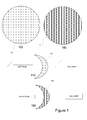
- a left Ophthalmic Lens 100 may include a left dichroic translation filter 101
- a right Ophthalmic Lens 150 may include a right dichroic translation filter 151.
- the left dichroic filter 111 may allow a specific array of red, green, and blue (RGB) light
- the right dichroic filter 161 may allow a different array of RGB light.
- the combined filtered translation may allow for Three-dimensional Perception of the stereoscopic image.
- the Ophthalmic Lenses 100, 150 may also include other passive elements, such as, for example, cosmetic coloration, including iris patterns, or vision-correcting aspects.
- FIG. 2 an alternate embodiment of a Viewing Set of Ophthalmic Lenses 200, 250 with polarizing translation filters 201, 251 is illustrated, wherein the Ophthalmic Lenses 200, 250 may translate circularly polarized light.
- polarizing light through a transmissible material including, for example, wire grids, employment of Brewster's angles plates, and employment of birefringent or biaxial materials.
- a left Ophthalmic Lens 200 may include a left translation filter 201, and a right Ophthalmic Lens 250 may include a right translation filter 251.
- the left translation filter 211 and the right translation filter 261 may linearly polarize circularly polarized light, wherein the two translation filters 211, 261 may polarize the light at different angles.
- the left Ophthalmic Lens 210 and the right Ophthalmic Lens 260 are used as a Viewing Set, the left filtered translation and the right filtered translation may combine to allow for Three-dimensional Perception of a stereoscopic image.
- the Ophthalmic Lenses 200, 250 may include Stabilizing Features 202, 252.
- the Stabilizing Features 202, 252 may be aligned with the translation filters 201, 251.
- the Stabilizing Features 212, 262 may alter the topography of the front curve surface. The altered topography may allow an eyelid to catch the Stabilizing Features 212, 262, and the user may reorient the Ophthalmic Lenses 210, 260 by blinking.
- the Stabilizing Features 212, 262 may not affect the topography of the front curve surface, and the added mass may be sufficient to ballast the Ophthalmic Lenses 210, 260 at a specific orientation on the eye.
- the Stabilizing Features 120 may comprise a material that is different from the encapsulating Reactive Monomer Mixture.
- the Stabilizing Feature 212, 262 may contain a tint, wherein the user may see how the Ophthalmic Lens 200, 250 may orient on the eye.
- FIG. 3 an embodiment of a Viewing Set of Ophthalmic Lenses 300, 350 with translation filters 301, 351 is illustrated, wherein the translation filters 301, 351 may be included in an encapsulated Rigid Insert 304, 354.
- the Rigid Insert 304, 354 may be included in an Ophthalmic Lens 300, 350, which may comprise a polymeric biocompatible material.
- the Ophthalmic Lens 300, 350 may include a rigid center, soft skirt design wherein a central rigid optical element comprises the Rigid Insert 304, 354.
- the encapsulating material 303, 353 of the Ophthalmic Lens 300, 350 may be a biocompatible polymerized material such as a silicone hydrogel, including, for example, Etafilcon, Narafilcon, Galyfilcon, and Senofilcon.
- Similar filtering techniques may be utilized in the Rigid Inserts 304, 354 as with the Ophthalmic Lenses 100, 150 wherein the translation filters 101, 150 are included in the soft lens material, as shown, for example, in Figure 1 .
- the Rigid Inserts 304, 354 may be fully encapsulated with the Ophthalmic Lenses 300, 350. Accordingly, the Rigid Inserts 304, 354 may not be limited to biocompatible material.
- the Rigid Insert 304, 354 may comprise a film of dichroic materials. Some embodiments may include layers of films, each contributing to the translation filters 301, 351. For example, the top and bottom films may act to protect the internal dichroic film, and the protecting layers may be three-dimensionally formed through a thermo forming process.
- the Rigid Insert 314, 310 may be fully encapsulated by the polymerized RMM 313, 363.
- the encapsulating process may place the Rigid Insert 314, 364 in the Optic Zone of the Ophthalmic Lenses 310, 360.
- the Rigid Insert 314, 364 may extend beyond the Optic Zone.
- the periphery portion of the Rigid Insert 314, 364 may provide passive functionalities.
- the portion outside of the Optic Zone may include cosmetic coloration, such as, for example, iris patterns; or, the periphery may include an active agent.
- the active agent may provide relieving hydration, which may be useful when the user's blink rate is low, such as, for example, while viewing stereoscopic media.
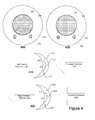
- FIG. 4 an alternative embodiment of a Viewing Set of Ophthalmic Lenses 400, 450 with Rigid Insert 404, 454 is illustrated.
- the Rigid Insert 404, 454 may translate circularly polarized light.
- a left Rigid Insert 404 may include a left translation filter 401, and a right Rigid Insert 454 may include a right translation filter 451.
- polarization features 401, 451 may be thermoformed onto an insert piece 404, 454. In some embodiments, such features 401, 451 may be imparted to insert pieces 404, 454 through properties of thin film starting materials. Alternatively, the thermoforming process may be sufficient to impart the polarization features 401, 451.
- the filtering function may be developed in a Rigid Insert 404, 454 through a single technique or by a combination of techniques.
- the polarizing features 401, 451 of an Ophthalmic Lens 400, 450 may include wire grids and dichroic materials.
- the Rigid Insert 404, 454 may be thermoformed from a thin sheet of metallic or conductive filaments or lines deployed in a parallel fashion to form a wire grid.
- the Rigid Inserts 414, 464 may comprise multiple layers.
- the front layer 420, 470 may comprise a quarter wave plate
- the back layer 421, 471 may comprise a linear polarizer.
- the right translation filter 461 may linearly polarize circularly polarized light, wherein the two translation filters 411, 461 may polarize the light at different angles.
- the left filtered translation and the right filtered translation may combine to allow for Three-dimensional Perception of a stereoscopic image.
- Thermoforming techniques may add alignment features to the front layer 420, 470 and the back layer 421, 471, which may allow for precise control of the differing polarizing orientations of the right Rigid Insert 464 and the left Rigid Insert 414.
- the polarizing features may be enhanced by thermo forming the Rigid Insert 464, 414 to include a Three-dimensional Surface.
- the Rigid Insert 404, 454 when the Rigid Insert 404, 454 is assembled into an Ophthalmic Lens 400, 450, the Rigid Insert 404, 454 may be positioned with alignment features into a cavity formed between a front curve Mold and a back curve Mold.
- the Rigid Insert 404, 454 may be encapsulated by filling the area between the Mold Pieces with Reactive Monomer Mixture and then polymerizing the RMM. Numerous Reactive Monomer Mixtures may be consistent with the formation of molded Ophthalmic Devices, including, for example, those capable of forming hydrogel lenses, such as silicone hydrogel.
- Some embodiments of the Ophthalmic Lenses 400, 450 may include Stabilizing Features 402, 452, wherein the Stabilizing Features 402, 452 may orient the Lenses 400, 450 on the eye and limit rotation. Stabilizing Features 402, 452 may be particularly significant in embodiments where the translation filter 401, 451 depends on a specific alignment.
- the Viewing Set may include similar translation filters 401, 451, and two unique filtered translations may be caused by different alignments of the translation filters 401, 451 in the left Ophthalmic Lens 400 and the right Ophthalmic Lens 450.
- Including the translation filters through a Rigid Insert may allow for additional passive functionalities imparted to the encapsulating material.
- some embodiments may include a tinting in the Optic Zone.
- the color tint may be an innate property of the encapsulating material.
- the coloring property may be added to the encapsulating material by depositions, applications, or other means of imparting a color to the Reactive Monomer Mixture.
- a color tinting may provide a variety of functions in an Ophthalmic Lens.
- the tinting may be useful in excluding or attenuating wavelengths of light as may be the function of shading ambient sunlight.
- the tinting may provide safety functions where the tinting may block certain wavelengths thereby shielding or partially shielding the effect of intense radiation sources such as, for example, lasers or welding arcs.
- the tinting 881 may address medical conditions in some users, who may benefit from either passing or rejecting certain wavelengths from entering the user's eye.
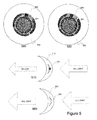
- the Media Insert 504, 554 may include the translation filters 501, 551 within a variable optic portion.
- Various energization elements may be included in regions outside the Optic Zone of the insert.
- the energization elements may include, for example, integrated circuits, passive electronic components, energization elements, and activation elements that may control the nature of the translation filters 501, 551.
- the Media Insert 504, 554 may comprise multiple insert pieces, wherein the insert pieces may be formed through thermoforming techniques.
- alignment features may allow two insert pieces and to lock into place without direct force to the Optic Zone portion or the component. This may allow for more delicate, but precise, assembly of a Media Insert 504, 554.
- liquid crystal may be susceptible to damage caused by pressure or heat.
- the front piece insert may be locked into the back piece insert, and the locking between the alignment features may maintain the positions of the two pieces.
- the Media Insert 504, 554 may be further secured by applying focused pressure or heat to more robust portions of the Media Insert 504, 554.
- the translation filters 501, 551 may comprise liquid crystal, wherein the activation of the liquid crystal may darken the translation filters 501, 551. The darkening may be sufficient to block light.
- the Viewing Set may provide Three-dimensional Perception through alternating activation of the left translation filter 501 and the right translation filter 551.
- the left Ophthalmic Lens 500 may be in electrical communication with the right Ophthalmic Lens 550, which may allow the left Media Insert 504 to synchronize with the right Media Insert 554.
- the frequency of the alternating activation may be configured to specific refresh rates of the stereoscopic media.
- the activation may be programmed for a single frequency.
- Other embodiments may include a variable alternating activation frequency.
- the Media Insert 504, 554 may include a sensor that may recognize the refresh rate of the viewed media, and the Media Insert 504, 554 may adjust the alternating activation frequency accordingly.
- a separate sensor may recognize when the user is viewing stereoscopic Media. This sensor may be capable of triggering a stop in activation when Three-dimensional Perception is not required. The ability to restrict activation may extend the battery life of the Media Insert and may allow extended wear, as the alternating activation may impede non-Three-dimensional Perception.
- the translation filter 601, 651 may be passive elements included in the polymerized RMM, and the Media Insert 604, 654 may include an active meniscus-base lens 607, 657 in the variable optic region 607, 657.
- the meniscus-based lens may allow for multiple powers of vision correction.
- the variable optic region 607, 657 may contain at least two immiscible fluids that form an interface between them that may act as a focal element.
- Various energization elements may be included in regions outside the Optic Zone of the insert.
- the energization elements may include, for example, integrated circuits, passive electronic components, energization elements, and activation elements that may control the nature of the meniscus based lens.
- the Media Insert 604, 654 may comprise an annular shape, wherein the annular Media Insert 604, 654 does not include a region in the Optic Zone.
- Such embodiments may provide non-ophthalmic functionalities, including, for example, administration of an active agent or monitoring a specific characteristic of the ophthalmic environment, such as glucose or temperature.
- the Ophthalmic Lenses 600, 650 may include a passive Rigid Insert, not shown, in addition to the Media Insert 604, 654.
- the Rigid Insert may provide additional functionalities to the Ophthalmic Lenses 600, 650 with translation filters 601, 651 included in the polymerized Reactive Monomer Mixture.
- thermoforming may add colored design to the Rigid Insert, which may add a cosmetic function to an Ophthalmic Lens 600, 650.
- the colored design may be located outside of the Optic Zone of the Ophthalmic Lens 600, 650.
- a printed pattern may be included in an annular Rigid Insert.
- the translation filter may be included in the Rigid Insert.
- the translation filters may be imperceptible when Three-dimensional Viewing is not required. Such embodiments may allow for extended use of the Ophthalmic Lens. Extended use may be significant in embodiments where the Ophthalmic Lenses provide functionalities in addition to the translation filters. For example, Ophthalmic Lenses that include translation filters may correct vision, add cosmetic coloration to the eye, monitor the ophthalmic environment, or a combination thereof. Accordingly, in such embodiments, the translation filters may be visually ignored when the user is not viewing stereoscopic media.
- a lens type can be a lens that includes a silicone containing component.
- a "silicone-containing component” is one that contains at least one [-Si-O-] unit in a monomer, macromer or prepolymer.
- the total Si and attached O are present in the silicone-containing component in an amount greater than about 20 weight percent, and more preferably greater than 30 weight percent of the total molecular weight of the silicone-containing component.
- Useful silicone-containing components preferably comprise polymerizable functional groups such as acrylate, methacrylate, acrylamide, methacrylamide, vinyl, N-vinyl lactam, N-vinylamide, and styryl functional groups.
- the Ophthalmic Lens skirt which sometimes may be called an insert encapsulating layer, that surrounds the insert may be comprised of standard hydrogel lens formulations.
- Exemplary materials with characteristics that may provide an acceptable match to numerous insert materials may include the Narafilcon family; including Narafilcon A and Narafilcon B.
- the Etafilcon family; including Etafilcon A may represent good exemplary material choices.
- a more technically inclusive discussion follows on the nature of materials consistent with the art herein; but it may be clear that any material which may form an acceptable enclosure or partial enclosure of the sealed and encapsulated inserts are consistent and included.
- Suitable silicone containing components include compounds of Formula I where:
- “monovalent reactive groups” are groups that can undergo free radical and/or cationic polymerization.
- free radical reactive groups include (meth)acrylates, styryls, vinyls, vinyl ethers, C 1-6 alkyl(meth)acrylates, (meth)acrylamides, C 1-6 alkyl(meth)acrylamides, N-vinyllactams, N-vinylamides, C 2-12 alkenyls, C 2-12 alkenylphenyls, C 2-12 alkenylnaphthyls, C 2-6 alkenylphenylC 1-6 alkyls, O-vinylcarbamates and O-vinylcarbonates.
- Non-limiting examples of cationic reactive groups include vinyl ethers or epoxide groups and mixtures thereof.
- the free radical reactive groups comprises (meth)acrylate, acryloxy, (meth)acrylamide, and mixtures thereof.
- Suitable monovalent alkyl and aryl groups include unsubstituted monovalent C 1 to C 16 alkyl groups, C 6 -C 14 aryl groups, such as substituted and unsubstituted methyl, ethyl, propyl, butyl, 2-hydroxypropyl, propoxypropyl, polyethyleneoxypropyl, combinations thereof and the like.
- silicone components of this embodiment include 2-methyl-,2-hydroxy-3-[3-[1,3,3,3-tetramethyl-1-[(trimethylsilyl)oxy]disiloxanyl]propoxy]propyl ester ("SiGMA”), 2-hydroxy-3-methacryloxypropyloxypropyl-tris(trimethylsiloxy)silane, 3-methacryloxypropyltris(trimethylsiloxy)silane (“TRIS”), 3-methacryloxypropylbis(trimethylsiloxy)methylsilane and 3-methacryloxypropylpentamethyl disiloxane.
- SiGMA 2-methyl-,2-hydroxy-3-[3-[1,3,3,3-tetramethyl-1-[(trimethylsilyl)oxy]disiloxanyl]propoxy]propyl ester
- SiGMA 2-hydroxy-3-methacryloxypropyloxypropyl-tris(trimethylsiloxy)silane
- TMS 3-methacryloxypropyltris
- b is 2 to 20, 3 to 15 or in some embodiments 3 to 10; at least one terminal R 1 comprises a monovalent reactive group and the remaining R 1 are selected from monovalent alkyl groups having 1 to 16 carbon atoms, and in another embodiment from monovalent alkyl groups having 1 to 6 carbon atoms.
- b is 3 to 15, one terminal R 1 comprises a monovalent reactive group, the other terminal R 1 comprises a monovalent alkyl group having 1 to 6 carbon atoms and the remaining R 1 comprise monovalent alkyl group having 1 to 3 carbon atoms.
- Non-limiting examples of silicone components of this embodiment include (mono-(2-hydroxy-3-methacryloxypropyl)-propyl ether terminated polydimethylsiloxane (400-1000 MW)) (“OH-mPDMS”), monomethacryloxypropyl terminated mono-n-butyl terminated polydimethylsiloxanes (800-1000 MW), (“mPDMS”).
- both terminal R 1 comprise monovalent reactive groups and the remaining R 1 are independently selected from monovalent alkyl groups having 1 to 18 carbon atoms which may have ether linkages between carbon atoms and may further comprise halogen.
- the lens of the present invention will be made from a Reactive Mixture comprising at least about 20 and preferably between about 20 and 70%wt silicone containing components based on total weight of reactive monomer components from which the polymer is made.
- one to four R 1 comprises a vinyl carbonate or carbamate of the formula: wherein: Y denotes O-, S- or NH-; R denotes, hydrogen or methyl; d is 1, 2, 3 or 4; and q is 0 or 1.
- the silicone-containing vinyl carbonate or vinyl carbamate monomers specifically include: 1,3-bis[4-(vinyloxycarbonyloxy)but-1-yl]tetramethyl-disiloxane; 3-(vinyloxycarbonylthio) propyl-[tris (trimethylsiloxy)silane]; 3-[tris(trimethylsiloxy)silyl] propyl allyl carbamate; 3-[tris(trimethylsiloxy)silyl] propyl vinyl carbamate; trimethylsilylethyl vinyl carbonate; trimethylsilylmethyl vinyl carbonate, and
- R 1 shall comprise a monovalent reactive group and no more than two of the remaining R 1 groups will comprise monovalent siloxane groups.
- silicone-containing components includes polyurethane macromers of the following formulae:
- a preferred silicone-containing component is a polyurethane macromer represented by the following formula:
- silicone containing components suitable for use in this invention include macromers containing polysiloxane, polyalkylene ether, diisocyanate, polyfluorinated hydrocarbon, polyfluorinated ether and polysaccharide groups; polysiloxanes with a polar fluorinated graft or side group having a hydrogen atom attached to a terminal difluoro-substituted carbon atom; hydrophilic siloxanyl methacrylates containing ether and siloxanyl linkanges and crosslinkable monomers containing polyether and polysiloxanyl groups. Any of the foregoing polysiloxanes can also be used as the silicone-containing component in this invention.
- a flowchart illustrates exemplary steps for forming a Viewing Set of Ophthalmic Lenses.
- Reactive Monomer Mixture may be deposited on a front curve mold.
- the left translation filter may be inherent in the RMM after polymerization and may not require additional steps to include the translation filter.
- a left translation filter may be incorporated with the RMM.
- the left translation filter may be deposited or printed on the front curve mold prior to depositing the RMM at 705. In such embodiments, the left translation filter may be incorporated by contact with the RMM.
- Stabilizing Features may be included in the RMM, wherein the Stabilizing Feature aligns with the left translation filter.
- a material may be deposited on the Front Curve Mold Piece, wherein the RMM may incorporate the material during deposition at 705.
- Alternate embodiments may inject the material into the cure or partially cured RMM.
- a further embodiment may include an aberration on the front curve mold, which may create Stabilizing Features in the Ophthalmic Lens.
- the back curve mold may be placed proximate to the front curve mold to create a lens-forming cavity.
- the RMM may be polymerized, for example, through curing techniques.
- the left Ophthalmic Lens may be removed from the mold.
- the formation of the right Ophthalmic Lens, at 735-760 may include a repetition of the process for forming the left Ophthalmic Lens, at 705-730.
- the right translation filter may complement the left translation filter, wherein the combining of the filtered translations allow for Three-dimensional Perception.
- a flowchart illustrates exemplary steps for forming a Viewing Set of Ophthalmic Lenses that include Rigid Inserts, wherein the translation filters are included in the Rigid Insert.
- a left Rigid Insert having a left translation filter may be placed proximate to a front curve mold.
- a Reactive Monomer Mixture may be deposited on the front curve mold.
- the RMM may add functionality to the Ophthalmic Lens, such as, for example, where RMM adds a tint to the Ophthalmic Lens.
- the left Rigid Insert may be aligned with a Stabilizing Feature, wherein the alignment ensures the functionality of the left Rigid Insert when the Ophthalmic Lens is oriented on an eye.
- the Stabilizing Feature material may be added to the surface of the Front Curve Mold prior to adding the encapsulating material at 810.
- the Stabilizing Feature may be inserts that may be placed on the Front Curve Mold prior to adding the encapsulating material at 810 and separately from adding the Rigid Insert at 815.
- the Stabilizing Features may be included with the Rigid Insert, wherein the left Rigid Insert may be aligned with the Stabilizing Features prior to a molding process, at 805-830.
- the back curve mold may be placed proximate to the front curve mold to create a lens-forming cavity.
- the RMM may be polymerized, for example, through curing techniques.
- the left Ophthalmic Lens may be removed from the molding apparatus.
- the formation of the right Ophthalmic Lens, at 835-860 may include a repetition of the process for forming the left Ophthalmic Lens, at 805-830.
- the right translation filter may complement the left translation filter, wherein the combining of the filtered translations allow for Three-dimensional Perception.
- a flowchart illustrates exemplary steps for forming Media Inserts for inclusion in a Viewing Set of Ophthalmic Lenses.
- a power source may be incorporated into a left Media Insert, wherein the left Media Insert may be included in a left Ophthalmic Lens.
- a load that may control the left translation filter activation may be included in circuit with the power source.
- an active translation filter may be included in the Optic Zone region of the Media Insert.
- the active translation filter may comprise liquid crystal, and upon activation, the liquid crystal may darken and block light.
- a left synchronizing load may be included in circuit with the power source.
- the left synchronizing load may be in electrical communication with a right synchronizing load.
- a left stereoscopic media sensor may be included in circuit with the power source.
- the left stereoscopic media sensor may allow the Media Insert to sense when the user requires Three-dimensional Perception.
- the sensor in some embodiments may allow for variable activation frequency, where the sensor may detect the refresh rate of the stereoscopic media.
- the process for forming a right Media Insert may be a repetition of the process steps for forming the left Media Insert, at 905-925.
- the right Media Insert may not include a separate right stereoscopic media sensor, at 950.
- a stereoscopic media sensor may be included in a left Media Insert, wherein the left Media Insert may communicate the information to the right Media Insert.
- the left synchronizing load may be capable of communicating activation commands to the right activating load.
- the present invention provides methods for creating Viewing Sets of Ophthalmic Lens with translation filters, including embodiments where the translation filters are included in an encapsulated Rigid Insert.
- the present invention also includes methods for forming a Media Insert capable of powering and controlling activation of an active translation filter, and more specifically, where the Media Insert may be incorporated in an Ophthalmic Lens Viewing Set.
Landscapes
- Physics & Mathematics (AREA)
- General Physics & Mathematics (AREA)
- Optics & Photonics (AREA)
- Engineering & Computer Science (AREA)
- Multimedia (AREA)
- Signal Processing (AREA)
- Health & Medical Sciences (AREA)
- Ophthalmology & Optometry (AREA)
- General Health & Medical Sciences (AREA)
- Spectroscopy & Molecular Physics (AREA)
- Prostheses (AREA)
Applications Claiming Priority (2)
| Application Number | Priority Date | Filing Date | Title |
|---|---|---|---|
| US13/842,980 US9873233B2 (en) | 2013-03-15 | 2013-03-15 | Ophthalmic lens viewing sets for three-dimensional perception of stereoscopic media |
| US13/842,717 US9664916B2 (en) | 2013-03-15 | 2013-03-15 | Stereoscopic ophthalmic lens viewing sets |
Publications (2)
| Publication Number | Publication Date |
|---|---|
| EP2778747A2 true EP2778747A2 (de) | 2014-09-17 |
| EP2778747A3 EP2778747A3 (de) | 2014-11-26 |
Family
ID=50272535
Family Applications (1)
| Application Number | Title | Priority Date | Filing Date |
|---|---|---|---|
| EP14160150.0A Withdrawn EP2778747A3 (de) | 2013-03-15 | 2014-03-14 | Ophthalmische Linsenbetrachtungssets zur dreidimensionalen Wahrnehmung stereoskopischer Medien |
Country Status (2)
| Country | Link |
|---|---|
| EP (1) | EP2778747A3 (de) |
| HK (1) | HK1201930A1 (de) |
Family Cites Families (9)
| Publication number | Priority date | Publication date | Assignee | Title |
|---|---|---|---|---|
| EP1728117A1 (de) * | 2004-03-05 | 2006-12-06 | Koninklijke Philips Electronics N.V. | Linse mit variablem brennpunkt |
| RU2313191C2 (ru) * | 2005-07-13 | 2007-12-20 | Евгений Борисович Гаскевич | Способ и система формирования стереоизображения |
| US7758187B2 (en) * | 2008-02-04 | 2010-07-20 | University Of Washington | Contact lens for three dimensional visualization |
| US20110102563A1 (en) * | 2009-11-03 | 2011-05-05 | Johnson Jr Robert L | Multi-spectral stereographic display system |
| GB201002521D0 (en) * | 2010-02-15 | 2010-03-31 | Taylor Richard | 3D eyewear |
| US20110298794A1 (en) * | 2010-06-08 | 2011-12-08 | Barney Freedman | Circular polarized contact lenses and methods thereof |
| US8836772B2 (en) * | 2010-11-17 | 2014-09-16 | Sony Computer Entertainment, Inc. | 3D shutter glasses with frame rate detector |
| US8553072B2 (en) * | 2010-11-23 | 2013-10-08 | Circa3D, Llc | Blanking inter-frame transitions of a 3D signal |
| KR20120139020A (ko) * | 2011-06-16 | 2012-12-27 | 엘지디스플레이 주식회사 | 입체 영상 시청용 콘택트 렌즈 |
-
2014
- 2014-03-14 EP EP14160150.0A patent/EP2778747A3/de not_active Withdrawn
-
2015
- 2015-03-12 HK HK15102519.1A patent/HK1201930A1/en unknown
Non-Patent Citations (1)
| Title |
|---|
| None |
Also Published As
| Publication number | Publication date |
|---|---|
| HK1201930A1 (en) | 2015-09-11 |
| EP2778747A3 (de) | 2014-11-26 |
Similar Documents
| Publication | Publication Date | Title |
|---|---|---|
| EP2778756A1 (de) | Ophthalmische Vorrichtungen mit Stabilisierungsfunktionen | |
| AU2018222924A1 (en) | Ophthalmic lens viewing sets for three-dimensional perception of stereoscopic media | |
| US9481124B2 (en) | Method and apparatus for forming thermoformed ophthalmic insert devices | |
| EP2778760A1 (de) | Ophthalmische Vorrichtungen mit Stabilisierungseigenschaften | |
| AU2018202362A1 (en) | Ophthalmic lens viewing sets for three-dimensional perception of stereoscopic media | |
| US9939657B2 (en) | Thermoformed ophthalmic insert devices | |
| HK1201930A1 (en) | Ophthalmic lens viewing sets for three-dimensional perception of stereoscopic media | |
| HK1259745A1 (en) | Methods and apparatus for electroactive variable aperture lenses |
Legal Events
| Date | Code | Title | Description |
|---|---|---|---|
| 17P | Request for examination filed |
Effective date: 20140314 |
|
| AK | Designated contracting states |
Kind code of ref document: A2 Designated state(s): AL AT BE BG CH CY CZ DE DK EE ES FI FR GB GR HR HU IE IS IT LI LT LU LV MC MK MT NL NO PL PT RO RS SE SI SK SM TR |
|
| AX | Request for extension of the european patent |
Extension state: BA ME |
|
| PUAI | Public reference made under article 153(3) epc to a published international application that has entered the european phase |
Free format text: ORIGINAL CODE: 0009012 |
|
| PUAL | Search report despatched |
Free format text: ORIGINAL CODE: 0009013 |
|
| RIC1 | Information provided on ipc code assigned before grant |
Ipc: G02C 7/04 20060101ALI20141015BHEP Ipc: H04N 13/04 20060101ALN20141015BHEP Ipc: A61F 2/14 20060101ALI20141015BHEP Ipc: G02B 27/26 20060101ALI20141015BHEP Ipc: G02B 27/22 20060101AFI20141015BHEP |
|
| AK | Designated contracting states |
Kind code of ref document: A3 Designated state(s): AL AT BE BG CH CY CZ DE DK EE ES FI FR GB GR HR HU IE IS IT LI LT LU LV MC MK MT NL NO PL PT RO RS SE SI SK SM TR |
|
| AX | Request for extension of the european patent |
Extension state: BA ME |
|
| RIC1 | Information provided on ipc code assigned before grant |
Ipc: G02B 27/22 20060101AFI20141023BHEP Ipc: G02B 27/26 20060101ALI20141023BHEP Ipc: H04N 13/04 20060101ALN20141023BHEP Ipc: A61F 2/14 20060101ALI20141023BHEP Ipc: G02C 7/04 20060101ALI20141023BHEP |
|
| R17P | Request for examination filed (corrected) |
Effective date: 20150526 |
|
| RBV | Designated contracting states (corrected) |
Designated state(s): AL AT BE BG CH CY CZ DE DK EE ES FI FR GB GR HR HU IE IS IT LI LT LU LV MC MK MT NL NO PL PT RO RS SE SI SK SM TR |
|
| REG | Reference to a national code |
Ref country code: HK Ref legal event code: DE Ref document number: 1201930 Country of ref document: HK |
|
| STAA | Information on the status of an ep patent application or granted ep patent |
Free format text: STATUS: EXAMINATION IS IN PROGRESS |
|
| 17Q | First examination report despatched |
Effective date: 20180913 |
|
| REG | Reference to a national code |
Ref country code: HK Ref legal event code: WD Ref document number: 1201930 Country of ref document: HK |
|
| STAA | Information on the status of an ep patent application or granted ep patent |
Free format text: STATUS: THE APPLICATION IS DEEMED TO BE WITHDRAWN |
|
| 18D | Application deemed to be withdrawn |
Effective date: 20211001 |