EP2778258A1 - Erosion resistant coating - Google Patents
Erosion resistant coating Download PDFInfo
- Publication number
- EP2778258A1 EP2778258A1 EP14155591.2A EP14155591A EP2778258A1 EP 2778258 A1 EP2778258 A1 EP 2778258A1 EP 14155591 A EP14155591 A EP 14155591A EP 2778258 A1 EP2778258 A1 EP 2778258A1
- Authority
- EP
- European Patent Office
- Prior art keywords
- platinum
- chromium
- erosion protection
- outer zone
- protection coating
- Prior art date
- Legal status (The legal status is an assumption and is not a legal conclusion. Google has not performed a legal analysis and makes no representation as to the accuracy of the status listed.)
- Ceased
Links
- 238000000576 coating method Methods 0.000 title claims abstract description 74
- 239000011248 coating agent Substances 0.000 title claims abstract description 54
- 230000003628 erosive effect Effects 0.000 title claims description 18
- BASFCYQUMIYNBI-UHFFFAOYSA-N platinum Chemical compound [Pt] BASFCYQUMIYNBI-UHFFFAOYSA-N 0.000 claims abstract description 74
- 239000011651 chromium Substances 0.000 claims abstract description 38
- 229910052804 chromium Inorganic materials 0.000 claims abstract description 37
- 229910052697 platinum Inorganic materials 0.000 claims abstract description 37
- VYZAMTAEIAYCRO-UHFFFAOYSA-N Chromium Chemical compound [Cr] VYZAMTAEIAYCRO-UHFFFAOYSA-N 0.000 claims abstract description 35
- 238000009792 diffusion process Methods 0.000 claims abstract description 9
- PXHVJJICTQNCMI-UHFFFAOYSA-N Nickel Chemical compound [Ni] PXHVJJICTQNCMI-UHFFFAOYSA-N 0.000 claims description 25
- 238000000034 method Methods 0.000 claims description 12
- 229910052759 nickel Inorganic materials 0.000 claims description 12
- XEEYBQQBJWHFJM-UHFFFAOYSA-N Iron Chemical compound [Fe] XEEYBQQBJWHFJM-UHFFFAOYSA-N 0.000 claims description 9
- 238000010438 heat treatment Methods 0.000 claims description 9
- 229910052782 aluminium Inorganic materials 0.000 claims description 7
- 229910052742 iron Inorganic materials 0.000 claims description 5
- 229910000990 Ni alloy Inorganic materials 0.000 claims description 4
- 239000004411 aluminium Substances 0.000 claims description 4
- XAGFODPZIPBFFR-UHFFFAOYSA-N aluminium Chemical compound [Al] XAGFODPZIPBFFR-UHFFFAOYSA-N 0.000 claims description 4
- NINIDFKCEFEMDL-UHFFFAOYSA-N Sulfur Chemical compound [S] NINIDFKCEFEMDL-UHFFFAOYSA-N 0.000 abstract description 4
- 239000005864 Sulphur Substances 0.000 abstract description 4
- 241000218642 Abies Species 0.000 abstract description 3
- 238000005260 corrosion Methods 0.000 description 24
- 230000007797 corrosion Effects 0.000 description 24
- 229910000601 superalloy Inorganic materials 0.000 description 8
- 230000008569 process Effects 0.000 description 7
- 238000005229 chemical vapour deposition Methods 0.000 description 6
- 229910045601 alloy Inorganic materials 0.000 description 5
- 239000000956 alloy Substances 0.000 description 5
- 238000005254 chromizing Methods 0.000 description 5
- 230000007613 environmental effect Effects 0.000 description 5
- 230000006872 improvement Effects 0.000 description 5
- 238000012360 testing method Methods 0.000 description 5
- 238000005336 cracking Methods 0.000 description 4
- 229910000951 Aluminide Inorganic materials 0.000 description 3
- 230000008901 benefit Effects 0.000 description 3
- 229910017052 cobalt Inorganic materials 0.000 description 3
- 239000010941 cobalt Substances 0.000 description 3
- GUTLYIVDDKVIGB-UHFFFAOYSA-N cobalt atom Chemical compound [Co] GUTLYIVDDKVIGB-UHFFFAOYSA-N 0.000 description 3
- 239000000758 substrate Substances 0.000 description 3
- 229910052715 tantalum Inorganic materials 0.000 description 3
- GUVRBAGPIYLISA-UHFFFAOYSA-N tantalum atom Chemical compound [Ta] GUVRBAGPIYLISA-UHFFFAOYSA-N 0.000 description 3
- KDLHZDBZIXYQEI-UHFFFAOYSA-N Palladium Chemical compound [Pd] KDLHZDBZIXYQEI-UHFFFAOYSA-N 0.000 description 2
- 230000015572 biosynthetic process Effects 0.000 description 2
- 230000008859 change Effects 0.000 description 2
- MMAADVOQRITKKL-UHFFFAOYSA-N chromium platinum Chemical compound [Cr].[Pt] MMAADVOQRITKKL-UHFFFAOYSA-N 0.000 description 2
- 238000001816 cooling Methods 0.000 description 2
- 238000000151 deposition Methods 0.000 description 2
- 238000009713 electroplating Methods 0.000 description 2
- 230000004907 flux Effects 0.000 description 2
- 230000000873 masking effect Effects 0.000 description 2
- 239000011159 matrix material Substances 0.000 description 2
- 235000002639 sodium chloride Nutrition 0.000 description 2
- 239000000126 substance Substances 0.000 description 2
- 229910019026 PtCr Inorganic materials 0.000 description 1
- FAPWRFPIFSIZLT-UHFFFAOYSA-M Sodium chloride Chemical compound [Na+].[Cl-] FAPWRFPIFSIZLT-UHFFFAOYSA-M 0.000 description 1
- RZJQYRCNDBMIAG-UHFFFAOYSA-N [Cu].[Cu].[Cu].[Cu].[Cu].[Cu].[Cu].[Cu].[Cu].[Cu].[Cu].[Cu].[Cu].[Cu].[Cu].[Cu].[Cu].[Cu].[Zn].[Ag].[Ag].[Ag].[Ag].[Ag].[Ag].[Ag].[Ag].[Ag].[Ag].[Ag].[Ag].[Ag].[Ag].[Ag].[Ag].[Ag].[Ag].[Ag].[Ag].[Ag].[Ag].[Ag].[Ag].[Ag].[Ag].[Ag].[Ag].[Ag].[Ag].[Ag].[Ag].[Ag].[Ag].[Ag].[Ag].[Ag].[Ag].[Ag].[Ag].[Ag].[Ag].[Ag].[Ag].[Ag].[Ag].[Ag].[Ag].[Ag].[Ag].[Ag].[Ag].[Ag].[Ag].[Ag].[Ag].[Ag].[Ag].[Ag].[Ag].[Ag].[Ag].[Sn].[Sn].[Sn].[Sn].[Sn].[Sn].[Sn].[Sn].[Sn].[Sn].[Sn].[Sn].[Sn].[Sn].[Sn].[Sn].[Sn].[Sn] Chemical class [Cu].[Cu].[Cu].[Cu].[Cu].[Cu].[Cu].[Cu].[Cu].[Cu].[Cu].[Cu].[Cu].[Cu].[Cu].[Cu].[Cu].[Cu].[Zn].[Ag].[Ag].[Ag].[Ag].[Ag].[Ag].[Ag].[Ag].[Ag].[Ag].[Ag].[Ag].[Ag].[Ag].[Ag].[Ag].[Ag].[Ag].[Ag].[Ag].[Ag].[Ag].[Ag].[Ag].[Ag].[Ag].[Ag].[Ag].[Ag].[Ag].[Ag].[Ag].[Ag].[Ag].[Ag].[Ag].[Ag].[Ag].[Ag].[Ag].[Ag].[Ag].[Ag].[Ag].[Ag].[Ag].[Ag].[Ag].[Ag].[Ag].[Ag].[Ag].[Ag].[Ag].[Ag].[Ag].[Ag].[Ag].[Ag].[Ag].[Ag].[Ag].[Sn].[Sn].[Sn].[Sn].[Sn].[Sn].[Sn].[Sn].[Sn].[Sn].[Sn].[Sn].[Sn].[Sn].[Sn].[Sn].[Sn].[Sn] RZJQYRCNDBMIAG-UHFFFAOYSA-N 0.000 description 1
- 238000005275 alloying Methods 0.000 description 1
- 230000004888 barrier function Effects 0.000 description 1
- 230000015556 catabolic process Effects 0.000 description 1
- 239000012141 concentrate Substances 0.000 description 1
- 238000004320 controlled atmosphere Methods 0.000 description 1
- 238000006731 degradation reaction Methods 0.000 description 1
- 230000008021 deposition Effects 0.000 description 1
- 230000008030 elimination Effects 0.000 description 1
- 238000003379 elimination reaction Methods 0.000 description 1
- 238000011534 incubation Methods 0.000 description 1
- 230000000977 initiatory effect Effects 0.000 description 1
- 238000007689 inspection Methods 0.000 description 1
- 229910052741 iridium Inorganic materials 0.000 description 1
- GKOZUEZYRPOHIO-UHFFFAOYSA-N iridium atom Chemical compound [Ir] GKOZUEZYRPOHIO-UHFFFAOYSA-N 0.000 description 1
- 238000005259 measurement Methods 0.000 description 1
- 229910052751 metal Inorganic materials 0.000 description 1
- 239000002184 metal Substances 0.000 description 1
- 150000002739 metals Chemical class 0.000 description 1
- 239000000203 mixture Substances 0.000 description 1
- 229910052763 palladium Inorganic materials 0.000 description 1
- 230000000149 penetrating effect Effects 0.000 description 1
- 238000005240 physical vapour deposition Methods 0.000 description 1
- 238000000623 plasma-assisted chemical vapour deposition Methods 0.000 description 1
- 239000011148 porous material Substances 0.000 description 1
- 239000002244 precipitate Substances 0.000 description 1
- 239000011253 protective coating Substances 0.000 description 1
- 230000009467 reduction Effects 0.000 description 1
- 230000008439 repair process Effects 0.000 description 1
- 229910052702 rhenium Inorganic materials 0.000 description 1
- WUAPFZMCVAUBPE-UHFFFAOYSA-N rhenium atom Chemical compound [Re] WUAPFZMCVAUBPE-UHFFFAOYSA-N 0.000 description 1
- 150000003839 salts Chemical class 0.000 description 1
- 229910021332 silicide Inorganic materials 0.000 description 1
- FVBUAEGBCNSCDD-UHFFFAOYSA-N silicide(4-) Chemical compound [Si-4] FVBUAEGBCNSCDD-UHFFFAOYSA-N 0.000 description 1
- 239000011780 sodium chloride Substances 0.000 description 1
- 238000004544 sputter deposition Methods 0.000 description 1
- WFKWXMTUELFFGS-UHFFFAOYSA-N tungsten Chemical compound [W] WFKWXMTUELFFGS-UHFFFAOYSA-N 0.000 description 1
- 229910052721 tungsten Inorganic materials 0.000 description 1
- 239000010937 tungsten Substances 0.000 description 1
Images


Classifications
-
- F—MECHANICAL ENGINEERING; LIGHTING; HEATING; WEAPONS; BLASTING
- F01—MACHINES OR ENGINES IN GENERAL; ENGINE PLANTS IN GENERAL; STEAM ENGINES
- F01D—NON-POSITIVE DISPLACEMENT MACHINES OR ENGINES, e.g. STEAM TURBINES
- F01D5/00—Blades; Blade-carrying members; Heating, heat-insulating, cooling or antivibration means on the blades or the members
- F01D5/12—Blades
- F01D5/28—Selecting particular materials; Particular measures relating thereto; Measures against erosion or corrosion
- F01D5/288—Protective coatings for blades
-
- C—CHEMISTRY; METALLURGY
- C23—COATING METALLIC MATERIAL; COATING MATERIAL WITH METALLIC MATERIAL; CHEMICAL SURFACE TREATMENT; DIFFUSION TREATMENT OF METALLIC MATERIAL; COATING BY VACUUM EVAPORATION, BY SPUTTERING, BY ION IMPLANTATION OR BY CHEMICAL VAPOUR DEPOSITION, IN GENERAL; INHIBITING CORROSION OF METALLIC MATERIAL OR INCRUSTATION IN GENERAL
- C23C—COATING METALLIC MATERIAL; COATING MATERIAL WITH METALLIC MATERIAL; SURFACE TREATMENT OF METALLIC MATERIAL BY DIFFUSION INTO THE SURFACE, BY CHEMICAL CONVERSION OR SUBSTITUTION; COATING BY VACUUM EVAPORATION, BY SPUTTERING, BY ION IMPLANTATION OR BY CHEMICAL VAPOUR DEPOSITION, IN GENERAL
- C23C30/00—Coating with metallic material characterised only by the composition of the metallic material, i.e. not characterised by the coating process
-
- C—CHEMISTRY; METALLURGY
- C23—COATING METALLIC MATERIAL; COATING MATERIAL WITH METALLIC MATERIAL; CHEMICAL SURFACE TREATMENT; DIFFUSION TREATMENT OF METALLIC MATERIAL; COATING BY VACUUM EVAPORATION, BY SPUTTERING, BY ION IMPLANTATION OR BY CHEMICAL VAPOUR DEPOSITION, IN GENERAL; INHIBITING CORROSION OF METALLIC MATERIAL OR INCRUSTATION IN GENERAL
- C23C—COATING METALLIC MATERIAL; COATING MATERIAL WITH METALLIC MATERIAL; SURFACE TREATMENT OF METALLIC MATERIAL BY DIFFUSION INTO THE SURFACE, BY CHEMICAL CONVERSION OR SUBSTITUTION; COATING BY VACUUM EVAPORATION, BY SPUTTERING, BY ION IMPLANTATION OR BY CHEMICAL VAPOUR DEPOSITION, IN GENERAL
- C23C16/00—Chemical coating by decomposition of gaseous compounds, without leaving reaction products of surface material in the coating, i.e. chemical vapour deposition [CVD] processes
- C23C16/06—Chemical coating by decomposition of gaseous compounds, without leaving reaction products of surface material in the coating, i.e. chemical vapour deposition [CVD] processes characterised by the deposition of metallic material
-
- C—CHEMISTRY; METALLURGY
- C23—COATING METALLIC MATERIAL; COATING MATERIAL WITH METALLIC MATERIAL; CHEMICAL SURFACE TREATMENT; DIFFUSION TREATMENT OF METALLIC MATERIAL; COATING BY VACUUM EVAPORATION, BY SPUTTERING, BY ION IMPLANTATION OR BY CHEMICAL VAPOUR DEPOSITION, IN GENERAL; INHIBITING CORROSION OF METALLIC MATERIAL OR INCRUSTATION IN GENERAL
- C23C—COATING METALLIC MATERIAL; COATING MATERIAL WITH METALLIC MATERIAL; SURFACE TREATMENT OF METALLIC MATERIAL BY DIFFUSION INTO THE SURFACE, BY CHEMICAL CONVERSION OR SUBSTITUTION; COATING BY VACUUM EVAPORATION, BY SPUTTERING, BY ION IMPLANTATION OR BY CHEMICAL VAPOUR DEPOSITION, IN GENERAL
- C23C10/00—Solid state diffusion of only metal elements or silicon into metallic material surfaces
- C23C10/02—Pretreatment of the material to be coated
-
- C—CHEMISTRY; METALLURGY
- C23—COATING METALLIC MATERIAL; COATING MATERIAL WITH METALLIC MATERIAL; CHEMICAL SURFACE TREATMENT; DIFFUSION TREATMENT OF METALLIC MATERIAL; COATING BY VACUUM EVAPORATION, BY SPUTTERING, BY ION IMPLANTATION OR BY CHEMICAL VAPOUR DEPOSITION, IN GENERAL; INHIBITING CORROSION OF METALLIC MATERIAL OR INCRUSTATION IN GENERAL
- C23C—COATING METALLIC MATERIAL; COATING MATERIAL WITH METALLIC MATERIAL; SURFACE TREATMENT OF METALLIC MATERIAL BY DIFFUSION INTO THE SURFACE, BY CHEMICAL CONVERSION OR SUBSTITUTION; COATING BY VACUUM EVAPORATION, BY SPUTTERING, BY ION IMPLANTATION OR BY CHEMICAL VAPOUR DEPOSITION, IN GENERAL
- C23C10/00—Solid state diffusion of only metal elements or silicon into metallic material surfaces
- C23C10/06—Solid state diffusion of only metal elements or silicon into metallic material surfaces using gases
- C23C10/08—Solid state diffusion of only metal elements or silicon into metallic material surfaces using gases only one element being diffused
- C23C10/10—Chromising
-
- C—CHEMISTRY; METALLURGY
- C23—COATING METALLIC MATERIAL; COATING MATERIAL WITH METALLIC MATERIAL; CHEMICAL SURFACE TREATMENT; DIFFUSION TREATMENT OF METALLIC MATERIAL; COATING BY VACUUM EVAPORATION, BY SPUTTERING, BY ION IMPLANTATION OR BY CHEMICAL VAPOUR DEPOSITION, IN GENERAL; INHIBITING CORROSION OF METALLIC MATERIAL OR INCRUSTATION IN GENERAL
- C23C—COATING METALLIC MATERIAL; COATING MATERIAL WITH METALLIC MATERIAL; SURFACE TREATMENT OF METALLIC MATERIAL BY DIFFUSION INTO THE SURFACE, BY CHEMICAL CONVERSION OR SUBSTITUTION; COATING BY VACUUM EVAPORATION, BY SPUTTERING, BY ION IMPLANTATION OR BY CHEMICAL VAPOUR DEPOSITION, IN GENERAL
- C23C10/00—Solid state diffusion of only metal elements or silicon into metallic material surfaces
- C23C10/28—Solid state diffusion of only metal elements or silicon into metallic material surfaces using solids, e.g. powders, pastes
-
- F—MECHANICAL ENGINEERING; LIGHTING; HEATING; WEAPONS; BLASTING
- F01—MACHINES OR ENGINES IN GENERAL; ENGINE PLANTS IN GENERAL; STEAM ENGINES
- F01D—NON-POSITIVE DISPLACEMENT MACHINES OR ENGINES, e.g. STEAM TURBINES
- F01D5/00—Blades; Blade-carrying members; Heating, heat-insulating, cooling or antivibration means on the blades or the members
- F01D5/30—Fixing blades to rotors; Blade roots ; Blade spacers
- F01D5/3092—Protective layers between blade root and rotor disc surfaces, e.g. anti-friction layers
-
- F—MECHANICAL ENGINEERING; LIGHTING; HEATING; WEAPONS; BLASTING
- F05—INDEXING SCHEMES RELATING TO ENGINES OR PUMPS IN VARIOUS SUBCLASSES OF CLASSES F01-F04
- F05D—INDEXING SCHEME FOR ASPECTS RELATING TO NON-POSITIVE-DISPLACEMENT MACHINES OR ENGINES, GAS-TURBINES OR JET-PROPULSION PLANTS
- F05D2300/00—Materials; Properties thereof
- F05D2300/10—Metals, alloys or intermetallic compounds
- F05D2300/14—Noble metals, i.e. Ag, Au, platinum group metals
- F05D2300/143—Platinum group metals, i.e. Os, Ir, Pt, Ru, Rh, Pd
Definitions
- the present invention relates to environmental protection coatings and particularly environmental protection coatings that are used on the roots and shanks of gas turbine blades.
- Turbine blades used in gas turbine engines can suffer corrosion which limits the life of the component in the harsh conditions in which the turbine blade operates. Sulphidation is one form of corrosion to which the blade is susceptible and which can require early removal of the blade from the engine.
- Turbine blades are typically nickel, cobalt or iron based superalloys and conventional environmental protection coatings include silicide modified aluminide coatings or chromised coatings for lower temperature Type 2 corrosion resistance.
- a diffused platinum coating is applied to turbine blade aerofoils and root shanks via an electroplating process and heat treated at 1100°C to 1150°C.
- the coating is used as either an aerofoil bond coat or for sulphidation protection on the shanks of turbine blade roots.
- the platinum coating has three layers with the outer layer comprising both a gamma phase and a gamma prime phase.
- the outer layer of the metallic article may comprise a controlled of chromium in quantities of about 3% with an increasing level of 3-6% and 6.5% for the intermediate and inner zone respectively. At these levels of chromium it has been found that the outer layer remains as a two phase layer.
- chromising is a process that increases the near surface level of chromium.
- Ni based alloys this has been shown to offer an improvement in corrosion resistance under low to moderate corrosive environments.
- More recent turbine blade alloys, suitable for use in the majority of large civil engines including, have been shown to be incompatible with chromising, resulting in no improvement in corrosion protection. This was due to Tantalum, acting as an alloying element, which was found to concentrate in the diffusion front after chromising causing a decrease in expected life.
- the tantalum caused an increase in the rate of degradation due to corrosion.
- Beta phase alloys are generally brittle and may require frequent replacement and repair during service of the component
- an erosion protection coating for a turbine blade comprising platinum and chromium and having a single gamma phase outer zone.
- the generated chromium enriched single phase outer zone does not have phase boundaries which avoids regions at which the atomic structure can change and that can cause strain due in part to a mismatch in elemental makeup
- the chromium comprises between 8 and 30wt% of the single phase outer zone.
- the single phase outer zone may comprise between 8 and 20wt% chromium.
- a high level of chromium promotes the formation of the single gamma phase outer zone.
- Aluminium may also be present in the single phase outer zone comprises at levels of up to 9wt% but preferably in amounts below 7.5%
- the single phase outer zone may comprise between9 and 23wt% chromium.
- the single phase outer zone preferably comprises between 25 to 60wt% platinum.
- the single phase outer zone preferably comprises between 20 to 40wt% nickel.
- the single phase outer zone preferably comprises between between 0 to 5wt% iron.
- the single phase outer zone is between 4 and 30 microns thick. Preferably below 20 microns thick. Preferably above 10 microns thick and below 30 microns thick. Measurements are taken from the outer surface.
- the maximum platinum diffusion zone is preferably no more than 40 microns thick.
- a nickel alloy turbine blade having an erosion protection coating according to any of the preceding ten paragraphs
- the turbine may have a root, wherein the erosion protection coating is applied to the root.
- a method of providing a coating on a nickel turbine blade comprising the steps of applying to the blade a coating of platinum, and heat treating to provide a platinum enriched outer layer with a thickness between 5 microns and 30microns, and diffusing chromium into the platinum to form a single phase outer zone.
- the heat treatment provides a platinum enriched outer layer that is between 5 and 11.5 microns following heat treatment.
- the outer layer may comprise between 8 and 30 wt% chromium.
- the heat treatment may comprise heating the blade to a temperature between 1000°C and 1200°C for 1 to 6 hours.
- the chromium may be deposited by chemical vapour deposition at a temperature between 875°C to 1200°C for 1 to 12 hours.
- Figure 1 depicts a gas turbine engine blade 10 mounted in a root slot of a turbine disc 5.
- the blade comprises an aerofoil 12, a platform 14, a shank 16 and a root 18.
- the blade has internal cooling passages which carry cooling air in use to allow the blade to operate at high temperatures.
- the shank 16 and the root 18 of the turbine blade have a protective coating according to the present invention.
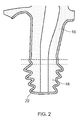
- Figure 2 shows the coating on the blade shank and root in more detail.
- the coating 22 extends over at least the whole exterior surface of the root and shank to eliminates a demarcation line that is formed where the coating extends over the just the shank with the root uncoated.
- the demarcation line can provide an initiation point for stress cracking of the coating but it has been desirable with older coatings to leave the root uncoated as it can be damaged by contact with the disc slot.
- the metallic turbine blade is manufactured from a nickel based superalloy, a cobalt based superalloy, or other based superalloy that comprises a gamma prime phase matrix and a gamma prime phase in the gamma phase matrix.
- a platinum layer is deposited using a standard electroplating process.
- chemical vapour deposition physical vapour deposition, e.g. sputtering, plasma assisted chemical vapour deposition, or any other suitable process may be used provided the thickness of the deposited coating is above a defined minimum and is conformal without pores or blistering.
- the deposited platinum layer is subsequently heat treated at a temperature between 1000°C and 1200°C for 1 to 6 hours. This produces a two phase (gamma- gamma prime) coating.
- the heat treatment of a 7micron thick layer of platinum into the nickel base superalloy results in a platinum enriched outer layer about 25 microns to 30microns thick.
- the heat treatment of a 4 micron thick layer of platinum into the nickel base superalloy results in a platinum enriched outer layer about 12 to 15 microns thick. It is preferred that a layer of platinum is deposited that is between 5 and 11.5 microns and generates a outer layer that is between 5 and 30 microns
- a layer of chromium is deposited onto the platinum using a chemical vapour deposition process (CVD) to diffuse in 8 to 30 wt% chromium which interdiffuses the chromium with the platinum to form a single gamma phase structure.
- CVD chemical vapour deposition process
- the CVD process is run at 875°C to 1200°C for 1 to 12 hours.
- Figure 3 depicts a backscattered image showing a typical unetched platinum chromium microstructure on a blade root formed from nickel alloy shown at 2000x magnification.
- the coating 22 on the blade root 18 has an chromium enriched outer zone 24 and a platinum enriched inner zone 26.
- Precipitates 28 of other metals e.g. tungsten, tantalum or rhenium can form within the platinum enriched inner layer.
- the generated chromium enriched outer layer 24 does not have phase boundaries which avoids regions at which the atomic structure can change and that can cause strain due in part to a mismatch in elemental makeup.
- the chromium enriched outer layer has a chemical make up that is: PT in a range 25-60 wt%, Cr between 8 and 20 wt%, Al in the range of up to 9 wt%, Ni between 20 and 40wt% and Fe between 0 and 5 wt%.
- the chromium enriched outer layer has a chemical make up that is: PT in a range 25-60 wt%, Cr between 9 and 23 wt%, Al in the range of up to 7.5 wt%, Ni between 20 and 40wt% and Fe between 0 and 5 wt%.
- sulphur is able to penetrate preferentially down phase boundaries penetrating through the bulk of the coating to the substrate. By removing the boundaries the corrosion resistance of the coating is improved.
- the platinum acts as a barrier to the inward diffusion of sulphur and the outward diffusion of substrate elements such as nickel and cobalt.
- the inclusion of Chromium to a level between 8 and 30% creates a single phase outer zone which minimises diffusion paths down which sulphur could diffuse preferentially and enables chromium rich outer oxide scale to form on top of the coating.
- the combination of platinum plus chromium acts to decrease inward and outward diffusion through the coating thereby improving the incubation life and corrosion resistance of the blade.
- the chromium rich single phase layer thickness is not less than 4microns but is more preferably between 10 and 20 microns.
- the maximum platinum diffusion zone following all heat treatment should be no more than 40 microns and is preferably in the range of 18 to 40 microns.
- the coating described herein offers significant improvements in life by preventing the substrate from being attacked under corrosive conditions and degraded in a pitting manner from which cracks are known to initiate.
- the PtCr has better type II hot corrosion resistance compared to other coatings used throughout the aerospace industry, including diffused platinum, aluminising, chromising and CrAl.
- Mechanical testing has also shown the coating to have superior mechanical integrity. i.e the coating is more ductile than all other corrosion resistant coating systems used to protect against this form of corrosion.
- the coating can be specified for blade features i.e. firtrees that have otherwise been out of scope for current in service corrosion resistant coatings as the stresses in these locations would have caused the coatings to crack.
- the ability to coat blade shanks and firtrees offers further advantages of being able to reduce the extent of masking and elimination of demarcation lines between areas coated and uncoated.
- One exemplary alloy has the following composition: Element wt% Al 1.7 Ti 0.2 Cr 15 Fe 1.7 Co 5 Ni 26.9 Nb 0.6 Mo 0.4 Hf 0.3 Ta 2 W 1.5 Re 1 Pt Balance
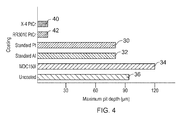
- Figure 4 depicts the maximum pit depth for a range of corrosion resistant coatings applied to two nickel alloy turbine blade (RR3010 and X4) following hot corrosion testing.
- the coatings were elemental platinum 30, aluminide 32, MDC1501 34 which is a platinum aluminide coating supplied by HOWMET and two coatings 40, 42 manufactured in accordance with the invention with between 8wt% and 30wt% chromium diffused into the platinum.
- the pit depth of an uncoated 36 blade is also shown.
- Each of the blades were hot corrosion tested by applying a medium sea salt deposition flux (1.5 ⁇ g/cm2/h) on the candidate coatings with a total exposure time of 500 hours, at an exposure temperature of 700°C.
- the gas used in the controlled atmosphere furnace was chosen to simulate a hot corrosion environment, i.e. 300vpm SO 2 -air. As can be seen from the results the pit depth following the test is significantly less in the coatings of the present invention than in conventional coatings.
- the coating formed in accordance with the present invention offers at least a doubling of life improvement as well as offering a greater than 0.5% strain to crack improvement over the prior coatings.
- the coating could be applied to other Ni based superalloys and is applicable to both HP and IP turbine blades.
- the coating could be used within the military, civil, industrial and energy based sectors where severe corrosion is limiting component lives.
- chromium rich putties offers an alternative technique for depositing chromium.
- the advantages include better control over where chromium is applied and a reduction in the level of masking as an external gas is not needed, as in CVD chromising, reducing processing time and cost.
Landscapes
- Chemical & Material Sciences (AREA)
- Engineering & Computer Science (AREA)
- Mechanical Engineering (AREA)
- Materials Engineering (AREA)
- Chemical Kinetics & Catalysis (AREA)
- Metallurgy (AREA)
- Organic Chemistry (AREA)
- General Engineering & Computer Science (AREA)
- General Chemical & Material Sciences (AREA)
- Turbine Rotor Nozzle Sealing (AREA)
- Solid-Phase Diffusion Into Metallic Material Surfaces (AREA)
Abstract
Description
- The present invention relates to environmental protection coatings and particularly environmental protection coatings that are used on the roots and shanks of gas turbine blades.
- Turbine blades used in gas turbine engines can suffer corrosion which limits the life of the component in the harsh conditions in which the turbine blade operates. Sulphidation is one form of corrosion to which the blade is susceptible and which can require early removal of the blade from the engine.
- Turbine blades are typically nickel, cobalt or iron based superalloys and conventional environmental protection coatings include silicide modified aluminide coatings or chromised coatings for lower temperature Type 2 corrosion resistance.
- In one coating described in
US6,565,931 a diffused platinum coating is applied to turbine blade aerofoils and root shanks via an electroplating process and heat treated at 1100°C to 1150°C. Applicable to Nickel based super-alloys, the coating is used as either an aerofoil bond coat or for sulphidation protection on the shanks of turbine blade roots. The platinum coating has three layers with the outer layer comprising both a gamma phase and a gamma prime phase. The outer layer of the metallic article may comprise a controlled of chromium in quantities of about 3% with an increasing level of 3-6% and 6.5% for the intermediate and inner zone respectively. At these levels of chromium it has been found that the outer layer remains as a two phase layer. - Service inspections and laboratory testing have shown that the coatings whilst providing good corrosion protection are unable to provide sufficient corrosion protection for the modern large civil engines that have entered service over the last five years. This has led to blade lifes having to be limited by sulphidation cracking that occurs once the coatings have been breached.
- The diffused platinum coating that is limited by sulphidation cracking, has been shown to only provide moderate corrosion resistance under low salt fluxes. Further understanding of the coatings structure has shown the two phase gamma-gamma prime coating to be susceptible to attack down the phase boundaries within the coating. This is believed to be responsible for the variability in corrosion protection observed depending on the specific environmental conditions for each engine examined.
- Another known process for increasing corrosion resistance is known as chromising, which is a process that increases the near surface level of chromium. For some of the older Ni based alloys this has been shown to offer an improvement in corrosion resistance under low to moderate corrosive environments. More recent turbine blade alloys, suitable for use in the majority of large civil engines including, have been shown to be incompatible with chromising, resulting in no improvement in corrosion protection. This was due to Tantalum, acting as an alloying element, which was found to concentrate in the diffusion front after chromising causing a decrease in expected life. Unexpectedly, the tantalum caused an increase in the rate of degradation due to corrosion.
- Some corrosion resistant alloys include high quantities of aluminium that form a beta phase alloy. Beta phase alloys are generally brittle and may require frequent replacement and repair during service of the component
- It is an object of the present invention that seeks to provide an improved environmental coating.
- According to a first aspect of the invention there is provided an erosion protection coating for a turbine blade, the coating comprising platinum and chromium and having a single gamma phase outer zone.
- Advantageously, the generated chromium enriched single phase outer zone does not have phase boundaries which avoids regions at which the atomic structure can change and that can cause strain due in part to a mismatch in elemental makeup
- Preferably the chromium comprises between 8 and 30wt% of the single phase outer zone. The single phase outer zone may comprise between 8 and 20wt% chromium. A high level of chromium promotes the formation of the single gamma phase outer zone.
- Aluminium may also be present in the single phase outer zone comprises at levels of up to 9wt% but preferably in amounts below 7.5%
- The single phase outer zone may comprise between9 and 23wt% chromium.
- The single phase outer zone preferably comprises between 25 to 60wt% platinum.
- The single phase outer zone preferably comprises between 20 to 40wt% nickel.
- The single phase outer zone preferably comprises between between 0 to 5wt% iron.
- Preferably the single phase outer zone is between 4 and 30 microns thick. Preferably below 20 microns thick. Preferably above 10 microns thick and below 30 microns thick. Measurements are taken from the outer surface.
- The maximum platinum diffusion zone is preferably no more than 40 microns thick.
- According to a further aspect of the invention there is provided a nickel alloy turbine blade having an erosion protection coating according to any of the preceding ten paragraphs The turbine may have a root, wherein the erosion protection coating is applied to the root. According to a further aspect of the invention there is provided a method of providing a coating on a nickel turbine blade comprising the steps of applying to the blade a coating of platinum, and heat treating to provide a platinum enriched outer layer with a thickness between 5 microns and 30microns, and diffusing chromium into the platinum to form a single phase outer zone.
- Preferably the heat treatment provides a platinum enriched outer layer that is between 5 and 11.5 microns following heat treatment.
- The outer layer may comprise between 8 and 30 wt% chromium.
- The heat treatment may comprise heating the blade to a temperature between 1000°C and 1200°C for 1 to 6 hours.
- The chromium may be deposited by chemical vapour deposition at a temperature between 875°C to 1200°C for 1 to 12 hours.
-
-
Figure 1 depicts a turbine blade mounted into a slot on a disc; -
Figure 2 depicts a blade root and shank having a coating in accordance with the invention; -
Figure 3 shows a backscattered image showing a typical platinum chromium microstructure; -
Figure 4 depicts the maximum pit depth for a number of erosion protection coatings following a corrosion test. -
Figure 1 depicts a gasturbine engine blade 10 mounted in a root slot of aturbine disc 5. The blade comprises anaerofoil 12, aplatform 14, ashank 16 and aroot 18. The blade has internal cooling passages which carry cooling air in use to allow the blade to operate at high temperatures. Theshank 16 and theroot 18 of the turbine blade have a protective coating according to the present invention. -
Figure 2 shows the coating on the blade shank and root in more detail. Thecoating 22 extends over at least the whole exterior surface of the root and shank to eliminates a demarcation line that is formed where the coating extends over the just the shank with the root uncoated. The demarcation line can provide an initiation point for stress cracking of the coating but it has been desirable with older coatings to leave the root uncoated as it can be damaged by contact with the disc slot. - The metallic turbine blade is manufactured from a nickel based superalloy, a cobalt based superalloy, or other based superalloy that comprises a gamma prime phase matrix and a gamma prime phase in the gamma phase matrix.
- A platinum layer is deposited using a standard electroplating process. Alternatively, chemical vapour deposition, physical vapour deposition, e.g. sputtering, plasma assisted chemical vapour deposition, or any other suitable process may be used provided the thickness of the deposited coating is above a defined minimum and is conformal without pores or blistering.
- The deposited platinum layer is subsequently heat treated at a temperature between 1000°C and 1200°C for 1 to 6 hours. This produces a two phase (gamma- gamma prime) coating. The heat treatment of a 7micron thick layer of platinum into the nickel base superalloy results in a platinum enriched outer layer about 25 microns to 30microns thick. The heat treatment of a 4 micron thick layer of platinum into the nickel base superalloy results in a platinum enriched outer layer about 12 to 15 microns thick. It is preferred that a layer of platinum is deposited that is between 5 and 11.5 microns and generates a outer layer that is between 5 and 30 microns
- Following formation of the platinum layer a layer of chromium is deposited onto the platinum using a chemical vapour deposition process (CVD) to diffuse in 8 to 30 wt% chromium which interdiffuses the chromium with the platinum to form a single gamma phase structure. To achieve the desired interdiffusion the CVD process is run at 875°C to 1200°C for 1 to 12 hours.
-
Figure 3 depicts a backscattered image showing a typical unetched platinum chromium microstructure on a blade root formed from nickel alloy shown at 2000x magnification. Thecoating 22 on theblade root 18 has an chromium enrichedouter zone 24 and a platinum enrichedinner zone 26.Precipitates 28 of other metals e.g. tungsten, tantalum or rhenium can form within the platinum enriched inner layer. - Advantageously, the generated chromium enriched
outer layer 24 does not have phase boundaries which avoids regions at which the atomic structure can change and that can cause strain due in part to a mismatch in elemental makeup. In a first embodiment the chromium enriched outer layer has a chemical make up that is: PT in a range 25-60 wt%, Cr between 8 and 20 wt%, Al in the range of up to 9 wt%, Ni between 20 and 40wt% and Fe between 0 and 5 wt%. - In an alternative embodiment the chromium enriched outer layer has a chemical make up that is: PT in a range 25-60 wt%, Cr between 9 and 23 wt%, Al in the range of up to 7.5 wt%, Ni between 20 and 40wt% and Fe between 0 and 5 wt%.
- It has been found that sulphur is able to penetrate preferentially down phase boundaries penetrating through the bulk of the coating to the substrate. By removing the boundaries the corrosion resistance of the coating is improved. The platinum acts as a barrier to the inward diffusion of sulphur and the outward diffusion of substrate elements such as nickel and cobalt. The inclusion of Chromium to a level between 8 and 30% creates a single phase outer zone which minimises diffusion paths down which sulphur could diffuse preferentially and enables chromium rich outer oxide scale to form on top of the coating. The combination of platinum plus chromium acts to decrease inward and outward diffusion through the coating thereby improving the incubation life and corrosion resistance of the blade.
- The chromium rich single phase layer thickness is not less than 4microns but is more preferably between 10 and 20 microns. The maximum platinum diffusion zone following all heat treatment should be no more than 40 microns and is preferably in the range of 18 to 40 microns.
- The coating described herein offers significant improvements in life by preventing the substrate from being attacked under corrosive conditions and degraded in a pitting manner from which cracks are known to initiate. The PtCr has better type II hot corrosion resistance compared to other coatings used throughout the aerospace industry, including diffused platinum, aluminising, chromising and CrAl. Mechanical testing has also shown the coating to have superior mechanical integrity. i.e the coating is more ductile than all other corrosion resistant coating systems used to protect against this form of corrosion.
- This ductility is of particular benefit as it offers greater strain resistance against cracking. Advantageously, the coating can be specified for blade features i.e. firtrees that have otherwise been out of scope for current in service corrosion resistant coatings as the stresses in these locations would have caused the coatings to crack. The ability to coat blade shanks and firtrees offers further advantages of being able to reduce the extent of masking and elimination of demarcation lines between areas coated and uncoated.
- One exemplary alloy has the following composition:
Element wt% Al 1.7 Ti 0.2 Cr 15 Fe 1.7 Co 5 Ni 26.9 Nb 0.6 Mo 0.4 Hf 0.3 Ta 2 W 1.5 Re 1 Pt Balance - Other elements such as palladium and / or iridium may be included in trace amounts.
-
Figure 4 depicts the maximum pit depth for a range of corrosion resistant coatings applied to two nickel alloy turbine blade (RR3010 and X4) following hot corrosion testing. The coatings wereelemental platinum 30,aluminide 32,MDC1501 34 which is a platinum aluminide coating supplied by HOWMET and twocoatings - The coating could be applied to other Ni based superalloys and is applicable to both HP and IP turbine blades. The coating could be used within the military, civil, industrial and energy based sectors where severe corrosion is limiting component lives.
- The use of chromium rich putties offers an alternative technique for depositing chromium. The advantages include better control over where chromium is applied and a reduction in the level of masking as an external gas is not needed, as in CVD chromising, reducing processing time and cost.
Claims (15)
- An erosion protection coating for a turbine blade, the coating comprising platinum and chromium and having a single gamma phase outer zone.
- An erosion protection coating according to claim 1, wherein the chromium comprises between 8 and 30wt% of the single gamma phase outer zone.
- An erosion protection coating according to claim 2, wherein the single phase outer zone comprises between 8 and 20wt% chromium.
- An erosion protection coating according to claim 3, wherein the single phase outer zone comprises up to 9wt% aluminium.
- An erosion protection coating according to claim 3, wherein the single phase outer zone comprises up to 7.5wt% aluminium.
- An erosion protection coating according to any preceding claim wherein the single phase outer zone comprises between 25 to 60wt% platinum.
- An erosion protection coating according to any preceding claim wherein the single phase outer zone comprises between 20 to 40wt% nickel.
- An erosion protection coating according to any preceding claim wherein the single phase outer zone comprises between 0 to 5wt% iron.
- An erosion protection coating according to any preceding claim, wherein the single phase outer zone is between 4 and 30 microns thick.
- An erosion protection coating according to claim 9, wherein the single phase outer zone is less than 20 microns thick.
- An erosion protection coating according to any preceding claim, wherein the maximum platinum diffusion zone is no more than 40 microns thick.
- A nickel alloy turbine blade having an erosion protection coating according to any of the preceding claims, wherein the erosion protection coating is applied to the root.
- A method of providing a coating on a nickel turbine blade comprising the steps of applying to the blade a coating of platinum, and heat treating to provide a platinum enriched outer layer with a thickness between 5 microns and 30microns, and diffusing chromium into the platinum to form a single phase outer zone.
- A method according to claim 13, wherein the heat treatment provides a platinum enriched outer layer that is less than 20 microns following heat treatment.
- A method according to claim 13 or claim 14, wherein the outer layer comprises between 8 and 30 wt% chromium.
Applications Claiming Priority (1)
| Application Number | Priority Date | Filing Date | Title |
|---|---|---|---|
| GB1304403.7A GB2511768A (en) | 2013-03-12 | 2013-03-12 | Erosion Resistant Coating |
Publications (1)
| Publication Number | Publication Date |
|---|---|
| EP2778258A1 true EP2778258A1 (en) | 2014-09-17 |
Family
ID=48189753
Family Applications (1)
| Application Number | Title | Priority Date | Filing Date |
|---|---|---|---|
| EP14155591.2A Ceased EP2778258A1 (en) | 2013-03-12 | 2014-02-18 | Erosion resistant coating |
Country Status (4)
| Country | Link |
|---|---|
| US (1) | US9777583B2 (en) |
| EP (1) | EP2778258A1 (en) |
| GB (1) | GB2511768A (en) |
| SG (1) | SG10201400179SA (en) |
Cited By (1)
| Publication number | Priority date | Publication date | Assignee | Title |
|---|---|---|---|---|
| WO2020128394A1 (en) * | 2018-12-21 | 2020-06-25 | Safran | Turbine part made of superalloy comprising rhenium and/or ruthenium and associated manufacturing method |
Families Citing this family (22)
| Publication number | Priority date | Publication date | Assignee | Title |
|---|---|---|---|---|
| ES2859572T3 (en) * | 2013-04-26 | 2021-10-04 | Howmet Corp | Electrodeposition of the component of the internal wing profile |
| US9587302B2 (en) | 2014-01-14 | 2017-03-07 | Praxair S.T. Technology, Inc. | Methods of applying chromium diffusion coatings onto selective regions of a component |
| US10276411B2 (en) | 2017-08-18 | 2019-04-30 | Applied Materials, Inc. | High pressure and high temperature anneal chamber |
| US11028480B2 (en) | 2018-03-19 | 2021-06-08 | Applied Materials, Inc. | Methods of protecting metallic components against corrosion using chromium-containing thin films |
| US11015252B2 (en) | 2018-04-27 | 2021-05-25 | Applied Materials, Inc. | Protection of components from corrosion |
| US11009339B2 (en) | 2018-08-23 | 2021-05-18 | Applied Materials, Inc. | Measurement of thickness of thermal barrier coatings using 3D imaging and surface subtraction methods for objects with complex geometries |
| WO2020219332A1 (en) | 2019-04-26 | 2020-10-29 | Applied Materials, Inc. | Methods of protecting aerospace components against corrosion and oxidation |
| US11535560B2 (en) | 2019-05-08 | 2022-12-27 | Praxair S.T. Technology, Inc. | Chromate-free ceramic coating compositions for hot corrosion protection of superalloy substrates |
| US11794382B2 (en) | 2019-05-16 | 2023-10-24 | Applied Materials, Inc. | Methods for depositing anti-coking protective coatings on aerospace components |
| US11697879B2 (en) | 2019-06-14 | 2023-07-11 | Applied Materials, Inc. | Methods for depositing sacrificial coatings on aerospace components |
| US11466364B2 (en) | 2019-09-06 | 2022-10-11 | Applied Materials, Inc. | Methods for forming protective coatings containing crystallized aluminum oxide |
| DE102019215220A1 (en) * | 2019-10-02 | 2021-04-08 | MTU Aero Engines AG | System with a rotor blade for a gas turbine with a blade root guard plate having a sealing section |
| US20210156267A1 (en) * | 2019-11-21 | 2021-05-27 | Applied Materials, Inc. | Methods for depositing protective coatings on turbine blades and other aerospace components |
| US11686208B2 (en) | 2020-02-06 | 2023-06-27 | Rolls-Royce Corporation | Abrasive coating for high-temperature mechanical systems |
| GB202002451D0 (en) | 2020-02-21 | 2020-04-08 | Rolls Royce Plc | Article and method of manufacturing the same |
| US11519066B2 (en) | 2020-05-21 | 2022-12-06 | Applied Materials, Inc. | Nitride protective coatings on aerospace components and methods for making the same |
| US11739429B2 (en) | 2020-07-03 | 2023-08-29 | Applied Materials, Inc. | Methods for refurbishing aerospace components |
| US12252628B2 (en) | 2020-11-06 | 2025-03-18 | Praxair S.T. Technology, Inc. | Chromate-free inorganic coating systems for hot corrosion protection of superalloy substrate |
| US12545791B2 (en) | 2022-08-30 | 2026-02-10 | Praxair S.T. Technology, Inc. | Chromate-free and phosphate-free ceramic coating compositions for hot corrosion protection of substrates |
| CN119604589A (en) | 2022-08-30 | 2025-03-11 | 普莱克斯S.T.技术有限公司 | Chromate-free and phosphate-free ceramic coating compositions for hot corrosion protection of substrates |
| US12012870B1 (en) * | 2022-11-29 | 2024-06-18 | Rtx Corporation | Machinable coating for CMC and metal interface in a turbine section |
| US12359575B2 (en) | 2022-12-13 | 2025-07-15 | Rtx Corporation | Machinable coating with thermal protection |
Citations (5)
| Publication number | Priority date | Publication date | Assignee | Title |
|---|---|---|---|---|
| EP0814178A1 (en) * | 1996-06-19 | 1997-12-29 | ROLLS-ROYCE plc | A thermal barrier coating for a superalloy article and a method of application thereof |
| US20050145503A1 (en) * | 2004-01-07 | 2005-07-07 | Honeywell International Inc. | Platinum aluminide coating and method thereof |
| US20060046091A1 (en) * | 2004-08-26 | 2006-03-02 | Murali Madhava | Chromium and active elements modified platinum aluminide coatings |
| US20060141283A1 (en) * | 2004-12-29 | 2006-06-29 | Honeywell International, Inc. | Low cost inovative diffused MCrAIY coatings |
| EP1916319A2 (en) * | 2006-10-27 | 2008-04-30 | General Electric Company | Platinium group bond coat modified for diffusion control |
Family Cites Families (4)
| Publication number | Priority date | Publication date | Assignee | Title |
|---|---|---|---|---|
| EP0567755B1 (en) * | 1992-04-29 | 1996-09-04 | WALBAR INC. (a Delaware Corporation) | Improved diffusion coating process and products |
| CA2165641C (en) * | 1994-12-24 | 2007-02-06 | David Stafford Rickerby | A method of applying a thermal barrier coating to a superalloy article and a thermal barrier coating |
| EP1094131B1 (en) | 1999-10-23 | 2004-05-06 | ROLLS-ROYCE plc | A corrosion protective coating for a metallic article and a method of applying a corrosion protective coating to a metallic article |
| US6589668B1 (en) * | 2000-06-21 | 2003-07-08 | Howmet Research Corporation | Graded platinum diffusion aluminide coating |
-
2013
- 2013-03-12 GB GB1304403.7A patent/GB2511768A/en not_active Withdrawn
-
2014
- 2014-02-18 EP EP14155591.2A patent/EP2778258A1/en not_active Ceased
- 2014-02-18 US US14/182,675 patent/US9777583B2/en active Active
- 2014-02-25 SG SG10201400179SA patent/SG10201400179SA/en unknown
Patent Citations (5)
| Publication number | Priority date | Publication date | Assignee | Title |
|---|---|---|---|---|
| EP0814178A1 (en) * | 1996-06-19 | 1997-12-29 | ROLLS-ROYCE plc | A thermal barrier coating for a superalloy article and a method of application thereof |
| US20050145503A1 (en) * | 2004-01-07 | 2005-07-07 | Honeywell International Inc. | Platinum aluminide coating and method thereof |
| US20060046091A1 (en) * | 2004-08-26 | 2006-03-02 | Murali Madhava | Chromium and active elements modified platinum aluminide coatings |
| US20060141283A1 (en) * | 2004-12-29 | 2006-06-29 | Honeywell International, Inc. | Low cost inovative diffused MCrAIY coatings |
| EP1916319A2 (en) * | 2006-10-27 | 2008-04-30 | General Electric Company | Platinium group bond coat modified for diffusion control |
Cited By (4)
| Publication number | Priority date | Publication date | Assignee | Title |
|---|---|---|---|---|
| WO2020128394A1 (en) * | 2018-12-21 | 2020-06-25 | Safran | Turbine part made of superalloy comprising rhenium and/or ruthenium and associated manufacturing method |
| FR3090696A1 (en) * | 2018-12-21 | 2020-06-26 | Safran | SUPERALLOY TURBINE PART COMPRISING RHENIUM AND / OR RUTHENIUM AND METHOD FOR MANUFACTURING SAME |
| CN113242913A (en) * | 2018-12-21 | 2021-08-10 | 赛峰集团 | Turbine component made of a rhenium and/or ruthenium containing superalloy and associated manufacturing method |
| US11873736B2 (en) | 2018-12-21 | 2024-01-16 | Safran | Turbine part made of superalloy comprising rhenium and/or ruthenium and associated manufacturing method |
Also Published As
| Publication number | Publication date |
|---|---|
| GB2511768A (en) | 2014-09-17 |
| GB201304403D0 (en) | 2013-04-24 |
| US9777583B2 (en) | 2017-10-03 |
| SG10201400179SA (en) | 2014-10-30 |
| US20140271220A1 (en) | 2014-09-18 |
Similar Documents
| Publication | Publication Date | Title |
|---|---|---|
| US9777583B2 (en) | Erosion resistant coating | |
| EP2631325A2 (en) | Coating and coating method for gas turbine component | |
| US20100330295A1 (en) | Method for providing ductile environmental coating having fatigue and corrosion resistance | |
| EP2145969B1 (en) | Economic oxidation and fatigue resistant metallic coating | |
| EP2193225B1 (en) | Bimetallic bond layer for thermal barrier coating on superalloy | |
| US6565931B1 (en) | Corrosion protective coating for a metallic article and a method of applying a corrosion protective coating to a metallic article | |
| EP1916319A2 (en) | Platinium group bond coat modified for diffusion control | |
| DE112008003460T5 (en) | Coated Super Alloy Objects | |
| GB2444611A (en) | Coating systems containing rhodium aluminide based layers | |
| US20100330393A1 (en) | Ductile environmental coating and coated article having fatigue and corrosion resistance | |
| DE112008003454T5 (en) | Thermal barrier coating systems | |
| US11248476B2 (en) | Turbine part made of superalloy comprising rhenium and/or ruthenium and associated manufacturing method | |
| EP3080329B1 (en) | Chromizing over cathodic arc coating | |
| US11293290B2 (en) | Turbine component made from superalloy comprising rhenium and associated manufacturing process | |
| JP2020515718A (en) | Superalloy turbine components and related manufacturing methods | |
| US9297089B2 (en) | Coatings for gas turbine components | |
| JP5815713B2 (en) | Alloy with ion impact surface for environmental protection | |
| RU2777682C2 (en) | Turbine part of superalloy with rhenium and/or ruthenium content and its manufacturing method | |
| Yuan et al. | Influence of Ru, Mo and Ir on the behavior of Ni-based MCrAlY coatings in high temperature oxidation |
Legal Events
| Date | Code | Title | Description |
|---|---|---|---|
| PUAI | Public reference made under article 153(3) epc to a published international application that has entered the european phase |
Free format text: ORIGINAL CODE: 0009012 |
|
| 17P | Request for examination filed |
Effective date: 20140218 |
|
| AK | Designated contracting states |
Kind code of ref document: A1 Designated state(s): AL AT BE BG CH CY CZ DE DK EE ES FI FR GB GR HR HU IE IS IT LI LT LU LV MC MK MT NL NO PL PT RO RS SE SI SK SM TR |
|
| AX | Request for extension of the european patent |
Extension state: BA ME |
|
| R17P | Request for examination filed (corrected) |
Effective date: 20150316 |
|
| RBV | Designated contracting states (corrected) |
Designated state(s): AL AT BE BG CH CY CZ DE DK EE ES FI FR GB GR HR HU IE IS IT LI LT LU LV MC MK MT NL NO PL PT RO RS SE SI SK SM TR |
|
| RAP1 | Party data changed (applicant data changed or rights of an application transferred) |
Owner name: ROLLS-ROYCE PLC |
|
| 17Q | First examination report despatched |
Effective date: 20151116 |
|
| STAA | Information on the status of an ep patent application or granted ep patent |
Free format text: STATUS: THE APPLICATION HAS BEEN REFUSED |
|
| 18R | Application refused |
Effective date: 20170518 |