EP2778128B1 - Method of thermal reduction of graphene oxide - Google Patents
Method of thermal reduction of graphene oxide Download PDFInfo
- Publication number
- EP2778128B1 EP2778128B1 EP14158166.0A EP14158166A EP2778128B1 EP 2778128 B1 EP2778128 B1 EP 2778128B1 EP 14158166 A EP14158166 A EP 14158166A EP 2778128 B1 EP2778128 B1 EP 2778128B1
- Authority
- EP
- European Patent Office
- Prior art keywords
- graphene oxide
- graphene
- temperature
- reduction
- mpa
- Prior art date
- Legal status (The legal status is an assumption and is not a legal conclusion. Google has not performed a legal analysis and makes no representation as to the accuracy of the status listed.)
- Active
Links
Images


Classifications
-
- C—CHEMISTRY; METALLURGY
- C01—INORGANIC CHEMISTRY
- C01B—NON-METALLIC ELEMENTS; COMPOUNDS THEREOF; METALLOIDS OR COMPOUNDS THEREOF NOT COVERED BY SUBCLASS C01C
- C01B32/00—Carbon; Compounds thereof
- C01B32/15—Nano-sized carbon materials
- C01B32/182—Graphene
- C01B32/184—Preparation
- C01B32/19—Preparation by exfoliation
- C01B32/192—Preparation by exfoliation starting from graphitic oxides
Definitions
- the object of the invention is a method of thermal reduction of graphene oxide by means of hot pressing. More specifically, the invention relates to a method of reduction of graphene oxide, especially in the form of powder, graphene paper, thin layers by subjecting it to a temperature and pressure under specified conditions.
- Graphene oxide is a product of oxidation of flake graphite by means of strong oxidants, Hummers method being most commonly used for this purpose.
- Graphene oxide is a specific chemical compound, the stoichiometry of which may vary within wide limits.
- Unfortunately due to the large presence of (hydroxy, epoxy, carboxy) functional groups, it is an insulator. From the point of view of industrial application and of currently conducted research - it is highly desirable in a reduced form - i.e. in the form of graphene because after the reduction, its electrical conductivity increases by several orders.
- the reduced graphene oxide is required in the form of suspensions, layers, and as a powder.
- Hot pressing is a novelty in the reduction of graphene oxide.
- the authors [13] have successfully applied the method of uniaxial hot pressing (pressure acting only in one direction) for obtaining rGO sheets.
- Another technology of hot pressing consists of subjecting the material to high pressure in all directions, which is the technology of hot isostatic pressing (HIP). It is used in the manufacture of graphene ceramic composites [14].
- hot isostatic pressing was developed for the needs of nuclear power industry and used for the first time in the late fifties of the last century. During its development, it has found use in the ceramics and foundry industries, and in materials research.
- the idea of hot isostatic pressing consists of subjecting the tested material simultaneously to high pressure, conveyed by a factor of inert gases, and to high temperature.
- certain numerical standards characterising this method were established.
- pressures possible to obtain in the chamber of hot isostatic press typically do not exceed 2000 bar (200 MPa), although in special versions of these devices, maximum pressures of 3000 bar (300 MPa) may be achievable as a standard, and in laboratory versions, i.e.
- a temperature standard is the temperature of working chamber of up to 2000 oC, achievable as a result of ohmic heating in the graphite furnace.
- this standard is the maximum temperature of 1400 oC, achievable with the use of molybdenum furnaces.
- Industrial standards for chambers start with diameters above 100 mm. In industrial practice, this implies the capacity of working zone of 1 litre and above. A typical capacity of workspace in high-temperature isostatic presses is several litres.
- Patent application CN102602925 discloses the method of reduction of graphene oxide by means of hot pressing wherein graphene oxide is subjected to hot isostatic pressing (HIP), that is, to temperature of 900-2000 °C with a simultaneous compression by inert gas at a pressure in the range of 1-100 MPa, more preferably 10-50 MPa, particularly preferably 10-40 MPa.
- HIP hot isostatic pressing
- the idea behind the invention being applied is to reduce pure graphene oxide, whether in the form of powder, paper or thin films cast or deposited on the substrate by means of hot isostatic pressing.
- the intention of preserving a very developed surface of GO powder and the use of very high pressures seem to be in contradiction. Further, it has not been reported to use this technology in the manufacture of graphene paper and thin films deposited on the substrate, although in case of using very high pressures reaching 3000 bar (300 MPa), it seems to be a justified.
- the method of reduction of graphene oxide by means of hot pressing according to the invention wherein graphene oxide is subjected to hot isostatic pressing (HIP), that is, to a high temperature with a simultaneous compression by gas from all sides, in the reactor, is characterised in that the hot isostatic pressing is carried out at a temperature of 200 °C to 3000 °C, preferably of 1000 °C to 2000 °C, and at a pressure in the range of 150 MPa to 300 MPa.
- HIP hot isostatic pressing
- the inert gas- is selected from the group consisting of nitrogen, argon, helium and a mixture thereof.
- graphene oxide is in the form of powder, thin layer or paper.
- a reactor selected from the group consisting of high-temperature isostatic press, metallurgical press and furnace for hot isostatic pressing is used.
- Graphene oxide in the form of powder 50 g
- a furnace made to order by Engineered Pressure Systems International EPSI
- a diameter of working chamber of 260 mm was used.
- the furnace was closed and flushed with argon in order to remove the air in the system.
- the argon pressure was increased to the value of 1000 bar (100 MPa).
- the system was heated until reaching the temperature of 1500 °C and the pressure of 3000 bar (300 MPa). These conditions were maintained for 30 mins, and then the temperature was lowered to room temperature. After cooling, the system was unsealed and vented, and the reduced graphene oxide in the form of non-agglomerated powder was removed from the furnace.
- Graphene oxide in the form of paper with a surface of 10 cm 2 (2.5x4 cm) was inserted into the furnace for hot isostatic pressing.
- the furnace was closed and flushed with argon in order to remove the air in the system.
- the argon pressure was increased to the value of 1000 bar (100 MPa).
- the system was heated until reaching the temperature of 2000 °C and the pressure of 3000 bar (300 MPa). These conditions were maintained for 30 mins, and then the temperature was lowered to room temperature. After cooling, the system was unsealed and vented, and the reduced graphene oxide in the form of graphene paper was removed from the furnace.
- Graphene oxide in the form of layer with a thickness of 1 to 10 nm applied on the substrate of silicon carbide (SiC) with a 2 inch diameter was inserted into the furnace for hot isostatic pressing.
- the furnace was closed and flushed with argon in order to remove the air in the system.
- the argon pressure was increased to the value of 800 bar (80 MPa).
- the system was heated until reaching the temperature of 800°C and the pressure of 2000 bar (200 MPa). These conditions were maintained for 30 mins, and then the temperature was lowered to room temperature. After cooling, the system was unsealed and vented, and the reduced graphene oxide in the form of greyish shiny layer on the SiC substrate was removed from the furnace.
- Graphene oxide paper after reduction by the method according to the present invention has one of the highest conductivities compared to the values cited in the literature. This proves a very high quality of the reduced graphene oxide obtainable by the method according to the invention, the conductivity being 2.26 ⁇ 10 5 S/m.
Landscapes
- Chemical & Material Sciences (AREA)
- Organic Chemistry (AREA)
- Engineering & Computer Science (AREA)
- Materials Engineering (AREA)
- Nanotechnology (AREA)
- Inorganic Chemistry (AREA)
- Carbon And Carbon Compounds (AREA)
- Battery Electrode And Active Subsutance (AREA)
Description
- The object of the invention is a method of thermal reduction of graphene oxide by means of hot pressing. More specifically, the invention relates to a method of reduction of graphene oxide, especially in the form of powder, graphene paper, thin layers by subjecting it to a temperature and pressure under specified conditions.
- Graphene oxide is a product of oxidation of flake graphite by means of strong oxidants, Hummers method being most commonly used for this purpose. Currently, many companies offer graphene oxide as a commercial product in the form of aqueous suspensions or powder. Graphene oxide is a specific chemical compound, the stoichiometry of which may vary within wide limits. Unfortunately, due to the large presence of (hydroxy, epoxy, carboxy) functional groups, it is an insulator. From the point of view of industrial application and of currently conducted research - it is highly desirable in a reduced form - i.e. in the form of graphene because after the reduction, its electrical conductivity increases by several orders. For further applications, the reduced graphene oxide is required in the form of suspensions, layers, and as a powder.
- Until now, attempts were made to conduct the reduction of graphene oxide by means of: chemical, electrochemical, thermal method, ultraviolet radiation, and with microwaves [1]. Among them, the thermal method is considered to be very economical and to allow easy scaling up. It requires the use of neither catalysts, like e.g. the method of reduction with UV radiation, nor functionalising compounds, which are necessary during chemical reduction in solutions. Thus, the thermal reduction has an advantage over other methods that it allows obtaining a flake graphene which is chemically very pure. Various conditions of conducting thermal reduction processes were used: temperature, atmospheric composition, pressure. Authors of the work [2] investigated dependence of the reduction degree which which can, among others, be characterised by atomic ratio C/O (carbon/oxygen) depending on temperature. According to them, for temperatures lower than 500°C, the C/O ratio was lower than 7, whereas if exceeding the temperature of 750°C, it was already 13. However, in the work [3], changes in chemical structure of graphene oxide at different temperatures of annealing were monitored by means of XPS spectra which demonstrated that for effective reduction, high temperatures above 800°C are required. A measure of reduction effectiveness may also be the electrical conductivity of the obtained product - reduced graphene oxide (rGO). [4]. It is much easier to reduce small amounts of material, e.g. applied, in the form of thin films, on various substrates having good adhesion, and such situations are numerously reflected in the literature. Works related to the reduction of graphene oxide powder are less numerous [10-12]. The main difficulty in the thermal treatment of graphene oxide powder lies in its very developed surface and in its low specific weight. Placing a loose, light powder in an open crucible, with even a small gas flow, causes blowing of the material and large losses thereof. However, covering the crucible prevents quick discharge of post-reaction gases and changes local conditions in the reaction zone, thereby deteriorating parameters of the final product. Hot pressing is a novelty in the reduction of graphene oxide. The authors [13] have successfully applied the method of uniaxial hot pressing (pressure acting only in one direction) for obtaining rGO sheets. Another technology of hot pressing consists of subjecting the material to high pressure in all directions, which is the technology of hot isostatic pressing (HIP). It is used in the manufacture of graphene ceramic composites [14].
- The technique of hot isostatic pressing was developed for the needs of nuclear power industry and used for the first time in the late fifties of the last century. During its development, it has found use in the ceramics and foundry industries, and in materials research. The idea of hot isostatic pressing consists of subjecting the tested material simultaneously to high pressure, conveyed by a factor of inert gases, and to high temperature. During development of the method, certain numerical standards characterising this method were established. Thus, pressures possible to obtain in the chamber of hot isostatic press typically do not exceed 2000 bar (200 MPa), although in special versions of these devices, maximum pressures of 3000 bar (300 MPa) may be achievable as a standard, and in laboratory versions, i.e. for pressure chambers of less than 100 mm in diameter, they can achieve 4000 bar (400 MPa). Similarly, a temperature standard is the temperature of working chamber of up to 2000 ºC, achievable as a result of ohmic heating in the graphite furnace. For the version of metallurgical presses, this standard is the maximum temperature of 1400 ºC, achievable with the use of molybdenum furnaces. From the viewpoint of industrial applications, the size of pressure chamber in high-temperature isostatic press is most important. Industrial standards for chambers start with diameters above 100 mm. In industrial practice, this implies the capacity of working zone of 1 litre and above. A typical capacity of workspace in high-temperature isostatic presses is several litres. It does not result from technical conditions of the construction of high-pressure chambers, but only from operational restrictions. This is evidenced by operating, record industrial installations of this type of presses. The largest among them, being currently operated, operate with high-pressure chambers with a diameter of 70 inches (about 178 cm), which results in a several hundred litres of workspace. It follows that for the technology of high-temperature hot isostatic pressing, there is not practically any problem with "scaling up" (i.e. scaling in the range of volume of working chambers of presses and in the range of volume of a single batch of processed material). The devices described in this paragraph are known and commercially available, possibly made for individual orders.
- Patent application
CN102602925 discloses the method of reduction of graphene oxide by means of hot pressing wherein graphene oxide is subjected to hot isostatic pressing (HIP), that is, to temperature of 900-2000 °C with a simultaneous compression by inert gas at a pressure in the range of 1-100 MPa, more preferably 10-50 MPa, particularly preferably 10-40 MPa. - However, the HIP technology as claimed has not ever been used for the reduction of graphene oxide in order to remove functional groups and for restoration of the sp2 hybridisation, characteristic for chemically pure, non-defective graphene. And this is a condition for achieving good electrical conductivity - one of the most important operational parameters of this "unusual" material.
- The idea behind the invention being applied is to reduce pure graphene oxide, whether in the form of powder, paper or thin films cast or deposited on the substrate by means of hot isostatic pressing. The intention of preserving a very developed surface of GO powder and the use of very high pressures seem to be in contradiction. Further, it has not been reported to use this technology in the manufacture of graphene paper and thin films deposited on the substrate, although in case of using very high pressures reaching 3000 bar (300 MPa), it seems to be a justified.
- Numbers enclosed in square brackets above refer to the following publications of the prior art:
- 1. Carbon 50 (2012) 3210-3228, S. Pei, H.M. Cheng, "The reduction of graphene oxide".
- 2. J. Phys. Chem. B 110 (2006) 8535-8539, H. C. Schniepp et al., "Functionalized single graphene sheets derived from splitting graphite oxide".
- 3. J. Am. Chem. Soc. 131 (2009)15939-44, X. Li et al., "Simultaneous nitrogen doping and reduction of graphene oxide".
- 4. Nano Lett. 8 (2008) 323-327, Xuan Wang et al., "Transparent, Conductive Graphene Electrodes for Dye-Sensitized Solar Cells".
- 5. Materials Letters 64 (2010) 765-767, Tran Viet Cuong et al., "Optoelectronic properties of graphene thin films prepared by thermal reduction of graphene oxide".
- 6. Carbon 49 (2011) 2905-2916, Qing Bin Zheng et al., "Improved electrical and optical characteristics of transparent graphene thin films produced by acid and doping treatments".
- 7. Materials Research Bulletin 46 (2011) 2131-2134, A. Wei et al., "Synthesis of high-performance graphene nanosheets by thermal reduction of grapheme oxide".
- 8. Chemical Physics Letters 511 (2011) 110-115, Chan-Jun Kim et al., "Structural evolution of graphite oxide during heat treatment".
- 9. Carbon 50 (2012) 659-667, C. M. Chen et al., "Annealing a graphene oxide film to produce a free standing high conductive grapheme film".
- 10. Adv. Funct. Mater. 21 (2011) 3496-3501, Meihua Jin et al., "Facile Physical Route to Highly Crystalline Graphene".
- 11. Carbon 48 (2010) 1146-1152, W. Chen, I. Yan, P. R. Bangal, "Preparation of graphene by the rapid and mild thermal reduction of graphene oxide induced by microwaves".
- 12. Carbon Letters 13 (2013) 48-50, S. Lee, S. Park, "Facile mass production of thermally reduced grapheme oxide".
- 13. Carbon 54 (2013) 143-148, Y. Zhang et al., "High quality graphene sheets from graphene oxide by hot-pressing".
- 14. Materials Science and Engineering A 528 (2011) 7933-7937, S. F. Bartolucci et al., "Graphene-aluminum nanocomposites".
- The method of reduction of graphene oxide by means of hot pressing according to the invention, wherein graphene oxide is subjected to hot isostatic pressing (HIP), that is, to a high temperature with a simultaneous compression by gas from all sides, in the reactor, is characterised in that the hot isostatic pressing is carried out at a temperature of 200 °C to 3000 °C, preferably of 1000 °C to 2000 °C, and at a pressure in the range of 150 MPa to 300 MPa.
- Preferably, the inert gas-is selected from the group consisting of nitrogen, argon, helium and a mixture thereof.
- Preferably, graphene oxide is in the form of powder, thin layer or paper.
- Preferably, a reactor selected from the group consisting of high-temperature isostatic press, metallurgical press and furnace for hot isostatic pressing is used.
- Now, the invention will be presented in greater detail in preferred embodiments, with reference to the accompanying drawings in which:
- Fig. 1
- shows a characteristic Raman spectrum of reduced graphene oxide, obtained by the method according to the invention,
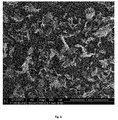
- fig. 2
- shows an SEM image of dried graphene powder, obtained by the method according to the invention, under low magnification,
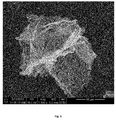
- fig. 3
- shows an SEM image of graphene powder, obtained by the method according to the invention, under high magnification, with visible structure of a single flake,
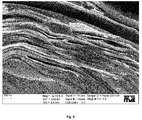
- fig. 4
- shows an SEM image of graphene paper, obtained by the method according to the invention, under high magnification, with visible structure composed of packets of graphene layers,
- fig. 5
- shows an FTIR spectrum of graphene oxide effectively reduced according to the invention in the form of graphene paper (graphene paper, annealing at 2000 ºC, 300 MPa - Example II).
- Graphene oxide in the form of powder (50 g), placed in a graphite crucible, was inserted into the furnace for hot isostatic pressing. Such furnace is a device known in the art and commercially available. To perform this and subsequent processes described in the present application, a furnace made to order by Engineered Pressure Systems International (EPSI) with a diameter of working chamber of 260 mm was used. The furnace was closed and flushed with argon in order to remove the air in the system. By means of a high performance pump, the argon pressure was increased to the value of 1000 bar (100 MPa). Then, the system was heated until reaching the temperature of 1500 °C and the pressure of 3000 bar (300 MPa). These conditions were maintained for 30 mins, and then the temperature was lowered to room temperature. After cooling, the system was unsealed and vented, and the reduced graphene oxide in the form of non-agglomerated powder was removed from the furnace.
- Graphene oxide in the form of paper with a surface of 10 cm2 (2.5x4 cm) was inserted into the furnace for hot isostatic pressing. The furnace was closed and flushed with argon in order to remove the air in the system. By means of a high performance pump, the argon pressure was increased to the value of 1000 bar (100 MPa). Then, the system was heated until reaching the temperature of 2000 °C and the pressure of 3000 bar (300 MPa). These conditions were maintained for 30 mins, and then the temperature was lowered to room temperature. After cooling, the system was unsealed and vented, and the reduced graphene oxide in the form of graphene paper was removed from the furnace.
- Graphene oxide in the form of layer with a thickness of 1 to 10 nm applied on the substrate of silicon carbide (SiC) with a 2 inch diameter was inserted into the furnace for hot isostatic pressing. The furnace was closed and flushed with argon in order to remove the air in the system. By means of a high performance pump, the argon pressure was increased to the value of 800 bar (80 MPa). Then, the system was heated until reaching the temperature of 800°C and the pressure of 2000 bar (200 MPa). These conditions were maintained for 30 mins, and then the temperature was lowered to room temperature. After cooling, the system was unsealed and vented, and the reduced graphene oxide in the form of greyish shiny layer on the SiC substrate was removed from the furnace.
- According to the following literature data [15,16], electrical conductivity of graphene paper is 190 to 5.71 × 10⁵ S/m. Wherein such a high conductivity value was obtained through a combination of chemical reduction (with hydrazine) and of lengthy annealing at high temperatures (up to 2700 °C).
- 15. Nano Res DOI: 10.1007/s12274-013-0298-6 R. Rozada, et al. "Towards full repair of defects in reduced graphene oxide films by two-step graphitization".
- 16. C. Valles,et al., Carbon 50 (2012), 835-844, "Flexible conductive graphene paper obtained by direct and gentle annealing of graphene oxide paper".
- Graphene oxide paper after reduction by the method according to the present invention has one of the highest conductivities compared to the values cited in the literature. This proves a very high quality of the reduced graphene oxide obtainable by the method according to the invention, the conductivity being 2.26 × 10⁵ S/m.
- The reduced graphene oxide obtained in the examples described above was characterised and the results are illustrated in
Figs. 1-5 .
Claims (4)
- A method of reduction of graphene oxide by means of hot pressing, wherein graphene oxide is subjected to hot isostatic pressing (HIP), that is, to a high temperature with a simultaneous compression by inert gas from all sides, in a reactor, characterised in that the hot isostatic pressing is carried out at a temperature of 200 °C to 3000 °C, preferably of 1000 °C to 2000 °C, and at a pressure in the range of 150 MPa to 300 MPa.
- The method according to any one of the preceding claims, characterised in that the inert gas is selected from the group consisting of nitrogen, argon, helium and a mixture thereof.
- The method according to any one of the preceding claims, characterised in that graphene oxide is in the form of powder, thin layer or paper.
- The method according to any one of the preceding claims, characterised in that a reactor is selected from the group consisting of high-temperature isostatic press, metallurgical press, furnace for hot isostatic pressing is used.
Applications Claiming Priority (1)
| Application Number | Priority Date | Filing Date | Title |
|---|---|---|---|
| PL403168A PL218099B1 (en) | 2013-03-15 | 2013-03-15 | Method for thermal reduction of graphene oxide |
Publications (2)
| Publication Number | Publication Date |
|---|---|
| EP2778128A1 EP2778128A1 (en) | 2014-09-17 |
| EP2778128B1 true EP2778128B1 (en) | 2016-03-02 |
Family
ID=49036247
Family Applications (1)
| Application Number | Title | Priority Date | Filing Date |
|---|---|---|---|
| EP14158166.0A Active EP2778128B1 (en) | 2013-03-15 | 2014-03-06 | Method of thermal reduction of graphene oxide |
Country Status (2)
| Country | Link |
|---|---|
| EP (1) | EP2778128B1 (en) |
| PL (1) | PL218099B1 (en) |
Families Citing this family (4)
| Publication number | Priority date | Publication date | Assignee | Title |
|---|---|---|---|---|
| PL405154A1 (en) | 2013-08-28 | 2015-03-02 | Instytut Technologii Materiałów Elektronicznych | Method of preparing graphene paper |
| US9637387B2 (en) * | 2014-01-17 | 2017-05-02 | Shenzhen Cantonnet Energy Services Co., Ltd | Method for repairing reduced graphene oxide |
| CN110407196B (en) * | 2019-08-23 | 2022-03-15 | 哈尔滨工业大学 | A kind of preparation method of low-defect graphene film based on graphene foam |
| CN116675221B (en) * | 2023-06-01 | 2024-04-09 | 南京工业大学 | Graphene film with high electrical conductivity and high thermal conductivity as well as preparation method and application thereof |
Family Cites Families (2)
| Publication number | Priority date | Publication date | Assignee | Title |
|---|---|---|---|---|
| US8691179B2 (en) * | 2011-01-04 | 2014-04-08 | Korea Institute Of Science And Technology | Method for fabricating graphene sheets or graphene particles using supercritical fluid |
| CN102602925B (en) * | 2012-04-13 | 2016-01-13 | 常州第六元素材料科技股份有限公司 | The method of Graphene is prepared in a kind of high pressure reduction |
-
2013
- 2013-03-15 PL PL403168A patent/PL218099B1/en unknown
-
2014
- 2014-03-06 EP EP14158166.0A patent/EP2778128B1/en active Active
Non-Patent Citations (1)
| Title |
|---|
| NAN WU ET AL: "Synthesis of network reduced graphene oxide in polystyrene matrix by a two-step reduction method for superior conductivity of the composite", JOURNAL OF MATERIALS CHEMISTRY, vol. 22, no. 33, 22 June 2012 (2012-06-22), pages 17254, XP055205681, ISSN: 0959-9428, DOI: 10.1039/c2jm33114d * |
Also Published As
| Publication number | Publication date |
|---|---|
| EP2778128A1 (en) | 2014-09-17 |
| PL218099B1 (en) | 2014-10-31 |
| PL403168A1 (en) | 2013-09-02 |
Similar Documents
| Publication | Publication Date | Title |
|---|---|---|
| CN108251076B (en) | Carbon nanotube-graphene composite heat dissipation film, and preparation method and application thereof | |
| CN102120572B (en) | Method for preparing nitrogen-doped graphene | |
| Sun et al. | High quality graphene films with a clean surface prepared by an UV/ozone assisted transfer process | |
| CN102603271B (en) | Graphene and oxide ceramic composite material and preparation method | |
| WO2007119526A1 (en) | In-line heater and method for manufacturing same | |
| US20150151973A1 (en) | Covalently-bonded graphene coating and its applications thereof | |
| Liu et al. | Synthesis of nitrogen-doped graphene by pyrolysis of ionic-liquid-functionalized graphene | |
| WO2017082147A1 (en) | Coating formed on graphite substrate and method for producing same | |
| EP2778128A1 (en) | Method of thermal reduction of graphene oxide | |
| Wypych | Graphene: Important results and applications | |
| Nguyen et al. | Strength improvement and purification of Yb2Si2O7‐SiC nanocomposites by surface oxidation treatment | |
| CN105568253A (en) | Method for growing hexagonal boron nitride by plasma chemical vapor deposition equipment | |
| CN104495765B (en) | A kind of method utilizing porous silicon to prepare alpha-phase silicon nitride | |
| JP2019206447A (en) | Method of producing graphite molding | |
| Su et al. | Flash sintering of alumina/reduced graphene oxide composites | |
| CN110923591B (en) | Preparation method and application of graphene | |
| CN103723717A (en) | Preparation method of nitrogen-doped graphene thin film | |
| CN111058017B (en) | Graphene metal composite wire and low-temperature continuous preparation method thereof | |
| CN103213976B (en) | Method for directly preparing graphene on surface of substrate | |
| WO2000045621A1 (en) | Carbon-based heating unit and method for preparation thereof | |
| KR102287921B1 (en) | Graphite sheet and method for preparing same | |
| Matsubara et al. | Preparation and properties of graphite grown in vapor phase | |
| CN103613092B (en) | A kind of preparation method of boron doped graphene | |
| Zhu et al. | Carbon nanotube films with ultrahigh thermal-shock and thermal-shock-fatigue resistance characterized by ultra-fast ascending shock testing | |
| CN1281487C (en) | Method fro directly synthesizing diamond by sintering nanometer carbon tube under low-pressure |
Legal Events
| Date | Code | Title | Description |
|---|---|---|---|
| 17P | Request for examination filed |
Effective date: 20140306 |
|
| AK | Designated contracting states |
Kind code of ref document: A1 Designated state(s): AL AT BE BG CH CY CZ DE DK EE ES FI FR GB GR HR HU IE IS IT LI LT LU LV MC MK MT NL NO PL PT RO RS SE SI SK SM TR |
|
| AX | Request for extension of the european patent |
Extension state: BA ME |
|
| PUAI | Public reference made under article 153(3) epc to a published international application that has entered the european phase |
Free format text: ORIGINAL CODE: 0009012 |
|
| R17P | Request for examination filed (corrected) |
Effective date: 20150316 |
|
| RBV | Designated contracting states (corrected) |
Designated state(s): AL AT BE BG CH CY CZ DE DK EE ES FI FR GB GR HR HU IE IS IT LI LT LU LV MC MK MT NL NO PL PT RO RS SE SI SK SM TR |
|
| GRAP | Despatch of communication of intention to grant a patent |
Free format text: ORIGINAL CODE: EPIDOSNIGR1 |
|
| INTG | Intention to grant announced |
Effective date: 20150917 |
|
| GRAS | Grant fee paid |
Free format text: ORIGINAL CODE: EPIDOSNIGR3 |
|
| GRAA | (expected) grant |
Free format text: ORIGINAL CODE: 0009210 |
|
| AK | Designated contracting states |
Kind code of ref document: B1 Designated state(s): AL AT BE BG CH CY CZ DE DK EE ES FI FR GB GR HR HU IE IS IT LI LT LU LV MC MK MT NL NO PL PT RO RS SE SI SK SM TR |
|
| REG | Reference to a national code |
Ref country code: GB Ref legal event code: FG4D Ref country code: FR Ref legal event code: PLFP Year of fee payment: 3 |
|
| REG | Reference to a national code |
Ref country code: AT Ref legal event code: REF Ref document number: 777899 Country of ref document: AT Kind code of ref document: T Effective date: 20160315 Ref country code: CH Ref legal event code: EP |
|
| REG | Reference to a national code |
Ref country code: IE Ref legal event code: FG4D |
|
| REG | Reference to a national code |
Ref country code: DE Ref legal event code: R096 Ref document number: 602014000966 Country of ref document: DE |
|
| REG | Reference to a national code |
Ref country code: NL Ref legal event code: MP Effective date: 20160302 |
|
| REG | Reference to a national code |
Ref country code: LT Ref legal event code: MG4D |
|
| REG | Reference to a national code |
Ref country code: AT Ref legal event code: MK05 Ref document number: 777899 Country of ref document: AT Kind code of ref document: T Effective date: 20160302 |
|
| PG25 | Lapsed in a contracting state [announced via postgrant information from national office to epo] |
Ref country code: NO Free format text: LAPSE BECAUSE OF FAILURE TO SUBMIT A TRANSLATION OF THE DESCRIPTION OR TO PAY THE FEE WITHIN THE PRESCRIBED TIME-LIMIT Effective date: 20160602 Ref country code: FI Free format text: LAPSE BECAUSE OF FAILURE TO SUBMIT A TRANSLATION OF THE DESCRIPTION OR TO PAY THE FEE WITHIN THE PRESCRIBED TIME-LIMIT Effective date: 20160302 Ref country code: GR Free format text: LAPSE BECAUSE OF FAILURE TO SUBMIT A TRANSLATION OF THE DESCRIPTION OR TO PAY THE FEE WITHIN THE PRESCRIBED TIME-LIMIT Effective date: 20160603 Ref country code: HR Free format text: LAPSE BECAUSE OF FAILURE TO SUBMIT A TRANSLATION OF THE DESCRIPTION OR TO PAY THE FEE WITHIN THE PRESCRIBED TIME-LIMIT Effective date: 20160302 Ref country code: ES Free format text: LAPSE BECAUSE OF FAILURE TO SUBMIT A TRANSLATION OF THE DESCRIPTION OR TO PAY THE FEE WITHIN THE PRESCRIBED TIME-LIMIT Effective date: 20160302 |
|
| PG25 | Lapsed in a contracting state [announced via postgrant information from national office to epo] |
Ref country code: LV Free format text: LAPSE BECAUSE OF FAILURE TO SUBMIT A TRANSLATION OF THE DESCRIPTION OR TO PAY THE FEE WITHIN THE PRESCRIBED TIME-LIMIT Effective date: 20160302 Ref country code: LT Free format text: LAPSE BECAUSE OF FAILURE TO SUBMIT A TRANSLATION OF THE DESCRIPTION OR TO PAY THE FEE WITHIN THE PRESCRIBED TIME-LIMIT Effective date: 20160302 Ref country code: PL Free format text: LAPSE BECAUSE OF FAILURE TO SUBMIT A TRANSLATION OF THE DESCRIPTION OR TO PAY THE FEE WITHIN THE PRESCRIBED TIME-LIMIT Effective date: 20160302 Ref country code: RS Free format text: LAPSE BECAUSE OF FAILURE TO SUBMIT A TRANSLATION OF THE DESCRIPTION OR TO PAY THE FEE WITHIN THE PRESCRIBED TIME-LIMIT Effective date: 20160302 Ref country code: AT Free format text: LAPSE BECAUSE OF FAILURE TO SUBMIT A TRANSLATION OF THE DESCRIPTION OR TO PAY THE FEE WITHIN THE PRESCRIBED TIME-LIMIT Effective date: 20160302 Ref country code: BE Free format text: LAPSE BECAUSE OF NON-PAYMENT OF DUE FEES Effective date: 20160331 Ref country code: NL Free format text: LAPSE BECAUSE OF FAILURE TO SUBMIT A TRANSLATION OF THE DESCRIPTION OR TO PAY THE FEE WITHIN THE PRESCRIBED TIME-LIMIT Effective date: 20160302 Ref country code: SE Free format text: LAPSE BECAUSE OF FAILURE TO SUBMIT A TRANSLATION OF THE DESCRIPTION OR TO PAY THE FEE WITHIN THE PRESCRIBED TIME-LIMIT Effective date: 20160302 |
|
| PG25 | Lapsed in a contracting state [announced via postgrant information from national office to epo] |
Ref country code: EE Free format text: LAPSE BECAUSE OF FAILURE TO SUBMIT A TRANSLATION OF THE DESCRIPTION OR TO PAY THE FEE WITHIN THE PRESCRIBED TIME-LIMIT Effective date: 20160302 Ref country code: IS Free format text: LAPSE BECAUSE OF FAILURE TO SUBMIT A TRANSLATION OF THE DESCRIPTION OR TO PAY THE FEE WITHIN THE PRESCRIBED TIME-LIMIT Effective date: 20160702 |
|
| REG | Reference to a national code |
Ref country code: DE Ref legal event code: R079 Ref document number: 602014000966 Country of ref document: DE Free format text: PREVIOUS MAIN CLASS: C01B0031040000 Ipc: C01B0032200000 |
|
| PG25 | Lapsed in a contracting state [announced via postgrant information from national office to epo] |
Ref country code: SK Free format text: LAPSE BECAUSE OF FAILURE TO SUBMIT A TRANSLATION OF THE DESCRIPTION OR TO PAY THE FEE WITHIN THE PRESCRIBED TIME-LIMIT Effective date: 20160302 Ref country code: PT Free format text: LAPSE BECAUSE OF FAILURE TO SUBMIT A TRANSLATION OF THE DESCRIPTION OR TO PAY THE FEE WITHIN THE PRESCRIBED TIME-LIMIT Effective date: 20160704 Ref country code: RO Free format text: LAPSE BECAUSE OF FAILURE TO SUBMIT A TRANSLATION OF THE DESCRIPTION OR TO PAY THE FEE WITHIN THE PRESCRIBED TIME-LIMIT Effective date: 20160302 Ref country code: CZ Free format text: LAPSE BECAUSE OF FAILURE TO SUBMIT A TRANSLATION OF THE DESCRIPTION OR TO PAY THE FEE WITHIN THE PRESCRIBED TIME-LIMIT Effective date: 20160302 Ref country code: SM Free format text: LAPSE BECAUSE OF FAILURE TO SUBMIT A TRANSLATION OF THE DESCRIPTION OR TO PAY THE FEE WITHIN THE PRESCRIBED TIME-LIMIT Effective date: 20160302 |
|
| REG | Reference to a national code |
Ref country code: DE Ref legal event code: R097 Ref document number: 602014000966 Country of ref document: DE |
|
| PG25 | Lapsed in a contracting state [announced via postgrant information from national office to epo] |
Ref country code: BE Free format text: LAPSE BECAUSE OF FAILURE TO SUBMIT A TRANSLATION OF THE DESCRIPTION OR TO PAY THE FEE WITHIN THE PRESCRIBED TIME-LIMIT Effective date: 20160302 Ref country code: IT Free format text: LAPSE BECAUSE OF FAILURE TO SUBMIT A TRANSLATION OF THE DESCRIPTION OR TO PAY THE FEE WITHIN THE PRESCRIBED TIME-LIMIT Effective date: 20160302 |
|
| PLBE | No opposition filed within time limit |
Free format text: ORIGINAL CODE: 0009261 |
|
| STAA | Information on the status of an ep patent application or granted ep patent |
Free format text: STATUS: NO OPPOSITION FILED WITHIN TIME LIMIT |
|
| PG25 | Lapsed in a contracting state [announced via postgrant information from national office to epo] |
Ref country code: DK Free format text: LAPSE BECAUSE OF FAILURE TO SUBMIT A TRANSLATION OF THE DESCRIPTION OR TO PAY THE FEE WITHIN THE PRESCRIBED TIME-LIMIT Effective date: 20160302 |
|
| 26N | No opposition filed |
Effective date: 20161205 |
|
| PG25 | Lapsed in a contracting state [announced via postgrant information from national office to epo] |
Ref country code: BG Free format text: LAPSE BECAUSE OF FAILURE TO SUBMIT A TRANSLATION OF THE DESCRIPTION OR TO PAY THE FEE WITHIN THE PRESCRIBED TIME-LIMIT Effective date: 20160602 Ref country code: SI Free format text: LAPSE BECAUSE OF FAILURE TO SUBMIT A TRANSLATION OF THE DESCRIPTION OR TO PAY THE FEE WITHIN THE PRESCRIBED TIME-LIMIT Effective date: 20160302 |
|
| REG | Reference to a national code |
Ref country code: FR Ref legal event code: PLFP Year of fee payment: 4 |
|
| PG25 | Lapsed in a contracting state [announced via postgrant information from national office to epo] |
Ref country code: MT Free format text: LAPSE BECAUSE OF FAILURE TO SUBMIT A TRANSLATION OF THE DESCRIPTION OR TO PAY THE FEE WITHIN THE PRESCRIBED TIME-LIMIT Effective date: 20160302 |
|
| REG | Reference to a national code |
Ref country code: FR Ref legal event code: PLFP Year of fee payment: 5 |
|
| PG25 | Lapsed in a contracting state [announced via postgrant information from national office to epo] |
Ref country code: HU Free format text: LAPSE BECAUSE OF FAILURE TO SUBMIT A TRANSLATION OF THE DESCRIPTION OR TO PAY THE FEE WITHIN THE PRESCRIBED TIME-LIMIT; INVALID AB INITIO Effective date: 20140306 |
|
| PG25 | Lapsed in a contracting state [announced via postgrant information from national office to epo] |
Ref country code: CY Free format text: LAPSE BECAUSE OF FAILURE TO SUBMIT A TRANSLATION OF THE DESCRIPTION OR TO PAY THE FEE WITHIN THE PRESCRIBED TIME-LIMIT Effective date: 20160302 Ref country code: MK Free format text: LAPSE BECAUSE OF FAILURE TO SUBMIT A TRANSLATION OF THE DESCRIPTION OR TO PAY THE FEE WITHIN THE PRESCRIBED TIME-LIMIT Effective date: 20160302 Ref country code: LU Free format text: LAPSE BECAUSE OF NON-PAYMENT OF DUE FEES Effective date: 20160306 Ref country code: MC Free format text: LAPSE BECAUSE OF FAILURE TO SUBMIT A TRANSLATION OF THE DESCRIPTION OR TO PAY THE FEE WITHIN THE PRESCRIBED TIME-LIMIT Effective date: 20160302 Ref country code: MT Free format text: LAPSE BECAUSE OF FAILURE TO SUBMIT A TRANSLATION OF THE DESCRIPTION OR TO PAY THE FEE WITHIN THE PRESCRIBED TIME-LIMIT Effective date: 20160331 Ref country code: TR Free format text: LAPSE BECAUSE OF FAILURE TO SUBMIT A TRANSLATION OF THE DESCRIPTION OR TO PAY THE FEE WITHIN THE PRESCRIBED TIME-LIMIT Effective date: 20160302 |
|
| PG25 | Lapsed in a contracting state [announced via postgrant information from national office to epo] |
Ref country code: AL Free format text: LAPSE BECAUSE OF FAILURE TO SUBMIT A TRANSLATION OF THE DESCRIPTION OR TO PAY THE FEE WITHIN THE PRESCRIBED TIME-LIMIT Effective date: 20160302 |
|
| GBPC | Gb: european patent ceased through non-payment of renewal fee |
Effective date: 20180306 |
|
| PG25 | Lapsed in a contracting state [announced via postgrant information from national office to epo] |
Ref country code: GB Free format text: LAPSE BECAUSE OF NON-PAYMENT OF DUE FEES Effective date: 20180306 |
|
| PGFP | Annual fee paid to national office [announced via postgrant information from national office to epo] |
Ref country code: CH Payment date: 20210319 Year of fee payment: 8 |
|
| REG | Reference to a national code |
Ref country code: CH Ref legal event code: PL |
|
| PG25 | Lapsed in a contracting state [announced via postgrant information from national office to epo] |
Ref country code: LI Free format text: LAPSE BECAUSE OF NON-PAYMENT OF DUE FEES Effective date: 20220331 Ref country code: CH Free format text: LAPSE BECAUSE OF NON-PAYMENT OF DUE FEES Effective date: 20220331 |
|
| PGFP | Annual fee paid to national office [announced via postgrant information from national office to epo] |
Ref country code: IE Payment date: 20260227 Year of fee payment: 13 Ref country code: DE Payment date: 20260227 Year of fee payment: 13 |
|
| PGFP | Annual fee paid to national office [announced via postgrant information from national office to epo] |
Ref country code: FR Payment date: 20260226 Year of fee payment: 13 |