EP2777933A1 - Composite material - Google Patents
Composite material Download PDFInfo
- Publication number
- EP2777933A1 EP2777933A1 EP12830851.7A EP12830851A EP2777933A1 EP 2777933 A1 EP2777933 A1 EP 2777933A1 EP 12830851 A EP12830851 A EP 12830851A EP 2777933 A1 EP2777933 A1 EP 2777933A1
- Authority
- EP
- European Patent Office
- Prior art keywords
- polyimide
- film
- polybenzoxazole
- inorganic filler
- varnish
- Prior art date
- Legal status (The legal status is an assumption and is not a legal conclusion. Google has not performed a legal analysis and makes no representation as to the accuracy of the status listed.)
- Withdrawn
Links
- 239000002131 composite material Substances 0.000 title claims abstract description 93
- 229920001721 polyimide Polymers 0.000 claims abstract description 242
- 239000011256 inorganic filler Substances 0.000 claims abstract description 216
- 229910003475 inorganic filler Inorganic materials 0.000 claims abstract description 216
- 229920002577 polybenzoxazole Polymers 0.000 claims abstract description 208
- 239000004642 Polyimide Substances 0.000 claims abstract description 183
- 239000002966 varnish Substances 0.000 claims abstract description 169
- 239000002243 precursor Substances 0.000 claims abstract description 127
- 239000004693 Polybenzimidazole Substances 0.000 claims abstract description 122
- 229920002480 polybenzimidazole Polymers 0.000 claims abstract description 121
- 239000004952 Polyamide Substances 0.000 claims abstract description 93
- 239000002253 acid Substances 0.000 claims abstract description 93
- 229920002647 polyamide Polymers 0.000 claims abstract description 93
- 239000000463 material Substances 0.000 claims abstract description 87
- 238000000465 moulding Methods 0.000 claims abstract description 66
- OKTJSMMVPCPJKN-UHFFFAOYSA-N Carbon Chemical compound [C] OKTJSMMVPCPJKN-UHFFFAOYSA-N 0.000 claims abstract description 38
- 239000010439 graphite Substances 0.000 claims abstract description 36
- 229910002804 graphite Inorganic materials 0.000 claims abstract description 36
- 239000011347 resin Substances 0.000 claims abstract description 32
- 229920005989 resin Polymers 0.000 claims abstract description 32
- 229920000343 polyazomethine Polymers 0.000 claims abstract description 30
- 239000000835 fiber Substances 0.000 claims abstract description 28
- 239000012784 inorganic fiber Substances 0.000 claims abstract description 22
- 239000009719 polyimide resin Substances 0.000 claims abstract description 22
- 238000001035 drying Methods 0.000 claims abstract description 17
- 239000004927 clay Substances 0.000 claims description 35
- -1 silicate compound Chemical class 0.000 claims description 25
- ISWSIDIOOBJBQZ-UHFFFAOYSA-N phenol group Chemical group C1(=CC=CC=C1)O ISWSIDIOOBJBQZ-UHFFFAOYSA-N 0.000 claims description 24
- 230000017525 heat dissipation Effects 0.000 abstract description 21
- 239000010425 asbestos Substances 0.000 abstract description 5
- 229910052895 riebeckite Inorganic materials 0.000 abstract description 5
- 239000012528 membrane Substances 0.000 description 88
- 239000000243 solution Substances 0.000 description 82
- 229920001577 copolymer Polymers 0.000 description 50
- 239000010410 layer Substances 0.000 description 38
- 239000002994 raw material Substances 0.000 description 30
- 238000004519 manufacturing process Methods 0.000 description 28
- 230000004888 barrier function Effects 0.000 description 26
- 238000010438 heat treatment Methods 0.000 description 26
- 238000009413 insulation Methods 0.000 description 19
- 238000000034 method Methods 0.000 description 19
- 229910052809 inorganic oxide Inorganic materials 0.000 description 16
- 150000004767 nitrides Chemical class 0.000 description 16
- 239000000126 substance Substances 0.000 description 15
- 238000003860 storage Methods 0.000 description 14
- 239000013078 crystal Substances 0.000 description 13
- 239000000203 mixture Substances 0.000 description 13
- 150000008065 acid anhydrides Chemical class 0.000 description 12
- 239000003960 organic solvent Substances 0.000 description 12
- 230000007423 decrease Effects 0.000 description 11
- 238000006243 chemical reaction Methods 0.000 description 10
- ZMXDDKWLCZADIW-UHFFFAOYSA-N N,N-Dimethylformamide Chemical compound CN(C)C=O ZMXDDKWLCZADIW-UHFFFAOYSA-N 0.000 description 9
- IAZDPXIOMUYVGZ-UHFFFAOYSA-N Dimethylsulphoxide Chemical compound CS(C)=O IAZDPXIOMUYVGZ-UHFFFAOYSA-N 0.000 description 6
- ZCQWOFVYLHDMMC-UHFFFAOYSA-N Oxazole Chemical compound C1=COC=N1 ZCQWOFVYLHDMMC-UHFFFAOYSA-N 0.000 description 6
- 125000003277 amino group Chemical group 0.000 description 6
- 150000008430 aromatic amides Chemical class 0.000 description 6
- 150000004982 aromatic amines Chemical class 0.000 description 6
- 230000006866 deterioration Effects 0.000 description 6
- 239000000945 filler Substances 0.000 description 6
- 238000012856 packing Methods 0.000 description 6
- 239000000843 powder Substances 0.000 description 6
- 230000001070 adhesive effect Effects 0.000 description 5
- 239000011248 coating agent Substances 0.000 description 5
- 238000000576 coating method Methods 0.000 description 5
- 150000001875 compounds Chemical class 0.000 description 5
- BPQQTUXANYXVAA-UHFFFAOYSA-N Orthosilicate Chemical compound [O-][Si]([O-])([O-])[O-] BPQQTUXANYXVAA-UHFFFAOYSA-N 0.000 description 4
- 239000002313 adhesive film Substances 0.000 description 4
- 239000003054 catalyst Substances 0.000 description 4
- 239000002734 clay mineral Substances 0.000 description 4
- 230000018044 dehydration Effects 0.000 description 4
- 238000006297 dehydration reaction Methods 0.000 description 4
- 229920005575 poly(amic acid) Polymers 0.000 description 4
- 238000007363 ring formation reaction Methods 0.000 description 4
- FXHOOIRPVKKKFG-UHFFFAOYSA-N N,N-Dimethylacetamide Chemical compound CN(C)C(C)=O FXHOOIRPVKKKFG-UHFFFAOYSA-N 0.000 description 3
- 229920006026 co-polymeric resin Polymers 0.000 description 3
- 238000011109 contamination Methods 0.000 description 3
- 239000000178 monomer Substances 0.000 description 3
- 239000002904 solvent Substances 0.000 description 3
- BCMCBBGGLRIHSE-UHFFFAOYSA-N 1,3-benzoxazole Chemical class C1=CC=C2OC=NC2=C1 BCMCBBGGLRIHSE-UHFFFAOYSA-N 0.000 description 2
- 229910052582 BN Inorganic materials 0.000 description 2
- PZNSFCLAULLKQX-UHFFFAOYSA-N Boron nitride Chemical compound N#B PZNSFCLAULLKQX-UHFFFAOYSA-N 0.000 description 2
- SECXISVLQFMRJM-UHFFFAOYSA-N N-Methylpyrrolidone Chemical compound CN1CCCC1=O SECXISVLQFMRJM-UHFFFAOYSA-N 0.000 description 2
- 239000004820 Pressure-sensitive adhesive Substances 0.000 description 2
- JUJWROOIHBZHMG-UHFFFAOYSA-N Pyridine Chemical compound C1=CC=NC=C1 JUJWROOIHBZHMG-UHFFFAOYSA-N 0.000 description 2
- VYPSYNLAJGMNEJ-UHFFFAOYSA-N Silicium dioxide Chemical compound O=[Si]=O VYPSYNLAJGMNEJ-UHFFFAOYSA-N 0.000 description 2
- XLOMVQKBTHCTTD-UHFFFAOYSA-N Zinc monoxide Chemical compound [Zn]=O XLOMVQKBTHCTTD-UHFFFAOYSA-N 0.000 description 2
- 238000005299 abrasion Methods 0.000 description 2
- 239000012790 adhesive layer Substances 0.000 description 2
- 239000002390 adhesive tape Substances 0.000 description 2
- 238000009954 braiding Methods 0.000 description 2
- 238000005260 corrosion Methods 0.000 description 2
- 230000007797 corrosion Effects 0.000 description 2
- 150000004985 diamines Chemical class 0.000 description 2
- 230000000694 effects Effects 0.000 description 2
- 210000004907 gland Anatomy 0.000 description 2
- 239000004973 liquid crystal related substance Substances 0.000 description 2
- 230000000873 masking effect Effects 0.000 description 2
- 239000011259 mixed solution Substances 0.000 description 2
- 229920000642 polymer Polymers 0.000 description 2
- 239000011241 protective layer Substances 0.000 description 2
- 239000000758 substrate Substances 0.000 description 2
- 239000010455 vermiculite Substances 0.000 description 2
- 229910052902 vermiculite Inorganic materials 0.000 description 2
- 235000019354 vermiculite Nutrition 0.000 description 2
- 229920002972 Acrylic fiber Polymers 0.000 description 1
- 229910017083 AlN Inorganic materials 0.000 description 1
- 239000005995 Aluminium silicate Substances 0.000 description 1
- PIGFYZPCRLYGLF-UHFFFAOYSA-N Aluminum nitride Chemical compound [Al]#N PIGFYZPCRLYGLF-UHFFFAOYSA-N 0.000 description 1
- 229920000049 Carbon (fiber) Polymers 0.000 description 1
- GRYLNZFGIOXLOG-UHFFFAOYSA-N Nitric acid Chemical compound O[N+]([O-])=O GRYLNZFGIOXLOG-UHFFFAOYSA-N 0.000 description 1
- 239000004113 Sepiolite Substances 0.000 description 1
- 229910052581 Si3N4 Inorganic materials 0.000 description 1
- 229920002978 Vinylon Polymers 0.000 description 1
- 229910021536 Zeolite Inorganic materials 0.000 description 1
- MCMNRKCIXSYSNV-UHFFFAOYSA-N ZrO2 Inorganic materials O=[Zr]=O MCMNRKCIXSYSNV-UHFFFAOYSA-N 0.000 description 1
- 239000000853 adhesive Substances 0.000 description 1
- PNEYBMLMFCGWSK-UHFFFAOYSA-N aluminium oxide Inorganic materials [O-2].[O-2].[O-2].[Al+3].[Al+3] PNEYBMLMFCGWSK-UHFFFAOYSA-N 0.000 description 1
- 235000012211 aluminium silicate Nutrition 0.000 description 1
- HPTYUNKZVDYXLP-UHFFFAOYSA-N aluminum;trihydroxy(trihydroxysilyloxy)silane;hydrate Chemical compound O.[Al].[Al].O[Si](O)(O)O[Si](O)(O)O HPTYUNKZVDYXLP-UHFFFAOYSA-N 0.000 description 1
- 229920006231 aramid fiber Polymers 0.000 description 1
- 230000009286 beneficial effect Effects 0.000 description 1
- 125000003785 benzimidazolyl group Chemical class N1=C(NC2=C1C=CC=C2)* 0.000 description 1
- VNSBYDPZHCQWNB-UHFFFAOYSA-N calcium;aluminum;dioxido(oxo)silane;sodium;hydrate Chemical compound O.[Na].[Al].[Ca+2].[O-][Si]([O-])=O VNSBYDPZHCQWNB-UHFFFAOYSA-N 0.000 description 1
- 239000004917 carbon fiber Substances 0.000 description 1
- 239000000919 ceramic Substances 0.000 description 1
- 238000000748 compression moulding Methods 0.000 description 1
- GUJOJGAPFQRJSV-UHFFFAOYSA-N dialuminum;dioxosilane;oxygen(2-);hydrate Chemical compound O.[O-2].[O-2].[O-2].[Al+3].[Al+3].O=[Si]=O.O=[Si]=O.O=[Si]=O.O=[Si]=O GUJOJGAPFQRJSV-UHFFFAOYSA-N 0.000 description 1
- HNPSIPDUKPIQMN-UHFFFAOYSA-N dioxosilane;oxo(oxoalumanyloxy)alumane Chemical compound O=[Si]=O.O=[Al]O[Al]=O HNPSIPDUKPIQMN-UHFFFAOYSA-N 0.000 description 1
- 239000003365 glass fiber Substances 0.000 description 1
- 229910052621 halloysite Inorganic materials 0.000 description 1
- 229910000271 hectorite Inorganic materials 0.000 description 1
- KWLMIXQRALPRBC-UHFFFAOYSA-L hectorite Chemical compound [Li+].[OH-].[OH-].[Na+].[Mg+2].O1[Si]2([O-])O[Si]1([O-])O[Si]([O-])(O1)O[Si]1([O-])O2 KWLMIXQRALPRBC-UHFFFAOYSA-L 0.000 description 1
- 125000000623 heterocyclic group Chemical group 0.000 description 1
- 229910052900 illite Inorganic materials 0.000 description 1
- 238000009830 intercalation Methods 0.000 description 1
- 230000002687 intercalation Effects 0.000 description 1
- NLYAJNPCOHFWQQ-UHFFFAOYSA-N kaolin Chemical compound O.O.O=[Al]O[Si](=O)O[Si](=O)O[Al]=O NLYAJNPCOHFWQQ-UHFFFAOYSA-N 0.000 description 1
- 238000003475 lamination Methods 0.000 description 1
- 229920002521 macromolecule Polymers 0.000 description 1
- 239000000395 magnesium oxide Substances 0.000 description 1
- CPLXHLVBOLITMK-UHFFFAOYSA-N magnesium oxide Inorganic materials [Mg]=O CPLXHLVBOLITMK-UHFFFAOYSA-N 0.000 description 1
- AXZKOIWUVFPNLO-UHFFFAOYSA-N magnesium;oxygen(2-) Chemical compound [O-2].[Mg+2] AXZKOIWUVFPNLO-UHFFFAOYSA-N 0.000 description 1
- VNWKTOKETHGBQD-UHFFFAOYSA-N methane Chemical compound C VNWKTOKETHGBQD-UHFFFAOYSA-N 0.000 description 1
- 239000010445 mica Substances 0.000 description 1
- 229910052618 mica group Inorganic materials 0.000 description 1
- 239000011490 mineral wool Substances 0.000 description 1
- 229910052901 montmorillonite Inorganic materials 0.000 description 1
- 229910021382 natural graphite Inorganic materials 0.000 description 1
- 229910017604 nitric acid Inorganic materials 0.000 description 1
- VGIBGUSAECPPNB-UHFFFAOYSA-L nonaaluminum;magnesium;tripotassium;1,3-dioxido-2,4,5-trioxa-1,3-disilabicyclo[1.1.1]pentane;iron(2+);oxygen(2-);fluoride;hydroxide Chemical compound [OH-].[O-2].[O-2].[O-2].[O-2].[O-2].[F-].[Mg+2].[Al+3].[Al+3].[Al+3].[Al+3].[Al+3].[Al+3].[Al+3].[Al+3].[Al+3].[K+].[K+].[K+].[Fe+2].O1[Si]2([O-])O[Si]1([O-])O2.O1[Si]2([O-])O[Si]1([O-])O2.O1[Si]2([O-])O[Si]1([O-])O2.O1[Si]2([O-])O[Si]1([O-])O2.O1[Si]2([O-])O[Si]1([O-])O2.O1[Si]2([O-])O[Si]1([O-])O2.O1[Si]2([O-])O[Si]1([O-])O2 VGIBGUSAECPPNB-UHFFFAOYSA-L 0.000 description 1
- 229910000273 nontronite Inorganic materials 0.000 description 1
- RVTZCBVAJQQJTK-UHFFFAOYSA-N oxygen(2-);zirconium(4+) Chemical compound [O-2].[O-2].[Zr+4] RVTZCBVAJQQJTK-UHFFFAOYSA-N 0.000 description 1
- 229920006376 polybenzimidazole fiber Polymers 0.000 description 1
- 229920000728 polyester Polymers 0.000 description 1
- 230000000379 polymerizing effect Effects 0.000 description 1
- 230000002265 prevention Effects 0.000 description 1
- UMJSCPRVCHMLSP-UHFFFAOYSA-N pyridine Natural products COC1=CC=CN=C1 UMJSCPRVCHMLSP-UHFFFAOYSA-N 0.000 description 1
- 239000004065 semiconductor Substances 0.000 description 1
- 229910052624 sepiolite Inorganic materials 0.000 description 1
- 235000019355 sepiolite Nutrition 0.000 description 1
- 239000000377 silicon dioxide Substances 0.000 description 1
- 235000012239 silicon dioxide Nutrition 0.000 description 1
- HQVNEWCFYHHQES-UHFFFAOYSA-N silicon nitride Chemical compound N12[Si]34N5[Si]62N3[Si]51N64 HQVNEWCFYHHQES-UHFFFAOYSA-N 0.000 description 1
- 230000003068 static effect Effects 0.000 description 1
- QAOWNCQODCNURD-UHFFFAOYSA-N sulfuric acid Substances OS(O)(=O)=O QAOWNCQODCNURD-UHFFFAOYSA-N 0.000 description 1
- 238000010189 synthetic method Methods 0.000 description 1
- 239000000454 talc Substances 0.000 description 1
- 229910052623 talc Inorganic materials 0.000 description 1
- 238000005406 washing Methods 0.000 description 1
- XLYOFNOQVPJJNP-UHFFFAOYSA-N water Substances O XLYOFNOQVPJJNP-UHFFFAOYSA-N 0.000 description 1
- 239000010457 zeolite Substances 0.000 description 1
- 239000011787 zinc oxide Substances 0.000 description 1
Images

Classifications
-
- C—CHEMISTRY; METALLURGY
- C08—ORGANIC MACROMOLECULAR COMPOUNDS; THEIR PREPARATION OR CHEMICAL WORKING-UP; COMPOSITIONS BASED THEREON
- C08K—Use of inorganic or non-macromolecular organic substances as compounding ingredients
- C08K3/00—Use of inorganic substances as compounding ingredients
- C08K3/34—Silicon-containing compounds
-
- B—PERFORMING OPERATIONS; TRANSPORTING
- B32—LAYERED PRODUCTS
- B32B—LAYERED PRODUCTS, i.e. PRODUCTS BUILT-UP OF STRATA OF FLAT OR NON-FLAT, e.g. CELLULAR OR HONEYCOMB, FORM
- B32B27/00—Layered products comprising a layer of synthetic resin
- B32B27/12—Layered products comprising a layer of synthetic resin next to a fibrous or filamentary layer
-
- B—PERFORMING OPERATIONS; TRANSPORTING
- B32—LAYERED PRODUCTS
- B32B—LAYERED PRODUCTS, i.e. PRODUCTS BUILT-UP OF STRATA OF FLAT OR NON-FLAT, e.g. CELLULAR OR HONEYCOMB, FORM
- B32B27/00—Layered products comprising a layer of synthetic resin
- B32B27/18—Layered products comprising a layer of synthetic resin characterised by the use of special additives
- B32B27/20—Layered products comprising a layer of synthetic resin characterised by the use of special additives using fillers, pigments, thixotroping agents
-
- B—PERFORMING OPERATIONS; TRANSPORTING
- B32—LAYERED PRODUCTS
- B32B—LAYERED PRODUCTS, i.e. PRODUCTS BUILT-UP OF STRATA OF FLAT OR NON-FLAT, e.g. CELLULAR OR HONEYCOMB, FORM
- B32B27/00—Layered products comprising a layer of synthetic resin
- B32B27/28—Layered products comprising a layer of synthetic resin comprising synthetic resins not wholly covered by any one of the sub-groups B32B27/30 - B32B27/42
-
- B—PERFORMING OPERATIONS; TRANSPORTING
- B32—LAYERED PRODUCTS
- B32B—LAYERED PRODUCTS, i.e. PRODUCTS BUILT-UP OF STRATA OF FLAT OR NON-FLAT, e.g. CELLULAR OR HONEYCOMB, FORM
- B32B27/00—Layered products comprising a layer of synthetic resin
- B32B27/28—Layered products comprising a layer of synthetic resin comprising synthetic resins not wholly covered by any one of the sub-groups B32B27/30 - B32B27/42
- B32B27/281—Layered products comprising a layer of synthetic resin comprising synthetic resins not wholly covered by any one of the sub-groups B32B27/30 - B32B27/42 comprising polyimides
-
- C—CHEMISTRY; METALLURGY
- C08—ORGANIC MACROMOLECULAR COMPOUNDS; THEIR PREPARATION OR CHEMICAL WORKING-UP; COMPOSITIONS BASED THEREON
- C08J—WORKING-UP; GENERAL PROCESSES OF COMPOUNDING; AFTER-TREATMENT NOT COVERED BY SUBCLASSES C08B, C08C, C08F, C08G or C08H
- C08J5/00—Manufacture of articles or shaped materials containing macromolecular substances
- C08J5/04—Reinforcing macromolecular compounds with loose or coherent fibrous material
- C08J5/0405—Reinforcing macromolecular compounds with loose or coherent fibrous material with inorganic fibres
- C08J5/042—Reinforcing macromolecular compounds with loose or coherent fibrous material with inorganic fibres with carbon fibres
-
- C—CHEMISTRY; METALLURGY
- C08—ORGANIC MACROMOLECULAR COMPOUNDS; THEIR PREPARATION OR CHEMICAL WORKING-UP; COMPOSITIONS BASED THEREON
- C08J—WORKING-UP; GENERAL PROCESSES OF COMPOUNDING; AFTER-TREATMENT NOT COVERED BY SUBCLASSES C08B, C08C, C08F, C08G or C08H
- C08J5/00—Manufacture of articles or shaped materials containing macromolecular substances
- C08J5/24—Impregnating materials with prepolymers which can be polymerised in situ, e.g. manufacture of prepregs
-
- C—CHEMISTRY; METALLURGY
- C08—ORGANIC MACROMOLECULAR COMPOUNDS; THEIR PREPARATION OR CHEMICAL WORKING-UP; COMPOSITIONS BASED THEREON
- C08J—WORKING-UP; GENERAL PROCESSES OF COMPOUNDING; AFTER-TREATMENT NOT COVERED BY SUBCLASSES C08B, C08C, C08F, C08G or C08H
- C08J5/00—Manufacture of articles or shaped materials containing macromolecular substances
- C08J5/24—Impregnating materials with prepolymers which can be polymerised in situ, e.g. manufacture of prepregs
- C08J5/249—Impregnating materials with prepolymers which can be polymerised in situ, e.g. manufacture of prepregs characterised by the additives used in the prepolymer mixture
-
- C—CHEMISTRY; METALLURGY
- C08—ORGANIC MACROMOLECULAR COMPOUNDS; THEIR PREPARATION OR CHEMICAL WORKING-UP; COMPOSITIONS BASED THEREON
- C08K—Use of inorganic or non-macromolecular organic substances as compounding ingredients
- C08K3/00—Use of inorganic substances as compounding ingredients
- C08K3/02—Elements
- C08K3/04—Carbon
-
- C—CHEMISTRY; METALLURGY
- C08—ORGANIC MACROMOLECULAR COMPOUNDS; THEIR PREPARATION OR CHEMICAL WORKING-UP; COMPOSITIONS BASED THEREON
- C08K—Use of inorganic or non-macromolecular organic substances as compounding ingredients
- C08K3/00—Use of inorganic substances as compounding ingredients
- C08K3/34—Silicon-containing compounds
- C08K3/346—Clay
-
- C—CHEMISTRY; METALLURGY
- C08—ORGANIC MACROMOLECULAR COMPOUNDS; THEIR PREPARATION OR CHEMICAL WORKING-UP; COMPOSITIONS BASED THEREON
- C08K—Use of inorganic or non-macromolecular organic substances as compounding ingredients
- C08K7/00—Use of ingredients characterised by shape
- C08K7/02—Fibres or whiskers
-
- C—CHEMISTRY; METALLURGY
- C08—ORGANIC MACROMOLECULAR COMPOUNDS; THEIR PREPARATION OR CHEMICAL WORKING-UP; COMPOSITIONS BASED THEREON
- C08L—COMPOSITIONS OF MACROMOLECULAR COMPOUNDS
- C08L79/00—Compositions of macromolecular compounds obtained by reactions forming in the main chain of the macromolecule a linkage containing nitrogen with or without oxygen or carbon only, not provided for in groups C08L61/00 - C08L77/00
- C08L79/04—Polycondensates having nitrogen-containing heterocyclic rings in the main chain; Polyhydrazides; Polyamide acids or similar polyimide precursors
-
- C—CHEMISTRY; METALLURGY
- C08—ORGANIC MACROMOLECULAR COMPOUNDS; THEIR PREPARATION OR CHEMICAL WORKING-UP; COMPOSITIONS BASED THEREON
- C08L—COMPOSITIONS OF MACROMOLECULAR COMPOUNDS
- C08L79/00—Compositions of macromolecular compounds obtained by reactions forming in the main chain of the macromolecule a linkage containing nitrogen with or without oxygen or carbon only, not provided for in groups C08L61/00 - C08L77/00
- C08L79/04—Polycondensates having nitrogen-containing heterocyclic rings in the main chain; Polyhydrazides; Polyamide acids or similar polyimide precursors
- C08L79/08—Polyimides; Polyester-imides; Polyamide-imides; Polyamide acids or similar polyimide precursors
-
- B—PERFORMING OPERATIONS; TRANSPORTING
- B32—LAYERED PRODUCTS
- B32B—LAYERED PRODUCTS, i.e. PRODUCTS BUILT-UP OF STRATA OF FLAT OR NON-FLAT, e.g. CELLULAR OR HONEYCOMB, FORM
- B32B2262/00—Composition or structural features of fibres which form a fibrous or filamentary layer or are present as additives
- B32B2262/02—Synthetic macromolecular fibres
-
- B—PERFORMING OPERATIONS; TRANSPORTING
- B32—LAYERED PRODUCTS
- B32B—LAYERED PRODUCTS, i.e. PRODUCTS BUILT-UP OF STRATA OF FLAT OR NON-FLAT, e.g. CELLULAR OR HONEYCOMB, FORM
- B32B2262/00—Composition or structural features of fibres which form a fibrous or filamentary layer or are present as additives
- B32B2262/10—Inorganic fibres
-
- B—PERFORMING OPERATIONS; TRANSPORTING
- B32—LAYERED PRODUCTS
- B32B—LAYERED PRODUCTS, i.e. PRODUCTS BUILT-UP OF STRATA OF FLAT OR NON-FLAT, e.g. CELLULAR OR HONEYCOMB, FORM
- B32B2264/00—Composition or properties of particles which form a particulate layer or are present as additives
- B32B2264/10—Inorganic particles
-
- B—PERFORMING OPERATIONS; TRANSPORTING
- B32—LAYERED PRODUCTS
- B32B—LAYERED PRODUCTS, i.e. PRODUCTS BUILT-UP OF STRATA OF FLAT OR NON-FLAT, e.g. CELLULAR OR HONEYCOMB, FORM
- B32B2264/00—Composition or properties of particles which form a particulate layer or are present as additives
- B32B2264/10—Inorganic particles
- B32B2264/107—Ceramic
- B32B2264/108—Carbon, e.g. graphite particles
-
- B—PERFORMING OPERATIONS; TRANSPORTING
- B32—LAYERED PRODUCTS
- B32B—LAYERED PRODUCTS, i.e. PRODUCTS BUILT-UP OF STRATA OF FLAT OR NON-FLAT, e.g. CELLULAR OR HONEYCOMB, FORM
- B32B2270/00—Resin or rubber layer containing a blend of at least two different polymers
-
- C—CHEMISTRY; METALLURGY
- C08—ORGANIC MACROMOLECULAR COMPOUNDS; THEIR PREPARATION OR CHEMICAL WORKING-UP; COMPOSITIONS BASED THEREON
- C08J—WORKING-UP; GENERAL PROCESSES OF COMPOUNDING; AFTER-TREATMENT NOT COVERED BY SUBCLASSES C08B, C08C, C08F, C08G or C08H
- C08J2379/00—Characterised by the use of macromolecular compounds obtained by reactions forming in the main chain of the macromolecule a linkage containing nitrogen with or without oxygen, or carbon only, not provided for in groups C08J2361/00 - C08J2377/00
- C08J2379/04—Polycondensates having nitrogen-containing heterocyclic rings in the main chain; Polyhydrazides; Polyamide acids or similar polyimide precursors
-
- C—CHEMISTRY; METALLURGY
- C08—ORGANIC MACROMOLECULAR COMPOUNDS; THEIR PREPARATION OR CHEMICAL WORKING-UP; COMPOSITIONS BASED THEREON
- C08J—WORKING-UP; GENERAL PROCESSES OF COMPOUNDING; AFTER-TREATMENT NOT COVERED BY SUBCLASSES C08B, C08C, C08F, C08G or C08H
- C08J2379/00—Characterised by the use of macromolecular compounds obtained by reactions forming in the main chain of the macromolecule a linkage containing nitrogen with or without oxygen, or carbon only, not provided for in groups C08J2361/00 - C08J2377/00
- C08J2379/04—Polycondensates having nitrogen-containing heterocyclic rings in the main chain; Polyhydrazides; Polyamide acids or similar polyimide precursors
- C08J2379/08—Polyimides; Polyester-imides; Polyamide-imides; Polyamide acids or similar polyimide precursors
Definitions
- the present invention relates to a composite material and in particular, to a composite material composed of a polyimide film, a polybenzimidazole film, or polybenzoxazole etc., which contains an inorganic filler; and a molding consisting of expanded graphite etc.
- polyimide Since polyimide has excellent characteristics, such as heat resistance, cold resistance, electric insulation, and mechanical strength etc., it is broadly used in a variety of technical fields.
- it is used as a material for forming a protective layer and an insulating layer on a circuit board etc. in electrical and electronic fields.
- a two-step method is known as the most industrially common synthetic method of making polyimide.
- the two-step method comprises the steps of polymerizing tetracarboxylic acid dihydrate and diamine in equimolar amounts to obtain polyamide acid (polyamic acid), which is a precursor of polyimide, and proceeding with a dehydration and cyclization (imidization) reaction by heating this polyamide acid to more than 200 °C or using a catalyst to thereby obtaining polyimide.
- polyimide may be industrially used in the form of a completely-imidized polyimide film, it is more often used in the form of a polyimide varnish consisting of a polyamide acid solution, and in the form of an incompletely-imidized polyimide precursor film obtained from drying of the polyamide acid solution.
- the polyimide varnish (polyamide acid solution) is applied to an object, such as a substrate, and the polyimide precursor film is bonded to the object, such as a substrate.
- the applied polyimide varnish and the adhered polyimide precursor film are imidized by heating, thereby forming a polyimide layer.
- the polyimide varnish and the polyimide precursor film have poor storage stability. If they are stored at room temperature, polyamide acid is depolymerized to acid anhydride and aromatic amine, and amide-exchange reaction between the produced acid anhydride and an amino group of other molecular chains decreases their average molecular weight and accordingly causes deterioration of adhesiveness and embrittlement of the film. Therefore, the polyimide varnish and the polyimide precursor film have the problem that they require refrigerated storage and are difficult to be handled.
- the polyimide film has very excellent characteristics, such as heat resistance, cold resistance, electric insulation, and mechanical strength etc., as described above, these characteristics should be further enhanced (for example, heat resistance must be improved) and insufficient characteristics, such as thermal conductivity and vapor barrier properties etc. should be improved, depending on the intended use. For example, if the polyimide film is applied to a seal material, vapor barrier property needs to be improved, and if it is applied to a heat dissipation sheet, thermal conductivity needs to be improved.
- Polybenzimidazole is a thermally and chemically stable heterocyclic macromolecule and has excellent heat resistance and abrasion resistance. For that reason, it is expected to be used as a protecting film etc. in the semiconductor field etc., as well as polyimide, while its characteristics need to be further enhanced or improved, depending on the intended use.
- Polybenzoxazole has characteristics, such as heat resistance, cold resistance, electric insulation, mechanical strength and the like equivalent to polyimide. Therefore, it is used as a material for forming a protective layer and an insulating layer on a circuit board, for example, in electrical and electronic fields, while its characteristics must be further enhanced or improved, depending on the intended use.
- an asbestos sheet joint gasket which has excellent characteristics in a wide temperature range from a low temperature region (about -240 °C) to a high temperature region (about +400 °C), was widely used for a seal material such as a packing, a gasket, and the like.
- a seal material such as a packing, a gasket, and the like.
- the use of asbestos was prohibited in principle and alternative materials have been sought since then.
- expanded graphite is the only material which can respond to the above-mentioned wide temperature range, but it cannot be the perfect alternative because it has a drawback that it possibly causes powders to fall from electric corrosion or surface (contamination).
- expanded graphite has excellent thermal conductivity and thus is also used for materials of the heat dissipation sheet for diffusing heat generated from electronic components used for electric products, such as liquid crystal television etc (for example, see the following patent document 1).
- an adhesive layer such as a pressure sensitive adhesive or a double-sided adhesive tape is necessary for fixing the expanded graphite sheet to an electronic component mounting board.
- the adhesive layer prevents thermal conductivity of the expanded graphite, leading to less beneficial heat dissipation effect.
- the expanded graphite also has a problem of contamination by powder fall, since it has conductive property. Therefore, when it is used as a heat dissipation sheet, a masking film should be provided on surface in order to ensure insulation performance and to prevent contamination, leading to prevention of thermal conductivity by the masking film.
- Patent Document 1 JP Tokukai 2005-229100
- the present invention addresses the above-described problems of the prior art and aims to provide a composite material, which can be preferably used as an alternative to asbestos seal materials or as a heat dissipation sheet with excellent thermal conductivity, by improving characteristics of polyimide, polybenzimidazole, or polybenzoxazole and by combining these with known seal materials such as expanded graphite etc and materials for the heat dissipation sheet.
- Invention according to claim 1 relates to a composite material composed of an inorganic filler-containing material containing an inorganic filler and any of the following: a polyimide film, a polyimide varnish consisting of a polyamide acid solution, an incompletely-imidized and self-standing polyimide precursor film obtained by drying the polyamide acid solution, a polybenzimidazole film, a varnish consisting of a polybenzimidazole solution, a polyazomethine film, a mixed film consisting of a polyimide resin and a polybenzimidazole resin, a mixed varnish consisting of the polyamide acid solution and the polybenzimidazole solution, a mixed film consisting of a polyimide precursor and polyazomethine, a polybenzoxazole film, a polybenzoxazole varnish consisting of a polyamide acid solution having phenol region, an incompletely-converted-to-oxazole and self-standing polybenzoxazole precursor film obtained by drying the varnish consisting of the
- the invention according to claim 2 relates to a composite material of claim 1, wherein an inorganic filler containing layer formed of said inorganic filler-containing material is provided on outer surface of said molding.
- the invention according to claim 3 relates to a composite material comprising an inorganic filler-containing material inside a molding consisting of any of expanded graphite, organic fiber, or inorganic fiber, wherein the inorganic filler-containing material contains an inorganic filler and any of the following: a polyimide varnish consisting of a polyamide acid solution, a varnish consisting of a polybenzimidazole solution, a mixed varnish consisting of the polyamide acid solution and the polybenzimidazole solution, a polybenzoxazole varnish consisting of a polyamide acid having phenol region, a mixed varnish consisting of the polyamide acid solution and a polybenzoxazole precursor solution, a varnish consisting of a polyimide-polybenzoxazole copolymer precursor solution which copolymerized the polyamide acid and the polyamide acid having phenol region.
- the invention according to claim 4 relates to a composite material of any of claims 1 to 3, wherein said inorganic filler consists of clay.
- the invention according to claim 5 relates to a composite material of any of claims 1 to 3, wherein said inorganic filler consists of a silicate compound.
- a composite material is composed of an inorganic filler-containing material containing an inorganic filler and any of the following: a polyimide film, a polyimide varnish consisting of a polyamide acid solution, an incompletely-imidized and self-standing polyimide precursor film obtained by drying the polyamide acid solution, a polybenzimidazole film, a varnish consisting of a polybenzimidazole solution, a polyazomethine film, a mixed film consisting of a polyimide resin and a polybenzimidazole resin, a mixed varnish consisting of a polyamide acid solution and a polybenzimidazole solution, a mixed film consisting of a polyimide precursor and polyazomethine, a polybenzoxazole film, a polybenzoxazole varnish consisting of the polyamide acid solution having phenol region, an incompletely-converted-to-oxazole and self-standing polybenzoxazole precursor film obtained by drying the varnish consisting of the polyamide acid solution, a
- a composite material can be additionally obtained, wherein original excellent characteristics (heat resistance etc.) of polyimide, polybenzimidazole, and polybenzoxazole can be further enhanced due to excellent characteristics (heat resistance etc.) of the inorganic filler, and insufficient characteristics, such as thermal conductivity and vapor barrier property etc. can be improved by appropriately selecting types of the inorganic filler.
- a composite material is obtained, wherein an inorganic filler containing layer formed of said inorganic filler-containing material is provided on outer surface of said molding, and thus it has high heat resistance and seal performance, has no powder fall, and has excellent insulation performance.
- a composite material comprising an inorganic filler-containing material inside a molding consisting of any of expanded graphite, organic fiber, or inorganic fiber is obtained, wherein the inorganic filler-containing material contains an inorganic filler and any of the following: the polyimide varnish consisting of the polyamide acid solution, the varnish consisting of the polybenzimidazole solution, the mixed varnish consisting of the polyamide acid solution and the polybenzimidazole solution, the polybenzoxazole varnish consisting of the polyamide acid having phenol region, a mixed varnish consisting of the polyamide acid solution and a polybenzoxazole precursor solution, the varnish consisting of the polyimide-polybenzoxazole copolymer precursor solution which copolymerized polyamide acid and polyamide acid having phenol region, and thus the composite material has high heat resistance, excellent seal performance, and insulation performance.
- a composite material is obtained wherein it has excellent seal performance, insulation performance, chemical resistance, and vapor barrier property, since it consists of clay.
- a composite material is obtained, wherein it has seal performance and small sliding resistance, since it consists of a silicate compound.
- the composite material according to the present invention is composed of an inorganic filler-containing material containing an inorganic filler and any of the following: a polyimide film, a polyimide varnish consisting of a polyamide acid solution, an incompletely-imidized and self-standing polyimide precursor film obtained by drying the polyamide acid solution, a polybenzimidazole film, a varnish consisting of a polybenzimidazole solution, a polyazomethine film, a mixed film consisting of a polyimide resin and a polybenzimidazole resin, a mixed varnish consisting of a polyamide acid solution and a polybenzimidazole solution, a mixed film consisting of a polyimide precursor and polyazomethine, a polybenzoxazole film, a polybenzoxazole varnish consisting of the polyamide acid solution having phenol region, an incompletely-converted-to-oxazole and self-standing polybenzoxazole precursor film obtained by drying the varnish consisting of the polyamide acid
- a first embodiment of an inorganic filler-containing material used as a raw material of the composite material according to the present invention is a polyimide film containing an inorganic filler.
- Types of the inorganic filler are not particularly limited, but one or two or more kinds of mixtures selected from clay, a silicate compound, a nitride, and an inorganic oxide are preferably used.
- One or more types of natural clay, synthetic clay, and modified clay can be used. More particularly, one or more types of mica, vermiculite, montmorillonite, beidellite, hectorite, stevensite, Magadiite, ilerite, kanemite, illite, sericite, or nontronite is preferably used.
- a silicate compound such as talc, kaolin, zeolite, halloysite, or vermiculite, etc. is preferably used, but is not limited to these.
- a nitride such as boron nitride, aluminium nitride, silicon nitride, etc. is preferably used, but is not limited to these.
- An inorganic oxide such as alumina, magnesium oxide, silicon dioxide, zinc oxide, zirconium dioxide, etc. is preferably used, but is not limited to these.
- Content of the inorganic filler is preferably 10 to 90 % by weight, more preferably 30 to 70 % by weight.
- the content of the inorganic filler is less than 10 % by weight, it does not exert some of its characteristics (heat resistance, seal performance, thermal conductivity, or abrasion resistance) well, and when the content is over 90 % by weight, it becomes more fragile and less flexible, neither of which is preferable.
- the first embodiment of the inorganic filler-containing material used as a raw material of the composite material according to the present invention polyimide film (hereinafter, referred to as the polyimide film), contains the inorganic filler and thus can impart the characteristics of the inorganic filler to the polyimide film.
- the inorganic filler has better heat resistance compared with polyimide, and thus can enhance heat resistance of the polyimide film.
- the inorganic filler can impart its stiffness to the polyimide film and thus the polyimide film, which is less likely to shrink (curl) after it is dried or cured, can be obtained.
- the inorganic filler consists of clay (especially, plate crystal clay (clay mineral belonging to a layered silicate)), a polyimide film with excellent seal performance, insulation performance, chemical resistance, and vapor barrier properties, can be obtained.
- clay especially, plate crystal clay (clay mineral belonging to a layered silicate)
- the inorganic filler consists of a silicate compound, a nitride, and an inorganic oxide, a polyimide film with excellent thermal conductivity can be obtained.
- the polyimide film can be manufactured by a method using the following two-step methods:
- a second embodiment of the inorganic filler-containing material used as a raw material of the composite material according to the present invention is a polyimide varnish consisting of the polyamide acid solution containing the inorganic filler.
- a polyimide varnish (hereinafter, referred to as the polyimide varnish) can be manufactured by the above-mentioned first and second steps of the method of manufacturing this polyimide film.
- the polyimide varnish can be obtained in the process (intermediate steps) of manufacturing the polyimide film.
- the polyimide varnish contains the inorganic filler and thus can be stored at room temperature and has excellent storage stability.
- the polyimide varnish contains the inorganic filler, the above-mentioned depolymerization of the polyamide acid is prevented and the average molecular weight is less likely to decrease, leading to the polyimide varnish which can be stored at room temperature and has excellent storage stability.
- the polyimide varnish is applied to an object and then imidized by heating, thereby allowing a polyimide membrane to be formed on an outer surface of the object.
- the polyimide varnish contains the inorganic filler. Therefore, the polyimide membrane obtained by applying the polyimide varnish to the object and heating it can demonstrate the high heat resistance of the inorganic filler. Furthermore, by selecting the inorganic filler appropriately, it is possible to obtain a polyimide membrane maintaining the original excellent characteristics of polyimide and having its insufficient characteristics (such as thermal conductivity and vapor barrier property etc.) improved.
- the inorganic filler consists of clay (especially, plate crystal clay), a polyimide membrane with excellent seal performance, insulation performance, chemical resistance, and vapor barrier property, can be obtained.
- the inorganic filler consists of a silicate compound, a nitride, and an inorganic oxide, a polyimide membrane with excellent thermal conductivity can be obtained.
- a third embodiment of the inorganic filler-containing material used as the raw material of the composite material according to the present invention is an incompletely-imidized and self-standing (self-supporting) polyimide precursor film obtained by drying a polyamide acid solution containing an inorganic filler.
- Self-standing property means that a film alone can maintain its form without any support.
- the polyimide precursor film (hereinafter, referred to as the polyimide precursor film), can be manufactured by the above-mentioned first to third steps of the method of manufacturing the polyimide film.
- the polyimide precursor film can be obtained in the process (intermediate steps) of manufacturing the polyimide film.
- the polyimide precursor film contains the inorganic filler, and thus it can be stored at room temperature and has excellent storage stability.
- the polyimide precursor film contains the inorganic filler, the above-mentioned depolymerization of the polyamide acid is prevented and the average molecular weight is less likely to decrease, leading to the polyimide precursor film which can be stored at room temperature and has excellent storage stability.
- the polyimide precursor film has an adhesive property in itself and thus can be used as an adhesive film. Therefore, after the polyimide precursor film adheres to an object and then is imidized by heating, a polyimide membrane can be formed on an outer surface of the object.
- the polyimide precursor film contains the inorganic filler. Therefore, the polyimide membrane obtained by bonding the polyimide precursor film to the object and heating it can demonstrate the high heat resistance of the inorganic filler. Furthermore, by selecting the inorganic filler appropriately, it is possible to obtain a polyimide membrane maintaining the original excellent characteristics of polyimide and having its insufficient characteristics (such as thermal conductivity and vapor barrier property etc.) improved.
- the inorganic filler consists of clay (especially, plate crystal clay), a polyimide membrane with excellent seal performance, insulation performance, chemical resistance, and vapor barrier property, can be obtained.
- the inorganic filler consists of a silicate compound, a nitride, and an inorganic oxide, a polyimide membrane with excellent thermal conductivity can be obtained.
- a fourth embodiment of the inorganic filler-containing material used as the raw material of the composite material according to the present invention is a polybenzimidazole film containing an inorganic filler.
- polybenzimidazole is a polymer which contains a substituted or unsubstituted benzimidazole as a monomer unit. Specifically, it is, for example, poly-2,2'-(m-phenylene)-5,5'-bibenzimidazole and the like. Types and content of the inorganic filler are the same as those of the above-mentioned first embodiment.
- the polybenzimidazole film contains the inorganic filler, thus it can be imparted the characteristics of the inorganic filler.
- the inorganic filler has better heat resistance compared with the polybenzimidazole film, it is possible to enhance heat resistance of the polybenzimidazole film.
- the polybenzimidazole film is imparted the stiffness of the inorganic filler, it can be less likely to shrink (curl) after it is dried or cured.
- the inorganic filler consists of clay (especially, plate crystal clay (clay mineral belonging to a layered silicate)), the polybenzimidazole film with excellent seal performance, insulation performance, chemical resistance, and vapor barrier property, can be obtained.
- clay especially, plate crystal clay (clay mineral belonging to a layered silicate)
- the inorganic filler consists of a silicate compound, a nitride, and an inorganic oxide
- the polybenzimidazole film with excellent thermal conductivity can be obtained.
- the polybenzimidazole film can be manufactured, for example, by the following methods:
- PBI Polybenzimidazole
- N,N-dimethylacetamide, N, N-dimethylformamide, Dimethyl sulfoxide, N-methyl-2-pyrrolidone, dimethylacetamide (DMA), dimethylformamide (DMF), pyridine, dimethylsulfoxide (DMSO) etc. are used for the solvent.
- a fifth embodiment of the inorganic filler-containing material used as the raw material of the composite material according to the present invention is a varnish consisting of a polybenzimidazole solution containing an inorganic filler.
- the fifth embodiment of the inorganic filler-containing material used as the raw material of the composite material according to the present invention the varnish consisting of the polybenzimidazole solution (hereinafter referred to as the polybenzimidazole varnish), can be manufactured by the above-mentioned first and second steps of the method of manufacturing the polybenzimidazole film.
- the polybenzimidazole varnish can be obtained in the process (intermediate steps) of manufacturing the polybenzimidazole film.
- the polybenzimidazole varnish contains the inorganic filler and thus it can be stored at room temperature and has excellent storage stability.
- the polybenzimidazole varnish is applied to an object and then baked (burned), thereby allowing a polybenzimidazole membrane to be formed on an outer surface of the object.
- the polybenzimidazole varnish contains the inorganic filler. Therefore, the polybenzimidazole membrane obtained by applying to the object and baking the polybenzimidazole varnish can demonstrate the high heat resistance of the inorganic filler. Furthermore, by selecting the inorganic filler appropriately, it is possible to obtain a polybenzimidazole membrane maintaining the original excellent characteristics of polybenzimidazole and having its insufficient characteristics (such as thermal conductivity and vapor barrier property etc.) improved.
- the inorganic filler consists of clay (especially, plate crystal clay), a polybenzimidazole membrane with excellent seal performance, insulation performance, chemical resistance, and vapor barrier property, can be obtained.
- the inorganic filler consists of a silicate compound, a nitride, and an inorganic oxide, a polybenzimidazole membrane with excellent thermal conductivity can be obtained.
- a sixth embodiment of the inorganic filler-containing material used as the raw material of the composite material according to the present invention is a polyazomethine film containing an inorganic filler.
- Polyazomethine is a precursor of polybenzimidazole. Examples of polyazomethine and polyazomethine films are described, for example, in the patent publication of Tokukai JP 2008-266538 .
- polyazomethine film (hereinafter, referred to as the polyazomethine film) can be manufactured by the above-mentioned first to fourth steps of the method of manufacturing the polybenzimidazole film.
- the polyazomethine film can be obtained in the process (intermediate steps) of manufacturing the polybenzimidazole film.
- the polyazomethine film has an adhesive property in itself and thus can be used as an adhesive film. Therefore, the polyazomethine film adheres to an object and is then baked (burned), thereby allowing a polybenzimidazole membrane to be formed on an outer surface of the object.
- the polyazomethine film contains the inorganic filler. Therefore, the polybenzimidazole membrane obtained by bonding the polyazomethine film to the object and baking it can demonstrate the high heat resistance of the inorganic filler. Furthermore, by selecting the inorganic filler appropriately, it is possible to obtain a polybenzimidazole membrane maintaining the original excellent characteristics of polybenzimidazole and having its insufficient characteristics (such as thermal conductivity and vapor barrier property etc.) improved.
- the inorganic filler consists of clay (especially, plate crystal clay), the polybenzimidazole membrane with excellent seal performance, insulation performance, chemical resistance, and vapor barrier property, can be obtained.
- the inorganic filler consists of a silicate compound, a nitride, and an inorganic oxide
- the polybenzimidazole membrane with excellent thermal conductivity can be obtained.
- a seventh embodiment of the inorganic filler-containing material used as the raw material of the composite material according to the present invention is a mixed film consisting of a polyimide resin and a polybenzimidazole resin and containing an inorganic filler.
- the mixed film (hereinafter, referred to as mixed film 1) is obtained by, for example, adding the inorganic filler to a mixture of a solution prepared by dissolving in an organic solvent a polyamide acid obtained in the middle of the second step (before combination of the inorganic filler) of the above-mentioned manufacturing method of the polyimide film and the PBI solution obtained in the first step of the above-mentioned manufacturing method of the polybenzimidazole film; heating the solution with the inorganic filler at low temperature (about 90-100 °C) to obtain a mixed film comprising a polyimide precursor and polyazomethine; and heating or baking the mixed film at high temperature (about 300-350 °C).
- Types and content of the inorganic filler are the same as those of the above-mentioned first embodiment.
- Mixed film 1 has characteristics of the above-mentioned polyimide film and polybenzimidazole film.
- An eighth embodiment of the inorganic filler-containing material used as the raw material of the composite material according to the present invention is a mixed varnish consisting of a polyamide acid solution and a polybenzimidazole solution and containing an inorganic filler.
- the mixed varnish (hereinafter, referred to as mixed varnish 1) is obtained by, for example, combining the inorganic filler with a mixture of a solution prepared by dissolving in an organic solvent a polyamide acid obtained in the middle of the second step (before combination of the inorganic filler) of the above-mentioned manufacturing method of the polyimide film and the PBI solution obtained in the first step of the above-mentioned manufacturing method of the polybenzimidazole film.
- Types and content of the inorganic filler are the same as those of the above-mentioned first embodiment.
- Mixed varnish 1 has characteristics of the above-mentioned polyimide varnish and the polybenzimidazole varnish.
- a ninth embodiment of the inorganic filler-containing material used as the raw material of the composite material according to the present invention is a mixed film containing an inorganic filler and comprising a polyimide precursor and polyazomethine.
- This mixed film (hereinafter, referred to as mixed film 2) is obtained by, for example, combining the inorganic filler with a mixture of a solution prepared by dissolving in an organic solvent a polyamide acid obtained in the middle of the second step (before combination of the inorganic filler) of the above-mentioned manufacturing method of the polyimide film and the PBI solution obtained in the first step of the above-mentioned manufacturing method of the polybenzimidazole film; and heating the mixed solution with this inorganic filler at low temperature (about 90-100 °C).
- Mixed film 2 has characteristics of the above-mentioned polyimide precursor film and polyazomethine film.
- a tenth embodiment of the inorganic filler-containing material used as the raw material of the composite material according to the present invention is a polybenzoxazole film containing an inorganic filler.
- polybenzoxazole is a polymer containing a substituted or unsubstituted benzoxazole as a monomer unit. Specifically, it is, for example, poly(paraphenylenebenzobisoxazole, poly-2,2'-(p-phenylene)-5,5'-bibenzoxazole and the like.
- Types and content of the inorganic filler are the same as those of the above-mentioned first embodiment.
- the polybenzoxazole film contains the inorganic filler and thus it can be imparted the characteristics of the inorganic filler.
- the inorganic filler has better heat resistance compared with a polybenzoxazole film, it is possible to enhance heat resistance of a polybenzoxazole film.
- the polybenzoxazole film is imparted the stiffness of the inorganic filler, it can be less likely to shrink (curl) after it is dried or cured.
- the inorganic filler consists of clay (especially, plate crystal clay (clay mineral belonging to a layered silicate)), the polybenzoxazole film with excellent seal performance, insulation performance, chemical resistance, and vapor barrier property, can be obtained.
- clay especially, plate crystal clay (clay mineral belonging to a layered silicate)
- the inorganic filler consists of a silicate compound, a nitride, and an inorganic oxide
- the polybenzoxazole film with excellent thermal conductivity can be obtained.
- the polybenzoxazole film can be manufactured, for example, by following methods:
- An eleventh embodiment of the inorganic filler-containing material used as the raw material of the composite material according to the present invention is a varnish consisting of a polybenzoxazole precursor solution containing an inorganic filler.
- the eleventh embodiment of the inorganic filler-containing material used as the raw material of the composite material according to the present invention, the varnish consisting of the polybenzoxazole precursor solution (hereinafter, referred to as the polybenzoxazole varnish), can be manufactured by the above-mentioned first and second steps of the method of manufacturing this polybenzoxazole.
- the polybenzoxazole varnish can be obtained in the process (intermediate steps) of manufacturing the polybenzoxazole.
- the polybenzoxazole varnish contains the inorganic filler and thus it can be stored at room temperature and has excellent storage stability.
- the polybenzoxazole varnish is applied to an object, heated, and then converted to an oxazole, thereby allowing a polybenzoxazole membrane to be formed on an outer surface of the object.
- this polybenzoxazole varnish contains the inorganic filler. Therefore, the polybenzoxazole membrane obtained by applying to the object and baking the polybenzoxazole varnish can demonstrate the high heat resistance of the inorganic filler. Furthermore, by selecting the inorganic filler appropriately, it is possible to obtain a polybenzoxazole membrane maintaining the original excellent characteristics of polybenzoxazole and having its insufficient characteristics (such as thermal conductivity and vapor barrier property etc.) improved.
- the inorganic filler consists of clay (especially, plate crystal clay), a polybenzoxazole membrane with excellent seal performance, insulation performance, chemical resistance, and vapor barrier property, can be obtained.
- an inorganic filler consists of a silicate compound, a nitride, and an inorganic oxide, a polybenzoxazole membrane with excellent thermal conductivity can be obtained.
- a twelfth embodiment of the inorganic filler-containing material used as the raw material of the composite material according to the present invention is an incompletely-converted-to-oxazole and self-standing (self-supporting) polybenzoxazole precursor film obtained by drying a polybenzoxazole precursor solution containing an inorganic filler.
- the polybenzoxazole precursor film (hereinafter, referred to as the polybenzoxazole precursor film), can be manufactured by the above-mentioned first to third steps of the method of manufacturing the polybenzoxazole film.
- the polybenzoxazole precursor film can be obtained in the process (intermediate steps) of manufacturing the polybenzoxazole.
- the polybenzoxazole precursor film contains the inorganic filler and thus it can be stored at room temperature and has excellent storage stability.
- polyamide acid is depolymerized to acid anhydride and aromatic amine, and amide-exchange reaction between the produced acid anhydride and an amino group of other molecular chains decreases their average molecular weight and accordingly causes deterioration of adhesiveness and embrittlement of the film.
- the polybenzoxazole precursor contains the inorganic filler, the above-mentioned depolymerization of the polyamide acid with a phenol region is prevented and the average molecular weight is less likely to decrease, leading to the polybenzoxazole precursor film which can be stored at room temperature and has excellent storage stability.
- the polybenzoxazole precursor film has an adhesive property in itself and thus can be used as an adhesive film. Therefore, after the polybenzoxazole precursor film adheres to an object and then is converted to an oxazole by heating, a polybenzoxazole membrane can be formed on an outer surface of the object.
- the polybenzoxazole precursor film contains the inorganic filler. Therefore, the polybenzoxazole membrane obtained by bonding the polybenzoxazole varnish to the object and heating it can demonstrate the high heat resistance of the inorganic filler. Furthermore, by selecting the inorganic filler appropriately, it is possible to obtain a polybenzoxazole membrane maintaining the original excellent characteristics of polybenzoxazole and having its insufficient characteristics (such as thermal conductivity and vapor barrier property etc.) improved.
- the inorganic filler consists of clay (especially, plate crystal clay), a polybenzoxazole membrane with excellent seal performance, insulation performance, chemical resistance, and vapor barrier property, can be obtained.
- an inorganic filler consists of a silicate compound, a nitride, and an inorganic oxide, a polybenzoxazole membrane with excellent thermal conductivity can be obtained.
- a thirteenth embodiment of the inorganic filler-containing material used as a raw material of the composite material according to the present invention is a mixed film containing an inorganic filler and containing a polyimide resin and a polybenzoxazole resin.
- This mixed film (hereinafter, referred to as mixed film 3) is obtained by, for example, combining the inorganic filler with a mixture of a solution prepared by dissolving in an organic solvent a polyamide acid obtained during the first step of the above-mentioned manufacturing method of the polyimide film and a polyamide acid with a phenol region obtained during the first step of the above-mentioned manufacturing method of the polybenzoxazole film; heating the mixture with the inorganic filler at low temperature (about 90-100 °C) to obtain a mixed film consisting of a polyimide precursor and polybenzoxazole precursor; and heating or baking this mixed film at high temperature (about 300-350 °C).
- Types and content of the inorganic filler are the same as those of the above-mentioned first embodiment.
- Mixed film 3 has characteristics of the above-mentioned polyimide film and polybenzoxazole film.
- a fourteenth embodiment of the inorganic filler-containing material used as the raw material of the composite material according to the present invention is a mixed varnish comprising a polyamide acid solution and a polybenzoxazole precursor solution and containing an inorganic filler.
- This mixed varnish (hereinafter, referred to as mixed varnish 2) is obtained by, for example, combining the inorganic filler with a mixture of a solution prepared by dissolving in an organic solvent a polyamide acid obtained during the first step of the above-mentioned manufacturing method of the polyimide film and a polyamide acid with a phenol region obtained during the first step of the above-mentioned manufacturing method of the polybenzoxazole film.
- Types and content of the inorganic filler are the same as those of the above-mentioned first embodiment.
- Mixed varnish 2 has characteristics of the above-mentioned polyimide varnish and polybenzoxazole varnish.
- a fifteenth embodiment of the inorganic filler-containing material used as the raw material of the composite material according to the present invention is a mixed film consisting of a polyimide precursor and a polybenzoxazole precursor, and containing an inorganic filler.
- This mixed film (hereinafter, referred to as mixed film 4) is obtained by, for example, combining the inorganic filler with a mixture of a solution prepared by dissolving in an organic solvent a polyamide acid obtained during the first step of the above-mentioned manufacturing method of the polyimide film and a polyamide acid with a phenol region obtained during the first step of the above-mentioned manufacturing method of the polybenzoxazole; and heating the mixed solution with this inorganic filler at low temperature (about 90-100 °C).
- Types and content of the inorganic filler are the same as those of the above-mentioned first embodiment.
- Mixed film 4 has characteristics of the above-mentioned polyimide precursor film and polybenzoxazole precursor film.
- a sixteenth embodiment of the inorganic filler-containing material used as the raw material of the composite material according to the present invention is a polyimide polybenzoxazole copolymer film containing an inorganic filler.
- polyimide polybenzoxazole copolymer is a copolymer containing a substituted or unsubstituted benzoxazole as a monomer unit.
- a structure for example shown in a Formula (Formula 1).
- Types and content of the inorganic filler are the same as those of the above-mentioned first embodiment.
- the polyimide polybenzoxazole copolymer film (hereinafter, referred to as the copolymer film), contains the inorganic filler and thus it can be imparted the characteristics of the inorganic filler.
- the inorganic filler has better heat resistance compared with the polyimide polybenzoxazole copolymer film, it is possible to enhance heat resistance of the polyimide polybenzoxazole copolymer film.
- the copolymer film is imparted the stiffness of the inorganic filler, it can be less likely to shrink (curl) after it is dried/cured.
- the inorganic filler consists of clay (especially, plate crystal clay (clay mineral belonging to a layered silicate)
- the polyimide polybenzoxazole copolymer with excellent seal performance, insulation performance, chemical resistance, and vapor barrier property can be obtained.
- the inorganic filler consists of a silicate compound, a nitride, and an inorganic oxide
- the polyimide polybenzoxazole copolymer film with excellent thermal conductivity can be obtained.
- the copolymer film can be manufactured, for example, by the following method:
- the copolymer film becomes a film with the characteristics of both the above-mentioned polyimide film and the polybenzoxazole film, it has a larger molecular weight compared with the mixed film and becomes a strong film.
- a polyimide polybenzoxazole copolymer film is a varnish consisting of a polyimide polybenzoxazole copolymer precursor solution which copolymerized a polyamide acid and a polyamide acid with a phenol region, and containing an inorganic filler.
- the varnish consisting of this copolymer precursor solution (hereinafter, referred to as the copolymer varnish) can be manufactured by the above-mentioned first and second steps of the method of manufacturing the copolymer film.
- this copolymer varnish can be obtained in the process (intermediate steps) of manufacturing the polyimide polybenzoxazole copolymer film.
- the copolymer varnish has characteristics of the above-mentioned polyimide varnish and polybenzoxazole varnish.
- This copolymer varnish contains the inorganic filler and thus it can be stored at room temperature and has excellent storage stability.
- the copolymer varnish contains the inorganic filler, the above-mentioned depolymerization of the polyamide acid is prevented and the average molecular weight is less likely to decrease, leading to the polyimide polybenzoxazole copolymer varnish which can be stored at room temperature and has excellent storage stability.
- the copolymer varnish is applied to an object and then imidized and converted to an oxazole by heating, thereby allowing a polyimide polybenzoxazole copolymer membrane to be formed on an outer surface of the object.
- the copolymer varnish contains the inorganic filler. Therefore, the polyimide polybenzoxazole copolymer membrane obtained by applying the polyimide polybenzoxazole copolymer precursor solution to the object and heating it can demonstrate the high heat resistance of the inorganic filler. Furthermore, by selecting the inorganic filler appropriately, it is possible to obtain a polyimide polybenzoxazole copolymer membrane maintaining the original excellent characteristics of the polyimide polybenzoxazole copolymer and having its insufficient characteristics (such as thermal conductivity and vapor barrier property etc.) improved.
- the inorganic filler consists of clay (especially, plate crystal clay), a polyimide membrane with excellent seal performance, insulation performance, chemical resistance, and vapor barrier property, can be obtained.
- an inorganic filler consists of a silicate compound, a nitride, and an inorganic oxide
- a polyimide polybenzoxazole copolymer membrane with excellent thermal conductivity can be obtained.
- An eighteenth embodiment of the inorganic filler-containing material used as the raw material of the composite material according to the present invention is an incompletely-imidized and - converted-to-oxazole and self-standing (self-supporting) polyimide polybenzoxazole copolymer precursor film obtained by drying a polyimide polybenzoxazole copolymer precursor solution containing an inorganic filler.
- the polyimide polybenzoxazole copolymer precursor film (hereinafter, referred to as the copolymer precursor film), can be manufactured by the above-mentioned first to third steps of the method of manufacturing the copolymer film.
- this copolymer precursor film can be obtained in the process (intermediate steps) of manufacturing the copolymer film.
- the copolymer precursor film contains the inorganic filler and thus it can be stored at room temperature and has excellent storage stability.
- the copolymer precursor film contains the inorganic filler, the above-mentioned depolymerization of the polyamide acid is prevented and the average molecular weight is less likely to decrease, leading to a polyimide polybenzoxazole copolymer precursor film which can be stored at room temperature and has excellent storage stability.
- the copolymer precursor film has an adhesive property in itself and thus can be used as an adhesive film. Therefore, after this copolymer precursor film adheres to an object and then is imidized and converted to an oxazole by heating, a polyimide polybenzoxazole copolymer membrane can be formed on an outer surface of the object.
- this copolymer precursor film contains the inorganic filler. Therefore, the polyimide polybenzoxazole copolymer membrane obtained by bonding the polyimide polybenzoxazole copolymer precursor film to the object and heating it can demonstrate the high heat resistance of the inorganic filler. Furthermore, by selecting the inorganic filler appropriately, it is possible to obtain a polyimide polybenzoxazole copolymer membrane maintaining the original excellent characteristics of polyimide and having its insufficient characteristics (such as thermal conductivity and vapor barrier property etc.) improved.
- the inorganic filler consists of clay (especially, plate crystal clay), a polyimide polybenzoxazole copolymer membrane with excellent seal performance, insulation performance, chemical resistance, and vapor barrier property, can be obtained.
- the inorganic filler consists of a silicate compound, a nitride, and an inorganic oxide
- a polyimide polybenzoxazole copolymer membrane with excellent thermal conductivity can be obtained.
- the composite material according to the present invention is composed of an inorganic filler-containing material of the above-mentioned first to eighteenth embodiments and a molding consisting of expanded graphite, organic fiber, or inorganic fiber.
- the composite material includes a composite material (first example) in which any of a layer of polyimide resin, a layer of polybenzimidazole resin, a layer of the mixture of polyimide resin and polybenzimidazole resin, a layer of polybenzoxazole resin, a layer of the mixture of polyimide resin and polybenzoxazole resin, or a layer of copolymer resin of polyimide and polybenzimidazole, containing the above-mentioned inorganic filler (hereinafter, referred to as an inorganic filler-containing layer) is provided on outer surface of the above-mentioned molding, and a composite material (the second example) which contains any of a polyimide resin, polybenzimidazole resin, a mixed resin of polyimide resin and polybenzimidazole resin, a polybenzoxazole resin, a mixed resin of polyimide resin and polybenzoxazole resin, or a copolymer resin of polyimide and polybenzimidazo
- a shape of the molding includes but is not particularly limited to, for example, sheet (including film), ring, or string (including thread) shape, etc.
- the molding consisting of expanded graphite can be obtained by once preparing an intercalation compound by reaction of a graphite powder, such as a natural graphite, pyrolytic graphite, or kish graphite as a raw material with a concentrated sulfuric acid or concentrated nitric acid, etc., then obtaining a residual compound through water washing, etc., and molding (compression molding, etc.) a flexible expanded graphite obtained by rapidly heating and expanding the residual compound into a necessary shape.
- a graphite powder such as a natural graphite, pyrolytic graphite, or kish graphite as a raw material with a concentrated sulfuric acid or concentrated nitric acid, etc.
- One or more inorganic fibers selected from a group consisting of ceramic fiber, glass fiber, SiC fiber, carbon fiber, sepiolite, and rock wool can be suitably used as inorganic fiber.
- the molding consisting of inorganic fiber includes a film or sheet, etc. formed of the inorganic fiber, and for example, an inorganic fiber paper is used.
- One or more organic fiber selected from a group consisting of acrylic fiber, aramid fiber, polyester fiber, vinylon, polyimide fiber, polyamidoimide fiber, polybenzimidazole fiber, and polybenzoxazole fiber can be suitably used as organic fiber.
- the molding consisting of organic fiber includes a film or sheet, etc. formed of the organic fiber, and for example, an organic fiber paper is used.
- the above-mentioned composite material of the first example can be formed by any of the following three methods (A)-(C);
- the composite material of the above-mentioned second example can be formed by the following method; impregnate any of the polyimide varnish, the polybenzimidazole varnish, the polybenzoxazole varnish, mixed varnish 1, mixed varnish 2, or the copolymer varnish inside the molding, and then heat or bake the varnish to form any of a polyimide resin, a polybenzimidazole resin, a polybenzoxazole resin, a mixed resin of the polyimide and the polybenzimidazole, a mixed resin of the polyimide and the polybenzoxazole, and a copolymer resin of the polyimide and the polybenzoxazole.
- the composite material according to the first example of the present invention can provide a molding with excellent heat resistance and filler-containing performance since it is a composite material in which an inorganic filler-containing layer is provided on outer surface of the molding.
- a molding consists of expanded graphite
- a composite material can be obtained, wherein the composite material has high heat resistance of the expanded graphite, prevents powder fall which is a disadvantage of the expanded graphite, and has excellent filler-containing performance which the expanded graphite does not have.
- a molding consists of inorganic fiber, a composite material with excellent heat resistance can be obtained.
- a molding consists of an organic fiber, a composite material with excellent flexibility can be obtained.
- an inorganic filler consists of a clay, a composite material with excellent seal performance, filler-containing performance, chemical resistance, and vapor barrier property can be obtained. Moreover, when an inorganic filler consists of a silicate compound, nitride, and inorganic oxide, a composite material with excellent thermal conductivity can be obtained.
- the composite material according to the second example of the present invention can provide a molding with excellent heat resistance since it is a composite material in which an inorganic filler-containing layer is included inside the molding.
- a molding consists of expanded graphite, a composite material with excellent thermal conductivity can be obtained.
- a molding consists of inorganic fiber, a composite material with excellent heat resistance can be obtained.
- a molding consists of an organic fiber, a composite material with excellent flexibility can be obtained.
- an inorganic filler consists of a clay, a composite material with excellent seal performance, filler-containing performance, chemical resistance, and vapor barrier property can be obtained. Moreover, when an inorganic filler consists of a silicate compound, nitride, and inorganic oxide, a composite material with excellent thermal conductivity can be obtained.
- the composite material according to the present invention is suitably used, for example for a seal material or heat dissipation sheet.
- the type of composite material is not particularly limited and it includes both static seal material (seal material for fixation) and dynamic seal material (material for dynamic seal).
- a gasket or packing, etc. can be examples for seal material.
- the shape or size of the seal material is not particularly limited and it can be suitably set depending on its usage.
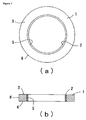
- Fig. 1 shows a seal material which is an example of the composite material according to the present invention, and (a) is a top view and (b) is a longitudinal sectional view.
- the seal material of the illustrative example is provided with an inorganic filler-containing layer 2, containing an inorganic filler, on an outer surface (inside surface) of a molding 1 molded in a ring shape.
- the molding 1 consists of any of the above-mentioned expanded graphite, inorganic fiber, or organic fiber.
- an outer surface of the molding 1 comprises a front side surface 3, a back side surface 4, an inside surface 5, and an outside surface 6, and the seal material consisting of the composite material according to the present invention is provided with an inorganic filler-containing layer 2 on at least one or more outer surfaces of these surfaces.
- a seal material is a gland packing as illustrated, it is possible to improve its seal performance by providing on the inside surface 5 which contacts with a valve rod the inorganic filler-containing layer 2 containing an inorganic filler such as a clay, can be improved.
- the inorganic filler-containing layer 2 can be formed by any of the following three methods (A)-(C);
- the seal material can also be a multilayer structure.
- Fig. 2 shows a seal material consisting of a composite material according to the present invention in the form of the multilayer structure, and (a) is a top view and (b) is a longitudinal sectional view.
- the seal material of the illustrative example is provided with several layers of the moldings 1 molded in a ring shape and inorganic filler-containing layers 2 between the layers of the moldings 1.
- inorganic filler-containing layer 2 containing an inorganic filler such as a clay between the layers of the moldings 1.
- the number of layers of lamination is three in the illustrative example, but it may not be limited to three, and it may be two or four or more.
- the second example of the seal material consisting of the composite material according to the present invention is a seal material consisting of a composite material which contains an inorganic filler-containing resin inside a molding consisting of any of expanded graphite, organic fiber, or inorganic fiber.
- Such seal material can be obtained by impregnating any of the polyimide varnish, the polybenzimidazole varnish, the polybenzoxazole varnish, mixed varnish 1, mixed varnish 2, or the copolymer varnish inside the molding, and then heating or baking the impregnated varnish.
- it can be manufactured by mixing any of the polyimide varnish, the polybenzimidazole varnish, the polybenzoxazole varnish, mixed varnish 1, mixed varnish 2, or the copolymer varnish with, for example, expanded graphite powder, inorganic fiber, or organic fiber, and then heat-molding this mixture using molding equipment, such as a die.
- it can be also manufactured by immersing a mold consisting of expanded graphite, inorganic fiber, or organic fiber fabricated in a sheet shape in any of the polyimide varnish, the polybenzimidazole varnish, the polybenzoxazole varnish, mixed varnish 1, mixed varnish 2, or the copolymer varnish, and then heat-molding the immersed varnish using molding equipment, such as a die.
- a seal material is a gland packing, it can be manufactured by coating yarns before braiding with the polyimide film or the polyimide precursor film or the polybenzimidazole film or the polyazomethine film or the polybenzoxazole film or the polybenzoxazole precursor film or mixed film 1 or mixed film 2 or mixed film 3 or mixed film 4 or the copolymer film or the copolymer precursor film, or impregnating the polyimide varnish, the polybenzimidazole varnish, the polybenzoxazole varnish, mixed varnish 1, mixed varnish 2, or the copolymer varnish in the yarn before braiding, and then heat-molding the impregnated varnish.
- the seal material consisting of the composite material according to the present invention consists of a composite material having an inorganic filler-containing layer on an outer surface of the molding or a composite material having an inorganic filler-containing resin inside the molding.
- a seal material can be obtained, wherein the seal material has the same high heat resistance as the seal material made from the expanded graphite, prevents powder fall or electric corrosion which is a disadvantage of the seal material made from the expanded graphite, and has excellent filler-containing performance which the expanded graphite does not have. Accordingly it can be used as a substitute for the conventional seal materials made from asbestos.
- a molding consists of inorganic fiber, a seal material with excellent heat resistance can be obtained.
- a molding consists of organic fiber, a seal material with excellent flexibility can be obtained.
- an inorganic filler contains a plate crystal, such as a boron nitride, etc.
- a seal material packing with excellent seal performance and a low friction coefficient (low slide resistance) can be obtained.
- Fig. 3 is a perspective view showing a heat dissipation sheet which is an example of the composite material according to the present invention.
- the heat dissipation sheet of the illustrative example is provided with an inorganic filler-containing layer 2 on outer surface of a sheet-like molding (hereinafter, referred to as the Sheet) 1 which is molded in a square shape.
- outer surface of the molding 1 comprises a front side surface 3, a back side surface 4, and an outside surface 6, and the heat dissipation sheet consisting of the composite material according to the present invention is provided with an inorganic filler-containing layer 2 on at least one or more outer surfaces of these surfaces.
- the inorganic filler-containing layer 2 can be formed by any of the following three methods (A)-(C);
- the heat dissipation sheet consisting of the composite material according to the present invention consists of a composite material having an inorganic filler-containing layer on an outer surface of the molding.
- the molding consists of expanded graphite
- a heat dissipation sheet can be obtained, where the heat dissipation sheet prevents powder fall from the expanded graphite and has filler-containing performance which the expanded graphite does not have.
- a molding consists of inorganic fiber, a heat dissipation sheet with excellent heat resistance can be obtained.
- a molding consists of organic fiber, a heat dissipation sheet with excellent flexibility can be obtained.
- the inorganic filler-containing layer 2 is formed of a polyimide membrane, a polybenzimidazole membrane, a polybenzoxazole membrane, a mixed membrane of polyimide and polybenzimidazole, a mixed membrane of polyimide and polybenzoxazole, or a copolymer membrane of polyimide and polybenzoxazole, obtained by applying any of the polyimide varnish, the polybenzimidazole varnish, the polybenzoxazole varnish, mixed varnish 1, mixed varnish 2, or the copolymer varnish to an outer surface of the Sheet, and then heating or baking the varnish; or of a polyimide membrane, a polybenzimidazole membrane, a polybenzoxazole membrane, a mixed membrane of polyimide and polybenzimidazole, a mixed membrane of polyimide and polybenzoxazole, or a copolymer membrane of polyimide and polybenzoxazole, obtained by bonding any of the polyimide precursor film, the polyazomethine
- the composite material according to the present invention is suitably employed for a seal material, such as a gasket or a packing, or a heat dissipation sheet, etc. used for a liquid crystal television or a personal computer, etc.
- a seal material such as a gasket or a packing, or a heat dissipation sheet, etc. used for a liquid crystal television or a personal computer, etc.
Landscapes
- Chemical & Material Sciences (AREA)
- Organic Chemistry (AREA)
- Medicinal Chemistry (AREA)
- Polymers & Plastics (AREA)
- Health & Medical Sciences (AREA)
- Chemical Kinetics & Catalysis (AREA)
- Engineering & Computer Science (AREA)
- Materials Engineering (AREA)
- Manufacturing & Machinery (AREA)
- Inorganic Chemistry (AREA)
- Dispersion Chemistry (AREA)
- Compositions Of Macromolecular Compounds (AREA)
- Laminated Bodies (AREA)
- Manufacture Of Macromolecular Shaped Articles (AREA)
- Macromolecular Compounds Obtained By Forming Nitrogen-Containing Linkages In General (AREA)
- Reinforced Plastic Materials (AREA)
Abstract
inorganic filler-containing materials containing an inorganic filler and any of the following: a polyimide film, a polyimide varnish consisting of a polyamide acid solution, an incompletely-imidized and self-standing polyimide precursor film obtained by drying the polyamide acid solution, a polybenzimidazole film, a varnish consisting of a polybenzimidazole solution, a polyazomethinefilm, a mixed film consisting of a polyimide resin and a polybenzimidazole resin, a mixed varnish consisting of the polyamide acid solution and the polybenzimidazole solution, a mixed film consisting of a polyimide precursor and polyazomethine, a polybenzoxazole film etc;
and a molding consisting of any of expanded graphite, organic fiber, or inorganic fiber.
Description
- The present invention relates to a composite material and in particular, to a composite material composed of a polyimide film, a polybenzimidazole film, or polybenzoxazole etc., which contains an inorganic filler; and a molding consisting of expanded graphite etc.
- Since polyimide has excellent characteristics, such as heat resistance, cold resistance, electric insulation, and mechanical strength etc., it is broadly used in a variety of technical fields.
- For instance, it is used as a material for forming a protective layer and an insulating layer on a circuit board etc. in electrical and electronic fields.
- A two-step method is known as the most industrially common synthetic method of making polyimide. The two-step method comprises the steps of polymerizing tetracarboxylic acid dihydrate and diamine in equimolar amounts to obtain polyamide acid (polyamic acid), which is a precursor of polyimide, and proceeding with a dehydration and cyclization (imidization) reaction by heating this polyamide acid to more than 200 °C or using a catalyst to thereby obtaining polyimide.
- While polyimide may be industrially used in the form of a completely-imidized polyimide film, it is more often used in the form of a polyimide varnish consisting of a polyamide acid solution, and in the form of an incompletely-imidized polyimide precursor film obtained from drying of the polyamide acid solution.
- In particular, the polyimide varnish (polyamide acid solution) is applied to an object, such as a substrate, and the polyimide precursor film is bonded to the object, such as a substrate. The applied polyimide varnish and the adhered polyimide precursor film are imidized by heating, thereby forming a polyimide layer.
- However, the polyimide varnish and the polyimide precursor film have poor storage stability. If they are stored at room temperature, polyamide acid is depolymerized to acid anhydride and aromatic amine, and amide-exchange reaction between the produced acid anhydride and an amino group of other molecular chains decreases their average molecular weight and accordingly causes deterioration of adhesiveness and embrittlement of the film. Therefore, the polyimide varnish and the polyimide precursor film have the problem that they require refrigerated storage and are difficult to be handled.
- While the polyimide film has very excellent characteristics, such as heat resistance, cold resistance, electric insulation, and mechanical strength etc., as described above, these characteristics should be further enhanced (for example, heat resistance must be improved) and insufficient characteristics, such as thermal conductivity and vapor barrier properties etc. should be improved, depending on the intended use. For example, if the polyimide film is applied to a seal material, vapor barrier property needs to be improved, and if it is applied to a heat dissipation sheet, thermal conductivity needs to be improved.
- Polybenzimidazole (PBI) is a thermally and chemically stable heterocyclic macromolecule and has excellent heat resistance and abrasion resistance. For that reason, it is expected to be used as a protecting film etc. in the semiconductor field etc., as well as polyimide, while its characteristics need to be further enhanced or improved, depending on the intended use.
- Polybenzoxazole (PBO) has characteristics, such as heat resistance, cold resistance, electric insulation, mechanical strength and the like equivalent to polyimide. Therefore, it is used as a material for forming a protective layer and an insulating layer on a circuit board, for example, in electrical and electronic fields, while its characteristics must be further enhanced or improved, depending on the intended use.
- Conventionally, an asbestos sheet joint gasket, which has excellent characteristics in a wide temperature range from a low temperature region (about -240 °C) to a high temperature region (about +400 °C), was widely used for a seal material such as a packing, a gasket, and the like. However, the use of asbestos was prohibited in principle and alternative materials have been sought since then.
- Among the currently-used materials of a seal material, expanded graphite is the only material which can respond to the above-mentioned wide temperature range, but it cannot be the perfect alternative because it has a drawback that it possibly causes powders to fall from electric corrosion or surface (contamination).
- Furthermore, expanded graphite has excellent thermal conductivity and thus is also used for materials of the heat dissipation sheet for diffusing heat generated from electronic components used for electric products, such as liquid crystal television etc (for example, see the following patent document 1).
- However, when an expanded graphite sheet is used as a heat dissipation sheet, an adhesive layer such as a pressure sensitive adhesive or a double-sided adhesive tape is necessary for fixing the expanded graphite sheet to an electronic component mounting board. The adhesive layer prevents thermal conductivity of the expanded graphite, leading to less beneficial heat dissipation effect.
- In addition, the expanded graphite also has a problem of contamination by powder fall, since it has conductive property. Therefore, when it is used as a heat dissipation sheet, a masking film should be provided on surface in order to ensure insulation performance and to prevent contamination, leading to prevention of thermal conductivity by the masking film.
-
Patent Document 1JP Tokukai 2005-229100 - The present invention addresses the above-described problems of the prior art and aims to provide a composite material, which can be preferably used as an alternative to asbestos seal materials or as a heat dissipation sheet with excellent thermal conductivity, by improving characteristics of polyimide, polybenzimidazole, or polybenzoxazole and by combining these with known seal materials such as expanded graphite etc and materials for the heat dissipation sheet.
- Invention according to
claim 1 relates to a composite material composed of an inorganic filler-containing material containing an inorganic filler and any of the following: a polyimide film, a polyimide varnish consisting of a polyamide acid solution, an incompletely-imidized and self-standing polyimide precursor film obtained by drying the polyamide acid solution, a polybenzimidazole film, a varnish consisting of a polybenzimidazole solution, a polyazomethine film, a mixed film consisting of a polyimide resin and a polybenzimidazole resin, a mixed varnish consisting of the polyamide acid solution and the polybenzimidazole solution, a mixed film consisting of a polyimide precursor and polyazomethine, a polybenzoxazole film, a polybenzoxazole varnish consisting of a polyamide acid solution having phenol region, an incompletely-converted-to-oxazole and self-standing polybenzoxazole precursor film obtained by drying the varnish consisting of the polyamide acid solution having phenol region, a mixed film consisting of the polyimide resin and the polybenzoxazole resin, a mixed varnish consisting of the polyamide acid solution and a polybenzoxazole precursor solution, a mixed film consisting of the polyimide precursor and a polybenzoxazole precursor, a polyimide-polybenzoxazole copolymer film obtained by copolymerizing the polyimide resin and the polybenzoxazole resin, a varnish consisting of a polyimide-polybenzoxazole copolymer precursor solution which copolymerized the polyamide acid and the polyamide acid having phenol region, an incompletely-imidized and - converted-to-oxazole and self-standing polyimide-polybenzoxazole copolymer precursor film obtained by drying the polyimide-polybenzoxazole copolymer precursor solution; and a molding consisting of any of expanded graphite, organic fiber, or inorganic fiber. - The invention according to
claim 2 relates to a composite material ofclaim 1, wherein an inorganic filler containing layer formed of said inorganic filler-containing material is provided on outer surface of said molding. - The invention according to
claim 3 relates to a composite material comprising an inorganic filler-containing material inside a molding consisting of any of expanded graphite, organic fiber, or inorganic fiber, wherein the inorganic filler-containing material contains an inorganic filler and any of the following: a polyimide varnish consisting of a polyamide acid solution, a varnish consisting of a polybenzimidazole solution, a mixed varnish consisting of the polyamide acid solution and the polybenzimidazole solution, a polybenzoxazole varnish consisting of a polyamide acid having phenol region, a mixed varnish consisting of the polyamide acid solution and a polybenzoxazole precursor solution, a varnish consisting of a polyimide-polybenzoxazole copolymer precursor solution which copolymerized the polyamide acid and the polyamide acid having phenol region. - The invention according to
claim 4 relates to a composite material of any ofclaims 1 to 3, wherein said inorganic filler consists of clay. - The invention according to
claim 5 relates to a composite material of any ofclaims 1 to 3, wherein said inorganic filler consists of a silicate compound. - According to the invention of
claim 1, a composite material is composed of an inorganic filler-containing material containing an inorganic filler and any of the following: a polyimide film, a polyimide varnish consisting of a polyamide acid solution, an incompletely-imidized and self-standing polyimide precursor film obtained by drying the polyamide acid solution, a polybenzimidazole film, a varnish consisting of a polybenzimidazole solution, a polyazomethine film, a mixed film consisting of a polyimide resin and a polybenzimidazole resin, a mixed varnish consisting of a polyamide acid solution and a polybenzimidazole solution, a mixed film consisting of a polyimide precursor and polyazomethine, a polybenzoxazole film, a polybenzoxazole varnish consisting of the polyamide acid solution having phenol region, an incompletely-converted-to-oxazole and self-standing polybenzoxazole precursor film obtained by drying the varnish consisting of the polyamide acid solution having phenol region, a mixed film consisting of a polyimide resin and a polybenzoxazole resin, a mixed varnish consisting of a polyamide acid solution and a polybenzoxazole precursor solution, a mixed film consisting of a polyimide precursor and a polybenzoxazole precursor, a polyimide-polybenzoxazole copolymer film obtained by copolymerizing a polyimide resin and a polybenzoxazole resin, a varnish consisting of a polyimide-polybenzoxazole copolymer precursor solution which copolymerized polyamide acid and polyamide acid having phenol region, an incompletely-imidized and -converted-to-oxazole and self-standing polyimide polybenzoxazole copolymer precursor films obtained by drying a polyimide-polybenzoxazole copolymer precursor solution; and a molding consisting of any of expanded graphite, organic fiber, or inorganic fiber. Therefore, a composite material can be additionally obtained, wherein original excellent characteristics (heat resistance etc.) of polyimide, polybenzimidazole, and polybenzoxazole can be further enhanced due to excellent characteristics (heat resistance etc.) of the inorganic filler, and insufficient characteristics, such as thermal conductivity and vapor barrier property etc. can be improved by appropriately selecting types of the inorganic filler. - According to the invention of
claim 2, a composite material is obtained, wherein an inorganic filler containing layer formed of said inorganic filler-containing material is provided on outer surface of said molding, and thus it has high heat resistance and seal performance, has no powder fall, and has excellent insulation performance. - According to the invention of
claim 3, a composite material comprising an inorganic filler-containing material inside a molding consisting of any of expanded graphite, organic fiber, or inorganic fiber is obtained, wherein the inorganic filler-containing material contains an inorganic filler and any of the following: the polyimide varnish consisting of the polyamide acid solution, the varnish consisting of the polybenzimidazole solution, the mixed varnish consisting of the polyamide acid solution and the polybenzimidazole solution, the polybenzoxazole varnish consisting of the polyamide acid having phenol region, a mixed varnish consisting of the polyamide acid solution and a polybenzoxazole precursor solution, the varnish consisting of the polyimide-polybenzoxazole copolymer precursor solution which copolymerized polyamide acid and polyamide acid having phenol region, and thus the composite material has high heat resistance, excellent seal performance, and insulation performance. - According to the invention of
claim 4, a composite material is obtained wherein it has excellent seal performance, insulation performance, chemical resistance, and vapor barrier property, since it consists of clay. - According to the invention of
claim 5, a composite material is obtained, wherein it has seal performance and small sliding resistance, since it consists of a silicate compound. -
-
Figure 1 shows a seal material consisting of a composite material according to the present invention, and (a) is a top view and (b) is a longitudinal sectional view. -
Figure 2 shows a seal material consisting of a composite material according to the present invention in the form of a multilayer structure, and (a) is a top view and (b) is a longitudinal sectional view. -
Figure 3 is a perspective view showing a heat dissipation sheet according to the present invention. - Hereinafter, preferred embodiments of the composite material according to the present invention will be set forth.
- The composite material according to the present invention is composed of an inorganic filler-containing material containing an inorganic filler and any of the following: a polyimide film, a polyimide varnish consisting of a polyamide acid solution, an incompletely-imidized and self-standing polyimide precursor film obtained by drying the polyamide acid solution, a polybenzimidazole film, a varnish consisting of a polybenzimidazole solution, a polyazomethine film, a mixed film consisting of a polyimide resin and a polybenzimidazole resin, a mixed varnish consisting of a polyamide acid solution and a polybenzimidazole solution, a mixed film consisting of a polyimide precursor and polyazomethine, a polybenzoxazole film, a polybenzoxazole varnish consisting of the polyamide acid solution having phenol region, an incompletely-converted-to-oxazole and self-standing polybenzoxazole precursor film obtained by drying the varnish consisting of the polyamide acid solution having phenol region, a mixed film consisting of a polyimide resin and a polybenzoxazole resin, a mixed varnish consisting of a polyamide acid solution and a polybenzoxazole precursor solution, a mixed film consisting of a polyimide precursor and a polybenzoxazole precursor, a polyimide-polybenzoxazole copolymer film obtained by copolymerizing a polyimide resin and a polybenzoxazole resin, a varnish consisting of a polyimide-polybenzoxazole copolymer precursor solution which copolymerized polyamide acid and polyamide acid having phenol region, an incompletely-imidized and -converted-to-oxazole and self-standing polyimide polybenzoxazole copolymer precursor films obtained by drying a polyimide-polybenzoxazole copolymer precursor solution; a molding consisting of expanded graphite, organic fiber, or inorganic fiber.
- A first embodiment of an inorganic filler-containing material used as a raw material of the composite material according to the present invention is a polyimide film containing an inorganic filler. Types of the inorganic filler are not particularly limited, but one or two or more kinds of mixtures selected from clay, a silicate compound, a nitride, and an inorganic oxide are preferably used.
- One or more types of natural clay, synthetic clay, and modified clay can be used. More particularly, one or more types of mica, vermiculite, montmorillonite, beidellite, hectorite, stevensite, Magadiite, ilerite, kanemite, illite, sericite, or nontronite is preferably used.
- A silicate compound such as talc, kaolin, zeolite, halloysite, or vermiculite, etc. is preferably used, but is not limited to these. A nitride such as boron nitride, aluminium nitride, silicon nitride, etc. is preferably used, but is not limited to these.
- An inorganic oxide such as alumina, magnesium oxide, silicon dioxide, zinc oxide, zirconium dioxide, etc. is preferably used, but is not limited to these.
- Content of the inorganic filler is preferably 10 to 90 % by weight, more preferably 30 to 70 % by weight.
- The reason is that when the content of the inorganic filler is less than 10 % by weight, it does not exert some of its characteristics (heat resistance, seal performance, thermal conductivity, or abrasion resistance) well, and when the content is over 90 % by weight, it becomes more fragile and less flexible, neither of which is preferable.
- The first embodiment of the inorganic filler-containing material used as a raw material of the composite material according to the present invention, polyimide film (hereinafter, referred to as the polyimide film), contains the inorganic filler and thus can impart the characteristics of the inorganic filler to the polyimide film. For example, the inorganic filler has better heat resistance compared with polyimide, and thus can enhance heat resistance of the polyimide film. Additionally, the inorganic filler can impart its stiffness to the polyimide film and thus the polyimide film, which is less likely to shrink (curl) after it is dried or cured, can be obtained.
- If the inorganic filler consists of clay (especially, plate crystal clay (clay mineral belonging to a layered silicate)), a polyimide film with excellent seal performance, insulation performance, chemical resistance, and vapor barrier properties, can be obtained.
- If the inorganic filler consists of a silicate compound, a nitride, and an inorganic oxide, a polyimide film with excellent thermal conductivity can be obtained.
- The polyimide film can be manufactured by a method using the following two-step methods:
- Polymerize tetracarboxylic acid dihydrate and diamine in equimolar amounts to obtain a polyamide acid (polyamic acid) which is a precursor of the polyimide (First Step).
- Dissolve the polyamide acid in an organic solvent, and add an inorganic filler to the organic solvent (Second Step).
- Dry the solution (polyamide acid solution with the inorganic filler) at low temperature (about 90 °C) to obtain a film (a polyimide precursor film) (Third Step).
- Complete dehydration and cyclization (imidization) by heating this film (the polyimide precursor film) to more than 200 °C or by using a catalyst, in order to obtain the polyimide film (Fourth Step).
- A second embodiment of the inorganic filler-containing material used as a raw material of the composite material according to the present invention is a polyimide varnish consisting of the polyamide acid solution containing the inorganic filler.
- The second embodiment of the inorganic filler-containing material used as the raw material of the composite material according to the present invention, a polyimide varnish (hereinafter, referred to as the polyimide varnish) can be manufactured by the above-mentioned first and second steps of the method of manufacturing this polyimide film.
- That is, the polyimide varnish can be obtained in the process (intermediate steps) of manufacturing the polyimide film.
- The polyimide varnish contains the inorganic filler and thus can be stored at room temperature and has excellent storage stability.
- That is, as mentioned above, if a conventional polyimide varnish is stored at room temperature, polyamide acid is depolymerized to acid anhydride and aromatic amine, and amide-exchange reaction between the produced acid anhydride and an amino group of other molecular chains decreases their average molecular weight and accordingly causes deterioration of adhesiveness of the film etc.
- However, since the polyimide varnish contains the inorganic filler, the above-mentioned depolymerization of the polyamide acid is prevented and the average molecular weight is less likely to decrease, leading to the polyimide varnish which can be stored at room temperature and has excellent storage stability.
- The polyimide varnish is applied to an object and then imidized by heating, thereby allowing a polyimide membrane to be formed on an outer surface of the object.
- As mentioned above, the polyimide varnish contains the inorganic filler. Therefore, the polyimide membrane obtained by applying the polyimide varnish to the object and heating it can demonstrate the high heat resistance of the inorganic filler. Furthermore, by selecting the inorganic filler appropriately, it is possible to obtain a polyimide membrane maintaining the original excellent characteristics of polyimide and having its insufficient characteristics (such as thermal conductivity and vapor barrier property etc.) improved.
- If the inorganic filler consists of clay (especially, plate crystal clay), a polyimide membrane with excellent seal performance, insulation performance, chemical resistance, and vapor barrier property, can be obtained.
- If the inorganic filler consists of a silicate compound, a nitride, and an inorganic oxide, a polyimide membrane with excellent thermal conductivity can be obtained.
- A third embodiment of the inorganic filler-containing material used as the raw material of the composite material according to the present invention is an incompletely-imidized and self-standing (self-supporting) polyimide precursor film obtained by drying a polyamide acid solution containing an inorganic filler. Self-standing property (self-supporting property) means that a film alone can maintain its form without any support.
- The third embodiment of the raw material of the composite material according to the present invention, the polyimide precursor film (hereinafter, referred to as the polyimide precursor film), can be manufactured by the above-mentioned first to third steps of the method of manufacturing the polyimide film.
- In other words, the polyimide precursor film can be obtained in the process (intermediate steps) of manufacturing the polyimide film.
- The polyimide precursor film contains the inorganic filler, and thus it can be stored at room temperature and has excellent storage stability.
- That is, as mentioned above, if a conventional polyimide precursor film is stored at room temperature, polyamide acid is depolymerized to acid anhydride and aromatic amine, and amide-exchange reaction between the produced acid anhydride and an amino group of other molecular chains decreases their average molecular weight and accordingly causes deterioration of adhesiveness and embrittlement of the film.
- However, since the polyimide precursor film contains the inorganic filler, the above-mentioned depolymerization of the polyamide acid is prevented and the average molecular weight is less likely to decrease, leading to the polyimide precursor film which can be stored at room temperature and has excellent storage stability.
- The polyimide precursor film has an adhesive property in itself and thus can be used as an adhesive film. Therefore, after the polyimide precursor film adheres to an object and then is imidized by heating, a polyimide membrane can be formed on an outer surface of the object.
- As described above, the polyimide precursor film contains the inorganic filler. Therefore, the polyimide membrane obtained by bonding the polyimide precursor film to the object and heating it can demonstrate the high heat resistance of the inorganic filler. Furthermore, by selecting the inorganic filler appropriately, it is possible to obtain a polyimide membrane maintaining the original excellent characteristics of polyimide and having its insufficient characteristics (such as thermal conductivity and vapor barrier property etc.) improved.
- If the inorganic filler consists of clay (especially, plate crystal clay), a polyimide membrane with excellent seal performance, insulation performance, chemical resistance, and vapor barrier property, can be obtained.
- If the inorganic filler consists of a silicate compound, a nitride, and an inorganic oxide, a polyimide membrane with excellent thermal conductivity can be obtained.
- A fourth embodiment of the inorganic filler-containing material used as the raw material of the composite material according to the present invention is a polybenzimidazole film containing an inorganic filler.
- Here, polybenzimidazole is a polymer which contains a substituted or unsubstituted benzimidazole as a monomer unit. Specifically, it is, for example, poly-2,2'-(m-phenylene)-5,5'-bibenzimidazole and the like. Types and content of the inorganic filler are the same as those of the above-mentioned first embodiment.
- The fourth embodiment of the inorganic filler-containing material used as the raw material of the composite material according to the present invention, the polybenzimidazole film (hereinafter, referred to as the polybenzimidazole film), contains the inorganic filler, thus it can be imparted the characteristics of the inorganic filler. For example, since the inorganic filler has better heat resistance compared with the polybenzimidazole film, it is possible to enhance heat resistance of the polybenzimidazole film. Furthermore, since the polybenzimidazole film is imparted the stiffness of the inorganic filler, it can be less likely to shrink (curl) after it is dried or cured.
- If the inorganic filler consists of clay (especially, plate crystal clay (clay mineral belonging to a layered silicate)), the polybenzimidazole film with excellent seal performance, insulation performance, chemical resistance, and vapor barrier property, can be obtained.
- If the inorganic filler consists of a silicate compound, a nitride, and an inorganic oxide, the polybenzimidazole film with excellent thermal conductivity can be obtained.
- The polybenzimidazole film can be manufactured, for example, by the following methods:
- Dissolve Polybenzimidazole (PBI) in a solvent to obtain a PBI solution (First Step). N,N-dimethylacetamide, N, N-dimethylformamide, Dimethyl sulfoxide, N-methyl-2-pyrrolidone, dimethylacetamide (DMA), dimethylformamide (DMF), pyridine, dimethylsulfoxide (DMSO) etc. are used for the solvent.
- Add the inorganic filler to this PBI solution (Second Step).
- Apply the PBI solution with the inorganic filler on an outer surface of a base to form a coating film on the outer surface of the base (Third Step).
- Remove the solvent by heating this coating film at low temperature (about 90-100 °C) in order to obtain a polyazomethine film (Fourth Step).
- Bake (burn) this polyazomethine film (for example, at approximately 300-350 °C) to form a cured coating film (Fifth Step).
- Separate this cured coating film from the base to obtain the polybenzimidazole film (Sixth Step).
- A fifth embodiment of the inorganic filler-containing material used as the raw material of the composite material according to the present invention is a varnish consisting of a polybenzimidazole solution containing an inorganic filler.
- The fifth embodiment of the inorganic filler-containing material used as the raw material of the composite material according to the present invention, the varnish consisting of the polybenzimidazole solution (hereinafter referred to as the polybenzimidazole varnish), can be manufactured by the above-mentioned first and second steps of the method of manufacturing the polybenzimidazole film.
- That is, the polybenzimidazole varnish can be obtained in the process (intermediate steps) of manufacturing the polybenzimidazole film.
- The polybenzimidazole varnish contains the inorganic filler and thus it can be stored at room temperature and has excellent storage stability.
- The polybenzimidazole varnish is applied to an object and then baked (burned), thereby allowing a polybenzimidazole membrane to be formed on an outer surface of the object.
- As mentioned above, the polybenzimidazole varnish contains the inorganic filler. Therefore, the polybenzimidazole membrane obtained by applying to the object and baking the polybenzimidazole varnish can demonstrate the high heat resistance of the inorganic filler. Furthermore, by selecting the inorganic filler appropriately, it is possible to obtain a polybenzimidazole membrane maintaining the original excellent characteristics of polybenzimidazole and having its insufficient characteristics (such as thermal conductivity and vapor barrier property etc.) improved.
- If the inorganic filler consists of clay (especially, plate crystal clay), a polybenzimidazole membrane with excellent seal performance, insulation performance, chemical resistance, and vapor barrier property, can be obtained.
- If the inorganic filler consists of a silicate compound, a nitride, and an inorganic oxide, a polybenzimidazole membrane with excellent thermal conductivity can be obtained.
- A sixth embodiment of the inorganic filler-containing material used as the raw material of the composite material according to the present invention is a polyazomethine film containing an inorganic filler. Polyazomethine is a precursor of polybenzimidazole. Examples of polyazomethine and polyazomethine films are described, for example, in the patent publication of Tokukai
JP 2008-266538 - The sixth embodiment of the inorganic filler-containing material used as the raw material of the composite material according to the present invention, polyazomethine film (hereinafter, referred to as the polyazomethine film) can be manufactured by the above-mentioned first to fourth steps of the method of manufacturing the polybenzimidazole film.
- That is, the polyazomethine film can be obtained in the process (intermediate steps) of manufacturing the polybenzimidazole film.
- The polyazomethine film has an adhesive property in itself and thus can be used as an adhesive film. Therefore, the polyazomethine film adheres to an object and is then baked (burned), thereby allowing a polybenzimidazole membrane to be formed on an outer surface of the object.
- As described above, the polyazomethine film contains the inorganic filler. Therefore, the polybenzimidazole membrane obtained by bonding the polyazomethine film to the object and baking it can demonstrate the high heat resistance of the inorganic filler. Furthermore, by selecting the inorganic filler appropriately, it is possible to obtain a polybenzimidazole membrane maintaining the original excellent characteristics of polybenzimidazole and having its insufficient characteristics (such as thermal conductivity and vapor barrier property etc.) improved.
- If the inorganic filler consists of clay (especially, plate crystal clay), the polybenzimidazole membrane with excellent seal performance, insulation performance, chemical resistance, and vapor barrier property, can be obtained.
- If the inorganic filler consists of a silicate compound, a nitride, and an inorganic oxide, the polybenzimidazole membrane with excellent thermal conductivity can be obtained.
- A seventh embodiment of the inorganic filler-containing material used as the raw material of the composite material according to the present invention is a mixed film consisting of a polyimide resin and a polybenzimidazole resin and containing an inorganic filler.
- The mixed film (hereinafter, referred to as mixed film 1) is obtained by, for example, adding the inorganic filler to a mixture of a solution prepared by dissolving in an organic solvent a polyamide acid obtained in the middle of the second step (before combination of the inorganic filler) of the above-mentioned manufacturing method of the polyimide film and the PBI solution obtained in the first step of the above-mentioned manufacturing method of the polybenzimidazole film; heating the solution with the inorganic filler at low temperature (about 90-100 °C) to obtain a mixed film comprising a polyimide precursor and polyazomethine; and heating or baking the mixed film at high temperature (about 300-350 °C).
- Types and content of the inorganic filler are the same as those of the above-mentioned first embodiment.
-
Mixed film 1 has characteristics of the above-mentioned polyimide film and polybenzimidazole film. - An eighth embodiment of the inorganic filler-containing material used as the raw material of the composite material according to the present invention is a mixed varnish consisting of a polyamide acid solution and a polybenzimidazole solution and containing an inorganic filler.
- The mixed varnish (hereinafter, referred to as mixed varnish 1) is obtained by, for example, combining the inorganic filler with a mixture of a solution prepared by dissolving in an organic solvent a polyamide acid obtained in the middle of the second step (before combination of the inorganic filler) of the above-mentioned manufacturing method of the polyimide film and the PBI solution obtained in the first step of the above-mentioned manufacturing method of the polybenzimidazole film.
- Types and content of the inorganic filler are the same as those of the above-mentioned first embodiment.
-
Mixed varnish 1 has characteristics of the above-mentioned polyimide varnish and the polybenzimidazole varnish. - A ninth embodiment of the inorganic filler-containing material used as the raw material of the composite material according to the present invention is a mixed film containing an inorganic filler and comprising a polyimide precursor and polyazomethine.
- This mixed film (hereinafter, referred to as mixed film 2) is obtained by, for example, combining the inorganic filler with a mixture of a solution prepared by dissolving in an organic solvent a polyamide acid obtained in the middle of the second step (before combination of the inorganic filler) of the above-mentioned manufacturing method of the polyimide film and the PBI solution obtained in the first step of the above-mentioned manufacturing method of the polybenzimidazole film; and heating the mixed solution with this inorganic filler at low temperature (about 90-100 °C).
-
Mixed film 2 has characteristics of the above-mentioned polyimide precursor film and polyazomethine film. - A tenth embodiment of the inorganic filler-containing material used as the raw material of the composite material according to the present invention is a polybenzoxazole film containing an inorganic filler.
- Here, polybenzoxazole is a polymer containing a substituted or unsubstituted benzoxazole as a monomer unit. Specifically, it is, for example, poly(paraphenylenebenzobisoxazole, poly-2,2'-(p-phenylene)-5,5'-bibenzoxazole and the like.
- Types and content of the inorganic filler are the same as those of the above-mentioned first embodiment.
- The tenth embodiment of the inorganic filler-containing material used as the raw material of the composite material according to the present invention, the polybenzoxazole film (hereinafter, referred to as the polybenzoxazole film), contains the inorganic filler and thus it can be imparted the characteristics of the inorganic filler. For example, since the inorganic filler has better heat resistance compared with a polybenzoxazole film, it is possible to enhance heat resistance of a polybenzoxazole film. Furthermore, since the polybenzoxazole film is imparted the stiffness of the inorganic filler, it can be less likely to shrink (curl) after it is dried or cured.
- If the inorganic filler consists of clay (especially, plate crystal clay (clay mineral belonging to a layered silicate)), the polybenzoxazole film with excellent seal performance, insulation performance, chemical resistance, and vapor barrier property, can be obtained.
- If the inorganic filler consists of a silicate compound, a nitride, and an inorganic oxide, the polybenzoxazole film with excellent thermal conductivity can be obtained.
- The polybenzoxazole film can be manufactured, for example, by following methods:
- Polymerize tetracarboxylic acid dihydrate and a bisaminophenol compound in equimolar amounts to obtain a polyamide acid (polyamic acid) having phenol region, which is a polybenzoxazole precursor (First Step).
- Dissolve the polyamide acid in an organic solvent and add an inorganic filler to an organic solvent (Second Step).
- Dry this mixture (polyamide acid solution with the inorganic filler) at low temperature (about 90 °C) to obtain a film (a polybenzoxazole precursor film) (Third Step).
- Complete dehydration and cyclization (conversion to oxazole) by heating this film (the polybenzoxazole precursor film) to more than 200 °C or by using a catalyst, in order to obtain the polybenzoxazole film (Fourth Step).
- An eleventh embodiment of the inorganic filler-containing material used as the raw material of the composite material according to the present invention is a varnish consisting of a polybenzoxazole precursor solution containing an inorganic filler.
- The eleventh embodiment of the inorganic filler-containing material used as the raw material of the composite material according to the present invention, the varnish consisting of the polybenzoxazole precursor solution (hereinafter, referred to as the polybenzoxazole varnish), can be manufactured by the above-mentioned first and second steps of the method of manufacturing this polybenzoxazole.
- That is, the polybenzoxazole varnish can be obtained in the process (intermediate steps) of manufacturing the polybenzoxazole.
- The polybenzoxazole varnish contains the inorganic filler and thus it can be stored at room temperature and has excellent storage stability.
- The polybenzoxazole varnish is applied to an object, heated, and then converted to an oxazole, thereby allowing a polybenzoxazole membrane to be formed on an outer surface of the object.
- As mentioned above, this polybenzoxazole varnish contains the inorganic filler. Therefore, the polybenzoxazole membrane obtained by applying to the object and baking the polybenzoxazole varnish can demonstrate the high heat resistance of the inorganic filler. Furthermore, by selecting the inorganic filler appropriately, it is possible to obtain a polybenzoxazole membrane maintaining the original excellent characteristics of polybenzoxazole and having its insufficient characteristics (such as thermal conductivity and vapor barrier property etc.) improved.
- If the inorganic filler consists of clay (especially, plate crystal clay), a polybenzoxazole membrane with excellent seal performance, insulation performance, chemical resistance, and vapor barrier property, can be obtained.
- If an inorganic filler consists of a silicate compound, a nitride, and an inorganic oxide, a polybenzoxazole membrane with excellent thermal conductivity can be obtained.
- A twelfth embodiment of the inorganic filler-containing material used as the raw material of the composite material according to the present invention is an incompletely-converted-to-oxazole and self-standing (self-supporting) polybenzoxazole precursor film obtained by drying a polybenzoxazole precursor solution containing an inorganic filler.
- The twelfth embodiment of the raw material of the composite material according to the present invention, the polybenzoxazole precursor film (hereinafter, referred to as the polybenzoxazole precursor film), can be manufactured by the above-mentioned first to third steps of the method of manufacturing the polybenzoxazole film.
- That is, the polybenzoxazole precursor film can be obtained in the process (intermediate steps) of manufacturing the polybenzoxazole.
- The polybenzoxazole precursor film contains the inorganic filler and thus it can be stored at room temperature and has excellent storage stability.
- That is, as mentioned above, if a conventional polybenzoxazole precursor film is stored at room temperature, polyamide acid is depolymerized to acid anhydride and aromatic amine, and amide-exchange reaction between the produced acid anhydride and an amino group of other molecular chains decreases their average molecular weight and accordingly causes deterioration of adhesiveness and embrittlement of the film.
- However, since the polybenzoxazole precursor contains the inorganic filler, the above-mentioned depolymerization of the polyamide acid with a phenol region is prevented and the average molecular weight is less likely to decrease, leading to the polybenzoxazole precursor film which can be stored at room temperature and has excellent storage stability.
- The polybenzoxazole precursor film has an adhesive property in itself and thus can be used as an adhesive film. Therefore, after the polybenzoxazole precursor film adheres to an object and then is converted to an oxazole by heating, a polybenzoxazole membrane can be formed on an outer surface of the object.
- As described above, the polybenzoxazole precursor film contains the inorganic filler. Therefore, the polybenzoxazole membrane obtained by bonding the polybenzoxazole varnish to the object and heating it can demonstrate the high heat resistance of the inorganic filler. Furthermore, by selecting the inorganic filler appropriately, it is possible to obtain a polybenzoxazole membrane maintaining the original excellent characteristics of polybenzoxazole and having its insufficient characteristics (such as thermal conductivity and vapor barrier property etc.) improved.
- If the inorganic filler consists of clay (especially, plate crystal clay), a polybenzoxazole membrane with excellent seal performance, insulation performance, chemical resistance, and vapor barrier property, can be obtained.
- If an inorganic filler consists of a silicate compound, a nitride, and an inorganic oxide, a polybenzoxazole membrane with excellent thermal conductivity can be obtained.
- A thirteenth embodiment of the inorganic filler-containing material used as a raw material of the composite material according to the present invention is a mixed film containing an inorganic filler and containing a polyimide resin and a polybenzoxazole resin.
- This mixed film (hereinafter, referred to as mixed film 3) is obtained by, for example, combining the inorganic filler with a mixture of a solution prepared by dissolving in an organic solvent a polyamide acid obtained during the first step of the above-mentioned manufacturing method of the polyimide film and a polyamide acid with a phenol region obtained during the first step of the above-mentioned manufacturing method of the polybenzoxazole film; heating the mixture with the inorganic filler at low temperature (about 90-100 °C) to obtain a mixed film consisting of a polyimide precursor and polybenzoxazole precursor; and heating or baking this mixed film at high temperature (about 300-350 °C).
- Types and content of the inorganic filler are the same as those of the above-mentioned first embodiment.
-
Mixed film 3 has characteristics of the above-mentioned polyimide film and polybenzoxazole film. - A fourteenth embodiment of the inorganic filler-containing material used as the raw material of the composite material according to the present invention is a mixed varnish comprising a polyamide acid solution and a polybenzoxazole precursor solution and containing an inorganic filler.
- This mixed varnish (hereinafter, referred to as mixed varnish 2) is obtained by, for example, combining the inorganic filler with a mixture of a solution prepared by dissolving in an organic solvent a polyamide acid obtained during the first step of the above-mentioned manufacturing method of the polyimide film and a polyamide acid with a phenol region obtained during the first step of the above-mentioned manufacturing method of the polybenzoxazole film.
- Types and content of the inorganic filler are the same as those of the above-mentioned first embodiment.
-
Mixed varnish 2 has characteristics of the above-mentioned polyimide varnish and polybenzoxazole varnish. - A fifteenth embodiment of the inorganic filler-containing material used as the raw material of the composite material according to the present invention is a mixed film consisting of a polyimide precursor and a polybenzoxazole precursor, and containing an inorganic filler.
- This mixed film (hereinafter, referred to as mixed film 4) is obtained by, for example, combining the inorganic filler with a mixture of a solution prepared by dissolving in an organic solvent a polyamide acid obtained during the first step of the above-mentioned manufacturing method of the polyimide film and a polyamide acid with a phenol region obtained during the first step of the above-mentioned manufacturing method of the polybenzoxazole; and heating the mixed solution with this inorganic filler at low temperature (about 90-100 °C).
- Types and content of the inorganic filler are the same as those of the above-mentioned first embodiment.
-
Mixed film 4 has characteristics of the above-mentioned polyimide precursor film and polybenzoxazole precursor film. - A sixteenth embodiment of the inorganic filler-containing material used as the raw material of the composite material according to the present invention is a polyimide polybenzoxazole copolymer film containing an inorganic filler.
- Here, polyimide polybenzoxazole copolymer is a copolymer containing a substituted or unsubstituted benzoxazole as a monomer unit.
In particular, there is a structure, for example shown in a Formula (Formula 1). - Types and content of the inorganic filler are the same as those of the above-mentioned first embodiment.

- The sixteenth embodiment of the inorganic filler-containing material used as the raw material of the composite material according to the present invention, the polyimide polybenzoxazole copolymer film (hereinafter, referred to as the copolymer film), contains the inorganic filler and thus it can be imparted the characteristics of the inorganic filler. For example, since the inorganic filler has better heat resistance compared with the polyimide polybenzoxazole copolymer film, it is possible to enhance heat resistance of the polyimide polybenzoxazole copolymer film. Furthermore, since the copolymer film is imparted the stiffness of the inorganic filler, it can be less likely to shrink (curl) after it is dried/cured.
- If the inorganic filler consists of clay (especially, plate crystal clay (clay mineral belonging to a layered silicate)), the polyimide polybenzoxazole copolymer with excellent seal performance, insulation performance, chemical resistance, and vapor barrier property, can be obtained.
- If the inorganic filler consists of a silicate compound, a nitride, and an inorganic oxide, the polyimide polybenzoxazole copolymer film with excellent thermal conductivity can be obtained.
- The copolymer film can be manufactured, for example, by the following method:
- Polymerize a diamine compound and a bisaminophenol compound with 1 mol of tetracarboxylic acid dihydrate by combining them at any ratio and using 1 mol, to obtain a polyamide acid (polyamic acid) which is a polyimide polybenzoxazole copolymer precursor (First Step);
- Dissolve this polyamide acid in an organic solvent and add an inorganic filler to this organic solvent (Second Step);
- Dry this mixture (polyamide acid solution with the inorganic filler) at low temperature (about 90 °C) to obtain a film (a polyimide polybenzoxazole copolymer precursor film) (Third Step); and
- Complete dehydration and cyclization (imidization and conversion to oxazole) by heating this film (polyimide polybenzoxazole copolymer precursor film) to more than 200 °C or by using a catalyst, in order to obtain the polyimide polybenzoxazole copolymer film (Fourth Step).
- Although the copolymer film becomes a film with the characteristics of both the above-mentioned polyimide film and the polybenzoxazole film, it has a larger molecular weight compared with the mixed film and becomes a strong film.
- A seventeenth embodiment of the inorganic filler-containing material used as the raw material of the composite material according to the present invention, a polyimide polybenzoxazole copolymer film is a varnish consisting of a polyimide polybenzoxazole copolymer precursor solution which copolymerized a polyamide acid and a polyamide acid with a phenol region, and containing an inorganic filler.
- The varnish consisting of this copolymer precursor solution (hereinafter, referred to as the copolymer varnish) can be manufactured by the above-mentioned first and second steps of the method of manufacturing the copolymer film.
- That is, this copolymer varnish can be obtained in the process (intermediate steps) of manufacturing the polyimide polybenzoxazole copolymer film.
- The copolymer varnish has characteristics of the above-mentioned polyimide varnish and polybenzoxazole varnish.
- This copolymer varnish contains the inorganic filler and thus it can be stored at room temperature and has excellent storage stability.
- That is, as mentioned above, if a conventional polyimide polybenzoxazole copolymer varnish is stored at room temperature, polyamide acid is depolymerized to acid anhydride and aromatic amine, and amide-exchange reaction between the produced acid anhydride and an amino group of other molecular chains decreases their average molecular weight and accordingly causes deterioration of adhesiveness, etc.
- However, since the copolymer varnish contains the inorganic filler, the above-mentioned depolymerization of the polyamide acid is prevented and the average molecular weight is less likely to decrease, leading to the polyimide polybenzoxazole copolymer varnish which can be stored at room temperature and has excellent storage stability.
- The copolymer varnish is applied to an object and then imidized and converted to an oxazole by heating, thereby allowing a polyimide polybenzoxazole copolymer membrane to be formed on an outer surface of the object.
- As mentioned above, the copolymer varnish contains the inorganic filler. Therefore, the polyimide polybenzoxazole copolymer membrane obtained by applying the polyimide polybenzoxazole copolymer precursor solution to the object and heating it can demonstrate the high heat resistance of the inorganic filler.
Furthermore, by selecting the inorganic filler appropriately, it is possible to obtain a polyimide polybenzoxazole copolymer membrane maintaining the original excellent characteristics of the polyimide polybenzoxazole copolymer and having its insufficient characteristics (such as thermal conductivity and vapor barrier property etc.) improved. - If the inorganic filler consists of clay (especially, plate crystal clay), a polyimide membrane with excellent seal performance, insulation performance, chemical resistance, and vapor barrier property, can be obtained.
- If an inorganic filler consists of a silicate compound, a nitride, and an inorganic oxide, a polyimide polybenzoxazole copolymer membrane with excellent thermal conductivity can be obtained.
- An eighteenth embodiment of the inorganic filler-containing material used as the raw material of the composite material according to the present invention is an incompletely-imidized and - converted-to-oxazole and self-standing (self-supporting) polyimide polybenzoxazole copolymer precursor film obtained by drying a polyimide polybenzoxazole copolymer precursor solution containing an inorganic filler.
- The eighteenth embodiment of the raw material of the composite material according to the present invention, the polyimide polybenzoxazole copolymer precursor film (hereinafter, referred to as the copolymer precursor film), can be manufactured by the above-mentioned first to third steps of the method of manufacturing the copolymer film.
- That is, this copolymer precursor film can be obtained in the process (intermediate steps) of manufacturing the copolymer film.
- The copolymer precursor film contains the inorganic filler and thus it can be stored at room temperature and has excellent storage stability.
- That is, as mentioned above, if a conventional polyimide polybenzoxazole copolymer precursor film is stored at room temperature, polyamide acid is depolymerized to acid anhydride and aromatic amine, and amide-exchange reaction between the produced acid anhydride and an amino group of other molecular chains decreases their average molecular weight and accordingly causes deterioration of adhesiveness or embrittlement of the film.
- However, since the copolymer precursor film contains the inorganic filler, the above-mentioned depolymerization of the polyamide acid is prevented and the average molecular weight is less likely to decrease, leading to a polyimide polybenzoxazole copolymer precursor film which can be stored at room temperature and has excellent storage stability.
- The copolymer precursor film has an adhesive property in itself and thus can be used as an adhesive film.
Therefore, after this copolymer precursor film adheres to an object and then is imidized and converted to an oxazole by heating, a polyimide polybenzoxazole copolymer membrane can be formed on an outer surface of the object. - As described above, this copolymer precursor film contains the inorganic filler. Therefore, the polyimide polybenzoxazole copolymer membrane obtained by bonding the polyimide polybenzoxazole copolymer precursor film to the object and heating it can demonstrate the high heat resistance of the inorganic filler. Furthermore, by selecting the inorganic filler appropriately, it is possible to obtain a polyimide polybenzoxazole copolymer membrane maintaining the original excellent characteristics of polyimide and having its insufficient characteristics (such as thermal conductivity and vapor barrier property etc.) improved.
- If the inorganic filler consists of clay (especially, plate crystal clay), a polyimide polybenzoxazole copolymer membrane with excellent seal performance, insulation performance, chemical resistance, and vapor barrier property, can be obtained.
- If the inorganic filler consists of a silicate compound, a nitride, and an inorganic oxide, a polyimide polybenzoxazole copolymer membrane with excellent thermal conductivity can be obtained.
- The composite material according to the present invention is composed of an inorganic filler-containing material of the above-mentioned first to eighteenth embodiments and a molding consisting of expanded graphite, organic fiber, or inorganic fiber.
- In particular, the composite material includes a composite material (first example) in which any of a layer of polyimide resin, a layer of polybenzimidazole resin, a layer of the mixture of polyimide resin and polybenzimidazole resin, a layer of polybenzoxazole resin, a layer of the mixture of polyimide resin and polybenzoxazole resin, or a layer of copolymer resin of polyimide and polybenzimidazole, containing the above-mentioned inorganic filler (hereinafter, referred to as an inorganic filler-containing layer) is provided on outer surface of the above-mentioned molding, and a composite material (the second example) which contains any of a polyimide resin, polybenzimidazole resin, a mixed resin of polyimide resin and polybenzimidazole resin, a polybenzoxazole resin, a mixed resin of polyimide resin and polybenzoxazole resin, or a copolymer resin of polyimide and polybenzimidazole, containing the above-mentioned inorganic filler (hereinafter, referred to as inorganic filler mixing resin) inside the above-mentioned molding.
- A shape of the molding includes but is not particularly limited to, for example, sheet (including film), ring, or string (including thread) shape, etc.
- The molding consisting of expanded graphite can be obtained by once preparing an intercalation compound by reaction of a graphite powder, such as a natural graphite, pyrolytic graphite, or kish graphite as a raw material with a concentrated sulfuric acid or concentrated nitric acid, etc., then obtaining a residual compound through water washing, etc., and molding (compression molding, etc.) a flexible expanded graphite obtained by rapidly heating and expanding the residual compound into a necessary shape.
- One or more inorganic fibers selected from a group consisting of ceramic fiber, glass fiber, SiC fiber, carbon fiber, sepiolite, and rock wool can be suitably used as inorganic fiber.
- The molding consisting of inorganic fiber includes a film or sheet, etc. formed of the inorganic fiber, and for example, an inorganic fiber paper is used.
- One or more organic fiber selected from a group consisting of acrylic fiber, aramid fiber, polyester fiber, vinylon, polyimide fiber, polyamidoimide fiber, polybenzimidazole fiber, and polybenzoxazole fiber can be suitably used as organic fiber.
- The molding consisting of organic fiber includes a film or sheet, etc. formed of the organic fiber, and for example, an organic fiber paper is used.
- The above-mentioned composite material of the first example can be formed by any of the following three methods (A)-(C);
- (A) Laminate (attach) any of the polyimide film, the polybenzimidazole film, the polybenzoxazole film,
mixed film 1,mixed film 2,mixed film 3,mixed film 4, or the copolymer film on an outer surface of the molding; - (B) Apply any of the polyimide varnish, the polybenzimidazole varnish, the polybenzoxazole varnish,
mixed varnish 1,mixed varnish 2, or the copolymer varnish to an outer surface of the molding, and then heat or bake the varnish to form any of a polyimide membrane, a polybenzimidazole membrane, a polybenzoxazole membrane, a mixed membrane of the polyimide and polybenzimidazole, a mixed membrane of the polyimide and polybenzoxazole, or a copolymer membrane of the polyimide and polybenzoxazole; - (C) bond any of the polyimide precursor film, the polyazomethine film, the polybenzoxazole precursor film,
mixed film 2,mixed film 4, or the copolymer precursor film to an outer surface of the molding, and then heat or bake the film to form any of a polyimide membrane, a polybenzimidazole membrane, a polybenzoxazole membrane, a mixed membrane of the polyimide and the polybenzimidazole, a mixed membrane of the polyimide and the polybenzoxazole, or a copolymer membrane of the polyimide and the polybenzoxazole. - The composite material of the above-mentioned second example can be formed by the following method;
impregnate any of the polyimide varnish, the polybenzimidazole varnish, the polybenzoxazole varnish,mixed varnish 1,mixed varnish 2, or the copolymer varnish inside the molding, and then heat or bake the varnish to form any of a polyimide resin, a polybenzimidazole resin, a polybenzoxazole resin, a mixed resin of the polyimide and the polybenzimidazole, a mixed resin of the polyimide and the polybenzoxazole, and a copolymer resin of the polyimide and the polybenzoxazole. - The composite material according to the first example of the present invention can provide a molding with excellent heat resistance and filler-containing performance since it is a composite material in which an inorganic filler-containing layer is provided on outer surface of the molding.
- If a molding consists of expanded graphite, a composite material can be obtained, wherein the composite material has high heat resistance of the expanded graphite, prevents powder fall which is a disadvantage of the expanded graphite, and has excellent filler-containing performance which the expanded graphite does not have.
- If a molding consists of inorganic fiber, a composite material with excellent heat resistance can be obtained.
- If a molding consists of an organic fiber, a composite material with excellent flexibility can be obtained.
- If an inorganic filler consists of a clay, a composite material with excellent seal performance, filler-containing performance, chemical resistance, and vapor barrier property can be obtained. Moreover, when an inorganic filler consists of a silicate compound, nitride, and inorganic oxide, a composite material with excellent thermal conductivity can be obtained.
- The composite material according to the second example of the present invention can provide a molding with excellent heat resistance since it is a composite material in which an inorganic filler-containing layer is included inside the molding.
- If a molding consists of expanded graphite, a composite material with excellent thermal conductivity can be obtained.
- If a molding consists of inorganic fiber, a composite material with excellent heat resistance can be obtained.
- If a molding consists of an organic fiber, a composite material with excellent flexibility can be obtained.
- If an inorganic filler consists of a clay, a composite material with excellent seal performance, filler-containing performance, chemical resistance, and vapor barrier property can be obtained. Moreover, when an inorganic filler consists of a silicate compound, nitride, and inorganic oxide, a composite material with excellent thermal conductivity can be obtained.
- The composite material according to the present invention is suitably used, for example for a seal material or heat dissipation sheet. If the composite material is used as a seal material, the type of composite material is not particularly limited and it includes both static seal material (seal material for fixation) and dynamic seal material (material for dynamic seal). In particular, a gasket or packing, etc. can be examples for seal material. Moreover, the shape or size of the seal material is not particularly limited and it can be suitably set depending on its usage.
-
Fig. 1 shows a seal material which is an example of the composite material according to the present invention, and (a) is a top view and (b) is a longitudinal sectional view. - The seal material of the illustrative example is provided with an inorganic filler-containing
layer 2, containing an inorganic filler, on an outer surface (inside surface) of amolding 1 molded in a ring shape. Themolding 1 consists of any of the above-mentioned expanded graphite, inorganic fiber, or organic fiber. - In addition, an outer surface of the
molding 1 comprises afront side surface 3, aback side surface 4, aninside surface 5, and anoutside surface 6, and the seal material consisting of the composite material according to the present invention is provided with an inorganic filler-containinglayer 2 on at least one or more outer surfaces of these surfaces. - For example, if a seal material is a gland packing as illustrated, it is possible to improve its seal performance by providing on the
inside surface 5 which contacts with a valve rod the inorganic filler-containinglayer 2 containing an inorganic filler such as a clay, can be improved. - The inorganic filler-containing
layer 2 can be formed by any of the following three methods (A)-(C); - (A) Laminate (attach) any of the polyimide film, the polybenzimidazole film, the polybenzoxazole film,
mixed film 1,mixed film 2,mixed film 3,mixed film 4, or the copolymer film on outer surface of the molding; - (B) Apply any of the polyimide varnish, the polybenzimidazole varnish, the polybenzoxazole varnish,
mixed varnish 1,mixed varnish 2, or the copolymer varnish to an outer surface of the molding, and then heat or bake the varnish to form any of a polyimide membrane, a polybenzimidazole membrane, a polybenzoxazole membrane, a mixed membrane of the polyimide and the polybenzimidazole, a mixed membrane of the polyimide and the polybenzoxazole, or a copolymer membrane of the polyimide and the polybenzoxazole; - (C) bonding any of the polyimide precursor film, the polyazomethine film, the polybenzoxazole precursor film,
mixed film 2,mixed film 4, or the copolymer precursor film to an outer surface of the molding, and then heat or bake the film to form any of a polyimide membrane, a polybenzimidazole membrane, a polybenzoxazole membrane, a mixed membrane of the polyimide and the polybenzimidazole, a mixed membrane of the polyimide and the polybenzoxazole, or a copolymer membrane of the polyimide and the polybenzoxazole. - The seal material can also be a multilayer structure.
-
Fig. 2 shows a seal material consisting of a composite material according to the present invention in the form of the multilayer structure, and (a) is a top view and (b) is a longitudinal sectional view. - The seal material of the illustrative example is provided with several layers of the
moldings 1 molded in a ring shape and inorganic filler-containinglayers 2 between the layers of themoldings 1. Thus, it is possible to further improve its seal performance by providing the inorganic filler-containinglayer 2 containing an inorganic filler such as a clay between the layers of themoldings 1. - The number of layers of lamination is three in the illustrative example, but it may not be limited to three, and it may be two or four or more.
- The second example of the seal material consisting of the composite material according to the present invention is a seal material consisting of a composite material which contains an inorganic filler-containing resin inside a molding consisting of any of expanded graphite, organic fiber, or inorganic fiber.
- Such seal material can be obtained by impregnating any of the polyimide varnish, the polybenzimidazole varnish, the polybenzoxazole varnish,
mixed varnish 1,mixed varnish 2, or the copolymer varnish inside the molding, and then heating or baking the impregnated varnish. - More particularly, it can be manufactured by mixing any of the polyimide varnish, the polybenzimidazole varnish, the polybenzoxazole varnish,
mixed varnish 1,mixed varnish 2, or the copolymer varnish with, for example, expanded graphite powder, inorganic fiber, or organic fiber, and then heat-molding this mixture using molding equipment, such as a die. Alternatively, it can be also manufactured by immersing a mold consisting of expanded graphite, inorganic fiber, or organic fiber fabricated in a sheet shape in any of the polyimide varnish, the polybenzimidazole varnish, the polybenzoxazole varnish,mixed varnish 1,mixed varnish 2, or the copolymer varnish, and then heat-molding the immersed varnish using molding equipment, such as a die. - If a seal material is a gland packing, it can be manufactured by coating yarns before braiding with the polyimide film or the polyimide precursor film or the polybenzimidazole film or the polyazomethine film or the polybenzoxazole film or the polybenzoxazole precursor film or
mixed film 1 ormixed film 2 ormixed film 3 ormixed film 4 or the copolymer film or the copolymer precursor film, or impregnating the polyimide varnish, the polybenzimidazole varnish, the polybenzoxazole varnish,mixed varnish 1,mixed varnish 2, or the copolymer varnish in the yarn before braiding, and then heat-molding the impregnated varnish. - As described above, the seal material consisting of the composite material according to the present invention consists of a composite material having an inorganic filler-containing layer on an outer surface of the molding or a composite material having an inorganic filler-containing resin inside the molding.
- Therefore, if a molding consists of expanded graphite, a seal material can be obtained, wherein the seal material has the same high heat resistance as the seal material made from the expanded graphite, prevents powder fall or electric corrosion which is a disadvantage of the seal material made from the expanded graphite, and has excellent filler-containing performance which the expanded graphite does not have. Accordingly it can be used as a substitute for the conventional seal materials made from asbestos.
- If a molding consists of inorganic fiber, a seal material with excellent heat resistance can be obtained.
- If a molding consists of organic fiber, a seal material with excellent flexibility can be obtained.
- If an inorganic filler contains a plate crystal, such as a boron nitride, etc., a seal material (packing) with excellent seal performance and a low friction coefficient (low slide resistance) can be obtained.
-
Fig. 3 is a perspective view showing a heat dissipation sheet which is an example of the composite material according to the present invention. - The heat dissipation sheet of the illustrative example is provided with an inorganic filler-containing
layer 2 on outer surface of a sheet-like molding (hereinafter, referred to as the Sheet) 1 which is molded in a square shape. - Additionally, outer surface of the
molding 1 comprises afront side surface 3, aback side surface 4, and anoutside surface 6, and the heat dissipation sheet consisting of the composite material according to the present invention is provided with an inorganic filler-containinglayer 2 on at least one or more outer surfaces of these surfaces. - The inorganic filler-containing
layer 2 can be formed by any of the following three methods (A)-(C); - (A) Laminate (attach, etc) any of the polyimide film, the polybenzimidazole film, the polybenzoxazole film,
mixed film 1,mixed film 2,mixed film 3,mixed film 4, or the copolymer film on an outer surface of the Sheet; - (B) Apply any of the polyimide varnish, the polybenzimidazole varnish, the polybenzoxazole varnish,
mixed varnish 1,mixed varnish 2, or the copolymer varnish to an outer surface of the Sheet, and then heat or bake the varnish to form any of a polyimide membrane, a polybenzimidazole membrane, a polybenzoxazole membrane, a mixed membrane of the polyimide and the polybenzimidazole, a mixed membrane of the polyimide and the polybenzoxazole, or a copolymer membrane of the polyimide and the polybenzoxazole; - (C) bond any of the polyimide precursor film, the polyazomethine film, the polybenzoxazole precursor film,
mixed film 2,mixed film 4, or the copolymer precursor film to an outer surface of the Sheet, and then heat or bake the film to form any of a polyimide membrane, a polybenzimidazole membrane, a polybenzoxazole membrane, a mixed membrane of the polyimide and the polybenzimidazole, a mixed membrane of the polyimide and the polybenzoxazole, or a copolymer membrane of the polyimide and the polybenzoxazole. - The heat dissipation sheet consisting of the composite material according to the present invention consists of a composite material having an inorganic filler-containing layer on an outer surface of the molding.
- If the molding consists of expanded graphite, a heat dissipation sheet can be obtained, where the heat dissipation sheet prevents powder fall from the expanded graphite and has filler-containing performance which the expanded graphite does not have.
- If a molding consists of inorganic fiber, a heat dissipation sheet with excellent heat resistance can be obtained.
- If a molding consists of organic fiber, a heat dissipation sheet with excellent flexibility can be obtained.
- Moreover, if the inorganic filler-containing
layer 2 is formed of a polyimide membrane, a polybenzimidazole membrane, a polybenzoxazole membrane, a mixed membrane of polyimide and polybenzimidazole, a mixed membrane of polyimide and polybenzoxazole, or a copolymer membrane of polyimide and polybenzoxazole, obtained by applying any of the polyimide varnish, the polybenzimidazole varnish, the polybenzoxazole varnish,mixed varnish 1,mixed varnish 2, or the copolymer varnish to an outer surface of the Sheet, and then heating or baking the varnish; or of a polyimide membrane, a polybenzimidazole membrane, a polybenzoxazole membrane, a mixed membrane of polyimide and polybenzimidazole, a mixed membrane of polyimide and polybenzoxazole, or a copolymer membrane of polyimide and polybenzoxazole, obtained by bonding any of the polyimide precursor film, the polyazomethine film, the polybenzoxazole precursor film,mixed film 2,mixed film 4, or the copolymer precursor film to an outer surface of the Sheet and then heating the film, the inorganic filler-containinglayer 2 exerts a function as an adhesive for bonding the sheet to other materials, thus pressure sensitive adhesive and double-sided adhesive tapes are not required for attaching the sheet to a circuit board, etc., and a heat dissipation sheet with excellent heat dissipation performance can be obtained. - The composite material according to the present invention is suitably employed for a seal material, such as a gasket or a packing, or a heat dissipation sheet, etc. used for a liquid crystal television or a personal computer, etc.
-
- 1 Molding
- 2 Inorganic Filler-containing Layer
(polyimide layer, polybenzimidazole layer, polybenzoxazole layer, mixed layer of polyimide and polybenzimidazole, mixed layer of polyimide and polybenzoxazole, or copolymer layer of polyimide and polybenzoxazole, containing inorganic filler) - 3 Outer Surface of Molding (Front Side Surface)
- 4 Outer Surface of the Molding (Back Side Surface)
- 5 Outer Surface of the Molding (Inside Surface)
- 6 Outer Surface of the Molding (Outside Surface)
Claims (5)
- A composite material composed of;
inorganic filler-containing materials containing an inorganic filler and any of the following: a polyimide film, a polyimide varnish consisting of a polyamide acid solution, an incompletely-imidized and self-standing polyimide precursor film obtained by drying the polyamide acid solution, a polybenzimidazole film, a varnish consisting of a polybenzimidazole solution, a polyazomethine film, a mixed film consisting of a polyimide resin and a polybenzimidazole resin, a mixed varnish consisting of the polyamide acid solution and the polybenzimidazole solution, a mixed film consisting of a polyimide precursor and polyazomethine, a polybenzoxazole film, a polybenzoxazole varnish consisting of a polyamide acid solution having phenol region, an incompletely-converted-to-oxazole and self-standing polybenzoxazole precursor film obtained by drying the varnish consisting of the polyamide acid solution having phenol region, a mixed film consisting of the polyimide resin and the polybenzoxazole resin, a mixed varnish consisting of the polyamide acid solution and a polybenzoxazole precursor solution, a mixed film consisting of the polyimide precursor and a polybenzoxazole precursor, a polyimide-polybenzoxazole copolymer film obtained by copolymerizing the polyimide resin and the polybenzoxazole resin, a varnish consisting of a polyimide-polybenzoxazole copolymer precursor solution which copolymerized the polyamide acid and the polyamide acid having phenol region, an incompletely-imidized and -converted-to-oxazole and self-standing polyimide-polybenzoxazole copolymer precursor film obtained by drying the polyimide-polybenzoxazole copolymer precursor solution;
and a molding consisting of any of expanded graphite, organic fiber, or inorganic fiber. - The composite material of claim 1, wherein an inorganic filler containing layer formed of said inorganic filler-containing material is provided on outer surface of said molding.
- A composite material comprising an inorganic filler-containing material inside a molding consisting of any of expanded graphite, organic fiber, or inorganic fiber, wherein the inorganic filler-containing material contains an inorganic filler and any of the following: a polyimide varnish consisting of a polyamide acid solution, a varnish consisting of a polybenzimidazole solution, a mixed varnish consisting of the polyamide acid solution and the polybenzimidazole solution, a polybenzoxazole varnish consisting of a polyamide acid having phenol region, a mixed varnish consisting of the polyamide acid solution and a polybenzoxazole precursor solution, a varnish consisting of a polyimide-polybenzoxazole copolymer precursor solution which copolymerized the polyamide acid and the polyamide acid having phenol region.
- The composite material of any of claims 1 to 3, wherein said inorganic filler consists of clay.
- The composite material of any of claims 1 to 3, wherein said inorganic filler consists of a silicate compound.
Applications Claiming Priority (3)
| Application Number | Priority Date | Filing Date | Title |
|---|---|---|---|
| JP2011197710 | 2011-09-09 | ||
| JP2012134182 | 2012-06-13 | ||
| PCT/JP2012/071229 WO2013035538A1 (en) | 2011-09-09 | 2012-08-22 | Composite material |
Publications (2)
| Publication Number | Publication Date |
|---|---|
| EP2777933A1 true EP2777933A1 (en) | 2014-09-17 |
| EP2777933A4 EP2777933A4 (en) | 2015-09-02 |
Family
ID=47831988
Family Applications (1)
| Application Number | Title | Priority Date | Filing Date |
|---|---|---|---|
| EP12830851.7A Withdrawn EP2777933A4 (en) | 2011-09-09 | 2012-08-22 | COMPOSITE MATERIAL |
Country Status (9)
| Country | Link |
|---|---|
| US (1) | US20140221548A1 (en) |
| EP (1) | EP2777933A4 (en) |
| JP (1) | JPWO2013035538A1 (en) |
| KR (1) | KR20140066204A (en) |
| CN (1) | CN103826851A (en) |
| AU (1) | AU2012305578B2 (en) |
| CA (1) | CA2847553A1 (en) |
| TW (1) | TWI535787B (en) |
| WO (1) | WO2013035538A1 (en) |
Families Citing this family (4)
| Publication number | Priority date | Publication date | Assignee | Title |
|---|---|---|---|---|
| JP5648814B2 (en) | 2010-06-03 | 2015-01-07 | 独立行政法人産業技術総合研究所 | Water vapor barrier film and method for producing the same |
| JP2022188766A (en) * | 2021-06-09 | 2022-12-21 | Ube株式会社 | Method for manufacturing heat insulation material and heat insulation material |
| CN113718536B (en) * | 2021-08-27 | 2023-09-15 | 北京宇程科技有限公司 | Polyimide diaphragm with cross-linked morphology and preparation method thereof |
| CN115623621A (en) * | 2022-11-14 | 2023-01-17 | 安徽宇航派蒙健康科技股份有限公司 | Graphene-based electrothermal film and preparation method thereof |
Family Cites Families (16)
| Publication number | Priority date | Publication date | Assignee | Title |
|---|---|---|---|---|
| JP2872756B2 (en) * | 1990-05-30 | 1999-03-24 | 株式会社豊田中央研究所 | Polyimide composite material and method for producing the same |
| JPH0727231A (en) * | 1993-07-16 | 1995-01-27 | Nippon Valqua Ind Ltd | Expansion graphite sheet gasket |
| DE4335322A1 (en) * | 1993-10-18 | 1995-04-20 | Basf Lacke & Farben | Solutions of polyimide-forming substances and their use as coating compositions |
| TW555787B (en) * | 2001-10-25 | 2003-10-01 | Ind Tech Res Inst | Synthesis of poly(imide-benzoxazole) copolymer |
| JP2003127267A (en) * | 2001-10-29 | 2003-05-08 | Fukui Prefecture | Heat-resistant release sheet and method for producing the same |
| JP2003188323A (en) * | 2001-12-19 | 2003-07-04 | Sony Corp | Graphite sheet and method for producing the same |
| JP2004068455A (en) * | 2002-08-07 | 2004-03-04 | Faibekkusu Kk | Building materials made of fiber reinforced plastic |
| JP4691721B2 (en) * | 2004-12-10 | 2011-06-01 | 独立行政法人産業技術総合研究所 | Composite film made of cloth and clay |
| DE112007000823T5 (en) * | 2006-04-05 | 2009-02-05 | Japan Matex Co., Ltd., Sennan-shi | A graphite-clay composite, a method of making the same, a gasket or package comprising the composite, and a clay dispersion used for the composite |
| JP2008016491A (en) * | 2006-07-03 | 2008-01-24 | Sharp Corp | Conductor-based printed wiring board and manufacturing method thereof |
| JP2008049607A (en) * | 2006-08-25 | 2008-03-06 | Teijin Ltd | Thermally conductive laminate made by laminating an electrically insulating thin film |
| JP2008266538A (en) | 2007-04-25 | 2008-11-06 | Toyobo Co Ltd | Polybenzazole film and method for producing the same |
| JP2009045820A (en) * | 2007-08-20 | 2009-03-05 | Kaneka Corp | Multilayer film of polyimide precursor solution and method for producing adhesive film |
| JP5149113B2 (en) * | 2008-09-17 | 2013-02-20 | ジャパンマテックス株式会社 | Seal material and manufacturing method thereof |
| JP2011084855A (en) * | 2009-09-15 | 2011-04-28 | Nagoya Oil Chem Co Ltd | Heat adhesive nonwoven fabric, sound absorption fiber sheet, and sound absorption material |
| US8445099B2 (en) * | 2009-11-30 | 2013-05-21 | E. I. Du Pont De Nemours And Company | Polyimide film |
-
2012
- 2012-08-22 WO PCT/JP2012/071229 patent/WO2013035538A1/en not_active Ceased
- 2012-08-22 KR KR1020147007990A patent/KR20140066204A/en not_active Ceased
- 2012-08-22 JP JP2013532531A patent/JPWO2013035538A1/en active Pending
- 2012-08-22 CN CN201280043491.7A patent/CN103826851A/en active Pending
- 2012-08-22 AU AU2012305578A patent/AU2012305578B2/en not_active Ceased
- 2012-08-22 US US14/343,514 patent/US20140221548A1/en not_active Abandoned
- 2012-08-22 EP EP12830851.7A patent/EP2777933A4/en not_active Withdrawn
- 2012-08-22 CA CA2847553A patent/CA2847553A1/en not_active Abandoned
- 2012-09-07 TW TW101132801A patent/TWI535787B/en not_active IP Right Cessation
Also Published As
| Publication number | Publication date |
|---|---|
| TW201313828A (en) | 2013-04-01 |
| WO2013035538A1 (en) | 2013-03-14 |
| EP2777933A4 (en) | 2015-09-02 |
| AU2012305578A1 (en) | 2014-04-03 |
| AU2012305578B2 (en) | 2016-08-04 |
| JPWO2013035538A1 (en) | 2015-03-23 |
| CA2847553A1 (en) | 2013-03-14 |
| CN103826851A (en) | 2014-05-28 |
| KR20140066204A (en) | 2014-05-30 |
| US20140221548A1 (en) | 2014-08-07 |
| TWI535787B (en) | 2016-06-01 |
Similar Documents
| Publication | Publication Date | Title |
|---|---|---|
| JP6702956B2 (en) | Polyetherimide varnish composition, method for producing the same, and article produced therefrom | |
| KR20120096000A (en) | Wire wrap compositions and methods relating thereto | |
| CN107614620B (en) | Resin composition, resin sheet, prepreg, insulator, cured resin sheet, and heat dissipation member | |
| AU2012305578B2 (en) | Composite material | |
| EP3086316A1 (en) | Sound-absorbing/insulating material and method for producing same | |
| TW201918453A (en) | Graphite sheet material with high performance and method for preparing the same and electronic device | |
| JP2014133669A (en) | Thermal interface material and thermal interface method | |
| CN110249424A (en) | Interlayer thermal bonding member, interlayer thermal bonding method, and manufacturing method of interlayer thermal bonding member | |
| TW202107493A (en) | Insulating sheet | |
| JP2023525572A (en) | High-temperature insulation laminates containing airgel layers | |
| KR102925085B1 (en) | Preparation method of high thermal conductive polyimide composites film, and the polyimide composites film thereby | |
| KR102077766B1 (en) | GRAPHITE FILM, preparing method thereof, and heat emission structure including the same | |
| CN104531047B (en) | A kind of application of thermostable heat-conductive BMI adhesive of low loading and preparation method thereof and adhesive | |
| JP7582783B2 (en) | Polyimide film and electronic device | |
| EP1606108A1 (en) | Double-sided metallic laminate and method for manufacturing the same | |
| Purushothaman et al. | Functionalized KIT‐6/Terpolyimide composites with ultra‐low dielectric constant | |
| CN107531883B (en) | Resin composition, resin sheet, resin cured product and resin substrate | |
| KR102151077B1 (en) | Structure of Polyimide Composite Film and Fabrication Method | |
| Peng et al. | Study on properties of Ca0. 9La0. 067TiO3‐0.01 Al2O3 ceramics reinforced PSAE/fiber composite substrate with high εr | |
| JP2004051447A (en) | Method for producing glassy carbon film | |
| JP3544788B2 (en) | Linear polyamic acid, linear polyimide and thermosetting polyimide | |
| JP2011021057A (en) | Heat-resistant resin molded article | |
| KR102815707B1 (en) | Graphite film applied with polyhydroxyimide and the method for producing the same | |
| JP2022021906A (en) | Method for producing graphite body | |
| TW202523496A (en) | Glue-free composite film and the preparation methods thereof |
Legal Events
| Date | Code | Title | Description |
|---|---|---|---|
| PUAI | Public reference made under article 153(3) epc to a published international application that has entered the european phase |
Free format text: ORIGINAL CODE: 0009012 |
|
| 17P | Request for examination filed |
Effective date: 20140404 |
|
| AK | Designated contracting states |
Kind code of ref document: A1 Designated state(s): AL AT BE BG CH CY CZ DE DK EE ES FI FR GB GR HR HU IE IS IT LI LT LU LV MC MK MT NL NO PL PT RO RS SE SI SK SM TR |
|
| DAX | Request for extension of the european patent (deleted) | ||
| RA4 | Supplementary search report drawn up and despatched (corrected) |
Effective date: 20150803 |
|
| RIC1 | Information provided on ipc code assigned before grant |
Ipc: B32B 27/20 20060101ALI20150728BHEP Ipc: C08L 79/08 20060101ALI20150728BHEP Ipc: C08L 79/04 20060101ALI20150728BHEP Ipc: C08J 5/24 20060101ALI20150728BHEP Ipc: C08L 79/00 20060101ALI20150728BHEP Ipc: C08K 3/00 20060101ALI20150728BHEP Ipc: B32B 27/34 20060101AFI20150728BHEP Ipc: B32B 27/12 20060101ALI20150728BHEP |
|
| 17Q | First examination report despatched |
Effective date: 20170912 |
|
| STAA | Information on the status of an ep patent application or granted ep patent |
Free format text: STATUS: THE APPLICATION IS DEEMED TO BE WITHDRAWN |
|
| 18D | Application deemed to be withdrawn |
Effective date: 20180123 |