EP2777037B1 - Systeme und verfahren für anzeigesysteme mit verbesserten leistungsprofilen - Google Patents
Systeme und verfahren für anzeigesysteme mit verbesserten leistungsprofilen Download PDFInfo
- Publication number
- EP2777037B1 EP2777037B1 EP12846847.7A EP12846847A EP2777037B1 EP 2777037 B1 EP2777037 B1 EP 2777037B1 EP 12846847 A EP12846847 A EP 12846847A EP 2777037 B1 EP2777037 B1 EP 2777037B1
- Authority
- EP
- European Patent Office
- Prior art keywords
- pwm
- light
- light emitters
- backlight
- period
- Prior art date
- Legal status (The legal status is an assumption and is not a legal conclusion. Google has not performed a legal analysis and makes no representation as to the accuracy of the status listed.)
- Active
Links
Images




Classifications
-
- G—PHYSICS
- G09—EDUCATION; CRYPTOGRAPHY; DISPLAY; ADVERTISING; SEALS
- G09G—ARRANGEMENTS OR CIRCUITS FOR CONTROL OF INDICATING DEVICES USING STATIC MEANS TO PRESENT VARIABLE INFORMATION
- G09G3/00—Control arrangements or circuits, of interest only in connection with visual indicators other than cathode-ray tubes
- G09G3/20—Control arrangements or circuits, of interest only in connection with visual indicators other than cathode-ray tubes for presentation of an assembly of a number of characters, e.g. a page, by composing the assembly by combination of individual elements arranged in a matrix no fixed position being assigned to or needed to be assigned to the individual characters or partial characters
- G09G3/34—Control arrangements or circuits, of interest only in connection with visual indicators other than cathode-ray tubes for presentation of an assembly of a number of characters, e.g. a page, by composing the assembly by combination of individual elements arranged in a matrix no fixed position being assigned to or needed to be assigned to the individual characters or partial characters by control of light from an independent source
- G09G3/3406—Control of illumination source
- G09G3/342—Control of illumination source using several illumination sources separately controlled corresponding to different display panel areas, e.g. along one dimension such as lines
-
- G—PHYSICS
- G06—COMPUTING OR CALCULATING; COUNTING
- G06F—ELECTRIC DIGITAL DATA PROCESSING
- G06F1/00—Details not covered by groups G06F3/00 - G06F13/00 and G06F21/00
- G06F1/26—Power supply means, e.g. regulation thereof
- G06F1/32—Means for saving power
- G06F1/3203—Power management, i.e. event-based initiation of a power-saving mode
- G06F1/3234—Power saving characterised by the action undertaken
- G06F1/325—Power saving in peripheral device
- G06F1/3265—Power saving in display device
-
- G—PHYSICS
- G09—EDUCATION; CRYPTOGRAPHY; DISPLAY; ADVERTISING; SEALS
- G09G—ARRANGEMENTS OR CIRCUITS FOR CONTROL OF INDICATING DEVICES USING STATIC MEANS TO PRESENT VARIABLE INFORMATION
- G09G3/00—Control arrangements or circuits, of interest only in connection with visual indicators other than cathode-ray tubes
- G09G3/20—Control arrangements or circuits, of interest only in connection with visual indicators other than cathode-ray tubes for presentation of an assembly of a number of characters, e.g. a page, by composing the assembly by combination of individual elements arranged in a matrix no fixed position being assigned to or needed to be assigned to the individual characters or partial characters
- G09G3/34—Control arrangements or circuits, of interest only in connection with visual indicators other than cathode-ray tubes for presentation of an assembly of a number of characters, e.g. a page, by composing the assembly by combination of individual elements arranged in a matrix no fixed position being assigned to or needed to be assigned to the individual characters or partial characters by control of light from an independent source
- G09G3/36—Control arrangements or circuits, of interest only in connection with visual indicators other than cathode-ray tubes for presentation of an assembly of a number of characters, e.g. a page, by composing the assembly by combination of individual elements arranged in a matrix no fixed position being assigned to or needed to be assigned to the individual characters or partial characters by control of light from an independent source using liquid crystals
-
- G—PHYSICS
- G09—EDUCATION; CRYPTOGRAPHY; DISPLAY; ADVERTISING; SEALS
- G09G—ARRANGEMENTS OR CIRCUITS FOR CONTROL OF INDICATING DEVICES USING STATIC MEANS TO PRESENT VARIABLE INFORMATION
- G09G2320/00—Control of display operating conditions
- G09G2320/06—Adjustment of display parameters
- G09G2320/0626—Adjustment of display parameters for control of overall brightness
- G09G2320/064—Adjustment of display parameters for control of overall brightness by time modulation of the brightness of the illumination source
-
- G—PHYSICS
- G09—EDUCATION; CRYPTOGRAPHY; DISPLAY; ADVERTISING; SEALS
- G09G—ARRANGEMENTS OR CIRCUITS FOR CONTROL OF INDICATING DEVICES USING STATIC MEANS TO PRESENT VARIABLE INFORMATION
- G09G2320/00—Control of display operating conditions
- G09G2320/06—Adjustment of display parameters
- G09G2320/0626—Adjustment of display parameters for control of overall brightness
- G09G2320/0646—Modulation of illumination source brightness and image signal correlated to each other
-
- G—PHYSICS
- G09—EDUCATION; CRYPTOGRAPHY; DISPLAY; ADVERTISING; SEALS
- G09G—ARRANGEMENTS OR CIRCUITS FOR CONTROL OF INDICATING DEVICES USING STATIC MEANS TO PRESENT VARIABLE INFORMATION
- G09G2320/00—Control of display operating conditions
- G09G2320/06—Adjustment of display parameters
- G09G2320/0626—Adjustment of display parameters for control of overall brightness
- G09G2320/0653—Controlling or limiting the speed of brightness adjustment of the illumination source
-
- G—PHYSICS
- G09—EDUCATION; CRYPTOGRAPHY; DISPLAY; ADVERTISING; SEALS
- G09G—ARRANGEMENTS OR CIRCUITS FOR CONTROL OF INDICATING DEVICES USING STATIC MEANS TO PRESENT VARIABLE INFORMATION
- G09G2330/00—Aspects of power supply; Aspects of display protection and defect management
- G09G2330/02—Details of power systems and of start or stop of display operation
- G09G2330/025—Reduction of instantaneous peaks of current
-
- G—PHYSICS
- G09—EDUCATION; CRYPTOGRAPHY; DISPLAY; ADVERTISING; SEALS
- G09G—ARRANGEMENTS OR CIRCUITS FOR CONTROL OF INDICATING DEVICES USING STATIC MEANS TO PRESENT VARIABLE INFORMATION
- G09G3/00—Control arrangements or circuits, of interest only in connection with visual indicators other than cathode-ray tubes
- G09G3/20—Control arrangements or circuits, of interest only in connection with visual indicators other than cathode-ray tubes for presentation of an assembly of a number of characters, e.g. a page, by composing the assembly by combination of individual elements arranged in a matrix no fixed position being assigned to or needed to be assigned to the individual characters or partial characters
- G09G3/2007—Display of intermediate tones
- G09G3/2074—Display of intermediate tones using sub-pixels
Definitions
- the present invention relates generally to display systems and, in particular, display systems having improved power profiles.
- High Dynamic Range (HDR) display systems have extended the performance of image rendering to accommodate the human eye's dynamic range - resulting in a demonstrably better visual experience for the viewer.
- this is brought about by the effective local modulation of arrays of individual light emitters, such as LEDs. Power usage of these displays (e.g. monitors, laptop displays, mobile displays, television, etc.) has become a concern.
- WO 2011/011548 A1 discloses a backlight for a display comprising one or more backlight controllers configured to independently control brightness levels of segments of light emitters with pulse width modulation driving signals.
- US 2002/005861 A1 discloses a method for driving an LED backlight device using pulse width modulation. By reducing the update rate of the backlight, additional resolution for driving the LEDs is gained.
- WO 2011/008724 A2 discloses systems and methods for controlling drive signals in spatial light modulator displays.
- a ramping pattern is used to slow the modification of the light source intensity from an old value to a new value.
- the light sources may be blanked if a blanking condition related to image properties is satisfied.
- WO 2010/045039 A1 discloses a backlight simulation at reduced resolutions to determine spatial modulation of light for high dynamic range images. Pixel data is adjusted instead of adapting the backlight.
- US 2011/025728 A1 discloses an image display apparatus comprising a liquid crystal panel that is illuminated by a backlight.
- the emission period of the backlight is set to the second half of one frame period.
- Dual modulator display systems comprise a backlight of individually addressable and controllable light emitters.
- the backlight provides illumination to a light modulator, e.g. an LCD, for further conditioning of the light to be presented to a viewer.
- the backlight is striped and each stripe is assigned a PWM scheme that effectively increases the bit depth of the controller for each stripe.
- the display system may allow a better matching of PWM periods to LCD frame rates to reduce visual artifacts.
- the display system may detect a small bright feature to be rendered in the image data and, with a pre-assignment of light emitters to different partitions, the backlight controller may drive a subset of the light emitters according to the partitions - as opposed to driving the subset according to the PWM scheme.
- Example possible embodiments which relate to image processing techniques, are described herein.
- numerous specific details are set forth in order to provide a thorough understanding of the present invention. It will be apparent, however, that the present invention may be practiced without these specific details. In other instances, well-known structures and devices are not described in exhaustive detail, in order to avoid unnecessarily occluding, obscuring, or obfuscating the present invention.
- the backlight includes multiple light emitting devices, such as LEDs, for illuminating regions of the spatial light modulator.
- Such light emitting devices or groups of such light emitting devices may be separately controllable so that the intensity of light emitted by the backlight can be made to vary in a desired way over the spatial light modulator.
- Such displays are referred to herein as dual-modulation displays.
- PWM Pulse Width Modulation
- the techniques of the '446 application help to reduce the overall power consumption.
- PWM typically involves controlling the brightness of light emitters on a backlight.
- a light emitting device such as an LED may be switched between an ON state at 100% brightness and an OFF state at 0% brightness by switching on and off a suitable fixed electrical current through the device.
- PWM operates by pulsing each light emitter to its ON state for some percentage of a repeating time period.
- the human visual system does not detect the light emitter cycling between ON and OFF states.
- An observer merely perceives the average emitted light intensity, which is proportional to the percentage of the PWM period that the device is in the ON state. This percentage is referred to as the duty cycle of the PWM signal.
- a light emitter driven by a PWM signal with a duty cycle of 75% is switched on for 75% of each PWM period and appears to an observer as if it were steadily emitting light having a brightness of 75% of its maximum brightness. Further improvements (as described herein) to these PWM schemes may allow for even greater improvements of the overall power consumption.
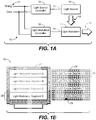
- FIG. 1A shows a typical display system 10 used in the present application.
- System 10 comprises light source controller 12 and light modulator controller 15 that - in one embodiment - may input timing and image data signals 11.
- Controllers 12 and 15 are control light source 14 and light modulator 17 via communications pathways 13 and 16 respectively.
- Light 18 emitted by source 14 illuminates modulator 17 and transmits to a viewer along a pathway 19.
- FIG. 1B shows one example of a display system 20 (in a somewhat exploded view) which is useful for understanding the present invention and in which the basic architecture of Figure 1 may be partitioned, segmented or otherwise striped.
- Display system 20 may have its light modulator 27 segmented (e.g., in segments 28 -- A, B, C, D, as shown - or in any other fashion).
- the light source 24 may likewise be segmented or striped (e.g., segments 26 A, B, C D, as shown - or in any other fashion).
- Each light source stripe may comprise an array of emitters 28 (e.g. 20 x 4 or any other striping, such as 16 LEDs by 3 rows).
- FIG. 2 illustrates four PWM driving signals I1-I4 for driving four light emitters or groups of light emitters on a backlight.
- the PWM signals I1-I4 each have a period T and an on-time or duty cycle of 75% of T. All of the signals are in phase with each other. They each rise together by a current I on at time t0 and fall together at time t3. Current I on corresponds to the current required to drive the light emitters in their ON state.
- PWM driving signals I1-I4 are depicted as identical in FIG. 2 for ease of illustration; however, in a dual modulation display each signal may be individually-controllable to have a specific duty cycles.
- brightness levels are controlled by varying the time at which each light emitter is switched off within a PWM cycle; that is, the duty cycle is timed from the start of each PWM cycle.
- the waveform P total in FIG. 2 represents total electrical power required to drive the light emitters controlled by the four PWM driving signals I1-I4.
- P total jumps immediately to a maximum value, P max , at time t0.
- each PWM signal 11-14 drove a light emitter consuming power of (I on ) ( Von ) when in an ON state
- P max would equal 4 (I on )(V on )
- P total remains at P max from times t0 to t3 and then drop to zero for the final quarter of each PWM cycle as every light emitter switches to the OFF state.
- the four LEDs would draw a total current of 4 (I on ) from times t0 to t3 and then draw zero total current for the final quarter of each cycle.
- a drawback to PWM when used with multiple light emitters is that the light emitters are all turned on simultaneously for some duration during the beginning of each PWM cycle (for any non-zero brightness setting).
- the result is that the power supply for the display must be able to deliver enough power to fully drive all of the light emitters for at least a short time and to provide this power almost instantaneously, regardless of the display's effective brightness level.
- This requirement increases the cost and complexity of the display's power supply, particularly for backlights having large numbers of light emitters.
- Some backlights may have dozens, hundreds or thousands of individual light emitters.
- This problem is particularly acute in the case that the display has the capability of displaying very bright images as is the case, for example, in some high dynamic range (HDR) displays.
- HDR high dynamic range
- Such displays may be capable of displaying images having local light intensities of 2000 cd/m 2 or more.
- light emitting elements may be of types that consume significant electrical power in their ON states.
- such transient power requirements are reduced by dividing the light emitters of a backlight into several groups and staggering the start times of PWM cycles for different ones of the groups over time.
- the light emitters can be divided into groups in any convenient manner.
- FIG. 3 illustrates PWM driving signals I1'-I4' according to an example which is useful for understanding the present invention and in which the light emitters of a backlight have been divided into four groups.
- Each group of light emitters is controlled by one of PWM signals I1'-I4'.
- each PWM signal has a duty cycle of 75% so that the light emitters operate at an effective brightness of 75%.
- PWM signals I1'-I4' in FIG. 3 are 90 degrees out of phase with one another.
- P total of FIG. 2 is shown in a dotted line overlaying P total' in FIG. 3 to more easily see the differences in power requirements.
- P total' ramps up in steps over the first PWM cycle to a level P max' at which it remains until the PWM signals are changed to display a subsequent image.
- P max' is less than P max by an amount ⁇ P max .
- each PWM signal I1'-I4' drives a light emitter consuming power of (I on ) (V on ) when in an ON state
- the maximum power P max' is 75% of the equivalent maximum power P max of 4(I on )(V on ) required when the PWM signals are in phase as illustrated in FIG. 2 .
- phase-shifting PWM signals may include the advantage that total power ramps up more gradually, is distributed more evenly and is held to a lower maximum value than if the same PWM signals were applied in phase.
- PWM signals for a given image may cycle without change for as long as that image is being displayed.
- the PWM driving signals may be updated to reflect image data for the new image.
- the total power may be required to ramp up from zero to a maximum value determined by the updated PWM signals. As described above, this initial ramp-up time may be extended by configuring groups of PWM signals to be out of phase with one another. During subsequent PWM cycles of the same image the total power may remain constant at this maximum value (as in the example illustrated in FIG. 3 ) or fluctuate to some degree relative to the initial ramp-up of the first PWM cycle.
- image data and corresponding PWM driving signals may be updated at the start of each video frame.
- the PWM period may be much shorter than the video frame period such that multiple PWM cycles occur within a single video frame.
- video frame periods are in the range of 3 to 16.7 milliseconds while PWM periods are in the range of 0.1 to 2 milliseconds.
- Example waveforms which are useful for understanding the present invention and which are representing frame periods and PWM periods are illustrated in FIG. 4A .
- Waveform 50 represents example video frame cycles having a period of T frame .
- Waveform 52 represents example PWM cycles having a period T.
- each frame cycle of waveform 50 contains twelve PWM cycles of waveform 52.
- the duration of the first PWM cycle after an image update is extended in time relative to subsequent PWM cycle periods of the same image.
- the image may be a video frame or a still image. Since power fluctuation or surges tend to be greatest during the first PWM cycle (as power ramps up from zero to a maximum value as illustrated in FIG. 3 ), lengthening the first PWM cycle allows more time for this initial power ramp-up to occur and reduces the power surge demands on the power supply accordingly. If only the first PWM cycle after an image update is extended (but still kept short relative to a frame period), there should be no visible effect on the light emitter brightness.
- the first PWM cycle period after an update may be extended in time up to about 2 milliseconds for example.
- Waveform 54 of FIG. 4A is similar to waveform 52 except that the first PWM cycle of each frame cycle has a duration T1 that is longer than a period T2 of the subsequent PWM cycles within the frame cycle according to an example embodiment of the invention.
- Period T1 may be made any suitable amount longer than period T2.
- period T1 is an integer multiple of period T2.
- the ratio of T1/T2 is in the range of 1.5 to 10 for example.
- period T1 is twice as long as period T2 (where T2 is equivalent to period T of waveform 52).
- FIG. 4B illustrates an example which is useful for understanding the present invention and where the phase shifting illustrated in FIG. 3 and the lengthened PWM cycle illustrated in FIG. 4A is combined.
- the duration of the first PWM cycle of signals I1"-I4" is twice as long as the subsequent PWM cycles.
- the PWM signals I1"-I4" in FIG. 4B are otherwise the same as I1'-I4' shown in FIG. 3 .
- the total power P total" steps up from zero to a maximum value P max" (equal to P max' in FIG. 3 ) at times t0, t2 and t4 of the first PWM cycle.
- the initial power ramp-up time is thus doubled relative to the example of FIG. 3 .
- Decreasing the ramp-up rate, magnitude and frequency of power variations of a backlight as described above may in turn decrease the complexity and cost of the power supply needed to power the backlight.
- various parameters of a power supply such as surge capacity, load regulation and transient response may be eased where PWM signals are offset as illustrated in FIGS. 3 and 4 .
- Surge capacity is a measure of the maximum current that a power supply is capable of supplying over a given period at a given duty cycle.
- the surge capacity of a power supply may be significantly greater than its average output power capacity.
- Load regulation is a measure of the ability of the power supply to maintain a constant output voltage in response to variations in the output load.
- Transient response is a measure of the time it takes for the output voltage to settle to a steady output voltage after an output load change.
- the efficiency and reliability of the power supply may be increased where PWM signals are offset as illustrated in FIGS. 3 and 4 .
- Power supplies tend to be more efficient when they are operated to supply a relatively consistent current and less efficient when bouncing between full and light loading.
- electrical components of the power supply tend to be stressed less and last longer when the current drawn from the power supply is not bouncing between full and light loading.
- FIG. 5A illustrates a portion of a backlight 60 comprising multiple tiles 62 of light emitters 64 according to an example which is useful for understanding the present invention.
- Light emitters 64 may be LEDs for example.
- backlight 60 comprises a two-dimensional array of tiles 62 and each tile comprises a two-dimensional arrangement of light emitters 64.
- each tile 62 comprises a printed circuit board (PCB) comprising an array of LEDs or other light emitters.
- PCB printed circuit board
- a display incorporating backlight 60 may also comprise a controller 66 that generates brightness signals 68 according to input image data 70.
- Brightness signals 68 may be analog or digital signals representing the desired brightness level for one or more light emitters 64.
- Backlight 60 may also comprise one or more PWM controllers 72 for converting brightness signals 68 into PWM driving signals 74, which may directly control the brightness of light emitters 64.
- backlight 60 comprises multiple PWM controllers 72, each controlling multiple light emitters 64 such as LEDs.
- each tile 62 comprises one or more PWM controllers 72 for controlling light emitters 64 on that tile.
- tiles 62 comprise PCBs having PWM controllers 72 integrated therein for controlling light emitters 64 on that PCB. Controller 66 and PWM controller 72 may be separate physical devices or may be combined within the same physical device.
- PWM driving signals 74 may be waveforms comprising a sequence of cycles having a given duration, duty cycle and phase offset. PWM driving signals 74 may operate to switch on and off a fixed electrical current through a light emitter 64. In some embodiments, PWM driving signals 74 of one tile are phase shifted relative to PWM driving signals 74 of another tile (as illustrated for example in FIG. 3 ). In some embodiments, the duration of the first PWM cycle of an image displayed is longer than the duration of subsequent PWM cycles of the same image (as illustrated for example in FIG. 4B ).
- PWM controller 72 outputs multiple PWM driving signals 74 that each controls a separate tile 62.
- all light emitters 64 on a tile 62 are controlled by a common PWM driving signal 74 generated for that tile.
- duty cycles of PWM driving signals 74 for each light emitter 64 are independently controllable by one or more PWM controllers 72.
- a controller chip or circuit individually controls multiple light emitters.
- the PWM controller chip or circuit is configured so that start times of the PWM signals generated for the light emitters are staggered relative to one another. In a backlight constructed using such PWM controller chip or circuits the times at which different groups of light emitters are turned ON are automatically staggered.
- Backlight 60 also comprises a power supply 76 for providing electrical power to light emitters 64 on the backlight.
- Power supply 76 may be configured to satisfy particular power requirements necessary to generate the desired range of brightness of light emitters 64. Such power requirements may include load regulation, transient response and/or surge capacity for example. If the start time of groups of PWM signals are staggered as illustrated in FIGS. 3 or 4 , light emitters 64 are not all switched on to 100% brightness at the same time and such power requirements may be reduced as described above. In particular, in some embodiments, power supply 76 has a surge capacity that is less than the surge capacity that would be required if all light emitters 64 were switched on at the same time.
- the percentage reduction in surge capacity of power supply 76 may be proportional to the percentage reduction in the number of light emitters driven by PWM signals having the same phase offset. In some embodiments, power supply 76 has a maximum surge capacity less than half the surge capacity that would be required if all light emitters 64 were switched on at the same time.
- power supply 76 is capable of a maximum output surge current (out-rush current) that is less than the total in-rush current that would be required by light emitters 64 if all light emitters 64 were switched on at the same time. For example, if backlight 60 comprises N light emitters and each light emitter requires an in-rush current of I rush when switched on, then power supply 76 may have a maximum out-rush current of less than N(I rush ) while being capable of supplying the average current required. In some embodiments, power supply 76 has a maximum out-rush current less than 0.75(N)(I rush ). In some embodiments, power supply 76 has a maximum out-rush current less than 0.5(N)(I rush ).
- Power supply 76 may be configured to have the capacity to supply a continuous output current sufficient to sustain a desired average brightness of backlight 60.
- power supply 76 is capable of generating a maximum average light intensity over the entire backlight 60 that is less than localized light intensities it may generate over portions of backlight 60.
- power supply 76 may be capable of generating localized light intensities of 2000 cd/m 2 or more over portions of backlight 60 while only capable of generating a maximum average light intensity of 400 cd/m 2 over the entire backlight 60.
- At block 102 of method 100 involves determining brightness values for all light emitters on a backlight of a display based on image data representing an image to be displayed.
- the light emitters are divided into a plurality of groups.
- the brightness values may be determined independently for each separate light emitter or for each separate group so that the intensity of light emitted by the backlight and incident on a spatial light modulator can be made to vary in a desired way over the spatial light modulator.
- the brightness values may be represented by electronic analog or digital signals, for example.
- PWM duty cycles are determined for the light emitters of each group based on the brightness values determined at block 102.
- the duty cycles may be expressed for example as the percentage or ratio of each PWM period that the light emitter should be in an ON state to produce the desired brightness level.
- phase offsets applied for each group differ from one another so as to stagger the start times of PWM cycles of different groups (as illustrated in FIG. 3 ). For example, phase offsets for each group may be applied in increments of 360 /N where N is the number of groups.
- the duration of each PWM cycle is set such that a first PWM cycle of the image is longer than duration of subsequent PWM cycles for the given image (as is illustrated in FIG. 4B ).
- the first PWM cycle may be made to be twice as long as subsequent PWM cycles.
- One benefit of extending the first cycle is to extend the ramp-up time required for the power and current drawn by the light emitters.
- a PWM cycle always comprise a contiguous on-time portion followed by a contiguous off-time portion.
- the pattern of on-time and off-time may varied so long as the overall ratio of on-time to off-time within the cycle is maintained.
- the order of on-time and off-time within a cycle may be reversed such that a light emitter remains off for some first portion of the cycle and then turns on for the remaining portion of the cycle.
- light emitters having different brightness levels may turn on at different times within the same PWM cycle (and switch off at the same time at the end of the cycle).
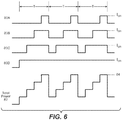
- FIG. 6 of the present application illustrates four waveforms 80A-80D representing PWM signals having duty cycles of 25%, 50%, 75% and 100% respectively and a period T, wherein the on-time of each period follows the off-time.
- the resulting total power waveform 82 steps up to a maximum value 84 during each cycle rather than rising instantaneously to the maximum value at the start of each cycle.
- on-time may also be centered within a PWM cycle such that different power levels rise and fall at different times.
- On-time and off- time may be interspersed within a PWM cycle in any other chosen manner so long as the overall proportion of on-time to off-time within the cycle remains the same.
- each cycle may be divided into that number of segments (for example 2 n segments) during which a light emitter may be set ON or OFF.
- Each brightness level may correspond to a particular pattern of ON/OFF segments within a PWM cycle.
- Different groups of light emitters may employ different sets of ON/OFF patterns for each brightness level such that on-times between groups are staggered even if set to the same brightness level. The total power requirements may thus be distributed more evenly across PWM cycles.
- Variations in the distribution of on-time and off-time within PWM cycles may be combined with variations in phase offsets for groups of PWM signals as described above.
- the start times of individual light emitters within a group having a common phase offset may be staggered by measuring duty cycles from the end of each PWM cycle. If the duration of the first cycle of each new image is made longer than a default PWM period, the initial ramp-up time required may be correspondingly extended as well.
- FIG. 5B illustrates a backlight 120 according to another example which is useful for understanding the present invention.
- multiple PWM controllers 122A-122D are each controlled by a separate clock signal 124A-124D (collectively clock signals 124).
- PWM controllers 122 each generate PWM driving signals 123 for a group 125 of one or more light emitters 126.
- Clock signals 124 have a common period T but are phase shifted from one another such that the start times of PWM cycles generated by PWM controllers 122 are staggered.
- Clock signals 124 may be generated by phase shifting the output of a common source clock by different amounts.
- clock signal 124A may be phase shifted by 0
- clock signal 124B may be phase shifted by 90
- clock signal 124C may be phase shifted by 180
- clock signal 124D may be phase shifted by 270.
- a clock signal to one or more PWM controllers is inverted relative to the clock signal to one or more other PWM controllers.
- each clock signal 124 may be switched between a first clock signal used for the first PWM cycle of a displayed image and a second clock signal used for subsequent PWM cycles of the same image.
- the first clock signal may have a longer period than the corresponding second clock signal (for example a period of 2T compared to T), but the same phase offset.
- the first clock signal may thus be used to extend the duration of the first PWM cycle of each displayed image relative to the duration of subsequent PWM cycles of the same image.
- the frequency of a clock signal may be changed such that a period of a first PWM cycle is longer than that of subsequent PWM cycles.
- FIG. 1A, FIG. 1B , FIG. 2 , FIG. 3 , FIG. 4A, FIG. 4B , FIG. 5A, FIG. 5B , and FIG. 6 may be part of the embodiments of the present invention described below.
- Features of the embodiments mentioned below may be embodied according to the features of the examples described above.
- Some embodiments herein described may affect: (1) reduced instantaneous power demands, (2) increase backlighting precision with increased bit-depth of PWM drivers and/or controllers, (3) better matching the backlighting to images being rendered and (4) provide better text readability by providing backlight blanking at desired times.
- the system may take a single frame and divided it into multiple PWM cycles. These PWM cycles may be individually controlled and can be reloaded per PWM period, thereby allowing the system to reload values given a single deep bit PWM value for that frame.
- the system may then further optimize this to distribute the start times in phases. This may be affected by splitting the PWM periods into phases and distributing the values of that PWM period to that phase.
- Such a system may not require as much instantaneous power because while a low value PWM LED shuts down on the later phases, the other LEDs may begin to turn ON. This allows an effective distribution of the overlap of LED PWM's being ON -- thus simultaneously increasing the lifetime of the supply and easing the requirements of the power supply.
- this PWM frame rate may be compared with the video frame operating the light modulator (e.g. 60-120 hz), it is possible to have approximately 60 PWM frames within a given video frame.
- the video frame operating the light modulator e.g. 60-120 hz
- a phasing concept may be set which sets a limit on the number of LEDs that may be turned on at any one time. For one example, this number may be defined as being a fraction of the total number of LEDs in the system. For example, if the system is designed for n phases, then no more than N/n LEDs may be on at any one time, where N is the total number of LEDs. In this case there is no overlapping of phases.
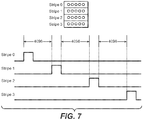
- the backlight of the display system may be striped to save overall power demand.
- FIG. 7 is one example embodiment of a display system according to the present invention in which the backlight is striped (Stripes 0, 1, 2, and 3 - as shown). These stripes may be staggered in their ON-OFF states as shown to reduce the instantaneous power demands of the display system.
- One embodiment of the present system comprises a design that takes a lower bit depth PWM LED driver controller and increases the bit depth per video frame to allow for more control over the light emitted during that frame.
- some commercial drivers use only 12bit PWM control. With these commercial drivers, one issue is that, as the LED was to be controlled at lower and lower luminances, the LEDs may have had a problem to control the color mix, as there may not be enough control at the bottom end.
- the human visual system is, however, sensitive to light at these lower levels.
- it is possible to allow more control at the lower levels which, in turn, allows the system to render better blacks and more accurate gray scale tracking.
- the 12-bit PWM controller may have its effective bit depth extending by 2 bits - to become an effective 14-bit controller.
- the extended bits ((0,0), (0,1), (1,0) and (1,1)) may be used for one stripe to add additional ON states as shown.
- the additional ON states are shown at step value 4096 - but it will be appreciated that other step values may be assumed within a duty cycle to assume different effective levels of luminance.
- FIG. 9 shows how the extended bits may be wrapped around in a striping scheme. For example, FIG. 9 shows how Stripe 1 may be driven with its extended bits - and extended bits (1,1) is shown wrapped to provide the desired result.
- the LED image may match in the same segments as the LCD.
- the LED image may update in the same segments as the LCD - e.g., 4 to 8 segments from top to bottom.
- a LED stripe may be blacked out a fraction of the time of the frame to avoid the viewing of the update-twist time of the LCD. This scheme would help to avoid noticeable LCD blur.
- PWM controllers comprising a first update period
- this PWM updating can be advantageously matched to the LCD response time (a first response time period). For example, when the LCD is switching from black to white from one frame to another frame, this takes some time and it may be a significant fraction of the time of a frame. This fraction of the time may be matched with a PWM cycle of the LED driver. For example, if the display is going from a LCD value of 0 to 255 (e.g.
- the PWMs in a frame may proceed as 0, 64, 256, 512, 2048, 4095, 4095, 4095 -- as opposed to just displaying 4095, 4095, 4095, 4095, 4095, repeatedly.
- the PWM signals are increased gradually over several update periods.
- the maximum brightness of the display system may be defined differently.
- maximum brightness may be defined several ways: (1) maximum brightness over the full screen and (2) maximum brightness of a small bright feature.
- the maximum brightness could be defined as a fully open LCD at 100% PWM on the LEDs. In such a case, it is possible to set the drive current such that only one phase is required and the di/dt improvement may still be realized.
- SBFs Small Bright Features
- SBFs may occur from time to time in an image - and may be accommodated if some headroom is designed into the display system to increase the LED dynamic range.
- SBFs may be detected in an image frame buffer -- as image data is read into the buffer.
- Such a buffer may be affected in light source controller 12 and/or light modulator controller 15 of FIG. 1A .
- Such a buffer may be implemented in other parts of the image pipeline of the display system, as is known in the art.
- FIG. 10 depicts an occurrence of a SBF, as it may appear in one embodiment of an LED backlight.
- the LED backlights may be further assigned to a one of a number of partitions.
- LEDs in FIG. 10 may be assigned to one of four partitions - I, II, III, and IV.
- the partitions may be actually physical partitioning of the area of the backlight itself.
- it will be appreciate that many other partitionings are possible and the scope of the present application encompasses them.
- a SBF is defined by an arbitrary group of LEDs that may ignore the phasing rules from time to time and be turned on for 100% of a PWM cycle. For example, an explosion at night may require a mostly dark screen with a small bright area, for example, 20% of the total area of the screen. As long as the maximum total current limitation is not exceeded, than the LED required to backlight the explosion could be given an exception to the rules set by the phasing limitations.
- FIG. 11 shows two example embodiments of how a SBF may be handled, accordingly.
- the top timing diagram shows that, for one given SBF, the LEDs of partition II may be illuminated for approximately 15% of its cycle.
- the three following diagrams illustrate how partition II and III LEDs may be illuminated to produce a 50% cycle, partition LEDs II, III, and IV illuminated to produce at 75% cycle, and how partial partition LED I, together with partition LEDs II, III, and IV are illuminated to produce a 90% cycle. Other illumination patterns are of course possible with this scheme.
- the system may monitor predicted power for any given scene and allow (or partially allow) the SBF, accordingly, by either by allowing 100% of the desired PWM value or scaling it down in order to meet the system peak current and/or di/dt limitations.
Landscapes
- Engineering & Computer Science (AREA)
- Theoretical Computer Science (AREA)
- Physics & Mathematics (AREA)
- General Physics & Mathematics (AREA)
- Computer Hardware Design (AREA)
- Chemical & Material Sciences (AREA)
- Crystallography & Structural Chemistry (AREA)
- General Engineering & Computer Science (AREA)
- Liquid Crystal Display Device Control (AREA)
- Control Of Indicators Other Than Cathode Ray Tubes (AREA)
- Liquid Crystal (AREA)
Claims (6)
- Anzeigesystem (10, 20), das Folgendes umfasst:einen Lichtmodulator (17, 27) mit mehreren Segmenten (28) ;eine Lichtmodulatorsteuerung (15), wobei die Lichtmodulatorsteuerung (15) die durch den Lichtmodulator (17, 27) transmittierte Menge an Licht steuert, wobei die Lichtmodulatorsteuerung (15) fähig ist, den Lichtmodulator (17, 27) in Segmenten (28) zu aktualisieren, wobei jede Segmentaktualisierung eine erste Reaktionszeitdauer umfasst;eine Hintergrundbeleuchtung (14, 24, 60), wobei die Hintergrundbeleuchtung (14, 24, 60) mehrere Streifen (26, 62) umfasst, wobei die Streifen (26, 62) jeweils mehrere Lichtemitter (64, 126) aufweisen;eine oder mehrere Hintergrundbeleuchtungssteuerungen (12, 66), wobei die Hintergrundbeleuchtungssteuerungen (12, 66) konfiguriert sind, Helligkeitsniveaus der Lichtemitter (64, 126) innerhalb der Streifen (26, 62) durch Anlegen von Pulsbreitenmodulationsansteuerungssignalen (74, 123), als PWM-Ansteuerungssignale (74, 123) bezeichnet, an jeden Streifen (26, 62) zu steuern, wobei jedes PWM-Ansteuerungssignal (74, 123) für jeden Streifen (26, 62) eine erste Aktualisierungsdauer aufweist;wobei jedes der Lichtmodulatorsegmente (28) räumlich an einen der Hintergrundbeleuchtungsstreifen (26, 62) angepasst ist und wobei ferner die erste Aktualisierungsdauer kürzer ist als die erste Reaktionszeit;wobei die Hintergrundbeleuchtungssteuerungen (12, 66) konfiguriert sind, die Streifen (26, 62) von Lichtemittern (64, 126) am Anfang der ersten Reaktionszeitdauer zu verdunkeln, um zu vermeiden, dass die Aktualisierungsverdrehungszeit des Lichtmodulators (17, 27) angezeigt wird;wobei die Hintergrundbeleuchtungssteuerungen (12, 66) konfiguriert sind, Helligkeitsniveaus der Lichtemitter (64, 126) durch PWM-Ansteuerungssignale (74, 123) mit einer Periodendauer T, einem zu dem Helligkeitsniveau proportionalen Tastgrad und einer relativen Phasenverschiebung zwischen den PWM-Ansteuerungssignalen (74, 123) verschiedener Streifen (26, 62) zu steuern;dadurch gekennzeichnet, dass
die Hintergrundbeleuchtungssteuerungen (12, 66) einen ersten Satz von Pulsbreitenmodulationsansteuerungswerten, als PWM-Ansteuerungswerte bezeichnet, innerhalb einer einzigen Periodendauer T ausgeben, wobei der erste Satz von PWM-Ansteuerungswerten eine Auflösung einer ersten Bittiefe repräsentiert; und
wobei die Streifen (26, 62) von Lichtemittern (64, 126) ferner durch PWM-Ansteuerungssignale (74, 123) über mehrere Periodendauern T' so gesteuert werden, dass die Lichtemitter (64, 126) über einen zweiten Satz von PWM-Ansteuerungswerten gesteuert werden, wobei der zweite Satz von PWM-Ansteuerungswerten eine Auflösung einer zweiten Bittiefe repräsentiert, wobei die zweite Bittiefe größer als die erste Bittiefe ist, wobei jede Periodendauer T` einen Pulsbreitenmodulationsansteuerungszyklus, als PWM-Ansteuerungszyklus bezeichnet, einer Periodendauer T mehrmals wiederholt, so dass zusätzliche Niveaus von Weißlicht mit niedriger Leuchtdichte mit der Hintergrundbeleuchtung (14, 24, 60) darstellbar sind, wobei eine Grenze der Anzahl von Lichtemittern (64, 126), die gegenwärtig eingeschaltet sind, festgesetzt ist und wobei die Grenze ein Bruchteil der Gesamtanzahl der Lichtemitter (64, 126) des Anzeigesystems (10, 20) ist. - Anzeigesystem (10, 20) nach Anspruch 1, wobei, wenn Lichtmodulatorsignale von vollständig AUS zu vollständig EIN übergehen, die PWM-Ansteuerungssignale (74, 123) schrittweise über mehrere erste Aktualisierungsdauern erhöht werden.
- Anzeigesystem (10, 20) nach einem der Ansprüche 1 bis 2, wobei die Hintergrundbeleuchtungssteuerungen (12, 66) einen ersten Satz von PWM-Ansteuerungswerten über einer einzigen Pulsbreitenmodulationsperiodendauer, als PWM-Periodendauer bezeichnet, umfassen, der einer ersten Bittiefe von 12 Bits entspricht, und wobei ferner die PWM-Ansteuerungssignale (74, 123) für einen gegebenen Streifen (26, 62) von Lichtemittern (64, 126) über vier PWM-Periodendauern gesteuert werden, was einer zweiten Bittiefe von 14 Bits entspricht.
- Anzeigesystem (10, 20) nach einem der Ansprüche 1 bis 3,
wobei jeder Lichtemitter (64, 126) einer von mehreren Unterteilungen zugeordnet ist;
wobei die Hintergrundbeleuchtungssteuerungen (12, 66) konfiguriert sind, Helligkeitsniveaus der Lichtemitter (64, 126) durch eines einer Gruppe (125) zu steuern, wobei die Gruppe (125) Folgendes umfasst:Steuern von Lichtemittern (64, 126) innerhalb der Streifen (26, 62) durch Anlegen von PWM-Ansteuerungssignalen (74, 123) an jeden Streifen (26, 62), undSteuern von Lichtemittern (64, 126) innerhalb von mehreren Unterteilungen; undwobei, wenn ein kleiner heller Bestandteil in einem Einzelbild detektiert wird, die Hintergrundbeleuchtungssteuerungen (12, 66) dann ferner einen Teilsatz von Lichtemittern (64, 126) innerhalb einer oder mehrerer der Unterteilungen steuern. - Anzeigesystem (10, 20) nach Anspruch 4, wobei die Unterteilungen der Lichtemitter (64, 126) die Hintergrundbeleuchtung (14, 24, 60) in Gebiete von Lichtemittern (64, 126), die der gleichen Unterteilung zugeordnet sind, unterteilen.
- Anzeigesystem (10, 20) nach Anspruch 4, wobei im Wesentlichen zwei beliebige angrenzende Lichtmitter (64, 126) verschiedenen Unterteilungen zugeordnet sind.
Applications Claiming Priority (2)
| Application Number | Priority Date | Filing Date | Title |
|---|---|---|---|
| US201161558654P | 2011-11-11 | 2011-11-11 | |
| PCT/US2012/063955 WO2013070774A1 (en) | 2011-11-11 | 2012-11-07 | Systems and method for display systems having improved power profiles |
Publications (3)
| Publication Number | Publication Date |
|---|---|
| EP2777037A1 EP2777037A1 (de) | 2014-09-17 |
| EP2777037A4 EP2777037A4 (de) | 2015-04-01 |
| EP2777037B1 true EP2777037B1 (de) | 2016-12-28 |
Family
ID=48290513
Family Applications (1)
| Application Number | Title | Priority Date | Filing Date |
|---|---|---|---|
| EP12846847.7A Active EP2777037B1 (de) | 2011-11-11 | 2012-11-07 | Systeme und verfahren für anzeigesysteme mit verbesserten leistungsprofilen |
Country Status (5)
| Country | Link |
|---|---|
| US (1) | US20140307011A1 (de) |
| EP (1) | EP2777037B1 (de) |
| JP (3) | JP5989789B2 (de) |
| CN (1) | CN103918022B (de) |
| WO (1) | WO2013070774A1 (de) |
Families Citing this family (23)
| Publication number | Priority date | Publication date | Assignee | Title |
|---|---|---|---|---|
| GB201312306D0 (en) | 2013-07-09 | 2013-08-21 | Tomtom Software Ltd | Traffic light phase predictions and improved navigation methods using the traffic light phase predictions |
| CN103903548B (zh) * | 2014-03-07 | 2016-03-02 | 京东方科技集团股份有限公司 | 一种显示面板的驱动方法和驱动系统 |
| WO2015157722A1 (en) * | 2014-04-10 | 2015-10-15 | Fruitman Clinton O | Power conserving method for electric lighting supply |
| CN106462038B (zh) | 2014-06-27 | 2018-05-18 | 杜比实验室特许公司 | 用于具有高动态范围的投影仪的光再循环 |
| KR20180002786A (ko) | 2015-06-05 | 2018-01-08 | 애플 인크. | 디스플레이 패널에 대한 방출 제어 장치들 및 방법들 |
| EP3308373A1 (de) | 2015-06-10 | 2018-04-18 | Apple Inc. | Anzeigetafelredundanzschemen |
| WO2016204973A1 (en) * | 2015-06-19 | 2016-12-22 | Intel Corporation | Enabling a chipset that supports a single display to support dual display |
| US11348511B2 (en) | 2015-06-19 | 2022-05-31 | Intel Corporation | Enabling a chipset that supports a single display to support dual display |
| TWI582750B (zh) * | 2016-06-30 | 2017-05-11 | 晨星半導體股份有限公司 | 應用於顯示器的背光控制及影像補償方法與相關的控制電路 |
| US10254584B2 (en) * | 2016-09-12 | 2019-04-09 | Panasonic Automotive Systems Company Of America, Division Of Panasonic Corporation Of North America | Adaptable backlight |
| US10997946B2 (en) * | 2017-10-18 | 2021-05-04 | Valve Corporation | Display with adjustable duty cycle for individual color channels |
| US10692443B2 (en) * | 2017-11-30 | 2020-06-23 | Novatek Microelectronics Corp. | Synchronous backlight device and operation method thereof |
| US10665177B2 (en) * | 2017-11-30 | 2020-05-26 | Novatek Microelectronics Corp. | Circuit arrangement for controlling backlight source and operation method thereof |
| CN111754945B (zh) * | 2019-03-29 | 2021-12-28 | 合肥鑫晟光电科技有限公司 | 用于控制显示装置的驱动的方法、装置和显示装置 |
| CN110211540A (zh) * | 2019-05-30 | 2019-09-06 | 深圳创维-Rgb电子有限公司 | 一种多区背光控制方法、装置、终端及存储介质 |
| CN111028796A (zh) * | 2019-12-03 | 2020-04-17 | Tcl华星光电技术有限公司 | 调光方法、装置及存储介质 |
| CN113496685B (zh) * | 2020-04-08 | 2022-11-18 | 华为技术有限公司 | 一种显示亮度调整方法及相关装置 |
| US11087672B1 (en) | 2020-12-09 | 2021-08-10 | Huayuan Semiconductor (Shenzhen) Limited Company | Display device with selectable LED current levels based on brightness data |
| US11922892B2 (en) * | 2021-01-20 | 2024-03-05 | Meta Platforms Technologies, Llc | High-efficiency backlight driver |
| WO2023236632A1 (zh) * | 2022-06-08 | 2023-12-14 | 海信视像科技股份有限公司 | 一种用于显示设备的驱动方法及显示设备 |
| US12367652B2 (en) * | 2022-09-16 | 2025-07-22 | Ford Global Technologies, Llc | Synchronizing image frames by super sampling |
| CN115966181B (zh) * | 2022-12-12 | 2024-07-30 | 四川长虹电器股份有限公司 | 多分区背光系统液晶电视功率限定的方法 |
| CN121459734A (zh) * | 2024-07-24 | 2026-02-03 | 荣耀终端股份有限公司 | 显示驱动方法及电子设备 |
Citations (1)
| Publication number | Priority date | Publication date | Assignee | Title |
|---|---|---|---|---|
| US20110025728A1 (en) * | 2008-12-25 | 2011-02-03 | Masahiro Baba | Image processing apparatus and image display apparatus |
Family Cites Families (24)
| Publication number | Priority date | Publication date | Assignee | Title |
|---|---|---|---|---|
| JPH07181916A (ja) * | 1993-12-22 | 1995-07-21 | Futaba Corp | 表示装置の駆動回路 |
| US7176948B2 (en) | 2000-04-12 | 2007-02-13 | Honeywell International Inc. | Method, apparatus and computer program product for controlling LED backlights and for improved pulse width modulation resolution |
| ES2813107T3 (es) | 2001-02-27 | 2021-03-22 | Dolby Laboratories Licensing Corp | Procedimiento y dispositivo para visualizar una imagen |
| JP4348457B2 (ja) | 2002-03-13 | 2009-10-21 | ドルビー ラボラトリーズ ライセンシング コーポレイション | 高ダイナミックレンジのディスプレイ、ディスプレイコントローラ及び画像表示方法 |
| KR101131306B1 (ko) * | 2004-06-30 | 2012-03-30 | 엘지디스플레이 주식회사 | 액정표시장치의 백라이트 유닛 |
| US8217970B2 (en) | 2004-07-27 | 2012-07-10 | Dolby Laboratories Licensing Corporation | Rapid image rendering on dual-modulator displays |
| US7205729B2 (en) * | 2004-10-07 | 2007-04-17 | Barco, Naamloze Vennootschap | Control system and method for controlling lighting and video devices |
| JP2007286501A (ja) * | 2006-04-19 | 2007-11-01 | Sony Corp | 液晶表示装置組立体の駆動方法 |
| US8605017B2 (en) * | 2006-06-02 | 2013-12-10 | Samsung Display Co., Ltd. | High dynamic contrast display system having multiple segmented backlight |
| CN101303839A (zh) * | 2007-05-08 | 2008-11-12 | 日本胜利株式会社 | 液晶显示装置及用于该装置的影像显示方法 |
| EP2175313A4 (de) * | 2007-09-27 | 2011-01-05 | Sharp Kk | Anzeigevorrichtung |
| US20090189842A1 (en) * | 2008-01-24 | 2009-07-30 | Industrial Technology Research Institute | Backlight control apparatus |
| KR101337142B1 (ko) * | 2008-09-10 | 2013-12-05 | 엘지디스플레이 주식회사 | 액정표시장치 및 그 구동 방법 |
| RU2469417C1 (ru) * | 2008-10-10 | 2012-12-10 | Шарп Кабусики Кайся | Устройство отображения изображений |
| US8456495B2 (en) * | 2008-10-10 | 2013-06-04 | Sharp Kabushiki Kaisha | Power control method of light emitting device for image display, light emitting device for image display, display device and television receiver |
| ES2541846T3 (es) * | 2008-10-14 | 2015-07-27 | Dolby Laboratories Licensing Corporation | Simulación de luz posterior a resoluciones reducidas para determinar la modulación espacial de luz para imágenes de alto rango dinámico |
| US8232742B2 (en) * | 2008-11-27 | 2012-07-31 | Arkalumen Inc. | Method, apparatus and computer-readable media for controlling lighting devices |
| JP5307527B2 (ja) * | 2008-12-16 | 2013-10-02 | ルネサスエレクトロニクス株式会社 | 表示装置、表示パネルドライバ、及びバックライト駆動方法 |
| WO2010131359A1 (ja) * | 2009-05-15 | 2010-11-18 | 株式会社 東芝 | 映像表示装置 |
| US20120086740A1 (en) * | 2009-07-03 | 2012-04-12 | Sharp Kabushiki Kaisha | Liquid Crystal Display Device And Light Source Control Method |
| CN102472905B (zh) * | 2009-07-13 | 2016-11-23 | 杜比实验室特许公司 | 用于控制空间光调制器显示器中的驱动信号的系统和方法 |
| US8867115B2 (en) | 2009-07-22 | 2014-10-21 | Dolby Laboratories Licensing Corporation | Control of array of two-dimensional imaging elements in light modulating displays |
| WO2011011548A1 (en) * | 2009-07-23 | 2011-01-27 | Dolby Laboratories Licensing Corporation | Reduced power displays |
| TWI407415B (zh) * | 2009-09-30 | 2013-09-01 | Macroblock Inc | 掃描型顯示裝置控制電路 |
-
2012
- 2012-11-07 CN CN201280055047.7A patent/CN103918022B/zh active Active
- 2012-11-07 WO PCT/US2012/063955 patent/WO2013070774A1/en not_active Ceased
- 2012-11-07 EP EP12846847.7A patent/EP2777037B1/de active Active
- 2012-11-07 JP JP2014540223A patent/JP5989789B2/ja active Active
- 2012-11-07 US US14/356,944 patent/US20140307011A1/en not_active Abandoned
-
2015
- 2015-09-16 JP JP2015182901A patent/JP6227607B2/ja active Active
-
2016
- 2016-04-01 JP JP2016074389A patent/JP6235065B2/ja active Active
Patent Citations (1)
| Publication number | Priority date | Publication date | Assignee | Title |
|---|---|---|---|---|
| US20110025728A1 (en) * | 2008-12-25 | 2011-02-03 | Masahiro Baba | Image processing apparatus and image display apparatus |
Also Published As
| Publication number | Publication date |
|---|---|
| US20140307011A1 (en) | 2014-10-16 |
| JP2016001341A (ja) | 2016-01-07 |
| EP2777037A4 (de) | 2015-04-01 |
| JP6235065B2 (ja) | 2017-11-22 |
| JP5989789B2 (ja) | 2016-09-07 |
| WO2013070774A1 (en) | 2013-05-16 |
| JP6227607B2 (ja) | 2017-11-08 |
| JP2016130866A (ja) | 2016-07-21 |
| CN103918022A (zh) | 2014-07-09 |
| CN103918022B (zh) | 2016-10-12 |
| JP2014532903A (ja) | 2014-12-08 |
| EP2777037A1 (de) | 2014-09-17 |
Similar Documents
| Publication | Publication Date | Title |
|---|---|---|
| US20140307011A1 (en) | Systems and Methods for Display Systems Having Improved Power Profiles | |
| US9373287B2 (en) | Reduced power displays | |
| US11164512B2 (en) | Display optimization techniques for micro-LED devices and arrays | |
| US9236025B2 (en) | Display device and method for driving the same | |
| EP1922902B1 (de) | Rote lichtquelle für rückbeleuchtung mit integrierter elektronik | |
| US8228272B2 (en) | Backlight device and liquid crystal display incorporating the backlight device | |
| US20170186404A1 (en) | Dynamic power and brightness control for a display screen | |
| US9311862B2 (en) | Backlight apparatus, control method therefor, and display apparatus | |
| EP3494572B1 (de) | Led-anzeigemodul und anzeigevorrichtung | |
| US20150206484A1 (en) | Display apparatus | |
| KR101229773B1 (ko) | 액정표시장치의 램프 구동 장치 | |
| CN119541421A (zh) | 显示屏的亮度调节方法与显示装置 | |
| US11397351B2 (en) | Display device | |
| CN117636786A (zh) | 一种显示面板的驱动方法及显示面板的驱动装置 | |
| CN100390619C (zh) | 液晶显示器件 |
Legal Events
| Date | Code | Title | Description |
|---|---|---|---|
| PUAI | Public reference made under article 153(3) epc to a published international application that has entered the european phase |
Free format text: ORIGINAL CODE: 0009012 |
|
| 17P | Request for examination filed |
Effective date: 20140611 |
|
| AK | Designated contracting states |
Kind code of ref document: A1 Designated state(s): AL AT BE BG CH CY CZ DE DK EE ES FI FR GB GR HR HU IE IS IT LI LT LU LV MC MK MT NL NO PL PT RO RS SE SI SK SM TR |
|
| DAX | Request for extension of the european patent (deleted) | ||
| A4 | Supplementary search report drawn up and despatched |
Effective date: 20150226 |
|
| RIC1 | Information provided on ipc code assigned before grant |
Ipc: G09G 3/20 20060101AFI20150220BHEP Ipc: G09G 3/36 20060101ALI20150220BHEP Ipc: G09G 3/34 20060101ALI20150220BHEP |
|
| 17Q | First examination report despatched |
Effective date: 20151015 |
|
| GRAP | Despatch of communication of intention to grant a patent |
Free format text: ORIGINAL CODE: EPIDOSNIGR1 |
|
| INTG | Intention to grant announced |
Effective date: 20160531 |
|
| GRAJ | Information related to disapproval of communication of intention to grant by the applicant or resumption of examination proceedings by the epo deleted |
Free format text: ORIGINAL CODE: EPIDOSDIGR1 |
|
| REG | Reference to a national code |
Ref country code: DE Ref legal event code: R079 Ref document number: 602012027219 Country of ref document: DE Free format text: PREVIOUS MAIN CLASS: G09G0003200000 Ipc: G06F0001320000 |
|
| RAP1 | Party data changed (applicant data changed or rights of an application transferred) |
Owner name: DOLBY LABORATORIES LICENSING CORPORATION |
|
| INTC | Intention to grant announced (deleted) | ||
| GRAR | Information related to intention to grant a patent recorded |
Free format text: ORIGINAL CODE: EPIDOSNIGR71 |
|
| GRAS | Grant fee paid |
Free format text: ORIGINAL CODE: EPIDOSNIGR3 |
|
| STAA | Information on the status of an ep patent application or granted ep patent |
Free format text: STATUS: GRANT OF PATENT IS INTENDED |
|
| RIC1 | Information provided on ipc code assigned before grant |
Ipc: G09G 3/34 20060101ALI20161017BHEP Ipc: G09G 3/20 20060101ALI20161017BHEP Ipc: G09G 3/36 20060101ALI20161017BHEP Ipc: G06F 1/32 20060101AFI20161017BHEP |
|
| GRAA | (expected) grant |
Free format text: ORIGINAL CODE: 0009210 |
|
| STAA | Information on the status of an ep patent application or granted ep patent |
Free format text: STATUS: THE PATENT HAS BEEN GRANTED |
|
| AK | Designated contracting states |
Kind code of ref document: B1 Designated state(s): AL AT BE BG CH CY CZ DE DK EE ES FI FR GB GR HR HU IE IS IT LI LT LU LV MC MK MT NL NO PL PT RO RS SE SI SK SM TR |
|
| INTG | Intention to grant announced |
Effective date: 20161121 |
|
| REG | Reference to a national code |
Ref country code: GB Ref legal event code: FG4D |
|
| REG | Reference to a national code |
Ref country code: CH Ref legal event code: EP |
|
| REG | Reference to a national code |
Ref country code: AT Ref legal event code: REF Ref document number: 857834 Country of ref document: AT Kind code of ref document: T Effective date: 20170115 |
|
| REG | Reference to a national code |
Ref country code: IE Ref legal event code: FG4D |
|
| REG | Reference to a national code |
Ref country code: DE Ref legal event code: R096 Ref document number: 602012027219 Country of ref document: DE |
|
| PG25 | Lapsed in a contracting state [announced via postgrant information from national office to epo] |
Ref country code: LV Free format text: LAPSE BECAUSE OF FAILURE TO SUBMIT A TRANSLATION OF THE DESCRIPTION OR TO PAY THE FEE WITHIN THE PRESCRIBED TIME-LIMIT Effective date: 20161228 |
|
| REG | Reference to a national code |
Ref country code: LT Ref legal event code: MG4D |
|
| PG25 | Lapsed in a contracting state [announced via postgrant information from national office to epo] |
Ref country code: SE Free format text: LAPSE BECAUSE OF FAILURE TO SUBMIT A TRANSLATION OF THE DESCRIPTION OR TO PAY THE FEE WITHIN THE PRESCRIBED TIME-LIMIT Effective date: 20161228 Ref country code: GR Free format text: LAPSE BECAUSE OF FAILURE TO SUBMIT A TRANSLATION OF THE DESCRIPTION OR TO PAY THE FEE WITHIN THE PRESCRIBED TIME-LIMIT Effective date: 20170329 Ref country code: LT Free format text: LAPSE BECAUSE OF FAILURE TO SUBMIT A TRANSLATION OF THE DESCRIPTION OR TO PAY THE FEE WITHIN THE PRESCRIBED TIME-LIMIT Effective date: 20161228 Ref country code: NO Free format text: LAPSE BECAUSE OF FAILURE TO SUBMIT A TRANSLATION OF THE DESCRIPTION OR TO PAY THE FEE WITHIN THE PRESCRIBED TIME-LIMIT Effective date: 20170328 |
|
| REG | Reference to a national code |
Ref country code: NL Ref legal event code: MP Effective date: 20161228 |
|
| REG | Reference to a national code |
Ref country code: AT Ref legal event code: MK05 Ref document number: 857834 Country of ref document: AT Kind code of ref document: T Effective date: 20161228 |
|
| PG25 | Lapsed in a contracting state [announced via postgrant information from national office to epo] |
Ref country code: FI Free format text: LAPSE BECAUSE OF FAILURE TO SUBMIT A TRANSLATION OF THE DESCRIPTION OR TO PAY THE FEE WITHIN THE PRESCRIBED TIME-LIMIT Effective date: 20161228 Ref country code: HR Free format text: LAPSE BECAUSE OF FAILURE TO SUBMIT A TRANSLATION OF THE DESCRIPTION OR TO PAY THE FEE WITHIN THE PRESCRIBED TIME-LIMIT Effective date: 20161228 Ref country code: RS Free format text: LAPSE BECAUSE OF FAILURE TO SUBMIT A TRANSLATION OF THE DESCRIPTION OR TO PAY THE FEE WITHIN THE PRESCRIBED TIME-LIMIT Effective date: 20161228 |
|
| PG25 | Lapsed in a contracting state [announced via postgrant information from national office to epo] |
Ref country code: NL Free format text: LAPSE BECAUSE OF FAILURE TO SUBMIT A TRANSLATION OF THE DESCRIPTION OR TO PAY THE FEE WITHIN THE PRESCRIBED TIME-LIMIT Effective date: 20161228 |
|
| PG25 | Lapsed in a contracting state [announced via postgrant information from national office to epo] |
Ref country code: RO Free format text: LAPSE BECAUSE OF FAILURE TO SUBMIT A TRANSLATION OF THE DESCRIPTION OR TO PAY THE FEE WITHIN THE PRESCRIBED TIME-LIMIT Effective date: 20161228 Ref country code: SK Free format text: LAPSE BECAUSE OF FAILURE TO SUBMIT A TRANSLATION OF THE DESCRIPTION OR TO PAY THE FEE WITHIN THE PRESCRIBED TIME-LIMIT Effective date: 20161228 Ref country code: IS Free format text: LAPSE BECAUSE OF FAILURE TO SUBMIT A TRANSLATION OF THE DESCRIPTION OR TO PAY THE FEE WITHIN THE PRESCRIBED TIME-LIMIT Effective date: 20170428 Ref country code: EE Free format text: LAPSE BECAUSE OF FAILURE TO SUBMIT A TRANSLATION OF THE DESCRIPTION OR TO PAY THE FEE WITHIN THE PRESCRIBED TIME-LIMIT Effective date: 20161228 Ref country code: CZ Free format text: LAPSE BECAUSE OF FAILURE TO SUBMIT A TRANSLATION OF THE DESCRIPTION OR TO PAY THE FEE WITHIN THE PRESCRIBED TIME-LIMIT Effective date: 20161228 |
|
| PG25 | Lapsed in a contracting state [announced via postgrant information from national office to epo] |
Ref country code: PL Free format text: LAPSE BECAUSE OF FAILURE TO SUBMIT A TRANSLATION OF THE DESCRIPTION OR TO PAY THE FEE WITHIN THE PRESCRIBED TIME-LIMIT Effective date: 20161228 Ref country code: IT Free format text: LAPSE BECAUSE OF FAILURE TO SUBMIT A TRANSLATION OF THE DESCRIPTION OR TO PAY THE FEE WITHIN THE PRESCRIBED TIME-LIMIT Effective date: 20161228 Ref country code: PT Free format text: LAPSE BECAUSE OF FAILURE TO SUBMIT A TRANSLATION OF THE DESCRIPTION OR TO PAY THE FEE WITHIN THE PRESCRIBED TIME-LIMIT Effective date: 20170428 Ref country code: BG Free format text: LAPSE BECAUSE OF FAILURE TO SUBMIT A TRANSLATION OF THE DESCRIPTION OR TO PAY THE FEE WITHIN THE PRESCRIBED TIME-LIMIT Effective date: 20170328 Ref country code: BE Free format text: LAPSE BECAUSE OF FAILURE TO SUBMIT A TRANSLATION OF THE DESCRIPTION OR TO PAY THE FEE WITHIN THE PRESCRIBED TIME-LIMIT Effective date: 20161228 Ref country code: AT Free format text: LAPSE BECAUSE OF FAILURE TO SUBMIT A TRANSLATION OF THE DESCRIPTION OR TO PAY THE FEE WITHIN THE PRESCRIBED TIME-LIMIT Effective date: 20161228 Ref country code: ES Free format text: LAPSE BECAUSE OF FAILURE TO SUBMIT A TRANSLATION OF THE DESCRIPTION OR TO PAY THE FEE WITHIN THE PRESCRIBED TIME-LIMIT Effective date: 20161228 Ref country code: SM Free format text: LAPSE BECAUSE OF FAILURE TO SUBMIT A TRANSLATION OF THE DESCRIPTION OR TO PAY THE FEE WITHIN THE PRESCRIBED TIME-LIMIT Effective date: 20161228 |
|
| REG | Reference to a national code |
Ref country code: DE Ref legal event code: R097 Ref document number: 602012027219 Country of ref document: DE |
|
| PLBE | No opposition filed within time limit |
Free format text: ORIGINAL CODE: 0009261 |
|
| STAA | Information on the status of an ep patent application or granted ep patent |
Free format text: STATUS: NO OPPOSITION FILED WITHIN TIME LIMIT |
|
| REG | Reference to a national code |
Ref country code: FR Ref legal event code: PLFP Year of fee payment: 6 |
|
| PG25 | Lapsed in a contracting state [announced via postgrant information from national office to epo] |
Ref country code: DK Free format text: LAPSE BECAUSE OF FAILURE TO SUBMIT A TRANSLATION OF THE DESCRIPTION OR TO PAY THE FEE WITHIN THE PRESCRIBED TIME-LIMIT Effective date: 20161228 |
|
| 26N | No opposition filed |
Effective date: 20170929 |
|
| PG25 | Lapsed in a contracting state [announced via postgrant information from national office to epo] |
Ref country code: SI Free format text: LAPSE BECAUSE OF FAILURE TO SUBMIT A TRANSLATION OF THE DESCRIPTION OR TO PAY THE FEE WITHIN THE PRESCRIBED TIME-LIMIT Effective date: 20161228 |
|
| PG25 | Lapsed in a contracting state [announced via postgrant information from national office to epo] |
Ref country code: MC Free format text: LAPSE BECAUSE OF FAILURE TO SUBMIT A TRANSLATION OF THE DESCRIPTION OR TO PAY THE FEE WITHIN THE PRESCRIBED TIME-LIMIT Effective date: 20161228 |
|
| PG25 | Lapsed in a contracting state [announced via postgrant information from national office to epo] |
Ref country code: LI Free format text: LAPSE BECAUSE OF NON-PAYMENT OF DUE FEES Effective date: 20171130 Ref country code: CH Free format text: LAPSE BECAUSE OF NON-PAYMENT OF DUE FEES Effective date: 20171130 |
|
| PG25 | Lapsed in a contracting state [announced via postgrant information from national office to epo] |
Ref country code: LU Free format text: LAPSE BECAUSE OF NON-PAYMENT OF DUE FEES Effective date: 20171107 |
|
| REG | Reference to a national code |
Ref country code: IE Ref legal event code: MM4A |
|
| PG25 | Lapsed in a contracting state [announced via postgrant information from national office to epo] |
Ref country code: MT Free format text: LAPSE BECAUSE OF NON-PAYMENT OF DUE FEES Effective date: 20171107 |
|
| PG25 | Lapsed in a contracting state [announced via postgrant information from national office to epo] |
Ref country code: IE Free format text: LAPSE BECAUSE OF NON-PAYMENT OF DUE FEES Effective date: 20171107 |
|
| PG25 | Lapsed in a contracting state [announced via postgrant information from national office to epo] |
Ref country code: HU Free format text: LAPSE BECAUSE OF FAILURE TO SUBMIT A TRANSLATION OF THE DESCRIPTION OR TO PAY THE FEE WITHIN THE PRESCRIBED TIME-LIMIT; INVALID AB INITIO Effective date: 20121107 |
|
| PG25 | Lapsed in a contracting state [announced via postgrant information from national office to epo] |
Ref country code: CY Free format text: LAPSE BECAUSE OF NON-PAYMENT OF DUE FEES Effective date: 20161228 |
|
| PG25 | Lapsed in a contracting state [announced via postgrant information from national office to epo] |
Ref country code: MK Free format text: LAPSE BECAUSE OF FAILURE TO SUBMIT A TRANSLATION OF THE DESCRIPTION OR TO PAY THE FEE WITHIN THE PRESCRIBED TIME-LIMIT Effective date: 20161228 |
|
| PG25 | Lapsed in a contracting state [announced via postgrant information from national office to epo] |
Ref country code: TR Free format text: LAPSE BECAUSE OF FAILURE TO SUBMIT A TRANSLATION OF THE DESCRIPTION OR TO PAY THE FEE WITHIN THE PRESCRIBED TIME-LIMIT Effective date: 20161228 |
|
| PG25 | Lapsed in a contracting state [announced via postgrant information from national office to epo] |
Ref country code: AL Free format text: LAPSE BECAUSE OF FAILURE TO SUBMIT A TRANSLATION OF THE DESCRIPTION OR TO PAY THE FEE WITHIN THE PRESCRIBED TIME-LIMIT Effective date: 20161228 |
|
| P01 | Opt-out of the competence of the unified patent court (upc) registered |
Effective date: 20230512 |
|
| PGFP | Annual fee paid to national office [announced via postgrant information from national office to epo] |
Ref country code: DE Payment date: 20251022 Year of fee payment: 14 |
|
| PGFP | Annual fee paid to national office [announced via postgrant information from national office to epo] |
Ref country code: GB Payment date: 20251022 Year of fee payment: 14 |
|
| PGFP | Annual fee paid to national office [announced via postgrant information from national office to epo] |
Ref country code: FR Payment date: 20251022 Year of fee payment: 14 |