EP2774198B1 - Cathode active material for overcharge protection in secondary lithium batteries - Google Patents
Cathode active material for overcharge protection in secondary lithium batteries Download PDFInfo
- Publication number
- EP2774198B1 EP2774198B1 EP12788384.1A EP12788384A EP2774198B1 EP 2774198 B1 EP2774198 B1 EP 2774198B1 EP 12788384 A EP12788384 A EP 12788384A EP 2774198 B1 EP2774198 B1 EP 2774198B1
- Authority
- EP
- European Patent Office
- Prior art keywords
- lithium
- overcharge
- overcharge protection
- metal oxide
- positive electrode
- Prior art date
- Legal status (The legal status is an assumption and is not a legal conclusion. Google has not performed a legal analysis and makes no representation as to the accuracy of the status listed.)
- Active
Links
Images



Classifications
-
- H—ELECTRICITY
- H01—ELECTRIC ELEMENTS
- H01M—PROCESSES OR MEANS, e.g. BATTERIES, FOR THE DIRECT CONVERSION OF CHEMICAL ENERGY INTO ELECTRICAL ENERGY
- H01M4/00—Electrodes
- H01M4/02—Electrodes composed of, or comprising, active material
- H01M4/36—Selection of substances as active materials, active masses, active liquids
- H01M4/362—Composites
- H01M4/364—Composites as mixtures
-
- H—ELECTRICITY
- H01—ELECTRIC ELEMENTS
- H01M—PROCESSES OR MEANS, e.g. BATTERIES, FOR THE DIRECT CONVERSION OF CHEMICAL ENERGY INTO ELECTRICAL ENERGY
- H01M10/00—Secondary cells; Manufacture thereof
- H01M10/05—Accumulators with non-aqueous electrolyte
- H01M10/052—Li-accumulators
- H01M10/0525—Rocking-chair batteries, i.e. batteries with lithium insertion or intercalation in both electrodes; Lithium-ion batteries
-
- H—ELECTRICITY
- H01—ELECTRIC ELEMENTS
- H01M—PROCESSES OR MEANS, e.g. BATTERIES, FOR THE DIRECT CONVERSION OF CHEMICAL ENERGY INTO ELECTRICAL ENERGY
- H01M10/00—Secondary cells; Manufacture thereof
- H01M10/42—Methods or arrangements for servicing or maintenance of secondary cells or secondary half-cells
- H01M10/4235—Safety or regulating additives or arrangements in electrodes, separators or electrolyte
-
- H—ELECTRICITY
- H01—ELECTRIC ELEMENTS
- H01M—PROCESSES OR MEANS, e.g. BATTERIES, FOR THE DIRECT CONVERSION OF CHEMICAL ENERGY INTO ELECTRICAL ENERGY
- H01M10/00—Secondary cells; Manufacture thereof
- H01M10/42—Methods or arrangements for servicing or maintenance of secondary cells or secondary half-cells
- H01M10/44—Methods for charging or discharging
-
- H—ELECTRICITY
- H01—ELECTRIC ELEMENTS
- H01M—PROCESSES OR MEANS, e.g. BATTERIES, FOR THE DIRECT CONVERSION OF CHEMICAL ENERGY INTO ELECTRICAL ENERGY
- H01M4/00—Electrodes
- H01M4/02—Electrodes composed of, or comprising, active material
- H01M4/04—Processes of manufacture in general
- H01M4/0402—Methods of deposition of the material
- H01M4/0404—Methods of deposition of the material by coating on electrode collectors
-
- H—ELECTRICITY
- H01—ELECTRIC ELEMENTS
- H01M—PROCESSES OR MEANS, e.g. BATTERIES, FOR THE DIRECT CONVERSION OF CHEMICAL ENERGY INTO ELECTRICAL ENERGY
- H01M4/00—Electrodes
- H01M4/02—Electrodes composed of, or comprising, active material
- H01M4/13—Electrodes for accumulators with non-aqueous electrolyte, e.g. for lithium-accumulators; Processes of manufacture thereof
- H01M4/131—Electrodes based on mixed oxides or hydroxides, or on mixtures of oxides or hydroxides, e.g. LiCoOx
-
- H—ELECTRICITY
- H01—ELECTRIC ELEMENTS
- H01M—PROCESSES OR MEANS, e.g. BATTERIES, FOR THE DIRECT CONVERSION OF CHEMICAL ENERGY INTO ELECTRICAL ENERGY
- H01M4/00—Electrodes
- H01M4/02—Electrodes composed of, or comprising, active material
- H01M4/36—Selection of substances as active materials, active masses, active liquids
- H01M4/48—Selection of substances as active materials, active masses, active liquids of inorganic oxides or hydroxides
- H01M4/485—Selection of substances as active materials, active masses, active liquids of inorganic oxides or hydroxides of mixed oxides or hydroxides for inserting or intercalating light metals, e.g. LiTi2O4 or LiTi2OxFy
-
- H—ELECTRICITY
- H01—ELECTRIC ELEMENTS
- H01M—PROCESSES OR MEANS, e.g. BATTERIES, FOR THE DIRECT CONVERSION OF CHEMICAL ENERGY INTO ELECTRICAL ENERGY
- H01M4/00—Electrodes
- H01M4/02—Electrodes composed of, or comprising, active material
- H01M4/36—Selection of substances as active materials, active masses, active liquids
- H01M4/48—Selection of substances as active materials, active masses, active liquids of inorganic oxides or hydroxides
- H01M4/50—Selection of substances as active materials, active masses, active liquids of inorganic oxides or hydroxides of manganese
- H01M4/505—Selection of substances as active materials, active masses, active liquids of inorganic oxides or hydroxides of manganese of mixed oxides or hydroxides containing manganese for inserting or intercalating light metals, e.g. LiMn2O4 or LiMn2OxFy
-
- H—ELECTRICITY
- H01—ELECTRIC ELEMENTS
- H01M—PROCESSES OR MEANS, e.g. BATTERIES, FOR THE DIRECT CONVERSION OF CHEMICAL ENERGY INTO ELECTRICAL ENERGY
- H01M4/00—Electrodes
- H01M4/02—Electrodes composed of, or comprising, active material
- H01M4/36—Selection of substances as active materials, active masses, active liquids
- H01M4/48—Selection of substances as active materials, active masses, active liquids of inorganic oxides or hydroxides
- H01M4/52—Selection of substances as active materials, active masses, active liquids of inorganic oxides or hydroxides of nickel, cobalt or iron
- H01M4/525—Selection of substances as active materials, active masses, active liquids of inorganic oxides or hydroxides of nickel, cobalt or iron of mixed oxides or hydroxides containing iron, cobalt or nickel for inserting or intercalating light metals, e.g. LiNiO2, LiCoO2 or LiCoOxFy
-
- H—ELECTRICITY
- H01—ELECTRIC ELEMENTS
- H01M—PROCESSES OR MEANS, e.g. BATTERIES, FOR THE DIRECT CONVERSION OF CHEMICAL ENERGY INTO ELECTRICAL ENERGY
- H01M4/00—Electrodes
- H01M4/02—Electrodes composed of, or comprising, active material
- H01M4/36—Selection of substances as active materials, active masses, active liquids
- H01M4/58—Selection of substances as active materials, active masses, active liquids of inorganic compounds other than oxides or hydroxides, e.g. sulfides, selenides, tellurides, halogenides or LiCoFy; of polyanionic structures, e.g. phosphates, silicates or borates
- H01M4/5825—Oxygenated metallic salts or polyanionic structures, e.g. borates, phosphates, silicates, olivines
-
- H—ELECTRICITY
- H01—ELECTRIC ELEMENTS
- H01M—PROCESSES OR MEANS, e.g. BATTERIES, FOR THE DIRECT CONVERSION OF CHEMICAL ENERGY INTO ELECTRICAL ENERGY
- H01M4/00—Electrodes
- H01M4/02—Electrodes composed of, or comprising, active material
- H01M4/62—Selection of inactive substances as ingredients for active masses, e.g. binders, fillers
- H01M4/628—Inhibitors, e.g. gassing inhibitors, corrosion inhibitors
-
- H—ELECTRICITY
- H01—ELECTRIC ELEMENTS
- H01M—PROCESSES OR MEANS, e.g. BATTERIES, FOR THE DIRECT CONVERSION OF CHEMICAL ENERGY INTO ELECTRICAL ENERGY
- H01M50/00—Constructional details or processes of manufacture of the non-active parts of electrochemical cells other than fuel cells, e.g. hybrid cells
- H01M50/50—Current conducting connections for cells or batteries
- H01M50/572—Means for preventing undesired use or discharge
- H01M50/574—Devices or arrangements for the interruption of current
- H01M50/578—Devices or arrangements for the interruption of current in response to pressure
-
- H—ELECTRICITY
- H01—ELECTRIC ELEMENTS
- H01M—PROCESSES OR MEANS, e.g. BATTERIES, FOR THE DIRECT CONVERSION OF CHEMICAL ENERGY INTO ELECTRICAL ENERGY
- H01M4/00—Electrodes
- H01M4/02—Electrodes composed of, or comprising, active material
- H01M2004/026—Electrodes composed of, or comprising, active material characterised by the polarity
- H01M2004/028—Positive electrodes
-
- H—ELECTRICITY
- H01—ELECTRIC ELEMENTS
- H01M—PROCESSES OR MEANS, e.g. BATTERIES, FOR THE DIRECT CONVERSION OF CHEMICAL ENERGY INTO ELECTRICAL ENERGY
- H01M2200/00—Safety devices for primary or secondary batteries
- H01M2200/20—Pressure-sensitive devices
-
- H—ELECTRICITY
- H02—GENERATION; CONVERSION OR DISTRIBUTION OF ELECTRIC POWER
- H02J—ELECTRIC POWER NETWORKS; CIRCUIT ARRANGEMENTS OR SYSTEMS FOR SUPPLYING OR DISTRIBUTING ELECTRIC POWER; SYSTEMS FOR STORING ELECTRIC ENERGY
- H02J7/00—Circuit arrangements for charging or discharging batteries or for supplying loads from batteries
- H02J7/60—Circuit arrangements for charging or discharging batteries or for supplying loads from batteries including safety or protection arrangements
- H02J7/61—Circuit arrangements for charging or discharging batteries or for supplying loads from batteries including safety or protection arrangements against overcharge
-
- Y—GENERAL TAGGING OF NEW TECHNOLOGICAL DEVELOPMENTS; GENERAL TAGGING OF CROSS-SECTIONAL TECHNOLOGIES SPANNING OVER SEVERAL SECTIONS OF THE IPC; TECHNICAL SUBJECTS COVERED BY FORMER USPC CROSS-REFERENCE ART COLLECTIONS [XRACs] AND DIGESTS
- Y02—TECHNOLOGIES OR APPLICATIONS FOR MITIGATION OR ADAPTATION AGAINST CLIMATE CHANGE
- Y02E—REDUCTION OF GREENHOUSE GAS [GHG] EMISSIONS, RELATED TO ENERGY GENERATION, TRANSMISSION OR DISTRIBUTION
- Y02E60/00—Enabling technologies; Technologies with a potential or indirect contribution to GHG emissions mitigation
- Y02E60/10—Energy storage using batteries
-
- Y—GENERAL TAGGING OF NEW TECHNOLOGICAL DEVELOPMENTS; GENERAL TAGGING OF CROSS-SECTIONAL TECHNOLOGIES SPANNING OVER SEVERAL SECTIONS OF THE IPC; TECHNICAL SUBJECTS COVERED BY FORMER USPC CROSS-REFERENCE ART COLLECTIONS [XRACs] AND DIGESTS
- Y10—TECHNICAL SUBJECTS COVERED BY FORMER USPC
- Y10T—TECHNICAL SUBJECTS COVERED BY FORMER US CLASSIFICATION
- Y10T29/00—Metal working
- Y10T29/49—Method of mechanical manufacture
- Y10T29/49002—Electrical device making
- Y10T29/49108—Electric battery cell making
Definitions
- Thermal runaway during overcharge in the lithium ion batteries is a safety concern in the automotive industry.
- Layered metal oxide cathode materials in particular, impose higher risks of thermal runaway due to their exothermic oxidative reactions with the electrolyte.
- Battery chargers usually operate at a fixed current or at a fixed power.
- the total current leaving each electrode is the sum of all the electrochemical reactions occurring in that electrode.
- the reactions that may be occurring at the positive electrode during overcharge include: (1) extraction of lithium ions from the lithium metal oxide, (2) side reactions which generate only inert gaseous species, and (3) side reactions which generate gas and/or species which may continue to react after interruption of the current.
- the relative rates of the reactions depend on the difference between the local electrochemical potential and the redox potential for the particular reaction, which is a function of the local reactant and product concentrations. For the case of a lithium metal oxide, once all of the lithium has been extracted at the redox potential of the oxide, no further oxidation of the active material is possible. Continued application of a charging current will then drive up the cell voltage to potentials at which the side reactions occur at rates sufficient to meet the applied current. That high voltage may lead to unwanted side reactions which generate species that continue to react after the current is interrupted or which generate gas at too rapid a rate, potentially leading to thermal runaway.
- electrolyte additives have being employed for the overcharge protection of commercial-grade lithium ion batteries.
- examples of such additives are redox shuttles which bypass the overcharge current via a redox reaction between the cathode and the anode.
- Such compounds usually have redox potentials of 0.2-0.4 V higher than the end-of-charge potential of the positive electrode, or cathode.
- polymer precursors for instance aromatic compounds such as cyclohexyl benzene and biphenyl are electrochemically oxidized and polymerized thereafter on an overcharged positive electrode to form a passive film that prevents the electrolyte from further reacting with the positive electrode.
- US2008280203 discloses a cathode active material for a lithium secondary battery comprising Li b FePO 4 , wherein 0 ⁇ b ⁇ 1 and Li x Ni y Mn z M a O 2 , wherein M can be Co.
- US2008280203 discloses a cathode active material for a lithium secondary battery comprising a lithium transition metal oxide and an additive, such as LiM x Mn 1-x O 2 wherein M can be Ni and 0.05 ⁇ x ⁇ 0.5.
- an electrode active material comprising a lithium metal oxide and an overcharge protection additive having an operating voltage higher than the operating voltage of the lithium metal oxide.
- a lithium ion comprising a positive electrode comprising a positive electrode active material, a negative electrode comprising a negative electrode active material, and an electrolyte.
- the positive electrode active material comprises a lithium metal oxide and an overcharge protection additive having an operating voltage higher than an operating voltage of the lithium metal oxide.
- a method of manufacturing a battery cathode comprising: forming a mixture comprising a lithium metal oxide and an overcharge protection additive having an operating voltage higher than an operating voltage of the lithium metal oxide, and contacting the mixture with a current collector.
- a lithium metal oxide can include one or more such oxides.
- the present invention is based on the discovery of novel electrode active materials for electrochemical cell electrodes.
- Such materials include a lithium metal oxide and an overcharge protection additive having an operating voltage higher than the lithium metal oxide.
- methods, electrodes, cells and systems employing such electrode materials that can promote improved battery performance, safety and/or longevity. These materials, methods, electrodes, cells, and systems are beneficial in a variety of battery applications.
- the materials can serve as cathode active materials in the positive electrode of lithium cells. When subjected to overcharge, such electrodes have been found to exhibit delayed voltage and temperature increases as compared to electrodes containing traditional materials. This advantageous feature can protect a cell by delaying deleterious overcharge-associated phenomena such as electrolyte oxidation and thermal runaway.
- the protection additive accepts surplus current and prevents sharp potential excursions in electrode potential, leading instead to a gentler, plateau-like voltage curve as the battery is charged beyond full capacity.
- oxygen gas may also be released during the oxidation of the overcharge protection additive, and this evolution of gas may facilitate the activation of a current interrupt device (CID) in the cell.
- CID current interrupt device
- Some overcharge protection additives can also undergo reversible lithium removal during overcharge, i.e. they can intercalate and de-intercalate lithium ions and that in turn contributes to the battery capacity and energy.
- traditional overcharge protection electrolyte additives do not contribute to the capacity of the battery and, when activated by overcharge events, tend to undergo irreversible reactions having adverse effects on the battery performance.
- an electrochemical cell electrode with overcharge protection includes a lithium ion oxide from which energy storage or release is obtained by oxidation or reduction accompanied by lithium ion insertion or removal.
- An additive that possesses a higher operating voltage than the lithium metal oxide is also included in the active material.
- the additive will provide a change in the behavior of open voltage of the electrode (as measured, for example, against a lithium metal electrode Li + /Li 0 ). As the electrode is charged above the desired state of charge (SOC), the change in voltage is more gradual than as found in an electrode without the additive.
- the change in temperature associated with overcharge is also more gradual than in an unprotected electrode.
- the additive performs the function of reducing and/or delaying overcharge-induced temperature and/or voltage increases as compared to those exhibited by unprotected electrodes.
- the oxidation of the protection additive prevents the ignition or explosion of the battery that may be induced by the overcharging.
- reversible ion removal enables the additive to contribute to the cell capacity and energy without the disadvantage of deteriorating battery performance that is found in the case of traditional overcharge protection additives.
- the lithium metal oxide may be any of those finding use in lithium ion batteries.
- Typical classes of lithium metal oxides include those of formula LiMO 2 , where M represents one or more metals, for instance transition metals such as Sc, Ti, V, Co, Mn, Fe, Co, Ni, Cu, Zn, and Al.
- Lithium metal oxides commonly found in battery electrodes include lithium cobalt oxides ( e.g . LiCoO 2 ), lithium nickel oxides ( e.g. LiNiO 2 ), lithium manganese oxides ( e.g. LiMnO 2 ), lithium nickel manganese cobalt oxides ( e.g.
- LiNi 1/3 Mn 1/3 Co 1/3 O 2 also known as NMC
- other oxides comprising other metals partially substituting for Mn, Ni, and Co, such as LiNi 0.80 Co 0.15 Al 0.05 O 2 .
- Other representative oxides finding use in battery electrodes include lithium nickel cobalt aluminum oxides, lithium titanates, lithium iron oxides, and lithium vanadium oxides.
- the overcharge protection additive comprises a material of formula x Li 2 M 1 O 3 ⁇ (1 - x )LiM 2 O 2 , where M 1 represents one or more of Mn, Ti, Zr, M 2 represents one or more of Mn, Ni, Co, and Cr, and x is greater than 0 and smaller than 1.
- M 1 represents one or more of Mn
- Ti, Zr M 2 represents one or more of Mn
- x is greater than 0 and smaller than 1.
- manganese oxide composite materials such as x Li 2 MnO 3 ⁇ (1 - x )LiM 2 O 2 (0 ⁇ x ⁇ 1) and are believed to include a layered Li 2 MnO 3 component structurally integrated with a layered LiM 2 O 2 component.
- overcharge protection additives that can undergo reversible lithium absorption upon oxidation are those of formula Li 1+v Mn 2-y O 4 , wherein y is greater than 0 and at most equal to 1/3.
- a positive electrode active material that includes an operating amount of a lithium metal oxide sufficient to provide a desired operating capacity, and a selected amount of an overcharge protection additive having an operating voltage higher than the lithium metal oxide.
- the metal oxide and protection additive may be a physical mixture or, for instance, form a solution together with or without the other components of the electrode.
- Example additive concentration ranges, expressed as a fraction of the weight of the positive electrode material include from about 1 to about 20 weight %, from about 5 to about 15 wt %, and about 7.5 to about 12.5 wt%.
- additive concentration ranges include from about 1 to about 30 wt%, from about 5 to about 20 wt%, and about 7.5 to about 15 wt%.
- the positive electrode material may be prepared by co-synthesizing or physically mixing an amount of the lithium metal oxide with the additive in a proportion that is consistent with the state of charge for which one is seeking indication, or in order to provide the desired capacity and voltage for overcharge protection.
- physical mixtures of these compounds are used for overcharge protection.
- the additive is added in a form from which lithium can be extracted at the desired voltage to function as overcharge protection agent.
- the cell is assembled in a discharged state, and the lithium that is inserted into the positive electrode during discharge is typically the lithium that was initially extracted from the positive electrode during charge. In such an instance, typically all of the lithium that is cycled during use of the battery originates from the starting positive electrode. If the overcharge protection additive in the positive electrode additive is in the lithiated state in the original mixture, lithium extraction during charge occurs first from the lithium metal oxide, and then from the additive in the event of an overcharge.
- a method is provided to prevent an electrochemical cell from catastrophic failure in the event of accidental overcharge.
- Often cells are made with a current-interrupt device (CID).
- the CID is designed so that it conducts current from the cell terminal to the cell electrodes during normal operation. If the pressure in the cell exceeds a certain threshold, the CID deforms, breaking the electrical connection and thus interrupting the current, thereby protecting the cell against further overcharge, which could generate dangerous amounts of gas.
- the cell may generate gas during overcharge because the electrolyte or electrode materials are oxidized at potentials beyond the normal operating voltages to produce gaseous products. It is these gaseous products that create the increased pressure that trips the CID. However, in some situations, the species produced during the period of overcharge may continue to react after the current is interrupted. This continuing reaction may further generate heat and gas, leading to thermal runaway, popping of safety vents or even bursting of the cell cap or case. The risk of cell venting is particularly acute if the rate of gas generation is very rapid, in which case the pressure of the cell may rise somewhat above the CID trip pressure in the time that it takes for the CID to activate. Several methods of enabling safe tripping of a CID are known in the art.
- gassing additives such as biphenyl may be mixed into the electrolyte to generate gas at a potential lower than that at which undesirable reactions begin to occur.
- these additives do not contribute to, and may negatively impact, cell energy or power during normal operation of the cell.
- the overcharge protection additive of the positive electrode material releases gas in the event of an overcharge, thereby reaching the CID trip pressure prior before unwanted overcharge-induced reactions take place.
- An amount of overcharge protection additive is added to positive electrodes in which the primary active material is a lithium metal oxide. During normal operation, the additive will not be active. If the positive electrode is charged above the redox potential of additive, it will be oxidized. As a result, the cell potential will grow more slowly than it would without the additive. The oxidation of the additive may also generate gaseous products, inducing the CID to trip before the lithium metal oxide or the electrolyte undergoes oxidative side-reactions.
- a positive electrode including an above described positive electrode active material is provided.
- An example method of producing such a positive electrode according will now be described.
- a lithium metal oxide, an overcharge protection additive, a conducting agent, a binder, and a solvent are mixed to prepare a positive electrode active material composition.
- the positive electrode active material composition can be coated directly on an aluminum collector and dried to prepare a cathode plate.
- the composition can be cast on a separate support to form a cathode active material film, which film is then peeled from the separate support and laminated on an aluminum collector to prepare a positive electrode plate.
- One commonly used conducting agent is carbon black.
- binders include vinylidene fluoride/hexafluoropropylene copolymers, polyvinylidenefluoride (PVDF), polyacrylonitrile, polymethylmethacrylate, polytetrafluoroethylene, and combinations thereof.
- the binder may also be a styrene butadiene rubber-based polymer.
- Example solvents include N-methylpyrrolidone (NMP), acetone, water, and the like.
- a lithium battery including an above described positive electrode is also provided.
- a method of producing one such battery will now be described.
- a positive electrode including an above described cathode active material composition is prepared.
- a negative electrode active material, a conducting agent, a binder, and a solvent are mixed to prepare a negative electrode active material composition.
- the anode active material composition can be coated directly on a copper collector to obtain an anode plate.
- the negative electrode active material composition can be cast on a separate support to form an anode active material film, which film is then peeled from the separate support and laminated on a copper collector to obtain a negative electrode plate.
- Non-limiting examples of suitable negative electrode active materials include lithium metal, lithium alloys, and carbonaceous materials (such as graphite).
- the conducting agent, the binder, and the solvent may be the same as used in the cathode.
- a plasticizer may be added to the cathode active material composition and the anode active material composition to form pores in the electrode plates.
- the cathode and the anode can be separated by a separator.
- the separator can be any separator that is commonly used in lithium batteries.
- a suitable separator may have low resistance to ion movement of the electrolyte and high electrolyte retaining capability.
- suitable separators include glass fibers, polyester, teflon, polyethylene, polypropylene, polytetrafluoroethylene (PTFE) and combinations thereof, each of which can be a woven or non-woven fabric.
- Foldable separators formed of polyethylene or polypropylene can be used in lithium ion batteries.
- separators having high organic electrolyte retaining capabilities can be used in lithium ion polymer batteries.
- a polymer resin, a filler, and a solvent are mixed to prepare a separator composition.
- the separator composition can be coated directly on an electrode and dried to form a separator film.
- the separator composition can be cast on a support and dried to form a separator composition film, which film is then peeled from the separate support and laminated on an electrode.
- the polymer resin is not limited and can be any material used as a binder for an electrode plate.
- suitable polymer resins include vinylidenefluoride/ hexafluoropropylene copolymers, polyvinylidenefluoride, polyacrylonitrile, polymethylmethacrylate, and combinations thereof.
- an example lithium battery 3 includes an electrode assembly 4 which includes a positive electrode 5, negative electrode 6 and a separator 7 between the cathode 5 and anode 6.
- the electrode assembly 4 is enclosed in a battery case 8, which is sealed with a cap plate 11 and gasket 12.
- An organic electrolyte is then injected into the battery to complete a lithium ion battery.
- the battery assembly can be stacked to form a bi-cell structure, and then impregnated with an organic electrolyte. The obtained product is then placed in a pouch and sealed, thus completing a lithium ion polymer battery.
- the organic electrolyte used in these lithium batteries can include a lithium salt and a mixed organic solvent including a high permittivity solvent and a low boiling point solvent.
- the high permittivity solvent can be any solvent used in the art.
- suitable high permittivity solvents include cyclic carbonates (such as ethylene carbonate, propylene carbonate, and butylene carbonate), and gammabutyrolactone.
- the low boiling point solvent can be any solvent used in the art.
- suitable low boiling point solvents include linear carbonates (such as dimethyl carbonate, ethylmethyl carbonate, diethyl carbonate, and dipropyl carbonate), dimethoxyethane, diethoxyethane, and fatty acid ester derivatives.
- the lithium salt can be any lithium salt used in lithium ion batteries.
- suitable lithium salts include LiClO 4 , LiCF 3 SO 3 , LiPF 6 , LiN (CF 3 SO 2 ), LiBF 4 , LiC(CF 3 SO 2 ) 3 , LiN(C 2 F 5 SO 2 ) 2 and combinations thereof.
- the concentration of the lithium salt usually ranges from about 0.5 to about 2 M.
- electrochemical cells substantially free of overcharge protection electrolyte additives such as polymeric film precursors, redox shuttles, and gassing additives.
- substantially free is meant that a cell contains no overcharge-protecting electrolyte additives at all or in amounts too small to afford meaningful protection against overcharge.
- Example concentration ranges in such a substantially free electrolyte include less than about 1 wt%, less than 0.5% wt%, less than 0.1 wt%, and less than 0.01 wt% of the protection additive(s).
- Overcharge protection is instead effected by adding an amount of overcharge protection additive to a positive electrode in which the primary active material is a lithium metal oxide.
- the additive can also undergo reversible lithium removal during overcharge.
- an additive that produces oxygen when oxidized may be chosen.
- Example (1) NMC Pouch Cells with Li-rich layered oxide or high-voltage spinel as overcharge protection additives
- reference pouch cells having a capacity of 1.25 Ah were first built, as follows.
- a reference cathode active material composition was formed containing 95 wt% NMC, 3 wt% conductive carbon and 2 wt% of PVDF binder and cast as an NMP slurry on aluminum foil, followed by drying and calendaring.
- the foil coated with the dried mixture was then folded and pressed to obtain the desired electrode density and thickness.
- the resulting electrode was slitted and stacked with a cell separator and a lithium negative electrode, to obtain a pouch cell that was ultrasonically welded, filled with an electrolyte containing NMP and LiPF 6 and vacuum-sealed.
- a first type of Li-rich layered oxide overcharge-protected pouch cells were then built with the same ingredients as the reference pouch cells, with the exception of the NMC which was substituted with a mixture including 90 wt% NMC and 10 wt% of the Li-rich layered oxide x Li 2 MnO 3 ⁇ (1 - x )LiNi 1/3 Mn 1/3 Co 1/3 O 2 (0 ⁇ x ⁇ 1) as overcharge protection additive.
- a second type of overcharge-protected pouch cells were also made where the NMC was substituted with a mixture including 90 wt% NMC and 10 wt% of a high-voltage spinel of formula LiMn 1.5 Ni 0.5 O 4 as overcharge protection additive.
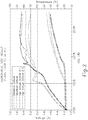
- Overcharge-protected cells of the first type were overcharged up to 5.4 - 5.5 Volts (as measured against Li + /Li 0 ) and their temperature and voltage in the course of charging were measured and plotted, as illustrated in FIG. 1 .
- the protected cells (High Voltage Cathode 1-1 and 1-2) showed a delay in the onset of overcharge-induced voltage increases as compared to the reference cells. This improvement was most prominent when the cells were charged beyond 150% SOC. Whereas the reference cells (Reference Cathode) exhibited a rapid surge in potential, the overcharge-protected cells showed a slower increase until a charge of about 175% SOC was reached.
- overcharge-protected cells also exhibited a delay in the onset of overcharge-induced temperature increases.
- Overcharge-protected cells of the second type (High Voltage Cathode 2-1 and 2-2) were also compared to the reference cells, as illustrated in FIG. 2 .
- a delay in the insurgence of overcharged-induced voltage and temperature increases was found.
- Example (2) Coin Cells with Li-rich layered oxide
- a reference coin cell was built as follows.
- a cathode active material composition was formed containing 94 wt% NMC, 3 wt% conductive carbon, and 3 wt% PVDF binder, which were blended and mixed in NMP, to form a slurry.
- the slurry was cast on an aluminum substrate and the NMP was removed under vacuum. Discs having a diameter of 0.5 in were then punched and reference coin cells made using lithium as counter electrode.
- Coin cells with overcharge protection were then made with the same ingredients as the reference coin cell, the only difference being in the cathode active material composition containing 84 wt% NMC and 10 wt% of the Li-rich layered oxide x Li 2 MnO 3 ⁇ (1 - x )LiMnO 2 (0 ⁇ x ⁇ 1) as overcharge protection additive.
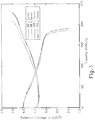
- Coin cells of both types were formed up to the normal cutoff voltage (4.3 V) and discharged to 2.5 V. The cells were then overcharged to 5 V, as illustrated in FIG. 3 .
- Cells with the overcharge protection additive (“10% Li Excess”) exhibited a slower voltage increase rate that was indicative of lithium extraction. Such lithium extraction could also be inferred from the higher specific capacity (mAh/g) of the cells with the additive, as calculated on the basis of the overall amount of electrode active material in a cell (NMC + additive).
- the applicability of the overcharge-protected materials to large batteries suited to automotive applications was tested, as follows.
- the reference cathode active material composition of Example (1) was included in the cathode of prismatic reference cells having a capacity of 32 Ah.
- a first type of Li-rich layered oxide overcharge-protected prismatic cells were built with the cathode active material substituting the NMC of the reference cells with the mixture including 90 wt% NMC and 10 wt% of the Li-rich layered oxide x Li 2 MnO 3 ⁇ (1 - x )LiNi 1/3 Mn 1/3 Co 1/3 O 2 (0 ⁇ x ⁇ 1) as overcharge protection additive.
- a second type of overcharge-protected prismatic cells were also made where the NMC was substituted with a mixture including 90 wt% NMC and 10 wt% of the high-voltage spinel of formula LiMn 1.5 Ni 0.5 O 4 as overcharge protection additive.
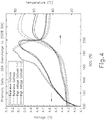
- Overcharge-protected prismatic cells of the first type were overcharged up to 5.1 - 5.2 Volts (as measured against Li + /Li 0 ) and their temperature and voltage in the course of charging were measured and plotted, as illustrated in FIG. 4 .
- the protected cells High Voltage Cathode 1-1 and 1-2
- Overcharge-protected prismatic cells of the second type were also compared to the reference cell, as illustrated in FIG. 5 .
- a delay in the insurgence of overcharged-induced voltage and temperature increases was observed in the protected cells (High Voltage Cathode 2-1 and 2-2).
Landscapes
- Chemical & Material Sciences (AREA)
- Chemical Kinetics & Catalysis (AREA)
- Electrochemistry (AREA)
- General Chemical & Material Sciences (AREA)
- Inorganic Chemistry (AREA)
- Engineering & Computer Science (AREA)
- Manufacturing & Machinery (AREA)
- Composite Materials (AREA)
- Materials Engineering (AREA)
- Crystallography & Structural Chemistry (AREA)
- Secondary Cells (AREA)
- Battery Electrode And Active Subsutance (AREA)
Description
- Thermal runaway during overcharge in the lithium ion batteries (LIB) is a safety concern in the automotive industry. Layered metal oxide cathode materials, in particular, impose higher risks of thermal runaway due to their exothermic oxidative reactions with the electrolyte. Battery chargers usually operate at a fixed current or at a fixed power. Consider the case of a fixed current applied to a lithium ion battery containing a lithium metal oxide. The total current leaving each electrode is the sum of all the electrochemical reactions occurring in that electrode. The reactions that may be occurring at the positive electrode during overcharge include: (1) extraction of lithium ions from the lithium metal oxide, (2) side reactions which generate only inert gaseous species, and (3) side reactions which generate gas and/or species which may continue to react after interruption of the current. The relative rates of the reactions depend on the difference between the local electrochemical potential and the redox potential for the particular reaction, which is a function of the local reactant and product concentrations. For the case of a lithium metal oxide, once all of the lithium has been extracted at the redox potential of the oxide, no further oxidation of the active material is possible. Continued application of a charging current will then drive up the cell voltage to potentials at which the side reactions occur at rates sufficient to meet the applied current. That high voltage may lead to unwanted side reactions which generate species that continue to react after the current is interrupted or which generate gas at too rapid a rate, potentially leading to thermal runaway.
- Traditionally, electrolyte additives have being employed for the overcharge protection of commercial-grade lithium ion batteries. Examples of such additives are redox shuttles which bypass the overcharge current via a redox reaction between the cathode and the anode. Such compounds usually have redox potentials of 0.2-0.4 V higher than the end-of-charge potential of the positive electrode, or cathode. In another approach, polymer precursors, for instance aromatic compounds such as cyclohexyl benzene and biphenyl are electrochemically oxidized and polymerized thereafter on an overcharged positive electrode to form a passive film that prevents the electrolyte from further reacting with the positive electrode.
-
US2008280203 discloses a cathode active material for a lithium secondary battery comprising LibFePO4, wherein 0≤b<1 and LixNiyMnzMaO2, wherein M can be Co. -
US2008280203 discloses a cathode active material for a lithium secondary battery comprising a lithium transition metal oxide and an additive, such as LiMxMn1-xO2 wherein M can be Ni and 0.05≤x<0.5. - In a first aspect, there is provided an electrode active material, according to claim 1, comprising a lithium metal oxide and an overcharge protection additive having an operating voltage higher than the operating voltage of the lithium metal oxide.
- In a second aspect, there is provided a lithium ion, according to
claim 7, comprising a positive electrode comprising a positive electrode active material, a negative electrode comprising a negative electrode active material, and an electrolyte. The positive electrode active material comprises a lithium metal oxide and an overcharge protection additive having an operating voltage higher than an operating voltage of the lithium metal oxide. - In a third aspect, there is provided a method of manufacturing a battery cathode, according to claim 14, comprising: forming a mixture comprising a lithium metal oxide and an overcharge protection additive having an operating voltage higher than an operating voltage of the lithium metal oxide, and contacting the mixture with a current collector.
-
-
FIG. 1 includes voltage and temperature plots comparing the overcharge properties of the first type of overcharge-protected pouch cells of Example (1) to those of reference cells without overcharge protection additives. -
FIG. 2 includes voltage and temperature plots comparing the overcharge properties of the second type of overcharge-protected pouch cells of Example (1) to those of reference cells without overcharge protection additives. -
FIG. 3 includes capacity-potential plots comparing the capacity of the coin cells of Example (2) to that of a reference cell without overcharge protection additives. -
FIG. 4 includes voltage and temperature plots comparing the overcharge properties of the first type of overcharge-protected prismatic cells of Example (3) to those of reference cells without overcharge protection additives. -
FIG. 5 includes voltage and temperature plots comparing the overcharge properties of the second type of overcharge-protected prismatic cells of Example (3) to those of reference cells without overcharge protection additives. -
FIG. 6 is a cross-sectional view of an example lithium ion battery. - As intended herein, the terms "a" and "an" include singular as well as plural references unless the context clearly dictates otherwise. For example, the term "a lithium metal oxide" can include one or more such oxides.
- As intended herein, the terms "approximately" and "about" and similar terms are intended to have a broad meaning in harmony with the common and accepted usage in the art to which the subject matter of this disclosure pertains. It should be understood by those of skill in the art who review this disclosure that these terms are intended to allow a description of certain features described and claimed without restricting the scope of these features to precise numerical ranges provided. Accordingly, these terms should be interpreted as indicating that insubstantial or inconsequential modifications or alterations of the subject matter described and claimed are considered to be within the scope of the invention as recited in the appended claims.
- It should be noted that the term "example" as used herein to describe various embodiments is intended to indicate that such embodiments are possible examples, representations, and/or illustrations of possible embodiments (and such term is not intended to connote that such embodiments are necessarily extraordinary or superlative examples).
- The present invention is based on the discovery of novel electrode active materials for electrochemical cell electrodes. Such materials include a lithium metal oxide and an overcharge protection additive having an operating voltage higher than the lithium metal oxide. Also provided are methods, electrodes, cells and systems employing such electrode materials that can promote improved battery performance, safety and/or longevity. These materials, methods, electrodes, cells, and systems are beneficial in a variety of battery applications. For example, the materials can serve as cathode active materials in the positive electrode of lithium cells. When subjected to overcharge, such electrodes have been found to exhibit delayed voltage and temperature increases as compared to electrodes containing traditional materials. This advantageous feature can protect a cell by delaying deleterious overcharge-associated phenomena such as electrolyte oxidation and thermal runaway.
- Without being bound to any particular theory, it is believed that, in the event of an overcharge, the protection additive accepts surplus current and prevents sharp potential excursions in electrode potential, leading instead to a gentler, plateau-like voltage curve as the battery is charged beyond full capacity. In some instances, oxygen gas may also be released during the oxidation of the overcharge protection additive, and this evolution of gas may facilitate the activation of a current interrupt device (CID) in the cell. Some overcharge protection additives can also undergo reversible lithium removal during overcharge, i.e. they can intercalate and de-intercalate lithium ions and that in turn contributes to the battery capacity and energy. By contrast, traditional overcharge protection electrolyte additives do not contribute to the capacity of the battery and, when activated by overcharge events, tend to undergo irreversible reactions having adverse effects on the battery performance.
- In one aspect, there is provided an electrochemical cell electrode with overcharge protection. The active material of the electrode includes a lithium ion oxide from which energy storage or release is obtained by oxidation or reduction accompanied by lithium ion insertion or removal. An additive that possesses a higher operating voltage than the lithium metal oxide is also included in the active material. In some embodiments, the additive will provide a change in the behavior of open voltage of the electrode (as measured, for example, against a lithium metal electrode Li+/Li0). As the electrode is charged above the desired state of charge (SOC), the change in voltage is more gradual than as found in an electrode without the additive. In representative embodiments, the change in temperature associated with overcharge is also more gradual than in an unprotected electrode.
- As a result, the additive performs the function of reducing and/or delaying overcharge-induced temperature and/or voltage increases as compared to those exhibited by unprotected electrodes. Without being bound to any particular theory, it is believed that, when a battery is overcharged, the oxidation of the protection additive prevents the ignition or explosion of the battery that may be induced by the overcharging. In addition, reversible ion removal enables the additive to contribute to the cell capacity and energy without the disadvantage of deteriorating battery performance that is found in the case of traditional overcharge protection additives.
- The lithium metal oxide may be any of those finding use in lithium ion batteries. Typical classes of lithium metal oxides include those of formula LiMO2, where M represents one or more metals, for instance transition metals such as Sc, Ti, V, Co, Mn, Fe, Co, Ni, Cu, Zn, and Al. Lithium metal oxides commonly found in battery electrodes include lithium cobalt oxides (e.g. LiCoO2), lithium nickel oxides (e.g. LiNiO2), lithium manganese oxides (e.g. LiMnO2), lithium nickel manganese cobalt oxides (e.g. LiNi1/3Mn1/3Co1/3O2, also known as NMC), and other oxides comprising other metals partially substituting for Mn, Ni, and Co, such as LiNi0.80Co0.15Al0.05O2. Other representative oxides finding use in battery electrodes include lithium nickel cobalt aluminum oxides, lithium titanates, lithium iron oxides, and lithium vanadium oxides.
- The overcharge protection additive comprises a material of formula xLi2M1O3 · (1 - x)LiM2O2, where M1 represents one or more of Mn, Ti, Zr, M2 represents one or more of Mn, Ni, Co, and Cr, and x is greater than 0 and smaller than 1. Exemplary among them are manganese oxide composite materials such as xLi2MnO3 · (1 - x)LiM2O2 (0 < x < 1) and are believed to include a layered Li2MnO3 component structurally integrated with a layered LiM2O2 component.
- Another exemplary class of overcharge protection additives that can undergo reversible lithium absorption upon oxidation are those of formula Li1+vMn2-yO4, wherein y is greater than 0 and at most equal to 1/3.
- In representative embodiments, there is provided a positive electrode active material that includes an operating amount of a lithium metal oxide sufficient to provide a desired operating capacity, and a selected amount of an overcharge protection additive having an operating voltage higher than the lithium metal oxide. The metal oxide and protection additive may be a physical mixture or, for instance, form a solution together with or without the other components of the electrode. There are no specific restrictions on the amount of protection additive present, which may vary on the basis of the operating capacity and amount of overcharge protection desired. Example additive concentration ranges, expressed as a fraction of the weight of the positive electrode material, include from about 1 to about 20 weight %, from about 5 to about 15 wt %, and about 7.5 to about 12.5 wt%. Other example additive concentration ranges include from about 1 to about 30 wt%, from about 5 to about 20 wt%, and about 7.5 to about 15 wt%. In some instances, the positive electrode material may be prepared by co-synthesizing or physically mixing an amount of the lithium metal oxide with the additive in a proportion that is consistent with the state of charge for which one is seeking indication, or in order to provide the desired capacity and voltage for overcharge protection. In one or more embodiments, physical mixtures of these compounds are used for overcharge protection.
- In at least some instances involving physical mixing of the lithium metal oxide with an overcharge protection additive, the additive is added in a form from which lithium can be extracted at the desired voltage to function as overcharge protection agent. In certain lithium ion cells, the cell is assembled in a discharged state, and the lithium that is inserted into the positive electrode during discharge is typically the lithium that was initially extracted from the positive electrode during charge. In such an instance, typically all of the lithium that is cycled during use of the battery originates from the starting positive electrode. If the overcharge protection additive in the positive electrode additive is in the lithiated state in the original mixture, lithium extraction during charge occurs first from the lithium metal oxide, and then from the additive in the event of an overcharge.
- As an example of an embodiment employing a protective additive, a method is provided to prevent an electrochemical cell from catastrophic failure in the event of accidental overcharge. Often cells are made with a current-interrupt device (CID). The CID is designed so that it conducts current from the cell terminal to the cell electrodes during normal operation. If the pressure in the cell exceeds a certain threshold, the CID deforms, breaking the electrical connection and thus interrupting the current, thereby protecting the cell against further overcharge, which could generate dangerous amounts of gas.
- The cell may generate gas during overcharge because the electrolyte or electrode materials are oxidized at potentials beyond the normal operating voltages to produce gaseous products. It is these gaseous products that create the increased pressure that trips the CID. However, in some situations, the species produced during the period of overcharge may continue to react after the current is interrupted. This continuing reaction may further generate heat and gas, leading to thermal runaway, popping of safety vents or even bursting of the cell cap or case. The risk of cell venting is particularly acute if the rate of gas generation is very rapid, in which case the pressure of the cell may rise somewhat above the CID trip pressure in the time that it takes for the CID to activate. Several methods of enabling safe tripping of a CID are known in the art. For example, gassing additives such as biphenyl may be mixed into the electrolyte to generate gas at a potential lower than that at which undesirable reactions begin to occur. However, these additives do not contribute to, and may negatively impact, cell energy or power during normal operation of the cell.
- In certain embodiments herein, the overcharge protection additive of the positive electrode material releases gas in the event of an overcharge, thereby reaching the CID trip pressure prior before unwanted overcharge-induced reactions take place. An amount of overcharge protection additive is added to positive electrodes in which the primary active material is a lithium metal oxide. During normal operation, the additive will not be active. If the positive electrode is charged above the redox potential of additive, it will be oxidized. As a result, the cell potential will grow more slowly than it would without the additive. The oxidation of the additive may also generate gaseous products, inducing the CID to trip before the lithium metal oxide or the electrolyte undergoes oxidative side-reactions.
- In one aspect, a positive electrode including an above described positive electrode active material is provided. An example method of producing such a positive electrode according will now be described. First, a lithium metal oxide, an overcharge protection additive, a conducting agent, a binder, and a solvent are mixed to prepare a positive electrode active material composition. The positive electrode active material composition can be coated directly on an aluminum collector and dried to prepare a cathode plate. Alternatively, the composition can be cast on a separate support to form a cathode active material film, which film is then peeled from the separate support and laminated on an aluminum collector to prepare a positive electrode plate. One commonly used conducting agent is carbon black. Examples binders include vinylidene fluoride/hexafluoropropylene copolymers, polyvinylidenefluoride (PVDF), polyacrylonitrile, polymethylmethacrylate, polytetrafluoroethylene, and combinations thereof. The binder may also be a styrene butadiene rubber-based polymer. Example solvents include N-methylpyrrolidone (NMP), acetone, water, and the like.
- A lithium battery including an above described positive electrode is also provided. A method of producing one such battery will now be described. First, a positive electrode including an above described cathode active material composition is prepared. Then, a negative electrode active material, a conducting agent, a binder, and a solvent are mixed to prepare a negative electrode active material composition. The anode active material composition can be coated directly on a copper collector to obtain an anode plate. Alternatively, the negative electrode active material composition can be cast on a separate support to form an anode active material film, which film is then peeled from the separate support and laminated on a copper collector to obtain a negative electrode plate.
- Non-limiting examples of suitable negative electrode active materials include lithium metal, lithium alloys, and carbonaceous materials (such as graphite). In the negative electrode active material composition, the conducting agent, the binder, and the solvent may be the same as used in the cathode. In some cases, a plasticizer may be added to the cathode active material composition and the anode active material composition to form pores in the electrode plates.
- The cathode and the anode can be separated by a separator. The separator can be any separator that is commonly used in lithium batteries. A suitable separator may have low resistance to ion movement of the electrolyte and high electrolyte retaining capability. Non-limiting examples of suitable separators include glass fibers, polyester, teflon, polyethylene, polypropylene, polytetrafluoroethylene (PTFE) and combinations thereof, each of which can be a woven or non-woven fabric. Foldable separators formed of polyethylene or polypropylene can be used in lithium ion batteries. On the other hand, separators having high organic electrolyte retaining capabilities can be used in lithium ion polymer batteries. A method of preparing a separator will now be described.
- A polymer resin, a filler, and a solvent are mixed to prepare a separator composition. The separator composition can be coated directly on an electrode and dried to form a separator film. Alternatively, the separator composition can be cast on a support and dried to form a separator composition film, which film is then peeled from the separate support and laminated on an electrode. The polymer resin is not limited and can be any material used as a binder for an electrode plate. Non-limiting examples of suitable polymer resins include vinylidenefluoride/ hexafluoropropylene copolymers, polyvinylidenefluoride, polyacrylonitrile, polymethylmethacrylate, and combinations thereof.
- As shown in
FIG. 6 , an example lithium battery 3 includes anelectrode assembly 4 which includes apositive electrode 5, negative electrode 6 and aseparator 7 between thecathode 5 and anode 6. Theelectrode assembly 4 is enclosed in abattery case 8, which is sealed with acap plate 11 andgasket 12. An organic electrolyte is then injected into the battery to complete a lithium ion battery. Alternatively, the battery assembly can be stacked to form a bi-cell structure, and then impregnated with an organic electrolyte. The obtained product is then placed in a pouch and sealed, thus completing a lithium ion polymer battery. - The organic electrolyte used in these lithium batteries can include a lithium salt and a mixed organic solvent including a high permittivity solvent and a low boiling point solvent. The high permittivity solvent can be any solvent used in the art. Non-limiting examples of suitable high permittivity solvents include cyclic carbonates (such as ethylene carbonate, propylene carbonate, and butylene carbonate), and gammabutyrolactone. The low boiling point solvent can be any solvent used in the art. Non-limiting examples of suitable low boiling point solvents include linear carbonates (such as dimethyl carbonate, ethylmethyl carbonate, diethyl carbonate, and dipropyl carbonate), dimethoxyethane, diethoxyethane, and fatty acid ester derivatives. The lithium salt can be any lithium salt used in lithium ion batteries. Non-limiting examples of suitable lithium salts include LiClO4, LiCF3SO3, LiPF6, LiN (CF3SO2), LiBF4, LiC(CF3SO2)3, LiN(C2F5SO2)2 and combinations thereof. In the organic electrolyte, the concentration of the lithium salt usually ranges from about 0.5 to about 2 M.
- As noted above, traditional overcharge protection electrolyte additives do not contribute to the capacity of the battery and are designed or tend to undergo irreversible reactions having adverse effects on the battery performance. By contrast, the inclusion in a cell of an overcharge protection additive capable of reversible ion removal renders such electrolyte additives superfluous while providing protection without sacrificing battery capacity. As a result, in a further aspect, there are provided electrochemical cells substantially free of overcharge protection electrolyte additives such as polymeric film precursors, redox shuttles, and gassing additives. By "substantially free" is meant that a cell contains no overcharge-protecting electrolyte additives at all or in amounts too small to afford meaningful protection against overcharge. Example concentration ranges in such a substantially free electrolyte include less than about 1 wt%, less than 0.5% wt%, less than 0.1 wt%, and less than 0.01 wt% of the protection additive(s). Overcharge protection is instead effected by adding an amount of overcharge protection additive to a positive electrode in which the primary active material is a lithium metal oxide. In some embodiments, the additive can also undergo reversible lithium removal during overcharge. In addition, an additive that produces oxygen when oxidized may be chosen.
- It is important to note that the construction and arrangement of electrodes and electrochemical cells as shown in the examples above is illustrative only. Although only a few embodiments have been described in detail in this disclosure, those skilled in the art who review this disclosure will readily appreciate that many modifications are possible (e.g., variations in sizes, dimensions, structures, shapes and proportions of the various elements, values of parameters, mounting arrangements, use of materials, colors, orientations, etc.) without materially departing from the novel teachings and advantages of the subject matter described herein. For example, elements shown as integrally formed may be constructed of multiple parts or elements, the position of elements may be reversed or otherwise varied, and the nature or number of discrete elements or positions may be altered or varied. The order or sequence of any process or method steps may be varied or re-sequenced according to alternative embodiments. Other substitutions, modifications, changes and omissions may also be made in the design, operating conditions and arrangement of the various exemplary embodiments without departing from the scope of the present invention.
- In order to measure beneficial effects imparted by overcharge protection additives, reference pouch cells having a capacity of 1.25 Ah were first built, as follows. A reference cathode active material composition was formed containing 95 wt% NMC, 3 wt% conductive carbon and 2 wt% of PVDF binder and cast as an NMP slurry on aluminum foil, followed by drying and calendaring. The foil coated with the dried mixture was then folded and pressed to obtain the desired electrode density and thickness. The resulting electrode was slitted and stacked with a cell separator and a lithium negative electrode, to obtain a pouch cell that was ultrasonically welded, filled with an electrolyte containing NMP and LiPF6 and vacuum-sealed.
- A first type of Li-rich layered oxide overcharge-protected pouch cells were then built with the same ingredients as the reference pouch cells, with the exception of the NMC which was substituted with a mixture including 90 wt% NMC and 10 wt% of the Li-rich layered oxide xLi2MnO3 · (1 - x)LiNi1/3Mn1/3Co1/3O2 (0 < x < 1) as overcharge protection additive. A second type of overcharge-protected pouch cells were also made where the NMC was substituted with a mixture including 90 wt% NMC and 10 wt% of a high-voltage spinel of formula LiMn1.5Ni0.5O4 as overcharge protection additive.
- Overcharge-protected cells of the first type were overcharged up to 5.4 - 5.5 Volts (as measured against Li+/Li0) and their temperature and voltage in the course of charging were measured and plotted, as illustrated in
FIG. 1 . The protected cells (High Voltage Cathode 1-1 and 1-2) showed a delay in the onset of overcharge-induced voltage increases as compared to the reference cells. This improvement was most prominent when the cells were charged beyond 150% SOC. Whereas the reference cells (Reference Cathode) exhibited a rapid surge in potential, the overcharge-protected cells showed a slower increase until a charge of about 175% SOC was reached. The overcharge-protected cells also exhibited a delay in the onset of overcharge-induced temperature increases. Overcharge-protected cells of the second type (High Voltage Cathode 2-1 and 2-2) were also compared to the reference cells, as illustrated inFIG. 2 . Here, too, a delay in the insurgence of overcharged-induced voltage and temperature increases was found. - A reference coin cell was built as follows. A cathode active material composition was formed containing 94 wt% NMC, 3 wt% conductive carbon, and 3 wt% PVDF binder, which were blended and mixed in NMP, to form a slurry. The slurry was cast on an aluminum substrate and the NMP was removed under vacuum. Discs having a diameter of 0.5 in were then punched and reference coin cells made using lithium as counter electrode. Coin cells with overcharge protection were then made with the same ingredients as the reference coin cell, the only difference being in the cathode active material composition containing 84 wt% NMC and 10 wt% of the Li-rich layered oxide xLi2MnO3 · (1 - x)LiMnO2 (0 < x < 1) as overcharge protection additive.
- Coin cells of both types were formed up to the normal cutoff voltage (4.3 V) and discharged to 2.5 V. The cells were then overcharged to 5 V, as illustrated in
FIG. 3 . Cells with the overcharge protection additive ("10% Li Excess") exhibited a slower voltage increase rate that was indicative of lithium extraction. Such lithium extraction could also be inferred from the higher specific capacity (mAh/g) of the cells with the additive, as calculated on the basis of the overall amount of electrode active material in a cell (NMC + additive). - The applicability of the overcharge-protected materials to large batteries suited to automotive applications was tested, as follows. The reference cathode active material composition of Example (1) was included in the cathode of prismatic reference cells having a capacity of 32 Ah. Then, a first type of Li-rich layered oxide overcharge-protected prismatic cells were built with the cathode active material substituting the NMC of the reference cells with the mixture including 90 wt% NMC and 10 wt% of the Li-rich layered oxide xLi2MnO3 · (1 - x)LiNi1/3Mn1/3Co1/3O2 (0 < x < 1) as overcharge protection additive. A second type of overcharge-protected prismatic cells were also made where the NMC was substituted with a mixture including 90 wt% NMC and 10 wt% of the high-voltage spinel of formula LiMn1.5Ni0.5O4 as overcharge protection additive.
- Overcharge-protected prismatic cells of the first type were overcharged up to 5.1 - 5.2 Volts (as measured against Li+/Li0) and their temperature and voltage in the course of charging were measured and plotted, as illustrated in
FIG. 4 . Similarly to what was found in Example (1), the protected cells (High Voltage Cathode 1-1 and 1-2) showed a delay in the onset of overcharge-induced voltage increases as compared to the reference cells. This improvement became apparent when the cells were overcharged at 130% SOC and higher. Gentler, slower overcharge-induced temperature increases were also observed, as seen in the temperature plots at 180% SOC and higher. Overcharge-protected prismatic cells of the second type were also compared to the reference cell, as illustrated inFIG. 5 . Here, too, a delay in the insurgence of overcharged-induced voltage and temperature increases was observed in the protected cells (High Voltage Cathode 2-1 and 2-2).
Claims (15)
- A positive electrode comprising a physical mixture of a primary active material and an overcharge protection additive, wherein the primary active material comprises a lithium metal oxide and the overcharge protection additive has an operating voltage higher than the operating voltage of the lithium metal oxide,
characterised in that:
the overcharge protection additive comprises:- a material of formula xLi2M1O3 · (1-x)LiM2O2, wherein: M1 is selected from the group consisting of Mn, Ti, Zr, and combinations thereof; M2 is selected from the group consisting of Mn, Ni, Co, Cr, and combinations thereof, and x is greater than 0 and smaller than 1, or- a material of formula Li1+yMn2-yO4, wherein y is greater than 0 and at most equal to 1/3. - The positive electrode of claim 1,
wherein the lithium metal oxide is of formula LiMO2, wherein M is selected from the group consisting of Sc, Ti, V, Co, Mn, Fe, Co, Ni, Cu, Zn, Al, and combinations thereof. - The positive electrode of claim 1,
wherein the lithium metal oxide is selected from the group consisting of lithium cobalt oxides, lithium manganese oxides, lithium nickel manganese cobalt oxides, lithium nickel cobalt aluminum oxides, lithium titanates, and combinations thereof. - The positive electrode of claim 1
comprising from about 1 to about 30 wt% of the overcharge protection additive. - The positive electrode of claim 1
comprising from about 5 to about 20 wt% of the overcharge protection additive. - The positive electrode of claim 1
comprising from about 7.5 to about 15 wt% of the overcharge protection additive. - A lithium ion battery comprising a positive electrode according to one of claims 1 to 6,
a negative electrode comprising a negative electrode active material, and an electrolyte, the positive electrode comprising a primary active material comprising a lithium metal oxide and an overcharge protection additive having an operating voltage higher than an operating voltage of the lithium metal oxide,
characterised in that:
the overcharge protection additive comprises:- a material of formula xLi2M1O3 · (1-x)LiM2O2, wherein: M1 is selected from the group consisting of Mn, Ti, Zr, and combinations thereof; M2 is selected from the group consisting of Mn, Ni, Co, Cr, and combinations thereof, and x is greater than 0 and smaller than 1, or- a material of formula Li1+yMn2-yO4, wherein y is greater than 0 and at most equal to 1/3. - The lithium ion battery of claim 7,
wherein the electrolyte is substantially free of overcharge-preventing electrolyte additives. - The lithium ion battery of claim 7,
wherein the electrolyte is substantially free of polymeric film precursors. - The lithium ion battery of claim 7,
wherein the electrolyte is substantially free of redox shuttle additives. - The lithium ion battery of claim 7,
wherein the lithium metal oxide is selected from the group consisting of lithium cobalt oxide, lithium manganese oxide, lithium nickel manganese cobalt oxide, lithium nickel cobalt aluminum oxide, lithium titanate, and combinations thereof. - The lithium ion battery of claim 7,
wherein the positive electrode material comprises 7.5 to 15 wt% of the overcharge protection additive. - The lithium ion battery of claim 7,
wherein the electrolyte is substantially free of overcharge-preventing electrolyte additives. - A method of manufacturing a battery cathode, comprising:- forming a mixture comprising a lithium metal oxide and an overcharge protection additive having an operating voltage higher than an operating voltage of the lithium metal oxide, and- contacting the mixture with a current collector,characterised in that:
the overcharge protection additive comprises:- a material of formula xLi2M1O3 · (1-x)LiM2O2, wherein: M1 is selected from the group consisting of Mn, Ti, Zr, and combinations thereof; M2 is selected from the group consisting of Mn, Ni, Co, Cr, and combinations thereof, and x is greater than 0 and smaller than 1, or- a material of formula Li1+yMn2-yO4, wherein y is greater than 0 and at most equal to 1/3. - The method of claim 14,
wherein the lithium metal oxide is selected from the group consisting of lithium cobalt oxide, lithium manganese oxide, lithium nickel manganese cobalt oxide, lithium nickel cobalt aluminum oxide, lithium titanate, and mixtures thereof.
Applications Claiming Priority (3)
| Application Number | Priority Date | Filing Date | Title |
|---|---|---|---|
| US201161555261P | 2011-11-03 | 2011-11-03 | |
| US13/664,210 US9991566B2 (en) | 2011-11-03 | 2012-10-30 | Cathode active material for overcharge protection in secondary lithium batteries |
| PCT/US2012/062988 WO2013067135A1 (en) | 2011-11-03 | 2012-11-01 | Cathode active material for overcharge protection in secondary lithium batteries |
Publications (2)
| Publication Number | Publication Date |
|---|---|
| EP2774198A1 EP2774198A1 (en) | 2014-09-10 |
| EP2774198B1 true EP2774198B1 (en) | 2019-01-16 |
Family
ID=47215777
Family Applications (1)
| Application Number | Title | Priority Date | Filing Date |
|---|---|---|---|
| EP12788384.1A Active EP2774198B1 (en) | 2011-11-03 | 2012-11-01 | Cathode active material for overcharge protection in secondary lithium batteries |
Country Status (4)
| Country | Link |
|---|---|
| US (2) | US9991566B2 (en) |
| EP (1) | EP2774198B1 (en) |
| CN (1) | CN104011915B (en) |
| WO (1) | WO2013067135A1 (en) |
Families Citing this family (14)
| Publication number | Priority date | Publication date | Assignee | Title |
|---|---|---|---|---|
| WO2015107551A2 (en) * | 2014-01-17 | 2015-07-23 | Godfrey Phillips India Limited | Lithium ion battery for electronic devices |
| CN105099632B (en) * | 2014-04-23 | 2019-12-13 | 北京三星通信技术研究有限公司 | A method and device for uplink sounding reference signal transmission |
| US20170373340A1 (en) * | 2014-12-26 | 2017-12-28 | Nissan Motor Co., Ltd. | Electric Device |
| CN105720304B (en) * | 2016-02-25 | 2019-02-19 | 中国科学院宁波材料技术与工程研究所 | A non-aqueous electrolyte and a lithium ion battery |
| JP6519577B2 (en) * | 2016-12-22 | 2019-05-29 | トヨタ自動車株式会社 | Lithium ion secondary battery |
| KR102320114B1 (en) * | 2017-06-21 | 2021-11-01 | 주식회사 엘지화학 | Current interrupt structure applied to the pouch type secondary battery |
| CN107681118A (en) * | 2017-09-03 | 2018-02-09 | 河南师范大学 | Iron nickel secondary batteries negative plate and preparation method thereof and the iron nickel secondary batteries using the negative plate |
| CN110808403B (en) * | 2018-08-06 | 2021-09-14 | 张家港市国泰华荣化工新材料有限公司 | Overcharge-preventing lithium ion battery |
| DE102019201479A1 (en) | 2019-02-06 | 2020-08-06 | Robert Bosch Gmbh | Cycles overlithiated, layer-like transition metal oxides with high upper cut-off voltages |
| US11186198B2 (en) * | 2019-05-31 | 2021-11-30 | Ford Global Technologies, Llc | Methods and systems for vehicle battery cell failure detection and overcharge protection |
| FR3112030B1 (en) * | 2020-06-26 | 2022-12-16 | Accumulateurs Fixes | Use of lithium secondary electrochemical cells containing a mixture of a lithiated nickel oxide and a lithiated manganese iron phosphate for automotive applications |
| FR3118533B1 (en) * | 2020-12-24 | 2023-03-10 | Solvionic | METHOD FOR PREPARING A HIGH MASS CHARGE ELECTRODE FILLED WITH ELECTROLYTE FOR A HIGH ENERGY DENSITY BATTERY |
| US11600814B2 (en) * | 2021-01-26 | 2023-03-07 | GM Global Technology Operations LLC | Nickel-containing positive electrode slurries having reduced or eliminated gelation and high-energy-density positive electrodes for electrochemical cells |
| US12206071B2 (en) | 2022-01-27 | 2025-01-21 | Ford Global Technologies, Llc | Dual-additive electrolyte solutions for overcharge response mitigation |
Family Cites Families (22)
| Publication number | Priority date | Publication date | Assignee | Title |
|---|---|---|---|---|
| CA2000873C (en) | 1988-10-21 | 1999-12-14 | Shigeru Oishi | Cell having current cutoff valve |
| US5278000A (en) | 1992-09-02 | 1994-01-11 | The United States Of America As Represented By The Administrator Of The National Aeronautics And Space Administration | Overcharge and overdischarge protection of ambient temperature secondary lithium cells |
| US5783333A (en) | 1996-11-27 | 1998-07-21 | Polystor Corporation | Lithium nickel cobalt oxides for positive electrodes |
| US6277521B1 (en) | 1997-05-15 | 2001-08-21 | Fmc Corporation | Lithium metal oxide containing multiple dopants and method of preparing same |
| JP3928836B2 (en) | 1999-12-10 | 2007-06-13 | 脇原 將孝 | Positive electrode material for lithium secondary battery and lithium secondary battery |
| US7468223B2 (en) | 2000-06-22 | 2008-12-23 | Uchicago Argonne, Llc | Lithium metal oxide electrodes for lithium cells and batteries |
| JP4183374B2 (en) | 2000-09-29 | 2008-11-19 | 三洋電機株式会社 | Nonaqueous electrolyte secondary battery |
| KR100441524B1 (en) | 2002-01-24 | 2004-07-23 | 삼성에스디아이 주식회사 | Positive active material slurry composition for rechargeable lithium battery |
| US7358009B2 (en) | 2002-02-15 | 2008-04-15 | Uchicago Argonne, Llc | Layered electrodes for lithium cells and batteries |
| KR100533095B1 (en) * | 2003-04-09 | 2005-12-01 | 주식회사 엘지화학 | The cathode active material comprising the overdischarge retardant and the lithium secondary battery using the same |
| US7732096B2 (en) | 2003-04-24 | 2010-06-08 | Uchicago Argonne, Llc | Lithium metal oxide electrodes for lithium batteries |
| KR100639526B1 (en) | 2005-02-02 | 2006-10-30 | 한양대학교 산학협력단 | 3-volt spinel oxide using carbonate co-precipitation method, manufacturing method thereof and lithium secondary battery using same |
| JP2007250198A (en) | 2006-03-13 | 2007-09-27 | Sanyo Electric Co Ltd | Nonaqueous electrolyte secondary battery |
| JP4827931B2 (en) | 2006-12-27 | 2011-11-30 | 三洋電機株式会社 | Non-aqueous electrolyte secondary battery and manufacturing method thereof |
| JP5153156B2 (en) | 2007-02-13 | 2013-02-27 | 三洋電機株式会社 | Method for producing positive electrode for non-aqueous electrolyte secondary battery |
| JP5159134B2 (en) | 2007-03-23 | 2013-03-06 | 三洋電機株式会社 | Nonaqueous electrolyte secondary battery |
| US8835027B2 (en) | 2007-09-21 | 2014-09-16 | Uchicago Argonne, Llc | Positive electrodes for lithium batteries |
| WO2009147854A1 (en) | 2008-06-04 | 2009-12-10 | パナソニック株式会社 | Battery pack |
| US9786944B2 (en) | 2008-06-12 | 2017-10-10 | Massachusetts Institute Of Technology | High energy density redox flow device |
| US8808912B2 (en) | 2009-01-29 | 2014-08-19 | Uchicago Argonne, Llc | Surface protected lithium-metal-oxide electrodes |
| US9166222B2 (en) | 2010-11-02 | 2015-10-20 | Envia Systems, Inc. | Lithium ion batteries with supplemental lithium |
| US8835041B2 (en) | 2011-01-14 | 2014-09-16 | Uchicago Argonne, Llc | Electrode materials for sodium batteries |
-
2012
- 2012-10-30 US US13/664,210 patent/US9991566B2/en active Active
- 2012-11-01 WO PCT/US2012/062988 patent/WO2013067135A1/en not_active Ceased
- 2012-11-01 CN CN201280064838.6A patent/CN104011915B/en active Active
- 2012-11-01 EP EP12788384.1A patent/EP2774198B1/en active Active
-
2016
- 2016-07-05 US US15/202,406 patent/US20160315355A1/en not_active Abandoned
Non-Patent Citations (1)
| Title |
|---|
| None * |
Also Published As
| Publication number | Publication date |
|---|---|
| CN104011915A (en) | 2014-08-27 |
| US20130115515A1 (en) | 2013-05-09 |
| EP2774198A1 (en) | 2014-09-10 |
| WO2013067135A1 (en) | 2013-05-10 |
| CN104011915B (en) | 2017-03-01 |
| US9991566B2 (en) | 2018-06-05 |
| US20160315355A1 (en) | 2016-10-27 |
Similar Documents
| Publication | Publication Date | Title |
|---|---|---|
| US9991566B2 (en) | Cathode active material for overcharge protection in secondary lithium batteries | |
| EP1490916B1 (en) | Lithium secondary battery comprising overdischarge-preventing agent | |
| EP1903627B1 (en) | Cathode active material for a lithium battery | |
| US6074777A (en) | Additives for overcharge protection in non-aqueous rechargeable lithium batteries | |
| KR102513330B1 (en) | Rechargeable battery with internal current limiter and interrupter | |
| KR101455663B1 (en) | Lithium-ion secondary battery | |
| JP5780071B2 (en) | Nonaqueous electrolyte secondary battery and manufacturing method thereof | |
| JP4735579B2 (en) | Non-aqueous electrolyte battery | |
| CN101485034B (en) | Lithium rechargeable battery | |
| US6497980B2 (en) | Organic electrolytic solution and lithium secondary battery adopting the same | |
| JP2013219047A (en) | Lithium secondary battery, and short circuit resistance control method thereof | |
| JP2009541938A (en) | Lithium ion secondary battery | |
| CN103227343B (en) | Rechargeable nonaqueous electrolytic battery, its manufacture method | |
| KR20040088292A (en) | The cathode active material comprising the overdischarge retardant and the lithium secondary battery using the same | |
| WO2017013718A1 (en) | Non-aqueous electrolyte battery and battery pack | |
| WO2013188034A1 (en) | Secondary lithium ion battery with mixed nickelate cathodes | |
| JP4848577B2 (en) | Non-aqueous electrolyte battery | |
| KR101305462B1 (en) | Electrode assembly and Lithium secondary Battery having the Same | |
| US9406924B2 (en) | Nonaqueous electrolyte secondary battery | |
| CN103227346B (en) | The manufacture method of rechargeable nonaqueous electrolytic battery, rechargeable nonaqueous electrolytic battery | |
| US8367255B2 (en) | Non-aqueous electrolyte secondary battery | |
| EP3168907B1 (en) | Cathode material of secondary battery, and production method therefor | |
| JP4240422B2 (en) | Organic electrolyte secondary battery | |
| JP2006221936A (en) | Electrolyte and battery |
Legal Events
| Date | Code | Title | Description |
|---|---|---|---|
| PUAI | Public reference made under article 153(3) epc to a published international application that has entered the european phase |
Free format text: ORIGINAL CODE: 0009012 |
|
| 17P | Request for examination filed |
Effective date: 20140503 |
|
| AK | Designated contracting states |
Kind code of ref document: A1 Designated state(s): AL AT BE BG CH CY CZ DE DK EE ES FI FR GB GR HR HU IE IS IT LI LT LU LV MC MK MT NL NO PL PT RO RS SE SI SK SM TR |
|
| RIN1 | Information on inventor provided before grant (corrected) |
Inventor name: BONHOMME, FREDERIC, C. Inventor name: CHO, SUNG-JIN Inventor name: BOONE, DAVID, R. Inventor name: HALLAC, BOUTROS Inventor name: NDEDI, ALEXANDRE, NTEPE Inventor name: SHI, QINGFANG Inventor name: TAGGOUGUI, MOHAMED |
|
| DAX | Request for extension of the european patent (deleted) | ||
| REG | Reference to a national code |
Ref country code: DE Ref legal event code: R079 Ref document number: 602012056046 Country of ref document: DE Free format text: PREVIOUS MAIN CLASS: H01M0004580000 Ipc: H01M0002340000 |
|
| STAA | Information on the status of an ep patent application or granted ep patent |
Free format text: STATUS: EXAMINATION IS IN PROGRESS |
|
| RIC1 | Information provided on ipc code assigned before grant |
Ipc: H01M 10/42 20060101ALI20171220BHEP Ipc: H01M 4/36 20060101ALI20171220BHEP Ipc: H01M 4/485 20100101ALI20171220BHEP Ipc: H01M 4/525 20100101ALI20171220BHEP Ipc: H01M 4/62 20060101ALI20171220BHEP Ipc: H01M 4/02 20060101ALI20171220BHEP Ipc: H02J 7/00 20060101ALI20171220BHEP Ipc: H01M 2/34 20060101AFI20171220BHEP Ipc: H01M 10/44 20060101ALI20171220BHEP Ipc: H01M 4/04 20060101ALI20171220BHEP Ipc: H01M 10/0525 20100101ALI20171220BHEP Ipc: H01M 4/131 20100101ALI20171220BHEP Ipc: H01M 4/58 20100101ALI20171220BHEP Ipc: H01M 4/505 20100101ALI20171220BHEP |
|
| 17Q | First examination report despatched |
Effective date: 20180105 |
|
| GRAP | Despatch of communication of intention to grant a patent |
Free format text: ORIGINAL CODE: EPIDOSNIGR1 |
|
| STAA | Information on the status of an ep patent application or granted ep patent |
Free format text: STATUS: GRANT OF PATENT IS INTENDED |
|
| INTG | Intention to grant announced |
Effective date: 20180801 |
|
| GRAS | Grant fee paid |
Free format text: ORIGINAL CODE: EPIDOSNIGR3 |
|
| GRAA | (expected) grant |
Free format text: ORIGINAL CODE: 0009210 |
|
| STAA | Information on the status of an ep patent application or granted ep patent |
Free format text: STATUS: THE PATENT HAS BEEN GRANTED |
|
| AK | Designated contracting states |
Kind code of ref document: B1 Designated state(s): AL AT BE BG CH CY CZ DE DK EE ES FI FR GB GR HR HU IE IS IT LI LT LU LV MC MK MT NL NO PL PT RO RS SE SI SK SM TR |
|
| REG | Reference to a national code |
Ref country code: GB Ref legal event code: FG4D |
|
| REG | Reference to a national code |
Ref country code: CH Ref legal event code: EP |
|
| REG | Reference to a national code |
Ref country code: IE Ref legal event code: FG4D |
|
| REG | Reference to a national code |
Ref country code: DE Ref legal event code: R096 Ref document number: 602012056046 Country of ref document: DE |
|
| REG | Reference to a national code |
Ref country code: AT Ref legal event code: REF Ref document number: 1090385 Country of ref document: AT Kind code of ref document: T Effective date: 20190215 |
|
| REG | Reference to a national code |
Ref country code: NL Ref legal event code: MP Effective date: 20190116 |
|
| REG | Reference to a national code |
Ref country code: LT Ref legal event code: MG4D |
|
| PG25 | Lapsed in a contracting state [announced via postgrant information from national office to epo] |
Ref country code: NL Free format text: LAPSE BECAUSE OF FAILURE TO SUBMIT A TRANSLATION OF THE DESCRIPTION OR TO PAY THE FEE WITHIN THE PRESCRIBED TIME-LIMIT Effective date: 20190116 |
|
| REG | Reference to a national code |
Ref country code: AT Ref legal event code: MK05 Ref document number: 1090385 Country of ref document: AT Kind code of ref document: T Effective date: 20190116 |
|
| PG25 | Lapsed in a contracting state [announced via postgrant information from national office to epo] |
Ref country code: PT Free format text: LAPSE BECAUSE OF FAILURE TO SUBMIT A TRANSLATION OF THE DESCRIPTION OR TO PAY THE FEE WITHIN THE PRESCRIBED TIME-LIMIT Effective date: 20190516 Ref country code: ES Free format text: LAPSE BECAUSE OF FAILURE TO SUBMIT A TRANSLATION OF THE DESCRIPTION OR TO PAY THE FEE WITHIN THE PRESCRIBED TIME-LIMIT Effective date: 20190116 Ref country code: PL Free format text: LAPSE BECAUSE OF FAILURE TO SUBMIT A TRANSLATION OF THE DESCRIPTION OR TO PAY THE FEE WITHIN THE PRESCRIBED TIME-LIMIT Effective date: 20190116 Ref country code: LT Free format text: LAPSE BECAUSE OF FAILURE TO SUBMIT A TRANSLATION OF THE DESCRIPTION OR TO PAY THE FEE WITHIN THE PRESCRIBED TIME-LIMIT Effective date: 20190116 Ref country code: FI Free format text: LAPSE BECAUSE OF FAILURE TO SUBMIT A TRANSLATION OF THE DESCRIPTION OR TO PAY THE FEE WITHIN THE PRESCRIBED TIME-LIMIT Effective date: 20190116 Ref country code: SE Free format text: LAPSE BECAUSE OF FAILURE TO SUBMIT A TRANSLATION OF THE DESCRIPTION OR TO PAY THE FEE WITHIN THE PRESCRIBED TIME-LIMIT Effective date: 20190116 Ref country code: NO Free format text: LAPSE BECAUSE OF FAILURE TO SUBMIT A TRANSLATION OF THE DESCRIPTION OR TO PAY THE FEE WITHIN THE PRESCRIBED TIME-LIMIT Effective date: 20190416 |
|
| PG25 | Lapsed in a contracting state [announced via postgrant information from national office to epo] |
Ref country code: BG Free format text: LAPSE BECAUSE OF FAILURE TO SUBMIT A TRANSLATION OF THE DESCRIPTION OR TO PAY THE FEE WITHIN THE PRESCRIBED TIME-LIMIT Effective date: 20190416 Ref country code: RS Free format text: LAPSE BECAUSE OF FAILURE TO SUBMIT A TRANSLATION OF THE DESCRIPTION OR TO PAY THE FEE WITHIN THE PRESCRIBED TIME-LIMIT Effective date: 20190116 Ref country code: LV Free format text: LAPSE BECAUSE OF FAILURE TO SUBMIT A TRANSLATION OF THE DESCRIPTION OR TO PAY THE FEE WITHIN THE PRESCRIBED TIME-LIMIT Effective date: 20190116 Ref country code: IS Free format text: LAPSE BECAUSE OF FAILURE TO SUBMIT A TRANSLATION OF THE DESCRIPTION OR TO PAY THE FEE WITHIN THE PRESCRIBED TIME-LIMIT Effective date: 20190516 Ref country code: HR Free format text: LAPSE BECAUSE OF FAILURE TO SUBMIT A TRANSLATION OF THE DESCRIPTION OR TO PAY THE FEE WITHIN THE PRESCRIBED TIME-LIMIT Effective date: 20190116 Ref country code: GR Free format text: LAPSE BECAUSE OF FAILURE TO SUBMIT A TRANSLATION OF THE DESCRIPTION OR TO PAY THE FEE WITHIN THE PRESCRIBED TIME-LIMIT Effective date: 20190417 |
|
| REG | Reference to a national code |
Ref country code: DE Ref legal event code: R097 Ref document number: 602012056046 Country of ref document: DE |
|
| PG25 | Lapsed in a contracting state [announced via postgrant information from national office to epo] |
Ref country code: SK Free format text: LAPSE BECAUSE OF FAILURE TO SUBMIT A TRANSLATION OF THE DESCRIPTION OR TO PAY THE FEE WITHIN THE PRESCRIBED TIME-LIMIT Effective date: 20190116 Ref country code: IT Free format text: LAPSE BECAUSE OF FAILURE TO SUBMIT A TRANSLATION OF THE DESCRIPTION OR TO PAY THE FEE WITHIN THE PRESCRIBED TIME-LIMIT Effective date: 20190116 Ref country code: EE Free format text: LAPSE BECAUSE OF FAILURE TO SUBMIT A TRANSLATION OF THE DESCRIPTION OR TO PAY THE FEE WITHIN THE PRESCRIBED TIME-LIMIT Effective date: 20190116 Ref country code: RO Free format text: LAPSE BECAUSE OF FAILURE TO SUBMIT A TRANSLATION OF THE DESCRIPTION OR TO PAY THE FEE WITHIN THE PRESCRIBED TIME-LIMIT Effective date: 20190116 Ref country code: CZ Free format text: LAPSE BECAUSE OF FAILURE TO SUBMIT A TRANSLATION OF THE DESCRIPTION OR TO PAY THE FEE WITHIN THE PRESCRIBED TIME-LIMIT Effective date: 20190116 Ref country code: AT Free format text: LAPSE BECAUSE OF FAILURE TO SUBMIT A TRANSLATION OF THE DESCRIPTION OR TO PAY THE FEE WITHIN THE PRESCRIBED TIME-LIMIT Effective date: 20190116 Ref country code: DK Free format text: LAPSE BECAUSE OF FAILURE TO SUBMIT A TRANSLATION OF THE DESCRIPTION OR TO PAY THE FEE WITHIN THE PRESCRIBED TIME-LIMIT Effective date: 20190116 Ref country code: AL Free format text: LAPSE BECAUSE OF FAILURE TO SUBMIT A TRANSLATION OF THE DESCRIPTION OR TO PAY THE FEE WITHIN THE PRESCRIBED TIME-LIMIT Effective date: 20190116 |
|
| PLBE | No opposition filed within time limit |
Free format text: ORIGINAL CODE: 0009261 |
|
| STAA | Information on the status of an ep patent application or granted ep patent |
Free format text: STATUS: NO OPPOSITION FILED WITHIN TIME LIMIT |
|
| PG25 | Lapsed in a contracting state [announced via postgrant information from national office to epo] |
Ref country code: SM Free format text: LAPSE BECAUSE OF FAILURE TO SUBMIT A TRANSLATION OF THE DESCRIPTION OR TO PAY THE FEE WITHIN THE PRESCRIBED TIME-LIMIT Effective date: 20190116 |
|
| REG | Reference to a national code |
Ref country code: DE Ref legal event code: R082 Ref document number: 602012056046 Country of ref document: DE Representative=s name: MEISSNER BOLTE PATENTANWAELTE RECHTSANWAELTE P, DE Ref country code: DE Ref legal event code: R081 Ref document number: 602012056046 Country of ref document: DE Owner name: CPS TECHNOLOGY HOLDINGS LLC (N.D.GES.D. STAATE, US Free format text: FORMER OWNER: JOHNSON CONTROLS TECHNOLOGY LLC, WILMINGTON, DEL., US |
|
| 26N | No opposition filed |
Effective date: 20191017 |
|
| PG25 | Lapsed in a contracting state [announced via postgrant information from national office to epo] |
Ref country code: SI Free format text: LAPSE BECAUSE OF FAILURE TO SUBMIT A TRANSLATION OF THE DESCRIPTION OR TO PAY THE FEE WITHIN THE PRESCRIBED TIME-LIMIT Effective date: 20190116 |
|
| PG25 | Lapsed in a contracting state [announced via postgrant information from national office to epo] |
Ref country code: TR Free format text: LAPSE BECAUSE OF FAILURE TO SUBMIT A TRANSLATION OF THE DESCRIPTION OR TO PAY THE FEE WITHIN THE PRESCRIBED TIME-LIMIT Effective date: 20190116 |
|
| REG | Reference to a national code |
Ref country code: CH Ref legal event code: PL |
|
| PG25 | Lapsed in a contracting state [announced via postgrant information from national office to epo] |
Ref country code: MC Free format text: LAPSE BECAUSE OF FAILURE TO SUBMIT A TRANSLATION OF THE DESCRIPTION OR TO PAY THE FEE WITHIN THE PRESCRIBED TIME-LIMIT Effective date: 20190116 Ref country code: LU Free format text: LAPSE BECAUSE OF NON-PAYMENT OF DUE FEES Effective date: 20191101 Ref country code: CH Free format text: LAPSE BECAUSE OF NON-PAYMENT OF DUE FEES Effective date: 20191130 Ref country code: LI Free format text: LAPSE BECAUSE OF NON-PAYMENT OF DUE FEES Effective date: 20191130 |
|
| REG | Reference to a national code |
Ref country code: BE Ref legal event code: MM Effective date: 20191130 |
|
| PG25 | Lapsed in a contracting state [announced via postgrant information from national office to epo] |
Ref country code: IE Free format text: LAPSE BECAUSE OF NON-PAYMENT OF DUE FEES Effective date: 20191101 |
|
| REG | Reference to a national code |
Ref country code: DE Ref legal event code: R079 Ref document number: 602012056046 Country of ref document: DE Free format text: PREVIOUS MAIN CLASS: H01M0002340000 Ipc: H01M0050572000 |
|
| PG25 | Lapsed in a contracting state [announced via postgrant information from national office to epo] |
Ref country code: BE Free format text: LAPSE BECAUSE OF NON-PAYMENT OF DUE FEES Effective date: 20191130 |
|
| REG | Reference to a national code |
Ref country code: GB Ref legal event code: 732E Free format text: REGISTERED BETWEEN 20210204 AND 20210210 |
|
| PG25 | Lapsed in a contracting state [announced via postgrant information from national office to epo] |
Ref country code: CY Free format text: LAPSE BECAUSE OF FAILURE TO SUBMIT A TRANSLATION OF THE DESCRIPTION OR TO PAY THE FEE WITHIN THE PRESCRIBED TIME-LIMIT Effective date: 20190116 |
|
| PG25 | Lapsed in a contracting state [announced via postgrant information from national office to epo] |
Ref country code: HU Free format text: LAPSE BECAUSE OF FAILURE TO SUBMIT A TRANSLATION OF THE DESCRIPTION OR TO PAY THE FEE WITHIN THE PRESCRIBED TIME-LIMIT; INVALID AB INITIO Effective date: 20121101 Ref country code: MT Free format text: LAPSE BECAUSE OF FAILURE TO SUBMIT A TRANSLATION OF THE DESCRIPTION OR TO PAY THE FEE WITHIN THE PRESCRIBED TIME-LIMIT Effective date: 20190116 |
|
| PG25 | Lapsed in a contracting state [announced via postgrant information from national office to epo] |
Ref country code: MK Free format text: LAPSE BECAUSE OF FAILURE TO SUBMIT A TRANSLATION OF THE DESCRIPTION OR TO PAY THE FEE WITHIN THE PRESCRIBED TIME-LIMIT Effective date: 20190116 |
|
| P01 | Opt-out of the competence of the unified patent court (upc) registered |
Free format text: CASE NUMBER: APP_847/2025 Effective date: 20250108 |
|
| PGFP | Annual fee paid to national office [announced via postgrant information from national office to epo] |
Ref country code: DE Payment date: 20251128 Year of fee payment: 14 |
|
| PGFP | Annual fee paid to national office [announced via postgrant information from national office to epo] |
Ref country code: GB Payment date: 20251127 Year of fee payment: 14 |
|
| PGFP | Annual fee paid to national office [announced via postgrant information from national office to epo] |
Ref country code: FR Payment date: 20251125 Year of fee payment: 14 |