EP2773005A2 - Method for Optimizing a Power Flow in an Electric Power Network - Google Patents
Method for Optimizing a Power Flow in an Electric Power Network Download PDFInfo
- Publication number
- EP2773005A2 EP2773005A2 EP14156701.6A EP14156701A EP2773005A2 EP 2773005 A2 EP2773005 A2 EP 2773005A2 EP 14156701 A EP14156701 A EP 14156701A EP 2773005 A2 EP2773005 A2 EP 2773005A2
- Authority
- EP
- European Patent Office
- Prior art keywords
- limits
- bound
- lowest
- power
- constraints
- Prior art date
- Legal status (The legal status is an assumption and is not a legal conclusion. Google has not performed a legal analysis and makes no representation as to the accuracy of the status listed.)
- Granted
Links
Images


Classifications
-
- H—ELECTRICITY
- H02—GENERATION; CONVERSION OR DISTRIBUTION OF ELECTRIC POWER
- H02J—ELECTRIC POWER NETWORKS; CIRCUIT ARRANGEMENTS OR SYSTEMS FOR SUPPLYING OR DISTRIBUTING ELECTRIC POWER; SYSTEMS FOR STORING ELECTRIC ENERGY
- H02J3/00—Circuit arrangements for AC mains or AC distribution networks
-
- G—PHYSICS
- G06—COMPUTING OR CALCULATING; COUNTING
- G06F—ELECTRIC DIGITAL DATA PROCESSING
- G06F17/00—Digital computing or data processing equipment or methods, specially adapted for specific functions
- G06F17/10—Complex mathematical operations
- G06F17/11—Complex mathematical operations for solving equations, e.g. nonlinear equations, general mathematical optimization problems
-
- G—PHYSICS
- G06—COMPUTING OR CALCULATING; COUNTING
- G06N—COMPUTING ARRANGEMENTS BASED ON SPECIFIC COMPUTATIONAL MODELS
- G06N5/00—Computing arrangements using knowledge-based models
- G06N5/01—Dynamic search techniques; Heuristics; Dynamic trees; Branch-and-bound
-
- G—PHYSICS
- G06—COMPUTING OR CALCULATING; COUNTING
- G06F—ELECTRIC DIGITAL DATA PROCESSING
- G06F1/00—Details not covered by groups G06F3/00 - G06F13/00 and G06F21/00
- G06F1/26—Power supply means, e.g. regulation thereof
-
- H—ELECTRICITY
- H02—GENERATION; CONVERSION OR DISTRIBUTION OF ELECTRIC POWER
- H02J—ELECTRIC POWER NETWORKS; CIRCUIT ARRANGEMENTS OR SYSTEMS FOR SUPPLYING OR DISTRIBUTING ELECTRIC POWER; SYSTEMS FOR STORING ELECTRIC ENERGY
- H02J2103/00—Details of circuit arrangements for mains or AC distribution networks
- H02J2103/30—Simulating, planning, modelling, reliability check or computer assisted design [CAD] of electric power networks
-
- H—ELECTRICITY
- H02—GENERATION; CONVERSION OR DISTRIBUTION OF ELECTRIC POWER
- H02J—ELECTRIC POWER NETWORKS; CIRCUIT ARRANGEMENTS OR SYSTEMS FOR SUPPLYING OR DISTRIBUTING ELECTRIC POWER; SYSTEMS FOR STORING ELECTRIC ENERGY
- H02J3/00—Circuit arrangements for AC mains or AC distribution networks
- H02J3/04—Arrangements for connecting networks of the same frequency but supplied from different sources
- H02J3/06—Controlling the transfer of power between connected networks; Controlling load sharing between connected networks
-
- Y—GENERAL TAGGING OF NEW TECHNOLOGICAL DEVELOPMENTS; GENERAL TAGGING OF CROSS-SECTIONAL TECHNOLOGIES SPANNING OVER SEVERAL SECTIONS OF THE IPC; TECHNICAL SUBJECTS COVERED BY FORMER USPC CROSS-REFERENCE ART COLLECTIONS [XRACs] AND DIGESTS
- Y02—TECHNOLOGIES OR APPLICATIONS FOR MITIGATION OR ADAPTATION AGAINST CLIMATE CHANGE
- Y02B—CLIMATE CHANGE MITIGATION TECHNOLOGIES RELATED TO BUILDINGS, e.g. HOUSING, HOUSE APPLIANCES OR RELATED END-USER APPLICATIONS
- Y02B70/00—Technologies for an efficient end-user side electric power management and consumption
- Y02B70/30—Systems integrating technologies related to power network operation and communication or information technologies for improving the carbon footprint of the management of residential or tertiary loads, i.e. smart grids as climate change mitigation technology in the buildings sector, including also the last stages of power distribution and the control, monitoring or operating management systems at local level
- Y02B70/3225—Demand response systems, e.g. load shedding, peak shaving
-
- Y—GENERAL TAGGING OF NEW TECHNOLOGICAL DEVELOPMENTS; GENERAL TAGGING OF CROSS-SECTIONAL TECHNOLOGIES SPANNING OVER SEVERAL SECTIONS OF THE IPC; TECHNICAL SUBJECTS COVERED BY FORMER USPC CROSS-REFERENCE ART COLLECTIONS [XRACs] AND DIGESTS
- Y02—TECHNOLOGIES OR APPLICATIONS FOR MITIGATION OR ADAPTATION AGAINST CLIMATE CHANGE
- Y02E—REDUCTION OF GREENHOUSE GAS [GHG] EMISSIONS, RELATED TO ENERGY GENERATION, TRANSMISSION OR DISTRIBUTION
- Y02E40/00—Technologies for an efficient electrical power generation, transmission or distribution
- Y02E40/70—Smart grids as climate change mitigation technology in the energy generation sector
-
- Y—GENERAL TAGGING OF NEW TECHNOLOGICAL DEVELOPMENTS; GENERAL TAGGING OF CROSS-SECTIONAL TECHNOLOGIES SPANNING OVER SEVERAL SECTIONS OF THE IPC; TECHNICAL SUBJECTS COVERED BY FORMER USPC CROSS-REFERENCE ART COLLECTIONS [XRACs] AND DIGESTS
- Y02—TECHNOLOGIES OR APPLICATIONS FOR MITIGATION OR ADAPTATION AGAINST CLIMATE CHANGE
- Y02E—REDUCTION OF GREENHOUSE GAS [GHG] EMISSIONS, RELATED TO ENERGY GENERATION, TRANSMISSION OR DISTRIBUTION
- Y02E60/00—Enabling technologies; Technologies with a potential or indirect contribution to GHG emissions mitigation
-
- Y—GENERAL TAGGING OF NEW TECHNOLOGICAL DEVELOPMENTS; GENERAL TAGGING OF CROSS-SECTIONAL TECHNOLOGIES SPANNING OVER SEVERAL SECTIONS OF THE IPC; TECHNICAL SUBJECTS COVERED BY FORMER USPC CROSS-REFERENCE ART COLLECTIONS [XRACs] AND DIGESTS
- Y04—INFORMATION OR COMMUNICATION TECHNOLOGIES HAVING AN IMPACT ON OTHER TECHNOLOGY AREAS
- Y04S—SYSTEMS INTEGRATING TECHNOLOGIES RELATED TO POWER NETWORK OPERATION, COMMUNICATION OR INFORMATION TECHNOLOGIES FOR IMPROVING THE ELECTRICAL POWER GENERATION, TRANSMISSION, DISTRIBUTION, MANAGEMENT OR USAGE, i.e. SMART GRIDS
- Y04S10/00—Systems supporting electrical power generation, transmission or distribution
- Y04S10/50—Systems or methods supporting the power network operation or management, involving a certain degree of interaction with the load-side end user applications
-
- Y—GENERAL TAGGING OF NEW TECHNOLOGICAL DEVELOPMENTS; GENERAL TAGGING OF CROSS-SECTIONAL TECHNOLOGIES SPANNING OVER SEVERAL SECTIONS OF THE IPC; TECHNICAL SUBJECTS COVERED BY FORMER USPC CROSS-REFERENCE ART COLLECTIONS [XRACs] AND DIGESTS
- Y04—INFORMATION OR COMMUNICATION TECHNOLOGIES HAVING AN IMPACT ON OTHER TECHNOLOGY AREAS
- Y04S—SYSTEMS INTEGRATING TECHNOLOGIES RELATED TO POWER NETWORK OPERATION, COMMUNICATION OR INFORMATION TECHNOLOGIES FOR IMPROVING THE ELECTRICAL POWER GENERATION, TRANSMISSION, DISTRIBUTION, MANAGEMENT OR USAGE, i.e. SMART GRIDS
- Y04S20/00—Management or operation of end-user stationary applications or the last stages of power distribution; Controlling, monitoring or operating thereof
- Y04S20/20—End-user application control systems
- Y04S20/222—Demand response systems, e.g. load shedding, peak shaving
-
- Y—GENERAL TAGGING OF NEW TECHNOLOGICAL DEVELOPMENTS; GENERAL TAGGING OF CROSS-SECTIONAL TECHNOLOGIES SPANNING OVER SEVERAL SECTIONS OF THE IPC; TECHNICAL SUBJECTS COVERED BY FORMER USPC CROSS-REFERENCE ART COLLECTIONS [XRACs] AND DIGESTS
- Y04—INFORMATION OR COMMUNICATION TECHNOLOGIES HAVING AN IMPACT ON OTHER TECHNOLOGY AREAS
- Y04S—SYSTEMS INTEGRATING TECHNOLOGIES RELATED TO POWER NETWORK OPERATION, COMMUNICATION OR INFORMATION TECHNOLOGIES FOR IMPROVING THE ELECTRICAL POWER GENERATION, TRANSMISSION, DISTRIBUTION, MANAGEMENT OR USAGE, i.e. SMART GRIDS
- Y04S40/00—Systems for electrical power generation, transmission, distribution or end-user application management characterised by the use of communication or information technologies, or communication or information technology specific aspects supporting them
- Y04S40/20—Information technology specific aspects, e.g. CAD, simulation, modelling, system security
Definitions
- the present invention relates generally to electric power networks, and more particularly to optimizing power flows in the networks including energy storage devices.
- An electric power network includes buses connected to transmission lines.
- the buses are locally connected to generators and loads.
- Optimal power flow (OPF) analysis is often used for monitoring and controlling the operation of the network.
- the power flow depends, in part, on voltage magnitudes and phase angles. Power flows and voltage levels on the buses are optimized by minimizing an objective function subject to constraints, such as the magnitudes, phases, power transferred, generator capacity, thermal losses, and the like.
- U.S. Patent 6,625,520 describes a system and method for operating an electric power system that determines optimal power flow and available transfer capability of the electric power system based on the optimal power flow.
- the system derives data associated with an initial phase angle and maximum electric power value of a generator by determining mechanical output and electrical output of a generator, including a generator phase angle defined by a time function with a constraint condition that the generator phase angle does not exceed a preset value.
- the embodiments of the invention provide a method for globally optimizing a power flow in electric power networks during multiple time periods of operation.
- a spatial branch and bound (BB) procedure ensures that a globally optimal solution is attained.
- the BB procedure partitions the feasible region of the power flow problem, specifically by partitioning the bound on generation variables and also constraints on voltage magnitudes, which speeds up convergence.
- a lower bound on the optimal solution is determined by semi-definite programming (SDP), which provides a maximal lower bound.
- SDP semi-definite programming
- the SDP uses interior point procedures, which bound the computational complexity.
- power flow in an electric power network is optimized during multiple time periods of operation of the electric power network by solving an optimization problem represented by an objective function by first initializing variables and constraints of a branch and bound (BB) tree, wherein nodes in the BB tree represent feasible regions of the optimization problem.
- BB branch and bound
- Upper and lower bounds on the objective function are solved using the BB tree. A lowest lower bound and a lowest upper bound are updated. If difference between the lowest lower bound and the lowest upper bound is less than a threshold, the power flow is outputted based on the lowest lower bound and the lowest upper bound.
- Lagrangian decomposition method is used to solve the lower bounding problem.
- Fig. 1 shows a topology of an electric power network that can use embodiments of the invention.
- the network can include AC components, and DC components connected by convertors. The only requirement is that variables and constraints that control the operation of the network are continuously controllable.
- the network includes buses 10 locally connected to loads (L) 12 and generators (G) 14. Additionally, buses are also locally connected to storage devices (B) 15 such as batteries.
- the buses are interconnected by transmission lines 20. Some of the transmission lines can be connected to transformers (T) 22.
- the generators supply active power (measured in, e.g., Mega Watts (MW)), and reactive power (measured in Mega Volt Ampere Reactive (MVar)).
- active power measured in, e.g., Mega Watts (MW)
- reactive power measured in Mega Volt Ampere Reactive (MVar)
- the loads consume the power.
- the power is defined by voltage magnitude and phase angle.
- the parameters for the optimization include, but are not limited to, an admittance matrix based on the branch impedance and bus fixed shunt admittance, and the flow capacity ratings, i.e., the maximal total power flow constrained by thermal ratings.
- the topology of the network can be represented by a graph G of nodes (generators and connected loads) 30 connected by edges (transmission lines) 31.
- Input to the method optimization includes the following:
- Output of the method includes complex valued voltages V i ( t ) ⁇ i ⁇ N at the buses, active and reactive power levels P i G ( t ), Q i G ( t ) ⁇ i ⁇ N of the generators, and energy storage device state-of-charge levels B i (t) ⁇ i ⁇ N .
- Example devices include, but are not limited to batteries, transformers, capacitors, inductors, and step voltage regulators.
- a branch and bound (BB) procedure to search a spatial BB tree 200.
- the tree includes a root node R, and after partitioning, child nodes R1 and R2.
- the tree is used to determine the global minimum for the OPF by constructing a convex relaxation of the feasible region R associated with the OPF (1), that is easy to solve and provides a lower bound ( L ) on the optimal objective function value.
- the upper bound ( U ) can be determined by using local minimization, which also yields a feasible solution.
- the steps used by the method are described with reference to Fig. 7 below.
- the BB updates the lowest upper bound ( U best ), if U ⁇ U best .
- the BB updates the lowest lower bound ( L best ) based on the nodes in the tree that are to be analyzed and lower bound obtained for the current node ( L ). For nodes in BB tree that have not been solved, an estimate of the lower bound is used. This is typically the lower bound value of the parent node from which it was derived. If ( U best -L best ), or optionally ( U best -L best )/ U best , is less than some predetermined threshold ⁇ , then the BB procedure terminates with the current upper bounding solution.
- the feasible region R is partitioned into R1 and R2, and the BB procedure is repeated, and so forth.
- the feasible region is partitioned into two sub-regions, over which the BB procedure is repeated. Nodes are deleted (in branch and bound terms "fathomed" X) when the lower bound L is greater than the current best upper bound, see Fig. 2 .
- the BB procedure terminates when all nodes have been processed. In that case, the best upper bounding solution is returned as the globally optimal solution.
- the partitioning of the feasible region can be accomplished by rectangular bisection on P G i or Q G i which in the stated problem correspond to a particular time-instant t .
- Fig. 6 shows a radial bisection on the voltage magnitudes ( e 2 i + f 2 i ) 0.5 which in the stated problem correspond to a particular time-instant t .
- the example optimization described herein is a minimization. However, it should be understood, the problem can also be posed as a maximization by reversing the sign of the objective function.
- the lower bound for OPF (1) is obtained by solving a semidefinite (SDP) relaxation of the OPF.
- SDP semidefinite
- the matrix W(t) is a relaxation of the outer vector product of the voltage variable vector, Re V t Im V t ⁇ Re V t Im V t .
- the SDP relaxations of the Multi-period Optimal Power Flow problem tend to be large scale problems. Therefore, decomposition methods are necessary to solve the problems effectively.
- the Lagrangian decomposition is used for the Multi-period Optimal Power Flow problem by dualizing only the time coupled constraints in equation (2).
- the constraints are the dynamics equation for the batteries and the ramp limits for the generator's power generation.
- the subgradient method does not guarantee ascent, and it can take a large number of iterations before the optimal multipliers are found. Hence, the method is usually terminated after a predetermined number of iterations.
- the optimal value of equation (4) provides the lower bound L in the method.
- ⁇ eq k + 1 ⁇ eq k + s k ⁇ g eq k
- ⁇ in k + 1 ⁇ in k + s k ⁇ g in k +
- [] + denotes the projection on to the nonnegative orthant.
- s k is a step size.
- g eq k denotes the residual of equality constraints that are dualized.
- g in k denotes the residual of inequality constraints that are dualized.
- the maximization problem can also be solved using a bundle method or any other nonsmooth optimization procedure.
- the lower and upper bounds for power generation variables and voltage magnitudes are updated as described below, the appropriate values are used in the subproblems (i), (ii) and (iii) described above.
- Fig. 7 shows the steps of our method for a method for globally optimizing a power flow in electric power networks during multiple time periods of operation.
- the invented power flow optimization has the following advantages over the prior art.
Landscapes
- Engineering & Computer Science (AREA)
- Physics & Mathematics (AREA)
- Theoretical Computer Science (AREA)
- General Physics & Mathematics (AREA)
- Mathematical Physics (AREA)
- Data Mining & Analysis (AREA)
- General Engineering & Computer Science (AREA)
- Software Systems (AREA)
- Computational Mathematics (AREA)
- Pure & Applied Mathematics (AREA)
- Mathematical Optimization (AREA)
- Mathematical Analysis (AREA)
- Artificial Intelligence (AREA)
- Computing Systems (AREA)
- Computational Linguistics (AREA)
- Operations Research (AREA)
- Evolutionary Computation (AREA)
- Algebra (AREA)
- Databases & Information Systems (AREA)
- Power Engineering (AREA)
- Supply And Distribution Of Alternating Current (AREA)
Abstract
Description
- The present invention relates generally to electric power networks, and more particularly to optimizing power flows in the networks including energy storage devices.
- An electric power network includes buses connected to transmission lines. The buses are locally connected to generators and loads. Optimal power flow (OPF) analysis is often used for monitoring and controlling the operation of the network. The power flow depends, in part, on voltage magnitudes and phase angles. Power flows and voltage levels on the buses are optimized by minimizing an objective function subject to constraints, such as the magnitudes, phases, power transferred, generator capacity, thermal losses, and the like.
- Most conventional OPF optimizations:
- Use simplifying assumptions, such as small differences between phase angles at buses, to reduce quadratic equalities and inequalities to linear equalities and inequalities. However, such assumptions may not be valid for all networks.
- Use nonlinear programming (NLP) to determine a lowest cost per kilowatt hour delivered. However, NLP cannot guarantee the globally optimal voltages and generator levels for efficient operation.
- Use a relaxation of OPF to convex optimization, such as second-order cone programming (SOCP). However, such relaxed convex optimizations do not guarantee feasible solutions with a global minimum for the original problem.
- Use a relaxation of OPF to semi-definite programming (SDP), which requires changing resistances of lossless lines in the network, restrictions on the network topology or constraints, or requires modification of the network to ensure global optimality.
- Use a branch and bound (BB) procedure with Lagrangian duality (LD) based lower bounds that do not consider all possible necessary constraints and are considerably slow due to the irregular nature of the optimization problem.
- Do not consider that the amount of energy that is stored, charged, or discharged in batteries at any time is critically dependent on the amount that is actually charged or discharged from the batteries at the that time.
- Do not consider time dependent changes for equipment, such as step voltage regulators, voltage transformers or capacitor banks that are used. These devices are typically expensive and frequent changes in their operations can lead to quick degradation of the equipment and eventually result in dramatic reduction in the life of the device.
- Do not consider time dependent changes when power drawn from generating equipment are subj ect to ramp limits.
- Thus, there remains a need to globally optimize an electric power networks considering multiple time periods of optimization in an efficient and expedient manner.
-
U.S. Patent 6,625,520 describes a system and method for operating an electric power system that determines optimal power flow and available transfer capability of the electric power system based on the optimal power flow. The system derives data associated with an initial phase angle and maximum electric power value of a generator by determining mechanical output and electrical output of a generator, including a generator phase angle defined by a time function with a constraint condition that the generator phase angle does not exceed a preset value. - The embodiments of the invention provide a method for globally optimizing a power flow in electric power networks during multiple time periods of operation. A spatial branch and bound (BB) procedure ensures that a globally optimal solution is attained. The BB procedure partitions the feasible region of the power flow problem, specifically by partitioning the bound on generation variables and also constraints on voltage magnitudes, which speeds up convergence. A lower bound on the optimal solution is determined by semi-definite programming (SDP), which provides a maximal lower bound. The SDP uses interior point procedures, which bound the computational complexity.
- Specifically, power flow in an electric power network is optimized during multiple time periods of operation of the electric power network by solving an optimization problem represented by an objective function by first initializing variables and constraints of a branch and bound (BB) tree, wherein nodes in the BB tree represent feasible regions of the optimization problem.
- Upper and lower bounds on the objective function are solved using the BB tree. A lowest lower bound and a lowest upper bound are updated. If difference between the lowest lower bound and the lowest upper bound is less than a threshold, the power flow is outputted based on the lowest lower bound and the lowest upper bound.
- To accommodate large problems arising from several periods, a Lagrangian decomposition method is used to solve the lower bounding problem.
-
-
Fig. 1 is a schematic of an electric power network and a graph representing the network that can be used by embodiments of the invention; -
Fig. 2 is schematic of a branch and bound tree used by embodiments of the invention; -
Fig. 3 is a graph of upper and lower bounds used by embodiments of the invention; -
Fig. 4 is a graph of optimized bounds according to embodiments of the invention; -
Fig. 5 is a schematic of a rectangular partitioning according to embodiments of the invention; -
Fig. 6 is a schematic of a radial partitioning according to embodiments of the invention; -
Fig. 7 is a flow diagram of a method according to embodiments of the invention; and -
Fig. 8 is a block diagram of matrices used by embodiments of the invention. -
Fig. 1 shows a topology of an electric power network that can use embodiments of the invention. The network can include AC components, and DC components connected by convertors. The only requirement is that variables and constraints that control the operation of the network are continuously controllable. - The network includes
buses 10 locally connected to loads (L) 12 and generators (G) 14. Additionally, buses are also locally connected to storage devices (B) 15 such as batteries. The buses are interconnected bytransmission lines 20. Some of the transmission lines can be connected to transformers (T) 22. - The generators supply active power (measured in, e.g., Mega Watts (MW)), and reactive power (measured in Mega Volt Ampere Reactive (MVar)). The loads consume the power. The power is defined by voltage magnitude and phase angle.
- The parameters for the optimization include, but are not limited to, an admittance matrix based on the branch impedance and bus fixed shunt admittance, and the flow capacity ratings, i.e., the maximal total power flow constrained by thermal ratings.
- The topology of the network can be represented by a graph G of nodes (generators and connected loads) 30 connected by edges (transmission lines) 31.
- Input to the method optimization includes the following:
- 1) A graph G(N, E) with a set of N nodes connected by a set of E edges (i, j).
- 2) An admittance of the lines yij = gij + jbij ∀(i, j)∈E, where g represents conductance of the line, b represents susceptance (imaginary part of the admittance) of the line with

- 3) Constraints on active power Pi G,min, Pi G,max i ∈ N that can be produced by the generators, and the reactive power Qi G,min, Qi G,max∀i∈N that can be produced by the generators.
- 4) Constraints

- 5) Limits Vi min, V i max∀i∈N on voltage magnitudes at the buses.
- 6) Constraints

- The optimization is performed at during time periods t = 1,..., T, where each time period has a duration Δt.
- Output of the method includes complex valued voltages Vi (t)∀i∈N at the buses, active and reactive power levels Pi G (t), Qi G (t)∀i∈N of the generators, and energy storage device state-of-charge levels Bi (t)∀i∈N. Example devices include, but are not limited to batteries, transformers, capacitors, inductors, and step voltage regulators.
- The global optimization uses a decision function f(PG,QG,V,B,R) that depends on active power generation variables PG =(PG (1),..., PG (T)),


- In the preferred embodiment, the form of the function f is quadratic and strictly increasing:

where c indicates constants, with c2i, c 1i ≥0∀i∈N. - We use equality constraints, inequality constraints and bounds on the decision variables to model the limits of feasible operation of the network. We model the operation of the electrical network by the equality constraints

where Ne indicates the number of equality constraints. - We model the limits on power generation, limits on voltage magnitude at the buses, ramp limits on the power generation, limits on rate of charge of batteries, limit on state-of-charge of batteries, constraints on the power transferred on the lines and thermal losses ensuring feasible operation as inequality constraints

where Ni indicates the number of inequality constraints. - To determine the voltages at the buses and the powers produced by the generators, we solve the following optimization problem to global optimality:
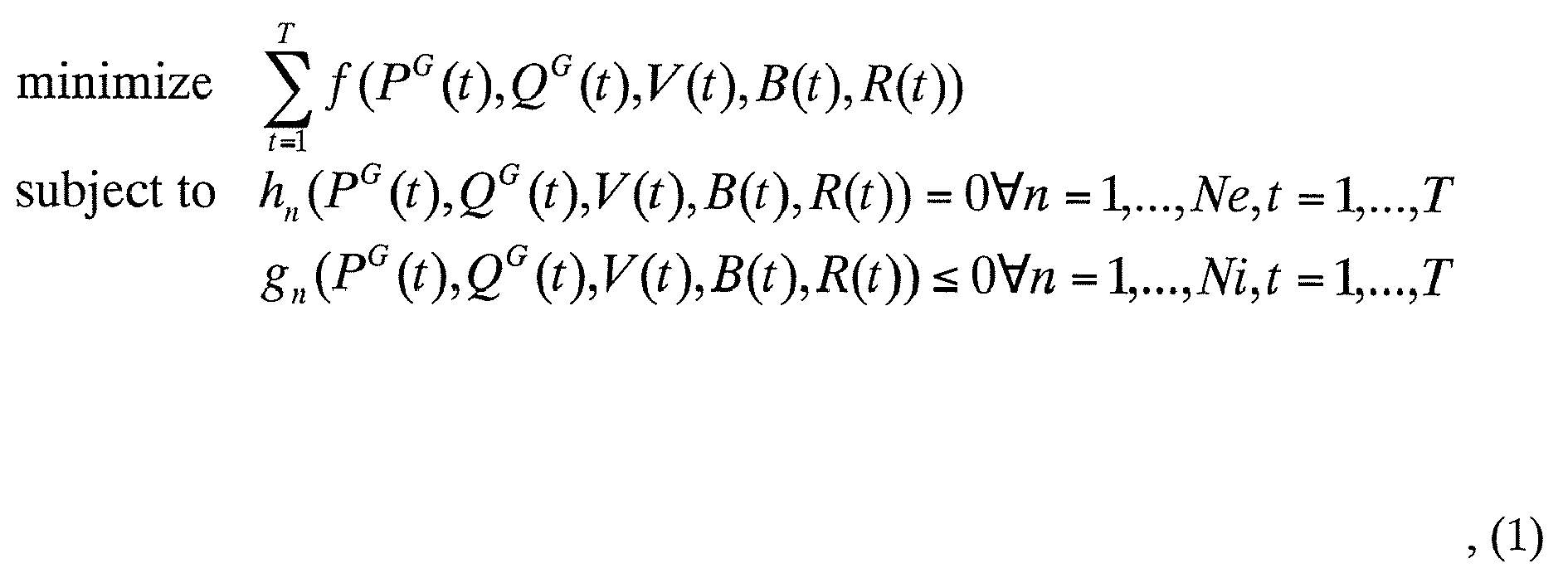
where Re(Vi ), Im(Vi ) denote the real and imaginary parts of the complex voltage Vi, respectively, and hn represents equality constraints and gn represents inequality constraints. - In the preferred embodiment, the equality constraints

are represented as - Power flows on the lines

- Power balances at the buses

- Battery dynamics

where Sij (t) = Pij (t) + jQij (t) denotes the complex valued power transferred from bus i to bus j at time instant t, Sji (t) = Pji (t)+ jQji (t) denotes the complex valued power transferred from bus j to bus i at time instant t, (V i(t))* denotes the complex conjugate of the complex valued variable,

- In the preferred embodiment for time period t=1, ..., T, the inequality constraints

are represented as follows,
Limit on apparent power transferred on lines
Limit on active power transferred on lines
Limit on thermal loss on lines
Limit of Power Generation
Limit on Voltage Magnitude
Limit on State - of - Charge of Batteries
Limit on rate of charge or discharge of Batteries
and for time periods t = 1,..., T - 1. - Ramp Limit on Generator Power Generation

- As shown in
Fig. 2 , we use a branch and bound (BB) procedure to search aspatial BB tree 200. The tree includes a root node R, and after partitioning, child nodes R1 and R2. The tree is used to determine the global minimum for the OPF by constructing a convex relaxation of the feasible region R associated with the OPF (1), that is easy to solve and provides a lower bound (L) on the optimal objective function value. - As shown in
Fig. 3 , the upper bound (U) can be determined by using local minimization, which also yields a feasible solution. The steps used by the method are described with reference toFig. 7 below. - The BB updates the lowest upper bound (Ubest ), if U < Ubest. The BB updates the lowest lower bound (Lbest ) based on the nodes in the tree that are to be analyzed and lower bound obtained for the current node (L). For nodes in BB tree that have not been solved, an estimate of the lower bound is used. This is typically the lower bound value of the parent node from which it was derived. If (Ubest-Lbest), or optionally (Ubest-Lbest )/Ubest, is less than some predetermined threshold τ, then the BB procedure terminates with the current upper bounding solution.
- Otherwise, if (U-L), or (U-L)/U or (Ubest-L) is less than some predetermined threshold τ, then the current node is deleted from the BB tree and another node from the BB tree is selected to update/improve the lower and upper bound using the solving steps.
- Otherwise as shown in
Fig. 4 , the feasible region R is partitioned into R1 and R2, and the BB procedure is repeated, and so forth. In other words, if there is an optimality gap, then the feasible region is partitioned into two sub-regions, over which the BB procedure is repeated. Nodes are deleted (in branch and bound terms "fathomed" X) when the lower bound L is greater than the current best upper bound, seeFig. 2 . - The BB procedure terminates when all nodes have been processed. In that case, the best upper bounding solution is returned as the globally optimal solution.
- As shown in
Fig. 5 , the partitioning of the feasible region can be accomplished by rectangular bisection on P G i or QG i which in the stated problem correspond to a particular time-instant t. -
Fig. 6 shows a radial bisection on the voltage magnitudes (e 2 i + f2 i )0.5 which in the stated problem correspond to a particular time-instant t. - The example optimization described herein is a minimization. However, it should be understood, the problem can also be posed as a maximization by reversing the sign of the objective function.
- The lower bound for OPF (1) is obtained by solving a semidefinite (SDP) relaxation of the OPF. The SDP that is solved is given by:

where W(t) ≻= 0 denotes that matrix W(t) must be positive semidefinite, the matrix operator Tr() is defined as

where ζi denotes a vector of size |N| with a 1 at the i - th component and zero elsewhere. - The matrix W(t) is a relaxation of the outer vector product of the voltage variable vector,

- In the preferred embodiment, the objective function is,

- The equality constraints in the semidefinite relaxation (Eq. 2) are written as,

where, the matrices Yij, Yji, Yi,Y i are defined as shown inFig. 8 . - The SDP relaxations of the Multi-period Optimal Power Flow problem tend to be large scale problems. Therefore, decomposition methods are necessary to solve the problems effectively. The Lagrangian decomposition is used for the Multi-period Optimal Power Flow problem by dualizing only the time coupled constraints in equation (2). The constraints are the dynamics equation for the batteries and the ramp limits for the generator's power generation. The dual problem is,

where, τi (t) is the multiplier for the battery dynamics equation in equation (2), and
are the multipliers for the active power ramp lower and upper limits for generators in equation (2) and
and σ i(t),σi (t) are the multipliers for the reactive power ramp lower and upper limits for generators in equation (2),
and the objective function is defined as
- The above objective function and the constraints in equation (3), which is partial Lagrangian, is decoupled by time. Thus, instead of solving a single large problem in equation (2), we decouple the optimization problem into T smaller SDPs. To obtain the best possible value of the partial Lagrangian dual function, the following optimization problem is solved,
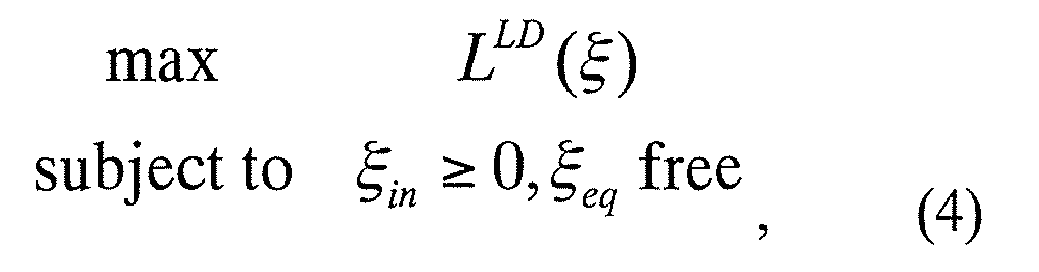
where ξ eq = τ,ξ in = (ρ,ρ,σ,σ). This is a non-smooth concave maximization problem, which can be solved using a projected subgradient method. At each iteration of the subgradient method T smaller SDP's are solved and the multipliers ξ are updated using a simple projected subgradient update. However, the subgradient method does not guarantee ascent, and it can take a large number of iterations before the optimal multipliers are found. Hence, the method is usually terminated after a predetermined number of iterations. The optimal value of equation (4) provides the lower bound L in the method. - The maximization problem which iterates on ξ is solved using a subgradient procedure as,

where []+ denotes the projection on to the nonnegative orthant. sk is a step size.


- The maximization problem can also be solved using a bundle method or any other nonsmooth optimization procedure. When the lower and upper bounds for power generation variables and voltage magnitudes are updated as described below, the appropriate values are used in the subproblems (i), (ii) and (iii) described above.
-
Fig. 7 shows the steps of our method for a method for globally optimizing a power flow in electric power networks during multiple time periods of operation. We begin by initializing 710 variables andconstraints 715 on theBB tree 200. Using the variables and constraints, we solve 720 upper andlower bounds 725 of the OPF, and update 730 the lowest upper andlower bounds 735. If adifference 740 of the lowest bounds is less than a threshold τ, then we output the power P and voltage V750. Otherwise, we partition 760 or delete the corresponding node in the BB tree, and repeat iterate atstep 720. - In summary, the invented power flow optimization has the following advantages over the prior art. We consider the coupling between optimization problems that exist over time, particularly when using storage devices such as batteries. We consider the coupling between problems that arise in successive time instants, particularly when switching equipment such as step voltage regulators, voltage transformers or capacitor banks are used. We also consider the coupling between problems that arise in successive time instants, particularly when power drawn from generating equipment are subject to ramp limits.
Claims (15)
- A method for optimizing a power flow in an electric power network by solving an optimization problem represented by an objective function, comprising the steps of:initializing (710) variables (715) and constraints of a branch and bound (BB) tree, wherein nodes in the BB tree represent feasible regions of the optimization problem;solving (720) for upper and lower bounds (725) on the objective function using the BB tree;updating (730) a lowest lower bound (735) and a lowest upper bound (735);determining (740) if a difference between the lowest lower bound (735) and the lowest upper bound (735) is less than a threshold; andoutputting (750) the power flow based on the lowest lower bound (735) and the lowest upper bound (735) if true, and otherwise iterating (760) beginning at the solving step (720) until a termination condition is reached, wherein the steps are performed in a processor over multiple time periods that are coupled during operation of the electric power network.
- The method of claim 1, wherein the lower bounds (725) are determined by semi-definite programming to provide lowest lower bound (735).
- The method of claim 1, wherein the solving (720) uses a Lagrangian decomposition method.
- The method of claim 1, wherein the parameters for the optimizing include an admittance matrix based on a branch impedance and a bus fixed shunt admittance, and flow capacity ratings.
- The method of claim 1, wherein output of the method includes complex valued voltages V i(t)∀i∈N at buses (10), active and reactive power levels of generators, and energy storage device state-of-charge levels.
- The method of claim 1, wherein the optimizing uses a decision function that depends on active power generation variables, reactive power generation variables, complex valued voltages, rate of charge of batteries, and battery state-of-charge levels at buses (10).
- The method of claim 6, wherein the decision function is quadratic and strictly increasing.
- The method of claim 1, wherein equality constraints, inequality constraints and bounds on decision variables are used to model limits of feasible operation of the network.
- The method of claim 1, further comprising:modeling limits on power generation, limits on voltage magnitude at buses, ramp limits on power generation, limits on rate of charge of batteries, limit on state-of-charge of batteries, constraints on power transferred on lines.
- The method of claim 1, wherein the upper bounds (725) are determined by local minimization.
- The method of claim 1, wherein the feasible regions are partitioned by rectangular bisection during the iterating.
- The method of claim 1, wherein the feasible regions are partitioned by radial bisection during the iterating.
- The method of claim 1, wherein the electric power network includes energy storage devices (15), and the multiple time periods are coupled to accommodate charging and discharging of the energy storage devices (15) at any particular time.
- The method of claim 1, wherein the multiple time periods of operation of the electric network are due to limits on power generation, limits on voltage magnitude at buses (10), ramp limits on the power generation, limits on rate of charge of batteries, limit on state-of-charge of batteries, constraints on the power transferred on the lines and thermal losses.
- The method of claim 1, wherein the multiple time periods of operation of the electric network are due to step voltage regulators, capacitor banks, and limits on frequent change in settings between subsequent time steps.
Applications Claiming Priority (1)
| Application Number | Priority Date | Filing Date | Title |
|---|---|---|---|
| US13/779,206 US9184589B2 (en) | 2013-02-27 | 2013-02-27 | Method for optimizing power flows in electric power networks |
Publications (3)
| Publication Number | Publication Date |
|---|---|
| EP2773005A2 true EP2773005A2 (en) | 2014-09-03 |
| EP2773005A3 EP2773005A3 (en) | 2015-08-26 |
| EP2773005B1 EP2773005B1 (en) | 2018-05-23 |
Family
ID=50189525
Family Applications (1)
| Application Number | Title | Priority Date | Filing Date |
|---|---|---|---|
| EP14156701.6A Active EP2773005B1 (en) | 2013-02-27 | 2014-02-26 | Method for Optimizing a Power Flow in an Electric Power Network |
Country Status (3)
| Country | Link |
|---|---|
| US (1) | US9184589B2 (en) |
| EP (1) | EP2773005B1 (en) |
| JP (1) | JP6048970B2 (en) |
Cited By (4)
| Publication number | Priority date | Publication date | Assignee | Title |
|---|---|---|---|---|
| CN104786867A (en) * | 2015-04-12 | 2015-07-22 | 北京理工大学 | Electromechanical compound transmission power distribution classification optimization control method |
| CN104932253A (en) * | 2015-04-12 | 2015-09-23 | 北京理工大学 | Mechanical-electrical composite transmission minimum principle real-time optimization control method |
| WO2015107865A3 (en) * | 2014-01-14 | 2015-10-15 | Mitsubishi Electric Corporation | Method for determining power flow, method and system for solving optimal power flow problem |
| WO2018177529A1 (en) * | 2017-03-30 | 2018-10-04 | Universita' Della Svizzera Italiana | Method to accelerate the processing of multiperiod optimal power flow problems |
Families Citing this family (14)
| Publication number | Priority date | Publication date | Assignee | Title |
|---|---|---|---|---|
| US20160071013A1 (en) * | 2014-09-10 | 2016-03-10 | Mitsubishi Electric Research Laboratories, Inc. | Method for Estimating Optimal Power Flows in Power Grids using Consensus-Based Distributed Processing |
| US10615638B1 (en) * | 2015-07-02 | 2020-04-07 | Antonio Trias | System and method for observing control limits in powerflow studies |
| JP6703777B2 (en) * | 2016-10-19 | 2020-06-03 | 株式会社東芝 | Power generation planning device, power generation planning method, and power generation planning program |
| CN109409558A (en) * | 2017-08-15 | 2019-03-01 | 中国电力科学研究院 | A kind of method and system of multiple objective programming charging service network |
| CN109066813B (en) * | 2018-08-27 | 2022-03-04 | 广西大学 | Coordinated control method of DC single-stage blocking into ground current based on AC-DC full model |
| US11063472B1 (en) * | 2020-03-03 | 2021-07-13 | Topolonet Corporation | Topology identification and state estimation of power grids |
| CN111900732B (en) * | 2020-08-04 | 2022-08-26 | 四川大学 | Wind power cluster access mode planning method considering wind power uncertainty and reactive power flow and voltage constraints |
| CN112290554B (en) * | 2020-10-21 | 2022-05-13 | 国网福建省电力有限公司 | Micro-grid voltage stability analysis method considering non-smooth constraint |
| CN114362267B (en) * | 2021-12-27 | 2024-05-14 | 河北工业大学 | Distributed coordination optimization method for AC/DC hybrid power distribution network considering multi-objective optimization |
| CN115102177B (en) * | 2022-06-15 | 2025-05-16 | 杭州电子科技大学 | Voltage control method for distributed photovoltaic power generation based on HELM stability criterion |
| CN115833134B (en) * | 2022-12-09 | 2025-05-06 | 国网电力科学研究院武汉能效测评有限公司 | Reactive efficiency optimization method and system considering voltage safety multi-cycle |
| US20240291274A1 (en) * | 2023-02-03 | 2024-08-29 | Arizona Board Of Regents On Behalf Of Arizona State University | Systems and methods for ac optimal power flow modeling for unbalanced distribution systems |
| CN118917070B (en) * | 2024-07-16 | 2025-09-02 | 广东工业大学 | A wireless charging optimization method and device based on Hippo optimization algorithm |
| CN119765355B (en) * | 2024-12-30 | 2025-12-16 | 广东电网有限责任公司 | A power grid power flow planning method, device, storage medium, and product. |
Citations (1)
| Publication number | Priority date | Publication date | Assignee | Title |
|---|---|---|---|---|
| US6625520B1 (en) | 2000-05-31 | 2003-09-23 | Luonan Chen | System and method for operating electric power systems utilizing optimal power flow |
Family Cites Families (18)
| Publication number | Priority date | Publication date | Assignee | Title |
|---|---|---|---|---|
| US20040132101A1 (en) * | 2002-09-27 | 2004-07-08 | Xencor | Optimized Fc variants and methods for their generation |
| JP4187620B2 (en) * | 2003-09-22 | 2008-11-26 | 株式会社明電舎 | A generator start / stop plan creation method and apparatus, and a recording medium for recording a processing program of the start / stop plan creation apparatus. |
| JP2006246692A (en) * | 2005-02-07 | 2006-09-14 | Tokyo Electric Power Co Inc:The | System restoration procedure creation method and program |
| JP2008199825A (en) * | 2007-02-14 | 2008-08-28 | Mitsubishi Chemicals Corp | Power plant operation optimization method and apparatus |
| JP2008271750A (en) * | 2007-04-24 | 2008-11-06 | Toshiba Corp | Power system voltage reactive power control method, apparatus and program |
| JP5402566B2 (en) * | 2009-11-25 | 2014-01-29 | 富士電機株式会社 | Microgrid supply and demand control device and microgrid supply and demand control method |
| EP2580696B1 (en) * | 2010-06-11 | 2025-08-06 | Hitachi Energy Ltd | Detecting state estimation network model data errors |
| WO2012061674A2 (en) * | 2010-11-04 | 2012-05-10 | Siemens Corporation | Stochastic state estimation for smart grids |
| US8396730B2 (en) * | 2011-02-14 | 2013-03-12 | Raytheon Company | System and method for resource allocation and management |
| US9170846B2 (en) * | 2011-03-29 | 2015-10-27 | Daniel Delling | Distributed data-parallel execution engines for user-defined serial problems using branch-and-bound algorithm |
| US8922175B2 (en) * | 2011-03-31 | 2014-12-30 | General Electric Company | System and method for operating capacitor banks |
| US8606420B2 (en) * | 2011-07-15 | 2013-12-10 | International Business Machines Corporation | Solving large-scale security-constrained economic dispatch problem in real-time |
| KR101844425B1 (en) * | 2011-09-26 | 2018-04-04 | 삼성전자주식회사 | A method and an apparatus for reconfiguring protocol of an application program |
| US20130144451A1 (en) * | 2011-10-25 | 2013-06-06 | San Diego State University Research Foundation | Residential and commercial energy management system |
| US9026259B2 (en) * | 2012-01-25 | 2015-05-05 | General Electric Company | Power generation optimization in microgrid including renewable power source |
| US8977524B2 (en) * | 2012-03-06 | 2015-03-10 | Siemens Aktiengesellschaft | Interior point method for reformulated optimal power flow model |
| US9093842B2 (en) * | 2012-08-16 | 2015-07-28 | Mitsubishi Electric Research Laboratories, Inc. | Method for globally optimizing power flows in electric networks |
| JP5996460B2 (en) * | 2013-03-08 | 2016-09-21 | 株式会社東芝 | Energy management apparatus, energy management system, energy management method and program |
-
2013
- 2013-02-27 US US13/779,206 patent/US9184589B2/en active Active
- 2013-12-19 JP JP2013262497A patent/JP6048970B2/en active Active
-
2014
- 2014-02-26 EP EP14156701.6A patent/EP2773005B1/en active Active
Patent Citations (1)
| Publication number | Priority date | Publication date | Assignee | Title |
|---|---|---|---|---|
| US6625520B1 (en) | 2000-05-31 | 2003-09-23 | Luonan Chen | System and method for operating electric power systems utilizing optimal power flow |
Cited By (6)
| Publication number | Priority date | Publication date | Assignee | Title |
|---|---|---|---|---|
| WO2015107865A3 (en) * | 2014-01-14 | 2015-10-15 | Mitsubishi Electric Corporation | Method for determining power flow, method and system for solving optimal power flow problem |
| US9280744B2 (en) | 2014-01-14 | 2016-03-08 | Mitsubishi Electric Research Laboratories, Inc. | System and method for optimal power flow analysis |
| CN104786867A (en) * | 2015-04-12 | 2015-07-22 | 北京理工大学 | Electromechanical compound transmission power distribution classification optimization control method |
| CN104932253A (en) * | 2015-04-12 | 2015-09-23 | 北京理工大学 | Mechanical-electrical composite transmission minimum principle real-time optimization control method |
| WO2018177529A1 (en) * | 2017-03-30 | 2018-10-04 | Universita' Della Svizzera Italiana | Method to accelerate the processing of multiperiod optimal power flow problems |
| US11080362B2 (en) | 2017-03-30 | 2021-08-03 | Università della Svizzera italiana | Method to accelerate the processing of multiperiod optimal power flow problems |
Also Published As
| Publication number | Publication date |
|---|---|
| JP6048970B2 (en) | 2016-12-21 |
| US20140244059A1 (en) | 2014-08-28 |
| EP2773005A3 (en) | 2015-08-26 |
| US9184589B2 (en) | 2015-11-10 |
| JP2014166132A (en) | 2014-09-08 |
| EP2773005B1 (en) | 2018-05-23 |
Similar Documents
| Publication | Publication Date | Title |
|---|---|---|
| EP2773005A2 (en) | Method for Optimizing a Power Flow in an Electric Power Network | |
| US9093842B2 (en) | Method for globally optimizing power flows in electric networks | |
| Shuai et al. | Optimal real-time operation strategy for microgrid: An ADP-based stochastic nonlinear optimization approach | |
| US11387654B2 (en) | Battery energy storage control systems and methods for a grid tie inverter coupled to a photovoltaic system | |
| Rahmani-Andebili | Stochastic, adaptive, and dynamic control of energy storage systems integrated with renewable energy sources for power loss minimization | |
| Liu et al. | Multi‐objective restoration optimisation of power systems with battery energy storage systems | |
| Das et al. | A computationally efficient optimization approach for battery systems in islanded microgrid | |
| US9280744B2 (en) | System and method for optimal power flow analysis | |
| Li et al. | Real-time energy management in microgrids with reduced battery capacity requirements | |
| US20150261892A1 (en) | Integrated optimal placement, sizing, and operation of energy storage devices in electric distribution networks | |
| Nejad et al. | Enhancing active distribution systems resilience by fully distributed self-healing strategy | |
| US9948103B2 (en) | Method for the computer-aided control of the power in an electrical grid | |
| US12027852B2 (en) | Deep learning-based optimal power flow solution with applications to operating electrical power systems | |
| EP4167417A1 (en) | Device power supply method, system, and related device | |
| Carpinelli et al. | Exponential weighted method and a compromise programming method for multi-objective operation of plug-in vehicle aggregators in microgrids | |
| MacRae et al. | Transmission expansion planning considering energy storage | |
| Cominesi et al. | Two-layer predictive control of a micro-grid including stochastic energy sources | |
| CN116093995A (en) | Multi-target network reconstruction method and system for power distribution system | |
| CN110880791A (en) | A Coordination Optimization Method for Hybrid AC and DC Distribution Network | |
| Fortenbacher et al. | Optimal real-time control of multiple battery sets for power system applications | |
| CN111541248B (en) | A method and device for joint optimization of intelligent soft switch and energy storage system | |
| Elsaadany et al. | Battery optimization for power systems: Feasibility and optimality | |
| US20160092776A1 (en) | Optimizing sizing of grid-scale batteries for frequency regulation services | |
| Görges et al. | Energy management in smart grids with electric vehicles based on pricing | |
| Selim et al. | Safe Deep Reinforcement Learning for Robust Frequency and Voltage-Constrained Networked Microgrid Restoration |
Legal Events
| Date | Code | Title | Description |
|---|---|---|---|
| PUAI | Public reference made under article 153(3) epc to a published international application that has entered the european phase |
Free format text: ORIGINAL CODE: 0009012 |
|
| 17P | Request for examination filed |
Effective date: 20140226 |
|
| AK | Designated contracting states |
Kind code of ref document: A2 Designated state(s): AL AT BE BG CH CY CZ DE DK EE ES FI FR GB GR HR HU IE IS IT LI LT LU LV MC MK MT NL NO PL PT RO RS SE SI SK SM TR |
|
| AX | Request for extension of the european patent |
Extension state: BA ME |
|
| REG | Reference to a national code |
Ref country code: DE Ref legal event code: R079 Ref document number: 602014025748 Country of ref document: DE Free format text: PREVIOUS MAIN CLASS: H02J0003060000 Ipc: G06F0017110000 |
|
| PUAL | Search report despatched |
Free format text: ORIGINAL CODE: 0009013 |
|
| AK | Designated contracting states |
Kind code of ref document: A3 Designated state(s): AL AT BE BG CH CY CZ DE DK EE ES FI FR GB GR HR HU IE IS IT LI LT LU LV MC MK MT NL NO PL PT RO RS SE SI SK SM TR |
|
| AX | Request for extension of the european patent |
Extension state: BA ME |
|
| RIC1 | Information provided on ipc code assigned before grant |
Ipc: H02J 3/06 20060101ALI20150717BHEP Ipc: G06F 17/11 20060101AFI20150717BHEP |
|
| R17P | Request for examination filed (corrected) |
Effective date: 20160212 |
|
| RBV | Designated contracting states (corrected) |
Designated state(s): AL AT BE BG CH CY CZ DE DK EE ES FI FR GB GR HR HU IE IS IT LI LT LU LV MC MK MT NL NO PL PT RO RS SE SI SK SM TR |
|
| GRAP | Despatch of communication of intention to grant a patent |
Free format text: ORIGINAL CODE: EPIDOSNIGR1 |
|
| STAA | Information on the status of an ep patent application or granted ep patent |
Free format text: STATUS: GRANT OF PATENT IS INTENDED |
|
| INTG | Intention to grant announced |
Effective date: 20171213 |
|
| GRAS | Grant fee paid |
Free format text: ORIGINAL CODE: EPIDOSNIGR3 |
|
| GRAA | (expected) grant |
Free format text: ORIGINAL CODE: 0009210 |
|
| STAA | Information on the status of an ep patent application or granted ep patent |
Free format text: STATUS: THE PATENT HAS BEEN GRANTED |
|
| AK | Designated contracting states |
Kind code of ref document: B1 Designated state(s): AL AT BE BG CH CY CZ DE DK EE ES FI FR GB GR HR HU IE IS IT LI LT LU LV MC MK MT NL NO PL PT RO RS SE SI SK SM TR |
|
| REG | Reference to a national code |
Ref country code: GB Ref legal event code: FG4D |
|
| REG | Reference to a national code |
Ref country code: CH Ref legal event code: EP |
|
| REG | Reference to a national code |
Ref country code: IE Ref legal event code: FG4D |
|
| REG | Reference to a national code |
Ref country code: AT Ref legal event code: REF Ref document number: 1002071 Country of ref document: AT Kind code of ref document: T Effective date: 20180615 |
|
| REG | Reference to a national code |
Ref country code: DE Ref legal event code: R096 Ref document number: 602014025748 Country of ref document: DE |
|
| REG | Reference to a national code |
Ref country code: NL Ref legal event code: MP Effective date: 20180523 |
|
| REG | Reference to a national code |
Ref country code: LT Ref legal event code: MG4D |
|
| PG25 | Lapsed in a contracting state [announced via postgrant information from national office to epo] |
Ref country code: SE Free format text: LAPSE BECAUSE OF FAILURE TO SUBMIT A TRANSLATION OF THE DESCRIPTION OR TO PAY THE FEE WITHIN THE PRESCRIBED TIME-LIMIT Effective date: 20180523 Ref country code: LT Free format text: LAPSE BECAUSE OF FAILURE TO SUBMIT A TRANSLATION OF THE DESCRIPTION OR TO PAY THE FEE WITHIN THE PRESCRIBED TIME-LIMIT Effective date: 20180523 Ref country code: ES Free format text: LAPSE BECAUSE OF FAILURE TO SUBMIT A TRANSLATION OF THE DESCRIPTION OR TO PAY THE FEE WITHIN THE PRESCRIBED TIME-LIMIT Effective date: 20180523 Ref country code: NO Free format text: LAPSE BECAUSE OF FAILURE TO SUBMIT A TRANSLATION OF THE DESCRIPTION OR TO PAY THE FEE WITHIN THE PRESCRIBED TIME-LIMIT Effective date: 20180823 Ref country code: FI Free format text: LAPSE BECAUSE OF FAILURE TO SUBMIT A TRANSLATION OF THE DESCRIPTION OR TO PAY THE FEE WITHIN THE PRESCRIBED TIME-LIMIT Effective date: 20180523 Ref country code: BG Free format text: LAPSE BECAUSE OF FAILURE TO SUBMIT A TRANSLATION OF THE DESCRIPTION OR TO PAY THE FEE WITHIN THE PRESCRIBED TIME-LIMIT Effective date: 20180823 |
|
| PG25 | Lapsed in a contracting state [announced via postgrant information from national office to epo] |
Ref country code: RS Free format text: LAPSE BECAUSE OF FAILURE TO SUBMIT A TRANSLATION OF THE DESCRIPTION OR TO PAY THE FEE WITHIN THE PRESCRIBED TIME-LIMIT Effective date: 20180523 Ref country code: HR Free format text: LAPSE BECAUSE OF FAILURE TO SUBMIT A TRANSLATION OF THE DESCRIPTION OR TO PAY THE FEE WITHIN THE PRESCRIBED TIME-LIMIT Effective date: 20180523 Ref country code: NL Free format text: LAPSE BECAUSE OF FAILURE TO SUBMIT A TRANSLATION OF THE DESCRIPTION OR TO PAY THE FEE WITHIN THE PRESCRIBED TIME-LIMIT Effective date: 20180523 Ref country code: LV Free format text: LAPSE BECAUSE OF FAILURE TO SUBMIT A TRANSLATION OF THE DESCRIPTION OR TO PAY THE FEE WITHIN THE PRESCRIBED TIME-LIMIT Effective date: 20180523 Ref country code: GR Free format text: LAPSE BECAUSE OF FAILURE TO SUBMIT A TRANSLATION OF THE DESCRIPTION OR TO PAY THE FEE WITHIN THE PRESCRIBED TIME-LIMIT Effective date: 20180824 |
|
| REG | Reference to a national code |
Ref country code: AT Ref legal event code: MK05 Ref document number: 1002071 Country of ref document: AT Kind code of ref document: T Effective date: 20180523 |
|
| PG25 | Lapsed in a contracting state [announced via postgrant information from national office to epo] |
Ref country code: AT Free format text: LAPSE BECAUSE OF FAILURE TO SUBMIT A TRANSLATION OF THE DESCRIPTION OR TO PAY THE FEE WITHIN THE PRESCRIBED TIME-LIMIT Effective date: 20180523 Ref country code: DK Free format text: LAPSE BECAUSE OF FAILURE TO SUBMIT A TRANSLATION OF THE DESCRIPTION OR TO PAY THE FEE WITHIN THE PRESCRIBED TIME-LIMIT Effective date: 20180523 Ref country code: RO Free format text: LAPSE BECAUSE OF FAILURE TO SUBMIT A TRANSLATION OF THE DESCRIPTION OR TO PAY THE FEE WITHIN THE PRESCRIBED TIME-LIMIT Effective date: 20180523 Ref country code: EE Free format text: LAPSE BECAUSE OF FAILURE TO SUBMIT A TRANSLATION OF THE DESCRIPTION OR TO PAY THE FEE WITHIN THE PRESCRIBED TIME-LIMIT Effective date: 20180523 Ref country code: SK Free format text: LAPSE BECAUSE OF FAILURE TO SUBMIT A TRANSLATION OF THE DESCRIPTION OR TO PAY THE FEE WITHIN THE PRESCRIBED TIME-LIMIT Effective date: 20180523 Ref country code: CZ Free format text: LAPSE BECAUSE OF FAILURE TO SUBMIT A TRANSLATION OF THE DESCRIPTION OR TO PAY THE FEE WITHIN THE PRESCRIBED TIME-LIMIT Effective date: 20180523 Ref country code: PL Free format text: LAPSE BECAUSE OF FAILURE TO SUBMIT A TRANSLATION OF THE DESCRIPTION OR TO PAY THE FEE WITHIN THE PRESCRIBED TIME-LIMIT Effective date: 20180523 |
|
| REG | Reference to a national code |
Ref country code: DE Ref legal event code: R097 Ref document number: 602014025748 Country of ref document: DE |
|
| PG25 | Lapsed in a contracting state [announced via postgrant information from national office to epo] |
Ref country code: SM Free format text: LAPSE BECAUSE OF FAILURE TO SUBMIT A TRANSLATION OF THE DESCRIPTION OR TO PAY THE FEE WITHIN THE PRESCRIBED TIME-LIMIT Effective date: 20180523 Ref country code: IT Free format text: LAPSE BECAUSE OF FAILURE TO SUBMIT A TRANSLATION OF THE DESCRIPTION OR TO PAY THE FEE WITHIN THE PRESCRIBED TIME-LIMIT Effective date: 20180523 |
|
| PLBE | No opposition filed within time limit |
Free format text: ORIGINAL CODE: 0009261 |
|
| STAA | Information on the status of an ep patent application or granted ep patent |
Free format text: STATUS: NO OPPOSITION FILED WITHIN TIME LIMIT |
|
| 26N | No opposition filed |
Effective date: 20190226 |
|
| PG25 | Lapsed in a contracting state [announced via postgrant information from national office to epo] |
Ref country code: SI Free format text: LAPSE BECAUSE OF FAILURE TO SUBMIT A TRANSLATION OF THE DESCRIPTION OR TO PAY THE FEE WITHIN THE PRESCRIBED TIME-LIMIT Effective date: 20180523 |
|
| REG | Reference to a national code |
Ref country code: CH Ref legal event code: PL |
|
| GBPC | Gb: european patent ceased through non-payment of renewal fee |
Effective date: 20190226 |
|
| PG25 | Lapsed in a contracting state [announced via postgrant information from national office to epo] |
Ref country code: LU Free format text: LAPSE BECAUSE OF NON-PAYMENT OF DUE FEES Effective date: 20190226 Ref country code: MC Free format text: LAPSE BECAUSE OF FAILURE TO SUBMIT A TRANSLATION OF THE DESCRIPTION OR TO PAY THE FEE WITHIN THE PRESCRIBED TIME-LIMIT Effective date: 20180523 |
|
| REG | Reference to a national code |
Ref country code: BE Ref legal event code: MM Effective date: 20190228 |
|
| REG | Reference to a national code |
Ref country code: IE Ref legal event code: MM4A |
|
| PG25 | Lapsed in a contracting state [announced via postgrant information from national office to epo] |
Ref country code: AL Free format text: LAPSE BECAUSE OF FAILURE TO SUBMIT A TRANSLATION OF THE DESCRIPTION OR TO PAY THE FEE WITHIN THE PRESCRIBED TIME-LIMIT Effective date: 20180523 |
|
| PG25 | Lapsed in a contracting state [announced via postgrant information from national office to epo] |
Ref country code: LI Free format text: LAPSE BECAUSE OF NON-PAYMENT OF DUE FEES Effective date: 20190228 Ref country code: CH Free format text: LAPSE BECAUSE OF NON-PAYMENT OF DUE FEES Effective date: 20190228 |
|
| PG25 | Lapsed in a contracting state [announced via postgrant information from national office to epo] |
Ref country code: GB Free format text: LAPSE BECAUSE OF NON-PAYMENT OF DUE FEES Effective date: 20190226 Ref country code: IE Free format text: LAPSE BECAUSE OF NON-PAYMENT OF DUE FEES Effective date: 20190226 |
|
| PG25 | Lapsed in a contracting state [announced via postgrant information from national office to epo] |
Ref country code: BE Free format text: LAPSE BECAUSE OF NON-PAYMENT OF DUE FEES Effective date: 20190228 |
|
| PG25 | Lapsed in a contracting state [announced via postgrant information from national office to epo] |
Ref country code: TR Free format text: LAPSE BECAUSE OF FAILURE TO SUBMIT A TRANSLATION OF THE DESCRIPTION OR TO PAY THE FEE WITHIN THE PRESCRIBED TIME-LIMIT Effective date: 20180523 |
|
| PG25 | Lapsed in a contracting state [announced via postgrant information from national office to epo] |
Ref country code: MT Free format text: LAPSE BECAUSE OF NON-PAYMENT OF DUE FEES Effective date: 20190226 Ref country code: PT Free format text: LAPSE BECAUSE OF FAILURE TO SUBMIT A TRANSLATION OF THE DESCRIPTION OR TO PAY THE FEE WITHIN THE PRESCRIBED TIME-LIMIT Effective date: 20180924 |
|
| REG | Reference to a national code |
Ref country code: DE Ref legal event code: R084 Ref document number: 602014025748 Country of ref document: DE |
|
| PG25 | Lapsed in a contracting state [announced via postgrant information from national office to epo] |
Ref country code: CY Free format text: LAPSE BECAUSE OF FAILURE TO SUBMIT A TRANSLATION OF THE DESCRIPTION OR TO PAY THE FEE WITHIN THE PRESCRIBED TIME-LIMIT Effective date: 20180523 |
|
| PG25 | Lapsed in a contracting state [announced via postgrant information from national office to epo] |
Ref country code: IS Free format text: LAPSE BECAUSE OF FAILURE TO SUBMIT A TRANSLATION OF THE DESCRIPTION OR TO PAY THE FEE WITHIN THE PRESCRIBED TIME-LIMIT Effective date: 20180923 |
|
| PG25 | Lapsed in a contracting state [announced via postgrant information from national office to epo] |
Ref country code: HU Free format text: LAPSE BECAUSE OF FAILURE TO SUBMIT A TRANSLATION OF THE DESCRIPTION OR TO PAY THE FEE WITHIN THE PRESCRIBED TIME-LIMIT; INVALID AB INITIO Effective date: 20140226 |
|
| PG25 | Lapsed in a contracting state [announced via postgrant information from national office to epo] |
Ref country code: MK Free format text: LAPSE BECAUSE OF FAILURE TO SUBMIT A TRANSLATION OF THE DESCRIPTION OR TO PAY THE FEE WITHIN THE PRESCRIBED TIME-LIMIT Effective date: 20180523 |
|
| P01 | Opt-out of the competence of the unified patent court (upc) registered |
Effective date: 20230512 |
|
| PGFP | Annual fee paid to national office [announced via postgrant information from national office to epo] |
Ref country code: FR Payment date: 20251231 Year of fee payment: 13 |
|
| PGFP | Annual fee paid to national office [announced via postgrant information from national office to epo] |
Ref country code: DE Payment date: 20260102 Year of fee payment: 13 |