EP2772971A1 - Negative electrode active material and metal ion battery using same - Google Patents
Negative electrode active material and metal ion battery using same Download PDFInfo
- Publication number
- EP2772971A1 EP2772971A1 EP12844377.7A EP12844377A EP2772971A1 EP 2772971 A1 EP2772971 A1 EP 2772971A1 EP 12844377 A EP12844377 A EP 12844377A EP 2772971 A1 EP2772971 A1 EP 2772971A1
- Authority
- EP
- European Patent Office
- Prior art keywords
- active material
- battery
- anode active
- anode
- lithium
- Prior art date
- Legal status (The legal status is an assumption and is not a legal conclusion. Google has not performed a legal analysis and makes no representation as to the accuracy of the status listed.)
- Granted
Links
Images




Classifications
-
- C—CHEMISTRY; METALLURGY
- C01—INORGANIC CHEMISTRY
- C01F—COMPOUNDS OF THE METALS BERYLLIUM, MAGNESIUM, ALUMINIUM, CALCIUM, STRONTIUM, BARIUM, RADIUM, THORIUM, OR OF THE RARE-EARTH METALS
- C01F7/00—Compounds of aluminium
- C01F7/68—Aluminium compounds containing sulfur
- C01F7/74—Sulfates
- C01F7/76—Double salts, i.e. compounds containing, besides aluminium and sulfate ions, only other cations, e.g. alums
- C01F7/762—Ammonium or alkali metal aluminium sulfates
-
- C—CHEMISTRY; METALLURGY
- C01—INORGANIC CHEMISTRY
- C01F—COMPOUNDS OF THE METALS BERYLLIUM, MAGNESIUM, ALUMINIUM, CALCIUM, STRONTIUM, BARIUM, RADIUM, THORIUM, OR OF THE RARE-EARTH METALS
- C01F7/00—Compounds of aluminium
- C01F7/78—Compounds containing aluminium, with or without oxygen or hydrogen, and containing two or more other elements
-
- C—CHEMISTRY; METALLURGY
- C01—INORGANIC CHEMISTRY
- C01G—COMPOUNDS CONTAINING METALS NOT COVERED BY SUBCLASSES C01D OR C01F
- C01G49/00—Compounds of iron
- C01G49/009—Compounds containing iron, with or without oxygen or hydrogen, and containing two or more other elements
-
- H—ELECTRICITY
- H01—ELECTRIC ELEMENTS
- H01M—PROCESSES OR MEANS, e.g. BATTERIES, FOR THE DIRECT CONVERSION OF CHEMICAL ENERGY INTO ELECTRICAL ENERGY
- H01M10/00—Secondary cells; Manufacture thereof
- H01M10/05—Accumulators with non-aqueous electrolyte
- H01M10/052—Li-accumulators
-
- H—ELECTRICITY
- H01—ELECTRIC ELEMENTS
- H01M—PROCESSES OR MEANS, e.g. BATTERIES, FOR THE DIRECT CONVERSION OF CHEMICAL ENERGY INTO ELECTRICAL ENERGY
- H01M10/00—Secondary cells; Manufacture thereof
- H01M10/05—Accumulators with non-aqueous electrolyte
- H01M10/054—Accumulators with insertion or intercalation of metals other than lithium, e.g. with magnesium or aluminium
-
- H—ELECTRICITY
- H01—ELECTRIC ELEMENTS
- H01M—PROCESSES OR MEANS, e.g. BATTERIES, FOR THE DIRECT CONVERSION OF CHEMICAL ENERGY INTO ELECTRICAL ENERGY
- H01M4/00—Electrodes
- H01M4/02—Electrodes composed of, or comprising, active material
- H01M4/36—Selection of substances as active materials, active masses, active liquids
- H01M4/48—Selection of substances as active materials, active masses, active liquids of inorganic oxides or hydroxides
- H01M4/52—Selection of substances as active materials, active masses, active liquids of inorganic oxides or hydroxides of nickel, cobalt or iron
- H01M4/525—Selection of substances as active materials, active masses, active liquids of inorganic oxides or hydroxides of nickel, cobalt or iron of mixed oxides or hydroxides containing iron, cobalt or nickel for inserting or intercalating light metals, e.g. LiNiO2, LiCoO2 or LiCoOxFy
-
- H—ELECTRICITY
- H01—ELECTRIC ELEMENTS
- H01M—PROCESSES OR MEANS, e.g. BATTERIES, FOR THE DIRECT CONVERSION OF CHEMICAL ENERGY INTO ELECTRICAL ENERGY
- H01M4/00—Electrodes
- H01M4/02—Electrodes composed of, or comprising, active material
- H01M4/36—Selection of substances as active materials, active masses, active liquids
- H01M4/58—Selection of substances as active materials, active masses, active liquids of inorganic compounds other than oxides or hydroxides, e.g. sulfides, selenides, tellurides, halogenides or LiCoFy; of polyanionic structures, e.g. phosphates, silicates or borates
- H01M4/5825—Oxygenated metallic salts or polyanionic structures, e.g. borates, phosphates, silicates, olivines
-
- C—CHEMISTRY; METALLURGY
- C01—INORGANIC CHEMISTRY
- C01P—INDEXING SCHEME RELATING TO STRUCTURAL AND PHYSICAL ASPECTS OF SOLID INORGANIC COMPOUNDS
- C01P2002/00—Crystal-structural characteristics
- C01P2002/70—Crystal-structural characteristics defined by measured X-ray, neutron or electron diffraction data
- C01P2002/72—Crystal-structural characteristics defined by measured X-ray, neutron or electron diffraction data by d-values or two theta-values, e.g. as X-ray diagram
-
- H—ELECTRICITY
- H01—ELECTRIC ELEMENTS
- H01M—PROCESSES OR MEANS, e.g. BATTERIES, FOR THE DIRECT CONVERSION OF CHEMICAL ENERGY INTO ELECTRICAL ENERGY
- H01M2220/00—Batteries for particular applications
- H01M2220/30—Batteries in portable systems, e.g. mobile phone, laptop
-
- Y—GENERAL TAGGING OF NEW TECHNOLOGICAL DEVELOPMENTS; GENERAL TAGGING OF CROSS-SECTIONAL TECHNOLOGIES SPANNING OVER SEVERAL SECTIONS OF THE IPC; TECHNICAL SUBJECTS COVERED BY FORMER USPC CROSS-REFERENCE ART COLLECTIONS [XRACs] AND DIGESTS
- Y02—TECHNOLOGIES OR APPLICATIONS FOR MITIGATION OR ADAPTATION AGAINST CLIMATE CHANGE
- Y02E—REDUCTION OF GREENHOUSE GAS [GHG] EMISSIONS, RELATED TO ENERGY GENERATION, TRANSMISSION OR DISTRIBUTION
- Y02E60/00—Enabling technologies; Technologies with a potential or indirect contribution to GHG emissions mitigation
- Y02E60/10—Energy storage using batteries
-
- Y—GENERAL TAGGING OF NEW TECHNOLOGICAL DEVELOPMENTS; GENERAL TAGGING OF CROSS-SECTIONAL TECHNOLOGIES SPANNING OVER SEVERAL SECTIONS OF THE IPC; TECHNICAL SUBJECTS COVERED BY FORMER USPC CROSS-REFERENCE ART COLLECTIONS [XRACs] AND DIGESTS
- Y02—TECHNOLOGIES OR APPLICATIONS FOR MITIGATION OR ADAPTATION AGAINST CLIMATE CHANGE
- Y02T—CLIMATE CHANGE MITIGATION TECHNOLOGIES RELATED TO TRANSPORTATION
- Y02T10/00—Road transport of goods or passengers
- Y02T10/60—Other road transportation technologies with climate change mitigation effect
- Y02T10/70—Energy storage systems for electromobility, e.g. batteries
Definitions
- the present invention relates to an anode active material and a metal ion battery prepared with the anode active material.
- a lithium-ion secondary battery has characteristics that it has a higher energy density and is operable at a high voltage compared with other secondary batteries. Therefore, it is used for information devices such as cellular phones, as a secondary battery that can be easily reduced in size and weight, and nowadays there is also an increasing demand for the lithium-ion secondary battery to be used as a power source for large-scale apparatuses such as electric vehicles and hybrid vehicles.
- the lithium-ion secondary battery comprises a cathode layer and an anode layer, and an electrolyte layer disposed between them.
- an electrolyte layer a non-aqueous liquid (electrolytic solution) and the like is employed.
- Patent Document 1 discloses an anode active material used for a non aqueous lithium-ion secondary battery, the anode active material including a lithium-titanium compound oxide having a spinel structure, represented by a general formula of LiM 0.5 Ti 1.5 O 4 (M is one or more element(s) selected from the group consisting of Fe, Co, Ni, Mn and Zn), and absorbing and releasing lithium ions, and a lithium-ion secondary battery prepared with the anode active material.
- Patent Document 2 discloses an anode active material of a lithium-ion secondary battery that is a single phase powder particle of Si including 0.01% or more to 0.40% by mass of B dissolved in solid.
- Patent Document 3 discloses a lithium-ion secondary battery comprising an anode active material, a cathode active material and a non-aqueous electrolyte, wherein a polycrystalline mesocarbon microsphere-graphitized article having a plurality of crystals and an average particle diameter of 1 to 120 ⁇ m, with the C axis direction of each crystal being in random directions is used as the anode active material.
- Patent Document 4 discloses a lithium-ion secondary battery prepared with an anode active material having a layered lithium iron nitride that is represented by a composition formula of Li 3-x Fe x N (0 ⁇ x ⁇ 0.4).
- graphite is known as a typical anode active material of a lithium-ion secondary battery, however, in a sodium ion secondary battery in which sodium ions move between a cathode layer and an anode layer, sodium ions are not inserted or removed in between graphite layers. Therefore, graphite cannot be used as an anode active material of a sodium ion secondary battery.
- a hard carbon functions as an anode active material for a sodium ion secondary battery, therefore research and development of the sodium ion secondary battery has been intensely carried out.
- Patent Document 5 discloses a non-aqueous electrolyte secondary battery comprising a cathode having a complex oxide that includes sodium and iron as a cathode active material, an anode having a carbon material as a absorbing material for sodium ions and lithium ions, and a non-aqueous electrolyte containing lithium ions and sodium ions.
- Patent Document 6 discloses a technique related to an anode active material for a sodium ion secondary battery that contains a carbon material and a sodium ion secondary battery in which the anode active material is used in an anode.
- An electrode potential to absorb and release lithium ions of the lithium-titanium complex oxide having a spinel structure which is used in the technique disclosed in Patent Document 1 is about 1. 5 V on the basis of lithium electrode potential (vs Li/Li+, the same is applied in what follows.). Therefore, the lithium-ion secondary battery disclosed in Patent Document 1 has a problem that it has a low battery voltage and tends to have a small energy density, even though it can prevent deposition of metal lithium.
- As an anode active material that can increase an energy density of a lithium-ion secondary battery a graphite-based material that absorbs and releases lithium ions at a potential of 0 V on the basis of lithium electrode potential is known.
- an electrode potential to absorb and release sodium ions the potential of the carbon material used in the techniques disclosed in Patent Documents 5 and 6 is about 0 V on the basis of sodium electrode potential (vs Na/Na + , the same is applied in what follows) . Therefore, the sodium-ion secondary batteries disclosed in Patent Documents 5 and 6 have a problem that metal sodium easily deposits at the same time especially upon charging of the batteries under a low temperature or charging after repeated charging and discharging thereby safety is easily lowered.
- an object of the present invention is to provide an anode active material capable of increasing battery voltage and battery safety at the same time, and a metal-ion battery prepared with the anode active material.
- a first aspect of the present invention is an anode active material comprising a material that belongs to alunite group and can insert and remove a ion(s) of at least one metal element selected from the group consisting of alkali metal elements and alkaline-earth metal elements.
- a ion(s) of at least one metal element selected from the group consisting of alkali metal elements and alkaline-earth metal elements refers, for example, at least one kind of ion (s) selected from the group consisting of a lithium ion(s), a sodium ion(s), a potassium ion(s), a magnesium ion (s), and a calcium ion (s).
- a material that belongs to alunite group refers a material in which K and/or Al of alunite: KAl 3 (SO 4 ) 2 (OH) 6 or KAl 3 (SO 4 ) 2 (OH) 6 is (are) each substituted to another element.
- the material that belongs to alunite group is, for example, alunite: KAl 3 (SO 4 ) 2 (OH) 6 , natroalunite: NaAl 3 (SO 4 ) 2 (OH) 6 , ammonioalunite : (NH 4 )Al 3 (SO 4 ) 2 (OH) 6 , minamiite: (Na, Ca, K, ⁇ )Al 3 (SO 4 ) 2 (OH) 6 , huangite: Ca ⁇ Al 6 (SO 4 ) 4 (OH) 12 , walthierite: BaAl 6 (SO 4 ) 4 (OH) 12 , jarosite: KFe 3+ 3 (SO 4 ) 2 (OH) 6 , natrojarosite: NaFe 3+ 3 (SO 4 ) 2 (OH) 6 , dorallcharite: (Tl, K)Fe 3+ 3 (SO 4 ) 2 (OH) 6 , ammoniojarosite: (NH 4
- the anode active material according to the first aspect of the present invention is capable to insert and remove an alkali metal ion (s) at a higher potential than an equilibrium potential of alkali metal and alkali metal ions, and capable to insert and remove an alkaline-earth metal ion (s) at a higher potential than an equilibrium potential of alkaline-earth metal and alkaline-earth metal ions. That is, since the anode active material can function as an anode active material in a potential range in which alkali metal and alkaline-earth metal do not deposit, safety can be increased.
- the anode active material according to the first aspect of the present invention is capable to insert and remove an alkali metal ion(s) and an alkaline-earth metal ion(s) in a lower potential range than a potential range in which a conventional anode active material can be used without alkali metal or alkaline-earth metal deposited, thereby it is possible to increase battery voltage. Therefore, according to the first aspect of the present invention, it is possible to provide an anode active material capable of increasing battery voltage and battery safety at the same time.
- the anode active material according to the first aspect of the present invention can be used as an anode active material of a lithium ion battery, a sodium ion battery and a potassium ion battery.
- the anode active material according to the first aspect of the present invention can be used as an anode active material of a magnesium ion battery and a calcium ion battery.
- a second aspect of the present invention is an anode active material comprising a material that belongs to alunite group.
- the anode active material according to the second aspect of the present invention is capable to insert and remove an alkali metal ion(s) at a higher potential than an equilibrium potential of alkali metal and alkali metal ions, and capable to insert and remove an alkaline-earth metal ion(s) at a higher potential than an equilibrium potential of alkaline-earth metal and alkaline-earth metal ions. That is, since the anode active material can function as an anode active material in a potential range in which alkali metal and alkaline-earth metal do not deposit, it is possible to increase safety.
- the anode active material according to the second aspect of the present invention is capable to insert and remove an alkali metal ion (s) and an alkaline-earth metal ion(s) in a lower potential range than a potential range in which a conventional anode active material can be used without alkali metal or alkaline-earth metal deposited, thereby it is possible to increase battery voltage. Therefore, according to the second aspect of the present invention, it is possible to provide an anode active material capable of increasing battery voltage and battery safety at the same time.
- anode active material according to the first or second aspect of the present invention described above can be represented by chemical formula: A 1+a M 3+b (SO 4 ) 2+c (OH) 6+d • v (H 2 O).
- the anode active material according to the first or second aspect of the present invention described above can be NaAl 3.0 (SO 4 ) 2.2 (OH) 5.6 • 0.30H 2 O. In such a configuration as well, it is possible to increase battery voltage at the same time increasing of battery safety.
- the material that belongs to alunite group can be natrojarosite. In such a configuration as well, it is possible to increase battery voltage at the same time increasing battery safety.
- the anode active material according to the first or second aspect of the present invention described above can be NaAl 1.1 Fe 1.6 (SO 4 ) 2 (OH) 5.1 • 0.12H 2 O.
- a charge-discharge capacity by unit mass of NaAl 1.1 Fe 1.6 (SO 4 ) 2 (OH) 5.1 0.12H 2 O is larger than a charge-discharge capacity by unit mass of graphite or lithium titanium oxide (hereinafter sometimes referred to as "LTO") . Therefore, by using NaAl 1.1 Fe 1.6 (SO 4 ) 2 (OH) 5 . 1 • 0.12H 2 O, it is possible to increase energy density at the same time increasing battery safety.
- the anode active material according to the first or second aspect of the present invention described above can be NaFe 3 (SO 4 ) 2 (OH) 6 .
- the anode active material according to the first or second aspect of the present invention described above can be NaFe 3 (SO 4 ) 2 (OH) 6 .
- the anode active material according to the first or second aspect of the present invention described above can be KFe 3 (SO 4 ) 2 (OH) 6 .
- the anode active material according to the first or second aspect of the present invention described above can be KFe 3 (SO 4 ) 2 (OH) 6 .
- a third aspect of the present invention is a metal ion battery comprising a cathode, an anode, and an electrolyte filled between the cathode and the anode, which electrolyte conducts a metal ion(s), wherein the anode active material according to the first or second aspect of the present invention described above is contained in the anode.
- the "metal ion battery” refers to a battery in which a metal ion(s) move(s) between a cathode and an anode.
- the metal ion battery includes a lithium-ion battery, a sodium-ion battery, a potassium-ion battery, a calcium-ion battery and a magnesium-ion battery for instance.
- the metal ion battery can be a primary battery or a secondary battery.
- the anode active material according to the first or second aspect of the present invention described above is used in the anode. Therefore, according to the third aspect of the present invention, it is possible to provide a metal ion battery capable of increasing battery voltage at the same time increasing battery safety.
- the metal ion can be a lithium ion.
- the metal ion can be a lithium ion.
- the metal ion can be a sodium ion.
- This configuration makes it possible to provide a sodium-ion battery capable of increasing battery voltage at the same time increasing safety.
- anode active material capable of increasing battery voltage at the same time increasing battery safety, and a metal ion battery prepared with the anode active material.
- graphite As an anode active material of a lithium-ion secondary battery, it is possible to increase battery voltage, thereby it is possible to increase energy density of the battery.
- a potential at which lithium ions are inserted to graphite, and a potential at which lithium ions are removed from graphite are close to a potential at which lithium ions deposit as metal lithium. Therefore, if graphite is used to as the anode active material, the metal lithium tends to deposit especially when the battery is charged under a low temperature, and when the battery is charged after repeated charging and discharging, thereby it is needed to have a provision for securing battery safety.
- an anode active material having a material that belongs to alunite group (a material that belongs to alunite group, which material can insert and remove ions of at least one metal element selected from the group consisting of alkali metal elements and alkaline-earth metal elements), for instance, an anode active material having alunite structure as its skeleton structure, an anode active material having natrojarosite structure as its skeleton structure and an anode active material having jarosite structure as its skeleton structure, is capable to be used in a potential range at which lithium ions do not deposit as metal lithium, and at the same time capable to insert and remove a lithium ions at a lower potential than a potential of LTO.
- an anode active material having a material that belongs to alunite group a material that belongs to alunite group, which material can insert and remove ions of at least one metal element selected from the group consisting of alkali metal elements and alkaline-earth metal elements
- the sodium-ion secondary battery can operate at a potential range in which sodium ions do not deposit as metal sodium.
- a hard carbon can be used as an anode active material of a sodium-ion secondary battery, however, a potential at which sodium ions are inserted in the hard carbon and a potential at which sodium ions are removed from the hard carbon is around 0 V on the basis of sodium electrode potential. Therefore, in order to increase energy density of a sodium-ion secondary battery prepared with a hard carbon, the sodium-ion secondary battery need to be used at a potential range in which sodium ions deposit as metal sodium.
- the anode active material of the present invention is capable of securing same or more of charge-discharge capacity per unit mass comparing with a capacity obtained when a hard carbon is used, even when the anode active material is used at a potential range in which sodium ions do not deposit as metal sodium.
- the anode active material of the present invention can be used not only as an anode active material of a lithium-ion battery, but also as an anode active material of a sodium-ion battery. This is because the way that lithium ions and sodium ions are inserted in the anode active material of the present invention is same as the way that lithium ions and sodium ions are removed from the anode active material of the present invention. Details of the ways are unknown, but it is presumed that charge-discharge is repeated by a reaction in which a lithium ion(s) or a sodium ion(s) is/are inserted in a vacant site(s) of structure and removed when the battery is discharged, or by a so-called conversion reaction.
- an expression “insert-remove” is not appropriate, however, herein the expression “insert-remove” is used including events that occur in the conversion reaction.
- the anode active material of the present invention is applied to a metal ion battery in which potassium ions, magnesium ions or calcium ions move between a cathode layer and an anode layer, similarly to lithium ions or sodium ions, it is considered that potassium ions, magnesium ions, and calcium ions also can be inserted and removed.
- the anode active material of the present invention can be applied not only to a lithium-ion battery and a sodium-ion battery, but also to a potassium-ion battery, a magnesium-ion battery and a calcium-ion battery.
- the anode active material of the present invention can be represented, for instance, by chemical formula: A 1+a M 3+b (SO 4 ) 2+c (OH) 6+d • v (H 2 O).
- the reason why a material in which the element M is not Al is also included in the anode active material of the present invention is that, the material has same structure of the anode active material, having a space (s) in the structure, thereby same reaction of the anode active material can be occurred. Even when the reaction is the conversion reaction, since oxides of the above elements can make the conversion reaction, the reaction can be occurred even when the element M is not Al.
- the reaction occurred this time is a reaction in which an ion(s) is/are inserted in or removed from a vacant space(s) of structure or a conversion reaction, it is possible to insert and remove an ion(s) of at least one metal element selected from the group consisting of alkali metal elements and alkaline-earth metal elements, even though Fe is not included in the anode active material of the present invention.
- Fe is included in the anode active material of the present invention.
- the anode active material of the present invention can be used for an anode of a metal ion battery that comprises a cathode, an anode, and an electrolyte filled between the cathode and the anode, which electrolyte conducts a metal ion (s).
- a metal ion conducted by the electrolyte and moving between the cathode and the anode, a lithium ion, a sodium ion, a potassium ion, a magnesium ion, a calcium ion and the like can be exemplified.
- the anode active material of the present invention can be used for each anode of a lithium-ion battery, a sodium-ion battery, a potassium-ion battery, a magnesium-ion battery, a calcium-ion battery and the like.
- a cathode active material to be contained in the cathode can be adequately selected from cathode active materials that correspond to metal ions to be moved between the cathode and the anode.
- a cathode active material a known cathode active material, for instance, a layered active material such as a lithium cobalt oxide (LiCoO 2 ), lithium nickel oxide (LiNiO 2 ) and the like, an olivine type active material such as olivine type lithium iron phosphate (LiFePO 4 ) and the like, a spinel type active material such as spinel type lithium manganese oxide (LiMn 2 O 4 ) and the like can be adequately used.
- the metal ion battery of the present invention is a sodium-ion battery
- a known cathode active material such as sodium iron oxide (NaFeO 2 ), fluorinated sodium iron phosphate (Na 2 FePO 4 F) and the like can be adequately used.
- the metal ion battery of the present invention is a potassium-ion battery, a magnesium-ion battery, or a calcium-ion battery, as a cathode active material, cathode active materials respectively capable to be applied to the batteries can be used.
- the cathode of the metal ion battery of the present invention is not limited as long as at least a cathode active material is contained in the cathode, and other than the cathode active material, a binder to bond the cathode active material and other materials, an electrical conducting material to improve electrical conductivity and the like can be contained.
- a cathode active material is contained in the cathode, and other than the cathode active material, a binder to bond the cathode active material and other materials, an electrical conducting material to improve electrical conductivity and the like can be contained.
- a sulfide type solid electrolyte such as Li 3 PS 4
- Li 2 S-P 2 S 5 that is produced by mixing Li 2 S and P 2 S 5 can be exemplified.
- a configuration of the solid electrolyte is not particularly limited, and the electrolyte can be a crystalline solid electrolyte, an amorphous solid electrolyte, glass ceramics, and polymer electrolyte such as polyethylene oxide (PEO), polyvinylidenefluoride-hexafluoropropylene copolymer (PVdF-HFP) and the like.
- polymer electrolyte such as polyethylene oxide (PEO), polyvinylidenefluoride-hexafluoropropylene copolymer (PVdF-HFP) and the like.
- a binder that can be contained in the cathode styrene-butadiene rubber (SBR), polyvinylidene fluoride (PVdF) and the like can be exemplified.
- SBR styrene-butadiene rubber
- PVdF polyvinylidene fluoride
- the anode of the metal ion battery of the present invention is not limited as long as the anode contains the anode active material of the present invention, and other than the anode active material, a solid electrolyte, a binder to bond the anode active material and other materials, an electrical conductive material to improve electrical conductivity and the like can be contained.
- a solid electrolyte, a binder and an electrical conductive material that can be contained in the anode same materials as a solid electrolyte, a binder, and an electrical conductive material that can be contained in the cathode can be exemplified.
- additive amount of the electrical conductive material is, in view of making effect of improving electron conductivity easy to be exerted and the like, 10 % or more of weight of the anode including the electrical conductive material, and in view of making inhibiting decreasing of capacity and the like, 80 % or less of weight of the anode including the electrical conductive material.
- the additive amount of the electrical conductive material is preferably 20 % or more to 60 % or less of the weight of the anode including the electrical conductive material.
- the anode can be produced, for example, by undergoing the step of applying a composition for anode that contains the anode active material of the present invention to a base material (an anode current collector and the like mentioned below) and drying the composition.
- a composition for anode that contains the anode active material of the present invention
- a base material an anode current collector and the like mentioned below
- drying the composition when the anode is produced by undergoing the step of applying the composition for anode to the base material, as an applying method, a doctor blade method, an electrostatic coating method, a dip coating method, a spray coating method and the like can be used.
- the cathode of the metal ion battery of the present invention can be produced for example by undergoing the step of applying a composition for cathode that contains a cathode active material to a base material (a cathode current collector and the like mentioned below) and drying the composition.
- the cathode and the anode of the metal ion battery of the present invention can be connected respectively to a cathode current collector and an anode current collector configured by an electrical conductive material.
- an electrical conductive material that can configure the cathode current collector and the anode current collector a metal material that includes one or two or more of element (s) selected from the group consisting of Cu, Ni, Al, V, Au, Pt, Mg, Fe, Ti, Co, Cr, Zn, Ge, and In can be exemplified.
- the cathode current collector and the anode current collector can be formed, for example, in a metal foil, metal mesh and the like, and a foam metal can be used for the cathode current collector and the anode current collector.
- the electrolyte of the metal ion battery of the present invention is not limited as long as the electrolyte has a conductivity of metal ions moving between the cathode and the anode, and an electrolyte that corresponds to metal ions moving between the cathode and the anode can be adequately selected.
- the electrolyte can be a liquid electrolyte (hereinafter referred to as "electrolytic solution"), a gel-like electrolyte, or a solid electrolyte.
- the metal ion battery of the present invention is a lithium-ion battery or a sodium-ion battery, and an electrolytic solution is used, as a solvent for the electrolytic solution, ethylene carbonate (EC), dimethyl carbonate (DMC), ethylmethyl carbonate (EMC), diethyl carbonate (DEC), propylene carbonate (PC) and the like can be exemplified.
- EC ethylene carbonate
- DMC dimethyl carbonate
- EMC ethylmethyl carbonate
- DEC diethyl carbonate
- PC propylene carbonate
- the metal ion battery of the present invention is a lithium-ion battery and an electrolytic solution is used, as a supporting electrolyte that can be used, LiPF 6 , LiClO 4 , LiTFSA and the like can be exemplified, and when the metal ion battery of the present invention is a sodium-ion battery and an electrolytic solution is used, as a supporting electrolyte that can be used, NaPF 6 , NaClO 4 , NaTFSA and the like can be exemplified.
- the metal ion battery of the present invention is a lithium-ion battery and a solid electrolyte is used
- a solid electrolyte that can be used the above solid electrolyte that can be contained in the cathode, and polymer electrolyte such as PEO can be exemplified.
- a gel-like electrolyte an electrolyte in which the above electrolytic solutions are contained in the PVdF-HFP copolymer and the like can be used.
- the electrolytic solution is applied with a configuration in which the electrolytic solution is impregnated in a separator configured of a porous organic material or porous inorganic material.
- a separator such as a separator of single-layer polypropylene, a separator of single-layer polyethylene, a polypropylene(PP)/polyethylene(PE)/polypropylene(PP) laminated film and the like can be adequately used.
- a polymer electrolyte and a solid electrolyte each can be replaced as the separator.
- Example 1 NaAl 1.1 Fe 1.6 (SO 4 ) 2 (OH) 5.1 • 0.12H 2 O
- aluminum sulfate, iron sulfate and sodium sulfate were dissolved in pure water, and agitating the water, sodium hydroxide solution was delivered by drops into the water.
- the resultant solution was poured into an autoclave apparatus to make reaction under a temperature of 150°C for 1 hour. Then the solution was cooled to a room temperature and filtered, and washed with 1L of pure water. After that, the resultant was dried for 24 hours thereby a powder of Example 1 (NaAl 1.1 Fe 1.6 (SO 4 ) 2 (OH) 5.1 • 0.12H 2 O) was obtained.
- the first composition produced as above was applied to a copper foil (current collector) and rolled after the composition was dried, to thereby an anode of Example 1 was produced.
- a CR2032 type coin battery (a lithium-ion secondary battery.
- a lithium-ion secondary battery (a lithium-ion secondary battery.
- a lithium metal for an opposite pole a lithium metal for an opposite pole
- a polypropylene(PP)/polyethylene(PE)/polypropylene(PP) laminated film as a separator
- an electrolytic solution in which a supporting electrolyte (1 mol/L-LiPF 6 ) was dissolved in a solvent in which 1:1 of ethylene carbonate (EC) and diethyl carbonate (DEC) by volume ratio were mixed.
- EC ethylene carbonate
- DEC diethyl carbonate
- Example 2 NaAl 3.0 (SO 4 ) 2.2 (OH) 5.6 • 0.30H 2 O
- aluminum sulfate and sodium sulfate were dissolved in pure water, and agitating the water, sodium hydroxide solution was delivered by drops into the water.
- the resultant solution was poured into an autoclave apparatus to make reaction under a temperature of 150°C for 1 hour. Then the solution was cooled to a room temperature and filtered, and washed with 1L of pure water. After that, the resultant was dried under a temperature of 80 °C for 24 hours thereby a powder of Example 2 (NaAl 3.0 (SO 4 ) 2 . 2 (OH) 5.6 • 0.30H 2 O) was obtained.
- the second composition produced as above was applied to a copper foil (current collector) and rolled after the composition was dried, to thereby an anode of Example 2 was produced.
- a CR2032 type coin battery (a lithium-ion secondary battery.
- a lithium-ion secondary battery (a lithium-ion secondary battery.
- a lithium metal for an opposite pole a lithium metal for an opposite pole
- a polypropylene(PP)/polyethylene(PE)/polypropylene(PP) laminated film as a separator
- an electrolytic solution in which a supporting electrolyte (1 mol/L-LiPF 6 ) was dissolved in a solvent in which 1:1 of ethylene carbonate (EC) and diethyl carbonate (DEC) by volume ratio were mixed.
- EC ethylene carbonate
- DEC diethyl carbonate
- a CR2032 type coin battery (a sodium-ion battery.
- a sodium-ion battery hereinafter, sometimes referred to as a "battery of Example 3".
- Example 3 A CR2032 type coin battery (a sodium-ion battery.
- the anode of Example 1 was produced with the anode of Example 1 as an anode, a sodium metal for an opposite pole, a polypropylene(PP)/polyethylene(PE)/polypropylene(PP) laminated film as a separator, and an electrolytic solution in which a supporting electrolyte (1 mol/L-NaPF 6 ) was dissolved in a solvent in which 1:1 of ethylene carbonate (EC) and diethyl carbonate (DEC) by volume ratio were mixed.
- EC ethylene carbonate
- DEC diethyl carbonate
- the composition produced as above was applied to a copper foil (current collector) and rolled after the composition was dried, to thereby an anode of Example 4 was produced.
- a CR2032 type coin battery (a lithium-ion secondary battery.
- a lithium-ion secondary battery (a lithium-ion secondary battery.
- a lithium metal for an opposite pole a lithium metal for an opposite pole
- a polypropylene(PP)/polyethylene(PE)/polypropylene(PP) laminated film as a separator
- an electrolytic solution in which a supporting electrolyte (1 mol/L-LiPF 6 ) was dissolved in a solvent in which 1:1 of ethylene carbonate (EC) and diethyl carbonate (DEC) by volume ratio were mixed.
- EC ethylene carbonate
- DEC diethyl carbonate
- KFe 3 (SO 4 ) 2 (OH) 6 iron sulfate and potassium sulfate were dissolved in pure water, and agitating the water, potassium hydroxide solution was delivered by drops into the water.
- the resultant solution was poured into an autoclave apparatus to make reaction under a temperature of 120°C for 24 hour. Then the solution was cooled to a room temperature and filtered, and washed with 1L of pure water. After that, the resultant was dried under a temperature of 80°C for 24 hours thereby a powder of Example 5 (KFe 3 (SO 4 ) 2 (OH) 6 ) was obtained.
- the composition produced as above was applied to a copper foil (current collector) and rolled after the composition was dried, to thereby an anode of Example 5 was produced.
- a CR2032 type coin battery (a lithium-ion secondary battery.
- a lithium-ion secondary battery a lithium-ion secondary battery.
- the anode of Example 5 was produced with the anode of Example 5 as an anode, a lithium metal for an opposite pole, a polypropylene(PP)/polyethylene(PE)/polypropylene(PP) laminated film as a separator, and an electrolytic solution in which a supporting electrolyte (1 mol/L-LiPF 6 ) was dissolved in a solvent in which 1:1 of ethylene carbonate (EC) and diethyl carbonate (DEC) by volume ratio were mixed.
- EC ethylene carbonate
- DEC diethyl carbonate
- a dispersant N-methyl-2-pyrrolidone
- a CR2032 type coin battery (a sodium-ion secondary battery.
- a battery of Example 6 was produced with the anode of Example 6 as an anode, a sodium metal for an opposite pole, a polypropylene(PP)/polyethylene(PE)/polypropylene(PP) laminated film as a separator, and an electrolytic solution in which a supporting electrolyte (1 mol/L-NaPF 6 ) was dissolved in a solvent in which 1:1 of ethylene carbonate (EC) and diethyl carbonate (DEC) by volume ratio were mixed.
- EC ethylene carbonate
- DEC diethyl carbonate
- a dispersant N-methyl-2-pyrrolidone
- a CR2032 type coin battery (a sodium-ion secondary battery.
- a battery of Example 7 was produced with the anode of Example 7 as an anode, a sodium metal for an opposite pole, a polypropylene(PP)/polyethylene(PE)/polypropylene(PP) laminated film as a separator, and an electrolytic solution in which a supporting electrolyte (1 mol/L-NaPF 6 ) was dissolved in a solvent in which 1:1 of ethylene carbonate (EC) and diethyl carbonate (DEC) by volume ratio were mixed.
- EC ethylene carbonate
- DEC diethyl carbonate
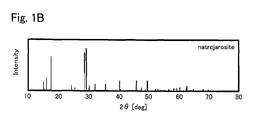
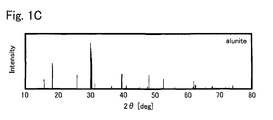
- Example 1 Crystal structure of Example 1 was identified by X-ray diffraction. Result of the diffraction is shown in Fig. 1A . Also, X-ray diffraction Pattern of natrojarosite: NaFe 3+ 3 (SO 4 ) 2 (OH) 6 was shown in Fig. 1B , and X-ray diffraction pattern of alunite: KAl 3 (SO 4 ) 2 (OH) 6 was shown in Fig. 1C . From Fig. 1A to Fig 1C , the result of X-ray diffraction measurement of the powder of Example 1 ( Fig 1A ) corresponded to Fig. 1B . The result of measurement of the powder of Example 2 corresponded to Fig. 1C .
- the powder of Example 1 has the crystal structure of natarojarosite, and the powder of Example 2 has the crystal structure of alunite. Both of the powders of Example 1 and 2 are configured by inexpensive elements. Therefore, according to the present invention, it is possible to reduce manufacturing cost of an anode active material, and by applying the anode active material of the present invention, it is also possible to reduce manufacturing cost of a battery.
- Constant current charge-discharge was carried out to each of the battery of Example 1, the battery of Example 2 and the battery of Example 3 produced by the above steps, under a temperature of 25°C, with a load current of 70 mA/g (active material), a voltage range of 0.05V or more to 1.5V or less (to the battery of Example 1 and the battery of Example 2, 0.05V or more to 1.5V or less on the basis of lithium electrode potential, to the battery of Example 3, 0.05V or more to 1.5V or less on the basis of sodium electrode potential).
- Results of the second cycles of the battery of Example 1 and the battery of Example 2 were shown in Fig. 2
- result of the second cycle of the battery of Example 3 was shown in Fig. 3 .
- Fig. 3 In Fig.
- results of the second cycles of a battery prepared with graphite as an anode active material and a battery prepared with Li 9 Ti 5 O 12 (LTO) as an anode active material are shown together with the results of the second cycles of the battery of Example 1 and the battery of Example 2, and in Fig. 3 , result of the second cycle of a battery prepared with hard carbon as an anode active material is shown together with the result of the second cycle of the battery of Example 3.
- LTO Li 9 Ti 5 O 12
- the battery of Example 1 in which the powder of Example 1 containing Fe was used for the anode operated stably in a range of 0.05V or more to 1.5V or less on the basis of lithium electrode potential.
- the battery of Example 1 had 500 mAh/g or more of reversible capacity, which means that even when the battery was used in a potential range in which metal lithium does not deposit, the battery was capable of securing a capacity larger than 372 mAh/g, which is a theoretical capacity of graphite.
- the battery of Example 1 was capable to increase battery safety since it can operate in a potential range in which metal lithium does not deposit, was capable to increase battery voltage since lithium ion is inserted and removed in a potential range lower than that of Li 4 Ti 5 O 12 , and was capable to increase energy density same or more to a battery prepared with graphite.
- the battery of Example 2 in which the powder of Example 2 that does not contain Fe operated stably in a range of 0.05V or more to 1. 5V or less on the basis of lithium electrode potential. Also, the battery of Example 2 was capable to insert and remove lithium ions at a lower potential than a potential at which lithium ions are inserted in or removed from Li 4 Ti 5 O 12 . Therefore, the battery of Example 2 is capable to increase battery voltage better than a battery in which Li 4 Ti 5 O 12 is used as an anode active material. As shown in Fig. 2 , the powder of Example 2 has a lower charge-discharge capacity per unit mass than that of Li 4 Ti 5 O 12 .
- an anode active material that contains Fe is preferably used for an anode.
- the battery of Example 3 in which the powder of Example 1 containing Fe was used for the anode operated stably in a range of 0.05V or more to 1.5V or less on the basis of sodium electrode potential. Also, the battery of Example 3 had 250 mAh/g or more of reversible capacity. That is, the battery of Example 3, since it can operate in a potential range in which metal sodium does not deposit, was capable to increase battery safety and at the same time was capable to increase energy density than a battery prepared with a hard carbon.
- Example 4 Crystal structure of Example 4 was identified by X-ray diffraction. Result of the diffraction is shown in Fig. 4 . From Fig. 4 and Fig 1B , the result of X-ray diffraction measurement of the powder of Example 4 ( Fig 4 ) corresponded to Fig. 1B . Therefore, it was found out that the powder of Example 4 has the crystal structure of natarojarosite: NaFe 3 (SO 4 ) 2 (OH) 6 .
- the powder of Example 4 is configured by inexpensive elements. Therefore, according to the present invention, it is possible to reduce manufacturing cost of an anode active material, and by applying the anode active material of the present invention, it is also possible to reduce manufacturing cost of a battery.
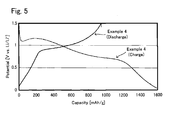
- Constant current charge-discharge was carried out to the battery prepared with the powder of Example 4 produced by the same step of Example 1, under a temperature of 25°C, with a load current of 70 mA/g (active material), a voltage range of 0.05V or more to 1.5V or less (on the basis of lithium electrode potential). Result of the first cycle of the battery of Example 4 is shown in Fig. 5 .
- the battery of Example 4 operated stably in a range of 0.05V or more to 1.5V or less on the basis of lithium electrode potential. Also, the battery of Example 4 had 500 mAh/g or more of capacity, which means that even when the battery was used in a potential range in which metal lithium does not deposit, the battery was capable of securing a capacity larger than 372 mAh/g, which is a theoretical capacity of graphite. That is, the battery of Example 4 is capable to increase battery safety since it can operate in a potential range in which metal lithium does not deposit.
- the battery of Example 4 can increase battery voltage, which makes it possible to increase energy density same or more to a battery prepared with graphite.
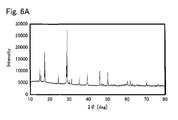
- Example 5 Crystal structure of Example 5 was identified by X-ray diffraction. Result of the diffraction of the powder of Example 5 is shown in Fig. 6A . Also, the X-ray diffraction pattern of jarosite: KFe 3 (SO 4 ) 2 (OH) 6 is shown in Fig. 6B . From Figs. 6A and 6B , the result of X-ray diffraction measurement of the powder of Example 5 ( Fig 6A ) corresponded to Fig. 6B . Therefore, it was found out that the powder of Example 5 has the crystal structure of jarosite: KFe 3 (SO 4 ) 2 (OH) 6 .
- the powder of Example 5 is configured by inexpensive elements. Therefore, according to the present invention, it is possible to reduce manufacturing cost of an anode active material, and by applying the anode active material of the present invention, it is also possible to reduce manufacturing cost of a battery.
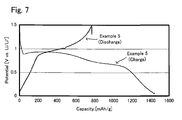
- Constant current charge-discharge was carried out to the battery prepared with the powder of Example 5 produced by the same step of Example 1, under a temperature of 25°C, with a load current of 70 mA/g (active material), a voltage range of 0.05V or more to 1.5V or less (on the basis of lithium electrode potential). Result of the first cycle of the battery of Example 5 is shown in Fig. 7 .
- the battery of Example 5 operated stably in a range of 0.05V or more to 1.5V or less on the basis of lithium electrode potential. Also, the battery of Example 5 had 500 mAh/g or more of capacity, which means that even when the battery was used in a potential range in which metal lithium does not deposit, the battery was capable of securing a capacity larger than 372 mAh/g, which is a theoretical capacity of graphite. That is, the battery of Example 5 is capable to increase battery safety since it can operate in a potential range in which metal lithium does not deposit.
- the battery of Example 5 can increase battery voltage, which makes it possible to increase energy density same or more to a battery prepared with graphite.
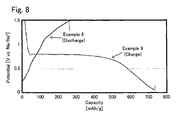
- Constant current charge-discharge was carried out to the battery prepared with the powder of Example 4 produced by the same step of Example 3, under a temperature of 25°C, with a load current of 70 mA/g (active material), a voltage range of 0.05V or more to 1.5V or less (on the basis of sodium electrode potential). Result of the first cycle of the battery of Example 6 is shown in Fig. 8 .
- the battery of Example 6 operated stably in a range of 0.05V or more to 1.5V or less on the basis of sodium electrode potential. Also, the battery of Example 6 had 260 mAh/g or more of discharging capacity. That is, the battery of Example 6 was capable to increase battery safety since it can operate in a potential range in which metal sodium does not deposit, and at the same time capable to increase energy density than that of a battery prepared with a hard carbon.
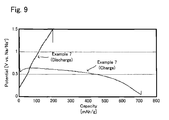
- Constant current charge-discharge was carried out to the battery prepared with the powder of Example 5 produced by the same step of Example 3, under a temperature of 25°C, with a load current of 70 mA/g (active material), a voltage range of 0.05V or more to 1.5V or less (on the basis of sodium electrode potential). Result of the first cycle of the battery of Example 7 is shown in Fig. 9 .
- the battery of Example 7 operated stably in a range of 0.05V or more to 1.5V or less on the basis of sodium electrode potential. Also, the battery of Example 7 had 190 mAh/g or more of discharging capacity. That is, the battery of Example 7 was capable to increase battery safety since it can operate in a potential range in which metal sodium does not deposit, and at the same time capable to increase energy density than that of a battery prepared with a hard carbon.
Landscapes
- Chemical & Material Sciences (AREA)
- Organic Chemistry (AREA)
- Inorganic Chemistry (AREA)
- General Chemical & Material Sciences (AREA)
- Chemical Kinetics & Catalysis (AREA)
- Electrochemistry (AREA)
- Engineering & Computer Science (AREA)
- Manufacturing & Machinery (AREA)
- Geology (AREA)
- Life Sciences & Earth Sciences (AREA)
- Crystallography & Structural Chemistry (AREA)
- Materials Engineering (AREA)
- Battery Electrode And Active Subsutance (AREA)
- Secondary Cells (AREA)
- Compounds Of Alkaline-Earth Elements, Aluminum Or Rare-Earth Metals (AREA)
- Compounds Of Iron (AREA)
Abstract
Description
- The present invention relates to an anode active material and a metal ion battery prepared with the anode active material.
- A lithium-ion secondary battery has characteristics that it has a higher energy density and is operable at a high voltage compared with other secondary batteries. Therefore, it is used for information devices such as cellular phones, as a secondary battery that can be easily reduced in size and weight, and nowadays there is also an increasing demand for the lithium-ion secondary battery to be used as a power source for large-scale apparatuses such as electric vehicles and hybrid vehicles.
- The lithium-ion secondary battery comprises a cathode layer and an anode layer, and an electrolyte layer disposed between them. As the electrolyte layer, a non-aqueous liquid (electrolytic solution) and the like is employed.
- As a technique related to such a lithium-ion secondary battery,
Patent Document 1 for example discloses an anode active material used for a non aqueous lithium-ion secondary battery, the anode active material including a lithium-titanium compound oxide having a spinel structure, represented by a general formula of LiM0.5Ti1.5O4 (M is one or more element(s) selected from the group consisting of Fe, Co, Ni, Mn and Zn), and absorbing and releasing lithium ions, and a lithium-ion secondary battery prepared with the anode active material.Patent Document 2 discloses an anode active material of a lithium-ion secondary battery that is a single phase powder particle of Si including 0.01% or more to 0.40% by mass of B dissolved in solid.Patent Document 3 discloses a lithium-ion secondary battery comprising an anode active material, a cathode active material and a non-aqueous electrolyte, wherein a polycrystalline mesocarbon microsphere-graphitized article having a plurality of crystals and an average particle diameter of 1 to 120 µm, with the C axis direction of each crystal being in random directions is used as the anode active material.Patent Document 4 discloses a lithium-ion secondary battery prepared with an anode active material having a layered lithium iron nitride that is represented by a composition formula of Li3-xFexN (0<x<0.4). - On the other hand, graphite is known as a typical anode active material of a lithium-ion secondary battery, however, in a sodium ion secondary battery in which sodium ions move between a cathode layer and an anode layer, sodium ions are not inserted or removed in between graphite layers. Therefore, graphite cannot be used as an anode active material of a sodium ion secondary battery. Nowadays, it has been found that a hard carbon functions as an anode active material for a sodium ion secondary battery, therefore research and development of the sodium ion secondary battery has been intensely carried out.
- As a technique related to such a sodium ion secondary battery,
Patent Document 5 for example discloses a non-aqueous electrolyte secondary battery comprising a cathode having a complex oxide that includes sodium and iron as a cathode active material, an anode having a carbon material as a absorbing material for sodium ions and lithium ions, and a non-aqueous electrolyte containing lithium ions and sodium ions. Also,Patent Document 6 discloses a technique related to an anode active material for a sodium ion secondary battery that contains a carbon material and a sodium ion secondary battery in which the anode active material is used in an anode. -
- Patent Document 1: Japanese Patent Application Laid-Open Publication No.
2011-86464 - Patent Document 2: Japanese Patent Application Laid-Open Publication No.
2011-40310 - Patent Document 3: Japanese Patent Application Laid-Open Publication No.
2009-173547 - Patent Document 4: Japanese Patent Application Laid-Open Publication No.
2010-257736 - Patent Document 5: Japanese Patent Application Laid-Open Publication No.
H11-4015 - Patent Document 6: Japanese Patent Application Laid-Open Publication No.
2009-129742 - An electrode potential to absorb and release lithium ions of the lithium-titanium complex oxide having a spinel structure which is used in the technique disclosed in
Patent Document 1 is about 1. 5 V on the basis of lithium electrode potential (vs Li/Li+, the same is applied in what follows.). Therefore, the lithium-ion secondary battery disclosed inPatent Document 1 has a problem that it has a low battery voltage and tends to have a small energy density, even though it can prevent deposition of metal lithium. As an anode active material that can increase an energy density of a lithium-ion secondary battery, a graphite-based material that absorbs and releases lithium ions at a potential of 0 V on the basis of lithium electrode potential is known. However, if the graphite-based material is used for an anode, metal lithium easily deposits upon charging especially at a low temperature, or charging after charging and discharging are repeated, therefore there is a problem that safety is easily lowered. There has not been suggested yet so far an anode active material that can absorb and release lithium ions at a potential with which metal lithium does not deposit, and at the same time that can provide a lithium ion secondary battery with an increased battery voltage. By using techniques disclosed inPatent Document 1 toPatent Document 4, it is difficult to support preventing deposition of metal lithium and increasing battery voltage at the same time. - On the other hand, an electrode potential to absorb and release sodium ions, the potential of the carbon material used in the techniques disclosed in
Patent Documents Patent Documents - Accordingly, an object of the present invention is to provide an anode active material capable of increasing battery voltage and battery safety at the same time, and a metal-ion battery prepared with the anode active material.
- In order to solve the above problems, the present invention takes the following means. Namely, a first aspect of the present invention is an anode active material comprising a material that belongs to alunite group and can insert and remove a ion(s) of at least one metal element selected from the group consisting of alkali metal elements and alkaline-earth metal elements.
- Here, the term "a ion(s) of at least one metal element selected from the group consisting of alkali metal elements and alkaline-earth metal elements" refers, for example, at least one kind of ion (s) selected from the group consisting of a lithium ion(s), a sodium ion(s), a potassium ion(s), a magnesium ion (s), and a calcium ion (s). Also, "a material that belongs to alunite group" refers a material in which K and/or Al of alunite: KAl3 (SO4)2(OH)6 or KAl3(SO4)2(OH)6 is (are) each substituted to another element. The material that belongs to alunite group is, for example, alunite: KAl3(SO4)2(OH)6, natroalunite: NaAl3(SO4)2(OH)6, ammonioalunite : (NH4)Al3(SO4)2(OH)6, minamiite: (Na, Ca, K, □)Al3(SO4)2(OH)6, huangite: Ca□Al6(SO4)4(OH)12, walthierite: BaAl6(SO4)4(OH)12, jarosite: KFe3+ 3(SO4)2(OH)6, natrojarosite: NaFe3+ 3(SO4)2(OH)6, dorallcharite: (Tl, K)Fe3+ 3 (SO4)2(OH)6, ammoniojarosite: (NH4)Fe3+ 3 (SO4)2(OH) 6, argentojarosite: AgFe3+ 3 (SO4)2 (OH) 6, plumbojarosite: PbFe3+ 6 (SO4)4(OH)12, hydrinium jarosite: (H3O)Fe3+ 3(SO4)2(OH) 6, osarizawaite: PbCuAl2 (SO4)2(OH)6, beaverite: PbCuFe3+ 2 (SO4)2 (OH) 6 and the like can be raised. "□" in the above chemical formulas means a vacant place.
- The anode active material according to the first aspect of the present invention is capable to insert and remove an alkali metal ion (s) at a higher potential than an equilibrium potential of alkali metal and alkali metal ions, and capable to insert and remove an alkaline-earth metal ion (s) at a higher potential than an equilibrium potential of alkaline-earth metal and alkaline-earth metal ions. That is, since the anode active material can function as an anode active material in a potential range in which alkali metal and alkaline-earth metal do not deposit, safety can be increased. Also, the anode active material according to the first aspect of the present invention is capable to insert and remove an alkali metal ion(s) and an alkaline-earth metal ion(s) in a lower potential range than a potential range in which a conventional anode active material can be used without alkali metal or alkaline-earth metal deposited, thereby it is possible to increase battery voltage. Therefore, according to the first aspect of the present invention, it is possible to provide an anode active material capable of increasing battery voltage and battery safety at the same time.
- Also, in the first aspect of the present invention described above, it is preferable that at least one element selected from the group consisting of lithium, sodium and potassium is included in the alkali metal elements. By including these elements, the anode active material according to the first aspect of the present invention can be used as an anode active material of a lithium ion battery, a sodium ion battery and a potassium ion battery.
- Also, in the first aspect of the present invention described above, it is preferable that at least one element selected from the group consisting of magnesium and calcium is included in the alkaline-earth metal elements. By including these elements, the anode active material according to the first aspect of the present invention can be used as an anode active material of a magnesium ion battery and a calcium ion battery.
- A second aspect of the present invention is an anode active material comprising a material that belongs to alunite group.
- The anode active material according to the second aspect of the present invention is capable to insert and remove an alkali metal ion(s) at a higher potential than an equilibrium potential of alkali metal and alkali metal ions, and capable to insert and remove an alkaline-earth metal ion(s) at a higher potential than an equilibrium potential of alkaline-earth metal and alkaline-earth metal ions. That is, since the anode active material can function as an anode active material in a potential range in which alkali metal and alkaline-earth metal do not deposit, it is possible to increase safety. Also, the anode active material according to the second aspect of the present invention is capable to insert and remove an alkali metal ion (s) and an alkaline-earth metal ion(s) in a lower potential range than a potential range in which a conventional anode active material can be used without alkali metal or alkaline-earth metal deposited, thereby it is possible to increase battery voltage. Therefore, according to the second aspect of the present invention, it is possible to provide an anode active material capable of increasing battery voltage and battery safety at the same time.
- Also, when A is defined as at least one kind selected from the group consisting of K, Na, Li, 1/2Mg, 1/2Ca, 1/2Sr, Rb, Ag, Tl, 1/2Pb, 1/2Hg, NH4 and H3O, M is defined as at least one kind of element selected from the group consisting of Al, Sc, Ti, V, Cr, Mn, Fe, Co, Ni, Cu, and Zn, and -1≤a, b, c≤1, -6≤d and 0≤v, the anode active material according to the first or second aspect of the present invention described above can be represented by chemical formula: A1+aM3+b (SO4) 2+c (OH) 6+d • v (H2O). In such a configuration as well, it is possible to increase battery voltage at the same time increasing battery safety. In the chemical formula, there is a case in which M has a plurality of kinds instead of one kind, and when valence of A is bivalent, A1+a is to be (1/2A)1+a that is A(1/2+a/2) • Also, especially when the anode active material represented by the above chemical formula is a natural mineral and the like, there are different impurities being included.
- Also, the anode active material according to the first or second aspect of the present invention described above can be NaAl3.0 (SO4)2.2 (OH) 5.6 • 0.30H2O. In such a configuration as well, it is possible to increase battery voltage at the same time increasing of battery safety.
- Also, in the first or second aspect of the present invention described above, the material that belongs to alunite group can be natrojarosite. In such a configuration as well, it is possible to increase battery voltage at the same time increasing battery safety.
- Also, the anode active material according to the first or second aspect of the present invention described above can be NaAl1.1Fe1.6 (SO4)2 (OH) 5.1 • 0.12H2O. In such a configuration as well, it is possible to increase battery voltage at the same time increasing battery safety. Also, a charge-discharge capacity by unit mass of NaAl1.1Fe1.6(SO4)2(OH)5.1 0.12H2O is larger than a charge-discharge capacity by unit mass of graphite or lithium titanium oxide (hereinafter sometimes referred to as "LTO") . Therefore, by using NaAl1.1Fe1.6 (SO4)2 (OH)5.1 • 0.12H2O, it is possible to increase energy density at the same time increasing battery safety.
- Also, the anode active material according to the first or second aspect of the present invention described above can be NaFe3(SO4)2(OH)6. In such a configuration as well, it is possible to increase battery voltage at the same time increasing battery safety.
- Also, the anode active material according to the first or second aspect of the present invention described above can be KFe3(SO4)2(OH)6. In such a configuration as well, it is possible to increase battery voltage at the same time increasing battery safety.
- A third aspect of the present invention is a metal ion battery comprising a cathode, an anode, and an electrolyte filled between the cathode and the anode, which electrolyte conducts a metal ion(s), wherein the anode active material according to the first or second aspect of the present invention described above is contained in the anode.
- Here, the "metal ion battery" refers to a battery in which a metal ion(s) move(s) between a cathode and an anode. The metal ion battery includes a lithium-ion battery, a sodium-ion battery, a potassium-ion battery, a calcium-ion battery and a magnesium-ion battery for instance. Also, the metal ion battery can be a primary battery or a secondary battery.
- In the third aspect of the present invention, the anode active material according to the first or second aspect of the present invention described above is used in the anode. Therefore, according to the third aspect of the present invention, it is possible to provide a metal ion battery capable of increasing battery voltage at the same time increasing battery safety.
- Also, in the third aspect of the present invention described above, the metal ion can be a lithium ion. In such a configuration, it is possible to provide a lithium-ion battery capable of increasing battery voltage at the same time increasing battery safety.
- Also, in the third aspect of the present invention described above, the metal ion can be a sodium ion. This configuration makes it possible to provide a sodium-ion battery capable of increasing battery voltage at the same time increasing safety.
- According to the present invention, it is possible to provide an anode active material capable of increasing battery voltage at the same time increasing battery safety, and a metal ion battery prepared with the anode active material.
-
-
Fig 1A is a graph showing a result of X-ray diffraction measurement of a powder of Example 1; -
Fig. 1B is a graph showing X-ray diffraction pattern of natrojarosite; -
Fig. 2 is a graph showing results of constant current charge-discharge of a lithium-ion secondary battery prepared with the powder of Example 1 and a lithium-ion secondary battery prepared with the powder of Example 2; -
Fig. 3 is a graph showing results of constant current charge-discharge of a sodium-ion secondary battery prepared with the powder of Example 1; -
Fig. 4 is a graph showing a result of X-ray diffraction measurement of a powder of Example 4; -
Fig. 5 is a graph showing results of constant current charge-discharge of a lithium-ion secondary battery prepared with the powder of Example 4; -
Fig. 6A is a graph showing a result of X-ray diffraction measurement of a powder of Example 5; -
Fig. 6B is a graph showing X-ray diffraction pattern of jarosite; -
Fig. 7 is a graph showing results of constant current charge-discharge of a lithium-ion secondary battery prepared with the powder of Example 5; -
Fig. 8 is a graph showing results of constant current charge-discharge of a sodium-ion secondary battery prepared with the powder of Example 4; -
Fig. 9 is a graph showing results of constant current charge-discharge of a sodium-ion secondary battery prepared with the powder of Example 5. - By using graphite as an anode active material of a lithium-ion secondary battery, it is possible to increase battery voltage, thereby it is possible to increase energy density of the battery. However, a potential at which lithium ions are inserted to graphite, and a potential at which lithium ions are removed from graphite are close to a potential at which lithium ions deposit as metal lithium. Therefore, if graphite is used to as the anode active material, the metal lithium tends to deposit especially when the battery is charged under a low temperature, and when the battery is charged after repeated charging and discharging, thereby it is needed to have a provision for securing battery safety. Against this, as an anode active material capable to insert and remove lithiums ion at a potential in which lithium ions do not deposit as a metal lithium, LTO and the like have been suggested. By using LTO, it becomes easy to increase battery safety, however, each potential at which lithium ions are inserted to LTO and at which lithium ions are removed from LTO is high as around 1.5 V on the basis of lithium electrode potential. Because of this, if LTO is used, battery voltage tends to be decreased. Also, since charge-discharge capacity of LTO per unit mass is 1/2 or less of charge-discharge capacity of graphite per unit mass, a battery prepared with LTO has a low energy density. As a battery for equipping to a vehicle, a battery that has a high safety and high energy density is demanded. To satisfy this demand, it is considered that identifying an anode active material capable to be used at a potential with which lithium ions do not deposit as metal lithium and at the same time capable to increase battery voltage is important.
- Inventors of the present invention have carried out an intensive study and found out that an anode active material having a material that belongs to alunite group (a material that belongs to alunite group, which material can insert and remove ions of at least one metal element selected from the group consisting of alkali metal elements and alkaline-earth metal elements), for instance, an anode active material having alunite structure as its skeleton structure, an anode active material having natrojarosite structure as its skeleton structure and an anode active material having jarosite structure as its skeleton structure, is capable to be used in a potential range at which lithium ions do not deposit as metal lithium, and at the same time capable to insert and remove a lithium ions at a lower potential than a potential of LTO.
- Further, it is found out that when the anode active material is used to an anode of a sodium-ion secondary battery, the sodium-ion secondary battery can operate at a potential range in which sodium ions do not deposit as metal sodium. Nowadays, it is reported that a hard carbon can be used as an anode active material of a sodium-ion secondary battery, however, a potential at which sodium ions are inserted in the hard carbon and a potential at which sodium ions are removed from the hard carbon is around 0 V on the basis of sodium electrode potential. Therefore, in order to increase energy density of a sodium-ion secondary battery prepared with a hard carbon, the sodium-ion secondary battery need to be used at a potential range in which sodium ions deposit as metal sodium. If the sodium-ion secondary battery is used only at a potential range in which metal sodium does not deposit, the energy density is significantly decreased. The inventors of the present invention has carried out an intensive study and found out that the anode active material of the present invention is capable of securing same or more of charge-discharge capacity per unit mass comparing with a capacity obtained when a hard carbon is used, even when the anode active material is used at a potential range in which sodium ions do not deposit as metal sodium.
- As described above, the anode active material of the present invention can be used not only as an anode active material of a lithium-ion battery, but also as an anode active material of a sodium-ion battery. This is because the way that lithium ions and sodium ions are inserted in the anode active material of the present invention is same as the way that lithium ions and sodium ions are removed from the anode active material of the present invention. Details of the ways are unknown, but it is presumed that charge-discharge is repeated by a reaction in which a lithium ion(s) or a sodium ion(s) is/are inserted in a vacant site(s) of structure and removed when the battery is discharged, or by a so-called conversion reaction. When the conversion reaction is occurred, there is a possibility that an expression "insert-remove" is not appropriate, however, herein the expression "insert-remove" is used including events that occur in the conversion reaction. When the anode active material of the present invention is applied to a metal ion battery in which potassium ions, magnesium ions or calcium ions move between a cathode layer and an anode layer, similarly to lithium ions or sodium ions, it is considered that potassium ions, magnesium ions, and calcium ions also can be inserted and removed. Therefore, it is considered that the anode active material of the present invention can be applied not only to a lithium-ion battery and a sodium-ion battery, but also to a potassium-ion battery, a magnesium-ion battery and a calcium-ion battery.
- The present invention has been made based on the above findings. Hereinafter, the present invention will be described. It should be noted that embodiments shown below are examples of the present invention, and the present invention is not limited to these embodiments.
- When A is defined as at least one kind selected from the group consisting of K, Na, Li, 1/2Mg, 1/2Ca, 1/2Sr, Rb, Ag, Tl, 1/2Pb, 1/2Hg, NH4 and H3O, M is defined as at least one kind of element selected from the group consisting of Al, Sc, Ti, V, Cr, Mn, Fe, Co, Ni, Cu and Zn, and -1≤a, b, c≤1, -6≤d and 0≤v, the anode active material of the present invention can be represented, for instance, by chemical formula: A1+aM3+b(SO4)2+c(OH)6+d • v (H2O).
- The reason why a material in which A is not Na is also included in the anode active material of the present invention is that, the material has same structure of the anode active material of the present invention, having a space (s) in the structure, thereby same reaction can be occurred. Even when the reaction is the conversion reaction, since the main reaction is reaction with element M, the reaction can be occurred even when A is not Na.
- Also, the reason why a material in which the element M is not Al is also included in the anode active material of the present invention is that, the material has same structure of the anode active material, having a space (s) in the structure, thereby same reaction of the anode active material can be occurred. Even when the reaction is the conversion reaction, since oxides of the above elements can make the conversion reaction, the reaction can be occurred even when the element M is not Al.
- Also, since it is inferred that the reaction occurred this time is a reaction in which an ion(s) is/are inserted in or removed from a vacant space(s) of structure or a conversion reaction, it is possible to insert and remove an ion(s) of at least one metal element selected from the group consisting of alkali metal elements and alkaline-earth metal elements, even though Fe is not included in the anode active material of the present invention. However, in view of having a configuration in which the energy density is easy to be increased and the like, it is preferable that Fe is included in the anode active material of the present invention.
- The anode active material of the present invention can be used for an anode of a metal ion battery that comprises a cathode, an anode, and an electrolyte filled between the cathode and the anode, which electrolyte conducts a metal ion (s). As the metal ion conducted by the electrolyte and moving between the cathode and the anode, a lithium ion, a sodium ion, a potassium ion, a magnesium ion, a calcium ion and the like can be exemplified. That is, the anode active material of the present invention can be used for each anode of a lithium-ion battery, a sodium-ion battery, a potassium-ion battery, a magnesium-ion battery, a calcium-ion battery and the like.
- In the metal ion battery of the present invention, a cathode active material to be contained in the cathode can be adequately selected from cathode active materials that correspond to metal ions to be moved between the cathode and the anode. When the metal ion battery of the present invention is a lithium-ion battery, as a cathode active material, a known cathode active material, for instance, a layered active material such as a lithium cobalt oxide (LiCoO2), lithium nickel oxide (LiNiO2) and the like, an olivine type active material such as olivine type lithium iron phosphate (LiFePO4) and the like, a spinel type active material such as spinel type lithium manganese oxide (LiMn2O4) and the like can be adequately used. Also, when the metal ion battery of the present invention is a sodium-ion battery, as a cathode active material, a known cathode active material such as sodium iron oxide (NaFeO2), fluorinated sodium iron phosphate (Na2FePO4F) and the like can be adequately used. When the metal ion battery of the present invention is a potassium-ion battery, a magnesium-ion battery, or a calcium-ion battery, as a cathode active material, cathode active materials respectively capable to be applied to the batteries can be used.
- The cathode of the metal ion battery of the present invention is not limited as long as at least a cathode active material is contained in the cathode, and other than the cathode active material, a binder to bond the cathode active material and other materials, an electrical conducting material to improve electrical conductivity and the like can be contained. For example, when the metal ion battery of the present invention is a lithium-ion battery, as a solid electrolyte that can be contained in the cathode, a sulfide type solid electrolyte such as Li3PS4, Li2S-P2S5 that is produced by mixing Li2S and P2S5 can be exemplified. When a solid electrolyte is contained in the cathode, a configuration of the solid electrolyte is not particularly limited, and the electrolyte can be a crystalline solid electrolyte, an amorphous solid electrolyte, glass ceramics, and polymer electrolyte such as polyethylene oxide (PEO), polyvinylidenefluoride-hexafluoropropylene copolymer (PVdF-HFP) and the like. Also, as a binder that can be contained in the cathode, styrene-butadiene rubber (SBR), polyvinylidene fluoride (PVdF) and the like can be exemplified. As an electrical conductive material that can be contained in the cathode, a carbon material such as a vapor-grown carbon fiber, a carbon black and the like, and a metal material that can endure environment in which the battery is used can be exemplified.
- The anode of the metal ion battery of the present invention is not limited as long as the anode contains the anode active material of the present invention, and other than the anode active material, a solid electrolyte, a binder to bond the anode active material and other materials, an electrical conductive material to improve electrical conductivity and the like can be contained. As a solid electrolyte, a binder and an electrical conductive material that can be contained in the anode, same materials as a solid electrolyte, a binder, and an electrical conductive material that can be contained in the cathode can be exemplified. When an electrical conductive material is to be contained in the anode, additive amount of the electrical conductive material is, in view of making effect of improving electron conductivity easy to be exerted and the like, 10 % or more of weight of the anode including the electrical conductive material, and in view of making inhibiting decreasing of capacity and the like, 80 % or less of weight of the anode including the electrical conductive material. The additive amount of the electrical conductive material is preferably 20 % or more to 60 % or less of the weight of the anode including the electrical conductive material.
- In the metal ion battery of the present invention, the anode can be produced, for example, by undergoing the step of applying a composition for anode that contains the anode active material of the present invention to a base material (an anode current collector and the like mentioned below) and drying the composition. When the anode is produced by undergoing the step of applying the composition for anode to the base material, as an applying method, a doctor blade method, an electrostatic coating method, a dip coating method, a spray coating method and the like can be used. On the other hand, the cathode of the metal ion battery of the present invention can be produced for example by undergoing the step of applying a composition for cathode that contains a cathode active material to a base material (a cathode current collector and the like mentioned below) and drying the composition.
- The cathode and the anode of the metal ion battery of the present invention can be connected respectively to a cathode current collector and an anode current collector configured by an electrical conductive material. As the electrical conductive material that can configure the cathode current collector and the anode current collector, a metal material that includes one or two or more of element (s) selected from the group consisting of Cu, Ni, Al, V, Au, Pt, Mg, Fe, Ti, Co, Cr, Zn, Ge, and In can be exemplified. Also, the cathode current collector and the anode current collector can be formed, for example, in a metal foil, metal mesh and the like, and a foam metal can be used for the cathode current collector and the anode current collector.
- the electrolyte of the metal ion battery of the present invention is not limited as long as the electrolyte has a conductivity of metal ions moving between the cathode and the anode, and an electrolyte that corresponds to metal ions moving between the cathode and the anode can be adequately selected. The electrolyte can be a liquid electrolyte (hereinafter referred to as "electrolytic solution"), a gel-like electrolyte, or a solid electrolyte. For example, when the metal ion battery of the present invention is a lithium-ion battery or a sodium-ion battery, and an electrolytic solution is used, as a solvent for the electrolytic solution, ethylene carbonate (EC), dimethyl carbonate (DMC), ethylmethyl carbonate (EMC), diethyl carbonate (DEC), propylene carbonate (PC) and the like can be exemplified. Also, when the metal ion battery of the present invention is a lithium-ion battery and an electrolytic solution is used, as a supporting electrolyte that can be used, LiPF6, LiClO4, LiTFSA and the like can be exemplified, and when the metal ion battery of the present invention is a sodium-ion battery and an electrolytic solution is used, as a supporting electrolyte that can be used, NaPF6, NaClO4, NaTFSA and the like can be exemplified. Also, when the metal ion battery of the present invention is a lithium-ion battery and a solid electrolyte is used, as a solid electrolyte that can be used, the above solid electrolyte that can be contained in the cathode, and polymer electrolyte such as PEO can be exemplified. When a gel-like electrolyte is used, an electrolyte in which the above electrolytic solutions are contained in the PVdF-HFP copolymer and the like can be used.
- When an electrolytic solution is applied to the metal ion battery of the present invention, the electrolytic solution is applied with a configuration in which the electrolytic solution is impregnated in a separator configured of a porous organic material or porous inorganic material. For the metal ion battery of the present invention, a known separator such as a separator of single-layer polypropylene, a separator of single-layer polyethylene, a polypropylene(PP)/polyethylene(PE)/polypropylene(PP) laminated film and the like can be adequately used. Also, a polymer electrolyte and a solid electrolyte each can be replaced as the separator.
- With reference to Examples, the present invention will be described more specifically.
- In order to obtain NaAl1.1Fe1.6 (SO4) 2 (OH) 5.1 • 0.12H2O, aluminum sulfate, iron sulfate and sodium sulfate were dissolved in pure water, and agitating the water, sodium hydroxide solution was delivered by drops into the water. The resultant solution was poured into an autoclave apparatus to make reaction under a temperature of 150°C for 1 hour. Then the solution was cooled to a room temperature and filtered, and washed with 1L of pure water. After that, the resultant was dried for 24 hours thereby a powder of Example 1 (NaAl1.1Fe1.6(SO4)2(OH)5.1 • 0.12H2O) was obtained.
- By putting the anode active material, carbon black and PVdF in a dispersant (N-methyl-2-pyrrolidone) with the amount thereof being the powder of Example 1:carbon black:PVdF=60:35:5 by weight ratio of solid content and mixing them, a composition in slurry form (hereinafter, referred to as a "first composition".) was produced. The first composition produced as above was applied to a copper foil (current collector) and rolled after the composition was dried, to thereby an anode of Example 1 was produced.
- A CR2032 type coin battery (a lithium-ion secondary battery. Hereinafter, sometimes referred to as a "battery of Example 1".) was produced with the anode of Example 1 as an anode, a lithium metal for an opposite pole, a polypropylene(PP)/polyethylene(PE)/polypropylene(PP) laminated film as a separator, and an electrolytic solution in which a supporting electrolyte (1 mol/L-LiPF6) was dissolved in a solvent in which 1:1 of ethylene carbonate (EC) and diethyl carbonate (DEC) by volume ratio were mixed.
- In order to obtain NaAl3.0(SO4)2.2(OH)5.6 • 0.30H2O, aluminum sulfate and sodium sulfate were dissolved in pure water, and agitating the water, sodium hydroxide solution was delivered by drops into the water. The resultant solution was poured into an autoclave apparatus to make reaction under a temperature of 150°C for 1 hour. Then the solution was cooled to a room temperature and filtered, and washed with 1L of pure water. After that, the resultant was dried under a temperature of 80 °C for 24 hours thereby a powder of Example 2 (NaAl3.0(SO4)2.2 (OH) 5.6 • 0.30H2O) was obtained.
- By putting the anode active material, carbon black and PVdF in a dispersant (N-methyl-2-pyrrolidone) with the amount thereof being the powder of Example 2:carbon black:PVdF=60:35:5 by weight ratio of solid content and mixing them, a composition in slurry form (hereinafter, referred to as a "second composition".) was produced. The second composition produced as above was applied to a copper foil (current collector) and rolled after the composition was dried, to thereby an anode of Example 2 was produced.
- A CR2032 type coin battery (a lithium-ion secondary battery. Hereinafter, sometimes referred to as a "battery of Example 2".) was produced with the anode of Example 2 as an anode, a lithium metal for an opposite pole, a polypropylene(PP)/polyethylene(PE)/polypropylene(PP) laminated film as a separator, and an electrolytic solution in which a supporting electrolyte (1 mol/L-LiPF6) was dissolved in a solvent in which 1:1 of ethylene carbonate (EC) and diethyl carbonate (DEC) by volume ratio were mixed.
- A CR2032 type coin battery (a sodium-ion battery. Hereinafter, sometimes referred to as a "battery of Example 3".) was produced with the anode of Example 1 as an anode, a sodium metal for an opposite pole, a polypropylene(PP)/polyethylene(PE)/polypropylene(PP) laminated film as a separator, and an electrolytic solution in which a supporting electrolyte (1 mol/L-NaPF6) was dissolved in a solvent in which 1:1 of ethylene carbonate (EC) and diethyl carbonate (DEC) by volume ratio were mixed.
- In order to obtain NaFe3(SO4)2(OH)6, iron sulfate and sodium sulfate were dissolved in pure water, and agitating the water, sodium hydroxide solution was delivered by drops into the water. The resultant solution was poured into an autoclave apparatus to make reaction under a temperature of 120°C for 24 hour. Then the solution was cooled to a room temperature and filtered, and washed with 1L of pure water. After that, the resultant was dried under a temperature of 80°C for 24 hours thereby a powder of Example 4 (NaFe3(SO4)2(OH)6) was obtained.
- By putting the anode active material, carbon black and PVdF in a dispersant (N-methyl-2-pyrrolidone) with the amount thereof being the powder of Example 4:carbon black:PVdF=60:35:5 by weight ratio of solid content and mixing them, a composition in slurry form was produced. The composition produced as above was applied to a copper foil (current collector) and rolled after the composition was dried, to thereby an anode of Example 4 was produced.
- A CR2032 type coin battery (a lithium-ion secondary battery. Hereinafter, sometimes referred to as a "battery of Example 4".) was produced with the anode of Example 4 as an anode, a lithium metal for an opposite pole, a polypropylene(PP)/polyethylene(PE)/polypropylene(PP) laminated film as a separator, and an electrolytic solution in which a supporting electrolyte (1 mol/L-LiPF6) was dissolved in a solvent in which 1:1 of ethylene carbonate (EC) and diethyl carbonate (DEC) by volume ratio were mixed.
- In order to obtain KFe3(SO4)2(OH)6, iron sulfate and potassium sulfate were dissolved in pure water, and agitating the water, potassium hydroxide solution was delivered by drops into the water. The resultant solution was poured into an autoclave apparatus to make reaction under a temperature of 120°C for 24 hour. Then the solution was cooled to a room temperature and filtered, and washed with 1L of pure water. After that, the resultant was dried under a temperature of 80°C for 24 hours thereby a powder of Example 5 (KFe3(SO4)2(OH)6) was obtained.
- By putting the anode active material, carbon black and PVdF in a dispersant (N-methyl-2-pyrrolidone) with the amount thereof being the powder of Example 5:carbon black:PVdF=60:35:5 by weight ratio of solid content and mixing them, a composition in slurry form was produced. The composition produced as above was applied to a copper foil (current collector) and rolled after the composition was dried, to thereby an anode of Example 5 was produced.
- A CR2032 type coin battery (a lithium-ion secondary battery. Hereinafter, sometimes referred to as a "battery of Example 5".) was produced with the anode of Example 5 as an anode, a lithium metal for an opposite pole, a polypropylene(PP)/polyethylene(PE)/polypropylene(PP) laminated film as a separator, and an electrolytic solution in which a supporting electrolyte (1 mol/L-LiPF6) was dissolved in a solvent in which 1:1 of ethylene carbonate (EC) and diethyl carbonate (DEC) by volume ratio were mixed.
- By putting the anode active material, carbon black and PVdF in a dispersant (N-methyl-2-pyrrolidone) with the amount thereof being the powder of Example 4:carbon black:PVdF=60:35:5 by weight ratio of solid content and mixing them, a composition in slurry form was produced. The composition produced as above was applied to a copper foil (current collector) and rolled after the composition was dried, to thereby an anode of Example 6 was produced.
- A CR2032 type coin battery (a sodium-ion secondary battery. Hereinafter, sometimes referred to as a "battery of Example 6". ) was produced with the anode of Example 6 as an anode, a sodium metal for an opposite pole, a polypropylene(PP)/polyethylene(PE)/polypropylene(PP) laminated film as a separator, and an electrolytic solution in which a supporting electrolyte (1 mol/L-NaPF6) was dissolved in a solvent in which 1:1 of ethylene carbonate (EC) and diethyl carbonate (DEC) by volume ratio were mixed.
- By putting the anode active material, carbon black and PVdF in a dispersant (N-methyl-2-pyrrolidone) with the amount thereof being the powder of Example 5:carbon black:PVdF=60:35:5 by weight ratio of solid content and mixing them, a composition in slurry form was produced. The composition produced as above was applied to a copper foil (current collector) and rolled after the composition was dried, to thereby an anode of Example 7 was produced.
- A CR2032 type coin battery (a sodium-ion secondary battery. Hereinafter, sometimes referred to as a "battery of Example 7".) was produced with the anode of Example 7 as an anode, a sodium metal for an opposite pole, a polypropylene(PP)/polyethylene(PE)/polypropylene(PP) laminated film as a separator, and an electrolytic solution in which a supporting electrolyte (1 mol/L-NaPF6) was dissolved in a solvent in which 1:1 of ethylene carbonate (EC) and diethyl carbonate (DEC) by volume ratio were mixed.
- Crystal structure of Example 1 was identified by X-ray diffraction. Result of the diffraction is shown in
Fig. 1A . Also, X-ray diffraction Pattern of natrojarosite: NaFe3+ 3(SO4)2(OH)6 was shown inFig. 1B , and X-ray diffraction pattern of alunite: KAl3(SO4)2(OH)6 was shown inFig. 1C . FromFig. 1A to Fig 1C , the result of X-ray diffraction measurement of the powder of Example 1 (Fig 1A ) corresponded toFig. 1B . The result of measurement of the powder of Example 2 corresponded toFig. 1C . Therefore, it was found out that the powder of Example 1 has the crystal structure of natarojarosite, and the powder of Example 2 has the crystal structure of alunite. Both of the powders of Example 1 and 2 are configured by inexpensive elements. Therefore, according to the present invention, it is possible to reduce manufacturing cost of an anode active material, and by applying the anode active material of the present invention, it is also possible to reduce manufacturing cost of a battery. - Constant current charge-discharge was carried out to each of the battery of Example 1, the battery of Example 2 and the battery of Example 3 produced by the above steps, under a temperature of 25°C, with a load current of 70 mA/g (active material), a voltage range of 0.05V or more to 1.5V or less (to the battery of Example 1 and the battery of Example 2, 0.05V or more to 1.5V or less on the basis of lithium electrode potential, to the battery of Example 3, 0.05V or more to 1.5V or less on the basis of sodium electrode potential). Results of the second cycles of the battery of Example 1 and the battery of Example 2 were shown in
Fig. 2 , and result of the second cycle of the battery of Example 3 was shown inFig. 3 . InFig. 2 , results of the second cycles of a battery prepared with graphite as an anode active material and a battery prepared with Li9Ti5O12 (LTO) as an anode active material are shown together with the results of the second cycles of the battery of Example 1 and the battery of Example 2, and inFig. 3 , result of the second cycle of a battery prepared with hard carbon as an anode active material is shown together with the result of the second cycle of the battery of Example 3. - As shown in
Fig. 2 , the battery of Example 1 in which the powder of Example 1 containing Fe was used for the anode operated stably in a range of 0.05V or more to 1.5V or less on the basis of lithium electrode potential. Also, the battery of Example 1 had 500 mAh/g or more of reversible capacity, which means that even when the battery was used in a potential range in which metal lithium does not deposit, the battery was capable of securing a capacity larger than 372 mAh/g, which is a theoretical capacity of graphite. That is, the battery of Example 1 was capable to increase battery safety since it can operate in a potential range in which metal lithium does not deposit, was capable to increase battery voltage since lithium ion is inserted and removed in a potential range lower than that of Li4Ti5O12, and was capable to increase energy density same or more to a battery prepared with graphite. - As shown in
Fig. 2 , the battery of Example 2 in which the powder of Example 2 that does not contain Fe operated stably in a range of 0.05V or more to 1. 5V or less on the basis of lithium electrode potential. Also, the battery of Example 2 was capable to insert and remove lithium ions at a lower potential than a potential at which lithium ions are inserted in or removed from Li4Ti5O12. Therefore, the battery of Example 2 is capable to increase battery voltage better than a battery in which Li4Ti5O12 is used as an anode active material. As shown inFig. 2 , the powder of Example 2 has a lower charge-discharge capacity per unit mass than that of Li4Ti5O12. Therefore, in view of making a configuration in which safety of a lithium-ion battery can be increased since the battery can operate in a potential range in which metal lithium does not deposit, and at the same time making a configuration in which energy density can be increased same or more to an energy density of an lithium-ion battery prepared with Li4Ti5O12, it was found out that an anode active material that contains Fe (the powder of Example 1) is preferably used for an anode. - As shown in
Fig. 3 , the battery of Example 3 in which the powder of Example 1 containing Fe was used for the anode operated stably in a range of 0.05V or more to 1.5V or less on the basis of sodium electrode potential. Also, the battery of Example 3 had 250 mAh/g or more of reversible capacity. That is, the battery of Example 3, since it can operate in a potential range in which metal sodium does not deposit, was capable to increase battery safety and at the same time was capable to increase energy density than a battery prepared with a hard carbon. - Crystal structure of Example 4 was identified by X-ray diffraction. Result of the diffraction is shown in
Fig. 4 . FromFig. 4 andFig 1B , the result of X-ray diffraction measurement of the powder of Example 4 (Fig 4 ) corresponded toFig. 1B . Therefore, it was found out that the powder of Example 4 has the crystal structure of natarojarosite: NaFe3 (SO4)2(OH)6. The powder of Example 4 is configured by inexpensive elements. Therefore, according to the present invention, it is possible to reduce manufacturing cost of an anode active material, and by applying the anode active material of the present invention, it is also possible to reduce manufacturing cost of a battery. - Constant current charge-discharge was carried out to the battery prepared with the powder of Example 4 produced by the same step of Example 1, under a temperature of 25°C, with a load current of 70 mA/g (active material), a voltage range of 0.05V or more to 1.5V or less (on the basis of lithium electrode potential). Result of the first cycle of the battery of Example 4 is shown in
Fig. 5 . - As shown in
Fig. 5 , the battery of Example 4 operated stably in a range of 0.05V or more to 1.5V or less on the basis of lithium electrode potential. Also, the battery of Example 4 had 500 mAh/g or more of capacity, which means that even when the battery was used in a potential range in which metal lithium does not deposit, the battery was capable of securing a capacity larger than 372 mAh/g, which is a theoretical capacity of graphite. That is, the battery of Example 4 is capable to increase battery safety since it can operate in a potential range in which metal lithium does not deposit. Also, in the battery of Example 4, lithium ions are inserted and removed in a lower potential range than that of Li4Ti5O12, therefore the battery of Example 4 can increase battery voltage, which makes it possible to increase energy density same or more to a battery prepared with graphite. - Crystal structure of Example 5 was identified by X-ray diffraction. Result of the diffraction of the powder of Example 5 is shown in
Fig. 6A . Also, the X-ray diffraction pattern of jarosite: KFe3(SO4)2(OH)6 is shown inFig. 6B . FromFigs. 6A and6B , the result of X-ray diffraction measurement of the powder of Example 5 (Fig 6A ) corresponded toFig. 6B . Therefore, it was found out that the powder of Example 5 has the crystal structure of jarosite: KFe3(SO4)2(OH)6. The powder of Example 5 is configured by inexpensive elements. Therefore, according to the present invention, it is possible to reduce manufacturing cost of an anode active material, and by applying the anode active material of the present invention, it is also possible to reduce manufacturing cost of a battery. - Constant current charge-discharge was carried out to the battery prepared with the powder of Example 5 produced by the same step of Example 1, under a temperature of 25°C, with a load current of 70 mA/g (active material), a voltage range of 0.05V or more to 1.5V or less (on the basis of lithium electrode potential). Result of the first cycle of the battery of Example 5 is shown in
Fig. 7 . - As shown in
Fig. 7 , the battery of Example 5 operated stably in a range of 0.05V or more to 1.5V or less on the basis of lithium electrode potential. Also, the battery of Example 5 had 500 mAh/g or more of capacity, which means that even when the battery was used in a potential range in which metal lithium does not deposit, the battery was capable of securing a capacity larger than 372 mAh/g, which is a theoretical capacity of graphite. That is, the battery of Example 5 is capable to increase battery safety since it can operate in a potential range in which metal lithium does not deposit. Also, in the battery of Example 5, lithium ions are inserted and removed in a lower potential range than that of Li4Ti5O12, therefore the battery of Example 5 can increase battery voltage, which makes it possible to increase energy density same or more to a battery prepared with graphite. - Constant current charge-discharge was carried out to the battery prepared with the powder of Example 4 produced by the same step of Example 3, under a temperature of 25°C, with a load current of 70 mA/g (active material), a voltage range of 0.05V or more to 1.5V or less (on the basis of sodium electrode potential). Result of the first cycle of the battery of Example 6 is shown in
Fig. 8 . - As shown in
Fig. 8 , the battery of Example 6 operated stably in a range of 0.05V or more to 1.5V or less on the basis of sodium electrode potential. Also, the battery of Example 6 had 260 mAh/g or more of discharging capacity. That is, the battery of Example 6 was capable to increase battery safety since it can operate in a potential range in which metal sodium does not deposit, and at the same time capable to increase energy density than that of a battery prepared with a hard carbon. - Constant current charge-discharge was carried out to the battery prepared with the powder of Example 5 produced by the same step of Example 3, under a temperature of 25°C, with a load current of 70 mA/g (active material), a voltage range of 0.05V or more to 1.5V or less (on the basis of sodium electrode potential). Result of the first cycle of the battery of Example 7 is shown in
Fig. 9 . - As shown in
Fig. 9 , the battery of Example 7 operated stably in a range of 0.05V or more to 1.5V or less on the basis of sodium electrode potential. Also, the battery of Example 7 had 190 mAh/g or more of discharging capacity. That is, the battery of Example 7 was capable to increase battery safety since it can operate in a potential range in which metal sodium does not deposit, and at the same time capable to increase energy density than that of a battery prepared with a hard carbon.
Claims (13)
- An anode active material comprising a material that belongs to alunite group and that can insert and remove an ion (s) of at least one metal element selected from the group consisting of alkali metal elements and alkaline-earth metal elements.
- The anode active material according to claim 1, wherein at least one element selected from the group consisting of lithium, sodium and potassium is included in the alkali metal elements.
- The anode active material according to claim 1 or 2, wherein at least one element selected from the group consisting of magnesium and calcium is included in the alkaline-earth metal elements.
- An anode active material comprising an element that belongs to alunite group.
- The anode active material according to any one of claims 1 to 4, the anode active material being represented by chemical formula: A1+aM3+b(SO4)2+c(OH)6+d • v(H2O) when A is defined as at least one kind selected from the group consisting of K, Na, Li, 1/2Mg, 1/2Ca, 1/2Sr, Rb, Ag, Tl, 1/2Pb, 1/2Hg, NH4 and H3O, M is defined at least one kind of element selected from the group consisting of Al, Sc, Ti, V, Cr, Mn, Fe, Co, Ni, Cu and Zn, and -1≤a, b, c≤1, -6≤d, and 0≤v.
- The anode active material according to claim 5, the anode active material being NaAl3.0 (SO4) 2.2 (OH) 5.6 • 0.30H2O.
- The anode active material according to any one of claims 1 to 5, wherein the material that belongs to alunite group is natrojarosite.
- The anode active material according to claim 5, the anode active material being NaAl1.1Fe1.6 (SO4)2 (OH) 5.1 • 0.12H2O.
- The anode active material according to claim 5, the anode active material being NaFe3(SO4)2(OH)6.
- The anode active material according to claim 5, the anode active material being KFe3(SO4)2(OH)6.
- A metal ion battery comprising a cathode, an anode, and an electrolyte filled between the cathode and the anode, the electrolyte conducting a metal ion (s), wherein the anode active material according to any one of claims 1 to 10 is contained in the anode.
- The metal ion battery according to claim 11, wherein the metal ion is a lithium ion.
- The metal ion battery according to claim 11, wherein the metal ion is a sodium ion.
Applications Claiming Priority (3)
| Application Number | Priority Date | Filing Date | Title |
|---|---|---|---|
| JP2011233487 | 2011-10-25 | ||
| JP2012145530 | 2012-06-28 | ||
| PCT/JP2012/076123 WO2013061770A1 (en) | 2011-10-25 | 2012-10-09 | Negative electrode active material and metal ion battery using same |
Publications (3)
| Publication Number | Publication Date |
|---|---|
| EP2772971A1 true EP2772971A1 (en) | 2014-09-03 |
| EP2772971A4 EP2772971A4 (en) | 2015-07-29 |
| EP2772971B1 EP2772971B1 (en) | 2018-05-02 |
Family
ID=48167604
Family Applications (1)
| Application Number | Title | Priority Date | Filing Date |
|---|---|---|---|
| EP12844377.7A Active EP2772971B1 (en) | 2011-10-25 | 2012-10-09 | Metal ion battery |
Country Status (6)
| Country | Link |
|---|---|
| US (1) | US9406935B2 (en) |
| EP (1) | EP2772971B1 (en) |
| JP (1) | JP5783262B2 (en) |
| KR (1) | KR101605277B1 (en) |
| CN (1) | CN103858258A (en) |
| WO (1) | WO2013061770A1 (en) |
Families Citing this family (11)
| Publication number | Priority date | Publication date | Assignee | Title |
|---|---|---|---|---|
| US9777361B2 (en) | 2013-03-15 | 2017-10-03 | Ati Properties Llc | Thermomechanical processing of alpha-beta titanium alloys |
| CN104638244B (en) * | 2015-02-12 | 2017-03-15 | 陕西理工学院 | The technique that sodium ion battery electrode material is prepared with ammonium jarosite and Chalcanthitum |
| CN104638260B (en) * | 2015-02-12 | 2017-02-01 | 陕西理工学院 | Process for preparing electrode material of multi-element doped sodium-ion battery by use of sodium jarosite |
| JP6563856B2 (en) * | 2016-05-30 | 2019-08-21 | トヨタ自動車株式会社 | Secondary battery system |
| WO2018170925A1 (en) * | 2017-03-24 | 2018-09-27 | 深圳先进技术研究院 | Calcium ion secondary cell, and manufacturing method thereof |
| CN109148885A (en) * | 2017-06-27 | 2019-01-04 | 海门市彼维知识产权服务有限公司 | A kind of negative electrode battery binding material |
| WO2019051662A1 (en) * | 2017-09-13 | 2019-03-21 | 辽宁宏成供电有限公司 | Novel high-potential multilayer-carbon coated polyanionic sodium ion battery cathode material and preparation method therefor |
| FR3090213B1 (en) * | 2018-12-18 | 2020-11-20 | Renault Sas | Lithium iron hydroxysulphide negative electrode active material |
| CN112310350A (en) * | 2019-07-26 | 2021-02-02 | 武汉中原长江科技发展有限公司 | Preparation method of jarosite and CNTs modified compound thereof and application of jarosite and CNTs modified compound in lithium battery electrode material |
| CN112397698B (en) * | 2020-11-16 | 2022-02-18 | 合肥国轩高科动力能源有限公司 | Composite conductive agent coated lithium iron phosphate material and preparation method and application thereof |
| JP7483911B2 (en) * | 2021-10-12 | 2024-05-15 | 寧徳時代新能源科技股▲分▼有限公司 | Separator, secondary battery and power consuming device |
Family Cites Families (19)
| Publication number | Priority date | Publication date | Assignee | Title |
|---|---|---|---|---|
| US4489043A (en) * | 1984-02-08 | 1984-12-18 | Kerr-Mcgee Chemical Corporation | Manufacture of manganous sulfate solutions |
| US5258168A (en) * | 1989-07-19 | 1993-11-02 | Aluminum Company Of America | Production of alunites |
| FR2703834B1 (en) * | 1993-04-05 | 1995-06-09 | Electricite De France | CATHODE, METHOD FOR MANUFACTURING CATHODE, AND ELECTROCHEMICAL ACCUMULATOR PRODUCED WITH SUCH A CATHODE. |
| US5908716A (en) * | 1997-04-15 | 1999-06-01 | Valence Technology, Inc. | Lithium--containing sulfates, method of preparation and uses thereof |
| JP3439082B2 (en) | 1997-07-16 | 2003-08-25 | 三洋電機株式会社 | Non-aqueous electrolyte secondary battery |
| US6777132B2 (en) * | 2000-04-27 | 2004-08-17 | Valence Technology, Inc. | Alkali/transition metal halo—and hydroxy-phosphates and related electrode active materials |
| JP5066132B2 (en) | 2002-06-27 | 2012-11-07 | Jfeケミカル株式会社 | Polycrystalline mesocarbon microsphere graphitized product, negative electrode active material, and lithium ion secondary battery |
| JP2005019351A (en) * | 2003-06-30 | 2005-01-20 | Yoshiaki Koike | Dispersion liquid and its manufacturing method |
| CN100456552C (en) * | 2005-01-28 | 2009-01-28 | 株式会社Lg化学 | Paste electrolyte and rechargeable lithium battery including the same |
| CN101155758B (en) * | 2005-04-08 | 2015-01-07 | 协和化学工业株式会社 | Alunite-type compound particles, its preparation method and its utilization |
| US20070048575A1 (en) * | 2005-08-30 | 2007-03-01 | Rovcal, Inc. | Electrochemical cells containing spun mercury-amalgamated zinc particles having improved physical characteristics |
| KR100927246B1 (en) * | 2006-09-11 | 2009-11-16 | 주식회사 엘지화학 | Electrode mixture containing clay mineral and electrochemical cell using the same |
| CN101542784A (en) * | 2006-11-15 | 2009-09-23 | 威伦斯技术公司 | Secondary electrochemical cell with high rate capability |
| US20080261113A1 (en) | 2006-11-15 | 2008-10-23 | Haitao Huang | Secondary electrochemical cell with high rate capability |
| JP5174439B2 (en) | 2007-11-26 | 2013-04-03 | 国立大学法人九州大学 | Sodium ion secondary battery and negative electrode active material for sodium ion secondary battery |
| JP5467244B2 (en) | 2009-04-24 | 2014-04-09 | 戸田工業株式会社 | Method for producing lithium iron nitride, negative electrode active material for lithium secondary battery, and lithium secondary battery |
| JP2011040310A (en) | 2009-08-13 | 2011-02-24 | Daido Steel Co Ltd | Negative electrode active material for lithium ion battery, and negative electrode structure |
| JP5644083B2 (en) | 2009-10-14 | 2014-12-24 | 株式会社豊田中央研究所 | Negative electrode active material for lithium secondary battery, lithium secondary battery using the same, and method for producing negative electrode active material for lithium secondary battery |
| JP5327549B2 (en) * | 2010-01-13 | 2013-10-30 | トヨタ自動車株式会社 | Lithium ion secondary battery |
-
2012
- 2012-10-09 EP EP12844377.7A patent/EP2772971B1/en active Active
- 2012-10-09 CN CN201280049449.6A patent/CN103858258A/en active Pending
- 2012-10-09 JP JP2013540714A patent/JP5783262B2/en active Active
- 2012-10-09 US US14/345,776 patent/US9406935B2/en active Active
- 2012-10-09 KR KR1020147006467A patent/KR101605277B1/en active Active
- 2012-10-09 WO PCT/JP2012/076123 patent/WO2013061770A1/en not_active Ceased
Also Published As
| Publication number | Publication date |
|---|---|
| CN103858258A (en) | 2014-06-11 |
| JPWO2013061770A1 (en) | 2015-04-02 |
| EP2772971A4 (en) | 2015-07-29 |
| KR101605277B1 (en) | 2016-03-21 |
| WO2013061770A1 (en) | 2013-05-02 |
| JP5783262B2 (en) | 2015-09-24 |
| EP2772971B1 (en) | 2018-05-02 |
| US20140227598A1 (en) | 2014-08-14 |
| US9406935B2 (en) | 2016-08-02 |
| KR20140046480A (en) | 2014-04-18 |
Similar Documents
| Publication | Publication Date | Title |
|---|---|---|
| US9406935B2 (en) | Anode active material and metal ion battery prepared therewith | |
| JP6524158B2 (en) | Negative electrode active material for non-aqueous electrolyte secondary battery, negative electrode, non-aqueous electrolyte secondary battery, battery pack and vehicle | |
| KR102459411B1 (en) | Negative electrode material for nonaqueous electrolyte secondary batteries, negative electrode for nonaqueous electrolyte secondary batteries, nonaqueous electrolyte secondary battery and method for producing negative electrode active material particles | |
| US9601761B2 (en) | Composite cathode active material, method of preparing the composite cathode active material, and cathode and lithium battery each including the composite cathode active material | |
| Maiyalagan et al. | Rechargeable lithium-ion batteries: trends and progress in electric vehicles | |
| Gopalakrishnan et al. | A comprehensive study on rechargeable energy storage technologies | |
| CN111416116B (en) | Positive electrode active material and electrochemical device including the same | |
| EP2355225A1 (en) | Secondary particle and lithium battery including secondary particle | |
| JP5472237B2 (en) | Battery active material, battery active material manufacturing method, and battery | |
| JP2020113465A (en) | Negative electrode active material for nonaqueous electrolyte secondary battery and method for manufacturing the same | |
| EP3183765A1 (en) | Electroactive materials for metal-ion batteries | |
| EP4117057B1 (en) | Lithium-ion secondary battery, battery module, battery pack, and powered device | |
| CN105144457A (en) | Non-aqueous electrolyte secondary battery | |
| JP2016024879A (en) | Non-aqueous electrolyte secondary battery positive electrode, non-aqueous electrolyte secondary battery and system thereof | |
| JP2009245940A (en) | Nonaqueous electrolyte secondary battery | |
| WO2016027081A1 (en) | Electroactive materials for metal-ion batteries | |
| EP2849267A1 (en) | Method for producing silicon-based negative electrode active material, negative electrode active material for lithium secondary battery, and lithium secondary battery containing same | |
| WO2011118302A1 (en) | Active material for battery, and battery | |
| JP2021012781A (en) | Non-aqueous electrolyte secondary battery | |
| JP2012174535A (en) | Electrode active material, and metal secondary battery comprising negative electrode containing the electrode active material | |
| US10256463B2 (en) | Composite anode active material, anode and lithium battery containing the material, and method of preparing the composite anode active material | |
| WO2014073701A1 (en) | Positive electrode active material, lithium battery, and manufacturing method for positive electrode active material | |
| CN112186177A (en) | Nonaqueous electrolyte secondary battery and positive electrode active material | |
| KR101785269B1 (en) | Composite negative electrode active material, method for preparing the same, and lithium battery including the same | |
| JP5354091B2 (en) | Battery active material and battery |
Legal Events
| Date | Code | Title | Description |
|---|---|---|---|
| PUAI | Public reference made under article 153(3) epc to a published international application that has entered the european phase |
Free format text: ORIGINAL CODE: 0009012 |
|
| 17P | Request for examination filed |
Effective date: 20140319 |
|
| AK | Designated contracting states |
Kind code of ref document: A1 Designated state(s): AL AT BE BG CH CY CZ DE DK EE ES FI FR GB GR HR HU IE IS IT LI LT LU LV MC MK MT NL NO PL PT RO RS SE SI SK SM TR |
|
| DAX | Request for extension of the european patent (deleted) | ||
| RA4 | Supplementary search report drawn up and despatched (corrected) |
Effective date: 20150625 |
|
| RIC1 | Information provided on ipc code assigned before grant |
Ipc: C01F 7/00 20060101ALI20150619BHEP Ipc: C01F 7/76 20060101ALI20150619BHEP Ipc: C01G 49/00 20060101ALI20150619BHEP Ipc: H01M 10/052 20100101ALI20150619BHEP Ipc: H01M 4/525 20100101ALI20150619BHEP Ipc: H01M 10/054 20100101ALI20150619BHEP Ipc: H01M 4/58 20100101AFI20150619BHEP |
|
| STAA | Information on the status of an ep patent application or granted ep patent |
Free format text: STATUS: EXAMINATION IS IN PROGRESS |
|
| 17Q | First examination report despatched |
Effective date: 20170526 |
|
| GRAP | Despatch of communication of intention to grant a patent |
Free format text: ORIGINAL CODE: EPIDOSNIGR1 |
|
| STAA | Information on the status of an ep patent application or granted ep patent |
Free format text: STATUS: GRANT OF PATENT IS INTENDED |
|
| INTG | Intention to grant announced |
Effective date: 20171213 |
|
| GRAS | Grant fee paid |
Free format text: ORIGINAL CODE: EPIDOSNIGR3 |
|
| GRAA | (expected) grant |
Free format text: ORIGINAL CODE: 0009210 |
|
| STAA | Information on the status of an ep patent application or granted ep patent |
Free format text: STATUS: THE PATENT HAS BEEN GRANTED |
|
| AK | Designated contracting states |
Kind code of ref document: B1 Designated state(s): AL AT BE BG CH CY CZ DE DK EE ES FI FR GB GR HR HU IE IS IT LI LT LU LV MC MK MT NL NO PL PT RO RS SE SI SK SM TR |
|
| REG | Reference to a national code |
Ref country code: GB Ref legal event code: FG4D |
|
| REG | Reference to a national code |
Ref country code: CH Ref legal event code: EP Ref country code: AT Ref legal event code: REF Ref document number: 996193 Country of ref document: AT Kind code of ref document: T Effective date: 20180515 |
|
| REG | Reference to a national code |
Ref country code: DE Ref legal event code: R096 Ref document number: 602012046045 Country of ref document: DE Ref country code: IE Ref legal event code: FG4D |
|
| REG | Reference to a national code |
Ref country code: DE Ref legal event code: R096 Ref document number: 602012046045 Country of ref document: DE |
|
| REG | Reference to a national code |
Ref country code: DE Ref legal event code: R084 Ref document number: 602012046045 Country of ref document: DE |
|
| REG | Reference to a national code |
Ref country code: GB Ref legal event code: 746 Effective date: 20180719 |
|
| REG | Reference to a national code |
Ref country code: NL Ref legal event code: MP Effective date: 20180502 |
|
| REG | Reference to a national code |
Ref country code: FR Ref legal event code: PLFP Year of fee payment: 7 |
|
| REG | Reference to a national code |
Ref country code: LT Ref legal event code: MG4D |
|
| PG25 | Lapsed in a contracting state [announced via postgrant information from national office to epo] |
Ref country code: ES Free format text: LAPSE BECAUSE OF FAILURE TO SUBMIT A TRANSLATION OF THE DESCRIPTION OR TO PAY THE FEE WITHIN THE PRESCRIBED TIME-LIMIT Effective date: 20180502 Ref country code: LT Free format text: LAPSE BECAUSE OF FAILURE TO SUBMIT A TRANSLATION OF THE DESCRIPTION OR TO PAY THE FEE WITHIN THE PRESCRIBED TIME-LIMIT Effective date: 20180502 Ref country code: NO Free format text: LAPSE BECAUSE OF FAILURE TO SUBMIT A TRANSLATION OF THE DESCRIPTION OR TO PAY THE FEE WITHIN THE PRESCRIBED TIME-LIMIT Effective date: 20180802 Ref country code: SE Free format text: LAPSE BECAUSE OF FAILURE TO SUBMIT A TRANSLATION OF THE DESCRIPTION OR TO PAY THE FEE WITHIN THE PRESCRIBED TIME-LIMIT Effective date: 20180502 Ref country code: BG Free format text: LAPSE BECAUSE OF FAILURE TO SUBMIT A TRANSLATION OF THE DESCRIPTION OR TO PAY THE FEE WITHIN THE PRESCRIBED TIME-LIMIT Effective date: 20180802 Ref country code: FI Free format text: LAPSE BECAUSE OF FAILURE TO SUBMIT A TRANSLATION OF THE DESCRIPTION OR TO PAY THE FEE WITHIN THE PRESCRIBED TIME-LIMIT Effective date: 20180502 |
|
| PG25 | Lapsed in a contracting state [announced via postgrant information from national office to epo] |
Ref country code: GR Free format text: LAPSE BECAUSE OF FAILURE TO SUBMIT A TRANSLATION OF THE DESCRIPTION OR TO PAY THE FEE WITHIN THE PRESCRIBED TIME-LIMIT Effective date: 20180803 Ref country code: HR Free format text: LAPSE BECAUSE OF FAILURE TO SUBMIT A TRANSLATION OF THE DESCRIPTION OR TO PAY THE FEE WITHIN THE PRESCRIBED TIME-LIMIT Effective date: 20180502 Ref country code: RS Free format text: LAPSE BECAUSE OF FAILURE TO SUBMIT A TRANSLATION OF THE DESCRIPTION OR TO PAY THE FEE WITHIN THE PRESCRIBED TIME-LIMIT Effective date: 20180502 Ref country code: LV Free format text: LAPSE BECAUSE OF FAILURE TO SUBMIT A TRANSLATION OF THE DESCRIPTION OR TO PAY THE FEE WITHIN THE PRESCRIBED TIME-LIMIT Effective date: 20180502 Ref country code: NL Free format text: LAPSE BECAUSE OF FAILURE TO SUBMIT A TRANSLATION OF THE DESCRIPTION OR TO PAY THE FEE WITHIN THE PRESCRIBED TIME-LIMIT Effective date: 20180502 |
|
| REG | Reference to a national code |
Ref country code: AT Ref legal event code: MK05 Ref document number: 996193 Country of ref document: AT Kind code of ref document: T Effective date: 20180502 |
|
| PG25 | Lapsed in a contracting state [announced via postgrant information from national office to epo] |
Ref country code: CZ Free format text: LAPSE BECAUSE OF FAILURE TO SUBMIT A TRANSLATION OF THE DESCRIPTION OR TO PAY THE FEE WITHIN THE PRESCRIBED TIME-LIMIT Effective date: 20180502 Ref country code: RO Free format text: LAPSE BECAUSE OF FAILURE TO SUBMIT A TRANSLATION OF THE DESCRIPTION OR TO PAY THE FEE WITHIN THE PRESCRIBED TIME-LIMIT Effective date: 20180502 Ref country code: PL Free format text: LAPSE BECAUSE OF FAILURE TO SUBMIT A TRANSLATION OF THE DESCRIPTION OR TO PAY THE FEE WITHIN THE PRESCRIBED TIME-LIMIT Effective date: 20180502 Ref country code: SK Free format text: LAPSE BECAUSE OF FAILURE TO SUBMIT A TRANSLATION OF THE DESCRIPTION OR TO PAY THE FEE WITHIN THE PRESCRIBED TIME-LIMIT Effective date: 20180502 Ref country code: AT Free format text: LAPSE BECAUSE OF FAILURE TO SUBMIT A TRANSLATION OF THE DESCRIPTION OR TO PAY THE FEE WITHIN THE PRESCRIBED TIME-LIMIT Effective date: 20180502 Ref country code: DK Free format text: LAPSE BECAUSE OF FAILURE TO SUBMIT A TRANSLATION OF THE DESCRIPTION OR TO PAY THE FEE WITHIN THE PRESCRIBED TIME-LIMIT Effective date: 20180502 Ref country code: EE Free format text: LAPSE BECAUSE OF FAILURE TO SUBMIT A TRANSLATION OF THE DESCRIPTION OR TO PAY THE FEE WITHIN THE PRESCRIBED TIME-LIMIT Effective date: 20180502 |
|
| REG | Reference to a national code |
Ref country code: DE Ref legal event code: R097 Ref document number: 602012046045 Country of ref document: DE |
|
| PG25 | Lapsed in a contracting state [announced via postgrant information from national office to epo] |
Ref country code: IT Free format text: LAPSE BECAUSE OF FAILURE TO SUBMIT A TRANSLATION OF THE DESCRIPTION OR TO PAY THE FEE WITHIN THE PRESCRIBED TIME-LIMIT Effective date: 20180502 Ref country code: SM Free format text: LAPSE BECAUSE OF FAILURE TO SUBMIT A TRANSLATION OF THE DESCRIPTION OR TO PAY THE FEE WITHIN THE PRESCRIBED TIME-LIMIT Effective date: 20180502 |
|
| PLBE | No opposition filed within time limit |
Free format text: ORIGINAL CODE: 0009261 |
|
| STAA | Information on the status of an ep patent application or granted ep patent |
Free format text: STATUS: NO OPPOSITION FILED WITHIN TIME LIMIT |
|
| 26N | No opposition filed |
Effective date: 20190205 |
|
| PG25 | Lapsed in a contracting state [announced via postgrant information from national office to epo] |
Ref country code: SI Free format text: LAPSE BECAUSE OF FAILURE TO SUBMIT A TRANSLATION OF THE DESCRIPTION OR TO PAY THE FEE WITHIN THE PRESCRIBED TIME-LIMIT Effective date: 20180502 |
|
| REG | Reference to a national code |
Ref country code: CH Ref legal event code: PL |
|
| REG | Reference to a national code |
Ref country code: BE Ref legal event code: MM Effective date: 20181031 |
|
| PG25 | Lapsed in a contracting state [announced via postgrant information from national office to epo] |
Ref country code: MC Free format text: LAPSE BECAUSE OF FAILURE TO SUBMIT A TRANSLATION OF THE DESCRIPTION OR TO PAY THE FEE WITHIN THE PRESCRIBED TIME-LIMIT Effective date: 20180502 Ref country code: LU Free format text: LAPSE BECAUSE OF NON-PAYMENT OF DUE FEES Effective date: 20181009 |
|
| REG | Reference to a national code |
Ref country code: IE Ref legal event code: MM4A |
|
| PG25 | Lapsed in a contracting state [announced via postgrant information from national office to epo] |
Ref country code: LI Free format text: LAPSE BECAUSE OF NON-PAYMENT OF DUE FEES Effective date: 20181031 Ref country code: CH Free format text: LAPSE BECAUSE OF NON-PAYMENT OF DUE FEES Effective date: 20181031 Ref country code: BE Free format text: LAPSE BECAUSE OF NON-PAYMENT OF DUE FEES Effective date: 20181031 |
|
| PG25 | Lapsed in a contracting state [announced via postgrant information from national office to epo] |
Ref country code: IE Free format text: LAPSE BECAUSE OF NON-PAYMENT OF DUE FEES Effective date: 20181009 |
|
| PG25 | Lapsed in a contracting state [announced via postgrant information from national office to epo] |
Ref country code: AL Free format text: LAPSE BECAUSE OF FAILURE TO SUBMIT A TRANSLATION OF THE DESCRIPTION OR TO PAY THE FEE WITHIN THE PRESCRIBED TIME-LIMIT Effective date: 20180502 |
|
| PG25 | Lapsed in a contracting state [announced via postgrant information from national office to epo] |
Ref country code: MT Free format text: LAPSE BECAUSE OF NON-PAYMENT OF DUE FEES Effective date: 20181009 |
|
| PG25 | Lapsed in a contracting state [announced via postgrant information from national office to epo] |
Ref country code: TR Free format text: LAPSE BECAUSE OF FAILURE TO SUBMIT A TRANSLATION OF THE DESCRIPTION OR TO PAY THE FEE WITHIN THE PRESCRIBED TIME-LIMIT Effective date: 20180502 |
|
| PG25 | Lapsed in a contracting state [announced via postgrant information from national office to epo] |
Ref country code: PT Free format text: LAPSE BECAUSE OF FAILURE TO SUBMIT A TRANSLATION OF THE DESCRIPTION OR TO PAY THE FEE WITHIN THE PRESCRIBED TIME-LIMIT Effective date: 20180502 |
|
| PG25 | Lapsed in a contracting state [announced via postgrant information from national office to epo] |
Ref country code: MK Free format text: LAPSE BECAUSE OF NON-PAYMENT OF DUE FEES Effective date: 20180502 Ref country code: CY Free format text: LAPSE BECAUSE OF FAILURE TO SUBMIT A TRANSLATION OF THE DESCRIPTION OR TO PAY THE FEE WITHIN THE PRESCRIBED TIME-LIMIT Effective date: 20180502 Ref country code: HU Free format text: LAPSE BECAUSE OF FAILURE TO SUBMIT A TRANSLATION OF THE DESCRIPTION OR TO PAY THE FEE WITHIN THE PRESCRIBED TIME-LIMIT; INVALID AB INITIO Effective date: 20121009 |
|
| PG25 | Lapsed in a contracting state [announced via postgrant information from national office to epo] |
Ref country code: IS Free format text: LAPSE BECAUSE OF FAILURE TO SUBMIT A TRANSLATION OF THE DESCRIPTION OR TO PAY THE FEE WITHIN THE PRESCRIBED TIME-LIMIT Effective date: 20180902 |
|
| P01 | Opt-out of the competence of the unified patent court (upc) registered |
Effective date: 20230427 |
|
| PGFP | Annual fee paid to national office [announced via postgrant information from national office to epo] |
Ref country code: GB Payment date: 20250828 Year of fee payment: 14 |
|
| PGFP | Annual fee paid to national office [announced via postgrant information from national office to epo] |
Ref country code: FR Payment date: 20250908 Year of fee payment: 14 |
|
| PGFP | Annual fee paid to national office [announced via postgrant information from national office to epo] |
Ref country code: DE Payment date: 20250902 Year of fee payment: 14 |