EP2772813A2 - Adaptives Schadenkontrollsystem - Google Patents
Adaptives Schadenkontrollsystem Download PDFInfo
- Publication number
- EP2772813A2 EP2772813A2 EP20140157234 EP14157234A EP2772813A2 EP 2772813 A2 EP2772813 A2 EP 2772813A2 EP 20140157234 EP20140157234 EP 20140157234 EP 14157234 A EP14157234 A EP 14157234A EP 2772813 A2 EP2772813 A2 EP 2772813A2
- Authority
- EP
- European Patent Office
- Prior art keywords
- aircraft
- damage
- compromise
- vehicle
- operational envelope
- Prior art date
- Legal status (The legal status is an assumption and is not a legal conclusion. Google has not performed a legal analysis and makes no representation as to the accuracy of the status listed.)
- Withdrawn
Links
- 230000003044 adaptive effect Effects 0.000 title description 5
- 238000000034 method Methods 0.000 claims description 29
- 230000001010 compromised effect Effects 0.000 claims description 14
- 230000000694 effects Effects 0.000 claims description 5
- 238000012423 maintenance Methods 0.000 claims description 5
- 230000001902 propagating effect Effects 0.000 claims description 2
- 238000010586 diagram Methods 0.000 description 8
- 238000001514 detection method Methods 0.000 description 7
- 230000004044 response Effects 0.000 description 4
- 230000006870 function Effects 0.000 description 3
- 230000008569 process Effects 0.000 description 3
- 230000001133 acceleration Effects 0.000 description 2
- 230000006399 behavior Effects 0.000 description 2
- 238000012545 processing Methods 0.000 description 2
- 230000008878 coupling Effects 0.000 description 1
- 238000010168 coupling process Methods 0.000 description 1
- 238000005859 coupling reaction Methods 0.000 description 1
- 238000005516 engineering process Methods 0.000 description 1
- 239000000446 fuel Substances 0.000 description 1
- 238000012986 modification Methods 0.000 description 1
- 230000004048 modification Effects 0.000 description 1
- 238000012544 monitoring process Methods 0.000 description 1
- 230000009467 reduction Effects 0.000 description 1
- 230000008439 repair process Effects 0.000 description 1
- 238000012552 review Methods 0.000 description 1
Images


Classifications
-
- G—PHYSICS
- G05—CONTROLLING; REGULATING
- G05D—SYSTEMS FOR CONTROLLING OR REGULATING NON-ELECTRIC VARIABLES
- G05D1/00—Control of position, course, altitude or attitude of land, water, air or space vehicles, e.g. using automatic pilots
- G05D1/0055—Control of position, course, altitude or attitude of land, water, air or space vehicles, e.g. using automatic pilots with safety arrangements
-
- B—PERFORMING OPERATIONS; TRANSPORTING
- B64—AIRCRAFT; AVIATION; COSMONAUTICS
- B64C—AEROPLANES; HELICOPTERS
- B64C19/00—Aircraft control not otherwise provided for
-
- B—PERFORMING OPERATIONS; TRANSPORTING
- B64—AIRCRAFT; AVIATION; COSMONAUTICS
- B64D—EQUIPMENT FOR FITTING IN OR TO AIRCRAFT; FLIGHT SUITS; PARACHUTES; ARRANGEMENT OR MOUNTING OF POWER PLANTS OR PROPULSION TRANSMISSIONS IN AIRCRAFT
- B64D45/00—Aircraft indicators or protectors not otherwise provided for
-
- G—PHYSICS
- G05—CONTROLLING; REGULATING
- G05D—SYSTEMS FOR CONTROLLING OR REGULATING NON-ELECTRIC VARIABLES
- G05D1/00—Control of position, course, altitude or attitude of land, water, air or space vehicles, e.g. using automatic pilots
- G05D1/0055—Control of position, course, altitude or attitude of land, water, air or space vehicles, e.g. using automatic pilots with safety arrangements
- G05D1/0066—Control of position, course, altitude or attitude of land, water, air or space vehicles, e.g. using automatic pilots with safety arrangements for limitation of acceleration or stress
-
- B—PERFORMING OPERATIONS; TRANSPORTING
- B64—AIRCRAFT; AVIATION; COSMONAUTICS
- B64D—EQUIPMENT FOR FITTING IN OR TO AIRCRAFT; FLIGHT SUITS; PARACHUTES; ARRANGEMENT OR MOUNTING OF POWER PLANTS OR PROPULSION TRANSMISSIONS IN AIRCRAFT
- B64D45/00—Aircraft indicators or protectors not otherwise provided for
- B64D2045/0085—Devices for aircraft health monitoring, e.g. monitoring flutter or vibration
Definitions
- a component of an aircraft's structure e.g., a rotorcraft, such as a helicopter, cyclocopter, autogyro, gyrodyne, etc.; a fixed-wing aircraft, such as an airplane, a seaplane, etc.
- a component of an aircraft's structure e.g., a rotorcraft, such as a helicopter, cyclocopter, autogyro, gyrodyne, etc.
- a fixed-wing aircraft such as an airplane, a seaplane, etc.
- the damage may spread or propagate to one or more additional components of the aircraft structure, particularly if loads are not minimized in the proximity of the affected area.
- An embodiment of the disclosure is directed to a method comprising: measuring, via at least one sensor, at least one of a damage and a compromise associated with a vehicle, determining at least one of a region and a location of the at least one of a damage and a compromise and a level of the at least one of a damage and a compromise, and adapting an operational envelope for the vehicle based on the determined at least one of a region and a location of the at least one of a damage and a compromise and the level of the at least one of a damage and a compromise.
- An embodiment of the disclosure is directed to an apparatus comprising: at least one processor, and memory having instructions stored thereon that, when executed by at least one processor, cause the apparatus to: measure at least one of a damage and a compromise associated with a vehicle, determine at least one of a region and a location of the at least one of a damage and a compromise and a level of the at least one of a damage and a compromise, and adapt an operational envelope for the vehicle based on the determined at least one of a region and a location of the at least one of a damage and a compromise and the level of the at least one of a damage and a compromise.
- An embodiment of the disclosure is directed to a system comprising: at least one sensor configured to provide data associated with an operation of an vehicle, and a control computer configured to receive the data and analyze the data to determine that a component associated with the vehicle structure is at least one of damaged and compromised, wherein the control computer is configured to adapt an operational envelope for the vehicle based on the determination.
- An embodiment of the disclosure is directed to a vehicle comprising: a structure, at least one sensor configured to generate data pertaining to the structure, a computing system configured to receive the data, process the data, and generate a control output, and a propulsion and control surface configured to compensate for an inoperability in the structure based on the control output.
- a method may comprise: measuring, via at least one sensor, at least one of a damage and a compromise associated with a vehicle; determining at least one of a region and a location of the at least one of a damage and a compromise and a level of the at least one of a damage and a compromise; and adapting an operational envelope for the vehicle based on the determined at least one of a region and a location of the at least one of a damage and a compromise and the level of the at least one of a damage and a compromise.
- the at least one sensor may be mounted on the vehicle.
- the vehicle may comprise an aircraft, and the operational envelope may be adapted for the aircraft during a flight.
- the method further may comprise indicating that the aircraft should be landed based on the determined at least one of a region and a location of the at least one of a damage and a compromise and the level of the at least one of a damage and a compromise.
- the at least one of a damage and a compromise may apply to a component of the vehicle, and adapting the operational envelope may comprise reducing a load imposed on the structure of the vehicle in order to prevent the at least one of a damage and a compromise from propagating through the vehicle structure.
- An apparatus may comprise: at least one processor; and memory having instructions stored thereon that, when executed by the at least one processor, cause the apparatus to: measure at least one of a damage and a compromise associated with a vehicle, determine at least one of a region and a location of the at least one of a damage and a compromise and a level of the at least one of a damage and a compromise, and adapt an operational envelope for the vehicle based on the determined at least one of a region and a location of the at least one of a damage and a compromise and the level of the at least one of a damage and a compromise.
- the vehicle may comprise an aircraft, and the instructions, when executed by the at least one processor, cause the apparatus to: measure the at least one of a damage and a compromise to the aircraft structure during a flight, and adapt the operational envelope for the aircraft during the flight.
- the instructions when executed by the at least one processor, may cause the apparatus to: provide an indication that the aircraft should be landed based on the determined at least one of a region and a location of the damage and the level of the at least one of a damage and a compromise.
- the vehicle may comprise an aircraft, and the at least one of a damage and a compromise may apply to a component of the aircraft, and the operational envelope may be adapted to reduce a load imposed on the component of the aircraft structure in order to allow for continued safe flight.
- a system may comprise: at least one sensor configured to provide data associated with an operation of an vehicle; and a control computer configured to receive the data and analyze the data to determine that a component associated with the vehicle structure is at least one of damaged and compromised.
- the control computer is configured to adapt an operational envelope for the vehicle based on the determination.
- the vehicle may comprise an aircraft, and the control computer may be configured to determine that the component is at least one of damaged and compromised when the aircraft is on the ground.
- the control computer further may be configured to adapt the operational envelope for the aircraft such that the aircraft remains on the ground until an indication is received by the control computer that a maintenance activity has been performed.
- the vehicle may comprise an aircraft, and the control computer may be configured to determine that the component is damaged when the aircraft is on the ground.
- the control computer may be configured to adapt the operational envelope for the aircraft such that the aircraft is configured to fly a reduced mission before the damage is repaired.
- the vehicle may comprise an aircraft, and the control computer may be configured to determine that the aircraft structure is at least one of damaged and compromised when the aircraft is in flight.
- the control computer may be configured to adapt the operational envelope based on a determined level of at least one of damage and compromise associated with the component.
- the vehicle may comprise an aircraft, and the control computer may be configured to receive at least one command based on an actuation of a device located in a cockpit of the aircraft.
- the control computer may be configured to limit the at least one command at least to an extent that the at least one command directs an operation of the aircraft that exceeds the operational envelope.
- Exemplary embodiments of apparatuses, systems, and methods are described for adapting an operational envelope in response to one or more structural components of a vehicle becoming inoperable (e.g., damaged or compromised).
- inoperability may occur when the aircraft is on the ground or during flight.
- the inoperability may be a result of damage or compromise.
- data from one or more sensors may be used to determine or identify a component that becomes damaged or compromised, a type of damage/comprise, and/or a level or an extent of the damage/compromise. Based on the damage/compromise, an operational envelope may be established or adjusted. The operational envelope may reduce the effective load on the vehicular structure or a component thereof.
- a load may be reduced in proximity to a damaged or compromised component.
- the operational envelope may be selected to allow a user, such as a pilot, to continue to operate the vehicle.
- the operational envelope may be selected to reduce loads to achieve safe loads (e.g., flight loads in the case of an aircraft) with respect to a given component, or to minimize or eliminate propagation of the damage/compromise.
- FIG. 1 an exemplary computing system 100 is shown.
- the system 100 is shown as including a memory 102.
- the memory 102 may store executable instructions.
- the executable instructions may be stored or organized in any manner and at any level of abstraction, such as in connection with one or more processes, routines, methods, etc. As an example, at least a portion of the instructions are shown in FIG. 1 as being associated with a first program 104a and a second program 104b.
- the instructions stored in the memory 102 may be executed by one or more processors, such as a processor 106.
- the processor 106 may be coupled to one or more input/output (I/O) devices 108.
- the I/O device(s) 108 may include one or more of a keyboard or keypad, a touchscreen or touch panel, a display screen, a microphone, a speaker, a mouse, a button, a remote control, a joystick, a printer, etc.
- the I/O device(s) 108 may be configured to provide an interface to allow a user to interact with the system 100.
- the system 100 is illustrative. In some embodiments, one or more of the entities may be optional. In some embodiments, additional entities not shown may be included. For example, in some embodiments the system 100 may be associated with one or more networks. In some embodiments, the entities may be arranged or organized in a manner different from what is shown in FIG. 1 . One or more of the entities shown in FIG. 1 may be associated with one or more of the devices or entities described herein.
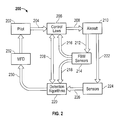
- FIG. 2 illustrates a block diagram 200 of a system for adaptive control of an aircraft in accordance with one or more embodiments.
- the block diagram 200 may be implemented by one or more systems, devices, or components, such as those described herein.
- the block diagram 200 may be implemented in connection with the system 100 of FIG. 1 .
- a user may issue one or more commands 204.
- the commands 204 may correspond to directives that the pilot 202 issues, which may represent a request to command a component or device of the aircraft to a particular state.
- the commands 204 may be generated in response to actuation or movement of a device located in a cockpit.
- the commands 204 may be received by a control computer that may implement or run one or more control laws.
- the control computer/control laws 206 may provide controls 208 to an aircraft 210.
- the control computer/control laws 206, or the aircraft 210, may adhere to a fly-by-wire (FBW) configuration.
- FBW fly-by-wire
- the controls 208 may regulate operation of one or more devices or components associated with the aircraft 210.
- the controls 208 may regulate air speed, attitude, acceleration, etc., associated with the aircraft 210.
- the regulation provided by the controls 208 may establish or modify an envelope associated with the operation or flight of the aircraft 210.
- Behavior or operation 212 of the aircraft 210 may be monitored. For example, such monitoring may occur via the use of, or by one or more, sensors 214.
- the sensors 214 may be configured to provide feedback 216 to the control computer/control laws 206 regarding the state of the aircraft 210.
- the feedback 216 may include state data, such as acceleration, angular rates, attitudes, altitude, mass, fuel flow and other data associated with the aircraft 210.
- the sensors 214 may also provide the state data 218 to one or more detection algorithms 220.
- Behavior or operation 222 of the aircraft 210 may be monitored by sensors 224.
- the sensors 224 may be configured to sense data that may be associated with an inoperability of a device or component of the aircraft 210.
- the data 226 may be provided by the sensors 224 to the detection algorithm(s) 220.
- the detection algorithm(s) 220 may exist separate from other entities. In some embodiments, the detection algorithm(s) 220 may be combined with, or exist with, another entity, such as the control computer/control laws 206. The detection algorithm(s) 220 may be operative on the state data 218 and/or the data 226. The detection algorithm(s) 220 may determine or identify a component of the aircraft 210 that is inoperable, a region (e.g., a location) of the component, and a level of the inoperability. That determination/identification may be provided 228 to the control computer/control laws 206 for adjustment of the controls 208 in response thereto.
- the determination/identification may be provided 230 to an I/O device 108, such as a multi-function display (MFD) 232.
- the MFD 232 may be configured to display or play status or warning messages or instructions regarding the damage or compromise, which may be used by the pilot 202 to establish or adjust/modify the commands 204 in response thereto.
- FIG. 3 a flow chart of a method 300 for adaptive control of an aircraft is shown.
- the method 300 may be executed in connection with one or more components, devices, or systems, such as those described herein.
- the method may be used to modify or establish an operational envelope.
- one or more sensors may measure damage or compromise to the aircraft structure.
- the effect or impact may indicate that the damage or compromise may allow the aircraft to continue to be operated with a reduced envelope, or may indicate to, e.g., a pilot that the aircraft should be landed immediately.
- one or more algorithms may be invoked.
- the algorithm(s) may make an assessment of the region (e.g., the location) and level of damage or compromise, potentially based on the damage or compromise measured in block 302.
- Block 302 may be implemented, for example, by the detection algorithms 220 of FIG. 2 .
- a determination or identification of one or more components' damage or comprise location and level may be provided.
- the type of damage/compromise and/or an extent of damage/compromise may be provided as part of block 304. For example, such information may be provided on an output device (e.g., a display screen, a speaker, etc.).
- an aircraft operational envelope may be adapted or established, potentially based on the invocation of the algorithm(s) of block 304.
- the operational envelope of block 306 may be based on one or more control laws.
- the operational envelope may serve to reduce a load imposed on the damaged or compromised aircraft component by adjusting, for example, control computer/control laws 206. Such load reduction may be used to compensate for the damage or compromise.
- the operational envelope may set the outer boundaries or thresholds within which the aircraft is allowed to operate, which may be less than the actual operational capabilities of the aircraft.
- the operational envelope of block 306 may serve to limit one or more commands (e.g., commands 204) issued by a pilot, at least to an extent that the commands direct an operation of the aircraft that exceeds the operational envelope. In this manner, the pilot may be prohibited from commanding a state of operation that exceeds a safe or reliable operation threshold.
- commands e.g., commands 204
- one or more of the blocks or operations (or a portion thereof) of the method 300 may be optional. In some embodiments, the blocks may execute in an order or sequence different from what is shown in FIG. 3 . In some embodiments, one or more additional blocks or operations not shown may be included.
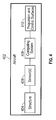
- FIG. 4 illustrates an exemplary block diagram associated with an aircraft 402.
- the aircraft 402 may correspond to the aircraft 210 of FIG. 2 in some embodiments.
- the aircraft 402 may have a structure 404.
- the structure 404 may include components or devices associated with operation of the aircraft 402 and the frame (e.g., the chassis or body) of the aircraft.
- the aircraft 402 may include, or be associated with, one or more sensors 406.
- the one or more sensors 406 may correspond to the sensors 214 and/or 224 of FIG. 2 .
- the sensor(s) 406 may be configured to monitor the structure 404 for inoperability (e.g., damage or compromise).
- Data provided or generated by the sensor(s) 406 may be provided to a computing or processing system 408.
- the computing system 408 may include one or more components or devices, such as those described above in connection with the computing system 100 of FIG. 1 .
- the computing system 408 may include one or more algorithms to process data received from the sensor(s) 406.
- the algorithm(s) may adhere to the block diagram 200 of FIG. 2 and/or the flowchart 300 of FIG. 3 .
- the computing system 408 may be configured to provide one or more outputs based on processing the data from the sensor(s) 406.
- the outputs provided by the computing system 408 may serve to control or regulate one or more propulsion or control surfaces 410.
- regulation of the propulsion and control surfaces 410 may be used to compensate for damage or compromise to the structure 404.
- Embodiments of this disclosure may be tied to one or more particular machines.
- one or more computers, devices, or architectures may be configured to compute or determine an operational envelope associated with an aircraft.
- a device may be configured to adjust the operational envelope based on a determination that a component of the aircraft structure is damaged or compromised. Such an adjustment may be used to reduce the likelihood that the damage or compromise will propagate or spread through the structure of the aircraft.
- the aircraft may continue to operate despite damage after the envelope is adjusted to achieve safe flight loads.
- an aircraft currently on the ground may stay on the ground (e.g., "be grounded") until an indication is received that a maintenance activity has been performed.
- an aircraft that is inoperable e.g., damaged or compromised
- Illustrative examples described herein relate aspects of this disclosure to aircraft and aerospace environments or applications. Aspects of this disclosure may be applied to other environments or applications. For example, aspects of this disclosure may be adapted so as to be applied to any type or kind of vehicle, such as marine vehicles (e.g., a boat, a ship, a submarine), terrestrial vehicles (e.g., automobiles), etc.
- marine vehicles e.g., a boat, a ship, a submarine
- terrestrial vehicles e.g., automobiles
- various functions or acts may take place at a given location and/or in connection with the operation of one or more apparatuses, systems, or devices. For example, in some embodiments, a portion of a given function or act may be performed at a first device or location, and the remainder of the function or act may be performed at one or more additional devices or locations.
- an apparatus or system may include one or more processors, and memory storing instructions that, when executed by the one or more processors, cause the apparatus or system to perform one or more methodological acts as described herein.
- Various mechanical components known to those of skill in the art may be used in some embodiments.
- Embodiments may be implemented as one or more apparatuses, systems, and/or methods.
- instructions may be stored on one or more computer-readable media, such as a transitory and/or non-transitory computer-readable medium.
- the instructions when executed, may cause an entity (e.g., an apparatus or system) to perform one or more methodological acts as described herein.
Landscapes
- Engineering & Computer Science (AREA)
- Aviation & Aerospace Engineering (AREA)
- Radar, Positioning & Navigation (AREA)
- Remote Sensing (AREA)
- Physics & Mathematics (AREA)
- General Physics & Mathematics (AREA)
- Automation & Control Theory (AREA)
- Traffic Control Systems (AREA)
- Testing Of Devices, Machine Parts, Or Other Structures Thereof (AREA)
Applications Claiming Priority (1)
| Application Number | Priority Date | Filing Date | Title |
|---|---|---|---|
| US13/780,987 US9132911B2 (en) | 2013-02-28 | 2013-02-28 | Damage adaptive control |
Publications (2)
| Publication Number | Publication Date |
|---|---|
| EP2772813A2 true EP2772813A2 (de) | 2014-09-03 |
| EP2772813A3 EP2772813A3 (de) | 2017-07-12 |
Family
ID=50190303
Family Applications (1)
| Application Number | Title | Priority Date | Filing Date |
|---|---|---|---|
| EP14157234.7A Withdrawn EP2772813A3 (de) | 2013-02-28 | 2014-02-28 | Adaptives Schadenkontrollsystem |
Country Status (2)
| Country | Link |
|---|---|
| US (2) | US9132911B2 (de) |
| EP (1) | EP2772813A3 (de) |
Cited By (1)
| Publication number | Priority date | Publication date | Assignee | Title |
|---|---|---|---|---|
| EP3029637A1 (de) * | 2014-11-21 | 2016-06-08 | Taleris Global LLP | System und verfahren zur identifizierung von fehlern in einem flugzeug |
Families Citing this family (14)
| Publication number | Priority date | Publication date | Assignee | Title |
|---|---|---|---|---|
| US9904928B1 (en) | 2014-07-11 | 2018-02-27 | State Farm Mutual Automobile Insurance Company | Method and system for comparing automatically determined crash information to historical collision data to detect fraud |
| US10410320B2 (en) | 2016-09-30 | 2019-09-10 | Sony Interactive Entertainment Inc. | Course profiling and sharing |
| US10377484B2 (en) | 2016-09-30 | 2019-08-13 | Sony Interactive Entertainment Inc. | UAV positional anchors |
| US10416669B2 (en) * | 2016-09-30 | 2019-09-17 | Sony Interactive Entertainment Inc. | Mechanical effects by way of software or real world engagement |
| US10850838B2 (en) | 2016-09-30 | 2020-12-01 | Sony Interactive Entertainment Inc. | UAV battery form factor and insertion/ejection methodologies |
| US10357709B2 (en) | 2016-09-30 | 2019-07-23 | Sony Interactive Entertainment Inc. | Unmanned aerial vehicle movement via environmental airflow |
| US10679511B2 (en) | 2016-09-30 | 2020-06-09 | Sony Interactive Entertainment Inc. | Collision detection and avoidance |
| US10336469B2 (en) | 2016-09-30 | 2019-07-02 | Sony Interactive Entertainment Inc. | Unmanned aerial vehicle movement via environmental interactions |
| EP3634848A4 (de) * | 2017-05-26 | 2020-12-30 | Sikorsky Aircraft Corporation | Adaptive steuerung eines flugzeugs mithilfe der überwachung der strukturellen gesundheit |
| US11203414B2 (en) | 2017-09-13 | 2021-12-21 | Sikorsky Aircraft Corporation | Controlling an aircraft based on detecting and mitigating fatiguing conditions and aircraft damage conditions |
| US10273021B1 (en) | 2018-06-22 | 2019-04-30 | Kitty Hawk Corporation | Automated self-testing |
| US10974851B2 (en) | 2018-11-09 | 2021-04-13 | Textron Innovations Inc. | System and method for maintaining and configuring rotorcraft |
| EP4224402A4 (de) * | 2020-09-29 | 2024-10-30 | Canon Kabushiki Kaisha | Informationsverarbeitungsvorrichtung, informationsverarbeitungsverfahren und programm |
| US12524021B2 (en) * | 2021-08-19 | 2026-01-13 | Lockheed Martin Corporation | Fault tolerant motion planner |
Family Cites Families (10)
| Publication number | Priority date | Publication date | Assignee | Title |
|---|---|---|---|---|
| US4337516A (en) * | 1980-06-26 | 1982-06-29 | United Technologies Corporation | Sensor fault detection by activity monitoring |
| US5881971A (en) | 1995-05-15 | 1999-03-16 | The Boeing Company | Monitoring systems for detecting failures in fly-by-wire aircraft flight control systems |
| US6625987B2 (en) | 2001-07-31 | 2003-09-30 | General Electric Co. | Control strategy for gas turbine engine |
| US7568662B1 (en) | 2001-09-12 | 2009-08-04 | Honeywell International Inc. | Emergency flight control system |
| US6823675B2 (en) | 2002-11-13 | 2004-11-30 | General Electric Company | Adaptive model-based control systems and methods for controlling a gas turbine |
| US7546219B2 (en) | 2005-08-31 | 2009-06-09 | The Boeing Company | Automated damage assessment, report, and disposition |
| US7571058B2 (en) * | 2006-05-09 | 2009-08-04 | Lockheed Martin Corporation | System to monitor the health of a structure, program product and related methods |
| US20120203419A1 (en) * | 2009-10-23 | 2012-08-09 | Bae Systems Plc | Safety management system |
| US8355830B2 (en) * | 2010-03-30 | 2013-01-15 | Aurora Flight Sciences Corporation | Aircraft health monitoring and design for condition |
| US9342060B2 (en) | 2010-09-14 | 2016-05-17 | United Technologies Corporation | Adaptive control for a gas turbine engine |
-
2013
- 2013-02-28 US US13/780,987 patent/US9132911B2/en active Active
-
2014
- 2014-02-28 EP EP14157234.7A patent/EP2772813A3/de not_active Withdrawn
-
2015
- 2015-06-29 US US14/753,318 patent/US9448558B2/en active Active
Non-Patent Citations (1)
| Title |
|---|
| None * |
Cited By (3)
| Publication number | Priority date | Publication date | Assignee | Title |
|---|---|---|---|---|
| EP3029637A1 (de) * | 2014-11-21 | 2016-06-08 | Taleris Global LLP | System und verfahren zur identifizierung von fehlern in einem flugzeug |
| JP2016120903A (ja) * | 2014-11-21 | 2016-07-07 | タレリス・グローバル・エルエルピーTaleris Global LLP | 航空機の不具合を特定するためのシステムおよび方法 |
| US9567106B2 (en) | 2014-11-21 | 2017-02-14 | Taleris Global Llp | System and method for identifying faults in an aircraft |
Also Published As
| Publication number | Publication date |
|---|---|
| EP2772813A3 (de) | 2017-07-12 |
| US9132911B2 (en) | 2015-09-15 |
| US20150301530A1 (en) | 2015-10-22 |
| US20140244075A1 (en) | 2014-08-28 |
| US9448558B2 (en) | 2016-09-20 |
Similar Documents
| Publication | Publication Date | Title |
|---|---|---|
| US9448558B2 (en) | Damage adaptive control | |
| US8761965B2 (en) | Automatic control of an aircraft in the event of flight crew incapacity | |
| US10815000B2 (en) | Short rejected takeoff system and method | |
| EP2881830A2 (de) | Nutzlastaufsetzerkennung | |
| EP3521175B1 (de) | Verfahren und systeme zur steuerung von schub, der von mehreren triebwerken an einem flugzeug erzeugt wird, zur unterstützung bestimmter flugbedingungen | |
| WO2013116139A1 (en) | Methods and systems for aircraft health and trend monitoring | |
| US11275373B2 (en) | Adaptive control of aircraft using structural health monitoring | |
| CA2863079A1 (en) | Methods and systems for requesting and retrieving aircraft data during flight of an aircraft | |
| KR20150012214A (ko) | 항공기 진동 검출 시스템 및 방법 | |
| EP2833230B1 (de) | Detektion einer harten Landung und Orientierungssteuerung | |
| US20150307203A1 (en) | Vertical axis soft landing control | |
| CA2825500A1 (en) | Method of determining a turbulent condition in an aircraft | |
| CN108688795A (zh) | 旋翼飞行器电传操纵稳定化 | |
| JP5592394B2 (ja) | 燃料補給ブームに掛かる力の自動的軽減 | |
| US9139290B2 (en) | Aircraft weight identification using filtered trim estimation | |
| Harno et al. | Safe flight envelope estimation for rotorcraft: a reachability approach | |
| US10457382B2 (en) | System and method for providing dynamic tactile feedback to a vehicle operator | |
| EP4342791A1 (de) | Temporäre backup-steuerungsmethode für die aktivierung einer steuerfläche eines fahrzeugs | |
| KR102075031B1 (ko) | 컴퓨팅 자원 및 상기 컴퓨팅 자원에 의해 수행되는 비행체 진동 제어 소프트웨어 업데이트 처리 방법 | |
| US20150066251A1 (en) | Flutter control actuator |
Legal Events
| Date | Code | Title | Description |
|---|---|---|---|
| PUAI | Public reference made under article 153(3) epc to a published international application that has entered the european phase |
Free format text: ORIGINAL CODE: 0009012 |
|
| 17P | Request for examination filed |
Effective date: 20140228 |
|
| AK | Designated contracting states |
Kind code of ref document: A2 Designated state(s): AL AT BE BG CH CY CZ DE DK EE ES FI FR GB GR HR HU IE IS IT LI LT LU LV MC MK MT NL NO PL PT RO RS SE SI SK SM TR |
|
| AX | Request for extension of the european patent |
Extension state: BA ME |
|
| PUAL | Search report despatched |
Free format text: ORIGINAL CODE: 0009013 |
|
| AK | Designated contracting states |
Kind code of ref document: A3 Designated state(s): AL AT BE BG CH CY CZ DE DK EE ES FI FR GB GR HR HU IE IS IT LI LT LU LV MC MK MT NL NO PL PT RO RS SE SI SK SM TR |
|
| AX | Request for extension of the european patent |
Extension state: BA ME |
|
| RIC1 | Information provided on ipc code assigned before grant |
Ipc: G05D 1/00 20060101AFI20170602BHEP Ipc: B64C 13/50 20060101ALI20170602BHEP |
|
| R17P | Request for examination filed (corrected) |
Effective date: 20180112 |
|
| RBV | Designated contracting states (corrected) |
Designated state(s): AL AT BE BG CH CY CZ DE DK EE ES FI FR GB GR HR HU IE IS IT LI LT LU LV MC MK MT NL NO PL PT RO RS SE SI SK SM TR |
|
| 17Q | First examination report despatched |
Effective date: 20180711 |
|
| RIC1 | Information provided on ipc code assigned before grant |
Ipc: B64D 45/00 20060101ALI20200604BHEP Ipc: G05D 1/00 20060101AFI20200604BHEP |
|
| GRAP | Despatch of communication of intention to grant a patent |
Free format text: ORIGINAL CODE: EPIDOSNIGR1 |
|
| STAA | Information on the status of an ep patent application or granted ep patent |
Free format text: STATUS: GRANT OF PATENT IS INTENDED |
|
| INTG | Intention to grant announced |
Effective date: 20200710 |
|
| STAA | Information on the status of an ep patent application or granted ep patent |
Free format text: STATUS: THE APPLICATION IS DEEMED TO BE WITHDRAWN |
|
| 18D | Application deemed to be withdrawn |
Effective date: 20201121 |