EP2761024B1 - Molekulare targets und verfahren zum screening nach formulierungen und zur konservierungswirksamkeitsprüfung - Google Patents
Molekulare targets und verfahren zum screening nach formulierungen und zur konservierungswirksamkeitsprüfung Download PDFInfo
- Publication number
- EP2761024B1 EP2761024B1 EP12775098.2A EP12775098A EP2761024B1 EP 2761024 B1 EP2761024 B1 EP 2761024B1 EP 12775098 A EP12775098 A EP 12775098A EP 2761024 B1 EP2761024 B1 EP 2761024B1
- Authority
- EP
- European Patent Office
- Prior art keywords
- cells
- rrna
- primer
- viable
- negative
- Prior art date
- Legal status (The legal status is an assumption and is not a legal conclusion. Google has not performed a legal analysis and makes no representation as to the accuracy of the status listed.)
- Active
Links
Images


Classifications
-
- C—CHEMISTRY; METALLURGY
- C12—BIOCHEMISTRY; BEER; SPIRITS; WINE; VINEGAR; MICROBIOLOGY; ENZYMOLOGY; MUTATION OR GENETIC ENGINEERING
- C12Q—MEASURING OR TESTING PROCESSES INVOLVING ENZYMES, NUCLEIC ACIDS OR MICROORGANISMS; COMPOSITIONS OR TEST PAPERS THEREFOR; PROCESSES OF PREPARING SUCH COMPOSITIONS; CONDITION-RESPONSIVE CONTROL IN MICROBIOLOGICAL OR ENZYMOLOGICAL PROCESSES
- C12Q1/00—Measuring or testing processes involving enzymes, nucleic acids or microorganisms; Compositions therefor; Processes of preparing such compositions
- C12Q1/68—Measuring or testing processes involving enzymes, nucleic acids or microorganisms; Compositions therefor; Processes of preparing such compositions involving nucleic acids
- C12Q1/6844—Nucleic acid amplification reactions
- C12Q1/686—Polymerase chain reaction [PCR]
-
- C—CHEMISTRY; METALLURGY
- C12—BIOCHEMISTRY; BEER; SPIRITS; WINE; VINEGAR; MICROBIOLOGY; ENZYMOLOGY; MUTATION OR GENETIC ENGINEERING
- C12Q—MEASURING OR TESTING PROCESSES INVOLVING ENZYMES, NUCLEIC ACIDS OR MICROORGANISMS; COMPOSITIONS OR TEST PAPERS THEREFOR; PROCESSES OF PREPARING SUCH COMPOSITIONS; CONDITION-RESPONSIVE CONTROL IN MICROBIOLOGICAL OR ENZYMOLOGICAL PROCESSES
- C12Q1/00—Measuring or testing processes involving enzymes, nucleic acids or microorganisms; Compositions therefor; Processes of preparing such compositions
- C12Q1/68—Measuring or testing processes involving enzymes, nucleic acids or microorganisms; Compositions therefor; Processes of preparing such compositions involving nucleic acids
- C12Q1/6876—Nucleic acid products used in the analysis of nucleic acids, e.g. primers or probes
- C12Q1/6888—Nucleic acid products used in the analysis of nucleic acids, e.g. primers or probes for detection or identification of organisms
- C12Q1/689—Nucleic acid products used in the analysis of nucleic acids, e.g. primers or probes for detection or identification of organisms for bacteria
-
- C—CHEMISTRY; METALLURGY
- C12—BIOCHEMISTRY; BEER; SPIRITS; WINE; VINEGAR; MICROBIOLOGY; ENZYMOLOGY; MUTATION OR GENETIC ENGINEERING
- C12Q—MEASURING OR TESTING PROCESSES INVOLVING ENZYMES, NUCLEIC ACIDS OR MICROORGANISMS; COMPOSITIONS OR TEST PAPERS THEREFOR; PROCESSES OF PREPARING SUCH COMPOSITIONS; CONDITION-RESPONSIVE CONTROL IN MICROBIOLOGICAL OR ENZYMOLOGICAL PROCESSES
- C12Q1/00—Measuring or testing processes involving enzymes, nucleic acids or microorganisms; Compositions therefor; Processes of preparing such compositions
- C12Q1/68—Measuring or testing processes involving enzymes, nucleic acids or microorganisms; Compositions therefor; Processes of preparing such compositions involving nucleic acids
- C12Q1/6876—Nucleic acid products used in the analysis of nucleic acids, e.g. primers or probes
- C12Q1/6888—Nucleic acid products used in the analysis of nucleic acids, e.g. primers or probes for detection or identification of organisms
- C12Q1/6895—Nucleic acid products used in the analysis of nucleic acids, e.g. primers or probes for detection or identification of organisms for plants, fungi or algae
Definitions
- the present invention relates to a method and kit for distinguishing viable from nonviable cells. Specifically, the present invention relates to a method and kit for identifying microbial RNA targets (precursor rRNA (pre-rRNA) or messenger RNA (mRNA)) in microbes (such as bacteria, yeasts or molds) that can serve as indicators of cell viability in preservative screening or Preservative Efficacy Testing (PET).
- pre-rRNA precursor rRNA
- mRNA messenger RNA
- microbes such as bacteria, yeasts or molds
- PET is assessed by conventional microbiological culture methods that combine enrichment/growth and plate counting. Time to results is very long. Depending on the preservative action, viable but non-cultivable cells are not detected by these culture methods. Furthermore, bacterial pathogens may be present in small numbers and/or bacterial samples may have poor plating efficiency that yields underestimates of performance.
- RT-PCR reverse transcription polymerase chain reaction
- PCT/US2009/067565 provides a ratiometric pre-rRNA analysis including compositions and methods for detecting the presence of viable cells in a sample.
- This disclosure describes nucleic acid amplification testing to detect species-specific pre- rRNA molecules. This method requires the use of two sample sets. A first sample set that is not stimulated to grow and a second sample set that is stimulated with nutrients/growth media prior to evaluation of the pre-rRNA targets. The level of pre-rRNA in the stimulated samples is compared to the level of pre-rRNA in the non-stimulated samples to obtain an indication of the presence of viable versus non-viable cells. As disclosed, only the viable cells respond to the exposure to nutrients by demonstrating an increase in pre-rRNA.
- PCT/US2009/067565 This step is referred to in PCT/US2009/067565 as a ratiometric assay.
- PCT/US2009/067565 basically discloses pre-rRNA replenishment following nutrient stimulation as a basis for measuring viable microbial cells.
- a similar ratiometric approach can be used for an mRNA target.
- US 2004/0265,934 discloses detection of pre-rRNA as a measure of bacteria viability in the identification of antibiotic drugs that reduce or inhibit rRNA transcription. Specifically, hybridization assay probes are disclosed for detecting a target sequence of rRNA of one or more mycobacteria optionally present in a sample. Thus, the disclosure of 2004/0265934 is not directed to detecting viable versus non-viable cells. Rather, this disclosure provides the use of probes directed to target sequences of mycobacterial rDNA, pre-rRNA, or rRNA.
- 5,770,373 discloses methods and oligonucleotide probe compositions for determining antibiotic resistance in mycobacteria.
- This method includes assaying the levels of pre-rRNA in the cells.
- the cells are treated by enzymatic or mechanical means to expose the cell membrane to lysis reagents; contacting the cells with the lysis reagent under conditions that release but do not degrade the mycobacterial pre-rRNA; and then detecting the mycobacterial pre-rRNA using an oligonucleotide probe.
- pre-rRNA is detected as a measure of sensitivity of mycobacterial cells to antimicrobial agents. This detection is accomplished through a biotinylated probe in a chemilluminescent sandwich hybridization assay.
- WO/1998/018958 provides a method for detecting live microbiological contaminants in a food product sample.
- the invention describes a method for detecting live microbiological contaminants in food product samples which relies on detecting the presence of mRNA coding for Elongation Factor 1 alpha (EF-I a): a gene product involved in protein synthesis.
- EF-I a Elongation Factor 1 alpha
- WO 2010/068802 describes methods for detecting the presence of viable cells in a sample by detecting ribosomal RNA precursors (pre-rRNA) as indicators of viable micrororganisms.
- pre-rRNA ribosomal RNA precursors
- Cangelosi et al. (Applied and Environmental Microbiology, Feb. 2010, p. 960-962 ) refers to ratiomeric pre-rRNA analysis (RPA) for detecting the replenishment of rRNA precursors which allows distinguishing viable from inactivated bacteria.
- RPA ratiomeric pre-rRNA analysis
- the present invention provides a method and kit for pre-rRNA assays directed to the detection of viable versus non-viable microbial cells.
- the method and kit can be used on different platforms including but not limited to the microCompassTM system.
- the method and kit of the present invention has varying applications including but not limited to cosmeceutical research/testing, pharmaceutical release testing, water purification/safety testing, and the like.
- a method for identifying and quantifying viable microbial cells in one or more samples containing a microorganism of interest.
- species-specific DNA is amplified from pre-rRNA-containing samples using a reverse transcription-polymerase chain reaction.
- the amplification step involves, for example, using a first primer complementary to a pre-rRNA region of a microorganism of interest, using a second primer complementary to a mature rRNA region of the microorganism of interest, and performing multiple cycles of amplification using the first primer and the second primer to yield detectable levels of amplified species-specific DNA.
- the quantitation step involves, for example, using a fluorescently labeled hybridizing probe complementary to the mature rRNA region of the microorganism of interest, using the first primer complementary to the pre-rRNA region of the microorganism of interest and the second primer complementary to the mature rRNA region of the microorganism of interest, and performing multiple cycles of amplification using the fluorescently labeled hybridizing probe and the first and the second primers to yield increasing levels of fluorescence signal above fluorescence background.
- the amplification of the species-specific DNA indicates the presence of viable microbial cells in one or more samples, and the quantitation of amplified species-specific DNA provides a relative measurement of the amount of viable microbial cells in one or more samples.
- the microorganisms of interest may be, for example, Escherichia coli, Serratia marcescens, or Bacillus subtilis, in which cases the first primers, second primers, and fluorescently labeled hybridizing probes are designed on the 3'- end of 16S rRNA.
- the microorganisms of interest may be, for example, Pseudomonas aeruginosa, Staphylococcus aureus, or Staphylococcus epidermidis, in which cases the first primers, second primers, and the fluorescently labeled hybridizing probes are designed on the 5'-end of 23S rRNA.
- the microorganism of interest may be, for example, Aspergillus brasiliensis, in which case the first primer, the second primer, and the fluorescently labeled hybridizing probe are designed on the 5'-end of 5.8S rRNA.
- the method may involve collecting cells onto a filter membrane and lysing the collected cells.
- the method may involve applying the amplification step and the quantitation step to both a test sample and a control sample, the control sample containing non-treated cells and then comparing the relative measurement of the amount of viable microbial cells in the control samples to the relative measurement of the amount of viable microbial cells in the test sample.
- the method of the invention is applicable to, for example, samples of cell cultures containing one or more cell culture formulations or preservatives in need of screening or efficacy testing.
- the method may involve collecting cells onto a filter membrane and lysing the collected cells.
- the method may involve applying the amplification step and the quantitation step to both a test sample and a control sample, the control sample containing non-treated cells and then comparing the relative measurement of the amount of viable microbial cells in the control samples to the relative measurement of the amount of viable microbial cells in the test sample.
- the method of the embodiment is applicable to, for example, samples of cell cultures containing one or more cell culture formulations or preservatives in need of screening or efficacy testing.
- a method for cell culture formulation screening or cell culture preservative efficacy testing in which one would perform the following steps: calibrating cells to a desired density; collecting cells on a filter membrane; applying nutrients to said membrane to yield enriched cells; incubating said enriched cells; removing nutrients; adding lysis buffer to membrane; recovering cell lysates; transferring lysate; extracting and purifying RNA; and amplifying and quantitating species- specific DNA by the reverse transcription-polymerase chain reaction.
- kits are provided for determining the presence of viable versus nonviable cells in a test sample.
- the kits contain, for example, primers and probes complementary to, for example, the 3'-end of 16S rRNA, the 5'-end of 23S rRNA, the 5'-end of 5.8S rRNA.
- a method and kit for identifying pre-rRNA in microbes such as bacteria, yeasts or molds.
- the method can be used, for example, to distinguish viable cells from non-viable or inactivated cells in response to a selected treatment with chemical or biological agents.
- RT-PCR is used to amplify species-specific DNA from pre-rRNA- containing samples. This is subsequently quantitated in amplification cycles by detection of hybridized fluorescent probe.
- the amplification of target is achieved using one primer complementary to the pre-rRNA region of the specific microbe of interest and a second primer complementary to the mature rRNA region.
- the hybridization probe used for quantitation of amplified product is complementary to the amplified rRNA region. Amplification and quantitation only occur if pre-rRNA is present (i.e., pre-rRNA is abundant in actively growing bacteria).
- the correlation between the cellular pre-rRNA content and the growth rate is one of the earliest and most fundamental observations in microbial physiology. For example, in the bacteria E. coli, during rapid growth (where doubling time is less than one hour), over 50 percent of the total RNA produced is rRNA. Ribosome synthesis is therefore a central process in microbial growth.
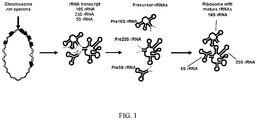
- ribosome RNA synthesis and maturation in E. coli begins with transcription from the rrn operon, producing a polycistronic rrn transcript that is subsequently processed to release pre-rRNA molecules. Further processing and addition of ribosomal proteins results in the formation of fully mature rRNA molecules. The secondary processing step is believed to be slower than the primary processing step, which results in an intracellular pool of pre-rRNAs.
- Pre-rRNAs have leader and tail sequences flanking the mature rRNA sequence. Leader and tail sequences are removed enzymatically (RNAse III cleavage) from the pre- rRNA during rRNA maturation and ribosome assembly to yield mature rRNA.
- Pre-rRNAs are present at the beginning of rRNA transcript production.
- the production of mature ribosomes involves final processing of pre-rRNAs.
- the present invention provides benefits such as:
- Examples provided herein pertain to specific assays for compendia microbes requested in the PET guidelines (EP Chapter 5.1.3 and USP Chapter 51): Escherichia coli (E. coli) ATCC No. 8739, Pseudomonas aeruginosa (P. aeruginosa) ATCC No. 9027, Staphylococcus aureus (S. aureus) ATCC No. 6538, Candida albicans (C. albicans) ATCC No. 10231 and Aspergillus brasiliensis (A. brasiliensis) ATCC No. 16404, and for other relevant microbes for which viability assays are of interest: Serratia marcescens ⁇ S. marcescens), Bacillus subtilis (B. subtilis) and Staphylococcus epidermidis (S. epidermidis).
- FIG. 2 illustrates E. coli, B. subtilis and S. marcescens pre-rRNA-specific systems designed in the 3' end of the 16S pre-rRNA for use with RT-PCR (forward primer, reverse primer, and forward probe).
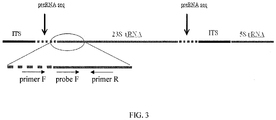
- FIG. 3 illustrates S. aureus, P. aeruginosa and S. epidermidis pre-rRNA-specific systems designed in the 5 ' end of the 23 S pre-rRNA for use with RT-PCR (forward primer, reverse primer, and forward probe).
- FIG. 4 illustrates A. brasiliensis pre- rRNA-specific systems designed in the 5' end of the 5.8S pre-rRNA for use with RT-PCR (forward primer, reverse primer, and forward probe).
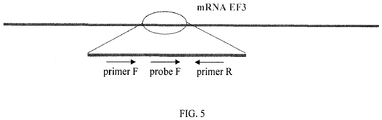
- FIG. 5 illustrates C. albicans EF-3 mRNA specific system designed in the internal sequence of the EF-3 mRNA for use with RT-PCR (forward primer, reverse primer, and forward probe).
- the difference of the Ct values is at least 3 logs, which corresponds to a ⁇ Ct > 10 for bacteria and at least 2 logs, which corresponds to a ⁇ Ct > 6.6 for fungi, after one day (24 hours) and seven days, respectively, for bacteria and fungi, of preservative treatment.
- USP requires data analysis after seven days and fourteen days for bacteria and fungi, respectively.
- the specific pre-rRNA assays disclosed herein are assessed with the following microbes: E. coli, P. aeruginosa, S. aureus, S. marcescens, B. subtilis, S. epidermidis and A, brasiliensis.
- Six different treatment methods are used: heat and isopropanol killing, preservative treatments with BAC (Benzalkonium Chloride), Poly-Q (PolyQuaternium) and IPBC (lodopropynyl Butylcarbamate) and a commercial contact lens solution (which is formulated with other chemicals in addition to two preservatives (polyaminopropyl biguanide and polyquaternium)).
- BAC Benzalkonium Chloride
- Poly-Q PolyQuaternium
- IPBC ladopropynyl Butylcarbamate
- a commercial contact lens solution which is formulated with other chemicals in addition to two preservatives (polyaminopropyl biguanide and
- Preservative treatments were evaluated at high cells concentrations (10 6 and 10 5 cells per assay) that are commonly used for formulation screening. Five replicates at each cell concentration were analyzed.
- the Ct value corresponds to the RT-PCR cycle for which the level of fluorescence is outside the fluorescence background. The method compares Ct values for non-treated and treated cells and is expressed as the ⁇ Ct.
- Ct values obtained for six bacteria and two fungi using six treatments Heat, Isopropanol, Preservatives BAC, Poly-Q and IPBC and a commercial contact lens solution.
- Ct values obtained for non-treated cells are compared to Ct values obtained for treated cells.
- the ⁇ Ct calculated is reported and must be ⁇ 10 to meet the specification of 3 logs reduction for bacteria and must be ⁇ 6.6 to meet the specification of 2 logs reduction for fungi. All assays are performed on the BD Max6 instrument from Becton Dickinson. Data are obtained by multiple operators on different days.
- E. coli - Heat Killing - Operator 1 Samples Ct Viable Mean Ct Ct Treated Mean Ct ⁇ Ct Viable-Dead E coli 10 6 cells 10.38 10.76 29.91 31.53 20.78 10.42 29.92 11.05 31.80 11.18 34.79 13.81 31.26 E coli 10 5 cells 13.86 13.91 31.50 31.58 17.68 13.71 32.09 13.62 31.46 14.08 31.37 14.27 31.49 NC 35.03 35.65 36.93 36.57 36.26 36.21 E.
- Table 3 Results obtained with Staphylococcus aureus and heat killing treatment (80°C ⁇ 2°C, 90 minutes): S. aureus - Heat Killing - Operator 1 Samples Ct Viable Mean Ct Ct Treated Mean Ct ⁇ Ct Viable-Dead S. aureus 10 6 cells 12.65 12.67 26.90 26.14 13.47 12.69 26.19 12.68 26.16 12.69 26.03 12.65 25.42 S.
- Negative NC Negative Control - Control plate of treated cells (10 6 cells) shows no colony on plate.
- Table 4 Results obtained with Serratia marcescens and heat killing treatment (80°C ⁇ 2°C, 90 minutes): S. marcescens-Heat Killing Samples Ct Viable Mean Ct Ct Treated Mean Ct ⁇ Ct Viable-Dead S. marcescens 10 6 cells 13.40 12.88 31.40 30.96 18.08 12.80 31.30 12.40 31.60 13.10 31.00 12.70 29.50 S.
- Negative Negative NC Negative Control - Control plate of treated cells (10 5 cells) shows no colony on plate.
- Table 9 Results obtained with Pseudomonas aeruginosa and Isopropanol treatment (1H at room temperature): P. aeruginosa - Isopropanol Killing - Operator 1 Samples Ct Viable Mean Ct Ct Treated Mean Ct ⁇ Ct Viable-Dead P. aeruginosa 10 6 cells 19.91 20.25 34.18 33.70 13.45 19.51 33.26 21.25 34.59 19.63 33.28 20.97 33.21 P.
- Negative Negative 24.20 Negative NC Negative Control - Control plate of treated cells (10 6 cells) shows no colony on plate. Table 11: Results obtained with Serratia marcescens and Isopropanol treatment (1H at room temperature): S. marcescens -Isopropanol Killing Samples Ct Viable Mean Ct Ct Treated Mean Ct ⁇ Ct Viable-Dead S.
- Table 13 Results obtained with Pseudomonas aeruginosa and preservative BAC treatment (24H at room temperature): P. aeruginosa - BAC Preservative Killing - Operator 1 Samples Ct Viable Mean Ct Ct Treated Mean Ct ⁇ Ct Viable-Dead P. aeruginosa 10 6 cells 16.10 16.19 27.96 30.72 14.53 16.39 Negative 16.65 Negative 15.56 Negative 16.24 33.48 P.
- Table 17 Results obtained with Candida albicans and preservative BAC treatment (from day 1 to day 14 at room temperature) (not belonging to the invention) C. albicans - BAC Preservative Treatment Samples Ct Viable Mean Ct Ct Treated Mean Ct ⁇ Ct Viable-Dead Day 1 C. albicans 10 5 cells 18.30 18.10 29.30 32.00 13.90 17.80 33.70 18.10 32.70 18.10 31.60 18.20 32.70 Day 7 C. albicans 10 5 cells 18.30 18.10 Negative 33.67 15.57 17.80 34.60 18.10 34.10 18.10 32.30 18.20 Negative Day 14 C.
- Table 18 Results obtained with Escherichia coli and preservative Poly-Q treatment (24H at room temperature): E. coli - Poly-Q Preservative Killing - Operator 2 Samples Ct Viable Mean Ct Ct Treated Mean Ct ⁇ Ct Viable-Dead E. coli 10 6 cells 11.60 11.56 error mix 20.19 8.62 11.33 21.55 11.30 19.31 10.85 18.30 12.73 21.58 E.
- Table 22 Results obtained with Aspergillus brasiliensis and preservative IPBC treatment (from day 1 to day 7 at room temperature): A. brasiliensis- IPBC Preservative Treatment Samples Ct Viable Mean Ct Ct Treated Mean Ct ⁇ Ct Viable-Dead Day 1 A. brasiliensis 10 6 cells 11.00 10.98 15.20 15.48 4.50 11.20 15.20 10.80 15.20 10.50 15.80 11.40 16.00 Day 2 A. brasiliensis 10 6 cells 11.00 10.98 26.30 25.22 14.24 11.20 23.80 10.80 24.60 10.50 24.30 11.40 27.10 Day 7 A.
- Negative Negative NC Negative Control - Control plate of treated cells (10 6 cells) shows colonies on plate (> 300) at day 1, and no colony at day 2 and day 7. Table 23: Results obtained with Candida albicans and preservative IPBC treatment (from day 1 to day 14 at room temperature)(not belonging to the invention): C. albicans- IPBC Preservative Treatment Samples Ct Viable Mean Ct Ct Treated Mean Ct ⁇ Ct Viable-Dead Day 1 C.
- This preservative D is effective from 1% to 0.005%.
- Control plate of treated cells (10 6 cells) shows no colony on plate for all preservative dilutions.
- This preservative E is ineffective at low concentrations.
- Control plate of treated cells (10 6 cells) shows colonies on plate (> 300) for 0.25%, 0.1% and 0.05%.
- Pre-rRNA and EF-3 mRNA assays are performed in two days (depending on the length of preservative treatment), while conventional methods require five days or more depending on the growth rates of the selected organism.
- viable but non-cultivable cells are detected by RT-PCR, but not by conventional growth-based methods thus reducing the number of false negatives.
- experimental data show that targeting pre-rRNA using a RT- PCR system is a useful tool for distinguishing viable (non-treated) from non-viable (treated) cells.
- the Poly-Q treatment did not show an efficient killing as control plates post- treatment still show bacteria growth, and so the ⁇ Ct are significantly lower especially for E. coli and P. aeruginosa.
- pre-rRNA and mRNA designed systems are species-specific and can be used for formulation screening and Preservative Efficacy Testing in filterable matrix.
- New optimized protocols can be assessed in case of PCR interference due to inhibitors coming from the tested matrix. These optimizations can include new treatments or wash steps of the filter membrane.
- Contemplated assays include an Internal Process Control (IPC) that ensures efficiency of the pre-rRNA and mRNA extraction and amplification process.
- IPC Internal Process Control
- This preservative D is effective from 1% to 0.005%.
- Control plate of treated cells (10 6 cells) shows no colony on plate for all preservative dilutions.
- This preservative E is ineffective at low concentrations.
- Control plate of treated cells (10 6 cells) shows colonies on plate (> 300) for 0.25%, 0.1% and 0.05%.
- Pre-rRNA and EF-3 mRNA assays are performed in two days (depending on the length of preservative treatment), while conventional methods require five days or more depending on the growth rates of the selected organism.
- viable but non-cultivable cells are detected by RT-PCR, but not by conventional growth-based methods thus reducing the number of false negatives.
- experimental data show that targeting pre-rRNA and EF-3 mRNA using a RT-PCR system is a useful tool for distinguishing viable (non-treated) from non-viable (treated) cells.
- the Poly-Q treatment did not show an efficient killing as control plates posttreatment still show bacteria growth, and so the ⁇ Ct are significantly lower especially for E. coli and P. aeruginosa.
- pre-rRNA and mRNA designed systems are species-specific and can be used for formulation screening and Preservative Efficacy Testing in filterable matrix.
- New optimized protocols can be assessed in case of PCR interference due to inhibitors coming from the tested matrix. These optimizations can include new treatments or wash steps of the filter membrane.
- Contemplated assays include an Internal Process Control (IPC) that ensures efficiency of the pre-rRNA and mRNA extraction and amplification process.
- IPC Internal Process Control
Landscapes
- Chemical & Material Sciences (AREA)
- Life Sciences & Earth Sciences (AREA)
- Organic Chemistry (AREA)
- Proteomics, Peptides & Aminoacids (AREA)
- Analytical Chemistry (AREA)
- Engineering & Computer Science (AREA)
- Health & Medical Sciences (AREA)
- Zoology (AREA)
- Wood Science & Technology (AREA)
- Biotechnology (AREA)
- Microbiology (AREA)
- Biochemistry (AREA)
- Biophysics (AREA)
- Molecular Biology (AREA)
- Physics & Mathematics (AREA)
- Genetics & Genomics (AREA)
- General Health & Medical Sciences (AREA)
- Immunology (AREA)
- Bioinformatics & Cheminformatics (AREA)
- General Engineering & Computer Science (AREA)
- Chemical Kinetics & Catalysis (AREA)
- Botany (AREA)
- Mycology (AREA)
- Measuring Or Testing Involving Enzymes Or Micro-Organisms (AREA)
Claims (9)
- Verfahren zum Identifizieren und Quantifizieren lebensfähiger mikrobieller Zellen in einer oder mehreren Probe(n) enthaltend einen Mikroorganismus von Interesse, umfassend:(a) Amplifizieren von speziesspezifischer DNS von prä-rRNS enthaltenden Proben unter Verwendung einer reversen Transkriptionspolymerasekettenreaktion, der Amplifikationsschritt umfassend:Verwendung eines ersten Primers komplementär zu einer prä-rRNS- Region des Mikroorganismus von Interesse;Verwendung eines zweiten Primers komplementär zu einer reifen rRNS- Region des Mikroorganismus von Interesse; undDurchführen mehrerer Amplifikationszyklen unter Verwendung des ersten Primers und des zweiten Primers, um nachweisbare Level von amplifizierter speziesspezifischer DNS zu erhalten; und(b) Quantifizieren der amplifizierten speziesspezifischen DNS, der Quantifizierungsschritt umfassend:Verwenden einer fluoreszenzmarkierten Hybridisierungssonde komplementär zu der reifen rRNS- Region des Mikroorganismus von Interesse;Verwenden des ersten Primers komplementär zu der prä-rRNS- Region des Mikroorganismus von Interesse;Verwenden des zweiten Primers komplementär zu der reifen rRNS- Region des Mikroorganismus von Interesse; undDurchführen mehrerer Amplifikationszyklen unter Verwendung der fluoreszenzmarkierten Hybridisierungssonde und des ersten Primers und des zweiten Primers, um zunehmende Level von Fluoreszenzsignal oberhalb Fluoreszenzhintergrund zu erhalten;wobei das Amplifizieren der speziesspezifischen DNS die Anwesenheit der lebensfähigen mikrobiellen Zellen in der einen oder den mehreren Probe(n) anzeigt, und wobei die Quantifizierung von der amplifizierten speziesspezifischen DNS eine relative Messung der Menge von den lebensfähigen mikrobiellen Zellen in der einen oder den mehreren Probe(n) liefert.
- Verfahren nach Anspruch 1, wobei der Mikroorganismus von Interesse ausgewählt ist aus der Gruppe bestehend aus Escherichia coli, Serratia marcescens, und Bacillus subtilis, und ferner wobei der erste Primer, der zweite Primer, und die fluoreszenzmarkierte Hybridisierungssonde an dem 3'-Ende von 16S rRNS ausgebildet sind.
- Verfahren nach Anspruch 1, wobei der Mikroorganismus von Interesse ausgewählt ist aus der Gruppe bestehend aus Pseudomonas aeruginosa, Staphylococcus aureus, und Staphylococcus epidermidis, und ferner wobei der erste Primer, der zweite Primer, und die fluoreszenzmarkierte Hybridisierungssonde an dem 5'-Ende von 23S rRNS ausgebildet sind.
- Verfahren nach Anspruch 1, wobei der Mikroorganismus von Interesse Aspergillus brasiliensis ist, und ferner wobei der erste Primer, der zweite Primer, und die fluoreszenzmarkierte Hybridisierungssonde an dem 5'-Ende von 5,8S rRNS ausgebildet sind.
- Verfahren nach Anspruch 1, ferner umfassend: Sammeln von Zellen auf einer Filtermembran und Lysieren der gesammelten Zellen.
- Verfahren nach Anspruch 1, ferner umfassend:Anwenden des Amplifikationsschritts und des Quantifizierungsschritts an sowohl einer Testprobe als auch einer Kontrollprobe, wobei die Kontrollprobe unbehandelte Zellen enthält; undVergleichen der relativen Messung von der Menge von den lebensfähigen mikrobiellen Zellen in den Kontrollproben zu der der relativen Messung von der Menge von den lebensfähigen mikrobiellen Zellen in der Testprobe.
- Verfahren nach Anspruch 1, wobei die eine oder mehreren Probe(n) eine oder mehrere Zellkulturzubereitung(en) oder Konservierungsmittel enthält, die Untersuchung oder Wirksamkeitsprüfung bedürfen.
- Verfahren von Zellkulturzubereitungsuntersuchung oder Zellkulturkonservierungswirksamkeitsprüfung, umfassend:Kalibrieren von Zellen auf eine gewünschte Dichte;Sammeln von Zellen auf einer Filtermembran;Aufbringen von Nährstoffen auf die Membran, um angereicherte Zellen zu liefern;Inkubieren der angereicherten Zellen;Entfernen von Nährstoffen;Hinzufügen von Lysepuffer zur Membran;Rückgewinnen von Zelllysaten;Transferieren von Lysat;Extrahieren und Reinigen von RNS; undAmplifizieren und Quantifizieren speziesspezifischer DNS mittels der reversen Transkriptionspolymerasekettenreaktion gemäß dem Verfahren nach Anspruch 1.
- Verwendung eines Kits zum Durchführen des Verfahrens nach Anspruch 1, das Kit umfassend Primer und Sonden ausgewählt aus der Gruppe bestehend aus Nukleinsäuren komplementär zu dem 3'-Ende von 16S rRNS, Nukleinsäuren komplementär zu dem 5'-Ende von 23S rRNS, und Nukleinsäuren komplementär zu dem 5 '-Ende von 5,8S rRNS.
Applications Claiming Priority (2)
| Application Number | Priority Date | Filing Date | Title |
|---|---|---|---|
| US201161540006P | 2011-09-28 | 2011-09-28 | |
| PCT/US2012/057705 WO2013049437A2 (en) | 2011-09-28 | 2012-09-28 | Molecular targets and methods for formulation screening and preservative efficacy testing |
Publications (2)
| Publication Number | Publication Date |
|---|---|
| EP2761024A2 EP2761024A2 (de) | 2014-08-06 |
| EP2761024B1 true EP2761024B1 (de) | 2017-04-19 |
Family
ID=47045167
Family Applications (1)
| Application Number | Title | Priority Date | Filing Date |
|---|---|---|---|
| EP12775098.2A Active EP2761024B1 (de) | 2011-09-28 | 2012-09-28 | Molekulare targets und verfahren zum screening nach formulierungen und zur konservierungswirksamkeitsprüfung |
Country Status (4)
| Country | Link |
|---|---|
| US (1) | US9512474B2 (de) |
| EP (1) | EP2761024B1 (de) |
| ES (1) | ES2626481T3 (de) |
| WO (1) | WO2013049437A2 (de) |
Families Citing this family (2)
| Publication number | Priority date | Publication date | Assignee | Title |
|---|---|---|---|---|
| EP2844762B1 (de) * | 2012-05-04 | 2017-12-20 | The Regents of The University of California | Nachweis einer antibiotischen suszeptibilität mit sonden für die präribosomale rna |
| WO2019046439A1 (en) * | 2017-08-30 | 2019-03-07 | Monsanto Technology Llc | Methods for detecting microbes |
Family Cites Families (10)
| Publication number | Priority date | Publication date | Assignee | Title |
|---|---|---|---|---|
| US5712095A (en) * | 1994-06-16 | 1998-01-27 | Becton Dickinson And Company | Rapid and sensitive detection of antibiotic-resistant mycobacteria using oligonucleotide probes specific for ribosomal RNA precursors |
| AU4549997A (en) | 1996-10-04 | 1998-05-05 | Dako A/S | Novel probes for the detection of mycobacteria |
| FR2755145B1 (fr) | 1996-10-28 | 1999-01-15 | Gervais Danone Co | Procede de mise en evidence de contaminants microbiologiques vivants dans un echantillon de produit a usage alimentaire |
| US6738502B1 (en) * | 1999-06-04 | 2004-05-18 | Kairos Scientific, Inc. | Multispectral taxonomic identification |
| EP1950313A3 (de) | 2000-03-27 | 2010-12-08 | GlaxoSmithKline LLC | Detektion von lebensfähigen Agenzien |
| CA2648216C (en) | 2006-04-13 | 2016-06-07 | Michael Gutschow | Tetrahalogenated compounds useful as inhibitors of angiogenesis |
| US7947441B2 (en) * | 2006-04-14 | 2011-05-24 | University Of South Florida | Molecular detection and quantification of Enterococci |
| AU2008300579B2 (en) * | 2007-09-18 | 2014-11-13 | Basf Plant Science Gmbh | Plants with increased yield |
| WO2010068802A1 (en) | 2008-12-10 | 2010-06-17 | University Of Washington | RATIOMETRIC PRE-rRNA ANALYSIS |
| WO2011109901A1 (en) | 2010-03-10 | 2011-09-15 | The Governors Of The University Of Alberta | Detection and quantification of viable bacteria in a sample using rpos mrna |
-
2012
- 2012-09-28 ES ES12775098.2T patent/ES2626481T3/es active Active
- 2012-09-28 EP EP12775098.2A patent/EP2761024B1/de active Active
- 2012-09-28 WO PCT/US2012/057705 patent/WO2013049437A2/en not_active Ceased
- 2012-09-28 US US14/342,171 patent/US9512474B2/en active Active
Non-Patent Citations (1)
| Title |
|---|
| None * |
Also Published As
| Publication number | Publication date |
|---|---|
| US9512474B2 (en) | 2016-12-06 |
| WO2013049437A3 (en) | 2013-08-15 |
| EP2761024A2 (de) | 2014-08-06 |
| ES2626481T3 (es) | 2017-07-25 |
| US20140272977A1 (en) | 2014-09-18 |
| WO2013049437A2 (en) | 2013-04-04 |
Similar Documents
| Publication | Publication Date | Title |
|---|---|---|
| US11866762B2 (en) | Methods of targeted antibiotic susceptibility testing | |
| JP2976406B2 (ja) | 核酸プローブ | |
| US5932416A (en) | Method for detecting the presence of RNA belonging to an organ or tissue cell-type | |
| EP3237637B1 (de) | Zusammensetzung zur reduzierung der inhibition von nuklein-säureamplifikation | |
| US9567648B1 (en) | Detection of foaming and bulking bacteria in wastewater | |
| JPWO2006080501A1 (ja) | rRNAを標的とした微生物の定量的解析方法 | |
| EP1042502B1 (de) | Mittel zur qualitativen und quantitativen analyse mikrobiologischer populationen in einer probe | |
| US9512474B2 (en) | Molecular targets and methods for formulation screening and preservative efficacy testing | |
| AU728893B2 (en) | Process for detecting live microbiological contaminants in food product sample | |
| EP1565576A2 (de) | Verfahren zur detektion von mikroorgasnismen in pharmazeutischen produkten | |
| CN109072286B (zh) | 细胞裂解和核酸扩增的方法 | |
| JP3194943B2 (ja) | クリプトコックス・ネオホルマンスの検出に用いる核酸プローブおよび方法 | |
| Zhen et al. | Development of a dual-internal-reference technique to improve accuracy when determining bacterial 16S rRNA: 16S rRNA gene ratio with application to Escherichia coli liquid and aerosol samples | |
| EP2929050A1 (de) | Verwendung von sonden zur massenspektrometrischen identifizierung von mikroorganismen oder zellen und relevanten erkrankungen von interesse | |
| WO2025104255A1 (en) | Rapid assay for detecting mirna: compositions and methods of use | |
| Fennell et al. | Development of a dual-internal-reference technique to improve accuracy when determining bacterial 16S rRNA: 16S rRNA gene ratio with application to Escherichia coli liquid and aerosol samples |
Legal Events
| Date | Code | Title | Description |
|---|---|---|---|
| PUAI | Public reference made under article 153(3) epc to a published international application that has entered the european phase |
Free format text: ORIGINAL CODE: 0009012 |
|
| 17P | Request for examination filed |
Effective date: 20140319 |
|
| AK | Designated contracting states |
Kind code of ref document: A2 Designated state(s): AL AT BE BG CH CY CZ DE DK EE ES FI FR GB GR HR HU IE IS IT LI LT LU LV MC MK MT NL NO PL PT RO RS SE SI SK SM TR |
|
| DAX | Request for extension of the european patent (deleted) | ||
| 17Q | First examination report despatched |
Effective date: 20150707 |
|
| GRAP | Despatch of communication of intention to grant a patent |
Free format text: ORIGINAL CODE: EPIDOSNIGR1 |
|
| INTG | Intention to grant announced |
Effective date: 20161129 |
|
| GRAS | Grant fee paid |
Free format text: ORIGINAL CODE: EPIDOSNIGR3 |
|
| GRAA | (expected) grant |
Free format text: ORIGINAL CODE: 0009210 |
|
| AK | Designated contracting states |
Kind code of ref document: B1 Designated state(s): AL AT BE BG CH CY CZ DE DK EE ES FI FR GB GR HR HU IE IS IT LI LT LU LV MC MK MT NL NO PL PT RO RS SE SI SK SM TR |
|
| REG | Reference to a national code |
Ref country code: GB Ref legal event code: FG4D |
|
| REG | Reference to a national code |
Ref country code: CH Ref legal event code: EP |
|
| REG | Reference to a national code |
Ref country code: AT Ref legal event code: REF Ref document number: 886032 Country of ref document: AT Kind code of ref document: T Effective date: 20170515 |
|
| REG | Reference to a national code |
Ref country code: NL Ref legal event code: FP Ref country code: IE Ref legal event code: FG4D |
|
| REG | Reference to a national code |
Ref country code: DE Ref legal event code: R096 Ref document number: 602012031375 Country of ref document: DE |
|
| REG | Reference to a national code |
Ref country code: SE Ref legal event code: TRGR |
|
| REG | Reference to a national code |
Ref country code: ES Ref legal event code: FG2A Ref document number: 2626481 Country of ref document: ES Kind code of ref document: T3 Effective date: 20170725 |
|
| REG | Reference to a national code |
Ref country code: FR Ref legal event code: PLFP Year of fee payment: 6 |
|
| REG | Reference to a national code |
Ref country code: LT Ref legal event code: MG4D |
|
| REG | Reference to a national code |
Ref country code: AT Ref legal event code: MK05 Ref document number: 886032 Country of ref document: AT Kind code of ref document: T Effective date: 20170419 |
|
| PG25 | Lapsed in a contracting state [announced via postgrant information from national office to epo] |
Ref country code: LT Free format text: LAPSE BECAUSE OF FAILURE TO SUBMIT A TRANSLATION OF THE DESCRIPTION OR TO PAY THE FEE WITHIN THE PRESCRIBED TIME-LIMIT Effective date: 20170419 Ref country code: FI Free format text: LAPSE BECAUSE OF FAILURE TO SUBMIT A TRANSLATION OF THE DESCRIPTION OR TO PAY THE FEE WITHIN THE PRESCRIBED TIME-LIMIT Effective date: 20170419 Ref country code: AT Free format text: LAPSE BECAUSE OF FAILURE TO SUBMIT A TRANSLATION OF THE DESCRIPTION OR TO PAY THE FEE WITHIN THE PRESCRIBED TIME-LIMIT Effective date: 20170419 Ref country code: HR Free format text: LAPSE BECAUSE OF FAILURE TO SUBMIT A TRANSLATION OF THE DESCRIPTION OR TO PAY THE FEE WITHIN THE PRESCRIBED TIME-LIMIT Effective date: 20170419 Ref country code: NO Free format text: LAPSE BECAUSE OF FAILURE TO SUBMIT A TRANSLATION OF THE DESCRIPTION OR TO PAY THE FEE WITHIN THE PRESCRIBED TIME-LIMIT Effective date: 20170719 Ref country code: GR Free format text: LAPSE BECAUSE OF FAILURE TO SUBMIT A TRANSLATION OF THE DESCRIPTION OR TO PAY THE FEE WITHIN THE PRESCRIBED TIME-LIMIT Effective date: 20170720 |
|
| PG25 | Lapsed in a contracting state [announced via postgrant information from national office to epo] |
Ref country code: RS Free format text: LAPSE BECAUSE OF FAILURE TO SUBMIT A TRANSLATION OF THE DESCRIPTION OR TO PAY THE FEE WITHIN THE PRESCRIBED TIME-LIMIT Effective date: 20170419 Ref country code: LV Free format text: LAPSE BECAUSE OF FAILURE TO SUBMIT A TRANSLATION OF THE DESCRIPTION OR TO PAY THE FEE WITHIN THE PRESCRIBED TIME-LIMIT Effective date: 20170419 Ref country code: BG Free format text: LAPSE BECAUSE OF FAILURE TO SUBMIT A TRANSLATION OF THE DESCRIPTION OR TO PAY THE FEE WITHIN THE PRESCRIBED TIME-LIMIT Effective date: 20170719 Ref country code: PL Free format text: LAPSE BECAUSE OF FAILURE TO SUBMIT A TRANSLATION OF THE DESCRIPTION OR TO PAY THE FEE WITHIN THE PRESCRIBED TIME-LIMIT Effective date: 20170419 Ref country code: IS Free format text: LAPSE BECAUSE OF FAILURE TO SUBMIT A TRANSLATION OF THE DESCRIPTION OR TO PAY THE FEE WITHIN THE PRESCRIBED TIME-LIMIT Effective date: 20170819 |
|
| REG | Reference to a national code |
Ref country code: DE Ref legal event code: R097 Ref document number: 602012031375 Country of ref document: DE |
|
| PG25 | Lapsed in a contracting state [announced via postgrant information from national office to epo] |
Ref country code: DK Free format text: LAPSE BECAUSE OF FAILURE TO SUBMIT A TRANSLATION OF THE DESCRIPTION OR TO PAY THE FEE WITHIN THE PRESCRIBED TIME-LIMIT Effective date: 20170419 Ref country code: EE Free format text: LAPSE BECAUSE OF FAILURE TO SUBMIT A TRANSLATION OF THE DESCRIPTION OR TO PAY THE FEE WITHIN THE PRESCRIBED TIME-LIMIT Effective date: 20170419 Ref country code: RO Free format text: LAPSE BECAUSE OF FAILURE TO SUBMIT A TRANSLATION OF THE DESCRIPTION OR TO PAY THE FEE WITHIN THE PRESCRIBED TIME-LIMIT Effective date: 20170419 Ref country code: CZ Free format text: LAPSE BECAUSE OF FAILURE TO SUBMIT A TRANSLATION OF THE DESCRIPTION OR TO PAY THE FEE WITHIN THE PRESCRIBED TIME-LIMIT Effective date: 20170419 Ref country code: SK Free format text: LAPSE BECAUSE OF FAILURE TO SUBMIT A TRANSLATION OF THE DESCRIPTION OR TO PAY THE FEE WITHIN THE PRESCRIBED TIME-LIMIT Effective date: 20170419 |
|
| PLBE | No opposition filed within time limit |
Free format text: ORIGINAL CODE: 0009261 |
|
| STAA | Information on the status of an ep patent application or granted ep patent |
Free format text: STATUS: NO OPPOSITION FILED WITHIN TIME LIMIT |
|
| PG25 | Lapsed in a contracting state [announced via postgrant information from national office to epo] |
Ref country code: SM Free format text: LAPSE BECAUSE OF FAILURE TO SUBMIT A TRANSLATION OF THE DESCRIPTION OR TO PAY THE FEE WITHIN THE PRESCRIBED TIME-LIMIT Effective date: 20170419 |
|
| 26N | No opposition filed |
Effective date: 20180122 |
|
| PG25 | Lapsed in a contracting state [announced via postgrant information from national office to epo] |
Ref country code: MC Free format text: LAPSE BECAUSE OF FAILURE TO SUBMIT A TRANSLATION OF THE DESCRIPTION OR TO PAY THE FEE WITHIN THE PRESCRIBED TIME-LIMIT Effective date: 20170419 Ref country code: SI Free format text: LAPSE BECAUSE OF FAILURE TO SUBMIT A TRANSLATION OF THE DESCRIPTION OR TO PAY THE FEE WITHIN THE PRESCRIBED TIME-LIMIT Effective date: 20170419 |
|
| REG | Reference to a national code |
Ref country code: IE Ref legal event code: MM4A |
|
| REG | Reference to a national code |
Ref country code: BE Ref legal event code: MM Effective date: 20170930 |
|
| PG25 | Lapsed in a contracting state [announced via postgrant information from national office to epo] |
Ref country code: LU Free format text: LAPSE BECAUSE OF NON-PAYMENT OF DUE FEES Effective date: 20170928 |
|
| PG25 | Lapsed in a contracting state [announced via postgrant information from national office to epo] |
Ref country code: IE Free format text: LAPSE BECAUSE OF NON-PAYMENT OF DUE FEES Effective date: 20170928 |
|
| REG | Reference to a national code |
Ref country code: FR Ref legal event code: PLFP Year of fee payment: 7 |
|
| PG25 | Lapsed in a contracting state [announced via postgrant information from national office to epo] |
Ref country code: BE Free format text: LAPSE BECAUSE OF NON-PAYMENT OF DUE FEES Effective date: 20170930 |
|
| PG25 | Lapsed in a contracting state [announced via postgrant information from national office to epo] |
Ref country code: MT Free format text: LAPSE BECAUSE OF NON-PAYMENT OF DUE FEES Effective date: 20170928 |
|
| PG25 | Lapsed in a contracting state [announced via postgrant information from national office to epo] |
Ref country code: HU Free format text: LAPSE BECAUSE OF FAILURE TO SUBMIT A TRANSLATION OF THE DESCRIPTION OR TO PAY THE FEE WITHIN THE PRESCRIBED TIME-LIMIT; INVALID AB INITIO Effective date: 20120928 |
|
| PG25 | Lapsed in a contracting state [announced via postgrant information from national office to epo] |
Ref country code: CY Free format text: LAPSE BECAUSE OF NON-PAYMENT OF DUE FEES Effective date: 20170419 |
|
| PG25 | Lapsed in a contracting state [announced via postgrant information from national office to epo] |
Ref country code: MK Free format text: LAPSE BECAUSE OF FAILURE TO SUBMIT A TRANSLATION OF THE DESCRIPTION OR TO PAY THE FEE WITHIN THE PRESCRIBED TIME-LIMIT Effective date: 20170419 |
|
| PG25 | Lapsed in a contracting state [announced via postgrant information from national office to epo] |
Ref country code: TR Free format text: LAPSE BECAUSE OF FAILURE TO SUBMIT A TRANSLATION OF THE DESCRIPTION OR TO PAY THE FEE WITHIN THE PRESCRIBED TIME-LIMIT Effective date: 20170419 |
|
| PG25 | Lapsed in a contracting state [announced via postgrant information from national office to epo] |
Ref country code: PT Free format text: LAPSE BECAUSE OF FAILURE TO SUBMIT A TRANSLATION OF THE DESCRIPTION OR TO PAY THE FEE WITHIN THE PRESCRIBED TIME-LIMIT Effective date: 20170419 |
|
| PG25 | Lapsed in a contracting state [announced via postgrant information from national office to epo] |
Ref country code: AL Free format text: LAPSE BECAUSE OF FAILURE TO SUBMIT A TRANSLATION OF THE DESCRIPTION OR TO PAY THE FEE WITHIN THE PRESCRIBED TIME-LIMIT Effective date: 20170419 |
|
| REG | Reference to a national code |
Ref country code: CH Ref legal event code: U11 Free format text: ST27 STATUS EVENT CODE: U-0-0-U10-U11 (AS PROVIDED BY THE NATIONAL OFFICE) Effective date: 20251001 |
|
| PGFP | Annual fee paid to national office [announced via postgrant information from national office to epo] |
Ref country code: DE Payment date: 20250926 Year of fee payment: 14 |
|
| PGFP | Annual fee paid to national office [announced via postgrant information from national office to epo] |
Ref country code: IT Payment date: 20250922 Year of fee payment: 14 Ref country code: NL Payment date: 20250925 Year of fee payment: 14 |
|
| PGFP | Annual fee paid to national office [announced via postgrant information from national office to epo] |
Ref country code: GB Payment date: 20250923 Year of fee payment: 14 |
|
| PGFP | Annual fee paid to national office [announced via postgrant information from national office to epo] |
Ref country code: FR Payment date: 20250925 Year of fee payment: 14 |
|
| PGFP | Annual fee paid to national office [announced via postgrant information from national office to epo] |
Ref country code: SE Payment date: 20250924 Year of fee payment: 14 |
|
| PGFP | Annual fee paid to national office [announced via postgrant information from national office to epo] |
Ref country code: CH Payment date: 20251001 Year of fee payment: 14 |
|
| PGFP | Annual fee paid to national office [announced via postgrant information from national office to epo] |
Ref country code: ES Payment date: 20251015 Year of fee payment: 14 |