EP2760848B1 - Processes for the preparation of cabazitaxel involving c(7)-oh and c(13)-oh silylation or just c(7)-oh silylation - Google Patents
Processes for the preparation of cabazitaxel involving c(7)-oh and c(13)-oh silylation or just c(7)-oh silylation Download PDFInfo
- Publication number
- EP2760848B1 EP2760848B1 EP12783667.4A EP12783667A EP2760848B1 EP 2760848 B1 EP2760848 B1 EP 2760848B1 EP 12783667 A EP12783667 A EP 12783667A EP 2760848 B1 EP2760848 B1 EP 2760848B1
- Authority
- EP
- European Patent Office
- Prior art keywords
- formula
- compound
- cabazitaxel
- base
- organic solvent
- Prior art date
- Legal status (The legal status is an assumption and is not a legal conclusion. Google has not performed a legal analysis and makes no representation as to the accuracy of the status listed.)
- Active
Links
- 0 CC1(C)C([C@](C([C@](C)([C@@](*)C[C@]([C@]23)OCC2OC(C)=O)[C@@]3[C@@]2OC(c3ccccc3)=O)=O)O)=C(C)CC[C@]12O Chemical compound CC1(C)C([C@](C([C@](C)([C@@](*)C[C@]([C@]23)OCC2OC(C)=O)[C@@]3[C@@]2OC(c3ccccc3)=O)=O)O)=C(C)CC[C@]12O 0.000 description 6
- WWGGPNCEUQHXCP-IZINSAANSA-N CC(C)(C)OC(N(C1c2ccccc2)C(c(cc2)ccc2C(C)=O)OC1C([O]([C@@H](C1)C(C)=C([C@H](C([C@](C)([C@H](C[C@H]2OC3)C(C)=O)[C@H]([C@@H]4OC(c5ccccc5)=O)[C@@]23OC(C)=O)=O)OC)C(C)(C)[C@@]14O)=C)=O)=O Chemical compound CC(C)(C)OC(N(C1c2ccccc2)C(c(cc2)ccc2C(C)=O)OC1C([O]([C@@H](C1)C(C)=C([C@H](C([C@](C)([C@H](C[C@H]2OC3)C(C)=O)[C@H]([C@@H]4OC(c5ccccc5)=O)[C@@]23OC(C)=O)=O)OC)C(C)(C)[C@@]14O)=C)=O)=O WWGGPNCEUQHXCP-IZINSAANSA-N 0.000 description 1
- JPTRYNUXIFVNQW-FREYRPHJSA-N CC(C)(C)OC(N[C@H]([C@H](C(O[C@@H](C1)C(C)=C([C@H](C([C@](C)([C@H](C[C@H]2OC3)OC)C([C@@H]4OC(c5ccccc5)=O)[C@@]23OC(C)=O)=O)OC)C(C)(C)[C@@]14[O-])=O)O)c1ccccc1)=O Chemical compound CC(C)(C)OC(N[C@H]([C@H](C(O[C@@H](C1)C(C)=C([C@H](C([C@](C)([C@H](C[C@H]2OC3)OC)C([C@@H]4OC(c5ccccc5)=O)[C@@]23OC(C)=O)=O)OC)C(C)(C)[C@@]14[O-])=O)O)c1ccccc1)=O JPTRYNUXIFVNQW-FREYRPHJSA-N 0.000 description 1
- SOMLCMFMEHXRKU-HZUFNEGSSA-N CC(C)([C@@](C1)([C@H]([C@H]([C@]2([C@@H](C[C@@H]3C(C)=O)OC2)OC(C)=O)[C@]3(C)C([C@@H]2OC)=O)OC(c3ccccc3)=O)O)C2=C(C)[C@H]1O Chemical compound CC(C)([C@@](C1)([C@H]([C@H]([C@]2([C@@H](C[C@@H]3C(C)=O)OC2)OC(C)=O)[C@]3(C)C([C@@H]2OC)=O)OC(c3ccccc3)=O)O)C2=C(C)[C@H]1O SOMLCMFMEHXRKU-HZUFNEGSSA-N 0.000 description 1
- KLVKXKCZKLLFLO-VVSJMRLLSA-N CC(C)([C@@](C1)([C@H]([C@]([C@@H]2C([O-2]C(C)=O)O[C@@H]2C[C@@H]2O)([C@]2(C)C([C@@H]2O)=O)N=C)OC(c3ccccc3)=O)O)C2=C(C)[C@H]1O Chemical compound CC(C)([C@@](C1)([C@H]([C@]([C@@H]2C([O-2]C(C)=O)O[C@@H]2C[C@@H]2O)([C@]2(C)C([C@@H]2O)=O)N=C)OC(c3ccccc3)=O)O)C2=C(C)[C@H]1O KLVKXKCZKLLFLO-VVSJMRLLSA-N 0.000 description 1
- ZLTBGRYEGJTERW-UHFFFAOYSA-N CCC(OC(C1)C(C)=C(C(C(C(C)(C(CC2CC3)O)C(C4OC(c5ccccc5)=O)C23OC(C)=O)=O)OC)C(C)(C)C14[O-2])S(CC)CC Chemical compound CCC(OC(C1)C(C)=C(C(C(C(C)(C(CC2CC3)O)C(C4OC(c5ccccc5)=O)C23OC(C)=O)=O)OC)C(C)(C)C14[O-2])S(CC)CC ZLTBGRYEGJTERW-UHFFFAOYSA-N 0.000 description 1
- ZWDCXCXYROUUSH-UHFFFAOYSA-N CCC(OC(CC(C(C(C(CC1)(C1CC1OC)OC(C)=O)C1(C)C1=O)OC(c2ccccc2)=O)(C2(C)C)[O-])C(C)=C2C1=[O]C)S(CC)CC Chemical compound CCC(OC(CC(C(C(C(CC1)(C1CC1OC)OC(C)=O)C1(C)C1=O)OC(c2ccccc2)=O)(C2(C)C)[O-])C(C)=C2C1=[O]C)S(CC)CC ZWDCXCXYROUUSH-UHFFFAOYSA-N 0.000 description 1
Images


Classifications
-
- C—CHEMISTRY; METALLURGY
- C07—ORGANIC CHEMISTRY
- C07D—HETEROCYCLIC COMPOUNDS
- C07D305/00—Heterocyclic compounds containing four-membered rings having one oxygen atom as the only ring hetero atoms
- C07D305/14—Heterocyclic compounds containing four-membered rings having one oxygen atom as the only ring hetero atoms condensed with carbocyclic rings or ring systems
-
- C—CHEMISTRY; METALLURGY
- C07—ORGANIC CHEMISTRY
- C07F—ACYCLIC, CARBOCYCLIC OR HETEROCYCLIC COMPOUNDS CONTAINING ELEMENTS OTHER THAN CARBON, HYDROGEN, HALOGEN, OXYGEN, NITROGEN, SULFUR, SELENIUM OR TELLURIUM
- C07F7/00—Compounds containing elements of Groups 4 or 14 of the Periodic Table
- C07F7/02—Silicon compounds
- C07F7/08—Compounds having one or more C—Si linkages
- C07F7/18—Compounds having one or more C—Si linkages as well as one or more C—O—Si linkages
- C07F7/1804—Compounds having Si-O-C linkages
Definitions
- the present invention relates to an improved process for the preparation of Cabazitaxel and its intermediates, with better yield and purity, which avoids the use of hazardous reagents.
- Cabazitaxel is a microtubule inhibitor indicated in combination with prednisone for treatment of patients with hormone-refractory metastatic prostate cancer previously treated with a docetaxel-containing treatment regimen, under the trade name Jevtana®.
- U.S. Patent No. 2001/0051736 A1 discloses a process for the manufacturing of cabazitaxel employing mono- and di-silylated intermediates.
- U.S. Patent No. 2012/0149925 A1 describes a process for the manufacturing of taxoids, among them cabazitaxel, via a C7 mono-silylated intermediate.
- U.S. Patent No. 2012/088391 A1 disclosed the C7-mono-silylated, C10-(D 3 ) Mono-methoxy - intermediate.
- U.S. Patent No. 2009/112655 A2 and international application WO 2012/142117 A1 describe methods for the manufacturing of Cabazitaxel-ethanol or -isopropanol solvates, respectively. Polymorphism in Pharmaceutical solids, 1. January 199, p. 205-208 discusses methods to obtain solvate form of drug substances.
- Tetrahedron Letter, vol. 37, p.3935-3938 describes the selective desilylation of the C7-position in the presence of a silyl group at C13.
- U.S. Patent No. 5,847,170 discloses the synthesis of Cabazitaxel by using 10-deacetyl baccatin III.
- the synthesis of Cabazitaxel as disclosed in U. S. Pat. No. 5,847,170 is summarized in Scheme-I
- the current process avoids the use of hazardous reagents, like Pyridine in the silylation step and hydrogen fluoride triethylamine complex (3HF.Et 3 N) in the deprotection step.
- hazardous reagents like Pyridine in the silylation step and hydrogen fluoride triethylamine complex (3HF.Et 3 N) in the deprotection step.
- the current process also utilizes the stochiometric quantity of methyl iodide for methylation in comparison to much higher quantities of the methyl iodide being used in the process described in patent US 5,847,170 , where in the example 1, methyl iodide is used as a solvent.
- Tetrahedron Letters, Vol. 35, pp. 5543-5546, 1994 discloses the silylation at C-7 position by using triethyl silyl chloride and Imidazole in Dimethylformamide.
- US Patent No. US 5,962,705 discloses the methylation by using methyl iodide or methyl sulphate in the presence of an anionization agent such as one or more strong bases in anhydrous medium.
- the first aspect of the present invention provides a first process for the preparation of Cabazitaxel of Formula (I) Comprising of:
- aryl rest Ar is a phenyl rest Ph
- R1 is a tert-Butyloxycarbonyl-rest (tBOC).
- Formula IX represents Cabazitaxel in that case.
- step g) in process 1 is performed to convert the compound of Formula IX into Cabazitaxel.
- the second aspect of the present invention provides a second process for preparation of Cabazitaxel of Formula (I) comprising:
- the deprotecting step c) is performed selectively such that the majority of the product comprises one protective silyl group at C13-OH but not at C7-OH.
- the aryl substituent Ar- is a phenyl substituent Ph-
- the R 1 substituent is a tert butoxy-carbonyl- substituent (tBOC-).
- the final product of synthesis is Cabazitaxel, also known as (1S,2S,3R,4S,7R,9S,10S,12R,15S)-4-(Acetyloxy)-15- ⁇ [(2R,3S)-3- ⁇ [(tert-butoxy)carbonyl]amino ⁇ -2-hydroxy-3-phenylpropanoyl]oxy ⁇ -1-hydroxy-9,12-dimethoxy-10,14,17,17-tetramethyl-11-oxo-6-oxatetracyclo[11.3.1.03,10.04,7]heptadec-13-en-2-ylbenzoat.
- Formula IX represents Cabazitaxel
- step h) in process 2 is performed to convert the compound of Formula IX into Cabazitaxel.
- the third aspect of the present invention relates to a novel intermediate of compound of Formula (XII)
- the compound of Formula (XII) is chemically 4 ⁇ -acetoxy-2 ⁇ -benzoyloxy-5 ⁇ ,20-epoxy-1 ⁇ ,7 ⁇ -dihydroxy-9-oxo-10 ⁇ -methoxy-13 ⁇ -triethylsilyloxy)-11-taxene.
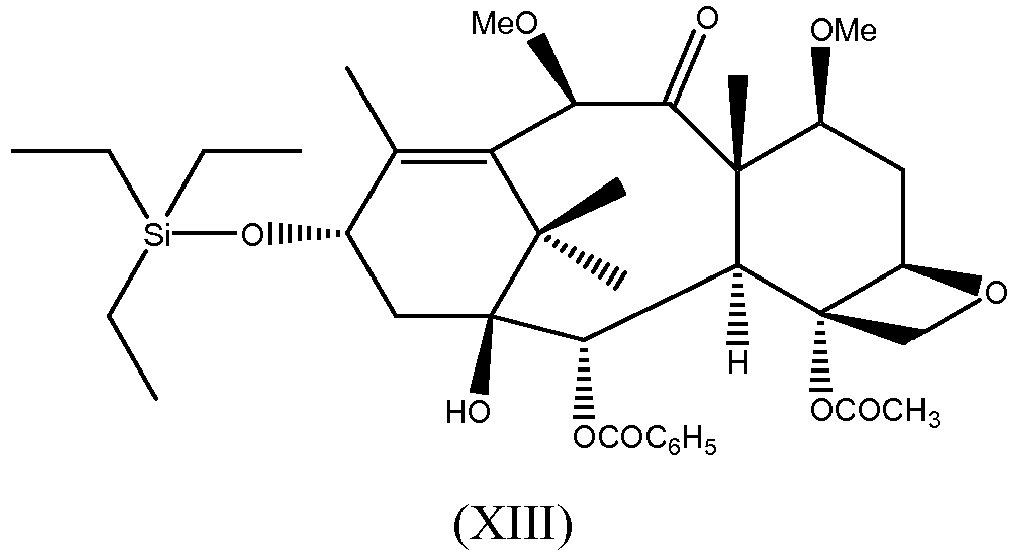
- the fourth aspect of the present invention relates to a novel intermediate of compound of Formula (XIII)
- the compound of Formula (XIII) is chemically 4 ⁇ -acetoxy-2 ⁇ -benzoyloxy-5 ⁇ ,20-epoxy-1 ⁇ -hydroxy-7 ⁇ ,10 ⁇ -dimethoxy-9-oxo-13 ⁇ -triethylsilyloxy)-11-taxene.
- the fifth aspect of the present invention provides Isopropanol Solvate of Cabazitaxel (I).
- 10-deacetyl baccatin III of Formula (III) may be obtained by any of the methods known in the art such as those described in US 5,393,895 , US 5,736,366 , US 6,124,482 and US 5,453,521 .
- the silylation of Formula III in steps a) of the first and second process may be carried out by using a silylating agent.
- the silylating agent may be selected from the group comprising of trimethyl silyl Halide, triethyl silyl Halide, tert-butyldimethylsilyl Halide, tri- iso -propylsilyloxymethyl Halide and triisopropyl silyl Halide.
- the silylation of Formula III in the first and second process may be carried out in the presence of a base, which may be selected from the group comprising of organic or inorganic base.
- the organic base may be selected from the group comprising of C 1 -C 4 alkyl ammonia; mono, di or tri C 1 - C 4 alkyl amine such as triethyl amine, diisopropropyl ethyl amine; mono, di or tri hydroxy C 1 -C 4 alkyl amine; morpholine; thiomorpholine; piperidine; N,N-dimethylaniline, N.N-dimethylamino pyridine (DMAP), hydrazine, imidazole and pyrrolidine.
- the most preferred base is imidazole.
- the inorganic base may be selected from the group comprising of metal carbonate such as lithium carbonate, sodium carbonate, potassium carbonate, barium carbonate, calcium carbonate and magnesium carbonate; metal bicarbonate such as sodium bicarbonate, potassium bicarbonate, barium bicarbonate, calcium bicarbonate and magnesium bicarbonate and metal hydroxide such as sodium hydroxide, potassium hydroxide, barium hydroxide, calcium hydroxide and magnesium hydroxide.
- metal carbonate such as lithium carbonate, sodium carbonate, potassium carbonate, barium carbonate, calcium carbonate and magnesium carbonate
- metal bicarbonate such as sodium bicarbonate, potassium bicarbonate, barium bicarbonate, calcium bicarbonate and magnesium bicarbonate
- metal hydroxide such as sodium hydroxide, potassium hydroxide, barium hydroxide, calcium hydroxide and magnesium hydroxide.
- the silylation of Formula III in the first and second process may be carried out in the presence of a suitable solvent.
- Suitable solvent may be selected from the group comprising of: alcohols, such as methanol, ethanol and isopropanol; nitriles, such as acetonitrile ; chlorinated hydrocarbons, such as methylene chloride, ethylene dichloride; dipolar aprotic solvents, such as dimethylsulfoxide and dimethylformamide; esters, such as ethyl acetate and isopropyl acetate; cyclic ethers, such as dioxane and tetrahydrofuran; and mixtures thereof. Most preferred solvent is methylene chloride.
- the silylation of Formula III in the first and second process may be carried out a temperature range of from -15 to 60°C and more preferably from 20 to 30°C to give the silylated product.
- the obtained silylated product can further be purified by using the suitable organic solvent such as methyl tert-butyl ether.
- the silylation of Formula III in the first process may be carried out for about 1-10 hours and more preferably for 4-5 hours, thereby resulting in a product carrying only one silyl-group.
- the silylation of Formula III in the second aspect may be carried out for about 15-30 hours and more preferably for 18-20 hours, thereby resulting in a product carrying two silyl-groups at two different positions.
- Methylation of the hydroxyl function in steps b) and d) of first and second process may be carried out in the presence of methyl iodide, methyl sulfate, Diazomethane, dimethyl carbonate, methyl nitrate and the like.
- the most preferred methyl source is Methyl iodide.
- Methylation of the hydroxyl function in steps b) and d) of first and second process may be carried out in the presence of an alkali metal hydride, such as sodium hydride, an alkali metal amide, such as lithium amide, or an alkali metal alkylide, such as butyl lithium.
- an alkali metal hydride such as sodium hydride
- an alkali metal amide such as lithium amide
- an alkali metal alkylide such as butyl lithium
- Methylation of the hydroxyl group in steps b) and d) of first and second process may also be carried out in the presence of suitable solvent.
- a suitable solvent may be selected from the group comprising of water; alcohols, such as methanol, ethanol and isopropanol; nitriles, such as acetonitrile; chlorinated hydrocarbons, such as methylene chloride, ethylene dichloride; ethers, such as diethyl ether, isopropyl ether, methyl isobutyl ether; dipolar aprotic solvents, such as dimethylsulfoxide, dimethylformamide and dimethyl acetamide; esters, such as ethyl acetate and isopropyl acetate; cyclic ethers, such as dioxane and tetrahydrofuran; and mixtures thereof.
- Most preferred solvent is a mixture of methyl isobutyl ether and tetrahydrofuran.
- Methylation of the hydroxyl group in steps b) and d) of first and second process may be carried out at a temperature range of from -5 to 50°C and more preferably from -5 to 15°C.
- the deprotection of the silyl group in step c) of first and second process may be carried out in the presence of an acid such as hydrofluoric acid or trifluoroacetic acid or fluorides such as tetrabutyl ammonium fluoride (TBAF).
- an acid such as hydrofluoric acid or trifluoroacetic acid or fluorides such as tetrabutyl ammonium fluoride (TBAF).
- the deprotection of the silyl group in step c) of first and second process may be carried out in the presence of a solvent such as tetrahydrofuran, acetonitrile, dichloromethane, methanol, ethanol and dimethylformamide.
- a solvent such as tetrahydrofuran, acetonitrile, dichloromethane, methanol, ethanol and dimethylformamide.
- the deprotection of the silyl group in step c) of first and second process may be carried out at a temperature range of from -5-50°C and more preferably from -5 to 10°C.
- step c) of the second process is performed such that one of the two protecting units, the one attached to the C7-OH is removed, and the other still remains and continuously protects the C13-OH. This is achieved by stirring the reaction mixture for about 2-8 hours. Most preferably for about 4-5 hours.
- esterification of compound of Formula (II) at C-13 Position may be carried out by using a method such as those described in the art for example in US 5,637,723 and US 5,847,170 .
- the esterification of compound of Formula (II) at C-13 Position by means of an acid of general formula (VII) may be carried out in the presence of a condensing/coupling agent reagent.
- a condensing reagent may be selected from the group comprising of carbodiimide such as dicyclocarbodiimide, Diisopropylcarbodiimide or ethyl-(N-N'-dimethyl amino propyl carbodiimide and reactive carbonates such as di-2-pyridyl carbonate and most preferred are carbodiimide.
- the esterification of compound of Formula (II) at C-13 Position may be carried out in the presence of a catalyst.
- a catalyst may be selected from amino pyridines such as 4-dimethylaminopyridine or 4-pyrrolidinopyridine.
- the esterification of compound of Formula (II) at C-13 Position may be carried out in the presence of a suitable solvent.
- Suitable solvent may be selected from the group comprising of water; alcohols, such as methanol, ethanol and isopropanol; nitriles, such as acetonitrile; chlorinated hydrocarbons, such as methylene chloride, ethylene dichloride; ethers, such as diethyl ether, isopropyl ether, methyl isobutyl ether; dipolar aprotic solvents, such as dimethylsulfoxide and dimethylformamide; esters, such as ethyl acetate and isopropyl acetate; cyclic ethers, such as dioxane and tetrahydrofuran; and mixtures thereof.
- the most preferred solvent is ethyl acetate.
- esterification of compound of Formula (II) at C-13 Position by means of an acid or salt of formula (VII) may be carried out at a temperature range of from 10-50°C to obtain the compound of Formula (VIII).
- Deprotection of the side chain of Formula (VIII) may be carried out at in the presence of an inorganic acid such as hydrochloric acid, sulphuric acid or nitric acid or organic acid such as acetic acid, methane sulphonic acid, trifluoromethane sulphonic acid or p -toluene sulphonic acid.
- an inorganic acid such as hydrochloric acid, sulphuric acid or nitric acid
- organic acid such as acetic acid, methane sulphonic acid, trifluoromethane sulphonic acid or p -toluene sulphonic acid.
- Deprotection of the side chain of Formula (VIII) may be carried out in the presence of a suitable solvent.
- Suitable solvent may be selected from the group comprising of water; alcohols, such as methanol, ethanol and isopropanol; nitriles, such as acetonitrile; chlorinated hydrocarbons, such as methylene chloride, ethylene dichloride; ethers, such as diethyl ether, isopropyl ether, methyl isobutyl ether; dipolar aprotic solvents, such as dimethylsulfoxide and dimethylformamide; esters, such as ethyl acetate and isopropyl acetate; cyclic ethers, such as dioxane and tetrahydrofuran; and mixtures thereof.
- Most preferred solvent is mixture of water and ethyl acetate.
- Deprotection of the side chain of Formula (VIII) may be carried out at a temperature range of from -10 to 60°C, and preferably from 0-5°C to obtain the compound of Formula (IX).
- the Cabazitaxel obtained by the present invention may be in the Form of Isopropanol Solvate of Cabazitaxel.
- the XRPD data reported herein was obtained using Cu K ⁇ radiation, having the wavelength 1.541 ⁇ and were obtained using Bruker AXS D8 advance Powder X-ray Diffractometer.
- Isopropanol Solvate of Cabazitaxel may be characterized by its XRPD having peaks at diffraction angles 2-theta of about 7.3678, 7.8537, 8.9596, 10.2918, 12.5727, 12.8651, 13.3343, 13.5721, 14.4207, 14.7600, 15.1798, 15.3152, 15.6282, 15.7413, 16.5402, 16.9857, 17.6849, 17.9590, 18.3018, 18.6973, 18.7727, 19.4610, 20.4624, 20.6809, 21.1058, 21.1565, 21.4007, 21.7609, 21.9196, 22.2176, 23.1030, 23.5156, 23.7025, 24.2617, 24.7859, 25.1584, 25.8322, 26.3237, 27.0935, 27.4874, 27.7876, 28.3142, 28.9803, 30.1735, 30.6174, 31.2054, 31.5714, 32.2104, 32.3404
- Isopropanol Solvate of Cabazitaxel may be further characterized by its DSC curve having endothermic peak at about 156.98°C.
- Isopropanol Solvate of Cabazitaxel may be further characterized by its TGA curve corresponding to a weight loss of about 0.3494% w/w.
- reaction mixture 25g of 4 ⁇ -acetoxy-2 ⁇ -benzoyloxy-5 ⁇ ,20-epoxy-1 ⁇ ,10 ⁇ ,13 ⁇ -trihydroxy-9-oxo-7 ⁇ -triethyl silyloxy-11-taxene, 125 ml of methyl tert-butyl ether and 50 ml of THF were added and stirred at 20-25°C for 10 min.
- Reaction mixture is brought to a temperature of -5°C to 0°C and 7.59 g of sodium hydride is added to the reaction mixture and stirred at -5 to 0°C for 18-20 h.
- the reaction mixture is diluted by adding 150 ml of dichloromethane and stirred for 10-20 min.
- Purified water 2.78 1 is added slowly to the reaction mixture.
- the reaction mixture is stirred for 1-2 hour at 20-30°C.
- the precipitated mass is filtered and wet cake is washed with water (2.78x3).
- the wet cake is dried for 2 hour.
- the solid material is dried at 50-60°C under vacuum for 4-6 hrs to get 560 g of 4 ⁇ -acetoxy-2 ⁇ -benzoyloxy-5 ⁇ ,20-epoxy-1 ⁇ ,13 ⁇ -dihydroxy-10 ⁇ -methoxy-9-oxo-7 ⁇ -triethylsilyloxy-11-taxene.
- Reaction mixture is diluted with 250 ml of ethyl acetate and the aqueous phase is separated and extracted with 250 ml ethyl acetate.
- the organic layer were mixed, dried over sodium sulphate and filtered.
- the organic layer is concentrated at below 45°C.
- n-hexane is added to the slurry and stirred for 1-1.5 h at room temperature.
- the solid is filtered and washed twice with n-hexane.
- the product is dried under vacuum at 50-55°C for 20-24h to obtain 17 g of 4 ⁇ -acetoxy-2 ⁇ -benzoyloxy-5 ⁇ ,20-epoxy-10 ⁇ -methoxy-9-oxo-1 ⁇ ,13 ⁇ ,7 ⁇ -trihydroxy-11-taxene. Yield: 81.9 %
- the obtained solid is filtered and washed with purified water.
- the material is suck dried for 2-3 h at room temperature and then dried at 50-60°C under vacuum for 4-6 hrs.
- the solid material is treated with 3.63 1 of ethyl acetate.
- the contents were heated 40-50°C and concentrated under vacuum at 50°C to get the solid product.
- 730 ml of methyl tertiary butyl ether is charged to the solid and stirred at 20-30°C.
- the solid is filtered and washed with 370 ml of methyl tertiary butyl ether.
- the reaction mixture is diluted by adding a solution of 7.45 g acetic acid in 100 ml dichloromethane and stirred for 10-20 min at 0-5°C, followed by the addition of 50 ml DM water.
- the organic phase is separated and washed with 40 ml DM water.
- the organic layer is separated and concentrated till solid appears.
- the solid material is crystallized by using 50 ml ethyl acetate and 300 ml n-hexane.
- the organic phase is separated and washed with 30 ml DM water.
- the organic layer is separated and concentrated till solid appears.
- the solid material purified by column chromatography by using 5-25% solution of ethyl acetate and hexane to get 4.5 g 4 ⁇ -acetoxy-2 ⁇ -benzoyloxy-5 ⁇ ,20-epoxy-1 ⁇ -hydroxy-7 ⁇ ,10 ⁇ -dimethoxy-9-oxo-13 ⁇ -triethylsilyloxy)-11-taxene.
- Reaction mixture is stirred for 48 h at 20-25°C.
- Reaction mixture is diluted with 50 ml DM water and ethyl acetate.
- Organic phase is separated and washed with 20 ml 5% NaHCO 3 solution followed by the filtration.
- Organic phase is concentrated under reduced pressure at 40°C.
- the residue obtained is purified by chromatography on 100g silica gel using 10% solution of ethyl acetate and n-hexane.
- reaction mixture is then diluted with 20 ml ethyl acetate and washed with 15 ml NaHCO 3 solution.
- the organic phase is concentrated till the dryness under vacuum at below 40°C.
- the product is purified by column chromatography on 100g silica gel using 10 % solution of 500ml ethyl acetate and n-hexane.
- the solid material is dissolved in 308 ml of dichloromethane and stirred for 30 min at 20-30°C.460 ml of isopropanol is slowly added to the reaction mixture and reaction mass is stirred for 30 min at 20-30°C. 1.85 L of IPA is again added slowly and stirred for 2 hours at 20-30°C. Reaction mass is cooled to 0 to 10°C and stirred for 1 h at 0 to 10°C. The solid is filtered and washed with precooled iso -propanol (154x2) and suck dried for 2 h.
- the material is dried under vacuum for 6-8 h at 70-80°C to get 152 g of IPA solvate of 4 ⁇ -acetoxy-2 ⁇ -benzoyloxy-5 ⁇ ,20-epoxy-1 ⁇ ,13 ⁇ -dihydroxy-7 ⁇ ,10 ⁇ -dimethoxy-9-oxo-11-taxen-13 ⁇ -yl-(2R,4S,5S)-3-tert-butoxycarbonylamino-2-hydroxy-3-phenylpropionate.
Landscapes
- Chemical & Material Sciences (AREA)
- Organic Chemistry (AREA)
- Pharmaceuticals Containing Other Organic And Inorganic Compounds (AREA)
- Epoxy Compounds (AREA)
Description
- The present invention relates to an improved process for the preparation of Cabazitaxel and its intermediates, with better yield and purity, which avoids the use of hazardous reagents.
- Cabazitaxel, which is chemically known as 4-acetoxy-2α-benzoyloxy-5β,20-epoxy-1-hydroxy-7β,10β-dimethoxy-9-oxotax-11-en-13α-yl(2R,3S)-3-tert-butoxycarbonylamino-2-hydroxy-3-phenyl-propionate is represented by Formula (I).

- Cabazitaxel is a microtubule inhibitor indicated in combination with prednisone for treatment of patients with hormone-refractory metastatic prostate cancer previously treated with a docetaxel-containing treatment regimen, under the trade name Jevtana®.
-
U.S. Patent No. 2001/0051736 A1 discloses a process for the manufacturing of cabazitaxel employing mono- and di-silylated intermediates.
U.S. Patent No. 2012/0149925 A1 describes a process for the manufacturing of taxoids, among them cabazitaxel, via a C7 mono-silylated intermediate.
U.S. Patent No. 2012/088391 A1 disclosed the C7-mono-silylated, C10-(D3) Mono-methoxy - intermediate.
U.S. Patent No. 2009/112655 A2 and international applicationWO 2012/142117 A1 describe methods for the manufacturing of Cabazitaxel-ethanol or -isopropanol solvates, respectively. Polymorphism in Pharmaceutical solids, 1. January 199, p. 205-208 discusses methods to obtain solvate form of drug substances. - Tetrahedron Letter, vol. 37, p.3935-3938 describes the selective desilylation of the C7-position in the presence of a silyl group at C13.
-
U.S. Patent No. 5,847,170 discloses the synthesis of Cabazitaxel by using 10-deacetyl baccatin III. The synthesis of Cabazitaxel as disclosed inU. S. Pat. No. 5,847,170 is summarized in Scheme-I
- The major disadvantage of the process disclosed in
U.S. Pat. No. 5,847,170 is that during the silylation of 10-DAB by using trimetheyl silyl chloride in Pyridine, several side products are being formed and silylated product is obtained in only 40-50% of yield. - The current process avoids the use of hazardous reagents, like Pyridine in the silylation step and hydrogen fluoride triethylamine complex (3HF.Et3N) in the deprotection step.
- The current process also utilizes the stochiometric quantity of methyl iodide for methylation in comparison to much higher quantities of the methyl iodide being used in the process described in
patent US 5,847,170 , where in the example 1, methyl iodide is used as a solvent. -
U. S. Pat. No. 5,962,705 discloses the synthesis of the intermediate of the Cabazitaxel having the Formula (II)
- Several patents disclose the silylation of 10-DAB by using triethylsilyl chloride and Imidazole such as those described in
US 6,410,757 ,US 6,500,858 ,US 6,727,369 andUS 7,186,851 . - Tetrahedron Letters, Vol. 35, pp. 5543-5546, 1994 discloses the silylation at C-7 position by using triethyl silyl chloride and Imidazole in Dimethylformamide.
-
US Patent No. US 5,962,705 discloses the methylation by using methyl iodide or methyl sulphate in the presence of an anionization agent such as one or more strong bases in anhydrous medium. - The first aspect of the present invention provides a first process for the preparation of Cabazitaxel of Formula (I)


- a) Treating 10-deacetylbaccatin of Formula (III)


- b) Methylating the compound of Formula (IV) in the presence of a base and a methylating agent to obtain a compound of Formula (V).

- c) Deprotecting the silyl group of compound of Formula (V) in the presence of a suitable organic solvent and a base to obtain the compound of Formula (VI).

- d) Methylating the compound of Formula (VI) to give a compound of Formula (II) in the presence of a suitable organic solvent and a base.

- e) converting the compound of formula II into Cabazitaxel (I).
In order to do so, disclosed herein are the steps of:
e') Esterifying
the compound of Formula (II) at C-13 Position by means of an acid or salt of Formula (VII),

- f) Deprotecting the side chain of the said product of formula (VIII) to obtain compound of Formula (IX), wherein R1 and Ar are defined as above.

- g) converting compound of Formula (IX) to Cabazitaxel (I).
- It is a preferred embodiment of the invention wherein the aryl rest Ar is a phenyl rest Ph, and R1 is a tert-Butyloxycarbonyl-rest (tBOC). In that embodiment there is no need to perform a step g), because Formula IX represents Cabazitaxel in that case.
- If the Ar- differs from Ph- and/or R1- differs from tBOC- then the optional step g) in process 1 is performed to convert the compound of Formula IX into Cabazitaxel.
- The second aspect of the present invention provides a second process for preparation of Cabazitaxel of Formula (I) comprising:
- a) treating 10-deacetylbaccatin of Formula (III)


- b) methylating the compound of formula (X) to obtain a compound of formula (XI) in the presence of a suitable organic solvent and a base;

- c) deprotecting the silyl group of compound of Formula XI to obtain the compound of Formula (XII) in the presence of suitable organic solvent and a base;

- d) methylating the compound of Formula (XII to give a compound of Formula (XIII) in the presence of a suitable organic solvent and a base;

- e) deprotecting the silyl group of C-13 position of compound of Formula XIII to obtain the compound of Formula (II) in the presence of a suitable organic solvent and a base.

- f) converting the compound of formula (II) into cabazitaxel (I).
In order to do so, disclosed herein are the steps of
f') Esterifying the compound of Formula (II) at C-13 Position by means of an acid or salt of Formula (VII),

- g) deprotecting the side chain of the said product of formula (VIII) to obtain compound of Formula (IX), wherein R1 and Ar are as defined above; and

- h) converting compound of Formula (IX) to Cabazitaxel (I).
- It is preferred that the deprotecting step c) is performed selectively such that the majority of the product comprises one protective silyl group at C13-OH but not at C7-OH.
- It is a preferred embodiment wherein the aryl substituent Ar- is a phenyl substituent Ph-, and the R1 substituent is a tert butoxy-carbonyl- substituent (tBOC-). As such, it is a preferred embodiment of the invention wherein the final product of synthesis is Cabazitaxel, also known as (1S,2S,3R,4S,7R,9S,10S,12R,15S)-4-(Acetyloxy)-15-{[(2R,3S)-3-{[(tert-butoxy)carbonyl]amino}-2-hydroxy-3-phenylpropanoyl]oxy}-1-hydroxy-9,12-dimethoxy-10,14,17,17-tetramethyl-11-oxo-6-oxatetracyclo[11.3.1.03,10.04,7]heptadec-13-en-2-ylbenzoat. In that embodiment there is no need to perform a step g), because Formula IX represents Cabazitaxel in that case.
- If Ar- differs from Ph- and/or R1- differs from tBOC- then the optional step h) in process 2 is performed to convert the compound of Formula IX into Cabazitaxel.
- The third aspect of the present invention relates to a novel intermediate of compound of Formula (XII)

- The compound of Formula (XII) is chemically 4α-acetoxy-2α-benzoyloxy-5β,20-epoxy-1β,7β-dihydroxy-9-oxo-10β-methoxy-13β-triethylsilyloxy)-11-taxene.
- The fourth aspect of the present invention relates to a novel intermediate of compound of Formula (XIII)

- The compound of Formula (XIII) is chemically 4α-acetoxy-2α-benzoyloxy-5β,20-epoxy-1β-hydroxy-7β,10β-dimethoxy-9-oxo-13β-triethylsilyloxy)-11-taxene.
- The fifth aspect of the present invention provides Isopropanol Solvate of Cabazitaxel (I).
-
-
Fig 1 , which represents the X-ray (powder) diffraction pattern of the Isopropanol Solvate of Cabazitaxel of the present invention -
Fig 2 , which represents the Differential Scanning calorimetry (DSC) of the Isopropanol Solvate of Cabazitaxel of the present invention -
Fig 3 , which represents the TGA of the Isopropanol Solvate of Cabazitaxel of the present invention - 10-deacetyl baccatin III of Formula (III) may be obtained by any of the methods known in the art such as those described in
US 5,393,895 ,US 5,736,366 ,US 6,124,482 andUS 5,453,521 .
- The silylation of Formula III in steps a) of the first and second process may be carried out by using a silylating agent.
- The silylating agent may be selected from the group comprising of trimethyl silyl Halide, triethyl silyl Halide, tert-butyldimethylsilyl Halide, tri-iso-propylsilyloxymethyl Halide and triisopropyl silyl Halide.
- The silylation of Formula III in the first and second process may be carried out in the presence of a base, which may be selected from the group comprising of organic or inorganic base.
- The organic base may be selected from the group comprising of C1-C4 alkyl ammonia; mono, di or tri C1- C4 alkyl amine such as triethyl amine, diisopropropyl ethyl amine; mono, di or tri hydroxy C1-C4 alkyl amine; morpholine; thiomorpholine; piperidine; N,N-dimethylaniline, N.N-dimethylamino pyridine (DMAP), hydrazine, imidazole and pyrrolidine. The most preferred base is imidazole.
- The inorganic base may be selected from the group comprising of metal carbonate such as lithium carbonate, sodium carbonate, potassium carbonate, barium carbonate, calcium carbonate and magnesium carbonate; metal bicarbonate such as sodium bicarbonate, potassium bicarbonate, barium bicarbonate, calcium bicarbonate and magnesium bicarbonate and metal hydroxide such as sodium hydroxide, potassium hydroxide, barium hydroxide, calcium hydroxide and magnesium hydroxide.
- The silylation of Formula III in the first and second process may be carried out in the presence of a suitable solvent. Suitable solvent may be selected from the group comprising of: alcohols, such as methanol, ethanol and isopropanol; nitriles, such as acetonitrile ; chlorinated hydrocarbons, such as methylene chloride, ethylene dichloride; dipolar aprotic solvents, such as dimethylsulfoxide and dimethylformamide; esters, such as ethyl acetate and isopropyl acetate; cyclic ethers, such as dioxane and tetrahydrofuran; and mixtures thereof. Most preferred solvent is methylene chloride.
- The silylation of Formula III in the first and second process may be carried out a temperature range of from -15 to 60°C and more preferably from 20 to 30°C to give the silylated product.
- The obtained silylated product can further be purified by using the suitable organic solvent such as methyl tert-butyl ether.
- The silylation of Formula III in the first process may be carried out for about 1-10 hours and more preferably for 4-5 hours, thereby resulting in a product carrying only one silyl-group.
- The silylation of Formula III in the second aspect may be carried out for about 15-30 hours and more preferably for 18-20 hours, thereby resulting in a product carrying two silyl-groups at two different positions.
- Methylation of the hydroxyl function in steps b) and d) of first and second process may be carried out in the presence of methyl iodide, methyl sulfate, Diazomethane, dimethyl carbonate, methyl nitrate and the like. The most preferred methyl source is Methyl iodide.
- Methylation of the hydroxyl function in steps b) and d) of first and second process may be carried out in the presence of an alkali metal hydride, such as sodium hydride, an alkali metal amide, such as lithium amide, or an alkali metal alkylide, such as butyl lithium.
- Methylation of the hydroxyl group in steps b) and d) of first and second process may also be carried out in the presence of suitable solvent. A suitable solvent may be selected from the group comprising of water; alcohols, such as methanol, ethanol and isopropanol; nitriles, such as acetonitrile; chlorinated hydrocarbons, such as methylene chloride, ethylene dichloride; ethers, such as diethyl ether, isopropyl ether, methyl isobutyl ether; dipolar aprotic solvents, such as dimethylsulfoxide, dimethylformamide and dimethyl acetamide; esters, such as ethyl acetate and isopropyl acetate; cyclic ethers, such as dioxane and tetrahydrofuran; and mixtures thereof. Most preferred solvent is a mixture of methyl isobutyl ether and tetrahydrofuran.
- Methylation of the hydroxyl group in steps b) and d) of first and second process may be carried out at a temperature range of from -5 to 50°C and more preferably from -5 to 15°C.
- The deprotection of the silyl group in step c) of first and second process may be carried out in the presence of an acid such as hydrofluoric acid or trifluoroacetic acid or fluorides such as tetrabutyl ammonium fluoride (TBAF).
- The deprotection of the silyl group in step c) of first and second process may be carried out in the presence of a solvent such as tetrahydrofuran, acetonitrile, dichloromethane, methanol, ethanol and dimethylformamide.
- The deprotection of the silyl group in step c) of first and second process may be carried out at a temperature range of from -5-50°C and more preferably from -5 to 10°C.
- The deprotection in step c) of the second process is performed such that one of the two protecting units, the one attached to the C7-OH is removed, and the other still remains and continuously protects the C13-OH. This is achieved by stirring the reaction mixture for about 2-8 hours. Most preferably for about 4-5 hours.
- The esterification of compound of Formula (II) at C-13 Position may be carried out by using a method such as those described in the art for example in
US 5,637,723 andUS 5,847,170 . - The esterification of compound of Formula (II) at C-13 Position by means of an acid of general formula (VII) may be carried out in the presence of a condensing/coupling agent reagent. A condensing reagent may be selected from the group comprising of carbodiimide such as dicyclocarbodiimide, Diisopropylcarbodiimide or ethyl-(N-N'-dimethyl amino propyl carbodiimide and reactive carbonates such as di-2-pyridyl carbonate and most preferred are carbodiimide.
- The esterification of compound of Formula (II) at C-13 Position may be carried out in the presence of a catalyst. A catalyst may be selected from amino pyridines such as 4-dimethylaminopyridine or 4-pyrrolidinopyridine.
- The esterification of compound of Formula (II) at C-13 Position may be carried out in the presence of a suitable solvent. Suitable solvent may be selected from the group comprising of water; alcohols, such as methanol, ethanol and isopropanol; nitriles, such as acetonitrile; chlorinated hydrocarbons, such as methylene chloride, ethylene dichloride; ethers, such as diethyl ether, isopropyl ether, methyl isobutyl ether; dipolar aprotic solvents, such as dimethylsulfoxide and dimethylformamide; esters, such as ethyl acetate and isopropyl acetate; cyclic ethers, such as dioxane and tetrahydrofuran; and mixtures thereof. The most preferred solvent is ethyl acetate.
- The esterification of compound of Formula (II) at C-13 Position by means of an acid or salt of formula (VII) may be carried out at a temperature range of from 10-50°C to obtain the compound of Formula (VIII).
- Deprotection of the side chain of Formula (VIII) may be carried out at in the presence of an inorganic acid such as hydrochloric acid, sulphuric acid or nitric acid or organic acid such as acetic acid, methane sulphonic acid, trifluoromethane sulphonic acid or p-toluene sulphonic acid.
- Deprotection of the side chain of Formula (VIII) may be carried out in the presence of a suitable solvent. Suitable solvent may be selected from the group comprising of water; alcohols, such as methanol, ethanol and isopropanol; nitriles, such as acetonitrile; chlorinated hydrocarbons, such as methylene chloride, ethylene dichloride; ethers, such as diethyl ether, isopropyl ether, methyl isobutyl ether; dipolar aprotic solvents, such as dimethylsulfoxide and dimethylformamide; esters, such as ethyl acetate and isopropyl acetate; cyclic ethers, such as dioxane and tetrahydrofuran; and mixtures thereof. Most preferred solvent is mixture of water and ethyl acetate.
- Deprotection of the side chain of Formula (VIII) may be carried out at a temperature range of from -10 to 60°C, and preferably from 0-5°C to obtain the compound of Formula (IX).
- The compound of Formula IX, wherein R1 is tertiary butoxy carbonyl, and wherein aryl is phenyl, is Cabazitaxel of Formula (I).
- The Cabazitaxel obtained by the present invention may be in the Form of Isopropanol Solvate of Cabazitaxel.
- The XRPD data reported herein was obtained using Cu Kα radiation, having the wavelength 1.541 Å and were obtained using Bruker AXS D8 advance Powder X-ray Diffractometer.
- Isopropanol Solvate of Cabazitaxel may be characterized by its XRPD having peaks at diffraction angles 2-theta of about 7.3678, 7.8537, 8.9596, 10.2918, 12.5727, 12.8651, 13.3343, 13.5721, 14.4207, 14.7600, 15.1798, 15.3152, 15.6282, 15.7413, 16.5402, 16.9857, 17.6849, 17.9590, 18.3018, 18.6973, 18.7727, 19.4610, 20.4624, 20.6809, 21.1058, 21.1565, 21.4007, 21.7609, 21.9196, 22.2176, 23.1030, 23.5156, 23.7025, 24.2617, 24.7859, 25.1584, 25.8322, 26.3237, 27.0935, 27.4874, 27.7876, 28.3142, 28.9803, 30.1735, 30.6174, 31.2054, 31.5714, 32.2104, 32.3404, 32.9802±0.2.
- Isopropanol Solvate of Cabazitaxel may be further characterized by its DSC curve having endothermic peak at about 156.98°C.
- Isopropanol Solvate of Cabazitaxel may be further characterized by its TGA curve corresponding to a weight loss of about 0.3494% w/w.

- The compound of formula (XII) may be characterized by its NMR bands at about δ 0.65 (m, 9H), 0.96 (s, 3H), 0.99 (s, 3H), 0.99 (t, J=8.4 Hz, 6H), 1.48 (s, 3H), 1.64 (m, 1H), 1.94 (s, 3H), 2.17 (m, 2H), 2.20 (s, 3H), 2.27 (m, 1H), 3.27 (s, 3H), 3.70 (d, J=7.2 Hz, 1H), 4.03 (bs, 2H), 4.11 (m, 1H), 4.52 (s, 1H, OH), 4.86 (s, 1H), 4.91 (m, 2H), 5.02 (d, J=7.2 Hz, 1H, OH), 5.40 (d, J=7.2 Hz, 1H), 7.55 (t, J=7.2 Hz, 2H), 7.66 (t, J=7.2 Hz, 1H), 8.0 (d, J=7.2 Hz, 2H) and further characterized by Mass spectra at 673 (M+H)+.
- The compound of formula (XIII) may be characterized by its NMR bands at about δ 0.65 (m, 6H), 0.95 (s, 3H), 0.99 (s, 3H), 0.99 (t, J=8.0 Hz, 9H), 1.48 (m, 1H), 1.52 (s, 3H), 1.97 (s, 3H), 2.10-2.22 (m, 2H), 2.21 (s, 3H), 2.66 (m, 1H), 3.21 (s, 3H), 3.30 (s, 3H), 3.70 (d, J=6.8 Hz, 1H), 3.80 (dd, J=10.4 Hz & 6.4 Hz, 1H), 4.03 & 4.06 (2×d, J=7.6 Hz, 2H), 4.56 (s, 1H, OH), 4.72 (s, 1H), 4.87 (m, 1H), 4.97 (d, J=5.6 Hz, 1H), 5.38 (d, J=7.2 Hz, 1H), 7.55 (t, J=7.2 Hz, 2H), 7.66 (t, J=7.2 Hz, 1H), 7.99 (d, J=7.2 Hz, 2H) and further characterized by Mass spectra at : 687 (M+H)+.
- Detailed experimental parameters suitable for this novel process of making Cabazitaxel are provided by the following examples, which are intended to be illustrative and not limiting of all possible embodiments of the invention.
-

- 100g of 10-DAB is charged at 20-25°C and cooled to 0-5°C. 37.52 g of Imidazole is charged at 0-5°C and stirred. After stirring for 10-15 min, the solution of 55.30 g triethyl silyl chloride in 100 ml methylene chloride is added at 0-5°C and stirred for 30-40 min. The reaction mixture is brought to a room temperature and stirred for 4-5 hrs. Reaction is diluted with 500 ml of DM water and stirred for 10-20 min. The organic phase is separated and washed twice with 250 ml of DM water. The organic phase is again washed with 200
ml 10% NaCl solution and organic phase is again separated and concentrated at below 40°C till organic layer reduced half. n-hexane is charged to the residue and stirred for 30-40 min at 20-25°C. The slurry is filtered and washed twice with 200 ml n-hexane. Product is dried at 50-55°C for 6-8 h to get 113g 4α-acetoxy-2α-benzoyloxy-5β,20-epoxy-1β,10β,13α-trihydroxy-9-oxo-7β-triethylsilyloxy)-11-taxene.
Yield: 93.4 % - 7.7 litre dichloromethane and 936.9 g of imidazole is charged. Reaction mixture is heated to 20-25°C and stirred for 15-30 min. 50 g 10-DAB and 2.5 litre of 10-DAB were charged to the reaction mixture and stirred for 1h at 20-30°C. In a separate container 2.5 L of Dichloromethane and 207.4 g of triethylsilyl chloride were added. This mixture is slowly added to the reaction mixture within 1-2 hrs at 20-30°C. Reaction mixture is stirred for further 4-5 hours. 2.5 L of purified water is added and stirred for 5-10 min. The organic layer is separated and treated with aqueous HCl (250 ml HCl is dissolved in 2.5 1 of water). After stirring for 5-10 min the organic layer is separated. 2.5 1 of water is added to the organic layer and again stirred for 5-10 min. The organic layer is separated and filtered through micron filter. The layer is concentrated under reduced pressure below 40°C to get the solid product. To this solid 2.0 l of methyl tertiary butyl ether is charged and stirred for 5-10 min. the solution is cooled to 0 to 5°C and stirred at the same temperature for 1 h. the solid is filtered and washed with methyl tert-butyl ether (250x2). The wet cake is suck dried for 1 h and obtained solid material is dried at 40-50°C under vacuum for 4-6 h to get 556 g of 4α-acetoxy-2α-benzoyloxy-5β,20-epoxy-1β,10β,13α-trihydroxy-9-oxo-7β-triethylsilyloxy)-11-taxene.
Yield: 91.7 %
Chromatographic purity: 91.7 % -

- 25g of 4α-acetoxy-2α-benzoyloxy-5β,20-epoxy-1β,10β,13α-trihydroxy-9-oxo-7β-triethyl silyloxy-11-taxene, 125 ml of methyl tert-butyl ether and 50 ml of THF were added and stirred at 20-25°C for 10 min. Reaction mixture is brought to a temperature of -5°C to 0°C and 7.59 g of sodium hydride is added to the reaction mixture and stirred at -5 to 0°C for 18-20 h. The reaction mixture is diluted by adding 150 ml of dichloromethane and stirred for 10-20 min. A solution of 13.68 ml of acetic acid in 10 ml dichloromethane is added drop wise to the reaction mixture at 0-5°C and stirred for 20-30 min followed by the addition of DM water and stirred for 10-15 min at 10-20°C. The organic phase is separated and washed with 100 ml DM water twice and with 50
ml 10% NaCl solution and concentrated below 40°C to get 24.2 g solid.
1H NMR (400 MHz; CDCl3, ppm) δ: 8.10 (d, J=8.0Hz, 2H), 7.59 (t, J=7.2Hz, 1H), 7.45 (t, J=7.6Hz, 2H), 5.60 (d, J=7.2Hz, 1H), 4.90-4.97 (m, 3H), 4.43 (dd, J=7.2 & 10.8Hz, 1H), 4.30 (d, J=8.4Hz, 1H), 4.15 (d, J=8.4Hz, 1H), 3.88 (d, J=6.8Hz, 1H), 3.41 (s, 3H), 2.42-2.52 (m, 1H), 2.27-2.28 (m, 4H), 2.11 (s, 3H), 2.03 (d, J=5.6Hz, 1H), 1.86-1.92 (m, 1H), 1.68 (s, 3H), 1.58 (brs, 1H, OH), 1.17 (s, 3H), 1.07 (s, 3H), 0.96 (t, J=8.0Hz, 9H), 0.57 (m, 6H)
MS (ES+) m/z: 673 (M+H)+
Yield: 95 % - 556g of 4α-acetoxy-2α-benzoyloxy-5β,20-epoxy-1β,10β,13α-trihydroxy-9-oxo-7β-triethylsilyloxy-11-taxene, 1.39 1 of dimethyl acetamide and stirred at -5 to -15°C. 359.4 g of methyl iodide and 7.59 g of sodium hydride is added to the reaction mixture at the same temperature and stirred for one hour. 10.15 g of sodium hydride is again charged to the reaction mixture and reaction mixture is stirred for 4-5 h at -5 to -15°C. Acetic acid 67.6 ml is slowly added to the reaction to bring the
pH ≤ 7. Purified water 2.78 1 is added slowly to the reaction mixture. The reaction mixture is stirred for 1-2 hour at 20-30°C. The precipitated mass is filtered and wet cake is washed with water (2.78x3). The wet cake is dried for 2 hour. The solid material is dried at 50-60°C under vacuum for 4-6 hrs to get 560 g of 4α-acetoxy-2α-benzoyloxy-5β,20-epoxy-1β,13α-dihydroxy-10β-methoxy-9-oxo-7β-triethylsilyloxy-11-taxene. -

- 125 ml of THF is added to the 25 g of 4α-acetoxy-2α-benzoyloxy-5β,20-epoxy-1β,13α-dihydroxy-10β-methoxy-9-oxo-7β-triethylsilyloxy-11-taxene. After stirring at 20-25°C for 5-10 min, reaction mixture is cooled to 0-5°C. 55.8 ml of tetrabutyl ammonium fluoride (TBAF) is added to the reaction mixture and after the stirring for 4-5 hrs, a solution of 3.35 ml acetic acid in 250 ml DM water is added at 20-25°C and reaction mixture is stirred for 10-20 min. Reaction mixture is diluted with 250 ml of ethyl acetate and the aqueous phase is separated and extracted with 250 ml ethyl acetate. The organic layer were mixed, dried over sodium sulphate and filtered. The organic layer is concentrated at below 45°C. n-hexane is added to the slurry and stirred for 1-1.5 h at room temperature. The solid is filtered and washed twice with n-hexane. The product is dried under vacuum at 50-55°C for 20-24h to obtain 17 g of 4α-acetoxy-2α-benzoyloxy-5β,20-epoxy-10β-methoxy-9-oxo-1β,13α,7β-trihydroxy-11-taxene.
Yield: 81.9 % - 3.892 litre of THF is added to the 25 g of 4α-acetoxy-2α-benzoyloxy-5β,20-epoxy-1β,13α-dihydroxy-10β-methoxy-9-oxo-7β-triethylsilyloxy-11-taxene. After stirring at 20-25°C for 5-10 min, reaction mixture is cooled to 0-5°C. 1.69 ml of tetrabutyl ammonium fluoride (TBAF) is added to the reaction mixture and after the stirring for 4-5 hrs at 0-5°C, a solution of 106.2 ml acetic acid 19.46 L water is added. The contents were cooled at 0-5°C and stirred for 1-2 h. The obtained solid is filtered and washed with purified water. The material is suck dried for 2-3 h at room temperature and then dried at 50-60°C under vacuum for 4-6 hrs. The solid material is treated with 3.63 1 of ethyl acetate. The contents were heated 40-50°C and concentrated under vacuum at 50°C to get the solid product. 730 ml of methyl tertiary butyl ether is charged to the solid and stirred at 20-30°C. The solid is filtered and washed with 370 ml of methyl tertiary butyl ether. The material is first dried at room temperature for 30 min and then dried under vacuum at 40-50°C for 4-6 hrs.
Yield = 72.9 %,
Chromatographic purity: 97.95 %. -

- The solution of 10 g of 4α-acetoxy-2α-benzoyloxy-5β,20-epoxy-10β-methoxy-9-oxo-1β,13α,7β-trihydroxy-11-taxene in 60 ml dimethyl acetamide is stirred till the clear solution and cooled to -10 to -15°C. 1.49 g of sodium hydride is added to the reaction mixture followed by the drop wise addition of 7.31 g methyl iodide. Reaction mixture is stirred for 3.5 to 4 h at -10 to - 15°C. Reaction mixture is poured in 60 ml 20 % aq NH4Cl solution at 20-22°C and stirred for 15-10 min at -10 to -15°C. 350 ml of water is added to the reaction mixture. Obtained solid is filtered and washed with 20 ml and dried for 20 min. crude material is purified by using 50 ml ethyl acetate and 15 ml hexane to get 5.35 g of 4α-acetoxy-2α-benzoyloxy-5β,20-epoxy-1β,13α-dihydroxy-7β,10β-dimethoxy-9-oxo-11-taxene.
Yield: 52 % - The solution of 325 g of 4α-acetoxy-2α-benzoyloxy-5β,20-epoxy-10β-methoxy-9-oxo-1β,13α,7β-trihydroxy-11-taxene in 1.95 litre is cooled at -10 to -15°C. 734.5g of methyl iodide and 23.3 g of sodium hydride were charged to the reaction mixture. Reaction mixture is stirred for one hour at -5 to -15°C. 17.17 g of sodium hydride is charged to the reaction mixture and reaction mixture is stirred for 4-5 h at the same temperature. To this solution 104.8 ml of acetic acid is added slowly and stirred for 30 min. to this reaction mixture 3.25 litre of purified water is added and reaction mixture is stirred for 4 h at 20-30°C. The reaction mass is filtered and wet cake is washed with purified water (1.625x2) and methanol (325x2). The wet cake is treated with 4.06 litre of methanol (325x2) and solid material is filtered and again washed with methanol. The obtained solid material is dried under vacuum at 40-50°C for 4-6 hrs to get 4α-acetoxy-2α-benzoyloxy-5β,20-epoxy-1β,13α-dihydroxy-7β,10β-dimethoxy-9-oxo-11-taxene.
Yield = 58.8 %
Chromatographic Purity: 97.13 % -

- 30g of 10-DAB is charged at 20-25°C and cooled to 0-5°C under an argon atmosphere. 18.7 g of Imidazole and 6.7g of DMAP is charged at 0-5°C and stirred. A solution of 41.5 g triethylsilyl chloride in 50 ml DCM is added at 0-5°C. The reaction mixture is brought to a room temperature and stirred for 18-20 hours. Reaction is diluted with 150 ml of DM water. The organic phase is separated and washed twice with 100 ml of DM water. The organic phase is separated and then concentrated till dryness. The product is purified by column chromatography using 5-15 % solution of ethyl acetate and n-hexane. Fractions containing only the desired product were concentrated to dryness at below 40°C to get 25.5 g of 4α-acetoxy-2α-benzoyloxy-5β,20-epoxy-1β,10β-dihydroxy-9-oxo-7β,13β-di(triethylsilyloxy)-11-taxene.
Yield: 59.8 % -

- 96 ml of methyl iodide is added to 24g of 4α-acetoxy-2α-benzoyloxy-5β,20-epoxy-1β,10β-dihydroxy-9-oxo-7β,13β-di(triethylsilyloxy)-11-taxene at 20-25°C and stirred at 0-5°C. 24 ml THF is added and stirred at 0-5°C. 2.98 g of sodium hydride is added to the reaction mixture and stirred at -5 to 0°C. The reaction mixture is diluted by adding a solution of 7.45 g acetic acid in 100 ml dichloromethane and stirred for 10-20 min at 0-5°C, followed by the addition of 50 ml DM water. The organic phase is separated and washed with 40 ml DM water. The organic layer is separated and concentrated till solid appears. The solid material is crystallized by using 50 ml ethyl acetate and 300 ml n-hexane. The slurry is filtered and dried under vacuum at 30-40°C to get 19 g of 4α-acetoxy-2α-benzoyloxy-5β,20-epoxy-1β-hydroxy-9-oxo-10β-methoxy-7β,13β-di(triethylsilyloxy)-11-taxene.
Yield: 77.7 % -

- 36 ml of THF is added to the 12 g of 4α-acetoxy-2α-benzoyloxy-5β,20-epoxy-1β-hydroxy-9-oxo-10β-methoxy-7β,13β-di(triethylsilyloxy)-11-taxene. After the stirring at 0-5°C under nitrogen, 18.3 ml of tetrabutyl ammonium fluoride (TBAF) is added to the reaction mixture and stirred for 4-5 hrs at 0-5°C. Reaction mixture is diluted by adding 10 ml dichloromethane and 30 ml DM water. The organic layer is separated and washed with 20 ml DM water. Organic layer is concentrated to obtain solid residue. The solid residue is purified by column chromatography using 20-40% solution of ethyl acetate and hexane. Fractions containing only the desired product were concentrated to dryness at below 40°C to get 8.3g of 4α-acetoxy-2α-benzoyloxy-5β,20-epoxy-1β,7β-dihydroxy-9-oxo-10β-methoxy-13β-triethylsilyloxy)-11-taxene.
Yield: 86.5 %
Spectral Data: 1H NMR (400 MHz; DMSO-d6, ppm) δ: 0.65 (m, 9H), 0.96 (s, 3H), 0.99 (s, 3H), 0.99 (t, J=8.4 Hz, 6H), 1.48 (s, 3H), 1.64 (m, 1H), 1.94 (s, 3H), 2.17 (m, 2H), 2.20 (s, 3H), 2.27 (m, 1H), 3.27 (s, 3H), 3.70 (d, J=7.2 Hz, 1H), 4.03 (bs, 2H), 4.11 (m, 1H), 4.52 (s, 1H, OH), 4.86 (s, 1H), 4.91 (m, 2H), 5.02 (d, J=7.2 Hz, 1H, OH), 5.40 (d, J=7.2 Hz, 1H), 7.55 (t, J=7.2 Hz, 2H), 7.66 (t, J=7.2 Hz, 1H), 8.0 (d, J=7.2 Hz, 2H). MS (ES+) m/z: 673 (M+H)+ -

- 55 ml of methyl iodide is added to 5.5g of 4α-acetoxy-2α-benzoyloxy-5β,20-epoxy-1β,7β-dihydroxy-9-oxo-10β-methoxy-13β-triethylsilyloxy)-11-taxene at 20-25°C. 5.5 ml THF is added and stirred at 0-5°C. 0.65 g of sodium hydride is added to the reaction mixture and stirred at -5 to 0°C. The reaction mixture is diluted by adding a solution of 0.93 g acetic acid in 6 ml dichloromethane and stirred for 10-20 min at 0-5°C, followed by the addition of 38.5 ml DM water. The organic phase is separated and washed with 30 ml DM water. The organic layer is separated and concentrated till solid appears. The solid material purified by column chromatography by using 5-25% solution of ethyl acetate and hexane to get 4.5 g 4α-acetoxy-2α-benzoyloxy-5β,20-epoxy-1β-hydroxy-7β,10β-dimethoxy-9-oxo-13β-triethylsilyloxy)-11-taxene.
Yield: 76.6 %
Spectral Data:
1H NMR (400 MHz; DMSO-d6, ppm) δ: 0.65 (m, 6H), 0.95 (s, 3H), 0.99 (s, 3H), 0.99 (t, J=8.0 Hz, 9H), 1.48 (m, 1H), 1.52 (s, 3H), 1.97 (s, 3H), 2.10-2.22 (m, 2H), 2.21 (s, 3H), 2.66 (m, 1H), 3.21 (s, 3H), 3.30 (s, 3H), 3.70 (d, J=6.8 Hz, 1H), 3.80 (dd, J=10.4 Hz & 6.4 Hz, 1H), 4.03 & 4.06 (2×d, J=7.6 Hz, 2H), 4.56 (s, 1H, OH), 4.72 (s, 1H), 4.87 (m, 1H), 4.97 (d, J=5.6 Hz, 1H), 5.38 (d, J=7.2 Hz, 1H), 7.55 (t, J=7.2 Hz, 2H), 7.66 (t, J=7.2 Hz, 1H), 7.99 (d, J=7.2 Hz, 2H).
MS (ES+) m/z: 687 (M+H)+ -

- 19.8 ml of THF is added to the 4.3 g of 4α-acetoxy-2α-benzoyloxy-5β,20-epoxy-1β-hydroxy-7β,10β-dimethoxy-9-oxo-13β-triethylsilyloxy)-11-taxene. After the stirring at 0-5°C under nitrogen, 9.4 ml of tetrabutyl ammonium fluoride (TBAF) is added to the reaction mixture and stirred for 4-5 hrs at 0-5°C. Reaction mixture is concentrated under vacuum at below 25°C to nearly the half volume. Reaction mixture is diluted by adding a solution of 0.1 ml acetic acid in 50 ml water. The slurry is filtered and solid material is washed with 30 ml DM water. The filtrate is extracted by using 50 ml ethyl acetate. Organic layer is concentrated to dryness and refluxed with 100 ml ethyl acetate. The slurry is filtered and solid material is dried under vacuum at 40-45°C to get 1.05 g 4α-acetoxy-2α-benzoyloxy-5β,20-epoxy-1β,13α-dihydroxy-7β,10β-dimethoxy-9-oxo-11-taxen.
Yield: 29.3 % -

- 0.78 g of dicyclohexylcarbodiimide and 0.085 g of 4-(N,N-dimethylamino)pyridine were added successively at 20-25°C to a suspension containing 1.35 g of 4α-acetoxy-2a-benzoyloxy-5β,20-epoxy-1β,13α-dihydroxy-7β,10β-dimethoxy-9-oxo-11-taxene, 1.41 of (2R,4S,5S)-3-tert-butoxycarbonyl-2-(4-methoxyphenyl)-4-phenyl-1,3-oxazolidine-5-carboxylic acid in 12 ml of ethyl acetate. Reaction mixture is stirred for 48 h at 20-25°C. Reaction mixture is diluted with 50 ml DM water and ethyl acetate. Organic phase is separated and washed with 20 ml 5% NaHCO3 solution followed by the filtration. Organic phase is concentrated under reduced pressure at 40°C. The residue obtained is purified by chromatography on 100g silica gel using 10% solution of ethyl acetate and n-hexane. Fractions containing only the desired product were concentrated to dryness at below 40°C to get 1.2 g 4α-acetoxy-2α-benzoyloxy-5β,20-epoxy-1β,13α-dihydroxy-7β,10β-dimethoxy-9-oxo-11-taxen-13α-yl-(2R,4S,5S)-3-tert-butoxycarbonyl-2-(4-methoxyphenyl)-4-phenyl-1,3-oxazolidine-5-carboxylate.
Yield: 75 % - 190 g of 4α-acetoxy-2a-benzoyloxy-5β,20-epoxy-1β,13α-dihydroxy-7β,10β-dimethoxy-9-oxo-11-taxene is dissolved in 3.8 1 of tetrahydrofuran and stirred for 30 min at 20-30°C. Charged 20.24 g of 4-(N,N-dimethylamino)pyridine (DMAP) and 198.8 g of (2R,4S,5S)-3-tert-butoxycarbonyl-2-(4-methoxyphenyl)-4-phenyl-1,3-oxazolidine-5-carboxylic acid to the reaction mix and stirred at 20-30°C for 30 min. To this reaction mixture 83.7 g of diisopropylcarbodiimide is added and reaction mixture is stirred for 4-5 hour. The solid is filtered and washed with tetrahydrofuran (425x2). The filtrate is charged in 5.13 L of water and reaction mass is stirred for 3-4 hours at 20-30°C. The solid is filtered and washed with water (425x2). The solid is again washed with 570 ml methanol and suck dried for 2 h. The solid is again treated with 1.33 litre methanol by heating to reflux for 2 hours. The solution is cooled to room temperature and solid is filtered. The solid is washed with 570 ml of methanol and suck dried for 1 hour. The material is dried under vacuum for 4-6 h at 40-50°C to get 260 g of 4α-acetoxy-2α-benzoyloxy-5β,20-epoxy-1β,13α-dihydroxy-7β,10β-dimethoxy-9-oxo-11-taxen-13α-yl-(2R,4S,5S)-3-tert-butoxycarbonyl-2-(4-methoxyphenyl)-4-phenyl-1,3-oxazolidine-5-carboxylate.
Yield: 82.5 %
Chromatographic Purity: 98.84 % -

- A solution of 1.6 g of 4α-acetoxy-2α-benzoyloxy-5β,20-epoxy-1β,13α-dihydroxy-7β,10β-dimethoxy-9-oxo-11-taxen-13α-yl-(2R,4S,5S)-3-tert-butoxycarbonyl-2-(4-methoxyphenyl)-4-phenyl-1,3-oxazolidine-5-carboxylate in 15 ml ethyl acetate and 12 ml solution of 0.25 N ethylacetate and HCl is stirred at 0°C for overnight. The reaction mixture is then diluted with 20 ml ethyl acetate and washed with 15 ml NaHCO3 solution. The organic phase is concentrated till the dryness under vacuum at below 40°C. The product is purified by column chromatography on 100g silica gel using 10 % solution of 500ml ethyl acetate and n-hexane. Fractions containing only the desired product were concentrated to dryness at below 40°C to get 1.0 g of 4α-acetoxy-2α-benzoyloxy-5β,20-epoxy-1β,13α-dihydroxy-7β,10β-dimethoxy-9-oxo-11-taxen-13α-yl-(2R,4S,5S)-3-tert-butoxycarbonylamino-2-hydroxy-3-phenylpropionate.
Yield: 71 %
Spectral Data:
1H NMR (400 MHz; CDCl3, ppm) δ: 1.20 (s, 3H, CH3), 1.21(s, 3H, CH3), 1.35 (s, 9H, t-Bu), 1.69(s, 1H, OH at position 1), 1.68 (s, 3H, CH3), 1.76-1.79 (m, 1H, CH 6aH6b), 1.87 (s, 3H, CH3), 2.24-2.29(m, 2H, CH2 16), 2.35 (s, 3H, COCH3), 2.67-2.70 (m, 1H, CH6a H 6b), 3.30(s, 3H, OCH3), 3.45 (s, 3H, OCH3), 3.45 (brs, 1H, OH at position 2'), 3.80 (d, J=6.8Hz,1H, H 3), 3.85 (dd, J=10 .0 & 6.0 Hz, 1H, H7), 4.17 & 4.29 (2d, J=8.4 Hz, 1H each, CH 20aH20b & CH20a H 20b), 4.62(brs, 1H, H-2'), 4.79 (s, 1H, H-10), 4.96 (d, J=8.8 Hz, 1H, H-5), 5.26 (d, J=7.6Hz, 1H, H-3'), 5.43 (d, J= 9.2 Hz, 1H, CONH), 5.62 (d, 6.8Hz, 1H, H-2), 6.20 (t, 1H, H-13),7.32-7.34 (m, 1H, aromatic proton), 7.38-7.42 (m, 4H, aromatic protons), 7.48(t, 2H, OCOC6H5 H at meta position), 7.60 (t, 1H, OCOC6H5, H at para position) and 8.09 (d, J=7.2Hz, 2H, OCOC6H5, H at ortho position)
MS (ES+) m/z: 836 (M+H)+ & 853 (M+NH4)+ - 220 g of 4α-acetoxy-2α-benzoyloxy-5β,20-epoxy-1β,13α-dihydroxy-7β,10β-dimethoxy-9-oxo-11-taxen-13α-yl-(2R,4S,5S)-3-tert-butoxycarbonyl-2-(4-methoxyphenyl)-4-phenyl-1,3-oxazolidine-5-carboxylate is dissolved in 3.3 L of methanol and 2.4 g of HCl. The solution is stirred for 6-7 h at 20-30°C. After the stirring 1.76 L of purified water is added slowly to the above solution and reaction mass is stirred for 1 h at 20-30°C. Again 2.64 L of purified water is slowly added to the reaction mixture and stirred for 1 h at 20-30°C. The solid is filtered and washed with highly purified water (HPW) (1.1 L x3). The wet cake is suck dried and treated with 1.2 L of iso-propanol. The reaction mass is stirred for 1 h at 20-30°C and cooled to 0-10°C. The solid is filtered and washed wit pre-cooled isopropanol (35ml x2). The material is suck dried for 1 h. The solid material is dissolved in 308 ml of dichloromethane and stirred for 30 min at 20-30°C.460 ml of isopropanol is slowly added to the reaction mixture and reaction mass is stirred for 30 min at 20-30°C. 1.85 L of IPA is again added slowly and stirred for 2 hours at 20-30°C. Reaction mass is cooled to 0 to 10°C and stirred for 1 h at 0 to 10°C. The solid is filtered and washed with precooled iso-propanol (154x2) and suck dried for 2 h. the material is dried under vacuum for 6-8 h at 70-80°C to get 152 g of IPA solvate of 4α-acetoxy-2α-benzoyloxy-5β,20-epoxy-1β,13α-dihydroxy-7β,10β-dimethoxy-9-oxo-11-taxen-13α-yl-(2R,4S,5S)-3-tert-butoxycarbonylamino-2-hydroxy-3-phenylpropionate.
Yield: 69 %
Chromatographic Purity: 99.79 %
DSC: 156.98 °C
TGA: 0.3494%w/w
PXRD angles 2-theta (Cu Kα radiation, λ =1.541 Å): : 7.3678, 7.8537, 8.9596, 10.2918, 12.5727, 12.8651, 13.3343, 13.5721, 14.4207, 14.7600, 15.1798, 15.3152, 15.6282, 15.7413, 16.5402, 16.9857, 17.6849, 17.9590, 18.3018, 18.6973, 18.7727, 19.4610, 20.4624, 20.6809, 21.1058, 21.1565, 21.4007, 21.7609, 21.9196, 22.2176, 23.1030, 23.5156, 23.7025, 24.2617, 24.7859, 25.1584, 25.8322, 26.3237, 27.0935, 27.4874, 27.7876, 28.3142, 28.9803, 30.1735, 30.6174, 31.2054, 31.5714, 32.2104, 32.3404, 32.9802±0.2
Claims (19)
- A process for the preparation of cabazitaxel (I),comprising the steps of:a) treating 10-deacetylbaccatin of formula (III)

 b) methylating the compound of formula (IV) in the presence of a base and a methylating agent to obtain compound of formula (V); and
 c) deprotecting the silyl group of compound of formula (V) in the presence of a suitable organic solvent and a base to obtain compound of formula (VI);
 d) methylating the compound of formula (VI) in the presence of a suitable organic solvent and a base to give compound of formula (II); and
 e) converting the compound of formula II into cabazitaxel (I).
 - A process for preparation of cabazitaxel (I),
 a) treating 10-deacetylbaccatin of formula (III)
 b) methylating the compound of formula (X) in the presence of a suitable organic solvent and a base to obtain compound of formula (XI);
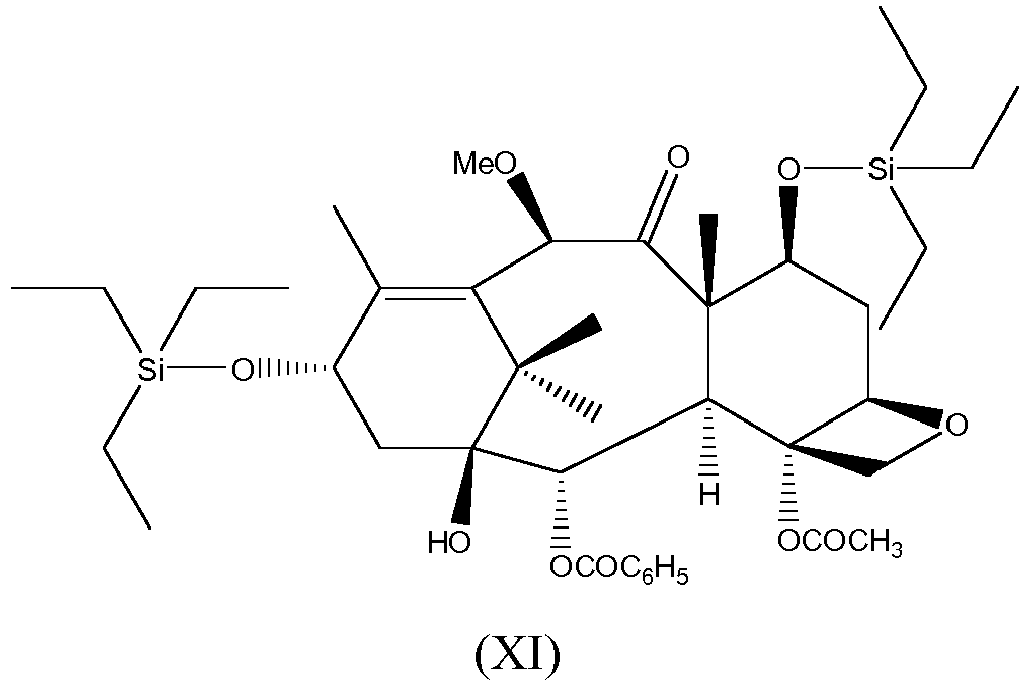 c) deprotecting the silyl group of compound of formula (XI) in the presence of suitable organic solvent and a base to obtain compound of formula (XII);
 d) methylating the compound of formula (XII) in the presence of a suitable organic solvent and a base to give compound of formula (XIII);
 e) deprotecting the silyl group of C-13 position of compound of formula (XIII) in the presence of a suitable organic solvent and a base to obtain compound of formula (II); and
 f) converting the compound of formula (II) into cabazitaxel (I).
 - A compound of formula (XII)

- A compound of formula (XIII)
- The process of claim 1 or 2, wherein the silylating agent is a triethyl silyl halide, especially wherein the triethyl silyl halide is triethyl silyl chloride.
- The process of claim 1 or 2, wherein the silylation is carried out in the presence of an organic or inorganic base, especially in the presence of imidazole.
- The process of claim 1 or 2, wherein the suitable organic solvent for silylation is selected from the group comprising of alcohols, nitriles, chlorinated hydrocarbons, dipolar aprotic solvents, esters, cyclic ethers, and mixtures thereof, especially wherein the solvent is a chlorinated hydrocarbon, especially wherein the chlorinated hydrocarbon is dichloromethane.
- The process of claim 1, wherein the silylation is carried out for 4 to 5 hours.
- The process for claim 2, wherein the silylation is carried out for 18 to 20 hours.
- The process of claim 1 or 2, wherein the silylation is carried out at 20 to 30°C.
- The process of claim 1 or 2, wherein the methylation in step b and step d is carried out in the presence of a base, especially in the presence of sodium hydride.
- The process of claim 1 or 2, wherein the methylation in step b and step d is carried out in the presence of a methylating agent, especially wherein said methylating agent is methyliodide.
- The process of claim 1 or 2, wherein a suitable organic solvent for methylation is selected from the group comprising of alcohols, nitriles, chlorinated hydrocarbons, ethers, dipolar aprotic solvents, esters, cyclic ethers, and mixtures thereof, especially wherein the suitable organic solvent for methylation is tetrahydrofuran or dimethylacetamide.
- The process for claim 1 or 2, wherein the methylation is carried out at -5 to +15°C.
- The process of claim 1 or 2, wherein the deprotection is carried out in the presence of a base, especially wherein the base is tetrabutyl ammonium fluoride (TBAF).
- The process of claim 1 or 2, wherein the suitable organic solvent for deprotection is selected from the group comprising of alcohols, nitriles, chlorinated hydrocarbons, ethers, dipolar aprotic solvents, esters, cyclic ethers, and mixtures thereof, especially wherein the solvent is tetrahydrofuran.
- The process of claim 1 or 2, wherein the deprotection is carried out at -5 to +10°C.
- The process as claimed in claim 1 or claim 2, wherein the obtained cabazitaxel is further converted into isopropanol solvate of cabazitaxel; comprising the additional steps of:a) dissolving cabazitaxel in dichloromethane to obtain a solution,b) adding isopropanol to the solution, andc) isolating isopropanol solvate of cabazitaxel.
- The process according to claim 18 wherein the obtained isopropanol solvate of cabazitaxel is characterized by any one of the following:a) an X-ray powder diffraction (XRD (Cu-K-alpha) pattern having peaks at 7.3678, 7.8537, 8.9596, 10.2918, 12.5727, 12.8651, 13.3343, 13.5721, 14.4207, 14.7600, 15.1798, 15.3152, 15.6282, 15.7413, 16.5402, 16.9857, 17.6849, 17.9590, 18.3018, 18.6973, 18.7727, 19.4610, 20.4624, 20.6809, 21.1058, 21.1565, 21.4007, 21.7609, 21.9196, 22.2176, 23.1030, 23.5156, 23.7025, 24.2617, 24.7859, 25.1584, 25.8322, 26.3237, 27.0935, 27.4874, 27.7876, 28.3142, 28.9803, 30.1735, 30.6174, 31.2054, 31.5714, 32.2104, 32.3404, 32.9802 ±0.2 degrees two-theta;b) an X-ray powder diffraction (XRD) pattern, as depicted in Fig 1.c) a melting endotherm of 156.98°C, as measured by differential scanning calorimetry; ord) a weight loss of about 0.3494%, as measured by a thermo gravimetric analysis (TGA).
Priority Applications (1)
| Application Number | Priority Date | Filing Date | Title |
|---|---|---|---|
| PL12783667T PL2760848T3 (en) | 2011-09-26 | 2012-09-21 | Processes for the preparation of cabazitaxel involving c(7)-oh and c(13)-oh silylation or just c(7)-oh silylation |
Applications Claiming Priority (2)
| Application Number | Priority Date | Filing Date | Title |
|---|---|---|---|
| IN2794DE2011 | 2011-09-26 | ||
| PCT/IN2012/000630 WO2013069027A1 (en) | 2011-09-26 | 2012-09-21 | Processes for the preparation of cabazitaxel involving c(7) -oh and c(13) -oh silylation or just c(7) -oh silylation |
Publications (2)
| Publication Number | Publication Date |
|---|---|
| EP2760848A1 EP2760848A1 (en) | 2014-08-06 |
| EP2760848B1 true EP2760848B1 (en) | 2018-11-28 |
Family
ID=47146459
Family Applications (1)
| Application Number | Title | Priority Date | Filing Date |
|---|---|---|---|
| EP12783667.4A Active EP2760848B1 (en) | 2011-09-26 | 2012-09-21 | Processes for the preparation of cabazitaxel involving c(7)-oh and c(13)-oh silylation or just c(7)-oh silylation |
Country Status (6)
| Country | Link |
|---|---|
| US (2) | US8901327B2 (en) |
| EP (1) | EP2760848B1 (en) |
| CN (1) | CN104039771B (en) |
| ES (1) | ES2712804T3 (en) |
| PL (1) | PL2760848T3 (en) |
| WO (1) | WO2013069027A1 (en) |
Families Citing this family (7)
| Publication number | Priority date | Publication date | Assignee | Title |
|---|---|---|---|---|
| CN103764637A (en) | 2011-04-12 | 2014-04-30 | 普拉斯化学品有限公司 | Solid state forms of cabazitaxel and processes for preparation thereof |
| TWI526437B (en) * | 2011-09-09 | 2016-03-21 | 台灣神隆股份有限公司 | Crystalline forms of cabazitaxel |
| US20130090484A1 (en) * | 2011-10-11 | 2013-04-11 | Scinopharm Taiwan Ltd. | Process for making an intermediate of cabazitaxel |
| KR101407353B1 (en) * | 2012-12-04 | 2014-06-17 | 주식회사 삼양바이오팜 | A novel process for preparing cabazitaxel from 10-deacetyl-baccatin iii with high yield and a novel intermediate for the same |
| CN106632158B (en) * | 2013-08-28 | 2018-11-06 | 江苏恒瑞医药股份有限公司 | The preparation method of 7 β, 10 β-dimethoxy -10- deacetylate Baccatine IIIs |
| CN103664837B (en) * | 2013-08-30 | 2016-01-20 | 北京阳光诺和药物研究有限公司 | A kind of preparation method of high purity Cabazitaxel intermediate |
| CN104292188A (en) * | 2014-08-21 | 2015-01-21 | 四川汇宇制药有限公司 | Cabazitaxel synthetic method |
Family Cites Families (17)
| Publication number | Priority date | Publication date | Assignee | Title |
|---|---|---|---|---|
| US5399726A (en) | 1993-01-29 | 1995-03-21 | Florida State University | Process for the preparation of baccatin III analogs bearing new C2 and C4 functional groups |
| FR2696459B1 (en) | 1992-10-05 | 1994-11-25 | Rhone Poulenc Rorer Sa | Process for the preparation of taxane derivatives. |
| FR2696462B1 (en) | 1992-10-05 | 1994-11-25 | Rhone Poulenc Rorer Sa | Process for obtaining 10-deacetyl baccatin III. |
| US5453521A (en) | 1992-10-05 | 1995-09-26 | Rhone-Poulenc Rorer S.A. | Process for obtaining 10-deacetylbaccatin III |
| FR2696463B1 (en) | 1992-10-05 | 1994-11-25 | Rhone Poulenc Rorer Sa | Process for obtaining 10-deacetyl baccatin III. |
| US6500858B2 (en) | 1994-10-28 | 2002-12-31 | The Research Foundation Of The State University Of New York | Taxoid anti-tumor agents and pharmaceutical compositions thereof |
| US5847170A (en) | 1995-03-27 | 1998-12-08 | Rhone-Poulenc Rorer, S.A. | Taxoids, their preparation and pharmaceutical compositions containing them |
| MA23823A1 (en) * | 1995-03-27 | 1996-10-01 | Aventis Pharma Sa | NEW TAXOIDS, THEIR PREPARATION AND THE COMPOSITIONS CONTAINING THEM |
| US6372780B2 (en) * | 1995-03-27 | 2002-04-16 | Aventis Pharma S.A. | Methods of treating cell lines expressing multidrug resistance P-glycoprotein |
| FR2771092B1 (en) * | 1997-11-18 | 1999-12-17 | Rhone Poulenc Rorer Sa | PROCESS FOR THE PREPARATION OF DERIVATIVES OF THE TAXOID CLASS |
| US6124482A (en) | 1998-07-27 | 2000-09-26 | Dabur Research Foundation | Process for isolation of 10-deacetyl baccatin-III |
| US6410757B1 (en) | 1999-02-16 | 2002-06-25 | Bio Research Corporation Of Yokohama | Baccatin derivatives and a process for producing the same |
| AU2005245396A1 (en) | 2004-05-14 | 2005-12-01 | Immunogen, Inc. | A facile method for synthesizing baccatin III compounds |
| FR2926551A1 (en) * | 2008-01-17 | 2009-07-24 | Aventis Pharma Sa | CRYSTALLINE FORMS OF DIMETHOXY DOCETAXEL AND METHODS FOR PREPARING SAME |
| US8791279B2 (en) * | 2010-12-13 | 2014-07-29 | Yung Shin Pharm. Ind. Co., Ltd. | Process for preparing taxoids from baccatin derivatives using lewis acid catalyst |
| WO2012088391A1 (en) * | 2010-12-22 | 2012-06-28 | Nektar Therapeutics | Non-ring hydroxy substituted taxanes and methods for synthesizing the same |
| CN103764637A (en) * | 2011-04-12 | 2014-04-30 | 普拉斯化学品有限公司 | Solid state forms of cabazitaxel and processes for preparation thereof |
-
2012
- 2012-09-21 ES ES12783667T patent/ES2712804T3/en active Active
- 2012-09-21 WO PCT/IN2012/000630 patent/WO2013069027A1/en not_active Ceased
- 2012-09-21 EP EP12783667.4A patent/EP2760848B1/en active Active
- 2012-09-21 PL PL12783667T patent/PL2760848T3/en unknown
- 2012-09-21 CN CN201280046984.6A patent/CN104039771B/en not_active Expired - Fee Related
- 2012-09-24 US US13/625,155 patent/US8901327B2/en active Active
-
2014
- 2014-11-05 US US14/533,412 patent/US9000193B2/en active Active
Non-Patent Citations (1)
| Title |
|---|
| None * |
Also Published As
| Publication number | Publication date |
|---|---|
| US9000193B2 (en) | 2015-04-07 |
| EP2760848A1 (en) | 2014-08-06 |
| US20150057454A1 (en) | 2015-02-26 |
| US20140058119A1 (en) | 2014-02-27 |
| WO2013069027A1 (en) | 2013-05-16 |
| CN104039771A (en) | 2014-09-10 |
| CN104039771B (en) | 2017-10-27 |
| US8901327B2 (en) | 2014-12-02 |
| PL2760848T3 (en) | 2019-07-31 |
| WO2013069027A9 (en) | 2013-10-17 |
| ES2712804T3 (en) | 2019-05-14 |
Similar Documents
| Publication | Publication Date | Title |
|---|---|---|
| US9000193B2 (en) | Process for the preparation of cabazitaxel | |
| AU678423B2 (en) | 2-debenzoyl-2-acyl taxol derivatives and methods for making same | |
| US7186851B2 (en) | Facile method for synthesizing baccatin III compounds | |
| US8722900B2 (en) | Process for cabazitaxel, and intermediates thereof | |
| US20100317868A1 (en) | Method of preparing taxane derivatives and intermediates used therein | |
| CN103172625B (en) | The midbody compound of Cabazitaxel | |
| WO2002012216A1 (en) | An improved process for the preparation of docetaxel | |
| JP6097405B2 (en) | Novel process for producing cabazitaxel in high yield from 10-deacetylbaccatin III | |
| KR101032761B1 (en) | Method for preparing docetaxel and novel intermediates for the production of docetaxel | |
| KR101003820B1 (en) | Method for preparing docetaxel and novel intermediates for the production of docetaxel | |
| KR101009467B1 (en) | Taxane derivatives useful for the synthesis of docetaxel and preparation methods thereof | |
| KR101003822B1 (en) | Method for preparing docetaxel and novel intermediates for the production of docetaxel | |
| EP2298754B1 (en) | Preparation of taxane derivatives | |
| CN103172654B (en) | Bearing taxanes and preparation method thereof | |
| CN101128449A (en) | Method for preparing docetaxel | |
| JP5870197B2 (en) | Method for producing taxane derivative | |
| CN115057833A (en) | Synthetic route and intermediate compound of anticancer drug cabazitaxel | |
| HK1135104A (en) | Method of preparing taxane derivatives and intermediates used therein | |
| WO2005016904A1 (en) | Process for preparing 4-alkyl-or 4-aryl-oxycarbonyl paclitaxel analogs and novel intermediates | |
| CN103172654A (en) | Taxane compound and preparation method thereof |
Legal Events
| Date | Code | Title | Description |
|---|---|---|---|
| PUAI | Public reference made under article 153(3) epc to a published international application that has entered the european phase |
Free format text: ORIGINAL CODE: 0009012 |
|
| 17P | Request for examination filed |
Effective date: 20140423 |
|
| AK | Designated contracting states |
Kind code of ref document: A1 Designated state(s): AL AT BE BG CH CY CZ DE DK EE ES FI FR GB GR HR HU IE IS IT LI LT LU LV MC MK MT NL NO PL PT RO RS SE SI SK SM TR |
|
| DAX | Request for extension of the european patent (deleted) | ||
| STAA | Information on the status of an ep patent application or granted ep patent |
Free format text: STATUS: EXAMINATION IS IN PROGRESS |
|
| 17Q | First examination report despatched |
Effective date: 20170929 |
|
| REG | Reference to a national code |
Ref country code: DE Ref legal event code: R079 Ref document number: 602012054115 Country of ref document: DE Free format text: PREVIOUS MAIN CLASS: C07D0305140000 Ipc: C07F0007180000 |
|
| GRAP | Despatch of communication of intention to grant a patent |
Free format text: ORIGINAL CODE: EPIDOSNIGR1 |
|
| STAA | Information on the status of an ep patent application or granted ep patent |
Free format text: STATUS: GRANT OF PATENT IS INTENDED |
|
| RIC1 | Information provided on ipc code assigned before grant |
Ipc: C07F 7/18 20060101AFI20180220BHEP Ipc: A61K 31/335 20060101ALI20180220BHEP Ipc: C07D 305/14 20060101ALI20180220BHEP |
|
| INTG | Intention to grant announced |
Effective date: 20180320 |
|
| GRAS | Grant fee paid |
Free format text: ORIGINAL CODE: EPIDOSNIGR3 |
|
| GRAA | (expected) grant |
Free format text: ORIGINAL CODE: 0009210 |
|
| STAA | Information on the status of an ep patent application or granted ep patent |
Free format text: STATUS: THE PATENT HAS BEEN GRANTED |
|
| AK | Designated contracting states |
Kind code of ref document: B1 Designated state(s): AL AT BE BG CH CY CZ DE DK EE ES FI FR GB GR HR HU IE IS IT LI LT LU LV MC MK MT NL NO PL PT RO RS SE SI SK SM TR |
|
| REG | Reference to a national code |
Ref country code: GB Ref legal event code: FG4D |
|
| REG | Reference to a national code |
Ref country code: CH Ref legal event code: EP |
|
| REG | Reference to a national code |
Ref country code: AT Ref legal event code: REF Ref document number: 1070088 Country of ref document: AT Kind code of ref document: T Effective date: 20181215 |
|
| REG | Reference to a national code |
Ref country code: DE Ref legal event code: R096 Ref document number: 602012054115 Country of ref document: DE |
|
| REG | Reference to a national code |
Ref country code: IE Ref legal event code: FG4D |
|
| REG | Reference to a national code |
Ref country code: DE Ref legal event code: R081 Ref document number: 602012054115 Country of ref document: DE Owner name: FRESENIUS KABI ONCOLOGY LTD., IN Free format text: FORMER OWNERS: AZIM, ABUL, GURGAON, HARYANA, IN; FRESENIUS KABI ONCOLOGY LTD., NEW DEHLI, IN; GUPTA, NITIN, GURGAON, HARYANA, IN; LAHIRI, SASWATA, GURGAON, HARYANA, IN; MISHRA, BHUWAN BHASKAR, GURGAON, HARYANA, IN; PANDA, NILENDU, GURGAON, HARYANA, IN; SANGHANI, SUNIL, GURGAON, HARYANA, IN |
|
| RAP2 | Party data changed (patent owner data changed or rights of a patent transferred) |
Owner name: FRESENIUS KABI ONCOLOGY LIMITED |
|
| REG | Reference to a national code |
Ref country code: NL Ref legal event code: MP Effective date: 20181128 |
|
| REG | Reference to a national code |
Ref country code: LT Ref legal event code: MG4D |
|
| REG | Reference to a national code |
Ref country code: AT Ref legal event code: MK05 Ref document number: 1070088 Country of ref document: AT Kind code of ref document: T Effective date: 20181128 |
|
| REG | Reference to a national code |
Ref country code: GB Ref legal event code: 732E Free format text: REGISTERED BETWEEN 20190321 AND 20190327 |
|
| PG25 | Lapsed in a contracting state [announced via postgrant information from national office to epo] |
Ref country code: IS Free format text: LAPSE BECAUSE OF FAILURE TO SUBMIT A TRANSLATION OF THE DESCRIPTION OR TO PAY THE FEE WITHIN THE PRESCRIBED TIME-LIMIT Effective date: 20190328 Ref country code: FI Free format text: LAPSE BECAUSE OF FAILURE TO SUBMIT A TRANSLATION OF THE DESCRIPTION OR TO PAY THE FEE WITHIN THE PRESCRIBED TIME-LIMIT Effective date: 20181128 Ref country code: HR Free format text: LAPSE BECAUSE OF FAILURE TO SUBMIT A TRANSLATION OF THE DESCRIPTION OR TO PAY THE FEE WITHIN THE PRESCRIBED TIME-LIMIT Effective date: 20181128 Ref country code: AT Free format text: LAPSE BECAUSE OF FAILURE TO SUBMIT A TRANSLATION OF THE DESCRIPTION OR TO PAY THE FEE WITHIN THE PRESCRIBED TIME-LIMIT Effective date: 20181128 Ref country code: LT Free format text: LAPSE BECAUSE OF FAILURE TO SUBMIT A TRANSLATION OF THE DESCRIPTION OR TO PAY THE FEE WITHIN THE PRESCRIBED TIME-LIMIT Effective date: 20181128 Ref country code: LV Free format text: LAPSE BECAUSE OF FAILURE TO SUBMIT A TRANSLATION OF THE DESCRIPTION OR TO PAY THE FEE WITHIN THE PRESCRIBED TIME-LIMIT Effective date: 20181128 Ref country code: NO Free format text: LAPSE BECAUSE OF FAILURE TO SUBMIT A TRANSLATION OF THE DESCRIPTION OR TO PAY THE FEE WITHIN THE PRESCRIBED TIME-LIMIT Effective date: 20190228 Ref country code: BG Free format text: LAPSE BECAUSE OF FAILURE TO SUBMIT A TRANSLATION OF THE DESCRIPTION OR TO PAY THE FEE WITHIN THE PRESCRIBED TIME-LIMIT Effective date: 20190228 |
|
| REG | Reference to a national code |
Ref country code: ES Ref legal event code: FG2A Ref document number: 2712804 Country of ref document: ES Kind code of ref document: T3 Effective date: 20190514 |
|
| PG25 | Lapsed in a contracting state [announced via postgrant information from national office to epo] |
Ref country code: PT Free format text: LAPSE BECAUSE OF FAILURE TO SUBMIT A TRANSLATION OF THE DESCRIPTION OR TO PAY THE FEE WITHIN THE PRESCRIBED TIME-LIMIT Effective date: 20190328 Ref country code: AL Free format text: LAPSE BECAUSE OF FAILURE TO SUBMIT A TRANSLATION OF THE DESCRIPTION OR TO PAY THE FEE WITHIN THE PRESCRIBED TIME-LIMIT Effective date: 20181128 Ref country code: SE Free format text: LAPSE BECAUSE OF FAILURE TO SUBMIT A TRANSLATION OF THE DESCRIPTION OR TO PAY THE FEE WITHIN THE PRESCRIBED TIME-LIMIT Effective date: 20181128 Ref country code: RS Free format text: LAPSE BECAUSE OF FAILURE TO SUBMIT A TRANSLATION OF THE DESCRIPTION OR TO PAY THE FEE WITHIN THE PRESCRIBED TIME-LIMIT Effective date: 20181128 Ref country code: GR Free format text: LAPSE BECAUSE OF FAILURE TO SUBMIT A TRANSLATION OF THE DESCRIPTION OR TO PAY THE FEE WITHIN THE PRESCRIBED TIME-LIMIT Effective date: 20190301 |
|
| PG25 | Lapsed in a contracting state [announced via postgrant information from national office to epo] |
Ref country code: NL Free format text: LAPSE BECAUSE OF FAILURE TO SUBMIT A TRANSLATION OF THE DESCRIPTION OR TO PAY THE FEE WITHIN THE PRESCRIBED TIME-LIMIT Effective date: 20181128 |
|
| PG25 | Lapsed in a contracting state [announced via postgrant information from national office to epo] |
Ref country code: DK Free format text: LAPSE BECAUSE OF FAILURE TO SUBMIT A TRANSLATION OF THE DESCRIPTION OR TO PAY THE FEE WITHIN THE PRESCRIBED TIME-LIMIT Effective date: 20181128 |
|
| REG | Reference to a national code |
Ref country code: DE Ref legal event code: R097 Ref document number: 602012054115 Country of ref document: DE |
|
| PG25 | Lapsed in a contracting state [announced via postgrant information from national office to epo] |
Ref country code: RO Free format text: LAPSE BECAUSE OF FAILURE TO SUBMIT A TRANSLATION OF THE DESCRIPTION OR TO PAY THE FEE WITHIN THE PRESCRIBED TIME-LIMIT Effective date: 20181128 Ref country code: SM Free format text: LAPSE BECAUSE OF FAILURE TO SUBMIT A TRANSLATION OF THE DESCRIPTION OR TO PAY THE FEE WITHIN THE PRESCRIBED TIME-LIMIT Effective date: 20181128 Ref country code: EE Free format text: LAPSE BECAUSE OF FAILURE TO SUBMIT A TRANSLATION OF THE DESCRIPTION OR TO PAY THE FEE WITHIN THE PRESCRIBED TIME-LIMIT Effective date: 20181128 Ref country code: SK Free format text: LAPSE BECAUSE OF FAILURE TO SUBMIT A TRANSLATION OF THE DESCRIPTION OR TO PAY THE FEE WITHIN THE PRESCRIBED TIME-LIMIT Effective date: 20181128 |
|
| PLBE | No opposition filed within time limit |
Free format text: ORIGINAL CODE: 0009261 |
|
| STAA | Information on the status of an ep patent application or granted ep patent |
Free format text: STATUS: NO OPPOSITION FILED WITHIN TIME LIMIT |
|
| PG25 | Lapsed in a contracting state [announced via postgrant information from national office to epo] |
Ref country code: SI Free format text: LAPSE BECAUSE OF FAILURE TO SUBMIT A TRANSLATION OF THE DESCRIPTION OR TO PAY THE FEE WITHIN THE PRESCRIBED TIME-LIMIT Effective date: 20181128 |
|
| 26N | No opposition filed |
Effective date: 20190829 |
|
| PG25 | Lapsed in a contracting state [announced via postgrant information from national office to epo] |
Ref country code: TR Free format text: LAPSE BECAUSE OF FAILURE TO SUBMIT A TRANSLATION OF THE DESCRIPTION OR TO PAY THE FEE WITHIN THE PRESCRIBED TIME-LIMIT Effective date: 20181128 |
|
| PG25 | Lapsed in a contracting state [announced via postgrant information from national office to epo] |
Ref country code: MC Free format text: LAPSE BECAUSE OF FAILURE TO SUBMIT A TRANSLATION OF THE DESCRIPTION OR TO PAY THE FEE WITHIN THE PRESCRIBED TIME-LIMIT Effective date: 20181128 |
|
| PG25 | Lapsed in a contracting state [announced via postgrant information from national office to epo] |
Ref country code: LU Free format text: LAPSE BECAUSE OF NON-PAYMENT OF DUE FEES Effective date: 20190921 |
|
| REG | Reference to a national code |
Ref country code: BE Ref legal event code: MM Effective date: 20190930 |
|
| PG25 | Lapsed in a contracting state [announced via postgrant information from national office to epo] |
Ref country code: BE Free format text: LAPSE BECAUSE OF NON-PAYMENT OF DUE FEES Effective date: 20190930 |
|
| PG25 | Lapsed in a contracting state [announced via postgrant information from national office to epo] |
Ref country code: CY Free format text: LAPSE BECAUSE OF FAILURE TO SUBMIT A TRANSLATION OF THE DESCRIPTION OR TO PAY THE FEE WITHIN THE PRESCRIBED TIME-LIMIT Effective date: 20181128 |
|
| PG25 | Lapsed in a contracting state [announced via postgrant information from national office to epo] |
Ref country code: HU Free format text: LAPSE BECAUSE OF FAILURE TO SUBMIT A TRANSLATION OF THE DESCRIPTION OR TO PAY THE FEE WITHIN THE PRESCRIBED TIME-LIMIT; INVALID AB INITIO Effective date: 20120921 |
|
| PG25 | Lapsed in a contracting state [announced via postgrant information from national office to epo] |
Ref country code: MK Free format text: LAPSE BECAUSE OF FAILURE TO SUBMIT A TRANSLATION OF THE DESCRIPTION OR TO PAY THE FEE WITHIN THE PRESCRIBED TIME-LIMIT Effective date: 20181128 |
|
| PGFP | Annual fee paid to national office [announced via postgrant information from national office to epo] |
Ref country code: IE Payment date: 20220823 Year of fee payment: 11 Ref country code: GB Payment date: 20220823 Year of fee payment: 11 Ref country code: DE Payment date: 20220916 Year of fee payment: 11 Ref country code: CZ Payment date: 20220829 Year of fee payment: 11 |
|
| PGFP | Annual fee paid to national office [announced via postgrant information from national office to epo] |
Ref country code: PL Payment date: 20220822 Year of fee payment: 11 Ref country code: FR Payment date: 20220822 Year of fee payment: 11 |
|
| PGFP | Annual fee paid to national office [announced via postgrant information from national office to epo] |
Ref country code: IT Payment date: 20220915 Year of fee payment: 11 Ref country code: ES Payment date: 20221006 Year of fee payment: 11 |
|
| PGFP | Annual fee paid to national office [announced via postgrant information from national office to epo] |
Ref country code: CH Payment date: 20220907 Year of fee payment: 11 |
|
| PGFP | Annual fee paid to national office [announced via postgrant information from national office to epo] |
Ref country code: MT Payment date: 20220823 Year of fee payment: 11 |
|
| REG | Reference to a national code |
Ref country code: DE Ref legal event code: R119 Ref document number: 602012054115 Country of ref document: DE |
|
| PG25 | Lapsed in a contracting state [announced via postgrant information from national office to epo] |
Ref country code: CZ Free format text: LAPSE BECAUSE OF NON-PAYMENT OF DUE FEES Effective date: 20230921 |
|
| REG | Reference to a national code |
Ref country code: CH Ref legal event code: PL |
|
| GBPC | Gb: european patent ceased through non-payment of renewal fee |
Effective date: 20230921 |
|
| REG | Reference to a national code |
Ref country code: IE Ref legal event code: MM4A |
|
| PG25 | Lapsed in a contracting state [announced via postgrant information from national office to epo] |
Ref country code: IE Free format text: LAPSE BECAUSE OF NON-PAYMENT OF DUE FEES Effective date: 20230921 |
|
| PG25 | Lapsed in a contracting state [announced via postgrant information from national office to epo] |
Ref country code: GB Free format text: LAPSE BECAUSE OF NON-PAYMENT OF DUE FEES Effective date: 20230921 |
|
| PG25 | Lapsed in a contracting state [announced via postgrant information from national office to epo] |
Ref country code: CH Free format text: LAPSE BECAUSE OF NON-PAYMENT OF DUE FEES Effective date: 20230930 |
|
| PG25 | Lapsed in a contracting state [announced via postgrant information from national office to epo] |
Ref country code: IE Free format text: LAPSE BECAUSE OF NON-PAYMENT OF DUE FEES Effective date: 20230921 Ref country code: GB Free format text: LAPSE BECAUSE OF NON-PAYMENT OF DUE FEES Effective date: 20230921 Ref country code: FR Free format text: LAPSE BECAUSE OF NON-PAYMENT OF DUE FEES Effective date: 20230930 Ref country code: DE Free format text: LAPSE BECAUSE OF NON-PAYMENT OF DUE FEES Effective date: 20240403 Ref country code: CH Free format text: LAPSE BECAUSE OF NON-PAYMENT OF DUE FEES Effective date: 20230930 |
|
| PG25 | Lapsed in a contracting state [announced via postgrant information from national office to epo] |
Ref country code: PL Free format text: LAPSE BECAUSE OF NON-PAYMENT OF DUE FEES Effective date: 20230921 |
|
| PG25 | Lapsed in a contracting state [announced via postgrant information from national office to epo] |
Ref country code: PL Free format text: LAPSE BECAUSE OF NON-PAYMENT OF DUE FEES Effective date: 20230921 |
|
| REG | Reference to a national code |
Ref country code: ES Ref legal event code: FD2A Effective date: 20241031 |
|
| PG25 | Lapsed in a contracting state [announced via postgrant information from national office to epo] |
Ref country code: IT Free format text: LAPSE BECAUSE OF NON-PAYMENT OF DUE FEES Effective date: 20230921 |
|
| PG25 | Lapsed in a contracting state [announced via postgrant information from national office to epo] |
Ref country code: IT Free format text: LAPSE BECAUSE OF NON-PAYMENT OF DUE FEES Effective date: 20230921 |
|
| PG25 | Lapsed in a contracting state [announced via postgrant information from national office to epo] |
Ref country code: ES Free format text: LAPSE BECAUSE OF NON-PAYMENT OF DUE FEES Effective date: 20230922 |
|
| PG25 | Lapsed in a contracting state [announced via postgrant information from national office to epo] |
Ref country code: ES Free format text: LAPSE BECAUSE OF NON-PAYMENT OF DUE FEES Effective date: 20230922 |