EP2759199A1 - A method of providing antimicrobial action and a synergistic antimicrobial composition thereof - Google Patents
A method of providing antimicrobial action and a synergistic antimicrobial composition thereof Download PDFInfo
- Publication number
- EP2759199A1 EP2759199A1 EP13152865.5A EP13152865A EP2759199A1 EP 2759199 A1 EP2759199 A1 EP 2759199A1 EP 13152865 A EP13152865 A EP 13152865A EP 2759199 A1 EP2759199 A1 EP 2759199A1
- Authority
- EP
- European Patent Office
- Prior art keywords
- composition
- alkyl
- tyramine
- terpineol
- antimicrobial
- Prior art date
- Legal status (The legal status is an assumption and is not a legal conclusion. Google has not performed a legal analysis and makes no representation as to the accuracy of the status listed.)
- Withdrawn
Links
- 239000000203 mixture Substances 0.000 title claims abstract description 102
- 230000000845 anti-microbial effect Effects 0.000 title claims abstract description 45
- 238000000034 method Methods 0.000 title claims abstract description 24
- 230000002195 synergetic effect Effects 0.000 title claims abstract description 12
- 229960003732 tyramine Drugs 0.000 claims abstract description 47
- DZGWFCGJZKJUFP-UHFFFAOYSA-N Tyramine Natural products NCCC1=CC=C(O)C=C1 DZGWFCGJZKJUFP-UHFFFAOYSA-N 0.000 claims abstract description 40
- -1 alkyl tyramine Chemical compound 0.000 claims abstract description 30
- MGSRCZKZVOBKFT-UHFFFAOYSA-N thymol Chemical compound CC(C)C1=CC=C(C)C=C1O MGSRCZKZVOBKFT-UHFFFAOYSA-N 0.000 claims description 50
- GLZPCOQZEFWAFX-UHFFFAOYSA-N Geraniol Chemical compound CC(C)=CCCC(C)=CCO GLZPCOQZEFWAFX-UHFFFAOYSA-N 0.000 claims description 47
- RRAFCDWBNXTKKO-UHFFFAOYSA-N eugenol Chemical compound COC1=CC(CC=C)=CC=C1O RRAFCDWBNXTKKO-UHFFFAOYSA-N 0.000 claims description 28
- WUOACPNHFRMFPN-UHFFFAOYSA-N alpha-terpineol Chemical compound CC1=CCC(C(C)(C)O)CC1 WUOACPNHFRMFPN-UHFFFAOYSA-N 0.000 claims description 27
- SQIFACVGCPWBQZ-UHFFFAOYSA-N delta-terpineol Natural products CC(C)(O)C1CCC(=C)CC1 SQIFACVGCPWBQZ-UHFFFAOYSA-N 0.000 claims description 27
- 229940116411 terpineol Drugs 0.000 claims description 27
- CDOSHBSSFJOMGT-UHFFFAOYSA-N linalool Chemical compound CC(C)=CCCC(C)(O)C=C CDOSHBSSFJOMGT-UHFFFAOYSA-N 0.000 claims description 26
- 239000005844 Thymol Substances 0.000 claims description 25
- 229960000790 thymol Drugs 0.000 claims description 25
- 239000000344 soap Substances 0.000 claims description 19
- 239000000341 volatile oil Substances 0.000 claims description 18
- 239000004094 surface-active agent Substances 0.000 claims description 16
- 239000000758 substrate Substances 0.000 claims description 15
- NPBVQXIMTZKSBA-UHFFFAOYSA-N Chavibetol Natural products COC1=CC=C(CC=C)C=C1O NPBVQXIMTZKSBA-UHFFFAOYSA-N 0.000 claims description 14
- 239000005770 Eugenol Substances 0.000 claims description 14
- UVMRYBDEERADNV-UHFFFAOYSA-N Pseudoeugenol Natural products COC1=CC(C(C)=C)=CC=C1O UVMRYBDEERADNV-UHFFFAOYSA-N 0.000 claims description 14
- 229960002217 eugenol Drugs 0.000 claims description 14
- GLZPCOQZEFWAFX-YFHOEESVSA-N Geraniol Natural products CC(C)=CCC\C(C)=C/CO GLZPCOQZEFWAFX-YFHOEESVSA-N 0.000 claims description 13
- 239000005792 Geraniol Substances 0.000 claims description 13
- 229940113087 geraniol Drugs 0.000 claims description 13
- XLYOFNOQVPJJNP-UHFFFAOYSA-N water Substances O XLYOFNOQVPJJNP-UHFFFAOYSA-N 0.000 claims description 13
- GLZPCOQZEFWAFX-JXMROGBWSA-N Nerol Natural products CC(C)=CCC\C(C)=C\CO GLZPCOQZEFWAFX-JXMROGBWSA-N 0.000 claims description 11
- 239000001490 (3R)-3,7-dimethylocta-1,6-dien-3-ol Substances 0.000 claims description 10
- CDOSHBSSFJOMGT-JTQLQIEISA-N (R)-linalool Natural products CC(C)=CCC[C@@](C)(O)C=C CDOSHBSSFJOMGT-JTQLQIEISA-N 0.000 claims description 10
- 229930007744 linalool Natural products 0.000 claims description 10
- 125000006539 C12 alkyl group Chemical group [H]C([H])([H])C([H])([H])C([H])([H])C([H])([H])C([H])([H])C([H])([H])C([H])([H])C([H])([H])C([H])([H])C([H])([H])C([H])([H])C([H])([H])* 0.000 claims description 8
- 229910021653 sulphate ion Inorganic materials 0.000 claims description 5
- 239000002904 solvent Substances 0.000 claims description 4
- 150000004996 alkyl benzenes Chemical class 0.000 claims description 3
- DZGWFCGJZKJUFP-UHFFFAOYSA-O tyraminium Chemical compound [NH3+]CCC1=CC=C(O)C=C1 DZGWFCGJZKJUFP-UHFFFAOYSA-O 0.000 description 19
- 238000004140 cleaning Methods 0.000 description 14
- 230000009467 reduction Effects 0.000 description 10
- 241000894006 Bacteria Species 0.000 description 8
- 125000000217 alkyl group Chemical group 0.000 description 8
- 230000000249 desinfective effect Effects 0.000 description 7
- 210000001541 thymus gland Anatomy 0.000 description 7
- 239000007788 liquid Substances 0.000 description 6
- LFQSCWFLJHTTHZ-UHFFFAOYSA-N Ethanol Chemical compound CCO LFQSCWFLJHTTHZ-UHFFFAOYSA-N 0.000 description 5
- 240000002657 Thymus vulgaris Species 0.000 description 5
- 241000588724 Escherichia coli Species 0.000 description 4
- 230000000844 anti-bacterial effect Effects 0.000 description 4
- 239000004615 ingredient Substances 0.000 description 4
- 244000005700 microbiome Species 0.000 description 4
- 239000003921 oil Substances 0.000 description 4
- 235000019198 oils Nutrition 0.000 description 4
- 230000008569 process Effects 0.000 description 4
- ICUTUKXCWQYESQ-UHFFFAOYSA-N triclocarban Chemical compound C1=CC(Cl)=CC=C1NC(=O)NC1=CC=C(Cl)C(Cl)=C1 ICUTUKXCWQYESQ-UHFFFAOYSA-N 0.000 description 4
- 239000006150 trypticase soy agar Substances 0.000 description 4
- 238000005406 washing Methods 0.000 description 4
- 235000007303 Thymus vulgaris Nutrition 0.000 description 3
- XEFQLINVKFYRCS-UHFFFAOYSA-N Triclosan Chemical compound OC1=CC(Cl)=CC=C1OC1=CC=C(Cl)C=C1Cl XEFQLINVKFYRCS-UHFFFAOYSA-N 0.000 description 3
- 230000009471 action Effects 0.000 description 3
- 239000003945 anionic surfactant Substances 0.000 description 3
- 230000008901 benefit Effects 0.000 description 3
- 150000001768 cations Chemical class 0.000 description 3
- 235000014113 dietary fatty acids Nutrition 0.000 description 3
- 239000003925 fat Substances 0.000 description 3
- 235000019197 fats Nutrition 0.000 description 3
- 239000000194 fatty acid Substances 0.000 description 3
- 229930195729 fatty acid Natural products 0.000 description 3
- 150000004665 fatty acids Chemical class 0.000 description 3
- 229910052708 sodium Inorganic materials 0.000 description 3
- 239000011734 sodium Substances 0.000 description 3
- 239000008247 solid mixture Substances 0.000 description 3
- 238000004659 sterilization and disinfection Methods 0.000 description 3
- 239000003760 tallow Substances 0.000 description 3
- 239000012085 test solution Substances 0.000 description 3
- 239000001585 thymus vulgaris Substances 0.000 description 3
- WUOACPNHFRMFPN-SECBINFHSA-N (S)-(-)-alpha-terpineol Chemical compound CC1=CC[C@@H](C(C)(C)O)CC1 WUOACPNHFRMFPN-SECBINFHSA-N 0.000 description 2
- QGZKDVFQNNGYKY-UHFFFAOYSA-O Ammonium Chemical compound [NH4+] QGZKDVFQNNGYKY-UHFFFAOYSA-O 0.000 description 2
- KWIUHFFTVRNATP-UHFFFAOYSA-N Betaine Natural products C[N+](C)(C)CC([O-])=O KWIUHFFTVRNATP-UHFFFAOYSA-N 0.000 description 2
- ZAMOUSCENKQFHK-UHFFFAOYSA-N Chlorine atom Chemical compound [Cl] ZAMOUSCENKQFHK-UHFFFAOYSA-N 0.000 description 2
- 241000196324 Embryophyta Species 0.000 description 2
- IAYPIBMASNFSPL-UHFFFAOYSA-N Ethylene oxide Chemical group C1CO1 IAYPIBMASNFSPL-UHFFFAOYSA-N 0.000 description 2
- 244000068988 Glycine max Species 0.000 description 2
- 235000010469 Glycine max Nutrition 0.000 description 2
- DGAQECJNVWCQMB-PUAWFVPOSA-M Ilexoside XXIX Chemical compound C[C@@H]1CC[C@@]2(CC[C@@]3(C(=CC[C@H]4[C@]3(CC[C@@H]5[C@@]4(CC[C@@H](C5(C)C)OS(=O)(=O)[O-])C)C)[C@@H]2[C@]1(C)O)C)C(=O)O[C@H]6[C@@H]([C@H]([C@@H]([C@H](O6)CO)O)O)O.[Na+] DGAQECJNVWCQMB-PUAWFVPOSA-M 0.000 description 2
- KWIUHFFTVRNATP-UHFFFAOYSA-O N,N,N-trimethylglycinium Chemical group C[N+](C)(C)CC(O)=O KWIUHFFTVRNATP-UHFFFAOYSA-O 0.000 description 2
- ZLMJMSJWJFRBEC-UHFFFAOYSA-N Potassium Chemical compound [K] ZLMJMSJWJFRBEC-UHFFFAOYSA-N 0.000 description 2
- FAPWRFPIFSIZLT-UHFFFAOYSA-M Sodium chloride Chemical compound [Na+].[Cl-] FAPWRFPIFSIZLT-UHFFFAOYSA-M 0.000 description 2
- DBMJMQXJHONAFJ-UHFFFAOYSA-M Sodium laurylsulphate Chemical compound [Na+].CCCCCCCCCCCCOS([O-])(=O)=O DBMJMQXJHONAFJ-UHFFFAOYSA-M 0.000 description 2
- 239000004141 Sodium laurylsulphate Substances 0.000 description 2
- 241000700605 Viruses Species 0.000 description 2
- 206010000496 acne Diseases 0.000 description 2
- 229910052783 alkali metal Inorganic materials 0.000 description 2
- 150000001340 alkali metals Chemical class 0.000 description 2
- OVKDFILSBMEKLT-UHFFFAOYSA-N alpha-Terpineol Natural products CC(=C)C1(O)CCC(C)=CC1 OVKDFILSBMEKLT-UHFFFAOYSA-N 0.000 description 2
- 229940088601 alpha-terpineol Drugs 0.000 description 2
- 239000002280 amphoteric surfactant Substances 0.000 description 2
- 125000000129 anionic group Chemical group 0.000 description 2
- 238000003556 assay Methods 0.000 description 2
- QVGXLLKOCUKJST-UHFFFAOYSA-N atomic oxygen Chemical compound [O] QVGXLLKOCUKJST-UHFFFAOYSA-N 0.000 description 2
- 229960003237 betaine Drugs 0.000 description 2
- 229910052801 chlorine Inorganic materials 0.000 description 2
- 239000000460 chlorine Substances 0.000 description 2
- MRUAUOIMASANKQ-UHFFFAOYSA-N cocamidopropyl betaine Chemical group CCCCCCCCCCCC(=O)NCCC[N+](C)(C)CC([O-])=O MRUAUOIMASANKQ-UHFFFAOYSA-N 0.000 description 2
- 150000001875 compounds Chemical class 0.000 description 2
- 230000000694 effects Effects 0.000 description 2
- 238000002474 experimental method Methods 0.000 description 2
- NNRLDGQZIVUQTE-UHFFFAOYSA-N gamma-Terpineol Chemical compound CC(C)=C1CCC(C)(O)CC1 NNRLDGQZIVUQTE-UHFFFAOYSA-N 0.000 description 2
- LHGVFZTZFXWLCP-UHFFFAOYSA-N guaiacol Chemical class COC1=CC=CC=C1O LHGVFZTZFXWLCP-UHFFFAOYSA-N 0.000 description 2
- 210000004247 hand Anatomy 0.000 description 2
- 239000006210 lotion Substances 0.000 description 2
- 239000000463 material Substances 0.000 description 2
- 229930003658 monoterpene Natural products 0.000 description 2
- 150000002773 monoterpene derivatives Chemical class 0.000 description 2
- 210000000214 mouth Anatomy 0.000 description 2
- 229940051866 mouthwash Drugs 0.000 description 2
- 239000007800 oxidant agent Substances 0.000 description 2
- 229910052760 oxygen Inorganic materials 0.000 description 2
- 239000001301 oxygen Substances 0.000 description 2
- 239000002304 perfume Substances 0.000 description 2
- 229910052700 potassium Inorganic materials 0.000 description 2
- 239000011591 potassium Substances 0.000 description 2
- 235000019333 sodium laurylsulphate Nutrition 0.000 description 2
- 239000007787 solid Substances 0.000 description 2
- 235000013599 spices Nutrition 0.000 description 2
- 239000010678 thyme oil Substances 0.000 description 2
- 239000000606 toothpaste Substances 0.000 description 2
- 229940034610 toothpaste Drugs 0.000 description 2
- 229960003500 triclosan Drugs 0.000 description 2
- DNIAPMSPPWPWGF-GSVOUGTGSA-N (R)-(-)-Propylene glycol Chemical compound C[C@@H](O)CO DNIAPMSPPWPWGF-GSVOUGTGSA-N 0.000 description 1
- RUJPNZNXGCHGID-UHFFFAOYSA-N (Z)-beta-Terpineol Natural products CC(=C)C1CCC(C)(O)CC1 RUJPNZNXGCHGID-UHFFFAOYSA-N 0.000 description 1
- 125000003903 2-propenyl group Chemical group [H]C([*])([H])C([H])=C([H])[H] 0.000 description 1
- 208000002874 Acne Vulgaris Diseases 0.000 description 1
- 229920001817 Agar Polymers 0.000 description 1
- 235000003276 Apios tuberosa Nutrition 0.000 description 1
- 235000010777 Arachis hypogaea Nutrition 0.000 description 1
- 235000010744 Arachis villosulicarpa Nutrition 0.000 description 1
- 208000035985 Body Odor Diseases 0.000 description 1
- WKBOTKDWSSQWDR-UHFFFAOYSA-N Bromine atom Chemical compound [Br] WKBOTKDWSSQWDR-UHFFFAOYSA-N 0.000 description 1
- OKTJSMMVPCPJKN-UHFFFAOYSA-N Carbon Chemical group [C] OKTJSMMVPCPJKN-UHFFFAOYSA-N 0.000 description 1
- UGFAIRIUMAVXCW-UHFFFAOYSA-N Carbon monoxide Chemical compound [O+]#[C-] UGFAIRIUMAVXCW-UHFFFAOYSA-N 0.000 description 1
- 244000223760 Cinnamomum zeylanicum Species 0.000 description 1
- 244000060011 Cocos nucifera Species 0.000 description 1
- 235000013162 Cocos nucifera Nutrition 0.000 description 1
- 229920000742 Cotton Polymers 0.000 description 1
- 240000004784 Cymbopogon citratus Species 0.000 description 1
- 235000017897 Cymbopogon citratus Nutrition 0.000 description 1
- IAZDPXIOMUYVGZ-UHFFFAOYSA-N Dimethylsulphoxide Chemical compound CS(C)=O IAZDPXIOMUYVGZ-UHFFFAOYSA-N 0.000 description 1
- PXGOKWXKJXAPGV-UHFFFAOYSA-N Fluorine Chemical compound FF PXGOKWXKJXAPGV-UHFFFAOYSA-N 0.000 description 1
- 241000282412 Homo Species 0.000 description 1
- 235000008694 Humulus lupulus Nutrition 0.000 description 1
- 241000124008 Mammalia Species 0.000 description 1
- 240000007594 Oryza sativa Species 0.000 description 1
- 235000007164 Oryza sativa Nutrition 0.000 description 1
- 235000019482 Palm oil Nutrition 0.000 description 1
- 244000133018 Panax trifolius Species 0.000 description 1
- 235000019774 Rice Bran oil Nutrition 0.000 description 1
- 235000004443 Ricinus communis Nutrition 0.000 description 1
- 241000220317 Rosa Species 0.000 description 1
- 206010040904 Skin odour abnormal Diseases 0.000 description 1
- QAOWNCQODCNURD-UHFFFAOYSA-L Sulfate Chemical compound [O-]S([O-])(=O)=O QAOWNCQODCNURD-UHFFFAOYSA-L 0.000 description 1
- 235000019486 Sunflower oil Nutrition 0.000 description 1
- 235000016639 Syzygium aromaticum Nutrition 0.000 description 1
- 244000223014 Syzygium aromaticum Species 0.000 description 1
- 240000006219 Thymus mastichina Species 0.000 description 1
- 235000007236 Thymus mastichina Nutrition 0.000 description 1
- 240000006001 Thymus serpyllum Species 0.000 description 1
- 235000004054 Thymus serpyllum Nutrition 0.000 description 1
- 241001184553 Thymus x citriodorus Species 0.000 description 1
- 244000157222 Thymus zygis Species 0.000 description 1
- 235000017826 Thymus zygis Nutrition 0.000 description 1
- 239000002253 acid Substances 0.000 description 1
- 150000007513 acids Chemical class 0.000 description 1
- 239000008272 agar Substances 0.000 description 1
- 150000001298 alcohols Chemical class 0.000 description 1
- 229910052784 alkaline earth metal Inorganic materials 0.000 description 1
- 150000001342 alkaline earth metals Chemical class 0.000 description 1
- 239000003242 anti bacterial agent Substances 0.000 description 1
- 230000002421 anti-septic effect Effects 0.000 description 1
- 239000004599 antimicrobial Substances 0.000 description 1
- 239000012298 atmosphere Substances 0.000 description 1
- 239000010480 babassu oil Substances 0.000 description 1
- 244000052616 bacterial pathogen Species 0.000 description 1
- GDTBXPJZTBHREO-UHFFFAOYSA-N bromine Substances BrBr GDTBXPJZTBHREO-UHFFFAOYSA-N 0.000 description 1
- 229910052794 bromium Inorganic materials 0.000 description 1
- 210000001217 buttock Anatomy 0.000 description 1
- 229910002091 carbon monoxide Inorganic materials 0.000 description 1
- 239000004359 castor oil Substances 0.000 description 1
- 235000019438 castor oil Nutrition 0.000 description 1
- 210000004027 cell Anatomy 0.000 description 1
- 210000002421 cell wall Anatomy 0.000 description 1
- 238000006243 chemical reaction Methods 0.000 description 1
- 235000017803 cinnamon Nutrition 0.000 description 1
- 239000010632 citronella oil Substances 0.000 description 1
- 239000001524 citrus aurantium oil Substances 0.000 description 1
- 239000012459 cleaning agent Substances 0.000 description 1
- 239000003240 coconut oil Substances 0.000 description 1
- 235000019864 coconut oil Nutrition 0.000 description 1
- 230000000052 comparative effect Effects 0.000 description 1
- 235000009508 confectionery Nutrition 0.000 description 1
- 239000006071 cream Substances 0.000 description 1
- 230000006378 damage Effects 0.000 description 1
- 239000000551 dentifrice Substances 0.000 description 1
- 239000003599 detergent Substances 0.000 description 1
- 238000010790 dilution Methods 0.000 description 1
- 239000012895 dilution Substances 0.000 description 1
- 239000003974 emollient agent Substances 0.000 description 1
- 239000003995 emulsifying agent Substances 0.000 description 1
- 150000002191 fatty alcohols Chemical class 0.000 description 1
- 235000021323 fish oil Nutrition 0.000 description 1
- 239000000796 flavoring agent Substances 0.000 description 1
- 235000019634 flavors Nutrition 0.000 description 1
- 229910052731 fluorine Inorganic materials 0.000 description 1
- 239000011737 fluorine Substances 0.000 description 1
- 239000006260 foam Substances 0.000 description 1
- 239000000499 gel Substances 0.000 description 1
- 239000003349 gelling agent Substances 0.000 description 1
- 230000002070 germicidal effect Effects 0.000 description 1
- ZEMPKEQAKRGZGQ-XOQCFJPHSA-N glycerol triricinoleate Natural products CCCCCC[C@@H](O)CC=CCCCCCCCC(=O)OC[C@@H](COC(=O)CCCCCCCC=CC[C@@H](O)CCCCCC)OC(=O)CCCCCCCC=CC[C@H](O)CCCCCC ZEMPKEQAKRGZGQ-XOQCFJPHSA-N 0.000 description 1
- 229960001867 guaiacol Drugs 0.000 description 1
- 229910052736 halogen Inorganic materials 0.000 description 1
- 150000002367 halogens Chemical class 0.000 description 1
- 238000005984 hydrogenation reaction Methods 0.000 description 1
- 230000002779 inactivation Effects 0.000 description 1
- 239000000077 insect repellent Substances 0.000 description 1
- 210000002414 leg Anatomy 0.000 description 1
- NETOHYFTCONTDT-UHFFFAOYSA-N linaloyl oxide Chemical compound CC1(C)CCCC(C)(C=C)O1 NETOHYFTCONTDT-UHFFFAOYSA-N 0.000 description 1
- 239000003589 local anesthetic agent Substances 0.000 description 1
- 238000004519 manufacturing process Methods 0.000 description 1
- 230000035800 maturation Effects 0.000 description 1
- 239000002609 medium Substances 0.000 description 1
- 235000002577 monoterpenes Nutrition 0.000 description 1
- 239000002324 mouth wash Substances 0.000 description 1
- 125000005608 naphthenic acid group Chemical group 0.000 description 1
- 239000002736 nonionic surfactant Substances 0.000 description 1
- 230000003287 optical effect Effects 0.000 description 1
- 230000003647 oxidation Effects 0.000 description 1
- 238000007254 oxidation reaction Methods 0.000 description 1
- 239000003346 palm kernel oil Substances 0.000 description 1
- 235000019865 palm kernel oil Nutrition 0.000 description 1
- 239000002540 palm oil Substances 0.000 description 1
- 239000003208 petroleum Substances 0.000 description 1
- 230000000704 physical effect Effects 0.000 description 1
- 239000000049 pigment Substances 0.000 description 1
- 239000010665 pine oil Substances 0.000 description 1
- 235000013824 polyphenols Nutrition 0.000 description 1
- 239000000843 powder Substances 0.000 description 1
- 239000003755 preservative agent Substances 0.000 description 1
- 239000011347 resin Substances 0.000 description 1
- 229920005989 resin Polymers 0.000 description 1
- 235000009566 rice Nutrition 0.000 description 1
- 239000008165 rice bran oil Substances 0.000 description 1
- 235000019719 rose oil Nutrition 0.000 description 1
- 239000010666 rose oil Substances 0.000 description 1
- 238000011012 sanitization Methods 0.000 description 1
- 210000004761 scalp Anatomy 0.000 description 1
- 230000001953 sensory effect Effects 0.000 description 1
- 239000002453 shampoo Substances 0.000 description 1
- 239000011780 sodium chloride Substances 0.000 description 1
- 238000007711 solidification Methods 0.000 description 1
- 230000008023 solidification Effects 0.000 description 1
- 241000894007 species Species 0.000 description 1
- 238000007655 standard test method Methods 0.000 description 1
- 239000000126 substance Substances 0.000 description 1
- BDHFUVZGWQCTTF-UHFFFAOYSA-N sulfonic acid Chemical compound OS(=O)=O BDHFUVZGWQCTTF-UHFFFAOYSA-N 0.000 description 1
- 239000002600 sunflower oil Substances 0.000 description 1
- 230000000475 sunscreen effect Effects 0.000 description 1
- 239000000516 sunscreening agent Substances 0.000 description 1
- 239000011885 synergistic combination Substances 0.000 description 1
- QJVXKWHHAMZTBY-GCPOEHJPSA-N syringin Chemical compound COC1=CC(\C=C\CO)=CC(OC)=C1O[C@H]1[C@H](O)[C@@H](O)[C@H](O)[C@@H](CO)O1 QJVXKWHHAMZTBY-GCPOEHJPSA-N 0.000 description 1
- 239000003784 tall oil Substances 0.000 description 1
- 230000001225 therapeutic effect Effects 0.000 description 1
- 239000002562 thickening agent Substances 0.000 description 1
- 230000000699 topical effect Effects 0.000 description 1
- 229960001325 triclocarban Drugs 0.000 description 1
Classifications
-
- A—HUMAN NECESSITIES
- A01—AGRICULTURE; FORESTRY; ANIMAL HUSBANDRY; HUNTING; TRAPPING; FISHING
- A01N—PRESERVATION OF BODIES OF HUMANS OR ANIMALS OR PLANTS OR PARTS THEREOF; BIOCIDES, e.g. AS DISINFECTANTS, AS PESTICIDES OR AS HERBICIDES; PEST REPELLANTS OR ATTRACTANTS; PLANT GROWTH REGULATORS
- A01N33/00—Biocides, pest repellants or attractants, or plant growth regulators containing organic nitrogen compounds
- A01N33/02—Amines; Quaternary ammonium compounds
- A01N33/04—Nitrogen directly attached to aliphatic or cycloaliphatic carbon atoms
Definitions
- the present invention relates to a method of providing fast antimicrobial activity through use of a specific antimicrobial active and to a synergistic antimicrobial composition, particularly to a wash-off composition for personal care or household care which comprises actives of natural origin.
- microorganisms such as bacteria, virus and molds
- Some of these organisms that reside on human skin cause undesirable conditions such as body odor, pimples and acne, which are cosmetically un-acceptable to people. These conditions are further aggravated by hot and humid climatic conditions.
- One way to get rid of these microorganisms residing on the skin is to wash them off, while having bath or while washing hands, preferably using a washing composition, such as soap. It is preferred that such compositions comprise fast acting antimicrobial actives that work in the time frame that people often take to do the washing action e.g. of the order of less than two minutes or so.
- antibacterial germicides or antibacterial agents such as triclosan (i.e., 2,4,4'-trichloro-2'-hydroxydiphenylether; TCN) and triclocarbanilide; TCC are known and have been used.
- these actives are not very fast acting and so although effective in leave on compositions, are not as effective in wash off compositions.
- Antimicrobial compositions comprising combinations of essential oil actives, based on which soaps have been are prepared, are also known and one such composition is claimed in WO2010046238 .
- the present inventors have surprisingly found that it is possible to provide fast antimicrobial activity by including a specific class of alkyl tyramine in a wash off composition.
- Alkyl tyramine has been reported to have antimicrobial activity (http://www.aapsj.org/abstracts/AM_2000/2984.htm) but it has not been reported to have fast antimicrobial activity.
- consumer preferred actives of natural origin e.g. essential oil active
- a wash-off composition comprising
- synergistic antimicrobial composition comprising
- the term 'providing antimicrobial effect' refers to reduction of the number of viable microorganisms in a given medium or on a given surface by physical or chemical means. Typically, this involves disinfection which is the destruction or inactivation of said microorganisms. Both animate and inanimate media and surfaces are contemplated.
- compositions of the present invention are preferred for non-therapeutic use, and more particularly preferred for use in cleaning surfaces of human body including skin, hair or oral cavity or for hard surface cleaning applications.
- the method of the invention may be enabled by formulating a personal cleaning composition.
- a personal cleaning composition as used herein, is meant to include a composition for cleaning and disinfecting topical areas e.g. skin and/or hair of mammals, especially humans.
- Such a composition is generally a rinse off product and includes any product applied to a human body for also improving appearance, cleansing, odor control or general aesthetics.
- composition of the present invention may be in the form of a powder, bar, liquid, a lotion, cream, foam or gel, or toner, or applied with an implement or via a face mask, pad or patch.
- skin as used herein is meant to include skin on the face and body (e.g., neck, chest, back, arms, underarms, hands, legs, buttocks and scalp).
- the composition of the invention is also of relevance to applications on any other external surface of the human body other than skin e.g. hair where products may be formulated with specific aim of providing disinfection and cleaning.
- the method of the present invention may also be enabled by way of formulating a composition to cleanse and disinfect hard surfaces.
- Such compositions can be used for disinfecting and cleaning hard surfaces like floors, walls, windows, doors, furniture, and table tops in various indoor and outdoor locations. Toilets and bathrooms are other places where germs proliferate and disinfection and cleaning compositions of the present invention may be used.
- Other types of hard surfaces that are cleaned by such compositions include utensils and other articles found in households, offices and other public places.
- Two of the popular classes of disinfecting/sanitizing actives for such uses are (i) bleaches and (ii) phenolics. Halogen and active oxygen are two most effective bleaches.
- Bleaches are compounds that liberate oxidising agents like chlorine, bromine, fluorine, nascent oxygen or other oxidizing agents that break the cell walls of microbes like bacteria and virus thereby disinfecting the surfaces thus treated.
- oxidising agents like chlorine, bromine, fluorine, nascent oxygen or other oxidizing agents that break the cell walls of microbes like bacteria and virus thereby disinfecting the surfaces thus treated.
- bleaches are considered harsh on the skin of the person using the same and so there is a need to look for milder yet equally if not better actives, which the present invention provides.
- the present invention may also be enabled by way of formulating a composition for oral care.
- the present invention may be formulated as a mouthwash, a toothpaste or a toothpowder.
- the invention provides for a method of providing antimicrobial effect on a substrate comprising the steps of applying a composition comprising alkyl tyramine of C8 to C12 alkyl chain on to said substrate; and rinsing the substrate with a suitable solvent or wiping the substrate with a suitable wipe, from about 15 seconds to about two minutes after the step of applying the composition.
- the alkyl tyramine preferably has an alkyl chain length of 9 to 12.
- the solvent for rinsing the surface is preferably water but could also be a mixture of water and alcohol.
- the word rinsing herein includes the act of wiping the surface with a suitable wipe.
- the surface e.g. hand, face, body, oral cavity or any hard surface e.g.
- a utensil is first contacted with the composition of the invention. It is then rinsed preferably with sufficient amounts of water after a pre-determined period of time to remove any visible or sensory reside of the composition. Alternately an alcohol wipe or a water/alcohol impregnated wipe may be used to wipe the surface to be visibly free of the anti-microbial composition.
- the step of rinsing or wiping the substrate is preferably carried out less than one minute, preferably less than 30 seconds after the step of applying the composition on the substrate.
- a method of cleaning and disinfecting a hard surface comprising applying to said hard surface a composition of the invention diluted with water in a weight ratio of 1: 20 to 1: 200, preferably in a ratio of 1:40 to 1:80.
- the composition used in the method of the present invention preferably comprises 0.1 to 10% alkyl tyramine and a carrier.
- the carrier preferably comprises water i.e. the composition is preferably an aqueous composition.
- the carrier preferably comprises a surfactant preferably from 1 to 80% by weight of the composition.
- the present invention also provides for a method where the composition that is applied on to the desired substrate additionally comprises an essential oil active.
- the essential oil active is preferably chosen from terpineol, thymol, geraniol, eugenol, linalool or nerol. Such essential oil active is preferably included in 0.01 to 2% by weight of the composition.
- the invention also provides for a wash-off composition
- a wash-off composition comprising 0.1 to 10% alkyl tyramine and 1 - 80% surfactant.
- the surfactant is preferably a soap, an alkyl sulphate or a linear alkyl benzene sulphonate.
- a particularly preferred surfactant is soap.
- Soap is a suitable surfactant for personal washing applications of the antimicrobial composition of the invention.
- the soap is preferably C8-C24 soap, more preferably C10-C20 soap and most preferably C12-C16 soap.
- the cation of the soap can be alkali metal, alkaline earth metal or ammonium.
- the cation of the soap is selected from sodium, potassium or ammonium. More preferably the cation of the soap is sodium or potassium.
- the soap may be obtained by saponifying a fat and/or a fatty acid.
- the fats or oils generally used in soap manufacture may be such as tallow, tallow stearines, palm oil, palm stearines, soya bean oil, fish oil, castor oil, rice bran oil, sunflower oil, coconut oil, babassu oil, palm kernel oil, and others.
- the fatty acids are derived from oils/fats selected from coconut, rice bran, groundnut, tallow, palm, palm kernel, cotton seed, soyabean, castor etc.
- the fatty acid soaps can also be synthetically prepared (e.g. by the oxidation of petroleum or by the hydrogenation of carbon monoxide by the Fischer-Tropsch process). Resin acids, such as those present in tall oil, may be used. Naphthenic acids are also suitable.
- the soap when present in solid forms of the present invention, is present in an amount of 30 to 90%, preferably from 50 to 85%, more preferably 55 to 75% by weight of the composition.
- the soap when present in liquid forms of the composition is present in 0.5 to 20%, preferably from 1 to 10% by weight of the composition.
- the antimicrobial composition of the invention is useful in hard surface cleaning applications.
- preferred surfactants are nonionic surfactants, such as C8-C22, preferably C8-C16 fatty alcohol ethoxylates, comprising between 1 and 8 ethylene oxide groups when the product is in the liquid form.
- surfactants are preferably selected from primary alkyl sulphate, secondary alkyl sulphonates, alkyl benzene sulphonates, or ethoxylated alkyl sulphates.
- the composition may further comprise an anionic surfactant, such as alkyl ether sulphate preferably those having between 1 and 3 ethylene oxide groups, either from natural or synthetic source and/or sulphonic acid. Especially preferred are sodium lauryl ether sulphates. Alkyl polyglucoside may also be present in the composition, preferably those having a carbon chain length between C6 and C16. Suitable surfactant concentrations in liquid forms of hard surface cleaning application are generally from about from 0.5 to 10%, preferably from 1 to 5 % by weight of the composition. In solid compositions, surfactant is preferably present in 5 to 40%, preferably from 10 to 30% by weight of the composition.
- an anionic surfactant such as alkyl ether sulphate preferably those having between 1 and 3 ethylene oxide groups, either from natural or synthetic source and/or sulphonic acid. Especially preferred are sodium lauryl ether sulphates. Alkyl polyglucoside may also be present in the composition, preferably those having a carbon chain length between C6
- the antimicrobial composition of the invention is useful in oral care compositions e.g. in a dentifrice/toothpaste or oral rinse product.
- preferred surfactants are anionic, nonionic or amphoteric in nature, preferably anionic or amphoteric.
- Anionic surfactant is preferably an alkali metal alkyl sulphate, more preferably a sodium lauryl sulphate (SLS). Mixtures of anionic surfactants may also be employed.
- the amphoteric surfactant is preferably a betaine, more preferably an alkylamidopropyl betaine (wherein the alkyl group is a linear C10 ⁇ C18 chain), and most preferably is cocoamidopropyl betaine (CAPB). Mixtures of amphoteric surfactants may also be employed.
- Suitable surfactant concentrations in oral care application are generally from about 2% to about 15%, preferably from about 2.2% to about 10%, more preferably from about 2.5 to about 5% by weight of the total
- the present invention is more particularly useful in skin and hair care and in household care applications.
- alkyl tyramine with longer chain length possesses antimicrobial activity
- the present inventors who have determined that the claimed alkyl tyramine provides the fast antimicrobial kinetic action which is especially important in a wash off processes where the contact time of the antimicrobial actives with the surface is low, i.e. of the order of less than about 2 minutes.
- wash off processes include a surfactant for the cleaning action.
- Yet another aspect of the present invention provides for a synergistic antimicrobial composition
- a synergistic antimicrobial composition comprising 0.1 to 10% alkyl tyramine of C8 to C12 alkyl chain and 0.01 to 2% of an essential oil active chosen from terpineol, thymol, geraniol, eugenol, linalool or nerol.
- the composition of the invention comprises preferably 0.01 to 2%, more preferably 0.01 to 1%, further more preferably 0.01 to 0.4%, by weight thymol.
- Thymol may be added to the composition in purified form.
- thyme oil or thyme extract comprising thymol may be added to the composition, while ensuring that thymol is present in the desired concentration in the composition of the present invention.
- Thyme oil or thyme extract is obtained from the thyme plant.
- Thyme plant refers to a plant belonging be genus Thymus and includes but is not limited to the following species: Thymus vulgaris, Thymus zygis, Thymus satureoides, Thymus mastichina, Thymus broussonetti, Thymus maroccanus, Thymus pallidus, Thymus algeriensis, Thymus serpyllum, Thymus pulegoide, and Thymus citriodorus.
- the terpineol is preferably selected from alpha-terpineol, beta-terpineol, gamma-terpineol or mixtures thereof. It is particularly preferred that the terpineol is alpha-terpineol.
- Terpineol may be added to the antibacterial composition in purified form. Alternatively pine oil comprising terpineol may be added to the antibacterial composition while ensuring that terpineol is present in the desired concentration in the composition of the present invention.
- the composition preferably comprises 0.01 to 2%, more preferably 0.02 to 1%, further more preferably 0.03 to 1%, and even more preferably 0.04 to 0.6% by weight terpineol.
- Eugenol is an allyl chain-substituted guaiacol. It is generally extracted from certain spices like clove or cinnamon. Eugenol has been used as a perfumery component, in preparing flavors, as an antiseptic or as a local anesthetic.
- the composition of the invention preferably comprises 0.01 to 2%, preferably 0.02 to 1%, more preferably 0.03 to 0.4%, by weight eugenol.
- Geraniol is a monoterpenoid and an aliphatic alcohol. It is the primary component of rose oil, palmrosa oil and citronella oil. It has a rose- -like odor and is commonly used in perfumes.
- the composition of the invention preferably comprises 0.01 to 2%, preferably 0.02 to 1%, more preferably 0.03 to 0.4%, by weight geraniol.
- Linalool The structure of Linalool is given below:
- Linalool is a naturally occurring terpene alcohol found in many flowers and spice plants. It has other names such as ⁇ -linalool, linalyl alcohol, linaloyl oxide, p -linalool, allo-ocimenol, and 2,6-dimethyl-2,7-octadien-6-ol. Linalool is used as a scent in 60-80% of perfumed hygiene products and cleaning agents including soaps, detergents, shampoos, lotions and also used in insect repellent products.
- the composition of the invention preferably comprises 0.01 to 2%, preferably 0.02 to 1%, more preferably 0.03 to 0.4%, by weight linalool.
- Nerol is a monoterpene found in many essential oils such as lemon grass and hops. It was originally isolated from neroli oil. This colourless liquid is used in perfumery. Like geraniol, nerol has a sweet rose odor and it is isomeric with geraniol, wherein the double bond is trans.
- the composition of the invention preferably comprises 0.01 to 2%, preferably 0.02 to 1%, more preferably 0.03 to 0.4%, by weight nerol.
- an essential oil active when included it is preferably selected from terpineol, thymol, eugenol or mixtures thereof. More preferably the essential oil active is terpineol, thymol or a mixture thereof. Most preferably the antimicrobial essential oil active, when included is a mixture of terpineol and thymol.
- An especially preferred aspect provides for higher than 0.05 and lesser than 0.3% by weight thymol; and higher than 0.05 and lesser than 1% by weight terpineol.
- composition may further comprise various additional ingredients known to a person skilled in the art.
- additional ingredients include but are not limited to: perfumes, pigments, preservatives, emollients, sunscreens, emulsifiers, gelling agents, or thickening agents.
- the synergistic activity of the composition of the invention provides sufficient antimicrobial efficacy necessary for cleaning and disinfecting the surfaces of interest.
- other well known strong antimicrobial actives like low molecular weight (C 2 to C 4 ) alcohols or bleaches (of chlorine or peroxygen types) are not essential for obtaining the desired activity from the composition.
- they may be present in small amounts preferably less than 2%, more preferably less than 1%, further more preferably less than 0.5% and even further more preferably less than 0.1% and optimally absent from the composition.
- composition of the invention is effective over a wide range of pH preferably in the range of 3.5 to 10.5.
- the method of the invention is made effective by formulating a composition of the invention in a suitable carrier.
- Water is a preferred carrier.
- Water may preferably be present in 10 to 90% by weight of the composition depending on the format of the composition. In solid composition water may be present in 10-30%, while in liquid or semi-solid composition, water may be present in 40 to 90%.
- Examples 1-7 Antimicrobial efficacy of various alkyl tyramines as compared to tyramine and a conventional antimicrobial (tri chloro carbanilide)
- test bacteria was grown overnight at 37°C on TSA (a.k.a. Tryptic Soy Agar; commonly used in the art) plate. The grown colonies were re-suspended in 0.85% saline solution. The culture cell density was adjusted to get the final count of about 1*10 8 cfu/ml (0.8 optical density at 620nm). 1ml of the test culture was added to 9ml of prepared test solution. After 30 second contact time, 1ml of the above mixture was immediately neutralized in 9 ml of D/E broth. This was again serially diluted in D/E broth and plated on TSA in duplicates.
- TSA a.k.a. Tryptic Soy Agar; commonly used in the art
- test culture 1 ml was added to 9 ml of saline and was serially diluted and plated on TSA. After solidification, the plates were incubated at 37°C for 48 hrs and the residual colonies were counted. All the antimicrobial experiments were performed under aseptic condition under laminar air flow and all the agar media and D/E dilution tubes were autoclaved (15 psig, 121 deg C, 15-20 min) prior to the assay.
- Examples 22 to 24 Synergistic activity of the alkyl tyramine with combination of thymol and terpineol
Landscapes
- Life Sciences & Earth Sciences (AREA)
- Agronomy & Crop Science (AREA)
- Pest Control & Pesticides (AREA)
- Plant Pathology (AREA)
- Health & Medical Sciences (AREA)
- Engineering & Computer Science (AREA)
- Dentistry (AREA)
- General Health & Medical Sciences (AREA)
- Wood Science & Technology (AREA)
- Zoology (AREA)
- Environmental Sciences (AREA)
- Agricultural Chemicals And Associated Chemicals (AREA)
Abstract
The present invention relates to a method of providing fast antimicrobial activity through use of specific alkyl tyramine and to a synergistic antimicrobial composition, particularly to a wash-off composition for personal care or household care which additionally comprises actives of natural origin.
Description
- The present invention relates to a method of providing fast antimicrobial activity through use of a specific antimicrobial active and to a synergistic antimicrobial composition, particularly to a wash-off composition for personal care or household care which comprises actives of natural origin.
- Any discussion of the prior art throughout the specification should in no way be considered as an admission that such prior art is widely known or forms part of the common general knowledge in the field.
- There are several types of microorganisms, such as bacteria, virus and molds, present in the atmosphere, some of which prefer to live and multiply on human skin. Some of these organisms that reside on human skin, cause undesirable conditions such as body odor, pimples and acne, which are cosmetically un-acceptable to people. These conditions are further aggravated by hot and humid climatic conditions. One way to get rid of these microorganisms residing on the skin is to wash them off, while having bath or while washing hands, preferably using a washing composition, such as soap. It is preferred that such compositions comprise fast acting antimicrobial actives that work in the time frame that people often take to do the washing action e.g. of the order of less than two minutes or so.
- To provide antibacterial germicides or antibacterial agents such as triclosan (i.e., 2,4,4'-trichloro-2'-hydroxydiphenylether; TCN) and triclocarbanilide; TCC are known and have been used. However, these actives are not very fast acting and so although effective in leave on compositions, are not as effective in wash off compositions. Antimicrobial compositions comprising combinations of essential oil actives, based on which soaps have been are prepared, are also known and one such composition is claimed in
WO2010046238 . - The present inventors have surprisingly found that it is possible to provide fast antimicrobial activity by including a specific class of alkyl tyramine in a wash off composition. Alkyl tyramine has been reported to have antimicrobial activity (http://www.aapsj.org/abstracts/AM_2000/2984.htm) but it has not been reported to have fast antimicrobial activity.
- Further the present inventors have found synergistic activity of this class of compound with other actives of natural origin.
- It is thus an object of the present invention to provide effective antimicrobial activity from wash off compositions in fast time scales.
- It is another object of the present invention to provide a synergistic combination of antimicrobial ingredients.
- It is yet another object of the present invention to provide a wash off composition comprising ingredients, which are readily available and can be easily incorporated in the composition thereby keeping costs low.
- It is yet another object of the present invention to provide a wash off composition where consumer preferred actives of natural origin e.g. essential oil active are included at low concentrations thereby maintaining the sensorial properties of these consumer products.
- The present invention relates to a method of providing antimicrobial effect on a substrate comprising the steps of:
- a) Applying a composition comprising alkyl tyramine having the following structure

on to said substrate; and - b) rinsing said substrate with a suitable solvent or wiping said substrate with a suitable wipe, from about 15 seconds to about two minutes after commencement of step (a).
- According to a preferred aspect of the present invention there is provided a wash-off composition comprising
- (a) 0.1 to 10% alkyl tyramine of the structure

- (b) 1 - 80% surfactant.
- According to yet another aspect of the invention there is provided a synergistic antimicrobial composition comprising
- (a) 0.1 to 10% alkyl tyramine of the structure

- (b) 0.01 to 2% of an essential oil active chosen from terpineol, thymol, geraniol, eugenol, linalool or nerol and mixtures thereof.
- These and other aspects, features and advantages will become apparent to those of ordinary skill in the art from a reading of the following detailed description and the appended claims. For the avoidance of doubt, any feature of one aspect of the present invention may be utilised in any other aspect of the invention. The word "comprising" is intended to mean "including" but not necessarily "consisting of" or "composed of". In other words, the listed steps or options need not be exhaustive. It is noted that the examples given in the description below are intended to clarify the invention and are not intended to limit the invention to those examples per se. Similarly, all percentages are weight/weight percentages unless otherwise indicated.
- Except in the operating and comparative examples, or where otherwise explicitly indicated, all numbers in this description indicating amounts of material or conditions of reaction, physical properties of materials and/or use are to be understood as modified by the word "about". Unless specified otherwise, numerical ranges expressed in the format "from x to y" are understood to include x and y. When for a specific feature multiple preferred ranges are described in the format "from x to y", it is understood that all ranges combining the different endpoints are also contemplated.
- Throughout this description, the term 'providing antimicrobial effect' refers to reduction of the number of viable microorganisms in a given medium or on a given surface by physical or chemical means. Typically, this involves disinfection which is the destruction or inactivation of said microorganisms. Both animate and inanimate media and surfaces are contemplated.
- The method of disinfecting the surface and the antimicrobial composition and the various components thereof are described below. The compositions of the present invention are preferred for non-therapeutic use, and more particularly preferred for use in cleaning surfaces of human body including skin, hair or oral cavity or for hard surface cleaning applications.
The method of the invention may be enabled by formulating a personal cleaning composition. By a personal cleaning composition as used herein, is meant to include a composition for cleaning and disinfecting topical areas e.g. skin and/or hair of mammals, especially humans. Such a composition is generally a rinse off product and includes any product applied to a human body for also improving appearance, cleansing, odor control or general aesthetics. The composition of the present invention may be in the form of a powder, bar, liquid, a lotion, cream, foam or gel, or toner, or applied with an implement or via a face mask, pad or patch. "Skin" as used herein is meant to include skin on the face and body (e.g., neck, chest, back, arms, underarms, hands, legs, buttocks and scalp). The composition of the invention is also of relevance to applications on any other external surface of the human body other than skin e.g. hair where products may be formulated with specific aim of providing disinfection and cleaning. - The method of the present invention may also be enabled by way of formulating a composition to cleanse and disinfect hard surfaces. Such compositions can be used for disinfecting and cleaning hard surfaces like floors, walls, windows, doors, furniture, and table tops in various indoor and outdoor locations. Toilets and bathrooms are other places where germs proliferate and disinfection and cleaning compositions of the present invention may be used. Other types of hard surfaces that are cleaned by such compositions include utensils and other articles found in households, offices and other public places. Two of the popular classes of disinfecting/sanitizing actives for such uses are (i) bleaches and (ii) phenolics. Halogen and active oxygen are two most effective bleaches. Bleaches are compounds that liberate oxidising agents like chlorine, bromine, fluorine, nascent oxygen or other oxidizing agents that break the cell walls of microbes like bacteria and virus thereby disinfecting the surfaces thus treated. However, such bleaches are considered harsh on the skin of the person using the same and so there is a need to look for milder yet equally if not better actives, which the present invention provides.
- The present invention may also be enabled by way of formulating a composition for oral care. Thus the present invention may be formulated as a mouthwash, a toothpaste or a toothpowder.
- The invention provides for a method of providing antimicrobial effect on a substrate comprising the steps of applying a composition comprising alkyl tyramine of C8 to C12 alkyl chain on to said substrate; and rinsing the substrate with a suitable solvent or wiping the substrate with a suitable wipe, from about 15 seconds to about two minutes after the step of applying the composition. The alkyl tyramine preferably has an alkyl chain length of 9 to 12. The solvent for rinsing the surface is preferably water but could also be a mixture of water and alcohol. The word rinsing herein includes the act of wiping the surface with a suitable wipe. Thus the surface e.g. hand, face, body, oral cavity or any hard surface e.g. a utensil is first contacted with the composition of the invention. It is then rinsed preferably with sufficient amounts of water after a pre-determined period of time to remove any visible or sensory reside of the composition. Alternately an alcohol wipe or a water/alcohol impregnated wipe may be used to wipe the surface to be visibly free of the anti-microbial composition. The step of rinsing or wiping the substrate is preferably carried out less than one minute, preferably less than 30 seconds after the step of applying the composition on the substrate.
- According to another aspect of the present invention there is provided a method of cleaning and disinfecting a hard surface comprising applying to said hard surface a composition of the invention diluted with water in a weight ratio of 1: 20 to 1: 200, preferably in a ratio of 1:40 to 1:80.
- The composition used in the method of the present invention preferably comprises 0.1 to 10% alkyl tyramine and a carrier. The carrier preferably comprises water i.e. the composition is preferably an aqueous composition. The carrier preferably comprises a surfactant preferably from 1 to 80% by weight of the composition. The present invention also provides for a method where the composition that is applied on to the desired substrate additionally comprises an essential oil active. The essential oil active is preferably chosen from terpineol, thymol, geraniol, eugenol, linalool or nerol. Such essential oil active is preferably included in 0.01 to 2% by weight of the composition.
- The invention also provides for a wash-off composition comprising 0.1 to 10% alkyl tyramine and 1 - 80% surfactant. The surfactant is preferably a soap, an alkyl sulphate or a linear alkyl benzene sulphonate.
- A particularly preferred surfactant is soap. Soap is a suitable surfactant for personal washing applications of the antimicrobial composition of the invention. The soap is preferably C8-C24 soap, more preferably C10-C20 soap and most preferably C12-C16 soap. The cation of the soap can be alkali metal, alkaline earth metal or ammonium. Preferably, the cation of the soap is selected from sodium, potassium or ammonium. More preferably the cation of the soap is sodium or potassium.
- The soap may be obtained by saponifying a fat and/or a fatty acid. The fats or oils generally used in soap manufacture may be such as tallow, tallow stearines, palm oil, palm stearines, soya bean oil, fish oil, castor oil, rice bran oil, sunflower oil, coconut oil, babassu oil, palm kernel oil, and others. In the above process the fatty acids are derived from oils/fats selected from coconut, rice bran, groundnut, tallow, palm, palm kernel, cotton seed, soyabean, castor etc. The fatty acid soaps can also be synthetically prepared (e.g. by the oxidation of petroleum or by the hydrogenation of carbon monoxide by the Fischer-Tropsch process). Resin acids, such as those present in tall oil, may be used. Naphthenic acids are also suitable.
- The soap, when present in solid forms of the present invention, is present in an amount of 30 to 90%, preferably from 50 to 85%, more preferably 55 to 75% by weight of the composition. The soap, when present in liquid forms of the composition is present in 0.5 to 20%, preferably from 1 to 10% by weight of the composition.
- The antimicrobial composition of the invention is useful in hard surface cleaning applications. In such applications preferred surfactants are nonionic surfactants, such as C8-C22, preferably C8-C16 fatty alcohol ethoxylates, comprising between 1 and 8 ethylene oxide groups when the product is in the liquid form. When the product is in the solid form for hard surface cleaning applications surfactants are preferably selected from primary alkyl sulphate, secondary alkyl sulphonates, alkyl benzene sulphonates, or ethoxylated alkyl sulphates. The composition may further comprise an anionic surfactant, such as alkyl ether sulphate preferably those having between 1 and 3 ethylene oxide groups, either from natural or synthetic source and/or sulphonic acid. Especially preferred are sodium lauryl ether sulphates. Alkyl polyglucoside may also be present in the composition, preferably those having a carbon chain length between C6 and C16. Suitable surfactant concentrations in liquid forms of hard surface cleaning application are generally from about from 0.5 to 10%, preferably from 1 to 5 % by weight of the composition. In solid compositions, surfactant is preferably present in 5 to 40%, preferably from 10 to 30% by weight of the composition.
- The antimicrobial composition of the invention is useful in oral care compositions e.g. in a dentifrice/toothpaste or oral rinse product. In such applications, preferred surfactants are anionic, nonionic or amphoteric in nature, preferably anionic or amphoteric. Anionic surfactant is preferably an alkali metal alkyl sulphate, more preferably a sodium lauryl sulphate (SLS). Mixtures of anionic surfactants may also be employed. The amphoteric surfactant is preferably a betaine, more preferably an alkylamidopropyl betaine (wherein the alkyl group is a linear C10∼C18 chain), and most preferably is cocoamidopropyl betaine (CAPB). Mixtures of amphoteric surfactants may also be employed. Suitable surfactant concentrations in oral care application are generally from about 2% to about 15%, preferably from about 2.2% to about 10%, more preferably from about 2.5 to about 5% by weight of the total composition.
- The present invention is more particularly useful in skin and hair care and in household care applications.
- Although there has been a suggestion in the prior art that alkyl tyramine with longer chain length possesses antimicrobial activity, it is the present inventors who have determined that the claimed alkyl tyramine provides the fast antimicrobial kinetic action which is especially important in a wash off processes where the contact time of the antimicrobial actives with the surface is low, i.e. of the order of less than about 2 minutes. Fortuitously such wash off processes include a surfactant for the cleaning action.
- Yet another aspect of the present invention provides for a synergistic antimicrobial composition comprising 0.1 to 10% alkyl tyramine of C8 to C12 alkyl chain and 0.01 to 2% of an essential oil active chosen from terpineol, thymol, geraniol, eugenol, linalool or nerol.
- The structure of thymol is given below:

- The composition of the invention comprises preferably 0.01 to 2%, more preferably 0.01 to 1%, further more preferably 0.01 to 0.4%, by weight thymol. Thymol may be added to the composition in purified form. Alternatively, thyme oil or thyme extract comprising thymol may be added to the composition, while ensuring that thymol is present in the desired concentration in the composition of the present invention. Thyme oil or thyme extract is obtained from the thyme plant. Thyme plant refers to a plant belonging be genus Thymus and includes but is not limited to the following species: Thymus vulgaris, Thymus zygis, Thymus satureoides, Thymus mastichina, Thymus broussonetti, Thymus maroccanus, Thymus pallidus, Thymus algeriensis, Thymus serpyllum, Thymus pulegoide, and Thymus citriodorus.
- The structure of a terpineol compound is given below:

- The terpineol is preferably selected from alpha-terpineol, beta-terpineol, gamma-terpineol or mixtures thereof. It is particularly preferred that the terpineol is alpha-terpineol. Terpineol may be added to the antibacterial composition in purified form. Alternatively pine oil comprising terpineol may be added to the antibacterial composition while ensuring that terpineol is present in the desired concentration in the composition of the present invention. The composition preferably comprises 0.01 to 2%, more preferably 0.02 to 1%, further more preferably 0.03 to 1%, and even more preferably 0.04 to 0.6% by weight terpineol.
- Eugenol is an allyl chain-substituted guaiacol. It is generally extracted from certain spices like clove or cinnamon. Eugenol has been used as a perfumery component, in preparing flavors, as an antiseptic or as a local anesthetic. The composition of the invention preferably comprises 0.01 to 2%, preferably 0.02 to 1%, more preferably 0.03 to 0.4%, by weight eugenol.
- Eugenol has the structure:

- The structure of the geraniol compound is given below:

- Geraniol is a monoterpenoid and an aliphatic alcohol. It is the primary component of rose oil, palmrosa oil and citronella oil. It has a rose- -like odor and is commonly used in perfumes. The composition of the invention preferably comprises 0.01 to 2%, preferably 0.02 to 1%, more preferably 0.03 to 0.4%, by weight geraniol.
- The structure of Linalool is given below:

- Linalool is a naturally occurring terpene alcohol found in many flowers and spice plants. It has other names such as β-linalool, linalyl alcohol, linaloyl oxide, p-linalool, allo-ocimenol, and 2,6-dimethyl-2,7-octadien-6-ol. Linalool is used as a scent in 60-80% of perfumed hygiene products and cleaning agents including soaps, detergents, shampoos, lotions and also used in insect repellent products. The composition of the invention preferably comprises 0.01 to 2%, preferably 0.02 to 1%, more preferably 0.03 to 0.4%, by weight linalool.
- The structure of Nerol is given below:

- Nerol is a monoterpene found in many essential oils such as lemon grass and hops. It was originally isolated from neroli oil. This colourless liquid is used in perfumery. Like geraniol, nerol has a sweet rose odor and it is isomeric with geraniol, wherein the double bond is trans. The composition of the invention preferably comprises 0.01 to 2%, preferably 0.02 to 1%, more preferably 0.03 to 0.4%, by weight nerol.
- According to a preferred aspect of the present invention when an essential oil active is included it is preferably selected from terpineol, thymol, eugenol or mixtures thereof. More preferably the essential oil active is terpineol, thymol or a mixture thereof. Most preferably the antimicrobial essential oil active, when included is a mixture of terpineol and thymol.
- An especially preferred aspect provides for higher than 0.05 and lesser than 0.3% by weight thymol; and higher than 0.05 and lesser than 1% by weight terpineol.
- The composition may further comprise various additional ingredients known to a person skilled in the art. Such additional ingredients include but are not limited to: perfumes, pigments, preservatives, emollients, sunscreens, emulsifiers, gelling agents, or thickening agents.
- The synergistic activity of the composition of the invention provides sufficient antimicrobial efficacy necessary for cleaning and disinfecting the surfaces of interest. Thus, other well known strong antimicrobial actives like low molecular weight (C2 to C4) alcohols or bleaches (of chlorine or peroxygen types) are not essential for obtaining the desired activity from the composition. However, they may be present in small amounts preferably less than 2%, more preferably less than 1%, further more preferably less than 0.5% and even further more preferably less than 0.1% and optimally absent from the composition.
- The composition of the invention is effective over a wide range of pH preferably in the range of 3.5 to 10.5.
- The method of the invention is made effective by formulating a composition of the invention in a suitable carrier. Water is a preferred carrier. Water may preferably be present in 10 to 90% by weight of the composition depending on the format of the composition. In solid composition water may be present in 10-30%, while in liquid or semi-solid composition, water may be present in 40 to 90%.
- The invention will now be illustrated with the help of the following non-limiting examples.
- The antimicrobial efficacy of various actives was tested used the following procedure.
- Different test solutions of actives (tyramine or alkyl tyramines) were first dissolved in 200µl of DMSO (Dimethyl sulfoxide) at different concentrations as indicated in the examples. These samples were then added to 9ml of sterile MQ water, vortexed and kept for 15 min (for maturation) prior to the assay. In the case of essential oil actives, a stock of 50% was prepared in ethanol and then diluted in 9 ml water as per the concentrations indicated in the examples.
-
- S.aureus ATCC 6538
- E.coli ATCC 10536
- The anti-bacterial benefit discussed in the invention was demonstrated in by the standard test method BS EN 1040 modified to suit the specific time point (30 second contact time) as given below.
- The test bacteria was grown overnight at 37°C on TSA (a.k.a. Tryptic Soy Agar; commonly used in the art) plate. The grown colonies were re-suspended in 0.85% saline solution. The culture cell density was adjusted to get the final count of about 1*108 cfu/ml (0.8 optical density at 620nm). 1ml of the test culture was added to 9ml of prepared test solution. After 30 second contact time, 1ml of the above mixture was immediately neutralized in 9 ml of D/E broth. This was again serially diluted in D/E broth and plated on TSA in duplicates. In case of the control, 1 ml of test culture was added to 9 ml of saline and was serially diluted and plated on TSA. After solidification, the plates were incubated at 37°C for 48 hrs and the residual colonies were counted. All the antimicrobial experiments were performed under aseptic condition under laminar air flow and all the agar media and D/E dilution tubes were autoclaved (15 psig, 121 deg C, 15-20 min) prior to the assay.
- The actives as shown in Table - 1 were tested using the above protocol and the data on log reduction of the bacteria S. aureus (control value of 7.2 log) is summarised in Table - 1
Table - 1 Example Active, (wt%) Log reduction 1 Tyramine (0.25%) 0 1A Tyramine (0.5%) 0 2 C5 Tyramine (0.25%) 0.3 2A C5 Tyramine (0.5%) 0.4 3 C6 Tyramine (0.25%) 0.6 3A C6 Tyramine (0.5%) 0.9 4 C9 Tyramine (0.25%) 5.4 4A C9 Tyramine (0.5%) 7.2 5 C12 Tyramine (0.25%) 7.2 5A C12Tyramine (0.5%) 7.2 6 TCC (0.5%) 0.2 - In the table above, a log reduction of 0 indicates that there was no visible reduction in the amount of bacteria after being treated with the antimicrobial active.
- The data in Table -1 above indicates that there is a selective range of alkyl tyramines (Examples 4, 4A, 5, 5A) which demonstrate antimicrobial activity while lower alkyl tyramines or tyramine or a traditional antimicrobial (Examples 1, 1A, 2, 2A, 3, 3A and 6) do not demonstrate this fast kinetics of antimicrobial action (in 30 seconds) against S. aureus.
- Several actives were tested against another bacteria E.coli ATCC 10536 using a procedure similar to what was used in Examples 1 to 6. The data on the log reduction of bacteria is summarised in Table - 2 below.
Table - 2 Example Active, (wt%) Log reduction 7 Tyramine (0.25%) 0 7A Tyramine (0.5%) 0 8 C9 Tyramine (0.25%) 2.8 8A C9 Tyramine (0.5%) 3.0 9 C12 Tyramine (0.25%) 3.1 9A C12 Tyramine (0.5%) 3.1 10 Triclosan (0.3%) 0.6 11 TCC (0.5%) 0.1 - The data in Table - 2 above indicates that similar activity is observed against E.coli.
- Several actives were tested for synergistic action against S. aureus using a procedure similar to what was used in Examples 1 to 6. The data on the log reduction of bacteria is summarised in Table - 3 below.
Table - 3 Example Active, (wt%) Log reduction 12 0.1% C12-Tyramine 0.8 13 0.08% Thymol 1.5 14 0.08% Terpineol 0.1 15 0.08% Eugenol 0.2 16 0.08% Geraniol 0.1 17 0.1% C12-Tyramine + 0.08% thymol 2.4 18 0.1% C12-Tyramine + 0.08% terpineol 1.3 19 0.1% C12-Tyramine + 0.08% eugenol 2.4 20 0.1% C12-Tyramine + 0.08% geraniol 2.1 21 0.1% C12-Tyramine + 0.08% nerol 2.2 - The data in Table - 3 above indicates that alkyl tyramine as claimed in the invention shows synergistic activity with essential oil actives.
- Experiments similar to the ones in Table - 3 above were carried out with a combination of two essential oil actives thymol and terpineol and the antimicrobial activity data is summarised in Table - 4.
Table- 4 Example Active, (wt%) Log reduction 22 0.1% C12-Tyramine 4.6 23 0.02% Thymol + 0.06% terpineol 0.1 24 0.1% C12 tyramine + 0.02% Thymol + 0.06% terpineol 7.2 - The data in Table 4 above indicates that a combination of thymol and terpineol interacts synergistically with higher chain length alkyl tyramine to provide antimicrobial benefits.
Claims (11)
- A method of providing antimicrobial effect on a substrate comprising the steps of :a) Applying a composition comprising alkyl tyramine having the following structure
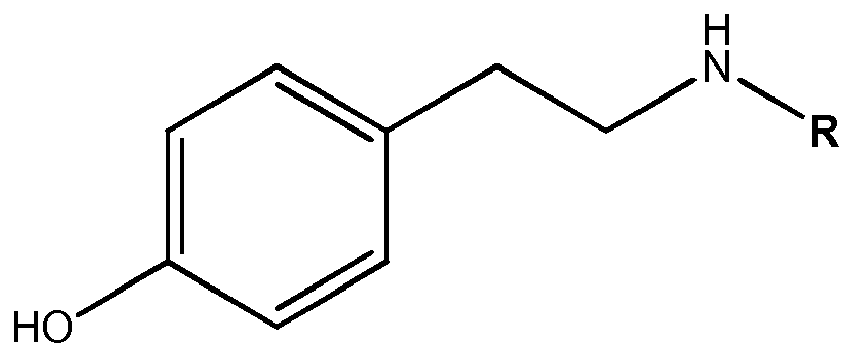
on to said substrate; andb) rinsing said substrate with a suitable solvent or wiping said substrate with a suitable wipe, from about 15 seconds to about two minutes after commencement of step (a). - A method as claimed in claim 1 wherein said composition comprises (i) 0.1 to 10% by weight of alkyl tyramine; and (ii) a carrier.
- A method as claimed in claim 1 or 2 wherein said carrier comprises 1 to 80% of surfactant by weight of the composition.
- A method as claimed in any one of the preceding claims wherein said carrier comprises water.
- A method as claimed in any one of the preceding claims wherein said composition additionally comprises 0.01 to 2% of an essential oil active chosen from terpineol, thymol, geraniol, eugenol, linalool or nerol, and mixtures thereof.
- A wash-off composition comprising(a) 0.1 to 10% alkyl tyramine of the structure
 (b) 1 to 80% by weight of surfactant.
 - A composition as claimed in claim 6 wherein said surfactant is a soap, an alkyl sulphate or a linear alkyl benzene sulphonate.
- A synergistic antimicrobial composition comprising(a) 0.1 to 10% alkyl tyramine of the structure
 (b) 0.01 to 2% of an essential oil active chosen from terpineol, thymol, geraniol, eugenol, linalool or nerol or mixtures thereof.
 - A composition as claimed in claim 8 wherein said essential oil active is selected from terpineol, thymol, eugenol or mixtures thereof.
- A composition as claimed in claim 8 or 9 wherein said antimicrobial active is a mixture of terpineol and thymol.
- A composition as claimed in claim 10 comprising higher than 0.05 and lesser than 0.3% by weight thymol; and higher than 0.05 and lesser than 1% by weight terpineol.
Priority Applications (1)
| Application Number | Priority Date | Filing Date | Title |
|---|---|---|---|
| EP13152865.5A EP2759199A1 (en) | 2013-01-28 | 2013-01-28 | A method of providing antimicrobial action and a synergistic antimicrobial composition thereof |
Applications Claiming Priority (1)
| Application Number | Priority Date | Filing Date | Title |
|---|---|---|---|
| EP13152865.5A EP2759199A1 (en) | 2013-01-28 | 2013-01-28 | A method of providing antimicrobial action and a synergistic antimicrobial composition thereof |
Publications (1)
| Publication Number | Publication Date |
|---|---|
| EP2759199A1 true EP2759199A1 (en) | 2014-07-30 |
Family
ID=47628016
Family Applications (1)
| Application Number | Title | Priority Date | Filing Date |
|---|---|---|---|
| EP13152865.5A Withdrawn EP2759199A1 (en) | 2013-01-28 | 2013-01-28 | A method of providing antimicrobial action and a synergistic antimicrobial composition thereof |
Country Status (1)
| Country | Link |
|---|---|
| EP (1) | EP2759199A1 (en) |
Cited By (1)
| Publication number | Priority date | Publication date | Assignee | Title |
|---|---|---|---|---|
| CN114586782A (en) * | 2018-03-20 | 2022-06-07 | 弗门尼舍有限公司 | Antimicrobial composition |
Citations (1)
| Publication number | Priority date | Publication date | Assignee | Title |
|---|---|---|---|---|
| WO2010046238A1 (en) | 2008-10-20 | 2010-04-29 | Unilever Nv | An antimicrobial composition |
-
2013
- 2013-01-28 EP EP13152865.5A patent/EP2759199A1/en not_active Withdrawn
Patent Citations (1)
| Publication number | Priority date | Publication date | Assignee | Title |
|---|---|---|---|---|
| WO2010046238A1 (en) | 2008-10-20 | 2010-04-29 | Unilever Nv | An antimicrobial composition |
Non-Patent Citations (2)
| Title |
|---|
| HONG S ET AL: "Antimicrobial Activity of Tyramine Derivatives", 2000 AAPS ANNUAL MEETING AND EXPOSITION, OCTOBER 29-NOVEMBER 2, 2000, INDIANAPOLIS CONVENTION CENTER, INDIANAPOLIS, US, AMERICAN ASSOCIATION OF PHARMACEUTICAL SCIENTISTS, 29 October 2000 (2000-10-29), XP009171084 * |
| MAH J H ET AL: "Paenibacillus tyraminigenes sp. nov. isolated from Myeolchi-jeotgal, a traditional Korean salted and fermented anchovy", INTERNATIONAL JOURNAL OF FOOD MICROBIOLOGY, ELSEVIER BV, NL, vol. 127, no. 3, 31 October 2008 (2008-10-31), pages 209 - 214, XP025468598, ISSN: 0168-1605, [retrieved on 20080704], DOI: 10.1016/J.IJFOODMICRO.2008.07.002 * |
Cited By (3)
| Publication number | Priority date | Publication date | Assignee | Title |
|---|---|---|---|---|
| CN114586782A (en) * | 2018-03-20 | 2022-06-07 | 弗门尼舍有限公司 | Antimicrobial composition |
| CN114586782B (en) * | 2018-03-20 | 2024-04-12 | 弗门尼舍有限公司 | Antimicrobial compositions |
| US12419305B2 (en) | 2018-03-20 | 2025-09-23 | Firmenich Sa | Antimicrobial compositions |
Similar Documents
| Publication | Publication Date | Title |
|---|---|---|
| CA2739843C (en) | Antimicrobial composition comprising thymol and terpineol for disinfecting surfaces | |
| JP5844260B2 (en) | Bactericides including eugenol, terpineol and thymol | |
| EP2787956B1 (en) | An anti bacterial composition | |
| EP2773315B1 (en) | A personal cleaning composition | |
| CN104736687B (en) | Soap composition | |
| CN104080341A (en) | Antimicrobial composition | |
| JP2015500818A (en) | How to disinfect the surface | |
| EP2787955A1 (en) | An antimicrobial composition | |
| EP2759199A1 (en) | A method of providing antimicrobial action and a synergistic antimicrobial composition thereof | |
| US20150086421A1 (en) | Antibacterial composition | |
| WO2013060558A1 (en) | Antimicrobial efficacy of s(-) alpha-terpineol |
Legal Events
| Date | Code | Title | Description |
|---|---|---|---|
| PUAI | Public reference made under article 153(3) epc to a published international application that has entered the european phase |
Free format text: ORIGINAL CODE: 0009012 |
|
| 17P | Request for examination filed |
Effective date: 20130128 |
|
| AK | Designated contracting states |
Kind code of ref document: A1 Designated state(s): AL AT BE BG CH CY CZ DE DK EE ES FI FR GB GR HR HU IE IS IT LI LT LU LV MC MK MT NL NO PL PT RO RS SE SI SK SM TR |
|
| AX | Request for extension of the european patent |
Extension state: BA ME |
|
| STAA | Information on the status of an ep patent application or granted ep patent |
Free format text: STATUS: THE APPLICATION HAS BEEN WITHDRAWN |
|
| 18W | Application withdrawn |
Effective date: 20140821 |