EP2757616A1 - Positive electrode for rechargable lithium battery and rechargable lithium battery including the same - Google Patents
Positive electrode for rechargable lithium battery and rechargable lithium battery including the same Download PDFInfo
- Publication number
- EP2757616A1 EP2757616A1 EP20130179617 EP13179617A EP2757616A1 EP 2757616 A1 EP2757616 A1 EP 2757616A1 EP 20130179617 EP20130179617 EP 20130179617 EP 13179617 A EP13179617 A EP 13179617A EP 2757616 A1 EP2757616 A1 EP 2757616A1
- Authority
- EP
- European Patent Office
- Prior art keywords
- active material
- oxide
- lithium
- positive
- positive electrode
- Prior art date
- Legal status (The legal status is an assumption and is not a legal conclusion. Google has not performed a legal analysis and makes no representation as to the accuracy of the status listed.)
- Granted
Links
Images


Classifications
-
- H—ELECTRICITY
- H01—ELECTRIC ELEMENTS
- H01M—PROCESSES OR MEANS, e.g. BATTERIES, FOR THE DIRECT CONVERSION OF CHEMICAL ENERGY INTO ELECTRICAL ENERGY
- H01M4/00—Electrodes
- H01M4/02—Electrodes composed of, or comprising, active material
- H01M4/13—Electrodes for accumulators with non-aqueous electrolyte, e.g. for lithium-accumulators; Processes of manufacture thereof
- H01M4/131—Electrodes based on mixed oxides or hydroxides, or on mixtures of oxides or hydroxides, e.g. LiCoOx
-
- H—ELECTRICITY
- H01—ELECTRIC ELEMENTS
- H01M—PROCESSES OR MEANS, e.g. BATTERIES, FOR THE DIRECT CONVERSION OF CHEMICAL ENERGY INTO ELECTRICAL ENERGY
- H01M10/00—Secondary cells; Manufacture thereof
- H01M10/05—Accumulators with non-aqueous electrolyte
- H01M10/052—Li-accumulators
- H01M10/0525—Rocking-chair batteries, i.e. batteries with lithium insertion or intercalation in both electrodes; Lithium-ion batteries
-
- H—ELECTRICITY
- H01—ELECTRIC ELEMENTS
- H01M—PROCESSES OR MEANS, e.g. BATTERIES, FOR THE DIRECT CONVERSION OF CHEMICAL ENERGY INTO ELECTRICAL ENERGY
- H01M4/00—Electrodes
- H01M4/02—Electrodes composed of, or comprising, active material
- H01M4/13—Electrodes for accumulators with non-aqueous electrolyte, e.g. for lithium-accumulators; Processes of manufacture thereof
- H01M4/133—Electrodes based on carbonaceous material, e.g. graphite-intercalation compounds or CFx
-
- H—ELECTRICITY
- H01—ELECTRIC ELEMENTS
- H01M—PROCESSES OR MEANS, e.g. BATTERIES, FOR THE DIRECT CONVERSION OF CHEMICAL ENERGY INTO ELECTRICAL ENERGY
- H01M4/00—Electrodes
- H01M4/02—Electrodes composed of, or comprising, active material
- H01M4/13—Electrodes for accumulators with non-aqueous electrolyte, e.g. for lithium-accumulators; Processes of manufacture thereof
- H01M4/139—Processes of manufacture
- H01M4/1391—Processes of manufacture of electrodes based on mixed oxides or hydroxides, or on mixtures of oxides or hydroxides, e.g. LiCoOx
-
- H—ELECTRICITY
- H01—ELECTRIC ELEMENTS
- H01M—PROCESSES OR MEANS, e.g. BATTERIES, FOR THE DIRECT CONVERSION OF CHEMICAL ENERGY INTO ELECTRICAL ENERGY
- H01M4/00—Electrodes
- H01M4/02—Electrodes composed of, or comprising, active material
- H01M4/13—Electrodes for accumulators with non-aqueous electrolyte, e.g. for lithium-accumulators; Processes of manufacture thereof
- H01M4/139—Processes of manufacture
- H01M4/1393—Processes of manufacture of electrodes based on carbonaceous material, e.g. graphite-intercalation compounds or CFx
-
- H—ELECTRICITY
- H01—ELECTRIC ELEMENTS
- H01M—PROCESSES OR MEANS, e.g. BATTERIES, FOR THE DIRECT CONVERSION OF CHEMICAL ENERGY INTO ELECTRICAL ENERGY
- H01M4/00—Electrodes
- H01M4/02—Electrodes composed of, or comprising, active material
- H01M4/36—Selection of substances as active materials, active masses, active liquids
- H01M4/362—Composites
- H01M4/364—Composites as mixtures
-
- H—ELECTRICITY
- H01—ELECTRIC ELEMENTS
- H01M—PROCESSES OR MEANS, e.g. BATTERIES, FOR THE DIRECT CONVERSION OF CHEMICAL ENERGY INTO ELECTRICAL ENERGY
- H01M4/00—Electrodes
- H01M4/02—Electrodes composed of, or comprising, active material
- H01M4/36—Selection of substances as active materials, active masses, active liquids
- H01M4/48—Selection of substances as active materials, active masses, active liquids of inorganic oxides or hydroxides
- H01M4/485—Selection of substances as active materials, active masses, active liquids of inorganic oxides or hydroxides of mixed oxides or hydroxides for inserting or intercalating light metals, e.g. LiTi2O4 or LiTi2OxFy
-
- H—ELECTRICITY
- H01—ELECTRIC ELEMENTS
- H01M—PROCESSES OR MEANS, e.g. BATTERIES, FOR THE DIRECT CONVERSION OF CHEMICAL ENERGY INTO ELECTRICAL ENERGY
- H01M4/00—Electrodes
- H01M4/02—Electrodes composed of, or comprising, active material
- H01M4/36—Selection of substances as active materials, active masses, active liquids
- H01M4/48—Selection of substances as active materials, active masses, active liquids of inorganic oxides or hydroxides
- H01M4/50—Selection of substances as active materials, active masses, active liquids of inorganic oxides or hydroxides of manganese
- H01M4/505—Selection of substances as active materials, active masses, active liquids of inorganic oxides or hydroxides of manganese of mixed oxides or hydroxides containing manganese for inserting or intercalating light metals, e.g. LiMn2O4 or LiMn2OxFy
-
- H—ELECTRICITY
- H01—ELECTRIC ELEMENTS
- H01M—PROCESSES OR MEANS, e.g. BATTERIES, FOR THE DIRECT CONVERSION OF CHEMICAL ENERGY INTO ELECTRICAL ENERGY
- H01M4/00—Electrodes
- H01M4/02—Electrodes composed of, or comprising, active material
- H01M4/36—Selection of substances as active materials, active masses, active liquids
- H01M4/48—Selection of substances as active materials, active masses, active liquids of inorganic oxides or hydroxides
- H01M4/52—Selection of substances as active materials, active masses, active liquids of inorganic oxides or hydroxides of nickel, cobalt or iron
- H01M4/525—Selection of substances as active materials, active masses, active liquids of inorganic oxides or hydroxides of nickel, cobalt or iron of mixed oxides or hydroxides containing iron, cobalt or nickel for inserting or intercalating light metals, e.g. LiNiO2, LiCoO2 or LiCoOxFy
-
- H—ELECTRICITY
- H01—ELECTRIC ELEMENTS
- H01M—PROCESSES OR MEANS, e.g. BATTERIES, FOR THE DIRECT CONVERSION OF CHEMICAL ENERGY INTO ELECTRICAL ENERGY
- H01M4/00—Electrodes
- H01M4/02—Electrodes composed of, or comprising, active material
- H01M4/36—Selection of substances as active materials, active masses, active liquids
- H01M4/58—Selection of substances as active materials, active masses, active liquids of inorganic compounds other than oxides or hydroxides, e.g. sulfides, selenides, tellurides, halogenides or LiCoFy; of polyanionic structures, e.g. phosphates, silicates or borates
- H01M4/5825—Oxygenated metallic salts or polyanionic structures, e.g. borates, phosphates, silicates, olivines
-
- H—ELECTRICITY
- H01—ELECTRIC ELEMENTS
- H01M—PROCESSES OR MEANS, e.g. BATTERIES, FOR THE DIRECT CONVERSION OF CHEMICAL ENERGY INTO ELECTRICAL ENERGY
- H01M4/00—Electrodes
- H01M4/02—Electrodes composed of, or comprising, active material
- H01M4/36—Selection of substances as active materials, active masses, active liquids
- H01M4/58—Selection of substances as active materials, active masses, active liquids of inorganic compounds other than oxides or hydroxides, e.g. sulfides, selenides, tellurides, halogenides or LiCoFy; of polyanionic structures, e.g. phosphates, silicates or borates
- H01M4/583—Carbonaceous material, e.g. graphite-intercalation compounds or CFx
-
- H—ELECTRICITY
- H01—ELECTRIC ELEMENTS
- H01M—PROCESSES OR MEANS, e.g. BATTERIES, FOR THE DIRECT CONVERSION OF CHEMICAL ENERGY INTO ELECTRICAL ENERGY
- H01M4/00—Electrodes
- H01M4/02—Electrodes composed of, or comprising, active material
- H01M4/36—Selection of substances as active materials, active masses, active liquids
- H01M4/58—Selection of substances as active materials, active masses, active liquids of inorganic compounds other than oxides or hydroxides, e.g. sulfides, selenides, tellurides, halogenides or LiCoFy; of polyanionic structures, e.g. phosphates, silicates or borates
- H01M4/583—Carbonaceous material, e.g. graphite-intercalation compounds or CFx
- H01M4/587—Carbonaceous material, e.g. graphite-intercalation compounds or CFx for inserting or intercalating light metals
-
- H—ELECTRICITY
- H01—ELECTRIC ELEMENTS
- H01M—PROCESSES OR MEANS, e.g. BATTERIES, FOR THE DIRECT CONVERSION OF CHEMICAL ENERGY INTO ELECTRICAL ENERGY
- H01M4/00—Electrodes
- H01M4/02—Electrodes composed of, or comprising, active material
- H01M4/62—Selection of inactive substances as ingredients for active masses, e.g. binders, fillers
- H01M4/621—Binders
- H01M4/622—Binders being polymers
- H01M4/623—Binders being polymers fluorinated polymers
-
- H—ELECTRICITY
- H01—ELECTRIC ELEMENTS
- H01M—PROCESSES OR MEANS, e.g. BATTERIES, FOR THE DIRECT CONVERSION OF CHEMICAL ENERGY INTO ELECTRICAL ENERGY
- H01M4/00—Electrodes
- H01M4/02—Electrodes composed of, or comprising, active material
- H01M4/62—Selection of inactive substances as ingredients for active masses, e.g. binders, fillers
- H01M4/624—Electric conductive fillers
- H01M4/625—Carbon or graphite
-
- Y—GENERAL TAGGING OF NEW TECHNOLOGICAL DEVELOPMENTS; GENERAL TAGGING OF CROSS-SECTIONAL TECHNOLOGIES SPANNING OVER SEVERAL SECTIONS OF THE IPC; TECHNICAL SUBJECTS COVERED BY FORMER USPC CROSS-REFERENCE ART COLLECTIONS [XRACs] AND DIGESTS
- Y02—TECHNOLOGIES OR APPLICATIONS FOR MITIGATION OR ADAPTATION AGAINST CLIMATE CHANGE
- Y02E—REDUCTION OF GREENHOUSE GAS [GHG] EMISSIONS, RELATED TO ENERGY GENERATION, TRANSMISSION OR DISTRIBUTION
- Y02E60/00—Enabling technologies; Technologies with a potential or indirect contribution to GHG emissions mitigation
- Y02E60/10—Energy storage using batteries
Definitions
- This disclosure relates to a positive electrode for rechargeable lithium battery and a rechargeable lithium battery including the same.
- Lithium rechargeable battery uses intercalation and deintercalation reactions of lithium ions when battery is charged and discharged.
- Lithium rechargeable battery basically includes a positive electrode comprising positive active material, a negative electrode comprising negative active material, a separator, and an electrolyte solution.
- ISG Idle Stop & Go or Integrated Starter & Generator
- the conventional lead storage battery that has been studied for use in the ISG system of a vehicle is very large in volume considering the capacity, and has disadvantage that the life becomes shorter and shorter as the charge and discharge continues.
- lithium rechargeable batteries In order to solve these problems, attention has been drawn to the use of lithium rechargeable batteries.
- the conventional lithium rechargeable batteries have low rate and short life, as they generate electricity by using oxidation/reduction reactions. This phenomenon limits their use in the applications requiring high input and output powers, such as the ISG system.
- lithium rechargeable batteries In order to obtain high input and output powers, low resistance design using thin electrodes has been developed.
- the lithium rechargeable batteries present limitations with respect to their material properties, and with the reduction of their capacity, even though a high rate is developed.
- the invention provides a positive electrode for a rechargeable lithium battery that has improved capacity, cycle-life, and high rate charge/discharge properties.
- the invention also provides a rechargeable lithium battery including the positive electrode according to the invention disclosed below.
- One of the objects of the invention is a positive electrode for a lithium rechargeable battery including a current collector; a positive active material layer disposed on the current collector, wherein the positive active material layer includes a positive active material, active carbon, and an additive, wherein said positive active material comprises a lithium metal oxide, and wherein said additive comprises manganese oxide, cobalt oxide, iron oxide, vanadium oxide, or a combination thereof.
- the additive preferably consists in manganese oxide, cobalt oxide, iron oxide, vanadium oxide, or a combination thereof.
- the manganese oxide, cobalt oxide, iron oxide, vanadium oxide, or the combination thereof is preferably manganese oxide, cobalt oxide, vanadium oxide, iron oxide, or a combination thereof, more preferably Mn 3 O 4 , CO 3 O 4 , V 2 O 5 , Fe 3 O 4 , or a combination thereof.
- the lithium metal oxide may comprise lithium cobalt oxide, lithium nickel cobalt manganese oxide, lithium nickel cobalt aluminum oxide, lithium phosphoric acid iron oxide, lithium phosphoric acid nickel oxide, lithium phosphoric acid cobalt oxide, or a combination thereof.
- the active carbon may be in the form of particles having an average diameter of 1 to 30 ⁇ m.
- the average diameter is preferably of 3 to 20 ⁇ m, more preferably of 5 to 10 ⁇ m.
- the average diameter may be measured using a solution including particles dispersed therein and a laser.
- the average diameter may be measured using a refraction angle of laser by the particles dispersed in the solution.
- the average diameter may be average value of size of the dispersed particles.
- the additive may be in the form of particles having an average diameter of 0.01 to 20 ⁇ m, preferably of 0.03 to 1 ⁇ m.
- the manganese oxide comprises Mn 3 O 4
- the cobalt oxide comprises Co 3 O 4
- the iron oxide comprises Fe 3 O 4
- the vanadium oxide comprises V 2 O 5 .
- the positive active material layer may comprise 65 to 90 wt %, preferably 70 to 85 wt % of said positive active material, 1 to 30 wt %, preferably 3 to 25 wt % of said active carbon, and 0.01 to15 wt %, preferably 0.05 to 10 wt % of said additive, based on the total weight of the positive active material layer.
- the active carbon and the additive may be comprised in a weight ratio of 1:0.03 to 1:0.3. This weight ratio is preferably of 1:0.05 to 1:0.23.
- the positive active material layer may further comprise at least one of a binder and a conductive material.
- the positive active material layer is usually made of the positive active material that is to say 100% of the positive active material layer is made of the positive active material.
- a lithium rechargeable battery including the positive electrode according to the invention as described above; a negative electrode including a negative active material; a separator disposed between the positive and negative electrodes; and an electrolyte impregnating the separator and the positive and negative electrodes.
- the negative active material may include amorphous carbon.
- a lithium rechargeable battery having advantageously improved capacity, cycle-life, and high rate charge/discharge properties is provided according to the invention.
- the positive electrode for a lithium rechargeable battery according to the invention includes a current collector; and a positive active material layer disposed on the current collector, wherein the positive active material layer includes a positive active material, active carbon, and an additive.
- the positive active material comprises a lithium metal oxide.
- the additive comprises, preferably consists in, manganese oxide, cobalt oxide, iron oxide, vanadium oxide, or a combination thereof, preferably manganese oxide, cobalt oxide, or a combination thereof, more preferably Mn 3 O 4 , Co 3 O 4 , Fe 3 O 4 , V 2 O 5 , or a combination thereof.
- the current collector may be Al but is not limited thereto.
- the lithium metal oxide may comprise, preferably may be, lithium cobalt oxide, lithium nickel cobalt manganese oxide, lithium nickel cobalt aluminium oxide, lithium phosphoric acid iron oxide, lithium phosphoric acid nickel oxide, lithium phosphoric acid cobalt oxide, or a combination thereof.
- the positive active material may include a composite metal oxide including, in addition to lithium, at least one selected from the group consisting of cobalt, manganese, and nickel.
- a composite metal oxide including, in addition to lithium, at least one selected from the group consisting of cobalt, manganese, and nickel.
- the following lithium metal oxide compounds may be used:
- Li a A' 1-b R"' b D 2 (wherein, in the above Chemical Formula, 0.90 ⁇ a ⁇ 1.8 and 0 ⁇ b ⁇ 0.5); Li a E 1-b R"' b O 2-c D c (wherein, in the above Chemical Formula, 0.90 ⁇ a ⁇ 1.8, 0 ⁇ b ⁇ 0.5 and 0 ⁇ c ⁇ 0.05); LiE 2-b R"' b O 4-c D c (wherein, in the above Chemical Formula, 0 ⁇ b ⁇ 0.5, 0 ⁇ c ⁇ 0.05); LiaNi 1-b-c Co b R"' c D ⁇ (wherein, in the above Chemical Formula, 0.90 ⁇ a ⁇ 1.8, 0 ⁇ b ⁇ 0.5, 0 ⁇ c ⁇ 0.05 and 0 ⁇ ⁇ ⁇ 2); LiaNi 1-b-c Co b R"' c O 2- ⁇ Z ⁇ (wherein, in the above
- A' is Ni, Co, Mn, or a combination thereof;
- R'" is Al, Ni, Co, Mn, Cr, Fe, Mg, Sr, V, a rare earth element, or a combination thereof;
- D is O, F, S, P, or a combination thereof;
- E is Co, Mn, or a combination thereof;
- Z is F, S, P, or a combination thereof;
- G is Al, Cr, Mn, Fe, Mg, La, Ce, Sr, V, or a combination thereof;
- Q is Ti, Mo, Mn, or a combination thereof;
- the lithium metal oxide may have a coating layer on its surface or may be mixed with a compound having a coating layer on its surface.
- the coating layer may include at least one coating element compound selected from the group consisting of an oxide of a coating element, a hydroxide of a coating element, an oxyhydroxide of a coating element, an oxycarbonate of a coating element, and a hydroxyl carbonate of a coating element.
- the coating element compound can be amorphous or crystalline.
- the coating element compound may include Mg, Al, Co, K, Na, Ca, Si, Ti, V, Sn, Ge, Ga, B, As, Zr, or a mixture thereof.
- the coating layer is usually formed by a method having no negative influence on the properties of the positive active material.
- the method may include any coating method such as spray coating, dipping, and the like but is not illustrated in more detail, since well-known to those who work in the related field.
- the positive active material layer may comprise 65 wt. % to 90 wt %, preferably 70 wt % to 85 wt %, of the positive active material, based on the total weight of the positive active material layer.
- the lithium rechargeable battery may have advantageously improved capacity, improved cycle-life, and improved high-rate charge/discharge properties.
- the active carbon may advantageously improve the high-rate charge/discharge properties of the lithium rechargeable battery by the means of an improved physical reaction (nto chemicall reaction) in the ions' absorption and dissociation.
- the active carbon may be in the form of particles having an average diameter of 1 to 30 ⁇ m, preferably 3 to 20 ⁇ m, more preferably 5 to 10 ⁇ m. Within these ranges, it is believed that the active carbon has similar average diameter to that of the positive active material, thus the dispersity of the active carbon may be good.
- the active carbon may be comprised in an amount of 1 to 30 wt %, specifically 3 to 25 wt %, based on the total weight of the positive active material. Within these ranges, the lithium rechargeable battery including the active carbon may have improved capacity, cycle-life, and high charge/discharge rate.
- the manganese oxide may comprise Mn 3 O 4
- the cobalt based oxide may comprise Co 3 O 4
- the iron based oxide may comprise Fe 3 O 4
- the vanadium based oxide may comprise V 2 O 5 .
- the manganese oxide Mn 3 O 4 may be used.
- the manganese oxide Mn 3 O 4 has spinel structures, and the number of the peripheral electrons of Mn may change from 2 + to 3 + .
- a transition metal such as, Co, Fe, V, and the like, as well as Mn, which is in a stable oxide form in the positive electrode
- the lithium rechargeable battery shows advantageously improved capacity as the lithium ion concentration on the surface of the electrode increases. It is believed this is due to the fact that the anions are absorbed onto the surfaces of the additives.
- the active carbon facilitates lithium ions' physical absorption to the surfaces of the additives, thereby fast delivery of the lithium ions to the positive active material. It is believed that the additive increases the lithium ions' dispersion on the surface through reduction reaction, thereby enhancing the properties of the active carbon, as well as providing electron's passage.
- the positive electrode according to the invention reduces internal resistance and increases conductivity to achieve high rate charge/discharge properties.
- the active carbon and the additive may be included in a weight ratio of 1:0.03 to 1:0.3, preferably 1:0.05 to 1:0.23. It is believed that, within this range, the lithium rechargeable battery may have improved capacity, cycle-life, and high rate charge/discharge properties.
- the additive may be in the form of particles having an averagediameter of 0.01 to 20 ⁇ m, preferably 0.1 to 1 ⁇ m, more preferably 0.03 to 1 ⁇ m. It is believed that, within this range, the additive has good dispersibility with the positive electrode active material and the active carbon.
- the active carbon may be in the form of particles being an average diameter of particles of 1 to 30 ⁇ m, preferably 3 to 20 ⁇ m, more preferably 5 to 10 ⁇ m.
- the additive may be included in an amount of 0.01 to 15 wt %, preferably 0.05 to 10 wt %, morepreferably 0.05 to 3 wt % based on the total weight of the positive active material. It is believed that, within this range, the lithium rechargeable battery may have improved capacity, cycle-life, and high rate charge/discharge properties.
- the active carbon may be included in an amount of 1 to 30 wt %, preferably 3 to 25 wt %, based on the total weight of the positive active material.
- the positive active material layer may include at least one binder and at least one conductive material. It is believed that the binder improves binding properties of the positive active material particles to one another and to a current collector.
- the binder include polyvinyl alcohol, carboxyl methylcellulose, hydroxypropylcellulose, diacetylcellulose, polyvinylchloride, carboxylated polyvinylchloride, polyvinyl fluoride, an ethylene oxide-containing polymer, polyvinylpyrrolidone, polyurethane, polytetrafluoroethylene, polyvinylidene fluoride, polyethylene, polypropylene, a styrene-butadiene rubber, an acrylated styrene-butadiene rubber, an epoxy resin, nylon, and the like, but are not limited thereto.
- the conductive material is generally used to provide conductivity to an electrode.
- the conductive material may also include any electronic conductive material as long as causing no chemical change.
- the conductive material can includes at least one mixture of a conductive material such as natural graphite, artificial graphite, carbon black, acetylene black, ketjen black, a carbon fiber, a metal powder, a metal fiber or the like such as copper, nickel, aluminum, silver or the like, or a polyphenylene derivative or the like.
- the binder may be included in an amount of 2 to 10 wt %, preferably 3 to 7 wt %, based on the total weight of the positive active material.
- the conductive material may be included in an amount of 1 to 8 wt %, specifically 2 to 5 wt %, based on the total weight of the positive active material.
- the positive electrode may be fabricated by coating a composition of a positive active material as a layer on the surface of a current collector to form a positive active material layer, and drying and pressing said coating.
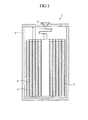
- the lithium rechargeable battery including the above positive electrode is described in detail, referring to FIG. 1 .
- the rechargeable lithium battery 1 includes an electrode assembly including a positive electrode 2, a negative electrode 3, and a separator 4 between the positive electrode 2 and the negative electrode 3, a battery case 5 for housing the electrode assembly, an electrolyte injected in the case from the top, and a cap plate 6 sealing the battery case 5.
- the negative electrode for a rechargeable lithium battery includes a current collector and a negative active material layer formed on the current collector, and the negative active material layer includes a negative active material.
- the current collector may be a copper foil, a nickel foil, a stainless steel foil, a titanium foil, nickel foam, a copper foam, a polymer substrate coated with a conductive metal, or a combination thereof.
- the negative active material layer may include negative electrode active material, a binder, and optionally a conductive material.
- the negative active material may include a material that reversibly intercalates/deintercalates lithium ions, lithium metal, a lithium metal alloy, a material being capable of doping/dedoping lithium, or a transition metal oxide.
- the material that reversibly intercalates/deintercalates lithium ions may be a carbon material.
- the carbon material may be any generally-used carbon-based negative active material in a lithium ion rechargeable battery. Examples of the carbon material include crystalline carbon, amorphous carbon, and a combination thereof.
- the crystalline carbon may be non-shaped, or sheet, flake, spherical, or fiber shaped natural graphite or artificial graphite.
- the amorphous carbon may be a soft carbon, a hard carbon, a mesophase pitch carbonized product, fired coke, and the like.
- the lithium metal alloy includes lithium and a metal of Na, K, Rb, Cs, Fr, Be, Mg, Ca, Sr, Si, Sb, Pb, In, Zn, Ba, Ra, Ge, Al, or Sn.
- Examples of the material being capable of doping/dedoping lithium include Si, a Si-C composite, SiO x (0 ⁇ x ⁇ 2), a Si-Y alloy (wherein Y is an alkali metal, an alkaline-earth metal, 1 Group 13 to 16 elements, a transition element, a rare earth element, or a combination thereof, and not Si), Sn, SnO 2 , a Sn-C composite, Sn-Y (wherein Y is an alkali metal, an alkaline-earth metal, Group 13 to 16 elements, a transition element, a rare earth element, or a combination thereof, and not Sn), and the like.
- Y may be Mg, Ca, Sr, Ba, Ra, Sc, Y, Ti, Zr, Hf, Rf, V, Nb, Ta, Db, Cr, Mo, W, Sg, Tc, Re, Bh, Fe, Pb, Ru, Os, Hs, Rh, Ir, Pd, Pt, Cu, Ag, Au, Zn, Cd, B, Al, Ga, Sn, In, Ti, Ge, P, As, Sb, Bi, S, Se, Te, Po, or a combination thereof.
- the transition metal oxide may be vanadium oxide, lithium vanadium oxide, and the like.
- the negative active material may preferably include said amorphous carbon, specifically an amorphous carbon sintered at between 400°C to 1500°C.
- amorphous carbon as a negative electrode material, the lithium rechargeable battery may have improved high rate charge/discharge property.
- the binder improves binding properties of negative active material particles with one another and with a current collector.
- the binder include polyvinyl alcohol, carboxyl methylcellulose, hydroxypropylcellulose, polyvinylchloride, carboxylated polyvinylchloride, polyvinyl fluoride, an ethylene oxide-containing polymer, polyvinylpyrrolidone, polyurethane, polytetrafluoroethylene, polyvinylidene fluoride, polyethylene, polypropylene, a styrene-butadiene rubber, an acrylated styrene-butadiene rubber, an epoxy resin, nylon, and the like, but are not limited thereto.
- the conductive material is included to improve electrode conductivity. Any electrically conductive material may be used as a conductive material unless it causes a chemical change. Examples of the conductive material include a carbon-based material such as natural graphite, artificial graphite, carbon black, acetylene black, ketjen black, a carbon fiber, and the like; a metal-based material of metal powder or metal fiber including copper, nickel, aluminum, silver, and the like; a conductive polymer such as polyphenylene derivatives; or a mixture thereof.
- a carbon-based material such as natural graphite, artificial graphite, carbon black, acetylene black, ketjen black, a carbon fiber, and the like
- a metal-based material of metal powder or metal fiber including copper, nickel, aluminum, silver, and the like
- a conductive polymer such as polyphenylene derivatives
- the negative and electrode may be fabricated in a method of mixing the active material, a conductive material, and a binder in a solvent to prepare a negative active material composition and coating the composition on a current collector.
- the electrode manufacturing method is well known and thus, is not described in detail in the present specification.
- the solvent includes N-methylpyrrolidone and the like but is not limited thereto.
- the electrolyte includes a non-aqueous organic solvent and a lithium salt.
- the non-aqueous organic solvent serves as a medium for transmitting ions taking part in the electrochemical reaction of the battery.
- the non-aqueous organic solvent may include a carbonate-based, ester-based, ether-based, ketone-based, alcohol-based, or aprotic solvent.
- Examples of the carbonate-based solvent may include dimethyl carbonate (DMC), diethyl carbonate (DEC), dipropyl carbonate (DPC), methylpropyl carbonate (MPC), ethylpropyl carbonate (EPC), methylethyl carbonate (MEC), ethylene carbonate (EC), propylene carbonate (PC), butylene carbonate (BC), and the like.
- DMC dimethyl carbonate
- DEC diethyl carbonate
- DPC dipropyl carbonate
- MPC methylpropyl carbonate
- EPC ethylpropyl carbonate
- MEC methylethyl carbonate
- EC ethylene carbonate
- PC propylene carbonate
- BC butylene carbonate
- the solvent When the carbonate-based solvent is prepared by mixing a cyclic carbonate and a linear carbonate, the solvent has advantages of high permittivity and low viscosity.
- the cyclic carbonate and the linear carbonate are mixed together in a volume ratio of 1:1 to 1:9.
- ester-based solvent may include methyl acetate, ethyl acetate, n-propyl acetate, dimethylethyl acetate, methylpropionate, ethylpropionate, ⁇ -butyrolactone, decanolide, valerolactone, mevalonolactone, caprolactone, and the like.
- ether-based solvent examples include dibutyl ether, tetraglyme, diglyme, dimethoxyethane, 2-methyltetrahydrofuran, tetrahydrofuran, and examples of the ketone-based solvent include cyclohexanone, and the like.
- the alcohol-based solvent include ethyl alcohol, isopropyl alcohol, and the like.
- the non-aqueous organic solvent may be used singularly or in a mixture.
- the mixing ratio can be controlled in accordance with a desirable battery performance.
- the non-aqueous electrolyte may further include an overcharge inhibitor, such as, ethylene carbonate, pyrocarbonate, and the like.
- an overcharge inhibitor such as, ethylene carbonate, pyrocarbonate, and the like.
- Lithium salt is dissolved in an organic solvent to be used as a lithium ion source in a lithium rechargeable battery, thus making the battery operate and promoting the lithium ion's delivery between positive and negative electrodes.
- lithium salt examples include LiPF 6 , LiBF 4 , LiSbF 6 , LiAsF 6 , LiN(SO 3 C 2 F 5 ) 2 , LiC 4 F 9 SO 3 , LiCIO 4 , LiAlO 2 , LiAlCI 4 , LiN(C x F 2x+1 SO 2 )(C y F 2y+1 SO 2 ) (wherein, x and y are natural numbers), LiCI, Lil, LiB(C 2 O 4 ) 2 (lithium bis(oxalato) borate; LiBOB), and a combination thereof.
- the concentration of the lithium ion salt in the lithium rechargeable battery may be between about 0.1 M and 2.0 M. It is believed that within these ranges, the electrolyte may have proper viscosity and good conductivity to exhibit good electrolyte properties, and the lithium ions may effectively move in the lithium rechargeable battery.
- the separator may be any material used in the art to which the invention pertains, as long as it can separate the positive and the negative electrodes and provide a passage through which the lithium ions can transfer.
- the separator isgenerally a material which is low resistive to the ion's movement of the electrolyte and has a good moisture containing property.
- glass fiber, polyester, polyethylene, polypropylene, poly tetrafluoro ethylene (PTFE), or a combination thereof may be selected as a separator.
- the separator may be in a woven or nonwoven form.
- a polyethylene based separator such as, polyethylene, polypropylene, and the like, is usually selected in a lithium rechargeable battery.
- a separator coated with a ceramic component or a polymer material may be used, which may also be fabricated in a monolayer or a multilayers.
- the amount of four of the five components of the positive active material layer (LiCoO 2 active carbon, carbon black and polyvinylidene fluoride) is expressed in weight % (wt %) based on the total weight of positive active layer material, and the total amount of these four components is 100%.
- the amount of the fifth component of the positive active material layer that is to say Mn 3 O 4 , is expressed in parts by weight based on 100 parts by weight of active carbon, and is considered as part of the amount of active carbon.
- the active carbon and the additive (Mn 3 O 4 ) have a weight ratio of 1:0.07.
- the negative active material composition is coated as a layer on a cupper foil, dried, and pressed to form a negative electrode.
- an electrolyte made of a solvent mixed with ethylene carbonate (EC), ethyl methyl carbonate (EMC), and dimethyl carbonate (DMC) (mixed in ratio of 2:2:6 in volume) and containing 1 M LiPF 6 is injected to fabricate a lithium rechargeable battery.
- EC ethylene carbonate
- EMC ethyl methyl carbonate
- DMC dimethyl carbonate
- the active carbon and the additive (Mn 3 O 4 ) have a weight ratio of 1:0.14.
- the active carbon and the additive (Mn 3 O 4 ) have a weight ratio of 1:0.21 (21 % by weight).
- a lithium rechargeable battery is fabricated in the same method as in Example 1, except that 85 wt % of LiCoO 2 (average diameter of 5 ⁇ m), 5 wt % of active carbon (YP, average diameter of 7 ⁇ m), 7 parts by weight of Co 3 O 4 (average diameter of 0.3 ⁇ m) as an additive, based on 100 parts by weight of the active carbon, 4 wt % of carbon black, and 6 wt % of polyvinylidene fluoride (PVdF) are mixed and dispersed in N-methyl-2-pyrrolidone to prepare a positive active material composition.
- the active carbon and the additive (Co 3 O 4 ) have a weight ratio of 1:0.07.
- a lithium rechargeable battery is fabricated in the same method as in Example 1, except that 85 wt % of LiCoO 2 (average diameter of 5 ⁇ m), 5 wt % of active carbon (YP, average diameter of 7 ⁇ m), 14 parts by weight of Co 3 O 4 (average diameter of 0.3 ⁇ m), as an additive, based on 100 parts by weight of the active carbon, 4 wt % of carbon black, and 6 wt % of polyvinylidene fluoride (PVdF) are mixed and dispersed in N-methyl-2-pyrrolidone to prepare a positive active material composition.
- the active carbon and the additive (Co 3 O 4 ) have a weight ratio of 1:0.14.
- a lithium rechargeable battery is fabricated in the same method as in Example 1, except that 85 wt % of LiCoO 2 (average diameter of 5 ⁇ m), 5 wt % of active carbon (YP, average diameter of 7 ⁇ m), 21 parts by weight of Co 3 O 4 (average diameter of 0.3 ⁇ m), as an additive, based on 100 parts by weight of the active carbon, 4 wt % of carbon black, and 6 wt % of polyvinylidene fluoride (PVdF) are mixed and dispersed in N-methyl-2-pyrrolidone to prepare a positive active material composition.
- the active carbon and the additive (Co 3 O 4 ) have a weight ratio of 1:0.21.
- a lithium rechargeable battery is fabricated in the same method as in Example 1, except that 85 wt % of LiCoO 2 (average diameter of 5 ⁇ m), 5 wt % of active carbon (YP, average diameter of 7 ⁇ m), 7 parts by weight of Fe 3 O 4 (average diameter of 0.3 ⁇ m), as an additive, based on 100 parts by weight of the active carbon, 4 wt % of carbon black, and 6 wt % of polyvinylidene fluoride (PVdF) are mixed and dispersed in N-methyl-2-pyrrolidone to prepare a positive active material composition.
- the active carbon and the additive (Co 3 O 4 ) have a weight ratio of 1:0.21.
- a lithium rechargeable battery is fabricated in the same method as in Example 1, except that 85 wt % of LiCoO 2 (average diameter of 5 ⁇ m), 5 wt % of active carbon (YP, average diameter of 7 ⁇ m), 14 parts by weight of Fe 3 O 4 (average diameter of 0.3 ⁇ m), as an additive, based on 100 parts by weight of the active carbon, 4 wt % of carbon black, and 6 wt % of polyvinylidene fluoride (PVdF) are mixed and dispersed in N-methyl-2-pyrrolidone to prepare a positive active material composition.
- the active carbon and the additive (Co 3 O 4 ) have a weight ratio of 1:0.21.
- a lithium rechargeable battery is fabricated in the same method as in Example 1, except that 85 wt % of LiCoO 2 (average diameter of 5 ⁇ m), 5 wt % of active carbon (YP, average diameter of 7 ⁇ m), 21 parts by weight of Fe 3 O 4 (average diameter of 0.3 ⁇ m), as an additive, based on 100 parts by weight of the active carbon, 4 wt % of carbon black, and 6 wt % of polyvinylidene fluoride (PVdF) are mixed and dispersed in N-methyl-2-pyrrolidone to prepare a positive active material composition.
- the active carbon and the additive (Co 3 O 4 ) have a weight ratio of 1:0.21.
- a lithium rechargeable battery is fabricated in the same method as in Example 1, except that 85 wt % of LiCoO 2 (average diameter of 5 ⁇ m), 5 wt % of active carbon (YP, average diameter of 7 ⁇ m), 7 parts by weight of V 2 O 5 (average diameter of 0.3 ⁇ m), as an additive, based on 100 parts by weight of the active carbon, 4 wt % of carbon black, and 6 wt % of polyvinylidene fluoride (PVdF) are mixed and dispersed in N-methyl-2-pyrrolidone to prepare a positive active material composition.
- the active carbon and the additive have a weight ratio of 1:0.21.
- a lithium rechargeable battery is fabricated in the same method as in Example 1, except that 85 wt % of LiCoO 2 (average diameter of 5 ⁇ m), 5 wt % of active carbon (YP, average diameter of 7 ⁇ m), 14 parts by weight of V 2 O 5 (average diameter of 0.3 ⁇ m), as an additive, based on 100 parts by weight of the active carbon, 4 wt % of carbon black, and 6 wt % of polyvinylidene fluoride (PVdF) are mixed and dispersed in N-methyl-2-pyrrolidone to prepare a positive active material composition.
- the active carbon and the additive have a weight ratio of 1:0.21.
- a lithium rechargeable battery is fabricated in the same method as in Example 1, except that 85 wt % of LiCoO 2 (average diameter of 5 ⁇ m), 5 wt % of active carbon (YP, average diameter of 7 ⁇ m), 21 parts by weight of V 2 O 5 (average diameter of 0.3 ⁇ m), as an additive, based on 100 parts by weight of the active carbon, 4 wt % of carbon black, and 6 wt % of polyvinylidene fluoride (PVdF) are mixed and dispersed in N-methyl-2-pyrrolidone to prepare a positive active material composition.
- the active carbon and the additive have a weight ratio of 1:0.21.
- a lithium rechargeable battery is fabricated in the same method as in Example 1, except that 85 wt % of LiCoO 2 (average diameter of 5 ⁇ m), 5 wt % of active carbon (YP, average diameter of 7 ⁇ m), 4 wt % of carbon black, and 6 wt % of polyvinylidene fluoride (PVdF) are mixed and dispersed in N-methyl-2-pyrrolidone to prepare a positive active material composition.
- LiCoO 2 average diameter of 5 ⁇ m
- YP active carbon
- PVdF polyvinylidene fluoride
- a lithium rechargeable battery is fabricated in the same method as in Example 1, except that 85 wt % of LiNi 1/3 Co 1/3 Mn 1/3 O 2 , 5 wt % of active carbon (average diameter of 7 ⁇ m), 4 wt % of carbon black, and 6 wt % of polyvinylidene fluoride (PVdF) are mixed and dispersed in N-methyl-2-pyrrolidone to prepare a positive active material composition.
- PVdF polyvinylidene fluoride
- a lithium rechargeable battery is fabricated in the same method as in Example 1, except that 85 wt % of LiFePO 4 , 5 wt % of active carbon (average diameter of 7 ⁇ m), 4 wt % of carbon black, and 6 wt % of polyvinylidene fluoride (PVdF) are mixed and dispersed in N-methyl-2-pyrrolidone to prepare a positive active material composition.
- PVdF polyvinylidene fluoride
- Constant current at 1 C is charged to each lithium rechargeable battery fabricated according to Examples 1 to 12 and Comparative Examples 1 to 3, and it is terminated when the voltage of the battery reaches at 4.2V, and the capacity is measured when the batteries are discharged at 50C current to 2.0V. The results are described in Tables 1 and 2.
- FIG. 2 is a graph showing the capacity characteristics of the lithium rechargeable batteries according to Example 1.
- Lithium rechargeable battery fabricated according to Examples 1 to 12 and Comparative Examples 1 to 3 are charged and discharged in the same conditions as in Experimental Example 1, and the capacity retention (%) of 30C/1C is measured. The results are shown in Table 1, and FIGS. 3 and 4 .
- FIG. 3 is a graph showing the high-rate charge characteristics (voltage u in V with respect to the capacity in Ah) of the lithium rechargeable batteries according to Examples 1 to 3, and to Comparative Example 1.
- FIG. 4 is a graph showing the high-rate discharge characteristics (voltage u in V with respect to the capacity in Ah) of the lithium rechargeable batteries according to Examples 1 to 3, and to Comparative Example 1.
- the capacity retention (%) of 30C/1C is obtained from the percentage of the discharge capacity at 1C to the discharge capacity at 30C.
- Lithium rechargeable battery fabricated according to Examples 1 to 12 and Comparative Examples 1 to 3 are charged and discharged for 1000 cycles in the same conditions as in Experimental Example 1, and the capacity retention (%) of 1 000 th /1 th cycle is measured. The results are shown in Table 1, and FIG. 5 .
- FIG. 5 is a graph showing the cycle-life characteristics (capacity charge at 1C after 30,000 cycles) of the lithium rechargeable batteries according to Examples 1 to 3, and to Comparative Example 1.
- the lithium rechargeable batteries comprising a positive active material, active carbon, and an additive according to Examples 1 to 12 have improved capacity, high rate charge/discharge, and cycle-life characteristics compared to those that do not include the additives according to Comparative Examples 1 to 3.
Landscapes
- Chemical & Material Sciences (AREA)
- Chemical Kinetics & Catalysis (AREA)
- Electrochemistry (AREA)
- General Chemical & Material Sciences (AREA)
- Inorganic Chemistry (AREA)
- Engineering & Computer Science (AREA)
- Composite Materials (AREA)
- Materials Engineering (AREA)
- Crystallography & Structural Chemistry (AREA)
- Manufacturing & Machinery (AREA)
- Secondary Cells (AREA)
- Battery Electrode And Active Subsutance (AREA)
Abstract
Description
- This disclosure relates to a positive electrode for rechargeable lithium battery and a rechargeable lithium battery including the same.
- Lithium rechargeable battery uses intercalation and deintercalation reactions of lithium ions when battery is charged and discharged. Lithium rechargeable battery basically includes a positive electrode comprising positive active material, a negative electrode comprising negative active material, a separator, and an electrolyte solution.
- Meanwhile, ISG (Idle Stop & Go or Integrated Starter & Generator) system will be a widely used system before the electric vehicles are commercially used, the commercial needs for which the experts are expecting exceeds more than 10 billion dollars by the year of 2015.
- The conventional lead storage battery that has been studied for use in the ISG system of a vehicle, however, is very large in volume considering the capacity, and has disadvantage that the life becomes shorter and shorter as the charge and discharge continues.
- In order to solve these problems, attention has been drawn to the use of lithium rechargeable batteries. The conventional lithium rechargeable batteries, however, have low rate and short life, as they generate electricity by using oxidation/reduction reactions. This phenomenon limits their use in the applications requiring high input and output powers, such as the ISG system.
- In order to obtain high input and output powers, low resistance design using thin electrodes has been developed. The lithium rechargeable batteries, however, present limitations with respect to their material properties, and with the reduction of their capacity, even though a high rate is developed.
- The invention provides a positive electrode for a rechargeable lithium battery that has improved capacity, cycle-life, and high rate charge/discharge properties.
- The invention also provides a rechargeable lithium battery including the positive electrode according to the invention disclosed below.
- One of the objects of the invention is a positive electrode for a lithium rechargeable battery including a current collector; a positive active material layer disposed on the current collector, wherein the positive active material layer includes a positive active material, active carbon, and an additive, wherein said positive active material comprises a lithium metal oxide, and wherein said additive comprises manganese oxide, cobalt oxide, iron oxide, vanadium oxide, or a combination thereof. The additive preferably consists in manganese oxide, cobalt oxide, iron oxide, vanadium oxide, or a combination thereof.
- In one embodiment, the manganese oxide, cobalt oxide, iron oxide, vanadium oxide, or the combination thereof, is preferably manganese oxide, cobalt oxide, vanadium oxide, iron oxide, or a combination thereof, more preferably Mn3O4, CO3O4, V2O5, Fe3O4, or a combination thereof.
- The lithium metal oxide may comprise lithium cobalt oxide, lithium nickel cobalt manganese oxide, lithium nickel cobalt aluminum oxide, lithium phosphoric acid iron oxide, lithium phosphoric acid nickel oxide, lithium phosphoric acid cobalt oxide, or a combination thereof.
- The active carbon may be in the form of particles having an average diameter of 1 to 30µm. The average diameter is preferably of 3 to 20 µm, more preferably of 5 to 10 µm.
- When a numerical value of a parameter is provided, it encompasses all the values around this specific numerical value, as known from the one skilled in the art.
- The average diameter may be measured using a solution including particles dispersed therein and a laser. For example, the average diameter may be measured using a refraction angle of laser by the particles dispersed in the solution. The average diameter may be average value of size of the dispersed particles.
- The additive may be in the form of particles having an average diameter of 0.01 to 20 µm, preferably of 0.03 to 1 µm.
- In a preferred embodiment, the manganese oxide comprises Mn3O4, the cobalt oxide comprises Co3O4, the iron oxide comprises Fe3O4, and the vanadium oxide comprises V2O5.
- The positive active material layer may comprise 65 to 90 wt %, preferably 70 to 85 wt % of said positive active material, 1 to 30 wt %, preferably 3 to 25 wt % of said active carbon, and 0.01 to15 wt %, preferably 0.05 to 10 wt % of said additive, based on the total weight of the positive active material layer.
- The active carbon and the additive may be comprised in a weight ratio of 1:0.03 to 1:0.3. This weight ratio is preferably of 1:0.05 to 1:0.23.
- The positive active material layer may further comprise at least one of a binder and a conductive material.
- The positive active material layer is usually made of the positive active material that is to say 100% of the positive active material layer is made of the positive active material.
- Another of the objects of the invention is a lithium rechargeable battery including the positive electrode according to the invention as described above; a negative electrode including a negative active material; a separator disposed between the positive and negative electrodes; and an electrolyte impregnating the separator and the positive and negative electrodes.
- The negative active material may include amorphous carbon.
- Other embodiments of the invention are detailed in the below description.
- A lithium rechargeable battery having advantageously improved capacity, cycle-life, and high rate charge/discharge properties is provided according to the invention.
-
-
FIG. 1 is an exploded perspective view showing a rechargeable lithium battery according to one embodiment of the invention. -
Fig. 2 is a graph showing the capacity characteristics of the lithium rechargeable batteries of Example 1. -
Fig. 3 is a graph showing the high-rate charge characteristics (voltage u in V with respect to the capacity in Ah) of the lithium rechargeable batteries of Examples 1 to 3, and of Comparative Example 1. -
Fig. 4 is a graph showing the high-rate discharge characteristics (voltage u in V with respect to the capacity in Ah) of the lithium rechargeable batteries of Examples 1 to 3, and of Comparative Example 1. -
Fig. 5 is a graph showing the cycle-life characteristics (capacity charge at 1 C after 30,000 cycles) of the lithium rechargeable batteries of Examples 1 to 3, and of Comparative Example 1. - Exemplary embodiments of the present disclosure will hereinafter be described in detail. However, these embodiments are only exemplary, and this disclosure is not limited thereto.
- The positive electrode for a lithium rechargeable battery according to the invention includes a current collector; and a positive active material layer disposed on the current collector, wherein the positive active material layer includes a positive active material, active carbon, and an additive.
- The positive active material comprises a lithium metal oxide.
- The additive comprises, preferably consists in, manganese oxide, cobalt oxide, iron oxide, vanadium oxide, or a combination thereof, preferably manganese oxide, cobalt oxide, or a combination thereof, more preferably Mn3O4, Co3O4, Fe3O4, V2O5, or a combination thereof.
- The current collector may be Al but is not limited thereto.
- The lithium metal oxide may comprise, preferably may be, lithium cobalt oxide, lithium nickel cobalt manganese oxide, lithium nickel cobalt aluminium oxide, lithium phosphoric acid iron oxide, lithium phosphoric acid nickel oxide, lithium phosphoric acid cobalt oxide, or a combination thereof.
- The positive active material may include a composite metal oxide including, in addition to lithium, at least one selected from the group consisting of cobalt, manganese, and nickel. In particular, the following lithium metal oxide compounds may be used:
- LiaA'1-bR"'bD2 (wherein, in the above Chemical Formula, 0.90 ≤ a ≤ 1.8 and 0 ≤ b ≤ 0.5); LiaE1-bR"'bO2-cDc (wherein, in the above Chemical Formula, 0.90 ≤ a ≤ 1.8, 0 ≤ b ≤ 0.5 and 0 ≤ c ≤ 0.05); LiE2-bR"'bO4-cDc (wherein, in the above Chemical Formula, 0 ≤ b ≤ 0.5, 0 ≤ c ≤ 0.05); LiaNi1-b-cCobR"'cDα (wherein, in the above Chemical Formula, 0.90 ≤ a ≤ 1.8, 0 ≤ b ≤ 0.5, 0 ≤ c ≤ 0.05 and 0 < α ≤ 2); LiaNi1-b-cCobR"'cO2-αZα (wherein, in the above Chemical Formula, 0.90 ≤ a ≤ 1.8, 0 ≤ b ≤ 0.5, 0 ≤ c ≤ 0.05 and 0 < α < 2); LiaNi1-b-cCObR"'cO2-αZ2 (wherein, in the above Chemical Formula, 0.90 ≤ a ≤ 1.8, 0 ≤ b ≤ 0.5, 0 ≤ c ≤ 0.05 and 0 < α < 2); LiaNi1-b-cMnbR"'cDα (wherein, in the above Chemical Formula, 0.90 ≤ a ≤ 1.8, 0 ≤ b ≤ 0.5, 0 ≤ c ≤ 0.05 and 0 < α ≤ 2); LiaNi1-b-cMnbR"'cO2-αZα (wherein, in the above Chemical Formula, 0.90 ≤ a ≤ 1.8, 0 ≤ b ≤ 0.5, 0 ≤ c ≤ 0.05 and 0 < α < 2); LiaNi1-b-cMnbR"'cO2-αZ2 (wherein, in the above Chemical Formula, 0.90 ≤ a ≤ 1.8, 0 ≤ b ≤ 0.5, 0 ≤ c ≤ 0.05 and 0 < α < 2); LiaNibEcGdO2 (wherein, in the above Chemical Formula, 0.90 ≤ a ≤ 1.8, 0 ≤ b ≤ 0.9, 0 ≤ c ≤ 0.5 and 0.001 ≤ d ≤ 0.1); LiaNibCocMndGeO2 (wherein, in the above Chemical Formula, 0.90 ≤ a ≤ 1.8, 0 ≤ b ≤ 0.9, 0 ≤ c ≤ 0.5, 0 ≤ d ≤ 0.5 and 0.001 ≤ e ≤ 0.1); LiaNiGbO2 (wherein, in the above Chemical Formula, 0.90 ≤ a ≤ 1.8 and 0.001 ≤ b ≤ 0.1); LiaCoGbO2 (wherein, in the above Chemical Formula, 0.90 ≤ a ≤ 1.8 and 0.001 ≤ b ≤ 0.1); LiaMnGbO2 (wherein, in the above Chemical Formula, 0.90 ≤ a ≤ 1.8 and 0.001 ≤ b ≤ 0.1); LiaMn2GbO4 (wherein, in the above Chemical Formula, 0.90 ≤ a ≤ 1.8 and 0.001 ≤ b ≤ 0.1); QO2; QS2; LiQS2; V2O5; LiV2O5; LiTO2; LiNiVO4; Li(3-f)J2(PO4)3 (0 ≤ f ≤ 2); Li(3-f)fe2(PO4)3 (0 ≤ f ≤ 2); and LiFePO4.
- In the above chemical formulae, A' is Ni, Co, Mn, or a combination thereof; R'" is Al, Ni, Co, Mn, Cr, Fe, Mg, Sr, V, a rare earth element, or a combination thereof; D is O, F, S, P, or a combination thereof; E is Co, Mn, or a combination thereof; Z is F, S, P, or a combination thereof; G is Al, Cr, Mn, Fe, Mg, La, Ce, Sr, V, or a combination thereof; Q is Ti, Mo, Mn, or a combination thereof; T is Cr, V, Fe, Sc, Y, or a combination thereof; and J is V, Cr, Mn, Co, Ni, Cu, or a combination thereof.
- The lithium metal oxide may have a coating layer on its surface or may be mixed with a compound having a coating layer on its surface. The coating layer may include at least one coating element compound selected from the group consisting of an oxide of a coating element, a hydroxide of a coating element, an oxyhydroxide of a coating element, an oxycarbonate of a coating element, and a hydroxyl carbonate of a coating element. The coating element compound can be amorphous or crystalline. The coating element compound may include Mg, Al, Co, K, Na, Ca, Si, Ti, V, Sn, Ge, Ga, B, As, Zr, or a mixture thereof. The coating layer is usually formed by a method having no negative influence on the properties of the positive active material. For example, the method may include any coating method such as spray coating, dipping, and the like but is not illustrated in more detail, since well-known to those who work in the related field.
- The positive active material layer may comprise 65 wt. % to 90 wt %, preferably 70 wt % to 85 wt %, of the positive active material, based on the total weight of the positive active material layer. Within this range, the lithium rechargeable battery may have advantageously improved capacity, improved cycle-life, and improved high-rate charge/discharge properties.The active carbon may advantageously improve the high-rate charge/discharge properties of the lithium rechargeable battery by the means of an improved physical reaction (nto chemicall reaction) in the ions' absorption and dissociation.The active carbon may be in the form of particles having an average diameter of 1 to 30 µm, preferably 3 to 20 µm, more preferably 5 to 10 µm. Within these ranges, it is believed that the active carbon has similar average diameter to that of the positive active material, thus the dispersity of the active carbon may be good.
- The active carbon may be comprised in an amount of 1 to 30 wt %, specifically 3 to 25 wt %, based on the total weight of the positive active material. Within these ranges, the lithium rechargeable battery including the active carbon may have improved capacity, cycle-life, and high charge/discharge rate.
- The manganese oxide may comprise Mn3O4, the cobalt based oxide may comprise Co3O4, the iron based oxide may comprise Fe3O4, and the vanadium based oxide may comprise V2O5.
- Preferably, the manganese oxide Mn3O4 may be used.
- The manganese oxide Mn3O4 has spinel structures, and the number of the peripheral electrons of Mn may change from 2+ to 3+. When using according to the invention a transition metal, such as, Co, Fe, V, and the like, as well as Mn, which is in a stable oxide form in the positive electrode, the lithium rechargeable battery shows advantageously improved capacity as the lithium ion concentration on the surface of the electrode increases. It is believed this is due to the fact that the anions are absorbed onto the surfaces of the additives.
- It is believed that the active carbon facilitates lithium ions' physical absorption to the surfaces of the additives, thereby fast delivery of the lithium ions to the positive active material. It is believed that the additive increases the lithium ions' dispersion on the surface through reduction reaction, thereby enhancing the properties of the active carbon, as well as providing electron's passage.
- Therefore, the positive electrode according to the invention reduces internal resistance and increases conductivity to achieve high rate charge/discharge properties.
- The active carbon and the additive may be included in a weight ratio of 1:0.03 to 1:0.3, preferably 1:0.05 to 1:0.23. It is believed that, within this range, the lithium rechargeable battery may have improved capacity, cycle-life, and high rate charge/discharge properties.
- The additive may be in the form of particles having an averagediameter of 0.01 to 20 µm, preferably 0.1 to 1 µm, more preferably 0.03 to 1 µm. It is believed that, within this range, the additive has good dispersibility with the positive electrode active material and the active carbon.
- The active carbon may be in the form of particles being an average diameter of particles of 1 to 30 µm, preferably 3 to 20 µm, more preferably 5 to 10 µm.
- The additive may be included in an amount of 0.01 to 15 wt %, preferably 0.05 to 10 wt %, morepreferably 0.05 to 3 wt % based on the total weight of the positive active material. It is believed that, within this range, the lithium rechargeable battery may have improved capacity, cycle-life, and high rate charge/discharge properties.
- The active carbon may be included in an amount of 1 to 30 wt %, preferably 3 to 25 wt %, based on the total weight of the positive active material.
- The positive active material layer may include at least one binder and at least one conductive material. It is believed that the binder improves binding properties of the positive active material particles to one another and to a current collector. Examples of the binder include polyvinyl alcohol, carboxyl methylcellulose, hydroxypropylcellulose, diacetylcellulose, polyvinylchloride, carboxylated polyvinylchloride, polyvinyl fluoride, an ethylene oxide-containing polymer, polyvinylpyrrolidone, polyurethane, polytetrafluoroethylene, polyvinylidene fluoride, polyethylene, polypropylene, a styrene-butadiene rubber, an acrylated styrene-butadiene rubber, an epoxy resin, nylon, and the like, but are not limited thereto.
- The conductive material is generally used to provide conductivity to an electrode. The conductive material may also include any electronic conductive material as long as causing no chemical change. For example, the conductive material can includes at least one mixture of a conductive material such as natural graphite, artificial graphite, carbon black, acetylene black, ketjen black, a carbon fiber, a metal powder, a metal fiber or the like such as copper, nickel, aluminum, silver or the like, or a polyphenylene derivative or the like.
- The binder may be included in an amount of 2 to 10 wt %, preferably 3 to 7 wt %, based on the total weight of the positive active material. The conductive material may be included in an amount of 1 to 8 wt %, specifically 2 to 5 wt %, based on the total weight of the positive active material.
- All the features of the positive electrode disclosed above can be combined.
- The positive electrode may be fabricated by coating a composition of a positive active material as a layer on the surface of a current collector to form a positive active material layer, and drying and pressing said coating.
- Hereinafter, the lithium rechargeable battery including the above positive electrode is described in detail, referring to
FIG. 1 . - Referring to
FIG. 1 , the rechargeable lithium battery 1 includes an electrode assembly including apositive electrode 2, anegative electrode 3, and aseparator 4 between thepositive electrode 2 and thenegative electrode 3, a battery case 5 for housing the electrode assembly, an electrolyte injected in the case from the top, and acap plate 6 sealing the battery case 5. - Details of the positive electrode are the same as described above.
- The negative electrode for a rechargeable lithium battery includes a current collector and a negative active material layer formed on the current collector, and the negative active material layer includes a negative active material.
- The current collector may be a copper foil, a nickel foil, a stainless steel foil, a titanium foil, nickel foam, a copper foam, a polymer substrate coated with a conductive metal, or a combination thereof.
- The negative active material layer may include negative electrode active material, a binder, and optionally a conductive material.
- The negative active material may include a material that reversibly intercalates/deintercalates lithium ions, lithium metal, a lithium metal alloy, a material being capable of doping/dedoping lithium, or a transition metal oxide.
- The material that reversibly intercalates/deintercalates lithium ions may be a carbon material. The carbon material may be any generally-used carbon-based negative active material in a lithium ion rechargeable battery. Examples of the carbon material include crystalline carbon, amorphous carbon, and a combination thereof. The crystalline carbon may be non-shaped, or sheet, flake, spherical, or fiber shaped natural graphite or artificial graphite. The amorphous carbon may be a soft carbon, a hard carbon, a mesophase pitch carbonized product, fired coke, and the like.
- The lithium metal alloy includes lithium and a metal of Na, K, Rb, Cs, Fr, Be, Mg, Ca, Sr, Si, Sb, Pb, In, Zn, Ba, Ra, Ge, Al, or Sn.
- Examples of the material being capable of doping/dedoping lithium include Si, a Si-C composite, SiOx (0 < x < 2), a Si-Y alloy (wherein Y is an alkali metal, an alkaline-earth metal, 1 Group 13 to 16 elements, a transition element, a rare earth element, or a combination thereof, and not Si), Sn, SnO2, a Sn-C composite, Sn-Y (wherein Y is an alkali metal, an alkaline-earth metal, Group 13 to 16 elements, a transition element, a rare earth element, or a combination thereof, and not Sn), and the like. Y may be Mg, Ca, Sr, Ba, Ra, Sc, Y, Ti, Zr, Hf, Rf, V, Nb, Ta, Db, Cr, Mo, W, Sg, Tc, Re, Bh, Fe, Pb, Ru, Os, Hs, Rh, Ir, Pd, Pt, Cu, Ag, Au, Zn, Cd, B, Al, Ga, Sn, In, Ti, Ge, P, As, Sb, Bi, S, Se, Te, Po, or a combination thereof.
- The transition metal oxide may be vanadium oxide, lithium vanadium oxide, and the like.
- The negative active material may preferably include said amorphous carbon, specifically an amorphous carbon sintered at between 400°C to 1500°C. By using amorphous carbon as a negative electrode material, the lithium rechargeable battery may have improved high rate charge/discharge property.
- The binder improves binding properties of negative active material particles with one another and with a current collector. Examples of the binder include polyvinyl alcohol, carboxyl methylcellulose, hydroxypropylcellulose, polyvinylchloride, carboxylated polyvinylchloride, polyvinyl fluoride, an ethylene oxide-containing polymer, polyvinylpyrrolidone, polyurethane, polytetrafluoroethylene, polyvinylidene fluoride, polyethylene, polypropylene, a styrene-butadiene rubber, an acrylated styrene-butadiene rubber, an epoxy resin, nylon, and the like, but are not limited thereto.
- The conductive material is included to improve electrode conductivity. Any electrically conductive material may be used as a conductive material unless it causes a chemical change. Examples of the conductive material include a carbon-based material such as natural graphite, artificial graphite, carbon black, acetylene black, ketjen black, a carbon fiber, and the like; a metal-based material of metal powder or metal fiber including copper, nickel, aluminum, silver, and the like; a conductive polymer such as polyphenylene derivatives; or a mixture thereof.
- The negative and electrode may be fabricated in a method of mixing the active material, a conductive material, and a binder in a solvent to prepare a negative active material composition and coating the composition on a current collector. The electrode manufacturing method is well known and thus, is not described in detail in the present specification. The solvent includes N-methylpyrrolidone and the like but is not limited thereto.
- The electrolyte includes a non-aqueous organic solvent and a lithium salt. The non-aqueous organic solvent serves as a medium for transmitting ions taking part in the electrochemical reaction of the battery. The non-aqueous organic solvent may include a carbonate-based, ester-based, ether-based, ketone-based, alcohol-based, or aprotic solvent.
- Examples of the carbonate-based solvent may include dimethyl carbonate (DMC), diethyl carbonate (DEC), dipropyl carbonate (DPC), methylpropyl carbonate (MPC), ethylpropyl carbonate (EPC), methylethyl carbonate (MEC), ethylene carbonate (EC), propylene carbonate (PC), butylene carbonate (BC), and the like.
- When the carbonate-based solvent is prepared by mixing a cyclic carbonate and a linear carbonate, the solvent has advantages of high permittivity and low viscosity. The cyclic carbonate and the linear carbonate are mixed together in a volume ratio of 1:1 to 1:9.
- Examples of the ester-based solvent may include methyl acetate, ethyl acetate, n-propyl acetate, dimethylethyl acetate, methylpropionate, ethylpropionate, γ-butyrolactone, decanolide, valerolactone, mevalonolactone, caprolactone, and the like. Examples of the ether-based solvent include dibutyl ether, tetraglyme, diglyme, dimethoxyethane, 2-methyltetrahydrofuran, tetrahydrofuran, and examples of the ketone-based solvent include cyclohexanone, and the like. Examples of the alcohol-based solvent include ethyl alcohol, isopropyl alcohol, and the like.
- The non-aqueous organic solvent may be used singularly or in a mixture. When the organic solvent is used in a mixture, the mixing ratio can be controlled in accordance with a desirable battery performance.
- The non-aqueous electrolyte may further include an overcharge inhibitor, such as, ethylene carbonate, pyrocarbonate, and the like.
- Lithium salt is dissolved in an organic solvent to be used as a lithium ion source in a lithium rechargeable battery, thus making the battery operate and promoting the lithium ion's delivery between positive and negative electrodes.
- Examples of the lithium salt include LiPF6, LiBF4, LiSbF6, LiAsF6, LiN(SO3C2F5)2, LiC4F9SO3, LiCIO4, LiAlO2, LiAlCI4, LiN(CxF2x+1SO2)(CyF2y+1SO2) (wherein, x and y are natural numbers), LiCI, Lil, LiB(C2O4)2(lithium bis(oxalato) borate; LiBOB), and a combination thereof.
- The concentration of the lithium ion salt in the lithium rechargeable battery may be between about 0.1 M and 2.0 M. It is believed that within these ranges, the electrolyte may have proper viscosity and good conductivity to exhibit good electrolyte properties, and the lithium ions may effectively move in the lithium rechargeable battery.
- The separator may be any material used in the art to which the invention pertains, as long as it can separate the positive and the negative electrodes and provide a passage through which the lithium ions can transfer.Thus the separator isgenerally a material which is low resistive to the ion's movement of the electrolyte and has a good moisture containing property. For example, glass fiber, polyester, polyethylene, polypropylene, poly tetrafluoro ethylene (PTFE), or a combination thereof may be selected as a separator. The separator may be in a woven or nonwoven form. For example, a polyethylene based separator, such as, polyethylene, polypropylene, and the like, is usually selected in a lithium rechargeable battery. In order to increase the heat-resistibility or mechanical strength, a separator coated with a ceramic component or a polymer material may be used, which may also be fabricated in a monolayer or a multilayers.
- The following examples illustrate the present invention in more detail. These examples, however, should not in any sense be interpreted as limiting the scope of the present invention.
- In all the examples according to the invention below (examples 1 to 9) the amount of four of the five components of the positive active material layer (LiCoO2 active carbon, carbon black and polyvinylidene fluoride) is expressed in weight % (wt %) based on the total weight of positive active layer material, and the total amount of these four components is 100%. The amount of the fifth component of the positive active material layer, that is to say Mn3O4, is expressed in parts by weight based on 100 parts by weight of active carbon, and is considered as part of the amount of active carbon.
- 85 wt % of LiCoO2 (average diameter of 5 µm), 5 wt % of active carbon (YP, average diameter of 7 µm), 7 parts by weight of Mn3O4 (average diameter of 0.3µm) as an additive, based on 100 parts by weight of the active carbon (which makes (5 * 0.07 =) 0.35 wt % of the positive active material layer), 4 wt % of carbon black, and 6 wt % of polyvinylidene fluoride (PVdF) are mixed and dispersed in N-methyl-2-pyrrolidone to prepare a positive active material composition. The active carbon and the additive (Mn3O4) have a weight ratio of 1:0.07.
- 90 wt % of soft carbon and 10 wt % of polyvinylidene fluoride (PVdF) are mixed and dispersed in N-methyl-2-pyrrolidone to prepare a negative active material composition. The negative active material composition is coated as a layer on a cupper foil, dried, and pressed to form a negative electrode.
- After interposing a polyethylene separator between the positive and negative electrodes, an electrolyte made of a solvent mixed with ethylene carbonate (EC), ethyl methyl carbonate (EMC), and dimethyl carbonate (DMC) (mixed in ratio of 2:2:6 in volume) and containing 1 M LiPF6 is injected to fabricate a lithium rechargeable battery.
- A lithium rechargeable battery is fabricated in the same method as in Example 1, except that 85 wt % of LiCoO2 (average diameter of 5 µm), 5 wt % of active carbon (YP, average diameter of 7µm), 14 parts by weight of Mn3O4 (average diameter of 0.3µm) as an additive, based on 100 parts by weight of the active carbon (which makes (5 * 0.14 =) 0.7 wt % of the positive active material layer), 4 wt % of carbon black, and 6 wt % of polyvinylidene fluoride (PVdF) are mixed and dispersed in N-methyl-2-pyrrolidone to prepare a positive active material composition. The active carbon and the additive (Mn3O4) have a weight ratio of 1:0.14.
- A lithium rechargeable battery is fabricated in the same method as in Example 1, except that 85 wt % of LiCoO2 (average diameter of 5 µm), 5 wt % of active carbon (YP, average diameter of 7µm), 21 parts by weight of Mn3O4 (average diameter of 0.3µm) based on 100 parts by weight of the active carbon (which makes (5 * 0.21 =) 1.05 wt % of the positive active material layer), 4 wt % of carbon black, and 6 wt % of polyvinylidene fluoride (PVdF) are mixed and dispersed in N-methyl-2-pyrrolidone to prepare a positive active material composition. The active carbon and the additive (Mn3O4) have a weight ratio of 1:0.21 (21 % by weight).
- A lithium rechargeable battery is fabricated in the same method as in Example 1, except that 85 wt % of LiCoO2 (average diameter of 5 µm), 5 wt % of active carbon (YP, average diameter of 7µm), 7 parts by weight of Co3O4 (average diameter of 0.3µm) as an additive, based on 100 parts by weight of the active carbon, 4 wt % of carbon black, and 6 wt % of polyvinylidene fluoride (PVdF) are mixed and dispersed in N-methyl-2-pyrrolidone to prepare a positive active material composition. The active carbon and the additive (Co3O4) have a weight ratio of 1:0.07.
- A lithium rechargeable battery is fabricated in the same method as in Example 1, except that 85 wt % of LiCoO2 (average diameter of 5 µm), 5 wt % of active carbon (YP, average diameter of 7µm), 14 parts by weight of Co3O4 (average diameter of 0.3µm), as an additive, based on 100 parts by weight of the active carbon, 4 wt % of carbon black, and 6 wt % of polyvinylidene fluoride (PVdF) are mixed and dispersed in N-methyl-2-pyrrolidone to prepare a positive active material composition. The active carbon and the additive (Co3O4) have a weight ratio of 1:0.14.
- A lithium rechargeable battery is fabricated in the same method as in Example 1, except that 85 wt % of LiCoO2 (average diameter of 5 µm), 5 wt % of active carbon (YP, average diameter of 7µm), 21 parts by weight of Co3O4 (average diameter of 0.3µm), as an additive, based on 100 parts by weight of the active carbon, 4 wt % of carbon black, and 6 wt % of polyvinylidene fluoride (PVdF) are mixed and dispersed in N-methyl-2-pyrrolidone to prepare a positive active material composition. The active carbon and the additive (Co3O4) have a weight ratio of 1:0.21.
- A lithium rechargeable battery is fabricated in the same method as in Example 1, except that 85 wt % of LiCoO2 (average diameter of 5 µm), 5 wt % of active carbon (YP, average diameter of 7µm), 7 parts by weight of Fe3O4 (average diameter of 0.3µm), as an additive, based on 100 parts by weight of the active carbon, 4 wt % of carbon black, and 6 wt % of polyvinylidene fluoride (PVdF) are mixed and dispersed in N-methyl-2-pyrrolidone to prepare a positive active material composition. The active carbon and the additive (Co3O4) have a weight ratio of 1:0.21.
- A lithium rechargeable battery is fabricated in the same method as in Example 1, except that 85 wt % of LiCoO2 (average diameter of 5 µm), 5 wt % of active carbon (YP, average diameter of 7µm), 14 parts by weight of Fe3O4 (average diameter of 0.3µm), as an additive, based on 100 parts by weight of the active carbon, 4 wt % of carbon black, and 6 wt % of polyvinylidene fluoride (PVdF) are mixed and dispersed in N-methyl-2-pyrrolidone to prepare a positive active material composition. The active carbon and the additive (Co3O4) have a weight ratio of 1:0.21.
- A lithium rechargeable battery is fabricated in the same method as in Example 1, except that 85 wt % of LiCoO2 (average diameter of 5 µm), 5 wt % of active carbon (YP, average diameter of 7µm), 21 parts by weight of Fe3O4 (average diameter of 0.3µm), as an additive, based on 100 parts by weight of the active carbon, 4 wt % of carbon black, and 6 wt % of polyvinylidene fluoride (PVdF) are mixed and dispersed in N-methyl-2-pyrrolidone to prepare a positive active material composition. The active carbon and the additive (Co3O4) have a weight ratio of 1:0.21.
- A lithium rechargeable battery is fabricated in the same method as in Example 1, except that 85 wt % of LiCoO2 (average diameter of 5 µm), 5 wt % of active carbon (YP, average diameter of 7µm), 7 parts by weight of V2O5 (average diameter of 0.3µm), as an additive, based on 100 parts by weight of the active carbon, 4 wt % of carbon black, and 6 wt % of polyvinylidene fluoride (PVdF) are mixed and dispersed in N-methyl-2-pyrrolidone to prepare a positive active material composition. The active carbon and the additive (Co3O4) have a weight ratio of 1:0.21.
- A lithium rechargeable battery is fabricated in the same method as in Example 1, except that 85 wt % of LiCoO2 (average diameter of 5 µm), 5 wt % of active carbon (YP, average diameter of 7µm), 14 parts by weight of V2O5 (average diameter of 0.3µm), as an additive, based on 100 parts by weight of the active carbon, 4 wt % of carbon black, and 6 wt % of polyvinylidene fluoride (PVdF) are mixed and dispersed in N-methyl-2-pyrrolidone to prepare a positive active material composition. The active carbon and the additive (Co3O4) have a weight ratio of 1:0.21.
- A lithium rechargeable battery is fabricated in the same method as in Example 1, except that 85 wt % of LiCoO2 (average diameter of 5 µm), 5 wt % of active carbon (YP, average diameter of 7µm), 21 parts by weight of V2O5 (average diameter of 0.3µm), as an additive, based on 100 parts by weight of the active carbon, 4 wt % of carbon black, and 6 wt % of polyvinylidene fluoride (PVdF) are mixed and dispersed in N-methyl-2-pyrrolidone to prepare a positive active material composition. The active carbon and the additive (Co3O4) have a weight ratio of 1:0.21.
- A lithium rechargeable battery is fabricated in the same method as in Example 1, except that 85 wt % of LiCoO2 (average diameter of 5 µm), 5 wt % of active carbon (YP, average diameter of 7µm), 4 wt % of carbon black, and 6 wt % of polyvinylidene fluoride (PVdF) are mixed and dispersed in N-methyl-2-pyrrolidone to prepare a positive active material composition.
- A lithium rechargeable battery is fabricated in the same method as in Example 1, except that 85 wt % of LiNi1/3Co1/3Mn1/3O2, 5 wt % of active carbon (average diameter of 7µm), 4 wt % of carbon black, and 6 wt % of polyvinylidene fluoride (PVdF) are mixed and dispersed in N-methyl-2-pyrrolidone to prepare a positive active material composition.
- A lithium rechargeable battery is fabricated in the same method as in Example 1, except that 85 wt % of LiFePO4, 5 wt % of active carbon (average diameter of 7µm), 4 wt % of carbon black, and 6 wt % of polyvinylidene fluoride (PVdF) are mixed and dispersed in N-methyl-2-pyrrolidone to prepare a positive active material composition.
- Constant current at 1 C is charged to each lithium rechargeable battery fabricated according to Examples 1 to 12 and Comparative Examples 1 to 3, and it is terminated when the voltage of the battery reaches at 4.2V, and the capacity is measured when the batteries are discharged at 50C current to 2.0V. The results are described in Tables 1 and 2.
-
FIG. 2 is a graph showing the capacity characteristics of the lithium rechargeable batteries according to Example 1. - Lithium rechargeable battery fabricated according to Examples 1 to 12 and Comparative Examples 1 to 3 are charged and discharged in the same conditions as in Experimental Example 1, and the capacity retention (%) of 30C/1C is measured. The results are shown in Table 1, and
FIGS. 3 and4 . -
FIG. 3 is a graph showing the high-rate charge characteristics (voltage u in V with respect to the capacity in Ah) of the lithium rechargeable batteries according to Examples 1 to 3, and to Comparative Example 1.FIG. 4 is a graph showing the high-rate discharge characteristics (voltage u in V with respect to the capacity in Ah) of the lithium rechargeable batteries according to Examples 1 to 3, and to Comparative Example 1. - The capacity retention (%) of 30C/1C is obtained from the percentage of the discharge capacity at 1C to the discharge capacity at 30C.
- Lithium rechargeable battery fabricated according to Examples 1 to 12 and Comparative Examples 1 to 3 are charged and discharged for 1000 cycles in the same conditions as in Experimental Example 1, and the capacity retention (%) of 1 000th/1th cycle is measured. The results are shown in Table 1, and
FIG. 5 . -
FIG. 5 is a graph showing the cycle-life characteristics (capacity charge at 1C after 30,000 cycles) of the lithium rechargeable batteries according to Examples 1 to 3, and to Comparative Example 1. - The capacity retention (%) of 1000th/1th is obtained from the percentage of the discharge capacity at the 1st cycle to the discharge capacity at the 1000th cycle.
[Table 1] Capacity(mAh) Capacity retention (%) of 30C/1C Capacity retention (%) of 1000th/1th cycle Example 1 132 86 93 Example 2 127.2 87 93 Example 3 124.2 87 94 Example 4 128 86 93 Example 5 122.3 87 93 Example 6 115.2 87 93 Example 7 122.5 86 93 Example 8 116.4 87 92 Example 9 110.1 87 92 Example 10 127.6 86 93 Example 11 120.5 87 93 Example 12 113.7 87 93 Comp Example 1 120 81 88 Comp Example 2 128 83 89 Comp Example 3 115 79 78 - From the results of Table 2, and
FIGS. 3 to 5 , the lithium rechargeable batteries comprising a positive active material, active carbon, and an additive according to Examples 1 to 12 have improved capacity, high rate charge/discharge, and cycle-life characteristics compared to those that do not include the additives according to Comparative Examples 1 to 3. - While this disclosure has been described in connection with what is presently considered to be practical exemplary embodiments, it is to be understood that the invention is not limited to the disclosed embodiments, but, on the contrary, is intended to cover various modifications and equivalent arrangements included within the spirit and scope of the appended claims.
<Description of Symbols> 1: rechargeable lithium battery, 2: positive electrode 3: negative electrode, 4: separator 5: battery case, 6: sealing cap plate
Claims (10)
- A positive electrode for a rechargeable lithium battery, including a current collector, a positive active material layer disposed on the current collector, wherein the positive active material layer comprises a positive active material, active carbon and an additive, wherein said positive active material comprises a lithium metal oxide, and wherein said additive comprises, preferably consists in, manganese oxide, cobalt oxide, iron oxide, vanadium oxide, or a combination thereof, preferably manganese oxide, cobalt oxide, vanadium oxide, iron oxide or a combination thereof, more preferably Mn3O4, Co3O4, V2O5, Fe3O4, or a combination thereof.
- A positive electrode according to claim 1, wherein the lithium metal oxide comprises lithium cobalt oxide, lithium nickel cobalt manganese oxide, lithium nickel cobalt aluminium oxide, lithium phosphoric acid iron oxide, lithium phosphoric acid nickel oxide, lithium phosphoric acid cobalt oxide, or a combination thereof.
- A positive electrode according to any one of claims 1 and 2, wherein the active carbon is in the form of particles having an average diameter of 1 to 30 µm, preferably of 3 to 20 µm, more preferably 5 to 10 µm.
- A positive electrode according to any one of claims 1 to 3, wherein the additive is in the form of particles having an average diameter of 0.01 to 20 µm, preferably of 0.03 to 1 µm.
- A positive electrode according to any one of claims 1 to 4, wherein the manganese oxide comprises Mn304, the cobalt oxide comprises Co3O4, the iron oxide comprises Fe304, and the vanadium oxide comprises V2O5.
- A positive electrode according to any one of claims 1 to 5, wherein the positive active material layer comprises 65 to 90 wt %, preferably 70 to 85 wt % of the positive active material, 1 to 30 wt %, preferably 3 to 25 wt % of active carbon, and 0.01 to 15 wt %, preferably 0.05 to 10 wt % of the additive, based on the total weight of the positive active material layer.
- A positive electrode according to claim 6, wherein the active carbon and the additive are comprised in a weight ratio of 1:0.03 to 1:0.3, preferably 1:0.05 to 1:0.23.
- A positive electrode according to any one of claims 1 to 7, wherein the positive active material layer further comprises at least one of a binder and a conductive material.
- A rechargeable lithium battery which includes a positive electrode according to any one of claims 1 to 8, a negative electrode including a negative active material, a separator interposed between the negative electrode and the positive electrode, and an electrolyte impregnating the separator and the positive and negative electrodes.
- A rechargeable lithium battery according to claim 9, wherein the negative active material comprises amorphous carbon.
Applications Claiming Priority (2)
| Application Number | Priority Date | Filing Date | Title |
|---|---|---|---|
| US201361753336P | 2013-01-16 | 2013-01-16 | |
| US13/932,463 US10224538B2 (en) | 2013-01-16 | 2013-07-01 | Positive electrode for rechargeable lithium battery and rechargeable lithium battery including the same |
Publications (2)
| Publication Number | Publication Date |
|---|---|
| EP2757616A1 true EP2757616A1 (en) | 2014-07-23 |
| EP2757616B1 EP2757616B1 (en) | 2017-10-25 |
Family
ID=48949054
Family Applications (1)
| Application Number | Title | Priority Date | Filing Date |
|---|---|---|---|
| EP13179617.9A Active EP2757616B1 (en) | 2013-01-16 | 2013-08-07 | Positive electrode for rechargable lithium battery and rechargable lithium battery including the same |
Country Status (5)
| Country | Link |
|---|---|
| US (1) | US10224538B2 (en) |
| EP (1) | EP2757616B1 (en) |
| JP (1) | JP6355227B2 (en) |
| KR (1) | KR101775544B1 (en) |
| CN (1) | CN103928655B (en) |
Cited By (1)
| Publication number | Priority date | Publication date | Assignee | Title |
|---|---|---|---|---|
| GB2572610A (en) * | 2018-04-03 | 2019-10-09 | Ilika Tech Ltd | Composition |
Families Citing this family (11)
| Publication number | Priority date | Publication date | Assignee | Title |
|---|---|---|---|---|
| US10978748B2 (en) * | 2016-03-24 | 2021-04-13 | Uchicago Argonne, Llc | Materials to improve the performance of lithium and sodium batteries |
| CN106450201A (en) * | 2016-11-01 | 2017-02-22 | 江苏海四达电源股份有限公司 | High-compacted high-capacity lithium ion battery |
| KR102859981B1 (en) * | 2019-04-08 | 2025-09-15 | 주식회사 엘지에너지솔루션 | Positive electrode for secondary battery and lithium secondary battery comprising the same |
| US20230059519A1 (en) * | 2020-02-26 | 2023-02-23 | Lg Energy Solution, Ltd. | Irreversible Additive, Positive Electrode Including the Irreversible Additive, and Lithium Secondary Battery Including the Positive Electrode |
| EP4222242A1 (en) * | 2020-09-30 | 2023-08-09 | Unilever IP Holdings B.V. | Packaging for perfume particles |
| KR20220063984A (en) | 2020-11-11 | 2022-05-18 | 한국전기연구원 | Expanded carbon for improving the output of secondary batteries and its manufacturing method |
| EP4191711B1 (en) | 2020-11-26 | 2026-03-25 | LG Energy Solution, Ltd. | Additive for positive electrode of lithium secondary battery, method for manufacturing same, and lithium secondary battery comprising same |
| KR20220073651A (en) | 2020-11-26 | 2022-06-03 | 주식회사 엘지에너지솔루션 | Additive for positive electrode of lithium secondary battery, method for preparing the same and positive electrode of lithium secondary battery comprising the same |
| JP7677819B2 (en) * | 2021-03-26 | 2025-05-15 | Tdk株式会社 | Lithium-ion secondary battery |
| CN116445012B (en) * | 2023-03-08 | 2025-04-15 | 上海交通大学绍兴新能源与分子工程研究院 | Preparation method and application of modified Ketjen black |
| CN116710400B (en) * | 2023-03-20 | 2025-05-27 | 广东邦普循环科技有限公司 | Electrode material for extracting lithium from salt lake by electrochemical deintercalation method, preparation method and application thereof |
Citations (9)
| Publication number | Priority date | Publication date | Assignee | Title |
|---|---|---|---|---|
| US5885544A (en) * | 1994-03-17 | 1999-03-23 | Nippon Chemical Industrial Co., Ltd. | Lithium cobaltate based positive electrode-active material for lithium secondary cell and method of manufacturing same |
| US20020127473A1 (en) * | 2000-12-27 | 2002-09-12 | Kabushiki Kaisha Toshiba | Positive electrode active material and non-aqueous secondary battery using the same |
| EP1391950A1 (en) * | 2001-04-20 | 2004-02-25 | Yuasa Corporation | Anode active matter and production method therefor, non- aqueous electrolyte secondary battery-use anode, and non-aqueous electrolyte secondary battery |
| US20040120882A1 (en) * | 1998-11-09 | 2004-06-24 | Sujeet Kumar | Multiple metal oxide submicron particles |
| EP1903627A1 (en) * | 2006-09-20 | 2008-03-26 | Samsung SDI Co., Ltd. | Cathode active material for a lithium battery |
| EP2418719A2 (en) * | 2010-08-13 | 2012-02-15 | Samsung SDI Co., Ltd. | Positive electrode active material and lithium battery including the same |
| EP2429020A1 (en) * | 2010-09-13 | 2012-03-14 | Samsung SDI Co., Ltd. | Positive electrode for rechargeable lithium battery and rechargeable lithium battery including same |
| EP2492996A2 (en) * | 2011-02-22 | 2012-08-29 | Fuji Jukogyo Kabushiki Kaisha | Positive electrode active material, lithium ion storage device using the same, and manufacturing method thereof |
| WO2013052494A1 (en) * | 2011-10-03 | 2013-04-11 | A123 Systems, Inc. | Cathode materials including an oxygen-gettering compound and an ion-storage compound |
Family Cites Families (13)
| Publication number | Priority date | Publication date | Assignee | Title |
|---|---|---|---|---|
| JP2001110418A (en) | 1999-10-13 | 2001-04-20 | Toyota Central Res & Dev Lab Inc | Positive electrode for lithium secondary battery and lithium secondary battery using the same |
| CN100347885C (en) * | 2003-05-22 | 2007-11-07 | 松下电器产业株式会社 | Nonaqueous electrolyte secondary battery and method for producing same |
| CN100546074C (en) | 2006-08-24 | 2009-09-30 | 比亚迪股份有限公司 | A kind of preparation method of electrode slurry |
| JP2008112594A (en) | 2006-10-30 | 2008-05-15 | Hitachi Vehicle Energy Ltd | Lithium secondary battery |
| JP2008112595A (en) | 2006-10-30 | 2008-05-15 | Hitachi Vehicle Energy Ltd | Lithium secondary battery |
| WO2008139578A1 (en) * | 2007-05-09 | 2008-11-20 | Panasonic Corporation | Nonaqueous electrolyte secondary battery |
| US20110223487A1 (en) * | 2007-08-29 | 2011-09-15 | Excellatron Solid State Llc | Electrochemical cell with sintered cathode and both solid and liquid electrolyte |
| US20090087731A1 (en) * | 2007-09-27 | 2009-04-02 | Atsushi Fukui | Lithium secondary battery |
| KR20110097459A (en) | 2010-02-25 | 2011-08-31 | 삼성에스디아이 주식회사 | Lithium secondary battery |
| KR101084076B1 (en) | 2010-05-06 | 2011-11-16 | 삼성에스디아이 주식회사 | Cathode active material for lithium secondary battery and lithium secondary battery comprising same |
| JP5382061B2 (en) | 2010-06-22 | 2014-01-08 | 日亜化学工業株式会社 | Positive electrode composition for non-aqueous electrolyte secondary battery and positive electrode slurry using the positive electrode composition |
| US10122015B2 (en) | 2011-03-22 | 2018-11-06 | Samsung Sdi Co., Ltd. | Positive electrode for lithium secondary battery and lithium secondary battery comprising the same |
| KR101255249B1 (en) * | 2011-07-15 | 2013-04-16 | 삼성에스디아이 주식회사 | Positive active material composition, positive electrode prepared by using the same and lithium battery comprising the same |
-
2013
- 2013-07-01 US US13/932,463 patent/US10224538B2/en active Active
- 2013-07-29 KR KR1020130089848A patent/KR101775544B1/en active Active
- 2013-08-07 EP EP13179617.9A patent/EP2757616B1/en active Active
- 2013-09-30 JP JP2013203899A patent/JP6355227B2/en active Active
- 2013-10-16 CN CN201310484615.1A patent/CN103928655B/en active Active
Patent Citations (9)
| Publication number | Priority date | Publication date | Assignee | Title |
|---|---|---|---|---|
| US5885544A (en) * | 1994-03-17 | 1999-03-23 | Nippon Chemical Industrial Co., Ltd. | Lithium cobaltate based positive electrode-active material for lithium secondary cell and method of manufacturing same |
| US20040120882A1 (en) * | 1998-11-09 | 2004-06-24 | Sujeet Kumar | Multiple metal oxide submicron particles |
| US20020127473A1 (en) * | 2000-12-27 | 2002-09-12 | Kabushiki Kaisha Toshiba | Positive electrode active material and non-aqueous secondary battery using the same |
| EP1391950A1 (en) * | 2001-04-20 | 2004-02-25 | Yuasa Corporation | Anode active matter and production method therefor, non- aqueous electrolyte secondary battery-use anode, and non-aqueous electrolyte secondary battery |
| EP1903627A1 (en) * | 2006-09-20 | 2008-03-26 | Samsung SDI Co., Ltd. | Cathode active material for a lithium battery |
| EP2418719A2 (en) * | 2010-08-13 | 2012-02-15 | Samsung SDI Co., Ltd. | Positive electrode active material and lithium battery including the same |
| EP2429020A1 (en) * | 2010-09-13 | 2012-03-14 | Samsung SDI Co., Ltd. | Positive electrode for rechargeable lithium battery and rechargeable lithium battery including same |
| EP2492996A2 (en) * | 2011-02-22 | 2012-08-29 | Fuji Jukogyo Kabushiki Kaisha | Positive electrode active material, lithium ion storage device using the same, and manufacturing method thereof |
| WO2013052494A1 (en) * | 2011-10-03 | 2013-04-11 | A123 Systems, Inc. | Cathode materials including an oxygen-gettering compound and an ion-storage compound |
Cited By (2)
| Publication number | Priority date | Publication date | Assignee | Title |
|---|---|---|---|---|
| GB2572610A (en) * | 2018-04-03 | 2019-10-09 | Ilika Tech Ltd | Composition |
| GB2572610B (en) * | 2018-04-03 | 2021-06-23 | Ilika Tech Limited | Composition, methods for its production, and its use |
Also Published As
| Publication number | Publication date |
|---|---|
| KR101775544B1 (en) | 2017-09-06 |
| JP6355227B2 (en) | 2018-07-11 |
| CN103928655A (en) | 2014-07-16 |
| US20140199587A1 (en) | 2014-07-17 |
| US10224538B2 (en) | 2019-03-05 |
| CN103928655B (en) | 2019-05-03 |
| KR20140092739A (en) | 2014-07-24 |
| EP2757616B1 (en) | 2017-10-25 |
| JP2014137991A (en) | 2014-07-28 |
Similar Documents
| Publication | Publication Date | Title |
|---|---|---|
| EP2757616B1 (en) | Positive electrode for rechargable lithium battery and rechargable lithium battery including the same | |
| KR101223624B1 (en) | Binder composition for rechargeable lithium battery, composition for forming negative active material layer and rechargeable lithium battery including the same | |
| EP2804242B1 (en) | Rechargeable lithium battery comprising a lithium nickel cobalt manganese composite oxide cathode and an ethylene carbonate based electrolyte | |
| EP2772968B1 (en) | Composite positive active material, method of preparing the same, and positive electrode and lithium battery containing the material | |
| US10461358B2 (en) | Rechargeable lithium battery | |
| US9209490B2 (en) | Electrolyte for rechargeable lithium battery, and rechargeable lithium battery including same | |
| EP2660906A1 (en) | Electrolyte for rechargeable lithium battery and rechargeable lithium battery including same | |
| KR101723993B1 (en) | Negative electrode for rechargeable lithium battery, method for preparing the same, and rechargeable lithium battery including the same | |
| EP2741351A2 (en) | Rechargeable lithium battery | |
| KR20150088632A (en) | Method for manufacturing composite positive active material, composite positive active material obtained thereby, positive electrode and lithium battery containing the material | |
| JP2019515460A (en) | Lithium ion secondary battery | |
| US9385375B2 (en) | Positive electrode for rechargeable lithium battery and rechargeable lithium battery including same | |
| KR101835586B1 (en) | Composite cathode active material, and cathode and lithium battery containing the material | |
| KR20170074624A (en) | Positive active material, lithium battery containing the material, and method of manufacturing the material | |
| US10879524B2 (en) | Positive electrode for rechargeable lithium battery and rechargeable lithium battery including the same | |
| KR20150006730A (en) | Binder composition for rechargeable lithium battery, and negative electrode and rechargeable lithium battery including the same | |
| EP2747178A1 (en) | Negative active material for rechargeable lithium battery, negative electrode and rechargeable lithium battery including same | |
| KR101895902B1 (en) | Positive active material for rechargeable lithium battery, method of preparing the same, and rechargeable lithium battery including the same | |
| EP2824074A1 (en) | Positive active material for rechargeable lithium battery, method of preparing the same, and rechargeable lithium battery including the same | |
| KR101646703B1 (en) | Positive electrode active material for rechargeable lithium battery, method of preparing the same, and rechargeable lithium battery including the same | |
| KR102194076B1 (en) | Positive active material for rechargeable lithium battery, method of prepareing the same and rechargeable lithium battery including the same | |
| KR20170095176A (en) | Electrolyte for rechargeable lithium battery, and rechargeable lithium battery including the same |
Legal Events
| Date | Code | Title | Description |
|---|---|---|---|
| PUAI | Public reference made under article 153(3) epc to a published international application that has entered the european phase |
Free format text: ORIGINAL CODE: 0009012 |
|
| 17P | Request for examination filed |
Effective date: 20130807 |
|
| AK | Designated contracting states |
Kind code of ref document: A1 Designated state(s): AL AT BE BG CH CY CZ DE DK EE ES FI FR GB GR HR HU IE IS IT LI LT LU LV MC MK MT NL NO PL PT RO RS SE SI SK SM TR |
|
| AX | Request for extension of the european patent |
Extension state: BA ME |
|
| R17P | Request for examination filed (corrected) |
Effective date: 20150123 |
|
| RBV | Designated contracting states (corrected) |
Designated state(s): AL AT BE BG CH CY CZ DE DK EE ES FI FR GB GR HR HU IE IS IT LI LT LU LV MC MK MT NL NO PL PT RO RS SE SI SK SM TR |
|
| 17Q | First examination report despatched |
Effective date: 20150601 |
|
| STAA | Information on the status of an ep patent application or granted ep patent |
Free format text: STATUS: EXAMINATION IS IN PROGRESS |
|
| GRAP | Despatch of communication of intention to grant a patent |
Free format text: ORIGINAL CODE: EPIDOSNIGR1 |
|
| STAA | Information on the status of an ep patent application or granted ep patent |
Free format text: STATUS: GRANT OF PATENT IS INTENDED |
|
| RIC1 | Information provided on ipc code assigned before grant |
Ipc: H01M 4/583 20100101ALI20170425BHEP Ipc: H01M 4/587 20100101ALI20170425BHEP Ipc: H01M 10/0525 20100101ALN20170425BHEP Ipc: H01M 4/62 20060101ALN20170425BHEP Ipc: H01M 4/131 20100101AFI20170425BHEP Ipc: H01M 4/58 20100101ALI20170425BHEP Ipc: H01M 4/485 20100101ALI20170425BHEP Ipc: H01M 4/505 20100101ALI20170425BHEP Ipc: H01M 4/36 20060101ALI20170425BHEP Ipc: H01M 4/525 20100101ALI20170425BHEP |
|
| INTG | Intention to grant announced |
Effective date: 20170524 |
|
| GRAS | Grant fee paid |
Free format text: ORIGINAL CODE: EPIDOSNIGR3 |
|
| GRAA | (expected) grant |
Free format text: ORIGINAL CODE: 0009210 |
|
| STAA | Information on the status of an ep patent application or granted ep patent |
Free format text: STATUS: THE PATENT HAS BEEN GRANTED |
|
| AK | Designated contracting states |
Kind code of ref document: B1 Designated state(s): AL AT BE BG CH CY CZ DE DK EE ES FI FR GB GR HR HU IE IS IT LI LT LU LV MC MK MT NL NO PL PT RO RS SE SI SK SM TR |
|
| REG | Reference to a national code |
Ref country code: GB Ref legal event code: FG4D |
|
| REG | Reference to a national code |
Ref country code: CH Ref legal event code: EP |
|
| REG | Reference to a national code |
Ref country code: AT Ref legal event code: REF Ref document number: 940699 Country of ref document: AT Kind code of ref document: T Effective date: 20171115 |
|
| REG | Reference to a national code |
Ref country code: IE Ref legal event code: FG4D |
|
| REG | Reference to a national code |
Ref country code: DE Ref legal event code: R096 Ref document number: 602013028317 Country of ref document: DE |
|
| REG | Reference to a national code |
Ref country code: NL Ref legal event code: MP Effective date: 20171025 |
|
| REG | Reference to a national code |
Ref country code: LT Ref legal event code: MG4D |
|
| REG | Reference to a national code |
Ref country code: AT Ref legal event code: MK05 Ref document number: 940699 Country of ref document: AT Kind code of ref document: T Effective date: 20171025 |
|
| PG25 | Lapsed in a contracting state [announced via postgrant information from national office to epo] |
Ref country code: NL Free format text: LAPSE BECAUSE OF FAILURE TO SUBMIT A TRANSLATION OF THE DESCRIPTION OR TO PAY THE FEE WITHIN THE PRESCRIBED TIME-LIMIT Effective date: 20171025 |
|
| PG25 | Lapsed in a contracting state [announced via postgrant information from national office to epo] |
Ref country code: LT Free format text: LAPSE BECAUSE OF FAILURE TO SUBMIT A TRANSLATION OF THE DESCRIPTION OR TO PAY THE FEE WITHIN THE PRESCRIBED TIME-LIMIT Effective date: 20171025 Ref country code: SE Free format text: LAPSE BECAUSE OF FAILURE TO SUBMIT A TRANSLATION OF THE DESCRIPTION OR TO PAY THE FEE WITHIN THE PRESCRIBED TIME-LIMIT Effective date: 20171025 Ref country code: ES Free format text: LAPSE BECAUSE OF FAILURE TO SUBMIT A TRANSLATION OF THE DESCRIPTION OR TO PAY THE FEE WITHIN THE PRESCRIBED TIME-LIMIT Effective date: 20171025 Ref country code: NO Free format text: LAPSE BECAUSE OF FAILURE TO SUBMIT A TRANSLATION OF THE DESCRIPTION OR TO PAY THE FEE WITHIN THE PRESCRIBED TIME-LIMIT Effective date: 20180125 Ref country code: FI Free format text: LAPSE BECAUSE OF FAILURE TO SUBMIT A TRANSLATION OF THE DESCRIPTION OR TO PAY THE FEE WITHIN THE PRESCRIBED TIME-LIMIT Effective date: 20171025 |
|
| PG25 | Lapsed in a contracting state [announced via postgrant information from national office to epo] |
Ref country code: AT Free format text: LAPSE BECAUSE OF FAILURE TO SUBMIT A TRANSLATION OF THE DESCRIPTION OR TO PAY THE FEE WITHIN THE PRESCRIBED TIME-LIMIT Effective date: 20171025 Ref country code: HR Free format text: LAPSE BECAUSE OF FAILURE TO SUBMIT A TRANSLATION OF THE DESCRIPTION OR TO PAY THE FEE WITHIN THE PRESCRIBED TIME-LIMIT Effective date: 20171025 Ref country code: IS Free format text: LAPSE BECAUSE OF FAILURE TO SUBMIT A TRANSLATION OF THE DESCRIPTION OR TO PAY THE FEE WITHIN THE PRESCRIBED TIME-LIMIT Effective date: 20180225 Ref country code: BG Free format text: LAPSE BECAUSE OF FAILURE TO SUBMIT A TRANSLATION OF THE DESCRIPTION OR TO PAY THE FEE WITHIN THE PRESCRIBED TIME-LIMIT Effective date: 20180125 Ref country code: RS Free format text: LAPSE BECAUSE OF FAILURE TO SUBMIT A TRANSLATION OF THE DESCRIPTION OR TO PAY THE FEE WITHIN THE PRESCRIBED TIME-LIMIT Effective date: 20171025 Ref country code: GR Free format text: LAPSE BECAUSE OF FAILURE TO SUBMIT A TRANSLATION OF THE DESCRIPTION OR TO PAY THE FEE WITHIN THE PRESCRIBED TIME-LIMIT Effective date: 20180126 Ref country code: LV Free format text: LAPSE BECAUSE OF FAILURE TO SUBMIT A TRANSLATION OF THE DESCRIPTION OR TO PAY THE FEE WITHIN THE PRESCRIBED TIME-LIMIT Effective date: 20171025 |
|
| REG | Reference to a national code |
Ref country code: FR Ref legal event code: PLFP Year of fee payment: 6 Ref country code: DE Ref legal event code: R097 Ref document number: 602013028317 Country of ref document: DE |
|
| PG25 | Lapsed in a contracting state [announced via postgrant information from national office to epo] |
Ref country code: CZ Free format text: LAPSE BECAUSE OF FAILURE TO SUBMIT A TRANSLATION OF THE DESCRIPTION OR TO PAY THE FEE WITHIN THE PRESCRIBED TIME-LIMIT Effective date: 20171025 Ref country code: DK Free format text: LAPSE BECAUSE OF FAILURE TO SUBMIT A TRANSLATION OF THE DESCRIPTION OR TO PAY THE FEE WITHIN THE PRESCRIBED TIME-LIMIT Effective date: 20171025 Ref country code: EE Free format text: LAPSE BECAUSE OF FAILURE TO SUBMIT A TRANSLATION OF THE DESCRIPTION OR TO PAY THE FEE WITHIN THE PRESCRIBED TIME-LIMIT Effective date: 20171025 Ref country code: CY Free format text: LAPSE BECAUSE OF FAILURE TO SUBMIT A TRANSLATION OF THE DESCRIPTION OR TO PAY THE FEE WITHIN THE PRESCRIBED TIME-LIMIT Effective date: 20171025 Ref country code: SK Free format text: LAPSE BECAUSE OF FAILURE TO SUBMIT A TRANSLATION OF THE DESCRIPTION OR TO PAY THE FEE WITHIN THE PRESCRIBED TIME-LIMIT Effective date: 20171025 |
|
| PG25 | Lapsed in a contracting state [announced via postgrant information from national office to epo] |
Ref country code: RO Free format text: LAPSE BECAUSE OF FAILURE TO SUBMIT A TRANSLATION OF THE DESCRIPTION OR TO PAY THE FEE WITHIN THE PRESCRIBED TIME-LIMIT Effective date: 20171025 Ref country code: IT Free format text: LAPSE BECAUSE OF FAILURE TO SUBMIT A TRANSLATION OF THE DESCRIPTION OR TO PAY THE FEE WITHIN THE PRESCRIBED TIME-LIMIT Effective date: 20171025 Ref country code: SM Free format text: LAPSE BECAUSE OF FAILURE TO SUBMIT A TRANSLATION OF THE DESCRIPTION OR TO PAY THE FEE WITHIN THE PRESCRIBED TIME-LIMIT Effective date: 20171025 Ref country code: PL Free format text: LAPSE BECAUSE OF FAILURE TO SUBMIT A TRANSLATION OF THE DESCRIPTION OR TO PAY THE FEE WITHIN THE PRESCRIBED TIME-LIMIT Effective date: 20171025 |
|
| PLBE | No opposition filed within time limit |
Free format text: ORIGINAL CODE: 0009261 |
|
| STAA | Information on the status of an ep patent application or granted ep patent |
Free format text: STATUS: NO OPPOSITION FILED WITHIN TIME LIMIT |
|
| 26N | No opposition filed |
Effective date: 20180726 |
|
| PG25 | Lapsed in a contracting state [announced via postgrant information from national office to epo] |
Ref country code: SI Free format text: LAPSE BECAUSE OF FAILURE TO SUBMIT A TRANSLATION OF THE DESCRIPTION OR TO PAY THE FEE WITHIN THE PRESCRIBED TIME-LIMIT Effective date: 20171025 |
|
| PG25 | Lapsed in a contracting state [announced via postgrant information from national office to epo] |
Ref country code: MC Free format text: LAPSE BECAUSE OF FAILURE TO SUBMIT A TRANSLATION OF THE DESCRIPTION OR TO PAY THE FEE WITHIN THE PRESCRIBED TIME-LIMIT Effective date: 20171025 |
|
| REG | Reference to a national code |
Ref country code: CH Ref legal event code: PL |
|
| PG25 | Lapsed in a contracting state [announced via postgrant information from national office to epo] |
Ref country code: CH Free format text: LAPSE BECAUSE OF NON-PAYMENT OF DUE FEES Effective date: 20180831 Ref country code: LU Free format text: LAPSE BECAUSE OF NON-PAYMENT OF DUE FEES Effective date: 20180807 Ref country code: LI Free format text: LAPSE BECAUSE OF NON-PAYMENT OF DUE FEES Effective date: 20180831 |
|
| REG | Reference to a national code |
Ref country code: BE Ref legal event code: MM Effective date: 20180831 |
|
| REG | Reference to a national code |
Ref country code: IE Ref legal event code: MM4A |
|
| PG25 | Lapsed in a contracting state [announced via postgrant information from national office to epo] |
Ref country code: IE Free format text: LAPSE BECAUSE OF NON-PAYMENT OF DUE FEES Effective date: 20180807 |
|
| PG25 | Lapsed in a contracting state [announced via postgrant information from national office to epo] |
Ref country code: BE Free format text: LAPSE BECAUSE OF NON-PAYMENT OF DUE FEES Effective date: 20180831 |
|
| PG25 | Lapsed in a contracting state [announced via postgrant information from national office to epo] |
Ref country code: MT Free format text: LAPSE BECAUSE OF NON-PAYMENT OF DUE FEES Effective date: 20180807 |
|
| PG25 | Lapsed in a contracting state [announced via postgrant information from national office to epo] |
Ref country code: TR Free format text: LAPSE BECAUSE OF FAILURE TO SUBMIT A TRANSLATION OF THE DESCRIPTION OR TO PAY THE FEE WITHIN THE PRESCRIBED TIME-LIMIT Effective date: 20171025 |
|
| PG25 | Lapsed in a contracting state [announced via postgrant information from national office to epo] |
Ref country code: PT Free format text: LAPSE BECAUSE OF FAILURE TO SUBMIT A TRANSLATION OF THE DESCRIPTION OR TO PAY THE FEE WITHIN THE PRESCRIBED TIME-LIMIT Effective date: 20171025 Ref country code: HU Free format text: LAPSE BECAUSE OF FAILURE TO SUBMIT A TRANSLATION OF THE DESCRIPTION OR TO PAY THE FEE WITHIN THE PRESCRIBED TIME-LIMIT; INVALID AB INITIO Effective date: 20130807 |
|
| PG25 | Lapsed in a contracting state [announced via postgrant information from national office to epo] |
Ref country code: MK Free format text: LAPSE BECAUSE OF NON-PAYMENT OF DUE FEES Effective date: 20171025 |
|
| PG25 | Lapsed in a contracting state [announced via postgrant information from national office to epo] |
Ref country code: AL Free format text: LAPSE BECAUSE OF FAILURE TO SUBMIT A TRANSLATION OF THE DESCRIPTION OR TO PAY THE FEE WITHIN THE PRESCRIBED TIME-LIMIT Effective date: 20171025 |
|
| P01 | Opt-out of the competence of the unified patent court (upc) registered |
Effective date: 20230528 |
|
| PGFP | Annual fee paid to national office [announced via postgrant information from national office to epo] |
Ref country code: DE Payment date: 20250805 Year of fee payment: 13 |
|
| PGFP | Annual fee paid to national office [announced via postgrant information from national office to epo] |
Ref country code: GB Payment date: 20250731 Year of fee payment: 13 |
|
| PGFP | Annual fee paid to national office [announced via postgrant information from national office to epo] |
Ref country code: FR Payment date: 20250808 Year of fee payment: 13 |