EP2756018B1 - Method for the continuous production of an aqueous poly(meth)acrylate resin dispersion - Google Patents
Method for the continuous production of an aqueous poly(meth)acrylate resin dispersion Download PDFInfo
- Publication number
- EP2756018B1 EP2756018B1 EP12759421.6A EP12759421A EP2756018B1 EP 2756018 B1 EP2756018 B1 EP 2756018B1 EP 12759421 A EP12759421 A EP 12759421A EP 2756018 B1 EP2756018 B1 EP 2756018B1
- Authority
- EP
- European Patent Office
- Prior art keywords
- meth
- acrylate
- acrylate copolymer
- polymer
- mmol
- Prior art date
- Legal status (The legal status is an assumption and is not a legal conclusion. Google has not performed a legal analysis and makes no representation as to the accuracy of the status listed.)
- Not-in-force
Links
Images




Classifications
-
- C—CHEMISTRY; METALLURGY
- C08—ORGANIC MACROMOLECULAR COMPOUNDS; THEIR PREPARATION OR CHEMICAL WORKING-UP; COMPOSITIONS BASED THEREON
- C08F—MACROMOLECULAR COMPOUNDS OBTAINED BY REACTIONS ONLY INVOLVING CARBON-TO-CARBON UNSATURATED BONDS
- C08F265/00—Macromolecular compounds obtained by polymerising monomers on to polymers of unsaturated monocarboxylic acids or derivatives thereof as defined in group C08F20/00
- C08F265/04—Macromolecular compounds obtained by polymerising monomers on to polymers of unsaturated monocarboxylic acids or derivatives thereof as defined in group C08F20/00 on to polymers of esters
- C08F265/06—Polymerisation of acrylate or methacrylate esters on to polymers thereof
-
- C—CHEMISTRY; METALLURGY
- C08—ORGANIC MACROMOLECULAR COMPOUNDS; THEIR PREPARATION OR CHEMICAL WORKING-UP; COMPOSITIONS BASED THEREON
- C08F—MACROMOLECULAR COMPOUNDS OBTAINED BY REACTIONS ONLY INVOLVING CARBON-TO-CARBON UNSATURATED BONDS
- C08F20/00—Homopolymers and copolymers of compounds having one or more unsaturated aliphatic radicals, each having only one carbon-to-carbon double bond, and only one being terminated by only one carboxyl radical or a salt, anhydride, ester, amide, imide or nitrile thereof
-
- C—CHEMISTRY; METALLURGY
- C08—ORGANIC MACROMOLECULAR COMPOUNDS; THEIR PREPARATION OR CHEMICAL WORKING-UP; COMPOSITIONS BASED THEREON
- C08F—MACROMOLECULAR COMPOUNDS OBTAINED BY REACTIONS ONLY INVOLVING CARBON-TO-CARBON UNSATURATED BONDS
- C08F6/00—Post-polymerisation treatments
- C08F6/06—Treatment of polymer solutions
Definitions
- the present invention relates to a method for the continuous production of an aqueous poly(meth)acrylate resin dispersion comprising the steps of: I) providing a (meth)acrylate polymer and/or a (meth)acrylate copolymer; II) adding a neutralizing agent; III) adding water; and IV) mixing the composition to yield a dispersion.
- dispersions based on (co)polymerisates of vinylic, radically (co)polymerizable monomers as binders in water-dilutable coatings.
- Such dispersions are prepared in the art from copolymers or mixtures of copolymers, for example (meth)acrylic esters, and further addition of hydroxyfunctional monomers, acid-functional monomers and optionally other monomers and molecular weight regulators.
- copolymers or copolymer mixtures in the art is undertaken by free radical polymerization in, for example, a batch process.
- the batch reactor may already be charged with polymers and/or further reactions may take place in the finished reaction mixture.
- the reaction may be conducted in substance (in bulk), meaning in the absence of diluting and radically non-reactive substances, in the presence of solvents or as an emulsion polymerization, meaning directly in water.
- Copolymers or copolymer mixtures thus obtained typically have an acid group content in mmol per 100 g solid polymer of 0.1 to 200 mmol.
- EP-A 0 947 557 EP-A 1 510 561 , DE-A 10 2004 054447 , EP-A 1 657 270 , EP-A 1 702 954 , EP-A 1 862 485 , EP-A 2 025 690 , EP-A 0 358 979 , EP-A 0 537 568 , EP-A 0 543 228 , EP-A 0 758 007 , EP-A 0 841 352 , EP-A 1 141 065 , EP-A 1 024 184 and DE-A 4 439 669 .
- the resin typically has a number averaged molecular weight of 500 to 50000 g/mol and is provided in the form of a highly viscous melt or a solution.
- the viscosity is a function of temperature and shear rate and normally is in a range of 1 Pa s and 1000 Pa s at shear rates from 40/s to 100/s.
- the polymer particles within the emulsion may solidify during cooling. Particles should have a mean size of less than 300 nm, which may be determined by way of the weight average. Then water-dilutable coatings can be produced with good optical properties such as a high gloss and furthermore good storage stability.
- the present invention has the object of addressing the afore-mentioned drawbacks in the art.
- the invention has the object of providing a method for the efficient production of aqueous dispersions comprising a poly(meth)acrylate resin without the need for widespread investments in the process plant and with a high space-time yield.
- the method is characterized in that at least step III) is conducted as a continuous step.
- aqueous polymer dispersions may be obtained with a solids content of, for example, 25 weight-% to 65 weight-%.
- the degree of neutralization defined as the molar ratio of added basic neutralizing agent to the acid groups present in the resin, may be in a range of 30% to 130%.
- Continuous steps or processes in the sense of the invention are in particular those in which an incoming stream enters an element of a reaction apparatus (such as a reactor or mixer) to be converted or to be processed and exits as an outgoing stream simultaneously but at separate locations.
- a reaction apparatus such as a reactor or mixer
- the run-time of the process and the time in which the products are in the process plant are in a ratio of at least 50:1.
- Suitable monomers which may be employed in the synthesis of the (meth)acrylate polymers and/or copolymers include aromatic monomers such as styrene, ⁇ -methyl styrene or vinyl toluene; aliphatic esters of acrylic and/or methacrylic acid with 1 to 18 C-atoms such as methyl acrlylate, ethyl acrylate, n-butyl acrylate, iso-butyl acrylate, n-hexyl acrylate, 2-ethylhexyl acrylate, methyl methacrylate, ethyl methacrylate, n-butyl methacrylate, stearyl methacrylate; cycloaliphatic esters of acrylic and/or methacrylic acid with 1 to 12 C-atoms in the alcohol component such as cyclohexyl methacrylate, isobornyl acrylate, isobornyl methacrylate; reaction products of hydroxyal
- (meth)acrylate copolymers with hydroxyl-group containing comonomers these comonomers including hydroxyalkyl esters of acrylic and/or methacrylic acid with 2 to 4 C-atoms in the hydroxyalkyl rest such as hydroxyethyl acrylate, hydroxypropyl acrylate, hydroxybutyl acrylate, hydroxyethyl methacrylate and hydroxypropyl methacrylate.
- the preparation of the (meth)acrylate polymers and copolymers is known to a person skilled in the art and may be via radical polymerization in substance (in bulk), in solution or in suspension, continuously or batch-wise.
- the hydroxyl group content may be calculated from the amount of OH group-containing monomers. Analytic methods include 1 H-NMR spectroscopy or IR spectroscopy. Titration to determine the OH number according to DIN ISO 4269 is also possible. Preferred OH group contents are ⁇ 5 mmol to ⁇ 600 mmol per 100 g of polymer, more preferred ⁇ 30 mmol to ⁇ 400 mmol per 100 g of polymer, most preferred ⁇ 50 mmol to ⁇ 350 mmol per 100 g of polymer.
- the acid group content may preferably be calculated using the acid number determined according to DIN EN ISO 2114. It is further possible to determine the acid number spectroscopically, such as via 1 H-NMR spectroscopy or IR spectroscopy. Preferred acid group contents are ⁇ 0.1 mmol to ⁇ 100 mmol per 100 g of polymer, more preferred ⁇ 10 mmol to ⁇ 50 mmol per 100 g of polymer.
- the mean particle size in the dispersions obtained by the method according to the invention and determined by ultracentrifugation may have a d50 value of ⁇ 10 nm to ⁇ 300 nm and preferably ⁇ 15 nm to ⁇ 250 nm.
- the d50 value is the value at which 50 weight-% of all particles are above this value and 50 weight-% of all particles are below.
- Ultracentrifugation methods are described in: W. Scholtan, H. Lange, Kolloid-Z. u. Z. Polymere 250 (1972) 782 and in H.G. Müller, Colloid Polym Sci 267 (1989) 1113 .
- the polymers employed may have a number averaged molecular weight M n (determined at 23°C by Size Excluding Chromatography using polystyrene standard for calibration and tetrahydrofurane as eluent) of 500 to 50000 g/mol, preferably 1000 to 40000 g/mol and more preferred 2000 to 30000 g/mol.
- M n number averaged molecular weight
- Polymers provided in the initial step of the method according to the invention may be dissolved in solvents such as, but not limited to, butyl glycol, solvent naphtha and/or propylene glycol-n-butyl ether.
- solvents such as, but not limited to, butyl glycol, solvent naphtha and/or propylene glycol-n-butyl ether.
- the temperature range of ⁇ 50 °C to ⁇ 170 °C provides for a melting, dissolution and adequately processible viscosity of the polymer. Preferred are temperatures of ⁇ 80 °C to ⁇ 120 °C.
- the neutralization step may be conducted using mixing units such as extruders, static mixers, spike mixers, nozzle jet dispersers, rotors and stators or under the influence of ultrasound.
- Residence time in the mixing units may be, for example, from ⁇ 10 seconds to ⁇ 20 minutes, preferably from ⁇ 30 seconds to ⁇ 12 minutes and more preferred from ⁇ 60 seconds to ⁇ 3 minutes.
- the ratio of length to diameter in the static mixer during this step may be in a range of ⁇ 1:5 to ⁇ 1:100, preferably ⁇ 1:10 to ⁇ 1:50 and more preferred ⁇ 1:15 to ⁇ 1:30.
- Neutralizing agents may be bases such as, for example, amines.
- the continuous emulsifying or dispersion may also be performed using mixing units such as extruders, static mixers, spike mixers, nozzle jet dispersers, rotors and stators or under the influence of ultrasound.
- Residence time in the mixing units may be, for example, from ⁇ 10 seconds to ⁇ 20 minutes, preferably from ⁇ 30 seconds to ⁇ 12 minutes and more preferred from ⁇ 60 seconds to ⁇ 3 minutes.
- the ratio of length to diameter in the static mixer during this step may be in a range of ⁇ 1:5 to ⁇ 1:100, preferably ⁇ 1:10 to ⁇ 1:50 and more preferred ⁇ 1:15 to ⁇ 1:30.
- steps I), II), III) and IV) are conducted as continuous steps.
- the (meth)acrylate polymer and/or (meth)acrylate copolymer are neutralized to a degree of ⁇ 30% to ⁇ 130%.
- the degree of neutralization is to be understood as the molar ratio of added basic neutralizing agent to the acid groups present in the resin.
- a degree of neutralization of 110% would correspond to a ratio of 1.1 molar equivalents of basic component such as amines to 1 mol of acid groups.
- a preferred degree of neutralization is ⁇ 50% to ⁇ 120%.
- the neutralizing agent in step II) comprises an organic amine.
- a (meth)acrylate copolymer which is a copolymer obtainable from at least one alkyl methacrylate, at least one hydroxyalkyl (meth)acrylate, at least one alkyl acrylate, and at least one (meth)acrylic acid, and optionally styrene.
- Particularly preferred is a combination of at least two comonomers selected from methyl methacrylate, hydroxyethyl methacrylate, butyl (meth)acrylate, isobornyl (meth)acrylate, cyclohexyl (meth)acrylate, styrene and (meth)acrylic acid.
- the acid group content of the (meth)acrylate copolymer is ⁇ 0.1 mmol to ⁇ 10 mmol per 100 g of polymer and the (meth)acrylate copolymer is produced using vinylic comonomers comprising substituents with polyoxyalkylene units (-CH 2 -CH(R 1 )-O-) m , R 1 denoting H or alkyl and m having a value of ⁇ 4 to ⁇ 60.
- the aforementioned alkyl can preferably contain 1-30 carbon atoms in the alkyl part and can be unsubstituted or substituted with optionally 1, 2, 3, 4, 5, 6, 7, 8 or 9 substituents selected independently of one another from the group consisting of F, Cl, Br, I, -CN, -NO 2 , -OH, - NH 2 , -SH, -O(C 1-5 -alkyl), -S(C 1-5 -alkyl), -NH(C 1-5 -alkyl), -N(C 1-5 -alkyl) (C 1-5 -alkyl), OCF 3 , C 3-8 -cycloalkyl and -SCF 3 .
- alkyl groups selected from the group consisting of methyl, ethyl, n-propyl, isopropyl, n-butyl, sec-butyl, isobutyl, tert-butyl, n-pentyl, sec-pentyl, neopentyl and n-hexyl, which can optionally be substituted with 1, 2, 3, 4, 5, 6, 7, 8 or 9 substituents selected independently of one another from the group consisting of F, Cl, Br, I, -CN, -NO 2 , -OH, -OH 2 , -SH, -OCH 3 , - O-C 2 H 5 , -SCH 3 , -S-C 2 H 5 , -OCF 3 , -SCF 3 , -NH-CH 3 , -N(CH 3 ) 2 , -N(C 2 H 5 ) 2 and - N(CH 3 )(C 2 H 5 ).
- unsubstituted alkyl groups selected from the group consisting of methyl, ethyl, n-propyl, isopropyl, n-butyl, sec-butyl, isobutyl, tert-butyl, n-pentyl, sec-pentyl, neopentyl and n-hexyl.
- R 1 denotes H or methyl.
- the acid group content of the (meth)acrylate copolymer is ⁇ 0.1 mmol to ⁇ 10 mmol per 100 g of polymer and the (meth)acrylate copolymer is produced using vinylic comonomers comprising substituents with amino groups -NR 2 R 3 , wherein R 2 and R 3 denote, independently of each other, H, C 1 to C 30 alkyl or C 7 to C 37 alkylaryl. These groups may be converted to ammonium groups by reaction with acids in order to improve the emulsification of the resin in water.
- Aryl as referred to in the present invention, is understood as meaning ring systems with at least one aromatic ring but without heteroatoms even in only one of the rings. These aryl is unsubstituted or substituted with 1, 2, 3, 4 or 5 substituents selected from the group consisting of F, CI, Br, I, NH 2 , SH, OH, SO 2 , oxo, carboxy, amido, cyano, carbamyl, nitro, phenyl, benzyl, -SO 2 NH 2 , C 1-6 alkyl and C 1-6 -alkoxy.
- aryl examples include but are not restricted to phenyl, naphthyl, fluoranthenyl, fluorenyl, tetralinyl or indanyl or anthracenyl radicals, which are unsubstituted or substituted.
- Alkylaryl as defined in the present invention, comprises a linear or branched, unsubstituted or substituted alkyl which is bonded to an aryl group, as defined above.
- a preferred alkylaryl is a benzyl group, wherein the alkyl chain is linear or branched and unsubstituted or substituted with 1, 2, 3, 4 or 5 substituents selected from the group consisting of F, Cl, Br, I, NH 2 , SH, OH, SO 2 , CF 3 , carboxy, amido, cyano, carbamyl, nitro, phenyl, benzyl, -SO 2 NH 2 , C 1-6 alkyl and C 1-6 -alkoxy.
- an emulsifier selected from the group consisting of cationic, anionic and/or nonionic emulsifiers is added in one or more of steps I), II), III) and IV).
- Suitable emulsifiers are known to those skilled in the art and are, for example, listed in Surfactant and Polymers in Aqueous Solution, by K. Holmberg, B. Jönsson, B. Kronberg, B. Lindman, 2.nd Edition, J.
- anionic for example, alkali metal or ammonium salts of long-chain carboxylic acids with 10 to 50 carbon atoms, alkali metal or ammonium alkyl sulfates, alkyl sulfonates, alkylarylsulfonates, sulfosuccinates, cationic, for example long-chain quaternary ammonium ammoniums salts with or without incorporation of ethylene oxide units, non-ionic, for example, polyoxoethylenated long-chain alcohols or alklyphenols or, for example, zwitterionic with both positive and negative charge on the hydrophilic group It is particularly preferred to add the emulsifier if the acid group content of the (meth)acrylate copolymer is ⁇ 0.1 mmol to ⁇ 10 mmol, as described by the two embodiments above.
- Anionic and cationic emulsifiers are not compatible with each other, but non-ionic and zwitter-ionic emulsifiers may be used in the mixtures.
- the typical emulsifier amount based on the resin is within a range of 0.1 weight-% to 5 weight-%.
- step IV) is performed using a static mixer.
- Static mixers are known to those in skilled in the art and are, for example, described in Arno Signer, Statisches Mischen in der Kunststoff für und -herzan, Plastverarbeiter 11(43), 1992 .
- Particularly preferred are static mixers of the SMX type, which are also known to those skilled in the art and are also mentioned in this publication.
- the ratio of length to diameter in the static mixer during this step may be in a range of ⁇ 1:5 to ⁇ 1:100, preferably ⁇ 1:10 to ⁇ 1:50 and more preferred ⁇ 1:15 to ⁇ 1:30.
- a special embodiment of the method according to the invention addresses this problem by performing step III) in a continuous manner using a nozzle with an, in radial direction, inner channel through which the water flows and a plurality of, in radial direction, outer channels through which the at least partially neutralized (meth)acrylate polymer and/or (meth)acrylate copolymer flows.
- the nozzle is constructed in such a way that to every partial stream of the high viscosity fluid (the at least partially neutralized (meth)acrylate polymer and/or (meth)acrylate copolymer) an additional partial stream of the low viscosity fluid (water) is added.
- the nozzle has the effect that the low viscosity fluid is the continuous phase. Then a high surface area is achieved by the individual channels from which the high viscosity fluid exits and a rapid dispersion takes place. Furthermore, the addition of the low viscosity fluid on the side of the channels which are faced towards the exterior side of the pipeline leads to a separation of the high viscosity fluid from the wall of the pipeline. This prevents a prolonged contact with the wall. Because contacting the wall may lead to a chemical degradation of the polymer as evident in the occurrence of discoloring, particle agglomeration or gel formation.
- the amount of neutralizing agent has a direct influence on the viscosity and the size of particles in the polymer dispersion obtained in the method according to the invention. From conventional stirring batch processes it is known that viscosity and particle size cannot be adjusted over a wide range but rather only small changes in the polymer properties are possible by adding a very specific amount of neutralizing agent. This fact opens a convenient possibility for a new process control and for quality control.
- the size of the particles is measured and the amount of neutralizing agent added in step II) is controlled so as to reach a desired particle size.
- the particle size may be determined by methods such as laser correlation spectroscopy, dynamic light scattering, ultracentrifugation or acoustic attenuation spectroscopy. It may be necessary to take samples from the product stream. Preferably this is done automatically.
- the viscosity of the dispersion of step IV) is measured and the amount of neutralizing agent added in step II) is controlled as to reach a desired viscosity.
- the viscosity may be determined by known methods such as the pressure drop over a capillary or by oscillatory measurements.
- Base resin 1 an 85 weight-% solution of a hydroxyl group-containing acrylate resin with a hydroxyl group content of 195 mmol per 100 g of solid resin, an acid group content of 50 mmol per 100 g of solid resin.
- Solvent butyl glycol: solvent naphtha 50:50 weight-%.
- Base resin 2 an 85 weight-% solution of a hydroxyl group-containing acrylate resin with a hydroxyl group content of 230 mmol per 100 g of solid resin, an acid group content of 50 mmol per 100 g of solid resin.
- Solvent propylene glycol-n-butyl ether (Dowanol ® PnB) : solvent naphtha (Solvesso ® SN100) 50:50 weight-%.
- Example 1 (emulsifying step):
- a 10 liter vessel 1 was charged with 7.5 kg of the base resin 1 solution, followed by heating to 90 °C. Over the course of one minute the neutralization agent, 199 g dimethylethanolamine, were added and it was homogenized by stirring for 20 minutes.
- the static mixer 9 was an SMX mixer with a diameter of 34 mm and a ratio of length to diameter of 20.
- the throughput of the resin-amine mixture was 7.7 kg/h and of the water was 7.5 kg/h.
- the particle size determined was 145 nm and the viscosity 0.83 Pa s.
- Residence (dwell) time in the static mixer was 117 seconds.
- a 10 liter vessel 1 was charged with 7.6 kg of the base resin 1 solution, followed by heating to 90 °C. 7.82 kg/h of the resin solution were metered using pump 3 and mixed with dimethylethanolamine from vessel 13 using pump 15 in static mixer 16.
- the amine throughput was varied between 188 g/h and 232 g/h. This corresponded to a neutralization degree of 94% to 116%.
- the product streams were then dispersed in static mixer 9.
- the static mixer 16 was an SMX mixer with a diameter of 22 mm and a ratio of length to diameter of 21.
- the residence time in the static mixer was 70 s.
- the static mixer 9 was an SMX mixer with a diameter of 27 mm and a ratio of length to diameter of 15. Residence time in the static mixer was 45 seconds.
- FIG. 3 shows the results obtained according to example 2, where the particle size is given as a function of the neutralization degree. It can be seen that all particle diameters were less than 145 nm, which is a surprising result. It can also be seen that the amine addition has a direct, approximately linear influence on the viscosity and the particle size. This surprising effect may be the basis of a process control concept.
- a 10 liter vessel 1 was charged with 7.3 kg of the base resin 2 solution, followed by heating to 105 °C. 7.74 kg/h resin were metered using pump 3 and combined with a mixture of 75 mass-% triethanolamine and 25 mass-% dimethylethanolamine from vessel 13 using pump 15 in static mixer 16.
- the amine throughput was varied between 354 g/h and 402 g/h. This corresponded to a neutralization degree of 95% to 110%.
- the product streams were then dispersed in static mixer 9.
- the static mixer 16 was an SMX mixer with a diameter of 22 mm and a ratio of length to diameter of 21.
- the residence time in the static mixer was 70 s.
- the static mixer 9 was an SMX mixer with a diameter of 27 mm and a ratio of length to diameter of 15. Residence time in the static mixer was 46 seconds.
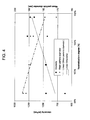
- FIG. 4 shows the results obtained according to example 3, where the particle size is given as a function of the neutralization degree. It can be seen that all particle diameters were less than 200 nm, which is a surprising result. It can also be seen that the amine addition has a direct, approximately linear influence on the viscosity and the particle size. This surprising effect may be the basis of a process control concept.
Landscapes
- Chemical & Material Sciences (AREA)
- Health & Medical Sciences (AREA)
- Chemical Kinetics & Catalysis (AREA)
- Medicinal Chemistry (AREA)
- Polymers & Plastics (AREA)
- Organic Chemistry (AREA)
- Addition Polymer Or Copolymer, Post-Treatments, Or Chemical Modifications (AREA)
- Paints Or Removers (AREA)
Description
- The present invention relates to a method for the continuous production of an aqueous poly(meth)acrylate resin dispersion comprising the steps of: I) providing a (meth)acrylate polymer and/or a (meth)acrylate copolymer; II) adding a neutralizing agent; III) adding water; and IV) mixing the composition to yield a dispersion.
- It is known from a wide number of publications and patents to use dispersions based on (co)polymerisates of vinylic, radically (co)polymerizable monomers as binders in water-dilutable coatings. Such dispersions are prepared in the art from copolymers or mixtures of copolymers, for example (meth)acrylic esters, and further addition of hydroxyfunctional monomers, acid-functional monomers and optionally other monomers and molecular weight regulators.
- The preparation of such copolymers or copolymer mixtures in the art is undertaken by free radical polymerization in, for example, a batch process. Optionally, the batch reactor may already be charged with polymers and/or further reactions may take place in the finished reaction mixture. The reaction may be conducted in substance (in bulk), meaning in the absence of diluting and radically non-reactive substances, in the presence of solvents or as an emulsion polymerization, meaning directly in water. Copolymers or copolymer mixtures thus obtained (generally referred to as 'resin') typically have an acid group content in mmol per 100 g solid polymer of 0.1 to 200 mmol.
- For the production and the use of such (meth)acrylate polymers in two-component polyurethane coatings reference is made to
EP- ,A 0 947 557EP- ,A 1 510 561DE-A 10 2004 054447 ,EP- ,A 1 657 270EP- ,A 1 702 954EP- ,A 1 862 485EP- ,A 2 025 690EP- ,A 0 358 979EP- ,A 0 537 568EP- ,A 0 543 228EP- ,A 0 758 007EP- ,A 0 841 352EP- ,A 1 141 065EP- andA 1 024 184DE-A 4 439 669 . - Furthermore, the resin typically has a number averaged molecular weight of 500 to 50000 g/mol and is provided in the form of a highly viscous melt or a solution. The viscosity is a function of temperature and shear rate and normally is in a range of 1 Pa s and 1000 Pa s at shear rates from 40/s to 100/s.
- After the manufacture of the copolymers or copolymer mixtures in substance or in the presence of solvents it is necessary to prepare the desired aqueous dispersion in a separate process step. As it is described in the state of the art (e. g.
EP-A 947 557 DE-A 4 439 669 orEP- ), in a stirred vessel (usually the reaction vessel), batch-wise one or more basic compounds such as organic amines, ammonia or inorganic base solutions are added to the resin. This is generally referred to as the neutralization step. Then water is added to the neutralized resin and mixed with it or sometimes the neutralized resin is added to water and mixed with the water. This is generally referred to as the emulsifying or dispersing step. A part of the resin may also transfer to the aqueous solution.A 1 024 184 - The polymer particles within the emulsion may solidify during cooling. Particles should have a mean size of less than 300 nm, which may be determined by way of the weight average. Then water-dilutable coatings can be produced with good optical properties such as a high gloss and furthermore good storage stability.
- It is known in the art that the mixing of highly viscous fluids with low viscosity fluids in stirring vessels is especially difficult and requires long stirring times and high shear rates. Because of this the neutralization step and the emulsifying step take several minutes to hours, which negatively impacts the economy of the process. Constantly rising economic requirements put forward to the production of aqueous binders cannot be met by such a process. In particular, an increase of the throughput at a given process plant size without large investments (raising the space-time yield) cannot be achieved with conventional methods.
- The present invention has the object of addressing the afore-mentioned drawbacks in the art. In particular, the invention has the object of providing a method for the efficient production of aqueous dispersions comprising a poly(meth)acrylate resin without the need for widespread investments in the process plant and with a high space-time yield.
- This object is achieved in the present invention by a method for the production of an aqueous poly(meth)acrylate resin dispersion, comprising the steps of:
- I) providing a (meth)acrylate polymer and/or a (meth)acrylate copolymer with an acid group content of ≥ 0.1 mmol to ≤ 200 mmol per 100 g of polymer at a temperature of ≥ 50 °C to ≤ 170 °C;
- II) adding a neutralizing agent to the (meth)acrylate polymer and/or (meth)acrylate copolymer to yield an at least partially neutralized (meth)acrylate polymer and/or (meth)acrylate copolymer;
- III) adding water to the at least partially neutralized (meth)acrylate polymer and/or (meth)acrylate copolymer to yield a composition comprising the at least partially neutralized (meth)acrylate polymer and/or (meth)acrylate copolymer and water;
- IV) mixing the composition of step III) to yield a dispersion of particles of the at least partially neutralized (meth)acrylate polymer and/or (meth)acrylate copolymer in water.
- The method is characterized in that at least step III) is conducted as a continuous step.
- In the method according to the invention aqueous polymer dispersions may be obtained with a solids content of, for example, 25 weight-% to 65 weight-%. The degree of neutralization, defined as the molar ratio of added basic neutralizing agent to the acid groups present in the resin, may be in a range of 30% to 130%.
- Continuous steps or processes in the sense of the invention are in particular those in which an incoming stream enters an element of a reaction apparatus (such as a reactor or mixer) to be converted or to be processed and exits as an outgoing stream simultaneously but at separate locations. This is opposed to the case of discontinuous processes where the process steps of feeding the components, carrying out process steps and discharging the products take place in temporal succession. Preferably, in a continuous process the run-time of the process and the time in which the products are in the process plant are in a ratio of at least 50:1.
- Suitable monomers which may be employed in the synthesis of the (meth)acrylate polymers and/or copolymers include aromatic monomers such as styrene, α-methyl styrene or vinyl toluene; aliphatic esters of acrylic and/or methacrylic acid with 1 to 18 C-atoms such as methyl acrlylate, ethyl acrylate, n-butyl acrylate, iso-butyl acrylate, n-hexyl acrylate, 2-ethylhexyl acrylate, methyl methacrylate, ethyl methacrylate, n-butyl methacrylate, stearyl methacrylate; cycloaliphatic esters of acrylic and/or methacrylic acid with 1 to 12 C-atoms in the alcohol component such as cyclohexyl methacrylate, isobornyl acrylate, isobornyl methacrylate; reaction products of hydroxyalkyl esters of acrylic and/or methacrylic acid with 2 to 4 C-atoms in the hydroxyalkyl rest with ε-caprolactone; α,β-monoolefinically unsaturated mono- or dicarboxylic acids with 3 to 7 C-atoms such as acrylic and/or methacrylic acid, and/or at least one hemiester of maleic or fumaric acid with 1 to 14 C-atoms in the alcohol rest such as maleic acid monoethyl ester, maleic acid monobutyl ester; further monomers such as acrylonitrile, methacrylonitrile, maleic acid anhydride, vinyl esters of aliphatic, optionally branched monocarboxylic acids with 1 to 10 C-atoms in the alcohol rest. This exemplary listing is not to be understood as limiting. It is also possible to use further unsaturated monomers as comonomers, cooligomers and even polymers with unsaturated groups. The terms '(meth)acrylate' and '(meth)acrylic' mean the possibility of both acrylate and methacrylate derivatives. It is preferred, but not limited to, to use (meth)acrylate copolymers with hydroxyl-group containing comonomers, these comonomers including hydroxyalkyl esters of acrylic and/or methacrylic acid with 2 to 4 C-atoms in the hydroxyalkyl rest such as hydroxyethyl acrylate, hydroxypropyl acrylate, hydroxybutyl acrylate, hydroxyethyl methacrylate and hydroxypropyl methacrylate.
- The preparation of the (meth)acrylate polymers and copolymers is known to a person skilled in the art and may be via radical polymerization in substance (in bulk), in solution or in suspension, continuously or batch-wise.
- The hydroxyl group content, expressed as mmol OH groups per 100 g of resin, may be calculated from the amount of OH group-containing monomers. Analytic methods include 1H-NMR spectroscopy or IR spectroscopy. Titration to determine the OH number according to DIN ISO 4269 is also possible. Preferred OH group contents are ≥ 5 mmol to ≤ 600 mmol per 100 g of polymer, more preferred ≥ 30 mmol to ≤ 400 mmol per 100 g of polymer, most preferred ≥ 50 mmol to ≤ 350 mmol per 100 g of polymer.
- The acid group content may preferably be calculated using the acid number determined according to DIN EN ISO 2114. It is further possible to determine the acid number spectroscopically, such as via 1H-NMR spectroscopy or IR spectroscopy. Preferred acid group contents are ≥ 0.1 mmol to ≤ 100 mmol per 100 g of polymer, more preferred ≥ 10 mmol to ≤ 50 mmol per 100 g of polymer.
- The mean particle size in the dispersions obtained by the method according to the invention and determined by ultracentrifugation may have a d50 value of ≥ 10 nm to ≤ 300 nm and preferably ≥ 15 nm to ≤ 250 nm. The d50 value is the value at which 50 weight-% of all particles are above this value and 50 weight-% of all particles are below. Ultracentrifugation methods are described in: W. Scholtan, H. Lange, Kolloid-Z. u. Z. Polymere 250 (1972) 782 and in H.G. Müller, Colloid Polym Sci 267 (1989) 1113 .
- Finally, the polymers employed may have a number averaged molecular weight Mn (determined at 23°C by Size Excluding Chromatography using polystyrene standard for calibration and tetrahydrofurane as eluent) of 500 to 50000 g/mol, preferably 1000 to 40000 g/mol and more preferred 2000 to 30000 g/mol.
- Polymers provided in the initial step of the method according to the invention may be dissolved in solvents such as, but not limited to, butyl glycol, solvent naphtha and/or propylene glycol-n-butyl ether. The temperature range of ≥ 50 °C to ≤ 170 °C provides for a melting, dissolution and adequately processible viscosity of the polymer. Preferred are temperatures of ≥ 80 °C to ≤ 120 °C.
- The neutralization step may be conducted using mixing units such as extruders, static mixers, spike mixers, nozzle jet dispersers, rotors and stators or under the influence of ultrasound. Residence time in the mixing units may be, for example, from ≥ 10 seconds to ≤ 20 minutes, preferably from ≥ 30 seconds to ≤ 12 minutes and more preferred from ≥ 60 seconds to ≤ 3 minutes. The ratio of length to diameter in the static mixer during this step may be in a range of ≥ 1:5 to ≤ 1:100, preferably ≥ 1:10 to ≤ 1:50 and more preferred ≥ 1:15 to ≤ 1:30. Neutralizing agents may be bases such as, for example, amines.
- The continuous emulsifying or dispersion may also be performed using mixing units such as extruders, static mixers, spike mixers, nozzle jet dispersers, rotors and stators or under the influence of ultrasound. Residence time in the mixing units may be, for example, from ≥ 10 seconds to ≤ 20 minutes, preferably from ≥ 30 seconds to ≤ 12 minutes and more preferred from ≥ 60 seconds to ≤ 3 minutes. The ratio of length to diameter in the static mixer during this step may be in a range of ≥ 1:5 to ≤ 1:100, preferably ≥ 1:10 to ≤ 1:50 and more preferred ≥ 1:15 to ≤ 1:30.
- Further preferred embodiments and other aspects of the present invention are described below. They can be combined freely unless the context clearly indicates otherwise.
- Of course, all the other steps may be continuous steps. In one embodiment of the method according to the invention steps I), II), III) and IV) are conducted as continuous steps.
- In another embodiment of the method according to the invention in step II) the (meth)acrylate polymer and/or (meth)acrylate copolymer are neutralized to a degree of ≥ 30% to ≤ 130%. As already outlined, the degree of neutralization is to be understood as the molar ratio of added basic neutralizing agent to the acid groups present in the resin. For example, a degree of neutralization of 110% would correspond to a ratio of 1.1 molar equivalents of basic component such as amines to 1 mol of acid groups. A preferred degree of neutralization is ≥ 50% to ≤ 120%.
- In another embodiment of the method according to the invention the neutralizing agent in step II) comprises an organic amine. Preferred are trialkylamines and most preferred are triethanolamine, dimethylethanolamine and combinations thereof.
- In another embodiment of the method according to the invention a (meth)acrylate copolymer is used which is a copolymer obtainable from at least one alkyl methacrylate, at least one hydroxyalkyl (meth)acrylate, at least one alkyl acrylate, and at least one (meth)acrylic acid, and optionally styrene. Particularly preferred is a combination of at least two comonomers selected from methyl methacrylate, hydroxyethyl methacrylate, butyl (meth)acrylate, isobornyl (meth)acrylate, cyclohexyl (meth)acrylate, styrene and (meth)acrylic acid.
- In another embodiment of the method according to the invention in step I) the acid group content of the (meth)acrylate copolymer is ≥ 0.1 mmol to ≤ 10 mmol per 100 g of polymer and the (meth)acrylate copolymer is produced using vinylic comonomers comprising substituents with polyoxyalkylene units (-CH2-CH(R1)-O-)m, R1 denoting H or alkyl and m having a value of ≥ 4 to ≤ 60.
- The aforementioned alkyl can preferably contain 1-30 carbon atoms in the alkyl part and can be unsubstituted or substituted with
optionally - Preferred are alkyl groups selected from the group consisting of methyl, ethyl, n-propyl, isopropyl, n-butyl, sec-butyl, isobutyl, tert-butyl, n-pentyl, sec-pentyl, neopentyl and n-hexyl, which can optionally be substituted with 1, 2, 3, 4, 5, 6, 7, 8 or 9 substituents selected independently of one another from the group consisting of F, Cl, Br, I, -CN, -NO2, -OH, -OH2, -SH, -OCH3, - O-C2H5, -SCH3, -S-C2H5, -OCF3, -SCF3, -NH-CH3, -N(CH3)2, -N(C2H5)2 and - N(CH3)(C2H5). More preferred are unsubstituted alkyl groups selected from the group consisting of methyl, ethyl, n-propyl, isopropyl, n-butyl, sec-butyl, isobutyl, tert-butyl, n-pentyl, sec-pentyl, neopentyl and n-hexyl.
- Such a low acid group content may, under certain circumstances, not be sufficient to ensure the emulsification of the resin in water. Therefore it is advantageous to incorporate these polyoxyalkylene units into the resin. Preferably, R1 denotes H or methyl.
- In another embodiment of the method according to the invention in step I) the acid group content of the (meth)acrylate copolymer is ≥ 0.1 mmol to ≤ 10 mmol per 100 g of polymer and the (meth)acrylate copolymer is produced using vinylic comonomers comprising substituents with amino groups -NR2R3, wherein R2 and R3 denote, independently of each other, H, C1 to C30 alkyl or C7 to C37 alkylaryl. These groups may be converted to ammonium groups by reaction with acids in order to improve the emulsification of the resin in water.
- Aryl, as referred to in the present invention, is understood as meaning ring systems with at least one aromatic ring but without heteroatoms even in only one of the rings. These aryl is unsubstituted or substituted with 1, 2, 3, 4 or 5 substituents selected from the group consisting of F, CI, Br, I, NH2, SH, OH, SO2, oxo, carboxy, amido, cyano, carbamyl, nitro, phenyl, benzyl, -SO2NH2, C1-6 alkyl and C1-6-alkoxy. Preferred examples of aryl include but are not restricted to phenyl, naphthyl, fluoranthenyl, fluorenyl, tetralinyl or indanyl or anthracenyl radicals, which are unsubstituted or substituted.
- Alkylaryl, as defined in the present invention, comprises a linear or branched, unsubstituted or substituted alkyl which is bonded to an aryl group, as defined above. A preferred alkylaryl is a benzyl group, wherein the alkyl chain is linear or branched and unsubstituted or substituted with 1, 2, 3, 4 or 5 substituents selected from the group consisting of F, Cl, Br, I, NH2, SH, OH, SO2, CF3, carboxy, amido, cyano, carbamyl, nitro, phenyl, benzyl, -SO2NH2, C1-6 alkyl and C1-6-alkoxy.
- In another embodiment of the method according to the invention an emulsifier selected from the group consisting of cationic, anionic and/or nonionic emulsifiers is added in one or more of steps I), II), III) and IV). Suitable emulsifiers are known to those skilled in the art and are, for example, listed in Surfactant and Polymers in Aqueous Solution, by K. Holmberg, B. Jönsson, B. Kronberg, B. Lindman, 2.nd Edition, J. Wiley, New York, 2002 , such as anionic, for example, alkali metal or ammonium salts of long-chain carboxylic acids with 10 to 50 carbon atoms, alkali metal or ammonium alkyl sulfates, alkyl sulfonates, alkylarylsulfonates, sulfosuccinates, cationic, for example long-chain quaternary ammonium ammoniums salts with or without incorporation of ethylene oxide units, non-ionic, for example, polyoxoethylenated long-chain alcohols or alklyphenols or, for example, zwitterionic with both positive and negative charge on the hydrophilic group It is particularly preferred to add the emulsifier if the acid group content of the (meth)acrylate copolymer is ≥ 0.1 mmol to ≤ 10 mmol, as described by the two embodiments above. Anionic and cationic emulsifiers are not compatible with each other, but non-ionic and zwitter-ionic emulsifiers may be used in the mixtures. The typical emulsifier amount based on the resin is within a range of 0.1 weight-% to 5 weight-%.
- In another embodiment of the method according to the invention step IV) is performed using a static mixer. Static mixers are known to those in skilled in the art and are, for example, described in Arno Signer, Statisches Mischen in der Kunststoffverarbeitung und -herstellung, Plastverarbeiter 11(43), 1992 . Particularly preferred are static mixers of the SMX type, which are also known to those skilled in the art and are also mentioned in this publication. The ratio of length to diameter in the static mixer during this step may be in a range of ≥ 1:5 to ≤ 1:100, preferably ≥ 1:10 to ≤ 1:50 and more preferred ≥ 1:15 to ≤ 1:30.
- It is known that in a static mixer problems may arise when a low viscosity fluid (liquid, supercritical or gaseous) and a high viscosity fluid are metered separately. In particular with a high volume ratio between a low viscosity fluid and a high viscosity fluid the effect has been observed that bubbles of the low viscosity fluid pass the static mixer with virtually no mixing having occurred. This leads to a reduced efficiency of the static mixer and may lead to a loss of function for the mixer. A special embodiment of the method according to the invention addresses this problem by performing step III) in a continuous manner using a nozzle with an, in radial direction, inner channel through which the water flows and a plurality of, in radial direction, outer channels through which the at least partially neutralized (meth)acrylate polymer and/or (meth)acrylate copolymer flows.
- It is preferred that the nozzle is constructed in such a way that to every partial stream of the high viscosity fluid (the at least partially neutralized (meth)acrylate polymer and/or (meth)acrylate copolymer) an additional partial stream of the low viscosity fluid (water) is added.
- The nozzle has the effect that the low viscosity fluid is the continuous phase. Then a high surface area is achieved by the individual channels from which the high viscosity fluid exits and a rapid dispersion takes place. Furthermore, the addition of the low viscosity fluid on the side of the channels which are faced towards the exterior side of the pipeline leads to a separation of the high viscosity fluid from the wall of the pipeline. This prevents a prolonged contact with the wall. Because contacting the wall may lead to a chemical degradation of the polymer as evident in the occurrence of discoloring, particle agglomeration or gel formation.
- It has surprisingly also been found that the amount of neutralizing agent has a direct influence on the viscosity and the size of particles in the polymer dispersion obtained in the method according to the invention. From conventional stirring batch processes it is known that viscosity and particle size cannot be adjusted over a wide range but rather only small changes in the polymer properties are possible by adding a very specific amount of neutralizing agent. This fact opens a convenient possibility for a new process control and for quality control.
- Therefore, in another embodiment of the method according to the invention in the dispersion of step IV) the size of the particles is measured and the amount of neutralizing agent added in step II) is controlled so as to reach a desired particle size. The particle size (mean particle size) may be determined by methods such as laser correlation spectroscopy, dynamic light scattering, ultracentrifugation or acoustic attenuation spectroscopy. It may be necessary to take samples from the product stream. Preferably this is done automatically.
- In another embodiment of the method according to the invention the viscosity of the dispersion of step IV) is measured and the amount of neutralizing agent added in step II) is controlled as to reach a desired viscosity. The viscosity may be determined by known methods such as the pressure drop over a capillary or by oscillatory measurements.
- The present invention will be further described with reference to the following figures and examples without wishing to be limited by them.
-
-
FIG. 1 shows the apparatus set up used in Example 1 -
FIG. 2 shows the apparatus set up used in Example 2 -
FIG. 3 shows the parameters of the resulting dispersions from Example 2 (viscosity and mean particle size as function of the neutralization degree) -
FIG. 4 shows the parameters of the resulting dispersions from Example 3 (viscosity and mean particle size as function of the neutralization degree) -
FIG. 5 shows an example of the nozzle design according to the invention -
FIG. 6 shows the incorporation of the inventive nozzle into the flange - Base resin 1: an 85 weight-% solution of a hydroxyl group-containing acrylate resin with a hydroxyl group content of 195 mmol per 100 g of solid resin, an acid group content of 50 mmol per 100 g of solid resin. This resin was prepared according to the Example 1 of
EP-A 0947557 . Solvent: butyl glycol: solvent naphtha 50:50 weight-%. Base resin 2: an 85 weight-% solution of a hydroxyl group-containing acrylate resin with a hydroxyl group content of 230 mmol per 100 g of solid resin, an acid group content of 50 mmol per 100 g of solid resin. This resin was prepared according to the Example 1 ofEP-A 1391469 . Solvent: propylene glycol-n-butyl ether (Dowanol® PnB) : solvent naphtha (Solvesso® SN100) 50:50 weight-%. Methods: - Particle size measurements: laser correlation spectroscopy, Malvern® Zetasizer, Z-mean value.
- Viscosity measurements: mPa s according to DIN EN ISO 3219/A.3.
- Hydroxyl group content: calculated from the OH group-containing acrylate monomers.
- Acid group content: calculated using the acid number determined according to DIN EN ISO 2114.
- pH value: dilution of the dispersion with deionized water by 1:4; DIN ISO 976.
- In a reaction system according to
FIG. 1 a 10liter vessel 1 was charged with 7.5 kg of thebase resin 1 solution, followed by heating to 90 °C. Over the course of one minute the neutralization agent, 199 g dimethylethanolamine, were added and it was homogenized by stirring for 20 minutes. - Deionized water from vessel 4, which can be connected or disconnected via valve 5, was metered using
pump 6, heated to 90 °C inheat exchanger 7 and was contacted with the resin-amine mixture innozzle 8. The product streams were then dispersed instatic mixer 9. - Using
heat exchanger 10 the dispersion was cooled and transferred to storage vessel 12 viapressure reducing valve 11. - The
static mixer 9 was an SMX mixer with a diameter of 34 mm and a ratio of length to diameter of 20. - The throughput of the resin-amine mixture was 7.7 kg/h and of the water was 7.5 kg/h. The particle size determined was 145 nm and the viscosity 0.83 Pa s.
- Residence (dwell) time in the static mixer was 117 seconds.
- In a reaction system according to
FIG. 2 a 10liter vessel 1 was charged with 7.6 kg of thebase resin 1 solution, followed by heating to 90 °C. 7.82 kg/h of the resin solution were metered using pump 3 and mixed with dimethylethanolamine fromvessel 13 usingpump 15 instatic mixer 16. - 6.97 kg/h of deionized water from vessel 4, which can be connected or disconnected via valve 5, were metered with
pump 6, heated to 90 °C usingheat exchanger 7 and contacted with the resin-amine mixture innozzle 8. - The amine throughput was varied between 188 g/h and 232 g/h. This corresponded to a neutralization degree of 94% to 116%. The product streams were then dispersed in
static mixer 9. - Using
heat exchanger 10 the dispersion was cooled and transferred to storage vessel 12 viapressure reducing valve 11. - The
static mixer 16 was an SMX mixer with a diameter of 22 mm and a ratio of length to diameter of 21. The residence time in the static mixer was 70 s. - The
static mixer 9 was an SMX mixer with a diameter of 27 mm and a ratio of length to diameter of 15. Residence time in the static mixer was 45 seconds.FIG. 3 shows the results obtained according to example 2, where the particle size is given as a function of the neutralization degree. It can be seen that all particle diameters were less than 145 nm, which is a surprising result. It can also be seen that the amine addition has a direct, approximately linear influence on the viscosity and the particle size. This surprising effect may be the basis of a process control concept. - In a reaction system according to
FIG. 2 a 10liter vessel 1 was charged with 7.3 kg of thebase resin 2 solution, followed by heating to 105 °C. 7.74 kg/h resin were metered using pump 3 and combined with a mixture of 75 mass-% triethanolamine and 25 mass-% dimethylethanolamine fromvessel 13 usingpump 15 instatic mixer 16. - 6.89 kg/h deionized water from vessel 4, which can be connected or disconnected via valve 5, were metered with
pump 6, heated to 70 °C usingheat exchanger 7 and contacted with the resin-amine mixture innozzle 8. - The amine throughput was varied between 354 g/h and 402 g/h. This corresponded to a neutralization degree of 95% to 110%. The product streams were then dispersed in
static mixer 9. - Using
heat exchanger 10 the dispersion was cooled and transferred to storage vessel 12 viapressure reducing valve 11. - The
static mixer 16 was an SMX mixer with a diameter of 22 mm and a ratio of length to diameter of 21. The residence time in the static mixer was 70 s. - The
static mixer 9 was an SMX mixer with a diameter of 27 mm and a ratio of length to diameter of 15. Residence time in the static mixer was 46 seconds.FIG. 4 shows the results obtained according to example 3, where the particle size is given as a function of the neutralization degree. It can be seen that all particle diameters were less than 200 nm, which is a surprising result. It can also be seen that the amine addition has a direct, approximately linear influence on the viscosity and the particle size. This surprising effect may be the basis of a process control concept.
Claims (12)
- A method for the production of an aqueous poly(meth)acrylate resin dispersion, comprising the steps of:I) providing a (meth)acrylate polymer and/or a (meth)acrylate copolymer with an acid group content of ≥ 0.1 mmol to ≤ 200 mmol per 100 g of polymer at a temperature of ≥ 50 °C to ≤ 170 °C;II) adding a neutralizing agent to the (meth)acrylate polymer and/or (meth)acrylate copolymer to yield an at least partially neutralized (meth)acrylate polymer and/or (meth)acrylate copolymer;III) adding water to the at least partially neutralized (meth)acrylate polymer and/or (meth)acrylate copolymer to yield a composition comprising the at least partially neutralized (meth)acrylate polymer and/or (meth)acrylate copolymer and water;IV) mixing the composition of step III) to yield a dispersion of particles of the at least partially neutralized (meth)acrylate polymer and/or (meth)acrylate copolymer in water;characterized in that
at least step III) is conducted as a continuous step. - The method according to claim 1, wherein steps I), II), III) and IV) are conducted as continuous steps.
- The method according to claim 1 or claim 2, wherein step II) the (meth)acrylate polymer and/or (meth)acrylate copolymer are neutralized to a degree of ≥ 30 % to ≤ 130 %.
- The method according to any of claims 1 to 3, wherein the neutralizing agent in step II) comprises at least one amine.
- The method according to any of claims 1 to 4, wherein a (meth)acrylate copolymer is used which is a copolymer obtainable from at least one alkyl methacrylate, at least one hydroxyalkyl (meth)acrylate, at least one alkyl acrylate, and at least one (meth)acrylic acid, and optionally styrene.
- The method according to any of claims 1 to 5, wherein in step I) the acid group content of the (meth)acrylate copolymer is ≥ 0.1 mmol to ≤ 10 mmol per 100 g of polymer and wherein the (meth)acrylate copolymer is produced using vinylic comonomers comprising substituents with polyoxyalkylene units (-CH2-CH(R1)-O-)m, R1 denoting H or alkyl and m having a value of ≥ 4 to ≤ 60.
- The method according to any of claims 1 to 6, wherein in step I) the acid group content of the (meth)acrylate copolymer is ≥ 0.1 mmol to ≤ 10 mmol per 100 g of polymer and wherein the (meth)acrylate copolymer is produced using vinylic comonomers comprising substituents with amino groups -NR2R3, wherein R2 and R3 denote, independently of each other, H, C1 to C30 alkyl or C7 to C37 alkylaryl.
- The method according to any of claims 1 to 7, wherein an emulsifier selected from the group consisting of cationic, anionic and/or nonionic emulsifiers is added in one or more of steps I), II), III) and IV).
- The method according to any of claims 1 to 8, wherein step IV) is performed using a static mixer.
- The method according to any of claims 1 to 9, wherein step III) is performed using a nozzle with an, in radial direction, interior inner channel through which the water flows and a plurality of, in radial direction, outer channels through which the at least partially neutralized (meth)acrylate polymer and/or (meth)acrylate copolymer flows.
- The method according to any of claims 1 to 10, wherein in the dispersion of step IV) the size of the particles is measured and the amount of neutralizing agent added in step II) is determined as a function of the particle size.
- The method according to any of claims 1 to 11, wherein the viscosity of the dispersion of step IV) is measured and the amount of neutralizing agent added in step II) is determined as a function of the particle size.
Priority Applications (1)
| Application Number | Priority Date | Filing Date | Title |
|---|---|---|---|
| EP12759421.6A EP2756018B1 (en) | 2011-09-15 | 2012-09-13 | Method for the continuous production of an aqueous poly(meth)acrylate resin dispersion |
Applications Claiming Priority (3)
| Application Number | Priority Date | Filing Date | Title |
|---|---|---|---|
| EP11181403 | 2011-09-15 | ||
| PCT/EP2012/067900 WO2013037863A1 (en) | 2011-09-15 | 2012-09-13 | Method for the continuous production of an aqueous poly(meth)acrylate resin dispersion |
| EP12759421.6A EP2756018B1 (en) | 2011-09-15 | 2012-09-13 | Method for the continuous production of an aqueous poly(meth)acrylate resin dispersion |
Publications (2)
| Publication Number | Publication Date |
|---|---|
| EP2756018A1 EP2756018A1 (en) | 2014-07-23 |
| EP2756018B1 true EP2756018B1 (en) | 2015-10-21 |
Family
ID=46851977
Family Applications (1)
| Application Number | Title | Priority Date | Filing Date |
|---|---|---|---|
| EP12759421.6A Not-in-force EP2756018B1 (en) | 2011-09-15 | 2012-09-13 | Method for the continuous production of an aqueous poly(meth)acrylate resin dispersion |
Country Status (3)
| Country | Link |
|---|---|
| EP (1) | EP2756018B1 (en) |
| ES (1) | ES2559654T3 (en) |
| WO (1) | WO2013037863A1 (en) |
Families Citing this family (1)
| Publication number | Priority date | Publication date | Assignee | Title |
|---|---|---|---|---|
| MY189062A (en) | 2013-03-15 | 2022-01-24 | Akzo Nobel Coatings Int Bv | Hybrid water dispersions, (poly)ethylene (meth)acrylic acid copolymer composite latex emulsions, hybrid (poly)ethylene (meth)acrylic acid organosilane composite latex emulsions, and coating compositions formed therefrom |
Family Cites Families (17)
| Publication number | Priority date | Publication date | Assignee | Title |
|---|---|---|---|---|
| KR0130652B1 (en) * | 1987-08-14 | 1998-04-07 | 존 휴즈 | Process for producing water absorbent resin |
| DE3829587A1 (en) | 1988-09-01 | 1990-03-15 | Bayer Ag | COATING AGENT, A PROCESS FOR THE PRODUCTION THEREOF, AND THE USE OF SELECTED TWO-COMPONENT POLYURETHANE SYSTEMS AS BINDER FOR SUCH COATING AGENTS |
| DE4134064A1 (en) | 1991-10-15 | 1993-04-22 | Bayer Ag | BINDER COMBINATION, A METHOD FOR THEIR PRODUCTION AND THEIR USE |
| DE4137896A1 (en) | 1991-11-18 | 1993-05-19 | Bayer Ag | AQUEOUS BINDER COMBINATION AND THEIR USE |
| DE4439669A1 (en) | 1994-11-07 | 1996-05-09 | Basf Lacke & Farben | Aqueous two-component polyurethane coating agent, process for its preparation and its use in processes for producing a multi-layer coating |
| DE19528939A1 (en) | 1995-08-07 | 1997-02-13 | Bayer Ag | Aqueous, crosslinkable binder dispersions with a low solvent content |
| DE19646586A1 (en) | 1996-11-12 | 1998-05-14 | Bayer Ag | Process for the preparation of polyacrylic secondary dispersions |
| DE19814061A1 (en) | 1998-03-30 | 1999-10-07 | Bayer Ag | Copolymer dispersions, binder combinations based on the copolymer dispersions, a process for their preparation and their use |
| DE19858732A1 (en) | 1998-12-18 | 2000-06-21 | Bayer Ag | Aqueous, two-component polyurethane coating material for various substrates contains, as binder, polyisocyanate in aqueous solution or dispersion of graft copolymer with elastomeric and thermoplastic polyol components |
| DE19903391A1 (en) | 1999-01-29 | 2000-08-03 | Bayer Ag | Aqueous coating agent, process for its preparation and its use |
| DE10237576A1 (en) | 2002-08-16 | 2004-02-26 | Bayer Ag | Aqueous binder dispersions as coating agents |
| DE102004054499A1 (en) | 2004-11-11 | 2006-05-18 | Bayer Materialscience Ag | Polyester-polyacrylate dispersions with reactive diluents based on lactone-containing compounds |
| DE102004054447A1 (en) | 2004-11-11 | 2006-05-18 | Bayer Materialscience Ag | Preparation of polyester polyacrylate-graft polymer dispersion with co-solvent, useful to prepare e.g. clear lacquers, comprises preparing a copolymer of vinyl monomers by radical polymerization and dispersing the copolymer in water |
| DE102005010694A1 (en) | 2005-03-09 | 2006-09-14 | Bayer Materialscience Ag | Aqueous copolymer dispersions with reactive diluents |
| DE102006025006A1 (en) | 2006-05-30 | 2007-12-06 | Bayer Materialscience Ag | Aqueous copolymer dispersion with improved blocking resistance |
| DE102007035366A1 (en) | 2007-07-27 | 2009-01-29 | Bayer Materialscience Ag | Aqueous polymer secondary dispersions for the production of coatings |
| US8394568B2 (en) * | 2009-11-02 | 2013-03-12 | Xerox Corporation | Synthesis and emulsification of resins |
-
2012
- 2012-09-13 WO PCT/EP2012/067900 patent/WO2013037863A1/en not_active Ceased
- 2012-09-13 EP EP12759421.6A patent/EP2756018B1/en not_active Not-in-force
- 2012-09-13 ES ES12759421.6T patent/ES2559654T3/en active Active
Also Published As
| Publication number | Publication date |
|---|---|
| ES2559654T3 (en) | 2016-02-15 |
| WO2013037863A1 (en) | 2013-03-21 |
| EP2756018A1 (en) | 2014-07-23 |
Similar Documents
| Publication | Publication Date | Title |
|---|---|---|
| US6992121B1 (en) | Aqueous, polymodal, multistage polymer emulsions | |
| EP2861664B1 (en) | Aqueous based blend composition and method of producing the same | |
| TW592794B (en) | A dispersant, coating compositions, pastes and/or moulding compounds | |
| CN102834419B (en) | The method of continuous emulsion polymerization | |
| AU2014230876B2 (en) | Hybrid water dispersions, (poly)ethylene (meth)acrylic acid copolymer composite latex emulsions, hybrid (poly)ethylene (meth)acrylic acid organosilane composite latex emulsions, and coating compositions formed therefrom | |
| CN109021161A (en) | A kind of method that microchannel plate should synthesize GMA acrylic resin | |
| CN110536947B (en) | Multimodal polymer composition | |
| JP2001279112A (en) | Surfactant-free aqueous emulsion | |
| JP3403828B2 (en) | Aqueous composite resin dispersion and method for producing the same | |
| CN102292363A (en) | Polymer dispersion in water | |
| JP7124316B2 (en) | Method for producing aqueous resin dispersion | |
| JP7482597B2 (en) | Water-based resin dispersion | |
| CA2305566A1 (en) | Scrub resistant latexes | |
| WO2013037863A1 (en) | Method for the continuous production of an aqueous poly(meth)acrylate resin dispersion | |
| JP5099320B2 (en) | Aqueous vinyl-modified epoxy resin, production method thereof, and aqueous coating agent | |
| KR102255332B1 (en) | Bisphenol a-free ethylene (meth)acrylic acid copolymer composition for metal can coatings | |
| CN112724309B (en) | Continuous production method of hydroxy acrylic resin aqueous dispersion | |
| CN106699936B (en) | A kind of preparation method of high molecular weight sodium polyacrylate | |
| JPH07166143A (en) | Production of pressure-sensitive adhesive dispersion based on butyl acrylate-(meth)acrylic acid copolymer | |
| JPH0559188A (en) | Method for producing aqueous dispersion of chlorinated polyolefin resin | |
| JP5023557B2 (en) | Aqueous modified polyolefin resin composition | |
| CN101155839A (en) | Method and equipment for preparing polyvinyl alcohol with high degree of polymerization | |
| CN103781811B (en) | Continuous seepage water dispersibles the method for vinyl polymer | |
| JPS5825386B2 (en) | Water-dispersed thermosetting coating composition | |
| López et al. | Synthesis and characterization of a pressure-sensitive adhesive based on an isobutyl acrylate/2-ethylhexyl acrylate copolymer |
Legal Events
| Date | Code | Title | Description |
|---|---|---|---|
| PUAI | Public reference made under article 153(3) epc to a published international application that has entered the european phase |
Free format text: ORIGINAL CODE: 0009012 |
|
| 17P | Request for examination filed |
Effective date: 20140415 |
|
| AK | Designated contracting states |
Kind code of ref document: A1 Designated state(s): AL AT BE BG CH CY CZ DE DK EE ES FI FR GB GR HR HU IE IS IT LI LT LU LV MC MK MT NL NO PL PT RO RS SE SI SK SM TR |
|
| RIN1 | Information on inventor provided before grant (corrected) |
Inventor name: WITKOWSKI, REINER Inventor name: AVTOMONOV, EVGENY Inventor name: BOOS, KARL-ROBERT Inventor name: RUHLAND, MATTHIAS Inventor name: STEIN, SIGRUN Inventor name: BACH, SVEN Inventor name: HENNINGER, BJOERN |
|
| DAX | Request for extension of the european patent (deleted) | ||
| GRAP | Despatch of communication of intention to grant a patent |
Free format text: ORIGINAL CODE: EPIDOSNIGR1 |
|
| INTG | Intention to grant announced |
Effective date: 20150602 |
|
| GRAS | Grant fee paid |
Free format text: ORIGINAL CODE: EPIDOSNIGR3 |
|
| GRAA | (expected) grant |
Free format text: ORIGINAL CODE: 0009210 |
|
| AK | Designated contracting states |
Kind code of ref document: B1 Designated state(s): AL AT BE BG CH CY CZ DE DK EE ES FI FR GB GR HR HU IE IS IT LI LT LU LV MC MK MT NL NO PL PT RO RS SE SI SK SM TR |
|
| REG | Reference to a national code |
Ref country code: GB Ref legal event code: FG4D |
|
| REG | Reference to a national code |
Ref country code: CH Ref legal event code: EP |
|
| RAP2 | Party data changed (patent owner data changed or rights of a patent transferred) |
Owner name: COVESTRO DEUTSCHLAND AG |
|
| REG | Reference to a national code |
Ref country code: AT Ref legal event code: REF Ref document number: 756567 Country of ref document: AT Kind code of ref document: T Effective date: 20151115 |
|
| REG | Reference to a national code |
Ref country code: IE Ref legal event code: FG4D |
|
| REG | Reference to a national code |
Ref country code: DE Ref legal event code: R096 Ref document number: 602012011835 Country of ref document: DE |
|
| REG | Reference to a national code |
Ref country code: ES Ref legal event code: FG2A Ref document number: 2559654 Country of ref document: ES Kind code of ref document: T3 Effective date: 20160215 |
|
| REG | Reference to a national code |
Ref country code: LT Ref legal event code: MG4D |
|
| REG | Reference to a national code |
Ref country code: NL Ref legal event code: FP |
|
| REG | Reference to a national code |
Ref country code: AT Ref legal event code: MK05 Ref document number: 756567 Country of ref document: AT Kind code of ref document: T Effective date: 20151021 |
|
| PG25 | Lapsed in a contracting state [announced via postgrant information from national office to epo] |
Ref country code: IS Free format text: LAPSE BECAUSE OF FAILURE TO SUBMIT A TRANSLATION OF THE DESCRIPTION OR TO PAY THE FEE WITHIN THE PRESCRIBED TIME-LIMIT Effective date: 20160221 Ref country code: HR Free format text: LAPSE BECAUSE OF FAILURE TO SUBMIT A TRANSLATION OF THE DESCRIPTION OR TO PAY THE FEE WITHIN THE PRESCRIBED TIME-LIMIT Effective date: 20151021 Ref country code: NO Free format text: LAPSE BECAUSE OF FAILURE TO SUBMIT A TRANSLATION OF THE DESCRIPTION OR TO PAY THE FEE WITHIN THE PRESCRIBED TIME-LIMIT Effective date: 20160121 Ref country code: LT Free format text: LAPSE BECAUSE OF FAILURE TO SUBMIT A TRANSLATION OF THE DESCRIPTION OR TO PAY THE FEE WITHIN THE PRESCRIBED TIME-LIMIT Effective date: 20151021 |
|
| PG25 | Lapsed in a contracting state [announced via postgrant information from national office to epo] |
Ref country code: RS Free format text: LAPSE BECAUSE OF FAILURE TO SUBMIT A TRANSLATION OF THE DESCRIPTION OR TO PAY THE FEE WITHIN THE PRESCRIBED TIME-LIMIT Effective date: 20151021 Ref country code: PT Free format text: LAPSE BECAUSE OF FAILURE TO SUBMIT A TRANSLATION OF THE DESCRIPTION OR TO PAY THE FEE WITHIN THE PRESCRIBED TIME-LIMIT Effective date: 20160222 Ref country code: GR Free format text: LAPSE BECAUSE OF FAILURE TO SUBMIT A TRANSLATION OF THE DESCRIPTION OR TO PAY THE FEE WITHIN THE PRESCRIBED TIME-LIMIT Effective date: 20160122 Ref country code: AT Free format text: LAPSE BECAUSE OF FAILURE TO SUBMIT A TRANSLATION OF THE DESCRIPTION OR TO PAY THE FEE WITHIN THE PRESCRIBED TIME-LIMIT Effective date: 20151021 Ref country code: SE Free format text: LAPSE BECAUSE OF FAILURE TO SUBMIT A TRANSLATION OF THE DESCRIPTION OR TO PAY THE FEE WITHIN THE PRESCRIBED TIME-LIMIT Effective date: 20151021 Ref country code: LV Free format text: LAPSE BECAUSE OF FAILURE TO SUBMIT A TRANSLATION OF THE DESCRIPTION OR TO PAY THE FEE WITHIN THE PRESCRIBED TIME-LIMIT Effective date: 20151021 Ref country code: FI Free format text: LAPSE BECAUSE OF FAILURE TO SUBMIT A TRANSLATION OF THE DESCRIPTION OR TO PAY THE FEE WITHIN THE PRESCRIBED TIME-LIMIT Effective date: 20151021 Ref country code: PL Free format text: LAPSE BECAUSE OF FAILURE TO SUBMIT A TRANSLATION OF THE DESCRIPTION OR TO PAY THE FEE WITHIN THE PRESCRIBED TIME-LIMIT Effective date: 20151021 |
|
| REG | Reference to a national code |
Ref country code: DE Ref legal event code: R097 Ref document number: 602012011835 Country of ref document: DE |
|
| PG25 | Lapsed in a contracting state [announced via postgrant information from national office to epo] |
Ref country code: CZ Free format text: LAPSE BECAUSE OF FAILURE TO SUBMIT A TRANSLATION OF THE DESCRIPTION OR TO PAY THE FEE WITHIN THE PRESCRIBED TIME-LIMIT Effective date: 20151021 |
|
| PLBE | No opposition filed within time limit |
Free format text: ORIGINAL CODE: 0009261 |
|
| STAA | Information on the status of an ep patent application or granted ep patent |
Free format text: STATUS: NO OPPOSITION FILED WITHIN TIME LIMIT |
|
| PG25 | Lapsed in a contracting state [announced via postgrant information from national office to epo] |
Ref country code: SK Free format text: LAPSE BECAUSE OF FAILURE TO SUBMIT A TRANSLATION OF THE DESCRIPTION OR TO PAY THE FEE WITHIN THE PRESCRIBED TIME-LIMIT Effective date: 20151021 Ref country code: RO Free format text: LAPSE BECAUSE OF FAILURE TO SUBMIT A TRANSLATION OF THE DESCRIPTION OR TO PAY THE FEE WITHIN THE PRESCRIBED TIME-LIMIT Effective date: 20151021 Ref country code: DK Free format text: LAPSE BECAUSE OF FAILURE TO SUBMIT A TRANSLATION OF THE DESCRIPTION OR TO PAY THE FEE WITHIN THE PRESCRIBED TIME-LIMIT Effective date: 20151021 Ref country code: SM Free format text: LAPSE BECAUSE OF FAILURE TO SUBMIT A TRANSLATION OF THE DESCRIPTION OR TO PAY THE FEE WITHIN THE PRESCRIBED TIME-LIMIT Effective date: 20151021 Ref country code: EE Free format text: LAPSE BECAUSE OF FAILURE TO SUBMIT A TRANSLATION OF THE DESCRIPTION OR TO PAY THE FEE WITHIN THE PRESCRIBED TIME-LIMIT Effective date: 20151021 |
|
| 26N | No opposition filed |
Effective date: 20160722 |
|
| REG | Reference to a national code |
Ref country code: NL Ref legal event code: PD Owner name: COVESTRO DEUTSCHLAND AG; DE Free format text: DETAILS ASSIGNMENT: VERANDERING VAN EIGENAAR(S), OVERDRACHT; FORMER OWNER NAME: BAYER INTELLECTUAL PROPERTY GMBH Effective date: 20160810 |
|
| PG25 | Lapsed in a contracting state [announced via postgrant information from national office to epo] |
Ref country code: SI Free format text: LAPSE BECAUSE OF FAILURE TO SUBMIT A TRANSLATION OF THE DESCRIPTION OR TO PAY THE FEE WITHIN THE PRESCRIBED TIME-LIMIT Effective date: 20151021 |
|
| PG25 | Lapsed in a contracting state [announced via postgrant information from national office to epo] |
Ref country code: MC Free format text: LAPSE BECAUSE OF FAILURE TO SUBMIT A TRANSLATION OF THE DESCRIPTION OR TO PAY THE FEE WITHIN THE PRESCRIBED TIME-LIMIT Effective date: 20151021 |
|
| REG | Reference to a national code |
Ref country code: CH Ref legal event code: PL |
|
| GBPC | Gb: european patent ceased through non-payment of renewal fee |
Effective date: 20160913 |
|
| REG | Reference to a national code |
Ref country code: IE Ref legal event code: MM4A |
|
| REG | Reference to a national code |
Ref country code: FR Ref legal event code: ST Effective date: 20170531 |
|
| PG25 | Lapsed in a contracting state [announced via postgrant information from national office to epo] |
Ref country code: GB Free format text: LAPSE BECAUSE OF NON-PAYMENT OF DUE FEES Effective date: 20160913 Ref country code: CH Free format text: LAPSE BECAUSE OF NON-PAYMENT OF DUE FEES Effective date: 20160930 Ref country code: IE Free format text: LAPSE BECAUSE OF NON-PAYMENT OF DUE FEES Effective date: 20160913 Ref country code: FR Free format text: LAPSE BECAUSE OF NON-PAYMENT OF DUE FEES Effective date: 20160930 Ref country code: LI Free format text: LAPSE BECAUSE OF NON-PAYMENT OF DUE FEES Effective date: 20160930 |
|
| PG25 | Lapsed in a contracting state [announced via postgrant information from national office to epo] |
Ref country code: LU Free format text: LAPSE BECAUSE OF NON-PAYMENT OF DUE FEES Effective date: 20160913 |
|
| PG25 | Lapsed in a contracting state [announced via postgrant information from national office to epo] |
Ref country code: HU Free format text: LAPSE BECAUSE OF FAILURE TO SUBMIT A TRANSLATION OF THE DESCRIPTION OR TO PAY THE FEE WITHIN THE PRESCRIBED TIME-LIMIT; INVALID AB INITIO Effective date: 20120913 |
|
| PG25 | Lapsed in a contracting state [announced via postgrant information from national office to epo] |
Ref country code: CY Free format text: LAPSE BECAUSE OF FAILURE TO SUBMIT A TRANSLATION OF THE DESCRIPTION OR TO PAY THE FEE WITHIN THE PRESCRIBED TIME-LIMIT Effective date: 20151021 Ref country code: MK Free format text: LAPSE BECAUSE OF FAILURE TO SUBMIT A TRANSLATION OF THE DESCRIPTION OR TO PAY THE FEE WITHIN THE PRESCRIBED TIME-LIMIT Effective date: 20151021 Ref country code: MT Free format text: LAPSE BECAUSE OF NON-PAYMENT OF DUE FEES Effective date: 20160930 |
|
| PG25 | Lapsed in a contracting state [announced via postgrant information from national office to epo] |
Ref country code: BG Free format text: LAPSE BECAUSE OF FAILURE TO SUBMIT A TRANSLATION OF THE DESCRIPTION OR TO PAY THE FEE WITHIN THE PRESCRIBED TIME-LIMIT Effective date: 20151021 |
|
| PG25 | Lapsed in a contracting state [announced via postgrant information from national office to epo] |
Ref country code: TR Free format text: LAPSE BECAUSE OF FAILURE TO SUBMIT A TRANSLATION OF THE DESCRIPTION OR TO PAY THE FEE WITHIN THE PRESCRIBED TIME-LIMIT Effective date: 20151021 Ref country code: AL Free format text: LAPSE BECAUSE OF FAILURE TO SUBMIT A TRANSLATION OF THE DESCRIPTION OR TO PAY THE FEE WITHIN THE PRESCRIBED TIME-LIMIT Effective date: 20151021 |
|
| PGFP | Annual fee paid to national office [announced via postgrant information from national office to epo] |
Ref country code: NL Payment date: 20200915 Year of fee payment: 9 |
|
| PGFP | Annual fee paid to national office [announced via postgrant information from national office to epo] |
Ref country code: IT Payment date: 20200827 Year of fee payment: 9 |
|
| PGFP | Annual fee paid to national office [announced via postgrant information from national office to epo] |
Ref country code: ES Payment date: 20201015 Year of fee payment: 9 |
|
| REG | Reference to a national code |
Ref country code: NL Ref legal event code: MM Effective date: 20211001 |
|
| PG25 | Lapsed in a contracting state [announced via postgrant information from national office to epo] |
Ref country code: NL Free format text: LAPSE BECAUSE OF NON-PAYMENT OF DUE FEES Effective date: 20211001 |
|
| PG25 | Lapsed in a contracting state [announced via postgrant information from national office to epo] |
Ref country code: IT Free format text: LAPSE BECAUSE OF NON-PAYMENT OF DUE FEES Effective date: 20210913 |
|
| PGFP | Annual fee paid to national office [announced via postgrant information from national office to epo] |
Ref country code: DE Payment date: 20220609 Year of fee payment: 11 |
|
| REG | Reference to a national code |
Ref country code: ES Ref legal event code: FD2A Effective date: 20221107 |
|
| PGFP | Annual fee paid to national office [announced via postgrant information from national office to epo] |
Ref country code: BE Payment date: 20220826 Year of fee payment: 11 |
|
| PG25 | Lapsed in a contracting state [announced via postgrant information from national office to epo] |
Ref country code: ES Free format text: LAPSE BECAUSE OF NON-PAYMENT OF DUE FEES Effective date: 20210914 |
|
| REG | Reference to a national code |
Ref country code: DE Ref legal event code: R119 Ref document number: 602012011835 Country of ref document: DE |
|
| REG | Reference to a national code |
Ref country code: BE Ref legal event code: MM Effective date: 20230930 |
|
| PG25 | Lapsed in a contracting state [announced via postgrant information from national office to epo] |
Ref country code: DE Free format text: LAPSE BECAUSE OF NON-PAYMENT OF DUE FEES Effective date: 20240403 |
|
| PG25 | Lapsed in a contracting state [announced via postgrant information from national office to epo] |
Ref country code: BE Free format text: LAPSE BECAUSE OF NON-PAYMENT OF DUE FEES Effective date: 20230930 |