EP2756004B1 - INHIBITOR OF PROPROTEIN CONVERTASE SUBTILISIN KEXIN-9 (PCSK9) FOR USE IN REDUCING LIPOPROTEIN(a) LEVELS - Google Patents
INHIBITOR OF PROPROTEIN CONVERTASE SUBTILISIN KEXIN-9 (PCSK9) FOR USE IN REDUCING LIPOPROTEIN(a) LEVELS Download PDFInfo
- Publication number
- EP2756004B1 EP2756004B1 EP12761864.3A EP12761864A EP2756004B1 EP 2756004 B1 EP2756004 B1 EP 2756004B1 EP 12761864 A EP12761864 A EP 12761864A EP 2756004 B1 EP2756004 B1 EP 2756004B1
- Authority
- EP
- European Patent Office
- Prior art keywords
- synthetic
- artificial sequence
- prt
- dna
- antibody
- Prior art date
- Legal status (The legal status is an assumption and is not a legal conclusion. Google has not performed a legal analysis and makes no representation as to the accuracy of the status listed.)
- Active
Links
Classifications
-
- A—HUMAN NECESSITIES
- A61—MEDICAL OR VETERINARY SCIENCE; HYGIENE
- A61K—PREPARATIONS FOR MEDICAL, DENTAL OR TOILETRY PURPOSES
- A61K39/00—Medicinal preparations containing antigens or antibodies
- A61K39/395—Antibodies; Immunoglobulins; Immune serum, e.g. antilymphocytic serum
- A61K39/39533—Antibodies; Immunoglobulins; Immune serum, e.g. antilymphocytic serum against materials from animals
- A61K39/3955—Antibodies; Immunoglobulins; Immune serum, e.g. antilymphocytic serum against materials from animals against proteinaceous materials, e.g. enzymes, hormones, lymphokines
-
- A—HUMAN NECESSITIES
- A61—MEDICAL OR VETERINARY SCIENCE; HYGIENE
- A61P—SPECIFIC THERAPEUTIC ACTIVITY OF CHEMICAL COMPOUNDS OR MEDICINAL PREPARATIONS
- A61P11/00—Drugs for disorders of the respiratory system
-
- A—HUMAN NECESSITIES
- A61—MEDICAL OR VETERINARY SCIENCE; HYGIENE
- A61P—SPECIFIC THERAPEUTIC ACTIVITY OF CHEMICAL COMPOUNDS OR MEDICINAL PREPARATIONS
- A61P27/00—Drugs for disorders of the senses
- A61P27/02—Ophthalmic agents
-
- A—HUMAN NECESSITIES
- A61—MEDICAL OR VETERINARY SCIENCE; HYGIENE
- A61P—SPECIFIC THERAPEUTIC ACTIVITY OF CHEMICAL COMPOUNDS OR MEDICINAL PREPARATIONS
- A61P3/00—Drugs for disorders of the metabolism
- A61P3/06—Antihyperlipidemics
-
- A—HUMAN NECESSITIES
- A61—MEDICAL OR VETERINARY SCIENCE; HYGIENE
- A61P—SPECIFIC THERAPEUTIC ACTIVITY OF CHEMICAL COMPOUNDS OR MEDICINAL PREPARATIONS
- A61P43/00—Drugs for specific purposes, not provided for in groups A61P1/00-A61P41/00
-
- A—HUMAN NECESSITIES
- A61—MEDICAL OR VETERINARY SCIENCE; HYGIENE
- A61P—SPECIFIC THERAPEUTIC ACTIVITY OF CHEMICAL COMPOUNDS OR MEDICINAL PREPARATIONS
- A61P7/00—Drugs for disorders of the blood or the extracellular fluid
-
- A—HUMAN NECESSITIES
- A61—MEDICAL OR VETERINARY SCIENCE; HYGIENE
- A61P—SPECIFIC THERAPEUTIC ACTIVITY OF CHEMICAL COMPOUNDS OR MEDICINAL PREPARATIONS
- A61P9/00—Drugs for disorders of the cardiovascular system
-
- A—HUMAN NECESSITIES
- A61—MEDICAL OR VETERINARY SCIENCE; HYGIENE
- A61P—SPECIFIC THERAPEUTIC ACTIVITY OF CHEMICAL COMPOUNDS OR MEDICINAL PREPARATIONS
- A61P9/00—Drugs for disorders of the cardiovascular system
- A61P9/10—Drugs for disorders of the cardiovascular system for treating ischaemic or atherosclerotic diseases, e.g. antianginal drugs, coronary vasodilators, drugs for myocardial infarction, retinopathy, cerebrovascula insufficiency, renal arteriosclerosis
-
- C—CHEMISTRY; METALLURGY
- C07—ORGANIC CHEMISTRY
- C07K—PEPTIDES
- C07K16/00—Immunoglobulins [IG], e.g. monoclonal or polyclonal antibodies
- C07K16/40—Immunoglobulins [IG], e.g. monoclonal or polyclonal antibodies against enzymes
-
- A—HUMAN NECESSITIES
- A61—MEDICAL OR VETERINARY SCIENCE; HYGIENE
- A61K—PREPARATIONS FOR MEDICAL, DENTAL OR TOILETRY PURPOSES
- A61K39/00—Medicinal preparations containing antigens or antibodies
- A61K2039/505—Medicinal preparations containing antigens or antibodies comprising antibodies
-
- C—CHEMISTRY; METALLURGY
- C07—ORGANIC CHEMISTRY
- C07K—PEPTIDES
- C07K2317/00—Immunoglobulins specific features
- C07K2317/20—Immunoglobulins specific features characterized by taxonomic origin
- C07K2317/21—Immunoglobulins specific features characterized by taxonomic origin from primates, e.g. man
-
- C—CHEMISTRY; METALLURGY
- C07—ORGANIC CHEMISTRY
- C07K—PEPTIDES
- C07K2317/00—Immunoglobulins specific features
- C07K2317/70—Immunoglobulins specific features characterized by effect upon binding to a cell or to an antigen
- C07K2317/76—Antagonist effect on antigen, e.g. neutralization or inhibition of binding
Definitions
- the present invention relates to the field of therapeutic treatments of diseases and disorders which are associated with elevated levels of lipoproteins. More specifically, the invention relates to the administration of PCSK9 inhibitors to reduce the levels of serum Lp(a) in a patient, wherein the PCSK9 inhibitor is an antibody or antigen-binding fragment thereof that specifically binds PCSK9.
- Lipoprotein(a) is a low-density lipoprotein-like particle formed by the association of apolipoprotein(a) (Apo(a)) with apoplipoprotein B100 (ApoB100).
- the Apo(a) component is covalently linked to the ApoB100 component in the assembled Lp(a) particle via a disulfide bond.
- Elevated serum Lp(a) has been shown in several studies to correlate with a variety of atherosclerotic and thrombotic disorders. ( See, e.g., Marcovina and Koschinsky (1998), Am. J. Cardiol. 82:57U-66U ; Ignatescu et al. (1998), Thromb.
- Examples of treatments that have been tested and/or proposed for lowering serum Lp(a) include administration of acetylsalicylic acid, L-carnitine, niacin or anacetrapib, or LDL apheresis. ( See, e.g., Parhofer (2011), Curr. Pharm Des 17:871-876 ). No currently available treatments, however, provide adequate and practical therapy for elevated Lp(a).
- PCSK9 Proprotein convertase subtilisin/kexin type 9
- PCSK9 inhibitors anti-PCSK9 antibodies
- the use of PCSK9 inhibitors (anti-PCSK9 antibodies) to reduce serum total cholesterol, LDL cholesterol and serum triglycerides is described in US Patent Appl. Publ. No. 2010/0166768 .
- Nordestgaard et al. (2010) European Heart Journal 31(23): 2844 describes the association between elevated Lp(a) levels and increased cardiovascular risk. Parhofer (2011) Current Pharmaceutical Design 17: 871-876 indicates that the effect of anti PCSK-9 antibodies on Lp(a) is unknown.
- WO2011/028938 describes the use of PCSK9 inhibitors to decrease LDL, ApoB or total cholesterol. Nonetheless, heretofore, PCSK9 inhibitors have not been shown to lower Lp(a) levels in patients. Thus, there remains a need in the art for therapeutic methods of lowering serum Lp(a) levels.
- the present invention addresses the aforementioned need in the art by providing pharmaceutical compositions for use in methods for lowering serum Lp(a) levels in an individual.
- the method comprises selecting a patient who exhibits a serum Lp(a) level above 30 mg/dL and is diagnosed with or identified as being at risk of developing a cardiovascular and/or thrombotic occlusive disease and disorder, and administering the pharmaceutical composition comprising a PCSK9 inhibitor to the patient, wherein the PCSK9 inhibitor is an antibody or antigen-binding fragment thereof that specifically binds PCSK9.
- the patient may also be selected on the basis of exhibiting additional risk factors for such diseases and disorders in which a reduction in Lp(a) levels would be beneficial or risk-lowering. For example, patients with hypercholesterolemia (e.g ., heFH, nonFH, etc.) may be good candidates for treatment with the therapeutic methods.
- hypercholesterolemia e.g ., heFH, nonFH, etc.
- anti-PCSK9 antibodies which may be used include any antibodies or antigen-binding fragments as set forth in US Patent Appl. Publ. No. 2010/0166768 , and/or disclosed herein.
- the PCSK9 inhibitor may be administered to a subject subcutaneously or intravenously. Furthermore, the PCSK9 inhibitor may be administered to a patient who is on a therapeutic statin regimen at the time of therapeutic intervention.
- the present invention provides pharmaceutical compositions for use in methods for reducing serum Lp(a) levels in a patient.
- the methods comprise selecting a patient who exhibits an elevated serum Lp(a) above 30 mg/dL, and administering to the patient the pharmaceutical composition comprising a PCSK9 inhibitor, wherein the PCSK9 inhibitor is an antibody or antigen-binding fragment thereof that specifically binds PCSK9.
- the expressions "Lp(a)” or "lipoprotein(a)” refer to a low-density lipoprotein-like particle formed by the association of apolipoprotein(a) (apo(a)) with apolipoprotein B100 (apo B100).
- elevated serum Lp(a) means a serum Lp(a) level greater than about 14 mg/dL.
- a patient may be considered to exhibit elevated serum Lp(a) if the level of serum Lp(a) measured in the patient is greater than about 15 mg/dL, 20 mg/dL, 25 mg/dL, 30 mg/dL, 35 mg/dL, 40 mg/dL, 45 mg/dL, 50 mg/dL, 60 mg/dL, 70 mg/dL, 80 mg/dL, 90 mg/dL, 100 mg/dL, 120 mg/dL, 140 mg/dL, 160 mg/dL, 180 mg/dL, or 200 mg/dL.
- the serum Lp(a) level can be measured in a patient post-prandial.
- the Lp(a) level is measured after a period of time of fasting (e.g ., after fasting for 6 hrs, 8 hrs, 10 hrs, 12 hrs or more).
- An exemplary method for measuring serum Lp(a) in a patient is by rate immune-nephelometry, although any clinically acceptable diagnostic method can be used in the context of the present invention.
- the methods described herein are useful for reducing serum Lp(a) levels in human subjects that exhibit an elevated level of serum Lp(a).
- the patient is otherwise healthy except for exhibiting elevated serum Lp(a).
- the patient may not exhibit any other risk factor of cardiovascular, thrombotic or other diseases or disorders at the time of treatment.
- the patient is selected on the basis of being diagnosed with, or at risk of developing, a disease or disorder that is caused by or correlated with elevated serum Lp(a).
- the patient may be diagnosed with or identified as being at risk of developing a cardiovascular disease or disorder, such as, e.g ., coronary artery disease, acute myocardial infarction, asymptomatic carotid atherosclerosis, stroke, peripheral artery occlusive disease, etc.
- a cardiovascular disease or disorder such as, e.g ., coronary artery disease, acute myocardial infarction, asymptomatic carotid atherosclerosis, stroke, peripheral artery occlusive disease, etc.
- the cardiovascular disease or disorder in some instances, is hypercholesterolemia.
- a patient may be selected for treatment if the patient is diagnosed with or identified as being at risk of developing a hypercholesterolemia condition such as, e.g ., heterozygous Familial Hypercholesterolemia (heFH), homozygous Familial Hypercholesterolemia (hoFH), as well as incidences of hypercholesterolemia that are distinct from Familial Hypercholesterolemia (nonFH).
- a hypercholesterolemia condition such as, e.g ., heterozygous Familial Hypercholesterolemia (heFH), homozygous Familial Hypercholesterolemia (hoFH), as well as incidences of hypercholesterolemia that are distinct from Familial Hypercholesterolemia (nonFH).
- heFH heterozygous Familial Hypercholesterolemia
- hoFH homozygous Familial Hypercholesterolemia
- nonFH Familial Hypercholesterolemia
- the patient may be diagnosed with or identified as being at risk of
- the patient is selected on the basis of being diagnosed with or at risk of developing a combination of two or more of the abovementioned diseases or disorders.
- the patient may be diagnosed with or identified as being at risk of developing coronary artery disease and pulmonary embolism.
- Other diagnostic combinations e.g ., atherosclerosis and central retinal vein occlusion, heFH and stroke, etc. are also included in the definition of the patient populations that are treatable.
- the patient who is to be treated is selected on the basis of one or more factors selected from the group consisting of age (e.g., older than 40, 45, 50, 55, 60, 65, 70, 75, or 80 years), race, gender (male or female), exercise habits (e.g., regular exerciser, non-exerciser), other preexisting medical conditions (e.g., type-II diabetes, high blood pressure, etc.), and current medication status (e.g., currently taking statins [ e.g., cerivastatin, atorvastatin, simvastatin, pitavastatin, rosuvastatin, fluvastatin, lovastatin, pravastatin, etc.], beta blockers, niacin, etc.).
- statins e.g., cerivastatin, atorvastatin, simvastatin, pitavastatin, rosuvastatin, fluvastatin, lovastatin, pravastatin, etc.
- beta blockers
- the present invention also includes pharmaceutical compositions for use in methods for reducing serum Lp(a) levels in patients who are intolerant of, non-responsive to, or inadequately responsive to conventional statin therapy. Potential patients can be selected/screened on the basis of one or more of these factors ( e.g., by questionnaire, diagnostic evaluation, etc.) before being treated.
- the present disclosure also includes pharmaceutical compositions for use in methods for increasing transintestinal cholesterol excretion (TICE) in a subject by administering the pharmaceutical composition comprising a PCSK9 inhibitor to the subject, wherein the PCSK9 inhibitor is an antibody or antigen-binding fragment thereof that specifically binds PCSK9, e.g., the antibody referred to herein as "mAb316P".
- the method may comprise identifying a subject for which enhanced TICE would be beneficial, or identifying a subject that exhibits impaired TICE, and administering the PCSK9 inhibitor (e.g., mAb316P) to the subject.
- PCSK9 inhibitor is any agent which binds to or interacts with human PCSK9 and inhibits the normal biological function of PCSK9 in vitro or in vivo.
- PCSK9 inhibitors include small molecule PCSK9 antagonists, peptide-based PCSK9 antagonists (e.g., "peptibody” molecules), and antibodies or antigen-binding fragments of antibodies that specifically bind human PCSK9.
- human proprotein convertase subtilisin/kexin type 9 or "human PCSK9” or “hPCSK9”, as used herein, refers to PCSK9 having the nucleic acid sequence shown in SEQ ID NO:754 and the amino acid sequence of SEQ ID NO:755, or a biologically active fragment thereof.
- antibody is intended to refer to immunoglobulin molecules comprising four polypeptide chains, two heavy (H) chains and two light (L) chains interconnected by disulfide bonds, as well as multimers thereof (e.g., IgM).
- Each heavy chain comprises a heavy chain variable region (abbreviated herein as HCVR or V H ) and a heavy chain constant region.
- the heavy chain constant region comprises three domains, C H 1, C H 2 and C H 3.
- Each light chain comprises a light chain variable region (abbreviated herein as LCVR or V L ) and a light chain constant region.
- the light chain constant region comprises one domain (C L 1).
- V H and V L regions can be further subdivided into regions of hypervariability, termed complementarity determining regions (CDRs), interspersed with regions that are more conserved, termed framework regions (FR).
- CDRs complementarity determining regions
- FR framework regions
- Each V H and V L is composed of three CDRs and four FRs, arranged from amino-terminus to carboxy-terminus in the following order: FR1, CDR1, FR2, CDR2, FR3, CDR3, FR4.
- the FRs of the anti-PCSK9 antibody may be identical to the human germline sequences, or may be naturally or artificially modified.
- An amino acid consensus sequence may be defined based on a side-by-side analysis of two or more CDRs.
- antibody also includes antigen-binding fragments of full antibody molecules.
- antigen-binding portion of an antibody, or “antigen-binding fragment” of an antibody, as used herein, include any naturally occurring, enzymatically obtainable, synthetic, or genetically engineered polypeptide or glycoprotein that specifically binds an antigen to form a complex.
- Antigen-binding fragments of an antibody may be derived, e.g., from full antibody molecules using any suitable standard techniques such as proteolytic digestion or recombinant genetic engineering techniques involving the manipulation and expression of DNA encoding antibody variable and optionally constant domains.
- DNA is known and/or is readily available from, e.g., commercial sources, DNA libraries (including, e.g., phage-antibody libraries), or can be synthesized.
- the DNA may be sequenced and manipulated chemically or by using molecular biology techniques, for example, to arrange one or more variable and/or constant domains into a suitable configuration, or to introduce codons, create cysteine residues, modify, add or delete amino acids, etc.
- Non-limiting examples of antigen-binding fragments include: (i) Fab fragments; (ii) F(ab')2 fragments; (iii) Fd fragments; (iv) Fv fragments; (v) single-chain Fv (scFv) molecules; (vi) dAb fragments; and (vii) minimal recognition units consisting of the amino acid residues that mimic the hypervariable region of an antibody (e.g., an isolated complementarity determining region (CDR) such as a CDR3 peptide), or a constrained FR3-CDR3-FR4 peptide.
- CDR complementarity determining region
- engineered molecules such as domain-specific antibodies, single domain antibodies, domain-deleted antibodies, chimeric antibodies, CDR-grafted antibodies, diabodies, triabodies, tetrabodies, minibodies, nanobodies (e.g. monovalent nanobodies, bivalent nanobodies, etc.), small modular immunopharmaceuticals (SMIPs), and shark variable IgNAR domains, are also encompassed within the expression "antigen-binding fragment," as used herein.
- SMIPs small modular immunopharmaceuticals
- an antigen-binding fragment of an antibody will typically comprise at least one variable domain.
- the variable domain may be of any size or amino acid composition and will generally comprise at least one CDR which is adjacent to or in frame with one or more framework sequences.
- the V H and V L domains may be situated relative to one another in any suitable arrangement.
- the variable region may be dimeric and contain V H -V H , V H -V L or V L -V L dimers.
- the antigen-binding fragment of an antibody may contain a monomeric V H or V L domain.
- an antigen-binding fragment of an antibody may contain at least one variable domain covalently linked to at least one constant domain.
- variable and constant domains that may be found within an antigen-binding fragment of an antibody of the present invention include: (i) V H -C H 1; (ii) V H -C H 2; (iii) V H -C H 3; (iv) V H -C H 1-C H 2; (v) V H -C H 1-C H 2-C H 3; (vi) V H -C H 2-C H 3; (vii) V H -C L ; (viii) V L -C H 1; (ix) V L -C H 2; (x) V L -C H 3; (xi) V L -C H 1-C H 2; (xii) V L -C H 1-C H 2-C H 3; (xiii) V L -C H 2-C H 3; and (xiv) V L
- variable and constant domains may be either directly linked to one another or may be linked by a full or partial hinge or linker region.
- a hinge region may consist of at least 2 ( e.g., 5, 10, 15, 20, 40, 60 or more) amino acids which result in a flexible or semi-flexible linkage between adjacent variable and/or constant domains in a single polypeptide molecule.
- an antigen-binding fragment of an antibody of the present invention may comprise a homo-dimer or hetero-dimer (or other multimer) of any of the variable and constant domain configurations listed above in non-covalent association with one another and/or with one or more monomeric V H or V L domain ( e.g., by disulfide bond(s)).
- antigen-binding fragments may be monospecific or multispecific (e.g., bispecific).
- a multispecific antigen-binding fragment of an antibody will typically comprise at least two different variable domains, wherein each variable domain is capable of specifically binding to a separate antigen or to a different epitope on the same antigen.
- Any multispecific antibody format, including the exemplary bispecific antibody formats disclosed herein, may be adapted for use in the context of an antigen-binding fragment of an antibody of the present invention using routine techniques available in the art.
- the constant region of an antibody is important in the ability of an antibody to fix complement and mediate cell-dependent cytotoxicity.
- the isotype of an antibody may be selected on the basis of whether it is desirable for the antibody to mediate cytotoxicity.
- human antibody is intended to include antibodies having variable and constant regions derived from human germline immunoglobulin sequences.
- the human antibodies of the invention may nonetheless include amino acid residues not encoded by human germline immunoglobulin sequences (e.g., mutations introduced by random or site-specific mutagenesis in vitro or by somatic mutation in vivo ), for example in the CDRs and in particular CDR3.
- the term "human antibody”, as used herein is not intended to include antibodies in which CDR sequences derived from the germline of another mammalian species, such as a mouse, have been grafted onto human framework sequences.
- recombinant human antibody is intended to include all human antibodies that are prepared, expressed, created or isolated by recombinant means, such as antibodies expressed using a recombinant expression vector transfected into a host cell (described further below), antibodies isolated from a recombinant, combinatorial human antibody library (described further below), antibodies isolated from an animal (e.g., a mouse) that is transgenic for human immunoglobulin genes (see e.g., Taylor et al. (1992) Nucl. Acids Res. 20:6287-6295 ) or antibodies prepared, expressed, created or isolated by any other means that involves splicing of human immunoglobulin gene sequences to other DNA sequences.
- Such recombinant human antibodies have variable and constant regions derived from human germline immunoglobulin sequences.
- such recombinant human antibodies are subjected to in vitro mutagenesis (or, when an animal transgenic for human Ig sequences is used, in vivo somatic mutagenesis) and thus the amino acid sequences of the V H and V L regions of the recombinant antibodies are sequences that, while derived from and related to human germline V H and V L sequences, may not naturally exist within the human antibody germline repertoire in vivo.
- an immunoglobulin molecule comprises a stable four chain construct of approximately 150-160 kDa in which the dimers are held together by an interchain heavy chain disulfide bond.
- the dimers are not linked via inter-chain disulfide bonds and a molecule of about 75-80 kDa is formed composed of a covalently coupled light and heavy chain (half-antibody).
- the frequency of appearance of the second form in various intact IgG isotypes is due to, but not limited to, structural differences associated with the hinge region isotype of the antibody.
- a single amino acid substitution in the hinge region of the human IgG4 hinge can significantly reduce the appearance of the second form ( Angal et al. (1993) Molecular Immunology 30:105 ) to levels typically observed using a human IgG1 hinge.
- the instant invention encompasses antibodies having one or more mutations in the hinge, C H 2 or C H 3 region which may be desirable, for example, in production, to improve the yield of the desired antibody form.
- an “isolated antibody,” as used herein, means an antibody that has been identified and separated and/or recovered from at least one component of its natural environment.
- an antibody that has been separated or removed from at least one component of an organism, or from a tissue or cell in which the antibody naturally exists or is naturally produced is an “isolated antibody” for purposes of the present invention.
- An isolated antibody also includes an antibody in situ within a recombinant cell. Isolated antibodies are antibodies that have been subjected to at least one purification or isolation step. According to certain embodiments, an isolated antibody may be substantially free of other cellular material and/or chemicals.
- the term "specifically binds,” means that an antibody or antigen-binding fragment thereof forms a complex with an antigen that is relatively stable under physiologic conditions. Methods for determining whether an antibody specifically binds to an antigen are well known in the art and include, for example, equilibrium dialysis and surface plasmon resonance.
- an antibody that "specifically binds" PCSK9 includes antibodies that bind PCSK9 or portion thereof with a K D of less than about 1000 nM, less than about 500 nM, less than about 300 nM, less than about 200 nM, less than about 100 nM, less than about 90 nM, less than about 80 nM, less than about 70 nM, less than about 60 nM, less than about 50 nM, less than about 40 nM, less than about 30 nM, less than about 20 nM, less than about 10 nM, less than about 5 nM, less than about 4 nM, less than about 3 nM, less than about 2 nM, less than about 1 nM or less than about 0.5 nM, as measured in a surface plasmon resonance assay.
- An isolated antibody that specifically binds human PCSK9 however, have cross-reactivity to other antigens, such as PCSK9 molecules from other (non
- the anti-PCSK9 antibodies may comprise one or more amino acid substitutions, insertions and/or deletions in the framework and/or CDR regions of the heavy and light chain variable domains as compared to the corresponding germline sequences from which the antibodies were derived. Such mutations can be readily ascertained by comparing the amino acid sequences disclosed herein to germline sequences available from, for example, public antibody sequence databases.
- the present invention includes antibodies, and antigen-binding fragments thereof, which are derived from any of the amino acid sequences disclosed herein, wherein one or more amino acids within one or more framework and/or CDR regions are mutated to the corresponding residue(s) of the germline sequence from which the antibody was derived, or to the corresponding residue(s) of another human germline sequence, or to a conservative amino acid substitution of the corresponding germline residue(s) (such sequence changes are referred to herein collectively as "germline mutations").
- Germline mutations A person of ordinary skill in the art, starting with the heavy and light chain variable region sequences disclosed herein, can easily produce numerous antibodies and antigen-binding fragments which comprise one or more individual germline mutations or combinations thereof.
- all of the framework and/or CDR residues within the V H and/or V L domains are mutated back to the residues found in the original germline sequence from which the antibody was derived.
- only certain residues are mutated back to the original germline sequence, e.g., only the mutated residues found within the first 8 amino acids of FR1 or within the last 8 amino acids of FR4, or only the mutated residues found within CDR1, CDR2 or CDR3.
- one or more of the framework and/or CDR residue(s) are mutated to the corresponding residue(s) of a different germline sequence (i.e., a germline sequence that is different from the germline sequence from which the antibody was originally derived).
- the antibodies of the present invention may contain any combination of two or more germline mutations within the framework and/or CDR regions, e.g., wherein certain individual residues are mutated to the corresponding residue of a particular germline sequence while certain other residues that differ from the original germline sequence are maintained or are mutated to the corresponding residue of a different germline sequence.
- antibodies and antigen-binding fragments that contain one or more germline mutations can be easily tested for one or more desired property such as, improved binding specificity, increased binding affinity, improved or enhanced antagonistic or agonistic biological properties (as the case may be), reduced immunogenicity, etc.
- desired property such as, improved binding specificity, increased binding affinity, improved or enhanced antagonistic or agonistic biological properties (as the case may be), reduced immunogenicity, etc.
- the antibodies and antigen-binding fragments obtained in this general manner are encompassed within the present invention.
- the present invention also includes pharmaceutical compositions comprising anti-PCSK9 antibodies comprising variants of any of the HCVR, LCVR, and/or CDR amino acid sequences disclosed herein having one or more conservative substitutions.
- the present invention includes anti-PCSK9 antibodies having HCVR, LCVR, and/or CDR amino acid sequences with, e.g., 10 or fewer, 8 or fewer, 6 or fewer, 4 or fewer, etc. conservative amino acid substitutions relative to any of the HCVR, LCVR, and/or CDR amino acid sequences disclosed herein.
- surface plasmon resonance refers to an optical phenomenon that allows for the analysis of real-time interactions by detection of alterations in protein concentrations within a biosensor matrix, for example using the BIAcoreTM system (Biacore Life Sciences division of GE Healthcare, Piscataway, NJ).
- K D is intended to refer to the equilibrium dissociation constant of a particular antibody-antigen interaction.
- epitope refers to an antigenic determinant that interacts with a specific antigen binding site in the variable region of an antibody molecule known as a paratope.
- a single antigen may have more than one epitope. Thus, different antibodies may bind to different areas on an antigen and may have different biological effects.
- Epitopes may be either conformational or linear.
- a conformational epitope is produced by spatially juxtaposed amino acids from different segments of the linear polypeptide chain.
- a linear epitope is one produced by adjacent amino acid residues in a polypeptide chain.
- an epitope may include moieties of saccharides, phosphoryl groups, or sulfonyl groups on the antigen.
- VELOCIMMUNETM technology see, for example, US 6,596,541 , Regeneron Pharmaceuticals or any other known method for generating monoclonal antibodies
- high affinity chimeric antibodies to PCSK9 are initially isolated having a human variable region and a mouse constant region.
- the VELOCIMMUNE® technology involves generation of a transgenic mouse having a genome comprising human heavy and light chain variable regions operably linked to endogenous mouse constant region loci such that the mouse produces an antibody comprising a human variable region and a mouse constant region in response to antigenic stimulation.
- the DNA encoding the variable regions of the heavy and light chains of the antibody are isolated and operably linked to DNA encoding the human heavy and light chain constant regions.
- the DNA is then expressed in a cell capable of expressing the fully human antibody.
- lymphatic cells such as B-cells
- the lymphatic cells may be fused with a myeloma cell line to prepare immortal hybridoma cell lines, and such hybridoma cell lines are screened and selected to identify hybridoma cell lines that produce antibodies specific to the antigen of interest.
- DNA encoding the variable regions of the heavy chain and light chain may be isolated and linked to desirable isotypic constant regions of the heavy chain and light chain.
- Such an antibody protein may be produced in a cell, such as a CHO cell.
- DNA encoding the antigen-specific chimeric antibodies or the variable domains of the light and heavy chains may be isolated directly from antigen-specific lymphocytes.
- high affinity chimeric antibodies are isolated having a human variable region and a mouse constant region.
- the antibodies are characterized and selected for desirable characteristics, including affinity, selectivity, epitope, etc, using standard procedures known to those skilled in the art.
- the mouse constant regions are replaced with a desired human constant region to generate the fully human antibody of the invention, for example wild-type or modified IgG1 or IgG4. While the constant region selected may vary according to specific use, high affinity antigen-binding and target specificity characteristics reside in the variable region.
- the antibodies that can be used in the present invention possess high affinities, as described above, when measured by binding to antigen either immobilized on solid phase or in solution phase.
- the mouse constant regions are replaced with desired human constant regions to generate the fully human antibodies of the invention. While the constant region selected may vary according to specific use, high affinity antigen-binding and target specificity characteristics reside in the variable region.
- human antibodies or antigen-binding fragments of antibodies that specifically bind PCSK9 which can be used in the context of the present invention include any antibody or antigen-binding fragment which comprises the three heavy chain CDRs (HCDR1, HCDR2 and HCDR3) contained within a heavy chain variable region (HCVR) having an amino acid sequence selected from the group consisting of SEQ ID NOs: 2, 18, 22, 26, 42, 46, 50, 66, 70, 74, 90, 94, 98, 114, 118, 122, 138, 142, 146, 162, 166, 170, 186, 190, 194, 210, 214, 218, 234, 238, 242, 258, 262, 266, 282, 286, 290, 306, 310, 314, 330, 334, 338, 354, 358, 362, 378, 382, 386, 402, 406, 410, 426, 430, 434, 450, 454, 458, 474, 478, 482, 498, 502, 506, 522, 5
- the antibody or antigen-binding fragment may comprise the three light chain CDRs (LCVR1, LCVR2, LCVR3) contained within a light chain variable region (LCVR) having an amino acid sequence selected from the group consisting of SEQ ID NOs: 10, 20, 24, 34, 44, 48, 58, 68, 72, 82, 92, 96, 106, 116, 120, 130, 140, 144, 154, 164, 168, 178, 188, 192, 202, 212, 216, 226, 236, 240, 250, 260, 264, 274, 284, 288, 298, 308, 312, 322, 332, 336, 346, 356, 360, 370, 380, 384, 394, 404, 408, 418, 428, 432, 442, 452, 456, 466, 476, 480, 490, 500, 504, 514, 524, 528, 538, 548, 552, 562, 572, 576, 586, 596, 600, 610,
- the antibody or antigen-binding fragment thereof comprises the six CDRs (HCDR1, HCDR2, HCDR3, LCDR1, LCDR2 and LCDR3) from the heavy and light chain variable region amino acid sequence pairs (HCVR/LCVR) selected from the group consisting of SEQ ID NOs: 2/10, 18/20, 22/24, 26/34, 42/44, 46/48, 50/58, 66/68, 70/72, 74/82, 90/92, 94/96, 98/106, 114/116, 118/120, 122/130, 138/140, 142/144, 146/154, 162/164, 166/168, 170/178, 186/188, 190/192, 194/202, 210/212, 214/216, 218/226, 234/236, 238/240, 242/250, 258/260, 262/264, 266/274, 282/284, 286/288, 290/298, 306/308, 310/312
- the anti-PCSK9 antibody, or antigen-binding fragment thereof, that can be used in the present invention has HCDR1/HCDR2/HCDR3/LCDR1/LCDR2/LCDR3 amino acid sequences selected from SEQ ID NOs: 76/78/80/84/86/88 (mAb316P) and 220/222/224/228/230/232 (mAb300N) (See US Patent App. Publ No. 2010/0166768 ).
- the antibody or antigen-binding fragment thereof comprises HCVR/LCVR amino acid sequence pairs selected from the group consisting of SEQ ID NOs: 2/10, 18/20, 22/24, 26/34, 42/44, 46/48, 50/58, 66/68, 70/72, 74/82, 90/92, 94/96, 98/106, 114/116, 118/120, 122/130, 138/140, 142/144, 146/154, 162/164, 166/168, 170/178, 186/188, 190/192, 194/202, 210/212, 214/216, 218/226, 234/236, 238/240, 242/250, 258/260, 262/264, 266/274, 282/284, 286/288, 290/298, 306/308, 310/312, 314/322, 330/332, 334/336, 338/346, 354/356, 358/360, 362/370, 3
- compositions of the invention are formulated with suitable carriers, excipients, and other agents that provide, for example, suitable transfer, delivery, or tolerance.
- suitable carriers excipients, and other agents that provide, for example, suitable transfer, delivery, or tolerance.
- suitable transfer, delivery, or tolerance can be found in the formulary known to all pharmaceutical chemists: Remington's Pharmaceutical Sciences, Mack Publishing Company, Easton, PA .
- formulations include, for example, powders, pastes, ointments, jellies, waxes, oils, lipids, lipid (cationic or anionic) containing vesicles (such as LIPOFECTINTM), DNA conjugates, anhydrous absorption pastes, oil-in-water and water-in-oil emulsions, emulsions carbowax (polyethylene glycols of various molecular weights), semi-solid gels, and semi-solid mixtures containing carbowax. See also Powell et al. "Compendium of excipients for parenteral formulations" PDA (1998) J Pharm Sci Technol 52:238-311 .
- compositions of the invention e.g ., encapsulation in liposomes, microparticles, microcapsules, recombinant cells capable of expressing the mutant viruses, receptor mediated endocytosis (see, e.g., Wu et al., 1987, J. Biol. Chem. 262:4429-4432 ).
- Methods of administration include, but are not limited to, intradermal, intramuscular, intraperitoneal, intravenous, subcutaneous, intranasal, epidural, and oral routes.
- composition may be administered by any convenient route, for example by infusion or bolus injection, by absorption through epithelial or mucocutaneous linings (e.g., oral mucosa, rectal and intestinal mucosa, etc.) and may be administered together with other biologically active agents.
- infusion or bolus injection by absorption through epithelial or mucocutaneous linings (e.g., oral mucosa, rectal and intestinal mucosa, etc.) and may be administered together with other biologically active agents.
- epithelial or mucocutaneous linings e.g., oral mucosa, rectal and intestinal mucosa, etc.
- a pharmaceutical composition of the present invention can be delivered subcutaneously or intravenously with a standard needle and syringe.
- a pen delivery device readily has applications in delivering a pharmaceutical composition of the present invention.
- Such a pen delivery device can be reusable or disposable.
- a reusable pen delivery device generally utilizes a replaceable cartridge that contains a pharmaceutical composition. Once all of the pharmaceutical composition within the cartridge has been administered and the cartridge is empty, the empty cartridge can readily be discarded and replaced with a new cartridge that contains the pharmaceutical composition. The pen delivery device can then be reused.
- a disposable pen delivery device there is no replaceable cartridge. Rather, the disposable pen delivery device comes prefilled with the pharmaceutical composition held in a reservoir within the device. Once the reservoir is emptied of the pharmaceutical composition, the entire device is discarded.
- Numerous reusable pen and autoinjector delivery devices have applications in the subcutaneous delivery of a pharmaceutical composition of the present invention.
- Examples include, but are not limited to AUTOPENTM (Owen Mumford, Inc., Woodstock, UK), DISETRONICTM pen (Disetronic Medical Systems, Bergdorf, Switzerland), HUMALOG MIX 75/25TM pen, HUMALOGTM pen, HUMALIN 70/30TM pen (Eli Lilly and Co., Indianapolis, IN), NOVOPENTM I, II and III (Novo Nordisk, Copenhagen, Denmark), NOVOPEN JUNIORTM (Novo Nordisk, Copenhagen, Denmark), BDTM pen (Becton Dickinson, Franklin Lakes, NJ), OPTIPENTM, OPTIPEN PROTM, OPTIPEN STARLETTM, and OPTICLIKTM (sanofi-aventis, Frankfurt, Germany), to name only a few.
- Examples of disposable pen delivery devices having applications in subcutaneous delivery of a pharmaceutical composition of the present invention include, but are not limited to the SOLOSTARTM pen (sanofi-aventis), the FLEXPENTM (Novo Nordisk), and the KWIKPENTM (Eli Lilly), the SURECLICKTM Autoinjector (Amgen, Thousand Oaks, CA), the PENLETTM (Haselmeier, Stuttgart, Germany), the EPIPEN (Dey, L.P.), and the HUMIRATM Pen (Abbott Labs, Abbott Park IL), to name only a few.
- the pharmaceutical composition can be delivered in a controlled release system.
- a pump may be used (see Langer, supra; Sefton, 1987, CRC Crit. Ref. Biomed. Eng. 14:201 ).
- polymeric materials can be used; see, Medical Applications of Controlled Release, Langer and Wise (eds.), 1974, CRC Pres., Boca Raton, Florida .
- a controlled release system can be placed in proximity of the composition's target, thus requiring only a fraction of the systemic dose (see, e.g., Goodson, 1984, in Medical Applications of Controlled Release, supra, vol. 2, pp. 115-138 ).
- Other controlled release systems are discussed in the review by Langer, 1990, Science 249:1527-1533 .
- the injectable preparations may include dosage forms for intravenous, subcutaneous, intracutaneous and intramuscular injections, drip infusions, etc. These injectable preparations may be prepared by known methods. For example, the injectable preparations may be prepared, e.g., by dissolving, suspending or emulsifying the antibody or its salt described above in a sterile aqueous medium or an oily medium conventionally used for injections.
- aqueous medium for injections there are, for example, physiological saline, an isotonic solution containing glucose and other auxiliary agents, etc., which may be used in combination with an appropriate solubilizing agent such as an alcohol (e.g., ethanol), a polyalcohol (e.g., propylene glycol, polyethylene glycol), a nonionic surfactant [e.g., polysorbate 80, HCO-50 (polyoxyethylene (50 mol) adduct of hydrogenated castor oil)], etc.
- an alcohol e.g., ethanol
- a polyalcohol e.g., propylene glycol, polyethylene glycol
- a nonionic surfactant e.g., polysorbate 80, HCO-50 (polyoxyethylene (50 mol) adduct of hydrogenated castor oil
- oily medium there are employed, e.g., sesame oil, soybean oil, etc., which may be used in combination with a solubilizing agent such as benzyl benzoate, benzyl alcohol, etc.
- a solubilizing agent such as benzyl benzoate, benzyl alcohol, etc.
- the pharmaceutical compositions for oral or parenteral use described above are prepared into dosage forms in a unit dose suited to fit a dose of the active ingredients.
- dosage forms in a unit dose include, for example, tablets, pills, capsules, injections (ampoules), suppositories, etc.
- the amount of PCSK9 inhibitor (e.g., anti-PCSK9 antibody) administered to a subject is, generally, a therapeutically effective amount.
- therapeutically effective amount means a dose of PCSK9 inhibitor that results in a detectable reduction in serum Lp(a).
- "therapeutically effective amount" of a PCSK9 inhibitor includes, e.g., an amount of PCSK9 inhibitor that causes a reduction of at least 2%, 5%, 10%, 15%, 20%, 25%, 30%, 40%, 50% or more in Lp(a) levels when administered to a human patient, e.g., as illustrated in Example 2, herein.
- animal models can be used to establish whether a particular amount of a candidate PCSK9 inhibitor is a therapeutically effective amount.
- a therapeutically effective amount can be from about 0.05 mg to about 600 mg, e.g., about 0.05 mg, about 0.1 mg, about 1.0 mg, about 1.5 mg, about 2.0 mg, about 10 mg, about 20 mg, about 30 mg, about 40 mg, about 50 mg, about 60 mg, about 70 mg, about 80 mg, about 90 mg, about 100 mg, about 110 mg, about 120 mg, about 130 mg, about 140 mg, about 150 mg, about 160 mg, about 170 mg, about 180 mg, about 190 mg, about 200 mg, about 210 mg, about 220 mg, about 230 mg, about 240 mg, about 250 mg, about 260 mg, about 270 mg, about 280 mg, about 290 mg, about 300 mg, about 310 mg, about 320 mg, about 330 mg, about 340 mg, about 350 mg, about 360 mg, about 370 mg, about 380 mg, about 390 mg, about 400 mg, about 410 mg, about 420 mg, about 430 mg, about 440 mg,
- the amount of anti-PCSK9 antibody contained within the individual doses may be expressed in terms of milligrams of antibody per kilogram of patient body weight (i.e., mg/kg).
- the anti-PCSK9 antibody may be administered to a patient at a dose of about 0.0001 to about 10 mg/kg of patient body weight.
- the pharmaceutical composition of the invention may be for use in a method comprising administering a pharmaceutical composition comprising an anti-PCSK9 antibody to a patient who is on a therapeutic regimen for the treatment of hypercholesterolemia at the time of, or just prior to, administration of the pharmaceutical composition of the invention.
- a patient who has previously been diagnosed with hypercholesterolemia may have been prescribed and is taking a stable therapeutic regimen of another drug prior to and/or concurrent with administration of a pharmaceutical composition comprising an anti-PCSK9 antibody.
- the prior or concurrent therapeutic regimen may comprise, e.g., (1) an agent which induces a cellular depletion of cholesterol synthesis by inhibiting 3-hydroxy-3-methylglutaryl (HMG)-coenzyme A (CoA) reductase, such as a statin (e.g., cerivastatin, atorvastatin, simvastatin, pitavastatin, rosuvastatin, fluvastatin, lovastatin, pravastatin, etc.); (2) an agent which inhibits cholesterol uptake and or bile acid re-absorption; (3) an agent which increase lipoprotein catabolism (such as niacin); and/or (4) activators of the LXR transcription factor that plays a role in cholesterol elimination such as 22-hydroxycholesterol.
- HMG 3-hydroxy-3-methylglutaryl
- CoA 3-hydroxy-3-methylglutaryl reductase
- a statin e.g., cerivastatin, atorvastatin, simva
- the patient, prior to or concurrent with administration of an anti-PCSK9 antibody is on a fixed combination of therapeutic agents such as ezetimibe plus simvastatin; a statin with a bile resin (e.g., cholestyramine, colestipol, colesevelam); niacin plus a statin (e.g., niacin with lovastatin); or with other lipid lowering agents such as omega-3-fatty acid ethyl esters (for example, omacor).
- therapeutic agents such as ezetimibe plus simvastatin; a statin with a bile resin (e.g., cholestyramine, colestipol, colesevelam); niacin plus a statin (e.g., niacin with lovastatin); or with other lipid lowering agents such as omega-3-fatty acid ethyl esters (for example, omacor).
- multiple doses of a PCSK9 inhibitor may be administered to a subject over a defined time course.
- the methods according to this aspect of the invention comprise sequentially administering to a subject multiple doses of a PCSK9 inhibitor.
- sequentially administering means that each dose of PCSK9 inhibitor is administered to the subject at a different point in time, e.g., on different days separated by a predetermined interval (e.g., hours, days, weeks or months).
- the present invention includes pharmaceutical compositions as defined in the claims for use in methods which comprise sequentially administering to the patient a single initial dose of a PCSK9 inhibitor, followed by one or more secondary doses of the PCSK9 inhibitor, and optionally followed by one or more tertiary doses of the PCSK9 inhibitor.
- the terms “initial dose,” “secondary doses,” and “tertiary doses,” refer to the temporal sequence of administration of the PCSK9 inhibitor.
- the “initial dose” is the dose which is administered at the beginning of the treatment regimen (also referred to as the “baseline dose”);
- the “secondary doses” are the doses which are administered after the initial dose;
- the “tertiary doses” are the doses which are administered after the secondary doses.
- the initial, secondary, and tertiary doses may all contain the same amount of PCSK9 inhibitor, but will generally differ from one another in terms of frequency of administration. In certain embodiments, however, the amount of PCSK9 inhibitor contained in the initial, secondary and/or tertiary doses will vary from one another ( e.g., adjusted up or down as appropriate) during the course of treatment.
- each secondary and/or tertiary dose is administered 1 to 30 (e.g., 1, 2, 3, 4, 5, 6, 7, 8, 9, 10, 11, 12, 13, 14, 15, 16, 17, 18, 19, 20, 21, 22, 23, 24, 25, 26, 27, 28, 29, 30, or more) days after the immediately preceding dose.
- the phrase "the immediately preceding dose,” as used herein, means, in a sequence of multiple administrations, the dose of PCSK9 inhibitor which is administered to a patient prior to the administration of the very next dose in the sequence with no intervening doses.
- the methods according to this aspect of the invention may comprise administering to a patient any number of secondary and/or tertiary doses of a PCSK9 inhibitor.
- a single secondary dose is administered to the patient.
- two or more (e.g., 2, 3, 4, 5, 6, 7, 8, or more) secondary doses are administered to the patient.
- only a single tertiary dose is administered to the patient.
- two or more (e.g., 2, 3, 4, 5, 6, 7, 8, or more) tertiary doses are administered to the patient.
- each secondary dose may be administered at the same frequency as the other secondary doses. For example, each secondary dose may be administered to the patient 1 to 29 days after the immediately preceding dose.
- each tertiary dose may be administered at the same frequency as the other tertiary doses. For example, each tertiary dose may be administered to the patient 1 to 60 days after the immediately preceding dose.
- the frequency at which the secondary and/or tertiary doses are administered to a patient can vary over the course of the treatment regimen. The frequency of administration may also be adjusted during the course of treatment by a physician depending on the needs of the individual patient following clinical examination.
- mAb316P Human anti-PCSK9 antibodies were generated as described in US Patent App. Publ No. 2010/0166768 .
- the exemplary PCSK9 inhibitor used in the following Example is the human anti-PCSK9 antibody designated mAb316P.
- mAb316P has the following amino acid sequence characteristics: heavy chain variable region (HCVR) comprising SEQ ID NO:90; light chain variable domain (LCVR) comprising SEQ ID NO:92; heavy chain complementarity determining region 1 (HCDR1) comprising SEQ ID NO:76; HCDR2 comprising SEQ ID NO:78; HCDR3 comprising SEQ ID NO:80; light chain complementarity determining region 1 (LCDR1) comprising SEQ ID NO:84; LCDR2 comprising SEQ ID NO:86; and LCDR3 comprising SEQ ID NO:88.
- HCVR heavy chain variable region
- LCVR light chain variable domain
- HCDR1 heavy chain complementarity determining region 1
- LCDR1 light chain complementarity determining region
- Example 2 Clinical Trials of An Anti-PCSK9 Monoclonal Antibody, As Mono- or Add-On Therapy in Heterozygous Familial and Non-Familial Hypercholesterolemia
- This example describes the results from two clinical trials in which single doses of the anti-PCSK9 monoclonal antibody mAb316P were administered intravenously (IV) or subcutaneously (SC) to healthy volunteers, and a multiple-dose clinical trial of mAb316P in subjects with either Familial Hypercholesterolemia (FH) or nonFH, receiving stable doses of atorvastatin or dietary intervention only.
- IV intravenously
- SC subcutaneously
- the third trial was a phase 1b, double-blind, randomized, placebo-controlled, ascending multiple-dose evaluation of mAb316P administered SC to subjects with FH or nonFH.
- the third trial was conducted in two parts: Part A and Part B.
- Part A of the third trial each subject received a total of 3 administrations of mAb316P (50 mg, 100 mg or 150 mg) or matching placebo.
- Part B of the third trial each subject received 2 administrations of either mAb316P (200 mg) or matching placebo.
- the first dose was administered in an inpatient unit where subjects were confined and observed for 48 hours post-dose. Subsequent doses were administered in an outpatient setting with at least 2 hours of post-dose observation.
- the single dose IV study included 5 sequential cohorts (0.3, 1.0, 3.0, 6.0, or 12.0 mg/kg of mAb316P), and the single SC dose trial included 4 sequential dose cohorts (50, 100, 150, and 250 mg of mAb316P).
- the third trial evaluated SC mAb316P doses of 50 mg, 100 mg, 150 mg, or placebo administered on days 1, 29 and 43 to 7 groups of subjects with FH or nonFH (Part A), and 200 mg or placebo administered on days 1 and 29 to an eighth group of subjects with FH or nonFH (Part B).
- the dosing regimens and patient compositions of the three trials are summarized in Table 1.
- each dose level commenced with a sentinel group of 3 (FH, non-FH, or both) subjects, with at least 1, but not more than 2, subjects receiving mAb316P. Enrollment of additional subjects at a given dose level only proceeded after the initial 3 subjects had safely completed their day 3 post-treatment assessments. Enrollment in the next higher dose level was opened once 10 subjects had completed the day 15 safety assessments. Enrollment, once started at each dose level, continued independent of the dose escalation decision and day 15 safety review.
- atorvastatin Potentially eligible patients not on atorvastatin could enter a 4 week run-in period during which were switched to a dose of atorvastatin (10 to 40 mg per day) that was likely to maintain LDL cholesterol near their pre-study level and >100 mg/dL (2.59 mmol/L). All subjects had triglycerides ⁇ 300 mg/dL and blood pressure controlled on fewer than 3 antihypertensive medications.
- ALT or AST hepatic transaminases
- x ULN normal
- CK creatine kinase
- Triglycerides and cholesterol were measured with enzymatic colorimetric tests (Olympus AU2700 or AU5400 Analyzer, Olympus, Center Valley, Pennsylvania, USA) with calibration directly traceable to CDC reference procedures. Apo B containing lipoproteins were precipitated with dextran sulphate and HDL cholesterol was measured on the supernatant. ( Warnick et al., (1978), J. Lipid Res. 19:65-76 ). LDL- and VLDL cholesterol were measured after preparative ultracentrifugation (beta-quantification).
- Apo A1, B, Lp(a) and hs-CRP were measured with rate immune-nephelometry (Dade Behring BNII nephelometer, Siemens Healthcare Diagnostics, Deerfield, Illinois, USA). All lipid, apolipoprotein, and hs-CRP values were blinded to the investigators, study staff, and patients from after day -2 for the atorvastatin treated groups or day -1 for diet only group.
- mAb316P Effects of mAb316P on lipid parameters in the single-dose studies were assessed using analysis of covariance (ANCOVA) models.
- Least squares means of differences between treatment groups and the pooled placebo group, 95% confidence intervals, and p-values for comparison between treatment groups versus placebo by visit were obtained within the framework of ANCOVA. Significance for all tests was set at 0.05.
- ANCOVA with treatment arm as the fixed effect and the relevant baseline value as a covariate was used to analyze the continuous variables. Missing values were imputed by the Last Observation Carried Forward (LOCF) method. All p-values, except for triglycerides and Lp(a), which were derived from the Rank-based analysis of covariates, were drawn from the ANCOVA model.
- LOCF Last Observation Carried Forward
- results were selected from study day 57 on which the effects of two subsequent 2-week dosing periods could be observed.
- the study was not powered for a direct statistical comparison of the response of FH subjects to nonFH subjects.
- a total of 40 subjects were randomized in the single dose IV study and 32 were randomized in the single dose SC study.
- Part A of the multiple-dose SC study a total of 97 subjects were screened and 62 were randomized (21 FH and 41 nonFH).
- a total of 10 subjects were included in Part B of the multi-dose SC study (4 FH and 6 nonFH).
- Baseline characteristics of the subjects in the single dose studies and Part A of the multi-dose study are shown in Table 2A.
- Baseline characteristics of the subjects in Part B of the multi-dose study are shown in Table 2B.
- Table 2A Single Dose IV Single Dose SC Multiple Dose SC - Part A FH nonFH nonFH Diet Alone (no atorvastatin) No.
- Lipid and apolipoprotein baseline and day 57 levels for all treatment groups in Part A of the multiple-dose study are shown in Tables 3A (atorvastatin-treated subjects) and 3B (diet only - no atorvastatin treatment).
- LDL cholesterol response at day 57 was similar in all subjects irrespective of FH or nonFH, atorvastatin treated or on diet alone. Corresponding changes were also observed in total- and non-HDL cholesterol and Apo B (Tables 3A and 3B). Importantly, reductions were also observed in Lp(a). Additionally, in patients taking atorvastatin favorable changes were seen in both HDL cholesterol and apoA1.
- This Example describes human trials of the anti-PCSK9 antibody referred to herein as mAb316P, starting with two single ascending dose studies in healthy volunteers and extending into a large multiple-dose proof of concept trial in patients with both FH and nonFH treated with either a statin or on diet alone. These trials confirm the potential to bring about rapid and significant reductions in LDL cholesterol with PCSK9 inhibition in both familial and nonfamilial hypercholesterolemia, whether on a statin or on diet alone. The populations tested encompass the large majority of patients with hypercholesterolemia.
- LDL cholesterol lowering efficacy of mAb316P highlights the surprising therapeutic advantages of mAb316P over several other Apo B/LDL-C lowering agents in development such as Apo B antisense, MTP inhibitors, and thyroid hormone analogues.
- the anti-PCSK9 antibodies of the present invention such as mAb316P also provide patients unable to tolerate statins (now estimated to be approximately 5% to 10% of all statin treated patients) a significant opportunity to achieve large (at least 50%) reductions in LDL cholesterol.
- statins now estimated to be approximately 5% to 10% of all statin treated patients
- the anti-PCSK9 antibodies of the invention, including mAb316P offer the real possibility that their use along with statins may finally achieve optimal LDL cholesterol control and potentially further reduce their substantial risk of the early and recurrent cardiovascular disease.
- the currently disclosed therapeutic methodologies may also offer many patients the potential to discontinue LDL apheresis, an invasive, time consuming, expensive every 2-week procedure that provides only short-term LDL cholesterol reduction.
- mAb316P injection site reactions were minimal. mAb316P was also generally safe and well tolerated with no trend in drug-related adverse events and no evidence of hepato- or myo-toxicity. The few CK elevations that were seen were exercise related.
- this Example shows that mAb316P inhibition of PCSK9, besides effectively lowering LDL cholesterol in human patients, surprisingly reduced Lp(a) levels as well.
- Example 3 A Randomized, Double-Blind, Placebo Controlled, 12 Week Study of the Safety and Efficacy of An Anti-PCSK9 Monoclonal Antibody in Patients with Heterozygous Familial Hypercholesterolemia
- SC subcutaneous
- mAb316P serum low-density lipoprotein cholesterol
- other lipids/apolipoproteins e.g ., total cholesterol, high-density lipoprotein cholesterol, triglycerides, apo B, Apo A1, and Lp[a]
- the patient population for this study included men and women, ages 18-75 years old, who were diagnosed with heFH, exhibited LDL-C levels of 100 mg/dL or greater, and who were on a stable daily statin dose (either with or without ezetimibe) at the start of the study. Patients were excluded if they were taking any additional lipid lowering compounds such as fibrates, niacin, omega-3 fatty acids, bile acid resins, plant stanols ( e.g ., Benecol, flaxseed oil, psyllium), or red yeast rice. A total of 77 patients completed the study.
- the drug formulation comprised 150 mg/mL of mAb316P, 10 mM histidine, 0.2% polysorbate 20, 10% sucrose, and had a pH of 6.0.
- the drug formulation (or placebo) was administered to the patients by subcutaneous injection into the abdomen. Each treatment included two subcutaneous injections of 1 mL each.
- Group 1 included 15 patients who received placebo once every two weeks;
- Group 2 included 16 patients who received 150 mg of mAb316P once every two weeks;
- Group 3 included 15 patients who received 150 mg of mAb316P once every four weeks;
- Group 4 included 16 patients who received 200 mg of mAb316P once every four weeks; and
- Group 5 included 15 patients who received 300 mg of mAb316P once every four weeks.
- the study duration was 12 weeks.
- Example 4 A Randomized, Double-Blind, Parallel-Group, Placebo Controlled, 12 Week Study of the Safety and Efficacy of An Anti-PCSK9 Monoclonal Antibody in Patients with Primary Hypercholesterolemia on Stable Atorvastatin Therapy
- LDL-C serum low-density lipoprotein cholesterol
- lipids/apolipoproteins e.g., total cholesterol, high-density lipoprotein cholesterol, triglycerides, apo B, Apo A1, and Lp[a]
- the patient population for this study included men and women, ages 18-75 years old, who were diagnosed with primary hypercholesterolemia, exhibited LDL-C levels of 100 mg/dL or greater, and who were on stable atorvastatin therapy of 10, 20 or 40 mg for at least six weeks prior to the start of the study. Patients were excluded if they were taking any additional lipid lowering compounds such as fibrates, niacin, omega-3 fatty acids, bile acid resins, plant stanols ( e.g ., Benecol, flaxseed oil, psyllium), or red yeast rice. A total of 118 patients completed the study.
- the drug formulation comprised 150 mg/mL of mAb316P, 10 mM histidine, 0.2% polysorbate 20, 10% sucrose, and had a pH of 6.0.
- the drug formulation (or placebo) was administered to the patients by subcutaneous injection into the abdomen. Each treatment included two subcutaneous injections of 1 mL each.
- the patients were divided into six groups. Group 1 included 20 patients who received placebo once every two weeks; Group 2 included 19 patients who received 50 mg of mAb316P once every two weeks; Group 3 included 20 patients who received 100 mg of mAb316P once every two weeks; Group 4 included 18 patients who received 150 mg of mAb316P once every two weeks; Group 5 included 20 patients who received 200 mg of mAb316P once every four weeks; and Group 6 included 21 patients who received 300 mg of mAb316P once every four weeks. The study duration was 12 weeks.
- Example 5 A Randomized, Double-Blind, Parallel-Group, Placebo Controlled, Fixed Dose Study of the Safety and Efficacy of An Anti-PCSK9 Monoclonal Antibody Co-Administered with 80 mg Atorvastatin in Patients with Primary Hypercholesterolemia
- mAb316P when co-administered with 80 mg of atorvastatin over 8 weeks in patients with primary hypercholesterolemia and LDL-C levels greater than 100 mg/dL. Efficacy was assessed based on changes in serum low-density lipoprotein cholesterol (LDL-C) and other lipids/apolipoproteins (e.g ., total cholesterol, high-density lipoprotein cholesterol, triglycerides, apo B, Apo A1, and Lp[a]) over the course of the study.
- LDL-C serum low-density lipoprotein cholesterol
- other lipids/apolipoproteins e.g ., total cholesterol, high-density lipoprotein cholesterol, triglycerides, apo B, Apo A1, and Lp[a]
- the patient population for this study included men and women, ages 18-75 years old, who were diagnosed with primary hypercholesterolemia, exhibited LDL-C levels of 100 mg/dL or greater, and who were on stable atorvastatin therapy of 10 mg for at least six weeks prior to the start of the study. Patients were excluded if they were taking any additional lipid lowering compounds such as fibrates, niacin, omega-3 fatty acids, bile acid resins, plant stanols ( e.g ., Benecol, flaxseed oil, psyllium), or red yeast rice. A total of 88 patients completed the study.
- the drug formulation comprised 150 mg/mL of mAb316P, 10 mM histidine, 0.2% polysorbate 20, 10% sucrose, and had a pH of 6.0.
- the drug formulation (or placebo) was administered to the patients by subcutaneous injection into the abdomen. Each treatment included one subcutaneous injection of 1 mL.
- Group 1 included 29 patients who received placebo once every two weeks plus 80 mg atorvastatin daily; Group 2 included 30 patients who received 150 mg of mAb316P once every two weeks plus 80 mg atorvastatin daily; and Group 3 included 29 patients who received 150 mg of mAb316P once every two weeks plus 10 mg atorvastatin daily.
- the study duration was 8 weeks.
- Blood samples were collected from the patients throughout the study, and during an 8 week follow-up period. The samples were collected after at least a 12 hour fast (in the morning before any drug intake). Measurements of the following parameters were determined from the blood samples: (1) Total Cholesterol; (2) LDL-C; (3) HDL-C; (4) Triglycerides (TG); (5) Apo B; (6) Apo A1; (7) Apo B/Apo A1 ratio; and (8) Lp(a). The percent changes in these parameters compared to placebo at the end of the study are summarized in Table 6. Table 6 Group 1 2 3 No.
Landscapes
- Health & Medical Sciences (AREA)
- Chemical & Material Sciences (AREA)
- Medicinal Chemistry (AREA)
- Life Sciences & Earth Sciences (AREA)
- Organic Chemistry (AREA)
- General Health & Medical Sciences (AREA)
- Bioinformatics & Cheminformatics (AREA)
- Engineering & Computer Science (AREA)
- Veterinary Medicine (AREA)
- Pharmacology & Pharmacy (AREA)
- Animal Behavior & Ethology (AREA)
- Public Health (AREA)
- Chemical Kinetics & Catalysis (AREA)
- General Chemical & Material Sciences (AREA)
- Nuclear Medicine, Radiotherapy & Molecular Imaging (AREA)
- Immunology (AREA)
- Proteomics, Peptides & Aminoacids (AREA)
- Molecular Biology (AREA)
- Genetics & Genomics (AREA)
- Biophysics (AREA)
- Biochemistry (AREA)
- Hematology (AREA)
- Cardiology (AREA)
- Heart & Thoracic Surgery (AREA)
- Diabetes (AREA)
- Mycology (AREA)
- Microbiology (AREA)
- Endocrinology (AREA)
- Epidemiology (AREA)
- Pulmonology (AREA)
- Ophthalmology & Optometry (AREA)
- Vascular Medicine (AREA)
- Urology & Nephrology (AREA)
- Obesity (AREA)
- Medicines Containing Antibodies Or Antigens For Use As Internal Diagnostic Agents (AREA)
- Peptides Or Proteins (AREA)
- Medicines That Contain Protein Lipid Enzymes And Other Medicines (AREA)
- Pharmaceuticals Containing Other Organic And Inorganic Compounds (AREA)
- Acyclic And Carbocyclic Compounds In Medicinal Compositions (AREA)
Description
- The present invention relates to the field of therapeutic treatments of diseases and disorders which are associated with elevated levels of lipoproteins. More specifically, the invention relates to the administration of PCSK9 inhibitors to reduce the levels of serum Lp(a) in a patient, wherein the PCSK9 inhibitor is an antibody or antigen-binding fragment thereof that specifically binds PCSK9.
- Lipoprotein(a) (Lp(a)) is a low-density lipoprotein-like particle formed by the association of apolipoprotein(a) (Apo(a)) with apoplipoprotein B100 (ApoB100). The Apo(a) component is covalently linked to the ApoB100 component in the assembled Lp(a) particle via a disulfide bond. Elevated serum Lp(a) has been shown in several studies to correlate with a variety of atherosclerotic and thrombotic disorders. (See, e.g., Marcovina and Koschinsky (1998), Am. J. Cardiol. 82:57U-66U; Ignatescu et al. (1998), Thromb. Haemost. 80:231-232; Lippi and Guidi (2000), Q. J. Med. 93:75-84; Bennet et al. (2008), Arch. Intern. Med. 168:598-608; The Emerging Risk Factors Collaboration (2009), J. Am. Med. Assoc. 302:412-423; and Lamon-Fava et al. (2011), J. Lipid Res. 52:1181-1187). Thus, therapeutic reduction of serum Lp(a) levels has been suggested as a means for treating or reducing the risk of cardiovascular disorders. There are few available therapeutic options for lowering serum Lp(a) levels. Examples of treatments that have been tested and/or proposed for lowering serum Lp(a) include administration of acetylsalicylic acid, L-carnitine, niacin or anacetrapib, or LDL apheresis. (See, e.g., Parhofer (2011), Curr. Pharm Des 17:871-876). No currently available treatments, however, provide adequate and practical therapy for elevated Lp(a).
- Proprotein convertase subtilisin/kexin type 9 (PCSK9) is a proprotein convertase belonging to the proteinase K subfamily of the secretory subtilase family. The use of PCSK9 inhibitors (anti-PCSK9 antibodies) to reduce serum total cholesterol, LDL cholesterol and serum triglycerides is described in US Patent Appl. Publ. No.
2010/0166768 . Nordestgaard et al. (2010) European Heart Journal 31(23): 2844 describes the association between elevated Lp(a) levels and increased cardiovascular risk. Parhofer (2011) Current Pharmaceutical Design 17: 871-876 indicates that the effect of anti PCSK-9 antibodies on Lp(a) is unknown.WO2011/028938 describes the use of PCSK9 inhibitors to decrease LDL, ApoB or total cholesterol. Nonetheless, heretofore, PCSK9 inhibitors have not been shown to lower Lp(a) levels in patients. Thus, there remains a need in the art for therapeutic methods of lowering serum Lp(a) levels. - The present invention addresses the aforementioned need in the art by providing pharmaceutical compositions for use in methods for lowering serum Lp(a) levels in an individual. The method comprises selecting a patient who exhibits a serum Lp(a) level above 30 mg/dL and is diagnosed with or identified as being at risk of developing a cardiovascular and/or thrombotic occlusive disease and disorder, and administering the pharmaceutical composition comprising a PCSK9 inhibitor to the patient, wherein the PCSK9 inhibitor is an antibody or antigen-binding fragment thereof that specifically binds PCSK9. The patient may also be selected on the basis of exhibiting additional risk factors for such diseases and disorders in which a reduction in Lp(a) levels would be beneficial or risk-lowering. For example, patients with hypercholesterolemia (e.g., heFH, nonFH, etc.) may be good candidates for treatment with the therapeutic methods.
- Specific exemplary anti-PCSK9 antibodies which may be used include any antibodies or antigen-binding fragments as set forth in US Patent Appl. Publ. No.
2010/0166768 , and/or disclosed herein. - The PCSK9 inhibitor may be administered to a subject subcutaneously or intravenously. Furthermore, the PCSK9 inhibitor may be administered to a patient who is on a therapeutic statin regimen at the time of therapeutic intervention.
- Other embodiments of the present invention will become apparent from a review of the ensuing detailed description.
- Before the present invention is described, it is to be understood that this invention is not limited to particular methods and experimental conditions described, as such methods and conditions may vary. It is also to be understood that the terminology used herein is for the purpose of describing particular embodiments only, and is not intended to be limiting, since the scope of the present invention will be limited only by the appended claims.
- Unless defined otherwise, all technical and scientific terms used herein have the same meaning as commonly understood by one of ordinary skill in the art to which this invention belongs. As used herein, the term "about," when used in reference to a particular recited numerical value, means that the value may vary from the recited value by no more than 1%. For example, as used herein, the expression "about 100" includes 99 and 101 and all values in between (e.g., 99.1, 99.2, 99.3, 99.4, etc.).
- Although any methods and materials similar or equivalent to those described herein can be used in the practice of the present invention, the preferred methods and materials are now described.
- The present invention provides pharmaceutical compositions for use in methods for reducing serum Lp(a) levels in a patient. The methods comprise selecting a patient who exhibits an elevated serum Lp(a) above 30 mg/dL, and administering to the patient the pharmaceutical composition comprising a PCSK9 inhibitor, wherein the PCSK9 inhibitor is an antibody or antigen-binding fragment thereof that specifically binds PCSK9. As used herein, the expressions "Lp(a)" or "lipoprotein(a)" refer to a low-density lipoprotein-like particle formed by the association of apolipoprotein(a) (apo(a)) with apolipoprotein B100 (apo B100).
- As described herein, "elevated serum Lp(a)" means a serum Lp(a) level greater than about 14 mg/dL. A patient may be considered to exhibit elevated serum Lp(a) if the level of serum Lp(a) measured in the patient is greater than about 15 mg/dL, 20 mg/dL, 25 mg/dL, 30 mg/dL, 35 mg/dL, 40 mg/dL, 45 mg/dL, 50 mg/dL, 60 mg/dL, 70 mg/dL, 80 mg/dL, 90 mg/dL, 100 mg/dL, 120 mg/dL, 140 mg/dL, 160 mg/dL, 180 mg/dL, or 200 mg/dL. The serum Lp(a) level can be measured in a patient post-prandial. In some embodiments, the Lp(a) level is measured after a period of time of fasting (e.g., after fasting for 6 hrs, 8 hrs, 10 hrs, 12 hrs or more). An exemplary method for measuring serum Lp(a) in a patient is by rate immune-nephelometry, although any clinically acceptable diagnostic method can be used in the context of the present invention.
- The methods described herein are useful for reducing serum Lp(a) levels in human subjects that exhibit an elevated level of serum Lp(a). In some instances the patient is otherwise healthy except for exhibiting elevated serum Lp(a). For example, the patient may not exhibit any other risk factor of cardiovascular, thrombotic or other diseases or disorders at the time of treatment. In other instances, however, the patient is selected on the basis of being diagnosed with, or at risk of developing, a disease or disorder that is caused by or correlated with elevated serum Lp(a). For example, at the time of, or prior to administration of the pharmaceutical composition of the present invention, the patient may be diagnosed with or identified as being at risk of developing a cardiovascular disease or disorder, such as, e.g., coronary artery disease, acute myocardial infarction, asymptomatic carotid atherosclerosis, stroke, peripheral artery occlusive disease, etc. The cardiovascular disease or disorder, in some instances, is hypercholesterolemia. For example, a patient may be selected for treatment if the patient is diagnosed with or identified as being at risk of developing a hypercholesterolemia condition such as, e.g., heterozygous Familial Hypercholesterolemia (heFH), homozygous Familial Hypercholesterolemia (hoFH), as well as incidences of hypercholesterolemia that are distinct from Familial Hypercholesterolemia (nonFH).
In other instances, at the time of, or prior to administration of the pharmaceutical composition of the present invention, the patient may be diagnosed with or identified as being at risk of developing a thrombotic occlusive disease or disorder, such as, e.g., pulmonary embolism, central retinal vein occlusion, etc. In certain embodiments, the patient is selected on the basis of being diagnosed with or at risk of developing a combination of two or more of the abovementioned diseases or disorders. For example, at the time of, or prior to administration of the pharmaceutical composition of the present invention, the patient may be diagnosed with or identified as being at risk of developing coronary artery disease and pulmonary embolism. Other diagnostic combinations (e.g., atherosclerosis and central retinal vein occlusion, heFH and stroke, etc.) are also included in the definition of the patient populations that are treatable. - In yet other instances, the patient who is to be treated is selected on the basis of one or more factors selected from the group consisting of age (e.g., older than 40, 45, 50, 55, 60, 65, 70, 75, or 80 years), race, gender (male or female), exercise habits (e.g., regular exerciser, non-exerciser), other preexisting medical conditions (e.g., type-II diabetes, high blood pressure, etc.), and current medication status (e.g., currently taking statins [e.g.,cerivastatin, atorvastatin, simvastatin, pitavastatin, rosuvastatin, fluvastatin, lovastatin, pravastatin, etc.], beta blockers, niacin, etc.). The present invention also includes pharmaceutical compositions for use in methods for reducing serum Lp(a) levels in patients who are intolerant of, non-responsive to, or inadequately responsive to conventional statin therapy. Potential patients can be selected/screened on the basis of one or more of these factors (e.g., by questionnaire, diagnostic evaluation, etc.) before being treated.
- The present disclosure also includes pharmaceutical compositions for use in methods for increasing transintestinal cholesterol excretion (TICE) in a subject by administering the pharmaceutical composition comprising a PCSK9 inhibitor to the subject, wherein the PCSK9 inhibitor is an antibody or antigen-binding fragment thereof that specifically binds PCSK9, e.g., the antibody referred to herein as "mAb316P". According to certain aspects, the method may comprise identifying a subject for which enhanced TICE would be beneficial, or identifying a subject that exhibits impaired TICE, and administering the PCSK9 inhibitor (e.g., mAb316P) to the subject.
- As used herein, a "PCSK9 inhibitor" is any agent which binds to or interacts with human PCSK9 and inhibits the normal biological function of PCSK9 in vitro or in vivo. Non-limiting examples of categories of PCSK9 inhibitors include small molecule PCSK9 antagonists, peptide-based PCSK9 antagonists (e.g., "peptibody" molecules), and antibodies or antigen-binding fragments of antibodies that specifically bind human PCSK9.
- The term "human proprotein convertase subtilisin/kexin type 9" or "human PCSK9" or "hPCSK9", as used herein, refers to PCSK9 having the nucleic acid sequence shown in SEQ ID NO:754 and the amino acid sequence of SEQ ID NO:755, or a biologically active fragment thereof.
- The term "antibody", as used herein, is intended to refer to immunoglobulin molecules comprising four polypeptide chains, two heavy (H) chains and two light (L) chains interconnected by disulfide bonds, as well as multimers thereof (e.g., IgM). Each heavy chain comprises a heavy chain variable region (abbreviated herein as HCVR or VH) and a heavy chain constant region. The heavy chain constant region comprises three domains, CH1, CH2 and CH3. Each light chain comprises a light chain variable region (abbreviated herein as LCVR or VL) and a light chain constant region. The light chain constant region comprises one domain (CL1). The VH and VL regions can be further subdivided into regions of hypervariability, termed complementarity determining regions (CDRs), interspersed with regions that are more conserved, termed framework regions (FR). Each VH and VL is composed of three CDRs and four FRs, arranged from amino-terminus to carboxy-terminus in the following order: FR1, CDR1, FR2, CDR2, FR3, CDR3, FR4. In different embodiments of the invention, the FRs of the anti-PCSK9 antibody (or antigen-binding portion thereof) may be identical to the human germline sequences, or may be naturally or artificially modified. An amino acid consensus sequence may be defined based on a side-by-side analysis of two or more CDRs.
- The term "antibody," as used herein, also includes antigen-binding fragments of full antibody molecules. The terms "antigen-binding portion" of an antibody, or "antigen-binding fragment" of an antibody, as used herein, include any naturally occurring, enzymatically obtainable, synthetic, or genetically engineered polypeptide or glycoprotein that specifically binds an antigen to form a complex. Antigen-binding fragments of an antibody may be derived, e.g., from full antibody molecules using any suitable standard techniques such as proteolytic digestion or recombinant genetic engineering techniques involving the manipulation and expression of DNA encoding antibody variable and optionally constant domains. Such DNA is known and/or is readily available from, e.g., commercial sources, DNA libraries (including, e.g., phage-antibody libraries), or can be synthesized. The DNA may be sequenced and manipulated chemically or by using molecular biology techniques, for example, to arrange one or more variable and/or constant domains into a suitable configuration, or to introduce codons, create cysteine residues, modify, add or delete amino acids, etc.
- Non-limiting examples of antigen-binding fragments include: (i) Fab fragments; (ii) F(ab')2 fragments; (iii) Fd fragments; (iv) Fv fragments; (v) single-chain Fv (scFv) molecules; (vi) dAb fragments; and (vii) minimal recognition units consisting of the amino acid residues that mimic the hypervariable region of an antibody (e.g., an isolated complementarity determining region (CDR) such as a CDR3 peptide), or a constrained FR3-CDR3-FR4 peptide. Other engineered molecules, such as domain-specific antibodies, single domain antibodies, domain-deleted antibodies, chimeric antibodies, CDR-grafted antibodies, diabodies, triabodies, tetrabodies, minibodies, nanobodies (e.g. monovalent nanobodies, bivalent nanobodies, etc.), small modular immunopharmaceuticals (SMIPs), and shark variable IgNAR domains, are also encompassed within the expression "antigen-binding fragment," as used herein.
- An antigen-binding fragment of an antibody will typically comprise at least one variable domain. The variable domain may be of any size or amino acid composition and will generally comprise at least one CDR which is adjacent to or in frame with one or more framework sequences. In antigen-binding fragments having a VH domain associated with a VL domain, the VH and VL domains may be situated relative to one another in any suitable arrangement. For example, the variable region may be dimeric and contain VH-VH, VH-VL or VL-VL dimers. Alternatively, the antigen-binding fragment of an antibody may contain a monomeric VH or VL domain.
- In certain embodiments, an antigen-binding fragment of an antibody may contain at least one variable domain covalently linked to at least one constant domain. Non-limiting, exemplary configurations of variable and constant domains that may be found within an antigen-binding fragment of an antibody of the present invention include: (i) VH-CH1; (ii) VH-CH2; (iii) VH-CH3; (iv) VH-CH1-CH2; (v) VH-CH1-CH2-CH3; (vi) VH-CH2-CH3; (vii) VH-CL; (viii) VL-CH1; (ix) VL-CH2; (x) VL-CH3; (xi) VL-CH1-CH2; (xii) VL-CH1-CH2-CH3; (xiii) VL-CH2-CH3; and (xiv) VL-CL. In any configuration of variable and constant domains, including any of the exemplary configurations listed above, the variable and constant domains may be either directly linked to one another or may be linked by a full or partial hinge or linker region. A hinge region may consist of at least 2 (e.g., 5, 10, 15, 20, 40, 60 or more) amino acids which result in a flexible or semi-flexible linkage between adjacent variable and/or constant domains in a single polypeptide molecule. Moreover, an antigen-binding fragment of an antibody of the present invention may comprise a homo-dimer or hetero-dimer (or other multimer) of any of the variable and constant domain configurations listed above in non-covalent association with one another and/or with one or more monomeric VH or VL domain (e.g., by disulfide bond(s)).
- As with full antibody molecules, antigen-binding fragments may be monospecific or multispecific (e.g., bispecific). A multispecific antigen-binding fragment of an antibody will typically comprise at least two different variable domains, wherein each variable domain is capable of specifically binding to a separate antigen or to a different epitope on the same antigen. Any multispecific antibody format, including the exemplary bispecific antibody formats disclosed herein, may be adapted for use in the context of an antigen-binding fragment of an antibody of the present invention using routine techniques available in the art.
- The constant region of an antibody is important in the ability of an antibody to fix complement and mediate cell-dependent cytotoxicity. Thus, the isotype of an antibody may be selected on the basis of whether it is desirable for the antibody to mediate cytotoxicity.
- The term "human antibody", as used herein, is intended to include antibodies having variable and constant regions derived from human germline immunoglobulin sequences. The human antibodies of the invention may nonetheless include amino acid residues not encoded by human germline immunoglobulin sequences (e.g., mutations introduced by random or site-specific mutagenesis in vitro or by somatic mutation in vivo), for example in the CDRs and in particular CDR3. However, the term "human antibody", as used herein, is not intended to include antibodies in which CDR sequences derived from the germline of another mammalian species, such as a mouse, have been grafted onto human framework sequences.
- The term "recombinant human antibody", as used herein, is intended to include all human antibodies that are prepared, expressed, created or isolated by recombinant means, such as antibodies expressed using a recombinant expression vector transfected into a host cell (described further below), antibodies isolated from a recombinant, combinatorial human antibody library (described further below), antibodies isolated from an animal (e.g., a mouse) that is transgenic for human immunoglobulin genes (see e.g., Taylor et al. (1992) Nucl. Acids Res. 20:6287-6295) or antibodies prepared, expressed, created or isolated by any other means that involves splicing of human immunoglobulin gene sequences to other DNA sequences. Such recombinant human antibodies have variable and constant regions derived from human germline immunoglobulin sequences. In certain embodiments, however, such recombinant human antibodies are subjected to in vitro mutagenesis (or, when an animal transgenic for human Ig sequences is used, in vivo somatic mutagenesis) and thus the amino acid sequences of the VH and VL regions of the recombinant antibodies are sequences that, while derived from and related to human germline VH and VL sequences, may not naturally exist within the human antibody germline repertoire in vivo.
- Human antibodies can exist in two forms that are associated with hinge heterogeneity. In one form, an immunoglobulin molecule comprises a stable four chain construct of approximately 150-160 kDa in which the dimers are held together by an interchain heavy chain disulfide bond. In a second form, the dimers are not linked via inter-chain disulfide bonds and a molecule of about 75-80 kDa is formed composed of a covalently coupled light and heavy chain (half-antibody). These forms have been extremely difficult to separate, even after affinity purification.
- The frequency of appearance of the second form in various intact IgG isotypes is due to, but not limited to, structural differences associated with the hinge region isotype of the antibody. A single amino acid substitution in the hinge region of the human IgG4 hinge can significantly reduce the appearance of the second form (Angal et al. (1993) Molecular Immunology 30:105) to levels typically observed using a human IgG1 hinge. The instant invention encompasses antibodies having one or more mutations in the hinge, CH2 or CH3 region which may be desirable, for example, in production, to improve the yield of the desired antibody form.
- An "isolated antibody," as used herein, means an antibody that has been identified and separated and/or recovered from at least one component of its natural environment. For example, an antibody that has been separated or removed from at least one component of an organism, or from a tissue or cell in which the antibody naturally exists or is naturally produced, is an "isolated antibody" for purposes of the present invention. An isolated antibody also includes an antibody in situ within a recombinant cell. Isolated antibodies are antibodies that have been subjected to at least one purification or isolation step. According to certain embodiments, an isolated antibody may be substantially free of other cellular material and/or chemicals.
- The term "specifically binds," means that an antibody or antigen-binding fragment thereof forms a complex with an antigen that is relatively stable under physiologic conditions. Methods for determining whether an antibody specifically binds to an antigen are well known in the art and include, for example, equilibrium dialysis and surface plasmon resonance. For example, an antibody that "specifically binds" PCSK9, as used in the context of the present invention, includes antibodies that bind PCSK9 or portion thereof with a KD of less than about 1000 nM, less than about 500 nM, less than about 300 nM, less than about 200 nM, less than about 100 nM, less than about 90 nM, less than about 80 nM, less than about 70 nM, less than about 60 nM, less than about 50 nM, less than about 40 nM, less than about 30 nM, less than about 20 nM, less than about 10 nM, less than about 5 nM, less than about 4 nM, less than about 3 nM, less than about 2 nM, less than about 1 nM or less than about 0.5 nM, as measured in a surface plasmon resonance assay. An isolated antibody that specifically binds human PCSK9, however, have cross-reactivity to other antigens, such as PCSK9 molecules from other (non-human) species.
- The anti-PCSK9 antibodies may comprise one or more amino acid substitutions, insertions and/or deletions in the framework and/or CDR regions of the heavy and light chain variable domains as compared to the corresponding germline sequences from which the antibodies were derived. Such mutations can be readily ascertained by comparing the amino acid sequences disclosed herein to germline sequences available from, for example, public antibody sequence databases. The present invention includes antibodies, and antigen-binding fragments thereof, which are derived from any of the amino acid sequences disclosed herein, wherein one or more amino acids within one or more framework and/or CDR regions are mutated to the corresponding residue(s) of the germline sequence from which the antibody was derived, or to the corresponding residue(s) of another human germline sequence, or to a conservative amino acid substitution of the corresponding germline residue(s) (such sequence changes are referred to herein collectively as "germline mutations"). A person of ordinary skill in the art, starting with the heavy and light chain variable region sequences disclosed herein, can easily produce numerous antibodies and antigen-binding fragments which comprise one or more individual germline mutations or combinations thereof. In certain embodiments, all of the framework and/or CDR residues within the VH and/or VL domains are mutated back to the residues found in the original germline sequence from which the antibody was derived. In other embodiments, only certain residues are mutated back to the original germline sequence, e.g., only the mutated residues found within the first 8 amino acids of FR1 or within the last 8 amino acids of FR4, or only the mutated residues found within CDR1, CDR2 or CDR3. In other embodiments, one or more of the framework and/or CDR residue(s) are mutated to the corresponding residue(s) of a different germline sequence (i.e., a germline sequence that is different from the germline sequence from which the antibody was originally derived). Furthermore, the antibodies of the present invention may contain any combination of two or more germline mutations within the framework and/or CDR regions, e.g., wherein certain individual residues are mutated to the corresponding residue of a particular germline sequence while certain other residues that differ from the original germline sequence are maintained or are mutated to the corresponding residue of a different germline sequence. Once obtained, antibodies and antigen-binding fragments that contain one or more germline mutations can be easily tested for one or more desired property such as, improved binding specificity, increased binding affinity, improved or enhanced antagonistic or agonistic biological properties (as the case may be), reduced immunogenicity, etc. The antibodies and antigen-binding fragments obtained in this general manner are encompassed within the present invention.
- The present invention also includes pharmaceutical compositions comprising anti-PCSK9 antibodies comprising variants of any of the HCVR, LCVR, and/or CDR amino acid sequences disclosed herein having one or more conservative substitutions. For example, the present invention includes anti-PCSK9 antibodies having HCVR, LCVR, and/or CDR amino acid sequences with, e.g., 10 or fewer, 8 or fewer, 6 or fewer, 4 or fewer, etc. conservative amino acid substitutions relative to any of the HCVR, LCVR, and/or CDR amino acid sequences disclosed herein.
- The term "surface plasmon resonance", as used herein, refers to an optical phenomenon that allows for the analysis of real-time interactions by detection of alterations in protein concentrations within a biosensor matrix, for example using the BIAcore™ system (Biacore Life Sciences division of GE Healthcare, Piscataway, NJ).
- The term "KD", as used herein, is intended to refer to the equilibrium dissociation constant of a particular antibody-antigen interaction.
- The term "epitope" refers to an antigenic determinant that interacts with a specific antigen binding site in the variable region of an antibody molecule known as a paratope. A single antigen may have more than one epitope. Thus, different antibodies may bind to different areas on an antigen and may have different biological effects. Epitopes may be either conformational or linear. A conformational epitope is produced by spatially juxtaposed amino acids from different segments of the linear polypeptide chain. A linear epitope is one produced by adjacent amino acid residues in a polypeptide chain. In certain circumstance, an epitope may include moieties of saccharides, phosphoryl groups, or sulfonyl groups on the antigen.
- Methods for generating human antibodies in transgenic mice are known in the art. Any such known methods can be used in the context of the present invention to make human antibodies that specifically bind to human PCSK9.
- Using VELOCIMMUNE™ technology (see, for example,
US 6,596,541 , Regeneron Pharmaceuticals) or any other known method for generating monoclonal antibodies, high affinity chimeric antibodies to PCSK9 are initially isolated having a human variable region and a mouse constant region. The VELOCIMMUNE® technology involves generation of a transgenic mouse having a genome comprising human heavy and light chain variable regions operably linked to endogenous mouse constant region loci such that the mouse produces an antibody comprising a human variable region and a mouse constant region in response to antigenic stimulation. The DNA encoding the variable regions of the heavy and light chains of the antibody are isolated and operably linked to DNA encoding the human heavy and light chain constant regions. The DNA is then expressed in a cell capable of expressing the fully human antibody. - Generally, a VELOCIMMUNE® mouse is challenged with the antigen of interest, and lymphatic cells (such as B-cells) are recovered from the mice that express antibodies. The lymphatic cells may be fused with a myeloma cell line to prepare immortal hybridoma cell lines, and such hybridoma cell lines are screened and selected to identify hybridoma cell lines that produce antibodies specific to the antigen of interest. DNA encoding the variable regions of the heavy chain and light chain may be isolated and linked to desirable isotypic constant regions of the heavy chain and light chain. Such an antibody protein may be produced in a cell, such as a CHO cell. Alternatively, DNA encoding the antigen-specific chimeric antibodies or the variable domains of the light and heavy chains may be isolated directly from antigen-specific lymphocytes.
- Initially, high affinity chimeric antibodies are isolated having a human variable region and a mouse constant region. The antibodies are characterized and selected for desirable characteristics, including affinity, selectivity, epitope, etc, using standard procedures known to those skilled in the art. The mouse constant regions are replaced with a desired human constant region to generate the fully human antibody of the invention, for example wild-type or modified IgG1 or IgG4. While the constant region selected may vary according to specific use, high affinity antigen-binding and target specificity characteristics reside in the variable region.
- In general, the antibodies that can be used in the present invention possess high affinities, as described above, when measured by binding to antigen either immobilized on solid phase or in solution phase. The mouse constant regions are replaced with desired human constant regions to generate the fully human antibodies of the invention. While the constant region selected may vary according to specific use, high affinity antigen-binding and target specificity characteristics reside in the variable region.
- Specific examples of human antibodies or antigen-binding fragments of antibodies that specifically bind PCSK9 which can be used in the context of the present invention include any antibody or antigen-binding fragment which comprises the three heavy chain CDRs (HCDR1, HCDR2 and HCDR3) contained within a heavy chain variable region (HCVR) having an amino acid sequence selected from the group consisting of SEQ ID NOs: 2, 18, 22, 26, 42, 46, 50, 66, 70, 74, 90, 94, 98, 114, 118, 122, 138, 142, 146, 162, 166, 170, 186, 190, 194, 210, 214, 218, 234, 238, 242, 258, 262, 266, 282, 286, 290, 306, 310, 314, 330, 334, 338, 354, 358, 362, 378, 382, 386, 402, 406, 410, 426, 430, 434, 450, 454, 458, 474, 478, 482, 498, 502, 506, 522, 526, 530, 546, 550, 554, 570, 574, 578, 594, 598, 602, 618, 622, 626, 642, 646, 650, 666, 670, 674, 690, 694, 698, 714, 718, 722, 738 and 742, or a substantially similar sequence thereof having at least 90%, at least 95%, at least 98% or at least 99% sequence identity. The antibody or antigen-binding fragment may comprise the three light chain CDRs (LCVR1, LCVR2, LCVR3) contained within a light chain variable region (LCVR) having an amino acid sequence selected from the group consisting of SEQ ID NOs: 10, 20, 24, 34, 44, 48, 58, 68, 72, 82, 92, 96, 106, 116, 120, 130, 140, 144, 154, 164, 168, 178, 188, 192, 202, 212, 216, 226, 236, 240, 250, 260, 264, 274, 284, 288, 298, 308, 312, 322, 332, 336, 346, 356, 360, 370, 380, 384, 394, 404, 408, 418, 428, 432, 442, 452, 456, 466, 476, 480, 490, 500, 504, 514, 524, 528, 538, 548, 552, 562, 572, 576, 586, 596, 600, 610, 620, 624, 634, 644, 648, 658, 668, 672, 682, 692, 696, 706, 716, 720, 730, 740 and 744, or a substantially similar sequence thereof having at least 90%, at least 95%, at least 98% or at least 99% sequence identity.
- In certain embodiments of the present invention, the antibody or antigen-binding fragment thereof comprises the six CDRs (HCDR1, HCDR2, HCDR3, LCDR1, LCDR2 and LCDR3) from the heavy and light chain variable region amino acid sequence pairs (HCVR/LCVR) selected from the group consisting of SEQ ID NOs: 2/10, 18/20, 22/24, 26/34, 42/44, 46/48, 50/58, 66/68, 70/72, 74/82, 90/92, 94/96, 98/106, 114/116, 118/120, 122/130, 138/140, 142/144, 146/154, 162/164, 166/168, 170/178, 186/188, 190/192, 194/202, 210/212, 214/216, 218/226, 234/236, 238/240, 242/250, 258/260, 262/264, 266/274, 282/284, 286/288, 290/298, 306/308, 310/312, 314/322, 330/332, 334/336, 338/346, 354/356, 358/360, 362/370, 378/380, 382/384, 386/394, 402/404, 406/408, 410/418, 426/428, 430/432, 434/442, 450/452, 454/456, 458/466, 474/476, 478/480, 482/490, 498/500, 502/504, 506/514, 522/524, 526/528, 530/538, 546/548, 550/552, 554/562, 570/572, 574/576, 578/586, 594/596, 598/600, 602/610, 618/620, 622/624, 626/634, 642/644, 646/648, 650/658, 666/668, 670/672, 674/682, 690/692, 694/696, 698/706, 714/716, 718/720, 722/730, 738/740 and 742/744.
- In certain embodiments of the present invention, the anti-PCSK9 antibody, or antigen-binding fragment thereof, that can be used in the present invention has HCDR1/HCDR2/HCDR3/LCDR1/LCDR2/LCDR3 amino acid sequences selected from SEQ ID NOs: 76/78/80/84/86/88 (mAb316P) and 220/222/224/228/230/232 (mAb300N) (See US Patent App. Publ No.
2010/0166768 ). - In certain embodiments of the present invention, the antibody or antigen-binding fragment thereof comprises HCVR/LCVR amino acid sequence pairs selected from the group consisting of SEQ ID NOs: 2/10, 18/20, 22/24, 26/34, 42/44, 46/48, 50/58, 66/68, 70/72, 74/82, 90/92, 94/96, 98/106, 114/116, 118/120, 122/130, 138/140, 142/144, 146/154, 162/164, 166/168, 170/178, 186/188, 190/192, 194/202, 210/212, 214/216, 218/226, 234/236, 238/240, 242/250, 258/260, 262/264, 266/274, 282/284, 286/288, 290/298, 306/308, 310/312, 314/322, 330/332, 334/336, 338/346, 354/356, 358/360, 362/370, 378/380, 382/384, 386/394, 402/404, 406/408, 410/418, 426/428, 430/432, 434/442, 450/452, 454/456, 458/466, 474/476, 478/480, 482/490, 498/500, 502/504, 506/514, 522/524, 526/528, 530/538, 546/548, 550/552, 554/562, 570/572, 574/576, 578/586, 594/596, 598/600, 602/610, 618/620, 622/624, 626/634, 642/644, 646/648, 650/658, 666/668, 670/672, 674/682, 690/692, 694/696, 698/706, 714/716, 718/720, 722/730, 738/740 and 742/744.
- The pharmaceutical compositions of the invention are formulated with suitable carriers, excipients, and other agents that provide, for example, suitable transfer, delivery, or tolerance. A multitude of appropriate formulations can be found in the formulary known to all pharmaceutical chemists: Remington's Pharmaceutical Sciences, Mack Publishing Company, Easton, PA. These formulations include, for example, powders, pastes, ointments, jellies, waxes, oils, lipids, lipid (cationic or anionic) containing vesicles (such as LIPOFECTIN™), DNA conjugates, anhydrous absorption pastes, oil-in-water and water-in-oil emulsions, emulsions carbowax (polyethylene glycols of various molecular weights), semi-solid gels, and semi-solid mixtures containing carbowax. See also Powell et al. "Compendium of excipients for parenteral formulations" PDA (1998) J Pharm Sci Technol 52:238-311.
- Various delivery systems are known and can be used to administer the pharmaceutical composition of the invention, e.g., encapsulation in liposomes, microparticles, microcapsules, recombinant cells capable of expressing the mutant viruses, receptor mediated endocytosis (see, e.g., Wu et al., 1987, J. Biol. Chem. 262:4429-4432). Methods of administration include, but are not limited to, intradermal, intramuscular, intraperitoneal, intravenous, subcutaneous, intranasal, epidural, and oral routes. The composition may be administered by any convenient route, for example by infusion or bolus injection, by absorption through epithelial or mucocutaneous linings (e.g., oral mucosa, rectal and intestinal mucosa, etc.) and may be administered together with other biologically active agents.
- A pharmaceutical composition of the present invention can be delivered subcutaneously or intravenously with a standard needle and syringe. In addition, with respect to subcutaneous delivery, a pen delivery device readily has applications in delivering a pharmaceutical composition of the present invention. Such a pen delivery device can be reusable or disposable. A reusable pen delivery device generally utilizes a replaceable cartridge that contains a pharmaceutical composition. Once all of the pharmaceutical composition within the cartridge has been administered and the cartridge is empty, the empty cartridge can readily be discarded and replaced with a new cartridge that contains the pharmaceutical composition. The pen delivery device can then be reused. In a disposable pen delivery device, there is no replaceable cartridge. Rather, the disposable pen delivery device comes prefilled with the pharmaceutical composition held in a reservoir within the device. Once the reservoir is emptied of the pharmaceutical composition, the entire device is discarded.
- Numerous reusable pen and autoinjector delivery devices have applications in the subcutaneous delivery of a pharmaceutical composition of the present invention. Examples include, but are not limited to AUTOPEN™ (Owen Mumford, Inc., Woodstock, UK), DISETRONIC™ pen (Disetronic Medical Systems, Bergdorf, Switzerland), HUMALOG MIX 75/25™ pen, HUMALOG™ pen, HUMALIN 70/30™ pen (Eli Lilly and Co., Indianapolis, IN), NOVOPEN™ I, II and III (Novo Nordisk, Copenhagen, Denmark), NOVOPEN JUNIOR™ (Novo Nordisk, Copenhagen, Denmark), BD™ pen (Becton Dickinson, Franklin Lakes, NJ), OPTIPEN™, OPTIPEN PRO™, OPTIPEN STARLET™, and OPTICLIK™ (sanofi-aventis, Frankfurt, Germany), to name only a few. Examples of disposable pen delivery devices having applications in subcutaneous delivery of a pharmaceutical composition of the present invention include, but are not limited to the SOLOSTAR™ pen (sanofi-aventis), the FLEXPEN™ (Novo Nordisk), and the KWIKPEN™ (Eli Lilly), the SURECLICK™ Autoinjector (Amgen, Thousand Oaks, CA), the PENLET™ (Haselmeier, Stuttgart, Germany), the EPIPEN (Dey, L.P.), and the HUMIRA™ Pen (Abbott Labs, Abbott Park IL), to name only a few.
- In certain situations, the pharmaceutical composition can be delivered in a controlled release system. In one embodiment, a pump may be used (see Langer, supra; Sefton, 1987, CRC Crit. Ref. Biomed. Eng. 14:201). In another embodiment, polymeric materials can be used; see, Medical Applications of Controlled Release, Langer and Wise (eds.), 1974, CRC Pres., Boca Raton, Florida. In yet another embodiment, a controlled release system can be placed in proximity of the composition's target, thus requiring only a fraction of the systemic dose (see, e.g., Goodson, 1984, in Medical Applications of Controlled Release, supra, vol. 2, pp. 115-138). Other controlled release systems are discussed in the review by Langer, 1990, Science 249:1527-1533.
- The injectable preparations may include dosage forms for intravenous, subcutaneous, intracutaneous and intramuscular injections, drip infusions, etc. These injectable preparations may be prepared by known methods. For example, the injectable preparations may be prepared, e.g., by dissolving, suspending or emulsifying the antibody or its salt described above in a sterile aqueous medium or an oily medium conventionally used for injections. As the aqueous medium for injections, there are, for example, physiological saline, an isotonic solution containing glucose and other auxiliary agents, etc., which may be used in combination with an appropriate solubilizing agent such as an alcohol (e.g., ethanol), a polyalcohol (e.g., propylene glycol, polyethylene glycol), a nonionic surfactant [e.g., polysorbate 80, HCO-50 (polyoxyethylene (50 mol) adduct of hydrogenated castor oil)], etc. As the oily medium, there are employed, e.g., sesame oil, soybean oil, etc., which may be used in combination with a solubilizing agent such as benzyl benzoate, benzyl alcohol, etc. The injection thus prepared is preferably filled in an appropriate ampoule.
- Advantageously, the pharmaceutical compositions for oral or parenteral use described above are prepared into dosage forms in a unit dose suited to fit a dose of the active ingredients. Such dosage forms in a unit dose include, for example, tablets, pills, capsules, injections (ampoules), suppositories, etc.
- The amount of PCSK9 inhibitor (e.g., anti-PCSK9 antibody) administered to a subject is, generally, a therapeutically effective amount. As used herein, the phrase "therapeutically effective amount" means a dose of PCSK9 inhibitor that results in a detectable reduction in serum Lp(a). For example, "therapeutically effective amount" of a PCSK9 inhibitor includes, e.g., an amount of PCSK9 inhibitor that causes a reduction of at least 2%, 5%, 10%, 15%, 20%, 25%, 30%, 40%, 50% or more in Lp(a) levels when administered to a human patient, e.g., as illustrated in Example 2, herein. Alternatively, animal models can be used to establish whether a particular amount of a candidate PCSK9 inhibitor is a therapeutically effective amount.
- In the case of an anti-PCSK9 antibody, a therapeutically effective amount can be from about 0.05 mg to about 600 mg, e.g., about 0.05 mg, about 0.1 mg, about 1.0 mg, about 1.5 mg, about 2.0 mg, about 10 mg, about 20 mg, about 30 mg, about 40 mg, about 50 mg, about 60 mg, about 70 mg, about 80 mg, about 90 mg, about 100 mg, about 110 mg, about 120 mg, about 130 mg, about 140 mg, about 150 mg, about 160 mg, about 170 mg, about 180 mg, about 190 mg, about 200 mg, about 210 mg, about 220 mg, about 230 mg, about 240 mg, about 250 mg, about 260 mg, about 270 mg, about 280 mg, about 290 mg, about 300 mg, about 310 mg, about 320 mg, about 330 mg, about 340 mg, about 350 mg, about 360 mg, about 370 mg, about 380 mg, about 390 mg, about 400 mg, about 410 mg, about 420 mg, about 430 mg, about 440 mg, about 450 mg, about 460 mg, about 470 mg, about 480 mg, about 490 mg, about 500 mg, about 510 mg, about 520 mg, about 530 mg, about 540 mg, about 550 mg, about 560 mg, about 570 mg, about 580 mg, about 590 mg, or about 600 mg, of the anti-PCSK9 antibody.
- The amount of anti-PCSK9 antibody contained within the individual doses may be expressed in terms of milligrams of antibody per kilogram of patient body weight (i.e., mg/kg). For example, the anti-PCSK9 antibody may be administered to a patient at a dose of about 0.0001 to about 10 mg/kg of patient body weight.
- According to certain embodiments, the pharmaceutical composition of the invention may be for use in a method comprising administering a pharmaceutical composition comprising an anti-PCSK9 antibody to a patient who is on a therapeutic regimen for the treatment of hypercholesterolemia at the time of, or just prior to, administration of the pharmaceutical composition of the invention. For example, a patient who has previously been diagnosed with hypercholesterolemia may have been prescribed and is taking a stable therapeutic regimen of another drug prior to and/or concurrent with administration of a pharmaceutical composition comprising an anti-PCSK9 antibody. The prior or concurrent therapeutic regimen may comprise, e.g., (1) an agent which induces a cellular depletion of cholesterol synthesis by inhibiting 3-hydroxy-3-methylglutaryl (HMG)-coenzyme A (CoA) reductase, such as a statin (e.g., cerivastatin, atorvastatin, simvastatin, pitavastatin, rosuvastatin, fluvastatin, lovastatin, pravastatin, etc.); (2) an agent which inhibits cholesterol uptake and or bile acid re-absorption; (3) an agent which increase lipoprotein catabolism (such as niacin); and/or (4) activators of the LXR transcription factor that plays a role in cholesterol elimination such as 22-hydroxycholesterol. In certain embodiments, the patient, prior to or concurrent with administration of an anti-PCSK9 antibody is on a fixed combination of therapeutic agents such as ezetimibe plus simvastatin; a statin with a bile resin (e.g., cholestyramine, colestipol, colesevelam); niacin plus a statin (e.g., niacin with lovastatin); or with other lipid lowering agents such as omega-3-fatty acid ethyl esters (for example, omacor).
- According to certain embodiments of the present invention, multiple doses of a PCSK9 inhibitor may be administered to a subject over a defined time course. The methods according to this aspect of the invention comprise sequentially administering to a subject multiple doses of a PCSK9 inhibitor. As used herein, "sequentially administering" means that each dose of PCSK9 inhibitor is administered to the subject at a different point in time, e.g., on different days separated by a predetermined interval (e.g., hours, days, weeks or months). The present invention includes pharmaceutical compositions as defined in the claims for use in methods which comprise sequentially administering to the patient a single initial dose of a PCSK9 inhibitor, followed by one or more secondary doses of the PCSK9 inhibitor, and optionally followed by one or more tertiary doses of the PCSK9 inhibitor.
- The terms "initial dose," "secondary doses," and "tertiary doses," refer to the temporal sequence of administration of the PCSK9 inhibitor. Thus, the "initial dose" is the dose which is administered at the beginning of the treatment regimen (also referred to as the "baseline dose"); the "secondary doses" are the doses which are administered after the initial dose; and the "tertiary doses" are the doses which are administered after the secondary doses. The initial, secondary, and tertiary doses may all contain the same amount of PCSK9 inhibitor, but will generally differ from one another in terms of frequency of administration. In certain embodiments, however, the amount of PCSK9 inhibitor contained in the initial, secondary and/or tertiary doses will vary from one another (e.g., adjusted up or down as appropriate) during the course of treatment.
- In one exemplary embodiment of the present invention, each secondary and/or tertiary dose is administered 1 to 30 (e.g., 1, 2, 3, 4, 5, 6, 7, 8, 9, 10, 11, 12, 13, 14, 15, 16, 17, 18, 19, 20, 21, 22, 23, 24, 25, 26, 27, 28, 29, 30, or more) days after the immediately preceding dose. The phrase "the immediately preceding dose," as used herein, means, in a sequence of multiple administrations, the dose of PCSK9 inhibitor which is administered to a patient prior to the administration of the very next dose in the sequence with no intervening doses.
- The methods according to this aspect of the invention may comprise administering to a patient any number of secondary and/or tertiary doses of a PCSK9 inhibitor. For example, in certain embodiments, only a single secondary dose is administered to the patient. In other embodiments, two or more (e.g., 2, 3, 4, 5, 6, 7, 8, or more) secondary doses are administered to the patient. Likewise, in certain embodiments, only a single tertiary dose is administered to the patient. In other embodiments, two or more (e.g., 2, 3, 4, 5, 6, 7, 8, or more) tertiary doses are administered to the patient.
- In embodiments involving multiple secondary doses, each secondary dose may be administered at the same frequency as the other secondary doses. For example, each secondary dose may be administered to the patient 1 to 29 days after the immediately preceding dose. Similarly, in embodiments involving multiple tertiary doses, each tertiary dose may be administered at the same frequency as the other tertiary doses. For example, each tertiary dose may be administered to the patient 1 to 60 days after the immediately preceding dose. Alternatively, the frequency at which the secondary and/or tertiary doses are administered to a patient can vary over the course of the treatment regimen. The frequency of administration may also be adjusted during the course of treatment by a physician depending on the needs of the individual patient following clinical examination.
- The following examples are put forth so as to provide those of ordinary skill in the art with a complete disclosure and description of how to make and use the compositions of the invention, and are not intended to limit the scope of what the inventors regard as their invention. Efforts have been made to ensure accuracy with respect to numbers used (e.g., amounts, temperature, etc.) but some experimental errors and deviations should be accounted for. Unless indicated otherwise, parts are parts by weight, molecular weight is average molecular weight, temperature is in degrees Centigrade, and pressure is at or near atmospheric.
- Human anti-PCSK9 antibodies were generated as described in US Patent App. Publ No.
2010/0166768 . The exemplary PCSK9 inhibitor used in the following Example is the human anti-PCSK9 antibody designated mAb316P. mAb316P has the following amino acid sequence characteristics: heavy chain variable region (HCVR) comprising SEQ ID NO:90; light chain variable domain (LCVR) comprising SEQ ID NO:92; heavy chain complementarity determining region 1 (HCDR1) comprising SEQ ID NO:76; HCDR2 comprising SEQ ID NO:78; HCDR3 comprising SEQ ID NO:80; light chain complementarity determining region 1 (LCDR1) comprising SEQ ID NO:84; LCDR2 comprising SEQ ID NO:86; and LCDR3 comprising SEQ ID NO:88. - This example describes the results from two clinical trials in which single doses of the anti-PCSK9 monoclonal antibody mAb316P were administered intravenously (IV) or subcutaneously (SC) to healthy volunteers, and a multiple-dose clinical trial of mAb316P in subjects with either Familial Hypercholesterolemia (FH) or nonFH, receiving stable doses of atorvastatin or dietary intervention only.
- Three clinical trials were conducted using mAb316P administered to human patients. Two of the trials were single dose placebo-controlled studies of mAb316P administered IV or SC, respectively. The third trial was a phase 1b, double-blind, randomized, placebo-controlled, ascending multiple-dose evaluation of mAb316P administered SC to subjects with FH or nonFH. The third trial was conducted in two parts: Part A and Part B. In Part A of the third trial, each subject received a total of 3 administrations of mAb316P (50 mg, 100 mg or 150 mg) or matching placebo. In Part B of the third trial, each subject received 2 administrations of either mAb316P (200 mg) or matching placebo. In both parts of the multiple SC dose trial, the first dose was administered in an inpatient unit where subjects were confined and observed for 48 hours post-dose. Subsequent doses were administered in an outpatient setting with at least 2 hours of post-dose observation.
- The single dose IV study included 5 sequential cohorts (0.3, 1.0, 3.0, 6.0, or 12.0 mg/kg of mAb316P), and the single SC dose trial included 4 sequential dose cohorts (50, 100, 150, and 250 mg of mAb316P). Based on initial results from these trials, the third trial evaluated SC mAb316P doses of 50 mg, 100 mg, 150 mg, or placebo administered on days 1, 29 and 43 to 7 groups of subjects with FH or nonFH (Part A), and 200 mg or placebo administered on days 1 and 29 to an eighth group of subjects with FH or nonFH (Part B). The dosing regimens and patient compositions of the three trials are summarized in Table 1.
Table 1 mAb 316 Dose Patient Group Total No. Patients (mAb316:Pbo) Patient Type Screening LDL-C Atorvastatin Dose Single IV Dose 0.3 mg/kg 1 8 (6:2) Healthy Volunteers > 100 mg/dL None 1.0 mg/kg 2 3.0 mg/kg 3 6.0 mg/kg 4 12.0 mg/kg 5 Single SC Dose 50 mg 1 8 (6:2) Healthy Volunteers > 100 mg/dL None 100 mg 2 150 mg 3 250 mg 4 Multiple SC Dose Part A 50 mg 1 7 (5:2) FH > 100 mg/dL 10-40 mg OD 2 10 (8:2) nonFH 100 mg 3 7 (5:2) FH 4 10 (8:2) nonFH 150 mg 5 7 (5:2) FH 6 10 (8:2) nonFH 7 10 (8:2) nonFH > 130 mg/dL None Part B 200 mg 8 10 (8:2) FH & nonFH > 100 mg/dL 10-40 mg OD - In the multiple SC dose trial, each dose level commenced with a sentinel group of 3 (FH, non-FH, or both) subjects, with at least 1, but not more than 2, subjects receiving mAb316P. Enrollment of additional subjects at a given dose level only proceeded after the initial 3 subjects had safely completed their day 3 post-treatment assessments. Enrollment in the next higher dose level was opened once 10 subjects had completed the day 15 safety assessments. Enrollment, once started at each dose level, continued independent of the dose escalation decision and day 15 safety review.
- Subjects in the single-dose studies were healthy men and women (18-65 years of age, 50-95 kg in body weight, body mass index [BMI] = 18-30 kg/m2) with serum LDL-C >100 mg/dL (2.59 mmol/L). The use of all non-study agents to alter lipids was prohibited throughout these studies.
- Subjects in the multiple-dose study had heterozygous FH or nonFH (18-65 years of age, BMI=18.0-35.0 kg/m2) and were on stable atorvastatin therapy (10 to 40 mg per day) with LDL cholesterol >100 mg/dL (2.59 mmol/L), or nonFH and were on diet only with LDL cholesterol >130 mg/dL (3.36 mmol/L) (Table 1). All subjects reviewed and signed an informed consent previously approved by an institutional review board prior to any study related procedures. Subjects in the FH group met Simon Broome criteria for definite or possible FH (Simon Broome Register Group (1991), BMJ 303:893-896; Neil et al., (2000), BMJ 321:148) while nonFH subjects did not. Those taking atorvastatin were on a stable dose, 10 to 40 mg daily, for at least 28 days prior to baseline, and remained on the same dose throughout the study. NonFH patients on diet only could not have received lipid-lowering therapy for at least 28 days prior to baseline, and remained off such treatment throughout the study. Potentially eligible patients not on atorvastatin could enter a 4 week run-in period during which were switched to a dose of atorvastatin (10 to 40 mg per day) that was likely to maintain LDL cholesterol near their pre-study level and >100 mg/dL (2.59 mmol/L). All subjects had triglycerides ≤300 mg/dL and blood pressure controlled on fewer than 3 antihypertensive medications. Patients with a history of cerebrovascular, cardiovascular, or peripheral vascular atherosclerotic disease, diabetes, or disorders known to produce secondary elevations of LDL cholesterol were excluded as were those with hepatic transaminases (ALT or AST) >1.2 times the upper limit of normal (x ULN), >2+ proteinuria or creatine kinase (CK) >3 x ULN, unless clearly exercise related in which case they were required to have repeat testing with CK <3 x ULN.
- In the multi-dose study, serum lipid (total-, HDL-, LDL-, non-HDL-, and VLDL cholesterol) and apolipoprotein (Apo) B, A1 and Lp(a), hs-CRP and safety laboratory tests were performed after 12 hour overnight fasts (water only) on screening (day -21 to -3), day -2 (for those on atorvastatin), day -1, days 1, 2, 3, 8, 15, 29, 43, 57, 71, 85, 99, 120, and the end-of-study (day 148). All laboratory measurements were performed by a central laboratory which maintained Part III certification by CDC Lipid Standardization Program and accreditation by the College of American Pathologists. Triglycerides and cholesterol were measured with enzymatic colorimetric tests (Olympus AU2700 or AU5400 Analyzer, Olympus, Center Valley, Pennsylvania, USA) with calibration directly traceable to CDC reference procedures. Apo B containing lipoproteins were precipitated with dextran sulphate and HDL cholesterol was measured on the supernatant. (Warnick et al., (1978), J. Lipid Res. 19:65-76). LDL- and VLDL cholesterol were measured after preparative ultracentrifugation (beta-quantification). Apo A1, B, Lp(a) and hs-CRP were measured with rate immune-nephelometry (Dade Behring BNII nephelometer, Siemens Healthcare Diagnostics, Deerfield, Illinois, USA). All lipid, apolipoprotein, and hs-CRP values were blinded to the investigators, study staff, and patients from after day -2 for the atorvastatin treated groups or day -1 for diet only group.
- Effects of mAb316P on lipid parameters in the single-dose studies were assessed using analysis of covariance (ANCOVA) models. Least squares means of differences between treatment groups and the pooled placebo group, 95% confidence intervals, and p-values for comparison between treatment groups versus placebo by visit were obtained within the framework of ANCOVA. Significance for all tests was set at 0.05.
- In the multi-dose study, all subjects who received placebo and atorvastatin were pooled into two placebo groups of either FH or nonFH subjects. The 6 subjects in both the FH and nonFH (atorvastatin treated) placebo groups, and 5 and 8 subjects in each of the respective FH and nonFH mAb316P-treated dose groups provided at least 80% power to detect a treatment difference of 30% (SD=15%) versus placebo in mean percentage change from baseline of LDL cholesterol at each study visit when comparing each dose with placebo with a 2-sided test at the 5% significance level. No adjustments were made for multiple comparisons. Group 7 results were summarized separately by treatment and placebo and the two groups were compared individually. ANCOVA with treatment arm as the fixed effect and the relevant baseline value as a covariate was used to analyze the continuous variables. Missing values were imputed by the Last Observation Carried Forward (LOCF) method. All p-values, except for triglycerides and Lp(a), which were derived from the Rank-based analysis of covariates, were drawn from the ANCOVA model.
- To summarize the lipid and lipoprotein effects, results were selected from study day 57 on which the effects of two subsequent 2-week dosing periods could be observed. The study was not powered for a direct statistical comparison of the response of FH subjects to nonFH subjects.
- A total of 40 subjects were randomized in the single dose IV study and 32 were randomized in the single dose SC study. For Part A of the multiple-dose SC study, a total of 97 subjects were screened and 62 were randomized (21 FH and 41 nonFH). A total of 10 subjects were included in Part B of the multi-dose SC study (4 FH and 6 nonFH). Baseline characteristics of the subjects in the single dose studies and Part A of the multi-dose study are shown in Table 2A. Baseline characteristics of the subjects in Part B of the multi-dose study are shown in Table 2B.
Table 2A Single Dose IV Single Dose SC Multiple Dose SC - Part A FH nonFH nonFH Diet Alone (no atorvastatin) No. Patients 40 32 21 30 10 Median Age 36 34 40 52 52 Gender Male 65% 74% 81% 59% 56% Female 35% 26% 19% 41% 44% Median BMI (kg/m2) 26 25 27 27 27 Race (%) White 55% 44% 86% 93% 100% Black/African American 37.5% 50% 14% 7% 0% American Indian/ Alaskan Native 7.5% 6% 0% 0% 0% Atorvastatin Dose 10 mg None None 14% 63% None 20 mg None None 33% 33% None 40 mg None None 52% 4% None Baseline Value LDL-C (mg/dL) 133 127 134 111 174 ApoB (mg/dL) 1.1 1.0 1.1 1.0 1.3 HDL-C (mg/dL) 54 55 44 51 51 TG (mg/dL) 108 103 113 136 133 Table 2B Multiple Dose SC - Part B (200 mg dose) FH and NonFH Combined FH NonFH Pbo mAb316P Pbo mAb316P Pbo mAb316P No. Patients 2 8 1 3 1 5 Median Age 35 45.5 27 50 43 41 Gender Male 50% 37.5% 100% 66.7% 0% 20% Female 50% 62.5% 0% 33.3% 100% 80% Median BMI (kg/m2) 29.39 26.02 28.26 25.43 30.52 26.61 Race (%) White 100% 100% 100% 100% 100% 100% Atorvastatin Dose 10 mg 50% 75% 0% 33.3% 100% 100% 20 mg 0% 12.5% 0% 33.3% 0% 0% 40 mg 50% 12.5% 100% 33.3% 0% 0% Baseline Value LDL-C (mmol/L) 3.05 3.32 3.76 3.78 2.33 3.08 ApoB (g/L) 0.85 1.06 0.92 1.05 0.77 1.07 HDL-C (mmol/L) 1.03 1.23 0.88 1.19 1.17 1.30 TG (mmol/L) 1.17 1.23 1.01 0.98 1.33 1.30 - Administration of a single IV or SC dose of mAb316P to healthy volunteers produced similar mean maximum percent reductions in LDL cholesterol of 55-60%. The degree and duration of LDL cholesterol lowering was dose dependent and LDL cholesterol reductions were sustained at least until 29 and 22 days after administration of higher dose levels of IV or SC mAb316P, respectively. Similarly, in the multiple-dose study, the mean percent reduction from baseline in LDL cholesterol was dose dependent and exceeded 50% two weeks after dosing with 150 mg in the FH and nonFH on atorvastatin and the nonFH diet alone populations . All but 1 subject in each population that received 150 mg in the multiple-dose study experienced a reduction of at least 40% from baseline.
- Lipid and apolipoprotein baseline and day 57 levels for all treatment groups in Part A of the multiple-dose study are shown in Tables 3A (atorvastatin-treated subjects) and 3B (diet only - no atorvastatin treatment).
Table 3A Atorvastatin-Treated Subjects Placebo (Pbo) mAb316P Dose 50 mg 100 mg 150 mg Parameter N=12 N=13 N=13 N=13 LDL Cholesterol mean (SD) mg/dL Baseline 125 (19) 114 (15) 121 (31) 123 (27) day 57 195 (17) 148 (29) 130 (16) 127 (26) % change vs Pbo -39.2 -53.7 -61.0 p value vs Pbo <0.0001 <0.0001 <0.0001 Total Cholesterol mean (SD) mg/dL Baseline 193 (20) 191 (24) 192 (27) 197 (32) day 57 195 (17) 148 (29) 130 (16) 127 (26) % change vs Pbo -24.6 -33.2 -36.4 p value vs Pbo <0.0001 <0.0001 <0.0001 HDL Cholesterol mean (SD) mg/dL Baseline 43 (10) 52 (16) 48 (10) 48 (11) day 57 42 (10) 55 (14) 51 (10) 54 (12) % change vs Pbo 13.2 11.3 18.2 p value vs Pbo 0.0153 0.0336 0.0009 LDL Cholesterol mean (SD) mg/dL Baseline 125 (20) 115 (16) 119 (30) 123 (29) day 57 129 (15) 74 (15) 58 (14) 52 (21) % change vs Pbo -41.7 -55.8 -62.4 p value vs Pbo <0.0001 <0.0001 <0.0001 Triglycerides median (min:max) mg/dL Baseline 113 (60:244) 118 (43:171) 135 (46:210) 117 (65:278) day 57 111 (55:186) 97 (40:189) 111 (31:173) 92 (60:181) % change vs Pbo -16.3 -7.5 -11.7 p value vs Pbo 0.0142 0.2515 0.0609 Apolipoprotein B mean (SD) mg/dL Baseline 107 (12) 104 (15) 100 (21) 106 (22) day 57 108 (14) 74 (14) 60 (12) 58 (14) % change vs Pbo -31.5 -42.0 -46.4 p value vs Pbo <0.0001 <0.0001 <0.0001 Apolipoprotein A1 mean (SD) mg/dL Baseline 132 (19) 155 (36) 144 (23) 145 (23) day 57 132 (20) 162 (31) 150 (20) 161 (24) % change vs Pbo 9.9 6.9 13.5 p value vs Pbo 0.019 0.086 0.013 Lipoprotein (a) median (min:max) mg/dL Baseline 22 (2:121) 46 (5:151) 50 (7:142) 61 (5:154) day 57 13 (2:119) 42 (4:145) 26 (3:95) 47 (5:119) % change vs Pbo -15.5 -24.1 -18.3 p value vs Pbo 0.1109 0.0015 0.1226 Table 3B Diet Only - No Atorvastatin Treatment Placebo (Pbo) 150 mg mAb316P Parameter N=2 N=8 LDL Cholesterol mean (SD) mg/dL Baseline 152 (16) 179 (49) day 57 242 (45) 154 (29) % change vs Pbo -57.0 p value vs Pbo <0.0001 0.0023 Total Cholesterol mean (SD) mg/dL Baseline 228 (6) 257 (58) day 57 242 (45) 154 (29) % change vs Pbo -43.3 p value vs Pbo 0.0025 HDL Cholesterol mean (SD) mg/dL Baseline 54 (14 50 (8) day 57 64 (8) 51 (10) % change vs Pbo -18.9 p value vs Pbo 0.17 LDL Cholesterol mean (SD) mg/dL Baseline 152 (12) 177 (49) day 57 159 (30) 79 (24) % change vs Pbo -58.4 p value vs Pbo <0.0025 Triglycerides median (min:max) mg/dL Baseline 116 (86:146) 127 (82:268) day 57 93 (68:118) 116 (70:186) % change vs Pbo -16.86 p value vs Pbo 0.4820 Apolipoprotein B mean (SD) mg/dL Baseline 118 (23) 138 (37) day 57 118 (6) 76 (19) % change vs Pbo -45.0 p value vs Pbo 0.003 Apolipoprotein A1 mean (SD) mg/dL Baseline 138 (6) 151 (15) day 57 170 (32) 154 (16) % change vs Pbo -19.2 p value vs Pbo 0.073 Lipoprotein (a) median (min:max) mg/dL Baseline 47 (30:63) 34 (5:111) day 57 58 (41:75) 39 (4:119) % change vs Pbo -43.8 p value vs Pbo 0.0415 - The LDL cholesterol response at day 57 was similar in all subjects irrespective of FH or nonFH, atorvastatin treated or on diet alone. Corresponding changes were also observed in total- and non-HDL cholesterol and Apo B (Tables 3A and 3B). Importantly, reductions were also observed in Lp(a). Additionally, in patients taking atorvastatin favorable changes were seen in both HDL cholesterol and apoA1.
- Similar improvements were observed in the mAb316P-treated patients in Part B of the multiple-dose study. That is, subcutaneous administration of 200 mg of mAb316P induced rapid, substantial, and sustained reductions in LDL-C, total cholesterol, non-HDL-C, apoB, and in the ratio of apoB/apoA. Patients who received 200 mg of mAb316P SC also appeared to demonstrate a trend toward higher levels of HDL-C and ApoA1.
- This Example describes human trials of the anti-PCSK9 antibody referred to herein as mAb316P, starting with two single ascending dose studies in healthy volunteers and extending into a large multiple-dose proof of concept trial in patients with both FH and nonFH treated with either a statin or on diet alone. These trials confirm the potential to bring about rapid and significant reductions in LDL cholesterol with PCSK9 inhibition in both familial and nonfamilial hypercholesterolemia, whether on a statin or on diet alone. The populations tested encompass the large majority of patients with hypercholesterolemia.
- The robust and reproducible effect on LDL cholesterol of mAb316P from single IV dosing, through single SC dosing, to multiple SC doses is seen within an unexpectedly short time after administration, reaching a maximum at approximately 2 weeks. This rapidity exceeds that for all other therapeutic modalities for hypercholesterolemia other than removal of LDL cholesterol via apheresis, and is more rapid than for statins. That large reductions of LDL cholesterol can be achieved with mAb316P in patients already on relatively high doses of atorvastatin known to produce 40% to 50% LDL cholesterol reductions clearly distinguishes the potential of mAb316P from other investigational therapies that have been added to statins, such as ezetimibe, bile acid sequestrants, and squalene synthase inhibitors. The LDL cholesterol lowering efficacy of mAb316P, combined with apparent tolerability and safety, highlights the surprising therapeutic advantages of mAb316P over several other Apo B/LDL-C lowering agents in development such as Apo B antisense, MTP inhibitors, and thyroid hormone analogues. In fact, the achievement in many of the subjects in these studies of low LDL cholesterol levels of 50 mg per deciliter (1.29 mmol/L) or less without any increase in hepatic transaminases is in marked contrast to results obtained with agents that inhibit hepatic VLDL and LDL formation. Epidemiology studies demonstrating that genetic under-expression or even the absence of PCSK9 and life-long low levels of LDL cholesterol appear not to be associated with unexpected morbidity or mortality, provide a level of comfort with regard to the therapeutic potential of drug inhibition of PCSK9.
- The anti-PCSK9 antibodies of the present invention such as mAb316P also provide patients unable to tolerate statins (now estimated to be approximately 5% to 10% of all statin treated patients) a significant opportunity to achieve large (at least 50%) reductions in LDL cholesterol. For many of the estimated 10 million patients worldwide with FH, the anti-PCSK9 antibodies of the invention, including mAb316P, offer the real possibility that their use along with statins may finally achieve optimal LDL cholesterol control and potentially further reduce their substantial risk of the early and recurrent cardiovascular disease. The currently disclosed therapeutic methodologies may also offer many patients the potential to discontinue LDL apheresis, an invasive, time consuming, expensive every 2-week procedure that provides only short-term LDL cholesterol reduction.
- Additional unexpected beneficial effects on other lipids were seen in HDL cholesterol, Apo A1 and, most surprisingly, Lp(a) which trended to, or reached, statistical significance, including in patients treated with atorvastatin. Importantly, before now, no therapeutic biologic agents (e.g., anti-PCSK9 antibodies) have been shown clinically to reduce Lp(a), which has been thought not to be cleared via the LDL receptor. Thus, the current experiments are the first demonstration of the ability of a PCSK9 inhibitor to reduce serum Lp(a) levels in patients.
- Regarding safety, mAb316P injection site reactions were minimal. mAb316P was also generally safe and well tolerated with no trend in drug-related adverse events and no evidence of hepato- or myo-toxicity. The few CK elevations that were seen were exercise related.
- In summary, this Example shows that mAb316P inhibition of PCSK9, besides effectively lowering LDL cholesterol in human patients, surprisingly reduced Lp(a) levels as well.
- A clinical trial was conducted to assess the efficacy of varying subcutaneous (SC) doses and dosing regimens of mAb316P on serum low-density lipoprotein cholesterol (LDL-C) and other lipids/apolipoproteins (e.g., total cholesterol, high-density lipoprotein cholesterol, triglycerides, apo B, Apo A1, and Lp[a]) in patients with heterozygous familial hypercholesterolemia (heFH).
- The patient population for this study included men and women, ages 18-75 years old, who were diagnosed with heFH, exhibited LDL-C levels of 100 mg/dL or greater, and who were on a stable daily statin dose (either with or without ezetimibe) at the start of the study. Patients were excluded if they were taking any additional lipid lowering compounds such as fibrates, niacin, omega-3 fatty acids, bile acid resins, plant stanols (e.g., Benecol, flaxseed oil, psyllium), or red yeast rice. A total of 77 patients completed the study.
- The drug formulation comprised 150 mg/mL of mAb316P, 10 mM histidine, 0.2% polysorbate 20, 10% sucrose, and had a pH of 6.0.
- The drug formulation (or placebo) was administered to the patients by subcutaneous injection into the abdomen. Each treatment included two subcutaneous injections of 1 mL each.
- The patients were divided into five groups. Group 1 included 15 patients who received placebo once every two weeks; Group 2 included 16 patients who received 150 mg of mAb316P once every two weeks; Group 3 included 15 patients who received 150 mg of mAb316P once every four weeks; Group 4 included 16 patients who received 200 mg of mAb316P once every four weeks; and Group 5 included 15 patients who received 300 mg of mAb316P once every four weeks. The study duration was 12 weeks.
- Blood samples were collected from the patients throughout the study, and during an 8 week follow-up period. The samples were collected after at least a 12 hour fast (in the morning before any drug intake). Measurements of the following parameters were determined from the blood samples: (1) Total Cholesterol; (2) LDL-C; (3) HDL-C; (4) Triglycerides (TG); (5) Apo B; (6) Apo A1; and (7) Lp(a). The median percent changes in these parameters compared to placebo at the end of the study (week 12) are summarized in Table 4.
Table 4 Group 1 2 3 4 5 No. of Patients 15 16 15 16 15 Treatment Placebo mAb316P mAb316P mAb316P mAb316P Dose N/A 150 mg 150 mg 200 mg 300 mg Dosing Frequency Q2W Q2W Q4W Q4W Q4W Total Cholesterol -6.52 -38.27 -18.89 -15.31 -28.84 LDL-C -4.90 -66.71 -24.30 -24.07 -49.35 HDL-C +2.48 +14.63 +6.33 +6.53 +4.48 Triglycerides -10.55 -16.23 -16.73 -9.87 -4.92 Apo B -7.32 -48.97 -19.09 -14.69 -36.27 Apo A1 -7.24 +9.98 +3.13 +0.33 +5.39 Lp(a) -11.07 -22.50 -11.30 -8.00 -14.29 - A clinical trial was conducted to assess the efficacy of five doses and two dose regimens of mAb316P over 12 weeks in patients with primary hypercholesterolemia and LDL-C levels greater than 100 mg/dL on ongoing stable atorvastatin therapy. Efficacy was assessed based on changes in serum low-density lipoprotein cholesterol (LDL-C) and other lipids/apolipoproteins (e.g., total cholesterol, high-density lipoprotein cholesterol, triglycerides, apo B, Apo A1, and Lp[a]) over the course of the study.
- The patient population for this study included men and women, ages 18-75 years old, who were diagnosed with primary hypercholesterolemia, exhibited LDL-C levels of 100 mg/dL or greater, and who were on stable atorvastatin therapy of 10, 20 or 40 mg for at least six weeks prior to the start of the study. Patients were excluded if they were taking any additional lipid lowering compounds such as fibrates, niacin, omega-3 fatty acids, bile acid resins, plant stanols (e.g., Benecol, flaxseed oil, psyllium), or red yeast rice. A total of 118 patients completed the study.
- The drug formulation comprised 150 mg/mL of mAb316P, 10 mM histidine, 0.2% polysorbate 20, 10% sucrose, and had a pH of 6.0.
- The drug formulation (or placebo) was administered to the patients by subcutaneous injection into the abdomen. Each treatment included two subcutaneous injections of 1 mL each.
- The patients were divided into six groups. Group 1 included 20 patients who received placebo once every two weeks; Group 2 included 19 patients who received 50 mg of mAb316P once every two weeks; Group 3 included 20 patients who received 100 mg of mAb316P once every two weeks; Group 4 included 18 patients who received 150 mg of mAb316P once every two weeks; Group 5 included 20 patients who received 200 mg of mAb316P once every four weeks; and Group 6 included 21 patients who received 300 mg of mAb316P once every four weeks. The study duration was 12 weeks.
- Blood samples were collected from the patients throughout the study, and during an 8 week follow-up period. The samples were collected after at least a 12 hour fast (in the morning before any drug intake). Measurements of the following parameters were determined from the blood samples: (1) Total Cholesterol; (2) LDL-C; (3) HDL-C; (4) Triglycerides (TG); (5) Apo B; (6) Apo A1; and (7) Lp(a). The median percent changes in these parameters compared to placebo at the end of the study (week 12) are summarized in Table 5.
Table 5 Group 1 2 3 4 5 6 No. of Patients 20 19 20 18 20 21 Treatment Placebo mAb316P mAb316P mAb316P mAb316P mAb316P Dose N/A 50 mg 100 mg 150 mg 200 mg 300 mg Dosing Frequency Q2W Q2W Q2W Q2W Q4W Q4W Total Cholesterol -3.73 -23.34 -40.21 -45.03 -29.51 -33.48 LDL-C -6.92 -37.04 -64.28 -74.83 -49.46 -51.98 HDL-C +1.81 +5.08 +7.93 +8.96 +5.59 +12.09 Triglycerides +22.42 -7.85 -11.41 -22.93 +1.27 -9.17 Apo B +0.76 -28.67 -48.67 -54.16 -30.67 -32.95 Apo A1 +0.58 +1.40 -0.88 +1.11 +0.66 +3.42 Lp(a) 0.00 -13.33 -27.27 -28.57 -18.92 -11.11 - A clinical trial was conducted to assess the efficacy of mAb316P when co-administered with 80 mg of atorvastatin over 8 weeks in patients with primary hypercholesterolemia and LDL-C levels greater than 100 mg/dL. Efficacy was assessed based on changes in serum low-density lipoprotein cholesterol (LDL-C) and other lipids/apolipoproteins (e.g., total cholesterol, high-density lipoprotein cholesterol, triglycerides, apo B, Apo A1, and Lp[a]) over the course of the study.
- The patient population for this study included men and women, ages 18-75 years old, who were diagnosed with primary hypercholesterolemia, exhibited LDL-C levels of 100 mg/dL or greater, and who were on stable atorvastatin therapy of 10 mg for at least six weeks prior to the start of the study. Patients were excluded if they were taking any additional lipid lowering compounds such as fibrates, niacin, omega-3 fatty acids, bile acid resins, plant stanols (e.g., Benecol, flaxseed oil, psyllium), or red yeast rice. A total of 88 patients completed the study.
- The drug formulation comprised 150 mg/mL of mAb316P, 10 mM histidine, 0.2% polysorbate 20, 10% sucrose, and had a pH of 6.0.
- The drug formulation (or placebo) was administered to the patients by subcutaneous injection into the abdomen. Each treatment included one subcutaneous injection of 1 mL.
- The patients were divided into three groups. Group 1 included 29 patients who received placebo once every two weeks plus 80 mg atorvastatin daily; Group 2 included 30 patients who received 150 mg of mAb316P once every two weeks plus 80 mg atorvastatin daily; and Group 3 included 29 patients who received 150 mg of mAb316P once every two weeks plus 10 mg atorvastatin daily. The study duration was 8 weeks.
- Blood samples were collected from the patients throughout the study, and during an 8 week follow-up period. The samples were collected after at least a 12 hour fast (in the morning before any drug intake). Measurements of the following parameters were determined from the blood samples: (1) Total Cholesterol; (2) LDL-C; (3) HDL-C; (4) Triglycerides (TG); (5) Apo B; (6) Apo A1; (7) Apo B/Apo A1 ratio; and (8) Lp(a). The percent changes in these parameters compared to placebo at the end of the study are summarized in Table 6.
Table 6 Group 1 2 3 No. of Patients 29 30 29 Treatment Placebo mAb316P mAb316P Dose N/A 150 mg 150 mg Dosing Frequency Q2W Q2W Q2W Daily Atorvastatin 80 mg 80 mg 10 mg Total Cholesterol -16.59 -47.21 -40.45 LDL-C -26.87 -70.62 -70.37 HDL-C -5.71 +5.17 +1.39 Triglycerides -11.89 -24.67 -3.98 Apo B -12.00 -58.00 -54.39 Apo A1 -5.56 -4.55 -0.69 Lp(a) -2.70 -31.01 -34.65 - Taken together, the results from these studies (Examples 3-5) confirm the ability of mAB316P to effectively lower LDL cholesterol and beneficially affect other lipid/apolipoprotein parameters in patients when administered at various doses and dosing regimens. These clinical Examples also confirm the unexpected finding that mAB316P is able to significantly reduce Lp(a) levels in patients under various circumstances.
- The present invention is not to be limited in scope by the specific embodiments described herein. Indeed, various modifications of the invention in addition to those described herein will become apparent to those skilled in the art from the foregoing description and the accompanying figures. The scope of the invention is defined by the appended claims.
-
- <110> Regeneron Pharmaceuticals, Inc.
- <120> Methods for Reducing Lipoprotein(a) Levels by Administering an Inhibitor of Proprotein Convertase Subtilisin Kexin-9 (PCSK9)
- <130> 7006A-WO
- <140> To be assigned
<141> Filed Herewith - <150>
61/535,392
<151> 2011-09-16 - <150>
61/559,162
<151> 2011-11-14 - <150>
61/641,321
<151> 2012-05-02 - <160> 763
- <170> FastSEQ for Windows Version 4.0
- <210> 1
<211> 351
<212> DNA
<213> Artificial Sequence - <220>
<223> Synthetic - <400> 1

- <210> 2
<211> 117
<212> PRT
<213> Artificial Sequence - <220>
<223> Synthetic - <400> 2


- <210> 3
<211> 24
<212> DNA
<213> Artificial Sequence - <220>
<223> Synthetic - <400> 3
ggatttactc taagtagtta cgac 24 - <210> 4
<211> 8
<212> PRT
<213> Artificial Sequence - <220>
<223> Synthetic - <400> 4

- <210> 5
<211> 21
<212> DNA
<213> Artificial Sequence - <220>
<223> Synthetic - <400> 5
attggttcta ccggtgacac a 21 - <210> 6
<211> 7
<212> PRT
<213> Artificial Sequence - <220>
<223> Synthetic - <400> 6

- <210> 7
<211> 33
<212> DNA
<213> Artificial Sequence - <220>
<223> Synthetic - <400> 7
gtaagagagg ggtgggaggt accctttgac tac 33 - <210> 8
<211> 11
<212> PRT
<213> Artificial Sequence - <220>
<223> Synthetic - <400> 8

- <210> 9
<211> 327
<212> DNA
<213> Artificial Sequence - <220>
<223> Synthetic - <400> 9

- <210> 10
<211> 109
<212> PRT
<213> Artificial Sequence - <220>
<223> Synthetic - <400> 10

- <210> 11
<211> 18
<212> DNA
<213> Artificial Sequence - <220>
<223> Synthetic - <400> 11
cagagtgtta gcagcaac 18 - <210> 12
<211> 6
<212> PRT
<213> Artificial Sequence - <220>
<223> Synthetic - <400> 12

- <210> 13
<211> 9
<212> DNA
<213> Artificial Sequence - <220>
<223> Synthetic - <400> 13
ggtgcatcc 9 - <210> 14
<211> 3
<212> PRT
<213> Artificial Sequence - <220>
<223> Synthetic - <400> 14

- <210> 15
<211> 30
<212> DNA
<213> Artificial Sequence - <220>
<223> Synthetic - <400> 15
cagcagtata ataactggcc tccattcact 30 - <210> 16
<211> 10
<212> PRT
<213> Artificial Sequence - <220>
<223> Synthetic - <400> 16

- <210> 17
<211> 351
<212> DNA
<213> Artificial Sequence - <220>
<223> Synthetic - <400> 17

- <210> 18
<211> 117
<212> PRT
<213> Artificial Sequence - <220>
<223> Synthetic - <400> 18

- <210> 19
<211> 324
<212> DNA
<213> Artificial Sequence - <220>
<223> Synthetic - <400> 19

- <210> 20
<211> 108
<212> PRT
<213> Artificial Sequence - <220>
<223> Synthetic - <400> 20


- <210> 21
<211> 351
<212> DNA
<213> Artificial Sequence - <220>
<223> Synthetic - <400> 21

- <210> 22
<211> 117
<212> PRT
<213> Artificial Sequence - <220>
<223> Synthetic - <400> 22

- <210> 23
<211> 324
<212> DNA
<213> Artificial Sequence - <220>
<223> Synthetic - <400> 23

- <210> 24
<211> 108
<212> PRT
<213> Artificial Sequence - <220>
<223> Synthetic - <400> 24

- <210> 25
<211> 342
<212> DNA
<213> Artificial Sequence - <220>
<223> Synthetic - <400> 25

- <210> 26
<211> 114
<212> PRT
<213> Artificial Sequence - <220>
<223> Synthetic - <400> 26


- <210> 27
<211> 24
<212> DNA
<213> Artificial Sequence - <220>
<223> Synthetic - <400> 27
ggattcacct tcagtagcta tggc 24 - <210> 28
<211> 8
<212> PRT
<213> Artificial Sequence - <220>
<223> Synthetic - <400> 28

- <210> 29
<211> 24
<212> DNA
<213> Artificial Sequence - <220>
<223> Synthetic - <400> 29
ataggatttg atggaagtaa tata 24 - <210> 30
<211> 8
<212> PRT
<213> Artificial Sequence - <220>
<223> Synthetic - <400> 30

- <210> 31
<211> 21
<212> DNA
<213> Artificial Sequence - <220>
<223> Synthetic - <400> 31
gcgagagaga agggtttaga c 21 - <210> 32
<211> 7
<212> PRT
<213> Artificial Sequence - <220>
<223> Synthetic - <400> 32

- <210> 33
<211> 321
<212> DNA
<213> Artificial Sequence - <220>
<223> Synthetic - <400> 33

- <210> 34
<211> 107
<212> PRT
<213> Artificial Sequence - <220>
<223> Synthetic - <400> 34

- <210> 35
<211> 18
<212> DNA
<213> Artificial Sequence - <220>
<223> Synthetic - <400> 35
cagagtatta gtagctgg 18 - <210> 36
<211> 6
<212> PRT
<213> Artificial Sequence - <220>
<223> Synthetic - <400> 36

- <210> 37
<211> 9
<212> DNA
<213> Artificial Sequence - <220>
<223> Synthetic - <400> 37
aaggcgtct 9 - <210> 38
<211> 3
<212> PRT
<213> Artificial Sequence - <220>
<223> Synthetic - <400> 38

- <210> 39
<211> 24
<212> DNA
<213> Artificial Sequence - <220>
<223> Synthetic - <400> 39
caacagtata atagttatta cact 24 - <210> 40
<211> 8
<212> PRT
<213> Artificial Sequence - <220>
<223> Synthetic - <400> 40

- <210> 41
<211> 342
<212> DNA
<213> Artificial Sequence - <220>
<223> Synthetic - <400> 41

- <210> 42
<211> 114
<212> PRT
<213> Artificial Sequence - <220>
<223> Synthetic - <400> 42

- <210> 43
<211> 318
<212> DNA
<213> Artificial Sequence - <220>
<223> Synthetic - <400> 43

- <210> 44
<211> 106
<212> PRT
<213> Artificial Sequence - <220>
<223> Synthetic - <400> 44

- <210> 45
<211> 342
<212> DNA
<213> Artificial Sequence - <220>
<223> Synthetic - <400> 45

- <210> 46
<211> 114
<212> PRT
<213> Artificial Sequence - <220>
<223> Synthetic - <400> 46

- <210> 47
<211> 319
<212> DNA
<213> Artificial Sequence - <220>
<223> Synthetic - <400> 47

- <210> 48
<211> 106
<212> PRT
<213> Artificial Sequence - <220>
<223> Synthetic - <400> 48

- <210> 49
<211> 342
<212> DNA
<213> Artificial Sequence - <220>
<223> Synthetic - <400> 49

- <210> 50
<211> 114
<212> PRT
<213> Artificial Sequence - <220>
<223> Synthetic - <400> 50


- <210> 51
<211> 24
<212> DNA
<213> Artificial Sequence - <220>
<223> Synthetic - <400> 51
ggattcacct tcagtagcta tggc 24 - <210> 52
<211> 8
<212> PRT
<213> Artificial Sequence - <220>
<223> Synthetic - <400> 52

- <210> 53
<211> 24
<212> DNA
<213> Artificial Sequence - <220>
<223> Synthetic - <400> 53
ataggatttg atggaagtaa tata 24 - <210> 54
<211> 8
<212> PRT
<213> Artificial Sequence - <220>
<223> Synthetic - <400> 54

- <210> 55
<211> 21
<212> DNA
<213> Artificial Sequence - <220>
<223> Synthetic - <400> 55
gcgagagaga agggtttaga c 21 - <210> 56
<211> 7
<212> PRT
<213> Artificial Sequence - <220>
<223> Synthetic - <400> 56

- <210> 57
<211> 342
<212> DNA
<213> Artificial Sequence - <220>
<223> Synthetic - <400> 57

- <210> 58
<211> 114
<212> PRT
<213> Artificial Sequence - <220>
<223> Synthetic - <400> 58

- <210> 59
<211> 36
<212> DNA
<213> Artificial Sequence - <220>
<223> Synthetic - <400> 59
cagagtgttt ttcacacctc caacaataag aactac 36 - <210> 60
<211> 12
<212> PRT
<213> Artificial Sequence - <220>
<223> Synthetic - <400> 60

- <210> 61
<211> 9
<212> DNA
<213> Artificial Sequence - <220>
<223> Synthetic - <400> 61
tgggcctct 9 - <210> 62
<211> 3
<212> PRT
<213> Artificial Sequence - <220>
<223> Synthetic - <400> 62

- <210> 63
<211> 27
<212> DNA
<213> Artificial Sequence - <220>
<223> Synthetic - <400> 63
caccaatatt acagtattcc gtggacg 27 - <210> 64
<211> 9
<212> PRT
<213> Artificial Sequence - <220>
<223> Synthetic - <400> 64

- <210> 65
<211> 342
<212> DNA
<213> Artificial Sequence - <220>
<223> Synthetic - <400> 65

- <210> 66
<211> 114
<212> PRT
<213> Artificial Sequence - <220>
<223> Synthetic - <400> 66

- <210> 67
<211> 339
<212> DNA
<213> Artificial Sequence - <220>
<223> Synthetic - <400> 67


- <210> 68
<211> 113
<212> PRT
<213> Artificial Sequence - <220>
<223> Synthetic - <400> 68

- <210> 69
<211> 342
<212> DNA
<213> Artificial Sequence - <220>
<223> Synthetic - <400> 69

- <210> 70
<211> 114
<212> PRT
<213> Artificial Sequence - <220>
<223> Synthetic - <400> 70


- <210> 71
<211> 339
<212> DNA
<213> Artificial Sequence - <220>
<223> Synthetic - <400> 71

- <210> 72
<211> 113
<212> PRT
<213> Artificial Sequence - <220>
<223> Synthetic - <400> 72

- <210> 73
<211> 354
<212> DNA
<213> Artificial Sequence - <220>
<223> Synthetic - <400> 73


- <210> 74
<211> 118
<212> PRT
<213> Artificial Sequence - <220>
<223> Synthetic - <400> 74

- <210> 75
<211> 24
<212> DNA
<213> Artificial Sequence - <220>
<223> Synthetic - <400> 75
ggattcacct ttaacaacta tgcc 24 - <210> 76
<211> 8
<212> PRT
<213> Artificial Sequence - <220>
<223> Synthetic - <400> 76

- <210> 77
<211> 24
<212> DNA
<213> Artificial Sequence - <220>
<223> Synthetic - <400> 77
attagtggta gcggtggtac taca 24 - <210> 78
<211> 8
<212> PRT
<213> Artificial Sequence - <220>
<223> Synthetic - <400> 78

- <210> 79
<211> 33
<212> DNA
<213> Artificial Sequence - <220>
<223> Synthetic - <400> 79
gcgaaagatt ctaactgggg aaatttcgat ctc 33 - <210> 80
<211> 11
<212> PRT
<213> Artificial Sequence - <220>
<223> Synthetic - <400> 80

- <210> 81
<211> 342
<212> DNA
<213> Artificial Sequence - <220>
<223> Synthetic - <400> 81

- <210> 82
<211> 114
<212> PRT
<213> Artificial Sequence - <220>
<223> Synthetic - <400> 82


- <210> 83
<211> 36
<212> DNA
<213> Artificial Sequence - <220>
<223> Synthetic - <400> 83
cagagtgttt tatacaggtc caacaatagg aacttc 36 - <210> 84
<211> 12
<212> PRT
<213> Artificial Sequence - <220>
<223> Synthetic - <400> 84

- <210> 85
<211> 9
<212> DNA
<213> Artificial Sequence - <220>
<223> Synthetic - <400> 85
tgggcatct 9 - <210> 86
<211> 3
<212> PRT
<213> Artificial Sequence - <220>
<223> Synthetic - <400> 86

- <210> 87
<211> 27
<212> DNA
<213> Artificial Sequence - <220>
<223> Synthetic - <400> 87
caacaatatt atactactcc gtacact 27 - <210> 88
<211> 9
<212> PRT
<213> Artificial Sequence - <220>
<223> Synthetic - <400> 88

- <210> 89
<211> 354
<212> DNA
<213> Artificial Sequence - <220>
<223> Synthetic - <400> 89

- <210> 90
<211> 118
<212> PRT
<213> Artificial Sequence - <220>
<223> Synthetic - <400> 90

- <210> 91
<211> 339
<212> DNA
<213> Artificial Sequence - <220>
<223> Synthetic - <400> 91

- <210> 92
<211> 113
<212> PRT
<213> Artificial Sequence - <220>
<223> Synthetic - <400> 92

- <210> 93
<211> 354
<212> DNA
<213> Artificial Sequence - <220>
<223> Synthetic - <400> 93

- <210> 94
<211> 118
<212> PRT
<213> Artificial Sequence - <220>
<223> Synthetic - <400> 94

- <210> 95
<211> 339
<212> DNA
<213> Artificial Sequence - <220>
<223> Synthetic - <400> 95

- <210> 96
<211> 113
<212> PRT
<213> Artificial Sequence - <220>
<223> Synthetic - <400> 96

- <210> 97
<211> 351
<212> DNA
<213> Artificial Sequence - <220>
<223> Synthetic - <400> 97

- <210> 98
<211> 117
<212> PRT
<213> Artificial Sequence - <220>
<223> Synthetic - <400> 98

- <210> 99
<211> 24
<212> DNA
<213> Artificial Sequence - <220>
<223> Synthetic - <400> 99
ggattcaccc tcagtagcta cgat 24 - <210> 100
<211> 8
<212> PRT
<213> Artificial Sequence - <220>
<223> Synthetic - <400> 100

- <210> 101
<211> 21
<212> DNA
<213> Artificial Sequence - <220>
<223> Synthetic - <400> 101
attggttcta ctggtgacac a 21 - <210> 102
<211> 7
<212> PRT
<213> Artificial Sequence - <220>
<223> Synthetic - <400> 102

- <210> 103
<211> 33
<212> DNA
<213> Artificial Sequence - <220>
<223> Synthetic - <400> 103
gcaagagagg gatgggacgt accctttgac ttc 33 - <210> 104
<211> 11
<212> PRT
<213> Artificial Sequence - <220>
<223> Synthetic - <400> 104

- <210> 105
<211> 324
<212> DNA
<213> Artificial Sequence - <220>
<223> Synthetic - <400> 105

- <210> 106
<211> 108
<212> PRT
<213> Artificial Sequence - <220>
<223> Synthetic - <400> 106

- <210> 107
<211> 18
<212> DNA
<213> Artificial Sequence - <220>
<223> Synthetic - <400> 107
caggacatta gaaatgat 18 - <210> 108
<211> 6
<212> PRT
<213> Artificial Sequence - <220>
<223> Synthetic - <400> 108

- <210> 109
<211> 9
<212> DNA
<213> Artificial Sequence - <220>
<223> Synthetic - <400> 109
gctgcatcc 9 - <210> 110
<211> 3
<212> PRT
<213> Artificial Sequence - <220>
<223> Synthetic - <400> 110

- <210> 111
<211> 27
<212> DNA
<213> Artificial Sequence - <220>
<223> Synthetic - <400> 111
ctacaagatt acaattaccc gtggacg 27 - <210> 112
<211> 9
<212> PRT
<213> Artificial Sequence - <220>
<223> Synthetic - <400> 112

- <210> 113
<211> 351
<212> DNA
<213> Artificial Sequence - <220>
<223> Synthetic - <400> 113

- <210> 114
<211> 117
<212> PRT
<213> Artificial Sequence - <220>
<223> Synthetic - <400> 114


- <210> 115
<211> 321
<212> DNA
<213> Artificial Sequence - <220>
<223> Synthetic - <400> 115

- <210> 116
<211> 107
<212> PRT
<213> Artificial Sequence - <220>
<223> Synthetic - <400> 116

- <210> 117
<211> 351
<212> DNA
<213> Artificial Sequence - <220>
<223> Synthetic - <400> 117

- <210> 118
<211> 117
<212> PRT
<213> Artificial Sequence - <220>
<223> Synthetic - <400> 118

- <210> 119
<211> 321
<212> DNA
<213> Artificial Sequence - <220>
<223> Synthetic - <400> 119

- <210> 120
<211> 107
<212> PRT
<213> Artificial Sequence - <220>
<223> Synthetic - <400> 120


- <210> 121
<211> 384
<212> DNA
<213> Artificial Sequence - <220>
<223> Synthetic - <400> 121

- <210> 122
<211> 128
<212> PRT
<213> Artificial Sequence - <220>
<223> Synthetic - <400> 122

- <210> 123
<211> 24
<212> DNA
<213> Artificial Sequence - <220>
<223> Synthetic - <400> 123
ggggactcca tcaatactta ctac 24 - <210> 124
<211> 8
<212> PRT
<213> Artificial Sequence - <220>
<223> Synthetic - <400> 124

- <210> 125
<211> 21
<212> DNA
<213> Artificial Sequence - <220>
<223> Synthetic - <400> 125
atctattata gtggaaccac c 21 - <210> 126
<211> 7
<212> PRT
<213> Artificial Sequence - <220>
<223> Synthetic - <400> 126

- <210> 127
<211> 66
<212> DNA
<213> Artificial Sequence - <220>
<223> Synthetic - <400> 127

- <210> 128
<211> 22
<212> PRT
<213> Artificial Sequence - <220>
<223> Synthetic - <400> 128

- <210> 129
<211> 324
<212> DNA
<213> Artificial Sequence - <220>
<223> Synthetic - <400> 129

- <210> 130
<211> 108
<212> PRT
<213> Artificial Sequence - <220>
<223> Synthetic - <400> 130

- <210> 131
<211> 18
<212> DNA
<213> Artificial Sequence - <220>
<223> Synthetic - <400> 131
caggacatta gcagttat 18 - <210> 132
<211> 6
<212> PRT
<213> Artificial Sequence - <220>
<223> Synthetic - <400> 132

- <210> 133
<211> 9
<212> DNA
<213> Artificial Sequence - <220>
<223> Synthetic - <400> 133
gctgcatcc 9 - <210> 134
<211> 3
<212> PRT
<213> Artificial Sequence - <220>
<223> Synthetic - <400> 134

- <210> 135
<211> 27
<212> DNA
<213> Artificial Sequence - <220>
<223> Synthetic - <400> 135
caacagctta atagttaccc tcggacg 27 - <210> 136
<211> 9
<212> PRT
<213> Artificial Sequence - <220>
<223> Synthetic - <400> 136

- <210> 137
<211> 384
<212> DNA
<213> Artificial Sequence - <220>
<223> Synthetic - <400> 137

- <210> 138
<211> 128
<212> PRT
<213> Artificial Sequence - <220>
<223> Synthetic - <400> 138

- <210> 139
<211> 321
<212> DNA
<213> Artificial Sequence - <220>
<223> Synthetic - <400> 139

- <210> 140
<211> 107
<212> PRT
<213> Artificial Sequence - <220>
<223> Synthetic - <400> 140

- <210> 141
<211> 384
<212> DNA
<213> Artificial Sequence - <220>
<223> Synthetic - <400> 141

- <210> 142
<211> 128
<212> PRT
<213> Artificial Sequence - <220>
<223> Synthetic - <400> 142

- <210> 143
<211> 321
<212> DNA
<213> Artificial Sequence - <220>
<223> Synthetic - <400> 143

- <210> 144
<211> 107
<212> PRT
<213> Artificial Sequence - <220>
<223> Synthetic - <400> 144

- <210> 145
<211> 378
<212> DNA
<213> Artificial Sequence - <220>
<223> Synthetic - <400> 145

- <210> 146
<211> 126
<212> PRT
<213> Artificial Sequence - <220>
<223> Synthetic - <400> 146

- <210> 147
<211> 24
<212> DNA
<213> Artificial Sequence - <220>
<223> Synthetic - <400> 147
ggttacacct ttaccaacta tggt 24 - <210> 148
<211> 8
<212> PRT
<213> Artificial Sequence - <220>
<223> Synthetic - <400> 148

- <210> 149
<211> 24
<212> DNA
<213> Artificial Sequence - <220>
<223> Synthetic - <400> 149
attagtggtt acaatggtaa caca 24 - <210> 150
<211> 8
<212> PRT
<213> Artificial Sequence - <220>
<223> Synthetic - <400> 150

- <210> 151
<211> 57
<212> DNA
<213> Artificial Sequence - <220>
<223> Synthetic - <400> 151
gcgagagata gagtcgttgt agcagctgct aattactact tttattctat ggacgtc 57 - <210> 152
<211> 19
<212> PRT
<213> Artificial Sequence - <220>
<223> Synthetic - <400> 152


- <210> 153
<211> 339
<212> DNA
<213> Artificial Sequence - <220>
<223> Synthetic - <400> 153

- <210> 154
<211> 113
<212> PRT
<213> Artificial Sequence - <220>
<223> Synthetic - <400> 154
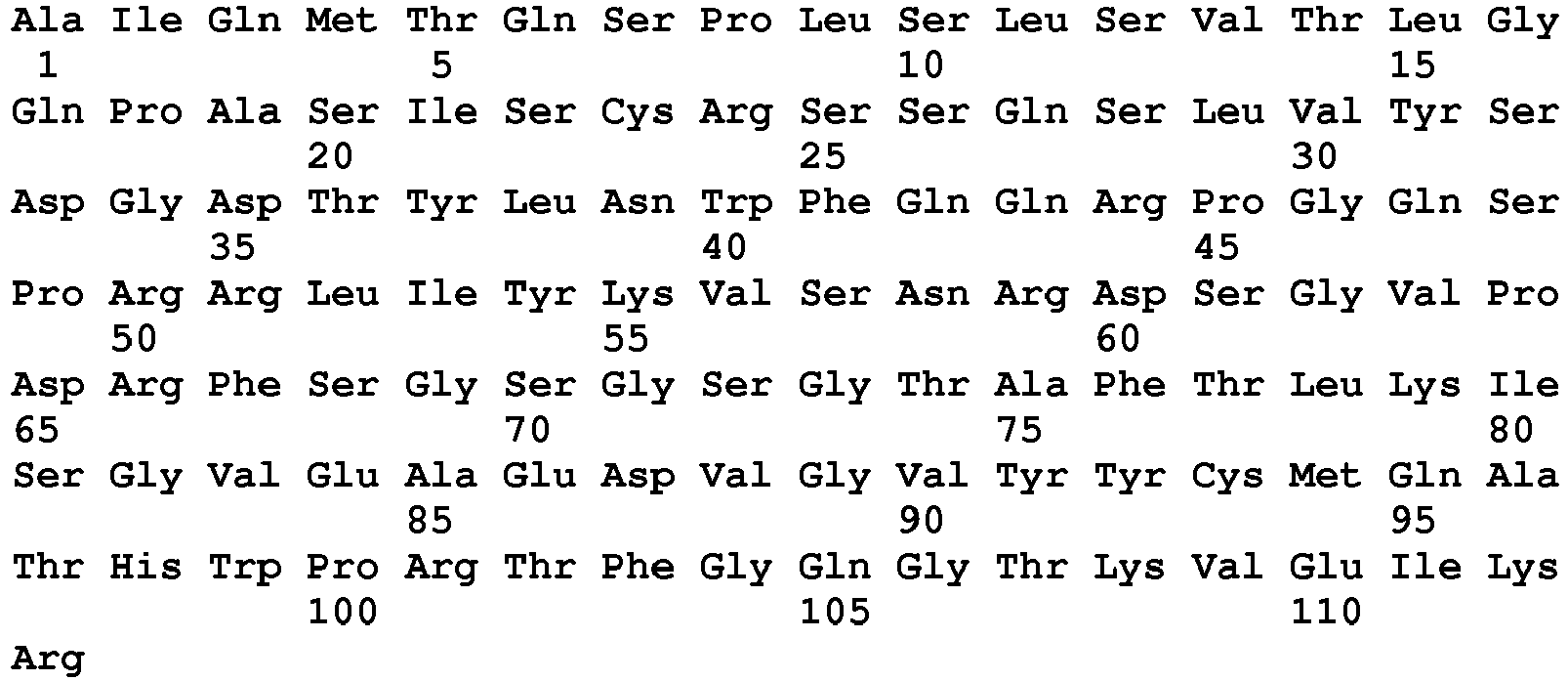
- <210> 155
<211> 33
<212> DNA
<213> Artificial Sequence - <220>
<223> Synthetic - <400> 155
caaagcctcg tatacagtga tggagacacc tac 33 - <210> 156
<211> 11
<212> PRT
<213> Artificial Sequence - <220>
<223> Synthetic - <400> 156

- <210> 157
<211> 9
<212> DNA
<213> Artificial Sequence - <220>
<223> Synthetic - <400> 157
aaggtttct 9 - <210> 158
<211> 3
<212> PRT
<213> Artificial Sequence - <220>
<223> Synthetic - <400> 158

- <210> 159
<211> 27
<212> DNA
<213> Artificial Sequence - <220>
<223> Synthetic - <400> 159
atgcaagcta cacactggcc tcggacg 27 - <210> 160
<211> 9
<212> PRT
<213> Artificial Sequence - <220>
<223> Synthetic - <400> 160

- <210> 161
<211> 378
<212> DNA
<213> Artificial Sequence - <220>
<223> Synthetic - <400> 161


- <210> 162
<211> 126
<212> PRT
<213> Artificial Sequence - <220>
<223> Synthetic - <400> 162

- <210> 163
<211> 336
<212> DNA
<213> Artificial Sequence - <220>
<223> Synthetic - <400> 163

- <210> 164
<211> 112
<212> PRT
<213> Artificial Sequence - <220>
<223> Synthetic - <400> 164
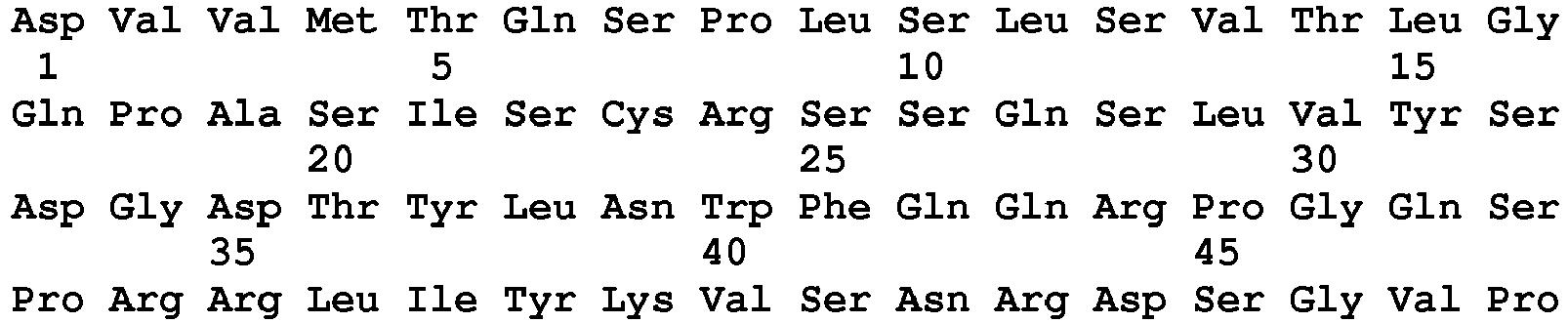

- <210> 165
<211> 378
<212> DNA
<213> Artificial Sequence - <220>
<223> Synthetic - <400> 165

- <210> 166
<211> 126
<212> PRT
<213> Artificial Sequence - <220>
<223> Synthetic - <400> 166

- <210> 167
<211> 336
<212> DNA
<213> Artificial Sequence - <220>
<223> Synthetic - <400> 167


- <210> 168
<211> 112
<212> PRT
<213> Artificial Sequence - <220>
<223> Synthetic - <400> 168

- <210> 169
<211> 375
<212> DNA
<213> Artificial Sequence - <220>
<223> Synthetic - <400> 169

- <210> 170
<211> 125
<212> PRT
<213> Artificial Sequence - <220>
<223> Synthetic - <400> 170


- <210> 171
<211> 30
<212> DNA
<213> Artificial Sequence - <220>
<223> Synthetic - <400> 171
ggattctcac tcatcactag tggagtgggt 30 - <210> 172
<211> 10
<212> PRT
<213> Artificial Sequence - <220>
<223> Synthetic - <400> 172

- <210> 173
<211> 21
<212> DNA
<213> Artificial Sequence - <220>
<223> Synthetic - <400> 173
atttattgga atggtgataa g 21 - <210> 174
<211> 7
<212> PRT
<213> Artificial Sequence - <220>
<223> Synthetic - <400> 174

- <210> 175
<211> 51
<212> DNA
<213> Artificial Sequence - <220>
<223> Synthetic - <400> 175
gcacacagga taactgaaac tagttactac ttctactacg gtatggacgt c 51 - <210> 176
<211> 17
<212> PRT
<213> Artificial Sequence - <220>
<223> Synthetic - <400> 176

- <210> 177
<211> 339
<212> DNA
<213> Artificial Sequence - <220>
<223> Synthetic - <400> 177

- <210> 178
<211> 113
<212> PRT
<213> Artificial Sequence - <220>
<223> Synthetic - <400> 178

- <210> 179
<211> 33
<212> DNA
<213> Artificial Sequence - <220>
<223> Synthetic - <400> 179
cagagcctcc tgcatagtca tggatacgac tat 33 - <210> 180
<211> 11
<212> PRT
<213> Artificial Sequence - <220>
<223> Synthetic - <400> 180

- <210> 181
<211> 9
<212> DNA
<213> Artificial Sequence - <220>
<223> Synthetic - <400> 181
ttgggttct 9 - <210> 182
<211> 3
<212> PRT
<213> Artificial Sequence - <220>
<223> Synthetic - <400> 182

- <210> 183
<211> 27
<212> DNA
<213> Artificial Sequence - <220>
<223> Synthetic - <400> 183
atgcaagctc tacaaactcc gctcact 27 - <210> 184
<211> 9
<212> PRT
<213> Artificial Sequence - <220>
<223> Synthetic - <400> 184

- <210> 185
<211> 375
<212> DNA
<213> Artificial Sequence - <220>
<223> Synthetic - <400> 185

- <210> 186
<211> 125
<212> PRT
<213> Artificial Sequence - <220>
<223> Synthetic - <400> 186

- <210> 187
<211> 336
<212> DNA
<213> Artificial Sequence - <220>
<223> Synthetic - <400> 187

- <210> 188
<211> 112
<212> PRT
<213> Artificial Sequence - <220>
<223> Synthetic - <400> 188

- <210> 189
<211> 375
<212> DNA
<213> Artificial Sequence - <220>
<223> Synthetic - <400> 189

- <210> 190
<211> 125
<212> PRT
<213> Artificial Sequence - <220>
<223> Synthetic - <400> 190

- <210> 191
<211> 336
<212> DNA
<213> Artificial Sequence - <220>
<223> Synthetic - <400> 191

- <210> 192
<211> 112
<212> PRT
<213> Artificial Sequence - <220>
<223> Synthetic - <400> 192

- <210> 193
<211> 375
<212> DNA
<213> Artificial Sequence - <220>
<223> Synthetic - <400> 193

- <210> 194
<211> 125
<212> PRT
<213> Artificial Sequence - <220>
<223> Synthetic - <400> 194

- <210> 195
<211> 30
<212> DNA
<213> Artificial Sequence - <220>
<223> Synthetic - <400> 195
gggttctcac tcagcactag tggagtgggt 30 - <210> 196
<211> 10
<212> PRT
<213> Artificial Sequence - <220>
<223> Synthetic - <400> 196

- <210> 197
<211> 21
<212> DNA
<213> Artificial Sequence - <220>
<223> Synthetic - <400> 197
atttattgga attctgataa g 21 - <210> 198
<211> 7
<212> PRT
<213> Artificial Sequence - <220>
<223> Synthetic - <400> 198

- <210> 199
<211> 51
<212> DNA
<213> Artificial Sequence - <220>
<223> Synthetic - <400> 199
gcacacagac atgacagctc gtcctactac ttctactacg gtatggacgt c 51 - <210> 200
<211> 17
<212> PRT
<213> Artificial Sequence - <220>
<223> Synthetic - <400> 200

- <210> 201
<211> 339
<212> DNA
<213> Artificial Sequence - <220>
<223> Synthetic - <400> 201

- <210> 202
<211> 113
<212> PRT
<213> Artificial Sequence - <220>
<223> Synthetic - <400> 202


- <210> 203
<211> 33
<212> DNA
<213> Artificial Sequence - <220>
<223> Synthetic - <400> 203
cagagcctcc tccatagtca tggatacaac tat 33 - <210> 204
<211> 11
<212> PRT
<213> Artificial Sequence - <220>
<223> Synthetic - <400> 204

- <210> 205
<211> 9
<212> DNA
<213> Artificial Sequence - <220>
<223> Synthetic - <400> 205
ttgggttct 9 - <210> 206
<211> 3
<212> PRT
<213> Artificial Sequence - <220>
<223> Synthetic - <400> 206
- <210> 207
<211> 27
<212> DNA
<213> Artificial Sequence - <220>
<223> Synthetic - <400> 207
atgcaagctc tacagactcc tctcact 27 - <210> 208
<211> 9
<212> PRT
<213> Artificial Sequence - <220>
<223> Synthetic - <400> 208

- <210> 209
<211> 375
<212> DNA
<213> Artificial Sequence - <220>
<223> Synthetic - <400> 209

- <210> 210
<211> 125
<212> PRT
<213> Artificial Sequence - <220>
<223> Synthetic - <400> 210

- <210> 211
<211> 336
<212> DNA
<213> Artificial Sequence - <220>
<223> Synthetic - <400> 211

- <210> 212
<211> 112
<212> PRT
<213> Artificial Sequence - <220>
<223> Synthetic - <400> 212

- <210> 213
<211> 375
<212> DNA
<213> Artificial Sequence - <220>
<223> Synthetic - <400> 213

- <210> 214
<211> 125
<212> PRT
<213> Artificial Sequence - <220>
<223> Synthetic - <400> 214


- <210> 215
<211> 336
<212> DNA
<213> Artificial Sequence - <220>
<223> Synthetic - <400> 215

- <210> 216
<211> 112
<212> PRT
<213> Artificial Sequence - <220>
<223> Synthetic - <400> 216

- <210> 217
<211> 381
<212> DNA
<213> Artificial Sequence - <220>
<223> Synthetic - <400> 217


- <210> 218
<211> 127
<212> PRT
<213> Artificial Sequence - <220>
<223> Synthetic - <400> 218

- <210> 219
<211> 24
<212> DNA
<213> Artificial Sequence - <220>
<223> Synthetic - <400> 219
ggattcacct ttagtagtca ctgg 24 - <210> 220
<211> 8
<212> PRT
<213> Artificial Sequence - <220>
<223> Synthetic - <400> 220

- <210> 221
<211> 24
<212> DNA
<213> Artificial Sequence - <220>
<223> Synthetic - <400> 221
ataaaccaag atggaagtga gaaa 24 - <210> 222
<211> 8
<212> PRT
<213> Artificial Sequence - <220>
<223> Synthetic - <400> 222

- <210> 223
<211> 60
<212> DNA
<213> Artificial Sequence - <220>
<223> Synthetic - <400> 223
gcgagagata ttgtactaat ggtctatgat atggactact actactacgg tatggacgtc 60 - <210> 224
<211> 20
<212> PRT
<213> Artificial Sequence - <220>
<223> Synthetic - <400> 224

- <210> 225
<211> 336
<212> DNA
<213> Artificial Sequence - <220>
<223> Synthetic - <400> 225

- <210> 226
<211> 112
<212> PRT
<213> Artificial Sequence - <220>
<223> Synthetic - <400> 226

- <210> 227
<211> 33
<212> DNA
<213> Artificial Sequence - <220>
<223> Synthetic - <400> 227
cagagcctcc tgcatagtaa tggaaacaac tat 33 - <210> 228
<211> 11
<212> PRT
<213> Artificial Sequence - <220>
<223> Synthetic - <400> 228

- <210> 229
<211> 9
<212> DNA
<213> Artificial Sequence - <220>
<223> Synthetic - <400> 229
ttgggttct 9 - <210> 230
<211> 3
<212> PRT
<213> Artificial Sequence - <220>
<223> Synthetic - <400> 230


- <210> 231
<211> 27
<212> DNA
<213> Artificial Sequence - <220>
<223> Synthetic - <400> 231
atgcaaactc tacaaactcc gctcact 27 - <210> 232
<211> 9
<212> PRT
<213> Artificial Sequence - <220>
<223> Synthetic - <400> 232

- <210> 233
<211> 381
<212> DNA
<213> Artificial Sequence - <220>
<223> Synthetic - <400> 233

- <210> 234
<211> 127
<212> PRT
<213> Artificial Sequence - <220>
<223> Synthetic - <400> 234


- <210> 235
<211> 336
<212> DNA
<213> Artificial Sequence - <220>
<223> Synthetic - <400> 235

- <210> 236
<211> 112
<212> PRT
<213> Artificial Sequence - <220>
<223> Synthetic - <400> 236

- <210> 237
<211> 381
<212> DNA
<213> Artificial Sequence - <220>
<223> Synthetic - <400> 237

- <210> 238
<211> 127
<212> PRT
<213> Artificial Sequence - <220>
<223> Synthetic - <400> 238
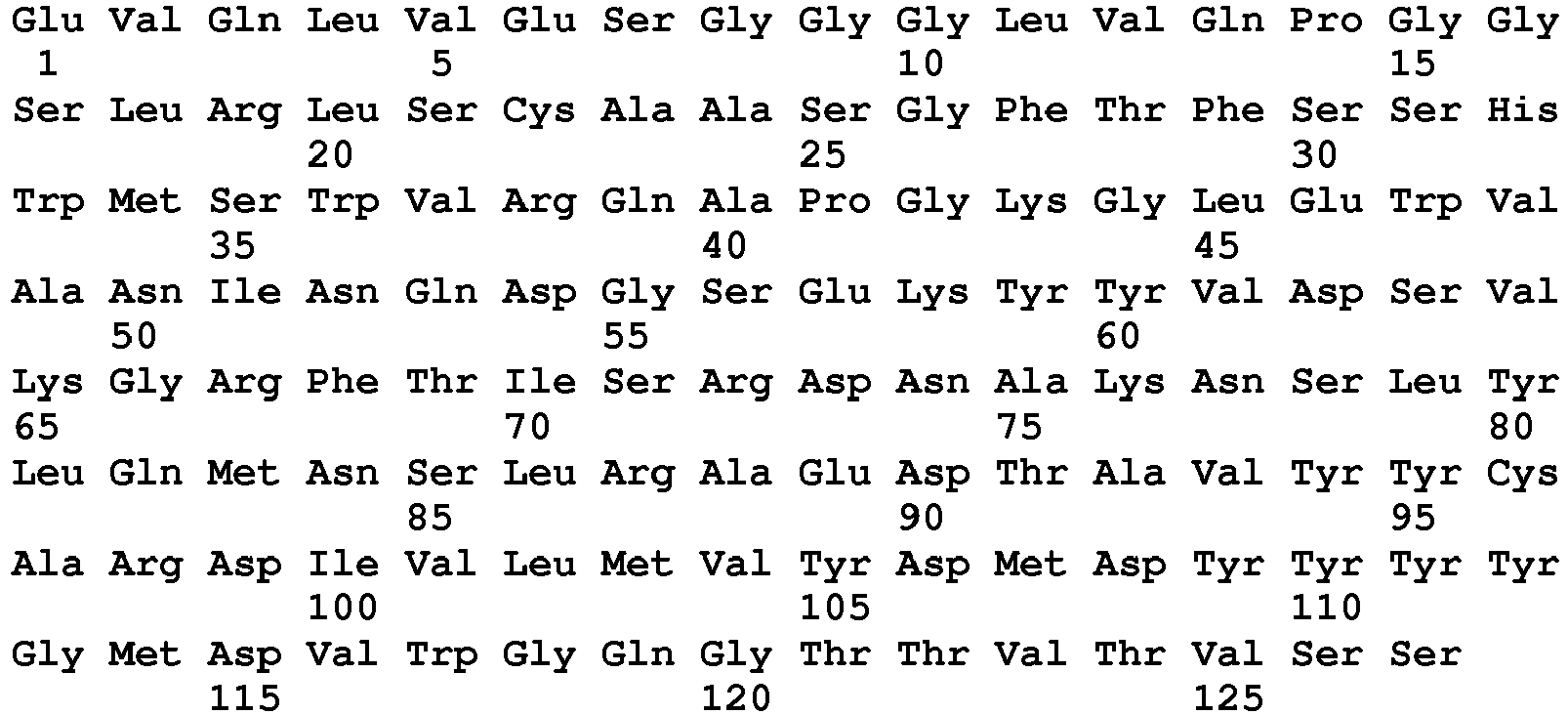
- <210> 239
<211> 336
<212> DNA
<213> Artificial Sequence - <220>
<223> Synthetic - <400> 239

- <210> 240
<211> 112
<212> PRT
<213> Artificial Sequence - <220>
<223> Synthetic - <400> 240

- <210> 241
<211> 381
<212> DNA
<213> Artificial Sequence - <220>
<223> Synthetic - <400> 241

- <210> 242
<211> 127
<212> PRT
<213> Artificial Sequence - <220>
<223> Synthetic - <400> 242

- <210> 243
<211> 24
<212> DNA
<213> Artificial Sequence - <220>
<223> Synthetic - <400> 243
ggattcacct tcagtagcta tggc 24 - <210> 244
<211> 8
<212> PRT
<213> Artificial Sequence - <220>
<223> Synthetic - <400> 244

- <210> 245
<211> 24
<212> DNA
<213> Artificial Sequence - <220>
<223> Synthetic - <400> 245
atatcatatg atggaagtaa taaa 24 - <210> 246
<211> 8
<212> PRT
<213> Artificial Sequence - <220>
<223> Synthetic - <400> 246

- <210> 247
<211> 60
<212> DNA
<213> Artificial Sequence - <220>
<223> Synthetic - <400> 247
gcgaaaaata ttgtactagt gatgtatgat atagactatc actactatgg gatggacgtc 60 - <210> 248
<211> 20
<212> PRT
<213> Artificial Sequence - <220>
<223> Synthetic - <400> 248

- <210> 249
<211> 336
<212> DNA
<213> Artificial Sequence - <220>
<223> Synthetic - <400> 249

- <210> 250
<211> 112
<212> PRT
<213> Artificial Sequence - <220>
<223> Synthetic - <400> 250

- <210> 251
<211> 33
<212> DNA
<213> Artificial Sequence - <220>
<223> Synthetic - <400> 251
cagagcctcc tgcatagtaa tggatacaac tat 33 - <210> 252
<211> 11
<212> PRT
<213> Artificial Sequence - <220>
<223> Synthetic - <400> 252

- <210> 253
<211> 9
<212> DNA
<213> Artificial Sequence - <220>
<223> Synthetic - <400> 253
ttgggtttt 9 - <210> 254
<211> 3
<212> PRT
<213> Artificial Sequence - <220>
<223> Synthetic - <400> 254

- <210> 255
<211> 27
<212> DNA
<213> Artificial Sequence - <220>
<223> Synthetic - <400> 255
atgcaagctc tacaaactcc tctcact 27 - <210> 256
<211> 9
<212> PRT
<213> Artificial Sequence - <220>
<223> Synthetic - <400> 256

- <210> 257
<211> 381
<212> DNA
<213> Artificial Sequence - <220>
<223> Synthetic - <400> 257

- <210> 258
<211> 127
<212> PRT
<213> Artificial Sequence - <220>
<223> Synthetic - <400> 258

- <210> 259
<211> 336
<212> DNA
<213> Artificial Sequence - <220>
<223> Synthetic - <400> 259

- <210> 260
<211> 112
<212> PRT
<213> Artificial Sequence - <220>
<223> Synthetic - <400> 260

- <210> 261
<211> 381
<212> DNA
<213> Artificial Sequence - <220>
<223> Synthetic - <400> 261

- <210> 262
<211> 127
<212> PRT
<213> Artificial Sequence - <220>
<223> Synthetic - <400> 262

- <210> 263
<211> 336
<212> DNA
<213> Artificial Sequence - <220>
<223> Synthetic - <400> 263

- <210> 264
<211> 112
<212> PRT
<213> Artificial Sequence - <220>
<223> Synthetic - <400> 264


- <210> 265
<211> 381
<212> DNA
<213> Artificial Sequence - <220>
<223> Synthetic - <400> 265

- <210> 266
<211> 127
<212> PRT
<213> Artificial Sequence - <220>
<223> Synthetic - <400> 266

- <210> 267
<211> 24
<212> DNA
<213> Artificial Sequence - <220>
<223> Synthetic - <400> 267
ggattcacct tcagtagcta tggc 24 - <210> 268
<211> 8
<212> PRT
<213> Artificial Sequence - <220>
<223> Synthetic - <400> 268

- <210> 269
<211> 24
<212> DNA
<213> Artificial Sequence - <220>
<223> Synthetic - <400> 269
atatcatatg atggaagtaa taaa 24 - <210> 270
<211> 8
<212> PRT
<213> Artificial Sequence - <220>
<223> Synthetic - <400> 270

- <210> 271
<211> 60
<212> DNA
<213> Artificial Sequence - <220>
<223> Synthetic - <400> 271
gcgaaaaata ttgtactagt gatgtatgat atagactatc actactatgg gatggacgtc 60 - <210> 272
<211> 20
<212> PRT
<213> Artificial Sequence - <220>
<223> Synthetic - <400> 272


- <210> 273
<211> 336
<212> DNA
<213> Artificial Sequence - <220>
<223> Synthetic - <400> 273

- <210> 274
<211> 112
<212> PRT
<213> Artificial Sequence - <220>
<223> Synthetic - <400> 274

- <210> 275
<211> 33
<212> DNA
<213> Artificial Sequence - <220>
<223> Synthetic - <400> 275
cagagcctcc tgcatagtaa tggatacaac tat 33 - <210> 276
<211> 11
<212> PRT
<213> Artificial Sequence - <220>
<223> Synthetic - <400> 276


- <210> 277
<211> 9
<212> DNA
<213> Artificial Sequence - <220>
<223> Synthetic - <400> 277
ttgggtttt 9 - <210> 278
<211> 3
<212> PRT
<213> Artificial Sequence - <220>
<223> Synthetic - <400> 278

- <210> 279
<211> 27
<212> DNA
<213> Artificial Sequence - <220>
<223> Synthetic - <400> 279
atgcaagctc tacaaactcc tctcact 27 - <210> 280
<211> 9
<212> PRT
<213> Artificial Sequence - <220>
<223> Synthetic - <400> 280

- <210> 281
<211> 381
<212> DNA
<213> Artificial Sequence - <220>
<223> Synthetic - <400> 281


- <210> 282
<211> 127
<212> PRT
<213> Artificial Sequence - <220>
<223> Synthetic - <400> 282

- <210> 283
<211> 336
<212> DNA
<213> Artificial Sequence - <220>
<223> Synthetic - <400> 283

- <210> 284
<211> 112
<212> PRT
<213> Artificial Sequence - <220>
<223> Synthetic - <400> 284


- <210> 285
<211> 381
<212> DNA
<213> Artificial Sequence - <220>
<223> Synthetic - <400> 285

- <210> 286
<211> 127
<212> PRT
<213> Artificial Sequence - <220>
<223> Synthetic - <400> 286

- <210> 287
<211> 336
<212> DNA
<213> Artificial Sequence - <220>
<223> Synthetic - <400> 287

- <210> 288
<211> 112
<212> PRT
<213> Artificial Sequence - <220>
<223> Synthetic - <400> 288

- <210> 289
<211> 372
<212> DNA
<213> Artificial Sequence - <220>
<223> Synthetic - <400> 289

- <210> 290
<211> 124
<212> PRT
<213> Artificial Sequence - <220>
<223> Synthetic - <400> 290


- <210> 291
<211> 30
<212> DNA
<213> Artificial Sequence - <220>
<223> Synthetic - <400> 291
gggttctcac tcagcgctag tggagtgggt 30 - <210> 292
<211> 10
<212> PRT
<213> Artificial Sequence - <220>
<223> Synthetic - <400> 292

- <210> 293
<211> 21
<212> DNA
<213> Artificial Sequence - <220>
<223> Synthetic - <400> 293
atttattgga atgatgataa g 21 - <210> 294
<211> 7
<212> PRT
<213> Artificial Sequence - <220>
<223> Synthetic - <400> 294

- <210> 295
<211> 48
<212> DNA
<213> Artificial Sequence - <220>
<223> Synthetic - <400> 295
gcacacagaa tacatctatg gtcctacttc tactacggta tggacgtc 48 - <210> 296
<211> 16
<212> PRT
<213> Artificial Sequence - <220>
<223> Synthetic - <400> 296

- <210> 297
<211> 336
<212> DNA
<213> Artificial Sequence - <220>
<223> Synthetic - <400> 297

- <210> 298
<211> 112
<212> PRT
<213> Artificial Sequence - <220>
<223> Synthetic - <400> 298
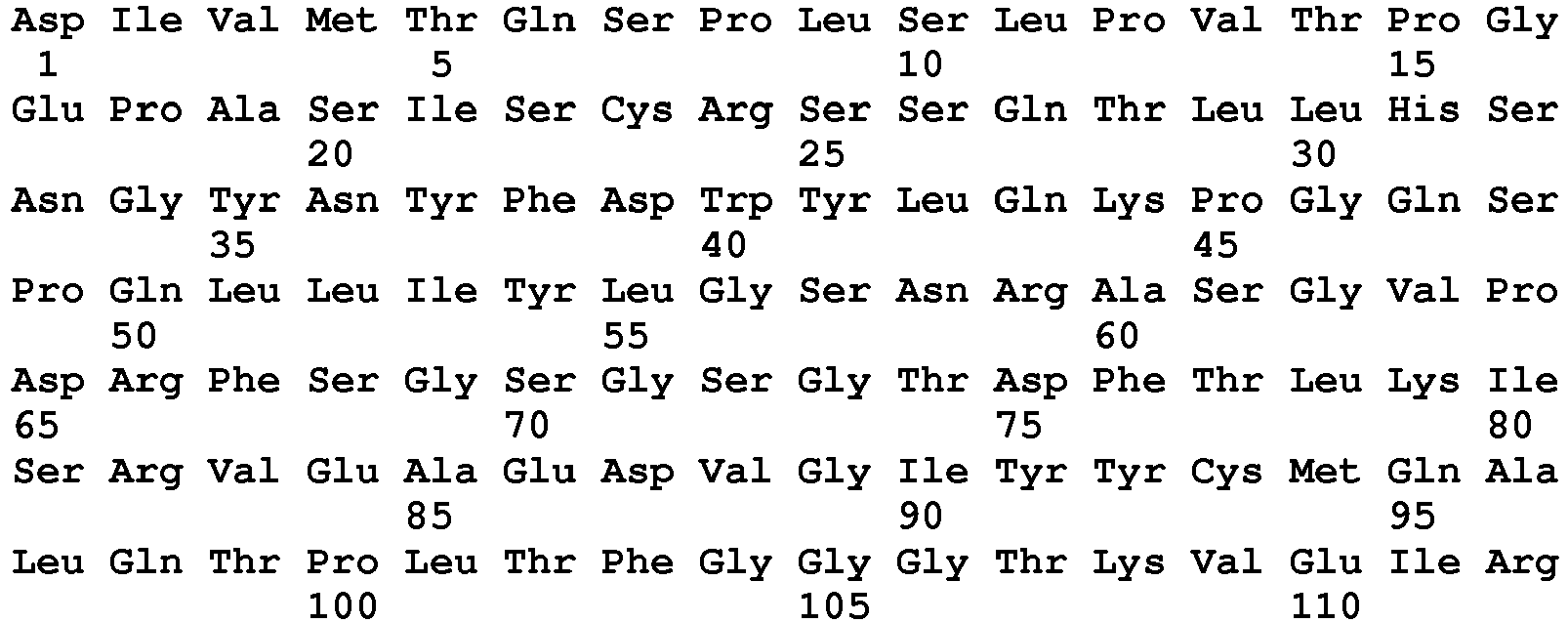
- <210> 299
<211> 33
<212> DNA
<213> Artificial Sequence - <220>
<223> Synthetic - <400> 299
cagactctcc tgcatagtaa tggatacaac tat 33 - <210> 300
<211> 11
<212> PRT
<213> Artificial Sequence - <220>
<223> Synthetic - <400> 300

- <210> 301
<211> 9
<212> DNA
<213> Artificial Sequence - <220>
<223> Synthetic - <400> 301
ttgggttct 9 - <210> 302
<211> 3
<212> PRT
<213> Artificial Sequence - <220>
<223> Synthetic - <400> 302

- <210> 303
<211> 27
<212> DNA
<213> Artificial Sequence - <220>
<223> Synthetic - <400> 303
atgcaagctc tacaaactcc tctcact 27 - <210> 304
<211> 9
<212> PRT
<213> Artificial Sequence - <220>
<223> Synthetic - <400> 304

- <210> 305
<211> 372
<212> DNA
<213> Artificial Sequence - <220>
<223> Synthetic - <400> 305

- <210> 306
<211> 124
<212> PRT
<213> Artificial Sequence - <220>
<223> Synthetic - <400> 306

- <210> 307
<211> 336
<212> DNA
<213> Artificial Sequence - <220>
<223> Synthetic - <400> 307

- <210> 308
<211> 112
<212> PRT
<213> Artificial Sequence - <220>
<223> Synthetic - <400> 308


- <210> 309
<211> 372
<212> DNA
<213> Artificial Sequence - <220>
<223> Synthetic - <400> 309

- <210> 310
<211> 124
<212> PRT
<213> Artificial Sequence - <220>
<223> Synthetic - <400> 310

- <210> 311
<211> 336
<212> DNA
<213> Artificial Sequence - <220>
<223> Synthetic - <400> 311

- <210> 312
<211> 112
<212> PRT
<213> Artificial Sequence - <220>
<223> Synthetic - <400> 312

- <210> 313
<211> 381
<212> DNA
<213> Artificial Sequence - <220>
<223> Synthetic - <400> 313

- <210> 314
<211> 127
<212> PRT
<213> Artificial Sequence - <220>
<223> Synthetic - <400> 314


- <210> 315
<211> 24
<212> DNA
<213> Artificial Sequence - <220>
<223> Synthetic - <400> 315
ggttacacct ttaccaccta tggt 24 - <210> 316
<211> 8
<212> PRT
<213> Artificial Sequence - <220>
<223> Synthetic - <400> 316

- <210> 317
<211> 24
<212> DNA
<213> Artificial Sequence - <220>
<223> Synthetic - <400> 317
atcagcggtt acaatggtaa aaca 24 - <210> 318
<211> 8
<212> PRT
<213> Artificial Sequence - <220>
<223> Synthetic - <400> 318

- <210> 319
<211> 60
<212> DNA
<213> Artificial Sequence - <220>
<223> Synthetic - <400> 319
tcgagagatc gtttagtagt accacctgcc cttaattatt cctactacgt tatggacgtc 60 - <210> 320
<211> 20
<212> PRT
<213> Artificial Sequence - <220>
<223> Synthetic - <400> 320

- <210> 321
<211> 336
<212> DNA
<213> Artificial Sequence - <220>
<223> Synthetic - <400> 321

- <210> 322
<211> 112
<212> PRT
<213> Artificial Sequence - <220>
<223> Synthetic - <400> 322

- <210> 323
<211> 33
<212> DNA
<213> Artificial Sequence - <220>
<223> Synthetic - <400> 323
caaagcctcg tatacagtga tggaaacacc tac 33 - <210> 324
<211> 11
<212> PRT
<213> Artificial Sequence - <220>
<223> Synthetic - <400> 324

- <210> 325
<211> 9
<212> DNA
<213> Artificial Sequence - <220>
<223> Synthetic - <400> 325
aaggtttct 9 - <210> 326
<211> 3
<212> PRT
<213> Artificial Sequence - <220>
<223> Synthetic - <400> 326

- <210> 327
<211> 27
<212> DNA
<213> Artificial Sequence - <220>
<223> Synthetic - <400> 327
atgcaaggta cacactggcc gtacact 27 - <210> 328
<211> 9
<212> PRT
<213> Artificial Sequence - <220>
<223> Synthetic - <400> 328

- <210> 329
<211> 381
<212> DNA
<213> Artificial Sequence - <220>
<223> Synthetic - <400> 329

- <210> 330
<211> 127
<212> PRT
<213> Artificial Sequence - <220>
<223> Synthetic - <400> 330

- <210> 331
<211> 336
<212> DNA
<213> Artificial Sequence - <220>
<223> Synthetic - <400> 331


- <210> 332
<211> 112
<212> PRT
<213> Artificial Sequence - <220>
<223> Synthetic - <400> 332

- <210> 333
<211> 381
<212> DNA
<213> Artificial Sequence - <220>
<223> Synthetic - <400> 333

- <210> 334
<211> 127
<212> PRT
<213> Artificial Sequence - <220>
<223> Synthetic - <400> 334


- <210> 335
<211> 336
<212> DNA
<213> Artificial Sequence - <220>
<223> Synthetic - <400> 335

- <210> 336
<211> 112
<212> PRT
<213> Artificial Sequence - <220>
<223> Synthetic - <400> 336

- <210> 337
<211> 354
<212> DNA
<213> Artificial Sequence - <220>
<223> Synthetic - <400> 337

- <210> 338
<211> 118
<212> PRT
<213> Artificial Sequence - <220>
<223> Synthetic - <400> 338

- <210> 339
<211> 24
<212> DNA
<213> Artificial Sequence - <220>
<223> Synthetic - <400> 339
ggattcacct tcagtagcta tagc 24 - <210> 340
<211> 8
<212> PRT
<213> Artificial Sequence - <220>
<223> Synthetic - <400> 340

- <210> 341
<211> 24
<212> DNA
<213> Artificial Sequence - <220>
<223> Synthetic - <400> 341
attagtagta gtagtagtta cata 24 - <210> 342
<211> 8
<212> PRT
<213> Artificial Sequence - <220>
<223> Synthetic - <400> 342

- <210> 343
<211> 33
<212> DNA
<213> Artificial Sequence - <220>
<223> Synthetic - <400> 343
gcgagagagg gcagtagcag actttttgac tac 33 - <210> 344
<211> 11
<212> PRT
<213> Artificial Sequence - <220>
<223> Synthetic - <400> 344

- <210> 345
<211> 321
<212> DNA
<213> Artificial Sequence - <220>
<223> Synthetic - <400> 345

- <210> 346
<211> 107
<212> PRT
<213> Artificial Sequence - <220>
<223> Synthetic - <400> 346


- <210> 347
<211> 18
<212> DNA
<213> Artificial Sequence - <220>
<223> Synthetic - <400> 347
cagagtatta gtagctgg 18 - <210> 348
<211> 6
<212> PRT
<213> Artificial Sequence - <220>
<223> Synthetic - <400> 348

- <210> 349
<211> 9
<212> DNA
<213> Artificial Sequence - <220>
<223> Synthetic - <400> 349
aaggcgtct 9 - <210> 350
<211> 3
<212> PRT
<213> Artificial Sequence - <220>
<223> Synthetic - <400> 350

- <210> 351
<211> 27
<212> DNA
<213> Artificial Sequence - <220>
<223> Synthetic - <400> 351
caacagtata atagttattg gtacact 27 - <210> 352
<211> 9
<212> PRT
<213> Artificial Sequence - <220>
<223> Synthetic - <400> 352

- <210> 353
<211> 354
<212> DNA
<213> Artificial Sequence - <220>
<223> Synthetic - <400> 353

- <210> 354
<211> 118
<212> PRT
<213> Artificial Sequence - <220>
<223> Synthetic - <400> 354

- <210> 355
<211> 321
<212> DNA
<213> Artificial Sequence - <220>
<223> Synthetic - <400> 355

- <210> 356
<211> 107
<212> PRT
<213> Artificial Sequence - <220>
<223> Synthetic - <400> 356

- <210> 357
<211> 354
<212> DNA
<213> Artificial Sequence - <220>
<223> Synthetic - <400> 357

- <210> 358
<211> 118
<212> PRT
<213> Artificial Sequence - <220>
<223> Synthetic - <400> 358


- <210> 359
<211> 321
<212> DNA
<213> Artificial Sequence - <220>
<223> Synthetic - <400> 359

- <210> 360
<211> 107
<212> PRT
<213> Artificial Sequence - <220>
<223> Synthetic - <400> 360

- <210> 361
<211> 384
<212> DNA
<213> Artificial Sequence - <220>
<223> Synthetic - <400> 361


- <210> 362
<211> 128
<212> PRT
<213> Artificial Sequence - <220>
<223> Synthetic - <400> 362

- <210> 363
<211> 24
<212> DNA
<213> Artificial Sequence - <220>
<223> Synthetic - <400> 363
ggattcacct tcagtgacca ctac 24 - <210> 364
<211> 8
<212> PRT
<213> Artificial Sequence - <220>
<223> Synthetic - <400> 364

- <210> 365
<211> 24
<212> DNA
<213> Artificial Sequence - <220>
<223> Synthetic - <400> 365
attagtaatg atggtggtac caaa 24 - <210> 366
<211> 8
<212> PRT
<213> Artificial Sequence - <220>
<223> Synthetic - <400> 366

- <210> 367
<211> 63
<212> DNA
<213> Artificial Sequence - <220>
<223> Synthetic - <400> 367

- <210> 368
<211> 21
<212> PRT
<213> Artificial Sequence - <220>
<223> Synthetic - <400> 368

- <210> 369
<211> 321
<212> DNA
<213> Artificial Sequence - <220>
<223> Synthetic - <400> 369

- <210> 370
<211> 107
<212> PRT
<213> Artificial Sequence - <220>
<223> Synthetic - <400> 370

- <210> 371
<211> 21
<212> DNA
<213> Artificial Sequence - <220>
<223> Synthetic - <400> 371
cagagtgtta acaacaaatt c 21 - <210> 372
<211> 7
<212> PRT
<213> Artificial Sequence - <220>
<223> Synthetic - <400> 372

- <210> 373
<211> 9
<212> DNA
<213> Artificial Sequence - <220>
<223> Synthetic - <400> 373
ggtgcatcc 9 - <210> 374
<211> 3
<212> PRT
<213> Artificial Sequence - <220>
<223> Synthetic - <400> 374

- <210> 375
<211> 24
<212> DNA
<213> Artificial Sequence - <220>
<223> Synthetic - <400> 375
caagtatatg gtaactcact cact 24 - <210> 376
<211> 8
<212> PRT
<213> Artificial Sequence - <220>
<223> Synthetic - <400> 376

- <210> 377
<211> 384
<212> DNA
<213> Artificial Sequence - <220>
<223> Synthetic - <400> 377

- <210> 378
<211> 128
<212> PRT
<213> Artificial Sequence - <220>
<223> Synthetic - <400> 378


- <210> 379
<211> 321
<212> DNA
<213> Artificial Sequence - <220>
<223> Synthetic - <400> 379

- <210> 380
<211> 107
<212> PRT
<213> Artificial Sequence - <220>
<223> Synthetic - <400> 380

- <210> 381
<211> 384
<212> DNA
<213> Artificial Sequence - <220>
<223> Synthetic - <400> 381

- <210> 382
<211> 128
<212> PRT
<213> Artificial Sequence - <220>
<223> Synthetic - <400> 382

- <210> 383
<211> 321
<212> DNA
<213> Artificial Sequence - <220>
<223> Synthetic - <400> 383

- <210> 384
<211> 107
<212> PRT
<213> Artificial Sequence - <220>
<223> Synthetic - <400> 384

- <210> 385
<211> 360
<212> DNA
<213> Artificial Sequence - <220>
<223> Synthetic - <400> 385

- <210> 386
<211> 120
<212> PRT
<213> Artificial Sequence - <220>
<223> Synthetic - <400> 386

- <210> 387
<211> 24
<212> DNA
<213> Artificial Sequence - <220>
<223> Synthetic - <400> 387
ggattcacct tcagtactta taac 24 - <210> 388
<211> 8
<212> PRT
<213> Artificial Sequence - <220>
<223> Synthetic - <400> 388


- <210> 389
<211> 24
<212> DNA
<213> Artificial Sequence - <220>
<223> Synthetic - <400> 389
attaggagta gtagtaatta cata 24 - <210> 390
<211> 8
<212> PRT
<213> Artificial Sequence - <220>
<223> Synthetic - <400> 390

- <210> 391
<211> 39
<212> DNA
<213> Artificial Sequence - <220>
<223> Synthetic - <400> 391
gcgagagatg gcagcagttg gtacgactac tctgactac 39 - <210> 392
<211> 13
<212> PRT
<213> Artificial Sequence - <220>
<223> Synthetic - <400> 392

- <210> 393
<211> 321
<212> DNA
<213> Artificial Sequence - <220>
<223> Synthetic - <400> 393


- <210> 394
<211> 107
<212> PRT
<213> Artificial Sequence - <220>
<223> Synthetic - <400> 394

- <210> 395
<211> 18
<212> DNA
<213> Artificial Sequence - <220>
<223> Synthetic - <400> 395
cagagtatta gtagctgg 18 - <210> 396
<211> 6
<212> PRT
<213> Artificial Sequence - <220>
<223> Synthetic - <400> 396

- <210> 397
<211> 9
<212> DNA
<213> Artificial Sequence - <220>
<223> Synthetic - <400> 397
aaggcgtct 9 - <210> 398
<211> 3
<212> PRT
<213> Artificial Sequence - <220>
<223> Synthetic - <400> 398

- <210> 399
<211> 27
<212> DNA
<213> Artificial Sequence - <220>
<223> Synthetic - <400> 399
caacagtata ttagttattc tcggacg 27 - <210> 400
<211> 9
<212> PRT
<213> Artificial Sequence - <220>
<223> Synthetic - <400> 400

- <210> 401
<211> 360
<212> DNA
<213> Artificial Sequence - <220>
<223> Synthetic - <400> 401

- <210> 402
<211> 120
<212> PRT
<213> Artificial Sequence - <220>
<223> Synthetic - <400> 402


- <210> 403
<211> 321
<212> DNA
<213> Artificial Sequence - <220>
<223> Synthetic - <400> 403

- <210> 404
<211> 107
<212> PRT
<213> Artificial Sequence - <220>
<223> Synthetic - <400> 404
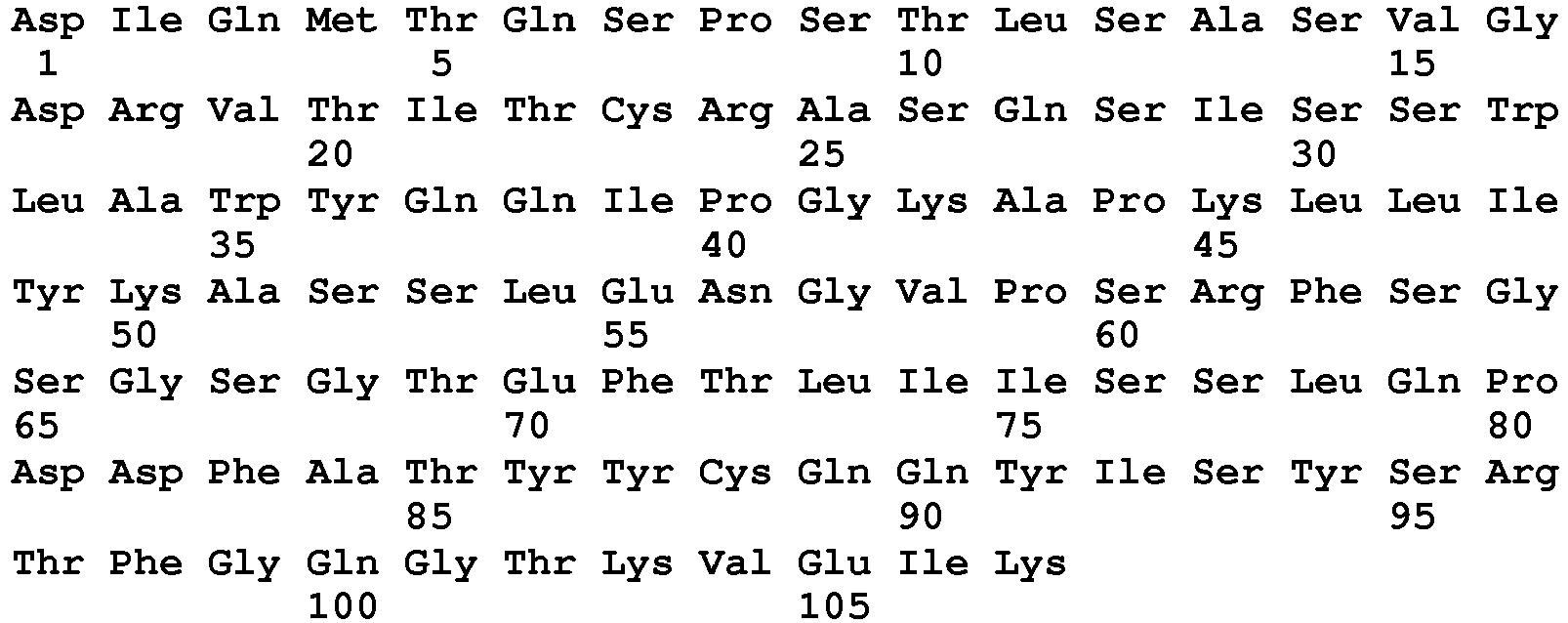
- <210> 405
<211> 360
<212> DNA
<213> Artificial Sequence - <220>
<223> Synthetic - <400> 405


- <210> 406
<211> 120
<212> PRT
<213> Artificial Sequence - <220>
<223> Synthetic - <400> 406

- <210> 407
<211> 321
<212> DNA
<213> Artificial Sequence - <220>
<223> Synthetic - <400> 407

- <210> 408
<211> 107
<212> PRT
<213> Artificial Sequence - <220>
<223> Synthetic - <400> 408


- <210> 409
<211> 360
<212> DNA
<213> Artificial Sequence - <220>
<223> Synthetic - <400> 409

- <210> 410
<211> 120
<212> PRT
<213> Artificial Sequence - <220>
<223> Synthetic - <400> 410

- <210> 411
<211> 24
<212> DNA
<213> Artificial Sequence - <220>
<223> Synthetic - <400> 411
ggattcacct tcagtactta taac 24 - <210> 412
<211> 8
<212> PRT
<213> Artificial Sequence - <220>
<223> Synthetic - <400> 412

- <210> 413
<211> 24
<212> DNA
<213> Artificial Sequence - <220>
<223> Synthetic - <400> 413
attaggagta gtagtaatta cata 24 - <210> 414
<211> 8
<212> PRT
<213> Artificial Sequence - <220>
<223> Synthetic - <400> 414

- <210> 415
<211> 39
<212> DNA
<213> Artificial Sequence - <220>
<223> Synthetic - <400> 415
gcgagagatg gcagcagttg gtacgactac tctgactac 39 - <210> 416
<211> 13
<212> PRT
<213> Artificial Sequence - <220>
<223> Synthetic - <400> 416

- <210> 417
<211> 321
<212> DNA
<213> Artificial Sequence - <220>
<223> Synthetic - <400> 417

- <210> 418
<211> 107
<212> PRT
<213> Artificial Sequence - <220>
<223> Synthetic - <400> 418

- <210> 419
<211> 18
<212> DNA
<213> Artificial Sequence - <220>
<223> Synthetic - <400> 419
cagagtatta gtagctgg 18 - <210> 420
<211> 6
<212> PRT
<213> Artificial Sequence - <220>
<223> Synthetic - <400> 420

- <210> 421
<211> 9
<212> DNA
<213> Artificial Sequence - <220>
<223> Synthetic - <400> 421
aaggcgtct 9 - <210> 422
<211> 3
<212> PRT
<213> Artificial Sequence - <220>
<223> Synthetic - <400> 422

- <210> 423
<211> 27
<212> DNA
<213> Artificial Sequence - <220>
<223> Synthetic - <400> 423
caacagtata ttagttattc tcggacg 27 - <210> 424
<211> 9
<212> PRT
<213> Artificial Sequence - <220>
<223> Synthetic - <400> 424

- <210> 425
<211> 360
<212> DNA
<213> Artificial Sequence - <220>
<223> Synthetic - <400> 425

- <210> 426
<211> 120
<212> PRT
<213> Artificial Sequence - <220>
<223> Synthetic - <400> 426

- <210> 427
<211> 321
<212> DNA
<213> Artificial Sequence - <220>
<223> Synthetic - <400> 427

- <210> 428
<211> 107
<212> PRT
<213> Artificial Sequence - <220>
<223> Synthetic - <400> 428

- <210> 429
<211> 360
<212> DNA
<213> Artificial Sequence - <220>
<223> Synthetic - <400> 429

- <210> 430
<211> 120
<212> PRT
<213> Artificial Sequence - <220>
<223> Synthetic - <400> 430

- <210> 431
<211> 321
<212> DNA
<213> Artificial Sequence - <220>
<223> Synthetic - <400> 431

- <210> 432
<211> 107
<212> PRT
<213> Artificial Sequence - <220>
<223> Synthetic - <400> 432

- <210> 433
<211> 360
<212> DNA
<213> Artificial Sequence - <220>
<223> Synthetic - <400> 433

- <210> 434
<211> 120
<212> PRT
<213> Artificial Sequence - <220>
<223> Synthetic - <400> 434

- <210> 435
<211> 24
<212> DNA
<213> Artificial Sequence - <220>
<223> Synthetic - <400> 435
ggattcacct tcagtactta taac 24 - <210> 436
<211> 8
<212> PRT
<213> Artificial Sequence - <220>
<223> Synthetic - <400> 436

- <210> 437
<211> 24
<212> DNA
<213> Artificial Sequence - <220>
<223> Synthetic - <400> 437
attaggagta gtagtaatta cata 24 - <210> 438
<211> 8
<212> PRT
<213> Artificial Sequence - <220>
<223> Synthetic - <400> 438

- <210> 439
<211> 39
<212> DNA
<213> Artificial Sequence - <220>
<223> Synthetic - <400> 439
gcgagagatg gcagcagttg gtacgactac tctgactac 39 - <210> 440
<211> 13
<212> PRT
<213> Artificial Sequence - <220>
<223> Synthetic - <400> 440

- <210> 441
<211> 321
<212> DNA
<213> Artificial Sequence - <220>
<223> Synthetic - <400> 441

- <210> 442
<211> 107
<212> PRT
<213> Artificial Sequence - <220>
<223> Synthetic - <400> 442

- <210> 443
<211> 18
<212> DNA
<213> Artificial Sequence - <220>
<223> Synthetic - <400> 443
cagagtatta gtagctgg 18 - <210> 444
<211> 6
<212> PRT
<213> Artificial Sequence - <220>
<223> Synthetic - <400> 444

- <210> 445
<211> 9
<212> DNA
<213> Artificial Sequence - <220>
<223> Synthetic - <400> 445
aaggcgtct 9 - <210> 446
<211> 3
<212> PRT
<213> Artificial Sequence - <220>
<223> Synthetic - <400> 446

- <210> 447
<211> 27
<212> DNA
<213> Artificial Sequence - <220>
<223> Synthetic - <400> 447
caacagtata ttagttattc tcggacg 27 - <210> 448
<211> 9
<212> PRT
<213> Artificial Sequence - <220>
<223> Synthetic - <400> 448

- <210> 449
<211> 360
<212> DNA
<213> Artificial Sequence - <220>
<223> Synthetic - <400> 449


- <210> 450
<211> 120
<212> PRT
<213> Artificial Sequence - <220>
<223> Synthetic - <400> 450

- <210> 451
<211> 321
<212> DNA
<213> Artificial Sequence - <220>
<223> Synthetic - <400> 451

- <210> 452
<211> 107
<212> PRT
<213> Artificial Sequence - <220>
<223> Synthetic - <400> 452


- <210> 453
<211> 360
<212> DNA
<213> Artificial Sequence - <220>
<223> Synthetic - <400> 453

- <210> 454
<211> 120
<212> PRT
<213> Artificial Sequence - <220>
<223> Synthetic - <400> 454

- <210> 455
<211> 321
<212> DNA
<213> Artificial Sequence - <220>
<223> Synthetic - <400> 455


- <210> 456
<211> 107
<212> PRT
<213> Artificial Sequence - <220>
<223> Synthetic - <400> 456

- <210> 457
<211> 360
<212> DNA
<213> Artificial Sequence - <220>
<223> Synthetic - <400> 457

- <210> 458
<211> 120
<212> PRT
<213> Artificial Sequence - <220>
<223> Synthetic - <400> 458


- <210> 459
<211> 24
<212> DNA
<213> Artificial Sequence - <220>
<223> Synthetic - <400> 459
ggattcacct tcagtactta taac 24 - <210> 460
<211> 8
<212> PRT
<213> Artificial Sequence - <220>
<223> Synthetic - <400> 460

- <210> 461
<211> 24
<212> DNA
<213> Artificial Sequence - <220>
<223> Synthetic - <400> 461
attaggagta gtagtaatta cata 24 - <210> 462
<211> 8
<212> PRT
<213> Artificial Sequence - <220>
<223> Synthetic - <400> 462

- <210> 463
<211> 39
<212> DNA
<213> Artificial Sequence - <220>
<223> Synthetic - <400> 463
gcgagagatg gcagcagttg gtacgactac tctgactac 39 - <210> 464
<211> 13
<212> PRT
<213> Artificial Sequence - <220>
<223> Synthetic - <400> 464

- <210> 465
<211> 321
<212> DNA
<213> Artificial Sequence - <220>
<223> Synthetic - <400> 465

- <210> 466
<211> 107
<212> PRT
<213> Artificial Sequence - <220>
<223> Synthetic - <400> 466

- <210> 467
<211> 18
<212> DNA
<213> Artificial Sequence - <220>
<223> Synthetic - <400> 467
cagagtatta gtagctgg 18 - <210> 468
<211> 6
<212> PRT
<213> Artificial Sequence - <220>
<223> Synthetic - <400> 468

- <210> 469
<211> 9
<212> DNA
<213> Artificial Sequence - <220>
<223> Synthetic - <400> 469
aaggcgtct 9 - <210> 470
<211> 3
<212> PRT
<213> Artificial Sequence - <220>
<223> Synthetic - <400> 470

- <210> 471
<211> 27
<212> DNA
<213> Artificial Sequence - <220>
<223> Synthetic - <400> 471
caacagtata ttagttattc tcggacg 27 - <210> 472
<211> 9
<212> PRT
<213> Artificial Sequence - <220>
<223> Synthetic - <400> 472

- <210> 473
<211> 360
<212> DNA
<213> Artificial Sequence - <220>
<223> Synthetic - <400> 473

- <210> 474
<211> 120
<212> PRT
<213> Artificial Sequence - <220>
<223> Synthetic - <400> 474

- <210> 475
<211> 321
<212> DNA
<213> Artificial Sequence - <220>
<223> Synthetic - <400> 475

- <210> 476
<211> 107
<212> PRT
<213> Artificial Sequence - <220>
<223> Synthetic - <400> 476

- <210> 477
<211> 360
<212> DNA
<213> Artificial Sequence - <220>
<223> Synthetic - <400> 477

- <210> 478
<211> 120
<212> PRT
<213> Artificial Sequence - <220>
<223> Synthetic - <400> 478

- <210> 479
<211> 321
<212> DNA
<213> Artificial Sequence - <220>
<223> Synthetic - <400> 479

- <210> 480
<211> 107
<212> PRT
<213> Artificial Sequence - <220>
<223> Synthetic - <400> 480

- <210> 481
<211> 354
<212> DNA
<213> Artificial Sequence - <220>
<223> Synthetic - <400> 481

- <210> 482
<211> 118
<212> PRT
<213> Artificial Sequence - <220>
<223> Synthetic - <400> 482


- <210> 483
<211> 24
<212> DNA
<213> Artificial Sequence - <220>
<223> Synthetic - <400> 483
ggattcacct tcggtgacta cgac 24 - <210> 484
<211> 8
<212> PRT
<213> Artificial Sequence - <220>
<223> Synthetic - <400> 484

- <210> 485
<211> 21
<212> DNA
<213> Artificial Sequence - <220>
<223> Synthetic - <400> 485
attgctcctg ctggtgacac a 21 - <210> 486
<211> 7
<212> PRT
<213> Artificial Sequence - <220>
<223> Synthetic - <400> 486

- <210> 487
<211> 36
<212> DNA <213> Artificial Sequence - <220>
<223> Synthetic - <400> 487
gctagagagg atatagcagt gcctggtttt gattac 36 - <210> 488
<211> 12
<212> PRT
<213> Artificial Sequence - <220>
<223> Synthetic - <400> 488

- <210> 489
<211> 324
<212> DNA
<213> Artificial Sequence - <220>
<223> Synthetic - <400> 489

- <210> 490
<211> 108
<212> PRT
<213> Artificial Sequence - <220>
<223> Synthetic - <400> 490

- <210> 491
<211> 18
<212> DNA
<213> Artificial Sequence - <220>
<223> Synthetic - <400> 491
cagagtgtta gcagcaac 18 - <210> 492
<211> 6
<212> PRT
<213> Artificial Sequence - <220>
<223> Synthetic - <400> 492

- <210> 493
<211> 9
<212> DNA
<213> Artificial Sequence - <220>
<223> Synthetic - <400> 493
ggtgcatcc 9 - <210> 494
<211> 3
<212> PRT
<213> Artificial Sequence - <220>
<223> Synthetic - <400> 494

- <210> 495
<211> 30
<212> DNA
<213> Artificial Sequence - <220>
<223> Synthetic - <400> 495
cagcagtata ataagtggcc tccgttcact 30 - <210> 496
<211> 10
<212> PRT
<213> Artificial Sequence - <220>
<223> Synthetic - <400> 496

- <210> 497
<211> 354
<212> DNA
<213> Artificial Sequence - <220>
<223> Synthetic - <400> 497

- <210> 498
<211> 118
<212> PRT
<213> Artificial Sequence - <220>
<223> Synthetic - <400> 498

- <210> 499
<211> 324
<212> DNA
<213> Artificial Sequence - <220>
<223> Synthetic - <400> 499

- <210> 500
<211> 108
<212> PRT
<213> Artificial Sequence - <220>
<223> Synthetic - <400> 500

- <210> 501
<211> 354
<212> DNA
<213> Artificial Sequence - <220>
<223> Synthetic - <400> 501

- <210> 502
<211> 118
<212> PRT
<213> Artificial Sequence - <220>
<223> Synthetic - <400> 502

- <210> 503
<211> 324
<212> DNA
<213> Artificial Sequence - <220>
<223> Synthetic - <400> 503

- <210> 504
<211> 108
<212> PRT
<213> Artificial Sequence - <220>
<223> Synthetic - <400> 504

- <210> 505
<211> 378
<212> DNA
<213> Artificial Sequence - <220>
<223> Synthetic - <400> 505

- <210> 506
<211> 126
<212> PRT
<213> Artificial Sequence - <220>
<223> Synthetic - <400> 506

- <210> 507
<211> 24
<212> DNA
<213> Artificial Sequence - <220>
<223> Synthetic - <400> 507
ggttacacct ttaccaacta cgct 24 - <210> 508
<211> 8
<212> PRT
<213> Artificial Sequence - <220>
<223> Synthetic - <400> 508

- <210> 509
<211> 24
<212> DNA
<213> Artificial Sequence - <220>
<223> Synthetic - <400> 509
gtcagcgctt acaatggtca caca 24 - <210> 510
<211> 8
<212> PRT
<213> Artificial Sequence - <220>
<223> Synthetic - <400> 510

- <210> 511
<211> 57
<212> DNA
<213> Artificial Sequence - <220>
<223> Synthetic - <400> 511
gcgagagggg gtgtagtcgt gccagttgct ccccacttct acaacggtat ggacgtc 57 - <210> 512
<211> 19
<212> PRT
<213> Artificial Sequence - <220>
<223> Synthetic - <400> 512

- <210> 513
<211> 336
<212> DNA
<213> Artificial Sequence - <220>
<223> Synthetic - <400> 513

- <210> 514
<211> 112
<212> PRT
<213> Artificial Sequence - <220>
<223> Synthetic - <400> 514


- <210> 515
<211> 33
<212> DNA
<213> Artificial Sequence - <220>
<223> Synthetic - <400> 515
cagagcctcc tgcatattaa tgaatacaac tat 33 - <210> 516
<211> 11
<212> PRT
<213> Artificial Sequence - <220>
<223> Synthetic - <400> 516

- <210> 517
<211> 9
<212> DNA
<213> Artificial Sequence - <220>
<223> Synthetic - <400> 517
ttgggtttt 9 - <210> 518
<211> 3
<212> PRT
<213> Artificial Sequence - <220>
<223> Synthetic - <400> 518

- <210> 519
<211> 27
<212> DNA
<213> Artificial Sequence - <220>
<223> Synthetic - <400> 519
atgcaagctc ttcaaactcc gtggacg 27 - <210> 520
<211> 9
<212> PRT
<213> Artificial Sequence - <220>
<223> Synthetic - <400> 520

- <210> 521
<211> 378
<212> DNA
<213> Artificial Sequence - <220>
<223> Synthetic - <400> 521

- <210> 522
<211> 126
<212> PRT
<213> Artificial Sequence - <220>
<223> Synthetic - <400> 522

- <210> 523
<211> 336
<212> DNA
<213> Artificial Sequence - <220>
<223> Synthetic - <400> 523

- <210> 524
<211> 112
<212> PRT
<213> Artificial Sequence - <220>
<223> Synthetic - <400> 524

- <210> 525
<211> 378
<212> DNA
<213> Artificial Sequence - <220>
<223> Synthetic - <400> 525

- <210> 526
<211> 126
<212> PRT
<213> Artificial Sequence - <220>
<223> Synthetic - <400> 526


- <210> 527
<211> 336
<212> DNA
<213> Artificial Sequence - <220>
<223> Synthetic - <400> 527

- <210> 528
<211> 112
<212> PRT
<213> Artificial Sequence - <220>
<223> Synthetic - <400> 528

- <210> 529
<211> 351
<212> DNA
<213> Artificial Sequence - <220>
<223> Synthetic - <400> 529


- <210> 530
<211> 117
<212> PRT
<213> Artificial Sequence - <220>
<223> Synthetic - <400> 530
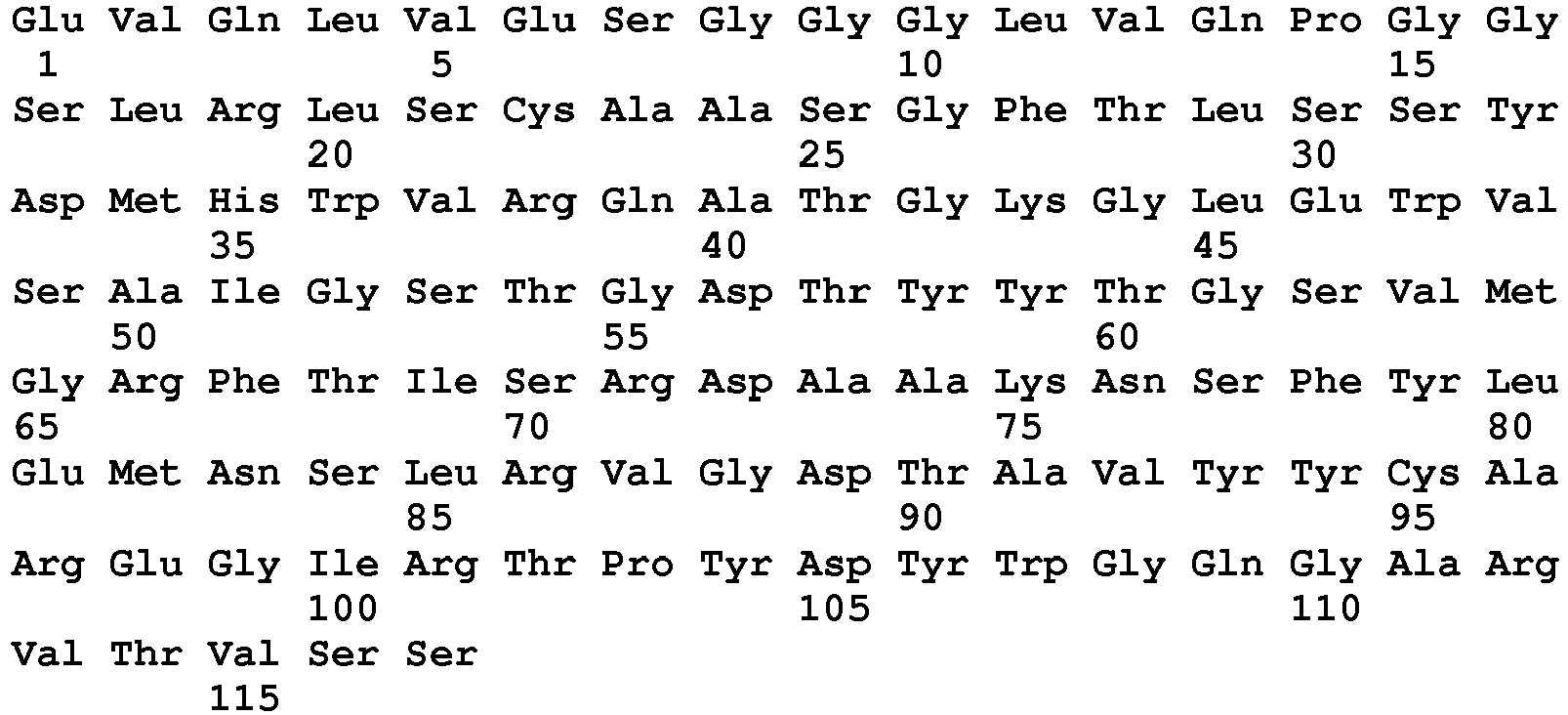
- <210> 531
<211> 24
<212> DNA
<213> Artificial Sequence - <220>
<223> Synthetic - <400> 531
ggattcaccc taagtagcta cgac 24 - <210> 532
<211> 8
<212> PRT
<213> Artificial Sequence - <220>
<223> Synthetic - <400> 532

- <210> 533
<211> 21
<212> DNA
<213> Artificial Sequence - <220>
<223> Synthetic - <400> 533
attggcagta ctggtgacac a 21 - <210> 534
<211> 7
<212> PRT
<213> Artificial Sequence - <220>
<223> Synthetic - <400> 534

- <210> 535
<211> 33
<212> DNA
<213> Artificial Sequence - <220>
<223> Synthetic - <400> 535
gcaagagagg gaataagaac accctatgat tat 33 - <210> 536
<211> 11
<212> PRT
<213> Artificial Sequence - <220>
<223> Synthetic - <400> 536

- <210> 537
<211> 324
<212> DNA
<213> Artificial Sequence - <220>
<223> Synthetic - <400> 537

- <210> 538
<211> 108
<212> PRT
<213> Artificial Sequence - <220>
<223> Synthetic - <400> 538


- <210> 539
<211> 18
<212> DNA
<213> Artificial Sequence - <220>
<223> Synthetic - <400> 539
cagagtgtta gcagcaat 18 - <210> 540
<211> 6
<212> PRT
<213> Artificial Sequence - <220>
<223> Synthetic - <400> 540

- <210> 541
<211> 9
<212> DNA
<213> Artificial Sequence - <220>
<223> Synthetic - <400> 541
ggtgcatcc 9 - <210> 542
<211> 3
<212> PRT
<213> Artificial Sequence - <220>
<223> Synthetic - <400> 542

- <210> 543
<211> 30
<212> DNA
<213> Artificial Sequence - <220>
<223> Synthetic - <400> 543
cagcagtata ataattggcc tccattcact 30 - <210> 544
<211> 10
<212> PRT
<213> Artificial Sequence - <220>
<223> Synthetic - <400> 544

- <210> 545
<211> 351
<212> DNA
<213> Artificial Sequence - <220>
<223> Synthetic - <400> 545

- <210> 546
<211> 117
<212> PRT
<213> Artificial Sequence - <220>
<223> Synthetic - <400> 546

- <210> 547 <211> 324
<212> DNA
<213> Artificial Sequence - <220>
<223> Synthetic - <400> 547

- <210> 548
<211> 108
<212> PRT
<213> Artificial Sequence - <220>
<223> Synthetic - <400> 548
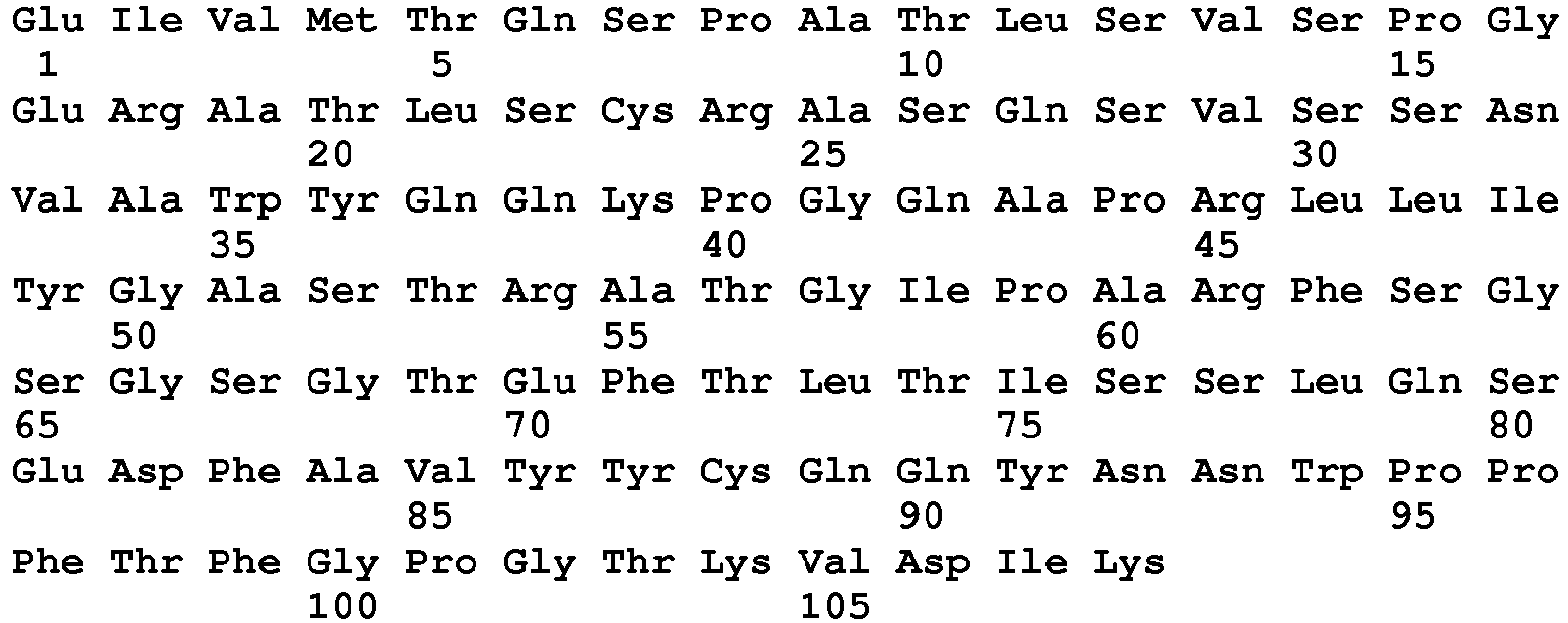
- <210> 549
<211> 351
<212> DNA
<213> Artificial Sequence - <220>
<223> Synthetic - <400> 549

- <210> 550
<211> 117
<212> PRT
<213> Artificial Sequence - <220>
<223> Synthetic - <400> 550

- <210> 551
<211> 324
<212> DNA
<213> Artificial Sequence - <220>
<223> Synthetic - <400> 551

- <210> 552
<211> 108
<212> PRT
<213> Artificial Sequence - <220>
<223> Synthetic - <400> 552
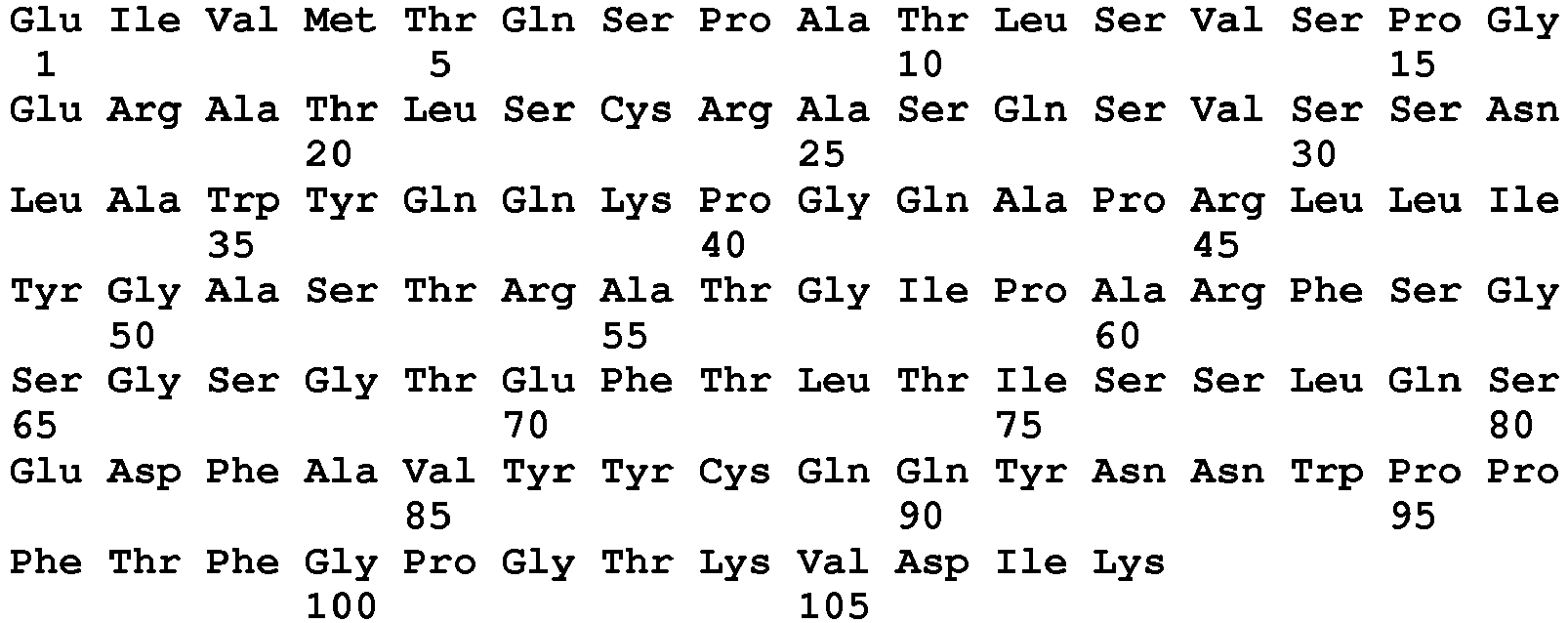
- <210> 553
<211> 351
<212> DNA
<213> Artificial Sequence - <220>
<223> Synthetic - <400> 553

- <210> 554
<211> 117
<212> PRT
<213> Artificial Sequence - <220>
<223> Synthetic - <400> 554

- <210> 555
<211> 24
<212> DNA
<213> Artificial Sequence - <220>
<223> Synthetic - <400> 555
ggattcaccc taagtagcta cgac 24 - <210> 556
<211> 8
<212> PRT
<213> Artificial Sequence - <220>
<223> Synthetic - <400> 556

- <210> 557
<211> 21
<212> DNA
<213> Artificial Sequence - <220>
<223> Synthetic - <400> 557
attggcagta ctggtgacac a 21 - <210> 558
<211> 7
<212> PRT
<213> Artificial Sequence - <220>
<223> Synthetic - <400> 558

- <210> 559
<211> 33
<212> DNA
<213> Artificial Sequence - <220>
<223> Synthetic - <400> 559
gcaagagagg gaataagaac accctatgat tat 33 - <210> 560
<211> 11
<212> PRT
<213> Artificial Sequence - <220>
<223> Synthetic - <400> 560

- <210> 561
<211> 324
<212> DNA
<213> Artificial Sequence - <220>
<223> Synthetic - <400> 561

- <210> 562
<211> 108
<212> PRT
<213> Artificial Sequence - <220>
<223> Synthetic - <400> 562

- <210> 563
<211> 18
<212> DNA
<213> Artificial Sequence - <220>
<223> Synthetic - <400> 563
cagagtgtta gcagcaat 18 - <210> 564
<211> 6
<212> PRT
<213> Artificial Sequence - <220>
<223> Synthetic - <400> 564

- <210> 565
<211> 9
<212> DNA
<213> Artificial Sequence - <220>
<223> Synthetic - <400> 565
ggtgcatcc 9 - <210> 566
<211> 3
<212> PRT
<213> Artificial Sequence - <220>
<223> Synthetic - <400> 566


- <210> 567
<211> 30
<212> DNA
<213> Artificial Sequence - <220>
<223> Synthetic - <400> 567
cagcagtata ataattggcc tccattcact 30 - <210> 568
<211> 10
<212> PRT
<213> Artificial Sequence - <220>
<223> Synthetic - <400> 568

- <210> 569
<211> 351
<212> DNA
<213> Artificial Sequence - <220>
<223> Synthetic - <400> 569

- <210> 570
<211> 117
<212> PRT
<213> Artificial Sequence - <220>
<223> Synthetic - <400> 570


- <210> 571
<211> 324
<212> DNA
<213> Artificial Sequence - <220>
<223> Synthetic - <400> 571

- <210> 572
<211> 108
<212> PRT
<213> Artificial Sequence - <220>
<223> Synthetic - <400> 572
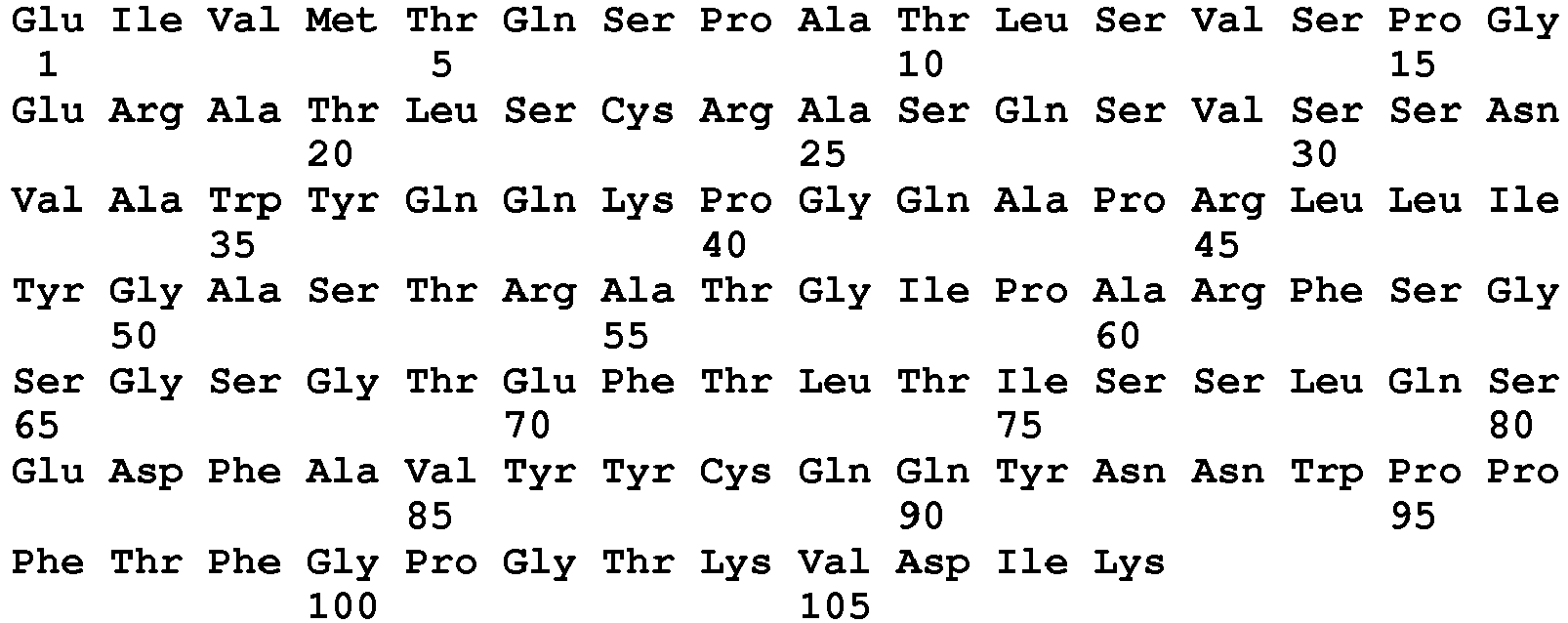
- <210> 573
<211> 351
<212> DNA
<213> Artificial Sequence - <220>
<223> Synthetic - <400> 573

- <210> 574
<211> 117
<212> PRT
<213> Artificial Sequence - <220>
<223> Synthetic - <400> 574

- <210> 575
<211> 324
<212> DNA
<213> Artificial Sequence - <220>
<223> Synthetic - <400> 575

- <210> 576
<211> 108
<212> PRT
<213> Artificial Sequence - <220>
<223> Synthetic - <400> 576

- <210> 577
<211> 363
<212> DNA
<213> Artificial Sequence - <220>
<223> Synthetic - <400> 577

- <210> 578
<211> 121
<212> PRT
<213> Artificial Sequence - <220>
<223> Synthetic - <400> 578

- <210> 579
<211> 24
<212> DNA
<213> Artificial Sequence - <220>
<223> Synthetic - <400> 579
ggattcacct ttgatgatta tgcc 24 - <210> 580
<211> 8
<212> PRT
<213> Artificial Sequence - <220>
<223> Synthetic - <400> 580


- <210> 581
<211> 24
<212> DNA
<213> Artificial Sequence - <220>
<223> Synthetic - <400> 581
attaattgga acagtggtag cata 24 - <210> 582
<211> 8
<212> PRT
<213> Artificial Sequence - <220>
<223> Synthetic - <400> 582

- <210> 583
<211> 42
<212> DNA
<213> Artificial Sequence - <220>
<223> Synthetic - <400> 583
gtaaaagagg tgactacggg atactactac ggtatggacg tc 42 - <210> 584
<211> 14
<212> PRT
<213> Artificial Sequence - <220>
<223> Synthetic - <400> 584

- <210> 585
<211> 321
<212> DNA
<213> Artificial Sequence - <220>
<223> Synthetic - <400> 585


- <210> 586
<211> 107
<212> PRT
<213> Artificial Sequence - <220>
<223> Synthetic - <400> 586

- <210> 587
<211> 18
<212> DNA
<213> Artificial Sequence - <220>
<223> Synthetic - <400> 587
cagggcatta gcagttat 18 - <210> 588
<211> 6
<212> PRT
<213> Artificial Sequence - <220>
<223> Synthetic - <400> 588

- <210> 589
<211> 9
<212> DNA
<213> Artificial Sequence - <220>
<223> Synthetic - <400> 589
gatgcatcc 9 - <210> 590
<211> 3
<212> PRT
<213> Artificial Sequence - <220>
<223> Synthetic - <400> 590

- <210> 591
<211> 27
<212> DNA
<213> Artificial Sequence - <220>
<223> Synthetic - <400> 591
caacagctta atatttaccc attcact 27 - <210> 592
<211> 9
<212> PRT
<213> Artificial Sequence - <220>
<223> Synthetic - <400> 592

- <210> 593
<211> 363
<212> DNA
<213> Artificial Sequence - <220>
<223> Synthetic - <400> 593

- <210> 594
<211> 121
<212> PRT
<213> Artificial Sequence - <220>
<223> Synthetic - <400> 594


- <210> 595
<211> 321
<212> DNA
<213> Artificial Sequence - <220>
<223> Synthetic - <400> 595

- <210> 596
<211> 107
<212> PRT
<213> Artificial Sequence - <220>
<223> Synthetic - <400> 596

- <210> 597
<211> 363
<212> DNA
<213> Artificial Sequence - <220>
<223> Synthetic - <400> 597


- <210> 598
<211> 121
<212> PRT
<213> Artificial Sequence - <220>
<223> Synthetic - <400> 598

- <210> 599
<211> 321
<212> DNA
<213> Artificial Sequence - <220>
<223> Synthetic - <400> 599

- <210> 600
<211> 107
<212> PRT
<213> Artificial Sequence - <220>
<223> Synthetic - <400> 600


- <210> 601
<211> 366
<212> DNA
<213> Artificial Sequence - <220>
<223> Synthetic - <400> 601

- <210> 602
<211> 122
<212> PRT
<213> Artificial Sequence - <220>
<223> Synthetic - <400> 602

- <210> 603
<211> 24
<212> DNA
<213> Artificial Sequence - <220>
<223> Synthetic - <400> 603
ggattcacgt ttagtagcta tgcc 24 - <210> 604
<211> 8
<212> PRT
<213> Artificial Sequence - <220>
<223> Synthetic - <400> 604

- <210> 605
<211> 24
<212> DNA
<213> Artificial Sequence - <220>
<223> Synthetic - <400> 605
atcagtggta atggtggtag cacc 24 - <210> 606
<211> 8
<212> PRT
<213> Artificial Sequence - <220>
<223> Synthetic - <400> 606

- <210> 607
<211> 45
<212> DNA
<213> Artificial Sequence - <220>
<223> Synthetic - <400> 607
gcgaaagccc gttattacga tttttggggg gggaatttcg atctc 45 - <210> 608
<211> 15
<212> PRT
<213> Artificial Sequence - <220>
<223> Synthetic - <400> 608

- <210> 609
<211> 324
<212> DNA
<213> Artificial Sequence - <220>
<223> Synthetic - <400> 609

- <210> 610
<211> 108
<212> PRT
<213> Artificial Sequence - <220>
<223> Synthetic - <400> 610

- <210> 611
<211> 21
<212> DNA
<213> Artificial Sequence - <220>
<223> Synthetic - <400> 611
cagagtgtta gcatcaggta c 21 - <210> 612
<211> 7
<212> PRT
<213> Artificial Sequence - <220>
<223> Synthetic - <400> 612

- <210> 613
<211> 9
<212> DNA
<213> Artificial Sequence - <220>
<223> Synthetic - <400> 613
ggtgcatcc 9 - <210> 614
<211> 3
<212> PRT
<213> Artificial Sequence - <220>
<223> Synthetic - <400> 614

- <210> 615
<211> 27
<212> DNA
<213> Artificial Sequence - <220>
<223> Synthetic - <400> 615
cagcaatatg gtagttcacc gctcact 27 - <210> 616
<211> 9
<212> PRT
<213> Artificial Sequence - <220>
<223> Synthetic - <400> 616

- <210> 617
<211> 366
<212> DNA
<213> Artificial Sequence - <220>
<223> Synthetic - <400> 617

- <210> 618
<211> 122
<212> PRT
<213> Artificial Sequence - <220>
<223> Synthetic - <400> 618

- <210> 619
<211> 324
<212> DNA
<213> Artificial Sequence - <220>
<223> Synthetic - <400> 619

- <210> 620
<211> 108
<212> PRT
<213> Artificial Sequence - <220>
<223> Synthetic - <400> 620

- <210> 621
<211> 366
<212> DNA
<213> Artificial Sequence - <220>
<223> Synthetic - <400> 621

- <210> 622
<211> 122
<212> PRT
<213> Artificial Sequence - <220>
<223> Synthetic - <400> 622

- <210> 623
<211> 324
<212> DNA
<213> Artificial Sequence - <220>
<223> Synthetic - <400> 623

- <210> 624
<211> 108
<212> PRT
<213> Artificial Sequence - <220>
<223> Synthetic - <400> 624

- <210> 625
<211> 381
<212> DNA
<213> Artificial Sequence - <220>
<223> Synthetic - <400> 625

- <210> 626
<211> 127
<212> PRT
<213> Artificial Sequence - <220>
<223> Synthetic - <400> 626
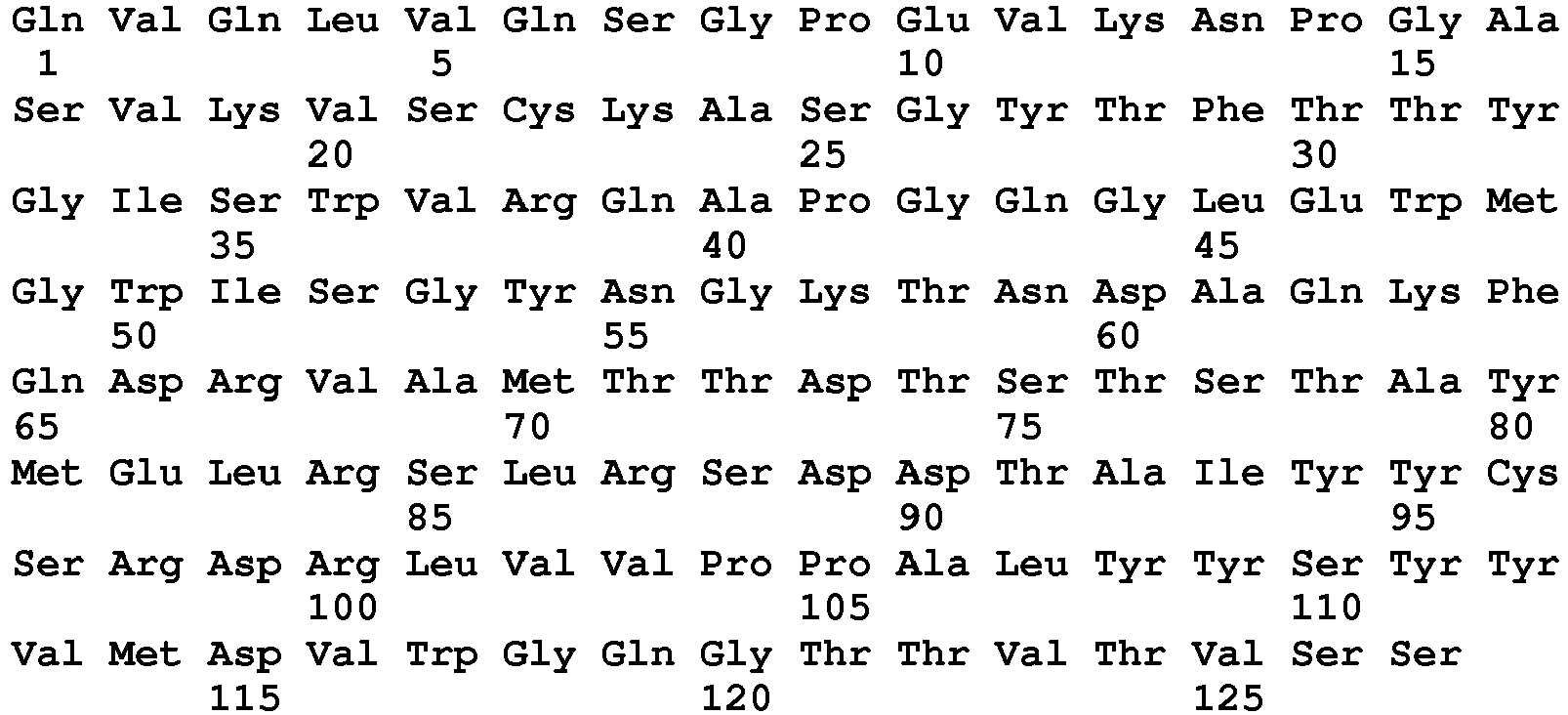
- <210> 627
<211> 24
<212> DNA
<213> Artificial Sequence - <220>
<223> Synthetic - <400> 627
ggttacacct ttaccaccta tggt 24 - <210> 628
<211> 8
<212> PRT
<213> Artificial Sequence - <220>
<223> Synthetic - <400> 628

- <210> 629
<211> 24
<212> DNA
<213> Artificial Sequence - <220>
<223> Synthetic - <400> 629
atcagcggtt acaatggtaa aaca 24 - <210> 630
<211> 8
<212> PRT
<213> Artificial Sequence - <220>
<223> Synthetic - <400> 630

- <210> 631
<211> 60
<212> DNA
<213> Artificial Sequence - <220>
<223> Synthetic - <400> 631
tcgagagatc gtttagtagt accacctgcc ctttattatt cctactacgt tatggacgtc 60 - <210> 632
<211> 20
<212> PRT
<213> Artificial Sequence - <220>
<223> Synthetic - <400> 632

- <210> 633
<211> 336
<212> DNA
<213> Artificial Sequence - <220>
<223> Synthetic - <400> 633

- <210> 634
<211> 112
<212> PRT
<213> Artificial Sequence - <220>
<223> Synthetic - <400> 634

- <210> 635
<211> 33
<212> DNA
<213> Artificial Sequence - <220>
<223> Synthetic - <400> 635
caaagcctcg tatacagtga tggaaacacc tac 33 - <210> 636
<211> 11
<212> PRT
<213> Artificial Sequence - <220>
<223> Synthetic - <400> 636

- <210> 637
<211> 9
<212> DNA
<213> Artificial Sequence - <220>
<223> Synthetic - <400> 637
aaggtttct 9 - <210> 638
<211> 3
<212> PRT
<213> Artificial Sequence - <220>
<223> Synthetic - <400> 638

- <210> 639
<211> 27
<212> DNA
<213> Artificial Sequence - <220>
<223> Synthetic - <400> 639
atgcaaggta cacactggcc gtacact 27 - <210> 640
<211> 9
<212> PRT
<213> Artificial Sequence - <220>
<223> Synthetic - <400> 640

- <210> 641
<211> 381
<212> DNA
<213> Artificial Sequence - <220>
<223> Synthetic - <400> 641


- <210> 642
<211> 127
<212> PRT
<213> Artificial Sequence - <220>
<223> Synthetic - <400> 642

- <210> 643
<211> 336
<212> DNA
<213> Artificial Sequence - <220>
<223> Synthetic - <400> 643

- <210> 644
<211> 112
<212> PRT
<213> Artificial Sequence - <220>
<223> Synthetic - <400> 644


- <210> 645
<211> 381
<212> DNA
<213> Artificial Sequence - <220>
<223> Synthetic - <400> 645

- <210> 646
<211> 127
<212> PRT
<213> Artificial Sequence - <220>
<223> Synthetic - <400> 646

- <210> 647
<211> 336
<212> DNA
<213> Artificial Sequence - <220>
<223> Synthetic - <400> 647


- <210> 648
<211> 112
<212> PRT
<213> Artificial Sequence - <220>
<223> Synthetic - <400> 648

- <210> 649
<211> 381
<212> DNA
<213> Artificial Sequence - <220>
<223> Synthetic - <400> 649

- <210> 650
<211> 127
<212> PRT
<213> Artificial Sequence - <220>
<223> Synthetic - <400> 650


- <210> 651
<211> 24
<212> DNA
<213> Artificial Sequence - <220>
<223> Synthetic - <400> 651
ggttacacct ttaccaccta tggt 24 - <210> 652
<211> 8
<212> PRT
<213> Artificial Sequence - <220>
<223> Synthetic - <400> 652

- <210> 653
<211> 24
<212> DNA
<213> Artificial Sequence - <220>
<223> Synthetic - <400> 653
atcagcggtt acaatggtaa aaca 24 - <210> 654
<211> 8
<212> PRT
<213> Artificial Sequence - <220>
<223> Synthetic - <400> 654

- <210> 655
<211> 60
<212> DNA
<213> Artificial Sequence - <220>
<223> Synthetic - <400> 655
tcgagagatc gtttagtagt accacctgcc cttaattatt actactacgt tatggacgtc 60 - <210> 656
<211> 20
<212> PRT
<213> Artificial Sequence - <220>
<223> Synthetic - <400> 656

- <210> 657
<211> 336
<212> DNA
<213> Artificial Sequence - <220>
<223> Synthetic - <400> 657

- <210> 658
<211> 112
<212> PRT
<213> Artificial Sequence - <220>
<223> Synthetic - <400> 658

- <210> 659
<211> 33
<212> DNA
<213> Artificial Sequence - <220>
<223> Synthetic - <400> 659
caaagcctcg tatacagtga tggaaacacc tac 33 - <210> 660
<211> 11
<212> PRT
<213> Artificial Sequence - <220>
<223> Synthetic - <400> 660

- <210> 661
<211> 9
<212> DNA
<213> Artificial Sequence - <220>
<223> Synthetic - <400> 661
aaggtttct 9 - <210> 662
<211> 3
<212> PRT
<213> Artificial Sequence - <220>
<223> Synthetic - <400> 662

- <210> 663
<211> 27
<212> DNA
<213> Artificial Sequence - <220>
<223> Synthetic - <400> 663
atgcaaggta cacactggcc gtacact 27 - <210> 664
<211> 9
<212> PRT
<213> Artificial Sequence - <220>
<223> Synthetic - <400> 664

- <210> 665
<211> 381
<212> DNA
<213> Artificial Sequence - <220>
<223> Synthetic - <400> 665

- <210> 666
<211> 127
<212> PRT
<213> Artificial Sequence - <220>
<223> Synthetic - <400> 666

- <210> 667
<211> 336
<212> DNA
<213> Artificial Sequence - <220>
<223> Synthetic - <400> 667

- <210> 668
<211> 112
<212> PRT
<213> Artificial Sequence - <220>
<223> Synthetic - <400> 668

- <210> 669
<211> 381
<212> DNA
<213> Artificial Sequence - <220>
<223> Synthetic - <400> 669

- <210> 670
<211> 127
<212> PRT
<213> Artificial Sequence - <220>
<223> Synthetic - <400> 670

- <210> 671
<211> 336
<212> DNA
<213> Artificial Sequence - <220>
<223> Synthetic - <400> 671

- <210> 672
<211> 112
<212> PRT
<213> Artificial Sequence - <220>
<223> Synthetic - <400> 672

- <210> 673
<211> 381
<212> DNA
<213> Artificial Sequence - <220>
<223> Synthetic - <400> 673

- <210> 674
<211> 127
<212> PRT
<213> Artificial Sequence - <220>
<223> Synthetic - <400> 674

- <210> 675
<211> 24
<212> DNA
<213> Artificial Sequence - <220>
<223> Synthetic - <400> 675
ggttacacct ttaccaccta tggt 24 - <210> 676
<211> 8
<212> PRT
<213> Artificial Sequence - <220>
<223> Synthetic - <400> 676

- <210> 677
<211> 24
<212> DNA
<213> Artificial Sequence - <220>
<223> Synthetic - <400> 677
atcagcggtt acaatggtaa aaca 24 - <210> 678
<211> 8
<212> PRT
<213> Artificial Sequence - <220>
<223> Synthetic - <400> 678

- <210> 679
<211> 60
<212> DNA
<213> Artificial Sequence - <220>
<223> Synthetic - <400> 679
tcgagagatc gtttagtagt accacctgcc ctttattatt actactacgt tatggacgtc 60 - <210> 680
<211> 20
<212> PRT
<213> Artificial Sequence - <220>
<223> Synthetic - <400> 680

- <210> 681
<211> 336
<212> DNA
<213> Artificial Sequence - <220>
<223> Synthetic - <400> 681

- <210> 682
<211> 112
<212> PRT
<213> Artificial Sequence - <220>
<223> Synthetic - <400> 682


- <210> 683
<211> 33
<212> DNA
<213> Artificial Sequence - <220>
<223> Synthetic - <400> 683
caaagcctcg tatacagtga tggaaacacc tac 33 - <210> 684
<211> 11
<212> PRT
<213> Artificial Sequence - <220>
<223> Synthetic - <400> 684

- <210> 685
<211> 9
<212> DNA
<213> Artificial Sequence - <220>
<223> Synthetic - <400> 685
aaggtttct 9 - <210> 686
<211> 3
<212> PRT
<213> Artificial Sequence - <220>
<223> Synthetic - <400> 686

- <210> 687
<211> 27
<212> DNA
<213> Artificial Sequence - <220>
<223> Synthetic - <400> 687
atgcaaggta cacactggcc gtacact 27 - <210> 688
<211> 9
<212> PRT
<213> Artificial Sequence - <220>
<223> Synthetic - <400> 688

- <210> 689
<211> 381
<212> DNA
<213> Artificial Sequence - <220>
<223> Synthetic - <400> 689

- <210> 690
<211> 127
<212> PRT
<213> Artificial Sequence - <220>
<223> Synthetic - <400> 690

- <210> 691
<211> 336
<212> DNA
<213> Artificial Sequence - <220>
<223> Synthetic - <400> 691

- <210> 692
<211> 112
<212> PRT
<213> Artificial Sequence - <220>
<223> Synthetic - <400> 692
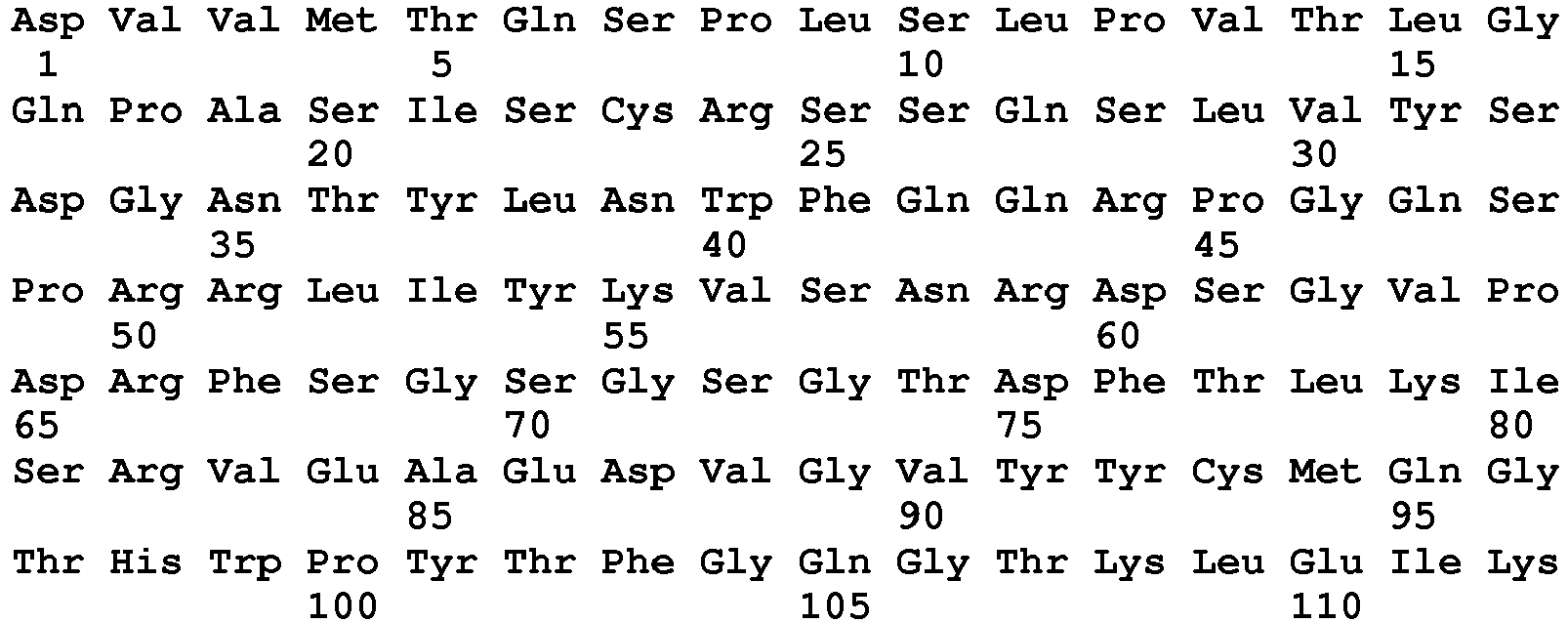
- <210> 693
<211> 381
<212> DNA
<213> Artificial Sequence - <220>
<223> Synthetic - <400> 693

- <210> 694
<211> 127
<212> PRT
<213> Artificial Sequence - <220>
<223> Synthetic - <400> 694


- <210> 695
<211> 336
<212> DNA
<213> Artificial Sequence - <220>
<223> Synthetic - <400> 695

- <210> 696
<211> 112
<212> PRT
<213> Artificial Sequence - <220>
<223> Synthetic - <400> 696

- <210> 697
<211> 384
<212> DNA
<213> Artificial Sequence - <220>
<223> Synthetic - <400> 697


- <210> 698
<211> 128
<212> PRT
<213> Artificial Sequence - <220>
<223> Synthetic - <400> 698

- <210> 699
<211> 24
<212> DNA
<213> Artificial Sequence - <220>
<223> Synthetic - <400> 699
ggattcacct tcagtgacca ctac 24 - <210> 700
<211> 8
<212> PRT
<213> Artificial Sequence - <220>
<223> Synthetic - <400> 700

- <210> 701
<211> 24
<212> DNA
<213> Artificial Sequence - <220>
<223> Synthetic - <400> 701
attagtaatg atggtggtac caaa 24 - <210> 702
<211> 8
<212> PRT
<213> Artificial Sequence - <220>
<223> Synthetic - <400> 702

- <210> 703
<211> 63
<212> DNA
<213> Artificial Sequence - <220>
<223> Synthetic - <400> 703

- <210> 704
<211> 21
<212> PRT
<213> Artificial Sequence - <220>
<223> Synthetic - <400> 704

- <210> 705
<211> 321
<212> DNA
<213> Artificial Sequence - <220>
<223> Synthetic - <400> 705

- <210> 706
<211> 107
<212> PRT
<213> Artificial Sequence - <220>
<223> Synthetic - <400> 706

- <210> 707
<211> 21
<212> DNA
<213> Artificial Sequence - <220>
<223> Synthetic - <400> 707
cagagtgtta acaacaaatt c 21 - <210> 708
<211> 7
<212> PRT
<213> Artificial Sequence - <220>
<223> Synthetic - <400> 708

- <210> 709
<211> 9
<212> DNA
<213> Artificial Sequence - <220>
<223> Synthetic - <400> 709
ggtgcatcc 9 - <210> 710
<211> 3
<212> PRT
<213> Artificial Sequence - <220>
<223> Synthetic - <400> 710

- <210> 711
<211> 24
<212> DNA
<213> Artificial Sequence - <220>
<223> Synthetic - <400> 711
caagtatatg gtaactcact cact 24 - <210> 712
<211> 8
<212> PRT
<213> Artificial Sequence - <220>
<223> Synthetic - <400> 712

- <210> 713
<211> 384
<212> DNA
<213> Artificial Sequence - <220>
<223> Synthetic - <400> 713

- <210> 714
<211> 128
<212> PRT
<213> Artificial Sequence - <220>
<223> Synthetic - <400> 714


- <210> 715
<211> 321
<212> DNA
<213> Artificial Sequence - <220>
<223> Synthetic - <400> 715

- <210> 716
<211> 107
<212> PRT
<213> Artificial Sequence - <220>
<223> Synthetic - <400> 716

- <210> 717
<211> 384
<212> DNA
<213> Artificial Sequence - <220>
<223> Synthetic - <400> 717

- <210> 718
<211> 128
<212> PRT
<213> Artificial Sequence - <220>
<223> Synthetic - <400> 718

- <210> 719
<211> 321
<212> DNA
<213> Artificial Sequence - <220>
<223> Synthetic - <400> 719

- <210> 720
<211> 107
<212> PRT
<213> Artificial Sequence - <220>
<223> Synthetic - <400> 720

- <210> 721
<211> 378
<212> DNA
<213> Artificial Sequence - <220>
<223> Synthetic - <400> 721

- <210> 722
<211> 126
<212> PRT
<213> Artificial Sequence - <220>
<223> Synthetic - <400> 722

- <210> 723
<211> 24
<212> DNA
<213> Artificial Sequence - <220>
<223> Synthetic - <400> 723
ggttacacct ttaccaacta cgct 24 - <210> 724
<211> 8
<212> PRT
<213> Artificial Sequence - <220>
<223> Synthetic - <400> 724

- <210> 725
<211> 24
<212> DNA
<213> Artificial Sequence - <220>
<223> Synthetic - <400> 725
gtcagcgctt acaatggtca caca 24 - <210> 726
<211> 8
<212> PRT
<213> Artificial Sequence - <220>
<223> Synthetic - <400> 726

- <210> 727
<211> 57
<212> DNA
<213> Artificial Sequence - <220>
<223> Synthetic - <400> 727
gcgagagggg gtgtagtcgt gccagttgct ccccacttct acaacggtat ggacgtc 57 - <210> 728
<211> 19
<212> PRT
<213> Artificial Sequence - <220>
<223> Synthetic - <400> 728

- <210> 729
<211> 336
<212> DNA
<213> Artificial Sequence - <220>
<223> Synthetic - <400> 729


- <210> 730
<211> 112
<212> PRT
<213> Artificial Sequence - <220>
<223> Synthetic - <400> 730
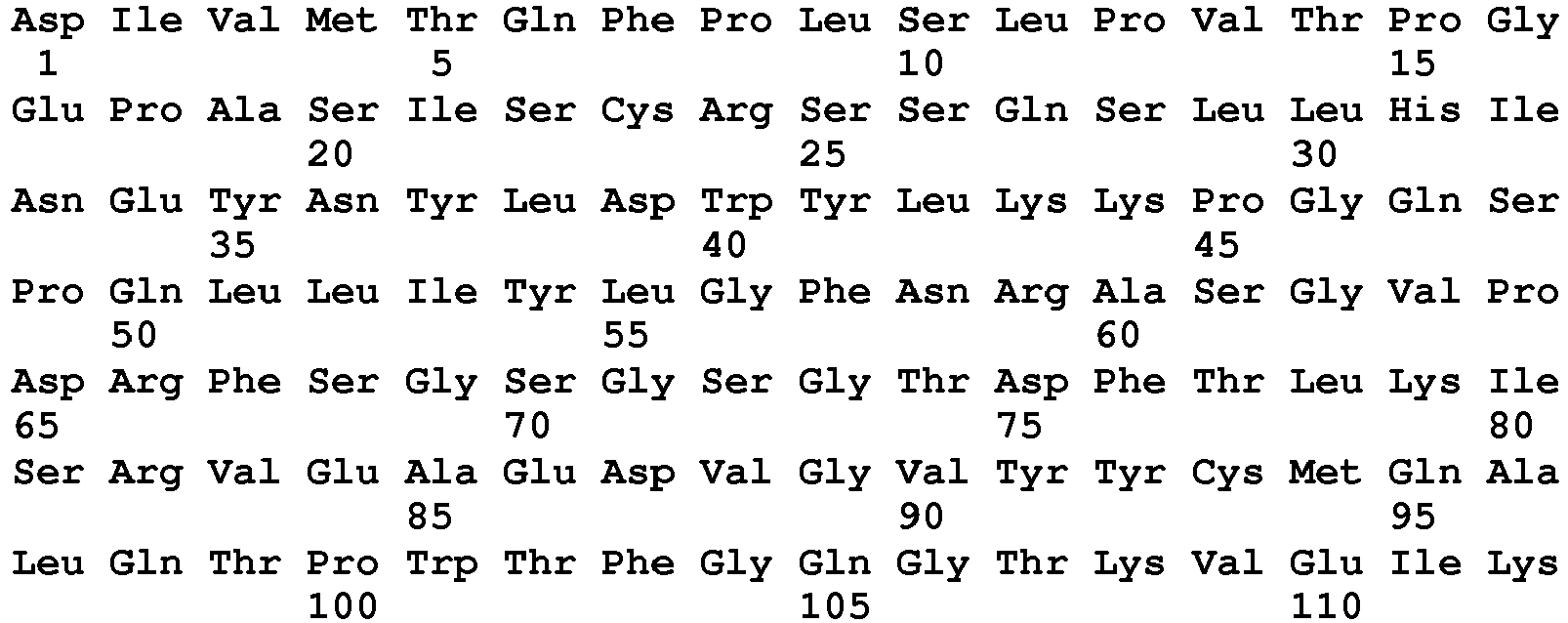
- <210> 731
<211> 33
<212> DNA
<213> Artificial Sequence - <220>
<223> Synthetic - <400> 731
cagagcctcc tgcatattaa tgaatacaac tat 33 - <210> 732
<211> 11
<212> PRT
<213> Artificial Sequence - <220>
<223> Synthetic - <400> 732

- <210> 733
<211> 9
<212> DNA
<213> Artificial Sequence - <220>
<223> Synthetic - <400> 733
ttgggtttt 9 - <210> 734
<211> 3
<212> PRT
<213> Artificial Sequence - <220>
<223> Synthetic - <400> 734

- <210> 735
<211> 27
<212> DNA
<213> Artificial Sequence - <220>
<223> Synthetic - <400> 735
atgcaagctc ttcaaactcc gtggacg 27 - <210> 736
<211> 9
<212> PRT
<213> Artificial Sequence - <220>
<223> Synthetic - <400> 736

- <210> 737
<211> 378
<212> DNA
<213> Artificial Sequence - <220>
<223> Synthetic - <400> 737

- <210> 738
<211> 126
<212> PRT
<213> Artificial Sequence - <220>
<223> Synthetic - <400> 738


- <210> 739
<211> 336
<212> DNA
<213> Artificial Sequence - <220>
<223> Synthetic - <400> 739

- <210> 740
<211> 112
<212> PRT
<213> Artificial Sequence - <220>
<223> Synthetic - <400> 740

- <210> 741
<211> 378
<212> DNA
<213> Artificial Sequence - <220>
<223> Synthetic - <400> 741

- <210> 742
<211> 126
<212> PRT
<213> Artificial Sequence - <220>
<223> Synthetic - <400> 742

- <210> 743
<211> 336
<212> DNA
<213> Artificial Sequence - <220>
<223> Synthetic - <400> 743

- <210> 744
<211> 112
<212> PRT
<213> Artificial Sequence - <220>
<223> Synthetic - <400> 744


- <210> 745
<211> 8
<212> PRT
<213> Artificial Sequence - <220>
<223> Synthetic - <220>
<221> VARIANT
<222> (1)...(8)
<223> Xaa = Any amino acid - <400> 745

- <210> 746
<211> 8
<212> PRT
<213> Artificial Sequence - <220>
<223> Synthetic - <220>
<221> VARIANT
<222> (1)...(8)
<223> Xaa - Any amino acid - <400> 746

- <210> 747
<211> 20
<212> PRT
<213> Artificial Sequence - <220>
<223> Synthetic - <220>
<221> VARIANT
<222> (1)...(20)
<223> Xaa = Any amino acid - <400> 747


- <210> 748
<211> 12
<212> PRT
<213> Artificial Sequence - <220>
<223> Synthetic - <220>
<221> VARIANT
<222> (1)...(12)
<223> Xaa = Any amino acid - <400> 748

- <210> 749
<211> 3
<212> PRT
<213> Artificial Sequence - <220>
<223> Synthetic - <220>
<221> VARIANT
<222> (1)...(3)
<223> Xaa = Any amino acid - <400> 749

- <210> 750
<211> 9
<212> PRT
<213> Artificial Sequence - <220>
<223> Synthetic - <220>
<221> VARIANT
<222> (1)...(9)
<223> Xaa = Any amino acid - <400> 750

- <210> 751
<211> 330
<212> PRT
<213> Artificial Sequence - <220>
<223> Synthetic - <400> 751

- <210> 752
<211> 327
<212> PRT
<213> Artificial Sequence - <220>
<223> Synthetic - <400> 752


- <210> 753
<211> 327
<212> PRT
<213> Artificial Sequence - <220>
<223> Synthetic - <400> 753


- <210> 754
<211> 2076
<212> DNA
<213> Homo sapiens - <400> 754

- <210> 755
<211> 692
<212> PRT
<213> Homo sapiens - <400> 755


- <210> 756
<211> 692
<212> PRT
<213> Macaca mulata - <400> 756


- <210> 757
<211> 694
<212> PRT
<213> Mus muscular - <400> 757


- <210> 758
<211> 653
<212> PRT
<213> Homo sapiens - <400> 758
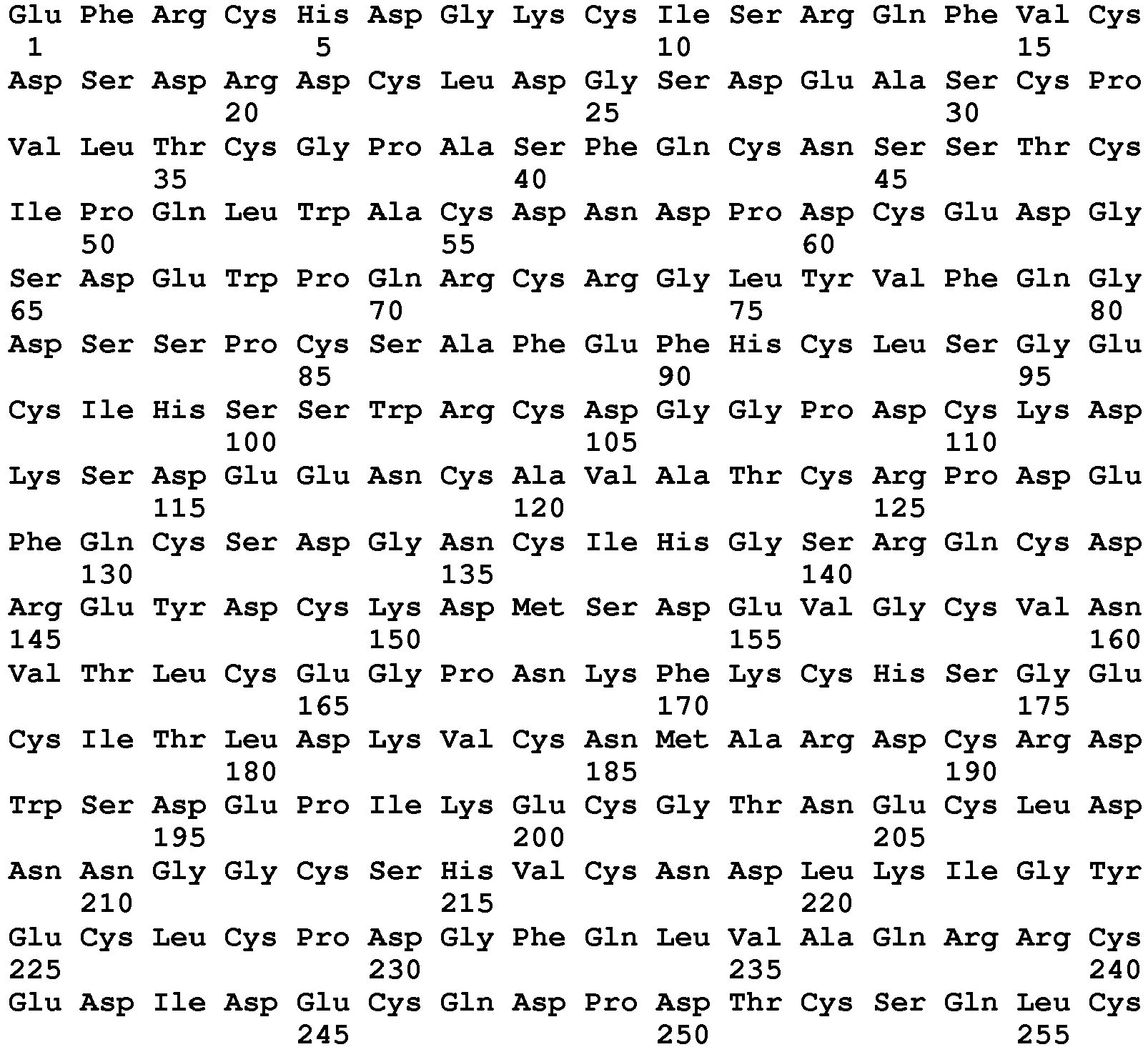

- <210> 759
<211> 753
<212> PRT
<213> Homo sapiens - <400> 759


- <210> 760
<211> 785
<212> PRT
<213> Homo sapiens - <400> 760


- <210> 761
<211> 692
<212> PRT
<213> Macaca fascicularis - <400> 761


- <210> 762
<211> 698
<212> PRT
<213> Mesocricetus auratus - <400> 762


- <210> 763
<211> 691
<212> PRT
<213> Rattus norvegicus - <400> 763


Claims (12)
- A pharmaceutical composition comprising a PCSK9 inhibitor for use in reducing lipoprotein(a) (Lp(a)) levels in a patient who exhibits a serum Lp(a) level above 30 mg/dL and who is diagnosed with or identified as being at risk of developing a cardiovascular disease or disorder prior to or at the time of administration of the composition, or who is diagnosed with or identified as being at risk of developing a thrombotic occlusive disease or disorder prior to or at the time of administration of the composition;
and wherein the PCSK9 inhibitor is an antibody or antigen-binding fragment thereof that specifically binds PCSK9. - The pharmaceutical composition for the use of claim 1, wherein the patient exhibits a serum Lp(a) level greater than 100 mg/dL.
- The pharmaceutical composition for the use of claim 1 or 2, wherein the cardiovascular disease or disorder is selected from the group consisting of coronary artery disease, acute myocardial infarction, asymptomatic carotid atherosclerosis, stroke, and peripheral artery occlusive disease.
- The pharmaceutical composition for the use of claim 1 or 2, wherein the cardiovascular disease or disorder is hypercholesterolemia.
- The pharmaceutical composition for the use of claim 4, wherein the hypercholesterolemia is heterozygous Familial Hypercholesterolemia (heFH), or the hypercholesterolemia is not Familial Hypercholesterolemia (nonFH).
- The pharmaceutical composition for the use of claim 1 or 2, wherein the thrombotic occlusive disease or disorder is selected from the group consisting of pulmonary embolism and central retinal vein occlusion.
- The pharmaceutical composition for the use of any one of claims 1 to 6, wherein the pharmaceutical composition comprises 20 mg to 200 mg of the PCSK9 inhibitor, optionally 50 mg to 150 mg of the PCSK9 inhibitor.
- The pharmaceutical composition for the use of claim 7, wherein the pharmaceutical composition comprises 50 mg of the PCSK9 inhibitor, 100 mg of the PCSK9 inhibitor, or 150 mg of the PCSK9 inhibitor.
- The pharmaceutical composition for the use of claims 1-8, wherein the antibody or antigen-binding fragment thereof comprises the heavy and light chain CDRs of a HCVR/LCVR amino acid sequence pair selected from the group consisting of SEQ ID NOs: 90/92 and 218/226.
- The pharmaceutical composition for the use of claim 9, wherein:(a) the antibody or antigen-binding fragment thereof comprises heavy and light chain CDR amino acid sequences having SEQ ID NOs:220, 222, 224, 228, 230 and 232, optionally wherein the antibody or antigen-binding fragment thereof comprises an HCVR having the amino acid sequence of SEQ ID NO:218 and an LCVR having the amino acid sequence of SEQ ID NO:226; or(b) the antibody or antigen-binding fragment thereof comprises heavy and light chain CDR amino acid sequences having SEQ ID NOs:76, 78, 80, 84, 86 and 88, optionally wherein the antibody or antigen-binding fragment thereof comprises an HCVR having the amino acid sequence of SEQ ID NO:90 and an LCVR having the amino acid sequence of SEQ ID NO:92.
- The pharmaceutical composition for the use of any one of claims 1 to 10, wherein the patient is on a therapeutic statin regimen at the time of or just prior to administration of the composition; optionally wherein the therapeutic statin regimen comprises a statin selected from the group consisting of cerivastatin, atorvastatin, simvastatin, pitavastatin, rosuvastatin, fluvastatin, lovastatin and pravastatin, preferably atorvastatin.
- The pharmaceutical composition for the use of any one of claims 1 to 10, wherein the patient is not on a therapeutic statin regimen at the time of administration of the composition.
Priority Applications (3)
| Application Number | Priority Date | Filing Date | Title |
|---|---|---|---|
| EP19162319.8A EP3536712B1 (en) | 2011-09-16 | 2012-09-12 | Methods for reducing lipoprotein(a) levels by administering an inhibitor of proprotein convertase subtilisin kexin-9 (pcsk9) |
| EP24202055.0A EP4461373A3 (en) | 2011-09-16 | 2012-09-12 | Methods for reducing lipoprotein(a) levels by administering an inhibitor of proprotein convertase subtilisin kexin-9 (pcsk9) |
| EP23176223.8A EP4252857B1 (en) | 2011-09-16 | 2012-09-12 | Methods for reducing lipoprotein(a) levels by administering an inhibitor of proprotein convertase subtilisin kexin-9 (pcsk9) |
Applications Claiming Priority (4)
| Application Number | Priority Date | Filing Date | Title |
|---|---|---|---|
| US201161535392P | 2011-09-16 | 2011-09-16 | |
| US201161559162P | 2011-11-14 | 2011-11-14 | |
| US201261641321P | 2012-05-02 | 2012-05-02 | |
| PCT/US2012/054756 WO2013039969A1 (en) | 2011-09-16 | 2012-09-12 | METHODS FOR REDUCING LIPOPROTEIN(a) LEVELS BY ADMINISTERING AN INHIBITOR OF PROPROTEIN CONVERTASE SUBTILISIN KEXIN-9 (PCSK9) |
Related Child Applications (4)
| Application Number | Title | Priority Date | Filing Date |
|---|---|---|---|
| EP19162319.8A Division-Into EP3536712B1 (en) | 2011-09-16 | 2012-09-12 | Methods for reducing lipoprotein(a) levels by administering an inhibitor of proprotein convertase subtilisin kexin-9 (pcsk9) |
| EP19162319.8A Division EP3536712B1 (en) | 2011-09-16 | 2012-09-12 | Methods for reducing lipoprotein(a) levels by administering an inhibitor of proprotein convertase subtilisin kexin-9 (pcsk9) |
| EP24202055.0A Division EP4461373A3 (en) | 2011-09-16 | 2012-09-12 | Methods for reducing lipoprotein(a) levels by administering an inhibitor of proprotein convertase subtilisin kexin-9 (pcsk9) |
| EP23176223.8A Division EP4252857B1 (en) | 2011-09-16 | 2012-09-12 | Methods for reducing lipoprotein(a) levels by administering an inhibitor of proprotein convertase subtilisin kexin-9 (pcsk9) |
Publications (2)
| Publication Number | Publication Date |
|---|---|
| EP2756004A1 EP2756004A1 (en) | 2014-07-23 |
| EP2756004B1 true EP2756004B1 (en) | 2019-12-25 |
Family
ID=46881178
Family Applications (4)
| Application Number | Title | Priority Date | Filing Date |
|---|---|---|---|
| EP12761864.3A Active EP2756004B1 (en) | 2011-09-16 | 2012-09-12 | INHIBITOR OF PROPROTEIN CONVERTASE SUBTILISIN KEXIN-9 (PCSK9) FOR USE IN REDUCING LIPOPROTEIN(a) LEVELS |
| EP24202055.0A Pending EP4461373A3 (en) | 2011-09-16 | 2012-09-12 | Methods for reducing lipoprotein(a) levels by administering an inhibitor of proprotein convertase subtilisin kexin-9 (pcsk9) |
| EP19162319.8A Active EP3536712B1 (en) | 2011-09-16 | 2012-09-12 | Methods for reducing lipoprotein(a) levels by administering an inhibitor of proprotein convertase subtilisin kexin-9 (pcsk9) |
| EP23176223.8A Active EP4252857B1 (en) | 2011-09-16 | 2012-09-12 | Methods for reducing lipoprotein(a) levels by administering an inhibitor of proprotein convertase subtilisin kexin-9 (pcsk9) |
Family Applications After (3)
| Application Number | Title | Priority Date | Filing Date |
|---|---|---|---|
| EP24202055.0A Pending EP4461373A3 (en) | 2011-09-16 | 2012-09-12 | Methods for reducing lipoprotein(a) levels by administering an inhibitor of proprotein convertase subtilisin kexin-9 (pcsk9) |
| EP19162319.8A Active EP3536712B1 (en) | 2011-09-16 | 2012-09-12 | Methods for reducing lipoprotein(a) levels by administering an inhibitor of proprotein convertase subtilisin kexin-9 (pcsk9) |
| EP23176223.8A Active EP4252857B1 (en) | 2011-09-16 | 2012-09-12 | Methods for reducing lipoprotein(a) levels by administering an inhibitor of proprotein convertase subtilisin kexin-9 (pcsk9) |
Country Status (26)
| Country | Link |
|---|---|
| US (2) | US10076571B2 (en) |
| EP (4) | EP2756004B1 (en) |
| JP (2) | JP6158813B2 (en) |
| KR (1) | KR101964031B1 (en) |
| CN (2) | CN103930444B (en) |
| AR (1) | AR087881A1 (en) |
| AU (1) | AU2012308797B2 (en) |
| BR (1) | BR112014005522A2 (en) |
| CA (1) | CA2848201C (en) |
| CL (1) | CL2014000605A1 (en) |
| CO (1) | CO6910163A2 (en) |
| EA (1) | EA028278B1 (en) |
| ES (3) | ES2773111T3 (en) |
| HR (1) | HRP20241450T1 (en) |
| HU (1) | HUE069234T2 (en) |
| IL (1) | IL231011B (en) |
| MA (1) | MA35430B1 (en) |
| MX (1) | MX363642B (en) |
| MY (1) | MY170089A (en) |
| PH (1) | PH12014500342B1 (en) |
| PL (1) | PL4252857T3 (en) |
| RS (1) | RS66342B1 (en) |
| SG (1) | SG2014010524A (en) |
| TW (1) | TWI601740B (en) |
| WO (1) | WO2013039969A1 (en) |
| ZA (1) | ZA201401114B (en) |
Cited By (1)
| Publication number | Priority date | Publication date | Assignee | Title |
|---|---|---|---|---|
| EP3536712A1 (en) | 2011-09-16 | 2019-09-11 | Regeneron Pharmaceuticals, Inc. | Methods for reducing lipoprotein(a) levels by administering an inhibitor of proprotein convertase subtilisin kexin-9 (pcsk9) |
Families Citing this family (56)
| Publication number | Priority date | Publication date | Assignee | Title |
|---|---|---|---|---|
| JOP20080381B1 (en) | 2007-08-23 | 2023-03-28 | Amgen Inc | Antigen Binding Proteins to Proprotein Convertase subtillisin Kexin type 9 (pcsk9) |
| JO3672B1 (en) | 2008-12-15 | 2020-08-27 | Regeneron Pharma | High Affinity Human Antibodies to PCSK9 |
| US20130064834A1 (en) | 2008-12-15 | 2013-03-14 | Regeneron Pharmaceuticals, Inc. | Methods for treating hypercholesterolemia using antibodies to pcsk9 |
| CA2825778A1 (en) | 2011-01-28 | 2012-08-02 | Sanofi | Pharmaceutical compositions comprising human antibodies to pcsk9 |
| JOP20200043A1 (en) | 2011-05-10 | 2017-06-16 | Amgen Inc | Ways to treat or prevent cholesterol disorders |
| AR087305A1 (en) | 2011-07-28 | 2014-03-12 | Regeneron Pharma | STABILIZED FORMULATIONS CONTAINING ANTI-PCSK9 ANTIBODIES, PREPARATION METHOD AND KIT |
| EA039663B1 (en) | 2012-05-03 | 2022-02-24 | Амген Инк. | Use of an anti-pcsk9 antibody for lowering serum cholesterol ldl and treating cholesterol related disorders |
| US9255154B2 (en) | 2012-05-08 | 2016-02-09 | Alderbio Holdings, Llc | Anti-PCSK9 antibodies and use thereof |
| CN105143203A (en) | 2013-04-17 | 2015-12-09 | 辉瑞大药厂 | N-piperidin-3-ylbenzamide derivatives for the treatment of cardiovascular diseases |
| US10111953B2 (en) * | 2013-05-30 | 2018-10-30 | Regeneron Pharmaceuticals, Inc. | Methods for reducing remnant cholesterol and other lipoprotein fractions by administering an inhibitor of proprotein convertase subtilisin kexin-9 (PCSK9) |
| TWI682780B (en) * | 2013-05-30 | 2020-01-21 | 美商再生元醫藥公司 | Use of a pharmaceutical composition for the manufacture of a medicament for treating autosomal dominant hypercholesterolemia associated with pcsk9 gain-of-function mutations |
| TW201534324A (en) | 2013-06-07 | 2015-09-16 | Sanofi Sa | Methods for inhibiting atherosclerosis by administering an inhibitor of PCSK9 |
| MX373298B (en) * | 2013-10-11 | 2020-05-20 | Sanofi Biotechnology | USE OF A PCSK9 INHIBITOR TO TREAT HYPERLIPIDEMIA. |
| US10428157B2 (en) | 2013-11-12 | 2019-10-01 | Sanofi Biotechnology | Dosing regimens for use with PCSK9 inhibitors |
| US9914769B2 (en) | 2014-07-15 | 2018-03-13 | Kymab Limited | Precision medicine for cholesterol treatment |
| CN106062004A (en) * | 2013-12-17 | 2016-10-26 | 科马布有限公司 | Ligands specifically binding to human targets of interest |
| US9045545B1 (en) | 2014-07-15 | 2015-06-02 | Kymab Limited | Precision medicine by targeting PD-L1 variants for treatment of cancer |
| US8992927B1 (en) | 2014-07-15 | 2015-03-31 | Kymab Limited | Targeting human NAV1.7 variants for treatment of pain |
| US9045548B1 (en) | 2014-07-15 | 2015-06-02 | Kymab Limited | Precision Medicine by targeting rare human PCSK9 variants for cholesterol treatment |
| US9067998B1 (en) | 2014-07-15 | 2015-06-30 | Kymab Limited | Targeting PD-1 variants for treatment of cancer |
| US8980273B1 (en) | 2014-07-15 | 2015-03-17 | Kymab Limited | Method of treating atopic dermatitis or asthma using antibody to IL4RA |
| US9034332B1 (en) | 2014-07-15 | 2015-05-19 | Kymab Limited | Precision medicine by targeting rare human PCSK9 variants for cholesterol treatment |
| US9051378B1 (en) | 2014-07-15 | 2015-06-09 | Kymab Limited | Targeting rare human PCSK9 variants for cholesterol treatment |
| US8986691B1 (en) | 2014-07-15 | 2015-03-24 | Kymab Limited | Method of treating atopic dermatitis or asthma using antibody to IL4RA |
| US8883157B1 (en) | 2013-12-17 | 2014-11-11 | Kymab Limited | Targeting rare human PCSK9 variants for cholesterol treatment |
| US9017678B1 (en) | 2014-07-15 | 2015-04-28 | Kymab Limited | Method of treating rheumatoid arthritis using antibody to IL6R |
| US9023359B1 (en) | 2014-07-15 | 2015-05-05 | Kymab Limited | Targeting rare human PCSK9 variants for cholesterol treatment |
| US8986694B1 (en) | 2014-07-15 | 2015-03-24 | Kymab Limited | Targeting human nav1.7 variants for treatment of pain |
| US8945560B1 (en) | 2014-07-15 | 2015-02-03 | Kymab Limited | Method of treating rheumatoid arthritis using antibody to IL6R |
| EA201691320A1 (en) * | 2014-02-14 | 2016-11-30 | Ридженерон Фармасьютикалз, Инк. | METHODS OF TREATMENT OF PATIENTS WITH HYPERSHOLESTERINEMIA, WHICH STABLE TO THERAPY WITH MODERN STATIN DOSES THERAPY |
| GB201403775D0 (en) | 2014-03-04 | 2014-04-16 | Kymab Ltd | Antibodies, uses & methods |
| US11555059B2 (en) | 2014-04-25 | 2023-01-17 | The Trustees Of The University Of Pennsylvania | LDLR variants and their use in compositions for reducing cholesterol levels |
| US9150660B1 (en) | 2014-07-15 | 2015-10-06 | Kymab Limited | Precision Medicine by targeting human NAV1.8 variants for treatment of pain |
| US9139648B1 (en) | 2014-07-15 | 2015-09-22 | Kymab Limited | Precision medicine by targeting human NAV1.9 variants for treatment of pain |
| KR20230074283A (en) | 2014-07-16 | 2023-05-26 | 사노피 바이오테크놀로지 | METHODS FOR TREATING PATIENTS WITH HETEROZYGOUS FAMILIAL HYPERCHOLESTEROLEMIA(heFH) |
| AU2015289617B2 (en) * | 2014-07-16 | 2021-04-15 | Regeneron Pharmaceuticals, Inc. | Methods for treating high cardiovascular risk patients with hypercholesterolemia |
| US9139653B1 (en) | 2015-04-30 | 2015-09-22 | Kymab Limited | Anti-human OX40L antibodies and methods of treatment |
| MX392182B (en) * | 2015-03-13 | 2025-03-21 | Esperion Therapeutics Inc | FIXED-DOSE COMBINATIONS AND FORMULATIONS COMPRISING 8-HYDROXY-2,2,14,14 TETRAMETHYLPENTADECANEDIOIC ACID (ETC1002) AND EZETIMIBE AND METHODS FOR TREATING OR REDUCING THE RISK OF CARDIOVASCULAR DISEASE. |
| EA201890519A1 (en) | 2015-08-18 | 2018-07-31 | Ридженерон Фармасьютикалз, Инк. | INHIBITING ANTIBODIES AGAINST PCSK9 FOR THE TREATMENT OF PATIENTS WITH HYPERLIPIDEMIA EXPOSING TO LIPOPROTEIN SCARVA |
| EP4085934A1 (en) | 2015-12-11 | 2022-11-09 | The Trustees of The University of Pennsylvania | Gene therapy for treating familial hypercholesterolemia |
| CN107406511B (en) | 2015-12-31 | 2021-01-19 | 江苏恒瑞医药股份有限公司 | PCSK9 antibody, antigen-binding fragment thereof, and medical use thereof |
| CN107531795B (en) | 2016-01-05 | 2021-01-19 | 江苏恒瑞医药股份有限公司 | PCSK9 antibody, antigen-binding fragment thereof and medical application thereof |
| US10858422B2 (en) | 2016-05-31 | 2020-12-08 | Abcentra, Llc | Methods for treating systemic lupus erythematosus with an anti-apolipoprotein B antibody |
| CN107474140B (en) * | 2016-06-08 | 2022-06-03 | 常州博嘉生物医药科技有限公司 | PCSK9 specific binding protein MV072 and application thereof |
| KR102379464B1 (en) | 2016-06-20 | 2022-03-29 | 키맵 리미티드 | anti-PD-L1 antibody |
| WO2018022511A1 (en) | 2016-07-25 | 2018-02-01 | The Trustees Of The University Of Pennsylvania | Compositions comprising a lecithin cholesterol acyltransferase variant and uses thereof |
| JP7103748B2 (en) * | 2016-10-05 | 2022-07-20 | サッポロビール株式会社 | PCSK9 inhibitor and food composition for improving cholesterol metabolism |
| WO2018083248A1 (en) | 2016-11-03 | 2018-05-11 | Kymab Limited | Antibodies, combinations comprising antibodies, biomarkers, uses & methods |
| JP2020510648A (en) * | 2017-02-20 | 2020-04-09 | ザ・トラステイーズ・オブ・ザ・ユニバーシテイ・オブ・ペンシルベニア | Gene therapy to treat familial hypercholesterolemia |
| US11325945B2 (en) | 2017-04-12 | 2022-05-10 | Cadila Healthcare Limited | Peptide based PCSK9 vaccine |
| IL277127B2 (en) * | 2018-03-06 | 2025-11-01 | Sanofi Biotechnology | Using pcsk9 tracking to reduce cardiovascular risk |
| JP7513533B2 (en) * | 2018-07-02 | 2024-07-09 | アブセントラ,エルエルシー | Compositions and methods for reducing the formation of lipoprotein A and the treatment of aortic valve sclerosis and aortic valve stenosis - Patents.com |
| WO2020150473A2 (en) | 2019-01-18 | 2020-07-23 | Dogma Therapeutics, Inc. | Pcsk9 inhibitors and methods of use thereof |
| JP7722989B2 (en) | 2019-11-12 | 2025-08-13 | アブセントラ,エルエルシー | Methods and compositions for treating cancer |
| JP2023506732A (en) | 2019-12-10 | 2023-02-20 | リジェネロン・ファーマシューティカルズ・インコーポレイテッド | Use of PCSK9 inhibitors to treat homozygous familial hypercholesterolemia |
| MX2024001877A (en) | 2021-08-10 | 2024-02-28 | Kymab Ltd | Treatment of atopic dermatitis. |
Citations (2)
| Publication number | Priority date | Publication date | Assignee | Title |
|---|---|---|---|---|
| US20100166768A1 (en) * | 2008-12-15 | 2010-07-01 | Regeneron Pharmaceuticals, Inc. | High Affinity Human Antibodies to PCSK9 |
| WO2015054619A2 (en) | 2013-10-11 | 2015-04-16 | Sanofi | Use of a pcsk9 inhibitor to treat hyperlipidemia |
Family Cites Families (114)
| Publication number | Priority date | Publication date | Assignee | Title |
|---|---|---|---|---|
| FI94339C (en) | 1989-07-21 | 1995-08-25 | Warner Lambert Co | Process for the preparation of pharmaceutically acceptable [R- (R *, R *)] - 2- (4-fluorophenyl) -, - dihydroxy-5- (1-methylethyl) -3-phenyl-4 - [(phenylamino) carbonyl] -1H- for the preparation of pyrrole-1-heptanoic acid and its pharmaceutically acceptable salts |
| EP1690935A3 (en) | 1990-01-12 | 2008-07-30 | Abgenix, Inc. | Generation of xenogeneic antibodies |
| JP2648897B2 (en) | 1991-07-01 | 1997-09-03 | 塩野義製薬株式会社 | Pyrimidine derivatives |
| AU2309692A (en) | 1991-07-03 | 1993-02-11 | Cryolife, Inc. | Method for stabilization of biomaterials |
| WO1993022336A1 (en) | 1992-04-30 | 1993-11-11 | Alpha Therapeutic Corporation | Improved solubilization and stabilization of factor viii complex |
| US6177401B1 (en) | 1992-11-13 | 2001-01-23 | Max-Planck-Gesellschaft Zur Forderung Der Wissenschaften | Use of organic compounds for the inhibition of Flk-1 mediated vasculogenesis and angiogenesis |
| GB9410534D0 (en) | 1994-05-26 | 1994-07-13 | Lynxvale Ltd | Improvements in or relating to growth factor inhibitors |
| US6267958B1 (en) | 1995-07-27 | 2001-07-31 | Genentech, Inc. | Protein formulation |
| US6685940B2 (en) | 1995-07-27 | 2004-02-03 | Genentech, Inc. | Protein formulation |
| JPH09154588A (en) | 1995-10-07 | 1997-06-17 | Toagosei Co Ltd | VEGF binding polypeptide |
| JP2000509018A (en) | 1996-03-26 | 2000-07-18 | イーライ・リリー・アンド・カンパニー | Obesity protein preparation |
| US6100071A (en) | 1996-05-07 | 2000-08-08 | Genentech, Inc. | Receptors as novel inhibitors of vascular endothelial growth factor activity and processes for their production |
| EP0852951A1 (en) | 1996-11-19 | 1998-07-15 | Roche Diagnostics GmbH | Stable lyophilized monoclonal or polyclonal antibodies containing pharmaceuticals |
| US7312196B2 (en) | 1997-01-08 | 2007-12-25 | Amylin Pharmaceuticals, Inc. | Formulations for amylin agonist peptides |
| US20070224663A1 (en) | 1997-03-07 | 2007-09-27 | Human Genome Sciences, Inc. | Human Secreted Proteins |
| US6171586B1 (en) | 1997-06-13 | 2001-01-09 | Genentech, Inc. | Antibody formulation |
| AU2484399A (en) | 1998-01-30 | 1999-08-16 | Scios Inc. | Controlled release delivery of peptide or protein |
| US7001892B1 (en) | 1999-06-11 | 2006-02-21 | Purdue Research Foundation | Pharmaceutical materials and methods for their preparation and use |
| US7129338B1 (en) | 1999-07-08 | 2006-10-31 | Research Association For Biotechnology | Secretory protein or membrane protein |
| EP1514933A1 (en) | 1999-07-08 | 2005-03-16 | Research Association for Biotechnology | Secretory protein or membrane protein |
| US7029895B2 (en) | 1999-09-27 | 2006-04-18 | Millennium Pharmaceuticals, Inc. | 27411, a novel human PGP synthase |
| AU2001241461A1 (en) | 2000-02-07 | 2001-08-14 | Millennium Pharmaceuticals, Inc. | Narc-1, novel subtilase-like homologs |
| US6659982B2 (en) | 2000-05-08 | 2003-12-09 | Sterling Medivations, Inc. | Micro infusion drug delivery device |
| US6629949B1 (en) | 2000-05-08 | 2003-10-07 | Sterling Medivations, Inc. | Micro infusion drug delivery device |
| PT2990420T (en) | 2000-05-26 | 2017-03-16 | Immunex Corp | Use of interleukin-4 receptor antibodies and compositions thereof |
| AU9084601A (en) | 2000-09-08 | 2002-03-22 | Massachusetts Inst Technology | G-csf analog compositions and methods |
| DE60139944D1 (en) | 2000-10-12 | 2009-10-29 | Genentech Inc | LOW VISCOSIS CONCENTRATED PROTEIN FORMULATIONS |
| US6596541B2 (en) | 2000-10-31 | 2003-07-22 | Regeneron Pharmaceuticals, Inc. | Methods of modifying eukaryotic cells |
| US20030133939A1 (en) | 2001-01-17 | 2003-07-17 | Genecraft, Inc. | Binding domain-immunoglobulin fusion proteins |
| US7754208B2 (en) | 2001-01-17 | 2010-07-13 | Trubion Pharmaceuticals, Inc. | Binding domain-immunoglobulin fusion proteins |
| ATE454137T1 (en) | 2001-07-25 | 2010-01-15 | Facet Biotech Corp | STABLE LYOPHILIZED PHARMACEUTICAL FORMULATION OF THE IGG ANTIBODY DACLIZUMAB |
| US20040101920A1 (en) | 2002-11-01 | 2004-05-27 | Czeslaw Radziejewski | Modification assisted profiling (MAP) methodology |
| AU2003293543A1 (en) | 2002-12-13 | 2004-07-09 | Abgenix, Inc. | System and method for stabilizing antibodies with histidine |
| PT1610820E (en) | 2003-04-04 | 2010-12-16 | Novartis Ag | High concentration antibody and protein formulations |
| EP1471152A1 (en) | 2003-04-25 | 2004-10-27 | Institut National De La Sante Et De La Recherche Medicale (Inserm) | Mutations in the human PCSK9 gene associated to hypercholesterolemia |
| JP2006525669A (en) | 2003-05-02 | 2006-11-09 | ユニバーシティ・カレッジ・コークーナショナル・ユニバーシティ・オブ・アイルランド,コーク | Light emitting diode and manufacturing method thereof |
| UA93653C2 (en) | 2003-11-07 | 2011-03-10 | Иммунекс Корпорейшн | Antibody that specifically binds to human interleukin-4 receptor (il-4r) |
| EP1740946B1 (en) | 2004-04-20 | 2013-11-06 | Genmab A/S | Human monoclonal antibodies against cd20 |
| US20060147945A1 (en) | 2005-01-06 | 2006-07-06 | Edmonds Brian T | Novel secreted proteins and their uses |
| EP2505646A1 (en) | 2006-05-05 | 2012-10-03 | Isis Pharmaceuticals, Inc. | Compounds and methods for modulating expression of CRP |
| ES2366973T3 (en) * | 2006-05-05 | 2011-10-27 | Isis Pharmaceuticals, Inc. | COMPOUNDS AND PROCEDURE TO MODULATE GENE EXPRESSION. |
| CA2654510C (en) | 2006-06-16 | 2015-03-17 | Regeneron Pharmaceuticals, Inc. | Vegf antagonist formulations suitable for intravitreal administration |
| US7572618B2 (en) | 2006-06-30 | 2009-08-11 | Bristol-Myers Squibb Company | Polynucleotides encoding novel PCSK9 variants |
| CA2664343C (en) | 2006-10-02 | 2016-04-26 | Regeneron Pharmaceuticals, Inc. | High affinity human antibodies to human il-4 receptor |
| US7608693B2 (en) | 2006-10-02 | 2009-10-27 | Regeneron Pharmaceuticals, Inc. | High affinity human antibodies to human IL-4 receptor |
| WO2008133647A2 (en) | 2006-11-07 | 2008-11-06 | Merck & Co., Inc. | Antagonists of pcsk9 |
| WO2008057457A2 (en) | 2006-11-07 | 2008-05-15 | Merck & Co., Inc. | Antagonists of pcsk9 |
| CA2667894A1 (en) | 2006-11-07 | 2008-05-15 | Merck & Co., Inc. | Antagonists of pcsk9 |
| CA2667869A1 (en) | 2006-11-07 | 2008-05-15 | Merck & Co., Inc. | Antagonists of pcsk9 |
| US8093222B2 (en) | 2006-11-27 | 2012-01-10 | Isis Pharmaceuticals, Inc. | Methods for treating hypercholesterolemia |
| EA200900741A1 (en) | 2006-11-27 | 2010-04-30 | Айзис Фармасьютикалз, Инк. | METHODS OF TREATMENT OF HYPERHOLESTERYNEMIA |
| ZA200904022B (en) | 2006-12-08 | 2010-08-25 | Lexicon Pharmaceuticals Inc | Monoclonal antibodies against ANGPTL3 |
| AR066042A1 (en) * | 2007-04-13 | 2009-07-22 | Novartis Ag | MOLECULES AND METHODS TO MODULATE PROTEIN CONVERTASA-SUBTILISIN / QUEXIN TYPE 9 (PCSK9) |
| CN101687927B (en) | 2007-05-15 | 2013-10-30 | 霍夫曼-拉罗奇有限公司 | Antibody directed to G protein coupled receptors (GPCR) |
| JOP20080381B1 (en) | 2007-08-23 | 2023-03-28 | Amgen Inc | Antigen Binding Proteins to Proprotein Convertase subtillisin Kexin type 9 (pcsk9) |
| US20100286021A1 (en) | 2007-09-25 | 2010-11-11 | Qun-Yong Zhou | Methods of Modulating Prokineticin 2 for Treatment of Stress Response and Anxiety-Related Disorders |
| CN102232088A (en) | 2007-10-26 | 2011-11-02 | 先灵公司 | Anti-PCSK9 and methods for treating lipid and cholesterol disorders |
| AR070315A1 (en) | 2008-02-07 | 2010-03-31 | Merck & Co Inc | ANTIBODIES 1B20 ANTAGONISTS OF PCSK9 |
| AR070316A1 (en) | 2008-02-07 | 2010-03-31 | Merck & Co Inc | PCSK9 ANTAGONISTS (SUBTILISINE-KEXINA TYPE 9 PROPROTEIN) |
| TW201920257A (en) | 2008-04-11 | 2019-06-01 | 日商中外製藥股份有限公司 | Antigen-binding molecule capable of binding two or more antigen molecules repeatedly |
| TWI445716B (en) | 2008-09-12 | 2014-07-21 | Rinat Neuroscience Corp | Pcsk9 antagonists |
| SI2331090T1 (en) | 2008-09-19 | 2018-04-30 | Pfizer Inc. | Stable liquid antibody formulation |
| TWI440469B (en) | 2008-09-26 | 2014-06-11 | Chugai Pharmaceutical Co Ltd | Improved antibody molecules |
| US20130064834A1 (en) | 2008-12-15 | 2013-03-14 | Regeneron Pharmaceuticals, Inc. | Methods for treating hypercholesterolemia using antibodies to pcsk9 |
| US8357371B2 (en) | 2008-12-15 | 2013-01-22 | Regeneron Pharmaceuticals, Inc. | Methods for treating hypercholesterolemia using antibodies to PCSK9 |
| PE20120359A1 (en) | 2009-03-06 | 2012-04-13 | Genentech Inc | FORMULATION WITH ANTIBODY |
| MX2011013722A (en) | 2009-06-18 | 2012-05-08 | Wyeth Llc | Lyophilized formulations for small modular immunopharmaceuticals. |
| WO2011028938A1 (en) * | 2009-09-02 | 2011-03-10 | Alnylam Pharmaceuticals, Inc. | Methods for lowering serum cholestrol in a subject using inhibition of pcsk9 |
| US20120219558A1 (en) | 2009-09-25 | 2012-08-30 | Yan Ni | Antagonists of pcsk9 |
| WO2011039578A1 (en) | 2009-10-02 | 2011-04-07 | INSERM (Institut National de la Santé et de la Recherche Médicale) | Combination of spla2 activity and lp(a) cardiovascular risk factors for the diagnosis/prognosis of a cardiovascular disease/event |
| CA2777698A1 (en) | 2009-10-30 | 2011-05-05 | Merck Sharp & Dohme Corp. | Ax1 and ax189 pcsk9 antagonists and variants |
| AU2010313324A1 (en) | 2009-10-30 | 2012-04-12 | Merck Sharp & Dohme Corp. | AX213 and AX132 PCSK9 antagonists and variants |
| PL3721904T3 (en) | 2009-11-20 | 2022-01-31 | Biocon Limited | Formulations of t1h antibody |
| AR079336A1 (en) | 2009-12-11 | 2012-01-18 | Irm Llc | ANTAGONISTS OF THE PRO-PROTEIN CONVERTASE-SUBTILISINE / TYPE 9 QUEXINE (PCSK9) |
| JO3417B1 (en) | 2010-01-08 | 2019-10-20 | Regeneron Pharma | Stabilized formulations containing anti-interleukin-6 receptor (il-6r) antibodies |
| NZ602220A (en) | 2010-03-11 | 2014-10-31 | Rinat Neuroscience Corp | Antibodies with ph dependent antigen binding |
| GB201005005D0 (en) | 2010-03-25 | 2010-05-12 | Angeletti P Ist Richerche Bio | New vaccine |
| MX366337B (en) | 2010-10-06 | 2019-07-05 | Regeneron Pharma | STABILIZED FORMULATIONS CONTAINING ANTI-INTERLEUKIN-4 (IL-4R) ANTI-RECEPTOR ANTIBODIES. |
| WO2012054438A1 (en) | 2010-10-22 | 2012-04-26 | Schering Corporation | Anti-pcsk9 |
| CA2817015A1 (en) | 2010-11-09 | 2012-05-18 | Altimab Therapeutics, Inc. | Protein complexes for antigen binding and methods of use |
| US8771696B2 (en) | 2010-11-23 | 2014-07-08 | Regeneron Pharmaceuticals, Inc. | Method of reducing the severity of stress hyperglycemia with human antibodies to the glucagon receptor |
| JO3756B1 (en) | 2010-11-23 | 2021-01-31 | Regeneron Pharma | Human antibodies to the glucagon receptor |
| CN103261230A (en) | 2010-12-22 | 2013-08-21 | 霍夫曼-拉罗奇有限公司 | Anti-PCSK9 antibodies and methods of use |
| CA2825778A1 (en) | 2011-01-28 | 2012-08-02 | Sanofi | Pharmaceutical compositions comprising human antibodies to pcsk9 |
| MX2013009258A (en) | 2011-02-11 | 2013-10-17 | Novartis Ag | Pcsk9 antagonists. |
| AR088782A1 (en) | 2011-04-29 | 2014-07-10 | Sanofi Sa | TEST SYSTEMS AND METHODS TO IDENTIFY AND CHARACTERIZE HYPOLIPEMIATING PHARMACOS |
| US20140004122A1 (en) | 2011-05-10 | 2014-01-02 | Amgen Inc. | Methods for treating or preventing cholesterol related disorders |
| JOP20200043A1 (en) * | 2011-05-10 | 2017-06-16 | Amgen Inc | Ways to treat or prevent cholesterol disorders |
| WO2013008185A1 (en) | 2011-07-14 | 2013-01-17 | Pfizer Inc. | Treatment with anti-pcsk9 antibodies |
| AR087305A1 (en) | 2011-07-28 | 2014-03-12 | Regeneron Pharma | STABILIZED FORMULATIONS CONTAINING ANTI-PCSK9 ANTIBODIES, PREPARATION METHOD AND KIT |
| ES2773111T3 (en) | 2011-09-16 | 2020-07-09 | Regeneron Pharma | Proprotein convertase subtilisin / kexin 9 inhibitor (PCSK9) for use in reducing lipoprotein levels (a) |
| AR087715A1 (en) | 2011-09-16 | 2014-04-09 | Lilly Co Eli | ANTI PCSK9 ANTIBODIES AND USES OF THE SAME |
| HK1207403A1 (en) | 2012-04-19 | 2016-01-29 | Acetylon Pharmaceuticals, Inc. | Biomarkers to identify patients that will respond to treatment and treating such patients |
| EA039663B1 (en) | 2012-05-03 | 2022-02-24 | Амген Инк. | Use of an anti-pcsk9 antibody for lowering serum cholesterol ldl and treating cholesterol related disorders |
| US9255154B2 (en) | 2012-05-08 | 2016-02-09 | Alderbio Holdings, Llc | Anti-PCSK9 antibodies and use thereof |
| WO2013177536A2 (en) | 2012-05-25 | 2013-11-28 | Catabasis Pharmaceuticals, Inc. | Methods of lowering proprotein convertase subtilisin/kexin type 9 (pcsk9) |
| NZ704771A (en) | 2012-08-13 | 2018-02-23 | Regeneron Pharma | Anti-pcsk9 antibodies with ph-dependent binding characteristics |
| EP2703009A1 (en) | 2012-08-31 | 2014-03-05 | Sanofi | Combination treatments involving antibodies to human PCSK9 |
| EP2703008A1 (en) | 2012-08-31 | 2014-03-05 | Sanofi | Human antibodies to PCSK9 for use in methods of treating particular groups of subjects |
| EP2706070A1 (en) | 2012-09-06 | 2014-03-12 | Sanofi | Combination treatments involving antibodies to human PCSK9 |
| TWI682780B (en) | 2013-05-30 | 2020-01-21 | 美商再生元醫藥公司 | Use of a pharmaceutical composition for the manufacture of a medicament for treating autosomal dominant hypercholesterolemia associated with pcsk9 gain-of-function mutations |
| US10111953B2 (en) | 2013-05-30 | 2018-10-30 | Regeneron Pharmaceuticals, Inc. | Methods for reducing remnant cholesterol and other lipoprotein fractions by administering an inhibitor of proprotein convertase subtilisin kexin-9 (PCSK9) |
| TW201534324A (en) | 2013-06-07 | 2015-09-16 | Sanofi Sa | Methods for inhibiting atherosclerosis by administering an inhibitor of PCSK9 |
| US10428157B2 (en) | 2013-11-12 | 2019-10-01 | Sanofi Biotechnology | Dosing regimens for use with PCSK9 inhibitors |
| US8883157B1 (en) | 2013-12-17 | 2014-11-11 | Kymab Limited | Targeting rare human PCSK9 variants for cholesterol treatment |
| US8945560B1 (en) | 2014-07-15 | 2015-02-03 | Kymab Limited | Method of treating rheumatoid arthritis using antibody to IL6R |
| US9034332B1 (en) | 2014-07-15 | 2015-05-19 | Kymab Limited | Precision medicine by targeting rare human PCSK9 variants for cholesterol treatment |
| EA201691320A1 (en) | 2014-02-14 | 2016-11-30 | Ридженерон Фармасьютикалз, Инк. | METHODS OF TREATMENT OF PATIENTS WITH HYPERSHOLESTERINEMIA, WHICH STABLE TO THERAPY WITH MODERN STATIN DOSES THERAPY |
| US20150283236A1 (en) | 2014-03-17 | 2015-10-08 | Marie Baccara-Dinet | Methods for treating subjects with primary hypercholesterolemia that is not adequately controlled |
| CN114558129A (en) | 2014-03-17 | 2022-05-31 | 赛诺菲生物技术公司 | Methods for reducing cardiovascular risk |
| AU2015289617B2 (en) | 2014-07-16 | 2021-04-15 | Regeneron Pharmaceuticals, Inc. | Methods for treating high cardiovascular risk patients with hypercholesterolemia |
| KR20230074283A (en) | 2014-07-16 | 2023-05-26 | 사노피 바이오테크놀로지 | METHODS FOR TREATING PATIENTS WITH HETEROZYGOUS FAMILIAL HYPERCHOLESTEROLEMIA(heFH) |
| EA201890519A1 (en) | 2015-08-18 | 2018-07-31 | Ридженерон Фармасьютикалз, Инк. | INHIBITING ANTIBODIES AGAINST PCSK9 FOR THE TREATMENT OF PATIENTS WITH HYPERLIPIDEMIA EXPOSING TO LIPOPROTEIN SCARVA |
| US10933134B2 (en) | 2017-03-16 | 2021-03-02 | Memorial Sloan Kettering Cancer Center | Combination therapies for treatment of cancer |
-
2012
- 2012-09-12 ES ES12761864T patent/ES2773111T3/en active Active
- 2012-09-12 SG SG2014010524A patent/SG2014010524A/en unknown
- 2012-09-12 BR BR112014005522A patent/BR112014005522A2/en not_active Application Discontinuation
- 2012-09-12 ES ES23176223T patent/ES2992345T3/en active Active
- 2012-09-12 EP EP12761864.3A patent/EP2756004B1/en active Active
- 2012-09-12 HU HUE23176223A patent/HUE069234T2/en unknown
- 2012-09-12 PL PL23176223.8T patent/PL4252857T3/en unknown
- 2012-09-12 MX MX2014002158A patent/MX363642B/en unknown
- 2012-09-12 CN CN201280044795.5A patent/CN103930444B/en active Active
- 2012-09-12 EP EP24202055.0A patent/EP4461373A3/en active Pending
- 2012-09-12 RS RS20241435A patent/RS66342B1/en unknown
- 2012-09-12 JP JP2014530746A patent/JP6158813B2/en active Active
- 2012-09-12 MY MYPI2014000359A patent/MY170089A/en unknown
- 2012-09-12 CA CA2848201A patent/CA2848201C/en active Active
- 2012-09-12 EP EP19162319.8A patent/EP3536712B1/en active Active
- 2012-09-12 KR KR1020147009762A patent/KR101964031B1/en active Active
- 2012-09-12 US US13/611,405 patent/US10076571B2/en active Active
- 2012-09-12 CN CN202010667134.4A patent/CN111789944A/en active Pending
- 2012-09-12 WO PCT/US2012/054756 patent/WO2013039969A1/en not_active Ceased
- 2012-09-12 ES ES19162319T patent/ES2953713T3/en active Active
- 2012-09-12 PH PH1/2014/500342A patent/PH12014500342B1/en unknown
- 2012-09-12 EA EA201490641A patent/EA028278B1/en not_active IP Right Cessation
- 2012-09-12 HR HRP20241450TT patent/HRP20241450T1/en unknown
- 2012-09-12 EP EP23176223.8A patent/EP4252857B1/en active Active
- 2012-09-12 AU AU2012308797A patent/AU2012308797B2/en active Active
- 2012-09-14 TW TW101133592A patent/TWI601740B/en active
- 2012-09-14 AR ARP120103399A patent/AR087881A1/en unknown
-
2014
- 2014-02-13 ZA ZA2014/01114A patent/ZA201401114B/en unknown
- 2014-02-17 IL IL231011A patent/IL231011B/en unknown
- 2014-03-06 MA MA36809A patent/MA35430B1/en unknown
- 2014-03-13 CL CL2014000605A patent/CL2014000605A1/en unknown
- 2014-03-14 CO CO14054971A patent/CO6910163A2/en unknown
-
2017
- 2017-06-07 JP JP2017112371A patent/JP2017206520A/en active Pending
-
2018
- 2018-08-02 US US16/053,448 patent/US11116839B2/en active Active
Patent Citations (2)
| Publication number | Priority date | Publication date | Assignee | Title |
|---|---|---|---|---|
| US20100166768A1 (en) * | 2008-12-15 | 2010-07-01 | Regeneron Pharmaceuticals, Inc. | High Affinity Human Antibodies to PCSK9 |
| WO2015054619A2 (en) | 2013-10-11 | 2015-04-16 | Sanofi | Use of a pcsk9 inhibitor to treat hyperlipidemia |
Non-Patent Citations (59)
| Title |
|---|
| "Cholesterol Management Guide for Healthcare Practitioners", 2018, ., XP055662885, Retrieved from the Internet <URL:https://www.heart.org/-/media/files/health-topics/cholesterol/chlstrmngmntgd_181110.pdf> |
| "Clinical lipidology . A companion to Braunwald's Hear Disease", 1 January 2009, ELSEVIER, Philadelphia, pages: 136 - 143 * |
| "Immunochemistry", Retrieved from the Internet <URL:https://denka-seiken.com/products/immunochemistry/> [retrieved on 20190711] * |
| "Third Report of the National Cholesterol Education Program (NCEP) Expert Panel on Detection, Evaluation, and Treatment of High Blood Cholesterol in Adults (Adult Treatment Panel III", NATIONAL INSTITUTES OF HEALTH, May 2001 (2001-05-01), pages 1 - 28, XP055662890 |
| "understand Inherited Lipoprotein(a)", Retrieved from the Internet <URL:www.lipoproteinafoundation.org/page/UndesrtandLpa> [retrieved on 20190627] * |
| BROWN W V ET AL: "Management of Lp(a)", JOURNAL OF CLINICAL LIPIDOLOGY, ELSEVIER, NEW YORK, NY, US, vol. 4, no. 4, 1 July 2010 (2010-07-01), pages 240 - 247, XP027229066, ISSN: 1933-2874, [retrieved on 20100714] * |
| BYAMBAA ENKHMAA ET AL: "Lipoprotein (a): impact by ethnicity and environmental and medical conditions", JOURNAL OF LIPID RESEARCH, vol. 57, no. 7, 1 July 2016 (2016-07-01), US, pages 1111 - 1125, XP055497837, ISSN: 0022-2275, DOI: 10.1194/jlr.R051904 * |
| CHEN ET AL.: "A Common PCSK9 Haplotype, Encompassing the E670G Coding Single Nucleotide Polymorphism, Is a Novel Genetic Marker for Plasma Low-Density Lipoprotein Cholesterol Levels and Severity of Coronary Atherosclerosis", N AM COLL CARDIOL., vol. 45, no. 10, 17 May 2005 (2005-05-17), pages 1611 - 1619, XP004889602 |
| DANIK ET AL.: "Lipoprotein(a), Measured With an Assay Independent of Apolipoprotein(a) Isoform Size, and Risk of Future Cardiovascular Events Among Initially Healthy Women", JAMA, vol. 296, no. 11, 20 September 2006 (2006-09-20), pages 1363 - 1370, XP002609986 |
| DUBÉ ET AL.: "Lipoprotein(a): more interesting than ever after 50 years", CURRENT OPINION LIPIDOLOGY, vol. 23, April 2012 (2012-04-01), pages 133 - 140, XP055264229 |
| E BOERWINKLE ET AL: "Apolipoprotein(a) gene accounts for greater than 90% of the variation in plasma lipoprotein(a) concentrations.", JOURNAL OF CLINICAL INVESTIGATION, vol. 90, no. 1, 1 July 1992 (1992-07-01), US, pages 52 - 60, XP055363901, ISSN: 0021-9738, DOI: 10.1172/JCI115855 * |
| ENKHMAA ET AL.: "Lipoprotein (a): impact by ethnicity and environmental and medical conditions", JOURNAL OF LIPID RESEARCH, vol. 57, no. 7, 4 December 2016 (2016-12-04), pages 1111 - 1125, XP055497837 |
| EVAN A STEIN: "Supplementary Appendix Effect of a Monoclonal Antibody to PCSK9 on LDL Cholesterol", 22 March 2012 (2012-03-22), pages 1 - 52, XP055190603 |
| EVAN A STEIN; SCOTT MELLIS; GEORGE D YANCOPOULOS; NEIL STAHL; DOUGLAS LOGAN; WILLIAM B SMITH; ELEANOR LISBON; MARIA GUTIERREZ; CHE: "Effect of a Monoclonal Antibody to PCSK9 on LDL Cholesterol", NEW ENGLAND JOURNAL OF MEDICINE, vol. 366, 22 March 2010 (2010-03-22), pages 11008 - 1118, XP055049842 |
| EXCERPT FROM CLINICAL TRIALS.GOV, 2 September 2011 (2011-09-02), Retrieved from the Internet <URL:https://clinicaltrials.gov/ct2/history/NCT01288443?V_1 0=View#StudyPageTop> |
| FORBANG NKETI I ET AL: "Sex and ethnic differences in the associations between lipoprotein(a) and peripheral arterial disease in the Multi-Ethnic Study of Atherosclerosis", JOURNAL OF VASCULAR SURGERY, C.V. MOSBY CO., ST. LOUIS, MO, US, vol. 63, no. 2, 27 October 2015 (2015-10-27), pages 453 - 458, XP029393006, ISSN: 0741-5214, DOI: 10.1016/J.JVS.2015.08.114 * |
| FRASER M, HALDEMAN-ENGLERT C.: "Lipoprotein(a) Cholesterol", Retrieved from the Internet <URL:hltps://www.urmc.rochester.edu/encyclopedia/content.aspx?contenttypeid=167&contentid=lpa_cholesterol> [retrieved on 20190627] * |
| GARG A.: "What is the role of alternative biomarkers for coronary heart disease?", CLINICAL ENDOCRINOLOGY, vol. 75, 16 March 2011 (2011-03-16), pages 289 - 293, XP055662926 |
| GAUDET DANIEL ET AL: "Effect of Alirocumab on Lipoprotein(a) Over >=1.5 Years (from the Phase 3 ODYSSEY Program)", AMERICAN JOURNAL OF CARDIOLOGY, CAHNERS PUBLISHING CO., NEWTON, MA, US, vol. 119, no. 1, 29 September 2016 (2016-09-29), pages 40 - 46, XP029844555, ISSN: 0002-9149, DOI: 10.1016/J.AMJCARD.2016.09.010 * |
| GAUDET DANIEL ET AL: "Effect of Alirocumab, a Monoclonal Proprotein Convertase Subtilisin/Kexin 9 Antibody, on Lipoprotein(a) Concentrations (a Pooled Analysis of 150 mg Every Two Weeks Dosing from Phase 2 Trials)", AMERICAN JOURNAL OF CARDIOLOGY, CAHNERS PUBLISHING CO., NEWTON, MA, US, vol. 114, no. 5, 18 June 2014 (2014-06-18), pages 711 - 715, XP029045241, ISSN: 0002-9149, DOI: 10.1016/J.AMJCARD.2014.05.060 * |
| GOLDSTEIN ET AL.: "A Century of Cholesterol and Coronaries: From Plaques to Genes to Statins", CELL, vol. 161, no. 1, 26 March 2015 (2015-03-26), pages 161 - 172, XP029209805 |
| GOUNI-BERTHOLD ET AL.: "Lipoprotein(a): Current Perspectives", CURRENT VASCULAR PHARMACOLOGY, vol. 9, 26 May 2011 (2011-05-26), pages 682 - 692, XP055497835 |
| HIROKI IKENAGA ET AL: "Usefulness of Lipoprotein (a) for Predicting Progression of Non-Culprit Coronary Lesions After Acute Myocardial Infarction", CIRCULATION JOURNAL, vol. 75, no. 12, 1 January 2011 (2011-01-01), JP, pages 2847 - 2852, XP055540050, ISSN: 1346-9843, DOI: 10.1253/circj.CJ-11-0365 * |
| IKENAGA ET AL.: "Usefulness of Lipoprotein (a) for Predicting Progression of Non-Culprit Coronary Lesions After Acute Myocardial Infarction", CIRCULATION JOURNAL, vol. 75, 13 September 2011 (2011-09-13), pages 2847 - 2852, XP055522737 |
| IOANNA GOUNI-BERTHOLD ET AL: "Lipoprotein(a): Current Perspectives", CURRENT VASCULAR PHARMACOLOGY, vol. 9, no. 6, 1 November 2011 (2011-11-01), NL, pages 682 - 692, XP055497835, ISSN: 1570-1611, DOI: 10.2174/157016111797484071 * |
| J. S. DANIK ET AL: "Lipoprotein(a), polymorphisms in the LPA gene, and incident venous thromboembolism among 21?483 women : Letters to the Editor", JOURNAL OF THROMBOSIS AND HAEMOSTASIS, vol. 11, no. 1, 1 January 2013 (2013-01-01), GB, pages 205 - 208, XP055497839, ISSN: 1538-7933, DOI: 10.1111/jth.12056 * |
| J.B. DUBÉ ET AL: "Lipoprotein(a): more interesting than ever after 50 years", CURR OPIN LIPIDOL., vol. 23, no. 2, 1 April 2012 (2012-04-01), pages 133 - 140, XP055264229 * |
| JOHN J ALBERS ET AL: "Immunochemical quantification of human plasma Lp(a) lipoprotein", LIPIDS, SPRINGER-VERLAG, BERLIN/HEIDELBERG, vol. 9, no. 1, 1 January 1974 (1974-01-01), pages 15 - 26, XP035174266, ISSN: 1558-9307, DOI: 10.1007/BF02533209 * |
| KOSCHINSKY ET AL.: "Lipoprotein(a): An Important Cardiovascular Risk Factor and a Clinical Conundrum", ENDOCRINOL METAB CLIN N AM, vol. 45, 2014, pages 949 - 962, XP055264218 |
| KOSCHINSKY: "A Companion to Braunwald's Heart Disease", CLINICAL LIPIDOLOGY, 2009, pages 136 - 143, XP055522743 |
| KULKARNI ET AL.: "Quantification of cholesterol in all lipoprotein classes by the VAP-II method", JOURNAL OF LIPID RESEARCH, vol. 35, 1994, pages 159 - 168, XP002425352 |
| LAMON-FAVA ET AL.: "Lipoprotein(a) levels, apo(a) isoform size, and coronary heart disease risk in the Framingham Offspring Study", JOURNAL OF LIPID RESEARCH, vol. 52, 7 April 2011 (2011-04-07), pages 1181 - 1187, XP055264234 |
| LAMON-FAVA STEFANIA ET AL: "Lipoprotein(a) levels, apo(a) isoform size, and coronary heart disease risk in the Framingham Offspring Study.", JOURNAL OF LIPID RESEARCH JUN 2011, vol. 52, no. 6, June 2011 (2011-06-01), pages 1181 - 1187, ISSN: 1539-7262 * |
| M.L.KOSCHINSKY ET AL: "Lipoprotein(a): An Important Cardiovascular Risk Factor and a Clinical Conundrum", ENDOCRINOLOGY AND METABOLISM CLINICS OF NORTH AMERICA, vol. 43, no. 4, 1 December 2014 (2014-12-01), pages 949 - 962, XP055264218 * |
| MACH ET AL.: "2019 ESC /EAS guidelines for management of dyslipidaemias: lipid modification to reduce cardiovascular risk", EUROPEAN HEART JOURNAL, 31 August 2019 (2019-08-31), pages 1 - 78, XP055662916 |
| MARIT S NENSETER; HENRIETTE WALAAS LINDVIG; THOR UELAND; GISLE LANGSLET; LEIV OSE; KIRSTEN B HOLVEN; KJETIL RETTERSTL: "Lipoprotein(a) levels in coronary heart disease-susceptible and -resistant patients with familial hypercholesterolemia", ATHEROSCLEROSIS, vol. 216, 3 February 2011 (2011-02-03), pages 426 - 432, XP028226580 |
| MAYA S. SAFAROVA ET AL: "Effect of specific lipoprotein(a) apheresis on coronary atherosclerosis regression assessed by quantitative coronary angiography", ATHEROSCLEROSIS SUPPLEMENTS, vol. 14, no. 1, 1 January 2013 (2013-01-01), AMSTERDAM, NL, pages 93 - 99, XP055497849, ISSN: 1567-5688, DOI: 10.1016/j.atherosclerosissup.2012.10.015 * |
| NENSETER ET AL.: "Lipoprotein(a) levels in coronary heart disease-susceptible and -resistant patients with familial hypercholesterolemia", ATHEROSCLEROSIS, vol. 216, 3 March 2011 (2011-03-03), pages 426 - 432, XP028226580 |
| NICHOLLS ET AL., JOURNAL OF LIPID RESEARCH, vol. 51, 2 July 2010 (2010-07-02), pages 3055 - 3061, XP055662887 |
| PARHOFER K: "Lipoprotein(a): Medical Treatment Options for an Elusive Molecule", CURRENT PHARMACEUTICAL DESIGN, vol. 17, no. 9, 1 March 2011 (2011-03-01), pages 871 - 876, XP002688212 |
| PARHOFER KLAUS G: "Lipoprotein(a): Medical Treatment Options for an Elusive Molecule", CURRENT PHARMACEUTICAL DESIGN, vol. 17, no. 9, 1 March 2011 (2011-03-01), pages 871 - 876, XP002688212 |
| PARHOFER KLAUS G: "Lipoprotein(a): Medical Treatment Options for an Elusive Molecule", CURRENT PHARMACEUTICAL DESIGN, vol. 17, no. 9, March 2011 (2011-03-01), pages 871 - 876, ISSN: 1381-6128 * |
| POKROVSKY S N ET AL: "Specific Lp(a) apheresis: A tool to prove lipoprotein(a) atherogenicity", ATHEROSCLEROSIS SUPPLEMENTS, vol. 30, 1 January 2017 (2017-01-01), pages 166 - 173, XP085276945, ISSN: 1567-5688, DOI: 10.1016/J.ATHEROSCLEROSISSUP.2017.05.004 * |
| REINER ET AL.: "ESC/EAS guidelines for management of dyslipidaemias", EUROPEAN HEART JOURNAL, vol. 32, July 2011 (2011-07-01), pages 1769 - 1818, XP055662895 |
| REINER ET AL.: "ESC/EAS guidelines for management of dyslipidaemias", EUROPEAN HEART JOURNAL, vol. 32, pages 1769 - 1818, XP055662895 |
| Retrieved from the Internet <URL:https://www.lipoproteinafoundation.org/page/RiskFactors> [retrieved on 20190711] * |
| SANTICA M. MARCOVINA ET AL: "Differences in Lp[a] concentrations and apo[a] polymorphs between black and white Americans", JOURNAL OF LIPID RESEARCH, vol. 37, no. 12, 1 December 1996 (1996-12-01), US, pages 2569 - 2585, XP055620574, ISSN: 0022-2275 * |
| SCHATZ U ET AL: "Most significant reduction of cardiovascular events in patients undergoing lipoproteinapheresis due to raised Lp(a) levels - A multicenter observational study", ATHEROSCLEROSIS SUPPLEMENTS, vol. 30, 1 January 2017 (2017-01-01), pages 246 - 252, XP085276986, ISSN: 1567-5688, DOI: 10.1016/J.ATHEROSCLEROSISSUP.2017.05.047 * |
| SM MARCOVINA ET AL: "Effect of the number of apolipoprotein(a) kringle 4 domains on immunochemical measurements of lipoprotein(a)", CLINICAL CHEMISTRY, vol. 41, no. 2, 1 February 1995 (1995-02-01), pages 246 - 255, XP055244600, ISSN: 0009-9147 * |
| SOTIRIOS TSIMIKAS ET AL: "Antisense therapy targeting apolipoproteine(a): a randomised, double-blind, placebo-controlled phase 1 study", THE LANCET, vol. 386, no. 10002, 10 October 2015 (2015-10-10), pages 1472 - 1483, XP055264248 * |
| STEIN ET AL.: "Effect of a Monoclonal Antibody to PCSK9 on LDL Cholesterol"", N ENGL J MED, vol. 366, 22 March 2012 (2012-03-22), pages 11008 - 1118, XP055049842 |
| STORM C.: "ringt die 2. Testgeneration den Durchbruch für Lp(a) ?", DIAGNOSTIK IM DIALOG, August 2013 (2013-08-01), pages 11 - 12, XP055575872 |
| SUET N. CHEN, BALLANTYNE CHRISTIE M., GOTTO ANTONIO M., TAN YANLI, WILLERSON JAMES T., MARIAN ALI J.: "A Common PCSK9Haplotype, Encompassing the E670G Coding Single Nucleotide Polymorphism, Is a Novel Genetic Marker for Plasma Low-Density Lipoprotein Cholesterol Levels and Severity of Coronary Atherosclerosis /NIH Author Manuscript/", JOURNAL OF THE AMERICAN COLLEGE OF CARDIOLOGY, vol. 45, no. 10, 17 May 2005 (2005-05-17), pages 1611 - 1619, XP055740331 |
| SWERGOLD ET AL.: "REGN727/SAR236553,A FULLY HUMAN PROPROTEIN CONVERTASE SUBTILISIN KEXIN 9 (PCSK9) MONOCLONAL ANTIBODY: EFFECTS ON SAFETY AND LIPID AND LIPOPROTEIN PROFILES WHEN ADMINISTERED SUBCUTANEOUSLY", ACC.11, vol. 57, no. 14, 3 April 2011 (2011-04-03), XP055662879 |
| TERRY A. JACOBSON: "Lipoprotein (a), Cardiovascular Disease, and Contemporary Management", MAYO CLINIC PROCEEDINGS, vol. 88, no. 11, November 2013 (2013-11-01), pages 1294 - 1311, XP055740338 |
| TSIMIKAS ET AL.: "Antisense therapy targeting apolipoprotein(a): a randomised, double-blind, placebo-controlled phase 1 study", LANCET, vol. 386, 10 October 2015 (2015-10-10), pages 1472 - 1483, XP055535698 |
| TSIMIKAS SOTIRIOS: "A Test in Context: Lipoprotein(a) Diagnosis, Prognosis, Controversies, and Emerging Therapies", JOURNAL OF THE AMERICAN COLLEGE OF CARDIOLOGY,, vol. 69, no. 6, 14 February 2017 (2017-02-14), pages 692 - 711, XP029916238 |
| VAN WISSEN ET AL.: "Long term statin treatment reduces lipoprotein(a) concentrations in heterozygous familial hypercholesterolaemia", HEART, vol. 89, 2003, pages 893 - 896, XP055393647 |
| WARNICK ET AL.: "Standardization of Measurements for Cholesterol, Triglycerides, and Major Lipoproteins", LABMEDICINE, vol. 39, no. 8, August 2008 (2008-08-01), pages 481 - 490, XP055139701 |
Cited By (1)
| Publication number | Priority date | Publication date | Assignee | Title |
|---|---|---|---|---|
| EP3536712A1 (en) | 2011-09-16 | 2019-09-11 | Regeneron Pharmaceuticals, Inc. | Methods for reducing lipoprotein(a) levels by administering an inhibitor of proprotein convertase subtilisin kexin-9 (pcsk9) |
Also Published As
Similar Documents
| Publication | Publication Date | Title |
|---|---|---|
| US11116839B2 (en) | Methods for reducing lipoprotein(a) levels by administering an inhibitor of proprotein convertase subtilisin kexin-9 (PCSK9) | |
| EP3448426B1 (en) | Methods for treating patients with familial hypercholesterolemia | |
| US11904017B2 (en) | Methods for reducing or eliminating the need for lipoprotein apheresis in patients with hyperlipidemia by administering alirocumab | |
| EP3003361B1 (en) | Methods for reducing remnant cholesterol and other lipoprotein fractions by administering an inhibitor of proprotein convertase subtilisin kexin-9 (pcsk9) | |
| US20150283236A1 (en) | Methods for treating subjects with primary hypercholesterolemia that is not adequately controlled | |
| HK1196834A (en) | INHIBITOR OF PROPROTEIN CONVERTASE SUBTILISIN KEXIN-9 (PCSK9) FOR USE IN REDUCING LlPOPROTEIN(A) LEVELS | |
| HK1196834B (en) | INHIBITOR OF PROPROTEIN CONVERTASE SUBTILISIN KEXIN-9 (PCSK9) FOR USE IN REDUCING LlPOPROTEIN(A) LEVELS | |
| NZ621135B2 (en) | METHODS FOR REDUCING LIPOPROTEIN(a) LEVELS BY ADMINISTERING AN INHIBITOR OF PROPROTEIN CONVERTASE SUBTILISIN KEXIN-9 (PCSK9) | |
| HK40003056B (en) | Methods for treating patients with familial hypercholesterolemia | |
| HK40003056A (en) | Methods for treating patients with familial hypercholesterolemia | |
| HK1255470B (en) | Anti-pcsk9 inhibitory antibodies for treating patients with hyperlipidemia undergoing lipoprotein apheresis | |
| HK1216841B (en) | Methods for reducing remnant cholesterol and other lipoprotein fractions by administering an inhibitor of proprotein convertase subtilisin kexin-9 (pcsk9) |
Legal Events
| Date | Code | Title | Description |
|---|---|---|---|
| PUAI | Public reference made under article 153(3) epc to a published international application that has entered the european phase |
Free format text: ORIGINAL CODE: 0009012 |
|
| 17P | Request for examination filed |
Effective date: 20140219 |
|
| AK | Designated contracting states |
Kind code of ref document: A1 Designated state(s): AL AT BE BG CH CY CZ DE DK EE ES FI FR GB GR HR HU IE IS IT LI LT LU LV MC MK MT NL NO PL PT RO RS SE SI SK SM TR |
|
| AX | Request for extension of the european patent |
Extension state: BA ME |
|
| REG | Reference to a national code |
Ref country code: HK Ref legal event code: DE Ref document number: 1196834 Country of ref document: HK |
|
| 17Q | First examination report despatched |
Effective date: 20150115 |
|
| RIC1 | Information provided on ipc code assigned before grant |
Ipc: A61P 3/06 20060101ALI20150924BHEP Ipc: C07K 16/40 20060101AFI20150924BHEP Ipc: A61K 39/00 20060101ALI20150924BHEP Ipc: A61K 39/395 20060101ALI20150924BHEP |
|
| TPAC | Observations filed by third parties |
Free format text: ORIGINAL CODE: EPIDOSNTIPA |
|
| STAA | Information on the status of an ep patent application or granted ep patent |
Free format text: STATUS: EXAMINATION IS IN PROGRESS |
|
| TPAC | Observations filed by third parties |
Free format text: ORIGINAL CODE: EPIDOSNTIPA |
|
| TPAC | Observations filed by third parties |
Free format text: ORIGINAL CODE: EPIDOSNTIPA |
|
| GRAP | Despatch of communication of intention to grant a patent |
Free format text: ORIGINAL CODE: EPIDOSNIGR1 |
|
| STAA | Information on the status of an ep patent application or granted ep patent |
Free format text: STATUS: GRANT OF PATENT IS INTENDED |
|
| INTG | Intention to grant announced |
Effective date: 20190215 |
|
| GRAS | Grant fee paid |
Free format text: ORIGINAL CODE: EPIDOSNIGR3 |
|
| TPAC | Observations filed by third parties |
Free format text: ORIGINAL CODE: EPIDOSNTIPA |
|
| GRAJ | Information related to disapproval of communication of intention to grant by the applicant or resumption of examination proceedings by the epo deleted |
Free format text: ORIGINAL CODE: EPIDOSDIGR1 |
|
| GRAL | Information related to payment of fee for publishing/printing deleted |
Free format text: ORIGINAL CODE: EPIDOSDIGR3 |
|
| STAA | Information on the status of an ep patent application or granted ep patent |
Free format text: STATUS: EXAMINATION IS IN PROGRESS |
|
| INTC | Intention to grant announced (deleted) | ||
| GRAJ | Information related to disapproval of communication of intention to grant by the applicant or resumption of examination proceedings by the epo deleted |
Free format text: ORIGINAL CODE: EPIDOSDIGR1 |
|
| GRAL | Information related to payment of fee for publishing/printing deleted |
Free format text: ORIGINAL CODE: EPIDOSDIGR3 |
|
| INTC | Intention to grant announced (deleted) | ||
| TPAC | Observations filed by third parties |
Free format text: ORIGINAL CODE: EPIDOSNTIPA |
|
| GRAP | Despatch of communication of intention to grant a patent |
Free format text: ORIGINAL CODE: EPIDOSNIGR1 |
|
| STAA | Information on the status of an ep patent application or granted ep patent |
Free format text: STATUS: GRANT OF PATENT IS INTENDED |
|
| GRAA | (expected) grant |
Free format text: ORIGINAL CODE: 0009210 |
|
| STAA | Information on the status of an ep patent application or granted ep patent |
Free format text: STATUS: THE PATENT HAS BEEN GRANTED |
|
| INTG | Intention to grant announced |
Effective date: 20191111 |
|
| AK | Designated contracting states |
Kind code of ref document: B1 Designated state(s): AL AT BE BG CH CY CZ DE DK EE ES FI FR GB GR HR HU IE IS IT LI LT LU LV MC MK MT NL NO PL PT RO RS SE SI SK SM TR |
|
| AX | Request for extension of the european patent |
Extension state: BA ME |
|
| REG | Reference to a national code |
Ref country code: GB Ref legal event code: FG4D |
|
| REG | Reference to a national code |
Ref country code: DE Ref legal event code: R026 Ref document number: 602012066721 Country of ref document: DE |
|
| REG | Reference to a national code |
Ref country code: CH Ref legal event code: EP |
|
| REG | Reference to a national code |
Ref country code: DE Ref legal event code: R096 Ref document number: 602012066721 Country of ref document: DE |
|
| REG | Reference to a national code |
Ref country code: AT Ref legal event code: REF Ref document number: 1217027 Country of ref document: AT Kind code of ref document: T Effective date: 20200115 |
|
| PLBI | Opposition filed |
Free format text: ORIGINAL CODE: 0009260 |
|
| REG | Reference to a national code |
Ref country code: IE Ref legal event code: FG4D |
|
| REG | Reference to a national code |
Ref country code: CH Ref legal event code: NV Representative=s name: VENI GMBH, CH |
|
| REG | Reference to a national code |
Ref country code: FI Ref legal event code: MDE Opponent name: AMGEN INC. |
|
| 26 | Opposition filed |
Opponent name: AMGEN INC. Effective date: 20191227 |
|
| REG | Reference to a national code |
Ref country code: NL Ref legal event code: FP |
|
| PG25 | Lapsed in a contracting state [announced via postgrant information from national office to epo] |
Ref country code: NO Free format text: LAPSE BECAUSE OF FAILURE TO SUBMIT A TRANSLATION OF THE DESCRIPTION OR TO PAY THE FEE WITHIN THE PRESCRIBED TIME-LIMIT Effective date: 20200325 Ref country code: GR Free format text: LAPSE BECAUSE OF FAILURE TO SUBMIT A TRANSLATION OF THE DESCRIPTION OR TO PAY THE FEE WITHIN THE PRESCRIBED TIME-LIMIT Effective date: 20200326 Ref country code: BG Free format text: LAPSE BECAUSE OF FAILURE TO SUBMIT A TRANSLATION OF THE DESCRIPTION OR TO PAY THE FEE WITHIN THE PRESCRIBED TIME-LIMIT Effective date: 20200325 Ref country code: LT Free format text: LAPSE BECAUSE OF FAILURE TO SUBMIT A TRANSLATION OF THE DESCRIPTION OR TO PAY THE FEE WITHIN THE PRESCRIBED TIME-LIMIT Effective date: 20191225 Ref country code: FI Free format text: LAPSE BECAUSE OF FAILURE TO SUBMIT A TRANSLATION OF THE DESCRIPTION OR TO PAY THE FEE WITHIN THE PRESCRIBED TIME-LIMIT Effective date: 20191225 Ref country code: LV Free format text: LAPSE BECAUSE OF FAILURE TO SUBMIT A TRANSLATION OF THE DESCRIPTION OR TO PAY THE FEE WITHIN THE PRESCRIBED TIME-LIMIT Effective date: 20191225 Ref country code: SE Free format text: LAPSE BECAUSE OF FAILURE TO SUBMIT A TRANSLATION OF THE DESCRIPTION OR TO PAY THE FEE WITHIN THE PRESCRIBED TIME-LIMIT Effective date: 20191225 |
|
| REG | Reference to a national code |
Ref country code: LT Ref legal event code: MG4D |
|
| PG25 | Lapsed in a contracting state [announced via postgrant information from national office to epo] |
Ref country code: RS Free format text: LAPSE BECAUSE OF FAILURE TO SUBMIT A TRANSLATION OF THE DESCRIPTION OR TO PAY THE FEE WITHIN THE PRESCRIBED TIME-LIMIT Effective date: 20191225 Ref country code: HR Free format text: LAPSE BECAUSE OF FAILURE TO SUBMIT A TRANSLATION OF THE DESCRIPTION OR TO PAY THE FEE WITHIN THE PRESCRIBED TIME-LIMIT Effective date: 20191225 |
|
| PG25 | Lapsed in a contracting state [announced via postgrant information from national office to epo] |
Ref country code: AL Free format text: LAPSE BECAUSE OF FAILURE TO SUBMIT A TRANSLATION OF THE DESCRIPTION OR TO PAY THE FEE WITHIN THE PRESCRIBED TIME-LIMIT Effective date: 20191225 |
|
| REG | Reference to a national code |
Ref country code: ES Ref legal event code: FG2A Ref document number: 2773111 Country of ref document: ES Kind code of ref document: T3 Effective date: 20200709 |
|
| PG25 | Lapsed in a contracting state [announced via postgrant information from national office to epo] |
Ref country code: EE Free format text: LAPSE BECAUSE OF FAILURE TO SUBMIT A TRANSLATION OF THE DESCRIPTION OR TO PAY THE FEE WITHIN THE PRESCRIBED TIME-LIMIT Effective date: 20191225 Ref country code: RO Free format text: LAPSE BECAUSE OF FAILURE TO SUBMIT A TRANSLATION OF THE DESCRIPTION OR TO PAY THE FEE WITHIN THE PRESCRIBED TIME-LIMIT Effective date: 20191225 Ref country code: CZ Free format text: LAPSE BECAUSE OF FAILURE TO SUBMIT A TRANSLATION OF THE DESCRIPTION OR TO PAY THE FEE WITHIN THE PRESCRIBED TIME-LIMIT Effective date: 20191225 Ref country code: PT Free format text: LAPSE BECAUSE OF FAILURE TO SUBMIT A TRANSLATION OF THE DESCRIPTION OR TO PAY THE FEE WITHIN THE PRESCRIBED TIME-LIMIT Effective date: 20200520 |
|
| PG25 | Lapsed in a contracting state [announced via postgrant information from national office to epo] |
Ref country code: SM Free format text: LAPSE BECAUSE OF FAILURE TO SUBMIT A TRANSLATION OF THE DESCRIPTION OR TO PAY THE FEE WITHIN THE PRESCRIBED TIME-LIMIT Effective date: 20191225 Ref country code: SK Free format text: LAPSE BECAUSE OF FAILURE TO SUBMIT A TRANSLATION OF THE DESCRIPTION OR TO PAY THE FEE WITHIN THE PRESCRIBED TIME-LIMIT Effective date: 20191225 Ref country code: IS Free format text: LAPSE BECAUSE OF FAILURE TO SUBMIT A TRANSLATION OF THE DESCRIPTION OR TO PAY THE FEE WITHIN THE PRESCRIBED TIME-LIMIT Effective date: 20200425 |
|
| PLBI | Opposition filed |
Free format text: ORIGINAL CODE: 0009260 |
|
| PLAX | Notice of opposition and request to file observation + time limit sent |
Free format text: ORIGINAL CODE: EPIDOSNOBS2 |
|
| PG25 | Lapsed in a contracting state [announced via postgrant information from national office to epo] |
Ref country code: DK Free format text: LAPSE BECAUSE OF FAILURE TO SUBMIT A TRANSLATION OF THE DESCRIPTION OR TO PAY THE FEE WITHIN THE PRESCRIBED TIME-LIMIT Effective date: 20191225 |
|
| 26 | Opposition filed |
Opponent name: BOEHMERT & BOEHMERT ANWALTSPARTNERSCHAFT MBB Effective date: 20200925 |
|
| REG | Reference to a national code |
Ref country code: AT Ref legal event code: MK05 Ref document number: 1217027 Country of ref document: AT Kind code of ref document: T Effective date: 20191225 |
|
| PG25 | Lapsed in a contracting state [announced via postgrant information from national office to epo] |
Ref country code: SI Free format text: LAPSE BECAUSE OF FAILURE TO SUBMIT A TRANSLATION OF THE DESCRIPTION OR TO PAY THE FEE WITHIN THE PRESCRIBED TIME-LIMIT Effective date: 20191225 |
|
| PG25 | Lapsed in a contracting state [announced via postgrant information from national office to epo] |
Ref country code: AT Free format text: LAPSE BECAUSE OF FAILURE TO SUBMIT A TRANSLATION OF THE DESCRIPTION OR TO PAY THE FEE WITHIN THE PRESCRIBED TIME-LIMIT Effective date: 20191225 |
|
| PLAF | Information modified related to communication of a notice of opposition and request to file observations + time limit |
Free format text: ORIGINAL CODE: EPIDOSCOBS2 |
|
| PG25 | Lapsed in a contracting state [announced via postgrant information from national office to epo] |
Ref country code: PL Free format text: LAPSE BECAUSE OF FAILURE TO SUBMIT A TRANSLATION OF THE DESCRIPTION OR TO PAY THE FEE WITHIN THE PRESCRIBED TIME-LIMIT Effective date: 20191225 |
|
| PLBB | Reply of patent proprietor to notice(s) of opposition received |
Free format text: ORIGINAL CODE: EPIDOSNOBS3 |
|
| PG25 | Lapsed in a contracting state [announced via postgrant information from national office to epo] |
Ref country code: MC Free format text: LAPSE BECAUSE OF FAILURE TO SUBMIT A TRANSLATION OF THE DESCRIPTION OR TO PAY THE FEE WITHIN THE PRESCRIBED TIME-LIMIT Effective date: 20191225 |
|
| PG25 | Lapsed in a contracting state [announced via postgrant information from national office to epo] |
Ref country code: LU Free format text: LAPSE BECAUSE OF NON-PAYMENT OF DUE FEES Effective date: 20200912 |
|
| PG25 | Lapsed in a contracting state [announced via postgrant information from national office to epo] |
Ref country code: TR Free format text: LAPSE BECAUSE OF FAILURE TO SUBMIT A TRANSLATION OF THE DESCRIPTION OR TO PAY THE FEE WITHIN THE PRESCRIBED TIME-LIMIT Effective date: 20191225 Ref country code: MT Free format text: LAPSE BECAUSE OF FAILURE TO SUBMIT A TRANSLATION OF THE DESCRIPTION OR TO PAY THE FEE WITHIN THE PRESCRIBED TIME-LIMIT Effective date: 20191225 Ref country code: CY Free format text: LAPSE BECAUSE OF FAILURE TO SUBMIT A TRANSLATION OF THE DESCRIPTION OR TO PAY THE FEE WITHIN THE PRESCRIBED TIME-LIMIT Effective date: 20191225 |
|
| PG25 | Lapsed in a contracting state [announced via postgrant information from national office to epo] |
Ref country code: MK Free format text: LAPSE BECAUSE OF FAILURE TO SUBMIT A TRANSLATION OF THE DESCRIPTION OR TO PAY THE FEE WITHIN THE PRESCRIBED TIME-LIMIT Effective date: 20191225 |
|
| APAH | Appeal reference modified |
Free format text: ORIGINAL CODE: EPIDOSCREFNO |
|
| APBM | Appeal reference recorded |
Free format text: ORIGINAL CODE: EPIDOSNREFNO |
|
| APBP | Date of receipt of notice of appeal recorded |
Free format text: ORIGINAL CODE: EPIDOSNNOA2O |
|
| APBM | Appeal reference recorded |
Free format text: ORIGINAL CODE: EPIDOSNREFNO |
|
| APBP | Date of receipt of notice of appeal recorded |
Free format text: ORIGINAL CODE: EPIDOSNNOA2O |
|
| APBQ | Date of receipt of statement of grounds of appeal recorded |
Free format text: ORIGINAL CODE: EPIDOSNNOA3O |
|
| APBQ | Date of receipt of statement of grounds of appeal recorded |
Free format text: ORIGINAL CODE: EPIDOSNNOA3O |
|
| P01 | Opt-out of the competence of the unified patent court (upc) registered |
Effective date: 20230509 |
|
| REG | Reference to a national code |
Ref country code: DE Ref legal event code: R039 Ref document number: 602012066721 Country of ref document: DE Ref country code: DE Ref legal event code: R008 Ref document number: 602012066721 Country of ref document: DE |
|
| REG | Reference to a national code |
Ref country code: DE Ref legal event code: R100 Ref document number: 602012066721 Country of ref document: DE |
|
| APBU | Appeal procedure closed |
Free format text: ORIGINAL CODE: EPIDOSNNOA9O |
|
| PLBN | Opposition rejected |
Free format text: ORIGINAL CODE: 0009273 |
|
| PLCK | Communication despatched that opposition was rejected |
Free format text: ORIGINAL CODE: EPIDOSNREJ1 |
|
| STAA | Information on the status of an ep patent application or granted ep patent |
Free format text: STATUS: OPPOSITION REJECTED |
|
| 27O | Opposition rejected |
Effective date: 20231206 |
|
| PGFP | Annual fee paid to national office [announced via postgrant information from national office to epo] |
Ref country code: NL Payment date: 20250704 Year of fee payment: 14 |
|
| REG | Reference to a national code |
Ref country code: CH Ref legal event code: U11 Free format text: ST27 STATUS EVENT CODE: U-0-0-U10-U11 (AS PROVIDED BY THE NATIONAL OFFICE) Effective date: 20251001 |
|
| PGFP | Annual fee paid to national office [announced via postgrant information from national office to epo] |
Ref country code: DE Payment date: 20250702 Year of fee payment: 14 |
|
| PGFP | Annual fee paid to national office [announced via postgrant information from national office to epo] |
Ref country code: IT Payment date: 20250825 Year of fee payment: 14 |
|
| PGFP | Annual fee paid to national office [announced via postgrant information from national office to epo] |
Ref country code: BE Payment date: 20250703 Year of fee payment: 14 Ref country code: GB Payment date: 20250703 Year of fee payment: 14 |
|
| PGFP | Annual fee paid to national office [announced via postgrant information from national office to epo] |
Ref country code: FR Payment date: 20250703 Year of fee payment: 14 |
|
| PGFP | Annual fee paid to national office [announced via postgrant information from national office to epo] |
Ref country code: IE Payment date: 20250702 Year of fee payment: 14 |
|
| PGFP | Annual fee paid to national office [announced via postgrant information from national office to epo] |
Ref country code: CH Payment date: 20251001 Year of fee payment: 14 |
|
| PGFP | Annual fee paid to national office [announced via postgrant information from national office to epo] |
Ref country code: ES Payment date: 20251017 Year of fee payment: 14 |
|
| REG | Reference to a national code |
Ref country code: DE Ref legal event code: R040 Ref document number: 602012066721 Country of ref document: DE |