EP2755265A1 - Thermodynamically stable binary oxide doped with lower valence element, its synthesis and application in electrochemical devices - Google Patents
Thermodynamically stable binary oxide doped with lower valence element, its synthesis and application in electrochemical devices Download PDFInfo
- Publication number
- EP2755265A1 EP2755265A1 EP13150645.3A EP13150645A EP2755265A1 EP 2755265 A1 EP2755265 A1 EP 2755265A1 EP 13150645 A EP13150645 A EP 13150645A EP 2755265 A1 EP2755265 A1 EP 2755265A1
- Authority
- EP
- European Patent Office
- Prior art keywords
- support material
- metal
- material according
- doped
- lower valence
- Prior art date
- Legal status (The legal status is an assumption and is not a legal conclusion. Google has not performed a legal analysis and makes no representation as to the accuracy of the status listed.)
- Withdrawn
Links
- 230000015572 biosynthetic process Effects 0.000 title claims description 11
- 238000003786 synthesis reaction Methods 0.000 title claims description 7
- 239000000463 material Substances 0.000 claims abstract description 36
- 239000000446 fuel Substances 0.000 claims abstract description 26
- 238000007254 oxidation reaction Methods 0.000 claims abstract description 26
- 230000003647 oxidation Effects 0.000 claims abstract description 24
- 229910052760 oxygen Inorganic materials 0.000 claims abstract description 24
- QVGXLLKOCUKJST-UHFFFAOYSA-N atomic oxygen Chemical compound [O] QVGXLLKOCUKJST-UHFFFAOYSA-N 0.000 claims abstract description 23
- 239000001301 oxygen Substances 0.000 claims abstract description 23
- 229910044991 metal oxide Inorganic materials 0.000 claims abstract description 20
- 239000002184 metal Substances 0.000 claims abstract description 18
- 229910000314 transition metal oxide Inorganic materials 0.000 claims abstract description 13
- 229910052751 metal Inorganic materials 0.000 claims abstract description 9
- 150000003624 transition metals Chemical class 0.000 claims abstract description 7
- 229910052723 transition metal Inorganic materials 0.000 claims abstract description 5
- 239000000203 mixture Substances 0.000 claims abstract description 4
- XOLBLPGZBRYERU-UHFFFAOYSA-N tin dioxide Chemical compound O=[Sn]=O XOLBLPGZBRYERU-UHFFFAOYSA-N 0.000 claims description 37
- 150000004706 metal oxides Chemical class 0.000 claims description 13
- 239000000843 powder Substances 0.000 claims description 13
- GWEVSGVZZGPLCZ-UHFFFAOYSA-N Titan oxide Chemical compound O=[Ti]=O GWEVSGVZZGPLCZ-UHFFFAOYSA-N 0.000 claims description 10
- 238000000034 method Methods 0.000 claims description 8
- 238000001354 calcination Methods 0.000 claims description 7
- WMWLMWRWZQELOS-UHFFFAOYSA-N bismuth(iii) oxide Chemical compound O=[Bi]O[Bi]=O WMWLMWRWZQELOS-UHFFFAOYSA-N 0.000 claims description 6
- YBMRDBCBODYGJE-UHFFFAOYSA-N germanium dioxide Chemical compound O=[Ge]=O YBMRDBCBODYGJE-UHFFFAOYSA-N 0.000 claims description 6
- LTPBRCUWZOMYOC-UHFFFAOYSA-N Beryllium oxide Chemical compound O=[Be] LTPBRCUWZOMYOC-UHFFFAOYSA-N 0.000 claims description 4
- ODINCKMPIJJUCX-UHFFFAOYSA-N Calcium oxide Chemical compound [Ca]=O ODINCKMPIJJUCX-UHFFFAOYSA-N 0.000 claims description 4
- CPLXHLVBOLITMK-UHFFFAOYSA-N Magnesium oxide Chemical compound [Mg]=O CPLXHLVBOLITMK-UHFFFAOYSA-N 0.000 claims description 4
- VYPSYNLAJGMNEJ-UHFFFAOYSA-N Silicium dioxide Chemical compound O=[Si]=O VYPSYNLAJGMNEJ-UHFFFAOYSA-N 0.000 claims description 4
- XLOMVQKBTHCTTD-UHFFFAOYSA-N Zinc monoxide Chemical compound [Zn]=O XLOMVQKBTHCTTD-UHFFFAOYSA-N 0.000 claims description 4
- CETPSERCERDGAM-UHFFFAOYSA-N ceric oxide Chemical compound O=[Ce]=O CETPSERCERDGAM-UHFFFAOYSA-N 0.000 claims description 3
- 229910000422 cerium(IV) oxide Inorganic materials 0.000 claims description 3
- YADSGOSSYOOKMP-UHFFFAOYSA-N lead dioxide Inorganic materials O=[Pb]=O YADSGOSSYOOKMP-UHFFFAOYSA-N 0.000 claims description 3
- 239000005518 polymer electrolyte Substances 0.000 claims description 3
- PNEYBMLMFCGWSK-UHFFFAOYSA-N aluminium oxide Inorganic materials [O-2].[O-2].[O-2].[Al+3].[Al+3] PNEYBMLMFCGWSK-UHFFFAOYSA-N 0.000 claims description 2
- QVQLCTNNEUAWMS-UHFFFAOYSA-N barium oxide Inorganic materials [Ba]=O QVQLCTNNEUAWMS-UHFFFAOYSA-N 0.000 claims description 2
- CXKCTMHTOKXKQT-UHFFFAOYSA-N cadmium oxide Inorganic materials [Cd]=O CXKCTMHTOKXKQT-UHFFFAOYSA-N 0.000 claims description 2
- 229910052681 coesite Inorganic materials 0.000 claims description 2
- 229910052593 corundum Inorganic materials 0.000 claims description 2
- 229910052906 cristobalite Inorganic materials 0.000 claims description 2
- VQCBHWLJZDBHOS-UHFFFAOYSA-N erbium(III) oxide Inorganic materials O=[Er]O[Er]=O VQCBHWLJZDBHOS-UHFFFAOYSA-N 0.000 claims description 2
- CMIHHWBVHJVIGI-UHFFFAOYSA-N gadolinium(III) oxide Inorganic materials [O-2].[O-2].[O-2].[Gd+3].[Gd+3] CMIHHWBVHJVIGI-UHFFFAOYSA-N 0.000 claims description 2
- QZQVBEXLDFYHSR-UHFFFAOYSA-N gallium(III) oxide Inorganic materials O=[Ga]O[Ga]=O QZQVBEXLDFYHSR-UHFFFAOYSA-N 0.000 claims description 2
- CJNBYAVZURUTKZ-UHFFFAOYSA-N hafnium(IV) oxide Inorganic materials O=[Hf]=O CJNBYAVZURUTKZ-UHFFFAOYSA-N 0.000 claims description 2
- MRELNEQAGSRDBK-UHFFFAOYSA-N lanthanum oxide Inorganic materials [O-2].[O-2].[O-2].[La+3].[La+3] MRELNEQAGSRDBK-UHFFFAOYSA-N 0.000 claims description 2
- 229910003443 lutetium oxide Inorganic materials 0.000 claims description 2
- 238000002156 mixing Methods 0.000 claims description 2
- PLDDOISOJJCEMH-UHFFFAOYSA-N neodymium oxide Inorganic materials [O-2].[O-2].[O-2].[Nd+3].[Nd+3] PLDDOISOJJCEMH-UHFFFAOYSA-N 0.000 claims description 2
- KTUFCUMIWABKDW-UHFFFAOYSA-N oxo(oxolanthaniooxy)lanthanum Chemical compound O=[La]O[La]=O KTUFCUMIWABKDW-UHFFFAOYSA-N 0.000 claims description 2
- FKTOIHSPIPYAPE-UHFFFAOYSA-N samarium(III) oxide Inorganic materials [O-2].[O-2].[O-2].[Sm+3].[Sm+3] FKTOIHSPIPYAPE-UHFFFAOYSA-N 0.000 claims description 2
- HYXGAEYDKFCVMU-UHFFFAOYSA-N scandium(III) oxide Inorganic materials O=[Sc]O[Sc]=O HYXGAEYDKFCVMU-UHFFFAOYSA-N 0.000 claims description 2
- 239000000377 silicon dioxide Substances 0.000 claims description 2
- 238000003980 solgel method Methods 0.000 claims description 2
- 229910052682 stishovite Inorganic materials 0.000 claims description 2
- IATRAKWUXMZMIY-UHFFFAOYSA-N strontium oxide Inorganic materials [O-2].[Sr+2] IATRAKWUXMZMIY-UHFFFAOYSA-N 0.000 claims description 2
- ZIKATJAYWZUJPY-UHFFFAOYSA-N thulium (III) oxide Inorganic materials [O-2].[O-2].[O-2].[Tm+3].[Tm+3] ZIKATJAYWZUJPY-UHFFFAOYSA-N 0.000 claims description 2
- 229910052905 tridymite Inorganic materials 0.000 claims description 2
- 238000007704 wet chemistry method Methods 0.000 claims description 2
- 229910001845 yogo sapphire Inorganic materials 0.000 claims description 2
- FIXNOXLJNSSSLJ-UHFFFAOYSA-N ytterbium(III) oxide Inorganic materials O=[Yb]O[Yb]=O FIXNOXLJNSSSLJ-UHFFFAOYSA-N 0.000 claims description 2
- RUDFQVOCFDJEEF-UHFFFAOYSA-N yttrium(III) oxide Inorganic materials [O-2].[O-2].[O-2].[Y+3].[Y+3] RUDFQVOCFDJEEF-UHFFFAOYSA-N 0.000 claims description 2
- -1 Tb2O3 Inorganic materials 0.000 claims 1
- JYTUFVYWTIKZGR-UHFFFAOYSA-N holmium oxide Inorganic materials [O][Ho]O[Ho][O] JYTUFVYWTIKZGR-UHFFFAOYSA-N 0.000 claims 1
- 238000004090 dissolution Methods 0.000 abstract description 6
- OKTJSMMVPCPJKN-UHFFFAOYSA-N Carbon Chemical compound [C] OKTJSMMVPCPJKN-UHFFFAOYSA-N 0.000 description 26
- 229910052799 carbon Inorganic materials 0.000 description 21
- 239000003054 catalyst Substances 0.000 description 18
- KRKNYBCHXYNGOX-UHFFFAOYSA-N citric acid Chemical compound OC(=O)CC(O)(C(O)=O)CC(O)=O KRKNYBCHXYNGOX-UHFFFAOYSA-N 0.000 description 15
- 238000000137 annealing Methods 0.000 description 12
- 230000007797 corrosion Effects 0.000 description 11
- 238000005260 corrosion Methods 0.000 description 11
- 239000004065 semiconductor Substances 0.000 description 11
- LYCAIKOWRPUZTN-UHFFFAOYSA-N Ethylene glycol Chemical compound OCCO LYCAIKOWRPUZTN-UHFFFAOYSA-N 0.000 description 9
- 229910021397 glassy carbon Inorganic materials 0.000 description 9
- 238000005259 measurement Methods 0.000 description 9
- VLTRZXGMWDSKGL-UHFFFAOYSA-N perchloric acid Chemical compound OCl(=O)(=O)=O VLTRZXGMWDSKGL-UHFFFAOYSA-N 0.000 description 8
- 239000000243 solution Substances 0.000 description 8
- 238000013112 stability test Methods 0.000 description 8
- 229920006395 saturated elastomer Polymers 0.000 description 7
- 239000010409 thin film Substances 0.000 description 7
- PXRKCOCTEMYUEG-UHFFFAOYSA-N 5-aminoisoindole-1,3-dione Chemical compound NC1=CC=C2C(=O)NC(=O)C2=C1 PXRKCOCTEMYUEG-UHFFFAOYSA-N 0.000 description 6
- UFHFLCQGNIYNRP-UHFFFAOYSA-N Hydrogen Chemical compound [H][H] UFHFLCQGNIYNRP-UHFFFAOYSA-N 0.000 description 6
- 229910052739 hydrogen Inorganic materials 0.000 description 6
- 239000001257 hydrogen Substances 0.000 description 6
- CQMNNMLVXSWLCH-UHFFFAOYSA-B 2-hydroxypropane-1,2,3-tricarboxylate;tin(4+) Chemical compound [Sn+4].[Sn+4].[Sn+4].[O-]C(=O)CC(O)(CC([O-])=O)C([O-])=O.[O-]C(=O)CC(O)(CC([O-])=O)C([O-])=O.[O-]C(=O)CC(O)(CC([O-])=O)C([O-])=O.[O-]C(=O)CC(O)(CC([O-])=O)C([O-])=O CQMNNMLVXSWLCH-UHFFFAOYSA-B 0.000 description 5
- 239000006230 acetylene black Substances 0.000 description 5
- 230000002378 acidificating effect Effects 0.000 description 5
- 238000002484 cyclic voltammetry Methods 0.000 description 5
- 239000000725 suspension Substances 0.000 description 5
- AZQWKYJCGOJGHM-UHFFFAOYSA-N 1,4-benzoquinone Chemical compound O=C1C=CC(=O)C=C1 AZQWKYJCGOJGHM-UHFFFAOYSA-N 0.000 description 4
- QIGBRXMKCJKVMJ-UHFFFAOYSA-N Hydroquinone Chemical compound OC1=CC=C(O)C=C1 QIGBRXMKCJKVMJ-UHFFFAOYSA-N 0.000 description 4
- KFZMGEQAYNKOFK-UHFFFAOYSA-N Isopropanol Chemical compound CC(C)O KFZMGEQAYNKOFK-UHFFFAOYSA-N 0.000 description 4
- 238000004458 analytical method Methods 0.000 description 4
- 230000000694 effects Effects 0.000 description 4
- 150000001247 metal acetylides Chemical class 0.000 description 4
- 239000002243 precursor Substances 0.000 description 4
- 239000010936 titanium Substances 0.000 description 4
- 229910009848 Ti4O7 Inorganic materials 0.000 description 3
- 238000002441 X-ray diffraction Methods 0.000 description 3
- 238000004833 X-ray photoelectron spectroscopy Methods 0.000 description 3
- 238000006243 chemical reaction Methods 0.000 description 3
- 239000007772 electrode material Substances 0.000 description 3
- 239000010931 gold Substances 0.000 description 3
- 229910052742 iron Inorganic materials 0.000 description 3
- 239000010410 layer Substances 0.000 description 3
- 229910000510 noble metal Inorganic materials 0.000 description 3
- 239000011148 porous material Substances 0.000 description 3
- 238000006722 reduction reaction Methods 0.000 description 3
- 239000000758 substrate Substances 0.000 description 3
- 229910001887 tin oxide Inorganic materials 0.000 description 3
- 229920000557 Nafion® Polymers 0.000 description 2
- 235000008331 Pinus X rigitaeda Nutrition 0.000 description 2
- 235000011613 Pinus brutia Nutrition 0.000 description 2
- 241000018646 Pinus brutia Species 0.000 description 2
- 239000007864 aqueous solution Substances 0.000 description 2
- ANERHPOLUMFRDC-UHFFFAOYSA-K bismuth citrate Chemical compound [Bi+3].[O-]C(=O)CC(O)(CC([O-])=O)C([O-])=O ANERHPOLUMFRDC-UHFFFAOYSA-K 0.000 description 2
- 239000006229 carbon black Substances 0.000 description 2
- 235000019241 carbon black Nutrition 0.000 description 2
- 150000001768 cations Chemical class 0.000 description 2
- 239000002800 charge carrier Substances 0.000 description 2
- 230000001351 cycling effect Effects 0.000 description 2
- 230000007547 defect Effects 0.000 description 2
- 238000009792 diffusion process Methods 0.000 description 2
- PPNKDDZCLDMRHS-UHFFFAOYSA-N dinitrooxybismuthanyl nitrate Chemical compound [Bi+3].[O-][N+]([O-])=O.[O-][N+]([O-])=O.[O-][N+]([O-])=O PPNKDDZCLDMRHS-UHFFFAOYSA-N 0.000 description 2
- 239000002019 doping agent Substances 0.000 description 2
- 239000003792 electrolyte Substances 0.000 description 2
- 239000011521 glass Substances 0.000 description 2
- PCHJSUWPFVWCPO-UHFFFAOYSA-N gold Chemical compound [Au] PCHJSUWPFVWCPO-UHFFFAOYSA-N 0.000 description 2
- 229910052737 gold Inorganic materials 0.000 description 2
- 238000011835 investigation Methods 0.000 description 2
- 229920000554 ionomer Polymers 0.000 description 2
- JKQOBWVOAYFWKG-UHFFFAOYSA-N molybdenum trioxide Chemical compound O=[Mo](=O)=O JKQOBWVOAYFWKG-UHFFFAOYSA-N 0.000 description 2
- 239000010955 niobium Substances 0.000 description 2
- ZKATWMILCYLAPD-UHFFFAOYSA-N niobium pentoxide Chemical compound O=[Nb](=O)O[Nb](=O)=O ZKATWMILCYLAPD-UHFFFAOYSA-N 0.000 description 2
- 150000004767 nitrides Chemical class 0.000 description 2
- 230000001590 oxidative effect Effects 0.000 description 2
- UPWOEMHINGJHOB-UHFFFAOYSA-N oxo(oxocobaltiooxy)cobalt Chemical compound O=[Co]O[Co]=O UPWOEMHINGJHOB-UHFFFAOYSA-N 0.000 description 2
- 239000002245 particle Substances 0.000 description 2
- WOCIAKWEIIZHES-UHFFFAOYSA-N ruthenium(iv) oxide Chemical compound O=[Ru]=O WOCIAKWEIIZHES-UHFFFAOYSA-N 0.000 description 2
- 241000894007 species Species 0.000 description 2
- 238000004544 sputter deposition Methods 0.000 description 2
- 239000000126 substance Substances 0.000 description 2
- 229910052715 tantalum Inorganic materials 0.000 description 2
- GUVRBAGPIYLISA-UHFFFAOYSA-N tantalum atom Chemical compound [Ta] GUVRBAGPIYLISA-UHFFFAOYSA-N 0.000 description 2
- UONOETXJSWQNOL-UHFFFAOYSA-N tungsten carbide Chemical compound [W+]#[C-] UONOETXJSWQNOL-UHFFFAOYSA-N 0.000 description 2
- NLXLAEXVIDQMFP-UHFFFAOYSA-N Ammonium chloride Substances [NH4+].[Cl-] NLXLAEXVIDQMFP-UHFFFAOYSA-N 0.000 description 1
- VHUUQVKOLVNVRT-UHFFFAOYSA-N Ammonium hydroxide Chemical compound [NH4+].[OH-] VHUUQVKOLVNVRT-UHFFFAOYSA-N 0.000 description 1
- KRKNYBCHXYNGOX-UHFFFAOYSA-K Citrate Chemical compound [O-]C(=O)CC(O)(CC([O-])=O)C([O-])=O KRKNYBCHXYNGOX-UHFFFAOYSA-K 0.000 description 1
- 229910052688 Gadolinium Inorganic materials 0.000 description 1
- 229910016289 MxO2 Inorganic materials 0.000 description 1
- GRYLNZFGIOXLOG-UHFFFAOYSA-N Nitric acid Chemical compound O[N+]([O-])=O GRYLNZFGIOXLOG-UHFFFAOYSA-N 0.000 description 1
- 229910021130 PdO2 Inorganic materials 0.000 description 1
- 229910001260 Pt alloy Inorganic materials 0.000 description 1
- KJTLSVCANCCWHF-UHFFFAOYSA-N Ruthenium Chemical compound [Ru] KJTLSVCANCCWHF-UHFFFAOYSA-N 0.000 description 1
- 229910052772 Samarium Inorganic materials 0.000 description 1
- QAOWNCQODCNURD-UHFFFAOYSA-N Sulfuric acid Chemical compound OS(O)(=O)=O QAOWNCQODCNURD-UHFFFAOYSA-N 0.000 description 1
- ATJFFYVFTNAWJD-UHFFFAOYSA-N Tin Chemical compound [Sn] ATJFFYVFTNAWJD-UHFFFAOYSA-N 0.000 description 1
- 229910021626 Tin(II) chloride Inorganic materials 0.000 description 1
- RTAQQCXQSZGOHL-UHFFFAOYSA-N Titanium Chemical compound [Ti] RTAQQCXQSZGOHL-UHFFFAOYSA-N 0.000 description 1
- 238000000627 alternating current impedance spectroscopy Methods 0.000 description 1
- 235000011114 ammonium hydroxide Nutrition 0.000 description 1
- LJCFOYOSGPHIOO-UHFFFAOYSA-N antimony pentoxide Inorganic materials O=[Sb](=O)O[Sb](=O)=O LJCFOYOSGPHIOO-UHFFFAOYSA-N 0.000 description 1
- 238000013459 approach Methods 0.000 description 1
- 230000009286 beneficial effect Effects 0.000 description 1
- 229910052797 bismuth Inorganic materials 0.000 description 1
- 229910052793 cadmium Inorganic materials 0.000 description 1
- 238000004364 calculation method Methods 0.000 description 1
- 230000015556 catabolic process Effects 0.000 description 1
- 230000003197 catalytic effect Effects 0.000 description 1
- 125000002091 cationic group Chemical group 0.000 description 1
- 230000009920 chelation Effects 0.000 description 1
- 239000003426 co-catalyst Substances 0.000 description 1
- 150000001875 compounds Chemical class 0.000 description 1
- 238000011109 contamination Methods 0.000 description 1
- 238000000354 decomposition reaction Methods 0.000 description 1
- 238000006731 degradation reaction Methods 0.000 description 1
- 230000003111 delayed effect Effects 0.000 description 1
- 238000000151 deposition Methods 0.000 description 1
- 230000006866 deterioration Effects 0.000 description 1
- 238000011161 development Methods 0.000 description 1
- 238000002848 electrochemical method Methods 0.000 description 1
- 238000006056 electrooxidation reaction Methods 0.000 description 1
- 239000010408 film Substances 0.000 description 1
- 238000005087 graphitization Methods 0.000 description 1
- 229910021480 group 4 element Inorganic materials 0.000 description 1
- 229910021478 group 5 element Inorganic materials 0.000 description 1
- RXPAJWPEYBDXOG-UHFFFAOYSA-N hydron;methyl 4-methoxypyridine-2-carboxylate;chloride Chemical compound Cl.COC(=O)C1=CC(OC)=CC=N1 RXPAJWPEYBDXOG-UHFFFAOYSA-N 0.000 description 1
- HTXDPTMKBJXEOW-UHFFFAOYSA-N iridium(IV) oxide Inorganic materials O=[Ir]=O HTXDPTMKBJXEOW-UHFFFAOYSA-N 0.000 description 1
- 238000011068 loading method Methods 0.000 description 1
- 239000011159 matrix material Substances 0.000 description 1
- 239000012528 membrane Substances 0.000 description 1
- 229910001463 metal phosphate Inorganic materials 0.000 description 1
- 150000002739 metals Chemical class 0.000 description 1
- 229910052758 niobium Inorganic materials 0.000 description 1
- GUCVJGMIXFAOAE-UHFFFAOYSA-N niobium atom Chemical compound [Nb] GUCVJGMIXFAOAE-UHFFFAOYSA-N 0.000 description 1
- 150000002823 nitrates Chemical class 0.000 description 1
- 229910017604 nitric acid Inorganic materials 0.000 description 1
- VVRQVWSVLMGPRN-UHFFFAOYSA-N oxotungsten Chemical class [W]=O VVRQVWSVLMGPRN-UHFFFAOYSA-N 0.000 description 1
- 230000035515 penetration Effects 0.000 description 1
- NBIIXXVUZAFLBC-UHFFFAOYSA-K phosphate Chemical compound [O-]P([O-])([O-])=O NBIIXXVUZAFLBC-UHFFFAOYSA-K 0.000 description 1
- 239000010452 phosphate Substances 0.000 description 1
- 238000004375 physisorption Methods 0.000 description 1
- 229910052697 platinum Inorganic materials 0.000 description 1
- 238000006116 polymerization reaction Methods 0.000 description 1
- 238000001556 precipitation Methods 0.000 description 1
- 229910052707 ruthenium Inorganic materials 0.000 description 1
- 239000002356 single layer Substances 0.000 description 1
- 238000001179 sorption measurement Methods 0.000 description 1
- 238000004528 spin coating Methods 0.000 description 1
- 238000005211 surface analysis Methods 0.000 description 1
- 238000003887 surface segregation Methods 0.000 description 1
- 238000010301 surface-oxidation reaction Methods 0.000 description 1
- 238000001308 synthesis method Methods 0.000 description 1
- PBCFLUZVCVVTBY-UHFFFAOYSA-N tantalum pentoxide Inorganic materials O=[Ta](=O)O[Ta](=O)=O PBCFLUZVCVVTBY-UHFFFAOYSA-N 0.000 description 1
- 238000012360 testing method Methods 0.000 description 1
- 238000002411 thermogravimetry Methods 0.000 description 1
- 229910052718 tin Inorganic materials 0.000 description 1
- AXZWODMDQAVCJE-UHFFFAOYSA-L tin(II) chloride (anhydrous) Chemical compound [Cl-].[Cl-].[Sn+2] AXZWODMDQAVCJE-UHFFFAOYSA-L 0.000 description 1
- QHGNHLZPVBIIPX-UHFFFAOYSA-N tin(ii) oxide Chemical class [Sn]=O QHGNHLZPVBIIPX-UHFFFAOYSA-N 0.000 description 1
- 229910052719 titanium Inorganic materials 0.000 description 1
- OGIDPMRJRNCKJF-UHFFFAOYSA-N titanium oxide Inorganic materials [Ti]=O OGIDPMRJRNCKJF-UHFFFAOYSA-N 0.000 description 1
- WFKWXMTUELFFGS-UHFFFAOYSA-N tungsten Chemical compound [W] WFKWXMTUELFFGS-UHFFFAOYSA-N 0.000 description 1
- 229910052721 tungsten Inorganic materials 0.000 description 1
- 239000010937 tungsten Substances 0.000 description 1
- DZKDPOPGYFUOGI-UHFFFAOYSA-N tungsten dioxide Inorganic materials O=[W]=O DZKDPOPGYFUOGI-UHFFFAOYSA-N 0.000 description 1
- 229910001930 tungsten oxide Inorganic materials 0.000 description 1
- 238000004758 underpotential deposition Methods 0.000 description 1
- 229910052720 vanadium Inorganic materials 0.000 description 1
- GPPXJZIENCGNKB-UHFFFAOYSA-N vanadium Chemical compound [V]#[V] GPPXJZIENCGNKB-UHFFFAOYSA-N 0.000 description 1
- XLYOFNOQVPJJNP-UHFFFAOYSA-N water Substances O XLYOFNOQVPJJNP-UHFFFAOYSA-N 0.000 description 1
- 230000004580 weight loss Effects 0.000 description 1
Images


Classifications
-
- H—ELECTRICITY
- H01—ELECTRIC ELEMENTS
- H01M—PROCESSES OR MEANS, e.g. BATTERIES, FOR THE DIRECT CONVERSION OF CHEMICAL ENERGY INTO ELECTRICAL ENERGY
- H01M4/00—Electrodes
- H01M4/86—Inert electrodes with catalytic activity, e.g. for fuel cells
- H01M4/88—Processes of manufacture
- H01M4/8803—Supports for the deposition of the catalytic active composition
-
- H—ELECTRICITY
- H01—ELECTRIC ELEMENTS
- H01M—PROCESSES OR MEANS, e.g. BATTERIES, FOR THE DIRECT CONVERSION OF CHEMICAL ENERGY INTO ELECTRICAL ENERGY
- H01M12/00—Hybrid cells; Manufacture thereof
- H01M12/04—Hybrid cells; Manufacture thereof composed of a half-cell of the fuel-cell type and of a half-cell of the primary-cell type
- H01M12/06—Hybrid cells; Manufacture thereof composed of a half-cell of the fuel-cell type and of a half-cell of the primary-cell type with one metallic and one gaseous electrode
-
- H—ELECTRICITY
- H01—ELECTRIC ELEMENTS
- H01M—PROCESSES OR MEANS, e.g. BATTERIES, FOR THE DIRECT CONVERSION OF CHEMICAL ENERGY INTO ELECTRICAL ENERGY
- H01M12/00—Hybrid cells; Manufacture thereof
- H01M12/08—Hybrid cells; Manufacture thereof composed of a half-cell of a fuel-cell type and a half-cell of the secondary-cell type
-
- H—ELECTRICITY
- H01—ELECTRIC ELEMENTS
- H01M—PROCESSES OR MEANS, e.g. BATTERIES, FOR THE DIRECT CONVERSION OF CHEMICAL ENERGY INTO ELECTRICAL ENERGY
- H01M8/00—Fuel cells; Manufacture thereof
- H01M8/10—Fuel cells with solid electrolytes
- H01M2008/1095—Fuel cells with polymeric electrolytes
-
- Y—GENERAL TAGGING OF NEW TECHNOLOGICAL DEVELOPMENTS; GENERAL TAGGING OF CROSS-SECTIONAL TECHNOLOGIES SPANNING OVER SEVERAL SECTIONS OF THE IPC; TECHNICAL SUBJECTS COVERED BY FORMER USPC CROSS-REFERENCE ART COLLECTIONS [XRACs] AND DIGESTS
- Y02—TECHNOLOGIES OR APPLICATIONS FOR MITIGATION OR ADAPTATION AGAINST CLIMATE CHANGE
- Y02E—REDUCTION OF GREENHOUSE GAS [GHG] EMISSIONS, RELATED TO ENERGY GENERATION, TRANSMISSION OR DISTRIBUTION
- Y02E60/00—Enabling technologies; Technologies with a potential or indirect contribution to GHG emissions mitigation
- Y02E60/10—Energy storage using batteries
-
- Y—GENERAL TAGGING OF NEW TECHNOLOGICAL DEVELOPMENTS; GENERAL TAGGING OF CROSS-SECTIONAL TECHNOLOGIES SPANNING OVER SEVERAL SECTIONS OF THE IPC; TECHNICAL SUBJECTS COVERED BY FORMER USPC CROSS-REFERENCE ART COLLECTIONS [XRACs] AND DIGESTS
- Y02—TECHNOLOGIES OR APPLICATIONS FOR MITIGATION OR ADAPTATION AGAINST CLIMATE CHANGE
- Y02E—REDUCTION OF GREENHOUSE GAS [GHG] EMISSIONS, RELATED TO ENERGY GENERATION, TRANSMISSION OR DISTRIBUTION
- Y02E60/00—Enabling technologies; Technologies with a potential or indirect contribution to GHG emissions mitigation
- Y02E60/30—Hydrogen technology
- Y02E60/50—Fuel cells
Definitions
- the invention relates to the use of novel, corrosion resistant oxide-based electrode materials for application in fuel cells, metal-air batteries, electrolyzer, and sensors.
- transition metal or metal oxides in their highest oxidation state can provide high electrochemical stability, as well as high surface area when produced by wet chemical synthesis methods.
- High surface area carbons are commonly used both for anode and cathode electrodes in fuel cells, electrolyzers, and metal-air batteries.
- PEFCs polymer electrolyte fuel cells
- carbon is used as support electrode material for Pt or Pt-alloy catalysts, within the gas-diffusion layer, and as a bipolar plate material.
- Pt or Pt-alloy catalysts within the gas-diffusion layer, and as a bipolar plate material.
- bipolar plate material despite its widespread use, carbon does not represent a stable support since it undergoes to electrochemical oxidation under operating fuel cell conditions.
- a good catalyst support should provide both adequate stability as well as high surface in order to reduce the loading of noble metal catalysts.
- transition metal or metal oxides can achieve high electrochemical stability when used in their highest oxidation state, as well as high surface area when produced by wet chemical synthesis methods.
- a catalyst support must also present adequate electronic conductivity to electrically connect the catalyst particles and must be able to form a porous structure.
- the electrochemically stable oxides under the most relevant PEFC conditions are limited to TiO 2 , Nb 2 O 5 , Ta 2 O 5 , MoO 3 , WO 2 , GeO 2 , SnO 2 , Sb 2 O 5 , and Bi 2 O 3 .
- oxide catalyst support has been performed on reduced oxides of titanium, such as the Magneli phase (Ti 4 O 7 ) or Ebonex, which show lower band-gaps and higher conductivity than the stoichiometric TiO 2 .
- the use of non-stoichiometric oxides, such as Ti 4 O 7 or Ebonex does not represent a better solution than the use of carbides or nitrides. Oxygen deficient-oxides can be definitively oxidized to their stoichiometric state at the typical fuel cell cathode conditions, resulting in a catalyst support with low electronic conductivity and also poor mechanical stability.
- a support material for electrochemical applications such as fuel cells, metal-air batteries, electrolyzer electrodes and sensors, having a composition of a semiconducting metal or transition metal oxide being doped with a lower valence element according to a general formula that is formulated as:
- Doped metal or transition metal oxides represent best candidates as support materials because they provide both dissolution and electrochemical stability under the relevant conditions of oxygen electrode, as well as achieve high conductivity and high surface area.
- the metal or transition metal oxides are present in their highest stable oxidation state as corrosion stable support at high electrochemical stability further able to provide surface areas larger than 50 m 2 /g, adequate electrical conductivity and possibly also acting as a co-catalysts, leading, thereby, to an oxygen electrode material with excellent stability and activity.
- the stable metal or transition metal support materials are applied for:
- the present invention provides porous oxide support for fuel cell operating in acidic conditions such as PEFC, while in another aspect the metal oxides are used as supports and/or catalysts in fuel cells operating in alkaline conditions.
- the metal oxides For use in PEFC, the metal oxides must provide also adequate dissolution stability in acidic environment. Considering that cationic contaminations can exchange the proton sites in the ionomer and the membrane (resulting mainly in proton transport limitations) the dissolution of the metal oxide support must be excluded.
- the conductivity exceeds the values of 0.02 S/cm measured under typical PEFC oxygen electrode conditions, since the ionomer proton conductivity in the catalyst layer can be assumed to be ⁇ 0.02 S/cm at 50%RH. Therefore without becoming the limiting factor, the electronic conductivity of the oxide electrode should be at least >0.02 S/cm under typical PEFC oxygen electrode conditions.
- n-type semiconductors whereas those in which holes are the majority charge carriers are referred to as p-type semiconductors.
- the general formula for the claimed oxide support can be formulated as: (M Y ) 1-x (D Z ) x O 2- ⁇ where M is a metal or transition metal in Y oxidation state and D represents the lower valence element (dopant) with an oxidation state Z ⁇ Y and ⁇ represents the oxygen vacancies in the lattice and at the surface of the support material.
- M is a metal or transition metal in Y oxidation state
- D represents the lower valence element (dopant) with an oxidation state Z ⁇ Y
- ⁇ represents the oxygen vacancies in the lattice and at the surface of the support material.
- semiconductors achieved by doping with a lower valence element can definitively present oxygen vacancies ( ⁇ ) in their lattice and at the surface.
- metal-oxide supports used in this invention not only act as inert support, but they can also act as advanced catalysts in alkaline conditions due to the present oxygen vacancies created by the use of dopants in a lower valence state compared to the host metal oxide.
- binary metal or transition metal oxides such as CeO 2 , SnO 2 , TiO 2 , HfO 2 , PbO 2 , GeO 2 and SiO 2 can be doped with Sc 2 O 3 , Y 2 O 3 , La 2 O 3 , Bi 2 O 3 , Sm 2 O 3 , Gd 2 O 3 , Tb 2 O 3 , HO 2 O 3 , Tm 2 O 3 , Lu 2 O 3 , Al 2 O 3 , Ga 2 O 3 , Nd 2 O 3 , Yb 2 O 3 , Er 2 O 3 , BeO, MgO, CaO, ZnO, SrO, BaO, or CdO.
- This invention also reports an optimized synthesis and calcination method to achieve high surface area semiconducting oxides.
- Using a modified sol-gel method it is possible to achieve single-phase formation and microstructure control of the desired powders at reduced temperatures. Indeed, the sol-gel procedure reduces the diffusion path up to a nanometric scale, and thus requires lower calcination temperatures.
- Bi-SnO 2 5 at% doped Bi-SnO 2
- Example 1 Chelation of cations is achieved by adding citric acid (CA) to the aqueous solution containing tin citrate and bismuth nitrate, respectively; ethylene glycol (EG) is added later in order to polymerize the organic precursor.
- CA citric acid
- EG ethylene glycol
- the aqueous tin citrate solution is prepared from SnCl 2 and CA with a CA:metal molar ratio of 3:1. Ammonia solution is added to the solution of tin citrate until a pH value of 4-5 is obtained in order to prevent tin citrate precipitation.
- Aqueous solution of Bi citrate is prepared mixing Bi(NO 3 ) 3 *5H 2 O and CA with a CA:metal molar ratio of 3:1.
- aqueous Bi-citrate solution is added to the tin citrate solution in the appropriate amount to achieve a doping level of 5 at%.
- HNO 3 is added drop wise to the solution until a pH value of ⁇ 1 is achieved.
- EG is then added to the citrate solution at weight ratio of 40:60 with respect to CA.
- the solution is kept at 100 °C to evaporate the water and once a viscous gel is obtained, the gel is heated at about 150 °C for 24h to promote polymerization reaction.
- TG analysis is used to establish the calcination temperature needed to achieve single phase materials.
- Figure 1a shows the TG curve for the BiSnO 2 precursor. The main weight loss of about 75% occurred between 130 and 550 °C, due to the decomposition of the organic matrix. Therefore, the calcination temperature was fixed at 550 °C. As shown in Figure 1b , holding the temperature at 550 °C, after about 1 h constant weigh is observed.
- the annealing time of the powder precursor is an important parameter since it can determine the crystallinity of the material and also the grain size, i.e. long annealing times generally lead to powders with larger crystallites.
- Two annealing times, 2 and 10 hours, have been use to produce single phase BiSnO 2 oxides.
- the annealing is performed in O 2 atmosphere in order to achieve oxide powders with the cations in their highest stable oxidation state.
- X-ray diffraction (XRD) analysis is performed to investigate the crystalline phase of the calcined oxides.
- the XRD patterns of BiSnO 2 calcined at 550 °C for 2 and 10 h indicate that both the powders show a single, crystalline phase.
- the crystallite size of the BiSnO 2 powders obtained after annealing at 550 °C for 2 and 10 h are determined using the Scherrer equation.
- the BiSnO 2 powder annealed at 550 °C for 2 hours presents a crystallite size of 8.5 nm, while larger crystallites of 35 nm are obtained for the powder annealed at 550 °C for 10 hours. Therefore, the annealing time of 2 hours is beneficial to produce single phase powders with small crystallites.
- Example 2 Surface analysis by X-ray photoelectron spectroscopy (XPS)
- the specific surface of the semiconducting oxide supports is determined measuring the N 2 physisorption isotherms at 77 K, using Quantachrome Autosorb-1 machine. 10-20 mg of oxide are transferred into the measuring chamber and degassed overnight at 200°C. The specific surface area and the pore size distribution are determined using a multi-point BET analysis. The surface area measured for the 5 at% Bi-doped tin oxides calcined at 550 °C for 2h in O 2 is 55 ⁇ 5 m 2 g -1 , while typical pore size distribution is shown in Figure 3 .
- Stability tests are performed over 1000 cycles between 50 mV and 1.6 V vs RHE using a scan rate of 50 mVs -1 .
- the same test is also performed on commonly used carbon for PEFC electrode (commercial Vulcan XC72).
- Figure 4 shows the CV curves obtained for the BiSnO 2 and Vulcan XC72 electrodes.
- BiSnO 2 no new peaks evolved during cycling.
- a strong decrease of the peak at about 1.5 V is observed for the Vulcan XC72 indicating oxidation of the carbon support.
- two redox peaks at about 0.55 and 0.6 V vs RHE appear indicating oxidation of the carbon surface, i.e. formation of quinone/hydroquinone species.
- Table 2 reports the charge calculated for the 25 th and the 1000 th cycle between 50 mV and 1 V, for both BiSnO 2 and Vulcan XC72 electrodes. After the stability test, the charge associated to the Vulcan XC72 CV increased of about 19% due to the formation of the quinone/hydroquinone species, while for BiSnO 2 mostly no change in the charge has been observed.
- Table 2 Vulcan XC72 BiSnO 2 Charge 25th cycle 24.5 ⁇ Ccm carbon -2 48.2 ⁇ Ccm oxide -2 Charge 1000th cycle 29.1 ⁇ Ccm carbon -2 48.6 ⁇ Ccm oxide -2 Charge increase after stability test + 19% 0.8%
- the ORR is determined by rotating disk measurements (RDE) measurements.
- RDE measurements are conducted in a three-electrode glass cell and using a rotator (Pine) to which the RDE thin-film working electrode is attached.
- the thin-film electrodes are prepared from a suspension made of 75 mg of oxide, 15 mg of acetylene black (Alfa Aesar), 100 ⁇ l of Nafion 117, and 25 ml of isopropanol. 20 ⁇ l of the above described suspension are spin coated on a glassy carbon rod of 5 mm in diameter and were dried overnight under N 2 flowing.
- the electrode is immersed in 0.1M HClO 4 at room temperature and the measurements are performed using a hydrogen reference electrode (RHE) and a Au counter electrode in a three reference configuration.
- RHE hydrogen reference electrode
- ORR activities are obtained from the negative-going scans at 5 mVs -1 in O 2 -saturated 0.1 M HClO 4 at 1600 rpm and corrected for capacitive currents obtained by negative-going scan in Ar-saturated 0.1 M HClO 4 .
- ORR current in the same condition has been also measured for the bare glassy carbon (GC) substrate and undoped tin oxide showing similar surface area than BiSnO 2 ; the results are shown in Figure 5 .
- BiSnO 2 shows higher ORR current than both the bare glassy carbon (which can be considered as background current) and the undoped SnO 2 , indicating that the Bi doping indeed enhanced the activity of tin dioxide towards ORR.
- Table 3 compares the onset of ORR taken at constant current density of 10 ⁇ A/cm 2 for the glassy carbon, SnO 2 and Bi-doped SnO 2 .
- the electrochemical stability of oxide semiconductor/Pt electrodes is tested by simulating automotive start and stop cycles of an operating fuel cell.
- the working electrode is prepared first spin coating on a glassy carbon substrate the oxide suspension described in Example 4.a and then depositing 50 ⁇ g/cm 2 of Pt by sputtering on top of the porous oxide film.
- the sputtering conditions are the same described in Chimia 66, 2012, 110.
- the working electrode is cycled between 0.5 and 1.5 V vs RHE for 1000 times at 50 mVs -1 in Ar-saturated 0.1 M HClO 4 at room temperature.
- Cyclic voltammetry measurements are performed before and after the stability test in order to evaluate changes in the Pt electrochemical surface area.
- the same stability test was also performed on the catalyst made of 50 ⁇ g/cm 2 of Pt sputtered on acetylene black (AB) carbon (surface area of 80 m 2 /g).
- the so-called hydrogen underpotential deposition is used to determine Pt surface area before and after the stability test.
- a specific charge of 210 ⁇ C/cm 2 for the adsorption of one monolayer of hydrogen on an atomically flat polycrystalline Pt electrode is used.
- Suitable material pairs can be:
Landscapes
- Engineering & Computer Science (AREA)
- Manufacturing & Machinery (AREA)
- Chemical & Material Sciences (AREA)
- Chemical Kinetics & Catalysis (AREA)
- Electrochemistry (AREA)
- General Chemical & Material Sciences (AREA)
- Inert Electrodes (AREA)
Abstract
It is the aim of the present invention to provide a support material for applications in fuel cell, metal-air battery, electrolyzer electrodes and sensors showing relative high surface area and good electrical conductivity as well as both high dissolution and electrochemical stability.
This aim is achieved according to the present invention by a support material for electrochemical applications, such as fuel cells, metal-air batteries, electrolyzer electrodes and sensors, having a composition of a semiconducting metal or transition metal oxide being doped with a lower valence element according to a general formula that is formulated as:
(MY)1-X(Dz)xO2-δ, where M is a metal or transition metal in Y oxidation state and D represents the lower valence element with an oxidation state with Z<Y and δ represents the oxygen vacancies in the lattice and at the surface of the support material.
(MY)1-X(Dz)xO2-δ, where M is a metal or transition metal in Y oxidation state and D represents the lower valence element with an oxidation state with Z<Y and δ represents the oxygen vacancies in the lattice and at the surface of the support material.
Doped metal or transition metal oxides represent best candidates as support materials because they provide both dissolution and electrochemical stability under the relevant conditions of oxygen electrode, as well as achieve high conductivity and high surface area.
Description
- The invention relates to the use of novel, corrosion resistant oxide-based electrode materials for application in fuel cells, metal-air batteries, electrolyzer, and sensors. Particularly, transition metal or metal oxides in their highest oxidation state can provide high electrochemical stability, as well as high surface area when produced by wet chemical synthesis methods.
- High surface area carbons are commonly used both for anode and cathode electrodes in fuel cells, electrolyzers, and metal-air batteries. Particularly, in polymer electrolyte fuel cells (PEFCs) carbon is used as support electrode material for Pt or Pt-alloy catalysts, within the gas-diffusion layer, and as a bipolar plate material. However, despite its widespread use, carbon does not represent a stable support since it undergoes to electrochemical oxidation under operating fuel cell conditions.
- Surface oxidation of the carbon support leads to an increase of the carbon hydrophilicity, which causes large mass transport overpotentials in a fuel cell system, and thereby a significant decrease of the performance. An even more severe degradation is caused by carbon oxidation reaction (COR), described by Equ. 1, which leads to an extended carbon corrosion and loss of the surface area.
Equ. 1 C + 2H 2 O → CO 2 + 4e- + 4H +
vs Eo=0.206 VNHE at 25°C - Even though COR can thermodynamically occur at potentials as low as 0.206 V vs NHE, due to the sluggish kinetics of this reaction, carbon corrosion represents a severe drawback only for systems operating above 0.7 V.
- Regarding fuel cell systems developed for automotive applications, it has been estimated that during a fuel cell lifetime (approximately 5000 h) at least 300.000 cycles between 0.7 and 0.9 V will be performed (The Electrochemical Society Interface 2005, 14, 24-35). Furthermore, during the start/stop cycles the cathode can even reach potentials up to 1.5 V (Schmidt, T. J. In Polymer Electrolyte Fuel Cell Durability; Eds.; Springer: New York, 2009, p 199-221). Therefore, under real fuel cell operative conditions carbon oxidation can significantly reduce the system performance since it leads to a drastic loss of the support surface area and, as a consequence, of the electrical connection of the Pt particles. Complete deterioration of the carbon would finally lead to a collapse of the structural integrity of the cathode. A recent investigation (J. Phys. Chem. C 2011, 115, 14236) reported that after 1000 start/stop cycles, the porosity of a carbon/Pt catalyst layer is reduced from 40% to 5%, with a decrease of the Pt surface area of about 85%. Corrosion stability of the oxygen electrode is therefore one of the main issue to solve in order to speed up a widespread fuel cell market penetration.
- In the search of more stable support materials than high surface area carbon blacks, attempts have been made to increase the degree of graphitization of the carbon support. However, even though graphitized carbon shows higher corrosion stability than high surface area carbon black, the corrosion issue is only kinetically delayed and not solved.
- As a consequence, several attempts have been made in order to replace carbon-based supports by other potentially more stable materials, e.g., carbides, nitrides and oxides. However, carbides or nitrates will all be again thermodynamically driven to oxidation and formation of the respective oxides under the high oxidative conditions of a fuel cell cathode. Therefore, these two classes of compounds do not provide a better alternative to carbon-based supports. For example, tungsten carbide (WC) has been widely investigated as catalyst support due to its high electronic conductivities and thermal stability. However, WC does not provide adequate corrosion stability since some authors reported the formation of tungsten oxides only after 50 potential cycles between 0 and 1.0 V vs NHE (J. Phys. Chem. ). Furthermore, since the synthesis of carbides is mainly through high temperature carbidization processes, this class of materials cannot provide the required specific surface area for a support material.
- Indeed, for fuel cell application a good catalyst support should provide both adequate stability as well as high surface in order to reduce the loading of noble metal catalysts.
- Therefore, the most successful approach in developing a high surface area and corrosion resistant support appears to be the use of transition metal or metal oxides. In fact, this class of materials can achieve high electrochemical stability when used in their highest oxidation state, as well as high surface area when produced by wet chemical synthesis methods.
- Apart from being resistant towards corrosion and showing large surface area, a catalyst support must also present adequate electronic conductivity to electrically connect the catalyst particles and must be able to form a porous structure.
- Further requisite for application as support material in PEFC cathodes is the (electro)chemical stability under acidic environment and up to 80°C. A recent publication (ECS Trans. 2010, 33, 473) showed that besides the oxides from the noble metal group (RuO2, IrO2, PdO2) only nine binary oxides are stable at pH=0, T=80°C and applied potential of 1 V vs SHE. Indeed based on the above mentioned study, excluding the oxide based on rare and expensive metals, the electrochemically stable oxides under the most relevant PEFC conditions are limited to TiO2, Nb2O5, Ta2O5, MoO3, WO2, GeO2, SnO2, Sb2O5, and Bi2O3.
- Most of the work on oxide catalyst support has been performed on reduced oxides of titanium, such as the Magneli phase (Ti4O7) or Ebonex, which show lower band-gaps and higher conductivity than the stoichiometric TiO2. However, the use of non-stoichiometric oxides, such as Ti4O7 or Ebonex, does not represent a better solution than the use of carbides or nitrides. Oxygen deficient-oxides can be definitively oxidized to their stoichiometric state at the typical fuel cell cathode conditions, resulting in a catalyst support with low electronic conductivity and also poor mechanical stability. It has been actually reported that Ebonex and Ti4O7 have limited electrochemical stability under an applied potential of 1.6 V vs. RHE in 0.5 M H2SO4 (J. Electrochem. Soc. 149, 2002, A1092). In contrast, the same authors showed that Nb-doped titanium oxide (Ti0.9Nb0.1O2) is quite resistant to electrochemical and thermal oxidation.
Therefore, only oxide-based materials containing elements in their highest stable oxidation state cannot be subjected to further oxidation and, thus, they represent the most stable support materials for applications in fuel cell, electrolyzer, and metal-air battery oxygen electrodes. - The international patent application (
WO 2010/135576 A2 ) claims to develop stable support based on Ti1-xMxO2, where M is a metal selected from tungsten, vanadium, niobium, tantalum, tin and ruthenium. All the above mentioned oxides in their high oxidation state represent n-type semiconductor (i.e. Ti is doped with an equal or higher valence element). Similarly, an even more recent patent application (WO 2011/108121 A1 ) deals with the use of Sb-doped tin oxide as fuel cell cathode support; i.e. doping Sn4+ with Sb5+ (higher valence element) leads to a n-type semiconductor.
In another recent patent application (WO 2010/033111 A1 ) oxide supports are claimed to be made of fluoride-doped metal oxide/phosphate. - It is therefore the aim of the present invention to provide a support material for application in fuel cell, metal-air battery, electrolyzer electrodes and sensors showing relative high surface area, good electrical conductivity as well as both high dissolution and electrochemical stability.
- This aim is achieved according to the present invention by a support material for electrochemical applications, such as fuel cells, metal-air batteries, electrolyzer electrodes and sensors, having a composition of a semiconducting metal or transition metal oxide being doped with a lower valence element according to a general formula that is formulated as:
- (MY)1-x(DZ)xO2-δ, where M is a metal or transition metal in Y oxidation state and D represents the lower valence element with an oxidation state with Z<Y and δ represents the oxygen vacancies in the lattice and at the surface of the support material.
- Doped metal or transition metal oxides represent best candidates as support materials because they provide both dissolution and electrochemical stability under the relevant conditions of oxygen electrode, as well as achieve high conductivity and high surface area.
- Preferably, the metal or transition metal oxides are present in their highest stable oxidation state as corrosion stable support at high electrochemical stability further able to provide surface areas larger than 50 m2 /g, adequate electrical conductivity and possibly also acting as a co-catalysts, leading, thereby, to an oxygen electrode material with excellent stability and activity.
- Advantageously, the stable metal or transition metal support materials are applied for:
- a) Oxygen reduction reaction (ORR) at the fuel cell cathode side; in this case electrochemical stability up to 1.5 V is required; and
- b) Oxygen evolution reaction (OER) at the fuel cell anode side; in this case electrochemical stability up to at least 1.8 V is required.
- In one aspect, the present invention provides porous oxide support for fuel cell operating in acidic conditions such as PEFC, while in another aspect the metal oxides are used as supports and/or catalysts in fuel cells operating in alkaline conditions.
- For use in PEFC, the metal oxides must provide also adequate dissolution stability in acidic environment. Considering that cationic contaminations can exchange the proton sites in the ionomer and the membrane (resulting mainly in proton transport limitations) the dissolution of the metal oxide support must be excluded.
- Preferably, the conductivity exceeds the values of 0.02 S/cm measured under typical PEFC oxygen electrode conditions, since the ionomer proton conductivity in the catalyst layer can be assumed to be ∼0.02 S/cm at 50%RH. Therefore without becoming the limiting factor, the electronic conductivity of the oxide electrode should be at least >0.02 S/cm under typical PEFC oxygen electrode conditions.
- Most of the metal oxides of interest show semiconducting behavior, and thus high conductivity, when properly doped. Doping involves the addition of a different element into the semiconductor, i.e. substituting a group IV element (e.g. Si) with a group V element (e.g., P) or a group III element (e.g., Al). Doped semiconductors in which the dominant (or majority) of charge carriers are electrons are referred to as n-type semiconductors, whereas those in which holes are the majority charge carriers are referred to as p-type semiconductors.
- The general formula for the claimed oxide support can be formulated as: (MY)1-x(DZ)xO2-δ where M is a metal or transition metal in Y oxidation state and D represents the lower valence element (dopant) with an oxidation state Z<Y and δ represents the oxygen vacancies in the lattice and at the surface of the support material. Doping a stoichiometric binary oxide with a lower valence element, for example doping a MO2 binary oxide with a D3+ element, leads to a p-type semiconductor and introduces oxygen vacancies in the host lattice for charge balancing according to Equ.2 (expressed in Kröger-Vink notation):

- Therefore, semiconductors achieved by doping with a lower valence element can definitively present oxygen vacancies (δ) in their lattice and at the surface.
- It has been reported that for partially oxidized tantalum carbonitrides increasing the amount of surface defects, i.e. oxygen vacancies, leads to an enhancement of catalytic activity towards oxygen reduction reaction (ORR) (Electrochimica acta 55, 2010, 7581). Therefore, the development of oxide supports with oxygen vacancy defects at the surface is expected to result in an oxygen electrode with advanced properties because the support itself contributes to the ORR or interacts with the noble metal catalysts reducing the electrode overpotentials.
- The metal-oxide supports used in this invention not only act as inert support, but they can also act as advanced catalysts in alkaline conditions due to the present oxygen vacancies created by the use of dopants in a lower valence state compared to the host metal oxide.
- To achieve adequate electrochemical stability under the oxidative condition present in an oxygen electrode, all the elements constituting the oxide semiconductors used as support will be in their highest stable oxidation state.
As an example, binary metal or transition metal oxides such as CeO2, SnO2, TiO2, HfO2, PbO2, GeO2 and SiO2 can be doped with Sc2O3, Y2O3, La2O3, Bi2O3, Sm2O3, Gd2O3, Tb2O3, HO2O3, Tm2O3, Lu2O3, Al2O3, Ga2O3, Nd2O3, Yb2O3, Er2O3, BeO, MgO, CaO, ZnO, SrO, BaO, or CdO. - To achieve support oxides with high specific surface area, it is adequate to use wet chemistry synthesis method. This invention also reports an optimized synthesis and calcination method to achieve high surface area semiconducting oxides. Using a modified sol-gel method it is possible to achieve single-phase formation and microstructure control of the desired powders at reduced temperatures. Indeed, the sol-gel procedure reduces the diffusion path up to a nanometric scale, and thus requires lower calcination temperatures.
- Preferred embodiments of the present invention are hereinafter described in more detail with respect to the attached drawings which depict in:
- Figure 1
- Thermogravimetric curve for the Bi-doped SnO2 powder precursor (a) and the impact of different annealing times (b);
- Figure 2
- XRD patterns of Bi-doped SnO2 powders annealed at 550 °C for 2 hours (upper graph) and 10 hours (lower graph);
- Figure 3
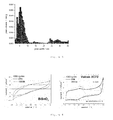
- Pore size distribution obtained by BET measurements for 5 at% Bi-doped SnO2 calcined at 550 °C for 2 hours in O2;
- Figure 4
- CV curves between 0.05 and 1.6 V vs Hydrogen Reference electrode (RHE) in 0.1 M HClO4 saturated with Ar, at a scan rate of 50 mVs-1 and at room temperature for Bi-doped and Vulcan X72 electrodes; and
- Figure 5
- ORR current densities (capacity-corrected, negative-going scans) of GC substrate, and GC-supported SnO2 and Bi-doped SnO2 thin film electrodes at 1600 rpm in O2 saturated 0.1 M HClO4 at 5 mVs-1.
- In the following a process is described for the synthesis of 5 at% doped Bi-SnO2 (BiSnO2) which is referred to as Example 1. Chelation of cations is achieved by adding citric acid (CA) to the aqueous solution containing tin citrate and bismuth nitrate, respectively; ethylene glycol (EG) is added later in order to polymerize the organic precursor.
- The aqueous tin citrate solution is prepared from SnCl2 and CA with a CA:metal molar ratio of 3:1. Ammonia solution is added to the solution of tin citrate until a pH value of 4-5 is obtained in order to prevent tin citrate precipitation.
- Aqueous solution of Bi citrate is prepared mixing Bi(NO3)3*5H2O and CA with a CA:metal molar ratio of 3:1.
- The aqueous Bi-citrate solution is added to the tin citrate solution in the appropriate amount to achieve a doping level of 5 at%. HNO3 is added drop wise to the solution until a pH value of ∼1 is achieved.
- EG is then added to the citrate solution at weight ratio of 40:60 with respect to CA. The solution is kept at 100 °C to evaporate the water and once a viscous gel is obtained, the gel is heated at about 150 °C for 24h to promote polymerization reaction.
- TG analysis is used to establish the calcination temperature needed to achieve single phase materials.
Figure 1a shows the TG curve for the BiSnO2 precursor. The main weight loss of about 75% occurred between 130 and 550 °C, due to the decomposition of the organic matrix. Therefore, the calcination temperature was fixed at 550 °C. As shown inFigure 1b , holding the temperature at 550 °C, after about 1 h constant weigh is observed. - The annealing time of the powder precursor is an important parameter since it can determine the crystallinity of the material and also the grain size, i.e. long annealing times generally lead to powders with larger crystallites. Two annealing times, 2 and 10 hours, have been use to produce single phase BiSnO2 oxides. Furthermore, the annealing is performed in O2 atmosphere in order to achieve oxide powders with the cations in their highest stable oxidation state.
- X-ray diffraction (XRD) analysis is performed to investigate the crystalline phase of the calcined oxides. The XRD patterns of BiSnO2 calcined at 550 °C for 2 and 10 h (
Figure 2 ) indicate that both the powders show a single, crystalline phase. The crystallite size of the BiSnO2 powders obtained after annealing at 550 °C for 2 and 10 h are determined using the Scherrer equation. The BiSnO2 powder annealed at 550 °C for 2 hours presents a crystallite size of 8.5 nm, while larger crystallites of 35 nm are obtained for the powder annealed at 550 °C for 10 hours. Therefore, the annealing time of 2 hours is beneficial to produce single phase powders with small crystallites. - XPS is used to determine the chemical surface composition of the BiSnO2 powders obtained after annealing at 550 °C for 2 and 10 h. The results are shown in Table 1.
- The 10 h annealing process leads to surface segregation of Bi at the surface, while a concentration of Bi closer to the theoretical one (5 at%) is obtained annealing the sample in O2 at 550 °C for 2h, which therefore represent the optimized calcination condition. Furthermore, the analysis of the binding energy of the Bi 4f7/2 line confirms that Bi is incorporated with a 3+ oxidation state.
Table 1 Annealing time at 550 °C for Sn at% Bi at% 10 h 80 20 2 h 92 8 - The specific surface of the semiconducting oxide supports is determined measuring the N2 physisorption isotherms at 77 K, using Quantachrome Autosorb-1 machine. 10-20 mg of oxide are transferred into the measuring chamber and degassed overnight at 200°C. The specific surface area and the pore size distribution are determined using a multi-point BET analysis. The surface area measured for the 5 at% Bi-doped tin oxides calcined at 550 °C for 2h in O2 is 55±5 m2g-1, while typical pore size distribution is shown in
Figure 3 . -
- a) The electrochemical stability under the most relevant PEFC cathode conditions is determined by cyclic voltammetry (CV) measurements. Electrochemical measurements are conducted in a three-electrode glass cell and using a rotator (Pine) to which the thin-film working electrode is attached. The thin-film electrodes were prepared from a suspension made of 75 mg of oxide, 100 µl of
Nafion 117 and 25 ml of isopropanol. 30 µL of the above described suspension are spin coated on a glassy carbon rod of 5 mm in diameter and dried overnight under N2 flowing. The electrode is immersed in 0.1M HClO4 electrolyte saturated with pure Ar at room temperature and the measurements are performed using a hydrogen reference electrode (RHE) and a gold counter electrode in a three reference configuration. - Stability tests are performed over 1000 cycles between 50 mV and 1.6 V vs RHE using a scan rate of 50 mVs-1. For comparison the same test is also performed on commonly used carbon for PEFC electrode (commercial Vulcan XC72).
-
Figure 4 shows the CV curves obtained for the BiSnO2 and Vulcan XC72 electrodes. For the BiSnO2 no new peaks evolved during cycling. Differently, a strong decrease of the peak at about 1.5 V is observed for the Vulcan XC72 indicating oxidation of the carbon support. Furthermore, during potential cycling of the Vulcan XC72 two redox peaks at about 0.55 and 0.6 V vs RHE appear indicating oxidation of the carbon surface, i.e. formation of quinone/hydroquinone species. - Table 2 reports the charge calculated for the 25th and the 1000th cycle between 50 mV and 1 V, for both BiSnO2 and Vulcan XC72 electrodes. After the stability test, the charge associated to the Vulcan XC72 CV increased of about 19% due to the formation of the quinone/hydroquinone species, while for BiSnO2 mostly no change in the charge has been observed.
Table 2 Vulcan XC72 BiSnO2 Charge 25th cycle 24.5 µCcmcarbon -2 48.2 µCcmoxide -2 Charge 1000th cycle 29.1 µCcmcarbon -2 48.6 µCcmoxide -2 Charge increase after stability test + 19% 0.8% - b) Corrosion stability under applied potential is tested holding the thin film electrodes described in Example 4.a at 1.6 V vs RHE for 30 minutes. The thin film electrodes are immersed in 0.1M HClO4 electrolyte saturated with pure Ar at room temperature and the measurements are performed using a hydrogen reference electrode (RHE) and a gold counter electrode in a three reference configuration. After holding BiSnO2 and Vulcan XC72 electrodes at 1.6 V vs RHE a steady state current of 109 nA/cm2 (current normalized by the surface area of the electrode) is observed for the Vulcan XC72 electrode, while for the BiSnO2 the steady state current normalized by the oxide surface area is almost 1 order of magnitude lower (17 nA/cm2). The significant difference in the steady state current at constant applied voltage indicates that a further faradaic reaction occurs on the Vulcan XC72 surface, i.e. carbon oxidation reaction (Equ.1).
- The ORR is determined by rotating disk measurements (RDE) measurements. RDE measurements are conducted in a three-electrode glass cell and using a rotator (Pine) to which the RDE thin-film working electrode is attached. The thin-film electrodes are prepared from a suspension made of 75 mg of oxide, 15 mg of acetylene black (Alfa Aesar), 100 µl of
Nafion 117, and 25 ml of isopropanol. 20 µl of the above described suspension are spin coated on a glassy carbon rod of 5 mm in diameter and were dried overnight under N2 flowing. The electrode is immersed in 0.1M HClO4 at room temperature and the measurements are performed using a hydrogen reference electrode (RHE) and a Au counter electrode in a three reference configuration. - All the potentials are corrected by the ohmic drop determined by high frequency ac impedance spectroscopy. ORR activities are obtained from the negative-going scans at 5 mVs-1 in O2-saturated 0.1 M HClO4 at 1600 rpm and corrected for capacitive currents obtained by negative-going scan in Ar-saturated 0.1 M HClO4. For comparison the ORR current in the same condition has been also measured for the bare glassy carbon (GC) substrate and undoped tin oxide showing similar surface area than BiSnO2; the results are shown in
Figure 5 . - BiSnO2 shows higher ORR current than both the bare glassy carbon (which can be considered as background current) and the undoped SnO2, indicating that the Bi doping indeed enhanced the activity of tin dioxide towards ORR. Table 3 compares the onset of ORR taken at constant current density of 10 µA/cm2 for the glassy carbon, SnO2 and Bi-doped SnO2.
Table3 Onset (V vs RHE) for ORR at constant current density of 10 mA/cm2 Glassy carbon 0.13 V SnO2 0.19 V Bi-doped SnO2 0.37 V - The electrochemical stability of oxide semiconductor/Pt electrodes is tested by simulating automotive start and stop cycles of an operating fuel cell. The working electrode is prepared first spin coating on a glassy carbon substrate the oxide suspension described in Example 4.a and then depositing 50 µg/cm2 of Pt by sputtering on top of the porous oxide film. The sputtering conditions are the same described in
Chimia 66, 2012, 110. The working electrode is cycled between 0.5 and 1.5 V vs RHE for 1000 times at 50 mVs-1 in Ar-saturated 0.1 M HClO4 at room temperature. - Cyclic voltammetry measurements are performed before and after the stability test in order to evaluate changes in the Pt electrochemical surface area. For comparison, the same stability test was also performed on the catalyst made of 50 µg/cm2 of Pt sputtered on acetylene black (AB) carbon (surface area of 80 m2/g). The so-called hydrogen underpotential deposition is used to determine Pt surface area before and after the stability test. For the calculation of the Pt surface area, a specific charge of 210 µC/cm2 for the adsorption of one monolayer of hydrogen on an atomically flat polycrystalline Pt electrode is used. The results are shown in Table 4; no significant change of the Pt electrochemical surface area is observed after the start/stop stability test for the BiSnO2/Pt catalyst, while a significantly larger decrease in surface area occurred for the AB/Pt catalyst.
Table 4 Stability test BiSnO2/Pt catalyst (cm2 Pt/cm2) AB/Pt catalyst (cm2 Pt/cm2) before 1.54 3.16 after 1.32 2.22 % change Pt surface area -12 % -42 % - Beside the Bi-doped SnO2 support material which has been described in detail above, the following material pairs have shown best prospects for alkaline applications:
- a) Fe or Co or Ni-doped Ti02;
- b) Cd or Ca-doped Co2O3;
- c) Co or Fe or Ni-doped Sn02
- d) Co or Fe or Ni-doped Pb02
- e) Gd or Sm or Y-doped CeO2
- Further, some investigations have been made for applications in acidic environments. Suitable material pairs can be:
- a) Bi-doped Ge04
- b) Bi-doped Hf04
- c) Bi-doped Pb04.
Claims (11)
- Support material for electrochemical applications, such as fuel cells, metal-air batteries, electrolyzer electrodes and sensors, having a composition of a semiconducting metal oxide being doped with a lower valence element according to a general formula that is formulated as:(MY)1-x(DZ)xO2-δ, where M is a metal or transition metal in Y oxidation state and D represents the lower valence element with an oxidation state with Z<Y and δ represents the oxygen vacancies in the lattice and at the surface of the support material.
- Support material according to claim 1, wherein the metal oxide is present in its highest stable oxidation state.
- Support material according to claim 1 or 2, wherein the BET surface area is larger than 50 m2 /g.
- Support material according to any of the preceding claims, wherein the metal oxide doped with the lower valence element provides adequate electrical conductivity in relation to the desired electrochemical application.
- Support material according to claim 4, wherein the electrical conductivity exceeds the values of 0.02 S/cm.
- Support material according to any of the preceding claims, wherein the metal or transition metal oxides is selected from a group containing CeO2, SnO2, TiO2, HfO2, PbO2, GeO2 and SiO2.
- Support material according to any of the preceding claims, wherein the lower valence element is selected from a group of oxides containing Sc2O3, Y2O3, La2O3, Bi2O3, Sm2O3, Gd2O3, Tb2O3, Ho2O3, Tm2O3, Lu2O3, Al2O3, Ga2O3, Nd2O3, Yb2O3, Er2O3, BeO, MgO, CaO, ZnO, SrO, BaO, or CdO, selection is made under the pre-requisite of the lower oxidation state as compared to the metal or transition metal oxide.
- Support material according to any of the preceding claims, wherein the metal or transition metal oxide and the lower valence element or its oxide respectively are prepared by a wet chemistry synthesis and hardened under calcination.
- Support material according to claim 8, wherein a sol-gel method is applied to achieve a single-phase formation and microstructure control of the desired powders at reduced temperatures as compared to other procedures for oxide mixing and calcination.
- Support material according to any of the preceding claims, wherein the metal oxide is SnO2 and the lower valence element is Bi; together forming a doped Bi-SnO2 compound.
- Polymer electrolyte fuel cell, electrolyzer, metal-air battery or sensor comprising in its electrode a support material according to any of the claims 1 to 10.
Priority Applications (3)
| Application Number | Priority Date | Filing Date | Title |
|---|---|---|---|
| EP13150645.3A EP2755265A1 (en) | 2013-01-09 | 2013-01-09 | Thermodynamically stable binary oxide doped with lower valence element, its synthesis and application in electrochemical devices |
| PCT/EP2013/076268 WO2014108269A1 (en) | 2013-01-09 | 2013-12-11 | Thermodynamically stable binary oxide doped with lower valence element, its synthesis and application in electrochemical devices |
| EP13815703.7A EP2943990A1 (en) | 2013-01-09 | 2013-12-11 | Thermodynamically stable binary oxide doped with lower valence element, its synthesis and application in electrochemical devices |
Applications Claiming Priority (1)
| Application Number | Priority Date | Filing Date | Title |
|---|---|---|---|
| EP13150645.3A EP2755265A1 (en) | 2013-01-09 | 2013-01-09 | Thermodynamically stable binary oxide doped with lower valence element, its synthesis and application in electrochemical devices |
Publications (1)
| Publication Number | Publication Date |
|---|---|
| EP2755265A1 true EP2755265A1 (en) | 2014-07-16 |
Family
ID=47563192
Family Applications (2)
| Application Number | Title | Priority Date | Filing Date |
|---|---|---|---|
| EP13150645.3A Withdrawn EP2755265A1 (en) | 2013-01-09 | 2013-01-09 | Thermodynamically stable binary oxide doped with lower valence element, its synthesis and application in electrochemical devices |
| EP13815703.7A Withdrawn EP2943990A1 (en) | 2013-01-09 | 2013-12-11 | Thermodynamically stable binary oxide doped with lower valence element, its synthesis and application in electrochemical devices |
Family Applications After (1)
| Application Number | Title | Priority Date | Filing Date |
|---|---|---|---|
| EP13815703.7A Withdrawn EP2943990A1 (en) | 2013-01-09 | 2013-12-11 | Thermodynamically stable binary oxide doped with lower valence element, its synthesis and application in electrochemical devices |
Country Status (2)
| Country | Link |
|---|---|
| EP (2) | EP2755265A1 (en) |
| WO (1) | WO2014108269A1 (en) |
Citations (3)
| Publication number | Priority date | Publication date | Assignee | Title |
|---|---|---|---|---|
| WO2010033111A1 (en) | 2008-09-17 | 2010-03-25 | Utc Power Corporation | Fuel cell catalyst support with fluoride-doped metal oxides/phosphates and method of manufacturing same |
| WO2010135576A2 (en) | 2009-05-21 | 2010-11-25 | Cornell Research Foundation, Inc. | Conducting metal oxide and metal nitride nanoparticles |
| WO2011108121A1 (en) | 2010-03-05 | 2011-09-09 | Toyota Jidosha Kabushiki Kaisha | Fuel cell electrocatalyst |
-
2013
- 2013-01-09 EP EP13150645.3A patent/EP2755265A1/en not_active Withdrawn
- 2013-12-11 WO PCT/EP2013/076268 patent/WO2014108269A1/en not_active Ceased
- 2013-12-11 EP EP13815703.7A patent/EP2943990A1/en not_active Withdrawn
Patent Citations (3)
| Publication number | Priority date | Publication date | Assignee | Title |
|---|---|---|---|---|
| WO2010033111A1 (en) | 2008-09-17 | 2010-03-25 | Utc Power Corporation | Fuel cell catalyst support with fluoride-doped metal oxides/phosphates and method of manufacturing same |
| WO2010135576A2 (en) | 2009-05-21 | 2010-11-25 | Cornell Research Foundation, Inc. | Conducting metal oxide and metal nitride nanoparticles |
| WO2011108121A1 (en) | 2010-03-05 | 2011-09-09 | Toyota Jidosha Kabushiki Kaisha | Fuel cell electrocatalyst |
Non-Patent Citations (7)
| Title |
|---|
| J. ELECTROCHEM. SOC., vol. 149, 2002, pages A1092 |
| J. PHYS. CHEM. C, vol. 111, 2007, pages 14617 |
| J. PHYS. CHEM. C, vol. 115, 2011, pages 14236 |
| NANA A. KYEREMATENG ET AL: "Electrochemical Fabrication and Properties of Highly Ordered Fe-Doped TiO 2 Nanotubes", CHEMPHYSCHEM, vol. 13, no. 16, 12 November 2012 (2012-11-12), pages 3707 - 3713, XP055066244, ISSN: 1439-4235, DOI: 10.1002/cphc.201200406 * |
| SCHMIDT, T. J.: "Polymer Electrolyte Fuel Cell Durability", 2009, SPRINGER, pages: 199 - 221 |
| THE ELECTROCHEMICAL SOCIETY INTERFACE, vol. 14, 2005, pages 24 - 35 |
| VELMURUGAN PALANIYANDI ET AL: "Microstructural evolution of nickel nanoparticle catalysts supported on gadolinium-doped ceria during autothermal reforming of iso-octane", JOURNAL OF ELECTRONIC MATERIALS, vol. 35, no. 5, 1 May 2006 (2006-05-01), pages 814 - 821, XP055066247, ISSN: 0361-5235, DOI: 10.1007/BF02692534 * |
Also Published As
| Publication number | Publication date |
|---|---|
| EP2943990A1 (en) | 2015-11-18 |
| WO2014108269A1 (en) | 2014-07-17 |
Similar Documents
| Publication | Publication Date | Title |
|---|---|---|
| KR102045351B1 (en) | Electrocatalyst for fuel cells and method for producing said electrocatalyst | |
| Han et al. | Screening oxide support materials for OER catalysts in acid | |
| Audichon et al. | Electroactivity of RuO2–IrO2 mixed nanocatalysts toward the oxygen evolution reaction in a water electrolyzer supplied by a solar profile | |
| Zhang et al. | Mesoporous tin oxide as an oxidation-resistant catalyst support for proton exchange membrane fuel cells | |
| JP5495798B2 (en) | Catalyst, method for producing the same and use thereof | |
| EP2251081B1 (en) | A membrane electrode assembly, process for preparing the same, and uses of the same | |
| EP2258475B1 (en) | Catalyst and manufacturing method and use therefor | |
| CN1874841B (en) | Noble metal oxide catalysts for water electrolysis | |
| WO2013092566A1 (en) | Precious metal oxide catalyst for water electrolysis | |
| WO2013060671A1 (en) | High performance fuel electrode for a solid oxide electrochemical cell | |
| Wang et al. | IrO 2-incorporated La 0.8 Sr 0.2 MnO 3 as a bifunctional oxygen electrocatalyst with enhanced activities | |
| JPWO2009091047A1 (en) | Catalyst, method for producing the same, and use thereof | |
| Wang et al. | Preparation of new titanium oxy nitride based electro catalysts using an anhydrous sol-gel method for water electrolysis in acid medium | |
| WO2015083383A1 (en) | Electrode catalyst for water electrolysis, and water electrolysis device using the same | |
| GB2574943A (en) | Electrically conductive material and electrode material | |
| EP2755265A1 (en) | Thermodynamically stable binary oxide doped with lower valence element, its synthesis and application in electrochemical devices | |
| CN112970137B (en) | Catalyst system, electrode and fuel cell or electrolyzer | |
| KR20230053750A (en) | Method of manufacturing eletrocatalyst for oxygen evolution or oxygen reduction and eletrocatalyst manufactured thereby | |
| Jiménez-Morales et al. | A comprehensive activity–stability correlation study of tantalum-doped tin oxide as a support for iridium oxide in low loading water electrolysis cell anodes | |
| Audichon et al. | Synthesis of RuxIr1-xO2 anode electrocatalysts for proton exchange membrane water electrolysis | |
| US20260117404A1 (en) | Water electrolysis electrode, manufacturing method of water electrolysis electrode, and water electrolysis device | |
| CN112166514B (en) | Catalyst systems, electrodes and fuel cells or electrolyzers | |
| US20240229263A1 (en) | Yolk-shell nanostructure and method of fabricating the same | |
| JP7058866B2 (en) | Anode for solid oxide fuel cell and solid oxide fuel cell using this anode | |
| US20120270135A1 (en) | Catalyst, method for producing the same, and use thereof |
Legal Events
| Date | Code | Title | Description |
|---|---|---|---|
| PUAI | Public reference made under article 153(3) epc to a published international application that has entered the european phase |
Free format text: ORIGINAL CODE: 0009012 |
|
| 17P | Request for examination filed |
Effective date: 20130109 |
|
| AK | Designated contracting states |
Kind code of ref document: A1 Designated state(s): AL AT BE BG CH CY CZ DE DK EE ES FI FR GB GR HR HU IE IS IT LI LT LU LV MC MK MT NL NO PL PT RO RS SE SI SK SM TR |
|
| AX | Request for extension of the european patent |
Extension state: BA ME |
|
| STAA | Information on the status of an ep patent application or granted ep patent |
Free format text: STATUS: THE APPLICATION IS DEEMED TO BE WITHDRAWN |
|
| 18D | Application deemed to be withdrawn |
Effective date: 20150117 |