EP2749633A1 - Composition having improved head stability and use thereof - Google Patents
Composition having improved head stability and use thereof Download PDFInfo
- Publication number
- EP2749633A1 EP2749633A1 EP12825652.6A EP12825652A EP2749633A1 EP 2749633 A1 EP2749633 A1 EP 2749633A1 EP 12825652 A EP12825652 A EP 12825652A EP 2749633 A1 EP2749633 A1 EP 2749633A1
- Authority
- EP
- European Patent Office
- Prior art keywords
- protein
- transglutaminase
- composition
- beer
- protease
- Prior art date
- Legal status (The legal status is an assumption and is not a legal conclusion. Google has not performed a legal analysis and makes no representation as to the accuracy of the status listed.)
- Granted
Links
Images
Classifications
-
- C—CHEMISTRY; METALLURGY
- C12—BIOCHEMISTRY; BEER; SPIRITS; WINE; VINEGAR; MICROBIOLOGY; ENZYMOLOGY; MUTATION OR GENETIC ENGINEERING
- C12C—BEER; PREPARATION OF BEER BY FERMENTATION; PREPARATION OF MALT FOR MAKING BEER; PREPARATION OF HOPS FOR MAKING BEER
- C12C5/00—Other raw materials for the preparation of beer
- C12C5/02—Additives for beer
-
- C—CHEMISTRY; METALLURGY
- C12—BIOCHEMISTRY; BEER; SPIRITS; WINE; VINEGAR; MICROBIOLOGY; ENZYMOLOGY; MUTATION OR GENETIC ENGINEERING
- C12C—BEER; PREPARATION OF BEER BY FERMENTATION; PREPARATION OF MALT FOR MAKING BEER; PREPARATION OF HOPS FOR MAKING BEER
- C12C5/00—Other raw materials for the preparation of beer
-
- C—CHEMISTRY; METALLURGY
- C12—BIOCHEMISTRY; BEER; SPIRITS; WINE; VINEGAR; MICROBIOLOGY; ENZYMOLOGY; MUTATION OR GENETIC ENGINEERING
- C12C—BEER; PREPARATION OF BEER BY FERMENTATION; PREPARATION OF MALT FOR MAKING BEER; PREPARATION OF HOPS FOR MAKING BEER
- C12C5/00—Other raw materials for the preparation of beer
- C12C5/004—Enzymes
-
- C—CHEMISTRY; METALLURGY
- C12—BIOCHEMISTRY; BEER; SPIRITS; WINE; VINEGAR; MICROBIOLOGY; ENZYMOLOGY; MUTATION OR GENETIC ENGINEERING
- C12C—BEER; PREPARATION OF BEER BY FERMENTATION; PREPARATION OF MALT FOR MAKING BEER; PREPARATION OF HOPS FOR MAKING BEER
- C12C7/00—Preparation of wort
Definitions
- the present invention relates to a composition effective for improving the foam stability of sparkling beverages or foods, and the use thereof.
- the present application claims priority to and the benefit of Japanese Priority Patent Application JP 2011-184102 filed August 25, 2011 , the entire contents of which are hereby incorporated by reference.
- various beer-like beverages such as low-malt beer having a lowered malt utilization rate and a beer-flavored sparkling alcoholic beverage (generally referred to as "the third beer") manufactured from a raw material and by a process, which are different from those of beer and low-malt beer, are sold by many companies.
- a beer-flavored non-alcoholic beverage is also sold by many companies in recent years.
- the foam formed when beer, a beer-like beverage, and a beer-flavored non-alcoholic beverage (for the convenience of explanation, these are collectively referred to as a "beer-based sparkling beverage") are poured is one of important features thereof, and in general, it is desired that the foam is retained over a long period of time, that is, foam stability (foam retention) is high.
- foam stability foam retention
- various attempts such as the addition of a polysaccharide with thickening property (Patent Documents 1 to 3) and the addition of soluble fraction of yeast cell wall (Patent Document 4), have been disclosed.
- Patent Documents 1 to 3 the addition of soluble fraction of yeast cell wall
- Patent Document 4 the needs for the technique for improving foam stability are still high.
- the foam stability is an important factor to determine the qualities of not only a beer-based sparkling beverage but also other sparkling beverages or foods.
- Patent Document 5 the publication (Patent Document 5) mentioned in the use of the enzyme (transglutaminase) used in the invention is represented in the following citation list.
- An object of the invention is to provide a composition effective for improving the foam stability of a beer-based sparkling beverage and the like, the use thereof, and the like.
- the inventors have aimed at the creation of a technique that brings about improvement in foam stability, and have conducted investigations using soy protein and pea protein used as a raw material of the third beer. Specifically, these proteins were treated with a protease and a transglutaminase, and thus the effect thereof was investigated. As a result, surprisingly, the solution obtained after reacting with the enzymes exhibited high foam stability.
- the product of proteolysis protein or polypeptide
- the product of proteolysis which is effective for improving foam stability, is produced when a protease and a transglutaminase are used to treat a protein material.
- a product having improved foam stability may be obtained since the product of proteolysis remains in the product.
- the foaming property of a protein material generally decreases when protein is decomposed to be low molecular peptides and amino acids (for example, see P.M. Nielson, Functionality of Protein Hydrolysates, FOOD PROTEINS AND THEIR APPLICATIONS (15) pp. 443 to 471 ).
- P.M. Nielson Functionality of Protein Hydrolysates, FOOD PROTEINS AND THEIR APPLICATIONS (15) pp. 443 to 471 .
- the foaming property and foam stability would be better in case of solely using a transglutaminase than in case of using a protease and a transglutaminase in combination.
- the above described fact that is demonstrated by the investigations of the inventors is contrary to this prediction, and thus it can be said that it is a surprising finding.
- a product of proteolysis which is effective for improving foam stability, is produced when a protease and a transglutaminase are used to treat a protein material.
- the product of proteolysis is highly expected to be used as a general foam stabilizer. In other words, it is highly expected to be applied to various kinds of sparkling beverages and foods as well as the third beer.
- the invention to be listed below will be based on the result and research finding described above.
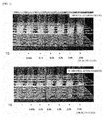
- Fig. 1 is a result of a foaming test using soy protein.
- the states of foams of the reaction solutions in one minute after foaming (top) and in thirty minutes after foaming (bottom) are illustrated (in case of using protease A as a protease).
- TG transglutaminase
- + addition
- - non-addition.
- the first aspect of the invention relates to a composition having improved foam stability.
- the term the "composition having improved foam stability” means the characteristic component of the invention, that is, a composition of which the foam stability is high due to the action and effect of a protein or a polypeptide produced by using a protease and a transglutaminase to treat a protein material, and which increases the foam stability of a sparkling beverage or food when used as at least part of a raw material or added during the manufacturing process of the sparkling beverage or food.
- the composition of the invention is used for improving the foam stability of a sparkling beverage or food.
- the examples of the sparkling beverage or food to which the composition of the invention is applicable may include a beer-based sparkling beverage (beer, low-malt beer, the third beer, and a beer-flavored non-alcoholic beverage), a carbonated beverage (alcohol-containing or non-alcoholic), and various kinds of cream (the detail of the use will be described below).
- the composition of the invention is particularly effective for improving the foam stability of the so-called "third beer".
- the third beer is classified broadly into one, which is brewed without using malt as a raw material, and the other, which is obtained by mixing low-malt beer with another alcoholic beverage (a representative is barley spirits). Under current Liquor Tax Law, the former is classified into other brews (effervescent) (1), and the latter is classified into liquor (effervescent) (1).
- the composition of the invention contains a protein or a polypeptide produced by using a protease and a transglutaminase to treat a protein material.
- the protein material is not particularly limited, but is preferably, a protein material which is a raw material of foods or beverages.
- the specific examples thereof may include wheat protein, barley protein, soy protein, corn protein, pea protein, rice protein, milk protein, and fish protein.
- the protein material is preferably wheat protein, barley protein, soy protein, corn protein, pea protein, and rice protein. These protein materials may be prepared according to a common technique or a commercially available product may be used.
- pea protein may be purchased from ORGANO CORPORATION (for example, product name: PP-CS), ROQUETTE JAPAN K. K. (for example, NUTRALYS), or the like.
- soy protein may be purchased from FUJI OIL CO., LTD (for example, product name: FUJIPRO F), The Nisshin Oillio Group, Ltd. (for example, product name: Solpea 4000), DAIICHI-KASEI CO., LTD. (for example, product name: Protein GP), or the like. Two or more kinds of protein materials may be used in combination.
- the protein or the polypeptide constituting the composition of the invention is obtained by using an enzyme to treat a mixture of two or more kinds of protein materials.
- the composition of the invention may be produced by using an enzyme to treat each of the protein materials to be used in combination, and then by mixing the protein or the polypeptide thus obtained.
- protease may include Biosoku, Newlase F3-G, Newlase A, Protease A "Amano” G, Protease A “Amano” SD, Protease N “Amano” G, Protease S “Amano” G, ProteAX, ProteAX G, Papain W-40, Promerain F, PROTIN NY10, PROTIN PC10, PROTIN AY, PROTIN SD-NY10, PROTIN SD-PC10F, THERMOASE PC10F, PROTIN SD-AC10F, PROTIN SD-AY10, PROLESAR FG-F, Protease P "Amano” 3G, Protease M “Amano” G, and Protease M “Amano” SD (these are manufactured by Amano Enzyme Inc.), Molsin F (manufactured by Kikkoman Corporation), Sumizyme AP, Sumizyme LP, Sumizyme LP500, Sumizyme FP, Sumizyme LPL, and
- transglutaminase a product produced by a microorganism such as Streptomyces (for example, see JP 64-27471 A ), a product produced by a mammal (for example, see JP 1-50382 B ), a recombinant one obtained using recombinant DNA technology (for example, JP 5-199883 A and JP 2004-97099 A ), and the like may be used.
- a transglutaminase produced by Streptomyces is preferably used.
- a stabilized type transglutaminase such as one disclosed in WO 2009/101762 may also be used.
- the composition of the invention may be produced by a method including the following step: (1) a step of treating a protein material with a protease and a transglutaminase.
- a step of treating a protein material with a protease and a transglutaminase In this step (1), two enzymes (protease and transglutaminase) are allowed to act with respect to a protein material, but the order of allowing them to act is not particularly limited. Therefore, a transglutaminase may be used after a protease is used, or these two enzymes may be used simultaneously. Preferably, these two enzymes are allowed to act simultaneously. By allowing them to act simultaneously, a decomposition reaction and a crosslinking reaction are efficiently performed, an effect that a further complicated crosslinked complex is produced may be expected to occur.
- allowing them to act simultaneously means that a state, in which an enzyme reaction by a protease and an enzyme reaction by a transglutaminase proceed simultaneously, is caused.
- a state in which an enzyme reaction by a protease and an enzyme reaction by a transglutaminase proceed simultaneously is caused.
- a protein material in case of a solid material, a material suspended or dissolved in a solvent such as water
- a state in which two enzyme reactions are performed simultaneously may be constituted.
- the reaction conditions are not particularly limited as long as the desired effect (that is, the effect of foam stability) is obtained.
- the reaction conditions may be determined in consideration of the properties of the protease to be used, the properties of the transglutaminase to be used, the properties of the protein material to be used, and the use of the composition.
- the examples of the reaction conditions may be as follows.
- the amount of the protease used is 0.1 % by weight (w/w) to 10% by weight (w/w) with respect to the protein material
- the amount of the transglutaminase used is, for example, 0.01 % by weight (w/w) to 10% by weight (w/w) and preferably 0.1 % by weight (w/w) to 2% by weight (w/w)
- the reaction temperature is, for example, 20°C to 60°C and preferably 30°C to 50°C.
- the reaction pH is, for example, pH 4 to pH 9
- the reaction time is, for example, 15 minutes to 10 hours and preferably 30 minutes to 10 hours. Meanwhile, the optimum reaction conditions may be determined through a preliminary experiment based on the test system indicated in Examples to be described below.
- the composition of the invention may also be produced by a method including the following step: (2) a step of treating a product of proteolysis with a transglutaminase.
- a product of proteolysis obtained in advance by treating a protein material with a protease is used instead of a protein material.
- a protein or a peptide bringing out the improvement in foam stability is produced.
- the reaction conditions such as the amount of the protease used when a product of proteolysis is prepared, and the amount of the transglutaminase used in step (2) are based on the case of the above described embodiment, in which step (1) is performed.
- the second aspect of the invention relates to the use of the composition of the invention.
- a method for manufacturing a beer-based sparkling beverage is provided.
- the composition of the invention is used as at least part of the raw material.
- the protein or the peptide which is an active component in the composition of the invention and brings about the improvement in foam stability, remains in the finished product, and thus a beer-based sparkling beverage excellent in foam stability is obtained.
- the manufacturing method of the invention is particularly effective for the manufacture of the third beer (other brews (effervescent) (1)), which is brewed without using malt as a raw material.
- the manufacturing method of the invention will be described in detail by taking the case where the method is applied to the third beer (other brews (effervescent) (1)) as an example.
- the composition of the invention is prepared by using a protease and a transglutaminase to treat a protein material or by using a transglutaminase to treat a product of proteolysis (step (1)). Otherwise, the same composition prepared in advance is prepared (another embodiment of step (1)).
- the composition produced or prepared in step (1) is mixed with sugar syrup, hops, and water, and boiled (step (2)).
- Sugar syrup is a material to supply carbon source necessary for the fermentation by yeast, and is, for example, maltose syrup, high maltose syrup, glucose syrup, saccharified liquid of starch, and the like.
- caramel color, safflower color, flavoring, and the like may be exemplified.
- step (3) After the liquid before fermentation obtained in step (2) is cooled, beer yeast is added thereto, and fermentation is performed (step (3)).
- the fermented liquid thus obtained is stored and aged (step (4)). Thereafter, according to the necessity, the fermented liquid is filtered and filled in a container to produce a product.
- the step for producing or preparing the composition of the invention is provided as a separate process, but the embodiment is not limited thereto.
- a protein material is mixed with sugar syrup and the like, and then a protease and a transglutaminase are allowed to act thereon, a component corresponding to an active component of the composition of the invention is produced in the process of manufacture, and thus the step for preparing the composition of the invention is not necessary to be provided as a separate process.
- the composition of the invention may be used as one of the auxiliary raw materials, or may be added during the process of manufacture.
- the time for addition is not particularly limited, but the composition may be added in a stage between after the preparation process and before the fermentation process.
- the composition of the invention prepared in advance is not used, but a component corresponding to an active component of the composition of the invention may be produced in the process of manufacture.
- the component may be produced by using a transglutaminase to treat the wort obtained in the saccharification process.
- a protease may also be used in combination.
- the third beer (liquor (effervescent) (1)) excellent in foam stability may also be manufactured.
- the foam stability of the beer-based sparkling beverage manufactured according to the manufacturing method of the invention may be evaluated, for example, by a NIBEM method.
- the NIBEM method is described in Analytica-EBC published by EBC (European Brewery Convention), and is generally used in the field of beer.
- the composition of the invention is widely applicable to various kinds of sparkling beverages and foods, to which foam stability is required or desired.
- the examples of the beverages as used herein may include a carbonated beverage (alcohol-containing or non-alcoholic), shake, cappuccino, a jelly-like beverage, and the like.
- the examples of the foods may include various kinds of cream, ice cream, mousse, meringue, and the like.
- the composition of the invention may be added to the raw material during processing in the process of manufacture.
- the component corresponding to an active component of the composition of the invention may be produced in the process of manufacture. Meanwhile, a form of use, in which the composition of the invention is added shortly before the use (eating and drinking) of the manufactured product, is also possible.
- the resultant was heated in a boiling water bath for 10 minutes and then cooled in flowing water. After cooling, the reaction liquid was diluted 10 times with purified water and 4 mL of the diluted solution was introduced into a test tube, and subjected to the foaming test.
- foaming was performed such that the top of the test tube was covered with Parafilm and shaken up and down predetermined times. The time dependent height of the foam was measured from 1 minute after foaming to 30 minutes after foaming.
- the same tests were performed using ProteAX G (Amano Enzyme Inc.) and Protease M "Amano" G (Amano Enzyme Inc.) instead of Protease A "Amano" SD.
- Fig. 1 indicates the state of foam in 1 minute after foaming (top) and the state of foam in 30 minutes after foaming (down).
- Table 2 Addition amount of transglutaminase Height of foam (cm) Remaining foam ratio (%) After 1 min.
- transglutaminase improves foam stability concentration-dependently. From the fact that the effect of foam stability is not exhibited in the addition of a deactivated transglutaminase, it can be said that the enzyme reaction by a transglutaminase is involved in foam stability.
- the enzyme reaction by a transglutaminase causes a glutamine residue and a lysine residue in a protein to bond with each other by an acyl transfer reaction. It is considered that the protein or the polypeptide synthesized by this reaction is involved in the improvement in foam stability.
- pea protein manufactured by ORGANO CORPORATION
- protease Protease M "Amano” G manufactured by Amano Enzyme Inc.
- a transglutaminase (ACTIVA TG manufactured by AJINOMOTO CO., INC.) was immediately added thereto at 0.05% to 2.0% per a raw material, and the resultant was left to stand for 30 minutes at 45°C while being stirred.
- a test sample in which a transglutaminase solution deactivated in advance by treating for 10 minutes in a boiling water bath was added, was also provided.
- the resultant was heated in a boiling water bath for 10 minutes and then cooled in flowing water. After cooling, the reaction liquid was diluted 2 times with purified water and 4 mL of the diluted solution was introduced into a test tube, and subjected to the foaming test.
- foaming was performed such that the top of the test tube was covered with Parafilm and shaken up and down predetermined times. The time dependent height of the foam was measured from 1 minute after foaming to 5 minutes after foaming.
- composition of the invention is applicable to various kinds of beverages and foods, to which the improvement in foam stability is desired.
- the invention may be used for the improvement in foam stability of a beer-based sparkling beverage (especially, the third beer), a carbonated beverage (alcohol-containing or non-alcoholic), shake, cappuccino, a jelly-like beverage, various kinds of cream, ice cream, mousse, and meringue.
Landscapes
- Chemical & Material Sciences (AREA)
- Organic Chemistry (AREA)
- Engineering & Computer Science (AREA)
- General Health & Medical Sciences (AREA)
- Food Science & Technology (AREA)
- Biochemistry (AREA)
- Bioinformatics & Cheminformatics (AREA)
- General Engineering & Computer Science (AREA)
- Health & Medical Sciences (AREA)
- Genetics & Genomics (AREA)
- Life Sciences & Earth Sciences (AREA)
- Wood Science & Technology (AREA)
- Zoology (AREA)
- Non-Alcoholic Beverages (AREA)
- Preparation Of Compounds By Using Micro-Organisms (AREA)
- Enzymes And Modification Thereof (AREA)
- Distillation Of Fermentation Liquor, Processing Of Alcohols, Vinegar And Beer (AREA)
Abstract
Description
- The present invention relates to a composition effective for improving the foam stability of sparkling beverages or foods, and the use thereof. The present application claims priority to and the benefit of Japanese Priority Patent Application
JP 2011-184102 filed August 25, 2011 - As a beverage alternative to beer, various beer-like beverages such as low-malt beer having a lowered malt utilization rate and a beer-flavored sparkling alcoholic beverage (generally referred to as "the third beer") manufactured from a raw material and by a process, which are different from those of beer and low-malt beer, are sold by many companies. In addition, a beer-flavored non-alcoholic beverage is also sold by many companies in recent years. The foam formed when beer, a beer-like beverage, and a beer-flavored non-alcoholic beverage (for the convenience of explanation, these are collectively referred to as a "beer-based sparkling beverage") are poured is one of important features thereof, and in general, it is desired that the foam is retained over a long period of time, that is, foam stability (foam retention) is high. In order to increase the foam stability of a beer-based sparkling beverage, various attempts, such as the addition of a polysaccharide with thickening property (
Patent Documents 1 to 3) and the addition of soluble fraction of yeast cell wall (Patent Document 4), have been disclosed. However, the needs for the technique for improving foam stability are still high. In the third beer, since the component derived from malt contributing to the formation of foam is not present, or the amount is little even if present, the foam stability thereof deteriorates compared to beer or low-malt beer, and thus, the improvement in foam stability thereof is particularly earnestly desired. On the other hand, the foam stability is an important factor to determine the qualities of not only a beer-based sparkling beverage but also other sparkling beverages or foods. - Meanwhile, the publication (Patent Document 5) mentioned in the use of the enzyme (transglutaminase) used in the invention is represented in the following citation list.
-
- Patent Document 1:
JP 4-228060 A - Patent Document 2:
US 4,720,389 - Patent Document 3:
US 4,729,900 - Patent Document 4:
JP 2008-271820 A - Patent Document 5:
JP 3616697 B1 - An object of the invention is to provide a composition effective for improving the foam stability of a beer-based sparkling beverage and the like, the use thereof, and the like.
- The inventors have aimed at the creation of a technique that brings about improvement in foam stability, and have conducted investigations using soy protein and pea protein used as a raw material of the third beer. Specifically, these proteins were treated with a protease and a transglutaminase, and thus the effect thereof was investigated. As a result, surprisingly, the solution obtained after reacting with the enzymes exhibited high foam stability. In other words, the inventors found that the product of proteolysis (protein or polypeptide), which is effective for improving foam stability, is produced when a protease and a transglutaminase are used to treat a protein material. For example, if the third beer is manufactured using the product of proteolysis as a raw material, a product having improved foam stability may be obtained since the product of proteolysis remains in the product.
- Here, it is known that the foaming property of a protein material generally decreases when protein is decomposed to be low molecular peptides and amino acids (for example, see P.M. Nielson, Functionality of Protein Hydrolysates, FOOD PROTEINS AND THEIR APPLICATIONS (15) pp. 443 to 471). When taking this knowledge into consideration, it is predicted that the foaming property and foam stability would be better in case of solely using a transglutaminase than in case of using a protease and a transglutaminase in combination. However, the above described fact that is demonstrated by the investigations of the inventors is contrary to this prediction, and thus it can be said that it is a surprising finding.
- As described above, by the intensive investigations of the inventors, it was found that a product of proteolysis, which is effective for improving foam stability, is produced when a protease and a transglutaminase are used to treat a protein material. The product of proteolysis is highly expected to be used as a general foam stabilizer. In other words, it is highly expected to be applied to various kinds of sparkling beverages and foods as well as the third beer. The invention to be listed below will be based on the result and research finding described above.
- [1] A composition having improved foam stability comprising a protein or a polypeptide produced by using a protease and a transglutaminase to treat a protein material.
- [2] The composition according to [1], in which the protein material is a raw material of foods or beverages.
- [3] The composition according to [1] or [2], in which the protein material is one or two or more of proteins selected from the group consisting of wheat protein, barley protein, soy protein, corn protein, pea protein, rice protein, milk protein, and fish protein.
- [4] The composition according to any one of [1] to [3], in which the transglutaminase is derived from Streptomyces.
- [5] The composition according to any one of [1] to [4], which is used in the manufacture of a beer-based sparkling beverage.
- [6] The composition according to [5], in which the beer-based sparkling beverage is a beer-based sparkling beverage not using malt as a raw material.
- [7] A method for producing a composition having improved foam stability, comprising the following step (1) or (2):
- (1) a step of treating a protein material with a protease and a transglutaminase; or
- (2) a step of treating a product of proteolysis with a transglutaminase.
- [8] The method for producing a composition according to [7], in which, in step (1), the protease and the transglutaminase are used simultaneously.
- [9] The method for producing a composition according to [7] or [8], in which the protein material is a protein material that is a raw material of foods or beverages.
- [10] The method for producing a composition according to any one of [7] to [9], in which the protein material is one or two or more of proteins selected from the group consisting of wheat protein, barley protein, soy protein, corn protein, pea protein, rice protein, milk protein, and fish protein.
- [11] The method for producing a composition according to any one of [7] to [10], in which the transglutaminase is derived from Streptomyces.
- [12] A method for manufacturing a beer-based sparkling beverage, the method comprising using the composition according to any one of [1] to [4] as at least part of a raw material.
- [13] The method for manufacturing a beer-based sparkling beverage according to [12], comprising the following steps (1) to (4):
- (1) a step of preparing the composition by using a protease and a transglutaminase to treat a protein material or by using a transglutaminase to treat a product of proteolysis, or a step of preparing the composition prepared in advance;
- (2) a step of mixing the composition produced or prepared in step (1) with sugar syrup, hops, and water, and boiling a mixture thereof;
- (3) a step of adding beer yeast to liquid before fermentation obtained in step (2), and fermenting the liquid; and
- (4) a step of storing and aging fermented liquid obtained in step (3).
- [14] A sparkling beverage or food comprising a protein or a polypeptide produced from a protein material by using a protease and a transglutaminase to treat a protein material.
- [15] The sparkling beverage or food according to [14], in which the sparkling beverage is a beer-based sparkling beverage.
-
Fig. 1 is a result of a foaming test using soy protein. The states of foams of the reaction solutions in one minute after foaming (top) and in thirty minutes after foaming (bottom) are illustrated (in case of using protease A as a protease). TG:: transglutaminase, +: addition, -: non-addition. - The first aspect of the invention relates to a composition having improved foam stability. In the present specification, the term the "composition having improved foam stability" means the characteristic component of the invention, that is, a composition of which the foam stability is high due to the action and effect of a protein or a polypeptide produced by using a protease and a transglutaminase to treat a protein material, and which increases the foam stability of a sparkling beverage or food when used as at least part of a raw material or added during the manufacturing process of the sparkling beverage or food.
- The composition of the invention is used for improving the foam stability of a sparkling beverage or food. The examples of the sparkling beverage or food to which the composition of the invention is applicable may include a beer-based sparkling beverage (beer, low-malt beer, the third beer, and a beer-flavored non-alcoholic beverage), a carbonated beverage (alcohol-containing or non-alcoholic), and various kinds of cream (the detail of the use will be described below). The composition of the invention is particularly effective for improving the foam stability of the so-called "third beer". In Japan, the third beer is classified broadly into one, which is brewed without using malt as a raw material, and the other, which is obtained by mixing low-malt beer with another alcoholic beverage (a representative is barley spirits). Under current Liquor Tax Law, the former is classified into other brews (effervescent) (1), and the latter is classified into liquor (effervescent) (1).
- The composition of the invention contains a protein or a polypeptide produced by using a protease and a transglutaminase to treat a protein material. Here, the protein material is not particularly limited, but is preferably, a protein material which is a raw material of foods or beverages. The specific examples thereof may include wheat protein, barley protein, soy protein, corn protein, pea protein, rice protein, milk protein, and fish protein. The protein material is preferably wheat protein, barley protein, soy protein, corn protein, pea protein, and rice protein. These protein materials may be prepared according to a common technique or a commercially available product may be used. For example, pea protein may be purchased from ORGANO CORPORATION (for example, product name: PP-CS), ROQUETTE JAPAN K. K. (for example, NUTRALYS), or the like. In the same manner, soy protein may be purchased from FUJI OIL CO., LTD (for example, product name: FUJIPRO F), The Nisshin Oillio Group, Ltd. (for example, product name: Solpea 4000), DAIICHI-KASEI CO., LTD. (for example, product name: Protein GP), or the like. Two or more kinds of protein materials may be used in combination. In that case, for example, the protein or the polypeptide constituting the composition of the invention is obtained by using an enzyme to treat a mixture of two or more kinds of protein materials. On the other hand, the composition of the invention may be produced by using an enzyme to treat each of the protein materials to be used in combination, and then by mixing the protein or the polypeptide thus obtained.
- The examples of the protease may include Biosoku, Newlase F3-G, Newlase A, Protease A "Amano" G, Protease A "Amano" SD, Protease N "Amano" G, Protease S "Amano" G, ProteAX, ProteAX G, Papain W-40, Promerain F, PROTIN NY10, PROTIN PC10, PROTIN AY, PROTIN SD-NY10, PROTIN SD-PC10F, THERMOASE PC10F, PROTIN SD-AC10F, PROTIN SD-AY10, PROLESAR FG-F, Protease P "Amano" 3G, Protease M "Amano" G, and Protease M "Amano" SD (these are manufactured by Amano Enzyme Inc.), Molsin F (manufactured by Kikkoman Corporation), Sumizyme AP, Sumizyme LP, Sumizyme LP500, Sumizyme FP, Sumizyme LPL, and Sumizyme MP (these are manufactured by Shin Nihon Chemical Co., Ltd), Denapushin 2P, Denachimu AP, Biopuraze OP, Biopuraze AL-15FG, Biopuraze 30G, Biopuraze APL-30, Biopuraze OR-10G, Biopuraze 30L, Biopuraze XL-416F, Biopuraze SP-20FG, Biopuraze SP-4FG, and Protease CL-15 (these are manufactured by Nagase ChemteX Corporation), Orientase 20A, Tetorase S, Nukureishin, Orientase 10NL, Orientase 90N, Orientase ONS, and Orientase 22BF (these are manufactured by HBI Enzymes Inc.), Brewers Clarex, Baridase AFP, Baridase FP60, Brewers Protease, Accelerzyme NP50.000, Delvorase, Baridase TSP200, Bakezyme PPU95.000, Bakezyme B500, Colpurin, Baridase Papain SF, and Baridase Bromerain (these are manufactured by DSM Japan), PROTEASE YP-SS, PANCIDASE NP-2, PANCIDASE P, AROASE AP-10, AROASE NP-10, AROASE NS, AROASE XA-10, and PROTEASE AL (these are manufactured by Yakult Pharmaceutical Industry Co., Ltd.), Puromoddo 223LP, Protex 7L, Protex 14L, Alkaline Protease GL, Protex 6L, Protex 89L, Pyurafekuto, Pyurafekuto OX, Puroperaze, Protex OXG, and Protex 40L (these are manufactured by Genencor Kyowa), PTN, Neutrase, Esperase, Savinase, Alcalase, Clearlens Pro, Everlase, Kannase, Porazyme, Flavourzyme, Protamex, and Noboran (these are manufactured by Novozymes Japan), PAPAIN F, TRYPSIN 4.0T, COROLASE N, VERON L10, COROLASE L10, COROLASE 7089, and VERON W (these are manufactured by HIGUCHI INC.), ENZYLON NBS, ENZYLON SA, and MAGNAKS MT (these are manufactured by RAKUTO KASEI INDUSTRIAL CO., LTD), KOKULASE P (manufactured by Mitsubishi-Kagaku Foods Corporation), Actinase AS and Actinase AF (these are manufactured by Kaken Pharma Co., Ltd.), Grindamyl PR59 and Grindamyl PR43 (these are manufactured by Danisco Japan Ltd.), Softagen M2 (manufactured by TAISHO TECHNOS CO., LTD.), Proteinase K (manufactured by Wako Pure Chemical Industries Ltd.), Deskin C (manufactured by Daiwa Kasei K.K.), and the like.
- As the transglutaminase, a product produced by a microorganism such as Streptomyces (for example, see
JP 64-27471 A JP 1-50382 B JP 5-199883 A JP 2004-97099 A WO 2009/101762 may also be used. - Hereinafter, the method for producing the composition of the invention will be described, and with regard to matters that will not be particularly mentioned, the description corresponding to the matters among the above descriptions on the composition will be adopted.
- The composition of the invention may be produced by a method including the following step: (1) a step of treating a protein material with a protease and a transglutaminase. In this step (1), two enzymes (protease and transglutaminase) are allowed to act with respect to a protein material, but the order of allowing them to act is not particularly limited. Therefore, a transglutaminase may be used after a protease is used, or these two enzymes may be used simultaneously. Preferably, these two enzymes are allowed to act simultaneously. By allowing them to act simultaneously, a decomposition reaction and a crosslinking reaction are efficiently performed, an effect that a further complicated crosslinked complex is produced may be expected to occur. The term "allowing them to act simultaneously" as used herein, means that a state, in which an enzyme reaction by a protease and an enzyme reaction by a transglutaminase proceed simultaneously, is caused. For example, if both of the enzymes are added and allowed to act at the same time with respect to a protein material (in case of a solid material, a material suspended or dissolved in a solvent such as water), or if one enzyme is added and allowed to act with respect to a protein material when the other enzyme is acting with respect to the protein material, a state in which two enzyme reactions are performed simultaneously may be constituted. Meanwhile, as indicated in Examples to be described below, it is confirmed that when a protease and a transglutaminase are allowed to act simultaneously, the excellent effect of foam stability is exhibited.
- The reaction conditions are not particularly limited as long as the desired effect (that is, the effect of foam stability) is obtained. The reaction conditions may be determined in consideration of the properties of the protease to be used, the properties of the transglutaminase to be used, the properties of the protein material to be used, and the use of the composition. The examples of the reaction conditions may be as follows. The amount of the protease used is 0.1 % by weight (w/w) to 10% by weight (w/w) with respect to the protein material, the amount of the transglutaminase used is, for example, 0.01 % by weight (w/w) to 10% by weight (w/w) and preferably 0.1 % by weight (w/w) to 2% by weight (w/w), and the reaction temperature is, for example, 20°C to 60°C and preferably 30°C to 50°C. The reaction pH is, for example, pH 4 to pH 9, and the reaction time is, for example, 15 minutes to 10 hours and preferably 30 minutes to 10 hours. Meanwhile, the optimum reaction conditions may be determined through a preliminary experiment based on the test system indicated in Examples to be described below.
- The composition of the invention may also be produced by a method including the following step: (2) a step of treating a product of proteolysis with a transglutaminase. In this embodiment, a product of proteolysis obtained in advance by treating a protein material with a protease is used instead of a protein material. As a result of acting and crosslinking of a transglutaminase with respect to the components in a product of proteolysis, a protein or a peptide bringing out the improvement in foam stability is produced. The reaction conditions such as the amount of the protease used when a product of proteolysis is prepared, and the amount of the transglutaminase used in step (2) are based on the case of the above described embodiment, in which step (1) is performed.
- The second aspect of the invention relates to the use of the composition of the invention. As one of suitable uses, a method for manufacturing a beer-based sparkling beverage is provided. In the method for manufacturing the beer-based sparkling beverage of the invention, the composition of the invention is used as at least part of the raw material. As a result thereof, the protein or the peptide, which is an active component in the composition of the invention and brings about the improvement in foam stability, remains in the finished product, and thus a beer-based sparkling beverage excellent in foam stability is obtained. The manufacturing method of the invention is particularly effective for the manufacture of the third beer (other brews (effervescent) (1)), which is brewed without using malt as a raw material. Hereinafter, the manufacturing method of the invention will be described in detail by taking the case where the method is applied to the third beer (other brews (effervescent) (1)) as an example.
- First, the composition of the invention is prepared by using a protease and a transglutaminase to treat a protein material or by using a transglutaminase to treat a product of proteolysis (step (1)). Otherwise, the same composition prepared in advance is prepared (another embodiment of step (1)). Next, the composition produced or prepared in step (1) is mixed with sugar syrup, hops, and water, and boiled (step (2)). Sugar syrup is a material to supply carbon source necessary for the fermentation by yeast, and is, for example, maltose syrup, high maltose syrup, glucose syrup, saccharified liquid of starch, and the like. As a material, which may be mixed with the composition, other than the sugar syrup, hops, and water, caramel color, safflower color, flavoring, and the like may be exemplified.
- After the liquid before fermentation obtained in step (2) is cooled, beer yeast is added thereto, and fermentation is performed (step (3)). The fermented liquid thus obtained is stored and aged (step (4)). Thereafter, according to the necessity, the fermented liquid is filtered and filled in a container to produce a product.
- In the example above, the step for producing or preparing the composition of the invention is provided as a separate process, but the embodiment is not limited thereto. For example, if a protein material is mixed with sugar syrup and the like, and then a protease and a transglutaminase are allowed to act thereon, a component corresponding to an active component of the composition of the invention is produced in the process of manufacture, and thus the step for preparing the composition of the invention is not necessary to be provided as a separate process.
- In a case where the manufacturing method of the invention is applied to the manufacture of beer or low-malt beer, the composition of the invention may be used as one of the auxiliary raw materials, or may be added during the process of manufacture. The time for addition is not particularly limited, but the composition may be added in a stage between after the preparation process and before the fermentation process. On the other hand, the composition of the invention prepared in advance is not used, but a component corresponding to an active component of the composition of the invention may be produced in the process of manufacture. For example, the component may be produced by using a transglutaminase to treat the wort obtained in the saccharification process. When the transglutaminase is used, a protease may also be used in combination. Meanwhile, using the low-malt beer thus manufactured as a raw material, the third beer (liquor (effervescent) (1)) excellent in foam stability may also be manufactured.
- The foam stability of the beer-based sparkling beverage manufactured according to the manufacturing method of the invention may be evaluated, for example, by a NIBEM method. The NIBEM method is described in Analytica-EBC published by EBC (European Brewery Convention), and is generally used in the field of beer.
- The composition of the invention is widely applicable to various kinds of sparkling beverages and foods, to which foam stability is required or desired. The examples of the beverages as used herein may include a carbonated beverage (alcohol-containing or non-alcoholic), shake, cappuccino, a jelly-like beverage, and the like. In the same manner, the examples of the foods may include various kinds of cream, ice cream, mousse, meringue, and the like. When the composition of the invention is used in such sparkling beverages and foods, for example, the composition of the invention may be added to the raw material during processing in the process of manufacture. In a case where a beverage or food using a protein material as a raw material, in the same manner as the case of a beer-based sparkling beverage, the component corresponding to an active component of the composition of the invention may be produced in the process of manufacture. Meanwhile, a form of use, in which the composition of the invention is added shortly before the use (eating and drinking) of the manufactured product, is also possible.
- In 50 mL of purified water, 1.5 g of soy protein (FUJIPRO F manufactured by FUJI OIL CO., LTD) was suspended, and then a protease (Protease A "Amano" SD manufactured by Amano Enzyme Inc.) was added thereto at 2% (w/w) per a raw material. A transglutaminase (ACTIVA TG manufactured by AJINOMOTO CO., INC.) was immediately added thereto at 0.05% to 2.0% per raw material, and the resultant was left to stand for 3 hours at 45°C while being stirred. At the same time, in order to confirm whether the protein of the transglutaminase itself was involved in the foam stability, a test sample, in which a transglutaminase solution deactivated in advance by treating for 10 minutes in a boiling water bath was added, was also provided. Meanwhile, the origin and properties of the enzymes used are indicated in Table 1.
[Table 1] Protease A "Amano" SD ProteAX G Protease M "Amano" G Transglutaminase Origin Aspergillus oryzae Aspergillus oryzae Aspergillus oryzae Streptomyces mobaraensis Acidic protease ▲ ▲ ⊚ Contaminating protease is not practically present Neutral protease Δ Δ ○ Basic protease ⊚ ⊚ ▲ Contaminating enzyme - β-Glucanase β-Glucanase α-Amylase β-Amylase * The strength of activity: in order of ⊚ > ○ > Δ > ▲ - After 3 hours of reaction, the resultant was heated in a boiling water bath for 10 minutes and then cooled in flowing water. After cooling, the reaction liquid was diluted 10 times with purified water and 4 mL of the diluted solution was introduced into a test tube, and subjected to the foaming test. In the foaming test, foaming was performed such that the top of the test tube was covered with Parafilm and shaken up and down predetermined times. The time dependent height of the foam was measured from 1 minute after foaming to 30 minutes after foaming. In addition, the same tests were performed using ProteAX G (Amano Enzyme Inc.) and Protease M "Amano" G (Amano Enzyme Inc.) instead of Protease A "Amano" SD.
- The results of foaming test are illustrated in
Fig. 1 and Table 2.Fig. 1 indicates the state of foam in 1 minute after foaming (top) and the state of foam in 30 minutes after foaming (down).[Table 2] Addition amount of transglutaminase Height of foam (cm) Remaining foam ratio (%) After 1 min. After 30 min Protease A "Amano" SD Not added 1.6 0.6 38 0.05% 1.5 0.6 40 0.10% 1.4 0.5 36 0.50% 1.6 1.2 75 1.00% 1.7 1.3 76 2.00% 1.4 1.1 79 2.0% (DEACTIVATE) 1.4 0.6 43 ProteAX G Not added 1.9 1.2 63 0.05% 1.8 1 56 0.10% 1.9 1.3 68 0.50% 1.8 1.5 83 1.00% 1.6 1.3 81 2.00% 1.7 1.4 82 2.0% (DEACTIVATE) 1.6 0.9 56 Protease M "Amano" G Not added 1.8 0.8 44 0.05% 2 1.1 55 0.10% 1.8 1.4 78 0.50% 1.8 1.4 78 1.00% 1.6 1.1 69 2.00% 1.4 1 71 2.0% (DEACTIVATE) 1.7 0.5 29 - As can be clearly seen from
Fig. 1 and Table 2, it is verified that the addition of a transglutaminase improves foam stability concentration-dependently. From the fact that the effect of foam stability is not exhibited in the addition of a deactivated transglutaminase, it can be said that the enzyme reaction by a transglutaminase is involved in foam stability. The enzyme reaction by a transglutaminase causes a glutamine residue and a lysine residue in a protein to bond with each other by an acyl transfer reaction. It is considered that the protein or the polypeptide synthesized by this reaction is involved in the improvement in foam stability. - In 50 mL of purified water, 1.5 g of pea protein (PP-CS manufactured by ORGANO CORPORATION) was suspended, and then a protease (Protease M "Amano" G manufactured by Amano Enzyme Inc.) was added thereto at 2% (w/w) per raw material. A transglutaminase (ACTIVA TG manufactured by AJINOMOTO CO., INC.) was immediately added thereto at 0.05% to 2.0% per a raw material, and the resultant was left to stand for 30 minutes at 45°C while being stirred. At the same time, in order to confirm whether the protein of the transglutaminase itself was involved in the foam stability, a test sample, in which a transglutaminase solution deactivated in advance by treating for 10 minutes in a boiling water bath was added, was also provided.
- After 30 minutes of reaction, the resultant was heated in a boiling water bath for 10 minutes and then cooled in flowing water. After cooling, the reaction liquid was diluted 2 times with purified water and 4 mL of the diluted solution was introduced into a test tube, and subjected to the foaming test. In the foaming test, foaming was performed such that the top of the test tube was covered with Parafilm and shaken up and down predetermined times. The time dependent height of the foam was measured from 1 minute after foaming to 5 minutes after foaming.
- The results of foaming test are indicated in Table 3.
[Table 3] Addition amount of transglutaminase Height of foam (cm) Remaining foam ratio (%) Immediately after After 30 min. Protease M "Amano" G Not added 2.3 0.2 9 0.05% 2.4 0.2 8 0.10% 2.1 0.2 10 0.50% 2 0.5 25 1.00% 1.6 0.8 50 2.00% 1.4 0.4 29 2.0% (deactivated) 2.3 0.2 9 - As can be clearly seen from Table 3, it is verified that by the addition of a transglutaminase, foam stability improved while foamability decreases concentration-dependently. From the fact that the effect of foam stability is not exhibited in the addition of a deactivated transglutaminase, it can be said that the enzyme reaction by a transglutaminase is involved in foam stability.
- The composition of the invention is applicable to various kinds of beverages and foods, to which the improvement in foam stability is desired. For example, the invention may be used for the improvement in foam stability of a beer-based sparkling beverage (especially, the third beer), a carbonated beverage (alcohol-containing or non-alcoholic), shake, cappuccino, a jelly-like beverage, various kinds of cream, ice cream, mousse, and meringue.
- This invention is not limited to the embodiments and the explanation of Examples described above. Various modifications are also included in this invention insofar as they are within the scope of the appended claims and they are easily achieved by those skilled in the art. The entire contents of the articles, published unexamined patent applications, publications of applications, and the like stated in the present specification are incorporated herein by reference.
Claims (15)
- A composition having improved foam stability, the composition comprising a protein or a polypeptide produced by using a protease and a transglutaminase to treat a protein material.
- The composition according to claim 1, wherein the protein material is a raw material of foods or beverages.
- The composition according to claim 1 or 2, wherein the protein material is one or two or more of proteins selected from the group consisting of wheat protein, barley protein, soy protein, corn protein, pea protein, rice protein, milk protein, and fish protein.
- The composition according to any one of claims 1 to 3, wherein the transglutaminase is derived from Streptomyces.
- The composition according to any one of claims 1 to 4, which is used in the manufacture of a beer-based sparkling beverage.
- The composition according to claim 5, wherein the beer-based sparkling beverage is a beer-based sparkling beverage not using malt as a raw material.
- A method for producing a composition having improved foam stability, comprising the following step (1) or (2):(1) a step of treating a protein material with a protease and a transglutaminase; or(2) a step of treating a product of proteolysis with a transglutaminase.
- The method for producing a composition according to claim 7, wherein, in step (1), the protease and the transglutaminase are used simultaneously.
- The method for producing a composition according to claim 7 or 8, wherein the protein material is a protein material that is a raw material of foods or beverages.
- The method for producing a composition according to any one of claims 7 to 9, wherein the protein material is one or two or more of proteins selected from the group consisting of wheat protein, barley protein, soy protein, corn protein, pea protein, rice protein, milk protein, and fish protein.
- The method for producing a composition according to any one of claims 7 to 10, wherein the transglutaminase is derived from Streptomyces.
- A method for manufacturing a beer-based sparkling beverage, comprising using the composition according to any one of claims 1 to 4 as at least part of a raw material.
- The method for manufacturing a beer-based sparkling beverage according to claim 12, comprising the following steps (1) to (4):(1) a step of preparing the composition by using a protease and a transglutaminase to treat a protein material or by using a transglutaminase to treat a product of proteolysis, or a step of preparing the composition produced in advance;(2) a step of mixing the composition produced or prepared in step (1) with sugar syrup, hops, and water, and boiling a mixture thereof;(3) a step of adding beer yeast to liquid before fermentation obtained in step (2), and fermenting the liquid; and(4) a step of storing and aging fermented liquid obtained in step (3).
- A sparkling beverage or food comprising a protein or a polypeptide produced from a protein material by using a protease and a transglutaminase to treat a protein material.
- The sparkling beverage or food according to claim 14, wherein the sparkling beverage is a beer-based sparkling beverage.
Applications Claiming Priority (2)
| Application Number | Priority Date | Filing Date | Title |
|---|---|---|---|
| JP2011184102 | 2011-08-25 | ||
| PCT/JP2012/071375 WO2013027813A1 (en) | 2011-08-25 | 2012-08-24 | Composition having improved head stability and use thereof |
Publications (3)
| Publication Number | Publication Date |
|---|---|
| EP2749633A1 true EP2749633A1 (en) | 2014-07-02 |
| EP2749633A4 EP2749633A4 (en) | 2015-07-01 |
| EP2749633B1 EP2749633B1 (en) | 2017-12-13 |
Family
ID=47746548
Family Applications (1)
| Application Number | Title | Priority Date | Filing Date |
|---|---|---|---|
| EP12825652.6A Active EP2749633B1 (en) | 2011-08-25 | 2012-08-24 | COMPOSITION HAVING IMPROVED Foam STABILITY AND USE THEREOF |
Country Status (6)
| Country | Link |
|---|---|
| US (1) | US20140186492A1 (en) |
| EP (1) | EP2749633B1 (en) |
| JP (1) | JP6059659B2 (en) |
| CN (2) | CN107216965A (en) |
| DK (1) | DK2749633T3 (en) |
| WO (1) | WO2013027813A1 (en) |
Cited By (1)
| Publication number | Priority date | Publication date | Assignee | Title |
|---|---|---|---|---|
| BE1023835B1 (en) * | 2016-07-04 | 2017-08-07 | Duvel Moortgat Nv | Method for brewing beer with a standardized foam stability and beer with a standardized foam stability |
Families Citing this family (13)
| Publication number | Priority date | Publication date | Assignee | Title |
|---|---|---|---|---|
| JP5710671B2 (en) * | 2013-03-21 | 2015-04-30 | サッポロビール株式会社 | Method for improving foam retention of unfermented beer-taste beverage and unfermented beer-taste beverage |
| JP5710672B2 (en) * | 2013-03-21 | 2015-04-30 | サッポロビール株式会社 | Method for improving foam retention of unfermented beer-taste beverage and unfermented beer-taste beverage |
| MX2017007689A (en) * | 2014-12-15 | 2017-10-27 | Corn Products Dev Inc | Use of enzymatically hydrolyzed vegetable protein in brewing fermented beverages. |
| JP2015128441A (en) * | 2015-03-04 | 2015-07-16 | サッポロビール株式会社 | Beer taste beverage |
| JP2015130874A (en) * | 2015-03-04 | 2015-07-23 | サッポロビール株式会社 | Beer-taste beverage |
| JP5872726B2 (en) * | 2015-06-26 | 2016-03-01 | サッポロビール株式会社 | Beer-taste beverage and method for producing the same |
| JP6097380B2 (en) * | 2015-12-11 | 2017-03-15 | サッポロビール株式会社 | Beer-taste beverage and method for producing the same |
| JP6181215B2 (en) * | 2016-01-13 | 2017-08-16 | サッポロビール株式会社 | Beer-taste beverage and method for producing beer-taste beverage |
| CN106753941A (en) * | 2016-11-29 | 2017-05-31 | 青岛啤酒股份有限公司 | A kind of albumen pale malt preparation method of beer foam containing high activity |
| CN110511842A (en) * | 2019-08-28 | 2019-11-29 | 中国农业大学 | A kind of preparation method and use of beer foam stabilizer |
| CN111398537A (en) * | 2020-04-25 | 2020-07-10 | 燕京啤酒(曲阜三孔)有限责任公司 | Method for predicting and regulating bubble-holding index of finished beer |
| CN111713650A (en) * | 2020-06-29 | 2020-09-29 | 江南大学 | A kind of preparation method of hypoallergenic egg white powder |
| CN115644409A (en) * | 2022-11-02 | 2023-01-31 | 华南理工大学 | Method for preparing flavor-developing base material by using yeast and soybean protein |
Family Cites Families (19)
| Publication number | Priority date | Publication date | Assignee | Title |
|---|---|---|---|---|
| JPS58149645A (en) | 1982-03-01 | 1983-09-06 | Ajinomoto Co Inc | Preparation of gelatinized material |
| US4720389A (en) | 1986-04-22 | 1988-01-19 | Merck & Co., Inc. | Foam-stabilized malt beverage |
| US4729900A (en) | 1986-04-22 | 1988-03-08 | Merck & Co., Inc. | Foam-stabilized malt beverage |
| JPH0665280B2 (en) | 1987-03-04 | 1994-08-24 | 味の素株式会社 | Protein gelling agent and protein gelling method using the same |
| US5190778A (en) | 1990-05-23 | 1993-03-02 | Merck & Co., Inc. | Foam-stabilized malt beverage |
| JP2958801B2 (en) * | 1990-09-14 | 1999-10-06 | 味の素株式会社 | Method for producing debittered functional peptide |
| JP3010589B2 (en) | 1990-10-19 | 2000-02-21 | 天野製薬株式会社 | Recombinant transglutaminase |
| JP3235278B2 (en) * | 1993-07-02 | 2001-12-04 | 味の素株式会社 | New meat quality improving agent and meat quality improving method |
| US6036983A (en) * | 1996-05-20 | 2000-03-14 | Novo Nordisk A/S | Method of obtaining protein hydrolysates |
| JP3616697B2 (en) * | 1996-09-04 | 2005-02-02 | 天野エンザイム株式会社 | Food material containing reconstituted wheat gluten as an active ingredient |
| US20020164400A1 (en) * | 2001-03-05 | 2002-11-07 | Berg Kenneth A. | Method for minimizing beta glucan problems in beer brewing |
| JP4323147B2 (en) | 2002-09-10 | 2009-09-02 | 天野エンザイム株式会社 | Transglutaminase producing bacteria |
| FR2878533B1 (en) * | 2004-11-26 | 2007-04-27 | Univ Cergy Pontoise | BIOMATERIAL CAPABLE OF SUCCESSIVELY MAKING A TRANSITION SOLUTION / GEL AND A TRANSITION GEL / SOLUTION |
| JP5497984B2 (en) * | 2005-07-07 | 2014-05-21 | 天野エンザイム株式会社 | Method for producing beer or beer-like beverage |
| WO2008017499A1 (en) * | 2006-08-11 | 2008-02-14 | Technische Universität München | Preparation of a food stuff from a protein enriched substrate under the simultaneous use of transglutaminase and protease |
| JP2008271820A (en) | 2007-04-27 | 2008-11-13 | Asahi Breweries Ltd | Foam stabilizer and food and drink to which the foam stabilizer is added |
| EP2251421B1 (en) | 2008-02-13 | 2016-11-16 | Amano Enzyme Inc. | Stabilized transglutaminase and process for production thereof |
| ATE523091T1 (en) * | 2008-11-26 | 2011-09-15 | Cooperatie Avebe U A | IMPROVED BEER FOAMING |
| CN103564149B (en) * | 2013-11-04 | 2015-05-06 | 合肥工业大学 | Method for modifying wheat protein by using compound enzyme method |
-
2012
- 2012-08-24 DK DK12825652.6T patent/DK2749633T3/en active
- 2012-08-24 EP EP12825652.6A patent/EP2749633B1/en active Active
- 2012-08-24 WO PCT/JP2012/071375 patent/WO2013027813A1/en not_active Ceased
- 2012-08-24 JP JP2013530063A patent/JP6059659B2/en active Active
- 2012-08-24 CN CN201710617456.6A patent/CN107216965A/en active Pending
- 2012-08-24 CN CN201280040629.8A patent/CN103748207A/en active Pending
- 2012-08-24 US US14/240,456 patent/US20140186492A1/en not_active Abandoned
Cited By (1)
| Publication number | Priority date | Publication date | Assignee | Title |
|---|---|---|---|---|
| BE1023835B1 (en) * | 2016-07-04 | 2017-08-07 | Duvel Moortgat Nv | Method for brewing beer with a standardized foam stability and beer with a standardized foam stability |
Also Published As
| Publication number | Publication date |
|---|---|
| CN107216965A (en) | 2017-09-29 |
| JP6059659B2 (en) | 2017-01-11 |
| WO2013027813A1 (en) | 2013-02-28 |
| CN103748207A (en) | 2014-04-23 |
| EP2749633A4 (en) | 2015-07-01 |
| DK2749633T3 (en) | 2018-01-22 |
| JPWO2013027813A1 (en) | 2015-03-19 |
| US20140186492A1 (en) | 2014-07-03 |
| EP2749633B1 (en) | 2017-12-13 |
Similar Documents
| Publication | Publication Date | Title |
|---|---|---|
| EP2749633B1 (en) | COMPOSITION HAVING IMPROVED Foam STABILITY AND USE THEREOF | |
| EP2402425B1 (en) | Improved brewing process | |
| JP5778149B2 (en) | Method for producing sparkling fermented beverage | |
| JP6757388B2 (en) | Manufacturing method of sparkling beverage | |
| CA2778563C (en) | Effervescent drink and method for producing same | |
| CA2595546C (en) | A production method of an alcoholic beverage with foaming properties,and the alcoholic beverage with foaming properties produced by the production method | |
| JP6105277B2 (en) | Method for producing beer-taste beverage | |
| JP5497984B2 (en) | Method for producing beer or beer-like beverage | |
| KR101995065B1 (en) | Preparation method of fermented alcoholic beverage with beer flavour using barley and starch | |
| JP4627296B2 (en) | Method for producing wort for producing fermented malt beverage | |
| ES2978288T3 (en) | Preparing a stable beer | |
| JP2008017776A (en) | Method for producing sparkling alcoholic beverage using Maillard reaction product and sparkling alcoholic beverage produced by the method | |
| DK2041256T3 (en) | IMPROVED Brewing Process | |
| EP4361240A2 (en) | Preparation of a stable beer |
Legal Events
| Date | Code | Title | Description |
|---|---|---|---|
| PUAI | Public reference made under article 153(3) epc to a published international application that has entered the european phase |
Free format text: ORIGINAL CODE: 0009012 |
|
| 17P | Request for examination filed |
Effective date: 20140321 |
|
| AK | Designated contracting states |
Kind code of ref document: A1 Designated state(s): AL AT BE BG CH CY CZ DE DK EE ES FI FR GB GR HR HU IE IS IT LI LT LU LV MC MK MT NL NO PL PT RO RS SE SI SK SM TR |
|
| DAX | Request for extension of the european patent (deleted) | ||
| RA4 | Supplementary search report drawn up and despatched (corrected) |
Effective date: 20150601 |
|
| RIC1 | Information provided on ipc code assigned before grant |
Ipc: C12C 5/02 20060101AFI20150526BHEP |
|
| 17Q | First examination report despatched |
Effective date: 20160222 |
|
| RIC1 | Information provided on ipc code assigned before grant |
Ipc: C12C 5/02 20060101AFI20170410BHEP |
|
| GRAP | Despatch of communication of intention to grant a patent |
Free format text: ORIGINAL CODE: EPIDOSNIGR1 |
|
| INTG | Intention to grant announced |
Effective date: 20170519 |
|
| GRAS | Grant fee paid |
Free format text: ORIGINAL CODE: EPIDOSNIGR3 |
|
| GRAJ | Information related to disapproval of communication of intention to grant by the applicant or resumption of examination proceedings by the epo deleted |
Free format text: ORIGINAL CODE: EPIDOSDIGR1 |
|
| GRAL | Information related to payment of fee for publishing/printing deleted |
Free format text: ORIGINAL CODE: EPIDOSDIGR3 |
|
| GRAP | Despatch of communication of intention to grant a patent |
Free format text: ORIGINAL CODE: EPIDOSNIGR1 |
|
| INTC | Intention to grant announced (deleted) | ||
| GRAA | (expected) grant |
Free format text: ORIGINAL CODE: 0009210 |
|
| INTG | Intention to grant announced |
Effective date: 20171016 |
|
| AK | Designated contracting states |
Kind code of ref document: B1 Designated state(s): AL AT BE BG CH CY CZ DE DK EE ES FI FR GB GR HR HU IE IS IT LI LT LU LV MC MK MT NL NO PL PT RO RS SE SI SK SM TR |
|
| REG | Reference to a national code |
Ref country code: GB Ref legal event code: FG4D |
|
| REG | Reference to a national code |
Ref country code: AT Ref legal event code: REF Ref document number: 954368 Country of ref document: AT Kind code of ref document: T Effective date: 20171215 Ref country code: CH Ref legal event code: EP |
|
| REG | Reference to a national code |
Ref country code: IE Ref legal event code: FG4D |
|
| REG | Reference to a national code |
Ref country code: DE Ref legal event code: R096 Ref document number: 602012040950 Country of ref document: DE |
|
| REG | Reference to a national code |
Ref country code: DK Ref legal event code: T3 Effective date: 20180118 |
|
| REG | Reference to a national code |
Ref country code: NL Ref legal event code: FP |
|
| REG | Reference to a national code |
Ref country code: LT Ref legal event code: MG4D |
|
| PG25 | Lapsed in a contracting state [announced via postgrant information from national office to epo] |
Ref country code: NO Free format text: LAPSE BECAUSE OF FAILURE TO SUBMIT A TRANSLATION OF THE DESCRIPTION OR TO PAY THE FEE WITHIN THE PRESCRIBED TIME-LIMIT Effective date: 20180313 Ref country code: SE Free format text: LAPSE BECAUSE OF FAILURE TO SUBMIT A TRANSLATION OF THE DESCRIPTION OR TO PAY THE FEE WITHIN THE PRESCRIBED TIME-LIMIT Effective date: 20171213 Ref country code: FI Free format text: LAPSE BECAUSE OF FAILURE TO SUBMIT A TRANSLATION OF THE DESCRIPTION OR TO PAY THE FEE WITHIN THE PRESCRIBED TIME-LIMIT Effective date: 20171213 Ref country code: LT Free format text: LAPSE BECAUSE OF FAILURE TO SUBMIT A TRANSLATION OF THE DESCRIPTION OR TO PAY THE FEE WITHIN THE PRESCRIBED TIME-LIMIT Effective date: 20171213 |
|
| REG | Reference to a national code |
Ref country code: AT Ref legal event code: MK05 Ref document number: 954368 Country of ref document: AT Kind code of ref document: T Effective date: 20171213 |
|
| PG25 | Lapsed in a contracting state [announced via postgrant information from national office to epo] |
Ref country code: HR Free format text: LAPSE BECAUSE OF FAILURE TO SUBMIT A TRANSLATION OF THE DESCRIPTION OR TO PAY THE FEE WITHIN THE PRESCRIBED TIME-LIMIT Effective date: 20171213 Ref country code: LV Free format text: LAPSE BECAUSE OF FAILURE TO SUBMIT A TRANSLATION OF THE DESCRIPTION OR TO PAY THE FEE WITHIN THE PRESCRIBED TIME-LIMIT Effective date: 20171213 Ref country code: BG Free format text: LAPSE BECAUSE OF FAILURE TO SUBMIT A TRANSLATION OF THE DESCRIPTION OR TO PAY THE FEE WITHIN THE PRESCRIBED TIME-LIMIT Effective date: 20180313 Ref country code: GR Free format text: LAPSE BECAUSE OF FAILURE TO SUBMIT A TRANSLATION OF THE DESCRIPTION OR TO PAY THE FEE WITHIN THE PRESCRIBED TIME-LIMIT Effective date: 20180314 Ref country code: RS Free format text: LAPSE BECAUSE OF FAILURE TO SUBMIT A TRANSLATION OF THE DESCRIPTION OR TO PAY THE FEE WITHIN THE PRESCRIBED TIME-LIMIT Effective date: 20171213 |
|
| REG | Reference to a national code |
Ref country code: FR Ref legal event code: PLFP Year of fee payment: 7 |
|
| PG25 | Lapsed in a contracting state [announced via postgrant information from national office to epo] |
Ref country code: CY Free format text: LAPSE BECAUSE OF FAILURE TO SUBMIT A TRANSLATION OF THE DESCRIPTION OR TO PAY THE FEE WITHIN THE PRESCRIBED TIME-LIMIT Effective date: 20171213 Ref country code: SK Free format text: LAPSE BECAUSE OF FAILURE TO SUBMIT A TRANSLATION OF THE DESCRIPTION OR TO PAY THE FEE WITHIN THE PRESCRIBED TIME-LIMIT Effective date: 20171213 Ref country code: CZ Free format text: LAPSE BECAUSE OF FAILURE TO SUBMIT A TRANSLATION OF THE DESCRIPTION OR TO PAY THE FEE WITHIN THE PRESCRIBED TIME-LIMIT Effective date: 20171213 Ref country code: ES Free format text: LAPSE BECAUSE OF FAILURE TO SUBMIT A TRANSLATION OF THE DESCRIPTION OR TO PAY THE FEE WITHIN THE PRESCRIBED TIME-LIMIT Effective date: 20171213 Ref country code: EE Free format text: LAPSE BECAUSE OF FAILURE TO SUBMIT A TRANSLATION OF THE DESCRIPTION OR TO PAY THE FEE WITHIN THE PRESCRIBED TIME-LIMIT Effective date: 20171213 |
|
| PG25 | Lapsed in a contracting state [announced via postgrant information from national office to epo] |
Ref country code: IS Free format text: LAPSE BECAUSE OF FAILURE TO SUBMIT A TRANSLATION OF THE DESCRIPTION OR TO PAY THE FEE WITHIN THE PRESCRIBED TIME-LIMIT Effective date: 20180413 Ref country code: PL Free format text: LAPSE BECAUSE OF FAILURE TO SUBMIT A TRANSLATION OF THE DESCRIPTION OR TO PAY THE FEE WITHIN THE PRESCRIBED TIME-LIMIT Effective date: 20171213 Ref country code: RO Free format text: LAPSE BECAUSE OF FAILURE TO SUBMIT A TRANSLATION OF THE DESCRIPTION OR TO PAY THE FEE WITHIN THE PRESCRIBED TIME-LIMIT Effective date: 20171213 Ref country code: AT Free format text: LAPSE BECAUSE OF FAILURE TO SUBMIT A TRANSLATION OF THE DESCRIPTION OR TO PAY THE FEE WITHIN THE PRESCRIBED TIME-LIMIT Effective date: 20171213 Ref country code: IT Free format text: LAPSE BECAUSE OF FAILURE TO SUBMIT A TRANSLATION OF THE DESCRIPTION OR TO PAY THE FEE WITHIN THE PRESCRIBED TIME-LIMIT Effective date: 20171213 Ref country code: SM Free format text: LAPSE BECAUSE OF FAILURE TO SUBMIT A TRANSLATION OF THE DESCRIPTION OR TO PAY THE FEE WITHIN THE PRESCRIBED TIME-LIMIT Effective date: 20171213 |
|
| REG | Reference to a national code |
Ref country code: DE Ref legal event code: R097 Ref document number: 602012040950 Country of ref document: DE |
|
| PLBE | No opposition filed within time limit |
Free format text: ORIGINAL CODE: 0009261 |
|
| STAA | Information on the status of an ep patent application or granted ep patent |
Free format text: STATUS: NO OPPOSITION FILED WITHIN TIME LIMIT |
|
| 26N | No opposition filed |
Effective date: 20180914 |
|
| PG25 | Lapsed in a contracting state [announced via postgrant information from national office to epo] |
Ref country code: SI Free format text: LAPSE BECAUSE OF FAILURE TO SUBMIT A TRANSLATION OF THE DESCRIPTION OR TO PAY THE FEE WITHIN THE PRESCRIBED TIME-LIMIT Effective date: 20171213 |
|
| PG25 | Lapsed in a contracting state [announced via postgrant information from national office to epo] |
Ref country code: MC Free format text: LAPSE BECAUSE OF FAILURE TO SUBMIT A TRANSLATION OF THE DESCRIPTION OR TO PAY THE FEE WITHIN THE PRESCRIBED TIME-LIMIT Effective date: 20171213 |
|
| REG | Reference to a national code |
Ref country code: CH Ref legal event code: PL |
|
| PG25 | Lapsed in a contracting state [announced via postgrant information from national office to epo] |
Ref country code: LU Free format text: LAPSE BECAUSE OF NON-PAYMENT OF DUE FEES Effective date: 20180824 Ref country code: CH Free format text: LAPSE BECAUSE OF NON-PAYMENT OF DUE FEES Effective date: 20180831 Ref country code: LI Free format text: LAPSE BECAUSE OF NON-PAYMENT OF DUE FEES Effective date: 20180831 |
|
| REG | Reference to a national code |
Ref country code: BE Ref legal event code: MM Effective date: 20180831 |
|
| PG25 | Lapsed in a contracting state [announced via postgrant information from national office to epo] |
Ref country code: BE Free format text: LAPSE BECAUSE OF NON-PAYMENT OF DUE FEES Effective date: 20180831 |
|
| PG25 | Lapsed in a contracting state [announced via postgrant information from national office to epo] |
Ref country code: MT Free format text: LAPSE BECAUSE OF NON-PAYMENT OF DUE FEES Effective date: 20180824 |
|
| PG25 | Lapsed in a contracting state [announced via postgrant information from national office to epo] |
Ref country code: TR Free format text: LAPSE BECAUSE OF FAILURE TO SUBMIT A TRANSLATION OF THE DESCRIPTION OR TO PAY THE FEE WITHIN THE PRESCRIBED TIME-LIMIT Effective date: 20171213 |
|
| PG25 | Lapsed in a contracting state [announced via postgrant information from national office to epo] |
Ref country code: HU Free format text: LAPSE BECAUSE OF FAILURE TO SUBMIT A TRANSLATION OF THE DESCRIPTION OR TO PAY THE FEE WITHIN THE PRESCRIBED TIME-LIMIT; INVALID AB INITIO Effective date: 20120824 Ref country code: PT Free format text: LAPSE BECAUSE OF FAILURE TO SUBMIT A TRANSLATION OF THE DESCRIPTION OR TO PAY THE FEE WITHIN THE PRESCRIBED TIME-LIMIT Effective date: 20171213 |
|
| PG25 | Lapsed in a contracting state [announced via postgrant information from national office to epo] |
Ref country code: IE Free format text: LAPSE BECAUSE OF NON-PAYMENT OF DUE FEES Effective date: 20180824 Ref country code: MK Free format text: LAPSE BECAUSE OF NON-PAYMENT OF DUE FEES Effective date: 20171213 |
|
| PG25 | Lapsed in a contracting state [announced via postgrant information from national office to epo] |
Ref country code: AL Free format text: LAPSE BECAUSE OF FAILURE TO SUBMIT A TRANSLATION OF THE DESCRIPTION OR TO PAY THE FEE WITHIN THE PRESCRIBED TIME-LIMIT Effective date: 20171213 |
|
| P01 | Opt-out of the competence of the unified patent court (upc) registered |
Effective date: 20230512 |
|
| PGFP | Annual fee paid to national office [announced via postgrant information from national office to epo] |
Ref country code: NL Payment date: 20250704 Year of fee payment: 14 |
|
| PGFP | Annual fee paid to national office [announced via postgrant information from national office to epo] |
Ref country code: DK Payment date: 20250814 Year of fee payment: 14 Ref country code: DE Payment date: 20250702 Year of fee payment: 14 |
|
| PGFP | Annual fee paid to national office [announced via postgrant information from national office to epo] |
Ref country code: GB Payment date: 20250703 Year of fee payment: 14 |
|
| PGFP | Annual fee paid to national office [announced via postgrant information from national office to epo] |
Ref country code: FR Payment date: 20250703 Year of fee payment: 14 |