EP2747301A1 - Communication program, information processing apparatus, communication system, and communication method - Google Patents
Communication program, information processing apparatus, communication system, and communication method Download PDFInfo
- Publication number
- EP2747301A1 EP2747301A1 EP13175717.1A EP13175717A EP2747301A1 EP 2747301 A1 EP2747301 A1 EP 2747301A1 EP 13175717 A EP13175717 A EP 13175717A EP 2747301 A1 EP2747301 A1 EP 2747301A1
- Authority
- EP
- European Patent Office
- Prior art keywords
- communication
- information processing
- data
- processing apparatus
- target
- Prior art date
- Legal status (The legal status is an assumption and is not a legal conclusion. Google has not performed a legal analysis and makes no representation as to the accuracy of the status listed.)
- Granted
Links
Images



Classifications
-
- H—ELECTRICITY
- H04—ELECTRIC COMMUNICATION TECHNIQUE
- H04W—WIRELESS COMMUNICATION NETWORKS
- H04W52/00—Power management, e.g. Transmission Power Control [TPC] or power classes
- H04W52/02—Power saving arrangements
- H04W52/0209—Power saving arrangements in terminal devices
- H04W52/0225—Power saving arrangements in terminal devices using monitoring of external events, e.g. the presence of a signal
- H04W52/0241—Power saving arrangements in terminal devices using monitoring of external events, e.g. the presence of a signal where no transmission is received, e.g. out of range of the transmitter
-
- H—ELECTRICITY
- H04—ELECTRIC COMMUNICATION TECHNIQUE
- H04B—TRANSMISSION
- H04B5/00—Near-field transmission systems, e.g. inductive or capacitive transmission systems
- H04B5/20—Near-field transmission systems, e.g. inductive or capacitive transmission systems characterised by the transmission technique; characterised by the transmission medium
-
- H—ELECTRICITY
- H04—ELECTRIC COMMUNICATION TECHNIQUE
- H04W—WIRELESS COMMUNICATION NETWORKS
- H04W4/00—Services specially adapted for wireless communication networks; Facilities therefor
- H04W4/80—Services using short range communication, e.g. near-field communication [NFC], radio-frequency identification [RFID] or low energy communication
-
- Y—GENERAL TAGGING OF NEW TECHNOLOGICAL DEVELOPMENTS; GENERAL TAGGING OF CROSS-SECTIONAL TECHNOLOGIES SPANNING OVER SEVERAL SECTIONS OF THE IPC; TECHNICAL SUBJECTS COVERED BY FORMER USPC CROSS-REFERENCE ART COLLECTIONS [XRACs] AND DIGESTS
- Y02—TECHNOLOGIES OR APPLICATIONS FOR MITIGATION OR ADAPTATION AGAINST CLIMATE CHANGE
- Y02D—CLIMATE CHANGE MITIGATION TECHNOLOGIES IN INFORMATION AND COMMUNICATION TECHNOLOGIES [ICT], I.E. INFORMATION AND COMMUNICATION TECHNOLOGIES AIMING AT THE REDUCTION OF THEIR OWN ENERGY USE
- Y02D30/00—Reducing energy consumption in communication networks
- Y02D30/70—Reducing energy consumption in communication networks in wireless communication networks
Definitions
- the present invention relates to a communication program, an information processing apparatus, a communication system, and a communication method for performing near field communication with a communication target.
- NFC Near Field Communication
- Japanese Unexamined Patent Application Publication No. 2005-252613 Japanese Unexamined Patent Application Publication No. 2005-252613 , for example.
- NFC Near Field Communication
- the communication target is specified, and communication is started.
- the present invention employs the following configurations (1) through (13).
- An example of the present invention is a communication program to be executed by a computer of an information processing apparatus having a communication section configured to perform near field communication, the communication program causing the computer to function as communication means and confirmation means.
- the communication means performs data communication with a communication target present near the communication section, using the communication section.
- the confirmation means after the data communication, causes the communication section to intermittently transmit radio waves for confirming presence of the communication target having performed the data communication.
- radio waves for confirming that the communication target is present are intermittently transmitted.
- the communication target is actually present at a position where the communication target can communicate with the information processing apparatus, there is a period in which the transmission of radio waves from the communication section is stopped.
- the communication target continues to be present at a position where the communication target can communicate with the information processing apparatus, it is possible to reduce the power consumption when communication is performed.
- the communication program may further cause the computer to function as determination means.
- the determination means if the presence of the communication target near the communication section has been confirmed, acquires identification information of the communication target from the communication target, and determines, using the acquired identification information, whether or not the communication target having performed the data communication has been changed.
- the information processing apparatus determines, using the identification information acquired from the communication target, whether or not the communication target has been changed. This makes it possible to determine whether or not the communication target has been changed between the performance of a confirmation operation (a single transmission of radio waves) and the next performance of the confirmation operation. This makes it possible to accurately confirm that the communication target continues to be present at a position where the communication target can communicate with the information processing apparatus.
- the confirmation means may continue to intermittently transmitting the radio waves for confirming the presence of the communication target having performed the data communication.
- the communication program may further cause the computer to function as first notification means.
- the first notification means if a result of the determination by the determination means is affirmative, notifies an application executed by the information processing apparatus that the communication target having performed the data communication has been changed.
- the confirmation means may temporarily stop radio waves for the data communication regardless of whether or not the communication target having performed the data communication is present at a position where the communication target can communicate with the information processing apparatus.
- the confirmation means may cause the communication section to intermittently transmit the radio waves for confirming the presence of the communication target having performed the data communication.
- the communication means may read and/or write data from and/or to the communication target present near the communication section. After the reading and/or the writing of the data has ended, the confirmation means may start an operation of intermittently transmitting the radio waves.
- the communication means may perform data communication with the communication target present near the communication section.
- the confirmation means may start an operation of intermittently transmitting the radio waves regardless of the instruction from the application.
- the confirmation means may stop the transmission operation.
- the communication means may perform the data communication anew with the communication target having performed the data communication.
- radio waves are intermittently transmitted.
- the information processing apparatus can quickly start the data communication if it is necessary to perform the data communication again.
- the communication program may further cause the computer to function as second notification means.
- the second notification means if the presence of the communication target has not been confirmed, notifies the application that the communication target has disappeared.
- the application recognizes that the communication target has disappeared. This enables the application to perform appropriate processing based on the fact that the communication target has disappeared.
- the second notification means may not notify the application of connection and disconnection of communication caused by the operation of intermittently transmitting the radio waves.
- the application can perform processing, considering that communication is established (the communication target continues to be present). This eliminates the need for the application to take into account the operation to be performed when communication has been disconnected or connected by the intermittent transmission of radio waves. This facilitates the creation and the development of an application.
- the communication program may further cause the computer to function as sensing means.
- the sensing means senses the presence or absence of the communication target present near the communication section at first time intervals, using the radio waves.
- the communication means may perform data communication with the sensed communication target.
- the confirmation means may cause the communication section to transmit the radio waves at second time intervals different from the first time intervals after the data communication.
- the second time intervals may be set to be longer than the first time intervals. This makes it possible to increase the effect of reducing power consumption. Further, for example, the second time intervals may be set to be shorter than the first time intervals. This makes it possible to reduce the possibility of a malfunction due to the fact that the change of the communication target is not detected, or due to the fact that the rewriting of data to the communication target has not been detected.
- Another example of the present invention is a communication program to be executed by a computer of an information processing apparatus having a communication section configured to perform near field communication, the communication program causing the computer to function as communication means and confirmation means.
- the communication means performs data communication with a communication target present near the communication section, using the communication section.
- the confirmation means confirms that the communication target having performed the data communication is present at a position where the communication target can communicate with the information processing apparatus.
- another example of the present invention may be an information processing apparatus including functions equivalent to those of the information processing apparatus according to the above configurations (1) through (13), and may be a communication system including the communication target and the information processing apparatus according to the above configurations (1) through (13). Further, another example of the present invention may be a communication method to be performed by the information processing apparatus according to the above configurations (1) through (13).
- the transmission of radio waves from a communication section may be stopped. This makes it possible to reduce the power consumption when communication is performed.
- FIG. 1 is a diagram showing an example of the configuration of the communication system according to the exemplary embodiment.
- a communication system 1 includes an information processing apparatus 2 and a communication target 3.
- the information processing apparatus 2 may be any information processing apparatus capable of performing near field communication with the communication target 3.
- near field communication refers to a communication method where radio waves from an apparatus develop an electromotive force (for example, by electromagnetic induction) in another apparatus.
- the other apparatus can operate by the developed electromotive force (the other apparatus may or may not have a power supply).
- near field communication when the information processing apparatus 2 and the communication target 3 have come close to each other (typically, the distance between the information processing apparatus 2 and the communication target 3 has become dozen centimeters or less), the information processing apparatus 2 and the communication target 3 become capable of communicating with each other.
- Near field communication in the exemplary embodiment is a communication method also referred to as "contactless communication". Further, in conventional general near field communication, radio waves continue to be transmitted while the communication between two communication apparatuses is established (a communication target, which is another communication apparatus, is close to a communication apparatus).
- the information processing apparatus 2 may be any information processing apparatus capable of performing near field communication.
- the information processing apparatus 2 is a handheld (or portable) apparatus such as a handheld game apparatus, a mobile phone, or a smartphone.
- the information processing apparatus 2 is a portable device having the function of an NFC reader/writer.
- the communication target 3 may be any apparatus capable of performing near field communication with the information processing apparatus 2.
- the communication target 3 is a storage medium (for example, an IC card) having the function of an NFC tag.
- the description is given below taking as an example the case where the communication target 3 is an IC card.
- the communication target 3, however, is not limited to a storage medium such as an IC card, and may be, for example, an information processing apparatus (a portable device) having an NFC card emulation function.
- the information processing apparatus 2 includes a communication section 11.
- the communication section 11 is an antenna used for near field communication.
- the information processing apparatus 2 includes a communication chip 12.
- the communication chip 12 In accordance with an instruction from a CPU 13 described later, the communication chip 12 generates a signal (radio waves) to be transmitted from the communication section 11. The generated signal is transmitted from the communication section 11.
- the communication chip 12 is, for example, an NFC chip.
- a communication module (for example, an NFC module) having the functions of the communication section 11 and the communication chip 12 may be connected (attached) to the information processing apparatus 2.
- the communication module may be configured to be attachable to and detachable from the information processing apparatus 2.
- the information processing apparatus 2 includes a CPU 13 and a memory 14.
- the CPU 13 is an information processing section for performing various types of information processing performed by the information processing apparatus 2.
- the CPU 13 performs the various types of information processing using the memory 14.
- the information processing apparatus 2 may include a plurality of apparatuses.
- a plurality of apparatuses capable of communicating with each other via a network may perform in a dispersed manner at least part of the information processing performed by the information processing apparatus 2.
- the information processing apparatus 2 may be configured such that an apparatus including the communication section 11 and the communication chip 12 is detachably attached to an apparatus including the CPU 13 and the memory 14.
- the CPU 13 executes at least two types of programs, namely an application program and a communication program (see FIG. 6 ).
- the application program may be a program for executing any application for performing data communication with the communication target (IC card) 3.
- the application program may be, for example, a game program for reading game data from the IC card 3 and performing game processing using the game data.
- the communication program is a program for performing near field communication with the IC card 3.
- the communication program is firmware for causing the communication chip 12 to operate.
- the communication program receives an instruction from an application and causes the communication chip 12 to perform an operation for communication. It should be noted that if the information processing apparatus 2 can execute a plurality of application programs, the communication program is used in all the applications in a shared manner. That is, the communication program (a communication control section described later) can receive instructions regarding communication from the plurality of applications.
- the information processing apparatus 2 includes a battery 16 and a power supply IC 15.
- the power supply IC 15 supplies power from the battery 16 to components of the information processing apparatus 2.
- the power supply IC 15 supplies power to at least the communication chip 12, the CPU 13, and the memory 14.
- a reduction in the power consumption of the communication chip 12, the CPU 13, and the memory 14 when near field communication is performed makes it possible to reduce the power consumption of the battery 16.
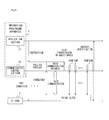
- FIG. 2 is a diagram showing an example of the operation of the communication system 1.
- the operation of the information processing apparatus 2 is described by separating an application section 21 and a communication control section 22 on the basis of their functions.
- the application section 21 is the CPU 13 that executes the application program described above.
- the communication control section 22 is achieved by the CPU 13 that executes the communication program, the communication chip 12, and the communication section 11.
- the information processing performed by the information processing apparatus 2 may not need to be achieved by two types of programs, namely the application program and the communication program, and may be achieved by a single program.
- the application section 21 outputs to the communication control section 22 an instruction regarding near field communication.
- the instruction may include any specific content.
- the application section 21 outputs to the communication control section 22 an instruction to read and/or write data from and/or to the IC card 3.
- the communication control section 22 When having received the instruction, the communication control section 22 detects the presence or absence of the IC card 3 present near the information processing apparatus 2 (more specifically, the communication section 11). Specifically, the communication control section 22 performs a polling process. That is, the communication control section 22 uses the communication section 11 to transmit radio waves (a polling signal (or a polling command)) for confirming the presence of the IC card 3.
- a polling signal or a polling command
- the communication control section 22 may notify the application section 21 that the IC card 3 has not been sensed.
- the IC card 3 is sensed by the polling process, and communication (connection) is established. That is, if the IC card 3 has been sensed, the communication control section 22 performs the process of establishing communication (for example, the process of acquiring information necessary for data communication from the IC card 3). Then, as shown in FIG. 2 , the communication control section 22 uses the communication section 11 to communicate with the IC card 3. Specifically, the communication control section 22 performs a data communication process.
- the data communication process is the process of transmitting and/or receiving data (to be used in an application) to and/or from the IC card 3.
- the data communication process is a communication process different from the polling process or the process of establishing communication, and is, for example, a data reading process and a data writing process.
- the data communication process is performed in accordance with the above instruction from the application section 21. Any specific operation may be performed in the data communication process, and may be an operation similar to a conventional operation.
- the communication control section 22 causes the communication section 11 to intermittently transmit radio waves, thereby confirming that the communication target (IC card) 3 is present (continues to be present) at a position where the communication target 3 can communicate with the information processing apparatus 2.
- the communication control section 22 temporarily stops the transmission of radio waves for near field communication.
- the communication control section 22 performs a confirmation operation, for example, at certain time intervals (see FIG. 2 ).
- the confirmation operation includes the operation of transmitting radio waves for confirming the presence of the IC card 3.
- these radio waves may be the same as those used in the polling process (the polling signal) described above. That is, the confirmation operation may be the same as the polling process.
- the communication control section 22 intermittently transmits radio waves for confirming the presence of the IC card 3 (having performed the data communication).
- the communication control section 22 performs information processing based on the result of the confirmation operation.
- the processing based on the confirmation result is performed, thereby enabling the information processing apparatus 2 to provide an appropriate response based on whether or not the communication target 3 is present.
- the communication control section 22 intermittently repeats the confirmation operation. It should be noted that in this case, in the exemplary embodiment, the communication control section 22 does not notify the application section 21 of the result of the confirmation operation (details will be described in "2-5: Notification to Application"). If, on the other hand, the IC card 3 has been moved away from the communication section 11, the presence of the IC card 3 is not confirmed.
- the communication control section 22 notifies the application section 21 that the IC card 3 is not present (an absence notification) (see FIG. 2 ). It should be noted that any processing may be performed by the application section 21 when having received the absence notification. For example, the application section 21 may end the processing regarding near field communication, or may give the communication control section 22 an instruction to detect the communication target 3 again.
- the intermittent confirmation operation is stopped in accordance with the fact that an instruction to stop has been given by the application section 21.
- the communication control section 22 stops the transmission of radio waves and ends the communication with the IC card 3.
- the information processing apparatus 2 can determine whether or not the IC card 3 continues to be present at a position where the IC card 3 can communicate with the information processing apparatus 2. This makes it possible to deal not only with the form of use in which the IC card 3 comes close to the information processing apparatus 2 only for a short period, but also with the form of use in which the IC card 3 continues to be present near the information processing apparatus 2. That is, in the exemplary embodiment, the information processing apparatus 2 can perform information processing based on whether or not the IC card 3 is present, or can perform information processing under the condition that the IC card 3 is present. For example, in a game application, the information processing apparatus 2 can perform information processing of causing a particular game character to appear in a game space while a predetermined IC card 3 is present.
- the information processing apparatus 2 uses the communication section 11 to perform data communication (the data communication process shown in FIG. 2 ) with the communication target (IC card) 3 present near the communication section 11. Further, after the data communication, the information processing apparatus 2 (the communication control section 22) causes the communication section 11 to intermittently transmit radio waves for confirming the presence of the communication target 3 having performed the data communication. Based on the exemplary embodiment, the confirmation operation (the transmission of radio waves) is intermittently performed. Thus, even when the communication target (IC card) 3 is actually present at a position where the communication target 3 can communicate with the information processing apparatus 2, there is a period in which the communication section 11 stops the transmission of radio waves (see FIG. 2 ).
- the communication section 11 does not continue to transmit radio waves during the period in which the communication target (IC card) 3 is present at a position where the communication target 3 can communicate with the information processing apparatus 2, but temporarily stops radio waves during this period. This makes it possible to reduce the power consumption when near field communication is performed. Further, when the information processing apparatus 2 is a portable device having the built-in battery 16 as in the exemplary embodiment, it is possible to reduce the power consumption of the battery 16 to increase the operating time of the portable device.
- the information processing apparatus 2 (the communication control section 22) temporarily stops radio waves for communication (see FIG. 2 ).
- This temporary stoppage of radio waves is performed regardless of whether or not the IC card 3 is present at a position where the IC card 3 can communicate with the information processing apparatus 2 (i.e., even when the IC card 3 is present at a position where the IC card 3 can communicate with the information processing apparatus 2).
- the information processing apparatus 2 (the communication control section 22) performs data communication with the IC card 3 in accordance with an instruction from an application executed by the information processing apparatus 2. Further, the information processing apparatus 2 (the communication control section 22) starts the operation of intermittently transmitting radio waves regardless of the instruction from the application. That is, the communication control section 22 voluntarily starts the confirmation operation, not in accordance with an instruction from the application. This eliminates the need for the application to manage the confirmation operation. This facilitates the development and the creation of an application.
- a confirmation operation is intermittently performed.
- the confirmation operation according to the exemplary embodiment is described in detail below.
- the confirmation operation is intermittently performed as in the exemplary embodiment, the communication target (IC card) 3 may be changed, that is, the IC card 3 may be replaced by another IC card, during the period from the performance of the confirmation operation to the next performance of the confirmation operation.
- the confirmation operation it is determined whether or not the communication target (IC card) 3 has been changed.
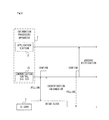
- FIG. 3 is a diagram showing examples of details of the confirmation operation shown in FIG. 2 .
- the communication control section 22 performs the operation of transmitting radio waves for confirming the presence of the IC card 3 (an operation similar to the polling process in the exemplary embodiment). That is, the communication control section 22 confirms that the IC card 3 is present at a position where the IC card 3 can communicate with the information processing apparatus 2 (determines whether or not the IC card 3 is present at a position where the IC card 3 can communicate with the information processing apparatus 2). If the presence of the IC card 3 has not been confirmed, the communication control section 22 notifies the application section 21 that the IC card 3 is not present (an absence notification) (see FIG. 3 ). In this case, a determination process using identification information described later is not performed.
- the communication control section 22 acquires identification information of the IC card 3 from the IC card 3 (see FIG. 3 ).
- the identification information of the communication target (IC card) 3 may be any information capable of identifying an individual communication target (IC card) 3.
- the identification information is an UID (Unique ID) in NFC.
- the communication control section 22 determines, using the acquired identification information, whether or not the IC card 3 has been changed. The determination may be made by any specific method. In the exemplary embodiment, the communication control section 22 compares the acquired identification information with the identification information saved in the memory 14. If the two pieces of identification information match each other, it is determined that the IC card 3 has not been changed. If the two pieces of identification information do not match each other, it is determined that the IC card 3 has been changed. It should be noted that the identification information saved in the memory 14 may be acquired in the data communication process performed before the confirmation operation, or may be acquired in the previous confirmation operation.
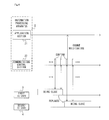
- FIG. 4 is a diagram showing an example of the operation of the communication system in the case where the IC card 3 is changed. It should be noted that, to make the figure readily understandable, unlike FIG. 3 , FIG. 4 does not show the details of the confirmation operation. In FIG. 4 , the case is considered where a first IC card 3 is first present at a position where the first IC card 3 can communicate with the information processing apparatus 2, and is thereafter replaced by a second IC card 4.
- the acquired identification information indicates the first IC card 3.
- the communication target IC card
- the intermittent transmission of radio waves is continued. This results in certainly performing the confirmation operation.
- the first IC card 3 has been replaced by the second IC card 4 during the period from the performance of the confirmation operation to the next performance of the confirmation operation
- the acquired identification information indicates the second IC card 4.
- the communication control section 22 notifies the application section 21 that the communication target has been changed (a change notification) (see FIG. 4 ). This enables the application to accurately recognize the change of the IC card.
- any processing may be performed by the application section 21 when having received the change notification.
- the application section 21 may end the processing regarding near field communication, or may give the communication control section 22 an instruction to perform data communication with the newly sensed second IC card 4.
- the information processing apparatus 2 determines, using the identification information acquired from the IC card 3, whether or not the communication target (IC card) 3 has been changed. This makes it possible to determine whether or not the IC card 3 has been changed during the period from the performance of the confirmation operation to the next performance of the confirmation operation, and therefore to accurately confirm that the IC card 3 continues to be present at a position where the IC card 3 can communicate with the information processing apparatus 2. Further, for example, it is possible to prevent dishonesty committed by changing the IC card.
- the information processing apparatus 2 may not need to acquire identification information from the IC card 3 in the confirmation operation, or may not need to make the determination using the acquired identification information. If the determination using the identification information is not made, for example, the shortening of the time intervals at which the confirmation operation is performed (for example, to intervals of several hundred milliseconds) makes it possible to reduce the possibility of a malfunction due to the fact that the change of the IC card 3 is not detected.
- the communication control section 22 may determine whether or not data has been rewritten to the IC card 3. Specifically, if data has been rewritten to the IC card 3, the information processing apparatus 2 writes, to the IC card 3, information indicating that data has been rewritten (rewriting information).
- the rewriting information may be, for example, a counter indicating the number of rewrites.
- the communication control section 22 acquires the rewriting information from the IC card 3. Then, the communication control section 22 determines, using the acquired rewriting information, whether or not data has been rewritten to the IC card 3. The determination may be performed by any specific method. For example, similarly to the above determination using the identification information, the communication control section 22 may compare the acquired rewriting information with the rewriting information saved in the memory 14.
- data in the IC card 3 may be rewritten. That is, the IC card 3 may be moved away once from a position where the IC card 3 can communicate with the information processing apparatus 2 and data may be rewritten by another communication apparatus, and thereafter, the IC card 3 may be placed again at a position where the IC card 3 can communicate with the information processing apparatus 2. In response, as described above, it is determined whether or not data has been rewritten, whereby it is possible to reduce the possibility of a malfunction due to the fact that the rewriting of data is not detected by the information processing apparatus 2.
- Each of the time intervals at which the confirmation operation is intermittently performed may be any length.
- each of the time intervals at which the confirmation operation is performed may be set to a length different from each of the time intervals at which the polling process (see FIG. 2 ) is performed before the data communication process. That is, if performing the polling process at first time intervals, the information processing apparatus 2 (the communication control section 22) causes the communication section 11 to transmit the radio waves described above at second time intervals, which are different from the first time intervals. It should be noted that in another embodiment, each of the first time intervals and each of the second time intervals may be set to the same length.
- Each of the second time intervals may be set to be longer than each of the first time intervals, or may be set to be shorter than each of the first time intervals.
- each of the second time intervals may be set to be shorter than each of the first time intervals, whereby it is possible to reduce the possibility that, as described above, a malfunction occurs because the change of the communication target (IC card) 3 is not detected.
- each of the second time intervals may be set to be shorter than each of the first time intervals, whereby it is also possible to reduce the possibility of a malfunction, as described above, due to the fact that the rewriting of data to the IC card 3 is not detected by the information processing apparatus 2. That is, each of the second time intervals may be set to be shorter, whereby it is possible to reduce the possibility of a malfunction without even making the determination using the identification information, or making the determination using the writing information.
- each of the second time intervals may be set to be longer than each of the first time intervals, thereby increasing the effect of reducing the power consumption. For example, if the determination using the identification information and/or the determination using the writing information are made in the confirmation operation, it is possible to sense the replacement of the IC card 3 and the rewriting of data. Thus, each of the second time intervals may be set to be longer than each of the first time intervals.
- the communication control section 22 performs a data communication process based on the new instruction.
- the IC card 3 continues to be present after the information processing apparatus 2 has ended a data communication process with the IC card 3, the information processing apparatus 2 can start a new data communication process. The details are described below.
- FIG. 5 is a diagram showing an example of the operation of the communication system in the case where a new instruction is given by the application section 21.
- the communication control section 22 first performs a confirmation operation.
- the confirmation operation performed in accordance with the fact that an instruction has been given (hereinafter referred to as a "post-instruction confirmation operation”) may be performed after a certain time has elapsed since the previous confirmation operation, or may be performed immediately after the instruction has been given (performed without waiting).
- the post-instruction confirmation operation is similar to the confirmation operation described above (see FIG. 3 ). That is, in the post-instruction confirmation operation, the operation of transmitting radio waves for confirming the presence of the IC card 3 and the determination operation using the identification information acquired from the IC card 3 are performed.
- the communication control section 22 performs a data communication process in accordance with an instruction from the application section 21 (see FIG. 5 ).
- the intermittent confirmation operation is stopped.
- the communication control section 22 may perform the process of establishing communication, where necessary, before performing the data communication process. The operation performed during the period from when a new instruction has been given to when the data communication process is performed may be similar to the operation performed when an instruction has first been given by the application section 21.
- the communication control section 22 gives the application section 21 the absence notification described above. Further, in the post-instruction confirmation operation, if it has been determined that the IC card 3 has been changed, the communication control section 22 gives the application section 21 the change notification described above.
- the communication control section 22 restarts the intermittent confirmation operation. That is, when the data communication process has ended, radio waves are temporarily stopped, and thereafter, radio waves are intermittently transmitted (see FIG. 5 ).
- the communication control section 22 stops the transmission operation. Further, in this case, the communication control section 22 communicates (performs a data communication process) with the IC card 3 in accordance with the instruction.
- the information processing apparatus 2 can quickly start the data communication.
- the communication control section 22 gives the application the absence notification described above. This enables the information processing apparatus 2 (the application section 21) to recognize that the IC card 3 has disappeared, and therefore to perform appropriate processing based on the recognition.
- the communication control section 22 does not notify the application of the connection and disconnection of communication caused by the operation of intermittently transmitting radio waves as described above. That is, if it has been confirmed that the IC card 3 is present at a position where the IC card 3 can communicate with the information processing apparatus 2, the communication control section 22 does not notify the application section 21 of the result of the confirmation operation. That is, in the exemplary embodiment, in practice, the communication between the information processing apparatus 2 and the IC card 3 is disconnected every time the confirmation operation is performed by intermittently transmitting radio waves. The application, however, is not notified of the disconnection.
- the application section 21 can perform processing, considering that communication is established (the IC card 3 continues to be present) until the absence notification is given. This eliminates the need for the application to take into account the operation to be performed when communication has been disconnected or connected by the intermittent confirmation operation. This facilitates the creation and the development of an application.
- the application may not be notified of the result of the confirmation operation, and if the presence of the IC card 3 has been confirmed, the application may be notified of the result of the confirmation operation. In this case, if a notification is not given for a predetermined period, the application section 21 may determine that the IC card 3 has disappeared. Further, in another embodiment, either when the presence of the IC card 3 has been confirmed or when the presence of the IC card 3 has not been confirmed, the communication control section 22 may notify the application section 21 of the result of the confirmation operation. In this case, the application section 21 may perform information processing based on the result of the confirmation operation.
- FIG. 6 is a diagram showing an example of a data area set in the memory 14 of the information processing apparatus 2 in the exemplary embodiment.
- the memory 14 of the information processing apparatus 2 has a program storage area 31 and a processing data storage area 34. It should be noted that the memory 14 stores, as well as data shown in FIG. 6 , data of an image to be output to a display section (not shown), data of an image used to generate the image to be output, and the like.
- the program storage area 31 various programs to be executed by the information processing apparatus 2 are stored.
- the application program 32 and the communication program 33 described above are stored in the program storage area 31, in the program storage area 31, the application program 32 and the communication program 33 described above are stored.
- FIG. 6 shows only one type of application program.
- the information processing apparatus 2 may store a plurality of types of application programs.
- the application program 32 (the communication program 33 likewise) may be stored in advance in a storage device in the information processing apparatus 2, or may be acquired from a storage medium attachable to and detachable from the information processing apparatus 2 and stored in the memory 14, or may be acquired from another apparatus via a network such as the Internet and stored in the memory 14.
- the CPU 13 executes a program (the application program 32 and/or the communication program 33) stored in the memory 14.
- the processing data storage area 34 various types of data to be used in the information processing performed by the information processing apparatus 2 (information processing shown in FIG. 7 ) are stored.
- at least identification information data 35, instruction data 36, and communication data 37 are stored.
- the identification information data 35 is data indicating the identification information described above, acquired from the IC card 3.
- the instruction data 36 is data indicating an instruction (an instruction content) from an application.
- the communication data 37 is data transmitted to and received from the IC card 3 by the data communication process described above. For example, data read from the IC card 3 and data to be written to the IC card 3 are stored as the communication data 37 in the memory 14.
- FIG. 7 is a flow chart showing an example of the flow of the information processing performed by the information processing apparatus 2 (the CPU 13) in the exemplary embodiment.
- a series of processes shown in FIG. 7 are performed by the CPU 13 executing the communication program 33.
- the information processing shown in FIG. 7 may be started at any timing.
- the information processing shown in FIG. 7 is started in accordance with the fact that an instruction (regarding near field communication) has been given by an application. At this time, data indicating the instruction is stored as the instruction data 36 in the memory 14.
- step S1 the CPU 13 starts detecting the IC card 3 present near the communication section 11. That is, the CPU 13 starts transmitting radio waves for confirming the presence of the IC card 3.
- step S2 the CPU 13 determines whether or not the IC card 3 has been sensed. That is, the CPU 13 determines whether or not the IC card 3 has responded to the radio waves of which the transmission has been started in step S1. If the result of the determination is affirmative in step S2, the process of step S5 described later is performed. If, on the other hand, the result of the determination is negative in step S2, the process of step S3 is performed.
- step S3 the CPU 13 determines whether or not the IC card 3 has been sensed in the previous sensing process.
- the previous sensing process refers to the process of step S2 performed one time before the process of step S2 in which the result of the determination has been negative this time (i.e., performed one time before the process of step S2 performed immediately before step S3).
- the determination process in step S3 is the process of determining whether or not the state where the IC card 3 is sensed has changed to the state where the IC card 3 is not sensed. If the result of the determination is affirmative in step S3, the process of step S4 is performed. If, on the other hand, the result of the determination is negative in step S3, the process of step S2 is performed again.
- steps S2 and S3 are repeatedly performed (here, at the first time intervals described above).
- the processes of steps S2 and S3 are repeatedly performed until the IC card 3 is sensed.
- step S4 the CPU 13 notifies the application that the IC card 3 is not sensed. That is, the CPU 13 outputs the absence notification described above to the application. After step S4, the CPU 13 performs the process of step S2.
- step S5 the CPU 13 acquires identification information from the sensed IC card 3. It should be noted that if identification information has been acquired for the first time since the IC card 3 has been newly sensed, the CPU 13 saves the identification information acquired for the first time. That is, the CPU 13 stores, as the identification information data 35 in the memory 14, data of the identification information acquired for the first time.
- step S6 the CPU 13 determines, on the basis of the acquired identification information, whether or not the communication target (IC card) 3 has been changed.
- the determination in step S6 is made by, for example, the method described in the above "2-2: Determination of Change of Communication Target in Confirmation Operation". If the result of the determination is negative in step S6, the process of step S7 is performed. If, on the other hand, the result of the determination is affirmative in step S6, the process of step S11 described later is performed.
- step S7 the CPU 13 determines whether or not an instruction has been given by the application.
- the application program 32 is executed by the CPU 13 independently of (in parallel with) the series of processes shown in FIG. 7 . If an instruction has been given in the information processing performed by the application program 32, the CPU 13 stores in the memory 14 the instruction data 36 indicating the instruction. That is, if an instruction has been given before or during the series of processes shown in FIG. 7 , the instruction data 36 is stored in the memory 14.
- the determination in step S7 is made on the basis of whether or not the instruction data 36 is stored in the memory 14. If the result of the determination is affirmative in step S7, the process of step S8 is performed. If, on the other hand, the result of the determination is negative in step S7, the process of step S8 is skipped, and the process of step S9 described later is performed.
- step S8 the CPU 13 performs the data communication process described above in accordance with the instruction from the application. Any specific operation may be performed in the data communication process.
- data to be written to the IC card 3 by the information processing apparatus 2 is stored as the communication data 37 in the memory 14 in the information processing performed by the application program 32.
- the CPU 13 reads the communication data 37 from the memory 14 and transmits the communication data 37 to the IC card 3, using the communication section 11.
- the data read from the IC card 3 by the information processing apparatus 2 is stored as the communication data 37 in the memory 14.
- the CPU 13 reads at appropriate timing the communication data 37 stored in the memory 14.
- step S9 subsequent to step S8 is performed.
- the instruction data 36 corresponding to the completed instruction is deleted from the memory 14.
- step S9 the CPU 13 stops the transmission of radio waves from the communication section 11. That is, the CPU 13 commands the communication chip 12 to stop the transmission of radio waves.
- step S10 the CPU 13 waits a predetermined time.
- the predetermined time is the time from the performance of the confirmation operation to the next performance of the confirmation operation, and corresponds to each of the second time intervals described above.
- step S11 the CPU 13 notifies the application that the IC card 3 has been changed. That is, the CPU 13 outputs the change notification described above to the application.
- step S12 the CPU 13 changes the saved identification information. That is, the CPU 13 stores, as new identification information data 35 in the memory 14, data indicating the identification information acquired in step S5 performed immediately before step S12.
- the identification information of the IC card after a change is thus saved, thereby enabling the information processing apparatus 2 to communicate also with the IC card after the change.
- steps S1, S2, S5, S6, S7, S9, and S10 are repeatedly performed in this order, thereby performing the intermittent confirmation operation (the transmission of radio waves) as shown in FIG. 2 .
- the process of steps S3 and S4 are performed. That is, the absence notification is output to the application.
- the process of step S11 is performed, and the change notification is output to the application.
- step S7 If an instruction has been given again by the application while the intermittent confirmation operation is performed, the result of the determination is affirmative in step S7. Consequently, the data communication process is performed in step S8. As described above, the operation described in the above "2. Overview of Operation of Communication System" is performed by the series of processes shown in FIG. 7 .
- the present invention can be used as, for example, a portable device that performs near field communication with an IC card, a communication program to be executed by a portable device, and the like in order, for example, to reduce the power consumption when communication is performed.
Landscapes
- Engineering & Computer Science (AREA)
- Computer Networks & Wireless Communication (AREA)
- Signal Processing (AREA)
- Mobile Radio Communication Systems (AREA)
- Near-Field Transmission Systems (AREA)
Abstract
Description
- The present invention relates to a communication program, an information processing apparatus, a communication system, and a communication method for performing near field communication with a communication target.
- Conventionally, there is a technique of performing communication between apparatuses, using near field communication such as NFC (Near Field Communication) (see Japanese Unexamined Patent Application Publication No.
2005-252613 - In conventional near field communication, while a communication target, which is another communication apparatus, is close to a communication apparatus, the communication apparatus continues to transmit radio waves to detect whether or not the communication target has moved away. This leads to large power consumption.
- Therefore, it is an object of the present invention to provide a communication program, an information processing apparatus, a communication system, and a communication method that are capable of reducing power consumption in near field communication.
- To achieve the above object, the present invention employs the following configurations (1) through (13).
- An example of the present invention is a communication program to be executed by a computer of an information processing apparatus having a communication section configured to perform near field communication, the communication program causing the computer to function as communication means and confirmation means. The communication means performs data communication with a communication target present near the communication section, using the communication section. The confirmation means, after the data communication, causes the communication section to intermittently transmit radio waves for confirming presence of the communication target having performed the data communication.
- Based on the above configuration (1), radio waves for confirming that the communication target is present are intermittently transmitted. Thus, even if the communication target is actually present at a position where the communication target can communicate with the information processing apparatus, there is a period in which the transmission of radio waves from the communication section is stopped. Thus, even if the communication target continues to be present at a position where the communication target can communicate with the information processing apparatus, it is possible to reduce the power consumption when communication is performed.
- The communication program may further cause the computer to function as determination means. The determination means, if the presence of the communication target near the communication section has been confirmed, acquires identification information of the communication target from the communication target, and determines, using the acquired identification information, whether or not the communication target having performed the data communication has been changed.
- Based on the above configuration (2), if the presence of the communication target has been confirmed, the information processing apparatus determines, using the identification information acquired from the communication target, whether or not the communication target has been changed. This makes it possible to determine whether or not the communication target has been changed between the performance of a confirmation operation (a single transmission of radio waves) and the next performance of the confirmation operation. This makes it possible to accurately confirm that the communication target continues to be present at a position where the communication target can communicate with the information processing apparatus.
- While a result of the determination by the determination means is negative, the confirmation means may continue to intermittently transmitting the radio waves for confirming the presence of the communication target having performed the data communication.
- Based on the above configuration (3), while the result of the determination is negative, the confirmation operation is intermittently continued. This makes it possible to certainly confirm that the communication target continues to be present at a position where the communication target can communicate with the information processing apparatus.
- The communication program may further cause the computer to function as first notification means. The first notification means, if a result of the determination by the determination means is affirmative, notifies an application executed by the information processing apparatus that the communication target having performed the data communication has been changed.
- Based on the above configuration (4), if the result of the determination is affirmative, the application is notified that the communication target has been changed. This enables the application (the information processing apparatus) to accurately recognize the change of the communication target.
- In response to the fact that the data communication between the information processing apparatus and the communication target present near the communication section has ended, the confirmation means may temporarily stop radio waves for the data communication regardless of whether or not the communication target having performed the data communication is present at a position where the communication target can communicate with the information processing apparatus.
- Based on the above configuration (5), if the communication between the information processing apparatus and the communication target has been established, it is possible to certainly perform the data communication, and also reduce the power consumption when the communication target continues to be present after the data communication.
- After the radio waves for the data communication have been temporarily stopped, the confirmation means may cause the communication section to intermittently transmit the radio waves for confirming the presence of the communication target having performed the data communication.
- Based on the above configuration (6), even if the communication target continues to be present after the data communication, radio waves are temporarily stopped, and thereafter, radio waves are intermittently transmitted. This makes it possible to reduce power consumption.
- As the data communication, the communication means may read and/or write data from and/or to the communication target present near the communication section. After the reading and/or the writing of the data has ended, the confirmation means may start an operation of intermittently transmitting the radio waves.
- Based on the above configuration (7), if the communication between the information processing apparatus and the communication target has been established, it is possible to certainly read and/or write data, and also reduce the power consumption when the communication target continues to be present after that.
- In accordance with an instruction from an application executed by the information processing apparatus, the communication means may perform data communication with the communication target present near the communication section. The confirmation means may start an operation of intermittently transmitting the radio waves regardless of the instruction from the application.
- Based on the above configuration (8), a confirmation operation is started even if an instruction has not been given by an application. This eliminates the need for the application to manage the confirmation operation. This facilitates the development and the creation of an application.
- If the instruction has been given by the application during the operation of intermittently transmitting the radio waves, the confirmation means may stop the transmission operation. In response to the stoppage of the transmission operation by the confirmation means and in accordance with the instruction from the application, the communication means may perform the data communication anew with the communication target having performed the data communication.
- Based on the above configuration (9), radio waves are intermittently transmitted. Thus, even if communication has been (temporarily) disconnected, the information processing apparatus can quickly start the data communication if it is necessary to perform the data communication again.
- The communication program may further cause the computer to function as second notification means. The second notification means, if the presence of the communication target has not been confirmed, notifies the application that the communication target has disappeared.
- Based on the above configuration (10), the application recognizes that the communication target has disappeared. This enables the application to perform appropriate processing based on the fact that the communication target has disappeared.
- The second notification means may not notify the application of connection and disconnection of communication caused by the operation of intermittently transmitting the radio waves.
- Based on the above configuration (11), without taking into account a communication state (whether or not communication is established), the application can perform processing, considering that communication is established (the communication target continues to be present). This eliminates the need for the application to take into account the operation to be performed when communication has been disconnected or connected by the intermittent transmission of radio waves. This facilitates the creation and the development of an application.
- The communication program may further cause the computer to function as sensing means. The sensing means senses the presence or absence of the communication target present near the communication section at first time intervals, using the radio waves. In this case, if the communication target has been sensed, the communication means may perform data communication with the sensed communication target. The confirmation means may cause the communication section to transmit the radio waves at second time intervals different from the first time intervals after the data communication.
- Based on the above configuration (12), for example, the second time intervals may be set to be longer than the first time intervals. This makes it possible to increase the effect of reducing power consumption. Further, for example, the second time intervals may be set to be shorter than the first time intervals. This makes it possible to reduce the possibility of a malfunction due to the fact that the change of the communication target is not detected, or due to the fact that the rewriting of data to the communication target has not been detected.
- Another example of the present invention is a communication program to be executed by a computer of an information processing apparatus having a communication section configured to perform near field communication, the communication program causing the computer to function as communication means and confirmation means. In accordance with an instruction from an application executed by the information processing apparatus, the communication means performs data communication with a communication target present near the communication section, using the communication section. By causing the communication section to intermittently transmit radio waves regardless of the instruction from the application, the confirmation means confirms that the communication target having performed the data communication is present at a position where the communication target can communicate with the information processing apparatus.
- Based on the above configuration (13), similarly to the above configuration (1), even if the communication target is actually present at a position where the communication target can communicate with the information processing apparatus, there is a period in which the transmission of radio waves from the communication section is stopped. Thus, even if the communication target continues to be present at a position where the communication target can communicate with the information processing apparatus, it is possible to reduce the power consumption when communication is performed.
- It should be noted that another example of the present invention may be an information processing apparatus including functions equivalent to those of the information processing apparatus according to the above configurations (1) through (13), and may be a communication system including the communication target and the information processing apparatus according to the above configurations (1) through (13). Further, another example of the present invention may be a communication method to be performed by the information processing apparatus according to the above configurations (1) through (13).
- Based on the present invention, if a communication target is actually present at a position where the communication target can communicate with an information processing apparatus, the transmission of radio waves from a communication section may be stopped. This makes it possible to reduce the power consumption when communication is performed.
- These and other objects, features, aspects and advantages of the present invention will become more apparent from the following detailed description of the present invention when taken in conjunction with the accompanying drawings.
-
-
FIG. 1 is a diagram showing an example of the configuration of a communication system according to an exemplary embodiment; -
FIG. 2 is a diagram showing an example of the operation of the communication system; -
FIG. 3 is a diagram showing examples of details of a confirmation operation shown inFIG. 2 ; -
FIG. 4 is a diagram showing an example of the operation of the communication system in the case where a communication target is changed; -
FIG. 5 is a diagram showing an example of the operation of the communication system in the case where a new instruction is given by an application section; -
FIG. 6 is a diagram showing an example of a data area set in a memory of an information processing apparatus; and -
FIG. 7 is a flow chart showing an example of the flow of the information processing performed by the information processing apparatus. - A description is given below of a communication program, an information processing apparatus, a communication system, and a communication method according to the exemplary embodiment. First, the configuration of the communication system is described.
FIG. 1 is a diagram showing an example of the configuration of the communication system according to the exemplary embodiment. As shown inFIG. 1 , acommunication system 1 includes aninformation processing apparatus 2 and acommunication target 3. Theinformation processing apparatus 2 may be any information processing apparatus capable of performing near field communication with thecommunication target 3. - In the exemplary embodiment, a description is given taking as an example the case where, as exemplary near field communication, communication based on the NFC standard is performed between the
information processing apparatus 2 and thecommunication target 3. Here, "near field communication" as used herein refers to a communication method where radio waves from an apparatus develop an electromotive force (for example, by electromagnetic induction) in another apparatus. The other apparatus can operate by the developed electromotive force (the other apparatus may or may not have a power supply). In near field communication, when theinformation processing apparatus 2 and thecommunication target 3 have come close to each other (typically, the distance between theinformation processing apparatus 2 and thecommunication target 3 has become dozen centimeters or less), theinformation processing apparatus 2 and thecommunication target 3 become capable of communicating with each other. Near field communication in the exemplary embodiment is a communication method also referred to as "contactless communication". Further, in conventional general near field communication, radio waves continue to be transmitted while the communication between two communication apparatuses is established (a communication target, which is another communication apparatus, is close to a communication apparatus). - The
information processing apparatus 2 may be any information processing apparatus capable of performing near field communication. In the exemplary embodiment, theinformation processing apparatus 2 is a handheld (or portable) apparatus such as a handheld game apparatus, a mobile phone, or a smartphone. For example, theinformation processing apparatus 2 is a portable device having the function of an NFC reader/writer. - The
communication target 3 may be any apparatus capable of performing near field communication with theinformation processing apparatus 2. In the exemplary embodiment, thecommunication target 3 is a storage medium (for example, an IC card) having the function of an NFC tag. The description is given below taking as an example the case where thecommunication target 3 is an IC card. Thecommunication target 3, however, is not limited to a storage medium such as an IC card, and may be, for example, an information processing apparatus (a portable device) having an NFC card emulation function. - The configuration of the
information processing apparatus 2 is described below. As shown inFIG. 1 , theinformation processing apparatus 2 includes acommunication section 11. Thecommunication section 11 is an antenna used for near field communication. Further, theinformation processing apparatus 2 includes acommunication chip 12. In accordance with an instruction from aCPU 13 described later, thecommunication chip 12 generates a signal (radio waves) to be transmitted from thecommunication section 11. The generated signal is transmitted from thecommunication section 11. Thecommunication chip 12 is, for example, an NFC chip. It should be noted that in another embodiment, a communication module (for example, an NFC module) having the functions of thecommunication section 11 and thecommunication chip 12 may be connected (attached) to theinformation processing apparatus 2. The communication module may be configured to be attachable to and detachable from theinformation processing apparatus 2. - As shown in
FIG. 1 , theinformation processing apparatus 2 includes aCPU 13 and amemory 14. TheCPU 13 is an information processing section for performing various types of information processing performed by theinformation processing apparatus 2. TheCPU 13 performs the various types of information processing using thememory 14. - It should be noted that the
information processing apparatus 2 may include a plurality of apparatuses. For example, in another embodiment, a plurality of apparatuses capable of communicating with each other via a network (a wide-area network and/or a local network) may perform in a dispersed manner at least part of the information processing performed by theinformation processing apparatus 2. Alternatively, for example, theinformation processing apparatus 2 may be configured such that an apparatus including thecommunication section 11 and thecommunication chip 12 is detachably attached to an apparatus including theCPU 13 and thememory 14. - In the exemplary embodiment, in the
information processing apparatus 2, theCPU 13 executes at least two types of programs, namely an application program and a communication program (seeFIG. 6 ). The application program may be a program for executing any application for performing data communication with the communication target (IC card) 3. The application program may be, for example, a game program for reading game data from theIC card 3 and performing game processing using the game data. The communication program is a program for performing near field communication with theIC card 3. For example, the communication program is firmware for causing thecommunication chip 12 to operate. Although described in detail later, the communication program receives an instruction from an application and causes thecommunication chip 12 to perform an operation for communication. It should be noted that if theinformation processing apparatus 2 can execute a plurality of application programs, the communication program is used in all the applications in a shared manner. That is, the communication program (a communication control section described later) can receive instructions regarding communication from the plurality of applications. - As shown in
FIG. 1 , theinformation processing apparatus 2 includes a battery 16 and apower supply IC 15. Thepower supply IC 15 supplies power from the battery 16 to components of theinformation processing apparatus 2. In the exemplary embodiment, thepower supply IC 15 supplies power to at least thecommunication chip 12, theCPU 13, and thememory 14. Thus, a reduction in the power consumption of thecommunication chip 12, theCPU 13, and thememory 14 when near field communication is performed makes it possible to reduce the power consumption of the battery 16. - Next, with reference to
FIGS. 2 through 5 , the operation of thecommunication system 1 regarding communication is described.FIG. 2 is a diagram showing an example of the operation of thecommunication system 1. It should be noted that as shown inFIG. 2 , in the exemplary embodiment, the operation of theinformation processing apparatus 2 is described by separating anapplication section 21 and acommunication control section 22 on the basis of their functions. In the exemplary embodiment, theapplication section 21 is theCPU 13 that executes the application program described above. Thecommunication control section 22 is achieved by theCPU 13 that executes the communication program, thecommunication chip 12, and thecommunication section 11. It should be noted that in another embodiment, the information processing performed by theinformation processing apparatus 2 may not need to be achieved by two types of programs, namely the application program and the communication program, and may be achieved by a single program. - As shown in
FIG. 2 , first, theapplication section 21 outputs to thecommunication control section 22 an instruction regarding near field communication. The instruction may include any specific content. For example, theapplication section 21 outputs to thecommunication control section 22 an instruction to read and/or write data from and/or to theIC card 3. - When having received the instruction, the
communication control section 22 detects the presence or absence of theIC card 3 present near the information processing apparatus 2 (more specifically, the communication section 11). Specifically, thecommunication control section 22 performs a polling process. That is, thecommunication control section 22 uses thecommunication section 11 to transmit radio waves (a polling signal (or a polling command)) for confirming the presence of theIC card 3. - As a result of the polling process described above, if the
IC card 3 present near thecommunication section 11 has not been sensed, thecommunication control section 22 repeatedly performs the polling process. It should be noted that if theIC card 3 has not been sensed even by repeating the polling process for a predetermined time or longer, thecommunication control section 22 may notify theapplication section 21 that theIC card 3 has not been sensed. - If, on the other hand, the
IC card 3 has been brought close to thecommunication section 11 by a user or the like, theIC card 3 is sensed by the polling process, and communication (connection) is established. That is, if theIC card 3 has been sensed, thecommunication control section 22 performs the process of establishing communication (for example, the process of acquiring information necessary for data communication from the IC card 3). Then, as shown inFIG. 2 , thecommunication control section 22 uses thecommunication section 11 to communicate with theIC card 3. Specifically, thecommunication control section 22 performs a data communication process. The data communication process is the process of transmitting and/or receiving data (to be used in an application) to and/or from theIC card 3. The data communication process is a communication process different from the polling process or the process of establishing communication, and is, for example, a data reading process and a data writing process. Here, the data communication process is performed in accordance with the above instruction from theapplication section 21. Any specific operation may be performed in the data communication process, and may be an operation similar to a conventional operation. - When the data communication process has ended, the
communication control section 22 causes thecommunication section 11 to intermittently transmit radio waves, thereby confirming that the communication target (IC card) 3 is present (continues to be present) at a position where thecommunication target 3 can communicate with theinformation processing apparatus 2. Specifically, when the data communication process has ended, thecommunication control section 22 temporarily stops the transmission of radio waves for near field communication. Then, thecommunication control section 22 performs a confirmation operation, for example, at certain time intervals (seeFIG. 2 ). The confirmation operation includes the operation of transmitting radio waves for confirming the presence of theIC card 3. Specifically, these radio waves may be the same as those used in the polling process (the polling signal) described above. That is, the confirmation operation may be the same as the polling process. As described above, after temporarily stopping radio waves for data communication, thecommunication control section 22 intermittently transmits radio waves for confirming the presence of the IC card 3 (having performed the data communication). - The
communication control section 22 performs information processing based on the result of the confirmation operation. The processing based on the confirmation result is performed, thereby enabling theinformation processing apparatus 2 to provide an appropriate response based on whether or not thecommunication target 3 is present. Specifically, if the presence of the IC card 3 (the fact that theIC card 3 continues to be present) has been confirmed by the confirmation operation, thecommunication control section 22 intermittently repeats the confirmation operation. It should be noted that in this case, in the exemplary embodiment, thecommunication control section 22 does not notify theapplication section 21 of the result of the confirmation operation (details will be described in "2-5: Notification to Application"). If, on the other hand, theIC card 3 has been moved away from thecommunication section 11, the presence of theIC card 3 is not confirmed. If the presence of theIC card 3 is not confirmed, thecommunication control section 22 notifies theapplication section 21 that theIC card 3 is not present (an absence notification) (seeFIG. 2 ). It should be noted that any processing may be performed by theapplication section 21 when having received the absence notification. For example, theapplication section 21 may end the processing regarding near field communication, or may give thecommunication control section 22 an instruction to detect thecommunication target 3 again. - In addition, although not shown in the figures, in the exemplary embodiment, the intermittent confirmation operation is stopped in accordance with the fact that an instruction to stop has been given by the
application section 21. At this time, thecommunication control section 22 stops the transmission of radio waves and ends the communication with theIC card 3. - Based on the above operation, the
information processing apparatus 2 can determine whether or not theIC card 3 continues to be present at a position where theIC card 3 can communicate with theinformation processing apparatus 2. This makes it possible to deal not only with the form of use in which theIC card 3 comes close to theinformation processing apparatus 2 only for a short period, but also with the form of use in which theIC card 3 continues to be present near theinformation processing apparatus 2. That is, in the exemplary embodiment, theinformation processing apparatus 2 can perform information processing based on whether or not theIC card 3 is present, or can perform information processing under the condition that theIC card 3 is present. For example, in a game application, theinformation processing apparatus 2 can perform information processing of causing a particular game character to appear in a game space while apredetermined IC card 3 is present. - As described above, in the exemplary embodiment, the information processing apparatus 2 (the communication control section 22) uses the
communication section 11 to perform data communication (the data communication process shown inFIG. 2 ) with the communication target (IC card) 3 present near thecommunication section 11. Further, after the data communication, the information processing apparatus 2 (the communication control section 22) causes thecommunication section 11 to intermittently transmit radio waves for confirming the presence of thecommunication target 3 having performed the data communication. Based on the exemplary embodiment, the confirmation operation (the transmission of radio waves) is intermittently performed. Thus, even when the communication target (IC card) 3 is actually present at a position where thecommunication target 3 can communicate with theinformation processing apparatus 2, there is a period in which thecommunication section 11 stops the transmission of radio waves (seeFIG. 2 ). That is, thecommunication section 11 does not continue to transmit radio waves during the period in which the communication target (IC card) 3 is present at a position where thecommunication target 3 can communicate with theinformation processing apparatus 2, but temporarily stops radio waves during this period. This makes it possible to reduce the power consumption when near field communication is performed. Further, when theinformation processing apparatus 2 is a portable device having the built-in battery 16 as in the exemplary embodiment, it is possible to reduce the power consumption of the battery 16 to increase the operating time of the portable device. - In addition, as described above, in the exemplary embodiment, in accordance with the fact that predetermined data communication (the data communication process) between the
information processing apparatus 2 and theIC card 3 has ended, the information processing apparatus 2 (the communication control section 22) temporarily stops radio waves for communication (seeFIG. 2 ). This temporary stoppage of radio waves is performed regardless of whether or not theIC card 3 is present at a position where theIC card 3 can communicate with the information processing apparatus 2 (i.e., even when theIC card 3 is present at a position where theIC card 3 can communicate with the information processing apparatus 2). Thus, it is possible to certainly perform data communication, and also reduce the power consumption when theIC card 3 continues to be present after that. - In addition, as described above, in the exemplary embodiment, the information processing apparatus 2 (the communication control section 22) performs data communication with the
IC card 3 in accordance with an instruction from an application executed by theinformation processing apparatus 2. Further, the information processing apparatus 2 (the communication control section 22) starts the operation of intermittently transmitting radio waves regardless of the instruction from the application. That is, thecommunication control section 22 voluntarily starts the confirmation operation, not in accordance with an instruction from the application. This eliminates the need for the application to manage the confirmation operation. This facilitates the development and the creation of an application. - As described above, in the exemplary embodiment, if the
IC card 3 is present at a position where theIC card 3 can communicate with theinformation processing apparatus 2, a confirmation operation is intermittently performed. The confirmation operation according to the exemplary embodiment is described in detail below. Here, when the confirmation operation is intermittently performed as in the exemplary embodiment, the communication target (IC card) 3 may be changed, that is, theIC card 3 may be replaced by another IC card, during the period from the performance of the confirmation operation to the next performance of the confirmation operation. In response, in the exemplary embodiment, in the confirmation operation, it is determined whether or not the communication target (IC card) 3 has been changed. -
FIG. 3 is a diagram showing examples of details of the confirmation operation shown inFIG. 2 . As shown inFIG. 3 , in the confirmation operation, thecommunication control section 22 performs the operation of transmitting radio waves for confirming the presence of the IC card 3 (an operation similar to the polling process in the exemplary embodiment). That is, thecommunication control section 22 confirms that theIC card 3 is present at a position where theIC card 3 can communicate with the information processing apparatus 2 (determines whether or not theIC card 3 is present at a position where theIC card 3 can communicate with the information processing apparatus 2). If the presence of theIC card 3 has not been confirmed, thecommunication control section 22 notifies theapplication section 21 that theIC card 3 is not present (an absence notification) (seeFIG. 3 ). In this case, a determination process using identification information described later is not performed. - In addition, if the presence of the
IC card 3 has been confirmed, thecommunication control section 22 acquires identification information of theIC card 3 from the IC card 3 (seeFIG. 3 ). It should be noted that the identification information of the communication target (IC card) 3 may be any information capable of identifying an individual communication target (IC card) 3. In the exemplary embodiment, the identification information is an UID (Unique ID) in NFC. - The
communication control section 22 determines, using the acquired identification information, whether or not theIC card 3 has been changed. The determination may be made by any specific method. In the exemplary embodiment, thecommunication control section 22 compares the acquired identification information with the identification information saved in thememory 14. If the two pieces of identification information match each other, it is determined that theIC card 3 has not been changed. If the two pieces of identification information do not match each other, it is determined that theIC card 3 has been changed. It should be noted that the identification information saved in thememory 14 may be acquired in the data communication process performed before the confirmation operation, or may be acquired in the previous confirmation operation. -
FIG. 4 is a diagram showing an example of the operation of the communication system in the case where theIC card 3 is changed. It should be noted that, to make the figure readily understandable, unlikeFIG. 3 ,FIG. 4 does not show the details of the confirmation operation. InFIG. 4 , the case is considered where afirst IC card 3 is first present at a position where thefirst IC card 3 can communicate with theinformation processing apparatus 2, and is thereafter replaced by a second IC card 4. - As shown in
FIG. 4 , in the state where thefirst IC card 3 is present, the acquired identification information indicates thefirst IC card 3. Thus, it is determined that the communication target (IC card) has not been changed. As shown inFIG. 4 , while the IC card is not changed (while the result of the determination is negative), the intermittent transmission of radio waves is continued. This results in certainly performing the confirmation operation. If, on the other hand, thefirst IC card 3 has been replaced by the second IC card 4 during the period from the performance of the confirmation operation to the next performance of the confirmation operation, the acquired identification information indicates the second IC card 4. Thus, it is determined that the communication target has been changed. In this case (if the result of the determination is affirmative), thecommunication control section 22 notifies theapplication section 21 that the communication target has been changed (a change notification) (seeFIG. 4 ). This enables the application to accurately recognize the change of the IC card. - It should be noted that any processing may be performed by the
application section 21 when having received the change notification. For example, theapplication section 21 may end the processing regarding near field communication, or may give thecommunication control section 22 an instruction to perform data communication with the newly sensed second IC card 4. - As described above, in the exemplary embodiment, in the confirmation operation, the information processing apparatus 2 (the communication control section 22) determines, using the identification information acquired from the
IC card 3, whether or not the communication target (IC card) 3 has been changed. This makes it possible to determine whether or not theIC card 3 has been changed during the period from the performance of the confirmation operation to the next performance of the confirmation operation, and therefore to accurately confirm that theIC card 3 continues to be present at a position where theIC card 3 can communicate with theinformation processing apparatus 2. Further, for example, it is possible to prevent dishonesty committed by changing the IC card. - It should be noted that in another embodiment, the
information processing apparatus 2 may not need to acquire identification information from theIC card 3 in the confirmation operation, or may not need to make the determination using the acquired identification information. If the determination using the identification information is not made, for example, the shortening of the time intervals at which the confirmation operation is performed (for example, to intervals of several hundred milliseconds) makes it possible to reduce the possibility of a malfunction due to the fact that the change of theIC card 3 is not detected. - In addition, in the confirmation operation, the
communication control section 22 may determine whether or not data has been rewritten to theIC card 3. Specifically, if data has been rewritten to theIC card 3, theinformation processing apparatus 2 writes, to theIC card 3, information indicating that data has been rewritten (rewriting information). The rewriting information may be, for example, a counter indicating the number of rewrites. In this case, in the confirmation operation, thecommunication control section 22 acquires the rewriting information from theIC card 3. Then, thecommunication control section 22 determines, using the acquired rewriting information, whether or not data has been rewritten to theIC card 3. The determination may be performed by any specific method. For example, similarly to the above determination using the identification information, thecommunication control section 22 may compare the acquired rewriting information with the rewriting information saved in thememory 14. - Here, during the period from the performance of the confirmation operation to the next performance of the confirmation operation, data in the
IC card 3 may be rewritten. That is, theIC card 3 may be moved away once from a position where theIC card 3 can communicate with theinformation processing apparatus 2 and data may be rewritten by another communication apparatus, and thereafter, theIC card 3 may be placed again at a position where theIC card 3 can communicate with theinformation processing apparatus 2. In response, as described above, it is determined whether or not data has been rewritten, whereby it is possible to reduce the possibility of a malfunction due to the fact that the rewriting of data is not detected by theinformation processing apparatus 2. - Each of the time intervals at which the confirmation operation is intermittently performed may be any length. In the exemplary embodiment, each of the time intervals at which the confirmation operation is performed may be set to a length different from each of the time intervals at which the polling process (see
FIG. 2 ) is performed before the data communication process. That is, if performing the polling process at first time intervals, the information processing apparatus 2 (the communication control section 22) causes thecommunication section 11 to transmit the radio waves described above at second time intervals, which are different from the first time intervals. It should be noted that in another embodiment, each of the first time intervals and each of the second time intervals may be set to the same length. - Each of the second time intervals may be set to be longer than each of the first time intervals, or may be set to be shorter than each of the first time intervals. For example, each of the second time intervals may be set to be shorter than each of the first time intervals, whereby it is possible to reduce the possibility that, as described above, a malfunction occurs because the change of the communication target (IC card) 3 is not detected. Further, each of the second time intervals may be set to be shorter than each of the first time intervals, whereby it is also possible to reduce the possibility of a malfunction, as described above, due to the fact that the rewriting of data to the
IC card 3 is not detected by theinformation processing apparatus 2. That is, each of the second time intervals may be set to be shorter, whereby it is possible to reduce the possibility of a malfunction without even making the determination using the identification information, or making the determination using the writing information. - In addition, for example, each of the second time intervals may be set to be longer than each of the first time intervals, thereby increasing the effect of reducing the power consumption. For example, if the determination using the identification information and/or the determination using the writing information are made in the confirmation operation, it is possible to sense the replacement of the
IC card 3 and the rewriting of data. Thus, each of the second time intervals may be set to be longer than each of the first time intervals. - In the exemplary embodiment, if a new instruction has been given by the
application section 21 while the confirmation operation is intermittently performed, thecommunication control section 22 performs a data communication process based on the new instruction. Thus, if theIC card 3 continues to be present after theinformation processing apparatus 2 has ended a data communication process with theIC card 3, theinformation processing apparatus 2 can start a new data communication process. The details are described below. -
FIG. 5 is a diagram showing an example of the operation of the communication system in the case where a new instruction is given by theapplication section 21. As shown inFIG. 5 , if a new instruction has been given by theapplication section 21 while the confirmation operation is intermittently performed, thecommunication control section 22 first performs a confirmation operation. Here, the confirmation operation performed in accordance with the fact that an instruction has been given (hereinafter referred to as a "post-instruction confirmation operation") may be performed after a certain time has elapsed since the previous confirmation operation, or may be performed immediately after the instruction has been given (performed without waiting). Further, in the exemplary embodiment, the post-instruction confirmation operation is similar to the confirmation operation described above (seeFIG. 3 ). That is, in the post-instruction confirmation operation, the operation of transmitting radio waves for confirming the presence of theIC card 3 and the determination operation using the identification information acquired from theIC card 3 are performed. - In the post-instruction confirmation operation, if it has been confirmed that the
IC card 3 is present at a position where theIC card 3 can communicate with theinformation processing apparatus 2, thecommunication control section 22 performs a data communication process in accordance with an instruction from the application section 21 (seeFIG. 5 ). Thus, the intermittent confirmation operation is stopped. It should be noted that in near field communication, communication is disconnected by stopping the transmission of radio waves. Thus, thecommunication control section 22 may perform the process of establishing communication, where necessary, before performing the data communication process. The operation performed during the period from when a new instruction has been given to when the data communication process is performed may be similar to the operation performed when an instruction has first been given by theapplication section 21. - It should be noted that in the post-instruction confirmation operation, if it has not been confirmed that the
IC card 3 is present at a position where theIC card 3 can communicate with theinformation processing apparatus 2, thecommunication control section 22 gives theapplication section 21 the absence notification described above. Further, in the post-instruction confirmation operation, if it has been determined that theIC card 3 has been changed, thecommunication control section 22 gives theapplication section 21 the change notification described above. - When the data communication process based on the new instruction has ended, the
communication control section 22 restarts the intermittent confirmation operation. That is, when the data communication process has ended, radio waves are temporarily stopped, and thereafter, radio waves are intermittently transmitted (seeFIG. 5 ). - As described above, if an instruction has been given by the application during the operation of intermittently transmitting radio waves for confirming the presence of the
IC card 3, thecommunication control section 22 stops the transmission operation. Further, in this case, thecommunication control section 22 communicates (performs a data communication process) with theIC card 3 in accordance with the instruction. Thus, in the exemplary embodiment, even when communication has been (temporarily) disconnected by intermittently performing a confirmation operation, if it is necessary to perform data communication anew, theinformation processing apparatus 2 can quickly start the data communication. - As described above, in the exemplary embodiment, if it has not been confirmed that the
IC card 3 is present at a position where theIC card 3 can communicate with theinformation processing apparatus 2, thecommunication control section 22 gives the application the absence notification described above. This enables the information processing apparatus 2 (the application section 21) to recognize that theIC card 3 has disappeared, and therefore to perform appropriate processing based on the recognition. - In addition, in the exemplary embodiment, the
communication control section 22 does not notify the application of the connection and disconnection of communication caused by the operation of intermittently transmitting radio waves as described above. That is, if it has been confirmed that theIC card 3 is present at a position where theIC card 3 can communicate with theinformation processing apparatus 2, thecommunication control section 22 does not notify theapplication section 21 of the result of the confirmation operation. That is, in the exemplary embodiment, in practice, the communication between theinformation processing apparatus 2 and theIC card 3 is disconnected every time the confirmation operation is performed by intermittently transmitting radio waves. The application, however, is not notified of the disconnection. Thus, without taking into account the communication state (whether or not communication is established), theapplication section 21 can perform processing, considering that communication is established (theIC card 3 continues to be present) until the absence notification is given. This eliminates the need for the application to take into account the operation to be performed when communication has been disconnected or connected by the intermittent confirmation operation. This facilitates the creation and the development of an application. - It should be noted that in another embodiment, if the presence of the
IC card 3 has not been confirmed, the application may not be notified of the result of the confirmation operation, and if the presence of theIC card 3 has been confirmed, the application may be notified of the result of the confirmation operation. In this case, if a notification is not given for a predetermined period, theapplication section 21 may determine that theIC card 3 has disappeared. Further, in another embodiment, either when the presence of theIC card 3 has been confirmed or when the presence of theIC card 3 has not been confirmed, thecommunication control section 22 may notify theapplication section 21 of the result of the confirmation operation. In this case, theapplication section 21 may perform information processing based on the result of the confirmation operation. - With reference to
FIGS. 6 and7 , a description is given below of an example of specific processing performed by the communication system 1 (the information processing apparatus 2) in the exemplary embodiment.FIG. 6 is a diagram showing an example of a data area set in thememory 14 of theinformation processing apparatus 2 in the exemplary embodiment. As shown inFIG. 6 , thememory 14 of theinformation processing apparatus 2 has aprogram storage area 31 and a processing data storage area 34. It should be noted that thememory 14 stores, as well as data shown inFIG. 6 , data of an image to be output to a display section (not shown), data of an image used to generate the image to be output, and the like. - In the
program storage area 31, various programs to be executed by theinformation processing apparatus 2 are stored. In the exemplary embodiment, in theprogram storage area 31, theapplication program 32 and thecommunication program 33 described above are stored. It should be noted thatFIG. 6 shows only one type of application program. Alternatively, theinformation processing apparatus 2 may store a plurality of types of application programs. It should be noted that the application program 32 (thecommunication program 33 likewise) may be stored in advance in a storage device in theinformation processing apparatus 2, or may be acquired from a storage medium attachable to and detachable from theinformation processing apparatus 2 and stored in thememory 14, or may be acquired from another apparatus via a network such as the Internet and stored in thememory 14. TheCPU 13 executes a program (theapplication program 32 and/or the communication program 33) stored in thememory 14. - In the processing data storage area 34, various types of data to be used in the information processing performed by the information processing apparatus 2 (information processing shown in
FIG. 7 ) are stored. In the exemplary embodiment, in the processing data storage area 34, at leastidentification information data 35,instruction data 36, andcommunication data 37 are stored. Theidentification information data 35 is data indicating the identification information described above, acquired from theIC card 3. Theinstruction data 36 is data indicating an instruction (an instruction content) from an application. Thecommunication data 37 is data transmitted to and received from theIC card 3 by the data communication process described above. For example, data read from theIC card 3 and data to be written to theIC card 3 are stored as thecommunication data 37 in thememory 14. - Next, the detailed flow of the information processing according to the exemplary embodiment is described.
FIG. 7 is a flow chart showing an example of the flow of the information processing performed by the information processing apparatus 2 (the CPU 13) in the exemplary embodiment. In the exemplary embodiment, a series of processes shown inFIG. 7 are performed by theCPU 13 executing thecommunication program 33. Further, the information processing shown inFIG. 7 may be started at any timing. In the exemplary embodiment, the information processing shown inFIG. 7 is started in accordance with the fact that an instruction (regarding near field communication) has been given by an application. At this time, data indicating the instruction is stored as theinstruction data 36 in thememory 14. - It should be noted that the processes of all the steps in the flow chart shown in
FIG. 7 are merely illustrative. Thus, the processing order of the steps may be changed, or another process may be performed in addition to (or instead of) the processes of all the steps, so long as similar results are obtained. Further, in the exemplary embodiment, descriptions are given on the assumption that theCPU 13 performs the processes of all the steps in the flow chart. Alternatively, a processor or a dedicated circuit other than theCPU 13 may perform the processes of some of the steps in the flow chart. - In the exemplary embodiment, first, in step S1, the
CPU 13 starts detecting theIC card 3 present near thecommunication section 11. That is, theCPU 13 starts transmitting radio waves for confirming the presence of theIC card 3. - In step S2, the
CPU 13 determines whether or not theIC card 3 has been sensed. That is, theCPU 13 determines whether or not theIC card 3 has responded to the radio waves of which the transmission has been started in step S1. If the result of the determination is affirmative in step S2, the process of step S5 described later is performed. If, on the other hand, the result of the determination is negative in step S2, the process of step S3 is performed. - In step S3, the
CPU 13 determines whether or not theIC card 3 has been sensed in the previous sensing process. It should be noted that the previous sensing process refers to the process of step S2 performed one time before the process of step S2 in which the result of the determination has been negative this time (i.e., performed one time before the process of step S2 performed immediately before step S3). The determination process in step S3 is the process of determining whether or not the state where theIC card 3 is sensed has changed to the state where theIC card 3 is not sensed. If the result of the determination is affirmative in step S3, the process of step S4 is performed. If, on the other hand, the result of the determination is negative in step S3, the process of step S2 is performed again. Thus, if theIC card 3 has not been sensed, the processes of steps S2 and S3 are repeatedly performed (here, at the first time intervals described above). Thus, in the polling process described above (seeFIG. 2 ), the processes of steps S2 and S3 are repeatedly performed until theIC card 3 is sensed. - In step S4, the
CPU 13 notifies the application that theIC card 3 is not sensed. That is, theCPU 13 outputs the absence notification described above to the application. After step S4, theCPU 13 performs the process of step S2. - On the other hand, in step S5, the
CPU 13 acquires identification information from the sensedIC card 3. It should be noted that if identification information has been acquired for the first time since theIC card 3 has been newly sensed, theCPU 13 saves the identification information acquired for the first time. That is, theCPU 13 stores, as theidentification information data 35 in thememory 14, data of the identification information acquired for the first time. - In step S6, the
CPU 13 determines, on the basis of the acquired identification information, whether or not the communication target (IC card) 3 has been changed. The determination in step S6 is made by, for example, the method described in the above "2-2: Determination of Change of Communication Target in Confirmation Operation". If the result of the determination is negative in step S6, the process of step S7 is performed. If, on the other hand, the result of the determination is affirmative in step S6, the process of step S11 described later is performed. - In step S7, the
CPU 13 determines whether or not an instruction has been given by the application. Here, in the exemplary embodiment, theapplication program 32 is executed by theCPU 13 independently of (in parallel with) the series of processes shown inFIG. 7 . If an instruction has been given in the information processing performed by theapplication program 32, theCPU 13 stores in thememory 14 theinstruction data 36 indicating the instruction. That is, if an instruction has been given before or during the series of processes shown inFIG. 7 , theinstruction data 36 is stored in thememory 14. Thus, the determination in step S7 is made on the basis of whether or not theinstruction data 36 is stored in thememory 14. If the result of the determination is affirmative in step S7, the process of step S8 is performed. If, on the other hand, the result of the determination is negative in step S7, the process of step S8 is skipped, and the process of step S9 described later is performed. - In step S8, the
CPU 13 performs the data communication process described above in accordance with the instruction from the application. Any specific operation may be performed in the data communication process. In the exemplary embodiment, data to be written to theIC card 3 by theinformation processing apparatus 2 is stored as thecommunication data 37 in thememory 14 in the information processing performed by theapplication program 32. Thus, to write data to theIC card 3, theCPU 13 reads thecommunication data 37 from thememory 14 and transmits thecommunication data 37 to theIC card 3, using thecommunication section 11. Further, the data read from theIC card 3 by theinformation processing apparatus 2 is stored as thecommunication data 37 in thememory 14. When the data read from theIC card 3 is used in the application, theCPU 13 reads at appropriate timing thecommunication data 37 stored in thememory 14. In the above step S8, when the data communication process corresponding to the instruction from the application has ended, the process of step S9 subsequent to step S8 is performed. At this time, theinstruction data 36 corresponding to the completed instruction is deleted from thememory 14. - In step S9, the
CPU 13 stops the transmission of radio waves from thecommunication section 11. That is, theCPU 13 commands thecommunication chip 12 to stop the transmission of radio waves. In the subsequent step S10, theCPU 13 waits a predetermined time. The predetermined time is the time from the performance of the confirmation operation to the next performance of the confirmation operation, and corresponds to each of the second time intervals described above. When the predetermined time has elapsed since the start of step S10, the process of step S1 is performed subsequently to step S10. - On the other hand, in step S11, the
CPU 13 notifies the application that theIC card 3 has been changed. That is, theCPU 13 outputs the change notification described above to the application. In the subsequent step S12, theCPU 13 changes the saved identification information. That is, theCPU 13 stores, as newidentification information data 35 in thememory 14, data indicating the identification information acquired in step S5 performed immediately before step S12. In the exemplary embodiment, the identification information of the IC card after a change is thus saved, thereby enabling theinformation processing apparatus 2 to communicate also with the IC card after the change. - Based on the series of processes shown in
FIG. 7 described above, the processes of steps S1, S2, S5, S6, S7, S9, and S10 are repeatedly performed in this order, thereby performing the intermittent confirmation operation (the transmission of radio waves) as shown inFIG. 2 . Further, if theIC card 3 has disappeared while the intermittent confirmation operation is performed, the result of the determination is negative in step S2. Consequently, the processes of steps S3 and S4 are performed. That is, the absence notification is output to the application. Further, if theIC card 3 has been changed while the intermittent confirmation operation is performed, the result of the determination is affirmative in step S6. Consequently, the process of step S11 is performed, and the change notification is output to the application. If an instruction has been given again by the application while the intermittent confirmation operation is performed, the result of the determination is affirmative in step S7. Consequently, the data communication process is performed in step S8. As described above, the operation described in the above "2. Overview of Operation of Communication System" is performed by the series of processes shown inFIG. 7 . - As described above, the present invention can be used as, for example, a portable device that performs near field communication with an IC card, a communication program to be executed by a portable device, and the like in order, for example, to reduce the power consumption when communication is performed.
- While certain example systems, methods, devices and apparatuses have been described herein, it is to be understood that the appended claims are not to be limited to the systems, methods, devices and apparatuses disclosed, but on the contrary, are intended to cover various modifications and equivalent arrangements included within the spirit and scope of the appended claims.
Claims (15)
- A communication program to be executed by a computer (13) of an information processing apparatus (2) having a communication section (11) configured to perform near field communication, the communication program causing the computer to function as:communication means (13, S8) for performing data communication with a communication target present near the communication section, using the communication section; andconfirmation means (13, S9, S10, S1) for, after the data communication, causing the communication section to intermittently transmit radio waves for confirming presence of the communication target having performed the data communication.
- The communication program according to claim 1, further causing the computer to function as
determination means (13, S5, S6) for, if the presence of the communication target near the communication section has been confirmed, acquiring identification information of the communication target from the communication target, and determining, using the acquired identification information, whether or not the communication target having performed the data communication has been changed. - The communication program according to claim 2, wherein
while a result of the determination by the determination means is negative, the confirmation means continues to intermittently transmitting the radio waves for confirming the presence of the communication target having performed the data communication. - The communication program according to claim 2 or 3, further causing the computer to function as
first notification means (13, S11) for, if a result of the determination by the determination means is affirmative, notifying an application executed by the information processing apparatus that the communication target having performed the data communication has been changed. - The communication program according to any one of claims 1 to 4, wherein in response to the fact that the data communication between the information processing apparatus and the communication target present near the communication section has ended, the confirmation means temporarily stops radio waves for the data communication regardless of whether or not the communication target having performed the data communication is present at a position where the communication target can communicate with the information processing apparatus (13, S9).
- The communication program according to claim 5, wherein
after the radio waves for the data communication have been temporarily stopped, the confirmation means causes the communication section to intermittently transmit the radio waves for confirming the presence of the communication target having performed the data communication. - The communication program according to claim 5 or 6, wherein
as the data communication, the communication means reads and/or writes data from and/or to the communication target present near the communication section; and
after the reading and/or the writing of the data has ended, the confirmation means starts an operation of intermittently transmitting the radio waves. - The communication program according to any one of claims 1 to 7, wherein
in accordance with an instruction from an application executed by the information processing apparatus, the communication means performs data communication with the communication target present near the communication section; and
the confirmation means starts an operation of intermittently transmitting the radio waves regardless of the instruction from the application. - The communication program according to claim 8, wherein
if the instruction has been given by the application during the operation of intermittently transmitting the radio waves, the confirmation means stops the transmission operation; and
in response to the stoppage of the transmission operation by the confirmation means and in accordance with the instruction from the application, the communication means performs the data communication anew with the communication target having performed the data communication. - The communication program according to claim 8 or 9, further causing the computer to function as
second notification means (13, S4) for, if the presence of the communication target has not been confirmed, notifying the application that the communication target has disappeared. - The communication program according to claim 10, wherein
the second notification means does not notify the application of connection and disconnection of communication caused by the operation of intermittently transmitting the radio waves. - The communication program according to any one of claims 1 to 11, further causing the computer to function as
sensing means (13, S2) for sensing the presence or absence of the communication target present near the communication section at first time intervals, using the radio waves, wherein
if the communication target has been sensed, the communication means performs data communication with the sensed communication target; and
the confirmation means causes the communication section to transmit the radio waves at second time intervals different from the first time intervals after the data communication. - An information processing apparatus comprising:an antenna (11) capable of performing near field communication;a data communication section (13, S8) configured to perform data communication with a communication target present near the antenna, using the antenna; anda confirmation section (13, S9, S10, S1) configured to, after the data communication, cause the antenna to intermittently transmit radio waves for confirming presence of the communication target having performed the data communication.
- A communication system (1) including an information processing apparatus (2) having an antenna (11) and a communication target (3) for performing near field communication with the information processing apparatus,
the information processing apparatus comprising:a data communication section (13, S8) configured to perform data communication with the communication target present near the antenna, using the antenna; anda confirmation section (13, S9, S10, S1) configured to, after the data communication, cause the antenna to intermittently transmit radio waves for confirming presence of the communication target having performed the data communication. - A communication method to be performed by an information processing apparatus (2) having a communication section (11) configured to perform near field communication, the communication method comprising:performing data communication with a communication target present near the communication section, using the communication section (13, S8); andafter the data communication, causing the communication section to intermittently transmit radio waves for confirming presence of the communication target having performed the data communication (13, S9, S10, S1).
Applications Claiming Priority (1)
| Application Number | Priority Date | Filing Date | Title |
|---|---|---|---|
| JP2012275927A JP6096497B2 (en) | 2012-12-18 | 2012-12-18 | Communication program, information processing apparatus, communication system, and communication method |
Publications (2)
| Publication Number | Publication Date |
|---|---|
| EP2747301A1 true EP2747301A1 (en) | 2014-06-25 |
| EP2747301B1 EP2747301B1 (en) | 2017-08-23 |
Family
ID=48748002
Family Applications (1)
| Application Number | Title | Priority Date | Filing Date |
|---|---|---|---|
| EP13175717.1A Active EP2747301B1 (en) | 2012-12-18 | 2013-07-09 | Communication program, information processing apparatus, communication system, and communication method |
Country Status (3)
| Country | Link |
|---|---|
| US (2) | US9326244B2 (en) |
| EP (1) | EP2747301B1 (en) |
| JP (1) | JP6096497B2 (en) |
Families Citing this family (2)
| Publication number | Priority date | Publication date | Assignee | Title |
|---|---|---|---|---|
| KR102279036B1 (en) * | 2014-11-14 | 2021-07-20 | 삼성전자주식회사 | Wireless data input and output method and apparatus |
| KR200482033Y1 (en) * | 2015-03-25 | 2016-12-20 | 손영찬 | Life-size cut out Display using Sensor Communication System of the Display |
Citations (4)
| Publication number | Priority date | Publication date | Assignee | Title |
|---|---|---|---|---|
| JP2005252613A (en) | 2004-03-03 | 2005-09-15 | Sony Corp | Wireless communication system, user terminal, terminal support device, and wireless communication method |
| US20080039212A1 (en) * | 2006-07-10 | 2008-02-14 | Erik Ahlgren | Method and system for data transfer from a hand held device |
| EP2192810A2 (en) * | 2008-11-27 | 2010-06-02 | Sony Corporation | Near field communication device |
| US20120231734A1 (en) * | 2006-10-24 | 2012-09-13 | Innovision Research & Technology Plc | Near Field RF Communicators and Near Field RF Communications Enabled Devices |
Family Cites Families (7)
| Publication number | Priority date | Publication date | Assignee | Title |
|---|---|---|---|---|
| JP3186441B2 (en) * | 1994-07-08 | 2001-07-11 | 松下電器産業株式会社 | Transponder, interrogator, and moving object identification device using the same |
| US5606574A (en) | 1993-09-13 | 1997-02-25 | Matsushita Electric Industrial Co., Ltd. | Mobile unit identifying system and method of demodulating for the same |
| JP4603391B2 (en) * | 2005-03-09 | 2010-12-22 | 株式会社リコー | POSITION INFORMATION MANAGEMENT DEVICE, POSITION INFORMATION MANAGEMENT METHOD, POSITION INFORMATION MANAGEMENT PROGRAM, COMPUTER-READABLE RECORDING MEDIUM, AND POSITION INFORMATION MANAGEMENT SYSTEM |
| JP4636241B2 (en) * | 2005-03-31 | 2011-02-23 | 日本電気株式会社 | Communication restriction system and communication restriction method |
| CN102342157B (en) * | 2009-03-03 | 2016-02-03 | 日本电气株式会社 | Wireless communication system, wireless base station equipment and control method thereof |
| JP5478548B2 (en) * | 2011-04-14 | 2014-04-23 | 日本電信電話株式会社 | Communication apparatus and operation method thereof |
| JP5610236B2 (en) * | 2012-03-07 | 2014-10-22 | ソニー株式会社 | Information processing apparatus and method, and information processing system |
-
2012
- 2012-12-18 JP JP2012275927A patent/JP6096497B2/en active Active
-
2013
- 2013-07-09 US US13/937,728 patent/US9326244B2/en active Active
- 2013-07-09 EP EP13175717.1A patent/EP2747301B1/en active Active
-
2016
- 2016-03-02 US US15/058,388 patent/US9655052B2/en active Active
Patent Citations (4)
| Publication number | Priority date | Publication date | Assignee | Title |
|---|---|---|---|---|
| JP2005252613A (en) | 2004-03-03 | 2005-09-15 | Sony Corp | Wireless communication system, user terminal, terminal support device, and wireless communication method |
| US20080039212A1 (en) * | 2006-07-10 | 2008-02-14 | Erik Ahlgren | Method and system for data transfer from a hand held device |
| US20120231734A1 (en) * | 2006-10-24 | 2012-09-13 | Innovision Research & Technology Plc | Near Field RF Communicators and Near Field RF Communications Enabled Devices |
| EP2192810A2 (en) * | 2008-11-27 | 2010-06-02 | Sony Corporation | Near field communication device |
Also Published As
| Publication number | Publication date |
|---|---|
| US9655052B2 (en) | 2017-05-16 |
| JP2014121007A (en) | 2014-06-30 |
| US20160183190A1 (en) | 2016-06-23 |
| EP2747301B1 (en) | 2017-08-23 |
| JP6096497B2 (en) | 2017-03-15 |
| US9326244B2 (en) | 2016-04-26 |
| US20140170972A1 (en) | 2014-06-19 |
Similar Documents
| Publication | Publication Date | Title |
|---|---|---|
| US20240296437A1 (en) | Systems and methods for providing near field communications | |
| EP3021563B1 (en) | Wireless data input and output method and apparatus | |
| US9716967B2 (en) | Communication system, communication terminal apparatus, storage medium having stored therein communication program, and communication method | |
| JP2010134672A (en) | Information-processing apparatus, information-processing method and program | |
| CN103729205B (en) | A kind of upgrade method of electronic tag and electronic tag | |
| CN113361293A (en) | Card swiping method, card controller, electronic device and storage medium | |
| US7963443B2 (en) | Systems, methods, and computer program products for mitigating signal noise at a wireless smart device reader | |
| JP2007094601A (en) | IC tag, IC tag control method, and IC tag system | |
| EP3806573A1 (en) | Information processing device | |
| US9655052B2 (en) | Storage medium having stored communication program, information processing apparatus, communication system, and communication method | |
| CN113412487B (en) | Communication system and communication method of communication system | |
| CN113300743B (en) | An NFC service device and electronic equipment | |
| US9007176B2 (en) | Portable electronic apparatus and control method of portable electronic apparatus | |
| WO2011120315A1 (en) | Software upgrading method and device for card reader and card reader | |
| US12001908B2 (en) | Method for identifying a passive RFID card | |
| EP4072032A1 (en) | Method of conducting two-way communication between smartphone and hygiene apparatus | |
| JP6217344B2 (en) | Method and apparatus for controlling access to shared memory | |
| EP2797025A1 (en) | Mobile proximity coupling device with display | |
| US9307348B2 (en) | Storage medium having stored therein communication program, information processing apparatus, communication system, communication method, and storage medium having communication function | |
| US20110041129A1 (en) | Process management apparatus, terminal apparatus, process management system, computer readable medium and process management method | |
| US20260030473A1 (en) | Near-field communication method and device | |
| JP6686725B2 (en) | Electronic information storage medium, information processing method, and information processing program | |
| CN121436008B (en) | A method, apparatus, device, medium, and product for near-field communication. | |
| JP2012033019A (en) | Information processor and rfid tag | |
| EP3113375B1 (en) | Information processing apparatus, notification control method, program, and information processing system |
Legal Events
| Date | Code | Title | Description |
|---|---|---|---|
| PUAI | Public reference made under article 153(3) epc to a published international application that has entered the european phase |
Free format text: ORIGINAL CODE: 0009012 |
|
| 17P | Request for examination filed |
Effective date: 20130709 |
|
| AK | Designated contracting states |
Kind code of ref document: A1 Designated state(s): AL AT BE BG CH CY CZ DE DK EE ES FI FR GB GR HR HU IE IS IT LI LT LU LV MC MK MT NL NO PL PT RO RS SE SI SK SM TR |
|
| AX | Request for extension of the european patent |
Extension state: BA ME |
|
| R17P | Request for examination filed (corrected) |
Effective date: 20140922 |
|
| RBV | Designated contracting states (corrected) |
Designated state(s): AL AT BE BG CH CY CZ DE DK EE ES FI FR GB GR HR HU IE IS IT LI LT LU LV MC MK MT NL NO PL PT RO RS SE SI SK SM TR |
|
| GRAP | Despatch of communication of intention to grant a patent |
Free format text: ORIGINAL CODE: EPIDOSNIGR1 |
|
| RIC1 | Information provided on ipc code assigned before grant |
Ipc: H04B 5/02 20060101AFI20161123BHEP |
|
| INTG | Intention to grant announced |
Effective date: 20161223 |
|
| GRAS | Grant fee paid |
Free format text: ORIGINAL CODE: EPIDOSNIGR3 |
|
| RAP1 | Party data changed (applicant data changed or rights of an application transferred) |
Owner name: NINTENDO CO., LTD. |
|
| GRAA | (expected) grant |
Free format text: ORIGINAL CODE: 0009210 |
|
| AK | Designated contracting states |
Kind code of ref document: B1 Designated state(s): AL AT BE BG CH CY CZ DE DK EE ES FI FR GB GR HR HU IE IS IT LI LT LU LV MC MK MT NL NO PL PT RO RS SE SI SK SM TR |
|
| REG | Reference to a national code |
Ref country code: GB Ref legal event code: FG4D |
|
| REG | Reference to a national code |
Ref country code: CH Ref legal event code: EP |
|
| REG | Reference to a national code |
Ref country code: AT Ref legal event code: REF Ref document number: 922340 Country of ref document: AT Kind code of ref document: T Effective date: 20170915 |
|
| REG | Reference to a national code |
Ref country code: IE Ref legal event code: FG4D |
|
| REG | Reference to a national code |
Ref country code: DE Ref legal event code: R096 Ref document number: 602013025355 Country of ref document: DE |
|
| REG | Reference to a national code |
Ref country code: NL Ref legal event code: MP Effective date: 20170823 |
|
| REG | Reference to a national code |
Ref country code: LT Ref legal event code: MG4D |
|
| REG | Reference to a national code |
Ref country code: AT Ref legal event code: MK05 Ref document number: 922340 Country of ref document: AT Kind code of ref document: T Effective date: 20170823 |
|
| PG25 | Lapsed in a contracting state [announced via postgrant information from national office to epo] |
Ref country code: NL Free format text: LAPSE BECAUSE OF FAILURE TO SUBMIT A TRANSLATION OF THE DESCRIPTION OR TO PAY THE FEE WITHIN THE PRESCRIBED TIME-LIMIT Effective date: 20170823 Ref country code: AT Free format text: LAPSE BECAUSE OF FAILURE TO SUBMIT A TRANSLATION OF THE DESCRIPTION OR TO PAY THE FEE WITHIN THE PRESCRIBED TIME-LIMIT Effective date: 20170823 Ref country code: NO Free format text: LAPSE BECAUSE OF FAILURE TO SUBMIT A TRANSLATION OF THE DESCRIPTION OR TO PAY THE FEE WITHIN THE PRESCRIBED TIME-LIMIT Effective date: 20171123 Ref country code: HR Free format text: LAPSE BECAUSE OF FAILURE TO SUBMIT A TRANSLATION OF THE DESCRIPTION OR TO PAY THE FEE WITHIN THE PRESCRIBED TIME-LIMIT Effective date: 20170823 Ref country code: FI Free format text: LAPSE BECAUSE OF FAILURE TO SUBMIT A TRANSLATION OF THE DESCRIPTION OR TO PAY THE FEE WITHIN THE PRESCRIBED TIME-LIMIT Effective date: 20170823 Ref country code: LT Free format text: LAPSE BECAUSE OF FAILURE TO SUBMIT A TRANSLATION OF THE DESCRIPTION OR TO PAY THE FEE WITHIN THE PRESCRIBED TIME-LIMIT Effective date: 20170823 Ref country code: SE Free format text: LAPSE BECAUSE OF FAILURE TO SUBMIT A TRANSLATION OF THE DESCRIPTION OR TO PAY THE FEE WITHIN THE PRESCRIBED TIME-LIMIT Effective date: 20170823 |
|
| PG25 | Lapsed in a contracting state [announced via postgrant information from national office to epo] |
Ref country code: RS Free format text: LAPSE BECAUSE OF FAILURE TO SUBMIT A TRANSLATION OF THE DESCRIPTION OR TO PAY THE FEE WITHIN THE PRESCRIBED TIME-LIMIT Effective date: 20170823 Ref country code: GR Free format text: LAPSE BECAUSE OF FAILURE TO SUBMIT A TRANSLATION OF THE DESCRIPTION OR TO PAY THE FEE WITHIN THE PRESCRIBED TIME-LIMIT Effective date: 20171124 Ref country code: IS Free format text: LAPSE BECAUSE OF FAILURE TO SUBMIT A TRANSLATION OF THE DESCRIPTION OR TO PAY THE FEE WITHIN THE PRESCRIBED TIME-LIMIT Effective date: 20171223 Ref country code: PL Free format text: LAPSE BECAUSE OF FAILURE TO SUBMIT A TRANSLATION OF THE DESCRIPTION OR TO PAY THE FEE WITHIN THE PRESCRIBED TIME-LIMIT Effective date: 20170823 Ref country code: LV Free format text: LAPSE BECAUSE OF FAILURE TO SUBMIT A TRANSLATION OF THE DESCRIPTION OR TO PAY THE FEE WITHIN THE PRESCRIBED TIME-LIMIT Effective date: 20170823 Ref country code: BG Free format text: LAPSE BECAUSE OF FAILURE TO SUBMIT A TRANSLATION OF THE DESCRIPTION OR TO PAY THE FEE WITHIN THE PRESCRIBED TIME-LIMIT Effective date: 20171123 Ref country code: ES Free format text: LAPSE BECAUSE OF FAILURE TO SUBMIT A TRANSLATION OF THE DESCRIPTION OR TO PAY THE FEE WITHIN THE PRESCRIBED TIME-LIMIT Effective date: 20170823 |
|
| PG25 | Lapsed in a contracting state [announced via postgrant information from national office to epo] |
Ref country code: DK Free format text: LAPSE BECAUSE OF FAILURE TO SUBMIT A TRANSLATION OF THE DESCRIPTION OR TO PAY THE FEE WITHIN THE PRESCRIBED TIME-LIMIT Effective date: 20170823 Ref country code: RO Free format text: LAPSE BECAUSE OF FAILURE TO SUBMIT A TRANSLATION OF THE DESCRIPTION OR TO PAY THE FEE WITHIN THE PRESCRIBED TIME-LIMIT Effective date: 20170823 Ref country code: CZ Free format text: LAPSE BECAUSE OF FAILURE TO SUBMIT A TRANSLATION OF THE DESCRIPTION OR TO PAY THE FEE WITHIN THE PRESCRIBED TIME-LIMIT Effective date: 20170823 |
|
| REG | Reference to a national code |
Ref country code: DE Ref legal event code: R097 Ref document number: 602013025355 Country of ref document: DE |
|
| PG25 | Lapsed in a contracting state [announced via postgrant information from national office to epo] |
Ref country code: EE Free format text: LAPSE BECAUSE OF FAILURE TO SUBMIT A TRANSLATION OF THE DESCRIPTION OR TO PAY THE FEE WITHIN THE PRESCRIBED TIME-LIMIT Effective date: 20170823 Ref country code: SM Free format text: LAPSE BECAUSE OF FAILURE TO SUBMIT A TRANSLATION OF THE DESCRIPTION OR TO PAY THE FEE WITHIN THE PRESCRIBED TIME-LIMIT Effective date: 20170823 Ref country code: SK Free format text: LAPSE BECAUSE OF FAILURE TO SUBMIT A TRANSLATION OF THE DESCRIPTION OR TO PAY THE FEE WITHIN THE PRESCRIBED TIME-LIMIT Effective date: 20170823 Ref country code: IT Free format text: LAPSE BECAUSE OF FAILURE TO SUBMIT A TRANSLATION OF THE DESCRIPTION OR TO PAY THE FEE WITHIN THE PRESCRIBED TIME-LIMIT Effective date: 20170823 |
|
| REG | Reference to a national code |
Ref country code: FR Ref legal event code: PLFP Year of fee payment: 6 |
|
| PLBE | No opposition filed within time limit |
Free format text: ORIGINAL CODE: 0009261 |
|
| STAA | Information on the status of an ep patent application or granted ep patent |
Free format text: STATUS: NO OPPOSITION FILED WITHIN TIME LIMIT |
|
| 26N | No opposition filed |
Effective date: 20180524 |
|
| PG25 | Lapsed in a contracting state [announced via postgrant information from national office to epo] |
Ref country code: SI Free format text: LAPSE BECAUSE OF FAILURE TO SUBMIT A TRANSLATION OF THE DESCRIPTION OR TO PAY THE FEE WITHIN THE PRESCRIBED TIME-LIMIT Effective date: 20170823 |
|
| REG | Reference to a national code |
Ref country code: CH Ref legal event code: PL |
|
| PG25 | Lapsed in a contracting state [announced via postgrant information from national office to epo] |
Ref country code: MC Free format text: LAPSE BECAUSE OF FAILURE TO SUBMIT A TRANSLATION OF THE DESCRIPTION OR TO PAY THE FEE WITHIN THE PRESCRIBED TIME-LIMIT Effective date: 20170823 Ref country code: LU Free format text: LAPSE BECAUSE OF NON-PAYMENT OF DUE FEES Effective date: 20180709 |
|
| REG | Reference to a national code |
Ref country code: BE Ref legal event code: MM Effective date: 20180731 |
|
| REG | Reference to a national code |
Ref country code: IE Ref legal event code: MM4A |
|
| PG25 | Lapsed in a contracting state [announced via postgrant information from national office to epo] |
Ref country code: LI Free format text: LAPSE BECAUSE OF NON-PAYMENT OF DUE FEES Effective date: 20180731 Ref country code: CH Free format text: LAPSE BECAUSE OF NON-PAYMENT OF DUE FEES Effective date: 20180731 Ref country code: IE Free format text: LAPSE BECAUSE OF NON-PAYMENT OF DUE FEES Effective date: 20180709 |
|
| PG25 | Lapsed in a contracting state [announced via postgrant information from national office to epo] |
Ref country code: BE Free format text: LAPSE BECAUSE OF NON-PAYMENT OF DUE FEES Effective date: 20180731 |
|
| PG25 | Lapsed in a contracting state [announced via postgrant information from national office to epo] |
Ref country code: MT Free format text: LAPSE BECAUSE OF NON-PAYMENT OF DUE FEES Effective date: 20180709 |
|
| PG25 | Lapsed in a contracting state [announced via postgrant information from national office to epo] |
Ref country code: TR Free format text: LAPSE BECAUSE OF FAILURE TO SUBMIT A TRANSLATION OF THE DESCRIPTION OR TO PAY THE FEE WITHIN THE PRESCRIBED TIME-LIMIT Effective date: 20170823 |
|
| PG25 | Lapsed in a contracting state [announced via postgrant information from national office to epo] |
Ref country code: PT Free format text: LAPSE BECAUSE OF FAILURE TO SUBMIT A TRANSLATION OF THE DESCRIPTION OR TO PAY THE FEE WITHIN THE PRESCRIBED TIME-LIMIT Effective date: 20170823 Ref country code: HU Free format text: LAPSE BECAUSE OF FAILURE TO SUBMIT A TRANSLATION OF THE DESCRIPTION OR TO PAY THE FEE WITHIN THE PRESCRIBED TIME-LIMIT; INVALID AB INITIO Effective date: 20130709 |
|
| PG25 | Lapsed in a contracting state [announced via postgrant information from national office to epo] |
Ref country code: MK Free format text: LAPSE BECAUSE OF NON-PAYMENT OF DUE FEES Effective date: 20170823 Ref country code: CY Free format text: LAPSE BECAUSE OF FAILURE TO SUBMIT A TRANSLATION OF THE DESCRIPTION OR TO PAY THE FEE WITHIN THE PRESCRIBED TIME-LIMIT Effective date: 20170823 |
|
| PG25 | Lapsed in a contracting state [announced via postgrant information from national office to epo] |
Ref country code: AL Free format text: LAPSE BECAUSE OF FAILURE TO SUBMIT A TRANSLATION OF THE DESCRIPTION OR TO PAY THE FEE WITHIN THE PRESCRIBED TIME-LIMIT Effective date: 20170823 |
|
| P01 | Opt-out of the competence of the unified patent court (upc) registered |
Effective date: 20230428 |
|
| REG | Reference to a national code |
Ref country code: DE Ref legal event code: R079 Ref document number: 602013025355 Country of ref document: DE Free format text: PREVIOUS MAIN CLASS: H04B0005020000 Ipc: H04B0005480000 |
|
| PGFP | Annual fee paid to national office [announced via postgrant information from national office to epo] |
Ref country code: DE Payment date: 20250528 Year of fee payment: 13 |
|
| PGFP | Annual fee paid to national office [announced via postgrant information from national office to epo] |
Ref country code: GB Payment date: 20260601 Year of fee payment: 14 |
|
| PGFP | Annual fee paid to national office [announced via postgrant information from national office to epo] |
Ref country code: FR Payment date: 20260608 Year of fee payment: 14 |