EP2746988A1 - Method for identifying a user manipulating a touchscreen device - Google Patents
Method for identifying a user manipulating a touchscreen device Download PDFInfo
- Publication number
- EP2746988A1 EP2746988A1 EP12199334.9A EP12199334A EP2746988A1 EP 2746988 A1 EP2746988 A1 EP 2746988A1 EP 12199334 A EP12199334 A EP 12199334A EP 2746988 A1 EP2746988 A1 EP 2746988A1
- Authority
- EP
- European Patent Office
- Prior art keywords
- data structure
- fingertips
- recording
- record
- touchscreen device
- Prior art date
- Legal status (The legal status is an assumption and is not a legal conclusion. Google has not performed a legal analysis and makes no representation as to the accuracy of the status listed.)
- Granted
Links
Images

Classifications
-
- G—PHYSICS
- G06—COMPUTING OR CALCULATING; COUNTING
- G06F—ELECTRIC DIGITAL DATA PROCESSING
- G06F21/00—Security arrangements for protecting computers, components thereof, programs or data against unauthorised activity
- G06F21/30—Authentication, i.e. establishing the identity or authorisation of security principals
- G06F21/31—User authentication
- G06F21/32—User authentication using biometric data, e.g. fingerprints, iris scans or voiceprints
-
- G—PHYSICS
- G06—COMPUTING OR CALCULATING; COUNTING
- G06V—IMAGE OR VIDEO RECOGNITION OR UNDERSTANDING
- G06V40/00—Recognition of biometric, human-related or animal-related patterns in image or video data
- G06V40/20—Movements or behaviour, e.g. gesture recognition
- G06V40/28—Recognition of hand or arm movements, e.g. recognition of deaf sign language
Definitions
- the field of the invention is the field of touch recognition systems, and more particularly the field of identification or recognition of persons manipulating a touchscreen device.
- a conventional method for identifying the user of a touchscreen device consists in verifying whether a numeral or graphical code input by the user matches a secret code selected by said user.
- the present invention proposes a method for identifying a user of a touchscreen device which does not present the drawbacks of the conventional methods.
- the invention relates to a method for identifying a user of a touchscreen device according to the geometry of their hand and/or to characteristics of the interaction of their fingertips with the touchscreen device.
- the invention proposes in particular to compare said geometry and/or interaction characteristics with information of the same type recorded in a database.
- a first aspect of the invention concerns a database comprising, for at least one hand of at least one user, a record for a pattern, said record comprising an identifier of said user, and at least one data structure among:
- a second aspect of the invention concerns a method of recording, in a database, a record for a pattern associated to one hand of one user, said method comprising:
- a third aspect of the invention relates to a method of identifying a user according to an hand tap having on a touchscreen device, this method comprising:
- the invention provides three fundamental features for recognizing the hand of a user:
- the invention therefore relates both (1) to the registration of biometric information for creating the database and (2) to the identification or recognition of a user by collecting their fingertips contacts characteristics and comparing said contacts with data sets stored in the database.
- the comparison of two data structures for comparing the user biometric information collected on the touch screen and the data sets in the database uses a Support Vector Machine classifier.
- the invention also relates to a touchscreen device comprising:
- the various steps of the recording method and/or the identifying method are determined by instructions of computer programs.
- the invention is also directed to a computer program on an information medium and which can be executed in a mobile terminal or more generally in a computer and includes instructions for executing the steps of the above recording method and/or the above identifying method.
- the program can use any programming language and take the form of source code, object code, or a code intermediate between source code and object code, such as a partially compiled form, or in any other suitable form.
- the invention is also directed to a computer-readable information medium containing instructions of the above computer program.
- the information medium can be any entity or device capable of storing the program, for example storage means, such as a read only memory (ROM), for example a CD ROM or a microelectronic circuit ROM, or magnetic storage means, for example a floppy disk or a hard disk.
- storage means such as a read only memory (ROM), for example a CD ROM or a microelectronic circuit ROM, or magnetic storage means, for example a floppy disk or a hard disk.
- the information medium can instead be a transmissible medium such as an electrical or optical signal, which can be conveyed via an electrical or optical cable, by radio or by other means.
- the program of the invention can in particular be downloaded over an Internet type network.
- the information medium can be an integrated circuit into which the program is incorporated, the integrated circuit executing the method in question or being used in its execution.
- FIG. 1 shows a touchscreen device 10 in accordance with the invention.
- the touch screen device has the hardware architecture of a conventional computer.
- it comprises a processor 11, a read/write memory 12 of the random access memory (RAM) type, and a read-only memory 13 having recorded therein a computer program according to the invention and including instructions for executing the steps of the method represented by the flow chart shown in Figure 3 .
- RAM random access memory
- the touchscreen device 10 also comprises a display 14 for displaying the identifier of a user when the user manipulating the touchscreen has been recognized according to the method of the invention.
- This sequence can be represented as follows ⁇ 1, 4, 3, 5, 2 ⁇ .
- d i,j represents the distance between the contacts of fingertips i and j on the touchscreen, with:
- d 1,2 distance between the thumb and the index finger
- d 1,5 distance between the thumb and the baby finger
- the touchscreen device 10 can access a database DB which will now be described in reference with Figure 2 .
- Two patterns may be associated with the same user: in figure 2 ; p2 and p3 are both patterns of the same user UID2.
- a record for a pattern may comprise one or several data structures among a so called first data structure DS1REF, a so called second data structure DS2REF and a so called third data structure DS3REF.
- a matrix e.g. MD1, MD2
- the second data structure DS2REF which is optional, comprises a sequence (e.g. ⁇ 1, 4, 3, 5, 2 ⁇ ) representing the order in which fingertips are collected from the touchscreen 10.
- the third data structure DS3REF which is optional, comprises a time interval, for example [2s, 3s].
- Figure 3 represents in flow chart form the main steps of a particular embodiment of a method in accordance with the invention of identifying a user manipulating the touchscreen device 10.
- this method consists first in collecting information relative to the geometry of their hand and/or to the characteristics of the interaction of their fingertips with the touchscreen device (steps E10 to E70), second in comparing this information with patterns of the database DB for recognizing or not the user (steps E80 to E100).
- Step E10 is a step of acquiring the coordinates of a plurality of fingertips contacts on the touchscreen device, preferably 4 or 5.
- Step E10 is followed by a step E20 of determining for at least one pair of said fingertips contacts, the distance between said fingertips contacts.
- the distance is calculated for each possible pair of fingers among 4 or 5 fingers. These distances form the elements of the matrix of distances MD1, MD2 already mentioned.
- Step E30 is a step of recording the matrix in a first data structure DS1.
- Step E40 is a step of determining the order in which at least two fingertips (preferably 4 or 5) have contacted the touchscreen device 10.
- the order 0 means that the corresponding finger did not contact the screen.
- Step E50 is a step of recording the sequence of orders in a second data structure DS2.
- Step E60 is a step of determining a duration during which a given number of fingertips (preferably 4 or 5) are all together in contact with the touchscreen device 10.
- Step E70 is a step of recording this duration in a third data structure DS3.
- the identifying method of the invention comprises a step E80 of comparing at least one of said first, second or third data structure DS1, DS2, DS3 with the corresponding first, second or third data structure DS1REF, DS2REF, DS3REF of at least one record for a pattern p1, p2, P3 recorded in the database DB.
- Comparing DS1 and DS1REF data structures consist in comparing two matrixes of distance.
- Comparing DS2 and DS2REF data structures consist in comparing two sequences of orders.
- Comparing DS3 and DS3REF data structures consist in checking whether a duration is comprised within a time interval.
- the comparison step E80 is followed by a step E90 of deciding whether the hand in contact with the screen corresponds or not to pattern p1, p2, p3 or not.
- the user identifier UID1, UID2 recorded in the record for this pattern is displayed on display 14.
- the invention also relates to the creation of the records for the patterns in the database DB.
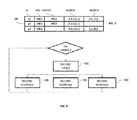
- Figure 4 represents in flow chart form the main steps of a particular embodiment of recording method in accordance with the invention.
- the recording of a pattern associated to one hand of a user comprises a step F10 of recording an identifier UID of this user in the record;
Landscapes
- Engineering & Computer Science (AREA)
- Theoretical Computer Science (AREA)
- Physics & Mathematics (AREA)
- Computer Security & Cryptography (AREA)
- General Physics & Mathematics (AREA)
- Psychiatry (AREA)
- Human Computer Interaction (AREA)
- Social Psychology (AREA)
- Health & Medical Sciences (AREA)
- Multimedia (AREA)
- General Health & Medical Sciences (AREA)
- Computer Vision & Pattern Recognition (AREA)
- Computer Hardware Design (AREA)
- Software Systems (AREA)
- General Engineering & Computer Science (AREA)
- User Interface Of Digital Computer (AREA)
Abstract
- at least one step among:
- a step (E10) of acquiring the coordinates of a plurality of fingertips contacts on said touchscreen device, of determining (E20), for at least one pair of said fingertips contacts, the distance between said fingertips contacts and (E30) of recording said distance in a first data structure ;
- a step (E40) of determining the order in which at least two fingertips have contacted said touchscreen device and (E50) of recording said order in a second data structure;
- a step (E60) of determining a duration during which a given number of fingertips are all together in contact with said touchscreen device and (E70) of recording said duration in a third data structure; and
- a step (E80) of comparing these data with corresponding data recorded in a database.
Description
- The field of the invention is the field of touch recognition systems, and more particularly the field of identification or recognition of persons manipulating a touchscreen device.
- A conventional method for identifying the user of a touchscreen device consists in verifying whether a numeral or graphical code input by the user matches a secret code selected by said user.
- This conventional method requires that the user remembers the above mentioned secret code.
- The present invention proposes a method for identifying a user of a touchscreen device which does not present the drawbacks of the conventional methods.
- More precisely, the invention relates to a method for identifying a user of a touchscreen device according to the geometry of their hand and/or to characteristics of the interaction of their fingertips with the touchscreen device.
- The invention proposes in particular to compare said geometry and/or interaction characteristics with information of the same type recorded in a database.
- A first aspect of the invention concerns a database comprising, for at least one hand of at least one user, a record for a pattern, said record comprising an identifier of said user, and at least one data structure among:
- a first data structure comprising, for at least one pair of fingers of said hand, a distance between the fingertips of said fingers;
- a second data structure comprising, for at least two fingers of said hand, an order assigned to said fingers for contacting a touchscreen device; and
- a third data structure comprising a time interval.
- A second aspect of the invention concerns a method of recording, in a database, a record for a pattern associated to one hand of one user, said method comprising:
- a step of recording an identifier of said user in said record; and
- at least one step among :
- recording in a first data structure of said record, for at least one pair of fingers of said hand, a distance between the fingertips of said fingers ;
- recording in a second data structure of said record, for at least two fingers of said hand, an order assigned to said fingers for contacting a touchscreen device;
- recording a time interval in a third data structure of said record.
- A third aspect of the invention relates to a method of identifying a user according to an hand tap having on a touchscreen device, this method comprising:
- at least one step among:
- a step of acquiring the coordinates of a plurality of fingertips contacts on said touchscreen device, of determining, for at least one pair of said fingertips contacts, the distance between said fingertips contacts and of recording same in a first data structure ;
- a step of determining the order in which at least two fingertips have contacted said touchscreen device and of recording same in a second data structure;
- a step of determining a duration for which a given number of fingertips are all together in contact with said touchscreen device and of recording same in a third data structure;
- a step of comparing at least one of said first, second or third data structure with the corresponding first, second or third data structure of at least one record for a pattern recorded in a database as mentioned above;
- a step of deciding whether this hand corresponds or not to said pattern according to the result of said comparison step and ; if it is the case
- a step of outputting the user identifier recorded in the record for this pattern.
- The invention provides three fundamental features for recognizing the hand of a user:
- first, according to the distance between fingertips positions on the touchscreen; the basis for the use of these distances coming from the fact that every person has a different hand geometry or shape;
- second, according to the order in which fingertips are collected from the touchscreen, for example middle finger first, then thumb, ring finger, index finger and baby finger;
- third, according to the time interval during which all or a predetermined number of fingertips are all together in contact with the touch screen.
- The invention therefore relates both (1) to the registration of biometric information for creating the database and (2) to the identification or recognition of a user by collecting their fingertips contacts characteristics and comparing said contacts with data sets stored in the database.
- In one particular embodiment, the comparison of two data structures for comparing the user biometric information collected on the touch screen and the data sets in the database uses a Support Vector Machine classifier.
- The invention also relates to a touchscreen device comprising:
- means for acquiring the coordinates of a plurality of fingertips contacts on said touchscreen device;
- means for determining for at least one pair of said fingertips contacts, the distance between said fingertips contacts and for recording said distance in a first data structure ;
- means for determining the order in which at least two fingertips have contacted said touchscreen device and means for recording said order in a second data structure;
- means for determining a duration during which a given number of fingertips are all together in contact with said touchscreen device and means for recording same in a third data structure;
- means for comparing at least one of said first, second or third data structure with the corresponding first, second or third data structure of at least one record for a pattern recorded in a database as mentioned above; and
- means for deciding whether said hand corresponds or not to the hand associated with said record according to the result of said comparison step ; and
- means for outputting the user identifier recorded in said record.
- In one particular embodiment, the various steps of the recording method and/or the identifying method are determined by instructions of computer programs.
- Consequently, the invention is also directed to a computer program on an information medium and which can be executed in a mobile terminal or more generally in a computer and includes instructions for executing the steps of the above recording method and/or the above identifying method.
- The program can use any programming language and take the form of source code, object code, or a code intermediate between source code and object code, such as a partially compiled form, or in any other suitable form.
- The invention is also directed to a computer-readable information medium containing instructions of the above computer program.
- The information medium can be any entity or device capable of storing the program, for example storage means, such as a read only memory (ROM), for example a CD ROM or a microelectronic circuit ROM, or magnetic storage means, for example a floppy disk or a hard disk.
- The information medium can instead be a transmissible medium such as an electrical or optical signal, which can be conveyed via an electrical or optical cable, by radio or by other means. The program of the invention can in particular be downloaded over an Internet type network.
- Alternatively, the information medium can be an integrated circuit into which the program is incorporated, the integrated circuit executing the method in question or being used in its execution.
- Other characteristics and advantages of the present invention appear from the following description made with reference to the accompanying drawings that show an embodiment without any limiting character. In the figures:
-
Figure 1 shows a touchscreen device in accordance with the invention; -
Figure 2 shows a database in accordance with the invention; -
Figure 3 shows, in the form of a flow chart, the main steps of a method of identifying a user in accordance with the invention; and -
Figure 4 shows, in the form of a flowchart, the main steps of a method of creating a record in a database in accordance with the invention. -
Figure 1 shows atouchscreen device 10 in accordance with the invention. In this specific embodiment, the touch screen device has the hardware architecture of a conventional computer. In particular, it comprises aprocessor 11, a read/writememory 12 of the random access memory (RAM) type, and a read-only memory 13 having recorded therein a computer program according to the invention and including instructions for executing the steps of the method represented by the flow chart shown inFigure 3 . - The
touchscreen device 10 also comprises a display 14 for displaying the identifier of a user when the user manipulating the touchscreen has been recognized according to the method of the invention. - In the example of
Figure 1 , we consider that the fingertips of the users contact the touchscreen according to the order below: - 1st contact: thumb (1st finger)
- 2nd contact: ring finger (4th finger)
- 3rd contact: middle finger (3rd finger)
- 4th contact: baby finger (5th finger); and
- 5th contact: index finger (2nd finger)
- This sequence can be represented as follows {1, 4, 3, 5, 2}.
- In this description, di,j represents the distance between the contacts of fingertips i and j on the touchscreen, with:
- i, j = 1 for the thumb
- i, j = 2 for the index finger
- i, j = 3 for the middle finger
- i, j = 4 for ring finger
- i, j = 5 for the baby finger.
- Only d1,2 (distance between the thumb and the index finger) and d1,5 (distance between the thumb and the baby finger) are represented for purpose of clarity.
- In this example we also consider that the 5 fingers remained all together in contact with the
touchscreen device 10 during 2,3s. - The
touchscreen device 10 can access a database DB which will now be described in reference withFigure 2 . - This database DB comprises 3 patterns p= p1, p2, p3, each pattern p being associated with a record comprising the identifier UID of a user and information relative to the geometry of their hand and/or to the characteristics of the interaction of their fingertips with the touchscreen device.
- Two patterns may be associated with the same user: in
figure 2 ; p2 and p3 are both patterns of the same user UID2. - A record for a pattern may comprise one or several data structures among a so called first data structure DS1REF, a so called second data structure DS2REF and a so called third data structure DS3REF.
- The first data structure DS1REF, which is optional, comprises a matrix (e.g. MD1, MD2), the elements di,j=1...5 thereof representing the distances between fingertips i and j as described before.
- The second data structure DS2REF, which is optional, comprises a sequence (e.g. {1, 4, 3, 5, 2}) representing the order in which fingertips are collected from the
touchscreen 10. - The third data structure DS3REF, which is optional, comprises a time interval, for example [2s, 3s].
-
Figure 3 represents in flow chart form the main steps of a particular embodiment of a method in accordance with the invention of identifying a user manipulating thetouchscreen device 10. - As a general overview, this method consists first in collecting information relative to the geometry of their hand and/or to the characteristics of the interaction of their fingertips with the touchscreen device (steps E10 to E70), second in comparing this information with patterns of the database DB for recognizing or not the user (steps E80 to E100).
- Step E10 is a step of acquiring the coordinates of a plurality of fingertips contacts on the touchscreen device, preferably 4 or 5.
- Step E10 is followed by a step E20 of determining for at least one pair of said fingertips contacts, the distance between said fingertips contacts. Preferably the distance is calculated for each possible pair of fingers among 4 or 5 fingers. These distances form the elements of the matrix of distances MD1, MD2 already mentioned.
- Step E30 is a step of recording the matrix in a first data structure DS1.
- Step E40 is a step of determining the order in which at least two fingertips (preferably 4 or 5) have contacted the
touchscreen device 10. Infigure 2 , the order 0 means that the corresponding finger did not contact the screen. Step E50 is a step of recording the sequence of orders in a second data structure DS2. - Step E60 is a step of determining a duration during which a given number of fingertips (preferably 4 or 5) are all together in contact with the
touchscreen device 10. Step E70 is a step of recording this duration in a third data structure DS3. - Once at least one of the data structures DS1, DS2 or DS3 has been obtained, the identifying method of the invention comprises a step E80 of comparing at least one of said first, second or third data structure DS1, DS2, DS3 with the corresponding first, second or third data structure DS1REF, DS2REF, DS3REF of at least one record for a pattern p1, p2, P3 recorded in the database DB.
- Comparing DS1 and DS1REF data structures consist in comparing two matrixes of distance.
- Comparing DS2 and DS2REF data structures consist in comparing two sequences of orders.
- Comparing DS3 and DS3REF data structures consist in checking whether a duration is comprised within a time interval.
- The comparison step E80 is followed by a step E90 of deciding whether the hand in contact with the screen corresponds or not to pattern p1, p2, p3 or not.
- If it is the case, the user identifier UID1, UID2 recorded in the record for this pattern is displayed on display 14.
- The invention also relates to the creation of the records for the patterns in the database DB.
-
Figure 4 represents in flow chart form the main steps of a particular embodiment of recording method in accordance with the invention. - The recording of a pattern associated to one hand of a user comprises a step F10 of recording an identifier UID of this user in the record; and
- at least one step among :
- recording F20 in the first data structure DS1REF of said record, for at least one pair of fingers of the hand (preferably 4 or 5), a distance between the fingertips of these fingers ;
- recording F30 in the second data structure DS2REF of said record, for at least two fingers of said hand, preferably 4 or 5, an order assigned to said fingers;
- recording F40 a time interval in a third data structure DS1REF of said record.
Claims (7)
- A database (DB) comprising, for at least one hand of at least one user, a record for a pattern (p), said record comprising an identifier (UID) of said user, and at least one data structure among:- a first data structure (DS1REF) comprising, for at least one pair of fingers of said hand, a distance between the fingertips of said fingers;- a second data structure (DS2REF) comprising, for at least two fingers of said hand, an order assigned to said fingers for contacting a touchscreen device; and- a third data structure (DS3REF) comprising a time interval.
- A method of recording, in a database (DB), a record for a pattern associated to one hand of one user, said method comprising:- a step (F10) of recording an identifier (UID) of said user in said record; and- at least one step among :- recording (F20) in a first data structure of said record, for at least one pair of fingers of said hand, a distance between the fingertips of said fingers ;- recording (F30) in a second data structure of said record, for at least two fingers of said hand, an order assigned to said fingers for contacting a touchscreen device;- recording (F40) a time interval in a third data structure of said record.
- A method of identifying a user according to a hand tap on a touchscreen device, this method comprising:- at least one step among:- a step (E10) of acquiring the coordinates of a plurality of fingertips contacts on said touchscreen device, of determining (E20), for at least one pair of said fingertips contacts, the distance between said fingertips contacts and (E30) of recording said distance in a first data structure ;- a step (E40) of determining the order in which at least two fingertips have contacted said touchscreen device and (E50) of recording said order in a second data structure;- a step (E60) of determining a duration during which a given number of fingertips are all together in contact with said touchscreen device and (E70) of recording said duration in a third data structure;- a step (E80) of comparing at least one of said first, second or third data structure with the corresponding first, second or third data structure of at least one record for a pattern recorded in a database according to Claim 1; and- a step (E90) of deciding whether said hand corresponds or not to said pattern according to the result of said comparison step and ; if it is the case- a step (E100) of outputting the user identifier recorded in the record for said pattern.
- A method according to Claim 3, characterized in that said step (E70) of comparing two data structures uses a Support Vector Machine classifier.
- A touchscreen device (10) comprising:- means for acquiring the coordinates of a plurality of fingertips contacts on said touchscreen device;- means for determining for at least one pair of said fingertips contacts, the distance between said fingertips contacts and for recording said distance in a first data structure ;- means for determining the order in which at least two fingertips have contacted said touchscreen device and means for recording said order in a second data structure;- means for determining a duration during which a given number of fingertips are all together in contact with said touchscreen device and means for recording said duration in a third data structure;- means for comparing at least one of said first, second or third data structure with the corresponding first, second or third data structure of at least one record for a pattern recorded in a database according to Claim 1;- means for deciding whether said hand corresponds or not to the hand associated with said record according to the result of said comparison step ; and- means for outputting the user identifier recorded in said record.
- A computer program including instructions for executing steps of the identifying method according to claims 3 or 4 when said program is executed by a computer.
- A computer-readable storage medium (13) on which is stored a computer program comprising instructions for executing the steps of the identifying method according to claims 3 or 4.
Priority Applications (1)
| Application Number | Priority Date | Filing Date | Title |
|---|---|---|---|
| EP12199334.9A EP2746988B1 (en) | 2012-12-24 | 2012-12-24 | Method for identifying a user manipulating a touchscreen device |
Applications Claiming Priority (1)
| Application Number | Priority Date | Filing Date | Title |
|---|---|---|---|
| EP12199334.9A EP2746988B1 (en) | 2012-12-24 | 2012-12-24 | Method for identifying a user manipulating a touchscreen device |
Publications (2)
| Publication Number | Publication Date |
|---|---|
| EP2746988A1 true EP2746988A1 (en) | 2014-06-25 |
| EP2746988B1 EP2746988B1 (en) | 2025-03-19 |
Family
ID=47504729
Family Applications (1)
| Application Number | Title | Priority Date | Filing Date |
|---|---|---|---|
| EP12199334.9A Active EP2746988B1 (en) | 2012-12-24 | 2012-12-24 | Method for identifying a user manipulating a touchscreen device |
Country Status (1)
| Country | Link |
|---|---|
| EP (1) | EP2746988B1 (en) |
Cited By (1)
| Publication number | Priority date | Publication date | Assignee | Title |
|---|---|---|---|---|
| CN104572936A (en) * | 2014-12-30 | 2015-04-29 | 苏州驰声信息科技有限公司 | Data management method and system for linear dynamic expansion |
Family Cites Families (1)
| Publication number | Priority date | Publication date | Assignee | Title |
|---|---|---|---|---|
| US8941466B2 (en) * | 2009-01-05 | 2015-01-27 | Polytechnic Institute Of New York University | User authentication for devices with touch sensitive elements, such as touch sensitive display screens |
-
2012
- 2012-12-24 EP EP12199334.9A patent/EP2746988B1/en active Active
Non-Patent Citations (2)
| Title |
|---|
| CHRISTOPHER VARENHORST: "Passdoodles; a Lightweight Authentication Method", INTERNET CITATION, 27 April 2004 (2004-04-27), pages I - II, XP002638827, Retrieved from the Internet <URL:http://people.csail.mit.edu/emax/papers/> [retrieved on 20110525] * |
| NAPA SAE-BAE ET AL: "Biometric-rich gestures", PROCEEDINGS OF THE 2012 ACM ANNUAL CONFERENCE ON HUMAN FACTORS IN COMPUTING SYSTEMS, CHI '12, 5 May 2012 (2012-05-05) - 10 May 2012 (2012-05-10), New York, New York, USA, pages 977, XP055084125, ISBN: 978-1-45-031015-4, DOI: 10.1145/2207676.2208543 * |
Cited By (2)
| Publication number | Priority date | Publication date | Assignee | Title |
|---|---|---|---|---|
| CN104572936A (en) * | 2014-12-30 | 2015-04-29 | 苏州驰声信息科技有限公司 | Data management method and system for linear dynamic expansion |
| CN104572936B (en) * | 2014-12-30 | 2018-07-13 | 苏州驰声信息科技有限公司 | A kind of data managing method and system of linear dynamic extending |
Also Published As
| Publication number | Publication date |
|---|---|
| EP2746988B1 (en) | 2025-03-19 |
Similar Documents
| Publication | Publication Date | Title |
|---|---|---|
| CN109316747B (en) | Game auxiliary information prompting method and device and electronic equipment | |
| EP3229516B1 (en) | Method and device for fingerprint registration and mobile terminal | |
| CN111782068B (en) | Method, device and system for generating mouse trajectory and method for processing data | |
| JP2008198132A (en) | Specific expression extraction program, specific expression extraction method, and specific expression extraction apparatus | |
| CN110245475A (en) | Auth method and device | |
| CN105324734A (en) | Tagging using eye gaze detection | |
| CN110795175A (en) | Method and device for analog control of intelligent terminal and intelligent terminal | |
| CN114917590B (en) | Virtual reality game system | |
| CN106504001A (en) | Method of payment and device in a kind of VR environment | |
| US20220294897A1 (en) | Systems and methods to manage models for call data | |
| KR20220053021A (en) | video game overlay | |
| JP6439434B2 (en) | Knowledge extraction editing program, knowledge extraction editing method, knowledge extraction editing apparatus, and knowledge extraction editing system | |
| KR102021700B1 (en) | System and method for rehabilitate language disorder custermized patient based on internet of things | |
| EP2746988B1 (en) | Method for identifying a user manipulating a touchscreen device | |
| CN103729059A (en) | Interactive method and device | |
| KR101422067B1 (en) | The method, device and server for providing game interface | |
| CN112364222B (en) | Regional portrait method of user age, computer equipment and storage medium | |
| CN114648900A (en) | Immersive interactive training method and system under VR combination | |
| CN113889143A (en) | Method and device for testing voice interaction performance, storage medium and processor | |
| CN113064982A (en) | Question-answer library generation method and related equipment | |
| WO2007026715A1 (en) | Simulation system and program | |
| CN104049932A (en) | Information processing method and electronic device | |
| US20240181343A1 (en) | System and method for individual player and team simulation | |
| CN118787947A (en) | A method, device, equipment and medium for dynamically generating interactive information based on user behavior data | |
| JP5694027B2 (en) | Authentication apparatus, method and program |
Legal Events
| Date | Code | Title | Description |
|---|---|---|---|
| PUAI | Public reference made under article 153(3) epc to a published international application that has entered the european phase |
Free format text: ORIGINAL CODE: 0009012 |
|
| 17P | Request for examination filed |
Effective date: 20121224 |
|
| AK | Designated contracting states |
Kind code of ref document: A1 Designated state(s): AL AT BE BG CH CY CZ DE DK EE ES FI FR GB GR HR HU IE IS IT LI LT LU LV MC MK MT NL NO PL PT RO RS SE SI SK SM TR |
|
| AX | Request for extension of the european patent |
Extension state: BA ME |
|
| R17P | Request for examination filed (corrected) |
Effective date: 20141224 |
|
| RBV | Designated contracting states (corrected) |
Designated state(s): AL AT BE BG CH CY CZ DE DK EE ES FI FR GB GR HR HU IE IS IT LI LT LU LV MC MK MT NL NO PL PT RO RS SE SI SK SM TR |
|
| STAA | Information on the status of an ep patent application or granted ep patent |
Free format text: STATUS: EXAMINATION IS IN PROGRESS |
|
| 17Q | First examination report despatched |
Effective date: 20170825 |
|
| RAP1 | Party data changed (applicant data changed or rights of an application transferred) |
Owner name: ORANGE |
|
| RAP3 | Party data changed (applicant data changed or rights of an application transferred) |
Owner name: ORANGE |
|
| REG | Reference to a national code |
Ref country code: DE Ref legal event code: R079 Free format text: PREVIOUS MAIN CLASS: G06K0009000000 Ipc: G06V0040200000 Ref country code: DE Ref legal event code: R079 Ref document number: 602012081419 Country of ref document: DE Free format text: PREVIOUS MAIN CLASS: G06K0009000000 Ipc: G06V0040200000 |
|
| RIC1 | Information provided on ipc code assigned before grant |
Ipc: G06V 40/20 20220101AFI20240924BHEP |
|
| GRAP | Despatch of communication of intention to grant a patent |
Free format text: ORIGINAL CODE: EPIDOSNIGR1 |
|
| STAA | Information on the status of an ep patent application or granted ep patent |
Free format text: STATUS: GRANT OF PATENT IS INTENDED |
|
| INTG | Intention to grant announced |
Effective date: 20241104 |
|
| GRAS | Grant fee paid |
Free format text: ORIGINAL CODE: EPIDOSNIGR3 |
|
| GRAA | (expected) grant |
Free format text: ORIGINAL CODE: 0009210 |
|
| STAA | Information on the status of an ep patent application or granted ep patent |
Free format text: STATUS: THE PATENT HAS BEEN GRANTED |
|
| AK | Designated contracting states |
Kind code of ref document: B1 Designated state(s): AL AT BE BG CH CY CZ DE DK EE ES FI FR GB GR HR HU IE IS IT LI LT LU LV MC MK MT NL NO PL PT RO RS SE SI SK SM TR |
|
| REG | Reference to a national code |
Ref country code: GB Ref legal event code: FG4D |
|
| REG | Reference to a national code |
Ref country code: CH Ref legal event code: EP |
|
| REG | Reference to a national code |
Ref country code: DE Ref legal event code: R096 Ref document number: 602012081419 Country of ref document: DE |
|
| REG | Reference to a national code |
Ref country code: IE Ref legal event code: FG4D |
|
| PG25 | Lapsed in a contracting state [announced via postgrant information from national office to epo] |
Ref country code: RS Free format text: LAPSE BECAUSE OF FAILURE TO SUBMIT A TRANSLATION OF THE DESCRIPTION OR TO PAY THE FEE WITHIN THE PRESCRIBED TIME-LIMIT Effective date: 20250619 |
|
| PG25 | Lapsed in a contracting state [announced via postgrant information from national office to epo] |
Ref country code: FI Free format text: LAPSE BECAUSE OF FAILURE TO SUBMIT A TRANSLATION OF THE DESCRIPTION OR TO PAY THE FEE WITHIN THE PRESCRIBED TIME-LIMIT Effective date: 20250319 |
|
| REG | Reference to a national code |
Ref country code: LT Ref legal event code: MG9D |
|
| PG25 | Lapsed in a contracting state [announced via postgrant information from national office to epo] |
Ref country code: NO Free format text: LAPSE BECAUSE OF FAILURE TO SUBMIT A TRANSLATION OF THE DESCRIPTION OR TO PAY THE FEE WITHIN THE PRESCRIBED TIME-LIMIT Effective date: 20250619 |
|
| PG25 | Lapsed in a contracting state [announced via postgrant information from national office to epo] |
Ref country code: HR Free format text: LAPSE BECAUSE OF FAILURE TO SUBMIT A TRANSLATION OF THE DESCRIPTION OR TO PAY THE FEE WITHIN THE PRESCRIBED TIME-LIMIT Effective date: 20250319 |
|
| PG25 | Lapsed in a contracting state [announced via postgrant information from national office to epo] |
Ref country code: LV Free format text: LAPSE BECAUSE OF FAILURE TO SUBMIT A TRANSLATION OF THE DESCRIPTION OR TO PAY THE FEE WITHIN THE PRESCRIBED TIME-LIMIT Effective date: 20250319 |
|
| PG25 | Lapsed in a contracting state [announced via postgrant information from national office to epo] |
Ref country code: GR Free format text: LAPSE BECAUSE OF FAILURE TO SUBMIT A TRANSLATION OF THE DESCRIPTION OR TO PAY THE FEE WITHIN THE PRESCRIBED TIME-LIMIT Effective date: 20250620 Ref country code: BG Free format text: LAPSE BECAUSE OF FAILURE TO SUBMIT A TRANSLATION OF THE DESCRIPTION OR TO PAY THE FEE WITHIN THE PRESCRIBED TIME-LIMIT Effective date: 20250319 |
|
| REG | Reference to a national code |
Ref country code: NL Ref legal event code: MP Effective date: 20250319 |
|
| REG | Reference to a national code |
Ref country code: AT Ref legal event code: MK05 Ref document number: 1777619 Country of ref document: AT Kind code of ref document: T Effective date: 20250319 |
|
| PG25 | Lapsed in a contracting state [announced via postgrant information from national office to epo] |
Ref country code: NL Free format text: LAPSE BECAUSE OF FAILURE TO SUBMIT A TRANSLATION OF THE DESCRIPTION OR TO PAY THE FEE WITHIN THE PRESCRIBED TIME-LIMIT Effective date: 20250319 |
|
| PG25 | Lapsed in a contracting state [announced via postgrant information from national office to epo] |
Ref country code: SE Free format text: LAPSE BECAUSE OF FAILURE TO SUBMIT A TRANSLATION OF THE DESCRIPTION OR TO PAY THE FEE WITHIN THE PRESCRIBED TIME-LIMIT Effective date: 20250319 |
|
| PG25 | Lapsed in a contracting state [announced via postgrant information from national office to epo] |
Ref country code: SM Free format text: LAPSE BECAUSE OF FAILURE TO SUBMIT A TRANSLATION OF THE DESCRIPTION OR TO PAY THE FEE WITHIN THE PRESCRIBED TIME-LIMIT Effective date: 20250319 |
|
| PG25 | Lapsed in a contracting state [announced via postgrant information from national office to epo] |
Ref country code: PT Free format text: LAPSE BECAUSE OF FAILURE TO SUBMIT A TRANSLATION OF THE DESCRIPTION OR TO PAY THE FEE WITHIN THE PRESCRIBED TIME-LIMIT Effective date: 20250721 Ref country code: ES Free format text: LAPSE BECAUSE OF FAILURE TO SUBMIT A TRANSLATION OF THE DESCRIPTION OR TO PAY THE FEE WITHIN THE PRESCRIBED TIME-LIMIT Effective date: 20250319 |
|
| PG25 | Lapsed in a contracting state [announced via postgrant information from national office to epo] |
Ref country code: PL Free format text: LAPSE BECAUSE OF FAILURE TO SUBMIT A TRANSLATION OF THE DESCRIPTION OR TO PAY THE FEE WITHIN THE PRESCRIBED TIME-LIMIT Effective date: 20250319 Ref country code: IT Free format text: LAPSE BECAUSE OF FAILURE TO SUBMIT A TRANSLATION OF THE DESCRIPTION OR TO PAY THE FEE WITHIN THE PRESCRIBED TIME-LIMIT Effective date: 20250319 |
|
| PG25 | Lapsed in a contracting state [announced via postgrant information from national office to epo] |
Ref country code: AT Free format text: LAPSE BECAUSE OF FAILURE TO SUBMIT A TRANSLATION OF THE DESCRIPTION OR TO PAY THE FEE WITHIN THE PRESCRIBED TIME-LIMIT Effective date: 20250319 |
|
| PG25 | Lapsed in a contracting state [announced via postgrant information from national office to epo] |
Ref country code: CZ Free format text: LAPSE BECAUSE OF FAILURE TO SUBMIT A TRANSLATION OF THE DESCRIPTION OR TO PAY THE FEE WITHIN THE PRESCRIBED TIME-LIMIT Effective date: 20250319 Ref country code: EE Free format text: LAPSE BECAUSE OF FAILURE TO SUBMIT A TRANSLATION OF THE DESCRIPTION OR TO PAY THE FEE WITHIN THE PRESCRIBED TIME-LIMIT Effective date: 20250319 |
|
| PG25 | Lapsed in a contracting state [announced via postgrant information from national office to epo] |
Ref country code: RO Free format text: LAPSE BECAUSE OF FAILURE TO SUBMIT A TRANSLATION OF THE DESCRIPTION OR TO PAY THE FEE WITHIN THE PRESCRIBED TIME-LIMIT Effective date: 20250319 |
|
| PG25 | Lapsed in a contracting state [announced via postgrant information from national office to epo] |
Ref country code: SK Free format text: LAPSE BECAUSE OF FAILURE TO SUBMIT A TRANSLATION OF THE DESCRIPTION OR TO PAY THE FEE WITHIN THE PRESCRIBED TIME-LIMIT Effective date: 20250319 |
|
| PG25 | Lapsed in a contracting state [announced via postgrant information from national office to epo] |
Ref country code: IS Free format text: LAPSE BECAUSE OF FAILURE TO SUBMIT A TRANSLATION OF THE DESCRIPTION OR TO PAY THE FEE WITHIN THE PRESCRIBED TIME-LIMIT Effective date: 20250719 |
|
| REG | Reference to a national code |
Ref country code: DE Ref legal event code: R097 Ref document number: 602012081419 Country of ref document: DE |
|
| PGFP | Annual fee paid to national office [announced via postgrant information from national office to epo] |
Ref country code: DE Payment date: 20251126 Year of fee payment: 14 |
|
| PGFP | Annual fee paid to national office [announced via postgrant information from national office to epo] |
Ref country code: GB Payment date: 20251119 Year of fee payment: 14 |
|
| PG25 | Lapsed in a contracting state [announced via postgrant information from national office to epo] |
Ref country code: DK Free format text: LAPSE BECAUSE OF FAILURE TO SUBMIT A TRANSLATION OF THE DESCRIPTION OR TO PAY THE FEE WITHIN THE PRESCRIBED TIME-LIMIT Effective date: 20250319 |
|
| PGFP | Annual fee paid to national office [announced via postgrant information from national office to epo] |
Ref country code: FR Payment date: 20251120 Year of fee payment: 14 |
|
| PLBE | No opposition filed within time limit |
Free format text: ORIGINAL CODE: 0009261 |
|
| STAA | Information on the status of an ep patent application or granted ep patent |
Free format text: STATUS: NO OPPOSITION FILED WITHIN TIME LIMIT |
|
| REG | Reference to a national code |
Ref country code: CH Ref legal event code: L10 Free format text: ST27 STATUS EVENT CODE: U-0-0-L10-L00 (AS PROVIDED BY THE NATIONAL OFFICE) Effective date: 20260128 |
|
| 26N | No opposition filed |
Effective date: 20251222 |
|
| PG25 | Lapsed in a contracting state [announced via postgrant information from national office to epo] |
Ref country code: LT Free format text: LAPSE BECAUSE OF FAILURE TO SUBMIT A TRANSLATION OF THE DESCRIPTION OR TO PAY THE FEE WITHIN THE PRESCRIBED TIME-LIMIT Effective date: 20250319 |
|
| PG25 | Lapsed in a contracting state [announced via postgrant information from national office to epo] |
Ref country code: MC Free format text: LAPSE BECAUSE OF FAILURE TO SUBMIT A TRANSLATION OF THE DESCRIPTION OR TO PAY THE FEE WITHIN THE PRESCRIBED TIME-LIMIT Effective date: 20250319 |
|
| REG | Reference to a national code |
Ref country code: CH Ref legal event code: H13 Free format text: ST27 STATUS EVENT CODE: U-0-0-H10-H13 (AS PROVIDED BY THE NATIONAL OFFICE) Effective date: 20260723 |