EP2746390A1 - Method for producing a recombinant protein of interest - Google Patents
Method for producing a recombinant protein of interest Download PDFInfo
- Publication number
- EP2746390A1 EP2746390A1 EP12198006.4A EP12198006A EP2746390A1 EP 2746390 A1 EP2746390 A1 EP 2746390A1 EP 12198006 A EP12198006 A EP 12198006A EP 2746390 A1 EP2746390 A1 EP 2746390A1
- Authority
- EP
- European Patent Office
- Prior art keywords
- protein
- interest
- pro
- urea
- inclusion bodies
- Prior art date
- Legal status (The legal status is an assumption and is not a legal conclusion. Google has not performed a legal analysis and makes no representation as to the accuracy of the status listed.)
- Withdrawn
Links
- 108010008281 Recombinant Fusion Proteins Proteins 0.000 title claims abstract description 16
- 102000007056 Recombinant Fusion Proteins Human genes 0.000 title claims abstract description 16
- 238000004519 manufacturing process Methods 0.000 title claims abstract description 14
- 108090000623 proteins and genes Proteins 0.000 claims abstract description 128
- 102000004169 proteins and genes Human genes 0.000 claims abstract description 126
- 210000003000 inclusion body Anatomy 0.000 claims abstract description 48
- 238000000034 method Methods 0.000 claims abstract description 42
- 102000037865 fusion proteins Human genes 0.000 claims abstract description 35
- 108020001507 fusion proteins Proteins 0.000 claims abstract description 35
- 230000003196 chaotropic effect Effects 0.000 claims abstract description 26
- XSQUKJJJFZCRTK-UHFFFAOYSA-N Urea Chemical compound NC(N)=O XSQUKJJJFZCRTK-UHFFFAOYSA-N 0.000 claims description 114
- 239000004202 carbamide Substances 0.000 claims description 58
- HEMHJVSKTPXQMS-UHFFFAOYSA-M Sodium hydroxide Chemical compound [OH-].[Na+] HEMHJVSKTPXQMS-UHFFFAOYSA-M 0.000 claims description 33
- 210000004027 cell Anatomy 0.000 claims description 31
- 238000003776 cleavage reaction Methods 0.000 claims description 25
- 230000007017 scission Effects 0.000 claims description 23
- 241000588724 Escherichia coli Species 0.000 claims description 11
- 108010050904 Interferons Proteins 0.000 claims description 5
- 102000014150 Interferons Human genes 0.000 claims description 5
- 230000001225 therapeutic effect Effects 0.000 claims description 4
- 241000282412 Homo Species 0.000 claims description 3
- 229940079322 interferon Drugs 0.000 claims description 3
- 238000011084 recovery Methods 0.000 claims description 3
- 239000000427 antigen Substances 0.000 claims description 2
- 102000036639 antigens Human genes 0.000 claims description 2
- 108091007433 antigens Proteins 0.000 claims description 2
- 238000002255 vaccination Methods 0.000 claims description 2
- 230000001105 regulatory effect Effects 0.000 claims 1
- 235000018102 proteins Nutrition 0.000 description 106
- PEDCQBHIVMGVHV-UHFFFAOYSA-N Glycerine Chemical compound OCC(O)CO PEDCQBHIVMGVHV-UHFFFAOYSA-N 0.000 description 78
- 108090000765 processed proteins & peptides Proteins 0.000 description 59
- FAPWRFPIFSIZLT-UHFFFAOYSA-M Sodium chloride Chemical compound [Na+].[Cl-] FAPWRFPIFSIZLT-UHFFFAOYSA-M 0.000 description 58
- 102000004196 processed proteins & peptides Human genes 0.000 description 46
- 229920001184 polypeptide Polymers 0.000 description 44
- 239000000872 buffer Substances 0.000 description 30
- 239000011780 sodium chloride Substances 0.000 description 29
- 239000000499 gel Substances 0.000 description 27
- XLYOFNOQVPJJNP-UHFFFAOYSA-N water Substances O XLYOFNOQVPJJNP-UHFFFAOYSA-N 0.000 description 25
- 239000000463 material Substances 0.000 description 24
- MNNHAPBLZZVQHP-UHFFFAOYSA-N diammonium hydrogen phosphate Chemical compound [NH4+].[NH4+].OP([O-])([O-])=O MNNHAPBLZZVQHP-UHFFFAOYSA-N 0.000 description 22
- 229910000388 diammonium phosphate Inorganic materials 0.000 description 22
- 230000004927 fusion Effects 0.000 description 20
- 230000000468 autoproteolytic effect Effects 0.000 description 19
- 229910052739 hydrogen Inorganic materials 0.000 description 19
- 239000001257 hydrogen Substances 0.000 description 19
- 230000014509 gene expression Effects 0.000 description 17
- 238000005516 engineering process Methods 0.000 description 15
- 239000011159 matrix material Substances 0.000 description 15
- 239000000203 mixture Substances 0.000 description 15
- 239000006228 supernatant Substances 0.000 description 15
- -1 halide ions Chemical class 0.000 description 14
- 230000008569 process Effects 0.000 description 13
- 239000007790 solid phase Substances 0.000 description 13
- 239000011324 bead Substances 0.000 description 12
- 239000003599 detergent Substances 0.000 description 12
- 239000003446 ligand Substances 0.000 description 12
- 238000004153 renaturation Methods 0.000 description 12
- 239000007787 solid Substances 0.000 description 12
- 102000002265 Human Growth Hormone Human genes 0.000 description 11
- 108010000521 Human Growth Hormone Proteins 0.000 description 11
- 239000000854 Human Growth Hormone Substances 0.000 description 11
- 230000000694 effects Effects 0.000 description 11
- 238000001042 affinity chromatography Methods 0.000 description 10
- 238000005119 centrifugation Methods 0.000 description 10
- 238000004587 chromatography analysis Methods 0.000 description 10
- PJJJBBJSCAKJQF-UHFFFAOYSA-N guanidinium chloride Chemical compound [Cl-].NC(N)=[NH2+] PJJJBBJSCAKJQF-UHFFFAOYSA-N 0.000 description 10
- 239000008188 pellet Substances 0.000 description 10
- 239000000126 substance Substances 0.000 description 10
- VYPSYNLAJGMNEJ-UHFFFAOYSA-N Silicium dioxide Chemical compound O=[Si]=O VYPSYNLAJGMNEJ-UHFFFAOYSA-N 0.000 description 9
- 239000000243 solution Substances 0.000 description 9
- 125000006850 spacer group Chemical group 0.000 description 9
- OWMVSZAMULFTJU-UHFFFAOYSA-N bis-tris Chemical compound OCCN(CCO)C(CO)(CO)CO OWMVSZAMULFTJU-UHFFFAOYSA-N 0.000 description 8
- 229920002678 cellulose Polymers 0.000 description 8
- 235000010980 cellulose Nutrition 0.000 description 8
- 238000006243 chemical reaction Methods 0.000 description 8
- 239000012723 sample buffer Substances 0.000 description 8
- 238000002415 sodium dodecyl sulfate polyacrylamide gel electrophoresis Methods 0.000 description 8
- YNJBWRMUSHSURL-UHFFFAOYSA-N trichloroacetic acid Chemical compound OC(=O)C(Cl)(Cl)Cl YNJBWRMUSHSURL-UHFFFAOYSA-N 0.000 description 8
- 241000710778 Pestivirus Species 0.000 description 7
- 239000007983 Tris buffer Substances 0.000 description 7
- 230000002776 aggregation Effects 0.000 description 7
- 238000004220 aggregation Methods 0.000 description 7
- 230000015572 biosynthetic process Effects 0.000 description 7
- 150000002500 ions Chemical class 0.000 description 7
- LENZDBCJOHFCAS-UHFFFAOYSA-N tris Chemical compound OCC(N)(CO)CO LENZDBCJOHFCAS-UHFFFAOYSA-N 0.000 description 7
- 229920000936 Agarose Polymers 0.000 description 6
- 235000001014 amino acid Nutrition 0.000 description 6
- 150000001413 amino acids Chemical class 0.000 description 6
- 239000001913 cellulose Substances 0.000 description 6
- 238000000326 densiometry Methods 0.000 description 6
- PBGKTOXHQIOBKM-FHFVDXKLSA-N insulin (human) Chemical compound C([C@@H](C(=O)N[C@@H](CC(C)C)C(=O)N[C@H]1CSSC[C@H]2C(=O)N[C@H](C(=O)N[C@@H](CO)C(=O)N[C@H](C(=O)N[C@H](C(N[C@@H](CO)C(=O)N[C@@H](CC(C)C)C(=O)N[C@@H](CC=3C=CC(O)=CC=3)C(=O)N[C@@H](CCC(N)=O)C(=O)N[C@@H](CC(C)C)C(=O)N[C@@H](CCC(O)=O)C(=O)N[C@@H](CC(N)=O)C(=O)N[C@@H](CC=3C=CC(O)=CC=3)C(=O)N[C@@H](CSSC[C@H](NC(=O)[C@H](C(C)C)NC(=O)[C@H](CC(C)C)NC(=O)[C@H](CC=3C=CC(O)=CC=3)NC(=O)[C@H](CC(C)C)NC(=O)[C@H](C)NC(=O)[C@H](CCC(O)=O)NC(=O)[C@H](C(C)C)NC(=O)[C@H](CC(C)C)NC(=O)[C@H](CC=3NC=NC=3)NC(=O)[C@H](CO)NC(=O)CNC1=O)C(=O)NCC(=O)N[C@@H](CCC(O)=O)C(=O)N[C@@H](CCCNC(N)=N)C(=O)NCC(=O)N[C@@H](CC=1C=CC=CC=1)C(=O)N[C@@H](CC=1C=CC=CC=1)C(=O)N[C@@H](CC=1C=CC(O)=CC=1)C(=O)N[C@@H]([C@@H](C)O)C(=O)N1[C@@H](CCC1)C(=O)N[C@@H](CCCCN)C(=O)N[C@@H]([C@@H](C)O)C(O)=O)C(=O)N[C@@H](CC(N)=O)C(O)=O)=O)CSSC[C@@H](C(N2)=O)NC(=O)[C@H](CCC(N)=O)NC(=O)[C@H](CCC(O)=O)NC(=O)[C@H](C(C)C)NC(=O)[C@@H](NC(=O)CN)[C@@H](C)CC)[C@@H](C)CC)[C@@H](C)O)NC(=O)[C@H](CCC(N)=O)NC(=O)[C@H](CC(N)=O)NC(=O)[C@@H](NC(=O)[C@@H](N)CC=1C=CC=CC=1)C(C)C)C1=CN=CN1 PBGKTOXHQIOBKM-FHFVDXKLSA-N 0.000 description 6
- 238000002360 preparation method Methods 0.000 description 6
- 239000000047 product Substances 0.000 description 6
- HDTRYLNUVZCQOY-UHFFFAOYSA-N α-D-glucopyranosyl-α-D-glucopyranoside Natural products OC1C(O)C(O)C(CO)OC1OC1C(O)C(O)C(O)C(CO)O1 HDTRYLNUVZCQOY-UHFFFAOYSA-N 0.000 description 5
- 229920002684 Sepharose Polymers 0.000 description 5
- HDTRYLNUVZCQOY-LIZSDCNHSA-N alpha,alpha-trehalose Chemical compound O[C@@H]1[C@@H](O)[C@H](O)[C@@H](CO)O[C@@H]1O[C@@H]1[C@H](O)[C@@H](O)[C@H](O)[C@@H](CO)O1 HDTRYLNUVZCQOY-LIZSDCNHSA-N 0.000 description 5
- 238000005277 cation exchange chromatography Methods 0.000 description 5
- 239000003795 chemical substances by application Substances 0.000 description 5
- VHJLVAABSRFDPM-QWWZWVQMSA-N dithiothreitol Chemical compound SC[C@@H](O)[C@H](O)CS VHJLVAABSRFDPM-QWWZWVQMSA-N 0.000 description 5
- 239000013604 expression vector Substances 0.000 description 5
- ZRALSGWEFCBTJO-UHFFFAOYSA-O guanidinium Chemical compound NC(N)=[NH2+] ZRALSGWEFCBTJO-UHFFFAOYSA-O 0.000 description 5
- 230000003993 interaction Effects 0.000 description 5
- 239000012528 membrane Substances 0.000 description 5
- 238000002264 polyacrylamide gel electrophoresis Methods 0.000 description 5
- 238000000746 purification Methods 0.000 description 5
- 230000009467 reduction Effects 0.000 description 5
- OGBMKVWORPGQRR-UMXFMPSGSA-N teriparatide Chemical compound C([C@H](NC(=O)[C@H](CCSC)NC(=O)[C@H](CC(C)C)NC(=O)[C@H](CCC(N)=O)NC(=O)[C@@H](NC(=O)[C@H](CCC(O)=O)NC(=O)[C@H](CO)NC(=O)[C@@H](NC(=O)[C@@H](N)CO)C(C)C)[C@@H](C)CC)C(=O)N[C@@H](CC(N)=O)C(=O)N[C@@H](CC(C)C)C(=O)NCC(=O)N[C@@H](CCCCN)C(=O)N[C@@H](CC=1N=CNC=1)C(=O)N[C@@H](CC(C)C)C(=O)N[C@@H](CC(N)=O)C(=O)N[C@@H](CO)C(=O)N[C@@H](CCSC)C(=O)N[C@@H](CCC(O)=O)C(=O)N[C@@H](CCCNC(N)=N)C(=O)N[C@@H](C(C)C)C(=O)N[C@@H](CCC(O)=O)C(=O)N[C@@H](CC=1C2=CC=CC=C2NC=1)C(=O)N[C@@H](CC(C)C)C(=O)N[C@@H](CCCNC(N)=N)C(=O)N[C@@H](CCCCN)C(=O)N[C@@H](CCCCN)C(=O)N[C@@H](CC(C)C)C(=O)N[C@@H](CCC(N)=O)C(=O)N[C@@H](CC(O)=O)C(=O)N[C@@H](C(C)C)C(=O)N[C@@H](CC=1N=CNC=1)C(=O)N[C@@H](CC(N)=O)C(=O)N[C@@H](CC=1C=CC=CC=1)C(O)=O)C1=CNC=N1 OGBMKVWORPGQRR-UMXFMPSGSA-N 0.000 description 5
- 229920002307 Dextran Polymers 0.000 description 4
- LFQSCWFLJHTTHZ-UHFFFAOYSA-N Ethanol Chemical compound CCO LFQSCWFLJHTTHZ-UHFFFAOYSA-N 0.000 description 4
- COCFEDIXXNGUNL-RFKWWTKHSA-N Insulin glargine Chemical compound C([C@@H](C(=O)N[C@@H](CC(C)C)C(=O)N[C@H]1CSSC[C@H]2C(=O)N[C@H](C(=O)N[C@@H](CO)C(=O)N[C@H](C(=O)N[C@H](C(N[C@@H](CO)C(=O)N[C@@H](CC(C)C)C(=O)N[C@@H](CC=3C=CC(O)=CC=3)C(=O)N[C@@H](CCC(N)=O)C(=O)N[C@@H](CC(C)C)C(=O)N[C@@H](CCC(O)=O)C(=O)N[C@@H](CC(N)=O)C(=O)N[C@@H](CC=3C=CC(O)=CC=3)C(=O)N[C@@H](CSSC[C@H](NC(=O)[C@H](C(C)C)NC(=O)[C@H](CC(C)C)NC(=O)[C@H](CC=3C=CC(O)=CC=3)NC(=O)[C@H](CC(C)C)NC(=O)[C@H](C)NC(=O)[C@H](CCC(O)=O)NC(=O)[C@H](C(C)C)NC(=O)[C@H](CC(C)C)NC(=O)[C@H](CC=3NC=NC=3)NC(=O)[C@H](CO)NC(=O)CNC1=O)C(=O)NCC(=O)N[C@@H](CCC(O)=O)C(=O)N[C@@H](CCCNC(N)=N)C(=O)NCC(=O)N[C@@H](CC=1C=CC=CC=1)C(=O)N[C@@H](CC=1C=CC=CC=1)C(=O)N[C@@H](CC=1C=CC(O)=CC=1)C(=O)N[C@@H]([C@@H](C)O)C(=O)N1[C@@H](CCC1)C(=O)N[C@@H](CCCCN)C(=O)N[C@@H]([C@@H](C)O)C(=O)N[C@@H](CCCNC(N)=N)C(=O)N[C@@H](CCCNC(N)=N)C(O)=O)C(=O)NCC(O)=O)=O)CSSC[C@@H](C(N2)=O)NC(=O)[C@H](CCC(N)=O)NC(=O)[C@H](CCC(O)=O)NC(=O)[C@H](C(C)C)NC(=O)[C@@H](NC(=O)CN)[C@@H](C)CC)[C@@H](C)CC)[C@@H](C)O)NC(=O)[C@H](CCC(N)=O)NC(=O)[C@H](CC(N)=O)NC(=O)[C@@H](NC(=O)[C@@H](N)CC=1C=CC=CC=1)C(C)C)C1=CN=CN1 COCFEDIXXNGUNL-RFKWWTKHSA-N 0.000 description 4
- 108010078049 Interferon alpha-2 Proteins 0.000 description 4
- 229910019142 PO4 Inorganic materials 0.000 description 4
- NBIIXXVUZAFLBC-UHFFFAOYSA-L Phosphate ion(2-) Chemical compound OP([O-])([O-])=O NBIIXXVUZAFLBC-UHFFFAOYSA-L 0.000 description 4
- 108010039918 Polylysine Proteins 0.000 description 4
- HDTRYLNUVZCQOY-WSWWMNSNSA-N Trehalose Natural products O[C@@H]1[C@@H](O)[C@@H](O)[C@@H](CO)O[C@@H]1O[C@@H]1[C@H](O)[C@@H](O)[C@@H](O)[C@@H](CO)O1 HDTRYLNUVZCQOY-WSWWMNSNSA-N 0.000 description 4
- 210000004899 c-terminal region Anatomy 0.000 description 4
- 150000001768 cations Chemical class 0.000 description 4
- 239000003153 chemical reaction reagent Substances 0.000 description 4
- 239000012504 chromatography matrix Substances 0.000 description 4
- 238000004925 denaturation Methods 0.000 description 4
- 230000036425 denaturation Effects 0.000 description 4
- 238000010790 dilution Methods 0.000 description 4
- 239000012895 dilution Substances 0.000 description 4
- 230000036571 hydration Effects 0.000 description 4
- 238000006703 hydration reaction Methods 0.000 description 4
- 230000002209 hydrophobic effect Effects 0.000 description 4
- 230000009878 intermolecular interaction Effects 0.000 description 4
- 239000002609 medium Substances 0.000 description 4
- 229910052751 metal Inorganic materials 0.000 description 4
- 239000002184 metal Substances 0.000 description 4
- 229910021645 metal ion Inorganic materials 0.000 description 4
- 108010092851 peginterferon alfa-2b Proteins 0.000 description 4
- NBIIXXVUZAFLBC-UHFFFAOYSA-K phosphate Chemical compound [O-]P([O-])([O-])=O NBIIXXVUZAFLBC-UHFFFAOYSA-K 0.000 description 4
- 229910052698 phosphorus Inorganic materials 0.000 description 4
- 229920000656 polylysine Polymers 0.000 description 4
- 150000003839 salts Chemical class 0.000 description 4
- 229960004532 somatropin Drugs 0.000 description 4
- 229960005460 teriparatide Drugs 0.000 description 4
- STMDPCBYJCIZOD-UHFFFAOYSA-N 2-(2,4-dinitroanilino)-4-methylpentanoic acid Chemical compound CC(C)CC(C(O)=O)NC1=CC=C([N+]([O-])=O)C=C1[N+]([O-])=O STMDPCBYJCIZOD-UHFFFAOYSA-N 0.000 description 3
- 229920001817 Agar Polymers 0.000 description 3
- BRLQWZUYTZBJKN-UHFFFAOYSA-N Epichlorohydrin Chemical compound ClCC1CO1 BRLQWZUYTZBJKN-UHFFFAOYSA-N 0.000 description 3
- 239000004593 Epoxy Substances 0.000 description 3
- 101000976075 Homo sapiens Insulin Proteins 0.000 description 3
- 108010057186 Insulin Glargine Proteins 0.000 description 3
- 108010005714 Interferon beta-1b Proteins 0.000 description 3
- PXHVJJICTQNCMI-UHFFFAOYSA-N Nickel Chemical compound [Ni] PXHVJJICTQNCMI-UHFFFAOYSA-N 0.000 description 3
- 108010076039 Polyproteins Proteins 0.000 description 3
- DBMJMQXJHONAFJ-UHFFFAOYSA-M Sodium laurylsulphate Chemical compound [Na+].CCCCCCCCCCCCOS([O-])(=O)=O DBMJMQXJHONAFJ-UHFFFAOYSA-M 0.000 description 3
- 108010049264 Teriparatide Proteins 0.000 description 3
- 230000003213 activating effect Effects 0.000 description 3
- 235000010419 agar Nutrition 0.000 description 3
- 238000005571 anion exchange chromatography Methods 0.000 description 3
- 230000008901 benefit Effects 0.000 description 3
- 239000013522 chelant Substances 0.000 description 3
- 239000003638 chemical reducing agent Substances 0.000 description 3
- XUJNEKJLAYXESH-UHFFFAOYSA-N cysteine Natural products SCC(N)C(O)=O XUJNEKJLAYXESH-UHFFFAOYSA-N 0.000 description 3
- 125000000151 cysteine group Chemical group N[C@@H](CS)C(=O)* 0.000 description 3
- 230000007423 decrease Effects 0.000 description 3
- 239000003814 drug Substances 0.000 description 3
- 239000011521 glass Substances 0.000 description 3
- JEGUKCSWCFPDGT-UHFFFAOYSA-N h2o hydrate Chemical compound O.O JEGUKCSWCFPDGT-UHFFFAOYSA-N 0.000 description 3
- 238000011534 incubation Methods 0.000 description 3
- 229910010272 inorganic material Inorganic materials 0.000 description 3
- 239000011147 inorganic material Substances 0.000 description 3
- 229960003507 interferon alfa-2b Drugs 0.000 description 3
- BPHPUYQFMNQIOC-NXRLNHOXSA-N isopropyl beta-D-thiogalactopyranoside Chemical compound CC(C)S[C@@H]1O[C@H](CO)[C@H](O)[C@H](O)[C@H]1O BPHPUYQFMNQIOC-NXRLNHOXSA-N 0.000 description 3
- 239000007788 liquid Substances 0.000 description 3
- 239000012160 loading buffer Substances 0.000 description 3
- 235000015097 nutrients Nutrition 0.000 description 3
- 239000011368 organic material Substances 0.000 description 3
- 239000002245 particle Substances 0.000 description 3
- 239000008194 pharmaceutical composition Substances 0.000 description 3
- 239000010452 phosphate Substances 0.000 description 3
- 229920000724 poly(L-arginine) polymer Polymers 0.000 description 3
- 108010011110 polyarginine Proteins 0.000 description 3
- 108010068072 salmon calcitonin Proteins 0.000 description 3
- MIXCUJKCXRNYFM-UHFFFAOYSA-M sodium;diiodomethanesulfonate;n-propyl-n-[2-(2,4,6-trichlorophenoxy)ethyl]imidazole-1-carboxamide Chemical compound [Na+].[O-]S(=O)(=O)C(I)I.C1=CN=CN1C(=O)N(CCC)CCOC1=C(Cl)C=C(Cl)C=C1Cl MIXCUJKCXRNYFM-UHFFFAOYSA-M 0.000 description 3
- 238000010186 staining Methods 0.000 description 3
- 239000000725 suspension Substances 0.000 description 3
- 239000013598 vector Substances 0.000 description 3
- 150000003923 2,5-pyrrolediones Chemical class 0.000 description 2
- FALRKNHUBBKYCC-UHFFFAOYSA-N 2-(chloromethyl)pyridine-3-carbonitrile Chemical compound ClCC1=NC=CC=C1C#N FALRKNHUBBKYCC-UHFFFAOYSA-N 0.000 description 2
- HPILSDOMLLYBQF-UHFFFAOYSA-N 2-[1-(oxiran-2-ylmethoxy)butoxymethyl]oxirane Chemical compound C1OC1COC(CCC)OCC1CO1 HPILSDOMLLYBQF-UHFFFAOYSA-N 0.000 description 2
- KHURTEAYLZEQHD-UHFFFAOYSA-N 3-n-propylpropane-1,1,3-triamine Chemical compound CCCNCCC(N)N KHURTEAYLZEQHD-UHFFFAOYSA-N 0.000 description 2
- XYVMOLOUBJBNBF-UHFFFAOYSA-N 3h-1,3-oxazol-2-one Chemical class OC1=NC=CO1 XYVMOLOUBJBNBF-UHFFFAOYSA-N 0.000 description 2
- RTNUTCOTGVKVBR-UHFFFAOYSA-N 4-chlorotriazine Chemical class ClC1=CC=NN=N1 RTNUTCOTGVKVBR-UHFFFAOYSA-N 0.000 description 2
- HRPVXLWXLXDGHG-UHFFFAOYSA-N Acrylamide Chemical compound NC(=O)C=C HRPVXLWXLXDGHG-UHFFFAOYSA-N 0.000 description 2
- 239000002028 Biomass Substances 0.000 description 2
- 101800000407 Brain natriuretic peptide 32 Proteins 0.000 description 2
- 241000710777 Classical swine fever virus Species 0.000 description 2
- 108010029961 Filgrastim Proteins 0.000 description 2
- 241000206672 Gelidium Species 0.000 description 2
- 108010070675 Glutathione transferase Proteins 0.000 description 2
- 102100039619 Granulocyte colony-stimulating factor Human genes 0.000 description 2
- 102000018997 Growth Hormone Human genes 0.000 description 2
- 108010051696 Growth Hormone Proteins 0.000 description 2
- ZRALSGWEFCBTJO-UHFFFAOYSA-N Guanidine Chemical compound NC(N)=N ZRALSGWEFCBTJO-UHFFFAOYSA-N 0.000 description 2
- 102100029100 Hematopoietic prostaglandin D synthase Human genes 0.000 description 2
- 229920002153 Hydroxypropyl cellulose Polymers 0.000 description 2
- 108010065920 Insulin Lispro Proteins 0.000 description 2
- 102000051628 Interleukin-1 receptor antagonist Human genes 0.000 description 2
- 108700021006 Interleukin-1 receptor antagonist Proteins 0.000 description 2
- XEEYBQQBJWHFJM-UHFFFAOYSA-N Iron Chemical compound [Fe] XEEYBQQBJWHFJM-UHFFFAOYSA-N 0.000 description 2
- 102100038166 Keratin-associated protein 10-4 Human genes 0.000 description 2
- 101710179654 Keratin-associated protein 10-4 Proteins 0.000 description 2
- TWRXJAOTZQYOKJ-UHFFFAOYSA-L Magnesium chloride Chemical compound [Mg+2].[Cl-].[Cl-] TWRXJAOTZQYOKJ-UHFFFAOYSA-L 0.000 description 2
- 101710175625 Maltose/maltodextrin-binding periplasmic protein Proteins 0.000 description 2
- LRHPLDYGYMQRHN-UHFFFAOYSA-N N-Butanol Chemical compound CCCCO LRHPLDYGYMQRHN-UHFFFAOYSA-N 0.000 description 2
- BACYUWVYYTXETD-UHFFFAOYSA-N N-Lauroylsarcosine Chemical compound CCCCCCCCCCCC(=O)N(C)CC(O)=O BACYUWVYYTXETD-UHFFFAOYSA-N 0.000 description 2
- 238000005481 NMR spectroscopy Methods 0.000 description 2
- 108010038807 Oligopeptides Proteins 0.000 description 2
- 102000015636 Oligopeptides Human genes 0.000 description 2
- 108091005804 Peptidases Proteins 0.000 description 2
- ISWSIDIOOBJBQZ-UHFFFAOYSA-N Phenol Chemical compound OC1=CC=CC=C1 ISWSIDIOOBJBQZ-UHFFFAOYSA-N 0.000 description 2
- 239000004952 Polyamide Substances 0.000 description 2
- 239000002202 Polyethylene glycol Substances 0.000 description 2
- 102100029522 Pre-mRNA-processing factor 19 Human genes 0.000 description 2
- 101710124492 Pre-mRNA-processing factor 19 Proteins 0.000 description 2
- 239000004365 Protease Substances 0.000 description 2
- 101100084022 Pseudomonas aeruginosa (strain ATCC 15692 / DSM 22644 / CIP 104116 / JCM 14847 / LMG 12228 / 1C / PRS 101 / PAO1) lapA gene Proteins 0.000 description 2
- 102400000827 Saposin-D Human genes 0.000 description 2
- 239000012506 Sephacryl® Substances 0.000 description 2
- 229920005654 Sephadex Polymers 0.000 description 2
- 239000012507 Sephadex™ Substances 0.000 description 2
- 239000012505 Superdex™ Substances 0.000 description 2
- 150000001299 aldehydes Chemical class 0.000 description 2
- 150000007824 aliphatic compounds Chemical class 0.000 description 2
- 150000001450 anions Chemical class 0.000 description 2
- RCHHVVGSTHAVPF-ZPHPLDECSA-N apidra Chemical compound C([C@@H](C(=O)N[C@@H](CC(C)C)C(=O)N[C@H]1CSSC[C@H]2C(=O)N[C@H](C(=O)N[C@@H](CO)C(=O)N[C@H](C(=O)N[C@H](C(N[C@@H](CO)C(=O)N[C@@H](CC(C)C)C(=O)N[C@@H](CC=3C=CC(O)=CC=3)C(=O)N[C@@H](CCC(N)=O)C(=O)N[C@@H](CC(C)C)C(=O)N[C@@H](CCC(O)=O)C(=O)N[C@@H](CC(N)=O)C(=O)N[C@@H](CC=3C=CC(O)=CC=3)C(=O)N[C@@H](CSSC[C@H](NC(=O)[C@H](C(C)C)NC(=O)[C@H](CC(C)C)NC(=O)[C@H](CC=3C=CC(O)=CC=3)NC(=O)[C@H](CC(C)C)NC(=O)[C@H](C)NC(=O)[C@H](CCC(O)=O)NC(=O)[C@H](C(C)C)NC(=O)[C@H](CC(C)C)NC(=O)[C@H](CC=3N=CNC=3)NC(=O)[C@H](CO)NC(=O)CNC1=O)C(=O)NCC(=O)N[C@@H](CCC(O)=O)C(=O)N[C@@H](CCCNC(N)=N)C(=O)NCC(=O)N[C@@H](CC=1C=CC=CC=1)C(=O)N[C@@H](CC=1C=CC=CC=1)C(=O)N[C@@H](CC=1C=CC(O)=CC=1)C(=O)N[C@@H]([C@@H](C)O)C(=O)N1[C@@H](CCC1)C(=O)N[C@@H](CCC(O)=O)C(=O)N[C@@H]([C@@H](C)O)C(O)=O)C(=O)N[C@@H](CC(N)=O)C(O)=O)=O)CSSC[C@@H](C(N2)=O)NC(=O)[C@H](CCC(N)=O)NC(=O)[C@H](CCC(O)=O)NC(=O)[C@H](C(C)C)NC(=O)[C@@H](NC(=O)CN)[C@@H](C)CC)[C@@H](C)CC)[C@@H](C)O)NC(=O)[C@H](CCC(N)=O)NC(=O)[C@H](CCCCN)NC(=O)[C@@H](NC(=O)[C@@H](N)CC=1C=CC=CC=1)C(C)C)C1=CNC=N1 RCHHVVGSTHAVPF-ZPHPLDECSA-N 0.000 description 2
- 230000001580 bacterial effect Effects 0.000 description 2
- 230000004071 biological effect Effects 0.000 description 2
- 229920003086 cellulose ether Polymers 0.000 description 2
- WOWHHFRSBJGXCM-UHFFFAOYSA-M cetyltrimethylammonium chloride Chemical compound [Cl-].CCCCCCCCCCCCCCCC[N+](C)(C)C WOWHHFRSBJGXCM-UHFFFAOYSA-M 0.000 description 2
- 229920001577 copolymer Polymers 0.000 description 2
- ATDGTVJJHBUTRL-UHFFFAOYSA-N cyanogen bromide Chemical compound BrC#N ATDGTVJJHBUTRL-UHFFFAOYSA-N 0.000 description 2
- 235000018417 cysteine Nutrition 0.000 description 2
- 230000009089 cytolysis Effects 0.000 description 2
- 210000000805 cytoplasm Anatomy 0.000 description 2
- 230000003247 decreasing effect Effects 0.000 description 2
- 238000012217 deletion Methods 0.000 description 2
- 230000037430 deletion Effects 0.000 description 2
- 239000003398 denaturant Substances 0.000 description 2
- 108010017271 denileukin diftitox Proteins 0.000 description 2
- 238000010217 densitometric analysis Methods 0.000 description 2
- 230000001419 dependent effect Effects 0.000 description 2
- 208000037265 diseases, disorders, signs and symptoms Diseases 0.000 description 2
- 208000035475 disorder Diseases 0.000 description 2
- 239000006185 dispersion Substances 0.000 description 2
- AFOSIXZFDONLBT-UHFFFAOYSA-N divinyl sulfone Chemical compound C=CS(=O)(=O)C=C AFOSIXZFDONLBT-UHFFFAOYSA-N 0.000 description 2
- 230000008030 elimination Effects 0.000 description 2
- 238000003379 elimination reaction Methods 0.000 description 2
- 230000002255 enzymatic effect Effects 0.000 description 2
- GKIPXFAANLTWBM-UHFFFAOYSA-N epibromohydrin Chemical compound BrCC1CO1 GKIPXFAANLTWBM-UHFFFAOYSA-N 0.000 description 2
- 230000001747 exhibiting effect Effects 0.000 description 2
- 239000012467 final product Substances 0.000 description 2
- 238000009472 formulation Methods 0.000 description 2
- 238000001502 gel electrophoresis Methods 0.000 description 2
- 239000003102 growth factor Substances 0.000 description 2
- 229960004198 guanidine Drugs 0.000 description 2
- WNRQPCUGRUFHED-DETKDSODSA-N humalog Chemical compound C([C@H](NC(=O)[C@H](CC(C)C)NC(=O)[C@H](CO)NC(=O)[C@H](CS)NC(=O)[C@H]([C@@H](C)CC)NC(=O)[C@H](CO)NC(=O)[C@H]([C@@H](C)O)NC(=O)[C@H](CS)NC(=O)[C@H](CS)NC(=O)[C@H](CCC(N)=O)NC(=O)[C@H](CCC(O)=O)NC(=O)[C@H](C(C)C)NC(=O)[C@@H](NC(=O)CN)[C@@H](C)CC)C(=O)N[C@@H](CCC(N)=O)C(=O)N[C@@H](CC(C)C)C(=O)N[C@@H](CCC(O)=O)C(=O)N[C@@H](CC(N)=O)C(=O)N[C@@H](CC=1C=CC(O)=CC=1)C(=O)N[C@@H](CS)C(=O)N[C@@H](CC(N)=O)C(O)=O)C1=CC=C(O)C=C1.C([C@@H](C(=O)N[C@@H](CC(C)C)C(=O)N[C@H](C(=O)N[C@@H](CCC(O)=O)C(=O)N[C@@H](C)C(=O)N[C@@H](CC(C)C)C(=O)N[C@@H](CC=1C=CC(O)=CC=1)C(=O)N[C@@H](CC(C)C)C(=O)N[C@@H](C(C)C)C(=O)N[C@@H](CS)C(=O)NCC(=O)N[C@@H](CCC(O)=O)C(=O)N[C@@H](CCCNC(N)=N)C(=O)NCC(=O)N[C@@H](CC=1C=CC=CC=1)C(=O)N[C@@H](CC=1C=CC=CC=1)C(=O)N[C@@H](CC=1C=CC(O)=CC=1)C(=O)N[C@@H]([C@@H](C)O)C(=O)N[C@@H](CCCCN)C(=O)N1[C@@H](CCC1)C(=O)N[C@@H]([C@@H](C)O)C(O)=O)C(C)C)NC(=O)[C@H](CO)NC(=O)CNC(=O)[C@H](CS)NC(=O)[C@H](CC(C)C)NC(=O)[C@H](CC=1NC=NC=1)NC(=O)[C@H](CCC(N)=O)NC(=O)[C@H](CC(N)=O)NC(=O)[C@@H](NC(=O)[C@@H](N)CC=1C=CC=CC=1)C(C)C)C1=CN=CN1 WNRQPCUGRUFHED-DETKDSODSA-N 0.000 description 2
- 229940042795 hydrazides for tuberculosis treatment Drugs 0.000 description 2
- 239000001863 hydroxypropyl cellulose Substances 0.000 description 2
- 235000010977 hydroxypropyl cellulose Nutrition 0.000 description 2
- 230000001976 improved effect Effects 0.000 description 2
- 230000006872 improvement Effects 0.000 description 2
- 238000001727 in vivo Methods 0.000 description 2
- 229960002869 insulin glargine Drugs 0.000 description 2
- 108700039926 insulin glulisine Proteins 0.000 description 2
- 229950004152 insulin human Drugs 0.000 description 2
- 108010010648 interferon alfacon-1 Proteins 0.000 description 2
- 108010042414 interferon gamma-1b Proteins 0.000 description 2
- 229940047124 interferons Drugs 0.000 description 2
- 230000008863 intramolecular interaction Effects 0.000 description 2
- 230000001788 irregular Effects 0.000 description 2
- 238000002955 isolation Methods 0.000 description 2
- YFVGRULMIQXYNE-UHFFFAOYSA-M lithium;dodecyl sulfate Chemical compound [Li+].CCCCCCCCCCCCOS([O-])(=O)=O YFVGRULMIQXYNE-UHFFFAOYSA-M 0.000 description 2
- 229920002521 macromolecule Polymers 0.000 description 2
- 108010000594 mecasermin Proteins 0.000 description 2
- 238000001471 micro-filtration Methods 0.000 description 2
- 108010046821 oprelvekin Proteins 0.000 description 2
- 108010044644 pegfilgrastim Proteins 0.000 description 2
- 108010092853 peginterferon alfa-2a Proteins 0.000 description 2
- 229960003931 peginterferon alfa-2b Drugs 0.000 description 2
- 108700037519 pegvisomant Proteins 0.000 description 2
- 239000012071 phase Substances 0.000 description 2
- 101150009573 phoA gene Proteins 0.000 description 2
- 229920002647 polyamide Polymers 0.000 description 2
- 108010052780 polyasparagine Proteins 0.000 description 2
- 229920001223 polyethylene glycol Polymers 0.000 description 2
- 229920002451 polyvinyl alcohol Polymers 0.000 description 2
- 235000019422 polyvinyl alcohol Nutrition 0.000 description 2
- 239000011148 porous material Substances 0.000 description 2
- 229960000856 protein c Drugs 0.000 description 2
- 230000002797 proteolythic effect Effects 0.000 description 2
- 150000004053 quinones Chemical class 0.000 description 2
- 230000002829 reductive effect Effects 0.000 description 2
- 108010051412 reteplase Proteins 0.000 description 2
- 239000000523 sample Substances 0.000 description 2
- 108700004121 sarkosyl Proteins 0.000 description 2
- 238000000926 separation method Methods 0.000 description 2
- 239000000377 silicon dioxide Substances 0.000 description 2
- 235000012239 silicon dioxide Nutrition 0.000 description 2
- JQWHASGSAFIOCM-UHFFFAOYSA-M sodium periodate Chemical compound [Na+].[O-]I(=O)(=O)=O JQWHASGSAFIOCM-UHFFFAOYSA-M 0.000 description 2
- 108700031632 somatrem Proteins 0.000 description 2
- 108090000250 sortase A Proteins 0.000 description 2
- 229940014800 succinic anhydride Drugs 0.000 description 2
- 235000000346 sugar Nutrition 0.000 description 2
- 230000008093 supporting effect Effects 0.000 description 2
- 238000003786 synthesis reaction Methods 0.000 description 2
- UMGDCJDMYOKAJW-UHFFFAOYSA-N thiourea Chemical compound NC(N)=S UMGDCJDMYOKAJW-UHFFFAOYSA-N 0.000 description 2
- 231100000331 toxic Toxicity 0.000 description 2
- 230000002588 toxic effect Effects 0.000 description 2
- UYPYRKYUKCHHIB-UHFFFAOYSA-N trimethylamine N-oxide Chemical compound C[N+](C)(C)[O-] UYPYRKYUKCHHIB-UHFFFAOYSA-N 0.000 description 2
- 238000002460 vibrational spectroscopy Methods 0.000 description 2
- DGVVWUTYPXICAM-UHFFFAOYSA-N β‐Mercaptoethanol Chemical compound OCCS DGVVWUTYPXICAM-UHFFFAOYSA-N 0.000 description 2
- HMLGSIZOMSVISS-ONJSNURVSA-N (7r)-7-[[(2z)-2-(2-amino-1,3-thiazol-4-yl)-2-(2,2-dimethylpropanoyloxymethoxyimino)acetyl]amino]-3-ethenyl-8-oxo-5-thia-1-azabicyclo[4.2.0]oct-2-ene-2-carboxylic acid Chemical compound N([C@@H]1C(N2C(=C(C=C)CSC21)C(O)=O)=O)C(=O)\C(=N/OCOC(=O)C(C)(C)C)C1=CSC(N)=N1 HMLGSIZOMSVISS-ONJSNURVSA-N 0.000 description 1
- XEPXTKKIWBPAEG-UHFFFAOYSA-N 1,1-dichloropropan-1-ol Chemical compound CCC(O)(Cl)Cl XEPXTKKIWBPAEG-UHFFFAOYSA-N 0.000 description 1
- IEJPPSMHUUQABK-UHFFFAOYSA-N 2,4-diphenyl-4h-1,3-oxazol-5-one Chemical compound O=C1OC(C=2C=CC=CC=2)=NC1C1=CC=CC=C1 IEJPPSMHUUQABK-UHFFFAOYSA-N 0.000 description 1
- HPNRHPKXQZSDFX-UHFFFAOYSA-N 2-[[2-[[2-[[2-[[2-[[6-amino-2-[[52-[[2-[[2-[[2-[[5-amino-2-[[2-[[2-[[6-amino-2-[[1-(2-amino-3-hydroxypropanoyl)pyrrolidine-2-carbonyl]amino]hexanoyl]amino]-4-methylsulfanylbutanoyl]amino]-3-methylbutanoyl]amino]-5-oxopentanoyl]amino]acetyl]amino]-3-hydroxypropanoyl]amino]acetyl]amino]-40-(4-aminobutyl)-49-benzyl-28-butan-2-yl-31,43-bis(3-carbamimidamidopropyl)-34-(carboxymethyl)-16,19,22,25-tetrakis(hydroxymethyl)-10-(2-methylpropyl)-37-(2-methylsulfanylethyl)-6,9,12,15,18,21,24,27,30,33,36,39,42,45,48,51-hexadecaoxo-1,2-dithia-5,8,11,14,17,20,23,26,29,32,35,38,41,44,47,50-hexadecazacyclotripentacontane-4-carbonyl]amino]hexanoyl]amino]-3-methylbutanoyl]amino]-4-methylpentanoyl]amino]-5-carbamimidamidopentanoyl]amino]-5-carbamimidamidopentanoyl]amino]-3-(1H-imidazol-5-yl)propanoic acid Chemical compound N1C(=O)C(NC(=O)CNC(=O)C(CO)NC(=O)CNC(=O)C(CCC(N)=O)NC(=O)C(NC(=O)C(CCSC)NC(=O)C(CCCCN)NC(=O)C2N(CCC2)C(=O)C(N)CO)C(C)C)CSSCC(C(=O)NC(CCCCN)C(=O)NC(C(C)C)C(=O)NC(CC(C)C)C(=O)NC(CCCNC(N)=N)C(=O)NC(CCCNC(N)=N)C(=O)NC(CC=2N=CNC=2)C(O)=O)NC(=O)CNC(=O)C(CC(C)C)NC(=O)CNC(=O)C(CO)NC(=O)C(CO)NC(=O)C(CO)NC(=O)C(CO)NC(=O)C(C(C)CC)NC(=O)C(CCCNC(N)=N)NC(=O)C(CC(O)=O)NC(=O)C(CCSC)NC(=O)C(CCCCN)NC(=O)C(CCCNC(N)=N)NC(=O)CNC(=O)C1CC1=CC=CC=C1 HPNRHPKXQZSDFX-UHFFFAOYSA-N 0.000 description 1
- HQWDKLAIDBOLFE-UHFFFAOYSA-M 2-fluoro-1-methylpyridin-1-ium;4-methylbenzenesulfonate Chemical class C[N+]1=CC=CC=C1F.CC1=CC=C(S([O-])(=O)=O)C=C1 HQWDKLAIDBOLFE-UHFFFAOYSA-M 0.000 description 1
- JRIYXFQGRXLBKL-UHFFFAOYSA-N 3-sulfanylbutane-1,2-diol Chemical compound CC(S)C(O)CO JRIYXFQGRXLBKL-UHFFFAOYSA-N 0.000 description 1
- 244000215068 Acacia senegal Species 0.000 description 1
- 244000106483 Anogeissus latifolia Species 0.000 description 1
- 235000011514 Anogeissus latifolia Nutrition 0.000 description 1
- 241000416162 Astragalus gummifer Species 0.000 description 1
- 241000972773 Aulopiformes Species 0.000 description 1
- BVKZGUZCCUSVTD-UHFFFAOYSA-M Bicarbonate Chemical compound OC([O-])=O BVKZGUZCCUSVTD-UHFFFAOYSA-M 0.000 description 1
- 102000000584 Calmodulin Human genes 0.000 description 1
- 108010041952 Calmodulin Proteins 0.000 description 1
- 229920002134 Carboxymethyl cellulose Polymers 0.000 description 1
- 229920002101 Chitin Polymers 0.000 description 1
- 229920001661 Chitosan Polymers 0.000 description 1
- KRKNYBCHXYNGOX-UHFFFAOYSA-K Citrate Chemical compound [O-]C(=O)CC(O)(CC([O-])=O)C([O-])=O KRKNYBCHXYNGOX-UHFFFAOYSA-K 0.000 description 1
- 102100026735 Coagulation factor VIII Human genes 0.000 description 1
- RYGMFSIKBFXOCR-UHFFFAOYSA-N Copper Chemical compound [Cu] RYGMFSIKBFXOCR-UHFFFAOYSA-N 0.000 description 1
- 229920000858 Cyclodextrin Polymers 0.000 description 1
- 102000004127 Cytokines Human genes 0.000 description 1
- 108090000695 Cytokines Proteins 0.000 description 1
- WQXNXVUDBPYKBA-UHFFFAOYSA-N Ectoine Natural products CC1=NCCC(C(O)=O)N1 WQXNXVUDBPYKBA-UHFFFAOYSA-N 0.000 description 1
- 102000004190 Enzymes Human genes 0.000 description 1
- 108090000790 Enzymes Proteins 0.000 description 1
- 102000003951 Erythropoietin Human genes 0.000 description 1
- 108090000394 Erythropoietin Proteins 0.000 description 1
- 108010043222 Exubera Proteins 0.000 description 1
- 102000003972 Fibroblast growth factor 7 Human genes 0.000 description 1
- 108090000385 Fibroblast growth factor 7 Proteins 0.000 description 1
- YLQBMQCUIZJEEH-UHFFFAOYSA-N Furan Chemical group C=1C=COC=1 YLQBMQCUIZJEEH-UHFFFAOYSA-N 0.000 description 1
- 108010010803 Gelatin Proteins 0.000 description 1
- 102400000321 Glucagon Human genes 0.000 description 1
- 108060003199 Glucagon Proteins 0.000 description 1
- WQZGKKKJIJFFOK-GASJEMHNSA-N Glucose Natural products OC[C@H]1OC(O)[C@H](O)[C@@H](O)[C@@H]1O WQZGKKKJIJFFOK-GASJEMHNSA-N 0.000 description 1
- SXRSQZLOMIGNAQ-UHFFFAOYSA-N Glutaraldehyde Chemical compound O=CCCCC=O SXRSQZLOMIGNAQ-UHFFFAOYSA-N 0.000 description 1
- 108010017080 Granulocyte Colony-Stimulating Factor Proteins 0.000 description 1
- 108010043121 Green Fluorescent Proteins Proteins 0.000 description 1
- 102000004144 Green Fluorescent Proteins Human genes 0.000 description 1
- 229920002907 Guar gum Polymers 0.000 description 1
- 229920000084 Gum arabic Polymers 0.000 description 1
- 239000001922 Gum ghatti Substances 0.000 description 1
- 101000897480 Homo sapiens C-C motif chemokine 2 Proteins 0.000 description 1
- 101000911390 Homo sapiens Coagulation factor VIII Proteins 0.000 description 1
- 101000599951 Homo sapiens Insulin-like growth factor I Proteins 0.000 description 1
- 101001135770 Homo sapiens Parathyroid hormone Proteins 0.000 description 1
- 101001135995 Homo sapiens Probable peptidyl-tRNA hydrolase Proteins 0.000 description 1
- 108010090613 Human Regular Insulin Proteins 0.000 description 1
- 102000013266 Human Regular Insulin Human genes 0.000 description 1
- UFHFLCQGNIYNRP-UHFFFAOYSA-N Hydrogen Chemical compound [H][H] UFHFLCQGNIYNRP-UHFFFAOYSA-N 0.000 description 1
- WOBHKFSMXKNTIM-UHFFFAOYSA-N Hydroxyethyl methacrylate Chemical compound CC(=C)C(=O)OCCO WOBHKFSMXKNTIM-UHFFFAOYSA-N 0.000 description 1
- 108010000178 IGF-I-IGFBP-3 complex Proteins 0.000 description 1
- 102100037852 Insulin-like growth factor I Human genes 0.000 description 1
- 108010032038 Interferon Regulatory Factor-3 Proteins 0.000 description 1
- 102100029843 Interferon regulatory factor 3 Human genes 0.000 description 1
- 102100030694 Interleukin-11 Human genes 0.000 description 1
- 108090001005 Interleukin-6 Proteins 0.000 description 1
- 108010063738 Interleukins Proteins 0.000 description 1
- 102000015696 Interleukins Human genes 0.000 description 1
- 208000022120 Jeavons syndrome Diseases 0.000 description 1
- 239000007836 KH2PO4 Substances 0.000 description 1
- ONIBWKKTOPOVIA-BYPYZUCNSA-N L-Proline Chemical compound OC(=O)[C@@H]1CCCN1 ONIBWKKTOPOVIA-BYPYZUCNSA-N 0.000 description 1
- ODKSFYDXXFIFQN-BYPYZUCNSA-N L-arginine Chemical compound OC(=O)[C@@H](N)CCCN=C(N)N ODKSFYDXXFIFQN-BYPYZUCNSA-N 0.000 description 1
- 229930064664 L-arginine Natural products 0.000 description 1
- 235000014852 L-arginine Nutrition 0.000 description 1
- 125000002059 L-arginyl group Chemical group O=C([*])[C@](N([H])[H])([H])C([H])([H])C([H])([H])C([H])([H])N([H])C(=N[H])N([H])[H] 0.000 description 1
- 229920000161 Locust bean gum Polymers 0.000 description 1
- 239000006137 Luria-Bertani broth Substances 0.000 description 1
- 101710181812 Methionine aminopeptidase Proteins 0.000 description 1
- 102000005431 Molecular Chaperones Human genes 0.000 description 1
- 108010006519 Molecular Chaperones Proteins 0.000 description 1
- 102000015728 Mucins Human genes 0.000 description 1
- 108010063954 Mucins Proteins 0.000 description 1
- 101710135898 Myc proto-oncogene protein Proteins 0.000 description 1
- 102100038895 Myc proto-oncogene protein Human genes 0.000 description 1
- 101001055320 Myxine glutinosa Insulin-like growth factor Proteins 0.000 description 1
- NQTADLQHYWFPDB-UHFFFAOYSA-N N-Hydroxysuccinimide Chemical class ON1C(=O)CCC1=O NQTADLQHYWFPDB-UHFFFAOYSA-N 0.000 description 1
- PYUSHNKNPOHWEZ-YFKPBYRVSA-N N-formyl-L-methionine Chemical compound CSCC[C@@H](C(O)=O)NC=O PYUSHNKNPOHWEZ-YFKPBYRVSA-N 0.000 description 1
- CHJJGSNFBQVOTG-UHFFFAOYSA-N N-methyl-guanidine Natural products CNC(N)=N CHJJGSNFBQVOTG-UHFFFAOYSA-N 0.000 description 1
- 125000001429 N-terminal alpha-amino-acid group Chemical group 0.000 description 1
- 101800000021 N-terminal protease Proteins 0.000 description 1
- 239000000020 Nitrocellulose Substances 0.000 description 1
- 108090001074 Nucleocapsid Proteins Proteins 0.000 description 1
- 102000035195 Peptidases Human genes 0.000 description 1
- 241000105461 Pestivirus strain D32/00_HoBi Species 0.000 description 1
- 239000004642 Polyimide Substances 0.000 description 1
- 239000004793 Polystyrene Substances 0.000 description 1
- 108010076181 Proinsulin Proteins 0.000 description 1
- ONIBWKKTOPOVIA-UHFFFAOYSA-N Proline Natural products OC(=O)C1CCCN1 ONIBWKKTOPOVIA-UHFFFAOYSA-N 0.000 description 1
- 238000001069 Raman spectroscopy Methods 0.000 description 1
- 108010012770 Rebetron Proteins 0.000 description 1
- 108020004511 Recombinant DNA Proteins 0.000 description 1
- 102100037486 Reverse transcriptase/ribonuclease H Human genes 0.000 description 1
- IWUCXVSUMQZMFG-AFCXAGJDSA-N Ribavirin Chemical compound N1=C(C(=O)N)N=CN1[C@H]1[C@H](O)[C@H](O)[C@@H](CO)O1 IWUCXVSUMQZMFG-AFCXAGJDSA-N 0.000 description 1
- 108010088160 Staphylococcal Protein A Proteins 0.000 description 1
- 229920002472 Starch Polymers 0.000 description 1
- 101710172711 Structural protein Proteins 0.000 description 1
- CZMRCDWAGMRECN-UGDNZRGBSA-N Sucrose Chemical compound O[C@H]1[C@H](O)[C@@H](CO)O[C@@]1(CO)O[C@@H]1[C@H](O)[C@@H](O)[C@H](O)[C@@H](CO)O1 CZMRCDWAGMRECN-UGDNZRGBSA-N 0.000 description 1
- 229930006000 Sucrose Natural products 0.000 description 1
- 102100036407 Thioredoxin Human genes 0.000 description 1
- 229920001615 Tragacanth Polymers 0.000 description 1
- 101710150448 Transcriptional regulator Myc Proteins 0.000 description 1
- 108010067390 Viral Proteins Proteins 0.000 description 1
- HCHKCACWOHOZIP-UHFFFAOYSA-N Zinc Chemical compound [Zn] HCHKCACWOHOZIP-UHFFFAOYSA-N 0.000 description 1
- 235000010489 acacia gum Nutrition 0.000 description 1
- 239000000205 acacia gum Substances 0.000 description 1
- 239000002253 acid Chemical group 0.000 description 1
- 150000003926 acrylamides Chemical class 0.000 description 1
- 229940099550 actimmune Drugs 0.000 description 1
- 230000004913 activation Effects 0.000 description 1
- 239000008272 agar Substances 0.000 description 1
- 230000004931 aggregating effect Effects 0.000 description 1
- 229920000615 alginic acid Polymers 0.000 description 1
- 235000010443 alginic acid Nutrition 0.000 description 1
- 125000000539 amino acid group Chemical group 0.000 description 1
- 125000003277 amino group Chemical group 0.000 description 1
- BFNBIHQBYMNNAN-UHFFFAOYSA-N ammonium sulfate Chemical compound N.N.OS(O)(=O)=O BFNBIHQBYMNNAN-UHFFFAOYSA-N 0.000 description 1
- 229910052921 ammonium sulfate Inorganic materials 0.000 description 1
- 229960004238 anakinra Drugs 0.000 description 1
- 238000004458 analytical method Methods 0.000 description 1
- 229940112930 apidra Drugs 0.000 description 1
- 239000008346 aqueous phase Substances 0.000 description 1
- 239000007864 aqueous solution Substances 0.000 description 1
- 230000009286 beneficial effect Effects 0.000 description 1
- 229960003237 betaine Drugs 0.000 description 1
- 229940021459 betaseron Drugs 0.000 description 1
- 239000008364 bulk solution Substances 0.000 description 1
- BBBFJLBPOGFECG-VJVYQDLKSA-N calcitonin Chemical compound N([C@H](C(=O)N[C@@H](CC(C)C)C(=O)NCC(=O)N[C@@H](CCCCN)C(=O)N[C@@H](CC(C)C)C(=O)N[C@@H](CO)C(=O)N[C@@H](CCC(N)=O)C(=O)N[C@@H](CCC(O)=O)C(=O)N[C@@H](CC(C)C)C(=O)N[C@@H](CC=1NC=NC=1)C(=O)N[C@@H](CCCCN)C(=O)N[C@@H](CC(C)C)C(=O)N[C@@H](CCC(N)=O)C(=O)N[C@@H]([C@@H](C)O)C(=O)N[C@@H](CC=1C=CC(O)=CC=1)C(=O)N1[C@@H](CCC1)C(=O)N[C@@H](CCCNC(N)=N)C(=O)N[C@@H]([C@@H](C)O)C(=O)N[C@@H](CC(N)=O)C(=O)N[C@@H]([C@@H](C)O)C(=O)NCC(=O)N[C@@H](CO)C(=O)NCC(=O)N[C@@H]([C@@H](C)O)C(=O)N1[C@@H](CCC1)C(N)=O)C(C)C)C(=O)[C@@H]1CSSC[C@H](N)C(=O)N[C@@H](CO)C(=O)N[C@@H](CC(N)=O)C(=O)N[C@@H](CC(C)C)C(=O)N[C@@H](CO)C(=O)N[C@@H]([C@@H](C)O)C(=O)N1 BBBFJLBPOGFECG-VJVYQDLKSA-N 0.000 description 1
- 229960003773 calcitonin (salmon synthetic) Drugs 0.000 description 1
- 150000001718 carbodiimides Chemical class 0.000 description 1
- 150000001720 carbohydrates Chemical class 0.000 description 1
- 235000014633 carbohydrates Nutrition 0.000 description 1
- PFKFTWBEEFSNDU-UHFFFAOYSA-N carbonyldiimidazole Chemical compound C1=CN=CN1C(=O)N1C=CN=C1 PFKFTWBEEFSNDU-UHFFFAOYSA-N 0.000 description 1
- 125000003178 carboxy group Chemical group [H]OC(*)=O 0.000 description 1
- 239000001768 carboxy methyl cellulose Substances 0.000 description 1
- 235000010948 carboxy methyl cellulose Nutrition 0.000 description 1
- 150000007942 carboxylates Chemical class 0.000 description 1
- 125000002057 carboxymethyl group Chemical group [H]OC(=O)C([H])([H])[*] 0.000 description 1
- 239000008112 carboxymethyl-cellulose Substances 0.000 description 1
- 229920001525 carrageenan Polymers 0.000 description 1
- 235000010418 carrageenan Nutrition 0.000 description 1
- 125000002091 cationic group Chemical group 0.000 description 1
- 239000006285 cell suspension Substances 0.000 description 1
- 239000000919 ceramic Substances 0.000 description 1
- 230000008859 change Effects 0.000 description 1
- 150000001805 chlorine compounds Chemical class 0.000 description 1
- 229960005004 cholera vaccine Drugs 0.000 description 1
- 239000012501 chromatography medium Substances 0.000 description 1
- 230000001447 compensatory effect Effects 0.000 description 1
- 239000002131 composite material Substances 0.000 description 1
- 239000005289 controlled pore glass Substances 0.000 description 1
- 230000001276 controlling effect Effects 0.000 description 1
- 229910052802 copper Inorganic materials 0.000 description 1
- 239000010949 copper Substances 0.000 description 1
- MGNCLNQXLYJVJD-UHFFFAOYSA-N cyanuric chloride Chemical compound ClC1=NC(Cl)=NC(Cl)=N1 MGNCLNQXLYJVJD-UHFFFAOYSA-N 0.000 description 1
- 229940097362 cyclodextrins Drugs 0.000 description 1
- PAFZNILMFXTMIY-UHFFFAOYSA-N cyclohexylamine Chemical class NC1CCCCC1 PAFZNILMFXTMIY-UHFFFAOYSA-N 0.000 description 1
- 230000016396 cytokine production Effects 0.000 description 1
- 230000002939 deleterious effect Effects 0.000 description 1
- 229960002923 denileukin diftitox Drugs 0.000 description 1
- 229940009976 deoxycholate Drugs 0.000 description 1
- KXGVEGMKQFWNSR-LLQZFEROSA-M deoxycholate Chemical compound C([C@H]1CC2)[C@H](O)CC[C@]1(C)[C@@H]1[C@@H]2[C@@H]2CC[C@H]([C@@H](CCC([O-])=O)C)[C@@]2(C)[C@@H](O)C1 KXGVEGMKQFWNSR-LLQZFEROSA-M 0.000 description 1
- 230000008021 deposition Effects 0.000 description 1
- 230000000368 destabilizing effect Effects 0.000 description 1
- 238000007865 diluting Methods 0.000 description 1
- SWSQBOPZIKWTGO-UHFFFAOYSA-N dimethylaminoamidine Natural products CN(C)C(N)=N SWSQBOPZIKWTGO-UHFFFAOYSA-N 0.000 description 1
- 230000003292 diminished effect Effects 0.000 description 1
- BNIILDVGGAEEIG-UHFFFAOYSA-L disodium hydrogen phosphate Chemical compound [Na+].[Na+].OP([O-])([O-])=O BNIILDVGGAEEIG-UHFFFAOYSA-L 0.000 description 1
- 229910000397 disodium phosphate Inorganic materials 0.000 description 1
- 239000012153 distilled water Substances 0.000 description 1
- 238000011143 downstream manufacturing Methods 0.000 description 1
- 229940079593 drug Drugs 0.000 description 1
- WQXNXVUDBPYKBA-YFKPBYRVSA-N ectoine Chemical compound CC1=[NH+][C@H](C([O-])=O)CCN1 WQXNXVUDBPYKBA-YFKPBYRVSA-N 0.000 description 1
- 238000004520 electroporation Methods 0.000 description 1
- 239000000839 emulsion Substances 0.000 description 1
- 230000002708 enhancing effect Effects 0.000 description 1
- 229940088598 enzyme Drugs 0.000 description 1
- 229940105423 erythropoietin Drugs 0.000 description 1
- 229940012151 exubera Drugs 0.000 description 1
- 238000000855 fermentation Methods 0.000 description 1
- 230000004151 fermentation Effects 0.000 description 1
- 229960004177 filgrastim Drugs 0.000 description 1
- 238000005189 flocculation Methods 0.000 description 1
- 230000016615 flocculation Effects 0.000 description 1
- 229940053641 forteo Drugs 0.000 description 1
- 229940113296 fortical Drugs 0.000 description 1
- 229920000159 gelatin Polymers 0.000 description 1
- 235000019322 gelatine Nutrition 0.000 description 1
- 235000011852 gelatine desserts Nutrition 0.000 description 1
- 229940063135 genotropin Drugs 0.000 description 1
- MASNOZXLGMXCHN-ZLPAWPGGSA-N glucagon Chemical compound C([C@@H](C(=O)N[C@H](C(=O)N[C@@H](CCC(N)=O)C(=O)N[C@@H](CC=1C2=CC=CC=C2NC=1)C(=O)N[C@@H](CC(C)C)C(=O)N[C@@H](CCSC)C(=O)N[C@@H](CC(N)=O)C(=O)N[C@@H]([C@@H](C)O)C(O)=O)C(C)C)NC(=O)[C@H](CC(O)=O)NC(=O)[C@H](CCC(N)=O)NC(=O)[C@H](C)NC(=O)[C@H](CCCNC(N)=N)NC(=O)[C@H](CCCNC(N)=N)NC(=O)[C@H](CO)NC(=O)[C@H](CC(O)=O)NC(=O)[C@H](CC(C)C)NC(=O)[C@H](CC=1C=CC(O)=CC=1)NC(=O)[C@H](CCCCN)NC(=O)[C@H](CO)NC(=O)[C@H](CC=1C=CC(O)=CC=1)NC(=O)[C@H](CC(O)=O)NC(=O)[C@H](CO)NC(=O)[C@@H](NC(=O)[C@H](CC=1C=CC=CC=1)NC(=O)[C@@H](NC(=O)CNC(=O)[C@H](CCC(N)=O)NC(=O)[C@H](CO)NC(=O)[C@@H](N)CC=1NC=NC=1)[C@@H](C)O)[C@@H](C)O)C1=CC=CC=C1 MASNOZXLGMXCHN-ZLPAWPGGSA-N 0.000 description 1
- 229960004666 glucagon Drugs 0.000 description 1
- 239000008103 glucose Substances 0.000 description 1
- 229960000587 glutaral Drugs 0.000 description 1
- 150000004676 glycans Chemical class 0.000 description 1
- KWIUHFFTVRNATP-UHFFFAOYSA-N glycine betaine Chemical compound C[N+](C)(C)CC([O-])=O KWIUHFFTVRNATP-UHFFFAOYSA-N 0.000 description 1
- 238000011194 good manufacturing practice Methods 0.000 description 1
- 239000005090 green fluorescent protein Substances 0.000 description 1
- 235000010417 guar gum Nutrition 0.000 description 1
- 239000000665 guar gum Substances 0.000 description 1
- 229960002154 guar gum Drugs 0.000 description 1
- 235000019314 gum ghatti Nutrition 0.000 description 1
- 239000002271 gyrase inhibitor Substances 0.000 description 1
- 230000003394 haemopoietic effect Effects 0.000 description 1
- 229920000669 heparin Polymers 0.000 description 1
- 229960002897 heparin Drugs 0.000 description 1
- HNDVDQJCIGZPNO-UHFFFAOYSA-N histidine Natural products OC(=O)C(N)CC1=CN=CN1 HNDVDQJCIGZPNO-UHFFFAOYSA-N 0.000 description 1
- 238000000265 homogenisation Methods 0.000 description 1
- 229940088597 hormone Drugs 0.000 description 1
- 239000005556 hormone Substances 0.000 description 1
- 229940038661 humalog Drugs 0.000 description 1
- 102000046768 human CCL2 Human genes 0.000 description 1
- 102000058004 human PTH Human genes 0.000 description 1
- 229940065770 humatrope Drugs 0.000 description 1
- 229940103471 humulin Drugs 0.000 description 1
- 125000004435 hydrogen atom Chemical group [H]* 0.000 description 1
- ZMZDMBWJUHKJPS-UHFFFAOYSA-N hydrogen thiocyanate Natural products SC#N ZMZDMBWJUHKJPS-UHFFFAOYSA-N 0.000 description 1
- 230000007062 hydrolysis Effects 0.000 description 1
- 238000006460 hydrolysis reaction Methods 0.000 description 1
- 230000005661 hydrophobic surface Effects 0.000 description 1
- 239000012535 impurity Substances 0.000 description 1
- 238000000338 in vitro Methods 0.000 description 1
- 229940023383 increlex Drugs 0.000 description 1
- 230000001939 inductive effect Effects 0.000 description 1
- 239000003262 industrial enzyme Substances 0.000 description 1
- 238000009776 industrial production Methods 0.000 description 1
- 229940090438 infergen Drugs 0.000 description 1
- 239000004615 ingredient Substances 0.000 description 1
- 239000002198 insoluble material Substances 0.000 description 1
- 229960000696 insulin glulisine Drugs 0.000 description 1
- 229960002068 insulin lispro Drugs 0.000 description 1
- 230000017730 intein-mediated protein splicing Effects 0.000 description 1
- 230000002452 interceptive effect Effects 0.000 description 1
- 229960003358 interferon alfacon-1 Drugs 0.000 description 1
- 229960003161 interferon beta-1b Drugs 0.000 description 1
- 229940028862 interferon gamma-1b Drugs 0.000 description 1
- 229940047122 interleukins Drugs 0.000 description 1
- 239000013067 intermediate product Substances 0.000 description 1
- 229940065638 intron a Drugs 0.000 description 1
- 238000004255 ion exchange chromatography Methods 0.000 description 1
- 229910052742 iron Inorganic materials 0.000 description 1
- 229940065223 kepivance Drugs 0.000 description 1
- 229940054136 kineret Drugs 0.000 description 1
- 229940060975 lantus Drugs 0.000 description 1
- 210000000265 leukocyte Anatomy 0.000 description 1
- MHCFAGZWMAWTNR-UHFFFAOYSA-M lithium perchlorate Chemical compound [Li+].[O-]Cl(=O)(=O)=O MHCFAGZWMAWTNR-UHFFFAOYSA-M 0.000 description 1
- 229910001486 lithium perchlorate Inorganic materials 0.000 description 1
- 238000011068 loading method Methods 0.000 description 1
- 235000010420 locust bean gum Nutrition 0.000 description 1
- 239000000711 locust bean gum Substances 0.000 description 1
- 229940076783 lucentis Drugs 0.000 description 1
- 229910001629 magnesium chloride Inorganic materials 0.000 description 1
- 229960001311 mecasermin Drugs 0.000 description 1
- 229960003613 mecasermin rinfabate Drugs 0.000 description 1
- 230000007246 mechanism Effects 0.000 description 1
- 229910044991 metal oxide Inorganic materials 0.000 description 1
- 150000004706 metal oxides Chemical class 0.000 description 1
- 229910052914 metal silicate Inorganic materials 0.000 description 1
- 229910052976 metal sulfide Inorganic materials 0.000 description 1
- TWXDDNPPQUTEOV-FVGYRXGTSA-N methamphetamine hydrochloride Chemical compound Cl.CN[C@@H](C)CC1=CC=CC=C1 TWXDDNPPQUTEOV-FVGYRXGTSA-N 0.000 description 1
- 229930182817 methionine Natural products 0.000 description 1
- 125000001360 methionine group Chemical group N[C@@H](CCSC)C(=O)* 0.000 description 1
- 230000000813 microbial effect Effects 0.000 description 1
- 230000002906 microbiologic effect Effects 0.000 description 1
- 229910000402 monopotassium phosphate Inorganic materials 0.000 description 1
- PJUIMOJAAPLTRJ-UHFFFAOYSA-N monothioglycerol Chemical compound OCC(O)CS PJUIMOJAAPLTRJ-UHFFFAOYSA-N 0.000 description 1
- 229940051875 mucins Drugs 0.000 description 1
- 229940054205 natrecor Drugs 0.000 description 1
- 102000034288 naturally occurring fusion proteins Human genes 0.000 description 1
- 108091006048 naturally occurring fusion proteins Proteins 0.000 description 1
- 229960001267 nesiritide Drugs 0.000 description 1
- HPNRHPKXQZSDFX-OAQDCNSJSA-N nesiritide Chemical compound C([C@H]1C(=O)NCC(=O)N[C@@H](CCCNC(N)=N)C(=O)N[C@@H](CCCCN)C(=O)N[C@@H](CCSC)C(=O)N[C@@H](CC(O)=O)C(=O)N[C@@H](CCCNC(N)=N)C(=O)N[C@H](C(N[C@@H](CO)C(=O)N[C@@H](CO)C(=O)N[C@@H](CO)C(=O)N[C@@H](CO)C(=O)NCC(=O)N[C@@H](CC(C)C)C(=O)NCC(=O)N[C@@H](CSSC[C@@H](C(=O)N1)NC(=O)CNC(=O)[C@H](CO)NC(=O)CNC(=O)[C@H](CCC(N)=O)NC(=O)[C@@H](NC(=O)[C@H](CCSC)NC(=O)[C@H](CCCCN)NC(=O)[C@H]1N(CCC1)C(=O)[C@@H](N)CO)C(C)C)C(=O)N[C@@H](CCCCN)C(=O)N[C@@H](C(C)C)C(=O)N[C@@H](CC(C)C)C(=O)N[C@@H](CCCNC(N)=N)C(=O)N[C@@H](CCCNC(N)=N)C(=O)N[C@@H](CC=1N=CNC=1)C(O)=O)=O)[C@@H](C)CC)C1=CC=CC=C1 HPNRHPKXQZSDFX-OAQDCNSJSA-N 0.000 description 1
- 229940071846 neulasta Drugs 0.000 description 1
- 229940082926 neumega Drugs 0.000 description 1
- 229940029345 neupogen Drugs 0.000 description 1
- 238000001683 neutron diffraction Methods 0.000 description 1
- 229910052759 nickel Inorganic materials 0.000 description 1
- 229920001220 nitrocellulos Polymers 0.000 description 1
- 229910052757 nitrogen Inorganic materials 0.000 description 1
- 150000002840 non-reducing disaccharides Chemical class 0.000 description 1
- 229940063137 norditropin Drugs 0.000 description 1
- 108020004707 nucleic acids Proteins 0.000 description 1
- 102000039446 nucleic acids Human genes 0.000 description 1
- 150000007523 nucleic acids Chemical class 0.000 description 1
- 229940063149 nutropin Drugs 0.000 description 1
- 229920002113 octoxynol Polymers 0.000 description 1
- 229940080527 omnitrope Drugs 0.000 description 1
- 229940100027 ontak Drugs 0.000 description 1
- 229960001840 oprelvekin Drugs 0.000 description 1
- 230000003204 osmotic effect Effects 0.000 description 1
- 230000002018 overexpression Effects 0.000 description 1
- 229960002404 palifermin Drugs 0.000 description 1
- 230000036961 partial effect Effects 0.000 description 1
- 239000001814 pectin Substances 0.000 description 1
- 229920001277 pectin Polymers 0.000 description 1
- 235000010987 pectin Nutrition 0.000 description 1
- HQQSBEDKMRHYME-UHFFFAOYSA-N pefloxacin mesylate Chemical compound [H+].CS([O-])(=O)=O.C1=C2N(CC)C=C(C(O)=O)C(=O)C2=CC(F)=C1N1CCN(C)CC1 HQQSBEDKMRHYME-UHFFFAOYSA-N 0.000 description 1
- 229940002988 pegasys Drugs 0.000 description 1
- 229960001373 pegfilgrastim Drugs 0.000 description 1
- 229960003930 peginterferon alfa-2a Drugs 0.000 description 1
- 229940106366 pegintron Drugs 0.000 description 1
- 229960002995 pegvisomant Drugs 0.000 description 1
- KHIWWQKSHDUIBK-UHFFFAOYSA-N periodic acid Chemical class OI(=O)(=O)=O KHIWWQKSHDUIBK-UHFFFAOYSA-N 0.000 description 1
- 239000000825 pharmaceutical preparation Substances 0.000 description 1
- 229940127557 pharmaceutical product Drugs 0.000 description 1
- 238000005191 phase separation Methods 0.000 description 1
- 239000013612 plasmid Substances 0.000 description 1
- 229920001308 poly(aminoacid) Polymers 0.000 description 1
- 229920002401 polyacrylamide Polymers 0.000 description 1
- 229920000728 polyester Polymers 0.000 description 1
- 229920000570 polyether Polymers 0.000 description 1
- 229920002704 polyhistidine Polymers 0.000 description 1
- 229920001721 polyimide Polymers 0.000 description 1
- 229920000193 polymethacrylate Polymers 0.000 description 1
- 229920005862 polyol Polymers 0.000 description 1
- 229920000098 polyolefin Polymers 0.000 description 1
- 150000003077 polyols Chemical class 0.000 description 1
- 229920001282 polysaccharide Polymers 0.000 description 1
- 239000005017 polysaccharide Substances 0.000 description 1
- 229920002223 polystyrene Polymers 0.000 description 1
- GNSKLFRGEWLPPA-UHFFFAOYSA-M potassium dihydrogen phosphate Chemical compound [K+].OP(O)([O-])=O GNSKLFRGEWLPPA-UHFFFAOYSA-M 0.000 description 1
- ZNNZYHKDIALBAK-UHFFFAOYSA-M potassium thiocyanate Chemical compound [K+].[S-]C#N ZNNZYHKDIALBAK-UHFFFAOYSA-M 0.000 description 1
- OXCMYAYHXIHQOA-UHFFFAOYSA-N potassium;[2-butyl-5-chloro-3-[[4-[2-(1,2,4-triaza-3-azanidacyclopenta-1,4-dien-5-yl)phenyl]phenyl]methyl]imidazol-4-yl]methanol Chemical compound [K+].CCCCC1=NC(Cl)=C(CO)N1CC1=CC=C(C=2C(=CC=CC=2)C2=N[N-]N=N2)C=C1 OXCMYAYHXIHQOA-UHFFFAOYSA-N 0.000 description 1
- 238000012545 processing Methods 0.000 description 1
- BDERNNFJNOPAEC-UHFFFAOYSA-N propan-1-ol Chemical compound CCCO BDERNNFJNOPAEC-UHFFFAOYSA-N 0.000 description 1
- 230000012846 protein folding Effects 0.000 description 1
- 229940124272 protein stabilizer Drugs 0.000 description 1
- 150000003222 pyridines Chemical group 0.000 description 1
- 150000003233 pyrroles Chemical group 0.000 description 1
- 239000010453 quartz Substances 0.000 description 1
- 229960003876 ranibizumab Drugs 0.000 description 1
- 230000035484 reaction time Effects 0.000 description 1
- 238000003259 recombinant expression Methods 0.000 description 1
- 230000003014 reinforcing effect Effects 0.000 description 1
- 229960002917 reteplase Drugs 0.000 description 1
- 238000012552 review Methods 0.000 description 1
- 235000019515 salmon Nutrition 0.000 description 1
- BBBFJLBPOGFECG-UHFFFAOYSA-N salmon calcitonin Chemical compound C=1N=CNC=1CC(C(=O)NC(CCCCN)C(=O)NC(CC(C)C)C(=O)NC(CCC(N)=O)C(=O)NC(C(C)O)C(=O)NC(CC=1C=CC(O)=CC=1)C(=O)N1C(CCC1)C(=O)NC(CCCNC(N)=N)C(=O)NC(C(C)O)C(=O)NC(CC(N)=O)C(=O)NC(C(C)O)C(=O)NCC(=O)NC(CO)C(=O)NCC(=O)NC(C(C)O)C(=O)N1C(CCC1)C(N)=O)NC(=O)C(CC(C)C)NC(=O)C(CCC(O)=O)NC(=O)C(CCC(N)=O)NC(=O)C(CO)NC(=O)C(CC(C)C)NC(=O)C(CCCCN)NC(=O)CNC(=O)C(CC(C)C)NC(=O)C(C(C)C)NC(=O)C1CSSCC(N)C(=O)NC(CO)C(=O)NC(CC(N)=O)C(=O)NC(CC(C)C)C(=O)NC(CO)C(=O)NC(C(C)O)C(=O)N1 BBBFJLBPOGFECG-UHFFFAOYSA-N 0.000 description 1
- 239000012266 salt solution Substances 0.000 description 1
- 238000012163 sequencing technique Methods 0.000 description 1
- 230000035939 shock Effects 0.000 description 1
- 238000007614 solvation Methods 0.000 description 1
- 239000002904 solvent Substances 0.000 description 1
- 229960003259 somatrem Drugs 0.000 description 1
- 229940099077 somavert Drugs 0.000 description 1
- 238000001179 sorption measurement Methods 0.000 description 1
- 230000006641 stabilisation Effects 0.000 description 1
- 238000011105 stabilization Methods 0.000 description 1
- 230000000087 stabilizing effect Effects 0.000 description 1
- 235000019698 starch Nutrition 0.000 description 1
- 230000003068 static effect Effects 0.000 description 1
- 238000003860 storage Methods 0.000 description 1
- 239000005720 sucrose Substances 0.000 description 1
- 150000005846 sugar alcohols Polymers 0.000 description 1
- 150000008163 sugars Chemical class 0.000 description 1
- YBBRCQOCSYXUOC-UHFFFAOYSA-N sulfuryl dichloride Chemical class ClS(Cl)(=O)=O YBBRCQOCSYXUOC-UHFFFAOYSA-N 0.000 description 1
- 230000008961 swelling Effects 0.000 description 1
- 229920005613 synthetic organic polymer Polymers 0.000 description 1
- 229920001059 synthetic polymer Polymers 0.000 description 1
- 229960003102 tasonermin Drugs 0.000 description 1
- QEMXHQIAXOOASZ-UHFFFAOYSA-N tetramethylammonium Chemical compound C[N+](C)(C)C QEMXHQIAXOOASZ-UHFFFAOYSA-N 0.000 description 1
- 150000003568 thioethers Chemical class 0.000 description 1
- 125000003396 thiol group Chemical group [H]S* 0.000 description 1
- 108060008226 thioredoxin Proteins 0.000 description 1
- 229940094937 thioredoxin Drugs 0.000 description 1
- 229940110253 toujeo Drugs 0.000 description 1
- 238000013518 transcription Methods 0.000 description 1
- 230000035897 transcription Effects 0.000 description 1
- 230000007704 transition Effects 0.000 description 1
- 230000014616 translation Effects 0.000 description 1
- 241000712461 unidentified influenza virus Species 0.000 description 1
- 229960005486 vaccine Drugs 0.000 description 1
- 125000000391 vinyl group Chemical group [H]C([*])=C([H])[H] 0.000 description 1
- 238000005406 washing Methods 0.000 description 1
- 238000001262 western blot Methods 0.000 description 1
- 238000010626 work up procedure Methods 0.000 description 1
- 230000029663 wound healing Effects 0.000 description 1
- 229920001285 xanthan gum Polymers 0.000 description 1
- 235000010493 xanthan gum Nutrition 0.000 description 1
- 239000000230 xanthan gum Substances 0.000 description 1
- 229940082509 xanthan gum Drugs 0.000 description 1
- 229910052725 zinc Inorganic materials 0.000 description 1
- 239000011701 zinc Substances 0.000 description 1
Images


Classifications
-
- C—CHEMISTRY; METALLURGY
- C12—BIOCHEMISTRY; BEER; SPIRITS; WINE; VINEGAR; MICROBIOLOGY; ENZYMOLOGY; MUTATION OR GENETIC ENGINEERING
- C12P—FERMENTATION OR ENZYME-USING PROCESSES TO SYNTHESISE A DESIRED CHEMICAL COMPOUND OR COMPOSITION OR TO SEPARATE OPTICAL ISOMERS FROM A RACEMIC MIXTURE
- C12P21/00—Preparation of peptides or proteins
- C12P21/06—Preparation of peptides or proteins produced by the hydrolysis of a peptide bond, e.g. hydrolysate products
-
- C—CHEMISTRY; METALLURGY
- C12—BIOCHEMISTRY; BEER; SPIRITS; WINE; VINEGAR; MICROBIOLOGY; ENZYMOLOGY; MUTATION OR GENETIC ENGINEERING
- C12N—MICROORGANISMS OR ENZYMES; COMPOSITIONS THEREOF; PROPAGATING, PRESERVING, OR MAINTAINING MICROORGANISMS; MUTATION OR GENETIC ENGINEERING; CULTURE MEDIA
- C12N15/00—Mutation or genetic engineering; DNA or RNA concerning genetic engineering, vectors, e.g. plasmids, or their isolation, preparation or purification; Use of hosts therefor
- C12N15/09—Recombinant DNA-technology
- C12N15/63—Introduction of foreign genetic material using vectors; Vectors; Use of hosts therefor; Regulation of expression
- C12N15/70—Vectors or expression systems specially adapted for E. coli
-
- C—CHEMISTRY; METALLURGY
- C12—BIOCHEMISTRY; BEER; SPIRITS; WINE; VINEGAR; MICROBIOLOGY; ENZYMOLOGY; MUTATION OR GENETIC ENGINEERING
- C12N—MICROORGANISMS OR ENZYMES; COMPOSITIONS THEREOF; PROPAGATING, PRESERVING, OR MAINTAINING MICROORGANISMS; MUTATION OR GENETIC ENGINEERING; CULTURE MEDIA
- C12N9/00—Enzymes; Proenzymes; Compositions thereof; Processes for preparing, activating, inhibiting, separating or purifying enzymes
- C12N9/14—Hydrolases (3)
- C12N9/48—Hydrolases (3) acting on peptide bonds (3.4)
- C12N9/50—Proteinases, e.g. Endopeptidases (3.4.21-3.4.25)
- C12N9/503—Proteinases, e.g. Endopeptidases (3.4.21-3.4.25) derived from viruses
- C12N9/506—Proteinases, e.g. Endopeptidases (3.4.21-3.4.25) derived from viruses derived from RNA viruses
-
- C—CHEMISTRY; METALLURGY
- C12—BIOCHEMISTRY; BEER; SPIRITS; WINE; VINEGAR; MICROBIOLOGY; ENZYMOLOGY; MUTATION OR GENETIC ENGINEERING
- C12P—FERMENTATION OR ENZYME-USING PROCESSES TO SYNTHESISE A DESIRED CHEMICAL COMPOUND OR COMPOSITION OR TO SEPARATE OPTICAL ISOMERS FROM A RACEMIC MIXTURE
- C12P21/00—Preparation of peptides or proteins
- C12P21/02—Preparation of peptides or proteins having a known sequence of two or more amino acids, e.g. glutathione
-
- C—CHEMISTRY; METALLURGY
- C07—ORGANIC CHEMISTRY
- C07K—PEPTIDES
- C07K2319/00—Fusion polypeptide
- C07K2319/50—Fusion polypeptide containing protease site
Definitions
- the present invention relates to a process for the recombinant production of a desired heterologous polypeptide of interest by using the autoprotease N pro of Pestivirus-technology.
- E. coli is widely used for expression of therapeutic proteins in large amounts.
- a homogeneous N-terminus is important, but incomplete removal of the N-formylmethionine by methionine aminopeptidases may lead to undesirable microheterogeneity.
- gene fusion technology is often used for recombinant protein expression.
- Some commonly used fusion tags as for instance glutathione-S-transferase (GST), maltose binding protein (MBP) or thioredoxin mediate solubility whereas others as for instance poly-His, FLAG, strep II or calmodulin-binding peptide (CBP) serve as affinity tags for easier purification.
- Gene fusion technology requires the removal of the tag from the final protein product by enzymatic or chemical cleavage with varying cleavage efficiencies and specificities.
- Self-cleaving tags like inteins, Sortase A (SrtA), FrpC protein or Cystein protease domain (CPD) as well as N pro autoprotease provide a useful alternative for expression of proteins with pharmaceutical relevance.
- heterologous proteins in E. coli frequently leads aggregation and deposition in dense, insoluble particles, also known as inclusion bodies.
- Advantages of the expression in inclusion bodies are the high purity of the desired product and the easy purification by centrifugation after cell disruption. However, crucial steps are resolving and refolding of the protein into its native structure. Solubilisation usually is carried out in high concentrations of chaotropic agents like urea or guanidinium hydrochloride to reach complete unfolding.
- Reducing agents such as 2-mercaptoethanol ( ⁇ -ME), dithiothreitol (DTT) or 1-monothioglycerol (MTG) are added to reduce non-native inter- and intramolecular disulfide bonds and keep the cysteins in a reduced state.
- Reducing agents such as 2-mercaptoethanol ( ⁇ -ME), dithiothreitol (DTT) or 1-monothioglycerol (MTG) are added to reduce non-native inter- and intramolecular disulfide bonds and keep the cysteins in a reduced state.
- Autoproteolytic cleavage and subsequent release of the fusion partner are initiated upon refolding following a monomolecular reaction with a reaction rate being only dependent on chaotrope concentration ( Ueberbacher et al., Process Biochem. 44 (2009), 1217-1224 ).
- a bottleneck step is the renaturation of the proteins. Elimination of hydrophobic intermolecular interaction during the first steps of refolding is crucial for successful renaturation at high protein concentrations and to prevent aggregation ( Vallejo et al., Microb. Cell Fact. 3 (2004), 11 ).
- Several renaturation techniques are known. Due to its simplicity refolding by dilution is preferred to pressure treatment or chromatographic techniques, especially in production scale. Protein concentration, as well as chaotrop concentration are diminished in a single step preventing aggregation by intermolecular interactions. However, large volumes and low protein concentration burden downstream processing steps. ( Jungbauer et al., J. Biotech. 128 (2007), 587-596 ).
- the invention should enable low volumes and high protein concentrations for obtaining the protein of interest and provide a method which is suitable to be established in industrial production scale, specifically for proteins used in medicine.
- separation of the renaturation step of the autoprotease from that of the protein of interest would also be beneficial and would enable highly specific renaturation conditions.
- the present invention provides a method for producing a recombinant protein of interest, characterised in by the following steps:
- the present invention is an improvement in the recombinant production of a desired heterologous polypeptide of interest by using the autoprotease N pro of Pestivirus-technology.
- This technology usually provides the recombinant expression of a fusion polypeptide which comprises an autoproteolytic moiety directly or indirectly derived from autoprotease N pro of Pestivirus and a heterologous polypeptide of interest in a host cell, often a prokaryotic host cell, such as E. coli.
- the heterologous polypeptide or protein of interest is covalently coupled via a peptide bond to the N pro molecule.
- the protein of interest is released from the fusion protein through hydrolysis of the peptide bond between the C-terminal Cys168 of Npro and position 169 of the fusion polypeptide which represents the authentic N-terminal amino acid of the protein of interest to be produced according to the present invention.
- the heterologous polypeptide of interest is produced in the host cell in form of cytoplasmic inclusion bodies (IB), which are then isolated and treated in such a way, that the desired heterologous polypeptide is cleaved from the fusion polypeptide by the N pro autoproteolytic activity.
- IB cytoplasmic inclusion bodies
- Fusion polypeptides comprising the autoprotease Npro of Pestivirus are therefore specifically useful for producing heterologous recombinant polypeptides.
- N pro is an autoprotease with length of 168 amino acids and an apparent M r of about 20 kD in vivo. It is the first protein in the polyprotein of Pestiviruses and undergoes autoproteolytic cleavage from the following nucleocapsid protein C. This cleavage takes place after the last amino acid in the sequence of N pro , Cys168.
- the autoprotease N pro activity of Pestivirus always cleaves off the fusion partner at this clearly determined site, releasing a polypeptide of interest with homogenous N-terminus.
- the autoproteolytic activity of N pro can be induced in vitro, by application of special buffers, so that the polypeptide of interest can be obtained by cleavage of fusion polypeptides that are expressed in IBs.
- N pro from Classical Swine Fever Virus (CSFV) used in this technology serves as an attractive tool for expression of therapeutic proteins in large amounts especially in E. coli.
- Medical applications require an authentic N-terminus of the recombinant proteins, which can be achieved by self-cleavage of N-terminally fused N pro autoprotease.
- N pro fusion technology also allows the expression of small or toxic peptides, which would be degraded immediately after their synthesis by host cell proteases ( Achmüller et al., Nat. Methods 4 (2007), 1037-1043 ).
- solubilisation is carried out in chaotropic agents such as urea or guanidinium chloride at high concentrations in combination with reducing agents to abolish false formed disulfide bonds. Due to its simplicity refolding by dilution is widely used to initiate renaturation. Hence, large amounts of buffer are added to provide conditions, which allow the formation of the correct biological active structure. Accordingly, according to the present invention, an autoprotease is applied that shows cleavage activity at high urea concentrations. This enables a significant lowering of the amount of buffer required after the solubilisation step and thus reduce costs.
- chaotropic agents such as urea or guanidinium chloride
- target protein and autoprotease require different renaturation conditions, the two steps can be separated, which adds another advantage to such preferred embodiments.
- An autoprotease active at high chaotropic conditions separates the renaturation step of the autoprotease from that of the target protein and thereby enables highly specific renaturation conditions.
- renaturing of the protein of interest can be separated from the cleaving step by the autoprotease which enables a better control for the recovery of the protein of interest. In this case, the protein of interest can then be brought into full activity at any later stage and at a different place.
- the inclusion bodies were generated in a recombinant production system, preferably in a prokaryotic host cell, especially in E. coli host cells.
- Preferred conditions in step (b) correspond to a urea concentration of more than 5 M, preferably more than 6 M, especially more than 7.5 M.
- "Correspond to” means that either urea is present in the amount indicated or that another chaotropic substance (such as butanol, ethanol, guanidinium chloride, lithium perchlorate, magnesium chloride, phenol, propanol, sodium dodecyl sulfate, thiourea, etc., or combinations of different chaotropes, e.g. a mixture of urea and guanidinium hydrochloride) is present in a concentration which leads to the same chaotropic effect (measured as increase of the entropy of the system.
- another chaotropic substance such as butanol, ethanol, guanidinium chloride, lithium perchlorate, magnesium chloride, phenol, propanol, sodium dodecyl sulfate, thiourea, etc., or combinations of different
- guanidinium hydrochloride concentrations are more than 2.5 M, preferably more than 3 M, especially more than 4 M.
- solubilisation of inclusion bodies is performed by subjecting the inclusion bodies to denaturising conditions.
- Preferred chaotropic conditions in step (c) correspond to a urea concentration of 1.4 to 5 M, preferably from 2 to 5 M, especially from 2 to 4 M.
- Preferred guanidinium hydrochloride concentrations in step (c) are from 0.7 to 2.5 M, preferably 1 to 2.5 M, especially 1 to 2 M.
- chaotropes can be applied, e.g. a mixture of urea and guanidinium hydrochloride.
- kosmotrope order-maker
- chaotrope disorder-maker
- solutes that stabilized, or destabilized respectively, proteins and membranes. Later they referred to the apparently correlating property of increasing, or decreasing respectively, the structuring of water. Such properties may vary dependent on the circumstances, method of determination or the solvation shell(s) investigated.
- An alternative term used for kosmotrope is "compensatory solute” as they have been found to compensate for the deleterious effects of high salt contents (which destroy the natural hydrogen bonded network of water) in osmotically stressed cells. Both the extent and strength of hydrogen bonding may be changed independently by the solute but either of these may be, and has been, used as measures of order making.
- Ionic kosmotropes should be treated differently from non-ionic kosmotropes, due mainly to the directed and polarized arrangements of the surrounding water molecules. Generally, ionic behaviour parallels the Hofmeister series. Large singly charged ions, with low charge density (e.g.
- kosmotropic cations will weaken the hydrogen bonds accepted by the inner shell water molecules).
- water molecules are held more strongly by molecules with a net charge than by molecules with no net charge; as shown by the difference between zwitterionic and cationic amino acids.
- Weakly hydrated ions (chaotropes, K + , Rb + , Cs + , Br - , I - , guanidinium + ) may be "pushed" onto weakly hydrated surfaces by strong water-water interactions with the transition from strong ionic hydration to weak ionic hydration occurring where the strength of the ion-water hydration approximately equals the strength of water-water interactions in bulk solution (with Na + being borderline on the strong side and Cl - being borderline on the weak side).
- Neutron diffraction studies on two important chaotropes show their very poor hydration, supporting the suggestion that they preferentially interact with the protein rather than the water. In contract to the kosmotropes, there is little significant difference between the properties of ionic and nonionc chaotropes due to the low charge density of the former.
- Optimum stabilization of biological macromolecule by salt requires a mixture of a kosmotropic anion with a chaotropic cation.
- Chaotropes break down the hydrogen-bonded network of water, so allowing macromolecules more structural freedom and encouraging protein extension and denaturation.
- Kosmotropes are stabilizing solutes which increase the order of water (such as polyhydric alcohols, trehalose, trimethylamine N-oxide, glycine betaine, ectoine, proline and various other zwitterions) whereas chaotropes create weaker hydrogen bonding, decreasing the order of water, increasing its surface tension and destabilizing macromolecular structures (such as guanidinium chloride and urea at high concentrations).
- urea weakens both hydrogen bonding and hydrophobic interactions but glucose acts as a kosmotrope, enhancing these properties.
- Guanidinium is a planar ion that may form weak hydrogen bonds around its edge but may establish strongly-held hydrogen-bonded ion pairs to protein carboxylates, similar to commonly found quaternary structural arginine-carboxylate "salt" links.
- guanidinium possesses rather hydrophobic surfaces that may interact with similar protein surfaces to enable protein denaturation. Both denaturants may cause protein swelling and destructuring by sliding between hydrophobic sites and consequently dragging in hydrogen-bound water to complete the denaturation.
- kosmotropic/chaotropic nature of a solute is determined from the physical bulk properties of water, often at necessarily high concentration.
- the change in the degree of structuring may be found, for example, using NMR or vibrational spectroscopy.
- Protein-stabilizing solutes kosmotropes
- increase the extent of hydrogen bonding reducing the proton and 17 O spin-lattice relaxation times
- the NMR chemical shift may increase (showing weaker bonding e.g. the zwitterionic kosmotrope, trimethylamine N-oxide) or decrease (showing stronger bonding e.g. the polyhydroxy kosmotrope, trehalose).
- Trehalose shows both a reduction in chemical shift and relaxation time, as to a lesser extent does the protein stabilizer (NH 4 ) 2 SO 4 , whereas NaCl only shows a reduction in chemical shift and the protein destabilizer KSCN shows an increase in relaxation time and a reduction in chemical shift.
- Vibrational spectroscopy may make use of the near-IR wavelength near 5200 cm -1 (v 2 + v 3 combination), which shifts towards longer wavelength (smaller wavenumber) when hydrogen bonds are stronger.
- trehalose has a much more static structure than the reducing sugars, due to its lack of mutarotation, or the other common non-reducing disaccharide, sucrose, due to its lack of a furan ring.
- chaotropic conditions has to be regarded individually on the nature of the liquid starting preparation (which may e.g. be a solution, a suspension, an emulsion, a two- or three phase liquid system, etc.), especially - in preparations containing more than one phase - on the aqueous phase of the preparation.
- Preferred chaotropic conditions in step (c) in the method according to the present invention are those which correspond to a urea concentration of 1.4 to 5 M (especially in a buffered salt solution, such as 8.0g NaCl, 0.2g KCl, 1.44g Na 2 HPO 4 , 0.24g KH 2 PO 4 ad 1000 ml with A. dest., pH 7.4 with HCl).
- chaotropic conditions may be easily determined by the methods mentioned above as well as by applying the teachings of the Hofmeister series. Addition of various substances in the starting liquid have to be checked in individual cases in order to provide optimum binding/non-aggregating conditions for binding.
- reduction agents should be optimised to correspond to an amount of 0.05 to 50 mM dithiothreitole (DTT), especially 0.1 to 10 mM DTT.
- DTT dithiothreitole
- detergents may, as described above, influence the chaotropicity of the starting preparation.
- denatured form designates the biologically inactive form of the expressed fusion protein, as obtained as a product of the recombinant production process, usually as obtained after solubilising the inclusion bodies (under conditions under which the native three dimensional structure of the fusion protein is disrupted).
- refolding refers to the mechanism during which the solubilized protein or part of protein (said part being associated to a specific activity of the part, if renatured) regains its native conformation and biological activity (or the biological activity of the part, respectively), i.e. reconstituting a protein from its denatured, inactive state to its active form (see also: Kaar et al., Biotech. Bioeng. 104 (2009), 774-784 ).
- autoproteolytic function refers to the autoproteolytic activity of one of the moieties of the fusion protein, which is inhibited while the fusion protein is in its denatured state and which is activated upon partial -(i.e. the autoprotease moiety) or complete refolding of the fusion protein.
- autoprotease shall refer to a polypeptide that possesses autoproteolytic activity and is capable of cleaving itself from a polypeptide moiety, i.e. the N pro autoprotease cleaves itself from the protein of interest part of the fusion protein according to the present invention.
- the term "recovering” shall refer to the obtaining of the protein of interest in purified form, i.e. by essentially separating the protein of interest from other proteins present in the expression/processing system, especially the autoprotease, but also all other proteins or other components which should not be present in the intermediate or final product.
- the protein of interest recovered by the method according to the present invention may be commercialised in the bulk form obtained directly from the cleaving step according to the present invention or further purified and/or formulated into a specific formulation, e.g. into a pharmaceutical formulation.
- inclusion bodies shall refer to insoluble aggregates containing heterologous polypeptides (the fusion protein according to the present invention) present in the cytoplasm of transformed host cells. These appear as bright spots under the microscope and can be recovered by separation of the cytoplasm.
- the inclusion bodies are usually solubilised using a chaotropic agent. Upon solubilisation inclusion bodies are dissolved and a monomolecular suspension with substantially reduced intra- and inter-molecular interactions is aimed.
- Preferred solvents are urea, guanidine HCl and strong ionic detergents as N-lauroylsarcosine.
- inclusion bodies are also solubilised using an aqueous alcohol solution at alkaline pH or simply an aqueous solution at alkaline pH.
- solubilisation shall refer to the process necessary to dissolve the inclusion bodies. Solubilisation is aimed to result in a monomolecular dispersion of the polypeptides with minimum intra- and inter-molecular interactions.
- a preferred way of solubilisation of inclusion bodies within the scope of the present invention is conducted by suspension in 50 mM Tris/HCl, 8 M urea, pH 7.3, adding a reducing agent, e.g. 50 mM DTT, in the case that oxidized cysteine residues are present. Where necessary it is possible to remove potentially insoluble material, for example by centrifugation. In the case that the inactive fusion protein is produced soluble within the cell, the clarified cell homogenate is subjected to the further work up described below for the solubilized inclusion bodies.
- the refolding (renaturing) of the autoproteolytic activity in step (c) is performed under chaotropic conditions, i.e. under conditions wherein the protein of interest moiety is preferably still present in a non-refolded form.
- Refolding of the protein of interest can be achieved (after cleaving) by making the conditions less chaotropic, e.g. by dilution, addition of kosmotropic substances or elimination of chaotropic substances.
- the protein of interest may also be renatured simultaneously with the autoprotease moiety in step (c), i.e. under chaotropic conditions.
- step (c) it is also preferred to carry out step (c) under chaotropic conditions which still allow a substantial cleavage rate so that the process can be conducted in appropriate reaction times, specifically in large scale set-ups.
- the autoproteolytic cleavage rate can be determined, for example, by initially solubilising the isolated/purified inclusion bodies in 7 M guanidine/HCI solution and then diluting 1:100 in reaction solution. After incubation for about 24 h, the reaction solution is examined by SDS-PAGE for cleavage having taken place. A Western blot is carried out to identify the proportions processed and unprocessed. The proportion of cleaved material can be determined by densitometric analysis of the Coomassie-stained SDS-PAGE gel.
- the N pro autoprotease moiety therefore has a preferred cleavage rate at 2.5 M urea of at least 20%, preferably at least 30%, especially at least 40%.
- the N pro autoprotease moiety is defined to have a cleavage rate at 2.5 M urea of 50 %.
- N pro autoprotease moieties to be applied in the present method have a sequence selected from the group consisting of SEQ ID nos. 1 or 2 ( ⁇ 21N pro (HoBi) or N pro (HoBi).
- the N pro autoprotease moiety has a sequence wherein the interferon regulatory factor 3 binding site is deleted. This deletion provides that the final product is essentially free of impurities which might interfere with the interferon production of humans.
- the present method can in principle be applied for production of any protein of interest, especially for all proteins known to be producible by the N pro autoprotease technique. Since the method according to the present invention is suitable for large-scale manufacturing and pharmaceutical good manufacturing practice, it is preferred to produce a protein for therapeutic use in humans with the present method, preferably a human recombinant protein or a vaccination antigen.
- Preferred proteins of interest therefore include the proteins referred to as the 151 recombinant pharmaceuticals approved for human use by the FDA or by the EMEA by 2009 in the review of Ferrer-Miralles et al. (Microbial Cell Factories 8 (2009), 17 doi:10.1186/1475-2859-8-17), especially the products based on proteins which have already been produced in an E.
- coli host cell Dukoral (Oral cholera vaccine),Pegasys (Peginterferon alfa-2a), PegIntron (Peginterferon alfa-2b), Infergen (Interferon alfacon-1), Rebetron (Interferon alfa-2b), Roferon A (Interferon alfa-2 a ), Viraferon (Interferon alfa-2b), ViraferonPeg (Peginterferon alfa-2b), Intron A (Interferon alfa-2b), Beromun (Tasonermin), Actimmune (Interferon gamma-1b), IPLEX (Mecasermin rinfabate recombinant), Kepivance (Palifermin), Neulasta (Pegfilgrastim), Neumega (Oprelvekin), Neupogen (Filgrastim), Humalog (Insulin lispro), Humatrope (Somatotropin), Humulin
- step (b) and/or step (c) can be performed at a pH of 5 to 11, preferably at a pH of 6 to 9.5, especially at a pH from 6.5 to 8.5.
- basic conditions are applied, especially in step (b), e.g.
- step (b) applies denaturing conditions to the fusion protein, preferably by a mixture of urea guanidinium hydrochloride and NaOH.
- step (b) and/or (c) is performed in a buffer, especially a phosphate, hydrogen phosphate or Tris/HCl buffer.
- the buffer may also comprise salts, such as NaCl, polyols, such as glycerol or carbohydrates, or detergents, such as non-ionic detergents, anionic detergents, cationic detergents, zwitterionic detergents, non-detergent sulfobetains, e.g. cetyl trimethylammonium chloride (CTAC), sodium dodecyl sulfate (SDS), lithium dodecyl sulfate (LDS) or N-lauroyl sarcosine.
- CTAC cetyl trimethylammonium chloride
- SDS sodium dodecyl sulfate
- LDS lithium dodecyl sulfate
- N-lauroyl sarcosine N-lauroyl sarcosine.
- step (c) in the presence of a buffer comprising NaCl, preferably of 50 to 1000 mM NaCl, especially of 100 to 500 mM NaCl; phosphate ions and/or hydrogen phosphate ions, preferably 5 to 500 mM phosphate and/or hydrogen phosphate, especially 10 to 200 mM phosphate and/or hydrogen phosphate; glycerol, preferably 1 to 10 % glycerol, especially 2 to 8 % glycerol; Tris/HCl, preferably 1 mM to 5 M Tris/HCl, especially 5 mM to 2 M Tris/HCl.
- a buffer comprising NaCl, preferably of 50 to 1000 mM NaCl, especially of 100 to 500 mM NaCl; phosphate ions and/or hydrogen phosphate ions, preferably 5 to 500 mM phosphate and/or hydrogen phosphate, especially 10 to 200 mM phosphate and/or hydrogen phosphate; glycerol,
- the buffer used in step (c) can further contain one or more of the following ingredients: L-arginine, low concentrations of denaturants, detergents, cyclodextrins, polyethylene glycol, low-molecular weight non-detergent zwitterionic agents such as sulfobetaines, substituted pyridines and pyrroles, and acid substituted aminocyclohexanes.
- the renaturing step for the protein of interest is carried out after recovery of the protein of interest.
- the renaturing step for the protein of interest can be carried out after full purification of the protein of interest.
- This embodiment is highly advantageous in those instances where the protein of interest is more stable in the non-renatured form than in the fully renatured ("active") form of this protein.
- the protein of interest can even be formulated into a pharmaceutical composition (e.g. a dry (lyophilised) composition) which may be reconstituted immediately before administration to a patient.
- renaturing of the protein of interest is carried out by such reconstitution immediately before administration. This overcomes the risk that activity of the protein of interest is lost before (e.g. during purification after cleavage, formulation into a pharmaceutical product or storage of such a protein/pharmaceutical formulation.
- the cleaving step (c) can be carried out in solution; however, according to a preferred embodiment, such cleaving (i.e. refolding of the autoprotease moiety to gain autoproteolytic activity) can be performed with the fusion protein being immobilised on a solid support. Refolding of the autoprotease (and enabling proteolytic activity) can then be initiated under chaotropic conditions according to the present invention whereafter the proteolytic activity is activated on the solid support.
- the cleaved part either the C-terminal autoprotease (if the protein of interest is coupled to the solid support) or the protein of interest (if an autoprotease moiety is coupled to the solid support)
- the fusion protein is immobilised on a solid support and step (c) is carried out so that the autoproteolytic activity of N pro autoprotease is formed on the solid support.
- the solid phase material all materials already applied in the present field are appropriate.
- the solid phase is selected from the group consisting of chromatography material, especially supports based on cellulose, agarose, acrylamide, poly(styrene-divinylbenzene) or ethylene glycol-methacrylate copolymers, microtiter plates, nitrocellulose membranes, microchips, glass plates, or metal coated supports.
- solid phase supports such as the supports based on cellulose, agarose (Sepharose or Macro-Prep gels), dextran (Sephadex gels), acrylamide (Sephacryl, Trisacryl gels), silica (TSK, SW gels), poly(styrene-divinylbenzene) (Source or Poros gels), ethylene glycol-methacrylate copolymers (Toyopearl HW, TSK, PW, fractogel EMD gels) or mixtures, in particular of agarose and dextran (Superdex gel).
- the supports approved for human or veterinary use by the competent American authorities (FDA for food and drug administration) or the European Union agencies will be more particularly selected.
- the support selected can be bonded, preferably by covalent bonding, to an affinity ligand (the support is said to be functionalized).
- the solid phase matrix may comprise, as the matrix backbone, any natural or synthetic and organic or inorganic material known per se to be applicable in solid phase separation of proteins and other biomolecules, e.g.
- natural or synthetic polysaccharides such as agar-agar and agaroses; celluloses, cellulose ethers such as hydroxypropyl cellulose, carboxymethyl celluose; starches; gums such as guar gum, and gum arabic, gum ghatti, gum tragacanth, locust bean gum, xanthan gum; pectins; mucins; dextrans; chitins; chitosans; alginates; carrageenans; heparins; gelatins; synthetic polymers such as polyamides such as polyacrylamides and polymethacrylamides; polyimides; polyesters; polyethers; polymeric vinyl compounds such as polyvinylalcohols and polystyrenes; polyalkenes; inorganic materials such as silicious materials such as silicon dioxide including amorphous silica and quartz; silicas; metal silicates, controlled pore glasses and ceramics; metal oxides and sulfides, or combinations
- the matrix backbone is preferably selected from agar-agar, agaroses, celluloses, cellulose ethers such as hydroxypropyl cellulose, carboxymethyl cellulose, polyamides such as poly(meth)acryl-amides, polyvinylalcohols, silicas, and controlled pore glasses.
- Especially interesting solid phase materials as matrix backbones are e.g. agar or agarose beads such as Sepharose and Superose beads from Pharmacia Biotech, Sweden and Biogel A from Biorad, USA; dextran based beads such as Sephadex, Pharmacia Biotech; cellulose based beads and membranes such as Perloza cellulose from Secheza, Czechoslovakia; composite beads such as Sephacryl and Superdex, Pharmacia Biotech; beads of synthetic organic polymers such as Fractogel from Toso-Haas, USA; POROS media from Perceptive Biosystems, USA, Bio-Rex, Bio-Gel P and Macro Prep from Biorad, HEMA and Separon from TESSEK and Hyper D and Trisacryl media from BioSepra, USA, Enzacryl and Azlactone, 3M, USA; beads of siliceous materials such as controlled pore glass, PROSEP, from Bioprocesing, England and Spherocil, BioSepra; and coated silica composite
- the solid phase matrix backbone, as well as the resulting functionalised solid phase matrix may, e.g., be in the form of irregular particles or spherical beads, membranes or sheets, moulded surfaces, or sticks.
- the solid phase material may further be fully or partly permeable or completely impermeable to proteins.
- the matrix is in the form of irregular or spherical beads with sizes in the range of 1-10000 ⁇ m, preferably 10-1000 ⁇ m; such as 10-60 ⁇ m for high performance applications and such as 50-500 ⁇ m, preferably 50-300 ⁇ m, for preparative purposes.
- Preferred materials (polymethacrylate monoliths) for use in the present invention are disclosed in Junbauer et al. (J. Chromatogr. A 1184 (2008), 62-79 ).
- a particular interesting form of matrix is a density controlled matrix in the form of a conglomerate comprising density controlling particles.
- These conglomerates are especially applicable in large scale operations for fluidised or expanded bed chromatography as well as different batch-wise chromatography techniques in non-packed columns, e.g. simple batch adsorption in stirred tanks.
- Affinity ligands for the fusion protein according to the present invention may be attached to the solid phase material by any type of covalent bond known per se to be applicable for this purpose, either by a direct chemical reaction between the affinity ligand and the solid phase material or by a preceding activation of the solid phase material or of the ligand with a suitable reagent known per se making it possible to link the matrix backbone and the ligand.
- activating reagents examples include epichlorohydrin, epibromohydrin, allyl-glycidylether; bis-epoxides such as butanedioldiglycidylether; halogen-substituted aliphatic compounds such as di-chloro-propanol, divinyl sulfone; carbonyldiimidazole; aldehydes such as glutaric dialdehyde; quinones; cyanogen bromide; periodates such as sodium-meta-periodate; carbodiimides; chloro-triazines such as cyanuric chloride; sulfonyl chlorides such as tosyl chlorides and tresyl chlorides; N-hydroxy succinimides; 2-fluoro-1-methylpyridinium toluene-4-sulfonates; oxazolones; maleimides; pyridyl disulfides; and hydrazides.
- the activating reagents leaving a spacer group SP1 different from a single bond e.g. epichlorohydrin, epibromohydrin, allyl-glycidylether; bis-epoxides; halogen-substituted aliphatic compounds; divinyl sulfone; aldehydes; quinones; cyanogen bromide; chloro-triazines; oxazolones; maleimides; pyridyl disulfides; and hydrazides, are preferred.
- Especially interesting activating reagents are believed to be epoxy-compounds such as epichlorohydrin, allyl-glycidylether and butanedioldiglycidylether.
- any matrix useful for the immobilization of peptide ligands can be used.
- Fractogel epoxy (M), from Merck, Darmstadt, Germany) or equally preferred "monolithic chromatography medium" CIM-epoxy is used.
- the ligands can be immobilized either directly onto the chemically activated backbone of the chromatography matrix, or via a spacer or linker. In the latter case a spacer is coupled to the chromatographic matrix, said spacer is then chemically activated, in order to allow binding of the ligand.
- Fractogel epoxy matrices are used in combination with spacers.
- the spacer is generated by reaction of the chromatographic matrix with diaminodipropylamine (DADPA) and subsequent reaction with succinic anhydride (SA).
- DADPA diaminodipropylamine
- SA succinic anhydride
- the resulting terminal carboxy group on the spacer is chemically activated and preferably linked to a terminal amino-group.
- the ligand is immobilized on the matrix or on the spacer via a reactive group that it comprises.
- reactive groups may be either the amino, carboxy or the sulfhydryl group.
- anchorage of the peptide on the matrix or the spacer via an amino bond is particularly preferred.
- the solid phase used according to the present invention is provided as affinity chromatography material, and exhibits oligopeptide ligands as disclosed in WO 2006/113958 A2 .
- the solid support is a chromatography column.
- any chromatography material capable of selectively binding the fusion polypeptide comprising N pro and the protein of interest
- the matrix of the chromatography may, in a preferred embodiment, be in the form of a column, however, it may also be in other forms, like beads or organic materials like polyethylene glycol modified with an affinity peptide.
- Chromatography materials suitable for use within the present invention may be based on a cellulose binding domain, they may be cation exchange chromatography materials using polycationic tags like e.g. polyarginine or polylysine as well as anion exchange chromatography with polyanionic tags like e.g. polyasparagine.
- an affinity chromatography material as solid support is preferably selected from the group consisting of immobilized metal ion chromatography (IMAC), cation exchange chromatography, anion exchange chromatography, cellulose binding domain chromatography and peptide affinity chromatography.
- affinity chromatography is cation exchange chromatography, wherein the fusion polypeptide comprises a polycationic tag. Even more preferred is the use of either a polyarginine or polylysine affinity tag.
- the expressed polypeptides preferably comprise an N-terminal polycationic tag, for example a polyarginine or polylysine tag.
- the solution containing the expressed polypeptide that was extracted from the host cells is (filtered) and loaded onto a column packed with any medium suitable for cation exchange chromatography such as e.g. SP Sepharose FF, CM Sepharose FF, Fractogel EMD SO3-.
- any medium suitable for cation exchange chromatography such as e.g. SP Sepharose FF, CM Sepharose FF, Fractogel EMD SO3-.
- buffers with low conductivity are applied. After loading unbound material may be washed out and refolding may be started by
- Another preferred embodiment of the present invention is one, wherein the solid support is an affinity chromatography or an anion exchange chromatography and wherein the polypeptide to be bound to the column comprises a polyanionic tag. More preferably, polyasparagine is used as affinity tag.
- a further preferred embodiment to achieve the desired binding properties is immobilized metal ion affinity chromatography (IMAC).
- the solid support is immobilized metal ion affinity chromatography (IMAC) material
- the polypeptide to be bound (especially the fusion protein comprising the second part of Npro and the protein of interest) comprises a metal chelate affinity tag.
- the polypeptide is detected and bound by means of a metal chelate affinity tag comprised in it.
- the metal chelate affinity tag is a polyhistidine affinity tag.
- IMAC is based on the specific coordinate covalent binding between histidine or other suitable unique amino acids (either naturally present on the surface of the protein or grafted with recombinant DNA techniques) and various immobilized metal ions, such as copper, nickel, zinc, or iron. Chromatographic materials known in the art for the use in IMAC may also be useful within the present invention.
- Ni 2+ -Chelating Sepharose Fast flow (GE Healthcare, Uppsala, SE) is used as matrix.
- the solid support may be an immunoaffinity chromatography material, employing epitope tags as described above which are present at the N-terminus of the polypeptide and are bound to the chromatographic matrix via an antibody recognizing said tag.
- Another preferred affinity chromatographic material is affinity chromatography using oligopeptide ligands as disclosed in WO 2006/113958 A .
- the present invention is carried out with the N pro technology.
- This technology is disclosed e.g. in WO 01/11057 A , WO 01/11056 A , WO 2006/113957 A , WO 2006/113958 A , WO 2006/113959 A , and Achmüller et al., Nat. Meth. 4 (2007), 1037-1043 .
- the N pro technology relates to a process for the recombinant production of a heterologous protein of interest, comprising (i) cultivation of a bacterial host cell which is transformed with an expression vector which comprises a nucleic acid molecule which codes for a fusion protein, the fusion protein comprising a first polypeptide which exhibits the autoproteolytic function of an autoprotease N pro of a pestivirus, and a second polypeptide which is connected to the first polypeptide at the C-terminus of the first polypeptide in a manner such that the second polypeptide is capable of being cleaved from the fusion protein by the autoproteolytic activity of the first polypeptide, and the second polypeptide being a heterologous protein of interest, wherein cultivation occurs under conditions which cause expression of the fusion protein and formation of corresponding cytoplasmic inclusion bodies, (ii) isolation of the inclusion bodies from the host cell, (iii) solubilisation of the isolated inclusion bodies, (iv) dilution
- heterologous protein means a polypeptide which is not naturally cleaved by an autoprotease N pro of a Pestivirus from a naturally occurring fusion protein or polyprotein (i.e. a polypeptide being different than the naturally following amino acids 169ff of the Pestivirus polyprotein encoding the structural Protein C and subsequent viral proteins).
- heterologous proteins of interest are industrial enzymes (process enzymes) or polypeptides with pharmaceutical, in particular human pharmaceutical, activity.
- proteins of interest proteins with an authentic N-terminus which is especially important for pharmaceutical applications.
- small peptides can be stably expressed by C-terminal linking to N pro .
- a high expression rate forces the fusion protein into inclusion bodies. After purification, N pro is refolded and cleaves itself off.
- the protein of interest to be produced by the present invention is attached C-terminally after Cys168 of the N pro autoprotease, because this is the cleavage site where the peptidic bond between the C-terminus of the N pro moiety (at Cys168) and the protein of interest is cleaved in step (c) according to the present invention.
- proteins of interest with human pharmaceutical activity are cytokines such as interleukins, for example IL-6, interferons such as leukocyte interferons, for example interferon a2B, growth factors, in particular haemopoietic or wound-healing growth factors, such as G-CSF, erythropoietin, or IGF, hormones such as human growth hormone (hGH), antibodies or vaccines.
- cytokines such as interleukins, for example IL-6
- interferons such as leukocyte interferons, for example interferon a2B
- growth factors in particular haemopoietic or wound-healing growth factors, such as G-CSF, erythropoietin, or IGF
- hormones such as human growth hormone (hGH), antibodies or vaccines.
- hGH human growth hormone
- very short polypeptides having only 5 to 30 amino acid residues can be produced as protein of interest by the present technology.
- the fusion protein according to the present invention can additionally contain auxiliary sequences, such as affinity tags or refolding aid moieties; it may also contain more than one protein of interest (it can e.g. contain two or three or four or even more proteins of interest which may be separated from each other at a later stage or even at the same stage as the cleavage by the Npro autoprotease).
- auxiliary sequences such as affinity tags or refolding aid moieties
- the present invention also relates to an N pro autoprotease moiety having a sequence selected from the group consisting of SEQ ID nos. 1 or 2 ( ⁇ 21N pro (HoBi) or Npro(HoBi)).
- Npro autoprotease sequences can be applied, such as the N-terminal protease of Pestivirus strain D32/00_HoBi (GenBank Accession No. AAS68353.1).
- the present invention relates to the production of recombinant proteins with an exactly defined N-terminus (meaning a protein product in which all molecules have the same N-terminus; standard protein production in E. coli leads partly to proteins with N-formyl groups at the N-terminus, as well as proteins which lack the N-terminal methionine) using a variant of the pestiviral N pro autoprotease D32/00_"HoBi" (SEQ.ID.No.1), having i.a.
- TSC TSC motif at the C-terminus instead of the naturally occurring "ASC” motif (SEQ.ID.No.2; also referred to as "N pro (HoBi)" which shows autoproteolytic activity at high chaotropic conditions allowing specifically efficient separated refolding of autoprotease and target protein.
- the present invention also relates to an expression vector encoding for a fusion protein comprising an N pro autoprotease according to SEQ:ID:NOs 1 and 2.
- the fusion polypeptide is operably linked to at least one expression control sequence.
- Expression control sequences are, in particular, promoters (such as the lac, tac, T3, T7, trp, gac, vhb, lambda pL or phoA promoter), ribosome binding sites (for example natural ribosome binding sites which belong to the abovementioned promoters, cro or synthetic ribosome binding sites), or transcription terminators (for example rrnB T1T2 or bla).
- the vector may also contain sequences encoding fusion domains, as described below, that are present at the N-terminal end of the fusion polypeptide and that are required for its binding to the affinity chromatography system, e.g. polyamino acids like polylysine or, for immunoaffinity chromatogography, so-called "epitope tags", which are usually short peptide sequences for which a specific antibody is available.
- epitope tags for which specific monoclonal antibodies are readily available include FLAG, influenza virus haemagglutinin (HA), and c-myc tags.
- the expression vector is a plasmid.
- a host cell preferably a prokaryotic host cell, especially an E. coli host cell, containing an expression vector according to the present invention.
- the transformed bacterial host cell i.e. the expression strain
- the host strain is cultivated in accordance with microbiological practice known per se.
- the host strain is generally brought up starting from a single colony on a nutrient medium, but it is also possible to employ cryo-preserved cell suspensions (cell banks).
- the strain is generally cultivated in a multistage process in order to obtain sufficient biomass for further use.
- the expressed fusion polypeptide is in the form of insoluble inclusion bodies, the culture will in these cases be carried out at relatively high temperature (for example 30°C or 37°C). Inducible systems are particularly suitable for producing inclusion bodies (for example with the trp, lac, tac or phoA promoter).
- the multistage system consists of a plurality of bioreactors (fermenters), it being preferred to employ defined nutrient media.
- the inclusion bodies are isolated from the host cell in a manner known per se. For example, after the fermentation has taken place, the host cells are harvested by centrifugation, micro filtration, flocculation or a combination thereof, preferably by centrifugation.
- the wet cell mass is disintegrated by mechanical, chemical or physical means such as high pressure homogenizer, beads mills, French press, Hughes press, osmotic shock, detergents, enzymatic lysis or a combination thereof.
- disruption of the cells takes place by high pressure homogenization.
- the inclusion bodies can be obtained for example by means of high-pressure dispersion or, preferably, by a simple centrifugation at low rotor speed.
- the inclusion bodies are separated by centrifugation or microfiltration or a combination thereof.
- the purity in relation to the desired polypeptide of interest can then be improved by multiple resuspension of the inclusion bodies in various buffers, for example in the presence of NaCl (for example 0.5 1.0 M) and/or detergent (for example Triton X 100).
- the purity of the inclusion body preparation is improved by several washing steps with various buffers (e.g. 0.5 % Deoxycholate followed by two times 1 M NaCl solution and finally distilled water). This usually results in removal of most of the foreign polypeptides from the inclusion bodies.
- ⁇ 21N pro (HoBi (SEQ.ID.NO.1); deletion of amino acids 2 to 21 of (SEQ.ID.NO.2)) was cloned into pET30a vectors harboring pep6His as well as SDD-diUbi-pep6His as target proteins using NdeI and SpeI.
- the vectors were transformed into E.coli BL21 (DE3) by electroporation and cells were grown over night at 37°C. Cells were diluted 1:100 and incubated at 37°C until OD 600 reached 0.5.
- IPTG isopropyl ⁇ -D-1-thiogalactopyranoside
- the SVDKLAAALEHHHHHH motif (SEQ.ID.NO.3) is a model peptide attached to the autoprotease moiety.
- Inclusion bodies were solubilized in 8M Urea/50 mM (NH 4 ) 2 HPO 4 pH7.5/10 mM MTG and refolded in
- Inclusion bodies were solubilized in 8M Urea/50 mM (NH 4 ) 2 HPO 4 pH7.5/10 mM MTG (Methylthioglycerole) and refolded in 500 mM NaCl, 20 mM (NH 4 ) 2 HPO 4 pH 7.5, 5% glycerol.
- 8M Urea/500 mM NaCl, 20 mM (NH 4 ) 2 HPO 4 pH 7.5, 5% glycerol was added to the refolding batch to final concentrations of 2.5, 3, 3.5, 4 and 4.5 M Urea.
- Refolding was stopped after 44 h at 20°C by centrifugation at 20,000xg for 15 minutes and room temperature and were resuspended in a gel loading buffer containing 8M urea to prevent further refolding in sample buffer and analyzed by gel electrophoresis using Bis-Tris gels. After staining and destaining, gels were photographed and band intensities were determined by densitometry using an AlphaDigDoc 1200 instrument.
- Inclusion bodies were solubilized in 8M Urea/500 mM NaCl, 20 mM (NH 4 ) 2 HPO 4 pH7.5, 5% glycerol/10 mM MTG and refolded in 500 mM NaCl, 20 mM (NH 4 ) 2 HPO 4 pH 7.5, 5% glycerol at 20°C.
- 8M Urea/500 mM NaCl, 20 mM (NH 4 ) 2 HPO 4 pH 7.5, 5% glycerol was added to the refolding batch to final concentrations of 3, 3.5 and 4 M Urea.
- samples were extracted, precipitated by TCA (trichloroacetic acid) and resuspended in a gel loading buffer containing 8 M Urea to eliminate further refolding in sample buffer.
- TCA trichloroacetic acid
- Samples were loaded onto Bis-Tris gels. After staining and destaining gels were photographed and band intensities were determined by densitometry using an AlphaDigDoc 1200 instrument.
- Figure 5 shows the refolding kinetic of ⁇ 21N pro (HoBi)-pep6His in 500 mM NaCl, 20 mM (NH 4 ) 2 HPO 4 pH 7.5, 5% glycerol at 3, 3.5 and 4M Urea.
Landscapes
- Life Sciences & Earth Sciences (AREA)
- Health & Medical Sciences (AREA)
- Chemical & Material Sciences (AREA)
- Organic Chemistry (AREA)
- Engineering & Computer Science (AREA)
- Genetics & Genomics (AREA)
- Wood Science & Technology (AREA)
- Zoology (AREA)
- Bioinformatics & Cheminformatics (AREA)
- Molecular Biology (AREA)
- Biotechnology (AREA)
- General Engineering & Computer Science (AREA)
- Biochemistry (AREA)
- General Health & Medical Sciences (AREA)
- Microbiology (AREA)
- Biomedical Technology (AREA)
- Chemical Kinetics & Catalysis (AREA)
- General Chemical & Material Sciences (AREA)
- Virology (AREA)
- Medicinal Chemistry (AREA)
- Biophysics (AREA)
- Proteomics, Peptides & Aminoacids (AREA)
- Physics & Mathematics (AREA)
- Plant Pathology (AREA)
- Peptides Or Proteins (AREA)
- Enzymes And Modification Thereof (AREA)
- Preparation Of Compounds By Using Micro-Organisms (AREA)
Abstract
Disclosed is a method for producing a recombinant protein of interest, the method being characterised in by the following steps:
(a) providing a fusion protein comprising an N pro autoprotease moiety and a protein of interest moiety in inclusion bodies,
(b) solubilising the inclusion bodies,
(c) allowing the fusion protein to be cleaved by the N pro autoprotease moiety under chaotropic conditions, wherein the recombinant protein of interest is cleaved from the fusion protein and wherein the recombinant protein of interest is not yet renatured or simultaneously renatured, and
(d) recovering the protein of interest, optionally including a renaturing step for the protein of interest.
Description
- The present invention relates to a process for the recombinant production of a desired heterologous polypeptide of interest by using the autoprotease Npro of Pestivirus-technology.
- E. coli is widely used for expression of therapeutic proteins in large amounts. For medical applications a homogeneous N-terminus is important, but incomplete removal of the N-formylmethionine by methionine aminopeptidases may lead to undesirable microheterogeneity. Moreover, gene fusion technology is often used for recombinant protein expression. Some commonly used fusion tags as for instance glutathione-S-transferase (GST), maltose binding protein (MBP) or thioredoxin mediate solubility whereas others as for instance poly-His, FLAG, strep II or calmodulin-binding peptide (CBP) serve as affinity tags for easier purification. Gene fusion technology requires the removal of the tag from the final protein product by enzymatic or chemical cleavage with varying cleavage efficiencies and specificities. Self-cleaving tags like inteins, Sortase A (SrtA), FrpC protein or Cystein protease domain (CPD) as well as Npro autoprotease provide a useful alternative for expression of proteins with pharmaceutical relevance.
- Overexpression of heterologous proteins in E. coli frequently leads aggregation and deposition in dense, insoluble particles, also known as inclusion bodies. Advantages of the expression in inclusion bodies are the high purity of the desired product and the easy purification by centrifugation after cell disruption. However, crucial steps are resolving and refolding of the protein into its native structure. Solubilisation usually is carried out in high concentrations of chaotropic agents like urea or guanidinium hydrochloride to reach complete unfolding. Reducing agents such as 2-mercaptoethanol (β-ME), dithiothreitol (DTT) or 1-monothioglycerol (MTG) are added to reduce non-native inter- and intramolecular disulfide bonds and keep the cysteins in a reduced state. Autoproteolytic cleavage and subsequent release of the fusion partner are initiated upon refolding following a monomolecular reaction with a reaction rate being only dependent on chaotrope concentration (Ueberbacher et al., Process Biochem. 44 (2009), 1217-1224).
- A bottleneck step is the renaturation of the proteins. Elimination of hydrophobic intermolecular interaction during the first steps of refolding is crucial for successful renaturation at high protein concentrations and to prevent aggregation (Vallejo et al., Microb. Cell Fact. 3 (2004), 11). Several renaturation techniques are known. Due to its simplicity refolding by dilution is preferred to pressure treatment or chromatographic techniques, especially in production scale. Protein concentration, as well as chaotrop concentration are diminished in a single step preventing aggregation by intermolecular interactions. However, large volumes and low protein concentration burden downstream processing steps. (Jungbauer et al., J. Biotech. 128 (2007), 587-596).
- It is therefore an object of the present invention to provide an improvement in renaturation of inclusion bodies which must be renaturated, especially for autoproteolytic cleavage and preparation of recombinant proteins downstream of the process. Preferably, the invention should enable low volumes and high protein concentrations for obtaining the protein of interest and provide a method which is suitable to be established in industrial production scale, specifically for proteins used in medicine. In addition, separation of the renaturation step of the autoprotease from that of the protein of interest would also be beneficial and would enable highly specific renaturation conditions.
- Therefore, the present invention provides a method for producing a recombinant protein of interest, characterised in by the following steps:
- (a) providing a fusion protein comprising an Npro autoprotease moiety and a protein of interest moiety in inclusion bodies,
- (b) solubilising the inclusion bodies,
- (c) allowing the fusion protein to be cleaved by the Npro autoprotease moiety under chaotropic conditions, wherein the recombinant protein of interest is cleaved from the fusion protein and wherein the recombinant protein of interest is not yet renatured or simultaneously renatured, and
- (d) recovering the protein of interest, optionally including a renaturing step for the protein of interest.
- The present invention is an improvement in the recombinant production of a desired heterologous polypeptide of interest by using the autoprotease Npro of Pestivirus-technology. This technology usually provides the recombinant expression of a fusion polypeptide which comprises an autoproteolytic moiety directly or indirectly derived from autoprotease Npro of Pestivirus and a heterologous polypeptide of interest in a host cell, often a prokaryotic host cell, such as E. coli. The heterologous polypeptide or protein of interest is covalently coupled via a peptide bond to the Npro molecule. The protein of interest is released from the fusion protein through hydrolysis of the peptide bond between the C-terminal Cys168 of Npro and position 169 of the fusion polypeptide which represents the authentic N-terminal amino acid of the protein of interest to be produced according to the present invention. The heterologous polypeptide of interest is produced in the host cell in form of cytoplasmic inclusion bodies (IB), which are then isolated and treated in such a way, that the desired heterologous polypeptide is cleaved from the fusion polypeptide by the Npro autoproteolytic activity.
- Fusion polypeptides comprising the autoprotease Npro of Pestivirus are therefore specifically useful for producing heterologous recombinant polypeptides. Npro is an autoprotease with length of 168 amino acids and an apparent Mr of about 20 kD in vivo. It is the first protein in the polyprotein of Pestiviruses and undergoes autoproteolytic cleavage from the following nucleocapsid protein C. This cleavage takes place after the last amino acid in the sequence of Npro, Cys168. The autoprotease Npro activity of Pestivirus always cleaves off the fusion partner at this clearly determined site, releasing a polypeptide of interest with homogenous N-terminus. In addition, the autoproteolytic activity of Npro can be induced in vitro, by application of special buffers, so that the polypeptide of interest can be obtained by cleavage of fusion polypeptides that are expressed in IBs.
- N-terminal autoprotease Npro from Classical Swine Fever Virus (CSFV) used in this technology serves as an attractive tool for expression of therapeutic proteins in large amounts especially in E. coli. Medical applications require an authentic N-terminus of the recombinant proteins, which can be achieved by self-cleavage of N-terminally fused Npro autoprotease. In addition, Npro fusion technology also allows the expression of small or toxic peptides, which would be degraded immediately after their synthesis by host cell proteases (Achmüller et al., Nat. Methods 4 (2007), 1037-1043). As the expression of Npro fusion proteins in E. coli leads to the formation of insoluble aggregates, known as inclusion bodies, appropriate resolving and renaturation protocols are required to obtain biological active proteins.
- As already mentioned, in most cases solubilisation is carried out in chaotropic agents such as urea or guanidinium chloride at high concentrations in combination with reducing agents to abolish false formed disulfide bonds. Due to its simplicity refolding by dilution is widely used to initiate renaturation. Hence, large amounts of buffer are added to provide conditions, which allow the formation of the correct biological active structure. Accordingly, according to the present invention, an autoprotease is applied that shows cleavage activity at high urea concentrations. This enables a significant lowering of the amount of buffer required after the solubilisation step and thus reduce costs. Additionally, if target protein and autoprotease require different renaturation conditions, the two steps can be separated, which adds another advantage to such preferred embodiments. An autoprotease active at high chaotropic conditions separates the renaturation step of the autoprotease from that of the target protein and thereby enables highly specific renaturation conditions. In fact, renaturing of the protein of interest can be separated from the cleaving step by the autoprotease which enables a better control for the recovery of the protein of interest. In this case, the protein of interest can then be brought into full activity at any later stage and at a different place. In the prior art, the restoration of the activity of the autoprotease moiety (which led to cleavage of the fusion protein) was always directly connected to the renaturation of the whole fusion protein, including the protein of interest moiety. This preferred embodiment of the present invention allows a separated refolding of the autoprotease and target protein.
- Accordingly, in a preferred method the inclusion bodies were generated in a recombinant production system, preferably in a prokaryotic host cell, especially in E. coli host cells.
- Preferred conditions in step (b) correspond to a urea concentration of more than 5 M, preferably more than 6 M, especially more than 7.5 M. "Correspond to" means that either urea is present in the amount indicated or that another chaotropic substance (such as butanol, ethanol, guanidinium chloride, lithium perchlorate, magnesium chloride, phenol, propanol, sodium dodecyl sulfate, thiourea, etc., or combinations of different chaotropes, e.g. a mixture of urea and guanidinium hydrochloride) is present in a concentration which leads to the same chaotropic effect (measured as increase of the entropy of the system. For example, preferred guanidinium hydrochloride concentrations are more than 2.5 M, preferably more than 3 M, especially more than 4 M. Preferably, in step (b), solubilisation of inclusion bodies is performed by subjecting the inclusion bodies to denaturising conditions.
- Preferred chaotropic conditions in step (c) correspond to a urea concentration of 1.4 to 5 M, preferably from 2 to 5 M, especially from 2 to 4 M. Preferred guanidinium hydrochloride concentrations in step (c) are from 0.7 to 2.5 M, preferably 1 to 2.5 M, especially 1 to 2 M. Again, also combinations of different chaotropes can be applied, e.g. a mixture of urea and guanidinium hydrochloride.
- The terms "kosmotrope" (order-maker) and "chaotrope" (disorder-maker) originally denoted solutes that stabilized, or destabilized respectively, proteins and membranes. Later they referred to the apparently correlating property of increasing, or decreasing respectively, the structuring of water. Such properties may vary dependent on the circumstances, method of determination or the solvation shell(s) investigated. An alternative term used for kosmotrope is "compensatory solute" as they have been found to compensate for the deleterious effects of high salt contents (which destroy the natural hydrogen bonded network of water) in osmotically stressed cells. Both the extent and strength of hydrogen bonding may be changed independently by the solute but either of these may be, and has been, used as measures of order making. It is, however, the effects on the extent of quality hydrogen bonding that is of overriding importance. The ordering effects of kosmotropes may be confused by their diffusional rotation, which creates more extensive disorganized junction zones of greater disorder with the surrounding bulk water than less hydrated chaotropes. Most kosmotropes do not cause a large scale net structuring in water.
- Ionic kosmotropes (or: "antichaotropes" to distinguish them from non-ionic kosmotropes) should be treated differently from non-ionic kosmotropes, due mainly to the directed and polarized arrangements of the surrounding water molecules. Generally, ionic behaviour parallels the Hofmeister series. Large singly charged ions, with low charge density (e.g. SCN-, H2PO4 -, HSO4 -, HCO3 -, I-, Cl-, NO3 -, NH4 +, Cs+, K+, (NH2)3C+ (guanidinium) and (CH3)4N+ (tetramethylammonium) ions; exhibiting weaker interactions with water than water with itself and thus interfering little in the hydrogen bonding of the surrounding water), are chaotropes whereas small or multiply-charged ions, with high charge density, are kosmotropes (e.g. SO4 2-, HPO4 2-, Mg2+, Ca2+, Li+, Na+, H+, OH- and HPO4 2-, exhibiting stronger interactions with water molecules than water with itself and therefore capable of breaking water-water hydrogen bonds). The radii of singly charged chaotropic ions are greater than 1.06Å for cations and greater than 1.78Å for anions. Thus the hydrogen bonding between water molecules is more broken in the immediate vicinity of ionic kosmotropes than ionic chaotropes. Reinforcing this conclusion, a Raman spectroscopic study of the hydrogen-bonded structure of water around the halide ions F-, Cl-, Br- and I- indicates that the total extent of aqueous hydrogen bonding increases with increasing ionic size and an IR study in HDO:D2O showed slow hydrogen bond reorientation around these halide ions getting slower with respect to increasing size. It is not unreasonable that a solute may strengthen some of the hydrogen bonds surrounding it (structure making; e.g. kosmotropic cations will strengthen the hydrogen bonds donated by the inner shell water molecules) whilst at the same time breaking some other hydrogen bonds (structure breaker; e.g. kosmotropic cations will weaken the hydrogen bonds accepted by the inner shell water molecules). Other factors being equal, water molecules are held more strongly by molecules with a net charge than by molecules with no net charge; as shown by the difference between zwitterionic and cationic amino acids.
- Weakly hydrated ions (chaotropes, K+, Rb+, Cs+, Br-, I-, guanidinium+) may be "pushed" onto weakly hydrated surfaces by strong water-water interactions with the transition from strong ionic hydration to weak ionic hydration occurring where the strength of the ion-water hydration approximately equals the strength of water-water interactions in bulk solution (with Na+ being borderline on the strong side and Cl- being borderline on the weak side). Neutron diffraction studies on two important chaotropes (guanidinium and thiocyanate ions) show their very poor hydration, supporting the suggestion that they preferentially interact with the protein rather than the water. In contract to the kosmotropes, there is little significant difference between the properties of ionic and nonionc chaotropes due to the low charge density of the former.
- Optimum stabilization of biological macromolecule by salt requires a mixture of a kosmotropic anion with a chaotropic cation.
- Chaotropes break down the hydrogen-bonded network of water, so allowing macromolecules more structural freedom and encouraging protein extension and denaturation. Kosmotropes are stabilizing solutes which increase the order of water (such as polyhydric alcohols, trehalose, trimethylamine N-oxide, glycine betaine, ectoine, proline and various other zwitterions) whereas chaotropes create weaker hydrogen bonding, decreasing the order of water, increasing its surface tension and destabilizing macromolecular structures (such as guanidinium chloride and urea at high concentrations). Recent work has shown that urea weakens both hydrogen bonding and hydrophobic interactions but glucose acts as a kosmotrope, enhancing these properties. Thus, when urea molecules are less than optimally hydrated (about 6 - 8 moles water per mole urea) urea hydrogen bonds to itself and the protein (significantly involving the peptide links) in the absence of sufficient water, so becoming more hydrophobic and hence more able to interact with further sites on the protein, leading to localized dehydration-led denaturation. Guanidinium is a planar ion that may form weak hydrogen bonds around its edge but may establish strongly-held hydrogen-bonded ion pairs to protein carboxylates, similar to commonly found quaternary structural arginine-carboxylate "salt" links. Also, guanidinium possesses rather hydrophobic surfaces that may interact with similar protein surfaces to enable protein denaturation. Both denaturants may cause protein swelling and destructuring by sliding between hydrophobic sites and consequently dragging in hydrogen-bound water to complete the denaturation.
- Generally the kosmotropic/chaotropic nature of a solute is determined from the physical bulk properties of water, often at necessarily high concentration. The change in the degree of structuring may be found, for example, using NMR or vibrational spectroscopy. Protein-stabilizing solutes (kosmotropes) increase the extent of hydrogen bonding (reducing the proton and 17O spin-lattice relaxation times) whereas the NMR chemical shift may increase (showing weaker bonding e.g. the zwitterionic kosmotrope, trimethylamine N-oxide) or decrease (showing stronger bonding e.g. the polyhydroxy kosmotrope, trehalose). Trehalose shows both a reduction in chemical shift and relaxation time, as to a lesser extent does the protein stabilizer (NH4)2SO4, whereas NaCl only shows a reduction in chemical shift and the protein destabilizer KSCN shows an increase in relaxation time and a reduction in chemical shift. Vibrational spectroscopy may make use of the near-IR wavelength near 5200 cm-1 (v2 + v3 combination), which shifts towards longer wavelength (smaller wavenumber) when hydrogen bonds are stronger.
- One of the most important kosmotropes is the non-reducing sugar α,α-trehalose. It should perhaps be noted that trehalose has a much more static structure than the reducing sugars, due to its lack of mutarotation, or the other common non-reducing disaccharide, sucrose, due to its lack of a furan ring.
- Accordingly, the term "chaotropic conditions" has to be regarded individually on the nature of the liquid starting preparation (which may e.g. be a solution, a suspension, an emulsion, a two- or three phase liquid system, etc.), especially - in preparations containing more than one phase - on the aqueous phase of the preparation. Preferred chaotropic conditions in step (c) in the method according to the present invention are those which correspond to a urea concentration of 1.4 to 5 M (especially in a buffered salt solution, such as 8.0g NaCl, 0.2g KCl, 1.44g Na2HPO4, 0.24g KH2PO4 ad 1000 ml with A. dest., pH 7.4 with HCl). Correspondence of chaotropic conditions (as well as reduction of chaotropicity ("lower" or "less" chaotropic conditions")) may be easily determined by the methods mentioned above as well as by applying the teachings of the Hofmeister series. Addition of various substances in the starting liquid have to be checked in individual cases in order to provide optimum binding/non-aggregating conditions for binding. For example, the use of reduction agents should be optimised to correspond to an amount of 0.05 to 50 mM dithiothreitole (DTT), especially 0.1 to 10 mM DTT. Furthermore, also the addition of detergents may, as described above, influence the chaotropicity of the starting preparation.
- The term "denatured form" (or "non-refolded form") in the meaning of the present invention designates the biologically inactive form of the expressed fusion protein, as obtained as a product of the recombinant production process, usually as obtained after solubilising the inclusion bodies (under conditions under which the native three dimensional structure of the fusion protein is disrupted).
- The term "refolding" (or "renaturing") refers to the mechanism during which the solubilized protein or part of protein (said part being associated to a specific activity of the part, if renatured) regains its native conformation and biological activity (or the biological activity of the part, respectively), i.e. reconstituting a protein from its denatured, inactive state to its active form (see also: Kaar et al., Biotech. Bioeng. 104 (2009), 774-784).
- The term "autoproteolytic function", "autoproteolytic activity" or "autoproteolytic" refers to the autoproteolytic activity of one of the moieties of the fusion protein, which is inhibited while the fusion protein is in its denatured state and which is activated upon partial -(i.e. the autoprotease moiety) or complete refolding of the fusion protein. As used herein the term "autoprotease" shall refer to a polypeptide that possesses autoproteolytic activity and is capable of cleaving itself from a polypeptide moiety, i.e. the Npro autoprotease cleaves itself from the protein of interest part of the fusion protein according to the present invention.
- As used herein, the term "recovering" shall refer to the obtaining of the protein of interest in purified form, i.e. by essentially separating the protein of interest from other proteins present in the expression/processing system, especially the autoprotease, but also all other proteins or other components which should not be present in the intermediate or final product. The protein of interest recovered by the method according to the present invention may be commercialised in the bulk form obtained directly from the cleaving step according to the present invention or further purified and/or formulated into a specific formulation, e.g. into a pharmaceutical formulation.
- As used herein the term "inclusion bodies" shall refer to insoluble aggregates containing heterologous polypeptides (the fusion protein according to the present invention) present in the cytoplasm of transformed host cells. These appear as bright spots under the microscope and can be recovered by separation of the cytoplasm. The inclusion bodies are usually solubilised using a chaotropic agent. Upon solubilisation inclusion bodies are dissolved and a monomolecular suspension with substantially reduced intra- and inter-molecular interactions is aimed. Preferred solvents are urea, guanidine HCl and strong ionic detergents as N-lauroylsarcosine. In another embodiment of the present invention inclusion bodies are also solubilised using an aqueous alcohol solution at alkaline pH or simply an aqueous solution at alkaline pH.
- As used herein the term "solubilisation" shall refer to the process necessary to dissolve the inclusion bodies. Solubilisation is aimed to result in a monomolecular dispersion of the polypeptides with minimum intra- and inter-molecular interactions. A preferred way of solubilisation of inclusion bodies within the scope of the present invention, is conducted by suspension in 50 mM Tris/HCl, 8 M urea, pH 7.3, adding a reducing agent, e.g. 50 mM DTT, in the case that oxidized cysteine residues are present. Where necessary it is possible to remove potentially insoluble material, for example by centrifugation. In the case that the inactive fusion protein is produced soluble within the cell, the clarified cell homogenate is subjected to the further work up described below for the solubilized inclusion bodies.
- For the present invention, the refolding (renaturing) of the autoproteolytic activity in step (c) is performed under chaotropic conditions, i.e. under conditions wherein the protein of interest moiety is preferably still present in a non-refolded form. Refolding of the protein of interest can be achieved (after cleaving) by making the conditions less chaotropic, e.g. by dilution, addition of kosmotropic substances or elimination of chaotropic substances. On the other hand, the protein of interest may also be renatured simultaneously with the autoprotease moiety in step (c), i.e. under chaotropic conditions.
- It is also preferred to carry out step (c) under chaotropic conditions which still allow a substantial cleavage rate so that the process can be conducted in appropriate reaction times, specifically in large scale set-ups. The autoproteolytic cleavage rate can be determined, for example, by initially solubilising the isolated/purified inclusion bodies in 7 M guanidine/HCI solution and then diluting 1:100 in reaction solution. After incubation for about 24 h, the reaction solution is examined by SDS-PAGE for cleavage having taken place. A Western blot is carried out to identify the proportions processed and unprocessed. The proportion of cleaved material can be determined by densitometric analysis of the Coomassie-stained SDS-PAGE gel. Higher chaotropic conditions would support the solubilisation process, however, usually decrease the cleavage rate of the autoprotease. A cleavage rate which is too low does not allow a proper industrial use of the present method, at least on a large-scale set-up. The Npro autoprotease moiety therefore has a preferred cleavage rate at 2.5 M urea of at least 20%, preferably at least 30%, especially at least 40%. If, for example incubation of the Npro autoprotease moiety of a specific fusion protein for 24 h at 2.5 M results in 50% of the amount of the material being cleaved (as determined by densitometric analysis of the Coomassie-stained SDS-PAGE gel), the Npro autoprotease moiety is defined to have a cleavage rate at 2.5 M urea of 50 %.
- Preferred Npro autoprotease moieties to be applied in the present method have a sequence selected from the group consisting of SEQ ID nos. 1 or 2 (Δ21Npro(HoBi) or Npro(HoBi).
- In a preferred embodiment of the present invention, the Npro autoprotease moiety has a sequence wherein the interferon
regulatory factor 3 binding site is deleted. This deletion provides that the final product is essentially free of impurities which might interfere with the interferon production of humans. - The present method can in principle be applied for production of any protein of interest, especially for all proteins known to be producible by the Npro autoprotease technique. Since the method according to the present invention is suitable for large-scale manufacturing and pharmaceutical good manufacturing practice, it is preferred to produce a protein for therapeutic use in humans with the present method, preferably a human recombinant protein or a vaccination antigen. Preferred proteins of interest therefore include the proteins referred to as the 151 recombinant pharmaceuticals approved for human use by the FDA or by the EMEA by 2009 in the review of Ferrer-Miralles et al. (Microbial Cell Factories 8 (2009), 17 doi:10.1186/1475-2859-8-17), especially the products based on proteins which have already been produced in an E. coli host cell: Dukoral (Oral cholera vaccine),Pegasys (Peginterferon alfa-2a), PegIntron (Peginterferon alfa-2b), Infergen (Interferon alfacon-1), Rebetron (Interferon alfa-2b), Roferon A (Interferon alfa-2a), Viraferon (Interferon alfa-2b), ViraferonPeg (Peginterferon alfa-2b), Intron A (Interferon alfa-2b), Beromun (Tasonermin), Actimmune (Interferon gamma-1b), IPLEX (Mecasermin rinfabate recombinant), Kepivance (Palifermin), Neulasta (Pegfilgrastim), Neumega (Oprelvekin), Neupogen (Filgrastim), Humalog (Insulin lispro), Humatrope (Somatotropin), Humulin (Human insulin), Insuman (Human insulin), Lantus (Insulin glargine), Fortical (Salmon calcitpnin), Apidra (Insulin glulisine), Exubera (Human insulin), Forcaltonin (Salmon calcitonin), Forsteo (Teriparatide), Forsteo/Forteo (Teriparatide), Genotropin (Somatotropin), Glucagon, Increlex (Mecasermin), Insulin human Winthrop (Insulin human), Norditropin (Somatropin), Nutropin (Somatropin), NutropinAQ (Somatropin), Optisulin (Insulin glargine), Preotact (Human parathyroid hormone), Protropin (Somatrem), Somavert (Pegvisomant), Betaferon/Betaseron (Interferon beta-1b), Lucentis (Ranibizumab), Natrecor (Nesiritide), Rapilysin/Retavas e (Reteplase), Ontak (Denileukin diftitox), Kineret (Anakinra), and Omnitrope (Somatropin).
- The process parameters can be optimised for each set-up, preferably depending on the Npro autoprotease used and on the protein of interest to be produced. For example, step (b) and/or step (c) can be performed at a pH of 5 to 11, preferably at a pH of 6 to 9.5, especially at a pH from 6.5 to 8.5. In a preferred embodiment, basic conditions are applied, especially in step (b), e.g. by the presence of more than 5 mM NaOH or KOH, preferably more than 25 mM NaOH or KOH, more preferred of more than 50 mM NaOH or KOH, especially more than 100mM NaOH or KOH (or mixtures of KOH and NaOH); or other basic components (or mixtures thereof) resulting in a pH of more than 10, especially of a pH from 11 to 14. A specifically preferred embodiment of step (b) applies denaturing conditions to the fusion protein, preferably by a mixture of urea guanidinium hydrochloride and NaOH.
- Preferably, step (b) and/or (c) is performed in a buffer, especially a phosphate, hydrogen phosphate or Tris/HCl buffer. The buffer may also comprise salts, such as NaCl, polyols, such as glycerol or carbohydrates, or detergents, such as non-ionic detergents, anionic detergents, cationic detergents, zwitterionic detergents, non-detergent sulfobetains, e.g. cetyl trimethylammonium chloride (CTAC), sodium dodecyl sulfate (SDS), lithium dodecyl sulfate (LDS) or N-lauroyl sarcosine.
- It is also preferred to perform step (c) in the presence of a buffer comprising NaCl, preferably of 50 to 1000 mM NaCl, especially of 100 to 500 mM NaCl; phosphate ions and/or hydrogen phosphate ions, preferably 5 to 500 mM phosphate and/or hydrogen phosphate, especially 10 to 200 mM phosphate and/or hydrogen phosphate; glycerol, preferably 1 to 10 % glycerol, especially 2 to 8 % glycerol; Tris/HCl, preferably 1 mM to 5 M Tris/HCl, especially 5 mM to 2 M Tris/HCl. The buffer used in step (c) can further contain one or more of the following ingredients: L-arginine, low concentrations of denaturants, detergents, cyclodextrins, polyethylene glycol, low-molecular weight non-detergent zwitterionic agents such as sulfobetaines, substituted pyridines and pyrroles, and acid substituted aminocyclohexanes.
- According to a preferred embodiment, the renaturing step for the protein of interest is carried out after recovery of the protein of interest. For example, the renaturing step for the protein of interest can be carried out after full purification of the protein of interest. This embodiment is highly advantageous in those instances where the protein of interest is more stable in the non-renatured form than in the fully renatured ("active") form of this protein. Accordingly, the protein of interest can even be formulated into a pharmaceutical composition (e.g. a dry (lyophilised) composition) which may be reconstituted immediately before administration to a patient. In such a case, renaturing of the protein of interest is carried out by such reconstitution immediately before administration. This overcomes the risk that activity of the protein of interest is lost before (e.g. during purification after cleavage, formulation into a pharmaceutical product or storage of such a protein/pharmaceutical formulation.
- The cleaving step (c) can be carried out in solution; however, according to a preferred embodiment, such cleaving (i.e. refolding of the autoprotease moiety to gain autoproteolytic activity) can be performed with the fusion protein being immobilised on a solid support. Refolding of the autoprotease (and enabling proteolytic activity) can then be initiated under chaotropic conditions according to the present invention whereafter the proteolytic activity is activated on the solid support. The cleaved part (either the C-terminal autoprotease (if the protein of interest is coupled to the solid support) or the protein of interest (if an autoprotease moiety is coupled to the solid support)) is then released from the solid support and can be easily recovered. Therefore, according to a preferred embodiment of the present method, the fusion protein is immobilised on a solid support and step (c) is carried out so that the autoproteolytic activity of Npro autoprotease is formed on the solid support.
- As solid phase material, all materials already applied in the present field are appropriate. Preferably, the solid phase is selected from the group consisting of chromatography material, especially supports based on cellulose, agarose, acrylamide, poly(styrene-divinylbenzene) or ethylene glycol-methacrylate copolymers, microtiter plates, nitrocellulose membranes, microchips, glass plates, or metal coated supports.
- According to the present invention various types of solid phase supports may be used, such as the supports based on cellulose, agarose (Sepharose or Macro-Prep gels), dextran (Sephadex gels), acrylamide (Sephacryl, Trisacryl gels), silica (TSK, SW gels), poly(styrene-divinylbenzene) (Source or Poros gels), ethylene glycol-methacrylate copolymers (Toyopearl HW, TSK, PW, fractogel EMD gels) or mixtures, in particular of agarose and dextran (Superdex gel). The supports approved for human or veterinary use by the competent American authorities (FDA for food and drug administration) or the European Union agencies will be more particularly selected. In addition, the support selected can be bonded, preferably by covalent bonding, to an affinity ligand (the support is said to be functionalized). The solid phase matrix may comprise, as the matrix backbone, any natural or synthetic and organic or inorganic material known per se to be applicable in solid phase separation of proteins and other biomolecules, e.g. natural or synthetic polysaccharides such as agar-agar and agaroses; celluloses, cellulose ethers such as hydroxypropyl cellulose, carboxymethyl celluose; starches; gums such as guar gum, and gum arabic, gum ghatti, gum tragacanth, locust bean gum, xanthan gum; pectins; mucins; dextrans; chitins; chitosans; alginates; carrageenans; heparins; gelatins; synthetic polymers such as polyamides such as polyacrylamides and polymethacrylamides; polyimides; polyesters; polyethers; polymeric vinyl compounds such as polyvinylalcohols and polystyrenes; polyalkenes; inorganic materials such as silicious materials such as silicon dioxide including amorphous silica and quartz; silicas; metal silicates, controlled pore glasses and ceramics; metal oxides and sulfides, or combinations of these natural or synthetic and organic or inorganic materials.
- The matrix backbone is preferably selected from agar-agar, agaroses, celluloses, cellulose ethers such as hydroxypropyl cellulose, carboxymethyl cellulose, polyamides such as poly(meth)acryl-amides, polyvinylalcohols, silicas, and controlled pore glasses.
- Especially interesting solid phase materials as matrix backbones are e.g. agar or agarose beads such as Sepharose and Superose beads from Pharmacia Biotech, Sweden and Biogel A from Biorad, USA; dextran based beads such as Sephadex, Pharmacia Biotech; cellulose based beads and membranes such as Perloza cellulose from Secheza, Czechoslovakia; composite beads such as Sephacryl and Superdex, Pharmacia Biotech; beads of synthetic organic polymers such as Fractogel from Toso-Haas, USA; POROS media from Perceptive Biosystems, USA, Bio-Rex, Bio-Gel P and Macro Prep from Biorad, HEMA and Separon from TESSEK and Hyper D and Trisacryl media from BioSepra, USA, Enzacryl and Azlactone, 3M, USA; beads of siliceous materials such as controlled pore glass, PROSEP, from Bioprocesing, England and Spherocil, BioSepra; and coated silica composites in the form of beads or membranes such as ACTI-DISK, ACTI-MOD and CycloSep from Arbor Technologies, USA.
- Typically, the solid phase matrix backbone, as well as the resulting functionalised solid phase matrix, may, e.g., be in the form of irregular particles or spherical beads, membranes or sheets, moulded surfaces, or sticks. The solid phase material may further be fully or partly permeable or completely impermeable to proteins. In a particularly interesting embodiment of the present invention, the matrix is in the form of irregular or spherical beads with sizes in the range of 1-10000 µm, preferably 10-1000 µm; such as 10-60 µm for high performance applications and such as 50-500 µm, preferably 50-300 µm, for preparative purposes. Preferred materials (polymethacrylate monoliths) for use in the present invention are disclosed in Junbauer et al. (J. Chromatogr. A 1184 (2008), 62-79).
- A particular interesting form of matrix is a density controlled matrix in the form of a conglomerate comprising density controlling particles. These conglomerates are especially applicable in large scale operations for fluidised or expanded bed chromatography as well as different batch-wise chromatography techniques in non-packed columns, e.g. simple batch adsorption in stirred tanks.
- Affinity ligands for the fusion protein according to the present invention may be attached to the solid phase material by any type of covalent bond known per se to be applicable for this purpose, either by a direct chemical reaction between the affinity ligand and the solid phase material or by a preceding activation of the solid phase material or of the ligand with a suitable reagent known per se making it possible to link the matrix backbone and the ligand. Examples of such suitable activating reagents are epichlorohydrin, epibromohydrin, allyl-glycidylether; bis-epoxides such as butanedioldiglycidylether; halogen-substituted aliphatic compounds such as di-chloro-propanol, divinyl sulfone; carbonyldiimidazole; aldehydes such as glutaric dialdehyde; quinones; cyanogen bromide; periodates such as sodium-meta-periodate; carbodiimides; chloro-triazines such as cyanuric chloride; sulfonyl chlorides such as tosyl chlorides and tresyl chlorides; N-hydroxy succinimides; 2-fluoro-1-methylpyridinium toluene-4-sulfonates; oxazolones; maleimides; pyridyl disulfides; and hydrazides. Among these, the activating reagents leaving a spacer group SP1 different from a single bond, e.g. epichlorohydrin, epibromohydrin, allyl-glycidylether; bis-epoxides; halogen-substituted aliphatic compounds; divinyl sulfone; aldehydes; quinones; cyanogen bromide; chloro-triazines; oxazolones; maleimides; pyridyl disulfides; and hydrazides, are preferred.
- Especially interesting activating reagents are believed to be epoxy-compounds such as epichlorohydrin, allyl-glycidylether and butanedioldiglycidylether.
- For peptide affinity chromatography within the scope of the present invention, any matrix useful for the immobilization of peptide ligands can be used. Preferably Fractogel epoxy (M), from Merck, Darmstadt, Germany) or equally preferred "monolithic chromatography medium" CIM-epoxy is used. The ligands can be immobilized either directly onto the chemically activated backbone of the chromatography matrix, or via a spacer or linker. In the latter case a spacer is coupled to the chromatographic matrix, said spacer is then chemically activated, in order to allow binding of the ligand. Preferably Fractogel epoxy matrices are used in combination with spacers.
- In a particularly preferred embodiment of the present invention the spacer is generated by reaction of the chromatographic matrix with diaminodipropylamine (DADPA) and subsequent reaction with succinic anhydride (SA). The resulting terminal carboxy group on the spacer is chemically activated and preferably linked to a terminal amino-group. The ligand is immobilized on the matrix or on the spacer via a reactive group that it comprises. In the case of peptide ligands such reactive groups may be either the amino, carboxy or the sulfhydryl group. Within the present invention anchorage of the peptide on the matrix or the spacer via an amino bond is particularly preferred.
- Preferably, the solid phase used according to the present invention is provided as affinity chromatography material, and exhibits oligopeptide ligands as disclosed in
WO 2006/113958 A2 . - Preferably the solid support is a chromatography column. In principle any chromatography material capable of selectively binding the fusion polypeptide (comprising Npro and the protein of interest) can be used within the framework of the present invention. The matrix of the chromatography may, in a preferred embodiment, be in the form of a column, however, it may also be in other forms, like beads or organic materials like polyethylene glycol modified with an affinity peptide.
- Chromatography materials suitable for use within the present invention may be based on a cellulose binding domain, they may be cation exchange chromatography materials using polycationic tags like e.g. polyarginine or polylysine as well as anion exchange chromatography with polyanionic tags like e.g. polyasparagine. Accordingly within the present invention the use of an affinity chromatography material as solid support is preferably selected from the group consisting of immobilized metal ion chromatography (IMAC), cation exchange chromatography, anion exchange chromatography, cellulose binding domain chromatography and peptide affinity chromatography.
- More preferably the affinity chromatography used is cation exchange chromatography, wherein the fusion polypeptide comprises a polycationic tag. Even more preferred is the use of either a polyarginine or polylysine affinity tag.
- For cation exchange chromatography the expressed polypeptides preferably comprise an N-terminal polycationic tag, for example a polyarginine or polylysine tag. The solution containing the expressed polypeptide that was extracted from the host cells is (filtered) and loaded onto a column packed with any medium suitable for cation exchange chromatography such as e.g. SP Sepharose FF, CM Sepharose FF, Fractogel EMD SO3-. Preferably buffers with low conductivity are applied. After loading unbound material may be washed out and refolding may be started by
- Another preferred embodiment of the present invention is one, wherein the solid support is an affinity chromatography or an anion exchange chromatography and wherein the polypeptide to be bound to the column comprises a polyanionic tag. More preferably, polyasparagine is used as affinity tag.
- A further preferred embodiment to achieve the desired binding properties is immobilized metal ion affinity chromatography (IMAC). Accordingly, in a preferred embodiment of the present invention the solid support is immobilized metal ion affinity chromatography (IMAC) material, and the polypeptide to be bound (especially the fusion protein comprising the second part of Npro and the protein of interest) comprises a metal chelate affinity tag. In this case the polypeptide is detected and bound by means of a metal chelate affinity tag comprised in it. In a more preferred embodiment of the present invention, the metal chelate affinity tag is a polyhistidine affinity tag. IMAC is based on the specific coordinate covalent binding between histidine or other suitable unique amino acids (either naturally present on the surface of the protein or grafted with recombinant DNA techniques) and various immobilized metal ions, such as copper, nickel, zinc, or iron. Chromatographic materials known in the art for the use in IMAC may also be useful within the present invention. In a preferred embodiment of the present invention, Ni2+-Chelating Sepharose Fast flow (GE Healthcare, Uppsala, SE) is used as matrix.
- Alternatively, the solid support may be an immunoaffinity chromatography material, employing epitope tags as described above which are present at the N-terminus of the polypeptide and are bound to the chromatographic matrix via an antibody recognizing said tag. Another preferred affinity chromatographic material is affinity chromatography using oligopeptide ligands as disclosed in
WO 2006/113958 A . - The present invention is carried out with the Npro technology. This technology is disclosed e.g. in
WO 01/11057 A WO 01/11056 A WO 2006/113957 A ,WO 2006/113958 A ,WO 2006/113959 A , and Achmüller et al., Nat. Meth. 4 (2007), 1037-1043. In general terms, the Npro technology relates to a process for the recombinant production of a heterologous protein of interest, comprising (i) cultivation of a bacterial host cell which is transformed with an expression vector which comprises a nucleic acid molecule which codes for a fusion protein, the fusion protein comprising a first polypeptide which exhibits the autoproteolytic function of an autoprotease Npro of a pestivirus, and a second polypeptide which is connected to the first polypeptide at the C-terminus of the first polypeptide in a manner such that the second polypeptide is capable of being cleaved from the fusion protein by the autoproteolytic activity of the first polypeptide, and the second polypeptide being a heterologous protein of interest, wherein cultivation occurs under conditions which cause expression of the fusion protein and formation of corresponding cytoplasmic inclusion bodies, (ii) isolation of the inclusion bodies from the host cell, (iii) solubilisation of the isolated inclusion bodies, (iv) dilution of the solubilisate to give a reaction solution in which the autoproteolytic cleavage of the heterologous protein of interest from the fusion protein is performed, and (v) isolation of the cleaved heterologous protein of interest ("recovering"). - This technology is suited for a large variety of proteins of interest. For the purpose of the present invention, the terms "heterologous protein", "target protein", "polypeptide of interest" or "protein of interest" (and the like) mean a polypeptide which is not naturally cleaved by an autoprotease Npro of a Pestivirus from a naturally occurring fusion protein or polyprotein (i.e. a polypeptide being different than the naturally following amino acids 169ff of the Pestivirus polyprotein encoding the structural Protein C and subsequent viral proteins). Examples of such heterologous proteins of interest are industrial enzymes (process enzymes) or polypeptides with pharmaceutical, in particular human pharmaceutical, activity.
- Due to its autocatalytic cleavage it enables synthesis of proteins with an authentic N-terminus which is especially important for pharmaceutical applications. Furthermore, not only large proteins ("proteins of interest") but also small peptides can be stably expressed by C-terminal linking to Npro. A high expression rate forces the fusion protein into inclusion bodies. After purification, Npro is refolded and cleaves itself off.
- It is essential that the protein of interest to be produced by the present invention is attached C-terminally after Cys168 of the Npro autoprotease, because this is the cleavage site where the peptidic bond between the C-terminus of the Npro moiety (at Cys168) and the protein of interest is cleaved in step (c) according to the present invention.
- Examples of preferred proteins of interest with human pharmaceutical activity are cytokines such as interleukins, for example IL-6, interferons such as leukocyte interferons, for example interferon a2B, growth factors, in particular haemopoietic or wound-healing growth factors, such as G-CSF, erythropoietin, or IGF, hormones such as human growth hormone (hGH), antibodies or vaccines. Also very short polypeptides having only 5 to 30 amino acid residues can be produced as protein of interest by the present technology. The Npro technology has specific advantages in an expression system making use of inclusion bodies, because the strong aggregation bias of the fused autoprotease facilitates the formation of inert inclusion bodies, almost independent of the fusion partner. Accordingly, almost any protein of interest is producible with the present system in high amounts and yields. Reports are e.g. available for expression of synthetic interferon-a1; toxic gyrase inhibitor CcdB, a short 16-residue model peptide termed pep6His (SVDKLAAALEHHHHHH (SEQ ID No. 3)), human proinsulin, synthetic double domain D of staphylococcal protein A (sSpA-D2), keratin-associated protein 10-4 (KRTAP10-4), synthetic green fluorescent protein variant (sGFPmut3.1), synthetic inhibitorial peptide of senescence evasion factor with N-terminal cysteine (C-sSNEVi), synthetic inhibitorial peptide of senescence evasion factor with randomized amino acid sequence with C-terminal cysteine (sSNEVscr-C); recombinant human monocyte chemoattractant protein 1 (rhMCP-1). So far, the only limitations with respect to high yields have been suspected for chaperones and proteins with comparable properties of supporting protein folding. Such proteins as fusion partners could suppress the aggregation bias of an Npro molecule, leading to lower yields due to less aggregation. Nevertheless, the present technology can even be applied for expressing such proteins counter-acting aggregation.
- The fusion protein according to the present invention can additionally contain auxiliary sequences, such as affinity tags or refolding aid moieties; it may also contain more than one protein of interest (it can e.g. contain two or three or four or even more proteins of interest which may be separated from each other at a later stage or even at the same stage as the cleavage by the Npro autoprotease).
- According to another aspect, the present invention also relates to an Npro autoprotease moiety having a sequence selected from the group consisting of SEQ ID nos. 1 or 2 (Δ21Npro(HoBi) or Npro(HoBi)). On the other hand, also known Npro autoprotease sequences can be applied, such as the N-terminal protease of Pestivirus strain D32/00_HoBi (GenBank Accession No. AAS68353.1).
- According to a preferred embodiment, the present invention relates to the production of recombinant proteins with an exactly defined N-terminus (meaning a protein product in which all molecules have the same N-terminus; standard protein production in E. coli leads partly to proteins with N-formyl groups at the N-terminus, as well as proteins which lack the N-terminal methionine) using a variant of the pestiviral Npro autoprotease D32/00_"HoBi" (SEQ.ID.No.1), having i.a. a "TSC" motif at the C-terminus instead of the naturally occurring "ASC" motif (SEQ.ID.No.2; also referred to as "Npro(HoBi)") which shows autoproteolytic activity at high chaotropic conditions allowing specifically efficient separated refolding of autoprotease and target protein.
- The present invention also relates to an expression vector encoding for a fusion protein comprising an Npro autoprotease according to SEQ:ID:NOs 1 and 2. In the expression vector to be employed in the process according to the present invention, the fusion polypeptide is operably linked to at least one expression control sequence. Expression control sequences are, in particular, promoters (such as the lac, tac, T3, T7, trp, gac, vhb, lambda pL or phoA promoter), ribosome binding sites (for example natural ribosome binding sites which belong to the abovementioned promoters, cro or synthetic ribosome binding sites), or transcription terminators (for example rrnB T1T2 or bla).
- The vector may also contain sequences encoding fusion domains, as described below, that are present at the N-terminal end of the fusion polypeptide and that are required for its binding to the affinity chromatography system, e.g. polyamino acids like polylysine or, for immunoaffinity chromatogography, so-called "epitope tags", which are usually short peptide sequences for which a specific antibody is available. Well known epitope tags for which specific monoclonal antibodies are readily available include FLAG, influenza virus haemagglutinin (HA), and c-myc tags.
- In a preferred embodiment of the present invention, the expression vector is a plasmid.
- Another aspect of the present invention relates to a host cell, preferably a prokaryotic host cell, especially an E. coli host cell, containing an expression vector according to the present invention. The transformed bacterial host cell, i.e. the expression strain, is cultivated in accordance with microbiological practice known per se. The host strain is generally brought up starting from a single colony on a nutrient medium, but it is also possible to employ cryo-preserved cell suspensions (cell banks). The strain is generally cultivated in a multistage process in order to obtain sufficient biomass for further use.
- On a small scale, this can take place in shaken flasks, it being possible in most cases to employ a complex medium (for example LB broth). However, it is also possible to use defined media (for example citrate medium). Since in the preferred embodiment of the present invention it is intended that the expressed fusion polypeptide is in the form of insoluble inclusion bodies, the culture will in these cases be carried out at relatively high temperature (for example 30°C or 37°C). Inducible systems are particularly suitable for producing inclusion bodies (for example with the trp, lac, tac or phoA promoter).
- On a larger scale, the multistage system consists of a plurality of bioreactors (fermenters), it being preferred to employ defined nutrient media. In addition, it is possible greatly to increase biomass and product formation by metering in particular nutrients (fed batch). Otherwise, the process is analogous to the shaken flask. In the process according to the present invention, the inclusion bodies are isolated from the host cell in a manner known per se. For example, after the fermentation has taken place, the host cells are harvested by centrifugation, micro filtration, flocculation or a combination thereof, preferably by centrifugation. The wet cell mass is disintegrated by mechanical, chemical or physical means such as high pressure homogenizer, beads mills, French press, Hughes press, osmotic shock, detergents, enzymatic lysis or a combination thereof. Preferably, disruption of the cells takes place by high pressure homogenization. In the preferred embodiment where the recombinant fusion polypeptide is deposited as inclusion bodies, the inclusion bodies can be obtained for example by means of high-pressure dispersion or, preferably, by a simple centrifugation at low rotor speed. The inclusion bodies are separated by centrifugation or microfiltration or a combination thereof. The purity in relation to the desired polypeptide of interest can then be improved by multiple resuspension of the inclusion bodies in various buffers, for example in the presence of NaCl (for example 0.5 1.0 M) and/or detergent (for example Triton X 100). Preferably the purity of the inclusion body preparation is improved by several washing steps with various buffers (e.g. 0.5 % Deoxycholate followed by two times 1 M NaCl solution and finally distilled water). This usually results in removal of most of the foreign polypeptides from the inclusion bodies.
- The present invention is further described by the following examples and the drawing figures, yet without being restricted thereto.
-
Figure 1 : SDS-PAGE of refolding of Δ21Npro(HoBi)-pep6His in five different refolding buffers containing 2.5M urea. 100 µl refolding batch (c=200 µg/ml) were centrifuged at 20,000xg. The supernatant was precipitated by TCA. Pellet and supernatant were resuspended in 10 µl 1x Magic Mix sample buffer and loaded onto NuPAGE® Bis-Tris 4-12% gels. As control the same amount of inclusion body was precipitated and analyzed. M... PageRuler™ Prestained Protein Ladder, P...pellet, S...supernatant, co...control, b...buffer. Amount of protein in PAGE samples: P and S together 20 µg. -
Figure 2 : Refolding efficiencies of D21Npro(HoBi)-pep6His in five different buffers in presence of 2.5M Urea. Gel was scanned in and band intensities were determined by densitometry using an AlphaDigDoc 1200 instrument. -
Figure 3 : Refolding of Δ21Npro(HoBi)-pep6His in 500 mM NaCl, 20 mM (NH4)2HPO4 pH 7.5, 5% glycerol with increasing Urea concentrations up to 4.5M. 100 µl refolding batch (c=200 µg/ml) were centrifuged at 20,000xg. The supernatant was precipitated by TCA. Pellet and supernatant were resuspended in 10 µl 1x Magic Mix sample buffer and loaded onto NuPAGE® Bis-Tris 4-12% gels. As control the same amount of inclusion body was precipitated and analyzed. M... PageRuler™ Prestained Protein Ladder, P...pellet, S...supernatant, co...control. Amount of protein in PAGE samples: P and S together 20 µg. -
Figure 4 : Refolding efficiencies of Δ21Npro(HoBi)-pep6His in 500 mM NaCl, 20 mM (NH4)2HPO4 pH 7.5, 5% glycerol with increasing Urea concentrations up to 4.5M. Gel was photographed and band intensities were determined by densitometry using an AlphaDigDoc 1200 instrument. -
Figure 5 : Refolding of Δ21Npro(HoBi)-pep6His in 500 mM NaCl, 20 mM (NH4)2HPO4 pH 7.5, 5% glycerol containing 3M (A), 3.5M (B) and 4M (C) Urea. Eachtime point 100 µl sample were extracted from the refolding batch (c=200 µg/ml) and precipitated by TCA. After resuspension in 10 µl 1x Magic Mix sample buffer samples were onto NuPAGE® Bis-Tris 4-12% gels. M...PageRuler™ Prestained Protein Ladder, P...pellet, S...supernatant, co...control, b...buffer. Amount of protein in each PAGE sample: 10 µg (A and C) and 5 µg (B). -
Figure 6 : Determination of the refolding kinetic of Δ21Npro(HoBi)-pep6His in 500 mM NaCl, 20 mM (NH4)2HPO4 pH 7.5, 5% glycerol in presence of 3M, 3.5M and 4M Urea. Gels were photographed and band intensities were determined by densitometry using an AlphaDigDoc 1200 instrument. -
Figure 7 : SDS-PAGE of refolding of Δ21Npro(HoBi)-SDD-diUbi-pep6His in five different refolding buffers containing 2.5M urea. 100 µl refolding batch (c=200 µg/ml) were centrifuged at 20,000xg. The supernatant was precipitated by TCA. Pellet and supernatant were resuspended in 10 µl 1x Magic Mix sample buffer and loaded onto NuPAGE® Bis-Tris 4-12% gels. As control the same amount of inclusion body was precipitated and analyzed. M... PageRulerTM Prestained Protein Ladder, P...pellet, S...supernatant, co...control, b...buffer. Amount of protein in PAGE samples: P and S together 20 µg. -
Figure 8 : Refolding of Δ21Npro(HoBi)-SDD-diUbi-pep6His in 500 mM NaCl, 20 mM (NH4)2HPO4 pH 7.5, 5% glycerol with increasing Urea concentrations up to 4.5M. 100 µl refolding batch (c=200 µg/ml) were centrifuged at 20,000xg. The supernatant was precipitated by TCA. Pellet and supernatant were resuspended in 10 µl 1x Magic Mix sample buffer and loaded onto NuPAGE® Bis-Tris 4-12% gels. As control the same amount of inclusion body was precipitated and analyzed. M... PageRuler™ Prestained Protein Ladder, P...pellet, S...supernatant, co...control. Amount of protein in PAGE samples: P and S together 20 µg. - Δ21Npro(HoBi (SEQ.ID.NO.1); deletion of
amino acids 2 to 21 of (SEQ.ID.NO.2)) was cloned into pET30a vectors harboring pep6His as well as SDD-diUbi-pep6His as target proteins using NdeI and SpeI. The vectors were transformed into E.coli BL21 (DE3) by electroporation and cells were grown over night at 37°C. Cells were diluted 1:100 and incubated at 37°C until OD600 reached 0.5. Protein expression was induced by addition of 1M IPTG (isopropyl β-D-1-thiogalactopyranoside) to a final concentration of 1 mM IPTG followed by an incubation for four hours at 37°C. Cells were harvested by centrifugation. Lysis was carried out using a french press. Inclusion bodies were harvested by a further centrifugation step. - Δ21 NPro (HoBi) autoprotease moiety (SEQ.ID.NO.1)


- The SVDKLAAALEHHHHHH motif (SEQ.ID.NO.3) is a model peptide attached to the autoprotease moiety.
- NPro (HoBi) autoprotease moiety (SEQ.ID.NO.2)

- Inclusion bodies were solubilized in 8M Urea/50 mM (NH4)2HPO4 pH7.5/10 mM MTG and refolded in
- a) buffer 1: 500 mM NaCl, 20 mM (NH4)2HPO4 pH 7.5, 5% glycerol
- b) buffer 2: 1M Tris/HCl pH 7.5, 5% glycerol
- c) buffer 13: 300 mM Arg/HCl, 500 mM NaCl, 20 mM (NH4)2HPO4 pH 9.0, 5% glycerol
- d) buffer 17: 100 mM NaCl, 100 mM (NH4)2HPO4 pH 7.5, 5% glycerol
- e) buffer 19: 150 mM NaCl, 50 mM NaPhosphate pH 7.5, 5% glycerol
- d) buffer 23: 150 mM NaCl, 20 mM Tris/HCl pH 7.5, 5% glycerol 8M Urea/50 mM (NH4)2HPO4 pH7.5 was added to a final concentration of 2.5M. Refolding was stopped after 68 hours at 20°C by centrifugation at 20,000xg. The supernatant was precipitated by TCA. Pellet and supernatant were re-suspended in a gel loading buffer containing 8M urea to prevent further refolding in sample buffer and analyzed by gel electrophoresis using Bis-Tris gels. After staining and destaining, gels were photographed and band intensities were determined by densitometry using an AlphaDigDoc 1200 instrument.
- Inclusion bodies were solubilized in 8M Urea/50 mM (NH4)2HPO4 pH7.5/10 mM MTG (Methylthioglycerole) and refolded in 500 mM NaCl, 20 mM (NH4)2HPO4 pH 7.5, 5% glycerol. 8M Urea/500 mM NaCl, 20 mM (NH4)2HPO4 pH 7.5, 5% glycerol was added to the refolding batch to final concentrations of 2.5, 3, 3.5, 4 and 4.5 M Urea. Refolding was stopped after 44 h at 20°C by centrifugation at 20,000xg for 15 minutes and room temperature and were resuspended in a gel loading buffer containing 8M urea to prevent further refolding in sample buffer and analyzed by gel electrophoresis using Bis-Tris gels. After staining and destaining, gels were photographed and band intensities were determined by densitometry using an AlphaDigDoc 1200 instrument.
- Inclusion bodies were solubilized in 8M Urea/500 mM NaCl, 20 mM (NH4)2HPO4 pH7.5, 5% glycerol/10 mM MTG and refolded in 500 mM NaCl, 20 mM (NH4)2HPO4 pH 7.5, 5% glycerol at 20°C. 8M Urea/500 mM NaCl, 20 mM (NH4)2HPO4 pH 7.5, 5% glycerol was added to the refolding batch to final concentrations of 3, 3.5 and 4 M Urea. After defined time points (0.5, 1, 1.5, 2, 3, 4, 5, 6, 7, 8, 9 and 30 hours) samples were extracted, precipitated by TCA (trichloroacetic acid) and resuspended in a gel loading buffer containing 8 M Urea to eliminate further refolding in sample buffer. Samples were loaded onto Bis-Tris gels. After staining and destaining gels were photographed and band intensities were determined by densitometry using an AlphaDigDoc 1200 instrument.
- Refolding studies revealed that Δ21Npro(HoBi) was able to cleave off pep6His in presence of 2.5 M urea in all buffers with different efficiencies (
Figure 1 and Figure 2 ). - SDS-PAGE shows that Δ21Npro(HoBi) was able to cleave off pep6His at 4.5M urea (
Figure 3 ). Graph inFigure 4 illustrates solubility and refolding efficiencies of Δ21Npro(HoBi)-pep6His under different urea concentrations. It can be assumed that the higher the urea concentration the lower the refolding efficiency. -
Figure 5 shows the refolding kinetic of Δ21Npro(HoBi)-pep6His in 500 mM NaCl, 20 mM (NH4)2HPO4 pH 7.5, 5% glycerol at 3, 3.5 and 4M Urea. The higher the urea concentration, the slower the cleavage reaction took place (Figure 6 ). - Analysis of refolding behavior of Δ21Npro(HoBi)-SDD-diUbi-pep6His by SDS-PAGE showed that Δ21Npro(HoBi) was able to cleave off SDD-diUbi-pep6His in presence of 2.5 M urea in majority of the buffers (except
buffer 2 and buffer 13) with different efficiencies (Figure 7 ). N-terminal sequencing determined that the band already visible in the control lane of Δ21Npro(HoBi)-SDD-diUbi-pep6His at the molecular weight of approx. 18 kD derived from in vivo cleaved Δ21Npro(HoBi). Determination of the refolding efficiency was left out of account due to the rather broad band of SDD-diUbi-pep6His. - SDS-PAGE in
Figure 8 illustrates that Δ21Npro(HoBi)-SDD-diUbi-pep6His showed still cleavage activity 4.5M urea. Refolding efficiencies of Δ21Npro(HoBi)-SDD-diUbi-pep6His were not calculated due to the rather broad band of the target protein SDD-diUbi-pep6His but it is visible that refolding efficiency decreases with raising urea concentration.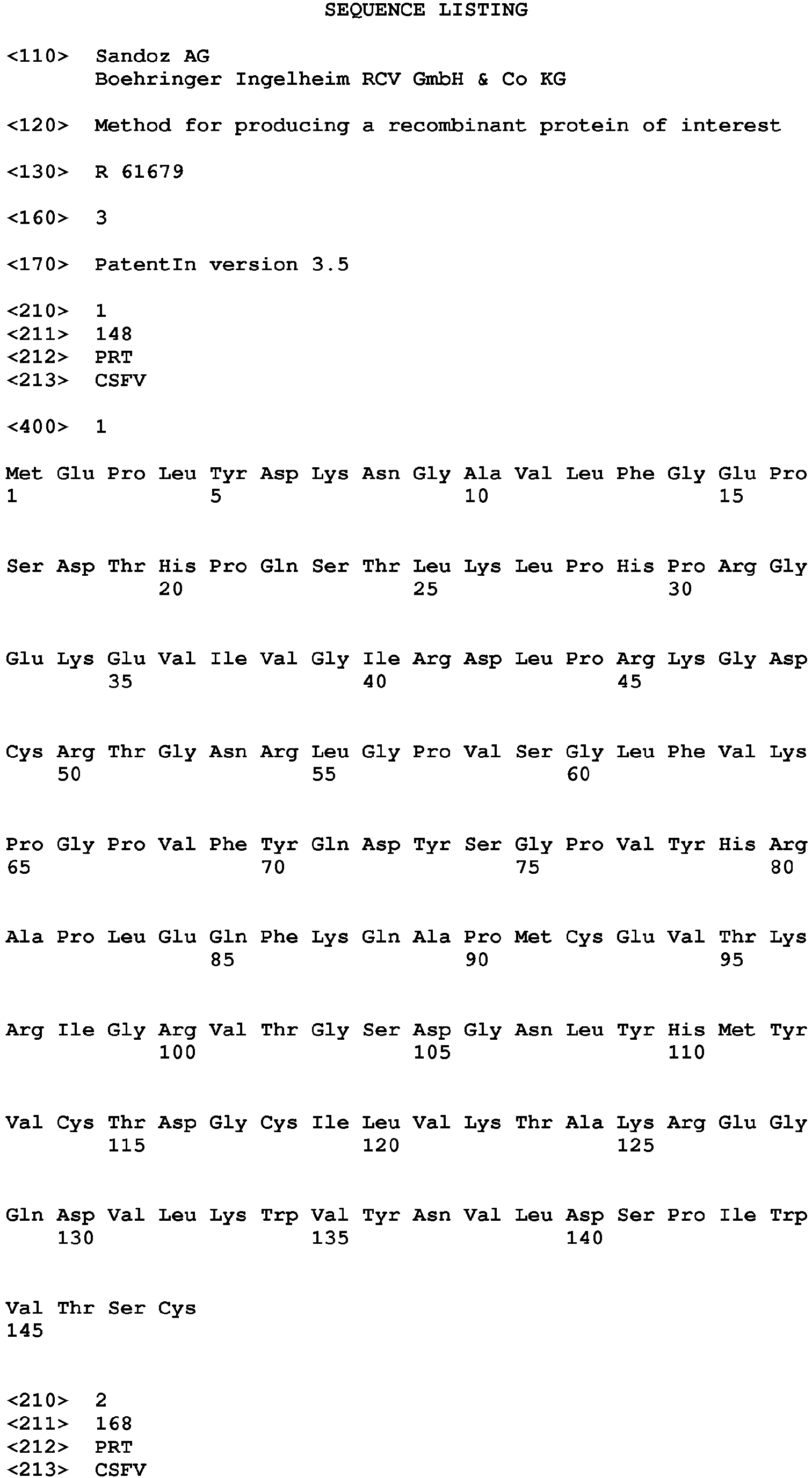

Claims (13)
- Method for producing a recombinant protein of interest, characterised in by the following steps:(a) providing a fusion protein comprising an Npro autoprotease moiety and a protein of interest moiety in inclusion bodies,(b) solubilising the inclusion bodies,(c) allowing the fusion protein to be cleaved by the Npro autoprotease moiety under chaotropic conditions, wherein the recombinant protein of interest is cleaved from the fusion protein and wherein the recombinant protein of interest is not yet renatured or simultaneously renatured, and(d) recovering the protein of interest, optionally including a renaturing step for the protein of interest.
- Method according to claim 1, characterized in that the inclusion bodies were generated in a recombinant production system, preferably in a prokaryotic host cell, especially in E. coli host cells.
- Method according to claim 1 or 2, characterized in that the conditions in step (b) correspond to a urea concentration of more than 5 M, preferably more than 6 M, especially more than 7.5 M.
- Method according to any one of claims 1 to 3, characterized in that the chaotropic conditions in step (c) correspond to a urea concentration of 1.4 to 5 M, preferably from 2 to 5 M, especially from 2 to 4 M.
- Method according to any one of claims 1 to 4, characterized in that the Npro autoprotease moiety has a cleavage rate at 2.5 M urea of at least 20%, preferably at least 30%, especially at least 40%.
- Method according to any one of claims 1 to 5, characterized in that the Npro autoprotease moiety has a sequence selected from the group consisting of SEQ ID nos. 1 or 2.
- Method according to any one of claims 1 to 6, characterized in that the Npro autoprotease moiety has a sequence wherein the interferon regulating factor 3 binding site is deleted.
- Method according to any one of claims 1 to 7, characterized in that the protein of interest is a protein for therapeutic use in humans, preferably a human recombinant protein or a vaccination antigen.
- Method according to any one of claims 1 to 8, characterized in that step (b) and/or step (c) is performed at a pH of 5 to 11, preferably at a pH of 6 to 9.5, especially at a pH from 6.5 to 8.5.
- Method according to any one of claims 1 to 9, characterized in that step (b) is performed under basic conditions.
- Method according to any one of claims 1 to 10, characterized in that step (b) is performed in the presence of NaOH or KOH, preferably of more than 5 mM NaOH or KOH, preferably more than 25 mM NaOH or KOH, more preferred of more than 50 mM NaOH or KOH, especially more than 100mM NaOH or KOH.
- Method according to any one of claims 1 to 11, characterized in that the renaturing step for the protein of interest is carried out after recovery of the protein of interest.
- Npro autoprotease moiety having a sequence selected from the group consisting of SEQ ID nos. 1 or 2.
Priority Applications (11)
| Application Number | Priority Date | Filing Date | Title |
|---|---|---|---|
| EP12198006.4A EP2746390A1 (en) | 2012-12-19 | 2012-12-19 | Method for producing a recombinant protein of interest |
| EP13811532.4A EP2935576B1 (en) | 2012-12-19 | 2013-12-19 | Method for producing a recombinant protein of interest |
| JP2015548587A JP6285459B2 (en) | 2012-12-19 | 2013-12-19 | Method for producing target recombinant protein |
| CN201380066196.8A CN105189743B (en) | 2012-12-19 | 2013-12-19 | Methods for the production of recombinant proteins of interest |
| SG11201504694VA SG11201504694VA (en) | 2012-12-19 | 2013-12-19 | Method for producing a recombinant protein of interest |
| AU2013366602A AU2013366602B2 (en) | 2012-12-19 | 2013-12-19 | Method for producing a recombinant protein of interest |
| CA2894941A CA2894941C (en) | 2012-12-19 | 2013-12-19 | Method for producing a recombinant protein of interest |
| US14/135,389 US9677107B2 (en) | 2012-12-19 | 2013-12-19 | Method for producing a recombinant protein of interest by using the Npro technology |
| PCT/EP2013/077464 WO2014096239A1 (en) | 2012-12-19 | 2013-12-19 | Method for producing a recombinant protein of interest |
| KR1020157015769A KR102141353B1 (en) | 2012-12-19 | 2013-12-19 | Method for producing a recombinant protein of interest |
| JP2017157554A JP6554514B2 (en) | 2012-12-19 | 2017-08-17 | Method for producing desired recombinant protein |
Applications Claiming Priority (1)
| Application Number | Priority Date | Filing Date | Title |
|---|---|---|---|
| EP12198006.4A EP2746390A1 (en) | 2012-12-19 | 2012-12-19 | Method for producing a recombinant protein of interest |
Publications (1)
| Publication Number | Publication Date |
|---|---|
| EP2746390A1 true EP2746390A1 (en) | 2014-06-25 |
Family
ID=47358396
Family Applications (2)
| Application Number | Title | Priority Date | Filing Date |
|---|---|---|---|
| EP12198006.4A Withdrawn EP2746390A1 (en) | 2012-12-19 | 2012-12-19 | Method for producing a recombinant protein of interest |
| EP13811532.4A Active EP2935576B1 (en) | 2012-12-19 | 2013-12-19 | Method for producing a recombinant protein of interest |
Family Applications After (1)
| Application Number | Title | Priority Date | Filing Date |
|---|---|---|---|
| EP13811532.4A Active EP2935576B1 (en) | 2012-12-19 | 2013-12-19 | Method for producing a recombinant protein of interest |
Country Status (9)
| Country | Link |
|---|---|
| US (1) | US9677107B2 (en) |
| EP (2) | EP2746390A1 (en) |
| JP (2) | JP6285459B2 (en) |
| KR (1) | KR102141353B1 (en) |
| CN (1) | CN105189743B (en) |
| AU (1) | AU2013366602B2 (en) |
| CA (1) | CA2894941C (en) |
| SG (1) | SG11201504694VA (en) |
| WO (1) | WO2014096239A1 (en) |
Cited By (5)
| Publication number | Priority date | Publication date | Assignee | Title |
|---|---|---|---|---|
| CN104558100A (en) * | 2015-02-04 | 2015-04-29 | 吉林农业大学 | Inclusion body pretreatment method |
| WO2016128363A1 (en) * | 2015-02-09 | 2016-08-18 | Sandoz Ag | Method for producing a recombinant protein of interest |
| WO2019138125A1 (en) * | 2018-01-15 | 2019-07-18 | Technische Universität München | Biological synthesis of amino acid chains for preparation of peptides and proteins |
| EP3904525A1 (en) | 2020-04-27 | 2021-11-03 | Kutzner, Christoph | Fusion polypeptides for target peptide production |
| EP4265636A1 (en) | 2022-04-19 | 2023-10-25 | mk2 Biotechnologies GmbH | Preparation of target peptides and proteins |
Families Citing this family (13)
| Publication number | Priority date | Publication date | Assignee | Title |
|---|---|---|---|---|
| US10562951B2 (en) | 2015-03-10 | 2020-02-18 | Merck Sharp & Dohme Corp. | Process for preparing recombinant insulin using microfiltration |
| JP6842720B2 (en) * | 2016-08-10 | 2021-03-17 | Spiber株式会社 | Method for Producing Insoluble Recombinant Protein Aggregate |
| US10738338B2 (en) | 2016-10-18 | 2020-08-11 | The Research Foundation for the State University | Method and composition for biocatalytic protein-oligonucleotide conjugation and protein-oligonucleotide conjugate |
| CN109957591A (en) * | 2017-12-22 | 2019-07-02 | 中国医学科学院医药生物技术研究所 | Preparation process improvement and quality standard formulation of dual-targeted liganded lidamycin DTLL |
| US11267863B2 (en) | 2018-01-19 | 2022-03-08 | Pepgene Inc. | N-terminal fusion partner for producing recombinant polypeptide, and method for producing recombinant polypeptide using same |
| CN110343183B (en) * | 2018-04-03 | 2023-05-12 | 点斗基因科技(南京)有限公司 | Recombinant expression vector and construction method and application thereof |
| CN119264211A (en) | 2018-08-27 | 2025-01-07 | 瑞泽恩制药公司 | Application of Raman spectroscopy in downstream purification |
| CN114958806A (en) * | 2022-06-14 | 2022-08-30 | 中国水产科学研究院淡水渔业研究中心 | Carp LPL1 recombinant protein and preparation method thereof |
| CN116042585B (en) * | 2022-07-11 | 2023-10-03 | 无锡佰翱得生物科学股份有限公司 | Application of SortaseA enzyme as proteolytic enzyme in the field of protein purification |
| KR20240064367A (en) * | 2022-11-04 | 2024-05-13 | 주식회사 대웅제약 | Method for purifying protein of TGF-β3 |
| CN117362401A (en) * | 2023-09-27 | 2024-01-09 | 中国农业科学院兰州兽医研究所 | A bovine viral diarrhea virus N protein and its application as a self-cleaving protein |
| US20250101484A1 (en) * | 2023-09-27 | 2025-03-27 | Pharmaessentia Corporation | Method to increase drug substance yield |
| EP4567108A1 (en) * | 2023-12-05 | 2025-06-11 | Kutzner, Christoph | Screening of target peptides using fusion polypeptides |
Citations (3)
| Publication number | Priority date | Publication date | Assignee | Title |
|---|---|---|---|---|
| WO2001011057A1 (en) | 1999-08-09 | 2001-02-15 | Biochemie Gesellschaft M.B.H. | Production of proteins |
| WO2001011056A1 (en) | 1999-08-09 | 2001-02-15 | Biochemie Gesellschaft M.B.H. | Production of proteins by autoproteolytic cleavage |
| WO2006113958A2 (en) | 2005-04-26 | 2006-11-02 | Sandoz Ag | Affinity ligands |
Family Cites Families (2)
| Publication number | Priority date | Publication date | Assignee | Title |
|---|---|---|---|---|
| GB0508434D0 (en) * | 2005-04-26 | 2005-06-01 | Sandoz Ag | Organic compounds |
| EP2746391A1 (en) * | 2012-12-19 | 2014-06-25 | Sandoz Ag | Method for producing a recombinant protein of interest |
-
2012
- 2012-12-19 EP EP12198006.4A patent/EP2746390A1/en not_active Withdrawn
-
2013
- 2013-12-19 EP EP13811532.4A patent/EP2935576B1/en active Active
- 2013-12-19 AU AU2013366602A patent/AU2013366602B2/en active Active
- 2013-12-19 US US14/135,389 patent/US9677107B2/en active Active
- 2013-12-19 CN CN201380066196.8A patent/CN105189743B/en active Active
- 2013-12-19 SG SG11201504694VA patent/SG11201504694VA/en unknown
- 2013-12-19 WO PCT/EP2013/077464 patent/WO2014096239A1/en not_active Ceased
- 2013-12-19 KR KR1020157015769A patent/KR102141353B1/en active Active
- 2013-12-19 CA CA2894941A patent/CA2894941C/en active Active
- 2013-12-19 JP JP2015548587A patent/JP6285459B2/en active Active
-
2017
- 2017-08-17 JP JP2017157554A patent/JP6554514B2/en active Active
Patent Citations (5)
| Publication number | Priority date | Publication date | Assignee | Title |
|---|---|---|---|---|
| WO2001011057A1 (en) | 1999-08-09 | 2001-02-15 | Biochemie Gesellschaft M.B.H. | Production of proteins |
| WO2001011056A1 (en) | 1999-08-09 | 2001-02-15 | Biochemie Gesellschaft M.B.H. | Production of proteins by autoproteolytic cleavage |
| WO2006113958A2 (en) | 2005-04-26 | 2006-11-02 | Sandoz Ag | Affinity ligands |
| WO2006113959A2 (en) | 2005-04-26 | 2006-11-02 | Sandoz Ag | Production of recombinant proteins by autoproteolytic cleavage of a fusion protein |
| WO2006113957A2 (en) | 2005-04-26 | 2006-11-02 | Sandoz Ag | Production of recombinant proteins by autoproteolytic cleavage of a fusion protein |
Non-Patent Citations (17)
| Title |
|---|
| ACHMULLER ET AL., NAT. METH., vol. 4, 2007, pages 1037 - 1043 |
| ACHMULLER ET AL., NAT. METHODS, vol. 4, 2007, pages 1037 - 1043 |
| ASTRID DÜRAUERAB ET AL: "Npro Autoprotease Fusion Technology: Development, Characteristics, and Influential Factors", SEPARATION SCIENCE AND TECHNOLOGY, DEKKER, NEW YORK, NY, US, vol. 45, no. 15, 1 January 2010 (2010-01-01), pages 2194 - 2209, XP009166982, ISSN: 0149-6395, DOI: 10.1080/15228967.2010.507552 * |
| CLEMENS ACHMÜLLER ET AL: "N-pro fusion technology to produce proteins with authentic N termini in E-coli", NATURE METHODS, NATURE PUBLISHING GROUP, GB, vol. 4, no. 12, 1 December 2007 (2007-12-01), pages 1037 - 1043, XP002663733, ISSN: 1548-7091, [retrieved on 20071118], DOI: 10.1038/NMETH1116 * |
| DATABASE UniProt [Online] 1 February 2005 (2005-02-01), "SubName: Full=Nonstructural protein; Flags: Fragment;", XP002692351, retrieved from EBI accession no. UNIPROT:Q5L4B1 Database accession no. Q5L4B1 * |
| FERRER-MIRALLES ET AL.: "8", MICROBIAL CELL FACTORIES, 2009, pages 17 |
| HAHN R ET AL: "Peptide affinity chromatography media that bind N<pro> fusion proteins under chaotropic conditions", JOURNAL OF CHROMATOGRAPHY, ELSEVIER SCIENCE PUBLISHERS B.V, NL, vol. 1217, no. 40, 1 October 2010 (2010-10-01), pages 6203 - 6213, XP027289138, ISSN: 0021-9673, [retrieved on 20100811] * |
| JUNBAUER ET AL., J. CHROMATOGR. A, vol. 1184, 2008, pages 62 - 79 |
| JUNGBAUER ET AL., J. BIOTECH., vol. 128, 2007, pages 587 - 596 |
| KAAR ET AL., BIOTECH. BIOENG., vol. 104, 2009, pages 774 - 784 |
| LEI XING ET AL: "Streamlined protein expression and purification using cleavable self-aggregating tags", MICROBIAL CELL FACTORIES, vol. 10, no. 1, 1 January 2011 (2011-01-01), pages 42, XP055052801, ISSN: 1475-2859, DOI: 10.1186/1472-6750-3-12 * |
| SCHMOEGER E ET AL: "Matrix-assisted refolding of autoprotease fusion proteins on an ion exchange column: A kinetic investigation", JOURNAL OF CHROMATOGRAPHY, ELSEVIER SCIENCE PUBLISHERS B.V, NL, vol. 1217, no. 38, 17 September 2010 (2010-09-17), pages 5950 - 5956, XP027236223, ISSN: 0021-9673, [retrieved on 20100825] * |
| UEBERBACHER ET AL., PROCESS BIOCHEM., vol. 44, 2009, pages 1217 - 1224 |
| UEBERBACHER R ET AL: "EDDIE fusion proteins: Triggering autoproteolytic cleavage", PROCESS BIOCHEMISTRY, ELSEVIER, NL, vol. 44, no. 11, 1 November 2009 (2009-11-01), pages 1217 - 1224, XP026614237, ISSN: 1359-5113, [retrieved on 20090702], DOI: 10.1016/J.PROCBIO.2009.06.017 * |
| VALLEJO ET AL., MICROB. CELL FACT., vol. 3, 2004, pages 11 |
| WALTRAUD KAAR ET AL: "Refolding of N pro fusion proteins", BIOTECHNOLOGY AND BIOENGINEERING, vol. 104, no. 4, 1 November 2009 (2009-11-01), pages n/a - n/a, XP055050976, ISSN: 0006-3592, DOI: 10.1002/bit.22432 * |
| YIFENG LI: "Self-cleaving fusion tags for recombinant protein production", BIOTECHNOLOGY LETTERS, vol. 33, no. 5, 1 May 2011 (2011-05-01), pages 869 - 881, XP055052800, ISSN: 0141-5492, DOI: 10.1007/s10529-011-0533-8 * |
Cited By (9)
| Publication number | Priority date | Publication date | Assignee | Title |
|---|---|---|---|---|
| CN104558100A (en) * | 2015-02-04 | 2015-04-29 | 吉林农业大学 | Inclusion body pretreatment method |
| WO2016128363A1 (en) * | 2015-02-09 | 2016-08-18 | Sandoz Ag | Method for producing a recombinant protein of interest |
| WO2019138125A1 (en) * | 2018-01-15 | 2019-07-18 | Technische Universität München | Biological synthesis of amino acid chains for preparation of peptides and proteins |
| US11697809B2 (en) | 2018-01-15 | 2023-07-11 | Christoph Kutzner | Biological synthesis of amino acid chains for preparation of peptides and proteins |
| EP3904525A1 (en) | 2020-04-27 | 2021-11-03 | Kutzner, Christoph | Fusion polypeptides for target peptide production |
| WO2021219585A2 (en) | 2020-04-27 | 2021-11-04 | Kutzner Christoph | Fusion polypeptides for target peptide production |
| US12454556B2 (en) | 2020-04-27 | 2025-10-28 | Christoph Kutzner | Fusion polypeptides for target peptide production |
| EP4265636A1 (en) | 2022-04-19 | 2023-10-25 | mk2 Biotechnologies GmbH | Preparation of target peptides and proteins |
| WO2023203032A1 (en) | 2022-04-19 | 2023-10-26 | Mk2 Biotechnologies Gmbh | Preparation of target peptides and proteins |
Also Published As
| Publication number | Publication date |
|---|---|
| KR102141353B1 (en) | 2020-08-06 |
| CA2894941C (en) | 2024-02-27 |
| AU2013366602A1 (en) | 2015-06-18 |
| JP6554514B2 (en) | 2019-07-31 |
| EP2935576B1 (en) | 2018-10-31 |
| CN105189743A (en) | 2015-12-23 |
| AU2013366602B2 (en) | 2019-05-30 |
| JP2016500273A (en) | 2016-01-12 |
| KR20150099741A (en) | 2015-09-01 |
| JP2018023380A (en) | 2018-02-15 |
| JP6285459B2 (en) | 2018-02-28 |
| CN105189743B (en) | 2020-02-18 |
| CA2894941A1 (en) | 2014-06-26 |
| SG11201504694VA (en) | 2015-07-30 |
| US9677107B2 (en) | 2017-06-13 |
| US20140170702A1 (en) | 2014-06-19 |
| WO2014096239A1 (en) | 2014-06-26 |
| EP2935576A1 (en) | 2015-10-28 |
Similar Documents
| Publication | Publication Date | Title |
|---|---|---|
| US9677107B2 (en) | Method for producing a recombinant protein of interest by using the Npro technology | |
| US8372959B2 (en) | Production of recombinant proteins by autoproteolytic cleavage of a fusion protein | |
| EP2935577B1 (en) | Method for producing a recombinant protein of interest | |
| EP2872627B1 (en) | Method for producing a recombinant protein of interest | |
| EP3256597B1 (en) | Method for producing a recombinant protein of interest | |
| US20160340384A1 (en) | Method for refolding recombinantly produced polypeptides | |
| AU2011253661B2 (en) | Production of recombinant proteins by autoproteolytic cleavage of a fusion protein |
Legal Events
| Date | Code | Title | Description |
|---|---|---|---|
| PUAI | Public reference made under article 153(3) epc to a published international application that has entered the european phase |
Free format text: ORIGINAL CODE: 0009012 |
|
| 17P | Request for examination filed |
Effective date: 20121219 |
|
| AK | Designated contracting states |
Kind code of ref document: A1 Designated state(s): AL AT BE BG CH CY CZ DE DK EE ES FI FR GB GR HR HU IE IS IT LI LT LU LV MC MK MT NL NO PL PT RO RS SE SI SK SM TR |
|
| AX | Request for extension of the european patent |
Extension state: BA ME |
|
| STAA | Information on the status of an ep patent application or granted ep patent |
Free format text: STATUS: THE APPLICATION IS DEEMED TO BE WITHDRAWN |
|
| 18D | Application deemed to be withdrawn |
Effective date: 20150106 |