EP2745702A1 - Aerated compositions containing ground pulse seed and hydrophobin - Google Patents
Aerated compositions containing ground pulse seed and hydrophobin Download PDFInfo
- Publication number
- EP2745702A1 EP2745702A1 EP12198877.8A EP12198877A EP2745702A1 EP 2745702 A1 EP2745702 A1 EP 2745702A1 EP 12198877 A EP12198877 A EP 12198877A EP 2745702 A1 EP2745702 A1 EP 2745702A1
- Authority
- EP
- European Patent Office
- Prior art keywords
- composition
- oil
- hydrophobin
- weight
- composition according
- Prior art date
- Legal status (The legal status is an assumption and is not a legal conclusion. Google has not performed a legal analysis and makes no representation as to the accuracy of the status listed.)
- Withdrawn
Links
- 239000000203 mixture Substances 0.000 title claims abstract description 125
- 101710091977 Hydrophobin Proteins 0.000 title claims abstract description 61
- 108010000912 Egg Proteins Proteins 0.000 claims description 66
- 102000002322 Egg Proteins Human genes 0.000 claims description 66
- 235000013345 egg yolk Nutrition 0.000 claims description 64
- 210000002969 egg yolk Anatomy 0.000 claims description 64
- 235000021251 pulses Nutrition 0.000 claims description 63
- 239000003921 oil Substances 0.000 claims description 49
- XLYOFNOQVPJJNP-UHFFFAOYSA-N water Substances O XLYOFNOQVPJJNP-UHFFFAOYSA-N 0.000 claims description 41
- 108090000623 proteins and genes Proteins 0.000 claims description 39
- 102000004169 proteins and genes Human genes 0.000 claims description 38
- 150000003904 phospholipids Chemical class 0.000 claims description 34
- 101001003080 Hypocrea jecorina Hydrophobin-2 Proteins 0.000 claims description 30
- 238000000034 method Methods 0.000 claims description 27
- 239000007788 liquid Substances 0.000 claims description 17
- 235000010523 Cicer arietinum Nutrition 0.000 claims description 13
- 244000045195 Cicer arietinum Species 0.000 claims description 13
- 241000196324 Embryophyta Species 0.000 claims description 13
- 150000002632 lipids Chemical class 0.000 claims description 12
- 240000004922 Vigna radiata Species 0.000 claims description 11
- 239000004615 ingredient Substances 0.000 claims description 11
- 238000002156 mixing Methods 0.000 claims description 11
- 240000004322 Lens culinaris Species 0.000 claims description 9
- 229920002472 Starch Polymers 0.000 claims description 9
- 235000019698 starch Nutrition 0.000 claims description 9
- 239000008107 starch Substances 0.000 claims description 9
- 239000008157 edible vegetable oil Substances 0.000 claims description 7
- 235000013325 dietary fiber Nutrition 0.000 claims description 6
- 235000010666 Lens esculenta Nutrition 0.000 claims description 5
- 239000007764 o/w emulsion Substances 0.000 claims description 5
- 239000006265 aqueous foam Substances 0.000 claims description 4
- 238000002360 preparation method Methods 0.000 claims description 4
- 235000000346 sugar Nutrition 0.000 claims description 4
- 150000008163 sugars Chemical class 0.000 claims description 4
- 230000000887 hydrating effect Effects 0.000 claims description 3
- MSYHGYDAVLDKCE-UHFFFAOYSA-N 2,2,3,3,4,4,4-heptafluoro-1-imidazol-1-ylbutan-1-one Chemical compound FC(F)(F)C(F)(F)C(F)(F)C(=O)N1C=CN=C1 MSYHGYDAVLDKCE-UHFFFAOYSA-N 0.000 claims description 2
- 235000010521 Cicer Nutrition 0.000 claims description 2
- 241000220455 Cicer Species 0.000 claims description 2
- 101001003067 Hypocrea jecorina Hydrophobin-1 Proteins 0.000 claims description 2
- 235000013305 food Nutrition 0.000 abstract description 26
- 239000003995 emulsifying agent Substances 0.000 abstract description 19
- 239000000839 emulsion Substances 0.000 description 78
- 239000006260 foam Substances 0.000 description 73
- 235000019198 oils Nutrition 0.000 description 48
- 235000014647 Lens culinaris subsp culinaris Nutrition 0.000 description 42
- 239000007789 gas Substances 0.000 description 41
- 241000219739 Lens Species 0.000 description 40
- 235000018102 proteins Nutrition 0.000 description 35
- 235000013312 flour Nutrition 0.000 description 29
- 238000003860 storage Methods 0.000 description 16
- QTBSBXVTEAMEQO-UHFFFAOYSA-N Acetic acid Chemical compound CC(O)=O QTBSBXVTEAMEQO-UHFFFAOYSA-N 0.000 description 15
- 235000010746 mayonnaise Nutrition 0.000 description 15
- 235000015112 vegetable and seed oil Nutrition 0.000 description 15
- 238000005273 aeration Methods 0.000 description 13
- 150000003626 triacylglycerols Chemical class 0.000 description 13
- 230000000052 comparative effect Effects 0.000 description 12
- 239000008268 mayonnaise Substances 0.000 description 12
- 239000003925 fat Substances 0.000 description 10
- 235000019197 fats Nutrition 0.000 description 10
- 238000002474 experimental method Methods 0.000 description 9
- 150000004665 fatty acids Chemical group 0.000 description 9
- 239000007787 solid Substances 0.000 description 9
- 235000010469 Glycine max Nutrition 0.000 description 7
- 235000010627 Phaseolus vulgaris Nutrition 0.000 description 7
- 244000046052 Phaseolus vulgaris Species 0.000 description 7
- FAPWRFPIFSIZLT-UHFFFAOYSA-M Sodium chloride Chemical compound [Na+].[Cl-] FAPWRFPIFSIZLT-UHFFFAOYSA-M 0.000 description 7
- 235000010721 Vigna radiata var radiata Nutrition 0.000 description 7
- LFQSCWFLJHTTHZ-UHFFFAOYSA-N Ethanol Chemical compound CCO LFQSCWFLJHTTHZ-UHFFFAOYSA-N 0.000 description 6
- 244000068988 Glycine max Species 0.000 description 6
- 241000219745 Lupinus Species 0.000 description 6
- 235000011469 Vigna radiata var sublobata Nutrition 0.000 description 6
- 235000014113 dietary fatty acids Nutrition 0.000 description 6
- 239000000194 fatty acid Substances 0.000 description 6
- 229930195729 fatty acid Natural products 0.000 description 6
- 239000000835 fiber Substances 0.000 description 6
- 239000000230 xanthan gum Substances 0.000 description 6
- 229920001285 xanthan gum Polymers 0.000 description 6
- 235000010493 xanthan gum Nutrition 0.000 description 6
- 229940082509 xanthan gum Drugs 0.000 description 6
- 235000019486 Sunflower oil Nutrition 0.000 description 5
- 238000004945 emulsification Methods 0.000 description 5
- 239000012071 phase Substances 0.000 description 5
- 230000008569 process Effects 0.000 description 5
- 150000003839 salts Chemical class 0.000 description 5
- 239000002600 sunflower oil Substances 0.000 description 5
- IJGRMHOSHXDMSA-UHFFFAOYSA-N Atomic nitrogen Chemical compound N#N IJGRMHOSHXDMSA-UHFFFAOYSA-N 0.000 description 4
- CURLTUGMZLYLDI-UHFFFAOYSA-N Carbon dioxide Chemical compound O=C=O CURLTUGMZLYLDI-UHFFFAOYSA-N 0.000 description 4
- 241000207199 Citrus Species 0.000 description 4
- 241000233866 Fungi Species 0.000 description 4
- JZNWSCPGTDBMEW-UHFFFAOYSA-N Glycerophosphorylethanolamin Natural products NCCOP(O)(=O)OCC(O)CO JZNWSCPGTDBMEW-UHFFFAOYSA-N 0.000 description 4
- 229930006000 Sucrose Natural products 0.000 description 4
- CZMRCDWAGMRECN-UGDNZRGBSA-N Sucrose Chemical compound O[C@H]1[C@H](O)[C@@H](CO)O[C@@]1(CO)O[C@@H]1[C@H](O)[C@@H](O)[C@H](O)[C@@H](CO)O1 CZMRCDWAGMRECN-UGDNZRGBSA-N 0.000 description 4
- 235000001014 amino acid Nutrition 0.000 description 4
- 150000001413 amino acids Chemical class 0.000 description 4
- 239000008346 aqueous phase Substances 0.000 description 4
- 235000014121 butter Nutrition 0.000 description 4
- 235000014633 carbohydrates Nutrition 0.000 description 4
- 150000001720 carbohydrates Chemical class 0.000 description 4
- 210000004027 cell Anatomy 0.000 description 4
- HVYWMOMLDIMFJA-DPAQBDIFSA-N cholesterol Chemical compound C1C=C2C[C@@H](O)CC[C@]2(C)[C@@H]2[C@@H]1[C@@H]1CC[C@H]([C@H](C)CCCC(C)C)[C@@]1(C)CC2 HVYWMOMLDIMFJA-DPAQBDIFSA-N 0.000 description 4
- 235000020971 citrus fruits Nutrition 0.000 description 4
- 150000001875 compounds Chemical class 0.000 description 4
- 239000012141 concentrate Substances 0.000 description 4
- GVJHHUAWPYXKBD-UHFFFAOYSA-N d-alpha-tocopherol Natural products OC1=C(C)C(C)=C2OC(CCCC(C)CCCC(C)CCCC(C)C)(C)CCC2=C1C GVJHHUAWPYXKBD-UHFFFAOYSA-N 0.000 description 4
- 239000006185 dispersion Substances 0.000 description 4
- 150000002148 esters Chemical class 0.000 description 4
- 238000005187 foaming Methods 0.000 description 4
- 230000002538 fungal effect Effects 0.000 description 4
- PEDCQBHIVMGVHV-UHFFFAOYSA-N glycerol group Chemical group OCC(O)CO PEDCQBHIVMGVHV-UHFFFAOYSA-N 0.000 description 4
- 239000000843 powder Substances 0.000 description 4
- 238000001338 self-assembly Methods 0.000 description 4
- 239000002002 slurry Substances 0.000 description 4
- 239000000243 solution Substances 0.000 description 4
- 239000005720 sucrose Substances 0.000 description 4
- 239000002562 thickening agent Substances 0.000 description 4
- IIZPXYDJLKNOIY-JXPKJXOSSA-N 1-palmitoyl-2-arachidonoyl-sn-glycero-3-phosphocholine Chemical compound CCCCCCCCCCCCCCCC(=O)OC[C@H](COP([O-])(=O)OCC[N+](C)(C)C)OC(=O)CCC\C=C/C\C=C/C\C=C/C\C=C/CCCCC IIZPXYDJLKNOIY-JXPKJXOSSA-N 0.000 description 3
- 102100028717 Cytosolic 5'-nucleotidase 3A Human genes 0.000 description 3
- KCXVZYZYPLLWCC-UHFFFAOYSA-N EDTA Chemical compound OC(=O)CN(CC(O)=O)CCN(CC(O)=O)CC(O)=O KCXVZYZYPLLWCC-UHFFFAOYSA-N 0.000 description 3
- 235000019482 Palm oil Nutrition 0.000 description 3
- 241000219843 Pisum Species 0.000 description 3
- 235000010582 Pisum sativum Nutrition 0.000 description 3
- 230000008901 benefit Effects 0.000 description 3
- 235000013365 dairy product Nutrition 0.000 description 3
- -1 diglycerides Chemical class 0.000 description 3
- 235000015071 dressings Nutrition 0.000 description 3
- 239000013604 expression vector Substances 0.000 description 3
- 239000000416 hydrocolloid Substances 0.000 description 3
- 239000000787 lecithin Substances 0.000 description 3
- 235000010445 lecithin Nutrition 0.000 description 3
- 229940067606 lecithin Drugs 0.000 description 3
- 238000004519 manufacturing process Methods 0.000 description 3
- 235000008390 olive oil Nutrition 0.000 description 3
- 239000004006 olive oil Substances 0.000 description 3
- 239000002540 palm oil Substances 0.000 description 3
- 229920001184 polypeptide Polymers 0.000 description 3
- 108090000765 processed proteins & peptides Proteins 0.000 description 3
- 102000004196 processed proteins & peptides Human genes 0.000 description 3
- 239000011780 sodium chloride Substances 0.000 description 3
- 241000894007 species Species 0.000 description 3
- 239000003381 stabilizer Substances 0.000 description 3
- 239000000126 substance Substances 0.000 description 3
- RYCNUMLMNKHWPZ-SNVBAGLBSA-N 1-acetyl-sn-glycero-3-phosphocholine Chemical compound CC(=O)OC[C@@H](O)COP([O-])(=O)OCC[N+](C)(C)C RYCNUMLMNKHWPZ-SNVBAGLBSA-N 0.000 description 2
- ZIIUUSVHCHPIQD-UHFFFAOYSA-N 2,4,6-trimethyl-N-[3-(trifluoromethyl)phenyl]benzenesulfonamide Chemical compound CC1=CC(C)=CC(C)=C1S(=O)(=O)NC1=CC=CC(C(F)(F)F)=C1 ZIIUUSVHCHPIQD-UHFFFAOYSA-N 0.000 description 2
- HZAXFHJVJLSVMW-UHFFFAOYSA-N 2-Aminoethan-1-ol Chemical compound NCCO HZAXFHJVJLSVMW-UHFFFAOYSA-N 0.000 description 2
- 241000894006 Bacteria Species 0.000 description 2
- 235000004977 Brassica sinapistrum Nutrition 0.000 description 2
- 241000220485 Fabaceae Species 0.000 description 2
- 229920000161 Locust bean gum Polymers 0.000 description 2
- 241001465754 Metazoa Species 0.000 description 2
- GQPLMRYTRLFLPF-UHFFFAOYSA-N Nitrous Oxide Chemical compound [O-][N+]#N GQPLMRYTRLFLPF-UHFFFAOYSA-N 0.000 description 2
- 238000001016 Ostwald ripening Methods 0.000 description 2
- 108010058846 Ovalbumin Proteins 0.000 description 2
- 102000015439 Phospholipases Human genes 0.000 description 2
- 108010064785 Phospholipases Proteins 0.000 description 2
- 241000235648 Pichia Species 0.000 description 2
- 235000019484 Rapeseed oil Nutrition 0.000 description 2
- 240000004808 Saccharomyces cerevisiae Species 0.000 description 2
- 239000004809 Teflon Substances 0.000 description 2
- 229920006362 Teflon® Polymers 0.000 description 2
- 241000223259 Trichoderma Species 0.000 description 2
- 244000078534 Vaccinium myrtillus Species 0.000 description 2
- 235000006582 Vigna radiata Nutrition 0.000 description 2
- 229930003427 Vitamin E Natural products 0.000 description 2
- CWRILEGKIAOYKP-SSDOTTSWSA-M [(2r)-3-acetyloxy-2-hydroxypropyl] 2-aminoethyl phosphate Chemical compound CC(=O)OC[C@@H](O)COP([O-])(=O)OCCN CWRILEGKIAOYKP-SSDOTTSWSA-M 0.000 description 2
- 230000015572 biosynthetic process Effects 0.000 description 2
- 239000001569 carbon dioxide Substances 0.000 description 2
- 229910002092 carbon dioxide Inorganic materials 0.000 description 2
- 235000010418 carrageenan Nutrition 0.000 description 2
- 239000000679 carrageenan Substances 0.000 description 2
- 229920001525 carrageenan Polymers 0.000 description 2
- 229940113118 carrageenan Drugs 0.000 description 2
- 235000012000 cholesterol Nutrition 0.000 description 2
- 238000004581 coalescence Methods 0.000 description 2
- 235000019864 coconut oil Nutrition 0.000 description 2
- 239000003240 coconut oil Substances 0.000 description 2
- 108091036078 conserved sequence Proteins 0.000 description 2
- 235000005687 corn oil Nutrition 0.000 description 2
- 125000000151 cysteine group Chemical group N[C@@H](CS)C(=O)* 0.000 description 2
- 230000003247 decreasing effect Effects 0.000 description 2
- 238000011161 development Methods 0.000 description 2
- 238000005516 engineering process Methods 0.000 description 2
- 230000002255 enzymatic effect Effects 0.000 description 2
- 238000002481 ethanol extraction Methods 0.000 description 2
- 239000000284 extract Substances 0.000 description 2
- 238000000605 extraction Methods 0.000 description 2
- 239000000796 flavoring agent Substances 0.000 description 2
- 235000019634 flavors Nutrition 0.000 description 2
- 239000012634 fragment Substances 0.000 description 2
- WIGCFUFOHFEKBI-UHFFFAOYSA-N gamma-tocopherol Natural products CC(C)CCCC(C)CCCC(C)CCCC1CCC2C(C)C(O)C(C)C(C)C2O1 WIGCFUFOHFEKBI-UHFFFAOYSA-N 0.000 description 2
- 239000001963 growth medium Substances 0.000 description 2
- 230000002209 hydrophobic effect Effects 0.000 description 2
- 235000015243 ice cream Nutrition 0.000 description 2
- 235000021374 legumes Nutrition 0.000 description 2
- 235000010420 locust bean gum Nutrition 0.000 description 2
- 239000000711 locust bean gum Substances 0.000 description 2
- 239000000463 material Substances 0.000 description 2
- 238000005259 measurement Methods 0.000 description 2
- 229910052757 nitrogen Inorganic materials 0.000 description 2
- 108020004707 nucleic acids Proteins 0.000 description 2
- 102000039446 nucleic acids Human genes 0.000 description 2
- 150000007523 nucleic acids Chemical class 0.000 description 2
- 235000014593 oils and fats Nutrition 0.000 description 2
- 239000002245 particle Substances 0.000 description 2
- WTJKGGKOPKCXLL-RRHRGVEJSA-N phosphatidylcholine Chemical compound CCCCCCCCCCCCCCCC(=O)OC[C@H](COP([O-])(=O)OCC[N+](C)(C)C)OC(=O)CCCCCCCC=CCCCCCCCC WTJKGGKOPKCXLL-RRHRGVEJSA-N 0.000 description 2
- 150000008104 phosphatidylethanolamines Chemical class 0.000 description 2
- 150000003905 phosphatidylinositols Chemical class 0.000 description 2
- 230000000717 retained effect Effects 0.000 description 2
- 235000012424 soybean oil Nutrition 0.000 description 2
- 239000003549 soybean oil Substances 0.000 description 2
- 239000008158 vegetable oil Substances 0.000 description 2
- 235000019165 vitamin E Nutrition 0.000 description 2
- 229940046009 vitamin E Drugs 0.000 description 2
- 239000011709 vitamin E Substances 0.000 description 2
- UHVMMEOXYDMDKI-JKYCWFKZSA-L zinc;1-(5-cyanopyridin-2-yl)-3-[(1s,2s)-2-(6-fluoro-2-hydroxy-3-propanoylphenyl)cyclopropyl]urea;diacetate Chemical compound [Zn+2].CC([O-])=O.CC([O-])=O.CCC(=O)C1=CC=C(F)C([C@H]2[C@H](C2)NC(=O)NC=2N=CC(=CC=2)C#N)=C1O UHVMMEOXYDMDKI-JKYCWFKZSA-L 0.000 description 2
- LDVVTQMJQSCDMK-UHFFFAOYSA-N 1,3-dihydroxypropan-2-yl formate Chemical compound OCC(CO)OC=O LDVVTQMJQSCDMK-UHFFFAOYSA-N 0.000 description 1
- FPIPGXGPPPQFEQ-UHFFFAOYSA-N 13-cis retinol Natural products OCC=C(C)C=CC=C(C)C=CC1=C(C)CCCC1(C)C FPIPGXGPPPQFEQ-UHFFFAOYSA-N 0.000 description 1
- 238000004679 31P NMR spectroscopy Methods 0.000 description 1
- AJBZENLMTKDAEK-UHFFFAOYSA-N 3a,5a,5b,8,8,11a-hexamethyl-1-prop-1-en-2-yl-1,2,3,4,5,6,7,7a,9,10,11,11b,12,13,13a,13b-hexadecahydrocyclopenta[a]chrysene-4,9-diol Chemical compound CC12CCC(O)C(C)(C)C1CCC(C1(C)CC3O)(C)C2CCC1C1C3(C)CCC1C(=C)C AJBZENLMTKDAEK-UHFFFAOYSA-N 0.000 description 1
- QCVGEOXPDFCNHA-UHFFFAOYSA-N 5,5-dimethyl-2,4-dioxo-1,3-oxazolidine-3-carboxamide Chemical compound CC1(C)OC(=O)N(C(N)=O)C1=O QCVGEOXPDFCNHA-UHFFFAOYSA-N 0.000 description 1
- UHPMCKVQTMMPCG-UHFFFAOYSA-N 5,8-dihydroxy-2-methoxy-6-methyl-7-(2-oxopropyl)naphthalene-1,4-dione Chemical compound CC1=C(CC(C)=O)C(O)=C2C(=O)C(OC)=CC(=O)C2=C1O UHPMCKVQTMMPCG-UHFFFAOYSA-N 0.000 description 1
- JBYXPOFIGCOSSB-GOJKSUSPSA-N 9-cis,11-trans-octadecadienoic acid Chemical compound CCCCCC\C=C\C=C/CCCCCCCC(O)=O JBYXPOFIGCOSSB-GOJKSUSPSA-N 0.000 description 1
- 235000003320 Adansonia digitata Nutrition 0.000 description 1
- 244000056971 Adansonia gregorii Species 0.000 description 1
- 235000003319 Adansonia gregorii Nutrition 0.000 description 1
- 244000251953 Agaricus brunnescens Species 0.000 description 1
- 235000001674 Agaricus brunnescens Nutrition 0.000 description 1
- 235000006667 Aleurites moluccana Nutrition 0.000 description 1
- 244000136475 Aleurites moluccana Species 0.000 description 1
- 241001207050 Allanblackia Species 0.000 description 1
- 244000144725 Amygdalus communis Species 0.000 description 1
- 235000011437 Amygdalus communis Nutrition 0.000 description 1
- 244000144730 Amygdalus persica Species 0.000 description 1
- 235000003911 Arachis Nutrition 0.000 description 1
- 244000105624 Arachis hypogaea Species 0.000 description 1
- 241000086254 Arnica montana Species 0.000 description 1
- 241000235349 Ascomycota Species 0.000 description 1
- 241000228212 Aspergillus Species 0.000 description 1
- 235000000832 Ayote Nutrition 0.000 description 1
- 108010077805 Bacterial Proteins Proteins 0.000 description 1
- 241000221198 Basidiomycota Species 0.000 description 1
- 241000283690 Bos taurus Species 0.000 description 1
- 241000167854 Bourreria succulenta Species 0.000 description 1
- 235000014698 Brassica juncea var multisecta Nutrition 0.000 description 1
- 240000002791 Brassica napus Species 0.000 description 1
- 235000006008 Brassica napus var napus Nutrition 0.000 description 1
- 235000006618 Brassica rapa subsp oleifera Nutrition 0.000 description 1
- 244000188595 Brassica sinapistrum Species 0.000 description 1
- 235000004936 Bromus mango Nutrition 0.000 description 1
- 241000195940 Bryophyta Species 0.000 description 1
- 235000003880 Calendula Nutrition 0.000 description 1
- 240000001432 Calendula officinalis Species 0.000 description 1
- 235000016401 Camelina Nutrition 0.000 description 1
- 244000197813 Camelina sativa Species 0.000 description 1
- 240000001548 Camellia japonica Species 0.000 description 1
- 241000222120 Candida <Saccharomycetales> Species 0.000 description 1
- 241000283707 Capra Species 0.000 description 1
- 229920002134 Carboxymethyl cellulose Polymers 0.000 description 1
- 235000009467 Carica papaya Nutrition 0.000 description 1
- 240000006432 Carica papaya Species 0.000 description 1
- 235000008733 Citrus aurantifolia Nutrition 0.000 description 1
- 235000005979 Citrus limon Nutrition 0.000 description 1
- 244000131522 Citrus pyriformis Species 0.000 description 1
- 241000252203 Clupea harengus Species 0.000 description 1
- 108091026890 Coding region Proteins 0.000 description 1
- 108091035707 Consensus sequence Proteins 0.000 description 1
- 101710183054 Cryparin Proteins 0.000 description 1
- 241000221756 Cryphonectria parasitica Species 0.000 description 1
- 241000195493 Cryptophyta Species 0.000 description 1
- 241000219122 Cucurbita Species 0.000 description 1
- 235000009854 Cucurbita moschata Nutrition 0.000 description 1
- 235000009804 Cucurbita pepo subsp pepo Nutrition 0.000 description 1
- QSJXEFYPDANLFS-UHFFFAOYSA-N Diacetyl Chemical group CC(=O)C(C)=O QSJXEFYPDANLFS-UHFFFAOYSA-N 0.000 description 1
- 235000016623 Fragaria vesca Nutrition 0.000 description 1
- 240000009088 Fragaria x ananassa Species 0.000 description 1
- 235000011363 Fragaria x ananassa Nutrition 0.000 description 1
- 241000223218 Fusarium Species 0.000 description 1
- 229920002907 Guar gum Polymers 0.000 description 1
- 235000019487 Hazelnut oil Nutrition 0.000 description 1
- 244000020551 Helianthus annuus Species 0.000 description 1
- 235000003222 Helianthus annuus Nutrition 0.000 description 1
- 241000238631 Hexapoda Species 0.000 description 1
- 240000000950 Hippophae rhamnoides Species 0.000 description 1
- 235000003145 Hippophae rhamnoides Nutrition 0.000 description 1
- 241000235649 Kluyveromyces Species 0.000 description 1
- 241001072282 Limnanthes Species 0.000 description 1
- 235000008755 Lupinus mutabilis Nutrition 0.000 description 1
- 240000005265 Lupinus mutabilis Species 0.000 description 1
- 235000019493 Macadamia oil Nutrition 0.000 description 1
- 241000124008 Mammalia Species 0.000 description 1
- 235000014826 Mangifera indica Nutrition 0.000 description 1
- 240000007228 Mangifera indica Species 0.000 description 1
- 241000235395 Mucor Species 0.000 description 1
- 241000221960 Neurospora Species 0.000 description 1
- 241000237502 Ostreidae Species 0.000 description 1
- 241001494479 Pecora Species 0.000 description 1
- 241000219833 Phaseolus Species 0.000 description 1
- 240000004713 Pisum sativum Species 0.000 description 1
- 229920001213 Polysorbate 20 Polymers 0.000 description 1
- 235000006040 Prunus persica var persica Nutrition 0.000 description 1
- 244000294611 Punica granatum Species 0.000 description 1
- 235000014360 Punica granatum Nutrition 0.000 description 1
- 235000019774 Rice Bran oil Nutrition 0.000 description 1
- 244000235659 Rubus idaeus Species 0.000 description 1
- 241000235070 Saccharomyces Species 0.000 description 1
- 241001125046 Sardina pilchardus Species 0.000 description 1
- 241000235346 Schizosaccharomyces Species 0.000 description 1
- 241000269821 Scombridae Species 0.000 description 1
- 108010073771 Soybean Proteins Proteins 0.000 description 1
- 235000009184 Spondias indica Nutrition 0.000 description 1
- 241000187180 Streptomyces sp. Species 0.000 description 1
- 235000011941 Tilia x europaea Nutrition 0.000 description 1
- 241000499912 Trichoderma reesei Species 0.000 description 1
- 235000003095 Vaccinium corymbosum Nutrition 0.000 description 1
- 235000017537 Vaccinium myrtillus Nutrition 0.000 description 1
- FPIPGXGPPPQFEQ-BOOMUCAASA-N Vitamin A Natural products OC/C=C(/C)\C=C\C=C(\C)/C=C/C1=C(C)CCCC1(C)C FPIPGXGPPPQFEQ-BOOMUCAASA-N 0.000 description 1
- 229930003316 Vitamin D Natural products 0.000 description 1
- QYSXJUFSXHHAJI-XFEUOLMDSA-N Vitamin D3 Natural products C1(/[C@@H]2CC[C@@H]([C@]2(CCC1)C)[C@H](C)CCCC(C)C)=C/C=C1\C[C@@H](O)CCC1=C QYSXJUFSXHHAJI-XFEUOLMDSA-N 0.000 description 1
- 229930003448 Vitamin K Natural products 0.000 description 1
- 235000018936 Vitellaria paradoxa Nutrition 0.000 description 1
- 241001135917 Vitellaria paradoxa Species 0.000 description 1
- 235000019498 Walnut oil Nutrition 0.000 description 1
- 238000010521 absorption reaction Methods 0.000 description 1
- 239000003570 air Substances 0.000 description 1
- 125000003158 alcohol group Chemical group 0.000 description 1
- FPIPGXGPPPQFEQ-OVSJKPMPSA-N all-trans-retinol Chemical compound OC\C=C(/C)\C=C\C=C(/C)\C=C\C1=C(C)CCCC1(C)C FPIPGXGPPPQFEQ-OVSJKPMPSA-N 0.000 description 1
- 239000008168 almond oil Substances 0.000 description 1
- 150000003863 ammonium salts Chemical class 0.000 description 1
- 238000004458 analytical method Methods 0.000 description 1
- 239000010775 animal oil Substances 0.000 description 1
- 239000003963 antioxidant agent Substances 0.000 description 1
- 235000006708 antioxidants Nutrition 0.000 description 1
- 239000007864 aqueous solution Substances 0.000 description 1
- 239000010478 argan oil Substances 0.000 description 1
- 235000021302 avocado oil Nutrition 0.000 description 1
- 239000008163 avocado oil Substances 0.000 description 1
- 239000010480 babassu oil Substances 0.000 description 1
- OGBUMNBNEWYMNJ-UHFFFAOYSA-N batilol Chemical class CCCCCCCCCCCCCCCCCCOCC(O)CO OGBUMNBNEWYMNJ-UHFFFAOYSA-N 0.000 description 1
- 230000004071 biological effect Effects 0.000 description 1
- 239000010473 blackcurrant seed oil Substances 0.000 description 1
- 235000021014 blueberries Nutrition 0.000 description 1
- 235000021324 borage oil Nutrition 0.000 description 1
- 125000004432 carbon atom Chemical group C* 0.000 description 1
- 239000001768 carboxy methyl cellulose Substances 0.000 description 1
- 235000010948 carboxy methyl cellulose Nutrition 0.000 description 1
- 239000008112 carboxymethyl-cellulose Substances 0.000 description 1
- 229940105329 carboxymethylcellulose Drugs 0.000 description 1
- 235000021466 carotenoid Nutrition 0.000 description 1
- 150000001747 carotenoids Chemical class 0.000 description 1
- 239000004359 castor oil Substances 0.000 description 1
- 235000019438 castor oil Nutrition 0.000 description 1
- 238000004113 cell culture Methods 0.000 description 1
- 230000001413 cellular effect Effects 0.000 description 1
- 238000012512 characterization method Methods 0.000 description 1
- 235000019693 cherries Nutrition 0.000 description 1
- 238000002983 circular dichroism Methods 0.000 description 1
- 235000019868 cocoa butter Nutrition 0.000 description 1
- 229940110456 cocoa butter Drugs 0.000 description 1
- 235000012716 cod liver oil Nutrition 0.000 description 1
- 239000003026 cod liver oil Substances 0.000 description 1
- 235000018597 common camellia Nutrition 0.000 description 1
- 229940108924 conjugated linoleic acid Drugs 0.000 description 1
- 239000013256 coordination polymer Substances 0.000 description 1
- 239000002285 corn oil Substances 0.000 description 1
- 235000012343 cottonseed oil Nutrition 0.000 description 1
- 239000002385 cottonseed oil Substances 0.000 description 1
- 238000012258 culturing Methods 0.000 description 1
- 230000007423 decrease Effects 0.000 description 1
- 235000005911 diet Nutrition 0.000 description 1
- 230000000378 dietary effect Effects 0.000 description 1
- 238000007323 disproportionation reaction Methods 0.000 description 1
- 235000005489 dwarf bean Nutrition 0.000 description 1
- 244000013123 dwarf bean Species 0.000 description 1
- 235000013399 edible fruits Nutrition 0.000 description 1
- 230000000694 effects Effects 0.000 description 1
- 235000014103 egg white Nutrition 0.000 description 1
- 210000000969 egg white Anatomy 0.000 description 1
- 230000001804 emulsifying effect Effects 0.000 description 1
- 235000008524 evening primrose extract Nutrition 0.000 description 1
- 239000010475 evening primrose oil Substances 0.000 description 1
- 229940089020 evening primrose oil Drugs 0.000 description 1
- 230000007717 exclusion Effects 0.000 description 1
- 238000000855 fermentation Methods 0.000 description 1
- 230000004151 fermentation Effects 0.000 description 1
- 235000021323 fish oil Nutrition 0.000 description 1
- 229940013317 fish oils Drugs 0.000 description 1
- 239000004088 foaming agent Substances 0.000 description 1
- 238000005194 fractionation Methods 0.000 description 1
- 235000021588 free fatty acids Nutrition 0.000 description 1
- 102000037865 fusion proteins Human genes 0.000 description 1
- 108020001507 fusion proteins Proteins 0.000 description 1
- 238000002309 gasification Methods 0.000 description 1
- 239000011521 glass Substances 0.000 description 1
- 150000004676 glycans Chemical class 0.000 description 1
- ZEMPKEQAKRGZGQ-XOQCFJPHSA-N glycerol triricinoleate Natural products CCCCCC[C@@H](O)CC=CCCCCCCCC(=O)OC[C@@H](COC(=O)CCCCCCCC=CC[C@@H](O)CCCCCC)OC(=O)CCCCCCCC=CC[C@H](O)CCCCCC ZEMPKEQAKRGZGQ-XOQCFJPHSA-N 0.000 description 1
- 239000010651 grapefruit oil Substances 0.000 description 1
- 239000008169 grapeseed oil Substances 0.000 description 1
- 230000005484 gravity Effects 0.000 description 1
- 235000015810 grayleaf red raspberry Nutrition 0.000 description 1
- 238000000227 grinding Methods 0.000 description 1
- 239000000665 guar gum Substances 0.000 description 1
- 235000010417 guar gum Nutrition 0.000 description 1
- 229960002154 guar gum Drugs 0.000 description 1
- 239000010468 hazelnut oil Substances 0.000 description 1
- 239000010460 hemp oil Substances 0.000 description 1
- 235000019514 herring Nutrition 0.000 description 1
- 238000000265 homogenisation Methods 0.000 description 1
- 238000009884 interesterification Methods 0.000 description 1
- 238000002372 labelling Methods 0.000 description 1
- 239000004571 lime Substances 0.000 description 1
- OYHQOLUKZRVURQ-IXWMQOLASA-N linoleic acid Natural products CCCCC\C=C/C\C=C\CCCCCCCC(O)=O OYHQOLUKZRVURQ-IXWMQOLASA-N 0.000 description 1
- 235000021388 linseed oil Nutrition 0.000 description 1
- 239000000944 linseed oil Substances 0.000 description 1
- 239000010469 macadamia oil Substances 0.000 description 1
- 235000020640 mackerel Nutrition 0.000 description 1
- 239000003550 marker Substances 0.000 description 1
- 230000007246 mechanism Effects 0.000 description 1
- 239000010507 melon oil Substances 0.000 description 1
- 238000002844 melting Methods 0.000 description 1
- 230000008018 melting Effects 0.000 description 1
- 230000000813 microbial effect Effects 0.000 description 1
- 244000005700 microbiome Species 0.000 description 1
- 235000013336 milk Nutrition 0.000 description 1
- 239000008267 milk Substances 0.000 description 1
- 210000004080 milk Anatomy 0.000 description 1
- 239000010658 moringa oil Substances 0.000 description 1
- 235000011929 mousse Nutrition 0.000 description 1
- 235000019508 mustard seed Nutrition 0.000 description 1
- QJGQUHMNIGDVPM-UHFFFAOYSA-N nitrogen group Chemical group [N] QJGQUHMNIGDVPM-UHFFFAOYSA-N 0.000 description 1
- 239000001272 nitrous oxide Substances 0.000 description 1
- 239000002773 nucleotide Substances 0.000 description 1
- 125000003729 nucleotide group Chemical group 0.000 description 1
- 235000019488 nut oil Nutrition 0.000 description 1
- 239000010466 nut oil Substances 0.000 description 1
- 235000015097 nutrients Nutrition 0.000 description 1
- 239000004533 oil dispersion Substances 0.000 description 1
- 230000003287 optical effect Effects 0.000 description 1
- 235000020636 oyster Nutrition 0.000 description 1
- 239000003346 palm kernel oil Substances 0.000 description 1
- 235000019865 palm kernel oil Nutrition 0.000 description 1
- 238000005191 phase separation Methods 0.000 description 1
- 125000002467 phosphate group Chemical group [H]OP(=O)(O[H])O[*] 0.000 description 1
- SHUZOJHMOBOZST-UHFFFAOYSA-N phylloquinone Natural products CC(C)CCCCC(C)CCC(C)CCCC(=CCC1=C(C)C(=O)c2ccccc2C1=O)C SHUZOJHMOBOZST-UHFFFAOYSA-N 0.000 description 1
- 230000000704 physical effect Effects 0.000 description 1
- 230000035479 physiological effects, processes and functions Effects 0.000 description 1
- 229940068065 phytosterols Drugs 0.000 description 1
- 239000010773 plant oil Substances 0.000 description 1
- 239000000256 polyoxyethylene sorbitan monolaurate Substances 0.000 description 1
- 235000010486 polyoxyethylene sorbitan monolaurate Nutrition 0.000 description 1
- 229920001282 polysaccharide Polymers 0.000 description 1
- 239000005017 polysaccharide Substances 0.000 description 1
- 229920000136 polysorbate Polymers 0.000 description 1
- 229940068965 polysorbates Drugs 0.000 description 1
- 239000010491 poppyseed oil Substances 0.000 description 1
- 239000012460 protein solution Substances 0.000 description 1
- 239000001944 prunus armeniaca kernel oil Substances 0.000 description 1
- 235000015136 pumpkin Nutrition 0.000 description 1
- 239000002994 raw material Substances 0.000 description 1
- 230000009467 reduction Effects 0.000 description 1
- 238000012552 review Methods 0.000 description 1
- 239000008165 rice bran oil Substances 0.000 description 1
- 239000010667 rosehip oil Substances 0.000 description 1
- 235000005713 safflower oil Nutrition 0.000 description 1
- 239000003813 safflower oil Substances 0.000 description 1
- 235000014438 salad dressings Nutrition 0.000 description 1
- 235000019512 sardine Nutrition 0.000 description 1
- 229920006395 saturated elastomer Polymers 0.000 description 1
- 235000011803 sesame oil Nutrition 0.000 description 1
- 239000008159 sesame oil Substances 0.000 description 1
- 229940057910 shea butter Drugs 0.000 description 1
- 239000002904 solvent Substances 0.000 description 1
- 229940001941 soy protein Drugs 0.000 description 1
- 230000003019 stabilising effect Effects 0.000 description 1
- 229940032147 starch Drugs 0.000 description 1
- 238000003756 stirring Methods 0.000 description 1
- 238000006467 substitution reaction Methods 0.000 description 1
- 239000004094 surface-active agent Substances 0.000 description 1
- 239000003760 tallow Substances 0.000 description 1
- 230000008685 targeting Effects 0.000 description 1
- 229930003799 tocopherol Natural products 0.000 description 1
- 239000011732 tocopherol Substances 0.000 description 1
- 125000002640 tocopherol group Chemical class 0.000 description 1
- 235000019149 tocopherols Nutrition 0.000 description 1
- 238000013518 transcription Methods 0.000 description 1
- 230000035897 transcription Effects 0.000 description 1
- 238000013519 translation Methods 0.000 description 1
- 238000004879 turbidimetry Methods 0.000 description 1
- 241001446247 uncultured actinomycete Species 0.000 description 1
- 235000021122 unsaturated fatty acids Nutrition 0.000 description 1
- 150000004670 unsaturated fatty acids Chemical class 0.000 description 1
- 235000013311 vegetables Nutrition 0.000 description 1
- 229930003231 vitamin Natural products 0.000 description 1
- 235000013343 vitamin Nutrition 0.000 description 1
- 239000011782 vitamin Substances 0.000 description 1
- 229940088594 vitamin Drugs 0.000 description 1
- 235000019155 vitamin A Nutrition 0.000 description 1
- 239000011719 vitamin A Substances 0.000 description 1
- 235000019166 vitamin D Nutrition 0.000 description 1
- 239000011710 vitamin D Substances 0.000 description 1
- 150000003710 vitamin D derivatives Chemical class 0.000 description 1
- 235000019168 vitamin K Nutrition 0.000 description 1
- 239000011712 vitamin K Substances 0.000 description 1
- 150000003721 vitamin K derivatives Chemical class 0.000 description 1
- 229940045997 vitamin a Drugs 0.000 description 1
- 229940046008 vitamin d Drugs 0.000 description 1
- 229940046010 vitamin k Drugs 0.000 description 1
- 239000008170 walnut oil Substances 0.000 description 1
- 239000001993 wax Substances 0.000 description 1
- 239000010497 wheat germ oil Substances 0.000 description 1
- 239000008256 whipped cream Substances 0.000 description 1
Images



Classifications
-
- A—HUMAN NECESSITIES
- A23—FOODS OR FOODSTUFFS; TREATMENT THEREOF, NOT COVERED BY OTHER CLASSES
- A23G—COCOA; COCOA PRODUCTS, e.g. CHOCOLATE; SUBSTITUTES FOR COCOA OR COCOA PRODUCTS; CONFECTIONERY; CHEWING GUM; ICE-CREAM; PREPARATION THEREOF
- A23G9/00—Frozen sweets, e.g. ice confectionery, ice-cream; Mixtures therefor
- A23G9/44—Frozen sweets, e.g. ice confectionery, ice-cream; Mixtures therefor characterised by shape, structure or physical form
- A23G9/46—Aerated, foamed, cellular or porous products
-
- A—HUMAN NECESSITIES
- A23—FOODS OR FOODSTUFFS; TREATMENT THEREOF, NOT COVERED BY OTHER CLASSES
- A23L—FOODS, FOODSTUFFS OR NON-ALCOHOLIC BEVERAGES, NOT OTHERWISE PROVIDED FOR; PREPARATION OR TREATMENT THEREOF
- A23L11/00—Pulses, i.e. fruits of leguminous plants, for production of food; Products from legumes; Preparation or treatment thereof
- A23L11/05—Mashed or comminuted pulses or legumes; Products made therefrom
-
- A—HUMAN NECESSITIES
- A23—FOODS OR FOODSTUFFS; TREATMENT THEREOF, NOT COVERED BY OTHER CLASSES
- A23L—FOODS, FOODSTUFFS OR NON-ALCOHOLIC BEVERAGES, NOT OTHERWISE PROVIDED FOR; PREPARATION OR TREATMENT THEREOF
- A23L27/00—Spices; Flavouring agents or condiments; Artificial sweetening agents; Table salts; Dietetic salt substitutes; Preparation or treatment thereof
- A23L27/60—Salad dressings; Mayonnaise; Ketchup
Definitions
- the present invention relates to aerated compositions containing ground pulse seed and hydrophobin and a method for making these compositions.
- Aerated food products are being developed with two aspects which are of importance: first the foamability (how easy is it to aerate the food product), and second the stability of the aeration during storage (how well remain the air bubbles intact upon storage of the aerated food product).
- Hydrophobins are proteins known for their ability to effectively stabilise gas bubbles in compositions.
- the hydrophobins contribute both to foamability and foam stability.
- WO 2006/010425 A1 , WO 2007/039064 A1 , WO 2010/136354 A1 , and WO 2010/136355 A1 disclose aerated compositions containing hydrophobins.
- a pulse is an annual leguminous crop yielding from one to twelve seeds of variable size, shape, and color within a pod. Pulses and pulse seeds are commonly used for food and animal feed.
- a legume in botany writing is a plant from the family Fabaceae (or Leguminosae), or a fruit of these specific plants. Examples of pulses and pulse seeds include dry beans ( Phaseolus spp .), dry peas ( Pisum spp .), chickpea ( Cicer arietinum), lentil (Lens culinaris), lupins (Lupinus spp.), and soyabean ( Glycine max ) .
- Pulses and pulse seeds are well known to be used in emulsion food products.
- WO 2012/089448 A1 discloses oil-in-water emulsions containing finely ground pulse seed, preferably from lentils, chickpeas, or beans.
- WO 2006/082640 A1 discloses mayonnaise containing soybean fibre.
- US 6,783,271 discloses a mayonnaise-like emulsion comprising soybean paste.
- EP 2 183 983 A2 discloses an enzymatically treated lupin bean powder and using this as an ingredient of a salad dressing.
- WO 99/51106 A1 discloses edible compositions comprising lupine proteins as emulsion stabilisers.
- KR 100529149 B1 discloses the use of bean powder in mayonnaise that is free from egg yolk.
- pulses or pulse seeds or their extracts can be used in aerated products.
- EP 0 371 725 A1 discloses aerated food products containing pea puree and pea flour.
- GB 557,483 discloses an aerated food product that contains ground soya beans or ground haricot beans.
- EP 1 967 077 A1 discloses frozen aerated food products containing soy protein and soy fat, having a good texture and good melting behaviour.
- EP 976 332 A2 discloses that enzymatically hydrolyzed lecithin with increased lysophospholipid content can be used as stabilizer and emulsifier in ice cream.
- the emulsifiers may interfere with the stabilising action of the hydrophobins, leading to decreased stability of aerated products.
- Examples of such products are oil-in-water emulsions like mayonnaises and light mayonnaises. These generally contain egg yolk, and phospholipids are an important element of egg yolk.
- aerated products with hydrophobins and in particular aerated oil-in-water emulsions with hydrophobins, that are stable with regard to gas bubble volume, as well as gas bubble size.
- aerated aerated products with hydrophobins and in particular aerated oil-in-water emulsions with hydrophobins, which do not require the addition of extra emulsifiers to create stable products.
- the present invention provides an aerated composition having an overrun of at least 5%, comprising water, and ground pulse seed, wherein the pulse seed has a lipid content of maximally 6%, based on the weight of the raw pulse seed, and hydrophobin, and wherein the concentration of phospholipids is maximally 0.18% by weight of the composition.
- the present invention provides a method for preparation of a composition according to the first aspect of the invention, comprising the following steps:
- the average gas bubble diameter is expressed as the d4,3 value, which is the volume weighted mean diameter.
- the volume based bubble size equals the diameter of a bubble that has the same volume as a given bubble.
- the d3,2 value may be used, which is defined as the diameter of a sphere that has the same volume/surface area ratio as a droplet or bubble of interest.
- the term 'aerated' means that gas has been intentionally incorporated into a composition, for example by mechanical means.
- the gas can be any gas, but is preferably, in the context of food products, a food-grade gas such as air, nitrogen, nitrous oxide, or carbon dioxide.
- a food-grade gas such as air, nitrogen, nitrous oxide, or carbon dioxide.
- Aeration and foaming are considered to be synonyms in this respect, as well as aeratability and foamability.
- an 'aerated product' and a 'foam' are considered to be synonyms in here.
- overrun volume of aerated product - volume of initial mix Volume of initial mix where the volumes refer to the volumes of aerated product and unaerated initial mix (from which the product is made). Overrun is measured at atmospheric pressure.
- a foam After formation, a foam will be vulnerable to coarsening and and phase separation by mechanisms such as creaming, Ostwald ripening and coalescence.
- creaming gas bubbles migrate under the influence of gravity to accumulate at the top of a product.
- Ostwald ripening or disproportionation refers to the growth of larger bubbles at the expense of smaller ones.
- Coalescence refers to merging of air bubbles by rupture of the film in between them. In general the smaller the average size of gas bubbles, the more preferable to obtain an aerated product of good quality.
- a stable foam or in the context of the present invention is defined as being stable for at least 30 minutes, more preferred at least an hour, more preferred at least a day, even more preferred at least a week, and most preferred at least a month, and most preferred several months.
- a stable foam can be defined to be stable with regard to total foam volume, and/or gas bubble size, and looses maximally 20% of its volume during 1 month storage.
- systems may exist which loose more than 20% of its volume during 1 month storage, which nevertheless are considered to have a good stability, as the stability of such foams is much better than comparative foams.
- Such a foam can be produced by aerating a composition using an aerolatte, kenwood mixer, or a BA Mixer, to a fixed overrun of for example 100%. The foam is then placed into a 100 mL measuring cylinder, stoppered, and stored at 5°C, and the foam volume measured over time. Foams of which the average bubble size strongly increases over time are regarded to be less stable than foams of which the average bubble size remains small over time.
- the present invention provides an aerated composition having an overrun of at least 5%, comprising water, and ground pulse seed, wherein the pulse seed has a lipid content of maximally 6%, based on the weight of the raw pulse seed, and hydrophobin, and wherein the concentration of phospholipids is maximally 0.18% by weight of the composition.
- composition of the invention preferably can be used as a food product, to which other ingredients can be added if required.
- the composition can be used as a basis for foams and/or aerated compositions or food products.
- the composition of the invention has an overrun of at least 10%, preferably at least 20%, and preferably at most 200%, and preferably at most 100%.
- the overrun is at least 30%.
- the bubbles present in the aerated composition may have a wide range of sizes, preferably of up to 2,000 micrometer. More preferably the average bubble size d4,3 is smaller than 1,500 micrometer, more preferably the average bubble size d4,3 is smaller than 1,000 micrometer.
- the major part of the bubbles is small, hence preferably at least 50% of the gas bubbles has a diameter of maximally 1,000 micrometer.
- Preferably at least 25% of the gas bubbles has a diameter of maximally 500 micrometer.
- a small average bubble size is desired, and in that case preferably at least 50% of the gas bubbles has a diameter of maximally 200 micrometer, and preferably at least 25% of the gas bubbles has a diameter of maximally 100 micrometer.
- composition may comprise a hydrocolloid thickener at a concentration ranging from 0.1 % by weight to 1% by weight based on the weight of the composition.
- Hydrocolloid thickeners that may be used, are preferably xanthan gum, locust bean gum, guar gum, carrageenan, carboxy methylcellulose, starch, or combinations of these. Xanthan gum, carrageenan, locust bean gum or any combination of these thickeners are preferred.
- the addition of a hydrocolloid thickener is especially preferred in oil-in-water emulsions, when the oil level is preferably maximally 40%, preferably maximally 30%, preferably maximally 25% by weight.
- the pH of the composition of the invention ranges from 3 to 5, preferably from 3 to 4.5.
- the concentration of ground pulse seed ranges from 0.1 to 10% by weight of the composition. This concentration is based on the weight of the raw pulse seed. Preferably the concentration of ground pulse seed ranges from 0.1 to 5% by weight, preferably from 0.5 to 5% by weight of the composition.
- the concentration of ground pulse seed preferably is at the higher end of the range of relatively low oil levels, meaning less than 40% by weight of oil. Vice versa, when the oil level is relatively high, the concentration of ground pulse seed is more at the lower end of the range.
- the ground pulse seed preferably is finely ground pulse seed, meaning that the maximum particle size of the ground pulse seed is less than 500 micrometer, preferably less than 400 micrometer.
- the ground pulse seed is obtained from pulse seed having the following composition, calculated on raw weight of the pulse seed:
- the pulse seed is obtained from plants from the genuses Vigna, Lens, or Cicer.
- the pulse seed is obtained from plants from the species Vigna radiata, Lens culinaris, Cicer arietinum, preferably from plants from the species Lens culinaris.
- Vigna radiata is the plant yielding the mung bean (used to be classified as Phaseolus aureus )
- Lens culinaris is the plant yielding lentil
- Cicer arietinum is is the plant yielding chickpea.
- the present invention provides a composition wherein the concentration of phospholipids is maximally 0.18% by weight of the composition.
- phospholipids may originate from various sources, such as egg yolk, but also may originate from the pulse seed.
- the composition of the invention does not contain extra added emulsifiers selected from lecithin, monoglyceride, diglyceride and PEG ester.
- the addition of extra emulsifiers to create stable products is not required, hence preferably the compositions of the present invention are substantially free from added emulsifiers, more preferred the compositions are free from added emulsifiers.
- added emulsifiers is meant that these are compounds which are generally added only to function as emulsifier, and examples of these are mono- and diglycerides, PEG ester, other food grade emulsifiers like for example diacetyl tartaric ester of mono- and diglycerides (Datem), and polysorbates.
- Egg yolk may be added to food products for various purposes, namely to provide an emulsifier (phospholipids), and also as a source of protein, and as ingredient that gives taste and flavour and texture to the composition.
- the concentration of phospholipids originating from egg yolk is maximally 0.15% by weight of the composition.
- the concentration of phospholipids is maximally 0.13% by weight of the composition.
- the concentration of phospholipids originating from egg yolk is maximally 0.10% by weight of the composition.
- Phospholipids in this respect are defined as the compounds that have a glycerol backbone, a phosphate group, one or two fatty acid chains, and often a nitrogen-containing alcohol group (e.g. ethanolamine). They act as emulsifiers, as they have a hydrophilic head and a hydrophobic tail. The most abundant phospholipids are phosphatidylcholine, lysophosphatidylcholine, phosphatidylinositol, and phosphatidylethanolamine.
- the composition of the invention is a non-frozen composition.
- the composition of the invention preferably is prepared and stored at a temperature above 0°C.
- the composition is in the form of an oil-in-water emulsion.
- Any commonly available oil or fat can be used to create the emulsion. Examples are dairy fat and vegetable oils like sunflower oil, olive oil, rapeseed oil, soybean oil, etcetera.
- Such emulsion may be created by dispersing an oil into the composition of the invention, or mixing the aerated composition of the invention with an oil-in-water emulsion.
- mixing the aerated composition of the invention with a mayonnaise or a dressing creates an oil-in-water emulsion according to the invention.
- the composition contains from 5 to 70% of dispersed oil phase, based on the weight of the composition. More preferred the amount of dispersed oil phase ranges from 10 to 50% by weight. If present, preferably oil droplets are dispersed as droplets having an average d3,2 value ranging from 2 to 12 micrometer, preferably from 3 to 10 micrometer.
- Edible oils contain a large number of different triacylglycerols (TAGs) with varying physical properties.
- TAGs are esters of glycerol and three fatty acids.
- the TAGs in edible oils contain fatty acids with an even number of carbon atoms in the chains, generally varying between 4 and 24 in number. Common fatty acids from vegetable origin are C10, C12, C14, C16, C18, C20 and C22, and most common TAGs are composed of these fatty acids.
- the fatty acids may be saturated, or monounsaturated or polyunsaturated. Each fatty acid can contain up to three double bonds at certain positions in the chain. Additionally especially fish oil contains a high number of unsaturated fatty acids with more than one unsaturated bond in the chain, up to even 4 or 5 double bonds.
- the terms 'triacylglycerols', 'TAGs', and 'triglycerides' may be used interchangeably in here. In the context of the present invention, triglycerides are understood to be edible oils and fats.
- Oil may originate from various edible natural oils.
- Fats include: plant oils (for example: allanblackia oil, apricot kernel oil, arachis oil, arnica oil, argan oil, avocado oil, babassu oil, baobab oil, black seed oil, blackberry seed oil, blackcurrant seed oil, blueberry seed oil, borage oil, calendula oil, camelina oil, camellia seed oil, castor oil, cherry kernel oil, cocoa butter, coconut oil, corn oil, cottonseed oil, evening primrose oil, grapefruit oil, grape seed oil, hazelnut oil, hempseed oil, illipe butter, lemon seed oil, lime seed oil, linseed oil, kukui nut oil, macadamia oil, maize oil, mango butter, meadowfoam oil, melon seed oil, moringa oil, mowrah butter, mustard seed oil, olive oil, orange seed oil, palm oil, palm kernel oil, papaya seed oil, passion seed oil, peach kernel oil, plum oil,
- the oil phase of the composition of the invention may be liquid at room temperature, or may be solid or partly solid at room temperature, or may be combination of both types of oil.
- oils that are liquid at room temperature are sunflower oil, olive oil, rapeseed oil, and other commonly known liquid vegetable oils.
- oils that are solid or partly solid at room temperature are coconut oil, dairy fat, and palm oil or palm oil fractions. Dairy fat is of animal origin, and most commonly is sourced from the milk of mammals like cows, sheep, and goats. These fats are preferred for use in the compositions of the invention.
- Natural oils contain at least 80% of triglycerides. Natural oils also may contain other compounds than triglycerides, such as diglycerides, monoglycerides and free fatty acids. Also compounds like lecithin, other emulsifiers, phytosterols, phytostanols, waxes, colourants like carotenoids, vitamins like vitamin A, D, E, and K, and antioxidants like the tocopherols (vitamin E) may be present in a natural oil.
- the total concentration of emulsifiers that do not originate from ground pulse seed is maximally 0.15% by weight of the composition, more preferred maximally 0.10% by weight of the composition.
- compositions according to the invention that are food products and oil-in-water emulsions, are dressings, mayonnaises and light mayonnaises.
- Egg yolk is not only added to many products to provide emulsifying capacity, but also because it provides taste and flavour to the product.
- the composition of the invention comprises an egg yolk fraction, wherein the egg yolk fraction has been treated to remove at least part of the phospholipids.
- the composition further comprises egg yolk fraction, and the egg yolk fraction comprises protein and phospholipids at a weight ratio of at least 3:1 wt/wt. Examples of such egg yolk fractions are defatted egg yolk and heat-stabilised egg yolk.
- Defatted egg yolk is an egg yolk which has been defatted by extracting lipid compounds from the egg yolk, for example by ethanol extraction.
- a suitable source of defatted egg yolk is Defatted Egg yolk powder 79 ex Bouwhuis Enthoven (Raalte, the Netherlands.
- Heat stabilised egg yolk is an egg yolk that has been subjected to an enzymatic process using phospholipase, leading to split off of one or two fatty acid chains from the phospholipid molecules. The fragments are retained in the sample.
- a suitable source of heat stabilised egg yolk is Heat stabilised egg yolk (92-8) ex Bouwhuis Enthoven (Raalte, the Netherlands).
- the composition of the invention comprises an egg yolk fraction that comprises protein and phospholipids at a weight ratio of at least 15:1 wt/wt, preferably at least 20:1 wt/wt. More preferred the egg yolk fraction comprises protein and phospholipids at a weight ratio ranging from 20:1 to 40:1, preferably from 25:1 to 35:1, and most preferred from 25:1 to 30:1.
- composition of the invention comprises an egg yolk fraction that comprises protein and lipids at a weight ratio of at least 1:1 wt/wt, preferably at least 2:1 wt/wt.
- the composition of the invention has a total concentration of phospholipids of maximally 0.05% by weight, most preferably of maximally 0.025% by weight of the composition.
- Hydrophobins are a well-defined class of proteins ( Wessels, 1997, Advances in Microbial Physiology 38: 1-45 ; Wosten, 2001, Annual Reviews of Microbiology 55: 625-646 ) that are capable of self-assembly at a hydrophobic/hydrophilic interface, and having a conserved sequence:
- a film can be established by incubating a Teflon sheet in the protein solution followed by at least three washes with water or buffer ( Wosten et al., 1994, Embo. J. 13: 5848-54 ).
- the protein film can be visualised by any suitable method, such as labeling with a fluorescent marker or by the use of fluorescent antibodies, as is well established in the art.
- m and n typically have values ranging from 0 to 2000, but more usually m and n in total are less than 100 or 200.
- the definition of hydrophobin in the context of the present invention includes fusion proteins of a hydrophobin and another polypeptide as well as conjugates of hydrophobin and other molecules such as polysaccharides.
- Hydrophobins identified to date are generally classed as either class I or class II. Both types have been identified in fungi as secreted proteins that self-assemble at hydrophobilic interfaces into amphipathic films. Assemblages of class I hydrophobins are relatively insoluble whereas those of class II hydrophobins readily dissolve in a variety of solvents.
- Hydrophobin-like proteins have also been identified in filamentous bacteria, such as Actinomycete and Streptomyces sp. ( WO 01/74864 ). These bacterial proteins, by contrast to fungal hydrophobins, form only up to one disulphide bridge since they have only two cysteine residues. Such proteins are an example of functional equivalents to hydrophobins having the consensus sequences shown in SEQ ID Nos. 1 and 2, and are within the scope of the present invention.
- the hydrophobins can be obtained by extraction from native sources, such as filamentous fungi, by any suitable process.
- hydrophobins can be obtained by culturing filamentous fungi that secrete the hydrophobin into the growth medium or by extraction from fungal mycelia with 60% ethanol. It is particularly preferred to isolate hydrophobins from host organisms that naturally secrete hydrophobins.
- Preferred hosts are hyphomycetes (e.g. Trichoderma), basidiomycetes and ascomycetes.
- Particularly preferred hosts are food grade organisms, such as Cryphonectria parasitica which secretes a hydrophobin termed cryparin ( MacCabe and Van Alfen, 1999, App. Environ. Microbiol. 65: 5431-5435 ).
- hydrophobins can be obtained by the use of recombinant technology.
- host cells typically micro-organisms
- the hydrophobins can then be isolated and used in accordance with the present invention.
- Techniques for introducing nucleic acid constructs encoding hydrophobins into host cells are well known in the art. More than 34 genes coding for hydrophobins have been cloned, from over 16 fungal species (see for example WO96/41882 which gives the sequence of hydrophobins identified in Agaricus bisporus; and Wosten, 2001, Annu Rev. Microbiol. 55: 625-646 ).
- Recombinant technology can also be used to modify hydrophobin sequences or synthesise novel hydrophobins having desired/improved properties.
- an appropriate host cell or organism is transformed by a nucleic acid construct that encodes the desired hydrophobin.
- the nucleotide sequence coding for the polypeptide can be inserted into a suitable expression vector encoding the necessary elements for transcription and translation and in such a manner that they will be expressed under appropriate conditions (e.g. in proper orientation and correct reading frame and with appropriate targeting and expression sequences).
- suitable expression vector encoding the necessary elements for transcription and translation and in such a manner that they will be expressed under appropriate conditions (e.g. in proper orientation and correct reading frame and with appropriate targeting and expression sequences).
- a number of expression systems may be used to express the polypeptide coding sequence. These include, but are not limited to, bacteria, fungi (including yeast), insect cell systems, plant cell culture systems and plants all transformed with the appropriate expression vectors. Preferred hosts are those that are considered food grade - 'generally regarded as safe' (GRAS).
- Suitable fungal species include yeasts such as (but not limited to) those of the genera Saccharomyces, Kluyveromyces, Pichia, Hansenula, Candida, Schizo saccharomyces and the like, and filamentous species such as (but not limited to) those of the genera Aspergillus, Trichoderma, Mucor, Neurospora, Fusarium and the like.
- hydrophobins are preferably at least 80% identical at the amino acid level to a hydrophobin identified in nature, more preferably at least 95% or 100% identical.
- hydrophobins possessing this high level of identity to a hydrophobin that naturally occurs are also embraced within the term "hydrophobins”.
- Hydrophobins can be purified from culture media or cellular extracts by, for example, the procedure described in WO 01/57076 which involves adsorbing the hydrophobin present in a hydrophobin-containing solution to surface and then contacting the surface with a surfactant, such as Tween 20, to elute the hydrophobin from the surface.
- a surfactant such as Tween 20
- Hydrophobins are excellent foaming agents that lead to good foamability and good foam stability of a product to which the hydrophobin is added. Hydrophobins are generally rather expensive, hence the product developer has the tendency to keep the concentration of hydrophobin as low as possible. This not only leads to cost reduction, but also to saving of resources, as the production of the hydrophobin naturally costs energy.
- the concentration of hydrophobin ranges from 0.001 % to 2% by weight, preferably from 0.001 % to 1% by weight.
- the concentration of hydrophobin is at least 0.002% by weight, more preferably at least 0.005% by weight, and more preferably at least 0.01 % by weight based on the weight of the composition.
- the concentration of hydrophobin is maximally 0.3% by weight, preferably at most 0.25% by weight based on the weight of the composition.
- the hydrophobin used in the present invention can be a Class I or a Class II hydrophobin.
- the hydrophobin comprises class II hydrophobin, preferably class II hydrophobin HFBI or class II hydrophobin HFBII.
- the hydrophobin is in isolated form.
- the hydrophobin is soluble in water.
- the hydrophobin is a class II hydrophobin HFBII.
- the hydrophobin When preparing the composition of the invention, the hydrophobin may be added to the other ingredients as a foamed solution in water.
- the concentration of this solution in water is preferably between 0.05 and 10% by weight, based on the weight of the water, preferably between 0.1 and 5% by weight, more preferably between 0.1 and 1% by weight.
- the advantages of the composition of the invention is not only that the foamability of the composition improves, but also the foam stability during storage. Foamability can be split in two parts; the first part relates to the ability to reach a high overrun, and the second to the ability to generate small bubbles during aeration. For some applications the presence of small bubbles is an advantage, hence if the average bubble size decreases, this is considered to be an advantage.
- composition of the invention can be used in an aerated food product.
- the composition of the invention is then used as such, or the aerated composition can be mixed with ingredients of such food product or with the food product itself.
- Preferred food products are soufflés, dressings, mayonnaise, light mayonnaise and other products.
- the present invention provides a method for preparation of a composition according to the first aspect of the invention, comprising the following steps:
- step a) the ground pulse seed is hydrated and heated in water, in order to gelatinise the starch.
- the time and temperature required for this preferably conform to one of the following requirements:
- the equipment used preferably can be any equipment which is normally used in the art to heat this kind of mixtures.
- concentration of ground pulse seed in step a) ranges from 0.5% to 10% by weight, preferably from 1% to 5% by weight.
- step b) water-soluble ingredients are added to the dispersion in any suitable way known to the skilled person.
- the emulsification may be done applying any emulsification method commonly known, for example high pressure homogenisation operated at a pressure ranging from 40 to 300 bar and 1 to 3 passes.
- the emulsification is done such that the average droplet size of the oil is smaller than 10 micrometer.
- the emulsification is done with an edible oil that is liquid at room temperature. In case the oil phase is solid or semi-solid at room temperature, the emulsification may be done at a temperature that the oil phase is liquid, for example at a temperature higher than 40°C or higher than 50°C.
- step e) an aerated composition of hydrophobin in water is provided, to be mixed with the mixture from the previous step.
- the aeration may be done with any common means to aerate an aqueous product, for example an aerolatte, kenwood mixer, or a BA Mixer.
- the concentration of hydrophobin in the aqueous composition prior to aerating preferably ranges from 0.05% to 1% by weight of the composition, more preferred ranges from 0.1% to 0.5%, more preferred from 0.1% to 0.3%.
- the overrun of the aerated aqueous composition comprising hydrophobin in step e) preferably ranges from 100% to 1,000%, more preferred from 200% to 900%.
- the gas bubble size in aerated compositions is estimated using a turbiscan turbidity measurement.
- this is a spectrophotometer that can be loaded with a glass tube containing a foam sample. Light transmitted at the tube and reflected is measured. This is translated into the average bubble diameter.
- BS backscattering
- g and Q are optical constants given by Mie theory ( G. F. Bohren and D.R.Huffman, Absorption and Scattering of Light by Small Particles. Wiley, New York, 1983 ).
- this method provides an estimate of the number average bubble size.
- the mean free path length is influenced by the gas bubbles, and also by the oil droplets dispersed in the continuous aqueous phase.
- the emulsion bases are the same (i.e. oil droplet size), and only the degree of aeration (for example gas volume, or gas bubble size) is different, then a difference between the values of the mean free path length A of the two emulsions is only influenced by the gas bubbles.
- the mean free path length ⁇ of these two samples gives a measure of the gas bubble size.
- the mean free path length A of two emulsion bases that are the same gives a measure for the difference in gas bubble size of the two samples.
- the mean free path length A is not the same as the average gas bubble size, it is a measure for the average gas bubble size.
- Example 1 -Aerated light mayonnaise with ground pulse seeds
- compositions in Table 3 were prepared, comparing red lentil flour (S1), chickpea flour (S5), and mungbean flour (S8), with a standard light-mayonnaise as comparative (S7).
- the comparative sample has been prepared with a composition which is the same as commercially available Hellmann's light mayonnaise (ex Unilever, Rotterdam). To these four compositions a foam containing hydrophobin was added to aerate the samples.
- Table 3 Compositions of oil-in-water emulsions with ground pulse seeds.
- Sample S7 (which is the same as commercially available Hellmann's light mayonnaise) was prepared in the following way:
- the HFBII foam as such was very stable, after 1 day the foam visually had not lost volume.
- the foam was also stable when mixing with the emulsion, it appeared that no foam volume was lost by the manual mixing operation.
- All aerated emulsions with pulse seeds could successfully be prepared, showing that the three ground pulse seeds could be used to make stable emulsions, and that the addition of an emulsifier like phospholipids or other emulsifier was not necessary.
- the aerated emulsions had a good structure.
- This Figure 1 shows that the comparative sample S7 (without ground pulse seed) shows a rapid increase of average bubble size already directly after production. It reaches a plateau after about 10 days, to remain more or less stable until a period of 60 days.
- the samples S5 (chickpea flour) and S8 (with mungbean flour) also show an increase to a similar value as the comparative S7, at a much smaller rate though.
- sample S1 containing red lentil flour
- the average bubble size slowly increases during about 40 days, from 1 to about 1.1. Then it reaches a plateau to remain at the value of about 1.1.
- Example 2 Aerated emulsions without hydrophobin
- the emulsion with sample code S1 from example 1 was aerated with a foam with lentil seed (without hydrophobin), in order to compare the foamability of the composition without hydrophobin. Also an aerated emulsion S1 aerated with HFBII foam was prepared again (a duplication of the aerated emulsion S1 from example 1), to compare this to the emulsion with lentil foam.
- Aqueous foams with lentil flour were produced by dispersing lentil flour in water at room temperature, at two concentrations:
- the dispersions of lentil flour in water were aerated by using a Kenwood Premium Chef mixer, at maximum speed, during 10 minutes.
- the maximum overruns and stability that could be obtained were:
- Figure 4 shows the mean free path length ⁇ as function of time, of these same samples. This time mean free path length is not relative to the initial value, but the value of ⁇ is plotted. This value of ⁇ is a measure for the bubble size, it does not give the bubble size directly, as the oil droplets also influence the mean free path length ⁇ .
- This figure shows that the mean free path length ⁇ of the emulsion with HFBII foam is smaller than of the emulsion with lentil foam, and this mean free path length ⁇ remains smaller.
- This graph is consistent with the picture in Figure 2 , which shows that the bubbles in the emulsion with lentil foam are relatively coarse.
- the aerated emulsion with HFBII shows a better performance, as the mean free path length ⁇ of these samples is smaller than of the lentil foam.
- the emulsion base is the same, hence this is a fair comparison.
- the only influencing factor on the mean free path length ⁇ is the gas bubble size.
- Figure 5 shows the ratio between the mean free path length ⁇ t and ⁇ 0 as function of time, of the duplicate samples for emulsion S1 aerated with lentil foam ( ⁇ ) and emulsion S1 aerated with HFBII foam (x). Both samples show the same relative mean free path length during storage.
- Example 3 Influence of egg yolk type on stability of aerated mayonnaise with red lentil flour
- compositions as in Table 4 Each composition contained different egg yolk type or no egg yolk. The amount of egg yolk source was normalised on the protein content present in the egg yolk. Table 4 Compositions of oil-in-water emulsions with red lentil flour and various egg yolk types.
- the emulsions were prepared and aerated using the same procedure, as in example 1, wherein the egg yolk types in samples S2, S3, and S4 were added after acetic acid addition.
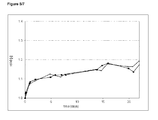
- This Figure 7 shows that the comparative sample S7 (without ground pulse seed, with egg yolk) shows a rapid increase of the ratio between the mean free path lengths ⁇ t and ⁇ 0 already directly after production. It reaches a plateau after about 10 days, to remain more or less stable until a period of 60 days.
- Sample S4 (with liquid egg yolk) even shows a stronger increase of the average bubble size. This shows that the phospholipids lead to decreased stability of the gas bubbles.
- Samples S2 and S3 (with stabilised egg yolk and defatted egg yolk, respectively) showed very stable gas bubbles. The average bubble size slowly increases during more than 60 days, to values which are considerably lower than the comparative example S7. Sample S1 shows the highest stability.
- the emulsion S1 from example 1 was also aerated without addition of extra lentil foam (like in example 2) or hydrophobin foam (like in example 1), by aerating the emulsion S1 from example 1 in the Kenwood Premium Chef mixer, at maximum speed, during 10 minutes.
- the maximum overrun that was obtained was about 2.5% using this method.
Landscapes
- Life Sciences & Earth Sciences (AREA)
- Chemical & Material Sciences (AREA)
- Engineering & Computer Science (AREA)
- Food Science & Technology (AREA)
- Polymers & Plastics (AREA)
- Health & Medical Sciences (AREA)
- Nutrition Science (AREA)
- Agronomy & Crop Science (AREA)
- Botany (AREA)
- Seasonings (AREA)
Abstract
The present invention provides aerated compositions containing ground pulse seed and hydrophobin. Aerated food products can be prepared that are stable and that do not require other emulsifiers in order to make stable products.
Description
- The present invention relates to aerated compositions containing ground pulse seed and hydrophobin and a method for making these compositions.
- Many food products are aerated, such as mousses, ice cream, and whipped cream. These food products contain small gas bubbles, and the gases may include air, nitrogen, and/or carbon dioxide. Aerated food products are being developed with two aspects which are of importance: first the foamability (how easy is it to aerate the food product), and second the stability of the aeration during storage (how well remain the air bubbles intact upon storage of the aerated food product).
- Hydrophobins are proteins known for their ability to effectively stabilise gas bubbles in compositions. The hydrophobins contribute both to foamability and foam stability. For example
WO 2006/010425 A1 ,WO 2007/039064 A1 ,WO 2010/136354 A1 , andWO 2010/136355 A1 disclose aerated compositions containing hydrophobins. - A pulse is an annual leguminous crop yielding from one to twelve seeds of variable size, shape, and color within a pod. Pulses and pulse seeds are commonly used for food and animal feed. A legume in botany writing is a plant from the family Fabaceae (or Leguminosae), or a fruit of these specific plants. Examples of pulses and pulse seeds include dry beans (Phaseolus spp.), dry peas (Pisum spp.), chickpea (Cicer arietinum), lentil (Lens culinaris), lupins (Lupinus spp.), and soyabean (Glycine max).
- Pulses and pulse seeds are well known to be used in emulsion food products.
-
WO 2012/089448 A1 discloses oil-in-water emulsions containing finely ground pulse seed, preferably from lentils, chickpeas, or beans. -
WO 2006/082640 A1 discloses mayonnaise containing soybean fibre.US 6,783,271 discloses a mayonnaise-like emulsion comprising soybean paste.EP 2 183 983 A2 discloses an enzymatically treated lupin bean powder and using this as an ingredient of a salad dressing.WO 99/51106 A1 -
KR 100529149 B1 - The use of pulses or pulse seeds or their extracts can be used in aerated products.
-
EP 0 371 725 A1GB 557,483 -
EP 1 967 077 A1 -
EP 976 332 A2 - Sathe S.K. et al. (Journal of Food Science 47(2), 1982, p. 491-497) describe foaming properties of flour obtained by grinding dried lupin seed (Lupinus mutabilis) in water. Also a protein concentrate of the lupin seed was investigated on foam properties in water. Foamability of the flour was lower than that of the protein concentrate, while the stability was comparable. The foaming capacity of the flour and the protein concentrate was lower than that of soybean and sunflower protein concentrates/isolates.
- Sathe S.K. et al. (Journal of Food Science 46(1), 1981, p. 71-81) describe foaming properties of flour and various protein fractions from the great northern bean (Phaseolus vulgaris L.) in water. The foamability was comparable to egg albumin (egg white), while the foam stability of protein of the great northern bean was less than that of egg albumin.
- Aerated products with hydrophobin that also contain emulsifiers like phospholipids, may suffer from instability with regards to the aeration (both gas bubble size and total gas bubble volume). The emulsifiers may interfere with the stabilising action of the hydrophobins, leading to decreased stability of aerated products. Examples of such products are oil-in-water emulsions like mayonnaises and light mayonnaises. These generally contain egg yolk, and phospholipids are an important element of egg yolk.
- Hence it is an object of the present invention to provide aerated products with hydrophobins, and in particular aerated oil-in-water emulsions with hydrophobins, that are stable with regard to gas bubble volume, as well as gas bubble size. Moreover, it is an object of the present invention to provide aerated aerated products with hydrophobins, and in particular aerated oil-in-water emulsions with hydrophobins, which do not require the addition of extra emulsifiers to create stable products.
- We have now found that this problem can be solved by providing aerated products containing a combination of ground pulse seed and hydrophobin.
- Accordingly in a first aspect the present invention provides an aerated composition having an overrun of at least 5%, comprising water, and ground pulse seed, wherein the pulse seed has a lipid content of maximally 6%, based on the weight of the raw pulse seed, and hydrophobin, and wherein the concentration of phospholipids is maximally 0.18% by weight of the composition.
- In a second aspect the present invention provides a method for preparation of a composition according to the first aspect of the invention, comprising the following steps:
- a) hydrating ground pulse seed in water at a temperature of at least 70°C during at least 5 minutes;
- b) optionally adding water soluble ingredients to the mixture from step a);
- c) optionally dispersing liquid edible oil into the mixture from step b);
- d) optionally adding egg yolk fraction comprising protein and phospholipids at a weight ratio of at least 3:1 wt/wt; and
- e) mixing the mixture from step c) or step d) with an aqueous foam containing hydrophobin.
- Unless defined otherwise, all technical and scientific terms used herein have the same meaning as commonly understood by one of ordinary skill in the art. All percentages, unless otherwise stated, refer to the percentage by weight, with the exception of percentages cited in relation to the overrun.
- In the context of the present invention and unless stated otherwise, the average gas bubble diameter is expressed as the d4,3 value, which is the volume weighted mean diameter. The volume based bubble size equals the diameter of a bubble that has the same volume as a given bubble. Also the d3,2 value may be used, which is defined as the diameter of a sphere that has the same volume/surface area ratio as a droplet or bubble of interest.
- The term 'aerated' means that gas has been intentionally incorporated into a composition, for example by mechanical means. The gas can be any gas, but is preferably, in the context of food products, a food-grade gas such as air, nitrogen, nitrous oxide, or carbon dioxide. Hence the term 'aeration' is not limited to aeration using air, and encompasses the 'gasification' with other gases as well. Aeration and foaming are considered to be synonyms in this respect, as well as aeratability and foamability. Also an 'aerated product' and a 'foam' are considered to be synonyms in here.
- The extent of aeration is measured in terms of 'overrun', which is defined as:

where the volumes refer to the volumes of aerated product and unaerated initial mix (from which the product is made). Overrun is measured at atmospheric pressure. - After formation, a foam will be vulnerable to coarsening and and phase separation by mechanisms such as creaming, Ostwald ripening and coalescence. By creaming, gas bubbles migrate under the influence of gravity to accumulate at the top of a product. Ostwald ripening or disproportionation refers to the growth of larger bubbles at the expense of smaller ones. Coalescence refers to merging of air bubbles by rupture of the film in between them. In general the smaller the average size of gas bubbles, the more preferable to obtain an aerated product of good quality.
- A stable foam or in the context of the present invention is defined as being stable for at least 30 minutes, more preferred at least an hour, more preferred at least a day, even more preferred at least a week, and most preferred at least a month, and most preferred several months. A stable foam can be defined to be stable with regard to total foam volume, and/or gas bubble size, and looses maximally 20% of its volume during 1 month storage. On the other hand systems may exist which loose more than 20% of its volume during 1 month storage, which nevertheless are considered to have a good stability, as the stability of such foams is much better than comparative foams.
- Such a foam can be produced by aerating a composition using an aerolatte, kenwood mixer, or a BA Mixer, to a fixed overrun of for example 100%. The foam is then placed into a 100 mL measuring cylinder, stoppered, and stored at 5°C, and the foam volume measured over time. Foams of which the average bubble size strongly increases over time are regarded to be less stable than foams of which the average bubble size remains small over time.
- In a first aspect the present invention provides an aerated composition having an overrun of at least 5%, comprising water, and ground pulse seed, wherein the pulse seed has a lipid content of maximally 6%, based on the weight of the raw pulse seed, and hydrophobin, and wherein the concentration of phospholipids is maximally 0.18% by weight of the composition.
- The composition of the invention preferably can be used as a food product, to which other ingredients can be added if required. The composition can be used as a basis for foams and/or aerated compositions or food products.
- Preferably, the composition of the invention has an overrun of at least 10%, preferably at least 20%, and preferably at most 200%, and preferably at most 100%. Preferably the overrun is at least 30%.
- The bubbles present in the aerated composition may have a wide range of sizes, preferably of up to 2,000 micrometer. More preferably the average bubble size d4,3 is smaller than 1,500 micrometer, more preferably the average bubble size d4,3 is smaller than 1,000 micrometer. Preferably the major part of the bubbles is small, hence preferably at least 50% of the gas bubbles has a diameter of maximally 1,000 micrometer. Preferably at least 25% of the gas bubbles has a diameter of maximally 500 micrometer. In some products a small average bubble size is desired, and in that case preferably at least 50% of the gas bubbles has a diameter of maximally 200 micrometer, and preferably at least 25% of the gas bubbles has a diameter of maximally 100 micrometer.
- Additionally the composition may comprise a hydrocolloid thickener at a concentration ranging from 0.1 % by weight to 1% by weight based on the weight of the composition. Hydrocolloid thickeners that may be used, are preferably xanthan gum, locust bean gum, guar gum, carrageenan, carboxy methylcellulose, starch, or combinations of these. Xanthan gum, carrageenan, locust bean gum or any combination of these thickeners are preferred. The addition of a hydrocolloid thickener is especially preferred in oil-in-water emulsions, when the oil level is preferably maximally 40%, preferably maximally 30%, preferably maximally 25% by weight. Preferably the pH of the composition of the invention ranges from 3 to 5, preferably from 3 to 4.5.
- Preferably the concentration of ground pulse seed ranges from 0.1 to 10% by weight of the composition. This concentration is based on the weight of the raw pulse seed. Preferably the concentration of ground pulse seed ranges from 0.1 to 5% by weight, preferably from 0.5 to 5% by weight of the composition. When the composition is in the form of an oil-in-water emulsion, the concentration of ground pulse seed preferably is at the higher end of the range of relatively low oil levels, meaning less than 40% by weight of oil. Vice versa, when the oil level is relatively high, the concentration of ground pulse seed is more at the lower end of the range. The ground pulse seed preferably is finely ground pulse seed, meaning that the maximum particle size of the ground pulse seed is less than 500 micrometer, preferably less than 400 micrometer.
- Preferably the ground pulse seed is obtained from pulse seed having the following composition, calculated on raw weight of the pulse seed:
- 25-55 wt% of starch;
- 1-40 wt% of dietary fiber;
- 0.5-12 wt% of sugars;
- 15-35 wt% of protein; and
- 0.8-8 wt% of lipids. Preferably the amount of dietary fibers in the ground pulse seed ranges from 20-40 wt%, preferably from 25-35 wt%. Preferably the amount of lipids in the ground pulse seed ranges from 0.8-6 wt%, preferably from 0.8-5 wt%, preferably from 0.8-4 wt%, preferably from 0.8-3 wt%, and more preferably from 0.8-2 wt%, and most preferably from 0.8-1.5 wt%. Preferably the pulse seed contains starch and protein in a weight ratio of 2:3 to 3:1, preferably 1:1 to 5:2.
- Preferably the pulse seed is obtained from plants from the genuses Vigna, Lens, or Cicer. Preferably the pulse seed is obtained from plants from the species Vigna radiata, Lens culinaris, Cicer arietinum, preferably from plants from the species Lens culinaris. Vigna radiata is the plant yielding the mung bean (used to be classified as Phaseolus aureus), Lens culinaris is the plant yielding lentil, and Cicer arietinum is is the plant yielding chickpea.
- Since the finely ground pulse can replace emulsifiers that are conventionally used to stabilise aerated food products, and in particular oil-in-water emulsions, the present invention provides a composition wherein the concentration of phospholipids is maximally 0.18% by weight of the composition. These phospholipids may originate from various sources, such as egg yolk, but also may originate from the pulse seed. Preferably the composition of the invention does not contain extra added emulsifiers selected from lecithin, monoglyceride, diglyceride and PEG ester. Preferably the addition of extra emulsifiers to create stable products is not required, hence preferably the compositions of the present invention are substantially free from added emulsifiers, more preferred the compositions are free from added emulsifiers. With added emulsifiers is meant that these are compounds which are generally added only to function as emulsifier, and examples of these are mono- and diglycerides, PEG ester, other food grade emulsifiers like for example diacetyl tartaric ester of mono- and diglycerides (Datem), and polysorbates. Egg yolk may be added to food products for various purposes, namely to provide an emulsifier (phospholipids), and also as a source of protein, and as ingredient that gives taste and flavour and texture to the composition.
- Preferably the concentration of phospholipids originating from egg yolk is maximally 0.15% by weight of the composition. Preferably, the concentration of phospholipids is maximally 0.13% by weight of the composition. Preferably the concentration of phospholipids originating from egg yolk is maximally 0.10% by weight of the composition. Phospholipids in this respect are defined as the compounds that have a glycerol backbone, a phosphate group, one or two fatty acid chains, and often a nitrogen-containing alcohol group (e.g. ethanolamine). They act as emulsifiers, as they have a hydrophilic head and a hydrophobic tail. The most abundant phospholipids are phosphatidylcholine, lysophosphatidylcholine, phosphatidylinositol, and phosphatidylethanolamine.
- Preferably, the composition of the invention is a non-frozen composition. This means that the composition of the invention preferably is prepared and stored at a temperature above 0°C.
- Preferably, the composition is in the form of an oil-in-water emulsion. Any commonly available oil or fat can be used to create the emulsion. Examples are dairy fat and vegetable oils like sunflower oil, olive oil, rapeseed oil, soybean oil, etcetera. Such emulsion may be created by dispersing an oil into the composition of the invention, or mixing the aerated composition of the invention with an oil-in-water emulsion. For example mixing the aerated composition of the invention with a mayonnaise or a dressing creates an oil-in-water emulsion according to the invention. Preferably, the composition contains from 5 to 70% of dispersed oil phase, based on the weight of the composition. More preferred the amount of dispersed oil phase ranges from 10 to 50% by weight. If present, preferably oil droplets are dispersed as droplets having an average d3,2 value ranging from 2 to 12 micrometer, preferably from 3 to 10 micrometer.
- The terms 'fat' and 'oil' are used interchangeably. Where applicable the prefix 'liquid' or 'solid' is added to indicate if the fat or oil is liquid or solid at ambient temperature as understood by the person skilled in the art. Edible oils contain a large number of different triacylglycerols (TAGs) with varying physical properties. The TAGs are esters of glycerol and three fatty acids. The TAGs in edible oils contain fatty acids with an even number of carbon atoms in the chains, generally varying between 4 and 24 in number. Common fatty acids from vegetable origin are C10, C12, C14, C16, C18, C20 and C22, and most common TAGs are composed of these fatty acids. The fatty acids may be saturated, or monounsaturated or polyunsaturated. Each fatty acid can contain up to three double bonds at certain positions in the chain. Additionally especially fish oil contains a high number of unsaturated fatty acids with more than one unsaturated bond in the chain, up to even 4 or 5 double bonds. The terms 'triacylglycerols', 'TAGs', and 'triglycerides' may be used interchangeably in here. In the context of the present invention, triglycerides are understood to be edible oils and fats.
- Oil may originate from various edible natural oils. Fats include: plant oils (for example: allanblackia oil, apricot kernel oil, arachis oil, arnica oil, argan oil, avocado oil, babassu oil, baobab oil, black seed oil, blackberry seed oil, blackcurrant seed oil, blueberry seed oil, borage oil, calendula oil, camelina oil, camellia seed oil, castor oil, cherry kernel oil, cocoa butter, coconut oil, corn oil, cottonseed oil, evening primrose oil, grapefruit oil, grape seed oil, hazelnut oil, hempseed oil, illipe butter, lemon seed oil, lime seed oil, linseed oil, kukui nut oil, macadamia oil, maize oil, mango butter, meadowfoam oil, melon seed oil, moringa oil, mowrah butter, mustard seed oil, olive oil, orange seed oil, palm oil, palm kernel oil, papaya seed oil, passion seed oil, peach kernel oil, plum oil, pomegranate seed oil, poppy seed oil, pumpkins seed oil, rapeseed (or canola) oil, red raspberry seed oil, rice bran oil, rosehip oil, safflower oil, seabuckthorn oil, sesame oil, shea butter, soy bean oil, strawberry seed oil, sunflower oil, sweet almond oil, walnut oil, wheat germ oil); fish oils (for example: sardine oil, mackerel oil, herring oil, cod-liver oil, oyster oil); animal oils (for example: butter or conjugated linoleic acid, lard or tallow); algae oil, or any mixture or fraction thereof. The oils and fats may also have been modified by hardening, fractionation, chemical or enzymatical interesterification or by a combination of these steps.
- The oil phase of the composition of the invention may be liquid at room temperature, or may be solid or partly solid at room temperature, or may be combination of both types of oil. Examples of oils that are liquid at room temperature are sunflower oil, olive oil, rapeseed oil, and other commonly known liquid vegetable oils. Examples of oils that are solid or partly solid at room temperature are coconut oil, dairy fat, and palm oil or palm oil fractions. Dairy fat is of animal origin, and most commonly is sourced from the milk of mammals like cows, sheep, and goats. These fats are preferred for use in the compositions of the invention.
- Generally natural oils contain at least 80% of triglycerides. Natural oils also may contain other compounds than triglycerides, such as diglycerides, monoglycerides and free fatty acids. Also compounds like lecithin, other emulsifiers, phytosterols, phytostanols, waxes, colourants like carotenoids, vitamins like vitamin A, D, E, and K, and antioxidants like the tocopherols (vitamin E) may be present in a natural oil. Preferably the total concentration of emulsifiers that do not originate from ground pulse seed is maximally 0.15% by weight of the composition, more preferred maximally 0.10% by weight of the composition.
- Preferred compositions according to the invention that are food products and oil-in-water emulsions, are dressings, mayonnaises and light mayonnaises.
- Egg yolk is not only added to many products to provide emulsifying capacity, but also because it provides taste and flavour to the product. Hence preferably the composition of the invention comprises an egg yolk fraction, wherein the egg yolk fraction has been treated to remove at least part of the phospholipids. Hence preferably the composition further comprises egg yolk fraction, and the egg yolk fraction comprises protein and phospholipids at a weight ratio of at least 3:1 wt/wt. Examples of such egg yolk fractions are defatted egg yolk and heat-stabilised egg yolk.
- Defatted egg yolk is an egg yolk which has been defatted by extracting lipid compounds from the egg yolk, for example by ethanol extraction. A suitable source of defatted egg yolk is Defatted Egg yolk powder 79 ex Bouwhuis Enthoven (Raalte, the Netherlands.
- Heat stabilised egg yolk is an egg yolk that has been subjected to an enzymatic process using phospholipase, leading to split off of one or two fatty acid chains from the phospholipid molecules. The fragments are retained in the sample. A suitable source of heat stabilised egg yolk is Heat stabilised egg yolk (92-8) ex Bouwhuis Enthoven (Raalte, the Netherlands).
- Preferably the composition of the invention comprises an egg yolk fraction that comprises protein and phospholipids at a weight ratio of at least 15:1 wt/wt, preferably at least 20:1 wt/wt. More preferred the egg yolk fraction comprises protein and phospholipids at a weight ratio ranging from 20:1 to 40:1, preferably from 25:1 to 35:1, and most preferred from 25:1 to 30:1.
- Preferably the composition of the invention comprises an egg yolk fraction that comprises protein and lipids at a weight ratio of at least 1:1 wt/wt, preferably at least 2:1 wt/wt.
- Preferably the composition of the invention has a total concentration of phospholipids of maximally 0.05% by weight, most preferably of maximally 0.025% by weight of the composition.
- Hydrophobins are a well-defined class of proteins (Wessels, 1997, Advances in Microbial Physiology 38: 1-45; Wosten, 2001, Annual Reviews of Microbiology 55: 625-646) that are capable of self-assembly at a hydrophobic/hydrophilic interface, and having a conserved sequence:
- Xn-C-X5-9-C-C-X11-39-C-X8-23-C-X5-9-C-C-X6-18-C-Xm (SEQ ID No. 1)
- Xn-C-X1-50-C-X0-5-C-X1-100-C-X1-100-C-X1-50-C-X0-5-C-X1-50-C-Xm (SEQ ID NO. 2)
- The formation of a film can be established by incubating a Teflon sheet in the protein solution followed by at least three washes with water or buffer (Wosten et al., 1994, Embo. J. 13: 5848-54). The protein film can be visualised by any suitable method, such as labeling with a fluorescent marker or by the use of fluorescent antibodies, as is well established in the art. m and n typically have values ranging from 0 to 2000, but more usually m and n in total are less than 100 or 200. The definition of hydrophobin in the context of the present invention includes fusion proteins of a hydrophobin and another polypeptide as well as conjugates of hydrophobin and other molecules such as polysaccharides.
- Hydrophobins identified to date are generally classed as either class I or class II. Both types have been identified in fungi as secreted proteins that self-assemble at hydrophobilic interfaces into amphipathic films. Assemblages of class I hydrophobins are relatively insoluble whereas those of class II hydrophobins readily dissolve in a variety of solvents.
- Hydrophobin-like proteins have also been identified in filamentous bacteria, such as Actinomycete and Streptomyces sp. (
WO 01/74864 - The hydrophobins can be obtained by extraction from native sources, such as filamentous fungi, by any suitable process. For example, hydrophobins can be obtained by culturing filamentous fungi that secrete the hydrophobin into the growth medium or by extraction from fungal mycelia with 60% ethanol. It is particularly preferred to isolate hydrophobins from host organisms that naturally secrete hydrophobins. Preferred hosts are hyphomycetes (e.g. Trichoderma), basidiomycetes and ascomycetes. Particularly preferred hosts are food grade organisms, such as Cryphonectria parasitica which secretes a hydrophobin termed cryparin (MacCabe and Van Alfen, 1999, App. Environ. Microbiol. 65: 5431-5435).
- Alternatively, hydrophobins can be obtained by the use of recombinant technology. For example host cells, typically micro-organisms, may be modified to express hydrophobins and the hydrophobins can then be isolated and used in accordance with the present invention. Techniques for introducing nucleic acid constructs encoding hydrophobins into host cells are well known in the art. More than 34 genes coding for hydrophobins have been cloned, from over 16 fungal species (see for example
WO96/41882 - Typically, an appropriate host cell or organism is transformed by a nucleic acid construct that encodes the desired hydrophobin. The nucleotide sequence coding for the polypeptide can be inserted into a suitable expression vector encoding the necessary elements for transcription and translation and in such a manner that they will be expressed under appropriate conditions (e.g. in proper orientation and correct reading frame and with appropriate targeting and expression sequences). The methods required to construct these expression vectors are well known to those skilled in the art.
- A number of expression systems may be used to express the polypeptide coding sequence. These include, but are not limited to, bacteria, fungi (including yeast), insect cell systems, plant cell culture systems and plants all transformed with the appropriate expression vectors. Preferred hosts are those that are considered food grade - 'generally regarded as safe' (GRAS).
- Suitable fungal species, include yeasts such as (but not limited to) those of the genera Saccharomyces, Kluyveromyces, Pichia, Hansenula, Candida, Schizo saccharomyces and the like, and filamentous species such as (but not limited to) those of the genera Aspergillus, Trichoderma, Mucor, Neurospora, Fusarium and the like.
- The sequences encoding the hydrophobins are preferably at least 80% identical at the amino acid level to a hydrophobin identified in nature, more preferably at least 95% or 100% identical. However, persons skilled in the art may make conservative substitutions or other amino acid changes that do not reduce the biological activity of the hydrophobin. For the purpose of the invention these hydrophobins possessing this high level of identity to a hydrophobin that naturally occurs are also embraced within the term "hydrophobins".
- Hydrophobins can be purified from culture media or cellular extracts by, for example, the procedure described in
WO 01/57076 Tween 20, to elute the hydrophobin from the surface. See also Collen et al., 2002, Biochim Biophys Acta. 1569: 139-50; Calonje et al., 2002, Can. J. Microbiol. 48: 1030-4; Askolin et al., 2001, Appl Microbiol Biotechnol. 57: 124-30; and De Vries et al., 1999, Eur J Biochem. 262: 377-85. - Hydrophobins are excellent foaming agents that lead to good foamability and good foam stability of a product to which the hydrophobin is added. Hydrophobins are generally rather expensive, hence the product developer has the tendency to keep the concentration of hydrophobin as low as possible. This not only leads to cost reduction, but also to saving of resources, as the production of the hydrophobin naturally costs energy. Preferably the concentration of hydrophobin ranges from 0.001 % to 2% by weight, preferably from 0.001 % to 1% by weight. Preferably the concentration of hydrophobin is at least 0.002% by weight, more preferably at least 0.005% by weight, and more preferably at least 0.01 % by weight based on the weight of the composition. Preferably the concentration of hydrophobin is maximally 0.3% by weight, preferably at most 0.25% by weight based on the weight of the composition.
- The hydrophobin used in the present invention can be a Class I or a Class II hydrophobin. Preferably the hydrophobin comprises class II hydrophobin, preferably class II hydrophobin HFBI or class II hydrophobin HFBII. Preferably the hydrophobin is in isolated form. Preferably the hydrophobin is soluble in water. Preferably the hydrophobin is a class II hydrophobin HFBII.
- When preparing the composition of the invention, the hydrophobin may be added to the other ingredients as a foamed solution in water. The concentration of this solution in water is preferably between 0.05 and 10% by weight, based on the weight of the water, preferably between 0.1 and 5% by weight, more preferably between 0.1 and 1% by weight.
- As indicated before, the advantages of the composition of the invention is not only that the foamability of the composition improves, but also the foam stability during storage. Foamability can be split in two parts; the first part relates to the ability to reach a high overrun, and the second to the ability to generate small bubbles during aeration. For some applications the presence of small bubbles is an advantage, hence if the average bubble size decreases, this is considered to be an advantage.
- The composition of the invention can be used in an aerated food product. The composition of the invention is then used as such, or the aerated composition can be mixed with ingredients of such food product or with the food product itself. Preferred food products are soufflés, dressings, mayonnaise, light mayonnaise and other products.
- In a second aspect the present invention provides a method for preparation of a composition according to the first aspect of the invention, comprising the following steps:
- a) hydrating ground pulse seed in water at a temperature of at least 70°C during at least 5 minutes;
- b) optionally adding water soluble ingredients to the mixture from step a);
- c) optionally dispersing liquid edible oil into the mixture from step b);
- d) optionally adding egg yolk fraction comprising protein and phospholipids at a weight ratio of at least 3:1 wt/wt; and
- e) mixing the mixture from step c) or step d) with an aqueous foam containing hydrophobin.
- In step a) the ground pulse seed is hydrated and heated in water, in order to gelatinise the starch. The time and temperature required for this preferably conform to one of the following requirements:
- ● 70-80°C: 5-80 minutes
- ● 80-100°C 5-70 minutes
- ● 100-120°C: 60-1200 seconds
- ● 120-150°C: 30-480 seconds
- The equipment used preferably can be any equipment which is normally used in the art to heat this kind of mixtures. Preferably the concentration of ground pulse seed in step a) ranges from 0.5% to 10% by weight, preferably from 1% to 5% by weight.
- In optional step b) water-soluble ingredients are added to the dispersion in any suitable way known to the skilled person.
- In optional step c) the emulsification may be done applying any emulsification method commonly known, for example high pressure homogenisation operated at a pressure ranging from 40 to 300 bar and 1 to 3 passes. Preferably the emulsification is done such that the average droplet size of the oil is smaller than 10 micrometer. Preferably the emulsification is done with an edible oil that is liquid at room temperature. In case the oil phase is solid or semi-solid at room temperature, the emulsification may be done at a temperature that the oil phase is liquid, for example at a temperature higher than 40°C or higher than 50°C.
- In optional step d) egg yolk fraction comprising protein and phospholipids at a weight ratio of at least 3:1 wt/wt; is added and mixed in any suitable way known to the skilled person.
- Finally in step e) an aerated composition of hydrophobin in water is provided, to be mixed with the mixture from the previous step. This way an aerated product is obtained. The aeration may be done with any common means to aerate an aqueous product, for example an aerolatte, kenwood mixer, or a BA Mixer.
- The concentration of hydrophobin in the aqueous composition prior to aerating preferably ranges from 0.05% to 1% by weight of the composition, more preferred ranges from 0.1% to 0.5%, more preferred from 0.1% to 0.3%. The overrun of the aerated aqueous composition comprising hydrophobin in step e) preferably ranges from 100% to 1,000%, more preferred from 200% to 900%.
-
-
Figure 1 : Relative bubble size as function of time, expressed as the ratio between the mean free path lengths, samples from example 1. Relative bubble size is determined using Turbiscan method described below. -
Figure 2 : Picture of two foams (from example 2), with: left emulsion S1 aerated with lentil flour foam, showing coarse gas bubbles; right emulsion S1 aerated with HFBII foam; showing finer gas bubbles. -
Figure 3 : Relative bubble size as function of time, expressed as the ratio between the mean free path lengths, samples from example 2: Relative bubble size is determined using Turbiscan method described below.- ■: emulsion S1 aerated with lentil foam
- x: emulsion S1 aerated with HFBII foam
-
Figure 4 : Mean free path length as function of time, of samples from example 2; determined using Turbiscan method described below.- ■: emulsion S1 aerated with lentil foam
- x: emulsion S1 aerated with HFBII foam
-
Figure 5 : Relative bubble size as function of time, expressed as the ratio between the mean free path lengths, samples from example 2, duplicate experiment. Relative bubble size is determined using Turbiscan method described below.- ■: emulsion S1 aerated with lentil foam
- x: emulsion S1 aerated with HFBII foam
-
Figure 6 : Mean free path length as function of time, of samples from example 2, duplicate experiment; determined using Turbiscan method described below.- ■: emulsion S1 aerated with lentil foam
- x: emulsion S1 aerated with HFBII foam
-
Figure 7 : Relative bubble size as function of time, expressed as the ratio between the mean free path lengths, samples from example 3. Relative bubble size is determined using Turbiscan method described below. - The following non-limiting examples describe the present invention.
-
- ● Class II Hydrophobin HFBII ex Danisco (Copenhagen, Denmark), produced by the fungus Trichoderma reesei, and isolated from fermentation broth. Concentration is 13.8 wt% of HFBII in aqueous solution, pH about 4.5, buffered with ammonium salt.
- ● citrus fibre: Herbacel AQ plus type N ex Herbafood (Werder (Havel), Germany);
- ● xanthan gum, Keltrol RD ex CP Kelco (Nijmegen, The Netherlands);
- ● EDTA: Dissolvine E-CA, ex Akzo Nobel (Amersfoort, The Netherlands).
- The following pulse seeds were used in the experiments:
- ● Mung bean (Vigna radiata), 'Groene mungbonen', supplier Vanka Kawat BV (Leidschendam, Netherlands). Milled with a coffee mill and sieved to a size smaller than 500 micrometer.
- ● Red lentil (Lens culinaris), lentil flour, supplier AS Besin (Turkey).
- ● Chickpea (Cicer arietinum), Valle del Sole™, supplier Unidex B.V. (Hillegom, The Netherlands). Milled with a coffee mill and sieved to a size smaller than 355 micrometer.
- Characterising data of these pulse seeds are given in the following table.
Table 1 Composition of selected pulse seeds (source: http://ndb.nal.usda.gov, 9th October 2012) Nutrient amount per 100g Chickpea (mature seeds, raw) Mung beans (mature seeds, raw) Lentils (raw) water g 11.53 9.05 10.40 protein g 19.30 23.86 25.80 total lipid (fat) g 6.04 1.15 1.06 ash g 2.48 3.32 2.67 total carbohydrate (by difference) 1 g 60.7 62.6 60.1 fiber (total dietary) 2 g 17.4 16.3 30.5 sugars, total 2 g 10.7 6.6 2.0 starch 2 g 32.6 39.7 27.6 1 total carbohydrate calculated by: 100% - (water+protein+lipid+ash)
2 dietary fiber and sugars are included in the carbohydrate value, and it is assumed that starch is remainder of total carbohydrates. Also the dietary fiber value may contain starch, hence the value in the starch row is the minimum value. -
- 1. Heat stabilised Egg yolk (92-8) ('SEY') ex Bouwhuis Enthoven (Raalte, the Netherlands). In this product the phospholipids from egg yolk are subjected to an enzymatic process using phospholipase, leading to split off of the fatty acid chains from the phospholipid molecules. The fragments are retained in the sample.
- 2. Defatted Egg yolk powder 79 ('DEY') ex Bouwhuis Enthoven (Raalte, the Netherlands. This is a hen's egg yolk, which has been pasteurized and dried, and defatted by ethanol extraction. Chemical and physical characteristics as given by supplier: solids ≥94%, fat content ≤11% (incl. phospholipids, cholesterol, triglycerides), protein content ≥75%, ethanol ≤4%.
- 3. Liquid egg yolk ('LEY') ex Bouwhuis Enthoven (Raalte, the Netherlands.
- Characterising data of these egg yolk types are given in the following table.
Table 2 Chemical characterisation of various egg yolk materials and fractions. Phosholipid analysis of materials (in % by weight), as determined using quantitative 31P-NMR spectroscopy: liquid egg yolk heat stabilised egg yolk defatted egg yolk moisture 51.5% * 51.5% * 5.8% & dry matter 94.2% & protein 13.5% * 13.5% * 73.3% & total lipids (incl. triglycerides, phospholipids, cholesterol) 25.5% * 25.5% * 11 % * salt (Nacl) 8% * 8% * Total phospholipids of which: 8.01%& 4.06%& 2.69% & PC (phosphatidylcholine) 5.97% 0.15% 1.67% 1-LPC (1-lysophosphatidylcholine) 0.03% 0.25% - 2-LPC (lysophosphatidylcholine) 0.12% 2.64% 0.05% PI (phosphatidylinositol) 0.09% - 0.37% SPH (sphingomyelin) 0.15% 0.20% 0.08% PE (phosphatidylethanolamine) 1.58% 0.04% 0.47% LPE (lysophosphatidylethanolamine) 0.07% 0.78% 0.03% ratio protein / total phospholipids (wt/wt) (calculated) 1.69 3.32 27.2 ratio protein / total lipids (wt/wt) (calculated) 0.53 0.53 6.66 *) data from supplier
&) determined in house - The gas bubble size in aerated compositions is estimated using a turbiscan turbidity measurement. In principle this is a spectrophotometer that can be loaded with a glass tube containing a foam sample. Light transmitted at the tube and reflected is measured. This is translated into the average bubble diameter.
- Detailed procedure: sample volumes of approximately 20 mL were studied by turbidimetry using a Turbiscan Lab Expert (Formulaction, Toulouse, France). We interpret the average backscattering along the height of the foam sample with exclusion of the top and bottom parts where the backscattering is affected by edge effects. The backscattering (BS) is related to the transport mean free path length (λ, lambda) of the light in the sample through:

- In turn, the transport mean free path of light is related to the mean diameter (d) and the volume fraction (Φ) of the gas bubbles through:

- Where g and Q are optical constants given by Mie theory (G. F. Bohren and D.R.Huffman, Absorption and Scattering of Light by Small Particles. Wiley, New York, 1983).
- For foam dispersed in a transparent liquid, this method provides an estimate of the number average bubble size.
- In an aerated emulsion, the mean free path length is influenced by the gas bubbles, and also by the oil droplets dispersed in the continuous aqueous phase. When two aerated emulsions are compared, and the emulsion bases are the same (i.e. oil droplet size), and only the degree of aeration (for example gas volume, or gas bubble size) is different, then a difference between the values of the mean free path length A of the two emulsions is only influenced by the gas bubbles. Hence the mean free path length λ of these two samples gives a measure of the gas bubble size. Therefore comparing the mean free path length A of two emulsion bases that are the same, gives a measure for the difference in gas bubble size of the two samples. The mean free path length A is not the same as the average gas bubble size, it is a measure for the average gas bubble size.
- When following the development of the gas bubble size during storage of aerated compositions, the mean free path length at the start of the measurement (λ0 at t=0) is taken as the reference, and the measured mean free path length at various moments in time (λt) is compared against this reference, by taking the ratio of these values (λt/λ0). This gives a measure for the development of the average gas bubble size compared to the starting value, assuming that the emulsion bases remain the same (i.e. oil droplet size) during storage.
- In this example it is shown that a light mayonnaise containing ground pulse seeds and hydrophobin is stable after aeration.
- The compositions in Table 3 were prepared, comparing red lentil flour (S1), chickpea flour (S5), and mungbean flour (S8), with a standard light-mayonnaise as comparative (S7). The comparative sample has been prepared with a composition which is the same as commercially available Hellmann's light mayonnaise (ex Unilever, Rotterdam). To these four compositions a foam containing hydrophobin was added to aerate the samples.
Table 3 Compositions of oil-in-water emulsions with ground pulse seeds. Ingredient S1 S5 S7 S8 [wt%] [wt%] [wt%] comparative [wt%] Red lentil flour 3 Chickpea flour 3 Mungbean flour 3 liquid egg yolk ('LEY') 8.9 sucrose 2 2 1.6 2 kitchen salt (NaCl) 1.6 1.6 1.7 1.6 demineralised water 39.9 39.9 30.8 39.9 acetic acid 12% 3.5 3.5 5.1 3.5 sunflower oil 50 50 50 50 citrus fibre AQ plus N 1.7 xanthan gum Keltrol RD 0.07 EDTA 0.1 pH adjusted to 3.7 3.7 3.7 3.7 - These oil-in-water emulsions were prepared using the following procedure:
- ● ground pulse seed slurry was prepared by dispersing flour into cold water (concentration 3% by weight), mix with a paddle stirrer at 200 rpm, heated to 85-90°C, and held at 85°C for 5 minutes;
- ● aqueous phase was prepared by mixing this slurry with sucrose and kitchen salt;
- ● oil was emulsified (using Silverson high shear mixer) by adding the oil to the aqueous phase while stirring;
- ● add acetic acid solution while mixing to set the pH.
- Sample S7 (which is the same as commercially available Hellmann's light mayonnaise) was prepared in the following way:
- ● Citrus fibre is dispersed in water, with high shear Silverson mixer at 5,000 rpm, during 10 minutes, resulting in a slurry.
- ● Liquid egg yolk, sucrose, and kitchen salt were mixed into this slurry with the high shear Silverson mixer, at 3,000 rpm for 2 minutes.
- ● Xanthan gum was dispersed into oil. This oil dispersion was mixed into above aqueous phase, and held at 6000 rpm for 5 minutes. Acetic acid was added at 3000 rpm and mixed for 5 minutes.
- ● This pre-emulsion was finally homogenised in a high pressure homogeniser at 300 bar.
- Aeration of these emulsions was performed in the following way. The hydrophobin HFBII as obtained was diluted with demineralised water to a concentration of 0.2% by weight. Subsequently this mixture of HFBII in water was aerated using a Kenwood mixer Premium Chef mixer, at maximum speed, to an overrun of about 700% to 800%, to yield HFBII foam. This foam was manually mixed with the emulsions to give aerated emulsions with 30 vol% air. About 8% of foam was mixed with an emulsion to obtain a volume fraction of air of 30 vol%. The final concentration of HFBII in the emulsion compositions was about 0.05% by weight of the composition.
- The HFBII foam as such was very stable, after 1 day the foam visually had not lost volume. The foam was also stable when mixing with the emulsion, it appeared that no foam volume was lost by the manual mixing operation.
- All aerated emulsions with pulse seeds could successfully be prepared, showing that the three ground pulse seeds could be used to make stable emulsions, and that the addition of an emulsifier like phospholipids or other emulsifier was not necessary. The aerated emulsions had a good structure.
- The stability of the aerated emulsions with regard to the aeration was followed using a Turbiscan as described above. The bubble size evolution of the samples during storage was determined, by determining the ratio between the mean free path lengths in time. Results of the bubble size evolution of these samples are given in
Figure 1 . This figure shows the ratio between the mean free path length λt and λ0, which is a measure for the relative bubble size as function of storage time, during 60 days storage at a temperature of 20°C. - This
Figure 1 shows that the comparative sample S7 (without ground pulse seed) shows a rapid increase of average bubble size already directly after production. It reaches a plateau after about 10 days, to remain more or less stable until a period of 60 days. The samples S5 (chickpea flour) and S8 (with mungbean flour) also show an increase to a similar value as the comparative S7, at a much smaller rate though. Until a storage period of 30 to 40 days, the average bubble size increase of samples S5 and S8 is smaller than that of the comparative sample S7. Finally sample S1 (containing red lentil flour) has an excellent stability. The average bubble size slowly increases during about 40 days, from 1 to about 1.1. Then it reaches a plateau to remain at the value of about 1.1. - The emulsion with sample code S1 from example 1 was aerated with a foam with lentil seed (without hydrophobin), in order to compare the foamability of the composition without hydrophobin. Also an aerated emulsion S1 aerated with HFBII foam was prepared again (a duplication of the aerated emulsion S1 from example 1), to compare this to the emulsion with lentil foam.
- Aqueous foams with lentil flour were produced by dispersing lentil flour in water at room temperature, at two concentrations:
- ● 0.7% lentil flour, containing about 0.2% protein based on the weight of the foam (comparable to the 0.2% concentration of HFBII in the other sample); and
- ● 7% lentil flour, containing about 2% protein based on the weight of the foam.
- The dispersions of lentil flour in water were aerated by using a Kenwood Premium Chef mixer, at maximum speed, during 10 minutes. The maximum overruns and stability that could be obtained were:
- ● 67% overrun for the 0.7% lentil flour dispersion; this foam coarsened very fast (within minutes), and it was not possible to obtain air bubble volume of 30 vol% when mixing this with emulsion S1;
- ● 100% overrun for the 7% lentil flour dispersion; this foam coarsened very fast (within minutes); in this case it was possible to obtain air bubble volume of 30 vol% when mixing this with emulsion S1. The air bubbles in this aerated emulsion were relatively coarse, compared to the aerated emulsion S1 with HFBII foam. This is shown in
Figure 2 . - The aerated emulsions with an air volume of 30 vol% with either lentil foam or HFBII foam were analysed in time using the Turbiscan as described above, to follow the evolution of the relative gas bubble size.
Figure 3 shows the ratio between the mean free path length λt and λ0, which is a measure for the relative bubble size as function of storage time, for emulsion S1 aerated with lentil foam (■) and emulsion S1 aerated with HFBII foam (x). This shows that the emulsion with lentil foam shows faster bubble growth than the emulsion with HFBII foam. In case of HFBII there is some coarsening of gas bubbles, and this mainly takes place within the first 3 days. Thereafter there is only a minor coarsening. In case of lentil foam, there is rapid coarsening of gas bubbles the first 3 days, and this process continues. -
Figure 4 shows the mean free path length λ as function of time, of these same samples. This time mean free path length is not relative to the initial value, but the value of λ is plotted. This value of λ is a measure for the bubble size, it does not give the bubble size directly, as the oil droplets also influence the mean free path length λ. This figure shows that the mean free path length λ of the emulsion with HFBII foam is smaller than of the emulsion with lentil foam, and this mean free path length λ remains smaller. This graph is consistent with the picture inFigure 2 , which shows that the bubbles in the emulsion with lentil foam are relatively coarse. As a small average bubble size is required, the aerated emulsion with HFBII shows a better performance, as the mean free path length λ of these samples is smaller than of the lentil foam. In this comparison, the emulsion base is the same, hence this is a fair comparison. In this case the only influencing factor on the mean free path length λ is the gas bubble size. - These examples of aerated emulsion S1 with either lentil foam or HFBII foam were duplicated. The only difference between the experiments as described above, is that for all experiments the lentil foam (water with 7% lentil flour) was made in a single batch. For the duplicate experiments that were done, this foam had been standing untouched for a longer time than for the experiments described above. As this lentil foam is not very stable, the coarsening process of this foam had started already before being mixed with the emulsion S1. Hence the growth of the relative bubble size in the duplicate experiments was smaller than in the experiments described above. This is shown in
Figure 5 , which shows the ratio between the mean free path length λt and λ0 as function of time, of the duplicate samples for emulsion S1 aerated with lentil foam (■) and emulsion S1 aerated with HFBII foam (x). Both samples show the same relative mean free path length during storage. - Although the ratio between λt and λ0 are the same for these samples, the mean free path length λ of the two samples is different.
Figure 6 shows that there is still a difference in mean free path length as function of time, of the duplicate samples, for emulsion S1 aerated with lentil foam (■) and emulsion S1 aerated with HFBII foam (x). The mean free path length λ of the emulsion with lentil foam is larger than that of the HFBII foam. As a small average bubble size is required, the aerated emulsion with HFBII shows a better performance, as the mean free path length is smaller. In this comparison, the emulsion base is the same, hence this is a fair comparison. In this case the only influencing factor on the mean free path length λ is the gas bubble size. - In this example the influence of various egg yolk types on stability of aerated light mayonnaise using hydrophobin as stabiliser and containing red lentil flour is investigated. Three types of egg yolk were tested and used, as described above.
- Various oil-in-water emulsions were produced, having compositions as in Table 4. Each composition contained different egg yolk type or no egg yolk. The amount of egg yolk source was normalised on the protein content present in the egg yolk.
Table 4 Compositions of oil-in-water emulsions with red lentil flour and various egg yolk types. Ingredient S1 # S2 S3 S4 S7 # [wt%] [wt%] [wt%] [wt%] comparative [wt%] comparative Red lentil flour 3 3 3 3 stabilised egg yolk (SEY)* 2.4 liquid egg yolk (LEY)* 2.4 8.9 defatted egg yolk (DEY) 0.43 sucrose 2 2 2 2 1.6 kitchen salt (NaCl) 1.6 1.4* 1.6 1.4* 1.7 demineralised water 39.9 37.7 39.5 37.7 30.8 acetic acid 12% 3.5 3.5 3.5 3.5 5.1 sunflower oil 50 50 50 50 50 citrus fibre 1.7 xanthan gum 0.07 EDTA 0.1 pH adjusted to 3.7 3.7 3.7 3.7 3.7 concentration phospholipids from egg yolk [wt%]% 0 0.097 0.012 0.19 0.71 concentration egg yolk protein [wt%] 0 0.32 0.32 0.32 1.20 #) S1 and S7 are the same samples as in Table 3
*) SEY and LEY both contain 2% NaCl
%) based on data in Table 2 - The emulsions were prepared and aerated using the same procedure, as in example 1, wherein the egg yolk types in samples S2, S3, and S4 were added after acetic acid addition.
- Aeration of these emulsions was performed in the same way as in example 1, leading to a final concentration of HFBII in the product of about 0.05% by weight of the composition. The aerated emulsions had a good structure.
- The average bubble size during storage of these emulsions was determined using a Turbiscan as described above. Results of the relative bubble size evolution are given in
Figure 7 . This figure shows the ratio between the mean free path lengths λt and λ0, which is a measure for the relative bubble size as function of storage time, during more than 60 days storage at a temperature of 20°C. - This
Figure 7 shows that the comparative sample S7 (without ground pulse seed, with egg yolk) shows a rapid increase of the ratio between the mean free path lengths λt and λ0 already directly after production. It reaches a plateau after about 10 days, to remain more or less stable until a period of 60 days. Sample S4 (with liquid egg yolk) even shows a stronger increase of the average bubble size. This shows that the phospholipids lead to decreased stability of the gas bubbles. Samples S2 and S3 (with stabilised egg yolk and defatted egg yolk, respectively) showed very stable gas bubbles. The average bubble size slowly increases during more than 60 days, to values which are considerably lower than the comparative example S7. Sample S1 shows the highest stability. - The emulsion S1 from example 1 was also aerated without addition of extra lentil foam (like in example 2) or hydrophobin foam (like in example 1), by aerating the emulsion S1 from example 1 in the Kenwood Premium Chef mixer, at maximum speed, during 10 minutes. The maximum overrun that was obtained was about 2.5% using this method.
Claims (14)
- An aerated composition having an overrun of at least 5%, comprising water, and ground pulse seed, wherein the pulse seed has a lipid content of maximally 6%, based on the weight of the raw pulse seed, and
hydrophobin, and
wherein the concentration of phospholipids is maximally 0.18% by weight of the composition. - A composition according to claim 1, having an overrun of at least 10%, preferably at least 20%, and preferably at most 200%, and preferably at most 100%.
- A composition according to claim 1 or 2, wherein the concentration of ground pulse seed ranges from 0.1 to 10% by weight of the composition.
- A composition according to any of claims 1 to 3, wherein the ground pulse seed is obtained from pulse seed having the following composition, calculated on raw weight of the pulse seed:- 25-55 wt% of starch;- 1-40 wt% of dietary fiber, preferably 10-40 wt% of dietary fiber;- 0.5-12 wt% of sugars;- 15-35 wt% of protein; and- 0.8-8 wt% of lipids, preferably 0.8-2 wt% lipids.
- A composition according to any of claims 1 to 4, wherein the pulse seed is obtained from plants from the genuses Vigna, Lens, or Cicer.
- A composition according to any of claims 1 to 5, wherein the pulse seed is obtained from plants from the species Vigna radiata, Lens culinaris, Cicer arietinum, preferably from plants from the species Lens culinaris.
- A composition according to any of claims 1 to 6, wherein the concentration of phospholipids is maximally 0.13% by weight of the composition.
- A composition according to any of claims 1 to 7, wherein the composition is a non-frozen composition.
- A composition according to any of claims 1 to 8, wherein the composition is in the form of an oil-in-water emulsion.
- A composition according to claim 9, wherein the composition contains from 5 to 70% of dispersed oil phase, based on the weight of the composition.
- A composition according to any of claims 1 to 10, wherein the composition further comprises egg yolk fraction, and the egg yolk fraction comprises protein and phospholipids at a weight ratio of at least 3:1 wt/wt.
- A composition according to any of claims 1 to 11, wherein the concentration of hydrophobin ranges from 0.001% to 2% by weight, preferably from 0.001% to 1% by weight.
- A composition according to any of claims 1 to 12, wherein the hydrophobin comprises class II hydrophobin, preferably class II hydrophobin HFBI or class II hydrophobin HFBII.
- A method for preparation of a composition according to any of claims 1 to 13, comprising the following steps:a) hydrating ground pulse seed in water at a temperature of at least 70°C during at least 5 minutes;b) optionally adding water soluble ingredients to the mixture from step a);c) optionally dispersing liquid edible oil into the mixture from step b);d) optionally adding egg yolk fraction comprising protein and phospholipids at a weight ratio of at least 3:1 wt/wt; ande) mixing the mixture from step c) or step d) with an aqueous foam containing hydrophobin.
Priority Applications (1)
| Application Number | Priority Date | Filing Date | Title |
|---|---|---|---|
| EP12198877.8A EP2745702A1 (en) | 2012-12-21 | 2012-12-21 | Aerated compositions containing ground pulse seed and hydrophobin |
Applications Claiming Priority (1)
| Application Number | Priority Date | Filing Date | Title |
|---|---|---|---|
| EP12198877.8A EP2745702A1 (en) | 2012-12-21 | 2012-12-21 | Aerated compositions containing ground pulse seed and hydrophobin |
Publications (1)
| Publication Number | Publication Date |
|---|---|
| EP2745702A1 true EP2745702A1 (en) | 2014-06-25 |
Family
ID=47519921
Family Applications (1)
| Application Number | Title | Priority Date | Filing Date |
|---|---|---|---|
| EP12198877.8A Withdrawn EP2745702A1 (en) | 2012-12-21 | 2012-12-21 | Aerated compositions containing ground pulse seed and hydrophobin |
Country Status (1)
| Country | Link |
|---|---|
| EP (1) | EP2745702A1 (en) |
Cited By (4)
| Publication number | Priority date | Publication date | Assignee | Title |
|---|---|---|---|---|
| WO2018122607A1 (en) * | 2016-12-30 | 2018-07-05 | Ascher Shmulewitz | Chickpea protein products and methods of making thereof |
| WO2020128083A1 (en) | 2018-12-21 | 2020-06-25 | Société des Produits Nestlé S.A. | Aerated food products and processes of preparation thereof |
| CN113073125A (en) * | 2021-03-29 | 2021-07-06 | 常州大学 | Extraction method of fructus cannabis polypeptide liquid |
| RU2820246C1 (en) * | 2023-11-24 | 2024-05-31 | федеральное государственное бюджетное образовательное учреждение высшего образования "Российский биотехнологический университет (РОСБИОТЕХ)" | Composition for producing coffee-chickpea mousse |
Citations (18)
| Publication number | Priority date | Publication date | Assignee | Title |
|---|---|---|---|---|
| GB557483A (en) | 1942-04-17 | 1943-11-23 | John Christian Ferree | Production of an edible product from soya beans and other protein containing materials |
| EP0371725A2 (en) | 1988-11-28 | 1990-06-06 | Unilever Plc | Method of preparing a food product |
| WO1996041882A1 (en) | 1995-06-12 | 1996-12-27 | Proefstation Voor De Champignoncultuur | Hydrophobins from edible fungi, genes, nucleotide sequences and dna-fragments encoding for said hydrophobins, and expression thereof |
| WO1999051106A1 (en) | 1998-04-03 | 1999-10-14 | E.I. Du Pont De Nemours And Company | Functional protein compositions, emulsions based thereon and processes for their preparation |
| EP0976332A2 (en) | 1998-07-27 | 2000-02-02 | Lucas Meyer GmbH & Co | Lecithin in ice cream |
| WO2001057076A1 (en) | 2000-02-04 | 2001-08-09 | Applied Nanosystems B.V. | Method of purifying a hydrophobin present in a hydrophobin-containing solution |
| WO2001074864A1 (en) | 2000-03-30 | 2001-10-11 | Applied Nanosystems B.V. | Protein capable of self-assembly at a hydrophobic-hydrophilic interface and uses thereof |
| US6783271B1 (en) | 1999-08-24 | 2004-08-31 | Zakrytoe Aktsionernoe Obschestvo “Katalizatornaya Kompaniya” | Rotary dispergator, method of producing food products with the use thereof and food products produced by this method |
| KR100529149B1 (en) | 2004-06-28 | 2005-11-15 | 주식회사오뚜기 | Method of manufacturing mayonnaise without using egg yolk and non-cholesterol mayonnaise |
| WO2006010425A1 (en) | 2004-07-27 | 2006-02-02 | Unilever Plc | Aerated food products containing hydrophobin |
| WO2006082640A1 (en) | 2005-02-03 | 2006-08-10 | Peace Beans Co., Ltd. | Process for producing mayonnaise-like sauce utilizing soybean and mayonnaise-like sauce utilizing soybean |
| WO2007039064A1 (en) | 2005-09-23 | 2007-04-12 | Unilever Plc | Aerated products with reduced creaming |
| US20080213453A1 (en) * | 2006-12-20 | 2008-09-04 | Conopco Inc, D/B/A Unilever | Aerated food products and methods for producing them |
| EP1967077A2 (en) | 2007-02-26 | 2008-09-10 | Unilever Plc | Frozen aerated product comprising soy protein |
| EP2183983A2 (en) | 2008-11-07 | 2010-05-12 | Kraft Foods Global Brands LLC | Pourable food composition with high natural fiber content and methods of production |
| WO2010136355A1 (en) | 2009-05-29 | 2010-12-02 | Unilever Plc | Oil-in-water emulsion |
| WO2010136354A1 (en) | 2009-05-29 | 2010-12-02 | Unilever Plc | Oil-in-water emulsion |
| WO2012089448A1 (en) | 2010-12-27 | 2012-07-05 | Unilever Nv | Stabilized edible oil-in-water emulsion comprising ground pulse seed |
-
2012
- 2012-12-21 EP EP12198877.8A patent/EP2745702A1/en not_active Withdrawn
Patent Citations (18)
| Publication number | Priority date | Publication date | Assignee | Title |
|---|---|---|---|---|
| GB557483A (en) | 1942-04-17 | 1943-11-23 | John Christian Ferree | Production of an edible product from soya beans and other protein containing materials |
| EP0371725A2 (en) | 1988-11-28 | 1990-06-06 | Unilever Plc | Method of preparing a food product |
| WO1996041882A1 (en) | 1995-06-12 | 1996-12-27 | Proefstation Voor De Champignoncultuur | Hydrophobins from edible fungi, genes, nucleotide sequences and dna-fragments encoding for said hydrophobins, and expression thereof |
| WO1999051106A1 (en) | 1998-04-03 | 1999-10-14 | E.I. Du Pont De Nemours And Company | Functional protein compositions, emulsions based thereon and processes for their preparation |
| EP0976332A2 (en) | 1998-07-27 | 2000-02-02 | Lucas Meyer GmbH & Co | Lecithin in ice cream |
| US6783271B1 (en) | 1999-08-24 | 2004-08-31 | Zakrytoe Aktsionernoe Obschestvo “Katalizatornaya Kompaniya” | Rotary dispergator, method of producing food products with the use thereof and food products produced by this method |
| WO2001057076A1 (en) | 2000-02-04 | 2001-08-09 | Applied Nanosystems B.V. | Method of purifying a hydrophobin present in a hydrophobin-containing solution |
| WO2001074864A1 (en) | 2000-03-30 | 2001-10-11 | Applied Nanosystems B.V. | Protein capable of self-assembly at a hydrophobic-hydrophilic interface and uses thereof |
| KR100529149B1 (en) | 2004-06-28 | 2005-11-15 | 주식회사오뚜기 | Method of manufacturing mayonnaise without using egg yolk and non-cholesterol mayonnaise |
| WO2006010425A1 (en) | 2004-07-27 | 2006-02-02 | Unilever Plc | Aerated food products containing hydrophobin |
| WO2006082640A1 (en) | 2005-02-03 | 2006-08-10 | Peace Beans Co., Ltd. | Process for producing mayonnaise-like sauce utilizing soybean and mayonnaise-like sauce utilizing soybean |
| WO2007039064A1 (en) | 2005-09-23 | 2007-04-12 | Unilever Plc | Aerated products with reduced creaming |
| US20080213453A1 (en) * | 2006-12-20 | 2008-09-04 | Conopco Inc, D/B/A Unilever | Aerated food products and methods for producing them |
| EP1967077A2 (en) | 2007-02-26 | 2008-09-10 | Unilever Plc | Frozen aerated product comprising soy protein |
| EP2183983A2 (en) | 2008-11-07 | 2010-05-12 | Kraft Foods Global Brands LLC | Pourable food composition with high natural fiber content and methods of production |
| WO2010136355A1 (en) | 2009-05-29 | 2010-12-02 | Unilever Plc | Oil-in-water emulsion |
| WO2010136354A1 (en) | 2009-05-29 | 2010-12-02 | Unilever Plc | Oil-in-water emulsion |
| WO2012089448A1 (en) | 2010-12-27 | 2012-07-05 | Unilever Nv | Stabilized edible oil-in-water emulsion comprising ground pulse seed |
Non-Patent Citations (15)
| Title |
|---|
| ASKOLIN ET AL., APPL MICROBIOL BIOTECHNOL., vol. 57, 2001, pages 124 - 30 |
| ASLI CAN KARACA ET AL: "Emulsifying properties of chickpea, faba bean, lentil and pea proteins produced by isoelectric precipitation and salt extraction", FOOD RESEARCH INTERNATIONAL, ELSEVIER APPLIED SCIENCE, BARKING, GB, vol. 44, no. 9, 2 June 2011 (2011-06-02), pages 2742 - 2750, XP028304134, ISSN: 0963-9969, [retrieved on 20110628], DOI: 10.1016/J.FOODRES.2011.06.012 * |
| CALONJE ET AL., CAN. J. MICROBIOL., vol. 48, 2002, pages 1030 - 4 |
| COLLEN ET AL., BIOCHIM BIOPHYS ACTA., vol. 1569, 2002, pages 139 - 50 |
| DE VOCHT ET AL., BIOPHYS. J., vol. 74, 1998, pages 2059 - 68 |
| DE VRIES ET AL., EUR J BIOCHEM., vol. 262, 1999, pages 377 - 85 |
| G. F. BOHREN; D.R.HUFFMAN: "Absorption and Scattering of Light by Small Particles", 1983, WILEY |
| MACCABE; VAN ALFEN, APP. ENVIRON. MICROBIOL., vol. 65, 1999, pages 5431 - 5435 |
| SATHE S.K. ET AL., JOURNAL OF FOOD SCIENCE, vol. 46, no. 1, 1981, pages 71 - 81 |
| SATHE S.K. ET AL., JOURNAL OF FOOD SCIENCE, vol. 47, no. 2, 1982, pages 491 - 497 |
| SOUCI SIEGFRIED WALTER ET AL: "Food Composition and Nutrition Tables, Kichererbse, Chick pea, Pois Chiche", 1 January 2000, FOOD COMPOSITION AND NUTRITION TABLES = DIE ZUSAMMENSETZUNG DER LEBENSMITTEL, NÄHRWERT-TABELLEN = LA COMPOSITION DES ALIMENTS, TABLEAUX DES VALEURS NUTRITIVES, MEDPHARM SCIENTIFIC PUBLISHERS, STUTTGART, GERMANY, PAGE(S) 823 - 824, ISBN: 978-3-88763-076-8, XP002632921 * |
| WESSELS, ADVANCES IN MICROBIAL PHYSIOLOGY, vol. 38, 1997, pages 1 - 45 |
| WOSTEN ET AL., EMBO. J., vol. 13, 1994, pages 5848 - 54 |
| WOSTEN, ANNU REV. MICROBIOL., vol. 55, 2001, pages 625 - 646 |
| WOSTEN, ANNUAL REVIEWS OF MICROBIOLOGY, vol. 55, 2001, pages 625 - 646 |
Cited By (7)
| Publication number | Priority date | Publication date | Assignee | Title |
|---|---|---|---|---|
| WO2018122607A1 (en) * | 2016-12-30 | 2018-07-05 | Ascher Shmulewitz | Chickpea protein products and methods of making thereof |
| CN111712137A (en) * | 2016-12-30 | 2020-09-25 | 伊诺莫罗有限公司 | Chickpea protein product and preparation method thereof |
| WO2020128083A1 (en) | 2018-12-21 | 2020-06-25 | Société des Produits Nestlé S.A. | Aerated food products and processes of preparation thereof |
| CN113163822A (en) * | 2018-12-21 | 2021-07-23 | 雀巢产品有限公司 | Aerated food product and method of making the same |
| CN113073125A (en) * | 2021-03-29 | 2021-07-06 | 常州大学 | Extraction method of fructus cannabis polypeptide liquid |
| CN113073125B (en) * | 2021-03-29 | 2024-04-09 | 常州大学 | Extraction method of fructus cannabis polypeptide liquid |
| RU2820246C1 (en) * | 2023-11-24 | 2024-05-31 | федеральное государственное бюджетное образовательное учреждение высшего образования "Российский биотехнологический университет (РОСБИОТЕХ)" | Composition for producing coffee-chickpea mousse |
Similar Documents
| Publication | Publication Date | Title |
|---|---|---|
| EP2434901B1 (en) | Oil-in-water emulsion | |
| CN114007433A (en) | Recombinant milk proteins and compositions comprising the same | |
| EP2434900B1 (en) | Oil-in-water emulsion | |
| EP2442665B1 (en) | Water-in-oil emulsion with improved spattering behaviour | |
| EP2806746A1 (en) | Aerated compositions containing egg albumen protein and hydrophobin | |
| US20240206491A1 (en) | Fermented food product | |
| EP2745702A1 (en) | Aerated compositions containing ground pulse seed and hydrophobin | |
| EP2854557B1 (en) | Aerated oil containing sucrose fatty acid ester and hydrophobin | |
| EP2651232B1 (en) | Oil-in-water emulsion with improved spattering behaviour | |
| EP2695527A1 (en) | Aerated oil-in-water emulsion composition containing egg yolk fraction and hydrophobin | |
| US20250107548A1 (en) | High oil content oil-in-water type emulsified oil-and-fat composition | |
| CN112165867A (en) | Acidic emulsified liquid seasoning containing cheese | |
| EP2645871B1 (en) | Oils and fats with improved spattering behaviour | |
| Bandyopadhyay | FUNCTIONAL UTILIZATION OF AQUEOUS-EXTRACTED FABA BEAN PROTEIN SOLUBLE FRACTIONS IN BEVERAGE APPLICATIONS | |
| WO2026006911A1 (en) | Hybrid micelle |
Legal Events
| Date | Code | Title | Description |
|---|---|---|---|
| PUAI | Public reference made under article 153(3) epc to a published international application that has entered the european phase |
Free format text: ORIGINAL CODE: 0009012 |
|
| 17P | Request for examination filed |
Effective date: 20121221 |
|
| AK | Designated contracting states |
Kind code of ref document: A1 Designated state(s): AL AT BE BG CH CY CZ DE DK EE ES FI FR GB GR HR HU IE IS IT LI LT LU LV MC MK MT NL NO PL PT RO RS SE SI SK SM TR |
|
| AX | Request for extension of the european patent |
Extension state: BA ME |
|
| STAA | Information on the status of an ep patent application or granted ep patent |
Free format text: STATUS: THE APPLICATION HAS BEEN WITHDRAWN |
|
| 18W | Application withdrawn |
Effective date: 20140627 |