EP2744021A1 - Positive active material, positive electrode and rechargeable lithium battery including same - Google Patents
Positive active material, positive electrode and rechargeable lithium battery including same Download PDFInfo
- Publication number
- EP2744021A1 EP2744021A1 EP20130196778 EP13196778A EP2744021A1 EP 2744021 A1 EP2744021 A1 EP 2744021A1 EP 20130196778 EP20130196778 EP 20130196778 EP 13196778 A EP13196778 A EP 13196778A EP 2744021 A1 EP2744021 A1 EP 2744021A1
- Authority
- EP
- European Patent Office
- Prior art keywords
- active material
- lithium battery
- positive active
- manganese oxide
- rechargeable lithium
- Prior art date
- Legal status (The legal status is an assumption and is not a legal conclusion. Google has not performed a legal analysis and makes no representation as to the accuracy of the status listed.)
- Granted
Links
Images



Classifications
-
- H—ELECTRICITY
- H01—ELECTRIC ELEMENTS
- H01M—PROCESSES OR MEANS, e.g. BATTERIES, FOR THE DIRECT CONVERSION OF CHEMICAL ENERGY INTO ELECTRICAL ENERGY
- H01M4/00—Electrodes
- H01M4/02—Electrodes composed of, or comprising, active material
- H01M4/64—Carriers or collectors
- H01M4/66—Selection of materials
- H01M4/661—Metal or alloys, e.g. alloy coatings
-
- C—CHEMISTRY; METALLURGY
- C01—INORGANIC CHEMISTRY
- C01G—COMPOUNDS CONTAINING METALS NOT COVERED BY SUBCLASSES C01D OR C01F
- C01G53/00—Compounds of nickel
- C01G53/40—Complex oxides containing nickel and at least one other metal element
- C01G53/42—Complex oxides containing nickel and at least one other metal element containing alkali metals, e.g. LiNiO2
- C01G53/44—Complex oxides containing nickel and at least one other metal element containing alkali metals, e.g. LiNiO2 containing manganese
- C01G53/62—Complex oxides containing nickel and at least one other metal element containing alkali metals, e.g. LiNiO2 containing manganese of the type (Mn2O5)n-
-
- H—ELECTRICITY
- H01—ELECTRIC ELEMENTS
- H01M—PROCESSES OR MEANS, e.g. BATTERIES, FOR THE DIRECT CONVERSION OF CHEMICAL ENERGY INTO ELECTRICAL ENERGY
- H01M10/00—Secondary cells; Manufacture thereof
- H01M10/05—Accumulators with non-aqueous electrolyte
- H01M10/052—Li-accumulators
- H01M10/0525—Rocking-chair batteries, i.e. batteries with lithium insertion or intercalation in both electrodes; Lithium-ion batteries
-
- H—ELECTRICITY
- H01—ELECTRIC ELEMENTS
- H01M—PROCESSES OR MEANS, e.g. BATTERIES, FOR THE DIRECT CONVERSION OF CHEMICAL ENERGY INTO ELECTRICAL ENERGY
- H01M4/00—Electrodes
- H01M4/02—Electrodes composed of, or comprising, active material
- H01M4/13—Electrodes for accumulators with non-aqueous electrolyte, e.g. for lithium-accumulators; Processes of manufacture thereof
- H01M4/131—Electrodes based on mixed oxides or hydroxides, or on mixtures of oxides or hydroxides, e.g. LiCoOx
-
- H—ELECTRICITY
- H01—ELECTRIC ELEMENTS
- H01M—PROCESSES OR MEANS, e.g. BATTERIES, FOR THE DIRECT CONVERSION OF CHEMICAL ENERGY INTO ELECTRICAL ENERGY
- H01M4/00—Electrodes
- H01M4/02—Electrodes composed of, or comprising, active material
- H01M4/36—Selection of substances as active materials, active masses, active liquids
- H01M4/48—Selection of substances as active materials, active masses, active liquids of inorganic oxides or hydroxides
- H01M4/50—Selection of substances as active materials, active masses, active liquids of inorganic oxides or hydroxides of manganese
- H01M4/505—Selection of substances as active materials, active masses, active liquids of inorganic oxides or hydroxides of manganese of mixed oxides or hydroxides containing manganese for inserting or intercalating light metals, e.g. LiMn2O4 or LiMn2OxFy
-
- C—CHEMISTRY; METALLURGY
- C01—INORGANIC CHEMISTRY
- C01P—INDEXING SCHEME RELATING TO STRUCTURAL AND PHYSICAL ASPECTS OF SOLID INORGANIC COMPOUNDS
- C01P2002/00—Crystal-structural characteristics
- C01P2002/50—Solid solutions
-
- C—CHEMISTRY; METALLURGY
- C01—INORGANIC CHEMISTRY
- C01P—INDEXING SCHEME RELATING TO STRUCTURAL AND PHYSICAL ASPECTS OF SOLID INORGANIC COMPOUNDS
- C01P2002/00—Crystal-structural characteristics
- C01P2002/60—Compounds characterised by their crystallite size
-
- C—CHEMISTRY; METALLURGY
- C01—INORGANIC CHEMISTRY
- C01P—INDEXING SCHEME RELATING TO STRUCTURAL AND PHYSICAL ASPECTS OF SOLID INORGANIC COMPOUNDS
- C01P2004/00—Particle morphology
- C01P2004/51—Particles with a specific particle size distribution
-
- C—CHEMISTRY; METALLURGY
- C01—INORGANIC CHEMISTRY
- C01P—INDEXING SCHEME RELATING TO STRUCTURAL AND PHYSICAL ASPECTS OF SOLID INORGANIC COMPOUNDS
- C01P2004/00—Particle morphology
- C01P2004/60—Particles characterised by their size
- C01P2004/61—Micrometer sized, i.e. from 1-100 micrometer
-
- C—CHEMISTRY; METALLURGY
- C01—INORGANIC CHEMISTRY
- C01P—INDEXING SCHEME RELATING TO STRUCTURAL AND PHYSICAL ASPECTS OF SOLID INORGANIC COMPOUNDS
- C01P2006/00—Physical properties of inorganic compounds
- C01P2006/40—Electric properties
-
- H—ELECTRICITY
- H01—ELECTRIC ELEMENTS
- H01M—PROCESSES OR MEANS, e.g. BATTERIES, FOR THE DIRECT CONVERSION OF CHEMICAL ENERGY INTO ELECTRICAL ENERGY
- H01M10/00—Secondary cells; Manufacture thereof
- H01M10/05—Accumulators with non-aqueous electrolyte
- H01M10/052—Li-accumulators
-
- Y—GENERAL TAGGING OF NEW TECHNOLOGICAL DEVELOPMENTS; GENERAL TAGGING OF CROSS-SECTIONAL TECHNOLOGIES SPANNING OVER SEVERAL SECTIONS OF THE IPC; TECHNICAL SUBJECTS COVERED BY FORMER USPC CROSS-REFERENCE ART COLLECTIONS [XRACs] AND DIGESTS
- Y02—TECHNOLOGIES OR APPLICATIONS FOR MITIGATION OR ADAPTATION AGAINST CLIMATE CHANGE
- Y02E—REDUCTION OF GREENHOUSE GAS [GHG] EMISSIONS, RELATED TO ENERGY GENERATION, TRANSMISSION OR DISTRIBUTION
- Y02E60/00—Enabling technologies; Technologies with a potential or indirect contribution to GHG emissions mitigation
- Y02E60/10—Energy storage using batteries
Definitions
- the present invention relates to a rechargeable lithium battery; more particularly, to a positive active material and a positive electrode for a rechargeable lithium battery.
- a lithium manganese oxide-based solid solution as a positive active material for a rechargeable battery can provide high-capacity when the battery is charged at a high voltage. Therefore, the lithium manganese oxide-based solid solution has been actively researched as a positive active material for a rechargeable lithium battery.
- the lithium manganese oxide-based solid solution does not have high load characteristics (maintenance of discharge capacity at high C-rates) when used as positive active material for a lithium battery.
- One aspect of the present invention relates to a positive active material for a rechargeable lithium battery as defined in claim 1.
- the positive active material has high load characteristics while maintaining high discharge capacity.
- Another aspect of the present invention relates to a positive electrode for a rechargeable lithium battery including the positive active material as defined in claim 5.
- Another aspect of the present invention relates to a rechargeable lithium battery including the positive electrode as defined in claim 8.
- a rechargeable lithium battery having high load characteristics (maintenance of discharge capacity at high C-rates), while maintaining high discharge capacity.
- FIG. 1 one example of a rechargeable lithium battery is described in FIG. 1 .
- FIG. 1 is a cross-sectional view showing a schematic structure of a rechargeable lithium battery.
- the rechargeable lithium battery 10 includes a positive electrode 20, a negative electrode 30, and a separator 40 interposed between the positive electrode 20 and the negative electrode 30.
- the rechargeable lithium battery may have a charge cut-off voltage (oxidation reduction potential) of, for example, about 4.5V to about 5.0V (vs. Li/Li + ).
- the rechargeable lithium battery has no particular limit about its shape and may have a shape such as a cylinder, a prism, a laminated type, a coin-type, and the like.
- the positive electrode 20 includes a current collector 21 and a positive active material layer 22 formed on the current collector 21.
- the positive active material layer includes a positive active material and a conductive material, and additionally a binder.
- the positive active material includes a lithium manganese oxide-based solid solution.
- the lithium manganese oxide-based solid solution may be a solid solution including Li 2 MnO 3 , and specifically may be represented by the following Chemical Formula 1.
- Chemical Formula 1 xLi 2 MnO 3 ⁇ (1-x)LiMO 2 In the above Chemical Formula 1,
- M is represented by the following Chemical Formula 2, and 0.2 ⁇ x ⁇ 0.5.
- M' may be Sc, Ti, V, Cr, Fe, Cu, Zn, Y, Zr, Nb, Mo, Tc, Ru, Hf, Ta, W, Re, or a combination thereof.
- the lithium battery When the lithium manganese oxide-based solid solution is applied to a positive electrode of a rechargeable lithium battery, the lithium battery not only has high discharge capacity but also has high load.
- the high load characteristics are expressed by high maintenance ratio of discharge capacity at a high discharge rate relative to the discharge capacity at a low discharge rate during the discharge.
- the lithium manganese oxide-based solid solution includes primary particles and secondary particles formed of the agglomerated primary particles.
- the high load characteristics of a rechargeable lithium battery may depend on the particle diameter of the secondary particles.
- FIG. 2 is a graph showing a relationship between an average particle diameter of the secondary particle of a lithium manganese oxide-based solid solution and a reaction area of lithium ions.
- FIG. 2 shows a conventional positive electrode for a rechargeable lithium battery 120 and a positive electrode for a rechargeable lithium battery 20.
- a conventional positive electrode 120 for a rechargeable lithium battery includes a current collector 121 and a positive active material layer 122 formed on the current collector 121, and the positive active material layer 122 includes a lithium manganese oxide-based solid solution and a conductive material 122c.
- the lithium manganese oxide-based solid solution includes the secondary particles 122b in which the primary particles 122a are agglomerated.
- the secondary particles 122b are enlarged and shown as the area A.
- the conventional secondary particles 122b have a very large size and thus, a smaller contact area with the conductive material 122c.
- the lithium manganese oxide-based solid solution has a large lattice volume and thus, a low electron conductivity rate, and accordingly, lithium ions are diffused at a very low rate in the secondary particles 122b during the discharge. Accordingly, the discharge at a high discharge rate ends before the secondary particles 122b all over the whole area finishes reacting with the lithium ions. As a result, the non-reaction area 122d is left inside the secondary particles 122b. As the non-reaction area 122d becomes larger, the discharge rate is higher. Since the non-reaction area 122d does not contribute to the discharge, the discharge capacity decreases as much as the non-reaction area. Accordingly, the high load characteristics of a conventional rechargeable lithium battery may deteriorate.
- a positive electrode for a rechargeable lithium battery 20 as described herein includes a current collector 21 and a positive active material layer 22 formed on the current collector 21, wherein the positive active material layer 22 includes a lithium manganese oxide-based solid solution and conductive material 22c.
- the positive active material layer 22 includes a lithium manganese oxide-based solid solution and conductive material 22c.
- primary particles 22a are agglomerated and form secondary particles 22b.
- the secondary particles 22b are enlarged and shown as the area B. As shown in the area B, the secondary particles 22b have a smaller size than the conventional secondary particles 122b. Accordingly, the lithium manganese oxide-based solid solution has an increased contact area with an electrolyte and more easily reacts with lithium ions. In addition, since the secondary particles 22b have a larger contact area with a conductive material 22c than the conventional secondary particles 122b, electric conductivity of the lithium manganese oxide-based solid solution may be increased. In other words, since electrons are easily spread inside the secondary particles 22b, the diffusion rate of the lithium ions may be increased. In addition, each secondary particle 22b has a small particle diameter, and thus, lithium ions are more easily diffused all over the secondary particles 22b. Accordingly, since the non-reaction area is difficult to form even during the discharge at a high discharge rate, that is, under a high load, the high load may be increased.
- the lithium manganese oxide solid solution includes secondary particles having a particle diameter (D50) in the range of 1 ⁇ m to 5 ⁇ m.
- the secondary particles have a particle diameter (D90) of less than 8 ⁇ m.
- Distribution of the particle diameters D10, D50, and D90 of the secondary particles can be measured using a common method, for example, using a laser diffraction-scattering method.
- the particle diameter of the secondary particles indicates a diameter when the secondary particles are regarded to have a spherical shape.
- the particle diameter of the secondary particles may satisfy a relationship in the following Equation 1.
- the particle diameter of the secondary particles satisfies a relationship in the following Equation 1, high load characteristics are further improved.
- each D10, D50, and D90 indicates a diameter of particles when the cumulative volume of the particles reaches 10 volume%, 50 volume%, and 90 volume% in a particle distribution.
- the (D90-D10) indicates non-uniformity of particle diameters based on D50 and is an index showing whether the particle distribution is broad or sharp. The smaller the (D90-D10) is, the sharper the particle distribution is.
- the lithium manganese oxide-based solid solution has a small difference between particle diameters D90 and D10 and a sharp particle distribution.
- the lithium manganese oxide-based solid solution has a crystallite diameter of less than or equal to 150 nm and specifically, greater than or equal to 40 nm and less than or equal to 150 nm.
- crystallite diameter within the range, crystallite is not disrupted but the fluidity is excellent, and thus, discharge capacity of a rechargeable lithium battery may be maintained at a high level.
- the crystallite indicates a single crystal having a fine size, and thus, the lithium manganese oxide-based solid solution may be an assembly of polycrystals formed of these crystallites.
- the crystallite diameter may be defined by the following Equation 2.
- D K * ⁇ / ⁇ * cos ⁇
- Units of the ⁇ and ⁇ are in radians.
- the particle diameters D10, D50, and D90 of secondary particles may be controlled by adjusting the agitation speed and the agitation time, and the crystallite diameter of the lithium manganese oxide-based solid solution may be controlled by adjusting the agitation speed, the agitation time, the firing temperature, the firing time, and the like.
- the crystallite diameter of the lithium manganese oxide-based solid solution is smaller, as the agitation speed is higher, the agitation time is shorter, the firing time is shorter, and the fire temperature is lower.
- the lithium manganese oxide-based solid solution may be prepared for example in a co-precipitated method and the like methods as known in the technical fields.
- a nickel source, a manganese source and a cobalt source are dissolved in ion exchanged water, preparing a mixed aqueous solution.
- the nickel source may be nickel sulfate hexahydrate, nickel acetate tetrahydrate, nickel chloride hexahydrate, nickel nitrate hexahydrate, or a combination thereof
- the manganese source may be manganese sulfate heptahydrate, manganese acetate tetrahydrate, manganese chloride tetrahydrate or a combination thereof
- the cobalt source may be cobalt sulfate pentahydrate, cobalt acetate tetrahydrate, or cobalt nitrate tetrahydrate or a combination thereof.
- the nickel source, the manganese source, and the cobalt source may be used in an amount of 10 wt% to 25 wt% based on the total amount of the mixed aqueous solution.
- the nickel source, the manganese source, and the cobalt source are mixed with a desired molar ratio of Ni, Co, and Mn.
- the molar ratio of the elements is determined according to the composition of the lithium manganese oxide-based solid solution. For example, 0.4Li 2 MnO 3 -0.6Li(Mn 1/3 CO 1/3 Ni 1/3 )O 2 is prepared by using Mn:Co:Ni in a molar ratio of 60:20:20.
- a M' source may be further added.
- the M' source may be M-including sulfate.
- the exemplary of the M' source may be titanium sulfate, vanadium sulfate ⁇ n hydrdate, iron sulfate heptahydrate, or a combination thereof.
- ion exchanged water in a predetermined amount is put in a reaction vessel and maintained at 50°C, to prepare a reaction vessel-aqueous solution.
- a NaOH aqueous solution (including 40 wt% of NaOH based on total weight of the NaOH aqueous solution) is added to the ion exchanged water in a dropwise fashion to adjust the pH of the reaction vessel aqueous solution to be 11.3 to 12.3. Then, the ion exchanged water was bubbled with inert gas such as nitrogen and the like to remove oxygen dissolved therein.
- the reaction vessel-aqueous solution was agitated and maintained at 25°C to 60°C, and the mixed aqueous solution was added thereto in a dropwise fashion.
- the rate of addition has no particular limit but may be, for example, about 1 ml/min to 10 ml/min.
- the NaOH aqueous solution (including 40 wt% of NaOH based on total weight of the NaOH aqueous solution) and a NH 3 aqueous solution (10 wt% of NH 3 based on total weight of the NH 3 aqueous solution) are additionally added to the aqueous solution in the reaction vessel forms, and the mixture is agitated and maintained at pH of 11.3 to 12.3 to coprecipitate hydroxide of each metal element.
- the agitation is performed at predetermined speed and time.
- the agitation speed may be in the range of 500 rpm to 3500 rpm, and specifically 500 rpm to 2000 rpm.
- the agitation time may be in the range of 0.5 hours to 100 hours, specifically 1 hour to 10 hours, and more specifically 1 hour to 4 hours. When the agitation speed and time are within the range, an average particle diameter and a crystallite diameter within the range is obtained.
- the co-precipitated hydroxide is isolated from the aqueous solution in the reaction vessel using an absorption filter and washed with ion exchanged water.
- the co-precipitated hydroxide is vacuum-dried.
- the drying may be performed, for example, at 80°C to 150°C, and for example, for 5 hours to 12 hours.
- Coarse particles can be excluded from co-precipitated hydroxide during or after the vacuum-drying by using a sieving device, a centrifugation device, and the like.
- the co-precipitated hydroxide is ground for several minutes with a mortar and a pestle to obtain a dried powder.
- the dried powder is mixed with lithium carbonate to obtain mixed powder.
- the mole ratio between Li and M(Ni+Mn+Co) is determined by composition of a solid solution.
- 0.4Li 2 MnO 3 -0.6Li(Mn 1/3 CO 1/3 Ni 1/3 )O 2 is prepared by mixing in 1.4:1 of a mole ratio between Li and M.
- the mixed powder is fired for a predetermined time at a predetermined temperature.
- the lithium manganese oxide-based solid solution is prepared.
- the firing may be performed for 4 hours to 24 hours, and specifically 6 hours to 12 hours at a temperature in the range of 800 °C to 1150 °C and specifically, 800 °C to 1050 °C.
- the content of the lithium manganese oxide-based solid solution is not particularly limited, and may be applied in an amount to form a positive active material layer for a rechargeable lithium battery.
- the conductive material may include, for example, carbon black such as ketjen black, acetylene black, and the like, natural graphite, artificial graphite, and the like but has no particular limit, as far as any material increases conductivity of a positive electrode.
- the content of the conductive material is not particularly limited, and may be used in an amount used in a positive active material layer of a rechargeable lithium battery.
- the binder may include, for example, polyvinylidene fluoride, an ethylene-propylene-diene terpolymer, a styrene-butadiene rubber, an acrylonitrile-butadiene rubber, a fluoro rubber, polyvinyl acetate, polymethylmethacrylate, polyethylene, nitrocellulose, and the like, but has the choice is not limited as long as any material binds the positive active material and the conductive material on the current collector 21.
- the content of the binder is not particularly limited, but may be in an applicable content to a positive active material layer of a rechargeable lithium battery.
- the positive active material layer 22 may be formed by, for example, dispersing the positive active material, the conductive material, and the binder in an organic solvent such as N-methyl-2-pyrrolidone, and the like to form a slurry, and coating the slurry on the current collector 21 followed by drying and compressing the same.
- the current collector 21 may be made of, for example, aluminum, and specifically roughened aluminum. When the current collector is roughened aluminum, high load characteristics of a rechargeable lithium battery can be achieved.
- the roughened aluminum may be a surface-roughened aluminum foil.
- the surface-roughened aluminum foil may be for example manufactured through physical etching by sandblast, chemical etching using acid, and electrochemical etching using electrolytic reaction in an acidic solution.
- the coating method may include, for example, a knife coating and, a gravure coating.
- the positive active material layer is compressed using a presser to manufacture a positive electrode having a desired thickness.
- the negative electrode 30 includes a current collector 31 and a negative active material layer 32 formed on the current collector 31.
- the current collector 31 may be, for example copper, nickel, and the like.
- the negative active material layer may be any usable negative active material layer of a rechargeable lithium battery.
- the negative active material layer may include a negative active material, and additionally a binder.
- the negative active material may include, for example, artificial graphite, natural graphite, a mixture of artificial graphite and natural graphite, natural graphite coated with artificial graphite, and the like; a mixture of a particulate of silicon, tin or oxides thereof and the graphite; a silicon or tin particulate; a silicon- or tin-containing alloy; a titanium oxide-compound such as Li 4 Ti 5 O 12 , and the like.
- the silicon oxide may be represented by the formula SiO x (0 ⁇ x ⁇ 2). In addition, lithium metal and the like may also be used.
- the binder may be the same as the binder of the positive active material layer.
- the mixing weight ratio of the negative active material and the binder is adjusted as needed.
- the negative electrode may be manufactured according to the same method as the positive electrode.
- the negative active material and the binder are mixed at a predetermined ratio and dispersed in an organic solvent such as N-methyl-2-pyrrolidone, and the like to form slurry. Then, the slurry is coated on a current collector and dried to form a negative active material layer. Subsequently, the negative active material layer is compressed using a presser to manufacture a negative electrode having a desired thickness.
- an organic solvent such as N-methyl-2-pyrrolidone, and the like
- the current collector may be a lithium metal foil.
- the separator 40 is not particularly limited, and may be any separator that is suitable for a rechargeable lithium battery. Specifically, a porous film or a non-woven fabric having excellent high-rate discharge performance may be used singularly or as a mixture.
- the material of the separator may include, for example, a polyolefin-based resin such as polyethylene, polypropylene and the like; a polyester-based resin such as polyethylene terephthalate, polybutylene terephthalate, and the like; a fluorinated resin such as polyvinylidene fluoride, a vinylidene fluoride-hexafluoropropylene copolymer, a vinylidene fluoride-perfluorovinyl ether copolymer, a vinylidene fluoride-tetrafluoroethylene copolymer, a vinylidene fluoride-trifluoroethylene copolymer, a vinylidene fluoride-fluoroethylene copolymer, a vinylidene fluoride-ethylene copolymer, a vinylidene fluoride-propylene copolymer, a vinylidene fluoride-trifluoropropylene copolymer, a vinyliden
- the porosity of the separator is not particularly limited.
- the separator is impregnated with an electrolyte.
- the electrolyte may be anything that is usable for a rechargeable lithium battery. Specifically, the electrolyte includes an electrolytic salt dissolved in a non-aqueous solvent.
- the non-aqueous solvent may be, for example, cyclic carbonates such as propylene carbonate, ethylene carbonate, butylene carbonate, chloroethylene carbonate, vinylene carbonate, and the like; cyclic esters such as ⁇ -butyrolactone, ⁇ -valero lactone, and the like; linear carbonates such as dimethyl carbonate, diethyl carbonate, ethylmethyl carbonate, and the like; acyclic esters such as methyl formate, methyl acetate, methyl butyrate, and the like; tetrahydrofuran or a derivative thereof; ethers such as 1,3-dioxane, 1,4-dioxane, 1,2-dimethoxyethane, 1,4-dibutoxyethane, methyl diglyme, and the like; nitriles such as acetonitrile, benzonitrile and the like; dioxolane or a derivative thereof; ethylene sulfide,
- the electrolytic salt may be, for example, an inorganic salt such as LiClO 4 , LiBF 4 , LiAsF 6 , LiPF 6 , LiSCN, LiBr, Lil, Li 2 SO 4 , Li 2 B 10 Cl 10 , NaClO 4 , Nal, NaSCN, NaBr, KClO 4 , KSCN, and the like; an organic salt such as LiCF 3 SO 3 , LiN(CF 3 SO 2 ) 2 , LiN(C 2 F 5 SO 2 ) 2 , LiN(CF 3 SO 2 )(C 4 F 9 SO 2 ), LiC(CF 3 SO 2 ) 3 , LiC(C 2 F 5 SO 2 ) 3 , (CH 3 ) 4 NBF 4 , (CH 3 ) 4 NBr, (C 2 H 5 ) 4 NClO 4 , (C 2 H 5 ) 4 Nl, (C 3 H 7 ) 4 NBr, (n-C 4 H 9 ) 4 NClO 4
- the concentration of the electrolytic salt is not particularly limited, but may be specifically 0.5 mol/I to 2.0 mol/l.
- the rechargeable lithium battery may be manufactured as follows.
- the separator 40 is disposed between the positive electrode 20 and the negative electrode 30 to manufacture an electrode assembly. Subsequently, the electrode assembly is processed to have a desired shape, for example, a cylinder, a prism, a laminated type, a button-type, and the like and then, inserted into the container. Then, the above electrolyte solution is injected into the container, so that each pore of the separator may be impregnated with the electrolyte.
- a mixed aqueous solution was prepared by dissolving nickel sulfate hexahydrate, manganese sulfate heptahydrate, and cobalt sulfate pentahydrate in ion exchanged water.
- the total amount of the nickel sulfate hexahydrate, the manganese sulfate heptahydrate, and the cobalt sulfate pentahydrate was included in an amount of 20 wt% based on total amount of the mixed aqueous solution.
- nickel sulfate hexahydrate, manganese sulfate heptahydrate, and cobalt sulfate pentahydrate were mixed so that an element molar ratio of Mn:Co:Ni might be 60:20:20.
- Ion exchanged water 500ml was put in a reaction vessel and maintained at 50°C.
- a NaOH aqueous solution (including 40 wt% of NaOH based on the total weight of the NaOH aqueous solution) was added to the ion exchanged water in a dropwise fashion to adjust pH of the aqueous solution in the reaction vessel to be 11.5 to prepare a reaction vessel-aqueous solution.
- the ion exchanged water was bubbled with nitrogen gas to remove oxygen dissolved therein.
- reaction vessel-aqueous solution was agitated and maintained at 50°C, and the mixed aqueous solution was added dropwise at a speed of 3 ml/min to the reaction vessel.
- a NaOH aqueous solution including 40 wt% of NaOH based on the total weight of the NaOH aqueous solution
- a NH 3 aqueous solution including 10 wt% of NH 3 based on the total weight of the NH 3 aqueous solution
- the reaction layer aqueous solution was agitated, at a speed of 2000 rpm for a time shown in Table 1. The hydroxide of each metal element was thus co-precipitated.
- the co-precipitated hydroxides were isolated from the reaction layer aqueous solution with an absorption filter and washed with ion exchange water. Then, the co-precipitated hydroxides were vacuum-dried. The vacuum-drying was performed at 100°C for 10 hours.
- the dried co-precipitated hydroxide was ground with a mortar and a pestle and dried to obtain a dried powder.
- the dried powder was mixed with lithium carbonate, yielding a mixed powder.
- the molar ratio of metals used in the mixing of the dried powder and the lithium carbonate was 1.4:1.
- the mixed powder was divided into the following Examples 1 to 7 and Comparative Examples 1 to 6, and each sample was fired.
- all the samples were performed for 10 hours by changing the firing temperature in the range of 800 °C to 1150 °C.
- each sample was respectively fired at a different temperature as shown in the following Table 1, preparing lithium manganese oxide-based solid solutions according to Examples 1 to 7 and Comparative Examples 1 to 6.
- Each lithium manganese oxide-based solid solution was mixed with acetylene black and polyvinylidene fluoride in a weight ratio of 80:13:7. This mixture was dispersed into N-methyl-2-pyrrolidone to prepare a slurry. The slurry was coated and dried on an aluminum foil as a current collector to form a positive active material layer, and the positive active material layer was compressed to have a thickness of about 50 ⁇ m to provide a positive electrode.
- the negative electrode was manufactured by mounting a metal lithium foil on a copper foil as a current collector.
- a separator As for a separator, a 12 ⁇ m-thick porous polyethylene film was used and disposed between the positive and negative electrodes, manufacturing an electrode assembly.
- the electrode assembly was manufactured into a size of a CR2032 coin half-cell and inserted in a CR2032 coin half-cell container.
- the electrolyte solution was prepared by mixing ethylene carbonate and dimethyl carbonate in a volume ratio of 3:7 to prepare a non-aqueous solvent and dissolving lithium hexafluorophosphate in a concentration of 1.00 mol/l.
- the electrolyte solution was injected into the coin half-cell container and thus, impregnated into the separator, manufacturing a rechargeable lithium battery cell.
- the particle diameters D10, D50 and D90 of secondary particles of the lithium manganese oxide-based solid solutions according to Examples 1 to 7 and Comparative Examples 1 to 6 were measured using a laser diffraction scattering particle distribution measuring equipment (Nikkiso Co., Ltd., Japan, Microtrac MT3000), and the results are shown in the following Table 2.
- D is a crystallite diameter
- K is 0.9
- ⁇ is a full width at half maximum (rad) of a peak around a diffraction angle by an X-ray diffraction (XRD) and the peak is a diffraction peak at a (003) plane of a crystallite
- ⁇ is 18/360*2 ⁇ (rad).
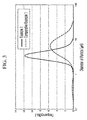
- FIG. 3 is a graph showing the particle distribution of the lithium manganese oxide-based solid solution according to Example 1 and Comparative Example 1.
- Example 1 the particle distribution of Example 1 is sharper than that of Comparative Example 1.
- Table 2 Crystallite diameter (nm) Particle diameter of secondary particle ( ⁇ m) (D90-D10)/D50 D10 D50 D90
- Example 1 60 2.1 3.2 4.8 0.8
- Example 2 90 3.0 3.9 5.1 0.5
- Example 3 80 0.6 1.5 2.5 1.3
- Example 4 120 2.6 3.6 5.2 0.7
- Example 5 150 2.5 3.6 5.3 0.8
- Example 6 60 2.1 4.8 7.5 1.1
- Example 7 40 1.0 2.2 3.8
- Comparative Example 1 60 2.7 6.0 12.8 1.7
- Comparative Example 2 80 4.9 6.5 9.3 0.7 Comparative Example 3 90 7.2 11.3 17.7 0.9 Comparative Example 4 150 4.9 6.5 9.3 0.7 Comparative Example 5 200 2.1 3.2 4.8 0.8 Comparative Example 6 300 0.7 1.6 3.2 1.6
- the CC-CV indicates a constant current and constant voltage charge
- the CC indicates a constant current discharge.
- the cut-off voltage indicates a voltage when the charge and discharge end. For example, the charge was performed to a voltage of 4.7V of the rechargeable lithium battery cells, and the discharge was performed to a voltage of 2.0 V of the rechargeable lithium battery cells in the 1st cycle.
- the lithium manganese oxide-based solid solution was charged and discharged for an activation treatment at the first cycle. Then, the high load characteristics of the lithium manganese oxide-based solid solution were evaluated as the discharge rate was increased, and the results are provided in the following Table 4 and FIGS. 4 and 5 .
- FIG. 4 is a graph showing the relationship between an average particle diameter (D50) of a lithium manganese oxide-based solid solution and capacity retention.
- a point P11 indicates measurement values of Examples 1 to 7
- a point P12 in an area C indicates measurement values of Comparative Examples 5 and 6
- a point P13 corresponding to D50 of greater than or equal to 5 ⁇ m indicates measurement values of Comparative Examples 1 to 4.
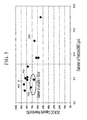
- FIG. 5 is a graph showing the relationship between an average particle diameter (D90) of a lithium manganese oxide-based solid solution and capacity retention.
- the point P21 indicates measurement values of Examples 1 to 7
- the point P22 in an area D indicates measurement values of Comparative Examples 5 and 6
- the point P23 corresponding to D90 of greater than or equal to 8 ⁇ m indicates measurement values of Comparative Examples 1 to 4.
- Examples 1 to 7 showed high discharge capacities and capacity retention when lightly loaded (during the 0.2C discharge), while Comparative Examples 1 to 4 having an average particle diameter out of the range showed deteriorated capacity retention, and Comparative Examples 5 and 6 having a crystallite diameter outside the range showed deteriorated discharge capacity as well as deteriorated capacity retention when lightly loaded.
- the discharge capacity was not only almost entirely maintained and also high load characteristics were also improved.
Landscapes
- Chemical & Material Sciences (AREA)
- Chemical Kinetics & Catalysis (AREA)
- Electrochemistry (AREA)
- General Chemical & Material Sciences (AREA)
- Engineering & Computer Science (AREA)
- Materials Engineering (AREA)
- Organic Chemistry (AREA)
- Inorganic Chemistry (AREA)
- Manufacturing & Machinery (AREA)
- Battery Electrode And Active Subsutance (AREA)
- Cell Electrode Carriers And Collectors (AREA)
- Secondary Cells (AREA)
- Composite Materials (AREA)
Abstract
Description
- The present invention relates to a rechargeable lithium battery; more particularly, to a positive active material and a positive electrode for a rechargeable lithium battery.
- A lithium manganese oxide-based solid solution as a positive active material for a rechargeable battery can provide high-capacity when the battery is charged at a high voltage. Therefore, the lithium manganese oxide-based solid solution has been actively researched as a positive active material for a rechargeable lithium battery.
- However, the lithium manganese oxide-based solid solution does not have high load characteristics (maintenance of discharge capacity at high C-rates) when used as positive active material for a lithium battery.
- One aspect of the present invention relates to a positive active material for a rechargeable lithium battery as defined in
claim 1. The positive active material has high load characteristics while maintaining high discharge capacity. - Another aspect of the present invention relates to a positive electrode for a rechargeable lithium battery including the positive active material as defined in claim 5.
- Another aspect of the present invention relates to a rechargeable lithium battery including the positive electrode as defined in
claim 8. - Further embodiments of the invention cloud be learned from the dependent claims and the following detailed description.
- Provided is a rechargeable lithium battery having high load characteristics (maintenance of discharge capacity at high C-rates), while maintaining high discharge capacity.
-
-
FIG. 1 is a cross-sectional view showing a schematic structure of a rechargeable lithium battery. -
FIG. 2 is a graph showing a relationship between an average particle diameter of a secondary particle of a lithium manganese oxide-based solid solution and a reaction area of lithium ions. -
FIG. 3 is a graph showing size distribution of the particle of the lithium manganese oxide-based solid solution according to Example 1 and Comparative Example 1. -
FIG. 4 is a graph showing the relationship between the average particle diameter (D50) of a lithium manganese oxide-based solid solution and capacity retention. -
FIG. 5 is a graph showing the relationship between an average particle diameter (D90) of a lithium manganese oxide-based solid solution and capacity retention. - Hereinafter, embodiments are described in detail.
- Hereinafter, one example of a rechargeable lithium battery is described in
FIG. 1 . -
FIG. 1 is a cross-sectional view showing a schematic structure of a rechargeable lithium battery. - Referring to
FIG. 1 , therechargeable lithium battery 10 includes apositive electrode 20, anegative electrode 30, and aseparator 40 interposed between thepositive electrode 20 and thenegative electrode 30. - The rechargeable lithium battery may have a charge cut-off voltage (oxidation reduction potential) of, for example, about 4.5V to about 5.0V (vs. Li/Li+).
- The rechargeable lithium battery has no particular limit about its shape and may have a shape such as a cylinder, a prism, a laminated type, a coin-type, and the like.
- The
positive electrode 20 includes acurrent collector 21 and a positiveactive material layer 22 formed on thecurrent collector 21. - The positive active material layer includes a positive active material and a conductive material, and additionally a binder.
- The positive active material includes a lithium manganese oxide-based solid solution.
- The lithium manganese oxide-based solid solution may be a solid solution including Li2MnO3, and specifically may be represented by the following Chemical Formula 1.
Chemical Formula 1 xLi2MnO3 · (1-x)LiMO2
In the above Chemical Formula 1, - M is represented by the following Chemical Formula 2, and 0.2≤x≤0.5.
Chemical Formula 2 MnaCObNicM'd
In the above Chemical Formula 2,
M' is a transition metal except Mn, Co, and Ni, and may be Sc, Ti, V, Cr, Fe, Cu, Zn, Y, Zr, Nb, Mo, Tc, Ru, Rh, Pd, Ag, Cd, La, Hf, Ta, W, Re, Os, Ir, Pt, Au, Hg, Ac, Rf, Db, Sg, Bh, Hs, or a combination thereof,
0.2≤a≤0.5, 0.1≤0.4, 0.2≤c≤0.5, 0≤d≤0.5, and a+b+c+d=1. - M' may be Sc, Ti, V, Cr, Fe, Cu, Zn, Y, Zr, Nb, Mo, Tc, Ru, Hf, Ta, W, Re, or a combination thereof.
- When the lithium manganese oxide-based solid solution is applied to a positive electrode of a rechargeable lithium battery, the lithium battery not only has high discharge capacity but also has high load. The high load characteristics are expressed by high maintenance ratio of discharge capacity at a high discharge rate relative to the discharge capacity at a low discharge rate during the discharge.
- The lithium manganese oxide-based solid solution includes primary particles and secondary particles formed of the agglomerated primary particles. Herein, the high load characteristics of a rechargeable lithium battery may depend on the particle diameter of the secondary particles.
- This will be specifically illustrated in
FIG. 2 . -
FIG. 2 is a graph showing a relationship between an average particle diameter of the secondary particle of a lithium manganese oxide-based solid solution and a reaction area of lithium ions. -
FIG. 2 shows a conventional positive electrode for arechargeable lithium battery 120 and a positive electrode for arechargeable lithium battery 20. - A conventional
positive electrode 120 for a rechargeable lithium battery includes acurrent collector 121 and a positiveactive material layer 122 formed on thecurrent collector 121, and the positiveactive material layer 122 includes a lithium manganese oxide-based solid solution and aconductive material 122c. The lithium manganese oxide-based solid solution includes thesecondary particles 122b in which theprimary particles 122a are agglomerated. - The
secondary particles 122b are enlarged and shown as the area A. As shown in the area A, the conventionalsecondary particles 122b have a very large size and thus, a smaller contact area with theconductive material 122c. In addition, the lithium manganese oxide-based solid solution has a large lattice volume and thus, a low electron conductivity rate, and accordingly, lithium ions are diffused at a very low rate in thesecondary particles 122b during the discharge. Accordingly, the discharge at a high discharge rate ends before thesecondary particles 122b all over the whole area finishes reacting with the lithium ions. As a result, thenon-reaction area 122d is left inside thesecondary particles 122b. As thenon-reaction area 122d becomes larger, the discharge rate is higher. Since thenon-reaction area 122d does not contribute to the discharge, the discharge capacity decreases as much as the non-reaction area. Accordingly, the high load characteristics of a conventional rechargeable lithium battery may deteriorate. - On the other hand, a positive electrode for a
rechargeable lithium battery 20 as described herein includes acurrent collector 21 and a positiveactive material layer 22 formed on thecurrent collector 21, wherein the positiveactive material layer 22 includes a lithium manganese oxide-based solid solution andconductive material 22c. In this lithium manganese oxide-based solid solution,primary particles 22a are agglomerated and formsecondary particles 22b. - The
secondary particles 22b are enlarged and shown as the area B. As shown in the area B, thesecondary particles 22b have a smaller size than the conventionalsecondary particles 122b. Accordingly, the lithium manganese oxide-based solid solution has an increased contact area with an electrolyte and more easily reacts with lithium ions. In addition, since thesecondary particles 22b have a larger contact area with aconductive material 22c than the conventionalsecondary particles 122b, electric conductivity of the lithium manganese oxide-based solid solution may be increased. In other words, since electrons are easily spread inside thesecondary particles 22b, the diffusion rate of the lithium ions may be increased. In addition, eachsecondary particle 22b has a small particle diameter, and thus, lithium ions are more easily diffused all over thesecondary particles 22b. Accordingly, since the non-reaction area is difficult to form even during the discharge at a high discharge rate, that is, under a high load, the high load may be increased. - Specifically, the lithium manganese oxide solid solution includes secondary particles having a particle diameter (D50) in the range of 1 µm to 5 µm. In addition, the secondary particles have a particle diameter (D90) of less than 8 µm. When the secondary particles have a particle diameter within the range, the crystallite size of the secondary particles is not disrupted but the non-reaction area is hard to form therein, and thus, high load characteristics of a rechargeable lithium battery may be increased.
- Distribution of the particle diameters D10, D50, and D90 of the secondary particles can be measured using a common method, for example, using a laser diffraction-scattering method.
- The particle diameter of the secondary particles indicates a diameter when the secondary particles are regarded to have a spherical shape.
- The particle diameter of the secondary particles may satisfy a relationship in the following
Equation 1. When the particle diameter of the secondary particles satisfies a relationship in the followingEquation 1, high load characteristics are further improved.
- In the
Equation 1, each D10, D50, and D90 indicates a diameter of particles when the cumulative volume of the particles reaches 10 volume%, 50 volume%, and 90 volume% in a particle distribution. - In the
Equation 1, the (D90-D10) indicates non-uniformity of particle diameters based on D50 and is an index showing whether the particle distribution is broad or sharp. The smaller the (D90-D10) is, the sharper the particle distribution is. - The lithium manganese oxide-based solid solution has a small difference between particle diameters D90 and D10 and a sharp particle distribution.
- The lithium manganese oxide-based solid solution has a crystallite diameter of less than or equal to 150 nm and specifically, greater than or equal to 40 nm and less than or equal to 150 nm. When the lithium manganese oxide-based solid solution has a crystallite diameter within the range, crystallite is not disrupted but the fluidity is excellent, and thus, discharge capacity of a rechargeable lithium battery may be maintained at a high level.
- The crystallite indicates a single crystal having a fine size, and thus, the lithium manganese oxide-based solid solution may be an assembly of polycrystals formed of these crystallites.
- Specifically, the crystallite diameter may be defined by the following
Equation 2.
- In the
Equation 2, - D is a crystallite diameter,
- K is a Scherrer constant, for example, 0.9,
- β is a full width at half maximum (rad) of a peak around a diffraction angle by an X-ray diffraction (XRD) and the peak is a diffraction peak at a (003) plane of a crystallite, and
- θ is a diffraction angle (rad).
- Units of the β and θ are in radians.
- In the lithium manganese oxide-based solid solution, the particle diameters D10, D50, and D90 of secondary particles may be controlled by adjusting the agitation speed and the agitation time, and the crystallite diameter of the lithium manganese oxide-based solid solution may be controlled by adjusting the agitation speed, the agitation time, the firing temperature, the firing time, and the like.
- The crystallite diameter of the lithium manganese oxide-based solid solution is smaller, as the agitation speed is higher, the agitation time is shorter, the firing time is shorter, and the fire temperature is lower.
- The lithium manganese oxide-based solid solution may be prepared for example in a co-precipitated method and the like methods as known in the technical fields.
- Specifically, a nickel source, a manganese source and a cobalt source are dissolved in ion exchanged water, preparing a mixed aqueous solution. The nickel source may be nickel sulfate hexahydrate, nickel acetate tetrahydrate, nickel chloride hexahydrate, nickel nitrate hexahydrate, or a combination thereof, the manganese source may be manganese sulfate heptahydrate, manganese acetate tetrahydrate, manganese chloride tetrahydrate or a combination thereof, and the cobalt source may be cobalt sulfate pentahydrate, cobalt acetate tetrahydrate, or cobalt nitrate tetrahydrate or a combination thereof.
- The nickel source, the manganese source, and the cobalt source may be used in an amount of 10 wt% to 25 wt% based on the total amount of the mixed aqueous solution. In addition, the nickel source, the manganese source, and the cobalt source are mixed with a desired molar ratio of Ni, Co, and Mn. The molar ratio of the elements is determined according to the composition of the lithium manganese oxide-based solid solution. For example, 0.4Li2MnO3-0.6Li(Mn1/3CO1/3Ni1/3)O2 is prepared by using Mn:Co:Ni in a molar ratio of 60:20:20.
- During the preparation of the mixed aqueous solution, a M' source may be further added. The M' source may be M-including sulfate. The exemplary of the M' source may be titanium sulfate, vanadium sulfate·n hydrdate, iron sulfate heptahydrate, or a combination thereof.
- On the other hand, ion exchanged water in a predetermined amount is put in a reaction vessel and maintained at 50°C, to prepare a reaction vessel-aqueous solution.
- Subsequently, a NaOH aqueous solution (including 40 wt% of NaOH based on total weight of the NaOH aqueous solution) is added to the ion exchanged water in a dropwise fashion to adjust the pH of the reaction vessel aqueous solution to be 11.3 to 12.3. Then, the ion exchanged water was bubbled with inert gas such as nitrogen and the like to remove oxygen dissolved therein.
- The reaction vessel-aqueous solution was agitated and maintained at 25°C to 60°C, and the mixed aqueous solution was added thereto in a dropwise fashion. The rate of addition has no particular limit but may be, for example, about 1 ml/min to 10 ml/min.
- The NaOH aqueous solution (including 40 wt% of NaOH based on total weight of the NaOH aqueous solution) and a NH3 aqueous solution (10 wt% of NH3 based on total weight of the NH3 aqueous solution) are additionally added to the aqueous solution in the reaction vessel forms, and the mixture is agitated and maintained at pH of 11.3 to 12.3 to coprecipitate hydroxide of each metal element.
- Herein, the agitation is performed at predetermined speed and time. For example, the agitation speed may be in the range of 500 rpm to 3500 rpm, and specifically 500 rpm to 2000 rpm. The agitation time may be in the range of 0.5 hours to 100 hours, specifically 1 hour to 10 hours, and more specifically 1 hour to 4 hours. When the agitation speed and time are within the range, an average particle diameter and a crystallite diameter within the range is obtained.
- Subsequently, a solid and liquid are separated, for example, the co-precipitated hydroxide is isolated from the aqueous solution in the reaction vessel using an absorption filter and washed with ion exchanged water.
- Subsequently, the co-precipitated hydroxide is vacuum-dried. The drying may be performed, for example, at 80°C to 150°C, and for example, for 5 hours to 12 hours.
- Coarse particles can be excluded from co-precipitated hydroxide during or after the vacuum-drying by using a sieving device, a centrifugation device, and the like.
- After the drying, the co-precipitated hydroxide is ground for several minutes with a mortar and a pestle to obtain a dried powder. The dried powder is mixed with lithium carbonate to obtain mixed powder. Herein, the mole ratio between Li and M(Ni+Mn+Co) is determined by composition of a solid solution. For example, 0.4Li2MnO3-0.6Li(Mn1/3CO1/3Ni1/3)O2 is prepared by mixing in 1.4:1 of a mole ratio between Li and M.
- Subsequently, the mixed powder is fired for a predetermined time at a predetermined temperature. Accordingly, the lithium manganese oxide-based solid solution is prepared. Herein, the firing may be performed for 4 hours to 24 hours, and specifically 6 hours to 12 hours at a temperature in the range of 800 °C to 1150 °C and specifically, 800 °C to 1050 °C.
- The content of the lithium manganese oxide-based solid solution is not particularly limited, and may be applied in an amount to form a positive active material layer for a rechargeable lithium battery.
- The conductive material may include, for example, carbon black such as ketjen black, acetylene black, and the like, natural graphite, artificial graphite, and the like but has no particular limit, as far as any material increases conductivity of a positive electrode.
- The content of the conductive material is not particularly limited, and may be used in an amount used in a positive active material layer of a rechargeable lithium battery.
- The binder may include, for example, polyvinylidene fluoride, an ethylene-propylene-diene terpolymer, a styrene-butadiene rubber, an acrylonitrile-butadiene rubber, a fluoro rubber, polyvinyl acetate, polymethylmethacrylate, polyethylene, nitrocellulose, and the like, but has the choice is not limited as long as any material binds the positive active material and the conductive material on the
current collector 21. - The content of the binder is not particularly limited, but may be in an applicable content to a positive active material layer of a rechargeable lithium battery.
- The positive
active material layer 22 may be formed by, for example, dispersing the positive active material, the conductive material, and the binder in an organic solvent such as N-methyl-2-pyrrolidone, and the like to form a slurry, and coating the slurry on thecurrent collector 21 followed by drying and compressing the same. - The
current collector 21 may be made of, for example, aluminum, and specifically roughened aluminum. When the current collector is roughened aluminum, high load characteristics of a rechargeable lithium battery can be achieved. - The roughened aluminum may be a surface-roughened aluminum foil. The surface-roughened aluminum foil may be for example manufactured through physical etching by sandblast, chemical etching using acid, and electrochemical etching using electrolytic reaction in an acidic solution.
- The coating method may include, for example, a knife coating and, a gravure coating.
- Subsequently, the positive active material layer is compressed using a presser to manufacture a positive electrode having a desired thickness.
- The
negative electrode 30 includes acurrent collector 31 and a negativeactive material layer 32 formed on thecurrent collector 31. - The
current collector 31 may be, for example copper, nickel, and the like. - The negative active material layer may be any usable negative active material layer of a rechargeable lithium battery. For example, the negative active material layer may include a negative active material, and additionally a binder.
- The negative active material may include, for example, artificial graphite, natural graphite, a mixture of artificial graphite and natural graphite, natural graphite coated with artificial graphite, and the like; a mixture of a particulate of silicon, tin or oxides thereof and the graphite; a silicon or tin particulate; a silicon- or tin-containing alloy; a titanium oxide-compound such as Li4Ti5O12, and the like. The silicon oxide may be represented by the formula SiOx (0<x≤2). In addition, lithium metal and the like may also be used.
- The binder may be the same as the binder of the positive active material layer.
- The mixing weight ratio of the negative active material and the binder is adjusted as needed.
- The negative electrode may be manufactured according to the same method as the positive electrode.
- Specifically, the negative active material and the binder are mixed at a predetermined ratio and dispersed in an organic solvent such as N-methyl-2-pyrrolidone, and the like to form slurry. Then, the slurry is coated on a current collector and dried to form a negative active material layer. Subsequently, the negative active material layer is compressed using a presser to manufacture a negative electrode having a desired thickness.
- When the negative active material layer is metal lithium, the current collector may be a lithium metal foil.
- The
separator 40 is not particularly limited, and may be any separator that is suitable for a rechargeable lithium battery. Specifically, a porous film or a non-woven fabric having excellent high-rate discharge performance may be used singularly or as a mixture. - The material of the separator may include, for example, a polyolefin-based resin such as polyethylene, polypropylene and the like; a polyester-based resin such as polyethylene terephthalate, polybutylene terephthalate, and the like; a fluorinated resin such as polyvinylidene fluoride, a vinylidene fluoride-hexafluoropropylene copolymer, a vinylidene fluoride-perfluorovinyl ether copolymer, a vinylidene fluoride-tetrafluoroethylene copolymer, a vinylidene fluoride-trifluoroethylene copolymer, a vinylidene fluoride-fluoroethylene copolymer, a vinylidene fluoride-ethylene copolymer, a vinylidene fluoride-propylene copolymer, a vinylidene fluoride-trifluoropropylene copolymer, a vinylidene fluoride-tetrafluoroethylene-hexafluoropropylene copolymer, a vinylidene fluoride-ethylene-tetrafluoroethylene copolymer, and the like.
- The porosity of the separator is not particularly limited.
- The separator is impregnated with an electrolyte.
- The electrolyte may be anything that is usable for a rechargeable lithium battery. Specifically, the electrolyte includes an electrolytic salt dissolved in a non-aqueous solvent.
- The non-aqueous solvent may be, for example, cyclic carbonates such as propylene carbonate, ethylene carbonate, butylene carbonate, chloroethylene carbonate, vinylene carbonate, and the like; cyclic esters such as γ-butyrolactone, γ-valero lactone, and the like; linear carbonates such as dimethyl carbonate, diethyl carbonate, ethylmethyl carbonate, and the like; acyclic esters such as methyl formate, methyl acetate, methyl butyrate, and the like; tetrahydrofuran or a derivative thereof; ethers such as 1,3-dioxane, 1,4-dioxane, 1,2-dimethoxyethane, 1,4-dibutoxyethane, methyl diglyme, and the like; nitriles such as acetonitrile, benzonitrile and the like; dioxolane or a derivative thereof; ethylene sulfide, a sulfolane, sultone or a derivative thereof, and the like. These may be used singularly or in a mixture of two or more.
- The electrolytic salt may be, for example, an inorganic salt such as LiClO4, LiBF4, LiAsF6, LiPF6, LiSCN, LiBr, Lil, Li2SO4, Li2B10Cl10, NaClO4, Nal, NaSCN, NaBr, KClO4, KSCN, and the like; an organic salt such as LiCF3SO3, LiN(CF3SO2)2, LiN(C2F5SO2)2, LiN(CF3SO2)(C4F9SO2), LiC(CF3SO2)3, LiC(C2F5SO2)3, (CH3)4NBF4, (CH3)4NBr, (C2H5)4NClO4, (C2H5)4Nl, (C3H7)4NBr, (n-C4H9)4NClO4, (n-C4H9)4Nl, (C2H5)4N-malate, (C2H5)4N-benzoate, (C2H5)4N-phthalate, lithium stearyl sulfonate, lithium octyl sulfonate, lithium dodecyl benzene sulfonate, and the like, and these may be used singularly or in a mixture of two or more.
- The concentration of the electrolytic salt is not particularly limited, but may be specifically 0.5 mol/I to 2.0 mol/l.
- The rechargeable lithium battery may be manufactured as follows.
- The
separator 40 is disposed between thepositive electrode 20 and thenegative electrode 30 to manufacture an electrode assembly. Subsequently, the electrode assembly is processed to have a desired shape, for example, a cylinder, a prism, a laminated type, a button-type, and the like and then, inserted into the container. Then, the above electrolyte solution is injected into the container, so that each pore of the separator may be impregnated with the electrolyte. - Hereinafter, the embodiments are illustrated in more detail with reference to examples.
- Examples 1 to 7 and Comparative Examples 1 to 6
- A mixed aqueous solution was prepared by dissolving nickel sulfate hexahydrate, manganese sulfate heptahydrate, and cobalt sulfate pentahydrate in ion exchanged water. Herein, the total amount of the nickel sulfate hexahydrate, the manganese sulfate heptahydrate, and the cobalt sulfate pentahydrate was included in an amount of 20 wt% based on total amount of the mixed aqueous solution. In addition, the nickel sulfate hexahydrate, manganese sulfate heptahydrate, and cobalt sulfate pentahydrate were mixed so that an element molar ratio of Mn:Co:Ni might be 60:20:20.
- Ion exchanged water (500ml) was put in a reaction vessel and maintained at 50°C. A NaOH aqueous solution (including 40 wt% of NaOH based on the total weight of the NaOH aqueous solution) was added to the ion exchanged water in a dropwise fashion to adjust pH of the aqueous solution in the reaction vessel to be 11.5 to prepare a reaction vessel-aqueous solution. Subsequently, the ion exchanged water was bubbled with nitrogen gas to remove oxygen dissolved therein.
- The reaction vessel-aqueous solution was agitated and maintained at 50°C, and the mixed aqueous solution was added dropwise at a speed of 3 ml/min to the reaction vessel.
- In addition, a NaOH aqueous solution (including 40 wt% of NaOH based on the total weight of the NaOH aqueous solution) and a NH3 aqueous solution (including 10 wt% of NH3 based on the total weight of the NH3 aqueous solution) were additionally added thereto to maintain the pH of the reaction vessel-aqueous solution at 11.5 to prepare a reaction layer aqueous solution. The reaction layer aqueous solution was agitated, at a speed of 2000 rpm for a time shown in Table 1. The hydroxide of each metal element was thus co-precipitated.
- Subsequently, the co-precipitated hydroxides were isolated from the reaction layer aqueous solution with an absorption filter and washed with ion exchange water. Then, the co-precipitated hydroxides were vacuum-dried. The vacuum-drying was performed at 100°C for 10 hours.
- Subsequently, the dried co-precipitated hydroxide was ground with a mortar and a pestle and dried to obtain a dried powder. The dried powder was mixed with lithium carbonate, yielding a mixed powder. The molar ratio of metals used in the mixing of the dried powder and the lithium carbonate (Li and M (Ni+Mn+Co)) was 1.4:1.
- Subsequently, the mixed powder was divided into the following Examples 1 to 7 and Comparative Examples 1 to 6, and each sample was fired. Herein, all the samples were performed for 10 hours by changing the firing temperature in the range of 800 °C to 1150 °C. In other words, each sample was respectively fired at a different temperature as shown in the following Table 1, preparing lithium manganese oxide-based solid solutions according to Examples 1 to 7 and Comparative Examples 1 to 6.
Table 1 Examples Comparative Examples 1 2 3 4 5 6 7 1 2 3 4 5 6 Agitation speed (rpm) 2000 2000 2000 2000 2000 2000 2000 2000 2000 2000 2000 3500 3000 Agitation time (hr) 3 3 2 3 3 4 2 5 5 8 5 6 7 Firing temperature (°C) 850 900 900 1000 1050 850 800 850 900 900 1000 1050 1150 Firing time (hr) 10 10 10 10 10 10 10 10 10 10 10 10 10 - Each lithium manganese oxide-based solid solution was mixed with acetylene black and polyvinylidene fluoride in a weight ratio of 80:13:7. This mixture was dispersed into N-methyl-2-pyrrolidone to prepare a slurry. The slurry was coated and dried on an aluminum foil as a current collector to form a positive active material layer, and the positive active material layer was compressed to have a thickness of about 50 µm to provide a positive electrode.
- The negative electrode was manufactured by mounting a metal lithium foil on a copper foil as a current collector.
- As for a separator, a 12 µm-thick porous polyethylene film was used and disposed between the positive and negative electrodes, manufacturing an electrode assembly.
- Subsequently, the electrode assembly was manufactured into a size of a CR2032 coin half-cell and inserted in a CR2032 coin half-cell container.
- The electrolyte solution was prepared by mixing ethylene carbonate and dimethyl carbonate in a volume ratio of 3:7 to prepare a non-aqueous solvent and dissolving lithium hexafluorophosphate in a concentration of 1.00 mol/l.
- The electrolyte solution was injected into the coin half-cell container and thus, impregnated into the separator, manufacturing a rechargeable lithium battery cell.
- The particle diameters D10, D50 and D90 of secondary particles of the lithium manganese oxide-based solid solutions according to Examples 1 to 7 and Comparative Examples 1 to 6 were measured using a laser diffraction scattering particle distribution measuring equipment (Nikkiso Co., Ltd., Japan, Microtrac MT3000), and the results are shown in the following Table 2.
- In addition, the crystallite diameter of the lithium manganese oxide-based solid solutions according to Examples 1 to 7 and Comparative Examples 1 to 6, and the results are provided in the following Table 2 and
FIG. 3 . - When an X-ray diffraction test was performed about the lithium manganese oxide-based solid solutions, a peak around a diffraction angle of 18° was observed. The crystallite diameter was obtained by using a diffraction angle and a full width at half maximum of the peak and also, the following
Equation 2.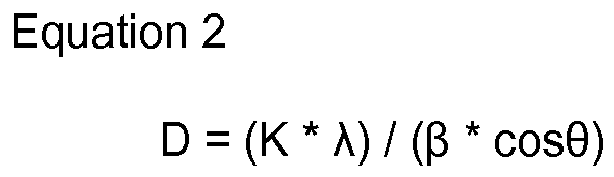
- In the
Equation 2, D is a crystallite diameter, K is 0.9, β is a full width at half maximum (rad) of a peak around a diffraction angle by an X-ray diffraction (XRD) and the peak is a diffraction peak at a (003) plane of a crystallite, and θ is 18/360*2π (rad). -
FIG. 3 is a graph showing the particle distribution of the lithium manganese oxide-based solid solution according to Example 1 and Comparative Example 1. - Referring to
FIG. 3 , the particle distribution of Example 1 is sharper than that of Comparative Example 1.Table 2 Crystallite diameter (nm) Particle diameter of secondary particle (µm) (D90-D10)/D50 D10 D50 D90 Example 1 60 2.1 3.2 4.8 0.8 Example 2 90 3.0 3.9 5.1 0.5 Example 3 80 0.6 1.5 2.5 1.3 Example 4 120 2.6 3.6 5.2 0.7 Example 5 150 2.5 3.6 5.3 0.8 Example 6 60 2.1 4.8 7.5 1.1 Example 7 40 1.0 2.2 3.8 1.3 Comparative Example 1 60 2.7 6.0 12.8 1.7 Comparative Example 2 80 4.9 6.5 9.3 0.7 Comparative Example 3 90 7.2 11.3 17.7 0.9 Comparative Example 4 150 4.9 6.5 9.3 0.7 Comparative Example 5 200 2.1 3.2 4.8 0.8 Comparative Example 6 300 0.7 1.6 3.2 1.6 - The charge and discharge evaluation of the rechargeable lithium battery cells according to Examples 1 to 7 and Comparative Examples 1 to 6 was performed as in the following Table 3.
Table 3 Cycle Number Charge Rate Discharge Rate Cut-Off Voltage (V) 1 0.1C CC-CV 0.1C CC 4.7-2.0 2 0.2C CC-CV 0.2C CC 4.6-2.5 3 0.2C CC- CV 1/3C CC 4.6-2.5 4 0.2C CC-CV 1C CC 4.6-2.5 5 0.2C CC-CV 2C CC 4.6-2.5 6 0.2C CC- CV 3C CC 4.6-2.5 7 0.2C CC-CV 5C CC 4.6-2.5 - In Table 3, the CC-CV indicates a constant current and constant voltage charge, and the CC indicates a constant current discharge. The cut-off voltage indicates a voltage when the charge and discharge end. For example, the charge was performed to a voltage of 4.7V of the rechargeable lithium battery cells, and the discharge was performed to a voltage of 2.0 V of the rechargeable lithium battery cells in the 1st cycle.
- As shown in Table 3, the lithium manganese oxide-based solid solution was charged and discharged for an activation treatment at the first cycle. Then, the high load characteristics of the lithium manganese oxide-based solid solution were evaluated as the discharge rate was increased, and the results are provided in the following Table 4 and
FIGS. 4 and5 . - In the following Table 4, the capacity retention (%) was obtained as a percentage of discharge capacity during the 3C discharge relative to discharge capacity during the 0.2C discharge.
Table 4 Discharge capacity Capacity retention (%) 0.2 C 3C (3C/0.2C) (mAh/g) Example 1 241 191 79 Example 2 276 228 82 Example 3 280 235 84 Example 4 212 168 79 Example 5 235 185 79 Example 6 272 212 78 Example 7 249 212 85 Comparative Example 1 242 159 66 Comparative Example 2 233 136 58 Comparative Example 3 258 141 54 Comparative Example 4 240 150 63 Comparative Example 5 210 140 67 Comparative Example 6 200 145 73 -
FIG. 4 is a graph showing the relationship between an average particle diameter (D50) of a lithium manganese oxide-based solid solution and capacity retention. - In
FIG. 4 , a point P11 indicates measurement values of Examples 1 to 7, a point P12 in an area C indicates measurement values of Comparative Examples 5 and 6, and a point P13 corresponding to D50 of greater than or equal to 5µm indicates measurement values of Comparative Examples 1 to 4. -
FIG. 5 is a graph showing the relationship between an average particle diameter (D90) of a lithium manganese oxide-based solid solution and capacity retention. - In
FIG. 5 , the point P21 indicates measurement values of Examples 1 to 7, the point P22 in an area D indicates measurement values of Comparative Examples 5 and 6, and the point P23 corresponding to D90 of greater than or equal to 8 µm indicates measurement values of Comparative Examples 1 to 4. - Referring to Table 4 and
FIGs. 4 and5 , Examples 1 to 7 showed high discharge capacities and capacity retention when lightly loaded (during the 0.2C discharge), while Comparative Examples 1 to 4 having an average particle diameter out of the range showed deteriorated capacity retention, and Comparative Examples 5 and 6 having a crystallite diameter outside the range showed deteriorated discharge capacity as well as deteriorated capacity retention when lightly loaded. - Accordingly, when the lithium manganese oxide-based solid solution described herein was used as a positive active material for a rechargeable lithium battery, the discharge capacity was not only almost entirely maintained and also high load characteristics were also improved.
Claims (8)
- A positive active material for a rechargeable lithium battery comprising a lithium manganese oxide-based solid solution comprising
primary particles (22a) and secondary particles (22b) formed of agglomerated primary particles (22a),
wherein a particle diameter (D50) of the secondary particles (22b) is in the range of 1 µm to 5 µm,
a particle diameter (D90) of the secondary particles (22b) is less than 8 µm, and
a crystallite diameter is less than or equal to 150 nm. - The positive active material of claim 1, wherein the particle diameter (D50) of the secondary particles (22b) and the particle diameter (D90) of the secondary particles (22b) have a relationship satisfying the following Equation 1:

- The positive active material of claim 1, wherein the crystallite diameter of the lithium manganese oxide-based solid solution is greater than or equal to 40 nm and less than or equal to 150 nm.
- The positive active material of claim 1, wherein the lithium manganese oxide-based solid solution is represented by the following Chemical Formula 1:
Chemical Formula 1 xLi2MnO3 · (1-x)LiMO2
wherein,
M is represented by the following Chemical Formula 2 and 0.2≤x≤0.5,
Chemical Formula 2 MnaCobNicM'd
wherein,M' is a transition metal except Mn, Co, and Ni,0.2≤a≤0.5, 0.1≤b≤0.4, 0.2≤c≤0.5, 0≤d≤0.5, and a+b+c+d=1. - A positive electrode (20) for a rechargeable lithium battery (10) comprising
a current collector (21); and
a positive active material layer (22) positioned on the current collector (21) and comprising the positive active material of one of the preceding claims. - The positive electrode of claim 5, wherein the current collector (21) is made of roughened aluminum.
- The positive electrode of claim 5, wherein the positive active material layer (22) further comprises a conductive material, and wherein the conductive material comprises carbon black.
- A rechargeable lithium battery (10) comprising
the positive electrode (20) of one of claims 5 through 7;
a negative electrode (30); and
an electrolyte.
Applications Claiming Priority (3)
| Application Number | Priority Date | Filing Date | Title |
|---|---|---|---|
| JP2012271537 | 2012-12-12 | ||
| KR1020130114615A KR101805651B1 (en) | 2012-12-12 | 2013-09-26 | Positive active material for rechargeable lithium battery, and positive electrode for rechargeable lithium battery and rechargeable lithium battery including the same |
| JP2013255970A JP6324051B2 (en) | 2012-12-12 | 2013-12-11 | Positive electrode active material for lithium secondary battery, and positive electrode for lithium secondary battery and lithium secondary battery including the same |
Publications (2)
| Publication Number | Publication Date |
|---|---|
| EP2744021A1 true EP2744021A1 (en) | 2014-06-18 |
| EP2744021B1 EP2744021B1 (en) | 2016-04-27 |
Family
ID=49759124
Family Applications (1)
| Application Number | Title | Priority Date | Filing Date |
|---|---|---|---|
| EP13196778.8A Active EP2744021B1 (en) | 2012-12-12 | 2013-12-12 | Positive active material, positive electrode and rechargeable lithium battery including same |
Country Status (4)
| Country | Link |
|---|---|
| US (1) | US9478808B2 (en) |
| EP (1) | EP2744021B1 (en) |
| JP (1) | JP6324051B2 (en) |
| CN (1) | CN103872311B (en) |
Cited By (7)
| Publication number | Priority date | Publication date | Assignee | Title |
|---|---|---|---|---|
| EP2991137A1 (en) * | 2014-08-25 | 2016-03-02 | Kabushiki Kaisha Toshiba | Positive electrode and nonaqueous electrolyte battery |
| WO2017056021A1 (en) * | 2015-09-29 | 2017-04-06 | Prince Erachem Sprl | Hydrated manganese oxide and a method for the production thereof |
| EP3657581A1 (en) * | 2018-11-14 | 2020-05-27 | Samsung SDI Co., Ltd. | Positive active material for rechargeable lithium battery, method of preparing the same and rechargeable lithium battery including the same |
| US11757092B2 (en) | 2018-11-15 | 2023-09-12 | Samsung Sdi Co., Ltd. | Positive active material for rechargeable lithium battery, method of preparing the same and rechargeable lithium battery including the same |
| US12034149B2 (en) | 2019-02-01 | 2024-07-09 | Samsung Sdi Co., Ltd. | Positive active material for rechargeable lithium battery, method of preparing the same and rechargeable lithium battery including the same |
| EP4418399A4 (en) * | 2021-10-14 | 2025-05-14 | LG Energy Solution, Ltd. | LITHIUM SECONDARY BATTERY |
| EP4376137A4 (en) * | 2021-10-22 | 2025-12-31 | Lg Energy Solution Ltd | ELECTRODE ARRANGEMENT, CYLINDRICAL BATTERY AND BATTERY PACK AND VEHICLE WITH IT |
Families Citing this family (21)
| Publication number | Priority date | Publication date | Assignee | Title |
|---|---|---|---|---|
| JP6133720B2 (en) | 2013-07-24 | 2017-05-24 | 住友金属鉱山株式会社 | Non-aqueous electrolyte secondary battery positive electrode active material, method for producing the same, and non-aqueous electrolyte secondary battery |
| JP6244713B2 (en) * | 2013-07-24 | 2017-12-13 | 住友金属鉱山株式会社 | Method for producing positive electrode active material for non-aqueous electrolyte secondary battery |
| WO2015129166A1 (en) * | 2014-02-26 | 2015-09-03 | 三洋電機株式会社 | Non-aqueous electrolyte secondary cell |
| US10840510B2 (en) | 2014-07-31 | 2020-11-17 | Sumitomo Metal Mining Co., Ltd. | Positive electrode active material for non-aqueous electrolyte secondary battery and method for producing same |
| JP6784013B2 (en) * | 2015-11-10 | 2020-11-11 | 日産自動車株式会社 | Positive electrode active material for non-aqueous electrolyte secondary batteries and its manufacturing method |
| CN108352523B (en) * | 2016-02-29 | 2019-11-05 | 三井金属矿业株式会社 | Spinel type lithium-manganese composite oxide |
| JP6605518B2 (en) * | 2017-01-27 | 2019-11-13 | ユミコア | High performance positive electrode active material for lithium ion battery and method for producing the same |
| CN107221656B (en) * | 2017-06-07 | 2020-12-29 | 北京当升材料科技股份有限公司 | Lithium-rich manganese-based solid solution cathode material for lithium ion battery and preparation method thereof |
| US11824188B2 (en) | 2017-08-14 | 2023-11-21 | Mitsui Mining & Smelting Co., Ltd. | Positive electrode active material for all-solid-state lithium secondary batteries |
| CN111033828B (en) | 2017-08-28 | 2023-03-24 | 三井金属矿业株式会社 | Positive electrode active material for all-solid-state lithium secondary battery |
| CN111033830A (en) | 2017-08-28 | 2020-04-17 | 三井金属矿业株式会社 | Positive electrode active material for all-solid-state lithium secondary battery |
| KR102385749B1 (en) * | 2019-03-15 | 2022-04-11 | 삼성에스디아이 주식회사 | Positive active material for rechargeable lithium battery, method of preparing the same and rechargeable lithium battery including the same |
| CN112186138B (en) * | 2019-07-02 | 2022-06-28 | 巴斯夫杉杉电池材料(宁乡)有限公司 | W-containing high-nickel ternary cathode material and preparation method thereof |
| CN110492097B (en) * | 2019-08-30 | 2021-04-27 | 中南大学 | A kind of NCM ternary composite cathode material and its preparation and application |
| WO2021174480A1 (en) * | 2020-03-05 | 2021-09-10 | 宁德新能源科技有限公司 | Positive electrode material and electrochemical device comprising same, and electronic apparatus |
| WO2022098135A1 (en) * | 2020-11-05 | 2022-05-12 | 주식회사 엘지에너지솔루션 | Positive electrode active material for lithium secondary battery, and lithium secondary battery comprising same |
| EP4216312A4 (en) * | 2020-12-04 | 2024-10-16 | Ecopro Bm Co., Ltd. | ACTIVE CATHODE MATERIAL AND RECHARGEABLE LITHIUM BATTERY COMPRISING SAME |
| KR102896735B1 (en) * | 2021-09-01 | 2025-12-04 | 삼성에스디아이 주식회사 | Cathode active material for lithium secondary battery, preparing method thereof, and lithium secondary battery comprising cathode including the same |
| JP7544006B2 (en) * | 2021-09-02 | 2024-09-03 | トヨタ自動車株式会社 | Method for producing positive electrode active material, positive electrode active material and lithium ion secondary battery |
| CN116799165A (en) | 2022-04-29 | 2023-09-22 | 北京当升材料科技股份有限公司 | Cathode material for lithium-ion battery and preparation method thereof |
| CN117154048A (en) | 2023-09-13 | 2023-12-01 | 宁波容百新能源科技股份有限公司 | A kind of cathode material and its preparation method and application |
Citations (5)
| Publication number | Priority date | Publication date | Assignee | Title |
|---|---|---|---|---|
| US20090155691A1 (en) * | 2007-12-13 | 2009-06-18 | Uchicago Argonne, Llc | Positive electrode for a lithium battery |
| EP2357693A1 (en) * | 2008-11-06 | 2011-08-17 | GS Yuasa International Ltd. | Positive electrode for lithium secondary battery, and lithium secondary battery |
| KR20110113241A (en) * | 2010-04-09 | 2011-10-17 | 주식회사 에코프로 | Method for producing a cathode active material for a secondary battery comprising a metal composite oxide and a cathode active material for a secondary battery comprising a metal composite oxide prepared thereby |
| US20120070725A1 (en) * | 2010-09-22 | 2012-03-22 | Subramanian Venkatachalam | Metal halide coatings on lithium ion battery positive electrode materials and corresponding batteries |
| EP2648250A1 (en) * | 2012-04-03 | 2013-10-09 | Samsung Corning Precision Materials Co., Ltd. | Lithium manganese oxide positive active material for lithium ion secondary battery and lithium ion secondary battery including the same |
Family Cites Families (13)
| Publication number | Priority date | Publication date | Assignee | Title |
|---|---|---|---|---|
| US7393476B2 (en) * | 2001-11-22 | 2008-07-01 | Gs Yuasa Corporation | Positive electrode active material for lithium secondary cell and lithium secondary cell |
| US20040013941A1 (en) * | 2002-05-20 | 2004-01-22 | Nichia Corporation | Positive electrode active material for a nonaqueous electrolyte secondary battery |
| US7927741B2 (en) * | 2007-01-26 | 2011-04-19 | Mitsui Mining & Smelting Co., Ltd. | Lithium transition metal oxide having layered structure |
| JP5256816B2 (en) | 2007-03-27 | 2013-08-07 | 学校法人神奈川大学 | Cathode material for lithium-ion batteries |
| JP4316656B1 (en) | 2008-07-25 | 2009-08-19 | 三井金属鉱業株式会社 | Lithium transition metal oxide with layer structure |
| JP5451228B2 (en) | 2008-07-25 | 2014-03-26 | 三井金属鉱業株式会社 | Lithium transition metal oxide with layer structure |
| JP2010135285A (en) | 2008-10-31 | 2010-06-17 | Sanyo Electric Co Ltd | Positive electrode active material for lithium secondary battery and method for manufacturing the same |
| KR101430843B1 (en) | 2010-03-04 | 2014-08-18 | 제이엑스 닛코 닛세키 킨조쿠 가부시키가이샤 | Positive electrode active material for lithium-ion battery, positive electrode for lithium-ion battery, and lithium-ion battery |
| JP5605641B2 (en) | 2010-12-16 | 2014-10-15 | トヨタ自動車株式会社 | Lithium secondary battery |
| KR101527996B1 (en) | 2011-04-29 | 2015-06-10 | 주식회사 엘지화학 | Mn-based Cathode Material with Improved Electrochemical performance and Lithium Secondary Battery containing the same |
| KR20120126021A (en) | 2011-05-10 | 2012-11-20 | 니폰 가가쿠 고교 가부시키가이샤 | Positive electrode active material powder for lithium rechargeable battery, method for manufacturing the same and lithium rechargeable battery |
| WO2012164752A1 (en) * | 2011-05-30 | 2012-12-06 | 住友金属鉱山株式会社 | Positive electrode active material for nonaqueous secondary batteries, method for producing same, and nonaqueous electrolyte secondary battery using positive electrode active material |
| JP4894969B1 (en) | 2011-06-07 | 2012-03-14 | 住友金属鉱山株式会社 | Nickel-manganese composite hydroxide particles and production method thereof, positive electrode active material for non-aqueous electrolyte secondary battery and production method thereof, and non-aqueous electrolyte secondary battery |
-
2013
- 2013-12-11 US US14/103,701 patent/US9478808B2/en active Active
- 2013-12-11 JP JP2013255970A patent/JP6324051B2/en active Active
- 2013-12-12 CN CN201310681263.9A patent/CN103872311B/en active Active
- 2013-12-12 EP EP13196778.8A patent/EP2744021B1/en active Active
Patent Citations (5)
| Publication number | Priority date | Publication date | Assignee | Title |
|---|---|---|---|---|
| US20090155691A1 (en) * | 2007-12-13 | 2009-06-18 | Uchicago Argonne, Llc | Positive electrode for a lithium battery |
| EP2357693A1 (en) * | 2008-11-06 | 2011-08-17 | GS Yuasa International Ltd. | Positive electrode for lithium secondary battery, and lithium secondary battery |
| KR20110113241A (en) * | 2010-04-09 | 2011-10-17 | 주식회사 에코프로 | Method for producing a cathode active material for a secondary battery comprising a metal composite oxide and a cathode active material for a secondary battery comprising a metal composite oxide prepared thereby |
| US20120070725A1 (en) * | 2010-09-22 | 2012-03-22 | Subramanian Venkatachalam | Metal halide coatings on lithium ion battery positive electrode materials and corresponding batteries |
| EP2648250A1 (en) * | 2012-04-03 | 2013-10-09 | Samsung Corning Precision Materials Co., Ltd. | Lithium manganese oxide positive active material for lithium ion secondary battery and lithium ion secondary battery including the same |
Cited By (10)
| Publication number | Priority date | Publication date | Assignee | Title |
|---|---|---|---|---|
| EP2991137A1 (en) * | 2014-08-25 | 2016-03-02 | Kabushiki Kaisha Toshiba | Positive electrode and nonaqueous electrolyte battery |
| US9711782B2 (en) | 2014-08-25 | 2017-07-18 | Kabushiki Kaisha Toshiba | Positive electrode and nonaqueous electrolyte battery |
| WO2017056021A1 (en) * | 2015-09-29 | 2017-04-06 | Prince Erachem Sprl | Hydrated manganese oxide and a method for the production thereof |
| EP3657581A1 (en) * | 2018-11-14 | 2020-05-27 | Samsung SDI Co., Ltd. | Positive active material for rechargeable lithium battery, method of preparing the same and rechargeable lithium battery including the same |
| US11495796B2 (en) | 2018-11-14 | 2022-11-08 | Samsung Sdi Co., Ltd. | Positive active material for rechargeable lithium battery, method of preparing the same and rechargeable lithium battery including the same |
| US11757092B2 (en) | 2018-11-15 | 2023-09-12 | Samsung Sdi Co., Ltd. | Positive active material for rechargeable lithium battery, method of preparing the same and rechargeable lithium battery including the same |
| US12034149B2 (en) | 2019-02-01 | 2024-07-09 | Samsung Sdi Co., Ltd. | Positive active material for rechargeable lithium battery, method of preparing the same and rechargeable lithium battery including the same |
| EP4418399A4 (en) * | 2021-10-14 | 2025-05-14 | LG Energy Solution, Ltd. | LITHIUM SECONDARY BATTERY |
| US12308429B2 (en) | 2021-10-14 | 2025-05-20 | Lg Energy Solution, Ltd. | Lithium secondary battery |
| EP4376137A4 (en) * | 2021-10-22 | 2025-12-31 | Lg Energy Solution Ltd | ELECTRODE ARRANGEMENT, CYLINDRICAL BATTERY AND BATTERY PACK AND VEHICLE WITH IT |
Also Published As
| Publication number | Publication date |
|---|---|
| CN103872311B (en) | 2017-10-13 |
| US9478808B2 (en) | 2016-10-25 |
| CN103872311A (en) | 2014-06-18 |
| JP2014135273A (en) | 2014-07-24 |
| EP2744021B1 (en) | 2016-04-27 |
| US20140162119A1 (en) | 2014-06-12 |
| JP6324051B2 (en) | 2018-05-16 |
Similar Documents
| Publication | Publication Date | Title |
|---|---|---|
| EP2744021B1 (en) | Positive active material, positive electrode and rechargeable lithium battery including same | |
| EP3331066B1 (en) | Nickel-based active material for lithium secondary battery, method of preparing the same, and lithium secondary battery including positive electrode including the nickel-based active material | |
| JP6549565B2 (en) | Positive electrode active material for lithium secondary battery, positive electrode for lithium secondary battery and lithium secondary battery | |
| KR102437198B1 (en) | Positive electrode active material for lithium secondary battery, positive electrode for lithium secondary battery and lithium secondary battery | |
| US10522830B2 (en) | Positive electrode active material for nonaqueous electrolyte secondary batteries and production method thereof, and nonaqueous electrolyte secondary battery | |
| CN104282879B (en) | Positive electrode active material, preparation method thereof, and positive electrode and rechargeable lithium battery | |
| EP3032618B1 (en) | Positive active material for rechargeable lithium battery and rechargeable lithium battery | |
| JP7083248B2 (en) | Positive Active Material for Lithium Secondary Battery, Method for Manufacturing Positive Active Material for Lithium Secondary Battery, Positive Positive for Lithium Secondary Battery and Lithium Secondary Battery | |
| KR20230008238A (en) | Positive electrode active material for lithium secondary batteries, positive electrode for lithium secondary batteries, and lithium secondary battery | |
| JP6929682B2 (en) | Method for producing lithium nickel composite oxide | |
| US20180248186A1 (en) | Positive electrode active material for nonaqueous electrolyte secondary batteries, production method thereof, and nonaqueous electrolyte secondary battery | |
| KR20160098315A (en) | Positive-electrode active material powder, positive electrode containing positive-electrode active material powder, and secondary battery | |
| EP3327835A1 (en) | Positive electrode active material and battery | |
| US9391327B2 (en) | Positive electrode for rechargeable lithium battery, preparing same, and rechargeable lithium battery | |
| KR101991896B1 (en) | A lithium ion secondary battery | |
| KR20190127725A (en) | Positive electrode active material for lithium secondary batteries, positive electrode for lithium secondary batteries, and lithium secondary battery | |
| KR20150059594A (en) | Positive electrode for rechargeable lithium battery, preparing the same, and rechargeable lithium battery | |
| JP5459757B2 (en) | Positive electrode active material for secondary battery and secondary battery using the same | |
| KR20170069915A (en) | Positive electrode for lithium ion secondary battery, method of preparing same, and lithium ion secondary battery | |
| EP2744022B1 (en) | Positive active material for rechargeable Lithium Battery | |
| KR20170100529A (en) | Lithium-cobalt composite oxide, production method therefor, electrochemical device, and lithium ion secondary battery | |
| KR20150048026A (en) | Rechargeable lithium battery and preparing the same | |
| KR102235278B1 (en) | Positive electrode for non-aqueous electrolyte seconary battery and non-aqueous electrolyte secondary battery | |
| CN111279529A (en) | Lithium composite metal compound, positive electrode active material for lithium secondary battery, positive electrode for lithium secondary battery, and lithium secondary battery | |
| CN114467201B (en) | Lithium secondary battery positive electrode active material and lithium secondary battery containing the same |
Legal Events
| Date | Code | Title | Description |
|---|---|---|---|
| PUAI | Public reference made under article 153(3) epc to a published international application that has entered the european phase |
Free format text: ORIGINAL CODE: 0009012 |
|
| 17P | Request for examination filed |
Effective date: 20131212 |
|
| AK | Designated contracting states |
Kind code of ref document: A1 Designated state(s): AL AT BE BG CH CY CZ DE DK EE ES FI FR GB GR HR HU IE IS IT LI LT LU LV MC MK MT NL NO PL PT RO RS SE SI SK SM TR |
|
| AX | Request for extension of the european patent |
Extension state: BA ME |
|
| R17P | Request for examination filed (corrected) |
Effective date: 20141208 |
|
| RBV | Designated contracting states (corrected) |
Designated state(s): AL AT BE BG CH CY CZ DE DK EE ES FI FR GB GR HR HU IE IS IT LI LT LU LV MC MK MT NL NO PL PT RO RS SE SI SK SM TR |
|
| 17Q | First examination report despatched |
Effective date: 20150121 |
|
| GRAP | Despatch of communication of intention to grant a patent |
Free format text: ORIGINAL CODE: EPIDOSNIGR1 |
|
| RIC1 | Information provided on ipc code assigned before grant |
Ipc: H01M 10/0525 20100101ALI20160118BHEP Ipc: H01M 4/505 20100101AFI20160118BHEP Ipc: H01M 4/131 20100101ALI20160118BHEP Ipc: C01G 53/00 20060101ALI20160118BHEP Ipc: H01M 4/66 20060101ALI20160118BHEP |
|
| INTG | Intention to grant announced |
Effective date: 20160203 |
|
| GRAS | Grant fee paid |
Free format text: ORIGINAL CODE: EPIDOSNIGR3 |
|
| GRAA | (expected) grant |
Free format text: ORIGINAL CODE: 0009210 |
|
| AK | Designated contracting states |
Kind code of ref document: B1 Designated state(s): AL AT BE BG CH CY CZ DE DK EE ES FI FR GB GR HR HU IE IS IT LI LT LU LV MC MK MT NL NO PL PT RO RS SE SI SK SM TR |
|
| REG | Reference to a national code |
Ref country code: GB Ref legal event code: FG4D |
|
| REG | Reference to a national code |
Ref country code: CH Ref legal event code: EP |
|
| REG | Reference to a national code |
Ref country code: AT Ref legal event code: REF Ref document number: 795674 Country of ref document: AT Kind code of ref document: T Effective date: 20160515 |
|
| REG | Reference to a national code |
Ref country code: IE Ref legal event code: FG4D |
|
| REG | Reference to a national code |
Ref country code: DE Ref legal event code: R096 Ref document number: 602013006955 Country of ref document: DE |
|
| REG | Reference to a national code |
Ref country code: LT Ref legal event code: MG4D |
|
| REG | Reference to a national code |
Ref country code: NL Ref legal event code: MP Effective date: 20160427 |
|
| REG | Reference to a national code |
Ref country code: AT Ref legal event code: MK05 Ref document number: 795674 Country of ref document: AT Kind code of ref document: T Effective date: 20160427 |
|
| PG25 | Lapsed in a contracting state [announced via postgrant information from national office to epo] |
Ref country code: NL Free format text: LAPSE BECAUSE OF FAILURE TO SUBMIT A TRANSLATION OF THE DESCRIPTION OR TO PAY THE FEE WITHIN THE PRESCRIBED TIME-LIMIT Effective date: 20160427 |
|
| PG25 | Lapsed in a contracting state [announced via postgrant information from national office to epo] |
Ref country code: FI Free format text: LAPSE BECAUSE OF FAILURE TO SUBMIT A TRANSLATION OF THE DESCRIPTION OR TO PAY THE FEE WITHIN THE PRESCRIBED TIME-LIMIT Effective date: 20160427 Ref country code: LT Free format text: LAPSE BECAUSE OF FAILURE TO SUBMIT A TRANSLATION OF THE DESCRIPTION OR TO PAY THE FEE WITHIN THE PRESCRIBED TIME-LIMIT Effective date: 20160427 Ref country code: PL Free format text: LAPSE BECAUSE OF FAILURE TO SUBMIT A TRANSLATION OF THE DESCRIPTION OR TO PAY THE FEE WITHIN THE PRESCRIBED TIME-LIMIT Effective date: 20160427 Ref country code: NO Free format text: LAPSE BECAUSE OF FAILURE TO SUBMIT A TRANSLATION OF THE DESCRIPTION OR TO PAY THE FEE WITHIN THE PRESCRIBED TIME-LIMIT Effective date: 20160727 |
|
| REG | Reference to a national code |
Ref country code: FR Ref legal event code: PLFP Year of fee payment: 4 |
|
| PG25 | Lapsed in a contracting state [announced via postgrant information from national office to epo] |
Ref country code: AT Free format text: LAPSE BECAUSE OF FAILURE TO SUBMIT A TRANSLATION OF THE DESCRIPTION OR TO PAY THE FEE WITHIN THE PRESCRIBED TIME-LIMIT Effective date: 20160427 Ref country code: RS Free format text: LAPSE BECAUSE OF FAILURE TO SUBMIT A TRANSLATION OF THE DESCRIPTION OR TO PAY THE FEE WITHIN THE PRESCRIBED TIME-LIMIT Effective date: 20160427 Ref country code: PT Free format text: LAPSE BECAUSE OF FAILURE TO SUBMIT A TRANSLATION OF THE DESCRIPTION OR TO PAY THE FEE WITHIN THE PRESCRIBED TIME-LIMIT Effective date: 20160829 Ref country code: HR Free format text: LAPSE BECAUSE OF FAILURE TO SUBMIT A TRANSLATION OF THE DESCRIPTION OR TO PAY THE FEE WITHIN THE PRESCRIBED TIME-LIMIT Effective date: 20160427 Ref country code: SE Free format text: LAPSE BECAUSE OF FAILURE TO SUBMIT A TRANSLATION OF THE DESCRIPTION OR TO PAY THE FEE WITHIN THE PRESCRIBED TIME-LIMIT Effective date: 20160427 Ref country code: GR Free format text: LAPSE BECAUSE OF FAILURE TO SUBMIT A TRANSLATION OF THE DESCRIPTION OR TO PAY THE FEE WITHIN THE PRESCRIBED TIME-LIMIT Effective date: 20160728 Ref country code: ES Free format text: LAPSE BECAUSE OF FAILURE TO SUBMIT A TRANSLATION OF THE DESCRIPTION OR TO PAY THE FEE WITHIN THE PRESCRIBED TIME-LIMIT Effective date: 20160427 Ref country code: LV Free format text: LAPSE BECAUSE OF FAILURE TO SUBMIT A TRANSLATION OF THE DESCRIPTION OR TO PAY THE FEE WITHIN THE PRESCRIBED TIME-LIMIT Effective date: 20160427 |
|
| PG25 | Lapsed in a contracting state [announced via postgrant information from national office to epo] |
Ref country code: IT Free format text: LAPSE BECAUSE OF FAILURE TO SUBMIT A TRANSLATION OF THE DESCRIPTION OR TO PAY THE FEE WITHIN THE PRESCRIBED TIME-LIMIT Effective date: 20160427 Ref country code: BE Free format text: LAPSE BECAUSE OF FAILURE TO SUBMIT A TRANSLATION OF THE DESCRIPTION OR TO PAY THE FEE WITHIN THE PRESCRIBED TIME-LIMIT Effective date: 20160427 |
|
| REG | Reference to a national code |
Ref country code: DE Ref legal event code: R097 Ref document number: 602013006955 Country of ref document: DE |
|
| PG25 | Lapsed in a contracting state [announced via postgrant information from national office to epo] |
Ref country code: SK Free format text: LAPSE BECAUSE OF FAILURE TO SUBMIT A TRANSLATION OF THE DESCRIPTION OR TO PAY THE FEE WITHIN THE PRESCRIBED TIME-LIMIT Effective date: 20160427 Ref country code: RO Free format text: LAPSE BECAUSE OF FAILURE TO SUBMIT A TRANSLATION OF THE DESCRIPTION OR TO PAY THE FEE WITHIN THE PRESCRIBED TIME-LIMIT Effective date: 20160427 Ref country code: CZ Free format text: LAPSE BECAUSE OF FAILURE TO SUBMIT A TRANSLATION OF THE DESCRIPTION OR TO PAY THE FEE WITHIN THE PRESCRIBED TIME-LIMIT Effective date: 20160427 Ref country code: EE Free format text: LAPSE BECAUSE OF FAILURE TO SUBMIT A TRANSLATION OF THE DESCRIPTION OR TO PAY THE FEE WITHIN THE PRESCRIBED TIME-LIMIT Effective date: 20160427 Ref country code: DK Free format text: LAPSE BECAUSE OF FAILURE TO SUBMIT A TRANSLATION OF THE DESCRIPTION OR TO PAY THE FEE WITHIN THE PRESCRIBED TIME-LIMIT Effective date: 20160427 |
|
| PG25 | Lapsed in a contracting state [announced via postgrant information from national office to epo] |
Ref country code: SM Free format text: LAPSE BECAUSE OF FAILURE TO SUBMIT A TRANSLATION OF THE DESCRIPTION OR TO PAY THE FEE WITHIN THE PRESCRIBED TIME-LIMIT Effective date: 20160427 |
|
| PLBE | No opposition filed within time limit |
Free format text: ORIGINAL CODE: 0009261 |
|
| STAA | Information on the status of an ep patent application or granted ep patent |
Free format text: STATUS: NO OPPOSITION FILED WITHIN TIME LIMIT |
|
| 26N | No opposition filed |
Effective date: 20170130 |
|
| PG25 | Lapsed in a contracting state [announced via postgrant information from national office to epo] |
Ref country code: SI Free format text: LAPSE BECAUSE OF FAILURE TO SUBMIT A TRANSLATION OF THE DESCRIPTION OR TO PAY THE FEE WITHIN THE PRESCRIBED TIME-LIMIT Effective date: 20160427 |
|
| REG | Reference to a national code |
Ref country code: CH Ref legal event code: PL |
|
| PG25 | Lapsed in a contracting state [announced via postgrant information from national office to epo] |
Ref country code: MC Free format text: LAPSE BECAUSE OF FAILURE TO SUBMIT A TRANSLATION OF THE DESCRIPTION OR TO PAY THE FEE WITHIN THE PRESCRIBED TIME-LIMIT Effective date: 20160427 |
|
| REG | Reference to a national code |
Ref country code: IE Ref legal event code: MM4A |
|
| PG25 | Lapsed in a contracting state [announced via postgrant information from national office to epo] |
Ref country code: CH Free format text: LAPSE BECAUSE OF NON-PAYMENT OF DUE FEES Effective date: 20161231 Ref country code: LU Free format text: LAPSE BECAUSE OF NON-PAYMENT OF DUE FEES Effective date: 20161212 Ref country code: LI Free format text: LAPSE BECAUSE OF NON-PAYMENT OF DUE FEES Effective date: 20161231 |
|
| REG | Reference to a national code |
Ref country code: FR Ref legal event code: PLFP Year of fee payment: 5 |
|
| PG25 | Lapsed in a contracting state [announced via postgrant information from national office to epo] |
Ref country code: IE Free format text: LAPSE BECAUSE OF NON-PAYMENT OF DUE FEES Effective date: 20161212 |
|
| PG25 | Lapsed in a contracting state [announced via postgrant information from national office to epo] |
Ref country code: HU Free format text: LAPSE BECAUSE OF FAILURE TO SUBMIT A TRANSLATION OF THE DESCRIPTION OR TO PAY THE FEE WITHIN THE PRESCRIBED TIME-LIMIT; INVALID AB INITIO Effective date: 20131212 |
|
| PG25 | Lapsed in a contracting state [announced via postgrant information from national office to epo] |
Ref country code: IS Free format text: LAPSE BECAUSE OF FAILURE TO SUBMIT A TRANSLATION OF THE DESCRIPTION OR TO PAY THE FEE WITHIN THE PRESCRIBED TIME-LIMIT Effective date: 20160427 Ref country code: MK Free format text: LAPSE BECAUSE OF FAILURE TO SUBMIT A TRANSLATION OF THE DESCRIPTION OR TO PAY THE FEE WITHIN THE PRESCRIBED TIME-LIMIT Effective date: 20160427 Ref country code: CY Free format text: LAPSE BECAUSE OF FAILURE TO SUBMIT A TRANSLATION OF THE DESCRIPTION OR TO PAY THE FEE WITHIN THE PRESCRIBED TIME-LIMIT Effective date: 20160427 |
|
| PG25 | Lapsed in a contracting state [announced via postgrant information from national office to epo] |
Ref country code: BG Free format text: LAPSE BECAUSE OF FAILURE TO SUBMIT A TRANSLATION OF THE DESCRIPTION OR TO PAY THE FEE WITHIN THE PRESCRIBED TIME-LIMIT Effective date: 20160427 |
|
| PG25 | Lapsed in a contracting state [announced via postgrant information from national office to epo] |
Ref country code: MT Free format text: LAPSE BECAUSE OF NON-PAYMENT OF DUE FEES Effective date: 20161212 |
|
| PG25 | Lapsed in a contracting state [announced via postgrant information from national office to epo] |
Ref country code: AL Free format text: LAPSE BECAUSE OF FAILURE TO SUBMIT A TRANSLATION OF THE DESCRIPTION OR TO PAY THE FEE WITHIN THE PRESCRIBED TIME-LIMIT Effective date: 20160427 Ref country code: TR Free format text: LAPSE BECAUSE OF FAILURE TO SUBMIT A TRANSLATION OF THE DESCRIPTION OR TO PAY THE FEE WITHIN THE PRESCRIBED TIME-LIMIT Effective date: 20160427 |
|
| P01 | Opt-out of the competence of the unified patent court (upc) registered |
Effective date: 20230528 |
|
| PGFP | Annual fee paid to national office [announced via postgrant information from national office to epo] |
Ref country code: DE Payment date: 20251126 Year of fee payment: 13 |
|
| PGFP | Annual fee paid to national office [announced via postgrant information from national office to epo] |
Ref country code: GB Payment date: 20251127 Year of fee payment: 13 |
|
| PGFP | Annual fee paid to national office [announced via postgrant information from national office to epo] |
Ref country code: FR Payment date: 20251128 Year of fee payment: 13 |