EP2743267A1 - Dentalwerkstoffe auf Basis von polymerisierbaren Aziden und Alkinen - Google Patents
Dentalwerkstoffe auf Basis von polymerisierbaren Aziden und Alkinen Download PDFInfo
- Publication number
- EP2743267A1 EP2743267A1 EP12197372.1A EP12197372A EP2743267A1 EP 2743267 A1 EP2743267 A1 EP 2743267A1 EP 12197372 A EP12197372 A EP 12197372A EP 2743267 A1 EP2743267 A1 EP 2743267A1
- Authority
- EP
- European Patent Office
- Prior art keywords
- radical
- independently
- cyclyl
- formula
- independently represents
- Prior art date
- Legal status (The legal status is an assumption and is not a legal conclusion. Google has not performed a legal analysis and makes no representation as to the accuracy of the status listed.)
- Granted
Links
Images


Classifications
-
- A—HUMAN NECESSITIES
- A61—MEDICAL OR VETERINARY SCIENCE; HYGIENE
- A61K—PREPARATIONS FOR MEDICAL, DENTAL OR TOILETRY PURPOSES
- A61K6/00—Preparations for dentistry
- A61K6/80—Preparations for artificial teeth, for filling teeth or for capping teeth
- A61K6/884—Preparations for artificial teeth, for filling teeth or for capping teeth comprising natural or synthetic resins
- A61K6/891—Compounds obtained otherwise than by reactions only involving carbon-to-carbon unsaturated bonds
-
- C—CHEMISTRY; METALLURGY
- C07—ORGANIC CHEMISTRY
- C07D—HETEROCYCLIC COMPOUNDS
- C07D403/00—Heterocyclic compounds containing two or more hetero rings, having nitrogen atoms as the only ring hetero atoms, not provided for by group C07D401/00
- C07D403/14—Heterocyclic compounds containing two or more hetero rings, having nitrogen atoms as the only ring hetero atoms, not provided for by group C07D401/00 containing three or more hetero rings
Definitions
- the present invention relates to thermally and / or light-curing dental materials and in particular dental composite materials having excellent mechanical properties for the production of dental composites for inlays, onlays, crowns, bridges or veneering materials.
- Dental composites which are used, for example, as direct filling material, inlay, onlay, crowns or veneering material generally consist of a polymerisable organic matrix and of one or more fillers. Depending on the nature of the fillers, the monomer matrix and the application, the degree of filling can vary between about 50-90 wt .-%.
- the composites are usually subdivided according to the particle size and composition of the fillers into macro-filler composites, homogeneous and heterogeneous microfiller composites and hybrid composites ( F. Lutz, RW Phillips, A Classification and Evaluation of Composite Resin Systems, J. Prost. Dent. 50 (1983) 480-488 ).
- the polymerisable organic matrix usually consists mainly of a mixture of monomers, initiator components, stabilizers and pigments ( J. Viohl, K. Dermann, D. Quast, S. Venz, The Chemistry of Dental Filling Plastics, Carl Hanser Verlag, Kunststoff-Vienna 1986, 21-27 ).
- As resins mixtures of dimethacrylates are usually used (cf. A. Kozfeldt, Resin composites in dentistry: the monomeric systems, Eur. J. Oral. Sci. 105 (1997) 97-116 ; JW Nicolson, HM Anstice, The chemistry of modern dental filling materials, J. Chem Ed.
- Examples of these are the high-viscosity dimethacrylates 2,2-bis [4- (2-hydroxy-3-methacryloyloxypropyl) phenyl] -propane (bis-GMA) and 1,6-bis [2-methacryloyloxyethoxycarbonylamino] -2,4,4 -trimethylhexane (UDMA) and the lower viscosity dimethacrylates used as diluent monomers, such as bismethacryloyloxymethyltricyclo [5.2.1] decane (TCDMA), decanediol-1,10-dimethacrylate (D 3 MA) and triethylene glycol dimethacrylate (TEGDMA).
- TCDMA bismethacryloyloxymethyltricyclo [5.2.1] decane
- D 3 MA decanediol-1,10-dimethacrylate
- TEGDMA triethylene glycol dimethacrylate
- the curing of the known dimethacrylate-based dental composites can be carried out by thermal, redox-initiated or light-induced radical polymerization using suitable initiators.
- these composites usually already within seconds and with correspondingly low monomer conversion at the so-called gel point to form a polymer network in which filler particles are firmly integrated.
- the finished 3-dimensional polymer network contains numerous unreacted double bonds even with almost complete monomer conversion. Therefore, the achievable with the known dimethacrylate-based dental composites crosslink densities and thus the achievable mechanical properties are severely limited.
- the invention is therefore based on the object to provide dental materials, which are characterized by higher conversion of the polyresuresdusen groups, improved mechanical properties and above all by an increased modulus of elasticity and are particularly suitable for the production of dental composites for inlays, onlays, crowns, bridges or veneering materials ,
- a group may be interrupted by a group such as -O- is understood to mean that the group is inserted into the carbon chain of the group, i. is bounded on both sides by carbon atoms.
- the number of these groups is therefore at least 1 smaller than the number of carbon atoms, and the groups can not be terminal.
- radicals which are not interrupted by the groups mentioned are preferred.
- dental materials are preferred in which alkyne groups and azide groups are completely or approximately in the stoichiometric ratio and in particular in the ratio 2: 1 - 1: 2, preferably in the ratio 1.5: 1 - 1: 1.5, particularly preferably in the ratio 1, 1: 1 - 1: 1.1 and most preferably 1.05: 1 - 1: 1.05 ratio.
- dental materials in which the compounds of the formula I have an average functionality of> 2.2 and in particular> 2.5.
- the average functionality is understood as meaning the average number of groups CG relative to the molecules of compounds of the formula I contained in the dental material.
- the dental materials according to the invention which comprise at least one compound of the formula I, and in particular at least one azide of the formula IA and at least one alkyne of the formula IB, have excellent polymerizability and show a very high conversion of the polyreactive groups and after curing have improved mechanical properties such as a significantly increased modulus of elasticity.
- polymer networks can be produced with tailor-made properties.
- the network density increases with the average functionality of the compounds and the achieved conversion of the polymerizable groups.
- the dental materials based on compounds of the formula I according to the invention are therefore particularly suitable for the production of dental restorative materials such as high modulus composite milling bodies for CAD-CAM-based processing techniques for the production of tooth-colored inlays, onlays, bridges or crowns.
- azide groups can be prepared in a manner known per se from aromatic hydrazines by diazotization, from alcohols by Mitsunobo reaction or from isocyanates by addition of 2-azidoethanol.
- azides of the formula IB with cyclooctyne groups can be carried out, for example, by reacting bi- or higher-functional isocyanates with corresponding hydroxycyclooctynes.
- the dental materials according to the invention preferably also contain a catalyst for the azide-alkyne cycloaddition.
- Suitable thermal catalysts for the azide-alkyne cycloaddition are, in particular, copper, ruthenium, nickel, palladium and platinum compounds and complexes, and in particular copper (I), ruthenium (I), nickel (II) , Palladium (II) and platinum (II) compounds and complexes.
- Particularly suitable are simple copper (I) salts such as CuCl, CuBr, CuI or CuOAc and copper (I) complexes such as CuOTf, Cu (CH 3 C (O) CHC (O) CH 3 ), CuI * P (OEt) 3 , [Cu (CH 3 CN) 4 ] PF 6 or Cu (PPh 3 ) Br.
- chelating ligands such as tris - [(1-benzyl-1H-1,2,3-triazol-4-yl) -methyl] -amine (TBTA), N, N, N ', N ", N" Pentamethyldiethylenetriamine (PMDETA), N, N, N'-trimethylethylenediamine (TRMEDA) or bathophenanthroline disulfonate (Batho).
- chelating ligands such as tris - [(1-benzyl-1H-1,2,3-triazol-4-yl) -methyl] -amine (TBTA), N, N, N ', N ", N” Pentamethyldiethylenetriamine (PMDETA), N, N, N'-trimethylethylenediamine (TRMEDA) or bathophenanthroline disulfonate (Batho).
- TBTA tris - [(1-benzyl-1H-1,2,3-triazol-4-yl) -methyl
- Cu (I) species can be converted, for example, with ascorbic acid or its sodium salt into the corresponding Cu (I) species.
- catalytic Cu (I) species from copper (II) salts can also be generated electrochemically.
- suitable compounds are Cp * Ru (PPh 3 ) 2 Cl, [Cp * RuCl] n and a mixture of PtCl 2 and PMDETA.
- CuOAc is particularly preferred.
- a particular catalyst activity can be achieved with a mixture of tripropargylamine and CuOAc, wherein the CuOAc is preferably used in an amount of 0.15-0.25 mol%. In this case, the formation of the active catalyst species can be followed by the color change from green to yellow occurring in the course of the reaction.
- Suitable light-inducible catalysts for the azide-alkyne cycloaddition are, in particular, photoreducible copper (II) compounds and mixtures of copper (II) compounds with light-inducible reducing agents.
- suitable copper (II) compounds are CuSO 4 , CuCl 2 , CuBr 2 , Cu (OH) 2 , Cu (OAc) 2 , CuO, Cu (ClO 4 ) 2 and Cu (NO 3 ) 2 and their hydrates and THF adducts.
- Suitable light-inducible Reducing agents especially for the UVA range are mainly Norrish Type I photoinitiators such as benzophenone, 2-hydroxy-2-methyl-1-phenyl-1-propanone, 4- (2-hydroxyethoxy) - phenyl (2-hydroxy-2-propyl) ketone, bis (2,6-dimethoxybenzoyl) -2,4,4-trimethylpentyl-phosphine oxide, bis (2,4,6-trimethylbenzoyl) -phenylphosphine oxide, 2, 2-Di-methoxy-2-phenylacetophenone, 2-benzyl-2-dimethylamino-4'-morpholino-butyrophenone (DBMP), 2,4,6- (trimethylbenzoyl) -diphenylphosphine oxide (TMDPO) and diphenyliodonium hexafluorophosphate.
- Type I photoinitiators such as benzophenone, 2-hydroxy-2-methyl-1-pheny
- Suitable light-inducible reducing agents are especially photoinitiators from the group of the titanocenes, such as dicyclopentadienylbis [2,6-difluoro-3- (1-pyrrolyl) -phenyl] -titanium, and ⁇ -diketones such as 9,10-phenanthrenequinone, 1-phenyl-propane-1,2-dione, diacetyl or camphorquinone.
- These light-inducible reducing agents for example in combination with CuCl 2 / PMDETA, can form blue-light-induced catalytic Cu (I) species for the azide-alkyne cycloaddition.
- Photoinitiators as light-inducible reducing agents for the visible region also form, upon irradiation, polymerization-initiating radicals, if appropriate in the presence of co-initiators.
- examples of these are mixtures of camphor quinone with tertiary amines, in particular tertiary aromatic amines.
- Particularly suitable tertiary aromatic amines are N, N-dialkyl anilines such as N, N-dimethylaniline, N, N-dialkyl-p-toluidines such as N-dimethyl-p-toluidine, N, N-dialkyl-3,5-xidynes as N, N, 3,5-tetramethylaniline, p- (N, N-dialkylamino) -phenyl-ethanols, p- (N, N-dialkylamino) -benzoic acid derivatives such as p- (dimethylamino) -benzonitrile, p- (N, N Dialkylamino) benzaldehydes such as N, N-dimethylamino-p-benzaldehyde, p- (N, N-dialkylamino) -phenylacetic acid esters such as ethyl p- (dimethylamino) benzoate or p- (N, N-
- tertiary aliphatic amines such as tri-n-butylamine, dimethyl-aminoethane-2-ol, triethanolamine, dimethylaminoethyl methacrylate or N, N-dimethylbenzylamine.
- substituted cycloalkynes such as difluorinated cyclooctynes can often rely on the use of catalysts can be omitted, since in this case the azide-alkyne cycloaddition takes place with degradation of the ring strain.
- hybrid materials which, in addition to at least one compound of the formula I, and in particular at least one azide of the formula IA and at least one alkyne of the formula IB, contain free-radically polymerizable monomers.
- Such hybrid materials can be cured by catalyst combinations of copper (I) or copper (II) compounds with radical photoinitiators as light-inducible reducing agents stepwise (first thermally and then light-induced) or simultaneously (light-induced).
- Mono- or polyfunctional (meth) acrylic acid derivatives are particularly suitable as free-radically polymerizable monomers (co-monomers).
- monofunctional (meth) acrylic acid derivatives are meant compounds having a polyfunctional (meth) acrylic acid derivative compounds having two or more, preferably 2 to 4 (meth) acrylic acid groups.
- Polyfunctional monomers have a crosslinking effect.
- Mono- or polyfunctional (meth) acrylic acid derivatives which are preferred according to the invention are methyl, ethyl, hydroxyethyl, butyl, benzyl, tetrahydrofurfuryl or isobornyl (meth) acrylate, p-cumylphenoxyethylene glycol methacrylate (CMP-1E), bisphenol-A- di (meth) acrylate, bis-GMA (an addition product of methacrylic acid and bisphenol A diglycidyl ether), ethoxy- or propoxylated bisphenol A dimethacrylate, such as the bisphenol A dimethacrylate SR-348c (Sartomer) having 3 ethoxy groups or 2,2-bis [4- (2-methacryloxypropoxy) -phenyl] -propane, UDMA (an addition product of 2-hydroxyethyl methacrylate (HEMA) and 2,2,4-trimethylhexamethylene diisocyanate), di-, tri- or t
- Particularly preferred mono- or polyfunctional (meth) acrylic acid derivatives are N-mono- or disubstituted acrylamides, such as N-ethylacrylamide, N, N-dimethacrylamide, N- (2-hydroxyethyl) acrylamide or N-methyl-N- (2-hydroxyethyl) acrylamide, N-monosubstituted methacrylamides such as N-ethylmethacrylamide or N- (2-hydroxyethyl) -methacrylamide and also N-vinylpyrrolidone and allyl ether.
- These monomers are characterized by a high resistance to hydrolysis and, because of their relatively low viscosity, are particularly suitable as diluent monomers.
- Preferred polyfunctional (meth) acrylic acid derivatives with high stability to hydrolysis are crosslinking pyrrolidones such as 1,6-bis (3-vinyl-2-pyrrolidonyl) hexane, bisacrylamides such as methylene or ethylenebisacrylamide and bis (meth) acrylamides such as N, N'-diethyl 1,3-bis- (acrylamido) -propane, 1,3-bis (methacrylamido) -propane, 1,4-bis- (acrylamido) -butane or 1,4-bis (acryloyl) -piperazine obtained by reaction can be synthesized from the corresponding diamines with (meth) acryloyl chloride.
- crosslinking pyrrolidones such as 1,6-bis (3-vinyl-2-pyrrolidonyl) hexane
- bisacrylamides such as methylene or ethylenebisacrylamide
- bis (meth) acrylamides such as N
- mixtures of the aforementioned monomers are used.
- the dental materials according to the invention may preferably also comprise additional free-radically polymerizable monomers containing acid groups (adhesive monomers).
- acid groups are carboxylic acid groups, phosphonic acid groups, phosphoric acid groups and sulfonic acid groups.
- Preferred monomers with polymerizable carboxylic acids are maleic acid, acrylic acid, methacrylic acid, 2- (hydroxymethyl) acrylic acid, 4- (meth) acryloyloxyethyltrimellitic anhydride, 10-methacryloyloxydecylmalonic acid, N- (2-hydroxy-3-methacryloyloxypropyl) -N-phenylglycine and 4-vinylbenzoic acid.
- Preferred monomers having polymerizable phosphonic acid groups are vinylphosphonic acid, 4-vinylphenylphosphonic acid, 4-vinylbenzylphosphonic acid, 2-methacryloyloxyethylphosphonic acid, 2-methacrylamidoethylphosphonic acid, 4-methacrylamido-4-methylpentylphosphonic acid, 2- [4- (dihydroxyphosphoryl) -2-oxa-butyl ] -acrylic acid, 2- [4- (dihydroxyphosphoryl) -2-oxa-butyl] -acrylic acid ethyl and -2,4,6-trimethylphenyl ester.
- Preferred monomers having polymerizable phosphoric acid groups are 2-methacryloyloxypropyl mono- or dihydrogenphosphate, 2-methacryloyloxyethylmono- or dihydrogenphosphate, 2-methacryloyloxyethylphenylhydrogenphosphate, dipentaerythritolpentamethacryloyloxyphosphate, 10-methacryloyloxydecyldihydrogenphosphate, phosphoric mono (1-acryloyl-piperidin-4-yl) ester, 6- (methacrylamido) hexyl dihydrogen phosphate and 1,3-bis (N-acryloyl-N-propylamino) -propan-2-yl dihydrogen phosphate.
- Preferred monomers having polymerizable sulfonic acid groups are vinylsulfonic acid, 4-vinylphenylsulfonic acid and 3- (methacrylamido) -propylsulfonic acid
- compositions according to the invention preferably also contain organic or inorganic filler particles in order to improve the mechanical properties or to adjust the viscosity.
- Preferred inorganic particulate fillers are amorphous spherical materials based on oxides such as ZrO 2 and TiO 2 or mixed oxides of SiO 2 , ZrO 2 and / or TiO 2 with an average average particle size of 0.005 to 2 ⁇ m, preferably 0.1 to 1 ⁇ m.
- nanoparticulate or microfine fillers such as fumed silica or precipitated silica having a mean average particle size of 5 to 200 nm, preferably 10 to 100 nm
- mini fillers such as quartz, glass ceramic or glass powder, for example of barium or strontium aluminum silicate glasses having an average particle size of 0.01 to 15 microns, preferably 0.1 to 1 micron
- X-ray opaque fillers such as ytterbium trifluoride or nanoparticulate tantalum (V) oxide or barium sulfate or mixed oxides of SiO 2 with ytterbium (III) oxide or tantalum (V) oxide having an average average particle size of 10 to 1000 nm, preferably 100 to 300 nm Particle size can be effected in particular by transmission or scanning electron microscopy or by laser diffraction.
- the transmission electron microscopy in the range of 1 nm to 50 nm, the transmission electron microscopy, in the range of 50 nm to 1 .mu.m scanning electron microscopy and in the range of 1 .mu.m to 100 .mu.m, the laser diffraction can be used to determine the average particle size.
- fibrous fillers, nanofibers or wiskers are also suitable.
- fillers based on SiO 2 can be surface-modified with azide- or alkyne-functionalized silanes.
- silanes are 3-azidopropyltriethoxysilane and N- [3- (triethoxysilyl) -propyl] -carbamic acid propargyl ester.
- functionalized acid phosphates such as propargyl dihydrogen phosphate.
- the dental materials according to the invention may contain further additives, in particular stabilizers, flavorings, colorants, microbicidal agents, fluoride ion donating additives, optical brighteners, plasticizers, UV absorbers or solvents such as water or ethanol or corresponding solvent mixtures.
- further additives in particular stabilizers, flavorings, colorants, microbicidal agents, fluoride ion donating additives, optical brighteners, plasticizers, UV absorbers or solvents such as water or ethanol or corresponding solvent mixtures.
- the invention also relates to the use of the dental materials according to the invention for the production of dental composites, preferably composite moldings, which are suitable in particular for machining by means of computer-aided processing techniques such as milling and grinding methods and especially for the production of dental restorative materials such as inlays, onlays, Crowns, bridges or veneering materials are suitable.
- the invention also relates to the use of at least one compound of the formula I, and in particular at least one azide of the formula IA and at least one alkyne of the formula IB, as described above for the preparation of a dental material and in particular a dental composite material.
- a stoichiometric mixture of azide and alkyne compounds was weighed into a vessel and stirred for 10 minutes. Then, the copper (I) catalyst (0.1 to 5 mol%) was added and stirred for a further 5 min until the catalyst dissolved, which typically led to yellowing of the solution. Then the mixture was placed in a compression sleeve made of metal or Teflon (0.5-1.0 mm high, inner diameter 15 mm) and covered with a PET film. The mixture was allowed to stand at room temperature for 24 hours and then heated to 32 ° C for 24 hours to achieve complete cure. The course of the reaction was monitored by IR spectroscopy by monitoring the decrease in IR absorption of the azide group at 2100 cm -1 .
- the resulting mixture was allowed to cure for 24 h at room temperature, then irradiated in a light oven (Dentacolor XS, Kulzer) for 540 s and finally heated to 32 ° C for a further 24 h.
- the ATR-IR spectrum of the obtained crosslinked polymer showed complete conversion.
- the value of the elastic modulus determined by nanoindentation was 5.1 GPa.
Landscapes
- Chemical & Material Sciences (AREA)
- Organic Chemistry (AREA)
- Health & Medical Sciences (AREA)
- Oral & Maxillofacial Surgery (AREA)
- Plastic & Reconstructive Surgery (AREA)
- Epidemiology (AREA)
- Life Sciences & Earth Sciences (AREA)
- Animal Behavior & Ethology (AREA)
- General Health & Medical Sciences (AREA)
- Public Health (AREA)
- Veterinary Medicine (AREA)
- Dental Preparations (AREA)
Abstract
Description
- Die vorliegende Erfindung betrifft thermisch- und/oder lichthärtende Dentalwerkstoffe und insbesondere dentale Kompositmaterialien mit hervorragenden mechanischen Eigenschaften zur Herstellung von dentalen Kompositen für Inlays, Onlays, Kronen, Brücken oder Verblendmaterialien.
- Dentale Komposite, die z.B. als direktes Füllungsmaterial, Inlay, Onlay, Kronen oder Verblendwerkstoff eingesetzt werden, bestehen in der Regel aus einer polymerisierbaren organischen Matrix und aus einem oder mehreren Füllstoffen. Je nach Art der Füllstoffe, der Monomermatrix und der Anwendung kann der Füllgrad zwischen ca. 50-90 Gew.-% variieren. Die Komposite werden üblicherweise nach der Partikelgrösse und Zusammensetzung der Füllstoffe unterteilt in Makrofüller-Komposite, homogene und heterogene Mikrofüller-Komposite und Hybrid-Komposite (F. Lutz, R. W. Phillips, A classification and evaluation of composite resin systems, J. Prosthet. Dent. 50 (1983) 480-488).
- Die polymerisierbare organische Matrix besteht üblicherweise vor allem aus einer Mischung von Monomeren, Initiator-Komponenten, Stabilisatoren und Pigmenten (J. Viohl, K. Dermann, D. Quast, S. Venz, Die Chemie zahnärztlicher Füllungskunststoffe, Carl Hanser Verlag, München-Wien 1986, 21-27). Dabei werden als Harze meist Mischungen von Dimethacrylaten eingesetzt (vgl. A. Peutzfeldt, Resin composites in dentistry: the monomer systems, Eur. J. Oral. Sci. 105 (1997) 97-116; J. W. Nicolson, H. M. Anstice, The chemistry of modern dental filling materials, J. Chem Ed. 76 (1999) 1497-1501; J. W. Stansburry, Curing dental resins and composites by photopolymerization, J. Esthet. Dent., 12 (2000) 300-308; N. Moszner, T. Hirt, New Polymer-Chemical Developments in Clinical Dental Polymer Materials: Enamel-Dentin Adhesives and Restorative Composites, J. Polym. Sci. Part A: Polym. Chem. 50 (2012) 4369-4402). Beispiele hierfür sind die hochviskosen Dimethacrylate 2,2-Bis[4-(2-hydroxy-3-methacryloyloxypropyl)phenyl]-propan (Bis-GMA) und 1,6-Bis-[2-methacryloyloxyethoxycarbonylamino]-2,4,4-trimethylhexan (UDMA) und die als Verdünnermonomere genutzten niedriger viskosen Dimethacrylate wie Bismethacryloyloxymethyltricyclo[5.2.1]decan (TCDMA), Decandiol-1,10-dimethacrylate (D3MA) und Triethylenglycoldimethacrylat (TEGDMA).
- Die Aushärtung der bekannten Dimethacrylat-basierenden dentalen Komposite kann durch thermische, redoxinitiierte oder lichtinduzierte radikalische Polymerisation unter Verwendung geeigneter Initiatoren erfolgen. Es hat sich allerdings als nachteilig herausgestellt, dass es bei diesen Kompositen meist schon innerhalb von Sekunden und bei entsprechend geringem Monomerumsatz am sogenannten Gelpunkt zur Bildung eines Polymernetzwerks kommt, in dem Füllerpartikel fest eingebunden sind. Das fertige 3-dimensionale Polymernetzwerk enthält auch bei nahezu vollständigem Monomerumsatz zahlreiche nichtumgesetzte Doppelbindungen. Daher sind die mit den bekannten Dimethacrylat-basierenden dentalen Kompositen erzielbaren Vernetzungsdichten und somit auch die erreichbaren mechanischen Eigenschaften stark begrenzt.
- Der Erfindung liegt daher die Aufgabe zugrunde, Dentalwerkstoffe bereitzustellen, die sich durch höheren Umsatz der polyreaktionsfähigen Gruppen, verbesserte mechanische Eigenschaften und vor allem durch einen erhöhten Elastizitätsmodul auszeichnen und sich insbesondere zur Herstellung von dentalen Kompositen für Inlays, Onlays, Kronen, Brücken oder Verblendmaterialien eignen.
- Diese Aufgabe wird erfindungsgemäss durch einen Dentalwerkstoff auf Basis mindestens einer Verbindung der Formel I gelöst
A- [X-Q- (Y-CG)n]m Formel I,
in der - A
- für -O-, -N=, -NR3-, =N-N=, -NR3-N=, =N-NR3-, -NR3-NR3- oder einen m-wertigen Alkylen-Rest, Cycloalkylen-Rest, Heterocycloalkylen-Rest, Arylen-Rest, Heteroarylen-Rest, gemischten Alkylen-Cyclyl-Rest wie Alkylen-Cyclyl-Rest, Cyclyl-Alkylen-Rest, Cyclyl-Alkylen-Cyclyl-Rest oder Alkylen-Cyclyl-Alkylen-Cyclyl-Alkylen-Rest oder Cyclyl-O-Cyclyl-Rest steht, wobei Alkylen jeweils unabhängig für einen linearen oder verzweigten aliphatischen C1-C50-Rest steht, der durch ein oder mehrere -O-, -S-, -NR3-, -CO-O-, -O-CO-, -O-CO-O-, -CO-NR3-, -NR3-CO-, -O-CO-NR3-, -NR3-CO-O- oder -NR3-CO-NR3- unterbrochen sein kann, Cycloalkylen jeweils unabhängig für einen cycloaliphatischen C3-C18-Rest steht,
Heterocycloalkylen jeweils unabhängig für einen heterocycloaliphatischen C3-C18-Rest steht,
Arylen jeweils unabhängig für einen aromatischen C6-C18-Rest steht,
Heteroarylen jeweils unabhängig für einen heteroaromatischen C3-C18-Rest steht,
Cyclyl jeweils unabhängig für Cycloalkylen, Heterocycloalkylen, Arylen oder Heteroarylen steht und
die genannten Reste jeweils unabhängig einen oder mehrere Substituenten, insbesondere ausgewählt aus C1-C5-Alkyl, OH, OCH3 und OCOCH3, tragen können, - CG
- jeweils unabhängig für eine Azidgruppe N3 oder eine Alkingruppe ausgewählt aus der Gruppe bestehend aus -CR1R2-C≡CH,

mit der Massgabe, dass das Dentalwerkstoff mindestens eine Verbindung der Formel I, die eine Azidgruppe aufweist, und mindestens eine Verbindung der Formel I enthält, die eine Alkingruppe aufweist, - Q
- jeweils unabhängig entfällt oder für einen (n+1)-wertigen linearen oder verzweigten aliphatischen C1-C20-Alkylen-Rest, der durch ein oder mehrere -O- oder -S- unterbrochen sein kann, oder einen Phenylenrest steht, wobei die genannten Reste jeweils unabhängig einen oder mehrere Substituenten, insbesondere ausgewählt aus CH3, C2H5, OH, OCH3 und OCOCH3, tragen können,
- R1, R2 und R3
- jeweils unabhängig für H oder einen C1-C10-Alkylrest stehen,
- X und Y
- jeweils unabhängig entfallen oder für -O-, -S-, -NR3-, -CO-, -CO-O-, -O-CO-, -O-CO-O-, -CO-NR3-, -NR3-CO-, -O-CO-NR3-, -NR3-CO-O- oder -NR3-CO-NR3- stehen,
- m
- jeweils unabhängig die Werte 2 bis 6 annehmen kann und
- n
- jeweils unabhängig die Werte 1 bis 4 annehmen kann.
- Der Hinweis, dass ein Rest durch eine Gruppe wie beispielsweise -O-unterbrochen sein kann, ist so zu verstehen, dass die Gruppe in die Kohlenstoffkette des Restes eingeschoben wird, d.h. beidseitig von Kohlenstoffatomen begrenzt wird. Die Anzahl dieser Gruppen ist daher um mindestens 1 kleiner als die Zahl der Kohlenstoffatome, und die Gruppen können nicht endständig sein. Erfindungsgemäss sind Reste, die nicht durch die genannten Gruppen unterbrochen sind, bevorzugt.
- Erfindungsgemäss werden nur solche Verbindungen in Erwägung gezogen, die in mit der chemischen Valenzlehre vereinbar sind.
- Besonders bevorzugt sind solche Verbindungen der Formel I, bei denen jeweils unabhängig voneinander
- A
- für -N= oder einen m-wertigen Alkylen-Rest, Cycloalkylen-Rest, Heterocycloalkylen-Rest, Arylen-Rest, Heteroarylen-Rest, gemischten Alkylen-Cyclyl-Rest wie Alkylen-Cyclyl-Rest, Cyclyl-Alkylen-Rest, Cyclyl-Alkylen-Cyclyl-Rest oder Alkylen-Cyclyl-Alkylen-Cyclyl-Alkylen-Rest oder Cyclyl-O-Cyclyl-Rest steht, wobei Alkylen jeweils unabhängig für einen linearen oder verzweigten aliphatischen C1-C20-Rest steht, der durch ein oder mehrere -O-, -S-, -CO-O-, -O-CO- oder -O-CO-O- unterbrochen sein kann, Cycloalkylen jeweils unabhängig für einen cycloaliphatischen C3-C12-Rest steht,
Heterocycloalkylen jeweils unabhängig für einen heterocycloaliphatischen C3-C12-Rest steht,
Arylen jeweils unabhängig für einen aromatischen C6-C12-Rest steht,
Heteroarylen jeweils unabhängig für einen heteroaromatischen C3-C12-Rest steht,
Cyclyl jeweils unabhängig für Cycloalkylen, Heterocycloalkylen, Arylen oder Heteroarylen steht und
die genannten Reste jeweils unabhängig einen oder mehrere Substituenten, insbesondere ausgewählt aus C1-C3-Alkyl, OCH3 und OCOCH3, tragen können, - CG
- jeweils unabhängig für eine Azidgruppe N3 oder eine Alkingruppe ausgewählt aus der Gruppe bestehend aus -CR1R2-C≡CH,
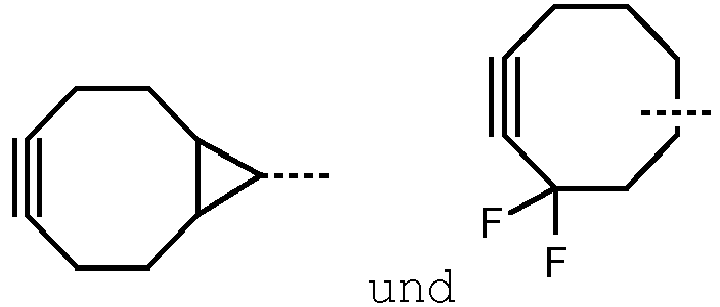
- Q
- jeweils unabhängig entfällt oder für einen (n+1)-wertigen linearen oder verzweigten aliphatischen C1-C10-Alkylen-Rest, der durch ein oder mehrere -O- oder -S- unterbrochen sein kann, oder einen Phenylenrest steht, wobei die genannten Reste jeweils unabhängig einen oder mehrere Substituenten, insbesondere ausgewählt aus CH3, C2H5, OCH3 und OCOCH3, tragen können,
- R1, R2 und R3
- jeweils unabhängig für H oder einen C1-C5-Alkylrest und insbesondere einen C1-C3-Alkylrest stehen,
- X und Y
- jeweils unabhängig entfallen oder für -O-, -S-, -CO-O-, -O-CO-, -O-CO-O-, -CO-NR3-, -NR3-CO-, -O-CO-NR3-, -NR3-CO-O- oder -NR3-CO-NR3- stehen,
- m
- jeweils unabhängig die Werte 2, 3 oder 4 annehmen kann,
- n
- jeweils unabhängig die Werte 1, 2 oder 3 und insbesondere 1 oder 2 annehmen kann und am meisten bevorzugt 1 ist.
- Besonders bevorzugt sind dabei Verbindungen, in denen alle Variablen eine der oben definierten Bedeutungen und insbesondere eine der bevorzugten Bedeutungen haben.
- Erfindungsgemäss besonders bevorzugt sind Dentalwerkstoffe, die mindestens ein Azid der Formel IA
A- [X-Q- (Y-CG)n]m Formel IA,
in der - A
- für -O-, -N=, -NR3-, =N-N=, -NR3-N=, =N-NR3-, -NR3-NR3- oder einen m-wertigen Alkylen-Rest, Cycloalkylen-Rest, Heterocycloalkylen-Rest, Arylen-Rest, Heteroarylen-Rest, gemischten Alkylen-Cyclyl-Rest wie Alkylen-Cyclyl-Rest, Cyclyl-Alkylen-Rest, Cyclyl-Alkylen-Cyclyl-Rest oder Alkylen-Cyclyl-Alkylen-Cyclyl-Alkylen-Rest oder Cyclyl-O-Cyclyl-Rest steht, wobei Alkylen jeweils unabhängig für einen linearen oder verzweigten aliphatischen C1-C50-Rest steht, der durch ein oder mehrere -O-, -S-, -NR3-, -CO-O-, -O-CO-, -O-CO-O-, -CO-NR3-, -NR3-CO-, -O-CO-NR3-, -NR3-CO-O- oder -NR3-CO-NR3- unterbrochen sein kann,
Cycloalkylen jeweils unabhängig für einen cycloaliphatischen C3-C18-Rest steht,
Heterocycloalkylen jeweils unabhängig für einen heterocycloaliphatischen C3-C18-Rest steht,
Arylen jeweils unabhängig für einen aromatischen C6-C18-Rest steht,
Heteroarylen jeweils unabhängig für einen heteroaromatischen C3-C18-Rest steht,
Cyclyl jeweils unabhängig für Cycloalkylen, Heterocycloalkylen, Arylen oder Heteroarylen steht und
die genannten Reste jeweils unabhängig einen oder mehrere Substituenten, insbesondere ausgewählt aus C1-C5-Alkyl, OH, OCH3 und OCOCH3, tragen können,
CG jeweils unabhängig für eine Azidgruppe N3 steht,
Q jeweils unabhängig entfällt oder für einen (n+1)-wertigen linearen oder verzweigten aliphatischen C1-C10-Alkylen-Rest, der durch ein oder mehrere -O- oder -S- unterbrochen sein kann, oder einen Phenylenrest steht, wobei die genannten Reste jeweils unabhängig einen oder mehrere Substituenten, insbesondere ausgewählt aus CH3, C2H5, OCH3 und OCOCH3, tragen können,
R1, R2 und R3 jeweils unabhängig für H oder einen C1-C10-Alkylrest stehen,
X und Y jeweils unabhängig entfallen oder für -O-, -S-, -NR3-, -CO-, -CO-O-, -O-CO-, -O-CO-O-, -CO-NR3-, -NR3-CO-, -O-CO-NR3-, -NR3-CO-O- oder -NR3-CO-NR3- stehen,
m jeweils unabhängig die Werte 2 bis 6 annehmen kann und
n jeweils unabhängig die Werte 1 bis 4 annehmen kann, und - A
- für -O-, -N=, -NR3-, =N-N=, -NR3-N=, =N-NR3-, -NR3-NR3- oder einen m-wertigen Alkylen-Rest, Cycloalkylen-Rest, Heterocycloalkylen-Rest, Arylen-Rest, Heteroarylen-Rest, gemischten Alkylen-Cyclyl-Rest wie Alkylen-Cyclyl-Rest, Cyclyl-Alkylen-Rest, Cyclyl-Alkylen-Cyclyl-Rest oder Alkylen-Cyclyl-Alkylen-Cyclyl-Alkylen-Rest oder Cyclyl-O-Cyclyl-Rest steht, wobei Alkylen jeweils unabhängig für einen linearen oder verzweigten aliphatischen C1-C50-Rest steht, der durch ein oder mehrere -O-, -S-, -NR3-, -CO-O-, -O-CO-, -O-CO-O-, -CO-NR3-, -NR3-CO-, -O-CO-NR3-, -NR3-CO-O- oder -NR3-CO-NR3- unterbrochen sein kann,
Cycloalkylen jeweils unabhängig für einen cycloaliphatischen C3-C18-Rest steht,
Heterocycloalkylen jeweils unabhängig für einen heterocycloaliphatischen C3-C18-Rest steht,
Arylen jeweils unabhängig für einen aromatischen C6-C18-Rest steht,
Heteroarylen jeweils unabhängig für einen heteroaromatischen C3-C18-Rest steht,
Cyclyl jeweils unabhängig für Cycloalkylen, Heterocycloalkylen, Arylen oder Heteroarylen steht und
die genannten Reste jeweils unabhängig einen oder mehrere Substituenten, insbesondere ausgewählt aus C1-C5-Alkyl, OH, OCH3 und OCOCH3, tragen können,
CG jeweils unabhängig für eine Alkingruppe ausgewählt aus der Gruppe bestehend aus -CR1R2-C≡CH,
- Q
- jeweils unabhängig entfällt oder für einen (n+1)-wertigen linearen oder verzweigten aliphatischen C1-C10-Alkylen-Rest, der durch ein oder mehrere -O- oder -S- unterbrochen sein kann, oder einen Phenylenrest steht, wobei die genannten Reste jeweils unabhängig einen oder mehrere Substituenten, insbesondere ausgewählt aus CH3, C2H5, OCH3 und OCOCH3, tragen können,
- R1, R2 und R3
- jeweils unabhängig für H oder einen C1-C10-Alkylrest stehen,
- X und Y
- jeweils unabhängig entfallen oder für -O-, -S-, -NR3-, -CO-, -CO-O-, -O-CO-, -O-CO-O-, -CO-NR3-, -NR3-CO-, -O-CO-NR3-, -NR3-CO-O- oder -NR3-CO-NR3- stehen,
- m
- jeweils unabhängig die Werte 2 bis 6 annehmen kann und
- n
- jeweils unabhängig die Werte 1 bis 4 annehmen kann.
- Dabei sind solche Verbindungen der Formel IA und IB besonders bevorzugt, in der jeweils unabhängig voneinander eine oder mehrere der Variablen eine der oben für Formel I definierten bevorzugten Bedeutungen haben. Besonders bevorzugt sind Verbindungen, in denen alle Variablen eine der oben definierten Bedeutungen und insbesondere eine der bevorzugten Bedeutungen haben.
- Ausserdem sind Dentalwerkstoffe bevorzugt, in denen Alkingruppen und Azidgruppen ganz oder annähernd im stöchiometrischen Verhältnis vorliegen und insbesondere im Verhältnis 2:1 - 1:2, vorzugsweise im Verhältnis 1,5:1 - 1:1,5, besonders bevorzugt im Verhältnis 1,1:1 - 1:1,1 und am meisten bevorzugt im Verhältnis 1,05:1 - 1:1,05 vorliegen.
- Weiter bevorzugt sind solche Dentalwerkstoffe, in denen die Verbindungen der Formel I eine mittlere Funktionalität von > 2,2 und insbesondere > 2,5 aufweisen. Unter der mittleren Funktionalität wird die durchschnittliche Anzahl an Gruppen CG bezogen auf die in dem Dentalwerkstoff enthaltenen Moleküle von Verbindungen der Formel I verstanden.
- Es wurde überraschend gefunden, dass die erfindungsgemässen Dentalwerkstoffe, die mindestens eine Verbindung der Formel I, und insbesondere mindestens ein Azid der Formel IA und mindestens ein Alkin der Formel IB enthalten, hervorragend polymerisierbar sind und einen sehr hohen Umsatz der polyreaktionsfähigen Gruppen zeigen und nach der Aushärtung verbesserte mechanische Eigenschaften wie einen deutlich erhöhten Elastizitätsmodul aufweisen.
- Darüber hinaus hat sich gezeigt, dass auf Basis der erfindungsgemässen Dentalwerkstoffe durch geeignete Auswahl der Verbindungen der Formel I, und insbesondere der multifunktionellen Azide der Formel IA und der multifunktionellen Alkine der Formel IB, sowie durch Variation der mittleren Funktionalität dieser Verbindungen in dem Dentalwerkstoff durch Einstellung eines geeigneten Mischungsverhältnis insbesondere der Azide und Alkine, Polymernetzwerke mit massgeschneiderten Eigenschaften hergestellt werden können. Dabei nimmt die Netzwerkdichte mit der mittleren Funktionalität der Verbindungen und dem erreichten Umsatz der polymerisierbaren Gruppen zu. Durch Variation der Struktur der Verbindungen der Formel I, wie etwa die Verwendung von flexiblen oder steifen Spacern zur Anbindung der Azid- bzw. Alkin-Gruppen, lassen sich die Eigenschaften der gebildeten Polycycloadditionsnetzwerke weiter beeinflussen. Ausserdem können durch thermische Nachbehandlung der Umsetzungsgrad der funktionellen Gruppen und damit die Vernetzungsdichte zusätzlich erhöht werden. Schliesslich lassen sich die mechanischen Eigenschaften durch Zugabe von Füllstoffen weiter verbessern. Die erfindungsgemässen Dentalwerkstoffe auf Basis von Verbindungen der Formel I eignen sich daher insbesondere für die Herstellung von dentalen Restaurationsmaterialien wie hochmoduligen Komposit-Frässkörpern für CAD-CAM-basierte Verarbeitungstechniken zur Herstellung von zahnfarbenen Inlays, Onlays, Brücken oder Kronen.
- Verbindungen der Formel I lassen sich nach an sich bekannten Synthesemethoden einfach herstellen. So sind Azide der Formel IA beispielsweise durch nucleophile Substitution von geeigneten di- oder höherfunktionalisierten Halogeniden (Z=Cl, Br, I) oder p-Toluolsulfonsäureestern (Z=OTos) mit Natriumazid NaN3 zugänglich:

-

- Weiterhin lassen sich Azidgruppen in an sich bekannter Weise aus aromatischen Hydrazinen durch Diazotierung, aus Alkoholen durch Mitsunobo-Reaktion oder aus Isocyanaten durch Addition von 2-Azidoethanol herstellen.
-

- Alkine der Formel IB sind ausgehend von kommerziell erhältlichen monofunktionellen Alkinen, wie Propargylamin (Z=NH2), Propargylessigsäure (Z=CH2COOH), Propargylalkohol (Z=OH) oder Propargylhalogeniden (Z=Cl, Br) leicht durch Umsetzung mit geeigneten di- oder höherfunktionalisierten Verbindungen wie Di- oder Polyolen zugänglich:

-

- Die Synthese von Aziden der Formel IB mit Cyclooctingruppen kann beispielsweise durch Umsetzung von bi- oder höherfunktionellen Isocyanaten mit entsprechenden Hydroxycyclooctinen erfolgen.
-

- Beispiele für die erfindungsgemässen Verbindungen der Formel I sind:





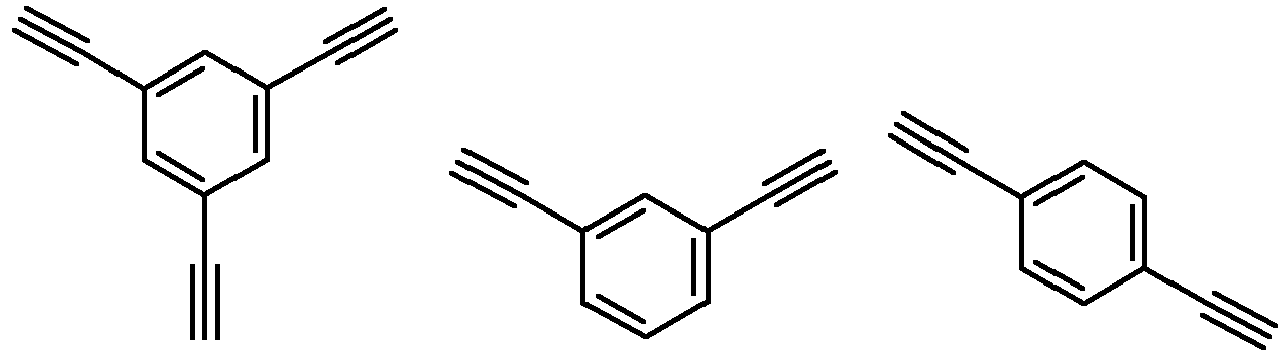
- Die erfindungsgemässen Dentalwerkstoffe enthalten vorzugsweise auch einen Katalysator für die Azid-Alkin-Cycloaddition.
- Als thermische Katalysatoren für die Azid-Alkin-Cycloaddition eignen sich vor allem Kupfer-, Ruthenium-, Nickel-, Palladium- und Platin-Verbindungen und -Komplexe und insbesondere Kupfer(I)-, Ruthenium(I)-, Nickel(II)-, Palladium(II)- und Platin(II)-Verbindungen und -Komplexe. Besonders geeignet sind einfache Kupfer(I)-salze wie CuCl, CuBr, CuI oder CuOAc und Kupfer(I)-Komplexe wie CuOTf, Cu(CH3C(O)CHC(O)CH3), CuI·P(OEt)3, [Cu(CH3CN)4]PF6 oder Cu(PPh3)Br. Diese können zusätzlich durch chelatisierende Liganden wie Tris-[(1-benzyl-1H-1,2,3-triazol-4-yl)-methyl]-amin (TBTA), N,N,N',N",N"-Pentamethyldiethylentriamin (PMDETA), N,N,N'-Trimethylethylendiamin (TRMEDA) oder Bathophenanthrolindisulfonate (Batho) stabilisiert werden. Weiterhin lassen sich Mischungen aus Kupfer(II)-salzen mit Reduktionsmitteln verwenden. Beispiele für geeignete Kupfer(II)-Salze sind CuSO4, CuCl2, CuBr2 und CuI2. Diese lassen sich etwa mit Ascorbinsäure oder deren Natriumsalz in die entsprechenden Cu(I)-Spezies überführen. Alternativ können katalytische Cu(I)-Spezies aus Kupfer(II)-Salzen auch elektrochemisch erzeugt werden. Weitere Beispiele für geeignete Verbindungen sind Cp*Ru(PPh3)2Cl, [Cp*RuCl]n und eine Mischung aus PtCl2 und PMDETA. CuOAc ist besonders bevorzugt. Eine besondere Katalysatoraktivität kann mit einer Mischung von Tripropargylamin und CuOAc erreicht werden, wobei das CuOAc vorzugsweise in einer Menge von 0,15-0,25 mol% eingesetzt wird. Dabei kann die Bildung der aktiven Katalysatorspezies durch die im Laufe der Reaktion eintretende Farbänderung von grün zu gelb verfolgt werden.
- Als lichtinduzierbare Katalysatoren für die Azid-Alkin-Cycloaddition eignen sich vor allem photoreduzierbare Kupfer(II)-Verbindungen sowie Mischungen von Kupfer(II)-Verbindungen mit lichtinduzierbaren Reduktionsmitteln. Beispiele für geeignete Kupfer(II)-Verbindungen sind CuSO4, CuCl2, CuBr2, Cu(OH)2, Cu(OAc)2, CuO, Cu(ClO4)2 und Cu(NO3)2 sowie deren Hydrate und THF-Addukte. Geeignete lichtinduzierbare Reduktionsmittel insbesondere für den UVA-Bereich (320-400 nm) sind vor allem Norrish-Typ-I-Photoinitiatoren wie Benzophenon, 2-Hydroxy-2-methyl-1-phenyl-1-propanon, 4-(2-Hydroxyethoxy)-phenyl-(2-hydroxy-2-propyl)-keton, Bis-(2,6-dimethoxybenzoyl)-2,4,4-trimethylpentyl-phosphinoxid, Bis-(2,4,6-trimethylbenzoyl)-phenylphosphinoxid, 2,2-Di-methoxy-2-phenylacetophenon, 2-Benzyl-2-dimethylamino-4'-morpholino-butyrophenon (DBMP), 2,4,6-(Trimethylbenzoyl)-diphenylphosphinoxid (TMDPO) und Diphenyliodoniumhexafluorophosphat. Geeignete lichtinduzierbare Reduktionsmittel insbesondere für den sichtbaren Bereich (400-800 nm) sind vor allem Photoinitiatoren aus der Gruppe der Titanocene, wie Dicyclopentadienyl-bis-[2,6-difluoro-3-(1-pyrrolyl)-phenyl]-titanium, und der α-Diketone, wie 9,10-Phenanthrenchinon, 1-Phenyl-propan-1,2-dion, Diacetyl oder Campherchinon. Diese lichtinduzierbaren Reduktionsmittel können etwa in Kombination mit CuCl2/PMDETA blaulichtinduziert katalytische Cu(I)-Spezies für die Azid-Alkin-Cycloaddition bilden.
- Photoinitiatoren als lichtinduzierbare Reduktionsmittel für den sichtbaren Bereich bilden bei Bestrahlung zudem polymerisationsauslösende Radikale, gegebenenfalls in Gegenwart von Co-Initiatoren. Beispiele hierfür sind Mischungen von Campherchinon mit tertiären Aminen, insbesondere tertiären aromatischen Aminen. Besonders geeignete tertiäre aromatische Aminen sind N,N-Dialkyl-aniline wie N,N-Dimethylanilin, N,N-Dialkyl-p-toluidine wie N-Dimethyl-p-toluidin, N,N-Dialkyl-3,5-xylidine wie N,N,3,5-Tetramethylanilin, p-(N,N-Dialkylamino)-phenylethanole, p-(N,N-Dialkylamino)-benzoesäure-derivate wie p-(Dimethylamino)-benzonitril, p-(N,N-Dialkylamino)-benzaldehyde wie N,N-Dimethylamino-p-benzaldehyd, p-(N,N-Dialkyl-amino)-phenylessigsäureester wie p-(Dimethylamino)-benzoesäureethylester oder p-(N,N-Dialkylamino)-phenylpropionsäureestern. Geeignet sind auch tertiäre aliphatische Amine wie Tri-n-butylamin, Dimethyl-aminoethan-2-ol, Triethanolamin, Dimethylaminoethylmethacrylat oder N,N-Dimethylbenzylamin.
- Beim Einsatz von substituierten Cycloalkinen wie difluorierten Cyclooctinen kann häufig auf die Verwendung von Katalysatoren verzichtet werden, da in diesem Fall die Azid-Alkin-Cycloaddition unter Abbau der Ringspannung stattfindet.
- Besonders geeignet sind auch Hybridmaterialien, die neben mindestens einer Verbindung der Formel I, und insbesondere mindestens einem Azid der Formel IA und mindestens einem Alkin der Formel IB, radikalisch polymerisierbare Monomere enthalten. Solche Hybridmaterialien können durch Katalysatorkombinationen von Kupfer(I)-oder Kupfer(II)-Verbindungen mit radikalischen Photoinitiatoren als lichtinduzierbaren Reduktionsmitteln stufenweise (erst thermisch und dann lichtinduziert) oder simultan (lichtinduziert) ausgehärtet werden.
- Als radikalisch polymerisierbare Monomere (Co-Monomere) sind insbesondere mono- oder polyfunktionelle (Meth)acrylsäurederivate geeignet. Unter monofunktionellen (Meth)acrylsäurederivaten werden Verbindungen mit einer, unter polyfunktionellen (Meth)acrylsäure-derivaten Verbindungen mit zwei oder mehr, vorzugsweise 2 bis 4 (Meth)acrylsäuregruppen verstanden. Polyfunktionelle Monomere haben eine vernetzende Wirkung.
- Erfindungsgemäss bevorzugte mono- oder polyfunktionelle (Meth)acrylsäurederivate sind Methyl-, Ethyl-, Hydroxyethyl-, Butyl-, Benzyl-, Tetrahydrofurfuryl- oder Isobornyl(meth)acrylat, p-Cumyl-phenoxyethylenglycolmethacrylat (CMP-1E), Bisphenol-A-di(meth)acrylat, Bis-GMA (ein Additionsprodukt aus Methacrylsäure und Bisphenol-A-diglycidylether), ethoxy- oder propoxyliertes Bisphenol-A-Dimethacrylat, wie etwa das Bisphenol-A-Dimethacrylat SR-348c (Sartomer) mit 3 Ethoxygruppen oder 2,2-Bis-[4-(2-methacryloxypropoxy)-phenyl]-propan, UDMA (ein Additionsprodukt aus 2-Hydroxyethylmethacrylat (HEMA) und 2,2,4-Trimethylhexamethylendiisocyanat), Di-, Tri- oder Tetraethylenglycoldi(meth)acrylat, Trimethylolpropantri(meth)acrylat, Pentaerythrittetra(meth)acrylat, Glycerindi- und -tri(meth)acrylat, 1,4-Butandioldi(meth)acrylat, 1,10-Decandioldi(meth)acrylat (D3MA) und 1,12-Dodecandioldi(meth)acrylat.
- Besonders bevorzugte mono- oder polyfunktionelle (Meth)acrylsäurederivate sind N-mono- oder -disubstitiuierte Acrylamide wie N-Ethylacrylamid, N,N-Dimethacrylamid, N-(2-Hydroxyethyl)acrylamid oder N-Methyl-N-(2-hydroxyethyl)acrylamid, N-monosubstituierte Methacrylamide wie N-Ethylmethacrylamid oder N-(2-Hydroxyethyl)-methacrylamid sowie N-Vinylpyrrolidon und Allylether. Diese Monomere zeichnen sich durch eine hohe Hydrolysestabilität aus und eignen sich aufgrund ihrer relativ geringen Viskosität besonders als Verdünnermonomere.
- Bevorzugte polyfunktionelle (Meth)acrylsäurederivate mit hoher Hydrolysestabilität sind vernetzende Pyrrolidone wie 1,6-Bis-(3-vinyl-2-pyrrolidonyl)-hexan, Bisacrylamide wie Methylen- oder Ethylenbisacrylamid und Bis(meth)acrylamide wie N,N'-Diethyl-1,3-bis-(acrylamido)-propan, 1,3-Bis(methacrylamido)-propan, 1,4-Bis-(acrylamido)-butan oder 1,4-Bis(acryloyl)-piperazin, die durch Umsetzung aus den entsprechenden Diaminen mit (Meth)acrylsäurechlorid synthetisiert werden können.
- Vorzugsweise werden Mischungen der vorstehend genannten Monomere verwendet.
- Die erfindungsgemässen Dentalwerkstoffe können neben mindestens einer Verbindung der Formel I, und insbesondere mindestens einer Verbindung der Formel IA und mindstens einer Verbindung der Formel IB, und ggf. den oben genannten Co-Monomeren vorzugweise auch zusätzliche radikalisch polymerisierbare, säuregruppenhaltige Monomere (Haftmonomere) enthalten. Bevorzugte Säuregruppen sind Carbonsäuregruppen, Phosphonsäuregruppen, Phosphorsäuregruppen und Sulfonsäuregruppen.
- Bevorzugte Monomere mit polymerisierbaren Carbonsäuren sind Maleinsäure, Acrylsäure, Methacrylsäure, 2-(Hydroxymethyl)acrylsäure, 4-(Meth)acryloyloxyethyltrimellitsäureanhydrid, 10-Methacryloyloxydecylmalonsäure, N-(2-Hydroxy-3-methacryloyloxypropyl)-N-phenylglycin und 4-Vinylbenzoesäure.
- Bevorzugte Monomere mit polymerisierbaren Phosphonsäuregruppen sind Vinylphosphonsäure, 4-Vinylphenylphosphonsäure, 4-Vinylbenzylphosphonsäure, 2-Methacryloyloxyethylphosphonsäure, 2-Methacrylamidoethylphosphonsäure, 4-Methacrylamido-4-methyl-pentylphosphonsäure, 2-[4-(Di-hydroxyphosphoryl)-2-oxa-butyl]-acrylsäure, 2-[4-(Dihydroxyphosphoryl)-2-oxa-butyl]-acrylsäureethyl- und -2,4,6-trimethylphenylester.
- Bevorzugte Monomere mit polymerisierbaren Phosphorsäuregruppen sind 2-Methacryloyloxypropylmono- oder -dihydrogenphosphat, 2-Methacryloyloxyethylmono- oder -dihydrogenphosphat, 2-Methacryloyloxyethylphenylhydrogenphosphat, Dipentaerythritolpentamethacryloyloxyphosphat, 10-Methacryloyloxydecyl-dihydrogenphosphat, Phosphorsäuremono-(1-acryloyl-piperidin-4-yl)-ester, 6-(Methacrylamido)-hexyldihydrogenphosphat und 1,3-Bis-(N-acryloyl-N-propyl-amino)-propan-2-yl-dihydrogenphosphat. Bevorzugte Monomere mit polymerisierbaren Sulfonsäuregruppen sind Vinylsulfonsäure, 4-Vinylphenylsulfonsäure und 3-(Methacrylamido)-propylsulfonsäure.
- Weiterhin enthalten die erfindungsgemässen Zusammensetzungen zur Verbesserung der mechanischen Eigenschaften oder zur Einstellung der Viskosität vorzugsweise auch organische oder anorganische Füllstoffpartikel.
- Bevorzugte anorganische partikuläre Füllstoffe sind amorphe kugelförmige Materialien auf Basis von Oxiden wie ZrO2 und TiO2 oder Mischoxiden aus SiO2, ZrO2 und/oder TiO2 mit einer mittleren durchschnittlichen Partikelgrösse von 0,005 bis 2 µm, vorzugsweise 0,1 bis 1 µm, nanopartikuläre oder mikrofeine Füllstoffe wie pyrogene Kieselsäure oder Fällungskieselsäure mit einer mittleren durchschnittlichen Partikelgrösse von 5 bis 200 nm, vorzugsweise 10 bis 100 nm, Minifüllstoffe wie Quarz-, Glaskeramik- oder Glaspulver beispielsweise von Barium- oder Strontiumaluminiumsilikatgläsern mit einer durchschnittlichen Teilchengrösse von 0,01 bis 15 µm, vorzugsweise 0,1 bis 1 µm, sowie röntgenopake Füllstoffe wie Ytterbiumtrifluorid oder nanopartikuläres Tantal(V)-oxid bzw. Bariumsulfat oder Mischoxide von SiO2 mit Ytterbium(III)-oxid oder Tantal(V)-oxid mit einer mittleren durchschnittlichen Partikelgrösse von 10 bis 1000 nm, vorzugsweise 100 bis 300 nm. Die Bestimmung der durchschnittlichen Partikelgrösse kann insbesondere durch Transmissions- oder Rasterelektronenmikroskopie oder durch Laserbeugung erfolgen. Vorzugsweise kann im Bereich von 1 nm bis 50 nm die Transmissionselektronenmikroskopie, im Bereich von 50 nm bis 1 µm die Rasterelektronenmikroskopie und im Bereich von 1 µm bis 100 µm die Laserbeugung zur Bestimmung der durchschnittlichen Partikelgrösse verwendet werden. Geeignet sind auch faserförmige Füllstoffe, Nanofasern oder Wiskers.
- Zur Verbesserung des Verbundes zwischen den Füllstoffpartikeln und der Polycycloadditionsmatrix können insbesondere Füllstoffe auf Basis von SiO2 mit Azid- oder Alkin-funktionalisierten Silanen oberflächenmodifiziert werden. Beispiele für solche Silane sind 3-Azidopropyltriethoxysilan und N-[3-(Triethoxysilyl)-propyl]-carbaminsäurepropargylester. Zur Oberflächenmodifizierung von nichtsilikatischen Füllstoffen etwa auf Basis von ZrO2 oder TiO2 können auch funktionalisierte saure Phosphate wie Propargyldihydrogenphosphat eingesetzt werden.
- Ausserdem können die erfindungsgemässen Dentalwerkstoffe weitere Additive enthalten, vor allem Stabilisatoren, Aromastoffe, Farbmittel, mikrobiozide Wirkstoffe, fluoridionenabgebende Additive, optische Aufheller, Weichmacher, UV-Absorber oder Lösungsmittel wie Wasser oder Ethanol bzw. entsprechende Lösungsmittelgemische.
- Besonders bevorzugt sind Dentalwerkstoffe auf Basis mindestens einer Verbindung der Formel I, und insbesondere mindestens eines Azids der Formel IA und mindestens eines Alkins der Formel IB, welche die folgenden Bestandteile enthalten:
- a) 0,1 bis 80 Gew.-%, insbesondere 1 bis 60 Gew.-%, bevorzugt 5 bis 50 Gew.-% und besonders bevorzugt 10 bis 40 Gew.-% mindestens einer Verbindung der Formel I und vorzugsweise einer Mischung mindestens eines Azids der Formel IA und mindestens eines Alkins der Formel IB,
- b) 0,01 bis 10 Gew.-%, bevorzugt 0,1 bis 3 Gew.-% und besonders bevorzugt 0,2 bis 2 Gew.-% Katalysator,
- c) 0 bis 80 Gew.-%, bevorzugt 1 bis 60 Gew.-% und besonders bevorzugt 5 bis 50 Gew.-% Co-Monomer,
- d) 0 bis 90 Gew.-%, bevorzugt 10 bis 80 Gew.-% und besonders bevorzugt 20 bis 70 Gew.-% Füllstoff und
- e) 0 bis 70 Gew.-%, bevorzugt 1 bis 50 Gew.-% und besonders bevorzugt 5 bis 20 Gew.-% Lösungsmittel.
- Die Erfindung betrifft auch die Verwendung der erfindungsgemässen Dentalwerkstoffe zur Herstellung von dentalen Kompositen, vorzugsweise Komposit-Formkörpern, die insbesondere für die maschinelle Bearbeitung mittels computergestützter Verarbeitungstechniken wie Fräs- und Schleifverfahren geeignet sind und sich vor allem zur Herstellung von dentalen Restaurationsmaterialien wie Inlays, Onlays, Kronen, Brücken oder Verblendmaterialien eignen.
- Weiterhin betrifft die Erfindung auch die Verwendung mindestens einer Verbindung der Formel I, und insbesondere mindestens eines Azids der Formel IA und mindestens eines Alkins der Formel IB, wie oben beschrieben zur Herstellung eines Dentalwerkstoffs und insbesondere eines dentalen Kompositmaterials.
- Die Erfindung wird im Folgenden anhand von Ausführungsbeispielen näher erläutert.
-

- Zu einer Lösung von Triethylenglycol-bis-(4-toluolsulfonat) (10 g, 21,8 mmol) in DMSO (130 ml) wurde Natriumazid (4,25 g, 65,4 mmol, 3 äq.) zugegeben. Die Reaktionsmischung wurde 48 h bei Raumtemperatur gerührt und dann die Reaktion durch Zugabe von Wasser (100 ml) abgebrochen. Das Reaktionsprodukt wurde mit Diethylether (3 x 50 ml) extrahiert und die vereinigten organischen Phasen mit Wasser (3 x 50 ml) gewaschen. Die organische Phase wurde mit wasserfreiem MgSO4 getrocknet. Nach Entfernen des Lösungsmittels unter vermindertem Druck wurden 4,32 g (98% Ausbeute) des Produkts als gelbes Öl erhalten.
1H-NMR (300 MHz, CDCl3): δ = 3,70-3,66 (m, 8H), 3,38 (t, J = 5 Hz, 4H). 13C-NMR (75 MHz, CDCl3): δ = 70,7, 70,1, 50,7.
Anal.: Ber. für C6H12N6O2: C, 36,00%; H, 6,04%; N, 41,98%; gef.: C, 36,25%; H, 5,79%; N, 42,08%. -

- Zu einer Lösung von 2,2,4-Trimethylhexan-1,6-diisocyanat (5 g, 23,8 mmol, Diastereomerenmischung) und Dibutylzinn(II)-dilaurat (6 mg, 9,52 µmol, 0,0004 äq) in Toluol (10 ml) wurde langsam Propargylalkohol (2,67 g, 47,6 mmol, 2 äq.) über einen Zeitraum von 15 min zugetropft und die Reaktionsmischung 48 h bei 60 °C gerührt. Nach Filtration über eine kurze Silica-Säule wurde das Lösungsmittel unter vermindertem Druck entfernt. Es wurden 7,51 g (98% Ausbeute) des Produkts als viskoses gelbes Öl erhalten.
1H-NMR (300 MHz, CDCl3): δ = 5,14-4,91 (br, 2H, N-H), 4,65 (br, 4H, C(O)O-CH2), 3,20-2,88 (m, 4H, NH-CH2), 2,46 (d, J = 1,8 Hz, 2H, C≡CH), 1,70-1,22 (br, 3H), 1,05-0,86 (m, 11H, CH2, CH3). 13C-NMR (75 MHz, CDCl3): δ = 155,8, 155,7, 155,4, 129,0, 128,2, 125,3, 78,4, 74,6, 74,5, 52,5, 52,3, 51,4, 48,6, 46,4, 45,9, 41,9, 39,2, 39,1, 37,4, 35,0, 32,9, 29,4, 27,4, 26,1, 25,5, 25,1, 22,3, 21,4, 20,5.
ESI-MS (m/z (%)): 345,18 (100) [M+ + Na].
Anal.: Ber. für C17H26N2O4: C, 63,33%; H, 8,13%; N, 8,69%; gef.: C, 63,07%; H, 7,91%; N, 8,83%. - Eine stöchiometrische Mischung von Azid- und Alkin-Verbindungen wurde in ein Gefäss eingewogen und 10 min gerührt. Dann wurde der Kupfer(I)-Katalysator (0,1 bis 5 mol-%) zugegeben und weitere 5 min gerührt, bis sich der Katalysator löste, was typischerweise zur Gelbfärbung der Lösung führte. Dann wurde die Mischung in eine Presshülse aus Metall oder Teflon (0,5-1,0 mm hoch, Innendurchmesser 15 mm) gegeben und mit einer PET-Folie abgedeckt. Die Mischung wurde 24 h bei Raumtemperatur stehen gelassen und anschliessend 24 h auf 32 °C erwärmt, wodurch eine vollständige Aushärtung erreicht wurde. Der Reaktionsverlauf wurde mittels IR-Spektroskopie durch Verfolgung der Abnahme der IR-Absorption der Azidgruppe bei 2100 cm-1 verfolgt.
-

- Stöchiometrische Mengen von 1,2-Bis-(2-azidoethoxy)ethan aus Beispiel 1 und 1,6-Bis-(prop-2-inoxycarbonylamino)-2,2,4-trimethyl-hexan aus Beispiel 2 wurden in Gegenwart von 0,5 mol% bzw. 2 mol% Kupfer(I)-acetat gemäss der vorstehenden allgemeinen Vorschrift umgesetzt. AT-IR-Spektren der erhaltenen Produkte sind in
Fig. 1 gezeigt. -

- Eine Mischung von Tripropargylamin (Sigma-Aldrich) mit 0,25 mol-% Kupfer(I)-acetat wurde 2 h bei Raumtemperatur gerührt. Danach wurde eine stöchiometrische Menge 1,3-Bis-(azidomethyl)-benzol (hergestellt nach S. T. Abu-Orabi, R. E. Harmon, J. Chem. Eng. Data 31 (1986) 379-380) zugegeben. Zur Härtung wurde die Reaktionsmischung 48 h auf 32 °C erwärmt. Das ATR-IR-Spektrum des erhaltenen vernetzten Polyaddukts ist in
Fig. 2 abgebildet und zeigt einen vollständigen Umsatz. Der Elastizitätsmodul dieses Polyaddukts wurde mittels Nanoindentation bestimmt. Dabei handelt es sich um eine örtlich hochauflösende Methode zur mechanischen Charakterisierung von festen Stoffen, die auf der Messung von Kraft und Weg während des elastisch-plastischen Kontakts eines harten Prüfkörpers (Indenter) mit der Probe basiert. Der Wert des mittels Nanoindentation bestimmten Elastizitätsmoduls des vernetzten Polyaddukts betrug 5,5 GPa. Vergleichsmessungen mit einem üblich lichtgehärteten Dentalharz auf Basis einer Mischung von UDMA (90 Gew.-%) und TEGDMA (10 Gew.-%) ergaben ein mittels Nanoindentation bestimmtes Elastizitätsmodul von nur 4,2 GPa. - Eine Mischung von Tripropargylamin mit Kupfer(I)-acetat (0,25 mol-%) wurde 2 h bei Raumtemperatur gerührt. Anschliessend wurde eine stöchiometrische Menge 1,3-Bis-(azidomethyl)-benzol zugegeben und in die erhaltene Mischung pyrogene Kieselsäure OX-50 (60 Gew.-% bezogen auf die Gesamtmischung, Primärpartikelgrösse 40 nm, Degussa) eingearbeitet. Zur Härtung wurde die Reaktionsmischung 48 h auf 32 °C erwärmt. Der Wert des mittels Nanoindentation bestimmten Elastizitätsmoduls des erhaltenen gefüllten Komposits betrug 11,7 GPa.
-

- Kupfer(II)-acetat (0,7-2,5 mol-%) wurde innerhalb von 5 min in Tripropargylamin gelöst, wodurch sich die Farbe der Mischung von türkis nach farblos änderte. Nach Zugabe einer stöchiometrischen Menge von 1,2-Bis-(2-azidoethoxy)-ethan und Methanol (15 Gew.-% bezogen auf die Gesamtmischung) wurde die Reaktionsmischung in einem Lichtofen (Dentacolor XS, Kulzer) 180 s lang bestrahlt, wodurch ein farbloses Netzwerkpolymer gebildet wurde. Das ATR-IR-Spektrum des erhaltenen vernetzten Polymers ist in
Fig. 3 abgebildet und zeigt einen vollständigen Umsatz. -

- Zur Herstellung von System A wurde eine Mischung von Tripropargylamin (1 mol) und Kupfer(I)-acetat (0,16 mol%) mind. 2 h gerührt, bis eine deutliche Gelbfärbung zu erkennen war, und danach wurde zu der 1,3-Bis-(azidomethyl)-benzol (1,5 mol) zugegeben. Zur Herstellung von System B wurde der Photoinitiator Benzoylmethylether (2 Gew.-%) innerhalb von 30 min in N,N'-Diethyl-1,3-bis-(acrylamido)-propan gelöst. Anschliessend wurden gleiche Gewichtsteile der Systeme A und B gemischt (A/B = 1:1). Die erhaltene Mischung wurde zur Härtung 24 h bei Raumtemperatur stehen gelassen, dann in einem Lichtofen (Dentacolor XS, Kulzer) 540 s lang bestrahlt und schliesslich weitere 24 h auf 32 °C erwärmt. Das ATR-IR-Spektrum des erhaltenen vernetzten Polymers zeigte einen vollständigen Umsatz. Der Wert des mittels Nanoindentation bestimmten Elastizitätsmoduls betrug 5,1 GPa.
A- [X-Q- (Y-CG)n]m Formel IB,
in der
Claims (15)
- Dentalwerkstoff, der mindestens eine Verbindung der Formel I enthält
A- [X-Q- (Y-CG)n]m Formel I,
in derA für -O-, -N=, -NR3-, =N-N=, -NR3-N=, =N-NR3-, -NR3-NR3-oder einen m-wertigen Alkylen-Rest, Cycloalkylen-Rest, Heterocycloalkylen-Rest, Arylen-Rest, Heteroarylen-Rest, gemischten Alkylen-Cyclyl-Rest oder Cyclyl-O-Cyclyl-Rest steht, wobei
Alkylen jeweils unabhängig für einen linearen oder verzweigten aliphatischen C1-C50-Rest steht, der durch ein oder mehrere -O-, -S-, -NR3-, -CO-O-, -O-CO-, -O-CO-O-, -CO-NR3-, -NR3-CO-, -O-CO-NR3-, -NR3-CO-O- oder -NR3-CO-NR3- unterbrochen sein kann,
Cycloalkylen jeweils unabhängig für einen cycloaliphatischen C3-C18-Rest steht,
Heterocycloalkylen jeweils unabhängig für einen heterocycloaliphatischen C3-C18-Rest steht,
Arylen jeweils unabhängig für einen aromatischen C6-C18-Rest steht,
Heteroarylen jeweils unabhängig für einen heteroaromatischen C3-C18-Rest steht,
Cyclyl jeweils unabhängig für Cycloalkylen, Heterocycloalkylen, Arylen oder Heteroarylen steht und
die genannten Reste jeweils unabhängig einen oder mehrere Substituenten, insbesondere ausgewählt aus C1-C5-Alkyl, OH, OCH3 und OCOCH3, tragen können,CG jeweils unabhängig für eine Azidgruppe N3 oder eine Alkingruppe ausgewählt aus der Gruppe bestehend aus -CR1R2-C≡CH,

mit der Massgabe, dass das Dentalwerkstoff mindestens eine Verbindung der Formel I, die eine Azidgruppe aufweist, und mindestens eine Verbindung der Formel I enthält, die eine Alkingruppe aufweist,Q jeweils unabhängig entfällt oder für einen (n+1)-wertigen linearen oder verzweigten aliphatischen C1-C20-Alkylen-Rest, der durch ein oder mehrere -O- oder -S- unterbrochen sein kann, oder einen Phenylenrest steht, wobei die genannten Reste jeweils unabhängig einen oder mehrere Substituenten, insbesondere ausgewählt aus CH3, C2H5, OH, OCH3 und OCOCH3, tragen können,R1, R2 und R3 jeweils unabhängig für H oder einen C1-C10-Alkylrest stehen,X und Y jeweils unabhängig entfallen oder für -O-, -S-, -NR3-, -CO-, -CO-O-, -O-CO-, -O-CO-O-, -CO-NR3-, -NR3-CO-, -O-CO-NR3-, -NR3-CO-O- oder -NR3-CO-NR3- stehen,m jeweils unabhängig die Werte 2 bis 6 annehmen kann undn jeweils unabhängig die Werte 1 bis 4 annehmen kann. - Dentalwerkstoff nach Anspruch 1, bei dem jeweils unabhängig voneinanderA für -N= oder einen m-wertigen Alkylen-Rest, Cycloalkylen-Rest, Heterocycloalkylen-Rest, Arylen-Rest, Heteroarylen-Rest, gemischten Alkylen-Cyclyl-Rest oder Cyclyl-O-Cyclyl-Rest steht, wobei
Alkylen jeweils unabhängig für einen linearen oder verzweigten aliphatischen C1-C20-Rest steht, der durch ein oder mehrere -O-, -S-, -CO-O-, -O-CO- oder -O-CO-O- unterbrochen sein kann,
Cycloalkylen jeweils unabhängig für einen cycloaliphatischen C3-C12-Rest steht,
Heterocycloalkylen jeweils unabhängig für einen heterocycloaliphatischen C3-C12-Rest steht,
Arylen jeweils unabhängig für einen aromatischen C6-C12-Rest steht,
Heteroarylen jeweils unabhängig für einen heteroaromatischen C3-C12-Rest steht,
Cyclyl jeweils unabhängig für Cycloalkylen, Heterocycloalkylen, Arylen oder Heteroarylen steht und
die genannten Reste jeweils unabhängig einen oder mehrere Substituenten, insbesondere ausgewählt aus C1-C3-Alkyl, OCH3 und OCOCH3, tragen können,CG jeweils unabhängig für eine Azidgruppe N3 oder eine Alkingruppe ausgewählt aus der Gruppe bestehend aus -CR1R2-C≡CH, Q jeweils unabhängig entfällt oder für einen (n+1)-wertigen linearen oder verzweigten aliphatischen C1-C10-Alkylen-Rest, der durch ein oder mehrere -O- oder -S-unterbrochen sein kann, oder einen Phenylenrest steht, wobei die genannten Reste jeweils unabhängig einen oder mehrere Substituenten, insbesondere ausgewählt aus CH3, C2H5, OCH3 und OCOCH3, tragen können,R1, R2 und R3 jeweils unabhängig für H oder einen C1-C5-Alkylrest und insbesondere einen C1-C3-Alkylrest stehen,X und Y jeweils unabhängig entfallen oder für -O-, -S-, -CO-O-, -O-CO-, -O-CO-O-, -CO-NR3-, -NR3-CO-, -O-CO-NR3-, -NR3-CO-O- oder -NR3-CO-NR3- stehen,m jeweils unabhängig die Werte 2, 3 oder 4 annehmen kann,n jeweils unabhängig die Werte 1, 2 oder 3 und insbesondere 1 oder 2 annehmen kann und am meisten bevorzugt 1 ist.
 - Dentalwerkstoff nach Anspruch 1 oder 2, der mindestens ein Azid der Formel IA
A- [X-Q- (Y-CG)n]m Formel IA
in derA für -O-, -N=, -NR3-, =N-N=, -NR3-N=, =N-NR3-, -NR3-NR3- oder einen m-wertigen Alkylen-Rest, Cycloalkylen-Rest, Heterocycloalkylen-Rest, Arylen-Rest, Heteroarylen-Rest, gemischten Alkylen-Cyclyl-Rest oder Cyclyl-O-Cyclyl-Rest steht, wobei
Alkylen jeweils unabhängig für einen linearen oder verzweigten aliphatischen C1-C50-Rest steht, der durch ein oder mehrere -O-, -S-, -NR3-, -CO-O-, -O-CO-, -O-CO-O-, -CO-NR3-, -NR3-CO-, -O-CO-NR3-, -NR3-CO-O- oder -NR3-CO-NR3- unterbrochen sein kann,
Cycloalkylen jeweils unabhängig für einen cycloaliphatischen C3-C18-Rest steht,
Heterocycloalkylen jeweils unabhängig für einen heterocycloaliphatischen C3-C18-Rest steht,
Arylen jeweils unabhängig für einen aromatischen C6-C18-Rest steht,
Heteroarylen jeweils unabhängig für einen heteroaromatischen C3-C18-Rest steht,
Cyclyl jeweils unabhängig für Cycloalkylen, Heterocycloalkylen, Arylen oder Heteroarylen steht und
die genannten Reste jeweils unabhängig einen oder mehrere Substituenten, insbesondere ausgewählt aus C1-C5-Alkyl, OH, OCH3 und OCOCH3, tragen können,CG Q jeweils unabhängig für eine Azidgruppe N3 steht, jeweils unabhängig entfällt oder für einen (n+1)-wertigen linearen oder verzweigten aliphatischen C1-C20-Alkylen-Rest, der durch ein oder mehrere -O- oder -S- unterbrochen sein kann, oder einen Phenylenrest steht, wobei die genannten Reste jeweils unabhängig einen oder mehrere Substituenten, insbesondere ausgewählt aus CH3, C2H5, OH, OCH3 und OCOCH3, tragen können,R1, R2 und R3 jeweils unabhängig für H oder einen C1-C10-Alkylrest stehen,X und Y jeweils unabhängig entfallen oder für -O-, -S-, -NR3-, -CO-, -CO-O-, -O-CO-, -O-CO-O-, -CO-NR3-, -NR3-CO-, -O-CO-NR3-, -NR3-CO-O- oder -NR3-CO-NR3- stehen,m jeweils unabhängig die Werte 2 bis 6 annehmen kann undn jeweils unabhängig die Werte 1 bis 4 annehmen kann, undmindestens ein Alkin der Formel IB enthält
A- [X-Q- (Y-CG)n]m Formel IB
in derA für -O-, -N=, -NR3-, =N-N=, -NR3-N=, =N-NR3-, -NR3-NR3- oder einen m-wertigen Alkylen-Rest, Cycloalkylen-Rest, Heterocycloalkylen-Rest, Arylen-Rest, Heteroarylen-Rest, gemischten Alkylen-Cyclyl-Rest oder Cyclyl-O-Cyclyl-Rest steht, wobei
Alkylen jeweils unabhängig für einen linearen oder verzweigten aliphatischen C1-C50-Rest steht, der durch ein oder mehrere -O-, -S-, -NR3-, -CO-O-, -O-CO-, -O-CO-O-, -CO-NR3-, -NR3-CO-, -O-CO-NR3-, -NR3-CO-O- oder -NR3-CO-NR3- unterbrochen sein kann,
Cycloalkylen jeweils unabhängig für einen cycloaliphatischen C3-C18-Rest steht,
Heterocycloalkylen jeweils unabhängig für einen heterocycloaliphatischen C3-C18-Rest steht,
Arylen jeweils unabhängig für einen aromatischen C6-C18-Rest steht,
Heteroarylen jeweils unabhängig für einen heteroaromatischen C3-C18-Rest steht,
Cyclyl jeweils unabhängig für Cycloalkylen, Heterocycloalkylen, Arylen oder Heteroarylen steht und
die genannten Reste jeweils unabhängig einen oder mehrere Substituenten, insbesondere ausgewählt aus C1-C5-Alkyl, OH, OCH3 und OCOCH3, tragen können,CG jeweils unabhängig für eine Alkingruppe ausgewählt aus der Gruppe bestehend aus -CR1R2-C≡CH,
 Q jeweils unabhängig entfällt oder für einen (n+1)-wertigen linearen oder verzweigten aliphatischen C1-C20-Alkylen-Rest, der durch ein oder mehrere -O- oder -S- unterbrochen sein kann, oder einen Phenylenrest steht, wobei die genannten Reste jeweils unabhängig einen oder mehrere Substituenten, insbesondere ausgewählt aus CH3, C2H5, OH, OCH3 und OCOCH3, tragen können,R1, R2 und R3 jeweils unabhängig für H oder einen C1-C10-Alkylrest stehen,X und Y jeweils unabhängig entfallen oder für -O-, -S-, -NR3-, -CO-, -CO-O-, -O-CO-, -O-CO-O-, -CO-NR3-, -NR3-CO-, -O-CO-NR3-, -NR3-CO-O- oder -NR3-CO-NR3- stehen,m jeweils unabhängig die Werte 2 bis 6 annehmen kann undn jeweils unabhängig die Werte 1 bis 4 annehmen kann.
 - Dentalwerkstoff nach einem der Ansprüche 1 bis 3, in dem die Verbindung der Formel I eine mittlere Funktionalität von > 2,2 und insbesondere > 2,5 aufweist.
- Dentalwerkstoff nach einem der Ansprüche 1 bis 4, der einen Katalysator für die Azid-Alkin-Cycloaddition enthält.
- Dentalwerkstoff nach Anspruch 5, der einen Katalysator ausgewählt aus der Gruppe bestehend aus Kupfer-, Ruthenium-, Nickel-, Palladium- und Platin-Verbindungen und -Komplexen enthält.
- Dentalwerkstoff nach Anspruch 5 oder 6, der als Katalysator eine Kupfer(II)-Verbindung und ein lichtinduzierbares Reduktionsmittel enthält.
- Dentalwerkstoff nach Anspruch 6 oder 7, der eine Kupfer(II)-Verbindung ausgewählt aus CuSO4, CuCl2, CuBr2, Cu(OH)2, Cu(OAc)2, CuO, Cu(ClO4)2 und Cu(NO3)2 sowie deren Hydraten und THF-Addukten enthält.
- Dentalwerkstoff nach Anspruch 7 oder 8, der als lichtinduzierbares Reduktionsmittel einen Photoinitiator ausgewählt aus der Gruppe bestehend aus Norrish-Typ-I-Photoinitiatoren, Titanocenen und α-Diketonen enthält.
- Dentalwerkstoff nach einem der Ansprüche 1 bis 9, der ein oder mehrere radikalisch polymerisierbare Monomere enthält.
- Dentalwerkstoff nach Anspruch 10, der
Methyl-, Ethyl-, Hydroxyethyl-, Butyl-, Benzyl-, Tetrahydrofurfuryl- oder Isobornyl(meth)acrylat, p-Cumyl-phenoxyethylenglycolmethacrylat (CMP-1E), Bisphenol-A-di(meth)acrylat, Bis-GMA, ethoxy- oder propoxyliertes Bisphenol-A-Dimethacrylat, UDMA, Di-, Tri- oder Tetraethylenglycoldi(meth)acrylat, Trimethylol-propantri(meth)acrylat, Pentaerythrittetra(meth)acrylat, Glycerindi- oder -tri(meth)acrylat, 1,4-Butandioldi(meth)acrylat, 1,10-Decandioldi(meth)acrylat (D3MA), 1,12-Dodecandioldi-(meth)acrylat,
und/oder
ein oder mehrere N-mono- oder -disubstitiuierte Acrylamide, N-Ethylacrylamid, N,N-Dimethacrylamid, N-(2-Hydroxyethyl)-acrylamid, N-Methyl-N-(2-hydroxyethyl)acrylamid, ein oder mehrere N-monosubstituierte Methacrylamide, N-Ethylmethacrylamid, N-(2-Hydroxyethyl)methacrylamid, N-Vinylpyrrolidon, ein oder mehrere vernetzende Allylether,
und/oder
ein oder mehrere vernetzende Pyrrolidone, 1,6-Bis(3-vinyl-2-pyrrolidonyl)-hexan, ein oder mehrere vernetzende Bisacrylamide, Methylen- oder Ethylenbisacrylamid, ein oder mehrere vernetzende Bis(meth)acrylamide, N,N'-Diethyl-1,3-bis(acrylamido)-propan, 1,3-Bis(methacrylamido)-propan, 1,4-Bis(acrylamido)-butan, 1,4-Bis(acryloyl)-piperazin,
oder eine Mischung davon enthält. - Dentalwerkstoff nach einem der Ansprüche 1 bis 11, der organischen und/oder anorganischen Füllstoff enthält.
- Dentalwerkstoff nach einem der Ansprüche 1 bis 12, dera) 0,1 bis 80 Gew.-%, insbesondere 1 bis 60 Gew.-%, bevorzugt 5 bis 50 Gew.-% und besonders bevorzugt 10 bis 40 Gew.-% mindestens einer Verbindung der Formel I und vorzugsweise einer Mischung mindestens eines Azids der Formel IA und mindestens eines Alkins der Formel IB,b) 0,01 bis 10 Gew.-%, bevorzugt 0,1 bis 3 Gew.-% und besonders bevorzugt 0,2 bis 2 Gew.-% Katalysator,c) 0 bis 80 Gew.-%, bevorzugt 1 bis 60 Gew.-% und besonders bevorzugt 5 bis 50 Gew.-% Co-Monomer,d) 0 bis 90 Gew.-%, bevorzugt 10 bis 80 Gew.-% und besonders bevorzugt 20 bis 70 Gew.-% Füllstoff unde) 0 bis 70 Gew.-%, bevorzugt 1 bis 50 Gew.-% und besonders bevorzugt 5 bis 20 Gew.-% Lösungsmittel.
- Verwendung eines Dentalwerkstoffs gemäss einem der Ansprüche 1 bis 13 zur Herstellung von dentalen Kompositen oder dentalen Restaurationsmaterialien und insbesondere zur Herstellung von Inlays, Onlays, Kronen, Brücken oder Verblendmaterialien.
- Verwendung mindestens einer Verbindung der Formel I wie in einem der Ansprüche 1 bis 4 definiert, und insbesondere mindestens eines Azids der Formel IA und mindestens eines Alkins der Formel IB wie in Anspruch 3 oder 4 definiert, zur Herstellung eines Dentalwerkstoffs und insbesondere eines dentalen Kompositmaterials.
Priority Applications (3)
| Application Number | Priority Date | Filing Date | Title |
|---|---|---|---|
| EP12197372.1A EP2743267B1 (de) | 2012-12-14 | 2012-12-14 | Auf polymerisierbaren Alkinen und Aziden basierende Dentalmassen |
| US14/100,207 US9333150B2 (en) | 2012-12-14 | 2013-12-09 | Dental restorative materials based on polymerizable azides and alkynes |
| HK14106775.2A HK1194060B (en) | 2014-07-04 | Dental materials based on polymerisable azides and alkenes |
Applications Claiming Priority (1)
| Application Number | Priority Date | Filing Date | Title |
|---|---|---|---|
| EP12197372.1A EP2743267B1 (de) | 2012-12-14 | 2012-12-14 | Auf polymerisierbaren Alkinen und Aziden basierende Dentalmassen |
Publications (2)
| Publication Number | Publication Date |
|---|---|
| EP2743267A1 true EP2743267A1 (de) | 2014-06-18 |
| EP2743267B1 EP2743267B1 (de) | 2015-03-04 |
Family
ID=47355935
Family Applications (1)
| Application Number | Title | Priority Date | Filing Date |
|---|---|---|---|
| EP12197372.1A Active EP2743267B1 (de) | 2012-12-14 | 2012-12-14 | Auf polymerisierbaren Alkinen und Aziden basierende Dentalmassen |
Country Status (2)
| Country | Link |
|---|---|
| US (1) | US9333150B2 (de) |
| EP (1) | EP2743267B1 (de) |
Cited By (1)
| Publication number | Priority date | Publication date | Assignee | Title |
|---|---|---|---|---|
| WO2018075275A1 (en) * | 2016-10-20 | 2018-04-26 | 3M Innovative Properties Company | Photoinitiators with protected carbonyl group |
Families Citing this family (1)
| Publication number | Priority date | Publication date | Assignee | Title |
|---|---|---|---|---|
| CN116133615A (zh) | 2020-07-06 | 2023-05-16 | 美适牙冠有限责任公司 | 用于使用预制套筒-牙冠对进行牙冠修复的方法和装置 |
Citations (1)
| Publication number | Priority date | Publication date | Assignee | Title |
|---|---|---|---|---|
| EP2455059A1 (de) * | 2010-11-19 | 2012-05-23 | Ivoclar Vivadent AG | Polymerisierbare Zusammensetzung mit verbesserter Durchhärtungstiefe |
Family Cites Families (1)
| Publication number | Priority date | Publication date | Assignee | Title |
|---|---|---|---|---|
| JP2009508991A (ja) * | 2005-09-15 | 2009-03-05 | ユニバーシティ オブ ユタ リサーチ ファウンデーション | ポリマー組成物ならびにその作製方法および使用方法 |
-
2012
- 2012-12-14 EP EP12197372.1A patent/EP2743267B1/de active Active
-
2013
- 2013-12-09 US US14/100,207 patent/US9333150B2/en active Active
Patent Citations (1)
| Publication number | Priority date | Publication date | Assignee | Title |
|---|---|---|---|---|
| EP2455059A1 (de) * | 2010-11-19 | 2012-05-23 | Ivoclar Vivadent AG | Polymerisierbare Zusammensetzung mit verbesserter Durchhärtungstiefe |
Non-Patent Citations (9)
| Title |
|---|
| A. PEUTZFELDT: "Resin composites in dentistry: the monomer systems", EUR. J. ORAL. SCI., vol. 105, 1997, pages 97 - 116, XP008056431 |
| BANERT, K. ET AL.: "The Exciting Chemistry of Tetraazidomethane", ANGEWANDTE CHEMIE, INTERNATIONAL EDITION., vol. 46, 4 December 2006 (2006-12-04), DEVCH VERLAG, WEINHEIM; DE, XP002696721, ISSN: 0570-0833, DOI: 10.1002/ANIE.200603960 * |
| F. LUTZ; R. W. PHILLIPS: "A classification and evaluation of composite resin systems", J. PROSTHET. DENT, vol. 50, 1983, pages 480 - 488 |
| J. VIOHL; K. DERMANN; D. QUAST; S. VENZ: "Die Chemie zahnärztlicher Füllungskunststoffe", 1986, CARL HANSER VERLAG, pages: 21 - 27 |
| J. W. NICOLSON; H. M. ANSTICE: "The chemistry of modern dental filling materials", J. CHEM ED., vol. 76, 1999, pages 1497 - 1501 |
| J. W. STANSBURRY: "Curing dental resins and composites by photopolymerization", J. ESTHET. DENT., vol. 12, 2000, pages 300 - 308 |
| LUTZ, J. F.: "1,3-dipolar cycloadditions of azides and alkynes: a universal ligation tool in polymer and materials science", ANGEWANDTE CHEMIE, INTERNATIONAL EDITION, vol. 46, no. 7, 9 January 2007 (2007-01-09), WILEY VCH VERLAG, WEINHEIM; DE, pages 1018 - 1025, XP002500213, ISSN: 1433-7851, DOI: 10.1002/ANIE.200604050 * |
| N. MOSZNER; T. HIRT: "New Polymer-Chemical Developments in Clinical Dental Polymer Materials: Enamel-Dentin Adhesives and Restorative Composites", J. POLYM. SCI. PART A: POLYM. CHEM., vol. 50, 2012, pages 4369 - 4402, XP055196980, DOI: doi:10.1002/pola.26260 |
| S. T. ABU-ORABI; R. E. HARMON, J. CHEM. ENG., vol. 31, 1986, pages 379 - 380 |
Cited By (2)
| Publication number | Priority date | Publication date | Assignee | Title |
|---|---|---|---|---|
| WO2018075275A1 (en) * | 2016-10-20 | 2018-04-26 | 3M Innovative Properties Company | Photoinitiators with protected carbonyl group |
| US10968197B2 (en) | 2016-10-20 | 2021-04-06 | 3M Innovative Properties Company | Photoinitiators with protected carbonyl group |
Also Published As
| Publication number | Publication date |
|---|---|
| HK1194060A1 (en) | 2014-10-10 |
| EP2743267B1 (de) | 2015-03-04 |
| US9333150B2 (en) | 2016-05-10 |
| US20140171536A1 (en) | 2014-06-19 |
Similar Documents
| Publication | Publication Date | Title |
|---|---|---|
| EP1749513B1 (de) | Photopolymerisierbare Dentalmaterialien mit Bisacylphosphinoxiden als Initiator | |
| EP1905415B1 (de) | Polymerisierbare Zusammensetzungen mit Acylgermanium-Verbindungen als Initiatoren | |
| EP3150641B1 (de) | Acylgermanium-photoinitiatoren und verfahren zu deren herstellung | |
| EP4085893B1 (de) | Transparente, bruchzähe polymerisationsharze zur herstellung dentaler formkörper | |
| EP3166569B1 (de) | Komposite mit gesteuerter netzwerkstruktur | |
| EP1970042B1 (de) | Verwendung von polymerisierbaren Calix[n]arenen als Dentalmaterialien | |
| WO2018046438A1 (de) | Polymerisierbare zusammensetzungen mit acylzinn-photoinitiatoren | |
| EP1222910B2 (de) | Dentalmaterialien auf der Basis polyfunktioneller Amide | |
| EP2103297A1 (de) | Polymerisierbare Zusammensetzung mit mehrere Germanium-Atome enthaltenden Initiatoren | |
| EP1905413A1 (de) | Polymerisierbare Zusammensetzungen mit Acylgermanen als Initiatoren | |
| EP2910236A1 (de) | Dentalmaterialien auf der Basis von geruchsarmen Thiolen | |
| EP3090722B1 (de) | Durch kettenübertragungspolymerisation härtbare dentalmaterialien | |
| EP2952516B1 (de) | Polysiloxanverbindung und daraus herstellbare dentalmaterialien | |
| EP2455059B1 (de) | Polymerisierbare Zusammensetzung mit verbesserter Durchhärtungstiefe | |
| EP4039220A1 (de) | Dentalmaterialien auf der basis von polymerisationsfähigen thioharnstoff-derivaten | |
| EP3156031B1 (de) | Polymerisierbare zusammensetzungen auf basis von thermisch spaltbaren verbindungen | |
| EP2289483B1 (de) | Verwendung von polymerisierbaren makrocyclischen Polyethern und makrocyclischen heteroanalogen Polyethern in Dentalmaterialien | |
| EP2743267B1 (de) | Auf polymerisierbaren Alkinen und Aziden basierende Dentalmassen | |
| DE102016214389A1 (de) | Dentalmaterialien auf der Basis von monofunktionellen Vinylcyclopropan-Derivaten | |
| EP3861976B1 (de) | Dentalmaterialien auf basis von cyclopolymerisierbaren vernetzern | |
| EP1281383B1 (de) | Polymerisierbares Dentalmaterial auf der Basis chromophorer Xerogele | |
| EP1825843B1 (de) | Dentalmaterialien auf der Basis von multicyclischen Allylsulfiden | |
| EP4484436A1 (de) | Radikalische polymerisierbare werkstoffe zur herstellung dentaler formkörper mit geringer verfärbung | |
| EP0443370B1 (de) | Dentalwerkstoffe | |
| EP2883528B1 (de) | Dentalwerkstoffe auf Basis von polymerisierbaren Aziden und Alkinen |
Legal Events
| Date | Code | Title | Description |
|---|---|---|---|
| PUAI | Public reference made under article 153(3) epc to a published international application that has entered the european phase |
Free format text: ORIGINAL CODE: 0009012 |
|
| 17P | Request for examination filed |
Effective date: 20140120 |
|
| AK | Designated contracting states |
Kind code of ref document: A1 Designated state(s): AL AT BE BG CH CY CZ DE DK EE ES FI FR GB GR HR HU IE IS IT LI LT LU LV MC MK MT NL NO PL PT RO RS SE SI SK SM TR |
|
| AX | Request for extension of the european patent |
Extension state: BA ME |
|
| GRAP | Despatch of communication of intention to grant a patent |
Free format text: ORIGINAL CODE: EPIDOSNIGR1 |
|
| INTG | Intention to grant announced |
Effective date: 20140829 |
|
| RIN1 | Information on inventor provided before grant (corrected) |
Inventor name: HIRT, DR. THOMAS Inventor name: SCHUBERT, PROF. DR. ULRICH S. Inventor name: HAPP, BOBBY Inventor name: MOSZNER, NORBERT Inventor name: FISCHER, URS KARL Inventor name: HAGER, DR. MARTIN Inventor name: SANDMANN, BENEDICT Inventor name: BURTSCHER, DR. PETER |
|
| REG | Reference to a national code |
Ref country code: HK Ref legal event code: DE Ref document number: 1194060 Country of ref document: HK |
|
| GRAS | Grant fee paid |
Free format text: ORIGINAL CODE: EPIDOSNIGR3 |
|
| GRAA | (expected) grant |
Free format text: ORIGINAL CODE: 0009210 |
|
| AK | Designated contracting states |
Kind code of ref document: B1 Designated state(s): AL AT BE BG CH CY CZ DE DK EE ES FI FR GB GR HR HU IE IS IT LI LT LU LV MC MK MT NL NO PL PT RO RS SE SI SK SM TR |
|
| REG | Reference to a national code |
Ref country code: GB Ref legal event code: FG4D Free format text: NOT ENGLISH |
|
| REG | Reference to a national code |
Ref country code: CH Ref legal event code: EP Ref country code: CH Ref legal event code: NV Representative=s name: KELLER AND PARTNER PATENTANWAELTE AG, CH |
|
| REG | Reference to a national code |
Ref country code: IE Ref legal event code: FG4D Free format text: LANGUAGE OF EP DOCUMENT: GERMAN |
|
| REG | Reference to a national code |
Ref country code: CH Ref legal event code: PCAR Free format text: NEW ADDRESS: EIGERSTRASSE 2 POSTFACH, 3000 BERN 14 (CH) |
|
| REG | Reference to a national code |
Ref country code: AT Ref legal event code: REF Ref document number: 713765 Country of ref document: AT Kind code of ref document: T Effective date: 20150415 |
|
| REG | Reference to a national code |
Ref country code: DE Ref legal event code: R096 Ref document number: 502012002399 Country of ref document: DE Effective date: 20150416 |
|
| REG | Reference to a national code |
Ref country code: NL Ref legal event code: VDEP Effective date: 20150304 |
|
| PG25 | Lapsed in a contracting state [announced via postgrant information from national office to epo] |
Ref country code: LT Free format text: LAPSE BECAUSE OF FAILURE TO SUBMIT A TRANSLATION OF THE DESCRIPTION OR TO PAY THE FEE WITHIN THE PRESCRIBED TIME-LIMIT Effective date: 20150304 Ref country code: SE Free format text: LAPSE BECAUSE OF FAILURE TO SUBMIT A TRANSLATION OF THE DESCRIPTION OR TO PAY THE FEE WITHIN THE PRESCRIBED TIME-LIMIT Effective date: 20150304 Ref country code: ES Free format text: LAPSE BECAUSE OF FAILURE TO SUBMIT A TRANSLATION OF THE DESCRIPTION OR TO PAY THE FEE WITHIN THE PRESCRIBED TIME-LIMIT Effective date: 20150304 Ref country code: NO Free format text: LAPSE BECAUSE OF FAILURE TO SUBMIT A TRANSLATION OF THE DESCRIPTION OR TO PAY THE FEE WITHIN THE PRESCRIBED TIME-LIMIT Effective date: 20150604 Ref country code: HR Free format text: LAPSE BECAUSE OF FAILURE TO SUBMIT A TRANSLATION OF THE DESCRIPTION OR TO PAY THE FEE WITHIN THE PRESCRIBED TIME-LIMIT Effective date: 20150304 Ref country code: FI Free format text: LAPSE BECAUSE OF FAILURE TO SUBMIT A TRANSLATION OF THE DESCRIPTION OR TO PAY THE FEE WITHIN THE PRESCRIBED TIME-LIMIT Effective date: 20150304 |
|
| REG | Reference to a national code |
Ref country code: HK Ref legal event code: GR Ref document number: 1194060 Country of ref document: HK |
|
| REG | Reference to a national code |
Ref country code: LT Ref legal event code: MG4D |
|
| PG25 | Lapsed in a contracting state [announced via postgrant information from national office to epo] |
Ref country code: GR Free format text: LAPSE BECAUSE OF FAILURE TO SUBMIT A TRANSLATION OF THE DESCRIPTION OR TO PAY THE FEE WITHIN THE PRESCRIBED TIME-LIMIT Effective date: 20150605 Ref country code: LV Free format text: LAPSE BECAUSE OF FAILURE TO SUBMIT A TRANSLATION OF THE DESCRIPTION OR TO PAY THE FEE WITHIN THE PRESCRIBED TIME-LIMIT Effective date: 20150304 Ref country code: RS Free format text: LAPSE BECAUSE OF FAILURE TO SUBMIT A TRANSLATION OF THE DESCRIPTION OR TO PAY THE FEE WITHIN THE PRESCRIBED TIME-LIMIT Effective date: 20150304 |
|
| PG25 | Lapsed in a contracting state [announced via postgrant information from national office to epo] |
Ref country code: NL Free format text: LAPSE BECAUSE OF FAILURE TO SUBMIT A TRANSLATION OF THE DESCRIPTION OR TO PAY THE FEE WITHIN THE PRESCRIBED TIME-LIMIT Effective date: 20150304 |
|
| PG25 | Lapsed in a contracting state [announced via postgrant information from national office to epo] |
Ref country code: PT Free format text: LAPSE BECAUSE OF FAILURE TO SUBMIT A TRANSLATION OF THE DESCRIPTION OR TO PAY THE FEE WITHIN THE PRESCRIBED TIME-LIMIT Effective date: 20150706 Ref country code: EE Free format text: LAPSE BECAUSE OF FAILURE TO SUBMIT A TRANSLATION OF THE DESCRIPTION OR TO PAY THE FEE WITHIN THE PRESCRIBED TIME-LIMIT Effective date: 20150304 Ref country code: SK Free format text: LAPSE BECAUSE OF FAILURE TO SUBMIT A TRANSLATION OF THE DESCRIPTION OR TO PAY THE FEE WITHIN THE PRESCRIBED TIME-LIMIT Effective date: 20150304 Ref country code: CZ Free format text: LAPSE BECAUSE OF FAILURE TO SUBMIT A TRANSLATION OF THE DESCRIPTION OR TO PAY THE FEE WITHIN THE PRESCRIBED TIME-LIMIT Effective date: 20150304 Ref country code: RO Free format text: LAPSE BECAUSE OF FAILURE TO SUBMIT A TRANSLATION OF THE DESCRIPTION OR TO PAY THE FEE WITHIN THE PRESCRIBED TIME-LIMIT Effective date: 20150304 |
|
| PG25 | Lapsed in a contracting state [announced via postgrant information from national office to epo] |
Ref country code: PL Free format text: LAPSE BECAUSE OF FAILURE TO SUBMIT A TRANSLATION OF THE DESCRIPTION OR TO PAY THE FEE WITHIN THE PRESCRIBED TIME-LIMIT Effective date: 20150304 Ref country code: IS Free format text: LAPSE BECAUSE OF FAILURE TO SUBMIT A TRANSLATION OF THE DESCRIPTION OR TO PAY THE FEE WITHIN THE PRESCRIBED TIME-LIMIT Effective date: 20150704 |
|
| REG | Reference to a national code |
Ref country code: DE Ref legal event code: R097 Ref document number: 502012002399 Country of ref document: DE |
|
| REG | Reference to a national code |
Ref country code: FR Ref legal event code: PLFP Year of fee payment: 4 |
|
| PG25 | Lapsed in a contracting state [announced via postgrant information from national office to epo] |
Ref country code: IT Free format text: LAPSE BECAUSE OF FAILURE TO SUBMIT A TRANSLATION OF THE DESCRIPTION OR TO PAY THE FEE WITHIN THE PRESCRIBED TIME-LIMIT Effective date: 20150304 |
|
| PLBE | No opposition filed within time limit |
Free format text: ORIGINAL CODE: 0009261 |
|
| STAA | Information on the status of an ep patent application or granted ep patent |
Free format text: STATUS: NO OPPOSITION FILED WITHIN TIME LIMIT |
|
| PG25 | Lapsed in a contracting state [announced via postgrant information from national office to epo] |
Ref country code: DK Free format text: LAPSE BECAUSE OF FAILURE TO SUBMIT A TRANSLATION OF THE DESCRIPTION OR TO PAY THE FEE WITHIN THE PRESCRIBED TIME-LIMIT Effective date: 20150304 |
|
| 26N | No opposition filed |
Effective date: 20151207 |
|
| PG25 | Lapsed in a contracting state [announced via postgrant information from national office to epo] |
Ref country code: SI Free format text: LAPSE BECAUSE OF FAILURE TO SUBMIT A TRANSLATION OF THE DESCRIPTION OR TO PAY THE FEE WITHIN THE PRESCRIBED TIME-LIMIT Effective date: 20150304 |
|
| PG25 | Lapsed in a contracting state [announced via postgrant information from national office to epo] |
Ref country code: BE Free format text: LAPSE BECAUSE OF NON-PAYMENT OF DUE FEES Effective date: 20151231 |
|
| PG25 | Lapsed in a contracting state [announced via postgrant information from national office to epo] |
Ref country code: MC Free format text: LAPSE BECAUSE OF FAILURE TO SUBMIT A TRANSLATION OF THE DESCRIPTION OR TO PAY THE FEE WITHIN THE PRESCRIBED TIME-LIMIT Effective date: 20150304 Ref country code: LU Free format text: LAPSE BECAUSE OF FAILURE TO SUBMIT A TRANSLATION OF THE DESCRIPTION OR TO PAY THE FEE WITHIN THE PRESCRIBED TIME-LIMIT Effective date: 20151214 |
|
| REG | Reference to a national code |
Ref country code: IE Ref legal event code: MM4A |
|
| PG25 | Lapsed in a contracting state [announced via postgrant information from national office to epo] |
Ref country code: IE Free format text: LAPSE BECAUSE OF NON-PAYMENT OF DUE FEES Effective date: 20151214 |
|
| REG | Reference to a national code |
Ref country code: FR Ref legal event code: PLFP Year of fee payment: 5 |
|
| PG25 | Lapsed in a contracting state [announced via postgrant information from national office to epo] |
Ref country code: SM Free format text: LAPSE BECAUSE OF FAILURE TO SUBMIT A TRANSLATION OF THE DESCRIPTION OR TO PAY THE FEE WITHIN THE PRESCRIBED TIME-LIMIT Effective date: 20150304 Ref country code: HU Free format text: LAPSE BECAUSE OF FAILURE TO SUBMIT A TRANSLATION OF THE DESCRIPTION OR TO PAY THE FEE WITHIN THE PRESCRIBED TIME-LIMIT; INVALID AB INITIO Effective date: 20121214 Ref country code: BG Free format text: LAPSE BECAUSE OF FAILURE TO SUBMIT A TRANSLATION OF THE DESCRIPTION OR TO PAY THE FEE WITHIN THE PRESCRIBED TIME-LIMIT Effective date: 20150304 |
|
| PG25 | Lapsed in a contracting state [announced via postgrant information from national office to epo] |
Ref country code: CY Free format text: LAPSE BECAUSE OF FAILURE TO SUBMIT A TRANSLATION OF THE DESCRIPTION OR TO PAY THE FEE WITHIN THE PRESCRIBED TIME-LIMIT Effective date: 20150304 |
|
| PG25 | Lapsed in a contracting state [announced via postgrant information from national office to epo] |
Ref country code: MT Free format text: LAPSE BECAUSE OF FAILURE TO SUBMIT A TRANSLATION OF THE DESCRIPTION OR TO PAY THE FEE WITHIN THE PRESCRIBED TIME-LIMIT Effective date: 20150304 |
|
| REG | Reference to a national code |
Ref country code: FR Ref legal event code: PLFP Year of fee payment: 6 |
|
| PG25 | Lapsed in a contracting state [announced via postgrant information from national office to epo] |
Ref country code: MK Free format text: LAPSE BECAUSE OF FAILURE TO SUBMIT A TRANSLATION OF THE DESCRIPTION OR TO PAY THE FEE WITHIN THE PRESCRIBED TIME-LIMIT Effective date: 20150304 |
|
| PG25 | Lapsed in a contracting state [announced via postgrant information from national office to epo] |
Ref country code: TR Free format text: LAPSE BECAUSE OF FAILURE TO SUBMIT A TRANSLATION OF THE DESCRIPTION OR TO PAY THE FEE WITHIN THE PRESCRIBED TIME-LIMIT Effective date: 20150304 Ref country code: AL Free format text: LAPSE BECAUSE OF FAILURE TO SUBMIT A TRANSLATION OF THE DESCRIPTION OR TO PAY THE FEE WITHIN THE PRESCRIBED TIME-LIMIT Effective date: 20150304 |
|
| REG | Reference to a national code |
Ref country code: FR Ref legal event code: PLFP Year of fee payment: 7 |
|
| REG | Reference to a national code |
Ref country code: AT Ref legal event code: MM01 Ref document number: 713765 Country of ref document: AT Kind code of ref document: T Effective date: 20171214 |
|
| PG25 | Lapsed in a contracting state [announced via postgrant information from national office to epo] |
Ref country code: AT Free format text: LAPSE BECAUSE OF NON-PAYMENT OF DUE FEES Effective date: 20171214 |
|
| REG | Reference to a national code |
Ref country code: CH Ref legal event code: PFA Owner name: IVOCLAR VIVADENT AG, LI Free format text: FORMER OWNER: IVOCLAR VIVADENT AG, LI |
|
| P01 | Opt-out of the competence of the unified patent court (upc) registered |
Effective date: 20230607 |
|
| PGFP | Annual fee paid to national office [announced via postgrant information from national office to epo] |
Ref country code: GB Payment date: 20231107 Year of fee payment: 12 |
|
| PGFP | Annual fee paid to national office [announced via postgrant information from national office to epo] |
Ref country code: FR Payment date: 20231107 Year of fee payment: 12 Ref country code: DE Payment date: 20231107 Year of fee payment: 12 |
|
| PGFP | Annual fee paid to national office [announced via postgrant information from national office to epo] |
Ref country code: CH Payment date: 20240101 Year of fee payment: 12 |
|
| REG | Reference to a national code |
Ref country code: DE Ref legal event code: R119 Ref document number: 502012002399 Country of ref document: DE |
|
| REG | Reference to a national code |
Ref country code: CH Ref legal event code: PL |
|
| GBPC | Gb: european patent ceased through non-payment of renewal fee |
Effective date: 20241214 |
|
| PG25 | Lapsed in a contracting state [announced via postgrant information from national office to epo] |
Ref country code: DE Free format text: LAPSE BECAUSE OF NON-PAYMENT OF DUE FEES Effective date: 20250701 |
|
| PG25 | Lapsed in a contracting state [announced via postgrant information from national office to epo] |
Ref country code: GB Free format text: LAPSE BECAUSE OF NON-PAYMENT OF DUE FEES Effective date: 20241214 |
|
| PG25 | Lapsed in a contracting state [announced via postgrant information from national office to epo] |
Ref country code: FR Free format text: LAPSE BECAUSE OF NON-PAYMENT OF DUE FEES Effective date: 20241231 |
|
| PG25 | Lapsed in a contracting state [announced via postgrant information from national office to epo] |
Ref country code: CH Free format text: LAPSE BECAUSE OF NON-PAYMENT OF DUE FEES Effective date: 20241231 |