EP2743239A2 - Production method for thermochromatic glass in which use is made of a low-temperature metal-vapour-deposition process, and thermochromatic glass obtained thereby - Google Patents
Production method for thermochromatic glass in which use is made of a low-temperature metal-vapour-deposition process, and thermochromatic glass obtained thereby Download PDFInfo
- Publication number
- EP2743239A2 EP2743239A2 EP12823879.7A EP12823879A EP2743239A2 EP 2743239 A2 EP2743239 A2 EP 2743239A2 EP 12823879 A EP12823879 A EP 12823879A EP 2743239 A2 EP2743239 A2 EP 2743239A2
- Authority
- EP
- European Patent Office
- Prior art keywords
- thermochromatic
- metal
- glass
- metal oxide
- diffusion preventing
- Prior art date
- Legal status (The legal status is an assumption and is not a legal conclusion. Google has not performed a legal analysis and makes no representation as to the accuracy of the status listed.)
- Granted
Links
- 239000011521 glass Substances 0.000 title claims abstract description 72
- 238000004519 manufacturing process Methods 0.000 title abstract description 5
- 238000005137 deposition process Methods 0.000 title description 2
- 238000010438 heat treatment Methods 0.000 claims abstract description 42
- 238000000034 method Methods 0.000 claims abstract description 42
- 229910052751 metal Inorganic materials 0.000 claims abstract description 37
- 239000002184 metal Substances 0.000 claims abstract description 37
- 229910044991 metal oxide Inorganic materials 0.000 claims abstract description 25
- 150000004706 metal oxides Chemical class 0.000 claims abstract description 25
- 239000000758 substrate Substances 0.000 claims description 39
- 238000009792 diffusion process Methods 0.000 claims description 33
- GWEVSGVZZGPLCZ-UHFFFAOYSA-N Titan oxide Chemical compound O=[Ti]=O GWEVSGVZZGPLCZ-UHFFFAOYSA-N 0.000 claims description 26
- GRUMUEUJTSXQOI-UHFFFAOYSA-N vanadium dioxide Chemical compound O=[V]=O GRUMUEUJTSXQOI-UHFFFAOYSA-N 0.000 claims description 23
- 229910021542 Vanadium(IV) oxide Inorganic materials 0.000 claims description 21
- 239000013078 crystal Substances 0.000 claims description 20
- 238000000151 deposition Methods 0.000 claims description 16
- 229910052581 Si3N4 Inorganic materials 0.000 claims description 15
- HQVNEWCFYHHQES-UHFFFAOYSA-N silicon nitride Chemical compound N12[Si]34N5[Si]62N3[Si]51N64 HQVNEWCFYHHQES-UHFFFAOYSA-N 0.000 claims description 15
- 238000004544 sputter deposition Methods 0.000 claims description 14
- LEONUFNNVUYDNQ-UHFFFAOYSA-N vanadium atom Chemical compound [V] LEONUFNNVUYDNQ-UHFFFAOYSA-N 0.000 claims description 9
- 229910004205 SiNX Inorganic materials 0.000 claims description 8
- 238000007254 oxidation reaction Methods 0.000 claims description 8
- 239000010410 layer Substances 0.000 claims description 7
- 230000003647 oxidation Effects 0.000 claims description 7
- 238000000231 atomic layer deposition Methods 0.000 claims description 5
- 239000002356 single layer Substances 0.000 claims description 4
- 230000000694 effects Effects 0.000 abstract description 4
- 238000007740 vapor deposition Methods 0.000 abstract description 4
- 238000012545 processing Methods 0.000 abstract description 2
- 238000005019 vapor deposition process Methods 0.000 abstract 2
- 150000002500 ions Chemical class 0.000 description 24
- 230000000052 comparative effect Effects 0.000 description 21
- 239000010408 film Substances 0.000 description 21
- 238000002834 transmittance Methods 0.000 description 14
- 239000010409 thin film Substances 0.000 description 13
- 230000008569 process Effects 0.000 description 12
- 239000004408 titanium dioxide Substances 0.000 description 9
- XKRFYHLGVUSROY-UHFFFAOYSA-N Argon Chemical compound [Ar] XKRFYHLGVUSROY-UHFFFAOYSA-N 0.000 description 8
- 230000008021 deposition Effects 0.000 description 8
- 229910052720 vanadium Inorganic materials 0.000 description 8
- 229910001415 sodium ion Inorganic materials 0.000 description 7
- 238000012360 testing method Methods 0.000 description 7
- QVGXLLKOCUKJST-UHFFFAOYSA-N atomic oxygen Chemical compound [O] QVGXLLKOCUKJST-UHFFFAOYSA-N 0.000 description 6
- 239000001301 oxygen Substances 0.000 description 6
- 229910052760 oxygen Inorganic materials 0.000 description 6
- 229910052786 argon Inorganic materials 0.000 description 4
- 239000011248 coating agent Substances 0.000 description 4
- 238000000576 coating method Methods 0.000 description 4
- 239000007789 gas Substances 0.000 description 4
- IJGRMHOSHXDMSA-UHFFFAOYSA-N Atomic nitrogen Chemical compound N#N IJGRMHOSHXDMSA-UHFFFAOYSA-N 0.000 description 3
- XHCLAFWTIXFWPH-UHFFFAOYSA-N [O-2].[O-2].[O-2].[O-2].[O-2].[V+5].[V+5] Chemical compound [O-2].[O-2].[O-2].[O-2].[O-2].[V+5].[V+5] XHCLAFWTIXFWPH-UHFFFAOYSA-N 0.000 description 3
- 238000006243 chemical reaction Methods 0.000 description 3
- 238000005229 chemical vapour deposition Methods 0.000 description 3
- 238000001816 cooling Methods 0.000 description 3
- 238000002425 crystallisation Methods 0.000 description 3
- 230000008025 crystallization Effects 0.000 description 3
- 229910001935 vanadium oxide Inorganic materials 0.000 description 3
- CURLTUGMZLYLDI-UHFFFAOYSA-N Carbon dioxide Chemical compound O=C=O CURLTUGMZLYLDI-UHFFFAOYSA-N 0.000 description 2
- 206010037660 Pyrexia Diseases 0.000 description 2
- 238000002441 X-ray diffraction Methods 0.000 description 2
- 239000003513 alkali Substances 0.000 description 2
- 229910001413 alkali metal ion Inorganic materials 0.000 description 2
- 230000007423 decrease Effects 0.000 description 2
- 239000002245 particle Substances 0.000 description 2
- 239000005361 soda-lime glass Substances 0.000 description 2
- 239000013077 target material Substances 0.000 description 2
- 230000007704 transition Effects 0.000 description 2
- RTAQQCXQSZGOHL-UHFFFAOYSA-N Titanium Chemical compound [Ti] RTAQQCXQSZGOHL-UHFFFAOYSA-N 0.000 description 1
- 230000004075 alteration Effects 0.000 description 1
- 230000015572 biosynthetic process Effects 0.000 description 1
- 229910052799 carbon Inorganic materials 0.000 description 1
- 229910002092 carbon dioxide Inorganic materials 0.000 description 1
- 239000001569 carbon dioxide Substances 0.000 description 1
- 230000008859 change Effects 0.000 description 1
- 238000007796 conventional method Methods 0.000 description 1
- 229910001873 dinitrogen Inorganic materials 0.000 description 1
- 238000012986 modification Methods 0.000 description 1
- 230000004048 modification Effects 0.000 description 1
- 229910052757 nitrogen Inorganic materials 0.000 description 1
- 238000009304 pastoral farming Methods 0.000 description 1
- 238000005240 physical vapour deposition Methods 0.000 description 1
- 230000035484 reaction time Effects 0.000 description 1
- 238000005546 reactive sputtering Methods 0.000 description 1
- 239000004065 semiconductor Substances 0.000 description 1
- 230000035939 shock Effects 0.000 description 1
- 239000011734 sodium Substances 0.000 description 1
- 229910052719 titanium Inorganic materials 0.000 description 1
- 239000010936 titanium Substances 0.000 description 1
- 229910052723 transition metal Inorganic materials 0.000 description 1
- 150000003624 transition metals Chemical class 0.000 description 1
Images



Classifications
-
- C—CHEMISTRY; METALLURGY
- C03—GLASS; MINERAL OR SLAG WOOL
- C03B—MANUFACTURE, SHAPING, OR SUPPLEMENTARY PROCESSES
- C03B27/00—Tempering or quenching glass products
- C03B27/012—Tempering or quenching glass products by heat treatment, e.g. for crystallisation; Heat treatment of glass products before tempering by cooling
-
- C—CHEMISTRY; METALLURGY
- C03—GLASS; MINERAL OR SLAG WOOL
- C03C—CHEMICAL COMPOSITION OF GLASSES, GLAZES OR VITREOUS ENAMELS; SURFACE TREATMENT OF GLASS; SURFACE TREATMENT OF FIBRES OR FILAMENTS MADE FROM GLASS, MINERALS OR SLAGS; JOINING GLASS TO GLASS OR OTHER MATERIALS
- C03C17/00—Surface treatment of glass, not in the form of fibres or filaments, by coating
- C03C17/34—Surface treatment of glass, not in the form of fibres or filaments, by coating with at least two coatings having different compositions
- C03C17/3411—Surface treatment of glass, not in the form of fibres or filaments, by coating with at least two coatings having different compositions with at least two coatings of inorganic materials
- C03C17/3429—Surface treatment of glass, not in the form of fibres or filaments, by coating with at least two coatings having different compositions with at least two coatings of inorganic materials at least one of the coatings being a non-oxide coating
- C03C17/3435—Surface treatment of glass, not in the form of fibres or filaments, by coating with at least two coatings having different compositions with at least two coatings of inorganic materials at least one of the coatings being a non-oxide coating comprising a nitride, oxynitride, boronitride or carbonitride
-
- C—CHEMISTRY; METALLURGY
- C03—GLASS; MINERAL OR SLAG WOOL
- C03C—CHEMICAL COMPOSITION OF GLASSES, GLAZES OR VITREOUS ENAMELS; SURFACE TREATMENT OF GLASS; SURFACE TREATMENT OF FIBRES OR FILAMENTS MADE FROM GLASS, MINERALS OR SLAGS; JOINING GLASS TO GLASS OR OTHER MATERIALS
- C03C17/00—Surface treatment of glass, not in the form of fibres or filaments, by coating
- C03C17/06—Surface treatment of glass, not in the form of fibres or filaments, by coating with metals
-
- C—CHEMISTRY; METALLURGY
- C03—GLASS; MINERAL OR SLAG WOOL
- C03C—CHEMICAL COMPOSITION OF GLASSES, GLAZES OR VITREOUS ENAMELS; SURFACE TREATMENT OF GLASS; SURFACE TREATMENT OF FIBRES OR FILAMENTS MADE FROM GLASS, MINERALS OR SLAGS; JOINING GLASS TO GLASS OR OTHER MATERIALS
- C03C17/00—Surface treatment of glass, not in the form of fibres or filaments, by coating
- C03C17/22—Surface treatment of glass, not in the form of fibres or filaments, by coating with other inorganic material
- C03C17/23—Oxides
- C03C17/27—Oxides by oxidation of a coating previously applied
-
- C—CHEMISTRY; METALLURGY
- C03—GLASS; MINERAL OR SLAG WOOL
- C03C—CHEMICAL COMPOSITION OF GLASSES, GLAZES OR VITREOUS ENAMELS; SURFACE TREATMENT OF GLASS; SURFACE TREATMENT OF FIBRES OR FILAMENTS MADE FROM GLASS, MINERALS OR SLAGS; JOINING GLASS TO GLASS OR OTHER MATERIALS
- C03C17/00—Surface treatment of glass, not in the form of fibres or filaments, by coating
- C03C17/34—Surface treatment of glass, not in the form of fibres or filaments, by coating with at least two coatings having different compositions
- C03C17/3411—Surface treatment of glass, not in the form of fibres or filaments, by coating with at least two coatings having different compositions with at least two coatings of inorganic materials
-
- C—CHEMISTRY; METALLURGY
- C03—GLASS; MINERAL OR SLAG WOOL
- C03C—CHEMICAL COMPOSITION OF GLASSES, GLAZES OR VITREOUS ENAMELS; SURFACE TREATMENT OF GLASS; SURFACE TREATMENT OF FIBRES OR FILAMENTS MADE FROM GLASS, MINERALS OR SLAGS; JOINING GLASS TO GLASS OR OTHER MATERIALS
- C03C17/00—Surface treatment of glass, not in the form of fibres or filaments, by coating
- C03C17/34—Surface treatment of glass, not in the form of fibres or filaments, by coating with at least two coatings having different compositions
- C03C17/3411—Surface treatment of glass, not in the form of fibres or filaments, by coating with at least two coatings having different compositions with at least two coatings of inorganic materials
- C03C17/3417—Surface treatment of glass, not in the form of fibres or filaments, by coating with at least two coatings having different compositions with at least two coatings of inorganic materials all coatings being oxide coatings
-
- C—CHEMISTRY; METALLURGY
- C23—COATING METALLIC MATERIAL; COATING MATERIAL WITH METALLIC MATERIAL; CHEMICAL SURFACE TREATMENT; DIFFUSION TREATMENT OF METALLIC MATERIAL; COATING BY VACUUM EVAPORATION, BY SPUTTERING, BY ION IMPLANTATION OR BY CHEMICAL VAPOUR DEPOSITION, IN GENERAL; INHIBITING CORROSION OF METALLIC MATERIAL OR INCRUSTATION IN GENERAL
- C23C—COATING METALLIC MATERIAL; COATING MATERIAL WITH METALLIC MATERIAL; SURFACE TREATMENT OF METALLIC MATERIAL BY DIFFUSION INTO THE SURFACE, BY CHEMICAL CONVERSION OR SUBSTITUTION; COATING BY VACUUM EVAPORATION, BY SPUTTERING, BY ION IMPLANTATION OR BY CHEMICAL VAPOUR DEPOSITION, IN GENERAL
- C23C14/00—Coating by vacuum evaporation, by sputtering or by ion implantation of the coating forming material
- C23C14/06—Coating by vacuum evaporation, by sputtering or by ion implantation of the coating forming material characterised by the coating material
- C23C14/08—Oxides
-
- C—CHEMISTRY; METALLURGY
- C23—COATING METALLIC MATERIAL; COATING MATERIAL WITH METALLIC MATERIAL; CHEMICAL SURFACE TREATMENT; DIFFUSION TREATMENT OF METALLIC MATERIAL; COATING BY VACUUM EVAPORATION, BY SPUTTERING, BY ION IMPLANTATION OR BY CHEMICAL VAPOUR DEPOSITION, IN GENERAL; INHIBITING CORROSION OF METALLIC MATERIAL OR INCRUSTATION IN GENERAL
- C23C—COATING METALLIC MATERIAL; COATING MATERIAL WITH METALLIC MATERIAL; SURFACE TREATMENT OF METALLIC MATERIAL BY DIFFUSION INTO THE SURFACE, BY CHEMICAL CONVERSION OR SUBSTITUTION; COATING BY VACUUM EVAPORATION, BY SPUTTERING, BY ION IMPLANTATION OR BY CHEMICAL VAPOUR DEPOSITION, IN GENERAL
- C23C14/00—Coating by vacuum evaporation, by sputtering or by ion implantation of the coating forming material
- C23C14/22—Coating by vacuum evaporation, by sputtering or by ion implantation of the coating forming material characterised by the process of coating
- C23C14/34—Sputtering
-
- C—CHEMISTRY; METALLURGY
- C03—GLASS; MINERAL OR SLAG WOOL
- C03C—CHEMICAL COMPOSITION OF GLASSES, GLAZES OR VITREOUS ENAMELS; SURFACE TREATMENT OF GLASS; SURFACE TREATMENT OF FIBRES OR FILAMENTS MADE FROM GLASS, MINERALS OR SLAGS; JOINING GLASS TO GLASS OR OTHER MATERIALS
- C03C2217/00—Coatings on glass
- C03C2217/20—Materials for coating a single layer on glass
- C03C2217/21—Oxides
- C03C2217/218—V2O5, Nb2O5, Ta2O5
-
- C—CHEMISTRY; METALLURGY
- C03—GLASS; MINERAL OR SLAG WOOL
- C03C—CHEMICAL COMPOSITION OF GLASSES, GLAZES OR VITREOUS ENAMELS; SURFACE TREATMENT OF GLASS; SURFACE TREATMENT OF FIBRES OR FILAMENTS MADE FROM GLASS, MINERALS OR SLAGS; JOINING GLASS TO GLASS OR OTHER MATERIALS
- C03C2218/00—Methods for coating glass
- C03C2218/30—Aspects of methods for coating glass not covered above
- C03C2218/32—After-treatment
- C03C2218/322—Oxidation
Definitions
- the present invention relates to a method of producing a thermochromatic glassthrough low-temperature metal vapor deposition and a thermochromatic glass produced by the same. More particularly, the present invention relates to a method of producing a thermochromatic glass, in which a metal for forming a thermochromatic metal oxide is deposited by metal vapor depositionat low temperature and then oxidizedthrough heat treatment to thereby improve process efficiency and reliability of thermochromatic characteristics of the produced glass, and a thermochromatic glass produced by the same.
- thermochromatic glass has variable light transmittance depending upon ambient temperature, and decreases sunlight transmittance at hightemperature to prevent external energy from being introduced into an interior, while increasing the sunlight transmittance at lowtemperature to promote introduction of external energy into the interior.
- cooling load of a building is reduced at hightemperature conditions, and heating load is reduced by a heating effect of natural lighting at lowtemperature conditions, thereby enabling efficient conservation of energy.
- thermochromatic glass is generally produced by coating a surface of glass with a thin film of vanadium dioxide (VO 2 ).
- Vanadium dioxide hashigh light transmittance due to characteristics of a semiconductor having a monoclinic structure at low temperature, and is converted into an orthorhombic structure having metallic characteristics and decreases inlight transmittance, as temperature increases.
- vanadium is a transition metal and thus vanadium dioxide has various polymorphs such as V 2 O 3 , V 2 O 5 , V 2 O 7 , etc. Thus, it is important to achieve clear formation of a crystal phase of vanadium dioxide having thermochromatic characteristics at low temperature.
- CVD chemical vapor deposition
- a gaseous metal precursor istypically used to smoothly form a thin film of vanadium dioxide among a plurality of polymorphs.
- Sputtering is generally used in order to achieve stable production of a large-area coating glass for buildings.
- the coating glass for buildings using a large-area glass substrate employs continuous deposition using an in-line sputter, it is difficult to heat the glass substrate during deposition and sputtering is generally performed at low temperature. This is because heating of a large-area glass substrate having several tens of square meters can cause not only a technical problem in that the glass substrate can be broken by thermal shock, but also subordinate problemsin that energy is excessively consumed and a large amount of carbon dioxide is emitted.
- thermochromatic glass Such process difficulty limits commercialization of the thermochromatic glass.
- An aspect of the present invention is to provide a method of producing a thermochromatic glass, in which a metal for forming a thermochromatic metal oxide is deposited by metal vapor deposition at low temperature and then oxidized through heat treatment to thereby improve process efficiency and reliability of thermochromatic characteristics of the produced glass, and a thermochromatic glass produced by the same.
- a method of producing a thermochromatic glass includes: depositing a metal for forming a thermochromatic metal oxide on a glass substrate; and performing post-heat treatment of the glass substrate to form a crystal phase of the thermochromatic metal oxide through oxidation of the deposited metal.
- a method of producing a thermochromatic glass includes: forming an ion diffusion preventing film on a glass substrate; depositing a metal for forming a thermochromatic metal oxide on the ion diffusion preventing film; and performing post-heat treatment of the glass substrate to form a crystal phase of the thermochromatic metal oxide through oxidation of the deposited metal.
- athermochromatic glass includes: a glass substrate; an ion diffusion preventing filmformed on the glass substrate; and a thermochromatic metal oxide film formed on the ion diffusion preventing film.
- the method of producing a thermochromatic glass employs continuous deposition usingan existing in-line sputter applied to a coating glass for buildings, thereby improving productivity.
- thermochromatic glass has a clear crystal phase of vanadium dioxide, thereby improving reliability of thermochromatic characteristics.
- thermochromatic glass and a thermochromatic glass produced by the same according to embodiments of the invention will be described in more detail with reference to the accompanying drawings.
- a method of producing a thermochromatic glass includes depositing a metal for forming a thermochromatic metal oxideon a glass substrate(S100); and performing post-heat treatment of the glass substrate to form a crystal phase of the thermochromatic metal oxide through oxidation of the deposited metal (S110).
- thermochromatic metal oxide is first deposited on the glass substrate (S100).
- the metal for forming a thermochromatic metal oxide refers to a metal before oxidization.
- the metal may be vanadium.
- the deposition process includes low-temperature sputtering or atomic layer deposition.
- a gas ion for example, argon (Ar + )
- a target having a negative voltage collides with a target having a negative voltage, and an ionized target material emitted by collision is deposited onto a desired substrate.
- the metal for example, vanadium is deposited on the glass substrate by sputtering.
- temperature for sputtering may be low within the range of 10°C to 100°C. That is, no more cooling or heating may be applied to the temperature for general sputtering.
- temperature is lower than this range, energy needed for movement of particles on the surface of the substrate is insufficient when the particles excited from the target by sputtering plasma are transferred to the substrate, whereby a thin film can be non-uniformly deposited onto the substrate.
- temperature increased by plasma when sputtering is applied to the glass substrate having room temperature is generally lower than about 100°C. Therefore, in order to increase the temperature above 100°C, there is a need for an additional heater for heating a large-area glass substrate.
- a conventional technique has a problem in that it is not mechanically easy to uniformly heat a surface of a large-area glass substrate for buildings(for example, the maximum area of 3.3 ⁇ 6m) to a desired temperature (for example, a temperature for forming a crystal phase of VO 2 : 500°C).
- a desired temperature for example, a temperature for forming a crystal phase of VO 2 : 500°C.
- a thin film of vanadium may be formed by atomic layer deposition. Likesputtering, atomic layer deposition is performed at low temperature, i.e. in the range of 10°C to 100°C. By atomic layer deposition, the thin film can be formed to have excellent thickness uniformity.
- the glass substrate is subjected to post-heat treatment to form a crystal phase of a thermochromatic metal oxidethrough oxidation of the deposited metal (S110).
- the metal deposited on the substrate is oxidized to form the crystal phase of the thermochromatic metal oxide.
- thermochromatic metal oxide is vanadium dioxide.
- temperature and time forpost-heat treatment are very important to clearly form a crystal phase of vanadium dioxide among various polymorphs of vanadium dioxide.
- post-heat treatment may be performed at a temperature of 460 ⁇ 480°C for 360 ⁇ 600 seconds.
- Factors of determining a crystallized phase include a reaction temperature, time, atmosphere, etc. In general, if the temperature is low or the time for post-heat treatment is short, energy for crystallization becomes insufficient to thereby form another polymorph according to this condition. If the temperature is high or the time for post-heat treatment is long, a further polymorph according to this condition is formed.
- V 2 O 5 is formed in common, as can be seen from the following examples.
- V 2 O 5 formed at low temperature has low crystallinity
- V 2 O 5 formed at high temperature has high crystallinity.
- oxygen included in air for heat treatment additionally reacts with the thin film in the case of high temperature and long reaction time and forms V 2 O 5 containing a larger amount of oxygen than VO 2 . Accordingly, it is desirable that the method according to the embodiment of the invention satisfy the foregoing ranges of temperature and time.
- a method of producing a thermochromatic glass includes forming an ion diffusion preventing film on a glass substrate (S200); depositing a metal for forming a thermochromatic metal oxideon the ion diffusion preventing film (S210); and performing post-heat treatment of the glass substrate to form a crystal phase of the thermochromatic metal oxide through oxidation of the deposited metal (S220).
- thermochromatic metal oxideonthe ion diffusion preventing film(S210) Except for forming the ion diffusion preventing film on the glass substrate(S200) and depositing a metal for forming a thermochromatic metal oxideonthe ion diffusion preventing film(S210), this method is the same as the method according to the above embodiment. Therefore, the ion diffusion preventing filmwill be described in more detail hereinafter.
- the ion diffusion preventing film serves to prevent alkali metal ions contained in the glass substrate from being diffused and reacting with vanadium or vanadium oxide during post-heat treatment, thereby improving product reliability.
- the ion diffusion preventing film may be a single layer of silicon nitride (SiN x ) or titanium dioxide (TiO 2 ), or a double-layer structure of silicon nitride (SiN x ) and titanium dioxide (TiO 2 ).
- Silicon nitride and titanium dioxide prevent alkali metal ions contained in the glass substrate, in particular, sodium ions from being diffused during the post-heat treatment.
- the double-layer structure of silicon nitride and titanium dioxide may be provided.
- silicon nitride serves to prevent diffusion of sodium ions
- titanium dioxide serves to absorb a small amount of sodium ions so asto prevent the sodium ions from being transferred to a vanadium layer.
- the ion diffusion preventing film may be formed by typical physical and chemical vapor deposition, without being limited thereto.
- silicon nitride may have a thickness of 10 nm to 40nm, and titanium dioxide may have a thickness of 5 nm to 30nm. If silicon nitride or titanium dioxideis formed to a smaller thickness than this range, it is difficult to prevent alkali ions from diffusing into the substrate. On the other hand, if silicon nitride or titanium dioxide is formed to a greater thickness than this range, there is a problem in that an additional configuration for the target material is needed to overcome a slow speed of sputtering.
- the thickness of the ion diffusion preventing film is smaller than the foregoing range, diffusion of alkali ions Na + eluted from the lower glass substrate is not sufficiently prevented so that vanadium oxide containing Na + can becrystallized.
- the thickness of the ion diffusion preventing film is thicker than the foregoing range, it is effective to prevent diffusion of ions, but there is a problem in that an additional target and a device for the additional target are needed to forma thick film usingan in-line sputter since both silicon nitride and titanium dioxide have a slow sputtering depositionrate.
- thermochromatic glass produced by the aforementioned method according to the present invention includes a glass substrate 10; an ion diffusion preventing film 20 formed on the glass substrate 10; and a thermochromatic metal oxide film 30 formed on the ion diffusion preventing film 20.
- thermochromatic metal oxide 30 may be vanadium dioxide, and the ion diffusion preventing film 20 may have a single layer of silicon nitride or titanium dioxide or a double layer of silicon nitride and titanium dioxide.
- the ion diffusion preventing film 20 may have a single layer of silicon nitride or titanium dioxide or a double layer of silicon nitride and titanium dioxide.
- a thin film of SiN x was deposited as a first diffusion preventing film on a soda lime glass having a thickness of 6 mm by reactive sputtering.
- a process gas included 40 sccm (standard cubic centimeter per minute) of argon and 10 sccm of nitrogen, and processing pressure was fixed at 3 mTorr.
- a power supply was AC power having a radio frequency of 13.56MHz and a power density of 3.60W/cm 2 . Deposition was performed for 970 seconds.
- a thin film of TiO 2 was deposited on the thin film of SiN x by sputtering.
- the process gas was 100 sccm of argon, the process pressure was 3mTorr, the process power density was 4.50W/cm 2 , and deposition was performed for 480 seconds.
- Vanadium was deposited on the thin film of TiO 2 by sputtering.
- the process gas was 100 sccm of argon
- the process pressure was 3m Torr
- the process power density was 4.50W/cm2
- deposition was performed for 244 seconds. Further, direct current (DC) power was used, and the overall deposition was performed at a low temperature of 25°C.
- DC direct current
- thermochromatic glass sample was heated to 470°C for 1 minute in air by rapid heat treatment (thermal process), maintained for 9 minutes, and cooled in a furnace by nitrogen gas, thereby preparing a thermochromatic glass sample.
- a soda-lime glass/vanadiumstructure was deposited to a thickness of 80 nm without an ion diffusion preventing layer, and subjected to post-heat treatment, thereby preparing a sample.
- Deposition of vanadiumand post-heat treatment were performed in the same manner as in Example.
- a sample was prepared in the same manner as in Example except thatpost-heat treatment was performed by heating the sample to 430°C for 1 minute, followed by maintaining for 9 minutes.
- a sample was prepared in the same manner as in Example except that post-heat treatment was performed by heating the sample to 450°C for 1 minute, followed by maintaining for 9 minutes.
- a sample was prepared in the same manner as in Example except that post-heat treatment was performed by heating the sample to 500°C for 1 minute, followed by maintaining for 9 minutes.
- a sample was prepared in the same manner as in Example except that post-heat treatment was performed by heating the sample to 470°C for 1 minute, followed by maintaining for 3 minutes.
- a transition temperature was determined at about 77°C, as shown in Fig. 5 .
Landscapes
- Chemical & Material Sciences (AREA)
- Materials Engineering (AREA)
- Engineering & Computer Science (AREA)
- Organic Chemistry (AREA)
- Chemical Kinetics & Catalysis (AREA)
- Geochemistry & Mineralogy (AREA)
- General Chemical & Material Sciences (AREA)
- Life Sciences & Earth Sciences (AREA)
- Mechanical Engineering (AREA)
- Metallurgy (AREA)
- Physics & Mathematics (AREA)
- Thermal Sciences (AREA)
- Surface Treatment Of Glass (AREA)
- Physical Vapour Deposition (AREA)
Abstract
Description
- The present invention relates to a method of producing a thermochromatic glassthrough low-temperature metal vapor deposition and a thermochromatic glass produced by the same. More particularly, the present invention relates to a method of producing a thermochromatic glass, in which a metal for forming a thermochromatic metal oxide is deposited by metal vapor depositionat low temperature and then oxidizedthrough heat treatment to thereby improve process efficiency and reliability of thermochromatic characteristics of the produced glass, and a thermochromatic glass produced by the same.
- A thermochromatic glass has variable light transmittance depending upon ambient temperature, and decreases sunlight transmittance at hightemperature to prevent external energy from being introduced into an interior, while increasing the sunlight transmittance at lowtemperature to promote introduction of external energy into the interior.
- Thus, cooling load of a building is reduced at hightemperature conditions, and heating load is reduced by a heating effect of natural lighting at lowtemperature conditions, thereby enabling efficient conservation of energy.
- Such a thermochromatic glass is generally produced by coating a surface of glass with a thin film of vanadium dioxide (VO2).
- Vanadium dioxide hashigh light transmittance due to characteristics of a semiconductor having a monoclinic structure at low temperature, and is converted into an orthorhombic structure having metallic characteristics and decreases inlight transmittance, as temperature increases.
- However, vanadium is a transition metal and thus vanadium dioxide has various polymorphs such as V2O3, V2O5, V2O7, etc. Thus, it is important to achieve clear formation of a crystal phase of vanadium dioxide having thermochromatic characteristics at low temperature.
- To this end, as disclosed in
US Patent Publication No. 4,400,412 and International Publication No.W02008/009967 , chemical vapor deposition (CVD) using a gaseous metal precursoristypically used to smoothly form a thin film of vanadium dioxide among a plurality of polymorphs. In addition, it is necessary for this process to heat a glass substrate up to a temperature of 400°C to 700°C while depositing a thin film. - Sputtering is generally used in order to achieve stable production of a large-area coating glass for buildings.
- However,since the coating glass for buildings using a large-area glass substrate employs continuous deposition using an in-line sputter, it is difficult to heat the glass substrate during deposition and sputtering is generally performed at low temperature. This is because heating of a large-area glass substrate having several tens of square meters can cause not only a technical problem in that the glass substrate can be broken by thermal shock, but also subordinate problemsin that energy is excessively consumed and a large amount of carbon dioxide is emitted.
- Such process difficulty limits commercialization of the thermochromatic glass.
- Therefore, there is a need fora technique capable of clearly forming a crystal phase of vanadium dioxide while stably performing low-temperature metal vapordeposition without any problem.
- An aspect of the present invention is to provide a method of producing a thermochromatic glass, in which a metal for forming a thermochromatic metal oxide is deposited by metal vapor deposition at low temperature and then oxidized through heat treatment to thereby improve process efficiency and reliability of thermochromatic characteristics of the produced glass, and a thermochromatic glass produced by the same.
- In accordance with one aspect of the present invention, a method of producing a thermochromatic glass includes: depositing a metal for forming a thermochromatic metal oxide on a glass substrate; and performing post-heat treatment of the glass substrate to form a crystal phase of the thermochromatic metal oxide through oxidation of the deposited metal.
- In accordance with another aspect of the present invention, a method of producing a thermochromatic glass includes: forming an ion diffusion preventing film on a glass substrate; depositing a metal for forming a thermochromatic metal oxide on the ion diffusion preventing film; and performing post-heat treatment of the glass substrate to form a crystal phase of the thermochromatic metal oxide through oxidation of the deposited metal.
- In accordance with a further aspect of the present invention, athermochromatic glass includes: a glass substrate; an ion diffusion preventing filmformed on the glass substrate; and a thermochromatic metal oxide film formed on the ion diffusion preventing film.
- According to the present invention, the method of producing a thermochromatic glass employs continuous deposition usingan existing in-line sputter applied to a coating glass for buildings, thereby improving productivity.
- In addition,according to the present invention, a thermochromatic glass has a clear crystal phase of vanadium dioxide, thereby improving reliability of thermochromatic characteristics.
-
-
Fig. 1 shows a method of producing a thermochromatic glass according to oneembodiment of the present invention. -
Fig. 2 shows a method of producing a thermochromatic glass according to another embodiment of the present invention. -
Fig. 3 shows a structure of a thermochromatic glassaccording to one embodiment of the present invention. -
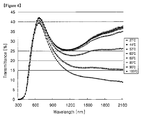
Fig. 4 is a graph showing transmittance varyingdepending upon temperature in a sunlight region(a wavelength region of 300 nm to 2100nm) inathermochromatic glassaccording to one example. -
Fig. 5 is a graph showing transmittance varyingdepending upon temperature at 2000nm inathermochromatic glassaccording toone example. -
Fig. 6 is a graph showing transmittance varyingdepending upon temperature inathermochromatic glassaccording to Comparative Example 4. -
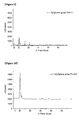
Fig. 7 is a grazing incident X-ray diffraction (GI-XRD) graph of the thermochromatic glassaccording to Comparative Example 1. -
Fig. 8 is a GI-XRD graph of a thermochromatic glassaccording to Comparative Example 2. -
Fig. 9 is a GI-XRD graph of a thermochromatic glassaccording to Comparative Example 3. -
Fig. 10 is a GI-XRD graph of a thermochromatic glassaccording to Comparative Example 4. -
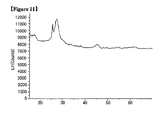
Fig. 11 is a GI-XRD graph of a thermochromatic glassaccording to Comparative Example 5. - The above and other aspects, features, and advantages of the present invention will become apparent from the detailed description of the following embodiments in conjunction with the accompanying drawings. It should be understood that the present invention is not limited to the following embodiments and may be embodied in different ways, and that the embodiments are provided for complete disclosure and thorough understanding of the present invention by those skilled in the art. The scope of the present invention is defined only by the claims. Like components will be denoted by like reference numerals throughout the specification.
- Hereinafter, a method of producing a thermochromatic glass and a thermochromatic glass produced by the same according to embodiments of the invention will be described in more detail with reference to the accompanying drawings.
- Referring to
Fig. 1 , a method of producing a thermochromatic glassaccording to one embodiment of the invention includes depositing a metal for forming a thermochromatic metal oxideon a glass substrate(S100); and performing post-heat treatment of the glass substrate to form a crystal phase of the thermochromatic metal oxide through oxidation of the deposited metal (S110). - In the method according to the embodiment of the invention, a metal for forming a thermochromatic metal oxide is first deposited on the glass substrate (S100).
- The metal for forming a thermochromatic metal oxiderefers to a metal before oxidization. In this embodiment, the metal may be vanadium.
- The deposition process includes low-temperature sputtering or atomic layer deposition.
- First, in sputtering, a gas ion (for example, argon (Ar+)) accelerated within a chamber collides with a target having a negative voltage, and an ionized target material emitted by collision is deposited onto a desired substrate. In this embodiment, the metal (for example, vanadium) is deposited on the glass substrate by sputtering.
- At this time, temperature for sputtering may be low within the range of 10°C to 100°C. That is, no more cooling or heating may be applied to the temperature for general sputtering.
- If the temperature is lower than this range, energy needed for movement of particles on the surface of the substrate is insufficient when the particles excited from the target by sputtering plasma are transferred to the substrate, whereby a thin film can be non-uniformly deposited onto the substrate. Further, temperature increased by plasma when sputtering is applied to the glass substrate having room temperature is generally lower than about 100°C. Therefore, in order to increase the temperature above 100°C, there is a need for an additional heater for heating a large-area glass substrate.
- That is, a conventional technique has a problem in that it is not mechanically easy to uniformly heat a surface of a large-area glass substrate for buildings(for example, the maximum area of 3.3×6m) to a desired temperature (for example, a temperature for forming a crystal phase of VO2: 500°C). However, according to the present invention, there is no need for an additional heating process.
- According to one embodiment of the invention, a thin film of vanadium may be formed by atomic layer deposition. Likesputtering, atomic layer deposition is performed at low temperature, i.e. in the range of 10°C to 100°C. By atomic layer deposition, the thin film can be formed to have excellent thickness uniformity.
- Next, the glass substrateis subjected to post-heat treatment to form a crystal phase of a thermochromatic metal oxidethrough oxidation of the deposited metal (S110).
- When post-heat treatment is applied to the glass substrate, the metal deposited on the substrate is oxidized to form the crystal phase of the thermochromatic metal oxide.
- Here, the thermochromatic metal oxide is vanadium dioxide. At this time, temperature and time forpost-heat treatment are very important to clearly form a crystal phase of vanadium dioxide among various polymorphs of vanadium dioxide. For example, post-heat treatment may be performed at a temperature of 460∼480°C for 360∼600 seconds.
- If the temperature ofpost-heat treatmentis below this range, vanadium dioxide is not crystallized due to insufficient thermal energy for crystallization. On the other hand, if the temperature ofpost-heat treatment is above this range, additional thermochemical reaction occurs between oxygen in air and the thin film, thereby forming polymorphs containing an excess of oxygen.
- Likewise, if the time forpost-heat treatment is shorter than the foregoing range, vanadium dioxide is not crystallized due to insufficient supply of energy for crystallization. On the other hand, if the time for post-heat treatment is longer than the foregoing range, additional thermo-chemical reaction occurs between oxygen in air and the thin filmas in the case where the temperature is higher than the foregoing range, thereby forming polymorphs containing an excess of oxygen.
- Factors of determining a crystallized phase include a reaction temperature, time, atmosphere, etc. In general, if the temperature is low or the time for post-heat treatment is short, energy for crystallization becomes insufficient to thereby form another polymorph according to this condition. If the temperature is high or the time for post-heat treatment is long, a further polymorph according to this condition is formed.
- In general, polymorphs formed at low and high temperatures are different from each other.However, according to the present invention, V2O5 is formed in common, as can be seen from the following examples.Here, in consideration of low peak intensity ofgrazing incident X-ray diffraction (GI-XRD), V2O5 formed at low temperature has low crystallinity and V2O5 formed at high temperature has high crystallinity.
- Thus, it is considered that oxygen included in air for heat treatment additionally reacts with the thin film in the case of high temperature and long reaction time and forms V2O5 containing a larger amount of oxygen than VO2. Accordingly, it is desirable that the method according to the embodiment of the invention satisfy the foregoing ranges of temperature and time.
- As shown in
Fig. 2 , a method of producing a thermochromatic glass according to another embodiment of the invention includes forming an ion diffusion preventing film on a glass substrate (S200); depositing a metal for forming a thermochromatic metal oxideon the ion diffusion preventing film (S210); and performing post-heat treatment of the glass substrate to form a crystal phase of the thermochromatic metal oxide through oxidation of the deposited metal (S220). - Except for forming the ion diffusion preventing film on the glass substrate(S200) and depositing a metal for forming a thermochromatic metal oxideonthe ion diffusion preventing film(S210), this method is the same as the method according to the above embodiment. Therefore, the ion diffusion preventing filmwill be described in more detail hereinafter.
- The ion diffusion preventing filmserves to prevent alkali metal ions contained in the glass substrate from being diffused and reacting with vanadium or vanadium oxide during post-heat treatment, thereby improving product reliability.
- The ion diffusion preventing film may be a single layer of silicon nitride (SiNx) or titanium dioxide (TiO2), or a double-layer structure of silicon nitride (SiNx) and titanium dioxide (TiO2).
- Silicon nitride and titanium dioxide prevent alkali metal ions contained in the glass substrate, in particular, sodium ions from being diffused during the post-heat treatment. To promote the effect of preventing diffusion of the ions, the double-layer structure of silicon nitride and titanium dioxide may be provided. Here,silicon nitride serves to prevent diffusion of sodium ions, andtitanium dioxide serves to absorb a small amount of sodium ions so asto prevent the sodium ions from being transferred to a vanadium layer.
- The ion diffusion preventing film may be formed by typical physical and chemical vapor deposition, without being limited thereto.
- In the ion diffusion preventing film, silicon nitride may have a thickness of 10 nm to 40nm, and titanium dioxide may have a thickness of 5 nm to 30nm. If silicon nitride or titanium dioxideis formed to a smaller thickness than this range, it is difficult to prevent alkali ions from diffusing into the substrate. On the other hand, if silicon nitride or titanium dioxide is formed to a greater thickness than this range, there is a problem in that an additional configuration for the target material is needed to overcome a slow speed of sputtering.
- That is, if the thickness of the ion diffusion preventing film is smaller than the foregoing range, diffusion of alkali ions Na+ eluted from the lower glass substrate is not sufficiently prevented so that vanadium oxide containing Na+ can becrystallized.
- Further, if the thickness of the ion diffusion preventing film is thicker than the foregoing range, it is effective to prevent diffusion of ions, but there is a problem in that an additional target and a device for the additional target are needed to forma thick film usingan in-line sputter since both silicon nitride and titanium dioxide have a slow sputtering depositionrate.
- As shown in
Fig. 3 , a thermochromatic glass produced by the aforementioned method according to the present invention includes aglass substrate 10; an iondiffusion preventing film 20 formed on theglass substrate 10; and a thermochromaticmetal oxide film 30 formed on the iondiffusion preventing film 20. - According to the present invention, the
thermochromatic metal oxide 30 may be vanadium dioxide, and the iondiffusion preventing film 20 may have a single layer of silicon nitride or titanium dioxide or a double layer of silicon nitride and titanium dioxide.Detailed descriptions of these components are disclosed above in the description of the method, and thus will be omitted. - A thin film of SiNx was deposited as a first diffusion preventing film on a soda lime glass having a thickness of 6 mm by reactive sputtering. Here, a process gas included 40 sccm (standard cubic centimeter per minute) of argon and 10 sccm of nitrogen, and processing pressure was fixed at 3 mTorr. Further, a power supply was AC power having a radio frequency of 13.56MHz and a power density of 3.60W/cm2. Deposition was performed for 970 seconds.
- A thin film of TiO2 was deposited on the thin film of SiNxby sputtering. The process gas was 100 sccm of argon, the process pressure was 3mTorr, the process power density was 4.50W/cm2, and deposition was performed for 480 seconds.
- Vanadium was deposited on the thin film of TiO2 by sputtering. At this time, the process gas was 100 sccm of argon, the process pressure was 3m Torr, the process power density was 4.50W/cm2, and deposition was performed for 244 seconds. Further, direct current (DC) power was used, and the overall deposition was performed at a low temperature of 25°C.
- The prepared sample was heated to 470°C for 1 minute in air by rapid heat treatment (thermal process), maintained for 9 minutes, and cooled in a furnace by nitrogen gas, thereby preparing a thermochromatic glass sample.
- A soda-lime glass/vanadiumstructure was deposited to a thickness of 80 nm without an ion diffusion preventing layer, and subjected to post-heat treatment, thereby preparing a sample. Deposition of vanadiumand post-heat treatmentwere performed in the same manner as in Example.
- A sample was prepared in the same manner as in Example except thatpost-heat treatment was performed by heating the sample to 430°C for 1 minute, followed by maintaining for 9 minutes.
- A sample was prepared in the same manner as in Example except that post-heat treatment was performed by heating the sample to 450°C for 1 minute, followed by maintaining for 9 minutes.
- A sample was prepared in the same manner as in Example except that post-heat treatment was performed by heating the sample to 500°C for 1 minute, followed by maintaining for 9 minutes.
- A sample was prepared in the same manner as in Example except that post-heat treatment was performed by heating the sample to 470°C for 1 minute, followed by maintaining for 3 minutes.
- While the sample prepared in Example was heated by increasing ambient temperature from low temperature up to 100°C and then cooled, variation in transmittance was observed in the sunlight region (i.e. a wavelength of 300 to 2100nm). The observation results are shown in
Fig. 4 . - Referring to
Fig. 4 , it can be seen that transmittance varied in a near-infrared region (i.e. a wavelength of 780 to 2100nm) depending upon change in temperature, and thus the thermochromatic characteristics were efficiently achieved. With this result, it can also be seen that the vanadium dioxidefilm was normally formed. - To evaluate a chromatic temperature, variation in transmittance depending upon temperature at a wavelength of 2000 nm was observed. As a result, a transition temperature was determined at about 77°C, as shown in
Fig. 5 . - In addition, hysteresis due to heating and cooling was observed. As the temperature was changed, the lattice structure of the crystal phase of VO2 was changed from a monoclinic crystal structure into an orthorhombic crystal structure. That is, it was understood that the hysteresis occurredsince an additional temperature gradient was needed for transition of the remaining crystal.
- For the sample prepared in Comparative Example 4, variation in transmittance depending upon temperature was observed. As a result, there was no variation in transmittance depending upon ambient temperature, as shown in
Fig. 6 . With this result, it was indirectly understood that the vanadium dioxide film was not normally formed. - For the samples prepared in Comparative Examples 1 to 5, GI-XRD testing was performed as shown in
Figs. 8 to 11 . - For Comparative Example 1, as a result of GI-XRD testing,it could be seen that a thin film of vanadium oxide (Na1.1V3O7.9) containing sodium ions was formed, as shown in
Fig. 7 . It was understood that this result was caused by the absence of an ion-diffusion preventing film. - For Comparative Example 2, as a result of GI-XRD testing, it could be seen that heating temperature was insufficient,since the unclear peaks of
Fig. 8 showed that the crystal phase was not formed. - In addition,for Comparative Examples 3 and 4, as a result of GI-XRD testing,it could be seen that V2O5 was formed as shown in
Figs. 9 and 10 . It was understood that vanadium dioxide was not formed since the temperature conditions according to the present invention was not satisfied. - For Comparative Example 5, as a result of GI-XRD testing,it could be seen that post-heat treatment was insufficient,since the unclear peaks of
Fig. 11 showed that the crystal phase was not formed. - Although some embodiments have been described herein, it should be understood by those skilled in the art that these embodiments are given by way of illustration only, and that various modifications, variations, and alterations can be made without departing from the spirit and scope of the present invention. Accordingly, the scope of the present invention should be limited only by the accompanying claims and equivalents thereof.
Claims (14)
- A method of producing a thermochromatic glass, comprising:depositing a metal for forming a thermochromatic metal oxide on a glass substrate; andperforming post-heat treatment of the glass substrate to form a crystal phase of the thermochromatic metal oxide through oxidation of the deposited metal.
- A method of producing a thermochromatic glass, comprising:forming an ion diffusion preventing film on a glass substrate;depositing a metal for forming a thermochromatic metal oxide on the ion diffusion preventing film; andperforming post-heat treatment of the glass substrate to form a crystal phase of the thermochromatic metal oxide through oxidation of the deposited metal.
- The method according to claim 1 or 2, wherein the metal for forming a thermochromatic metal oxide comprises vanadium (V).
- The method according to claim 1 or 2, wherein the metal for forming a thermochromatic metal oxide is deposited by sputtering or atomic layer deposition.
- The method according to claim 1 or 2, wherein the metal for forming a thermochromatic metal oxide is deposited at a temperature of 10°C to 100°C.
- The method according to claim 1 or 2, wherein thepost-heat treatment is performed at a temperature of 460°C to 480°C.
- The method according to claim 1 or 2, wherein thepost-heat treatment is performed for 360 to 600 seconds.
- The method according to claim 1 or 2, wherein the crystal phase of the thermochromatic metal oxide comprises vanadium dioxide(VO2).
- The method according to claim 2, wherein the ion diffusion preventing film comprises a single layer of silicon nitride(SiNx) or titanium dioxide(TiO2).
- The method according to claim 2, wherein the ion diffusion preventing film comprises a double layer of silicon nitride(SiNx) andtitanium dioxide(TiO2).
- A thermochromatic glass comprising:a glass substrate;an ion diffusion preventing filmformed on the glass substrate; anda thermochromatic metal oxide film formed on the ion diffusion preventing film.
- The thermochromatic glass according to claim 11, wherein the ion diffusion preventing film comprises a single layer of silicon nitride(SiNx) or titanium dioxide(TiO2).
- The thermochromatic glassaccording to claim 11, wherein the ion diffusion preventing film comprises a double layer of silicon nitride(SiNx) andtitanium dioxide(TiO2).
- The thermochromatic glassaccording to claim 11, wherein the thermochromatic metal oxide comprises vanadium dioxide(VO2).
Applications Claiming Priority (2)
| Application Number | Priority Date | Filing Date | Title |
|---|---|---|---|
| KR1020110080816A KR101380509B1 (en) | 2011-08-12 | 2011-08-12 | Manufacturing method of thermochromic glass using metal deposition and the thermochromic glass using thereof |
| PCT/KR2012/006275 WO2013025000A2 (en) | 2011-08-12 | 2012-08-08 | Production method for thermochromatic glass in which use is made of a low-temperature metal-vapour-deposition process, and thermochromatic glass obtained thereby |
Publications (3)
| Publication Number | Publication Date |
|---|---|
| EP2743239A2 true EP2743239A2 (en) | 2014-06-18 |
| EP2743239A4 EP2743239A4 (en) | 2015-04-29 |
| EP2743239B1 EP2743239B1 (en) | 2017-09-27 |
Family
ID=47715562
Family Applications (1)
| Application Number | Title | Priority Date | Filing Date |
|---|---|---|---|
| EP12823879.7A Not-in-force EP2743239B1 (en) | 2011-08-12 | 2012-08-08 | Production method for thermochromatic glass in which use is made of a low-temperature metal-vapour-deposition process, and thermochromatic glass obtained thereby |
Country Status (6)
| Country | Link |
|---|---|
| US (1) | US9193624B2 (en) |
| EP (1) | EP2743239B1 (en) |
| JP (1) | JP5816753B2 (en) |
| KR (1) | KR101380509B1 (en) |
| CN (1) | CN103732553A (en) |
| WO (1) | WO2013025000A2 (en) |
Cited By (1)
| Publication number | Priority date | Publication date | Assignee | Title |
|---|---|---|---|---|
| CN109626425A (en) * | 2019-02-25 | 2019-04-16 | 上海海事大学 | A kind of nanometer of threadiness Na1.1V3O7.9Material, preparation method and the usage |
Families Citing this family (6)
| Publication number | Priority date | Publication date | Assignee | Title |
|---|---|---|---|---|
| US20150362374A1 (en) * | 2014-06-16 | 2015-12-17 | The Government Of The United States Of America, As Represented By The Secretary Of The Navy | Atomic Layer Deposition of Vanadium Oxide for Microbolometer and Imager |
| KR101762308B1 (en) * | 2014-10-31 | 2017-07-28 | 부경대학교 산학협력단 | Flexible thermochromic film |
| KR101906656B1 (en) * | 2015-12-03 | 2018-10-10 | 아주대학교산학협력단 | Single layer smart window |
| CN105861989B (en) * | 2016-06-02 | 2018-09-28 | 中国科学院广州能源研究所 | A kind of preparation method of vanadium oxide film layer |
| US12306371B2 (en) * | 2021-06-02 | 2025-05-20 | Arizona Board Of Regents On Behalf Of Arizona State University | Layered thermochromic device for enhanced infrared emission, and method for making the same |
| KR20230078090A (en) * | 2021-11-26 | 2023-06-02 | 한국전자기술연구원 | Vanadium Oxide Thin Film and method for manufacturing the same |
Family Cites Families (16)
| Publication number | Priority date | Publication date | Assignee | Title |
|---|---|---|---|---|
| US3660155A (en) * | 1970-04-15 | 1972-05-02 | Us Navy | Method for preparing solid films |
| JPS5881976A (en) * | 1981-11-06 | 1983-05-17 | Toru Mashida | Preparation of decorative body |
| US4400412A (en) | 1982-02-01 | 1983-08-23 | Ppg Industries, Inc. | Thermochromic vanadium oxide coated glass |
| CA2084247A1 (en) * | 1992-03-18 | 1993-09-19 | Francis Paul Fehlner | Lcd panel production |
| KR960031660A (en) * | 1995-02-06 | 1996-09-17 | 이문희 | Crystallization Method of Thin Films for Thermochromic Smart Windows |
| KR100343134B1 (en) * | 1998-07-09 | 2002-10-25 | 삼성전자 주식회사 | Method for forming a dielectric film |
| JP2000137251A (en) * | 1998-08-28 | 2000-05-16 | Itaru Yasui | Thermochromic body and method for producing the same |
| JP2001048586A (en) * | 1999-08-03 | 2001-02-20 | Nisshin Steel Co Ltd | Light reflecting glass beads and method for producing the same |
| FR2809388B1 (en) * | 2000-05-23 | 2002-12-20 | Saint Gobain Vitrage | GLAZING COMPRISING AT LEAST ONE LAYER WITH THERMOCHROMIC PROPERTIES |
| JP4278420B2 (en) * | 2003-04-11 | 2009-06-17 | 富士フイルム株式会社 | Method for forming metal compound thin film and substrate |
| JP4533996B2 (en) * | 2005-01-28 | 2010-09-01 | 独立行政法人産業技術総合研究所 | Highly heat insulating automatic light control glass and manufacturing method thereof |
| KR100753997B1 (en) * | 2006-02-10 | 2007-09-03 | 황진하 | A method of forming a nickel oxide thin film, a method of crystallizing an amorphous silicon thin film using the same, and a method of manufacturing a thin film transistor. |
| GB0614545D0 (en) | 2006-07-21 | 2006-08-30 | Univ London | Coating Film |
| JP2008297500A (en) * | 2007-06-01 | 2008-12-11 | Nippon Sheet Glass Co Ltd | Thermochromic material and manufacturing method thereof |
| FR2922886B1 (en) | 2007-10-25 | 2010-10-29 | Saint Gobain | GLASS SUBSTRATE COATED WITH LAYERS WITH IMPROVED RESISTIVITY. |
| CN101560638B (en) * | 2009-05-27 | 2010-12-01 | 天津大学 | Method for preparing vanadium oxide film by metal oxidation method |
-
2011
- 2011-08-12 KR KR1020110080816A patent/KR101380509B1/en not_active Expired - Fee Related
-
2012
- 2012-08-08 CN CN201280039509.6A patent/CN103732553A/en active Pending
- 2012-08-08 US US14/234,797 patent/US9193624B2/en not_active Expired - Fee Related
- 2012-08-08 JP JP2014523876A patent/JP5816753B2/en not_active Expired - Fee Related
- 2012-08-08 WO PCT/KR2012/006275 patent/WO2013025000A2/en not_active Ceased
- 2012-08-08 EP EP12823879.7A patent/EP2743239B1/en not_active Not-in-force
Cited By (2)
| Publication number | Priority date | Publication date | Assignee | Title |
|---|---|---|---|---|
| CN109626425A (en) * | 2019-02-25 | 2019-04-16 | 上海海事大学 | A kind of nanometer of threadiness Na1.1V3O7.9Material, preparation method and the usage |
| CN109626425B (en) * | 2019-02-25 | 2021-02-02 | 上海海事大学 | Nano linear Na1.1V3O7.9Material, method for the production thereof and use thereof |
Also Published As
| Publication number | Publication date |
|---|---|
| JP2014525889A (en) | 2014-10-02 |
| KR101380509B1 (en) | 2014-04-01 |
| WO2013025000A2 (en) | 2013-02-21 |
| EP2743239B1 (en) | 2017-09-27 |
| JP5816753B2 (en) | 2015-11-18 |
| EP2743239A4 (en) | 2015-04-29 |
| KR20130018012A (en) | 2013-02-20 |
| CN103732553A (en) | 2014-04-16 |
| WO2013025000A3 (en) | 2013-05-30 |
| US20140170420A1 (en) | 2014-06-19 |
| US9193624B2 (en) | 2015-11-24 |
Similar Documents
| Publication | Publication Date | Title |
|---|---|---|
| US9193624B2 (en) | Production method for thermochromatic glass in which use is made of a low-temperature metal-vapour-deposition process, and thermochromatic glass obtained thereby | |
| CN100499174C (en) | New metal strip product | |
| Zhou et al. | Synthesis and characterization of boron carbon nitride films by radio frequency magnetron sputtering | |
| CN105951053B (en) | A kind of preparation method of titania-doped transparent conductive film of niobium and the titania-doped transparent conductive film of niobium | |
| CN103619772B (en) | Process for producing glazing comprising a porous layer | |
| Cemin et al. | Low-energy ion irradiation in HiPIMS to enable anatase TiO2 selective growth | |
| Belosludtsev et al. | Correlation between stoichiometry and properties of scandium oxide films prepared by reactive magnetron sputtering | |
| Feng et al. | Solar selective absorbing coatings TiN/TiSiN/SiN prepared on stainless steel substrates | |
| Peng et al. | Effect of N2 flow rate on the properties of N doped TiO2 films deposited by DC coupled RF magnetron sputtering | |
| CN110699670B (en) | Preparation method of vanadium dioxide film | |
| US20150325418A1 (en) | Method for producing a dielectric and/or barrier layer or multilayer on a substrate, and device for implementing said method | |
| Kim et al. | Growth and characterization of VO2 thin film by pulsed DC sputtering of optical switching applications | |
| Hoffman et al. | Plasma‐enhanced chemical vapor deposition of silicon, germanium, and tin nitride thin films from metalorganic precursors | |
| Figueiredo et al. | Reducing the incorporation of contaminant oxygen in decorative TiN coatings deposited by low temperature reactive sputtering | |
| US20100065418A1 (en) | Reactive magnetron sputtering for the large-scale deposition of chalcopyrite absorber layers for thin layer solar cells | |
| Szelwicka et al. | High‐Performance Thermochromic VO2‐Based Coatings Deposited by Roll‐to‐Roll High‐Power Impulse Magnetron Sputtering | |
| CN108018532B (en) | A kind of vanadium dioxide composite film and preparation method thereof | |
| CN108220897B (en) | Method for preparing vanadium dioxide thin film by magnetron sputtering at low temperature | |
| CN110373636A (en) | A kind of preparation method of molybdenum silicide transistion metal compound thin-film material | |
| CN103774098B (en) | Tin monoxide textured film and preparation method thereof | |
| Wang et al. | Preparation methods and application of silicon oxide films | |
| JP2011127199A (en) | Transparent body and method for producing it | |
| Sivakumar et al. | Effect of annealing on structural, surface and optical properties of PVD-EBE α-MoO3 thin films for electrochromic devices | |
| Čyvienė et al. | Zr, ZrN and Zr/Al thin films deposition using arc evaporation and annealing | |
| Ying et al. | Annealing behaviors of structural, interfacial and optical properties of HfO2 thin films prepared by plasma assisted reactive pulsed laser deposition |
Legal Events
| Date | Code | Title | Description |
|---|---|---|---|
| PUAI | Public reference made under article 153(3) epc to a published international application that has entered the european phase |
Free format text: ORIGINAL CODE: 0009012 |
|
| 17P | Request for examination filed |
Effective date: 20140212 |
|
| AK | Designated contracting states |
Kind code of ref document: A2 Designated state(s): AL AT BE BG CH CY CZ DE DK EE ES FI FR GB GR HR HU IE IS IT LI LT LU LV MC MK MT NL NO PL PT RO RS SE SI SK SM TR |
|
| DAX | Request for extension of the european patent (deleted) | ||
| A4 | Supplementary search report drawn up and despatched |
Effective date: 20150331 |
|
| RIC1 | Information provided on ipc code assigned before grant |
Ipc: C03C 17/34 20060101ALI20150325BHEP Ipc: C23C 14/08 20060101ALI20150325BHEP Ipc: C03B 27/012 20060101ALI20150325BHEP Ipc: C03C 4/00 20060101ALI20150325BHEP Ipc: C23C 14/34 20060101ALI20150325BHEP Ipc: C03C 17/06 20060101AFI20150325BHEP Ipc: C03C 17/27 20060101ALI20150325BHEP |
|
| 17Q | First examination report despatched |
Effective date: 20160714 |
|
| GRAP | Despatch of communication of intention to grant a patent |
Free format text: ORIGINAL CODE: EPIDOSNIGR1 |
|
| INTG | Intention to grant announced |
Effective date: 20170412 |
|
| GRAS | Grant fee paid |
Free format text: ORIGINAL CODE: EPIDOSNIGR3 |
|
| GRAA | (expected) grant |
Free format text: ORIGINAL CODE: 0009210 |
|
| AK | Designated contracting states |
Kind code of ref document: B1 Designated state(s): AL AT BE BG CH CY CZ DE DK EE ES FI FR GB GR HR HU IE IS IT LI LT LU LV MC MK MT NL NO PL PT RO RS SE SI SK SM TR |
|
| REG | Reference to a national code |
Ref country code: GB Ref legal event code: FG4D |
|
| REG | Reference to a national code |
Ref country code: CH Ref legal event code: EP |
|
| REG | Reference to a national code |
Ref country code: AT Ref legal event code: REF Ref document number: 931758 Country of ref document: AT Kind code of ref document: T Effective date: 20171015 |
|
| REG | Reference to a national code |
Ref country code: IE Ref legal event code: FG4D |
|
| REG | Reference to a national code |
Ref country code: DE Ref legal event code: R096 Ref document number: 602012037939 Country of ref document: DE |
|
| PG25 | Lapsed in a contracting state [announced via postgrant information from national office to epo] |
Ref country code: HR Free format text: LAPSE BECAUSE OF FAILURE TO SUBMIT A TRANSLATION OF THE DESCRIPTION OR TO PAY THE FEE WITHIN THE PRESCRIBED TIME-LIMIT Effective date: 20170927 Ref country code: NO Free format text: LAPSE BECAUSE OF FAILURE TO SUBMIT A TRANSLATION OF THE DESCRIPTION OR TO PAY THE FEE WITHIN THE PRESCRIBED TIME-LIMIT Effective date: 20171227 Ref country code: SE Free format text: LAPSE BECAUSE OF FAILURE TO SUBMIT A TRANSLATION OF THE DESCRIPTION OR TO PAY THE FEE WITHIN THE PRESCRIBED TIME-LIMIT Effective date: 20170927 Ref country code: LT Free format text: LAPSE BECAUSE OF FAILURE TO SUBMIT A TRANSLATION OF THE DESCRIPTION OR TO PAY THE FEE WITHIN THE PRESCRIBED TIME-LIMIT Effective date: 20170927 Ref country code: FI Free format text: LAPSE BECAUSE OF FAILURE TO SUBMIT A TRANSLATION OF THE DESCRIPTION OR TO PAY THE FEE WITHIN THE PRESCRIBED TIME-LIMIT Effective date: 20170927 |
|
| REG | Reference to a national code |
Ref country code: NL Ref legal event code: MP Effective date: 20170927 |
|
| REG | Reference to a national code |
Ref country code: LT Ref legal event code: MG4D |
|
| REG | Reference to a national code |
Ref country code: AT Ref legal event code: MK05 Ref document number: 931758 Country of ref document: AT Kind code of ref document: T Effective date: 20170927 |
|
| PG25 | Lapsed in a contracting state [announced via postgrant information from national office to epo] |
Ref country code: BG Free format text: LAPSE BECAUSE OF FAILURE TO SUBMIT A TRANSLATION OF THE DESCRIPTION OR TO PAY THE FEE WITHIN THE PRESCRIBED TIME-LIMIT Effective date: 20171227 Ref country code: GR Free format text: LAPSE BECAUSE OF FAILURE TO SUBMIT A TRANSLATION OF THE DESCRIPTION OR TO PAY THE FEE WITHIN THE PRESCRIBED TIME-LIMIT Effective date: 20171228 Ref country code: LV Free format text: LAPSE BECAUSE OF FAILURE TO SUBMIT A TRANSLATION OF THE DESCRIPTION OR TO PAY THE FEE WITHIN THE PRESCRIBED TIME-LIMIT Effective date: 20170927 Ref country code: RS Free format text: LAPSE BECAUSE OF FAILURE TO SUBMIT A TRANSLATION OF THE DESCRIPTION OR TO PAY THE FEE WITHIN THE PRESCRIBED TIME-LIMIT Effective date: 20170927 |
|
| PG25 | Lapsed in a contracting state [announced via postgrant information from national office to epo] |
Ref country code: NL Free format text: LAPSE BECAUSE OF FAILURE TO SUBMIT A TRANSLATION OF THE DESCRIPTION OR TO PAY THE FEE WITHIN THE PRESCRIBED TIME-LIMIT Effective date: 20170927 |
|
| PG25 | Lapsed in a contracting state [announced via postgrant information from national office to epo] |
Ref country code: RO Free format text: LAPSE BECAUSE OF FAILURE TO SUBMIT A TRANSLATION OF THE DESCRIPTION OR TO PAY THE FEE WITHIN THE PRESCRIBED TIME-LIMIT Effective date: 20170927 Ref country code: ES Free format text: LAPSE BECAUSE OF FAILURE TO SUBMIT A TRANSLATION OF THE DESCRIPTION OR TO PAY THE FEE WITHIN THE PRESCRIBED TIME-LIMIT Effective date: 20170927 Ref country code: CZ Free format text: LAPSE BECAUSE OF FAILURE TO SUBMIT A TRANSLATION OF THE DESCRIPTION OR TO PAY THE FEE WITHIN THE PRESCRIBED TIME-LIMIT Effective date: 20170927 |
|
| PG25 | Lapsed in a contracting state [announced via postgrant information from national office to epo] |
Ref country code: IT Free format text: LAPSE BECAUSE OF FAILURE TO SUBMIT A TRANSLATION OF THE DESCRIPTION OR TO PAY THE FEE WITHIN THE PRESCRIBED TIME-LIMIT Effective date: 20170927 Ref country code: SM Free format text: LAPSE BECAUSE OF FAILURE TO SUBMIT A TRANSLATION OF THE DESCRIPTION OR TO PAY THE FEE WITHIN THE PRESCRIBED TIME-LIMIT Effective date: 20170927 Ref country code: AT Free format text: LAPSE BECAUSE OF FAILURE TO SUBMIT A TRANSLATION OF THE DESCRIPTION OR TO PAY THE FEE WITHIN THE PRESCRIBED TIME-LIMIT Effective date: 20170927 Ref country code: SK Free format text: LAPSE BECAUSE OF FAILURE TO SUBMIT A TRANSLATION OF THE DESCRIPTION OR TO PAY THE FEE WITHIN THE PRESCRIBED TIME-LIMIT Effective date: 20170927 Ref country code: EE Free format text: LAPSE BECAUSE OF FAILURE TO SUBMIT A TRANSLATION OF THE DESCRIPTION OR TO PAY THE FEE WITHIN THE PRESCRIBED TIME-LIMIT Effective date: 20170927 Ref country code: IS Free format text: LAPSE BECAUSE OF FAILURE TO SUBMIT A TRANSLATION OF THE DESCRIPTION OR TO PAY THE FEE WITHIN THE PRESCRIBED TIME-LIMIT Effective date: 20180127 |
|
| REG | Reference to a national code |
Ref country code: DE Ref legal event code: R097 Ref document number: 602012037939 Country of ref document: DE |
|
| PG25 | Lapsed in a contracting state [announced via postgrant information from national office to epo] |
Ref country code: DK Free format text: LAPSE BECAUSE OF FAILURE TO SUBMIT A TRANSLATION OF THE DESCRIPTION OR TO PAY THE FEE WITHIN THE PRESCRIBED TIME-LIMIT Effective date: 20170927 |
|
| PLBE | No opposition filed within time limit |
Free format text: ORIGINAL CODE: 0009261 |
|
| STAA | Information on the status of an ep patent application or granted ep patent |
Free format text: STATUS: NO OPPOSITION FILED WITHIN TIME LIMIT |
|
| PG25 | Lapsed in a contracting state [announced via postgrant information from national office to epo] |
Ref country code: PL Free format text: LAPSE BECAUSE OF FAILURE TO SUBMIT A TRANSLATION OF THE DESCRIPTION OR TO PAY THE FEE WITHIN THE PRESCRIBED TIME-LIMIT Effective date: 20170927 |
|
| 26N | No opposition filed |
Effective date: 20180628 |
|
| PG25 | Lapsed in a contracting state [announced via postgrant information from national office to epo] |
Ref country code: SI Free format text: LAPSE BECAUSE OF FAILURE TO SUBMIT A TRANSLATION OF THE DESCRIPTION OR TO PAY THE FEE WITHIN THE PRESCRIBED TIME-LIMIT Effective date: 20170927 |
|
| PG25 | Lapsed in a contracting state [announced via postgrant information from national office to epo] |
Ref country code: MC Free format text: LAPSE BECAUSE OF FAILURE TO SUBMIT A TRANSLATION OF THE DESCRIPTION OR TO PAY THE FEE WITHIN THE PRESCRIBED TIME-LIMIT Effective date: 20170927 |
|
| REG | Reference to a national code |
Ref country code: CH Ref legal event code: PL |
|
| GBPC | Gb: european patent ceased through non-payment of renewal fee |
Effective date: 20180808 |
|
| PG25 | Lapsed in a contracting state [announced via postgrant information from national office to epo] |
Ref country code: CH Free format text: LAPSE BECAUSE OF NON-PAYMENT OF DUE FEES Effective date: 20180831 Ref country code: LI Free format text: LAPSE BECAUSE OF NON-PAYMENT OF DUE FEES Effective date: 20180831 Ref country code: LU Free format text: LAPSE BECAUSE OF NON-PAYMENT OF DUE FEES Effective date: 20180808 |
|
| REG | Reference to a national code |
Ref country code: BE Ref legal event code: MM Effective date: 20180831 |
|
| REG | Reference to a national code |
Ref country code: IE Ref legal event code: MM4A |
|
| PG25 | Lapsed in a contracting state [announced via postgrant information from national office to epo] |
Ref country code: IE Free format text: LAPSE BECAUSE OF NON-PAYMENT OF DUE FEES Effective date: 20180808 |
|
| PG25 | Lapsed in a contracting state [announced via postgrant information from national office to epo] |
Ref country code: FR Free format text: LAPSE BECAUSE OF NON-PAYMENT OF DUE FEES Effective date: 20180831 Ref country code: BE Free format text: LAPSE BECAUSE OF NON-PAYMENT OF DUE FEES Effective date: 20180831 |
|
| PG25 | Lapsed in a contracting state [announced via postgrant information from national office to epo] |
Ref country code: GB Free format text: LAPSE BECAUSE OF NON-PAYMENT OF DUE FEES Effective date: 20180808 |
|
| PG25 | Lapsed in a contracting state [announced via postgrant information from national office to epo] |
Ref country code: MT Free format text: LAPSE BECAUSE OF NON-PAYMENT OF DUE FEES Effective date: 20180808 |
|
| PG25 | Lapsed in a contracting state [announced via postgrant information from national office to epo] |
Ref country code: TR Free format text: LAPSE BECAUSE OF FAILURE TO SUBMIT A TRANSLATION OF THE DESCRIPTION OR TO PAY THE FEE WITHIN THE PRESCRIBED TIME-LIMIT Effective date: 20170927 |
|
| PG25 | Lapsed in a contracting state [announced via postgrant information from national office to epo] |
Ref country code: HU Free format text: LAPSE BECAUSE OF FAILURE TO SUBMIT A TRANSLATION OF THE DESCRIPTION OR TO PAY THE FEE WITHIN THE PRESCRIBED TIME-LIMIT; INVALID AB INITIO Effective date: 20120808 Ref country code: PT Free format text: LAPSE BECAUSE OF FAILURE TO SUBMIT A TRANSLATION OF THE DESCRIPTION OR TO PAY THE FEE WITHIN THE PRESCRIBED TIME-LIMIT Effective date: 20170927 |
|
| PG25 | Lapsed in a contracting state [announced via postgrant information from national office to epo] |
Ref country code: MK Free format text: LAPSE BECAUSE OF NON-PAYMENT OF DUE FEES Effective date: 20170927 Ref country code: CY Free format text: LAPSE BECAUSE OF FAILURE TO SUBMIT A TRANSLATION OF THE DESCRIPTION OR TO PAY THE FEE WITHIN THE PRESCRIBED TIME-LIMIT Effective date: 20170927 |
|
| PG25 | Lapsed in a contracting state [announced via postgrant information from national office to epo] |
Ref country code: AL Free format text: LAPSE BECAUSE OF FAILURE TO SUBMIT A TRANSLATION OF THE DESCRIPTION OR TO PAY THE FEE WITHIN THE PRESCRIBED TIME-LIMIT Effective date: 20170927 |
|
| PGFP | Annual fee paid to national office [announced via postgrant information from national office to epo] |
Ref country code: DE Payment date: 20220603 Year of fee payment: 11 |
|
| REG | Reference to a national code |
Ref country code: DE Ref legal event code: R119 Ref document number: 602012037939 Country of ref document: DE |
|
| PG25 | Lapsed in a contracting state [announced via postgrant information from national office to epo] |
Ref country code: DE Free format text: LAPSE BECAUSE OF NON-PAYMENT OF DUE FEES Effective date: 20240301 |