EP2742093B1 - Composition with improved long term scratch resistance and reduced surface tack - Google Patents
Composition with improved long term scratch resistance and reduced surface tack Download PDFInfo
- Publication number
- EP2742093B1 EP2742093B1 EP12751289.5A EP12751289A EP2742093B1 EP 2742093 B1 EP2742093 B1 EP 2742093B1 EP 12751289 A EP12751289 A EP 12751289A EP 2742093 B1 EP2742093 B1 EP 2742093B1
- Authority
- EP
- European Patent Office
- Prior art keywords
- propylene copolymer
- heco
- heterophasic propylene
- polypropylene
- fatty acid
- Prior art date
- Legal status (The legal status is an assumption and is not a legal conclusion. Google has not performed a legal analysis and makes no representation as to the accuracy of the status listed.)
- Revoked
Links
- 0 *C(N*=C)=O Chemical compound *C(N*=C)=O 0.000 description 2
Images


Classifications
-
- C—CHEMISTRY; METALLURGY
- C08—ORGANIC MACROMOLECULAR COMPOUNDS; THEIR PREPARATION OR CHEMICAL WORKING-UP; COMPOSITIONS BASED THEREON
- C08L—COMPOSITIONS OF MACROMOLECULAR COMPOUNDS
- C08L23/00—Compositions of homopolymers or copolymers of unsaturated aliphatic hydrocarbons having only one carbon-to-carbon double bond; Compositions of derivatives of such polymers
- C08L23/02—Compositions of homopolymers or copolymers of unsaturated aliphatic hydrocarbons having only one carbon-to-carbon double bond; Compositions of derivatives of such polymers not modified by chemical after-treatment
- C08L23/10—Homopolymers or copolymers of propene
- C08L23/14—Copolymers of propene
-
- C—CHEMISTRY; METALLURGY
- C08—ORGANIC MACROMOLECULAR COMPOUNDS; THEIR PREPARATION OR CHEMICAL WORKING-UP; COMPOSITIONS BASED THEREON
- C08J—WORKING-UP; GENERAL PROCESSES OF COMPOUNDING; AFTER-TREATMENT NOT COVERED BY SUBCLASSES C08B, C08C, C08F, C08G or C08H
- C08J5/00—Manufacture of articles or shaped materials containing macromolecular substances
-
- C—CHEMISTRY; METALLURGY
- C08—ORGANIC MACROMOLECULAR COMPOUNDS; THEIR PREPARATION OR CHEMICAL WORKING-UP; COMPOSITIONS BASED THEREON
- C08K—Use of inorganic or non-macromolecular organic substances as compounding ingredients
- C08K3/00—Use of inorganic substances as compounding ingredients
-
- C—CHEMISTRY; METALLURGY
- C08—ORGANIC MACROMOLECULAR COMPOUNDS; THEIR PREPARATION OR CHEMICAL WORKING-UP; COMPOSITIONS BASED THEREON
- C08K—Use of inorganic or non-macromolecular organic substances as compounding ingredients
- C08K5/00—Use of organic ingredients
- C08K5/16—Nitrogen-containing compounds
- C08K5/20—Carboxylic acid amides
-
- C—CHEMISTRY; METALLURGY
- C08—ORGANIC MACROMOLECULAR COMPOUNDS; THEIR PREPARATION OR CHEMICAL WORKING-UP; COMPOSITIONS BASED THEREON
- C08L—COMPOSITIONS OF MACROMOLECULAR COMPOUNDS
- C08L2205/00—Polymer mixtures characterised by other features
- C08L2205/03—Polymer mixtures characterised by other features containing three or more polymers in a blend
-
- C—CHEMISTRY; METALLURGY
- C08—ORGANIC MACROMOLECULAR COMPOUNDS; THEIR PREPARATION OR CHEMICAL WORKING-UP; COMPOSITIONS BASED THEREON
- C08L—COMPOSITIONS OF MACROMOLECULAR COMPOUNDS
- C08L2207/00—Properties characterising the ingredient of the composition
- C08L2207/06—Properties of polyethylene
- C08L2207/062—HDPE
-
- C—CHEMISTRY; METALLURGY
- C08—ORGANIC MACROMOLECULAR COMPOUNDS; THEIR PREPARATION OR CHEMICAL WORKING-UP; COMPOSITIONS BASED THEREON
- C08L—COMPOSITIONS OF MACROMOLECULAR COMPOUNDS
- C08L23/00—Compositions of homopolymers or copolymers of unsaturated aliphatic hydrocarbons having only one carbon-to-carbon double bond; Compositions of derivatives of such polymers
- C08L23/02—Compositions of homopolymers or copolymers of unsaturated aliphatic hydrocarbons having only one carbon-to-carbon double bond; Compositions of derivatives of such polymers not modified by chemical after-treatment
- C08L23/10—Homopolymers or copolymers of propene
- C08L23/12—Polypropene
Definitions
- the present invention is directed to a new automotive interior article comprising a composition comprising a heterophasic propylene copolymer (HECO) and a specific fatty acid amide derivative. Furthermore the present invention relates to use of a composition as well as of a slip agent to improve surface tack and/or scratch resistance.
- HECO heterophasic propylene copolymer
- Automotive interior parts like dashboards, door claddings, trims are commonly made from polymers. Especially propylene based resins and in particular TPO / talc compounds are widely used for these applications.
- WO 2006/131455A1 discloses a scratch resistant polyolefincompound containing a specific additive combination, said compound comprises the following components
- thermoplastic elastomer composition comprising a thermoplastic polymer, an ethylene-alpha olefin plastomer and a peroxide.
- Said composition features an improved scratch resistance and no to low gloss change of the finished product during heat ageing (60° gloss measured on grain VWK09 96h at 120°C).
- slip agents e.g. compare WO 2007/139622 A3 , WO 02/22731 A2 , WO 2005/111145 A1 , WO 2006/063698 A1 .
- Slip agents like fatty acid amides (Eruc-amide, Oleamide, Stearamide, Behenamide) reduce the coefficient of friction of polymeric surfaces by migrating from the bulk to the surface.
- polyethylene is added (preferably high density polyethylene (HDPE)). Polyethylene affects the morphology of the dispersed rubber phase stabilizing the surface and immediate subsurface layer of injection mouldings.
- the object of the present invention is to provide an additive which enables a skilled person to provide a polypropylene with improved long term scratch resistance as well as reduced surface tack.
- a further object of the present invention is to provide an automotive interior article with improved long term scratch resistance and reduced surface tack.
- the finding of the present invention is that one slip agent must be used being a fatty acid amide derivative.
- the present invention is directed to Use of a fatty acid amide derivative of formula (I) wherein Ri is a C5 to C25 alkyl residue or C5 to C25 alkenyl residue, R2 is a long-chain organic residue containing at least 6 carbon atoms, in an amount of 2500 to 18000 ppm in an article comprising a heterophasic propylene copolymer (HECO) to reduce the surface tack in comparison with the same article but without a slip agent.
- HECO heterophasic propylene copolymer
- HECO Heterophasic propylene copolymer
- Heterophasic polymer systems are well known in the art and are systems in particular obtained in a process comprising at least two steps resulting in a multiphase structure comprising a polypropylene matrix and inclusions therein comprising amorphous elastomer. Such systems can be easily tailored for the automotive requirements by setting the comonomer content in the polypropylene matrix and in the elastomeric phase respectively.
- a heterophasic propylene copolymer according to this invention comprises as matrix a random propylene copolymer or a propylene homopolymer and dispersed therein an elastomeric propylene copolymer.
- the matrix contains (finely) dispersed inclusions being not part of the matrix and said inclusions contain the elastomeric propylene copolymer.
- inclusion indicates that the matrix and the inclusion form different phases within the heterophasic propylene copolymer (HECO), said inclusions are for instance visible by high resolution microscopy, like electron microscopy or scanning force microscopy.
- the heterophasic propylene copolymer may contain further additives but no other polymer in an amount exceeding 5 wt.-%, more preferably exceeding 3 wt.-%, like exceeding 1 wt.-%, based on the total amount of the heterophasic polymer.
- One additional polymer which may be present in such low amounts is a polyethylene which is a reaction product obtained by the preparation of the heterophasic propylene copolymer (HECO).
- a heterophasic propylene copolymer (HECO) as defined in the present invention contains only a polypropylene matrix, an elastomeric propylene copolymer, and optionally a polyethylene in amounts as mentioned in this paragraph.
- the propylene content in the heterophasic polymer is in the range of 70 to 92 wt.-%, more preferably in the range of 75 to 85 wt.-%, yet more preferably in the range of 78 to 82 wt.-%, based on the total amount of the heterophasic propylene copolymer (HECO), more preferably based on the amount of the polymer components of the heterophasic propylene copolymer (HECO), yet more preferably based on the amount of the polypropylene matrix and the elastomeric propylene copolymer together.
- HECO heterophasic propylene copolymer
- the comonomers as defined for the polypropylene matrix being a random propylene copolymer and the elastomeric propylene copolymer, respectively, preferably ethylene.
- the comonomer content, preferably ethylene content, for the total heterophasic propylene copolymer (HECO) is in the range of 8.0 to 30.0 wt.-%, more preferably in the range of 15.0 to 25.0 wt.-%, still more preferably in the range of 18.0 to 22.0 wt.-%, based on the total amount of the heterophasic propylene copolymer (HECO), more preferably based on the amount of the polymer components of the heterophasic propylene copolymer (HECO), yet more preferably based on the amount of the polypropylene matrix and the elastomeric propylene copolymer together.
- the polypropylene matrix of the heterophasic propylene copolymer can be made of the propylene homo- and/or copolymer only but can also comprise additional polymers, in particular polymers which can be blended homogeneously with the propylene homo- or copolymer and together form a continuous phase which can act as a matrix.
- additional polymers in particular polymers which can be blended homogeneously with the propylene homo- or copolymer and together form a continuous phase which can act as a matrix.
- at least 80 wt.-% of the matrix, more preferably at least 90 wt.-%, even more preferably at least 95 wt.-% of the matrix are made of the propylene homo- and/or copolymer.
- the matrix consists of the propylene homo- and/or copolymer.
- the propylene homo- and/or copolymer forming the matrix can be a random propylene copolymer or a propylene homopolymer.
- the matrix is a propylene homopolymer.
- propylene homopolymer refers to a polypropylene that consists substantially, i.e. of at least 97 wt.-%, preferably of at least 98 wt.-%, more preferably of at least 99 wt.-%, most preferably of at least 99.8 wt.-% of propylene units. In a preferred embodiment only propylene units in the propylene homopolymer are detectable.
- the propylene homo- and/or copolymer forming the matrix is a random propylene copolymer it comprises monomers copolymerizable with propylene, for example comonomers such as ethylene and/or C 4 to C 12 ⁇ -olefins, in particular ethylene and/or C 4 to C 10 ⁇ -olefins, e.g. 1-butene and/or 1-hexene.
- the random propylene copolymer comprises, especially consists of, monomers copolymerizable with propylene from the group consisting of ethylene, 1-butene and 1-hexene.
- the random propylene copolymer comprises - apart from propylene - units derivable from ethylene and/or 1-butene.
- the random propylene copolymer comprises units derivable from ethylene and propylene only.
- the comonomer content in the random propylene copolymer is preferably in the range of more than 0.5 to 10.0 wt.-%, still more preferably in the range of more than 0.5 to 7.0 wt.-%.
- the propylene homo- and/or copolymer matrix can have a xylene cold soluble content (XCS) in a broad range, i.e. up to 6.0 wt.-%, based on the total amount of propylene homo- and/or copolymer matrix. Accordingly the propylene homo- and/or copolymer matrix may have a xylene cold soluble content (XCS) in the range from 0.3 to 6.0 wt.-%, e.g., from 0.5 to 5.5 wt.-%, based on the amount of the propylene homo- and/or copolymer matrix.
- XCS xylene cold soluble content
- the matrix is a propylene homopolymer having a xylene cold soluble (XCS) content in the range from 0.5 to 4.5 wt.-%, more preferably in the range from 0.8 to 4.0 wt.-%, still more preferably from 0.8 to 3.5 wt.-%.
- XCS xylene cold soluble
- the polypropylene matrix has a melt flow rate MFR 2 (230 °C) of 10 to 300 g/10 min, preferably in the range from 25 to 150 g/10 min, more preferably in the range from 30 to 120 g/10 min.
- the propylene homo- and/or copolymer forming the matrix has a weight average molecular weight (Mw) from 100000 to 400000 g/mol, preferably from 150000 to 350000, more preferably from 175000 to 300000 g/mol.
- heterophasic propylene copolymer comprises an elastomeric propylene copolymer which is dispersed within said matrix.
- the elastomeric propylene copolymer comprises monomers copolymerizable with propylene, for example, comonomers such as ethylene and/or C 4 to C 12 ⁇ -olefins, preferably ethylene and/or C 4 to C 10 ⁇ -olefins, e.g. 1-butene and/or 1-hexene.
- the elastomeric propylene copolymer comprises, especially consists of, monomers copolymerizable with propylene from the group consisting of ethylene, 1-butene and 1-hexene.
- the elastomeric propylene copolymer comprises - apart from propylene - units derivable from ethylene and/or 1-butene.
- the elastomeric propylene copolymer phase comprises units derivable from ethylene and propylene only.
- polypropylene matrix is a random propylene copolymer it is preferred that the comonomer(s) of the random propylene copolymer and the elastomeric propylene copolymer are the same.
- the properties of the elastomeric propylene copolymer mainly influence the xylene cold soluble (XCS) content of the heterophasic propylene copolymer (HECO).
- XCS xylene cold soluble
- the xylene cold soluble (XCS) fraction of heterophasic propylene copolymer (HECO) is regarded as the elastomeric propylene copolymer of the heterophasic propylene copolymer (HECO).
- the amount of the elastomeric propylene copolymer, i.e. of the xylene cold soluble (XCS) fraction, of the heterophasic propylene copolymer (HECO) is in the range from 15 to 50 wt.-%, preferably in the range from 20 to 40 wt.-%, and more preferably in the range from 25 to 38 wt.-%, based on the total amount of the heterophasic propylene copolymer (HECO).
- a further preferred requirement of the present invention is that the intrinsic viscosity (IV) of the xylene cold soluble (XCS) fraction of the heterophasic propylene copolymer (HECO) is rather high. Rather high values of intrinsic viscosity improve the impact strength. Accordingly it is appreciated that the intrinsic viscosity of the xylene cold soluble (XCS) fraction of heterophasic propylene copolymer (HECO) is above 1.5 dl/g, more preferably at least 1.8 dl/g, yet more preferably at least 2.0 dl/g, like at least 2.3 dl/g. On the other hand the intrinsic viscosity should be not too high otherwise the flowability is decreased.
- the intrinsic viscosity of the xylene cold soluble (XCS) fraction of the heterophasic propylene copolymer (HECO) is preferably in the range of 1.8 to 4.5 dl/g, more preferably in the range 2.0 to 4.1 dl/g, still more preferably 2.3 to 4.0 dl/g.
- the heterophasic propylene copolymer (HECO) of the present invention has a rather high melt flow rate. Accordingly it is preferred that the heterophasic polymer has a melt flow rate MFR 2 (230 °C) of at least 8 g/10 min, more preferably in the range from 8 to 300 g/10 min, and most preferably in the range from 10 to 100 g/10 min, still more preferably in the range from 10 to 80 g/10 min.
- MFR 2 230 °C
- a preferred multistage process is a "loop-gas phase"-process, such as developed by Borealis A/S, Denmark (known as BORSTAR® technology) described e.g. in patent literature, such as in EP 0 887 379 , WO 92/12182 WO 2004/000899 , WO 2004/111095 , WO 99/24478 , WO 99/24479 or in WO 00/68315 .
- a further suitable slurry-gas phase process is the Spheripol® process of Basell.
- the heterophasic propylene copolymer is obtained by producing the polypropylene matrix phase in at least one reactor, transferring said matrix phase in at least one subsequent reactor, where in presence of the matrix the elastomeric propylene copolymer is produced.
- a suitable catalyst for the polymerization of the heterophasic polymer composition is any stereospecific catalyst for propylene polymerization which is capable of polymerizing and copolymerizing propylene and comonomers at a temperature of 40 to 110°C and at a pressure from 10 to 100 bar.
- Ziegler-Natta as well as metallocene catalysts are suitable catalysts.
- One skilled in the art is aware of the various possibilities to produce such heterophasic polymers and will simply find out a suitable procedure to produce suitable heterophasic polymers which can be used in the present invention.
- heterophasic propylene copolymer is the commercial product EF 015 AE of Borealis AG.
- a slip agent according to this invention is an additive that gradually migrates to the surface and/or reduces the coefficient of friction of the surface of an article made from a composition containing said slip agent.
- composition of the automotive interior article comprises a slip agent which is a fatty acid amide derivative of formula (I) as follows: wherein R 1 is a C 5 to C 25 alkyl residue or C 5 to C 25 alkenyl residue R 2 is a long-chain organic residue containing at least 6 carbon atoms.
- the fatty acid amide derivative of formula (I) is the only slip agent in the composition, more preferably in the total automotive interior article.
- Fatty acids like fatty acid amides, are known to the skilled person.
- a fatty acid and its derivatives contain an unbranched long chain aliphatic residue.
- the residues of the slip agents are unbranched. More precisely the C 5 to C 25 alkyl residue or C 5 to C 25 alkenyl residue and the specific embodiments thereof are unbranched.
- long-chain organic residue covers long chain aliphatic residues, like alkyl residues and alkenyl residues, as well as aliphatic residues comprising functional groups included in the chain, like -NH-CO-, -NH-, -CO-, or -O-.
- the R 1 residue of the fatty acid amid derivative of formula (I) is preferably a C 10 to C 25 alkyl residue or C 10 to C 25 alkenyl residue.
- the R 2 residue of the fatty acid amid derivative of formula (I) is preferably selected from the group consisting of an aliphatic amide derivative residue containing 6 to 30 carbon atoms, an aliphatic alkyl residue containing 5 to 30 carbon atoms, and an aliphatic alkeny residue containing 5 to 30 carbon atoms.
- the R 2 residue is a C 5 to C 25 alkyl residue or a C 5 to C 25 alkenyl residue.
- R 2 residue is R 4 -NH-CO-R 5 , with R 4 being a covalent bond or a C 1 to C 6 alkyl residue, like -CH 2 - or -CH 2 -CH 2 -, and R 5 being a C 5 to C 25 alkyl residue or a C 5 to C 25 alkenyl residue, more preferably a C 5 to C 25 alkyl residue.
- the fatty acid amid derivative is of formula (Ia) with R 1 and R 5 being independently from each other a C 5 to C 25 alkyl residue, more preferably an unbranched C 5 to C 25 alkyl residue, still more preferably an unbranched C 10 to C 20 alkyl residue, like -(CH 2 ) n CH 3 , with n being a positive integer between 12 to 18, like 16, and R 4 being a C 1 to C 6 alkyl residue, preferably an unbranched C 1 to C 6 alkyl residue, more preferably -CH 2 - or -CH 2 -CH 2 -, still more preferably -CH 2 -CH 2 -.
- R 1 and R 5 are identical and are -(CH 2 ) n CH 3 , with n being a positive integer between 12 to 18, like 16.
- the fatty acid amid derivative of formula (Ia) as stated in the previous paragraph is N,N'-bisstearoylethylenediamide (CH 3 (CH 2 ) 16 CONHCH 2 CH 2 NHCO(CH 2 ) 16 CH 3 ).
- R 4 being a C 1 to C 6 alkyl residue, preferably an unbranched C 1 to C 6 alkyl residue, more preferably -CH 2 - or -CH 2 -CH 2 -, still more preferably -CH 2 -CH 2 -.
- the fatty acid amid derivative is of formula (Ib) is N,N'-ethylene-bis-oleamide.
- the fatty acid amid derivative is of formula (Ib) with
- the fatty acid amid derivative of formula (Ib) is N-9-octadecenyl hexadecanamide.
- the fatty acid amid derivative is of formula (Ib) with
- R 3 being a C 5 to C 25 alkyl residue or C 5 to C 25 alkenyl residue, preferably a C 5 to C 25 alkyl residue, more preferably an unbranched C 5 to C 25 alkyl residue, still more preferably an unbranched C 10 to C 20 alkyl residue, like -(CH 2 ) n CH 3 , with n a positive integer between 12 to 18, like 14.
- fatty acid amid derivative of formula (Ib) is N-octadecyl-13-docosenamide
- the fatty acid amid derivative of is of formula (Ia) and in particular is N,N'-bisstearoylethylenediamide (CH 3 (CH 2 ) 16 CONHCH 2 CH 2 NHCO(CH 2 ) 16 CH 3 ).
- the fatty acid amide derivative is contained in a range of 2500 ppm to 18000 ppm, in particular preferred in a range of 4000 ppm to 8000 ppm.
- composition of the automotive (interior) article may additionally contain
- the inorganic filler is a phyllosilicate, mica or wollastonite. Even more preferred the inorganic filler is selected from the group consisting of mica, wollastonite, kaolinite, smectite, montmorillonite and talc. The most preferred the inorganic filler is talc.
- the mineral filler preferably has a cutoff particle size d95 [mass percent] of equal or below 20 ⁇ m, more preferably below 10.0 ⁇ m, like below 8.0 ⁇ m
- the inorganic filler has a surface area measured according to the commonly known BET method with N 2 gas as analysis adsorptive of less than 22 m 2 /g, more preferably of less than 20 m 2 /g, yet more preferably of less than 18 m 2 /g.
- Inorganic fillers fulfilling these requirements are preferably anisotropic mineral fillers, like talc, mica and wollastonite.
- a propylene homopolymer and/or a high density polyethylene can be added.
- the propylene homopolymer has a melt flow rate MFR 2 (230 °C) of 10.0 to 50.0 g/10min, more preferably from 15.0 to 40.0 g/10min.
- the high density polyethylene has preferably a density measured according to ISO 1183in the range of 0.954 to 0.966 g/cm 3 and a melt flow rate (MFR 2 at 190 °C) of 1.0 to 50.0 g/10min, more preferably from 5.0 to 40.0 g/10min.
- composition being used for the automotive interior article must comprise:
- heterophasic propylene copolymer HECO
- heterophasic propylene copolymer HECO
- preferred fatty acid amide derivative are described in the section "slip agents”.
- a propylene homopolymer and/or inorganic filler and/or a high density polymer (HDPE) can be present.
- HDPE high density polymer
- composition for the automotive interior article preferably comprises
- composition of the present invention can be prepared by any suitable method known in the art, such as by blending the heterophasic propylene copolymer (HECO), the fatty acid amide of formula (I) and the additional polymer components, if present, as well as any optional further additives listed above, either directly, e.g. in an extruder, such that the same extruder is used to make the finished product, or by melt pre-mixing in a separate mixer or extruder.
- a conventional compounding or blending apparatus e.g. a Banburry mixer, a 2-roll rubber mill, Buss-co-kneader or a twin screw extruder may be used.
- composition comprising
- the composition of the present invention is preferably used for the production of automotive articles, like molded automotive articles, preferably automotive injection molded articles. Even more preferred is the use of the inventive composition for the production of car interiors like body panels.
- the composition of the present invention is used for the production of automotive articles, preferably interior automotive articles, more preferably dash boards, instrument panels, door claddings, arm rests, gear sticks, shift lever knobs, mats, interior skins, trunk claddings, or interior trims.
- a slip agent being a fatty acid amide derivative of formula (I) wherein
- polypropylene as used throughout the instant invention covers any polypropylene, like a propylene homopolymer, a random propylene copolymer or a heterophasic propylene copolymer.
- the polypropylene is a heterophasic propylene copolymer (HECO) as defined herein.
- HECO heterophasic propylene copolymer
- the heterophasic propylene copolymer (HECO) and the fatty acid amide derivative repectively, reference is made to the information provided above. Accordingly, particular preferred is the use of fatty acid amide derivatives according to formulas (Ia) and (Ib).
- the improvement of scratch resistance is determined as the long term scratch resistance (two weeks after molding and at 95 °C) [oven ageing], wherein the long term scratch resistance (two weeks after molding and at 95 °C) [oven ageing] of the propylene, preferably of the heterophasic propylene copolymer (HECO), is at least factor 4.0 lower, preferably at least a factor 5.0 lower, more preferably a factor 6.0 lower, like a factor 6.0 to 8.0 lower, than the long term scratch resistance (two weeks after molding and at 95 °C) of the same polypropylene, preferably the same heterophasic propylene copolymer (HECO), but without a slip agent.
- the measuring method for the scratch resistance is described in the example section.
- the reduced surface tack is measured as the surface tack factor (especially after two weeks at 95 °C), wherein the surface tack factor (especially after two weeks at 95 °C) [oven ageing] of the polypropylene, preferably the heterophasic propylene copolymer (HECO), is at least a factor 1.8 lower, more preferably at least a factor 2.5 lower, like a factor 2.2 to 3.0 lower, than the surface tack factor (especially after two weeks at 95 °C) [oven ageing] of the same polypropylene, preferably of the same heterophasic propylene copolymer (HECO), but without a slip agent.
- the measuring method for the surface tack factor is described in the example section.
- the article according to the invention shows much better properties regarding the scratch resistance as well as the surface tack by higher temperatures and after longer times, e.g. two weeks.
- the inventive automotive interior article shows much better properties regarding especially scratch resistance and surface tack as articles made of state of the art compositions.
- Density was measured according to ISO 1183-1 - method A (2004). Sample preparation is done by compression moulding in accordance with ISO 1872-2:2007.
- the ethylene content was measured with Fourier transform infrared spectroscopy (FTIR) calibrated with 13 C-NMR.
- FTIR Fourier transform infrared spectroscopy
- a thin film of the sample was prepared by hot-pressing.
- the area of absorption peaks 720 and 733 cm -1 was measured with Perkin Elmer FTIR 1600 spectrometer.
- the method was calibrated by ethylene content data measured by 13 C-NMR.
- Mw/Mn/MWD were measured by Gel Permeation Chromatography (GPC) according to the following method:
- the MFR 2 (230 °C) was measured according to ISO 1133 (230 °C, 2.16 kg load).
- the MFR 2 (190 °C) was measured according to ISO 1133 (190 °C, 2.16 kg load).
- the gloss was measured on injection moulded grained specimen according to DIN 67530 at an angle of 60°.
- the grain for gloss measurements was identical to the grain used in evaluation of scratch visibility.
- xylene cold solubles (XCS, wt.-%) was determined at 25 °C according ISO 16152; first edition; 2005-07-01.
- Particle size is measured according to ISO 13320-1:1999
- the intrinsic viscosity was measured according to DIN ISO 1628/1, October 1999 (in decalin at 135 °C).
- a minimum of 20 scratches parallel to each other were brought up at a load of 10 N with a distance of 2 mm.
- the application of the scratches was repeated perpendicular to each other, so that the result was a scratching screen.
- the scratching direction should be unidirectional.
- the scratch visibility is reported as the difference of the luminance ⁇ L of the unscratched from the scratched areas.
- ⁇ L values were measured using a spectrophotometer that fulfils the requirements to DIN 5033. Light source for quantification of ⁇ L D65/10°. Measured ⁇ L values must be below a maximum of 1.5.
- the surface tack measurement was performed on injection moulded multigrain plaques with a film gate using the grain K29.
- the K29 surface is defined as a grain with a grain depth of 0.01 mm, and a minimum draft angle of 1° for ejection from the injection moulding tool.
- the section with this grain was cut out from the plaque with a bench shear.
- test method for quantifying surface tack can also be found in the paper " A novel test method for quantifying surface tack of polypropylene compound surfaces” by ⁇ akmak et al., which will be published in eXPRESS Polymer Letters in 2011 .
- the specimens were faced around a light source in an environmental chamber (WeatherOmeterCi4000, Atlas Material Testing Technology GmbH; Linsen emerge, Germany) and artificially weathered using the Kalahari weathering condition.
- the weathering conditions of the chamber were:
- the specimens were conditioned for approximately 1 h at 23 °C and 50% relative humidity before testing surface tack.
- the specimens were put into a fan oven at 80°C and 95°C In the current investigation the specimens were aged for 7 and 14 days. After the temperature exposure the specimens were conditioned for approximately 1 h at 23°C and 50% relative humidity before testing surface tack.
- One polymer composition according to the present invention (IE: inventive example) and six comparative compositions (CE: comparative examples) were prepared.
- the components of the compositions are listed on table 1.
- the polymer compositions were prepared by melt blending the components on a corotating twin screw extruder type Coperion ZSK 40 (screw diameter 40 mm. L7/D ratio 38) at temperatures in the range of 170-190 °C, using a high intensity mixing screw configuration with two sets of kneading blocks.
- H-PP Compositions Unit C1 C2 C3 C4 C5 IE H-PP [wt.-%] 58.5 58.3 58.4 57.9 56.5 57.9 PP [wt.-%] 12.0 12.0 12.0 12.0 12.0 12.0 HDPE [wt.-%] 11.0 11.0 11.0 11.0 11.0 IF [wt.-%] 17.0 17.0 17.0 17.0 17.0 ESA [wt.-%] 0.2 ⁇ SA [wt.-%] 0.15 SR [wt.-%] 0.6 EBS [wt.-%] 0.6 Tego [wt.-%] 2.0 * the remaining part to 100 wt.-% are additives and colorants H-PP is the commercial heterophasic propylene copolymer "EF015AE" of Borealis AG having a melt flow rate MFR 2 (230 °C) of 18 g/10 min, a XCS of 29 wt.-%, and an ethylene content (EF015
Landscapes
- Chemical & Material Sciences (AREA)
- Health & Medical Sciences (AREA)
- Chemical Kinetics & Catalysis (AREA)
- Medicinal Chemistry (AREA)
- Polymers & Plastics (AREA)
- Organic Chemistry (AREA)
- Engineering & Computer Science (AREA)
- Manufacturing & Machinery (AREA)
- Materials Engineering (AREA)
- Compositions Of Macromolecular Compounds (AREA)
Description
- The present invention is directed to a new automotive interior article comprising a composition comprising a heterophasic propylene copolymer (HECO) and a specific fatty acid amide derivative. Furthermore the present invention relates to use of a composition as well as of a slip agent to improve surface tack and/or scratch resistance.
- Automotive interior parts like dashboards, door claddings, trims are commonly made from polymers. Especially propylene based resins and in particular TPO / talc compounds are widely used for these applications.
- For such parts it is often tried to mimic a leather- or fabric-like surface and touch in order to give occupants a high-quality impression of the car. As a result materials should provide a low surface gloss level and good haptics respectively low values for surface tack. Additionally to maintain the high-quality perception of the parts till the end of the car's lifetime the polymer should provide a high resistance to scratches e.g. from keys, fingernails, rings.
- In comparison to metals polymers have rather low stiffness and surface hardness and hence are much more prone to scratches apart from material design and filler addition usually additives are used to overcome this drawback.
-
WO 2006/131455A1 discloses a scratch resistant polyolefincompound containing a specific additive combination, said compound comprises the following components - a) a polyolefin substrate and an amount effective to improve the scratch resistance and light stability of said polyolefin substrate of an additive combination of
- b) a carboxylic acid reagent functionalized olefin polymer or copolymer, c) a primary or secondary fatty acid amide and d) a combination of i) a low molecular weight sterically
- In
EP 2083046 A1 a thermoplastic elastomer composition is disclosed comprising a thermoplastic polymer, an ethylene-alpha olefin plastomer and a peroxide. Said composition features an improved scratch resistance and no to low gloss change of the finished product during heat ageing (60° gloss measured on grain VWK09 96h at 120°C). - It is known to people skilled in the art that scratch resistance of TPO / talc compounds can be improved by the addition of slip agents e.g. compare
WO 2007/139622 A3 ,WO 02/22731 A2 WO 2005/111145 A1 ,WO 2006/063698 A1 . Slip agents like fatty acid amides (Eruc-amide, Oleamide, Stearamide, Behenamide) reduce the coefficient of friction of polymeric surfaces by migrating from the bulk to the surface. In some of the above mentioned applications also polyethylene is added (preferably high density polyethylene (HDPE)). Polyethylene affects the morphology of the dispersed rubber phase stabilizing the surface and immediate subsurface layer of injection mouldings. - In combination both mechanisms lead to very cost efficient scratch resistant material formulations. However apart from scratch resistance and gloss also haptics is becoming more and more important for interior applications. One factor in this respect is the surface tack of a part. Unfortunately it was claimed several times that fatty acid amides lead to a tacky feel of the surface (e.g. Huber, G. ;Solera, P.: New Additive to Improve Scratch Resistance and Reduce Surface-Tack for Automotive Applications. First Automotive Congress - Plastics in Motion 2006; Botkin, J.:Technical Approaches to Improving the Scratch Resistance of TPO's. Part1: Surface Lubrication. SPE Automotive TPO Global Conference 2007). Therefore alternative routes to improve the scratch performance of compounds at reasonable cost are targeted.
- Polydimethylsiloxanes are known to improve scratch resistance combined with good haptics (compare e.g.
EP 2083046 A1 , Botkin, J.:Technical Approaches to Improving the Scratch Resistance of TPO's. Part1 : Surface Lubrication. SPE Automotive TPO Global Conference 2007). However main drawback of this type of scratch resistance additives is their high price combined with high required loading (typically 2 to 3 wt.-%). - Accordingly the object of the present invention is to provide an additive which enables a skilled person to provide a polypropylene with improved long term scratch resistance as well as reduced surface tack. A further object of the present invention is to provide an automotive interior article with improved long term scratch resistance and reduced surface tack.
- The finding of the present invention is that one slip agent must be used being a fatty acid amide derivative.
- Thus the present invention is directed to Use of a fatty acid amide derivative of formula (I) wherein Ri is a C5 to C25 alkyl residue or C5 to C25 alkenyl residue, R2 is a long-chain organic residue containing at least 6 carbon atoms, in an amount of 2500 to 18000 ppm in an article comprising a heterophasic propylene copolymer (HECO) to reduce the surface tack in comparison with the same article but without a slip agent.
- In following the compounds of the present invention are described in more detail.
- One essential component is the presence of a heterophasic propylene copolymer. Heterophasic polymer systems are well known in the art and are systems in particular obtained in a process comprising at least two steps resulting in a multiphase structure comprising a polypropylene matrix and inclusions therein comprising amorphous elastomer. Such systems can be easily tailored for the automotive requirements by setting the comonomer content in the polypropylene matrix and in the elastomeric phase respectively.
- More precisely, a heterophasic propylene copolymer (HECO) according to this invention comprises as matrix a random propylene copolymer or a propylene homopolymer and dispersed therein an elastomeric propylene copolymer. Thus the matrix contains (finely) dispersed inclusions being not part of the matrix and said inclusions contain the elastomeric propylene copolymer. The term inclusion indicates that the matrix and the inclusion form different phases within the heterophasic propylene copolymer (HECO), said inclusions are for instance visible by high resolution microscopy, like electron microscopy or scanning force microscopy.
- Preferably the heterophasic propylene copolymer (HECO) may contain further additives but no other polymer in an amount exceeding 5 wt.-%, more preferably exceeding 3 wt.-%, like exceeding 1 wt.-%, based on the total amount of the heterophasic polymer. One additional polymer which may be present in such low amounts is a polyethylene which is a reaction product obtained by the preparation of the heterophasic propylene copolymer (HECO). Accordingly it is in particular appreciated that a heterophasic propylene copolymer (HECO) as defined in the present invention contains only a polypropylene matrix, an elastomeric propylene copolymer, and optionally a polyethylene in amounts as mentioned in this paragraph.
- Preferably the propylene content in the heterophasic polymer is in the range of 70 to 92 wt.-%, more preferably in the range of 75 to 85 wt.-%, yet more preferably in the range of 78 to 82 wt.-%, based on the total amount of the heterophasic propylene copolymer (HECO), more preferably based on the amount of the polymer components of the heterophasic propylene copolymer (HECO), yet more preferably based on the amount of the polypropylene matrix and the elastomeric propylene copolymer together. The remaining part constitutes the comonomers as defined for the polypropylene matrix being a random propylene copolymer and the elastomeric propylene copolymer, respectively, preferably ethylene. Accordingly the comonomer content, preferably ethylene content, for the total heterophasic propylene copolymer (HECO) is in the range of 8.0 to 30.0 wt.-%, more preferably in the range of 15.0 to 25.0 wt.-%, still more preferably in the range of 18.0 to 22.0 wt.-%, based on the total amount of the heterophasic propylene copolymer (HECO), more preferably based on the amount of the polymer components of the heterophasic propylene copolymer (HECO), yet more preferably based on the amount of the polypropylene matrix and the elastomeric propylene copolymer together.
- The polypropylene matrix of the heterophasic propylene copolymer (HECO) can be made of the propylene homo- and/or copolymer only but can also comprise additional polymers, in particular polymers which can be blended homogeneously with the propylene homo- or copolymer and together form a continuous phase which can act as a matrix. In a preferred embodiment, at least 80 wt.-% of the matrix, more preferably at least 90 wt.-%, even more preferably at least 95 wt.-% of the matrix are made of the propylene homo- and/or copolymer. Even further preferred, the matrix consists of the propylene homo- and/or copolymer.
- The propylene homo- and/or copolymer forming the matrix can be a random propylene copolymer or a propylene homopolymer. In a preferred embodiment, the matrix is a propylene homopolymer.
- For the purpose of the present invention, the expression "propylene homopolymer" refers to a polypropylene that consists substantially, i.e. of at least 97 wt.-%, preferably of at least 98 wt.-%, more preferably of at least 99 wt.-%, most preferably of at least 99.8 wt.-% of propylene units. In a preferred embodiment only propylene units in the propylene homopolymer are detectable.
- In case the propylene homo- and/or copolymer forming the matrix is a random propylene copolymer it comprises monomers copolymerizable with propylene, for example comonomers such as ethylene and/or C4 to C12 α-olefins, in particular ethylene and/or C4 to C10 α-olefins, e.g. 1-butene and/or 1-hexene. Preferably the random propylene copolymer comprises, especially consists of, monomers copolymerizable with propylene from the group consisting of ethylene, 1-butene and 1-hexene. More specifically the random propylene copolymer comprises - apart from propylene - units derivable from ethylene and/or 1-butene. In a preferred embodiment the random propylene copolymer comprises units derivable from ethylene and propylene only. The comonomer content in the random propylene copolymer is preferably in the range of more than 0.5 to 10.0 wt.-%, still more preferably in the range of more than 0.5 to 7.0 wt.-%.
- The propylene homo- and/or copolymer matrix can have a xylene cold soluble content (XCS) in a broad range, i.e. up to 6.0 wt.-%, based on the total amount of propylene homo- and/or copolymer matrix. Accordingly the propylene homo- and/or copolymer matrix may have a xylene cold soluble content (XCS) in the range from 0.3 to 6.0 wt.-%, e.g., from 0.5 to 5.5 wt.-%, based on the amount of the propylene homo- and/or copolymer matrix.
- According to a preferred embodiment the matrix is a propylene homopolymer having a xylene cold soluble (XCS) content in the range from 0.5 to 4.5 wt.-%, more preferably in the range from 0.8 to 4.0 wt.-%, still more preferably from 0.8 to 3.5 wt.-%.
- According to one embodiment of the present invention, the polypropylene matrix has a melt flow rate MFR2 (230 °C) of 10 to 300 g/10 min, preferably in the range from 25 to 150 g/10 min, more preferably in the range from 30 to 120 g/10 min.
- Accordingly it is preferred that the propylene homo- and/or copolymer forming the matrix has a weight average molecular weight (Mw) from 100000 to 400000 g/mol, preferably from 150000 to 350000, more preferably from 175000 to 300000 g/mol.
- In addition to the polypropylene matrix phase, the heterophasic propylene copolymer (HECO) comprises an elastomeric propylene copolymer which is dispersed within said matrix.
- According to one embodiment, the elastomeric propylene copolymer comprises monomers copolymerizable with propylene, for example, comonomers such as ethylene and/or C4 to C12 α-olefins, preferably ethylene and/or C4 to C10 α-olefins, e.g. 1-butene and/or 1-hexene. Preferably the elastomeric propylene copolymer comprises, especially consists of, monomers copolymerizable with propylene from the group consisting of ethylene, 1-butene and 1-hexene. More specifically the elastomeric propylene copolymer comprises - apart from propylene - units derivable from ethylene and/or 1-butene. Thus, in an especially preferred embodiment the elastomeric propylene copolymer phase comprises units derivable from ethylene and propylene only.
- In case the polypropylene matrix is a random propylene copolymer it is preferred that the comonomer(s) of the random propylene copolymer and the elastomeric propylene copolymer are the same.
- The properties of the elastomeric propylene copolymer mainly influence the xylene cold soluble (XCS) content of the heterophasic propylene copolymer (HECO). Thus, according to the present invention the xylene cold soluble (XCS) fraction of heterophasic propylene copolymer (HECO) is regarded as the elastomeric propylene copolymer of the heterophasic propylene copolymer (HECO).
- According to one embodiment of the present invention, the amount of the elastomeric propylene copolymer, i.e. of the xylene cold soluble (XCS) fraction, of the heterophasic propylene copolymer (HECO) is in the range from 15 to 50 wt.-%, preferably in the range from 20 to 40 wt.-%, and more preferably in the range from 25 to 38 wt.-%, based on the total amount of the heterophasic propylene copolymer (HECO).
- A further preferred requirement of the present invention is that the intrinsic viscosity (IV) of the xylene cold soluble (XCS) fraction of the heterophasic propylene copolymer (HECO) is rather high. Rather high values of intrinsic viscosity improve the impact strength. Accordingly it is appreciated that the intrinsic viscosity of the xylene cold soluble (XCS) fraction of heterophasic propylene copolymer (HECO) is above 1.5 dl/g, more preferably at least 1.8 dl/g, yet more preferably at least 2.0 dl/g, like at least 2.3 dl/g. On the other hand the intrinsic viscosity should be not too high otherwise the flowability is decreased. Thus the intrinsic viscosity of the xylene cold soluble (XCS) fraction of the heterophasic propylene copolymer (HECO) is preferably in the range of 1.8 to 4.5 dl/g, more preferably in the range 2.0 to 4.1 dl/g, still more preferably 2.3 to 4.0 dl/g.
- According to one embodiment, the heterophasic propylene copolymer (HECO) of the present invention has a rather high melt flow rate. Accordingly it is preferred that the heterophasic polymer has a melt flow rate MFR2 (230 °C) of at least 8 g/10 min, more preferably in the range from 8 to 300 g/10 min, and most preferably in the range from 10 to 100 g/10 min, still more preferably in the range from 10 to 80 g/10 min.
- Processes for preparing heterophasic polymer systems are well known in the art, and are multi-step processes containing at least two process steps. A preferred multistage process is a "loop-gas phase"-process, such as developed by Borealis A/S, Denmark (known as BORSTAR® technology) described e.g. in patent literature, such as in
EP 0 887 379WO 92/12182 WO 2004/000899 ,WO 2004/111095 ,WO 99/24478 WO 99/24479 WO 00/68315 - According to one embodiment of the present invention, the heterophasic propylene copolymer (HECO) is obtained by producing the polypropylene matrix phase in at least one reactor, transferring said matrix phase in at least one subsequent reactor, where in presence of the matrix the elastomeric propylene copolymer is produced.
- A suitable catalyst for the polymerization of the heterophasic polymer composition is any stereospecific catalyst for propylene polymerization which is capable of polymerizing and copolymerizing propylene and comonomers at a temperature of 40 to 110°C and at a pressure from 10 to 100 bar. Ziegler-Natta as well as metallocene catalysts are suitable catalysts. One skilled in the art is aware of the various possibilities to produce such heterophasic polymers and will simply find out a suitable procedure to produce suitable heterophasic polymers which can be used in the present invention.
- Especially preferred the heterophasic propylene copolymer (HECO) is the commercial product EF 015 AE of Borealis AG.
- A slip agent according to this invention is an additive that gradually migrates to the surface and/or reduces the coefficient of friction of the surface of an article made from a composition containing said slip agent.
- The finding of the present invention is that the composition of the automotive interior article comprises a slip agent which is a fatty acid amide derivative of formula (I) as follows:

R2 is a long-chain organic residue containing at least 6 carbon atoms. - Preferably the fatty acid amide derivative of formula (I) is the only slip agent in the composition, more preferably in the total automotive interior article.
- Fatty acids, like fatty acid amides, are known to the skilled person. Typically a fatty acid and its derivatives contain an unbranched long chain aliphatic residue. Thus according to the present invention the residues of the slip agents are unbranched. More precisely the C5 to C25 alkyl residue or C5 to C25 alkenyl residue and the specific embodiments thereof are unbranched.
- The term "long-chain organic residue" covers long chain aliphatic residues, like alkyl residues and alkenyl residues, as well as aliphatic residues comprising functional groups included in the chain, like -NH-CO-, -NH-, -CO-, or -O-.
- The R1 residue of the fatty acid amid derivative of formula (I) is preferably a C10 to C25 alkyl residue or C10 to C25 alkenyl residue.
- The R2 residue of the fatty acid amid derivative of formula (I) is preferably selected from the group consisting of an aliphatic amide derivative residue containing 6 to 30 carbon atoms, an aliphatic alkyl residue containing 5 to 30 carbon atoms, and an aliphatic alkeny residue containing 5 to 30 carbon atoms.
- Thus in one specific embodiment the R2 residue is a C5 to C25 alkyl residue or a C5 to C25 alkenyl residue.
- In another specific embodiment the R2 residue is R4-NH-CO-R5, with
R4 being a covalent bond or a C1 to C6 alkyl residue, like -CH2- or -CH2-CH2-, and
R5 being a C5 to C25 alkyl residue or a C5 to C25 alkenyl residue, more preferably a C5 to C25 alkyl residue. - In one preferred embodiment the fatty acid amid derivative is of formula (Ia)

R1 and R5 being independently from each other a C5 to C25 alkyl residue, more preferably an unbranched C5 to C25 alkyl residue, still more preferably an unbranched C10 to C20 alkyl residue, like -(CH2)nCH3, with n being a positive integer between 12 to 18, like 16, and R4 being a C1 to C6 alkyl residue, preferably an unbranched C1 to C6 alkyl residue, more preferably -CH2- or -CH2-CH2-, still more preferably -CH2-CH2-. - It is especially preferred that R1 and R5 are identical and are -(CH2)nCH3, with n being a positive integer between 12 to 18, like 16. Accordingly in preferred embodiment the fatty acid amid derivative of formula (Ia) as stated in the previous paragraph is N,N'-bisstearoylethylenediamide (CH3(CH2)16CONHCH2CH2NHCO(CH2)16CH3).
- In another preferred embodiment the fatty acid amid derivative is of formula (Ia)

R1 and R5 being independently from each other a C5 to C25 alkenyl residue, more preferably an unbranched C5 to C25 alkenyl residue, still more preferably -(CH2)xCH=CH(CH2)yCH3, with x = 4 to 15 and y = 3 to 10, preferably with x being a positive integer between 7 to 15 and y being a positive integer between 4 to 9.
R4 being a C1 to C6 alkyl residue, preferably an unbranched C1 to C6 alkyl residue, more preferably -CH2- or -CH2-CH2-, still more preferably -CH2-CH2-. - It is especially preferred that R1 and R5 are identical and are -(CH2)xCH=CH(CH2)yCH3, with x being positive integers between 4 to 15 and y being positive integers between 3 to 10, preferably with x being a positive integer between 7 to 15 and y being a positive integer between 4 to 9. Accordingly in preferred embodiment the fatty acid amid derivative is of formula (Ib) is N,N'-ethylene-bis-oleamide.
- In still another preferred embodiment the fatty acid amid derivative is of formula (Ib)
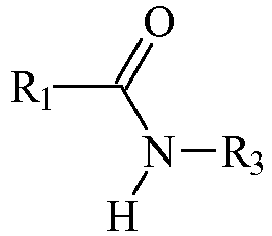
- R1 being a C5 to C25 alkyl residue, more preferably an unbranched C5 to C25 alkyl residue, still more preferably an unbranched C10 to C20 alkyl residue, like -(CH2)nCH3, with n being a positive integer between 12 to 18, like 14, and
- R3 being a C5 to C25 alkyl residue or C5 to C25 alkenyl residue, preferably a C5 to C25 alkenyl residue, more preferably a -(CH2)xCH=CH(CH2)yCH3, with x being a positive integer between 4 to 15 and y being a positive integer between 3 to 10, preferably with x being a positive integer between 7 to 15 and y being a positive integer between 4 to 9.
- Thus it is especially preferred that
R1 is -(CH2)nCH3, with n being a positive integer between 12 to 18, like 14, and
R3 is -(CH2)xCH=CH(CH2)yCH3, with x being a positive integer between 4 to 15 and y being a positive integer between 3 to 10, preferably with x being a positive integer between 7 to 15 and y being a positive integer between 4 to 9. - Accordingly in preferred embodiment the fatty acid amid derivative of formula (Ib) is N-9-octadecenyl hexadecanamide.
- In yet another preferred embodiment the fatty acid amid derivative is of formula (Ib)

- R1 being a C5 to C25 alkenyl residue, preferably an unbranched C5 to C25 alkenyl residue, more preferably an unbranched C10 to C20 alkenyl residue, still more preferably - (CH2)xCH=CH(CH2)yCH3, with x a positive integer between 4 to 15 and y a positive integer between 3 to 10, preferably with x a positive integer between 7 to 15 and y a positive integer between 4 to 9,
- R3 being a C5 to C25 alkyl residue or C5 to C25 alkenyl residue, preferably a C5 to C25 alkyl residue, more preferably an unbranched C5 to C25 alkyl residue, still more preferably an unbranched C10 to C20 alkyl residue, like -(CH2)nCH3, with n a positive integer between 12 to 18, like 14.
- Thus it is especially preferred that
R1 is -(CH2)xCH=CH(CH2)yCH3, with x a positive integer between 4 to 15 and y a positive integer between 3 to 10, preferably with x a positive integer between 7 to 15 and y a positive integer between 4 to 9, and
R3 is -(CH2)nCH3, with n a positive integer between 12 to 18, like 14. - Accordingly in preferred embodiment of the previous paragraph the fatty acid amid derivative of formula (Ib) is N-octadecyl-13-docosenamide
- It is especially preferred that the fatty acid amid derivative of is of formula (Ia) and in particular is N,N'-bisstearoylethylenediamide
(CH3(CH2)16CONHCH2CH2NHCO(CH2)16CH3). - Preferably the fatty acid amide derivative is contained in a range of 2500 ppm to 18000 ppm, in particular preferred in a range of 4000 ppm to 8000 ppm.
- The composition of the automotive (interior) article may additionally contain
- (d) inorganic filler
and/or - (e) polypropylene homopolymer
and/or - (f) high density polyethylene (HDPE).
- Also further additives know by a person skilled in the art can be contained apart from those preferably disclaimed below. One typical example of such further additives are antioxidants. Preferably the inorganic filler is a phyllosilicate, mica or wollastonite. Even more preferred the inorganic filler is selected from the group consisting of mica, wollastonite, kaolinite, smectite, montmorillonite and talc. The most preferred the inorganic filler is talc.
- The mineral filler preferably has a cutoff particle size d95 [mass percent] of equal or below 20 µm, more preferably below 10.0 µm, like below 8.0 µm
- Typically the inorganic filler has a surface area measured according to the commonly known BET method with N2 gas as analysis adsorptive of less than 22 m2/g, more preferably of less than 20 m2/g, yet more preferably of less than 18 m2/g. Inorganic fillers fulfilling these requirements are preferably anisotropic mineral fillers, like talc, mica and wollastonite.
- To improve further the stiffness of the composition for instance a propylene homopolymer and/or a high density polyethylene can be added.
- Preferably the propylene homopolymer has a melt flow rate MFR2 (230 °C) of 10.0 to 50.0 g/10min, more preferably from 15.0 to 40.0 g/10min.
- If present, the high density polyethylene (HDPE) has preferably a density measured according to ISO 1183in the range of 0.954 to 0.966 g/cm3 and a melt flow rate (MFR2 at 190 °C) of 1.0 to 50.0 g/10min, more preferably from 5.0 to 40.0 g/10min.
- As already mentioned above the composition being used for the automotive interior article must comprise:
- (a) a heterophasic propylene copolymer (HECO)
and - (b) a fatty acid amide derivative of formula (I)
- Prefered embodiments of the heterophasic propylene copolymer (HECO) are described in the section "heterophasic propylene copolymer" whereas preferred fatty acid amide derivative are described in the section "slip agents".
- Optionally a propylene homopolymer and/or inorganic filler and/or a high density polymer (HDPE) can be present.
- Thus the composition for the automotive interior article preferably comprises
- (a) at least 40 wt.-%, more preferably 40 to 95 wt.-%, yet more preferably 45 to 60 wt-%, of the heterophasic propylene copolymer (HECO),
- (b) at least 2500 ppm, preferably 2500 to 18000 ppm, yet more preferably 4000 to 8000 ppm, of a fatty acid amide derivative of formula (I)

- R1 is a C5 to C25 alkyl residue or C5 to C25 alkenyl residue
- R2 is a long-chain organic residue containing at least 6 carbon atoms,
- (c) optionally at least 5 wt.-%, more preferably 5 to 30 wt.-%, yet more preferably 7 to 25 wt.-%, of propylene homopolymer,
- (d) optionally at least 5 wt.-%, more preferably 5 to 30 wt.-%, yet more preferably 10 to 20 wt.-%, of inorganic filler, and
- (e) optionally at least 5 wt.-%, more preferably 5 to 30 wt.-%, yet more preferably 7 to 20 wt.-%, of high density polyethylene (HDPE).
- The composition of the present invention can be prepared by any suitable method known in the art, such as by blending the heterophasic propylene copolymer (HECO), the fatty acid amide of formula (I) and the additional polymer components, if present, as well as any optional further additives listed above, either directly, e.g. in an extruder, such that the same extruder is used to make the finished product, or by melt pre-mixing in a separate mixer or extruder. For mixing, a conventional compounding or blending apparatus, e.g. a Banburry mixer, a 2-roll rubber mill, Buss-co-kneader or a twin screw extruder may be used.
- Furthermore the use of a composition comprising
- (a) a heterophasic propylene copolymer (HECO) and
- (b) a fatty acid amide derivative of the formula (I)

- Additionally the invention encompasses the use of a composition comprising
- (a) a heterophasic propylene copolymer (HECO)
- (b) a fatty acid amide derivative of formula (I)

- R1 is a C5 to C25 alkyl residue or C5 to C25 alkenyl residue and
- R2 is a long-chain organic residue containing at least 6 carbon atoms, wherein the long term scratch resistance of an article, preferably of an automotive (interior) article, containing a fatty acid amide of formula (I) is improved and/or the surface tack is reduced in comparison with an article comprising the same composition without a slip agent.
- Concerning the prefered embodiments of the heterophasic propylene copolymer (HECO) and the fatty acid amide derivative, repectively, reference is made to the information provided above.
The composition of the present invention is preferably used for the production of automotive articles, like molded automotive articles, preferably automotive injection molded articles. Even more preferred is the use of the inventive composition for the production of car interiors like body panels.
According to a preferred embodiment of the present invention, the composition of the present invention is used for the production of automotive articles, preferably interior automotive articles, more preferably dash boards, instrument panels, door claddings, arm rests, gear sticks, shift lever knobs, mats, interior skins, trunk claddings, or interior trims. Moreover the present invention is directed to the use of a slip agent being a fatty acid amide derivative of formula (I)
- R1 is a C5 to C25 alkyl residue or C5 to C25 alkenyl residue and
- R2 is a long-chain organic residue containing at least 6 carbon atoms
- in a polypropylene, preferably in a heterophasic propylene copolcmer (HECO), for improving the long term scratch resistance and/or for reducing the surface tack of the polypropylene, preferably of the heterophasic propylene copolcmer (HECO), and/or of an automotive (interior) article comprising the polypropylene, i.e. the heterophasic propylene copolymer (HECO).
- The expression "polypropylene" as used throughout the instant invention covers any polypropylene, like a propylene homopolymer, a random propylene copolymer or a heterophasic propylene copolymer. Preferably the polypropylene is a heterophasic propylene copolymer (HECO) as defined herein. Thus, concerning the preferred embodiments of the heterophasic propylene copolymer (HECO) and the fatty acid amide derivative, repectively, reference is made to the information provided above. Accordingly, particular preferred is the use of fatty acid amide derivatives according to formulas (Ia) and (Ib).
- Preferably the improvement of scratch resistance is determined as the long term scratch resistance (two weeks after molding and at 95 °C) [oven ageing], wherein the long term scratch resistance (two weeks after molding and at 95 °C) [oven ageing] of the propylene, preferably of the heterophasic propylene copolymer (HECO), is at least factor 4.0 lower, preferably at least a factor 5.0 lower, more preferably a factor 6.0 lower, like a factor 6.0 to 8.0 lower, than the long term scratch resistance (two weeks after molding and at 95 °C) of the same polypropylene, preferably the same heterophasic propylene copolymer (HECO), but without a slip agent. The measuring method for the scratch resistance is described in the example section.
- Preferably the reduced surface tack is measured as the surface tack factor (especially after two weeks at 95 °C), wherein the surface tack factor (especially after two weeks at 95 °C) [oven ageing] of the polypropylene, preferably the heterophasic propylene copolymer (HECO), is at least a factor 1.8 lower, more preferably at least a factor 2.5 lower, like a factor 2.2 to 3.0 lower, than the surface tack factor (especially after two weeks at 95 °C) [oven ageing] of the same polypropylene, preferably of the same heterophasic propylene copolymer (HECO), but without a slip agent. The measuring method for the surface tack factor is described in the example section.
- By using the described compositions respectively slip agents for the production of automotive interior articles there can be obtained an improved long term scratch and reduced surface tack of these articles. Accordingly the values provided with regard to the long term scratch resistance (especially after two weeks at 95 °C) [oven ageing] and the surface tack factor (especially after two weeks at 95 °C) [oven ageing] for the polypropylene as such are equally applicable for automotive (interior) articles comprising the instant composition and/or slip agent as defined above
- It was found surprisingly that the article according to the invention shows much better properties regarding the scratch resistance as well as the surface tack by higher temperatures and after longer times, e.g. two weeks.
- Especially at temperatures of 80 °C or higher temperatures (i.e. 90 °C) the inventive automotive interior article shows much better properties regarding especially scratch resistance and surface tack as articles made of state of the art compositions.
- This property is necessary e.g. for automotive interior articles, which have to stay unscratched for many years although they are exposed to quite different influences.
- The present invention will now be described in further detail by the examples provided below.
- The following definitions of terms and determination methods apply for the above general description of the invention as well as to the below examples unless otherwise defined.
- The Density was measured according to ISO 1183-1 - method A (2004). Sample preparation is done by compression moulding in accordance with ISO 1872-2:2007.
- The ethylene content was measured with Fourier transform infrared spectroscopy (FTIR) calibrated with 13C-NMR. When measuring the ethylene content in propylene, a thin film of the sample (thickness about 250 µm) was prepared by hot-pressing. The area of absorption peaks 720 and 733 cm-1 was measured with Perkin Elmer FTIR 1600 spectrometer. The method was calibrated by ethylene content data measured by 13C-NMR.
- Mw/Mn/MWD were measured by Gel Permeation Chromatography (GPC) according to the following method:
- The weight average molecular weight Mw and the molecular weight distribution (MWD = Mw/Mn wherein Mn is the number average molecular weight and Mw is the weight average molecular weight) is measured by a method based on ISO 16014-1:2003 and ISO 16014-4:2003. A Waters Alliance GPCV 2000 instrument, equipped with refractive index detector and online viscosimeter was used with 3 x TSK-gel columns (GMHXL-HT) from TosoHaas and 1,2,4-trichlorobenzene (TCB, stabilized with 200 mg/
L 2,6-Di tert butyl-4-methylphenol) as solvent at 145 °C and at a constant flow rate of 1 mL/min. 216.5 µL of sample solution were injected per analysis. The column set was calibrated using relative calibration with 19 narrow MWD polystyrene (PS) standards in the range of 0.5 kg/mol to 11 500 kg/mol and a set of well characterised broad polypropylene standards. All samples were prepared by dissolving 5 - 10 mg of polymer in 10 mL (at 160 °C) of stabilized TCB (same as mobile phase) and keeping for 3 hours with continuous shaking prior sampling in into the GPC instrument. - The MFR2 (230 °C) was measured according to ISO 1133 (230 °C, 2.16 kg load).
- The MFR2 (190 °C) was measured according to ISO 1133 (190 °C, 2.16 kg load).
- The gloss was measured on injection moulded grained specimen according to DIN 67530 at an angle of 60°. The grain for gloss measurements was identical to the grain used in evaluation of scratch visibility.
- The content of xylene cold solubles (XCS, wt.-%) was determined at 25 °C according ISO 16152; first edition; 2005-07-01.
- Particle size is measured according to ISO 13320-1:1999
- The intrinsic viscosity was measured according to DIN ISO 1628/1, October 1999 (in decalin at 135 °C).
- The tensile modulus was measured according to ISO 527-2 (cross head speed = 1 mm/min; 23 °C) using injection moulded specimens as described in EN ISO 1873-2 (dog bone shape, 4 mm thickness).
- To determine the scratch visibility a Cross Hatch Cutter Model 420P, manufactured by Erichsen, was used. For the tests, plaques of 70x70x4 mm size were cut from a moulded grained (grain parameters: average grain size = 1 mm, grain depth = 0.12 mm, conicity = 6°) plaque of size 140x200x4 mm. The minimum period between injection moulding of specimens and scratch-testing was 7 days.
- For testing the specimens must be clamped in a suitable apparatus as described above. Scratches were applied at a force of 10 N or 15 N using a cylindrical metal pen with a ball shaped end (radius = 0.5 mm ± 0.01). A cutting speed of 1000 mm/min was used.
- A minimum of 20 scratches parallel to each other were brought up at a load of 10 N with a distance of 2 mm. The application of the scratches was repeated perpendicular to each other, so that the result was a scratching screen. The scratching direction should be unidirectional. The scratch visibility is reported as the difference of the luminance ΔL of the unscratched from the scratched areas. ΔL values were measured using a spectrophotometer that fulfils the requirements to DIN 5033. Light source for quantification of ΔL D65/10°. Measured ΔL values must be below a maximum of 1.5.
- A detailed test description of the test method (Erichsen cross hatch cutter method) can be found in the article "Evaluation of scratch resistance in multiphase PP blends" by Thomas Koch and Doris Machl, published in POLYMER TESTING 26 (2007), p. 927-936.
- The surface tack measurement was performed on injection moulded multigrain plaques with a film gate using the grain K29. The K29 surface is defined as a grain with a grain depth of 0.01 mm, and a minimum draft angle of 1° for ejection from the injection moulding tool. The section with this grain was cut out from the plaque with a bench shear.
- To perform the experiments an Instron tensile testing machine was used (ElectroPuls E3000, Instron Deutschland GmbH, Germany) with an elastomer die tip having a diameter of 25 mm and a thickness of 5 mm. The compressive force F was -50 N, the holding time tH was 91 s, and the haul-off speed v was 55 mm/s. The tests were performed at standard laboratory climate conditions (23°C and 50% relative humidity). Each single surface tack measurement was performed with this setup in the following way: After the elastomer (NR/SBR) tip had been cleaned and attached to the die by means of a double-side adhesive tape, the tackiness force FT of both the aluminium reference and the specimen (sample) were measured. The surface tack is reported as tack quotient QT, which was calculated by the following Equation:

- A detailed description of the test method for quantifying surface tack can also be found in the paper "A novel test method for quantifying surface tack of polypropylene compound surfaces" by Çakmak et al., which will be published in eXPRESS Polymer Letters in 2011.
- For weathering, the specimens were faced around a light source in an environmental chamber (WeatherOmeterCi4000, Atlas Material Testing Technology GmbH; Linsengericht, Germany) and artificially weathered using the Kalahari weathering condition. The weathering conditions of the chamber were:
- Light source: Xenon arc light
- Filter: Pyrex S
- Black standard temperature: 90°C
- Chamber temperature in the dry phase: 50°C
- Relative humidity: 20%
- Intensity of irradiation (300-400 nm): 75 W/m2.
- After the UV exposure the specimens were conditioned for approximately 1 h at 23 °C and 50% relative humidity before testing surface tack.
- 5 plaques of each material were put into the UV chamber (PV3929 dry and hot - Kalahari test). After 24, 48, 96, 192 and 384 h one plaque per material was taken out of the chamber. For each of these samples Surface tack and scratch resistance were determined.
- For thermal ageing, the specimens were put into a fan oven at 80°C and 95°C In the current investigation the specimens were aged for 7 and 14 days. After the temperature exposure the specimens were conditioned for approximately 1 h at 23°C and 50% relative humidity before testing surface tack.
- One polymer composition according to the present invention (IE: inventive example) and six comparative compositions (CE: comparative examples) were prepared. The components of the compositions are listed on table 1.
- The polymer compositions were prepared by melt blending the components on a corotating twin screw extruder type Coperion ZSK 40 (screw diameter 40 mm. L7/D ratio 38) at temperatures in the range of 170-190 °C, using a high intensity mixing screw configuration with two sets of kneading blocks.
Table 1: Compositions Unit C1 C2 C3 C4 C5 IE H-PP [wt.-%] 58.5 58.3 58.4 57.9 56.5 57.9 PP [wt.-%] 12.0 12.0 12.0 12.0 12.0 12.0 HDPE [wt.-%] 11.0 11.0 11.0 11.0 11.0 11.0 IF [wt.-%] 17.0 17.0 17.0 17.0 17.0 17.0 ESA [wt.-%] 0.2 ÖSA [wt.-%] 0.15 SR [wt.-%] 0.6 EBS [wt.-%] 0.6 Tego [wt.-%] 2.0 * the remaining part to 100 wt.-% are additives and colorants
H-PP is the commercial heterophasic propylene copolymer "EF015AE" of Borealis AG having a melt flow rate MFR2 (230 °C) of 18 g/10 min, a XCS of 29 wt.-%, and an ethylene content (C2) of 20 wt.-%
PP is the commercial propylene homopolymer "HF955MO" of Borealis AG having a melt flow rate MFR2 (230 °C) of 20 g/10 min
HDPE is the commercial high density polyethylene "MG9641B" of Borealis AG having a melt flow rate MFR2 (190 °C) of 8 g/10 min and a density of 964 kg/m3
IF is the commercial product "Steamic T1 CA" of Luzenac having a median particle size d50 of 2.1µm
ESA is the commercial erucamide "Finawax E" of Fine organics
OSA is the commercial 9-octadecenamide "Chrodamide OR" of Croda Chemical
SR is the commercial stearamide "Crodamide SR" of Croda Chemical
EBS is the commercial NN'-bisstearoylethylenediamide "Licolub FA6" of Clariant
Tego is the commercial product "Tegomer AS 100" of EvonikTable 2: Properties in unstored state Unit C1 C2 C3 C4 C5 IE MFR 230°C/2.16 kg g/10 min 14.4 15.0 15.4 16.6 16.0 16.0 Delta 1w None 4.69 1.16 0.91 2.23 1.05 4.62 Gloss 60° on K09 [%] 3.3 3.0 3.3 3.3 3.5 3.4 Tack quotient QT none 0.67 0.60 0.88 0.68 0.74 0.78 Delta 1w delta one week after moulding Table 3: Surface properties after artificial wheatering at various times Delta L 24h None 4.69 1.16 0.91 2.23 1.05 4.62 Delta L 48h None 2.48 1.51 3.31 1.93 0.92 2.65 Delta L 96h None 3.53 1.44 3.69 1.80 0.92 1.55 Delta L 192h None 3.53 1.54 3.56 2.24 0.91 1.09 Delta L 384h None 3.14 2.03 3.12 2.31 0.52 1.38 Tack quotient QT 24h None 0.57 0.62 0.56 0.71 0.67 0.51 Tack quotient QT 48h None 0.85 0.68 0.97 0.83 0.63 0.58 Tack quotient QT 96h None 0.75 0.66 0.66 0.88 0.66 0.33 Tack quotient QT 192h None 0.61 0.58 0.79 0.73 0.46 0.51 Tack quotient QT 384h None 0.75 0.45 0.64 0.70 0.49 0.31 Table 4: Surface properties after 14 days oven-ageing at different temperatures Unit C1 C2 C3 C4 C5 IE Delta L 65°C None 3.70 1.64 2.47 0.16 1.65 3.20 Delta L 80°C None 3.37 1.20 1.82 1.86 1.04 0.29 Delta L 95°C None 3.38 1.76 3.20 2.14 1.52 0.40 Tack quotient QT 65°C None 0.94 0.83 0.91 0.58 0.73 0.65 Tack quotient QT 80°C None 0.82 0.69 0.81 0.63 0.74 0.31 Tack quotient QT 95°C None 0.99 0.90 0.59 0.80 0.80 0.32

Claims (11)
- Use of a fatty acid amide derivative of formula (I)
 R1 is a C5 to C25 alkyl residue or C5 to C25 alkenyl residue,R2 is a long-chain organic residue containing at least 6 carbon atoms,in an amount of 2500 to 18000 ppm in an article comprising a heterophasic propylene copolymer (HECO) to reduce the surface tack in comparison with the same article but without a slip agent.
- Use according to claim 1, wherein the article is an automotive interior article.
- Use according to claim 2, wherein the fatty acid amid derivative is of formula (Ia)
 R1 and R5 being independently from each other a C5 to C25 alkyl residue,R4 being a C1 to C6 alkyl residue.
- Use according to claim 2 or 3, wherein the fatty acid amid derivative of formula (Ia) is N,N'-bisstearoylethylenediamide.
- Use according to one of claims 2 to 4, wherein the composition comprises additionally(c) inorganic filler
and/or(d) polypropylene homopolymer
and/or(e) high density polyethylene (HDPE). - Use according to claims 2 or 3, wherein saturated fatty acid amide derivative of formula (I) is the only slip agent being contained in the composition and/or in the automotive interior article.
- Use according to claims 2 or 3, wherein the composition comprises(a) 40 to 95 wt.-%, of the heterophasic propylene copolymer (HECO),(b) optionally 5 to 30 wt.-% of the propylene homopolymer,(c) optionally 5 to 30 wt.-% of the inorganic filler, and(d) optionally 5 to 30 wt.-% of the high density polyethylene (HDPE).
- Use of a slip agent being a fatty acid amide derivative of formula (I)
 R1 is a C5 to C25 alkyl residue or C5 to C25 alkenyl residue,R2 is a long-chain organic residue containing at least 6 carbon atoms in an amount of 2500 to 18000 ppm in a propylene, preferably in a heterophasic propylene copolymer (HECO), for reducing surface tack in comparison with the same polypropylene, preferably the same heterophasic propylene copolymer (HECO), but without a slip agent.
- Use of the slip agent according to claim 8 for improving the long term scratch resistance of the polypropylene, preferably of the heterophasic propylene copolymer (HECO), in comparison with the same polypropylene, preferably the same heterophasic propylene copolymer (HECO), but without a slip agent.
- Use according to one of claims 1, 8 and 9, wherein the long term scratch resistance (after two weeks at 95 °C) of the polypropylene, preferably of the heterophasic propylene copolymer (HECO), is at least factor 4.0 lower than the long term scratch resistance (especially after two weeks at 95 °C) of the same polypropylene, preferably of the same heterophasic propylene copolymer (HECO), without a slip agent.
- Use according to one of claims 1, 8 and 9, wherein the surface tack is determined by the surface tack factor, the surface tack factor (after two weeks at 95 °C) of the polypropylene, preferably of the heterophasic propylene copolymer (HECO), is at least a factor 1.8 lower than the surface tack factor (after two weeks at 95 °C) of the same polypropylene, preferably of the same heterophasic propylene copolymer (HECO), without a slip agent.
Priority Applications (2)
| Application Number | Priority Date | Filing Date | Title |
|---|---|---|---|
| EP12751289.5A EP2742093B1 (en) | 2011-08-11 | 2012-08-08 | Composition with improved long term scratch resistance and reduced surface tack |
| PL12751289T PL2742093T3 (en) | 2011-08-11 | 2012-08-08 | Composition with improved long term scratch resistance and reduced surface tack |
Applications Claiming Priority (3)
| Application Number | Priority Date | Filing Date | Title |
|---|---|---|---|
| EP11177311 | 2011-08-11 | ||
| EP12751289.5A EP2742093B1 (en) | 2011-08-11 | 2012-08-08 | Composition with improved long term scratch resistance and reduced surface tack |
| PCT/EP2012/065517 WO2013021003A1 (en) | 2011-08-11 | 2012-08-08 | Composition with improved long term scratch resistance and reduced surface tack |
Publications (2)
| Publication Number | Publication Date |
|---|---|
| EP2742093A1 EP2742093A1 (en) | 2014-06-18 |
| EP2742093B1 true EP2742093B1 (en) | 2016-09-28 |
Family
ID=46754404
Family Applications (1)
| Application Number | Title | Priority Date | Filing Date |
|---|---|---|---|
| EP12751289.5A Revoked EP2742093B1 (en) | 2011-08-11 | 2012-08-08 | Composition with improved long term scratch resistance and reduced surface tack |
Country Status (8)
| Country | Link |
|---|---|
| US (1) | US20140303301A1 (en) |
| EP (1) | EP2742093B1 (en) |
| KR (1) | KR101638710B1 (en) |
| CN (1) | CN103717666B (en) |
| BR (1) | BR112014002876A2 (en) |
| ES (1) | ES2607102T3 (en) |
| PL (1) | PL2742093T3 (en) |
| WO (1) | WO2013021003A1 (en) |
Families Citing this family (3)
| Publication number | Priority date | Publication date | Assignee | Title |
|---|---|---|---|---|
| WO2017144468A1 (en) * | 2016-02-22 | 2017-08-31 | Sabic Global Technologies B.V. | Composition comprising heterophasic propylene copolymer |
| CN113150436B (en) * | 2021-03-31 | 2022-12-02 | 金发科技股份有限公司 | Polypropylene composition and preparation method thereof |
| CN114181453B (en) * | 2021-11-04 | 2023-07-18 | 金发科技股份有限公司 | A low friction coefficient low atomization polypropylene material and its preparation method and application |
Citations (5)
| Publication number | Priority date | Publication date | Assignee | Title |
|---|---|---|---|---|
| US4510281A (en) | 1981-05-26 | 1985-04-09 | E. I. Du Pont De Nemours And Company | Tack-free polymer pellets |
| JP2002003692A (en) | 2000-04-18 | 2002-01-09 | Japan Polychem Corp | Polypropylene resin composition with excellent scratch resistance |
| US20040010086A1 (en) | 2002-07-12 | 2004-01-15 | Deenadayalu Chundury | Low temperature impact resistant polyolefin alloys |
| US20060009554A1 (en) | 2004-07-07 | 2006-01-12 | Sharma Ashutosh H | Scratch resistant polyolefins |
| US20110152810A1 (en) | 2009-12-23 | 2011-06-23 | Invista North America S.A.R.L. | Elastic fiber containing an anti-tack additive |
Family Cites Families (18)
| Publication number | Priority date | Publication date | Assignee | Title |
|---|---|---|---|---|
| FI86867C (en) | 1990-12-28 | 1992-10-26 | Neste Oy | FLERSTEGSPROCESS FOR FRAMSTAELLNING AV POLYETEN |
| FI111848B (en) | 1997-06-24 | 2003-09-30 | Borealis Tech Oy | Process and equipment for the preparation of homopolymers and copolymers of propylene |
| FI974175L (en) | 1997-11-07 | 1999-05-08 | Borealis As | Method for producing polypropylene |
| FI980342A0 (en) | 1997-11-07 | 1998-02-13 | Borealis As | Polymerroer och -roerkopplingar |
| FI991057A0 (en) | 1999-05-07 | 1999-05-07 | Borealis As | High stiffness propylene polymers and process for their preparation |
| WO2002022731A2 (en) | 2000-09-15 | 2002-03-21 | The Dow Chemical Company | Propylene polymer composition |
| CN100519600C (en) | 2002-06-25 | 2009-07-29 | 玻利阿黎斯技术有限公司 | Polyolefin with improved scratch resistance and process for producing the same |
| US6734253B2 (en) * | 2002-07-19 | 2004-05-11 | Dow Global Technologies, Inc. | Scratch and mar resistant propylene polymer composition |
| EP1484343A1 (en) | 2003-06-06 | 2004-12-08 | Universiteit Twente | Process for the catalytic polymerization of olefins, a reactor system and its use in the same process |
| US8273826B2 (en) * | 2006-03-15 | 2012-09-25 | Dow Global Technologies Llc | Impact modification of thermoplastics with ethylene/α-olefin interpolymers |
| ATE450570T1 (en) | 2004-05-05 | 2009-12-15 | Dow Global Technologies Inc | SCRATCH RESISTANT PROPYLENE POLYMER COMPOSITION |
| KR101224331B1 (en) | 2004-12-16 | 2013-01-18 | 사우디 베이식 인더스트리즈 코포레이션 | Polypropylene composition having improved scratch resistance |
| DK1888686T3 (en) | 2005-06-07 | 2013-04-29 | Basf Se | Scratch-resistant polyolefins |
| US7790795B2 (en) | 2006-05-25 | 2010-09-07 | Exxonmobil Chemical Patents Inc. | Scratch and mar resistant polymer compositions, methods for making and articles made from the same |
| EP2240542B9 (en) * | 2008-01-25 | 2012-01-11 | Borealis AG | Low-sticky additive package for automotive interior applications |
| EP2083046A1 (en) | 2008-01-25 | 2009-07-29 | ExxonMobil Chemical Patents Inc. | Thermoplastic elastomer compositions |
| US8093335B2 (en) * | 2008-12-15 | 2012-01-10 | Exxonmobil Chemical Patents Inc. | Thermoplastic polyolefin in-reactor blends and molded articles therefrom |
| EP2530116B1 (en) * | 2009-08-28 | 2017-10-11 | Borealis AG | Polypropylene-talc composite with reduced malodour |
-
2012
- 2012-08-08 PL PL12751289T patent/PL2742093T3/en unknown
- 2012-08-08 US US14/237,725 patent/US20140303301A1/en not_active Abandoned
- 2012-08-08 BR BR112014002876A patent/BR112014002876A2/en not_active Application Discontinuation
- 2012-08-08 KR KR1020147006090A patent/KR101638710B1/en not_active Expired - Fee Related
- 2012-08-08 ES ES12751289.5T patent/ES2607102T3/en active Active
- 2012-08-08 EP EP12751289.5A patent/EP2742093B1/en not_active Revoked
- 2012-08-08 CN CN201280038172.7A patent/CN103717666B/en not_active Expired - Fee Related
- 2012-08-08 WO PCT/EP2012/065517 patent/WO2013021003A1/en not_active Ceased
Patent Citations (5)
| Publication number | Priority date | Publication date | Assignee | Title |
|---|---|---|---|---|
| US4510281A (en) | 1981-05-26 | 1985-04-09 | E. I. Du Pont De Nemours And Company | Tack-free polymer pellets |
| JP2002003692A (en) | 2000-04-18 | 2002-01-09 | Japan Polychem Corp | Polypropylene resin composition with excellent scratch resistance |
| US20040010086A1 (en) | 2002-07-12 | 2004-01-15 | Deenadayalu Chundury | Low temperature impact resistant polyolefin alloys |
| US20060009554A1 (en) | 2004-07-07 | 2006-01-12 | Sharma Ashutosh H | Scratch resistant polyolefins |
| US20110152810A1 (en) | 2009-12-23 | 2011-06-23 | Invista North America S.A.R.L. | Elastic fiber containing an anti-tack additive |
Non-Patent Citations (3)
| Title |
|---|
| "Kirk-Othmer Encyclopedia of Chemical Technology", 2001, article OWEN, M. J .: "Release Agents", pages: 1 - 3, XP055396272 |
| BOTKIN: "Technical approaches to improving the scratch resistance of TPOs Part 1: Surface Lubrication", 2007 SPE AUTOMOTIVE TPO GLOBAL CONFERENCE, 2007, XP055396294 |
| DATABASE REGISTRY Database accession no. 110-30-5 |
Also Published As
| Publication number | Publication date |
|---|---|
| KR101638710B1 (en) | 2016-07-11 |
| BR112014002876A2 (en) | 2017-02-21 |
| WO2013021003A1 (en) | 2013-02-14 |
| EP2742093A1 (en) | 2014-06-18 |
| US20140303301A1 (en) | 2014-10-09 |
| KR20140045577A (en) | 2014-04-16 |
| PL2742093T3 (en) | 2017-05-31 |
| ES2607102T3 (en) | 2017-03-29 |
| CN103717666B (en) | 2016-06-29 |
| CN103717666A (en) | 2014-04-09 |
Similar Documents
| Publication | Publication Date | Title |
|---|---|---|
| EP2557117B1 (en) | Composition with improved scratch visibility and low surface tack | |
| EP2551299B1 (en) | Lightweight polypropylene resin with superior surface characteristics for use in automotive interior applications | |
| EP2915846B1 (en) | High flow polyolefin composition with low shrinkage and clte | |
| EP0739943B1 (en) | Thermoplastic resin composition and injection molded article thereof | |
| EP3377575B2 (en) | High flow tpo composition with excellent low temperature impact | |
| EP3170864B1 (en) | High flow tpo composition with excellent balance in mechanical properties for automotive interior | |
| US20100152360A1 (en) | Thermoplastic Polyolefin In-Reactor Blends And Molded Articles Therefrom | |
| EP3377576B1 (en) | High flow tpo composition with excellent tensile strain at break and low powder stickiness | |
| US20140303301A1 (en) | Composition with improved long term scratch resistance and reduced surface tack | |
| WO2014095846A1 (en) | Automotive compounds featuring low surface tack | |
| EP3719070B1 (en) | Polypropylene resin composition with improved scratch resistance and vehicle molded parts manufactured therefrom |
Legal Events
| Date | Code | Title | Description |
|---|---|---|---|
| PUAI | Public reference made under article 153(3) epc to a published international application that has entered the european phase |
Free format text: ORIGINAL CODE: 0009012 |
|
| 17P | Request for examination filed |
Effective date: 20140228 |
|
| AK | Designated contracting states |
Kind code of ref document: A1 Designated state(s): AL AT BE BG CH CY CZ DE DK EE ES FI FR GB GR HR HU IE IS IT LI LT LU LV MC MK MT NL NO PL PT RO RS SE SI SK SM TR |
|
| DAX | Request for extension of the european patent (deleted) | ||
| 17Q | First examination report despatched |
Effective date: 20160216 |
|
| GRAP | Despatch of communication of intention to grant a patent |
Free format text: ORIGINAL CODE: EPIDOSNIGR1 |
|
| INTG | Intention to grant announced |
Effective date: 20160506 |
|
| GRAS | Grant fee paid |
Free format text: ORIGINAL CODE: EPIDOSNIGR3 |
|
| GRAA | (expected) grant |
Free format text: ORIGINAL CODE: 0009210 |
|
| AK | Designated contracting states |
Kind code of ref document: B1 Designated state(s): AL AT BE BG CH CY CZ DE DK EE ES FI FR GB GR HR HU IE IS IT LI LT LU LV MC MK MT NL NO PL PT RO RS SE SI SK SM TR |
|
| REG | Reference to a national code |
Ref country code: GB Ref legal event code: FG4D |
|
| REG | Reference to a national code |
Ref country code: CH Ref legal event code: EP |
|
| REG | Reference to a national code |
Ref country code: AT Ref legal event code: REF Ref document number: 832719 Country of ref document: AT Kind code of ref document: T Effective date: 20161015 |
|
| REG | Reference to a national code |
Ref country code: IE Ref legal event code: FG4D |
|
| REG | Reference to a national code |
Ref country code: DE Ref legal event code: R096 Ref document number: 602012023531 Country of ref document: DE |
|
| REG | Reference to a national code |
Ref country code: NL Ref legal event code: FP |
|
| REG | Reference to a national code |
Ref country code: SE Ref legal event code: TRGR |
|
| REG | Reference to a national code |
Ref country code: RO Ref legal event code: EPE |
|
| REG | Reference to a national code |
Ref country code: LT Ref legal event code: MG4D |
|
| PG25 | Lapsed in a contracting state [announced via postgrant information from national office to epo] |
Ref country code: FI Free format text: LAPSE BECAUSE OF FAILURE TO SUBMIT A TRANSLATION OF THE DESCRIPTION OR TO PAY THE FEE WITHIN THE PRESCRIBED TIME-LIMIT Effective date: 20160928 Ref country code: RS Free format text: LAPSE BECAUSE OF FAILURE TO SUBMIT A TRANSLATION OF THE DESCRIPTION OR TO PAY THE FEE WITHIN THE PRESCRIBED TIME-LIMIT Effective date: 20160928 Ref country code: HR Free format text: LAPSE BECAUSE OF FAILURE TO SUBMIT A TRANSLATION OF THE DESCRIPTION OR TO PAY THE FEE WITHIN THE PRESCRIBED TIME-LIMIT Effective date: 20160928 Ref country code: NO Free format text: LAPSE BECAUSE OF FAILURE TO SUBMIT A TRANSLATION OF THE DESCRIPTION OR TO PAY THE FEE WITHIN THE PRESCRIBED TIME-LIMIT Effective date: 20161228 Ref country code: LT Free format text: LAPSE BECAUSE OF FAILURE TO SUBMIT A TRANSLATION OF THE DESCRIPTION OR TO PAY THE FEE WITHIN THE PRESCRIBED TIME-LIMIT Effective date: 20160928 |
|
| REG | Reference to a national code |
Ref country code: AT Ref legal event code: MK05 Ref document number: 832719 Country of ref document: AT Kind code of ref document: T Effective date: 20160928 |
|
| PG25 | Lapsed in a contracting state [announced via postgrant information from national office to epo] |
Ref country code: GR Free format text: LAPSE BECAUSE OF FAILURE TO SUBMIT A TRANSLATION OF THE DESCRIPTION OR TO PAY THE FEE WITHIN THE PRESCRIBED TIME-LIMIT Effective date: 20161229 Ref country code: LV Free format text: LAPSE BECAUSE OF FAILURE TO SUBMIT A TRANSLATION OF THE DESCRIPTION OR TO PAY THE FEE WITHIN THE PRESCRIBED TIME-LIMIT Effective date: 20160928 |
|
| PG25 | Lapsed in a contracting state [announced via postgrant information from national office to epo] |
Ref country code: EE Free format text: LAPSE BECAUSE OF FAILURE TO SUBMIT A TRANSLATION OF THE DESCRIPTION OR TO PAY THE FEE WITHIN THE PRESCRIBED TIME-LIMIT Effective date: 20160928 |
|
| REG | Reference to a national code |
Ref country code: SK Ref legal event code: T3 Ref document number: E 22731 Country of ref document: SK |
|
| PG25 | Lapsed in a contracting state [announced via postgrant information from national office to epo] |
Ref country code: PT Free format text: LAPSE BECAUSE OF FAILURE TO SUBMIT A TRANSLATION OF THE DESCRIPTION OR TO PAY THE FEE WITHIN THE PRESCRIBED TIME-LIMIT Effective date: 20170130 Ref country code: IS Free format text: LAPSE BECAUSE OF FAILURE TO SUBMIT A TRANSLATION OF THE DESCRIPTION OR TO PAY THE FEE WITHIN THE PRESCRIBED TIME-LIMIT Effective date: 20170128 Ref country code: BG Free format text: LAPSE BECAUSE OF FAILURE TO SUBMIT A TRANSLATION OF THE DESCRIPTION OR TO PAY THE FEE WITHIN THE PRESCRIBED TIME-LIMIT Effective date: 20161228 Ref country code: AT Free format text: LAPSE BECAUSE OF FAILURE TO SUBMIT A TRANSLATION OF THE DESCRIPTION OR TO PAY THE FEE WITHIN THE PRESCRIBED TIME-LIMIT Effective date: 20160928 Ref country code: SM Free format text: LAPSE BECAUSE OF FAILURE TO SUBMIT A TRANSLATION OF THE DESCRIPTION OR TO PAY THE FEE WITHIN THE PRESCRIBED TIME-LIMIT Effective date: 20160928 |
|
| REG | Reference to a national code |
Ref country code: DE Ref legal event code: R026 Ref document number: 602012023531 Country of ref document: DE |
|
| PLBI | Opposition filed |
Free format text: ORIGINAL CODE: 0009260 |
|
| 26 | Opposition filed |
Opponent name: CRODA INTERNATIONAL PLC Effective date: 20170616 |
|
| PG25 | Lapsed in a contracting state [announced via postgrant information from national office to epo] |
Ref country code: DK Free format text: LAPSE BECAUSE OF FAILURE TO SUBMIT A TRANSLATION OF THE DESCRIPTION OR TO PAY THE FEE WITHIN THE PRESCRIBED TIME-LIMIT Effective date: 20160928 |
|
| PLAX | Notice of opposition and request to file observation + time limit sent |
Free format text: ORIGINAL CODE: EPIDOSNOBS2 |
|
| REG | Reference to a national code |
Ref country code: FR Ref legal event code: PLFP Year of fee payment: 6 |
|
| PG25 | Lapsed in a contracting state [announced via postgrant information from national office to epo] |
Ref country code: SI Free format text: LAPSE BECAUSE OF FAILURE TO SUBMIT A TRANSLATION OF THE DESCRIPTION OR TO PAY THE FEE WITHIN THE PRESCRIBED TIME-LIMIT Effective date: 20160928 |
|
| PLBB | Reply of patent proprietor to notice(s) of opposition received |
Free format text: ORIGINAL CODE: EPIDOSNOBS3 |
|
| REG | Reference to a national code |
Ref country code: CH Ref legal event code: PL |
|
| PG25 | Lapsed in a contracting state [announced via postgrant information from national office to epo] |
Ref country code: MC Free format text: LAPSE BECAUSE OF FAILURE TO SUBMIT A TRANSLATION OF THE DESCRIPTION OR TO PAY THE FEE WITHIN THE PRESCRIBED TIME-LIMIT Effective date: 20160928 |
|
| PG25 | Lapsed in a contracting state [announced via postgrant information from national office to epo] |
Ref country code: CH Free format text: LAPSE BECAUSE OF NON-PAYMENT OF DUE FEES Effective date: 20170831 Ref country code: LI Free format text: LAPSE BECAUSE OF NON-PAYMENT OF DUE FEES Effective date: 20170831 |
|
| REG | Reference to a national code |
Ref country code: IE Ref legal event code: MM4A |
|
| PG25 | Lapsed in a contracting state [announced via postgrant information from national office to epo] |
Ref country code: LU Free format text: LAPSE BECAUSE OF NON-PAYMENT OF DUE FEES Effective date: 20170808 |
|
| PG25 | Lapsed in a contracting state [announced via postgrant information from national office to epo] |
Ref country code: IE Free format text: LAPSE BECAUSE OF NON-PAYMENT OF DUE FEES Effective date: 20170808 |
|
| REG | Reference to a national code |
Ref country code: FR Ref legal event code: PLFP Year of fee payment: 7 |
|
| PG25 | Lapsed in a contracting state [announced via postgrant information from national office to epo] |
Ref country code: MT Free format text: LAPSE BECAUSE OF NON-PAYMENT OF DUE FEES Effective date: 20170808 |
|
| PG25 | Lapsed in a contracting state [announced via postgrant information from national office to epo] |
Ref country code: AL Free format text: LAPSE BECAUSE OF FAILURE TO SUBMIT A TRANSLATION OF THE DESCRIPTION OR TO PAY THE FEE WITHIN THE PRESCRIBED TIME-LIMIT Effective date: 20160928 |
|
| PGFP | Annual fee paid to national office [announced via postgrant information from national office to epo] |
Ref country code: NL Payment date: 20180821 Year of fee payment: 7 Ref country code: DE Payment date: 20180823 Year of fee payment: 7 Ref country code: RO Payment date: 20180723 Year of fee payment: 7 Ref country code: ES Payment date: 20180921 Year of fee payment: 7 Ref country code: IT Payment date: 20180830 Year of fee payment: 7 Ref country code: FR Payment date: 20180827 Year of fee payment: 7 |
|
| PGFP | Annual fee paid to national office [announced via postgrant information from national office to epo] |
Ref country code: CZ Payment date: 20180806 Year of fee payment: 7 Ref country code: GB Payment date: 20180822 Year of fee payment: 7 Ref country code: SE Payment date: 20180823 Year of fee payment: 7 Ref country code: SK Payment date: 20180806 Year of fee payment: 7 Ref country code: TR Payment date: 20180806 Year of fee payment: 7 Ref country code: PL Payment date: 20180727 Year of fee payment: 7 Ref country code: BE Payment date: 20180821 Year of fee payment: 7 |
|
| RDAD | Information modified related to despatch of communication that patent is revoked |
Free format text: ORIGINAL CODE: EPIDOSCREV1 |
|
| STAA | Information on the status of an ep patent application or granted ep patent |
Free format text: STATUS: THE PATENT HAS BEEN GRANTED |
|
| RDAF | Communication despatched that patent is revoked |
Free format text: ORIGINAL CODE: EPIDOSNREV1 |
|
| REG | Reference to a national code |
Ref country code: DE Ref legal event code: R064 Ref document number: 602012023531 Country of ref document: DE Ref country code: DE Ref legal event code: R103 Ref document number: 602012023531 Country of ref document: DE |
|
| RDAG | Patent revoked |
Free format text: ORIGINAL CODE: 0009271 |
|
| STAA | Information on the status of an ep patent application or granted ep patent |
Free format text: STATUS: PATENT REVOKED |
|
| 27W | Patent revoked |
Effective date: 20190301 |
|
| GBPR | Gb: patent revoked under art. 102 of the ep convention designating the uk as contracting state |
Effective date: 20190301 |
|
| REG | Reference to a national code |
Ref country code: BE Ref legal event code: FP Effective date: 20161205 |
|
| REG | Reference to a national code |
Ref country code: SK Ref legal event code: MC4A Ref document number: E 22731 Country of ref document: SK Effective date: 20190301 |
|
| REG | Reference to a national code |
Ref country code: SE Ref legal event code: ECNC |
|
| PG25 | Lapsed in a contracting state [announced via postgrant information from national office to epo] |
Ref country code: MK Free format text: LAPSE BECAUSE OF FAILURE TO SUBMIT A TRANSLATION OF THE DESCRIPTION OR TO PAY THE FEE WITHIN THE PRESCRIBED TIME-LIMIT Effective date: 20160928 |
|
| PG25 | Lapsed in a contracting state [announced via postgrant information from national office to epo] |
Ref country code: CY Free format text: LAPSE BECAUSE OF FAILURE TO SUBMIT A TRANSLATION OF THE DESCRIPTION OR TO PAY THE FEE WITHIN THE PRESCRIBED TIME-LIMIT Effective date: 20160928 |