TECHNICAL FIELD
-
The present invention relates to a lubricating oil composition for internal combustion engines which can exhibit a good wear resistance for aluminum materials even when reducing a phosphorus content and a content of a metal component derived from a metal-based detergent in the composition.
BACKGROUND ART
-
In recent years, for the purpose of reducing environmental burdens, strict regulations against exhaust gases have been successively introduced in automobile industries. The exhaust gases contain, in addition to carbon dioxide (CO2) as a global worming substance, various harmful substances such as particular matters (PM), hydrocarbons (HC), carbon monoxide (CO) and nitrogen oxides (NOx). Among these substances, very strict regulation values have been imposed on PM and NOx. As the measure for reducing an amount of these substances discharged, gasoline automobiles are provided with a three-way catalyst, whereas diesel automobiles are provided with a diesel particulate filter (DPF). The exhaust gases are cleaned by passing through these members, and then discharged into atmospheric air.
-
It has recently reported that active sites of the three-way catalyst tend to be poisoned with phosphorus components in engine oils to thereby cause deterioration in a catalyst performance thereof, and ashes derived from metal components are deposited on DPF to thereby reduce a service life of DPF. At present, in ILSAC Standard and JASO Standard as standards for engine oils, the upper limits of the phosphorus content and ash content in the engine oils have been established, and the engine oils having less contents of these substances have now been developed.
-
On the other hand, from the viewpoint of improving a fuel consumption, parts of an engine or a transmission are formed of a nonferrous metal material for reducing a weight thereof. Of the nonferrous metal materials, an aluminum alloy, in particular, an Al-Si alloy, has been frequently employed. However, the conventional engine oils contain anti-wear agents such as zinc dithiophosphate (ZnDTP) which are intended to mainly cause a reaction for forming a coating film on Fe. Therefore, there is such a fear that the oils are deteriorated in wear resistance for aluminum materials such as Al-Si alloy.
-
In consequence, intense studies have been made to provide good anti-wear agents for aluminum materials (for example, refer to Patent Document 1). However, these anti-wear agents have failed to exhibit a sufficient effect unless they are used in combination with ZnDTP having a large phosphorus content. Therefore, there still remains such a problem that the conventional engine oils have an adverse influence on an exhaust gas post-treatment device.
-
Thus, there is a strong demand for a lubricating oil composition for internal combustion engines which can exhibit an excellent wear resistance for aluminum materials even with a reduced phosphorus content or without any phosphorus content therein.
PRIOR ART DOCUMENTS
PATENT DOCUMENTS
-
Patent Document 1:
JP 2010-528155A SUMMARY OF THE INVENTION
PROBLEMS TO BE SOLVED BY THE INVENTION
-
Under the aforementioned circumstances, an object of the present invention is to provide a lubricating oil composition for internal combustion engines which is excellent in wear resistance for aluminum materials and can be considerably reduced in content of ZnDTP having a large phosphorus content or a metallic detergent while maintaining a good wear resistance for aluminum materials.
MEANS FOR SOLVING THE PROBLEMS
-
As a result of intense and extensive researches for developing the above desirable lubricating oil composition for internal combustion engines, the present inventors have found that when controlling a nitrogen content and a boron content derived from an imide-based dispersant and a boronated imide-based dispersant in the composition, the above obj ect can be achieved. The present invention has been accomplished on the basis of the above finding.
-
Thus, the present invention relates to the following aspects.
- 1. A lubricating oil composition for internal combustion engines, including a boronated imide-based dispersant, or the boronated imide-based dispersant and a non-boronated imide-based dispersant, in which a boron content (B % by mass) derived from the boronated imide-based dispersant and a nitrogen content (N % by mass) derived from the boronated imide-based dispersant or derived from the boronated imide-based dispersant and the non-boronated imide-based dispersant satisfy the following formula (I):
and a phosphorus content (P % by mass) and a content of a metal component (M % by mass) derived from a metallic detergent on the basis of a total amount of the composition satisfy any of the following requirements A to C:
- A: P < 0.03 and M < 0.05;
- B: P < 0.03 and 0.05 ≤ M ≤ 0.12; and
- C: 0.03 ≤ P ≤ 0.06 and M < 0.05.
- 2. The lubricating oil composition for internal combustion engines as described in the above aspect 1, wherein the boron content (B % by mass) derived from the boronated imide-based dispersant and the nitrogen content (N % by mass) derived from the boronated imide-based dispersant or derived from the boronated imide-based dispersant and the non-boronated imide-based dispersant satisfy the following formula (II):
- 3. The lubricating oil composition for internal combustion engines as described in the above aspect 1 or 2, further including a sulfur-based anti-wear agent.
- 4. The lubricating oil composition for internal combustion engines as described in the above aspect 3, wherein the sulfur-based anti-wear agent is a disulfide compound represented by the following general formula (3):
R1OOC-A1-S2-A2-COOR2 (3)
wherein R1 and R2 are each independently a hydrocarbon group having 1 to 30 carbon atoms which may contain an oxygen atom, a sulfur atom or a nitrogen atom; and A1 and A2 are each independently a divalent hydrocarbon group having 1 to 12 carbon atoms.
EFFECT OF THE INVENTION
-
In accordance with the present invention, it is possible to provide a lubricating oil composition for internal combustion engines which is excellent in wear resistance for aluminum materials and can be considerably reduced in content of ZnDTP having a large phosphorus content or a metallic detergent while maintaining a good wear resistance for aluminum materials.
-
Therefore, it is also possible to provide a lubricating oil composition for internal combustion engines which is capable of reducing an adverse influence on an exhaust gas post-treatment device while maintaining a good wear resistance for aluminum materials.
EMBODIMENTS FOR CARRYING OUT THE INVENTION
-
The present invention relates to a lubricating oil composition for internal combustion engines, including a boronated imide-based dispersant, or the boronated imide-based dispersant and a non-boronated imide-based dispersant, in which a boron content (B % by mass) derived from the boronated imide-based dispersant, and a nitrogen content (N % by mass) derived from the boronated imide-based dispersant or derived from the boronated imide-based dispersant and the non-boronated imide-based dispersant satisfy the following formula (I):
-
The composition capable of satisfying the above formula (I) can be enhanced in wear resistance. In addition, the composition capable of satisfying the following formula (II):
can be further enhanced in the above effect.
-
As described above, in the present invention, the boronated imide-based dispersant is used, if required, in combination with the non-boronated imide-based dispersant.
-
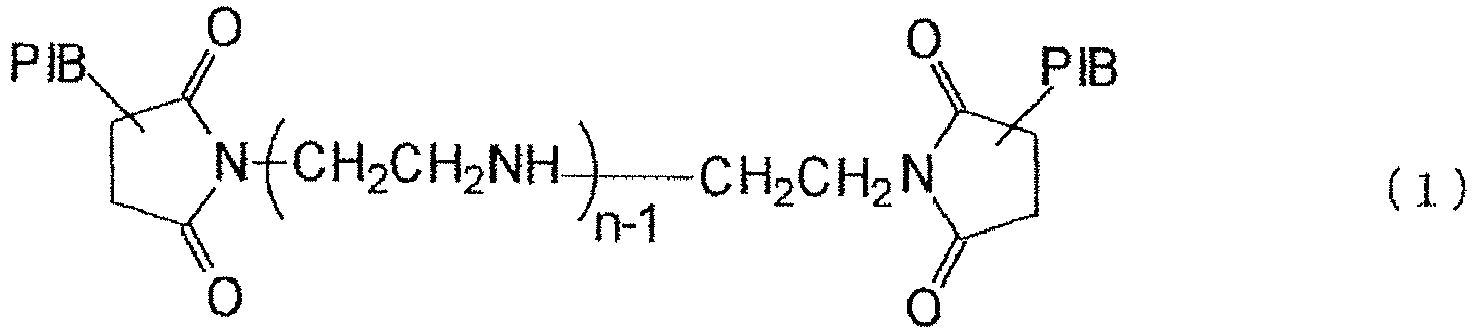
The non-boronated imide-based dispersant is usually referred to merely as an imide-based dispersant. As the non-boronated imide-based dispersant, there may be suitably used polybutenyl succinic acid imides. The polybutenyl succinic acid imides include compounds represented by the following general formulae (1) and (2).
-
In these general formulae, PIB represents a polybutenyl group. The number-average molecular weight of PIB is usually from 800 to 3500 and preferably from 900 to 2000. When the number-average molecular weight of PIB is 800 or more, there is no fear that the resulting composition is deteriorated in dispersibility. When the number-average molecular weight of PIB is 3500 or less, there is no fear that the resulting composition is deteriorated in storage stability.
-
Also, in the above general formulae (1) and (2), n is usually an integer of from 1 to 5 and preferably from 2 to 4. When n lies within the above-specified range, there is no fear that the resulting composition is deteriorated in dispersibility.
-
The method for producing the above polybutenyl succinic acid imides is not particularly limited, and the polybutenyl succinic acid imides may be produced by any known methods. For example, polybutene and maleic anhydride are reacted with each other at a temperature of from 100 to 200°C to obtain polybutenyl succinic acid, and then the thus obtained polybutenyl succinic acid is reacted with a polyamine such as diethylenetriamine, triethylenetetramine, tetraethylenepentamine and pentaethylenehexamine to obtain the polybutenyl succinic acid imides.
-
On the other hand, as the preferred boronated imide-based dispersant used in the present invention, there may be mentioned those boronated polybutenyl succinic acid imides obtained by reacting the above non-boronated imide-based dispersant represented by the above general formula (1) or (2) with a boron compound.
-
Examples of the boron compound include boric acid, a boric acid salt and a boric acid ester. Specific examples of the boric acid include orthoboric acid, metaboric acid and paraboric acid. Suitable examples of the boric acid salt include ammonium salts, e.g., ammonium borates such as ammonium metaborate, ammonium tetraborate, ammonium pentaborate and ammonium octaborate. Suitable examples of the boric acid ester include esters of boric acid and an alkyl alcohol (preferably having 1 to 6 carbon atoms), for example, monomethyl borate,dimethyl borate, trimethyl borate, monoethyl borate, diethyl borate, triethyl borate, monopropyl borate, dipropyl borate, tripropyl borate, monobutyl borate, dibutyl borate and tributyl borate.
-
The mass ratio of the boron content B to the nitrogen content N (B/N) in the boronated polybutenyl succinic acid imides is preferably from 0.1 to 3 and more preferably from 0.2 to 2.
-
Meanwhile, in the lubricating oil composition for internal combustion engines according to the present invention, the contents of the above boronated succinic acid imide-based dispersant and non-boronated succinic acid imide-based dispersant (imide-based dispersant) are not particularly limited as long as they can satisfy the above formula (I), and are each preferably from 0.1 to 15% by mass and more preferably from 0.5 to 10% by mass. When the content of each of the dispersants is 0.1% by mass or more, the resulting composition can exhibit a good detergency and a good dispersibility. When the content of each of the dispersants is 15% bymass or less, the resulting composition can exhibit an effect of enhancing a detergency and a dispersibility thereof corresponding to the increased content.
-
In the lubricating oil composition for internal combustion engines according to the present invention, it is further required that a phosphorus content (P % by mass) and a content of a metal component (M % by mass) derived from a metallic detergent satisfy any of the following requirements A to C. The respective cases where the requirements A to C are satisfied are described below.
[Case A]
-
In the case A, the following requirement is satisfied:
-
That is, the phosphorus content in the lubricating oil composition is less than 0.03% by mass on the basis of a total amount of the composition, whereas the content of the metal component derived from the metallic detergent in the lubricating oil composition is less than 0.05% by mass on the basis of a total amount of the composition.
-
When the phosphorus content in the composition is less than 0.03% by mass, poisoning of active sites of a three-way catalyst can be suppressed, so that a service life of the catalyst can be extended. Therefore, the phosphorus content in the composition is preferably 0.01% by mass or less, more preferably 0.005% by mass or less and still more preferably 0.001% by mass or less.
-
Also, when the content of the metal component derived from the metal-based detergent in the composition is less than 0.05% by mass, deposition of ashes derived from the metal component on DPF can be suppressed, so that a service life of DPF can be extended. Therefore, the content of the metal component in the composition is preferably 0.01% by mass or less, more preferably 0.005% by mass or less and still more preferably 0.001% by mass or less.
-
In order to reduce the phosphorus content in the composition to less than 0.03% by mass, it is required that the amount of a phosphorus-containing anti-wear agent compounded in the composition is reduced, or the composition is free from such an anti-wear agent. Therefore, zinc dithiophosphate (ZnDTP) extensively used as an extremely excellent anti-wear agent in conventional lubricating oils for internal combustion engines must be restricted or prohibited from being included in the composition.
-
In addition, in order to control the content of the metal component derived from the metallic detergent in the composition to less than 0.05% by mass, the metallic detergent must also be restricted or prohibited from being included in the composition.
[Case B]
-
In the case B, the following requirement is satisfied:
-
That is, the phosphorus content in the lubricating oil composition is less than 0.03% by mass on the basis of a total amount of the composition, whereas the content of the metal component derived from the metallic detergent in the lubricating oil composition is not less than 0.05% by mass and not more than 0.12% by mass on the basis of a total amount of the composition.
-
When the phosphorus content in the composition is less than 0.03% by mass, poisoning of active sites of a three-way catalyst can be suppressed, so that a service life of the catalyst can be extended. Therefore, the phosphorus content in the composition is preferably 0.01% by mass or less, more preferably 0.005% by mass or less and still more preferably 0.001% by mass or less.
-
In order to reduce the phosphorus content in the composition to less than 0.03% by mass, it is required that the amount of a phosphorus-containing anti-wear agent compounded in the composition is reduced, or the composition is free from such an anti-wear agent. Therefore, zinc dithiophosphate (ZnDTP) extensively used as an extremely excellent anti-wear agent in conventional lubricating oils for internal combustion engines must be restricted or prohibited from being included in the composition.
-
In addition, when the content of the metal component derived from the metallic detergent in the composition is not less than 0.05% by mass, the resulting composition can be further enhanced in detergency as required for lubricating oils for internal combustion engines. On the other hand, when the content of the metal component derived from the metallic detergent in the composition is not more than 0.12% by mass or less, deposition of ashes derived from the metal component on DPF can be suppressed, so that a service life of DPF can be extended. Therefore, the content of the metal component in the composition is preferably not less than 0.05% by mass and not more than 0.10% by mass, and more preferably not less than 0.05% and not more than 0.08% by mass.
-
Suitable examples of the metallic detergent from which the metal component is derived include sulfonates, phenates, salicylates and naphthenates of alkali metals (such as Na and K) and alkali earth metals (such as Ca, Mg and Ba). Among these metallic detergents, preferred are Ca sulfonate, Ca phenate and Ca salicylate. The base number of these metallic detergents is preferably from 0 to 500 mg KOH/g, more preferably from 150 to 400 mg KOH/g and still more preferably from 200 to 350 mg KOH/g as measured by a perchloric acid method.
-
The metallic detergents may be used alone or in combination of any two or more thereof.
-
The content of the metallic detergent in the composition may be appropriately selected so as to adjust the content of the metal component derived from the metallic detergent in the composition to the above-specified range.
[Case C]
-
In the case C, the following requirement is satisfied:
-
That is, the phosphorus content in the lubricating oil composition is not less than 0.03% by mass and not more than 0.06% by mass on the basis of a total amount of the composition, whereas the content of the metal component derived from the metallic detergent in the lubricating oil composition is less than 0.05% by mass on the basis of a total amount of the composition.
-
When the phosphorus content in the composition is not less than 0.03% by mass, the resulting composition can be further enhanced inwear resistance. On the other hand, when the phosphorus content in the composition is not more than 0.06% by mass, poisoning of active sites of a three-way catalyst can be suppressed, so that a service life of the catalyst can be extended. Therefore, the phosphorus content in the composition is preferably not less than 0.03% by mass and not more than 0.05% by mass.
-
The above phosphorus content may be controlled by adjusting an amount of the phosphorus-based anti-wear agent compounded in the composition. Typical examples of the phosphorus-based anti-wear agent include dithiophosphoric acid metal salts such as zinc dithiophosphate (ZnDTP) and molybdenum dithiophosphate (MoDTP) ; phosphoric acid esters or phosphorous acid esters (such as organic phosphoric acid esters, organic phosphorous acid esters, alkyl or aryl acid phosphates, alkyl or aryl hydrogen phosphites and amine salts of these compounds) ; thiophosphoric acid esters; and thiophosphorous acid esters. Among these phosphorus-based anti-wear agents, preferred is zinc dithiophosphate, i.e., zinc dihydrocarbyl dithiophosphate (in which the hydrocarbyl group is an alkyl group preferably having 1 to 18 carbon atoms and more preferably 2 to 12 carbon atoms, an alkenyl group, an arylalkyl group or an alkaryl group), and more preferred are zinc dialkyl dithiophosphates containing a secondary alkyl group having 3 to 8 carbon atoms.
-
On the other hand, when the content of the metal component derived from the metallic detergent in the composition is less than 0.05% by mass, deposition of ashes derived from the metal component on DPF can be suppressed, so that a service life of DPF can be extended. Therefore, the content of the metal component in the composition is preferably 0.01% by mass or less, more preferably 0.005% by mass or less and still more preferably 0.001% by mass or less.
-
The lubricating oil composition for internal combustion engines according to the present invention preferably further contains a sulfur-based anti-wear agent. Preferred examples of the sulfur-based anti-wear agent include those phosphorus-free sulfur-based anti-wear agents such as sulfurized oils and fats, sulfurized fatty acids, sulfurized esters, sulfurized olefins and dihydrocarbyl polysulfides. Among these sulfur-based anti-wear agents, more preferred are disulfide compounds represented by the following general formula (3):
R1OOC-A1-S2-A2-COOR2 (3)
wherein R1 and R2 are each independently a hydrocarbon group having 1 to 30 carbon atoms which may contain an oxygen atom, a sulfur atom or a nitrogen atom; and A1 and A2 are each independently a divalent hydrocarbon group having 1 to 12 carbon atoms.
-
Specific examples of the sulfur-containing compound represented by the above general formula (3) include bis(methoxycarbonylmethyl)disulfide, bis(ethoxycarbonylmethyl)disulfide, bis(n-propoxycarbonylmethyl)disulfide, bis(isopropoxycarbonylmethyl)disulfide, bis(n-butoxycarbonylmethyl)disulfide, bis(n-octoxycarbonylmethyl)disulfide, bis(n-dodecyloxycarbonylmethyl)disulfide, bis(cyclopropoxycarbonylmethyl)disulfide, 1,1-bis(1-methoxycarbonylethyl)disulfide, 1,1-bis(1-methoxycarbonyl-n-propyl)disulfide, 1,1-bis(1-methoxycarbonyl-n-butyl)disulfide, 1,1-bis(1-methoxycarbonyl-n-hexyl)disulfide, 1,1-bis(1-methoxycarbonyl-n-octyl)disulfide, 1,1-bis(1-methoxycarbonyl-n-dodecyl)disulfide, 2,2-bis(2-methoxycarbonyl-n-propyl)disulfide, α,α-bis(α-methoxycarbonylbenzyl)disulfide, 1,1-bis(2-methoxycarbonylethyl)disulfide, 1,1-bis(2-ethoxycarbonylethyl)disulfide, 1,1-bis(2-n-propoxycarbonylethyl)disulfide, 1,1-bis(2-isopropoxycarbonylethyl)disulfide, 1,1-bis(2-cyclopropoxycarbonylethyl)disulfide, 1,1-bis(2-methoxycarbonyl-n-propyl)disulfide, 1,1-bis(2-methoxycarbonyl-n-butyl)disulfide, 1,1-bis(2-methoxycarbonyl-n-hexyl)disulfide, 1,1-bis(3-methoxycarbonyl-n-propyl)disulfide, 2,2-bis(3-methoxycarbonyl-n-pentyl)disulfide and 1,1-bis(2-methoxycarbonyl-1-phenylethyl)disulfide.
-
The content of the sulfur-based anti-wear agent in the composition is preferably from 0.05 to 5% bymass and more preferably from 0.1 to 3% bymass on the basis of a total amount of the composition. When the content of the sulfur-based anti-wear agent in the composition is 0.05% by mass or more, the resulting composition can exhibit a sufficient wear resistance. When the content of the sulfur-based anti-wear agent in the composition is 5% by mass or less, the resulting composition is free from occurrence of corrosion.
-
The lubricating oil composition according to the present invention may further contain other additives used in conventionally known lubricating oil compositions such as lubricating oils for internal combustion engines unless they give any adverse influence on the conditions of the phosphorus content and the content of the metal component as required in the present invention. Examples of the other additives include the other friction reducing agent, a viscosity index improver, a pour point depressant, an antioxidant and a rust inhibitor.
-
Specific examples of the other friction reducing agent include ash-free friction reducing agents such as fatty acid ester-based compounds, fatty amine-based compounds and higher alcohol-based compounds.
-
Examples of the viscosity index improver include so-called non-dispersed type viscosity index improvers such as copolymers of various methacrylic acid esters or an optional combination of the methacrylic acid esters and hydrogenated products thereof, and so-called dispersed type viscosity index improvers such as copolymers obtained by further copolymerizing various nitrogen compound-containing methacrylic acid esters with the above compounds.
-
Further examples of the viscosity index improver include non-dispersed type or dispersed type ethylene-α-olefin copolymers (in which the α-olefin include, for example, propylene, 1-butene, 1-pentene, etc.) and hydrogenated products thereof, polyisobutylene and hydrogenated products thereof, hydrogenated styrene-diene copolymers, styrene-maleic anhydride ester copolymers and polyalkyl styrenes. The molecular weight (number-average molecular weight) of these viscosity index improvers is, for example, as follows. The number-average molecular weight of the dispersed type or non-dispersed type polymethacrylates is from 5000 to 1000000 and preferably from 100000 to 800000. The number-average molecular weight of the polyisobutylene and hydrogenated products thereof is from 800 to 5000. The number-average molecular weight of the ethylene-α-olefin copolymers and hydrogenated products thereof is from 800 to 300000 and preferably from 10000 to 200000.
-
Examples of the antioxidant include phenol-based antioxidants and amine-based antioxidants. Examples of the phenol-based antioxidants include 4,4'-methylene bis(2,6-di-t-butyl phenol); 4,4'-bis(2,6-di-t-butyl phenol); 4,4'-bis(2-methyl-6-t-butyl phenol); 2,2'-methylene bis(4-ethyl-6-t-butyl phenol); 2,2'-methylene bis(4-methyl-6-t-butyl phenol); 4,4'-butylidene bis(3-methyl-6-t-butyl phenol); 4,4'-isopropylidene bis(2,6-di-t-butylphenol);2,2'-methylenebis(4-methyl-6-nonyl phenol); 2,2'-isobutylidene bis(4,6-dimethyl phenol); 2,2'-methylene bis(4-methyl-6-cyclohexyl phenol); 2,6-di-t-butyl-4-methyl phenol; 2,6-di-t-butyl-4-ethyl phenol; 2,4-dimethyl-6-t-butyl phenol; 2,6-di-t-amyl-p-cresol; 2,6-di-t-butyl-4-(N,N'-dimethylaminomethyl phenol); 4,4'-thiobis(2-methyl-6-t-butyl phenol); 4,4'-thiobis(3-methyl-6-t-butyl phenol); 2,2'-thiobis(4-methyl-6-t-butyl phenol); bis(3-methyl-4-hydroxy-5-t-butyl benzyl)sulfide; bis(3,5-di-t-butyl-4-hydroxybenzyl)sulfide; n-octadecyl-3-(4-hydroxy-3,5-di-t-butylphenyl)propionate; and 2,2'-thio[diethyl-bis-3-(3,5-di-t-butyl-4-hydroxyphenyl)propi onate]. Among these phenol-based antioxidants, especially preferred are bisphenol-based antioxidants and ester group-containing phenol-based antioxidants.
-
Examples of the amine-based antioxidants include monoalkyl diphenyl amine-based antioxidantssuch asmonooctyldiphenylamine and monononyl diphenyl amine; dialkyl diphenyl amine-based antioxidants such as 4,4'-dibutyl diphenyl amine, 4,4'-dipentyl diphenyl amine, 4,4'-dihexyl diphenyl amine, 4,4'-diheptyl diphenyl amine, 4,4'-dioctyl diphenyl amine and 4,4'-dinonyl diphenyl amine; polyalkyl diphenyl amine-based antioxidants such as tetrabutyl diphenyl amine, tetrahexyl diphenyl amine, tetraoctyl diphenyl amine and tetranonyl diphenyl amine; and naphtyl amine-based antioxidants. Specific examples of the naphtyl amine-based antioxidants include α-naphtyl amine; phenyl-α-naphtyl amine; and alkyl-substituted phenyl-α-naphtyl amines such as butyl phenyl-α-naphtyl amine, pentyl phenyl-α-naphtyl amine, hexyl phenyl-α-naphtyl amine, heptyl phenyl-α-naphtyl amine, octyl phenyl-α-naphtyl amine and nonyl phenyl-α-naphtyl amine. Among these amine-based antioxidants, preferred are dialkyl diphenyl amine-based antioxidants and naphtyl amine-based antioxidants.
-
These antioxidants may be used alone or in combination of any two or more thereof. In particular, it is preferred that one or more kinds of the phenol-based antioxidants are used in combination with one or more kinds of the amine-based antioxidants.
-
Examples of the rust inhibitor include alkyl benzene sulfonates, dinonyl naphthalene sulfonate, alkenyl succinic acid esters and polyhydric alcohol esters.
-
The amounts of the above other additives compounded in the composition may be appropriately selected from an ordinary practical range.
-
The lubricating oil composition having such a performance as aimed by the present invention can be obtained by compounding the various additives mentioned above in a base oil for lubricants (hereinafter occasionally referred to merely as a "base oil").
-
The base oil used in the present invention is not particularly limited, and may be appropriately selected from conventionally known mineral base oils (hereinafter also referred to merely as "mineral oils") and conventionally known synthetic base oils (hereinafter also referred to merely as "synthetic oils").
-
Examples of the mineral oils include distilled oils obtained by subj ecting a paraffin base crude oil, an intermediate base crude oil or a naphthene base crude oil to atmospheric distillation, or subjecting a residue oil obtained from the atmospheric distillation to distillation under reduced pressure, and refined oils obtained by subjecting these oils to ordinary purification treatments. Specific examples of the refined oils include solvent-refined oils, hydrogenation refined oils, hydrocracked oils, dewaxed oils and clay-treated oils as well as isomerized oils of waxes (such as slack wax).
-
Examples of the synthetic oils include poly-α-olefins such as α-olefin oligomers having 8 to 14 carbon atoms, polybutene, polyol esters and alkyl benzenes.
-
In the present invention, as the base oil, the above mineral oils may be used alone or in combination of any two or more thereof. Also, the above synthetic oils may be used alone or in combination of any two or more thereof. Further, one or more kinds of the mineral oils may be used in combination with one or more kinds of the synthetic oils.
-
In addition, the content of the base oil in the composition is preferably 70% by mass or more, and more preferably 80% by mass or more.
-
The kinematic viscosity of the base oil as measured at 100°C is preferably in the range of from 1.5 to 50 mm2/s, more preferably from 3 to 30 mm2/s and still more preferably from 3 to 15 mm2/s. When the kinematic viscosity of the base oil as measured at 100°C is 1.5 mm2/s or more, the resulting lubricating oil composition hardly suffers from evaporation loss. When the kinematic viscosity of the base oil as measured at 100°C is 50 mm2/s or less, power loss owing to a viscosity resistance of the resulting lubricating oil composition can be suppressed, so that the composition can exhibit a good effect of improving a fuel consumption.
-
In addition, the viscosity index of the base oil is preferably 80 or more, more preferably 90 or more, and still more preferably 100 or more. The base oil having a viscosity index of 80 or more has a less change in viscosity depending upon temperature and therefore can exhibit a stable lubricating performance.
-
Also, the base oil preferably has a sulfur content of 50 ppm by mass or less as measured according to JIS K 2541. When the sulfur content of the base oil is 50 ppm by mass or less, the resulting lubricating oil composition can exhibit an effect of enhancing a wear resistance of a low-friction slide material. The sulfur content of the base oil is more preferably 30 ppm by mass or less and still more preferably 20 ppm by mass or less.
-
Further, the base oil preferably has a %CA value of 3.0 or less as measured by ring analysis from the viewpoint of a good stability of the resulting lubricating oil composition. The %CA value according to ring analysis as used herein means a proportion (percentage) of an aromatic component in the base oil which is calculated by a ring analysis n-d-M method. When the %CA value of the base oil is 3.0 or less, the resulting lubricating oil composition can exhibit a good oxidation stability. The %CA value of the base oil is more preferably 1.0 or less and more preferably 0.5 or less.
EXAMPLES
-
The present invention will be described in more detail by referring to the following examples, etc. However, it should be noted that these examples are only illustrative and not intended to limit the invention thereto.
-
Meanwhile, the formulations and performance of the lubricating oil composition for internal combustion engines (hereinafter also referred to merely as a "lubricating oil composition") were measured by the following methods.
<Formulations of Lubricating Oil Composition>
1. Quantitative Determination of Boron, Phosphorus and Calcium
-
Measured according to ASTM D5185.
2. Quantitative Determination of Nitrogen
-
Measured according to JIS K2609.
3. Sulfur Content
-
Measured according to JIS K2541.
<Performance of Lubricating Oil Composition>
4. Evaluation of Wear Resistance
-
Using an SRV friction tester (reciprocating type friction tester), a cylinder and a disk as test specimens were subjected to friction test under the following conditions to measure a size of wear scar generated on the cylinder.
Testing Conditions
-
- Test specimens: Cylinder (standard material: SUJ2); disk (Si-containing aluminum: AA (Aluminum Association of America) Standard "A390")
- Test temperature: 130°C
- Load: 200 N
- Amplitude: 3.0 mm
- Frequency: 20 Hz
- Test time: 1 h
Examples A1 to A10 and Comparative Examples A1 to A8
-
The lubricating oil compositions having formulations as shown in Tables 1 and 2 were prepared and subjected to measurement of a wear resistance. The results are shown in Tables 1 and 2.
-
The respective components used for preparing the lubricating oil compositions are as follows.
- (1) Base oil 1: Hydrogenation refined mineral oil (100 N) ; 40°C kinematic viscosity: 21.0 mm2/s; 100°C kinematic viscosity: 4.5 mm2/s; viscosity index: 127; sulfur content: less than 5 ppm by mass
- (2) Boronated imide 1: Boronated polybutenyl succinic acid monoimide; number-average molecular weight of polybutenyl group: 950; base number (perchloric acid method) : 30.6 mg KOH/g; nitrogen content: 1.8% by mass; boron content: 2.1% by mass
- (3) Boronated imide 2: Boronated polybutenyl succinic acid bisimide; number-average molecular weight of polybutenyl group: 950; base number (perchloric acid method) : 25 mg KOH/g; nitrogen content: 1.2% by mass; boron content: 1.3% by mass
- (4) Non-boronated imide 1: Polybutenyl succinic acid monoimide; number-average molecular weight of polybutenyl group: 950; base number (perchloric acid method) : 44 mg KOH/g; nitrogen content: 2.1% by mass
- (5) Non-boronated imide 2: Polybutenyl succinic acid bisimide; number-average molecular weight of polybutenyl group: 1300; base number (perchloric acid method) : 11.9 mg KOH/g; nitrogen content: 1.0% by mass
- (6) Sulfur-based anti-wear agent: Bis (n-octoxycarbonylmethyl) disulfide; sulfur content: 158 ppm by mass
- (7) Metal-based detergent: Casalicylate; base number (perchloric acid method): 270 mg KOH/g
- (8) Phosphorus-based anti-wear agent: Zinc dithioalkyl dithiophosphate; Zn content: 9.0% by mass; phosphorus content: 8.0% by mass; sulfur content: 17.1% by mass; alkyl group: mixture of a secondary butyl group and a secondary hexyl group (9) Other additives: Mixture of an antioxidant (phenol-based antioxidant and amine-based antioxidant), a metal deactivator (alkyl benzotriazole) and a defoaming agent (silicone-based compound).
TABLE 1 | | Examples |
| A1 | A2 | A3 | A4 | A5 | A6 | A7 | A8 | A9 | A10 |
| Amounts compounded (% by mass) | | | | | | | | | | |
| Base oil | bal.*1 | bal.*1 | bal.*1 | bal.*1 | bal.*1 | bal.*1 | bal.*1 | bal.*1 | bal.*1 | bal.*1 |
| Boronated imide 1 | 7.0 | - | 7.0 | 2.0 | - | - | 2.0 | 5.0 | - | - |
| Boronated imide 2 | - | 4.0 | 4.0 | - | 4.0 | 6.0 | 6.0 | 6.0 | 4.0 | 4.0 |
| Non-boronated imide 1 | 2.0 | - | - | 7.0 | 2.0 | 2.0 | 2.0 | 2.0 | - | - |
| Non-boronated imide 2 | 2.0 | 5.0 | 5.0 | 7.0 | 7.0 | 7.0 | 7.0 | 7.0 | 5.0 | 5.0 |
| Sulfur-based extreme pressure agent | 1.0 | 1.0 | 1.0 | 1.0 | 1.0 | 1.0 | 1.0 | 1.0 | 1.0 | 1.0 |
| Metallic detergent | - | - | - | - | - | - | - | - | - | 0.4 |
| Phosphorus-based anti-wear agent | - | - | - | - | - | - | - | - | 0.3 | - |
| Other additives | 2.4 | 2.4 | 2.4 | 2.4 | 2.4 | 2.4 | 2.4 | 2.4 | 2.4 | 2.4 |
| Formulations of composition (% by mass) | | | | | | | | | | |
| N content: derived from a dispersant | 0.20 | 0.11 | 0.25 | 0.25 | 0.17 | 0.20 | 0.24 | 0.30 | 0.11 | 0.11 |
| B content: derived from a dispersant | 0.14 | 0.05 | 0.19 | 0.04 | 0.05 | 0.08 | 0.12 | 0.18 | 0.05 | 0.05 |
| P content | 0 | 0 | 0 | 0 | 0 | 0 | 0 | 0 | 0.02 | 0 |
| Metal content: derived from a metallic detergent | 0 | 0 | 0 | 0 | 0 | 0 | 0 | 0 | 0 | 0.04 |
| S content | 0.21 | 0.21 | 0.21 | 0.21 | 0.21 | 0.21 | 0.21 | 0.21 | 0.25 | 0.21 |
| Evaluation results | | | | | | | | | | |
| SRV test: width of wear on cylinder (mm) | 0.452 | 0.433 | 0.472 | 0.356 | 0.361 | 0.322 | 0.318 | 0.381 | 0.411 | 0.460 |
TABLE 2 | | Comparative Examples |
| A1 | A2 | A3 | A4 | A5 | A6 | A7 | A8 |
| Amounts compounded (% by mass) | | | | | | | | |
| Base oil | bal.*1 | bal.*1 | bal.*1 | bal.*1 | bal.*1 | bal.*1 | bal.*1 | bal.*1 |
| Boronated imide 1 | - | - | - | 4.0 | 8.0 | - | - | - |
| Boronated imide 2 | - | - | 4.0 | - | - | 4.0 | 4.0 | 4.0 |
| Non-boronated imide 1 | 2.0 | 2.0 | - | 2.0 | 2.0 | - | - | - |
| Non-boronated imide 2 | - | 7.0 | - | - | - | - | - | - |
| Sulfur-based extreme pressure agent | 1.0 | 1.0 | 1.0 | 1.0 | 1.0 | 1.0 | 1.0 | 1.0 |
| Metallic detergent | - | - | - | - | - | - | - | 0.5 |
| Phosphorus-based anti-wear agent | - | - | - | - | - | 0.4 | 0.3 | - |
| Other additives | 2.4 | 2.4 | 2.4 | 2.4 | 2.4 | 2.4 | 2.4 | 2.4 |
| Formulations of composition (% by mass) | | | | | | | | |
| N content: derived from a dispersant | 0.04 | 0.11 | 0.06 | 0.12 | 0.20 | 0.06 | 0.06 | 0.06 |
| B content: derived from a dispersant | - | - | 0.05 | 0.08 | 0.16 | 0.05 | 0.05 | 0.05 |
| P content | 0 | 0 | 0 | 0 | 0 | 0.03 | 0.02 | 0 |
| Metal content: derived from a metallic detergent | 0 | 0 | 0 | 0 | 0 | 0 | 0 | 0.05 |
| S content | 0.21 | 0.21 | 0.21 | 0.21 | 0.21 | 0.27 | 0.25 | 0.21 |
| Evaluation results | | | | | | | | |
| SRV test: width of wear on cylinder (mm) | 0.538 | 0.603 | 0.593 | 0.589 | 0.622 | 0.588 | 0.585 | 0.627 |
-
The followings were recognized from Tables 1 and 2.
- (1) The lubricating oil compositions capable of satisfying the formula (I) according to the present invention were excellent in wear resistance for aluminum materials (Examples A1 to A10). In particular, the lubricating oil compositions obtained in Examples A4 to A8 which were capable of satisfying the formula (II) were further excellent in wear resistance for aluminum materials.
In contrast, the lubricating oil compositions incapable of satisfying the formula (I) were deteriorated in wear resistance for aluminum materials as compared to the above compositions according to the present invention obtained in Examples A1 to A10 (Comparative Examples A1 to A8).
- (2) The lubricating oil compositions according to the present invention (Examples A1 to A10) exhibited a good wear resistance even when they had no P content. In addition, the lubricating oil compositions according to the present invention were extremely reduced in both of P content and content of the metal component derived from the metallic detergent, and therefore were extremely excellent in effects of preventing poisoning of a three-way catalyst and suppressing deterioration in service life of DPF.
Examples B1 to B9 and Comparative Examples B1 to B7
-
The lubricating oil compositions having formulations as shown in Tables 3 and 4 were prepared and subjected to measurement of a wear resistance. The results are shown in Tables 3 and 4.
-
The respective components used for preparing the lubricating oil compositions as well as the methods for measuring the formulations and performance of the respective compositions were the same as those used in Examples A1 to A10 and Comparative Examples A1 to A8.
TABLE 3 | | Examples |
| B1 | B2 | B3 | B4 | B5 | B6 | B7 | B8 | B9 |
| Amounts compounded (% by mass) | | | | | | | | | |
| Base oil | bal.*1 | bal.*1 | bal.*1 | bal.*1 | bal.*1 | bal.*1 | bal.*1 | bal.*1 | bal.*1 |
| Boronated imide 1 | 7.0 | - | - | 7.0 | 2.0 | - | - | 2.0 | - |
| Boronated imide 2 | - | 4.0 | 4.0 | 4.0 | - | 4.0 | 6.0 | 6.0 | 4.0 |
| Non-boronated imide 1 | 2.0 | - | - | - | 7.0 | 2.0 | 2.0 | 2.0 | - |
| Non-boronated imide 2 | 2.0 | 5.0 | 5.0 | 5.0 | 7.0 | 7.0 | 7.0 | 7.0 | 5.0 |
| Sulfur-based extreme pressure agent | 1.0 | 1.0 | 1.0 | 1.0 | 1.0 | 1.0 | 1.0 | 1.0 | 1.0 |
| Metallic detergent | 0.5 | 0.5 | 0.5 | 0.5 | 0.5 | 0.5 | 0.5 | 0.5 | 0.5 |
| Phosphorus-based anti-wear agent | - | - | - | - | - | - | - | - | 0.3 |
| Other additives | 2.4 | 2.4 | 2.4 | 2.4 | 2.4 | 2.4 | 2.4 | 2.4 | 2.4 |
| Formulations of composition (% by mass) | | | | | | | | | |
| N content: derived from a dispersant | 0.20 | 0.11 | 0.11 | 0.25 | 0.25 | 0.17 | 0.20 | 0.24 | 0.11 |
| B content: derived from a dispersant | 0.14 | 0.05 | 0.05 | 0.19 | 0.04 | 0.05 | 0.08 | 0.12 | 0.05 |
| P content | 0 | 0 | 0 | 0 | 0 | 0 | 0 | 0 | 0.02 |
| Metal content (Ca): derived from a metallic detergent | 0.05 | 0.05 | 0.05 | 0.05 | 0.05 | 0.05 | 0.05 | 0.05 | 0.05 |
| S content | 0.21 | 0.21 | 0.21 | 0.21 | 0.21 | 0.21 | 0.21 | 0.21 | 0.25 |
| Evaluation results | | | | | | | | | |
| SRV test: width of wear on cylinder (mm) | 0.472 | 0.460 | 0.444 | 0.496 | 0.389 | 0.381 | 0.331 | 0.366 | 0.457 |
TABLE 4 | | Comparative Examples |
| B1 | B2 | B3 | B4 | B5 | B6 | B7 |
| Amounts compounded (% by mass) | | | | | | | |
| Base oil | bal.*1 | bal.*1 | bal.*1 | bal.*1 | bal.*1 | bal.*1 | bal.*1 |
| Boronated imide 1 | - | - | - | 4.0 | 8.0 | - | - |
| Boronated imide 2 | - | - | 4.0 | - | - | 4.0 | 4.0 |
| Non-boronated imide 1 | 2.0 | 2.0 | - | 2.0 | 2.0 | - | - |
| Non-boronated imide 2 | - | 7.0 | - | - | - | - | - |
| Sulfur-based extreme pressure agent | 1.0 | 1.0 | 1.0 | 1.0 | 1.0 | 1.0 | 1.0 |
| Metallic detergent | 0.5 | 0.5 | 0.5 | 0.5 | 0.5 | - | 1.0 |
| Phosphorus-based anti-wear agent | - | - | - | - | - | 0.3 | - |
| Other additives | 2.4 | 2.4 | 2.4 | 2.4 | 2.4 | 2.4 | 2.4 |
| Formulations of composition (% by mass) | | | | | | | |
| N content: derived from a dispersant | 0.04 | 0.11 | 0.06 | 0.12 | 0.20 | 0.06 | 0.06 |
| B content: derived from a dispersant | 0.00 | 0.00 | 0.05 | 0.08 | 0.16 | 0.05 | 0.05 |
| P content | 0 | 0 | 0 | 0 | 0 | 0.02 | 0 |
| Metal content (Ca): derived from a metallic detergent | 0.05 | 0.05 | 0.05 | 0.05 | 0.05 | 0 | 0.10 |
| S content | 0.21 | 0.21 | 0.21 | 0.21 | 0.21 | 0.25 | 0.21 |
| Evaluation results | | | | | | | |
| SRV test: width of wear on cylinder (mm) | 0.566 | 0.594 | 0.594 | 0.600 | 0.612 | 0.585 | 0.614 |
-
The followings were recognized from Tables 3 and 4.
- (1) The lubricating oil compositions capable of satisfying the formula (I) according to the present invention were excellent in wear resistance for aluminum materials (Examples B1 to B9). In particular, the lubricating oil compositions obtained in Examples B5 to B8 which were capable of satisfying the formula (II) were further excellent in wear resistance for aluminum materials.
In contrast, the lubricating oil compositions incapable of satisfying the formula (I) all were deteriorated in wear resistance for aluminum materials (Comparative Examples B1 to B7).
- (2) The lubricating oil compositions according to the present invention (Examples B1 to B9) exhibited a good wear resistance even when they had substantially no P content. In addition, the lubricating oil compositions according to the present invention exhibited an extremely reduced P content, and therefore were extremely excellent in effect of preventing poisoning of a three-way catalyst. In addition, the content of the metal component derived from the metallic detergent in the lubricating oil compositions according to the present invention was 0.05% by mass or more, so that the compositions exhibited a very good detergency owing to inclusion of an adequate amount of the metallic detergent therein. On the other hand, the content of the metal component derived from the metallic detergent in the lubricating oil compositions according to the present invention was 0.12% by mass or less, so that the compositions also exhibited a good effect of suppressing deterioration in service life of DPF.
Examples C1 to C10 and Comparative Examples C1 to C8
-
The lubricating oil compositions having formulations as shown in Tables 5 and 6 were prepared and subjected to measurement of a wear resistance. The results are shown in Tables 5 and 6.
-
The respective components used for preparing the lubricating oil compositions as well as the methods for measuring the formulations and performance of the respective compositions were the same as those used in Examples A1 to A10 and Comparative Examples A1 to A8.
TABLE 5 | | Examples |
| C1 | C2 | C3 | C4 | C5 | C6 | C7 | C8 | C9 | C10 |
| Amounts compounded (% by mass) | | | | | | | | | | |
| Base oil | bal.*1 | bal.*1 | bal.*1 | bal.*1 | bal.*1 | bal.*1 | bal.*1 | bal.*1 | bal.*1 | bal.*1 |
| Boronated imide 1 | 7.0 | - | - | 7.0 | 2.0 | - | 2.0 | 5.0 | - | - |
| Boronated imide 2 | - | 4.0 | 4.0 | 4.0 | - | 6.0 | 6.0 | 6.0 | 4.0 | 4.0 |
| Non-boronated imide 1 | 2.0 | - | - | - | 7.0 | 2.0 | 2.0 | 2.0 | - | - |
| Non-boronated imide 2 | 2.0 | 5.0 | 5.0 | 5.0 | 7.0 | 7.0 | 7.0 | 7.0 | 5.0 | 5.0 |
| Sulfur-based extreme pressure agent | 1.0 | 1.0 | 1.0 | 1.0 | 1.0 | 1.0 | 1.0 | 1.0 | 1.0 | 1.0 |
| Metallic detergent | - | - | - | - | - | - | - | - | 0.2 | 0.4 |
| Phosphorus-based anti-wear agent | 0.4 | 0.4 | 0.5 | 0.4 | 0.4 | 0.4 | 0.4 | 0.4 | 0.4 | 0.4 |
| Other additives | 2.4 | 2.4 | 2.4 | 2.4 | 2.4 | 2.4 | 2.4 | 2.4 | 2.4 | 2.4 |
| Formulations of composition (% by mass) | | | | | | | | | | |
| N content: derived from a dispersant | 0.20 | 0.11 | 0.11 | 0.25 | 0.25 | 0.20 | 0.24 | 0.30 | 0.11 | 0.11 |
| B content: derived from a dispersant | 0.14 | 0.05 | 0.05 | 0.19 | 0.04 | 0.08 | 0.12 | 0.18 | 0.05 | 0.05 |
| P content | 0.03 | 0.03 | 0.04 | 0.03 | 0.03 | 0.03 | 0.03 | 0.03 | 0.03 | 0.03 |
| Metal content (Ca): derived from a metallic detergent | 0 | 0 | 0 | 0 | 0 | 0 | 0 | 0 | 0.02 | 0.04 |
| S content | 0.27 | 0.27 | 0.30 | 0.27 | 0.27 | 0.27 | 0.27 | 0.27 | 0.27 | 0.27 |
| Evaluation results | | | | | | | | | | |
| SRV test: width of wear on cylinder (mm) | 0.432 | 0.408 | 0.386 | 0.463 | 0.325 | 0.302 | 0.315 | 0.351 | 0.434 | 0.441 |
TABLE 6 | | Comparative Examples |
| C1 | C2 | C3 | C4 | C5 | C6 | C7 | C8 |
| Amounts compounded (% by mass) | | | | | | | | |
| Base oil | bal.*1 | bal.*1 | bal.*1 | bal.*1 | bal.*1 | bal.*1 | bal.*1 | bal.*1 |
| Boronated imide 1 | - | - | - | 4.0 | 8.0 | - | - | - |
| Boronated imide 2 | - | - | 4.0 | - | - | 4.0 | 4.0 | 4.0 |
| Non-boronated imide 1 | 2.0 | 2.0 | - | 2.0 | 2.0 | - | - | - |
| Non-boronated imide 2 | - | 7.0 | - | - | - | - | - | - |
| Sulfur-based extreme pressure agent | 1.0 | 1.0 | 1.0 | 1.0 | 1.0 | 1.0 | 1.0 | 1.0 |
| Metallic detergent | - | - | - | - | - | - | - | 0.5 |
| Phosphorus-based anti-wear agent | 0.4 | 0.4 | 0.4 | 0.4 | 0.4 | 0.5 | 0.4 | - |
| Other additives | 2.4 | 2.4 | 2.4 | 2.4 | 2.4 | 2.4 | 2.4 | 2.4 |
| Formulations of composition (% by mass) | | | | | | | | |
| N content: derived from a dispersant | 0.04 | 0.11 | 0.06 | 0.12 | 0.20 | 0.06 | 0.06 | 0.06 |
| B content: derived from a dispersant | 0.00 | 0.00 | 0.05 | 0.08 | 0.16 | 0.05 | 0.05 | 0.05 |
| P content | 0.03 | 0.03 | 0.03 | 0.03 | 0.03 | 0.04 | 0.03 | 0 |
| Metal content (Ca): derived from a metallic detergent | 0 | 0 | 0 | 0 | 0 | 0 | 0 | 0.05 |
| S content | 0.27 | 0.27 | 0.27 | 0.27 | 0.27 | 0.30 | 0.27 | 0.21 |
| Evaluation results | | | | | | | | |
| SRV test: width of wear on cylinder (mm) | 0.511 | 0.567 | 0.575 | 0.560 | 0.599 | 0.414 | 0.588 | 0.627 |
-
The followings were recognized from Tables 5 and 6.
- (1) The lubricating oil compositions capable of satisfying the formula (I) according to the present invention were excellent in wear resistance for aluminum materials (Examples C1 to C10). In particular, the lubricating oil compositions obtained in Examples C5 to C8 which were capable of satisfying the formula (II) were further excellent in wear resistance for aluminum materials.
In contrast, the lubricating oil compositions incapable of satisfying the formula (I) all were deteriorated in wear resistance for aluminum materials (Comparative Examples C1 to C8).
- (2) The lubricating oil compositions according to the present invention (Examples C1 to C10) were still more excellent in wear resistance since the P content therein was 0.03% by mass or more. In addition, the P content in the lubricating oil compositions according to the present invention was 0.06% by mass or less, so that the compositions exhibited a good effect of preventing poisoning of a three-way catalyst. In addition, the content of the metal component in the lubricating oil compositions according to the present invention was less than 0. 05% by mass, so that the compositions were extremely excellent in effect of suppressing deterioration in service life of DPF.
INDUSTRIAL APPLICABILITY
-
The lubricating oil composition for internal combustion engines according to the present invention is excellent in wear resistance for aluminum materials. Thus, according to the present invention, it is possible to provide a lubricating oil composition for internal combustion engines which can be considerably reduced in content of ZnDTP having a large phosphorus content or a metallic detergent while maintaining a wear resistance for aluminum materials.
-
Therefore, the lubricating oil composition according to the present invention can be usefully used as a lubricating oil composition for internal combustion engines which is capable of reducing an adverse influence on an exhaust gas post-treatment device for internal combustion engines which is formed of an aluminum material.