EP2740746A1 - Polymerization initiator, modified conjugated diene polymer and tire produced therefrom - Google Patents
Polymerization initiator, modified conjugated diene polymer and tire produced therefrom Download PDFInfo
- Publication number
- EP2740746A1 EP2740746A1 EP13195404.2A EP13195404A EP2740746A1 EP 2740746 A1 EP2740746 A1 EP 2740746A1 EP 13195404 A EP13195404 A EP 13195404A EP 2740746 A1 EP2740746 A1 EP 2740746A1
- Authority
- EP
- European Patent Office
- Prior art keywords
- conjugated diene
- diene polymer
- polymerization initiator
- modified conjugated
- formula
- Prior art date
- Legal status (The legal status is an assumption and is not a legal conclusion. Google has not performed a legal analysis and makes no representation as to the accuracy of the status listed.)
- Withdrawn
Links
- 229920000642 polymer Polymers 0.000 title claims abstract description 125
- 150000001993 dienes Chemical class 0.000 title claims abstract description 124
- 239000003505 polymerization initiator Substances 0.000 title claims description 74
- 150000001875 compounds Chemical class 0.000 claims abstract description 40
- 229910052739 hydrogen Inorganic materials 0.000 claims abstract description 22
- 239000001257 hydrogen Substances 0.000 claims abstract description 22
- 125000004435 hydrogen atom Chemical group [H]* 0.000 claims abstract description 16
- 125000000008 (C1-C10) alkyl group Chemical group 0.000 claims abstract description 14
- 229910052751 metal Inorganic materials 0.000 claims abstract description 8
- 239000002184 metal Substances 0.000 claims abstract description 8
- 239000000203 mixture Substances 0.000 claims description 47
- 229920001971 elastomer Polymers 0.000 claims description 32
- 239000005060 rubber Substances 0.000 claims description 32
- 238000002360 preparation method Methods 0.000 claims description 27
- 239000000178 monomer Substances 0.000 claims description 26
- 229920002554 vinyl polymer Polymers 0.000 claims description 23
- 239000002904 solvent Substances 0.000 claims description 20
- 239000000654 additive Substances 0.000 claims description 15
- 230000000996 additive effect Effects 0.000 claims description 15
- 125000000217 alkyl group Chemical group 0.000 claims description 14
- 125000000391 vinyl group Chemical group [H]C([*])=C([H])[H] 0.000 claims description 12
- RTZKZFJDLAIYFH-UHFFFAOYSA-N ether Substances CCOCC RTZKZFJDLAIYFH-UHFFFAOYSA-N 0.000 claims description 9
- 239000011256 inorganic filler Substances 0.000 claims description 9
- 229910003475 inorganic filler Inorganic materials 0.000 claims description 9
- 125000002947 alkylene group Chemical group 0.000 claims description 6
- 150000001412 amines Chemical class 0.000 claims description 3
- 125000001033 ether group Chemical group 0.000 claims description 2
- 229910052783 alkali metal Inorganic materials 0.000 claims 1
- 150000001340 alkali metals Chemical class 0.000 claims 1
- 239000002585 base Substances 0.000 claims 1
- 239000003999 initiator Substances 0.000 abstract description 13
- VLKZOEOYAKHREP-UHFFFAOYSA-N n-Hexane Chemical compound CCCCCC VLKZOEOYAKHREP-UHFFFAOYSA-N 0.000 description 57
- MZRVEZGGRBJDDB-UHFFFAOYSA-N N-Butyllithium Chemical compound [Li]CCCC MZRVEZGGRBJDDB-UHFFFAOYSA-N 0.000 description 50
- OISVCGZHLKNMSJ-UHFFFAOYSA-N 2,6-dimethylpyridine Chemical compound CC1=CC=CC(C)=N1 OISVCGZHLKNMSJ-UHFFFAOYSA-N 0.000 description 27
- 230000000052 comparative effect Effects 0.000 description 27
- 238000006116 polymerization reaction Methods 0.000 description 22
- -1 alkyl lithium Chemical compound 0.000 description 21
- 238000004458 analytical method Methods 0.000 description 19
- 229910052744 lithium Inorganic materials 0.000 description 19
- 238000006243 chemical reaction Methods 0.000 description 18
- SFSXNVBMAODLGN-UHFFFAOYSA-N 2-ethyl-6-methylpyridine Chemical compound CCC1=CC=CC(C)=N1 SFSXNVBMAODLGN-UHFFFAOYSA-N 0.000 description 16
- KWYHDKDOAIKMQN-UHFFFAOYSA-N N,N,N',N'-tetramethylethylenediamine Chemical compound CN(C)CCN(C)C KWYHDKDOAIKMQN-UHFFFAOYSA-N 0.000 description 16
- XEKOWRVHYACXOJ-UHFFFAOYSA-N Ethyl acetate Chemical compound CCOC(C)=O XEKOWRVHYACXOJ-UHFFFAOYSA-N 0.000 description 15
- WHXSMMKQMYFTQS-UHFFFAOYSA-N Lithium Chemical compound [Li] WHXSMMKQMYFTQS-UHFFFAOYSA-N 0.000 description 15
- ZMANZCXQSJIPKH-UHFFFAOYSA-N Triethylamine Chemical compound CCN(CC)CC ZMANZCXQSJIPKH-UHFFFAOYSA-N 0.000 description 15
- 239000000047 product Substances 0.000 description 15
- VYPSYNLAJGMNEJ-UHFFFAOYSA-N Silicium dioxide Chemical compound O=[Si]=O VYPSYNLAJGMNEJ-UHFFFAOYSA-N 0.000 description 14
- PPBRXRYQALVLMV-UHFFFAOYSA-N Styrene Chemical compound C=CC1=CC=CC=C1 PPBRXRYQALVLMV-UHFFFAOYSA-N 0.000 description 13
- XLYOFNOQVPJJNP-UHFFFAOYSA-N water Substances O XLYOFNOQVPJJNP-UHFFFAOYSA-N 0.000 description 11
- KAKZBPTYRLMSJV-UHFFFAOYSA-N Butadiene Chemical compound C=CC=C KAKZBPTYRLMSJV-UHFFFAOYSA-N 0.000 description 10
- 239000003921 oil Substances 0.000 description 10
- 238000003756 stirring Methods 0.000 description 10
- OKKJLVBELUTLKV-UHFFFAOYSA-N Methanol Chemical compound OC OKKJLVBELUTLKV-UHFFFAOYSA-N 0.000 description 9
- 239000000463 material Substances 0.000 description 9
- 238000005096 rolling process Methods 0.000 description 9
- WYURNTSHIVDZCO-UHFFFAOYSA-N Tetrahydrofuran Chemical compound C1CCOC1 WYURNTSHIVDZCO-UHFFFAOYSA-N 0.000 description 8
- 239000003963 antioxidant agent Substances 0.000 description 7
- 230000003078 antioxidant effect Effects 0.000 description 7
- 239000010692 aromatic oil Substances 0.000 description 7
- 230000000694 effects Effects 0.000 description 7
- 238000000034 method Methods 0.000 description 7
- 239000004322 Butylated hydroxytoluene Substances 0.000 description 6
- NLZUEZXRPGMBCV-UHFFFAOYSA-N Butylhydroxytoluene Chemical compound CC1=CC(C(C)(C)C)=C(O)C(C(C)(C)C)=C1 NLZUEZXRPGMBCV-UHFFFAOYSA-N 0.000 description 6
- RRHGJUQNOFWUDK-UHFFFAOYSA-N Isoprene Chemical compound CC(=C)C=C RRHGJUQNOFWUDK-UHFFFAOYSA-N 0.000 description 6
- 238000005481 NMR spectroscopy Methods 0.000 description 6
- XYFCBTPGUUZFHI-UHFFFAOYSA-N Phosphine Chemical compound P XYFCBTPGUUZFHI-UHFFFAOYSA-N 0.000 description 6
- 229940095259 butylated hydroxytoluene Drugs 0.000 description 6
- 235000010354 butylated hydroxytoluene Nutrition 0.000 description 6
- 239000007822 coupling agent Substances 0.000 description 6
- 230000000704 physical effect Effects 0.000 description 6
- 239000000377 silicon dioxide Substances 0.000 description 6
- 239000000010 aprotic solvent Substances 0.000 description 5
- 238000010528 free radical solution polymerization reaction Methods 0.000 description 5
- 229920003048 styrene butadiene rubber Polymers 0.000 description 5
- HPYNZHMRTTWQTB-UHFFFAOYSA-N 2,3-dimethylpyridine Chemical compound CC1=CC=CN=C1C HPYNZHMRTTWQTB-UHFFFAOYSA-N 0.000 description 4
- WHTDCOSHHMXZNE-UHFFFAOYSA-N 2,6-diethylpyridine Chemical compound CCC1=CC=CC(CC)=N1 WHTDCOSHHMXZNE-UHFFFAOYSA-N 0.000 description 4
- BSKHPKMHTQYZBB-UHFFFAOYSA-N 2-methylpyridine Chemical compound CC1=CC=CC=N1 BSKHPKMHTQYZBB-UHFFFAOYSA-N 0.000 description 4
- 239000002174 Styrene-butadiene Substances 0.000 description 4
- XLOMVQKBTHCTTD-UHFFFAOYSA-N Zinc monoxide Chemical compound [Zn]=O XLOMVQKBTHCTTD-UHFFFAOYSA-N 0.000 description 4
- 239000012141 concentrate Substances 0.000 description 4
- 229920001577 copolymer Polymers 0.000 description 4
- 239000000446 fuel Substances 0.000 description 4
- 238000005227 gel permeation chromatography Methods 0.000 description 4
- 150000002431 hydrogen Chemical class 0.000 description 4
- GPRLSGONYQIRFK-UHFFFAOYSA-N hydron Chemical compound [H+] GPRLSGONYQIRFK-UHFFFAOYSA-N 0.000 description 4
- 238000004898 kneading Methods 0.000 description 4
- 239000002798 polar solvent Substances 0.000 description 4
- 230000035484 reaction time Effects 0.000 description 4
- YLQBMQCUIZJEEH-UHFFFAOYSA-N tetrahydrofuran Natural products C=1C=COC=1 YLQBMQCUIZJEEH-UHFFFAOYSA-N 0.000 description 4
- MCSXGCZMEPXKIW-UHFFFAOYSA-N 3-hydroxy-4-[(4-methyl-2-nitrophenyl)diazenyl]-N-(3-nitrophenyl)naphthalene-2-carboxamide Chemical compound Cc1ccc(N=Nc2c(O)c(cc3ccccc23)C(=O)Nc2cccc(c2)[N+]([O-])=O)c(c1)[N+]([O-])=O MCSXGCZMEPXKIW-UHFFFAOYSA-N 0.000 description 3
- UHOVQNZJYSORNB-UHFFFAOYSA-N Benzene Chemical compound C1=CC=CC=C1 UHOVQNZJYSORNB-UHFFFAOYSA-N 0.000 description 3
- KFZMGEQAYNKOFK-UHFFFAOYSA-N Isopropanol Chemical compound CC(C)O KFZMGEQAYNKOFK-UHFFFAOYSA-N 0.000 description 3
- CSNNHWWHGAXBCP-UHFFFAOYSA-L Magnesium sulfate Chemical compound [Mg+2].[O-][S+2]([O-])([O-])[O-] CSNNHWWHGAXBCP-UHFFFAOYSA-L 0.000 description 3
- IMNFDUFMRHMDMM-UHFFFAOYSA-N N-Heptane Chemical compound CCCCCCC IMNFDUFMRHMDMM-UHFFFAOYSA-N 0.000 description 3
- 239000005062 Polybutadiene Substances 0.000 description 3
- FAPWRFPIFSIZLT-UHFFFAOYSA-M Sodium chloride Chemical compound [Na+].[Cl-] FAPWRFPIFSIZLT-UHFFFAOYSA-M 0.000 description 3
- YXFVVABEGXRONW-UHFFFAOYSA-N Toluene Chemical compound CC1=CC=CC=C1 YXFVVABEGXRONW-UHFFFAOYSA-N 0.000 description 3
- MTHSVFCYNBDYFN-UHFFFAOYSA-N diethylene glycol Chemical compound OCCOCCO MTHSVFCYNBDYFN-UHFFFAOYSA-N 0.000 description 3
- 238000010438 heat treatment Methods 0.000 description 3
- 230000000977 initiatory effect Effects 0.000 description 3
- INQOMBQAUSQDDS-UHFFFAOYSA-N iodomethane Chemical compound IC INQOMBQAUSQDDS-UHFFFAOYSA-N 0.000 description 3
- 238000002156 mixing Methods 0.000 description 3
- OFBQJSOFQDEBGM-UHFFFAOYSA-N n-pentane Natural products CCCCC OFBQJSOFQDEBGM-UHFFFAOYSA-N 0.000 description 3
- 229910000073 phosphorus hydride Inorganic materials 0.000 description 3
- 239000011780 sodium chloride Substances 0.000 description 3
- 238000004073 vulcanization Methods 0.000 description 3
- BKCIQPUIDHPJSI-UHFFFAOYSA-N 2,3,4,5-tetramethylpyridine Chemical compound CC1=CN=C(C)C(C)=C1C BKCIQPUIDHPJSI-UHFFFAOYSA-N 0.000 description 2
- QBSVEFGWBSANTE-UHFFFAOYSA-N 2,3,4,6-tetramethylpyridine Chemical compound CC1=CC(C)=C(C)C(C)=N1 QBSVEFGWBSANTE-UHFFFAOYSA-N 0.000 description 2
- HOPRXXXSABQWAV-UHFFFAOYSA-N 2,3,4-trimethylpyridine Chemical compound CC1=CC=NC(C)=C1C HOPRXXXSABQWAV-UHFFFAOYSA-N 0.000 description 2
- ZAAVUWIYUMVQJG-UHFFFAOYSA-N 2,3,5,6-tetramethylpyridine Chemical compound CC1=CC(C)=C(C)N=C1C ZAAVUWIYUMVQJG-UHFFFAOYSA-N 0.000 description 2
- SDJHPPZKZZWAKF-UHFFFAOYSA-N 2,3-dimethylbuta-1,3-diene Chemical compound CC(=C)C(C)=C SDJHPPZKZZWAKF-UHFFFAOYSA-N 0.000 description 2
- MNDSSKADVGDFDF-UHFFFAOYSA-N 2,4,5-trimethylpyridine Chemical compound CC1=CC(C)=C(C)C=N1 MNDSSKADVGDFDF-UHFFFAOYSA-N 0.000 description 2
- BWZVCCNYKMEVEX-UHFFFAOYSA-N 2,4,6-Trimethylpyridine Chemical compound CC1=CC(C)=NC(C)=C1 BWZVCCNYKMEVEX-UHFFFAOYSA-N 0.000 description 2
- JYYNAJVZFGKDEQ-UHFFFAOYSA-N 2,4-Dimethylpyridine Chemical compound CC1=CC=NC(C)=C1 JYYNAJVZFGKDEQ-UHFFFAOYSA-N 0.000 description 2
- XWKFPIODWVPXLX-UHFFFAOYSA-N 2,5-dimethylpyridine Chemical compound CC1=CC=C(C)N=C1 XWKFPIODWVPXLX-UHFFFAOYSA-N 0.000 description 2
- NURQLCJSMXZBPC-UHFFFAOYSA-N 3,4-dimethylpyridine Chemical compound CC1=CC=NC=C1C NURQLCJSMXZBPC-UHFFFAOYSA-N 0.000 description 2
- HWWYDZCSSYKIAD-UHFFFAOYSA-N 3,5-dimethylpyridine Chemical compound CC1=CN=CC(C)=C1 HWWYDZCSSYKIAD-UHFFFAOYSA-N 0.000 description 2
- ITQTTZVARXURQS-UHFFFAOYSA-N 3-methylpyridine Chemical compound CC1=CC=CN=C1 ITQTTZVARXURQS-UHFFFAOYSA-N 0.000 description 2
- FKNQCJSGGFJEIZ-UHFFFAOYSA-N 4-methylpyridine Chemical compound CC1=CC=NC=C1 FKNQCJSGGFJEIZ-UHFFFAOYSA-N 0.000 description 2
- 239000004215 Carbon black (E152) Substances 0.000 description 2
- XDTMQSROBMDMFD-UHFFFAOYSA-N Cyclohexane Chemical compound C1CCCCC1 XDTMQSROBMDMFD-UHFFFAOYSA-N 0.000 description 2
- LCGLNKUTAGEVQW-UHFFFAOYSA-N Dimethyl ether Chemical compound COC LCGLNKUTAGEVQW-UHFFFAOYSA-N 0.000 description 2
- YNQLUTRBYVCPMQ-UHFFFAOYSA-N Ethylbenzene Chemical compound CCC1=CC=CC=C1 YNQLUTRBYVCPMQ-UHFFFAOYSA-N 0.000 description 2
- 230000005526 G1 to G0 transition Effects 0.000 description 2
- UFHFLCQGNIYNRP-UHFFFAOYSA-N Hydrogen Chemical compound [H][H] UFHFLCQGNIYNRP-UHFFFAOYSA-N 0.000 description 2
- ATUOYWHBWRKTHZ-UHFFFAOYSA-N Propane Chemical compound CCC ATUOYWHBWRKTHZ-UHFFFAOYSA-N 0.000 description 2
- 235000021355 Stearic acid Nutrition 0.000 description 2
- NINIDFKCEFEMDL-UHFFFAOYSA-N Sulfur Chemical compound [S] NINIDFKCEFEMDL-UHFFFAOYSA-N 0.000 description 2
- HEDRZPFGACZZDS-MICDWDOJSA-N Trichloro(2H)methane Chemical compound [2H]C(Cl)(Cl)Cl HEDRZPFGACZZDS-MICDWDOJSA-N 0.000 description 2
- 125000002877 alkyl aryl group Chemical group 0.000 description 2
- 238000010539 anionic addition polymerization reaction Methods 0.000 description 2
- 230000003712 anti-aging effect Effects 0.000 description 2
- 125000003118 aryl group Chemical group 0.000 description 2
- 239000006229 carbon black Substances 0.000 description 2
- 239000007795 chemical reaction product Substances 0.000 description 2
- 239000003795 chemical substances by application Substances 0.000 description 2
- 238000004440 column chromatography Methods 0.000 description 2
- 238000007334 copolymerization reaction Methods 0.000 description 2
- 125000001511 cyclopentyl group Chemical group [H]C1([H])C([H])([H])C([H])([H])C([H])(*)C1([H])[H] 0.000 description 2
- DIOQZVSQGTUSAI-UHFFFAOYSA-N decane Chemical compound CCCCCCCCCC DIOQZVSQGTUSAI-UHFFFAOYSA-N 0.000 description 2
- 239000003480 eluent Substances 0.000 description 2
- 238000007720 emulsion polymerization reaction Methods 0.000 description 2
- 125000001495 ethyl group Chemical group [H]C([H])([H])C([H])([H])* 0.000 description 2
- 239000000945 filler Substances 0.000 description 2
- 229920006158 high molecular weight polymer Polymers 0.000 description 2
- 229930195733 hydrocarbon Natural products 0.000 description 2
- 125000001183 hydrocarbyl group Chemical group 0.000 description 2
- 230000006872 improvement Effects 0.000 description 2
- 239000007788 liquid Substances 0.000 description 2
- 125000002496 methyl group Chemical group [H]C([H])([H])* 0.000 description 2
- UAEPNZWRGJTJPN-UHFFFAOYSA-N methylcyclohexane Chemical compound CC1CCCCC1 UAEPNZWRGJTJPN-UHFFFAOYSA-N 0.000 description 2
- 230000004048 modification Effects 0.000 description 2
- 238000012986 modification Methods 0.000 description 2
- QIQXTHQIDYTFRH-UHFFFAOYSA-N octadecanoic acid Chemical compound CCCCCCCCCCCCCCCCCC(O)=O QIQXTHQIDYTFRH-UHFFFAOYSA-N 0.000 description 2
- OQCDKBAXFALNLD-UHFFFAOYSA-N octadecanoic acid Natural products CCCCCCCC(C)CCCCCCCCC(O)=O OQCDKBAXFALNLD-UHFFFAOYSA-N 0.000 description 2
- 239000002994 raw material Substances 0.000 description 2
- 239000000741 silica gel Substances 0.000 description 2
- 229910002027 silica gel Inorganic materials 0.000 description 2
- 229960001866 silicon dioxide Drugs 0.000 description 2
- 229910052708 sodium Inorganic materials 0.000 description 2
- 239000008117 stearic acid Substances 0.000 description 2
- 239000011593 sulfur Substances 0.000 description 2
- 229910052717 sulfur Inorganic materials 0.000 description 2
- 238000009864 tensile test Methods 0.000 description 2
- GETQZCLCWQTVFV-UHFFFAOYSA-N trimethylamine Chemical compound CN(C)C GETQZCLCWQTVFV-UHFFFAOYSA-N 0.000 description 2
- 239000011787 zinc oxide Substances 0.000 description 2
- BOGRNZQRTNVZCZ-AATRIKPKSA-N (3e)-3-methylpenta-1,3-diene Chemical compound C\C=C(/C)C=C BOGRNZQRTNVZCZ-AATRIKPKSA-N 0.000 description 1
- AHAREKHAZNPPMI-AATRIKPKSA-N (3e)-hexa-1,3-diene Chemical compound CC\C=C\C=C AHAREKHAZNPPMI-AATRIKPKSA-N 0.000 description 1
- 125000003837 (C1-C20) alkyl group Chemical group 0.000 description 1
- PMJHHCWVYXUKFD-SNAWJCMRSA-N (E)-1,3-pentadiene Chemical compound C\C=C\C=C PMJHHCWVYXUKFD-SNAWJCMRSA-N 0.000 description 1
- 238000011925 1,2-addition Methods 0.000 description 1
- BOGRNZQRTNVZCZ-UHFFFAOYSA-N 1,2-dimethyl-butadiene Natural products CC=C(C)C=C BOGRNZQRTNVZCZ-UHFFFAOYSA-N 0.000 description 1
- HMUNWXXNJPVALC-UHFFFAOYSA-N 1-[4-[2-(2,3-dihydro-1H-inden-2-ylamino)pyrimidin-5-yl]piperazin-1-yl]-2-(2,4,6,7-tetrahydrotriazolo[4,5-c]pyridin-5-yl)ethanone Chemical compound C1C(CC2=CC=CC=C12)NC1=NC=C(C=N1)N1CCN(CC1)C(CN1CC2=C(CC1)NN=N2)=O HMUNWXXNJPVALC-UHFFFAOYSA-N 0.000 description 1
- HVOKBODBWQEEGI-UHFFFAOYSA-N 1-ethenyl-3,5-diethylbenzene Chemical compound CCC1=CC(CC)=CC(C=C)=C1 HVOKBODBWQEEGI-UHFFFAOYSA-N 0.000 description 1
- FWNGRKSQEBCGAX-UHFFFAOYSA-N 1-ethenyl-4,5-dimethylnaphthalene Chemical compound C1=CC(C)=C2C(C)=CC=CC2=C1C=C FWNGRKSQEBCGAX-UHFFFAOYSA-N 0.000 description 1
- RRRXUCMQOPNVAT-UHFFFAOYSA-N 1-ethenyl-4-(4-methylphenyl)benzene Chemical compound C1=CC(C)=CC=C1C1=CC=C(C=C)C=C1 RRRXUCMQOPNVAT-UHFFFAOYSA-N 0.000 description 1
- IGGDKDTUCAWDAN-UHFFFAOYSA-N 1-vinylnaphthalene Chemical compound C1=CC=C2C(C=C)=CC=CC2=C1 IGGDKDTUCAWDAN-UHFFFAOYSA-N 0.000 description 1
- 238000005160 1H NMR spectroscopy Methods 0.000 description 1
- VZSRBBMJRBPUNF-UHFFFAOYSA-N 2-(2,3-dihydro-1H-inden-2-ylamino)-N-[3-oxo-3-(2,4,6,7-tetrahydrotriazolo[4,5-c]pyridin-5-yl)propyl]pyrimidine-5-carboxamide Chemical compound C1C(CC2=CC=CC=C12)NC1=NC=C(C=N1)C(=O)NCCC(N1CC2=C(CC1)NN=N2)=O VZSRBBMJRBPUNF-UHFFFAOYSA-N 0.000 description 1
- NUNQKTCKURIZQX-UHFFFAOYSA-N 2-(2-ethoxyethoxy)-2-methylpropane Chemical compound CCOCCOC(C)(C)C NUNQKTCKURIZQX-UHFFFAOYSA-N 0.000 description 1
- OTZZZISTDGMMMX-UHFFFAOYSA-N 2-(3,5-dimethylpyrazol-1-yl)-n,n-bis[2-(3,5-dimethylpyrazol-1-yl)ethyl]ethanamine Chemical compound N1=C(C)C=C(C)N1CCN(CCN1C(=CC(C)=N1)C)CCN1C(C)=CC(C)=N1 OTZZZISTDGMMMX-UHFFFAOYSA-N 0.000 description 1
- GTEXIOINCJRBIO-UHFFFAOYSA-N 2-[2-(dimethylamino)ethoxy]-n,n-dimethylethanamine Chemical compound CN(C)CCOCCN(C)C GTEXIOINCJRBIO-UHFFFAOYSA-N 0.000 description 1
- XXZCIYUJYUESMD-UHFFFAOYSA-N 2-[4-[2-(2,3-dihydro-1H-inden-2-ylamino)pyrimidin-5-yl]-3-(morpholin-4-ylmethyl)pyrazol-1-yl]-1-(2,4,6,7-tetrahydrotriazolo[4,5-c]pyridin-5-yl)ethanone Chemical compound C1C(CC2=CC=CC=C12)NC1=NC=C(C=N1)C=1C(=NN(C=1)CC(=O)N1CC2=C(CC1)NN=N2)CN1CCOCC1 XXZCIYUJYUESMD-UHFFFAOYSA-N 0.000 description 1
- FYELSNVLZVIGTI-UHFFFAOYSA-N 2-[4-[2-(2,3-dihydro-1H-inden-2-ylamino)pyrimidin-5-yl]-5-ethylpyrazol-1-yl]-1-(2,4,6,7-tetrahydrotriazolo[4,5-c]pyridin-5-yl)ethanone Chemical compound C1C(CC2=CC=CC=C12)NC1=NC=C(C=N1)C=1C=NN(C=1CC)CC(=O)N1CC2=C(CC1)NN=N2 FYELSNVLZVIGTI-UHFFFAOYSA-N 0.000 description 1
- WZFUQSJFWNHZHM-UHFFFAOYSA-N 2-[4-[2-(2,3-dihydro-1H-inden-2-ylamino)pyrimidin-5-yl]piperazin-1-yl]-1-(2,4,6,7-tetrahydrotriazolo[4,5-c]pyridin-5-yl)ethanone Chemical compound C1C(CC2=CC=CC=C12)NC1=NC=C(C=N1)N1CCN(CC1)CC(=O)N1CC2=C(CC1)NN=N2 WZFUQSJFWNHZHM-UHFFFAOYSA-N 0.000 description 1
- ZRPAUEVGEGEPFQ-UHFFFAOYSA-N 2-[4-[2-(2,3-dihydro-1H-inden-2-ylamino)pyrimidin-5-yl]pyrazol-1-yl]-1-(2,4,6,7-tetrahydrotriazolo[4,5-c]pyridin-5-yl)ethanone Chemical compound C1C(CC2=CC=CC=C12)NC1=NC=C(C=N1)C=1C=NN(C=1)CC(=O)N1CC2=C(CC1)NN=N2 ZRPAUEVGEGEPFQ-UHFFFAOYSA-N 0.000 description 1
- CSBDTEMAXHVRBB-UHFFFAOYSA-N 2-ethoxy-n,n-dimethylethanamine Chemical compound CCOCCN(C)C CSBDTEMAXHVRBB-UHFFFAOYSA-N 0.000 description 1
- PJXJBPMWCKMWLS-UHFFFAOYSA-N 2-methyl-3-methylidenepent-1-ene Chemical compound CCC(=C)C(C)=C PJXJBPMWCKMWLS-UHFFFAOYSA-N 0.000 description 1
- KUFLEYZWYCAZCC-UHFFFAOYSA-N 2-methylhexa-1,3-diene Chemical compound CCC=CC(C)=C KUFLEYZWYCAZCC-UHFFFAOYSA-N 0.000 description 1
- KXYAVSFOJVUIHT-UHFFFAOYSA-N 2-vinylnaphthalene Chemical compound C1=CC=CC2=CC(C=C)=CC=C21 KXYAVSFOJVUIHT-UHFFFAOYSA-N 0.000 description 1
- JLBJTVDPSNHSKJ-UHFFFAOYSA-N 4-Methylstyrene Chemical compound CC1=CC=C(C=C)C=C1 JLBJTVDPSNHSKJ-UHFFFAOYSA-N 0.000 description 1
- DXFURPHVJQITAC-UHFFFAOYSA-N 4-benzyl-1-ethenyl-2-ethylbenzene Chemical compound C1=C(C=C)C(CC)=CC(CC=2C=CC=CC=2)=C1 DXFURPHVJQITAC-UHFFFAOYSA-N 0.000 description 1
- UGWOAPBVIGCNOV-UHFFFAOYSA-N 5-ethenyldec-5-ene Chemical compound CCCCC=C(C=C)CCCC UGWOAPBVIGCNOV-UHFFFAOYSA-N 0.000 description 1
- XTHFKEDIFFGKHM-UHFFFAOYSA-N Dimethoxyethane Chemical compound COCCOC XTHFKEDIFFGKHM-UHFFFAOYSA-N 0.000 description 1
- 244000043261 Hevea brasiliensis Species 0.000 description 1
- CTQNGGLPUBDAKN-UHFFFAOYSA-N O-Xylene Chemical compound CC1=CC=CC=C1C CTQNGGLPUBDAKN-UHFFFAOYSA-N 0.000 description 1
- 239000004902 Softening Agent Substances 0.000 description 1
- FYOQEFGAZKEPGG-UHFFFAOYSA-N [Li]C1=CC=C(C)C=C1 Chemical compound [Li]C1=CC=C(C)C=C1 FYOQEFGAZKEPGG-UHFFFAOYSA-N 0.000 description 1
- MENDLKZJBPWBEC-UHFFFAOYSA-N [Li]C1CCC(CCCC)CC1 Chemical compound [Li]C1CCC(CCCC)CC1 MENDLKZJBPWBEC-UHFFFAOYSA-N 0.000 description 1
- JRBIPQPXIQFOLA-UHFFFAOYSA-N [Li]CCCCC1CCCCC1 Chemical compound [Li]CCCCC1CCCCC1 JRBIPQPXIQFOLA-UHFFFAOYSA-N 0.000 description 1
- 125000002723 alicyclic group Chemical group 0.000 description 1
- 125000001931 aliphatic group Chemical group 0.000 description 1
- 150000001338 aliphatic hydrocarbons Chemical class 0.000 description 1
- 125000005119 alkyl cycloalkyl group Chemical group 0.000 description 1
- XYLMUPLGERFSHI-UHFFFAOYSA-N alpha-Methylstyrene Chemical compound CC(=C)C1=CC=CC=C1 XYLMUPLGERFSHI-UHFFFAOYSA-N 0.000 description 1
- 150000004945 aromatic hydrocarbons Chemical group 0.000 description 1
- 230000015572 biosynthetic process Effects 0.000 description 1
- 229920001400 block copolymer Polymers 0.000 description 1
- 239000001273 butane Substances 0.000 description 1
- 229910052792 caesium Inorganic materials 0.000 description 1
- 238000007796 conventional method Methods 0.000 description 1
- 238000001816 cooling Methods 0.000 description 1
- 230000008878 coupling Effects 0.000 description 1
- 238000010168 coupling process Methods 0.000 description 1
- 238000005859 coupling reaction Methods 0.000 description 1
- 125000001316 cycloalkyl alkyl group Chemical group 0.000 description 1
- 125000000753 cycloalkyl group Chemical group 0.000 description 1
- WJTCGQSWYFHTAC-UHFFFAOYSA-N cyclooctane Chemical compound C1CCCCCCC1 WJTCGQSWYFHTAC-UHFFFAOYSA-N 0.000 description 1
- 239000004914 cyclooctane Substances 0.000 description 1
- 230000003247 decreasing effect Effects 0.000 description 1
- 229960004132 diethyl ether Drugs 0.000 description 1
- POLCUAVZOMRGSN-UHFFFAOYSA-N dipropyl ether Chemical compound CCCOCCC POLCUAVZOMRGSN-UHFFFAOYSA-N 0.000 description 1
- 239000006185 dispersion Substances 0.000 description 1
- 150000002430 hydrocarbons Chemical group 0.000 description 1
- 125000000959 isobutyl group Chemical group [H]C([H])([H])C([H])(C([H])([H])[H])C([H])([H])* 0.000 description 1
- 125000001972 isopentyl group Chemical group [H]C([H])([H])C([H])(C([H])([H])[H])C([H])([H])C([H])([H])* 0.000 description 1
- 125000001449 isopropyl group Chemical group [H]C([H])([H])C([H])(*)C([H])([H])[H] 0.000 description 1
- 150000002642 lithium compounds Chemical class 0.000 description 1
- GYNNXHKOJHMOHS-UHFFFAOYSA-N methyl-cycloheptane Natural products CC1CCCCCC1 GYNNXHKOJHMOHS-UHFFFAOYSA-N 0.000 description 1
- 239000002480 mineral oil Substances 0.000 description 1
- 235000010446 mineral oil Nutrition 0.000 description 1
- IJDNQMDRQITEOD-UHFFFAOYSA-N n-butane Chemical compound CCCC IJDNQMDRQITEOD-UHFFFAOYSA-N 0.000 description 1
- 125000004108 n-butyl group Chemical group [H]C([H])([H])C([H])([H])C([H])([H])C([H])([H])* 0.000 description 1
- 125000001280 n-hexyl group Chemical group C(CCCCC)* 0.000 description 1
- 125000004123 n-propyl group Chemical group [H]C([H])([H])C([H])([H])C([H])([H])* 0.000 description 1
- 229920003052 natural elastomer Polymers 0.000 description 1
- 229920001194 natural rubber Polymers 0.000 description 1
- YCWSUKQGVSGXJO-NTUHNPAUSA-N nifuroxazide Chemical group C1=CC(O)=CC=C1C(=O)N\N=C\C1=CC=C([N+]([O-])=O)O1 YCWSUKQGVSGXJO-NTUHNPAUSA-N 0.000 description 1
- TVMXDCGIABBOFY-UHFFFAOYSA-N octane Chemical compound CCCCCCCC TVMXDCGIABBOFY-UHFFFAOYSA-N 0.000 description 1
- 239000012766 organic filler Substances 0.000 description 1
- 150000001282 organosilanes Chemical class 0.000 description 1
- HDBWAWNLGGMZRQ-UHFFFAOYSA-N p-Vinylbiphenyl Chemical compound C1=CC(C=C)=CC=C1C1=CC=CC=C1 HDBWAWNLGGMZRQ-UHFFFAOYSA-N 0.000 description 1
- PMJHHCWVYXUKFD-UHFFFAOYSA-N piperylene Natural products CC=CC=C PMJHHCWVYXUKFD-UHFFFAOYSA-N 0.000 description 1
- 229920002857 polybutadiene Polymers 0.000 description 1
- 229910052700 potassium Inorganic materials 0.000 description 1
- HJWLCRVIBGQPNF-UHFFFAOYSA-N prop-2-enylbenzene Chemical compound C=CCC1=CC=CC=C1 HJWLCRVIBGQPNF-UHFFFAOYSA-N 0.000 description 1
- 239000001294 propane Substances 0.000 description 1
- 229920005604 random copolymer Polymers 0.000 description 1
- 239000012258 stirred mixture Substances 0.000 description 1
- 125000003011 styrenyl group Chemical group [H]\C(*)=C(/[H])C1=C([H])C([H])=C([H])C([H])=C1[H] 0.000 description 1
- 238000003786 synthesis reaction Methods 0.000 description 1
- 125000000999 tert-butyl group Chemical group [H]C([H])([H])C(*)(C([H])([H])[H])C([H])([H])[H] 0.000 description 1
- 230000007704 transition Effects 0.000 description 1
- YFTHZRPMJXBUME-UHFFFAOYSA-N tripropylamine Chemical compound CCCN(CCC)CCC YFTHZRPMJXBUME-UHFFFAOYSA-N 0.000 description 1
- 239000004636 vulcanized rubber Substances 0.000 description 1
- 239000008096 xylene Substances 0.000 description 1
Classifications
-
- C—CHEMISTRY; METALLURGY
- C08—ORGANIC MACROMOLECULAR COMPOUNDS; THEIR PREPARATION OR CHEMICAL WORKING-UP; COMPOSITIONS BASED THEREON
- C08K—Use of inorganic or non-macromolecular organic substances as compounding ingredients
- C08K3/00—Use of inorganic substances as compounding ingredients
- C08K3/34—Silicon-containing compounds
- C08K3/36—Silica
-
- C—CHEMISTRY; METALLURGY
- C08—ORGANIC MACROMOLECULAR COMPOUNDS; THEIR PREPARATION OR CHEMICAL WORKING-UP; COMPOSITIONS BASED THEREON
- C08K—Use of inorganic or non-macromolecular organic substances as compounding ingredients
- C08K5/00—Use of organic ingredients
- C08K5/16—Nitrogen-containing compounds
- C08K5/34—Heterocyclic compounds having nitrogen in the ring
- C08K5/3412—Heterocyclic compounds having nitrogen in the ring having one nitrogen atom in the ring
- C08K5/3432—Six-membered rings
-
- C—CHEMISTRY; METALLURGY
- C08—ORGANIC MACROMOLECULAR COMPOUNDS; THEIR PREPARATION OR CHEMICAL WORKING-UP; COMPOSITIONS BASED THEREON
- C08F—MACROMOLECULAR COMPOUNDS OBTAINED BY REACTIONS ONLY INVOLVING CARBON-TO-CARBON UNSATURATED BONDS
- C08F2/00—Processes of polymerisation
-
- B—PERFORMING OPERATIONS; TRANSPORTING
- B60—VEHICLES IN GENERAL
- B60C—VEHICLE TYRES; TYRE INFLATION; TYRE CHANGING; CONNECTING VALVES TO INFLATABLE ELASTIC BODIES IN GENERAL; DEVICES OR ARRANGEMENTS RELATED TO TYRES
- B60C1/00—Tyres characterised by the chemical composition or the physical arrangement or mixture of the composition
-
- C—CHEMISTRY; METALLURGY
- C07—ORGANIC CHEMISTRY
- C07D—HETEROCYCLIC COMPOUNDS
- C07D213/00—Heterocyclic compounds containing six-membered rings, not condensed with other rings, with one nitrogen atom as the only ring hetero atom and three or more double bonds between ring members or between ring members and non-ring members
- C07D213/02—Heterocyclic compounds containing six-membered rings, not condensed with other rings, with one nitrogen atom as the only ring hetero atom and three or more double bonds between ring members or between ring members and non-ring members having three double bonds between ring members or between ring members and non-ring members
- C07D213/04—Heterocyclic compounds containing six-membered rings, not condensed with other rings, with one nitrogen atom as the only ring hetero atom and three or more double bonds between ring members or between ring members and non-ring members having three double bonds between ring members or between ring members and non-ring members having no bond between the ring nitrogen atom and a non-ring member or having only hydrogen or carbon atoms directly attached to the ring nitrogen atom
- C07D213/06—Heterocyclic compounds containing six-membered rings, not condensed with other rings, with one nitrogen atom as the only ring hetero atom and three or more double bonds between ring members or between ring members and non-ring members having three double bonds between ring members or between ring members and non-ring members having no bond between the ring nitrogen atom and a non-ring member or having only hydrogen or carbon atoms directly attached to the ring nitrogen atom containing only hydrogen and carbon atoms in addition to the ring nitrogen atom
- C07D213/16—Heterocyclic compounds containing six-membered rings, not condensed with other rings, with one nitrogen atom as the only ring hetero atom and three or more double bonds between ring members or between ring members and non-ring members having three double bonds between ring members or between ring members and non-ring members having no bond between the ring nitrogen atom and a non-ring member or having only hydrogen or carbon atoms directly attached to the ring nitrogen atom containing only hydrogen and carbon atoms in addition to the ring nitrogen atom containing only one pyridine ring
-
- C—CHEMISTRY; METALLURGY
- C08—ORGANIC MACROMOLECULAR COMPOUNDS; THEIR PREPARATION OR CHEMICAL WORKING-UP; COMPOSITIONS BASED THEREON
- C08C—TREATMENT OR CHEMICAL MODIFICATION OF RUBBERS
- C08C19/00—Chemical modification of rubber
- C08C19/22—Incorporating nitrogen atoms into the molecule
-
- C—CHEMISTRY; METALLURGY
- C08—ORGANIC MACROMOLECULAR COMPOUNDS; THEIR PREPARATION OR CHEMICAL WORKING-UP; COMPOSITIONS BASED THEREON
- C08F—MACROMOLECULAR COMPOUNDS OBTAINED BY REACTIONS ONLY INVOLVING CARBON-TO-CARBON UNSATURATED BONDS
- C08F236/00—Copolymers of compounds having one or more unsaturated aliphatic radicals, at least one having two or more carbon-to-carbon double bonds
- C08F236/02—Copolymers of compounds having one or more unsaturated aliphatic radicals, at least one having two or more carbon-to-carbon double bonds the radical having only two carbon-to-carbon double bonds
- C08F236/04—Copolymers of compounds having one or more unsaturated aliphatic radicals, at least one having two or more carbon-to-carbon double bonds the radical having only two carbon-to-carbon double bonds conjugated
- C08F236/10—Copolymers of compounds having one or more unsaturated aliphatic radicals, at least one having two or more carbon-to-carbon double bonds the radical having only two carbon-to-carbon double bonds conjugated with vinyl-aromatic monomers
-
- C—CHEMISTRY; METALLURGY
- C08—ORGANIC MACROMOLECULAR COMPOUNDS; THEIR PREPARATION OR CHEMICAL WORKING-UP; COMPOSITIONS BASED THEREON
- C08F—MACROMOLECULAR COMPOUNDS OBTAINED BY REACTIONS ONLY INVOLVING CARBON-TO-CARBON UNSATURATED BONDS
- C08F36/00—Homopolymers and copolymers of compounds having one or more unsaturated aliphatic radicals, at least one having two or more carbon-to-carbon double bonds
- C08F36/02—Homopolymers and copolymers of compounds having one or more unsaturated aliphatic radicals, at least one having two or more carbon-to-carbon double bonds the radical having only two carbon-to-carbon double bonds
- C08F36/04—Homopolymers and copolymers of compounds having one or more unsaturated aliphatic radicals, at least one having two or more carbon-to-carbon double bonds the radical having only two carbon-to-carbon double bonds conjugated
- C08F36/06—Butadiene
-
- C—CHEMISTRY; METALLURGY
- C08—ORGANIC MACROMOLECULAR COMPOUNDS; THEIR PREPARATION OR CHEMICAL WORKING-UP; COMPOSITIONS BASED THEREON
- C08F—MACROMOLECULAR COMPOUNDS OBTAINED BY REACTIONS ONLY INVOLVING CARBON-TO-CARBON UNSATURATED BONDS
- C08F4/00—Polymerisation catalysts
- C08F4/42—Metals; Metal hydrides; Metallo-organic compounds; Use thereof as catalyst precursors
- C08F4/44—Metals; Metal hydrides; Metallo-organic compounds; Use thereof as catalyst precursors selected from light metals, zinc, cadmium, mercury, copper, silver, gold, boron, gallium, indium, thallium, rare earths or actinides
- C08F4/46—Metals; Metal hydrides; Metallo-organic compounds; Use thereof as catalyst precursors selected from light metals, zinc, cadmium, mercury, copper, silver, gold, boron, gallium, indium, thallium, rare earths or actinides selected from alkali metals
- C08F4/48—Metals; Metal hydrides; Metallo-organic compounds; Use thereof as catalyst precursors selected from light metals, zinc, cadmium, mercury, copper, silver, gold, boron, gallium, indium, thallium, rare earths or actinides selected from alkali metals selected from lithium, rubidium, caesium or francium
-
- C—CHEMISTRY; METALLURGY
- C08—ORGANIC MACROMOLECULAR COMPOUNDS; THEIR PREPARATION OR CHEMICAL WORKING-UP; COMPOSITIONS BASED THEREON
- C08L—COMPOSITIONS OF MACROMOLECULAR COMPOUNDS
- C08L47/00—Compositions of homopolymers or copolymers of compounds having one or more unsaturated aliphatic radicals, at least one having two or more carbon-to-carbon double bonds; Compositions of derivatives of such polymers
-
- C—CHEMISTRY; METALLURGY
- C08—ORGANIC MACROMOLECULAR COMPOUNDS; THEIR PREPARATION OR CHEMICAL WORKING-UP; COMPOSITIONS BASED THEREON
- C08L—COMPOSITIONS OF MACROMOLECULAR COMPOUNDS
- C08L9/00—Compositions of homopolymers or copolymers of conjugated diene hydrocarbons
-
- C—CHEMISTRY; METALLURGY
- C08—ORGANIC MACROMOLECULAR COMPOUNDS; THEIR PREPARATION OR CHEMICAL WORKING-UP; COMPOSITIONS BASED THEREON
- C08L—COMPOSITIONS OF MACROMOLECULAR COMPOUNDS
- C08L9/00—Compositions of homopolymers or copolymers of conjugated diene hydrocarbons
- C08L9/02—Copolymers with acrylonitrile
-
- Y—GENERAL TAGGING OF NEW TECHNOLOGICAL DEVELOPMENTS; GENERAL TAGGING OF CROSS-SECTIONAL TECHNOLOGIES SPANNING OVER SEVERAL SECTIONS OF THE IPC; TECHNICAL SUBJECTS COVERED BY FORMER USPC CROSS-REFERENCE ART COLLECTIONS [XRACs] AND DIGESTS
- Y02—TECHNOLOGIES OR APPLICATIONS FOR MITIGATION OR ADAPTATION AGAINST CLIMATE CHANGE
- Y02T—CLIMATE CHANGE MITIGATION TECHNOLOGIES RELATED TO TRANSPORTATION
- Y02T10/00—Road transport of goods or passengers
- Y02T10/80—Technologies aiming to reduce greenhouse gasses emissions common to all road transportation technologies
- Y02T10/86—Optimisation of rolling resistance, e.g. weight reduction
Definitions
- the present disclosure relates to a polymerization initiator, a modified conjugated diene polymer and a tire produced therefrom.
- conjugated diene polymers having low rolling resistance and excellent wear resistance and wet skid resistance are used as rubber for tires.
- the rolling resistance of tires is reduced by reducing the hysteresis loss of vulcanized rubber.
- rubber materials having a low hysteresis loss natural rubber and the like are known, but they have a problem of low wet skid resistance.
- conjugated diene polymers such as styrene-butadiene rubber (hereinafter referred to as SBR) or butadiene rubber (hereinafter referred to as BR), which are prepared by emulsion polymerization or solution polymerization, have recently been used as rubber for tires.
- SBR styrene-butadiene rubber
- BR butadiene rubber
- solution-polymerized SBR is prepared using an anionic polymerization initiator.
- anionic polymerization initiator alkyl lithium is mainly used.
- the above rubber materials for tires still have problems in that improvement in the hysteresis loss or wear resistance thereof is insufficient and blending of the rubber materials does not show sufficient effects and reduces the processability of the rubber materials.
- Another object of the present disclosure is to provide a polymerization initiator for use in the preparation of the end-modified conjugated diene polymer, a solution thereof and a composition thereof.
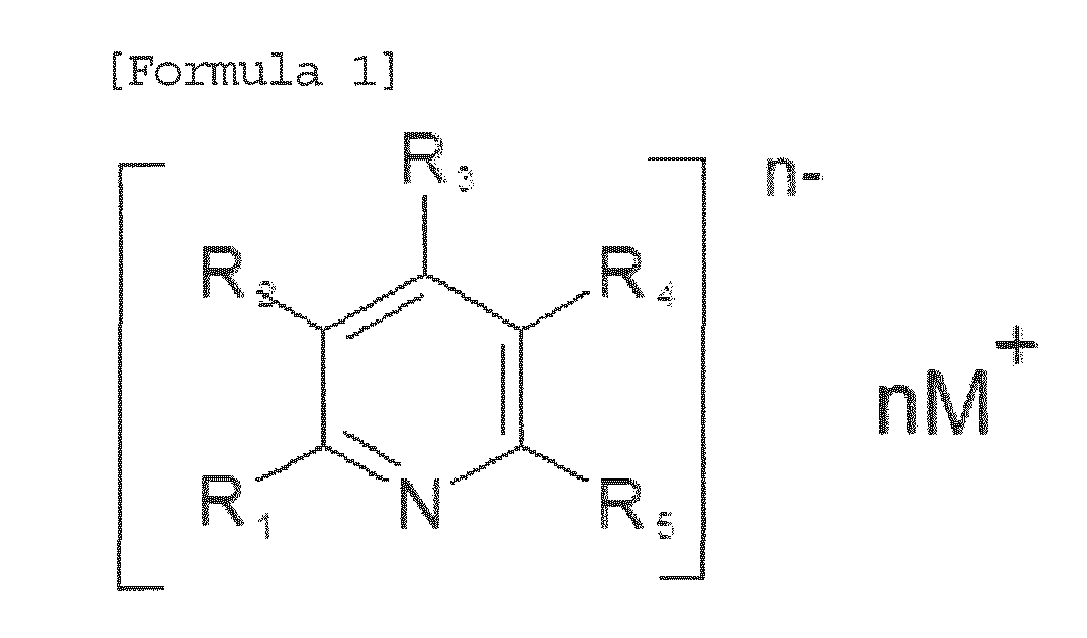
- the present disclosure provides a polymerization initiator, a compound represented by the following formula 1: wherein R 1 to R 5 are each independently hydrogen or a C 1-10 alkylgroup or its carbanion; n- represents the number of negative charges of the carbanion and is 1- to 5-; M is a metal; and n is equal to the number of carbanions in R 1 to R 5 .
- the present disclosure also provides a polymerization initiator solution comprising one or more compounds represented by formula 1, an aprotic solvent and a polar solvent.
- the present disclosure also provides a polymerization initiator composition comprising two or more compounds represented by the following formula 2.
- the present disclosure also provides a modified conjugated diene polymer comprising agroup represented by the following formula 2: wherein R' 1 to R' 5 are each independently hydrogen or a C 1-10 alkyl or alkylenegroup, and at least in R' 1 to R' 5 is an alkylenegroup linked to the conjugated diene polymer chain.
- the present disclosure also provides a modified conjugated diene polymer composition comprising 100 parts by weight of the modified conjugated diene polymer and 10-200 parts by weight of an organic filler.
- the present disclosure also provides a tire produced from the modified conjugated diene polymer composition.
- a polymerization initiator according to the present disclosure is a compound represented by the following formula 1: wherein R 1 to R 5 are each independently hydrogen or a C 1-10 alkylgroup or its carbanion; n- represents the number of negative charges of the carbanion and is 1- to 5-; M is a metal; and n is equal to the number of carbanions in R 1 to R 5 .
- R 1 to R 5 are each independently hydrogen or C 1-5 alkylgroup or its carbanion. In another embodiment, R 1 to R 5 are each independently hydrogen or C 1-2 alkylgroup or its carbanion.
- n- is 1- to 3-. In another embodiment, n- is 1- or 2-.
- M is Li, Na, K or Cs. In another embodiment, M is Li or Na.
- the polymerization initiator according to the present disclosure is highly active and ensures sufficient randominization of monomers to produce a high-vinyl conjugated diene polymer having a decreased content of block styrene.
- a method for preparing the polymerization initiator of the present disclosure comprises reacting a compound represented by the following formula 3 with a compound represented by the following formula 4: wherein R 6 to R 10 are each independently hydrogen or a C 1-10 alkylgroup; and Formula 4 R (Li) x wherein R is a C 1-20 hydrocarbylgroup, and x is an integer ranging from 1 to 4.
- R 6 to R 10 are each independently hydrogen or a C 1-10 alkylgroup. In another embodiment, R 6 to R 10 are each independently hydrogen or a C 1-5 alkylgroup. In still another embodiment, R 6 to R 10 are each independently hydrogen or a C 1-2 alkylgroup.
- At least one of R 6 to R 10 is a C 1-10 alkylgroup, a C 1-5 alkylgroup, a methylgroup or an ethylgroup.
- the compound represented by formula 3 may be one or more selected from thegroup consisting of 2-methylpyridine, 3-methylpyridine, 4-methylpyridine, 2,3-dimethylpyridine, 2,4-dimethylpyridine, 2,5-dimethylpyridine, 2,6-dimethylpyridine, 3,4-dimethylpyridine, 3,5-dimethylpyridine, 2,3,4-trimethylpyridine, 2,4,5-trimethylpyridine, 2,4,6-trimethylpyridine, 2,3,4,5-tetramethylpyridine, 2,3,4,6-tetramethylpyridine and 2,3,5,6-tetramethylpyridine.
- R in formula 4 is a C 2-8 hydrocarbylgroup, a C 1-20 alkylgroup or a C 2-8 alkylgroup.
- R may be an aliphatic or alicyclicgroup, for example, an alkyl, cycloalkyl, cycloalkylalkyl, alkylcycloalkyl, aryl or alkylarylgroup.
- R is methyl, ethyl, n-propyl, isopropyl, n-butyl, isobutyl, t-butyl, n-amyl, isoamyl, n-hexyl, n-octyl, n-decyl, cyclopentyl, cyclohexylethyl, cyclopentylethyl, methylcyclopentylethyl, cyclopentyl, dimethylcyclopentyl, ethylcyclopentyl, methylcyclohexyl, dimethylcyclohexyl, ethylcyclohexyl or isopropylhexyl.
- the compound represented by formula 4 may be an organic lithium compound, for example, p-tolyl lithium, 4-phenyl lithium, 4-butylcyclohexyl lithium, 4-cyclohexylbutyl lithium, lithium dialkylamine, lithium dialkyl phosphine, lithium alkyl aryl phosphine, lithium diaryl phosphine or the like.
- the method for preparing the polymerization initiator of the present disclosure comprises reacting the component of formula 3 with the compound of formula 4 with stirring at a predetermined reaction temperature in the presence of a polar additive and a solvent.
- the method for preparing the polymerization initiator of the present disclosure may be carried out according to the following reaction scheme 1:
- the method for preparing the polymerization initiator of the present disclosure may be carried out according to the following reaction scheme 2:
- the reaction temperature may be, for example, -70 to 50°C or 0 to 50°C. In this temperature range, the activity of the compound represented by formula 4 is not reduced, and the reaction is easily carried out.
- the reaction time may be 5 minutes to 48 hours, 30 minutes to 30 hours, or 50 minutes to 26 hours. In this reaction time range, the activity of the compound represented by formula 4 is not reduced, and the reaction is easily carried out.
- the polar additive is a base.
- the polar additive is ether, amine or a mixture thereof.
- the polar additive is selected from thegroup consisting of tetrahydrofuran, ditetrahydrofurylpropane, diethylether, cycloamyl ether, dipropylether, ethylene dimethyl ether, diethyleneglycol, dimethyl ether, tert-butoxyethoxyethane, bis-(2-dimethylaminoethyl)ether, (dimethylaminoethyl)ethyl ether, trimethylamine, triethylamine, tripropylamine and tetramethylethylenediamine.
- the polar additive is triethylamine or tetramethylethylenediamine.
- the solvent may be an aprotic solvent.
- the molar ratio between the compound of formula 3 and the compound of formula 4 is 0.01:1 to 1:0.01, 0.1:1 to 1:0.1, or 0.5:1 to 1:0.5.
- the molar ratio between the compound of formula 3 and the compound of formula 4 is 1:1 to 1:2, 1:1.01 to 1:1.50, or 1:1.1 to 1:1.4.
- a polar solvent may optionally be added to the aprotic solvent in order to increase the rate of polymerization or control the structure of the polymer. In this case, the solubility of the solute is increased to promote the reaction.
- the polymerization initiator solution of the present disclosure comprises one or more compounds represented by the following formula 1, a solvent and a polar additive: wherein R 1 to R 5 are each independently hydrogen or a C 1-10 alkylgroup or its carbanion; n- represents the number of negative charges of the carbanion and is 1- to 5-; M is a metal; and n is equal to the number of carbanions in R 1 to R 5 .
- the one or more compounds represented by formula 1 may be a mixture of a compound wherein n is 1 with a compound wherein n is 2-5.
- the compound of formula 1 wherein n is 2-5 can substantially serves as a coupling agent, because the initiation of polymerization occurs in 2 to 5 directions.
- a high-molecular-weight polymer can be obtained, which has not only improved compatibility with an inorganic filler which is added to a rubber polymer composition for tires, but also various improved properties.
- the one or more compounds represented by formula 1 may be a mixture of the compound of formula 1, wherein R 2 to R 4 1 are each hydrogen, R 1 is an alkylgroup, and R 5 is a carbaniongroup formed by removal of hydrogen cation from an alkylgroup (therefore, n is 1-), with the compound of formula 1 wherein R 2 to R 4 in formula 1 are each hydrogen, and R 1 and R 5 is a carbaniongroup formed by removal of hydrogen cation from an alkylgroup (therefore, n is 2-).
- the solvent is an aprotic solvent.
- the solvent is a hydrocarbon solvent.
- the solvent is an aromatic hydrocarbon solvent, an alicyclic hydrocarbon solvent or an aliphatic hydrocarbon solvent.
- the solvent may be one or more selected from among benzene, toluene, xylene, ethylbenzene, cyclohexane, methyl cyclohexane, cyclooctane, propane, butane, pentane, n-hexane, n-heptane, octane, decane and so on.
- the polar additive is a base, and in another embodiment, it may be ether, amine or a mixture thereof.
- the polar additive may be used in an amount of 0.1-40 moles or 0.1-10 moles per mole of the compound represented by formula 1.
- the polar additive may be added during synthesis of the polymerization initiator or preparation of the conjugated diene polymer.
- the polar additive When the polar additive is added during preparation of the conjugated diene polymer, it may be added in an amount of, for example, about 300-1,500 parts by weight based on a total of 100 parts by weight of the monomer added.
- the polymerization initiator solution may be used for homopolymerization of a conjugated diene monomer or copolymerization of a conjugated diene monomer and a vinyl monomer.
- the polymerization initiator composition of the present disclosure comprises two or more compounds represented by the following formula 1: wherein R 1 to R 5 are each independently hydrogen or a C 1-10 alkylgroup or its carbanion; n- represents the number of negative charges of the carbanion and is 1- to 5-; M is a metal; and n is equal to the number of carbanions in R 1 to R 5 .
- the molar ratio between the compound of formula 1 wherein n is 1 and the compound of formula 1 wherein n is 2 to 5 is 1:0.0001 to 0.0001:1, 1:0.1 to 1:2.0, or 1:0.3 to 1:1.3.
- the polymerization initiator composition of the present disclosure may comprise the compound of formula 1 wherein n in formula 1 is 2 and the compound of formula 1 wherein n is 2 to 5.
- the compound of formula 1 wherein n is 2-5 can substantially serve as a coupling agent, because the initiation of polymerization occurs in 2 to 5 directions.
- a high-molecular-weight polymer can be obtained, which has not only improved compatibility with an inorganic filler which is added to a rubber polymer composition for tires, but also various improved properties.
- the polymerization initiator composition of the present disclosure may comprises the compound of formula 1 wherein R 2 to R 4 are each hydrogen, R 1 is an alkylgroup, and R 5 is a carbaniongroup formed by removal of hydrogen cation from an alkylgroup (therefore, n is 1-), with the compound of formula 1 wherein R 2 to R 4 in formula 1 are each hydrogen, and R 1 and R 5 is a carbaniongroup formed by removal of hydrogen cation from an alkylgroup (therefore, n is 2-).
- the modified conjugated diene polymer of the present disclosure comprises agroup represented by the following formula 2: wherein R' 1 to R' 5 are each independently hydrogen or a C 1-10 alkyl or alkylenegroup, and at least one of R' 1 to R' 5 is an alkylenegroup linked to the conjugated diene polymer chain.
- the conjugated diene polymer may have a vinyl content of 25% or more, 25-60%, 30-45%, or 35-45%.
- theglass transition temperature of the polymer is increased, and thus when the polymer is applied to a tire, it can satisfy physical properties required for the tire, such as running resistance and braking force, and reduce fuel consumption.
- vinyl content refers to either the content of a unit having a vinylgroup or the content of a 1,2-addition (which is not a 1,4-addition) conjugated diene monomer relative to 100 wt% of conjugated diene monomers.
- the modified conjugated diene polymer may be a polymer comprising either a conjugated diene monomer alone or the conjugated diene monomer and an aromatic vinyl monomer in an amount of 0.0001-40 wt% based on 100 wt% of the sum of the conjugated diene monomer and the aromatic vinyl monomer.
- the modified conjugated diene polymer has a weight-average molecular weight of 5,000-5,000,000, 50,000-1,000,000, 100,000-600,000, or 300,000-500,000.
- the modified diene polymer of the present disclosure is a modified conjugated diene random polymer.
- the modified conjugated diene copolymer of the present disclosure may further comprise aromatic oil.
- the aromatic oil is not specifically limited, as long as it cangenerally be used in tire rubber compositions.
- the aromatic oil may be TDAE (treated distillate aromatic extract) oil.
- the aromatic oil cangreatly improve the processability of a conjugated diene polymer (e.g., SBR) having a high molecular weight.
- the aromatic oil may be used in an amount of 1-100 parts by weight or 10-50 parts by weight based on 100 parts by weight of the polymer. In this aromatic oil content range, the processability of the conjugated diene polymer prepared is improved and the Mooney viscosity is maintained or increased.
- the modified conjugated diene polymer can be prepared, for example, by solution-polymerizing a conjugated diene monomer using the polymerization initiator in the presence of an aprotic solvent.
- the solution polymerization has advantages over emulsion polymerization in that the vinyl content and aromatic vinyl monomer (unit) content of the polymer, which determine the physical properties of rubber, can be optionally controlled, and the molecular weight and physical properties of the polymer can be easily controlled by coupling or modification.
- the modified conjugated diene polymers e.g., SBR or BR
- SBR or BR modified conjugated diene polymers
- the solution polymerization may be carried out at 20°C to 80°C for 1-5 hours.
- the polymerization initiator may be used in an amount of, for example, 0.01-10mmol, 0.1-2mmol or 0.2-1.0mmol based on 150g of the monomer used.
- the conjugated diene monomer is one or more selected from thegroup consisting of 1,3-butadiene, isoprene, 2,3-dimethyl-1,3-butadiene, 1,3-pentadiene, 2-methyl-3-ethyl-1,3-butadiene, 3-methyl-1,3-pentadiene, 1,3-hexadiene, 2-methyl-1,3-hexadiene, and 3-butyl-1,3-octadiene.
- the conjugated diene monomer is 1,3-butadiene or isoprene.
- the aromatic vinyl monomer is one or more selected from thegroup consisting of styrene, ⁇ -methyl styrene, 1-vinyl naphthalene, 2-vinyl naphthalene, 1- ⁇ -methyl vinyl naphthalene, 2- ⁇ -methyl vinyl naphthalene, 4-methyl styrene, vinyl toluene, 3,5-diethyl styrene, 2-ethyl-4-benzyl styrene, 4-phenyl styrene, 4-p-tolyl styrene, and 4,5-dimethyl-1-vinyl naphthalene.
- the aromatic vinyl monomer is styrene.
- the modified conjugated diene polymer may have a PDI of for example, 0.5-10, 0.5-5, or 1.0-1.5.
- the modified conjugated diene polymer has a Tan ⁇ at 0°C of 0.6-0.75 as measured at 10 Hz by DMA after mixture of silica.
- Tan ⁇ the rolling resistance and wet skid resistance of a tire produced from the polymer aregreatly improved compared to those of conventional tires.
- the modified conjugated diene polymer of the present disclosure may have a Tan ⁇ at 60°C of, for example, 0.07-0.09.
- the rolling resistance (RR) of a tire produced from the polymer isgreatly improved compared to those of conventional tires.
- the modified conjugated diene polymer rubber composition of the present disclosure comprises 100 parts by weight of the modified conjugated diene polymer and 10-200 parts by weight of an inorganic filler.
- the modified conjugated diene polymer rubber composition of the present disclosure shows improved wear resistance, high wet skid resistance and low rolling resistance, because the modified conjugated diene polymer has excellent compatibility with the inorganic filler.
- the inorganic filler is not specifically limited as long as it maygenerally be applied to the conjugated diene polymer.
- the inorganic filler may be silica, carbon black or a mixture thereof.
- the modified conjugated diene polymer rubber composition may further comprise 1-100 parts by weight of oil.
- the oil may be, for example, mineral oil or a softening agent.
- the oil may be used in an amount of, for example, 10-100 parts by weight or 20-80 parts by weight based on 100 parts by weight of the conjugated diene polymer. In this oil content range, the oil promotes the expression of the physical properties of the rubber composition and suitably softens the rubber composition to increase the processability of the composition.
- the tire of the present disclosure is produced from the modified conjugated diene polymer rubber composition.
- the polymerization product was added to steam-heated hot water, and the solvent was removed by stirring. Then, the remaining material was roll-dried to remove the remaining solvent and water.
- Table 1 The results of analysis of the modified conjugated diene polymer thus prepared are shown in Table 1 below.
- a modified conjugated diene polymer was prepared in the same manner as Example 1, except that N,N,N',N'-tetramethylethylenediamine was not added.
- the results of analysis of the modified conjugated diene polymer thus prepared are shown in Table 1 below.
- a modified conjugated diene polymer was prepared in the same manner as Example 1, except that 0.4mmol of N,N,N',N'-tetramethylethylenediamine was added.
- the results of analysis of the modified conjugated diene polymer thus prepared are shown in Table 1 below.
- a conjugated diene polymer was prepared in the same manner as Example 1, except that 0.16 ml (0.4mmol) of 2.5 M n-butyllithium (n-BuLi)/hexane solution was used instead of the polymerization initiator of the present disclosure.
- the polymerization product was treated in the same manner as Example 1, and the results of analysis of the conjugated diene polymer thus prepared are shown in Table 1 below.
- a conjugated diene polymer was prepared in the same manner as Comparative Example 1, except that 0.4mmol of N,N,N',N'-tetramethylethylenediamine was used.
- the polymerization product was treated in the same manner as Example 1, and the results of analysis of the conjugated diene polymer thus prepared are shown in Table 1 below.
- a conjugated diene polymer was prepared in the same manner as Comparative Example 1, except that 0.8mmol of N,N,N',N'-tetramethylethylenediamine was used.
- the polymerization product was treated in the same manner as Example 1, and the results of analysis of the conjugated diene polymer thus prepared are shown in Table 1 below.
- the polymers prepared in the Examples and the Comparative Examples were analyzed by NMR (nuclear magnetic resonance) using conventional methods to measure the fine structure of the conjugated diene compound, the composition ratio of the conjugated diene compound to the vinyl compound, and the random or block ratio of the conjugated diene compound and the vinyl compound.
- the polymerization product was added to steam-heated hot water, and the solvent was removed by stirring. Then, the remaining material was roll-dried to remove the remaining solvent and water.
- Table 2 The results of analysis of the modified conjugated diene polymer thus prepared are shown in Table 2 below.
- a polymerization initiator was prepared in the same manner as Example 4, except that the reaction was carried out for 4 hours and 30 minutes. Using the polymerization initiator, a modified conjugated diene polymer was prepared in the same manner as Example 4. The results of analysis of the modified conjugated diene polymer thus prepared are shown in Table 2 below.
- a polymerization initiator was prepared in the same manner as Example 4, except that the reaction was carried out for 25 hours. Using the polymerization initiator, a modified conjugated diene polymer was prepared in the same manner as Example 4. The results of analysis of the modified conjugated diene polymer thus prepared are shown in Table 2 below.
- a polymerization initiator was prepared in the same manner as Example 4, except that 0.72g (6.6mmol) of dimethyl pyridine was used. Using the polymerization initiator, a modified conjugated diene polymer was prepared in the same manner as Example 4. The results of analysis of the modified conjugated diene polymer thus prepared are shown in Table 2 below.
- a polymerization initiator was prepared in the same manner as Example 4, except that 0.4mmol of n-butyllithium was used. Using the polymerization initiator, a modified conjugated diene polymer was prepared in the same manner as Example 4. The results of analysis of the conjugated diene polymer thus prepared are shown in Table 2 below.
- reaction product was concentrated, and the concentrate was dissolved in ethyl acetate, washed with water and saline, dried with anhydrous magnesium sulfate, and then concentrated again, thereby obtaining crude 2-ethyl-6-methylpyridine.
- the obtained crude 2-ethyl-6-methylpyridine was purified by column chromatography (stationary phase: silicagel; eluent: n-hexane/ethyl acetate (6/1)), thereby obtaining 3.2g of 2-ethyl-6-methylpyridine as liquid.
- the obtained 2-ethyl-6-methylpyridine was analyzed by NMR.
- the solution was cooled to -40°C, and 28.7 ml (46mmol) of 1.6 M n-butyllithium in hexane was added dropwise. At this time, the solution changed to deep red. Next, the solution was stirred for 1 hour, and then cooled to 0°C, after which 6.0g (42mmol) of methyl iodide was added thereto dropwise. Then, the cooling bath was removed, and the solution was stirred at room temperature for 1 hour, and then concentrated. The concentrate was dissolved in ethyl acetate, washed with water and saline, dried with anhydrous magnesium sulfate, and then concentrated again.
- the concentrate was purified by column chromatography (stationary phase: silicagel; eluent: n-hexane/ethyl acetate (6/1), thereby obtaining 2g of 2,6-diethyl pyridine as liquid.
- the obtained 2,6-diethyl pyridine was analyzed by NMR.
- a modified conjugated diene polymer was prepared in the same manner as Example 8, except that 1.14mmol of 2,6-diethyl pyridine was added during the preparation of the polymerization initiator.
- the results of analysis of the prepared modified conjugated diene polymer are shown in Table 3 below.
- a modified conjugated diene polymer was prepared in the same manner as Example 8, except that 1.14mmol of 2,6-dimethyl pyridine was added during the preparation of the polymerization initiator.
- the results of analysis of the prepared modified conjugated diene polymer are shown in Table 3 below.
- a modified conjugated diene polymer was prepared in the same manner as Example 8, except that 1mmol of n-butyllithium that is not the polymerization initiator of the present disclosure was added during the preparation of the polymerization initiator.
- the results of analysis of the prepared conjugated diene polymer are shown in Table 3 below.
- the molecular weights of the modified conjugated diene polymers prepared in Examples 8 to 10 were substantially equal to that of the conjugated diene polymer prepared in Comparative Example 5 using the conventional organic lithium initiator, even though the amount of initiator added was about two times larger than that in Comparative Example 5. This suggests that the polymerization initiator of the present disclosure also functioned as a coupling agent.
- the polymerization product was added to steam-heated hot water, and the solvent was removed by stirring. Then, the remaining material was roll-dried to remove the remaining solvent and water.
- Table 4 The results of analysis of the modified conjugated diene polymer thus prepared are shown in Table 4 below.
- a polymerization product was obtained in the same manner as Example 11.
- aromatic oil (TDEA) was added in an amount of 37.5 parts by weight based on 100 parts by weight of the polymerization product, thereby obtaining an oil-containing polymerization or copolymerization product.
- the polymerization product was added to steam-heated hot water, and the solvent was removed by stirring. Then, the remaining material was roll-dried to remove the remaining solvent and water.
- Table 4 The results of analysis of the modified conjugated diene polymer thus prepared are shown in Table 4 below.
- a conjugated diene polymer was prepared in the same manner as Example 11, except that 0.16 ml (0.4mmol based on lithium) of 2.5 M n-butyllithium (NBL)/hexane solution was used instead of the polymerization initiator of the present disclosure and that 1.06g (0.9mmol) of N,N,N',N'-tetramethylethylenediamine was used.
- NBL n-butyllithium
- a conjugated diene polymer was prepared in the same manner as Example 12, except that 1.2 ml (0.3mmol based on lithium) of 2.5 M n-butyllithium (NBL)/hexane solution was used instead of the polymerization initiator of the present disclosure and that 0.81g (0.7mmol) of N,N,N',N'-tetramethylethylenediamine was used.
- NBL n-butyllithium
- the raw material rubber conjugated diene polymer
- a filler an organosilane coupling agent, oil, zinc oxide, a stearic acid antioxidant, an anti-aging agent, wax and an accelerator
- the temperature of the kneader was controlled, and a first blend was obtained at a discharge temperature of 140 to 150°C.
- stage-2 kneading the first blend was cooled to room temperature, and then rubber, sulfur and a vulcanization accelerator were added to the kneader, and a second blend was obtained at a discharge temperature of 45 to 60°C.
- stage-3 kneading the second blend was molded and vulcanized with a vulcanization press at 180°C for T90+10 minutes, thereby preparing vulcanized rubbers.
- a dynamic mechanical analyzer (TA Instruments, Inc.) was used.
- the Tan ⁇ was measured at varying temperatures (0-60°C) in a twist mode at a frequency of 10 Hz while changing strain.
- the Payne effect was expressed as a difference between the highest value and the lowest value at a strain of 0.2-40%.
- the smaller the Payne effect the better the dispersibility of a filler such as silica.
- the higher the Tan ⁇ at 0°C the better the wet skid resistance.
- the Tan ⁇ at 60°C the lower the hysteresis loss, and the lower the rolling resistance (i.e., high fuel efficiency).
- the properties of the vulcanized rubbers are shown in Table 6 below.
- the present disclosure provides a modified conjugated diene polymer, which has a high vinyl content, excellent compatibility with inorganic fillers andgood properties in terms of braking force, viscoelasticity, wear performance and fuel economy, and a tire comprising the modified conjugated diene polymer and having low rolling resistance and excellent wet skin resistance.
Landscapes
- Chemical & Material Sciences (AREA)
- Organic Chemistry (AREA)
- Health & Medical Sciences (AREA)
- Chemical Kinetics & Catalysis (AREA)
- Medicinal Chemistry (AREA)
- Polymers & Plastics (AREA)
- Engineering & Computer Science (AREA)
- Materials Engineering (AREA)
- General Chemical & Material Sciences (AREA)
- Mechanical Engineering (AREA)
- Addition Polymer Or Copolymer, Post-Treatments, Or Chemical Modifications (AREA)
- Polymerization Catalysts (AREA)
- Tires In General (AREA)
- Pyridine Compounds (AREA)
- Compositions Of Macromolecular Compounds (AREA)
Abstract
Description
- The present disclosure relates to a polymerization initiator, a modified conjugated diene polymer and a tire produced therefrom.
- At present, conjugated diene polymers having low rolling resistance and excellent wear resistance and wet skid resistance are used as rubber for tires.
- The rolling resistance of tires is reduced by reducing the hysteresis loss of vulcanized rubber. As rubber materials having a low hysteresis loss, natural rubber and the like are known, but they have a problem of low wet skid resistance.
- For this reason, conjugated diene polymers such as styrene-butadiene rubber (hereinafter referred to as SBR) or butadiene rubber (hereinafter referred to as BR), which are prepared by emulsion polymerization or solution polymerization, have recently been used as rubber for tires.
- Meanwhile, solution-polymerized SBR is prepared using an anionic polymerization initiator. As the anionic polymerization initiator, alkyl lithium is mainly used.
- However, the above rubber materials for tires still have problems in that improvement in the hysteresis loss or wear resistance thereof is insufficient and blending of the rubber materials does not show sufficient effects and reduces the processability of the rubber materials.
- It is an object of the present disclosure to solve the above-described problems occurring in the art and to provide an end-modified conjugated diene polymer, which has a high vinyl content, excellent compatibility with inorganic fillers and good properties in terms of braking force, viscoelasticity, wear performance and fuel economy, and a tire comprising the end-modified conjugated diene polymer and having low rolling resistance and excellent wet skin resistance.
- Another object of the present disclosure is to provide a polymerization initiator for use in the preparation of the end-modified conjugated diene polymer, a solution thereof and a composition thereof.
- To achieve the above objects, the present disclosure provides a polymerization initiator, a compound represented by the following formula 1:

- The present disclosure also provides a polymerization initiator solution comprising one or more compounds represented by formula 1, an aprotic solvent and a polar solvent.
- The present disclosure also provides a polymerization initiator composition comprising two or more compounds represented by the following formula 2.
- The present disclosure also provides a modified conjugated diene polymer comprising agroup represented by the following formula 2:

- The present disclosure also provides a modified conjugated diene polymer composition comprising 100 parts by weight of the modified conjugated diene polymer and 10-200 parts by weight of an organic filler.
- The present disclosure also provides a tire produced from the modified conjugated diene polymer composition.
- Hereinafter, description will be made in detail on a polymerization initiator, a solution thereof, a composition thereof, a polymer prepared therefrom, a composition comprising the same and a tire produced therefrom.
- A polymerization initiator according to the present disclosure is a compound represented by the following formula 1:

- In one embodiment of the present disclosure, R1 to R5 are each independently hydrogen or C1-5 alkylgroup or its carbanion. In another embodiment, R1 to R5 are each independently hydrogen or C1-2 alkylgroup or its carbanion.
- In one embodiment, n- is 1- to 3-. In another embodiment, n- is 1- or 2-.
- In one embodiment, M is Li, Na, K or Cs. In another embodiment, M is Li or Na.
- The polymerization initiator according to the present disclosure is highly active and ensures sufficient randominization of monomers to produce a high-vinyl conjugated diene polymer having a decreased content of block styrene.
- In one embodiment, a method for preparing the polymerization initiator of the present disclosure comprises reacting a compound represented by the following formula 3 with a compound represented by the following formula 4:

Formula 4 R (Li)x
wherein R is a C1-20 hydrocarbylgroup, and x is an integer ranging from 1 to 4. - In one embodiment, R6 to R10 are each independently hydrogen or a C1-10 alkylgroup. In another embodiment, R6 to R10 are each independently hydrogen or a C1-5 alkylgroup. In still another embodiment, R6 to R10 are each independently hydrogen or a C1-2 alkylgroup.
- In still another embodiment, at least one of R6 to R10 is a C1-10 alkylgroup, a C1-5 alkylgroup, a methylgroup or an ethylgroup.
- In one embodiment, the compound represented by formula 3 may be one or more selected from thegroup consisting of 2-methylpyridine, 3-methylpyridine, 4-methylpyridine, 2,3-dimethylpyridine, 2,4-dimethylpyridine, 2,5-dimethylpyridine, 2,6-dimethylpyridine, 3,4-dimethylpyridine, 3,5-dimethylpyridine, 2,3,4-trimethylpyridine, 2,4,5-trimethylpyridine, 2,4,6-trimethylpyridine, 2,3,4,5-tetramethylpyridine, 2,3,4,6-tetramethylpyridine and 2,3,5,6-tetramethylpyridine.
- In one embodiment, R in formula 4 is a C2-8 hydrocarbylgroup, a C1-20 alkylgroup or a C2-8 alkylgroup.
- In another embodiment, R may be an aliphatic or alicyclicgroup, for example, an alkyl, cycloalkyl, cycloalkylalkyl, alkylcycloalkyl, aryl or alkylarylgroup.
- In still another embodiment, R is methyl, ethyl, n-propyl, isopropyl, n-butyl, isobutyl, t-butyl, n-amyl, isoamyl, n-hexyl, n-octyl, n-decyl, cyclopentyl, cyclohexylethyl, cyclopentylethyl, methylcyclopentylethyl, cyclopentyl, dimethylcyclopentyl, ethylcyclopentyl, methylcyclohexyl, dimethylcyclohexyl, ethylcyclohexyl or isopropylhexyl.
- In one embodiment, the compound represented by formula 4 may be an organic lithium compound, for example, p-tolyl lithium, 4-phenyl lithium, 4-butylcyclohexyl lithium, 4-cyclohexylbutyl lithium, lithium dialkylamine, lithium dialkyl phosphine, lithium alkyl aryl phosphine, lithium diaryl phosphine or the like.
- In another embodiment, the method for preparing the polymerization initiator of the present disclosure comprises reacting the component of formula 3 with the compound of formula 4 with stirring at a predetermined reaction temperature in the presence of a polar additive and a solvent.
- In one embodiment, the method for preparing the polymerization initiator of the present disclosure may be carried out according to the following reaction scheme 1:


- In another embodiment, the method for preparing the polymerization initiator of the present disclosure may be carried out according to the following reaction scheme 2:

- The reaction temperature may be, for example, -70 to 50°C or 0 to 50°C. In this temperature range, the activity of the compound represented by formula 4 is not reduced, and the reaction is easily carried out.
- The reaction time may be 5 minutes to 48 hours, 30 minutes to 30 hours, or 50 minutes to 26 hours. In this reaction time range, the activity of the compound represented by formula 4 is not reduced, and the reaction is easily carried out.
- In one embodiment, the polar additive is a base. In another embodiment, the polar additive is ether, amine or a mixture thereof. In still another embodiment, the polar additive is selected from thegroup consisting of tetrahydrofuran, ditetrahydrofurylpropane, diethylether, cycloamyl ether, dipropylether, ethylene dimethyl ether, diethyleneglycol, dimethyl ether, tert-butoxyethoxyethane, bis-(2-dimethylaminoethyl)ether, (dimethylaminoethyl)ethyl ether, trimethylamine, triethylamine, tripropylamine and tetramethylethylenediamine. In another embodiment, the polar additive is triethylamine or tetramethylethylenediamine.
- The solvent may be an aprotic solvent.
- In one embodiment, the molar ratio between the compound of formula 3 and the compound of formula 4 is 0.01:1 to 1:0.01, 0.1:1 to 1:0.1, or 0.5:1 to 1:0.5.
- In another embodiment, the molar ratio between the compound of formula 3 and the compound of formula 4 is 1:1 to 1:2, 1:1.01 to 1:1.50, or 1:1.1 to 1:1.4.
- In addition, in the method for preparing the polymerization initiator of the present disclosure, a polar solvent may optionally be added to the aprotic solvent in order to increase the rate of polymerization or control the structure of the polymer. In this case, the solubility of the solute is increased to promote the reaction.
- The polymerization initiator solution of the present disclosure comprises one or more compounds represented by the following formula 1, a solvent and a polar additive:

- In one embodiment, the one or more compounds represented by formula 1 may be a mixture of a compound wherein n is 1 with a compound wherein n is 2-5. In this case, the compound of formula 1 wherein n is 2-5 can substantially serves as a coupling agent, because the initiation of polymerization occurs in 2 to 5 directions. Thus, a high-molecular-weight polymer can be obtained, which has not only improved compatibility with an inorganic filler which is added to a rubber polymer composition for tires, but also various improved properties.
- In one embodiment, the one or more compounds represented by formula 1 may be a mixture of the compound of formula 1, wherein R2 to R4 1 are each hydrogen, R1 is an alkylgroup, and R5 is a carbaniongroup formed by removal of hydrogen cation from an alkylgroup (therefore, n is 1-), with the compound of formula 1 wherein R2 to R4 in formula 1 are each hydrogen, and R1 and R5 is a carbaniongroup formed by removal of hydrogen cation from an alkylgroup (therefore, n is 2-).
- In one embodiment, the solvent is an aprotic solvent. In another embodiment, the solvent is a hydrocarbon solvent. In still another embodiment, the solvent is an aromatic hydrocarbon solvent, an alicyclic hydrocarbon solvent or an aliphatic hydrocarbon solvent. Specifically, the solvent may be one or more selected from among benzene, toluene, xylene, ethylbenzene, cyclohexane, methyl cyclohexane, cyclooctane, propane, butane, pentane, n-hexane, n-heptane, octane, decane and so on.
- In one embodiment, the polar additive is a base, and in another embodiment, it may be ether, amine or a mixture thereof. The polar additive may be used in an amount of 0.1-40 moles or 0.1-10 moles per mole of the compound represented by formula 1.
- When a conjugated diene monomer is copolymerized with a vinyl aromatic monomer, a block copolymer is easily prepared due to the difference in reaction rate between the monomers. However, when a polar additive is added to the monomers, it increases the reaction rate of the vinyl aromatic compound having a slow reaction rate to induce, for example, a random copolymer.
- In one embodiment, the polar additive may be added during synthesis of the polymerization initiator or preparation of the conjugated diene polymer.
- When the polar additive is added during preparation of the conjugated diene polymer, it may be added in an amount of, for example, about 300-1,500 parts by weight based on a total of 100 parts by weight of the monomer added.
- In one embodiment, the polymerization initiator solution may be used for homopolymerization of a conjugated diene monomer or copolymerization of a conjugated diene monomer and a vinyl monomer.
- The polymerization initiator composition of the present disclosure comprises two or more compounds represented by the following formula 1:

- In one embodiment, the molar ratio between the compound of formula 1 wherein n is 1 and the compound of formula 1 wherein n is 2 to 5 is 1:0.0001 to 0.0001:1, 1:0.1 to 1:2.0, or 1:0.3 to 1:1.3.
- In one embodiment, the polymerization initiator composition of the present disclosure may comprise the compound of formula 1 wherein n in formula 1 is 2 and the compound of formula 1 wherein n is 2 to 5. In this case, the compound of formula 1 wherein n is 2-5 can substantially serve as a coupling agent, because the initiation of polymerization occurs in 2 to 5 directions. Thus, a high-molecular-weight polymer can be obtained, which has not only improved compatibility with an inorganic filler which is added to a rubber polymer composition for tires, but also various improved properties.
- In another embodiment, the polymerization initiator composition of the present disclosure may comprises the compound of formula 1 wherein R2 to R4 are each hydrogen, R1 is an alkylgroup, and R5 is a carbaniongroup formed by removal of hydrogen cation from an alkylgroup (therefore, n is 1-), with the compound of formula 1 wherein R2 to R4 in formula 1 are each hydrogen, and R1 and R5 is a carbaniongroup formed by removal of hydrogen cation from an alkylgroup (therefore, n is 2-).
- The modified conjugated diene polymer of the present disclosure comprises agroup represented by the following formula 2:

- In one embodiment, the conjugated diene polymer may have a vinyl content of 25% or more, 25-60%, 30-45%, or 35-45%. In this vinyl content range, theglass transition temperature of the polymer is increased, and thus when the polymer is applied to a tire, it can satisfy physical properties required for the tire, such as running resistance and braking force, and reduce fuel consumption.
- As used herein, the term "vinyl content" refers to either the content of a unit having a vinylgroup or the content of a 1,2-addition (which is not a 1,4-addition) conjugated diene monomer relative to 100 wt% of conjugated diene monomers.
- In one embodiment, the modified conjugated diene polymer may be a polymer comprising either a conjugated diene monomer alone or the conjugated diene monomer and an aromatic vinyl monomer in an amount of 0.0001-40 wt% based on 100 wt% of the sum of the conjugated diene monomer and the aromatic vinyl monomer.
- In one embodiment, the modified conjugated diene polymer has a weight-average molecular weight of 5,000-5,000,000, 50,000-1,000,000, 100,000-600,000, or 300,000-500,000.
- In one embodiment, the modified diene polymer of the present disclosure is a modified conjugated diene random polymer.
- The modified conjugated diene copolymer of the present disclosure may further comprise aromatic oil. The aromatic oil is not specifically limited, as long as it cangenerally be used in tire rubber compositions. For example, the aromatic oil may be TDAE (treated distillate aromatic extract) oil. In this case, the aromatic oil cangreatly improve the processability of a conjugated diene polymer (e.g., SBR) having a high molecular weight.
- The aromatic oil may be used in an amount of 1-100 parts by weight or 10-50 parts by weight based on 100 parts by weight of the polymer. In this aromatic oil content range, the processability of the conjugated diene polymer prepared is improved and the Mooney viscosity is maintained or increased.
- Meanwhile, the modified conjugated diene polymer can be prepared, for example, by solution-polymerizing a conjugated diene monomer using the polymerization initiator in the presence of an aprotic solvent.
- The solution polymerization has advantages over emulsion polymerization in that the vinyl content and aromatic vinyl monomer (unit) content of the polymer, which determine the physical properties of rubber, can be optionally controlled, and the molecular weight and physical properties of the polymer can be easily controlled by coupling or modification. Thus, the modified conjugated diene polymers (e.g., SBR or BR) prepared by solution polymerization show small end-chain movement and have affinity or compatibility with carbon black, and thus are frequently used as tire rubber materials.
- For example, the solution polymerization may be carried out at 20°C to 80°C for 1-5 hours.
- In the solution polymerization, the polymerization initiator may be used in an amount of, for example, 0.01-10mmol, 0.1-2mmol or 0.2-1.0mmol based on 150g of the monomer used.
- In one embodiment, the conjugated diene monomer is one or more selected from thegroup consisting of 1,3-butadiene, isoprene, 2,3-dimethyl-1,3-butadiene, 1,3-pentadiene, 2-methyl-3-ethyl-1,3-butadiene, 3-methyl-1,3-pentadiene, 1,3-hexadiene, 2-methyl-1,3-hexadiene, and 3-butyl-1,3-octadiene. In another embodiment, the conjugated diene monomer is 1,3-butadiene or isoprene.
- In one embodiment, the aromatic vinyl monomer (compound) is one or more selected from thegroup consisting of styrene, α-methyl styrene, 1-vinyl naphthalene, 2-vinyl naphthalene, 1-α-methyl vinyl naphthalene, 2-α-methyl vinyl naphthalene, 4-methyl styrene, vinyl toluene, 3,5-diethyl styrene, 2-ethyl-4-benzyl styrene, 4-phenyl styrene, 4-p-tolyl styrene, and 4,5-dimethyl-1-vinyl naphthalene. Preferably, the aromatic vinyl monomer is styrene.
- The modified conjugated diene polymer may have a PDI of for example, 0.5-10, 0.5-5, or 1.0-1.5.
- With respect to viscoelastic properties, the modified conjugated diene polymer has a Tanδ at 0°C of 0.6-0.75 as measured at 10 Hz by DMA after mixture of silica. In this Tanδ range, the rolling resistance and wet skid resistance of a tire produced from the polymer aregreatly improved compared to those of conventional tires.
- In addition, the modified conjugated diene polymer of the present disclosure may have a Tanδ at 60°C of, for example, 0.07-0.09. In this Tanδ range, the rolling resistance (RR) of a tire produced from the polymer isgreatly improved compared to those of conventional tires.
- The modified conjugated diene polymer rubber composition of the present disclosure comprises 100 parts by weight of the modified conjugated diene polymer and 10-200 parts by weight of an inorganic filler.
- The modified conjugated diene polymer rubber composition of the present disclosure shows improved wear resistance, high wet skid resistance and low rolling resistance, because the modified conjugated diene polymer has excellent compatibility with the inorganic filler.
- The inorganic filler is not specifically limited as long as it maygenerally be applied to the conjugated diene polymer. For example, the inorganic filler may be silica, carbon black or a mixture thereof.
- The modified conjugated diene polymer rubber composition may further comprise 1-100 parts by weight of oil.
- The oil may be, for example, mineral oil or a softening agent.
- The oil may be used in an amount of, for example, 10-100 parts by weight or 20-80 parts by weight based on 100 parts by weight of the conjugated diene polymer. In this oil content range, the oil promotes the expression of the physical properties of the rubber composition and suitably softens the rubber composition to increase the processability of the composition.
- The tire of the present disclosure is produced from the modified conjugated diene polymer rubber composition.
- Hereinafter, the present disclosure will be described with reference to examples. These examples describe the polymerization initiator solution of the present disclosure and the modified conjugated diene polymer prepared using the same. These examples are for illustrative purposes only and are not intended to limit the scope of the present disclosure. Unless otherwise specified, all percentages (%) are percentages by weight.
- In a 250-ml round bottom flask, 1.07g (10mmol) of 2,6-dimethyl pyridine was dissolved by addition of 44.8 ml of hexane, and 4 ml (10mmol) of 2.5 M n-butyl lithium was added to the solution. At this time, the solution was opaque yellow in color. Then, the solution was stirred for 1 hour, thereby preparing a polymerization initiator.
- 37g of styrene, 113g of 1,3-butadiene and 600g of n-hexane were introduced into a 2-L Buchi reactor, and then heated with stirring to control the internal temperature of the reactor to 60°C. When the temperature reached 60°C, 0.28mmol of N,N,N',N'-tetramethylethylenediamine and the above-prepared polymerization initiator (0.4mmol based on lithium) were introduced into the reactor and adiabatically heated until the reaction became stable. After adiabatic heating, the reaction temperature was increased to 70°C, and after 60 minutes, the polymerization reaction was stopped by addition of methanol. Then, 5 ml of a solution of 0.3 wt% of the antioxidant BHT (butylated hydroxytoluene) in hexane was added thereto.
- The polymerization product was added to steam-heated hot water, and the solvent was removed by stirring. Then, the remaining material was roll-dried to remove the remaining solvent and water. The results of analysis of the modified conjugated diene polymer thus prepared are shown in Table 1 below.
- In a 250-ml round bottom flask, 1.07g (10mmol) of 2,6-dimethyl pyridine was dissolved by addition of 1.52 ml (10mmol) of N,N,N',N'-tetramethylethylenediamine and 43.3 ml of hexane, and 4 ml (10mmol) of 2.5 M n-butyl lithium was added to the solution. At this time, the solution changed to clear red. Then, the solution was stirred for 1 hour, thereby preparing a polymerization initiator.
- It could be seen that, when the N,N,N',N'-tetramethylethylenediamine was added, the solution was maintained in a clear state, and thus the solubility was increased and the introduction of the initiator became easy.
- A modified conjugated diene polymer was prepared in the same manner as Example 1, except that N,N,N',N'-tetramethylethylenediamine was not added. The results of analysis of the modified conjugated diene polymer thus prepared are shown in Table 1 below.
- In a 250-ml round bottom flask, 0.93g (10mmol) of 2-methyl pyridine was dissolved by addition of 1.52 ml (10mmol) of N,N,N',N'-tetramethylethylenediamine and 43.3 ml of hexane, and 4 ml (10mmol) of 2.5 M n-butyl lithium was added to the solution. At this time, the solution changed to clear red. Then, the solution was stirred for 1 hour, thereby preparing a polymerization initiator.
- A modified conjugated diene polymer was prepared in the same manner as Example 1, except that 0.4mmol of N,N,N',N'-tetramethylethylenediamine was added. The results of analysis of the modified conjugated diene polymer thus prepared are shown in Table 1 below.
- A conjugated diene polymer was prepared in the same manner as Example 1, except that 0.16 ml (0.4mmol) of 2.5 M n-butyllithium (n-BuLi)/hexane solution was used instead of the polymerization initiator of the present disclosure. The polymerization product was treated in the same manner as Example 1, and the results of analysis of the conjugated diene polymer thus prepared are shown in Table 1 below.
- A conjugated diene polymer was prepared in the same manner as Comparative Example 1, except that 0.4mmol of N,N,N',N'-tetramethylethylenediamine was used. The polymerization product was treated in the same manner as Example 1, and the results of analysis of the conjugated diene polymer thus prepared are shown in Table 1 below.
- A conjugated diene polymer was prepared in the same manner as Comparative Example 1, except that 0.8mmol of N,N,N',N'-tetramethylethylenediamine was used. The polymerization product was treated in the same manner as Example 1, and the results of analysis of the conjugated diene polymer thus prepared are shown in Table 1 below.
- The polymers prepared in the Examples and the Comparative Examples were analyzed by NMR (nuclear magnetic resonance) using conventional methods to measure the fine structure of the conjugated diene compound, the composition ratio of the conjugated diene compound to the vinyl compound, and the random or block ratio of the conjugated diene compound and the vinyl compound.
Table 1 Polymerization initiator Molar ratio of polar solvent/initiator Conjugated diene copolymer NMR (%) Kind Content (mmol) Styrene Block PS Vinyl content Example 1 Formula 1 0.4 0.7 23.2 0 27.4 Example 2 Formula 1 0.4 1.0 22.1 0 26.4 Example 3 Formula 1 0.4 2.0 24.1 0 40.3 Comparative Example 1 n-BuLi 0.4 0.7 23.2 3.5 18.9 Comparative Example 2 n-BuLi 0.4 1.0 24.2 2.3 23.2 Comparative Example 3 n-BuLi 0.4 2.0 25.4 0 36.7 - As can be seen from the results in Table 1 above, the vinyl contents of the modified conjugated diene polymers prepared in Examples 1 to 3 were significantly higher than those of the conjugated diene polymers prepared in Comparative Examples 1 to 3 using the conventional organic lithium initiator under the condition of the same molar ratio of polar solvent/initiator.
- In a 250-ml round bottom flask, 0.55g (5mmol) of 2,6-dimethyl pyridine and 1.17g (10mmol) of N,N,N',N'-tetramethylethylenediamine were dissolved by addition of 43.88 ml of hexane, and 4 ml (10mmol) of 2.5M n-butyl lithium was added to the solution. At this time, the solution changed to clear red. Then, the solution was stirred for 1 hour, thereby preparing a polymerization initiator.
- 37g of styrene, 113g of 1,3-butadiene and 600g of n-hexane were introduced into a 2-L Buchi reactor, and then heated with stirring to control the internal temperature of the reactor to 60°C. When the temperature reached 60°C, the above-prepared polymerization initiator (0.4mmol based on lithium) was introduced into the reactor and adiabatically heated until the reaction became stable. After adiabatic heating, the reaction temperature was increased to 70°C, and after 60 minutes, the polymerization reaction was stopped by addition of methanol. Then, 5 ml of a solution of 0.3 wt% of the antioxidant BHT (butylated hydroxytoluene) in hexane was added thereto.
- The polymerization product was added to steam-heated hot water, and the solvent was removed by stirring. Then, the remaining material was roll-dried to remove the remaining solvent and water. The results of analysis of the modified conjugated diene polymer thus prepared are shown in Table 2 below.
- A polymerization initiator was prepared in the same manner as Example 4, except that the reaction was carried out for 4 hours and 30 minutes. Using the polymerization initiator, a modified conjugated diene polymer was prepared in the same manner as Example 4. The results of analysis of the modified conjugated diene polymer thus prepared are shown in Table 2 below.
- A polymerization initiator was prepared in the same manner as Example 4, except that the reaction was carried out for 25 hours. Using the polymerization initiator, a modified conjugated diene polymer was prepared in the same manner as Example 4. The results of analysis of the modified conjugated diene polymer thus prepared are shown in Table 2 below.
- A polymerization initiator was prepared in the same manner as Example 4, except that 0.72g (6.6mmol) of dimethyl pyridine was used. Using the polymerization initiator, a modified conjugated diene polymer was prepared in the same manner as Example 4. The results of analysis of the modified conjugated diene polymer thus prepared are shown in Table 2 below.
- A polymerization initiator was prepared in the same manner as Example 4, except that 0.4mmol of n-butyllithium was used. Using the polymerization initiator, a modified conjugated diene polymer was prepared in the same manner as Example 4. The results of analysis of the conjugated diene polymer thus prepared are shown in Table 2 below.
Table 2 Initiator Reaction time for initiator preparation Formula 3/lithium Moles of lithium (mmol) GPC × 104(g/mol) Mn (expected) Mn Mw PDI Example 4 Formula 1 1 hr 0.5:1 0.4 74 38.9 52.8 1.36 Example 5 Formula 1 4 hr and 30 min 0.5:1 0.4 74 47.0 66.8 1.42 Example 6 Formula 1 25 hr 0.5:1 0.4 74 48.8 76.2 1.56 Example 7 Formula 1 1 hr 0.66:1 0.4 74 68.0 102.8 1.51 Comparative Example 4 n-BuLi - - 0.4 37 37.4 43.2 1.15 - As can be seen from the results in Table 2 above, the molecular weights of the modified conjugated diene polymers prepared in Examples 4 to 7 of the present disclosure were higher than that of the conjugated diene polymer prepared in Comparative Example 4 using the conventional organic lithium initiator. Such results suggest that the polymerization initiators of Examples 4 to 7 functioned as a coupling agent.
- In a 250-ml 3-neck jacketed reactor flask, 4.3g (40.2mmol) of 2,6-dimethylpyridine and 4.06g (40.2mmol) of triethylamine were dissolved by addition of 50 ml of anhydrous tetrahydrofuran, and the solution was cooled to -40°C, after which 28.7 ml (46mmol) of 1.6 M n-butyllithium in hexane was added dropwise thereto. At the same time, the solution changed to deep red. Next, the solution was stirred for 1 hour, and then warmed to 0°C, after which 5.7g (40.2mmol) of methyl iodide was added dropwise thereto, followed by stirring for 1 hour. Then, the reaction product was concentrated, and the concentrate was dissolved in ethyl acetate, washed with water and saline, dried with anhydrous magnesium sulfate, and then concentrated again, thereby obtaining crude 2-ethyl-6-methylpyridine.
- The obtained crude 2-ethyl-6-methylpyridine was purified by column chromatography (stationary phase: silicagel; eluent: n-hexane/ethyl acetate (6/1)), thereby obtaining 3.2g of 2-ethyl-6-methylpyridine as liquid. The obtained 2-ethyl-6-methylpyridine was analyzed by NMR.
- 1H NMR (CDCl3, ppm): 1.24 (10H, m), 2.55 (4H, m), 2.92 (4H, q), 7.12 (4H, t), 7.66 (4H, dd)
- In a flask in aglove box purged well with argongas, 2mmol of N,N,N',N'-tetramethylethylenediamine and 1.14mmol of the above-prepared 2-ethyl-6-methylpyridine were added to 150 ml of cyclohexane, and the 2mmol of n-BuLi wad added thereto. The mixture was stirred for 16 hours, thereby preparing a polymerization initiator.
- 20g of isoprene was added to the prepared polymerization initiator and polymerized for 3 hours, and then 2-propanol was added thereto to stop the polymerization reaction. Then, an antioxidant was added to the polymerization product in an amount of 1 parts by weight based on 100 parts by weight of the polymerization product, and the mixture was stirred to disperse the antioxidant. The stirred mixture was precipitated, thereby obtaining a modified conjugated diene polymer. The results of analysis of the prepared modified conjugated diene polymer are shown in Table 3 below.
- In a 250-ml 3-neck jacketed reactor flask, 4.3g (40.2mmol) of 2,6-dimethylpyridine and 4.06g (40.2mmol) of triethylamine were dissolved by addition of 50 ml of anhydrous tetrahydrofuran, and the solution was cooled to -40°C, after which 28.7 ml (46mmol) of 1.6 M butyllithium in hexane was added dropwise thereto. At the same time, the solution changed to deep red. Next, the solution was stirred for 1 hour, and then warmed to 0°C, after which 5.7g (40.2mmol) of methyl iodide was added dropwise thereto, followed by stirring for 1 hour. Then, the reaction product was concentrated, and the concentrate was dissolved in ethyl acetate, washed with water and saline, dried with anhydrous magnesium sulfate, and then concentrated again, thereby obtaining crude 2-ethyl-6-methylpyridine. Subsequently, 3.2g of the obtained 2-ethyl-6-methylpyridine was placed in a 250-ml 3-neck jacketed reactor flask and dissolved by addition of 4.06g (40.2mmol) of triethylamine and 50 ml of anhydrous tetrahydrofuran. The solution was cooled to -40°C, and 28.7 ml (46mmol) of 1.6 M n-butyllithium in hexane was added dropwise. At this time, the solution changed to deep red. Next, the solution was stirred for 1 hour, and then cooled to 0°C, after which 6.0g (42mmol) of methyl iodide was added thereto dropwise. Then, the cooling bath was removed, and the solution was stirred at room temperature for 1 hour, and then concentrated. The concentrate was dissolved in ethyl acetate, washed with water and saline, dried with anhydrous magnesium sulfate, and then concentrated again. The concentrate was purified by column chromatography (stationary phase: silicagel; eluent: n-hexane/ethyl acetate (6/1), thereby obtaining 2g of 2,6-diethyl pyridine as liquid. The obtained 2,6-diethyl pyridine was analyzed by NMR.
- 1 H NMR (CDCl 3 , ppm) : 1.24 (10H, m), 2,92 (4H, q), 7.14 (4H, t), 7.59 (4H, dd)
- A modified conjugated diene polymer was prepared in the same manner as Example 8, except that 1.14mmol of 2,6-diethyl pyridine was added during the preparation of the polymerization initiator. The results of analysis of the prepared modified conjugated diene polymer are shown in Table 3 below.
- A modified conjugated diene polymer was prepared in the same manner as Example 8, except that 1.14mmol of 2,6-dimethyl pyridine was added during the preparation of the polymerization initiator. The results of analysis of the prepared modified conjugated diene polymer are shown in Table 3 below.
- A modified conjugated diene polymer was prepared in the same manner as Example 8, except that 1mmol of n-butyllithium that is not the polymerization initiator of the present disclosure was added during the preparation of the polymerization initiator. The results of analysis of the prepared conjugated diene polymer are shown in Table 3 below.
- The molecular weights of the conjugated diene copolymers prepared in the Examples of the present disclosure and in the Comparative Example were measured bygPC (gel permeation chromatography).
Table 3 Initiator Reaction time for initiator preparation Formula 3/lithium Moles of lithium (mmol) GPC × 104 (g/mol) Mn (expected) Mn Mw PDI Example 8 Formula 1 16 hr 0.57:1 2 2 38.9 2.4 1.13 Example 9 Formula 1 16 hr 0.57:1 2 2 47.0 2.0 1.12 Example 10 Formula 1 16 hr 0.57:1 2 2 48.8 1.7 1.30 Comparative Example 5 n-BuLi - - 1 2 37.4 2.0 1.12 - As can be seen from the results in Table 3 above, the molecular weights of the modified conjugated diene polymers prepared in Examples 8 to 10 were substantially equal to that of the conjugated diene polymer prepared in Comparative Example 5 using the conventional organic lithium initiator, even though the amount of initiator added was about two times larger than that in Comparative Example 5. This suggests that the polymerization initiator of the present disclosure also functioned as a coupling agent.
- In a 250-ml round bottom flask, 0.33g (0.3mmol) of 2,6-dimethyl pyridine and 1.06g (0.9mmol) of N,N,N',N'-tetramethylethylenediamine were dissolved by addition of 16.5 ml of hexane, and 1.52 ml (0.4mmol) of 2.5 M n-butyl lithium was added to the solution. At this time, the solution changed to clear red. Then, the solution was stirred for 1 hour, thereby preparing a polymerization initiator.
- 200g of styrene, 600g of 1,3-butadiene and 3,200g of n-hexane were introduced into a 10-L reactor, and then heated with stirring to control the internal temperature of the reactor to 60°C. When the temperature reached 60°C, the above-prepared polymerization initiator was introduced into the reactor, and the mixture was adiabatically heated until the reaction became stable. After adiabatic heating, the reaction temperature was increased to 70°C, and after 60 minutes, the polymerization reaction was stopped by addition of methanol. Then, 5 ml of a solution of 0.3 wt% of the antioxidant BHT (butylated hydroxytoluene) in hexane was added thereto.
- The polymerization product was added to steam-heated hot water, and the solvent was removed by stirring. Then, the remaining material was roll-dried to remove the remaining solvent and water. The results of analysis of the modified conjugated diene polymer thus prepared are shown in Table 4 below.
- In a 250-ml round bottom flask, 0.25g (0.23mmol) of 2,6-dimethyl pyridine and 0.81g (0.7mmol) of N,N,N',N'-tetramethylethylenediamine were dissolved by addition of 17.5 ml of hexane, and 1.2 ml (0.3mmol based on lithium) of 2.5 M n-butyllithium was added to the solution. At this time, the solution changed to clear red. Then, the solution was stirred for 1 hour, thereby preparing a polymerization initiator.
- A polymerization product was obtained in the same manner as Example 11. To the polymerization product solution, aromatic oil (TDEA) was added in an amount of 37.5 parts by weight based on 100 parts by weight of the polymerization product, thereby obtaining an oil-containing polymerization or copolymerization product.
- The polymerization product was added to steam-heated hot water, and the solvent was removed by stirring. Then, the remaining material was roll-dried to remove the remaining solvent and water. The results of analysis of the modified conjugated diene polymer thus prepared are shown in Table 4 below.
- A conjugated diene polymer was prepared in the same manner as Example 11, except that 0.16 ml (0.4mmol based on lithium) of 2.5 M n-butyllithium (NBL)/hexane solution was used instead of the polymerization initiator of the present disclosure and that 1.06g (0.9mmol) of N,N,N',N'-tetramethylethylenediamine was used. The obtained polymerization product was treated in the same manner as Example 11. The results of analysis of the conjugated diene polymer thus prepared are shown in Table 4 below.
- A conjugated diene polymer was prepared in the same manner as Example 12, except that 1.2 ml (0.3mmol based on lithium) of 2.5 M n-butyllithium (NBL)/hexane solution was used instead of the polymerization initiator of the present disclosure and that 0.81g (0.7mmol) of N,N,N',N'-tetramethylethylenediamine was used. The obtained polymerization product was treated in the same manner as Example 12. The results of analysis of the conjugated diene polymer thus prepared are shown in Table 4 below.
Table 4 Example 11 Example 12 Comparative Example 6 Comparative Example 7 Sample A B C D Initiation time Formula 1 Formula 1 n-BuLi n-BuLi Modification time 1 hr 1 hr - - TDAE oil - 37.5 phr - 37.5 phr MV 48.8 35.2 55.7 41.3 -S/R 1.019 1.221 0.855 1.883 DSC (°C) Tg -27.68 -33.08 -29.56 -32.23 NMR (%) SM 25 25 25 25 Vinyl 40 41 40 42 GPC (×104) Mn 26.0 33.1 27.9 34.2 Mw 32.5 47.0 31.2 42.2 PDI 1.25 1.42 1.12 1.23 - Each of the samples (A to D) shown in Table 4 above was used as a raw material rubber and blended under the conditions shown in Table 5 below, thereby preparing conjugated diene polymer rubber compositions. Samples A and C were blended under the blending condition of S-1, and samples B and D were blended under the blending condition of S-2.
- With respect to the kneading of the conjugated diene polymer compositions, in stage-1 kneading, the raw material rubber (conjugated diene polymer), a filler, an organosilane coupling agent, oil, zinc oxide, a stearic acid antioxidant, an anti-aging agent, wax and an accelerator were kneaded at 80 rpm using a Banbury mixer equipped with a temperature controller. The temperature of the kneader was controlled, and a first blend was obtained at a discharge temperature of 140 to 150°C.
In stage-2 kneading, the first blend was cooled to room temperature, and then rubber, sulfur and a vulcanization accelerator were added to the kneader, and a second blend was obtained at a discharge temperature of 45 to 60°C. In stage-3 kneading, the second blend was molded and vulcanized with a vulcanization press at 180°C for T90+10 minutes, thereby preparing vulcanized rubbers. - The physical properties of each of the prepared vulcanized rubbers were measured according to the following methods.
- According to the tensile test method of ASTM 412, the tensile strength at break and the tensile stress at 300% elongation (300% modulus) were measured.
- A dynamic mechanical analyzer (TA Instruments, Inc.) was used. The Tanδ was measured at varying temperatures (0-60°C) in a twist mode at a frequency of 10 Hz while changing strain. The Payne effect was expressed as a difference between the highest value and the lowest value at a strain of 0.2-40%. The smaller the Payne effect, the better the dispersibility of a filler such as silica. The higher the Tanδ at 0°C, the better the wet skid resistance. In addition, the higher the Tanδ at 60°C, the lower the hysteresis loss, and the lower the rolling resistance (i.e., high fuel efficiency). The properties of the vulcanized rubbers are shown in Table 6 below.
Table 5 S-1 (parts by weight) S-2 (parts by weight) Rubber 100.0 137.5 Silica 70.0 70.0 Coupling agent 11.2 11.2 Oil 33.75 Zinc oxide 3.0 3.0 Stearic acid 2.0 2.0 Antioxidant 2.0 2.0 Anti-aging agent 2.0 2.0 Wax 1.0 1.0 Rubber accelerator 1.75 1.75 Sulfur 1.5 1.5 Vulcanization accelerator 2.0 2.0 Total parts by weight 230.2 234.0 Table 6 Comparative Example 8 Example 13 Comparative Example 9 Example 14 Copolymer C A D B Mooney viscosity of blend 42.3 39.0 55.5 54.7 300% modulus (Kgf/cm2) 111 125 102 117 Tensile strength (Kgf/cm2) 179 183 178 172 Tanδ at 0°C 0.549 0.703 0.519 0.628 Tanδ at 60°C 0.090 0.087 0.083 0.074 60°C Δg' (Payne effect) 0.43 0.37 0.43 0.38 - As can be seen from the results in Table 6 above, in the case of the modified conjugated diene polymer compositions of Examples 13 and 14 according to the present disclosure, the 300% modulus wasgreatly increased, and the Tanδ at 0°C was higher than that in the case of Comparative Examples 8 and 9. Thus, it is obviously expected that a tire comprising the modified conjugated diene polymer rubber composition of the present disclosure will have high wet skid resistance.
- In addition, in the case of the modified conjugated diene polymer compositions of Examples 13 and 14 according to the present disclosure, the Tanδ at 60°C was lower than that in the case of Comparative Examples 8 and 9. Thus, it is obviously expected that a tire comprising the modified conjugated diene polymer rubber composition of the present disclosure will have rolling resistance lower than that of the prior art. This demonstrates that the Payne effect was lower in Examples 13 and 14 than in Comparative Examples 8 and 9, suggesting that silica was more sufficiently dispersed in the case of Examples 13 and 14. Such changes in the physical properties are attributable to a significant improvement in dispersion of silica caused by the use of the modified conjugated diene polymer of the present disclosure.
- As described above, the present disclosure provides a modified conjugated diene polymer, which has a high vinyl content, excellent compatibility with inorganic fillers andgood properties in terms of braking force, viscoelasticity, wear performance and fuel economy, and a tire comprising the modified conjugated diene polymer and having low rolling resistance and excellent wet skin resistance.
Claims (18)
- A polymerization initiator which is a compound represented by the following formula 1:

- The polymerization initiator of claim 1, wherein R1 to R5 are each independently hydrogen or a C1-2 alkylgroup or its carbanion.
- The polymerization initiator of claim 1, wherein n is 1 or 2.
- The polymerization initiator of claim 1, wherein M is an alkali metal.
- A polymerization initiator solution comprising one or more compounds represented by the formula 1, a solvent and a polar additive:

- The polymerization initiator solution of claim 5, wherein the polar additive is contained in an amount of 0.1-40 moles per mole of the compounds represented by formula 1.
- The polymerization initiator solution of claim 5, wherein the polar additive is a base.
- The polymerization initiator solution of claim 5, wherein the polar additive is ether, amine or a mixture thereof.
- The polymerization initiator solution of claim 5, wherein the polymerization initiator solution is used for preparation of a conjugated diene polymer.
- A polymerization initiator composition comprising two or more compounds represented by the following formula 1:


- The polymerization initiator composition of claim 10, wherein a molar ratio between the compound of formula 1 wherein n is 1 and the compound formula 1 wherein n is 2 is 1:0.0001 to 0.0001:1.
- A modified conjugated diene polymer comprising agroup represented by the following formula 2:


- The modified conjugated diene polymer of claim 12, wherein the modified conjugated diene polymer has a vinyl content of 25% or more.
- The modified conjugated diene polymer of claim 12, wherein the modified conjugated diene polymer comprises an aromatic vinyl monomer in an amount of 0.0001-40 wt% based on 100 wt% of the sum of a conjugated diene monomer and the aromatic vinyl monomer.
- The modified conjugated diene polymer of claim 12, wherein the modified conjugated diene polymer is a modified conjugated diene random polymer.
- A modified conjugated diene polymer rubber composition comprising 100 parts by weight of the modified conjugated diene polymer of any one of claims 12 to 15 and 10-200 parts by weight of an inorganic filler.
- The modified conjugated diene polymer rubber composition of claim 16, wherein the rubber composition further comprises 1-100 parts by weight of oil.
- A tire produced from the modified conjugated diene polymer rubber composition of claim 16.
Applications Claiming Priority (1)
| Application Number | Priority Date | Filing Date | Title |
|---|---|---|---|
| KR1020120140701A KR101525291B1 (en) | 2012-12-06 | 2012-12-06 | Polymerization Initiator, Modified-conjugated Diene Polymer And Tire Prepared Therefrom |
Publications (1)
| Publication Number | Publication Date |
|---|---|
| EP2740746A1 true EP2740746A1 (en) | 2014-06-11 |
Family
ID=49709550
Family Applications (1)
| Application Number | Title | Priority Date | Filing Date |
|---|---|---|---|
| EP13195404.2A Withdrawn EP2740746A1 (en) | 2012-12-06 | 2013-12-03 | Polymerization initiator, modified conjugated diene polymer and tire produced therefrom |
Country Status (5)
| Country | Link |
|---|---|
| US (2) | US9309371B2 (en) |
| EP (1) | EP2740746A1 (en) |
| JP (1) | JP5839618B2 (en) |
| KR (1) | KR101525291B1 (en) |
| CN (1) | CN103848941A (en) |
Families Citing this family (7)
| Publication number | Priority date | Publication date | Assignee | Title |
|---|---|---|---|---|
| KR101800496B1 (en) * | 2014-06-16 | 2017-11-22 | 주식회사 엘지화학 | Modified Conjugated Diene Polymer, Modified Rubber Composition And Method For Preparing the Modified Conjugated Diene Polymer |
| KR101724795B1 (en) * | 2014-07-30 | 2017-04-07 | 주식회사 엘지화학 | Modified Conjugated Diene Polymer, Modified Rubber Composition And Method For Preparing the Modified Conjugated Diene Polymer |
| KR101775761B1 (en) * | 2014-07-30 | 2017-09-19 | 주식회사 엘지화학 | Modified Conjugated Diene Polymer, Modified Rubber Composition And Method For Preparing the Modified Conjugated Diene Polymer |
| US20170247479A1 (en) * | 2014-10-17 | 2017-08-31 | Zeon Corporation | Rubber compositon for tires |
| KR102034454B1 (en) * | 2017-01-04 | 2019-10-21 | 주식회사 엘지화학 | Composition of polymerization initiator, Preparation Method thereof and, Preparation method of polymer using the same |
| WO2019122546A1 (en) * | 2017-12-20 | 2019-06-27 | Compagnie Generale Des Etablissements Michelin | Rubber composition |
| CN111212828B (en) * | 2018-06-20 | 2023-07-21 | Lg化学株式会社 | Modified polymerization initiator and preparation method thereof |
Citations (3)
| Publication number | Priority date | Publication date | Assignee | Title |
|---|---|---|---|---|
| US20090203861A1 (en) * | 2007-12-17 | 2009-08-13 | Gwangju Institute Of Science And Technology | Anionic polymerization method for styrene derivative containing pyridine as functional group |
| KR20110052523A (en) * | 2009-11-12 | 2011-05-18 | 주식회사 엘지화학 | Modified polymerization initiator, and high vinyl conjugated diene copolymer using the same |
| KR20110120622A (en) * | 2010-04-29 | 2011-11-04 | 주식회사 엘지화학 | Modified polymerization initiator, and conjugated diene copolymer using the same |
Family Cites Families (3)
| Publication number | Priority date | Publication date | Assignee | Title |
|---|---|---|---|---|
| JPH0535835U (en) * | 1991-10-03 | 1993-05-14 | 東燃化学株式会社 | Anti-slip foot rubber |
| JP5035835B2 (en) | 2007-03-01 | 2012-09-26 | ルネサスエレクトロニクス株式会社 | Display panel data side drive circuit and test method thereof |
| ATE534674T1 (en) * | 2007-03-28 | 2011-12-15 | Asahi Kasei Chemicals Corp | METHOD FOR PRODUCING A MODIFIED CONJUGATE DIENE POLYMER, COMPOSITIONS COMPRISING THE POLYMER AND TIRES COMPRISING THESE COMPOSITIONS |
-
2012
- 2012-12-06 KR KR1020120140701A patent/KR101525291B1/en active Active
-
2013
- 2013-12-03 EP EP13195404.2A patent/EP2740746A1/en not_active Withdrawn
- 2013-12-04 JP JP2013251096A patent/JP5839618B2/en active Active
- 2013-12-04 US US14/096,800 patent/US9309371B2/en active Active
- 2013-12-05 CN CN201310655048.1A patent/CN103848941A/en active Pending
-
2015
- 2015-03-03 US US14/636,932 patent/US9200135B2/en active Active
Patent Citations (3)
| Publication number | Priority date | Publication date | Assignee | Title |
|---|---|---|---|---|
| US20090203861A1 (en) * | 2007-12-17 | 2009-08-13 | Gwangju Institute Of Science And Technology | Anionic polymerization method for styrene derivative containing pyridine as functional group |
| KR20110052523A (en) * | 2009-11-12 | 2011-05-18 | 주식회사 엘지화학 | Modified polymerization initiator, and high vinyl conjugated diene copolymer using the same |
| KR20110120622A (en) * | 2010-04-29 | 2011-11-04 | 주식회사 엘지화학 | Modified polymerization initiator, and conjugated diene copolymer using the same |
Also Published As
| Publication number | Publication date |
|---|---|
| US20150175773A1 (en) | 2015-06-25 |
| US9309371B2 (en) | 2016-04-12 |
| US9200135B2 (en) | 2015-12-01 |
| KR101525291B1 (en) | 2015-06-02 |
| KR20140073040A (en) | 2014-06-16 |
| JP5839618B2 (en) | 2016-01-06 |
| US20140163163A1 (en) | 2014-06-12 |
| JP2014114452A (en) | 2014-06-26 |
| CN103848941A (en) | 2014-06-11 |
Similar Documents
| Publication | Publication Date | Title |
|---|---|---|
| US9200135B2 (en) | Polymerization initiator, modified-conjugated diene polymer and tire prepared therefrom | |
| US9969832B2 (en) | Modified conjugated diene-based polymer, method for preparing same, and rubber composition comprising same | |
| JP6476179B2 (en) | Modified conjugated diene polymer, process for producing the same, and rubber composition containing the same | |
| US9290585B2 (en) | Modified conjugated diene polymer and method for preparing the same | |
| US9718899B2 (en) | Anionic polymerization initiator having anionic terminal comprising amine group, production method for modified conjugated diene-based copolymer using same, and rubber composition comprising modified conjugated diene-based copolymer produced in accordance therewith | |
| US9422417B1 (en) | Modified conjugated diene polymer, method for preparing the same and rubber composition comprising the same | |
| KR101649024B1 (en) | Modified diene polymer, manufacturing method thereof and rubber composition comprising the same | |
| WO2014050341A1 (en) | Method for producing conjugated diene rubber | |
| KR102478240B1 (en) | Modified conjugated diene polymer and rubber composition comprising the same | |
| US10023661B2 (en) | End-functional conjugated diene-based polymer and method of preparing same | |
| JPH02265902A (en) | Production of high-trans low-vinyl conjugated diene polymer | |
| EP3392279B1 (en) | Modified polymer comprising a functional group derived from a styrene-based compound | |
| JP2018510939A (en) | Method for producing rubber composition using aminosilane-based terminal modifier with functional group introduced, and rubber composition produced thereby | |
| KR20120139014A (en) | Modified-conjugated diene copolymers using functional initiator | |
| US20190375912A1 (en) | Modified Polymerization Initiator and Modified Conjugated Diene-Based Polymer Including Functional Group Derived Therefrom | |
| JP2008163336A (en) | Catalyst system for synthesizing amine functionalized rubbery polymer having high trans microstructure | |
| TW202337931A (en) | Methods of manufacturing conjugated diene-based polymers and the polymers, rubbers and tires made therefrom | |
| KR101680371B1 (en) | Polymerization Initiator, Modified-conjugated Diene Polymer And Tire Prepared Therefrom | |
| JP2015086307A (en) | Conjugated diene rubber composition and rubber cross-linked product | |
| CN115087679B (en) | Modified conjugated diene polymer and preparation method thereof | |
| CA2080990C (en) | Diene polymers having reduced hysteresis and improved raw viscosity incorporating primary partial coupling and terminals formed from vinyl compounds containing heterocyclic nitrogen groups | |
| JP2016196547A (en) | Rubber composition for tire | |
| KR102065652B1 (en) | Modifying agent, preparation method of modified conjugated diene polymer using the modifying agent and modified conjugated diene polymer | |
| CN118047920A (en) | Conjugated diene copolymer, rubber and method for producing the same | |
| KR20220070823A (en) | Copolymer, method of producing the same and rubber composition comprising the same |
Legal Events
| Date | Code | Title | Description |
|---|---|---|---|
| PUAI | Public reference made under article 153(3) epc to a published international application that has entered the european phase |
Free format text: ORIGINAL CODE: 0009012 |
|
| 17P | Request for examination filed |
Effective date: 20131203 |
|
| AK | Designated contracting states |
Kind code of ref document: A1 Designated state(s): AL AT BE BG CH CY CZ DE DK EE ES FI FR GB GR HR HU IE IS IT LI LT LU LV MC MK MT NL NO PL PT RO RS SE SI SK SM TR |
|
| AX | Request for extension of the european patent |
Extension state: BA ME |
|
| RBV | Designated contracting states (corrected) |
Designated state(s): AL AT BE BG CH CY CZ DE DK EE ES FI FR GB GR HR HU IE IS IT LI LT LU LV MC MK MT NL NO PL PT RO RS SE SI SK SM TR |
|
| 17Q | First examination report despatched |
Effective date: 20151214 |
|
| STAA | Information on the status of an ep patent application or granted ep patent |
Free format text: STATUS: THE APPLICATION IS DEEMED TO BE WITHDRAWN |
|
| 18D | Application deemed to be withdrawn |
Effective date: 20170523 |