EP2740738B1 - Platinum compounds for treating cell proliferative disease, preparation methods and uses thereof - Google Patents
Platinum compounds for treating cell proliferative disease, preparation methods and uses thereof Download PDFInfo
- Publication number
- EP2740738B1 EP2740738B1 EP12811424.6A EP12811424A EP2740738B1 EP 2740738 B1 EP2740738 B1 EP 2740738B1 EP 12811424 A EP12811424 A EP 12811424A EP 2740738 B1 EP2740738 B1 EP 2740738B1
- Authority
- EP
- European Patent Office
- Prior art keywords
- compound
- platinum
- alkyl
- cis
- diamine
- Prior art date
- Legal status (The legal status is an assumption and is not a legal conclusion. Google has not performed a legal analysis and makes no representation as to the accuracy of the status listed.)
- Active
Links
- 0 **(*)*N(C(O*(CI1)(*C(CCCC2)C2*1=N)O1)=O)C1=O Chemical compound **(*)*N(C(O*(CI1)(*C(CCCC2)C2*1=N)O1)=O)C1=O 0.000 description 11
- VKIRRGRTJUUZHS-UHFFFAOYSA-N NC(CC1)CCC1N Chemical compound NC(CC1)CCC1N VKIRRGRTJUUZHS-UHFFFAOYSA-N 0.000 description 1
Classifications
-
- A—HUMAN NECESSITIES
- A61—MEDICAL OR VETERINARY SCIENCE; HYGIENE
- A61K—PREPARATIONS FOR MEDICAL, DENTAL OR TOILETRY PURPOSES
- A61K31/00—Medicinal preparations containing organic active ingredients
- A61K31/33—Heterocyclic compounds
- A61K31/335—Heterocyclic compounds having oxygen as the only ring hetero atom, e.g. fungichromin
- A61K31/35—Heterocyclic compounds having oxygen as the only ring hetero atom, e.g. fungichromin having six-membered rings with one oxygen as the only ring hetero atom
- A61K31/351—Heterocyclic compounds having oxygen as the only ring hetero atom, e.g. fungichromin having six-membered rings with one oxygen as the only ring hetero atom not condensed with another ring
-
- C—CHEMISTRY; METALLURGY
- C07—ORGANIC CHEMISTRY
- C07F—ACYCLIC, CARBOCYCLIC OR HETEROCYCLIC COMPOUNDS CONTAINING ELEMENTS OTHER THAN CARBON, HYDROGEN, HALOGEN, OXYGEN, NITROGEN, SULFUR, SELENIUM OR TELLURIUM
- C07F15/00—Compounds containing elements of Groups 8, 9, 10 or 18 of the Periodic Table
-
- A—HUMAN NECESSITIES
- A61—MEDICAL OR VETERINARY SCIENCE; HYGIENE
- A61K—PREPARATIONS FOR MEDICAL, DENTAL OR TOILETRY PURPOSES
- A61K31/00—Medicinal preparations containing organic active ingredients
- A61K31/28—Compounds containing heavy metals
- A61K31/282—Platinum compounds
-
- A—HUMAN NECESSITIES
- A61—MEDICAL OR VETERINARY SCIENCE; HYGIENE
- A61K—PREPARATIONS FOR MEDICAL, DENTAL OR TOILETRY PURPOSES
- A61K31/00—Medicinal preparations containing organic active ingredients
- A61K31/33—Heterocyclic compounds
- A61K31/555—Heterocyclic compounds containing heavy metals, e.g. hemin, hematin, melarsoprol
-
- A—HUMAN NECESSITIES
- A61—MEDICAL OR VETERINARY SCIENCE; HYGIENE
- A61K—PREPARATIONS FOR MEDICAL, DENTAL OR TOILETRY PURPOSES
- A61K47/00—Medicinal preparations characterised by the non-active ingredients used, e.g. carriers or inert additives; Targeting or modifying agents chemically bound to the active ingredient
- A61K47/50—Medicinal preparations characterised by the non-active ingredients used, e.g. carriers or inert additives; Targeting or modifying agents chemically bound to the active ingredient the non-active ingredient being chemically bound to the active ingredient, e.g. polymer-drug conjugates
-
- A—HUMAN NECESSITIES
- A61—MEDICAL OR VETERINARY SCIENCE; HYGIENE
- A61P—SPECIFIC THERAPEUTIC ACTIVITY OF CHEMICAL COMPOUNDS OR MEDICINAL PREPARATIONS
- A61P35/00—Antineoplastic agents
-
- C—CHEMISTRY; METALLURGY
- C07—ORGANIC CHEMISTRY
- C07F—ACYCLIC, CARBOCYCLIC OR HETEROCYCLIC COMPOUNDS CONTAINING ELEMENTS OTHER THAN CARBON, HYDROGEN, HALOGEN, OXYGEN, NITROGEN, SULFUR, SELENIUM OR TELLURIUM
- C07F15/00—Compounds containing elements of Groups 8, 9, 10 or 18 of the Periodic Table
- C07F15/0006—Compounds containing elements of Groups 8, 9, 10 or 18 of the Periodic Table compounds of the platinum group
-
- C—CHEMISTRY; METALLURGY
- C07—ORGANIC CHEMISTRY
- C07F—ACYCLIC, CARBOCYCLIC OR HETEROCYCLIC COMPOUNDS CONTAINING ELEMENTS OTHER THAN CARBON, HYDROGEN, HALOGEN, OXYGEN, NITROGEN, SULFUR, SELENIUM OR TELLURIUM
- C07F15/00—Compounds containing elements of Groups 8, 9, 10 or 18 of the Periodic Table
- C07F15/0006—Compounds containing elements of Groups 8, 9, 10 or 18 of the Periodic Table compounds of the platinum group
- C07F15/0086—Platinum compounds
- C07F15/0093—Platinum compounds without a metal-carbon linkage
Definitions
- the invention relates a category of platinum containing compounds for treating cell proliferative diseases in particular, relates a series of platinum containing compounds with the leaving group of malonic acid derivatives containing amino and alkyl amino radical, preparation methods and uses thereof.
- Cancers are among the leading diseases threatening the human life today.
- the morbidity and mortality of cancers have increased sharply in recent years.
- the tumor development trend revealed by the World Health Organization indicates that, the annual global newly confirmed tumor patients are more than 10,000,000 since 1996. As in the end of 1996, the global total tumor patients have exceeded 40,000,000. Approximately 7,000,000 persons die of various cancers all around the world each year. In 2001, the world morbidity and mortality of tumor have increased by 22% from 1990. Cancer has become the second main cause of death just next to cardiovascular and cerebrovascular diseases.
- the most common cancers are lung cancer, breast cancer, colorectal cancer, gastric cancer, liver cancer, cervical cancer, esophageal cancer, and bladder cancer.
- Antitumor drugs are the most commonly used way of the treatment. In 2008, the global market sale of antitumor drugs is US$ 48 billion. At present, clinical antitumor drugs are mainly classified into alkylating agent, antimetabolites, metal platinum, plant alkaloids and other crude drugs, cytotoxic antibiotics, etc. Platinum antitumor drugs are sort of principal antitumor drugs and cisplatin was firstly developed in 1960s. The important difference from traditional cytotoxic antitumor drugs is their unique mechanism of action and excellent selectivity.
- the major target is DNA, which is cross-linked inter and intra DNAs and forms platinum complex ⁇ DNA complex, to disturb DNA replication or combine with nucleoprotein and plasmosin, belonging to cell cycle nonspecific agent (CCNSA).
- Cis-dichlorodiamminoplatinum i.e., Cisplatin, cis-1,1-cyclobutanedicarboxylate platinum, i.e., Carboplatin, cis-glycolic acid-diammineplatinum i.e., Nedaplatin, oxalate-(trans-L-1, 2-cyclohexanediamine) platinum i.e., Oxaliplatin, cis-[(4R,5R)-4,5-bi-(aminomethyl)-2-isopropyl 1,3-dioxane](bidentate) platinum, i.e., Sunpla, and 1,2-diaminomethyl-cyclobutane-lactate platinum i.e.
- Platinum antitumor drugs are characterized by wide antitumor spectrum, good effect, etc. Moreover, they are well collaborated with other antitumor drugs. This not only improves the inhabitation ratio of the existed tumor, but also expands antitumor spectrum, thus consolidating the position of platinum antitumor drugs in clinical treatment.
- cisplatin ranks the second in the comprehensive evaluation on curative effect and market.
- Statistical data indicate that, among all chemotherapy regimens in China, more than 70% ⁇ 80% are dominated by platinum or compatible with platinum drugs.
- Platinum antitumor drugs however, now with high toxicity, has many defects, including bone marrow suppression, nephrotoxicity, nerve injury, etc., poor solubility, comparatively narrow anticancer spectrum, drug resistance, etc. Therefore, designing and synthesizing new platinum antitumor drugs remains one of the leading directions for the present antitumor drug research ( M.A. Jakuper, M. Galanski, B. K. Keppler. Tumor-inhibiting platinum complexes-state of art and future perspectives, Rev. Physiol Biochem Pharmacol, 2003, 146, 1-53 ).
- Plan et al prepared the sodium alcoholate salt for platinum compound, effectively improved the solubility externally ( US4322362A ), but the compound must be dissolved under the condition above pH10 and the toxicity has still not been effectively solved.
- Giulia C et al also prepared series of platinum compounds. However, the solubility of those compounds was still not remarkably improved ( Chem. Med Chem., 2009, 4(10), 1677-1685 ).
- WO2006091790A1 also made public a series of platinum compounds with specific structure, but similarly, the solubility was still not distinctively improved.
- CN 1698903 A discloses a double-arm RPEG2Y, which can be used as the carrying agent by forming complexes with antineoplastic cisplatin.
- Cisplatin complexes chelated by using said double-arm PEG as the carrying agent exhibit higher curative effect compared with cisplatin using linear PEG as the carrying agent.
- the toxicity of prepared compounds is not significantly reduced.
- Wang et al. Antitumor Platinum Drugs in accord with Classical Structure-Activity Relationships, Chemistry Online, issue 12, 2003, pages 828-836
- Kidani et al. Synthesis of Platinum (II) Complexes of 4-substituted o-Phenylenediamine Derivatives and Determination of their Antitumor Activity, Chem. Pharm. Bull., 1979, vol.
- the present invention provides a class of platinum compounds used for the treatment of proliferating diseases, in particular platinum compounds with the leaving group of malonic acid derivative containing amino and alkylamino radical, their pharmaceutical acceptable salts, solvates, racemat, non-enantiomer, or geometric isomer thereof.
- platinum compounds used for the treatment of proliferating diseases, in particular platinum compounds with the leaving group of malonic acid derivative containing amino and alkylamino radical, their pharmaceutical acceptable salts, solvates, racemat, non-enantiomer, or geometric isomer thereof.
- the aqueous solubility of the compounds in the invention has been greatly improved, and the toxicity and side effects have been significantly reduced, and unexpected technical effects have been produced.
- a compound of formula A or a pharmaceutically acceptable salt, solvate, racemate, non-enantiomer, or geometric isomer thereof,
- R 1 and R 2 are selected from hydrogen, C 1-8 alkyl, naphthenic base, alkoxy alkyl, alkyl amino alkyl, or heterocycle;
- R 3 may be but not limited to C 2-10 alkyl, naphthenic base;
- R 4 and R 5 are selected from hydrogen, hydroxyl, C 1-8 alkyl, naphthenic base, alkoxy, alkoxy alkyl, or heterocycle.
- the present invention provides compounds of formula B and their pharmaceutically acceptable salts:
- R 1 , R 2 , R 3 are as described above.
- the present inventions describes compounds according to the structures A and B above, wherein R 1 and R 2 are independently selected from hydrogen, methyl, ethyl or propyl; R 3 is ethyl or propyl; R 4 and R 5 are hydrogen.
- the present invention further provides compounds of formula C and their pharmaceutically acceptable salts, i.e. the compounds obtained when R 4 , R 5 and their connected atoms form a closed ring together.
- the structural of formula C is as follows: is: which may be optionally substituted;
- the structure of compounds is as follows:
- the preferred pharmaceutically acceptable salt for the compounds of the current invention is selected from nitrate, carbonate, sulphate, phosphate, mesylate, trifluoromethanesulfonic salt, tosilate, benzene sulfonate, acetate, fumarate, tartrate, oxalate, maleate, malate, succinate, lactate, citrate, glutamate, or aspartate.
- the current invention describes a pharmaceutical composition, which contains any of the previously described compound and pharmaceutically acceptable carrier; wherein said composition is in any appropriate dosage form, preferably in the form of injection; and it may or may not contain one or more of other drug(s) suit for the treatment of cancer.
- the current invention discloses a preparation method of any of the compounds mentioned, which includes the following steps: or includes the following steps:
- the current invention discloses the use of any of the previously described compounds, or its pharmaceutically acceptable salt, its solvate, its racemat, its non-enantiomer, its geometric isomer, or the pharmaceutically composition mentioned before, for preparing the drug for the treatment of cell proliferation diseases, wherein the cell proliferation diseases are preferably cancers, and the cancer is preferably breast cancer, lung cancer, colon cancer, gastric cancer, esophagus cancer, ovarian cancer, osteosarcoma, cervical cancer, bladder cancer, liver cancer, cerebroma, prostate cancer, or melanoma.
- the present invention describes a kit, which includes the pharmaceutically composition according to the current invention and instructions, wherein said kit may comprise one or more other drugs for the treatment of cancer.
- alkyl refers to 1-20 unsubstituted saturated carbon atom(s) of straight chain or branched-chain, preferably alkyl groups containing 1-7 carbon atom(s), most preferably, unsubstituted alkyl groups containing 1-4 carbon atom(s).
- substituted alkyl refers to , for example, the alkyl substituted by 1-4 of the following substituent group(s): such as halogen, trifluoromethyl, trifluoromethoxyl, hydroxyl, alkoxy, cycloalkyloxy, heterocyclic oxygroup, oxo, alkane acyl, aryloxy, alkane acyl oxygen radical, amino, alkylamino, arylamine, aralkyl amido, naphthene amido, heterocyclic amido, substituent tertiary amine (wherein 2 nitrogen substituent groups are selected from alkyl, aryl or aralkyl); alkane acyl amido, aroyl amino, aryl alkane acyl amido, substituent alkane acyl amido, substituent aromatic amino, substituent aryl alkane acyl, thiodiglycolic, alkyl sulfonium, aryl s
- halogen or halogenate refers to fluorine, chlorine, bromine, and iodine.
- aryl refers to monocyclic or dicyclic aromatics containing 6-12 carbon atoms in ring, such as phenyl, naphthyl, biphenyl and diphenyl. The above “aryl” may be substituted.
- aralkyl refers to the aryl combined directly through alkyl group, such as benzyl.
- substituted aryl refers to the aryl substituted by 1-4 of the following substituent group(s):
- substituent group(s) such as alkyl, substituent alkyl, halogen, trifluoromethoxy, trifluoromethyl, hydroxyl, alkoxy, cycloalkyloxy, heterocyclic oxygroup, alkane acyl, alkane acyl oxygen radical, amino, alkylamino, aralkyl amido, naphthene amido, heterocyclic amido, dialkyl amino, alkane acyl amido, thiol, alkyl sulfo, naphthenic base sulfo, heterocycle sulfo, carbamido, nitryl, cyano, carboxyl, carboxyl alkyl, formamyl, alkoxy carbonyl, alkyl carbonyl sulfur, aryl carbonyl sulfur, alkyl sulfonyl, sulfonamido, ary
- alkenyl refers to the straight chain or branched-chain alkyl group with 1-4 ethylenic bond(s) containing 2-20 carbon atoms, preferably 2-15 carbon atoms, most preferably 2-8 carbon atoms.
- substituted alkenyl refers to the alkenyl group substituted by, for example, 1-2 of the following substituent group(s): such as halogen, hydroxyl, alkoxy, alkane acyl, alkane acyl oxygen radical, amino, alkylamino, dialkyl amino, alkanoyl amido, thiodiglycolic, alkyl sulfo, alkyl carbonyl sulfur, alkyl sulfonyl, sulfonamido, nitryl, cyano, carboxyl, formamyl, substituted formamyl, guanidyl and heterocyclic radical, such as indolyl, imidazolyl, furyl, thienyl, thiazolyl, pyrrolidyl, pyridyl, pyrimidyl, etc.
- substituent group(s) such as halogen, hydroxyl, alkoxy, alkane acyl, alkane acyl oxygen
- alkynyl or chain alkynyl refers to the straight chain or branched-chain alkyl group with 1-4 acetylenic bonds containing 2-20 carbon atoms, preferably 2-15 carbon atoms, most preferably 2-8 carbon atoms.
- substituted alkenyl refers to the alkenyl substituted by, for example, one of the following substituent groups: halogen, hydroxyl, alkoxy, alkane acyl, alkane acyl oxygen radical, amino, alkylamino, dialkyl amino, alkane acyl amido, thiodiglycolic, alkyl sulfo, alkyl carbonyl sulfur, alkyl sulfonyl, sulfonamido, nitryl, cyano, carboxyl, formamyl, substituted formyl amino, guanidyl and heterocyclic radical, such as imidazolyl, furyl, thienyl, thiazolyl, pyrrolidyl, pyridyl, pyrimidyl, etc.
- non-naphthenic base refers to optionally substitutive, saturate hydrocarbon ring system preferably containing 1-3 ring(s) and each (may be further condensed with unsaturated C 3 -C 7 carbon atomic ring) containing 3-7 carbon atoms.
- Example groups include cyclopropyl, cyclobutyl, cyclopentyl, cyclohexyl, cycloheptyl, cyclo-octyl, cyclodecyl, cyclic dodecyl and adamantyl.
- Example for substituent group includes one or more of aklyl group(s) as described above, or one or more of alkyl substituent group(s) as described above.
- heterocycle refers to optionally substituted, completely saturated or incompletely saturated aromatic or non-aromatic ring group, for example, the said ring is 4-7-membered monocyclic, 7-11-membered dicyclic or 10-15-membered tricyclic system, containing at least one heteroatom on the ring at least containing on carbon atom.
- heteroatom(s) selected from nitrogen atom, oxygen atom and sulphur atom on each ring of heterocyclic group containing heteroatom, wherein the said nitrogen and sulphur heteroatom may also be optionally oxidized and nitrogen heteroatom may also be optionally quaternized.
- the said heterocyclic group may be connected on any heteroatom or carbon atom.
- Example monocyclic heterocyclic group includes pyrrolidyl, pyrryl, indolyl, pyrazolyl, oxa-cyclobutyl group, pyrazolinyl, imidazolyl, imidazolinyl, imidazolidinyl, oxazolyl, oxazolidinyl, isoxazolinyl, isoxazolyl, thiazolyl, thiadiazole, oxazolidinyl, isoxazolinyl, isoxazolyl, furyl, tetrahydrofuran, thienyl, oxadiazol, piperidyl, piperazinyl, 2-oxo-piperazinyl, 2-oxo-piperidyl, 2-oxo-pyrrolidyl, 2-oxo-pazepine, azepine, 4-piperidone, pyridyl, N-oxo-pyridyl, pyr
- Example bicyclic heterocyclic group includes benzothiazolyl, benzoxazolyl, benzothiophene, quinuclidinyl, quinolyl, quinolyl-N-oxide, tetrahydroisoquinol, isoquinolyl, benzimidazolyl, benzopyranyl, indolizine, benzopyranyl, chromone, aryl coumarin, 1,2-phthalazine, quinoxaline, indazolyl, pyrrolo and pyridyl, furan and pyridyl (such as furan and [2,3-c]pyridyl, furan and [3,1-b]pyridyl or furan and [2,3-b]pyridyl), isoindolinyl, dihydrogen quinazoline (such as 3,4-dihydro-4-oxo-quinazolinyl), benzisothiazol, benzisoxazole, benzodiazin
- heteroatom includes oxygen, sulphur and nitrogen.
- pharmaceutically acceptable salt includes the active compound salt prepared with relatively nontoxic acid or alkali on the basis of the specific substituent group existed on the compound as described in this invention.
- alkali addition salt can be obtained by enabling the compound in neutral form to contact sufficient necessary with alkali directly or in appropriate inert solvent.
- pharmaceutical acceptable inorganic alkali salt derivatives include aluminum, ammonium, calcium, copper, ferric iron, ferrous, lithium, magnesium, manganese, bivalent manganese, potassium, sodium, zinc, etc.
- Pharmaceutical acceptable organic base salt derivatives include primary, secondary and tertiary amine salts; they include substituent amine, cyclammonium, amine, etc., such as arginine, glycine betaine, caffeine, choline, N,N'-dibenzyl ethylenediamine, diethylamine, 2-diethyl aminoacyl alcohol, 2-dimethyl aminoacyl alcohol, cholamine, ethylenediamine, N-ethyl morpholine, N-ethyl piperidine, glucosamine, glucamine, histidine, hydrabamine, isopropamide, lysine, methylglucosamine, morpholine, piperazine, piperidine, polyamino resin, procaine, purine, theobromine, triethylamine, trimethylamine, tripropylamine, tromethamine, etc.
- substituent amine such as arginine, glycine betaine, caffeine, choline, N
- acid addition salt can be obtained by enabling the compound in neutral form to contact sufficient required acid directly or in appropriate inert solvent.
- pharmaceutical acceptable acid addition salts include salts derivated from inorganic acid, such as nitrate, carbonate, bicarbonate, phosphate, hydrophosphate, dihydric phosphate, sulphate, bisulfate, phosphite, hydrochloride, hydrobromide, hydriodate, etc.; salt derivated from relative nontoxic organic acid, for example, acetic acid, propionic acid, isobutyric acid, malonic, benzoic acid, succinic acid, suberic acid, fumaric acid, mandelic acid, phthalic acid, benzenesulfonic acid, p-toluenesulfonic acid, citric acid, tartaric acid, methanesulfonic acid, etc.; and also include arginine acid, for example, arginine salt and
- the leaving group of compounds in the present invention contains basic group(s) that may form salt with acid and platinum (II) complex salts are prepared with the method well known to the technical person in this field.
- it may form mesylate, trifluoromethanesulfonic salt with lower alkyl sulfonic acid, such as methanesulfonic acid, trifluoromethanesulfonic acid, etc.; form tosilate, benzene sulfonate, camphosulfonate with arylsulphonate, such as benzenesulfonic acid or p-toluenesulfonic acid, etc.; form appropriate salts with organic carboxylic acid, such as acetic acid, fumaric acid, tartaric acid, oxalate, maleic acid, malic acid, succinic acid, lactic acid or citric acid, etc.; may form glutamate or aspartate with arginine acid, such as glutamic acid
- the compounds of the present invention may be interconverted with their salt form through the conventional method in this field.
- free bases can be obtained by separation in conventional way after the contacting between salts and alkali or acid, or the form of salts can be obtained by separation in conventional way by adding acid or alkali to the compounds.
- Some physical properties of the free bases, such as the solubility in polar solvent, are different from various salt forms; however, for the purpose of the present invention, salts and the compounds in parent form have the same antitumor effect.
- the present invention may provide the compounds in the form of prodrug esters.
- the "prodrug(s)" of the compounds as described in this invention refers to the compounds that are prone to chemical change in physiological environment to obtain the compounds of the present invention.
- prodrugs can be converted into the compounds of the present invention with chemical or biochemical methods in separation environment. For example, when placed in the transdermal patch reponsitory containing appropriate enzyme or chemical reagent, prodrugs may be slowly converted into the compounds of the present invention. Prodrugs are usually pharmacological inert compounds before converting into active drugs; however, this situation is not necessary.
- the functional group required by the activity in drug is concealed with "precursor group” (as defined below), releasing functional group through conversion (such as cracking in specific operating condition) and obtaining the "precursor part" of active drug and prodrug.
- Precursor part may be catalyzed or induced through such as hydrolysis reaction, or through another actor (such as enzyme, light, acid or alkali) or change of physical or environmental parameter (such as change of temperature) or exposing physical or environmental parameters for spontaneous cracking.
- actor may be endogenic, for example, the enzyme existed in the cell where prodrug is given or the acidic environment of gastro or provided from external source.
- Precursor Group refers to a sort of protective group that can convert drug into prodrug when the functional group used in covering active drug forms “precursor part".
- Precursor group is usually connected with the functional group of drug through bond. The said bond can be cracked in specific condition. Therefore, precursor group is a part of precursor part. The said precursor part is cracked in specific operating condition and releases functional group.
- the amide precursor part of the formula -NH-C(O)CH 3 contains precursor group -C(O)CH 3 .
- hydroxyl functional group may become sulphonate, ester (such as acetic acid ester or maleic acid ester) or carbonic acid ester precursor part by concealing.
- This precursor part may be hydrolyzed in the body, to obtain hydroxyl.
- Carboxyl can be covered into ester (including methyl, ethyl, pivaloyl acyloxy methyl, silicyl ester and sulpho acid ester), amide or hydrazide precursor part. They can be hydrolyzed in body to obtain carboxyl.
- the present invention includes the known esters and acyls used for change of solubility or hydrolysis property in the field, used as controlled-release or prodrug preparation.
- the specific examples of appropriate precursor groups and their appropriate precursor parts are obvious.
- Some compounds of the present invention may exist in the form of non-solvation and solvation including hydration.
- Solvent refers to the compound generated from the combination of solvent molecule with the molecule or ion of solute.
- Solvent may be organic compound, inorganic compound or the mixture of both.
- Some examples of solvent include but not limited to carbinol, N,N-dimethyl formamide, tetralin furan, dimethylsulfoxide, and water.
- solvent form is equivalent to non-solvent form and included in the range of the present invention.
- Some compounds of the present invention may exist in the form of polymorph or morphism. In general, for the assumed usage of the present invention, all physical forms are the same and included in the range of the present invention.
- Some compounds of the present invention have asymmetric carbon atom (rotophore) or double bond; their raceme, non-enantiomer, geometric isomer, and individual isomer (such as separated enantiomer) are included in the range of the present invention.
- Those isomers may be split or asymmetrically synthesized with conventional method to make isomer "optical pure", i.e., not containing other isomers on the whole.
- pure required enantiomer can be obtained through asymmetric synthesis preparation or through chiral auxiliaries derivatization, wherein splitting the mixture of diastereomer obtained and cracking the assistant group, or when the molecule contains alkali functional group such as amino or acidic functional group such as carboxyl, appropriate optical active acid or alkali may be used for forming asymmetric heterogeneous salt, then splitting the non-enantiomer formed hereof through fractional crystallization or chromatographic process well-known in this field, finally pure enantiomer is recovered.
- the compound of the present invention may contain the isotope of the atom in abnormal proportion in one or more atom(s) constituting the compound.
- the compound may be labeled with radioisotope such as tritium ( 3 H), iodine -125( 125 l) or carbon -14( 14 C). Regardless of whether it has radioactivity or not, all isotope forms of the compound of the present invention are all included in the range of the present invention.
- Another purpose of the present invention is to provide the preparation methods for the foregoing compounds.
- the preferred preparation method is as follows:
- the present invention also provides a pharmaceutical composition containing above compound(s), its pharmaceutically acceptable salt, stereoisomer, prodrug or its solvate and pharmaceutical acceptable carriers.
- the composition contains approximately 0.01%-100%, preferably approximately 0.1%-100%, more preferably approximately 1%-100%, most preferably approximately 20%-100% (in weight) of one or more compound(s) of the present invention.
- the remaining part is composed of appropriate drug carrier(s) and/or excipient(s).
- the known method in this field and appropriate carrier may be used to form composition containing the compound of the present invention to match with administration route.
- the quantity of the active compound in unit dose preparation may be between approximately 0.001 mg and approximately 1000 mg, preferably between approximately 0.01 mg and approximately 500 mg, and more preferably between approximately 1 mg and approximately 100 mg, and most preferably between approximately 10 mg and approximately 50 mg.
- the administration may, for example, be oral, local, intravenous, subcutaneous, percutaneous, transdermal, intramuscular, intra-articular, parenteral, intra-arterial, intradermal, intraventricular, encephalic, intraperitoneal, within damage, intranasal, rectum, vagina, suction or through implantation repository.
- parenteral used in present invention includes subcutaneous, intravenous, intramuscular, intra-articular, within synovial fluid, within breast bone, intrathecal, intrahepatic, within damaged position and intracranial injection or target controlled infusion, preferably giving composition intravenously.
- the preparation of the prevent invention may be designed as quick-acting, immediate-release or long-acting.
- the compound may be administered locally other than in systemic way, such as giving (such as injecting) sustained release preparation.
- the composites of the present invention may be prepared into the drug for mammal, preferably for human.
- One or more composite(s) containing in the prevent invention may be given repeatedly, for example, at least 2, 3, 4, 5, 6, 7, 8 or more times, or the composites may be given through continuous infusion.
- the appropriate positions of drug delivery include but not limited to blood vessel, muscle, skin, bronchus, intestines and stomach, anus, vagina, eye and ear.
- the preparation may adopt liquid dosage form, freeze-dry powder form, solid or semisolid, such as solution, suspension, emulsion, tablet, pill, capsule, powder, suppository, retention enema, cream, ointment, lotion, gel, aerosol, etc., preferably, the simple unit dosage form for delivering accurate dose.
- the composite may be in the form of sterile injection and aseptic packaging powder, preferably, preparing injection at pH value of approximately 4.5-7.5.
- the composite of the present invention in sterile injection form are water or oil mixed suspension.
- Such suspension may be prepared with suitable dispersive or wetting agent and suspending agent according to the known technology in the field.
- Sterile injection preparation may be the sterile injection solution or suspension dissolved or suspended in nontoxic parenteral acceptable diluent or solvent, such as the solution dissolved in 1,3-butylene-glycol.
- Usable acceptable menstruum and solvent include water, Ringer's solution and other hypertonic sodium chloride solution.
- sterile non-volatile oil is usually used as solvent or suspended substrate.
- the nonvolatile oil of any brand including synthetic monoglyceride or diester can be used, similar to naturally pharmaceutical acceptable oil such as olive oil or castor oil, especially their polyethylene oxide ethylation form.
- Fatty acid such as oleic acid and its glyceride derivant can be used to prepare injection preparation.
- Such oil solution or suspension may also contain long-chain alcohol diluent or dispersing agent, such as carboxymethylcellulose or similar dispersing agent generally used in the preparation in pharmaceutical acceptance dosage form including emulsion and suspension.
- Other commonly used surfactants, such as Tween, Span, and the acceptable solid, liquid usually used for preparation pharmacy or other emulsifier or bioavailability promoter in other dosage form may be used for the purpose of preparation.
- Such compounds as those used for parenteral drug delivery, for example, through injection such as large dose injection or continuous infusion may be prepared.
- Injection unit dosage form may be stored in ampoule or multiple-dose container.
- the composites of the present invention in the form of freeze-drying may be provided.
- Such composites may include buffer agent used for redissolution before drug delivery, or freeze-drying composites may contain buffer agent, used for, for example, water redissolution.
- Freeze-drying composites may contain appropriate vasoconstrictor, such as epinephrine. Freeze-drying composites may be delivered through syringe, optionally packaged with the buffer agent used for redissolution, for the convenience to immediately delivering such redissolution composites to patients.
- the medicinal composites of the present invention may also be used as any oral acceptable dosage form. They include tablet, capsule, cachet, emulsion, suspension, solution, syrup, elixir, spray, pill, lozenge, powder, granule and sustained release preparation.
- Appropriate excipients used for oral administration include medical Mannitol, lactose, starch, magnesium stearate, saccharin sodium, Icum powder, cellulose, glucose, gelatin, cane sugar, magnesium carbonate, etc.
- the common carriers include lactose and corn starch. Generally, lubricant such as magnesium stearate may be added.
- usable diluents include lactose and dry corn starch.
- active ingredient shall be mixed with emulsified and suspending agents. Some sweetening agents, corrigents or colorants may be added according to the circumstances.
- One or more compound(s) of the present invention and optionally one or more pharmaceutical acceptance auxiliary material(s) may be dissolved or dispersed on carriers such as salt aqueous solution, glucose aqueous solution, glycerol, ethanol, etc. to form, for example, oral, local or intravenous administered solution or suspension for preparing liquid compositions.
- carriers such as salt aqueous solution, glucose aqueous solution, glycerol, ethanol, etc.
- Sterile liquid such as oil, water, ethanol and their combination may be used for preparing the pharmaceutical preparations in the form of liquid suspension or solution.
- Suspension may contain oil, such as peanut oil, sesame oil, cottonseed oil, corn oil, and olive oil.
- Suspension preparation may also contain fatty acid ester, such as oleic acid ethyl ester, isopropyl myristate; fatty acid glyceride and acetyl fatty acid glyceride.
- Suspension preparations may include ethanol, such as alcohol, isopropanol, hexadecanol, glycerol and propylene glycol; ether such as poly (ethylene glycol); petroleum hydrocarbon, such as mineral oil and vaseline, and water can also be used for suspension preparation.
- ethanol such as alcohol, isopropanol, hexadecanol, glycerol and propylene glycol
- ether such as poly (ethylene glycol)
- petroleum hydrocarbon such as mineral oil and vaseline, and water can also be used for suspension preparation.
- the compositions adopt the form of pill, tablet or capsule. Therefore, the compositions may contain one or more diluent(s), such as lactose, cane sugar, dicalcium phosphate, etc.; disintegrants, such as starch or their derivatives; lubricants, such as magnesium stearate, etc.; and/or adhesives, such as starch, Arabic gum, polyvinylpyrrolidone, gelatin, cellulose, and their derivatives. Tablet may be prepared with any pressing or molding method known to the technical personnel in the field.
- diluent(s) such as lactose, cane sugar, dicalcium phosphate, etc.
- disintegrants such as starch or their derivatives
- lubricants such as magnesium stearate, etc.
- adhesives such as starch, Arabic gum, polyvinylpyrrolidone, gelatin, cellulose, and their derivatives. Tablet may be prepared with any pressing or molding method known to the technical personnel in the field.
- Tablet may be prepared and pressed through pressing optionally the compounds of the present invention in the form of free flow mixed with auxiliary elements (such as adhesive, lubricant, diluent, disintegrant or dispersing agent) in suitable machine.
- Molding tablet may be prepared by molding powder mixture of the compound of the present invention with any suitable carrier in suitable machine.
- compositions of the present invention may be in the suppository form of rectal administration.
- suppositories may be prepared by mixing the drug with appropriate non-irritating excipient, which is solid under room temperature but is liquid under rectal temperature and thus release drug in rectum.
- suitable non-irritating excipient include cocoa butter, beewax, polyethylene glycol, hard fat and/or hydrogenated coco-glyceride.
- the compositions suitable for rectal administration may also contain rectal enema unit.
- Such unit contains one or more compound(s) of the present invention and pharmaceutical acceptable menstruum (such as 50% ethanol aqueous solution or salt aqueous solution).
- menstruum is physiologically compatible with rectum and/or colon.
- Rectal enema unit contains the applicator tip protected by inert cover.
- This tip preferably, is composed of polyethylene, lubricated with lubricant such as white vaseline, preferably protected by one-way valve, to prevent the backflow of the drug delivered.
- Rectal enema unit shall have sufficient length, preferably 2 inches, and inserted into colon via anus.
- the medicinal compositions of the present invention may also be in the form of local drug delivery, especially when therapeutical target includes the region or organ locally accessible.
- the diseases of those organs include the diseases of eye, skin or lower intestinal tract. It is easy to prepare suitable topical preparation used for the regions or organs in those regions or organs.
- the compound of the present invention containing one or more composite(s) may be in the form of emulsion, lotion, gel, foam, cream, gelatin, solution, suspension, ointment and transdermal patch.
- Topical administration at lower intestinal tract can be realized through rectal suppository preparation or suitable enema preparation. Topical transdermal patch may be used as well.
- the medicinal composition in appropriate ointment form may be prepared.
- Such ointment contains the active ingredient suspended on or dissolved in one or more carriers.
- the carriers used for the topical delivery of the compound of the present invention include but not limited to mineral oil, liquid Vaseline, white Vaseline, propylene glycol, polyoxyethylene, polypropylene oxide compound, emulsifying wax and water.
- the medicinal composition in appropriate lotion or cream form may be prepared.
- Such lotion or creation contains the active ingredients suspended on or dissolved in one or more pharmaceutical acceptable carriers. Suitable carriers include mineral oil, Span-60, Tween-60, cetyl, wax, cetanol, 2-octyldodecanol, benzyl alcohol and water.
- the medicinal composites of the present invention may be delivered through nose aerosol or suction.
- the composites in the form of dry powered or liquid may be delivered through sprayer.
- Such composites are prepared with the known technology in pharmaceutical preparation field.
- the composites in the form of solution may be prepared in saline with benzyl alcohol or other suitable corrosion remover, absorption enhancer for reinforcing bioavailability, fluorocarbon compound and/or other conventional solubilizer or dispersing agent.
- the pharmaceutical acceptable carriers that can be used for those composites include ion exchanger, aluminum oxide, aluminum stearate, lecithin; serum protein such as human serum albumin; buffer substance such as phosphate; glycine, sorbic acid, potassium sorbate, partial glyceride mixture of saturate plant fatty acid, water, salt or electrolyte such as sulfuric acid protamine, sodium hydrogen phosphate, potassium hydrogen phosphate, sodium chloride, zinc salt; colloidal silicon dioxide, magnesium trisilicate, polyvinylpyrrolidone, cellulose substance, polyethylene glycol, sodium carboxymethylcellulose, polyacrylate, wax, polyethylene-polypropylene oxide-block polymer, polyethylene glycol and wool fat.
- ion exchanger aluminum oxide, aluminum stearate, lecithin
- serum protein such as human serum albumin
- buffer substance such as phosphate
- excipients include but not limited to water, saline, lactose, glucose, cane sugar, sorbitol, Mannitol, starch, Arabic gum, calcium phosphate, alginate, tragacanth, gelatin, calcium silicate, microcrystalline cellulose, polyvinylpyrrolidone, cellulose, syrup, methylcellulose, ethyl cellulose, hydroxypropyl methyl cellulose and polyacrylic acid, such as carbopol.
- the composites may include lubricant such as talcum powder, magnesium stearate and mineral oil; wetting agent; emulsifier; suspending agent; corrosion remover such as methyl-, ethyl- and propyl-hydroxyl-benzoate; pH modifier such as inorganic and organic acid and alkali; sweetening agent; and corrigent.
- lubricant such as talcum powder, magnesium stearate and mineral oil
- wetting agent such as talcum powder, magnesium stearate and mineral oil
- emulsifier such as methyl-, ethyl- and propyl-hydroxyl-benzoate
- corrosion remover such as methyl-, ethyl- and propyl-hydroxyl-benzoate
- pH modifier such as inorganic and organic acid and alkali
- sweetening agent such as inorganic and organic acid and alkali
- corrigent such as inorganic and organic acid and alkali
- the technical personnel in the field usually know other pharmaceutical acceptable excipients, carriers and dosage forms, which are included in the present invention. It is understood that the specific dosage and therapeutical schedule for any specific patient are decided by many factors. They include the activity of specific compound used, patient's age, weight, general health condition, sex, diet, drug administration time, discharge rate, combination, judgment of therapist and severity of specific disease treated. The quantity of active ingredient is also decided by specific compound and other therapeutic drug in (if any) composites.
- the above pharmaceutical composites can further include other active ingredients for treating or auxiliary treating proliferating diseases, or the other combined use of the drugs for treating or auxiliary treating proliferating disease, such as the combined use of anti-proliferative agent, immunomodulator, anticancer drug, cytotoxic agent, and anticancer aided drug beyond the present invention.
- therapeutic agents include: anti-proliferative agent, such as methotrexate; FK506 (fujimycin, Prograf), mycophenolate mofetil; TNF- ⁇ inhibitor, such as Tenidap; cytotoxic drug, such as azathioprine and cyclophosphamide; anti-TNF antibody or soluble TNF receptor, such as etanercept (Enbrel); Rapamycin, leflunimide, and cyclo-oxygenase-2 (COX-2) inhibitor, such as celecoxib and rofecoxib, or their derivatives; and the PTK inhibitor that the existing technology has been made public.
- anti-proliferative agent such as methotrexate
- FK506 fujimycin, Prograf
- mycophenolate mofetil such as Tenidap
- TNF- ⁇ inhibitor such as Tenidap
- cytotoxic drug such as azathioprine and cyclophosphamide
- Typical anticancer drugs and cytotoxic agents include but not limited to: alkylating agent, such as chlormethine, alkylsulphonate, nitrourea, aziridine and triazene; antimetabolite, such as Folate antagonist, purineanalogue and pyrimidine analogue; antibiotics, such as anthracene nucleus, bleomycin, mitomycin, dactinomycin and streptomyces plicatus; enzyme, such as L-asparaginase; farnesyltransferase inhibitor; hormone drug, such as, glucocorticoid, estrogen/antiestrogen, androgen/antiandrogen, pregnendione, luteinizing hormone releasing hormone antagonist, acetic acid Sandostatin; microtubules breaker, such as ecteinascidin or its analogue and derivant; microtubules stabilizer, such as paclitaxel, docetaxel and epothilone or
- anticancer drugs and cytotoxic agents in the same category include but not limited to: chlormethine hydrochloride, cyclophosphamide, chlorambucil, betamerphalan, ifosfamide, busulfan, carmustine, lomustine, semustine, streptozotocin, thiotepa, dacarbazine, methotrexate, sulfur guanopterin, thiol petrin, fludarabine, Pentastatin, leustatin, cytarabine, fluorouracil, doxorubicin hydrochloride, daunorubicin, idarubicin, sulfuric acid bleomycin, mitomycin C, Dactinomycin D, safracins, Micronomicin, quinocarcins, discodermolides, vincristine, vincaleukoblastinum, Corvino libin tartrate, etoposide, teniposide, paclitaxel
- the preferred members in those categories include but not limited to: paclitaxel, cisplatin, Carboplatin, adriamycin, idarubicin, daunorubicin, aminopterin, methotrexate, methyl petrin, mitomycin C, ecteinascidin, pholipomycin, 5-fluorouracil, 6-thiol petrin, gemcitabine, cytarabine, podophyllotoxin or podophyllotoxin derivant, such as etoposide, phosphoric acidetoposide or teniposide, betamerphalan, vincaleukoblastinum, vincristine, leurosidine, vindesine and leurosine.
- antitumor drugs and other cytotoxic agents include: U.S. patent application 09/506, 481 , submitted on February 17, 2000, German patents 41380428 , WO97/19086 , WO98/22461 , WO98/25929 , WO98/38192 , WO99/01124 , WO99/02224 , WO99/02514 , WO99/03848 , WO99/07692 , WO99/27890 , WO99/28324 , WO99/43653 , WO99/54330 , WO99/54318 , WO99/54319 , WO99/65913 , WO99/67252 , WO99/67253 , and epothilone derivatives in WO00/00485 ; cell cycle protein dependent kinase inhibitor in WO99/24416 ; and isoprene protein transferase inhibitor in WO97/30992 and WO98/54966
- therapeutic agents above may use, for example, the dosage pointed out in clinical medicine manual or the dosage determined by the general technical personnel in the field when using together with the compound of the present invention.
- the present invention provides a method for treating cell proliferation diseases, including effective dosage of the compound in formula A delivering to the patient with requirement.
- Cell proliferation disease refers to the disease with the characteristic of abnormal cell proliferation. Proliferation disease does not mean any limit on cell growth rate but only represents the loss of the normal control affecting growth and cell division. Therefore, in some embodiments, the cell of proliferation disease may have the same cell division rate as normal cell without affecting the signal restricting such growth. Within the range of neoplasm or tumor, the neoplasm or tumor of "cell proliferation disease” is the abnormal growth of tissue. “Cell proliferation disease” refers to any kind of various malignant tumors characterized in cell proliferation. Such tumors have the capability to intrude into surrounding tissues and/or transfer to new position of settlement.
- the cell proliferation diseases that can be treated with the compound exposed in paper relate to any disease characterized in abnormal cell proliferation. Those include various benign or malignant, transferred or non-transferred tumor and cancer. The method described in this paper may be used for confronting the particular characteristics of tumor, such as tissue invasion or transitivity.
- Cell proliferation diseases include various tumors. They include but not limited to:
- the malignant proliferation disease treated is hematologic neoplasm.
- This tumor is the cell hyperplasia of hemopoietic system.
- the hematologic neoplasm treated is lymphocytoma, wherein abnormal cell originates from lymphoid cell lineage cells and/or the characteristic phenotype displays lymphoid cell lineage cells.
- Lymphoid cell tumor may be subdivided into B cytoma, T and NK cytoma, and Hodgkin lymphoma.
- B cytoma can be further divided into ancestor B cytoma and mature/peripheral B cytoma.
- the illustrational B cytomais precursor B lymphocyte leukemia/lymphoma precursor B cell acute lymphocyte leukemia
- the illustrational mature/peripheral B cytoma is B cell chronic lymphocyte leukemia/small lymphocyte lymphoma, B cell prolymphocyte leukemia, lymphoplasmacytic lymphoma, splenic marginal region B cell lymphoma, hairy cell leukemia, plasma cell myeloma /plasmacytoma, MALT type universal domain area B cell lymphoma, section area B cell lymphoma, follicle lymphoma, jacket cell lymphoma, diffuse large B cell lymphoma, mediastinal large B cell lymphoma, primary effusion lymphoma and Burkittl ymphoma /Burkitt cell leukemia.
- T cell and NK cytoma can be further divided into precursor T cell cancer and mature (peripheral) T cytoma.
- Illustrational precursor T cytoma is precursor T-lymphocyte lymphoma/leukemia (precursor T cell acute lymphocyte leukemia), while illustrational mature (peripheral) T cytoma is T cellprolymphocyte leukemia T cell particle lymphocyte leukemia, aggressive NK cell leukemia, adult T cell lymphoma/leukemia (HTLV-1), extranodal nasal type NK/T cell lymphoma; nasal form, pathotype T cell lymphoma, hepatolienal ⁇ - ⁇ T cell lymphoma, subcutaneous panniculitis T cell lymphoma, granuloma fungoides/Sezary syndrome, retrogressive maxicell lymphoma; T/invalid cell, primary skin type peripheral T cell lymphoma, non-additionally characterized blood vessel immunoblastic lymphadenopathy T cell lymphoma
- the third type of lymphoid cell tumor is Hodgkin lymphoma, also called as Hodgkin's disease.
- the illustrative diagnosis of the disease treated with the said compound includes but not limited to nodular lymphocyte predominant Hodgkin lymphoma and various Hodgkin's diseases in classic form, wherein the illustrational diseases are nodual hardening Hodgkin lymphoma (Level 1 and Level 2), lymphocyte-enriched classic Hodgkin lymphoma, Hodgkin lymphoma composed of mixed cells and lymphocytic depletion Hodgkin lymphoma.
- the hematologic neoplasm treated is myelocytome.
- Such tumor includes a major category of malignant proliferation disease involving or displaying the cell characteristic phenotype of myelocyte spectrum.
- Myelocytome may be subdivided into myeloproliferative disease, myeloproliferative disorder/myelodysplastic disease, myelodysplastic syndrome and acute myeloid leukemia.
- Illustrational myelodysplastic disease is chronic myelogenous leukemia, chronic neutrophils leukemia, chronic eosinophilic pneumonia leukemia/hypereosinophilic syndrome, chronic idiopathic myelofibrosis, polycythemia and primary thrombocythemia.
- Illustrational myeloproliferative disorder/myelodysplastic disease is chronic myelomonocytic leukemia, atypical chronic myelogenous leukemia and teenager acute myelomonocytic leukemia.
- Illustrational myelodysplastic syndrome is the refractory anemia with and without annular sideroblast, refractory pancytopenia (myelodysplastic syndrome) with multilinkage dysplasia, refractory anemia (myelodysplastic syndrome) with excessive germ cell, 5q-syndrome and myelodysplastic syndrome.
- the compound of the present invention can be used for treating any relevant myelocytome.
- the said compound can be used for treating acute myeloid leukemia (AML).
- AML acute myeloid leukemia
- Such leukemia represents a major category of myelocytome in which the diseases may be further divided.
- Such branches include but not limited to AML with recurrent chromosomal translocation, AML with multilinkage dysplasia and other unclassified AMLs.
- the illustrational AMLs with recurrent chromosomal translocation include but not limited to AML with t (8;21)(q22;q22), AML1 (CBF- ⁇ )/ETO, acute promyelocytic leukemia (AML with t(15;17)(q22;q11-12) and variants, PML/RAR- ⁇ ), AML with abnormal eosinophil cell (inv(16)(p13q22) or ⁇ (16;16)(p13;q11), CBFb/MYH11X) and 11q23(MLL) abnormal AML.
- the illustrational AMLs with multilinkage dysplasia are the AMLs relative to or irrelative to the foregoing myelodysplastic syndrome.
- Other acute myeloid leukemia not classified into the category of any definition includes minimally differentiated AML, immature AML, mature AML, acute myelomonocytic leukemia, acute mononuclear leukemia, acute red cell leukemia, acute megakaryocyte leukemia, acute basophil cell leukemia and acute total leukemia with myelofibrosis.
- the treated tumors are breast cancer, lung cancer, colon cancer, gastric cancer, esophagus cancer, ovarian cancer, osteosarcoma, cervical cancer, liver cancer, cerebroma, prostate cancer, and melanoma.
- treatment used in the present invention indicates the relief of the symptom relating to symptom or disease or termination of the further development or deterioration of those symptoms, or stopping or preventing disease or symptom.
- pharmaceutical effective dose refers to the quantity of the subject compound that research personnel, veterinarians, physicians or other clinical technicians are seeking the biological or medical reaction to tissue, system, animal or human.
- the term "effective dose of treatment” includes the dose of compound delivered sufficient to stop the development of one or more symptom(s) of diseases or symptoms under treatment or to relieve to a certain degree.
- the effective dose of treatment should be changed with the compound, symptom or status and severity as well as the age, weight, etc. of the mammal treated.
- the term "patient” defined in this paper includes animals, such as mammal. Mammal includes but not limited to primate (such as human), cow, sheep, goat, horse, dog, cat, rabbit, rat, mice, etc. In preferred embodiment, the patient is human.
- the effective dose of the compound of the present invention may be decided by the general technical personnel in the field. For adult, the dosage is approximately 0.001-1000 mg of active compound per kg of weight per day.
- the drug may be administered in single dose or in respective divided dose, such as 1-4 time(s) per day.
- the specific dose level and administration frequency are variable and decided by many factors, including the activity of the specific compound used, metabolic stability and acting duration of the compound, species of administration object, age, weight, health status, sex, and dietary habit, way and time of administration, discharging rate, combination of drugs, and the severity of specific symptom.
- the solubility of the ionized compound of the present invention is obviously improved.
- the solubility of the compounds in the invention is above 80 mg/ml in water.
- the solubility is generally more than 100 mg/ml.
- the platinum compound of the prior art cannot be salinized.
- the compound of the present invention can produce salt form and is more favorable for producing into the form of stable preparation.
- any compound containing effective dose are within the range of the conventional test and the present invention.
- Therapeutically effective dose may be adjusted according to the administration route and dosage form.
- the representative compound of the present invention is the preparation showing high therapeutic index.
- Therapeutic index is the dose ratio between toxicity and curative effect and can be expressed by the ratio between LD 50 and in vivo antitumor activity (ED 50 ) or in vitro cytotoxicity (IC 50 ).
- LD 50 is the lethal dose for 50% population;
- ED 50 is the therapeutically effective dose for 50% population.
- LD 50 and ED 50 are determined in animal cell culture medium or experimental animal through standard pharmaceutical method.
- LD 50 lethal dose for 50% animal, mmol/kg representing toxicity of the compound of the present invention is much higher than the platinum compound cisplatin and carboplatin, etc. of the existing technology and the effective dose of in vivo antitumor activity and in vitro concentration of inhibiting cell toxicity IC 50 value are equivalent or lower than carboplatin, it can be used for treating the patient who cannot tolerate the existing platinum compounds such as carboplatin, cisplatin, etc. and achieve better technical effect.
- the IC 50 value of the compound of the present invention is higher than 0.45 mmol/kg, preferably higher than 0.5 mmol/kg, and most preferably higher than 0.6 mmol/kg.
- the compound of the present invention may be individually use or used in combination, and/or in combined use with other suitable therapeutic agents used for treating proliferating diseases.
- the purity of the raw materials used in the present invention is just above chemical purity.
- the said raw materials may be purchased from market.
- the compounds obtained in the following embodiments are in the form of salt. Ionized compounds may be obtained by adding alkali to regulate pH value of those compounds in the form of salt.
- the said compounds can be easily converted into other types of organic or inorganic salts by using the method of adding appropriate acid, which possibly include but not limited to nitrate, carbonate, bicarbonate, phosphate, hydrophosphate, dihydric phosphate, sulphate, bisulfate, phosphite, acetate, propionate, isobutyrate, malonate, benzoate, succinate, suberate, fumarate, mandelate, phthalate, benzene sulfonate, tosilate, citrate, tartrate, mesylate, arginine salt, glucuronate or galactose acid salt, etc. This will not be explained again in the following embodiments one by one.
- the mixture was stirred and heated to 65 ⁇ 85 °C in oil bath for 16 ⁇ 24h; suction filtration was conducted to remove solid which was washed with diethyl ether (30 ml ⁇ 3 times), filtrate was consolidated; and washed with water (40 ml ⁇ 3 times) then dried with MgSO 4 for 4 ⁇ 8h; after removal of solvent, the distillate was collected for 125 °C -143 °C at vacuum 0.93 kPa (7 mmHg); the product was 8.699 g; and the yield was 32.7%.
- Step 2 2-(2-methylamine ethyl)-diethyl malonate
- Step 5 Diamine ⁇ dihydrate platinum (II) sulphate
- the said compound is soluble in water.
- the solubility is 221 mg/ml.
- Free base of the compound [2-(2-methylamine ethyl)-malonic] ⁇ [cis-diamine] platinum (II) could be obtained by regulating pH with alkali. Free base elemental analysis: C18.29% (theoretical 18.56%); H3.84% (theoretical 3.87%); N10.57% (theoretical 10.82%).
- Step 2 2-(2-dimethylamine ethyl)-diethyl malonate
- Step 3 2-(2-dimethylamine ethyl)-sodium malonate
- Step 6 [2-(2-dimethylamine ethyl)-malonato] ⁇ [cis-diamine] platinum (II) acetate;
- 2-(2-dimethylamine ethyl)-malonic acid disodium salt (2 mmol) solution was regulated to the pH 5 ⁇ 7 with CH 3 COOH (1M) and then cis-diamine ⁇ dihydrate platinum (II) sulphate aqueous solution was poured into reaction mixture; the mixture was heated in water bath to 40 ⁇ 75 °C for 4-6h under N 2 protection; after filtration through celite, reaction mixture was concentrated to a certain volume and should be at a standstill; crystalline-type 2-(2-dimethylamine ethyl)-malonic ⁇ cis-diamino platinum (II) phosphate (113 mg) was obtained.
- Both the free base and salt of the said compound are soluble in water.
- the solubility is 198 mg/ml. It can be easily converted into other types of organic or inorganic salts through ionization. It may be but not limited to sulphate, mesylate, tartrate, succinate, acetate, citrate, tosilate, fumarate, etc.
- Free base elemental analysis C20.57% (theoretical 20.9%); H4.41% (theoretical 4.23%); N10.52% (theoretical 10.45%).
- Step 6 [2-(3-dimethylamine propyl)-malonato] ⁇ [cis-diamine] platinum (II) phosphate;
- 2-(3-dimethylamine propyl)-malonic acid disodium salt (2 mmol) solution was regulated to the pH 5 ⁇ 7 with H 3 PO 4 (1M) and then cis-diamine ⁇ dihydrate platinum (II) sulphate aqueous solution was poured into reaction mixture; the mixture was heated in water bath to 40 ⁇ 75 °C for 4-6h. Under N 2 protection; after filtration, the filtrate was concentrated to a certain volume and should be at a standstill; crystalline-type 2-(2-methylamine ethyl)-malonic ⁇ cis-diamino platinum (II) phosphate (115 mg) was obtained.
- Both the free base and salt of the said compound are soluble in water.
- the solubility is 164 mg/ml. It can be easily converted into other types of organic or inorganic salts through ionization. It may be but not limited to sulphate, mesylate, tartrate, succinate, acetate, citrate, tosilate, fumarate, etc.
- Free base elemental analysis C23.22% (theoretical 23.08%); H4.54% (theoretical 4.57%); N10.32% (theoretical 10.10%).
- Step 6 [2-(3-amino propyl)-malonato] ⁇ [cis-diamine] platinum (II) phosphate;
- Both the free base and salt of the said compound are soluble in water.
- the solubility is 176 mg/ml. It can be easily converted into other types of organic or inorganic salts through ionization. It may be but not limited to sulphate, mesylate, tartrate, succinate, acetate, citrate, tosilate, fumarate, etc.
- Free base elemental analysis C18.37% (theoretical 18.56%); H3.61% (theoretical 3.87%); N10.72% (theoretical 10.82%).
- Step 2 2-(2-diethylamine ethyl)-diethyl malonate
- Step 3 2-(2-diethylamine ethyl)-sodium malonate
- Step 6 [2-(2-diethylamine ethyl)-malonato] ⁇ [cis-diamine] platinum (II) phosphate;
- 2-(2-diethylamine ethyl)-malonic acid disodium salt (2 mmol) solution was regulated to the pH 5 ⁇ 7 with H 3 PO 4 (1M) and then cis-diamine ⁇ dihydrate platinum (II) sulphate aqueous solution was poured into reaction mixture; the mixture was heated in water bath to 40 ⁇ 75 °C for 4-6h under N 2 protection; after filtration, reaction mixture was concentrated to a certain volume and should be at a standstill; crystalline-type 2-(2-diethylamine ethyl)-malonic ⁇ cis-diamino platinum (II) phosphate (118 mg) was obtained.
- Both the free base and salt of the said compound are soluble in water.
- the solubility is 187 mg/ml. It can be easily converted into other types of organic or inorganic salts through ionization. It may be but not limited to sulphate, mesylate, tartrate, succinate, acetate, citrate, tosilate, fumarate, etc.
- Free base elemental analysis C24.9% (theoretical 25.12%); H4.84% (theoretical 4.88%); N9.56% (theoretical 9.77%).
- Step 6 2-(3-diethylamine propyl)-malonic ⁇ cis-diamino platinum (II) phosphate
- 2-(3-diethylamine ethyl)-malonic acid disodium salt (2 mmol) solution was regulated to the pH 5 ⁇ 7 with H 3 PO 4 (1M) and then cis-diamine ⁇ dihydrate platinum (II) sulphate aqueous solution was poured into reaction mixture; the mixture was heated in water bath to 40 ⁇ 75 °C for 4-6h under N 2 protection; after filtration through celite, reaction mixture was concentrated to a certain volume and should be at a standstill; crystalline-type 2-(3-diethylamine ethyl)-malonic ⁇ cis-diamino platinum (II) phosphate (123 mg) was obtained.
- Both the free base and salt of the said compound are soluble in water.
- the solubility is 165 mg/ml. It can be easily converted into other types of organic or inorganic salts through ionization. It may be but not limited to sulphate, mesylate, tartrate, succinate, acetate, citrate, tosilate, fumarate, etc. Free base elemental analysis: C26.76% (theoretical 27.03%); H4.85% (theoretical 5.18%); N9.64% (theoretical 9.46%).
- Step 2 2-(2-di-n-propylamine ethyl)-diethyl malonate
- Step 3 2-(2-di-n-propylamine ethyl)-sodium malonate
- Step 6 2-(2-di-n-propylamine ethyl)-malonic ⁇ cis-diamino platinum (II) phosphate;
- 2-(2-di-n-propylamine ethyl)-malonic acid disodium salt (2 mmol) solution was regulated to the pH 5 ⁇ 7 with H 3 PO 4 (1M) and then cis-diamine ⁇ dihydrate platinum (II) sulphate aqueous solution was poured into reaction mixture; the mixture was heated in water bath to 40 ⁇ 75 °C for 4-6h under N 2 protection; after filtration through celite, reaction mixture was concentrated to a certain volume and should be at a standstill; crystalline-type 2-(2-di-n-propylamine ethyl)-malonic ⁇ cis-diamino platinum (II) phosphate (123 mg) was obtained.
- Both the free base and salt of the said compound are soluble in water.
- the solubility is 159 mg/ml. It can be easily converted into other types of organic or inorganic salts through ionization. It may be but not limited to sulphate, mesylate, tartrate, succinate, acetate, citrate, tosilate, fumarate, etc. Free base elemental analysis: C28.59% (theoretical 28.82%); H5.62% (theoretical 5.46%); N9.29% (theoretical 9.17%).
- Step 6 [2-(3-di-n-propylamine propyl)-malonnato] ⁇ [cis-diamine] platinum (II) mesylate;
- Both the free base and salt of the said compound are soluble in water.
- the solubility is 148 mg/ml. It can be easily converted into other types of organic or inorganic salts through ionization. It may be but not limited to sulphate, mesylate, tartrate, succinate, acetate, citrate, tosilate, fumarate, etc. Free base elemental analysis: C30.28% (theoretical 30.51%); H5.83% (theoretical 5.72%); N9.16% (theoretical 8.9%).
- Step 2 2-(2-amino ethyl)-diethyl malonate
- Step 5 Trans-cyclohexamethylene diamine ⁇ dihydrate platinum (II) sulphate
- Step 6 [2-(2-amino ethyl)-malonato] ⁇ [cis-(1,2-trans-cyclohexamethylene diamine)] platinum (II) phosphate
- the said compound is soluble in water.
- the solubility is 275 mg/ml. It can be easily converted into other types of organic or inorganic salts through ionization. It may be but not limited to sulphate, mesylate, tartrate, succinateacetate, citrate, tosilate, fumarate, etc. Free base elemental analysis: C29.31% (theoretical 29.07%); H4.82% (theoretical 4.63%); N9.17% (theoretical 9.25%).
- Step 6 [2-(2-diethylamine ethyl)-malonato] ⁇ [cis-(1,2-trans-cyclohexamethylene diamine)] platinum (II) tosilate
- the said compound is soluble in water.
- the solubility is 233 mg/ml. It can be easily converted into other types of organic or inorganic salts through ionization. It may be but not limited to sulphate, mesylate, tartrate, succinateacetate, citrate, tosilate, fumarate, etc. Free base elemental analysis: C32.34% (theoretical 32.37%); H5.42% (theoretical 5.19%); N8.47% (theoretical 8.71%).
- the said compound is soluble in water.
- the solubility is 200 mg/ml. It can be easily converted into other types of organic or inorganic salts through ionization. It may be but not limited to sulphate, mesylate, tartrate, succinateacetate, citrate, tosilate, fumarate, etc. Free base elemental analysis: C33.54% (theoretical 33.87%); H5.29% (theoretical 5.44%); N8.26% (theoretical 8.47%).
- Step 2 2-(2-ethylamine ethyl)-diethyl malonate
- Step 3 2-(2-ethylamine ethyl)-sodium malonate
- Step 6 [2-(2-ethylamine ethyl)-malonato] ⁇ [cis-(1,2-trans-cyclohexamethylene diamine)] platinum (II) phosphate
- the said compound is soluble in water.
- the solubility is 221 mg/ml. It can be easily converted into other types of organic or inorganic salts through ionization. It may be but not limited to sulphate, mesylate, tartrate, succinateacetate, citrate, tosilate, fumarate, etc. Free base elemental analysis: C32.55% (theoretical 32.43%); H5.21% (theoretical 5.0%); N8.56% (theoretical 8.73%).
- Step 6 [2-(2-diethylamine ethyl)-malonato] ⁇ [cis-(1,2-trans-cyclohexamethylene diamine)] platinum (II) citrate
- the said compound is soluble in water.
- the solubility is 180 mg/ml. It can be easily converted into other types of organic or inorganic salts through ionization. It may be but not limited to sulphate, mesylate, tartrate, succinateacetate, citrate, tosilate, fumarate, etc. Free base elemental analysis: C35.01% (theoretical 35.29%); H5.43% (theoretical 5.69%); N8.51% (theoretical 8.24%).
- Step 6 [2-(3-diethylamine propyl)-malonato] ⁇ [cis-(1,2-trans-cyclohexamethylene diamine)] platinum (II) phosphate
- the said compound is soluble in water.
- the solubility is 156 mg/ml. It can be easily converted into other types of organic or inorganic salts through ionization. It may be but not limited to sulphate, mesylate, tartrate, succinateacetate, citrate, tosilate, fumarate, etc. Free base elemental analysis: C36.37% (theoretical 36.64%); H6.13% (theoretical 5.92%); N8.22% (theoretical 8.02%).
- Step 6 [2-(2-di-n-propylamine ethyl)-malonato] ⁇ [cis-(1,2-trans-cyclohexamethylene diamine)] platinum (II) phosphate
- the said compound is soluble in water.
- the solubility is 131 mg/ml. It can be easily converted into other types of organic or inorganic salts through ionization. It may be but not limited to sulphate, mesylate, tartrate, succinateacetate, citrate, tosilate, fumarate, etc. Free base elemental analysis: C37.97% (theoretical 37.92%); H6.34% (theoretical 6.13%); N7.62% (theoretical 7.81%).
- Step 6 [2-(3-di-n-propylamine propyl)-malonato] ⁇ [cis-(1,2-trans-cyclohexamethylene diamine)] platinum (II) phosphate
- the said compound is soluble in water.
- the solubility is 109 mg/ml. It can be easily converted into other types of organic or inorganic salts through ionization. It may be but not limited to sulphate, mesylate, tartrate, succinateacetate, citrate, tosilate, fumarate, etc. Free base elemental analysis: C39.14% (theoretical 39.13%); H6.38% (theoretical 6.34%); N7.69% (theoretical 7.61%).
- 1,2-trans-dibromo cyclopentane (11.5 g, 50 mmol) and 30% ammonia ethanol solution (30 ml) was added into 100 ml pressure reactor; the mixture was heated to 40 ⁇ 60 °C and stirred for 6 ⁇ 8h; after removal of solvent in vacuo to afford 1,2-trans-cyclopentylamine (4.015 g) as light yellow transparent oil; and the yield was 79.6%. Elemental analysis: C60.21% (theoretical 60%); H12.12% (theoretical 12%); N28.21% (theoretical 28%).
- Step 7 [2-(3-diethylamine propyl)-malonato] ⁇ [cis-(1,2-trans-diaminocyclopentane)] platinum (II) phosphate
- the said compound is soluble in water.
- the solubility is 178 mg/ml. It can be easily converted into other types of organic or inorganic salts through free base. It may be but not limited to sulphate, mesylate, tartrate, succinateacetate, citrate, tosilate, fumarate, etc. Free base elemental analysis: C35.58% (theoretical 35.29%); H5.61% (theoretical 5.69%); N8.37% (theoretical 8.24%).
- 1,2-trans-dibromo cyclobutane (10.65 g, 50 mmol) and 30% ammonia ethanol solution (30 ml) was added into 100 ml pressure reactor; the mixture was heated to 40 ⁇ 60 °C and stirred for 6 ⁇ 8h, after removal of solvent in vacuo to afford 1,2-trans-diaminecyclobutane (3.723 g) as light yellow transparent oil; and the yield is 86.58%. Elemental analysis: C55.57% (theoretical 55.81%); H11.90% (theoretical 11.63%); N32.17% (theoretical 32.56%).
- Step 7 [2-(3-diethylamine propyl)-malonato] ⁇ [cis-(1,2-trans-diaminocyclobutene)] platinum (II) succinate
- the said compound is soluble in water.
- the solubility is 208 mg/ml. It can be easily converted into other types of organic or inorganic salts through free base. It may be but not limited to sulphate, mesylate, tartrate, succinateacetate, citrate, tosilate, fumarate, etc. Free base elemental analysis: C34.57% (theoretical 33.87%); H5.62% (theoretical 5.44%); N8.39% (theoretical 8.47%).
- Step 5 1,2-trans-cyclopropyl diamine ⁇ dihydrate platinum (II) sulphate
- Step 6 [2-(3-diethylamine propyl)-malonato] ⁇ [cis-(1,2-trans-cyclopropyl diamine)] platinum (II) phosphate
- the said compound is soluble in water.
- the solubility is 218 mg/ml. It can be easily converted into other types of organic or inorganic salts through ionization. It may be but not limited to sulphate, mesylate, tartrate, succinateacetate, citrate, tosilate, fumarate, etc. Free base elemental analysis: C32.53% (theoretical 32.37%); H5.12% (theoretical 5.19%); N8.99% (theoretical 8.71%).
- Step 5 1,2-ethyldiamine dihydrate platinum (II) sulphate
- the said compound is soluble in water.
- the solubility is 269 mg/ml. It can be easily converted into other types of organic or inorganic salts through free base. It may be but not limited to sulphate, mesylate, tartrate, succinateacetate, citrate, tosilate, fumarate, etc. Free alkali elemental analysis: C24.95% (theoretical 25.23%); H4.32% (theoretical 4.44%); N9.92% (theoretical 9.81%).
- Step 6 [2-(2-diethylamine ethyl)-malonato] ⁇ [cis-1,3-propyl diamine] platinum (II) phosphate
- the said compound is soluble in water.
- the solubility is 231 mg/ml. It can be easily converted into other types of organic or inorganic salts through free base. It may be but not limited to sulphate, mesylate, tartrate, succinateacetate, citrate, tosilate, fumarate, etc. Free base elemental analysis: C30.91% (theoretical 30.64%); H5.32% (theoretical 5.32%); N8.98% (theoretical 8.94%).
- the said compound is soluble in water.
- the solubility is 181 mg/ml. It can be easily converted into other types of organic or inorganic salts through free base. It may be but not limited to sulphate, mesylate, tartrate, succinateacetate, citrate, tosilate, fumarate, etc. Free base elemental analysis: C34.93% (theoretical 35.16%); H6.22% (theoretical 6.05%); N8.17% (theoretical 8.20%).
- Step 5 1,2-(1,2-dihydroxymethyl)-ethyldiamine dihydrate platinum (II) sulphate
- Step 6 [2-(2-diethylamine ethyl)-malonato] ⁇ [cis-1,2-(1,2-dihydroxymethyl)-ethyldiamine] platinum (II) phosphate
- the said compound is soluble in water.
- the solubility is 206 mg/ml. It can be easily converted into other types of organic or inorganic salts through free base. It may be but not limited to sulphate, mesylate, tartrate, succinateacetate, citrate, tosilate, fumarate, etc. Free base elemental analysis: C30.43% (theoretical 30.23%); H5.22% (theoretical 5.23%); N8.16% (theoretical 8.14%).
- Step 6 [2-(2-dimethylamine ethyl)-malonato] ⁇ [cis-1,3-(2,2-hydroxymethyl)-propane diamine] platinum (II) phosphate
- the said compound is soluble in water.
- the solubility is 231 mg/ml. It can be easily converted into other types of organic or inorganic salts through free base. It may be but not limited to sulphate, mesylate, tartrate, succinateacetate, citrate, tosilate, fumarate, etc. Free base elemental analysis: C28.49% (theoretical 28.69%); H5.20% (theoretical 4.98%); N8.19% (theoretical 8.37%).
- Step 6 [2-(2-dimethylamine ethyl)-malonato] ⁇ [cis-trans-1,2-diaminomethylcyclobutane] platinum (II) phosphate
- the said compound is soluble in water.
- the solubility is 185 mg/ml. It can be easily converted into other types of organic or inorganic salts through free base. It may be but not limited to sulphate, mesylate, tartrate, succinateacetate, citrate, tosilate, fumarate, etc. Free base elemental analysis: C32.49% (theoretical 32.37%); H5.36% (theoretical 5.19%); N8. 75% (theoretical 8.71%).
- Step 6 2-(2-diethylamine ethyl)-malonic acid disodium salt (2 mmol) solution was regulated to the pH 5 ⁇ 7 with fumaric acid (C 4 H 4 O 4 , 1M) and then aqueous trans-1,2-diaminomethylcyclobutane dihydrate platinum (II) sulphate was poured into reaction mixture; the mixture was heated in water bath to 40 ⁇ 60°C for 4-8h and then added 2.5 g silica into it, the mixture was stirred for 15 min and concentrated to dry, the residue was purified by column chromatography to afford the title compound (153 mg).
- the said compound is soluble in water.
- the solubility is 176 mg/ml. It can be easily converted into other types of organic or inorganic salts through free base. It may be but not limited to sulphate, mesylate, tartrate, succinateacetate, citrate, tosilate, fumarate, etc. Free base elemental analysis: C35.41% (theoretical 35.29%); H5.50% (theoretical 5.69%); N8.17% (theoretical 8.24%).
- Step 5 1,4-cyclohexanediamine ⁇ dihydrate platinum (II) sulphate
- Step 6 [2-(2-diethylamine ethyl)-malonato] ⁇ [cis-1,4-cyclohexyl diamine] platinum (II) phosphate
- the said compound is soluble in water.
- the solubility is 145 mg/ml. It can be easily converted into other types of organic or inorganic salts through free base. It may be but not limited to sulphate, mesylate, tartrate, succinateacetate, citrate, tosilate, fumarate, etc. Free base elemental analysis: C35.51% (theoretical 35.29%); H5.57% (theoretical 5.69%); N8.06% (theoretical 8.24%).
- Step 4 1,3-(2,2-(4-oxacyclohexyl))-propyl diamine ⁇ diiodo-platinum (II)
- Step 5 1,3-(2,2-(4-oxacyclohexyl))-propyl diamine ⁇ dihydrate platinum (II) sulphate
- Step 6 [2-(2-diethylamine ethyl)-malonato] ⁇ [cis-1,3-(2,2-(4-oxacyclohexyl))-propyldiamine] platinum (II) phosphate
- the said compound is soluble in water.
- the solubility is 178 mg/ml. It can be easily converted into other types of organic or inorganic salts through free base. It may be but not limited to sulphate, mesylate, tartrate, succinateacetate, citrate, tosilate, fumarate, etc. Free base elemental analysis: C35.27% (theoretical 35.56%); H5.51% (theoretical 5.74%); N8.04% (theoretical 7.78%).
- Step 6 [2-(3-(1-piperidyl)-propyl)-malonato] ⁇ [cis-diamine]platinum (II) phosphate;
- the said compound is soluble in water.
- the solubility is 159 mg/ml. It can be easily converted into other types of organic or inorganic salts through free base. It may be but not limited to sulphate, mesylate, tartrate, succinate, acetate, citrate, tosilate, fumarate, etc. Free base elemental analysis: C28.24% (theoretical 28.79%); H4.93% (theoretical 5.05%); N9.02% (theoretical 9.23%).
- Step 3 2-(3-(1-pyrrolidyl)-propyl)-diethyl malonate disodium salt
- Step 6 [2-(3-(1-pyrrolidyl)-propyl)-malonato] ⁇ [cis-diamine] platinum (II) phosphate;
- the said compound is soluble in water.
- the solubility is 160 mg/ml. It can be easily converted into other types of organic or inorganic salts through ionization. It may be but not limited to sulphate, mesylate, tartrate, succinate, acetate, citrate, tosilate, fumarate, etc. Free base elemental analysis: C26.73% (theoretical 26.98%); H4.96% (theoretical 4.76%); N9.38% (theoretical 9.52%).
- Table 1 Results of Intravenous Injection of Cisplatin, Carboplatin and Embodiment Platinum Compounds to Rat LD 50 : Control and Embodiment compound LD 50 value (mmol/kg) Embodiment compound LD 50 value (mmol/kg) cisplatin 0.044 compound 15 0.469 Carboplatin 0.336 compound 16 0.524 compound 1 0.722 compound 17 0.616 compound 2 0.791 compound 18 0.784 compound 3 0.824 compound 19 0.802 compound 4 0.802 compound 20 0.753 compound 5 0.853 compound 21 0.716 compound 6 0.749 compound 22 0.882 compound 7 0.791 compound 23 0.702 compound 8 0.806 compound 24 0.509 compound 9 0.724 compound 25 0.520 compound 10 0.593 compound 26 0.758 compound 11 0.509 compound 27 0.729 compound 12 0.609 compound 28 0.767 compound 13 0.908 compound 29 0.784 compound 14 0.902 compound 30 0.802 Conclusion: The and acute toxicity of the compounds at the
- Embodiment platinum containing compounds The toxic action of Embodiment platinum containing compounds was observed on tumor cells by MTT colorimetric method.
- Several kinds of tumor cells in exponential growth phase were prepared into single cell suspension, inoculated on 96 pore plat at the density of 4 ⁇ 10 4 /hole, cultivated for 24 hours to enable to adhere to wall with 1640 culture medium containing 10% fetal calf serum (complete medium) at 37 °C; the final culture volume was 100 ⁇ l. Cell morphology was observed after culture for 24 hours.
- cytotoxicity (IC 50 ) of different test platinum compounds to different cell lines The cytotoxicity (IC 50 ) of different test platinum compounds to different cell lines
- IC 50 (mM) cell lines carboplatin cis-platin compound 4 compound 5 compound 6 compound 7 compound 8
- Pulmonary epithelial cell BEAS-2B 0.037 0.0033 0.042 0.13 0.161 0.075 0.049 lung cancer Lewis 0.038 0.045 0.068 0.041 0.224 0.128 0.057 colon cancerSW480 0.087 0.015 0.387 0.032 0.652 0.051 0.020 lung cancerH292 0.055 0.0053 0.196 0.041 0.036 0.124 0.201 Table 4.
- IC 50 (mM) cell lines carboplatin cisplatin compound 9 compound 10 compound 11 compound 12 compound 13
- Pulmonary epithelial cell BEAS-2B 0.037 0.0033 0.057 0.22 0.168 0.015 0.145 lung cancer Lewis 0.038 0.045 0.069 0.143 0.213 0.057 0.036 colon cancerSW48 0 0.087 0.015 0.071 0.094 0.057 0.203 0.080 lung cancerH292 0.055 0.0053 0.063 0.054 0.006 0.241 0.316 Table 5.
- mice 4 ⁇ 6 weeks old at the weight of 17 ⁇ 20 g was inoculated in armpit of the right forearm with 0.2 ml colon cancer SW480 cell line single-cell suspension, the inoculation concentration 1 ⁇ 10 7 /ml, randomly grouped 24 hours after inoculation, 10 mice a group; each group was intravenously administered with 4 mg/kg (positive control group), isometric normal saline (negative control group), and Embodiment 1-8 compound group respectively, administered continuously, delivered drug every other day, totally 4 times, and all intraperitoneal injection; subcutaneous tumor is taken out for weighing after 10 days and tumor inhibition rate is calculated (see Table 8).
- tumor inhibition rate % average tumor weight of control group-average tumor weight of medicated group average tumor weight of control group ⁇ 100 Table 8.
- results of research on anti-colon cancer SW480 activity of target compounds compounds size of animal (set) dose (mg/kg) tumor inhibition rate (%) ( ⁇ SD) carboplatin 10 4 20.5 ⁇ 3.27 compound 1 10 4 33.8 ⁇ 11.58* compound 2 10 4 30.2 ⁇ 10.33* compound 3 10 4 24.7 ⁇ 9.56 compound 4 10 4 25.3 ⁇ 10.34 compound 5 10 4 21.9 ⁇ 7.52 compound 6 10 4 24.9 ⁇ 9.01 compound 7 10 4 28.5 ⁇ 7.65* compound 8 10 4 29.7 ⁇ 8.81* * Compare with carboplatin 4 mg group, p ⁇ 0.05 (2) Male nude mice 4 ⁇ 6 weeks old at the weight of 17 ⁇ 20 g were inoculated with 50 ⁇ l colon cancer SW480 cell line single-cell suspension at the inoculation concentration of 1 ⁇ 10 7 /ml at subcutaneous position of left forelimb, randomly grouped 5 days later
- mice 4 ⁇ 6 weeks old at the weight of 17 ⁇ 20 g were inoculated with 0.2ml lung cancer H292 cell line cell line single-cell suspension at the inoculation concentration of 1 ⁇ 10 8 /ml at subcutaneous position of back close to armpit, randomly grouped after 2 weeks, 10 mice a group; each group is intravenously administered with 15 mg/kg carboplatin (positive control group), isometric normal saline (negative control group), and 15 mg/kg Embodiment 9-16 compound group respectively; administered every 2 days, totally 4 times, and all intraperitoneal injection; the test ends 30 days after inoculation; subcutaneous tumor is taken out for weighing and tumor inhibition rate is calculated (see Table 10). Table 10.
- results of research on anti-lung H292 activity of target compounds compounds size of animal (set) dose (mg/kg) tumor inhibition rate (%) carboplatin 10 15 55.2 ⁇ 12.89 compound 9 10 15 79.2 ⁇ 14.99** compound 10 10 15 55.3 ⁇ 11.21 compound 11 10 15 35.9 ⁇ 7.13 ⁇ compound 12 10 15 76.3 ⁇ 20.67* compound 13 10 15 56.1 ⁇ 9.81 compound 14 10 15 39.8 ⁇ 8.51 ⁇ compound 15 10 15 59.0 ⁇ 11.02 compound 16 10 15 35.2 ⁇ 6.43 ⁇ *Compare with carboplatin 15 mg group, p ⁇ 0.05 **Compare with carboplatin 15 mg group, p ⁇ 0.01 ⁇ Compare with carboplatin 15 mg group, the action is weak.
- mice 4 ⁇ 6 weeks old at the weight of 17 ⁇ 20 g were inoculated with 0.2ml breast cancer MCF-7 tumor cell line single-cell suspension at the concentration of 1 ⁇ 10 8 /ml at subcutaneous position of back close to armpit, randomly grouped after 2 weeks, 10 mice a group; each group is intravenously administered with 15 mg/kg carboplatin (positive control group), isometric normal saline (negative control group), and 15 mg/kg Embodiment 17-24 compound group respectively; administered every 2 days, totally 4 times, and all intraperitoneal injection; the test ends 30 days after inoculation; subcutaneous tumor is taken out for weighing and tumor inhibition rate is calculated (see Table 11). Table 11.
- Embodiment 8 10 g compound and 50 g Mannitol in Embodiment 8 were dissolved into 1000 ml injection water at normal temperature in 1000 ml glassware, after filtration with 0.22 ⁇ m microporous membrane, the filtration was charged into 2 ml penicillin bottle, ⁇ ml solution in each bottle, and then refrigerated to obtain the product at the specification of 10 mg/bottle.
Landscapes
- Health & Medical Sciences (AREA)
- Chemical & Material Sciences (AREA)
- Organic Chemistry (AREA)
- Public Health (AREA)
- Veterinary Medicine (AREA)
- Medicinal Chemistry (AREA)
- Pharmacology & Pharmacy (AREA)
- Life Sciences & Earth Sciences (AREA)
- Animal Behavior & Ethology (AREA)
- General Health & Medical Sciences (AREA)
- Epidemiology (AREA)
- Nuclear Medicine, Radiotherapy & Molecular Imaging (AREA)
- General Chemical & Material Sciences (AREA)
- Chemical Kinetics & Catalysis (AREA)
- Engineering & Computer Science (AREA)
- Bioinformatics & Cheminformatics (AREA)
- Acyclic And Carbocyclic Compounds In Medicinal Compositions (AREA)
- Pharmaceuticals Containing Other Organic And Inorganic Compounds (AREA)
- Organic Low-Molecular-Weight Compounds And Preparation Thereof (AREA)
- Medicines That Contain Protein Lipid Enzymes And Other Medicines (AREA)
Description
- The invention relates a category of platinum containing compounds for treating cell proliferative diseases in particular, relates a series of platinum containing compounds with the leaving group of malonic acid derivatives containing amino and alkyl amino radical, preparation methods and uses thereof.
- Cancers (malignant tumor) are among the leading diseases threatening the human life today. The morbidity and mortality of cancers have increased sharply in recent years. The tumor development trend revealed by the World Health Organization indicates that, the annual global newly confirmed tumor patients are more than 10,000,000 since 1996. As in the end of 1996, the global total tumor patients have exceeded 40,000,000. Approximately 7,000,000 persons die of various cancers all around the world each year. In 2001, the world morbidity and mortality of tumor have increased by 22% from 1990. Cancer has become the second main cause of death just next to cardiovascular and cerebrovascular diseases. The most common cancers are lung cancer, breast cancer, colorectal cancer, gastric cancer, liver cancer, cervical cancer, esophageal cancer, and bladder cancer. The authoritative survey data on the morbidity and mortality of cancers in China in 2006 published on the tenth National Clinical Oncology Conference show that, the cancer deaths are 3,000,000 in China in 2006. There are approximately 2,120,000 newly confirmed cancer patients each year. In the mortality of malignant tumor, lung cancer ranks the first of malignant tumor. Experts estimated that, by 2020, the death toll will exceed 4,000,000; by 2025, tumor will become the first major cause for global death toll.
- There are three means for clinically treating cancers: operation, radiotherapy and chemotherapy. Antitumor drugs are the most commonly used way of the treatment. In 2008, the global market sale of antitumor drugs is US$ 48 billion. At present, clinical antitumor drugs are mainly classified into alkylating agent, antimetabolites, metal platinum, plant alkaloids and other crude drugs, cytotoxic antibiotics, etc. Platinum antitumor drugs are sort of principal antitumor drugs and cisplatin was firstly developed in 1960s. The important difference from traditional cytotoxic antitumor drugs is their unique mechanism of action and excellent selectivity. The major target is DNA, which is cross-linked inter and intra DNAs and forms platinum complex ∼ DNA complex, to disturb DNA replication or combine with nucleoprotein and plasmosin, belonging to cell cycle nonspecific agent (CCNSA). Cis-dichlorodiamminoplatinum i.e., Cisplatin, cis-1,1-cyclobutanedicarboxylate platinum, i.e., Carboplatin, cis-glycolic acid-diammineplatinum i.e., Nedaplatin, oxalate-(trans-L-1, 2-cyclohexanediamine) platinum i.e., Oxaliplatin, cis-[(4R,5R)-4,5-bi-(aminomethyl)-2-isopropyl 1,3-dioxane](bidentate) platinum, i.e., Sunpla, and 1,2-diaminomethyl-cyclobutane-lactate platinum i.e., Lobaplatin etc. have been successfully developed in succession. Platinum antitumor drugs are characterized by wide antitumor spectrum, good effect, etc. Moreover, they are well collaborated with other antitumor drugs. This not only improves the inhabitation ratio of the existed tumor, but also expands antitumor spectrum, thus consolidating the position of platinum antitumor drugs in clinical treatment. In the ranking among hundreds of antitumor drugs conducted by WHO in 1995, cisplatin ranks the second in the comprehensive evaluation on curative effect and market. Statistical data indicate that, among all chemotherapy regimens in China, more than 70%∼80% are dominated by platinum or compatible with platinum drugs.
- Platinum antitumor drugs, however, now with high toxicity, has many defects, including bone marrow suppression, nephrotoxicity, nerve injury, etc., poor solubility, comparatively narrow anticancer spectrum, drug resistance, etc. Therefore, designing and synthesizing new platinum antitumor drugs remains one of the leading directions for the present antitumor drug research (M.A. Jakuper, M. Galanski, B. K. Keppler. Tumor-inhibiting platinum complexes-state of art and future perspectives, Rev. Physiol Biochem Pharmacol, 2003, 146, 1-53).
- Substantive studies have been conducted in recent two years to reduce the toxic and side effects of platinum chemotherapy drug, improve curative effect, reduce tumor recurrence and avoid drug resistance, and improve the water solubility of platinum compound. For example, the solubility of cisplatin is 2.65 mg/ml. Later the solubility of Oxaliplatin is 7.9 mg/ml; the solubility of Carboplatin is 17.8 mg/ml; that of Minoplatin is 27 mg/ml. Comparing with cisplatin, the toxic and side effects of Oxaliplatin and Carboplatin are reduced. The deficiency is that the solubility of above so-called water-soluble platinum compounds remain slight soluble or sparingly soluble. Murray A. Plan et al prepared the sodium alcoholate salt for platinum compound, effectively improved the solubility externally (
US4322362A ), but the compound must be dissolved under the condition above pH10 and the toxicity has still not been effectively solved. Giulia C et al also prepared series of platinum compounds. However, the solubility of those compounds was still not remarkably improved (Chem. Med Chem., 2009, 4(10), 1677-1685).WO2006091790A1 also made public a series of platinum compounds with specific structure, but similarly, the solubility was still not distinctively improved.CN 1698903 A discloses a double-arm RPEG2Y, which can be used as the carrying agent by forming complexes with antineoplastic cisplatin. Cisplatin complexes chelated by using said double-arm PEG as the carrying agent exhibit higher curative effect compared with cisplatin using linear PEG as the carrying agent. However, the toxicity of prepared compounds is not significantly reduced. Wang et al. (Antitumor Platinum Drugs in accord with Classical Structure-Activity Relationships, Chemistry Online, issue 12, 2003, pages 828-836) and Kidani et al. (Synthesis of Platinum (II) Complexes of 4-substituted o-Phenylenediamine Derivatives and Determination of their Antitumor Activity, Chem. Pharm. Bull., 1979, vol. 27, pages 2577-2581) reported that the higher the pka value of the carrier-ligated amines the stronger the bond between the platinum and amine. A strong platinum amine bond is considered as unfavourable for antitumor drugs; therefore, these two references discourage the analysis of such compounds. - The present invention provides a class of platinum compounds used for the treatment of proliferating diseases, in particular platinum compounds with the leaving group of malonic acid derivative containing amino and alkylamino radical, their pharmaceutical acceptable salts, solvates, racemat, non-enantiomer, or geometric isomer thereof. Comparing with the existing platinum antitumor drugs, the aqueous solubility of the compounds in the invention has been greatly improved, and the toxicity and side effects have been significantly reduced, and unexpected technical effects have been produced.
- A compound of formula A, or a pharmaceutically acceptable salt, solvate, racemate, non-enantiomer, or geometric isomer thereof,

- Wherein:
- R1 and R2,
are the same or different, selected from hydrogen; alkyl; optionally substituted saturate hydrocarbon rings containing 1 to 3 ring(s) and each ring containing 3 to 7 carbon atoms; alkoxy alkyl; alkyl amino alkyl; heterocycle; a straight chain or branched-chain alkyl group with 1 to 4 ethylenic bond(s) containing 2 to 20 carbon atoms; and a straight chain or branched-chain alkyl group with 1 to 4 acetylenic bond(s) containing 2 to 20 carbon atoms;
wherein hydrocarbyl; alkoxy alkyl; alkyl amino alkyl and heterocycle are unsubstituted or optionally substituted, preferably substituted by halogen, hydroxyl, alkoxy, alkyl, alkoxy alkyl, optionally substituted saturate hydrocarbon ring containing 1 to 3 ring(s) and each ring containing 3 to 7 carbon atoms, and heterocycle;
provided that R1 or R2 does not contain any unsaturated bond, or if R1 and/or R2 contain(s) unsaturated bond, the atom of the unsaturated bond cannot be directly connected with nitrogen atom; - R3
is selected from alkyl, an optionally substituted saturate hydrocarbon ring containing 1 to 3 ring(s) and each ring containing 3 to 7 carbon atoms; - R4 and R5,
are the same or different, selected from: hydrogen; hydroxyl; alkyl; optionally substituted saturate hydrocarbon rings containing 1 to 3 ring(s) and each ring containing 3 to 7 carbon atoms; alkoxy; alkoxy alkyl; heterocycle; a straight chain or branched-chain alkyl group with 1 to 4 ethylenic bond(s) containing 2 to 20 carbon atoms; a straight chain or branched-chain alkyl group with 1 to 4 acetylenic bond(s) containing 2 to 20 carbon atoms;
wherein alkyl, a straight chain or branched-chain alkyl group with 1 to 4 ethylenic bond(s) containing 2 to 20 carbon atoms, a straight chain or branched-chain alkyl group with 1 to 4 acetylenic bond(s) containing 2 to 20 carbon atoms, optionally substituted saturate hydrocarbon ring containing 1 to 3 ring(s) and each ring containing 3 to 7 carbon atoms, alkoxy alkyl, alkyl amino alkyl and heterocycle are unsubstituted or optionally substituted, preferably substituted by halogen, hydroxyl, alkoxy, straight chain or branched-chain alkyl, alkoxy alkyl, an optionally substituted saturate hydrocarbon ring containing 1 to 3 ring(s) and each ring containing 3 to 7 carbon atoms and heterocycle; - R4 and R5
form a closed ring via the connected atoms of R4 and R5; said ring may be a quaternary, pentabasic, hexahydric, heptabasic or octatomic ring; said ring is optionally condensed with other rings and optionally substituted, preferably substituted by halogen, hydroxyl, alkoxy, straight chain or branched-chain alkyl, alkoxy alkyl, an optionally substituted saturate hydrocarbon ring containing 1 to 3 ring(s) and each ring containing 3 to 7 carbon atoms and heterocycle. - Preferably, R1 and R2 are selected from hydrogen, C1-8 alkyl, naphthenic base, alkoxy alkyl, alkyl amino alkyl, or heterocycle; R3 may be but not limited to C2-10alkyl, naphthenic base; R4 and R5 are selected from hydrogen, hydroxyl, C1-8 alkyl, naphthenic base, alkoxy, alkoxy alkyl, or heterocycle.
- More preferably, the present invention provides compounds of formula B and their pharmaceutically acceptable salts:

- Wherein R1, R2, R3 are as described above.
- Preferably the present inventions describes compounds according to the structures A and B above, wherein R1 and R2 are independently selected from hydrogen, methyl, ethyl or propyl; R3 is ethyl or propyl; R4 and R5 are hydrogen.
- The present invention further provides compounds of formula C and their pharmaceutically acceptable salts, i.e. the compounds obtained when R4, R5 and their connected atoms form a closed ring together. The structural of formula C is as follows:

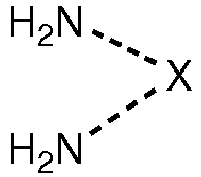


- R1 and R2,
are the same or different, selected from hydrogen; alkyl; optionally substituted saturate hydrocarbon ring containing 1 to 3 ring(s) and each ring containing 3 to 7 carbon atoms; alkoxy alkyl; alkyl amino alkyl; heterocycle; a straight chain or branched-chain alkyl group with 1 to 4 ethylenic bond(s) containing 2 to 20 carbon atoms; a straight chain or branched-chain alkyl group with 1 to 4 acetylenic bond(s) containing 2 to 20 carbon atoms;
wherein alkyl; alkoxy alkyl; alkyl amino alkyl and heterocycle may be unsubstituted or optionally substituted, preferably substituted by halogen, hydroxyl, alkoxy, alkyl, alkoxy alkyl, an optionally substituted saturate hydrocarbon ring containing 1 to 3 ring(s) and each ring containing 3 to 7 carbon atoms, and heterocycle;
provided that R1 or R2 does not contain any unsaturated bond, or if R1 and/or R2 contain(s) unsaturated bond, the atom of the unsaturated bond cannot be directly connected with nitrogen atom; - R3 is selected from alkyl;
- R6 is selected from (CH2)n, wherein n=1-6, preferably 3-5, the most preferably 4, wherein some -CH2- may be substituted by -O-; wherein one or more hydrogen(s) of (CH2)n is optionally substituted by fluorine, alkyl, hydroxyl or alkoxy, heterocycle; preferred compound is selected from (±) trans- 1, 2-cyclohexanediamine platinum (II), trans- 1,2-cyclopentamethylenediamine platinum (II), trans-1,2-cyclobutanediamine platinum (II) and trans-1,2-cyclopropane diamine platinum (II);
- R7 is selected from (CH2)n, wherein n=0-3, preferably n = 0-2; wherein some -CH2- may be substituted by -O-; wherein one or more hydrogen(s) of (CH2)n is optionally substituted by halogen, alkyl, hydroxyl, hydroxyalkyl, alkoxy, and heterocycle;
- R8 and R9 are selected from hydrogen, halogen, hydroxyl, hydroxyalkyl, alkyl, alkoxy and heterocycle; R8 and R9 may be the same or different, preferably hydroxymethyl;
- R10 and R11 are selected from hydrogen, halogen, hydroxyalkyl, alkyl, alkoxy and heterocycle; R10 and R11 may be the same or different, preferably hydroxymethyl;
- R12 is selected from (CH2)n, wherein n=2-4, wherein some -CH2- may be substituted by -O-; one or more hydrogens of (CH2)n is optionally substituted by halogen, alkyl, hydroxyl, alkoxy or heterocycle;
- R13 is -CH2- or -O-, preferably -CH2-;
- R14 is hydrogen, halogen, alkyl, alkoxy, heterocycle, hydroxyalkyl or hydroxyl; preferably R14 is hydrogen;
- R15 is (CH2)n, wherein n=1-3; -CH2-O-; or -O-; wherein one or more hydrogen(s) of (CH2)n is optionally substituted by alkyl, alkoxy, heterocycle, hydroxyl, or hydroxyalkyl; preferably -CH2-O-CH2-.
- Preferably, the structure of compounds is as follows:


- Wherein R1 and R2 are the same or different, selected from hydrogen; alkyl; optionally substituted saturate hydrocarbon ring containing 1 to 3 ring(s) and each ring containing 3 to 7 carbon atoms; alkoxy alkyl; alkyl amino alkyl; heterocycle; a straight chain or branched-chain alkyl group with 1 to 4 ethylenic bond(s) containing 2 to 20 carbon atoms; a straight chain or branched-chain alkyl group with 1 to 4 acetylenic bond(s) containing 2 to 20 carbon atoms;
- wherein alkyl; alkoxy alkyl; alkyl amino alkyl and heterocycle may be unsubstituted or optionally substituted, preferably substituted by halogen, hydroxyl, alkoxy, alkyl, alkoxy alkyl, an optionally substituted saturate hydrocarbon ring containing 1 to 3 ring(s) and each ring containing 3 to 7 carbon atoms, and heterocycle;
- provided that R1 or R2 does not contain any unsaturated bond, or if R1 and/or R2 contain(s) unsaturated bond, the atom of the unsaturated bond cannot be directly connected with nitrogen atom;
- compound 1; [2-(2-methylamino ethyl)-malonato] [cis-diamine] platinum (II);
- compound 2: [2-(2-dimethylamino ethyl)-malonato] [cis-diamine] platinum (II);
- compound 3: [2-(3-dimethylamino propyl)-malonato] [cis-diamine] platinum (II);
- compound 4: [2-(3-amino propyl)-malonato] [cis-diamine] platinum (II);
- compound 5: [2-(2-diethylamino ethyl)-malonato] [cis-diamine] platinum (II);
- compound 6: [2-(3-diethylamino propyl)-malonato]·[cis-diamine] platinum (II);
- compound 7: [2-(2-di-n-propylamino ethyl)-malonato]·[cis-diamine] platinum (II);
- compound 8: [2-(3-di-n-propylamino propyl)-malonato] [cis-diamine] platinum (II);
- compound 9: [2-(2-amino ethyl)-malonato]·[cis-(1,2-trans-cyclohexane diamine)] platinum (II);
- compound 10: [2-(2-dimethylamino ethyl)-malonnato]·[cis-(1,2-trans-cyclohexane diamine)] platinum (II);
- compound 11: [2-(3-dimethylamino propyl)-malonato]·[cis-(1,2-trans-cyclohexane diamine)] platinum (II);
- compound 12: [2-(2-ethylamino ethyl)-malonato]·[cis-(1,2-trans-cyclohexane diamine)] platinum (II);
- compound 13: [2-(2-diethylamino ethyl)-malonato]·[cis-(1,2-trans-cyclohexane diamine)] platinum (II);
- compound 14: [2-(3-diethylamino propyl)-malonato]·[cis-(1,2-trans-cyclohexane diamine)] platinum (II);
- compound 15: [2-(2-di-n-propylamino ethyl)-malonato]·[cis-(1,2-trans-cyclohexane diamine)] platinum (II);
- compound 16: [2-(3-di-n-propylamino propyl)-malonato]·[cis-(1,2-trans-cyclohexane diamine)] platinum (II);
- compound 17: [2-(3-diethylamino propyl)-malonato]·[cis-(1,2-trans-cyclopentyl diamine)] platinum (II);
- compound 18: [2-(3-diethylamino propyl)-malonato]·[cis-(1,2-trans-cyclobutyl diamine)] platinum (II);
- compound 19: [2-(3-diethylamino propyl)-malonato]·[cis-(1,2-trans-cyclopropyl diamine)] platinum (II);
- compound 20: [2-(2-dimethylamino ethyl)-malonato]·[cis-1,2-ethyldiamine] platinum (II);
- compound 21: [2-(2-diethylamino ethyl)-malonato]·[cis-1,3-propyl diamine] platinum (II);
- compound 22: [2-(2-di-n-propylamino ethyl)-malonato]·[cis-1,4-butyldiamine] platinum (II);
- compound 23: [2-(2-diethylamino ethyl)-malonato]·[cis-1,2-(1,2-dihydroxymethyl) -ethyl diamine] platinum (II);
- compound 24: [2-(2-dimethylamino ethyl)-malonato]·[cis-1,3-(2,2-hydroxymethyl)-propyl diamine] platinum (II);
- Compound 25: [2-(2-dimethylamino ethyl)-malonato]·[cis-1,4-(trans-2,3-cyclobutyl)-butane diamine] platinum (II);
- compound 26: [2-(2-diethylamino ethyl)-malonic]·[cis-1,4-(trans-2,3-cyclobutyl)-butane diamine] platinum (II);
- compound 27: [2-(2-diethylamino ethyl)-malonato]·[cis-1,4-cyclohexane diamine] platinum (II);
- compound 28: [2-(2-diethylamino ethyl)-malonato]-[cis-1,3-(2,2-(4-oxacyclohexyl))-propyl diamine] platinum (II).
- The preferred pharmaceutically acceptable salt for the compounds of the current invention is selected from nitrate, carbonate, sulphate, phosphate, mesylate, trifluoromethanesulfonic salt, tosilate, benzene sulfonate, acetate, fumarate, tartrate, oxalate, maleate, malate, succinate, lactate, citrate, glutamate, or aspartate.
- The current invention describes a pharmaceutical composition, which contains any of the previously described compound and pharmaceutically acceptable carrier; wherein said composition is in any appropriate dosage form, preferably in the form of injection; and it may or may not contain one or more of other drug(s) suit for the treatment of cancer.
- The current invention discloses a preparation method of any of the compounds mentioned, which includes the following steps:


- The current invention discloses the use of any of the previously described compounds, or its pharmaceutically acceptable salt, its solvate, its racemat, its non-enantiomer, its geometric isomer, or the pharmaceutically composition mentioned before, for preparing the drug for the treatment of cell proliferation diseases, wherein the cell proliferation diseases are preferably cancers, and the cancer is preferably breast cancer, lung cancer, colon cancer, gastric cancer, esophagus cancer, ovarian cancer, osteosarcoma, cervical cancer, bladder cancer, liver cancer, cerebroma, prostate cancer, or melanoma.
- The present invention describes a kit, which includes the pharmaceutically composition according to the current invention and instructions, wherein said kit may comprise one or more other drugs for the treatment of cancer.
- The following are the definitions of various terms used in the description of the present invention. Unless limited in special case, the following terms are applicable to the entire description and claims (independently or as a part of larger group).
- The term "alkyl" refers to 1-20 unsubstituted saturated carbon atom(s) of straight chain or branched-chain, preferably alkyl groups containing 1-7 carbon atom(s), most preferably, unsubstituted alkyl groups containing 1-4 carbon atom(s).
- The term "substituted alkyl" refers to , for example, the alkyl substituted by 1-4 of the following substituent group(s): such as halogen, trifluoromethyl, trifluoromethoxyl, hydroxyl, alkoxy, cycloalkyloxy, heterocyclic oxygroup, oxo, alkane acyl, aryloxy, alkane acyl oxygen radical, amino, alkylamino, arylamine, aralkyl amido, naphthene amido, heterocyclic amido, substituent tertiary amine (wherein 2 nitrogen substituent groups are selected from alkyl, aryl or aralkyl); alkane acyl amido, aroyl amino, aryl alkane acyl amido, substituent alkane acyl amido, substituent aromatic amino, substituent aryl alkane acyl, thiodiglycolic, alkyl sulfonium, aryl sulfonium, aralkyl sulfonium, naphthenic sulfonium, heterocyclic sulfonium, alkyl carbonyl sulfur, aryl carbonyl sulfur, aromatic alkyl carbonyl sulfur, alkyl sulfonyl, aryl sulfonyl, aromatic alkyl sulfonyl, sulfonamido, such as SO2NH2, substituted sulfonamide, nitryl, cyano, carboxyl, carbamyl, such as CONH2, substituted carbamyl such as CONH alkyl, CONH aryl, CONH aralkyl or when two substituent groups exist on nitrogen, selected from alkyl, aryl or aralkyl; alkoxy carbonyl, aryl, substituent aryl, guanidyl and heterocyclic radical, such as indolyl, imidazolyl, furyl, thienyl, thiazolyl, pyrrolidyl, pyridyl, pyrimidyl, etc. The above substituted groups may be further substituted by halogen, alkyl, alkoxy, aryl or aralkyl.
- The term "halogen" or "halogenate" refers to fluorine, chlorine, bromine, and iodine.
- The term "aryl" refers to monocyclic or dicyclic aromatics containing 6-12 carbon atoms in ring, such as phenyl, naphthyl, biphenyl and diphenyl. The above "aryl" may be substituted.
- The term "aralkyl" refers to the aryl combined directly through alkyl group, such as benzyl.
- The term "substituent aryl" refers to the aryl substituted by 1-4 of the following substituent group(s): Such as alkyl, substituent alkyl, halogen, trifluoromethoxy, trifluoromethyl, hydroxyl, alkoxy, cycloalkyloxy, heterocyclic oxygroup, alkane acyl, alkane acyl oxygen radical, amino, alkylamino, aralkyl amido, naphthene amido, heterocyclic amido, dialkyl amino, alkane acyl amido, thiol, alkyl sulfo, naphthenic base sulfo, heterocycle sulfo, carbamido, nitryl, cyano, carboxyl, carboxyl alkyl, formamyl, alkoxy carbonyl, alkyl carbonyl sulfur, aryl carbonyl sulfur, alkyl sulfonyl, sulfonamido, aryloxy, etc. The said substituent group may be further substituted by halogen, hydroxyl, alkyl, alkoxy, aryl, substituent aryl, substituent alkyl or substituent aralkyl.
- The term "alkenyl" refers to the straight chain or branched-chain alkyl group with 1-4 ethylenic bond(s) containing 2-20 carbon atoms, preferably 2-15 carbon atoms, most preferably 2-8 carbon atoms.
- The term "substituent alkenyl" refers to the alkenyl group substituted by, for example, 1-2 of the following substituent group(s): such as halogen, hydroxyl, alkoxy, alkane acyl, alkane acyl oxygen radical, amino, alkylamino, dialkyl amino, alkanoyl amido, thiodiglycolic, alkyl sulfo, alkyl carbonyl sulfur, alkyl sulfonyl, sulfonamido, nitryl, cyano, carboxyl, formamyl, substituted formamyl, guanidyl and heterocyclic radical, such as indolyl, imidazolyl, furyl, thienyl, thiazolyl, pyrrolidyl, pyridyl, pyrimidyl, etc.
- The term "alkynyl or chain alkynyl" refers to the straight chain or branched-chain alkyl group with 1-4 acetylenic bonds containing 2-20 carbon atoms, preferably 2-15 carbon atoms, most preferably 2-8 carbon atoms.
- The term "substituent alkenyl" refers to the alkenyl substituted by, for example, one of the following substituent groups: halogen, hydroxyl, alkoxy, alkane acyl, alkane acyl oxygen radical, amino, alkylamino, dialkyl amino, alkane acyl amido, thiodiglycolic, alkyl sulfo, alkyl carbonyl sulfur, alkyl sulfonyl, sulfonamido, nitryl, cyano, carboxyl, formamyl, substituted formyl amino, guanidyl and heterocyclic radical, such as imidazolyl, furyl, thienyl, thiazolyl, pyrrolidyl, pyridyl, pyrimidyl, etc.
- The term "naphthenic base" refers to optionally substitutive, saturate hydrocarbon ring system preferably containing 1-3 ring(s) and each (may be further condensed with unsaturated C3-C7 carbon atomic ring) containing 3-7 carbon atoms. Example groups include cyclopropyl, cyclobutyl, cyclopentyl, cyclohexyl, cycloheptyl, cyclo-octyl, cyclodecyl, cyclic dodecyl and adamantyl. Example for substituent group includes one or more of aklyl group(s) as described above, or one or more of alkyl substituent group(s) as described above.
- The terms "heterocycle", "heterocyclic", and "heterocyclic radical" refer to optionally substituted, completely saturated or incompletely saturated aromatic or non-aromatic ring group, for example, the said ring is 4-7-membered monocyclic, 7-11-membered dicyclic or 10-15-membered tricyclic system, containing at least one heteroatom on the ring at least containing on carbon atom. There may be 1, 2, 3 or 4 heteroatom(s) selected from nitrogen atom, oxygen atom and sulphur atom on each ring of heterocyclic group containing heteroatom, wherein the said nitrogen and sulphur heteroatom may also be optionally oxidized and nitrogen heteroatom may also be optionally quaternized. The said heterocyclic group may be connected on any heteroatom or carbon atom.
- Example monocyclic heterocyclic group includes pyrrolidyl, pyrryl, indolyl, pyrazolyl, oxa-cyclobutyl group, pyrazolinyl, imidazolyl, imidazolinyl, imidazolidinyl, oxazolyl, oxazolidinyl, isoxazolinyl, isoxazolyl, thiazolyl, thiadiazole, oxazolidinyl, isoxazolinyl, isoxazolyl, furyl, tetrahydrofuran, thienyl, oxadiazol, piperidyl, piperazinyl, 2-oxo-piperazinyl, 2-oxo-piperidyl, 2-oxo-pyrrolidyl, 2-oxo-pazepine, azepine, 4-piperidone, pyridyl, N-oxo-pyridyl, pyrazinyl, pyrimidyl, pyridazinyl, tetrahydrothiopyran, tetrahydropyrane, morpholinyl, thiamethoxam morpholinyl, thiamethoxam morpholine sulfoxide, tetrahydrothiopyran sulfoxide, thiamethoxam morpholinyl sulfoxide, 1,3-dioxolame and tetralin-1, 1-dioxo thienyl, dioxane, isoxazolyl, thia cyclobutyl, thia cyclopropyl, triazinyl and triazolyl, etc.
- Example bicyclic heterocyclic group includes benzothiazolyl, benzoxazolyl, benzothiophene, quinuclidinyl, quinolyl, quinolyl-N-oxide, tetrahydroisoquinol, isoquinolyl, benzimidazolyl, benzopyranyl, indolizine, benzopyranyl, chromone, aryl coumarin, 1,2-phthalazine, quinoxaline, indazolyl, pyrrolo and pyridyl, furan and pyridyl (such as furan and [2,3-c]pyridyl, furan and [3,1-b]pyridyl or furan and [2,3-b]pyridyl), isoindolinyl, dihydrogen quinazoline (such as 3,4-dihydro-4-oxo-quinazolinyl), benzisothiazol, benzisoxazole, benzodiazine, benzopyranyl, benzothiopyran, benzodiazine, benzofuryl, thiochroman, thiochroman sulphone, chroman, chroman sulphone, dihydrobenzene benzopyranyl, indolinyl, isobenzopyran, isoindolinyl, 1,5-phthalazine, 2,3-phthalazine, 3,4-methylenedioxy benzyl, purine, pyridine-pyridy, quinazolinyl, tetralinquinolyl, thiophene-furan, thiophene-pyridine, thiophene-thienyl, etc.
- Smaller heterocycles, such as epoxide and aziridine, are also included.
- The term "heteroatom" includes oxygen, sulphur and nitrogen.
- The term "pharmaceutically acceptable salt" includes the active compound salt prepared with relatively nontoxic acid or alkali on the basis of the specific substituent group existed on the compound as described in this invention. When the compound in the invention contains relatively acidic functional group, alkali addition salt can be obtained by enabling the compound in neutral form to contact sufficient necessary with alkali directly or in appropriate inert solvent. Examples of pharmaceutical acceptable inorganic alkali salt derivatives include aluminum, ammonium, calcium, copper, ferric iron, ferrous, lithium, magnesium, manganese, bivalent manganese, potassium, sodium, zinc, etc. Pharmaceutical acceptable organic base salt derivatives include primary, secondary and tertiary amine salts; they include substituent amine, cyclammonium, amine, etc., such as arginine, glycine betaine, caffeine, choline, N,N'-dibenzyl ethylenediamine, diethylamine, 2-diethyl aminoacyl alcohol, 2-dimethyl aminoacyl alcohol, cholamine, ethylenediamine, N-ethyl morpholine, N-ethyl piperidine, glucosamine, glucamine, histidine, hydrabamine, isopropamide, lysine, methylglucosamine, morpholine, piperazine, piperidine, polyamino resin, procaine, purine, theobromine, triethylamine, trimethylamine, tripropylamine, tromethamine, etc. When the compound of the present invention contains relatively alkali functional group, acid addition salt can be obtained by enabling the compound in neutral form to contact sufficient required acid directly or in appropriate inert solvent. Examples of pharmaceutical acceptable acid addition salts include salts derivated from inorganic acid, such as nitrate, carbonate, bicarbonate, phosphate, hydrophosphate, dihydric phosphate, sulphate, bisulfate, phosphite, hydrochloride, hydrobromide, hydriodate, etc.; salt derivated from relative nontoxic organic acid, for example, acetic acid, propionic acid, isobutyric acid, malonic, benzoic acid, succinic acid, suberic acid, fumaric acid, mandelic acid, phthalic acid, benzenesulfonic acid, p-toluenesulfonic acid, citric acid, tartaric acid, methanesulfonic acid, etc.; and also include arginine acid, for example, arginine salt and organic acid such as glucuronic acid or galactonic acid salts; preferably nitrate, carbonate, bicarbonate, phosphate, hydrophosphate, dihydric phosphate, sulphate, bisulfate, phosphite, acetate, propionate, isobutyrate, malonate, benzoate, succinate, suberate, fumarate, mandelate, phthalate, benzene sulfonate, tosilate, citrate, tartrate, mesylate, arginine salt, glucuronate or galactose acid salt.
- In some embodiments in the present invention, the leaving group of compounds in the present invention contains basic group(s) that may form salt with acid and platinum (II) complex salts are prepared with the method well known to the technical person in this field. For example, it may form mesylate, trifluoromethanesulfonic salt with lower alkyl sulfonic acid, such as methanesulfonic acid, trifluoromethanesulfonic acid, etc.; form tosilate, benzene sulfonate, camphosulfonate with arylsulphonate, such as benzenesulfonic acid or p-toluenesulfonic acid, etc.; form appropriate salts with organic carboxylic acid, such as acetic acid, fumaric acid, tartaric acid, oxalate, maleic acid, malic acid, succinic acid, lactic acid or citric acid, etc.; may form glutamate or aspartate with arginine acid, such as glutamic acid or aspartic acid; form appropriate salts with inorganic acid, such as nitric acid, carbonic acid, sulfuric acid or phosphoric acid, etc. The acid that may be used include organic acid, inorganic acid, etc.
- The compounds of the present invention may be interconverted with their salt form through the conventional method in this field. For example, free bases can be obtained by separation in conventional way after the contacting between salts and alkali or acid, or the form of salts can be obtained by separation in conventional way by adding acid or alkali to the compounds. Some physical properties of the free bases, such as the solubility in polar solvent, are different from various salt forms; however, for the purpose of the present invention, salts and the compounds in parent form have the same antitumor effect.
- In addition to the salt form, the present invention may provide the compounds in the form of prodrug esters. The "prodrug(s)" of the compounds as described in this invention refers to the compounds that are prone to chemical change in physiological environment to obtain the compounds of the present invention. In addition, prodrugs can be converted into the compounds of the present invention with chemical or biochemical methods in separation environment. For example, when placed in the transdermal patch reponsitory containing appropriate enzyme or chemical reagent, prodrugs may be slowly converted into the compounds of the present invention. Prodrugs are usually pharmacological inert compounds before converting into active drugs; however, this situation is not necessary. Usually, the functional group required by the activity in drug is concealed with "precursor group" (as defined below), releasing functional group through conversion (such as cracking in specific operating condition) and obtaining the "precursor part" of active drug and prodrug. Precursor part may be catalyzed or induced through such as hydrolysis reaction, or through another actor (such as enzyme, light, acid or alkali) or change of physical or environmental parameter (such as change of temperature) or exposing physical or environmental parameters for spontaneous cracking. Comparing with operating environment, actor may be endogenic, for example, the enzyme existed in the cell where prodrug is given or the acidic environment of gastro or provided from external source.
- "Precursor Group" refers to a sort of protective group that can convert drug into prodrug when the functional group used in covering active drug forms "precursor part". Precursor group is usually connected with the functional group of drug through bond. The said bond can be cracked in specific condition. Therefore, precursor group is a part of precursor part. The said precursor part is cracked in specific operating condition and releases functional group. As a specific example, the amide precursor part of the formula -NH-C(O)CH3 contains precursor group -C(O)CH3.
- It is well known in the art that a wide variety of precursor groups and the part of precursors suitably conceal the functional group in active compounds to obtain prodrugs. For example, hydroxyl functional group may become sulphonate, ester (such as acetic acid ester or maleic acid ester) or carbonic acid ester precursor part by concealing. This precursor part may be hydrolyzed in the body, to obtain hydroxyl. Carboxyl can be covered into ester (including methyl, ethyl, pivaloyl acyloxy methyl, silicyl ester and sulpho acid ester), amide or hydrazide precursor part. They can be hydrolyzed in body to obtain carboxyl. The present invention includes the known esters and acyls used for change of solubility or hydrolysis property in the field, used as controlled-release or prodrug preparation. For one skilled in the art, the specific examples of appropriate precursor groups and their appropriate precursor parts are obvious.
- Some compounds of the present invention may exist in the form of non-solvation and solvation including hydration. "Solvate" refers to the compound generated from the combination of solvent molecule with the molecule or ion of solute. Solvent may be organic compound, inorganic compound or the mixture of both. Some examples of solvent include but not limited to carbinol, N,N-dimethyl formamide, tetralin furan, dimethylsulfoxide, and water. Generally, solvent form is equivalent to non-solvent form and included in the range of the present invention. Some compounds of the present invention may exist in the form of polymorph or morphism. In general, for the assumed usage of the present invention, all physical forms are the same and included in the range of the present invention.
- Some compounds of the present invention have asymmetric carbon atom (rotophore) or double bond; their raceme, non-enantiomer, geometric isomer, and individual isomer (such as separated enantiomer) are included in the range of the present invention. Those isomers may be split or asymmetrically synthesized with conventional method to make isomer "optical pure", i.e., not containing other isomers on the whole. For example, if particular enantiomer of the compound of the present invention is required, pure required enantiomer can be obtained through asymmetric synthesis preparation or through chiral auxiliaries derivatization, wherein splitting the mixture of diastereomer obtained and cracking the assistant group, or when the molecule contains alkali functional group such as amino or acidic functional group such as carboxyl, appropriate optical active acid or alkali may be used for forming asymmetric heterogeneous salt, then splitting the non-enantiomer formed hereof through fractional crystallization or chromatographic process well-known in this field, finally pure enantiomer is recovered.
- The compound of the present invention may contain the isotope of the atom in abnormal proportion in one or more atom(s) constituting the compound. For example, the compound may be labeled with radioisotope such as tritium (3H), iodine -125(125l) or carbon -14(14C). Regardless of whether it has radioactivity or not, all isotope forms of the compound of the present invention are all included in the range of the present invention.
- Another purpose of the present invention is to provide the preparation methods for the foregoing compounds.
- I. The preparation method for the formula (A) is provided as follows:
- (1) Potassium chloroplatinite was added into water and the mixture was stirred to form solution at room temperature; potassium iodide was put into above potassium chloroplatinite solution to react with shielded nitrogen and gas away from light and oxygen in water bath condition;
- (2) R4NH2 was dissolved in distilled water and added dropwise into the reaction liquid in (1); the mixture was reacted in water bath condition;
- (3) After cooling down above the reaction mixture below room temperature, R5NH2 was dissolved in distilled water and then added dropwise to the reaction mixture (2) to react in water bath; yellow deposit in large quantity was generated in the mixture; after cooling down the mixture below room temperature; diiodo diamine platinum (II) was obtained through suction filtration and washing.
- (4) Ag2SO4was added in water and stirred; in water; diiodo diamine platinum (II) was added into reaction mixture and then water was added; the mixture was stirred in water bath condition away from light and oxygen with shielded nitrogen and gas; dihydrol diamine platinum (II)·sulphate was obtained by suction;
- (5) Putting diethyl malonate, Br-R3-Br, K2CO3 and tetrabutylammonium bromide into flask the mixture was heated and stirred; after removal of solid by suction and washing, filtrate was collected in vacuo after removal of solvent;
- (6) 2-Br-R3-diethyl malonate and anhydrous K2CO3 was added in acetonitrile and stirring; R1-NH-R2 was added into reaction mixture; the mixture was heated and stirred; filtering out insoluble substance of the mixture; the filtrate was pumped dry and residue was dissolved in organic solvent; the organic phase was washed with aqueous solution and dried; after removal of solvent in vacuo; the product was obtained by purifying through column chromatography.
- (7) NaOH solution was added into the product in (6) and stirred at room temperature.
- (8) After treating the product in (7) with acid solution, the product in above (4) was added, the mixture was heated to afford the platinum compound of the present invention.
The preferable preparation method is as follows:- (1) Stirring potassium chloroplatinite in water at room temperature; potassium iodide solution of water was added into above potassium chloroplatinite solution. The mixture was stirred away from light and oxygen in water bath at 40∼60 °C.
- (2) R4NH2 solution of water was added dropwise to the reaction mixture in (1) to react in water bath at 40∼60 °C;
- (3) Cooling down reaction mixture below 20 °C, R5NH2 aqueous solution was added dropwise into the reaction mixture in (2) to react in water bath for 30∼60min at 40∼60 °C; there will be yellow deposit in great quantity; after cooling down below 20 °C, diiodo diamine platinum (II) was obtained by suction and washing with water, anhydrous ethanol, and diethyl ether in turn.
- (4) Stirring Ag2SO4 in water, above diiodo diamine platinum (II) was put into reaction mixture and then water was added; the mixture was stirred away from light and oxygen at 40∼60 °C; dihydrol diamine platinum (II) sulphate was obtained after suction filtration.
- (5) Putting diethyl malonate, Br-R3-Br, K2CO3 and tetrabutylammonium bromide into flask the mixture was heated and stirred; after removal of solid by suction and washing, filtrate was washed and dried over MgSO4; distillate was collected in vacuo after removal of solvent;
- (6) Stirring 2-Br-R3-diethyl malonate and anhydrous K2CO3 in acetonitrile; R1-NH-R2 was added into reaction mixture; the mixture was heated and stirred; filtering out insoluble substance of the mixture; the filtrate was pumped dry and added, organic solvent for dissolution; the organic phase was washed with aqueous solution and dried; after removal of solvent in vacuo, the product was obtained by purifying (through column chromatography).
- (7) NaOH solution was added into the product in (6) and stirred at room temperature.
- (8) After treating the product in (7) with acid solution, the product in above (4) was added, the mixture was heated to afford the platinum compound of the present invention.

- II. The preparation method in the formula (B) is as follows:
- (1) Potassium chloroplatinite was added in water and stirred at room temperature; potassium iodide solution of water was added into above potassium chloroplatinite solution. The mixture was stirred away from light and oxygen in water bath;
- (2) Bidentate ammonia NH2-X-NH2 aqueous solution was added dropwise into the reaction mixture in (1) to react in water bath; yellow deposit in great quantity was afforded; after cooling down the mixture below room temperature, bidentatediiodo diamine platinum (II) was obtained by suction and washing
- (3) Ag2SO4 was added in water and stirred, above bidentatediiodo diamine platinum (II) was put into reaction mixture and then water was added; the mixture was stirred away from light and oxygen; dihydrol diamine platinum (II) ·sulphate was obtained after suction filtration.
- (4) Putting diethyl malonate, Br-R3-Br, K2CO3 and tetrabutylammonium bromide into flask the mixture was heated and stirred; after removal of solid by suction and washing, filtrate was washed and dried over MgSO4; distillate was collected in vacuo after removal of solvent;
- (5) Stirring 2-Br-R3-diethyl malonate and anhydrous K2CO3 in acetonitrile; R1-NH-R2 was added into reaction mixture; the mixture was heated and stirred; filtering out insoluble substance of the mixture; the filtrate was pumped dry and added, organic solvent for dissolution; the organic phase was washed with aqueous solution and dried, after removal of solvent in vacuo; the product was obtained by purifying through column chromatography.
- (6) NaOH solution was added into the product in (5) and stirred at room temperature.
- (7) After treating the product in (6) with acid solution, the product in above (3) was added, the mixture was heated to afford the platinum compound of the present invention.
- The preferred preparation method is as follows:
- (1) Potassium chloroplatinite was added in water and stirred at room temperature; potassium iodide solution of water was added into above potassium chloroplatinite solution. The mixture was stirred away from light and oxygen in water bath at 40∼60 °C.
- (2) Bidentate ammonia NH2-X-NH2 aqueous solution was added dropwise into the reaction mixture in (1) to react in water bath for 40∼60 °C; yellow deposit in great quantity was afforded; after cooling down the mixture below 20 °C, bidentatediiodo diamine platinum (II) was obtained by suction and washing.
- (3) Stirring Ag2SO4 in water, above bidentatediiodo diamine platinum (II) was put into reaction mixture and then water was added; the mixture was stirred away from light and oxygen at 40∼60 °C; dihydrol diamine platinum (II) ·sulphate was obtained after suction filtration.
- (4) Putting diethyl malonate, Br-R3-Br, K2CO3 and tetrabutylammonium bromide into flask the mixture was heated and stirred; after removal of solid by suction and washing, filtrate was washed and dried over MgSO4; distillate was collected in vacuo after removal of solvent;
- (5) Stirring 2-Br-R3-diethyl malonate and anhydrous K2CO3 in acetonitrile; R1-NH-R2 was added into reaction mixture; the mixture was heated and stirred; filtering out insoluble substance of the mixture; the filtrate was pumped dry and added, organic solvent for dissolution; the organic phase was washed with aqueous solution and dried, after removal of solvent in vacuo; the product was obtained by purifying through column chromatography.
- (6) NaOH solution was added into the product in (5) and stirred at room temperature.
- (7) After treating the product in (6) with acid solution, the product in above (3) was added, the mixture was heated to afford the platinum compound of the present invention.

- The present invention also provides a pharmaceutical composition containing above compound(s), its pharmaceutically acceptable salt, stereoisomer, prodrug or its solvate and pharmaceutical acceptable carriers. The composition contains approximately 0.01%-100%, preferably approximately 0.1%-100%, more preferably approximately 1%-100%, most preferably approximately 20%-100% (in weight) of one or more compound(s) of the present invention. The remaining part is composed of appropriate drug carrier(s) and/or excipient(s). The known method in this field and appropriate carrier may be used to form composition containing the compound of the present invention to match with administration route.
- The quantity of the active compound in unit dose preparation may be between approximately 0.001 mg and approximately 1000 mg, preferably between approximately 0.01 mg and approximately 500 mg, and more preferably between approximately 1 mg and approximately 100 mg, and most preferably between approximately 10 mg and approximately 50 mg.
- The administration may, for example, be oral, local, intravenous, subcutaneous, percutaneous, transdermal, intramuscular, intra-articular, parenteral, intra-arterial, intradermal, intraventricular, encephalic, intraperitoneal, within damage, intranasal, rectum, vagina, suction or through implantation repository. The term "parenteral" used in present invention includes subcutaneous, intravenous, intramuscular, intra-articular, within synovial fluid, within breast bone, intrathecal, intrahepatic, within damaged position and intracranial injection or target controlled infusion, preferably giving composition intravenously. The preparation of the prevent invention may be designed as quick-acting, immediate-release or long-acting. In addition, the compound may be administered locally other than in systemic way, such as giving (such as injecting) sustained release preparation. In accordance with the representative embodiment, the composites of the present invention may be prepared into the drug for mammal, preferably for human.
- One or more composite(s) containing in the prevent invention may be given repeatedly, for example, at least 2, 3, 4, 5, 6, 7, 8 or more times, or the composites may be given through continuous infusion. The appropriate positions of drug delivery include but not limited to blood vessel, muscle, skin, bronchus, intestines and stomach, anus, vagina, eye and ear. The preparation may adopt liquid dosage form, freeze-dry powder form, solid or semisolid, such as solution, suspension, emulsion, tablet, pill, capsule, powder, suppository, retention enema, cream, ointment, lotion, gel, aerosol, etc., preferably, the simple unit dosage form for delivering accurate dose.
- For parenteral drug delivery, the composite may be in the form of sterile injection and aseptic packaging powder, preferably, preparing injection at pH value of approximately 4.5-7.5.
- The composite of the present invention in sterile injection form are water or oil mixed suspension. Such suspension may be prepared with suitable dispersive or wetting agent and suspending agent according to the known technology in the field. Sterile injection preparation may be the sterile injection solution or suspension dissolved or suspended in nontoxic parenteral acceptable diluent or solvent, such as the solution dissolved in 1,3-butylene-glycol. Usable acceptable menstruum and solvent include water, Ringer's solution and other hypertonic sodium chloride solution. Additionally, sterile non-volatile oil is usually used as solvent or suspended substrate. Therefore, the nonvolatile oil of any brand including synthetic monoglyceride or diester can be used, similar to naturally pharmaceutical acceptable oil such as olive oil or castor oil, especially their polyethylene oxide ethylation form. Fatty acid such as oleic acid and its glyceride derivant can be used to prepare injection preparation. Such oil solution or suspension may also contain long-chain alcohol diluent or dispersing agent, such as carboxymethylcellulose or similar dispersing agent generally used in the preparation in pharmaceutical acceptance dosage form including emulsion and suspension. Other commonly used surfactants, such as Tween, Span, and the acceptable solid, liquid usually used for preparation pharmacy or other emulsifier or bioavailability promoter in other dosage form may be used for the purpose of preparation. Such compounds as those used for parenteral drug delivery, for example, through injection such as large dose injection or continuous infusion, may be prepared. Injection unit dosage form may be stored in ampoule or multiple-dose container.
- The composites of the present invention in the form of freeze-drying may be provided. Such composites may include buffer agent used for redissolution before drug delivery, or freeze-drying composites may contain buffer agent, used for, for example, water redissolution. Freeze-drying composites may contain appropriate vasoconstrictor, such as epinephrine. Freeze-drying composites may be delivered through syringe, optionally packaged with the buffer agent used for redissolution, for the convenience to immediately delivering such redissolution composites to patients.
- The medicinal composites of the present invention may also be used as any oral acceptable dosage form. They include tablet, capsule, cachet, emulsion, suspension, solution, syrup, elixir, spray, pill, lozenge, powder, granule and sustained release preparation. Appropriate excipients used for oral administration include medical Mannitol, lactose, starch, magnesium stearate, saccharin sodium, Icum powder, cellulose, glucose, gelatin, cane sugar, magnesium carbonate, etc. In case of the tablet used for oral administration, the common carriers include lactose and corn starch. Generally, lubricant such as magnesium stearate may be added. In case of capsule, usable diluents include lactose and dry corn starch. When water suspension is required for oral medication, active ingredient shall be mixed with emulsified and suspending agents. Some sweetening agents, corrigents or colorants may be added according to the circumstances.
- One or more compound(s) of the present invention and optionally one or more pharmaceutical acceptance auxiliary material(s) may be dissolved or dispersed on carriers such as salt aqueous solution, glucose aqueous solution, glycerol, ethanol, etc. to form, for example, oral, local or intravenous administered solution or suspension for preparing liquid compositions. Sterile liquid, such as oil, water, ethanol and their combination may be used for preparing the pharmaceutical preparations in the form of liquid suspension or solution.
- For oral or parenteral drug delivery, pharmacy-suitable surfactant, suspending agent or emulsifier may be added. Suspension may contain oil, such as peanut oil, sesame oil, cottonseed oil, corn oil, and olive oil. Suspension preparation may also contain fatty acid ester, such as oleic acid ethyl ester, isopropyl myristate; fatty acid glyceride and acetyl fatty acid glyceride. Suspension preparations may include ethanol, such as alcohol, isopropanol, hexadecanol, glycerol and propylene glycol; ether such as poly (ethylene glycol); petroleum hydrocarbon, such as mineral oil and vaseline, and water can also be used for suspension preparation.
- In some embodiments, the compositions adopt the form of pill, tablet or capsule. Therefore, the compositions may contain one or more diluent(s), such as lactose, cane sugar, dicalcium phosphate, etc.; disintegrants, such as starch or their derivatives; lubricants, such as magnesium stearate, etc.; and/or adhesives, such as starch, Arabic gum, polyvinylpyrrolidone, gelatin, cellulose, and their derivatives. Tablet may be prepared with any pressing or molding method known to the technical personnel in the field. Tablet may be prepared and pressed through pressing optionally the compounds of the present invention in the form of free flow mixed with auxiliary elements (such as adhesive, lubricant, diluent, disintegrant or dispersing agent) in suitable machine. Molding tablet may be prepared by molding powder mixture of the compound of the present invention with any suitable carrier in suitable machine.
- Or the medicinal compositions of the present invention may be in the suppository form of rectal administration. Such suppositories may be prepared by mixing the drug with appropriate non-irritating excipient, which is solid under room temperature but is liquid under rectal temperature and thus release drug in rectum. Such materials include cocoa butter, beewax, polyethylene glycol, hard fat and/or hydrogenated coco-glyceride. The compositions suitable for rectal administration may also contain rectal enema unit. Such unit contains one or more compound(s) of the present invention and pharmaceutical acceptable menstruum (such as 50% ethanol aqueous solution or salt aqueous solution). Such menstruum is physiologically compatible with rectum and/or colon. Rectal enema unit contains the applicator tip protected by inert cover. This tip, preferably, is composed of polyethylene, lubricated with lubricant such as white vaseline, preferably protected by one-way valve, to prevent the backflow of the drug delivered. Rectal enema unit shall have sufficient length, preferably 2 inches, and inserted into colon via anus.
- The medicinal compositions of the present invention may also be in the form of local drug delivery, especially when therapeutical target includes the region or organ locally accessible. The diseases of those organs include the diseases of eye, skin or lower intestinal tract. It is easy to prepare suitable topical preparation used for the regions or organs in those regions or organs. In case of topical administration, the compound of the present invention containing one or more composite(s) may be in the form of emulsion, lotion, gel, foam, cream, gelatin, solution, suspension, ointment and transdermal patch.
- Topical administration at lower intestinal tract can be realized through rectal suppository preparation or suitable enema preparation. Topical transdermal patch may be used as well. In case of topical application, the medicinal composition in appropriate ointment form may be prepared. Such ointment contains the active ingredient suspended on or dissolved in one or more carriers. The carriers used for the topical delivery of the compound of the present invention include but not limited to mineral oil, liquid Vaseline, white Vaseline, propylene glycol, polyoxyethylene, polypropylene oxide compound, emulsifying wax and water. Or the medicinal composition in appropriate lotion or cream form may be prepared. Such lotion or creation contains the active ingredients suspended on or dissolved in one or more pharmaceutical acceptable carriers. Suitable carriers include mineral oil, Span-60, Tween-60, cetyl, wax, cetanol, 2-octyldodecanol, benzyl alcohol and water.
- The medicinal composites of the present invention may be delivered through nose aerosol or suction. In case of inhalation delivery, the composites in the form of dry powered or liquid may be delivered through sprayer. Such composites are prepared with the known technology in pharmaceutical preparation field. Moreover, the composites in the form of solution may be prepared in saline with benzyl alcohol or other suitable corrosion remover, absorption enhancer for reinforcing bioavailability, fluorocarbon compound and/or other conventional solubilizer or dispersing agent.
- The pharmaceutical acceptable carriers that can be used for those composites include ion exchanger, aluminum oxide, aluminum stearate, lecithin; serum protein such as human serum albumin; buffer substance such as phosphate; glycine, sorbic acid, potassium sorbate, partial glyceride mixture of saturate plant fatty acid, water, salt or electrolyte such as sulfuric acid protamine, sodium hydrogen phosphate, potassium hydrogen phosphate, sodium chloride, zinc salt; colloidal silicon dioxide, magnesium trisilicate, polyvinylpyrrolidone, cellulose substance, polyethylene glycol, sodium carboxymethylcellulose, polyacrylate, wax, polyethylene-polypropylene oxide-block polymer, polyethylene glycol and wool fat.
- Examples of suitable excipients include but not limited to water, saline, lactose, glucose, cane sugar, sorbitol, Mannitol, starch, Arabic gum, calcium phosphate, alginate, tragacanth, gelatin, calcium silicate, microcrystalline cellulose, polyvinylpyrrolidone, cellulose, syrup, methylcellulose, ethyl cellulose, hydroxypropyl methyl cellulose and polyacrylic acid, such as carbopol. The composites may include lubricant such as talcum powder, magnesium stearate and mineral oil; wetting agent; emulsifier; suspending agent; corrosion remover such as methyl-, ethyl- and propyl-hydroxyl-benzoate; pH modifier such as inorganic and organic acid and alkali; sweetening agent; and corrigent.
- In addition to above representative dosage forms, the technical personnel in the field usually know other pharmaceutical acceptable excipients, carriers and dosage forms, which are included in the present invention. It is understood that the specific dosage and therapeutical schedule for any specific patient are decided by many factors. They include the activity of specific compound used, patient's age, weight, general health condition, sex, diet, drug administration time, discharge rate, combination, judgment of therapist and severity of specific disease treated. The quantity of active ingredient is also decided by specific compound and other therapeutic drug in (if any) composites.
- The above pharmaceutical composites can further include other active ingredients for treating or auxiliary treating proliferating diseases, or the other combined use of the drugs for treating or auxiliary treating proliferating disease, such as the combined use of anti-proliferative agent, immunomodulator, anticancer drug, cytotoxic agent, and anticancer aided drug beyond the present invention.
- Other examples of those therapeutic agents include: anti-proliferative agent, such as methotrexate; FK506 (fujimycin, Prograf), mycophenolate mofetil; TNF-α inhibitor, such as Tenidap; cytotoxic drug, such as azathioprine and cyclophosphamide; anti-TNF antibody or soluble TNF receptor, such as etanercept (Enbrel); Rapamycin, leflunimide, and cyclo-oxygenase-2 (COX-2) inhibitor, such as celecoxib and rofecoxib, or their derivatives; and the PTK inhibitor that the existing technology has been made public.
- Typical anticancer drugs and cytotoxic agents include but not limited to: alkylating agent, such as chlormethine, alkylsulphonate, nitrourea, aziridine and triazene; antimetabolite, such as Folate antagonist, purineanalogue and pyrimidine analogue; antibiotics, such as anthracene nucleus, bleomycin, mitomycin, dactinomycin and streptomyces plicatus; enzyme, such as L-asparaginase; farnesyltransferase inhibitor; hormone drug, such as, glucocorticoid, estrogen/antiestrogen, androgen/antiandrogen, pregnendione, luteinizing hormone releasing hormone antagonist, acetic acid Sandostatin; microtubules breaker, such as ecteinascidin or its analogue and derivant; microtubules stabilizer, such as paclitaxel, docetaxel and epothilone or their analogues or derivatives; products derived from plants, such as Vinca Alkaloids, epipodophyllotoxin, taxane; topoisomerase inhibitor; isoprene based protein transferase inhibitor; miscellaneous reagents, such as, hydroxycarbamide, Procarbazine, Mitotane, hexamethyl melamine, platinum coordinated complex such as cisplatin and Carboplatin; and other drugs used for anticancer and cytotoxic agent, such as biological response regulator, growth factor; and immunomodulator and monoclonal antibody. The compound of the present invention may also be used in combination with radiotherapy.
- The examples of the anticancer drugs and cytotoxic agents in the same category include but not limited to: chlormethine hydrochloride, cyclophosphamide, chlorambucil, betamerphalan, ifosfamide, busulfan, carmustine, lomustine, semustine, streptozotocin, thiotepa, dacarbazine, methotrexate, sulfur guanopterin, thiol petrin, fludarabine, Pentastatin, leustatin, cytarabine, fluorouracil, doxorubicin hydrochloride, daunorubicin, idarubicin, sulfuric acid bleomycin, mitomycin C, Dactinomycin D, safracins, Micronomicin, quinocarcins, discodermolides, vincristine, vincaleukoblastinum, Corvino libin tartrate, etoposide, teniposide, paclitaxel, tamoxifen, estramustine, phosphoric acid estramustine sodium salt, Flutan, Buserelin, Lupron, pteridine, diyne, levomisole, aflacon, interferon, interleukin, Aldesleukin, Felsdine, myeloid growth factor, rituximab, BCG, vitamin A acid, irinotecan hydrochloride, betamethasone, gemcitabinehydrochloride, hexamethy and Topotecan, and any of their analogues or derivatives.
- The preferred members in those categories include but not limited to: paclitaxel, cisplatin, Carboplatin, adriamycin, idarubicin, daunorubicin, aminopterin, methotrexate, methyl petrin, mitomycin C, ecteinascidin, pholipomycin, 5-fluorouracil, 6-thiol petrin, gemcitabine, cytarabine, podophyllotoxin or podophyllotoxin derivant, such as etoposide, phosphoric acidetoposide or teniposide, betamerphalan, vincaleukoblastinum, vincristine, leurosidine, vindesine and leurosine.
- Examples of antitumor drugs and other cytotoxic agents include:
U.S. patent application 09/506, 481 41380428 ,WO97/19086 WO98/22461 WO98/25929 WO98/38192 WO99/01124 WO99/02224 WO99/02514 WO99/03848 WO99/07692 WO99/27890 WO99/28324 WO99/43653 WO99/54330 WO99/54318 WO99/54319 WO99/65913 WO99/67252 WO99/67253 WO00/00485 WO99/24416 WO97/30992 WO98/54966 - Other therapeutic agents above may use, for example, the dosage pointed out in clinical medicine manual or the dosage determined by the general technical personnel in the field when using together with the compound of the present invention.
- Finally, the present invention provides a method for treating cell proliferation diseases, including effective dosage of the compound in formula A delivering to the patient with requirement.
- "Cell proliferation disease" refers to the disease with the characteristic of abnormal cell proliferation. Proliferation disease does not mean any limit on cell growth rate but only represents the loss of the normal control affecting growth and cell division. Therefore, in some embodiments, the cell of proliferation disease may have the same cell division rate as normal cell without affecting the signal restricting such growth. Within the range of neoplasm or tumor, the neoplasm or tumor of "cell proliferation disease" is the abnormal growth of tissue. "Cell proliferation disease" refers to any kind of various malignant tumors characterized in cell proliferation. Such tumors have the capability to intrude into surrounding tissues and/or transfer to new position of settlement.
- In general, the cell proliferation diseases that can be treated with the compound exposed in paper relate to any disease characterized in abnormal cell proliferation. Those include various benign or malignant, transferred or non-transferred tumor and cancer. The method described in this paper may be used for confronting the particular characteristics of tumor, such as tissue invasion or transitivity. Cell proliferation diseases include various tumors. They include but not limited to:
- Cancer: Including bladder cancer, breast cancer, colon cancer, renal cancer, liver cancer, lung cancer, cellule lung cancer, ovarian cancer, prostate cancer, pancreatic cancer, esophageal cancer, gastric cancer, gallbladder, cervical cancer, thyroid cancer and skin cancer, squamous cell carcinoma;
- Hematopoietic tumors of lymphatic system: Including leukemia, leukemia of acute lymphatic system, leukemia of acute lymphoblast, β-cell lymphoma, T-cell lymphoma, Hodgkins lymphoma, non-Hodgkins lymphoma, chorionic villus lymphoma and Burketts lymphoma;
- Hematopoietic tumors of myeloid lineage: Including acute and chronic myelocytic leukemia, myelodysplastic syndromes and promyelocytic leukemia;
- Tumors of central and peripheral nervous system: Including astrocytoma, neuroturbo chargeoma, glioma and schwannoma;
- Neoplasms of mesenchymal origin: Including fibrosarcoma, rhabdomyosarcoma and osteosarcoma;
- Other tumors: Including melanoma, xenoderma pigmentosum, amination acanthoma, seminoma, follicular thyroid carcinoma and teratocarcinoma.
- In some embodiments, the malignant proliferation disease treated is hematologic neoplasm. This tumor is the cell hyperplasia of hemopoietic system.
- In some embodiments, the hematologic neoplasm treated is lymphocytoma, wherein abnormal cell originates from lymphoid cell lineage cells and/or the characteristic phenotype displays lymphoid cell lineage cells. Lymphoid cell tumor may be subdivided into B cytoma, T and NK cytoma, and Hodgkin lymphoma. B cytoma can be further divided into ancestor B cytoma and mature/peripheral B cytoma. The illustrational B cytomais precursor B lymphocyte leukemia/lymphoma (precursor B cell acute lymphocyte leukemia), while the illustrational mature/peripheral B cytoma is B cell chronic lymphocyte leukemia/small lymphocyte lymphoma, B cell prolymphocyte leukemia, lymphoplasmacytic lymphoma, splenic marginal region B cell lymphoma, hairy cell leukemia, plasma cell myeloma /plasmacytoma, MALT type universal domain area B cell lymphoma, section area B cell lymphoma, follicle lymphoma, jacket cell lymphoma, diffuse large B cell lymphoma, mediastinal large B cell lymphoma, primary effusion lymphoma and Burkittl ymphoma /Burkitt cell leukemia. T cell and NK cytoma can be further divided into precursor T cell cancer and mature (peripheral) T cytoma. Illustrational precursor T cytoma is precursor T-lymphocyte lymphoma/leukemia (precursor T cell acute lymphocyte leukemia), while illustrational mature (peripheral) T cytoma is T cellprolymphocyte leukemia T cell particle lymphocyte leukemia, aggressive NK cell leukemia, adult T cell lymphoma/leukemia (HTLV-1), extranodal nasal type NK/T cell lymphoma; nasal form, pathotype T cell lymphoma, hepatolienal γ-δ T cell lymphoma, subcutaneous panniculitis T cell lymphoma, granuloma fungoides/Sezary syndrome, retrogressive maxicell lymphoma; T/invalid cell, primary skin type peripheral T cell lymphoma, non-additionally characterized blood vessel immunoblastic lymphadenopathy T cell lymphoma, retrogressive maxicell lymphoma, T/invalid cell, primary body type. The third type of lymphoid cell tumor is Hodgkin lymphoma, also called as Hodgkin's disease. The illustrative diagnosis of the disease treated with the said compound includes but not limited to nodular lymphocyte predominant Hodgkin lymphoma and various Hodgkin's diseases in classic form, wherein the illustrational diseases are nodual hardening Hodgkin lymphoma (Level 1 and Level 2), lymphocyte-enriched classic Hodgkin lymphoma, Hodgkin lymphoma composed of mixed cells and lymphocytic depletion Hodgkin lymphoma.
- In some embodiments, the hematologic neoplasm treated is myelocytome. Such tumor includes a major category of malignant proliferation disease involving or displaying the cell characteristic phenotype of myelocyte spectrum. Myelocytome may be subdivided into myeloproliferative disease, myeloproliferative disorder/myelodysplastic disease, myelodysplastic syndrome and acute myeloid leukemia. Illustrational myelodysplastic disease is chronic myelogenous leukemia, chronic neutrophils leukemia, chronic eosinophilic pneumonia leukemia/hypereosinophilic syndrome, chronic idiopathic myelofibrosis, polycythemia and primary thrombocythemia. Illustrational myeloproliferative disorder/myelodysplastic disease is chronic myelomonocytic leukemia, atypical chronic myelogenous leukemia and teenager acute myelomonocytic leukemia. Illustrational myelodysplastic syndrome is the refractory anemia with and without annular sideroblast, refractory pancytopenia (myelodysplastic syndrome) with multilinkage dysplasia, refractory anemia (myelodysplastic syndrome) with excessive germ cell, 5q-syndrome and myelodysplastic syndrome. In various embodiments, the compound of the present invention can be used for treating any relevant myelocytome.
- In some embodiments, the said compound can be used for treating acute myeloid leukemia (AML). Such leukemia represents a major category of myelocytome in which the diseases may be further divided. Such branches include but not limited to AML with recurrent chromosomal translocation, AML with multilinkage dysplasia and other unclassified AMLs. The illustrational AMLs with recurrent chromosomal translocation include but not limited to AML with t (8;21)(q22;q22), AML1 (CBF-α)/ETO, acute promyelocytic leukemia (AML with t(15;17)(q22;q11-12) and variants, PML/RAR-α), AML with abnormal eosinophil cell (inv(16)(p13q22) or †(16;16)(p13;q11), CBFb/MYH11X) and 11q23(MLL) abnormal AML. The illustrational AMLs with multilinkage dysplasia are the AMLs relative to or irrelative to the foregoing myelodysplastic syndrome. Other acute myeloid leukemia not classified into the category of any definition includes minimally differentiated AML, immature AML, mature AML, acute myelomonocytic leukemia, acute mononuclear leukemia, acute red cell leukemia, acute megakaryocyte leukemia, acute basophil cell leukemia and acute total leukemia with myelofibrosis.
- Preferably, the treated tumors are breast cancer, lung cancer, colon cancer, gastric cancer, esophagus cancer, ovarian cancer, osteosarcoma, cervical cancer, liver cancer, cerebroma, prostate cancer, and melanoma.
- The term "treatment" used in the present invention indicates the relief of the symptom relating to symptom or disease or termination of the further development or deterioration of those symptoms, or stopping or preventing disease or symptom.
- The term "pharmaceutical effective dose", "effective dose of treatment" or "therapeutically effective dose" refers to the quantity of the subject compound that research personnel, veterinarians, physicians or other clinical technicians are seeking the biological or medical reaction to tissue, system, animal or human.
- The term "effective dose of treatment" includes the dose of compound delivered sufficient to stop the development of one or more symptom(s) of diseases or symptoms under treatment or to relieve to a certain degree. The effective dose of treatment should be changed with the compound, symptom or status and severity as well as the age, weight, etc. of the mammal treated.
- The term "patient" defined in this paper includes animals, such as mammal. Mammal includes but not limited to primate (such as human), cow, sheep, goat, horse, dog, cat, rabbit, rat, mice, etc. In preferred embodiment, the patient is human. The effective dose of the compound of the present invention may be decided by the general technical personnel in the field. For adult, the dosage is approximately 0.001-1000 mg of active compound per kg of weight per day. The drug may be administered in single dose or in respective divided dose, such as 1-4 time(s) per day. It should be clear that, for any specific object, the specific dose level and administration frequency are variable and decided by many factors, including the activity of the specific compound used, metabolic stability and acting duration of the compound, species of administration object, age, weight, health status, sex, and dietary habit, way and time of administration, discharging rate, combination of drugs, and the severity of specific symptom.
- Comparing with the antitumor platinum compound of the prior art, the solubility of the ionized compound of the present invention is obviously improved. The solubility of the compounds in the invention is above 80 mg/ml in water. Especially for the compounds in embodiments of the present invention, the solubility is generally more than 100 mg/ml. Moreover, the platinum compound of the prior art cannot be salinized. The compound of the present invention can produce salt form and is more favorable for producing into the form of stable preparation.
- The above dosage forms of any compound containing effective dose are within the range of the conventional test and the present invention. Therapeutically effective dose may be adjusted according to the administration route and dosage form. The representative compound of the present invention is the preparation showing high therapeutic index. Therapeutic index is the dose ratio between toxicity and curative effect and can be expressed by the ratio between LD50 and in vivo antitumor activity (ED50) or in vitro cytotoxicity (IC50). LD50 is the lethal dose for 50% population; ED50 is the therapeutically effective dose for 50% population. LD50 and ED50 are determined in animal cell culture medium or experimental animal through standard pharmaceutical method. Since LD50 (lethal dose for 50% animal, mmol/kg) representing toxicity of the compound of the present invention is much higher than the platinum compound cisplatin and carboplatin, etc. of the existing technology and the effective dose of in vivo antitumor activity and in vitro concentration of inhibiting cell toxicity IC50 value are equivalent or lower than carboplatin, it can be used for treating the patient who cannot tolerate the existing platinum compounds such as carboplatin, cisplatin, etc. and achieve better technical effect. The IC50 value of the compound of the present invention is higher than 0.45 mmol/kg, preferably higher than 0.5 mmol/kg, and most preferably higher than 0.6 mmol/kg. The compound of the present invention may be individually use or used in combination, and/or in combined use with other suitable therapeutic agents used for treating proliferating diseases.
- The following embodiments and test examples were described in the present invention in details, but will not restrict the enablement of the present invention in any way. The technical personnel in this field should understand that any modification or substitution of appropriate technical characteristics according to the instructions of the existing technology remain within the range of protection claimed by the present invention. The purity of the raw materials used in the present invention is just above chemical purity. The said raw materials may be purchased from market. The compounds obtained in the following embodiments are in the form of salt. Ionized compounds may be obtained by adding alkali to regulate pH value of those compounds in the form of salt. The said compounds can be easily converted into other types of organic or inorganic salts by using the method of adding appropriate acid, which possibly include but not limited to nitrate, carbonate, bicarbonate, phosphate, hydrophosphate, dihydric phosphate, sulphate, bisulfate, phosphite, acetate, propionate, isobutyrate, malonate, benzoate, succinate, suberate, fumarate, mandelate, phthalate, benzene sulfonate, tosilate, citrate, tartrate, mesylate, arginine salt, glucuronate or galactose acid salt, etc. This will not be explained again in the following embodiments one by one.
-

- Diethyl malonate (16.02 g, 0.1 mol) and 1,2-dibromoethane (47.45 g, 0.25 mol) were placed into 150 ml flasks. K2CO3 (15.203 g, 0.11 mol) and tetrabutylammonium bromide (153 mg) were added. The mixture was stirred and heated to 65∼85 °C in oil bath for 16∼24h; suction filtration was conducted to remove solid which was washed with diethyl ether (30 ml×3 times), filtrate was consolidated; and washed with water (40 ml×3 times) then dried with MgSO4 for 4∼8h; after removal of solvent, the distillate was collected for 125 °C -143 °C at vacuum 0.93 kPa (7 mmHg); the product was 8.699 g; and the yield was 32.7%.
-

- To the mixture of 2-bromethyl-diethyl malonate (106.91 g,0.4 mol), anhydrous K2CO3 (55.840 g, 0.4 mol) in acetonitrile (500 ml), methylamine (31.1 g, 1.0 mol) solution in refrigerated was added and the mixture was heated at 40∼60 °C for 2-6h; insoluble substance was filtered out and the filtrate was concentrated in vacuo; the residues was dissolved with 1000 ml ethyl acetate; organic phase was washed with saturate NaCl aqueous solution (250 ml×3 times) and dried over anhydrous MgSO4 overnight; after removal of solvent in vacuo, light yellow oil (85.5 g) was obtained; the oil was purified by column chromatography to afford the title compound (41.4 g) and the yield was 47.7%.
-

- 2M NaOH solution (2.5 mL) was added to 2-(2-methylamine ethyl)-diethyl malonate (435 mg, 2 mmol) in 20 ml flasks; and the mixture was stirred at room temperature for 45∼60h, 2-(2-methylamine ethyl)-malonic acid disodium salt solution was obtained.
-
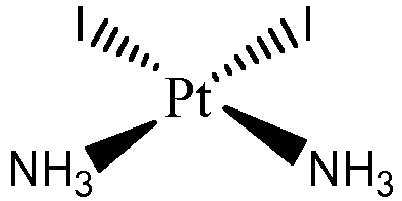
- Kl (6.640 g, 40 mmol) solution (50 ml) was added to potassium chloroplatinite (K2P†Cl4) (2.075 g, 5 mmol) in water (50 ml), the mixture was stirred and heated to 40∼60 °C away from light and oxygen for 0.5∼2h, and then ammonia water (50 ml) (containing 5 mmol ammonia) was added; the reaction mixture was kept under this condition for 0.5∼2h. Light yellow solid product (2.29 g) was obtained by suction filtration and washed successively with water (10 ml×3 times) and diethyl ether (10 ml×3 times); the yield was 95.1%. Elemental analysis: H1.24% (theoretical 1.21%); N5.56% (theoretical 5.797%).
-

- Adding Ag2SO4 (625 mg, 2 mmol) in water (30 ml) and stirring, diamine·diiodo-platinum (II) (0.96g, 2 mmol) was added and another part of water (40 ml) was added to the reaction mixture; the mixture was stirred and heated at 40∼60 °C for 4∼8h. After removing Agl deposit by suction, the filtrate was the aqueous solution of the product.
-

- 2-(2-methylamine ethyl)-malonic acid disodium salt (2 mmol) solution was regulated the pH to 5∼7 with H3PO4 (1M) and then cis-diamine·dihydrate platinum (II) sulphate aqueous solution was poured into reaction mixture; the mixture was heated in water bath to 40∼75 °C for 4-6h under N2 protection; after filtration, reaction mixture was concentrated to a certain volume and should be at a standstill; crystalline-type [2-(2-methylamine ethyl)-malonato] ·[cis-diamino] platinum (II) phosphate (106 mg) is obtained.
- The said compound is soluble in water. The solubility is 221 mg/ml. Free base of the compound [2-(2-methylamine ethyl)-malonic] ·[cis-diamine] platinum (II) could be obtained by regulating pH with alkali. Free base elemental analysis: C18.29% (theoretical 18.56%); H3.84% (theoretical 3.87%); N10.57% (theoretical 10.82%).
1HNMR (D2O) (ppm): δ3.60 (t, 1H), δ2.87 (s, 3H), δ2.65 (t, 2H), δ1.75 (m, 2H). -
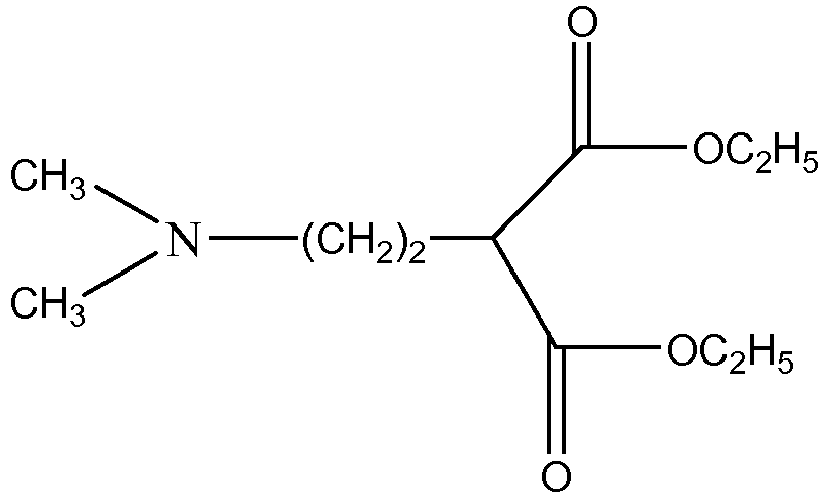
- To the mixture of 2-broethyl-diethyl malonate (106.91 g, 0.4 mol), anhydrous K2CO3 (55.840 g, 0.4 mol) in acetonitrile (500 ml), dimethylamine (45.3 g, 1.0 mol) solution in refrigerated was added and the mixture was heated at 40∼60 °C for 2-6h; insoluble substance was filtered out and the filtrate was concentrated in vacuo; the residues was dissolved with 1000 ml ethyl acetate; organic phase was washed with saturate NaCl aqueous solution (250 ml×3 times) and dried over anhydrous MgSO4 overnight; after removal of solvent in vacuo, light yellow oil (91.3 g) was obtained; the oil was purified by column chromatography to afford the title compound (45.37 g) and the yield was 49.1%.
-

- 2M NaOH solution (2.5 mL) was added to 2-(2-dimethylamine ethyl)-diethyl malonate (435 mg, 2 mmol) in 20 ml flasks; and the mixture was stirred at room temperature for 45∼60h, 2-(2-dimethylamine ethyl)-malonic acid disodium salt solution was obtained.
-

- 2-(2-dimethylamine ethyl)-malonic acid disodium salt (2 mmol) solution was regulated to the pH 5∼7 with CH3COOH (1M) and then cis-diamine ·dihydrate platinum (II) sulphate aqueous solution was poured into reaction mixture; the mixture was heated in water bath to 40∼75 °C for 4-6h under N2 protection; after filtration through celite, reaction mixture was concentrated to a certain volume and should be at a standstill; crystalline-type 2-(2-dimethylamine ethyl)-malonic·cis-diamino platinum (II) phosphate (113 mg) was obtained.
- Both the free base and salt of the said compound are soluble in water. The solubility is 198 mg/ml. It can be easily converted into other types of organic or inorganic salts through ionization. It may be but not limited to sulphate, mesylate, tartrate, succinate, acetate, citrate, tosilate, fumarate, etc. Free base elemental analysis: C20.57% (theoretical 20.9%); H4.41% (theoretical 4.23%); N10.52% (theoretical 10.45%).
1HNMR (D2O)(ppm): δ3.65(†,1H), δ2.66(s,6H), δ2.55(†,2H) δ1.74(m,2H). -

- Diethyl malonate (16.02 g, 0.1 mol) and 1,3-dibromoethane (50.6 g, 0.25 mol) were placed into 150 ml flasks. K2CO3 (15.13 g, 0.11 mol) and tetrabutylammonium bromide (153 mg) were added. The mixture was stirred and heated to 65∼85 °C in oil bath for 16∼24h; suction filtration was conducted to remove solid which was washed with diethyl ether (30 ml×3 times), filtrate consolidated was washed with water (40 ml×3 times) and dried over anhydrous MgSO4 for 4∼8h. After removal of solvent, the distillate was collected for 125-143 °C at vacuum 0.93 kPa (7 mmHg); the product was 9.39 g; and the yield was 32.9%
-
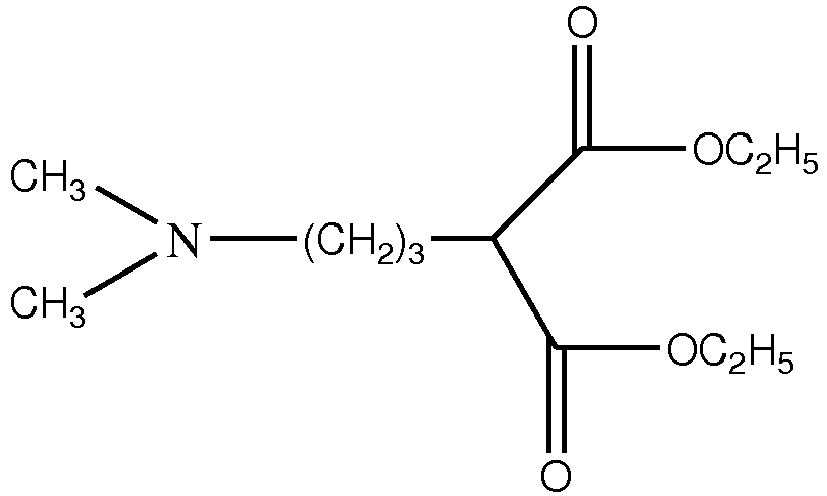
- To the mixture of 2-bropropyl-diethyl malonate (106.91 g, 0.4 mol), anhydrous K2CO3 (55.70 g, 0.4 mol) in acetonitrile (500 ml), dimethylamine (45.2 g, 1.0 mol) solution in refrigerated was added and the mixture was heated at 40∼60 °C for 2-6h; insoluble substance was filtered out and the filtrate was concentrated in vacuo; the residue was dissolved with 1000 ml ethyl acetate; organic phase was washed with saturate NaCl aqueous solution (250 ml×3 times) and dried over anhydrous MgSO4 overnight; after removal of solvent in vacuo, light yellow oil (97.1 g) was obtained; the oil was purified by column chromatography to afford the title compound (34.37 g) and the yield was 35.1%.
-

- 2M NaOH solution (2.5 mL) was added to 2-(2-dimethylamine ethyl)-diethyl malonate (463 mg, 2 mmol) in 20 ml flasks; and the mixture was stirred at room temperature for 45∼60h, 2-(3-dimethylamine propyl)-malonic acid disodium salt solution is obtained.
-

- 2-(3-dimethylamine propyl)-malonic acid disodium salt (2 mmol) solution was regulated to the pH 5∼7 with H3PO4 (1M) and then cis-diamine ·dihydrate platinum (II) sulphate aqueous solution was poured into reaction mixture; the mixture was heated in water bath to 40∼75 °C for 4-6h. Under N2 protection; after filtration, the filtrate was concentrated to a certain volume and should be at a standstill; crystalline-type 2-(2-methylamine ethyl)-malonic ·cis-diamino platinum (II) phosphate (115 mg) was obtained.
- Both the free base and salt of the said compound are soluble in water. The solubility is 164 mg/ml. It can be easily converted into other types of organic or inorganic salts through ionization. It may be but not limited to sulphate, mesylate, tartrate, succinate, acetate, citrate, tosilate, fumarate, etc. Free base elemental analysis: C23.22% (theoretical 23.08%); H4.54% (theoretical 4.57%); N10.32% (theoretical 10.10%).
1HNMR(D2O)(ppm):δ3.62(t,1H), δ2.75(s,6H),δ2.69(†,2H),δ1.75(m,2H), δ1.49(m,2H). -

- To the mixture of 2-bropropyl-diethyl malonate (113.7 g, 0.4 mol), anhydrous K2CO3 (55.40 g, 0.4 mol) in acetonitrile (500 ml), dimethylamine (45.2 g, 1.0 mol), Excessive ammonia was bubbled into mixture which was then heated at 40∼60 °C for 2-6h; insoluble substance was filtered out and the filtrate was concentrated in vacuo; the residues was dissolved with 1000 ml ethyl acetate; organic phase was washed with saturate NaCl aqueous solution (250 ml×3 times) and dried over anhydrous MgSO4 overnight; after removal of solvent in vacuo, light yellow oil (85.9 g) was obtained; the oil was purified by column chromatography to afford the title compound (34.9 g) and the yield was 40.2%.
-

- 2M NaOH solution (2.5 mL) was added to 2-(3-aminopropyl)-diethyl malonate (433 mg, 2 mmol) in 20 ml flasks; and the mixture was stirred at room temperature for 45∼60h, 2-(3-aminopropyl)-malonic acid disodium salt solution was obtained.
-

- 2-(3-aminopropyl)-malonic acid disodium salt (2 mmol) solution was regulated to the pH 5∼7 with H3PO4 (1M) and then cis-diamine·dihydrate platinum (II) sulphate aqueous solution was added into reaction mixture which was then heated in water bath to 40∼75 °C for 4-6hr under N2 protection; after filtration, the filtrate was concentrated to a certain volume and should be at a standstill; crystalline-type 2-(3-aminpropyl)-malonic ·cis-diamino platinum (II) phosphate (118 mg) was obtained.
- Both the free base and salt of the said compound are soluble in water. The solubility is 176 mg/ml. It can be easily converted into other types of organic or inorganic salts through ionization. It may be but not limited to sulphate, mesylate, tartrate, succinate, acetate, citrate, tosilate, fumarate, etc. Free base elemental analysis: C18.37% (theoretical 18.56%); H3.61% (theoretical 3.87%); N10.72% (theoretical 10.82%).
1HNMR(D2O)(ppm):δ3.62(†,1H), δ2.88(†,2H), δ1.78(m,2H), δ1.52(m,2H). -

- To the mixture of 2-broethyl-diethyl malonate (106.75 g, 0.4 mol), anhydrous K2CO3 (55.70 g, 0.4 mol) in acetonitrile (500 ml), dimethylamine (45.2 g, 1.0 mol) solution in refrigerated was added and the mixture was heated at 40∼60 °C for 2-6h; insoluble substance was filtered out and the filtrate was concentrated in vacuo; the residues was dissolved with 1000 ml ethyl acetate; organic phase was washed with saturate NaCl aqueous solution (250 ml×3 times) and dried over anhydrous MgSO4 overnight; after removal of solvent in vacuo, light yellow oil (92.5 g) was obtained; the oil was purified by column chromatography to afford the title compound (46.93 g) and the yield was 45.3%.
-

- 2M NaOH solution (2.5 mL) was added to 2-(2-diethylamine ethyl)-diethyl malonate (518 mg, 2 mmol) in 20 ml flasks; and the mixture was stirred at room temperature for 45∼60h, 2-(2-diethylamine ethyl)-malonic acid disodium salt solution was obtained.
-

- 2-(2-diethylamine ethyl)-malonic acid disodium salt (2 mmol) solution was regulated to the pH 5∼7 with H3PO4 (1M) and then cis-diamine·dihydrate platinum (II) sulphate aqueous solution was poured into reaction mixture; the mixture was heated in water bath to 40∼75 °C for 4-6h under N2 protection; after filtration, reaction mixture was concentrated to a certain volume and should be at a standstill; crystalline-type 2-(2-diethylamine ethyl)-malonic·cis-diamino platinum (II) phosphate (118 mg) was obtained.
- Both the free base and salt of the said compound are soluble in water. The solubility is 187 mg/ml. It can be easily converted into other types of organic or inorganic salts through ionization. It may be but not limited to sulphate, mesylate, tartrate, succinate, acetate, citrate, tosilate, fumarate, etc. Free base elemental analysis: C24.9% (theoretical 25.12%); H4.84% (theoretical 4.88%); N9.56% (theoretical 9.77%).
1HNMR(D2O)(ppm):δ3.60(†,1H),δ2.78(q,4H), δ2.70(†,2H), δ1.70(m,2H),δ1.08(†,6H). -

- To the mixture of 2-bropropyl-diethyl malonate (114.1 g, 0.4 mol), anhydrous K2CO3 (55.60 g, 0.4 mol) in acetonitrile (500 ml), diethylamine (73.1 g, 1.0 mol) solution refrigerated was added and the mixture was heated at 40∼60 °C for 2-6h; insoluble substance was filtered out and the filtrate was concentrated in vacuo; the residues was dissolved with 1000 ml ethyl acetate; organic phase was washed with saturate NaCl aqueous solution (250 ml×3 times) and dried over anhydrous MgSO4 overnight; after removal of solvent in vacuo, light yellow oil (105.3 g) was obtained; the oil was purified by column chromatography to afford the title compound (39.5 g) and the yield was 36.3%.
-

- 2M NaOH solution (2.5 mL). was added to 2-(3-diethylamine ethyl)-diethyl malonate (518 mg, 2 mmol) in 20 ml flasks; and the mixture was stirred at room temperature for 45∼60h, 2-(2-diethylamine ethyl)-malonic acid disodium salt solution was obtained.
- 2-(3-diethylamine ethyl)-malonic acid disodium salt (2 mmol) solution was regulated to the pH 5∼7 with H3PO4 (1M) and then cis-diamine·dihydrate platinum (II) sulphate aqueous solution was poured into reaction mixture; the mixture was heated in water bath to 40∼75 °C for 4-6h under N2 protection; after filtration through celite, reaction mixture was concentrated to a certain volume and should be at a standstill; crystalline-type 2-(3-diethylamine ethyl)-malonic·cis-diamino platinum (II) phosphate (123 mg) was obtained.

- 1HNMR(D2O)(ppm): δ3.62(t,1H), δ2.76(q,4H), δ2.69(t,2H), δ1.74(m,2H), δ1.49(m,2H) δ1.07(t,6H).
- Both the free base and salt of the said compound are soluble in water. The solubility is 165 mg/ml. It can be easily converted into other types of organic or inorganic salts through ionization. It may be but not limited to sulphate, mesylate, tartrate, succinate, acetate, citrate, tosilate, fumarate, etc. Free base elemental analysis: C26.76% (theoretical 27.03%); H4.85% (theoretical 5.18%); N9.64% (theoretical 9.46%).
-

- To the mixture of 2-broethyl-diethyl malonate (106.6 g, 0.4 mol), anhydrous K2CO3 (55.0 g, 0.4 mol) in acetonitrile (500 ml), di-n-propylamine (101.0 g, 1.0 mol) solution refrigerated was added and the mixture was heated at 40∼60 °C for 2-6h; insoluble substance was filtered out and the filtrate was concentrated in vacuo; the residues was dissolved with 1000 ml ethyl acetate; organic phase was washed with saturate NaCl aqueous solution (250 ml×3 times) and dried over anhydrous MgSO4 overnight; after removal of solvent in vacuo, light yellow oil (109.3 g) was obtained; the oil was purified by column chromatography to afford the title compound (47.53 g) and the yield was 41.4%.
-

- 2M NaOH solution (2.5 mL) was added to 2-(2-di-n-propylamine ethyl)-diethyl malonate (575 mg, 2 mmol) in 20 ml flasks; and the mixture was stirred at room temperature for 45∼60h, 2-(2-di-n-propylamine ethyl)-malonic acid disodium salt solution was obtained.
- 2-(2-di-n-propylamine ethyl)-malonic acid disodium salt (2 mmol) solution was regulated to the pH 5∼7 with H3PO4 (1M) and then cis-diamine·dihydrate platinum (II) sulphate aqueous solution was poured into reaction mixture; the mixture was heated in water bath to 40∼75 °C for 4-6h under N2 protection; after filtration through celite, reaction mixture was concentrated to a certain volume and should be at a standstill; crystalline-type 2-(2-di-n-propylamine ethyl)-malonic·cis-diamino platinum (II) phosphate (123 mg) was obtained.

- 1HNMR (D2O) (ppm): δ3.60(t,1H), δ2.77(t,4H), δ2.70(t,2H), δ1.78(m,2H), δ1.25(m,4H), δ1.05(t,6H).
- Both the free base and salt of the said compound are soluble in water. The solubility is 159 mg/ml. It can be easily converted into other types of organic or inorganic salts through ionization. It may be but not limited to sulphate, mesylate, tartrate, succinate, acetate, citrate, tosilate, fumarate, etc. Free base elemental analysis: C28.59% (theoretical 28.82%); H5.62% (theoretical 5.46%); N9.29% (theoretical 9.17%).
-
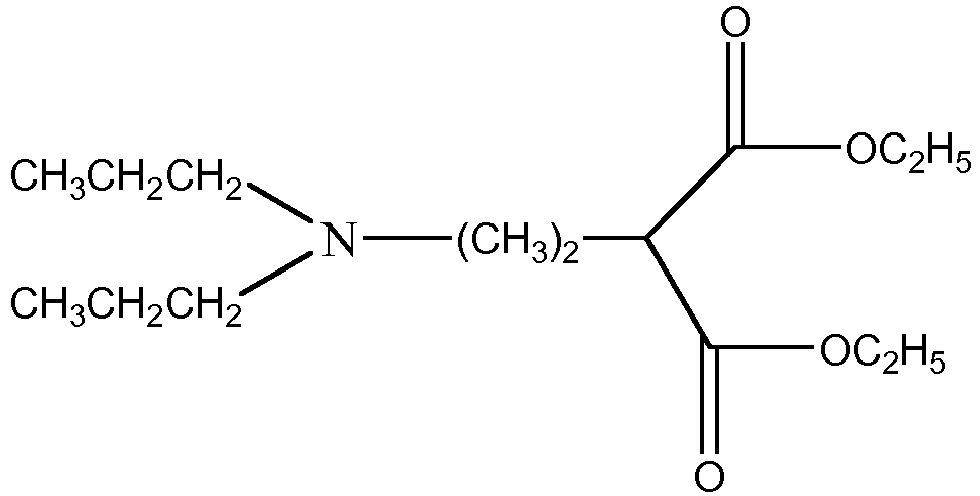
- To the mixture of 2-bropropyl-diethyl malonate (113.0 g, 0.4 mol), anhydrous K2CO3 (55.20 g, 0.4 mol) in acetonitrile (500 ml), di-n-propylamine (45.2 g, 1.0 mol) solution refrigerated was added and the mixture was heated at 40∼60 °C for 2-6h; insoluble substance was filtered out and the filtrate was concentrated in vacuo; the residues was dissolved with 1000 ml ethyl acetate; organic phase was washed with saturate NaCl aqueous solution (250 ml×3 times) and dried over anhydrous MgSO4 overnight; after removal of solvent in vacuo, light yellow oil (103.1 g) was obtained; the oil was purified by column chromatography to afford the title compound (40.1 g) and the yield was 33.3%.
-

- 2M NaOH solution (2.5 mL) was added to 2-(3-di-n-propylamine propyl)-diethyl malonate (603 mg, 2 mmol) in 20 ml flasks; and the mixture was stirred at room temperature for 45∼60h, 2-(3-di-n-propylamine propyl)-malonic acid disodium salt solution was obtained.
- 2-(3-di-n-propylamine propyl)-malonic acid disodium salt (2 mmol) solution was regulated to the pH 5∼7 with CH3SO3 H (1M) and then cis-diamine·dihydrate platinum (II) sulphate aqueous solution was poured into reaction mixture; the mixture was heated in water bath to 40∼75 °C for 4-6h under N2 protection; after filtration through celite, reaction mixture was concentrated to a certain volume and should be at a standstill; crystalline-type 2-(3-di-n-propylamine propyl)-malonic·cis-diamino platinum (II) phosphate (125 mg) is obtained.

- 1HNMR(D2O)(ppm): δ3.62(t,1H), δ2.77(t,4H), δ2.70(t,2H), δ1.74(m,2H), δ1.49(m,2H) δ1.25(m,4H), δ1.03(t,6H).
- Both the free base and salt of the said compound are soluble in water. The solubility is 148 mg/ml. It can be easily converted into other types of organic or inorganic salts through ionization. It may be but not limited to sulphate, mesylate, tartrate, succinate, acetate, citrate, tosilate, fumarate, etc. Free base elemental analysis: C30.28% (theoretical 30.51%); H5.83% (theoretical 5.72%); N9.16% (theoretical 8.9%).
-

- To the mixture of 2-bromethyl-diethyl malonate (106.5 g, 0.4 mol), anhydrous K2CO3 (55.0 g, 0.4 mol) in acetonitrile (500 ml), excessive ammonia was added and the mixture was heated at 40∼60 °C for 2-6h; insoluble substance is filtered out and the filtrate was concentrated in vacuo; the residues was dissolved with 1000 ml ethyl acetate; organic phase was washed with saturate NaCl aqueous solution (250 ml×3 times) and dried over anhydrous MgSO4 overnight; after removal of solvent in vacuo, light yellow oil (77.4 g) was obtained; the oil was purified by column chromatography to afford the title compound (34.7 g) and the yield was 42.7%.
-

- 2M NaOH solution (2.5 mL) was added to 2-(2-amino ethyl)-diethyl malonate (603 mg, 2 mmol) in 20 ml flasks; and the mixture was stirred at room temperature for 45∼60h, 2-(2-amino ethyl)-malonic acid disodium salt solution was obtained.
-

- KI (6.640 g, 40 mmol) solution (50 ml) was added to potassium chloroplatinite (K2PtCl4) (2.075 g, 5 mmol) in water (50 ml), the mixture was stirred and heated to 40∼60 °C away from light and oxygen for 0.5∼2h, and then trans-hexamethylene diamine (571 mg, 5 mmol) in water (50 ml) was added; the reaction mixture was kept under this condition for 0.5∼2h. Yellow solid product (2.709 g) was obtained by suction filtration and washed successively with water (10 ml×3 times) and diethyl ether (10 ml×3 times); the yield was 95.1%. Elemental analysis: C12.68% (theoretical 12.80%); H2.61% (theoretical 2.51%); N4.99% (theoretical 4.98%).
-

- Stirring Ag2SO4 (625 mg, 2 mmol) in water (30 ml), trans-hexamethylene diamine·diiodo-platinum (II) (1.126 g, 2 mmol) was added and another part of water (40 ml) was added to the reaction mixture; the mixture was stirred and heated at 40∼60 °C for 4∼8h. After removing Agl deposit by suction, the filtrate was the aqueous solution of the product.
-

- 2-(2-amino ethyl)-malonic acid disodium salt (2 mmol) solution was regulated to the pH 5∼7 with H3PO4 (1M) and then aqueous trans-hexamethylene diamine·dihydrate platinum (II) sulphate was poured into reaction mixture; the mixture was heated in water bath to 40∼60 °C for 4-8h; and then added 2.5 g silica into it; the mixture was stirred for 15 min and concentrated to dry, the residue was purified by column chromatography to afford the title compound (138 mg).
- The said compound is soluble in water. The solubility is 275 mg/ml. It can be easily converted into other types of organic or inorganic salts through ionization. It may be but not limited to sulphate, mesylate, tartrate, succinateacetate, citrate, tosilate, fumarate, etc. Free base elemental analysis: C29.31% (theoretical 29.07%); H4.82% (theoretical 4.63%); N9.17% (theoretical 9.25%).
1HNMR (D2O) (ppm): δ3.61(t,1H), δ2.78(t,2H), δ2.06(br,2H), δ1.81(m,2H), δ1.74(m,2H), δ1.46(m,2H), δ1.21(br,2H), δ1.01(m,2H). -

- 2-(2-dimethylamine ethyl)-malonic acid disodium salt (2 mmol) solution was regulated to the pH 5∼7 with H3PO4 (1M) and then aqueous trans-hexamethylene diamine·dihydrate platinum (II) sulphate was poured into reaction mixture; the mixture was heated in water bath to 40∼60 °C for 4-8h and then added 2.5 g silica into it; the mixture was stirred for 15 min and concentrated to dry, the residue was purified by column chromatography to afford the title compound (149 mg).
1HNMR(D2O)(ppm): δ3.63(t,1H), δ2.68(s,6H), δ2.55(t,2H), δ2.06(br,2H), δ1.81(m,2H), δ1.74(m,2H), δ1.46(m,2H), δ1.21(br,2H), δ1.05(m,2H). - The said compound is soluble in water. The solubility is 233 mg/ml. It can be easily converted into other types of organic or inorganic salts through ionization. It may be but not limited to sulphate, mesylate, tartrate, succinateacetate, citrate, tosilate, fumarate, etc. Free base elemental analysis: C32.34% (theoretical 32.37%); H5.42% (theoretical 5.19%); N8.47% (theoretical 8.71%).
-

- 2-(3-dimethylamine propyl)-malonic acid disodium salt (2 mmol) solution was regulated to the pH 5∼7 with H3PO4 (1M) and then aqueous trans-hexamethylene diamine·dihydrate platinum (II) sulphate was poured into reaction mixture; the mixture was heated in water bath to 40∼60 °C for 4-8h and then added 2.5 g silica into it; the mixture was stirred for 15 min and concentrated to dry, the residue was purified by column chromatography to afford the title compound (131 mg).
1HNMR(D2O)(ppm): δ3.61(t,1H), δ2.75(s,6H), δ2.69(t,2H), δ2.06(br,2H), δ1.81(m,2H) δ1.74(m,2H), δ1.49(m,2H) δ1.46(m,2H), δ1.21(br,2H), δ1.02(m,2H) - The said compound is soluble in water. The solubility is 200 mg/ml. It can be easily converted into other types of organic or inorganic salts through ionization. It may be but not limited to sulphate, mesylate, tartrate, succinateacetate, citrate, tosilate, fumarate, etc. Free base elemental analysis: C33.54% (theoretical 33.87%); H5.29% (theoretical 5.44%); N8.26% (theoretical 8.47%).
-

- To the mixture of 2-bromethyl-diethyl malonate (106.2 g, 0.4 mol), anhydrous K2CO3 (55.0 g, 0.4 mol) in acetonitrile (500 ml), ethylamine (44.2 g, 1.0 mol) refrigerated was added and the mixture was heated at 40∼60 °C for 2-6h; insoluble substance was filtered out and the filtrate was concentrated in vacuo; the residues was dissolved with 1000 ml ethyl acetate; organic phase was washed with saturate NaCl aqueous solution (250 ml×3 times) and dried over anhydrous MgSO4 overnight; after removal of solvent in vacuo, light yellow oil (85.4 g) was obtained ; the oil was purified by column chromatography to afford the title compound (36.8 g) and the yield was 39.7%.
-

- 2M NaOH solution (2.5 mL). was added to 2-(2-ethylamine ethyl)-diethyl malonate (465 mg, 2 mmol) in 20 ml flasks; and the mixture was stirred at room temperature for 45∼60h, 2-(2-ethylamine ethyl)-malonic acid disodium salt solution was obtained.
-

- 2-(2-ethylamine ethyl)-malonic acid disodium salt (2 mmol) solution was regulated to the pH 5∼7 with H3PO4 (1M) and then aqueous trans-hexamethylene diamine·dihydrate platinum (II) sulphate was poured into reaction mixture; the mixture was heated in water bath to 40∼60 °C for 4-8h and then added 2.5 g silica into it; the mixture was stirred for 15 min and concentrated to dry, the residue was purified by column chromatography to afford the title compound (137 mg).
1HNMR(D2O)(ppm): δ3.60(t,1H), δ2.78(m,2H), δ2.70(t,2H), 2.06(br,2H), 1.81(m,2H), δ1.70(m,2H), 1.46(m,2H), 1.21(br,2H), δ1.08(t,3H) 1.00(m,2H). - The said compound is soluble in water. The solubility is 221 mg/ml. It can be easily converted into other types of organic or inorganic salts through ionization. It may be but not limited to sulphate, mesylate, tartrate, succinateacetate, citrate, tosilate, fumarate, etc. Free base elemental analysis: C32.55% (theoretical 32.43%); H5.21% (theoretical 5.0%); N8.56% (theoretical 8.73%).
-

- 2-(2-diethylamine ethyl)-malonic acid disodium salt (2 mmol) solution was regulated to the pH 5∼7 with citric acid (1M) and then aqueous trans-hexamethylene diamine·dihydrate platinum (II) sulphate was poured into reaction mixture; the mixture was heated in water bath to 40∼60 °C for 4-8h and then added 2.5 g silica into it; the mixture was stirred for 15 min and concentrated to dry, the residue was purified by column chromatography to afford the title compound (155 mg).
1HNMR(D2O)(ppm): δ3.62(t,1H), δ2.78(m,4H), δ2.70(t,2H), 2.06(br,2H), 1.81 (m,2H), δ1.70(m,2H), 1.46(m,2H), 1.21(br,2H), δ1.06(t,6H) 1.00(m,2H). - The said compound is soluble in water. The solubility is 180 mg/ml. It can be easily converted into other types of organic or inorganic salts through ionization. It may be but not limited to sulphate, mesylate, tartrate, succinateacetate, citrate, tosilate, fumarate, etc. Free base elemental analysis: C35.01% (theoretical 35.29%); H5.43% (theoretical 5.69%); N8.51% (theoretical 8.24%).
-

- 2-(2-diethylamine propyl)-malonic acid disodium salt (2 mmol) solution was regulated to the pH 5∼7 with H3PO4 (1M) and then aqueous trans-hexamethylene diamine·dihydrate platinum (II) sulphate was poured into reaction mixture; the mixture was heated in water bath to 40∼60 °C for 4-8h and then added 2.5 g silica into it; the mixture was stirred for 15 min and concentrated to dry, the residue was purified by column chromatography to afford the title compound (145m g).
1HNMR(D2O)(ppm): δ3.61(t,1H), δ2.78(q,4H), δ2.70(t,2H), δ2.06(br,2H), δ1.81(m,2H), δ1.72(m,2H), δ1.46(m,2H), δ1.49(m,2H) δ1.21(br,2H), δ1.08(t,6H), δ1.02(m,2H). - The said compound is soluble in water. The solubility is 156 mg/ml. It can be easily converted into other types of organic or inorganic salts through ionization. It may be but not limited to sulphate, mesylate, tartrate, succinateacetate, citrate, tosilate, fumarate, etc. Free base elemental analysis: C36.37% (theoretical 36.64%); H6.13% (theoretical 5.92%); N8.22% (theoretical 8.02%).
-

- 2-(2-di-n-propylamine ethyl)-malonic acid disodium salt (2 mmol) solution was regulated to the pH 5∼7 with H3PO4 (1M) and then aqueous trans-hexamethylene diamine·dihydrate platinum (II) sulphate was poured into reaction mixture; the mixture was heated in water bath to 40∼60 °C for 4-8h and then added 2.5 g silica into it; the mixture was stirred for 15 min and concentrated to dry, the residue was purified by column chromatography to afford the title compound (151m g).
1HNMR(D2O)(ppm): δ3.60(t,1H), δ2.77(t,4H), δ2.70(t,2H), δ2.06 (br,2H), δ1.81 (m,2H), δ1.78(m,2H), δ1.46 (m,2H), δ1.25(m,4H), δ1.21 (br,2H), δ1.03 (t,6H) δ1.00 (m,2H). - The said compound is soluble in water. The solubility is 131 mg/ml. It can be easily converted into other types of organic or inorganic salts through ionization. It may be but not limited to sulphate, mesylate, tartrate, succinateacetate, citrate, tosilate, fumarate, etc. Free base elemental analysis: C37.97% (theoretical 37.92%); H6.34% (theoretical 6.13%); N7.62% (theoretical 7.81%).
-

- 2-(3-di-n-propylamine propyl)-malonic acid disodium salt (2 mmol) solution was regulated to the pH 5∼7 with H3PO4 (1M) and then aqueous trans-hexamethylene diamine·dihydrate platinum (II) sulphate was poured into reaction mixture; the mixture was heated in water bath to 40∼60 °C for 4-8h and then added 2.5 g silica into it; the mixture was stirred for 15 min and concentrated to dry, the residue was purified by column chromatography to afford the title compound (160 mg).
1HNMR(D2O)(ppm): δ3.62(t,1H), δ2.77(t,4H), δ2.70(t,2H), δ2.06 (br,2H), δ1.81 (m,2H), δ1.74(m,2H), δ1.49(m,2H) δ1.46 (m,2H), δ1.25 (m,4H), δ1.21 (br,2H), δ1.03 (t,6H), δ1.00 (m,2H). - The said compound is soluble in water. The solubility is 109 mg/ml. It can be easily converted into other types of organic or inorganic salts through ionization. It may be but not limited to sulphate, mesylate, tartrate, succinateacetate, citrate, tosilate, fumarate, etc. Free base elemental analysis: C39.14% (theoretical 39.13%); H6.38% (theoretical 6.34%); N7.69% (theoretical 7.61%).
-

- To the solution of cyclopentene (6.81 g,100 mmol) in dichloromethane (30 ml), Br2 (16.5 g, 103 mmol) was added dropwise slowly at -5∼10 °C and stirred for 1∼3h, organic layer was washed with saturate sodium bicarbonate solution (10 ml×3 times) and dry with anhydrous MgSO4 for 2∼3h; after removal of solvent in vacuo, 1,2-trans-dibromo cyclopentane (20.56 g) as light yellow transparent oil was obtained; and the yield is 90.18%. Elemental analysis: C26.51% (theoretical 26.32%); H3.62% (theoretical 3.51%).
- 1,2-trans-dibromo cyclopentane (11.5 g, 50 mmol) and 30% ammonia ethanol solution (30 ml) was added into 100 ml pressure reactor; the mixture was heated to 40∼60 °C and stirred for 6∼8h; after removal of solvent in vacuo to afford 1,2-trans-cyclopentylamine (4.015 g) as light yellow transparent oil; and the yield was 79.6%. Elemental analysis: C60.21% (theoretical 60%); H12.12% (theoretical 12%); N28.21% (theoretical 28%).
-

- KI (6.630 g, 40 mmol) solution (50 ml) was added to potassium chloroplatinite (K2PtCl4) (2.073 g, 5 mmol) in water (50 ml), the mixture was stirred and heated to 40∼60 °C away from light and oxygen for 0.5∼2h, and then 1,2-trans-diaminocyclopentane (501 mg, 5 mmol) in water (50 ml) was added; the reaction mixture was kept under this condition for 0.5∼2h. Yellow solid product (2.56 g) was obtained by suction filtration and washing successively with water (10 ml×3 times) and diethyl ether (10 ml×3 times), the yield was 93.1%.
- Elemental analysis: C10.78% (theoretical 10.93%); H2.31% (theoretical 2.19%); N4.98% (theoretical 5.10%).
-
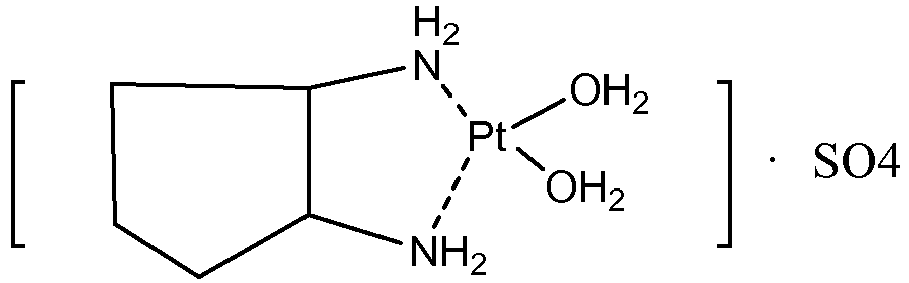
- Stirring Ag2SO4 (625 mg, 2 mmol) in water (30 ml), 1,2-trans-diaminocyclopentane·diiodo-platinum (II) (1.10 g, 2 mmol) was added and another part of water (40 ml) was added to the reaction mixture; the mixture was stirred and heated at 40∼60 °C for 4∼8h. After removing Agl deposit by suction, the filtrate was the aqueous solution of the product.
-

- 2-(3-diethylamine propyl)-malonic acid disodium salt (2 mmol) solution was regulated to the pH 5∼7 with H3PO4 (1M) and then aqueous 1,2-trans-hexamethylene diamine·dihydrate platinum (II) sulphate was poured into reaction mixture; the mixture was heated in water bath to 40∼60 °C for 4-8h and then added 2.5 g silica into it; the mixture was stirred for 15 min and concentrated to dry, the residue was purified by column chromatography to afford the title compound (153 mg).
1HNMR(D2O)(ppm): δ3.61(t,1H), δ2.78(q,4H), δ2.70(t,2H), δ2.08(br,2H), δ1.83(m,2H), δ1.72(m,2H), δ1.49(m,2H) δ1.42(m,2H), δ1.20(m,1H), δ1.08(t,6H), δ1.02(m,1H). - The said compound is soluble in water. The solubility is 178 mg/ml. It can be easily converted into other types of organic or inorganic salts through free base. It may be but not limited to sulphate, mesylate, tartrate, succinateacetate, citrate, tosilate, fumarate, etc. Free base elemental analysis: C35.58% (theoretical 35.29%); H5.61% (theoretical 5.69%); N8.37% (theoretical 8.24%).
-

- To the solution of cyclobutene (5.39 g , 100 mmol) in dichloromethane (30 ml), Br2 (16.5 g, 103 mmol) was added dropwise slowly at -5∼10 °C and stirred for 1∼3h, organic layer was washed with saturate sodium bicarbonate solution (10 ml×3 times) and dried with anhydrous MgSO4 for 2∼3h; After removal of solvent in vacuo,1,2-trans-dibromo cyclobutane (20.37 g) as light yellow transparent oil was obtained; and the yield was 95.19%. Elemental analysis: C22.53% (theoretical 22.43%); H2.61% (theoretical 2.80%).
- 1,2-trans-dibromo cyclobutane (10.65 g, 50 mmol) and 30% ammonia ethanol solution (30 ml) was added into 100 ml pressure reactor; the mixture was heated to 40∼60 °C and stirred for 6∼8h, after removal of solvent in vacuo to afford 1,2-trans-diaminecyclobutane (3.723 g) as light yellow transparent oil; and the yield is 86.58%. Elemental analysis: C55.57% (theoretical 55.81%); H11.90% (theoretical 11.63%); N32.17% (theoretical 32.56%).
-

- KI (6.630 g, 40 mmol) solution (50 ml) was added to potassium chloroplatinite (K2PtCl4) (2.075 g, 5mmol) in water (50 ml), the mixture was stirred and heated to 40∼60 °C away from light and oxygen for 0.5∼2h, and then 1,2-trans-diaminocyclobutane (501 mg, 5 mmol) in water (50 ml) was added; the reaction mixture shall be kept under this condition for 0.5∼2h. Yellow solid product (2.49 g) was obtained by suction filtration and washing successively with water (10 ml×3 times) and diethyl ether (10 ml×3 times), the yield was 90.8%.
- Elemental analysis: C8.75% (theoretical 8.97%); H1.91% (theoretical 1.87%); N5.98% (theoretical 5.23%).
-

- Stirring Ag2SO4 (625 mg, 2 mmol) in water (30 ml), 1,2-trans-diaminocyclobutane·diiodo-platinum (II) (1.07 g, 2 mmol) was added and another part of water (40 ml) was added to the reaction mixture; the mixture was stirred and heated at 40∼60 °C for 4∼8h. After removing Agl deposit by suction, the filtrate was the aqueous solution of the product.
-

- 2-(3-diethylamine propyl)-malonic acid disodium salt (2 mmol) solution was regulated to the pH 5∼7 with succinic acid (C4H6O4, 1M) and then aqueous 1,2-trans-cyclobutyl diamine·dihydrate platinum (II) sulphate was poured into reaction mixture; the mixture was heated in water bath to 40∼60 °C for 4-8h and then added 2.5 g silica into it; the mixture was stirred for 15 min and concentrated to dry, the residue was purified by column chromatography to afford the title compound (143 mg).
1HNMR(D2O)(ppm): δ3.62(t,1H), δ2.78(q,4H), δ2.70(t,2H), δ2.08(br,2H), δ1.85(m,2H), δ1.72(m,2H), δ1.49(m,2H), δ1.44(m,2H), δ1.08(t,6H). - The said compound is soluble in water. The solubility is 208 mg/ml. It can be easily converted into other types of organic or inorganic salts through free base. It may be but not limited to sulphate, mesylate, tartrate, succinateacetate, citrate, tosilate, fumarate, etc. Free base elemental analysis: C34.57% (theoretical 33.87%); H5.62% (theoretical 5.44%); N8.39% (theoretical 8.47%).
-

- KI (6.630 g, 40 mmol) solution (50 ml) was added to potassium chloroplatinite (K2PtCl4) (2.075 g, 5 mmol) in water (50 ml), the mixture was stirred and heated to 40∼60 °C away from light and oxygen for 0.5∼2h, and then 1,2-trans-cyclopropyl diamine (361 mg, 5 mmol) in water (50 ml) was added; the reaction mixture was kept under this condition for 0.5∼2h. Yellow solid product (2.39 g) was obtained by suction filtration and washing successively with water (10 ml×3 times) and diethyl ether (10 ml×3 times), the yield was 91.8%.
- Elemental analysis: C6.97% (theoretical 6.91%); H1.41% (theoretical 1.54%); N5.47% (theoretical 5.37%).
-

- Stirring Ag2SO4 (624 mg, 2 mmol) in water (30 ml), 1,2-trans-cyclopropyl diamine·diiodo-platinum (II) (1.04 g, 2 mmol) was added and another part of water (30 ml) was added to the reaction mixture; the mixture was stirred and heated at 40∼60 °C for 4∼8h. After removing Agl deposit by suction, the filtrate was the aqueous solution of the product.
-

- 2-(3-diethylamine propyl)-malonic acid disodium salt (2 mmol) solution was regulated to the pH 5∼7 with H3PO4 (1M) and then aqueous 1,2-trans-cyclopropyl diamine·dihydrate platinum (II) sulphate was poured into reaction mixture; the mixture was heated in water bath to 40∼60 °C for 4-8h and then added 2.5 g silica into it, the mixture was stirred for 15 min and concentrated to dry, the residue was purified by column chromatography to afford the title compound (137 mg).
1HNMR(D2O)(ppm): δ3.61(t,1H), δ2.78(q,4H), δ2.70(t,2H), 2.10(br,2H), 1.87(m,1H), δ1.75(m,2H), δ1.48(m,2H), 1.43(m,1H), 1.09(t,6H). - The said compound is soluble in water. The solubility is 218 mg/ml. It can be easily converted into other types of organic or inorganic salts through ionization. It may be but not limited to sulphate, mesylate, tartrate, succinateacetate, citrate, tosilate, fumarate, etc. Free base elemental analysis: C32.53% (theoretical 32.37%); H5.12% (theoretical 5.19%); N8.99% (theoretical 8.71%).
-

- KI (6.64 g, 40 mmol) solution (40 ml) was added to potassium chloroplatinite (K2PtCl4) (2.076 g, 5 mmol) in water (50 ml), the mixture was stirred and heated to 40∼60 °C away from light and oxygen for 0.5∼2h, and then 1,2-ethylenediamine (301 mg, 5 mmol) refrigerated in water (50 ml) was added; the reaction mixture shall be kept under this condition for 0.5∼2h. Yellow solid product (2.254 g) was obtained by suction filtration and washing successively with water (10 ml×3 times) and diethyl ether (10 ml×3 times), the yield was 89.8%.
- Elemental analysis: C4.77% (theoretical 4.72%); H1.41% (theoretical 1.57%); N5.41% (theoretical 5.50%).
-

- Stirring Ag2SO4 (625 mg, 2 mmol) in water (30 ml), 1,2-ethylenediamine diiodo-platinum (II) (1.02 g, 2 mmol) was added and another part of water (30 ml) was added to the reaction mixture, the mixture was stirred and heated at 40∼60 °C for 4∼8h. After removing Agl deposit by suction, the filtrate was the aqueous solution of the product.
-

- 2-(3-dimethylamine ethyl)-malonic acid disodium salt (2 mmol) solution was regulated to the pH 5∼7 with p-toluenesulfonic acid (C7H8O3S, 1M) and then aqueous 1,2-ethylenediamine dihydrate platinum (II) sulphate was poured into reaction mixture; the mixture was heated in water bath to 40∼60 °C for 4-8h and then added 2.5 g silica into it, the mixture was stirred for 15 min and concentrated to dry, the residue was purified by column chromatography to afford the title compound (140 mg).
1HNMR(D2O)(ppm): δ3.63(t,1H), δ2.68(s,6H), δ2.55(t,2H), δ2.24-2.32(br,4H), δ1.74(m,2H). - The said compound is soluble in water. The solubility is 269 mg/ml. It can be easily converted into other types of organic or inorganic salts through free base. It may be but not limited to sulphate, mesylate, tartrate, succinateacetate, citrate, tosilate, fumarate, etc. Free alkali elemental analysis: C24.95% (theoretical 25.23%); H4.32% (theoretical 4.44%); N9.92% (theoretical 9.81%).
-

- KI (6.64 g, 40 mmol) solution (40 ml) was added to potassium chloroplatinite (K2PtCl4) (2.073 g, 5 mmol) in water (50 ml), the mixture was stirred and heated to 40∼60 °C away from light and oxygen for 0.5∼2h, and then 1,3-propane diamine (commercially available) refrigerated (372 mg, 5 mmol) in water (50 ml) was added; the reaction mixture was kept under this condition for 0.5∼2h. Yellow solid product (2.281 g) was obtained by suction filtration and washing successively with water (10 ml×3 times) and diethyl ether (10 ml×3 times); the yield was 87.6%.
- Elemental analysis: C6.77% (theoretical 6.88%); H1.79% (theoretical 1.91%); N5.43% (theoretical 5.35%).
-

- Stirring Ag2SO4 (625 mg, 2 mmol) in water (30 ml), 1,3-propyl diamine diiodo-platinum (II) (1.04 g, 2 mmol) was added and another part of water (30 ml) was added to the reaction mixture; the mixture was stirred and heated at 40∼60 °C for 4∼8h. After removing Agl deposit by suction, the filtrate was the aqueous solution of the product.
-

- 2-(3-dimethylamine ethyl)-malonic acid disodium salt (2 mmol) solution was regulated to the pH 5∼7 with H3PO4 (1M) and then aqueous 1,3-propyl diamine·dihydrate platinum (II) sulphate was poured into reaction mixture; the mixture was heated in water bath to 40∼60 °C for 4-8h and then added 2.5 g silica into it; the mixture was stirred for 15 min and concentrated to dry, the residue was purified by column chromatography to afford the title compound (142 mg).
1HNMR(D2O)(ppm): δ3.60(t,1H), δ2.78(q,4H), δ2.70(m,2H), δ2.26(t,4H), δ1.70(m,2H), δ1.45(m,2H), δ1.08(t,6H). - The said compound is soluble in water. The solubility is 231 mg/ml. It can be easily converted into other types of organic or inorganic salts through free base. It may be but not limited to sulphate, mesylate, tartrate, succinateacetate, citrate, tosilate, fumarate, etc. Free base elemental analysis: C30.91% (theoretical 30.64%); H5.32% (theoretical 5.32%); N8.98% (theoretical 8.94%).
-

- KI (6.635 g, 40 mmol) solution (40 ml) was added to potassium chloroplatinite (K2PtCl4) (2.071 g, 5 mmol) in water (50 ml), the mixture was stirred and heated to 40∼60 °C away from light and oxygen for 0.5∼2h, and then 1,4-butyldiamine (commercially available) refrigerated (372 mg, 5 mmol) in water (50 ml) was added; the reaction mixture was kept under this condition for 0.5∼2h. Yellow solid product (2.365 g) was obtained by suction filtration and washing successively with water (10 ml×3 times) and diethyl ether (10 ml×3 times), the yield was 88.1%.
- Elemental analysis: C8.69% (theoretical 8.94%); H2.39% (theoretical 2.23%); N5.44% (theoretical 5.21%).
-

- Stirring Ag2SO4 (624 mg, 2 mmol) in water (30 ml), 1,4-butyldiamine diiodo-platinum (II) (1.04 g, 2 mmol) was added and another part of water (30 ml) was added to the reaction mixture, the mixture was stirred and heated at 40∼60 °C for 4∼8h. After removing Agl deposit by suction, the filtrate was the aqueous solution of the product.
-

- 2-(2-di-n-propylamine ethyl)-malonic acid disodium salt (2 mmol) solution was regulated to the pH 5∼7 with H3PO4 (1M) and then aqueous 1,4-butyldiamine dihydrate platinum (II) sulphate was poured into reaction mixture; the mixture was heated in water bath to 40∼60 °C for 4-8h and then added 2.5 g silica into it; the mixture was stirred for 15 min and concentrated to dry, the residue was purified by column chromatography to afford the title compound (149 mg).
1HNMR(D2O)(ppm): δ3.60(t,1H), δ2.72(m,4H), δ2.52(m,4H), δ2.36(t,2H), δ1.82(m,2H), δ1.55 (t,4H), δ1.39 (m,4H), δ1.05(t,6H). - The said compound is soluble in water. The solubility is 181 mg/ml. It can be easily converted into other types of organic or inorganic salts through free base. It may be but not limited to sulphate, mesylate, tartrate, succinateacetate, citrate, tosilate, fumarate, etc. Free base elemental analysis: C34.93% (theoretical 35.16%); H6.22% (theoretical 6.05%); N8.17% (theoretical 8.20%).
-

- KI (6.637 g, 40 mmol) solution (40 ml) was added to potassium chloroplatinite (K2PtCl4) (2.073 g, 5 mmol) in water (50 ml), the mixture was stirred and heated to 40∼60 °C away from light and oxygen for 0.5∼2h, and then 1,2-(1,2-dihydroxymethyl)ethyldiamine (601 mg, 5 mmol) in water (50 ml) was added; the reaction mixture was kept under this condition for 0.5∼2h. Yellow solid product (2.163 g) was obtained by suction filtration and washing successively with water (10 ml×3 times) and diethyl ether (10 ml×3 times), the yield was 79.96%.
- Elemental analysis: C8.65% (theoretical 8.44%); H2.39% (theoretical 2.11%); N5.03% (theoretical 4.92%).
-

- Stirring Ag2SO4 (624 mg, 2 mmol) in water (30 ml), 1,2-(1,2-dihydroxymethyl)-ethyldiamine diiodo-platinum (II) (1.04 g, 2 mmol) was added and another part of water (30 ml) was added to the reaction mixture; the mixture was stirred and heated at 40∼60 °C for 4∼8h. After removing Agl deposit by suction, the filtrate was the aqueous solution of the title compound.
-

- 2-(2-diethylamine ethyl)-malonic acid disodium salt (2 mmol) solution was regulated to the pH 5∼7 with H3PO4 (1M) and then aqueous 1,2-(1,2-dihydroxymethyl)-ethyldiamine dihydrate platinum (II) sulphate was poured into reaction mixture; the mixture was heated in water bath to 40∼60 °C for 4-8h and then added 2.5 g silica into it, the mixture was stirred for 15 min and concentrated to dry, the residue was purified by column chromatography to afford the title compound (132 mg).
1HNMR(D2O)(ppm): δ3.60(t,1H), δ3.03(d,4H), δ2.77-2.92 (m,4H), δ2.67(m,2H), δ2.40(t,2H) δ1.75(t,2H), δ1.08 (t,6H). - The said compound is soluble in water. The solubility is 206 mg/ml. It can be easily converted into other types of organic or inorganic salts through free base. It may be but not limited to sulphate, mesylate, tartrate, succinateacetate, citrate, tosilate, fumarate, etc. Free base elemental analysis: C30.43% (theoretical 30.23%); H5.22% (theoretical 5.23%); N8.16% (theoretical 8.14%).
-

- KI (6.637 g, 40 mmol) solution (40 ml) was added to potassium chloroplatinite (K2PtCl4) (2.0734 g, 5 mmol) in water (50 ml), the mixture was stirred and heated to 40∼60 °C away from light and oxygen for 0.5∼2h, and then 1,3-(2,2-dihydroxymethyl)-propyl diamine (671 mg, 5 mmol) in water (50 ml) was added; the reaction mixture shall be kept under this condition for 0.5∼2h. Yellow solid product (2.163 g) was obtained by suction filtration and washing successively with water (10 ml×3 times) and diethyl ether (10 ml×3 times), the yield was 79.96%.
- Elemental analysis: C10.37% (theoretical 10.29%); H2.49% (theoretical 2.40%); N5.01% (theoretical 4.80%).
-

- Stirring Ag2SO4 (624 mg, 2 mmol) in water (30 ml), 1,3-(2,2-dihydroxymethyl)-propyl diamine·diiodo-platinum (II) (1.04 g, 2 mmol) was added and another part of water (30 ml) was added to the reaction mixture; the mixture was stirred and heated at 40∼60 °C for 4∼8h. After removing Agl deposit by suction, the filtrate was the aqueous solution of the title compound.
-

- 2-(2-dimethylamine ethyl)-malonic acid disodium salt (2 mmol) solution was regulated to the pH 5∼7 with H3PO4 (1M) and then aqueous 1,3-(2,2-dihydroxymethyl)-propyl diamine·dihydrate platinum (II) sulphate was poured into reaction mixture; the mixture was heated in water bath to 40∼60 °C for 4-8h and then added 2.5 g silica into it; the mixture was stirred for 15 min and concentrated to dry, the residue was purified by column chromatography to afford the title compound (137 mg).
1HNMR (D2O)(ppm): δ3.62(t,1H), δ3.49(s,4H), δ2.75(s,6H), δ2.70 (t,2H), δ2.57(s,4H), δ1.70 (m,2H). - The said compound is soluble in water. The solubility is 231 mg/ml. It can be easily converted into other types of organic or inorganic salts through free base. It may be but not limited to sulphate, mesylate, tartrate, succinateacetate, citrate, tosilate, fumarate, etc. Free base elemental analysis: C28.49% (theoretical 28.69%); H5.20% (theoretical 4.98%); N8.19% (theoretical 8.37%).
-

- KI (6.64 g, 40 mmol) solution (40 ml) was added to potassium chloroplatinite (K2PtCl4) (2.075 g, 5 mmol) in water (50 ml), the mixture was stirred and heated to 40∼60 °C away from light and oxygen for 0.5∼2h, and then trans-1,2-diaminomethylcyclobutane (571 mg, 5 mmol) in water (50 ml) was added; the reaction mixture shall be kept under this condition for 0.5∼2h. Yellow solid product (2.251 g) was obtained by suction filtration and washing successively with water (10 ml×3 times) and diethyl ether (10 ml×3 times), the yield was 79.96%.
- Elemental analysis: C12.61% (theoretical 12.79%); H2.45% (theoretical 2.49%); N5.11% (theoretical 4.97%).
-

- Stirring Ag2SO4 (624 mg, 2 mmol) in water (30 ml), trans-1,2-diaminomethylcyclobutane·diiodo-platinum (II) (1.12g, 2 mmol) was added and another part of water (30 ml) was added to the reaction mixture; the mixture was stirred and heated at 40∼60 °C for 4∼8h. After removing Agl deposit by suction, the filtrate was the aqueous solution of the title compound.
-

- 2-(2-dimethylamine ethyl)-malonic acid disodium salt (2 mmol) solution was regulated to the pH 5∼7 with H3PO4 (1M) and then aqueous trans-1,2-diaminomethylcyclobutane·dihydrate platinum (II) sulphate was poured into reaction mixture; the mixture was heated in water bath to 40∼60 °C for 4-8h and then added 2.5 g silica into it; the mixture was stirred for 15 min and concentrated to dry, the residue was purified by column chromatography to afford the title compound (151 mg).
1HNMR(D2O)(ppm): δ3.62(t,1H), δ2.75 (s,6H), δ2.70 (t,2H), δ2.23(d,4H), δ1.95(m,2H), δ1.70 (m,2H), δ1.44(m,4H) - The said compound is soluble in water. The solubility is 185 mg/ml. It can be easily converted into other types of organic or inorganic salts through free base. It may be but not limited to sulphate, mesylate, tartrate, succinateacetate, citrate, tosilate, fumarate, etc. Free base elemental analysis: C32.49% (theoretical 32.37%); H5.36% (theoretical 5.19%); N8. 75% (theoretical 8.71%).
-

- Step 6: 2-(2-diethylamine ethyl)-malonic acid disodium salt (2 mmol) solution was regulated to the pH 5∼7 with fumaric acid (C4H4O4, 1M) and then aqueous trans-1,2-diaminomethylcyclobutane dihydrate platinum (II) sulphate was poured into reaction mixture; the mixture was heated in water bath to 40∼60°C for 4-8h and then added 2.5 g silica into it, the mixture was stirred for 15 min and concentrated to dry, the residue was purified by column chromatography to afford the title compound (153 mg).
1HNMR(D2O)(ppm): δ3.62(t,1H), δ2.78(m,4H), δ2.70(t,2H), δ2.23(d,4H), δ1.89 (m,2H), δ1.72 (m,2H), δ1.08(t,6H), δ1.44 (m,4H). - The said compound is soluble in water. The solubility is 176 mg/ml. It can be easily converted into other types of organic or inorganic salts through free base. It may be but not limited to sulphate, mesylate, tartrate, succinateacetate, citrate, tosilate, fumarate, etc. Free base elemental analysis: C35.41% (theoretical 35.29%); H5.50% (theoretical 5.69%); N8.17% (theoretical 8.24%).
-

- KI (6.64 g, 40 mmol) solution (40 ml) was added to potassium chloroplatinite (K2PtCl4) (2.071 g, 5 mmol) in water (50 ml), the mixture was stirred and heated to 40∼60 °C away from light and oxygen for 0.5∼2h, and then 1,4-cyclohexyldiamine (572 mg, 5 mmol) in water (50 ml) was added; the reaction mixture was kept under this condition for 0.5∼2h. Yellow solid product (2.163 g) was obtained by suction filtration and washing successively with water (10 ml×3 times) and diethyl ether (10 ml×3 times), the yield was 76.84%.
- Elemental analysis: C12.74% (theoretical 12.79%); H2.45% (theoretical 2.49%); N5.17% (theoretical 4.97%).
-

- Stirring Ag2SO4 (624 mg, 2 mmol) in water (30 ml), 1,4-cyclohexanediamine·diiodo-platinum (II) (1.125 g, 2 mmol) was added and another part of water (30 ml) was added to the reaction mixture; the mixture was stirred and heated at 40∼60 °C for 4∼8h. After removing Agl deposit by suction, the filtrate was the aqueous solution of the title compound.
-

- 2-(2-diethylamine ethyl)-malonic acid disodium salt (2 mmol) solution was regulated to the pH 5∼7 with H3PO4 (1M) and then aqueous 1,4-cyclohexanediamine·dihydrate platinum (II) sulphate was poured into reaction mixture; the mixture was heated in water bath to 40∼60 °C for 4-8h and then added 2.5 g silica into it; the mixture was stirred for 15 min and concentrated to dry, the residue was purified by column chromatography to afford the title compound (140 mg).
1HNMR(D2O)(ppm): δ3.62(t,1H), δ2.78(m,4H), δ2.70(t,2H), 2.05(m,2H), δ1.72 (m,2H), δ1.53-1.78(m,8H), δ1.08 (t,6H). - The said compound is soluble in water. The solubility is 145 mg/ml. It can be easily converted into other types of organic or inorganic salts through free base. It may be but not limited to sulphate, mesylate, tartrate, succinateacetate, citrate, tosilate, fumarate, etc. Free base elemental analysis: C35.51% (theoretical 35.29%); H5.57% (theoretical 5.69%); N8.06% (theoretical 8.24%).
-

- KI (6.64 g, 40 mmol) solution (40 ml) was added to potassium chloroplatinite (K2PtCl4) (2.071 g, 5 mmol) in water (50 ml), the mixture was stirred and heated to 40∼60 °C away from light and oxygen for 0.5∼2h, and then 1,3-(2,2-(4-oxacyclohexyl))-propyl diamine (572 mg, 5 mmol) in water (50 ml) was added; the reaction mixture was kept under this condition for 0.5∼2h. Yellow solid product (2.547 g) was obtained by suction filtration and washing successively with water (10 ml×3 times) and diethyl ether (10 ml×3 times), the yield was 85.91%.
- Elemental analysis: C14.35% (theoretical 14.17%); H2.75% (theoretical 2.70%); N4.72% (theoretical 4.72%).
-
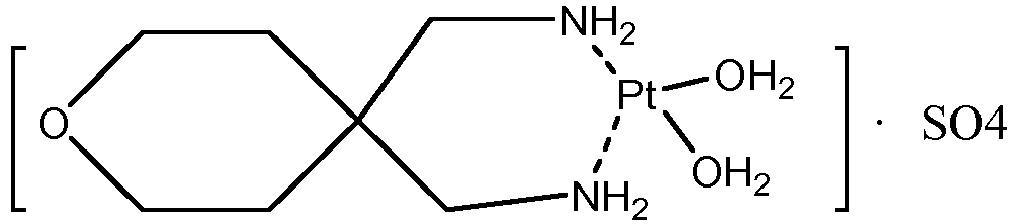
- Stirring Ag2SO4 (623 mg, 2 mmol) in water (30 ml), 1,3-(2,2-(4-oxacyclohexyl))-propyl diamine·diiodo-platinum (II) (1.125 g, 2 mmol) was added and another part of water (30 ml) was added to the reaction mixture; the mixture was stirred and heated at 40∼60 °C for 4∼8h. After removing Agl deposit by suction, the filtrate was the aqueous solution of the title compound.
-

- 2-(2-diethylamine ethyl)-malonic acid disodium salt (2 mmol) solution was regulated to the pH 5∼7 with H3PO4 (1M) and then aqueous 1,3-(2,2-(4-oxacyclohexyl))-propyl diamine·dihydrate platinum (II) sulphate was poured into reaction mixture; the mixture was heated in water bath to 40∼60 °C for 4-8h and then added 2.5 g silica into it; the mixture was stirred for 15 min and concentrated to dry, the residue was purified by column chromatography to afford the title compound (159 mg).
1HNMR(D2O)(ppm): δ3.70 (t,4H), δ3.60(t,1H), δ2.78(m,4H), δ2.70 (t,2H), δ2.12(s,4H), δ1.89(m,2H δ1.52(t,4H), δ1.08 (t,6H). - The said compound is soluble in water. The solubility is 178 mg/ml. It can be easily converted into other types of organic or inorganic salts through free base. It may be but not limited to sulphate, mesylate, tartrate, succinateacetate, citrate, tosilate, fumarate, etc. Free base elemental analysis: C35.27% (theoretical 35.56%); H5.51% (theoretical 5.74%); N8.04% (theoretical 7.78%).
-

- To the mixture of 2-bropropyl-diethyl malonate (113.7 g, 0.4 mol), anhydrous K2CO3 (55.40 g, 0.4 mol) in acetonitrile (500 ml), piperidine solution (85.0 g, 1.0 mol) was added into mixture which was then heated at 40∼60 °C for 2-6h; insoluble substance is filtered out and the filtrate was concentrated in vacuo; the residues was dissolved with 1000 ml ethyl acetate ; organic phase was washed with saturate NaCl aqueous solution (250 ml×3 times) and dried over anhydrous MgSO4 overnight; after removal of solvent in vacuo, light yellow oil (99.3 g) was obtained; the oil was purified by column chromatography to afford the title compound (35.57 g) and the yield was 31.2%.
-

- 2M NaOH solution (2.5 mL) was added to 2-(3-(1-piperidyl)-propyl)-diethyl malonate (572 mg, 2 mmol) in 20 ml flasks; and the mixture was stirred at room temperature for 45∼60h, 2-(3-(1-piperidyl)-propyl)-diethyl malonate disodium salt solution was obtained.
-

- 2-(3-(1-piperidyl)-propyl)-malonic acid disodium salt (2 mmol) solution was regulated to the pH 5∼7 with H3PO4 (1M) and then aqueous cis-diamine·dihydrate platinum (II) sulphate was poured into reaction mixture; the mixture was heated in water bath to 40∼75 °C for 4-6h, the mixture was concentrated to certain volume and the residue was standstill at room temperature; the title compound (136 mg) was obtained by suction.
- The said compound is soluble in water. The solubility is 159 mg/ml. It can be easily converted into other types of organic or inorganic salts through free base. It may be but not limited to sulphate, mesylate, tartrate, succinate, acetate, citrate, tosilate, fumarate, etc. Free base elemental analysis: C28.24% (theoretical 28.79%); H4.93% (theoretical 5.05%); N9.02% (theoretical 9.23%). 1HNMR(D2O)(ppm): δ3.62(t,1H), δ2.83(m,4H), δ2.70(m,2H), δ1.85(m,2H δ1.77(m,4H), δ1.52(m,2H), δ1.37(m,2H).
-

- To the mixture of 2-bropropyl-diethyl malonate (113.6 g, 0.4 mol), anhydrous K2CO3 (55.73 g, 0.4 mol) in acetonitrile (500 ml), pyrrolidine solution (71.1 g, 1.0 mol) was added into mixture which was then heated at 40∼60 °C for 2-6h; insoluble substance was filtered out and the filtrate was concentrated in vacuo; the residues was dissolved with 1000 ml ethyl acetate ; organic phase was washed with saturate NaCl aqueous solution (250 ml×3 times) and dried over anhydrous MgSO4 overnight; after removal of solvent in vacuo, light yellow oil (95.9 g) was obtained; the oil was purified by column chromatography to afford the title compound (31.87 g) and the yield was 29.4%.
-

- 2M NaOH solution (2.5 mL) was added to 2-(3-(1-pyrrolidyl)-propyl)-diethyl malonate (545 mg, 2 mmol) in 20 ml flasks; and the mixture was stirred at room temperature for 45∼60h, 2-(3-(1-pyrrolidyl)-propyl)-malonic acid disodium salt solution was obtained.
-

- 2-(3-(1-pyrrolidyl)-propyl)-malonic acid disodium salt (2 mmol) solution was regulated to the pH 5∼7 with H3PO4 (1M) and then aqueous cis-diamine·dihydrate platinum (II) sulphate was poured into reaction mixture; the mixture was heated in water bath to 40∼75 °C for 4-6h, the mixture was concentrated to certain volume and the residue was standstill at room temperature; the title compound (123 mg) was obtained by suction.
- The said compound is soluble in water. The solubility is 160 mg/ml. It can be easily converted into other types of organic or inorganic salts through ionization. It may be but not limited to sulphate, mesylate, tartrate, succinate, acetate, citrate, tosilate, fumarate, etc. Free base elemental analysis: C26.73% (theoretical 26.98%); H4.96% (theoretical 4.76%); N9.38% (theoretical 9.52%).
1HNMR(D2O)(ppm): δ3.61(t,1H), δ2.85(m,4H), δ2.71(m,2H), δ1.85(m,2H), δ1.79(m,4H), δ1.51(m,2H). - Kunming mice at 4∼6 weeks old and at the weight of 18∼22 g were taken, 50% male and 50% female. Embodiment platinum compound was dissolved with 5% glucose solution. Single intravenous administration (control: carboplatin and cisplatin) was made at different doses. Mortality and toxicity were observed after administration. Totally observing 14 days, LD50 value was calculated with Bliss method according to mortality. the results are shown in Table 1:
Table 1: Results of Intravenous Injection of Cisplatin, Carboplatin and Embodiment Platinum Compounds to Rat LD50: Control and Embodiment compound LD50 value (mmol/kg) Embodiment compound LD50 value (mmol/kg) cisplatin 0.044 compound 15 0.469 Carboplatin 0.336 compound 16 0.524 compound 1 0.722 compound 17 0.616 compound 2 0.791 compound 18 0.784 compound 3 0.824 compound 19 0.802 compound 4 0.802 compound 20 0.753 compound 5 0.853 compound 21 0.716 compound 6 0.749 compound 22 0.882 compound 7 0.791 compound 23 0.702 compound 8 0.806 compound 24 0.509 compound 9 0.724 compound 25 0.520 compound 10 0.593 compound 26 0.758 compound 11 0.509 compound 27 0.729 compound 12 0.609 compound 28 0.767 compound 13 0.908 compound 29 0.784 compound 14 0.902 compound 30 0.802 Conclusion: The and acute toxicity of the compounds at the same molar concentration in the Embodiment are much smaller than cisplatin and Carboplatin. - The toxic action of Embodiment platinum containing compounds was observed on tumor cells by MTT colorimetric method. Several kinds of tumor cells in exponential growth phase were prepared into single cell suspension, inoculated on 96 pore plat at the density of 4×10⁴/hole, cultivated for 24 hours to enable to adhere to wall with 1640 culture medium containing 10% fetal calf serum (complete medium) at 37 °C; the final culture volume was 100 µl. Cell morphology was observed after culture for 24 hours. For the dosage of platinum compounds, since IC50 values of cells are different, the following concentrations are determined through pretest: appropriate adjustment on 200, 60, 20, 6, 2, 0.6 µg/ml cisplatin, 200, 60, 20, 6, 2, 0.6 µg/ml carboplatin, and Embodiment platinum containing compounds depending on the sensitivity to each cell. The results are shown in Table 2-7 below:
Table 2. The cytotoxicity (IC50) of different test platinum compounds to different cell lines The IC50 (n =6) of chemotherapeutic drugs to different cell lines IC50(mM) cell lines carboplatin cisplatin compound 1 compound 2 compound 3 breast cancer MCF-7 0.103 0.012 0.057 0.11 0.202 breast cancer MCF-7Cisplatin resistance strain 0.255 0.015 0.168 0.245 0.023 lung cancerA549 0.232 0.016 0.087 0.132 0.152 lung cancerH292 0.055 0.0053 0.103 0.021 0.0098 Table 3. The cytotoxicity (IC50) of different test platinum compounds to different cell lines The IC50 (n =6) of chemotherapeutic drugs to different cell lines IC50(mM) cell lines carboplatin cis-platin compound 4 compound 5 compound 6 compound 7 compound 8 Pulmonary epithelial cell BEAS-2B 0.037 0.0033 0.042 0.13 0.161 0.075 0.049 lung cancer Lewis 0.038 0.045 0.068 0.041 0.224 0.128 0.057 colon cancerSW480 0.087 0.015 0.387 0.032 0.652 0.051 0.020 lung cancerH292 0.055 0.0053 0.196 0.041 0.036 0.124 0.201 Table 4. The cytotoxicity (IC50) of different test platinum compounds to different cell lines The IC50 (n =6) of chemotherapeutic drugs to different cell lines IC50(mM) cell lines carboplatin cisplatin compound 9 compound 10 compound 11 compound 12 compound 13 Pulmonary epithelial cell BEAS-2B 0.037 0.0033 0.057 0.22 0.168 0.015 0.145 lung cancer Lewis 0.038 0.045 0.069 0.143 0.213 0.057 0.036 colon cancerSW48 0 0.087 0.015 0.071 0.094 0.057 0.203 0.080 lung cancerH292 0.055 0.0053 0.063 0.054 0.006 0.241 0.316 Table 5. The cytotoxicity (IC50) of different test platinum compounds to different cell lines The IC50 (n =6) of chemotherapeutic drugs to different cell lines IC50(mM) cell lines carboplatin cisplatin compound 14 compound 15 compound 16 compound 17 compound 18 testis cell ST 0.195 0.00899 0.251 0.012 0.016 0.302 0.147 gastric cancerMGC 803 0.625 0.0025 0.213 0.149 0.216 0.556 0.367 colon cancerSW48 0 0.087 0.015 0.078 0.092 0.077 0.205 0.281 lung cancerH292 0.055 0.0053 0.161 0.651 0.402 0.249 0.224 Table 6. The cytotoxicity (IC50) of different test platinum compounds to different cell lines The IC50 (n =6) of chemotherapeutic drugs to different cell lines IC50(mM) cell lines carboplatin cisplatin compound 19 compound 20 compound 21 compound 22 compound 23 testis cell ST 0.195 0.00899 0.251 0.012 0.016 0.302 0.147 gastric cancerMGC 803 0.625 0.0025 0.213 0.149 0.216 0.556 0.367 esophagus cancerECA 109 0.052 0.073 0.088 0.193 0.174 0.215 0.212 lung cancerH292 0.055 0.0053 0.062 0.351 0.205 0.102 0.084 Table 7. The cytotoxicity (IC50) of different test platinum compounds to different cell lines The IC50 (n =6) of chemotherapeutic drugs to different cell lines IC50(mM) cell lines carboplatin compound 24 compound 25 compound 26 compound 27 compound 28 compound 29 compound 30 testis cell ST 0.195 0.153 0.114 0.312 0.360 0.138 0.127 0.114 gastric cancerMGC80 3 0.625 0.217 0.341 0.234 0.453 0.162 0.201 0.313 esophagus cancerECA10 9 0.052 0.125 0.196 0.163 0.350 0.256 0.263 0.147 lung cancerH292 0.055 0.065 0.053 0. 136 0.158 0.099 0.074 0.076 - It is observed from Tables 2-7 show that embodiment compounds 1-30 have equivalent or stronger cytotoxic effects in vitro than carboplatin.
-
(1) Male nude mice 4∼6 weeks old at the weight of 17∼20 g was inoculated in armpit of the right forearm with 0.2 ml colon cancer SW480 cell line single-cell suspension, the inoculation concentration 1×10⁷/ml, randomly grouped 24 hours after inoculation, 10 mice a group; each group was intravenously administered with 4 mg/kg (positive control group), isometric normal saline (negative control group), and Embodiment 1-8 compound group respectively, administered continuously, delivered drug every other day, totally 4 times, and all intraperitoneal injection; subcutaneous tumor is taken out for weighing after 10 days and tumor inhibition rate is calculated (see Table 8). The calculation formula of tumor inhabitation rate is:
Table 8. Results of research on anti-colon cancer SW480 activity of target compounds compounds size of animal (set) dose (mg/kg) tumor inhibition rate (%) (×±SD) carboplatin 10 4 20.5±3.27 compound 1 10 4 33.8±11.58* compound 2 10 4 30.2±10.33* compound 3 10 4 24.7±9.56 compound 4 10 4 25.3±10.34 compound 5 10 4 21.9±7.52 compound 6 10 4 24.9±9.01 compound 7 10 4 28.5±7.65* compound 8 10 4 29.7±8.81* * Compare with carboplatin 4 mg group, p<0.05
(2) Male nude mice 4∼6 weeks old at the weight of 17∼20 g were inoculated with 50 µl colon cancer SW480 cell line single-cell suspension at the inoculation concentration of 1×10⁷/ml at subcutaneous position of left forelimb, randomly grouped 5 days later, 10 mice a group; each group is intravenously administered with 3,5 mg/kg of cisplatin (positive control group), isometric normal saline (negative control group), 3, 5, 10, 15 mg/kg of Embodiment 1 compound group, and 3, 5, 10, 15 mg/kg of Embodiment 8 compound group respectively, continuously administered for 3 days, and all intraperitoneal injection; subcutaneous tumor is taken out for weighing 24 hours after drug discontinuance and tumor inhibition rate is calculated (see Table 9).Table 9. Results of research on anti-colon cancer SW480 activity of target compounds compounds size of animal (set) dose (mg/kg) tumor inhibition rate (%) (×±SD) cisplatin 10 3 62.9±9.01 cisplatin 10 5 71.1±10.76 compound 1 10 3 43.9±10.51▲ compound 1 10 5 46.8±8.89▲ compound 1 10 10 79.9±9.30* compound 1 10 15 86.8±11.21* compound 8 10 3 40.4±5.02▲ compound 8 10 5 73.6±9.18▲ compound 8 10 10 74.4±12.25 compound 8 10 15 82.8±10.07* * Compare with cisplatin 5 mg group, p<0.05
▲ Compare with cisplatin 3mg group, the action is weak.
(3) Male nude mice 4∼6 weeks old at the weight of 17∼20 g were inoculated with 0.2ml lung cancer H292 cell line cell line single-cell suspension at the inoculation concentration of 1 ×10⁸/ml at subcutaneous position of back close to armpit, randomly grouped after 2 weeks, 10 mice a group; each group is intravenously administered with 15 mg/kg carboplatin (positive control group), isometric normal saline (negative control group), and 15 mg/kg Embodiment 9-16 compound group respectively; administered every 2 days, totally 4 times, and all intraperitoneal injection; the test ends 30 days after inoculation; subcutaneous tumor is taken out for weighing and tumor inhibition rate is calculated (see Table 10).Table 10. Results of research on anti-lung H292 activity of target compounds compounds size of animal (set) dose (mg/kg) tumor inhibition rate (%) carboplatin 10 15 55.2±12.89 compound 9 10 15 79.2±14.99** compound 10 10 15 55.3±11.21 compound 11 10 15 35.9±7.13▲ compound 12 10 15 76.3 ±20.67* compound 13 10 15 56.1±9.81 compound 14 10 15 39.8±8.51▲ compound 15 10 15 59.0±11.02 compound 16 10 15 35.2±6.43▲ *Compare with carboplatin 15 mg group, p<0.05
**Compare with carboplatin 15 mg group, p<0.01
▲ Compare with carboplatin 15 mg group, the action is weak.
(4) Male nude mice 4∼6 weeks old at the weight of 17∼20 g were inoculated with 0.2ml breast cancer MCF-7 tumor cell line single-cell suspension at the concentration of 1×10⁸/ml at subcutaneous position of back close to armpit, randomly grouped after 2 weeks, 10 mice a group; each group is intravenously administered with 15 mg/kg carboplatin (positive control group), isometric normal saline (negative control group), and 15 mg/kg Embodiment 17-24 compound group respectively; administered every 2 days, totally 4 times, and all intraperitoneal injection; the test ends 30 days after inoculation; subcutaneous tumor is taken out for weighing and tumor inhibition rate is calculated (see Table 11).Table 11. Results of research on anti-breast cancer MCF-7 activity of target compounds compounds size of animal (set) dose (mg/kg) tumor inhibition rate (%) carboplatin 10 15 40.1±10.34 compound 17 10 15 39.8±12.12 compound 18 10 15 45.0±9.87 compound 19 10 15 52.6±10.5* compound 20 10 15 54.52±10.25* compound 21 10 15 40.3±9.65 compound 22 10 15 40.9±8.97 compound 23 10 15 44.1±15.12 compound 24 10 15 44.8±11.31 *Compare with carboplatin 15 mg group, p<0.05
(5) Male nude mice 4∼6 weeks old at the weight of 17∼20 g were inoculated with 0.2 ml lung cancer Lewis cell line single-cell suspension at the inoculation concentration of 1 ×10⁷/ml at subcutaneous position of back close to armpit, randomly grouped after 2 weeks, 10 mice a group; each group is intravenously administered with 15 mg/kg carboplatin (positive control group), isometric normal saline (negative control group), 15 mg/kg Embodiment 25-37 compound group respectively; administered every 2 days, totally 4 times, and all intraperitoneal injection; the test ends 30 days after inoculation; subcutaneous tumor is taken out for weighing and tumor inhibition rate is calculated (see Table 12).Table 12. Results of research on Lewis Activity of Anti-lung Cancer of Target Compound compounds size of animal (set) dose (mg/kg) tumor inhibition rate (%) carboplatin 10 15 70.2±10.09 compound 25 10 15 80.1±9.65* compound 26 10 15 72.4±16.78 compound 27 10 15 71.3±10.54 compound 28 10 15 73.3±17.92 * Compare with carboplatin 15 mg group, p<0.05 -

- Process: 10 g phosphate and 50 g glucose of the compound in Embodiment 5 was dissolved in 1000 ml injection water at normal temperature in 2000 ml glassware, after filtration with 0.22 µm microporous membrane, the filtration was charged into 1ml ampoule to obtain the product at the specification of 10 mg/ml.
-

- Process: 10 g mesylate and 50 g glucose of the compound in Embodiment 8 was dissolved into 1000 ml injection water at normal temperature in 1000 ml glassware, after filtration with 0.22 µm microporous membrane, the filtration was charged into 2 ml penicillin bottle to afford the product at the specification of 10 mg/bottle.
-

- Process: 10 g compound and 50 g Mannitol in Embodiment 8 were dissolved into 1000 ml injection water at normal temperature in 1000 ml glassware, after filtration with 0.22 µm microporous membrane, the filtration was charged into 2 ml penicillin bottle, µml solution in each bottle, and then refrigerated to obtain the product at the specification of 10 mg/bottle.
-

- Process: 20 g phosphate and 50 g Mannitol of the compound in Embodiment 15 was dissolved into 1000 ml injection water at normal temperature in 1000 ml glassware, after filtration with 0.22 µm microporous membrane, the filtration was charged into 2ml penicillin bottle, 1 ml solution in each bottle, and then refrigeratedto obtain the product at the specification of 20 mg/bottle.
-

- Process: 50 g tosilate of the compound in Embodiment 20 was dissolved into 1000 ml injection water at normal temperature in 1000 ml glassware, after filtration with 0.22 µm microporous membrane, the filtration was charged into 2 ml penicillin bottle, 1 ml solution in each bottle, and then refrigerated to obtain the product at the specification of 50 mg/bottle.
Claims (11)
- A compound of formula A, or a pharmaceutically acceptable salt, solvate, racemat, non-enantiomer, or geometric isomer thereof
 R1 and R2,
are the same or different, selected from hydrogen; alkyl; optionally substituted saturate hydrocarbon rings containing 1 to 3 ring(s) and each ring containing 3 to 7 carbon atoms; alkoxy alkyl; alkyl amino alkyl; heterocycle; a straight chain or branched-chain alkyl group with 1 to 4 ethylenic bond(s) containing 2 to 20 carbon atoms; and a straight chain or branched-chain alkyl group with 1 to 4 acetylenic bond(s) containing 2 to 20 carbon atoms;
whereinhydrocarbyl; alkoxy alkyl; alkyl amino alkyl and heterocycle are unsubstituted or optionally substituted, preferably substituted by halogen, hydroxyl, alkoxy, alkyl, alkoxy alkyl, optionally substituted saturate hydrocarbon ring containing 1 to 3 ring(s) and each ring containing 3 to 7 carbon atoms, and heterocycle;
provided that R1 or R2 does not contain any unsaturated bond, or if R1 and/or R2 contain(s) unsaturated bond, the atom of the unsaturated bond cannot be directly connected with nitrogen atom;R3
is selected from alkyl, an optionally substituted saturate hydrocarbon ring containing 1 to 3 ring(s) and each ring containing 3 to 7 carbon atoms;R4 and R5,
are the same or different, selected from: hydrogen; hydroxyl; alkyl; optionally substituted saturate hydrocarbon rings containing 1 to 3 ring(s) and each ring containing 3 to 7 carbon atoms; alkoxy; alkoxy alkyl; heterocycle; a straight chain or branched-chain alkyl group with 1 to 4 ethylenic bond(s) containing 2 to 20 carbon atoms; a straight chain or branched-chain alkyl group with 1 to 4 acetylenic bond(s) containing 2 to 20 carbon atoms;
wherein alkyl, a straight chain or branched-chain alkyl group with 1 to 4 ethylenic bond(s) containing 2 to 20 carbon atoms, a straight chain or branched-chain alkyl group with 1 to 4 acetylenic bond(s) containing 2 to 20 carbon atoms, optionally substituted saturate hydrocarbon ring containing 1 to 3 ring(s) and each ring containing 3 to 7 carbon atoms, alkoxy alkyl, alkyl amino alkyl and heterocycle are unsubstituted or optionally substituted, preferably substituted by halogen, hydroxyl, alkoxy, straight chain or branched-chain alkyl, alkoxy alkyl, an optionally substituted saturate hydrocarbon ring containing 1 to 3 ring(s) and each ring containing 3 to 7 carbon atoms and heterocycle;R4 and R5
form a closed ring via the connected atoms of R4 and R5; said ring may be a quaternary, pentabasic, hexahydric, heptabasic or octatomic ring; said ring is optionally condensed with other rings and optionally substituted, preferably substituted by halogen, hydroxyl, alkoxy, straight chain or branched-chain alkyl, alkoxy alkyl, an optionally substituted saturate hydrocarbon ring containing 1 to 3 ring(s) and each ring containing 3 to 7 carbon atoms and heterocycle. - The compound according to Claim 1, wherein said compound is as shown in formula B,
 R1, R2 and R3 are as described in Claim1.
 - The compound according to claims 1 or 2, wherein R1 and R2 are independently selected from hydrogen, methyl, ethyl or propyl; R3 is ethyl or propyl; R4 and R5 are hydrogen.
- The compound according to claim 1, wherein said compound is as shown in formula C,
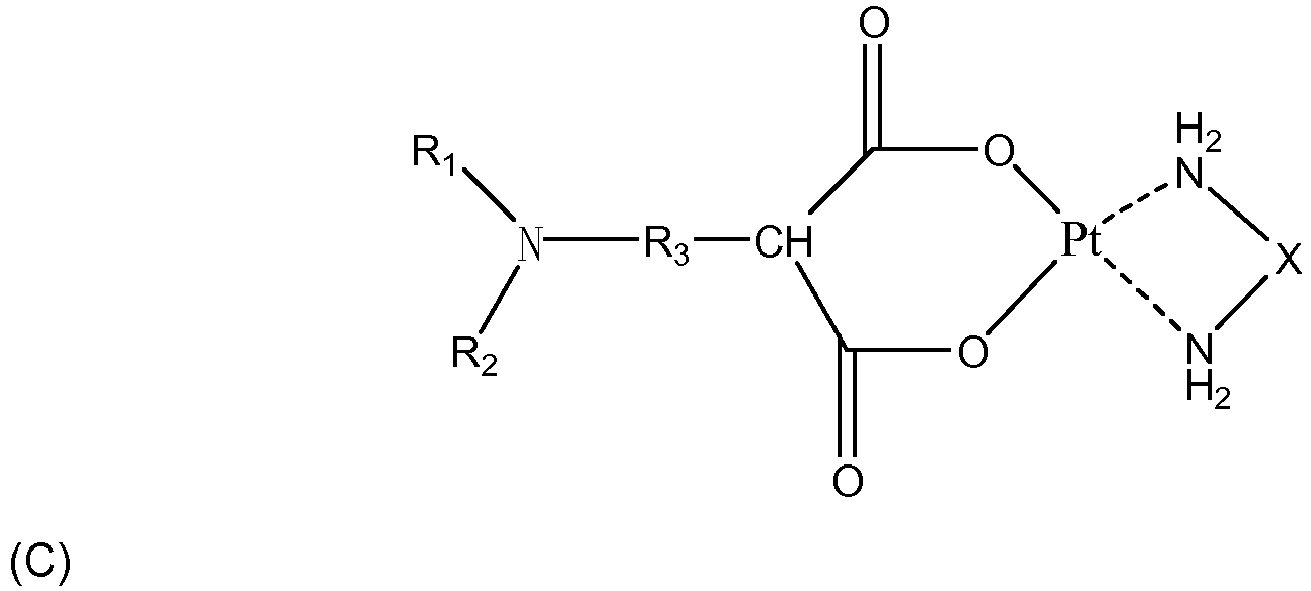


 R1 and R2,
are the same or different, selected from hydrogen; alkyl; optionally substituted saturate hydrocarbon ring containing 1 to 3 ring(s) and each ring containing 3 to 7 carbon atoms; alkoxy alkyl; alkyl amino alkyl; heterocycle; a straight chain or branched-chain alkyl group with 1 to 4 ethylenic bond(s) containing 2 to 20 carbon atoms; a straight chain or branched-chain alkyl group with 1 to 4 acetylenic bond(s) containing 2 to 20 carbon atoms;
wherein alkyl; alkoxy alkyl; alkyl amino alkyl and heterocycle may be unsubstituted or optionally substituted, preferably substituted by halogen, hydroxyl, alkoxy, alkyl, alkoxy alkyl, an optionally substituted saturate hydrocarbon ring containing 1 to 3 ring(s) and each ring containing 3 to 7 carbon atoms, and heterocycle;
provided that R1 or R2 does not contain any unsaturated bond, or if R1 and/or R2 contain(s) unsaturated bond, the atom of the unsaturated bond cannot be directly connected with nitrogen atom;R3 is selected from alkyl;R6 is selected from (CH2)n, wherein n=1-6, preferably 3-5, the most preferably 4, wherein some -CH2- may be substituted by -O-; wherein one or more hydrogen(s) of (CH2)n is optionally substituted by fluorine, alkyl, hydroxyl or alkoxy, heterocycle; preferred compound is selected from (±) trans- 1, 2-cyclohexanediamine platinum (II), trans- 1,2-cyclopentamethylenediamine platinum (II), trans-1,2-cyclobutanediamine platinum (II) and trans-1,2-cyclopropane diamine platinum (II);R7 is selected from (CH2)n, wherein n=0-3, preferably n = 0-2; wherein some -CH2-may be substituted by -O-; wherein one or more hydrogen(s) of (CH2)n is optionally substituted by halogen, alkyl, hydroxyl, hydroxyalkyl, alkoxy, and heterocycle;R8 and R9 are selected from hydrogen, halogen, hydroxyl, hydroxyalkyl, alkyl, alkoxy and heterocycle; R8 and R9 may be the same or different, preferably hydroxymethyl;R10 and R11 are selected from hydrogen, halogen, hydroxyalkyl, alkyl, alkoxy and heterocycle; R10 and R11 may be the same or different, preferably hydroxymethyl;R12 is selected from (CH2)n, wherein n=2-4, wherein some -CH2- may be substituted by -O-; one or more hydrogens of (CH2)n is optionally substituted by halogen, alkyl, hydroxyl, alkoxy or heterocycle;R13 is -CH2- or -O-, preferably -CH2-;R14 is hydrogen, halogen, alkyl, alkoxy, heterocycle, hydroxyalkyl or hydroxyl; preferably R14 is hydrogen;
R15 is (CH2)n, wherein n=1-3; -CH2-O-; or -O-; wherein one or more hydrogen(s) of (CH2)n is optionally substituted by alkyl, alkoxy, heterocycle, hydroxyl, or hydroxyalkyl; preferably -CH2-O-CH2-. - The compound according to claim 4, wherein said compound is of formula below:


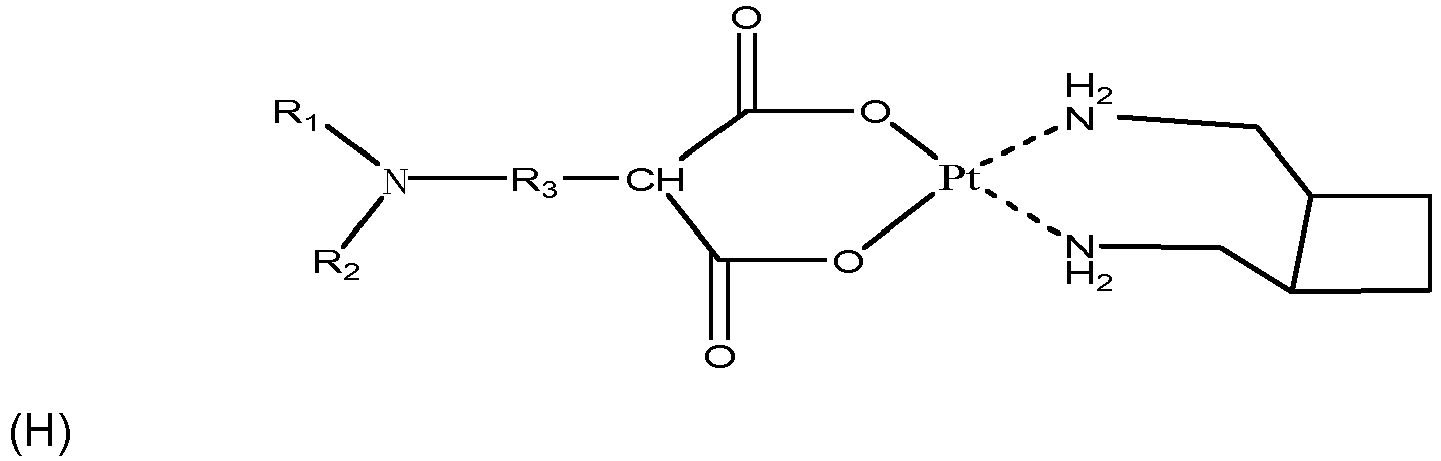


- The compound according to claim 1, or pharmaceutical acceptable salt, solvate, racemat, non-enantiomer, or geometric isomer, wherein said compound is selected from the group consisting of:compound 1: [2-(2-methylamino ethyl)-malonato] [cis-diamine] platinum (II);compound 2: [2-(2-dimethylamino ethyl)-malonato] [cis-diamine] platinum (II);compound 3: [2-(3-dimethylamino propyl)-malonato] [cis-diamine] platinum (II);compound 4: [2-(3-amino propyl)-malonato] [cis-diamine] platinum (II);compound 5: [2-(2-diethylamino ethyl)-malonato] [cis-diamine] platinum (II);compound 6: [2-(3-diethylamino propyl)-malonato]·[cis-diamine] platinum (II);compound 7: [2-(2-di-n-propylamino ethyl)-malonato]-[cis-diamine] platinum (II);compound 8: [2-(3-di-n-propylamino propyl)-malonato] [cis-diamine] platinum (II);compound 9: [2-(2-amino ethyl)-malonato]·[cis-(1,2-trans-cyclohexane diamine)] platinum (II);compound 10: [2-(2-dimethylamino ethyl)-malonnato]·[cis-(1,2-trans-cyclohexane diamine)] platinum (II);compound 11: [2-(3-dimethylamino propyl)-malonato]·[cis-(1,2-trans-cyclohexane diamine)] platinum (II);compound 12: [2-(2-ethylamino ethyl)-malonato]·[cis-(1,2-trans-cyclohexane diamine)] platinum (II);compound 13: [2-(2-diethylamino ethyl)-malonato]·[cis-(1,2-trans-cyclohexane diamine)] platinum (II);compound 14: [2-(3-diethylamino propyl)-malonato]·[cis-(1,2-trans-cyclohexane diamine)] platinum (II);compound 15: [2-(2-di-n-propylamino ethyl)-malonato]·[cis-(1,2-trans-cyclohexane diamine)] platinum (II);compound 16: [2-(3-di-n-propylamino propyl)-malonato]·[cis-(1,2-trans-cyclohexane diamine)] platinum (II);compound 17: [2-(3-diethylamino propyl)-malonato]·[cis-(1,2-trans-cyclopentyl diamine)] platinum (II);compound 18: [2-(3-diethylamino propyl)-malonato]·[cis-(1,2-trans-cyclobutyl diamine)] platinum (II);compound 19: [2-(3-diethylamino propyl)-malonato]·[cis-(1,2-trans-cyclopropyl diamine)] platinum (II);compound 20: [2-(2-dimethylamino ethyl)-malonato]·[cis-1,2-ethyldiamine] platinum (II);compound 21: [2-(2-diethylamino ethyl)-malonato]·[cis-1,3-propyl diamine] platinum (II);compound 22: [2-(2-di-n-propylamino ethyl)-malonato]·[cis-1,4-butyldiamine] platinum (II);compound 23: [2-(2-diethylamino ethyl)-malonato]·[cis-1,2-(1,2-dihydroxymethyl)-ethyl diamine] platinum (II);compound 24: [2-(2-dimethylamino ethyl)-malonato]·[cis-1,3-(2,2-hydroxymethyl)-propyl diamine] platinum (II);Compound 25: [2-(2-dimethylamino ethyl)-malonato]·[cis-1,4-(trans-2,3-cyclobutyl)-butane diamine] platinum (II);compound 26: [2-(2-diethylamino ethyl)-malonic]·[cis-1,4-(trans-2,3-cyclobutyl)-butane diamine] platinum (II);compound 27: [2-(2-diethylamino ethyl)-malonato]·[cis-1,4-cyclohexane diamine] platinum (II);compound 28: [2-(2-diethylamino ethyl)-malonato]·[cis-1,3-(2,2-(4-oxacyclohexyl))-propyl diamine] platinum (II).
- The compound according to any one of claims 1 to 6, wherein said compound is in the form of pharmaceutically acceptable salt; the preferred pharmaceutically acceptable salt is selected from nitrate, carbonate, sulphate, phosphate, mesylate, trifluoromethanesulfonic salt, tosilate, benzene sulfonate, acetate, fumarate, tartrate, oxalate, maleate, malate, succinate, lactate, citrate, glutamate, or aspartate.
- A pharmaceutical composition, contains the compound in any one of claims 1 to 7 and pharmaceutically acceptable carrier; wherein said composition is in any appropriate dosage form, preferably in the form of injection; and it may or may not contain one or more of other drug(s) suit for the treatment of cancer.
- A preparation method of the compound according to claim 1, includes the following steps:


- The use of the compound according to any one of claims 1 to 7, or its pharmaceutically acceptable salt, its solvate, its racemat, its non-enantiomer, its geometric isomer, or the pharmaceutically composition according to claim 8, for preparing the drug for the treatment of cell proliferation diseases, wherein the cell proliferation diseases are preferably cancers, and the cancer is preferably breast cancer, lung cancer, colon cancer, gastric cancer, esophagus cancer, ovarian cancer, osteosarcoma, cervical cancer, bladder cancer, liver cancer, cerebroma, prostate cancer, or melanoma.
- A kit includes the pharmaceutically composition according to claim 8 and instructions, wherein said kit may comprise one or more other drugs for the treatment of cancer.
Applications Claiming Priority (2)
| Application Number | Priority Date | Filing Date | Title |
|---|---|---|---|
| CN2011101922898A CN102863474A (en) | 2011-07-09 | 2011-07-09 | Platinum compounds for treating cell proliferative diseases and preparation method and application thereof |
| PCT/CN2012/078302 WO2013007172A1 (en) | 2011-07-09 | 2012-07-06 | Platinum compounds for treating cell proliferative disease, preparation methods and uses thereof |
Publications (3)
| Publication Number | Publication Date |
|---|---|
| EP2740738A1 EP2740738A1 (en) | 2014-06-11 |
| EP2740738A4 EP2740738A4 (en) | 2015-03-04 |
| EP2740738B1 true EP2740738B1 (en) | 2018-03-28 |
Family
ID=47442632
Family Applications (1)
| Application Number | Title | Priority Date | Filing Date |
|---|---|---|---|
| EP12811424.6A Active EP2740738B1 (en) | 2011-07-09 | 2012-07-06 | Platinum compounds for treating cell proliferative disease, preparation methods and uses thereof |
Country Status (7)
| Country | Link |
|---|---|
| US (1) | US9138421B2 (en) |
| EP (1) | EP2740738B1 (en) |
| JP (1) | JP5914648B2 (en) |
| KR (2) | KR20140040848A (en) |
| CN (2) | CN102863474A (en) |
| ES (1) | ES2668470T3 (en) |
| WO (1) | WO2013007172A1 (en) |
Families Citing this family (5)
| Publication number | Priority date | Publication date | Assignee | Title |
|---|---|---|---|---|
| WO2014075391A1 (en) * | 2012-11-17 | 2014-05-22 | 北京市丰硕维康技术开发有限责任公司 | Platinum compound of malonic acid derivative having leaving group containing amino or alkylamino |
| WO2014114183A1 (en) * | 2013-01-23 | 2014-07-31 | 北京市丰硕维康技术开发有限责任公司 | Platinum (ii) compound for treating tumor cell proliferative disease |
| CN116854745A (en) * | 2015-06-25 | 2023-10-10 | 新纳特产品公司 | Pharmaceutical co-crystal composition and use thereof |
| EP3845544B1 (en) * | 2018-09-01 | 2023-11-15 | Beijing Showby Pharmaceutical Co., Ltd. | Phosphate of platinum compound and preparation method therefor |
| CN116023232B (en) * | 2023-01-03 | 2024-03-08 | 湖南省湘中制药有限公司 | Preparation method of propyl malonic acid and homologs thereof |
Family Cites Families (39)
| Publication number | Priority date | Publication date | Assignee | Title |
|---|---|---|---|---|
| US4322362A (en) * | 1980-07-28 | 1982-03-30 | Bristol-Myers Company | Salts of 2-hydroxymalonate platinum complexes |
| JPS61249993A (en) | 1985-04-26 | 1986-11-07 | Tanabe Seiyaku Co Ltd | Novel organoplatinum complex and production thereof |
| IL85595A0 (en) | 1987-03-06 | 1988-08-31 | Tanabe Seiyaku Co | Organic platinum complex and its preparation |
| US4946954A (en) | 1989-01-17 | 1990-08-07 | Georgetown University | Platinum pharmaceutical agents |
| DE4138042C2 (en) | 1991-11-19 | 1993-10-14 | Biotechnolog Forschung Gmbh | Epothilones, their production processes and agents containing these compounds |
| JPH06137794A (en) | 1992-10-27 | 1994-05-20 | Toray Ind Inc | Reversible camouflage garment |
| ATE218556T1 (en) | 1995-11-17 | 2002-06-15 | Biotechnolog Forschung Gmbh | EPOTHILONE DERIVATIVES AND THEIR PRODUCTION |
| US6011029A (en) | 1996-02-26 | 2000-01-04 | Bristol-Myers Squibb Company | Inhibitors of farnesyl protein transferase |
| JP4274583B2 (en) | 1996-11-18 | 2009-06-10 | ゲゼルシャフト・フュア・ビオテクノロギッシェ・フォルシュンク・ミット・ベシュレンクテル・ハフツング(ゲー・ベー・エフ) | Epothilone C, D, E and F, manufacturing and drugs |
| US6242469B1 (en) | 1996-12-03 | 2001-06-05 | Sloan-Kettering Institute For Cancer Research | Synthesis of epothilones, intermediates thereto, analogues and uses thereof |
| US6441186B1 (en) | 1996-12-13 | 2002-08-27 | The Scripps Research Institute | Epothilone analogs |
| US6380394B1 (en) | 1996-12-13 | 2002-04-30 | The Scripps Research Institute | Epothilone analogs |
| EP1201666A3 (en) | 1997-02-25 | 2003-03-05 | Gesellschaft für biotechnologische Forschung mbH (GBF) | Epothilones with a modified side chain |
| GB9801231D0 (en) | 1997-06-05 | 1998-03-18 | Merck & Co Inc | A method of treating cancer |
| WO1999002224A1 (en) | 1997-07-07 | 1999-01-21 | Lewis Robert D | Statistical analysis and feedback system for sports employing a projectile |
| US6605599B1 (en) | 1997-07-08 | 2003-08-12 | Bristol-Myers Squibb Company | Epothilone derivatives |
| ES2184307T3 (en) | 1997-07-16 | 2003-04-01 | Schering Ag | DERIVATIVES OF TIAZOL, PROCEDURE FOR ITS PREPARATION AND ITS USE. |
| CA2299608A1 (en) | 1997-08-09 | 1999-02-18 | Schering Aktiengesellschaft | New epothilone derivatives, method for producing same and their pharmaceutical use |
| US6040321A (en) | 1997-11-12 | 2000-03-21 | Bristol-Myers Squibb Company | Aminothiazole inhibitors of cyclin dependent kinases |
| US6365749B1 (en) | 1997-12-04 | 2002-04-02 | Bristol-Myers Squibb Company | Process for the preparation of ring-opened epothilone intermediates which are useful for the preparation of epothilone analogs |
| AU738576B2 (en) | 1997-12-04 | 2001-09-20 | Bristol-Myers Squibb Company | A process for the reduction of oxiranyl epothilones to olefinic epothilones |
| JP2002504540A (en) | 1998-02-25 | 2002-02-12 | スローン−ケッタリング インスティトゥート フォア キャンサー リサーチ | Synthesis of epothilone, its intermediates and analogs |
| US6498257B1 (en) | 1998-04-21 | 2002-12-24 | Bristol-Myers Squibb Company | 2,3-olefinic epothilone derivatives |
| US6380395B1 (en) | 1998-04-21 | 2002-04-30 | Bristol-Myers Squibb Company | 12, 13-cyclopropane epothilone derivatives |
| DE19826988A1 (en) | 1998-06-18 | 1999-12-23 | Biotechnolog Forschung Gmbh | Epothilone minor components |
| WO1999067253A2 (en) | 1998-06-22 | 1999-12-29 | Novartis Ag | Desmethyl epothilones |
| WO2000000485A1 (en) | 1998-06-30 | 2000-01-06 | Schering Aktiengesellschaft | Epothilon derivatives, their preparation process, intermediate products and their pharmaceutical use |
| WO2000050423A1 (en) | 1999-02-22 | 2000-08-31 | Gesellschaft Fuer Biotechnologische Forschung Mbh (Gbf) | C-21 modified epothilones |
| US7166733B2 (en) * | 2000-01-04 | 2007-01-23 | Access Pharmaceuticals, Inc. | O,O'-Amidomalonate and N,O-Amidomalonate platinum complexes |
| KR20040074857A (en) | 2003-02-19 | 2004-08-26 | 학교법인 이화학당 | Platinum(ⅱ) complexes of n-substituted amino dicarboxylates and preparation method thereof |
| CN1680384A (en) * | 2004-04-08 | 2005-10-12 | 香港中文大学 | Demethylcantharidin platinum complex and its application |
| WO2006091790A1 (en) * | 2005-02-23 | 2006-08-31 | Xenoport, Inc. | Platinum-containing compounds exhibiting cytostatic activity, synthesis and methods of use |
| CN1332716C (en) | 2005-05-25 | 2007-08-22 | 北京市海格里斯科技有限公司 | High molecular antineoplastic cisplatin medicine and preparation method thereof |
| CN101475600A (en) | 2009-01-20 | 2009-07-08 | 昆明贵研药业有限公司 | Novel method for synthesizing antineoplastic medicament carboplatin |
| EP2391630A2 (en) * | 2009-01-31 | 2011-12-07 | IGF Oncology, LLC | Anti-cancer protein-platinum conjugates |
| EP2454267A2 (en) * | 2009-07-16 | 2012-05-23 | Royal College of Surgeons in Ireland | Metal complexes having dual histone deacetylase inhibitory and dna-binding activity |
| CN102286050A (en) | 2011-06-24 | 2011-12-21 | 天津大学 | Glucose-containing platinum complex for treating tumors and preparation method thereof |
| CN102276657A (en) | 2011-06-24 | 2011-12-14 | 天津大学 | Complex containing mannose meal for targeting treatment of tumors and preparation method thereof |
| CN102276674A (en) | 2011-06-24 | 2011-12-14 | 天津大学 | Galactose-containing platinum complex for tumour targeted therapy and preparation method thereof |
-
2011
- 2011-07-09 CN CN2011101922898A patent/CN102863474A/en active Pending
-
2012
- 2012-07-06 US US14/131,902 patent/US9138421B2/en active Active
- 2012-07-06 CN CN201280023124.0A patent/CN103732601B/en active Active
- 2012-07-06 JP JP2014519389A patent/JP5914648B2/en active Active
- 2012-07-06 KR KR1020147003050A patent/KR20140040848A/en not_active Ceased
- 2012-07-06 ES ES12811424.6T patent/ES2668470T3/en active Active
- 2012-07-06 EP EP12811424.6A patent/EP2740738B1/en active Active
- 2012-07-06 KR KR1020167026055A patent/KR101739083B1/en active Active
- 2012-07-06 WO PCT/CN2012/078302 patent/WO2013007172A1/en not_active Ceased
Non-Patent Citations (2)
| Title |
|---|
| WANG ET AL.: "Antitumor Platinum Drugs in accord with Classical Structure-Activity Relationships", CHEMISTRY ONLINE (HTTP://HXTB.ORG), vol. 12, 2003, pages 828 - 836 * |
| YOSHINORI KIDANI ET AL: "SYNTHESIS OF PLATINUM II COMPLEXES OF 4 SUBSTITUTED O PHENYLENEDIAMINE DERIVATIVES AND DETERMINATION OF THEIR ANTI TUMOR ACTIVITY", CHEM. PHARM. BULL., 1 January 1979 (1979-01-01), pages 2577 - 2581, XP055351546, Retrieved from the Internet <URL:https://www.jstage.jst.go.jp/article/cpb1958/27/11/27_11_2577/_pdf> [retrieved on 20170303] * |
Also Published As
| Publication number | Publication date |
|---|---|
| KR101739083B1 (en) | 2017-05-23 |
| US20140142079A1 (en) | 2014-05-22 |
| JP2014523905A (en) | 2014-09-18 |
| US9138421B2 (en) | 2015-09-22 |
| EP2740738A1 (en) | 2014-06-11 |
| WO2013007172A1 (en) | 2013-01-17 |
| EP2740738A4 (en) | 2015-03-04 |
| CN103732601B (en) | 2016-06-22 |
| KR20160113333A (en) | 2016-09-28 |
| JP5914648B2 (en) | 2016-05-11 |
| KR20140040848A (en) | 2014-04-03 |
| CN102863474A (en) | 2013-01-09 |
| ES2668470T3 (en) | 2018-05-18 |
| CN103732601A (en) | 2014-04-16 |
Similar Documents
| Publication | Publication Date | Title |
|---|---|---|
| JP6315848B2 (en) | MEK / PI3K dual inhibitor and therapeutic method using the inhibitor | |
| US20080161282A1 (en) | Cytotoxic agents and methods of use | |
| BR112012018415A2 (en) | compound, composition, methods of preparing a composition and treatment, and, use of a compound. | |
| EP2924044B1 (en) | Platinum compound of malonic acid derivative having leaving group containing amino or alkylamino | |
| US9138421B2 (en) | Platinum compounds for treating cell proliferative diseases, preparation method and use thereof | |
| EP2759547B1 (en) | Platinum compound having amino- or alkylamino-containing succinic acid derivatives as leaving group, preparation method therefor, and use thereof | |
| CN104995201B (en) | A platinum(II) compound for the treatment of tumor cell proliferative diseases | |
| CN102875462B (en) | Anti-tumor 2-amino nicotinonitrile, application and preparation method thereof | |
| CN103703011B (en) | A kind of platinum compound whose leaving group is a hydroxyacid derivative containing amino group or alkylamino group, its preparation method and application | |
| US11958869B2 (en) | Ruthenium arene Schiff-base complexes and uses thereof | |
| US20050209321A1 (en) | Platinum carboxylate anticancer compounds | |
| CN105541696B (en) | A kind of antitumor compound and its preparation method and application | |
| CN115260107B (en) | An anti-tumor drug prodrug, pharmaceutical composition and application in the field of tumor targeted therapy | |
| US12161637B2 (en) | Anti-cancer gold complex, process of synthesis and method of treatment thereof | |
| US11571430B2 (en) | Platinum(II) ammine selenourea complexes and methods of treating cancer | |
| Zhao | Functionalization and in vitro study of cytotoxic salan titanium (IV)-bis-chelates |
Legal Events
| Date | Code | Title | Description |
|---|---|---|---|
| PUAI | Public reference made under article 153(3) epc to a published international application that has entered the european phase |
Free format text: ORIGINAL CODE: 0009012 |
|
| 17P | Request for examination filed |
Effective date: 20140127 |
|
| AK | Designated contracting states |
Kind code of ref document: A1 Designated state(s): AL AT BE BG CH CY CZ DE DK EE ES FI FR GB GR HR HU IE IS IT LI LT LU LV MC MK MT NL NO PL PT RO RS SE SI SK SM TR |
|
| DAX | Request for extension of the european patent (deleted) | ||
| A4 | Supplementary search report drawn up and despatched |
Effective date: 20150129 |
|
| RIC1 | Information provided on ipc code assigned before grant |
Ipc: A61K 31/351 20060101ALI20150123BHEP Ipc: A61K 31/282 20060101ALI20150123BHEP Ipc: A61K 31/555 20060101ALI20150123BHEP Ipc: A61P 35/00 20060101ALI20150123BHEP Ipc: C07F 15/00 20060101AFI20150123BHEP |
|
| 17Q | First examination report despatched |
Effective date: 20151207 |
|
| GRAP | Despatch of communication of intention to grant a patent |
Free format text: ORIGINAL CODE: EPIDOSNIGR1 |
|
| INTG | Intention to grant announced |
Effective date: 20171027 |
|
| GRAS | Grant fee paid |
Free format text: ORIGINAL CODE: EPIDOSNIGR3 |
|
| GRAA | (expected) grant |
Free format text: ORIGINAL CODE: 0009210 |
|
| AK | Designated contracting states |
Kind code of ref document: B1 Designated state(s): AL AT BE BG CH CY CZ DE DK EE ES FI FR GB GR HR HU IE IS IT LI LT LU LV MC MK MT NL NO PL PT RO RS SE SI SK SM TR |
|
| REG | Reference to a national code |
Ref country code: GB Ref legal event code: FG4D |
|
| REG | Reference to a national code |
Ref country code: CH Ref legal event code: EP |
|
| REG | Reference to a national code |
Ref country code: AT Ref legal event code: REF Ref document number: 983318 Country of ref document: AT Kind code of ref document: T Effective date: 20180415 |
|
| REG | Reference to a national code |
Ref country code: IE Ref legal event code: FG4D |
|
| REG | Reference to a national code |
Ref country code: DE Ref legal event code: R096 Ref document number: 602012044551 Country of ref document: DE |
|
| REG | Reference to a national code |
Ref country code: ES Ref legal event code: FG2A Ref document number: 2668470 Country of ref document: ES Kind code of ref document: T3 Effective date: 20180518 |
|
| REG | Reference to a national code |
Ref country code: FR Ref legal event code: PLFP Year of fee payment: 7 |
|
| PG25 | Lapsed in a contracting state [announced via postgrant information from national office to epo] |
Ref country code: LT Free format text: LAPSE BECAUSE OF FAILURE TO SUBMIT A TRANSLATION OF THE DESCRIPTION OR TO PAY THE FEE WITHIN THE PRESCRIBED TIME-LIMIT Effective date: 20180328 Ref country code: FI Free format text: LAPSE BECAUSE OF FAILURE TO SUBMIT A TRANSLATION OF THE DESCRIPTION OR TO PAY THE FEE WITHIN THE PRESCRIBED TIME-LIMIT Effective date: 20180328 Ref country code: HR Free format text: LAPSE BECAUSE OF FAILURE TO SUBMIT A TRANSLATION OF THE DESCRIPTION OR TO PAY THE FEE WITHIN THE PRESCRIBED TIME-LIMIT Effective date: 20180328 Ref country code: NO Free format text: LAPSE BECAUSE OF FAILURE TO SUBMIT A TRANSLATION OF THE DESCRIPTION OR TO PAY THE FEE WITHIN THE PRESCRIBED TIME-LIMIT Effective date: 20180628 |
|
| REG | Reference to a national code |
Ref country code: NL Ref legal event code: MP Effective date: 20180328 |
|
| REG | Reference to a national code |
Ref country code: LT Ref legal event code: MG4D |
|
| PG25 | Lapsed in a contracting state [announced via postgrant information from national office to epo] |
Ref country code: GR Free format text: LAPSE BECAUSE OF FAILURE TO SUBMIT A TRANSLATION OF THE DESCRIPTION OR TO PAY THE FEE WITHIN THE PRESCRIBED TIME-LIMIT Effective date: 20180629 Ref country code: BG Free format text: LAPSE BECAUSE OF FAILURE TO SUBMIT A TRANSLATION OF THE DESCRIPTION OR TO PAY THE FEE WITHIN THE PRESCRIBED TIME-LIMIT Effective date: 20180628 Ref country code: RS Free format text: LAPSE BECAUSE OF FAILURE TO SUBMIT A TRANSLATION OF THE DESCRIPTION OR TO PAY THE FEE WITHIN THE PRESCRIBED TIME-LIMIT Effective date: 20180328 Ref country code: LV Free format text: LAPSE BECAUSE OF FAILURE TO SUBMIT A TRANSLATION OF THE DESCRIPTION OR TO PAY THE FEE WITHIN THE PRESCRIBED TIME-LIMIT Effective date: 20180328 Ref country code: SE Free format text: LAPSE BECAUSE OF FAILURE TO SUBMIT A TRANSLATION OF THE DESCRIPTION OR TO PAY THE FEE WITHIN THE PRESCRIBED TIME-LIMIT Effective date: 20180328 |
|
| PG25 | Lapsed in a contracting state [announced via postgrant information from national office to epo] |
Ref country code: RO Free format text: LAPSE BECAUSE OF FAILURE TO SUBMIT A TRANSLATION OF THE DESCRIPTION OR TO PAY THE FEE WITHIN THE PRESCRIBED TIME-LIMIT Effective date: 20180328 Ref country code: AL Free format text: LAPSE BECAUSE OF FAILURE TO SUBMIT A TRANSLATION OF THE DESCRIPTION OR TO PAY THE FEE WITHIN THE PRESCRIBED TIME-LIMIT Effective date: 20180328 Ref country code: PL Free format text: LAPSE BECAUSE OF FAILURE TO SUBMIT A TRANSLATION OF THE DESCRIPTION OR TO PAY THE FEE WITHIN THE PRESCRIBED TIME-LIMIT Effective date: 20180328 Ref country code: NL Free format text: LAPSE BECAUSE OF FAILURE TO SUBMIT A TRANSLATION OF THE DESCRIPTION OR TO PAY THE FEE WITHIN THE PRESCRIBED TIME-LIMIT Effective date: 20180328 Ref country code: EE Free format text: LAPSE BECAUSE OF FAILURE TO SUBMIT A TRANSLATION OF THE DESCRIPTION OR TO PAY THE FEE WITHIN THE PRESCRIBED TIME-LIMIT Effective date: 20180328 |
|
| PG25 | Lapsed in a contracting state [announced via postgrant information from national office to epo] |
Ref country code: SM Free format text: LAPSE BECAUSE OF FAILURE TO SUBMIT A TRANSLATION OF THE DESCRIPTION OR TO PAY THE FEE WITHIN THE PRESCRIBED TIME-LIMIT Effective date: 20180328 Ref country code: CZ Free format text: LAPSE BECAUSE OF FAILURE TO SUBMIT A TRANSLATION OF THE DESCRIPTION OR TO PAY THE FEE WITHIN THE PRESCRIBED TIME-LIMIT Effective date: 20180328 Ref country code: SK Free format text: LAPSE BECAUSE OF FAILURE TO SUBMIT A TRANSLATION OF THE DESCRIPTION OR TO PAY THE FEE WITHIN THE PRESCRIBED TIME-LIMIT Effective date: 20180328 |
|
| REG | Reference to a national code |
Ref country code: AT Ref legal event code: MK05 Ref document number: 983318 Country of ref document: AT Kind code of ref document: T Effective date: 20180328 |
|
| PG25 | Lapsed in a contracting state [announced via postgrant information from national office to epo] |
Ref country code: PT Free format text: LAPSE BECAUSE OF FAILURE TO SUBMIT A TRANSLATION OF THE DESCRIPTION OR TO PAY THE FEE WITHIN THE PRESCRIBED TIME-LIMIT Effective date: 20180730 |
|
| REG | Reference to a national code |
Ref country code: DE Ref legal event code: R097 Ref document number: 602012044551 Country of ref document: DE |
|
| PG25 | Lapsed in a contracting state [announced via postgrant information from national office to epo] |
Ref country code: DK Free format text: LAPSE BECAUSE OF FAILURE TO SUBMIT A TRANSLATION OF THE DESCRIPTION OR TO PAY THE FEE WITHIN THE PRESCRIBED TIME-LIMIT Effective date: 20180328 Ref country code: AT Free format text: LAPSE BECAUSE OF FAILURE TO SUBMIT A TRANSLATION OF THE DESCRIPTION OR TO PAY THE FEE WITHIN THE PRESCRIBED TIME-LIMIT Effective date: 20180328 |
|
| PLBE | No opposition filed within time limit |
Free format text: ORIGINAL CODE: 0009261 |
|
| STAA | Information on the status of an ep patent application or granted ep patent |
Free format text: STATUS: NO OPPOSITION FILED WITHIN TIME LIMIT |
|
| REG | Reference to a national code |
Ref country code: CH Ref legal event code: PL |
|
| 26N | No opposition filed |
Effective date: 20190103 |
|
| PG25 | Lapsed in a contracting state [announced via postgrant information from national office to epo] |
Ref country code: LU Free format text: LAPSE BECAUSE OF NON-PAYMENT OF DUE FEES Effective date: 20180706 Ref country code: MC Free format text: LAPSE BECAUSE OF FAILURE TO SUBMIT A TRANSLATION OF THE DESCRIPTION OR TO PAY THE FEE WITHIN THE PRESCRIBED TIME-LIMIT Effective date: 20180328 |
|
| REG | Reference to a national code |
Ref country code: BE Ref legal event code: MM Effective date: 20180731 |
|
| REG | Reference to a national code |
Ref country code: IE Ref legal event code: MM4A |
|
| PG25 | Lapsed in a contracting state [announced via postgrant information from national office to epo] |
Ref country code: CH Free format text: LAPSE BECAUSE OF NON-PAYMENT OF DUE FEES Effective date: 20180731 Ref country code: IE Free format text: LAPSE BECAUSE OF NON-PAYMENT OF DUE FEES Effective date: 20180706 Ref country code: LI Free format text: LAPSE BECAUSE OF NON-PAYMENT OF DUE FEES Effective date: 20180731 |
|
| PG25 | Lapsed in a contracting state [announced via postgrant information from national office to epo] |
Ref country code: BE Free format text: LAPSE BECAUSE OF NON-PAYMENT OF DUE FEES Effective date: 20180731 Ref country code: SI Free format text: LAPSE BECAUSE OF FAILURE TO SUBMIT A TRANSLATION OF THE DESCRIPTION OR TO PAY THE FEE WITHIN THE PRESCRIBED TIME-LIMIT Effective date: 20180328 |
|
| PG25 | Lapsed in a contracting state [announced via postgrant information from national office to epo] |
Ref country code: MT Free format text: LAPSE BECAUSE OF NON-PAYMENT OF DUE FEES Effective date: 20180706 |
|
| PG25 | Lapsed in a contracting state [announced via postgrant information from national office to epo] |
Ref country code: TR Free format text: LAPSE BECAUSE OF FAILURE TO SUBMIT A TRANSLATION OF THE DESCRIPTION OR TO PAY THE FEE WITHIN THE PRESCRIBED TIME-LIMIT Effective date: 20180328 |
|
| PG25 | Lapsed in a contracting state [announced via postgrant information from national office to epo] |
Ref country code: HU Free format text: LAPSE BECAUSE OF FAILURE TO SUBMIT A TRANSLATION OF THE DESCRIPTION OR TO PAY THE FEE WITHIN THE PRESCRIBED TIME-LIMIT; INVALID AB INITIO Effective date: 20120706 |
|
| PG25 | Lapsed in a contracting state [announced via postgrant information from national office to epo] |
Ref country code: MK Free format text: LAPSE BECAUSE OF NON-PAYMENT OF DUE FEES Effective date: 20180328 Ref country code: CY Free format text: LAPSE BECAUSE OF FAILURE TO SUBMIT A TRANSLATION OF THE DESCRIPTION OR TO PAY THE FEE WITHIN THE PRESCRIBED TIME-LIMIT Effective date: 20180328 |
|
| PG25 | Lapsed in a contracting state [announced via postgrant information from national office to epo] |
Ref country code: IS Free format text: LAPSE BECAUSE OF FAILURE TO SUBMIT A TRANSLATION OF THE DESCRIPTION OR TO PAY THE FEE WITHIN THE PRESCRIBED TIME-LIMIT Effective date: 20180728 |
|
| REG | Reference to a national code |
Ref country code: DE Ref legal event code: R082 Ref document number: 602012044551 Country of ref document: DE Representative=s name: GILLE HRABAL PARTNERSCHAFTSGESELLSCHAFT MBB PA, DE Ref country code: DE Ref legal event code: R081 Ref document number: 602012044551 Country of ref document: DE Owner name: BEIJING SHOWBY PHARMACEUTICAL CO., LTD., CN Free format text: FORMER OWNER: BEIJING FSWELCOME TECHNOLOGY DEVELOPMENT CO., LTD, BEIJING, HAIDIAN, CN |
|
| REG | Reference to a national code |
Ref country code: DE Ref legal event code: R081 Ref document number: 602012044551 Country of ref document: DE Owner name: BEIJING SHOWBY PHARMACEUTICAL CO., LTD., CN Free format text: FORMER OWNER: BEIJING SHUOBAI PHARMACEUTICAL CO., LTD, BEIJING, CN |
|
| REG | Reference to a national code |
Ref country code: ES Ref legal event code: PC2A Owner name: BEIJING SHOWBY PHARMACEUTICAL CO., LTD Effective date: 20210928 |
|
| REG | Reference to a national code |
Ref country code: GB Ref legal event code: 732E Free format text: REGISTERED BETWEEN 20210916 AND 20210922 |
|
| PGFP | Annual fee paid to national office [announced via postgrant information from national office to epo] |
Ref country code: ES Payment date: 20250826 Year of fee payment: 14 |
|
| PGFP | Annual fee paid to national office [announced via postgrant information from national office to epo] |
Ref country code: DE Payment date: 20250722 Year of fee payment: 14 |
|
| PGFP | Annual fee paid to national office [announced via postgrant information from national office to epo] |
Ref country code: IT Payment date: 20250724 Year of fee payment: 14 |
|
| PGFP | Annual fee paid to national office [announced via postgrant information from national office to epo] |
Ref country code: GB Payment date: 20250722 Year of fee payment: 14 |
|
| PGFP | Annual fee paid to national office [announced via postgrant information from national office to epo] |
Ref country code: FR Payment date: 20250725 Year of fee payment: 14 |