EP2736731B2 - Schreib-, zeichen-, mal- oder kosmetikgerät umfassend einen wabenkörper - Google Patents
Schreib-, zeichen-, mal- oder kosmetikgerät umfassend einen wabenkörper Download PDFInfo
- Publication number
- EP2736731B2 EP2736731B2 EP12758396.1A EP12758396A EP2736731B2 EP 2736731 B2 EP2736731 B2 EP 2736731B2 EP 12758396 A EP12758396 A EP 12758396A EP 2736731 B2 EP2736731 B2 EP 2736731B2
- Authority
- EP
- European Patent Office
- Prior art keywords
- honeycomb body
- instrument according
- instrument
- longitudinal structures
- weight
- Prior art date
- Legal status (The legal status is an assumption and is not a legal conclusion. Google has not performed a legal analysis and makes no representation as to the accuracy of the status listed.)
- Active
Links
Images
Classifications
-
- B—PERFORMING OPERATIONS; TRANSPORTING
- B32—LAYERED PRODUCTS
- B32B—LAYERED PRODUCTS, i.e. PRODUCTS BUILT-UP OF STRATA OF FLAT OR NON-FLAT, e.g. CELLULAR OR HONEYCOMB, FORM
- B32B3/00—Layered products comprising a layer with external or internal discontinuities or unevennesses, or a layer of non-planar shape; Layered products comprising a layer having particular features of form
- B32B3/10—Layered products comprising a layer with external or internal discontinuities or unevennesses, or a layer of non-planar shape; Layered products comprising a layer having particular features of form characterised by a discontinuous layer, i.e. formed of separate pieces of material
- B32B3/12—Layered products comprising a layer with external or internal discontinuities or unevennesses, or a layer of non-planar shape; Layered products comprising a layer having particular features of form characterised by a discontinuous layer, i.e. formed of separate pieces of material characterised by a layer of regularly- arranged cells, e.g. a honeycomb structure
-
- A—HUMAN NECESSITIES
- A45—HAND OR TRAVELLING ARTICLES
- A45D—HAIRDRESSING OR SHAVING EQUIPMENT; EQUIPMENT FOR COSMETICS OR COSMETIC TREATMENTS, e.g. FOR MANICURING OR PEDICURING
- A45D40/00—Casings or accessories specially adapted for storing or handling solid or pasty toiletry or cosmetic substances, e.g. shaving soaps or lipsticks
- A45D40/20—Pencil-like cosmetics; Simple holders for handling stick-shaped cosmetics or shaving soap while in use
-
- B—PERFORMING OPERATIONS; TRANSPORTING
- B32—LAYERED PRODUCTS
- B32B—LAYERED PRODUCTS, i.e. PRODUCTS BUILT-UP OF STRATA OF FLAT OR NON-FLAT, e.g. CELLULAR OR HONEYCOMB, FORM
- B32B1/00—Layered products having a non-planar shape
- B32B1/08—Tubular products
-
- B—PERFORMING OPERATIONS; TRANSPORTING
- B43—WRITING OR DRAWING IMPLEMENTS; BUREAU ACCESSORIES
- B43K—IMPLEMENTS FOR WRITING OR DRAWING
- B43K19/00—Non-propelling pencils; Styles; Crayons; Chalks
- B43K19/02—Pencils with graphite; Coloured pencils
-
- B—PERFORMING OPERATIONS; TRANSPORTING
- B43—WRITING OR DRAWING IMPLEMENTS; BUREAU ACCESSORIES
- B43K—IMPLEMENTS FOR WRITING OR DRAWING
- B43K19/00—Non-propelling pencils; Styles; Crayons; Chalks
- B43K19/14—Sheathings
-
- B—PERFORMING OPERATIONS; TRANSPORTING
- B43—WRITING OR DRAWING IMPLEMENTS; BUREAU ACCESSORIES
- B43K—IMPLEMENTS FOR WRITING OR DRAWING
- B43K19/00—Non-propelling pencils; Styles; Crayons; Chalks
- B43K19/16—Making non-propelling pencils
-
- B—PERFORMING OPERATIONS; TRANSPORTING
- B43—WRITING OR DRAWING IMPLEMENTS; BUREAU ACCESSORIES
- B43K—IMPLEMENTS FOR WRITING OR DRAWING
- B43K7/00—Ball-point pens
- B43K7/005—Pen barrels
-
- B—PERFORMING OPERATIONS; TRANSPORTING
- B43—WRITING OR DRAWING IMPLEMENTS; BUREAU ACCESSORIES
- B43K—IMPLEMENTS FOR WRITING OR DRAWING
- B43K8/00—Pens with writing-points other than nibs or balls
- B43K8/003—Pen barrels
-
- B—PERFORMING OPERATIONS; TRANSPORTING
- B43—WRITING OR DRAWING IMPLEMENTS; BUREAU ACCESSORIES
- B43L—ARTICLES FOR WRITING OR DRAWING UPON; WRITING OR DRAWING AIDS; ACCESSORIES FOR WRITING OR DRAWING
- B43L19/00—Erasers, rubbers, or erasing devices; Holders therefor
- B43L19/0056—Holders for erasers
- B43L19/0068—Hand-held holders
- B43L19/0075—Hand-held holders of the pencil type
-
- Y—GENERAL TAGGING OF NEW TECHNOLOGICAL DEVELOPMENTS; GENERAL TAGGING OF CROSS-SECTIONAL TECHNOLOGIES SPANNING OVER SEVERAL SECTIONS OF THE IPC; TECHNICAL SUBJECTS COVERED BY FORMER USPC CROSS-REFERENCE ART COLLECTIONS [XRACs] AND DIGESTS
- Y10—TECHNICAL SUBJECTS COVERED BY FORMER USPC
- Y10T—TECHNICAL SUBJECTS COVERED BY FORMER US CLASSIFICATION
- Y10T428/00—Stock material or miscellaneous articles
- Y10T428/13—Hollow or container type article [e.g., tube, vase, etc.]
- Y10T428/1352—Polymer or resin containing [i.e., natural or synthetic]
- Y10T428/139—Open-ended, self-supporting conduit, cylinder, or tube-type article
- Y10T428/1393—Multilayer [continuous layer]
Definitions
- the invention relates to a writing, drawing, painting or cosmetic device according to the preamble of claim 1.
- Honeycomb bodies and their basic structure are known from catalyst technology, for example from catalyst technology for motor vehicles. Such honeycomb bodies are generally characterized by a low density and high strength. These honeycomb bodies are usually made of expensive ceramics or expensive metals and have a large number of hollow longitudinal structures, usually arranged parallel to one another.
- Honeycomb bodies are understood below to mean casings or other elements for writing, drawing, painting or cosmetic devices. Such devices include pens such as pencils, colored pencils or cosmetic pencils with color-emitting leads, the leads of which are held immovably in casings and must be sharpened to maintain their functionality. This also applies to devices whose leads are made of eraser material.
- honeycomb bodies can be used in a variety of ways as elements of/for writing, drawing, painting or marking devices such as ballpoint pens, fine or clutch pencils, etc. Examples of elements that can be made from honeycomb bodies include shafts, pushers, end caps, grip zones, color-emitting leads and clips.
- casings for wood-cased pens made of wood, wood substitute materials or thermoplastics are known from the state of the art.
- Wood substitute materials have recently been used to protect natural woods and wood resources.
- WPC wood plastic composites
- EN 10 2008 034 013 A1 WPC as a wood substitute material, has isotropic homogeneous physical properties.
- WPC has a very high density (> 1.0 g/cm 3 ), higher than the density of wood used for pencil production, which has a density between 0.3 and 0.6 g/cm 3 .
- its strength is lower than that of wood.
- Anisotropic properties such as those found in wood cannot be achieved with WPC.
- Another disadvantage of pencils with a WPC lead coating is that a higher sharpening torque is required to sharpen the pencil, since the physical properties of WPC are the same in all directions.
- Pencil casings for core pencils are shown and described, with the fiber material arranged parallel to the pencil axis. This allows a high breaking strength and uniform cuttability during the sharpening process to be achieved or set.
- DE-OS 2144053 describes a foamed stick which has elliptical hollow cells.
- the object of the invention is therefore to provide a writing, drawing, painting or marking device which does not have the disadvantages of the known prior art, wherein the writing, drawing, painting or cosmetic device comprises a honeycomb body which, in addition to low weight and low material usage, has high strength perpendicular to the honeycomb structure.
- a writing, drawing, painting or marking device with non-displaceable in casings held lead, which comprises at least one honeycomb body, wherein the device has a high strength/flexural strength and at the same time very good sharpenability.
- a writing, drawing, painting or cosmetic device has at least one honeycomb body, wherein the honeycomb body consists of at least one base body, wherein the at least one honeycomb body/base body contains a plurality of hollow longitudinal structures parallel to one another, wherein the at least one honeycomb body is formed from a natural material-plastic composite material, and the hollow longitudinal structures are designed as a tubular structure.
- honeycomb bodies/casings not only is the bending strength perpendicular to the longitudinal axis/longitudinal structures improved, but also the sharpenability is significantly improved.
- the large number of hollow longitudinal structures of the honeycomb body are aligned or arranged parallel to the longitudinal axis of the device.
- the outer contour of the devices can be round, oval, elliptical, polygonal, star-shaped or other shaped, for example.
- the honeycomb body is designed as a casing for a color-emitting lead, with the casing and the color-emitting lead being manufactured or formed by coextrusion. Examples of such devices with a honeycomb body are lead, colored or cosmetic pencils.
- the honeycomb body can also be designed as an intermediate product for the manufacture of devices.
- An example is the boards used in pencil production, where the leads are glued between two such boards. These boards could also be provided with hollow longitudinal structures. The production of such boards/honeycomb bodies takes place via thermoplastic extrusion.
- Examples of possible cross-sections of the axially parallel hollow longitudinal structures formed in the honeycomb bodies include round, elliptical, polygonal and/or star-shaped cross-sections.
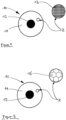
- Figure 1 shows a wooden pencil 10 in plan view, which is composed of a lead 12 and a honeycomb body/cover 11 concentrically surrounding this lead 12.
- the honeycomb structure/cover 11 has a plurality of hollow longitudinal structures 13, which in this embodiment is referred to as a square tube structure, or can be referred to as such.
- a detail Z has been shown enlarged.
- the distribution/arrangement of the longitudinal structures in the honeycomb body/envelope must preferably be evenly distributed over the cross-section so that the pin ideally has the same strength values in all directions perpendicular to the longitudinal structures.
- the distribution/arrangement of the longitudinal structures in the honeycomb body can also be different in radial direction.
- Figure 2 shows an alternative design of a device/pen 10, with hollow longitudinal structures 13' in the casing/honeycomb body 11. To clarify the honeycomb structure, a detail Z has been shown enlarged.
- the hollow longitudinal structures do not have to be formed over the entire cross-section of the casing. Improvements in strength and improved sharpenability can be determined/measured even when the casing/honeycomb body is partially penetrated with longitudinal structures.
- a further advantage is that honeycomb bodies/device elements designed in this way and the devices provided with them have a significantly lower weight and at the same time material is saved during their production.
- material savings of up to 80% by weight can be achieved, depending on the number and cross-sectional area of the longitudinal structures as well as the wall thicknesses between the structures compared to a body made of solid material.
- agents for impregnation, coloring or improving the sharpenability can also be easily introduced via the hollow longitudinal structures of the honeycomb bodies, since the hollow longitudinal structures can be capillary due to their dimensions.
- Frame example 1 (natural material-plastic composite material)
- Frame example 2 (natural material-plastic composite material)
- the plastic/polymer used in the examples in the natural material-plastic composite material is a polymer from the group of polyolefins, polystyrenes, styrene-acrylonitriles, acrylonitrile-butadiene-styrenes, polycarbonates, polyvinyl chloride and/or from the group of biopolymers.
- Wood, crops, bamboo, kernel flour and/or cellulose are used as organic fillers/natural substances in the natural material-plastic composite material, which are available in powder, flour and/or fiber form, whereby the size of the fillers is a maximum particle size of 250 ⁇ m, in particular a maximum of 100 ⁇ m.
- At least one inorganic filler from the group of layered silicates, talc, boron nitride, soapstone and graphite is used.
- Both colored and white pigments can be used as color pigments.
- titanium dioxide can be used to lighten the honeycomb body.
- adhesion promoter In natural material-plastic composites, it has proven advantageous to use an adhesion promoter to bond the native material to the plastic.
- adhesion promoters include polyethylene with grafted maleic anhydride or propylene with grafted maleic anhydride.
- the waxes used include amide waxes, fatty acids such as stearic acid and palmitic acid, montan wax, stearates, fatty acid esters and/or paraffin waxes.
- the formulations can also contain additives such as lubricants, plasticizers, surface-active substances, thermal stabilizers and/or UV stabilizers.
- a pencil, colour pencil, marker or cosmetic pencil which has a honeycomb body/casing made of a wood substitute material or plastic, whereby an anisotropy is formed due to hollow longitudinal structures, can be sharpened with a commercially available hand sharpener with little effort and at the same time has sufficient strength with low weight.
- test specimens made of solid material (wood, wood substitute material) and a honeycomb body made of a natural material-plastic composite with hollow longitudinal structures were manufactured and sharpened.
- the use of a test specimen that was assessed as being easy to sharpen means that a pencil made with it, consisting of a casing made of wood, wood substitute material or a honeycomb body made of a natural material-plastic composite and a lead, can also be sharpened with little effort.
- a pencil In general, a pencil is considered to be sharpenable with little effort if, as in the test, it has a so-called sharpening moment of less than 9 Ncm during the test or sharpening.
- the sharpening moment is determined in a testing machine developed for this purpose by continuously sharpening a test specimen in the form of a solid body made of wood, a solid body made of wood substitute material and a honeycomb body made of natural material-plastic composite material for 20 s.
- the average torque [in Ncm] determined during sharpening, which is required for continuously sharpening a test specimen with a diameter of 7.6 ⁇ 0.2 mm at a speed of 43 rpm with an existing pointed cone, i.e. already sharpened at the desired angle, in a commercially available sharpener with a new blade, is referred to as the sharpening moment.
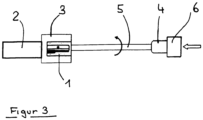
- a sharpener 1 is attached to a holder 3 connected to a torque measuring device 2.
- a test specimen 5 is provided in a holder 4 so that it can rotate and is inserted into the sharpener 1.
- the rotating test specimen 5 is pneumatically fed in the direction of the sharpener 1 by means of a feed device 6, which acts on the holder 4 of the test specimen 5 with a feed force of 20 N (see arrow on the right in the picture).
- the torque measured by the torque measuring device 2 during the sharpening process of the test specimen 5 is recorded and averaged over the test duration in order to determine the sharpening torque.
- test specimens EN 102008034013 A1 and the honeycomb body with square tube structure according to Figure 1 following composition Polyethylene high density (PE-HD) 25.0 wt.% Wood fibers 65.0 wt.% Polyethylene grafted with maleic anhydride 2.0 wt.% Amide wax 3.0 wt.% Stearic acid 3.0 wt.% Titanium dioxide 2.0 wt.% Natural wood Wood substitute materials according to EN 102008034013 A1
- Honeycomb body with hollow structures (according to the invention) Peak torque Ncm 7 to 12 9 to 10 ⁇ 9
- honeycomb body/envelope according to the invention made of wood substitute material/natural material-plastic composite material with hollow longitudinal structures is ideal for producing wood-cased pencils which have a lead made of eraser material and a casing for the lead, wherein the classic wood casing or the casing made of the wood substitute material is replaced by the honeycomb body/envelope according to the invention.
- the honeycomb body/sheathing according to the invention consisting of wood substitute material/natural material-plastic composite material with hollow longitudinal structures, is formed by co-extrusion.
- the lead and the sheath are formed in-situ in an extruder and are extruded together via a mouthpiece in the desired geometry as a continuous strand, which only needs to be divided into individual pencils.
- the honeycomb body and lead are co-extruded.
- Extrusion is a continuous manufacturing process and is therefore ideally suited for the cost-effective mass production of honeycomb bodies themselves and writing, drawing, painting, marking or cosmetic devices comprising a honeycomb body.
- Extrusion or co-extrusion is carried out using a special honeycomb structure tool, as is known from brick or catalyst production, for forming hollow chamber profiles with longitudinal structures.
- the extrusion process offers the advantage that almost all cross-sectional geometries of pins can be produced.
- Another possibility is to coat an existing lead, which can also be done by extrusion via cross-heads, similar to cable sheathing.
- Ballpoint pens, mechanical pencils or fiber pens can also have elements that are designed as honeycomb bodies.
- the honeycomb-shaped semi-finished products or honeycomb bodies are also manufactured by extrusion.
Landscapes
- Engineering & Computer Science (AREA)
- Mechanical Engineering (AREA)
- Laminated Bodies (AREA)
- Inks, Pencil-Leads, Or Crayons (AREA)
- Pens And Brushes (AREA)
- Extrusion Moulding Of Plastics Or The Like (AREA)
- Cosmetics (AREA)
Description
- Die Erfindung betrifft ein Schreib-, Zeichen-, Mal,- oder Kosmetikgerät nach dem Oberbegriff des Anspruch 1.
- Wabenkörper sowie deren prinzipieller Aufbau sind aus der Katalysatortechnik, beispielsweise aus der Katalysatortechnik für Kraftfahrzeuge bekannt. Derartige Wabenkörper zeichnen sich in der Regel durch eine geringe Dichte bei gleichzeitig hoher Festigkeit auf. Diese Wabenkörper sind zumeist aus teuerer Keramik oder teueren Metallen aufgebaut und weisen eine Vielzahl von - in der Regel zueinander achsparallel angeordnet - hohlen Längsstrukturen auf.
- Unter Wabenkörpern werden nachfolgend Umhüllungen oder sonstige Elemente für Schreib-, Zeichen-, Mal,- oder Kosmetikgeräte verstanden. Derartige Geräte sind unter anderem Stifte, wie Blei, Farb- oder Kosmetikstifte mit farbabgebenden Minen, deren Minen unverschiebbar in Umhüllungen gehaltert sind und zur Erhaltung deren Funktionsfähigkeit angespitzt werden müssen. Dies gilt ebenfalls für Geräte deren Minen aus Radiergummi-Material bestehen. Des Weiteren können Wabenkörper als Elemente von/für Schreib-, Zeichen-, Mal,- oder Markiergeräten, wie Kugelschreiber, Fein- oder Fallminenstifte usw. eine vielfältige Verwendung finden. Als Elemente, welche aus Wabenkörpern ausgebildet sein können, seien beispielhaft Schäfte, Drücker, Abschlusskappen, Griffzonen, farbabgebende Minen und Klipps genannt.
- Als weitere Elemente seinen Zwischenprodukte für die Herstellung von derartigen Geräten genannt, beispielsweise sogenannte Brettchen wie diese aus der klassischen Herstellung von holzgefassten Stiften bekannt sind.
- Aus dem Stand der Technik sind beispielsweise Umhüllungen von holzgefassten Stiften bekannt, welche aus Holz, Holzersatzwerkstoffen oder thermoplastischen Kunststoffen bestehen.
- Die Holzersatzwerkstoffe werden in neuerer Zeit eingesetzt, um die natürlichen Hölzer bzw. Holzvorkommen zu schonen.
- Eine Form dieser sogenannten Holzersatzwerkstoffe stellen sogenannte Wood Plastik Composites (WPC) dar, bei denen es sich um thermoplastisch verarbeitbare Materialien mit unterschiedlichen Anteilen von Holz, Kunststoffen und Additiven handelt, die durch thermoplastische Formgebungsverfahren wie z. B. Extrusion, Spritzguss oder Pressen verarbeitet werden.
- Beispielhaft für die Verwendung von WPC für holzgefasste Stifte sei die
-
DE 10 2008 034 013 A1 genannt, wobei das WPC als Holzersatzwerkstoff isotrope homogene physikalische Eigenschaften aufweist. - Im Allgemeinen weist WPC eine sehr hohe Dichte (> 1,0 g/cm3) auf, höher als die Dichte von Hölzern, welche für die Bleistiftfertigung eingesetzt werden und eine Dichte zwischen 0,3 und 0,6 g/cm3 aufweisen. Die Festigkeit hingegen ist geringer als die von Holz. Anisotrope Eigenschaften wie diese bei Holz vorliegen, können bei WPC nicht realisiert werden. Als nachteilig hat es sich zudem bei Stiften mit einer Minenummantelung aus WPC herausgestellt, dass ein höheres Spitzmoment nötig ist um den Stift anzuspitzen, da die physikalischen Eigenschaften bei WPC in allen Richtungen gleich sind.
- Es hat sich gezeigt, wenn Holz durch isotropes WPC ersetzt wird, dass man zwar eine ausreichende Festigkeit einstellen kann, jedoch als Folge höhere Spitzmomente auftreten.
- Hohe Festigkeit bei gleichzeitig guter Spitzbarkeit von Holz, konnte unter Verwendung von isotropem WPC nicht erreicht werden. Es kann festgehalten werden, dass Stifte, bestehend aus Minen und einer Ummantelung aus WPC, immer einen Kompromiss aus Festigkeit und Spitzbarkeit darstellen.
- Weiter werden in der
DE-PS 801613 Bleistiftumhüllungen für Kernstifte gezeigt und beschrieben, wobei das Fasermaterial parallel zur Stiftachse verlaufend angeordnet ist. Dadurch kann eine hohe Bruchfestigkeit sowie eine gleichmäßige Schneidbarkeit beim Spitzvorgang erreicht bzw. eingestellt werden. - Nachteilig hat es sich jedoch bei derartigen Stiften herausgestellt, dass durch die Ausrichtung der Faser das Herstellungsverfahren sehr schwierig ist und derartige ummantelte Stifte ein relativ hohes Gewicht aufweisen. Zudem ist der erreichte Kompromiss zwischen Festigkeit und Spitzbarkeit für den Anwender bzw. Benutzer nicht zufriedenstellend.
- Aus der
EP 1150847 B1 ist ein Verfahren zur Herstellung von Stiften bekannt, bei welchem Mine und Minenumhüllung im Verfahren der Coextrusion hergestellt werden. Sowohl Mine als auch deren Umhüllung bestehen aus thermoplastischem Kunststoff. - Nachteilig ist es bei den derart hergestellten Stiften, dass diese ein sehr hohes Gewicht aufweisen und das Spitzmoment für den Benutzer inakzeptabel hoch ist. Bei derartigen Produkten wird viel Material verbraucht, was deren Herstellung zudem teuer macht.
-
DE-OS 2144053 beschreibt einen geschäumten Stift, welcher elliptische Hohlzellen aufweist. - Die Schriften
US 6,019,533 undFR 944811 - Aufgabe der Erfindung ist es daher, ein Schreib-, Zeichen-, Mal,- oder Markiergerät zu schaffen, das die Nachteile des bekannten Standes der Technik nicht aufweist, wobei das Schreib-, Zeichen-, Mal- oder Kosmetikgerät welches einen Wabenkörper umfasst, welches neben einem geringem Gewicht und geringem Materialeinsatz eine hohe Festigkeit senkrecht zur Wabenstruktur aufweist.
- Weiter ist es Aufgabe der Erfindung ein Schreib-, Zeichen-, Mal,- oder Markiergeräte mit unverschiebbar in Umhüllungen gehalterter Mine zu schaffen, welches mindestens einen Wabenkörper umfasst, wobei das Gerät eine hohe Festigkeit/Biegefestigkeit bei gleichzeitig sehr guter Spitzbarkeit aufweist.
- Diese Aufgabe wird mit den Merkmalen gemäß Anspruch 1 gelöst. Die Aufgabe wird weiterhin gelöst durch ein Verfahren gemäß Anspruch 12 zur Herstellung eines Schreib-, Zeichen-, Mal- oder Kosmetikgeräts. Weitere Ausführungsformen sind mit den Unteransprüchen umfasst.
- Gelöst wird die Aufgabe, indem ein Schreib-, Zeichen-, Mal- oder Kosmetikgerät mindestens einen Wabenkörper aufweist, wobei der Wabenkörper mindestens aus einem Grundkörper besteht, wobei der mindestens eine Wabenkörper/Grundkörper eine Vielzahl von zueinander achsparallel hohlen Längsstrukturen beinhaltet, wobei der mindestens eine Wabenkörper aus Naturstoff-Kunststoff-Verbundwerkstoff gebildet ist, und die hohlen Längsstrukturen als eine Röhrenstruktur ausgebildet sind.
- Es hat sich in überraschender Weise gezeigt, dass in einer derart geschaffenen Anisotropie in Materialien zu sogenannten Wabenkörpern aus Naturstoff-Kunststoff-Verbundwerkstoff, insbesondere bei Verwendung von Holzersatzwerkstoffen, durch hohle Längsstrukturen eine Optimierung/Erhöhung der Biegefestigkeit bei senkrecht zu den Längsstrukturen auftretenden Belastung erzielt werden kann.
- Weiter hat sich gezeigt, dass bei Schreib-, Zeichen-, Mal,- Markier- oder Kosmetikgeräten mit unverschiebbar/ verschie-besicher in Wabenkörpern/Umhüllungen gehalterten farbabgebenden Minen, nicht nur die Biegefestigkeit senkrecht zur Längsachse/Längsstrukturen verbessert wird, sondern auch die Spitzbarkeit signifikant verbessert wird. Die Vielzahl der hohlen Längsstrukturen des Wabenkörpers sind parallel zur Längsachse des Gerätes ausgerichtet bzw. angeordnet. Die Außenkontur der Geräte kann beispielsweise rund, oval, ellipsenförmig, vieleckig, sternförmig oder andersförmig ausgebildet sein. Der Wabenkörper ist hierbei als eine Umhüllung einer farbabgebenden Mine ausgebildet, wobei die Umhüllung und die farbabgebende Mine mittels Coextrusion hergestellt bzw. ausgebildet sind. Beispiele für derartige Geräte mit Wabenkörper sind Blei-, Bunt- oder Kosmetikstifte.
- Der Wabenkörper kann aber auch als ein Zwischenprodukt für die Herstellung von Geräten ausgebildet sein. Beispielhaft seien die Brettchen aus der Bleistiftherstellung genannt, wobei zwischen zweier derartige Brettchen die Minen eingeleimt werden. Diese Brettchen könnten ebenfalls mit hohlen Längsstrukturen versehen werden. Die Herstellung derartiger Brettchen/Wabenkörper erfolgt über thermoplastische Extrusion.
- Es hat sich zudem gezeigt, dass eine signifikante Verbesserung von Festigkeit und Spitzbarkeit im Wesentlichen unabhängig vom Querschnittsprofil der hohlen Längsstrukturen im Wabenkörper ist.
- Als Beispiele für mögliche Querschnitte der achsparallen hohlen Längsstrukturen, welche in den Wabenkörpern ausgebildet sind, seien beispielhaft runde, ellipsenförmige, vieleckige und/oder sternförmige Querschnitte genannt.
- Zur Verdeutlichung der erfindungsgemäßen Lösung sollen die
Figuren 1 und 2 dienen. -
Figur 1 zeigt einen holzgefassten Stift 10 in der Draufsicht, der sich aus einer Mine 12 und einer diese Mine 12 konzentrisch umgebenden Wabenkörper/Umhüllung 11 zusammensetzt. Die Wabenstruktur/Umhüllung 11 weist eine Vielzahl hohler Längstrukturen 13 auf, welche in dieser Ausführung als quadratische Röhrenstruktur bezeichnet wird, bzw. werden kann. Zur Verdeutlichung der Wabenstruktur wurde ein Detail Z vergrößert dargestellt. - Allgemein gilt es anzumerken, dass die Verteilung/Anordnung der Längsstrukturen im Wabenkörper/Umhüllung bevorzugt gleichmäßig über den Querschnitt verteilt sein müssen, damit der Stift in idealer Weise in allen Richtungen senkrecht zu den Längsstrukturen die gleichen Festigkeitswerte aufweist.
- Auch kann sich die Verteilung/Anordnung der Längsstrukturen im Wabenkörper in radialer unterschiedlich ausgebildet sein.
-
Figur 2 zeigt eine alternative Ausgestaltung eines Gerätes/Stiftes 10, mit hohlen Längsstrukturen 13' in der Umhüllung/Wabenkörper 11. Zur Verdeutlichung der Wabenstruktur wurde ein Detail Z vergrößert dargestellt. - Es hat sich gezeigt, dass sich die hohlen Längsstrukturen nicht über dem gesamten Querschnitt der Umhüllung ausge-bildet sein müssen. Verbesserung in Festigkeit bei verbesserter Spitzbarkeit können auch schon bei teilweiser Durch-setzung der Umhüllung/Wabenkörper mit Längsstrukturen festgestellt/gemessen werden.
- Sehrgute Ergebnisse konnten beispielsweise dann gemessen werden, wenn die hohlen Längsstrukturen über den gesamten Querschnitt des Wabenkörpers/Umhüllung ausgebildet sind und die Größe der Waben/Längsstrukturen der bei handelsüblichen Katalysatoreinsätzen entspricht. Dies entspricht Wandstärken zwischen den hohlen Längsstrukturen kleiner 100 µm.
- Es ist jedoch auch möglich die Wandstärken zwischen den hohlen Strukturen und die Querschnittsflächen der hohlen Längsstrukturen größer als die von Katalysatoren zu gestalten, denn der gewünschte Effekt zur Lösung der Aufgabe ist bei fast jeder Ausgestaltung messbar, wobei dies unabhängig von der Querschnittform der hohlen Längsstrukturen ist. Es sei darauf hingewiesen, dass auch unterschiedliche Hohlraumprofile im Querschnitt eines Körpers kombiniert werden können.
- Es hat sich zudem gezeigt, dass Längsstrukturen welche im Randbereich der Umhüllungs-/Wabenkörperoberfläche liegen auch aufgeschnitten sein können, wodurch je nach Querschnittform auch hinterschnittige Konturen entstehen können.
- Unabhängig von vorstehend genannten Vorteilen der erfindungsgemäßen Lösung sei als weiterer Vorteil genannt, dass derartig gestaltete Wabenkörper/Geräteelemente und den damit versehenen Geräten ein signifikant geringeres Gewicht aufweisen und zugleich Material bei deren Herstellung gespart wird. Bei Wabenkörper aufweisenden Geräten kann eine Materialeinsparung bis zu 80 Gew. % erreicht werden, abhängig von Anzahl und Querschnittsfläche der Längsstrukturen sowie den Wandstärken zwischen den Strukturen gegenüber einem Körper aus Vollmaterial.
- Hierbei gilt es anzumerken, dass über die hohl ausgebildeten Längsstrukturen der Wabenkörper auch Mittel zur Imprägnation, Einfärbung oder Verbesserung der Spitzfähigkeit problemlos eingebracht werden können, da die hohlen Längsstrukturen aufgrund ihrer Dimensionierung kapillar ausgebildet sein können.
- Nachfolgend werden beispielhaft drei Rahmenbeispiele für eine mögliche Zusammensetzung eines Holzersatzwerkstoffes angeführt, welchen bei der Herstellung anisotroper Umhüllungen Verwendung finden können.
-
15 - 30 Gew.-% mindestens eines polymeren Bindemittels, 50 - 80 Gew.-% mindestens eines organischen Füllstoffs, 0 - 20 Gew.-% mindestens eines anorganischen Füllstoffs, 0,5 - 5 Gew.-% mindestens eines Haftvermittlers, 1 - 30 Gew.-% mindestens eines Wachses, 0 - 10 Gew.-% mindestens eines Farbpigments, und 0 - 10 Gew.-% mindestens eines Additivs, -
- mindestens 50 Gew.% Naturstoff(e)
- 0 bis 20 Gew.% anorganische(r) Füllstoff(e)
- 0 bis 10 Gew.% Haftvermittler
- 0 bis 10 Gew.% Farbpigment(e)
- 0 bis 10 Gew.% Wachs(e)
- 0 bis 5 Gew.% Additiv(e)
- Bei den in den Beispielen eingesetzten Kunststoff/Polymer im Naturstoff-Kunststoff-Verbundwerkstoffs handelt es sich um ein Polymer aus der Gruppe der Polyolefine, Polystyrole, Styrolacrylnitrile, Acrylnitril-Butadien-Styrole, Polycarbonate, Polyvinylchlorid und/oder aus der Gruppe der Biopolymere.
- Als organische Füllstoffe/Naturstoffe im Naturstoff-Kunststoff-Verbundwerkstoffs sind Holz, Nutzpflanzen, Bambus, Kernmehle und/oder Cellulose eingesetzt, die in Pulver-, Mehl- und/oder Faserform vorliegen, wobei die Größe der Füllstoffe eine maximale Partikelgröße von 250 µm, insbesondere von maximal 100 µm beträgt.
- Zum Einstellen der Sprödigkeit und der Gleiteigenschaften beim Spitzen ist es vorteilhaft, wenn mindestens ein anorganisches Füllmittel aus der Gruppe der Schichtsilikate, Talkum, Bornitrid, Speckstein und Graphit eingesetzt ist.
- Als Farbpigmente können bunte als auch weiße Pigmente eingesetzt werden. So kann beispielsweise Titandioxid zur Aufhellung des Wabenkörpers eingesetzt werden.
- In Naturstoff-Kunststoff-Verbundwerkstoffen hat es sich als vorteilhaft erwiesen, wenn ein Haftvermittler zur Anbindung des Nativstoffes an den Kunststoff eingesetzt ist. Beispielhaft seien als Haftvermittler ein Polyethylen mit aufgepfropftem Maleinsäureanhydrid oder ein Propylen mit aufgepfropftem Maleinsäureanhydrid genannt.
- Die eingesetzten Wachse umfassen Amidwachse, Fettsäuren wie z.B. Stearinsäure und Palmitinsäure, Montanwachs, Stearate, Fettsäureester und/oder Paraffinwachse. Den Rezepturen können zudem Additive wie beispielsweise Gleitmittel, Weichmacher, oberflächenaktive Substanzen, thermische Stabilisatoren und/oder UV-Stabilisatoren beigefügt sein.
- Der Effekt der Festigkeitsteigerung bei gleichzeitig verbesserter Spitzbarkeit bei Schreib-, Zeichen-, Mal-, Markier- und/oder Kosmetikgeräten ist je nach verarbeitetem Werkstoff zwar immer größer als bei einem entsprechenden Vollmaterial, jedoch können die Werte des Grades der Verbesserung je nach verwendetem Werkstoff variieren. Die Verbesserung durch die erfindungsgemäße Lösung beruht rein auf einer technischen Ausgestaltung und kann als werkstoffunabhängig bezeichnet werden.
- Ein Blei-, Farb-, Markier- oder Kosmetikstift, welcher einen Wabenkörper/Umhüllung aus einem Holzersatzwerkstoff oder Kunststoff aufweist, wobei aufgrund hohler Längsstrukturen eine Anisotropie ausgebildet ist, ist mit einem handelsüblichen Handspitzer mit geringem Kraftaufwand spitzbar und weist gleichzeitig die ausreichende Festigkeit bei niedrigem Gewicht auf.
- Um eine Vergleichbarkeit bei Messungen zur Spitzbarkeit herzustellen, wurden Probekörper aus Vollmaterial (Holz, Holzersatzwerkstoff) und ein Wabenkörper aus Naturstoff-Kunststoff-Verbundwerkstoff mit hohlen Längsstrukturen hergestellt und angespitzt. Dabei führt der Einsatz eines als gut spitzbar beurteilter Probekörper dazu, dass ein damit hergestellter Stift, bestehend aus einer Umhüllung aus Holz, Holzersatzwerkstoff oder Wabenkörper aus Naturstoff-Kunststoff-Verbundwerkstoff und Mine ebenfalls mit geringem Kraftaufwand gespitzt werden kann.
- Allgemein gilt als mit geringem Kraftaufwand spitzbar, wenn wie im Versuch ein Stift der bei der Prüfung bzw. Anspitzung ein so genanntes Spitzmoment von kleiner 9 Ncm aufweist.
- Das Spitzmoment wird in einer zu diesem Zweck entwickelten Prüfmaschine bestimmt, indem ein Prüfkörper in Form eines Vollkörpers aus Holz, einem Vollkörper aus Holzersatzwerkstoff und einem Wabenkörper aus Naturstoff-Kunststoff-Verbundwerkstoff 20 s lang kontinuierlich gespitzt wird. Das während der Anspitzung ermittelte durchschnittliche Drehmoment [in Ncm], das zum kontinuierlichen Anspitzen eines Prüfkörpers mit einem Durchmesser von 7,6 ± 0,2 mm mit einer Drehzahl von 43 U/min bei bereits vorhandenem Spitzkegel, d.h. bereits im gewünschten Winkel angespitzt ist, in einem handelsüblichen Spitzer mit neuer Klinge erforderlich ist, wird als Spitzmoment bezeichnet.
- Das Prinzip einer Vorrichtung zur Messung des Spitzmoments ist in der
Figur 3 zur Erläuterung dargestellt. Ein Spitzer 1 wird dazu in einer, mit einer Drehmoment-Messvorrichtung 2 verbundenen Halterung 3 befestigt. Ein Prüfkörper 5 wird in einer Aufnahme 4 rotierbar bereitgestellt und in den Spitzer 1 eingeführt. Es erfolgt ein pneumatischer Vorschub des rotierenden Prüfkörpers 5 in Richtung des Spitzers 1 mittels einer Vorschubeinrichtung 6, die auf die Aufnahme 4 des Prüfkörpers 5 mit einer Vorschubkraft von 20 N einwirkt (siehe Pfeil rechts im Bild). Das während des Spitzvorgangs des Prüfkörpers 5 von der Drehmoment-Messvorrichtung 2 gemessene Drehmoment wird aufgezeichnet und über die Prüfdauer gemittelt, um das Spitzmoment zu bestimmen. - Dass sich die Spitzbarkeit von Probekörpern in erfindungsgemäßer Ausführung deutlich verbessert geht aus nachfolgender Tabelle hervor.
- Hierbei weisen die Probekörper gemäß dem Stand der Technik
DE 102008034013 A1 und dem Wabenkörper mit quadratischer Röhrenstruktur nachFigur 1 folgende Zusammensetzung auf:Polyethylen High Density (PE-HD) 25,0 Gew.-% Holzfasern 65,0 Gew.-% Polyethylen mit gepfropften Maleinsäureanhydrid 2,0 Gew.-% Amidwachs 3,0 Gew.-% Stearinsäure 3,0 Gew.-% Titandioxid 2,0 Gew.-% Natürliches Holz Holzersatzwerkstoffe gemäß DE 102008034013 A1 Wabenkörper mit hohlen Strukturen (gemäß Erfindung) Spitzmoment Ncm 7 bis 12 9 bis 10 <9 - Weiterhin ist eine Verwendung eines erfindungsgemäßen Wabenkörpers/Umhüllung aus Holzersatzwerkstoff/Naturstoff-Kunststoff-Verbundwerkstoff mit hohlen Längsstrukturen zur Herstellung holzgefasster Stifte ideal, welche eine Mine aus Radiergummi-Material und eine Ummantelung für die Mine aufweisen, wobei die klassische Holzummantelung oder die Ummantelung aus dem Holzersatzwerkstoff durch den erfindungsgemäßen Wabenkörper/Ummantelung ersetzt wird.
- Besonders bevorzugt ist es bei der Herstellung von Stiften mit farbabgebenden Minen oder Minen aus Radiergummi-Material, wenn der erfindungsgemäße Wabenkörper/Ummantelung, bestehend aus Holzersatzwerkstoff/Naturstoff-Kunststoff-Verbundwerkstoff mit hohlen Längsstrukturen durch Co-Extrudieren gebildet wird. Dabei werden die Mine und die Umhüllung in-situ in einem Extruder geformt und über ein Mundstück gemeinsam in der jeweils gewünschten Geometrie als Endlosstrang ausgebracht, der nur noch in einzelne Stifte zerteilt werden muss. Wabenkörper und Mine werden coextrudiert.
- Die Extrusion ist ein kontinuierliches Herstellungsverfahren und daher zur kostengünstigen Massenproduktion von Wabenkörpern an sich und Schreib-, Zeichen-, Mal,- Markier- oder Kosmetikgeräte umfassend einen Wabenkörper hervorragend geeignet.
- Extrusion oder Co-Extrusion erfolgen über ein spezielles Wabenstrukturwerkzeug, wie dies aus der Ziegel- oder Katalysatorherstellung, zur Ausformung von Hohlkammerprofilen mit Längsstrukturen bekannt ist.
- Die Extrusions-Verfahren bieten den Vorteil, dass nahezu alle Querschnittsgeometrien von Stiften hergestellt werden können.
- Eine andere Möglichkeit besteht darin, eine bereits vorliegende Mine zu ummanteln, was ebenfalls mittels Extrusion über Querspritzköpfe, analog der Kabelummantelung geschehen kann.
- Auch Kugelschreiber, Feinminenstifte oder Faserschreiber können Elemente aufweisen, welche als Wabenkörper ausgebildet ist. Hierzu werden die wabenförmigen Halbzeuge bzw. Wabenkörper ebenso mittels Extrusion hergestellt.
Claims (13)
- Schreib-, Zeichen-, Mal- oder Kosmetikgerät umfassend mindestens einen Wabenkörper,wobei der mindestens eine Wabenkörper als eine Umhüllung einer farbabgebenden Mine ausgebildet ist,wobei der mindestens eine Wabenkörper aus einem Naturstoff-Kunststoff-Verbundwerkstoff gebildet ist,wobei der mindestens eine Wabenkörper eine Vielzahl von zueinander achsparallel hohlen Längsstrukturen beinhaltet und die hohlen Längsstrukturen als eine Röhrenstruktur ausgebildet sind.
- Gerät nach Anspruch 1,
dadurch gekennzeichnet,
und dass die Mine in der Umhüllung verschiebesicher gehaltert ist. - Gerät nach Anspruch 2,
dadurch gekennzeichnet,
dass die Umhüllung und die farbabgebende Mine coextrudiert ausgebildet sind. - Gerät nach einem der Ansprüche 1 bis 3,
dadurch gekennzeichnet,
dass die Vielzahl von hohlen Längsstrukturen des Wabenkörpers parallel zur Längsachse des Gerätes ausgerichtet sind. - Gerät nach mindestens einem der vorstehenden Ansprüche,
dadurch gekennzeichnet,
dass die Querschnitte der Längsstrukturen im Wabenkörper rund, ellipsenförmig, vieleckig und/oder sternförmig ausgebildet sind. - Gerät nach mindestens einem der vorstehenden Ansprüche,
dadurch gekennzeichnet,
dass das Gerät ein Blei-, Bunt- oder Kosmetikstift ist. - Gerät nach einem der Ansprüche 1 bis 6,
dadurch gekennzeichnet,
dass ein Naturstoff des Naturstoff-Kunststoff-Verbundwerkstoffs aus Holz und/oder Cellulose besteht. - Gerät nach Anspruch 7,
dadurch gekennzeichnet,
dass das Holz und/oder Cellulose in Pulver-, Mehl- und/oder Faserform vorliegt. - Gerät nach einem der Ansprüche 1 bis 8,
dadurch gekennzeichnet,
dass der Naturstoff-Kunststoff-Verbundwerkstoffmindestens 50 Gew.% Naturstoff(e)0 bis 20 Gew.% anorganische(r) Füllstoff(e)0 bis 10 Gew.% Haftvermittler0 bis 10 Gew.% Farbpigment(e)0 bis 10 Gew.% Wachs(e)0 bis 5 Gew.% Additiv(e)Rest Kunststoff(e) als polymeres Bindemittelbeinhaltet. - Gerät nach einem der Ansprüche 1 bis 9,
dadurch gekennzeichnet,
dass ein Kunststoff des Naturstoff-Kunststoff-Verbundwerkstoffs ein Polymer aus der Gruppe der Polyolefine, Polystyrole, Styrolacrylnitrile, Acrylnitril-Butadien-Styrole, Polycarbonate, Polyvinylchlorid und/oder aus der Gruppe der Biopolymere ausgewählt ist. - Gerät nach einem der Ansprüche 1 bis 10,
dadurch gekennzeichnet,
dass die Außenkontur des Gerätes rund oder vieleckig ausgebildet ist. - Verfahren zur Herstellung eines Schreib-, Zeichen-, Mal- oder Kosmetikgeräts umfassend mindestens einen Wabenkörper,wobei der mindestens eine Wabenkörper als eine Umhüllung einer farbabgebenden Mine ausgebildet ist,wobei der mindestens eine Wabenkörper aus einem Naturstoff-Kunststoff-Verbundwerkstoff gebildet ist,wobei der mindestens eine Wabenkörper eine Vielzahl von zueinander achsparallel hohlen Längsstrukturen beinhaltet und die hohlen Längsstrukturen als eine Röhrenstruktur ausgebildet sind,wobei der Wabenkörper durch Extrusion hergestellt wird.
- Verfahren nach Anspruch 12,
wobei der Wabenkörper und die Mine coextrudiert werden.
Priority Applications (1)
| Application Number | Priority Date | Filing Date | Title |
|---|---|---|---|
| PL12758396T PL2736731T3 (pl) | 2011-07-28 | 2012-07-05 | Przybór do pisania, rysowania, malowania lub kosmetyczny zawierający korpus o budowie plastra miodu |
Applications Claiming Priority (2)
| Application Number | Priority Date | Filing Date | Title |
|---|---|---|---|
| DE102011109177 | 2011-07-28 | ||
| PCT/EP2012/002811 WO2013013762A1 (de) | 2011-07-28 | 2012-07-05 | Schreib-, zeichen-, mal- oder kosmetikgerät umfassend einen wabenkörper sowie ein verfahren zur herstellung des wabenkörpers oder des gerätes umfassend einen wabenkörper |
Publications (3)
| Publication Number | Publication Date |
|---|---|
| EP2736731A1 EP2736731A1 (de) | 2014-06-04 |
| EP2736731B1 EP2736731B1 (de) | 2021-03-31 |
| EP2736731B2 true EP2736731B2 (de) | 2024-07-17 |
Family
ID=46832327
Family Applications (1)
| Application Number | Title | Priority Date | Filing Date |
|---|---|---|---|
| EP12758396.1A Active EP2736731B2 (de) | 2011-07-28 | 2012-07-05 | Schreib-, zeichen-, mal- oder kosmetikgerät umfassend einen wabenkörper |
Country Status (9)
| Country | Link |
|---|---|
| US (1) | US9579865B2 (de) |
| EP (1) | EP2736731B2 (de) |
| CN (1) | CN103732415B (de) |
| BR (1) | BR112014002086B8 (de) |
| DE (1) | DE102012000269B4 (de) |
| ES (1) | ES2872384T3 (de) |
| PL (1) | PL2736731T3 (de) |
| RU (1) | RU2581979C2 (de) |
| WO (1) | WO2013013762A1 (de) |
Families Citing this family (4)
| Publication number | Priority date | Publication date | Assignee | Title |
|---|---|---|---|---|
| CN107043577B (zh) * | 2017-04-20 | 2021-02-02 | 浙江华科笔业有限公司 | 一种全塑彩笔及其制备方法 |
| WO2020049148A1 (en) | 2018-09-07 | 2020-03-12 | Societe Bic | Body for a writing, tracing, drawing or coloring pencil |
| MX429259B (es) | 2018-09-07 | 2025-11-13 | SOCIéTé BIC | Cuerpo para un lápiz para escribir, trazar, dibujar o colorear. |
| DE102022114169B4 (de) * | 2022-06-03 | 2025-04-30 | Staedtler Se | Stift mit PLA/PBS-Schaftgrundmaterial |
Family Cites Families (11)
| Publication number | Priority date | Publication date | Assignee | Title |
|---|---|---|---|---|
| FR944811A (fr) | 1947-03-25 | 1949-04-15 | Perfectionnement aux cartouches de recharge d'encre pour stylographes et stylographe obtenu en utilisant ce perfectionnement | |
| DE801613C (de) | 1949-05-14 | 1951-01-15 | Faber Castell A W | Bleistiftumhuellung fuer Kernstifte und Verfahren zu ihrer Herstellung |
| DE2144053A1 (de) | 1970-09-02 | 1972-03-30 | Dainippon Ink & Chemicals | Bleistiftholz |
| SU1708276A1 (ru) * | 1989-06-27 | 1992-01-30 | Харьковский политехнический институт им.В.И.Ленина | Способ изготовлени косметического карандаша |
| US6019533A (en) * | 1997-08-18 | 2000-02-01 | Eversharp Pen Co. | Grip accessory, writing instrument and a method for enhancing comfort in a gripped surface |
| FR2802148B1 (fr) * | 1999-12-13 | 2003-01-24 | Conte | Procede de fabrication par tri-extrusion d'un crayon a ecrire ou a colorier et crayon a ecrire ou a colorier comportant une couche intermediaire de protection |
| DE20314274U1 (de) * | 2003-09-12 | 2004-05-27 | Faber-Castell Ag | Holzgefasster Stift für Schreib-, Mal-, Zeichen-, und Kosmetikzwecke |
| DE102006046491B4 (de) * | 2006-09-29 | 2017-03-16 | Staedtler Mars Gmbh & Co. Kg | Schreib-, Zeichen-, Mal- und/oder Kosmetikstift |
| UA25735U (en) * | 2007-01-22 | 2007-08-27 | Valerii Vilinovych Kaliuzhnyi | Pencil |
| DE102008034013B4 (de) | 2008-07-15 | 2011-04-28 | J. S. Staedtler Gmbh & Co. Kg | Verwendung eines Holzersatzwerkstoff |
| JP2010036372A (ja) | 2008-08-01 | 2010-02-18 | Mitsubishi Pencil Co Ltd | 鉛筆 |
-
2012
- 2012-01-10 DE DE102012000269.6A patent/DE102012000269B4/de active Active
- 2012-07-05 PL PL12758396T patent/PL2736731T3/pl unknown
- 2012-07-05 EP EP12758396.1A patent/EP2736731B2/de active Active
- 2012-07-05 BR BR112014002086A patent/BR112014002086B8/pt active IP Right Grant
- 2012-07-05 CN CN201280037880.9A patent/CN103732415B/zh not_active Expired - Fee Related
- 2012-07-05 US US14/235,527 patent/US9579865B2/en active Active
- 2012-07-05 RU RU2014107698/12A patent/RU2581979C2/ru active
- 2012-07-05 ES ES12758396T patent/ES2872384T3/es active Active
- 2012-07-05 WO PCT/EP2012/002811 patent/WO2013013762A1/de not_active Ceased
Also Published As
| Publication number | Publication date |
|---|---|
| DE102012000269A1 (de) | 2013-01-31 |
| BR112014002086B8 (pt) | 2021-04-20 |
| US20140162007A1 (en) | 2014-06-12 |
| ES2872384T3 (es) | 2021-11-02 |
| CN103732415B (zh) | 2017-02-22 |
| BR112014002086A2 (pt) | 2017-02-21 |
| RU2581979C2 (ru) | 2016-04-20 |
| RU2014107698A (ru) | 2015-09-10 |
| CN103732415A (zh) | 2014-04-16 |
| WO2013013762A1 (de) | 2013-01-31 |
| PL2736731T3 (pl) | 2021-08-02 |
| EP2736731A1 (de) | 2014-06-04 |
| US9579865B2 (en) | 2017-02-28 |
| DE102012000269B4 (de) | 2023-11-02 |
| EP2736731B1 (de) | 2021-03-31 |
| BR112014002086B1 (pt) | 2020-11-17 |
| BR112014002086A8 (pt) | 2018-04-03 |
Similar Documents
| Publication | Publication Date | Title |
|---|---|---|
| EP2313462B1 (de) | Holzersatzwerkstoff sowie dessen verwendung | |
| DE102008034015B4 (de) | Schreib-, Zeichen-, Mal- oder Kosmetikstift | |
| EP2069125B1 (de) | Schreib-, zeichen-, mal- und/oder kosmetikstift | |
| EP2948317B1 (de) | Schreiber und herstellungsverfahren | |
| EP2303602A1 (de) | Mine für schreib-, zeichen- und/oder malgeräte | |
| EP2736731B1 (de) | Schreib-, zeichen-, mal- oder kosmetikgerät umfassend einen wabenkörper | |
| EP3052574A1 (de) | Mine für schreib-, zeichen und/oder malgeräte sowie verfahren zu deren herstellung | |
| EP1918329B1 (de) | Thermoplastische Formmasse und daraus hergestellter Formkörper | |
| EP3042937B1 (de) | Mine oder Kreide enthaltend Graphit und ein polymeres Bindemittel und Stift mit einer Graphitmine | |
| DE202008009751U1 (de) | Schreib-, Zeichen-, Mal- oder Kosmetikstift | |
| DE202011103995U1 (de) | Schreib-, Zeichen-, Mal- oder Kosmetikgerät umfassend einen Wabenkörper | |
| DE10228714B4 (de) | Verfahren zur Herstellung von spitzbaren Stiften und spitzbarer Stift | |
| DE112018000620B4 (de) | Stifthülse | |
| DE202008009752U1 (de) | Holzersatzwerkstoff | |
| DE202024104335U1 (de) | Vorrichtung zum Herstellen eines Extrusionsstrangs für ein Schreibgerät mit einer wendelförmigen Hüllschicht | |
| DE102024121899A1 (de) | Vorrichtung und Verfahren zum Herstellen eines Extrusionsstrangs für ein Schreibgerät mit einer wendelförmigen Hüllschicht | |
| DE202013000836U1 (de) | Komponente für Schreib-, Zeichen-, Mal- und/oder Kosmetikstifte | |
| HK1196337A (en) | Writing, drawing, painting or cosmetic device comprising a honeycomb body, and method for producing the honeycomb body or the device comprising a honeycomb body | |
| HK1196337B (en) | Writing, drawing, painting or cosmetic device comprising a honeycomb body, and method for producing the honeycomb body or the device comprising a honeycomb body | |
| DE102011109178A1 (de) | Wabenkörper und Verfahren zu deren Herstellung | |
| DE202011103993U1 (de) | Wabenkörper |
Legal Events
| Date | Code | Title | Description |
|---|---|---|---|
| PUAI | Public reference made under article 153(3) epc to a published international application that has entered the european phase |
Free format text: ORIGINAL CODE: 0009012 |
|
| 17P | Request for examination filed |
Effective date: 20140122 |
|
| AK | Designated contracting states |
Kind code of ref document: A1 Designated state(s): AL AT BE BG CH CY CZ DE DK EE ES FI FR GB GR HR HU IE IS IT LI LT LU LV MC MK MT NL NO PL PT RO RS SE SI SK SM TR |
|
| DAX | Request for extension of the european patent (deleted) | ||
| RAP1 | Party data changed (applicant data changed or rights of an application transferred) |
Owner name: STAEDTLER MARS GMBH & CO. KG |
|
| STAA | Information on the status of an ep patent application or granted ep patent |
Free format text: STATUS: EXAMINATION IS IN PROGRESS |
|
| 17Q | First examination report despatched |
Effective date: 20190329 |
|
| GRAP | Despatch of communication of intention to grant a patent |
Free format text: ORIGINAL CODE: EPIDOSNIGR1 |
|
| STAA | Information on the status of an ep patent application or granted ep patent |
Free format text: STATUS: GRANT OF PATENT IS INTENDED |
|
| GRAS | Grant fee paid |
Free format text: ORIGINAL CODE: EPIDOSNIGR3 |
|
| INTG | Intention to grant announced |
Effective date: 20210120 |
|
| GRAA | (expected) grant |
Free format text: ORIGINAL CODE: 0009210 |
|
| STAA | Information on the status of an ep patent application or granted ep patent |
Free format text: STATUS: THE PATENT HAS BEEN GRANTED |
|
| AK | Designated contracting states |
Kind code of ref document: B1 Designated state(s): AL AT BE BG CH CY CZ DE DK EE ES FI FR GB GR HR HU IE IS IT LI LT LU LV MC MK MT NL NO PL PT RO RS SE SI SK SM TR |
|
| REG | Reference to a national code |
Ref country code: GB Ref legal event code: FG4D Free format text: NOT ENGLISH Ref country code: CH Ref legal event code: EP |
|
| REG | Reference to a national code |
Ref country code: AT Ref legal event code: REF Ref document number: 1376513 Country of ref document: AT Kind code of ref document: T Effective date: 20210415 |
|
| REG | Reference to a national code |
Ref country code: DE Ref legal event code: R096 Ref document number: 502012016700 Country of ref document: DE |
|
| REG | Reference to a national code |
Ref country code: IE Ref legal event code: FG4D Free format text: LANGUAGE OF EP DOCUMENT: GERMAN |
|
| REG | Reference to a national code |
Ref country code: NL Ref legal event code: FP |
|
| REG | Reference to a national code |
Ref country code: LT Ref legal event code: MG9D |
|
| PG25 | Lapsed in a contracting state [announced via postgrant information from national office to epo] |
Ref country code: HR Free format text: LAPSE BECAUSE OF FAILURE TO SUBMIT A TRANSLATION OF THE DESCRIPTION OR TO PAY THE FEE WITHIN THE PRESCRIBED TIME-LIMIT Effective date: 20210331 Ref country code: FI Free format text: LAPSE BECAUSE OF FAILURE TO SUBMIT A TRANSLATION OF THE DESCRIPTION OR TO PAY THE FEE WITHIN THE PRESCRIBED TIME-LIMIT Effective date: 20210331 Ref country code: BG Free format text: LAPSE BECAUSE OF FAILURE TO SUBMIT A TRANSLATION OF THE DESCRIPTION OR TO PAY THE FEE WITHIN THE PRESCRIBED TIME-LIMIT Effective date: 20210630 Ref country code: NO Free format text: LAPSE BECAUSE OF FAILURE TO SUBMIT A TRANSLATION OF THE DESCRIPTION OR TO PAY THE FEE WITHIN THE PRESCRIBED TIME-LIMIT Effective date: 20210630 |
|
| PG25 | Lapsed in a contracting state [announced via postgrant information from national office to epo] |
Ref country code: SE Free format text: LAPSE BECAUSE OF FAILURE TO SUBMIT A TRANSLATION OF THE DESCRIPTION OR TO PAY THE FEE WITHIN THE PRESCRIBED TIME-LIMIT Effective date: 20210331 Ref country code: RS Free format text: LAPSE BECAUSE OF FAILURE TO SUBMIT A TRANSLATION OF THE DESCRIPTION OR TO PAY THE FEE WITHIN THE PRESCRIBED TIME-LIMIT Effective date: 20210331 Ref country code: LV Free format text: LAPSE BECAUSE OF FAILURE TO SUBMIT A TRANSLATION OF THE DESCRIPTION OR TO PAY THE FEE WITHIN THE PRESCRIBED TIME-LIMIT Effective date: 20210331 |
|
| PG25 | Lapsed in a contracting state [announced via postgrant information from national office to epo] |
Ref country code: SM Free format text: LAPSE BECAUSE OF FAILURE TO SUBMIT A TRANSLATION OF THE DESCRIPTION OR TO PAY THE FEE WITHIN THE PRESCRIBED TIME-LIMIT Effective date: 20210331 Ref country code: LT Free format text: LAPSE BECAUSE OF FAILURE TO SUBMIT A TRANSLATION OF THE DESCRIPTION OR TO PAY THE FEE WITHIN THE PRESCRIBED TIME-LIMIT Effective date: 20210331 Ref country code: EE Free format text: LAPSE BECAUSE OF FAILURE TO SUBMIT A TRANSLATION OF THE DESCRIPTION OR TO PAY THE FEE WITHIN THE PRESCRIBED TIME-LIMIT Effective date: 20210331 |
|
| REG | Reference to a national code |
Ref country code: ES Ref legal event code: FG2A Ref document number: 2872384 Country of ref document: ES Kind code of ref document: T3 Effective date: 20211102 |
|
| PG25 | Lapsed in a contracting state [announced via postgrant information from national office to epo] |
Ref country code: SK Free format text: LAPSE BECAUSE OF FAILURE TO SUBMIT A TRANSLATION OF THE DESCRIPTION OR TO PAY THE FEE WITHIN THE PRESCRIBED TIME-LIMIT Effective date: 20210331 Ref country code: IS Free format text: LAPSE BECAUSE OF FAILURE TO SUBMIT A TRANSLATION OF THE DESCRIPTION OR TO PAY THE FEE WITHIN THE PRESCRIBED TIME-LIMIT Effective date: 20210731 Ref country code: RO Free format text: LAPSE BECAUSE OF FAILURE TO SUBMIT A TRANSLATION OF THE DESCRIPTION OR TO PAY THE FEE WITHIN THE PRESCRIBED TIME-LIMIT Effective date: 20210331 Ref country code: PT Free format text: LAPSE BECAUSE OF FAILURE TO SUBMIT A TRANSLATION OF THE DESCRIPTION OR TO PAY THE FEE WITHIN THE PRESCRIBED TIME-LIMIT Effective date: 20210802 |
|
| REG | Reference to a national code |
Ref country code: DE Ref legal event code: R026 Ref document number: 502012016700 Country of ref document: DE |
|
| PLBI | Opposition filed |
Free format text: ORIGINAL CODE: 0009260 |
|
| PLAX | Notice of opposition and request to file observation + time limit sent |
Free format text: ORIGINAL CODE: EPIDOSNOBS2 |
|
| PG25 | Lapsed in a contracting state [announced via postgrant information from national office to epo] |
Ref country code: DK Free format text: LAPSE BECAUSE OF FAILURE TO SUBMIT A TRANSLATION OF THE DESCRIPTION OR TO PAY THE FEE WITHIN THE PRESCRIBED TIME-LIMIT Effective date: 20210331 Ref country code: AL Free format text: LAPSE BECAUSE OF FAILURE TO SUBMIT A TRANSLATION OF THE DESCRIPTION OR TO PAY THE FEE WITHIN THE PRESCRIBED TIME-LIMIT Effective date: 20210331 |
|
| 26 | Opposition filed |
Opponent name: SOCIETE BIC Effective date: 20211227 |
|
| REG | Reference to a national code |
Ref country code: CH Ref legal event code: PL |
|
| PG25 | Lapsed in a contracting state [announced via postgrant information from national office to epo] |
Ref country code: MC Free format text: LAPSE BECAUSE OF FAILURE TO SUBMIT A TRANSLATION OF THE DESCRIPTION OR TO PAY THE FEE WITHIN THE PRESCRIBED TIME-LIMIT Effective date: 20210331 |
|
| PG25 | Lapsed in a contracting state [announced via postgrant information from national office to epo] |
Ref country code: LI Free format text: LAPSE BECAUSE OF NON-PAYMENT OF DUE FEES Effective date: 20210731 Ref country code: CH Free format text: LAPSE BECAUSE OF NON-PAYMENT OF DUE FEES Effective date: 20210731 |
|
| PLBB | Reply of patent proprietor to notice(s) of opposition received |
Free format text: ORIGINAL CODE: EPIDOSNOBS3 |
|
| PG25 | Lapsed in a contracting state [announced via postgrant information from national office to epo] |
Ref country code: IS Free format text: LAPSE BECAUSE OF FAILURE TO SUBMIT A TRANSLATION OF THE DESCRIPTION OR TO PAY THE FEE WITHIN THE PRESCRIBED TIME-LIMIT Effective date: 20210731 Ref country code: LU Free format text: LAPSE BECAUSE OF NON-PAYMENT OF DUE FEES Effective date: 20210705 |
|
| PG25 | Lapsed in a contracting state [announced via postgrant information from national office to epo] |
Ref country code: IE Free format text: LAPSE BECAUSE OF NON-PAYMENT OF DUE FEES Effective date: 20210705 |
|
| PG25 | Lapsed in a contracting state [announced via postgrant information from national office to epo] |
Ref country code: HU Free format text: LAPSE BECAUSE OF FAILURE TO SUBMIT A TRANSLATION OF THE DESCRIPTION OR TO PAY THE FEE WITHIN THE PRESCRIBED TIME-LIMIT; INVALID AB INITIO Effective date: 20120705 Ref country code: CY Free format text: LAPSE BECAUSE OF FAILURE TO SUBMIT A TRANSLATION OF THE DESCRIPTION OR TO PAY THE FEE WITHIN THE PRESCRIBED TIME-LIMIT Effective date: 20210331 |
|
| PG25 | Lapsed in a contracting state [announced via postgrant information from national office to epo] |
Ref country code: GR Free format text: LAPSE BECAUSE OF FAILURE TO SUBMIT A TRANSLATION OF THE DESCRIPTION OR TO PAY THE FEE WITHIN THE PRESCRIBED TIME-LIMIT Effective date: 20210331 |
|
| PGFP | Annual fee paid to national office [announced via postgrant information from national office to epo] |
Ref country code: CZ Payment date: 20230623 Year of fee payment: 12 |
|
| PGFP | Annual fee paid to national office [announced via postgrant information from national office to epo] |
Ref country code: PL Payment date: 20230626 Year of fee payment: 12 Ref country code: NL Payment date: 20230720 Year of fee payment: 12 |
|
| PGFP | Annual fee paid to national office [announced via postgrant information from national office to epo] |
Ref country code: IT Payment date: 20230731 Year of fee payment: 12 Ref country code: GB Payment date: 20230724 Year of fee payment: 12 Ref country code: ES Payment date: 20230821 Year of fee payment: 12 Ref country code: AT Payment date: 20230718 Year of fee payment: 12 |
|
| PGFP | Annual fee paid to national office [announced via postgrant information from national office to epo] |
Ref country code: BE Payment date: 20230719 Year of fee payment: 12 |
|
| REG | Reference to a national code |
Ref country code: NL Ref legal event code: PD Owner name: STAEDTLER SE; DE Free format text: DETAILS ASSIGNMENT: CHANGE OF OWNER(S), ASSIGNMENT; FORMER OWNER NAME: STAEDTLER MARS GMBH & CO. KG Effective date: 20231201 |
|
| REG | Reference to a national code |
Ref country code: GB Ref legal event code: 732E Free format text: REGISTERED BETWEEN 20231123 AND 20231129 |
|
| REG | Reference to a national code |
Ref country code: DE Ref legal event code: R081 Ref document number: 502012016700 Country of ref document: DE Owner name: STAEDTLER SE, DE Free format text: FORMER OWNER: STAEDTLER MARS GMBH & CO. KG, 90427 NUERNBERG, DE |
|
| REG | Reference to a national code |
Ref country code: BE Ref legal event code: PD Owner name: STAEDTLER SE; DE Free format text: DETAILS ASSIGNMENT: CHANGE OF OWNER(S), ASSIGNMENT; FORMER OWNER NAME: STAEDTLER MARS GMBH & CO. KG Effective date: 20231130 |
|
| REG | Reference to a national code |
Ref country code: AT Ref legal event code: PC Ref document number: 1376513 Country of ref document: AT Kind code of ref document: T Owner name: STAEDTLER SE, DE Effective date: 20240205 |
|
| RAP2 | Party data changed (patent owner data changed or rights of a patent transferred) |
Owner name: STAEDTLER SE |
|
| PG25 | Lapsed in a contracting state [announced via postgrant information from national office to epo] |
Ref country code: MK Free format text: LAPSE BECAUSE OF FAILURE TO SUBMIT A TRANSLATION OF THE DESCRIPTION OR TO PAY THE FEE WITHIN THE PRESCRIBED TIME-LIMIT Effective date: 20210331 |
|
| REG | Reference to a national code |
Ref country code: CH Ref legal event code: PK Free format text: BERICHTIGUNGEN |
|
| PUAH | Patent maintained in amended form |
Free format text: ORIGINAL CODE: 0009272 |
|
| STAA | Information on the status of an ep patent application or granted ep patent |
Free format text: STATUS: PATENT MAINTAINED AS AMENDED |
|
| RIN2 | Information on inventor provided after grant (corrected) |
Inventor name: THIES, ANDREAS |
|
| 27A | Patent maintained in amended form |
Effective date: 20240717 |
|
| AK | Designated contracting states |
Kind code of ref document: B2 Designated state(s): AL AT BE BG CH CY CZ DE DK EE ES FI FR GB GR HR HU IE IS IT LI LT LU LV MC MK MT NL NO PL PT RO RS SE SI SK SM TR |
|
| REG | Reference to a national code |
Ref country code: DE Ref legal event code: R102 Ref document number: 502012016700 Country of ref document: DE |
|
| REG | Reference to a national code |
Ref country code: ES Ref legal event code: PC2A Owner name: STAEDTLER SE Effective date: 20240906 |
|
| PG25 | Lapsed in a contracting state [announced via postgrant information from national office to epo] |
Ref country code: MT Free format text: LAPSE BECAUSE OF FAILURE TO SUBMIT A TRANSLATION OF THE DESCRIPTION OR TO PAY THE FEE WITHIN THE PRESCRIBED TIME-LIMIT Effective date: 20210331 |
|
| PG25 | Lapsed in a contracting state [announced via postgrant information from national office to epo] |
Ref country code: NL Free format text: LAPSE BECAUSE OF FAILURE TO SUBMIT A TRANSLATION OF THE DESCRIPTION OR TO PAY THE FEE WITHIN THE PRESCRIBED TIME-LIMIT Effective date: 20210331 |
|
| PG25 | Lapsed in a contracting state [announced via postgrant information from national office to epo] |
Ref country code: NL Free format text: LAPSE BECAUSE OF FAILURE TO SUBMIT A TRANSLATION OF THE DESCRIPTION OR TO PAY THE FEE WITHIN THE PRESCRIBED TIME-LIMIT Effective date: 20210331 |
|
| PG25 | Lapsed in a contracting state [announced via postgrant information from national office to epo] |
Ref country code: CZ Free format text: LAPSE BECAUSE OF FAILURE TO SUBMIT A TRANSLATION OF THE DESCRIPTION OR TO PAY THE FEE WITHIN THE PRESCRIBED TIME-LIMIT Effective date: 20210331 |
|
| PG25 | Lapsed in a contracting state [announced via postgrant information from national office to epo] |
Ref country code: ES Free format text: LAPSE BECAUSE OF FAILURE TO SUBMIT A TRANSLATION OF THE DESCRIPTION OR TO PAY THE FEE WITHIN THE PRESCRIBED TIME-LIMIT Effective date: 20240717 |
|
| PG25 | Lapsed in a contracting state [announced via postgrant information from national office to epo] |
Ref country code: ES Free format text: LAPSE BECAUSE OF FAILURE TO SUBMIT A TRANSLATION OF THE DESCRIPTION OR TO PAY THE FEE WITHIN THE PRESCRIBED TIME-LIMIT Effective date: 20240717 Ref country code: CZ Free format text: LAPSE BECAUSE OF FAILURE TO SUBMIT A TRANSLATION OF THE DESCRIPTION OR TO PAY THE FEE WITHIN THE PRESCRIBED TIME-LIMIT Effective date: 20210331 |
|
| REG | Reference to a national code |
Ref country code: AT Ref legal event code: MM01 Ref document number: 1376513 Country of ref document: AT Kind code of ref document: T Effective date: 20240705 |
|
| GBPC | Gb: european patent ceased through non-payment of renewal fee |
Effective date: 20240705 |
|
| PG25 | Lapsed in a contracting state [announced via postgrant information from national office to epo] |
Ref country code: AT Free format text: LAPSE BECAUSE OF NON-PAYMENT OF DUE FEES Effective date: 20240705 Ref country code: BE Free format text: LAPSE BECAUSE OF NON-PAYMENT OF DUE FEES Effective date: 20240731 |
|
| PG25 | Lapsed in a contracting state [announced via postgrant information from national office to epo] |
Ref country code: GB Free format text: LAPSE BECAUSE OF NON-PAYMENT OF DUE FEES Effective date: 20240705 |
|
| REG | Reference to a national code |
Ref country code: BE Ref legal event code: MM Effective date: 20240731 |
|
| PG25 | Lapsed in a contracting state [announced via postgrant information from national office to epo] |
Ref country code: IT Free format text: LAPSE BECAUSE OF NON-PAYMENT OF DUE FEES Effective date: 20240705 |
|
| PGFP | Annual fee paid to national office [announced via postgrant information from national office to epo] |
Ref country code: DE Payment date: 20250512 Year of fee payment: 14 |
|
| PGFP | Annual fee paid to national office [announced via postgrant information from national office to epo] |
Ref country code: FR Payment date: 20250723 Year of fee payment: 14 |
|
| PG25 | Lapsed in a contracting state [announced via postgrant information from national office to epo] |
Ref country code: TR Free format text: LAPSE BECAUSE OF FAILURE TO SUBMIT A TRANSLATION OF THE DESCRIPTION OR TO PAY THE FEE WITHIN THE PRESCRIBED TIME-LIMIT Effective date: 20210331 |
|
| PG25 | Lapsed in a contracting state [announced via postgrant information from national office to epo] |
Ref country code: PL Free format text: LAPSE BECAUSE OF THE APPLICANT RENOUNCES Effective date: 20241017 |