EP2735645A1 - Method of manufacturing a floor covering - Google Patents
Method of manufacturing a floor covering Download PDFInfo
- Publication number
- EP2735645A1 EP2735645A1 EP13188366.2A EP13188366A EP2735645A1 EP 2735645 A1 EP2735645 A1 EP 2735645A1 EP 13188366 A EP13188366 A EP 13188366A EP 2735645 A1 EP2735645 A1 EP 2735645A1
- Authority
- EP
- European Patent Office
- Prior art keywords
- layer
- wear
- providing
- backing layer
- Prior art date
- Legal status (The legal status is an assumption and is not a legal conclusion. Google has not performed a legal analysis and makes no representation as to the accuracy of the status listed.)
- Granted
Links
Images
Classifications
-
- B—PERFORMING OPERATIONS; TRANSPORTING
- B29—WORKING OF PLASTICS; WORKING OF SUBSTANCES IN A PLASTIC STATE IN GENERAL
- B29C—SHAPING OR JOINING OF PLASTICS; SHAPING OF MATERIAL IN A PLASTIC STATE, NOT OTHERWISE PROVIDED FOR; AFTER-TREATMENT OF THE SHAPED PRODUCTS, e.g. REPAIRING
- B29C44/00—Shaping by internal pressure generated in the material, e.g. swelling or foaming ; Producing porous or cellular expanded plastics articles
- B29C44/20—Shaping by internal pressure generated in the material, e.g. swelling or foaming ; Producing porous or cellular expanded plastics articles for articles of indefinite length
- B29C44/22—Shaping by internal pressure generated in the material, e.g. swelling or foaming ; Producing porous or cellular expanded plastics articles for articles of indefinite length consisting of at least two parts of chemically or physically different materials, e.g. having different densities
- B29C44/24—Making multilayered articles
-
- B—PERFORMING OPERATIONS; TRANSPORTING
- B29—WORKING OF PLASTICS; WORKING OF SUBSTANCES IN A PLASTIC STATE IN GENERAL
- B29D—PRODUCING PARTICULAR ARTICLES FROM PLASTICS OR FROM SUBSTANCES IN A PLASTIC STATE
- B29D99/00—Subject matter not provided for in other groups of this subclass
- B29D99/0057—Producing floor coverings
-
- B—PERFORMING OPERATIONS; TRANSPORTING
- B32—LAYERED PRODUCTS
- B32B—LAYERED PRODUCTS, i.e. PRODUCTS BUILT-UP OF STRATA OF FLAT OR NON-FLAT, e.g. CELLULAR OR HONEYCOMB, FORM
- B32B5/00—Layered products characterised by the non- homogeneity or physical structure, i.e. comprising a fibrous, filamentary, particulate or foam layer; Layered products characterised by having a layer differing constitutionally or physically in different parts
- B32B5/18—Layered products characterised by the non- homogeneity or physical structure, i.e. comprising a fibrous, filamentary, particulate or foam layer; Layered products characterised by having a layer differing constitutionally or physically in different parts characterised by features of a layer of foamed material
-
- B—PERFORMING OPERATIONS; TRANSPORTING
- B32—LAYERED PRODUCTS
- B32B—LAYERED PRODUCTS, i.e. PRODUCTS BUILT-UP OF STRATA OF FLAT OR NON-FLAT, e.g. CELLULAR OR HONEYCOMB, FORM
- B32B27/00—Layered products comprising a layer of synthetic resin
- B32B27/06—Layered products comprising a layer of synthetic resin as the main or only constituent of a layer, which is next to another layer of the same or of a different material
- B32B27/065—Layered products comprising a layer of synthetic resin as the main or only constituent of a layer, which is next to another layer of the same or of a different material of foam
-
- B—PERFORMING OPERATIONS; TRANSPORTING
- B32—LAYERED PRODUCTS
- B32B—LAYERED PRODUCTS, i.e. PRODUCTS BUILT-UP OF STRATA OF FLAT OR NON-FLAT, e.g. CELLULAR OR HONEYCOMB, FORM
- B32B27/00—Layered products comprising a layer of synthetic resin
- B32B27/06—Layered products comprising a layer of synthetic resin as the main or only constituent of a layer, which is next to another layer of the same or of a different material
- B32B27/08—Layered products comprising a layer of synthetic resin as the main or only constituent of a layer, which is next to another layer of the same or of a different material of synthetic resin
-
- B—PERFORMING OPERATIONS; TRANSPORTING
- B32—LAYERED PRODUCTS
- B32B—LAYERED PRODUCTS, i.e. PRODUCTS BUILT-UP OF STRATA OF FLAT OR NON-FLAT, e.g. CELLULAR OR HONEYCOMB, FORM
- B32B27/00—Layered products comprising a layer of synthetic resin
- B32B27/12—Layered products comprising a layer of synthetic resin next to a fibrous or filamentary layer
-
- B—PERFORMING OPERATIONS; TRANSPORTING
- B32—LAYERED PRODUCTS
- B32B—LAYERED PRODUCTS, i.e. PRODUCTS BUILT-UP OF STRATA OF FLAT OR NON-FLAT, e.g. CELLULAR OR HONEYCOMB, FORM
- B32B27/00—Layered products comprising a layer of synthetic resin
- B32B27/18—Layered products comprising a layer of synthetic resin characterised by the use of special additives
- B32B27/20—Layered products comprising a layer of synthetic resin characterised by the use of special additives using fillers, pigments, thixotroping agents
-
- B—PERFORMING OPERATIONS; TRANSPORTING
- B32—LAYERED PRODUCTS
- B32B—LAYERED PRODUCTS, i.e. PRODUCTS BUILT-UP OF STRATA OF FLAT OR NON-FLAT, e.g. CELLULAR OR HONEYCOMB, FORM
- B32B27/00—Layered products comprising a layer of synthetic resin
- B32B27/30—Layered products comprising a layer of synthetic resin comprising vinyl (co)polymers; comprising acrylic (co)polymers
- B32B27/304—Layered products comprising a layer of synthetic resin comprising vinyl (co)polymers; comprising acrylic (co)polymers comprising vinyl halide (co)polymers, e.g. PVC, PVDC, PVF, PVDF
-
- B—PERFORMING OPERATIONS; TRANSPORTING
- B32—LAYERED PRODUCTS
- B32B—LAYERED PRODUCTS, i.e. PRODUCTS BUILT-UP OF STRATA OF FLAT OR NON-FLAT, e.g. CELLULAR OR HONEYCOMB, FORM
- B32B27/00—Layered products comprising a layer of synthetic resin
- B32B27/40—Layered products comprising a layer of synthetic resin comprising polyurethanes
-
- B—PERFORMING OPERATIONS; TRANSPORTING
- B32—LAYERED PRODUCTS
- B32B—LAYERED PRODUCTS, i.e. PRODUCTS BUILT-UP OF STRATA OF FLAT OR NON-FLAT, e.g. CELLULAR OR HONEYCOMB, FORM
- B32B5/00—Layered products characterised by the non- homogeneity or physical structure, i.e. comprising a fibrous, filamentary, particulate or foam layer; Layered products characterised by having a layer differing constitutionally or physically in different parts
- B32B5/18—Layered products characterised by the non- homogeneity or physical structure, i.e. comprising a fibrous, filamentary, particulate or foam layer; Layered products characterised by having a layer differing constitutionally or physically in different parts characterised by features of a layer of foamed material
- B32B5/20—Layered products characterised by the non- homogeneity or physical structure, i.e. comprising a fibrous, filamentary, particulate or foam layer; Layered products characterised by having a layer differing constitutionally or physically in different parts characterised by features of a layer of foamed material foamed in situ
-
- B—PERFORMING OPERATIONS; TRANSPORTING
- B32—LAYERED PRODUCTS
- B32B—LAYERED PRODUCTS, i.e. PRODUCTS BUILT-UP OF STRATA OF FLAT OR NON-FLAT, e.g. CELLULAR OR HONEYCOMB, FORM
- B32B5/00—Layered products characterised by the non- homogeneity or physical structure, i.e. comprising a fibrous, filamentary, particulate or foam layer; Layered products characterised by having a layer differing constitutionally or physically in different parts
- B32B5/22—Layered products characterised by the non- homogeneity or physical structure, i.e. comprising a fibrous, filamentary, particulate or foam layer; Layered products characterised by having a layer differing constitutionally or physically in different parts characterised by the presence of two or more layers which are next to each other and are fibrous, filamentary, formed of particles or foamed
- B32B5/24—Layered products characterised by the non- homogeneity or physical structure, i.e. comprising a fibrous, filamentary, particulate or foam layer; Layered products characterised by having a layer differing constitutionally or physically in different parts characterised by the presence of two or more layers which are next to each other and are fibrous, filamentary, formed of particles or foamed one layer being a fibrous or filamentary layer
- B32B5/245—Layered products characterised by the non- homogeneity or physical structure, i.e. comprising a fibrous, filamentary, particulate or foam layer; Layered products characterised by having a layer differing constitutionally or physically in different parts characterised by the presence of two or more layers which are next to each other and are fibrous, filamentary, formed of particles or foamed one layer being a fibrous or filamentary layer another layer next to it being a foam layer
-
- D—TEXTILES; PAPER
- D06—TREATMENT OF TEXTILES OR THE LIKE; LAUNDERING; FLEXIBLE MATERIALS NOT OTHERWISE PROVIDED FOR
- D06N—WALL, FLOOR, OR LIKE COVERING MATERIALS, e.g. LINOLEUM, OILCLOTH, ARTIFICIAL LEATHER, ROOFING FELT, CONSISTING OF A FIBROUS WEB COATED WITH A LAYER OF MACROMOLECULAR MATERIAL; FLEXIBLE SHEET MATERIAL NOT OTHERWISE PROVIDED FOR
- D06N3/00—Artificial leather, oilcloth or other material obtained by covering fibrous webs with macromolecular material, e.g. resins, rubber or derivatives thereof
- D06N3/0043—Artificial leather, oilcloth or other material obtained by covering fibrous webs with macromolecular material, e.g. resins, rubber or derivatives thereof characterised by their foraminous structure; Characteristics of the foamed layer or of cellular layers
- D06N3/005—Artificial leather, oilcloth or other material obtained by covering fibrous webs with macromolecular material, e.g. resins, rubber or derivatives thereof characterised by their foraminous structure; Characteristics of the foamed layer or of cellular layers obtained by blowing or swelling agent
-
- D—TEXTILES; PAPER
- D06—TREATMENT OF TEXTILES OR THE LIKE; LAUNDERING; FLEXIBLE MATERIALS NOT OTHERWISE PROVIDED FOR
- D06N—WALL, FLOOR, OR LIKE COVERING MATERIALS, e.g. LINOLEUM, OILCLOTH, ARTIFICIAL LEATHER, ROOFING FELT, CONSISTING OF A FIBROUS WEB COATED WITH A LAYER OF MACROMOLECULAR MATERIAL; FLEXIBLE SHEET MATERIAL NOT OTHERWISE PROVIDED FOR
- D06N3/00—Artificial leather, oilcloth or other material obtained by covering fibrous webs with macromolecular material, e.g. resins, rubber or derivatives thereof
- D06N3/0056—Artificial leather, oilcloth or other material obtained by covering fibrous webs with macromolecular material, e.g. resins, rubber or derivatives thereof characterised by the compounding ingredients of the macro-molecular coating
- D06N3/0063—Inorganic compounding ingredients, e.g. metals, carbon fibres, Na2CO3, metal layers; Post-treatment with inorganic compounds
-
- D—TEXTILES; PAPER
- D06—TREATMENT OF TEXTILES OR THE LIKE; LAUNDERING; FLEXIBLE MATERIALS NOT OTHERWISE PROVIDED FOR
- D06N—WALL, FLOOR, OR LIKE COVERING MATERIALS, e.g. LINOLEUM, OILCLOTH, ARTIFICIAL LEATHER, ROOFING FELT, CONSISTING OF A FIBROUS WEB COATED WITH A LAYER OF MACROMOLECULAR MATERIAL; FLEXIBLE SHEET MATERIAL NOT OTHERWISE PROVIDED FOR
- D06N3/00—Artificial leather, oilcloth or other material obtained by covering fibrous webs with macromolecular material, e.g. resins, rubber or derivatives thereof
- D06N3/04—Artificial leather, oilcloth or other material obtained by covering fibrous webs with macromolecular material, e.g. resins, rubber or derivatives thereof with macromolecular compounds obtained by reactions only involving carbon-to-carbon unsaturated bonds
- D06N3/06—Artificial leather, oilcloth or other material obtained by covering fibrous webs with macromolecular material, e.g. resins, rubber or derivatives thereof with macromolecular compounds obtained by reactions only involving carbon-to-carbon unsaturated bonds with polyvinylchloride or its copolymerisation products
-
- D—TEXTILES; PAPER
- D06—TREATMENT OF TEXTILES OR THE LIKE; LAUNDERING; FLEXIBLE MATERIALS NOT OTHERWISE PROVIDED FOR
- D06N—WALL, FLOOR, OR LIKE COVERING MATERIALS, e.g. LINOLEUM, OILCLOTH, ARTIFICIAL LEATHER, ROOFING FELT, CONSISTING OF A FIBROUS WEB COATED WITH A LAYER OF MACROMOLECULAR MATERIAL; FLEXIBLE SHEET MATERIAL NOT OTHERWISE PROVIDED FOR
- D06N3/00—Artificial leather, oilcloth or other material obtained by covering fibrous webs with macromolecular material, e.g. resins, rubber or derivatives thereof
- D06N3/04—Artificial leather, oilcloth or other material obtained by covering fibrous webs with macromolecular material, e.g. resins, rubber or derivatives thereof with macromolecular compounds obtained by reactions only involving carbon-to-carbon unsaturated bonds
- D06N3/06—Artificial leather, oilcloth or other material obtained by covering fibrous webs with macromolecular material, e.g. resins, rubber or derivatives thereof with macromolecular compounds obtained by reactions only involving carbon-to-carbon unsaturated bonds with polyvinylchloride or its copolymerisation products
- D06N3/08—Artificial leather, oilcloth or other material obtained by covering fibrous webs with macromolecular material, e.g. resins, rubber or derivatives thereof with macromolecular compounds obtained by reactions only involving carbon-to-carbon unsaturated bonds with polyvinylchloride or its copolymerisation products with a finishing layer consisting of polyacrylates, polyamides or polyurethanes or polyester
-
- D—TEXTILES; PAPER
- D06—TREATMENT OF TEXTILES OR THE LIKE; LAUNDERING; FLEXIBLE MATERIALS NOT OTHERWISE PROVIDED FOR
- D06N—WALL, FLOOR, OR LIKE COVERING MATERIALS, e.g. LINOLEUM, OILCLOTH, ARTIFICIAL LEATHER, ROOFING FELT, CONSISTING OF A FIBROUS WEB COATED WITH A LAYER OF MACROMOLECULAR MATERIAL; FLEXIBLE SHEET MATERIAL NOT OTHERWISE PROVIDED FOR
- D06N7/00—Flexible sheet materials not otherwise provided for, e.g. textile threads, filaments, yarns or tow, glued on macromolecular material
- D06N7/0005—Floor covering on textile basis comprising a fibrous substrate being coated with at least one layer of a polymer on the top surface
- D06N7/0007—Floor covering on textile basis comprising a fibrous substrate being coated with at least one layer of a polymer on the top surface characterised by their relief structure
- D06N7/001—Floor covering on textile basis comprising a fibrous substrate being coated with at least one layer of a polymer on the top surface characterised by their relief structure obtained by mechanical embossing
-
- D—TEXTILES; PAPER
- D06—TREATMENT OF TEXTILES OR THE LIKE; LAUNDERING; FLEXIBLE MATERIALS NOT OTHERWISE PROVIDED FOR
- D06N—WALL, FLOOR, OR LIKE COVERING MATERIALS, e.g. LINOLEUM, OILCLOTH, ARTIFICIAL LEATHER, ROOFING FELT, CONSISTING OF A FIBROUS WEB COATED WITH A LAYER OF MACROMOLECULAR MATERIAL; FLEXIBLE SHEET MATERIAL NOT OTHERWISE PROVIDED FOR
- D06N7/00—Flexible sheet materials not otherwise provided for, e.g. textile threads, filaments, yarns or tow, glued on macromolecular material
- D06N7/0005—Floor covering on textile basis comprising a fibrous substrate being coated with at least one layer of a polymer on the top surface
- D06N7/0039—Floor covering on textile basis comprising a fibrous substrate being coated with at least one layer of a polymer on the top surface characterised by the physical or chemical aspects of the layers
- D06N7/0052—Compounding ingredients, e.g. rigid elements
- D06N7/0055—Particulate material such as cork, rubber particles, reclaimed resin particles, magnetic particles, metal particles, glass beads
-
- E—FIXED CONSTRUCTIONS
- E04—BUILDING
- E04F—FINISHING WORK ON BUILDINGS, e.g. STAIRS, FLOORS
- E04F15/00—Flooring
- E04F15/16—Flooring, e.g. parquet on flexible web, laid as flexible webs; Webs specially adapted for use as flooring; Parquet on flexible web
-
- B—PERFORMING OPERATIONS; TRANSPORTING
- B29—WORKING OF PLASTICS; WORKING OF SUBSTANCES IN A PLASTIC STATE IN GENERAL
- B29L—INDEXING SCHEME ASSOCIATED WITH SUBCLASS B29C, RELATING TO PARTICULAR ARTICLES
- B29L2031/00—Other particular articles
- B29L2031/732—Floor coverings
-
- B—PERFORMING OPERATIONS; TRANSPORTING
- B32—LAYERED PRODUCTS
- B32B—LAYERED PRODUCTS, i.e. PRODUCTS BUILT-UP OF STRATA OF FLAT OR NON-FLAT, e.g. CELLULAR OR HONEYCOMB, FORM
- B32B2255/00—Coating on the layer surface
- B32B2255/02—Coating on the layer surface on fibrous or filamentary layer
-
- B—PERFORMING OPERATIONS; TRANSPORTING
- B32—LAYERED PRODUCTS
- B32B—LAYERED PRODUCTS, i.e. PRODUCTS BUILT-UP OF STRATA OF FLAT OR NON-FLAT, e.g. CELLULAR OR HONEYCOMB, FORM
- B32B2260/00—Layered product comprising an impregnated, embedded, or bonded layer wherein the layer comprises an impregnation, embedding, or binder material
- B32B2260/04—Impregnation, embedding, or binder material
- B32B2260/046—Synthetic resin
-
- B—PERFORMING OPERATIONS; TRANSPORTING
- B32—LAYERED PRODUCTS
- B32B—LAYERED PRODUCTS, i.e. PRODUCTS BUILT-UP OF STRATA OF FLAT OR NON-FLAT, e.g. CELLULAR OR HONEYCOMB, FORM
- B32B2262/00—Composition or structural features of fibres which form a fibrous or filamentary layer or are present as additives
- B32B2262/10—Inorganic fibres
- B32B2262/101—Glass fibres
-
- B—PERFORMING OPERATIONS; TRANSPORTING
- B32—LAYERED PRODUCTS
- B32B—LAYERED PRODUCTS, i.e. PRODUCTS BUILT-UP OF STRATA OF FLAT OR NON-FLAT, e.g. CELLULAR OR HONEYCOMB, FORM
- B32B2266/00—Composition of foam
- B32B2266/02—Organic
- B32B2266/0214—Materials belonging to B32B27/00
- B32B2266/0221—Vinyl resin
- B32B2266/0235—Vinyl halide, e.g. PVC, PVDC, PVF, PVDF
-
- B—PERFORMING OPERATIONS; TRANSPORTING
- B32—LAYERED PRODUCTS
- B32B—LAYERED PRODUCTS, i.e. PRODUCTS BUILT-UP OF STRATA OF FLAT OR NON-FLAT, e.g. CELLULAR OR HONEYCOMB, FORM
- B32B2307/00—Properties of the layers or laminate
- B32B2307/10—Properties of the layers or laminate having particular acoustical properties
- B32B2307/102—Insulating
-
- B—PERFORMING OPERATIONS; TRANSPORTING
- B32—LAYERED PRODUCTS
- B32B—LAYERED PRODUCTS, i.e. PRODUCTS BUILT-UP OF STRATA OF FLAT OR NON-FLAT, e.g. CELLULAR OR HONEYCOMB, FORM
- B32B2307/00—Properties of the layers or laminate
- B32B2307/40—Properties of the layers or laminate having particular optical properties
-
- B—PERFORMING OPERATIONS; TRANSPORTING
- B32—LAYERED PRODUCTS
- B32B—LAYERED PRODUCTS, i.e. PRODUCTS BUILT-UP OF STRATA OF FLAT OR NON-FLAT, e.g. CELLULAR OR HONEYCOMB, FORM
- B32B2307/00—Properties of the layers or laminate
- B32B2307/40—Properties of the layers or laminate having particular optical properties
- B32B2307/412—Transparent
-
- B—PERFORMING OPERATIONS; TRANSPORTING
- B32—LAYERED PRODUCTS
- B32B—LAYERED PRODUCTS, i.e. PRODUCTS BUILT-UP OF STRATA OF FLAT OR NON-FLAT, e.g. CELLULAR OR HONEYCOMB, FORM
- B32B2307/00—Properties of the layers or laminate
- B32B2307/50—Properties of the layers or laminate having particular mechanical properties
- B32B2307/554—Wear resistance
-
- B—PERFORMING OPERATIONS; TRANSPORTING
- B32—LAYERED PRODUCTS
- B32B—LAYERED PRODUCTS, i.e. PRODUCTS BUILT-UP OF STRATA OF FLAT OR NON-FLAT, e.g. CELLULAR OR HONEYCOMB, FORM
- B32B2307/00—Properties of the layers or laminate
- B32B2307/70—Other properties
- B32B2307/744—Non-slip, anti-slip
-
- B—PERFORMING OPERATIONS; TRANSPORTING
- B32—LAYERED PRODUCTS
- B32B—LAYERED PRODUCTS, i.e. PRODUCTS BUILT-UP OF STRATA OF FLAT OR NON-FLAT, e.g. CELLULAR OR HONEYCOMB, FORM
- B32B2471/00—Floor coverings
-
- B—PERFORMING OPERATIONS; TRANSPORTING
- B32—LAYERED PRODUCTS
- B32B—LAYERED PRODUCTS, i.e. PRODUCTS BUILT-UP OF STRATA OF FLAT OR NON-FLAT, e.g. CELLULAR OR HONEYCOMB, FORM
- B32B2471/00—Floor coverings
- B32B2471/02—Carpets
-
- D—TEXTILES; PAPER
- D06—TREATMENT OF TEXTILES OR THE LIKE; LAUNDERING; FLEXIBLE MATERIALS NOT OTHERWISE PROVIDED FOR
- D06N—WALL, FLOOR, OR LIKE COVERING MATERIALS, e.g. LINOLEUM, OILCLOTH, ARTIFICIAL LEATHER, ROOFING FELT, CONSISTING OF A FIBROUS WEB COATED WITH A LAYER OF MACROMOLECULAR MATERIAL; FLEXIBLE SHEET MATERIAL NOT OTHERWISE PROVIDED FOR
- D06N2209/00—Properties of the materials
- D06N2209/02—Properties of the materials having acoustical properties
- D06N2209/025—Insulating, sound absorber
-
- D—TEXTILES; PAPER
- D06—TREATMENT OF TEXTILES OR THE LIKE; LAUNDERING; FLEXIBLE MATERIALS NOT OTHERWISE PROVIDED FOR
- D06N—WALL, FLOOR, OR LIKE COVERING MATERIALS, e.g. LINOLEUM, OILCLOTH, ARTIFICIAL LEATHER, ROOFING FELT, CONSISTING OF A FIBROUS WEB COATED WITH A LAYER OF MACROMOLECULAR MATERIAL; FLEXIBLE SHEET MATERIAL NOT OTHERWISE PROVIDED FOR
- D06N2209/00—Properties of the materials
- D06N2209/08—Properties of the materials having optical properties
- D06N2209/0807—Coloured
-
- D—TEXTILES; PAPER
- D06—TREATMENT OF TEXTILES OR THE LIKE; LAUNDERING; FLEXIBLE MATERIALS NOT OTHERWISE PROVIDED FOR
- D06N—WALL, FLOOR, OR LIKE COVERING MATERIALS, e.g. LINOLEUM, OILCLOTH, ARTIFICIAL LEATHER, ROOFING FELT, CONSISTING OF A FIBROUS WEB COATED WITH A LAYER OF MACROMOLECULAR MATERIAL; FLEXIBLE SHEET MATERIAL NOT OTHERWISE PROVIDED FOR
- D06N2209/00—Properties of the materials
- D06N2209/08—Properties of the materials having optical properties
- D06N2209/0807—Coloured
- D06N2209/0815—Coloured on the layer surface, e.g. ink
-
- D—TEXTILES; PAPER
- D06—TREATMENT OF TEXTILES OR THE LIKE; LAUNDERING; FLEXIBLE MATERIALS NOT OTHERWISE PROVIDED FOR
- D06N—WALL, FLOOR, OR LIKE COVERING MATERIALS, e.g. LINOLEUM, OILCLOTH, ARTIFICIAL LEATHER, ROOFING FELT, CONSISTING OF A FIBROUS WEB COATED WITH A LAYER OF MACROMOLECULAR MATERIAL; FLEXIBLE SHEET MATERIAL NOT OTHERWISE PROVIDED FOR
- D06N2209/00—Properties of the materials
- D06N2209/10—Properties of the materials having mechanical properties
- D06N2209/106—Roughness, anti-slip, abrasiveness
-
- D—TEXTILES; PAPER
- D06—TREATMENT OF TEXTILES OR THE LIKE; LAUNDERING; FLEXIBLE MATERIALS NOT OTHERWISE PROVIDED FOR
- D06N—WALL, FLOOR, OR LIKE COVERING MATERIALS, e.g. LINOLEUM, OILCLOTH, ARTIFICIAL LEATHER, ROOFING FELT, CONSISTING OF A FIBROUS WEB COATED WITH A LAYER OF MACROMOLECULAR MATERIAL; FLEXIBLE SHEET MATERIAL NOT OTHERWISE PROVIDED FOR
- D06N2211/00—Specially adapted uses
- D06N2211/06—Building materials
- D06N2211/066—Floor coverings
Definitions
- the present invention relates to a method of manufacturing a floor covering having sustainable slip-resistance and sound attenuation properties, particularly for manufacturing a single heterogeneous product capable of reducing levels of sound resulting from high impact interactions and providing the required sustainable, (long-lasting) slip-resistance properties.
- the ability to reduce the levels of sound resulting from high impact interactions is a desirable feature in many residential and commercial establishments to maintain a more peaceful and noise-free environment.
- a separate acoustic underlayment needs to be installed followed by an anti-slip or safety floor covering there over.
- This combination of two floorings presents a number of significant disadvantages; firstly, the installation procedure for the two separate products is complicated and more expensive, both in monetary and time terms; secondly, the differential thermal expansion and differential movement between the products causes problems; and thirdly, the production costs are naturally higher for two products than they would be for one.
- a method of manufacturing a decorative heterogeneous floor covering comprising a sound attenuation effect with an acoustic impact sound reduction of at least about 15 decibels and sustainable slip-resistance properties, the method comprising the steps of:
- wear layer can be laid and processed on the print layer.
- the bonded print/ wear layer intermediate can then be inverted to apply the backing layer, which is processed into a foam.
- This method is efficient since it requires only a single inversion of the print/ wear layer intermediate to apply the backing layer. Furthermore, the method ensures that the characteristics of the foam backing layer is not at risk of being compromised by being subjected to unnecessary heat curing steps, since high temperatures and pressure loadings can damage the foam structure once formed, thereby affecting the sound attenuation properties.
- sound attenuation effect it is meant that the second layer is capable of reducing the volume and intensity of a sound when an object impacts upon the floor covering.
- the wear layer is applied as a gel.
- step (b) comprises processing, which may comprise heat curing of the gel.
- the heat curing is conducted at temperatures of between approximately 115oC and approximately 125oC for between around 10 to around 30 seconds, more preferably, at approximately 120oC for between around 15 to 20 seconds, most preferably for 18 seconds.
- the wear layer comprises particulate material at least partially embedded therein.
- step (b) comprises scatter application of particulate material.
- the particulate material is allowed to at least partially, preferably fully, embed itself in the unprocessed wear layer.
- the particulate material is allowed to substantially completely embed in the transparent wear layer. Most preferably, substantially all of the particulate material is fully embedded in the wear layer, although it will be appreciated that as the wear layer erodes or "wears" through subsequent use as a floor covering, the particulate material may be gradually exposed.
- the wear layer is preferably transparent.
- the wear layer comprises a quantity of a particulate material providing a high coefficient of friction. With this arrangement, the slip resistance of the floor covering is improved and is sustainable throughout the life of the product.
- the wear layer comprises PVC.
- the wear layer may further comprise one or more of a stabiliser, an anti-static agent and a bacteriostat.
- the bacteriostat comprises an antimicrobial additive.
- the wear layer comprises a surface finish.
- the surface finish comprises an embossed surface specifically designed to impart the necessary slip-resistance whilst exhibiting low soil pick-up tendencies.
- the emboss comprises a combination of micro-and macro-scale emboss patterns, which may range from about 30 ⁇ m to about 160 ⁇ m, respectively, in depth. Different emboss patterns may be used dependent upon the decoration of the print layer. For example, a wood grain emboss may be specifically designed to suit a print decoration/ design of a reproduction wood effect.
- the micro-scale embossing may comprise indentations of between about 40-50 ⁇ m depth, more preferably, between about 42-45 ⁇ m.
- the macro-scale embossing may comprise indentations of between about 100-120 ⁇ m, more preferably, about 110 ⁇ m.
- the macro-scale emboss may cover between about 10-20% and more preferably about 15% of the surface area of the wear layer.
- the surface finish on the wear layer is applied after the application and processing of the backing layer.
- the particulate material comprises aluminium oxide, which may be white or clear aluminium oxide, although it is appreciated that other suitable particulate materials having a high coefficient of friction may be used, such as quartz or a silicon carbide.
- the particles of the particulate material have an average size of between about 0.50-0.75 mm, more preferably between about 0.59-0.71 mm across their widest points.
- the particle size of the particulate material in the wear layer ensures that as the emboss begins to wear, the particulate material imparts sustainable slip-resistance properties throughout the life of the product.
- the particles are typically distributed across the covering in an amount of about 100-300 g/m2, typically about 200 g/m2.
- the size of the clear particulate material allows any floor designs situated under the wear layer to be highly visible, without being obscured by particles as is the case with some other slip-resistant floor coverings.
- the backing layer comprises an acoustic impact sound reduction of at least about 19 decibels.
- the backing layer is applied as a liquid, which is preferably a plastisol.
- step (c) comprises processing of the plastisol liquid.
- the plastisol comprises a mix of one or more chemical substances which emit gas when exposed to heat during the production process, thus creating the bubbles and foam effect in the material.
- the chemical substances comprise a blowing agent.
- the blowing agent comprises azodicarbonamide.
- the foaming comprises an increase in heat to form the gas or (gases), which creates small pockets or bubbles.
- the processing of the backing layer comprises blowing and curing steps.
- a first stage comprises processing at a temperature of between approximately 140oC to 160oC.
- a second stage comprises processing at a temperature of between approximately 160oC to 180oC.
- a third and/or a fourth stage comprises processing at a temperature of between approximately 178oC to 198oC.
- a fifth stage comprises processing at a temperature of between approximately 170oC to 190oC.
- the total processing time for all of the blowing and curing steps is approximately 4 1 ⁇ 2 minutes to 5 1 ⁇ 2 minutes.
- the blowing agent and process temperature is increased or decreased to change the density, stiffness and foam thickness.
- the processing temperature remains even across the width of the oven.
- even air flow is maintained across the width of the oven.
- the gel of the unprocessed backing layer comprises PVC (polyvinyl chloride).
- the gel may further comprise one or more of a plasticiser, a filler, and a stabiliser.
- the print layer comprises PVC.
- the print layer also comprises one or more of a plasticiser, filler, a stabiliser, a pigment and an antistatic agent.
- step (a) of the method comprises applying a print layer and then printing the decoration thereon.
- the decoration is applied using a multi-station gravure printing system.
- the print layer is heat cured.
- the heat curing is conducted at temperatures of between approximately 60oC and approximately 70oC for between around 4 to around 8 seconds, more preferably, at approximately 65oC for around 6 seconds.
- This layer provides the aesthetic aspect of the covering. Any print design can be used thereon as desired, such as wood or stone effect designs as natural replications, or even abstract designs.
- the method further comprises the addition of a reinforcing layer.
- the reinforcing layer may be provide the initial or starting component. Therefore, the method may comprise a precursor step before step (a) comprising providing a reinforcing layer. The method may comprise applying the print layer to an upper surface to the reinforcing layer. Therefore, the backing layer may be applied to an underside of the reinforcing layer.
- the processing capability and also the dimensional stability of the floor covering is improved. Furthermore, since the reinforcing layer is provided between the wear/ print layer intermediate and the foam backing layer, its ability to resist impact damage and indentations in the foam layer is increased.
- the reinforcing layer comprises glass fibre, more preferably, a polyvinyl chloride (PVC) impregnated glass fibre.
- PVC polyvinyl chloride
- the reinforcing layer is encapsulated.
- encapsulation comprises applying a plastisol coating to impregnate the glass fibre with PVC.
- the encapsulated reinforcing layer is heat cured.
- the heat curing is conducted at temperatures of between approximately 155oC and approximately 165oC for between around 10 to around 30 seconds, more preferably, at approximately 160oC for between around 15 to 20 seconds, most preferably for 18 seconds.
- the method may comprise the addition of a coating to the wear layer.
- the coating may comprise an approximately 100% radiation curing lacquer system.
- the coating comprises a quantity of a particulate material having a high coefficient of friction.
- the particulate material may comprise aluminium oxide, such as white or clear aluminium oxide, but it may also be another particulate material.
- the particulate material in the coating may, or may not, be the same particulate material which is present in the wear layer. Preferably, however, the same particulate material is used in both the coating and the wear layer.
- the lacquer of the coating may comprise a cross-linking polymer, such as polyurethane (PU), polyester, acrylic or an epoxy-containing material.
- PU polyurethane
- the polymer may be cross-linked by exposure to radiation, such as high energy ultra-violet radiation.
- the coating comprises a dry film thickness in the region of about 15-25 ⁇ m, more preferably, about 20 ⁇ m.
- the coating provides an improved resistance to scuffing, chemical staining, abrasion, picking up of dirt, and a further improvement in the initial slip-resistance of the floor covering.
- the method may comprise the inclusion of a felted fibre or fleece base layer.
- the base layer may be applied to the backing layer.
- the base layer may simply be adhered to the backing layer with an adhesive.
- the plasticiser in one or all of the relevant layers may comprise one or more of di-isononyl phthalate or dioctyl terephthalate.
- one or all of the relevant layers may comprise one or more of any other suitable plasticiser known in the art, such as phthalic acid esters, terephthalic acid esters, dibenzoate and mono benzoate esters, epoxidised oils, phosphate esters, citrate esters, adipate esters, alkyl sulphonic acid esters, and hydrogenated phthalic acid esters such as Diisononyl 1,2-cyclohexane dicarboxylate.
- the filler in all of the relevant layers comprises calcium carbonate.
- the stabiliser in all of the relevant layers comprises one of either: zinc oxide or calcium zinc or an epoxised soybean oil.
- the anti-static agent in all of the relevant layers comprises an antistatic plasticiser such as Markstat 60.
- the floor covering of the invention is between about 3.5-4.0 mm thick, with the wear layer being typically between about 0.5-0.7 mm thick, although these respective thicknesses may be increased or reduced as required.
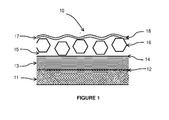
- Figure 1 shows a representation of a floor covering 10 in accordance with the invention comprising: a foam backing layer 11 as its bottom layer; a reinforced PVC impregnated glass fibre layer 12; a print layer 13 with a print design 14 thereon; a transparent wear layer 15 comprising approximately 200 g/m 2 of white aluminium oxide particles 16 embedded therein with an average particle size of approximately 0.59-0.71 mm; and a polyurethane coating layer 17 white aluminium oxide particles 18 embedded therein with an average particle size of approximately 0.02 mm (20 ⁇ m).
- the method comprises the following steps:
- a glass fibre substrate is encapsulated with a liquid plastisol (comprising a mix of PVC, plasticiser, stabiliser and minor liquid additives), which is then gelled onto a heated drum at a temperature of approximately 160oC +/- 5oC for approximately 18 seconds +/- 5 seconds, in order to form the reinforcing layer 12.
- a liquid plastisol comprising a mix of PVC, plasticiser, stabiliser and minor liquid additives
- a print layer substrate comprising a mix of PVC, a plasticiser, a filler, a stabiliser, a pigment and an anti-static agent is prepared and applied over the reinforcing layer 12.
- the substrate is gelled onto a heated drum at a temperature of approximately 155oC +/-5oC for approximately 18 seconds +/- 5 seconds.
- the print layer 13 in combination with the reinforcing layer 12 is directed through a multi-station gravure printing system to apply the print design 14.
- the print design 14 is dried before further processing.
- a gel comprising PVC a stabiliser, an anti-static agent and a bacteriostat (with an antimicrobial additive) is applied over the print design 14.
- a particulate material 16 comprising aluminium oxide, which may be white or clear aluminium oxide, having an average size of between about 0.59-0.71 mm across their widest points is scattered across the wet gel and allowed to fully embed in the gel. The particles are distributed across the covering in an amount of about 200 g/m 2 .
- the gel is then heat cured at a temperature of approximately 120oC +/-5oC for approximately 18 seconds +/- 5 seconds to form the transparent wear layer 15 on the print layer 13.
- the product at this stage is inverted such that a lower side of the reinforcing layer 12 is accessible.
- a plastisol mix of PVC polyvinyl chloride
- one or more of a plasticisers, a filler, a stabiliser and an azodicarbonamide blowing agent is prepared.
- the mix is applied to the lower side of the reinforcing layer 12 and gelled.
- the foam is blown by passing the construct through an oven as follows: Stage 1:- at a temperature of approximately 150oC +/-10oC;
- the total processing time for the five stages is 5 minutes +/- 30 seconds to create the foam backing layer 11.
- the wear layer 15 is contacted with a belt with a profiled surface in order to emboss the surface thereof.
- the profile is adapted to provide a combination of micro-and macro-scale emboss patterns, which range from about 30 ⁇ m to about 160 ⁇ m, respectively, in depth on the wear layer 15.
- the profile provides micro-scale embossing comprise indentations of between about 40-50 ⁇ m depth.
- the profile further provides macro-scale embossing comprises indentations of between about 100-120 ⁇ m and provides coverage on between about 10- 20% and of the surface area of the wear layer 15.
- the wear layer 15 is then cooled.
- the product at this stage is inverted such that the wear layer 15 is accessible.
- a 100% radiation curing lacquer is prepared by mixing a polyurethane cross-linking polymer with a particulate white or clear aluminium oxide (or silica or aluminium oxide) having an average size of about 0.02 mm across their widest points.
- the lacquer is applied to the embossed surface of the wear layer 15 and is then cross-linked (cured) by exposure to radiation, such as high energy ultra-violet radiation.
- the coating comprises a dry film thickness in the region of about 15-25 ⁇ m.
- the final floor covering is inspected, cut into 20 m long rolls and packaged.
- the present invention makes it possible for what has always previously been two separate and discrete products to be combined in one single heterogeneous product. This allows for savings to be made on transportation and installation costs, installation time and problems encountered when installing two separate products, the cost of the product itself as it will inevitably be cheaper to produce and sell than two separate products, and packaging.
- the transparency of the wear layer 15 allows the print design 14 to be visible.
- the floor covering of the invention has been specifically designed to be HSE compliant, i.e. to have a rating of 36 or more in the HSE pendulum coefficient of friction (C0F) test and 20 ⁇ m or more in the surface roughness requirement, both of which values represent a low slip potential.
- HSE compliant i.e. to have a rating of 36 or more in the HSE pendulum coefficient of friction (C0F) test and 20 ⁇ m or more in the surface roughness requirement, both of which values represent a low slip potential.
- the flooring 10 comprises a sustainable three-stage slip-resistance: an initial stage of slip resistance is provided by the embossed surface of the wear layer 15, which is mirrored by the thin coating 17 thereon, which will be gradually worn away; a second stage is provided by the particulate material 18 in the coating 17; once the first and second stages have been exhausted, a third stage of slip-resistance is provided by the particulate in the wear layer 15.
- the enhanced slip resistance of the floor has been tested by the reduction of identifiable particles in the wear layer when subjected to 50,000 wear test cycles to ensure the reduction in identifiable particles is less than 10%, thereby ensuring sustainable slip throughout the product's lifespan. Furthermore, the floor covering has been further tested by evaluating with a bio-mechanical foot:- the floor covering is subjected to 1,000,000 footsteps and then tested to ensure the slip characteristics of the product as it leaves the factory are the same after a simulated 10 year lifespan.
- the foam backing layer or sound attenuation layer improves the underfoot comfort in comparison with standard compact safety floors. This provides benefits where the flooring is used in areas where people are required to stand for prolonged periods of time, such as behind bar areas, cafes or in retail establishments, as the covering is ergonomically designed to provide anti-fatigue benefits.
- the floor covering of the invention is substantially resistant to permanent stains from most or all conventional household materials. It is also long-lasting and durable, maintaining the new-look' appearance for longer. As the particulate material is typically embedded within the clear wear layer, particles are not lost or broken from contact as they are in some existing slip-resistant floor coverings.
- the floor covering of the invention is flexible and easy to install. It is primarily intended for use in residential and commercial establishments where high impact sound reduction is important, and/or for areas which are normally dry but are liable to be subject to liquid spillages, making the slip-resistant property of the covering an important consideration. This is particularly the case in establishments such as homes, schools, hospitals, care homes, laboratories, shops, cafes and restaurants, sports centres, community buildings, and reception/foyer areas of buildings.
Landscapes
- Engineering & Computer Science (AREA)
- Textile Engineering (AREA)
- Chemical & Material Sciences (AREA)
- Chemical Kinetics & Catalysis (AREA)
- Architecture (AREA)
- Inorganic Chemistry (AREA)
- Mechanical Engineering (AREA)
- Civil Engineering (AREA)
- Structural Engineering (AREA)
- Floor Finish (AREA)
- Laminated Bodies (AREA)
Abstract
Description
- The present invention relates to a method of manufacturing a floor covering having sustainable slip-resistance and sound attenuation properties, particularly for manufacturing a single heterogeneous product capable of reducing levels of sound resulting from high impact interactions and providing the required sustainable, (long-lasting) slip-resistance properties.
- The ability to reduce the levels of sound resulting from high impact interactions is a desirable feature in many residential and commercial establishments to maintain a more peaceful and noise-free environment.
- This is particularly the case in establishments such as homes, schools, hospitals, care homes, laboratories, shops, cafes and restaurants, sports centres, community buildings, and reception/foyer areas of buildings. Such establishments usually hence arrange for the installation of flooring having favourable acoustic properties.
- In addition to the enhanced acoustic properties of such flooring, it is often the case that such establishments have areas which are normally dry but which may also be also prone to liquid spillages. These establishments hence also require floor coverings which offer an enhanced slip resistance in order to reduce the likelihood of accidents caused by people slipping.
- According to the UK Health and Safety Executive (HSE), there are over 35,000 injuries per year caused by slips and trips in the UK alone. This accounts for approximately one of every three major non-fatal injuries, as well as approximately one in every five injuries in the workplace. Floor coverings having higher coefficients of friction are one way of trying to reduce the number of such injuries. A number of floor coverings providing slip-resistance properties are currently commercially available.
- If an establishment requires sound attenuation in addition to a slip-resistant floor covering, often, the installation of two discrete products is required.
- Typically, a separate acoustic underlayment needs to be installed followed by an anti-slip or safety floor covering there over. This combination of two floorings presents a number of significant disadvantages; firstly, the installation procedure for the two separate products is complicated and more expensive, both in monetary and time terms; secondly, the differential thermal expansion and differential movement between the products causes problems; and thirdly, the production costs are naturally higher for two products than they would be for one.
- An additional consideration is the requirement for a decorative or attractive floor covering in most environments.
- Whilst methods are generally available to incorporate a decorative element into a slip-resistant floor covering, which simply requires building up a product from the bottom upwards, it has proven difficult to develop the appropriate machinery and methods that can produce a single heterogeneous product incorporating decoration, sustainable slip-resistance and sound attenuation properties that will (a) perform as required and (b) not de-laminate.
- Before the invention, two discrete layers manufactured independently, one offering slip resistance and one providing sound attenuation, would have had to be installed one on top of the other, with all the difficulties this presents.
- It would therefore be desirable to provide a suitable method to manufacture a heterogeneous floor covering, which is not only robust, but decorative and with both sustainable slip-resistance properties and sound attenuation properties.
- Therefore, in accordance with the present invention there is provided a method of manufacturing a decorative heterogeneous floor covering comprising a sound attenuation effect with an acoustic impact sound reduction of at least about 15 decibels and sustainable slip-resistance properties, the method comprising the steps of:
- a) providing a print layer comprising a print decoration/ design thereon;
- b) providing a wear layer over said print layer to provide a print/ wear layer intermediate; and
- c) providing a foam backing layer on the intermediate, the backing layer being capable of providing said sound attenuation effect;
- With this arrangement, wear layer can be laid and processed on the print layer. The bonded print/ wear layer intermediate can then be inverted to apply the backing layer, which is processed into a foam. This method is efficient since it requires only a single inversion of the print/ wear layer intermediate to apply the backing layer. Furthermore, the method ensures that the characteristics of the foam backing layer is not at risk of being compromised by being subjected to unnecessary heat curing steps, since high temperatures and pressure loadings can damage the foam structure once formed, thereby affecting the sound attenuation properties.
- By "sound attenuation" effect it is meant that the second layer is capable of reducing the volume and intensity of a sound when an object impacts upon the floor covering.
- Preferably, the wear layer is applied as a gel.
- Preferably, therefore, step (b) comprises processing, which may comprise heat curing of the gel. Preferably, the heat curing is conducted at temperatures of between approximately 115ºC and approximately 125ºC for between around 10 to around 30 seconds, more preferably, at approximately 120ºC for between around 15 to 20 seconds, most preferably for 18 seconds.
- Preferably, the wear layer comprises particulate material at least partially embedded therein. Preferably, therefore, prior to processing of the wear layer, step (b) comprises scatter application of particulate material. Preferably, the particulate material is allowed to at least partially, preferably fully, embed itself in the unprocessed wear layer.
- Preferably, the particulate material is allowed to substantially completely embed in the transparent wear layer. Most preferably, substantially all of the particulate material is fully embedded in the wear layer, although it will be appreciated that as the wear layer erodes or "wears" through subsequent use as a floor covering, the particulate material may be gradually exposed.
- The wear layer is preferably transparent. Preferably, the wear layer comprises a quantity of a particulate material providing a high coefficient of friction. With this arrangement, the slip resistance of the floor covering is improved and is sustainable throughout the life of the product.
- Preferably, the wear layer comprises PVC. The wear layer may further comprise one or more of a stabiliser, an anti-static agent and a bacteriostat.
- Preferably, the bacteriostat comprises an antimicrobial additive.
- Preferably, the wear layer comprises a surface finish. Preferably, the surface finish comprises an embossed surface specifically designed to impart the necessary slip-resistance whilst exhibiting low soil pick-up tendencies. Preferably, the emboss comprises a combination of micro-and macro-scale emboss patterns, which may range from about 30 µm to about 160 µm, respectively, in depth. Different emboss patterns may be used dependent upon the decoration of the print layer. For example, a wood grain emboss may be specifically designed to suit a print decoration/ design of a reproduction wood effect.
- The micro-scale embossing may comprise indentations of between about 40-50 µm depth, more preferably, between about 42-45 µm. The macro-scale embossing may comprise indentations of between about 100-120 µm, more preferably, about 110 µm. The macro-scale emboss may cover between about 10-20% and more preferably about 15% of the surface area of the wear layer.
- Preferably, the surface finish on the wear layer is applied after the application and processing of the backing layer.
- Preferably, the particulate material comprises aluminium oxide, which may be white or clear aluminium oxide, although it is appreciated that other suitable particulate materials having a high coefficient of friction may be used, such as quartz or a silicon carbide.
- Preferably, the particles of the particulate material have an average size of between about 0.50-0.75 mm, more preferably between about 0.59-0.71 mm across their widest points.
- The particle size of the particulate material in the wear layer ensures that as the emboss begins to wear, the particulate material imparts sustainable slip-resistance properties throughout the life of the product.
- Preferably, the particles are typically distributed across the covering in an amount of about 100-300 g/m2, typically about 200 g/m2. The size of the clear particulate material allows any floor designs situated under the wear layer to be highly visible, without being obscured by particles as is the case with some other slip-resistant floor coverings.
- Preferably, the backing layer comprises an acoustic impact sound reduction of at least about 19 decibels.
- Preferably, the backing layer is applied as a liquid, which is preferably a plastisol. Preferably, therefore, step (c) comprises processing of the plastisol liquid.
- Preferably, the plastisol comprises a mix of one or more chemical substances which emit gas when exposed to heat during the production process, thus creating the bubbles and foam effect in the material. Preferably, the chemical substances comprise a blowing agent. Preferably, the blowing agent comprises azodicarbonamide. Preferably, the foaming comprises an increase in heat to form the gas or (gases), which creates small pockets or bubbles.
- Preferably, the processing of the backing layer comprises blowing and curing steps. Preferably, a first stage comprises processing at a temperature of between approximately 140ºC to 160ºC. Preferably a second stage comprises processing at a temperature of between approximately 160ºC to 180ºC. Preferably, a third and/or a fourth stage comprises processing at a temperature of between approximately 178ºC to 198ºC. Preferably, a fifth stage comprises processing at a temperature of between approximately 170ºC to 190ºC. Preferably, the total processing time for all of the blowing and curing steps is approximately 4 ½ minutes to 5 ½ minutes.
- Preferably, during foaming, the blowing agent and process temperature is increased or decreased to change the density, stiffness and foam thickness. Preferably, during foaming, the processing temperature remains even across the width of the oven. Preferably also, during foaming, even air flow is maintained across the width of the oven. With this arrangement, a compromise between two conflicting properties can be reached, those being (1) residual indentation - which is typically kept less than about 0.2 mm, and (2) acoustic impact sound reduction, which is as much as or greater than about 19 decibels.
- Preferably, the gel of the unprocessed backing layer comprises PVC (polyvinyl chloride). The gel may further comprise one or more of a plasticiser, a filler, and a stabiliser.
- Preferably, the print layer comprises PVC. Preferably, the print layer also comprises one or more of a plasticiser, filler, a stabiliser, a pigment and an antistatic agent. Preferably, step (a) of the method comprises applying a print layer and then printing the decoration thereon. Preferably, the decoration is applied using a multi-station gravure printing system.
- Preferably, the print layer is heat cured. Preferably, the heat curing is conducted at temperatures of between approximately 60ºC and approximately 70ºC for between around 4 to around 8 seconds, more preferably, at approximately 65ºC for around 6 seconds. This layer provides the aesthetic aspect of the covering. Any print design can be used thereon as desired, such as wood or stone effect designs as natural replications, or even abstract designs.
- Preferably, the method further comprises the addition of a reinforcing layer. The reinforcing layer may be provide the initial or starting component. Therefore, the method may comprise a precursor step before step (a) comprising providing a reinforcing layer. The method may comprise applying the print layer to an upper surface to the reinforcing layer. Therefore, the backing layer may be applied to an underside of the reinforcing layer.
- With the addition of this layer at the very beginning of the method, the processing capability and also the dimensional stability of the floor covering is improved. Furthermore, since the reinforcing layer is provided between the wear/ print layer intermediate and the foam backing layer, its ability to resist impact damage and indentations in the foam layer is increased.
- Preferably, the reinforcing layer comprises glass fibre, more preferably, a polyvinyl chloride (PVC) impregnated glass fibre.
- Preferably, the reinforcing layer is encapsulated. Preferably, encapsulation comprises applying a plastisol coating to impregnate the glass fibre with PVC. Preferably, the encapsulated reinforcing layer is heat cured. Preferably, the heat curing is conducted at temperatures of between approximately 155ºC and approximately 165ºC for between around 10 to around 30 seconds, more preferably, at approximately 160ºC for between around 15 to 20 seconds, most preferably for 18 seconds.
- The method may comprise the addition of a coating to the wear layer. The coating may comprise an approximately 100% radiation curing lacquer system. Preferably, the coating comprises a quantity of a particulate material having a high coefficient of friction. Again, the particulate material may comprise aluminium oxide, such as white or clear aluminium oxide, but it may also be another particulate material. The particulate material in the coating may, or may not, be the same particulate material which is present in the wear layer. Preferably, however, the same particulate material is used in both the coating and the wear layer.
- The lacquer of the coating may comprise a cross-linking polymer, such as polyurethane (PU), polyester, acrylic or an epoxy-containing material. The polymer may be cross-linked by exposure to radiation, such as high energy ultra-violet radiation.
- Preferably, the coating comprises a dry film thickness in the region of about 15-25 µm, more preferably, about 20 µm. The coating provides an improved resistance to scuffing, chemical staining, abrasion, picking up of dirt, and a further improvement in the initial slip-resistance of the floor covering.
- The method may comprise the inclusion of a felted fibre or fleece base layer. The base layer may be applied to the backing layer. The base layer may simply be adhered to the backing layer with an adhesive.
- The plasticiser in one or all of the relevant layers may comprise one or more of di-isononyl phthalate or dioctyl terephthalate. However, one or all of the relevant layers may comprise one or more of any other suitable plasticiser known in the art, such as phthalic acid esters, terephthalic acid esters, dibenzoate and mono benzoate esters, epoxidised oils, phosphate esters, citrate esters, adipate esters, alkyl sulphonic acid esters, and hydrogenated phthalic acid esters such as Diisononyl 1,2-cyclohexane dicarboxylate.
- Preferably, the filler in all of the relevant layers comprises calcium carbonate.
- Preferably, the stabiliser in all of the relevant layers comprises one of either: zinc oxide or calcium zinc or an epoxised soybean oil.
- Preferably, the anti-static agent in all of the relevant layers comprises an antistatic plasticiser such as Markstat 60.
- While these materials are exemplary of what materials could be used to perform each of these functions, they are of course not the only materials which could be used and other such materials are also envisaged within the scope of the invention.
- Preferably, the floor covering of the invention is between about 3.5-4.0 mm thick, with the wear layer being typically between about 0.5-0.7 mm thick, although these respective thicknesses may be increased or reduced as required.
- The invention will now be described further by way of example with reference to the following figure which is intended to be illustrative only and in no way limiting upon the scope of the invention.
-
Figure 1 shows a representation of a floor covering 10 in accordance with the invention comprising: afoam backing layer 11 as its bottom layer; a reinforced PVC impregnatedglass fibre layer 12; aprint layer 13 with aprint design 14 thereon; atransparent wear layer 15 comprising approximately 200 g/m2 of whitealuminium oxide particles 16 embedded therein with an average particle size of approximately 0.59-0.71 mm; and apolyurethane coating layer 17 whitealuminium oxide particles 18 embedded therein with an average particle size of approximately 0.02 mm (20µm). - In a preferred embodiment, the method comprises the following steps:
- A glass fibre substrate is encapsulated with a liquid plastisol (comprising a mix of PVC, plasticiser, stabiliser and minor liquid additives), which is then gelled onto a heated drum at a temperature of approximately 160ºC +/- 5ºC for approximately 18 seconds +/- 5 seconds, in order to form the reinforcing
layer 12. - A print layer substrate comprising a mix of PVC, a plasticiser, a filler, a stabiliser, a pigment and an anti-static agent is prepared and applied over the reinforcing
layer 12. The substrate is gelled onto a heated drum at a temperature of approximately 155ºC +/-5ºC for approximately 18 seconds +/- 5 seconds. Theprint layer 13 in combination with the reinforcinglayer 12 is directed through a multi-station gravure printing system to apply theprint design 14. Theprint design 14 is dried before further processing. - A gel comprising PVC a stabiliser, an anti-static agent and a bacteriostat (with an antimicrobial additive) is applied over the
print design 14. Aparticulate material 16 comprising aluminium oxide, which may be white or clear aluminium oxide, having an average size of between about 0.59-0.71 mm across their widest points is scattered across the wet gel and allowed to fully embed in the gel. The particles are distributed across the covering in an amount of about 200 g/m2. - The gel is then heat cured at a temperature of approximately 120ºC +/-5ºC for approximately 18 seconds +/- 5 seconds to form the
transparent wear layer 15 on theprint layer 13. - The product at this stage is inverted such that a lower side of the reinforcing
layer 12 is accessible. - A plastisol mix of PVC (polyvinyl chloride), one or more of a plasticisers, a filler, a stabiliser and an azodicarbonamide blowing agent is prepared.
- The mix is applied to the lower side of the reinforcing
layer 12 and gelled. The foam is blown by passing the construct through an oven as follows: Stage 1:- at a temperature of approximately 150ºC +/-10ºC; - Stage 2:- at a temperature of approximately 170ºC +/-10ºC;
- Stage 3:- at a temperature of approximately 188ºC +/-10ºC;
- Stage 4:- at a temperature of approximately 188ºC +/-10ºC; and
- Stage 5:- at a temperature of approximately 180ºC +/-10ºC.
- The total processing time for the five stages is 5 minutes +/- 30 seconds to create the
foam backing layer 11. - The
wear layer 15 is contacted with a belt with a profiled surface in order to emboss the surface thereof. The profile is adapted to provide a combination of micro-and macro-scale emboss patterns, which range from about 30 µm to about 160 µm, respectively, in depth on thewear layer 15. The profile provides micro-scale embossing comprise indentations of between about 40-50 µm depth. The profile further provides macro-scale embossing comprises indentations of between about 100-120 µm and provides coverage on between about 10- 20% and of the surface area of thewear layer 15. - The
wear layer 15 is then cooled. - The product at this stage is inverted such that the
wear layer 15 is accessible. - A 100% radiation curing lacquer is prepared by mixing a polyurethane cross-linking polymer with a particulate white or clear aluminium oxide (or silica or aluminium oxide) having an average size of about 0.02 mm across their widest points.
- The lacquer is applied to the embossed surface of the
wear layer 15 and is then cross-linked (cured) by exposure to radiation, such as high energy ultra-violet radiation. - The coating comprises a dry film thickness in the region of about 15-25 µm.
- The final floor covering is inspected, cut into 20 m long rolls and packaged.
- The present invention makes it possible for what has always previously been two separate and discrete products to be combined in one single heterogeneous product. This allows for savings to be made on transportation and installation costs, installation time and problems encountered when installing two separate products, the cost of the product itself as it will inevitably be cheaper to produce and sell than two separate products, and packaging.
- With the resultant floor covering, the transparency of the
wear layer 15 allows theprint design 14 to be visible. - The floor covering of the invention has been specifically designed to be HSE compliant, i.e. to have a rating of 36 or more in the HSE pendulum coefficient of friction (C0F) test and 20 µm or more in the surface roughness requirement, both of which values represent a low slip potential.
- Accordingly, the
flooring 10 comprises a sustainable three-stage slip-resistance: an initial stage of slip resistance is provided by the embossed surface of thewear layer 15, which is mirrored by thethin coating 17 thereon, which will be gradually worn away; a second stage is provided by theparticulate material 18 in thecoating 17; once the first and second stages have been exhausted, a third stage of slip-resistance is provided by the particulate in thewear layer 15. - The enhanced slip resistance of the floor has been tested by the reduction of identifiable particles in the wear layer when subjected to 50,000 wear test cycles to ensure the reduction in identifiable particles is less than 10%, thereby ensuring sustainable slip throughout the product's lifespan. Furthermore, the floor covering has been further tested by evaluating with a bio-mechanical foot:- the floor covering is subjected to 1,000,000 footsteps and then tested to ensure the slip characteristics of the product as it leaves the factory are the same after a simulated 10 year lifespan.
- The foam backing layer or sound attenuation layer, improves the underfoot comfort in comparison with standard compact safety floors. This provides benefits where the flooring is used in areas where people are required to stand for prolonged periods of time, such as behind bar areas, cafes or in retail establishments, as the covering is ergonomically designed to provide anti-fatigue benefits.
- The floor covering of the invention is substantially resistant to permanent stains from most or all conventional household materials. It is also long-lasting and durable, maintaining the new-look' appearance for longer. As the particulate material is typically embedded within the clear wear layer, particles are not lost or broken from contact as they are in some existing slip-resistant floor coverings.
- The floor covering of the invention is flexible and easy to install. It is primarily intended for use in residential and commercial establishments where high impact sound reduction is important, and/or for areas which are normally dry but are liable to be subject to liquid spillages, making the slip-resistant property of the covering an important consideration. This is particularly the case in establishments such as homes, schools, hospitals, care homes, laboratories, shops, cafes and restaurants, sports centres, community buildings, and reception/foyer areas of buildings.
- It is of course to be understood that the present invention is not intended to be restricted to the foregoing examples which are described by way of example only.
Claims (15)
- A method of manufacturing a decorative heterogeneous floor covering comprising a sound attenuation effect with an acoustic impact sound reduction of at least about 15 decibels and sustainable slip-resistance properties, the method comprising the steps of:a) providing a print layer comprising a print decoration/ design thereon;b) providing a wear layer over said print layer to provide a print/ wear layer intermediate; andc) providing a foam backing layer on the intermediate, the backing layer being capable of providing said sound attenuation effect;wherein between steps (a) and (b), the method comprises inverting the print/ wear layers intermediate before applying the backing layer to a reverse side / base thereof.
- The method according to claim 1, wherein the wear layer is applied as a gel which is heat cured.
- The method according to claim 2, wherein prior to processing (curing) of the wear layer, step (b) comprises scatter application of a particulate material.
- The method according to claim 3, wherein the particulate material is allowed to at least partially embed itself in the unprocessed (gel) wear layer.
- The method according to any one of claims 1-4, wherein the method comprises providing the wear layer with a surface finish.
- The method according to claim 5, wherein the surface of the wear layer is embossed.
- The method according to claim 6, wherein the emboss comprises a combination of micro-and macro-scale emboss patterns, which range from about 30 µm to about 160 µm, respectively, in depth.
- The method according to any one of claims 5 - 7, wherein the surface finish on the wear layer is applied after the application and processing of the backing layer.
- The method according to any one of claims 1 - 8, wherein the backing layer comprises an acoustic impact sound reduction of at least about 19 decibels.
- The method according to any one of claims 1 - 9, wherein the backing layer is applied as a liquid and subsequent processing of the backing layer comprised blowing and curing steps.
- The method according to any one of claims 1-10, wherein the method further comprises the addition of a reinforcing layer comprising glass fibre, which is encapsulated and heat cured.
- The method according to claim 15, wherein the reinforcing layer provides the initial or starting component of the flooring and the print layer is applied to an upper surface of the reinforcing layer.
- The method according to claim 17, wherein the backing layer is applied to an underside of the reinforcing layer.
- The method according to any one of claims 1 - 20, wherein a coating is added to the wear layer, the coating comprising substantially 100% radiation curing lacquer system.
- The method according to any one of claims 21 or 22, wherein the coating comprises a quantity of a particulate material having a high coefficient of friction.
Applications Claiming Priority (1)
| Application Number | Priority Date | Filing Date | Title |
|---|---|---|---|
| GB1221147.0A GB2508812A (en) | 2012-11-23 | 2012-11-23 | Manufacture of sound attenuating floor covering |
Publications (2)
| Publication Number | Publication Date |
|---|---|
| EP2735645A1 true EP2735645A1 (en) | 2014-05-28 |
| EP2735645B1 EP2735645B1 (en) | 2017-03-08 |
Family
ID=47560602
Family Applications (1)
| Application Number | Title | Priority Date | Filing Date |
|---|---|---|---|
| EP13188366.2A Active EP2735645B1 (en) | 2012-11-23 | 2013-10-11 | Method of manufacturing a floor covering |
Country Status (4)
| Country | Link |
|---|---|
| US (1) | US20140147585A1 (en) |
| EP (1) | EP2735645B1 (en) |
| GB (1) | GB2508812A (en) |
| HU (1) | HUE032180T2 (en) |
Cited By (4)
| Publication number | Priority date | Publication date | Assignee | Title |
|---|---|---|---|---|
| CN104371218A (en) * | 2014-11-06 | 2015-02-25 | 浙江天振竹木开发有限公司 | Composite plate |
| GB2564646A (en) * | 2017-07-17 | 2019-01-23 | Altro Ltd | Improvements in or relating to organic material |
| WO2021031289A1 (en) * | 2019-08-16 | 2021-02-25 | 浙江永裕家居股份有限公司 | Co-extrusion spc foam flooring and manufacturing method therefor |
| WO2021244992A3 (en) * | 2020-06-01 | 2022-02-10 | Altro Limited | Embossed floor covering materials |
Families Citing this family (18)
| Publication number | Priority date | Publication date | Assignee | Title |
|---|---|---|---|---|
| BE1020722A3 (en) | 2012-06-01 | 2014-04-01 | Unilin Bvba | PANEL FOR FORMING A FLOOR COVERING AND METHOD FOR MANUFACTURING SUCH PANELS. |
| DE102013113125A1 (en) | 2013-11-27 | 2015-05-28 | Guido Schulte | Floor, wall or ceiling panel and method of making the same |
| DE102013113109A1 (en) | 2013-11-27 | 2015-06-11 | Guido Schulte | floorboard |
| DE102013113130B4 (en) | 2013-11-27 | 2022-01-27 | Välinge Innovation AB | Method of manufacturing a floorboard |
| CN112297574A (en) | 2014-01-10 | 2021-02-02 | 瓦林格创新股份有限公司 | Method for producing a component with a veneer |
| EP3142857B1 (en) | 2014-05-12 | 2025-08-20 | Välinge Innovation AB | A method of producing a veneered element |
| EP2949461B1 (en) * | 2014-05-26 | 2016-04-06 | Timonisam UG | Print substrate |
| CN104047407A (en) * | 2014-07-10 | 2014-09-17 | 余建平 | Large-specification decoration particle thin plate |
| AU2015290301B2 (en) | 2014-07-16 | 2019-07-18 | Valinge Innovation Ab | Method to produce a thermoplastic wear resistant foil |
| EP3245330A4 (en) | 2015-01-14 | 2018-08-22 | Välinge Innovation AB | A method to produce a wear resistant layer with different gloss levels |
| EP3310580A4 (en) | 2015-06-16 | 2019-02-13 | Välinge Innovation AB | METHOD FOR FORMING SURFACE ELEMENT OR BUILDING PANEL, AND SURFACE ELEMENT AND BUILDING PANEL |
| UA127004C2 (en) | 2016-04-25 | 2023-03-08 | Велінге Інновейшн Аб | A veneered element and method of producing such a veneered element |
| BE1024734B1 (en) * | 2016-11-10 | 2018-06-19 | Ivc Bvba | FLOOR PANEL AND METHOD FOR MANUFACTURING A FLOOR PANEL |
| GB2569608B (en) | 2017-12-21 | 2022-10-26 | Altro Ltd | Plasticiser composition |
| WO2019139522A1 (en) | 2018-01-11 | 2019-07-18 | Välinge Innovation AB | A method to produce a veneered element and a veneered element |
| CN111542432B (en) | 2018-01-11 | 2023-01-10 | 瓦林格创新股份有限公司 | Surface element and method for producing a surface element |
| CN113260506A (en) | 2019-01-09 | 2021-08-13 | 瓦林格创新股份有限公司 | Method for producing a veneer element and veneer element |
| CN110736789B (en) * | 2019-11-28 | 2022-01-25 | 山东大学齐鲁医院 | Method for judging preparation end point of foam hardening agent and application |
Citations (8)
| Publication number | Priority date | Publication date | Assignee | Title |
|---|---|---|---|---|
| US4100318A (en) * | 1976-12-27 | 1978-07-11 | Dowdflor Corporation | Actinic radiation cured coating for cushioned sheet goods and method |
| US4303695A (en) * | 1977-12-20 | 1981-12-01 | Biscayne Decorative Products, Inc. | Crinkle emboss and method |
| US5632844A (en) * | 1993-02-05 | 1997-05-27 | Gencorp Inc. | Acoustic lamina wall covering |
| US20050042438A1 (en) * | 2003-08-21 | 2005-02-24 | Afif Javier Miguel | Flexible laminate for coating and protection of surfaces, and manufacturing method of the same |
| US20050281997A1 (en) * | 2004-06-16 | 2005-12-22 | Sealed Air Corporation (Us) | Pitch modulating laminate |
| WO2009156707A1 (en) * | 2008-06-26 | 2009-12-30 | James Halstead Plc | Floor covering |
| US20110268933A1 (en) * | 2010-04-30 | 2011-11-03 | Kris Edward Hahn | Non-vinyl resilient flooring product and methods of making same |
| WO2013079950A1 (en) * | 2011-11-30 | 2013-06-06 | James Halstead Plc | Anti-skid floor covering |
Family Cites Families (1)
| Publication number | Priority date | Publication date | Assignee | Title |
|---|---|---|---|---|
| US9174384B2 (en) * | 2009-09-01 | 2015-11-03 | Fina Technology, Inc. | Multilayer polypropylene films and methods of making and using same |
-
2012
- 2012-11-23 GB GB1221147.0A patent/GB2508812A/en not_active Withdrawn
-
2013
- 2013-10-11 EP EP13188366.2A patent/EP2735645B1/en active Active
- 2013-10-11 HU HUE13188366A patent/HUE032180T2/en unknown
- 2013-11-05 US US14/072,037 patent/US20140147585A1/en not_active Abandoned
Patent Citations (8)
| Publication number | Priority date | Publication date | Assignee | Title |
|---|---|---|---|---|
| US4100318A (en) * | 1976-12-27 | 1978-07-11 | Dowdflor Corporation | Actinic radiation cured coating for cushioned sheet goods and method |
| US4303695A (en) * | 1977-12-20 | 1981-12-01 | Biscayne Decorative Products, Inc. | Crinkle emboss and method |
| US5632844A (en) * | 1993-02-05 | 1997-05-27 | Gencorp Inc. | Acoustic lamina wall covering |
| US20050042438A1 (en) * | 2003-08-21 | 2005-02-24 | Afif Javier Miguel | Flexible laminate for coating and protection of surfaces, and manufacturing method of the same |
| US20050281997A1 (en) * | 2004-06-16 | 2005-12-22 | Sealed Air Corporation (Us) | Pitch modulating laminate |
| WO2009156707A1 (en) * | 2008-06-26 | 2009-12-30 | James Halstead Plc | Floor covering |
| US20110268933A1 (en) * | 2010-04-30 | 2011-11-03 | Kris Edward Hahn | Non-vinyl resilient flooring product and methods of making same |
| WO2013079950A1 (en) * | 2011-11-30 | 2013-06-06 | James Halstead Plc | Anti-skid floor covering |
Cited By (7)
| Publication number | Priority date | Publication date | Assignee | Title |
|---|---|---|---|---|
| CN104371218A (en) * | 2014-11-06 | 2015-02-25 | 浙江天振竹木开发有限公司 | Composite plate |
| GB2564646A (en) * | 2017-07-17 | 2019-01-23 | Altro Ltd | Improvements in or relating to organic material |
| EP3444120A1 (en) * | 2017-07-17 | 2019-02-20 | Altro Limited | Improvements in or relating to organic material |
| WO2021031289A1 (en) * | 2019-08-16 | 2021-02-25 | 浙江永裕家居股份有限公司 | Co-extrusion spc foam flooring and manufacturing method therefor |
| US12030282B2 (en) | 2019-08-16 | 2024-07-09 | Unilin, Bv | Co-extrusion SPC foam flooring and manufacturing method thereof |
| US12415344B2 (en) | 2019-08-16 | 2025-09-16 | Unilin, Bv | Co-extrusion SPC foam flooring and manufacturing method thereof |
| WO2021244992A3 (en) * | 2020-06-01 | 2022-02-10 | Altro Limited | Embossed floor covering materials |
Also Published As
| Publication number | Publication date |
|---|---|
| EP2735645B1 (en) | 2017-03-08 |
| GB201221147D0 (en) | 2013-01-09 |
| GB2508812A (en) | 2014-06-18 |
| US20140147585A1 (en) | 2014-05-29 |
| HUE032180T2 (en) | 2017-09-28 |
Similar Documents
| Publication | Publication Date | Title |
|---|---|---|
| EP2735645B1 (en) | Method of manufacturing a floor covering | |
| CA2729539C (en) | Floor covering | |
| US20250003230A1 (en) | Floor panel | |
| US20240218676A1 (en) | Floor panel and method for manufacturing a floor panel | |
| EP2785929B1 (en) | Anti-skid floor covering | |
| RU2509849C2 (en) | Detachable surface coating | |
| US9663957B2 (en) | Floor covering and films for use therewith | |
| JP2014529021A (en) | Vinyl flooring for non-slip flooring and its manufacturing method | |
| US12377645B2 (en) | Composite panels and methods for making the same | |
| KR20180032764A (en) | Sound insulation and non-slip flooring material and manufacture method thereof | |
| US11420428B2 (en) | Composite polymeric film wear layer for hard surfaces | |
| CN101512080A (en) | Floor covering and film therefor | |
| JP2005530068A (en) | Ventilated decorative floor cover with a gap | |
| KR101818292B1 (en) | Flooring comprising polyvinylbutyral and manufacturing method thereof | |
| KR101555854B1 (en) | Composite floor board using ethylene vinyl acetate | |
| US20250059777A1 (en) | Underlayment Assembly | |
| CA3068326C (en) | Composite polymeric film wear layer for hard surfaces | |
| CN108049597A (en) | A kind of floor panel structure of the multiple anti-skidding effect of household | |
| KR20180126752A (en) | Loose lay tile |
Legal Events
| Date | Code | Title | Description |
|---|---|---|---|
| PUAI | Public reference made under article 153(3) epc to a published international application that has entered the european phase |
Free format text: ORIGINAL CODE: 0009012 |
|
| 17P | Request for examination filed |
Effective date: 20131011 |
|
| AK | Designated contracting states |
Kind code of ref document: A1 Designated state(s): AL AT BE BG CH CY CZ DE DK EE ES FI FR GB GR HR HU IE IS IT LI LT LU LV MC MK MT NL NO PL PT RO RS SE SI SK SM TR |
|
| AX | Request for extension of the european patent |
Extension state: BA ME |
|
| R17P | Request for examination filed (corrected) |
Effective date: 20141010 |
|
| RBV | Designated contracting states (corrected) |
Designated state(s): AL AT BE BG CH CY CZ DE DK EE ES FI FR GB GR HR HU IE IS IT LI LT LU LV MC MK MT NL NO PL PT RO RS SE SI SK SM TR |
|
| 17Q | First examination report despatched |
Effective date: 20150629 |
|
| REG | Reference to a national code |
Ref country code: DE Ref legal event code: R079 Ref document number: 602013018213 Country of ref document: DE Free format text: PREVIOUS MAIN CLASS: D06N0003060000 Ipc: B29D0099000000 |
|
| GRAP | Despatch of communication of intention to grant a patent |
Free format text: ORIGINAL CODE: EPIDOSNIGR1 |
|
| RIC1 | Information provided on ipc code assigned before grant |
Ipc: D06N 3/08 20060101ALI20160921BHEP Ipc: B32B 5/20 20060101ALI20160921BHEP Ipc: B32B 27/12 20060101ALI20160921BHEP Ipc: D06N 3/00 20060101ALI20160921BHEP Ipc: B32B 27/20 20060101ALI20160921BHEP Ipc: B32B 27/06 20060101ALI20160921BHEP Ipc: B32B 27/40 20060101ALI20160921BHEP Ipc: B32B 27/08 20060101ALI20160921BHEP Ipc: B32B 5/18 20060101ALI20160921BHEP Ipc: B32B 5/24 20060101ALI20160921BHEP Ipc: D06N 7/00 20060101ALI20160921BHEP Ipc: B29D 99/00 20100101AFI20160921BHEP Ipc: B32B 27/30 20060101ALI20160921BHEP Ipc: D06N 3/06 20060101ALI20160921BHEP |
|
| INTG | Intention to grant announced |
Effective date: 20161012 |
|
| GRAS | Grant fee paid |
Free format text: ORIGINAL CODE: EPIDOSNIGR3 |
|
| GRAA | (expected) grant |
Free format text: ORIGINAL CODE: 0009210 |
|
| AK | Designated contracting states |
Kind code of ref document: B1 Designated state(s): AL AT BE BG CH CY CZ DE DK EE ES FI FR GB GR HR HU IE IS IT LI LT LU LV MC MK MT NL NO PL PT RO RS SE SI SK SM TR |
|
| REG | Reference to a national code |
Ref country code: GB Ref legal event code: FG4D |
|
| REG | Reference to a national code |
Ref country code: CH Ref legal event code: EP Ref country code: AT Ref legal event code: REF Ref document number: 873153 Country of ref document: AT Kind code of ref document: T Effective date: 20170315 |
|
| REG | Reference to a national code |
Ref country code: IE Ref legal event code: FG4D |
|
| REG | Reference to a national code |
Ref country code: NL Ref legal event code: FP |
|
| REG | Reference to a national code |
Ref country code: DE Ref legal event code: R096 Ref document number: 602013018213 Country of ref document: DE |
|
| REG | Reference to a national code |
Ref country code: SE Ref legal event code: TRGR |
|
| REG | Reference to a national code |
Ref country code: NO Ref legal event code: T2 Effective date: 20170308 |
|
| REG | Reference to a national code |
Ref country code: LT Ref legal event code: MG4D |
|
| PG25 | Lapsed in a contracting state [announced via postgrant information from national office to epo] |
Ref country code: GR Free format text: LAPSE BECAUSE OF FAILURE TO SUBMIT A TRANSLATION OF THE DESCRIPTION OR TO PAY THE FEE WITHIN THE PRESCRIBED TIME-LIMIT Effective date: 20170609 Ref country code: FI Free format text: LAPSE BECAUSE OF FAILURE TO SUBMIT A TRANSLATION OF THE DESCRIPTION OR TO PAY THE FEE WITHIN THE PRESCRIBED TIME-LIMIT Effective date: 20170308 Ref country code: HR Free format text: LAPSE BECAUSE OF FAILURE TO SUBMIT A TRANSLATION OF THE DESCRIPTION OR TO PAY THE FEE WITHIN THE PRESCRIBED TIME-LIMIT Effective date: 20170308 Ref country code: LT Free format text: LAPSE BECAUSE OF FAILURE TO SUBMIT A TRANSLATION OF THE DESCRIPTION OR TO PAY THE FEE WITHIN THE PRESCRIBED TIME-LIMIT Effective date: 20170308 |
|
| REG | Reference to a national code |
Ref country code: AT Ref legal event code: MK05 Ref document number: 873153 Country of ref document: AT Kind code of ref document: T Effective date: 20170308 |
|
| PG25 | Lapsed in a contracting state [announced via postgrant information from national office to epo] |
Ref country code: LV Free format text: LAPSE BECAUSE OF FAILURE TO SUBMIT A TRANSLATION OF THE DESCRIPTION OR TO PAY THE FEE WITHIN THE PRESCRIBED TIME-LIMIT Effective date: 20170308 Ref country code: BG Free format text: LAPSE BECAUSE OF FAILURE TO SUBMIT A TRANSLATION OF THE DESCRIPTION OR TO PAY THE FEE WITHIN THE PRESCRIBED TIME-LIMIT Effective date: 20170608 Ref country code: ES Free format text: LAPSE BECAUSE OF FAILURE TO SUBMIT A TRANSLATION OF THE DESCRIPTION OR TO PAY THE FEE WITHIN THE PRESCRIBED TIME-LIMIT Effective date: 20170308 Ref country code: RS Free format text: LAPSE BECAUSE OF FAILURE TO SUBMIT A TRANSLATION OF THE DESCRIPTION OR TO PAY THE FEE WITHIN THE PRESCRIBED TIME-LIMIT Effective date: 20170308 |
|
| REG | Reference to a national code |
Ref country code: HU Ref legal event code: AG4A Ref document number: E032180 Country of ref document: HU |
|
| REG | Reference to a national code |
Ref country code: FR Ref legal event code: PLFP Year of fee payment: 5 |
|
| PG25 | Lapsed in a contracting state [announced via postgrant information from national office to epo] |
Ref country code: RO Free format text: LAPSE BECAUSE OF FAILURE TO SUBMIT A TRANSLATION OF THE DESCRIPTION OR TO PAY THE FEE WITHIN THE PRESCRIBED TIME-LIMIT Effective date: 20170308 Ref country code: IT Free format text: LAPSE BECAUSE OF FAILURE TO SUBMIT A TRANSLATION OF THE DESCRIPTION OR TO PAY THE FEE WITHIN THE PRESCRIBED TIME-LIMIT Effective date: 20170308 Ref country code: AT Free format text: LAPSE BECAUSE OF FAILURE TO SUBMIT A TRANSLATION OF THE DESCRIPTION OR TO PAY THE FEE WITHIN THE PRESCRIBED TIME-LIMIT Effective date: 20170308 Ref country code: CZ Free format text: LAPSE BECAUSE OF FAILURE TO SUBMIT A TRANSLATION OF THE DESCRIPTION OR TO PAY THE FEE WITHIN THE PRESCRIBED TIME-LIMIT Effective date: 20170308 Ref country code: SK Free format text: LAPSE BECAUSE OF FAILURE TO SUBMIT A TRANSLATION OF THE DESCRIPTION OR TO PAY THE FEE WITHIN THE PRESCRIBED TIME-LIMIT Effective date: 20170308 Ref country code: EE Free format text: LAPSE BECAUSE OF FAILURE TO SUBMIT A TRANSLATION OF THE DESCRIPTION OR TO PAY THE FEE WITHIN THE PRESCRIBED TIME-LIMIT Effective date: 20170308 |
|
| PG25 | Lapsed in a contracting state [announced via postgrant information from national office to epo] |
Ref country code: PT Free format text: LAPSE BECAUSE OF FAILURE TO SUBMIT A TRANSLATION OF THE DESCRIPTION OR TO PAY THE FEE WITHIN THE PRESCRIBED TIME-LIMIT Effective date: 20170710 Ref country code: SM Free format text: LAPSE BECAUSE OF FAILURE TO SUBMIT A TRANSLATION OF THE DESCRIPTION OR TO PAY THE FEE WITHIN THE PRESCRIBED TIME-LIMIT Effective date: 20170308 Ref country code: IS Free format text: LAPSE BECAUSE OF FAILURE TO SUBMIT A TRANSLATION OF THE DESCRIPTION OR TO PAY THE FEE WITHIN THE PRESCRIBED TIME-LIMIT Effective date: 20170708 Ref country code: PL Free format text: LAPSE BECAUSE OF FAILURE TO SUBMIT A TRANSLATION OF THE DESCRIPTION OR TO PAY THE FEE WITHIN THE PRESCRIBED TIME-LIMIT Effective date: 20170308 |
|
| REG | Reference to a national code |
Ref country code: DE Ref legal event code: R097 Ref document number: 602013018213 Country of ref document: DE |
|
| PLBE | No opposition filed within time limit |
Free format text: ORIGINAL CODE: 0009261 |
|
| STAA | Information on the status of an ep patent application or granted ep patent |
Free format text: STATUS: NO OPPOSITION FILED WITHIN TIME LIMIT |
|
| PG25 | Lapsed in a contracting state [announced via postgrant information from national office to epo] |
Ref country code: DK Free format text: LAPSE BECAUSE OF FAILURE TO SUBMIT A TRANSLATION OF THE DESCRIPTION OR TO PAY THE FEE WITHIN THE PRESCRIBED TIME-LIMIT Effective date: 20170308 |
|
| PGFP | Annual fee paid to national office [announced via postgrant information from national office to epo] |
Ref country code: NO Payment date: 20171010 Year of fee payment: 5 |
|
| 26N | No opposition filed |
Effective date: 20171211 |
|
| PG25 | Lapsed in a contracting state [announced via postgrant information from national office to epo] |
Ref country code: SI Free format text: LAPSE BECAUSE OF FAILURE TO SUBMIT A TRANSLATION OF THE DESCRIPTION OR TO PAY THE FEE WITHIN THE PRESCRIBED TIME-LIMIT Effective date: 20170308 |
|
| PG25 | Lapsed in a contracting state [announced via postgrant information from national office to epo] |
Ref country code: MC Free format text: LAPSE BECAUSE OF FAILURE TO SUBMIT A TRANSLATION OF THE DESCRIPTION OR TO PAY THE FEE WITHIN THE PRESCRIBED TIME-LIMIT Effective date: 20170308 |
|
| REG | Reference to a national code |
Ref country code: CH Ref legal event code: PL |
|
| REG | Reference to a national code |
Ref country code: IE Ref legal event code: MM4A |
|
| PG25 | Lapsed in a contracting state [announced via postgrant information from national office to epo] |
Ref country code: CH Free format text: LAPSE BECAUSE OF NON-PAYMENT OF DUE FEES Effective date: 20171031 Ref country code: LI Free format text: LAPSE BECAUSE OF NON-PAYMENT OF DUE FEES Effective date: 20171031 Ref country code: LU Free format text: LAPSE BECAUSE OF NON-PAYMENT OF DUE FEES Effective date: 20171011 |
|
| REG | Reference to a national code |
Ref country code: FR Ref legal event code: PLFP Year of fee payment: 6 |
|
| PG25 | Lapsed in a contracting state [announced via postgrant information from national office to epo] |
Ref country code: MT Free format text: LAPSE BECAUSE OF NON-PAYMENT OF DUE FEES Effective date: 20171011 |
|
| PG25 | Lapsed in a contracting state [announced via postgrant information from national office to epo] |
Ref country code: IE Free format text: LAPSE BECAUSE OF NON-PAYMENT OF DUE FEES Effective date: 20171011 |
|
| REG | Reference to a national code |
Ref country code: NO Ref legal event code: MMEP |
|
| PG25 | Lapsed in a contracting state [announced via postgrant information from national office to epo] |
Ref country code: NO Free format text: LAPSE BECAUSE OF NON-PAYMENT OF DUE FEES Effective date: 20181031 |
|
| PG25 | Lapsed in a contracting state [announced via postgrant information from national office to epo] |
Ref country code: CY Free format text: LAPSE BECAUSE OF NON-PAYMENT OF DUE FEES Effective date: 20170308 |
|
| PG25 | Lapsed in a contracting state [announced via postgrant information from national office to epo] |
Ref country code: MK Free format text: LAPSE BECAUSE OF FAILURE TO SUBMIT A TRANSLATION OF THE DESCRIPTION OR TO PAY THE FEE WITHIN THE PRESCRIBED TIME-LIMIT Effective date: 20170308 |
|
| PG25 | Lapsed in a contracting state [announced via postgrant information from national office to epo] |
Ref country code: TR Free format text: LAPSE BECAUSE OF FAILURE TO SUBMIT A TRANSLATION OF THE DESCRIPTION OR TO PAY THE FEE WITHIN THE PRESCRIBED TIME-LIMIT Effective date: 20170308 |
|
| PG25 | Lapsed in a contracting state [announced via postgrant information from national office to epo] |
Ref country code: AL Free format text: LAPSE BECAUSE OF FAILURE TO SUBMIT A TRANSLATION OF THE DESCRIPTION OR TO PAY THE FEE WITHIN THE PRESCRIBED TIME-LIMIT Effective date: 20170308 |
|
| P01 | Opt-out of the competence of the unified patent court (upc) registered |
Effective date: 20230517 |
|
| P01 | Opt-out of the competence of the unified patent court (upc) registered |
Effective date: 20230526 |
|
| P03 | Opt-out of the competence of the unified patent court (upc) deleted | ||
| PGFP | Annual fee paid to national office [announced via postgrant information from national office to epo] |
Ref country code: HU Payment date: 20251008 Year of fee payment: 13 |
|
| PGFP | Annual fee paid to national office [announced via postgrant information from national office to epo] |
Ref country code: NL Payment date: 20251020 Year of fee payment: 13 |
|
| PGFP | Annual fee paid to national office [announced via postgrant information from national office to epo] |
Ref country code: DE Payment date: 20251029 Year of fee payment: 13 |
|
| PGFP | Annual fee paid to national office [announced via postgrant information from national office to epo] |
Ref country code: GB Payment date: 20251003 Year of fee payment: 13 |
|
| PGFP | Annual fee paid to national office [announced via postgrant information from national office to epo] |
Ref country code: FR Payment date: 20251003 Year of fee payment: 13 |
|
| PGFP | Annual fee paid to national office [announced via postgrant information from national office to epo] |
Ref country code: BE Payment date: 20251027 Year of fee payment: 13 |
|
| PGFP | Annual fee paid to national office [announced via postgrant information from national office to epo] |
Ref country code: SE Payment date: 20251003 Year of fee payment: 13 |