EP2735555A1 - Hydraulic binders - Google Patents
Hydraulic binders Download PDFInfo
- Publication number
- EP2735555A1 EP2735555A1 EP12306469.3A EP12306469A EP2735555A1 EP 2735555 A1 EP2735555 A1 EP 2735555A1 EP 12306469 A EP12306469 A EP 12306469A EP 2735555 A1 EP2735555 A1 EP 2735555A1
- Authority
- EP
- European Patent Office
- Prior art keywords
- alkali metal
- magnesium
- hydraulic binder
- sio
- binder according
- Prior art date
- Legal status (The legal status is an assumption and is not a legal conclusion. Google has not performed a legal analysis and makes no representation as to the accuracy of the status listed.)
- Withdrawn
Links
- 239000011230 binding agent Substances 0.000 title claims abstract description 44
- -1 alkali metal magnesium orthosilicate Chemical class 0.000 claims abstract description 63
- 229910052783 alkali metal Inorganic materials 0.000 claims abstract description 44
- 239000000203 mixture Substances 0.000 claims abstract description 37
- VYPSYNLAJGMNEJ-UHFFFAOYSA-N Silicium dioxide Chemical compound O=[Si]=O VYPSYNLAJGMNEJ-UHFFFAOYSA-N 0.000 claims description 56
- 229910000288 alkali metal carbonate Inorganic materials 0.000 claims description 48
- HCWCAKKEBCNQJP-UHFFFAOYSA-N magnesium orthosilicate Chemical compound [Mg+2].[Mg+2].[O-][Si]([O-])([O-])[O-] HCWCAKKEBCNQJP-UHFFFAOYSA-N 0.000 claims description 41
- 238000006243 chemical reaction Methods 0.000 claims description 36
- 239000000391 magnesium silicate Substances 0.000 claims description 34
- XLYOFNOQVPJJNP-UHFFFAOYSA-N water Substances O XLYOFNOQVPJJNP-UHFFFAOYSA-N 0.000 claims description 33
- 229910052919 magnesium silicate Inorganic materials 0.000 claims description 32
- 235000019792 magnesium silicate Nutrition 0.000 claims description 32
- 150000008041 alkali metal carbonates Chemical class 0.000 claims description 25
- CPLXHLVBOLITMK-UHFFFAOYSA-N magnesium oxide Inorganic materials [Mg]=O CPLXHLVBOLITMK-UHFFFAOYSA-N 0.000 claims description 24
- 239000000377 silicon dioxide Substances 0.000 claims description 24
- 239000000395 magnesium oxide Substances 0.000 claims description 22
- AXZKOIWUVFPNLO-UHFFFAOYSA-N magnesium;oxygen(2-) Chemical compound [O-2].[Mg+2] AXZKOIWUVFPNLO-UHFFFAOYSA-N 0.000 claims description 21
- 229910052681 coesite Inorganic materials 0.000 claims description 17
- 229910052906 cristobalite Inorganic materials 0.000 claims description 17
- 229910052682 stishovite Inorganic materials 0.000 claims description 17
- 229910052905 tridymite Inorganic materials 0.000 claims description 17
- 229910000272 alkali metal oxide Inorganic materials 0.000 claims description 13
- 150000001875 compounds Chemical class 0.000 claims description 11
- 150000001340 alkali metals Chemical class 0.000 claims description 10
- 239000000654 additive Substances 0.000 claims description 8
- 235000012239 silicon dioxide Nutrition 0.000 claims description 8
- 229910020489 SiO3 Inorganic materials 0.000 claims description 6
- 239000004567 concrete Substances 0.000 claims description 6
- 229910052910 alkali metal silicate Inorganic materials 0.000 claims description 5
- 230000000996 additive effect Effects 0.000 claims description 3
- 239000004570 mortar (masonry) Substances 0.000 claims description 3
- 239000006072 paste Substances 0.000 claims 1
- 125000002467 phosphate group Chemical class [H]OP(=O)(O[H])O[*] 0.000 claims 1
- CDBYLPFSWZWCQE-UHFFFAOYSA-L Sodium Carbonate Chemical compound [Na+].[Na+].[O-]C([O-])=O CDBYLPFSWZWCQE-UHFFFAOYSA-L 0.000 description 36
- CURLTUGMZLYLDI-UHFFFAOYSA-N Carbon dioxide Chemical compound O=C=O CURLTUGMZLYLDI-UHFFFAOYSA-N 0.000 description 19
- 238000000034 method Methods 0.000 description 19
- 239000008188 pellet Substances 0.000 description 17
- 239000000047 product Substances 0.000 description 17
- 239000007787 solid Substances 0.000 description 17
- 229910052500 inorganic mineral Inorganic materials 0.000 description 16
- 235000010755 mineral Nutrition 0.000 description 16
- 239000011707 mineral Substances 0.000 description 16
- 230000008569 process Effects 0.000 description 16
- 229910000029 sodium carbonate Inorganic materials 0.000 description 16
- 239000007789 gas Substances 0.000 description 15
- 239000011777 magnesium Substances 0.000 description 15
- 239000000843 powder Substances 0.000 description 15
- 238000002844 melting Methods 0.000 description 13
- 230000008018 melting Effects 0.000 description 13
- 239000010450 olivine Substances 0.000 description 13
- 229910052609 olivine Inorganic materials 0.000 description 13
- XEEYBQQBJWHFJM-UHFFFAOYSA-N Iron Chemical compound [Fe] XEEYBQQBJWHFJM-UHFFFAOYSA-N 0.000 description 12
- 229910002092 carbon dioxide Inorganic materials 0.000 description 12
- 229910052749 magnesium Inorganic materials 0.000 description 12
- 239000011734 sodium Substances 0.000 description 11
- FYYHWMGAXLPEAU-UHFFFAOYSA-N Magnesium Chemical compound [Mg] FYYHWMGAXLPEAU-UHFFFAOYSA-N 0.000 description 10
- 238000010438 heat treatment Methods 0.000 description 9
- 239000011435 rock Substances 0.000 description 9
- 239000008030 superplasticizer Substances 0.000 description 9
- BVKZGUZCCUSVTD-UHFFFAOYSA-L Carbonate Chemical compound [O-]C([O-])=O BVKZGUZCCUSVTD-UHFFFAOYSA-L 0.000 description 8
- 239000011575 calcium Substances 0.000 description 7
- 239000001569 carbon dioxide Substances 0.000 description 7
- 239000000463 material Substances 0.000 description 7
- 239000002245 particle Substances 0.000 description 7
- 150000004760 silicates Chemical class 0.000 description 7
- OYPRJOBELJOOCE-UHFFFAOYSA-N Calcium Chemical compound [Ca] OYPRJOBELJOOCE-UHFFFAOYSA-N 0.000 description 6
- NBIIXXVUZAFLBC-UHFFFAOYSA-N Phosphoric acid Chemical compound OP(O)(O)=O NBIIXXVUZAFLBC-UHFFFAOYSA-N 0.000 description 6
- 229910052791 calcium Inorganic materials 0.000 description 6
- 238000002485 combustion reaction Methods 0.000 description 6
- 239000000446 fuel Substances 0.000 description 6
- 235000012245 magnesium oxide Nutrition 0.000 description 6
- 229910052751 metal Inorganic materials 0.000 description 6
- 239000002184 metal Substances 0.000 description 6
- BASFCYQUMIYNBI-UHFFFAOYSA-N platinum Chemical compound [Pt] BASFCYQUMIYNBI-UHFFFAOYSA-N 0.000 description 6
- 238000002360 preparation method Methods 0.000 description 6
- 229910052623 talc Inorganic materials 0.000 description 6
- DGAQECJNVWCQMB-PUAWFVPOSA-M Ilexoside XXIX Chemical compound C[C@@H]1CC[C@@]2(CC[C@@]3(C(=CC[C@H]4[C@]3(CC[C@@H]5[C@@]4(CC[C@@H](C5(C)C)OS(=O)(=O)[O-])C)C)[C@@H]2[C@]1(C)O)C)C(=O)O[C@H]6[C@@H]([C@H]([C@@H]([C@H](O6)CO)O)O)O.[Na+] DGAQECJNVWCQMB-PUAWFVPOSA-M 0.000 description 5
- BPQQTUXANYXVAA-UHFFFAOYSA-N Orthosilicate Chemical compound [O-][Si]([O-])([O-])[O-] BPQQTUXANYXVAA-UHFFFAOYSA-N 0.000 description 5
- 238000002441 X-ray diffraction Methods 0.000 description 5
- 239000012535 impurity Substances 0.000 description 5
- 229910052909 inorganic silicate Inorganic materials 0.000 description 5
- 229910052742 iron Inorganic materials 0.000 description 5
- JEIPFZHSYJVQDO-UHFFFAOYSA-N iron(III) oxide Inorganic materials O=[Fe]O[Fe]=O JEIPFZHSYJVQDO-UHFFFAOYSA-N 0.000 description 5
- 238000005259 measurement Methods 0.000 description 5
- 239000012071 phase Substances 0.000 description 5
- GNSKLFRGEWLPPA-UHFFFAOYSA-M potassium dihydrogen phosphate Chemical compound [K+].OP(O)([O-])=O GNSKLFRGEWLPPA-UHFFFAOYSA-M 0.000 description 5
- 239000004576 sand Substances 0.000 description 5
- 229910052708 sodium Inorganic materials 0.000 description 5
- 229910009112 xH2O Inorganic materials 0.000 description 5
- PXHVJJICTQNCMI-UHFFFAOYSA-N Nickel Chemical compound [Ni] PXHVJJICTQNCMI-UHFFFAOYSA-N 0.000 description 4
- XFWJKVMFIVXPKK-UHFFFAOYSA-N calcium;oxido(oxo)alumane Chemical compound [Ca+2].[O-][Al]=O.[O-][Al]=O XFWJKVMFIVXPKK-UHFFFAOYSA-N 0.000 description 4
- 239000004568 cement Substances 0.000 description 4
- 239000003638 chemical reducing agent Substances 0.000 description 4
- 238000001816 cooling Methods 0.000 description 4
- 238000009826 distribution Methods 0.000 description 4
- 229910052839 forsterite Inorganic materials 0.000 description 4
- 239000000499 gel Substances 0.000 description 4
- 150000004677 hydrates Chemical class 0.000 description 4
- 238000006703 hydration reaction Methods 0.000 description 4
- 150000002739 metals Chemical class 0.000 description 4
- 150000003013 phosphoric acid derivatives Chemical class 0.000 description 4
- 229910052710 silicon Inorganic materials 0.000 description 4
- 239000000243 solution Substances 0.000 description 4
- 239000000454 talc Substances 0.000 description 4
- 238000012360 testing method Methods 0.000 description 4
- PEDCQBHIVMGVHV-UHFFFAOYSA-N Glycerine Chemical compound OCC(O)CO PEDCQBHIVMGVHV-UHFFFAOYSA-N 0.000 description 3
- XUIMIQQOPSSXEZ-UHFFFAOYSA-N Silicon Chemical compound [Si] XUIMIQQOPSSXEZ-UHFFFAOYSA-N 0.000 description 3
- WYTGDNHDOZPMIW-RCBQFDQVSA-N alstonine Natural products C1=CC2=C3C=CC=CC3=NC2=C2N1C[C@H]1[C@H](C)OC=C(C(=O)OC)[C@H]1C2 WYTGDNHDOZPMIW-RCBQFDQVSA-N 0.000 description 3
- 150000001399 aluminium compounds Chemical class 0.000 description 3
- 229910000147 aluminium phosphate Inorganic materials 0.000 description 3
- 150000001450 anions Chemical class 0.000 description 3
- 229940077746 antacid containing aluminium compound Drugs 0.000 description 3
- 229910052599 brucite Inorganic materials 0.000 description 3
- 239000002738 chelating agent Substances 0.000 description 3
- 239000007795 chemical reaction product Substances 0.000 description 3
- 229910052620 chrysotile Inorganic materials 0.000 description 3
- DGVMNQYBHPSIJS-UHFFFAOYSA-N dimagnesium;2,2,6,6-tetraoxido-1,3,5,7-tetraoxa-2,4,6-trisilaspiro[3.3]heptane;hydrate Chemical compound O.[Mg+2].[Mg+2].O1[Si]([O-])([O-])O[Si]21O[Si]([O-])([O-])O2 DGVMNQYBHPSIJS-UHFFFAOYSA-N 0.000 description 3
- 238000001033 granulometry Methods 0.000 description 3
- 150000004679 hydroxides Chemical class 0.000 description 3
- SZVJSHCCFOBDDC-UHFFFAOYSA-N iron(II,III) oxide Inorganic materials O=[Fe]O[Fe]O[Fe]=O SZVJSHCCFOBDDC-UHFFFAOYSA-N 0.000 description 3
- VTHJTEIRLNZDEV-UHFFFAOYSA-L magnesium dihydroxide Chemical class [OH-].[OH-].[Mg+2] VTHJTEIRLNZDEV-UHFFFAOYSA-L 0.000 description 3
- 238000004519 manufacturing process Methods 0.000 description 3
- 239000011812 mixed powder Substances 0.000 description 3
- 229910000402 monopotassium phosphate Inorganic materials 0.000 description 3
- 239000002667 nucleating agent Substances 0.000 description 3
- 229910052697 platinum Inorganic materials 0.000 description 3
- 229920001296 polysiloxane Polymers 0.000 description 3
- 239000010703 silicon Substances 0.000 description 3
- 239000002893 slag Substances 0.000 description 3
- 239000007858 starting material Substances 0.000 description 3
- 239000000126 substance Substances 0.000 description 3
- HVBSAKJJOYLTQU-UHFFFAOYSA-N 4-aminobenzenesulfonic acid Chemical compound NC1=CC=C(S(O)(=O)=O)C=C1 HVBSAKJJOYLTQU-UHFFFAOYSA-N 0.000 description 2
- VTYYLEPIZMXCLO-UHFFFAOYSA-L Calcium carbonate Chemical compound [Ca+2].[O-]C([O-])=O VTYYLEPIZMXCLO-UHFFFAOYSA-L 0.000 description 2
- VYZAMTAEIAYCRO-UHFFFAOYSA-N Chromium Chemical compound [Cr] VYZAMTAEIAYCRO-UHFFFAOYSA-N 0.000 description 2
- RTZKZFJDLAIYFH-UHFFFAOYSA-N Diethyl ether Chemical compound CCOCC RTZKZFJDLAIYFH-UHFFFAOYSA-N 0.000 description 2
- LFQSCWFLJHTTHZ-UHFFFAOYSA-N Ethanol Chemical compound CCO LFQSCWFLJHTTHZ-UHFFFAOYSA-N 0.000 description 2
- UQSXHKLRYXJYBZ-UHFFFAOYSA-N Iron oxide Chemical compound [Fe]=O UQSXHKLRYXJYBZ-UHFFFAOYSA-N 0.000 description 2
- 239000007836 KH2PO4 Substances 0.000 description 2
- 229920001732 Lignosulfonate Polymers 0.000 description 2
- 239000011398 Portland cement Substances 0.000 description 2
- ZLMJMSJWJFRBEC-UHFFFAOYSA-N Potassium Chemical compound [K] ZLMJMSJWJFRBEC-UHFFFAOYSA-N 0.000 description 2
- 239000002253 acid Substances 0.000 description 2
- 229910052891 actinolite Inorganic materials 0.000 description 2
- 150000001339 alkali metal compounds Chemical class 0.000 description 2
- WNROFYMDJYEPJX-UHFFFAOYSA-K aluminium hydroxide Chemical compound [OH-].[OH-].[OH-].[Al+3] WNROFYMDJYEPJX-UHFFFAOYSA-K 0.000 description 2
- 229910021502 aluminium hydroxide Inorganic materials 0.000 description 2
- 229910000323 aluminium silicate Inorganic materials 0.000 description 2
- 229910052885 anthophyllite Inorganic materials 0.000 description 2
- 229910052898 antigorite Inorganic materials 0.000 description 2
- 239000010425 asbestos Substances 0.000 description 2
- 238000004364 calculation method Methods 0.000 description 2
- 150000001805 chlorine compounds Chemical class 0.000 description 2
- 229910001919 chlorite Inorganic materials 0.000 description 2
- 229910052619 chlorite group Inorganic materials 0.000 description 2
- QBWCMBCROVPCKQ-UHFFFAOYSA-N chlorous acid Chemical compound OCl=O QBWCMBCROVPCKQ-UHFFFAOYSA-N 0.000 description 2
- 229910052804 chromium Inorganic materials 0.000 description 2
- 239000011651 chromium Substances 0.000 description 2
- 239000003245 coal Substances 0.000 description 2
- MQRJBSHKWOFOGF-UHFFFAOYSA-L disodium;carbonate;hydrate Chemical compound O.[Na+].[Na+].[O-]C([O-])=O MQRJBSHKWOFOGF-UHFFFAOYSA-L 0.000 description 2
- 239000010459 dolomite Substances 0.000 description 2
- 229910000514 dolomite Inorganic materials 0.000 description 2
- 238000005265 energy consumption Methods 0.000 description 2
- 229910052634 enstatite Inorganic materials 0.000 description 2
- 229910052840 fayalite Inorganic materials 0.000 description 2
- 230000036571 hydration Effects 0.000 description 2
- 125000002887 hydroxy group Chemical group [H]O* 0.000 description 2
- 230000003993 interaction Effects 0.000 description 2
- 239000007788 liquid Substances 0.000 description 2
- 229910052899 lizardite Inorganic materials 0.000 description 2
- 239000000347 magnesium hydroxide Substances 0.000 description 2
- 229910001862 magnesium hydroxide Inorganic materials 0.000 description 2
- 235000012254 magnesium hydroxide Nutrition 0.000 description 2
- GVALZJMUIHGIMD-UHFFFAOYSA-H magnesium phosphate Chemical class [Mg+2].[Mg+2].[Mg+2].[O-]P([O-])([O-])=O.[O-]P([O-])([O-])=O GVALZJMUIHGIMD-UHFFFAOYSA-H 0.000 description 2
- 235000012243 magnesium silicates Nutrition 0.000 description 2
- BBCCCLINBSELLX-UHFFFAOYSA-N magnesium;dihydroxy(oxo)silane Chemical compound [Mg+2].O[Si](O)=O BBCCCLINBSELLX-UHFFFAOYSA-N 0.000 description 2
- VNWKTOKETHGBQD-UHFFFAOYSA-N methane Chemical compound C VNWKTOKETHGBQD-UHFFFAOYSA-N 0.000 description 2
- 238000002156 mixing Methods 0.000 description 2
- 229910052759 nickel Inorganic materials 0.000 description 2
- 150000002823 nitrates Chemical class 0.000 description 2
- 150000002826 nitrites Chemical class 0.000 description 2
- 239000003921 oil Substances 0.000 description 2
- 239000011591 potassium Substances 0.000 description 2
- 229910052700 potassium Inorganic materials 0.000 description 2
- BWHMMNNQKKPAPP-UHFFFAOYSA-L potassium carbonate Chemical compound [K+].[K+].[O-]C([O-])=O BWHMMNNQKKPAPP-UHFFFAOYSA-L 0.000 description 2
- 229910052611 pyroxene Inorganic materials 0.000 description 2
- 239000010453 quartz Substances 0.000 description 2
- 229910052895 riebeckite Inorganic materials 0.000 description 2
- 150000003839 salts Chemical class 0.000 description 2
- 239000012265 solid product Substances 0.000 description 2
- 150000003467 sulfuric acid derivatives Chemical class 0.000 description 2
- 229910052889 tremolite Inorganic materials 0.000 description 2
- CWBIFDGMOSWLRQ-UHFFFAOYSA-N trimagnesium;hydroxy(trioxido)silane;hydrate Chemical compound O.[Mg+2].[Mg+2].[Mg+2].O[Si]([O-])([O-])[O-].O[Si]([O-])([O-])[O-] CWBIFDGMOSWLRQ-UHFFFAOYSA-N 0.000 description 2
- 238000002604 ultrasonography Methods 0.000 description 2
- 229910000851 Alloy steel Inorganic materials 0.000 description 1
- BVKZGUZCCUSVTD-UHFFFAOYSA-M Bicarbonate Chemical compound OC([O-])=O BVKZGUZCCUSVTD-UHFFFAOYSA-M 0.000 description 1
- 239000002028 Biomass Substances 0.000 description 1
- 229910021532 Calcite Inorganic materials 0.000 description 1
- UGFAIRIUMAVXCW-UHFFFAOYSA-N Carbon monoxide Chemical compound [O+]#[C-] UGFAIRIUMAVXCW-UHFFFAOYSA-N 0.000 description 1
- VEXZGXHMUGYJMC-UHFFFAOYSA-M Chloride anion Chemical compound [Cl-] VEXZGXHMUGYJMC-UHFFFAOYSA-M 0.000 description 1
- 235000002918 Fraxinus excelsior Nutrition 0.000 description 1
- UFHFLCQGNIYNRP-UHFFFAOYSA-N Hydrogen Chemical compound [H][H] UFHFLCQGNIYNRP-UHFFFAOYSA-N 0.000 description 1
- 239000004117 Lignosulphonate Substances 0.000 description 1
- 235000019738 Limestone Nutrition 0.000 description 1
- JLVVSXFLKOJNIY-UHFFFAOYSA-N Magnesium ion Chemical group [Mg+2] JLVVSXFLKOJNIY-UHFFFAOYSA-N 0.000 description 1
- 229910002651 NO3 Inorganic materials 0.000 description 1
- KKCBUQHMOMHUOY-UHFFFAOYSA-N Na2O Inorganic materials [O-2].[Na+].[Na+] KKCBUQHMOMHUOY-UHFFFAOYSA-N 0.000 description 1
- NHNBFGGVMKEFGY-UHFFFAOYSA-N Nitrate Chemical compound [O-][N+]([O-])=O NHNBFGGVMKEFGY-UHFFFAOYSA-N 0.000 description 1
- 239000002202 Polyethylene glycol Substances 0.000 description 1
- 239000004372 Polyvinyl alcohol Substances 0.000 description 1
- 239000011401 Portland-fly ash cement Substances 0.000 description 1
- 238000003991 Rietveld refinement Methods 0.000 description 1
- 239000004113 Sepiolite Substances 0.000 description 1
- 229910000831 Steel Inorganic materials 0.000 description 1
- NINIDFKCEFEMDL-UHFFFAOYSA-N Sulfur Chemical compound [S] NINIDFKCEFEMDL-UHFFFAOYSA-N 0.000 description 1
- 241001625808 Trona Species 0.000 description 1
- 238000010521 absorption reaction Methods 0.000 description 1
- 150000007513 acids Chemical class 0.000 description 1
- 230000009471 action Effects 0.000 description 1
- 238000005054 agglomeration Methods 0.000 description 1
- 229910001491 alkali aluminosilicate Inorganic materials 0.000 description 1
- 150000008044 alkali metal hydroxides Chemical class 0.000 description 1
- 229910001963 alkali metal nitrate Inorganic materials 0.000 description 1
- 229910052784 alkaline earth metal Inorganic materials 0.000 description 1
- 125000000217 alkyl group Chemical group 0.000 description 1
- 229910052782 aluminium Inorganic materials 0.000 description 1
- 239000004411 aluminium Substances 0.000 description 1
- XAGFODPZIPBFFR-UHFFFAOYSA-N aluminium Chemical compound [Al] XAGFODPZIPBFFR-UHFFFAOYSA-N 0.000 description 1
- VSCWAEJMTAWNJL-UHFFFAOYSA-K aluminium chloride Substances Cl[Al](Cl)Cl VSCWAEJMTAWNJL-UHFFFAOYSA-K 0.000 description 1
- PNEYBMLMFCGWSK-UHFFFAOYSA-N aluminium oxide Inorganic materials [O-2].[O-2].[O-2].[Al+3].[Al+3] PNEYBMLMFCGWSK-UHFFFAOYSA-N 0.000 description 1
- 159000000013 aluminium salts Chemical class 0.000 description 1
- 239000001164 aluminium sulphate Substances 0.000 description 1
- 235000011128 aluminium sulphate Nutrition 0.000 description 1
- 229910052612 amphibole Inorganic materials 0.000 description 1
- 238000004458 analytical method Methods 0.000 description 1
- 239000002518 antifoaming agent Substances 0.000 description 1
- 239000011260 aqueous acid Substances 0.000 description 1
- 239000008346 aqueous phase Substances 0.000 description 1
- 239000007864 aqueous solution Substances 0.000 description 1
- 239000002956 ash Substances 0.000 description 1
- 230000009286 beneficial effect Effects 0.000 description 1
- 230000015572 biosynthetic process Effects 0.000 description 1
- 239000011400 blast furnace cement Substances 0.000 description 1
- 238000009835 boiling Methods 0.000 description 1
- 238000001354 calcination Methods 0.000 description 1
- 239000000404 calcium aluminium silicate Substances 0.000 description 1
- 235000012215 calcium aluminium silicate Nutrition 0.000 description 1
- WNCYAPRTYDMSFP-UHFFFAOYSA-N calcium aluminosilicate Chemical compound [Al+3].[Al+3].[Ca+2].[O-][Si]([O-])=O.[O-][Si]([O-])=O.[O-][Si]([O-])=O.[O-][Si]([O-])=O WNCYAPRTYDMSFP-UHFFFAOYSA-N 0.000 description 1
- 229940078583 calcium aluminosilicate Drugs 0.000 description 1
- 229910000019 calcium carbonate Inorganic materials 0.000 description 1
- NWXHSRDXUJENGJ-UHFFFAOYSA-N calcium;magnesium;dioxido(oxo)silane Chemical compound [Mg+2].[Ca+2].[O-][Si]([O-])=O.[O-][Si]([O-])=O NWXHSRDXUJENGJ-UHFFFAOYSA-N 0.000 description 1
- 150000001720 carbohydrates Chemical class 0.000 description 1
- 235000014633 carbohydrates Nutrition 0.000 description 1
- 125000004432 carbon atom Chemical group C* 0.000 description 1
- BVKZGUZCCUSVTD-UHFFFAOYSA-N carbonic acid Chemical class OC(O)=O BVKZGUZCCUSVTD-UHFFFAOYSA-N 0.000 description 1
- 150000004649 carbonic acid derivatives Chemical class 0.000 description 1
- 239000005018 casein Substances 0.000 description 1
- BECPQYXYKAMYBN-UHFFFAOYSA-N casein, tech. Chemical compound NCCCCC(C(O)=O)N=C(O)C(CC(O)=O)N=C(O)C(CCC(O)=N)N=C(O)C(CC(C)C)N=C(O)C(CCC(O)=O)N=C(O)C(CC(O)=O)N=C(O)C(CCC(O)=O)N=C(O)C(C(C)O)N=C(O)C(CCC(O)=N)N=C(O)C(CCC(O)=N)N=C(O)C(CCC(O)=N)N=C(O)C(CCC(O)=O)N=C(O)C(CCC(O)=O)N=C(O)C(COP(O)(O)=O)N=C(O)C(CCC(O)=N)N=C(O)C(N)CC1=CC=CC=C1 BECPQYXYKAMYBN-UHFFFAOYSA-N 0.000 description 1
- 235000021240 caseins Nutrition 0.000 description 1
- 239000013522 chelant Substances 0.000 description 1
- 238000001311 chemical methods and process Methods 0.000 description 1
- 239000003795 chemical substances by application Substances 0.000 description 1
- 229910052857 chondrodite Inorganic materials 0.000 description 1
- 230000001427 coherent effect Effects 0.000 description 1
- 239000000567 combustion gas Substances 0.000 description 1
- 230000006835 compression Effects 0.000 description 1
- 238000007906 compression Methods 0.000 description 1
- 229920001577 copolymer Polymers 0.000 description 1
- 229910052593 corundum Inorganic materials 0.000 description 1
- 239000008406 cosmetic ingredient Substances 0.000 description 1
- 150000004691 decahydrates Chemical class 0.000 description 1
- 238000000354 decomposition reaction Methods 0.000 description 1
- 238000011161 development Methods 0.000 description 1
- BUACSMWVFUNQET-UHFFFAOYSA-H dialuminum;trisulfate;hydrate Chemical compound O.[Al+3].[Al+3].[O-]S([O-])(=O)=O.[O-]S([O-])(=O)=O.[O-]S([O-])(=O)=O BUACSMWVFUNQET-UHFFFAOYSA-H 0.000 description 1
- 239000004205 dimethyl polysiloxane Substances 0.000 description 1
- 229910052637 diopside Inorganic materials 0.000 description 1
- HNPSIPDUKPIQMN-UHFFFAOYSA-N dioxosilane;oxo(oxoalumanyloxy)alumane Chemical compound O=[Si]=O.O=[Al]O[Al]=O HNPSIPDUKPIQMN-UHFFFAOYSA-N 0.000 description 1
- 229940042400 direct acting antivirals phosphonic acid derivative Drugs 0.000 description 1
- 239000002270 dispersing agent Substances 0.000 description 1
- 238000004090 dissolution Methods 0.000 description 1
- 229910001650 dmitryivanovite Inorganic materials 0.000 description 1
- 238000000921 elemental analysis Methods 0.000 description 1
- 230000008030 elimination Effects 0.000 description 1
- 238000003379 elimination reaction Methods 0.000 description 1
- 239000000839 emulsion Substances 0.000 description 1
- 238000005516 engineering process Methods 0.000 description 1
- 238000001704 evaporation Methods 0.000 description 1
- 230000008020 evaporation Effects 0.000 description 1
- 238000000855 fermentation Methods 0.000 description 1
- 230000004151 fermentation Effects 0.000 description 1
- 239000003546 flue gas Substances 0.000 description 1
- 239000010881 fly ash Substances 0.000 description 1
- IVJISJACKSSFGE-UHFFFAOYSA-N formaldehyde;1,3,5-triazine-2,4,6-triamine Chemical class O=C.NC1=NC(N)=NC(N)=N1 IVJISJACKSSFGE-UHFFFAOYSA-N 0.000 description 1
- CBYZIWCZNMOEAV-UHFFFAOYSA-N formaldehyde;naphthalene Chemical class O=C.C1=CC=CC2=CC=CC=C21 CBYZIWCZNMOEAV-UHFFFAOYSA-N 0.000 description 1
- 239000002803 fossil fuel Substances 0.000 description 1
- 230000004927 fusion Effects 0.000 description 1
- 238000007499 fusion processing Methods 0.000 description 1
- 239000008187 granular material Substances 0.000 description 1
- 230000036541 health Effects 0.000 description 1
- 239000011874 heated mixture Substances 0.000 description 1
- XLYOFNOQVPJJNP-ZSJDYOACSA-N heavy water Substances [2H]O[2H] XLYOFNOQVPJJNP-ZSJDYOACSA-N 0.000 description 1
- KWLMIXQRALPRBC-UHFFFAOYSA-L hectorite Chemical compound [Li+].[OH-].[OH-].[Na+].[Mg+2].O1[Si]2([O-])O[Si]1([O-])O[Si]([O-])(O1)O[Si]1([O-])O2 KWLMIXQRALPRBC-UHFFFAOYSA-L 0.000 description 1
- 229910000271 hectorite Inorganic materials 0.000 description 1
- 229910052595 hematite Inorganic materials 0.000 description 1
- 231100000003 human carcinogen Toxicity 0.000 description 1
- 229910052855 humite Inorganic materials 0.000 description 1
- 229910052739 hydrogen Inorganic materials 0.000 description 1
- 239000001257 hydrogen Substances 0.000 description 1
- XLYOFNOQVPJJNP-UHFFFAOYSA-M hydroxide Chemical compound [OH-] XLYOFNOQVPJJNP-UHFFFAOYSA-M 0.000 description 1
- 229910001853 inorganic hydroxide Inorganic materials 0.000 description 1
- 229910052809 inorganic oxide Inorganic materials 0.000 description 1
- 239000011872 intimate mixture Substances 0.000 description 1
- LIKBJVNGSGBSGK-UHFFFAOYSA-N iron(3+);oxygen(2-) Chemical compound [O-2].[O-2].[O-2].[Fe+3].[Fe+3] LIKBJVNGSGBSGK-UHFFFAOYSA-N 0.000 description 1
- 229910001707 krotite Inorganic materials 0.000 description 1
- 235000019357 lignosulphonate Nutrition 0.000 description 1
- 239000006028 limestone Substances 0.000 description 1
- 239000012263 liquid product Substances 0.000 description 1
- NEMFQSKAPLGFIP-UHFFFAOYSA-N magnesiosodium Chemical compound [Na].[Mg] NEMFQSKAPLGFIP-UHFFFAOYSA-N 0.000 description 1
- ZLNQQNXFFQJAID-UHFFFAOYSA-L magnesium carbonate Chemical compound [Mg+2].[O-]C([O-])=O ZLNQQNXFFQJAID-UHFFFAOYSA-L 0.000 description 1
- 229910001425 magnesium ion Inorganic materials 0.000 description 1
- 159000000003 magnesium salts Chemical class 0.000 description 1
- 238000012423 maintenance Methods 0.000 description 1
- 239000011159 matrix material Substances 0.000 description 1
- 239000000155 melt Substances 0.000 description 1
- 229910052914 metal silicate Inorganic materials 0.000 description 1
- 125000002496 methyl group Chemical group [H]C([H])([H])* 0.000 description 1
- 150000004682 monohydrates Chemical class 0.000 description 1
- 235000019796 monopotassium phosphate Nutrition 0.000 description 1
- 239000002105 nanoparticle Substances 0.000 description 1
- 239000003345 natural gas Substances 0.000 description 1
- 231100001223 noncarcinogenic Toxicity 0.000 description 1
- 229910052856 norbergite Inorganic materials 0.000 description 1
- 230000003287 optical effect Effects 0.000 description 1
- 150000002894 organic compounds Chemical class 0.000 description 1
- 229920000620 organic polymer Polymers 0.000 description 1
- JTJMJGYZQZDUJJ-UHFFFAOYSA-N phencyclidine Chemical class C1CCCCN1C1(C=2C=CC=CC=2)CCCCC1 JTJMJGYZQZDUJJ-UHFFFAOYSA-N 0.000 description 1
- 150000003007 phosphonic acid derivatives Chemical class 0.000 description 1
- PJNZPQUBCPKICU-UHFFFAOYSA-N phosphoric acid;potassium Chemical compound [K].OP(O)(O)=O PJNZPQUBCPKICU-UHFFFAOYSA-N 0.000 description 1
- 229920000435 poly(dimethylsiloxane) Polymers 0.000 description 1
- 229920001495 poly(sodium acrylate) polymer Polymers 0.000 description 1
- 229920000058 polyacrylate Polymers 0.000 description 1
- 229920001223 polyethylene glycol Polymers 0.000 description 1
- 229920002451 polyvinyl alcohol Polymers 0.000 description 1
- 229910000027 potassium carbonate Inorganic materials 0.000 description 1
- 239000002244 precipitate Substances 0.000 description 1
- 229920005989 resin Polymers 0.000 description 1
- 239000011347 resin Substances 0.000 description 1
- 238000000926 separation method Methods 0.000 description 1
- 235000019355 sepiolite Nutrition 0.000 description 1
- 229910052624 sepiolite Inorganic materials 0.000 description 1
- 238000007873 sieving Methods 0.000 description 1
- 229910021487 silica fume Inorganic materials 0.000 description 1
- 239000002002 slurry Substances 0.000 description 1
- 229910052911 sodium silicate Inorganic materials 0.000 description 1
- 239000011343 solid material Substances 0.000 description 1
- 239000006104 solid solution Substances 0.000 description 1
- 230000006641 stabilisation Effects 0.000 description 1
- 239000010959 steel Substances 0.000 description 1
- 238000003860 storage Methods 0.000 description 1
- 229950000244 sulfanilic acid Drugs 0.000 description 1
- LSNNMFCWUKXFEE-UHFFFAOYSA-L sulfite Chemical class [O-]S([O-])=O LSNNMFCWUKXFEE-UHFFFAOYSA-L 0.000 description 1
- 239000011593 sulfur Substances 0.000 description 1
- 229910052717 sulfur Inorganic materials 0.000 description 1
- 239000000725 suspension Substances 0.000 description 1
- 238000012546 transfer Methods 0.000 description 1
- 230000007704 transition Effects 0.000 description 1
- IBPRKWGSNXMCOI-UHFFFAOYSA-N trimagnesium;disilicate;hydrate Chemical compound O.[Mg+2].[Mg+2].[Mg+2].[O-][Si]([O-])([O-])[O-].[O-][Si]([O-])([O-])[O-] IBPRKWGSNXMCOI-UHFFFAOYSA-N 0.000 description 1
- ZNXQQQIOFZAIDJ-UHFFFAOYSA-K trisodium carboxy carbonate dihydrate Chemical compound O.O.[Na+].[Na+].[Na+].OC(=O)OC([O-])=O.OC(=O)OC([O-])=O.OC(=O)OC([O-])=O ZNXQQQIOFZAIDJ-UHFFFAOYSA-K 0.000 description 1
- 238000009423 ventilation Methods 0.000 description 1
- 239000002699 waste material Substances 0.000 description 1
- 239000002023 wood Substances 0.000 description 1
- 238000004846 x-ray emission Methods 0.000 description 1
- 229910001844 ye'elimite Inorganic materials 0.000 description 1
- 229910001845 yogo sapphire Inorganic materials 0.000 description 1
- 229910000859 α-Fe Inorganic materials 0.000 description 1
Images
Classifications
-
- C—CHEMISTRY; METALLURGY
- C01—INORGANIC CHEMISTRY
- C01B—NON-METALLIC ELEMENTS; COMPOUNDS THEREOF; METALLOIDS OR COMPOUNDS THEREOF NOT COVERED BY SUBCLASS C01C
- C01B33/00—Silicon; Compounds thereof
- C01B33/20—Silicates
-
- C—CHEMISTRY; METALLURGY
- C04—CEMENTS; CONCRETE; ARTIFICIAL STONE; CERAMICS; REFRACTORIES
- C04B—LIME, MAGNESIA; SLAG; CEMENTS; COMPOSITIONS THEREOF, e.g. MORTARS, CONCRETE OR LIKE BUILDING MATERIALS; ARTIFICIAL STONE; CERAMICS; REFRACTORIES; TREATMENT OF NATURAL STONE
- C04B28/00—Compositions of mortars, concrete or artificial stone, containing inorganic binders or the reaction product of an inorganic and an organic binder, e.g. polycarboxylate cements
- C04B28/02—Compositions of mortars, concrete or artificial stone, containing inorganic binders or the reaction product of an inorganic and an organic binder, e.g. polycarboxylate cements containing hydraulic cements other than calcium sulfates
- C04B28/10—Lime cements or magnesium oxide cements
- C04B28/105—Magnesium oxide or magnesium carbonate cements
-
- C—CHEMISTRY; METALLURGY
- C04—CEMENTS; CONCRETE; ARTIFICIAL STONE; CERAMICS; REFRACTORIES
- C04B—LIME, MAGNESIA; SLAG; CEMENTS; COMPOSITIONS THEREOF, e.g. MORTARS, CONCRETE OR LIKE BUILDING MATERIALS; ARTIFICIAL STONE; CERAMICS; REFRACTORIES; TREATMENT OF NATURAL STONE
- C04B9/00—Magnesium cements or similar cements
Definitions
- This invention relates to new hydraulic binders produced using an alkali metal magnesium orthosilicate.
- a hydraulic binder is a binder which sets and hardens by chemical interaction with water and is capable of doing so under water.
- the binder is capable of holding solid materials together in a coherent mass, for example in a mortar or concrete.
- Magnesium silicate rocks make up the majority of the Earth's mantle, and large surface deposits of such rocks are also found in many locations.
- the composition of the Earth's mantle is about 70% basic magnesium orthosilicate (Mg 2 SiO 4 ), and, when this material is found in crystalline form close to the Earth's surface, it is generally in the form of olivine, which is essentially a solid solution between forsterite (pure Mg 2 SiO 4 and fayalite (pure Fe 2 SiO 4 ), representing the two main components of the Earth's mantle.
- anhydrous magnesium silicates also occur as pyroxenes, such as enstatite (MgSiO 3 ).
- magnesium silicates Due to the action of water, either at the surface or at depth within the Earth's crust, anhydrous magnesium silicates are converted into magnesium silicate hydrate minerals such as serpentine or chlorite (with the idealised overall composition Mg 3 Si 2 O 5 (OH) 4 ), and also talc (with the idealised overall composition (Mg 3 Si 4 O 10 (OH) 2 ).
- Magnesium silicate rocks constitute an excellent source of basic magnesium. Although the common magnesium silicate minerals listed above tend to be very “unreactive,” (e.g. in that they have high melting points and also dissolve only very slowly in water or dilute acids), it is known that they will react rapidly with molten alkali metal carbonates, such as sodium carbonate (Na 2 CO 3 ). Such a process, commonly referred to as a “carbonate fusion", is often used in the preparation of minerals for chemical analysis. Generally, a large excess of solid alkali metal carbonate (typically at least ten parts of alkali metal carbonate to one part of magnesium silicate rock) is added and the mixture heated to well above the melting point of the alkali metal carbonate.
- the magnesium silicate completely dissolves in the resulting melt, which after cooling can easily and rapidly be dissolved in a strong aqueous acid and the solution then analyzed by standard chemical techniques, thus allowing for total elemental analysis of the rock.
- the carbonate fusion process is a small scale process; it is analytical, not preparative, and is not energy-efficient as it involves melting a large excess of alkali metal carbonate in order to fully dissolve the magnesium silicate.
- sodium magnesium silicate is sometimes used, in accordance with the International Nomenclature of Cosmetic Ingredients (INCI) to identify synthetic hectorites in the form of nanoparticles and which form clear gels in water. According to one manufacturer of such products hectorites have the formula (Mg 5.2 Li 0.8 )(Si 8 )O 20 (OH) 4 Na 0.8 .
- the present invention seeks to provide hydraulic binders and hydraulic compositions comprising an anhydrous alkali metal magnesium orthosilicate of the general formula R 2 MgSiO 4 wherein R represents an alkali metal; and, preferably, either magnesium oxide or an alkali metal silicate (R 2 SiO 3 ), which compositions absorb carbon dioxide.
- the present invention accordingly provides a hydraulic binder comprising an alkali metal magnesium orthosilicate, and, preferably, magnesium oxide or an alkali metal silicate.
- the alkali metal is preferably potassium or, more preferably, sodium.
- the alkali metal magnesium orthosilicate is preferably prepared by the reaction of an alkali metal carbonate compound, which compound is an alkali metal carbonate, an alkali metal bicarbonate, or a mixture thereof, with a magnesium silicate.
- hydraulic binders according to the invention set and harden when mixed with water due to hydration reactions which produce magnesium hydroxides (e.g. brucite) and magnesium silicate hydrate gels (M-S-H) as well as releasing alkali metal hydroxides and silicates into solution.
- magnesium hydroxides e.g. brucite
- M-S-H magnesium silicate hydrate gels
- the hydraulic binder according to the invention when mixed with a concentrated (preferably > 3% w/w) aqueous solution of phosphoric acid or a water soluble phosphate salt (for example potassium dihydrogen phosphate) the hydraulic binder according to the invention produces a mixture which sets and hardens rapidly. Insoluble or sparingly soluble magnesium phosphate salts are formed.
- the invention provides a hydraulic composition according to the invention which also comprises a water soluble phosphate salt.
- Preferred such compositions comprise, on a dry solids basis, 0.1 to 70%, more preferably 1 to 40%, of water soluble phosphate salt.
- the hydraulic binder according to the invention preferably has a Blaine specific surface area of at least 100m2/kg, more preferably 300 to 600m2/kg.
- the hydraulic binder according to the invention preferably comprises an additive to promote setting and hardening.
- Additives include nucleating agents. These are generally small particles which provide a surface on which hydration products involved in the hardening process may grow. Such nucleating agents include alkaline earth metal carbonates such as calcite, dolomite and hydromagnesite, as well as poorly-soluble inorganic oxides or hydroxides such as brucite and precipitated silica. The nucleating agents are preferably in fine particulate form.
- Additives to promote hardening also comprise water-soluble chelating agents for magnesium.
- Preferred chelating agents chelate magnesium in a pH range of 10 to 14. Preferably about half of the chelating agent in solution is bound to magnesium ions.
- Additives also include aluminium compounds.
- Such compounds include aluminosilicates, generally in X-ray amorphous particulate form.
- aluminosilicate include for example, burnt clays (e.g. metakaolins); coal combustion ashes (e.g. fly ash); and metallurgical slags (e.g. granulated blast-furnace slags).
- aluminium compounds also include aluminium hydroxide and sources thereof, for example water-soluble aluminium salts which precipitate aluminium hydroxide under basic conditions.
- Such salts include aluminium sulphate, chloride and nitrate.
- the hydraulic binder according to the invention also comprises a calcium aluminate or sulfoaluminate hydraulic binder.
- Such hydraulic binders include, for example, hydraulic binders comprising mono-calcium aluminate (CaAl 2 O 4 ) or calcium sulfoaluminate (ye'elimite, Ca 4 Al 6 O 12 (SO 4 )).
- the inclusion of a calcium aluminate or sulfoaluminate hydraulic binder can give hydraulic binders with enhanced strength development properties compared to hydraulic binders obtained by mixing the same mono-calcium aluminate or calcium sulfoaluminate hydraulic binder in the same proportions with an inert powder such as quartz.
- Additives to promote hardening also include compounds which provide soluble anions, for example chlorides, nitrates, sulphates and carbonates. Such anions can be beneficial by accelerating the dissolution of anhydrous phases and the growth of hydrates.
- the hydraulic binders according to the invention described above also comprise a Portland cement.
- Portland cements include those listed in the EN 197-1 Standard, for example CEM I (comprising substantially pure cement clinker), Portland slag cement, Portland fly ash cement, and blast furnace cement (CEM III).
- the water/solid hydraulic binder ratio is generally from 0.1 to 10, preferably 0.2 to 1, by mass.
- the invention also relates to a hydraulic composition
- a hydraulic composition comprising a hydraulic binder according to the present invention.
- Such compositions generally comprise fine aggregate and/or coarse aggregate.
- the hydraulic composition may also comprise a particulate inorganic, e.g. mineral, material, for example calcium carbonate, e.g. limestone or dolomite, or silica, e.g. quartz or silica fume.
- a particulate inorganic e.g. mineral, material, for example calcium carbonate, e.g. limestone or dolomite, or silica, e.g. quartz or silica fume.
- the hydraulic composition according to the present invention is a hydraulic slurry, a mortar or a concrete.
- the hydraulic composition according to the invention preferably comprises a superplasticizer.
- the superplasticizer generally acts as a dispersant.
- a water reducer is defined as an additive which reduces the amount of mixing water of concrete for a given workability by typically 10 - 15%.
- Water reducers include, for example lignosulphonates, hydroxycarboxylic acids, carbohydrates, and other specialized organic compounds, for example glycerol, polyvinyl alcohol, sodium alumino-methyl-siliconate, sulfanilic acid and casein.
- Superplasticizers are a class of organic polymer based water reducers capable of reducing the water contents of hydraulic binders by over about 30% while maintaining a high workability.
- Common superplasticizers include sulphonated naphthalene formaldehyde condensates (SNF); sulphonated melamine formaldehyde condensates (SMF); modified lignosulfonates (MLS); and others.
- More recent types of superplasticizer include polycarboxylic compounds such as polyacrylates.
- the superplasticizer is preferably a new generation superplasticizer, for example a copolymer containing polyethylene glycol as graft chain and carboxylic functions in the main chain such as a polycarboxylic ether.
- Sodium polycarboxylate-polysulphonates and sodium polyacrylates may also be used. Phosphonic acid derivatives may also be used.
- the amount of superplasticizer required generally depends on the water demand of the hydraulic binder. The lower the water demand, the lower the amount of superplasticizer required.
- the superplasticizer may be used in acid form or as a sodium, potassium, calcium or magnesium salt.
- a defoaming agent e.g. polydimethylsiloxane
- silicones in the form of a solution, a solid or preferably in the form of a resin, an oil or an emulsion, preferably in water. More particularly suitable are silicones comprising R1SiO0.5 and (R12SiO) moieties.
- the R1 radicals which may be the same or different, are preferably hydrogen or an alkyl group of 1 to 8 carbon atoms, the methyl group being preferred.
- the number of moieties in each silicone molecule is preferably from 30 to 120.
- the amount of such an agent in the final hydraulic binder is generally at most 5 parts in 100 parts by weight relative to the hydraulic binder.
- the concrete according to the invention may be subjected to a cure to improve its mechanical properties.
- Curing may be effected under wet or dry conditions. Curing is generally conducted in humid air at a temperature at or above ambient temperature (e.g. 20°C to 90°C), preferably from 60°C to 90°C.
- ambient temperature e.g. 20°C to 90°C
- the curing temperature should be less than the boiling point of water at the ambient pressure; but autoclaving, in which curing is conducted in water vapour at elevated pressures, allows curing temperatures higher than 100°C to be used.
- Curing may be conducted in the presence of carbon dioxide (preferably in gaseous form). Such curing is believed to promote carbonation of hydroxyl groups, which further increases the strength and durability of the hardened product. It may be effected using combustion flue gas, for example in a closed chamber.
- the cure time may be, for example, 3 hours to 7 days, preferably about 1 day. Curing may be started before or after setting.
- the cure may be performed in dry or wet conditions or in cycles alternating both environments, for example, a 24 hour cure in a humid environment followed by a 24 hour cure in a dry environment.
- the alkali metal magnesium orthosilicate of the hydraulic binder according to the invention is preferably prepared by a process which comprises the reaction, at a temperature from 500°C to 1200°C, of an alkali metal carbonate compound, which compound is an alkali metal carbonate, an alkali metal bicarbonate or a mixture thereof, with a magnesium silicate.
- the molar ratio of alkali metal carbonate compound, expressed as alkali metal oxide, to magnesium silicate expressed as silicon dioxide is preferably from about 4:1 to 1:4, for example ⁇ 4 :1 to 1:4, more preferably from 3:1 to 1:3, for example 2:1 to 1:2. The ratio is most preferably about 1:1.
- the alkali metal carbonate compound is preferably an alkali metal carbonate. It will be understood that when the alkali metal carbonate compound comprises bicarbonate the latter will generally decompose to the corresponding carbonate at the temperatures used to prepare the alkali metal magnesium orthosilicate.
- the alkali metal carbonate compound may be anhydrous or hydrated. Hydrates of sodium carbonate include the monohydrate and decahydrate. Hydrates of potassium carbonate include the sesquihydrate (also known as hemihydrate). It is preferable, when economically feasible, to use anhydrous alkali metal carbonate compounds to avoid the expenditure of energy required to remove water of hydration.
- the starting material used to prepare the alkali metal magnesium orthosilicate comprises magnesium silicate it may also comprise metals other than magnesium.
- the magnesium silicate used in the preparation of the alkali metal magnesium orthosilicate is generally a mineral silicate, for example a rock comprising a high concentration, preferably 20% or more, more preferably 50% or more, of a magnesium silicate of the general composition: m(MgO)•t(QO)•SiO 2 •xH 2 O wherein Q represents a metal or metals other than magnesium, (for example calcium and/or a transition group metal such as iron, chromium or nickel); m is from 0.5 to 3, t is less than or equal to 1, and x is from zero to 2.
- Q represents a metal or metals other than magnesium, (for example calcium and/or a transition group metal such as iron, chromium or nickel);
- m is from 0.5 to 3
- t is less than or equal to 1
- x is from zero to 2.
- Such minerals include olivines, e.g. forsterite and monticellite; serpentines, e.g. antigorite, chrysotile, lizardite, sepiolite and garnierite; pyroxenes, e.g. enstatite, diopside, bronzite and hypersthene; amphiboles, e.g. amosite, anthophyllite, tremolite and actinolite; humites, e.g. chondrodite and norbergite; and other minerals such as chlorite, talc, iddingsite and hectorite. These minerals may contain substantial quantities of iron in addition to magnesium and silicon, and also significant amounts of calcium, aluminium and alkali metals.
- serpentines e.g. antigorite, chrysotile, lizardite, sepiolite and garnierite
- pyroxenes e.g. enstatite,
- Asbestos comprises a group of naturally occurring minerals which includes fibrous serpentine (e.g. chrysotile) and amphibole (e.g. amosite, anthophyllite, tremolite and actinolite) minerals.
- fibrous serpentine e.g. chrysotile
- amphibole e.g. amosite, anthophyllite, tremolite and actinolite
- the mineral silicate used to prepare the alkali metal magnesium orthosilicate is preferably a magnesium silicate.
- the MgO/SiO 2 molar ratio is preferably from 0.5 to 3, more preferably 0.65 to 2.
- the CaO/SiO 2 molar ratio is preferably ⁇ 0.5.
- the FeO/SiO 2 molar ratio is preferably ⁇ 0.5.
- the content of other elements in terms of the (total oxides)/SiO 2 molar ratio is preferably ⁇ 0.2.
- the alkali metal carbonate compound used in the preparation of the alkali metal magnesium orthosilicate may be a mineral, for example trona (tri-sodium hydrogen dicarbonate dihydrate; Na 3 H(CO 3 ) 2 •2H 2 O), or a commercially available compound. It may contain impurities, for example hydroxides and silicates and, generally in smaller amounts, other impurities, e.g. chlorides, sulfates, sulfites, nitrates and nitrites. If impurities (e.g.
- alkali metal nitrates, nitrites or hydroxides are present which, at the temperature used to prepare the alkali metal magnesium orthosilicate, decompose to an alkali metal oxide, they should be taken into account when calculating the amount of alkali metal oxide.
- the process used to prepare the alkali metal magnesium orthosilicate is preferably effected at a temperature from 600 to 1100°C, more preferably from 800 to 1000°C. Heating is generally effected for a few minutes to a few hours.
- the process is preferably effected at a temperature at which the magnesium silicate is solid and the alkali metal carbonate corresponding to the alkali metal carbonate compound is solid or liquid.
- the process may be effected at a temperature below the melting point of the alkali metal carbonate corresponding to the alkali metal compound, more preferably slightly below its melting point.
- an alkali metal carbonate compound preferably an alkali metal carbonate
- a magnesium silicate when the two materials are contacted with each other in the solid state.
- They are preferably in particulate form, for example as powders.
- a mixture of the compounds is preferably heated, for example in a furnace, to a temperature close to, but below, the melting point of the alkali metal carbonate corresponding to the alkali metal compound.
- the ratio of the carbonate and silicate used is preferably substantially equal to the stoichiometric ratio calculated on the basis that one mole of alkali metal oxide (written generically as "R 2 O" in which R represents an alkali metal) present in the alkali metal carbonate compound, is equivalent to one mole of silica (SiO 2 ) present in the magnesium silicate.
- R 2 O alkali metal oxide
- SiO 2 silica
- the magnesium silicate and alkali metal carbonate compound used to prepare the alkali metal magnesium orthosilicate are preferably in particulate form or in shaped form, e.g. as pellets.
- Rock used to provide the magnesium silicate and/or alkali metal carbonate compound for the preparation of the alkali metal magnesium orthosilicate will generally be dried, crushed and, if necessary, ground (for example co-ground) to a desired particle size distribution.
- the magnesium silicate may be crushed to the granulometry of fine sand (grain size 0.06 to 0.2mm) or, if necessary, ground to a fine powder (grain sizes below 0.06mm). Grain sizes greater than 0.06mm are generally determined by sieving. Grain sizes lower than 0.06mm are generally determined by laser granulometry. Undesirable mineral impurities can be separated to the extent consistent with energy efficiency by mechanical or other separation methods.
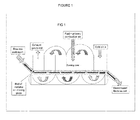
- the process to prepare the alkali metal magnesium orthosilicate is conducted in a moving grate furnace.
- This procedure is especially suited to magnesium silicate rocks (rocks comprising mainly MgO and SiO 2 ) in which the MgO/ SiO 2 ratio is close to or greater than 1.
- a mixture of alkali metal carbonate compound and magnesium silicate, each in particulate form, is formed into pellets (e.g. using a disc or drum pelletizer). Water may be added to the mixture to facilitate the pelletising process.
- the pellets are fed onto a moving grate comprising, for example, a high-temperature-resisting steel alloy, where they are heated, for example, by the passage of hot gases, for example fuel combustion gases.
- the hot gases may be drawn through the bed of pellets on the grate by fans, usually placed under the grate.
- the hot gases are produced by burning, in an excess of air, a fossil fuel, such as natural gas, oil or coal; waste- or biomass-derived fuels, such as wood chips or waste fermentation gases, may also be used.
- a fossil fuel such as natural gas, oil or coal
- waste- or biomass-derived fuels such as wood chips or waste fermentation gases
- the fuel used should have a low sulfur content, for example, ⁇ 1%.
- the rate of heating is controlled, for example, by varying the amount of fuel, the speed of the moving grate and/or the speed of the ventilation fans in order to ensure good overall energy efficiency and also to ensure that the pellets retain their mechanical integrity during the process.
- the moving grate is designed so that the gases may be passed through the bed several times along the length of the grate to allow for efficient heat transfer between the gases and the pellets, so that the gases leaving the furnace are as cool as possible.
- the pellets pass through the hottest zone (“burning zone") just after the combustion of the fuel, they are cooled by passing air through the bed, such that they reach as low a temperature as possible before being discharged from the bed.
- the metals "Q" present as minor components may also substitute partially for R, Mg or Si in the silicate compounds produced by the above reactions.
- the alkali metal magnesium orthosilicate to magnesium oxide ratio can be adjusted by varying the value of m in the starting materials.
- Equations (1a,b,c) illustrates the production of alkali metal magnesium orthosilicates plus magnesium and/or other oxides and silicates by direct reaction of a stoichiometric (i.e. 1:1 R 2 O:SiO 2 ) mixture of a magnesium silicate and an alkali metal carbonate.
- the final solid product remaining in the treated pellets is an intimate mixture comprising an alkali metal magnesium orthosilicate (R 2 MgSiO 4 ) and possibly either magnesium oxide (MgO also known as periclase) or alkali metal silicates (R 2 SiO 3 as well as other solid products comprising the other metals (Q), especially iron, which may present as magnetite (Fe 3 O 4 ), as haematite (Fe 2 O 3 ) or possibly as an alkali metal ferrite (RFeO 2 ); calcium, which may be present as silicates; chromium, which may be present as alkali metal chromates (R 2 CrO 4 ); and nickel, which may be present as oxides or silicates.
- Equations (1a,b,c) illustrate the production of alkali metal magnesium orthosilicates plus magnesium and/or other oxides and silicates by direct reaction of a mixture of a magnesium silicate and an alkali metal carbonate.
- This type of reaction is very endothermic, mainly due to the liberation of carbon dioxide gas: it consumes about 3.4 kJ (i.e. about 0.8 kcal) of heat per gram of CO 2 liberated.
- 3.4 kJ i.e. about 0.8 kcal
- the preparation of the alkali metal magnesium orthosilicate is conducted in a system comprising moving grates for pre-heating and cooling and a rotary kiln in a decarbonation step which produces carbon dioxide.
- pellets When a moving grate system is used it is important to maintain the solid in the form of suitably-sized pellets so that they form a porous bed on the grate, allowing for the passage of gases.
- the pellets preferably retain their mechanical integrity; they preferably also maintain their mean size within pre-determined limits.
- the maximum solids temperature in the process does not substantially exceed the melting point of the alkali metal carbonate corresponding to the alkali metal carbonate compound, and/or (b) the maximum solid volume fraction of melt-forming material (substantially alkali metal carbonate) in the pellets is generally below the value at which the nodule will deform significantly even if the alkali metal carbonate melts. This value is generally below about 35% of the total solids volume.
- the preparation of the alkali metal magnesium orthosilicate may also be conducted in a suspension preheater system comprising a plurality of cyclones in a preheater and, for example, a rotary kiln, for example as used in a typical modern cement plant.
- the starting materials for example as a mixed substantially dry powder, are fed (cold) into the top cyclone of the preheater.
- the material is heated close to the melting point of the alkali metal carbonate corresponding to the alkali metal carbonate compound, but without reaching this melting point, in order to avoid, for example, the formation of accretions on the walls of the preheater.
- the mixed powder enters a rotary kiln in which, as the temperature rises to the melting point of the alkali metal carbonate, the powder self-nodulizes.
- the ratio of alkali metal carbonate compound to magnesium silicate and/or the particle size distribution of the magnesium silicate and alkali metal carbonate compound in particulate form is chosen to promote self-nodulization.
- the nodules are then decarbonated in the rotary kiln.
- the decarbonated nodules are then cooled, for example on a moving grate cooler also as used in typical modern cement plants.
- the heat of the hot nodules can be used to preheat the incoming combustion air for the kiln by counter-current heat exchange.
- the main solid compounds produced are an amorphous magnesium silicate hydrate, "M-S-H", of variable composition, plus, in the case where m>1, magnesium hydroxide (brucite).
- equations 2(a) and 2(b) are not perfectly balanced equations but rather are simply intended to indicate the main initial products of the reaction between the hydraulic binder of the invention with water. It will also be understood that when phosphoric acid or a water soluble phosphate salt are used with the hydraulic binder of the invention the hardened product will generally comprise insoluble or sparingly soluble magnesium phosphate salts precipitated as a result of the reaction of the products of the above initial reactions with the dissolved phosphoric acid or its salts.
- pellets as used in this specification including the accompanying claims is to be understood as embracing shaped, generally substantially spherical, forms such as pellets, nodules and granules.
- Blaine specific surface areas are determined by known methods.
- Particle size and size distribution when measured by laser granulometry is measured using a Malvern MS2000 laser granulometer. Measurement is effected in ethanol.
- the light source consists of a red He-Ne laser (632 nm) and a blue diode (466 nm).
- the optical model is that of Mie and the calculation matrix is of the polydisperse type.
- the apparatus is checked before each working session by means of a standard sample (Sifraco C10 silica) for which the particle size distribution is known.
- Measurements are performed with the following parameters: pump speed 2300rpm and stirrer speed 800rpm.
- the sample is introduced in order to establish an obscuration between 10 and 20%. Measurement is effected after stabilisation of the obscuration.
- Ultrasound at 80% is first applied for 1 minute to ensure the de-agglomeration of the sample. After about 30s (for possible air bubbles to clear), a measurement is carried out for 15s (15000 analysed images). Without emptying the cell, measurement is repeated at least twice to verify the stability of the result and elimination of possible bubbles.
- Ground olivine sand of composition (Mg 0.94 Fe 0.06 ) 2 SiO 4 was mixed with a sodium carbonate hydrate powder in a 14:11 mass ratio. 25g of this powder was pressed into a pellet and placed into a lab furnace in a platinum crucible. It was heated up to 800°C over 2 hours, maintained at 800°C for 1 hour and cooled back to room temperature by natural cooling. In order to evaluate the reaction efficiency, separate samples of the sodium carbonate and olivine used underwent exactly the same heat treatment. The measured ignition losses are shown in the following Table: Table 1 Sample Loss on Ignition Sodium carbonate powder 14.97 % Ground olivine sand 0.22 % 14:11 mix of ground olivine sand + sodium carbonate powder 16.69 %
- the ignition loss of the pure sodium carbonate was due entirely to loss of hydrate water and not to decomposition or evaporation of the carbonate.
- the pure olivine sample remained essentially unchanged during heat treatment, but the mixed sample reacted. From the measured LOI data, it is estimated that 60% of the CO 2 from the carbonate was lost from the mixture.
- the phase constitution of the reacted sample was determined by X-ray diffraction. The reaction products observed by this technique were Na 2 MgSiO 4 , MgO and Fe 2 O 3 together with some unreacted olivine and sodium carbonate.
- Example 2 The same ground pure olivine sand (Mg 0.94 Fe 0.06 ) 2 SiO 4 and sodium carbonate hydrate powder as used in Example 1 were mixed in a 1400:1235 mass ratio. (The molar ratio of this mixture is approximately 1:1). The powder was pressed into pellets and placed (in a platinum crucible) into a lab furnace which was kept at 900°C. The sample was air-quenched after 1h of heat treatment. Separate samples of the sodium carbonate and olivine used underwent an identical heat treatment. It is important to mention that at this temperature, sodium carbonate is in the liquid state. (The melting temperature of this compound is 851°C). The measured loss on ignition of all of the samples is presented in the following Table. Table 2 Sample Loss on Ignition Sodium carbonate 14.96 % Olivine 0.04 % Olivine + Sodium carbonate 23.02 %
- a crushed sample of serpentine from Horsmanaho, Finland (ground in a ball mill to a powder with 43% passing a 75 micrometre sieve, and containing, by mass, 37.9% silicon expressed as SiO2, 38.7% magnesium expressed as MgO, 7.4% iron expressed as Fe2O3, and with an ignition loss of 14.9% at 950°C), was mixed with anhydrous sodium carbonate powder in a 5355:4645 mass ratio (molar ratio approximately 1:1.3). About 5kg of the mixed powder was pressed into a steel crucible and calcined in a lab furnace at 950°C for 4.5 hours. The mass loss during calcination was 27.9%. From the measured mass loss it can be estimated that the decarbonation reaction was complete.
- the reaction product was analysed by XRF spectrometry and shown to contain 27.8% silicon expressed as SiO2, 30.4% magnesium expressed as MgO, 5.7% iron expressed as Fe2O3, and 33.4% sodium expressed as Na2O.
- An XRD analysis showed the major phases present in the product to be Na2MgSiO4 and periclase (MgO)
- phase constitution of the reacted sample was determined by X-ray diffraction: the main products detected were Na 2 MgSiO 4 and Na 2 SiO 3 .
- Example 2 The product of Example 2 (referred to here as "product X”) was ground to a fine powder with a Blaine specific surface area of 430 m 2 /kg. It was mixed in various proportions with powdered crystalline potassium di-hydrogen phosphate [KH 2 PO 4 > 99% pure, obtained from Sigma Life Science, (CAS n° 7778-77-0)]. 100g of each mixed powder sample was mixed with sufficient water to make a workable paste, and the setting behaviour of each paste sample was followed at 20°C.
- product X powdered crystalline potassium di-hydrogen phosphate
Landscapes
- Chemical & Material Sciences (AREA)
- Organic Chemistry (AREA)
- Engineering & Computer Science (AREA)
- Ceramic Engineering (AREA)
- Inorganic Chemistry (AREA)
- Materials Engineering (AREA)
- Structural Engineering (AREA)
- Chemical Kinetics & Catalysis (AREA)
- Silicates, Zeolites, And Molecular Sieves (AREA)
Abstract
Description
- This invention relates to new hydraulic binders produced using an alkali metal magnesium orthosilicate.
- A hydraulic binder is a binder which sets and hardens by chemical interaction with water and is capable of doing so under water. The binder is capable of holding solid materials together in a coherent mass, for example in a mortar or concrete.
- Magnesium silicate rocks make up the majority of the Earth's mantle, and large surface deposits of such rocks are also found in many locations. The composition of the Earth's mantle is about 70% basic magnesium orthosilicate (Mg2SiO4), and, when this material is found in crystalline form close to the Earth's surface, it is generally in the form of olivine, which is essentially a solid solution between forsterite (pure Mg2SiO4 and fayalite (pure Fe2SiO4), representing the two main components of the Earth's mantle. In the Earth's crust, in addition to olivine, anhydrous magnesium silicates also occur as pyroxenes, such as enstatite (MgSiO3). Due to the action of water, either at the surface or at depth within the Earth's crust, anhydrous magnesium silicates are converted into magnesium silicate hydrate minerals such as serpentine or chlorite (with the idealised overall composition Mg3Si2O5(OH)4), and also talc (with the idealised overall composition (Mg3Si4O10(OH)2).
- Magnesium silicate rocks constitute an excellent source of basic magnesium. Although the common magnesium silicate minerals listed above tend to be very "unreactive," (e.g. in that they have high melting points and also dissolve only very slowly in water or dilute acids), it is known that they will react rapidly with molten alkali metal carbonates, such as sodium carbonate (Na2CO3). Such a process, commonly referred to as a "carbonate fusion", is often used in the preparation of minerals for chemical analysis. Generally, a large excess of solid alkali metal carbonate (typically at least ten parts of alkali metal carbonate to one part of magnesium silicate rock) is added and the mixture heated to well above the melting point of the alkali metal carbonate. The magnesium silicate completely dissolves in the resulting melt, which after cooling can easily and rapidly be dissolved in a strong aqueous acid and the solution then analyzed by standard chemical techniques, thus allowing for total elemental analysis of the rock. The carbonate fusion process is a small scale process; it is analytical, not preparative, and is not energy-efficient as it involves melting a large excess of alkali metal carbonate in order to fully dissolve the magnesium silicate.
- The term sodium magnesium silicate is sometimes used, in accordance with the International Nomenclature of Cosmetic Ingredients (INCI) to identify synthetic hectorites in the form of nanoparticles and which form clear gels in water. According to one manufacturer of such products hectorites have the formula (Mg5.2Li0.8)(Si8)O20(OH)4Na0.8.
- The present invention seeks to provide hydraulic binders and hydraulic compositions comprising an anhydrous alkali metal magnesium orthosilicate of the general formula R2MgSiO4 wherein R represents an alkali metal; and, preferably, either magnesium oxide or an alkali metal silicate (R2SiO3), which compositions absorb carbon dioxide.
- The present invention accordingly provides a hydraulic binder comprising an alkali metal magnesium orthosilicate, and, preferably, magnesium oxide or an alkali metal silicate.
- The alkali metal is preferably potassium or, more preferably, sodium.
- The alkali metal magnesium orthosilicate is preferably prepared by the reaction of an alkali metal carbonate compound, which compound is an alkali metal carbonate, an alkali metal bicarbonate, or a mixture thereof, with a magnesium silicate.
- It is believed that the hydraulic binders according to the invention set and harden when mixed with water due to hydration reactions which produce magnesium hydroxides (e.g. brucite) and magnesium silicate hydrate gels (M-S-H) as well as releasing alkali metal hydroxides and silicates into solution.
- According to a further feature of the invention, when mixed with a concentrated (preferably > 3% w/w) aqueous solution of phosphoric acid or a water soluble phosphate salt (for example potassium dihydrogen phosphate) the hydraulic binder according to the invention produces a mixture which sets and hardens rapidly. Insoluble or sparingly soluble magnesium phosphate salts are formed. The invention provides a hydraulic composition according to the invention which also comprises a water soluble phosphate salt. Preferred such compositions comprise, on a dry solids basis, 0.1 to 70%, more preferably 1 to 40%, of water soluble phosphate salt.
- The hydraulic binder according to the invention preferably has a Blaine specific surface area of at least 100m2/kg, more preferably 300 to 600m2/kg.
- The hydraulic binder according to the invention preferably comprises an additive to promote setting and hardening.
- Additives include nucleating agents. These are generally small particles which provide a surface on which hydration products involved in the hardening process may grow. Such nucleating agents include alkaline earth metal carbonates such as calcite, dolomite and hydromagnesite, as well as poorly-soluble inorganic oxides or hydroxides such as brucite and precipitated silica. The nucleating agents are preferably in fine particulate form.
- Additives to promote hardening also comprise water-soluble chelating agents for magnesium. Preferred chelating agents chelate magnesium in a pH range of 10 to 14. Preferably about half of the chelating agent in solution is bound to magnesium ions.
- Additives also include aluminium compounds. Such compounds include aluminosilicates, generally in X-ray amorphous particulate form. Examples of the aluminosilicate include for example, burnt clays (e.g. metakaolins); coal combustion ashes (e.g. fly ash); and metallurgical slags (e.g. granulated blast-furnace slags).
- The aluminium compounds also include aluminium hydroxide and sources thereof, for example water-soluble aluminium salts which precipitate aluminium hydroxide under basic conditions. Such salts include aluminium sulphate, chloride and nitrate.
- It is believed that the inclusion of such aluminium compounds promotes and/or accelerates the hydration reactions in the hydraulic binders according to the invention, and also leads to the production of additional solid hydrates such as, for example, hydrotalcites (magnesium aluminate layered-double-hydroxides), alkali alumino-silicate gels and/or calcium alumino-silicate gels, thus resulting in an accelerated hardening process and stronger hardened products.
- According to a feature of the invention the hydraulic binder according to the invention also comprises a calcium aluminate or sulfoaluminate hydraulic binder. Such hydraulic binders include, for example, hydraulic binders comprising mono-calcium aluminate (CaAl2O4) or calcium sulfoaluminate (ye'elimite, Ca4Al6O12(SO4)). The inclusion of a calcium aluminate or sulfoaluminate hydraulic binder can give hydraulic binders with enhanced strength development properties compared to hydraulic binders obtained by mixing the same mono-calcium aluminate or calcium sulfoaluminate hydraulic binder in the same proportions with an inert powder such as quartz.
- Additives to promote hardening also include compounds which provide soluble anions, for example chlorides, nitrates, sulphates and carbonates. Such anions can be beneficial by accelerating the dissolution of anhydrous phases and the growth of hydrates.
- According to a feature of the invention the hydraulic binders according to the invention described above also comprise a Portland cement. Such Portland cements include those listed in the EN 197-1 Standard, for example CEM I (comprising substantially pure cement clinker), Portland slag cement, Portland fly ash cement, and blast furnace cement (CEM III).
- When the hydraulic binders according to the invention are used the water/solid hydraulic binder ratio is generally from 0.1 to 10, preferably 0.2 to 1, by mass.
- The invention also relates to a hydraulic composition comprising a hydraulic binder according to the present invention. Such compositions generally comprise fine aggregate and/or coarse aggregate.
- The hydraulic composition may also comprise a particulate inorganic, e.g. mineral, material, for example calcium carbonate, e.g. limestone or dolomite, or silica, e.g. quartz or silica fume.
- Preferably, the hydraulic composition according to the present invention is a hydraulic slurry, a mortar or a concrete.
- The hydraulic composition according to the invention preferably comprises a superplasticizer. The superplasticizer generally acts as a dispersant.
- The term "superplasticizer" as used in this specification and the accompanying claims is to be understood as including both water reducers and superplasticizers as described in the Concrete Admixtures Handbook, Properties Science and Technology, V.S. Ramachandran, Noyes Publications, 1984.
- A water reducer is defined as an additive which reduces the amount of mixing water of concrete for a given workability by typically 10 - 15%. Water reducers include, for example lignosulphonates, hydroxycarboxylic acids, carbohydrates, and other specialized organic compounds, for example glycerol, polyvinyl alcohol, sodium alumino-methyl-siliconate, sulfanilic acid and casein.
- Superplasticizers are a class of organic polymer based water reducers capable of reducing the water contents of hydraulic binders by over about 30% while maintaining a high workability. Common superplasticizers include sulphonated naphthalene formaldehyde condensates (SNF); sulphonated melamine formaldehyde condensates (SMF); modified lignosulfonates (MLS); and others. More recent types of superplasticizer include polycarboxylic compounds such as polyacrylates. The superplasticizer is preferably a new generation superplasticizer, for example a copolymer containing polyethylene glycol as graft chain and carboxylic functions in the main chain such as a polycarboxylic ether. Sodium polycarboxylate-polysulphonates and sodium polyacrylates may also be used. Phosphonic acid derivatives may also be used. The amount of superplasticizer required generally depends on the water demand of the hydraulic binder. The lower the water demand, the lower the amount of superplasticizer required. The superplasticizer may be used in acid form or as a sodium, potassium, calcium or magnesium salt.
- Other additives may be included in the composition according to the invention, for example, a defoaming agent (e.g. polydimethylsiloxane). These also include silicones in the form of a solution, a solid or preferably in the form of a resin, an oil or an emulsion, preferably in water. More particularly suitable are silicones comprising R1SiO0.5 and (R12SiO) moieties.
- In these formulae, the R1 radicals, which may be the same or different, are preferably hydrogen or an alkyl group of 1 to 8 carbon atoms, the methyl group being preferred. The number of moieties in each silicone molecule is preferably from 30 to 120.
- The amount of such an agent in the final hydraulic binder is generally at most 5 parts in 100 parts by weight relative to the hydraulic binder.
- The concrete according to the invention may be subjected to a cure to improve its mechanical properties. Curing may be effected under wet or dry conditions. Curing is generally conducted in humid air at a temperature at or above ambient temperature (e.g. 20°C to 90°C), preferably from 60°C to 90°C. The curing temperature should be less than the boiling point of water at the ambient pressure; but autoclaving, in which curing is conducted in water vapour at elevated pressures, allows curing temperatures higher than 100°C to be used.
- Curing may be conducted in the presence of carbon dioxide (preferably in gaseous form). Such curing is believed to promote carbonation of hydroxyl groups, which further increases the strength and durability of the hardened product. It may be effected using combustion flue gas, for example in a closed chamber.
- Carbonation by absorption of carbon dioxide from the atmosphere will continue until all of the hydroxyl groups have been carbonated.
- The cure time may be, for example, 3 hours to 7 days, preferably about 1 day. Curing may be started before or after setting.
- The cure may be performed in dry or wet conditions or in cycles alternating both environments, for example, a 24 hour cure in a humid environment followed by a 24 hour cure in a dry environment.
- The alkali metal magnesium orthosilicate of the hydraulic binder according to the invention is preferably prepared by a process which comprises the reaction, at a temperature from 500°C to 1200°C, of an alkali metal carbonate compound, which compound is an alkali metal carbonate, an alkali metal bicarbonate or a mixture thereof, with a magnesium silicate.
- The molar ratio of alkali metal carbonate compound, expressed as alkali metal oxide, to magnesium silicate expressed as silicon dioxide is preferably from about 4:1 to 1:4, for example <4 :1 to 1:4, more preferably from 3:1 to 1:3, for example 2:1 to 1:2. The ratio is most preferably about 1:1.
- The alkali metal carbonate compound is preferably an alkali metal carbonate. It will be understood that when the alkali metal carbonate compound comprises bicarbonate the latter will generally decompose to the corresponding carbonate at the temperatures used to prepare the alkali metal magnesium orthosilicate. The alkali metal carbonate compound may be anhydrous or hydrated. Hydrates of sodium carbonate include the monohydrate and decahydrate. Hydrates of potassium carbonate include the sesquihydrate (also known as hemihydrate). It is preferable, when economically feasible, to use anhydrous alkali metal carbonate compounds to avoid the expenditure of energy required to remove water of hydration.
- Although the starting material used to prepare the alkali metal magnesium orthosilicate comprises magnesium silicate it may also comprise metals other than magnesium.
- The magnesium silicate used in the preparation of the alkali metal magnesium orthosilicate is generally a mineral silicate, for example a rock comprising a high concentration, preferably 20% or more, more preferably 50% or more, of a magnesium silicate of the general composition:
m(MgO)•t(QO)•SiO2•xH2O
wherein Q represents a metal or metals other than magnesium, (for example calcium and/or a transition group metal such as iron, chromium or nickel); m is from 0.5 to 3, t is less than or equal to 1, and x is from zero to 2. It will be understood that the composition or formulae of minerals is often depicted in terms of the theoretical amount of oxides which they contain: the oxides are, however, not present as such in the minerals whose composition is depicted in this way. - Such minerals include olivines, e.g. forsterite and monticellite; serpentines, e.g. antigorite, chrysotile, lizardite, sepiolite and garnierite; pyroxenes, e.g. enstatite, diopside, bronzite and hypersthene; amphiboles, e.g. amosite, anthophyllite, tremolite and actinolite; humites, e.g. chondrodite and norbergite; and other minerals such as chlorite, talc, iddingsite and hectorite. These minerals may contain substantial quantities of iron in addition to magnesium and silicon, and also significant amounts of calcium, aluminium and alkali metals.
- Asbestos comprises a group of naturally occurring minerals which includes fibrous serpentine (e.g. chrysotile) and amphibole (e.g. amosite, anthophyllite, tremolite and actinolite) minerals. The fibrillar forms of asbestos are known to be harmful to health and are considered to be human carcinogens. The process of the invention provides a means of converting these minerals into useful (and non-carcinogenic) materials.
- The mineral silicate used to prepare the alkali metal magnesium orthosilicate is preferably a magnesium silicate. The MgO/SiO2 molar ratio is preferably from 0.5 to 3, more preferably 0.65 to 2. The CaO/SiO2 molar ratio is preferably ≤0.5. The FeO/SiO2 molar ratio is preferably ≤0.5. The content of other elements in terms of the (total oxides)/SiO2 molar ratio is preferably ≤0.2.
- The alkali metal carbonate compound used in the preparation of the alkali metal magnesium orthosilicate may be a mineral, for example trona (tri-sodium hydrogen dicarbonate dihydrate; Na3H(CO3)2•2H2O), or a commercially available compound. It may contain impurities, for example hydroxides and silicates and, generally in smaller amounts, other impurities, e.g. chlorides, sulfates, sulfites, nitrates and nitrites. If impurities (e.g. alkali metal nitrates, nitrites or hydroxides) are present which, at the temperature used to prepare the alkali metal magnesium orthosilicate, decompose to an alkali metal oxide, they should be taken into account when calculating the amount of alkali metal oxide.
- The process used to prepare the alkali metal magnesium orthosilicate is preferably effected at a temperature from 600 to 1100°C, more preferably from 800 to 1000°C. Heating is generally effected for a few minutes to a few hours.
- The process is preferably effected at a temperature at which the magnesium silicate is solid and the alkali metal carbonate corresponding to the alkali metal carbonate compound is solid or liquid. The process may be effected at a temperature below the melting point of the alkali metal carbonate corresponding to the alkali metal compound, more preferably slightly below its melting point.
- We have found, unexpectedly, that it is possible to obtain a high degree of reaction between an alkali metal carbonate compound, preferably an alkali metal carbonate, and a magnesium silicate when the two materials are contacted with each other in the solid state. They are preferably in particulate form, for example as powders. A mixture of the compounds is preferably heated, for example in a furnace, to a temperature close to, but below, the melting point of the alkali metal carbonate corresponding to the alkali metal compound. The ratio of the carbonate and silicate used is preferably substantially equal to the stoichiometric ratio calculated on the basis that one mole of alkali metal oxide (written generically as "R2O" in which R represents an alkali metal) present in the alkali metal carbonate compound, is equivalent to one mole of silica (SiO2) present in the magnesium silicate. For example, the stoichiometric mass ratio for the reaction between pure forsterite (Mg2SiO4, mol. wt. = 140) and pure anhydrous sodium carbonate (Na2CO3 mol. wt. = 106) would be 140:106. It will be understood that the actual silicate and carbonate sources used in practice will not always be pure, but the idealized stoichiometric ratio refers to that in which the heated mixture has an overall molar ratio of R2O:SiO2 substantially equal to unity.
- The magnesium silicate and alkali metal carbonate compound used to prepare the alkali metal magnesium orthosilicate are preferably in particulate form or in shaped form, e.g. as pellets.
- Rock used to provide the magnesium silicate and/or alkali metal carbonate compound for the preparation of the alkali metal magnesium orthosilicate will generally be dried, crushed and, if necessary, ground (for example co-ground) to a desired particle size distribution. For example the magnesium silicate may be crushed to the granulometry of fine sand (grain size 0.06 to 0.2mm) or, if necessary, ground to a fine powder (grain sizes below 0.06mm). Grain sizes greater than 0.06mm are generally determined by sieving. Grain sizes lower than 0.06mm are generally determined by laser granulometry. Undesirable mineral impurities can be separated to the extent consistent with energy efficiency by mechanical or other separation methods.
- In one embodiment the process to prepare the alkali metal magnesium orthosilicate is conducted in a moving grate furnace. This procedure is especially suited to magnesium silicate rocks (rocks comprising mainly MgO and SiO2) in which the MgO/ SiO2 ratio is close to or greater than 1.
- For example a mixture of alkali metal carbonate compound and magnesium silicate, each in particulate form, is formed into pellets (e.g. using a disc or drum pelletizer). Water may be added to the mixture to facilitate the pelletising process. The pellets are fed onto a moving grate comprising, for example, a high-temperature-resisting steel alloy, where they are heated, for example, by the passage of hot gases, for example fuel combustion gases. The hot gases may be drawn through the bed of pellets on the grate by fans, usually placed under the grate. The process is illustrated diagrammatically in
Figure 1 of the accompanying drawings. - Typically, the hot gases are produced by burning, in an excess of air, a fossil fuel, such as natural gas, oil or coal; waste- or biomass-derived fuels, such as wood chips or waste fermentation gases, may also be used. Preferably the fuel used should have a low sulfur content, for example, <1%. The passage of hot gases through the bed heats the particles up, ultimately, to the desired temperature.
- The rate of heating is controlled, for example, by varying the amount of fuel, the speed of the moving grate and/or the speed of the ventilation fans in order to ensure good overall energy efficiency and also to ensure that the pellets retain their mechanical integrity during the process. The moving grate is designed so that the gases may be passed through the bed several times along the length of the grate to allow for efficient heat transfer between the gases and the pellets, so that the gases leaving the furnace are as cool as possible. Moreover, once the pellets pass through the hottest zone ("burning zone") just after the combustion of the fuel, they are cooled by passing air through the bed, such that they reach as low a temperature as possible before being discharged from the bed. The incoming air, thus preheated by the outgoing solid particles, is used as the main air supply for combustion of fuel in the burning zone, thus leading to a high overall thermal efficiency for this type of furnace. The theoretical overall chemical reaction occurring during the heating process is shown below in equation (1a) for the reaction between forsterite (Mg2SiO4) and an alkali metal carbonate (R2CO3) in equimolar amounts:
(1a) Mg2SiO4 + R2CO3 ⇒ R2MgSiO4 + MgO + CO2↑
in which R is as hereinbefore defined. - The more general form of this reaction can be written as in equation (1b) for m≥1 and equation (1 c) for m≤1:
(1b) mMgO•tQO•SiO2•xH2O + R2CO3 ⇒ R2MgSiO4+(m-1)MgO + t(QO) + CO2↑ + xH2O↑
(1c) mMgO•tQO•SiO2•xH2O +R2CO3 ⇒ mR2MgSiO4 +(1-m)R2SiO3 + t(QO) + CO2↑ + xH2O↑
wherein m is greater than or equal to 1 for reaction (1b) and less than or equal to 1 for reaction (1 c); and Q, t and x are as hereinbefore defined. - The metals "Q" present as minor components may also substitute partially for R, Mg or Si in the silicate compounds produced by the above reactions.
- The alkali metal magnesium orthosilicate to magnesium oxide ratio can be adjusted by varying the value of m in the starting materials.
- The idealized reactions depicted in equations (1a,b,c) illustrates the production of alkali metal magnesium orthosilicates plus magnesium and/or other oxides and silicates by direct reaction of a stoichiometric (i.e. 1:1 R2O:SiO2) mixture of a magnesium silicate and an alkali metal carbonate.
- The vertical arrow ↑ indicates that the carbon dioxide gas and water vapour produced by this reaction escapes from the bed and exits with the rest of the exhaust gases. Thus, ideally, the final solid product remaining in the treated pellets is an intimate mixture comprising an alkali metal magnesium orthosilicate (R2MgSiO4) and possibly either magnesium oxide (MgO also known as periclase) or alkali metal silicates (R2SiO3 as well as other solid products comprising the other metals (Q), especially iron, which may present as magnetite (Fe3O4), as haematite (Fe2O3) or possibly as an alkali metal ferrite (RFeO2); calcium, which may be present as silicates; chromium, which may be present as alkali metal chromates (R2CrO4); and nickel, which may be present as oxides or silicates.
- When the molar ratio of alkali metal carbonate compound, expressed as alkali metal oxide of the formula R2O, in which R represents an alkali metal, to magnesium silicate, expressed as silicon dioxide, of the formula SiO2, is about 1, and the value of m is also about 1, the reaction produces an alkali metal magnesium orthosilicate as the principal product. When the value of m is greater than 1, magnesium oxide (MgO) is also produced (as shown in equation 1b). When the value of m is lower than 1, an alkali metal silicate R2SiO3 is produced instead of MgO (as shown in equation 1c).
- When the molar ratio of alkali metal carbonate compound, expressed as alkali metal oxide of the formula R2O, in which R represents an alkali metal, to magnesium silicate, expressed as silicon dioxide, of the formula SiO2, is less than one, the reaction produces the same products as when the ratio is 1, but some unreacted magnesium silicate may remain in the products. When the ratio is greater than 1, the reaction produces the same products as when the ratio is 1, but some unreacted alkali metal carbonate may remain in the product.
- The idealized reactions depicted in equations (1a,b,c) illustrate the production of alkali metal magnesium orthosilicates plus magnesium and/or other oxides and silicates by direct reaction of a mixture of a magnesium silicate and an alkali metal carbonate. This type of reaction is very endothermic, mainly due to the liberation of carbon dioxide gas: it consumes about 3.4 kJ (i.e. about 0.8 kcal) of heat per gram of CO2 liberated. Thus, regardless of the temperature at which the reaction is conducted, there will be a significant net energy consumption for the overall process. However, if the reaction is conducted, as described above, in a furnace system which allows for good counter-current heat exchange between the outgoing hot gases and the incoming solids, and likewise between the outgoing hot solids and the incoming combustion air, the net energy consumption can be reduced to a value close to the theoretical limit given above. It is important, for energy efficiency, to have efficient counter-current heat exchange at both the beginning and the end of the process, incoming and outgoing, for example in a moving grate furnace as described above.
- In a further embodiment, the preparation of the alkali metal magnesium orthosilicate is conducted in a system comprising moving grates for pre-heating and cooling and a rotary kiln in a decarbonation step which produces carbon dioxide.
- When a moving grate system is used it is important to maintain the solid in the form of suitably-sized pellets so that they form a porous bed on the grate, allowing for the passage of gases. The pellets preferably retain their mechanical integrity; they preferably also maintain their mean size within pre-determined limits.
- In order to facilitate maintenance of the mechanical integrity of the pellets either (a) the maximum solids temperature in the process does not substantially exceed the melting point of the alkali metal carbonate corresponding to the alkali metal carbonate compound, and/or (b) the maximum solid volume fraction of melt-forming material (substantially alkali metal carbonate) in the pellets is generally below the value at which the nodule will deform significantly even if the alkali metal carbonate melts. This value is generally below about 35% of the total solids volume. However, since the reaction itself produces no liquid products (only solids and gases) at the temperatures preferably employed, the risk of the nodules deforming significantly due to melting is quite low even at far higher initial volume fractions of alkali metal carbonate as long as the heating occurs slowly enough to allow for a significant degree of reaction to occur before complete melting of the alkali metal carbonate.
- The preparation of the alkali metal magnesium orthosilicate may also be conducted in a suspension preheater system comprising a plurality of cyclones in a preheater and, for example, a rotary kiln, for example as used in a typical modern cement plant. The starting materials, for example as a mixed substantially dry powder, are fed (cold) into the top cyclone of the preheater. During its passage through the preheater cyclone tower, by counter-current heat exchange with kiln exit gases, the material is heated close to the melting point of the alkali metal carbonate corresponding to the alkali metal carbonate compound, but without reaching this melting point, in order to avoid, for example, the formation of accretions on the walls of the preheater. At the bottom of the preheater tower, the mixed powder enters a rotary kiln in which, as the temperature rises to the melting point of the alkali metal carbonate, the powder self-nodulizes. The ratio of alkali metal carbonate compound to magnesium silicate and/or the particle size distribution of the magnesium silicate and alkali metal carbonate compound in particulate form is chosen to promote self-nodulization. The nodules are then decarbonated in the rotary kiln. The decarbonated nodules are then cooled, for example on a moving grate cooler also as used in typical modern cement plants. The heat of the hot nodules can be used to preheat the incoming combustion air for the kiln by counter-current heat exchange.
- The hydraulic binder of the invention sets and hardens by chemical interaction with water. It is believed that the initial part of the reaction of the binder with water can be written qualitatively as follows, for m≥1 (equation 2a), and m≤1 (equation 2b):
(2a) (m-1)MgO + R2MgSiO4 ⇒ (m-1)Mg(OH)2 + "M-S-H" + 2R+ + (OH-, H2SiO4 =, CO3 =)
(2b) (1-m)R2SiO3 + mR2MgSiO4 ⇒ "M-S-H" + 2R+ + (OH-, H2SiO4, CO3 =)
- In the above initial reactions, the main solid compounds produced are an amorphous magnesium silicate hydrate, "M-S-H", of variable composition, plus, in the case where m>1, magnesium hydroxide (brucite). The alkali metals can dissolve in the aqueous phase as alkali metal cations (R+), and the charge of these alkali metal cations is essentially balanced by a mixture of three principal dissolved anions: hydroxide (OH-), silicate (H2SiO4 =) and carbonate (CO3 =), present in various ratios depending on the conditions and materials used. It is to be understood that equations 2(a) and 2(b) are not perfectly balanced equations but rather are simply intended to indicate the main initial products of the reaction between the hydraulic binder of the invention with water. It will also be understood that when phosphoric acid or a water soluble phosphate salt are used with the hydraulic binder of the invention the hardened product will generally comprise insoluble or sparingly soluble magnesium phosphate salts precipitated as a result of the reaction of the products of the above initial reactions with the dissolved phosphoric acid or its salts.
- In this specification, including the accompanying claims, percentages unless otherwise indicated are by mass.
- The term "pellets" as used in this specification including the accompanying claims is to be understood as embracing shaped, generally substantially spherical, forms such as pellets, nodules and granules.
- Blaine specific surface areas are determined by known methods.
- Particle size and size distribution when measured by laser granulometry is measured using a Malvern MS2000 laser granulometer. Measurement is effected in ethanol. The light source consists of a red He-Ne laser (632 nm) and a blue diode (466 nm). The optical model is that of Mie and the calculation matrix is of the polydisperse type.
- The apparatus is checked before each working session by means of a standard sample (Sifraco C10 silica) for which the particle size distribution is known.
- Measurements are performed with the following parameters: pump speed 2300rpm and stirrer speed 800rpm. The sample is introduced in order to establish an obscuration between 10 and 20%. Measurement is effected after stabilisation of the obscuration. Ultrasound at 80% is first applied for 1 minute to ensure the de-agglomeration of the sample. After about 30s (for possible air bubbles to clear), a measurement is carried out for 15s (15000 analysed images). Without emptying the cell, measurement is repeated at least twice to verify the stability of the result and elimination of possible bubbles.
- All values given in the description and the specified ranges correspond to average values obtained with ultrasound.
- The following non-limiting Examples illustrate the invention.
- Ground olivine sand of composition (Mg0.94Fe0.06)2SiO4 was mixed with a sodium carbonate hydrate powder in a 14:11 mass ratio. 25g of this powder was pressed into a pellet and placed into a lab furnace in a platinum crucible. It was heated up to 800°C over 2 hours, maintained at 800°C for 1 hour and cooled back to room temperature by natural cooling. In order to evaluate the reaction efficiency, separate samples of the sodium carbonate and olivine used underwent exactly the same heat treatment. The measured ignition losses are shown in the following Table:
Table 1 Sample Loss on Ignition Sodium carbonate powder 14.97 % Ground olivine sand 0.22 % 14:11 mix of ground olivine sand + sodium carbonate powder 16.69 % - The ignition loss of the pure sodium carbonate was due entirely to loss of hydrate water and not to decomposition or evaporation of the carbonate. The pure olivine sample remained essentially unchanged during heat treatment, but the mixed sample reacted. From the measured LOI data, it is estimated that 60% of the CO2 from the carbonate was lost from the mixture. The phase constitution of the reacted sample was determined by X-ray diffraction. The reaction products observed by this technique were Na2MgSiO4, MgO and Fe2O3 together with some unreacted olivine and sodium carbonate.
- The same ground pure olivine sand (Mg0.94Fe0.06)2SiO4 and sodium carbonate hydrate powder as used in Example 1 were mixed in a 1400:1235 mass ratio. (The molar ratio of this mixture is approximately 1:1). The powder was pressed into pellets and placed (in a platinum crucible) into a lab furnace which was kept at 900°C. The sample was air-quenched after 1h of heat treatment. Separate samples of the sodium carbonate and olivine used underwent an identical heat treatment. It is important to mention that at this temperature, sodium carbonate is in the liquid state. (The melting temperature of this compound is 851°C). The measured loss on ignition of all of the samples is presented in the following Table.
Table 2 Sample Loss on Ignition Sodium carbonate 14.96 % Olivine 0.04 % Olivine + Sodium carbonate 23.02 % - From the measured LOI data, a conversion rate (degree of decarbonation) close to 100% was obtained which means that the reaction was essentially complete. The reaction product was analysed by X-ray diffraction and the main phases detected were Na2MgSiO4 and MgO together with some un-reacted olivine. No remaining sodium carbonate was detected, in agreement with the observed loss on ignition data. The MgO to Na2MgSiO4 mass ratio was estimated by Rietveld analysis of the X-ray diffraction data to be 14:86, in reasonable agreement with mass balance calculations.
- A crushed sample of serpentine from Horsmanaho, Finland (ground in a ball mill to a powder with 43% passing a 75 micrometre sieve, and containing, by mass, 37.9% silicon expressed as SiO2, 38.7% magnesium expressed as MgO, 7.4% iron expressed as Fe2O3, and with an ignition loss of 14.9% at 950°C), was mixed with anhydrous sodium carbonate powder in a 5355:4645 mass ratio (molar ratio approximately 1:1.3). About 5kg of the mixed powder was pressed into a steel crucible and calcined in a lab furnace at 950°C for 4.5 hours. The mass loss during calcination was 27.9%. From the measured mass loss it can be estimated that the decarbonation reaction was complete. The reaction product was analysed by XRF spectrometry and shown to contain 27.8% silicon expressed as SiO2, 30.4% magnesium expressed as MgO, 5.7% iron expressed as Fe2O3, and 33.4% sodium expressed as Na2O. An XRD analysis showed the major phases present in the product to be Na2MgSiO4 and periclase (MgO)
- Ground natural talc from Luzenac (France) with nominal composition Mg3Si4O10(OH)2 and containing some minor impurities (1.1% Al2O3, 0.9 % Fe2O3 and 0.9% CaO by mass) was mixed with anhydrous sodium carbonate (Na2CO3) at a 4863:5136 mass ratio (molar ratio approximately 1:1). 20.5g of this powder was pressed into a pellet and placed into a lab furnace in a platinum crucible. The sample was heated at 900°C for 1 hour, followed by cooling in air. It was weighed before and after treatment and the measured loss on ignition of 23.3% was consistent with loss of carbon dioxide from the sodium carbonate plus bound water from the talc; it represents about 95% of the theoretical value for complete reaction of 24.6%. The phase constitution of the reacted sample was determined by X-ray diffraction: the main products detected were Na2MgSiO4 and Na2SiO3.
- The product of Example 2 (referred to here as "product X") was ground to a fine powder with a Blaine specific surface area of 430 m2/kg. It was mixed in various proportions with powdered crystalline potassium di-hydrogen phosphate [KH2PO4 > 99% pure, obtained from Sigma Life Science, (CAS n° 7778-77-0)]. 100g of each mixed powder sample was mixed with sufficient water to make a workable paste, and the setting behaviour of each paste sample was followed at 20°C. Results are shown in Table 3, below:
Table 3 product X (g) KH2PO4 (g) Water (g) Comments Test 1 90 10 38.1 Set almost immediately; impossible to cast in mould Test 2 95 5 33.4 Set in less than 10min., difficult to cast in mould Test 3 99 1 29.3 Set in about 10min, easy to cast in mould Test 4 99 1 31.3 Set in about 10min, easy to cast in mould - All of the paste samples set in 10 minutes or less, but the first sample set so quickly that it was impossible to cast it into moulds to make shaped specimens. The second sample began to set quickly but it was nevertheless possible to cast 2x2x10cm paste prisms from it. These prisms were demoulded after two hours storage in moist air at 20°C, and tested in compression, giving an average compressive strength of 2MPa.
Claims (11)
- A hydraulic binder comprising an alkali metal magnesium orthosilicate of the general formula R2MgSiO4wherein R represents an alkali metal.
- A hydraulic binder according to claim 1 which also comprises magnesium oxide.
- A hydraulic binder according to claim 1 which also comprises an alkali metal silicate (R2SiO3 wherein R is as defined in claim 1).
- A hydraulic binder according to claim 1, 2 or 3 which also comprises a water soluble phosphate salt.
- A hydraulic binder according to any one of the preceding claims in particulate form.
- A hydraulic binder according to any one of the preceding claims in which the alkali metal magnesium orthosilicate is prepared by the reaction of an alkali metal carbonate compound, which compound is an alkali metal carbonate, an alkali metal bicarbonate or a mixture thereof, with a magnesium silicate.
- A hydraulic binder according to any one of the preceding claims in which the alkali metal magnesium orthosilicate is prepared by the reaction, at a temperature from 500 to 1200°C, of an alkali metal carbonate compound which compound is an alkali metal carbonate, an alkali metal bicarbonate or a mixture thereof, with a magnesium silicate comprising mMgO.SiO2, the molar ratio of alkali metal carbonate compound, expressed as alkali metal oxide of the formula R2O, in which R represents an alkali metal, to magnesium silicate, expressed as silicon dioxide of the formula SiO2, being from 4:1 to 1:4, which reaction produces an alkali metal magnesium orthosilicate.
- A hydraulic binder according to any one of the preceding claims which also comprises an additive to promote setting and hardening.
- A hydraulic composition comprising a hydraulic binder according to any one of the preceding claims.
- A hydraulic composition according to claim 9 which is a paste, mortar or concrete.
- A product in shaped form comprising a hydraulic binder according to any one of the preceding claims.
Priority Applications (11)
| Application Number | Priority Date | Filing Date | Title |
|---|---|---|---|
| EP12306469.3A EP2735555A1 (en) | 2012-11-27 | 2012-11-27 | Hydraulic binders |
| KR1020157016739A KR20150088845A (en) | 2012-11-27 | 2013-11-26 | Process for the treatment of a silicate mineral |
| RU2015125492A RU2654983C2 (en) | 2012-11-27 | 2013-11-26 | Method for treating silicate mineral |
| MX2015006607A MX2015006607A (en) | 2012-11-27 | 2013-11-26 | Process for the treatment of a silicate mineral. |
| CN201380061823.9A CN104812468B (en) | 2012-11-27 | 2013-11-26 | Method for handling silicate mineral |
| CA2892325A CA2892325A1 (en) | 2012-11-27 | 2013-11-26 | Process for the treatment of a silicate mineral |
| PCT/EP2013/074732 WO2014082996A1 (en) | 2012-11-27 | 2013-11-26 | Process for the treatment of a silicate mineral |
| EP13795508.4A EP2925426A1 (en) | 2012-11-27 | 2013-11-26 | Process for the treatment of a silicate mineral |
| AU2013351282A AU2013351282B2 (en) | 2012-11-27 | 2013-11-26 | Process for the treatment of a silicate mineral |
| US14/647,277 US9631257B2 (en) | 2012-11-27 | 2013-11-26 | Process for the treatment of a silicate mineral |
| JP2015543468A JP2015536897A (en) | 2012-11-27 | 2013-11-26 | Silicate mineral processing method |
Applications Claiming Priority (1)
| Application Number | Priority Date | Filing Date | Title |
|---|---|---|---|
| EP12306469.3A EP2735555A1 (en) | 2012-11-27 | 2012-11-27 | Hydraulic binders |
Publications (1)
| Publication Number | Publication Date |
|---|---|
| EP2735555A1 true EP2735555A1 (en) | 2014-05-28 |
Family
ID=47290865
Family Applications (1)
| Application Number | Title | Priority Date | Filing Date |
|---|---|---|---|
| EP12306469.3A Withdrawn EP2735555A1 (en) | 2012-11-27 | 2012-11-27 | Hydraulic binders |
Country Status (1)
| Country | Link |
|---|---|
| EP (1) | EP2735555A1 (en) |
Cited By (5)
| Publication number | Priority date | Publication date | Assignee | Title |
|---|---|---|---|---|
| CN111646764A (en) * | 2020-07-09 | 2020-09-11 | 大连理工大学 | Whisker modified hydrated magnesium silicate material and preparation method and application thereof |
| CN114426417A (en) * | 2022-01-27 | 2022-05-03 | 山东大元实业股份有限公司 | Multifunctional product prepared from silicon inorganic material and preparation method thereof |
| US20220204405A1 (en) * | 2019-04-03 | 2022-06-30 | Bostik Sa | Hydraulic binder composition |
| WO2023110102A1 (en) * | 2021-12-16 | 2023-06-22 | Ocs 2 Ug (Haftungsbeschränkt) | Reinforced magnesium silicate hydrate composite material |
| US20240101477A1 (en) * | 2020-12-15 | 2024-03-28 | Holcim Technology Ltd | Method of calcining a clay material |
Citations (3)
| Publication number | Priority date | Publication date | Assignee | Title |
|---|---|---|---|---|
| SU1643493A1 (en) * | 1989-05-06 | 1991-04-23 | Всесоюзный научно-исследовательский институт строительных материалов и конструкций им.П.П.Будникова | Binder |
| US5085838A (en) * | 1989-05-25 | 1992-02-04 | Western Research Institute | Thermal modification of asbestos |
| EP2532624A1 (en) * | 2011-06-07 | 2012-12-12 | Lafarge | Process for the mineralization of carbon dioxide |
-
2012
- 2012-11-27 EP EP12306469.3A patent/EP2735555A1/en not_active Withdrawn
Patent Citations (3)
| Publication number | Priority date | Publication date | Assignee | Title |
|---|---|---|---|---|
| SU1643493A1 (en) * | 1989-05-06 | 1991-04-23 | Всесоюзный научно-исследовательский институт строительных материалов и конструкций им.П.П.Будникова | Binder |
| US5085838A (en) * | 1989-05-25 | 1992-02-04 | Western Research Institute | Thermal modification of asbestos |
| EP2532624A1 (en) * | 2011-06-07 | 2012-12-12 | Lafarge | Process for the mineralization of carbon dioxide |
Non-Patent Citations (5)
| Title |
|---|
| DATABASE CA [online] CHEMICAL ABSTRACTS SERVICE, COLUMBUS, OHIO, US; 12 May 1984 (1984-05-12), LUGININA, I. G. ET AL: "Effect of alkalies and magnesium oxide on the properties of hydrotechnical cement", XP002696114, retrieved from STN Database accession no. 85:165619 * |
| DATABASE WPI Week 199213, Derwent World Patents Index; AN 1992-103011, XP002696113 * |
| LUGININA I G ET AL: "Alkali-Magnesium Silicates in Cement and Their Properties", INORGANIC MATERIALS, PLENUM PUBLISHING CO., NEW YORK, NY, US, vol. 15, no. 8, 1 August 1979 (1979-08-01), pages 1152 - 1155, XP008161548, ISSN: 0020-1685 * |
| LUGININA, I. G. ET AL: "Effect of alkalies and magnesium oxide on the properties of hydrotechnical cement", TSEMENT , (5), 8-9 CODEN: TSMTAC; ISSN: 0041-4867, 1976 * |
| V.S. RAMACHANDRAN: "Properties Science and Technology", 1984, NOYES PUBLICATIONS, article "Concrete Admixtures Handbook" |
Cited By (7)
| Publication number | Priority date | Publication date | Assignee | Title |
|---|---|---|---|---|
| US20220204405A1 (en) * | 2019-04-03 | 2022-06-30 | Bostik Sa | Hydraulic binder composition |
| US12673897B2 (en) * | 2019-04-03 | 2026-07-07 | Bostik Sa | Hydraulic binder composition |
| CN111646764A (en) * | 2020-07-09 | 2020-09-11 | 大连理工大学 | Whisker modified hydrated magnesium silicate material and preparation method and application thereof |
| US20240101477A1 (en) * | 2020-12-15 | 2024-03-28 | Holcim Technology Ltd | Method of calcining a clay material |
| US12595206B2 (en) * | 2020-12-15 | 2026-04-07 | Amrize Technology Switzerland Llc | Method of calcining a clay material |
| WO2023110102A1 (en) * | 2021-12-16 | 2023-06-22 | Ocs 2 Ug (Haftungsbeschränkt) | Reinforced magnesium silicate hydrate composite material |
| CN114426417A (en) * | 2022-01-27 | 2022-05-03 | 山东大元实业股份有限公司 | Multifunctional product prepared from silicon inorganic material and preparation method thereof |
Similar Documents
| Publication | Publication Date | Title |
|---|---|---|
| CN1419523B (en) | Cement containing magnesium | |
| Sultan et al. | Incorporation of cement bypass flue dust in fly ash and blast furnace slag-based geopolymer | |
| CA2957395C (en) | Carbonatable calcium silicate compositions and methods thereof | |
| TWI478891B (en) | Expandable material and its manufacturing method | |
| US9631257B2 (en) | Process for the treatment of a silicate mineral | |
| KR20120104179A (en) | Cement admixture, process for producing same, and cement composition, mortar, and concrete each containing the admixture | |
| Sun et al. | alkali-activated blast furnace slag for eco-friendly binders | |
| CN101541707A (en) | Geopolymeric cement based on fly ash and harmless to use | |
| CN103180260A (en) | Process for producing magnesium-containing cement binder composition | |
| KR102702670B1 (en) | Concrete block composition containing calcium carbonate and manufacturing method thereof | |
| Karrech et al. | Management and valorisation of delithiated β-spodumene and its processing stream | |
| Castaldelli et al. | Preliminary studies on the use of sugar cane bagasse ash (SCBA) in the manufacture of alkali activated binders | |
| JP4554217B2 (en) | Method for producing hydraulic iron ore cement clinker | |
| JP4048351B2 (en) | Structural material using pressurized fluidized bed boiler ash | |
| JP7569777B2 (en) | Method for producing CO2 immobilization material and CO2 immobilization product | |
| Sahu | Technological forecasting for commercializing novel low-carbon cement and concrete formulations | |
| EP3898549A1 (en) | Versatile method for preparing carbonatable clinker materials | |
| JP7757226B2 (en) | Geopolymer composition and its hardened product | |
| JP7710925B2 (en) | Expansive and cementitious compositions | |
| RU2484067C2 (en) | Raw mix for preparation of frost-resistant wall building stones and monolithic walls | |
| JP2002293591A (en) | Cement admixture and cement composition | |
| Otakulov | MODERN TECHNOLOGIES IN PORTLAND CEMENT PRODUCTION | |
| JP2025101978A (en) | Organic acid calcium, additive composition, and cement composition | |
| TW202337865A (en) | Cement, cement composition, cement hardened product and method of producing cement hardened product | |
| JP6186170B2 (en) | Cement quick setting material and cement composition using the same |
Legal Events
| Date | Code | Title | Description |
|---|---|---|---|
| PUAI | Public reference made under article 153(3) epc to a published international application that has entered the european phase |
Free format text: ORIGINAL CODE: 0009012 |
|
| 17P | Request for examination filed |
Effective date: 20121127 |
|
| AK | Designated contracting states |
Kind code of ref document: A1 Designated state(s): AL AT BE BG CH CY CZ DE DK EE ES FI FR GB GR HR HU IE IS IT LI LT LU LV MC MK MT NL NO PL PT RO RS SE SI SK SM TR |
|
| AX | Request for extension of the european patent |
Extension state: BA ME |
|
| R17P | Request for examination filed (corrected) |
Effective date: 20141128 |
|
| RBV | Designated contracting states (corrected) |
Designated state(s): AL AT BE BG CH CY CZ DE DK EE ES FI FR GB GR HR HU IE IS IT LI LT LU LV MC MK MT NL NO PL PT RO RS SE SI SK SM TR |
|
| STAA | Information on the status of an ep patent application or granted ep patent |
Free format text: STATUS: THE APPLICATION IS DEEMED TO BE WITHDRAWN |
|
| 18D | Application deemed to be withdrawn |
Effective date: 20141201 |