EP2734842B1 - Apparatus and method for lateral flow affinity assays - Google Patents
Apparatus and method for lateral flow affinity assays Download PDFInfo
- Publication number
- EP2734842B1 EP2734842B1 EP12738592.0A EP12738592A EP2734842B1 EP 2734842 B1 EP2734842 B1 EP 2734842B1 EP 12738592 A EP12738592 A EP 12738592A EP 2734842 B1 EP2734842 B1 EP 2734842B1
- Authority
- EP
- European Patent Office
- Prior art keywords
- molecule
- sample
- immobilised
- detector
- solid phase
- Prior art date
- Legal status (The legal status is an assumption and is not a legal conclusion. Google has not performed a legal analysis and makes no representation as to the accuracy of the status listed.)
- Not-in-force
Links
Images




Classifications
-
- G—PHYSICS
- G01—MEASURING; TESTING
- G01N—INVESTIGATING OR ANALYSING MATERIALS BY DETERMINING THEIR CHEMICAL OR PHYSICAL PROPERTIES
- G01N33/00—Investigating or analysing materials by specific methods not covered by groups G01N1/00 - G01N31/00
- G01N33/48—Biological material, e.g. blood, urine; Haemocytometers
- G01N33/50—Chemical analysis of biological material, e.g. blood, urine; Testing involving biospecific ligand binding methods; Immunological testing
- G01N33/53—Immunoassay; Biospecific binding assay; Materials therefor
- G01N33/543—Immunoassay; Biospecific binding assay; Materials therefor with an insoluble carrier for immobilising immunochemicals
- G01N33/54366—Apparatus specially adapted for solid-phase testing
- G01N33/54373—Apparatus specially adapted for solid-phase testing involving physiochemical end-point determination, e.g. wave-guides, FETS, gratings
- G01N33/5438—Electrodes
-
- G—PHYSICS
- G01—MEASURING; TESTING
- G01N—INVESTIGATING OR ANALYSING MATERIALS BY DETERMINING THEIR CHEMICAL OR PHYSICAL PROPERTIES
- G01N33/00—Investigating or analysing materials by specific methods not covered by groups G01N1/00 - G01N31/00
- G01N33/48—Biological material, e.g. blood, urine; Haemocytometers
- G01N33/50—Chemical analysis of biological material, e.g. blood, urine; Testing involving biospecific ligand binding methods; Immunological testing
- G01N33/53—Immunoassay; Biospecific binding assay; Materials therefor
- G01N33/543—Immunoassay; Biospecific binding assay; Materials therefor with an insoluble carrier for immobilising immunochemicals
- G01N33/54366—Apparatus specially adapted for solid-phase testing
- G01N33/54386—Analytical elements
- G01N33/54387—Immunochromatographic test strips
- G01N33/54388—Immunochromatographic test strips based on lateral flow
Definitions
- Affinity assays are widely used in medical, food, and environmental research and are based on the principle of a reagent binding to a target analyte. The binding interaction is detected through some physico-chemical change, the magnitude of which is proportional to the analyte concentration.
- Many different reagents have been described including, but not limited to, antibodies, other proteins, nucleic acids, and synthetic receptors.
- Antibodies are commonly used as the reagent and many different assay formats using antibodies have been described. These are collectively referred to as immunoassays.
- One type of immunoassay which is particularly suitable for point of care tests (POCTs) is the lateral flow (LF) immunoassay (also referred to as an immunochromatographic assay).
- LF lateral flow
- LF immunoassays are a well-established and robust technology for detection of antigens. They are adapted to operate along a single axis to suit a test strip format and typically employ a sandwich (also referred to as 2-site, reagent excess or non-competitive) format. In this format one of two antibodies is labelled, typically with coloured particles, and dried as a soluble preparation on a LF membrane (typically a hydrophobic nitrocellulose or cellulose acetate membrane). This first antibody dissolves in the sample, whilst a second antibody is fixed to the LF membrane some short distance from the first antibody. Sample solution carries the first antibody to the second through capillary flow and the immune complex that forms during this flow is captured by the second antibody forming a visible line. Excess labelled first antibody is carried past this 'test line' to react at a control line. This provides a qualitative read-out.
- US2010/0267166 describes a device for detecting an analyte, comprising a labelled conjugate comprising a binding member reacted with a first epitope of the analyte and a label, and a biotinylated capture component having a site reactive with a second epitope of the analyte.
- apparatus for the quantitative analysis of an analyte in a sample comprises:
- a method for quantitative detection of target molecules in a substrate-containing sample comprises:
- the apparatus described in the first aspect of the invention is used in the method for quantitative detection of target molecules in a substrate-containing sample according to the second aspect of the invention.
- the present invention addresses the aims of increasing the sensitivity of binding assays and is described in detail with reference to the lateral flow (LF) immunoassay.
- the invention provides a quantitative numerical readout of the amount of immune complex present in a sample, whilst retaining the simplicity and robustness of the assay format, by replacing the visual estimation of immune complex formation with an electrochemical measurement.
- SERRS encapsulated surface enhanced resonance Raman scattering
- the invention provides an apparatus for the quantitative analysis of an analyte in a sample, comprising:
- distal from means that the second position is not immediately adjacent to the first position.
- the second position is located downstream from the first position in the direct of flow.
- the term "close proximity" means that the detector must be positioned sufficiently close to the immobilized molecule at the second position to be able to detect any change in current or charge passed at said second position.
- the detector is located as close as possible to the immobilized molecule at the second position.
- the solid phase may be any suitable solid material or membrane, such as porous and/or non-porous surfaces such as silicon, silicon oxide, metallic and metal-coated surfaces, polymeric and polysaccharide surfaces.
- the solid phase is a lateral flow (LF) membrane, preferably comprising chromatogenic media, which may be polymeric or cellulosic, such as hydrophobic nitrocellulose or cellulose acetate.
- the present invention also provides a method for quantitative detection of target molecules in a substrate-containing sample.
- the method comprises the following steps:
- the target molecule is an antigen and the first and second labelled binding molecules are antibodies.
- the complex formed is an immune complex.
- Step (c) may take place as the complex is transported to the second position.
- Such transportation may be by means of capillary action, microfluidics or electrophoretic migration.
- the apparatus described in the first aspect of the invention can be used in the method for quantitative detection of target molecules in a substrate-containing sample according to the second aspect of the invention.
- the method utilises the presence of substrate in the sample to change the local pH at the test line through the co-deposition of a corresponding enzyme immobilized at the second position.
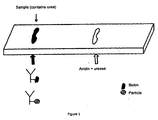
- a corresponding enzyme to refer to an entity that catalysis the chemical reaction with a given substrate. Examples of compositions of the immune complexes that are applied to the solid phase membrane and the test line (i.e. the second position) are illustrated schematically in Figure 1 .
- the first label that is capable of releasing a detectable species is preferably a redox probe, and is preferably encapsulated in a polymer.
- the polymer may be an enteric coating material which dissolves when subjected to a pH change, typically under alkaline conditions, or alternatively it may be a 'smart' stimuli responsive polymer that swells in response to a pH change.
- Suitable enteric polymers include polyvinyl acetate phthalate, hydroxypropyl methylcellulose phthalate, methacrylic acid, cellulose acetate trimellitate, carboxymethyl ethylcellulose and hydroxypropyl methylcellulose acetate succinate.
- Suitable pH-responsive 'smart' polymers include poly(propylacrylic acid) and chitosan.
- Suitable redox probes undergo fast, preferably diffusion-limited, electron exchange at the detector and include complexes of iron, osmium, copper and ruthenium, as well as organic molecules such as flavins and dyes.
- Specific examples include but are not limited to: ferrocene and its derivatives; iron complexes such as hexacyanide; ruthenium complexes such as hexamine; osmium complexes as tris(bipyridyl); thiazine dyes; phenazine dyes; riboflavin and its derivatives; and tetrathiafulvalene and its derivatives. Additional examples will be apparent to those skilled in the art.
- the second binding molecule is preferably labelled with biotin and the molecule that binds to it, and which is immobilised at the second position, is preferably avidin or streptavidin.
- the detector located in close proximity to the immobilised molecule at the second position is preferably positioned below the test line (i.e. at or underneath the second position on the LF membrane).
- the detector is preferably an electrode, and preferably a screen printed electrode.
- the skilled person will be familiar with the term "screen-printed electrode". However, for the avoidance of doubt, this is defined as a conducting carbon ink or metal paste film deposited on an inert support, such as PVC, ceramic, and alumina or polyester, and incorporating reference and counter electrodes.
- the electrode is preferably poised at a potential where there is a diffusion-limited reduction of the redox probe and a minimal background current from the sample.
- the detector must be positioned in sufficiently close proximity to the immobilized molecule at the second position (i.e. the test line) to be able to detect the change in current or charge passed.
- the apparatus and method of the invention may be used for the in vitro quantitative analysis of many analytes including antigens, antibodies, other proteins and the products of nucleic acid amplification tests.
- the test sample may be selected from the following non-limiting group of body samples obtained from a subject or patient: urine; saliva; serum; plasma; whole blood; faeces; and exudates (e.g. from wounds or lesions).
- the sample may be a non-clinical material, such as soil, air, water or food matter.
- the apparatus and method of the invention can be used as a tool to aid diagnosis and patient management.
- the assay can be used to identify, confirm, or rule out disease in symptomatic patients, or to accurately prescribe therapeutic drugs and to monitor treatment, for example to monitor blood sugar levels in diabetic patients or to determine pregnancy.
- Other uses also include in epidemiology, where the rapid assay can be used to detect and monitor the incidence or prevalence of disease for targeting and evaluating health programs, as well as in screening to determine the prevalence of disease in asymptomatic individuals.
- 'subject' and 'patient' are used interchangeably herein and refer to a mammal including a non-primate (e.g. a cow, pig, horse, dog, cat, rat and mouse) and a primate (e.g. a monkey and human), and preferably a human.
- a non-primate e.g. a cow, pig, horse, dog, cat, rat and mouse
- a primate e.g. a monkey and human
- an embodiment of the invention as a lateral flow immunoassay wherein the first and second binding molecules are antibodies, the target analyte is an antigen and the solid phase is a lateral flow membrane.
- the two antibodies Upon addition of the substrate-containing sample, the two antibodies dissolve and form the immune complex which is carried by lateral flow to the test line.
- the immune complex travels with the liquid front and is captured at the test line by the reaction between the biotin component of the immune complex and avidin/streptavidin present in the test line.
- the substrate arrives at the test line there is a local change in pH due to the conversion of the substrate within the test sample. This may be a change to a more acidic environment (i.e. a decrease in pH) to a more alkaline environment (i.e. an increase in pH) depending upon the specific enzyme used.
- the amplified electrochemical reaction that takes place at the test line is illustrated schematically in Figure 2 .
- the substrate-containing sample is preferably urine and the corresponding enzyme is therefore preferably urease.
- the concentration of urea in urine is around 10-20 times the Km value for urease; therefore the enzyme will be running at its maximal rate.
- the change in pH results in the redox probe undergoing reduction and releasing the redox species, which is detected from the current (or charge passed) at the underlying electrode.
- the current resulting from the released redox species is proportional to the antigen content of the sample. Therefore, by measuring the current (or charge passed) at the electrode, the antigen content of the sample can be determined quantitatively.
- Figure 3 illustrates the pH change as a function of the enzymatic reaction between urease and urea in a solution with a low buffering capacity (2mM Tris/HCl buffer).
- the substrate-containing sample may be pyrophosphate and the corresponding enzyme is therefore preferably pyrophosphatase.
- Figure 4 illustrates the pH change as a function of the enzymatic reaction between pyrophosphate and pyrophosphatase in a solution with a low buffering capacity (2mM Tris/HCl buffer with addition of 2mM MgCl 2 ).
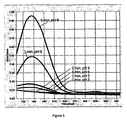
- FIG. 5 The effect of increasing the local pH on release of the first encapsulated label (a redox probe, specifically a ferrocene derivative) is illustrated in Figure 5 .
- This graph shows the spectrophotometric determination of ferrocene carboxylic acid release from polymeric beads as a function of time, at an alkaline pH of 9. As can be seen from the control values, when the pH is maintained at a mildly acidic pH of 5 the polymer does not dissolve and there is no increase in absorbance.
- FIG. 6 illustrates a similar effect, however in this experiment the redox probe is potassium ferricyanate.
- the graph shows the spectrophotometric determination of release of the encapsulated probe from polymeric beads as a function of time, at an alkaline pH of 9. As can be seen from the control values, when the pH is maintained at a mildly acidic pH of 5 the polymer does not dissolve and there is no increase in absorbance.
- Figure 7 illustrates the production of current as a function of the ferrocene carboxylic acid release from the polymeric beads at different time points and at an alkaline test pH of 9 and a mildly acidic control pH of 5.
- the graph shows that at pH 9 more electro-active molecules were released from the polymer beads as a function of polymer dissolution at the elevated pH. This release is reflected in the increase of the detected current. No current increase was observed at pH 5.
Landscapes
- Health & Medical Sciences (AREA)
- Immunology (AREA)
- Life Sciences & Earth Sciences (AREA)
- Engineering & Computer Science (AREA)
- Molecular Biology (AREA)
- Biomedical Technology (AREA)
- Chemical & Material Sciences (AREA)
- Hematology (AREA)
- Urology & Nephrology (AREA)
- Biotechnology (AREA)
- Biochemistry (AREA)
- Cell Biology (AREA)
- Food Science & Technology (AREA)
- Medicinal Chemistry (AREA)
- Physics & Mathematics (AREA)
- Analytical Chemistry (AREA)
- Microbiology (AREA)
- General Health & Medical Sciences (AREA)
- General Physics & Mathematics (AREA)
- Pathology (AREA)
- Measuring Or Testing Involving Enzymes Or Micro-Organisms (AREA)
- Apparatus Associated With Microorganisms And Enzymes (AREA)
- Investigating Or Analysing Biological Materials (AREA)
Applications Claiming Priority (2)
| Application Number | Priority Date | Filing Date | Title |
|---|---|---|---|
| GBGB1112395.7A GB201112395D0 (en) | 2011-07-19 | 2011-07-19 | Immunoassay |
| PCT/GB2012/051733 WO2013011323A2 (en) | 2011-07-19 | 2012-07-19 | Apparatus and method for affinity assays |
Publications (2)
| Publication Number | Publication Date |
|---|---|
| EP2734842A2 EP2734842A2 (en) | 2014-05-28 |
| EP2734842B1 true EP2734842B1 (en) | 2016-01-20 |
Family
ID=44586826
Family Applications (1)
| Application Number | Title | Priority Date | Filing Date |
|---|---|---|---|
| EP12738592.0A Not-in-force EP2734842B1 (en) | 2011-07-19 | 2012-07-19 | Apparatus and method for lateral flow affinity assays |
Country Status (7)
| Country | Link |
|---|---|
| US (1) | US20140248642A1 (https=) |
| EP (1) | EP2734842B1 (https=) |
| JP (1) | JP6053781B2 (https=) |
| DK (1) | DK2734842T3 (https=) |
| ES (1) | ES2567803T3 (https=) |
| GB (1) | GB201112395D0 (https=) |
| WO (1) | WO2013011323A2 (https=) |
Families Citing this family (5)
| Publication number | Priority date | Publication date | Assignee | Title |
|---|---|---|---|---|
| SG11201508541TA (en) | 2013-04-15 | 2015-11-27 | Univ Nanyang Tech | Electrochemical lateral flow bioassay and biosensor |
| US20170285021A1 (en) * | 2014-08-30 | 2017-10-05 | Agency For Science, Technology And Research | A Test Strip For Paper-Based Assay |
| US9678070B2 (en) | 2015-04-29 | 2017-06-13 | Church & Dwight Co., Inc. | Method and apparatus for electrochemical detection |
| EP3735315B1 (en) | 2018-01-05 | 2026-03-04 | SiMPore Inc. | Sample preparation and flow-through sensors using functionalized silicon nanomembranes |
| CN110895283A (zh) * | 2019-12-10 | 2020-03-20 | 宁波奥丞生物科技有限公司 | 一种高灵敏度的d-二聚体检测试剂盒及其使用方法 |
Family Cites Families (12)
| Publication number | Priority date | Publication date | Assignee | Title |
|---|---|---|---|---|
| US4851337A (en) * | 1986-01-08 | 1989-07-25 | Hygeia Sciences, Inc. | Extraction of test substances |
| US5139934A (en) * | 1990-05-25 | 1992-08-18 | Becton, Dickinson And Company | Substrate composition and method for solid phase urease immunoassay |
| EP0700520B1 (en) * | 1993-05-29 | 1997-07-30 | Cambridge Life Sciences Plc | Sensors based on polymer transformation |
| US20050287035A1 (en) * | 1997-06-04 | 2005-12-29 | Bernadette Yon-Hin | Electrode strips for testing small volumes |
| US7348183B2 (en) * | 2000-10-16 | 2008-03-25 | Board Of Trustees Of The University Of Arkansas | Self-contained microelectrochemical bioassay platforms and methods |
| WO2004016160A2 (en) * | 2002-08-19 | 2004-02-26 | Iowa State University Research Foundation, Inc. | Redox polymer nanoparticles |
| US20040106190A1 (en) * | 2002-12-03 | 2004-06-03 | Kimberly-Clark Worldwide, Inc. | Flow-through assay devices |
| US20050112703A1 (en) * | 2003-11-21 | 2005-05-26 | Kimberly-Clark Worldwide, Inc. | Membrane-based lateral flow assay devices that utilize phosphorescent detection |
| JP4007606B2 (ja) * | 2004-02-03 | 2007-11-14 | キヤノン株式会社 | センサおよび検出方法 |
| US8003407B2 (en) * | 2004-07-29 | 2011-08-23 | Relia Diagnostic Systems, Llc | Lateral flow system and assay |
| US7776618B2 (en) | 2007-03-01 | 2010-08-17 | Church & Dwight Co., Inc. | Diagnostic detection device |
| US20090071823A1 (en) * | 2007-08-10 | 2009-03-19 | Conopco, Inc. D/B/A Unilever | Disposable enzymatic sensor for liquid samples |
-
2011
- 2011-07-19 GB GBGB1112395.7A patent/GB201112395D0/en not_active Ceased
-
2012
- 2012-07-19 US US14/233,233 patent/US20140248642A1/en not_active Abandoned
- 2012-07-19 DK DK12738592.0T patent/DK2734842T3/en active
- 2012-07-19 JP JP2014520730A patent/JP6053781B2/ja not_active Expired - Fee Related
- 2012-07-19 WO PCT/GB2012/051733 patent/WO2013011323A2/en not_active Ceased
- 2012-07-19 ES ES12738592.0T patent/ES2567803T3/es active Active
- 2012-07-19 EP EP12738592.0A patent/EP2734842B1/en not_active Not-in-force
Also Published As
| Publication number | Publication date |
|---|---|
| JP6053781B2 (ja) | 2016-12-27 |
| GB201112395D0 (en) | 2011-08-31 |
| DK2734842T3 (en) | 2016-04-11 |
| ES2567803T3 (es) | 2016-04-26 |
| JP2014521102A (ja) | 2014-08-25 |
| WO2013011323A3 (en) | 2013-03-07 |
| EP2734842A2 (en) | 2014-05-28 |
| WO2013011323A2 (en) | 2013-01-24 |
| US20140248642A1 (en) | 2014-09-04 |
Similar Documents
| Publication | Publication Date | Title |
|---|---|---|
| Cao et al. | A disposable paper-based microfluidic immunosensor based on reduced graphene oxide-tetraethylene pentamine/Au nanocomposite decorated carbon screen-printed electrodes | |
| Boonkaew et al. | Electrochemical paper-based analytical device for multiplexed, point-of-care detection of cardiovascular disease biomarkers | |
| Shekari et al. | Dual assaying of breast cancer biomarkers by using a sandwich–type electrochemical aptasensor based on a gold nanoparticles–3D graphene hydrogel nanocomposite and redox probes labeled aptamers | |
| Ge et al. | Nanomaterial-enhanced paper-based biosensors | |
| Lin et al. | A nanoparticle label/immunochromatographic electrochemical biosensor for rapid and sensitive detection of prostate-specific antigen | |
| Liu et al. | Disposable electrochemical immunosensor diagnosis device based on nanoparticle probe and immunochromatographic strip | |
| Wilson | Electrochemical immunosensors for the simultaneous detection of two tumor markers | |
| Zhang et al. | Multiplexed sandwich immunoassays using flow-injection electrochemiluminescence with designed substrate spatial-resolved technique for detection of tumor markers | |
| Jia et al. | Triple signal amplification using gold nanoparticles, bienzyme and platinum nanoparticles functionalized graphene as enhancers for simultaneous multiple electrochemical immunoassay | |
| US8198039B2 (en) | Biosensors and related methods | |
| Nourani et al. | Magnetic nanoparticle-based immunosensor for electrochemical detection of hepatitis B surface antigen | |
| Simão et al. | Nanostructured electrochemical immunosensor for detection of serological alkaline phosphatase | |
| EP2734842B1 (en) | Apparatus and method for lateral flow affinity assays | |
| Zhu et al. | Low-sample-consumption and ultrasensitive detection of procalcitonin by boronate affinity recognition-enhanced dynamic light scattering biosensor | |
| Nian et al. | Electrochemical immunoassay of cotinine in serum based on nanoparticle probe and immunochromatographic strip | |
| Wang et al. | A novel impedance enhancer for amperometric biosensor based ultrasensitive detection of matrix metalloproteinase-2 | |
| Dong et al. | Universal all-in-one lateral flow immunoassay with triple signal amplification for ultrasensitive and simple self-testing of Treponema pallidum antibodies | |
| Osaki et al. | Optimization of electrochemical analysis for signal amplification in gold nanoparticle-probed immunoassays | |
| US20230221311A1 (en) | Method for detecting an analyte with the help of metal nanoparticles on an electrode | |
| CN106353500A (zh) | 一种多肿瘤标志物无标记化学发光成像免疫传感器的制备及分析方法 | |
| Luo et al. | Label-free paper-based immunosensor with graphene nanocomposites for electrochemical detection of follicle-stimulating hormone | |
| Deng et al. | A novel potentiometric immunoassay for carcinoma antigen 15-3 by coupling enzymatic biocatalytic precipitation with a nanogold labelling strategy | |
| Chang et al. | Competitive electrochemical immunosensors by immobilization of hexahistidine-rich recombinant proteins on the signal labels | |
| Kaur et al. | A Rapid Electrochemical Immunosensor Platform for the Sepsis-Associated Host and Pathogen Marker Dual Detection | |
| US9678070B2 (en) | Method and apparatus for electrochemical detection |
Legal Events
| Date | Code | Title | Description |
|---|---|---|---|
| PUAI | Public reference made under article 153(3) epc to a published international application that has entered the european phase |
Free format text: ORIGINAL CODE: 0009012 |
|
| 17P | Request for examination filed |
Effective date: 20140207 |
|
| AK | Designated contracting states |
Kind code of ref document: A2 Designated state(s): AL AT BE BG CH CY CZ DE DK EE ES FI FR GB GR HR HU IE IS IT LI LT LU LV MC MK MT NL NO PL PT RO RS SE SI SK SM TR |
|
| DAX | Request for extension of the european patent (deleted) | ||
| RIN1 | Information on inventor provided before grant (corrected) |
Inventor name: CASS, ANTHONY EDWARD GEORGE Inventor name: CELAYA SANFIZ, ALMUDENA Inventor name: REHAK, MARIAN |
|
| GRAP | Despatch of communication of intention to grant a patent |
Free format text: ORIGINAL CODE: EPIDOSNIGR1 |
|
| INTG | Intention to grant announced |
Effective date: 20150417 |
|
| RAP1 | Party data changed (applicant data changed or rights of an application transferred) |
Owner name: THE BIO NANO CENTRE LIMITED |
|
| GRAP | Despatch of communication of intention to grant a patent |
Free format text: ORIGINAL CODE: EPIDOSNIGR1 |
|
| INTG | Intention to grant announced |
Effective date: 20150723 |
|
| GRAS | Grant fee paid |
Free format text: ORIGINAL CODE: EPIDOSNIGR3 |
|
| GRAA | (expected) grant |
Free format text: ORIGINAL CODE: 0009210 |
|
| AK | Designated contracting states |
Kind code of ref document: B1 Designated state(s): AL AT BE BG CH CY CZ DE DK EE ES FI FR GB GR HR HU IE IS IT LI LT LU LV MC MK MT NL NO PL PT RO RS SE SI SK SM TR |
|
| REG | Reference to a national code |
Ref country code: GB Ref legal event code: FG4D |
|
| REG | Reference to a national code |
Ref country code: CH Ref legal event code: EP |
|
| REG | Reference to a national code |
Ref country code: IE Ref legal event code: FG4D |
|
| REG | Reference to a national code |
Ref country code: AT Ref legal event code: REF Ref document number: 771974 Country of ref document: AT Kind code of ref document: T Effective date: 20160215 |
|
| REG | Reference to a national code |
Ref country code: DE Ref legal event code: R096 Ref document number: 602012014141 Country of ref document: DE |
|
| REG | Reference to a national code |
Ref country code: DK Ref legal event code: T3 Effective date: 20160404 |
|
| REG | Reference to a national code |
Ref country code: SE Ref legal event code: TRGR Ref country code: ES Ref legal event code: FG2A Ref document number: 2567803 Country of ref document: ES Kind code of ref document: T3 Effective date: 20160426 |
|
| REG | Reference to a national code |
Ref country code: NL Ref legal event code: FP |
|
| REG | Reference to a national code |
Ref country code: LT Ref legal event code: MG4D |
|
| REG | Reference to a national code |
Ref country code: FR Ref legal event code: PLFP Year of fee payment: 5 |
|
| PG25 | Lapsed in a contracting state [announced via postgrant information from national office to epo] |
Ref country code: GR Free format text: LAPSE BECAUSE OF FAILURE TO SUBMIT A TRANSLATION OF THE DESCRIPTION OR TO PAY THE FEE WITHIN THE PRESCRIBED TIME-LIMIT Effective date: 20160421 Ref country code: HR Free format text: LAPSE BECAUSE OF FAILURE TO SUBMIT A TRANSLATION OF THE DESCRIPTION OR TO PAY THE FEE WITHIN THE PRESCRIBED TIME-LIMIT Effective date: 20160120 Ref country code: NO Free format text: LAPSE BECAUSE OF FAILURE TO SUBMIT A TRANSLATION OF THE DESCRIPTION OR TO PAY THE FEE WITHIN THE PRESCRIBED TIME-LIMIT Effective date: 20160420 |
|
| PG25 | Lapsed in a contracting state [announced via postgrant information from national office to epo] |
Ref country code: LV Free format text: LAPSE BECAUSE OF FAILURE TO SUBMIT A TRANSLATION OF THE DESCRIPTION OR TO PAY THE FEE WITHIN THE PRESCRIBED TIME-LIMIT Effective date: 20160120 Ref country code: IS Free format text: LAPSE BECAUSE OF FAILURE TO SUBMIT A TRANSLATION OF THE DESCRIPTION OR TO PAY THE FEE WITHIN THE PRESCRIBED TIME-LIMIT Effective date: 20160520 Ref country code: RS Free format text: LAPSE BECAUSE OF FAILURE TO SUBMIT A TRANSLATION OF THE DESCRIPTION OR TO PAY THE FEE WITHIN THE PRESCRIBED TIME-LIMIT Effective date: 20160120 Ref country code: PL Free format text: LAPSE BECAUSE OF FAILURE TO SUBMIT A TRANSLATION OF THE DESCRIPTION OR TO PAY THE FEE WITHIN THE PRESCRIBED TIME-LIMIT Effective date: 20160120 Ref country code: LT Free format text: LAPSE BECAUSE OF FAILURE TO SUBMIT A TRANSLATION OF THE DESCRIPTION OR TO PAY THE FEE WITHIN THE PRESCRIBED TIME-LIMIT Effective date: 20160120 Ref country code: PT Free format text: LAPSE BECAUSE OF FAILURE TO SUBMIT A TRANSLATION OF THE DESCRIPTION OR TO PAY THE FEE WITHIN THE PRESCRIBED TIME-LIMIT Effective date: 20160520 |
|
| REG | Reference to a national code |
Ref country code: DE Ref legal event code: R097 Ref document number: 602012014141 Country of ref document: DE |
|
| PG25 | Lapsed in a contracting state [announced via postgrant information from national office to epo] |
Ref country code: EE Free format text: LAPSE BECAUSE OF FAILURE TO SUBMIT A TRANSLATION OF THE DESCRIPTION OR TO PAY THE FEE WITHIN THE PRESCRIBED TIME-LIMIT Effective date: 20160120 |
|
| PLBE | No opposition filed within time limit |
Free format text: ORIGINAL CODE: 0009261 |
|
| STAA | Information on the status of an ep patent application or granted ep patent |
Free format text: STATUS: NO OPPOSITION FILED WITHIN TIME LIMIT |
|
| PG25 | Lapsed in a contracting state [announced via postgrant information from national office to epo] |
Ref country code: SM Free format text: LAPSE BECAUSE OF FAILURE TO SUBMIT A TRANSLATION OF THE DESCRIPTION OR TO PAY THE FEE WITHIN THE PRESCRIBED TIME-LIMIT Effective date: 20160120 Ref country code: SK Free format text: LAPSE BECAUSE OF FAILURE TO SUBMIT A TRANSLATION OF THE DESCRIPTION OR TO PAY THE FEE WITHIN THE PRESCRIBED TIME-LIMIT Effective date: 20160120 Ref country code: RO Free format text: LAPSE BECAUSE OF FAILURE TO SUBMIT A TRANSLATION OF THE DESCRIPTION OR TO PAY THE FEE WITHIN THE PRESCRIBED TIME-LIMIT Effective date: 20160120 |
|
| 26N | No opposition filed |
Effective date: 20161021 |
|
| PG25 | Lapsed in a contracting state [announced via postgrant information from national office to epo] |
Ref country code: SI Free format text: LAPSE BECAUSE OF FAILURE TO SUBMIT A TRANSLATION OF THE DESCRIPTION OR TO PAY THE FEE WITHIN THE PRESCRIBED TIME-LIMIT Effective date: 20160120 Ref country code: BG Free format text: LAPSE BECAUSE OF FAILURE TO SUBMIT A TRANSLATION OF THE DESCRIPTION OR TO PAY THE FEE WITHIN THE PRESCRIBED TIME-LIMIT Effective date: 20160420 |
|
| PG25 | Lapsed in a contracting state [announced via postgrant information from national office to epo] |
Ref country code: MC Free format text: LAPSE BECAUSE OF FAILURE TO SUBMIT A TRANSLATION OF THE DESCRIPTION OR TO PAY THE FEE WITHIN THE PRESCRIBED TIME-LIMIT Effective date: 20160120 |
|
| REG | Reference to a national code |
Ref country code: FR Ref legal event code: PLFP Year of fee payment: 6 |
|
| PG25 | Lapsed in a contracting state [announced via postgrant information from national office to epo] |
Ref country code: LU Free format text: LAPSE BECAUSE OF NON-PAYMENT OF DUE FEES Effective date: 20160719 |
|
| PG25 | Lapsed in a contracting state [announced via postgrant information from national office to epo] |
Ref country code: CY Free format text: LAPSE BECAUSE OF FAILURE TO SUBMIT A TRANSLATION OF THE DESCRIPTION OR TO PAY THE FEE WITHIN THE PRESCRIBED TIME-LIMIT Effective date: 20160120 Ref country code: HU Free format text: LAPSE BECAUSE OF FAILURE TO SUBMIT A TRANSLATION OF THE DESCRIPTION OR TO PAY THE FEE WITHIN THE PRESCRIBED TIME-LIMIT; INVALID AB INITIO Effective date: 20120719 |
|
| REG | Reference to a national code |
Ref country code: FR Ref legal event code: PLFP Year of fee payment: 7 |
|
| PG25 | Lapsed in a contracting state [announced via postgrant information from national office to epo] |
Ref country code: MK Free format text: LAPSE BECAUSE OF FAILURE TO SUBMIT A TRANSLATION OF THE DESCRIPTION OR TO PAY THE FEE WITHIN THE PRESCRIBED TIME-LIMIT Effective date: 20160120 Ref country code: MT Free format text: LAPSE BECAUSE OF NON-PAYMENT OF DUE FEES Effective date: 20160731 |
|
| PG25 | Lapsed in a contracting state [announced via postgrant information from national office to epo] |
Ref country code: AL Free format text: LAPSE BECAUSE OF FAILURE TO SUBMIT A TRANSLATION OF THE DESCRIPTION OR TO PAY THE FEE WITHIN THE PRESCRIBED TIME-LIMIT Effective date: 20160120 Ref country code: TR Free format text: LAPSE BECAUSE OF FAILURE TO SUBMIT A TRANSLATION OF THE DESCRIPTION OR TO PAY THE FEE WITHIN THE PRESCRIBED TIME-LIMIT Effective date: 20160120 |
|
| REG | Reference to a national code |
Ref country code: AT Ref legal event code: UEP Ref document number: 771974 Country of ref document: AT Kind code of ref document: T Effective date: 20160120 |
|
| PGFP | Annual fee paid to national office [announced via postgrant information from national office to epo] |
Ref country code: NL Payment date: 20210906 Year of fee payment: 10 Ref country code: FI Payment date: 20210824 Year of fee payment: 10 Ref country code: AT Payment date: 20210825 Year of fee payment: 10 Ref country code: CZ Payment date: 20210818 Year of fee payment: 10 Ref country code: IE Payment date: 20210824 Year of fee payment: 10 Ref country code: IT Payment date: 20210826 Year of fee payment: 10 |
|
| PGFP | Annual fee paid to national office [announced via postgrant information from national office to epo] |
Ref country code: ES Payment date: 20210826 Year of fee payment: 10 Ref country code: DK Payment date: 20210826 Year of fee payment: 10 Ref country code: SE Payment date: 20210826 Year of fee payment: 10 Ref country code: CH Payment date: 20210816 Year of fee payment: 10 Ref country code: BE Payment date: 20210817 Year of fee payment: 10 |
|
| PGFP | Annual fee paid to national office [announced via postgrant information from national office to epo] |
Ref country code: FR Payment date: 20220510 Year of fee payment: 11 |
|
| PGFP | Annual fee paid to national office [announced via postgrant information from national office to epo] |
Ref country code: DE Payment date: 20220524 Year of fee payment: 11 |
|
| REG | Reference to a national code |
Ref country code: DK Ref legal event code: EBP Effective date: 20220731 |
|
| REG | Reference to a national code |
Ref country code: CH Ref legal event code: PL Ref country code: SE Ref legal event code: EUG |
|
| REG | Reference to a national code |
Ref country code: NL Ref legal event code: MM Effective date: 20220801 |
|
| REG | Reference to a national code |
Ref country code: AT Ref legal event code: MM01 Ref document number: 771974 Country of ref document: AT Kind code of ref document: T Effective date: 20220719 |
|
| REG | Reference to a national code |
Ref country code: BE Ref legal event code: MM Effective date: 20220731 |
|
| PG25 | Lapsed in a contracting state [announced via postgrant information from national office to epo] |
Ref country code: SE Free format text: LAPSE BECAUSE OF NON-PAYMENT OF DUE FEES Effective date: 20220720 Ref country code: LI Free format text: LAPSE BECAUSE OF NON-PAYMENT OF DUE FEES Effective date: 20220731 Ref country code: FI Free format text: LAPSE BECAUSE OF NON-PAYMENT OF DUE FEES Effective date: 20220719 Ref country code: CZ Free format text: LAPSE BECAUSE OF NON-PAYMENT OF DUE FEES Effective date: 20220719 Ref country code: CH Free format text: LAPSE BECAUSE OF NON-PAYMENT OF DUE FEES Effective date: 20220731 Ref country code: AT Free format text: LAPSE BECAUSE OF NON-PAYMENT OF DUE FEES Effective date: 20220719 |
|
| PG25 | Lapsed in a contracting state [announced via postgrant information from national office to epo] |
Ref country code: BE Free format text: LAPSE BECAUSE OF NON-PAYMENT OF DUE FEES Effective date: 20220731 |
|
| PG25 | Lapsed in a contracting state [announced via postgrant information from national office to epo] |
Ref country code: NL Free format text: LAPSE BECAUSE OF NON-PAYMENT OF DUE FEES Effective date: 20220801 |
|
| PG25 | Lapsed in a contracting state [announced via postgrant information from national office to epo] |
Ref country code: IT Free format text: LAPSE BECAUSE OF NON-PAYMENT OF DUE FEES Effective date: 20220719 Ref country code: IE Free format text: LAPSE BECAUSE OF NON-PAYMENT OF DUE FEES Effective date: 20220719 Ref country code: DK Free format text: LAPSE BECAUSE OF NON-PAYMENT OF DUE FEES Effective date: 20220731 |
|
| REG | Reference to a national code |
Ref country code: ES Ref legal event code: FD2A Effective date: 20230904 |
|
| PG25 | Lapsed in a contracting state [announced via postgrant information from national office to epo] |
Ref country code: ES Free format text: LAPSE BECAUSE OF NON-PAYMENT OF DUE FEES Effective date: 20220720 |
|
| REG | Reference to a national code |
Ref country code: DE Ref legal event code: R119 Ref document number: 602012014141 Country of ref document: DE |
|
| GBPC | Gb: european patent ceased through non-payment of renewal fee |
Effective date: 20230719 |
|
| PG25 | Lapsed in a contracting state [announced via postgrant information from national office to epo] |
Ref country code: DE Free format text: LAPSE BECAUSE OF NON-PAYMENT OF DUE FEES Effective date: 20240201 Ref country code: GB Free format text: LAPSE BECAUSE OF NON-PAYMENT OF DUE FEES Effective date: 20230719 |
|
| REG | Reference to a national code |
Ref country code: GB Ref legal event code: S28 Free format text: APPLICATION FILED |
|
| PG25 | Lapsed in a contracting state [announced via postgrant information from national office to epo] |
Ref country code: FR Free format text: LAPSE BECAUSE OF NON-PAYMENT OF DUE FEES Effective date: 20230731 |
|
| REG | Reference to a national code |
Ref country code: GB Ref legal event code: S28 Free format text: RESTORATION ALLOWED Effective date: 20240531 |
|
| PGFP | Annual fee paid to national office [announced via postgrant information from national office to epo] |
Ref country code: GB Payment date: 20240522 Year of fee payment: 13 |
|
| GBPC | Gb: european patent ceased through non-payment of renewal fee |
Effective date: 20250719 |
|
| PG25 | Lapsed in a contracting state [announced via postgrant information from national office to epo] |
Ref country code: GB Free format text: LAPSE BECAUSE OF NON-PAYMENT OF DUE FEES Effective date: 20250719 |