EP2734205B1 - Heterocyclic protein kinase inhibitors - Google Patents
Heterocyclic protein kinase inhibitors Download PDFInfo
- Publication number
- EP2734205B1 EP2734205B1 EP12815055.4A EP12815055A EP2734205B1 EP 2734205 B1 EP2734205 B1 EP 2734205B1 EP 12815055 A EP12815055 A EP 12815055A EP 2734205 B1 EP2734205 B1 EP 2734205B1
- Authority
- EP
- European Patent Office
- Prior art keywords
- mmol
- cancer
- compound
- mixture
- imidazo
- Prior art date
- Legal status (The legal status is an assumption and is not a legal conclusion. Google has not performed a legal analysis and makes no representation as to the accuracy of the status listed.)
- Active
Links
- 0 N[C@]1CC[C@](*c(cc[n]2nc3)nc2c3-c2cc(Cl)ccc2)CC1 Chemical compound N[C@]1CC[C@](*c(cc[n]2nc3)nc2c3-c2cc(Cl)ccc2)CC1 0.000 description 3
- DRKBDDUOHKJNIP-QUWSVYMGSA-N C[C@](CC1)(CC[C@H]1Nc1c[n]2c(-c3cc(OC(F)(F)F)ccc3)nnc2cc1)O Chemical compound C[C@](CC1)(CC[C@H]1Nc1c[n]2c(-c3cc(OC(F)(F)F)ccc3)nnc2cc1)O DRKBDDUOHKJNIP-QUWSVYMGSA-N 0.000 description 2
- FIVIBNBLEJQDQK-UHFFFAOYSA-N CC(C)(C(CC1)CCC1Nc(cc[n]1nc2)nc1c2-c1cc(OC(F)(F)F)ccc1)O Chemical compound CC(C)(C(CC1)CCC1Nc(cc[n]1nc2)nc1c2-c1cc(OC(F)(F)F)ccc1)O FIVIBNBLEJQDQK-UHFFFAOYSA-N 0.000 description 1
- IUGMKNUWVITXNR-UHFFFAOYSA-O CC(C)(C(CC1)CCC1[NH3+])O Chemical compound CC(C)(C(CC1)CCC1[NH3+])O IUGMKNUWVITXNR-UHFFFAOYSA-O 0.000 description 1
- FPOOBLUDOKRHTK-UHFFFAOYSA-N CC(C)(C(N1CCC(CNc(cc2)n[n]3c2ncc3-c2cccc(OC(F)(F)F)c2)CC1)=O)O Chemical compound CC(C)(C(N1CCC(CNc(cc2)n[n]3c2ncc3-c2cccc(OC(F)(F)F)c2)CC1)=O)O FPOOBLUDOKRHTK-UHFFFAOYSA-N 0.000 description 1
- GXCZUNMVXPJIFR-UHFFFAOYSA-N CC(C)(CCNc(cc1)n[n]2c1ncc2-c1cccc(OC(F)(F)F)c1)O Chemical compound CC(C)(CCNc(cc1)n[n]2c1ncc2-c1cccc(OC(F)(F)F)c1)O GXCZUNMVXPJIFR-UHFFFAOYSA-N 0.000 description 1
- LTKKGHAPQYJRCK-JCNLHEQBSA-N CC(C)([C@H](CC1)CC[C@@H]1Nc(cc1)n[n]2c1ncc2-c1cc(F)ccc1)O Chemical compound CC(C)([C@H](CC1)CC[C@@H]1Nc(cc1)n[n]2c1ncc2-c1cc(F)ccc1)O LTKKGHAPQYJRCK-JCNLHEQBSA-N 0.000 description 1
- NMIBDYYYDQCKBY-WKILWMFISA-N CC(C)([C@H](CC1)CC[C@@H]1Nc(cc1)n[n]2c1ncc2-c1cc(OC(F)(F)F)ccc1)O Chemical compound CC(C)([C@H](CC1)CC[C@@H]1Nc(cc1)n[n]2c1ncc2-c1cc(OC(F)(F)F)ccc1)O NMIBDYYYDQCKBY-WKILWMFISA-N 0.000 description 1
- FSQNGXYJUMATLF-JCNLHEQBSA-N CC(C)([C@H](CC1)CC[C@@H]1Nc(cc[n]1nc2)nc1c2-c1cc(C(F)(F)F)ccc1)O Chemical compound CC(C)([C@H](CC1)CC[C@@H]1Nc(cc[n]1nc2)nc1c2-c1cc(C(F)(F)F)ccc1)O FSQNGXYJUMATLF-JCNLHEQBSA-N 0.000 description 1
- BEGBEWMECAKSHX-JCNLHEQBSA-N CC(C)([C@H](CC1)CC[C@@H]1Nc1c[n]2c(-c3cc(C(F)(F)F)ccc3)nnc2cc1)O Chemical compound CC(C)([C@H](CC1)CC[C@@H]1Nc1c[n]2c(-c3cc(C(F)(F)F)ccc3)nnc2cc1)O BEGBEWMECAKSHX-JCNLHEQBSA-N 0.000 description 1
- QSBTYAYHRUDFNL-KYZUINATSA-N CC(C)([C@H](CC1)CC[C@@H]1OC)O Chemical compound CC(C)([C@H](CC1)CC[C@@H]1OC)O QSBTYAYHRUDFNL-KYZUINATSA-N 0.000 description 1
- BYISLERDLFBHEJ-JCNLHEQBSA-N CC(C)([C@H](CC1)CC[C@@H]1Oc(cc1)n[n]2c1ncc2-c1cc(Cl)ccc1)O Chemical compound CC(C)([C@H](CC1)CC[C@@H]1Oc(cc1)n[n]2c1ncc2-c1cc(Cl)ccc1)O BYISLERDLFBHEJ-JCNLHEQBSA-N 0.000 description 1
- VHKPSLFBOSSRNO-GDBMZVCRSA-N CC(C)([C@H](CC1)C[C@@H]1Nc(cc1)n[n]2c1ncc2-c1cccc(Cl)c1)O Chemical compound CC(C)([C@H](CC1)C[C@@H]1Nc(cc1)n[n]2c1ncc2-c1cccc(Cl)c1)O VHKPSLFBOSSRNO-GDBMZVCRSA-N 0.000 description 1
- HQBDNWLHCUWEJY-UHFFFAOYSA-N CC(CC1)(CCC1Nc(cc[n]1nc2)nc1c2-c1cc(Cl)ccc1)O Chemical compound CC(CC1)(CCC1Nc(cc[n]1nc2)nc1c2-c1cc(Cl)ccc1)O HQBDNWLHCUWEJY-UHFFFAOYSA-N 0.000 description 1
- BZKQJSLASWRDNE-ZKCHVHJHSA-N CCOC([C@H](CC1)CC[C@@H]1O)=O Chemical compound CCOC([C@H](CC1)CC[C@@H]1O)=O BZKQJSLASWRDNE-ZKCHVHJHSA-N 0.000 description 1
- YQMZDUSQOPSHEA-UHFFFAOYSA-N CN(C)CC(N1CCC(CNc(cc2)n[n]3c2ncc3-c2cccc(OC(F)(F)F)c2)CC1)=O Chemical compound CN(C)CC(N1CCC(CNc(cc2)n[n]3c2ncc3-c2cccc(OC(F)(F)F)c2)CC1)=O YQMZDUSQOPSHEA-UHFFFAOYSA-N 0.000 description 1
- OMJKFWFDNIIACS-LJGSYFOKSA-N CN[C@H](CC1)CC[C@@H]1O Chemical compound CN[C@H](CC1)CC[C@@H]1O OMJKFWFDNIIACS-LJGSYFOKSA-N 0.000 description 1
- HHRFSNJVCPRJOW-UHFFFAOYSA-N COCCOc(cc1)n[n]2c1ncc2-c1cc(OC(F)(F)F)ccc1 Chemical compound COCCOc(cc1)n[n]2c1ncc2-c1cc(OC(F)(F)F)ccc1 HHRFSNJVCPRJOW-UHFFFAOYSA-N 0.000 description 1
- TVVMWWRPWKWQQW-AABCQZNVSA-N CO[C@H](CC1)CC/C1=N/c(cc1)n[n]2c1ncc2-c1cc(Cl)ccc1 Chemical compound CO[C@H](CC1)CC/C1=N/c(cc1)n[n]2c1ncc2-c1cc(Cl)ccc1 TVVMWWRPWKWQQW-AABCQZNVSA-N 0.000 description 1
- HLNDIWMNQHSGRA-WKILWMFISA-N CO[C@H](CC1)CC[C@@H]1Nc(cc1)n[n]2c1ncc2-c1cccc(C(F)(F)F)c1 Chemical compound CO[C@H](CC1)CC[C@@H]1Nc(cc1)n[n]2c1ncc2-c1cccc(C(F)(F)F)c1 HLNDIWMNQHSGRA-WKILWMFISA-N 0.000 description 1
- OQJHUFMYQSOHFU-WKILWMFISA-N CO[C@H](CC1)CC[C@@H]1Nc(cc[n]1nc2)nc1c2-c1cc(C(F)(F)F)ccc1 Chemical compound CO[C@H](CC1)CC[C@@H]1Nc(cc[n]1nc2)nc1c2-c1cc(C(F)(F)F)ccc1 OQJHUFMYQSOHFU-WKILWMFISA-N 0.000 description 1
- GZUHKZVVKCGMFG-SHTZXODSSA-N CS(N[C@H](CC1)CC[C@@H]1Nc(cc1)n[n]2c1ncc2-c1cc(OC(F)(F)F)ccc1)(=O)=O Chemical compound CS(N[C@H](CC1)CC[C@@H]1Nc(cc1)n[n]2c1ncc2-c1cc(OC(F)(F)F)ccc1)(=O)=O GZUHKZVVKCGMFG-SHTZXODSSA-N 0.000 description 1
- DDINLXKZAICDAS-LPANUZLBSA-N C[C@](CC1)(CC/C1=N/c(cc1)n[n]2c1ncc2-c1cc(OC(F)(F)F)ccc1)O Chemical compound C[C@](CC1)(CC/C1=N/c(cc1)n[n]2c1ncc2-c1cc(OC(F)(F)F)ccc1)O DDINLXKZAICDAS-LPANUZLBSA-N 0.000 description 1
- OEQGSMAROCJMFY-UHFFFAOYSA-N Clc1cccc(-c2cnc(cc3)[n]2nc3Cl)c1 Chemical compound Clc1cccc(-c2cnc(cc3)[n]2nc3Cl)c1 OEQGSMAROCJMFY-UHFFFAOYSA-N 0.000 description 1
- UOWNIZQQIBFCJF-UHFFFAOYSA-N FC(Oc1cc(-c2cnc(cc3)[n]2nc3Cl)ccc1)(F)F Chemical compound FC(Oc1cc(-c2cnc(cc3)[n]2nc3Cl)ccc1)(F)F UOWNIZQQIBFCJF-UHFFFAOYSA-N 0.000 description 1
- AUOKUOLENNHANL-UHFFFAOYSA-N FC(Oc1cc(-c2cnc(cc3)[n]2nc3NCC2CCNCC2)ccc1)(F)F Chemical compound FC(Oc1cc(-c2cnc(cc3)[n]2nc3NCC2CCNCC2)ccc1)(F)F AUOKUOLENNHANL-UHFFFAOYSA-N 0.000 description 1
- UDNLNKGTGCEELU-UHFFFAOYSA-N FC(Oc1cccc(-c2cnc(cc3)[n]2nc3NCC2CCSCC2)c1)(F)F Chemical compound FC(Oc1cccc(-c2cnc(cc3)[n]2nc3NCC2CCSCC2)c1)(F)F UDNLNKGTGCEELU-UHFFFAOYSA-N 0.000 description 1
- SSXPZXJQITXPKU-UHFFFAOYSA-N FC(c1cc(-c2cnc(cc3)[n]2nc3NC2CCOCC2)ccc1)(F)F Chemical compound FC(c1cc(-c2cnc(cc3)[n]2nc3NC2CCOCC2)ccc1)(F)F SSXPZXJQITXPKU-UHFFFAOYSA-N 0.000 description 1
- HEAKBVRPNWMRHN-UHFFFAOYSA-N FC(c1cccc(-c2nnc(cc3)[n]2cc3NC2CCOCC2)c1)(F)F Chemical compound FC(c1cccc(-c2nnc(cc3)[n]2cc3NC2CCOCC2)c1)(F)F HEAKBVRPNWMRHN-UHFFFAOYSA-N 0.000 description 1
- GDPPKOWXZGFJLI-UHFFFAOYSA-N N#CC1CCN(CCO)CC1 Chemical compound N#CC1CCN(CCO)CC1 GDPPKOWXZGFJLI-UHFFFAOYSA-N 0.000 description 1
- FSDNTQSJGHSJBG-UHFFFAOYSA-N N#CC1CCNCC1 Chemical compound N#CC1CCNCC1 FSDNTQSJGHSJBG-UHFFFAOYSA-N 0.000 description 1
- GQPNNQUKJKTMAC-SXNXEAAASA-N N#C[C@H](CC1)CC/C1=N/c(cc1)n[n]2c1ncc2-c1cccc(Cl)c1 Chemical compound N#C[C@H](CC1)CC/C1=N/c(cc1)n[n]2c1ncc2-c1cccc(Cl)c1 GQPNNQUKJKTMAC-SXNXEAAASA-N 0.000 description 1
- IALLAFCBZHMLLB-SAZUREKKSA-N N#C[C@H](CC1)CC[C@@H]1Nc(cc1)n[n]2c1ncc2-c1cccc(Cl)c1 Chemical compound N#C[C@H](CC1)CC[C@@H]1Nc(cc1)n[n]2c1ncc2-c1cccc(Cl)c1 IALLAFCBZHMLLB-SAZUREKKSA-N 0.000 description 1
- ITGMTNOYOPHQAE-UHFFFAOYSA-N NC(CC1)CCC1C#N Chemical compound NC(CC1)CCC1C#N ITGMTNOYOPHQAE-UHFFFAOYSA-N 0.000 description 1
- IZGWUVLRSMIWRT-NNUKFRKNSA-N NC([C@H](CC1)CC[C@@H]1Nc(cc1)n[n]2c1ncc2-c1cc(Cl)ccc1)=N Chemical compound NC([C@H](CC1)CC[C@@H]1Nc(cc1)n[n]2c1ncc2-c1cc(Cl)ccc1)=N IZGWUVLRSMIWRT-NNUKFRKNSA-N 0.000 description 1
- VKMYXOQRUXXUHE-UHFFFAOYSA-N NCC1CCN(CCO)CC1 Chemical compound NCC1CCN(CCO)CC1 VKMYXOQRUXXUHE-UHFFFAOYSA-N 0.000 description 1
- WPMKCHOCXWTADK-HDJSIYSDSA-N N[C@H](CC1)CC[C@@H]1Nc(cc[n]1nc2)nc1c2-c1cc(OC(F)(F)F)ccc1 Chemical compound N[C@H](CC1)CC[C@@H]1Nc(cc[n]1nc2)nc1c2-c1cc(OC(F)(F)F)ccc1 WPMKCHOCXWTADK-HDJSIYSDSA-N 0.000 description 1
- FAYOEAWYPGERMJ-UHFFFAOYSA-N O=C(CC1)CCC1Nc(cc[n]1nc2)nc1c2-c1cc(Cl)ccc1 Chemical compound O=C(CC1)CCC1Nc(cc[n]1nc2)nc1c2-c1cc(Cl)ccc1 FAYOEAWYPGERMJ-UHFFFAOYSA-N 0.000 description 1
- QXKOUGZSCPCVLJ-UHFFFAOYSA-N O=S(CC1)(CCN1c(cc[n]1nc2)nc1c2-c1cc(C(F)(F)F)ccc1)=O Chemical compound O=S(CC1)(CCN1c(cc[n]1nc2)nc1c2-c1cc(C(F)(F)F)ccc1)=O QXKOUGZSCPCVLJ-UHFFFAOYSA-N 0.000 description 1
- ZDVNPROQTYCTSR-SHTZXODSSA-N O=SN[C@H](CC1)CC[C@@H]1Nc(cc1)n[n]2c1ncc2-c1cc(Cl)ccc1 Chemical compound O=SN[C@H](CC1)CC[C@@H]1Nc(cc1)n[n]2c1ncc2-c1cc(Cl)ccc1 ZDVNPROQTYCTSR-SHTZXODSSA-N 0.000 description 1
- DQINITVVKFIKIO-UHFFFAOYSA-N OCCN1CCC(CNc(cc2)n[n]3c2ncc3-c2cc(OC(F)(F)F)ccc2)CC1 Chemical compound OCCN1CCC(CNc(cc2)n[n]3c2ncc3-c2cc(OC(F)(F)F)ccc2)CC1 DQINITVVKFIKIO-UHFFFAOYSA-N 0.000 description 1
- ZYDWOIWFIPDRTR-VARHAHGJSA-O [NH2+]=C(/C=C\c1ncc(-c2cccc(Cl)c2)[nH]1)Cl Chemical compound [NH2+]=C(/C=C\c1ncc(-c2cccc(Cl)c2)[nH]1)Cl ZYDWOIWFIPDRTR-VARHAHGJSA-O 0.000 description 1
Images




Classifications
-
- C—CHEMISTRY; METALLURGY
- C07—ORGANIC CHEMISTRY
- C07D—HETEROCYCLIC COMPOUNDS
- C07D487/00—Heterocyclic compounds containing nitrogen atoms as the only ring hetero atoms in the condensed system, not provided for by groups C07D451/00 - C07D477/00
- C07D487/02—Heterocyclic compounds containing nitrogen atoms as the only ring hetero atoms in the condensed system, not provided for by groups C07D451/00 - C07D477/00 in which the condensed system contains two hetero rings
- C07D487/04—Ortho-condensed systems
-
- A—HUMAN NECESSITIES
- A61—MEDICAL OR VETERINARY SCIENCE; HYGIENE
- A61P—SPECIFIC THERAPEUTIC ACTIVITY OF CHEMICAL COMPOUNDS OR MEDICINAL PREPARATIONS
- A61P29/00—Non-central analgesic, antipyretic or antiinflammatory agents, e.g. antirheumatic agents; Non-steroidal antiinflammatory drugs [NSAID]
-
- A—HUMAN NECESSITIES
- A61—MEDICAL OR VETERINARY SCIENCE; HYGIENE
- A61P—SPECIFIC THERAPEUTIC ACTIVITY OF CHEMICAL COMPOUNDS OR MEDICINAL PREPARATIONS
- A61P35/00—Antineoplastic agents
-
- A—HUMAN NECESSITIES
- A61—MEDICAL OR VETERINARY SCIENCE; HYGIENE
- A61P—SPECIFIC THERAPEUTIC ACTIVITY OF CHEMICAL COMPOUNDS OR MEDICINAL PREPARATIONS
- A61P35/00—Antineoplastic agents
- A61P35/02—Antineoplastic agents specific for leukemia
-
- A—HUMAN NECESSITIES
- A61—MEDICAL OR VETERINARY SCIENCE; HYGIENE
- A61P—SPECIFIC THERAPEUTIC ACTIVITY OF CHEMICAL COMPOUNDS OR MEDICINAL PREPARATIONS
- A61P37/00—Drugs for immunological or allergic disorders
- A61P37/02—Immunomodulators
- A61P37/06—Immunosuppressants, e.g. drugs for graft rejection
-
- A—HUMAN NECESSITIES
- A61—MEDICAL OR VETERINARY SCIENCE; HYGIENE
- A61P—SPECIFIC THERAPEUTIC ACTIVITY OF CHEMICAL COMPOUNDS OR MEDICINAL PREPARATIONS
- A61P43/00—Drugs for specific purposes, not provided for in groups A61P1/00-A61P41/00
-
- C—CHEMISTRY; METALLURGY
- C07—ORGANIC CHEMISTRY
- C07D—HETEROCYCLIC COMPOUNDS
- C07D471/00—Heterocyclic compounds containing nitrogen atoms as the only ring hetero atoms in the condensed system, at least one ring being a six-membered ring with one nitrogen atom, not provided for by groups C07D451/00 - C07D463/00
- C07D471/02—Heterocyclic compounds containing nitrogen atoms as the only ring hetero atoms in the condensed system, at least one ring being a six-membered ring with one nitrogen atom, not provided for by groups C07D451/00 - C07D463/00 in which the condensed system contains two hetero rings
- C07D471/04—Ortho-condensed systems
Definitions
- the present invention relates, in general, to compounds that inhibit protein kinase activity, and to compositions and methods related thereto.
- Cancer and other hyperproliferative diseases is characterized by uncontrolled cell proliferation. This loss of the normal control of cell proliferation often appears to occur as the result of genetic damage to cell pathways that control progress through the cell cycle.
- the cell cycle consists of DNA synthesis (S phase), cell division or mitosis (M phase), and non-synthetic periods referred to as gap 1 (G1) and gap 2 (G2).
- the M-phase is composed of mitosis and cytokinesis (separation into two cells). All steps in the cell cycle are controlled by an orderly cascade of protein phosphorylation and several families of protein kinases are involved in carrying out these phosphorylation steps.
- the activity of many protein kinases increases in human tumors compared to normal tissue and this increased activity can be due to many factors, including increased levels of a kinase or changes in expression of co-activators or inhibitory proteins.
- Cells have proteins that govern the transition from one phase of the cell cycle to another.
- the cyclins are a family of proteins whose concentrations increase and decrease throughout the cell cycle.
- the cyclins turn on, at the appropriate time, different cyclin-dependent protein kinases (CDKs) that phosphorylate substrates essential for progression through the cell cycle.
- CDKs cyclin-dependent protein kinases
- Activity of specific CDKs at specific times is essential for both initiation and coordinated progress through the cell cycle.
- CDK1 is the most prominent cell cycle regulator that orchestrates M-phase activities.
- mitotic protein kinases that participate in M-phase have been identified, which include members of the polo, aurora, and NIMA (Never-In-Mitosis-A) families and kinases implicated in mitotic checkpoints, mitotic exit, and cytokinesis.
- Pim kinases are a family of oncogenic serine/threonine kinases. Pim-1 kinase is known to be involved in a number of cytokine signaling pathways as a downstream effector. Once activated, Pim-1 kinase causes progression of the cell cycle, inhibition of apoptosis and modulation of other signal transduction pathways, including its own. Pim-1 kinase is also known to effect activation of transcription factors such as NFAT, p100, c-Myb and Pap-1, and inhibition of others such as HP1.
- transcription factors such as NFAT, p100, c-Myb and Pap-1
- Pim-1 kinase Normal expression of Pim-1 kinase is seen in cells of hematopoietic origin, such as fetal liver, thymus, spleen and bone marrow. Additionally, expression is seen in prostate and oral epithelial cells Pim-1 kinase is believed to be involved in the initiation or progression of malignant transformation leading to malignancies including Burkitt's lymphoma, prostate cancer, oral cancer and diffuse large cell lymphomas, among others.
- Pim kinases also play a role in immune regulation. For example, enhanced Pim expression has been observed in a variety of inflammatory states. Pim-2 is also implicated in cytokine induced T-cell growth and survival. A recent publication ( Jackson et al., Cell Immunology, 2012, 272, 200-213 ) demonstrated in vivo efficacy for a dual PIM-1 and PIM-3 inhibitor in a mouse inflammatory bowel disease model. Therefore, PIM kinases are attractive targets for various autoimmune and/or inflammatory diseases.
- the present invention is generally directed to compounds, and pharmaceutical compositions as defined in the claims
- the compounds described herein have utility over a broad range of therapeutic applications, and may be used to treat diseases, such as cancer and various inflammatory conditions, that are mediated at least in part by protein kinase activity. Accordingly, in one aspect of the invention, the compounds described herein are formulated as pharmaceutically acceptable compositions for administration to a subject in need thereof.
- the invention provides medicinal uses as claimed.
- WO2009/060197 discloses protein kinase inhibitors different from the present invention.
- WO2008/058126 discloses Pim kinase inhibitors different from the present invention. Bullock et al., Journal of Medicinal Chemistry, 2005, 7604-7614 and Kevin et al., Journal of Medivcinal Chemistry 2009, 1814-1827 are background scientific articles in the field of Pim kinase inhibitors.
- Alkyl refers to a saturated straight or branched hydrocarbon radical of one to six carbon atoms (i.e., C 1 -C 6 ), preferably one to four carbon atoms, e.g., methyl, ethyl, propyl, 2-propyl, n-butyl, iso-butyl, tert-butyl, pentyl, hexyl, and the like, preferably methyl, ethyl, propyl, or 2-propyl.
- saturated straight chain alkyls include methyl, ethyl, n-propyl, n-butyl, n-pentyl, n-hexyl, and the like; while saturated branched alkyls include isopropyl, sec- butyl, isobutyl, tert -butyl, isopentyl, and the like.
- saturated cyclic alkyls include cyclopropyl, cyclobutyl, cyclopentyl, cyclohexyl, -CH 2 -cyclohexyl, and the like; while unsaturated cyclic alkyls include cyclopentenyl, cyclohexenyl, -CH 2 -cyclohexenyl, and the like.
- Cyclic alkyls are also referred to herein as a "cycloalkyl.”
- Unsaturated alkyls contain at least one double or triple bond between adjacent carbon atoms (referred to as an "alkenyl” or “alkynyl”, respectively.)
- Representative straight chain and branched alkenyls include ethylenyl, propylenyl, 1-butenyl, 2-butenyl, isobutylenyl, 1-pentenyl, 2-pentenyl, 3-methyl-1-butenyl, 2-methyl-2-butenyl, 2,3-dimethyl-2-butenyl, and the like; while representative straight chain and branched alkynyls include acetylenyl, propynyl, 1-butynyl, 2-butynyl, 1-pentynyl, 2-pentynyl, 3-methyl-1-butynyl, and the like.
- Alkylene means a linear saturated divalent hydrocarbon radical of one to six carbon atoms or a branched saturated divalent hydrocarbon radical of three to six carbon atoms, e.g., methylene, ethylene, 2,2-dimethylethylene, propylene, 2-methylpropylene, butylene, pentylene, and the like, preferably methylene, ethylene, or propylene.
- Cycloalkyl refers to a saturated cyclic hydrocarbon radical of three to eight carbon atoms, e.g., cyclopropyl, cyclobutyl, cyclopentyl or cyclohexyl.
- Alkoxy means a radical -OR a where R a is an alkyl as defined above, e.g., methoxy, ethoxy, propoxy, butoxy and the like.
- Halo means fluoro, chloro, bromo, or iodo, preferably fluoro and chloro.
- Haloalkyl means alkyl substituted with one or more, preferably one, two or three, same or different halo atoms, e.g., -CH 2 Cl, -CF 3 , -CH 2 CF 3 , -CH 2 CCl 3 , and the like.
- Haloalkoxy means a radical -OR b where R b is an haloalkyl as defined above, e.g., trifluoromethoxy, trichloroethoxy, 2,2-dichloropropoxy, and the like.
- Acyl means a radical -C(O)R c where R c is hydrogen, alkyl, or haloalkyl as defined herein, e.g., formyl, acetyl, trifluoroacetyl, butanoyl, and the like.
- Tautomer refers to a compound that results from the formal migration of a hydrogen atom accompanied by a switch of a single bond and adjacent double bond.
- the enol and keto form of a compound are tautomers of each other.
- heterocyclic group optionally substituted with an alkyl group means that the alkyl may but need not be present, and the description includes situations where the heterocycle group is substituted with an alkyl group and situations where the heterocycle group is not substituted with the alkyl group.
- the present invention is directed to a compound having a structure according to structure (I-D) or structure (II-D) below: or a stereoisomer, tautomer or pharmaceutically acceptable salt thereof, wherein:
- R 6 is H, and in other embodiments R is H or methyl. In still other embodiments, R 5 is at the meta position, and the compound has one of the following structures (I-Da) or (II-Da):
- R 6 is H, and in other embodiments R is H or methyl.
- n 3 or 4, for example is some embodiments m is 4.
- the compound has one of the following structures (IDb) or (IIDb):
- R 7 is H.
- n is 0 or 1, for example in some specific embodiments of any of the foregoing n is 0.
- At least one of R 3 or R 4 is H, for example in certain embodiments each of R 3 and R 4 is H.
- R 5 is -OCF 3 , -CF 3 , Cl or F.
- R5 is in the meta position and R 6 is H.
- R 12 is -OH, -CN or -OCH 3 .
- R 9 is H and in other embodiments R 9 is methyl.
- at least one of R 10 or R 11 is methyl, for example in some embodiments each of R 10 and R 11 is methyl.
- y is 0 or 1.
- the W is -O-, -S(O) 2 -, -CH(OH)-, -CH(CN)-, -C(CH 3 )(OH)-, -CH(OCH 3 )- or -CH[C(CH 3 ) 2 OH]-.
- X is -NH-, and in some other embodiments X is -O-.
- R 1 is selected from the following structure one of the following structures:
- Still other embodiments include compounds of structure (I-D) or (II-D) wherein the compound has a hERG IC 50 activity of 10 ⁇ M or more, for example 30 ⁇ M or more.
- R 2 is wherein A represents an optionally substituted 3 to 8-membered carbocyclic ring and R 3 , R 4 , R 10 , R 11 , n and y are as defined above.
- n is 0, and in other embodiments y is 0 or 1.
- at least one of R 3 or R 4 is H. In some other embodiments, R 3 and R 4 are each H. In some other embodiments, at least one of R 10 or R 11 is methyl. In some other embodiments, R 10 and R 11 are each methyl.
- A is an optionally substituted 6-membered carbocyclic ring and R 2 has the following structure:
- At least one of R 10 or R" is methyl. In some other embodiments, R 10 and R 11 are each methyl. In some embodiments y is 0 and in other embodiments y is 1.
- R 2 has one of the following structures:
- R 2 has one of the following structures:
- R 2 is and the present invention is directed to a compound having a structure according to structure (III-D) below: or a stereoisomer, tautomer or pharmaceutically acceptable salt thereof, wherein:
- R 6 is H, and in other embodiments R is H or methyl. In still other embodiments, R 5 is at the meta position, and the compound has the following structure (III-Da):
- R 6 is H, and in other embodiments R is H or methyl.
- n 3 or 4, for example is some embodiments m is 4.
- M 4
- the compound has the following structure (III-Db):
- R 7 is H.
- n is 0 or 1, for example in some specific embodiments of any of the foregoing n is 0.
- At least one of R 3 or R 4 is H, for example in certain embodiments each of R 3 and R 4 is H.
- R 5 is -OCF 3 , -CF 3 , Cl or F.
- R5 is in the meta position and R 6 is H.
- R 12 is -OH, -CN or -OCH 3 .
- R 9 is H and in other embodiments R 9 is methyl.
- at least one of R 10 or R 11 is methyl, for example in some embodiments each of R 10 and R 11 is methyl.
- y is 0 or 1.
- the W is -O-, -S(O) 2 -, -CH(OH)-, -CH(CN)-, -C(CH 3 )(OH)-, -CH(OCH 3 )- or -CH[C(CH 3 ) 2 OH]-.
- X is -NH-, and in some other embodiments X is -O-.
- R 1 is selected from one of the following structures:
- Still other embodiments include compounds of structure (III-D) wherein the compound has a hERG IC 50 activity of 10 ⁇ M or more, for example 30 ⁇ M or more.
- R 2 is wherein A represents an optionally substituted 3 to 8-membered carbocyclic ring and R 3 , R 4 , R 10 , R 11 , n and y are as defined above.
- n is 0, and in other embodiments y is 0 or 1.
- at least one of R 3 or R 4 is H. In some other embodiments, R 3 and R 4 are each H. In some other embodiments, at least one of R 10 or R 11 is methyl. In some other embodiments, R 10 and R 11 are each methyl.
- A is an optionally substituted 6-membered carbocyclic ring and R 2 has the following structure:
- At least one of R 10 or R 11 is methyl. In some other embodiments, R 10 and R 11 are each methyl. In some embodiments y is 0 and in other embodiments y is 1.
- R 2 has one of the following structures:
- R 2 has one of the following structures:
- R 2 is a 3, 4 or 5 membered carbocyclic ring and has one of the following structures: wherein R 3 , R 4 , R 10 , R 11 , n and y are as defined above.
- n is 0, and in other embodiments y is 0 or 1.
- at least one of R 3 or R 4 is H. In some other embodiments, R 3 and R 4 are each H. In some other embodiments, at least one of R 10 or R 11 is methyl. In some other embodiments, R 10 and R 11 are each methyl.
- compounds are provided having structures set forth in Table I below (Compounds 8-1 to 8-45 and 8-70 to 8-93).
- the compound of structure (I-D) or (II-D) has one of the following structures: or
- isomers Compounds that have the same molecular formula but differ in the nature or sequence of bonding of their atoms or the arrangement of their atoms in space are termed “isomers”. Isomers that differ in the arrangement of their atoms in space are termed “stereoisomers”. Stereoisomers that are not mirror images of one another are termed “diastereomers” and those that are non-superimposable mirror images of each other are termed “enantiomers”. When a compound has an asymmetric center, for example, it is bonded to four different groups, a pair of enantiomers is possible.
- An enantiomer can be characterized by the absolute configuration of its asymmetric center and is described by the R- and S-sequencing rules of Cahn and Prelog ( Cahn, R., Ingold, C., and Prelog, V. Angew. Chem. 78:413-47, 1966 ; Angew. Chem. Internat. Ed. Eng. 5:385-415, 511, 1966 ), or by the manner in which the molecule rotates the plane of polarized light and designated as dextrorotatory or levorotatory (i.e., as (+) or (-)-isomers respectively).
- a chiral compound can exist as either individual enantiomer or as a mixture thereof. A mixture containing equal proportions of the enantiomers is called a "racemic mixture".
- the compounds of this invention may possess one or more asymmetric centers; such compounds can therefore be produced as individual (R)- or (S)-stereoisomers or as mixtures thereof. Unless indicated otherwise, the description or naming of a particular compound in the specification and claims is intended to include both individual enantiomers and mixtures, racemic or otherwise, thereof.
- the methods for the determination of stereochemistry and the separation of stereoisomers are well-known in the art (see discussion in Ch. 4 of ADVANCED ORGANIC CHEMISTRY, 4th edition, March, J., John Wiley and Sons, New York City, 1992 ).
- the compounds of the present invention may exhibit the phenomena of tautomerism and structural isomerism.
- the compounds described herein may adopt an E or a Z configuration about the double bond connecting the 2-indolinone moiety to the pyrrole moiety or they may be a mixture of E and Z.
- This invention encompasses any tautomeric or structural isomeric form and mixtures thereof which possess the ability to modulate aurora-2 kinase activity and is not limited to, any one tautomeric or structural isomeric form.
- a compound of the present invention would be metabolized by enzymes in the body of the organism such as human being to generate a metabolite that can modulate the activity of the protein kinases.
- Arylation of (c) with R1-Y, wherein Y is an appropriate activating group) under appropriate conditions yields (d).
- treatment of (d) with R 2 -XH, wherein R2 and X are as defined herein results in compounds of structure (I).
- a catalyst such as palladium (e.g., Buchwald catalysts and the like), may be useful to effect the coupling of R 2 -Z and (d).
- Optional oxidation or alkylation using methods known in the art are used to produce compounds having various X moieties.
- nitriles of structure (e) can be treated with amino acetals under basic conditions to yield (f).
- Compounds of structre (f) may then be reacted with hydrazine under acidic conditions (e.g., acetic acid) to yield pyrazoles of structre (g).
- (g) can then be cyclized by treatment with h in the presence of a base (e.g., sodium ethoxide) to yield (i).
- Reduction of (i) with an appropriate reagent e.g., POCl3 yields (j), wherein LG is an appropriate leaving group (e.g., halogen such as chloro or bromo).
- LG is an appropriate leaving group (e.g., halogen such as chloro or bromo).
- Compounds of structure (III) may be prepared according to General Reaction Scheme III.
- Compounds of structure k, wherein LG represents an appropriate leaving group such as bromine may be purchased from commercial sources or prepared according to methods known in the art and/or described herein.
- Reaction of k with an appropriate halo acid e.g., acid chloride
- Cyclization of m by treatment under dehydrating conditions e.g., acetic acid/HCl
- compounds of structure (III) are obtained as described for step D in General Reaction Scheme (I).
- the present invention is directed to a method for preparing a compound having the following structure (ID): or a salt thereof, wherein W is the method comprising:
- W-H and (A) are reacted in the presence of a base.
- the base is Diisopropylethylamine.
- (A) has been prepared by reaction of (B) and (C): in the presence of a palladium catalyst and a base.
- a palladium catalyst may be Pd(PPh 3 ) 4 and/or the base may be potassium carbonate.
- the method further comprises treating the solid with an acid to obtain a salt of (ID).
- the acid is HCl, maleic acid or methane sulfonic acid.
- Some embodiments of the foregoing method further comprise recrystallizing the solid in a solvent, for example methanol.
- W is N-(2-aminoethyl)-2-aminoethyl-N-(2-aminoethyl)-2-aminoethyl-N-(2-aminoethyl)-2-aminoethyl-N-(2-aminoethyl)-2-aminoethyl-N-(2-aminoethyl)-2-aminoethyl-N-phenyl
- W-H is prepared by a method comprising alkylation of or a carboxy or amino protected derivative or a salt thereof.
- alkylation may comprise reaction with a methylmagnesium halide compound such as methylmagnesium chloride, methylmagnesium bromide or methylmagnesium iodide.
- (ID) is prepared at scales of 50 grams or higher.
- a compound of the present invention or a pharmaceutically acceptable salt thereof can be administered as such to a human patient or can be administered in pharmaceutical compositions in which the foregoing materials are mixed with suitable carriers or excipient(s).
- suitable carriers or excipient(s) include REMINGTON'S PHARMACOLOGICAL SCIENCES, Mack Publishing Co., Easton, PA, latest editi on.
- a “pharmaceutical composition” refers to a mixture of one or more of the compounds described herein, or pharmaceutically acceptable salts or prodrugs thereof, with other chemical components, such as pharmaceutically acceptable excipients.
- the purpose of a pharmaceutical composition is to facilitate administration of a compound to an organism.
- “Pharmaceutically acceptable excipient” refers to an inert substance added to a pharmaceutical composition to further facilitate administration of a compound.
- excipients include calcium carbonate, calcium phosphate, various sugars and types of starch, cellulose derivatives, gelatin, vegetable oils and polyethylene glycols.
- “Pharmaceutically acceptable salt” refers to those salts which retain the biological effectiveness and properties of the parent compound. Such salts may include: (1) acid addition salt which is obtained by reaction of the free base of the parent compound with inorganic acids such as hydrochloric acid, hydrobromic acid, nitric acid, phosphoric acid, sulfuric acid, and perchloric acid and the like, or with organic acids such as acetic acid, oxalic acid, (D)- or (L)-malic acid, maleic acid, methanesulfonic acid, ethanesulfonic acid, p-toluenesulfonic acid, salicylic acid, tartaric acid, citric acid, succinic acid, glutamic acid or malonic acid and the like, preferably hydrochloric acid or (L)-malic acid; or (2) salts formed when an acidic proton present in the parent compound either is replaced by a metal ion, e.g., an alkali metal ion, an alkaline
- “Therapeutically effective amount” refers to that amount of the compound being administered which will relieve to some extent one or more of the symptoms of the disorder being treated.
- a therapeutically effective amount refers to that amount which has the effect of: (1) reducing the size of the tumor; (2) inhibiting tumor metastasis; (3) inhibiting tumor growth; and/or (4) relieving one or more symptoms associated with the cancer.
- protein kinase-mediated condition or “disease”, as used herein, means any disease or other deleterious condition in which a protein kinase is known to play a role.
- protein kinase-mediated condition or “disease” also means those diseases or conditions that are alleviated by treatment with a protein kinase inhibitor.
- Such conditions include, without limitation, cancers which express Pim kinases, particularly Pim-1 kinase, and other hyperproliferative disorders associated with Pim kinase expression.
- the cancer is a cancer of colon, breast, stomach, prostate, pancreas, or ovarian tissue.
- Pim kinase-mediated condition or “disease”, as used herein, means any disease or other deleterious condition in which Pim 1 kinase, Pim 2 Kinase and/or Pim 3 kinase is known to be expressed and/or play a role.
- the term “Pim kinase-mediated condition” or “disease” also means those diseases or conditions that are alleviated by treatment with an Pim kinase inhibitor.
- administer refers to the delivery of an inventive compound or of a pharmaceutically acceptable salt thereof or of a pharmaceutical composition containing an inventive compound or a pharmaceutically acceptable salt thereof of this invention to an organism for the purpose of prevention or treatment of a protein kinase-related disorder.
- Suitable routes of administration may include, without limitation, oral, rectal, transmucosal or intestinal administration or intramuscular, subcutaneous, intramedullary, intrathecal, direct intraventricular, intravenous, intravitreal, intraperitoneal, intranasal, or intraocular injections.
- the preferred routes of administration are oral and intravenous.
- the liposomes may be targeted to and taken up selectively by the tumor.
- compositions of the present invention may be manufactured by processes well known in the art, e.g., by means of conventional mixing, dissolving, granulating, dragee-making, levigating, emulsifying, encapsulating, entrapping or lyophilizing processes.
- compositions for use in accordance with the present invention may be formulated in any conventional manner using one or more physiologically acceptable carriers comprising excipients and auxiliaries which facilitate processing of the active compounds into preparations which can be used pharmaceutically. Proper formulation is dependent upon the route of administration chosen.
- the compounds of the invention may be formulated in aqueous solutions, preferably in physiologically compatible buffers such as Hanks' solution, Ringer's solution, or physiological saline buffer.
- physiologically compatible buffers such as Hanks' solution, Ringer's solution, or physiological saline buffer.
- penetrants appropriate to the barrier to be permeated are used in the formulation. Such penetrants are generally known in the art.
- the compounds can be formulated by combining the active compounds with pharmaceutically acceptable carriers well known in the art.
- Such carriers enable the compounds of the invention to be formulated as tablets, pills, lozenges, dragees, capsules, liquids, gels, syrups, slurries, suspensions and the like, for oral ingestion by a patient.
- Pharmaceutical preparations for oral use can be made using a solid excipient, optionally grinding the resulting mixture, and processing the mixture of granules, after adding other suitable auxiliaries if desired, to obtain tablets or dragee cores.
- Useful excipients are, in particular, fillers such as sugars, including lactose, sucrose, mannitol, or sorbitol, cellulose preparations such as, for example, maize starch, wheat starch, rice starch and potato starch and other materials such as gelatin, gum tragacanth, methyl cellulose, hydroxypropylmethyl-cellulose, sodium carboxymethylcellulose, and/or polyvinyl-pyrrolidone (PVP).
- disintegrating agents may be added, such as cross-linked polyvinyl pyrrolidone, agar, or alginic acid. A salt such as sodium alginate may also be used.
- Dragee cores are provided with suitable coatings.
- suitable coatings may be used which may optionally contain gum arabic, talc, polyvinyl pyrrolidone, carbopol gel, polyethylene glycol, and/or titanium dioxide, lacquer solutions, and suitable organic solvents or solvent mixtures.
- Dyestuffs or pigments may be added to the tablets or dragee coatings for identification or to characterize different combinations of active compound doses.
- compositions which can be used orally include push-fit capsules made of gelatin, as well as soft, sealed capsules made of gelatin and a plasticizer, such as glycerol or sorbitol.
- the push-fit capsules can contain the active ingredients in admixture with a filler such as lactose, a binder such as starch, and/or a lubricant such as talc or magnesium stearate and, optionally, stabilizers.
- the active compounds may be dissolved or suspended in suitable liquids, such as fatty oils, liquid paraffin, or liquid polyethylene glycols. Stabilizers may be added in these formulations, also.
- Pharmaceutical compositions which may also be used include hard gelatin capsules.
- the capsules or pills may be packaged into brown glass or plastic bottles to protect the active compound from light.
- the containers containing the active compound capsule formulation are preferably stored at controlled room temperature (15-30°C).
- the compounds for use according to the present invention may be conveniently delivered in the form of an aerosol spray using a pressurized pack or a nebulizer and a suitable propellant, e.g., without limitation, dichlorodifluoromethane, trichlorofluoromethane, dichlorotetra-fluoroethane or carbon dioxide.
- a suitable propellant e.g., without limitation, dichlorodifluoromethane, trichlorofluoromethane, dichlorotetra-fluoroethane or carbon dioxide.
- the dosage unit may be controlled by providing a valve to deliver a metered amount.
- Capsules and cartridges of, for example, gelatin for use in an inhaler or insufflator may be formulated containing a powder mix of the compound and a suitable powder base such as lactose or starch.
- the compounds may also be formulated for parenteral administration, e.g., by bolus injection or continuous infusion.
- Formulations for injection may be presented in unit dosage form, e.g., in ampoules or in multidose containers, with an added preservative.
- the compositions may take such forms as suspensions, solutions or emulsions in oily or aqueous vehicles, and may contain formulating materials such as suspending, stabilizing and/or dispersing agents.
- compositions for parenteral administration include aqueous solutions of a water soluble form, such as, without limitation, a salt, of the active compound.
- suspensions of the active compounds may be prepared in a lipophilic vehicle.
- Suitable lipophilic vehicles include fatty oils such as sesame oil, synthetic fatty acid esters such as ethyl oleate and triglycerides, or materials such as liposomes.
- Aqueous injection suspensions may contain substances which increase the viscosity of the suspension, such as sodium carboxymethyl cellulose, sorbitol, or dextran.
- the suspension may also contain suitable stabilizers and/or agents that increase the solubility of the compounds to allow for the preparation of highly concentrated solutions.
- the active ingredient may be in powder form for constitution with a suitable vehicle, e.g., sterile, pyrogen-free water, before use.
- a suitable vehicle e.g., sterile, pyrogen-free water
- the compounds may also be formulated in rectal compositions such as suppositories or retention enemas, using, e.g., conventional suppository bases such as cocoa butter or other glycerides.
- the compounds may also be formulated as depot preparations. Such long acting formulations may be administered by implantation (for example, subcutaneously or intramuscularly) or by intramuscular injection.
- a compound of this invention may be formulated for this route of administration with suitable polymeric or hydrophobic materials (for instance, in an emulsion with a pharmacologically acceptable oil), with ion exchange resins, or as a sparingly soluble derivative such as, without limitation, a sparingly soluble salt.
- a non-limiting example of a pharmaceutical carrier for the hydrophobic compounds of the invention is a cosolvent system comprising benzyl alcohol, a nonpolar surfactant, a water-miscible organic polymer and an aqueous phase such as the VPD cosolvent system.
- VPD is a solution of 3% w/v benzyl alcohol, 8% w/v of the nonpolar surfactant polysorbate 80, and 65% w/v polyethylene glycol 300, made up to volume in absolute ethanol.
- the VPD cosolvent system (VPD:D5W) consists of VPD diluted 1:1 with a 5% dextrose in water solution. This cosolvent system dissolves hydrophobic compounds well, and itself produces low toxicity upon systemic administration.
- cosolvent system may be varied considerably without destroying its solubility and toxicity characteristics.
- identity of the cosolvent components may be varied: for example, other low-toxicity nonpolar surfactants may be used instead of polysorbate 80, the fraction size of polyethylene glycol may be varied, other biocompatible polymers may replace polyethylene glycol, e.g., polyvinyl pyrrolidone, and other sugars or polysaccharides may substitute for dextrose.
- hydrophobic pharmaceutical compounds may be employed.
- Liposomes and emulsions are well known examples of delivery vehicles or carriers for hydrophobic drugs.
- certain organic solvents such as dimethylsulfoxide also may be employed, although often at the cost of greater toxicity.
- the compounds may be delivered using a sustained-release system, such as semipermeable matrices of solid hydrophobic polymers containing the therapeutic agent.
- sustained-release materials have been established and are well known by those skilled in the art.
- Sustained-release capsules may, depending on their chemical nature, release the compounds for a few weeks up to over 100 days.
- additional strategies for protein stabilization may be employed.
- compositions herein also may comprise suitable solid or gel phase carriers or excipients.
- suitable solid or gel phase carriers or excipients include, but are not limited to, calcium carbonate, calcium phosphate, various sugars, starches, cellulose derivatives, gelatin, and polymers such as polyethylene glycols.
- salts in which the compound forms the positively charged moiety include, without limitation, quaternary ammonium (defined elsewhere herein), salts such as the hydrochloride, sulfate, carbonate, lactate, tartrate, malate, maleate, succinate wherein the nitrogen atom of the quaternary ammonium group is a nitrogen of the selected compound of this invention which has reacted with the appropriate acid.
- Salts in which a compound of this invention forms the negatively charged species include, without limitation, the sodium, potassium, calcium and magnesium salts formed by the reaction of a carboxylic acid group in the compound with an appropriate base (e.g. sodium hydroxide (NaOH), potassium hydroxide (KOH), calcium hydroxide (Ca(OH) 2 ), etc.).
- an appropriate base e.g. sodium hydroxide (NaOH), potassium hydroxide (KOH), calcium hydroxide (Ca(OH) 2 ), etc.
- compositions suitable for use in the present invention include compositions wherein the active ingredients are contained in an amount sufficient to achieve the intended purpose, e.g., the modulation of protein kinase activity and/or the treatment or prevention of a protein kinase-related disorder.
- a therapeutically effective amount means an amount of compound effective to prevent, alleviate or ameliorate symptoms of disease or prolong the survival of the subject being treated.
- the therapeutically effective amount or dose can be estimated initially from cell culture assays. Then, the dosage can be formulated for use in animal models so as to achieve a circulating concentration range that includes the IC 50 as determined in cell culture (i.e., the concentration of the test compound which achieves a half-maximal inhibition of the protein kinase activity). Such information can then be used to more accurately determine useful doses in humans.
- Toxicity and therapeutic efficacy of the compounds described herein can be determined by standard pharmaceutical procedures in cell cultures or experimental animals, e.g., by determining the IC 50 and the LD 50 (both of which are discussed elsewhere herein) for a subject compound.
- the data obtained from these cell culture assays and animal studies can be used in formulating a range of dosage for use in humans.
- the dosage may vary depending upon the dosage form employed and the route of administration utilized.
- the exact formulation, route of administration and dosage can be chosen by the individual physician in view of the patient's condition. (See, e.g., GOODMAN & GILMAN'S THE PHARMACOLOGICAL BASIS OF THERAPEUTICS, Ch. 3, 9th ed., Ed. by Hardman, J., and Limbard, L., McGraw-Hill, New York City, 1996, p.46 .)
- Dosage amount and interval may be adjusted individually to provide plasma levels of the active species which are sufficient to maintain the kinase modulating effects. These plasma levels are referred to as minimal effective concentrations (MECs).
- MEC minimal effective concentrations
- the MEC will vary for each compound but can be estimated from in vitro data, e.g., the concentration necessary to achieve 50-90% inhibition of a kinase may be ascertained using the assays described herein. Dosages necessary to achieve the MEC will depend on individual characteristics and route of administration. HPLC assays or bioassays can be used to determine plasma concentrations.
- Dosage intervals can also be determined using MEC value.
- Compounds should be administered using a regimen that maintains plasma levels above the MEC for 10-90% of the time, preferably between 30-90% and most preferably between 50-90%.
- the therapeutically effective amounts of compounds of the present invention may range from approximately 2.5 mg/m 2 to 1500 mg/m 2 per day. Additional illustrative amounts range from 0.2-1000 mg/qid, 2-500 mg/qid, and 20-250 mg/qid.
- the effective local concentration of the drug may not be related to plasma concentration, and other procedures known in the art may be employed to determine the correct dosage amount and interval.
- the amount of a composition administered will, of course, be dependent on the subject being treated, the severity of the affliction, the manner of administration, the judgment of the prescribing physician, etc.
- compositions may, if desired, be presented in a pack or dispenser device, such as an FDA approved kit, which may contain one or more unit dosage forms containing the active ingredient.
- the pack may for example comprise metal or plastic foil, such as a blister pack.
- the pack or dispenser device may be accompanied by instructions for administration.
- the pack or dispenser may also be accompanied by a notice associated with the container in a form prescribed by a governmental agency regulating the manufacture, use or sale of pharmaceuticals, which notice is reflective of approval by the agency of the form of the compositions or of human or veterinary administration.
- Such notice for example, may be of the labeling approved by the U.S. Food and Drug Administration for prescription drugs or of an approved product insert.
- compositions comprising a compound of the invention formulated in a compatible pharmaceutical carrier may also be prepared, placed in an appropriate container, and labeled for treatment of an indicated condition.
- Suitable conditions indicated on the label may include treatment of a tumor, inhibition of angiogenesis, treatment of fibrosis, diabetes, and the like.
- Certain embodiments of the compounds of the present invention are small molecule PIM kinase inhibitors that reduce the growth of solid tumor xenografts where the tumorigenicity is mediated by over-expression of either PIM-1 or PIM-2, as well as human bladder carcinoma tumors, androgen-independent prostate tumors, and AML models harboring either wild-type FLT3 or the FLT3-ITD mutation. While not wishing to be bound by theory, the combination of inhibiting all three PIM family members together in one compound may promote the observed antitumor activity.
- the compound reduced the growth of established UM-UC-3 xenografts, suggesting that PIM-1 over-expression in patient bladder tumors may be sensitive to perturbation.
- the examples demonstrate that PC3 prostate cancer xenografts were inhibited by a representative compound. While not wishing to be bound by theory, certain embodiments of the present compounds may advantageously inhibit PIM kinase function in the solid tumor setting by inhibition of all three PIM kinases for an anti-tumor effect.
- AML also represents an important indication of interest for targeting with PIM kinase inhibitors based on over-expression of PIM-1 and PIM-2 ( Brault, L (2010) Haematologica 95:1004 ; Magnuson, NS (2010) Future Oncol 6:1461 ; Nawijn, MC (2011) Nature Rev Cancer 11:23 ; Alvarado, Y (2012) Expert. Rev. Hematol 5:81 ), as well as FLT3 kinase, where approximately 25% of patients with AML have tumor cells expressing the FLT3-ITD driver mutation ( Kottaridis PD (2001) Blood 98:1752 ).
- a representative compound demonstrated a 5-fold enhancement in cell cytotoxicity in vitro in the FLT3-ITD mutant cells compared to the wild-type FLT3-expressing cells correlated with xenograft regression versus a partial antitumor effect. Accordingly, it is believed that both populations of AML patients, based on FLT3 status, may benefit from treatment with a PIM kinase inhibitor according to the present invention.
- diseases and conditions mediated by protein kinases including diseases and conditions mediated by PIM kinase.
- diseases may include by way of example and not limitation, cancers such as lung cancer, NSCLC (non small cell lung cancer), oat-cell cancer, bone cancer, pancreatic cancer, skin cancer, dermatofibrosarcoma protuberans, cancer of the head and neck, cutaneous or intraocular melanoma, uterine cancer, ovarian cancer, colo-rectal cancer, cancer of the anal region, stomach cancer, colon cancer, breast cancer, gynecologic tumors (e.g., uterine sarcomas, carcinoma of the fallopian tubes, carcinoma of the endometrium, carcinoma of the cervix, carcinoma of the vagina or carcinoma of the vulva), Hodgkin's Disease, hepatocellular cancer, cancer of the esophagus, cancer of the small cells.
- the compounds and compositions of the invention can be used in methods for treating cancers such as hematological malignancies.
- cancers such as hematological malignancies.
- the compounds and compositions of the invention can be used in methods for treating acute myeloid leukemia (AML).
- AML acute myeloid leukemia
- Other methods include treatment of bladder cancer, or treatment of prostate cancer.
- the inventive compounds can be used in combination with one or more other chemotherapeutic agents.
- the dosage of the inventive compounds may be adjusted for any drug-drug reaction.
- the chemotherapeutic agent is selected from the group consisting of mitotic inhibitors, alkylating agents, anti-metabolites, cell cycle inhibitors, enzymes, topoisomerase inhibitors such as CAMPTOSAR (irinotecan), biological response modifiers, anti-hormones, antiangiogenic agents such as MMP-2, MMP-9 and COX-2 inhibitors, anti-androgens, platinum coordination complexes (cisplatin, etc.), substituted ureas such as hydroxyurea; methylhydrazine derivatives, e.g., procarbazine; adrenocortical suppressants, e.g., mitotane, aminoglutethimide, hormone and hormone antagonists such as the adrenocorticosterio
- alkylating agents examples include, without limitation, fluorouracil (5-FU) alone or in further combination with leukovorin; other pyrimidine analogs such as UFT, capecitabine, gemcitabine and cytarabine, the alkyl sulfonates, e.g., busulfan (used in the treatment of chronic granulocytic leukemia), improsulfan and piposulfan; aziridines, e.g., benzodepa, carboquone, meturedepa and uredepa; ethyleneimines and methylmelamines, e.g., altretamine, triethylenemelamine, triethylenephosphoramide, triethylenethiophosphoramide and trimethylolmelamine; and the nitrogen mustards, e.g., chlorambucil (used in the treatment of chronic lymphocytic leukemia, primary macroglobulinemia and non-Hodgkin's lymphoma),
- antimetabolite chemotherapeutic agents examples include, without limitation, folic acid analogs, e.g., methotrexate (used in the treatment of acute lymphocytic leukemia, choriocarcinoma, mycosis fungiodes, breast cancer, head and neck cancer and osteogenic sarcoma) and pteropterin; and the purine analogs such as mercaptopurine and thioguanine which find use in the treatment of acute granulocytic, acute lymphocytic and chronic granulocytic leukemias.
- methotrexate used in the treatment of acute lymphocytic leukemia, choriocarcinoma, mycosis fungiodes, breast cancer, head and neck cancer and osteogenic sarcoma
- pteropterin examples include, without limitation, folic acid analogs, e.g., methotrexate (used in the treatment of acute lymphocytic leukemia, choriocarcinoma
- Examples of natural product-based chemotherapeutic agents that the above method can be carried out in combination with include, without limitation, the vinca alkaloids, e.g., vinblastine (used in the treatment of breast and testicular cancer), vincristine and vindesine; the epipodophyllotoxins, e.g., etoposide and teniposide, both of which are useful in the treatment of testicular cancer and Kaposi's sarcoma; the antibiotic chemotherapeutic agents, e.g., daunorubicin, doxorubicin, epirubicin, mitomycin (used to treat stomach, cervix, colon, breast, bladder and pancreatic cancer), dactinomycin, temozolomide, plicamycin, bleomycin (used in the treatment of skin, esophagus and genitourinary tract cancer); and the enzymatic chemotherapeutic agents such as L-asparaginase.
- the vinca alkaloids
- COX-II inhibitors examples include Vioxx, CELEBREX (celecoxib), valdecoxib, paracoxib, rofecoxib, and Cox 189.
- MMP-2 and MMP-9 inhibitors are those that have little or no activity inhibiting MMP-1. More preferred are those that selectively inhibit MMP-2 and/or MMP-9 relative to the other matrix-metalloproteinases (i.e., MMP-1, MMP-3, MMP-4, MMP-5, MMP-6, MMP-7, MMP-8, MMP-10, MMP-11, MMP-12, and MMP-13).
- MMP inhibitors useful in the present invention are AG-3340, RO 32-3555, RS 13-0830, and compounds selected from: 3-[[4-(4-fluoro-phenoxy)-benzenesulfonyl]-(1-hydroxycarbamoyl-cyclopentyl)- amino]-propionic acid; 3-exo-3-[4-(4-fluoro-phenoxy)-benzenesulfonylamino]-8-oxa-bicyclo[3.2.1]octane-3-carboxylic acid hydroxyamide; (2R,3R) 1-[4-(2-chloro-4-fluoro-benzyloxy)-benzenesulfonyl]-3-hydroxy-3-methyl-piperidine-2-carboxylic acid hydroxyamide; 4-[4-(4-fluoro-phenoxy)-benzenesulfonylamino]-tetrahydro-pyran-4-carboxylic acid hydroxyamide; 3-[
- anti-angiogenesis agents other COX-II inhibitors and other MMP inhibitors, can also be used in the present invention.
- An inventive compound can also be used with other signal transduction inhibitors, such as agents that can inhibit EGFR (epidermal growth factor receptor) responses, such as EGFR antibodies, EGF antibodies, and molecules that are EGFR inhibitors; VEGF (vascular endothelial growth factor) inhibitors; and erbB2 receptor inhibitors, such as organic molecules or antibodies that bind to the erbB2 receptor, such as HERCEPTIN (Genentech, Inc., South San Francisco, CA).
- EGFR inhibitors are described in, for example in WO 95/19970 (published Jul. 27, 1995 ), WO 98/14451 (published Apr. 9, 1998 ), WO 98/02434 (published Jan. 22, 1998 ), and U.S. Pat. No. 5,747,498 (issued May 5, 1998 ), and such substances can be used in the present invention as described herein.
- EGFR-inhibiting agents include, but are not limited to, the monoclonal antibodies C225 and anti-EGFR 22Mab (ImClone Systems, Inc., New York, NY), the compounds ZD-1839 (AstraZeneca), BIBX-1382 (Boehringer Ingelheim), MDX-447 (Medarex Inc., Annandale, NJ), and OLX-103 (Merck & Co., Whitehouse Station, NJ), and EGF fusion toxin (Seragen Inc., Hopkinton, MA).
- VEGF inhibitors for example SU-5416 and SU-6668 (Sugen Inc., South San Francisco, CA), can also be combined with an inventive compound.
- VEGF inhibitors are described in, for example, WO 01/60814 A3 (published Aug. 23, 2001 ), WO 99/24440 (published May 20,1999 ), PCT International Application PCT/IB99/00797 (filed May 3, 1999 ), WO 95/21613 (published Aug. 17, 1995 ), WO 99/61422 (published Dec. 2, 1999 ), U.S. Pat. No. 5,834,504 (issued Nov. 10, 1998 ), WO 01/60814 , WO 98/50356 (published Nov.
- VEGF inhibitors useful in the present invention are IM862 (Cytran Inc., Kirkland, WA); anti-VEGF monoclonal antibody of Genentech, Inc.; and angiozyme, a synthetic ribozyme from Ribozyme (Boulder, CO) and Chiron (Emeryville, CA). These and other VEGF inhibitors can be used in the present invention as described herein.
- pErbB2 receptor inhibitors such as GW-282974 (Glaxo Wellcome plc), and the monoclonal antibodies AR-209 (Aronex Pharmaceuticals Inc., The Woodlands, TX) and 2B-1 (Chiron), can furthermore be combined with an inventive compound, for example, those indicated in WO 98/02434 (published Jan. 22, 1998 ), WO 99/35146 (published Jul. 15, 1999 ), WO 99/35132 (published Jul. 15, 1999 ), WO 98/02437 (published Jan. 22, 1998 ), WO 97/13760 (published Apr. 17, 1997 ), WO 95/19970 (published Jul. 27, 1995 ), U.S. Pat. No. 5,587,458 (issued Dec.
- ErbB2 receptor inhibitors useful in the present invention are also described in U.S. Pat. No. 6,284,764 (issued Sep. 4, 2001 ), incorporated in its entirety herein by reference.
- the erbB2 receptor inhibitor compounds and substance described in the aforementioned PCT applications, U.S. patents, and U.S. provisional applications, as well as other compounds and substances that inhibit the erbB2 receptor, can be used with an inventive compound, in accordance with the present invention.
- An inventive compound can also be used with other agents useful in treating cancer, including, but not limited to, agents capable of enhancing antitumor immune responses, such as CTLA4 (cytotoxic lymphocyte antigen 4) antibodies, and other agents capable of blocking CTLA4; and anti-proliferative agents such as other farnesyl protein transferase inhibitors, for example the farnesyl protein transferase inhibitors described in the references cited in the "Background" section, of U.S. Pat. No. 6,258,824 B1 .
- agents capable of enhancing antitumor immune responses such as CTLA4 (cytotoxic lymphocyte antigen 4) antibodies, and other agents capable of blocking CTLA4
- anti-proliferative agents such as other farnesyl protein transferase inhibitors, for example the farnesyl protein transferase inhibitors described in the references cited in the "Background" section, of U.S. Pat. No. 6,258,824 B1 .
- the above method can also be carried out in combination with radiation therapy, wherein the amount of an inventive compound in combination with the radiation therapy is effective in treating the above diseases.
- Pim kinases also play a role in immune regulation and inflammatory states. Accordingly, one embodiment of the invention is directed to methods for treatment of an autoimmune or inflammatory disorder, disease or condition mediated by Pim kinase.
- the disclosed methods comprise administering an effective amount of any of the disclosed compounds to a mammal, for example a mammal in need of treatment for an autoimmune or inflammatory disease, disorder or condition.
- Inflammatory diseases, disorders or conditions treatable according to the disclosed methods include, but are not limited to: osteoarthritis, rheumatoid arthritis, pain, inflammatory bowel diseases, respiratory disorders, skin disorders or combinations thereof.
- the inflammatory bowel diseases are selected from Crohn's disease, ulcerative colitis, irritable bowel syndrome and combinations thereof.
- the respiratory disorders are selected from asthma, rhinitis, chronic obstructive pulmonary disease, bronchitis, nasal polyposis, nasal congestion, farmer's lung, fibroid lung, cough and combinations thereof.
- the skin disorders are selected from dermatitis, cutaneous eosinophilias, Lichen planus, urticaria, psoriasis, pruritus, angiodermas, corneal ulcers, chronic skin ulcers, conjunctivitis, vasculitides, uveitis, erythemas and combinations thereof.
- hERG the human Ether-à-go-go -Related Gene
- hERG the human Ether-à-go-go -Related Gene
- Some clinically successful drug candidates have the tendency to inhibit hERG which may compromise the electrical ativity of the heart and can result in a potentially fatal disorder called long QT syndrome.
- drugs capable of treating any of the diseases, conditions or disorders described herein, without substanatial concomitant inhibition of hERG may be advantageous in certain methods of treatment.
- certain embodiments of the present invention include compounds which have a hERG inhibition IC 50 of greater than 1 ⁇ M, greater than 10 ⁇ M, greater than 30 ⁇ M or even greater than 50 ⁇ M (as determined by the Fast Patch assay available from WuXiApptec (Shanghai China)).
- the compound is also effective for treatment of the Pim kinase mediated diseases described above.
- PIM-1, PIM-2 and actin antibodies were purchased from Cell Signaling Technology (Danvers, MA) (Cat #3247, 4730 and 3700).
- IRDye 800CW goat anti-rabbit and IRDye 680 goat anti-mouse secondary antibodies were purchased from LI-COR (Lincoln, NE).
- HEK-293, NIH-3T3, 22RV-1, UM-UC-3, PC-3 MV-4-11, GDM-1, RPMI-8226, NCI-H929, Pfeiffer, SU-DHL-6, Toledo, Z-138, Jeko-1, Maver-1, Mino, MC116, JM-1, SupT1, U937 and K562 cell lines were purchased from ATCC (Manassas, VA), while the MOLM-13, ML-2 and PL-21 cell lines were purchased from DSMZ (Braunschweig, Germany), and the 22RV1/PIM-1 over-expression cell line was licensed from the lab of Anjali Jain, Ph.D. (Cedars Yale, CA).
- the NIH-3T3/PIM-2 over-expression cell lines were generated at Epoch Life Science (Missouri City, TX) by transfecting the NIH-3T3 cell line with a PIM-2 over-expression plasmid encoding a neomycin resistance gene and selecting a stable pool resistant to G418.
- PIM-1, PIM-2 and BAD plasmids were purchased from Origene (Rockville, MD).
- Human shRNA lentiviral particles were purchased from the Sigma-Aldrich MISSION collection (St. Louis, MO).
- RPMI 1640 and EMEM media with glutamine were supplemented with 10% fetal bovine serum and 1X Penicillin-Streptomycin (Life Technologies, Grand Island NY).
- ATPlite was purchased from Perkin Elmer (Shelton, CT).
- HEK-293 cells (1x10 4 ) were seeded in a 96-well plate using EMEM media with serum and incubated overnight at 37°C in 5% CO 2 .
- Adherent cells were transfected the next day using Effectene (Qiagen) with 0.1 ⁇ g BAD + 300 pg of PIM-1 or PIM-1 KD (K67M) overexpression plasmids for 18 hours.
- Cells were serum starved for an additional 18 hours, then treated 2 hours with various concentrations of SGI-9481 or 0.5% carrier DMSO control. Media was removed and cells were lysed using 25 ⁇ l 1X lysis buffer from the AlphaScreen SureFire Phospho-BAD (Ser112) kit from Perkin Elmer.
- Lysates (4 ⁇ l) were transferred to a 384-well proxiplate, and 5 ⁇ l of acceptor mix was added to each well and incubated for 2 hours at room temperature.
- Donor mix (2 ⁇ l) was added to each well, and samples incubated for 2 hours at room temperature and reactions measured on an Envision plate reader (PerkinElmer) with AlphaScreen capabilities.
- Non-specific phosphorylation of BAD was subtracted using values from PIM-1 KD transfected cells, and the remaining wells were normalized to the DMSO control wells.
- EC 50 values were calculated using GraphPad Prism software (La Jolla, CA).
- Protein lysates were prepared from cells using an NP-40 based cell lysis buffer (30 mM Tris-HCl pH 7.4, 120 mM NaCl, 1% NP-40, 1X protease inhibitor cocktail, 1X phosphatase inhibitor cocktail I and II (Sigma)). Cells were incubated with lysis buffer for 20 minutes on ice, centrifuged at 13000 x g for 5 min at 4°C, and clarified lysate was quantified using the BCA protein assay kit (Thermo Scientific, Rockford, IL).
- Protein (10 ⁇ g) from PIM-1 and PIM-2 overexpressing cells and matching parental controls or 50 ⁇ g of protein from UM-UC-3 cells 48 hours post-transduction were loaded onto a 4-12% Bis-Tris NuPAGE Novex gel, transferred to nitrocellulose membrane using an iBlot transfer system.
- Membranes were probed with antibodies against PIM-1, PIM-2 or actin, then probed with rabbit or mouse IRDye secondary antibodies and imaged on an Odyssey fluorescence imaging system (LI-COR).
- UM-UC-3 cells (2.5x10 5 ) were seeded in a 6-well plate in complete RPMI 1640 media, and allowed to adhere overnight at 37°C in 5% CO 2 .
- Cells were transduced with 8 ⁇ g/mL polybrene (Sigma-Aldrich) and Lentiviral particles at an MOI of 50 based on titer values pre-determined by Sigma-Aldrich using a p24 ELISA for each batch of shRNA. Following overnight transduction, viral particle containing media was removed and replaced with fresh complete media, and cells were cultured for an additional 48 hours at 37°C in 5% CO 2 . Cells were trypsinized and fractions of the transduced cells were collected for colony formation growth assays, while the remaining cells were collected for RNA and protein isolation.
- RNA from 0.5x10 6 cells was isolated on a QIAcube (Qiagen, Santa Clarita, CA) using the protocol for purification of total RNA from animal cells (QIAshredder homogenization and on-column DNase digest), and quantified using a Nanodrop 8000 spectrophotometer (Thermo Electron, West Palm Beach, FL).
- Total RNA (1 ⁇ g) was converted to cDNA in a 20 ⁇ l reaction using the iScript cDNA synthesis kit (Bio-Rad, Hercules, CA) by incubating the reaction components for 5 minutes at 25°C, 30 minutes at 42°C, followed by 5 minutes at 85°C.
- the cDNA reaction (2 ⁇ l) was used in a 20 ⁇ l PCR multiplex reaction using 1X FAM-labeled PIM-1, VIC-labeled actin Taqman primer sets and the Taqman gene expression master mix from Life Technologies on an iQ5 Real-Time PCR machine (Bio-Rad).
- An 8-point, half-log standard curve was generated for PIM-1 and actin messages using RNA from untreated cells.
- a linear trendline (with an R squared value >0.99) was generated by plotting log concentrations of standard vs. Ct values generated from the real-time PCR reactions. Relative message levels from shRNA treated samples were calculated based on the standard curve, normalized to actin and compared to the non-target shRNA control.
- UM-UC-3 cells were seeded in a 12-well plate 48 hours post-transduction and cultured for 8-10 days at 37°C in 5% CO 2 .
- Cells were fixed with 4% paraformaldehyde in PBS, washed twice with PBS, and stained with a crystal violet solution (1% crystal violet, 10% ethanol in water). Stained cells were washed thrice with water, and imaged after drying on a GelCount colony counter (Oxford Optronix Ltd., Oxford, UK).
- Total staining intensity per well was determined by lysis of cells with 200 ⁇ l of Triton X-100 lysis buffer (1% Triton X-100, 50 mM Tris-HCl pH 7.4, 150 mM NaCl, 1 mM EDTA). Lysates (100 ⁇ l) from each well were transferred to a clear 96-well plate and absorbance at 560 nm was determined on an Envision microplate reader. IC 50 values were determined using GraphPad Prism software. For compound treated PC-3 and UM-UC-3, cells were seeded and stained as above, but were incubated with various concentrations of test compound or DMSO one day after seeding.
- Adherent or suspension cancer cell lines were seeded at 2000-5000 cells/well in a 96-well plate, or 1000-2000 cells/well in a 384-well plate. Suspension cells were treated with drug the same day as seeding, while adherent cells were incubated overnight at 37°Cin 5% CO 2 prior to drug treatment. All cells were treated for 72 hours, then lysed with ATPlite (Perkin Elmer) and measured on an Envision microplate reader. IC 50 values were determined using GraphPad Prism software.
- mice Male and female Nu/Nu mice were purchased from Harlan Sprague Dawley (Indianapolis, IN). Female Nu/Nu mice were used for all xenograft evaluations with the exception of the PC-3 xenografts where male Nu/Nu mice were used.
- Cell lines were expanded in vitro in complete media, and if adherent were harvested by trypsin-EDTA, centrifuged and resuspended in PBS 1:1 with Matrigel (BD Bioscienes). Cells were inoculated subcutaneously in the right hind flank of mice.
- mice When tumors reached 100-200 mm 3 by caliper measurement, mice were randomized and dosing of SGI-9481 or vehicle control began and continued every day for 5 days (QDx5) with 2 days off for 18-21 days. Tumor volumes and body weights were determined twice a week, and tumor weights were measured at the completion of the translational xenograft studies.
- 3-bromo-6-chloroimidazo[1,2-b]pyridazine was prepared according to procedures described in U.S. Patent No. 7,750,007 , which is hereby incorporated by reference in its entirety.
- 3-bromo-6-chloroimidazo[1,2-b]pyridazine 5 g, 21.5 mmol
- 3-(trifluoromethoxy)phenylboronic acid 4.43 g, 21.5 mmol
- dioxane/H 2 O 100 mL, 4:1
- K 2 CO 3 (6.8 g, 64.5 mmol)
- Pd(PPh 3 ) 4 1.9 g, 2.58 mmol
- EX. 8-5 was prepared by similar procedures as in EX. 8-1 using trans-3-am inocyclopentanol .
- EX. 8-5 was prepared by similar procedures as in EX. 8-1 using trans-3-(aminomethyl)cyclobutanol.
- EX. 8-9 was prepared by similar procedures as in EX. 8-1 using trans -4-amino-1-methylcyclohexanol.
- EX. 8-10 was prepared by similar procedures as in EX. 8-1 using 2-( trans -4-aminocyclohexyl)propan-2-ol.
- EX. 8-11 was prepared by similar procedures as in EX. 8-1 using trans-4-methoxycyclohexanamine.
- EX. 8-12 was prepared by similar procedures as in EX. 8-1 using tetrahydro-2 H -pyran-4-amine.
- EX. 8-14 was prepared by similar procedures as in EX. 8-1 using 4-aminotetrahydro-2H-thiopyran 1,1-dioxide.
- EX. 8-15 was prepared by similar procedures as in EX. 8-1 using thiomorpholine 1,1-dioxide.
- EX. 8-16 was prepared by similar procedures as in EX. 8-1 using trans -4-isopropoxycyclohexanamine.
- EX. 8-25 was prepared by similar procedures as in EX. 8-1 using ( S )-tert-butyl piperidin-3-ylcarbamate, and then deprotected with HCl in dioxane.
- EX. 8-29 free base and hydrochloride salt were prepared in 50 g scale according the following procedures.
- EX. 8-29 Free Base
- EA 3000 mL
- EX. 8-29 (HCl Salt) 53 g, 98.13%) as a white solid.
- EX. 8-30 was prepared by similar procedures as in EX. 8-1 using trans- 4-amino-1-methylcyclohexanol.
- EX. 8-31 was prepared by similar procedures as in EX. 8-1 using 2-( trans -4-aminocyclohexyl)propan-2-ol.
- EX. 8-31 was prepared in 50 g scale employing the following procedures.
- EX. 8-31 Free Base
- EA 10 L
- EX. 8-32 to EX. 8-34 were prepared by similar procedures as in EX. 8-1.
- EX. 8-36 to EX. 8-40 were prepared by similar procedures as in EX. 8-35.
- EX. 8-41 to EX. 8-42 were prepared by similar procedures as in EX. 8-4.
- EX. 8-43 was prepared by similar procedures as in EX. 8-1.
- EX. 8-47 to EX. 8-53 were prepared using similar procedures as in EX. 8-46.
- EX. 8-55 to EX. 8-60 were prepared using similar procedures as in EX. 8-54.
- EX. 8-62 to EX. 8-67 and EX. 8-69 were prepared using similar procedures as in EX. 8-61.
- EX.8-68 was prepared using similar procedures as in EX. 8-8.
- trans-4-(aminomethyl)cyclohexanecarboxylic acid (2 g, 12.7 mmol) in MeOH (64 mL) was added dropwise thionyl chloride (0.93 mL, 12.7 mmol) at room temperature. The resulting mixture was stirred at room temperature for 4 h. The mixture was concentrated in vacuo to dryness to give trans-methyl 4-(aminomethyl)cyclohexanecarboxylate (2.5 g, 115%) as HCl salts.
- EX. 8-86 is prepared from 6-chloro-3-(3-(trifluoromethoxy)phenyl)imidazo[1,2-b]pyridazine using similar procedures as in EX. 8-85.
- trans-4-(aminomethyl)cyclohexanecarboxylic acid (2 g, 12.7 mmol) in MeOH (64 mL) was added dropwise thionyl chloride (0.927 mL, 12.7 mmol) at room temperature. The resulting mixture was stirred at room temperature for 4 h. The mixture was concentrated in vacuo to give crude trans-4-(((tert-butoxycarbonyl)amino)methyl)cyclohexanecarboxylic acid (2.5 g, 115%) as HCl salts, which was used in the next step directly.
- EX. 8-89, Ex. 8-90 and EX. 8-91 were prepared using similar procedures as in Ex. 8-80.
- EX. 8-95 was prepared using a similar procedures as in EX. 8-96.
- the solid was further purified by using preparative HPLC and obtained product 4-((3-(3-(Trifluoromethoxy)phenyl)-[1,2,4]triazolo[4,3-a]pyridin-6-yl)amino)cyclohexyl)propan-2-ol.
- Pim-1 kinase activity can be determined is by quantifying the amount of ATP remaining in solution after an in vitro Pim-1 kinase reaction.
- the Kinase-Glo Assay Kit (Promega, Inc., Madison, WI) allows this.
- the amount of ATP remaining in the solution after the kinase reaction serves as a substrate for the luciferase to catalyze luciferin to oxyluciferin plus one photon of light.
- the luminescent signal read by the Luminoskan Ascent Instrument correlates with the amount of ATP present after the kinase reaction and inversely correlates with the amount of kinase acitivity.
- This assay is efficient at determining the IC 50 values of kinase inhibitors against the Pim-1 kinase. These assays are set up in duplicate 50ul volumes in white, flat bottom 96 well plates. Inhibitors are added to the solution of 1X kinase buffer, 10uM ATP, 100uM Pim-1-specific substrate, 50ng of active Pim-1 enzyme, and water in serial dilutions ranging from micromolar to nanomolar concentrations.
- Pim-1 kinase activity can be determined by quantifying the phosphorylation of a known Pim-1 substrate in another in vitro assay.
- the Z-Lyte Protein Kinase Assay Kit (Invitrogen, Madison WI.) allows this, using Fluorescent Resonance Energy Transfer (FRET) procedure.
- FRET Fluorescent Resonance Energy Transfer
- a known Pim-1 substrate (Serine-Threonine Substrate from Invitrogen), which bears two fluorophores at opposing ends (coumarin and fluorescein) is incubated with Pim-1 enzyme and a potential inhibitor. Following this, the kinase reaction is stopped, and a development reagent is added.
- This reagent a protease
- FRET can then be measured using a spectrophotometer, such as the Gemini EM (Molecular Devices). A reduction in FRET is indicative of an active inhibitor.
- PIM kinase IC 50 and K i determinations were determined at Reaction Biology (Malvern, PA).
- K i determination PIM-1 were incubated with 10-dose, 3-fold serial dilutions of compound starting with 10 ⁇ M using 5 different concentrations of ATP (25, 50, 100, 250 and 500 ⁇ M ATP for PIM-1; 5, 10, 20, 50 and 100 ⁇ M ATP for PIM-2 and PIM-3), and the activity was measured at 0, 5, 10, 15, 20, 30, 45, 60, 75, 90, 105 and 120 minutes.
- the data was analyzed in a Michaelis-Menton plot to determine apparent K m and K i values using GraFit software using a mixed inhibition equation for global fit.
- Cell culture-based assays can be used to evaluate the ability of compounds of the invention to inhibit one or more cellular activities, such as cancer cell growth and/or survival.
- Numerous cancer cell lines can be obtained from the American Type Culture Collection (ATCC) and other sources. Briefly, cells are seeded into 96-well, tissue-culture treated, opaque white plates (Thermo Electron, Vantaa, Finland), at between 5000 and 10000 cells per well, depending on the speed of cell proliferation, in 100 ⁇ l of appropriate growth medium (determined by the ATCC). Cells are then exposed to the appropriate concentration of drug or an equal amount of DMSO (drug diluent) and allowed to grow in its presence for 96 hours.
- DMSO drug diluent
- Cell-Titer-Glo reagent Promega, Inc., Madison, WI
- 100 ⁇ l of Cell-Titer-Glo reagent is added to each well. Plates are then shaken for 2 minutes at room temperature to allow for cell lysis and incubated for 10 minutes at room temperature to stabilize the luminescent signal. Similar to the Kinase-Glo assay reagent from Promega, this reagent contains both luciferase enzyme and its substrate luciferin. Luciferase, activated by ATP in the cell lysate, catalyzes the conversion of luciferin to oxyluciferin, a reaction which produces light. The amount of light produced is proportionate to the amount of ATP in the cell lysate, which is itself proportional to cell number and gives an index of cellular proliferation.
- a Western blot assay will also be performed.
- cells which have been treated with a potential Pim-1 inhibitor are lysed with a buffer specific for the isolation and preservation of proteins (1% Nonidet P-40, 150mM NaCl, 50mM Tris pH 8.0, 5mM EDTA, 1:500 Protease Inhibitor Cocktail III [Calbiochem], 100mM NaF, 100mM Sodium Orthovanadate).
- a buffer specific for the isolation and preservation of proteins 1% Nonidet P-40, 150mM NaCl, 50mM Tris pH 8.0, 5mM EDTA, 1:500 Protease Inhibitor Cocktail III [Calbiochem], 100mM NaF, 100mM Sodium Orthovanadate.
- the protein concentration in these lysates is then quantified using the BCA Protein Assay Kit (Pierce).
- Known amounts of protein e.g.
- EX . IC 50 (nM) EX . IC 50 (nM) 8-99 83 8-100 1644 8-101 488 8-102 3250 8-103 3805 8-104 684 8-105 2490 8-106 518 8-107 3948 8-108 70 8-109 3870 8-110 3165 8-111 >30 ⁇ M 8-112 >30 ⁇ M 8-113 722
- hERG activity of Representative Compounds
- the cellular potency of a representative compound (8-31) was determined by measuring its effect on baseline phosphorylation of BAD (BCL-2 antagonist of cell death), a known substrate of PIM, on serine 112 by over-expression of PIM-1 and BAD in HEK-293 cells.
- BAD BCL-2 antagonist of cell death
- PIM-1 a known substrate of PIM
- Over-expression of the catalytically inactive mutant PIM-1 (K67M) did not increase phosphorylation of BAD compared to BAD transfection alone (data not shown), and was used as a negative control to subtract BAD phosphorylation by cellular kinases other than PIM-1.
- PIM-1 and PIM-2 over-expression cell lines were developed.
- the prostate cancer cell line 22RV1 engineered to over-express PIM-1 as previously described Mumenthaler, et al, Mol. Cancer Ther., 2009, 8(10)2882-93 ) was evaluated in vivo.
- a second model engineered to over-express PIM-2 was established using the NIH-3T3 mouse fibroblast cell line. Both cell backgrounds displayed increased expression of PIM-1 or PIM-2 kinase by Western blot, and significantly enhanced the observed growth rate in cell culture ( Fig.
- NIH-3T3/PIM-2 + vehicle vs. NIH-3T3 + vehicle significantly inhibited by compound 8-31 (NIH-3T3/PIM-2 + vehicle vs. NIH-3T3/PIM-2 + compound 8-31) ( Fig. 3B ).
- PIM-2 over-expression demonstrated a similar effect on xenograft growth with or without vehicle administration (data not shown). No significant changes in body weight were observed in any group.
- Compound 8-31 was tested for inhibiting the growth of established mouse xenograft tumors using the UM-UC-3 and PC-3 solid tumor cell lines that were tested in vitro. Oral dosing of 200 mg/kg of compound 8-31 significantly reduced both UM-UC-3 and PC-3 tumor growth measured by volume (caliper) and by final tumor weight, with no significant changes in body weight or gross adverse toxicity ( Fig. 5 ). In addition, dosing of compound 8-31 at 125 mg/kg in each model led to significant tumor growth inhibition, albeit less than that observed with 200 mg/kg, indicating a dose-response effect and a therapeutic window (data not shown). Pharmacokinetic studies of the PC-3 tumor-burdened mice revealed that 200 mg/kg compound 8-31 dosing led to plasma and tumor tissue levels above the in vitro proliferation EC 50 (data not shown).
- MV-4-11 and MOLM-13 were particularly sensitive to SGI-9481, while not wishing to be bound by theory, it is believed that this is potentially due to the combination of PIM kinase and FLT3 inhibition, although the activity could be possibly attributed to the FLT3 activity of the compound alone.
- the inhibitory activity of compound 8-31 (and other compounds of the invention) against multiple members of the phosphatidyl inositol-3-kinase (PI3K) family observed in the selectivity study may impart additional advantage when targeting different tumor types
- Compound 8-31 demonstrated significant tumor growth inhibition in mouse xenograft studies with ML-2 cells (wild-type FLT3) ( FIG. 7A ), similar to the level of reduction observed in the solid tumor models.
- Treatment of established xenografts of MV-4-11 (FLT3-ITD) with compound 8-31 also induced regressions ( Fig. 7B ). While not wishing to be bound by theory, these data indicate that AML models are sensitive to compound 8-31, where FLT3-ITD status enhanced the antitumor effects observed.
Landscapes
- Organic Chemistry (AREA)
- Chemical & Material Sciences (AREA)
- Health & Medical Sciences (AREA)
- Life Sciences & Earth Sciences (AREA)
- General Health & Medical Sciences (AREA)
- Chemical Kinetics & Catalysis (AREA)
- General Chemical & Material Sciences (AREA)
- Medicinal Chemistry (AREA)
- Nuclear Medicine, Radiotherapy & Molecular Imaging (AREA)
- Pharmacology & Pharmacy (AREA)
- Veterinary Medicine (AREA)
- Animal Behavior & Ethology (AREA)
- Public Health (AREA)
- Bioinformatics & Cheminformatics (AREA)
- Engineering & Computer Science (AREA)
- Immunology (AREA)
- Transplantation (AREA)
- Hematology (AREA)
- Oncology (AREA)
- Pain & Pain Management (AREA)
- Rheumatology (AREA)
- Pharmaceuticals Containing Other Organic And Inorganic Compounds (AREA)
- Nitrogen Condensed Heterocyclic Rings (AREA)
Description
- The present invention relates, in general, to compounds that inhibit protein kinase activity, and to compositions and methods related thereto.
- Cancer (and other hyperproliferative diseases) is characterized by uncontrolled cell proliferation. This loss of the normal control of cell proliferation often appears to occur as the result of genetic damage to cell pathways that control progress through the cell cycle. The cell cycle consists of DNA synthesis (S phase), cell division or mitosis (M phase), and non-synthetic periods referred to as gap 1 (G1) and gap 2 (G2). The M-phase is composed of mitosis and cytokinesis (separation into two cells). All steps in the cell cycle are controlled by an orderly cascade of protein phosphorylation and several families of protein kinases are involved in carrying out these phosphorylation steps. In addition, the activity of many protein kinases increases in human tumors compared to normal tissue and this increased activity can be due to many factors, including increased levels of a kinase or changes in expression of co-activators or inhibitory proteins.
- Cells have proteins that govern the transition from one phase of the cell cycle to another. For example, the cyclins are a family of proteins whose concentrations increase and decrease throughout the cell cycle. The cyclins turn on, at the appropriate time, different cyclin-dependent protein kinases (CDKs) that phosphorylate substrates essential for progression through the cell cycle. Activity of specific CDKs at specific times is essential for both initiation and coordinated progress through the cell cycle. For example, CDK1 is the most prominent cell cycle regulator that orchestrates M-phase activities. However, a number of other mitotic protein kinases that participate in M-phase have been identified, which include members of the polo, aurora, and NIMA (Never-In-Mitosis-A) families and kinases implicated in mitotic checkpoints, mitotic exit, and cytokinesis.
- Pim kinases (e.g., Pim-1 kinase, Pim-2 kinase, Pim-3 kinase) are a family of oncogenic serine/threonine kinases. Pim-1 kinase is known to be involved in a number of cytokine signaling pathways as a downstream effector. Once activated, Pim-1 kinase causes progression of the cell cycle, inhibition of apoptosis and modulation of other signal transduction pathways, including its own. Pim-1 kinase is also known to effect activation of transcription factors such as NFAT, p100, c-Myb and Pap-1, and inhibition of others such as HP1. Normal expression of Pim-1 kinase is seen in cells of hematopoietic origin, such as fetal liver, thymus, spleen and bone marrow. Additionally, expression is seen in prostate and oral epithelial cells Pim-1 kinase is believed to be involved in the initiation or progression of malignant transformation leading to malignancies including Burkitt's lymphoma, prostate cancer, oral cancer and diffuse large cell lymphomas, among others.
- Pim kinases also play a role in immune regulation. For example, enhanced Pim expression has been observed in a variety of inflammatory states. Pim-2 is also implicated in cytokine induced T-cell growth and survival. A recent publication (Jackson et al., Cell Immunology, 2012, 272, 200-213) demonstrated in vivo efficacy for a dual PIM-1 and PIM-3 inhibitor in a mouse inflammatory bowel disease model. Therefore, PIM kinases are attractive targets for various autoimmune and/or inflammatory diseases.
- Based on their involvement in a number of human malignancies, there is a need for the rational design of specific and selective inhibitors for the treatment of cancer and other conditions that are mediated and/or associated with Pim kinase proteins. The present invention fulfills these needs and offers other related advantages.
- The present invention is generally directed to compounds, and pharmaceutical compositions as defined in the claims
- These compounds of the present invention have utility over a broad range of therapeutic applications, and may be used to treat diseases, such as cancer and various inflammatory conditions, that are mediated at least in part by protein kinase activity. Accordingly, in one aspect of the invention, the compounds described herein are formulated as pharmaceutically acceptable compositions for administration to a subject in need thereof.
- In another aspect, the invention provides medicinal uses as claimed.
-
WO2009/060197 discloses protein kinase inhibitors different from the present invention.WO2008/058126 discloses Pim kinase inhibitors different from the present invention. Bullock et al., Journal of Medicinal Chemistry, 2005, 7604-7614 and Kevin et al., Journal of Medivcinal Chemistry 2009, 1814-1827 are background scientific articles in the field of Pim kinase inhibitors. - These and other aspects of the invention will be apparent upon reference to the following detailed description and attached figures. To that end, certain patent and other documents are cited herein to more specifically set forth various aspects of this invention.
-
-
Figure 1 shows results of a cell-based assay of a representative compound -
Figures 2A and 2B illustrates cell growth rate in cell culture. -
Figures 3A and 3B present tumor regression and body weight data. -
Figures 4A ,4B and 4C show colony growth data. -
Figures 5A and 5B are graphs showing tumor regression and body weight data. -
Figure 6 presents data from hematological cancer screening. -
Figures 7A and 7B show tumor regression and body weight data. - According to a general aspect of the present invention, there are provided compounds useful as protein kinase inhibitors and compositions and methods relating thereto. Compounds of the invention have structures set forth in the claims.
- Unless otherwise stated the following terms used in the specification and claims have the meanings discussed below:
- "Alkyl" refers to a saturated straight or branched hydrocarbon radical of one to six carbon atoms (i.e., C1-C6), preferably one to four carbon atoms, e.g., methyl, ethyl, propyl, 2-propyl, n-butyl, iso-butyl, tert-butyl, pentyl, hexyl, and the like, preferably methyl, ethyl, propyl, or 2-propyl. Representative saturated straight chain alkyls include methyl, ethyl, n-propyl, n-butyl, n-pentyl, n-hexyl, and the like; while saturated branched alkyls include isopropyl, sec-butyl, isobutyl, tert-butyl, isopentyl, and the like. Representative saturated cyclic alkyls include cyclopropyl, cyclobutyl, cyclopentyl, cyclohexyl, -CH2-cyclohexyl, and the like; while unsaturated cyclic alkyls include cyclopentenyl, cyclohexenyl, -CH2-cyclohexenyl, and the like. Cyclic alkyls are also referred to herein as a "cycloalkyl." Unsaturated alkyls contain at least one double or triple bond between adjacent carbon atoms (referred to as an "alkenyl" or "alkynyl", respectively.) Representative straight chain and branched alkenyls include ethylenyl, propylenyl, 1-butenyl, 2-butenyl, isobutylenyl, 1-pentenyl, 2-pentenyl, 3-methyl-1-butenyl, 2-methyl-2-butenyl, 2,3-dimethyl-2-butenyl, and the like; while representative straight chain and branched alkynyls include acetylenyl, propynyl, 1-butynyl, 2-butynyl, 1-pentynyl, 2-pentynyl, 3-methyl-1-butynyl, and the like.
- "Alkylene" means a linear saturated divalent hydrocarbon radical of one to six carbon atoms or a branched saturated divalent hydrocarbon radical of three to six carbon atoms, e.g., methylene, ethylene, 2,2-dimethylethylene, propylene, 2-methylpropylene, butylene, pentylene, and the like, preferably methylene, ethylene, or propylene.
- "Cycloalkyl" refers to a saturated cyclic hydrocarbon radical of three to eight carbon atoms, e.g., cyclopropyl, cyclobutyl, cyclopentyl or cyclohexyl.
- "Alkoxy" means a radical -ORa where Ra is an alkyl as defined above, e.g., methoxy, ethoxy, propoxy, butoxy and the like.
- "Halo" means fluoro, chloro, bromo, or iodo, preferably fluoro and chloro.
- "Haloalkyl" means alkyl substituted with one or more, preferably one, two or three, same or different halo atoms, e.g., -CH2Cl, -CF3, -CH2CF3, -CH2CCl3, and the like.
- "Haloalkoxy" means a radical -ORb where Rb is an haloalkyl as defined above, e.g., trifluoromethoxy, trichloroethoxy, 2,2-dichloropropoxy, and the like.
- "Acyl" means a radical -C(O)Rc where Rc is hydrogen, alkyl, or haloalkyl as defined herein, e.g., formyl, acetyl, trifluoroacetyl, butanoyl, and the like.
- "Tautomer" refers to a compound that results from the formal migration of a hydrogen atom accompanied by a switch of a single bond and adjacent double bond. For example, the enol and keto form of a compound are tautomers of each other.
- "Optional" or "optionally" means that the subsequently described event or circumstance may but need not occur, and that the description includes instances where the event or circumstance occurs and instances in which it does not. For example, "heterocyclic group optionally substituted with an alkyl group" means that the alkyl may but need not be present, and the description includes situations where the heterocycle group is substituted with an alkyl group and situations where the heterocycle group is not substituted with the alkyl group.
- The present invention is directed to a compound having a structure according to structure (I-D) or structure (II-D) below:

- X is -N(R8)- or -O-;
- W is

- R3, R4, R7, R8, R9, R10 and R11 are, at each occurrence, independently H or alkyl;
- R5 is halo, haloalkyl or haloalkoxy;
- R6 is H, -OH, alkyl or alkoxy;
- R12 is -OH;
- m is 1, 2, 3, 4, 5 or 6;
- n is 0, 1, 2, 3 or 4; and
- y is, 1.
- In certain embodiments of the foregoing compounds of structure (I-D) or (II-D), R6 is H, and in other embodiments R is H or methyl. In still other embodiments, R5 is at the meta position, and the compound has one of the following structures (I-Da) or (II-Da):

- In some embodiments of structures (I-Da) or (II-Da), R6 is H, and in other embodiments R is H or methyl.
- In some other embodiments, m is 3 or 4, for example is some embodiments m is 4. In certain embodiments where M is 4, the compound has one of the following structures (IDb) or (IIDb):

- In various embodiments of the foregoing compounds of structure (I-D) or (II-D), R7 is H. In other various embodiments n is 0 or 1, for example in some specific embodiments of any of the foregoing n is 0.
- In still other various embodiments of the foregoing compounds of structure (I-D) or (II-D), at least one of R3 or R4 is H, for example in certain embodiments each of R3 and R4 is H.
- In some embodiments of the foregoing compounds of structure (I-D) or (II-D), R5 is -OCF3, -CF3, Cl or F. For example, in some of these embodiments R5 is in the meta position and R6 is H.
- In still other embodiments of the foregoing compounds of structure (I-D) or (II-D), R12 is -OH, -CN or -OCH3. In some embodiments R9 is H and in other embodiments R9 is methyl. In yet other embodiments, at least one of R10 or R11 is methyl, for example in some embodiments each of R10 and R11 is methyl. In some embodiments y is 0 or 1.
- In some other embodiments of the foregoing compounds of structure (I-D) or (II-D), The W is -O-, -S(O)2-, -CH(OH)-, -CH(CN)-, -C(CH3)(OH)-, -CH(OCH3)- or -CH[C(CH3)2OH]-. In other embodiments X is -NH-, and in some other embodiments X is -O-.
- In still other embodiments of the foregoing compounds of structure (I-D) or (II-D), R1 is selected from the following structure one of the following structures:

- Still other embodiments include compounds of structure (I-D) or (II-D) wherein the compound has a hERG IC50 activity of 10 µM or more, for example 30 µM or more.
- In still other embodiments of structures (I), (II), (I-A), (II-A), (I-B), (II-B), (I-C) or (II-C) above, R2 is

- In other embodiments of the foregoing, n is 0, and in other embodiments y is 0 or 1. In some other embodiments, at least one of R3 or R4 is H. In some other embodiments, R3 and R4 are each H. In some other embodiments, at least one of R10 or R11 is methyl. In some other embodiments, R10 and R11 are each methyl. In yet other embodiments, A is an optionally substituted 6-membered carbocyclic ring and R2 has the following structure:

- In some other embodiments of the foregoing, at least one of R10 or R" is methyl. In some other embodiments, R10 and R11 are each methyl. In some embodiments y is 0 and in other embodiments y is 1.
- In more specific embodiments R2 has one of the following structures:

- In even other embodiments, R2 has one of the following structures:

- In still other embodiments of the compound of structure (III), R2 is


- X is -N(R8)- or -O-;
- W is

- R3, R4, R7, R8, R9, R10 and R11 are, at each occurrence, independently H or alkyl;
- R5 is halo, haloalkyl or haloalkoxy;
- R6 is H, -OH, alkyl or alkoxy;
- R12 is -OH,
- m is 1, 2, 3, 4, 5 or 6;
- n is 0, 1, 2, 3 or 4; and
- y is 1.
- In certain embodiments of the foregoing compounds of structure (III-D) or (II-D), R6 is H, and in other embodiments R is H or methyl. In still other embodiments, R5 is at the meta position, and the compound has the following structure (III-Da):

- In some embodiments of structure (III-Da), R6 is H, and in other embodiments R is H or methyl.
- In some other embodiments, m is 3 or 4, for example is some embodiments m is 4. In certain embodiments where M is 4, the compound has the following structure (III-Db):

- In various embodiments of the foregoing compounds of structure (III-D), R7 is H. In other various embodiments n is 0 or 1, for example in some specific embodiments of any of the foregoing n is 0.
- In still other various embodiments of the foregoing compounds of structure (III-D), at least one of R3 or R4 is H, for example in certain embodiments each of R3 and R4 is H.
- In some embodiments of the foregoing compounds of structure (III-D), R5 is -OCF3, -CF3, Cl or F. For example, in some of these embodiments R5 is in the meta position and R6 is H.
- In still other embodiments of the foregoing compounds of structure (III-D), R12 is -OH, -CN or -OCH3. In some embodiments R9 is H and in other embodiments R9 is methyl. In yet other embodiments, at least one of R10 or R11 is methyl, for example in some embodiments each of R10 and R11 is methyl. In some embodiments y is 0 or 1.
- In some other embodiments of the foregoing compounds of structure (III-D), The W is -O-, -S(O)2-, -CH(OH)-, -CH(CN)-, -C(CH3)(OH)-, -CH(OCH3)- or -CH[C(CH3)2OH]-. In other embodiments X is -NH-, and in some other embodiments X is -O-.
- In still other embodiments of the foregoing compounds of structure (III-D), R1 is selected from one of the following structures:

- Still other embodiments include compounds of structure (III-D) wherein the compound has a hERG IC50 activity of 10 µM or more, for example 30 µM or more.
- In still other embodiments of structures (III), (III-A), (III-B) or (III-C) above, R2 is

- In other embodiments of the foregoing, n is 0, and in other embodiments y is 0 or 1. In some other embodiments, at least one of R3 or R4 is H. In some other embodiments, R3 and R4 are each H. In some other embodiments, at least one of R10 or R11 is methyl. In some other embodiments, R10 and R11 are each methyl. In yet other embodiments, A is an optionally substituted 6-membered carbocyclic ring and R2 has the following structure:

- In some other embodiments of the foregoing, at least one of R10 or R11 is methyl. In some other embodiments, R10 and R11 are each methyl. In some embodiments y is 0 and in other embodiments y is 1.
- In more specific embodiments R2 has one of the following structures:

- In even other embodiments, R2 has one of the following structures:

- In still other embodiments of structures (III), (III-A), (III-B) or (III-C) above, R2 is a 3, 4 or 5 membered carbocyclic ring and has one of the following structures:

- In other embodiments of the foregoing, n is 0, and in other embodiments y is 0 or 1. In some other embodiments, at least one of R3 or R4 is H. In some other embodiments, R3 and R4 are each H. In some other embodiments, at least one of R10 or R11 is methyl. In some other embodiments, R10 and R11 are each methyl. In more specific aspects of structure (I) above, compounds are provided having structures set forth in Table I below (Compounds 8-1 to 8-45 and 8-70 to 8-93).
- In more specific aspects of structure (II) above, compounds are provided having structures set forth in Table II below (Compounds 8-46 to 8-69 and 8-95 to 8-98).
- In more specific aspects of structure (III) above, compounds are provided having structures set forth in Table III below (Compounds 8-99 to 8-113).
Table I. Illustrative Pim inhibitors. * within the scope of the claims EX. Structure EX. Structure 8-1 
8-2 
8-3 
8-4 
8-5 
8-6 
8-7 
8-8 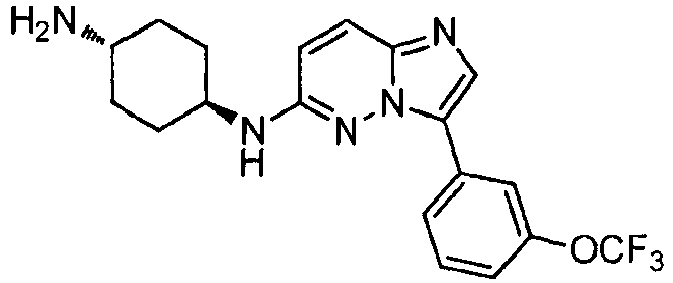
8-9 
8-10 
8-11 
8-12 
8-13 
8-14 
8-15 
8-16 
8-17 
8-18 
8-19 
8-20 
8-21 
8-22 
8-23 
8-24 
8-25 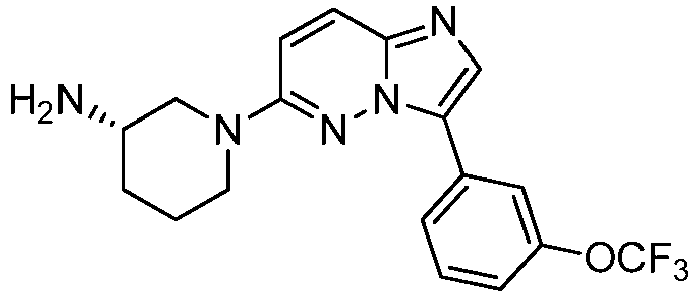
8-26 
8-27 
8-28 
8-29 
8-30 
8-31 
8-32 
8-33 
8-34 
8-35 
8-36 
8-37 
8-38 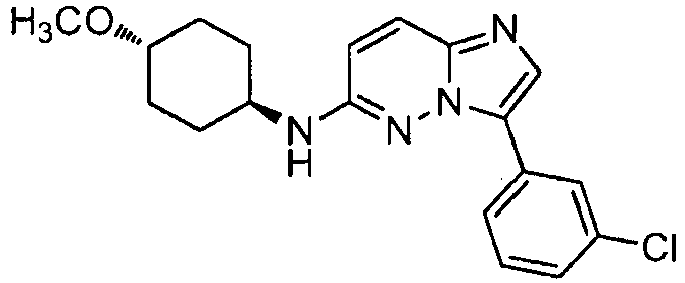
8-39 
8-40 
8-41 
8-42 
8-43 
8-44 
8-45 
8-68 
8-70 
8-71 
8-72 
8-73 
8-75 
8-76 
8-77 
8-78 
8-79 
8-80 
8-81 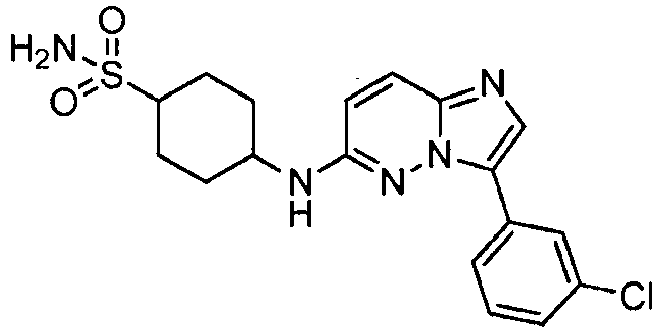
8-82 
8-83 
8-84 
8-85 
8-86 
8-87 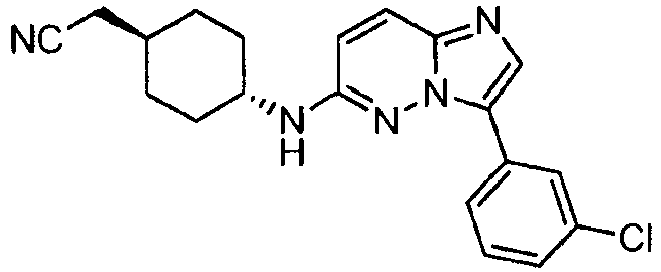
8-88 
8-89 
8-90 
8-91 
8-92 
8-93 
Table II. Illustrative Pim inhibitors. *within the scope of the claims EX. Structure EX. Structure 8-46 
8-47 
8-48 
8-49 
8-50 
8-51 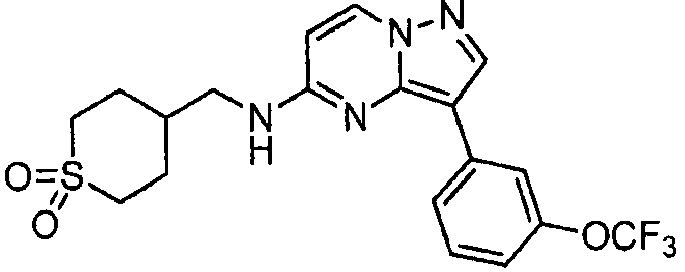
8-52 
8-53 
8-54 
8-55 
8-56 
8-57 
8-58 
8-59 
8-60 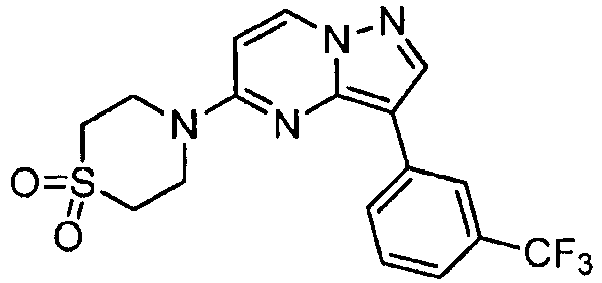
8-61 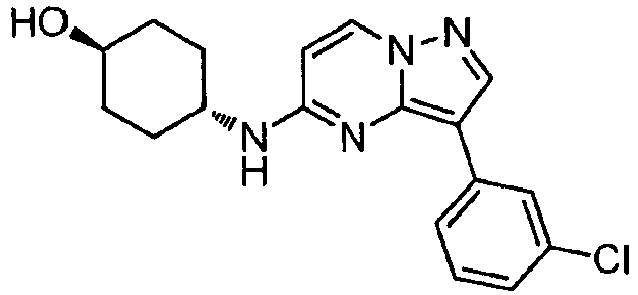
8-62 
8-63 
8-64 
8-65 
8-66 
8-67 
8-69 
8-95 
8-96 
8-97 
8-98 
Table III. Illustrative Pim inhibitors. EX. Structure EX. Structure 8-99 
8-100 
8-101 
8-102 
8-103 
8-104 
8-105 
8-106 
8-107 
8-108 
8-109 
8-110 
8-111 
8-112 
8-113 
- In certain embodiments, the compound of structure (I-D) or (II-D) has one of the following structures:


- Compounds that have the same molecular formula but differ in the nature or sequence of bonding of their atoms or the arrangement of their atoms in space are termed "isomers". Isomers that differ in the arrangement of their atoms in space are termed "stereoisomers". Stereoisomers that are not mirror images of one another are termed "diastereomers" and those that are non-superimposable mirror images of each other are termed "enantiomers". When a compound has an asymmetric center, for example, it is bonded to four different groups, a pair of enantiomers is possible. An enantiomer can be characterized by the absolute configuration of its asymmetric center and is described by the R- and S-sequencing rules of Cahn and Prelog (Cahn, R., Ingold, C., and Prelog, V. Angew. Chem. 78:413-47, 1966; Angew. Chem. Internat. Ed. Eng. 5:385-415, 511, 1966), or by the manner in which the molecule rotates the plane of polarized light and designated as dextrorotatory or levorotatory (i.e., as (+) or (-)-isomers respectively). A chiral compound can exist as either individual enantiomer or as a mixture thereof. A mixture containing equal proportions of the enantiomers is called a "racemic mixture".
- The compounds of this invention may possess one or more asymmetric centers; such compounds can therefore be produced as individual (R)- or (S)-stereoisomers or as mixtures thereof. Unless indicated otherwise, the description or naming of a particular compound in the specification and claims is intended to include both individual enantiomers and mixtures, racemic or otherwise, thereof. The methods for the determination of stereochemistry and the separation of stereoisomers are well-known in the art (see discussion in Ch. 4 of ADVANCED ORGANIC CHEMISTRY, 4th edition, March, J., John Wiley and Sons, New York City, 1992).
- The compounds of the present invention may exhibit the phenomena of tautomerism and structural isomerism. For example, the compounds described herein may adopt an E or a Z configuration about the double bond connecting the 2-indolinone moiety to the pyrrole moiety or they may be a mixture of E and Z. This invention encompasses any tautomeric or structural isomeric form and mixtures thereof which possess the ability to modulate aurora-2 kinase activity and is not limited to, any one tautomeric or structural isomeric form.
- It is contemplated that a compound of the present invention would be metabolized by enzymes in the body of the organism such as human being to generate a metabolite that can modulate the activity of the protein kinases.
- Compounds of or illustrated by the present invention can be prepared according to methods known to those of ordinary skill in the art, including the methods exemplified in the examples. In a general sense, compounds of structure (I) can be prepared according to General Reaction Scheme I.

- Referring to General Reaction Scheme I, compounds of structre (a), wherein R is as defined above and LG represents an appropriate leaving groups (e.g., chloro, bromo and the like) can be purchased or prepared according to methods known in the art. Reaction of (a) with an activated aldehyde, such as 2-bromoacetaldehyde, yields fused by cyclic compounds of structure (b). Activation of an aryl carbon of (b), for example by treatment with bromine, results in (c), wherein "Act" is an activating group such as bromine. Arylation of (c) with R1-Y, wherein Y is an appropriate activating group) under appropriate conditions (e.g., Suzuki coupling, wherein Y is boronic acid) yields (d). Finally, treatment of (d) with R2-XH, wherein R2 and X are as defined herein, results in compounds of structure (I). In certain embodiments, a catalyst, such as palladium (e.g., Buchwald catalysts and the like), may be useful to effect the coupling of R2-Z and (d). Optional oxidation or alkylation using methods known in the art are used to produce compounds having various X moieties.
- Compounds of structure (II) can be prepared according to methods known to those of ordinary skill in the art, including the methods exemplified in the examples. A general preparation method for compounds of structure (II) is depicted in General Reaction Scheme II.

- In reference to General reaction Scheme II, nitriles of structure (e) can be treated with amino acetals under basic conditions to yield (f). Compounds of structre (f) may then be reacted with hydrazine under acidic conditions (e.g., acetic acid) to yield pyrazoles of structre (g). (g) can then be cyclized by treatment with h in the presence of a base (e.g., sodium ethoxide) to yield (i). Reduction of (i) with an appropriate reagent (e.g., POCl3) yields (j), wherein LG is an appropriate leaving group (e.g., halogen such as chloro or bromo). Finally, compounds of structure (II) are prepared as described for step D in General Reaction Scheme (I).
- Compounds of structure (III) may be prepared according to General Reaction Scheme III. Compounds of structure k, wherein LG represents an appropriate leaving group such as bromine, may be purchased from commercial sources or prepared according to methods known in the art and/or described herein. Reaction of k with an appropriate halo acid (e.g., acid chloride) results in compounds of structure m. Cyclization of m by treatment under dehydrating conditions (e.g., acetic acid/HCl) results in compounds of structure n. Finally, compounds of structure (III) are obtained as described for step D in General Reaction Scheme (I).

- One skilled in the art will recognize that the above General Reaction Schemes I, II and III may be modified at any number of steps and the order of steps may be changed. In addition, protecting groups and other strategies well known to one of ordinary skill in the art may be employed, even if not specifically described herein.
- The present inventors have discovered that compounds of the present invention may be prepared at large scales (e.g., greater than 50 g) according to the general procedures described above. Accordingly, in some specific embodiments, the present invention is directed to a method for preparing a compound having the following structure (ID):


- a) reacting W-H with a compound of structure (A):

- b) isolating (ID) as a solid,
wherein W-H indicates a W radical (as defined above) having a hydrogen atom completing its valence. - In certain embodiments of the foregoing method, W-H and (A) are reacted in the presence of a base. For example, in some embodiments the base is Diisopropylethylamine.
- In other embodiments, (A) has been prepared by reaction of (B) and (C):

- In certain other embodiments, the method further comprises treating the solid with an acid to obtain a salt of (ID). In some embodiments, the acid is HCl, maleic acid or methane sulfonic acid.
- Some embodiments of the foregoing method further comprise recrystallizing the solid in a solvent, for example methanol.
- In certain specific embodiments, wherein W is

- In other embodiments, W is

- In still other embodiments, W-H is prepared by a method comprising alkylation of

- In even other embodiments, (ID) is prepared at scales of 50 grams or higher.
- A compound of the present invention or a pharmaceutically acceptable salt thereof, can be administered as such to a human patient or can be administered in pharmaceutical compositions in which the foregoing materials are mixed with suitable carriers or excipient(s). Techniques for formulation and administration of drugs may be found, for example, in REMINGTON'S PHARMACOLOGICAL SCIENCES, Mack Publishing Co., Easton, PA, latest edition.
- A "pharmaceutical composition" refers to a mixture of one or more of the compounds described herein, or pharmaceutically acceptable salts or prodrugs thereof, with other chemical components, such as pharmaceutically acceptable excipients. The purpose of a pharmaceutical composition is to facilitate administration of a compound to an organism.
- "Pharmaceutically acceptable excipient" refers to an inert substance added to a pharmaceutical composition to further facilitate administration of a compound. Examples, without limitation, of excipients include calcium carbonate, calcium phosphate, various sugars and types of starch, cellulose derivatives, gelatin, vegetable oils and polyethylene glycols.
- "Pharmaceutically acceptable salt" refers to those salts which retain the biological effectiveness and properties of the parent compound. Such salts may include: (1) acid addition salt which is obtained by reaction of the free base of the parent compound with inorganic acids such as hydrochloric acid, hydrobromic acid, nitric acid, phosphoric acid, sulfuric acid, and perchloric acid and the like, or with organic acids such as acetic acid, oxalic acid, (D)- or (L)-malic acid, maleic acid, methanesulfonic acid, ethanesulfonic acid, p-toluenesulfonic acid, salicylic acid, tartaric acid, citric acid, succinic acid, glutamic acid or malonic acid and the like, preferably hydrochloric acid or (L)-malic acid; or (2) salts formed when an acidic proton present in the parent compound either is replaced by a metal ion, e.g., an alkali metal ion, an alkaline earth ion, or an aluminum ion; or coordinates with an organic base such as ethanolamine, diethanolamine, triethanolamine, tromethamine, N-methylglucamine, and the like.
- "Therapeutically effective amount" refers to that amount of the compound being administered which will relieve to some extent one or more of the symptoms of the disorder being treated. In reference to the treatment of cancer, a therapeutically effective amount refers to that amount which has the effect of: (1) reducing the size of the tumor; (2) inhibiting tumor metastasis; (3) inhibiting tumor growth; and/or (4) relieving one or more symptoms associated with the cancer.
- The term "protein kinase-mediated condition" or "disease", as used herein, means any disease or other deleterious condition in which a protein kinase is known to play a role. The term "protein kinase-mediated condition" or "disease" also means those diseases or conditions that are alleviated by treatment with a protein kinase inhibitor. Such conditions include, without limitation, cancers which express Pim kinases, particularly Pim-1 kinase, and other hyperproliferative disorders associated with Pim kinase expression. In certain embodiments, the cancer is a cancer of colon, breast, stomach, prostate, pancreas, or ovarian tissue.
- The term "Pim kinase-mediated condition" or "disease", as used herein, means any disease or other deleterious condition in which
Pim 1 kinase,Pim 2 Kinase and/orPim 3 kinase is known to be expressed and/or play a role. The term "Pim kinase-mediated condition" or "disease" also means those diseases or conditions that are alleviated by treatment with an Pim kinase inhibitor. - As used herein, "administer" or "administration" refers to the delivery of an inventive compound or of a pharmaceutically acceptable salt thereof or of a pharmaceutical composition containing an inventive compound or a pharmaceutically acceptable salt thereof of this invention to an organism for the purpose of prevention or treatment of a protein kinase-related disorder.
- Suitable routes of administration may include, without limitation, oral, rectal, transmucosal or intestinal administration or intramuscular, subcutaneous, intramedullary, intrathecal, direct intraventricular, intravenous, intravitreal, intraperitoneal, intranasal, or intraocular injections. In certain embodiments, the preferred routes of administration are oral and intravenous.
- Alternatively, one may administer the compound in a local rather than systemic manner, for example, via injection of the compound directly into a solid tumor, often in a depot or sustained release formulation.
- Furthermore, one may administer the drug in a targeted drug delivery system, for example, in a liposome coated with tumor-specific antibody. In this way, the liposomes may be targeted to and taken up selectively by the tumor.
- Pharmaceutical compositions of the present invention may be manufactured by processes well known in the art, e.g., by means of conventional mixing, dissolving, granulating, dragee-making, levigating, emulsifying, encapsulating, entrapping or lyophilizing processes.
- Pharmaceutical compositions for use in accordance with the present invention may be formulated in any conventional manner using one or more physiologically acceptable carriers comprising excipients and auxiliaries which facilitate processing of the active compounds into preparations which can be used pharmaceutically. Proper formulation is dependent upon the route of administration chosen.
- For injection, the compounds of the invention may be formulated in aqueous solutions, preferably in physiologically compatible buffers such as Hanks' solution, Ringer's solution, or physiological saline buffer. For transmucosal administration, penetrants appropriate to the barrier to be permeated are used in the formulation. Such penetrants are generally known in the art.
- For oral administration, the compounds can be formulated by combining the active compounds with pharmaceutically acceptable carriers well known in the art. Such carriers enable the compounds of the invention to be formulated as tablets, pills, lozenges, dragees, capsules, liquids, gels, syrups, slurries, suspensions and the like, for oral ingestion by a patient. Pharmaceutical preparations for oral use can be made using a solid excipient, optionally grinding the resulting mixture, and processing the mixture of granules, after adding other suitable auxiliaries if desired, to obtain tablets or dragee cores. Useful excipients are, in particular, fillers such as sugars, including lactose, sucrose, mannitol, or sorbitol, cellulose preparations such as, for example, maize starch, wheat starch, rice starch and potato starch and other materials such as gelatin, gum tragacanth, methyl cellulose, hydroxypropylmethyl-cellulose, sodium carboxymethylcellulose, and/or polyvinyl-pyrrolidone (PVP). If desired, disintegrating agents may be added, such as cross-linked polyvinyl pyrrolidone, agar, or alginic acid. A salt such as sodium alginate may also be used.
- Dragee cores are provided with suitable coatings. For this purpose, concentrated sugar solutions may be used which may optionally contain gum arabic, talc, polyvinyl pyrrolidone, carbopol gel, polyethylene glycol, and/or titanium dioxide, lacquer solutions, and suitable organic solvents or solvent mixtures. Dyestuffs or pigments may be added to the tablets or dragee coatings for identification or to characterize different combinations of active compound doses.
- Pharmaceutical compositions which can be used orally include push-fit capsules made of gelatin, as well as soft, sealed capsules made of gelatin and a plasticizer, such as glycerol or sorbitol. The push-fit capsules can contain the active ingredients in admixture with a filler such as lactose, a binder such as starch, and/or a lubricant such as talc or magnesium stearate and, optionally, stabilizers. In soft capsules, the active compounds may be dissolved or suspended in suitable liquids, such as fatty oils, liquid paraffin, or liquid polyethylene glycols. Stabilizers may be added in these formulations, also. Pharmaceutical compositions which may also be used include hard gelatin capsules. The capsules or pills may be packaged into brown glass or plastic bottles to protect the active compound from light. The containers containing the active compound capsule formulation are preferably stored at controlled room temperature (15-30°C).
- For administration by inhalation, the compounds for use according to the present invention may be conveniently delivered in the form of an aerosol spray using a pressurized pack or a nebulizer and a suitable propellant, e.g., without limitation, dichlorodifluoromethane, trichlorofluoromethane, dichlorotetra-fluoroethane or carbon dioxide. In the case of a pressurized aerosol, the dosage unit may be controlled by providing a valve to deliver a metered amount. Capsules and cartridges of, for example, gelatin for use in an inhaler or insufflator may be formulated containing a powder mix of the compound and a suitable powder base such as lactose or starch.
- The compounds may also be formulated for parenteral administration, e.g., by bolus injection or continuous infusion. Formulations for injection may be presented in unit dosage form, e.g., in ampoules or in multidose containers, with an added preservative. The compositions may take such forms as suspensions, solutions or emulsions in oily or aqueous vehicles, and may contain formulating materials such as suspending, stabilizing and/or dispersing agents.
- Pharmaceutical compositions for parenteral administration include aqueous solutions of a water soluble form, such as, without limitation, a salt, of the active compound. Additionally, suspensions of the active compounds may be prepared in a lipophilic vehicle. Suitable lipophilic vehicles include fatty oils such as sesame oil, synthetic fatty acid esters such as ethyl oleate and triglycerides, or materials such as liposomes. Aqueous injection suspensions may contain substances which increase the viscosity of the suspension, such as sodium carboxymethyl cellulose, sorbitol, or dextran. Optionally, the suspension may also contain suitable stabilizers and/or agents that increase the solubility of the compounds to allow for the preparation of highly concentrated solutions.
- Alternatively, the active ingredient may be in powder form for constitution with a suitable vehicle, e.g., sterile, pyrogen-free water, before use.
- The compounds may also be formulated in rectal compositions such as suppositories or retention enemas, using, e.g., conventional suppository bases such as cocoa butter or other glycerides.
- In addition to the formulations described previously, the compounds may also be formulated as depot preparations. Such long acting formulations may be administered by implantation (for example, subcutaneously or intramuscularly) or by intramuscular injection. A compound of this invention may be formulated for this route of administration with suitable polymeric or hydrophobic materials (for instance, in an emulsion with a pharmacologically acceptable oil), with ion exchange resins, or as a sparingly soluble derivative such as, without limitation, a sparingly soluble salt.
- A non-limiting example of a pharmaceutical carrier for the hydrophobic compounds of the invention is a cosolvent system comprising benzyl alcohol, a nonpolar surfactant, a water-miscible organic polymer and an aqueous phase such as the VPD cosolvent system. VPD is a solution of 3% w/v benzyl alcohol, 8% w/v of the
nonpolar surfactant polysorbate 80, and 65% w/v polyethylene glycol 300, made up to volume in absolute ethanol. The VPD cosolvent system (VPD:D5W) consists of VPD diluted 1:1 with a 5% dextrose in water solution. This cosolvent system dissolves hydrophobic compounds well, and itself produces low toxicity upon systemic administration. Naturally, the proportions of such a cosolvent system may be varied considerably without destroying its solubility and toxicity characteristics. Furthermore, the identity of the cosolvent components may be varied: for example, other low-toxicity nonpolar surfactants may be used instead ofpolysorbate 80, the fraction size of polyethylene glycol may be varied, other biocompatible polymers may replace polyethylene glycol, e.g., polyvinyl pyrrolidone, and other sugars or polysaccharides may substitute for dextrose. - Alternatively, other delivery systems for hydrophobic pharmaceutical compounds may be employed. Liposomes and emulsions are well known examples of delivery vehicles or carriers for hydrophobic drugs. In addition, certain organic solvents such as dimethylsulfoxide also may be employed, although often at the cost of greater toxicity.
- Additionally, the compounds may be delivered using a sustained-release system, such as semipermeable matrices of solid hydrophobic polymers containing the therapeutic agent. Various sustained-release materials have been established and are well known by those skilled in the art. Sustained-release capsules may, depending on their chemical nature, release the compounds for a few weeks up to over 100 days. Depending on the chemical nature and the biological stability of the therapeutic reagent, additional strategies for protein stabilization may be employed.
- The pharmaceutical compositions herein also may comprise suitable solid or gel phase carriers or excipients. Examples of such carriers or excipients include, but are not limited to, calcium carbonate, calcium phosphate, various sugars, starches, cellulose derivatives, gelatin, and polymers such as polyethylene glycols.
- Many of the protein kinase-modulating compounds of the invention may be provided as physiologically acceptable salts wherein the claimed compound may form the negatively or the positively charged species. Examples of salts in which the compound forms the positively charged moiety include, without limitation, quaternary ammonium (defined elsewhere herein), salts such as the hydrochloride, sulfate, carbonate, lactate, tartrate, malate, maleate, succinate wherein the nitrogen atom of the quaternary ammonium group is a nitrogen of the selected compound of this invention which has reacted with the appropriate acid. Salts in which a compound of this invention forms the negatively charged species include, without limitation, the sodium, potassium, calcium and magnesium salts formed by the reaction of a carboxylic acid group in the compound with an appropriate base (e.g. sodium hydroxide (NaOH), potassium hydroxide (KOH), calcium hydroxide (Ca(OH)2), etc.).
- Pharmaceutical compositions suitable for use in the present invention include compositions wherein the active ingredients are contained in an amount sufficient to achieve the intended purpose, e.g., the modulation of protein kinase activity and/or the treatment or prevention of a protein kinase-related disorder.
- More specifically, a therapeutically effective amount means an amount of compound effective to prevent, alleviate or ameliorate symptoms of disease or prolong the survival of the subject being treated.
- Determination of a therapeutically effective amount is well within the capability of those skilled in the art, especially in light of the detailed disclosure provided herein.
- For any compound used in the methods of the invention, the therapeutically effective amount or dose can be estimated initially from cell culture assays. Then, the dosage can be formulated for use in animal models so as to achieve a circulating concentration range that includes the IC50 as determined in cell culture (i.e., the concentration of the test compound which achieves a half-maximal inhibition of the protein kinase activity). Such information can then be used to more accurately determine useful doses in humans.
- Toxicity and therapeutic efficacy of the compounds described herein can be determined by standard pharmaceutical procedures in cell cultures or experimental animals, e.g., by determining the IC50 and the LD50 (both of which are discussed elsewhere herein) for a subject compound. The data obtained from these cell culture assays and animal studies can be used in formulating a range of dosage for use in humans. The dosage may vary depending upon the dosage form employed and the route of administration utilized. The exact formulation, route of administration and dosage can be chosen by the individual physician in view of the patient's condition. (See, e.g., GOODMAN & GILMAN'S THE PHARMACOLOGICAL BASIS OF THERAPEUTICS, Ch. 3, 9th ed., Ed. by Hardman, J., and Limbard, L., McGraw-Hill, New York City, 1996, p.46.)
- Dosage amount and interval may be adjusted individually to provide plasma levels of the active species which are sufficient to maintain the kinase modulating effects. These plasma levels are referred to as minimal effective concentrations (MECs). The MEC will vary for each compound but can be estimated from in vitro data, e.g., the concentration necessary to achieve 50-90% inhibition of a kinase may be ascertained using the assays described herein. Dosages necessary to achieve the MEC will depend on individual characteristics and route of administration. HPLC assays or bioassays can be used to determine plasma concentrations.
- Dosage intervals can also be determined using MEC value. Compounds should be administered using a regimen that maintains plasma levels above the MEC for 10-90% of the time, preferably between 30-90% and most preferably between 50-90%.
- At present, the therapeutically effective amounts of compounds of the present invention may range from approximately 2.5 mg/m2 to 1500 mg/m2 per day. Additional illustrative amounts range from 0.2-1000 mg/qid, 2-500 mg/qid, and 20-250 mg/qid.
- In cases of local administration or selective uptake, the effective local concentration of the drug may not be related to plasma concentration, and other procedures known in the art may be employed to determine the correct dosage amount and interval.
- The amount of a composition administered will, of course, be dependent on the subject being treated, the severity of the affliction, the manner of administration, the judgment of the prescribing physician, etc.
- The compositions may, if desired, be presented in a pack or dispenser device, such as an FDA approved kit, which may contain one or more unit dosage forms containing the active ingredient. The pack may for example comprise metal or plastic foil, such as a blister pack. The pack or dispenser device may be accompanied by instructions for administration. The pack or dispenser may also be accompanied by a notice associated with the container in a form prescribed by a governmental agency regulating the manufacture, use or sale of pharmaceuticals, which notice is reflective of approval by the agency of the form of the compositions or of human or veterinary administration. Such notice, for example, may be of the labeling approved by the U.S. Food and Drug Administration for prescription drugs or of an approved product insert. Compositions comprising a compound of the invention formulated in a compatible pharmaceutical carrier may also be prepared, placed in an appropriate container, and labeled for treatment of an indicated condition. Suitable conditions indicated on the label may include treatment of a tumor, inhibition of angiogenesis, treatment of fibrosis, diabetes, and the like.
- Certain embodiments of the compounds of the present invention are small molecule PIM kinase inhibitors that reduce the growth of solid tumor xenografts where the tumorigenicity is mediated by over-expression of either PIM-1 or PIM-2, as well as human bladder carcinoma tumors, androgen-independent prostate tumors, and AML models harboring either wild-type FLT3 or the FLT3-ITD mutation. While not wishing to be bound by theory, the combination of inhibiting all three PIM family members together in one compound may promote the observed antitumor activity.
- Previous work evaluating bladder carcinoma indicated that PIM-1 was expressed in over 80% of malignant tissues compared with normal epithelia, and expression was enhanced when comparing specimens derived from bladder cancer patients with invasive versus with non-invasive tumors (Guo, S (2010) J Exp Clin Cancer Res 29:161). Further, it was shown that shRNA knockdown of PIM-1 in bladder carcinoma cell lines reduced the growth of the cells in vitro, indicating a prominent role for PIM-1 in bladder carcinoma (Guo, S (2010) J Exp Clin Cancer Res 29:161). As demonstrated in the examples, a representative compound of the invention in the bladder cancer model UM-UC-3 in vitro showed an effective phenocopy by the compound compared to shRNA-mediated knockdown. The compound reduced the growth of established UM-UC-3 xenografts, suggesting that PIM-1 over-expression in patient bladder tumors may be sensitive to perturbation. The examples also demonstrate that PC3 prostate cancer xenografts were inhibited by a representative compound. While not wishing to be bound by theory, certain embodiments of the present compounds may advantageously inhibit PIM kinase function in the solid tumor setting by inhibition of all three PIM kinases for an anti-tumor effect.
- AML also represents an important indication of interest for targeting with PIM kinase inhibitors based on over-expression of PIM-1 and PIM-2 (Brault, L (2010) Haematologica 95:1004; Magnuson, NS (2010) Future Oncol 6:1461; Nawijn, MC (2011) Nature Rev Cancer 11:23; Alvarado, Y (2012) Expert. Rev. Hematol 5:81), as well as FLT3 kinase, where approximately 25% of patients with AML have tumor cells expressing the FLT3-ITD driver mutation (Kottaridis PD (2001) Blood 98:1752). In evaluations of AML cell line models for effects of PIM kinase inhibitors, several groups reported sensitivity in models expressing the FLT3-ITD mutation (Chen, LS (2011) Blood 118:693; Pierre, F (2012) BMCL 22:3327; Blanco-Aparicio, C (2011) Cancer Lett 300:145; Fathi, AT (2012) Leuk Res 36:224). PIM-2 over-expression in AML patient specimens suggests a link between malignancy and expression (Tamburini, J (2009) Blood 114:1618).
- As shown in the examples, a representative compound demonstrated a 5-fold enhancement in cell cytotoxicity in vitro in the FLT3-ITD mutant cells compared to the wild-type FLT3-expressing cells correlated with xenograft regression versus a partial antitumor effect. Accordingly, it is believed that both populations of AML patients, based on FLT3 status, may benefit from treatment with a PIM kinase inhibitor according to the present invention.
- As mentioned above, the compounds and compositions of the invention will find utility in the treatment of a broad range of diseases and conditions mediated by protein kinases, including diseases and conditions mediated by PIM kinase. Such diseases may include by way of example and not limitation, cancers such as lung cancer, NSCLC (non small cell lung cancer), oat-cell cancer, bone cancer, pancreatic cancer, skin cancer, dermatofibrosarcoma protuberans, cancer of the head and neck, cutaneous or intraocular melanoma, uterine cancer, ovarian cancer, colo-rectal cancer, cancer of the anal region, stomach cancer, colon cancer, breast cancer, gynecologic tumors (e.g., uterine sarcomas, carcinoma of the fallopian tubes, carcinoma of the endometrium, carcinoma of the cervix, carcinoma of the vagina or carcinoma of the vulva), Hodgkin's Disease, hepatocellular cancer, cancer of the esophagus, cancer of the small intestine, cancer of the endocrine system (e.g., cancer of the thyroid, pancreas, parathyroid or adrenal glands), sarcomas of soft tissues, cancer of the urethra, cancer of the penis, prostate cancer (particularly hormone-refractory), chronic or acute leukemia, solid tumors of childhood, hypereosinophilia, lymphocytic lymphomas, cancer of the bladder, cancer of the kidney or ureter (e.g., renal cell carcinoma, carcinoma of the renal pelvis), pediatric malignancy, neoplasms of the central nervous system (e.g., primary CNS lymphoma, spinal axis tumors, medulloblastoma, brain stem gliomas or pituitary adenomas), Barrett's esophagus (pre-malignant syndrome), neoplastic cutaneous disease, psoriasis, mycoses fungoides, and benign prostatic hypertrophy, diabetes related diseases such as diabetic retinopathy, retinal ischemia, and retinal neovascularization, hepatic cirrhosis, angiogenesis, cardiovascular disease such as atherosclerosis, immunological disease such as autoimmune disease and renal disease.
- In some embodiments, the compounds and compositions of the invention can be used in methods for treating cancers such as hematological malignancies. For example, in some embodiments the compounds and compositions of the invention can be used in methods for treating acute myeloid leukemia (AML). Other methods include treatment of bladder cancer, or treatment of prostate cancer.
- The inventive compounds (i.e., compounds (I), (II) and (III)) can be used in combination with one or more other chemotherapeutic agents. The dosage of the inventive compounds may be adjusted for any drug-drug reaction. In one embodiment, the chemotherapeutic agent is selected from the group consisting of mitotic inhibitors, alkylating agents, anti-metabolites, cell cycle inhibitors, enzymes, topoisomerase inhibitors such as CAMPTOSAR (irinotecan), biological response modifiers, anti-hormones, antiangiogenic agents such as MMP-2, MMP-9 and COX-2 inhibitors, anti-androgens, platinum coordination complexes (cisplatin, etc.), substituted ureas such as hydroxyurea; methylhydrazine derivatives, e.g., procarbazine; adrenocortical suppressants, e.g., mitotane, aminoglutethimide, hormone and hormone antagonists such as the adrenocorticosteriods (e.g., prednisone), progestins (e.g., hydroxyprogesterone caproate), estrogens (e.g., diethylstilbesterol), antiestrogens such as tamoxifen, androgens, e.g., testosterone propionate, and aromatase inhibitors, such as anastrozole, and AROMASIN (exemestane).
- Examples of alkylating agents that the above method can be carried out in combination with include, without limitation, fluorouracil (5-FU) alone or in further combination with leukovorin; other pyrimidine analogs such as UFT, capecitabine, gemcitabine and cytarabine, the alkyl sulfonates, e.g., busulfan (used in the treatment of chronic granulocytic leukemia), improsulfan and piposulfan; aziridines, e.g., benzodepa, carboquone, meturedepa and uredepa; ethyleneimines and methylmelamines, e.g., altretamine, triethylenemelamine, triethylenephosphoramide, triethylenethiophosphoramide and trimethylolmelamine; and the nitrogen mustards, e.g., chlorambucil (used in the treatment of chronic lymphocytic leukemia, primary macroglobulinemia and non-Hodgkin's lymphoma), cyclophosphamide (used in the treatment of Hodgkin's disease, multiple myeloma, neuroblastoma, breast cancer, ovarian cancer, lung cancer, Wilm's tumor and rhabdomyosarcoma), estramustine, ifosfamide, novembrichin, prednimustine and uracil mustard (used in the treatment of primary thrombocytosis, non-Hodgkin's lymphoma, Hodgkin's disease and ovarian cancer); and triazines, e.g., dacarbazine (used in the treatment of soft tissue sarcoma).
- Examples of antimetabolite chemotherapeutic agents that the above method can be carried out in combination with include, without limitation, folic acid analogs, e.g., methotrexate (used in the treatment of acute lymphocytic leukemia, choriocarcinoma, mycosis fungiodes, breast cancer, head and neck cancer and osteogenic sarcoma) and pteropterin; and the purine analogs such as mercaptopurine and thioguanine which find use in the treatment of acute granulocytic, acute lymphocytic and chronic granulocytic leukemias.
- Examples of natural product-based chemotherapeutic agents that the above method can be carried out in combination with include, without limitation, the vinca alkaloids, e.g., vinblastine (used in the treatment of breast and testicular cancer), vincristine and vindesine; the epipodophyllotoxins, e.g., etoposide and teniposide, both of which are useful in the treatment of testicular cancer and Kaposi's sarcoma; the antibiotic chemotherapeutic agents, e.g., daunorubicin, doxorubicin, epirubicin, mitomycin (used to treat stomach, cervix, colon, breast, bladder and pancreatic cancer), dactinomycin, temozolomide, plicamycin, bleomycin (used in the treatment of skin, esophagus and genitourinary tract cancer); and the enzymatic chemotherapeutic agents such as L-asparaginase.
- Examples of useful COX-II inhibitors include Vioxx, CELEBREX (celecoxib), valdecoxib, paracoxib, rofecoxib, and Cox 189.
- Examples of useful matrix metalloproteinase inhibitors are described in
WO 96/33172 (published Oct. 24, 1996 WO 96/27583 (published Mar. 7, 1996 97304971.1 (filed Jul. 8, 1997 99308617.2 (filed Oct. 29, 1999 WO 98/07697 (published Feb. 26, 1998 WO 98/03516 (published Jan. 29, 1998 WO 98/34918 (published Aug. 13, 1998 WO 98/34915 (published Aug. 13, 1998 WO 98/33768 (published Aug. 6, 1998 WO 98/30566 (published Jul. 16, 1998 606,046 (published Jul. 13, 1994 931,788 (published Jul. 28, 1999 WO 90/05719 (published May 31, 1990 WO 99/52910 (published Oct. 21, 1999 WO 99/52889 (published Oct. 21, 1999 WO 99/29667 (published Jun. 17, 1999 PCT/IB98/01113 (filed Jul. 21, 1998 99302232.1 (filed Mar. 25, 1999 9912961.1 (filed Jun. 3, 1999 U.S. Pat. No. 5,863,949 (issued Jan. 26, 1999 ),U.S. Pat. No. 5,861,510 (issued Jan. 19, 1999 ), and European Patent Publication780,386 (published Jun. 25, 1997 - Some specific examples of MMP inhibitors useful in the present invention are AG-3340, RO 32-3555, RS 13-0830, and compounds selected from: 3-[[4-(4-fluoro-phenoxy)-benzenesulfonyl]-(1-hydroxycarbamoyl-cyclopentyl)- amino]-propionic acid; 3-exo-3-[4-(4-fluoro-phenoxy)-benzenesulfonylamino]-8-oxa-bicyclo[3.2.1]octane-3-carboxylic acid hydroxyamide; (2R,3R) 1-[4-(2-chloro-4-fluoro-benzyloxy)-benzenesulfonyl]-3-hydroxy-3-methyl-piperidine-2-carboxylic acid hydroxyamide; 4-[4-(4-fluoro-phenoxy)-benzenesulfonylamino]-tetrahydro-pyran-4-carboxylic acid hydroxyamide; 3-[[4-(4-fluoro-phenoxy)-benzenesulfonyl]-(1-hydroxycarbamoyl-cyclobutyl)- amino]-propionic acid; 4-[4-(4-chloro-phenoxy)-benzenesulfonylamino]-tetrahydro-pyran-4-carboxylic acid hydroxyamide; (R) 3-[4-(4-chloro-phenoxy)-benzenesulfonylamino]-tetrahydro-pyran-3-carboxylic acid hydroxyamide; (2R,3R) 1-[4-(4-fluoro-2-methylbenzyloxy)-benzenesulfonyl]-3-hydroxy-3-methyl-piperidine-2-carboxylic acid hydroxyamide; 3-[[(4-(4-fluoro-phenoxy)-benzenesulfonyl]-(1-hydroxycarbamoyl-1-methyl-ethyl)-amino]-propionic acid; 3-[[4-(4-fluoro-phenoxy)-benzenesulfonyl]-(4-hydroxycarbamoyl-tetrahydro-pyran-4-yl)-amino]-propionic acid; 3-exo-3-[4-(4-chloro-phenoxy)-benzenesulfonylamino]-8-oxa-bicyclo[3.2.1]octane-3-carboxylic acid hydroxyamide; 3-endo-3-[4-(4-fluoro-phenoxy)-benzenesulfonylamino]-8-oxa-bicyclo[3.2.1]octane-3-carboxylic acid hydroxyamide; and (R) 3-[4-(4-fluoro-phenoxy)-benzenesulfonylamino]-tetrahydro-furan-3-carboxylic acid hydroxyamide; and pharmaceutically acceptable salts and solvates of these compounds.
- Other anti-angiogenesis agents, other COX-II inhibitors and other MMP inhibitors, can also be used in the present invention.
- An inventive compound can also be used with other signal transduction inhibitors, such as agents that can inhibit EGFR (epidermal growth factor receptor) responses, such as EGFR antibodies, EGF antibodies, and molecules that are EGFR inhibitors; VEGF (vascular endothelial growth factor) inhibitors; and erbB2 receptor inhibitors, such as organic molecules or antibodies that bind to the erbB2 receptor, such as HERCEPTIN (Genentech, Inc., South San Francisco, CA). EGFR inhibitors are described in, for example in
WO 95/19970 (published Jul. 27, 1995 WO 98/14451 (published Apr. 9, 1998 WO 98/02434 (published Jan. 22, 1998 U.S. Pat. No. 5,747,498 (issued May 5, 1998 ), and such substances can be used in the present invention as described herein. - EGFR-inhibiting agents include, but are not limited to, the monoclonal antibodies C225 and anti-EGFR 22Mab (ImClone Systems, Inc., New York, NY), the compounds ZD-1839 (AstraZeneca), BIBX-1382 (Boehringer Ingelheim), MDX-447 (Medarex Inc., Annandale, NJ), and OLX-103 (Merck & Co., Whitehouse Station, NJ), and EGF fusion toxin (Seragen Inc., Hopkinton, MA).
- These and other EGFR-inhibiting agents can be used in the present invention. VEGF inhibitors, for example SU-5416 and SU-6668 (Sugen Inc., South San Francisco, CA), can also be combined with an inventive compound. VEGF inhibitors are described in, for example,
WO 01/60814 A3 (published Aug. 23, 2001 WO 99/24440 (published May 20,1999 PCT/IB99/00797 (filed May 3, 1999 WO 95/21613 (published Aug. 17, 1995 WO 99/61422 (published Dec. 2, 1999 U.S. Pat. No. 5,834,504 (issued Nov. 10, 1998 ),WO 01/60814 WO 98/50356 (published Nov. 12, 1998 U.S. Pat. No. 5,883,113 (issued Mar. 16,1999 ),U.S. Pat. No. 5,886,020 (issued Mar. 23, 1999 ),U.S. Pat. No. 5,792,783 (issued Aug. 11, 1998 ),WO 99/10349 (published Mar. 4, 1999 WO 97/32856 (published Sep. 12,1997 WO 97/22596 (published Jun. 26, 1997 WO 98/54093 (published Dec. 3,1998 WO 98/02438 (published Jan. 22, 1998 WO 99/16755 (published Apr. 8, 1999 WO 98/02437 (published Jan. 22, 1998 WO 98/02434 (published Jan. 22, 1998 WO 99/35146 (published Jul. 15, 1999 WO 99/35132 (published Jul. 15, 1999 WO 98/02437 (published Jan. 22, 1998 WO 97/13760 (published Apr. 17, 1997 WO 95/19970 (published Jul. 27, 1995 U.S. Pat. No. 5,587,458 (issued Dec. 24, 1996 ), andU.S. Pat. No. 5,877,305 (issued Mar. 2,1999 ). ErbB2 receptor inhibitors useful in the present invention are also described inU.S. Pat. No. 6,284,764 (issued Sep. 4, 2001 ), incorporated in its entirety herein by reference. The erbB2 receptor inhibitor compounds and substance described in the aforementioned PCT applications, U.S. patents, and U.S. provisional applications, as well as other compounds and substances that inhibit the erbB2 receptor, can be used with an inventive compound, in accordance with the present invention. - An inventive compound can also be used with other agents useful in treating cancer, including, but not limited to, agents capable of enhancing antitumor immune responses, such as CTLA4 (cytotoxic lymphocyte antigen 4) antibodies, and other agents capable of blocking CTLA4; and anti-proliferative agents such as other farnesyl protein transferase inhibitors, for example the farnesyl protein transferase inhibitors described in the references cited in the "Background" section, of
U.S. Pat. No. 6,258,824 B1 . - The above method can also be carried out in combination with radiation therapy, wherein the amount of an inventive compound in combination with the radiation therapy is effective in treating the above diseases.
- Techniques for administering radiation therapy are known in the art, and these techniques can be used in the combination therapy described herein. The administration of the compound of the invention in this combination therapy can be determined as described herein.
- Pim kinases also play a role in immune regulation and inflammatory states. Accordingly, one embodiment of the invention is directed to methods for treatment of an autoimmune or inflammatory disorder, disease or condition mediated by Pim kinase. The disclosed methods comprise administering an effective amount of any of the disclosed compounds to a mammal, for example a mammal in need of treatment for an autoimmune or inflammatory disease, disorder or condition. Inflammatory diseases, disorders or conditions treatable according to the disclosed methods include, but are not limited to: osteoarthritis, rheumatoid arthritis, pain, inflammatory bowel diseases, respiratory disorders, skin disorders or combinations thereof.
- In some embodiments, the inflammatory bowel diseases are selected from Crohn's disease, ulcerative colitis, irritable bowel syndrome and combinations thereof.
- In some other embodiments, the respiratory disorders are selected from asthma, rhinitis, chronic obstructive pulmonary disease, bronchitis, nasal polyposis, nasal congestion, farmer's lung, fibroid lung, cough and combinations thereof.
- In yet other embodiments, the skin disorders are selected from dermatitis, cutaneous eosinophilias, Lichen planus, urticaria, psoriasis, pruritus, angiodermas, corneal ulcers, chronic skin ulcers, conjunctivitis, vasculitides, uveitis, erythemas and combinations thereof.
- While the compounds and compositions of the invention find utility in a broad range of diseases and conditions, including those described above, some embodiments include compounds which have reduced side effects compared to other known therapeutics. One such side effect may include hERG inhibition. hERG (the human Ether-à-go-go-Related Gene) is a gene that encodes a protein which contribiutes to the electrical activity of the heart. Some clinically successful drug candidates have the tendency to inhibit hERG which may compromise the electrical ativity of the heart and can result in a potentially fatal disorder called long QT syndrome. Thus, drugs capable of treating any of the diseases, conditions or disorders described herein, without substanatial concomitant inhibition of hERG, may be advantageous in certain methods of treatment. Accordingly, certain embodiments of the present invention include compounds which have a hERG inhibition IC50 of greater than 1 µM, greater than 10 µM, greater than 30 µM or even greater than 50 µM (as determined by the Fast Patch assay available from WuXiApptec (Shanghai China)). In further embodiments of the foregoing, the compound is also effective for treatment of the Pim kinase mediated diseases described above.
- The invention will be further understood upon consideration of the following non-limiting Examples.
- Illustrative and representative compounds of the present invention were synthesized according the synthetic procedures detailed herein.
- All solvents and reagents were available from Aldrich or VWR chemicals and used as supplied or purified by standard laboratory methods as required. NMR spectra were recorded on a Varian Unity at 400 MHz (1H) at 25°C. Chemical shifts are reported in ppm and referenced internally to residual CHCl3 for (d 7.26) or CH3OH for (d 3.33). Low resolution mass spectrometry was performed by The Mass Spectrometry and Proteomics Core facility at the University of Utah. Flash chromatography was performed on Combifalsh (Yamazen) with normal phase silica gel column (RediSep) and CH2Cl2/CH3OH solvent system. TLC used pre-coated silica gel aluminum sheets.
- PIM-1, PIM-2 and actin antibodies were purchased from Cell Signaling Technology (Danvers, MA) (Cat #3247, 4730 and 3700). IRDye 800CW goat anti-rabbit and IRDye 680 goat anti-mouse secondary antibodies were purchased from LI-COR (Lincoln, NE). HEK-293, NIH-3T3, 22RV-1, UM-UC-3, PC-3 MV-4-11, GDM-1, RPMI-8226, NCI-H929, Pfeiffer, SU-DHL-6, Toledo, Z-138, Jeko-1, Maver-1, Mino, MC116, JM-1, SupT1, U937 and K562 cell lines were purchased from ATCC (Manassas, VA), while the MOLM-13, ML-2 and PL-21 cell lines were purchased from DSMZ (Braunschweig, Germany), and the 22RV1/PIM-1 over-expression cell line was licensed from the lab of Anjali Jain, Ph.D. (Cedars Sinai, CA). The NIH-3T3/PIM-2 over-expression cell lines were generated at Epoch Life Science (Missouri City, TX) by transfecting the NIH-3T3 cell line with a PIM-2 over-expression plasmid encoding a neomycin resistance gene and selecting a stable pool resistant to G418. PIM-1, PIM-2 and BAD plasmids were purchased from Origene (Rockville, MD). Human shRNA lentiviral particles were purchased from the Sigma-Aldrich MISSION collection (St. Louis, MO). For cell culture, RPMI 1640 and EMEM media with glutamine were supplemented with 10% fetal bovine serum and 1X Penicillin-Streptomycin (Life Technologies, Grand Island NY). ATPlite was purchased from Perkin Elmer (Shelton, CT).
- HEK-293 cells (1x10⁴) were seeded in a 96-well plate using EMEM media with serum and incubated overnight at 37°C in 5% CO2. Adherent cells were transfected the next day using Effectene (Qiagen) with 0.1 µg BAD + 300 pg of PIM-1 or PIM-1 KD (K67M) overexpression plasmids for 18 hours. Cells were serum starved for an additional 18 hours, then treated 2 hours with various concentrations of SGI-9481 or 0.5% carrier DMSO control. Media was removed and cells were lysed using 25 µl 1X lysis buffer from the AlphaScreen SureFire Phospho-BAD (Ser112) kit from Perkin Elmer. Lysates (4 µl) were transferred to a 384-well proxiplate, and 5 µl of acceptor mix was added to each well and incubated for 2 hours at room temperature. Donor mix (2 µl) was added to each well, and samples incubated for 2 hours at room temperature and reactions measured on an Envision plate reader (PerkinElmer) with AlphaScreen capabilities. Non-specific phosphorylation of BAD was subtracted using values from PIM-1 KD transfected cells, and the remaining wells were normalized to the DMSO control wells. EC50 values were calculated using GraphPad Prism software (La Jolla, CA).
- Protein lysates were prepared from cells using an NP-40 based cell lysis buffer (30 mM Tris-HCl pH 7.4, 120 mM NaCl, 1% NP-40, 1X protease inhibitor cocktail, 1X phosphatase inhibitor cocktail I and II (Sigma)). Cells were incubated with lysis buffer for 20 minutes on ice, centrifuged at 13000 x g for 5 min at 4°C, and clarified lysate was quantified using the BCA protein assay kit (Thermo Scientific, Rockford, IL). Protein (10 µg) from PIM-1 and PIM-2 overexpressing cells and matching parental controls or 50 µg of protein from UM-UC-3 cells 48 hours post-transduction were loaded onto a 4-12% Bis-Tris NuPAGE Novex gel, transferred to nitrocellulose membrane using an iBlot transfer system. Membranes were probed with antibodies against PIM-1, PIM-2 or actin, then probed with rabbit or mouse IRDye secondary antibodies and imaged on an Odyssey fluorescence imaging system (LI-COR).
- UM-UC-3 cells (2.5x10⁵) were seeded in a 6-well plate in complete RPMI 1640 media, and allowed to adhere overnight at 37°C in 5% CO2. Cells were transduced with 8 µg/mL polybrene (Sigma-Aldrich) and Lentiviral particles at an MOI of 50 based on titer values pre-determined by Sigma-Aldrich using a p24 ELISA for each batch of shRNA. Following overnight transduction, viral particle containing media was removed and replaced with fresh complete media, and cells were cultured for an additional 48 hours at 37°C in 5% CO2. Cells were trypsinized and fractions of the transduced cells were collected for colony formation growth assays, while the remaining cells were collected for RNA and protein isolation.
- RNA from 0.5x10⁶ cells was isolated on a QIAcube (Qiagen, Santa Clarita, CA) using the protocol for purification of total RNA from animal cells (QIAshredder homogenization and on-column DNase digest), and quantified using a Nanodrop 8000 spectrophotometer (Thermo Electron, West Palm Beach, FL). Total RNA (1 µg) was converted to cDNA in a 20 µl reaction using the iScript cDNA synthesis kit (Bio-Rad, Hercules, CA) by incubating the reaction components for 5 minutes at 25°C, 30 minutes at 42°C, followed by 5 minutes at 85°C. The cDNA reaction (2 µl) was used in a 20 µl PCR multiplex reaction using 1X FAM-labeled PIM-1, VIC-labeled actin Taqman primer sets and the Taqman gene expression master mix from Life Technologies on an iQ5 Real-Time PCR machine (Bio-Rad). An 8-point, half-log standard curve was generated for PIM-1 and actin messages using RNA from untreated cells. A linear trendline (with an R squared value >0.99) was generated by plotting log concentrations of standard vs. Ct values generated from the real-time PCR reactions. Relative message levels from shRNA treated samples were calculated based on the standard curve, normalized to actin and compared to the non-target shRNA control.
- For shRNA growth experiments, 500 UM-UC-3 cells were seeded in a 12-well plate 48 hours post-transduction and cultured for 8-10 days at 37°C in 5% CO2. Cells were fixed with 4% paraformaldehyde in PBS, washed twice with PBS, and stained with a crystal violet solution (1% crystal violet, 10% ethanol in water). Stained cells were washed thrice with water, and imaged after drying on a GelCount colony counter (Oxford Optronix Ltd., Oxford, UK). Total staining intensity per well was determined by lysis of cells with 200 µl of Triton X-100 lysis buffer (1% Triton X-100, 50 mM Tris-HCl pH 7.4, 150 mM NaCl, 1 mM EDTA). Lysates (100 µl) from each well were transferred to a clear 96-well plate and absorbance at 560 nm was determined on an Envision microplate reader. IC50 values were determined using GraphPad Prism software. For compound treated PC-3 and UM-UC-3, cells were seeded and stained as above, but were incubated with various concentrations of test compound or DMSO one day after seeding.
- Adherent or suspension cancer cell lines were seeded at 2000-5000 cells/well in a 96-well plate, or 1000-2000 cells/well in a 384-well plate. Suspension cells were treated with drug the same day as seeding, while adherent cells were incubated overnight at 37°
Cin 5% CO2 prior to drug treatment. All cells were treated for 72 hours, then lysed with ATPlite (Perkin Elmer) and measured on an Envision microplate reader. IC50 values were determined using GraphPad Prism software. - Male and female Nu/Nu mice were purchased from Harlan Sprague Dawley (Indianapolis, IN). Female Nu/Nu mice were used for all xenograft evaluations with the exception of the PC-3 xenografts where male Nu/Nu mice were used. Cell lines were expanded in vitro in complete media, and if adherent were harvested by trypsin-EDTA, centrifuged and resuspended in PBS 1:1 with Matrigel (BD Bioscienes). Cells were inoculated subcutaneously in the right hind flank of mice. When tumors reached 100-200 mm3 by caliper measurement, mice were randomized and dosing of SGI-9481 or vehicle control began and continued every day for 5 days (QDx5) with 2 days off for 18-21 days. Tumor volumes and body weights were determined twice a week, and tumor weights were measured at the completion of the translational xenograft studies.
- All statistical analyses were performed by parametric ANOVA test.
-

- 3-bromo-6-chloroimidazo[1,2-b]pyridazine was prepared according to procedures described in
U.S. Patent No. 7,750,007 , which is hereby incorporated by reference in its entirety. To a solution of 3-bromo-6-chloroimidazo[1,2-b]pyridazine (5 g, 21.5 mmol) and 3-(trifluoromethoxy)phenylboronic acid (4.43 g, 21.5 mmol) in dioxane/H2O (100 mL, 4:1) was added K2CO3 (6.8 g, 64.5 mmol)) and Pd(PPh3)4 (1.9 g, 2.58 mmol), the mixture was stirred at 110 °C for 3 h. The solution was concentrated, partitioned in EtOAc/H2O. The aqueous layer was washed with EtOAc (50 mL) for 3 times. The collected organic layers were dried over Na2SO4, concentrated and purified by column chromatography to give compound 6-chloro-3-(3-(trifluoromethoxy)phenyl)imidazo[1,2-b]pyridazine (3.2 g, with 63% purity, yield 30%) as a brown solid. - To a solution of 6-chloro-3-(3-(trifluoromethoxy)phenyl)imidazo[1,2-b]pyridazine (200 mg, 0.64 mmol) and trans-4-aminocyclohexanol hydrogenchloride (184 mg, 1.59 mmol) in NMP (2.0 mL) was added NaHCO3 (161 mg, 1.91 mmol), the mixture was stirred at 180 °C for 45 mins under microwave irridation. The mixture was purified by flash chromatograph to give 4-((3-(3-(trifluoromethoxy)phenyl)imidazo[1,2-b]pyridazin-6-yl)amino)cyclohexanol (50 mg, 0.127 mmol, 16%) as a pale yellow solid.
- 1H-NMR (DMSO-d6/400 MHz): δ 8.49 (s, 1H), 8.34 (brs, 1H), 8.07 (d, J = 8 Hz, 1H), 7.99 (d, J = 10 Hz, 1H), 7.67 (m, 2H), 7.45 (d, J = 7.6 Hz, 1H), 7.12 (m, J = 10 Hz, 1H), 3.54 (s, 2H), 2.05 (d, J = 9.6 Hz, 2H), 1.87 (d, J = 9.6 Hz, 2H), 1.25 (m, 4H). MS (ES+, m/z): (M+H)+: 393.4.
-

- To a solution of 6-chloro-3-(3-(trifluoromethoxy)phenyl)imidazo[1,2-b]pyridazine (200 mg, 0.64 mmol) and cis-4-aminocyclohexanol hydrogenchloride (367 mg, 3.19 mmol) in NMP (2.0 mL) was added NaHCO3 (268 mg, 3.19 mmol), the mixture was stirred at 180 °C for 45 mins under microwave irridation. The mixture was purified by flash chromatograph to give 4-((3-(3-(trifluoromethoxy)phenyl)imidazo[1,2-b]pyridazin-6-yl)amino)cyclohexanol (80 mg, 32%) as a pale yellow solid.
1H-NMR (CD3OD/400 MHz): δ 8.40 (s, 1H), 7.97 (d, J = 8.0 Hz, 1H), 7.84 (s, 1H), 7.58 (d, J = 8.0 Hz, 1H), 7.51 (m, 1H), 7.21 (d, J = 8.4 Hz, 1H), 6.75 (d, J = 9.6 Hz, 1H), 3.88 (m, 2H), 1.79 (m, 8H). MS (ES+, m/z): (M+H)+: 393.4. -

- To a solution of 6-chloro-3-(3-(trifluoromethoxy)phenyl)imidazo[1,2-b]pyridazine (300 mg, 0.96 mmol) and 4-amino-2-methylbutan-2-ol hydrogenchloride (493 mg, 4.78 mmol) in NMP (2.0 mL) was added NaHCO3 (516 mg, 4.78 mmol), the mixture was stirred at 180 °C for 45 mins under microwave irridation. The mixture was purified by flash chromatograph to give 2-methyl-4-((3-(3-(trifluoromethoxy)phenyl)imidazo[1,2-b]pyridazin-6-yl)amino)butan-2-ol (175 mg, 48%) as a pale yellow solid.
1H-NMR (CD3OD/400 MHz): δ 9.30 (s, 1H), 8.05 (d, J = 8.0 Hz, 1H), 7.83 (s, 1H), 7.61 (d, J = 10.0 Hz, 1H), 7.51 (t, J = 8.4 Hz, 1H), 7.20 (d, J = 8.0 Hz, 1H), 6.71 (d, J = 10.0 Hz, 1H), 3.88 (t, J = 7.6 Hz, 1H), 1.89 (t, J = 7.6 Hz, 1H), 1.26 (s, 6H). MS (ES+, m/z): (M+H)+: 381.5. -

- A solution of 6-chloro-3-(3-(trifluoromethoxy)phenyl)imidazo[1,2-b]pyridazine (0.3 g, 0.96 mmol) and cyclohexanediol (0.11 g, 0.96 mmol) in
toluene 5 mL was added potassium tertiary butoxide (0.165 g, 1.72 mmol), rac-BINAP (36 mg, 0.057 mmol) and Pd2(dba)3 (26 mg, 0.029 mmol) and the mixture was heated at 120°C for 4 h under microwave irridation. The resulting dark brown solution was cooled down and was concentrated under reduced pressure. The solid was further purified by using combiflash chromatography (12 g column), eluent: 0-10% methanol/DCM and obtained product 4-((3-(3-(trifluoromethoxy)phenyl)imidazo[1,2-b]pyridazin-6-yl)oxy)cyclohexanol (50 mg, 0.127 mmol, 13% yield).
1H-NMR (CD3OD/400 MHz): δ 8.12 (s, 1H), 7.93 (s, 1H), 7.89 (m, 1H), 7.87 (s, 1H), 7.87 (m, 1H), 7.54 (t, J = 8.0 Hz, 1H), 7.25 (d, J = 9.2 Hz, 1H), 6.85 (d, J = 9.6 Hz, 1H), 4.98 (m, 1H), 3.69 (m, 1H), 2.22 (m, 2H), 2.02 (m, 2H), 1.62 (m, 2H), 1.45 (m, 2H). MS (ES+, m/z): (M+H)+: 394.5. -

- EX. 8-5 was prepared by similar procedures as in EX. 8-1 using trans-3-am inocyclopentanol .
1H-NMR (CD3OD/400 MHz): δ 8.40 (s, 1H), 7.98 (d, J = 8.8 Hz, 1H), 7.80 (s, 1H), 7.58 (d, J = 8.0 Hz, 1H), 7.50 (m, 1H), 7.19 (m, 1H), 6.72 (d, J = 8.0 Hz, 1H), 4.28 (m, 1H), 4.21 (m, 1H), 2.43 (m, 1H), 2.15 (m, 1H), 1.83 (m, 3H), 1.58 (m, 1H). MS (ES+, m/z): (M+H)+: 379.5. -

- To the solution of compound 1-amino-2-methylpropan-2-ol (55 mg, 0.57 mmol) and compound 6-chloro-3-(3-(trifluoromethoxy)phenyl)imidazo[1,2-b]pyridazine (150 mg, 0.48 mmol) in 3 mL DMSO was added DIEA (0.21 mL, 0.96 mmol) and 10 mg CsF, the solvent was stirred for 5 h at 120 °C, Then the mixture was purified by HPLC to afford the compound 2-methyl-1-((3-(3-(trifluoromethoxy)phenyl)imidazo[1,2-b]pyridazin-6-yl)amino)propan-2-ol (25 mg, 12 %) as a white solid.
1H-NMR (CD3OD/400 MHz): δ 8.28-8.24 (d, J = 15.2 Hz, 2H), 7.99-7.92 (m, 2H), 7.66-7.62 (t, J = 8.4 Hz, 1H), 7.41-7.39 (m, 1H), 7.34-7.31 (d, J = 9.6 Hz, 1H), 3.42 (d, 2H), 1.28-1.27 (d, J = 6 Hz, 6H). MS (ES+, m/z): (M+H)+: 367.4. -

- EX. 8-5 was prepared by similar procedures as in EX. 8-1 using trans-3-(aminomethyl)cyclobutanol.
1H-NMR (CD3OD/400 MHz): δ 8.43 (s, 1H), 7.94 (d, J = 8.8 Hz, 1H), 7.83 (s, 1H), 7.59 (d, J = 8.0 Hz, 1H), 7.48 (m, 1H), 7.19 (m, 1H), 6.70 (d, J = 8.0 Hz, 1H), 4.38 (m, 1H), 3.40 (m, 1H), 2.57 (m, 1H), 2.10 (m, 5H). MS (ES+, m/z): (M+H)+: 379.5. -

- A solution of pyridazine (0.3 g, 0.96 mmol) and 1,4-trans-cyclohexanediamine (0.11 g, 0.96 mmol) in
toluene 5 mL was added potassium tertiary butoxide (0.165 g, 1.72 mmol), rac-BINAP (36 mg, 0.057 mmol) and Pd2(dba)3 (26 mg, 0.029 mmol) and the mixture was heated at 100°C for 16 h under microwave irridation. The resulting dark brown solution was cooled down and was concentrated under reduced pressure. The solid was further purified by using combiflash chromatography (12 g column), eluent: 0-10% methanol/DCM and obtained product 4-((3-(3-(trifluoromethoxy)phenyl)imidazo[1,2-b]pyridazin-6-yl)oxy)cyclohexanol (170 mg, 0.434 mmol, 45% yield.).
1H-NMR (CD3OD/400 MHz): δ 8.30 (s, 1H), 8.00 (m, 1H), 7.83 (s, 1H), 7.60 (d, J = 9.2 Hz, 1H), 7.50 (t, J = 8.0 Hz, 1H), 7.21 (d, J = 9.2 Hz, 1H), 6.68 (d, J = 9.6 Hz, 1H), 3.68 (m, 1H), 2.70 (m, 1H), 2.24 (m, 2H), 1.98 (m, 2H), 1.33 (m, 4H). MS (ES+, m/z): (M+H)+: 375.4. -

- EX. 8-9 was prepared by similar procedures as in EX. 8-1 using trans-4-amino-1-methylcyclohexanol.
1H-NMR (CD3OD/400 MHz): δ 8.23 (s, 1H), 7.93 (d, J = 8.8 Hz, 1H), 7.76 (s, 1H), 7.54 (d, J = 8.0 Hz, 1H), 7.42 (m, 1H), 7.16 (m, 1H), 6.60 (d, J = 8.0 Hz, 1H), 3.77 (m, 1H), 2.09 (m, 2H), 1.72 (m, 2H), 1.45 (m, 4H), 1.30 (s, 3H). MS (ES+, m/z): (M+H)+: 407.5. -

- EX. 8-10 was prepared by similar procedures as in EX. 8-1 using 2-(trans-4-aminocyclohexyl)propan-2-ol.
1H-NMR (CD3OD/400 MHz): δ 8.45 (s, 1H), 7.95 (d, J = 8.0 Hz, 1H), 7.82 (s, 1H), 7.59 (d, J = 8.0 Hz, 1H), 7.50 (t, J = 8.0 Hz, 1H), 7.21 (d, J = 7.6 Hz, 1H), 6.68 (d, J = 10.0 Hz, 1H), 3.50 (m, 1H), 2.09 (m, 2H), 2.27 (m, 2H), 1.95 (m, 2H), 1.40 (m, 1H), 1.26 (m, 2H), 1.14 (s, 6H). MS (ES+, m/z): (M+H)+: 435.6. -

- EX. 8-11 was prepared by similar procedures as in EX. 8-1 using trans-4-methoxycyclohexanamine.
1H-NMR (CD3OD/400 MHz): δ 8.40 (s, 1H), 8.02 (d, J = 8.0 Hz, 1H), 7.87 (s, 1H), 7.63 (d, J = 8.0 Hz, 1H), 7.54 (s, 1H), 7.26 (s, 1H), 6.72 (d, J = 10.0 Hz, 1H), 3.76 (m, 1H), 3.39 (s, 6H), 3.30 (m, 1H), 2.27 (m, 2H), 2.15 (m, 2H), 1.40 (m, 4H). MS (ES+, m/z): (M+H)+: 407.6. -

- EX. 8-12 was prepared by similar procedures as in EX. 8-1 using tetrahydro-2H-pyran-4-amine.
1H-NMR (CD3OD/400 MHz): δ 8.37 (s, 1H), 7.95 (d, J = 8.0 Hz, 1H), 7.87 (s, 1H), 7.63 (d, J = 8.0 Hz, 1H), 7.52 (t, J = 8.0 Hz, 1H), 7.23 (m, 1H), 6.72 (d, J = 10.0 Hz, 1H), 3.98 (m, 5H), 2.11 (m, 2H), 1.59 (m, 2H). MS (ES+, m/z): (M+H)+: 379.5. -

- A mixture of compound dihydro-2H-thiopyran-4(3H)-one (0.75 g, 6.46 mmol) and TosMIC (0.138 g, 7.11 mmol) in DME (25 mL) was cooled to 0 °C and a solution of potassium tert-butoxide (0.145 g, 12.9 mmol) in tert-butanol (13 mL) added dropwise. The mixture was then allowed to warm to room temperature and stirred for 3 h before dilution with DCM, washing with Sat. sodium bicarbonate and dried over Na2SO4. Removal of the solvent in vacuo to afford the compound tetrahydro-2H-thiopyran-4-carbonitrile (1 g, crude) as pale brown oil.
1H-NMR (CDCl3/400 MHz): δ 7.98-7.94 (m, 1H), 7.44-7.43 (d, J = 1.6 Hz, 1H), 7.37-7.34 (m, 1H). - LiAlH4 (45 mg, 11.8 mmol) in 15 mL THF was cooled to 0 °C under N2. The addition funnel was charged with 10 mL compound tetrahydro-2H-thiopyran-4-carbonitrile (1 g, 8 mmol) in 5 mL THF, the rate of addition was set to maintain the temperature below 10 °C. The reaction mixture was allowed to gradually warm to room temperature and stirred for overnight. The reaction mixture was then cooled to about 5 °C and Na2SO4·10H2O was added in portions to maintain the temperature at about 10 °C. The reaction mixture was filtered and the salts were washed with warm THF. The filtrate was combined and concentrated to afford the compound (tetrahydro-2H-thiopyran-4-yl)methanamine (150 mg, crude) as yellow oil.
- To the solution of compound (tetrahydro-2H-thiopyran-4-yl)methanamine (150 mg, 1.14 mmol) and compound 6-chloro-3-(3-(trifluoromethoxy)phenyl)imidazo[1,2-b]pyridazine (358 mg, 1.14 mmol) in 3 mL DMSO was added DIEA (0.22 mL, 2.28 mmol) and 10 mg CsF, the solvent was stirred for 5 h at 120 °C, Then the mixture was purified by HPLC to afford the compound N-((tetrahydro-2H-thiopyran-4-yl)methyl)-3-(3-(trifluoromethoxy)phenyl)imidazo[1,2-b]pyridazin-6-amine (26 mg, 30 %) as yellow oil.
1H-NMR (CDCl3/400 MHz): δ 8.29 (s, 1H), 8.23 (s, 1H), 7.98-7.95 (m, 2H), 7.64-7.60 (t, J = 8 Hz, 1H), 7.41-7.39 (d, J = 8 Hz, 1H), 7.25-7.23 (d, J = 10 Hz, 1H), 3.24-3.22 (d, J = 6.8 Hz, 2H), 2.68-2.55 (m, 4H), 2.14-2.10 (m, 2H), 1.80-1.78 (t, J = 3.2 Hz, 1H), 1.44-1.37 (m, 2H). MS (ES+, m/z): (M+H)+: 409.5. - The compound N-((tetrahydro-2H-thiopyran-4-yl)methyl)-3-(3-(trifluoromethoxy)phenyl)imidazo[1,2-b]pyridazin-6-amine (70 mg, 0.171 mmol) was dissolved in CH3OH (10 mL). A solution of (NH4)Mo7O24 (84 mg, 0.07 mmol) in H2O2 (290 mg, 2.56 mmol) was added to the mixture dropwise. After stirred for 30 min, the solvent was removed and purified by column to afford the compound 4-(((3-(3-(trifluoromethoxy)phenyl)imidazo[1,2-b]pyridazin-6-yl)amino)methyl)tetrahydro-2H-
thiopyran 1,1-dioxide (23 mg, 30%) as a yellow solid.
1H-NMR (CD3OD/400 MHz): δ 8.20 (s, 1H), 7.90-7.87 (m, 1H), 7.75 (s, 1H), 7.56-7.53 (d, J = 9.6 Hz, 1H), 7.44-7.40 (t, J = 8.4 Hz, 1H), 7.14-7.12 (m, 1H), 6.65-6.62 (d, J = 9.6 Hz, 1H), 3.25-3.20 (m, 2H), 3.02-2.95 (m, 4H), 2.15-2.11 (d, J = 12.8 Hz, 2H),2.08-1.95 (m, 1H), 1.81-1.69 (m, 2H). MS (ES+, m/z): (M+H)+: 441.5. -

- EX. 8-14 was prepared by similar procedures as in EX. 8-1 using 4-aminotetrahydro-2H-
thiopyran 1,1-dioxide.
1H-NMR (CD3OD/400 MHz): δ 8.20 (s, 1H), 8.01 (d, J = 7.6 Hz, 1H), 7.82 (s, 1H), 7.67 (d, J = 7.6 Hz, 1H), 7.55 (t, J = 8.0 Hz, 1H), 7.23 (d, J = 8.0 Hz, 1H), 6.75 (d, J = 10.0 Hz, 1H), 4.01 (m, 1H), 3.20 (m, 4H), 2.48 (m, 2H), 2.24 (m, 2H). MS (ES+, m/z): (M+H)+: 441.5. -

- EX. 8-15 was prepared by similar procedures as in EX. 8-1 using
thiomorpholine 1,1-dioxide.
1H-NMR (CD3OD/400 MHz): δ 8.10 (s, 1H), 7.98 (m, 2H), 7.89 (d, J = 7.6 Hz, 1H), 7.57 (t, J = 8.0 Hz, 1H), 7.31 (d, J = 10.0 Hz, 1H), 7.26 (d, J = 8.4 Hz, 1H), 4.18 (t, J = 6.4 Hz, 4H), 3.21 (t, J = 6.4 Hz, 4H). MS (ES+, m/z): (M+H)+: 413.4. -

- EX. 8-16 was prepared by similar procedures as in EX. 8-1 using trans-4-isopropoxycyclohexanamine.
1H-NMR (CD3OD/400 MHz): δ 8.35 (s, 1H), 7.98 (d, J = 9.6 Hz, 1H), 7.84 (s, 1H), 7.59 (d, J = 9.6 Hz, 1H), 7.51 (t, J = 8.0 Hz, 1H), 7.20 (d, J = 7.0 Hz, 1H), 6.68 (d, J = 9.6 Hz, 1H), 3.45 (m, 1H), 3.42 (m, 2H), 2.02 (m, 2H), 1.33 (m, 2H), 1.14 (d, J = 6.0 Hz, 6H). MS (ES+, m/z): (M+H)+: 435.5. -

- To a solution of DAST (7.7 mL) in 75 mL CCl4 was added the compound ethyl 4-oxocyclohexanecarboxylate (5 g, 29 mmol) dropwise at 0 °C, then the mixture was stirred for 16 h at r.t, water was added slowly and the organic phase washed with water, dried over Na2SO4, distilled to afford the
compound ethyl 4,4-difluorocyclohexanecarboxylate (4.2 g, 71 %) as a colorless oil. - To a solution of
compound ethyl 4,4-difluorocyclohexanecarboxylate (4.2 g, 21.8 mmol) in 40 mL EtOH was treated with 2N NaOH (1.34 g, 32.8 mmol) at 0 °C, and the mixture was allowed to warm to r.t. and stirred for 18 h. The mixture was diluted with water and the pH was adjusted to 3-4 with 6N HCl. The mixture was extracted with toluene, dried and concentrated to give thetitle compound 4,4-difluorocyclohexanecarboxylic acid (3.4 g, 94 %) as a white solid.
1H-NMR (CDCl3/400 MHz): δ 2.28-2.27 (m, 1H), 2.22-2.20 (m, 1H), 2.08-2.02 (m, 3H), 1.99-1.94 (m, 3H), 1.19 (s, 1H). - To a solution of
compound 4,4-difluorocyclohexanecarboxylic acid (3.5 g, 21 mmol) in 80 mL THF, 4-methylmorpholine (2.51 g, 21 mmol) was added at -70 °C, followed by isobutyl chloridocarbonate (2.85 g, 21 mmol). 30 min later, 10 mL ammonium hydroxide was added. The resulting mixture was allowed to warm up to 0 °C. After removal of all solvents, the residue was washed with water, PE to afford thecompound 4,4-difluorocyclohexanecarboxamide (1.82 g, 40 %) as a white solid.
1H-NMR (DMSO-d6/400 MHz): δ 7.26 (s, 1H), 6.77 (s, 1H), 2.25-2.15 (m, 1H), 2.05-1.95 (m, 2H), 1.80-1.75 (m, 4H), 1.57-1.53 (m, 2H). - To a solution of
compound 4,4-difluorocyclohexanecarboxamide (1.8 g, 13 mmol) in 100 mL THF was added LiBH4 (1.1 g, 50 mmol) under N2 stirred for overnight. Then the reaction mixture was refluxed for 4 h. After cooled to r.t, it was poured into ice-water slowly. After filtration, the product was extracted with DCM from filtrate. Combined organic layers washed with water, brine, dried over Na2SO4, filtered and condensed to afford compound (4,4-difluorocyclohexyl)methanamine (0.8 g, crude) as a colorless oil. - To the solution of compound (4,4-difluorocyclohexyl)methanamine (100 mg, 6 mmol) and compound 6-chloro-3-(3-(trifluoromethoxy)phenyl)imidazo[1,2-b]pyridazine (190 mg, 6 mmol) in 3 mL DMSO was added DIEA (0.21 mL, 12 mmol) and 10 mg CsF, the solvent was stirred for 5 h at 120 °C, Then the mixture was purified by HPLC to afford the compound N-((4,4-difluorocyclohexyl)methyl)-3-(3-(trifluoromethoxy)phenyl)imidazo[1,2-b]pyridazin-6-amine (21 mg, 10 %) as a white solid.
1H-NMR (CD3OD/400 MHz): δ 8.35 (s, 1H), 7.94-7.91 (t, J = 13.2 Hz, 1H), 7.93-7.82 (d, J = 4 Hz, 1H), 7.62-7.60 (t, J = 4.8 Hz, 1H), 7.49-7.46 (m, 1H), 7.20-7.18 (t, J = 2.8 Hz, 1H), 7.73-7.69(d, 1H), 3.26-3.22 (t, J = 6.4 Hz, 2H), 2.05 (s, 1H), 2.02 (s, 2H), 1.93-1.65 (m, 4H), 1.38-1.22 (m, 2H). MS (ES+, m/z): (M+H)+: 427.4. -

- To the solution of compound (tetrahydro-2H-thiopyran-4-yl)methanamine (150 mg, 1.14 mmol) and compound 6-chloro-3-(3-(trifluoromethoxy)phenyl)imidazo[1,2-b]pyridazine (358 mg, 1.14 mmol) in 3 mL DMSO was added DIEA (0.22 mL, 2.28 mmol) and 10 mg CsF, the solvent was stirred for 5 h at 120 °C, Then the mixture was purified by HPLC to afford the compound N-((tetrahydro-2H-thiopyran-4-yl)methyl)-3-(3-(trifluoromethoxy)phenyl)imidazo[1,2-b]pyridazin-6-amine (26 mg, 30 %) as yellow oil.
1H-NMR (CDCl3/400 MHz): δ 8.29 (s, 1H), 8.23 (s, 1H), 7.98-7.95 (m, 2H), 7.64-7.60 (t, J = 8 Hz, 1H), 7.41-7.39 (d, J = 8 Hz, 1H), 7.25-7.23 (d, J = 10 Hz, 1H), 3.24-3.22 (d, J = 6.8 Hz, 2H), 2.68-2.55 (m, 4H), 2.14-2.10 (m, 2H), 1.80-1.78 (t, J = 3.2 Hz, 1H), 1.44-1.37 (m, 2H). MS (ES+, m/z): (M+H)+: 409.5. -

- Compound 6-chloro-3-(3-(trifluoromethoxy)phenyl)imidazo[1,2-b]pyridazine (0.2 g, 0.638 mmol), 4-aminomethyltetrahydropyran (0.145 g, 0.956 mmol), Sodium tertiarybutyloxide (0.172 g, 1.785 mmol), rac-BINAP (0.024 g, 0.038 mmol) and Pd2(dba)3 (0.018 g, 0.019 mmol) were combined in a 20 ml vial. Toluene (5 mL) was added and nitrogen was bubbled through the mixture for 5 minutes. The reaction mixture was then heated to 100 °C overnight. Silica gel was added to the reaction mixture and the solvent stripped off. The product was isolated via column chromatography (hexanes:EtOAc) with the Compound N-((tetrahydro-2H-pyran-4-yl)methyl)-3-(3-(trifluoromethoxy)phenyl)imidazo[1,2-b]pyridazin-6-amine eluting at 100% EtOAc.
1H-NMR (CDCl3/400 MHz): δ 8.50 (s, 1H), 8.07 (d, J = 7.6 Hz, 1H), 8.03 (s, 1H), 7.77 (d, J = 9.2 Hz, 1H), 7.58 (t, J = 8.0 Hz, 1H), 7.29 (d, J = 8.4 Hz, 1H), 7.24 (bs, 1H), 6.76 (d, J = 10.0 Hz, 1H), 3.87 (d, J = 11.2 Hz, 1H), 3.30 (m, 3H), 3.20 (m, 2H), 1.97 (bs, 1H), 1.69 (d, J = 12.8 Hz, 2H), 1.26 (m, 2H). MS (ES+, m/z): (M+H)+: 393.3 -

- Compound N-(piperidin-4-ylmethyl)-3-(3-(trifluoromethoxy)phenyl)imidazo[1,2-b]pyridazin-6-amine (200 mg, 0.47 mmol) was combined with 2-hydroxy-2-methylpropanoic acid (49 mg, 0.47 mmol), EDC (99 mg, 0.51 mmol) and HOAT (64 mg, 0.47 mmol). The mixture was then taken up in DMF (2 mL) and NMM (257 uL, 2.34 mmol) was added. The mixture was then stirred overnight at room temperature. The DMF solution was then poured into an excess of water (20 mL) causing a precipitate to form. The precipitate was collected by filtration and purified via column chromatography (DCM/MeOH 0-15%) to give Compound 2-hydroxy-2-methyl-1-(4-(((3-(3-(trifluoromethoxy)phenyl)imidazo[1,2-b]pyridazin-6-yl)amino)methyl)piperidin-1-yl)propan-1-one.
1H-NMR (CDCl3/400 MHz): δ 8.46 (s, 1H), 8.14 (s, 1H) 8.08 (d, J = 7.6 Hz, 1H), 7.83 (d, J = 9.2 Hz, 1H), 7.60 (t, J = 8.0 Hz, 1H), 7.42 (bs, 1H), 7.32 (d, J = 8.0 Hz, 1H), 6.85 (d, J = 9.2 Hz, 1H), 4.62 (m, 1H), 3.19 (s, 2H), 2.99 (m, 1H), 2.76 (d, J = 15.6 Hz, 2H), 2.66 (d, J = 15.6 Hz, 2H), 1.99 (m, 1H), 1.80 (d, J = 13.2 Hz, 2H), 1.30 (s, 6H), 1.14 (m, 2H). MS (ES+, m/z): (M+H)+: 478.3 -

- Compound N-(piperidin-4-ylmethyl)-3-(3-(trifluoromethoxy)phenyl)imidazo[1,2-b]pyridazin-6-amine (200 mg, 0.47 mmol) was combined with 2-morpholinoacetic acid (68 mg, 0.47 mmol), EDC (99 mg, 0.51 mmol) and HOAT (64 mg, 0.47 mmol). The mixture was then taken up in DMF (2 mL) and NMM (257 uL, 2.34 mmol) was added. The mixture was then stirred overnight at room temperature. The DMF solution was then poured into an excess of water (20 mL) causing a precipitate to form. The precipitate was collected by filtration and purified via column chromatography (DCM/MeOH 0-15%) The crude product was then dissolved in methanolic HCl and precipitated with diethyl ether to give 2-morpholino-1-(4-(((3-(3-(trifluoromethoxy)phenyl)imidazo[1,2-b]pyridazin-6-yl)amino)methyl)piperidin-1-yl)ethanone as the HCl salt.
1H-NMR (CDCl3/400 MHz): δ 10.26 (bs, 1H), 8.60 (s, 1H), 8.38 (m, 2H) 8.09 (m, 2H), 7.69 (t, J = 8.0 Hz, 1H), 7.48 (d, J = 8.0 Hz, 1H), 7.39 (d, J = 13.6 Hz, 1H), 4.62 (m, 4H), 3.90 (m, 5H), 3.68 (d, J = 12.8 Hz, 1H), 3.38 (m, 3H), 3.05 (t, J = 12.0 Hz, 1H), 2.68 (t, J = 12.0 Hz, 1H), 2.03 (m, 1H), 1.86 (d, J = 11.6 Hz, 2H), 1.26 (m, 1H), 1.09 (m, 2H). MS (ES+, m/z): (M+H)+: 519.3 -

- CH3NO2 (6.6 mL, 122mmol) and MeONa (221 mg, 4.1 mmol) was added to a solution of compound 1-methylpiperidin-4-one (10 mL, 81.3 mmol) in EtOH (10 mL). After 30 min more ethanol (15 mL) was added to facilitate stirring. The reaction mixture was stirred at room temperature for 2 days and then filtered through celite. The isolated solid was washed with ether to give the product 1-methyl-4-(nitromethyl)piperidin-4-ol (5.7 g, yield 40.4 %). 1H-NMR (DMSO-ds/400 MHz): δ 5.01 (s, 1H), 4.47 (s, 2H), 2.41-2.40 (m, 2H), 2.21-2.15 (m, 2H), 2.12 (s, 3H), 1.64-1.53 (m, 4H).
- A mixture of 1-methyl-4-(nitromethyl)piperidin-4-ol (0.6 g, 3.5 mmol) and Raney Ni (0.1 g) in methanol (25 ml) was stirred for 16 hrs at room temperature under ambient pressure of hydrogen gas. The mixture was filtered through celite and evaporated under reduced pressure. The residue was used without further purification4-(aminomethyl)-1-methylpiperidin-4-ol (0.4 g, 74%).
- CsF (50 mg, 0.33 mmol) was added to the mixture of 6-chloro-3-(3-(trifluoromethoxy)phenyl)imidazo[1,2-b]pyridazine (150 mg, 0.48 mmol) and 4-(aminomethyl)-1-methylpiperidin-4-ol (150 mg, 1.04 mmol) in DMSO (1.5 mL). The mixture was heated to 120 °C over night and partitioned with EtOAc (10 mL) and water (10 mL). The organic layer was washed with brine (8 mL x 3), dried with Na2SO4 and concentrated under reduced pressure. The residue was purified by pre-HPLC to give the product1-methyl-4-(((3-(3-(trifluoromethoxy)phenyl)imidazo[1,2-b]pyridazin-6-yl)amino)methyl)piperidin-4-ol (22 mg, 10 %)
1H-NMR (CD3OD/400 MHz): δ 8.28 (s, 1H), 8.02 (d, J = 8.0 Hz, 1H), 7.84 (s, 1H), 7.64 (d, J = 5.6 Hz, 1H), 7.55 (t, J = 8.0 Hz, 1H), 7.22 (d, J = 8.0 Hz, 1H), 6.84 (d, J = 10.0 Hz, 1H), 3.47 (s, 2H), 2.58-2.60 (brs, 2H), 2.48-2.47 (brs, 2H), 2.25 (s, 3H), 1.79-1.69 (m, 4H). MS (ES+, m/z): (M+H)+: 422.0. -

- A solution of tert-butyl 2-oxopiperidine-1-carboxylate (5.4 g, 27 mmol) in THF (100 mL) was added LDA (16.2 mL, 32.4 mmol) at -78 °C. After stirring for 0.5 h, phenyl selenisum chloride (7.94 g, 41.5 mmol) was added. The mixture was stirred at -78 °C for 4.5 hrs and then quenched with H2O (30 mL), diluted with brine (200 mL). The aqueous layer was extracted with CH2Cl2 (200 mL x 2). The combined organic phase was dried, filtered and condensed. The residue was purified by flash chromatography (100% petroleum ether to petroleum ether/EtOAc = 5:1) to give compound tert-butyl 2-oxo-3-(phenylselanyl)piperidine-1-carboxylate (4.27 g, 45%) as an orange solid.
- A solution of 30% H2O2 (2.2 mL, 36 mmol) was added to a stirring solution of tert-butyl 2-oxo-3-(phenylselanyl)piperidine-1-carboxylate (4.27 g, 12 mmol) in THF (20 mL) at 0°C. The reaction mixture was stirred 15 min at 0 °C and allowed to warm up to room temperature and kept for 30 min. The reaction mixture was then dissolved in CH2Cl2 (200 mL) and washed with a saturated NaHCO3. The organic phase was dried and condensed to compound tert-butyl 2-oxo-5,6-dihydropyridine-1(2H)-carboxylate (2.1 g, 88.6%).
- A solution of tert-butyl 2-oxo-5,6-dihydropyridine-1(2H)-carboxylate (2.1 g, 11 mmol) in CH3NO2 (22.7 g, 372 mmol) under N2 was added DBU (2.52 g, 16.5 mmol). The mixture was stirred at room temperature overnight and then condensed and purified by flash chromatography to give compound tert-butyl 4-(nitromethyl)-2-oxopiperidine-1-carboxylate (0.6 g, 22%) as a white solid.
- A solution of compound tert-butyl 4-(nitromethyl)-2-oxopiperidine-1-carboxylate (0.3 g, 1.2 mmol), Ni (0.1 g) and ammonia (2 mL) in MeOH (30 mL) was stirred under H2 at room temperature for 7 hrs. The mixture was filtered and condensed to compound tert-butyl 4-(aminomethyl)-2-oxopiperidine-1-carboxylate (0.13 g, 49%) as a white solid.
- A mixture of compound tert-butyl 4-(aminomethyl)-2-oxopiperidine-1-carboxylate (37 mg, 0.16 mmol), DIEA (0.6 mL, 3.5 mmol), 6-chloro-3-(3-(trifluoromethoxy)phenyl)imidazo[1,2-b]pyridazine (50 mg) and CsF (17 mg, 0.11 mmol) in DMSO (2 mL) was stirred at 120 °C overnight. The mixture was diluted with H2O (20 mL) and CH2Cl2 (20 mL). The organic phase was separated and condensed to give crude compound tert-butyl 2-oxo-4-(((3-(3-(trifluoromethoxy)phenyl)imidazo[1,2-b]pyridazin-6-yl)amino)methyl)piperidine-1-carboxylate (60 mg).
- A solution of compound tert-butyl 2-oxo-4-(((3-(3-(trifluoromethoxy)phenyl)imidazo[1,2-b]pyridazin-6-yl)amino)methyl)piperidine-1-carboxylate (114 mg, 0.23 mmol) in CH2Cl2 (10 mL) was added TFA (2 mL). The mixture was stirred at room temperature for 30 min and condensed. The residue was purified by prep-HPLC to give 4-(((3-(3-(trifluoromethoxy)phenyl)imidazo[1,2-b]pyridazin-6-yl)amino)methyl)piperidin-2-one (6 mg, 6.6%) as white solid.
1H-NMR (CD3OD/400 MHz): δ 9.06 (d, J = 10 Hz, 2H), 8.59 (s, 1H), 8.45 (d, J = 10 Hz, 1H), 8.19 (s, 1H), 8.03-8.01 (m, 1H), 7.69 (t, J = 8 Hz, 1H), 7.51-7.48 (m, 1H), 4.36-4.32 (m, 1H), 3.79-3.74 (m, 1H), 3.06-3.01 (m, 2H), 2.69-2.63 (m, 1H), 2.59-2.53 (m, 1H), 2.02-1.97 (m, 1H), 1.95-1.89 (m, 1H). MS (ES+, m/z): 406.3. -

- A solution of compound tert-butyl 2-oxo-4-(((3-(3-(trifluoromethoxy)phenyl)imidazo[1,2-b]pyridazin-6-yl)amino)methyl)piperidine-1-carboxylate (114 mg, 0.23 mmol) in CH2Cl2(10 mL) was added TFA (2 mL). The mixture was stirred at room temperature for 30 min and condensed. The residue was purified by prep-HPLC to give 4-(aminomethyl)-1-(3-(3-(trifluoromethoxy)phenyl)imidazo[1,2-b]pyridazin-6-yl)piperidin-2-one as white solid.
1H-NMR (CD3OD/400 MHz): δ 8.33 (s, 1H), 8.22 (s, 1H), 7.99 (m, 2H), 7.69 (t, J = 8.0 Hz, 1H), 7.44 (d, J = 8.0 Hz, 1H), 7.25 (d, J = 8.0 Hz, 1H), 3.52 (m, 2H), 3.44 (m, 2H), 3.07 (m, 1H), 2.60 (m, 1H), 2.49 (m, 1H), 2.08 (m, 1H), 1.86 (m, 1H). MS (ES+, m/z): 406.3. -

- EX. 8-25 was prepared by similar procedures as in EX. 8-1 using (S)-tert-butyl piperidin-3-ylcarbamate, and then deprotected with HCl in dioxane.
1H-NMR (CD3OD/400 MHz): δ 8.22 (s, 1H), 7.96 (d, J = 8.0 Hz, 1H), 7.89 (s, 1H), 7.74 (d, J = 8.0 Hz, 1H), 7.52 (t, J = 8.0 Hz, 1H), 7.20 (m, 2H), 3.98 (m, 2H), 3.07 (m, 1H), 2.88 (m, 2H), 2.00 (m, 1H), 1.88 (m, 1H), 1.69 (m, 1H), 1.43 (m, 1H). MS (ES+, m/z): (M+H)+: 378.5. -

- To a solution of 3-bromo-6-chloroimidazo[1,2-b]pyridazine (2 g, 8.6 mmol) and 3-(cyano)phenylboronic acid (1.26 g, 8.6 mmol) in dioxane/H2O (100 mL, 4:1) was added K2CO3 (2.38 g, 17.2 mmol) and Pd(PPh3)4 (0.19 g, 0.172 mmol), the mixture was stirred at 110 °C for 3 h. The solution was concentrated and partitioned in EtOAc/H2O. The aqueous layer was washed with EtOAc (50 mL) 3 times. The collected organic layers were dried over Na2SO4, concentrated and purified by column chromatography to give compound 3-(6-chloroimidazo[1,2-b]pyridazin-3-yl)benzonitrile (1.2 g, 4.71 mmol, yield 55%) as a brown solid.
1H-NMR (CDCl3/400 MHz): δ 8.39 (s, 1H), 8.24 (m, 1H), 8.10 (s, 1H), 7.99 (d, J = 9.6 Hz, 1H), 7.65 (m, 2H), 7.15 (d, J = 9.6 Hz, 1H). MS (ES+, m/z): (M+H)+: 264.3. - To a solution of 3-(6-chloroimidazo[1,2-b]pyridazin-3-yl)benzonitrile (300 mg, 1.18 mmol) and trans-4-aminocyclohexanol hydrogenchloride (678 mg, 5.89 mmol) in NMP (2.0 mL) was added NaHCO3 (496 mg, 5.89 mmol), the mixture was stirred at 180 °C for 45 mins under microwave irridation. The mixture was purified by flash chromatograph to give 4-((3-(3-cyano phenyl)imidazo[1,2-b]pyridazin-6-yl)amino)cyclohexanol (110 mg, 28%) as a pale yellow solid.
1H-NMR (CD3OD/400 MHz): δ 8.72 (s, 1H), 8.33 (m, 1H), 7.87 (s, 1H), 7.64 (m, 3H), 6.70 (d, J = 9.6 Hz, 1H), 3.61 (m, 2H), 2.23 (d, J = 8.8 Hz, 2H), 2.02 (d, J = 8.8 Hz, 2H), 1.49 (m, 2H), 1.34 (m, 2H). MS (ES+, m/z): (M+H)+: 334.5. -

- Bromoethanol (1.36 g, 11 mmol) and piperidine-4-carbonitrile (1.0 g, 9.1 mmol) 5 mL of dimethylformamide. After this, 4.0 g of anhydrous sodium carbonate and 0.08 g of sodium iodide were added to the resulting solution, and the mixture was stirred for 4 hours at 130 °C. Then the mixture was poured into ice water and extracted with ethyl acetate. The oily extract obtained was purified by silica gel chromatography 1-(2-hydroxyethyl)piperidine-4-carbonitrile (300 mg, 18%).
1H-NMR (CDCl3/400 MHz): δ 3.58 (t, J = 4.6 Hz, 2H), 2.60 - 2.75 (m, 4 H), 2.50 - 2.60 (m, 2H), 2.31 -2.46 (m, 2H), 1.70 - 2.00 (m, 4 H). - To the solution of compound 1-(2-hydroxyethyl)piperidine-4-carbonitrile (300 mg, 2 mmol) in dry THF (5 mL) at 0 °C, BH3·SMe2 (220 mg, 2.4 mmol) was added dropwise. The mixture was stirred at 0 °C for 2 hrs. Water was added then K2CO3. The mixture was filtered and concentrated to give compound 2-(4-(aminomethyl)piperidin-1-yl)ethanol (150 mg, 47%).
1H-NMR (CDCl3/400 MHz): δ 3.61 - 3.70 (m, 1 H), 3.59 (t, J = 5.6 Hz, 2 H), 2.91 (d, J = 11.6 Hz, 2 H), 2.57 (d, J = 6.4 Hz, 2 H), 2.50 (t, J = 5.6 Hz, 2 H), 1.97 - 2.10 (m, 2 H), 1.63 - 1.70 (m, 2 H), 1.15 - 1.35 (m, 2 H). - To the solution of compound 2-(4-(aminomethyl)piperidin-1-yl)ethanol (150 mg, 0.95 mmol) and compound 6-chloro-3-(3-(trifluoromethoxy)phenyl)imidazo[1,2-b]pyridazine (200 mg, 0.64 mmol) in 3 mL DMSO was added DIEA (0.3 mL, 1.37 mmol) and 10 mg CsF, the solvent was stirred for 5 h at 120 °C, Then the mixture was purified by HPLC to afford the compound 2-(4-(((3-(3-(trifluoromethoxy)phenyl)imidazo[1,2-b]pyridazin-6-yl)amino)methyl)cyclohexyl)ethanol (34 mg, 8.2 %) as a brown solid.
1H-NMR (CDCl3/400 MHz): δ 8.61 (s, 1 H), 8.20 - 8.25 (m, 1 H), 7.95 - 8.05 (m, 2 H), 7.66 (t, J = 4.4 Hz, 1 H), 7.21 - 7.28 (m, 1 H), 3.80 - 3.90 (m, 2 H), 3.62 - 3.75 (m, 2 H), 3.37 (d, J = 6.4 Hz, 2 H), 3.21 (t, J = 5.2 Hz, 2 H), 2.91 - 3.09 (m, 2 H), 2.10 (d, J = 14.0 Hz, 2 H), 1.51 - 1.69 (m, 2 H). MS (ES+, m/z): (M+H)+: 435.5. -

- To the solution of compound (tetrahydro-2H-pyran-4-yl)methanol (100 mg, 0.86 mmol) and compound 6-chloro-3-(3-(trifluoromethoxy)phenyl)imidazo[1,2-b]pyridazine (270 mg, 0.86 mmol) in 10 mL dioxane was added t-BuOK (200 mg, 1.78 mmol). The mixture was stirred at 70 °C for 4 hrs. Then the mixture was purified by Pre-HPLC to afford the compound 6-((tetrahydro-2H-pyran-4-yl)methoxy)-3-(3-(trifluoromethoxy)phenyl)imidazo[1,2-b]pyridazine (25 mg, 12 %) as a white solid.
1H-NMR (CD3OD/400 MHz): δ 8.18 (s, 1 H), 7.89 (s, 1 H),7.82 (d, J = 9.2 Hz, 1 H), 7.71-7.79 (m, 1 H), 7.42 (d, J = 8.0 Hz, 1 H), 7.10-7.19 (m, 1 H), 6.69 (d, J = 9.6 Hz, 1 H), 4.16 (d, J = 6.8 Hz, 2H), 3.90 - 4.04 (m, 2 H), 3.30 - 3.45 (m, 2 H), 2.01 - 2.15 (m, 1 H), 1.63 - 1.75 (m, 2 ), 1.37 - 1.45 (m, 2 H). MS (ES+, m/z): (M+H)+: 334.5. -

- To a solution of 3-bromo-6-chloroimidazo[1,2-b]pyridazine (2 g, 8.6 mmol) and 3-(trifluoromethyl)phenylboronic acid (1.63 g, 8.6 mmol) in dioxane/H2O (100 mL, 4:1) was added K2CO3 (2.4 g, 17.2 mmol) and Pd(PPh3) 4 (0.497 g, 0.430 mmol), the mixture was stirred at 110 °C for 3 h. The solution was concentrated, partitioned in EtOAc/H2O. The aqueous layer was washed with EtOAc (50 mL) for 3 times. The collected organic layers were dried over Na2SO4, concentrated and purified by column chromatography to give compound 6-chloro-3-(3-(trifluoromethyl)phenyl)imidazo[1,2-b]pyridazine (0.22 g, 0.739 mmol, yield 9%) as a brown solid.
1H-NMR (CDCl3/400 MHz): δ 8.28 (s, 1H), 8.24 (m, 1H), 8.11 (s, 1H), 7.99 (d, J = 9.6 Hz, 1H), 7.64 (m, 2H), 7.13 (d, J = 9.6 Hz, 1H). - To a solution of 6-chloro-3-(3-(trifluoromethyl)phenyl)imidazo[1,2-b]pyridazine (220 mg, 0.739 mmol) and trans-4-aminocyclohexanol hydrogenchloride (85 mg, 0.739 mmol) in NMP (2.0 mL) was added NaHCO3 (79 mg, 0.739 mmol), the mixture was stirred at 180 °C for 45 mins under microwave irridation. The mixture was purified by flash chromatograph to give 4-((3-(3-trifluoromethylphenyl)imidazo[1,2-b]pyridazin-6-yl)amino)cyclohexanol (40 mg, , 0.106 mmol, 14%) as a pale yellow solid.
1H-NMR (CD3OD/400 MHz): δ 8.71 (s, 1H), 8.21 (m, 1H), 7.84 (s, 1H), 7.60 (m, 3H), 6.67 (m, 1H), 3.71 (m, 1H), 3.59 (m, 1H), 2.18 (m, 2H), 1.96 (m, 2H), 1.38 (m, 4H). MS (ES+, m/z): (M+H)+: 377.4. - EX. 8-29 free base and hydrochloride salt were prepared in 50 g scale according the following procedures.

- To a solution of 3-bromo-6-chloroimidazo[1,2-b]pyridazine (150 g, 0.65 mol) and 3-(trifluoromethyl)phenylboronic(143 g, 0.65 mol) in dioxane/H2O(2.5 L: 4:1) was added K2CO3 (180 g, 1.3 mol) and Pd(PPh3)4 (10 g, 10 mmol). The mixture was stirred at 80 °C for 24 h. The solution was concentrated, partitioned with EA/H2O. The aqueous layer was extracted with EA (500mL) for 3 times. The collected organic layers was dried over Na2SO4, concentrated and purified by column chromatograph (PE:EA, 3:1 to 2:1) to give 6-chloro-3-(3-(trifluoromethyl)phenyl)imidazo[1,2-b]pyridazine (135.15 g, 70.3%) as yellow solid.
- To a solution of 6-chloro-3-(3-(trifluoromethyl)phenyl)imidazo[1,2-b]pyridazine (90 g, 300 mmol) and trans-4-aminocyclohexanol (60 g, 522 mmol) in 300 mL of DMSO was added DIEA (90 g, 900 mmol) and CsF(45 g, 30 mmol). The mixture was stirred at 180 °C for 4 hour. After cooled to the room temperature, the reaction mixture was poured into 3 L of water. The solid precipitated was collected, washed with water and recrystalized with MeOH to give the EX. 8-29 (Free Base) (68.3 g, 63.06%) as a white solid. The product precipated from MeOH generally contains 1 eq of MeOH. To remove the residue MeOH, the product was dissolved in EA, and then re-evaporated.
- To a solution of EX. 8-29 (Free Base) (54 g, 144 mmol) in EA (3000 mL) was added HCl/EA until no further solid formed. The solid was collected and dried under vacuo to give EX. 8-29 (HCl Salt) (53 g, 98.13%) as a white solid.
1H NMR (MeOD / 400 MHz): δ 8.64 (s, 1H), 8.37 (s, 1H), 8.27 (d, J = 8.0 Hz, 1H), 8.00(d, J = 9.6 Hz, 1H), 7.85(d, J = 8.0 Hz, 1H),7.79(t, J = 8.0 Hz, 1H), 7.27(d, J = 9.6 Hz, 1H), 3.76-3.71 (m, 1H), 3.66-3.61 (m, 1H), 2.22-2.20(m,2H), 2.03-2.01 (m,2H),1.45-1.41 (m,4H). MS (ES+, m/z): (M+H)+: 377.2. -

- EX. 8-30 was prepared by similar procedures as in EX. 8-1 using trans-4-amino-1-methylcyclohexanol.
1H-NMR (CD3OD/400 MHz): δ 8.72 (s, 1H), 8.23 (d, J = 7.6 Hz, 1H), 7.86 (s, 1H), 7.62 (m, 3H), 6.74 (d, J = 9.6 Hz, 1H), 3.84 (m, 1H), 2.08 (m, 2H), 1.74 (m, 2H), 1.60 (m, 4H), 1.55 (s, 3H). MS (ES+, m/z): (M+H)+: 391.5. - EX. 8-31 was prepared by similar procedures as in EX. 8-1 using 2-(trans-4-aminocyclohexyl)propan-2-ol.

- 1H-NMR (CD3OD/400 MHz): δ 8.82 (s, 1H), 8.19 (m, 1H), 7.88 (s, 1H), 7.62 (m, 3H), 6.70 (d, J = 9.6 Hz, 1H), 3.71 (m, 1H), 2.26 (m, 2H), 1.95 (m, 2H), 1.36 (m, 1H), 1.27 (m, 4H), 1.21 (s, 6H). MS (ES+, m/z): (M+H)+: 419.6.
- Alternatively, EX. 8-31 was prepared in 50 g scale employing the following procedures.

- To a solution of trans-4-((tert-butoxycarbonyl)amino)cyclohexanecarboxylic acid (823 g, 3.38mol) in EtOAc (4000 mL) was added EA/HCl (2500 mL). The mixture was stirred at 0 °C overnight. The reaction mixture was filtered and dried in vacuo to give a product of hydrochloride salt of trans-4-aminocyclohexanecarboxylic acid as white solid (604 g, 99.42 %yield).
- A mixture of hydrochloride salt of trans-4-aminocyclohexanecarboxylic acid (720 g), BnBr(1700 g, 2.5 eq) and K2CO3 in DMF (8000 mL) was stirred at rt overnight. More BnBr (100 g) was added and the reaction mixture was heated to 50 °C and kept for 3 hrs. The reaction mixture was then poured into water and extracted with EtOAc and combined organic phase washed with brine and concentrated in vacuo to give crude trans-benzyl 4-(dibenzylamino)cyclohexanecarboxylate as white solid (1495 g, 93.9% yield).
- To a solution of trans-benzyl 4-(dibenzylamino)cyclohexanecarboxylate (290
g X 5, 3.6 mol) in 2 L of THF under N2 at 0 °C, MeMgBr (800 mL) was added. The mixture was stirred at room temperature overnight and then quenched with 1.5 L of saturated NH4Cl. The resulting mixture was extracted wtih EtOAc. The product was extracted with 1 M HCl to the aqueous phase, which was then wash with EtOAc. The aqueous phase was then neutralized with NaOH, extracted with EtOAc, washed with brine, dried with Na2SO4 and concentrated in vacuo to give the 2-(trans-4-(dibenzylamino)cyclohexyl)propan-2-ol as white solid (950 g, 78.3%yield). - A mixture of 2-(trans-4-(dibenzylamino)cyclohexyl)propan-2-ol (120
g X 8, 356mmol) and Pd(OH)2 (15g X 8) in methanol (1000 mL) and MeOH /NH3(100 mL) was stirred under H2 (50 psi) at 50 °C for 72 hrs, then the catalyst was removed and the filtrate was concentrated in vacuo and The crude product was chromatographed on silica gel (DCM /MeOH 20 :1 - DCM /MeOH/NH3 5 :4 :1) to give the 2-(trans-4-aminocyclohexyl)propan-2-ol as a pale yellow solid (210 g, 47.5% yield).
- 6-chloro-3-(3-(trifluoromethyl)phenyl)imidazo[1,2-b]pyridazine was prepared according to procedure in EX. 8-29.
- To a solution of 6-chloro-3-(3-(trifluoromethyl)phenyl)imidazo[1,2-b]pyridazine (100 g, 337 mmol) and 2-(trans-4-aminocyclohexyl)propan-2-ol (55 g, 350 mmol) in 400 mL of DMSO was added DIEA (90 g, 900 mmol) and CsF(45 g, 30 mmol). The mixture was stirred at 180 °C for 4 hour. The solid was removed and the filtrate was poured into a stirred solution of water (4 L) and EA (1 L), The solid formed was collected and recrystallized from EA to give EX. 8-31 (Free Base) as off white solid (70.58 g, 48.34%). From the mother liquid and the filtrate, a second batch of product was obtained after column chromatography (EA).
1H NMR (MeOD/400 MHz): δ 8.80 (s, 1H), 8.17 (d, J = 6.8 Hz, 1H), 7.85 (s, 1H), 7.62-7.58 (m, 3H), 6.68 (d, J = 9.6 Hz, 1H), 3.72-3.65 (m,1H), 2.30-2.24 (m, 2H), 1.95-1.90 (m, 2H), 1.37-1.22 (m, 5H),1.16 (s,6H). MS (ES+, m/z): (M+H)+: 419.3. Melting Point:216.7°C -219.3 °C. - To a production of EX. 8-31 (Free Base) (57 g, 136 mmol) in EA (10 L) was added HCl/EA until no further solid formed (about 100 mL of HCl/EA). The mixture was stirred at room temperature for half an hour and the solid was collected, washed with EA and dried under vacuo to give EX. 8-31 (HCl) (52.06 g, 91.33%) as off white solid.
1H NMR (MeOD/400 MHz): δ 8.69 (s, 1H), 8.34 (s, 1H), 8.21 (d, J = 7.6 Hz, 1H), 7.96(d, J = 9.6Hz, 1H), 7.81 (d, J = 8.0 Hz, 1H), 7.75(dd, J = 7.6 Hz, 8.0 Hz, 1H), 7.23(d, J = 9.6 Hz, 1H), 3.73-3.66 (m, 1H), 2.24-2.20 (m, 2H), 1.97 (m, 2H), 1.37-1.25 (m, 5H),1.16(s,6H). MS (ES+, m/z): (M+H)+: 419.2. Melting Point:200.4 °C-201.6 °C - EX. 8-32 to EX. 8-34 were prepared by similar procedures as in EX. 8-1.
-

- 1H-NMR (CD3OD/400 MHz): δ 8.73 (s, 1H), 8.21 (d, J = 8.0 Hz, 1H), 7.86 (s, 1H), 7.60 (m, 3H), 6.69 (d, J = 8.0 Hz, 1H), 3.73 (m, 1H), 3.34 (s, 3H), 3.24 (m, 1H), 2.21 (m, 2H), 1.36 (m, 4H). MS (ES+, m/z): (M+H)+: 391.5.
-

- 1H-NMR (CD3OD/400 MHz): δ 8.74 (s, 1H), 8.16 (d, J = 6.8 Hz, 1H), 7.86 (s, 1H), 7.62 (m, 3H), 6.71 (d, J = 9.6 Hz, 1H), 3.98 (m, 3H), 3.53 (m, 2H), 2.08 (m, 2H), 1.57 (m, 2H). MS (ES+, m/z): (M+H)+: 363.5.
-

- 1H-NMR (CD3OD/400 MHz): δ 8.73 (s, 1H), 8.25 (d, J = 8.0 Hz, 1H), 7.69 (s, 1H), 7.64 (m, 3H), 6.76 (d, J = 10.0 Hz, 1H), 3.98 (m, 2H), 3.06 (m, 4H), 2.23 (m, 2H), 2.11 (m, 1H), 1.86 (m, 2H). MS (ES+, m/z): (M+H)+: 425.4.
-

- To a solution of 3-bromo-6-chloroimidazo[1,2-b]pyridazine (2 g, 8.6 mmol) and 3-(chloro)phenylboronic acid (1.35 g, 8.6 mmol) in dioxane/H2O (100 mL, 4:1) was added K2CO3 (2.4 g, 17.2 mmol) and Pd(PPh3)4 (0.19 g, 0.172 mmol), the mixture was stirred at 110 °C for 3 h. The solution was concentrated, partitioned in EtOAc/H2O. The aqueous layer was washed with EtOAc (50 mL) for 3 times. The collected organic layers were dried over Na2SO4, concentrated and purified by column chromatography to give compound 6-chloro-3-(3-chlorophenyl)imidazo[1,2-b]pyridazine (1.2 g, 4.54 mmol, 53% yield) as a brown solid.
1H-NMR (CDCl3/400 MHz): δ 8.04 (d, J = 13.2 Hz, 2H), 7.94 (m, 2H), 7.42 (m, 2H), 7.10 (d, J = 9.2 Hz, 1H). MS (ES+, m/z): (M+H)+: 264.3. - To a solution of 6-chloro-3-(3-chlorophenyl)imidazo[1,2-b]pyridazine (300 mg, 1.14 mmol) and trans-4-aminocyclohexanol hydrogenchloride (327 mg, 2.84 mmol) in NMP (2.0 mL) was added NaHCO3 (286 mg, 3.41 mmol), the mixture was stirred at 180 °C for 45 mins under microwave irridation. The mixture was purified by flash chromatograph to give 4-((3-(3-chlorophenyl)imidazo[1,2-b]pyridazin-6-yl)amino)cyclohexanol (120 mg, 0.350 mmol, 31%) as a pale yellow solid.
1H-NMR (CD3OD/400 MHz): δ 8.47 (s, 1H), 7.90 (m, 1H), 7.80 (s, 1H), 7.58 (d, J = 10.0 Hz, 1H), 7.41 (m, 2H), 7.30 (m, 1H), 6.66 (m, 1H), 3.61 (m, 2H), 2.20 (m, 2H), 2.00 (m, 2H), 1.50 (m, 2H), 1.45 (m, 2H). MS (ES+, m/z): (M+H)+: 343.5. - EX. 8-36 to EX. 8-40 were prepared by similar procedures as in EX. 8-35.
-

- 1H-NMR (CD3OD/400 MHz): δ 8.43 (s, 1H), 7.91 (d, J = 8.0 Hz, 1H), 7.79 (s, 1H), 7.57 (d, J = 8.0 Hz, 1H), 7.36 (m, 1H), 7.27 (d, J = 8.0 Hz, 1H), 6.79 (d, J = 10.0 Hz, 1H), 3.80 (m, 1H), 2.14 (m, 2H), 1.73 (m, 4H), 1.52 (m, 2H), 1.26 (s, 3H). MS (ES+, m/z): (M+H)+: 357.5.
-

- 1H-NMR (CD3OD/400 MHz): δ 8.56 (s, 1H), 7.88 (d, J = 8.0 Hz, 1H), 7.82 (s, 1H), 7.58 (d, J = 9.6 Hz, 1H), 7.41 (m, 1H), 7.29 (d, J = 6.8 Hz, 1H), 6.65 (d, J = 10.0 Hz, 1H), 3.68 (m, 1H), 2.30 (m, 2H), 1.94 (m, 4H), 1.30 (m, 5H), 1.15 (s, 6H). MS (ES+, m/z): (M+H)+: 385.5.
-

- 1H-NMR (CD3OD/400 MHz): δ 8.44 (s, 1H), 7.84 (d, J = 9.6 Hz, 1H), 7.77 (s, 1H), 7.55 (d, J = 9.6 Hz, 1H), 7.35 (m, 1H), 7.26 (d, J = 6.8 Hz, 1H), 6.63 (d, J = 10.0 Hz, 1H), 3.65 (m, 1H), 3.23 (m, 1H), 2.22 (m, 2H), 2.09 (m, 2H), 1.32 (m, 4H). MS (ES+, m/z): (M+H)+: 357.5.
-

- 1H-NMR (CDCl3/400 MHz): δ 8.35 (s, 1H), 7.81 (m, 2H), 7.74 (d, J = 9.6 Hz, 1H), 7.38 (m, 1H), 6.63 (d, J = 9.6 Hz, 1H), 4.04 (m, 3H), 3.60 (m, 2H), 2.17 (m, 2H), 1.60 (m, 2H). MS (ES+, m/z): (M+H)+: 329.5.
-

- 1H-NMR (CD3OD/400 MHz): δ 8.41 (s, 1H), 7.90 (d, J = 8.0 Hz, 1H), 7.82 (s, 1H), 7.63 (d, J = 8.0 Hz, 1H), 7.40 (m, 1H), 7.30 (d, J = 8.0 Hz, 1H), 6.68 (d, J = 8.0 Hz, 1H), 3.34 (m, 2H), 3.07 (m, 4H), 2.28 (m, 2H), 2.19 (m, 1H), 1.85 (m, 2H). MS (ES+, m/z): (M+H)+: 391.4.
- EX. 8-41 to EX. 8-42 were prepared by similar procedures as in EX. 8-4.
-

- 1H-NMR (CD3OD/400 MHz): δ 8.41 (s, 1H), 7.94 (m, 2H), 7.82 (d, J = 8.0 Hz, 1H), 7.48 (t, J = 8.0 Hz, 1H), 7.21 (d, J = 9.6 Hz, 1H), 4.56 (t, J = 6.4 Hz, 1H), 2.05 (t, J = 6.4 Hz, 1H), 1.32 (s, 6H). MS (ES+, m/z): (M+H)+: 382.5.
-

- 1H-NMR (CD3OD/400 MHz): δ 8.11 (s, 1H), 7.98 (d, J = 10.0 Hz, 1H), 7.94 (s, 1H), 7.81 (d, J = 8.0 Hz, 1H), 7.49 (t, J = 7.6 Hz, 1H), 7.22 (d, J = 9.6 Hz, 1H), 6.90 (d, J = 9.6 Hz, 1H), 4.53 (t, J = 4.8 Hz, 1H), 3.80 (t, J = 4.8 Hz, 1H), 3.45 (s, 3H). MS (ES+, m/z): (M+H)+: 354.4.
-

- EX. 8-43 was prepared by similar procedures as in EX. 8-1.
1H-NMR (CD3OD/400 MHz): δ 8.21 (s, 1H), 7.92 (d, J = 8.0 Hz, 1H), 7.82 (s, 1H), 7.64 (d, J = 10.0 Hz, 1H), 7.48 (t, J = 8.0 Hz, 1H), 7.32 (d, J = 6.4 Hz, 2H), 7.20 (d, J = 8.4 Hz, 1H), 6.87 (m, 2H), 6.78 (d, J = 10.0 Hz, 1H), 4.48 (s, 2H), 3.75 (s, 3H). MS (ES+, m/z): (M+H)+: 415.5. -

- A solution of 6-chloro-3-(3-(trifluoromethoxy)phenyl)imidazo[1,2-b]pyridazine (200 mg, 0.638 mmol) and 2-morpholinoethanamine (83 mg, 0.638 mmol) in toluene (5 mL, 0.638 mmol) was added sodium tetiarybutyloxide (110 mg, 1.148 mmol), rac-BINAP (23.81 mg, 0.038 mmol) and the mixture was heated at 100°C for overnight. After 16 h, the resulting dark brown solution was cooled down and was concentrated under reduced pressure. The solid was further purified by using combiflash chromatography (12g, DCM to 10% MeOH/DCM) gave 252 mg of yellow solid N-(2-morpholinoethyl)-3-(3-(trifluoromethoxy)phenyl)imidazo[1,2-b]pyridazin-6-amine. 1HNMR(400 MHz, CD3OD) 8.28(s, 1H), 8.00(d, J=7.6Hz, 1H), 7.82(s, 1H), 7.63(d, J=9.6Hz, 1H), 7.52(m, 1H), 7.21 (d, J=8.0Hz, 1H), 6.74(d, J=9.6Hz, 1H), 3.67(m, 4H), 3.53(m, 2H), 2.68(m, 2H), 2.52(m, 4H) ESI: 408.4(M+H)+
- The free base of N-(2-morpholinoethyl)-3-(3-(trifluoromethoxy)phenyl)imidazo[1,2-b]pyridazin-6-amine (258 mg, 0.658 mmol) was suspended into methanol (2 ml). Concentrated HCl (137 uL, 12 M) was added and the solution was added drop wise into 30 mL of Ether, filtration and dry to give 247 mg off white powder as HCl salt. 1HNMR(400 MHz, CD3OD) 8.31 (s, 1H), 8.26(s, 2H), 7.97(m, 2H), 7.64(m, 1H), 7.42(d, J=8.21 Hz, 1H), 7.26(m, 1H), 3.93(m, 2H), 3.35(m, 4H), 2.02(m, 1H), 1.71 (m, 2H), 1.34(m, 2H).
-

- The reaction mixture of N-(piperidin-4-ylmethyl)-3-(3-(trifluoromethoxy)phenyl)imidazo[1,2-b]pyridazin-6-amine (100 mg 0.234 mmol), 2-(dimethylamino)acetyl chloride (43.5mg, 0.234 mmol), TEA(81 uL, 2.5 eq) in DMF (1 mL) was stirred overnight. The residue was poured into water (20 mL). The precipitate was collected by filtration and purified by combiflash chromatography (12g, DCM to 10% MeOH/DCM) gave 22 mg of solid 2-(dimethylamino)-1-(4-(((3-(3-(trifluoromethoxy)phenyl)imidazo[1,2-b]pyridazin-6-yl)amino)methyl)piperidin-1-yl)ethanone. 1HNMR(400MHz, CD3OD) 8.28(m, 2H), 7.97(m, 2H), 7.64(t, J=8.02Hz, 1H), 7.41 (d, J=8.21 Hz, 1H), 7.22(d, J=9.0Hz, 1H), 4.53(d, J=13.5Hz, 1H), 4.25(m, 2H), 3.68(d, J=13.5Hz, 1H), 3.11 (m, 2H), 3.06(s, 3H), 2.90(s, 3H), 2.71 (t, J=12.5Hz, 2H), 2.08(m, 1H), 1.90(d, J=12.5Hz, 2H). ESI: 477.5(M+H)+
- The free base 2-(dimethylamino)-1-(4-(((3-(3-(trifluoromethoxy)phenyl)imidazo[1,2-b]pyridazin-6-yl)amino)methyl)piperidin-1-yl)ethanone (247 mg, 0.517 mmol) was suspended into methanol (2mL). Concentrated HCl (108 uL, 2.5 eq) was added. The solution was added dropwise into 30 mL of Ether, filtration and dry to give 205 mg off white powder as HCl salt. 1HNMR(400 MHz, CD3OD) 8.29 (s, 1H), 8.25(s, 1H), 7.96(m, 2H), 7.64(t, J=8.02Hz, 1H), 7.41 (d, J=8.41 Hz, 1H), 7.24(d, J=9.8Hz, 1H), 2.02(m, 1H), 1.87(d, J=8.32Hz, 2H), 1.39(s, 6H).
-
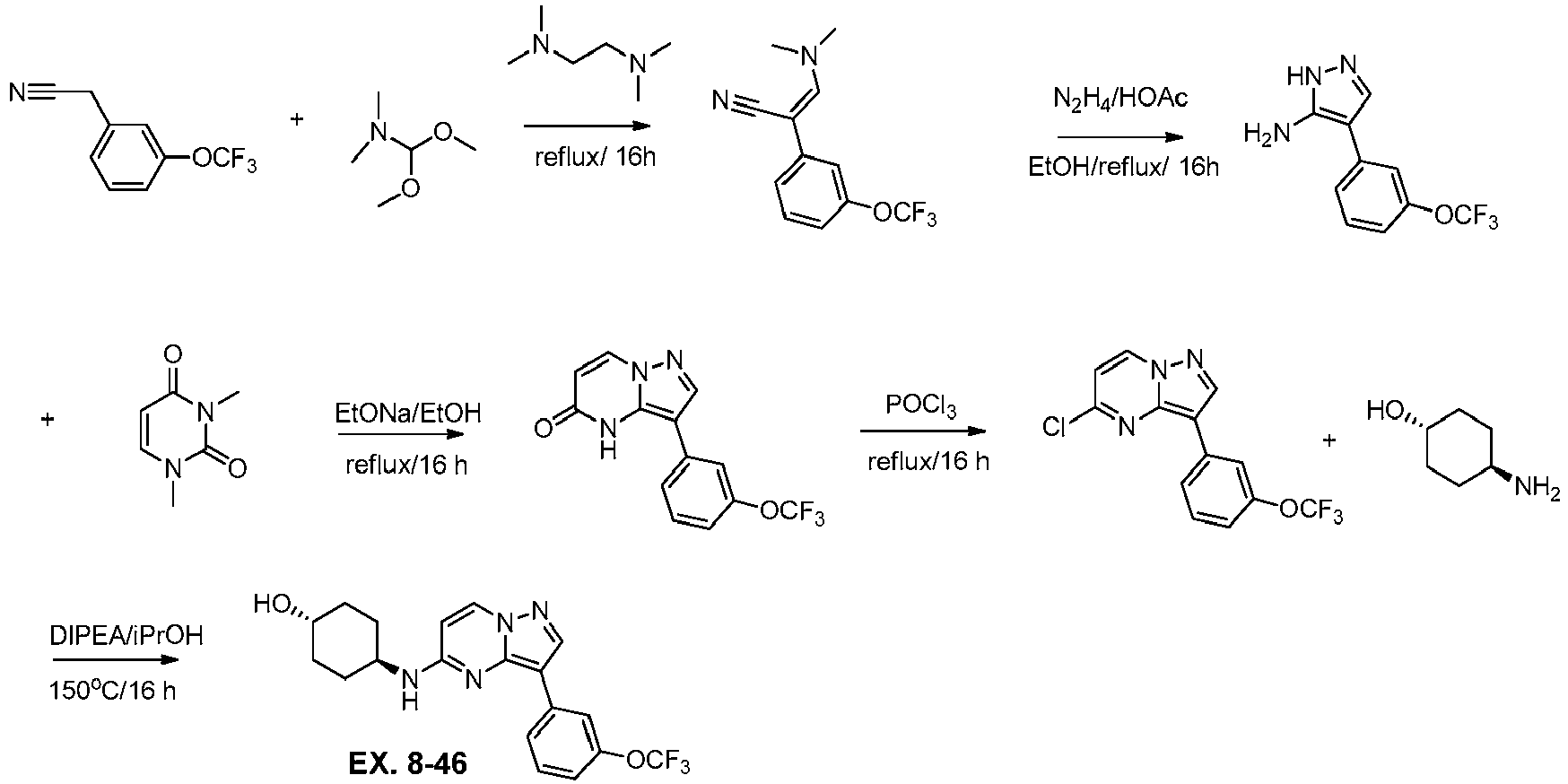
- A mixture of 3-trifluoromethoxyphenylacetonitrile (2.5 grams, 12.43 mmol), DIPEA (0.321 grams, 2.48 mmol), and dimethyl formamide dimethyl acetal (20 mL) were heated at reflux for 4 h. On cooling, the reaction was partitioned between EtOAc and saturated aqueous NH4Cl solution. The aqueous phase was extracted with ethyl acetate and the combined organic phase washed with brine and concerated in vacuo. The crude product was purified by chromatography (ethyl acetate/hexane, 0-10%) on silica gel (24 grams) to give pure product (2.3 grams, 8.98 mmol, 72% yield.).
- A mixture of acrylnitrile (2.0 g, 7.81 mmol), hydrazine hydrate (4.53 grams, 39.0 mmol), and glacial acetaic acid (2.34 grams, 39.0 mmol) and ethanol (20 mL) were heated at reflux for 16 h. On cooling, the reaction was diluted with water, extracted with AcOEt and the combined organic phase washed with brine and concerated in vacuo (1.90 grams, 7.84 mmol, 100% yield.).
- 1H-NMR (CDCl3/400 MHz): δ 7.64 (m, 1H), 7.42 (m, 4H), 7.06 (d, J = 7.6 Hz, 1H). MS (ES+, m/z): (M+H)+: 244.3.
- A mixture of pyrazole (0.8 grams, 3.29 mmol), 1,3-dimethyluracil (0.51 grams, 3.62 mmol), and
dry EtOH 10 mL were treated dropwise with sodium ethoxide (0.29 grams, 4.28 mmol) and on completion of addition the reaction was heated at reflux for 16 h. On cooling the reaction was concentrated in vacuo and the residue added to ice, neutralised with acetic acid and the resulting precipitate filtered, washed with water and dried to give the product (0.4 grams, 1.36 mmol, 41% yield.). No chromatography was needed for this step.
1H-NMR (CDCl3/400 MHz): δ 8.42 (d, J = 8.0 Hz, 1H), 8.09 (s, 1H), 7.62 (d, J = 7.6 Hz, 1H), 7.52 (m, 2H), 7.20 (d, J = 8.8 Hz, 1H), 6.16 (d, J = 7.6 Hz, 1H). - A mixture of pyrazolepyrimidinone (0.5 grams, 1.69 mmol) was treated with
POCl 3 10 mL and the mixture was heated at relux for overnight. On cooling, after remove the slovent under rotovapor, the reaction was poured onto ice, cautiously made basic with saturated aqueous NaHCO3 solution and extracted with EtOAc. The combined organic phases were washed with brine and concentrated in vacuo to give the product (0.3 grams, 0.96 mmol, 56% yield.).
1H-NMR (CDCl3/400 MHz): δ 8.56 (d, J = 7.6 Hz, 1H), 8.39 (s, 1H), 7.92 (d, J = 7.6 Hz, 1H), 7.85 (m, 2H), 7.45 (t, J = 8.0 Hz, 1H), 7.12 (d, J = 8.4 Hz, 1H), 6.85 (d, J = 7.2 Hz, 1H). MS (ES+, m/z): (M+H)+: 314.3. - A solution of 3-bromo-5-chloropyrazolo[1,5-a]pyrimidine (0.03 grams, 0.096 mmol) and trans-1,4-diamocyclohexane (0.017 grams, 0.143 mmol) in iso-propanol (5 mL) was added DIPEA (0.025 grams, 0.191 mmol) and the mixture was heated at 150°C for 12 h under microwave irradiation. The resulting dark brown solution was cooled down and was concentrated under reduced pressure. The solid was further purified by using combiflash chromatography (12 g column), eluent: 0-6% CH3OH/DCM and obtained product (0.020 grams, 0.051 mmol, 53% yield.).
1H-NMR (CD3OD/400 MHz): δ 8.22 (s, 1H), 8.18 (m, 2H), 7.80 (d, J = 8.0 Hz, 1H), 7.34 (t, J = 8.4 Hz, 1H), 6.96 (m, 1H), 6.17 (d, J = 7.6 Hz, 1H), 3.90 (m, 1H), 3.58 (m, 1H), 2.18 (m, 2H), 2.00 (m, 2H), 1.38 (m, 4H). MS (ES+, m/z): (M+H)+: 393.5. - EX. 8-47 to EX. 8-53 were prepared using similar procedures as in EX. 8-46.
-

- 1H-NMR (CD3OD/400 MHz): δ 8.38 (s, 1H), 8.22 (m, 2H), 7.78 (d, J = 8.0 Hz, 1H), 7.38 (t, J = 8.0 Hz, 1H), 6.97 (d, J = 7.6 Hz, 1H), 6.22 (d, J = 7.6 Hz, 1H), 3.90 (m, 1H), 2.25 (m, 2H), 1.97 (m, 2H), 2.00 (m, 2H), 1.37 (m, 1H), 1.30 (m, 4H), 1.16 (s, 6H). MS (ES+, m/z): (M+H)+: 435 .5.
-
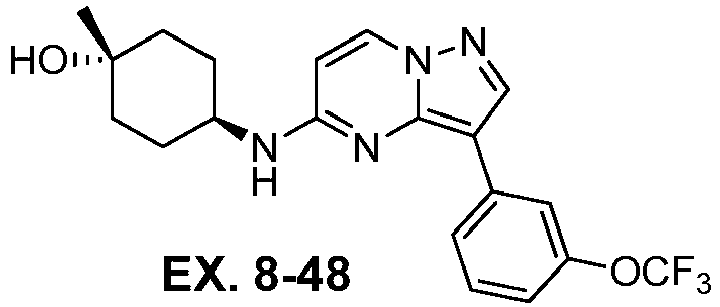
- 1H-NMR (CD3OD/400 MHz): δ 8.25 (m, 3H), 7.95 (d, J = 8.0 Hz, 1H), 7.40 (t, J = 8.0 Hz, 1H), 6.99 (d, J = 7.6 Hz, 1H), 6.29 (d, J = 7.6 Hz, 1H), 4.10 (m, 1H), 2.11 (m, 2H), 1.74 (m, 2H), 1.62 (m, 4H), 1.28 (s, 3H). MS (ES+, m/z): (M+H)+: 407.5.
-

- 1H-NMR (CD3OD/400 MHz): δ 8.30 (m, 1H), 8.22 (m, 2H), 7.82 (d, J = 8.0 Hz, 1H), 7.38 (t, J = 8.0 Hz, 1H), 6.38 (m, 1H), 6.22 (d, J = 7.6 Hz, 1H), 3.95 (m, 1H), 3.26 (m, 1H), 2.22 (m, 2H), 2.14 (m, 2H), 1.38 (m, 4H). MS (ES+, m/z): (M+H)+: 407.5.
-

- 1H-NMR (CDCl3/400 MHz): δ 8.32 (s, 1H), 8.29 (m, 2H), 7.83 (d, J = 8.0 Hz, 1H), 7.41 (t, J = 8.0 Hz, 1H), 7.02 (d, J = 8.0 Hz, 1H), 6.29 (d, J = 8.0 Hz, 1H), 4.24 (m, 1H), 4.02 (m, 2H), 3.60 (t, J = 12.0 Hz, 2H), 2.12 (m, 2H), 1.62 (m, 2H). MS (ES+, m/z): (M+H)+: 379.4.
-

- 1H-NMR (CD3OD/400 MHz): δ 8.24 (m, 2H), 8.21 (s, 1H), 7.70 (d, J = 8.0 Hz, 1H), 7.38 (d, J = 8.0 Hz, 1H), 7.23 (m, 1H), 6.07 (d, J = 7.2 Hz, 1H), 3.51 (t, J = 6.4 Hz, 2H), 3.06 (m, 2H), 3.00 (m, 2H), 2.22 (m, 3H), 1.96 (m, 2H). MS (ES+, m/z): (M+H)+: 441.4.
-
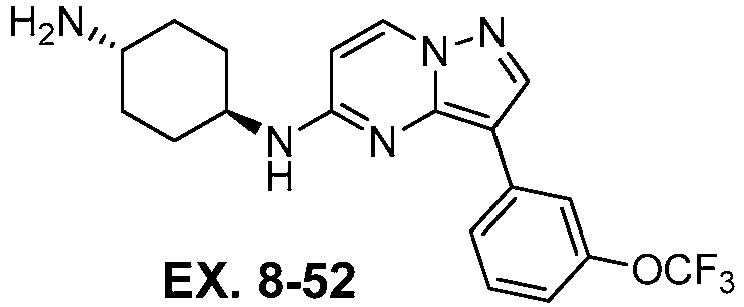
- 1H-NMR (CD3OD/400 MHz): δ 8.24 (m, 3H), 7.87 (d, J = 7.6 Hz, 1H), 7.39 (t, J = 8.0 Hz, 1H), 6.99 (d, J = 8.0 Hz, 1H), 6.24 (d, J = 7.6 Hz, 1H), 3.95 (m, 1H), 2.86 (m, 1H), 2.24 (m, 2H), 1.8 (m, 2H), 1.37 (t, J = 9.2 Hz, 4H). MS (ES+, m/z): (M+H)+: 392.4.
-

- 1H-NMR (CD3OD/400 MHz): δ 8.32 (d, J = 8.0 Hz, 1H), 8.24 (m, 1H), 8.07 (m, 1H), 7.85 (d, J = 5.6 Hz, 1H), 7.38 (t, J = 8.0 Hz, 1H), 6.95 (d, J = 7.6 Hz, 1H), 6.61 (d, J = 7.6 Hz, 1H), 4.22 (m, 2H), 3.17 (m, 2H), 2.91 (m, 1H), 2.10 (m, 1H), 1.80 (m, 1H), 1.60 (m, 1H), 1.50 (m, 1H). MS (ES+, m/z): (M+H)+: 378.5.
-

- A mixture of 2-(3-(trifluoromethyl)phenyl)acetonitrile (4.55 g, 24.58 mmol), 1,1-dimethoxy-N,N-dimethylmethanamine (13.10 ml, 98 mmol), and N 1,N 1,N 2,N 2-tetramethylethane-1,2-diamine (0.737 ml, 4.92 mmol) were heated to reflux for 5h. After cooling to RT, the mixture was partitioned between saturated aqueous NH4Cl and EtOAc and extracted three times with EtOAc. The combined organics were washed with brine, dried over Na2SO4, and concentrated in vacuo. After absorbing on celite, the compound was purified by Isco (40g silica, 10% to 70% EtOAc/hexanes) to give pure 3-(dimethylamino)-2-(3-(trifluoromethyl)phenyl)acrylonitrile (2.93g, 50% yield).
1H NMR (400 MHz, CDCl3): 7.48 (m, 2H), 7.41-7.34 (m, 2H), 6.94 (s, 1H), 3.25 (s, 6H).
- To a mixture of 3-(dimethylamino)-2-(3-(trifluoromethyl)phenyl)acrylonitrile (2.93 g, 12.20 mmol) in ethanol (35 ml) was added hydrazine hydrate (3.80 ml, 122 mmol) and acetic acid (6.98 ml, 122 mmol). Upon to reflux; a solution formed. After 5 hours, 0.25mL of hydrazine hydrate was added and the reaction refluxed an additional 15 hours. The volatiles were removed in vacuo, and the residue partitioned between EtOAc and water. After extracting three times with EtOAc, the combined organics were washed twice with saturated aqueous NaHCO3, dried over Na2SO4, and concentrated in vacuo to cleanly give 4-(3-(trifluoromethyl)phenyl)-1H-pyrazol-5-amine (2.7g, 97% yield) as a light yellow oil.
1H NMR (400 MHz, CDCl3): 7.69 (m, 1H), 7.63 (m, 1H), 7.58 (s, 1H), 7.50 (m, 2H), 5.78 (br s, 3H).
- To a mixture of 4-(3-(trifluoromethyl)phenyl)-1H-pyrazol-5-amine (2.7g, 11.88 mmol) and 1,3-dimethylpyrimidine-2,4(1H,3H)-dione (1.999 g, 14.26 mmol) in ethanol (35 ml) was added sodium ethoxide (1.132 g, 16.64 mmol). After heating to reflux 16 hours under Agonr, the reaction was cooled to RT and the volatiles removed in vacuo. The mixture was diluted with 30mL H2O and acidified to pH=4 with AcOH. The resulting solid was collected by vacuum filtration. The solid was taken up in a 4:1 DCM/2-propanol solution, washed with water, dried over Na2SO4, and rotovaced to give pure 3-(3-(trifluoromethyl)phenyl)pyrazolo[1,5-a]pyrimidin-5(4H)-one (2.07 g, 7.41 mmol, 62.4% yield).
1H NMR (400 MHz, DMSO-d6): 12.38 (br s, 1H), 8.62 (d, 1H), 8.38 (s, 1H), 8.05 (m, 2H), 7.60 (m, 2H), 6.20 (m, 1H).
- A mixture of 3-(3-(trifluoromethyl)phenyl)pyrazolo[1,5-a]pyrimidin-5(4H)-one (2.07 g, 7.41 mmol) and POCl3 (6.91 ml, 74.1 mmol) was heated to 107°C. The heating was continued for 16 hours. The reaction mixture was cooled to RT and the POCl3 removed in vacuo to give a waxy solid. The solid was triturated multiple times with Et2O and the Et2O layers were combined and rotovaced. The resulting residue was taken up in DCM and washed with saturated aqueous NaHCO3, dried over Na2SO4 and concentrated in vacuo to give 5-chloro-3-(3-(trifluoromethyl)phenyl)pyrazolo[1,5-a]pyrimidine (1.47g, 67% yield) as a brown solid.
1H NMR (400 MHz, CDCl3): 8.60 (d, 1H), 8.47 (s, 1H), 8.24 (d, 1H), 8.19 (s, 1H), 7.55 (m, 2H), 6.87 (d, 1H).
- A mixture of 5-chloro-3-(3-(trifluoromethyl)phenyl)pyrazolo[1,5-a]pyrimidine (100 mg, 0.336 mmol), 4-aminocyclohexanol (58.0 mg, 0.504 mmol), and DIEA (0.117 ml, 0.672 mmol) in 2-propanol (3 ml) was irradiated to 135°C for 14h in a Biotage microwave. After cooling, the mixture was diluted with saturated aqueous NaHCO3, and extracted three times with EtOAc. The combined extracts were washed with brine, dried over Na2SO4 and concentrated in vacuo. After absorbing on celite, the compound was purified by Isco (12g silica, 1/5/4 MeOH/EtOAc/hex) to give trans-4-((3-(3-(trifluoromethyl)phenyl)pyrazolo[1,5-a]pyrimidin-5-yl)amino)cyclohexanol (101mg, 80% yield) as a white solid.
1H NMR (400 MHz, CD3OD): 8.72 (s, 1H), 8.29 (s, 1H), 8.50 (d, 1H), 8.09 (d, 1H), 7.50 (t, 1H), 7.39 (d, 1H), 6.25 (d, 1H), 3.98 (m, 1H), 3.62 (m, 1H), 2.23 (m, 2H), 2.03 (m, 2H), 1.55-1.32 (m, 4H). MS (ES+, m/z): (M+H)+: 377.5. - EX. 8-55 to EX. 8-60 were prepared using similar procedures as in EX. 8-54.
-
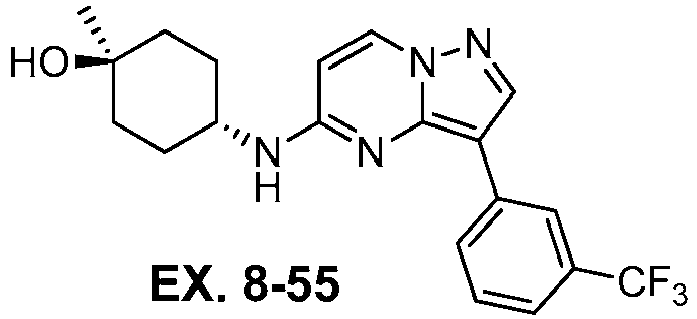
- 1H NMR (400 MHz, CD3OD): 8.69 (s, 1H), 8.29 (s, 1H), 8.25 (d, 1H), 8.11 (d, 1H), 7.30 (t, 1H), 7.39 (d, 1H), 6.31 (d, 1H), 4.09 (m, 1H), 2.15 (m, 2H), 1.79-1.52 (m, 6H), 1.30 (s, 3H). MS (ES+, m/z): (M+H)+: 391.5.
-

- 1H NMR (400 MHz, CD3OD): 8.78 (s, 1H), 8.18 (s, 1H), 8.24 (d, 1H), 8.05 (d, 1H), 7.49 (t, 1H), 7.38 (d, 1H), 6.25 (d, 1H), 3.95 (m, 1H), 2.28 (m, 2H), 1.95 (m, 2H), 1.32 (m, 5H), 1.20 (s, 6H). MS (ES+, m/z): (M+H)+: 419.5.
-

- 1H NMR (400 MHz, DMSO-d6): 8.76 (s, 1H), 8.49 (d, 1H), 8.45 (s, 1H), 8.13 (d, 1H), 7.66 (d, 1H), 7.56 (t, 1H), 7.42 (d, 1H), 6.30 (d, 1H), 3.75 (m, 1H), 3.27 (s, 3H), 3.19 (m. 1H), 2.10 (m, 4H), 1.30 (m, 4H). MS (ES+, m/z): (M+H)+: 391.5.
-
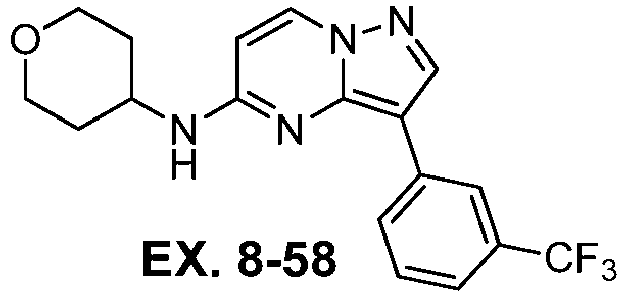
- 1H NMR (400 MHz, DMSO-d6): 8.73 (s, 1H), 8.52 (d, 1H), 8.47 (s, 1H), 8.15 (d, 1H), 7.77 (d, 1H), 7.55 (t, 1H), 7.43 (d, 1H), 6.33 (d, 1H), 4.08 (m, 1H), 3.93 (m, 2H), 3.43 (m, 2H), 2.05 (m, 2H), 1.53 (m, 2H). MS (ES+, m/z): (M+H)+: 363.5.
-
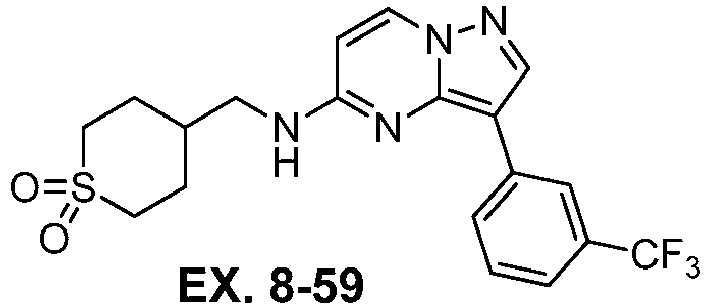
- 1H NMR (400 MHz, CD3OD): 8.66 (s, 1H), 8.31 (s, 1H), 8.29 (s, 1H), 8.12 (d, 1H), 7.52 (t, 1H), 7.40 (d, 1H), 6.31 (d, 1H), 3.50 (d, 2H), 3.18 (m, 4H), 2.21 (m, 3H), 1.88 (m, 2H). MS (ES+, m/z): (M+H)+: 425.5.
-

- 1H NMR (400 MHz, DMSO-d6): 8.82 (d, 1H), 8.61 (s, 1H), 8.48 (m, 1H), 8.28 (d, 1H), 7.61 (t, 1H), 7.48 (d, 1H), 6.98 (d, 1H), 4.22 (m, 4H), 3.28 (m, 4H). MS (ES+, m/z): (M+H)+: 397.4.
-

- A mixture of 3-chlorophenylacetonitrile (5 grams, 33.0 mmol), N,N,N',N'-tetramethyl-ethane-1,2-diamine (0.767 grams, 6.60 mmol), and dimethyl formamide dimethyl acetal (20 mL) were heated at reflux for 4 h. On cooling, the reaction was partitioned between EtOAc and saturated aqueous NH4Cl solution. The aqueous phase was extracted with ethyl acetate and the combined organic phase washed with brine and concerated in vacuo. The crude product was purified by chromatography (ethyl acetate/hexane, 0-10%) on silica gel (24 grams) to give pure product (6.8 grams, 33.0 mmol, 100% yield.).
1H-NMR (CDCl3/400 MHz): δ 7.31 (m, 2H), 7.22 (m, 2H), 7.08 (m, 1H), 3.31 (s, 3H), 3.30 (s, 3H). - A mixture of acrylnitrile (5.0 g, 24.19 mmol), hydrazine hydrate (7.75 grams, 242 mmol), and glacial acetaic acid (14.53 grams, 242 mmol) and ethanol (20 mL) were heated at reflux for 16 h. On cooling, the reaction was diluted with water, extracted with AcOEt and the combined organic phase washed with brine and concerated in vacuo (4.0 grams, 20.66 mmol, 85% yield.).
1H-NMR (CDCl3/400 MHz): δ 7.63 (m, 1H), 7.52 (m, 1H), 7.42 (d, J = 8.0 Hz, 1H), 7.33 (t, J = 8.0 Hz, 1H), 7.17 (d, J = 8.0 Hz, 1H). MS (ES+, m/z): (M+H)+: 194.3. - A mixture of pyrazole (4.0 grams, 20.66 mmol), 1,3-dimethyluracil (3.47 grams, 24.79 mmol), and
dry EtOH 10 mL were treated dropwise with sodium ethoxide (1.97 grams, 28.9 mmol) and on completion of addition the reaction was heated at reflux for 16 h. On cooling the reaction was concentrated in vacuo and the residue added to ice, neutralised with acetic acid and the resulting precipitate filtered, washed with water and dried to give the product (4.0 grams, 16.28 mmol, 79% yield.). No chromatography was needed for this step.
1H-NMR (CDCl3/400 MHz): δ 8.38 (d, J = 8.4 Hz, 1H), 8.04 (s, 1H), 7.65 (s, 1H), 7.65 (s, 1H), 7.51 (m, 1H), 7.40 (t, J = 8.0 Hz, 1H), 7.27 (d, J = 8.0 Hz, 1H), 6.12 (d, J = 7.6 Hz, 1H). MS (ES+, m/z): (M+H)+: 246.3. - A mixture of pyrazolepyrimidinone (4.0 grams, 16.28 mmol) was treated with
POCl 3 10 mL and the mixture was heated at relux for overnight. On cooling, after remove the slovent under rotovapor, the reaction was poured onto ice, cautiously made basic with saturated aqueous NaHCO3 solution and extracted with EtOAc. The combined organic phases were washed with brine and concentrated in vacuo to give the product (0.65 grams, 2.46 mmol, 15% yield.).
1H-NMR (CDCl3/400 MHz): δ 8.89 (d, J = 7.4 Hz, 1H), 8.61 (s, 1H), 8.10 (m, 1H), 7.96 (d, J = 7.6 Hz, 1H), 7.40 (t, J = 8.0 Hz, 1H), 7.26 (d, J = 8.0 Hz, 1H), 7.06 (d, J = 7.2 Hz, 1H). MS (ES+, m/z): (M)+: 264.3. - A solution of 3-chloro-5-chloropyrazolo[1,5-a]pyrimidine (0.150 grams, 0.568 mmol) and trans-1,4-diamocyclohexane (0.131 grams, 1.14 mmol) in iso-propanol (5 mL) was added DIPEA (0.177 grams, 2.272 mmol) and the mixture was heated at 150°C for 12 h under microwave irradiation. The resulting dark brown solution was cooled down and was concentrated under reduced pressure. The solid was further purified by using combiflash chromatography (12 g column), eluent: 0-6% CH3OH/DCM and obtained product (0.100 grams, 0.292 mmol, 52% yield.).
1H-NMR (CD3OD/400 MHz): δ 8.41 (s, 1H), 8.24 (d, J = 8.0 Hz, 2H), 7.80 (d, J = 8.0 Hz, 1H), 7.30 (t, J = 8.4 Hz, 1H), 7.10 (m, 1H), 6.25 (d, J = 7.6 Hz, 1H), 3.95 (m, 1H), 3.63 (m, 1H), 2.26 (m, 2H), 2.04 (m, 2H), 1.55 (m, 2H), 1.39 (m, 2H). MS (ES+, m/z): (M+H)+: 343.5. - EX. 8-62 to EX. 8-67 and EX. 8-69 were prepared using similar procedures as in EX. 8-61.
-

- 1H-NMR (CD3OD/400 MHz): δ 8.36 (s, 1H), 8.23 (m, 2H), 7.84 (d, J = 8.0 Hz, 1H), 7.30 (t, J = 8.0 Hz, 1H), 7.11 (d, J = 7.6 Hz, 1H), 6.29 (d, J = 7.6 Hz, 1H), 4.02 (m, 1H), 2.20 (m, 2H), 1.75 (m, 4H), 1.50 (m, 2H), 1.29 (s, 6H). MS (ES+, m/z): (M+H)+: 357.5.
-

- 1H-NMR (CD3OD/400 MHz): δ 8.35 (s, 1H), 8.12 (m, 2H), 7.72 (d, J = 8.0 Hz, 1H), 7.27 (t, J = 8.0 Hz, 1H), 7.09 (d, J = 7.6 Hz, 1H), 6.20 (d, J = 7.6 Hz, 1H), 3.95 (m, 1H), 2.30 (m, 2H), 1.94 (m, 2H), 1.32 (m, 4H), 1.50 (s, 6H). MS (ES+, m/z): (M+H)+: 385.5.
-
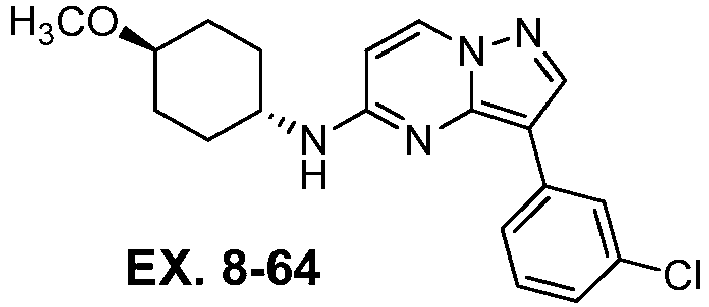
- 1H-NMR (CD3OD/400 MHz): δ 8.40 (s, 1H), 8.23 (m, 2H), 7.80 (d, J = 8.0 Hz, 1H), 7.29 (t, J = 8.0 Hz, 1H), 7.05 (d, J = 8.0 Hz, 1H), 6.22 (d, J = 7.6 Hz, 1H), 3.95 (m, 1H), 3.30 (m, 1H), 2.25 (m, 2H), 2.15 (m, 2H), 1.45 (m, 4H). MS (ES+, m/z): (M+H)+: 357.5.
-

- 1H-NMR (CDCl3/400 MHz): δ 8.32 (s, 1H), 8.15 (m, 2H), 7.72 (d, J = 8.0 Hz, 1H), 7.26 (t, J = 8.0 Hz, 1H), 7.08 (d, J = 8.0 Hz, 1H), 6.23 (d, J = 8.0 Hz, 1H), 4.20 (m, 1H), 4.00 (m, 2H), 3.62 (t, J = 12.0 Hz, 2H), 2.17 (m, 2H), 1.62 (m, 2H). MS (ES+, m/z): (M+H)+: 329.5.
-

- 1H-NMR (CD3OD/400 MHz): δ 8.35 (s, 1H), 8.28 (d, J = 8.0 Hz, 1H), 8.24 (s, 1H), 7.81 (d, J = 8.0 Hz, 1H), 7.31 (t, J = 7.2 Hz, 1H), 7.11 (d, J = 7.2 Hz, 1H), 6.29 (d, J = 7.2 Hz, 1H), 3.46 (m, 2H), 3.10 (m, 4H), 2.27 (m, 3H), 1.89 (m, 2H). MS (ES+, m/z): (M+H)+: 391.4.
-

- 1H-NMR (CD3OD/400 MHz): δ 8.26 (m, 3H), 7.86 (d, J = 8.0 Hz, 1H), 7.37 (m, 1H), 6.99 (d, J = 8.0 Hz, 1H), 6.28 (d, J = 7.2 Hz, 1H), 3.41 (d, J = 6.0 Hz, 2H), 2.80 (d, J = 12.0 Hz, 1H), 2.30 (s, 3H), 2.11 (t, J = 12.0 Hz, 1H), 1.89 (m, 3H), 1.44 (m, 2H), 1.29 (m, 2H). MS (ES+, m/z): (M+H)+: 391.4.
-

- EX.8-68 was prepared using similar procedures as in EX. 8-8.
1H-NMR (CD3OD/400 MHz): δ 8.42 (s, 1H), 7.84 (d, J = 8.0 Hz, 1H), 7.78 (s, 1H), 7.59 (d, J = 8.0 Hz, 1H), 7.37 (t, J = 8.0 Hz, 1H), 7.27 (m, 1H), 6.66 (d, J = 7.6 Hz, 1H), 3.65 (m, 1H), 3.01 (m, 1H), 2.33 (m, 2H), 2.08 (m, 2H), 1.56 (m, 2H), 1.38 (m, 2H). MS (ES+, m/z): (M+H)+: 325.5. -

- 1H-NMR (CD3OD/400 MHz): δ 8.37 (s, 1H), 8.23 (m, 2H), 7.80 (d, J = 8.0 Hz, 1H), 7.28 (t, J = 7.6 Hz, 1H), 7.09 (d, J = 7.6 Hz, 1H), 6.23 (d, J = 7.2 Hz, 1H), 3.90 (m, 1H), 2.75 (m, 1H), 2.27 (m, 2H), 2.05 (m, 2H), 1.36 (m, 4H). MS (ES+, m/z): (M+H)+: 325.5.
-

- To a solution of 6-chloro-3-(3-chlorophenyl)imidazo[1,2-b]pyridazine (100 mg, 0.38 mmol) and cyclohexane-1,3-diamine (43 mg, 0.38 mmol) in NMP (1.0 mL) was added NaHCO3 (32 mg, 0.38 mmol), the mixture was stirred at 180 °C for 60 mins under microwave irridation. The mixture was purified by flash chromatograph to give N1-(3-(3-chlorophenyl)imidazo[1,2-b]pyridazin-6-yl)cyclohexane-1,3-diamine (30 mg, 0.088 mmol, 23%) as a pale yellow solid.
1H-NMR (CD3OD/400 MHz): δ 8.44 (s, 1H), 7.84 (d, 1H), 7.78 (m, 1H), 7.58 (d, 1H), 7.28 (m, 1H), 7.25 (m, 1H), 6.65 (d, 1H), 3.75 (m, 1H), 2.94 (m, 1H), 2.41 (m, 1H), 2.20 (m, 1H), 1.95 (m, 2H), 1.51 (m, 1H), 1.16 (m, 3H). MS (ES+, m/z): (M+H)+: 342.5. -

- To a solution of 6-chloro-3-(3-chlorophenyl)imidazo[1,2-b]pyridazine (200 mg, 0.78 mmol) and (S)-Piperidin-3-amine (290 mg, 2.12 mmol) in NMP (1.0 mL) was added NaHCO3 (118 mg, 1.52 mmol), the mixture was stirred at 180 °C for 60 mins under microwave irridation. The mixture was purified by flash chromatograph to give (S)-1-(3-(3-chlorophenyl)imidazo[1,2-b]pyridazin-6-yl)piperidin-3-amine (32 mg, 0.098 mmol, 13%) as a pale yellow solid.
1H-NMR (CD3OD/400 MHz): δ 8.19 (s, 1H), 7.87 (d, J = 7.6 Hz, 1H), 7.79 (s, 1H), 7.66 (d, J = 10.0 Hz, 1H), 7.34 (t, J = 8.0 Hz, 1H), 7.23 (d, J = 8.0 Hz, 1H), 7.07 (d, J = 10.0 Hz, 1H), 3.97 (m, 1H), 3.95 (m, 1H), 2.99 (m, 1H), 2.83 (m, 2H), 1.98 (m, 1H), 1.79 (m, 1H), 1.60 (m, 1H), 1.36 (m, 1H). MS (ES+, m/z): (M+H)+: 328.6. -

- To a solution of 6-chloro-3-(3-chlorophenyl)imidazo[1,2-b]pyridazine (200 mg, 0.757 mmol) and 4-aminocyclohexanone (290 mg, 2.56 mmol) in NMP (1.0 mL) was added NaHCO3 (118 mg, 1.52 mmol), the mixture was stirred at 180 °C for 60 mins under microwave irridation. The mixture was purified by flash chromatograph to give 4-((3-(3-chlorophenyl)imidazo[1,2-b]pyridazin-6-yl)amino)cyclohexanone (40 mg, 0.117 mmol, 16%) as a pale yellow solid.
1H-NMR (CD3Cl/400 MHz): δ 8.38 (s, 1H), 7.83 (s, 1H), 7.76 (d, J = 7.6 Hz, 2H), 7.37 (t, J = 8.0 Hz, 1H), 7.29 (m, 1H), 6.64 (d, J = 9.6 Hz, 1H), 4.90 (m, 1H), 4.25 (m, 1H), 2.53 (m, 6H), 1.80 (m, 2H). MS (ES+, m/z): (M+H)+: 341.4. -

- To a solution of 6-chloro-3-(3-chlorophenyl)imidazo[1,2-b]pyridazine (80 mg, 0.303 mmol) and trans-4-aminocyclohexanecarbonitrile (38 mg, 0.303 mmol) in NMP (1.0 mL) was added NaHCO3 (102 mg, 1.212 mmol), the mixture was stirred at 180 °C for 60 mins under microwave irridation. The mixture was purified by flash chromatograph to give 4-trans-((3-(3-chlorophenyl)imidazo[1,2-b]pyridazin-6-yl)amino)cyclohexanecarbonitrile (20 mg, 0.057 mmol, 23%) as white solid.
1H-NMR (CD3OD/400 MHz): δ 8.40 (s, 1H), 7.83 (d, 1H), 7.78 (s, 1H), 7.56 (d, 1H), 7.38 (m, 1H), 7.29 (m, 1H), 6.63 (d, 1H), 3.67 (m, 1H), 2.65 (m, 1H), 2.30 (m, 2H), 2.20 (m, 2H), 1.75 (m, 2H), 1.32 (m, 2H). MS (ES+, m/z): (M+H)+: 352.5. -

- To a solution of 3-bromo-6-chloroimidazo[1,2-b]pyridazine (500 mg, 2.15 mmol) in a mixed solvent of dioxane (5 mL) and water (0.5 mL) was added (3-fluorophenyl)boronic acid (273 mg, 1.96 mmol), K2CO3 (811 mg, 5.88 mmol) and Pd(dppf)2Cl2 (79 mg, 0.098 mmol). The reaction mixture was stirred at 80°C overnight under N2. TLC (PE: EA = 5:1) showed the starting material was consumed. The mixture was cooled and concentrated. The residue was purified by column chromatography on silica gel (petroleum ether/EtOAc = 20:1 to 1:1) to give 6-chloro-3-(3-fluorophenyl)imidazo[1,2-b]pyridazine (300 mg, 56%) as a yellow solid.
- To a solution of give 6-chloro-3-(3-fluorophenyl)imidazo[1,2-b]pyridazine (100 mg, 0.404 mmol) in NMP (2 mL) was added 2-(trans-4-aminocyclohexyl)propan-2-ol (95 mg, 0.6 mmol) and NaHCO3 (101.8 mg, 1.21 mmol). The mixture was purged with nitrogen and kept at 180°C for 30 min with M.W. reaction. LCMS showed the reaction was complete. The mixture was partitioned between water (100 mL) and EtOAc (50 mL). The aqueous layer was extracted with EtOAc (50 mL * 3). The combined extracts were dried over Na2SO4, filtered and concentrated in vacuo. The residue was purified by prep. HPLC to give EX. 8-75 (10.6 mg, 7.2%) as a yellow solid.
1H NMR (MeOD, 400MHz): δ 8.26 (dt, J1 = 11.34 Hz, J2 = 2.06 Hz, 1H), 7.88 (d, J = 7.90 Hz, 1H), 7.86 (s, 1H), 7.63 (d, J = 9.96 Hz, 1H), 7.48-7.43 (m, 1H), 7.07 (td, J1 = 8.42 Hz, J2 = 2.75 Hz, 1H), 6.71 (d, J = 9.62 Hz, 1H), 3.68 (br, 1H), 2.36 (br, 2H), 2.00 (br, 2H), 1.42-1.26 (m, 5H), 1.21 (s, 6H). MS (ES+, m/z): (M+H)+: 369.3 -

- To a solution of trans-4-(aminomethyl)cyclohexanecarboxylic acid (2 g, 12.7 mmol) in MeOH (64 mL) was added dropwise thionyl chloride (0.93 mL, 12.7 mmol) at room temperature. The resulting mixture was stirred at room temperature for 4 h. The mixture was concentrated in vacuo to dryness to give trans-methyl 4-(aminomethyl)cyclohexanecarboxylate (2.5 g, 115%) as HCl salts.
- To a solution of trans-methyl 4-(aminomethyl)cyclohexanecarboxylate (1 g, 5.8 mmol) in THF (50 mL) was added dropwise methylmagnesium bromide (7.7 mL, 23.2 mmol) at -78°C. The mixture was stirred at room temperature for 2 h. TLC (PE: EA = 5:1) showed the reaction was complete. The mixture was quenched by the addition of NH4Cl (100 mL) and extracted with EtOAc (100 mL X 3). The combined extracts were dried over Na2SO4, filtered and concentrated in vacuo to give 2-(trans-4-(aminomethyl)cyclohexyl)propan-2-ol (0.42 g, 39.2%) as a yellow solid.
- A mixture of 6-chloro-3-(3-chlorophenyl)imidazo[1,2-b]pyridazine (100 mg, 0.38 mmol), 2-(trans-4-(aminomethyl)cyclohexyl)propan-2-ol (140 mg, 0.76 mmol) and KF (51 mg, 0.88 mmol) in DMSO (2 mL) was stirred at 130°C overnight. LCMS showed the reaction was complete. The mixture was poured into water (100 mL) and extracted with EtOAc (50 mL X 3). The combined extracts were dried over Na2SO4, filtered and concentrated in vacuo. The residue was purified by prep-HPLC to give EX. 8-76 (12 mg, 8%) as a yellow solid.
1H NMR (MeOD, 400MHz): δ 8.44 (s, 1H), 8.05 (s, 1H), 7.98 (d, J = 7.56 Hz, 1H), 7.78 (d, J = 9.62 Hz, 1H), 7.50 (t, J = 7.56 Hz, 1H), 7.43 (d, J = 8.25 Hz, 1H), 6.97 (d, J = 9.62 Hz, 1H), 3.27 (d, J = 6.87 Hz, 2H), 2.03 (d, J = 10.65 Hz, 2H), 1.94 (s, J = 10.65 Hz, 2H), 1.77 (br, 1H), 1.35-1.31 (m, 1H), 1.15 (s, 6H), 1.15-1.02 (m, 4H). MS (ES+, m/z): (M+H)+: 399.3. -

- To a solution of trans-ethyl 4-hydroxycyclohexanecarboxylate (1 g, 5.8 mmol) in THF (50 mL) was added dropwise methylmagnesium bromide (7.7 mL, 23.2 mmol) at -78°C. The mixture was stirred at room temperature for 2 h. TLC (PE: EA = 1:1) showed the reaction was complete. The mixture was quenched by the addition of NH4Cl (100 mL) and extracted with EtOAc (100 mL * 3). The combined extracts were dried over Na2SO4, filtered and concentrated in vacuo to give trans-4-(2-hydroxypropan-2-yl)cyclohexanol (0.88 g, 96%) as a yellow solid.
- To a solution of 6-chloro-3-(3-chlorophenyl)imidazo[1,2-b]pyridazine (100 mg, 0.378 mmol) in toluene (2 mL) was added trans-4-(2-hydroxypropan-2-yl)cyclohexanol (179.8 mg, 1.14 mmol), BINAP (23.5 mg, 0.038 mmol), Pd(OAc)2 (8.78 mg, 0.038 mmol) and t-BuONa (60.5 mg, 0.76 mmol). The mixture was filled with nitrogen and kept 120°C for 1 h with M.W. reaction. LCMS showed the reaction was complete. The mixture was poured into brine (100 mL) and extracted with EtOAc (100 mL * 3). The combined extracts were dried over Na2SO4, filtered and concentrated in vacuo. The residue was purified by prep. HPLC to give trans-4-(2-hydroxypropan-2-yl)cyclohexanol (13 mg, 8.6%) as a yellow solid.
1H NMR (DMSO, 400MHz): δ 8.41 (s, 1H), 8.18 (s, 1H), 8.05 (d, J = 9.62 Hz, 1H), 7.97 (d, J = 7.56 Hz, 1H), 7.48 (t, J = 7.56 Hz, 1H), 7.38 (d, J = 7.56 Hz, 1H), 6.89 (d, J = 9.88 Hz, 1H), 4.84-4.79 (m, 1H), 4.11 (s, 1H), 2.28 (d, J = 7.82 Hz, 2H), 1.88 (d, J = 9.88 Hz, 2H), 1.44-1.36 (m, 2H), 1.25-1.18 (m, 3H), 1.02 (s, 6H), MS (ES+, m/z):(M+H+): 386.2 -
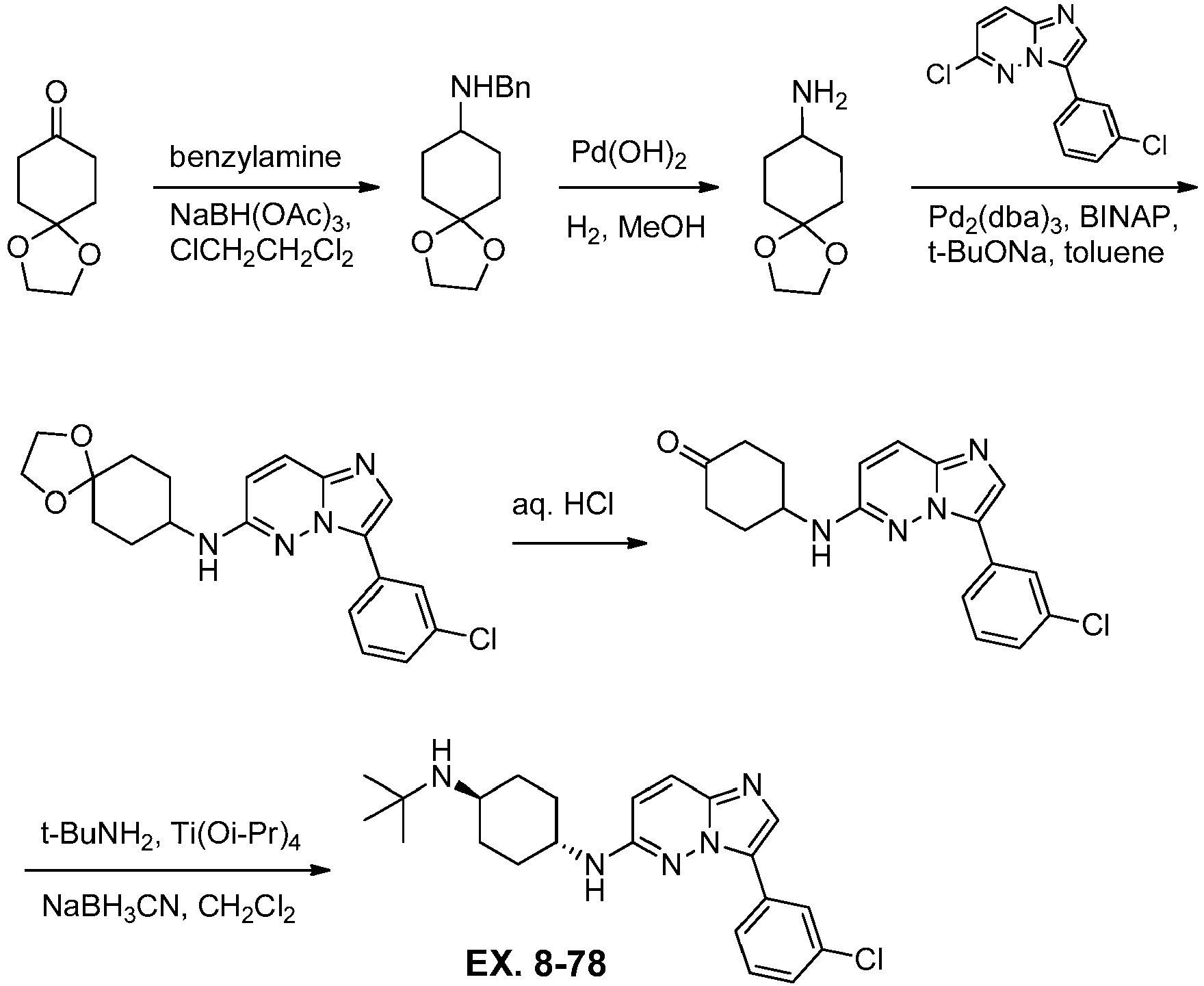
- To a solution of 1,4-dioxaspiro[4.5]decan-8-one (10 g, 6.4 mmol) and benzylamine (7 mL, 6.4 mmol) in 1, 2-dichloroethane (220 mL) was treated with NaBH(OAc)3 (19 g, 89.6 mmol). The mixture was stirred at room temperature for 1h. TLC (PE: EA = 1:1) showed the reaction was complete. The mixture was partitioned between sat. aq. NaHCO3 (500 mL) and EtOAc (200 mL). The organic layer was dried over Na2SO4, filtered and concentrated in vacuo to give N-benzyl-1,4-dioxaspiro[4.5]decan-8-amine (18 g, 115%) as a yellow liquid, which was used in the next step directly.
- A mixture of N-benzyl-1,4-dioxaspiro[4.5]decan-8-amine (3 g, 12.2 mmol) and Palladium hydroxide (0.9 g) in MeOH (120 mL) was hydrogenated under 50 psi of H2 at room temperature. The mixture was stirred at room temperature for 24 h. TLC (CH2Cl2: MeOH = 10:1) showed the reaction was complete. The mixture was filtered and the filtrated was concentrated in vacuo to give 1,4-dioxaspiro[4.5]decan-8-amine (2.1 g, 110%) as a brown oil.
- A mixture of 6-chloro-3-(3-chlorophenyl)imidazo[1,2-b]pyridazine (500 mg, 1.89 mmol), ,4-dioxaspiro[4.5]decan-8-amine (297 mg, 1.89 mmol), BINAP (117.7 mg, 0.189 mmol), t-BuONa (302.4 mg, 3.78 mmol) and Pd2(dba)3 in toluene (10 mL) was filled with N2 and stirred at 110°C overnight. TLC (PE: EA = 1:1) showed the starting material was almost consumed. The mixture was partitioned between water (150 mL) and EtOAc (100 mL). The organic layer was dried over Na2SO4, filtered and concentrated in vucuo. The residue was purified by combi flash to give 3-(3-chlorophenyl)-N-(1,4-dioxaspiro[4.5]decan-8-yl)imidazo[1,2-b]pyridazin-6-amine (420 mg, 57.8%) as a yellow solid.
- To a solution of 3-(3-chlorophenyl)-N-(1,4-dioxaspiro[4.5]decan-8-yl)imidazo[1,2-b]pyridazin-6-amine (210 mg, 0.55 mmol) in THF (3 mL) was added 3 N HCl (3 mL). The resulting mixture was stirred at room temperature for 2 h. TLC (EtOAc) showed the reaction was complete. The mixture was poured into sat. NaHCO3 (aq) and extracted with EtOAc (100 mL X 3). The organic layers were dried over Na2SO4, filtered and concentrated in vacuo to give 4-((3-(3-chlorophenyl)imidazo[1,2-b]pyridazin-6-yl)amino)cyclohexanone (190 mg, 102%) as a yellow solid
- To a 0°C solution of 4-((3-(3-chlorophenyl)imidazo[1,2-b]pyridazin-6-yl)amino)cyclohexanone (80 mg, 0.23 mmol) and t-Butylamine (17.2 mg, 0.23 mmol) in CH2Cl2 (1.2 mL) was added dropwise Ti(Oi-Pr)4 (0.27 mL, 0.92 mmol). The resulting mixture was stirred at room temperature overnight. LCMS showed the reaction was complete. The mixture was poured into water (150 mL) and extracted with EtOAc (100 mL * 3). The organic layers were dried over Na2SO4, filtered and concentrated in vacuo. The residue was purified by prep. HPLC to give EX. 8-78 (15 mg, 16.5%) as a white solid.
1H NMR (MeOD, 400MHz): δ 8.56 (t, J = 1.72 Hz, 1H), 8.45 (br, 0.66H), 7.91 (d, J = 7.93 Hz, 1H), 7.88 (s, 1H), 7.67 (d, J = 9.66 Hz, 1H), 7.46 (t, J = 7.93 Hz, 1H), 7.35 (dd, J1 = 7.93 Hz, J2 = 1.03 Hz, 1H), 6.75 (d, J = 9.66 Hz, 1H), 3.78 (tt, J1 = 11.04 Hz, J2 = 3.45 Hz, 1H), 3.42 (tt, J1 = 12.07 Hz, J2 = 3.79 Hz, 1H), 2.42 (d, J = 11.04 Hz, 2H), 2.23 (d, J = 12.42 Hz, 2H), 1.79 (q, J = 12.42 Hz, 2H), 1.54 (q, J = 12.07 Hz, 2H), 1.46 (s, 9H), MS (ES+, m/z): (M+H+): 398.3. -

- To a solution of TMSN3 (93 mg, 0.78 mmol), TsOH H2O (49 mg, 0.26 mmol) and BF3Et2O (74 mg, 0.52 mmol) in CH2Cl2 (1.3 mL) was slowly added dropwise a solution of EX. 8-37 (100 mg, 0.26 mmol) in CH2Cl2 (1 mL) at 0°C. After the addition, the reaction mixture was stirred at room temperature overnight. TLC (CH2Cl2: MeOH = 10:1) showed the reaction was complete. The mixture was poured into water (150 mL) and extracted with EtOAc (100 mL * 3). The organic layers were dried over Na2SO4, filtered and concentrated in vacuo to give crude N-(trans-4-(2-azidopropan-2-yl)cyclohexyl)-3-(3-chlorophenyl)imidazo[1,2-b]pyridazin-6-amine (80 mg) as a yellow oil, which was used in the next step directly.
- A mixture of N-(trans-4-(2-azidopropan-2-yl)cyclohexyl)-3-(3-chlorophenyl)imidazo[1,2-b]pyridazin-6-amine (90 mg, 0.22 mmol) and Pd/C (30 mg) in MeOH (5 mL) and CH2Cl2 (5 mL) was hydrogenated under 50 psi of H2 at room temperature for 48 h. LCMS showed the reaction was complete. The mixture was filtered and the filtrate was concentrated in vacuo. The residue was purified by prep. HPLC to give EX. 8-79 (4 mg, 5%) as an off-white solid.
1H NMR (MeOD, 400MHz): δ 8.49 (s, 1H), 8.29 (br, 0.68H), 7.79 (d, J = 7.56 Hz, 1H), 7.77 (s, 1H), 7.56 (d, J = 9.62 Hz, 1H), 7.34 (t, J = 7.56 Hz, 1H), 7.23 (d, J = 7.56 Hz, 1H), 6.62 (d, J = 9.62 Hz, 1H), 3.65 (tt, J1 = 11.68 Hz, J2 = 4.12 Hz, 1H), 2.29 (d, J = 11.68 Hz, 2H), 1.81 (s, J = 12.37 Hz, 2H), 1.52 (t, J = 11.68 Hz, 1H), 1.36 (q, J = 11.68 Hz, 4H), 1.39-1.29 (m, 4H), 1.25 (s, 6H). MS (ES+, m/z): (M+H+): 384.2. -

- To a mixture of 6-chloro-3-(3-chlorophenyl)imidazo[1,2-b]pyridazine (500 mg, 1.89 mmol) in toluene (10 mL) was added trans-cyclohexane-1,4-diamine (215.9 mg, 1.89 mmol), t-BuONa (302.4 mg, 3.78 mmol), BINAP (117.7 mg, 0.189 mmol), Pd2(dba)3 (173 mg, 0.189 mmol). The mixture was filled with N2 and heated at 110°C for 4 h. TLC (PE: EA = 1:1) showed the reaction was complete. The reaction was poured into water (150 mL), extracted with EA (3 X 50 mL). The organic layer was dried and condensed. The residue was purified by combi flash (CH2Cl2: MeOH = 0 ∼ 10:1) to give trans-N1-(3-(3-chlorophenyl)imidazo[1,2-b]pyridazin-6-yl)cyclohexane-1,4-diamine (240 mg, yield: 37%) as a yellow solid.
- To a 0°C solution of trans-N1-(3-(3-chlorophenyl)imidazo[1,2-b]pyridazin-6-yl)cyclohexane-1,4-diamine (50 mg, 0.146 mmol) and DIPEA (0.08 mL, 0.44 mmol) in DMSO (0.6 mL) was added dropwise MeSO3Cl (20 mg, 0.176 mmol). The resulting mixture was stirred at room temperature for 6 h. TLC (CH2Cl2: MeOH = 10:1) showed most of starting material was converted. The mixture was partitioned between water (50 mL) and EtOAc (50 mL) and separated. The aqueous layer was extracted with EtOAc (50 mL X 3). The combined extracts were dried over Na2SO4, filtered and concentrated in vacuo. The residue was purified by prep-HPLC to give EX. 8-80 (10.8 mg, 18%) as a white solid.
1H NMR (DMSO, 400MHz): δ 8.53 (s, 1H), 8.23 (br, 0.4H), 8.01 (d, J = 8.0 Hz, 1H), 7.99 (s, 1H), 7.75 (d, J = 9.6 Hz, 1H), 7.45 (t, J = 8.0 Hz, 1H), 7.35 (dd, J1 = 7.6 Hz, J2 = 1.2 Hz, 1H), 7.10 (d, J = 7.6 Hz, 1H), 7.07 (d, J = 6.4 Hz, 1H), 6.69 (d, J = 9.6 Hz, 1H), 3.54-3.51 (m, 1H), 3.21-3.15 (m, 1H), 2.92 (s, 3H), 2.17 (d, J = 10.4 Hz, 2H), 1.98 (d, J = 10.4 Hz, 2H), 1.46-1.30 (m, 4H). MS (ES+, m/z): (M+H+): 420.2 -

- To a solution of isoindoline-1,3-dione (2 g, 13.6 mmol) in Et3N (60 mL) was added ClCOOEt (2.55 g, 16.33 mmol) at 0°C. The mixture was warmed to room temperature and stirred at room temperature for 4 h. The mixture was filtered and the solid was partitioned between water (150 mL) and EtOAc (50 mL) and adjusted pH value to 6 with 1 N HCl. The organic layer was washed with brine and dried over Na2SO4, filtered and concentrated in vacuo to give
ethyl 1,3-dioxoisoindoline-2-carboxylate (1.67 g, 53.08%) as a white solid. - To a solution of
ethyl 1,3-dioxoisoindoline-2-carboxylate (1.67 g, 7.19 mmol) in water (16 mL) was added 4-aminocyclohexanol (1.31 g, 8.63 mmol), followed by K2CO3 (1.59 g, 11.5 mmol). The mixture was stirred at room temperature for 2 h. TLC (PE: EA = 1:1) showed the reaction was complete. The mixture was filtered and the solid was dried under vacuum to give 2-(4-hydroxycyclohexyl)isoindoline-1,3-dione (1 g, 56.82%) as a brown solid. - To a solution of PPh3 (1.28 g, 4.9 mmol) in THF (12 mL) was added dropwise DEAD (852 mg, 4.9 mmol) at -10°C. After the white solid was appeared, compound 2-(4-hydroxycyclohexyl)isoindoline-1,3-dione (600 mg, 2.45 mmol) was added, followed by CH3COSH (0.35 mL, 4.9 mmol) at -10°C. The mixture was stirred at room temperature overnight. TLC (PE: EA = 1:1) showed the reaction was complete. The mixture was poured into water (200 mL) and extracted with EtOAc (100 mL). The aqueous layer was extracted with EtOAc (100 mL X 3). The combined extracts were dried over Na2SO4, filtered and concentrated in vacuo to give S-(4-(1,3-dioxoisoindolin-2-yl)cyclohexyl) ethanethioate (600 mg, 81%) as a white solid.
- A solution of hydrogen peroxide (0.8 mL) in formic acid (8 mL) was stirred at room temperature for 1 h. After cooling in an ice bath, a mixture of compound 60 (400 mg, 1.32 mmol) in formic acid (2 mL) was added while keeping the temperature at 0°C. The mixture was stirred at room temperature overnight. TLC (PE: EA = 1:1) showed the reaction was complete. The mixture was cooled in an ice bath and solid Na2SO3 was added slowly till the iodine-starch did not go blue. The mixture was mixed with silica gel and concentrated in vacuo. The residue was purified by combi flash (CH2Cl2: MeOH = 10:1) to give 4-(1,3-dioxoisoindolin-2-yl)cyclohexane-1-sulfonic acid (400 mg, 98%) as a white solid.
- A mixture of 4-(1,3-dioxoisoindolin-2-yl)cyclohexane-1-sulfonic acid (6.8 g, 22 mmol) and PCl5 (5 g, 24 mmol) was stirred at room temperature for 30 min. And then the mixture was heated at 100°C and stirred for 2 h. After cooling to room temperatue, the mixture was washed with EtOAc (150 mL X 3). The combined extracts were concentrated in vacuo to give crude 4-(1,3-dioxoisoindolin-2-yl)cyclohexane-1-sulfonyl chloride (5 g, 68%) as a whit solid, which was used in the next step directly.
- A mixture of 4-(1,3-dioxoisoindolin-2-yl)cyclohexane-1-sulfonyl chloride (5 g, 15.2 mmol) in NH3/THF (150 mL) was stirred at room temperature overnight. The mixture was concentrated in vacuo. The residue was dissolved into about 100 mL of hot water and the solid was filtered under hot condition. The filtrate was concentrated in vacuo to give 4-(1,3-dioxoisoindolin-2-yl)cyclohexane-1-sulfonamide (3 g, 64%) as an off-white solid.
- A mixture of 4-(1,3-dioxoisoindolin-2-yl)cyclohexane-1-sulfonamide (3 g, 9.7 mmol) and NH2NH2H2O (1 mL) in EtOH (15 mL) was heated at reflux for 30 min. After cooling, the pH was adjusted with diluted HCl to 5. The mixture was concentrated in vacuo. The residue was dissipated with 35%HCl (10 mL) and heating until all solid material was dissolved. Upon cooling, a crystalline material was filtered and the filtrated was concentrated to give crude 4-aminocyclohexane-1-sulfonamide (700 mg, 40%) as a yellow solid, which was used in the next step directly.
- A mixture of 4-aminocyclohexane-1-sulfonamide (200 mg, 1.12 mmol), 6-chloro-3-(3-chlorophenyl)imidazo[1,2-b]pyridazine (200 mg, 0.76 mmol) and KF (500 mg, 8.6 mmol) in DMSO (2 mL) was heated at 120°C overnight. LCMS showed the reaction was complete. The mixture was poured into brine (80 mL) and extracted with EtOAc (30 mL X 3). The combined extracts were dried over Na2SO4, filtered and concentrated in vacuo. The residue was purified by to prep. HPLC give two isomers: EX. 8-81 isomer 1 (7.0 mg) and EX. 8-81 isomer 2 (8.1 mg) as white solid.
EX. 8-81isomer 1. 1H NMR (MeOD, 400MHz): δ 8.39 (s, 1H), 8.33 (s, 1H), 8.00-7.97 (m, 2H), 7.58-7.55 (m, 2H), 7.25 (d, J = 9.93 Hz, 1H), 3.78 (tt, J1 = 11.35 Hz, J2 = 3.41 Hz, 1H), 3.02 (tt, J1 = 11.64 Hz, J2 = 3.41 Hz, 1H), 2.39 (t, J = 11.64 Hz, 4H), 1.79 (d, J = 12.49 Hz, 2H), 1.47 (d, J = 12.49 Hz, 2H). MS (ES+, m/z): (M+H+): 406.1.
EX. 8-81isomer 2. 1H NMR (MeOD, 400MHz): δ 8.34 (s, 1H), 8.32 (s, 1H), 8.0 (d, J = 9.96 Hz, 1H), 7.97 (d, J = 6.87 Hz, 1H), 7.56 (d, J = 7.56 Hz, 1H), 7.55 (s, 1H), 7.40 (d, J = 9.96 Hz, 1H), 4.08 (t, J = 3.44 Hz, 1H), 3.09 (tt, J1 = 9.96 Hz, J2 = 3.78 Hz, 1H), 2.29-2.25 (m, 2H), 2.15-2.10 (m, 2H), 2.06-1.96 (m, 2H), 1.88-1.80 (m, 2H). MS (ES+, m/z): (M+H+): 406.2. -
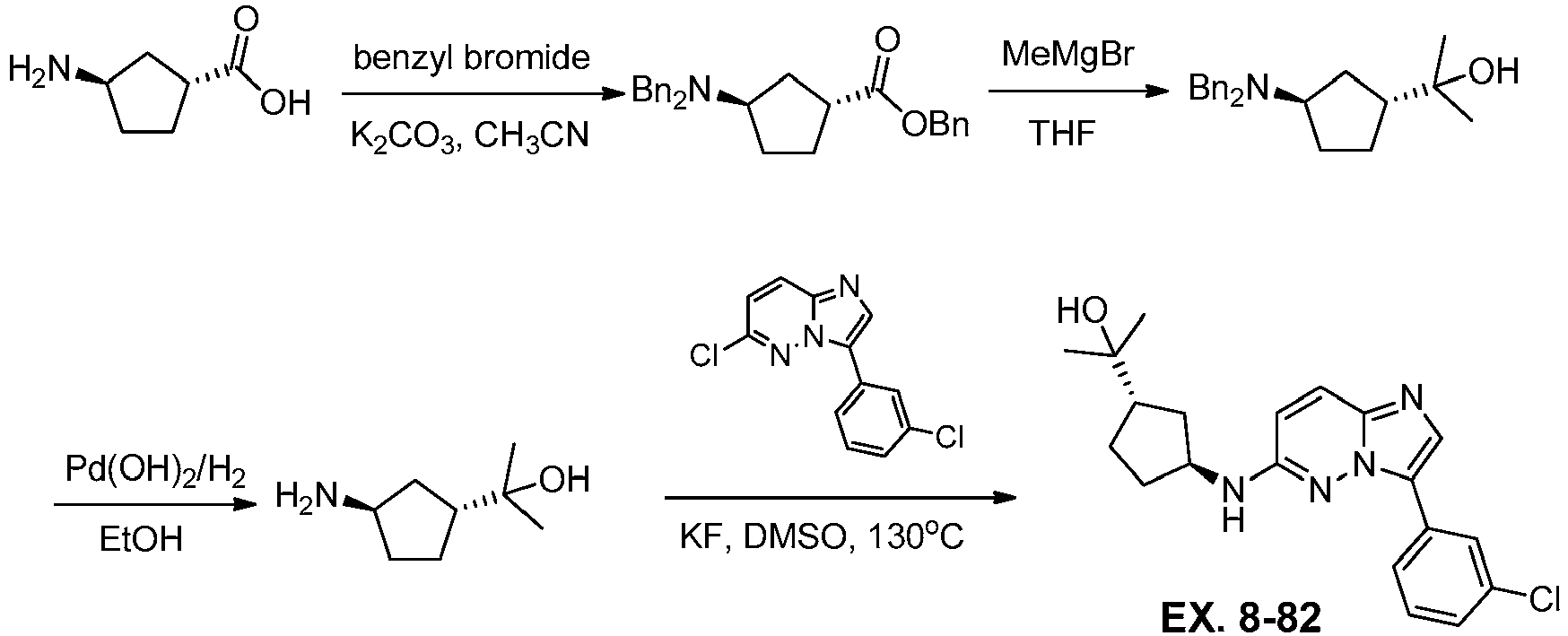
- To a 80°C mixture of trans-3-aminocyclopentanecarboxylic acid (1 g, 7.74 mmol) and K2CO3 (3.2 g, 23.22 mmol) in CH3CN (20 mL) was added dropwise a solution of benzyl bromide (3.2 mL, 27.1 mmol) in CH3CN (10 mL). The mixture was heated at 80°C overnight. The mixture was cooled and poured into water (150 mL) and extracted with EtOAc (100 mL * 3). The combined extracts were dried over Na2SO4, filtered and concentrated in vacuo. The residue was purified by combi flash to give trans-benzyl 3-(dibenzylamino)cyclopentanecarboxylate (2.8 g, 90.6%) as a white solid.
- To a 0°C solution of trans-benzyl 3-(dibenzylamino)cyclopentanecarboxylate (2.8 g, 7 mmol) in THF (250 mL) was added dropwise MeMgBr (23 mL, 70 mmol). After the addition, the reaction mixture was stirred at room temperature overnight. TLC (PE) showed the reaction was complete. The mixture was cooled and poured into sat. NH4Cl (300 mL) and extracted with EtOAc (100 mL * 3). The combined extracts were dried over Na2SO4, filtered and concentrated in vacuo to give crude 2-(trans-3-(dibenzylamino)cyclopentyl)propan-2-ol (3 g, 133%) as a yellow liquid.
- A mixture of 2-(trans-3-(dibenzylamino)cyclopentyl)propan-2-ol (3 g, 9.3 mmol) and Pd(OH)2 (900 mg) in EtOH (30 mL) was hydrogenated under 50 psi of H2 for 48 h at room temperature. TLC (PE: EA = 5:1) showed the reaction was complete. The mixture was filtered and concentrated in vacuo to give crude 2-(trans-3-aminocyclopentyl)propan-2-ol (1 g, 77%) as a yellow oil.
- A mixture of 2-(trans-3-aminocyclopentyl)propan-2-ol (82 mg, 0.57 mmol), 6-chloro-3-(3-chlorophenyl)imidazo[1,2-b]pyridazine (100 mg, 0.38 mmol) and KF (66.2 mg, 1.14 mmol) in DMSO (1 mL) was stirred at 130°C overnight. LCMS showed the reaction was complete. The mixture was poured into water (100 mL) and extracted with EtOAc (50 mL * 3). The combined extracts were dried over Na2SO4, filtered and concentrated in vacuo. The residue was purified by prep-HPLC to give EX.8-82 (45 mg, 32%) as an off-white solid.
1H NMR (MeOD, 400MHz): δ 8.57 (t, J = 2.06 Hz, 1H), 7.96 (dt, J1 = 8.11 Hz, J2 = 1.32 Hz, 1H), 7.86 (s, 1H), 7.63 (d, J = 9.88 Hz, 1H), 7.44 (t, J = 8.11 Hz, 1H), 7.33 (d, J = 7.76 Hz, 1H), 6.74 (d, J = 9.70 Hz, 1H), 4.19-4.12 (m, 1H), 2.41-2.34 (m, 1H), 2.22-2.10 (m, 2H), 1.83-1.62 (m, 3H), 1.51-1.43 (m, 1H), 1.23 (s, 6H). MS (ES+, m/z): (M+H+): 371.1 -

- A mixture of trans-N1-(3-(3-chlorophenyl)imidazo[1,2-b]pyridazin-6-yl)cyclohexane-1,4-diamine (50 mg, 0.146 mmol) and ethyl formate (0.37 mL) in DMF (1.2 mL) was heated at 90°C for 6 h. LCMS showed the reaction was complete. The mixture was concentrated in vacuo and purified b prep-HPLC to give EX. 8-83 (22 mg, 41%) as an off-white solid.
1H NMR (MeOD, 400MHz): δ 8.47 (s, 1H), 8.23 (br, 0.36H), 7.98 (s, 1H), 7.88 (d, J = 8.0Hz, 1H), 7.82 (s, 1H), 7.60 (d, J = 9.6 Hz, 1H), 7.39 (t, J = 8.0 Hz, 1H), 7.29 (d, J = 8.0 Hz, 1H), 7.68 (d, J = 9.6 Hz, 1H), 3.79 (t, J = 11.2 Hz, 1H), 3.70 (t, J = 10.8 Hz, 1H), 2.28 (d, J = 12 Hz, 2H), 2.02 (d, J = 12 Hz, 2H), 1.54-1.36 (m, 4H). MS (ES+, m/z): (M+H+): 370.2 -

- To a solution of trans-N1-(3-(3-chlorophenyl)imidazo[1,2-b]pyridazin-6-yl)cyclohexane-1,4-diamine (90 mg, 0.26 mmol) and pyridine (0.08 mL, 1.04 mmol) in CH2Cl2 (2.6 mL) was added dropwise chloroacetyl chloride (0.03 mL, 0.39 mmol). The resulting mixture was stirred at room temperature overnight. TLC (CH2Cl2: MeOH = 10:1) showed the reaction was complete. The mixture was poured into sat. aq. NaHCO3 (100 mL) and extracted with EtOAc (50 mL * 3). The extracts were dried over Na2SO4, filtered and concentrated in vacuo to give crude 2-chloro-N-(trans-4-((3-(3-chlorophenyl)imidazo[1,2-b]pyridazin-6-yl)amino)cyclohexyl)acetamide (110 mg, 101 %) as a yellow solid.
- A mixture of 2-chloro-N-(trans-4-((3-(3-chlorophenyl)imidazo[1,2-b]pyridazin-6-yl)amino)cyclohexyl)acetamide (50 mg, 0.12 mmol), morpholine (0.3 mL) and DIPEA (0.2 mL) in CH2Cl2 (0.6 mL) was stirred at 50°C for 3 h. LCMS showed the reaction was complete. The mixture was concentrated in vacuo. The residue was partitioned between water (100 mL) and EtOAc (50 mL). The organic layer was dried over Na2SO4, filtered and concentrated in vacuo. The residue was purified by prep-HPLC to give EX. 8-84 (9.6 mg, 17%) as a white solid.
1H NMR (MeOD, 400MHz): δ 8.49 (s, 1H), 7.90 (d, J = 7.6 Hz, 1H), 7.88 (s, 1H), 7.66 (d, J = 9.6 Hz, 1H), 7.44 (t, J = 7.6 Hz, 1H), 7.34 (d, J = 8.8 Hz, 1H), 6.75 (d, J = 9.6 Hz, 1H), 3.87-3.73 (m, 6H), 3.36-3.30 (m, 1H), 3.36-3.30 (m, 1H), 3.30-3.20 (m, 1H), 2.84 (br, 4H), 2.31 (d, J = 12.8 Hz, 2H), 2.02 (d, J = 12.8 Hz, 2H), 1.54-1.40 (m, 4H). MS (ES+, m/z): (M+H+): 469.3. -

- A mixture of 6-chloro-3-(3-(trifluoromethyl)phenyl)imidazo[1,2-b]pyridazine (50 mg, 0.168 mmol), Trans-4-aminocyclohexanecarbonitrile (53 mg, 0.22 mmol) and KF (42.2 mg, 0.73 mmol) in DMSO (0.5 mL) was heated at 130°C overnight. LCMS showed the reaction was almost complete. The mixture was purified by prep. HPLC to give trans-4-((3-(3-(trifluoromethyl)phenyl)imidazo[1,2-b]pyridazin-6-yl)amino)cyclohexanecarbonitrile (20 mg, 30.8%) as an off-white solid.
1H NMR (MeOD, 400MHz): δ 8.75 (s, 1H), 8.24 (t, J = 3.61 Hz, 1H), 7.99 (s, 1H), 7.74-7.69 (m, 3H), 6.84 (d, J = 9.79 Hz, 1H), 3.83 (tt, J1 = 10.82 Hz, J2 = 3.78 Hz, 1H), 2.71 (tt, J1 = 11.51 Hz, J2 = 3.61 Hz, 1H), 2.23 (tt, J1 = 16.15Hz, J2 = 6.18Hz, 4H), 1.73 (q, J = 12.20 Hz, 2H), 1.43 (q, J = 12.54 Hz, 2H). MS (ES+, m/z): (M+H+):386.2. -

- EX. 8-86 is prepared from 6-chloro-3-(3-(trifluoromethoxy)phenyl)imidazo[1,2-b]pyridazine using similar procedures as in EX. 8-85.
1H NMR (MeOD, 400MHz): δ 8.42 (s, 1H), 8.02 (d, J = 7.90 Hz, 1H), 7.99 (s, 1H), 7.72 (d, J = 9.62 Hz, 1H), 7.60 (t, J = 8.25 Hz, 1H), 7.31 (t, J = 8.25 Hz, 1H), 6.82 (t, J = 9.62 Hz, 1H), 3.82 (tt, J1 = 10.65 Hz, J2 = 3.44 Hz, 1H), 2.73 (tt, J1 = 11.68 Hz, J2 = 3.44 Hz, 1H), 2.31-2.20 (m, 4H), 1.76 (q, J = 12.02 Hz, 2H), 1.43 (q, J = 12.02 Hz, 2H). MS (ES+, m/z): (M+H+): 402.2. -

- To a 0°C solution of diethyl cyanomethyl phosphonate (0.07 mL, 0.4 mmol) in THF (1.5 mL) was added DMPU (0.27 mL, 1 mmol), followed by NaH (15 mL, 0.37 mmol). After stirring for 10 min, a solution of 4-((3-(3-chlorophenyl)imidazo[1,2-b]pyridazin-6-yl)amino)cyclohexanone (130 mg, 0.38 mmol) in THF (1.5 mL) was added. The resulting mixture was stirred at room temperature for 2 h. TLC (EA) showed most of s.m. was converted into product. The mixture was poured into water (100 mL) and extracted with EtOAc (50 mL * 3). The combined extracts were dried over Na2SO4, filtered and concentrated in vacuo to give crude 2-(4-((3-(3-chlorophenyl)imidazo[1,2-b]pyridazin-6-yl)amino)cyclohexylidene)acetonitrile (100 mg, 69%) as a yellow solid.
- A mixture of 2-(4-((3-(3-chlorophenyl)imidazo[1,2-b]pyridazin-6-yl)amino)cyclohexylidene)acetonitrile (100 mg, 0.26 mmol) and 10% Pd/C (100 mg) in EtOAc (2 mL) was stirred under H2 balloon at room temperature for 4 h. LCMS showed the most of s.m was consumed. The mixture was filtered and the filterate was concentrated in vacuo. The residue was purified by prep. HPLC to give EX. 8-87 (13 mg, 13.7%) as a white solid.
1H NMR (MeOD, 400MHz): δ 8.51 (s, 1H), 8.17 (br, 0.4H), 7.93 (d, J = 7.90 Hz, 1H), 7.87 (s, 1H), 7.64 (d, J = 9.96 Hz, 1H), 7.44 (t, J = 7.90 Hz, 1H), 7.34 (d, J = 7.90 Hz, 1H), 6.73 (d, J = 9.96 Hz, 1H), 3.72 (tt, J1 = 10.31 Hz, J2 = 3.44 Hz, 1H), 2.46 (d, J = 6.18 Hz, 2H), 2.33 (d, J = 10.65 Hz, 2H), 1.98 (d, J = 10.99 Hz, 2H), 1.77 (br, 1H), 1.48-1.32 (m, 4H). MS (ES+, m/z): (M+H+): 366.3. -

- To a solution of trans-4-(aminomethyl)cyclohexanecarboxylic acid (2 g, 12.7 mmol) in MeOH (64 mL) was added dropwise thionyl chloride (0.927 mL, 12.7 mmol) at room temperature. The resulting mixture was stirred at room temperature for 4 h. The mixture was concentrated in vacuo to give crude trans-4-(((tert-butoxycarbonyl)amino)methyl)cyclohexanecarboxylic acid (2.5 g, 115%) as HCl salts, which was used in the next step directly.
- A suspension of trans-4-(((tert-butoxycarbonyl)amino)methyl)cyclohexanecarboxylic acid (2.27 g, 8.8 mmol) and NMM (1.4 mL, 10.12 mmol) in THF (15 mL) was added dropwise isopropyl chloroformate (1.79 g, 17.6 mmol) below 10°C. The mixture containing trans-4-(((tert-butoxycarbonyl)amino)methyl)cyclohexanecarboxylic (isopropyl carbonic) anhydride was stirred at room temperature for 3 h. TLC (PE: EA = 1:1) showed the reaction was complete. The mixture was used in the next step directly.
- Above mixture was cooled to 10°C again and ammonium hydroxide (8.2 mL, 52.8 mmol) was added. The final mixture was stirred at room temperature for 18 h. The mixture was filtered and the filter cake was washed with water three times and dried to give tert-butyl ((trans-4-carbamoylcyclohexyl)methyl)carbamate (1.7 g, 74%) as a white solid.
- To a solution of tert-butyl ((trans-4-carbamoylcyclohexyl)methyl)carbamate (1.7 g, 6.6 mmol) in CH2Cl2 (33 mL) was added DBU (3g, 19.8 mmol) at room temperature. After stirring for 10 min, ethyl dichlorophosphate (2.2 g, 13.2 mmol) was added. The mixture was stirred at room temperature for 50 min. TLC (CH2Cl2: MeOH = 10:1) showed the reaction was complete. The mixture was poured into sat. NH4Cl (aq., 150 mL) and extracted with CH2Cl2 (100 mL * 2). The combined extracts were dried over Na2SO4, filtered and concentrated in vacuo. The residue was purified by combi flash to give tert-butyl ((trans-4-cyanocyclohexyl)methyl)carbamate (1.4 g, 88%) as a white solid.
- To a solution of tert-butyl ((trans-4-cyanocyclohexyl)methyl)carbamate (1.4 g, 5.86 mmol) in CH2Cl2 (20 mL) was added TFA (20 mL) at r.t. The resulting mixture was stirred at room temperature for 1 h. TLC (PE: EA = 5:1) showed the reaction was complete. The mixture was concentrated in vacuo to give trans-4-(aminomethyl)cyclohexanecarbonitrile (2.6 g, 319%) as TFA salts.
- A mixture of 6-chloro-3-(3-chlorophenyl)imidazo[1,2-b]pyridazine (50 mg, 0.189 mmol), -4-(aminomethyl)cyclohexanecarbonitrile (111 mg, 0.25 mmol) and KF (47 mg, 0.82 mmol) in DMSO (0.5 mL) was heated at 130°C overnight. LCMS showed the reaction was almost complete. The mixture was purified by prep. HPLC to give EX. 8-88 (26 mg, 38%) as an off-white solid.
1H NMR (MeOD, 400MHz): δ 8.48 (t, J = 1.89 Hz, 1H), 8.19 (br, 0.3H), 7.95 (dt, J1 = 7.90 Hz, J2 = 1.37 Hz, 1H), 7.86 (s, 1H), 7.66 (d, J = 9.62 Hz, 1H), 7.45 (t, J = 7.90 Hz, 1H), 7.35 (dq, J1 = 8.07 Hz, J2 = 0.86 Hz, 1H), 6.76 (d, J = 9.62 Hz, 1H), 3.28 (d, J = 6.87 Hz, 2H), 2.60 (tt, J1 = 12.02 Hz, J2 = 3.61 Hz, 1H), 2.17-2.13 (m, 2H), 2.05-2.01 (m, 2H), 1.94-1.87 (m, 1H), 1.59 (qd, J1 = 13.06 Hz, J2 = 3.26 Hz, 1H), 1.14 (qd, J1 = 12.71 Hz, J2 = 3.26 Hz, 1H). MS (ES+, m/z): (M+H+): 366.1. - EX. 8-89, Ex. 8-90 and EX. 8-91 were prepared using similar procedures as in Ex. 8-80.
-

- To a 0°C solution of trans-N1-(3-(3-fluorophenyl)imidazo[1,2-b]pyridazin-6-yl)cyclohexane-1,4-diamine (180 mg, 0.55 mmol) and DIPEA (213.2 mg, 1.65 mol) in DMSO (2.8 mL) was added dropwise MeSO2Cl (63.4 mg, 0.55 mmol). The resulting mixture was stirred at room temperature overnight. LCMS showed most of starting material was converted. The mixture was partitioned between brine (100 mL) and EtOAc (50 mL) and separated. The aqueous layer was extracted with EtOAc (50 mL * 3). The combined extracts were dried over Na2SO4, filtered and concentrated in vacuo. The residue was purified by prep-HPLC to give EX. 8-89 (13 mg, 6%) as a brown solid.
1H NMR (MeOD, 400MHz): δ 8.13 (dt, J1 = 10.65 Hz, J2 = 2.06 Hz, 1H), 8.07 (s, 1H), 7.89 (d, J = 7.90 Hz, 1H), 7.80 (d, J = 9.62 Hz, 1H), 7.53 (q, J = 7.90 Hz, 1H), 7.17 (td, J1 = 8.25 Hz, J2 = 2.40 Hz, 1H), 6.96 (d, J = 9.62 Hz, 1H), 3.70 (tt, J1 = 10.65 Hz, J2 = 3.78 Hz, 1H), 3.32-3.27 (m, 1H), 2.99 (s, 3H), 2.30 (d, J = 12.02 Hz, 2H), 2.15 (d, J = 11.68 Hz, 2H), 1.58-1.40 (m, 4H). MS (ES+, m/z): (M+H+): 404.0. -

- To a 0°C solution of trans-N1-(3-(3-(trifluoromethyl)phenyl)imidazo[1,2-b]pyridazin-6-yl)cyclohexane-1,4-diamine (130 mg, 0.35 mmol) and DIPEA (135.7 mg, 10.5 mmol) in DMSO (1.75 mL) was added dropwise MeSO2Cl (47.6 mg, 0.42 mmol). The resulting mixture was stirred at room temperature overnight. LCMS showed most of starting material was converted. The mixture was partitioned between brine (100 mL) and EtOAc (50 mL) and separated. The aqueous layer was extracted with EtOAc (50 mL * 3). The combined extracts were dried over Na2SO4, filtered and concentrated in vacuo. The residue was purified by prep-HPLC to give EX. 8-90 (30 mg, 18.9%) as a white solid.
1H NMR (MeOD, 400MHz): δ 8.73 (s, 1H), 8.28 (d, J = 6.87 Hz, 1H), 7.93 (s, 1H), 7.69-7.67 (m, 3H), 6.77 (d, J = 9.62 Hz, 1H), 3.74 (tt, J1 = 10.65 Hz, J2 = 3.78 Hz, 1H), 3.29-3.26 (m, 1H), 2.99 (s, 3H), 2.28 (d, J = 11.68 Hz, 2H), 2.12 (d, J = 12.35 Hz, 2H), 1.56-1.39 (m, 4H). MS (ES+, m/z): (M+H+): 454.7. -

- To a 0°C solution of trans-N1-(3-(3-(trifluoromethoxy)phenyl)imidazo[1,2-b]pyridazin-6-yl)cyclohexane-1,4-diamine (180 mg, 0.46 mmol) and DIPEA (178 mg, 1.38 mol) in DMSO (2.0 mL) was added dropwise MeSO2Cl (53 mg, 0.46 mmol). The resulting mixture was stirred at room temperature overnight. LCMS showed most of starting material was converted. The mixture was partitioned between brine (100 mL) and EtOAc (50 mL) and separated. The aqueous layer was extracted with EtOAc (50 mL * 3). The combined extracts were dried over Na2SO4, filtered and concentrated in vacuo. The residue was purified by prep-HPLC to give EX. 8-91 (57.1 mg, 26.4%) as a white solid.
1H NMR (MeOD, 400MHz): δ 8.33 (s, 1H), 8.07 (d, J = 8.25 Hz, 1H), 7.88 (s, 1H), 7.65 (d, J = 9.62 Hz, 1H), 7.56 (t, J = 7.56 Hz, 1H), 7.27 (d, J = 8.25 Hz, 1H), 6.73 (d, J = 9.62 Hz, 1H), 3.73 (tt, J1 = 10.99 Hz, J2 = 3.44 Hz, 1H), 3.32-3.28 (m, 1H), 2.99 (s, 3H), 2.29 (d, J = 12.37 Hz, 2H), 2.14 (d, J = 11.68 Hz, 2H), 1.57-1.38 (m, 4H). MS (ES+, m/z): (M+H+): 470.2. -

- To a mixture of hydroxylamine hydrochloride (15.3 mg, 0.22 mmol) and Na2CO3 (28 mg, 0.26 mmol) in water (0.7 mL) was added a solution of 4-((3-(3-chlorophenyl)imidazo[1,2-b]pyridazin-6-yl)amino)cyclohexanone (50 mg, 0.147 mmol) in MeOH (0.5 mL) at 0°C. The resulting mixture was stirred at room temperature for 1 h. LCMS showed the reaction was complete. The mixture was poured into water and extracted with EtOAc (50 mL * 3). The combined extracts were dried over Na2SO4, filtered and concentrated in vacuo. The residue was purified by prep-HPLC and then by SFC to give EX. 8-92 (10 mg, 19%) as a white solid.
1H NMR (MeOD, 400MHz): δ 8.39 (s, 1H), 7.83 (d, J = 8.25 Hz, 1H), 7.74 (s, 1H), 7.54 (d, J = 9.96 Hz, 1H), 7.34 (t, J = 7.90 Hz, 1H), 7.23 (dd, J1 = 7.99 Hz, J2 = 1.12 Hz, 1H), 6.64 (d, J = 9.71 Hz, 1H), 3.91 (tt, J1 = 10.31 Hz, J2 = 3.44 Hz, 1H), 3.17-3.15 (m, 1H), 2.40-2.35 (m, 1H), 2.29-2.19 (m, 3H), 2.07-2.00 (m, 2H), 1.51-1.36 (m, 1H). MS (ES+, m/z): (M+H+): 356.1. -

- trans-4-((3-(3-Chlorophenyl)imidazo[1,2-b]pyridazin-6-yl)amino)cyclohexanecarbonitrile (100 mg, 0.252 mmol) was dissolved into HCl/MeOH (4 mL) and HCl/dioxane (4 mL). The mixture was stirred at room temperature overnight. The mixture was concentrated in vacuo and the residue was dissolved in NH3/MeOH (4 mL). The mixture was stirred at room temperature for 2 h. LCMS showed the reaction was complete. The mixture was concentrated in vacuo. The residue was purified by prep. HPLC to give EX. 8-93 (3.5 mg, 18.4%) as a brown solid.
1H NMR (MeOD, 400MHz): δ 8.42 (br, 1H), 8.26 (s, 1H), 7.85 (d, J = 8.25 Hz, 1H), 7.72 (s, 1H), 7.55 (d, J = 9.62 Hz, 1H), 7.35 (t, J = 8.25 Hz, 1H), 7.23 (d, J = 8.25 Hz, 1H), 6.62 (d, J = 9.62 Hz, 1H), 3.66 (tt, J1 = 11.68 Hz, J2 = 3.44 Hz, 1H), 2.47 (d, J1 = 13.06 Hz, J2 = 3.44 Hz, 1H), 2.36 (d, J = 10.31 Hz, 2H), 1.98 (d, J = 12.37 Hz, 2H), 1.72 (qd, J1 = 13.06 Hz, J2 = 2.40 Hz,), 1.32 (qd, J1 = 12.71 Hz, J2 = 2.75 Hz,).
MS (ES+, m/z): (M+H+): 369.1; (M/2+H+): 185.4. -

- EX. 8-95 was prepared using a similar procedures as in EX. 8-96.
-

- A mixture of 5-chloro-3-(3-chlorophenyl)pyrazolo[1,5-a]pyrimidine (100 mg, 0.379 mmol), (S)-piperidin-3-amine (76 mg, 0.757 mmol), and DIEA (0.158 ml, 1.515 mmol) in 2-propanol (3 ml) was irradiated to 150°C for 14h in a Biotage microwave. After cooling, the mixture was diluted with saturated aqueous NaHCO3, and extracted three times with EtOAc. The combined extracts were washed with brine, dried over Na2SO4 and concentrated in vacuo. After absorbing on celite, the compound was purified by chromatography (12g silica, 0-15% methanol/DCM) to give (S)-1-(3-(3-chlorophenyl)pyrazolo[1,5-a]pyrimidin-5-yl)piperidin-3-amine (35 mg, 28% yield) as a white solid.
1H NMR (CD3OD/400 MHz): 8.47 (d, J = 8.0 Hz, 1H), 8.29 (s, 1H), 8.03 (s, 1H), 7.92 (m, 1H), 7.33 (t, J = 8.0 Hz, 1H), 7.13 (d, J = 8.0 Hz, 1H), 6.73 (d, J = 8.0 Hz, 1H), 4.27 (m, 1H), 4.02 (m, 1H), 3.50 (m, 1H), 3.40 (m, 1H), 2.20 (m, 1H), 1.90 (m, 1H), 1.80 (m, 2H), 1.36 (m, H). MS (ES+, m/z): (M+H)+: 328.5. -

- A mixture of 5-chloro-3-(3-chlorophenyl)pyrazolo[1,5-a]pyrimidine (100 mg, 0.379 mmol), 4-aminocyclohexanone (43 mg, 0.379 mmol), and DIEA (0.158 ml, 1.515 mmol) in 2-propanol (3 ml) was irradiated to 150°C for 14h in a Biotage microwave. After cooling, the mixture was diluted with saturated aqueous NaHCO3, and extracted three times with EtOAc. The combined extracts were washed with brine, dried over Na2SO4 and concentrated in vacuo. After absorbing on celite, the compound was purified by chromatography (12g silica, 0-15% methanol/DCM) to give 4-((3-(3-chlorophenyl)pyrazolo[1,5-a]pyrimidin-5-yl)amino)cyclohexanone (30 mg, 24% yield) as a white solid.
1H NMR (CD3OD/400 MHz): 8.35 (s, 1H), 8.26 (d, J = 7.6 Hz, 1H), 8.21 (d, J = 10.4 Hz, 1H), 7.79 (m, 1H), 7.08 (m, 1H), 6.26 (m, 1H), 4.40 (m, 1H), 2.62 (m, 2H), 2.47 (m, 2H), 2.00 (m, 1H), 1.84 (m, 2H), 1.65 (m, 1H). MS (ES+, m/z): (M+H)+: 341.4. -

- A mixture of 3-trifluoromethoxyphenylacetonitrile (2.5 grams, 12.43 mmol), DIPEA (0.321 grams, 2.48 mmol), and dimethyl formamide dimethyl acetal (20 mL) were heated at reflux for 4 h. On cooling, the reaction mixture was partitioned between EtOAc and saturated aqueous NH4Cl solution. The aqueous phase was extracted with ethyl acetate and the combined organic phase was washed with brine and concentrated in vacuo. The crude product was purified by chromatography (ethyl acetate/hexane, 0-10%) on silica gel (24 grams) to give pure product (2.3 grams, 8.98 mmol, 72% yield.).
- A mixture of acrylnitrile (2.0 g, 7.81 mmol), hydrazine hydrate (4.53 grams, 39.0 mmol), and glacial acetaic acid (2.34 grams, 39.0 mmol) and ethanol (20 mL) were heated at reflux for 16 h. On cooling, the reaction mixture was diluted with water, extracted with AcOEt and the combined organic phase was washed with brine and concentrated in vacuo (1.90 grams, 7.84 mmol, 100% yield.). 1H-NMR (CDCl3/400 MHz): δ 7.64 (m, 1H), 7.42 (m, 4H), 7.06 (d, J = 7.6 Hz, 1H). MS (ES+, m/z): (M+H)+: 244.3.
- A mixture of pyrazole (2.0 g, 8.22 mmol), diethyl malonate (1.32 g, 8.22 mmol), and
dry EtOH 20 mL were treated dropwise with sodium ethoxide (1.12 g, 16.45 mmol) and on completion of addition the reaction was heated at reflux for 16 h. On cooling the reaction mixture was concentrated in vacuo and the residue was added to ice, neutralized with actic acid and the resulting precipitate filterated, washed with water and dried to give product 3-(3-trifluoromethoxyphenyl)pyrazolo[1,5-a]pyrimidine-5,7-diol (1.6 g, 5.14 mmol, 63% yield). - A mixture of 3-(3-trifluoromethoxyphenyl)pyrazolo[1,5-a]pyrimidine-5,7-diol (1.0 g, 3.21 mmol) in 20 mL phosphoryl oxychloride was heated at reflux for 16 h. On cooling the reaction mixture was concentrated in vacuo and the residue was extracted with ethyl ether three times. The combined ether solution was washed with NaHCO3 and dried. After removed the solvent,
pure product 5,7-dichloro-3-(3-(trifluoromethoxy)phenyl)pyrazolo[1,5-a]pyrimidine was obtained (0.8 g, 2.30 mmol, 72% yield). - To a microwave reactor charged with the 5,7-dichloro product (1.0 g, 2.87 mmoL) and a stirbar was added saturated
aqueous NH 3 5 mL. The microwave was sealed and heated to 80°C for 4 h. After cooled down and extracted with ethyl acetate, the organic phase was dried and concentrated. Chromatography provided pure porduct 5-chloro-3-(3-(trifluoromethoxy)phenyl)pyrazolo[1,5-a]pyrimidin-7-amine (0.15 g, 0.456 mmol, 16% yield).
1H-NMR (CD3Cl/400 MHz): δ 8.32 (s, 1H), 7.95 (d, J = 7.6 Hz, 1H), 7.83 (s, 1H), 7.43 (t, J = 8.0 Hz, 1H), 7.07 (d, J = 7.6 Hz, 1H), 6.16 (s, 1H), 5.78 (br, 2H). MS (ES+, m/z): (M+H)+: 329.5. - To a solution of 5-chloro-3-(3-(trifluoromethoxy)phenyl)pyrazolo[1,5-a]pyrimidin-7-amine (150 mg, 0.46 mmol) and 4-trans-(aminocyclohexyl)propan-2-ol (144 mg, 0.913 mmol) in NMP (2.0 mL) was added NaHCO3 (43 mg, 0.55 mmol), the mixture was stirred at 180 °C for 60 mins under microwave irradiation. The mixture was purified by flash chromatograph to give 4-trans-((7-amino-3-(3-(trifluoromethoxy)phenyl)pyrazolo[1,5-a]pyrimidin-5-yl)amino)cyclohexyl)propan-2-ol (30 mg, 0.067 mmol, 15%) as a pale yellow solid.
1H-NMR (CD3OD/400 MHz): δ 8.40 (s, 1H), 8.20 (s, 1H), 7.78 (d, J = 7.6 Hz, 1H), 7.35 (t, J = 8.0 Hz, 1H), 6.94 (d, J = 7.6 Hz, 1H), 5.38 (s, 1H), 3.84 (m, 1H), 3.41 (m, 1H), 2.20 (m, 2H), 1.95 (m, 2H), 1.26 (m, 4H), 1.16 (s, 6H). MS (ES+, m/z): (M+H)+: 450.6. -

- To mixture of hydrazinepyridine (1.4 grams, 7.45 mmol) in ACN (15 mL) was added acid chloride (1.672 grams, 7.45 mmol), and the mixture was stirred at r.t. overnight. After stirring overnight, filtration got the pure white solid and dried for the next step directly (2.60 grams, 6.91 mmol, 93% yield).
- To a solution of N'-(5-bromopyridin-2(1H)-ylidene)-3-(trifluoromethoxy)benzohydrazide (1.0 gram, 2.66 mmol) AcOH 10 mL and 0.5 mL 4M HCl in dioxane were added and the mixture was heated to 180°C for 1 h. TLC indicated the reaction processed almost completely. After removed the solvent, the residue was dissolved in DCM and washed with saturated NaHCO3. Dried with Na2SO4 and concentrated for chromatography purification (ethyl acetate/hexane, 0-40%). White solid (0.40 grams, 1.117 mmol, 42% yield) was obtained as pure product.
1H-NMR (CD3OD/400 MHz): δ 8.67 (m, 1H), 7.90 (d, J = 7.6 Hz, 1H), 7.83 (s, 1H), 7.79 (m, 1H), 7.77 (m, 1H), 7.60 (d, J = 8.8 Hz, 1H), 7.56 (d, J = 9.6 Hz, 1H). MS (ES+, m/z): (M+H)+: 358.3. - A solution of triazolopyridine (0.15 g, 0.419 mmol) and 4-methoxycyclohexanaime (0.5 mL) in toluene 0.5 mL was added cesium carbonate (0.273 g, 0.838 mmol), rac-BINAP (78 mg, 0.127 mmol) and Pd (OAc)2 (19 mg, 0.084 mmol) and the mixture was heated at 100°C for 16 h under microwave irradiation. The resulting dark brown solution was cooled down and was concentrated under reduced pressure. The solid was further purified by using combiflash chromatography (12 g column), eluent: 0-10% methanol/DCM and obtained product 4-(Methoxycyclohexyl)-3-(3-(trifluoromethoxy)phenyl)-[1,2,4]triazolo[4,3-a]pyridin-6-amine (40 mg, 0.098 mmol, 24% yield).
1H-NMR (CD3OD/400 MHz): δ 7.85 (d, J = 8.0 Hz, 1H), 7.78 (s, 1H), 7.74 (t, J = 8.4 Hz, 1H), 7.57 (d, J = 10.0 Hz, 1H), 7.50 (d, J = 9.2 Hz, 1H), 7.35 (s, 1H), 7.16 (d, J = 10.0 Hz, 1H), 3.24 (m, 1H), 3.12 (m, 1H), 2.10 (m, 4H), 1.31 (m, 4H). MS (ES+, m/z): (M+H)+: 407.5. -

- A solution of triazolopyridine (0.20 g, 0.558 mmol) and 4-amino-1-methylcyclohexanol (0.216 g, 1.675 mmol) in dioxane 0.5 mL was added cesium carbonate (0.546 g, 1.675 mmol), rac-BINAP (104 mg, 0.168 mmol) and Pd(OAc)2 (25 mg, 0.112 mmol) and the mixture was heated at 100°C for 16 h under microwave irradiation. The resulting dark brown solution was cooled down and was concentrated under reduced pressure. The solid was further purified by using combiflash chromatography (12 g column), eluent: 0-10% methanol/DCM and obtained product 1-Methyl-4-((3-(3-(trifluoromethoxy)phenyl)-[1,2,4]triazolo[4,3-a]pyridin-6-yl)amino)cyclohexanol (23 mg, 0.057 mmol, 10% yield).
1H-NMR (CD3OD/400 MHz): δ 7.85 (d, J = 8.0 Hz, 1H), 7.76 (m, 2H), 7.74 (d, J = 9.6 Hz, 1H), 7.50 (d, J = 9.2 Hz, 1H), 7.35 (s, 1H), 7.21 (d, J = 10.0 Hz, 1H), 3.23 (m, 1H), 1.98 (m, 2H), 1.70 (m, 2H), 1.49 (m, 4H), 1.24 (s, 6H). MS (ES+, m/z): (M+H)+: 407.5. -

- A solution of triazolopyridine (0.10 g, 0.279 mmol) and 4-amino-cyclohexylpropanol (0.220 g, 1.396 mmol) in dioxane 0.5 mL was added cesium carbonate (0.182 g, 0.558 mmol), rac-BINAP (52 mg, 0.084 mmol) and Pd(OAc)2 (13 mg, 0.056 mmol) and the mixture was heated at 100°C for 16 h under microwave irradiation. The resulting dark brown solution was cooled down and was concentrated under reduced pressure. The solid was further purified by using preparative HPLC and obtained product 4-((3-(3-(Trifluoromethoxy)phenyl)-[1,2,4]triazolo[4,3-a]pyridin-6-yl)amino)cyclohexyl)propan-2-ol.
1H-NMR (CD3OD/400 MHz): δ 7.83 (m, 1H), 7.72 (m, 2H), 7.70 (d, J = 8.4 Hz, 1H), 7.48 (m, 1H), 7.32 (s, 1H), 7.19 (d, J = 8.6 Hz, 1H), 3.26 (m, 1H), 2.25 (m, 2H), 1.93 (m, 2H), 1.29 (m, 4H), 1.17 (s, 6H). MS (ES+, m/z): (M+H)+: 435.6. -

- A solution of triazolopyridine (0.075 g, 0.209 mmol) and tetrahydro-2H-pyran-4-amine (0.5 mL) in toluene 0.5 mL was added cesium carbonate (0.136 g, 0.419 mmol), rac-BINAP (36 mg, 0.063 mmol) and Pd(OAc)2 (9.4 mg, 0.042 mmol) and the mixture was heated at 100°C for 16 h under microwave irradiation. The resulting dark brown solution was cooled down and was concentrated under reduced pressure. The solid was further purified by using combiflash chromatography (12 g column), eluent: 0-10% methanol/DCM and obtained product N-(tetrahydro-2H-pyran-4-yl)-3-(3-(trifluoromethoxy)phenyl)-[1,2,4]triazolo[4,3-a]pyridin-6-amine (30 mg, 0.079 mmol, 38% yield).
1H-NMR (CD3OD/400 MHz): δ 7.84 (d, J = 8.0 Hz, 1H), 7.77 (s, 1H), 7.73 (t, J = 8.0 Hz, 1H), 7.59 (d, J = 10.0 Hz, 1H), 7.50 (m, 1H), 7.40 (s, 1H), 7.18 (d, J = 9.6 Hz, 1H), 3.94 (m, 2H), 3.47 (m, 2H), 3.38 (m, 1H), 2.00 (m, 2H), 1.52 (m, 2H). MS (ES+, m/z): (M+H)+: 379.5. -

- A solution of triazolopyridine (0.20 g, 0.558 mmol) and 4-(aminomethyl)tetrahydro-2H-thiopyran-1,1-dioxane (0.220 g, 1.396 mmol) in dioxane 0.5 mL was added cesium carbonate (0.546 g, 1.765 mmol), rac-BINAP (104 mg, 0.168 mmol) and Pd(OAc)2 (25 mg, 0.112 mmol) and the mixture was heated at 100°C for 16 h under microwave irradiation. The resulting dark brown solution was cooled down and was concentrated under reduced pressure. The solid was further purified by using preparative HPLC and obtained product 4-(((3-(3-(trifluoromethoxy)phenyl)-[1,2,4]triazolo[4,3-a]pyridin-6-yl)amino)methyl)tetrahydro-2H-
thiopyran 1,1-dioxide.
1H-NMR (CD3OD/400 MHz): δ 7.92 (d, J = 8.0 Hz, 1H), 7.85 (s, 1H), 7.79 (m, 2H), 7.59 (m, 2H), 7.49 (s, 1H), 3.09 (m, 6H), 2.20 (m, 2H), 1.95 (m, 1H), 1.83 (m, 2H). MS (ES+, m/z): (M+H)+: 441.4. -

- To a solution of 4-(methoxycyclohexyl)-3-(3-(trifluoromethoxy)phenyl)-[1,2,4]triazolo[4,3-a]pyridin-6-amine (0.030 gram, 0.074 mmol) in DCM 1.0 mL was added TMSI 0.2 mL. The mixture was stirred at rt. for overnight. TLC indicated pretty clean reaction. After removal the solvent completely, then the residue was quenched with NaHCO3 saturated aqueous solution. Chromatography on silica gel got pure product (0.020 gram, 0.051 mmol, 69% yield).
1H-NMR (CD3OD/400 MHz): δ 7.95 (d, J = 8.0 Hz, 1H), 7.87 (m, 3H), 7.73 (d, J = 9.2 Hz, 1H), 7.65 (d, J = 8.4 Hz, 1H), 7.50 (s, 1H), 3.60 (m, 1H), 3.21 (m, 1H), 2.10 (m, 2H), 1.98 (m, 2H), 1.37 (m, 4H). MS (ES+, m/z): (M+H)+: 393.5. -

- To a solution of 4-(trans-methoxycyclohexyl)-3-(3-(trifluoromethoxy)phenyl)-[1,2,4]triazolo[4,3-a]pyridin-6-amine (0.020 gram, 0.049 mmol) in DCM 1.0 mL was added TMSBr 0.25 mL with ice-water cooling. The mixture was stirred at rt. for overnight. TLC indicated pretty clean reaction. After removal the solvent completely, then the residue was quenched with NaHCO3 saturated aqueous solution. Chromatography on silica gel got pure product (0.009 gram, 0.020 mmol, 40% yield).
1H-NMR (CD3OD/400 MHz): δ 7.84 (d, J = 8.0 Hz, 1H), 7.77 (s, 1H), 7.73 (t, J = 8.0 Hz, 1H), 7.58 (d, J = 10.0 Hz, 1H), 7.50 (m, 1H), 7.36 (s, 1H), 7.21 (d, J = 10.0 Hz, 1H), 4.55 (m, 1H), 3.22 (m, 1H), 2.12 (m, 2H), 1.99 (m, 2H), 1.86 (m, 4H). MS (ES+, m/z): (M+H)+: 455.4. -

- The solution of 2-chloro-5-iodopyridine (2.0 g, 20.9 mmol), anhydrous hydrazine (3.3 mL, 105 mmol) in pyridine (40 mL) was heated at reflux overnight. After cooling to room temperature, the reaction mixture was concentrated under reduced pressure. To the residue was added 1 N sodium hydroxide solution and it was extracted with EtOAc. The organic layer was separated, dried (sodium sulfate) and concentrated under reduced pressure. To the residue was added hexanes, and the precipitate was collected and dried in vacuo to afford the title compound (1.35 g, 69% yield) as off-white crystals. MS (ES+, m/z): 236.2 (M++1).
- To a suspension of 5-iodo-2-hydrazinopydine (1.32 g, 5.62 mmol) in EtOH (90 mL) was added 3-(trifluoromethyl)-benzaldehyde (0.98 g, 5.62 mmol). The mixture was heated at reflux for 5 h under argon. After cooling to RT, the resulting precipitate was collected by filtration and washed with EtOH. The crude product was recrystallized from DCM and hexane to afford the title compound (1.80 g, 82% yield) as a white solid. MS (ES+, m/z): 392.3 (M++1).
- To a solution of 5-iodo-2-(2-(3-(trifluoromethyl)benzylidene)hydrazinyl)pyridine (1.60 g, 4.09 mmol) in DCM (10 mL)/EtOH (1 mL), was added Phl(OAc)2 (1.845 g, 5.73 mmol). The mixture was stirred at RT for 5 h, then the solvent was removed in vacuo. The residue was dissolved in DCM and purified on SiO2 column chromatography with 80% 15%MeOH/EA in hexane to afford the title compound (1.21 g, 76% yield) as an off-white solid. MS (ES+, m/z): 390.3 (M++1).
- To a suspension of 6-iodo-3-(3-(trifluoromethyl)phenyl)-[1,2,4]triazolo[4,3-a]pyridine (0.078 g, 0.2 mmol) and trans-4-methoxycyclohexanamine (0.078 g, 0.6 mmol) in toluene (0.5 mL) was added Cul (0.023 g, 0.12 mmol), ethane-1,2-diol (0.025 g, 0.4 mmol) and K3PO4 (0.085 g, 0.4 mmol). It was flushed with argon and heated at 90 °C overnight. The mixture was absorbed on SiO2 and the major peak was washed out with 60%-100% 20% MeOH/DCM/0.2%NH3 in hexane. Then the crude product was combined and purified again on C18 column chromatography using 20-40% ACN in water to give the title compounds.
1H NMR (400 MHz, CD3COCD3/CDCl3): 8.00 (m, 2H), 7.66 (m, 3H), 7.38 (m, 1H), 6.96 (m, 1H), 4.58 (br, 1H), 3.22 (s, 3H), 3.08 (m, 1H), 3.07 (m, 1H), 2.00 (m, 2H), 1.18 (m, 4H).
19F NMR (376 MHz, CD3COCD3/CDCl3): -57.9. MS (ES+, m/z): 391.5 (M++1). -
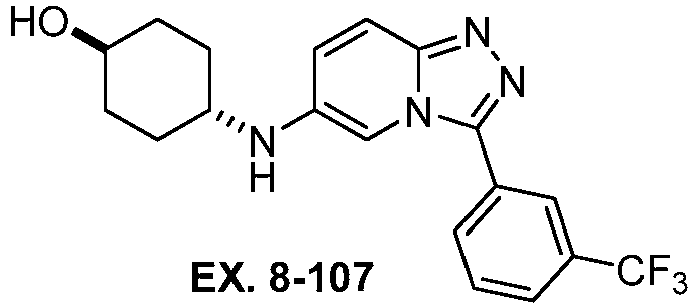
- 1H NMR (400 MHz, CD3COCD3): 8.23 (m, 2H), 7.87 (m, 2H), 7.59 (m, 1H), 7.58 (m, 1H), 7.12 (dd, J = 10.0, 2.0 Hz, 1H), 5.09 (d, J = 7.6 Hz, 1H), 3.57 (m, 1H), 3.30 (m, 1H), 2.16 (m, 4H), 1.30 (m, 4H). 19F NMR (376 MHz, CD3COCD3): -63.4. MS (ES+, m/z): 377.5 (M++1).
-

- To a suspension of 6-bromo-3-(3-(trifluoromethyl)phenyl)-[1,2,4]triazolo[4,3-a]pyridine (0.190 g, 0.56 mmol) and trans-4-amino-1-methylcyclohexanol (0.072 g, 0.56 mmol) in dioxane (1.5 mL) was added rac-Binap (0.104 g, 0.17 mmol), Pd(OAc)2 (0.025 g, 0.11 mmol) and Cs2CO3 (0.362 g, 0.111 mmol). It was flushed with argon then heated at 100 °C overnight. It was absorbed on SiO2 and purified on column chromatography on SiO2 with 40-100% 15%MeOH/EA in hexane. This product was further purified on C18 column chromatography using 20-40% ACN in water.
1H NMR (400 MHz, CD3COCD3): 8.23 (m, 2H), 7.88 (m, 2H), 7.94 (t, J = 10.0 Hz, 1H), 7.57 (s, 1H), 7.18 (d, J = 10.0 Hz, 1H), 3.39 (m, 1H), 2.07 (m, 2H), 1.70 (m, 2H), 1.55 (m, 4H), 1.21 (s, 3H). MS (ES+, m/z): 391.5 (M++1). -

- 1H NMR (400 MHz, CD3COCD3): 8.28 (m, 2H), 7.99 (m, 2H), 7.94 (t, J = 8.0 Hz, 1H), 7.73 (s, 1H), 7.53 (d, J = 10.0 Hz, 1H), 3.23 (m, 1H), 2.21 (m, 2H), 1.93 (m, 2H), 1.31 (m, 2H), 1.25 (m, 2H), 1.17 (s, 6H). MS (ES+, m/z): 391.5 (M++1).
-

- To a suspension of 6-iodo-3-(3-(trifluoromethyl)phenyl)-[1,2,4]triazolo[4,3-a]pyridine (0.101 g, 0.26 mmol) and tetrahydro-2H-pyran-4-amine (0.131 g, 1.30mmol) in toluene (1 mL) was added rac-Binap (0.049 g, 0.078 mmol), Pd(OAc)2 (0.012 g, 0.052 mmol) and Cs2CO3 (0.169 g, 0.52 mmol). It was flushed with argon then heated at 110 °C overnight. It was absorbed on SiO2 and purified on column chromatography on SiO2 with 60% 15%MeOH/EA in hexane. This product was further purified on C18 column chromatography using 20-40% ACN in water.
1H NMR (400 MHz, CD3COCD3): 8.24 (m, 2H), 7.85 (m, 2H), 7.63 (m, 1H), 7.60 (d, J = 10.0 Hz, 1H), 7.15 (d, J = 10.0 Hz, 1H), 5.21 (br, 1H), 3.88 (m, 2H), 3.50 (m, 1H), 3.43 (m, 2H), 1.95 (m, 2H), 1.49 (m, 2H). 19F NMR (376 MHz, CD3COCD3): -63.4. MS (ES+, m/z): 363.5 (M++1). -

- 1H NMR (400 MHz, CD3COCD3): 8.27 (m, 2H), 7.94 (m, 1H), 7.90 (m, 1H), 7.84 (d, J = 9.6 Hz, 1H), 7.69 (s, 1H), 7.39 (d, J = 9.6 Hz, 1H), 3.18 (d, J = 6.8 Hz, 2H), 3.09 (m, 2H), 3.01 (m, 2H), 2.25 (m, 2H), 2.15 (m, 1H), 1.85 (m, 2H). MS (ES+, m/z): 425.5 (M++1).
-
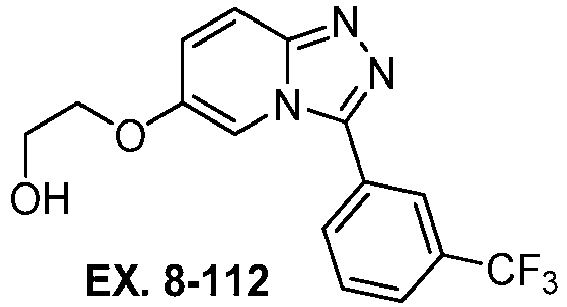
- 1H NMR (400 MHz, CD3COCD3): 8.20 (m, 2H), 8.00 (m, 1H), 7.83 (m, 2H), 7.74 (m, 1H), 7.25 (m, 1H), 4.15 (m, 2H), 3.97 (m, 2H). 19F NMR (376 MHz, CD3COCD3): -63.1. MS (ES+, m/z): 324.4 (M++1).
-

- To mixture of hydrazinepyridine (2.0 grams, 10.64 mmol) in ACN (15 mL) was added acid chloride (1.86 grams, 10.64 mmol), and the mixture was stirred at r.t. overnight. After stirring overnight, filtration got the pure white solid and dried for the next step directly (3.0 grams, 9.19 mmol, 86% yield). MS (ES+, m/z): (M+H)+: 326.3.
- To a solution of N'-(5-bromopyridin-2(1H)-ylidene)-3-chlorobenzohydrazide (3.0 grams, 9.19 mmol) AcOH 10 mL and 0.5 mL 4M HCl in dioxane were added and the mixture was heated to 180°C for 1 h. TLC indicated the reaction processed almost completely. After removed the solvent, the residue was dissolved in DCM and washed with saturated NaHCO3. Dried with Na2SO4 and concentrated for chromatography purification (ethyl acetate/hexane, 0-40%). White solid (0.30 grams, 0.972 mmol, 11% yield) was obtained as pure product.
1H-NMR (CD3OD/400 MHz): δ 8.65 (m, 1H), 7.85 (d, J = 8.0 Hz, 1H), 7.80 (s, 1H), 7.77 (m, 1H), 7.75 (m, 1H), 7.58 (d, J = 8.6 Hz, 1H), 7.56 (d, J = 9.2 Hz, 1H). MS (ES+, m/z): (M+H)+: 308.3. - A solution of triazolopyridine (0.13 g, 0.419 mmol) and 4-methoxycyclohexanaime (0.5 mL) in toluene 0.5 mL was added cesium carbonate (0.273 g, 0.838 mmol), rac-BINAP (78 mg, 0.127 mmol) and Pd (OAc)2 (19 mg, 0.084 mmol) and the mixture was heated at 100°C for 16 h under microwave irradiation. The resulting dark brown solution was cooled down and was concentrated under reduced pressure. The solid was further purified by using combiflash chromatography (12 g column), eluent: 0-10% methanol/DCM and obtained product 4-(Methoxycyclohexyl)-3-(3-(trifluoromethoxy)phenyl)-[1,2,4]triazolo[4,3-a]pyridin-6-amine (50 mg, 0.140 mmol, 33% yield).
1H-NMR (CD3OD/400 MHz): δ 7.83 (s, 1H), 7.75 (d, J = 6.8 Hz, 1H), 7.57 (m, 3H), 7.35 (s, 1H), 7.14 (d, J = 10.0 Hz, 1H), 3.20 (m, 1H), 3.12 (m, 1H), 2.07 (m, 4H), 1.29 (m, 4H). MS (ES+, m/z): (M+H)+: 357.5. - One illustrative manner in which Pim-1 kinase activity can be determined is by quantifying the amount of ATP remaining in solution after an in vitro Pim-1 kinase reaction. The Kinase-Glo Assay Kit (Promega, Inc., Madison, WI) allows this. The amount of ATP remaining in the solution after the kinase reaction serves as a substrate for the luciferase to catalyze luciferin to oxyluciferin plus one photon of light. Thus, the luminescent signal read by the Luminoskan Ascent Instrument (Thermo Electron Corp., Milford, MA) correlates with the amount of ATP present after the kinase reaction and inversely correlates with the amount of kinase acitivity. This assay is efficient at determining the IC50 values of kinase inhibitors against the Pim-1 kinase. These assays are set up in duplicate 50ul volumes in white, flat bottom 96 well plates. Inhibitors are added to the solution of 1X kinase buffer, 10uM ATP, 100uM Pim-1-specific substrate, 50ng of active Pim-1 enzyme, and water in serial dilutions ranging from micromolar to nanomolar concentrations. This solution is incubated at 30 degrees Celsius at 360rpm for two hours. Following the incubation, 50ul of Kinase-Glo reagent is added to each well, including all positive and negative control wells, and incubated at room temperature for 15 minutes. The plate is then read by the Luminoskan Ascent instrument and the results displayed with the Ascent Software version 2.6. The IC50 values can then be calculated for each inhibitor tested.
- Alternatively, Pim-1 kinase activity can be determined by quantifying the phosphorylation of a known Pim-1 substrate in another in vitro assay. The Z-Lyte Protein Kinase Assay Kit (Invitrogen, Madison WI.) allows this, using Fluorescent Resonance Energy Transfer (FRET) procedure. Briefly, a known Pim-1 substrate (Serine-Threonine Substrate from Invitrogen), which bears two fluorophores at opposing ends (coumarin and fluorescein) is incubated with Pim-1 enzyme and a potential inhibitor. Following this, the kinase reaction is stopped, and a development reagent is added. This reagent, a protease, will cleave only unphosphorylated substrate, separating the two fluorophores and reducing the amount of FRET which can occur between them. FRET can then be measured using a spectrophotometer, such as the Gemini EM (Molecular Devices). A reduction in FRET is indicative of an active inhibitor.
- Alternatively, PIM kinase IC50 and Ki determinations were determined at Reaction Biology (Malvern, PA). For Ki determination, PIM-1 were incubated with 10-dose, 3-fold serial dilutions of compound starting with 10 µM using 5 different concentrations of ATP (25, 50, 100, 250 and 500 µM ATP for PIM-1; 5, 10, 20, 50 and 100 µM ATP for PIM-2 and PIM-3), and the activity was measured at 0, 5, 10, 15, 20, 30, 45, 60, 75, 90, 105 and 120 minutes. The data was analyzed in a Michaelis-Menton plot to determine apparent Km and Ki values using GraFit software using a mixed inhibition equation for global fit.
- Cell culture-based assays can be used to evaluate the ability of compounds of the invention to inhibit one or more cellular activities, such as cancer cell growth and/or survival. Numerous cancer cell lines can be obtained from the American Type Culture Collection (ATCC) and other sources. Briefly, cells are seeded into 96-well, tissue-culture treated, opaque white plates (Thermo Electron, Vantaa, Finland), at between 5000 and 10000 cells per well, depending on the speed of cell proliferation, in 100 µl of appropriate growth medium (determined by the ATCC). Cells are then exposed to the appropriate concentration of drug or an equal amount of DMSO (drug diluent) and allowed to grow in its presence for 96 hours. Following this, 100 µl of Cell-Titer-Glo reagent (Promega, Inc., Madison, WI) is added to each well. Plates are then shaken for 2 minutes at room temperature to allow for cell lysis and incubated for 10 minutes at room temperature to stabilize the luminescent signal. Similar to the Kinase-Glo assay reagent from Promega, this reagent contains both luciferase enzyme and its substrate luciferin. Luciferase, activated by ATP in the cell lysate, catalyzes the conversion of luciferin to oxyluciferin, a reaction which produces light. The amount of light produced is proportionate to the amount of ATP in the cell lysate, which is itself proportional to cell number and gives an index of cellular proliferation.
- In order to detect specific inhibition of Pim-1 enzyme in cell culture, a Western blot assay will also be performed. For this, cells which have been treated with a potential Pim-1 inhibitor are lysed with a buffer specific for the isolation and preservation of proteins (1% Nonidet P-40, 150mM NaCl, 50mM Tris pH 8.0, 5mM EDTA, 1:500 Protease Inhibitor Cocktail III [Calbiochem], 100mM NaF, 100mM Sodium Orthovanadate). The protein concentration in these lysates is then quantified using the BCA Protein Assay Kit (Pierce). Known amounts of protein, e.g. 10 µg, are loaded onto 12% SDS-polyacrylamide gels and are subjected to reducing, denaturing SDS-PAGE. Electrophoresed proteins are transferred to a nitrocellulose membrane, which is then probed with antibodies to p-21 and phospho (Thr 145) p-21. As Threonine-145 of the p-21 protein is a substrate for Pim-1, measuring the amount of phosphorylation at this site in treated cells should provide a means by which to evaluate the efficacy of our Pim-1 inhibitors.
- Using procedures essentially as described above, illustrative compounds were tested for inhibition of Pim-1 kinase activity. IC50 values were determined for illustrative compounds against Pim-1 kinase, using the Promega Kinase-Glo assay, the results for which are summarized in Tables IV and V below.
Table IV. Compound IC50 on Pim1. EX. IC50 (nM) EX. IC50 (nM) 8-1 13 8-2 18 8-3 30 8-4 7 8-5 36 8-6 30 8-7 10 8-8 4 8-9 13 8-10 9 8-11 8 8-12 81 8-13 58 8-14 1190 8-15 2830 8-16 503 8-17 173 8-18 53 8-19 13 8-20 16 8-21 46 8-22 41 8-23 1630 8-24 34 8-25 30 8-26 28 8-27 23 8-28 553 8-29 5 8-30 103 8-31 1 8-32 115 8-33 33 8-34 241 8-35 7 8-36 145 8-37 4 8-38 18 8-39 48 8-40 200 8-41 226 8-42 1970 8-43 523 8-44 153 8-45 16 8-46 27 8-47 204 8-48 197 8-49 378 8-50 633 8-51 148 8-52 5 8-53 132 8-54 25 8-55 54 8-56 17 8-57 66 8-58 149 8-59 111 8-60 NA 8-61 237 8-62 378 8-63 23 8-64 68 8-65 186 8-66 164 8-67 45 8-68 4 8-69 24 8-70 8 8-71 12 8-72 58 8-73 17 8-75 56 8-76 687 8-77 14 8-78 206 8-79 2 8-80 52 8-82 34 8-83 89 8-84 239 8-85 19 8-86 14 8-88 69 8-92 38 8-95 24 8-96 94 8-97 168 8-98 470 Table V. Compound IC50 on Pim1. EX. IC50(nM) EX. IC50(nM) 8-99 83 8-100 1644 8-101 488 8-102 3250 8-103 3805 8-104 684 8-105 2490 8-106 518 8-107 3948 8-108 70 8-109 3870 8-110 3165 8-111 >30 µM 8-112 >30 µM 8-113 722 - Representative compounds were tested for hERG activity using the Fast Patch assay available from WuXiApptec (Shanghai China). The hERG activity for representative compounds is provided in Table VI below.
Table VI. hERG Activity of Representative Compounds Compound hERG IC50 (µM) 8-37 >30 8-35 30 8-64 >30 8-39 >30 8-31 >30 8-30 12 8-29 10 8-10 >30 8-9 26 8-11 >30 8-63 >30 8-54 >30 8-56 >30 8-46 >30 8-1 16 8-13 10 - The cellular potency of a representative compound (8-31) was determined by measuring its effect on baseline phosphorylation of BAD (BCL-2 antagonist of cell death), a known substrate of PIM, on serine 112 by over-expression of PIM-1 and BAD in HEK-293 cells. Over-expression of the catalytically inactive mutant PIM-1 (K67M) did not increase phosphorylation of BAD compared to BAD transfection alone (data not shown), and was used as a negative control to subtract BAD phosphorylation by cellular kinases other than PIM-1.
- Compound 8-31 demonstrated potent PIM-1 specific cellular activity in the PIM-1/BAD over-expression system with an average EC50 = 67 nM (
Fig. 1 ). - In an effort to demonstrate tumorigenicity of the PIM kinases and to evaluate representative compounds (e.g., EX. 8-31) in PIM-driven tumor xenografts, PIM-1 and PIM-2 over-expression cell lines were developed. The prostate cancer cell line 22RV1 engineered to over-express PIM-1 as previously described (Mumenthaler, et al, Mol. Cancer Ther., 2009, 8(10)2882-93) was evaluated in vivo. A second model engineered to over-express PIM-2 was established using the NIH-3T3 mouse fibroblast cell line. Both cell backgrounds displayed increased expression of PIM-1 or PIM-2 kinase by Western blot, and significantly enhanced the observed growth rate in cell culture (
Fig. 2 ). PIM-1 overexpression in 22RV1 cells significantly enhanced subcutaneous tumor growth compared to the parental cell line when grown as mouse xenografts (22RV1/PIM-1 + vehicle vs. 22RV1 + vehicle), and the growth was significantly reduced by administration of compound 8-31 (22RV1/PIM-1 + vehicle vs. 22RV1/PIM-1 + compound 8-31) (Fig. 3A ). PIM-1 over-expression demonstrated a similar effect on xenograft growth in the presence or absence of vehicle treatment (data not shown). No significant changes in body weight were observed in mice from any group. Similarly, PIM-2 over-expression in NIH-3T3 cells significantly induced subcutaneous tumor growth compared to the parental cell line when grown as mouse xenografts (NIH-3T3/PIM-2 + vehicle vs. NIH-3T3 + vehicle), and the growth was significantly inhibited by compound 8-31 (NIH-3T3/PIM-2 + vehicle vs. NIH-3T3/PIM-2 + compound 8-31) (Fig. 3B ). Likewise, PIM-2 over-expression demonstrated a similar effect on xenograft growth with or without vehicle administration (data not shown). No significant changes in body weight were observed in any group. - Translational models were also explored for PIM dependency using shRNA knockdown. The UM-UC-3 urinary epithelial bladder carcinoma cell line was used to verify and validate dependency on PIM-1 for growth. PIM-1 mRNA was significantly reduced using two independent shRNAs targeting PIM-1 compared to the non-target shRNA control (
Fig. 4A ). Further, PIM-1 protein was reduced using PIM-1 shRNA compared to non-target shRNA, and 2D-colony growth was markedly reduced with PIM-1 knockdown (Fig. 4A ), comparable to a previous report in the literature (Guo, S (2010) J Exp Clin Cancer Res 29:161). Reduction of PIM-1 mRNA and growth also were observed using both PIM-1 and PIM-2 shRNA in the androgen-independent prostate carcinoma cell line PC-3 (data not shown). Finally, compound 8-31 reduced colony growth of UM-UC-3 and PC-3 cells (Fig. 4B and 4C ), confirming the PIM-1 dependent growth for both cell lines. - Compound 8-31 was tested for inhibiting the growth of established mouse xenograft tumors using the UM-UC-3 and PC-3 solid tumor cell lines that were tested in vitro. Oral dosing of 200 mg/kg of compound 8-31 significantly reduced both UM-UC-3 and PC-3 tumor growth measured by volume (caliper) and by final tumor weight, with no significant changes in body weight or gross adverse toxicity (
Fig. 5 ). In addition, dosing of compound 8-31 at 125 mg/kg in each model led to significant tumor growth inhibition, albeit less than that observed with 200 mg/kg, indicating a dose-response effect and a therapeutic window (data not shown). Pharmacokinetic studies of the PC-3 tumor-burdened mice revealed that 200 mg/kg compound 8-31 dosing led to plasma and tumor tissue levels above the in vitro proliferation EC50 (data not shown). - PIM kinases are implicated in the survival of hematological cancers, therefore compound 8-31 was screened against a panel of hematological cell lines using an in vitro viability assay. Over 35 cell lines were tested, and the most sensitive cell lines from various indications were selected and verified by multiple EC50 determinations (
Figure 6 ). Compound 8-31 displayed nearly equivalent EC50 values for the most sensitive hematological cell lines compared to the bladder line, UM-UC-3, in the range of 1-2 µM. Antiproliferative activity using PIM-2 shRNA against FLT3-ITD driven leukemia lines has been observed (Adam (2006) Cancer Res 66:3828-35 data not shown). Notably, MV-4-11 and MOLM-13 were particularly sensitive to SGI-9481, while not wishing to be bound by theory, it is believed that this is potentially due to the combination of PIM kinase and FLT3 inhibition, although the activity could be possibly attributed to the FLT3 activity of the compound alone. While not wishing to be bound by theory, the inhibitory activity of compound 8-31 (and other compounds of the invention) against multiple members of the phosphatidyl inositol-3-kinase (PI3K) family observed in the selectivity study may impart additional advantage when targeting different tumor types - Compound 8-31 demonstrated significant tumor growth inhibition in mouse xenograft studies with ML-2 cells (wild-type FLT3) (
Fig. 7A ), similar to the level of reduction observed in the solid tumor models. Treatment of established xenografts of MV-4-11 (FLT3-ITD) with compound 8-31 also induced regressions (Fig. 7B ). While not wishing to be bound by theory, these data indicate that AML models are sensitive to compound 8-31, where FLT3-ITD status enhanced the antitumor effects observed.
Claims (12)
- A compound having one of the following structures (I-D), (II-D) or (III-D):

 X is -N(R8)- or -O-;W is
 R is H, -OH, halo, alkyl, haloalkyl, alkoxy, haloalkoxy, -N(R8)2, or -CN;R3, R4, R7, R8, R9, R10 and R11 are, at each occurrence, independently H or alkyl;R5 is halo, haloalkyl or haloalkoxy;R6 is H, -OH, alkyl or alkoxy;R12 is -OH;m is 1, 2, 3, 4, 5 or 6;n is 0, 1, 2, 3 or 4; andy is 1.
 - The compound of claim 1, wherein R6 is H.
- The compound of any of claims 1-2, wherein R5 is at the meta position and the compound has one of the following structures (I-Da), (II-Da) or (IIIDa):


- The compound of any of claims 1-3, wherein m is 3 or 4, or wherein m is 4.
- The compound of any of claims 1 or 2, wherein the compound has one of the following structures (IDb), (IIDb) or (IIIDb):


- The compound of any of claims 1-5, wherein n is 0 or 1, or wherein n is 0.
- The compound of any of claims 1-6, wherein R5 is -OCF3, -CF3, Cl or F.
- The compound of any of claims 1-7, wherein each of R10 and R11 is methyl.
- The compound of any of claims 1-8, wherein X is -NH- or -O-.
- The compound of any of claims 1-9, wherein the compound has one of the following structures:


- A pharmaceutical composition comprising a compound of any one of claims 1-10 and a pharmaceutically acceptable carrier.
- The composition of claim 11 for use in a method of treating a Pim kinase-expressing cancer, an autoimmune disease or an inflammatory disease,
wherein the cancer is lung cancer, non small cell lung cancer, oat-cell cancer, bone cancer, pancreatic cancer, skin cancer, dermatofibrosarcoma protuberans, cancer of the head and neck, cutanteous or intraocular melanoma, uterine cancer, ovarian cancer, colo-rectal cancer, cancer of the anal region, stomach cancer, colon cancer, breast cancer, gynecologic tumors, Hodgkin's Disease, hepatocellular cancer, cancer of the esophagus, cancer of the small intestine, cancer of the endocrine system, sarcomas of soft tissue, cancer of the urethra, cancer of the penis, prostate cancer, chronic or acute leukemia, solid tumors of childhood, hypereosinophilia, lymphocytic lymphomas, cancer of the bladder, cancer of the kidney or ureter, pediatric malignancy, neoplasms of the central nervous system, neoplastic cutaneous disease, or a hematological malignancy, preferably wherein the hematological malignancy is acute myeloid leukemia.
Priority Applications (4)
| Application Number | Priority Date | Filing Date | Title |
|---|---|---|---|
| EP18162853.8A EP3409278B8 (en) | 2011-07-21 | 2012-07-20 | Heterocyclic protein kinase inhibitors |
| EP20195890.7A EP3812387A1 (en) | 2011-07-21 | 2012-07-20 | Heterocyclic protein kinase inhibitors |
| DK18162853.8T DK3409278T3 (en) | 2011-07-21 | 2012-07-20 | Heterocyclic protein kinase inhibitors |
| CY20201101171T CY1123626T1 (en) | 2011-07-21 | 2020-12-11 | HETEROCYCLIC PROTEIN KINASE INHIBITORS |
Applications Claiming Priority (5)
| Application Number | Priority Date | Filing Date | Title |
|---|---|---|---|
| US201161510207P | 2011-07-21 | 2011-07-21 | |
| US201161632834P | 2011-07-21 | 2011-07-21 | |
| US201261632826P | 2012-03-01 | 2012-03-01 | |
| US201261608028P | 2012-03-07 | 2012-03-07 | |
| PCT/US2012/047685 WO2013013188A1 (en) | 2011-07-21 | 2012-07-20 | Heterocyclic protein kinase inhibitors |
Related Child Applications (2)
| Application Number | Title | Priority Date | Filing Date |
|---|---|---|---|
| EP20195890.7A Division EP3812387A1 (en) | 2011-07-21 | 2012-07-20 | Heterocyclic protein kinase inhibitors |
| EP18162853.8A Division EP3409278B8 (en) | 2011-07-21 | 2012-07-20 | Heterocyclic protein kinase inhibitors |
Publications (3)
| Publication Number | Publication Date |
|---|---|
| EP2734205A1 EP2734205A1 (en) | 2014-05-28 |
| EP2734205A4 EP2734205A4 (en) | 2014-12-10 |
| EP2734205B1 true EP2734205B1 (en) | 2018-03-21 |
Family
ID=47558512
Family Applications (3)
| Application Number | Title | Priority Date | Filing Date |
|---|---|---|---|
| EP12815055.4A Active EP2734205B1 (en) | 2011-07-21 | 2012-07-20 | Heterocyclic protein kinase inhibitors |
| EP20195890.7A Pending EP3812387A1 (en) | 2011-07-21 | 2012-07-20 | Heterocyclic protein kinase inhibitors |
| EP18162853.8A Active EP3409278B8 (en) | 2011-07-21 | 2012-07-20 | Heterocyclic protein kinase inhibitors |
Family Applications After (2)
| Application Number | Title | Priority Date | Filing Date |
|---|---|---|---|
| EP20195890.7A Pending EP3812387A1 (en) | 2011-07-21 | 2012-07-20 | Heterocyclic protein kinase inhibitors |
| EP18162853.8A Active EP3409278B8 (en) | 2011-07-21 | 2012-07-20 | Heterocyclic protein kinase inhibitors |
Country Status (10)
| Country | Link |
|---|---|
| US (7) | US9416132B2 (en) |
| EP (3) | EP2734205B1 (en) |
| JP (1) | JP6105578B2 (en) |
| CY (1) | CY1123626T1 (en) |
| DK (2) | DK2734205T3 (en) |
| ES (2) | ES2834093T3 (en) |
| HU (1) | HUE052198T2 (en) |
| PL (1) | PL3409278T3 (en) |
| PT (1) | PT3409278T (en) |
| WO (1) | WO2013013188A1 (en) |
Families Citing this family (28)
| Publication number | Priority date | Publication date | Assignee | Title |
|---|---|---|---|---|
| EP2734205B1 (en) | 2011-07-21 | 2018-03-21 | Tolero Pharmaceuticals, Inc. | Heterocyclic protein kinase inhibitors |
| IN2014DN07384A (en) * | 2012-03-09 | 2015-04-24 | Lexicon Pharmaceuticals Inc | |
| JP6166289B2 (en) * | 2012-03-14 | 2017-07-19 | バイエル・インテレクチュアル・プロパティ・ゲゼルシャフト・ミット・ベシュレンクテル・ハフツングBayer Intellectual Property GmbH | Substituted imidazopyridazine |
| JP6377068B2 (en) | 2012-11-16 | 2018-08-22 | ユニバーシティ・ヘルス・ネットワーク | Pyrazolopyrimidine compounds |
| EP2943485B1 (en) | 2013-01-14 | 2017-09-20 | Incyte Holdings Corporation | Bicyclic aromatic carboxamide compounds useful as pim kinase inhibitors |
| ME03780B (en) | 2013-01-15 | 2021-04-20 | Incyte Holdings Corp | THIAZOLE CARBOXAMIDE DERIVATIVES AND PYRIDINE CARBOXAMIDE DERIVATIVES USED AS PIM KINASE INHIBITORS |
| JP2016509036A (en) | 2013-02-20 | 2016-03-24 | バイエル・ファルマ・アクティエンゲゼルシャフト | Substituted imidazo [1,2-B] pyridazines as MKNK1 inhibitors |
| US9370515B2 (en) * | 2013-03-07 | 2016-06-21 | Califia Bio, Inc. | Mixed lineage kinase inhibitors and method of treatments |
| TW201605866A (en) | 2013-08-23 | 2016-02-16 | 英塞特公司 | Furo- and thieno-pyridine carboxamide compounds useful as PIM kinase inhibitors |
| US10214545B2 (en) | 2014-01-09 | 2019-02-26 | Bayer Pharma Aktiengesellschaft | Amido-substituted imidazopyridazines useful in the treatment of hyper-proliferative and/or angiogenesis disorders |
| GB201403093D0 (en) * | 2014-02-21 | 2014-04-09 | Cancer Rec Tech Ltd | Therapeutic compounds and their use |
| WO2016010897A1 (en) | 2014-07-14 | 2016-01-21 | Incyte Corporation | Bicyclic heteroaromatic carboxamide compounds useful as pim kinase inhibitors |
| US9580418B2 (en) | 2014-07-14 | 2017-02-28 | Incyte Corporation | Bicyclic aromatic carboxamide compounds useful as Pim kinase inhibitors |
| WO2016196244A1 (en) | 2015-05-29 | 2016-12-08 | Incyte Corporation | Pyridineamine compounds useful as pim kinase inhibitors |
| CN105061188B (en) * | 2015-08-11 | 2017-03-08 | 艾琪康医药科技(上海)有限公司 | A kind of preparation method of 4,4 difiuorocyclohexyl formic acid |
| AR105967A1 (en) | 2015-09-09 | 2017-11-29 | Incyte Corp | SALTS OF A PIM QUINASA INHIBITOR |
| WO2017059251A1 (en) | 2015-10-02 | 2017-04-06 | Incyte Corporation | Heterocyclic compounds useful as pim kinase inhibitors |
| US10596161B2 (en) | 2017-12-08 | 2020-03-24 | Incyte Corporation | Low dose combination therapy for treatment of myeloproliferative neoplasms |
| CA3095580A1 (en) * | 2018-04-13 | 2019-10-17 | Sumitomo Dainippon Pharma Oncology, Inc. | Pim kinase inhibitors for treatment of myeloproliferative neoplasms and fibrosis associated with cancer |
| US11028351B2 (en) | 2018-06-27 | 2021-06-08 | Henkel IP & Holding GmbH | Unit dose detergent packs with anti-yellowing and anti-efflorescence formulations |
| AU2020221247B2 (en) | 2019-02-12 | 2024-12-12 | Sumitomo Pharma America, Inc. | Formulations comprising heterocyclic protein kinase inhibitors |
| JP7767301B2 (en) * | 2020-04-15 | 2025-11-11 | ピラミッド バイオサイエンシズ インコーポレイテッド | Method for preparing tyrosine receptor kinase inhibitors |
| CN112430632B (en) * | 2020-11-18 | 2022-09-13 | 上海合全药物研发有限公司 | Preparation method of 2- ((trans) -4-aminocyclohexyl) isopropanol |
| EP4289847A4 (en) * | 2021-02-08 | 2025-01-01 | Hangzhou Biosun Pharmaceutical Co., Ltd. | Pim kinase inhibitor |
| ES3063655T3 (en) * | 2021-12-01 | 2026-04-17 | Fundacion Del Sector Publico Estatal Centro Nac De Investigaciones Oncologicas Carlos Iii F S P Cnio | Compounds |
| CN116262753A (en) * | 2021-12-13 | 2023-06-16 | 杭州邦顺制药有限公司 | A novel PIM kinase inhibitor |
| JP2026509318A (en) | 2022-10-31 | 2026-03-18 | スミトモ・ファーマ・アメリカ・インコーポレイテッド | PIM1 inhibitors for the treatment of myeloproliferative neoplasms |
| CN116836168B (en) * | 2023-05-24 | 2026-01-02 | 浙江大学 | 7-Difluoromethyl-5-arylpyrazolopyrimidine compounds, their preparation and applications |
Family Cites Families (238)
| Publication number | Priority date | Publication date | Assignee | Title |
|---|---|---|---|---|
| SU6668A1 (en) | 1921-07-19 | 1924-09-15 | А.Д. Несмеянов | Centrifugal Liquid Sprayer |
| SU5416A1 (en) | 1926-06-03 | 1928-05-31 | Тормейер Г. | Engine compound internal combustion |
| US2779780A (en) | 1955-03-01 | 1957-01-29 | Du Pont | 1, 4-diamino-2, 3-dicyano-1, 4-bis (substituted mercapto) butadienes and their preparation |
| US3935230A (en) | 1972-10-24 | 1976-01-27 | E. R. Squibb & Sons, Inc. | α, α, α, α', α', α'-Hexafluorodi-m-tolylamine derivatives |
| GB8827305D0 (en) | 1988-11-23 | 1988-12-29 | British Bio Technology | Compounds |
| DE4134467A1 (en) | 1991-10-18 | 1993-04-22 | Thomae Gmbh Dr K | HETEROBIARYL DERIVATIVES, MEDICAMENTS CONTAINING THESE COMPOUNDS AND METHOD FOR THE PRODUCTION THEREOF |
| FI941572L (en) | 1991-10-07 | 1994-05-27 | Oncologix Inc | Combination and method of use of anti-erbB-2 monoclonal antibodies |
| WO1993016185A2 (en) | 1992-02-06 | 1993-08-19 | Creative Biomolecules, Inc. | Biosynthetic binding protein for cancer marker |
| US6177401B1 (en) | 1992-11-13 | 2001-01-23 | Max-Planck-Gesellschaft Zur Forderung Der Wissenschaften | Use of organic compounds for the inhibition of Flk-1 mediated vasculogenesis and angiogenesis |
| US5455258A (en) | 1993-01-06 | 1995-10-03 | Ciba-Geigy Corporation | Arylsulfonamido-substituted hydroxamic acids |
| US5441952A (en) | 1993-04-05 | 1995-08-15 | Merck & Co., Inc. | Fibrinogen receptor antagonists |
| EP0647450A1 (en) | 1993-09-09 | 1995-04-12 | BEHRINGWERKE Aktiengesellschaft | Improved prodrugs for enzyme mediated activation |
| IL112248A0 (en) | 1994-01-25 | 1995-03-30 | Warner Lambert Co | Tricyclic heteroaromatic compounds and pharmaceutical compositions containing them |
| US5863949A (en) | 1995-03-08 | 1999-01-26 | Pfizer Inc | Arylsulfonylamino hydroxamic acid derivatives |
| KR19980703559A (en) | 1995-04-04 | 1998-11-05 | 그레이엄브레레톤 | Imidazo [l, 2-a] pyridine derivatives |
| JP3053222B2 (en) | 1995-04-20 | 2000-06-19 | ファイザー・インコーポレーテッド | Arylsulfonylhydroxamic acid derivatives as MMP and TNF inhibitors |
| US5747498A (en) | 1996-05-28 | 1998-05-05 | Pfizer Inc. | Alkynyl and azido-substituted 4-anilinoquinazolines |
| US5880141A (en) | 1995-06-07 | 1999-03-09 | Sugen, Inc. | Benzylidene-Z-indoline compounds for the treatment of disease |
| GB9520822D0 (en) | 1995-10-11 | 1995-12-13 | Wellcome Found | Therapeutically active compounds |
| GB9523675D0 (en) | 1995-11-20 | 1996-01-24 | Celltech Therapeutics Ltd | Chemical compounds |
| GB9624482D0 (en) | 1995-12-18 | 1997-01-15 | Zeneca Phaema S A | Chemical compounds |
| ATE225343T1 (en) | 1995-12-20 | 2002-10-15 | Hoffmann La Roche | MATRIX METALLOPROTEASE INHIBITORS |
| PL327227A1 (en) | 1995-12-22 | 1998-12-07 | Novo Nordisk As | Compounds exhibiting growth hormone liberating properties |
| ES2169355T3 (en) | 1996-03-05 | 2002-07-01 | Astrazeneca Ab | DERIVATIVES OF 4-ANILINOQUINAZOLINA. |
| EP0818442A3 (en) | 1996-07-12 | 1998-12-30 | Pfizer Inc. | Cyclic sulphone derivatives as inhibitors of metalloproteinases and of the production of tumour necrosis factor |
| DE69716916T2 (en) | 1996-07-13 | 2003-07-03 | Glaxo Group Ltd., Greenford | CONDENSED HETEROCYCLIC COMPOUNDS AS PROTEIN KINASE INHIBITORS |
| EA199900021A1 (en) | 1996-07-13 | 1999-08-26 | Глаксо, Груп Лимитед | BICYCLIC HETEROAROMATIC COMPOUNDS AS PROTEINTHYROSINKINASE INHIBITORS |
| HRP970371A2 (en) | 1996-07-13 | 1998-08-31 | Kathryn Jane Smith | Heterocyclic compounds |
| CA2260898C (en) | 1996-07-18 | 2002-05-14 | Pfizer Limited | Phosphinate based inhibitors of matrix metalloproteases |
| PL331895A1 (en) | 1996-08-23 | 1999-08-16 | Pfizer | Arylosulphonylamino derivatives of hydroxamic acid |
| CA2239227C (en) | 1996-10-01 | 2007-10-30 | Kyowa Hakko Kirin Co., Ltd. | Nitrogen-containing heterocyclic compounds |
| ID18494A (en) | 1996-10-02 | 1998-04-16 | Novartis Ag | PIRAZOLA DISTRIBUTION IN THE SEQUENCE AND THE PROCESS OF MAKING IT |
| DE69730151T2 (en) | 1997-01-06 | 2005-08-04 | Pfizer Inc. | CYCLIC SULPHONE DERIVATIVES |
| AU721748B2 (en) | 1997-02-03 | 2000-07-13 | Pfizer Products Inc. | Arylsulfonylamino hydroxamic acid derivatives |
| CA2279863A1 (en) | 1997-02-07 | 1998-08-13 | Pfizer Inc. | N-hydroxy-beta-sulfonyl-propionamide derivatives and their use as inhibitors of matrix metalloproteinases |
| WO1998034918A1 (en) | 1997-02-11 | 1998-08-13 | Pfizer Inc. | Arylsulfonyl hydroxamic acid derivatives |
| CA2289102A1 (en) | 1997-05-07 | 1998-11-12 | Sugen, Inc. | 2-indolinone derivatives as modulators of protein kinase activity |
| JP2002501532A (en) | 1997-05-30 | 2002-01-15 | メルク エンド カンパニー インコーポレーテッド | Novel angiogenesis inhibitors |
| ID23668A (en) | 1997-08-08 | 2000-05-11 | Pfizer Prod Inc | ARILOKSIARILSULFONILAMINO HYDROXAMAMIC ACID DEPOSIT |
| ATE368665T1 (en) | 1997-08-22 | 2007-08-15 | Astrazeneca Ab | OXINDOLYLQUINAZOLINE DERIVATIVES AS ANGIOGENESIS INHIBITORS |
| JP2001518470A (en) | 1997-09-26 | 2001-10-16 | メルク エンド カムパニー インコーポレーテッド | Novel angiogenesis inhibitors |
| WO1999024440A1 (en) | 1997-11-11 | 1999-05-20 | Pfizer Products Inc. | Thienopyrimidine and thienopyridine derivatives useful as anticancer agents |
| GB9725782D0 (en) | 1997-12-05 | 1998-02-04 | Pfizer Ltd | Therapeutic agents |
| GB9800575D0 (en) | 1998-01-12 | 1998-03-11 | Glaxo Group Ltd | Heterocyclic compounds |
| RS49779B (en) | 1998-01-12 | 2008-06-05 | Glaxo Group Limited, | BICYCLIC HETEROAROMATIC COMPOUNDS AS PROTEIN TYROSINE KINASE INHIBITORS |
| GB9801690D0 (en) | 1998-01-27 | 1998-03-25 | Pfizer Ltd | Therapeutic agents |
| PA8469501A1 (en) | 1998-04-10 | 2000-09-29 | Pfizer Prod Inc | HYDROXAMIDES OF THE ACID (4-ARILSULFONILAMINO) -TETRAHIDROPIRAN-4-CARBOXILICO |
| PA8469401A1 (en) | 1998-04-10 | 2000-05-24 | Pfizer Prod Inc | BICYCLE DERIVATIVES OF HYDROXAMIC ACID |
| DE69917124T2 (en) | 1998-04-10 | 2005-05-12 | Pfizer Products Inc., Groton | Cyclobutyl Aryloxysulfonylamin-hydroxamic acid |
| IL139934A0 (en) | 1998-05-29 | 2002-02-10 | Sugen Inc | Pyrrole substituted 2-indolinone derivatives and pharmaceutical compositions containing the same |
| UA60365C2 (en) | 1998-06-04 | 2003-10-15 | Пфайзер Продактс Інк. | Isothiazole derivatives, a method for preparing thereof, a pharmaceutical composition and a method for treatment of hyperproliferative disease of mammal |
| DK1004578T3 (en) | 1998-11-05 | 2004-06-28 | Pfizer Prod Inc | 5-oxo-pyrrolidine-2-carboxylic acid hydroxamide derivatives |
| IL143236A0 (en) | 1998-12-16 | 2002-04-21 | Warner Lambert Co | Treatment of arthritis with mek inhibitors |
| UA71945C2 (en) | 1999-01-27 | 2005-01-17 | Pfizer Prod Inc | Substituted bicyclic derivatives being used as anticancer agents |
| KR20010102073A (en) | 1999-02-11 | 2001-11-15 | 실버스타인 아써 에이. | Heteroaryl-substituted quinolin-2-one derivatives useful as anticancer agents |
| IL129299A0 (en) | 1999-03-31 | 2000-02-17 | Mor Research Applic Ltd | Monoclonal antibodies antigens and diagnosis of malignant diseases |
| EP1234031B2 (en) | 1999-11-30 | 2021-11-24 | Mayo Foundation For Medical Education And Research | B7-h1, a novel immunoregulatory molecule |
| AR034118A1 (en) | 2000-02-15 | 2004-02-04 | Sugen Inc | COMPOUNDS OF 2-INDOLINONES REPLACED WITH PROTEINQUINASE INHIBITING PIRROLS; YOUR PHARMACEUTICAL AND INTERMEDIARY SYNTHESIS COMPOSITIONS |
| HUP0301117A3 (en) | 2000-02-17 | 2004-01-28 | Amgen Inc Thousand Oaks | Imidazole derivatives kinase inhibitors, their use, process for their preparation and pharmaceutical compositions containing them |
| WO2002006213A2 (en) | 2000-07-19 | 2002-01-24 | Warner-Lambert Company | Oxygenated esters of 4-iodo phenylamino benzhydroxamic acids |
| EP1964839A3 (en) | 2000-08-18 | 2008-11-05 | Millennium Pharmaceuticals, Inc. | Quinazoline derivatives as kinase inhibitors |
| US6995162B2 (en) | 2001-01-12 | 2006-02-07 | Amgen Inc. | Substituted alkylamine derivatives and methods of use |
| US7799827B2 (en) | 2002-03-08 | 2010-09-21 | Eisai Co., Ltd. | Macrocyclic compounds useful as pharmaceuticals |
| TWI343377B (en) | 2002-03-13 | 2011-06-11 | Array Biopharma Inc | N3 alkylated benzimidazole derivatives as mek inhibitors |
| AU2003231231A1 (en) | 2002-05-06 | 2003-11-11 | Bayer Pharmaceuticals Corporation | Pyridinyl amino pyrimidine derivatives useful for treating hyper-proliferative disorders |
| IL149820A0 (en) | 2002-05-23 | 2002-11-10 | Curetech Ltd | Humanized immunomodulatory monoclonal antibodies for the treatment of neoplastic disease or immunodeficiency |
| PT1537878E (en) | 2002-07-03 | 2010-11-18 | Ono Pharmaceutical Co | IMMUNOPOTENTIAL COMPOSITIONS |
| CA2503905A1 (en) | 2002-09-16 | 2004-03-25 | Plexxikon, Inc. | Crystal structure of pim-1 kinase |
| ATE473980T1 (en) | 2002-12-18 | 2010-07-15 | Vertex Pharma | TRIAZOLOPYRIDAZINE AS PROTEIN KINASE INHIBITORS |
| WO2004056875A1 (en) | 2002-12-23 | 2004-07-08 | Wyeth | Antibodies against pd-1 and uses therefor |
| JP2006151810A (en) | 2002-12-26 | 2006-06-15 | Daiichi Asubio Pharma Co Ltd | Dihydrothienoquinoline derivative and cell adhesion inhibitor containing the same |
| JP2006517580A (en) * | 2003-02-14 | 2006-07-27 | ファイザー・プロダクツ・インク | Triazolopyridine as an anti-inflammatory compound |
| DE602004021472D1 (en) | 2003-02-20 | 2009-07-23 | Smithkline Beecham Corp | Pyrimiidinverbindungen |
| BRPI0414544A (en) | 2003-09-18 | 2006-11-07 | Novartis Ag | 2,4-di (phenylamino) pyrimidines useful in the treatment of proliferative disorders |
| ES2344007T3 (en) | 2003-10-14 | 2010-08-16 | The Arizona Board Of Regents On Behalf Of The University Of Arizona | PROTEIN QUINASE INHIBITORS. |
| DE602005010714D1 (en) * | 2004-08-12 | 2008-12-11 | Pfizer | THE P38 MAP KINASE |
| TW200633990A (en) | 2004-11-18 | 2006-10-01 | Takeda Pharmaceuticals Co | Amide compound |
| US7723340B2 (en) | 2005-01-13 | 2010-05-25 | Signal Pharmaceuticals, Llc | Haloaryl substituted aminopurines, compositions thereof, and methods of treatment therewith |
| CA2604284A1 (en) | 2005-04-28 | 2006-11-02 | Supergen, Inc. | Protein kinase inhibitors |
| PL2161336T5 (en) | 2005-05-09 | 2017-10-31 | Ono Pharmaceutical Co | Human monoclonal antibodies to programmed death 1(PD-1) and methods for treating cancer using anti-PD-1 antibodies alone or in combination with other immunotherapeutics |
| CA2612241C (en) | 2005-07-01 | 2018-11-06 | Medarex, Inc. | Human monoclonal antibodies to programmed death ligand 1 (pd-l1) |
| WO2007014011A2 (en) | 2005-07-21 | 2007-02-01 | Ardea Biosciences, Inc. | N-(arylamino)-sulfonamide inhibitors of mek |
| JP2009502734A (en) * | 2005-07-29 | 2009-01-29 | アステラス製薬株式会社 | Fused heterocycles as Lck inhibitors |
| EP1923388A4 (en) | 2005-08-12 | 2011-03-09 | Takeda Pharmaceutical | BRAIN / NERVE CELL PROTECTION AND THERAPEUTIC FOR SLEEP DISORDERS |
| US20070049591A1 (en) | 2005-08-25 | 2007-03-01 | Kalypsys, Inc. | Inhibitors of MAPK/Erk Kinase |
| DE102005042742A1 (en) | 2005-09-02 | 2007-03-08 | Schering Ag | Substituted imidazo [1,2b] pyridazines as kinase inhibitors, their production and use as pharmaceuticals |
| US7750000B2 (en) * | 2005-09-02 | 2010-07-06 | Bayer Schering Pharma Ag | Substituted imidazo[1,2b]pyridazines as kinase inhibitors, their preparation and use as medicaments |
| CA2624882C (en) | 2005-10-06 | 2014-05-20 | Schering Corporation | Pyrazolopyrimidines as protein kinase inhibitors |
| BRPI0621027A2 (en) | 2006-01-13 | 2011-11-29 | Pharmacyclics Inc | compound, pharmaceutical composition |
| JO2660B1 (en) | 2006-01-20 | 2012-06-17 | نوفارتيس ايه جي | PI-3 Kinase inhibitors and methods of their use |
| EP1984363A1 (en) | 2006-02-09 | 2008-10-29 | Pfizer Limited | Triazolopyridine compounds |
| WO2007146838A2 (en) | 2006-06-09 | 2007-12-21 | Icos Corporation | Substituted phenyl acetic acids as dp-2 antagonists |
| DE102006029447A1 (en) | 2006-06-21 | 2007-12-27 | Bayer Schering Pharma Ag | Oxo-substituted imidazo [1,2b] pyridazines, their preparation and use as pharmaceuticals |
| EP1873157A1 (en) | 2006-06-21 | 2008-01-02 | Bayer Schering Pharma Aktiengesellschaft | Pyrazolopyrimidines and salts thereof, pharmaceutical compositions comprising same, methods of preparing same and uses of same |
| EP1900739A1 (en) | 2006-08-30 | 2008-03-19 | Cellzome Ag | Diazolodiazine derivatives as kinase inhibitors |
| AU2007292924A1 (en) | 2006-09-07 | 2008-03-13 | Biogen Idec Ma Inc. | IRAK modulators for treating an inflammatory condition, cell proliferative disorder, immune disorder |
| PL2526933T3 (en) | 2006-09-22 | 2015-08-31 | Pharmacyclics Llc | Inhibitors of Bruton's tyrosine kinase |
| KR20090073121A (en) | 2006-09-29 | 2009-07-02 | 노파르티스 아게 | Pyrazolopyrimidines as PI3 'Lipid Kinase Inhibitors |
| KR20090075714A (en) * | 2006-10-30 | 2009-07-08 | 노파르티스 아게 | Heterocyclic compounds as anti-inflammatory agents |
| WO2008055233A1 (en) | 2006-10-31 | 2008-05-08 | Supergen, Inc. | Protein kinase inhibitors |
| ES2403546T3 (en) | 2006-11-03 | 2013-05-20 | Pharmacyclics, Inc. | Bruton tyrosine kinase activity probe and method of use |
| MY146474A (en) | 2006-11-06 | 2012-08-15 | Supergen Inc | Imidazo[1,2-b]pyridazine and pyrazolo[1,5-a]pyrimidine derivatives and their use as protein kinase inhibitors |
| US20120058997A1 (en) * | 2006-11-06 | 2012-03-08 | Supergen, Inc. | Imidazo[1,2-b]pyridazine and pyrazolo[1,5-a]pyrimidine derivatives and their use as protein kinase inhibitors |
| WO2008082839A2 (en) | 2006-12-29 | 2008-07-10 | Abbott Laboratories | Pim kinase inhibitors as cancer chemotherapeutics |
| ES2702362T3 (en) | 2007-01-31 | 2019-02-28 | Ym Biosciences Australia Pty | Compounds based on thiopyrimidine and uses thereof |
| AU2008221278A1 (en) | 2007-03-01 | 2008-09-04 | Supergen, Inc. | Pyrimidine-2,4-diamine derivatives and their use as JAK2 kinase inhibitors |
| ES2431163T3 (en) | 2007-03-01 | 2013-11-25 | Novartis Ag | PIM kinase inhibitors and methods for use |
| US7834024B2 (en) | 2007-03-26 | 2010-11-16 | Rigel Pharmaceuticals, Inc. | Compositions and methods for inhibition of the JAK pathway |
| SG10201508035TA (en) | 2007-03-28 | 2015-10-29 | Pharmacyclics Inc | Inhibitors of bruton's tyrosine kinase |
| US20120101113A1 (en) | 2007-03-28 | 2012-04-26 | Pharmacyclics, Inc. | Inhibitors of bruton's tyrosine kinase |
| CA2682733A1 (en) | 2007-04-13 | 2008-10-23 | Supergen, Inc. | Axl kinase inhibitors |
| US9244059B2 (en) | 2007-04-30 | 2016-01-26 | Immutep Parc Club Orsay | Cytotoxic anti-LAG-3 monoclonal antibody and its use in the treatment or prevention of organ transplant rejection and autoimmune disease |
| EP1987839A1 (en) | 2007-04-30 | 2008-11-05 | I.N.S.E.R.M. Institut National de la Sante et de la Recherche Medicale | Cytotoxic anti-LAG-3 monoclonal antibody and its use in the treatment or prevention of organ transplant rejection and autoimmune disease |
| KR101586617B1 (en) | 2007-06-18 | 2016-01-20 | 머크 샤프 앤 도메 비.브이. | Antibodies to human programmed death receptor PD-1 |
| WO2009017954A1 (en) | 2007-08-01 | 2009-02-05 | Phenomix Corporation | Inhibitors of jak2 kinase |
| AU2008298948B2 (en) | 2007-09-12 | 2014-09-04 | F. Hoffmann-La Roche Ag | Combinations of phosphoinositide 3-kinase inhibitor compounds and chemotherapeutic agents, and methods of use |
| EP2044949A1 (en) | 2007-10-05 | 2009-04-08 | Immutep | Use of recombinant lag-3 or the derivatives thereof for eliciting monocyte immune response |
| EP2214675B1 (en) | 2007-10-25 | 2013-11-20 | Genentech, Inc. | Process for making thienopyrimidine compounds |
| WO2009060197A1 (en) * | 2007-11-08 | 2009-05-14 | Centro Nacional De Investigaciones Oncologicas (Cnio) | Imidazopyridazines for use as protein kinase inhibitors |
| WO2009064486A2 (en) | 2007-11-15 | 2009-05-22 | Musc Foundation For Research Development | Inhibitors of pim protein kinases, compositions, and methods for treating cancer |
| EP2252618A1 (en) | 2007-12-19 | 2010-11-24 | Vertex Pharmaceuticals Incorporated | PYRAZOLO [1,5-a] PYRIMIDINES USEFUL AS JAK2 INHIBITORS |
| WO2009080638A2 (en) | 2007-12-20 | 2009-07-02 | Cellzome Limited | Sulfamides as zap-70 inhibitors |
| US8168794B2 (en) | 2008-03-03 | 2012-05-01 | Novartis Ag | Pim kinase inhibitors and methods of their use |
| UY31679A1 (en) | 2008-03-03 | 2009-09-30 | PIM KINASE INHIBITORS AND METHODS FOR USE | |
| US8168757B2 (en) | 2008-03-12 | 2012-05-01 | Merck Sharp & Dohme Corp. | PD-1 binding proteins |
| EP2300013B2 (en) | 2008-05-21 | 2024-11-13 | Takeda Pharmaceutical Company Limited | Phosphorous derivatives as kinase inhibitors |
| US20100035875A1 (en) | 2008-06-20 | 2010-02-11 | Bing-Yan Zhu | Triazolopyridine jak inhibitor compounds and methods |
| NZ603525A (en) | 2008-06-27 | 2015-02-27 | Celgene Avilomics Res Inc | Pyrimidine based compound and uses thereof |
| FR2933409B1 (en) | 2008-07-03 | 2010-08-27 | Centre Nat Rech Scient | NEW PYRROLO ° 2,3-a! CARBAZOLES AND THEIR USE AS INHIBITORS OF PIM KINASES |
| CA2730930C (en) | 2008-07-16 | 2015-01-13 | Pharmacyclics, Inc. | Inhibitors of bruton's tyrosine kinase for the treatment of solid tumors |
| RU2011108563A (en) | 2008-08-05 | 2012-09-10 | Таргеджен, Инк. (US) | THALASSEMIA TREATMENT METHODS |
| AR072999A1 (en) | 2008-08-11 | 2010-10-06 | Medarex Inc | HUMAN ANTIBODIES THAT JOIN GEN 3 OF LYMPHOCYTARY ACTIVATION (LAG-3) AND THE USES OF THESE |
| TWI496779B (en) | 2008-08-19 | 2015-08-21 | Array Biopharma Inc | Triazolopyridine compounds as pim kinase inhibitors |
| US8557809B2 (en) | 2008-08-19 | 2013-10-15 | Array Biopharma Inc. | Triazolopyridine compounds as PIM kinase inhibitors |
| JP2012500652A (en) | 2008-08-25 | 2012-01-12 | アンプリミューン、インコーポレーテッド | Targeted costimulatory polypeptides and methods of use for treating cancer |
| JP5564045B2 (en) | 2008-09-02 | 2014-07-30 | ノバルティス アーゲー | Bicyclic kinase inhibitor |
| WO2010026122A1 (en) | 2008-09-02 | 2010-03-11 | Novartis Ag | Heterocyclic pim-kinase inhibitors |
| WO2010026124A1 (en) | 2008-09-02 | 2010-03-11 | Novartis Ag | Picolinamide derivatives as kinase inhibitors |
| CA2736829C (en) | 2008-09-12 | 2018-02-27 | Isis Innovation Limited | Pd-1 specific antibodies and uses thereof |
| RS53350B (en) | 2008-09-22 | 2014-10-31 | Array Biopharma, Inc. | SUBSTITUTED COMPOUNDS OF IMIDASO [1,2-B] PYRIDASINE AS INK KINASE INHIBITORS |
| PL2342226T3 (en) | 2008-09-26 | 2017-01-31 | Dana-Farber Cancer Institute, Inc. | Human anti-pd-1, pd-l1, and pd-l2 antibodies and uses thereof |
| EP4209510B1 (en) | 2008-12-09 | 2024-01-31 | F. Hoffmann-La Roche AG | Anti-pd-l1 antibodies and their use to enhance t-cell function |
| EP2376491B1 (en) | 2008-12-19 | 2015-03-04 | Cephalon, Inc. | Pyrrolotriazines as alk and jak2 inhibitors |
| CA2758916A1 (en) | 2009-04-15 | 2010-10-21 | Pui-Kai Li | Curcumin analogs as dual jak2/stat3 inhibitors and methods of making and using the same |
| AU2010249493A1 (en) | 2009-05-20 | 2011-12-08 | Cylene Pharmaceuticals, Inc. | Pyrazolopyrimidines and related heterocycles as kinase inhibitors |
| US20100331315A1 (en) | 2009-06-18 | 2010-12-30 | Mustapha Haddach | Rhodanines and related heterocycles as kinase inhibitors |
| TW201107329A (en) * | 2009-07-30 | 2011-03-01 | Oncotherapy Science Inc | Fused imidazole derivative having ttk inhibitory action |
| US7741330B1 (en) | 2009-10-12 | 2010-06-22 | Pharmacyclics, Inc. | Pyrazolo-pyrimidine inhibitors of Bruton's tyrosine kinase |
| EP2332917B1 (en) | 2009-11-11 | 2012-08-01 | Sygnis Bioscience GmbH & Co. KG | Compounds for PIM kinase inhibition and for treating malignancy |
| NO2504364T3 (en) | 2009-11-24 | 2018-01-06 | ||
| US20130017199A1 (en) | 2009-11-24 | 2013-01-17 | AMPLIMMUNE ,Inc. a corporation | Simultaneous inhibition of pd-l1/pd-l2 |
| WO2011076519A1 (en) | 2009-12-22 | 2011-06-30 | Unilever Nv | A process for preparing a tea product |
| BR112012015248B1 (en) | 2009-12-23 | 2022-01-04 | Jasco Pharmaceuticals, LLC | COMPOUND |
| UY33213A (en) | 2010-02-18 | 2011-09-30 | Almirall Sa | PIRAZOL DERIVATIVES AS JAK INHIBITORS |
| EP2545078A1 (en) | 2010-03-11 | 2013-01-16 | UCB Pharma, S.A. | Pd-1 antibody |
| NZ772688A (en) | 2010-06-03 | 2022-09-30 | Pharmacyclics Llc | The use of inhibitors of bruton’s tyrosine kinase (btk) |
| WO2011155607A1 (en) | 2010-06-11 | 2011-12-15 | 協和発酵キリン株式会社 | Anti-tim-3 antibody |
| CA2802344C (en) | 2010-06-18 | 2023-06-13 | The Brigham And Women's Hospital, Inc. | Bi-specific antibodies against tim-3 and pd-1 for immunotherapy in chronic immune conditions |
| US8907053B2 (en) | 2010-06-25 | 2014-12-09 | Aurigene Discovery Technologies Limited | Immunosuppression modulating compounds |
| JP2013530199A (en) | 2010-07-06 | 2013-07-25 | ノバルティス アーゲー | Cyclic ether compounds useful as kinase inhibitors |
| TWI541243B (en) | 2010-09-10 | 2016-07-11 | 拜耳知識產權公司 | Substituted imidazopyridazines |
| BR112013008527A2 (en) | 2010-12-17 | 2016-07-12 | Nerviano Medical Sciences Srl | substituted pyrazole quinazoline derivatives as kinase inhibitors |
| UA111075C2 (en) | 2011-02-25 | 2016-03-25 | Еррей Біофарма Інк. | Triazolopyridine compounds as pim kinase inhibitors |
| JP2014506915A (en) | 2011-03-04 | 2014-03-20 | ノバルティス アーゲー | Tetrasubstituted cyclohexyl compounds as kinase inhibitors |
| CA2830780A1 (en) | 2011-03-22 | 2012-09-27 | Amgen Inc. | Azole compounds as pim inhibitors |
| SI2699264T1 (en) | 2011-04-20 | 2018-08-31 | Medimmune Llc | Antibodies and other molecules that bind B7-H1 and PD-1 |
| CA2844407A1 (en) | 2011-06-14 | 2012-12-20 | Novartis Ag | Combination of panobinostat and ruxolitinib in the treatment of cancer such as a myeloproliferative neoplasm |
| MY165963A (en) | 2011-06-20 | 2018-05-18 | Incyte Holdings Corp | Azetidinyl phenyl, pyridyl or pyrazinyl carboxamide derivatives as jak inhibitors |
| WO2013006490A2 (en) | 2011-07-01 | 2013-01-10 | Cellerant Therapeutics, Inc. | Antibodies that specifically bind to tim3 |
| EA201490265A1 (en) | 2011-07-13 | 2014-12-30 | Фармасайкликс, Инк. | BLUTON TYROSINKINASE INHIBITORS |
| EP2734205B1 (en) | 2011-07-21 | 2018-03-21 | Tolero Pharmaceuticals, Inc. | Heterocyclic protein kinase inhibitors |
| RU2604814C2 (en) | 2011-07-24 | 2016-12-10 | Кьюртек Лтд. | Versions of humanized immunomodulatory monoclonal antibodies |
| CN102924444B (en) | 2011-08-11 | 2015-07-08 | 上海吉铠医药科技有限公司 | PIM kinase inhibitor, preparation method thereof, and application thereof in pharmacy |
| CN110801454A (en) | 2011-10-19 | 2020-02-18 | 药品循环有限责任公司 | Use of Bruton's Tyrosine Kinase (BTK) inhibitors |
| US9624298B2 (en) | 2011-11-28 | 2017-04-18 | Merck Patent Gmbh | Anti-PD-L1 antibodies and uses thereof |
| US8377946B1 (en) | 2011-12-30 | 2013-02-19 | Pharmacyclics, Inc. | Pyrazolo[3,4-d]pyrimidine and pyrrolo[2,3-d]pyrimidine compounds as kinase inhibitors |
| US8501724B1 (en) | 2012-01-31 | 2013-08-06 | Pharmacyclics, Inc. | Purinone compounds as kinase inhibitors |
| NZ630719A (en) | 2012-03-09 | 2017-01-27 | Lexicon Pharmaceuticals Inc | Imidazo [1, 2 - b] pyridazine - based compounds, compositions comprising them, and uses thereof |
| WO2013173518A1 (en) | 2012-05-16 | 2013-11-21 | Pharmacyclics, Inc. | Inhibitors of bruton's tyrosine kinase |
| PE20150194A1 (en) | 2012-05-21 | 2015-02-08 | Novartis Ag | NOVELTY N-PYRIDINYL AMIDES CYCLIC SUBSTITUTE AS KINASE INHIBITORS |
| AU2013267161A1 (en) | 2012-05-31 | 2014-11-20 | Sorrento Therapeutics, Inc. | Antigen binding proteins that bind PD-L1 |
| WO2013184572A1 (en) | 2012-06-04 | 2013-12-12 | Pharmacyclics, Inc. | Crystalline forms of a bruton's tyrosine kinase inhibitor |
| UY34887A (en) | 2012-07-02 | 2013-12-31 | Bristol Myers Squibb Company Una Corporacion Del Estado De Delaware | OPTIMIZATION OF ANTIBODIES THAT FIX THE LYMPHOCYTE ACTIVATION GEN 3 (LAG-3) AND ITS USES |
| AU2013293087B2 (en) | 2012-07-24 | 2017-08-31 | Pharmacyclics Llc | Mutations associated with resistance to inhibitors of Bruton's tyrosine kinase (BTK) |
| WO2014022758A1 (en) | 2012-08-03 | 2014-02-06 | Dana-Farber Cancer Institute, Inc. | Single agent anti-pd-l1 and pd-l2 dual binding antibodies and methods of use |
| US8703981B2 (en) | 2012-08-03 | 2014-04-22 | Xerox Corporation | Lignosulfonate compounds for solid ink applications |
| ES2733576T3 (en) | 2012-08-06 | 2019-12-02 | Acea Therapeutics Inc | New pyrrolopyrimidine compounds as protein kinase inhibitors |
| KR101446742B1 (en) | 2012-08-10 | 2014-10-01 | 한국화학연구원 | N2,N4-bis(4-(piperazin-1-yl)phenyl)pyrimidine-2,4-diamine derivatives or pharmaceutically acceptable salt thereof, and pharmaceutical composition for the prevention or treatment of cancer containing the same as an active ingredient |
| CN102880459A (en) | 2012-08-14 | 2013-01-16 | 张涛 | Compiling implementation method and system based on Visual Lisp programming language |
| US9315514B2 (en) | 2012-08-27 | 2016-04-19 | Rhodes Technologies | 1,3-dioxanomorphides and 1,3-dioxanocodides |
| WO2014033631A1 (en) | 2012-08-31 | 2014-03-06 | Novartis Ag | N-(3-pyridyl) biarylamides as kinase inhibitors |
| CN104812756A (en) | 2012-09-26 | 2015-07-29 | 曼凯德公司 | Multiple kinase pathway inhibitors |
| BR112015007672A2 (en) | 2012-10-04 | 2017-08-08 | Dana Farber Cancer Inst Inc | human monoclonal anti-pd-l1 antibodies and methods of use |
| SG11201503842PA (en) | 2012-11-15 | 2015-06-29 | Pharmacyclics Inc | Pyrrolopyrimidine compounds as kinase inhibitors |
| AR093984A1 (en) | 2012-12-21 | 2015-07-01 | Merck Sharp & Dohme | ANTIBODIES THAT JOIN LEGEND 1 OF SCHEDULED DEATH (PD-L1) HUMAN |
| ME03780B (en) | 2013-01-15 | 2021-04-20 | Incyte Holdings Corp | THIAZOLE CARBOXAMIDE DERIVATIVES AND PYRIDINE CARBOXAMIDE DERIVATIVES USED AS PIM KINASE INHIBITORS |
| US9561228B2 (en) | 2013-02-08 | 2017-02-07 | Celgene Avilomics Research, Inc. | ERK inhibitors and uses thereof |
| US10322125B2 (en) | 2013-02-22 | 2019-06-18 | Emory University | TGF-beta enhancing compositions for cartilage repair and methods related thereto |
| US9708326B2 (en) | 2013-02-25 | 2017-07-18 | Pharmacyclics Llc | Inhibitors of bruton's tyrosine kinase |
| JP6433974B2 (en) | 2013-03-14 | 2018-12-05 | トレロ ファーマシューティカルズ, インコーポレイテッド | JAK2 and ALK2 inhibitors and methods of use thereof |
| EP2968341A4 (en) | 2013-03-14 | 2016-11-23 | Pharmacyclics Llc | Combinations of bruton's tyrosine kinase inhibitors and cyp3a4 inhibitors |
| US10280221B2 (en) | 2013-03-15 | 2019-05-07 | Glaxosmithkline Intellectual Property Development Limited | Anti-LAG-3 binding proteins |
| AU2014251028A1 (en) | 2013-04-08 | 2015-11-05 | Janssen Pharmaceutica Nv | Ibrutinib combination therapy |
| JP6742903B2 (en) | 2013-05-02 | 2020-08-19 | アナプティスバイオ インコーポレイティッド | Antibodies to programmed death-1 (PD-1) |
| US9676853B2 (en) | 2013-05-31 | 2017-06-13 | Sorrento Therapeutics, Inc. | Antigen binding proteins that bind PD-1 |
| KR102094011B1 (en) | 2013-06-13 | 2020-03-26 | 삼성전자주식회사 | Method and apparatus for cancelling noise in an electronic device |
| US20160145355A1 (en) | 2013-06-24 | 2016-05-26 | Biomed Valley Discoveries, Inc. | Bispecific antibodies |
| US9637487B2 (en) | 2013-07-02 | 2017-05-02 | Pharmacyclics Llc | Purinone compounds as kinase inhibitors |
| CN105611928A (en) | 2013-08-08 | 2016-05-25 | 诺华股份有限公司 | Pim kinase inhibitor combinations |
| TW201605866A (en) | 2013-08-23 | 2016-02-16 | 英塞特公司 | Furo- and thieno-pyridine carboxamide compounds useful as PIM kinase inhibitors |
| LT3702373T (en) | 2013-09-13 | 2022-11-10 | Beigene Switzerland Gmbh | Anti-pd1 antibodies and their use as therapeutics and diagnostics |
| CA2925124A1 (en) | 2013-09-30 | 2015-04-02 | Pharmacyclics Llc | Inhibitors of bruton's tyrosine kinase |
| AU2014339900B2 (en) | 2013-10-25 | 2019-10-24 | Dana-Farber Cancer Institute, Inc. | Anti-PD-L1 monoclonal antibodies and fragments thereof |
| WO2015081158A1 (en) | 2013-11-26 | 2015-06-04 | Bristol-Myers Squibb Company | Method of treating hiv by disrupting pd-1/pd-l1 signaling |
| HUE046249T2 (en) | 2013-12-12 | 2020-02-28 | Shanghai hengrui pharmaceutical co ltd | PD-1 antibody, antigen-binding fragment thereof, and its therapeutic use |
| EP3094351B9 (en) | 2014-01-15 | 2022-04-13 | Kadmon Corporation, LLC | Immunomodulatory agents |
| TWI681969B (en) | 2014-01-23 | 2020-01-11 | 美商再生元醫藥公司 | Human antibodies to pd-1 |
| TWI680138B (en) | 2014-01-23 | 2019-12-21 | 美商再生元醫藥公司 | Human antibodies to pd-l1 |
| CA2935423C (en) | 2014-01-24 | 2023-11-07 | Dana-Farber Cancer Institute, Inc. | Antibody molecules to pd-1 and uses thereof |
| PT3556775T (en) | 2014-01-28 | 2021-12-31 | Bristol Myers Squibb Co | Anti-lag-3 antibodies to treat hematological malignancies |
| AU2015210750B2 (en) | 2014-01-31 | 2020-08-20 | Children's Medical Center Corporation | Antibody molecules to TIM-3 and uses thereof |
| WO2015138920A1 (en) | 2014-03-14 | 2015-09-17 | Novartis Ag | Antibody molecules to lag-3 and uses thereof |
| CN106413716B (en) | 2014-04-08 | 2020-03-27 | 因赛特公司 | Treatment of B cell malignancies by combination of JAK and PI3K inhibitors |
| TW201545749A (en) | 2014-04-25 | 2015-12-16 | Univ Nat Cheng Kung | Zhankuic acid A, a JAK2/3 tyrosine kinase inhibitor, and a potential therapeutic agent for hepatitis |
| DK3149042T3 (en) | 2014-05-29 | 2019-11-04 | Spring Bioscience Corp | PD-L1 antibodies and uses thereof |
| WO2015195163A1 (en) | 2014-06-20 | 2015-12-23 | R-Pharm Overseas, Inc. | Pd-l1 antagonist fully human antibody |
| TWI693232B (en) | 2014-06-26 | 2020-05-11 | 美商宏觀基因股份有限公司 | Covalently bonded diabodies having immunoreactivity with pd-1 and lag-3, and methods of use thereof |
| TWI726608B (en) | 2014-07-03 | 2021-05-01 | 英屬開曼群島商百濟神州有限公司 | Anti-pd-l1 antibodies and their use as therapeutics and diagnostics |
| JO3663B1 (en) | 2014-08-19 | 2020-08-27 | Merck Sharp & Dohme | Anti-lag3 antibodies and antigen-binding fragments |
| WO2016061142A1 (en) | 2014-10-14 | 2016-04-21 | Novartis Ag | Antibody molecules to pd-l1 and uses thereof |
| ES2763548T3 (en) | 2014-11-06 | 2020-05-29 | Hoffmann La Roche | Anti-TIM3 antibodies and usage procedures |
| TWI595006B (en) | 2014-12-09 | 2017-08-11 | 禮納特神經系統科學公司 | Anti-PD-1 antibodies and methods of using same |
| US20160200815A1 (en) | 2015-01-05 | 2016-07-14 | Jounce Therapeutics, Inc. | Antibodies that inhibit tim-3:lilrb2 interactions and uses thereof |
| CN107922484A (en) | 2015-03-06 | 2018-04-17 | 索伦托治疗有限公司 | With reference to the Antybody therapy agent of TIM3 |
| EP3277321B1 (en) | 2015-04-01 | 2024-08-14 | AnaptysBio, Inc. | Antibodies directed against t cell immunoglobulin and mucin protein 3 (tim-3) |
| WO2016161248A1 (en) | 2015-04-02 | 2016-10-06 | Tolero Pharmaceuticals, Inc. | Targeting pim kinases in combination with btk inhibition |
| CN105919955A (en) | 2016-06-13 | 2016-09-07 | 佛山市腾瑞医药科技有限公司 | Ruxolitinib preparation and application thereof |
| CA3095580A1 (en) | 2018-04-13 | 2019-10-17 | Sumitomo Dainippon Pharma Oncology, Inc. | Pim kinase inhibitors for treatment of myeloproliferative neoplasms and fibrosis associated with cancer |
-
2012
- 2012-07-20 EP EP12815055.4A patent/EP2734205B1/en active Active
- 2012-07-20 WO PCT/US2012/047685 patent/WO2013013188A1/en not_active Ceased
- 2012-07-20 EP EP20195890.7A patent/EP3812387A1/en active Pending
- 2012-07-20 US US14/234,109 patent/US9416132B2/en active Active
- 2012-07-20 JP JP2014521840A patent/JP6105578B2/en active Active
- 2012-07-20 PL PL18162853.8T patent/PL3409278T3/en unknown
- 2012-07-20 ES ES18162853T patent/ES2834093T3/en active Active
- 2012-07-20 PT PT181628538T patent/PT3409278T/en unknown
- 2012-07-20 HU HUE18162853A patent/HUE052198T2/en unknown
- 2012-07-20 ES ES12815055.4T patent/ES2671748T3/en active Active
- 2012-07-20 EP EP18162853.8A patent/EP3409278B8/en active Active
- 2012-07-20 DK DK12815055.4T patent/DK2734205T3/en active
- 2012-07-20 DK DK18162853.8T patent/DK3409278T3/en active
-
2016
- 2016-07-11 US US15/207,224 patent/US10047093B2/en active Active
-
2018
- 2018-07-11 US US16/033,038 patent/US10392392B2/en active Active
-
2019
- 2019-07-02 US US16/460,755 patent/US10875864B2/en active Active
-
2020
- 2020-11-05 US US17/090,857 patent/US20210238183A1/en not_active Abandoned
- 2020-12-11 CY CY20201101171T patent/CY1123626T1/en unknown
-
2024
- 2024-11-21 US US18/954,608 patent/US20250129085A1/en not_active Abandoned
-
2025
- 2025-01-16 US US19/024,072 patent/US20250320217A1/en active Pending
Non-Patent Citations (1)
| Title |
|---|
| None * |
Also Published As
| Publication number | Publication date |
|---|---|
| JP6105578B2 (en) | 2017-03-29 |
| EP2734205A1 (en) | 2014-05-28 |
| US20210238183A1 (en) | 2021-08-05 |
| EP3812387A1 (en) | 2021-04-28 |
| EP3409278A1 (en) | 2018-12-05 |
| US10047093B2 (en) | 2018-08-14 |
| HUE052198T2 (en) | 2021-04-28 |
| US20170002014A1 (en) | 2017-01-05 |
| US9416132B2 (en) | 2016-08-16 |
| DK3409278T3 (en) | 2020-11-09 |
| ES2671748T3 (en) | 2018-06-08 |
| US10392392B2 (en) | 2019-08-27 |
| US20140329807A1 (en) | 2014-11-06 |
| ES2834093T3 (en) | 2021-06-16 |
| DK2734205T3 (en) | 2018-06-14 |
| PT3409278T (en) | 2020-12-18 |
| US20200102313A1 (en) | 2020-04-02 |
| JP2014520898A (en) | 2014-08-25 |
| US20250129085A1 (en) | 2025-04-24 |
| EP3409278B1 (en) | 2020-09-16 |
| EP3409278B8 (en) | 2020-11-04 |
| CY1123626T1 (en) | 2022-03-24 |
| HK1198360A1 (en) | 2015-04-10 |
| US20190071446A1 (en) | 2019-03-07 |
| US10875864B2 (en) | 2020-12-29 |
| US20250320217A1 (en) | 2025-10-16 |
| EP2734205A4 (en) | 2014-12-10 |
| WO2013013188A1 (en) | 2013-01-24 |
| PL3409278T3 (en) | 2021-02-22 |
Similar Documents
| Publication | Publication Date | Title |
|---|---|---|
| US20250320217A1 (en) | Substituted imidazo[1,2-b]pyridazines as protein kinase inhibitors | |
| EP3356345B1 (en) | Heteroaryl derivatives as sepiapterin reductase inhibitors | |
| EP2086979B1 (en) | Imidazo[1,2-b]pyridazine and pyrazolo[1,5-a]pyrimidine derivatives and their use as protein kinase inhibitors | |
| CN110551105B (en) | Substituted triazoles useful as AXL inhibitors | |
| AU2009302360B2 (en) | Imidazopyridazinecarbonitriles useful as kinase inhibitors | |
| AU2021200884A1 (en) | MK2 inhibitors and uses thereof | |
| US8841299B2 (en) | Substituted pyrrolo[1,2-a]pyrazines as tankyrase inhibitors | |
| US20120058997A1 (en) | Imidazo[1,2-b]pyridazine and pyrazolo[1,5-a]pyrimidine derivatives and their use as protein kinase inhibitors | |
| KR20100110888A (en) | Compounds and compositions as kinase inhibitors | |
| KR20140138865A (en) | Imidazo[1,2-b]pyridazine-based compounds, compositions comprising them, and uses thereof | |
| CA3077134A1 (en) | Pde9 inhibitor and use thereof | |
| IL191213A (en) | Substituted bicyclic pyrimidone derivatives, medicament and use of said derivatives in the preparation of medicaments | |
| TW201402576A (en) | Pyrrolopyrimidone and pyrrolopyridone inhibitors of tankyrase | |
| JP5255438B2 (en) | Benzimidazoles useful as protein kinase inhibitors | |
| HK40041458A (en) | Heterocyclic protein kinase inhibitors | |
| HK40001531A (en) | Heterocyclic protein kinase inhibitors | |
| HK40001531B (en) | Heterocyclic protein kinase inhibitors | |
| HK1198360B (en) | Heterocyclic protein kinase inhibitors | |
| EP3842435A1 (en) | Novel sulfonamide derivative with fused pyrimidine skeleton, having epidermal growth factor receptor mutation inhibitory effect | |
| CN121494868A (en) | A tetracyclic lactam compound, its intermediate and its applications |
Legal Events
| Date | Code | Title | Description |
|---|---|---|---|
| PUAI | Public reference made under article 153(3) epc to a published international application that has entered the european phase |
Free format text: ORIGINAL CODE: 0009012 |
|
| 17P | Request for examination filed |
Effective date: 20140210 |
|
| AK | Designated contracting states |
Kind code of ref document: A1 Designated state(s): AL AT BE BG CH CY CZ DE DK EE ES FI FR GB GR HR HU IE IS IT LI LT LU LV MC MK MT NL NO PL PT RO RS SE SI SK SM TR |
|
| DAX | Request for extension of the european patent (deleted) | ||
| A4 | Supplementary search report drawn up and despatched |
Effective date: 20141110 |
|
| RIC1 | Information provided on ipc code assigned before grant |
Ipc: A61K 31/497 20060101AFI20141104BHEP |
|
| 17Q | First examination report despatched |
Effective date: 20151015 |
|
| GRAP | Despatch of communication of intention to grant a patent |
Free format text: ORIGINAL CODE: EPIDOSNIGR1 |
|
| RIN1 | Information on inventor provided before grant (corrected) |
Inventor name: BRENNING, BENJAMIN, GARY Inventor name: SAUNDERS, MICHAEL Inventor name: XU, YONG Inventor name: LIU, XIAOHUI Inventor name: KULTGEN, STEVEN, G. Inventor name: HO, KOC-KAN |
|
| INTG | Intention to grant announced |
Effective date: 20171009 |
|
| GRAS | Grant fee paid |
Free format text: ORIGINAL CODE: EPIDOSNIGR3 |
|
| GRAA | (expected) grant |
Free format text: ORIGINAL CODE: 0009210 |
|
| AK | Designated contracting states |
Kind code of ref document: B1 Designated state(s): AL AT BE BG CH CY CZ DE DK EE ES FI FR GB GR HR HU IE IS IT LI LT LU LV MC MK MT NL NO PL PT RO RS SE SI SK SM TR |
|
| REG | Reference to a national code |
Ref country code: GB Ref legal event code: FG4D |
|
| REG | Reference to a national code |
Ref country code: CH Ref legal event code: EP |
|
| REG | Reference to a national code |
Ref country code: AT Ref legal event code: REF Ref document number: 980347 Country of ref document: AT Kind code of ref document: T Effective date: 20180415 |
|
| REG | Reference to a national code |
Ref country code: IE Ref legal event code: FG4D |
|
| REG | Reference to a national code |
Ref country code: DE Ref legal event code: R096 Ref document number: 602012044295 Country of ref document: DE |
|
| REG | Reference to a national code |
Ref country code: NL Ref legal event code: FP |
|
| REG | Reference to a national code |
Ref country code: ES Ref legal event code: FG2A Ref document number: 2671748 Country of ref document: ES Kind code of ref document: T3 Effective date: 20180608 |
|
| REG | Reference to a national code |
Ref country code: DK Ref legal event code: T3 Effective date: 20180607 |
|
| REG | Reference to a national code |
Ref country code: NO Ref legal event code: T2 Effective date: 20180321 |
|
| REG | Reference to a national code |
Ref country code: SE Ref legal event code: TRGR |
|
| REG | Reference to a national code |
Ref country code: FR Ref legal event code: PLFP Year of fee payment: 7 |
|
| PG25 | Lapsed in a contracting state [announced via postgrant information from national office to epo] |
Ref country code: HR Free format text: LAPSE BECAUSE OF FAILURE TO SUBMIT A TRANSLATION OF THE DESCRIPTION OR TO PAY THE FEE WITHIN THE PRESCRIBED TIME-LIMIT Effective date: 20180321 Ref country code: CY Free format text: LAPSE BECAUSE OF FAILURE TO SUBMIT A TRANSLATION OF THE DESCRIPTION OR TO PAY THE FEE WITHIN THE PRESCRIBED TIME-LIMIT Effective date: 20180321 Ref country code: LT Free format text: LAPSE BECAUSE OF FAILURE TO SUBMIT A TRANSLATION OF THE DESCRIPTION OR TO PAY THE FEE WITHIN THE PRESCRIBED TIME-LIMIT Effective date: 20180321 |
|
| REG | Reference to a national code |
Ref country code: CH Ref legal event code: NV Representative=s name: ING. MARCO ZARDI C/O M. ZARDI AND CO. S.A., CH |
|
| REG | Reference to a national code |
Ref country code: LT Ref legal event code: MG4D |
|
| PG25 | Lapsed in a contracting state [announced via postgrant information from national office to epo] |
Ref country code: LV Free format text: LAPSE BECAUSE OF FAILURE TO SUBMIT A TRANSLATION OF THE DESCRIPTION OR TO PAY THE FEE WITHIN THE PRESCRIBED TIME-LIMIT Effective date: 20180321 Ref country code: RS Free format text: LAPSE BECAUSE OF FAILURE TO SUBMIT A TRANSLATION OF THE DESCRIPTION OR TO PAY THE FEE WITHIN THE PRESCRIBED TIME-LIMIT Effective date: 20180321 Ref country code: BG Free format text: LAPSE BECAUSE OF FAILURE TO SUBMIT A TRANSLATION OF THE DESCRIPTION OR TO PAY THE FEE WITHIN THE PRESCRIBED TIME-LIMIT Effective date: 20180621 Ref country code: GR Free format text: LAPSE BECAUSE OF FAILURE TO SUBMIT A TRANSLATION OF THE DESCRIPTION OR TO PAY THE FEE WITHIN THE PRESCRIBED TIME-LIMIT Effective date: 20180622 |
|
| PG25 | Lapsed in a contracting state [announced via postgrant information from national office to epo] |
Ref country code: RO Free format text: LAPSE BECAUSE OF FAILURE TO SUBMIT A TRANSLATION OF THE DESCRIPTION OR TO PAY THE FEE WITHIN THE PRESCRIBED TIME-LIMIT Effective date: 20180321 Ref country code: EE Free format text: LAPSE BECAUSE OF FAILURE TO SUBMIT A TRANSLATION OF THE DESCRIPTION OR TO PAY THE FEE WITHIN THE PRESCRIBED TIME-LIMIT Effective date: 20180321 Ref country code: PL Free format text: LAPSE BECAUSE OF FAILURE TO SUBMIT A TRANSLATION OF THE DESCRIPTION OR TO PAY THE FEE WITHIN THE PRESCRIBED TIME-LIMIT Effective date: 20180321 Ref country code: AL Free format text: LAPSE BECAUSE OF FAILURE TO SUBMIT A TRANSLATION OF THE DESCRIPTION OR TO PAY THE FEE WITHIN THE PRESCRIBED TIME-LIMIT Effective date: 20180321 |
|
| PG25 | Lapsed in a contracting state [announced via postgrant information from national office to epo] |
Ref country code: SM Free format text: LAPSE BECAUSE OF FAILURE TO SUBMIT A TRANSLATION OF THE DESCRIPTION OR TO PAY THE FEE WITHIN THE PRESCRIBED TIME-LIMIT Effective date: 20180321 Ref country code: SK Free format text: LAPSE BECAUSE OF FAILURE TO SUBMIT A TRANSLATION OF THE DESCRIPTION OR TO PAY THE FEE WITHIN THE PRESCRIBED TIME-LIMIT Effective date: 20180321 Ref country code: CZ Free format text: LAPSE BECAUSE OF FAILURE TO SUBMIT A TRANSLATION OF THE DESCRIPTION OR TO PAY THE FEE WITHIN THE PRESCRIBED TIME-LIMIT Effective date: 20180321 |
|
| PG25 | Lapsed in a contracting state [announced via postgrant information from national office to epo] |
Ref country code: PT Free format text: LAPSE BECAUSE OF FAILURE TO SUBMIT A TRANSLATION OF THE DESCRIPTION OR TO PAY THE FEE WITHIN THE PRESCRIBED TIME-LIMIT Effective date: 20180723 |
|
| REG | Reference to a national code |
Ref country code: DE Ref legal event code: R097 Ref document number: 602012044295 Country of ref document: DE |
|
| PLBE | No opposition filed within time limit |
Free format text: ORIGINAL CODE: 0009261 |
|
| STAA | Information on the status of an ep patent application or granted ep patent |
Free format text: STATUS: NO OPPOSITION FILED WITHIN TIME LIMIT |
|
| 26N | No opposition filed |
Effective date: 20190102 |
|
| PG25 | Lapsed in a contracting state [announced via postgrant information from national office to epo] |
Ref country code: MC Free format text: LAPSE BECAUSE OF FAILURE TO SUBMIT A TRANSLATION OF THE DESCRIPTION OR TO PAY THE FEE WITHIN THE PRESCRIBED TIME-LIMIT Effective date: 20180321 |
|
| PG25 | Lapsed in a contracting state [announced via postgrant information from national office to epo] |
Ref country code: SI Free format text: LAPSE BECAUSE OF FAILURE TO SUBMIT A TRANSLATION OF THE DESCRIPTION OR TO PAY THE FEE WITHIN THE PRESCRIBED TIME-LIMIT Effective date: 20180321 |
|
| PG25 | Lapsed in a contracting state [announced via postgrant information from national office to epo] |
Ref country code: MT Free format text: LAPSE BECAUSE OF NON-PAYMENT OF DUE FEES Effective date: 20180720 |
|
| PG25 | Lapsed in a contracting state [announced via postgrant information from national office to epo] |
Ref country code: HU Free format text: LAPSE BECAUSE OF FAILURE TO SUBMIT A TRANSLATION OF THE DESCRIPTION OR TO PAY THE FEE WITHIN THE PRESCRIBED TIME-LIMIT; INVALID AB INITIO Effective date: 20120720 |
|
| PG25 | Lapsed in a contracting state [announced via postgrant information from national office to epo] |
Ref country code: MK Free format text: LAPSE BECAUSE OF NON-PAYMENT OF DUE FEES Effective date: 20180321 |
|
| PG25 | Lapsed in a contracting state [announced via postgrant information from national office to epo] |
Ref country code: IS Free format text: LAPSE BECAUSE OF FAILURE TO SUBMIT A TRANSLATION OF THE DESCRIPTION OR TO PAY THE FEE WITHIN THE PRESCRIBED TIME-LIMIT Effective date: 20180721 |
|
| REG | Reference to a national code |
Ref country code: DE Ref legal event code: R081 Ref document number: 602012044295 Country of ref document: DE Owner name: SUMITOMO PHARMA ONCOLOGY, INC., MARLBOROUGH, US Free format text: FORMER OWNER: TOLERO PHARMACEUTICALS, INC., LEHI, UTAH, US Ref country code: DE Ref legal event code: R081 Ref document number: 602012044295 Country of ref document: DE Owner name: SUMITOMO PHARMA ONCOLOGY, INC. (N. D. GES. D. , US Free format text: FORMER OWNER: TOLERO PHARMACEUTICALS, INC., LEHI, UTAH, US Ref country code: DE Ref legal event code: R082 Ref document number: 602012044295 Country of ref document: DE Representative=s name: GRUENECKER PATENT- UND RECHTSANWAELTE PARTG MB, DE Ref country code: DE Ref legal event code: R081 Ref document number: 602012044295 Country of ref document: DE Owner name: SUMITOMO DAINIPPON PHARMA ONCOLOGY, INC. (A CO, US Free format text: FORMER OWNER: TOLERO PHARMACEUTICALS, INC., LEHI, UTAH, US |
|
| REG | Reference to a national code |
Ref country code: LU Ref legal event code: HC Owner name: SUMITOMO DAINIPPON PHARMA ONCOLOGY, INC.; US Free format text: FORMER OWNER: BOSTON BIOMEDICAL, INC. Effective date: 20200814 Ref country code: LU Ref legal event code: PD Owner name: BOSTON BIOMEDICAL, INC.; US Free format text: FORMER OWNER: TOLERO PHARMACEUTICALS, INC. Effective date: 20200814 |
|
| REG | Reference to a national code |
Ref country code: NL Ref legal event code: HC Owner name: SUMITOMO DAINIPPON PHARMA ONCOLOGY, INC.; US Free format text: DETAILS ASSIGNMENT: CHANGE OF OWNER(S), CHANGE OF OWNER(S) NAME; FORMER OWNER NAME: BOSTON BIOMEDICAL, INC. Effective date: 20200825 Ref country code: NL Ref legal event code: PD Owner name: BOSTON BIOMEDICAL, INC.; US Free format text: DETAILS ASSIGNMENT: CHANGE OF OWNER(S), MERGE; FORMER OWNER NAME: TOLERO PHARMACEUTICALS, INC. Effective date: 20200825 |
|
| REG | Reference to a national code |
Ref country code: NO Ref legal event code: CHAD Owner name: SUMITOMO DAINIPPON PHARMA ONCOLOGY, US Ref country code: NO Ref legal event code: CREP |
|
| REG | Reference to a national code |
Ref country code: GB Ref legal event code: 732E Free format text: REGISTERED BETWEEN 20200911 AND 20200916 Ref country code: ES Ref legal event code: PC2A Owner name: SUMITOMO DAINIPPON PHARMA ONCOLOGY, INC. Effective date: 20201001 |
|
| REG | Reference to a national code |
Ref country code: BE Ref legal event code: HC Owner name: SUMITOMO DAINIPPON PHARMA ONCOLOGY, INC.; US Free format text: DETAILS ASSIGNMENT: CHANGE OF OWNER(S), CHANGEMENT DE NOM DU PROPRIETAIRE; FORMER OWNER NAME: BOSTON BIOMEDICAL, INC. Effective date: 20200811 Ref country code: BE Ref legal event code: PD Owner name: BOSTON BIOMEDICAL, INC.; US Free format text: DETAILS ASSIGNMENT: CHANGE OF OWNER(S), FUSION; FORMER OWNER NAME: TOLERO PHARMACEUTICALS, INC. Effective date: 20200811 |
|
| REG | Reference to a national code |
Ref country code: NO Ref legal event code: CREP Representative=s name: BRYN AARFLOT AS, STORTINGSGATA 8, 0161 OSLO, NORGE |
|
| REG | Reference to a national code |
Ref country code: FI Ref legal event code: PCE Owner name: SUMITOMO DAINIPPON PHARMA ONCOLOGY, INC. |
|
| REG | Reference to a national code |
Ref country code: CH Ref legal event code: PFUS Owner name: SUMITOMO DAINIPPON PHARMA ONCOLOGY, INC., US Free format text: FORMER OWNER: TOLERO PHARMACEUTICALS, INC., US |
|
| REG | Reference to a national code |
Ref country code: AT Ref legal event code: PC Ref document number: 980347 Country of ref document: AT Kind code of ref document: T Owner name: SUMITOMO DAINIPPON PHARMA ONCOLOGY, INC., US Effective date: 20210907 |
|
| REG | Reference to a national code |
Ref country code: NO Ref legal event code: CHAD Owner name: SUMITOMO PHARMA ONCOLOGY, US |
|
| REG | Reference to a national code |
Ref country code: DE Ref legal event code: R081 Ref document number: 602012044295 Country of ref document: DE Owner name: SUMITOMO PHARMA ONCOLOGY, INC., MARLBOROUGH, US Free format text: FORMER OWNER: SUMITOMO DAINIPPON PHARMA ONCOLOGY, INC. (A CORPORATION OF THE STATE DELAWARE), CAMBRIDGE, MA, US Ref country code: DE Ref legal event code: R081 Ref document number: 602012044295 Country of ref document: DE Owner name: SUMITOMO PHARMA ONCOLOGY, INC. (N. D. GES. D. , US Free format text: FORMER OWNER: SUMITOMO DAINIPPON PHARMA ONCOLOGY, INC. (A CORPORATION OF THE STATE DELAWARE), CAMBRIDGE, MA, US Ref country code: DE Ref legal event code: R081 Ref document number: 602012044295 Country of ref document: DE Owner name: SUMITOMO PHARMA AMERICA, INC., MARLBOROUGH, US Free format text: FORMER OWNER: SUMITOMO DAINIPPON PHARMA ONCOLOGY, INC. (A CORPORATION OF THE STATE DELAWARE), CAMBRIDGE, MA, US |
|
| REG | Reference to a national code |
Ref country code: LU Ref legal event code: HC Owner name: SUMITOMO PHARMA ONCOLOGY, INC.; US Free format text: FORMER OWNER: SUMITOMO DAINIPPON PHARMA ONCOLOGY, INC. Effective date: 20220519 |
|
| REG | Reference to a national code |
Ref country code: NL Ref legal event code: HC Owner name: SUMITOMO PHARMA ONCOLOGY, INC.; US Free format text: DETAILS ASSIGNMENT: CHANGE OF OWNER(S), CHANGE OF OWNER(S) NAME; FORMER OWNER NAME: SUMITOMO DAINIPPON PHARMA ONCOLOGY, INC. Effective date: 20220525 |
|
| REG | Reference to a national code |
Ref country code: BE Ref legal event code: HC Owner name: SUMITOMO PHARMA ONCOLOGY, INC; US Free format text: DETAILS ASSIGNMENT: CHANGE OF OWNER(S), CHANGE OF OWNER(S) NAME; FORMER OWNER NAME: SUMITOMO DAINIPPON PHARMA ONCOLOGY, INC. Effective date: 20220516 |
|
| REG | Reference to a national code |
Ref country code: ES Ref legal event code: PC2A Owner name: SUMITOMO PHARMA ONCOLOGY, INC. Effective date: 20220707 |
|
| REG | Reference to a national code |
Ref country code: AT Ref legal event code: HC Ref document number: 980347 Country of ref document: AT Kind code of ref document: T Owner name: SUMITOMO PHARMA ONCOLOGY, INC., US Effective date: 20220921 |
|
| REG | Reference to a national code |
Ref country code: DE Ref legal event code: R081 Ref document number: 602012044295 Country of ref document: DE Owner name: SUMITOMO PHARMA ONCOLOGY, INC., MARLBOROUGH, US Free format text: FORMER OWNER: SUMITOMO PHARMA ONCOLOGY, INC. (N. D. GES. D. STAATES DELAWARE), CAMBRIDGE, MA, US Ref country code: DE Ref legal event code: R081 Ref document number: 602012044295 Country of ref document: DE Owner name: SUMITOMO PHARMA AMERICA, INC., MARLBOROUGH, US Free format text: FORMER OWNER: SUMITOMO PHARMA ONCOLOGY, INC. (N. D. GES. D. STAATES DELAWARE), CAMBRIDGE, MA, US |
|
| REG | Reference to a national code |
Ref country code: LU Ref legal event code: HC Owner name: SUMITOMO PHARMA ONCOLOGY, INC.; US Free format text: FORMER OWNER: SUMITOMO PHARMA ONCOLOGY, INC. Effective date: 20230419 |
|
| REG | Reference to a national code |
Ref country code: NO Ref legal event code: CHAD Owner name: SUMITOMO PHARMA ONCOLOGY, US |
|
| P01 | Opt-out of the competence of the unified patent court (upc) registered |
Effective date: 20230517 |
|
| REG | Reference to a national code |
Ref country code: DE Ref legal event code: R081 Ref document number: 602012044295 Country of ref document: DE Owner name: SUMITOMO PHARMA AMERICA, INC., MARLBOROUGH, US Free format text: FORMER OWNER: SUMITOMO PHARMA ONCOLOGY, INC., MARLBOROUGH, MA, US |
|
| REG | Reference to a national code |
Ref country code: GB Ref legal event code: 732E Free format text: REGISTERED BETWEEN 20250109 AND 20250115 |
|
| REG | Reference to a national code |
Ref country code: LU Ref legal event code: PD Owner name: SUMITOMO PHARMA AMERICA, INC.; US Free format text: FORMER OWNER: SUMITOMO PHARMA ONCOLOGY, INC. Effective date: 20250109 |
|
| REG | Reference to a national code |
Ref country code: NL Ref legal event code: PD Owner name: SUMITOMO PHARMA AMERICA, INC.; US Free format text: DETAILS ASSIGNMENT: CHANGE OF OWNER(S), MERGE; FORMER OWNER NAME: TOLERO PHARMACEUTICALS, INC. Effective date: 20250313 |
|
| PGFP | Annual fee paid to national office [announced via postgrant information from national office to epo] |
Ref country code: LU Payment date: 20250728 Year of fee payment: 14 Ref country code: NL Payment date: 20250726 Year of fee payment: 14 |
|
| PGFP | Annual fee paid to national office [announced via postgrant information from national office to epo] |
Ref country code: ES Payment date: 20250801 Year of fee payment: 14 Ref country code: FI Payment date: 20250725 Year of fee payment: 14 |
|
| PGFP | Annual fee paid to national office [announced via postgrant information from national office to epo] |
Ref country code: DE Payment date: 20250729 Year of fee payment: 14 Ref country code: DK Payment date: 20250725 Year of fee payment: 14 |
|
| PGFP | Annual fee paid to national office [announced via postgrant information from national office to epo] |
Ref country code: NO Payment date: 20250729 Year of fee payment: 14 |
|
| PGFP | Annual fee paid to national office [announced via postgrant information from national office to epo] |
Ref country code: IT Payment date: 20250721 Year of fee payment: 14 Ref country code: TR Payment date: 20250711 Year of fee payment: 14 |
|
| PGFP | Annual fee paid to national office [announced via postgrant information from national office to epo] |
Ref country code: BE Payment date: 20250728 Year of fee payment: 14 Ref country code: GB Payment date: 20250728 Year of fee payment: 14 |
|
| PGFP | Annual fee paid to national office [announced via postgrant information from national office to epo] |
Ref country code: AT Payment date: 20250702 Year of fee payment: 14 Ref country code: FR Payment date: 20250725 Year of fee payment: 14 |
|
| PGFP | Annual fee paid to national office [announced via postgrant information from national office to epo] |
Ref country code: CH Payment date: 20250801 Year of fee payment: 14 Ref country code: SE Payment date: 20250727 Year of fee payment: 14 |
|
| PGFP | Annual fee paid to national office [announced via postgrant information from national office to epo] |
Ref country code: IE Payment date: 20250728 Year of fee payment: 14 |
|
| REG | Reference to a national code |
Ref country code: FI Ref legal event code: PCE Owner name: SUMITOMO PHARMA AMERICA, INC. |
|
| REG | Reference to a national code |
Ref country code: BE Ref legal event code: PD Owner name: SUMITOMO PHARMA AMERICA, INC.; US Free format text: DETAILS ASSIGNMENT: CHANGE OF OWNER(S), MERGE; FORMER OWNER NAME: SUMITOMO PHARMA ONCOLOGY, INC Effective date: 20250922 |
|
| REG | Reference to a national code |
Ref country code: AT Ref legal event code: PC Ref document number: 980347 Country of ref document: AT Kind code of ref document: T Owner name: SUMITOMO PHARMA AMERICA, INC., US Effective date: 20251103 |