EP2730772A2 - Düse mit Leitvorrichtungen - Google Patents
Düse mit Leitvorrichtungen Download PDFInfo
- Publication number
- EP2730772A2 EP2730772A2 EP13191624.9A EP13191624A EP2730772A2 EP 2730772 A2 EP2730772 A2 EP 2730772A2 EP 13191624 A EP13191624 A EP 13191624A EP 2730772 A2 EP2730772 A2 EP 2730772A2
- Authority
- EP
- European Patent Office
- Prior art keywords
- nozzle
- azimuthal
- wall elements
- guide
- guide devices
- Prior art date
- Legal status (The legal status is an assumption and is not a legal conclusion. Google has not performed a legal analysis and makes no representation as to the accuracy of the status listed.)
- Granted
Links
- 230000004323 axial length Effects 0.000 claims abstract description 17
- 230000009467 reduction Effects 0.000 description 6
- 230000001427 coherent effect Effects 0.000 description 4
- 230000008859 change Effects 0.000 description 3
- 230000010534 mechanism of action Effects 0.000 description 3
- 238000000034 method Methods 0.000 description 3
- 230000000737 periodic effect Effects 0.000 description 3
- 230000008569 process Effects 0.000 description 3
- 230000001133 acceleration Effects 0.000 description 2
- 229910000831 Steel Inorganic materials 0.000 description 1
- 230000015572 biosynthetic process Effects 0.000 description 1
- 238000002955 isolation Methods 0.000 description 1
- 238000012423 maintenance Methods 0.000 description 1
- 239000010959 steel Substances 0.000 description 1
- 230000003313 weakening effect Effects 0.000 description 1
Images


Classifications
-
- F—MECHANICAL ENGINEERING; LIGHTING; HEATING; WEAPONS; BLASTING
- F02—COMBUSTION ENGINES; HOT-GAS OR COMBUSTION-PRODUCT ENGINE PLANTS
- F02K—JET-PROPULSION PLANTS
- F02K1/00—Plants characterised by the form or arrangement of the jet pipe or nozzle; Jet pipes or nozzles peculiar thereto
- F02K1/46—Nozzles having means for adding air to the jet or for augmenting the mixing region between the jet and the ambient air, e.g. for silencing
-
- F—MECHANICAL ENGINEERING; LIGHTING; HEATING; WEAPONS; BLASTING
- F02—COMBUSTION ENGINES; HOT-GAS OR COMBUSTION-PRODUCT ENGINE PLANTS
- F02K—JET-PROPULSION PLANTS
- F02K1/00—Plants characterised by the form or arrangement of the jet pipe or nozzle; Jet pipes or nozzles peculiar thereto
- F02K1/38—Introducing air inside the jet
- F02K1/386—Introducing air inside the jet mixing devices in the jet pipe, e.g. for mixing primary and secondary flow
-
- F—MECHANICAL ENGINEERING; LIGHTING; HEATING; WEAPONS; BLASTING
- F02—COMBUSTION ENGINES; HOT-GAS OR COMBUSTION-PRODUCT ENGINE PLANTS
- F02K—JET-PROPULSION PLANTS
- F02K1/00—Plants characterised by the form or arrangement of the jet pipe or nozzle; Jet pipes or nozzles peculiar thereto
- F02K1/46—Nozzles having means for adding air to the jet or for augmenting the mixing region between the jet and the ambient air, e.g. for silencing
- F02K1/48—Corrugated nozzles
-
- F—MECHANICAL ENGINEERING; LIGHTING; HEATING; WEAPONS; BLASTING
- F05—INDEXING SCHEMES RELATING TO ENGINES OR PUMPS IN VARIOUS SUBCLASSES OF CLASSES F01-F04
- F05D—INDEXING SCHEME FOR ASPECTS RELATING TO NON-POSITIVE-DISPLACEMENT MACHINES OR ENGINES, GAS-TURBINES OR JET-PROPULSION PLANTS
- F05D2230/00—Manufacture
- F05D2230/80—Repairing, retrofitting or upgrading methods
-
- F—MECHANICAL ENGINEERING; LIGHTING; HEATING; WEAPONS; BLASTING
- F05—INDEXING SCHEMES RELATING TO ENGINES OR PUMPS IN VARIOUS SUBCLASSES OF CLASSES F01-F04
- F05D—INDEXING SCHEME FOR ASPECTS RELATING TO NON-POSITIVE-DISPLACEMENT MACHINES OR ENGINES, GAS-TURBINES OR JET-PROPULSION PLANTS
- F05D2250/00—Geometry
- F05D2250/10—Two-dimensional
- F05D2250/18—Two-dimensional patterned
- F05D2250/182—Two-dimensional patterned crenellated, notched
-
- F—MECHANICAL ENGINEERING; LIGHTING; HEATING; WEAPONS; BLASTING
- F05—INDEXING SCHEMES RELATING TO ENGINES OR PUMPS IN VARIOUS SUBCLASSES OF CLASSES F01-F04
- F05D—INDEXING SCHEME FOR ASPECTS RELATING TO NON-POSITIVE-DISPLACEMENT MACHINES OR ENGINES, GAS-TURBINES OR JET-PROPULSION PLANTS
- F05D2250/00—Geometry
- F05D2250/10—Two-dimensional
- F05D2250/18—Two-dimensional patterned
- F05D2250/183—Two-dimensional patterned zigzag
-
- F—MECHANICAL ENGINEERING; LIGHTING; HEATING; WEAPONS; BLASTING
- F05—INDEXING SCHEMES RELATING TO ENGINES OR PUMPS IN VARIOUS SUBCLASSES OF CLASSES F01-F04
- F05D—INDEXING SCHEME FOR ASPECTS RELATING TO NON-POSITIVE-DISPLACEMENT MACHINES OR ENGINES, GAS-TURBINES OR JET-PROPULSION PLANTS
- F05D2260/00—Function
- F05D2260/96—Preventing, counteracting or reducing vibration or noise
-
- Y—GENERAL TAGGING OF NEW TECHNOLOGICAL DEVELOPMENTS; GENERAL TAGGING OF CROSS-SECTIONAL TECHNOLOGIES SPANNING OVER SEVERAL SECTIONS OF THE IPC; TECHNICAL SUBJECTS COVERED BY FORMER USPC CROSS-REFERENCE ART COLLECTIONS [XRACs] AND DIGESTS
- Y02—TECHNOLOGIES OR APPLICATIONS FOR MITIGATION OR ADAPTATION AGAINST CLIMATE CHANGE
- Y02T—CLIMATE CHANGE MITIGATION TECHNOLOGIES RELATED TO TRANSPORTATION
- Y02T50/00—Aeronautics or air transport
- Y02T50/60—Efficient propulsion technologies, e.g. for aircraft
Definitions
- the invention relates to a nozzle with guide devices according to the preamble of patent claim 1.
- a nozzle is used, for example, in a gas turbine, in particular an aircraft engine, or in a burner, an ejector or a mixing nozzle of a process plant.
- the drive jet represents a considerable source of sound.
- stable, coherent vortex structures contribute to the generation of sound, which form in the shear layers of the free jet.
- numerous passive and active measures are known.
- the generic EP 2 072 793 A2 describes a nozzle with guide elements, in which the nozzle edge alternately diffuser-like and nozzle-like guide elements are formed.
- the guide elements thereby alternately form converging and diverging trapezoids in the flow direction.
- the present invention has for its object to provide a nozzle with vanes, which provides a further reduction of the sound emissions generated by the propulsion jet, at the same time low aerodynamic losses.
- the solution according to the invention provides a nozzle with a nozzle lateral surface and a nozzle edge, on which first and second guide devices are arranged alternately in the circumferential direction.
- the first guide devices are nozzle-shaped and form an open, converging channel.
- the second guide devices are diffuser-like and form an open, diverging channel.
- the first guide devices each have a first azimuthal baffle and two guide elements, wherein the first azimuthal baffle forms a first trailing edge and two first edges to the wall elements.
- the second guide devices each have a second azimuthal baffle and two baffles, wherein the second azimuthal baffle forms a second trailing edge and two edges to the wall elements.
- a wall element connects in each case a first guide device and a second guide device and is part of both guide devices. It is true that each wall element has a first edge to one of the first guide walls, a second edge to one of the second guide walls and a front-side trailing edge. The two edges of a wall element diverge in the axial direction.
- At least some of the first azimuthal baffles of the first baffle and some of the second azimuthal baffles of the second baffle have a different axial length such that their first and second trailing edges have a different axial position.
- At least some of the first outflow edges of the first azimuthal baffles and / or at least some of the second outflow edges of the second azimuthal baffles extend obliquely to the circumferential direction.
- oblique, cut-back trailing edges (the first / second guide devices and / or the wall elements) are provided. These cause a higher spatial variance of the direction of the vorticity vector of the outgoing vortices and thus reduce the intensity of large, stable, coherent vortices.
- the mechanism of action for jet noise reduction is thus improved by the solution according to the invention.
- the weakening of the large, circumferentially coherent vortex structures leads to a reduced noise generation in the beam.
- the solution according to the invention enables an efficient reduction of the low-frequency noise, wherein the high-frequency noise experiences no or only a slight increase. At the same time, the flow losses are minimized by an optimized shape of the wall elements of the guide devices.
- the solution according to the invention is also robust, low-maintenance and weight-neutral. It requires no moving parts, no control and no separate power supply. It is therefore cost-effective.
- the nozzle according to the invention can be applied to all nozzle types, in particular also to a nozzle with a core stream nozzle and a bypass nozzle.
- the guide devices may be integrated part of the nozzle, in particular be formed from segments of the nozzle casing surface, or be attached as a retrofit kit later on the nozzle casing surface.
- the trailing edges of the first and second guide walls run in the circumferential direction, i. H. perpendicular to the nozzle main axis or main flow direction.
- the azimuthal baffles of the first and second guide devices have a different length, so that their trailing edges are at different axial positions, but in principle in the azimuthal direction, d. H. run in the circumferential direction.
- the end-side trailing edges of the wall elements that connect the adjacent guide walls of a first and a second guide device oblique in the sense that they have an axial and a radial component.
- first azimuthal baffles and the second azimuthal baffles must have a different axial length. Also, it is not necessary that the first azimuthal baffles, taken separately, all have the same axial length, and the second azimuthal baffles, taken separately, all have the same axial length exhibit. Also, the first azimuthal baffles may have different axial lengths, for example, in two or three different axial lengths of the first azimuthal baffles are realized in regular order. The same applies to the second azimuthal baffles. Of course, it is also within the scope of the present invention that the first azimuthal baffles, taken in isolation, all have the same axial length and the second azimuthal baffles, taken separately, also all have the same length.
- the outflow edges extend at an angle of up to +/- 45 ° to the nozzle main axis or main flow direction.
- the end-side trailing edges of adjacent wall elements which respectively connect a first and a second guide device, are located at different axial positions.
- the azimuthal trailing edges of the first and second azimuthal baffles extend obliquely to the circumferential direction, thereby causing a variation in the length (i.e., the axial extent) of an azimuthal baffle in the circumferential direction.
- the wall elements which each connect a first guide device and a second guide device, extend in the radial direction according to an embodiment variant, that is to say in a radial direction. h., They are aligned perpendicular to the nozzle lateral surface. However, in alternative embodiments, it may also be provided that the wall elements are inclined, wherein they have a radial component and a component in the circumferential direction. An oblique arrangement of the wall elements results in the channels provided by the first and second guide devices tapering or widening in the radial direction. This can lead to an additional turbulence at the nozzle edge.
- the wall elements have straight edges and are accordingly formed as triangles.
- the triangles extend from a starting point which adjoins the nozzle lateral surface, up to the end-side trailing edge.
- the wall elements are provided with a curvature, wherein the formed by the first and second guide devices Canals in the axial direction not linear, but for example widen arcuate or taper.
- adjacent wall elements converge and diverge alternately and in pairs in the axial direction.
- a considered wall element thus forms with its one neighbor a convergent channel and with its other neighbor a divergent channel.
- the first and the second baffles may be inclined in different ways relative to the flow direction at the nozzle edge.
- the first guide walls are inclined radially outwards and the second guide walls are inclined radially inward, or vice versa.
- FIG. 3 shows a nozzle 1 with a nozzle shell surface 4 and first guide devices 10 and second guide devices 20, which are formed on a nozzle edge with a beam exit edge 5.
- the first guide devices 10 converge in the flow direction 6 and are inclined radially inward, while the second guide devices 20 diverge in the flow direction 6 and are inclined radially outward.
- a reverse training is also possible.
- the jet axis 7 forms in the flow direction 6 an extension of the center line 8 of the nozzle 1.
- the center line 8 of the nozzle may be identical to the center line of the turbine (as shown), but also slightly differ.
- a drive jet 1a emerges from the nozzle at the jet exit edge.
- An outer flow 4a runs along the nozzle casing surface 4.
- the FIG. 4 shows a nozzle 1, which comprises a Kernstromdüse 2 and a Maustromdüse 3.
- the core stream nozzle 2 and the bypass nozzle 3 each have a nozzle casing surface 4 with a jet outlet edge 5 and first guide devices 10 and second guide devices 20 on nozzle edges 9 with associated jet outlet edges 5.
- the first guide devices 10 converge in the flow direction 6 and are inclined radially inward, while the second guide devices 20 diverge in the flow direction 6 and are inclined radially outward.
- the first guide devices 10 are inclined radially outwards and the second guide devices 20 are inclined radially inwards.
- the jet axis 7 forms in the flow direction 6 an extension of the center line 8 of the nozzle 1.
- the center line 8 of the nozzle may be identical to the center line of the turbine (as shown), but also slightly differ.
- FIGS. 4 In operation occurs in the embodiment of FIGS. 4 a hot core stream 2a from the core stream nozzle 2.
- a cold side stream 3a exits from the bypass nozzle 3.
- the outer flow 4a runs along the nozzle lateral surface 4 of the bypass nozzle 3.
- FIG. 1 shows a first embodiment of an inventively designed nozzle edge with first, nozzle-like design guide devices 10 and second, diffuser-like guide devices 20, which improve the mechanism of action for jet noise reduction other than according to the Figures 3 and 4 are formed.
- the nozzle edge 9 is formed from first guide devices 10 and second guide devices 20.
- the first guide devices 10 form a nozzle-like channel and the second guide devices 20 form a diffuser-like channel.
- the first guide devices 10 each comprise a (first) azimuthal baffle 11 and two wall elements 30 adjacent thereto circumferentially adjacent thereto.
- the azimuthal baffle 11 is bounded by four boundary lines or edges.
- a first, seen in the flow direction axially front, azimuthally extending edge is formed by a circumferentially extending edge 16 which is adjacent to the nozzle shell surface 4 and defines the beginning of the guide elements 10, 20 in the axial direction.
- a second, seen in the flow direction axially rear, azimuthal extending edge is formed by a (first) trailing edge 12.
- the first guide 10 further comprises two lateral, d. H. circumferentially spaced edges 13.
- the edges 13 form edges to the wall elements 30 and thereby boundaries of the azimuthal baffle 11. They converge according to a convergence angle ⁇ , wherein the convergence angle ⁇ , for example, between 0 ° and 7 °.
- the second guide devices 20 also comprise a (second) azimuthal baffle 21 and two wall elements 30.
- the azimuthal baffle 21 is defined by four boundary lines or edges.
- a first, axially leading edge is formed by the circumferentially extending edge 16.
- a second, axially rear edge is formed by a (second) trailing edge 22.
- two lateral edges 23 are provided to the wall elements 30. The two edges 23 diverge corresponding to a divergence angle ⁇ , wherein the divergence angle ⁇ is, for example, between 0 ° and 7 °.
- the wall elements 30 are triangular and are bounded by the edges 13, 23 and 31. You are in the illustrated embodiment in itself, but may alternatively be bent or curved in itself.
- the wall elements 30 each connect a first guide device 10 and a second guide device 20 to one another and are part of both guide devices 10, 20 insofar as each wall element 30 has a first edge 13 to one of the first guide walls 11 and a second edge 23 to one of the second baffles 21 has.
- Each wall element 30 further comprises an end-side trailing edge 31. The two edges 13, 23 of a wall element diverge downstream in the axial direction.
- first guide devices 10 are radially inwardly inclined and the second guide devices 20 are inclined radially outward with respect to the flow direction.
- first guide devices 10 are radially inwardly inclined and the second guide devices 20 are inclined radially outward with respect to the flow direction.
- second guide devices 20 are inclined radially outward with respect to the flow direction.
- the azimuthal baffles 11 of the first guide devices 10 and the azimuthal baffles 21 of the second guide devices 20 at least partially a different axial length. That is, at least some of the first trailing edges 12 of the first guide devices 10 and at least some of the second trailing edges 22 of the second guide devices 20 have a different axial position. In this case, the outflow edges 12, 22 of the first and second guide devices 10, 20 each extend in the circumferential direction.
- At least some of the end-side trailing edges 31 of the wall elements 30 are inclined with an axial and a radial component, as shown in FIG. 1 is apparent.
- the axial length can, but need not, cover all of the first and second guide devices 10, 20.
- the counterclockwise adjacent baffle 11 in contrast, has a smaller axial length, so that the end-side trailing edge 31 of the intermediate wall element 30 extends obliquely.
- the azimuthal baffle 21 of a second guide device which adjoins this azimuthal guide wall 11 in the counterclockwise direction, is not offset axially relative to this guide wall 11. An axial offset takes place only against the then then counterclockwise subsequent first guide 11th
- a change of the axial length is not carried out at each guide device 10, 20, but only at every n-th guide device, with n greater than two equal.
- a change of the axial length can be non-periodic and this be realized, for example, in a random manner or a certain number of series following.
- a nozzle edge 9 is provided, in which the end-side trailing edges 31 of at least some of the wall elements 30 are oblique and experiences an additional variation due to the different axial lengths of the azimuthal guide walls 11, 21 of the nozzle edge 9.
- local acceleration and deceleration of the flow issuing from the nozzle edge 9 in the region of the nozzle outlet edge and a variation of the axial velocity in the circumferential direction are achieved to a greater extent.
- Axial and radial vortices are generated downstream of the nozzle, which interact with the stable ring vortex. These eventually deform and dissipate.
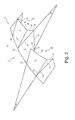
- FIG. 2 shows a further embodiment of a nozzle edge with convergent and divergent first and second guide devices 10, 20.
- first and second guide devices 10, 20 With regard to the structure of the individual guide devices 10, 20 is made to the statements in relation to FIG. 1 directed.
- the outflow edges 12, 22 are obliquely aligned, for example, at an angle less than or equal to 45 ° to the nozzle main axis or main flow direction.
- the trailing edges 12, 22 reciprocate in a zigzag line that defines the jet exit edge of the nozzle rim.
- the educated zig-zag line can be formed regularly with fixed angles and lengths of the trailing edges 12, 22 or alternatively irregularly with changing angles and / or lengths of the trailing edges 12, 22.
- Additional oblique edges are provided, which improve the mechanism of action for jet noise reduction, in that the local acceleration and deceleration of the outgoing flow from the nozzle edge 9 in the region of the jet outlet edges can develop even more.
- FIGS. 1 and 2 can also be combined.
- the outflow edges 12, 22 provided there also extend obliquely to the circumferential direction.
- an oblique course of the trailing edges need not be realized in each of the guide devices 10, 20, but it is also within the scope of the invention to make such an oblique course only in some of the guide devices 10, 20, wherein a periodic or not periodic arrangement and order may be provided. It can also be provided that the individual outflow edges 12, 22 of the individual guide devices 10, 20 realize different angles with respect to their inclination to the circumferential direction.
- FIGS. 1 and 2 can be varied so that the wall elements 30 are not as shown in FIGS FIGS. 1 and 2 shown, in the radial direction, ie, perpendicular to the nozzle shell surface 4, but have an oblique formation with a radial component and a component in the circumferential direction.
- the invention is not limited in its embodiment to the above-described embodiments, which are only to be understood as examples.
- the illustrated angles and size ratios of the first and second guide devices are to be understood merely as examples.
- the wall elements 30 deviating from the representations of FIGS. 1 and 2 are not formed in triangular shape, but in the axial direction have a curved or curved course. As a result, a further variation in the configuration of the open flow channels provided by the guide devices 10, 20 can take place.
Landscapes
- Engineering & Computer Science (AREA)
- Chemical & Material Sciences (AREA)
- Combustion & Propulsion (AREA)
- Mechanical Engineering (AREA)
- General Engineering & Computer Science (AREA)
- Nozzles (AREA)
- Jet Pumps And Other Pumps (AREA)
Abstract
Description
- Die Erfindung betrifft eine Düse mit Leitvorrichtungen gemäß dem Oberbegriff des Patentanspruchs 1. Eine solche Düse findet beispielsweise Verwendung in einer Gasturbine, insbesondere einem Flugzeugtriebwerk, oder in einem Brenner, einem Ejektor oder einer Mischdüse einer verfahrenstechnischen Anlage.
- Beim Startvorgang eines Flugzeuges stellt der Antriebsstrahl eine erhebliche Schallquelle dar. Dabei tragen zur Schallerzeugung stabile, kohärente Wirbelstrukturen bei, die sich in den Scherschichten des Freistrahls bilden. Zur Minderung des Strahllärms sind zahlreiche passive und aktive Maßnahmen bekannt.
- Die gattungsbildende
EP 2 072 793 A2 beschreibt eine Düse mit Leitelementen, bei der am Düsenrand alternierend diffusorartige und düsenartige Leitelemente ausgebildet sind. Die Leitelemente bilden dabei in Strömungsrichtung abwechselnd konvergierende und divergierende Trapeze. Durch solche Leitelemente wird das ausströmende Medium am Düsenrand, wo das ausströmende Medium auf das umgebende Medium trifft, verwirbelt. Die dabei entstehenden Axial- und Radialwirbel schwächen dabei die stabilen, kohärenten und lärmerzeugenden Wirbelstrukturen und führen somit zu einer verminderten Lärmerzeugung im Antriebsstahl. - Es besteht ein fortlaufender Bedarf, eine weitere Minderung des Strahllärms von Flugzeugen bei gleichzeitig geringen aerodynamischen Verlusten bereitzustellen.
- Dementsprechend liegt der vorliegenden Erfindung die Aufgabe zugrunde, eine Düse mit Leitelementen bereitzustellen, die eine weitere Verminderung der durch den Antriebsstrahl erzeugten Schallemissionen bereitstellt, bei gleichzeitig geringen aerodynamischen Verlusten.
- Diese Aufgabe wird erfindungsgemäß durch eine Düse mit den Merkmalen des Anspruchs 1 und eine Düse mit den Merkmalen des Anspruchs 4 gelöst. Ausgestaltungen der Erfindung sind in den Unteransprüchen angegeben.
- Danach sieht die erfindungsgemäße Lösung eine Düse mit einer Düsenmantelfläche und einem Düsenrand vor, an dem in Umfangsrichtung abwechselnd erste und zweite Leitvorrichtungen angeordnet sind. Die ersten Leitvorrichtungen sind düsenartig ausgebildet und bilden einen offenen, konvergierenden Kanal. Die zweiten Leitvorrichtungen sind diffusorartig ausgebildet und bilden einen offen, divergierenden Kanal. Hierzu weisen die ersten Leitvorrichtungen jeweils eine erste azimuthale Leitwand und zwei Leitelemente auf, wobei die erste azimuthale Leitwand eine erste Abströmkante und zwei erste Kanten zu den Wandelementen ausbildet. Ebenso weisen die zweiten Leitvorrichtungen jeweils eine zweite azimuthale Leitwand und zwei Leitelemente auf, wobei die zweite azimuthale Leitwand eine zweite Abströmkante und zwei Kanten zu den Wandelementen ausbildet.
- Ein Wandelement verbindet jeweils eine erste Leitvorrichtung und eine zweite Leitvorrichtung und ist dabei Teil beider Leitvorrichtungen. Dabei gilt, dass jedes Wandelement eine erste Kante zu einer der ersten Leitwände, eine zweite Kante zu einer der zweiten Leitwände und eine stirnseitige Abströmkante aufweist. Die beiden Kanten eines Wandelementes divergieren in axialer Richtung.
- Es ist gemäß einem ersten Erfindungsaspekt vorgesehen, dass bei einer solchen Düse zumindest einige der ersten azimuthalen Leitwände der ersten Leitvorrichtung und einige der zweiten azimuthalen Leitwände der zweiten Leitvorrichtung eine unterschiedliche axiale Länge besitzen, so dass deren erste und zweite Abströmkanten eine unterschiedliche axiale Position besitzen.
- Gemäß einem zweiten Erfindungsaspekt ist vorgesehen, dass bei einer solchen Düse zumindest einige der ersten Abströmkanten der ersten azimuthalen Leitwände und/oder zumindest einige der zweiten Abströmkanten der zweiten azimuthalen Leitwände schräg zur Umfangsrichtung verlaufen.
- In beiden Fällen werden schräge, zurückgeschnittene Abströmkanten (der ersten/zweiten Leitvorrichtungen und/oder der Wandelemente) bereitgestellt. Diese bewirken eine höhere räumliche Varianz der Richtung des Wirbelstärkevektors der abgehenden Wirbel und führen damit zur Reduktion der Intensität der großen, stabilen, kohärenten Wirbel. Der Wirkungsmechanismus zur Strahllärmreduktion wird somit durch die erfindungsgemäße Lösung verbessert. Dabei führt die Schwächung der großen, in Umfangsrichtung kohärenten Wirbelstrukturen zu einer verminderten Lärmerzeugung im Strahl.
- Die erfindungsgemäße Lösung ermöglicht eine effiziente Reduktion des tieffrequenten Lärms, wobei der hochfrequente Lärm keine oder eine nur geringe Erhöhung erfährt. Gleichzeitig werden die Strömungsverluste durch eine optimierte Form der Wandelemente der Leitvorrichtungen minimiert. Die erfindungsgemäße Lösung ist darüber hinaus robust, wartungsarm sowie gewichtsneutral. Sie benötigt keine beweglichen Teile, keine Steuerung und keine gesonderte Energieversorgung. Sie ist damit auch kostengünstig.
- Die erfindungsgemäße Düse kann bei allen Düsentypen angewendet werden, insbesondere auch an einer Düse mit einer Kernstromdüse und einer Nebenstromdüse. Die Leitvorrichtungen können integrierter Bestandteil der Düse sein, insbesondere aus Segmenten der Düsenmantelfläche gebildet sein, oder als Nachrüstsatz nachträglich an der Düsenmantelfläche befestigt werden.
- In einer Ausgestaltung des ersten Erfindungsaspektes, bei dem erste und zweite Leitvorrichtungen eine unterschiedliche axiale Länge besitzen, laufen die Abströmkanten der ersten und zweiten Leitwände in Umfangsrichtung, d. h. senkrecht zur Düsenhauptachse bzw. Hauptströmungsrichtung. Die azimuthalen Leitwände der ersten und zweiten Leitvorrichtungen besitzen eine unterschiedliche Länge, so dass sich deren Abströmkanten an unterschiedlichen axialen Positionen befinden, die jedoch dabei grundsätzlich in azimuthaler Richtung, d. h. in Umfangsrichtung verlaufen.
- Dementsprechend verlaufen die stirnseitigen Abströmkanten der Wandelemente, die die benachbarten Leitwände einer ersten und einer zweiten Leitvorrichtung verbinden, schräg in dem Sinne, dass sie eine axiale und eine radiale Komponente aufweisen.
- Es wird darauf hingewiesen, dass gemäß dem ersten Erfindungsaspekt nicht sämtliche der ersten azimuthalen Leitwände und der zweiten azimuthalen Leitwände eine unterschiedliche axiale Länge besitzen müssen. Auch ist es nicht erforderlich, dass die ersten azimuthalen Leitwände für sich betrachtet alle die gleiche axiale Länge aufweisen und die zweiten azimuthalen Leitwände für sich betrachtet alle die gleiche axiale Länge aufweisen. Auch die ersten azimuthalen Leitwände können unterschiedliche axiale Längen besitzen, wobei beispielsweise in regelmäßiger Reihenfolge zwei oder drei unterschiedliche axiale Längen der ersten azimuthalen Leitwände realisiert sind. Gleiches gilt für die zweiten azimuthalen Leitwände. Es liegt aber natürlich ebenfalls im Rahmen der vorliegenden Erfindung, dass die ersten azimuthalen Leitwände für sich genommen alle die gleiche axiale Länge aufweisen und die zweiten azimuthalen Leitwände für sich betrachtet ebenfalls alle die gleiche Länge aufweisen.
- Gemäß einer Ausführungsvariante des zweiten Erfindungsaspektes, wonach zumindest einige der ersten Abströmkanten und/oder zumindest einige der zweiten Abströmkanten schräg zur Umfangsrichtung verlaufen, verlaufen die Abströmkanten in einem Winkel von bis zu +/- 45° zur Düsenhauptachse bzw. Hauptströmungsrichtung.
- Bei dem zweiten Erfindungsaspekt befinden sich die stirnseitigen Abströmkanten benachbarter Wandelemente, die jeweils eine erste und eine zweite Leitvorrichtung verbinden, an unterschiedlichen axialen Positionen. Die azimuthalen Abströmkanten der ersten und zweiten azimuthalen Leitwände verlaufen schräg zur Umfangsrichtung und bedingen dadurch eine Variation der Länge (d. h. der axialen Ausdehnung) einer azimuthalen Leitwand in Umfangsrichtung.
- Die Wandelemente, die jeweils eine erste Leitvorrichtung und eine zweite Leitvorrichtung miteinander verbinden, verlaufen gemäß einer Ausführungsvariante in radialer Richtung, d. h., sie sind senkrecht zu der Düsenmantelfläche ausgerichtet. Jedoch kann in alternativen Ausführungsvarianten ebenfalls vorgesehen sein, dass die Wandelemente schräg verlaufen, wobei sie eine radiale Komponente und eine Komponente in Umfangsrichtung aufweisen. Eine schräge Anordnung der Wandelemente führt dazu, dass die durch die ersten und zweiten Leitvorrichtungen bereitgestellten Kanäle sich in radialer Richtung verjüngen oder verbreitern. Dies kann zu einer zusätzlichen Verwirbelung am Düsenrand führen.
- Eine Ausführungsvariante der vorliegenden Erfindung sieht vor, dass die Wandelemente gerade Kanten aufweisen und dementsprechend als Dreiecke ausgebildet sind. Die Dreiecke erstrecken sich dabei von einem Anfangspunkt, der an die Düsenmantelfläche angrenzt, bis zu der stirnseitigen Abströmkante. Jedoch kann in alternativen Ausführungsbeispielen vorgesehen sein, dass die Wandelemente mit einer Krümmung versehen sind, wobei die durch die ersten und zweiten Leitvorrichtungen gebildeten Kanäle sich in axialer Richtung nicht linear, sondern z.B. bogenförmig verbreitern bzw. verjüngen.
- Bei der erfindungsgemäßen Düse konvergieren und divergieren benachbarte Wandelemente abwechselnd und paarweise in axialer Richtung. Ein betrachtetes Wandelement bildet somit mit seinem einen Nachbarn einen konvergenten Kanal und mit seinem anderen Nachbarn einen divergenten Kanal.
- Die ersten und die zweiten Leitwände können bezogen auf die Strömungsrichtung am Düsenrand in unterschiedlicher Weise geneigt sein. Hierzu kann insbesondere vorgesehen sein, dass die ersten Leitwände radial auswärts geneigt und die zweiten Leitwände radial einwärts geneigt sind oder umgekehrt. Dies bedeutet, dass die düsenartig ausgebildeten Leitvorrichtungen innenliegend, d. h. zum Strahl und die diffusorartigen Leitvorrichtungen nach außen zur Umgebungsströmung ausgerichtet sind, oder dass die diffusorartigen Leitvorrichtungen innenliegend, d. h. zum Strahl und die düsenartigen Leitvorrichtungen nach außen zur Umgebungsströmung ausgerichtet sind.
- Die Erfindung wird nachfolgend unter Bezugnahme auf die Figuren der Zeichnung anhand mehrerer Ausführungsbeispiele näher erläutert. Es zeigen:
- Figur 1
- ein erstes Ausführungsbeispiel erster und zweiter Leitvorrichtungen einer erfindungsgemäßen Düse;
- Figur 2
- ein zweites Ausführungsbeispiel erster und zweiter Leiteinrichtungen einer erfindungsgemäßen Düse;
- Figur 3
- eine perspektivische und schematische Ansicht eines ersten Ausführungsbeispiels einer Düse mit ersten und zweiten Leiteinrichtungen gemäß dem Stand der Technik; und
- Figur 4
- eine perspektivisch und schematische Ansicht eines zweiten Ausführungsbeispiels einer Düse gemäß dem Stand der Technik.
- Zum besseren Verständnis des Hintergrunds der vorliegenden Erfindung werden zunächst anhand der
Figuren 3 und4 zwei Ausgestaltungen einer Düse mit ersten und zweiten Leitvorrichtungen gemäß dem Stand der Technik erläutert. - Die
Figur 3 zeigt eine Düse 1 mit einer Düsenmantelfläche 4 sowie ersten Leitvorrichtungen 10 und zweiten Leitvorrichtungen 20, die an einem Düsenrand mit einer Strahlaustrittskante 5 ausgebildet sind. Die ersten Leitvorrichtungen 10 konvergieren in Strömungsrichtung 6 und sind radial nach innen geneigt, während die zweiten Leitvorrichtungen 20 in Strömungsrichtung 6 divergieren und radial nach außen geneigt sind. Eine umgekehrte Ausbildung ist ebenfalls möglich. Die Strahlachse 7 bildet in Strömungsrichtung 6 eine Verlängerung der Mittellinie 8 der Düse 1. Die Mittellinie 8 der Düse kann identisch mit der Mittelinie der Turbine sein (wie dargestellt), davon aber auch geringfügig abweichen. - Im Betrieb tritt ein Antriebsstrahl 1a an der Strahlaustrittskante aus der Düse aus. Eine Außenströmung 4a verläuft entlang der Düsenmantelfläche 4.
- Die
Figur 4 zeigt eine Düse 1, die eine Kernstromdüse 2 und eine Nebenstromdüse 3 umfasst. Die Kernstromdüse 2 und die Nebenstromdüse 3 weisen jeweils eine Düsenmantelfläche 4 mit einer Strahlaustrittskante 5 sowie erste Leitvorrichtungen 10 und zweite Leitvorrichtungen 20 an Düsenrändern 9 mit zugehörigen Strahlaustrittskanten 5 auf. Wie in derFigur 3 konvergieren die ersten Leitvorrichtungen 10 in Strömungsrichtung 6 und sind radial nach innen geneigt, während die zweiten Leitvorrichtungen 20 in Strömungsrichtung 6 divergieren und radial nach außen geneigt sind. Alternativ sind die ersten Leitvorrichtungen 10 radial nach außen und die zweiten Leitvorrichtungen 20 radial nach innen geneigt. Die Strahlachse 7 bildet in Strömungsrichtung 6 eine Verlängerung der Mittellinie 8 der Düse 1. Die Mittellinie 8 der Düse kann identisch mit der Mittelinie der Turbine sein (wie dargestellt), davon aber auch geringfügig abweichen. - Im Betrieb tritt im Ausführungsbeispiel der
Figuren 4 ein heißer Kernstrom 2a aus der Kernstromdüse 2 aus. Ein kalter Nebenstrom 3a tritt aus der Nebenstromdüse 3 aus. Die Außenströmung 4a verläuft entlang der Düsenmantelfläche 4 der Nebenstromdüse 3. - Eine Anordnung entsprechend den
Figuren 3 und4 ist in derEP 2 072 793 A2 beschrieben, auf die insofern ergänzend Bezug genommen wird. - Die
Figur 1 zeigt ein erstes Ausführungsbeispiel eines erfindungsgemäß ausgebildeten Düsenrandes mit ersten, düsenartig ausgebildeten Leitvorrichtungen 10 und zweiten, diffusorartigen Leitvorrichtungen 20, die zur Verbesserung des Wirkungsmechanismus zur Strahllärmreduktion in anderer Weise als gemäß denFiguren 3 und4 ausgebildet sind. - Gemäß der
Figur 1 wird der Düsenrand 9 aus ersten Leitvorrichtungen 10 und zweiten Leitvorrichtungen 20 gebildet. Die ersten Leitvorrichtungen 10 bilden einen düsenartigen Kanal und die zweiten Leitvorrichtungen 20 einen diffusorartigen Kanal aus. - Hierzu umfassen die ersten Leitvorrichtungen 10 jeweils eine (erste) azimuthale Leitwand 11 und zwei daran in Umfangsrichtung benachbart angrenzende Wandelemente 30. Die azimuthale Leitwand 11 wird dabei durch vier Begrenzungslinien bzw. Kanten begrenzt. Eine erste, in Strömungsrichtung gesehen axial vordere, azimuthal verlaufende Kante wird durch eine in Umfangsrichtung verlaufende Kante 16 gebildet, die an die Düsenmantelfläche 4 angrenzt und in axialer Richtung den Beginn der Leitelemente 10, 20 definiert. Eine zweite, in Strömungsrichtung gesehen axial hintere, azimuthal verlaufende Kante wird durch eine (erste) Abströmkante 12 gebildet. Die erste Leitvorrichtung 10 umfasst des Weiteren zwei seitliche, d. h. in Umfangsrichtung beabstandete Kanten 13 auf. Die Kanten 13 bilden Kanten zu den Wandelementen 30 und dabei Begrenzungen der azimuthalen Leitwand 11. Sie konvergieren gemäß einem Konvergenzwinkel β, wobei der Konvergenzwinkel β beispielsweise zwischen 0° und 7° liegt.
- Die zweiten Leitvorrichtungen 20 umfassen ebenfalls eine (zweite) azimuthale Leitwand 21 und zwei Wandelemente 30. Die azimuthale Leitwand 21 wird dabei durch vier Begrenzungslinien bzw. Kanten definiert. Eine erste, axial vordere Kante wird durch die in Umfangsrichtung verlaufende Kante 16 gebildet. Eine zweite, axial hintere Kante wird durch eine (zweite) Abströmkante 22 gebildet. Des Weiteren sind zwei seitliche Kanten 23 zu den Wandelementen 30 vorgesehen. Die beiden Kanten 23 divergieren entsprechend einem Divergenzwinkel α, wobei der Divergenzwinkel α beispielsweise zwischen 0° und 7° liegt.
- Die Wandelemente 30 sind dreieckförmig und werden durch die Kanten 13, 23 und 31 begrenzt. Sie sind im dargestellte Ausführungsbeispiel in sich eben, können alternativ aber auch in sich gebogen bzw. gekrümmt ausgebildet sein.
- Die Wandelemente 30 verbinden jeweils eine erste Leitvorrichtung 10 und eine zweite Leitvorrichtung 20 miteinander und sind dabei Teil beider Leitvorrichtungen 10, 20 insofern, als jedes Wandelement 30 eine erste Kante 13 zu einer der ersten Leitwände 11 und eine zweite Kante 23 zu einer der zweiten Leitwände 21 aufweist. Jedes Wandelement 30 umfasst des Weiteren eine stirnseitige Abströmkante 31. Die beiden Kanten 13, 23 eines Wandelementes divergieren dabei stromabwärts in axialer Richtung.
- Es wird darauf hingewiesen, dass die ersten Leitvorrichtungen 10 radial einwärts und die zweiten Leitvorrichtungen 20 radial auswärts bezogen auf die Strömungsrichtung geneigt sind. Es ist jedoch ebenso eine entgegengesetzte Ausrichtung der Leitvorrichtungen 10, 20 möglich.
- Die azimuthalen Leitwände 11 der ersten Leitvorrichtungen 10 und die azimuthalen Leitwände 21 der zweiten Leitvorrichtungen 20 besitzen gemäß dem Ausführungsbeispiel der
Figur 1 zumindest teilweise eine unterschiedliche axiale Länge. Das heißt, zumindest einige der ersten Abströmkanten 12 der ersten Leitvorrichtungen 10 und zumindest einige der zweiten Abströmkanten 22 der zweiten Leitvorrichtungen 20 besitzen eine unterschiedliche axiale Position. Dabei verlaufen die Abströmkanten 12, 22 der ersten und zweiten Leitvorrichtungen 10, 20 jeweils in Umfangsrichtung. - Entsprechend der unterschiedlichen axialen Position der ersten und der zweiten Abströmkanten 12, 22 sind zumindest einige der stirnseitigen Abströmkanten 31 der Wandelemente 30 schräg verlaufend mit einer axialen und einer radialen Komponente, wie aus der
Figur 1 ersichtlich ist. - Es wird darauf hingewiesen, dass ein Wechsel der axialen Länge zwar sämtliche der ersten und zweiten Leitvorrichtungen 10, 20 erfassen kann, aber nicht muss. So ist beispielsweise im Ausführungsbeispiel der
Figur 1 vorgesehen, dass die in derFigur 1 hinten angeordnete Leitwand 21 eine erste axiale Länge besitzt, die daran entgegen dem Uhrzeigersinn angrenzende Leitwand 11 demgegenüber eine geringere axiale Länge besitzt, so dass die stirnseitige Abströmkante 31 des dazwischen liegenden Wandelementes 30 schräg verläuft. Die sich entgegen dem Uhrzeigersinn an diese azimuthale Leitwand 11 angrenzende azimuthale Leitwand 21 einer zweiten Leitvorrichtung ist dagegen nicht gegenüber dieser Leitwand 11 axial versetzt. Ein axialer Versatz erfolgt erst wieder gegenüber der sich dann entgegen dem Uhrzeigersinn anschließenden ersten Leitvorrichtung 11. - Es kann somit beispielsweise vorgesehen sein, dass ein Wechsel der axialen Länge nicht bei jeder Leitvorrichtung 10, 20, sondern nur bei jeder n-ten Leitvorrichtung erfolgt, mit n größergleich zwei.
- Auch kann ein Wechsel der axialen Länge nichtperiodisch erfolgen und hierzu beispielsweise in zufälliger Weise oder einer bestimmten Zahlenreihe folgend realisiert sein.
- Insgesamt wird ein Düsenrand 9 bereitgestellt, bei dem die stirnseitigen Abströmkanten 31 zumindest einiger der Wandelemente 30 schräg verlaufen und durch die unterschiedlichen axialen Längen der azimuthalen Leitwände 11, 21 der Düsenrand 9 eine zusätzliche Variation erfährt. Hierdurch werden in verstärktem Maße eine lokale Beschleunigung und Verzögerung der vom Düsenrand 9 abgebenden Strömung im Bereich der Düsenaustrittskante und eine Variation der axialen Geschwindigkeit in Umfangsrichtung erreicht. Dabei werden Axial- und Radialwirbel stromab der Düse generiert, die mit dem stabilen Ringwirbel interagieren. Diese verformen sich schließlich und dissipieren. Dies sorgt für einen erhöhten Impulsaustausch, d. h., für eine bessere, homogene Durchmischung der Innenströmung 1a, 2a, 3a und der Außenströmung 3a, 4a (vgl.
Figuren 3 ,4 ). Die großen, tieffrequenten lärmerzeugenden Wirbelstrukturen werden in kleine Wirbelstrukturen zerschlagen, deren abgestrahlter, hochfrequenter Lärm besser atmosphärisch absorbiert wird. - Die
Figur 2 zeigt ein weiteres Ausführungsbeispiel eines Düsenrandes mit konvergenten und divergenten ersten und zweiten Leitvorrichtungen 10, 20. Hinsichtlich des Aufbaus der einzelnen Leitvorrichtungen 10, 20 wird dabei auf die Ausführungen in Bezug aufFigur 1 verwiesen. - Im Unterschied zum Ausführungsbeispiel der
Figur 1 ist beim Ausführungsbeispiel derFigur 2 vorgesehen, dass zumindest einige der ersten Abströmkanten 12 der azimuthalen Leitwände 11 und/oder zumindest einige der zweiten Abströmkanten 22 der zweiten azimuthalen Leitwände 21 schräg zur Umfangsrichtung verlaufen. Hierdurch wird eine Variation der axialen Ausdehnung dieser azimuthalen Wände 11, 21 und damit der entsprechenden diffusorartigen Kanäle und düsenartigen Kanäle erreicht, die die zweiten und ersten Leiteinrichtungen 10, 20 bereitstellen. - Die Abströmkanten 12, 22 sind beispielsweise in einem Winkel kleiner gleich 45° zur Düsenhauptachse bzw. Hauptströmungsrichtung schräg ausgerichtet.
- Die Abströmkanten 12, 22 verlaufen in einer Zick-Zack-Linie hin- und her, die die Strahlaustrittskante des Düsenrands definiert. Die gebildete Zick-Zacklinie kann regelmäßig mit festen Winkeln und Längen der Abströmkanten 12, 22 oder alternativ unregelmäßig mit sich ändernden Winkeln und/oder Längen der Abströmkanten 12, 22 gebildet sein.
- Auch beim Ausführungsbeispiel der
Figur 2 werden zusätzliche schräg verlaufende Kanten bereitgestellt, die den Wirkmechanismus zur Strahllärmreduktion verbessern, indem die lokale Beschleunigung und Verzögerung der vom Düsenrand 9 abgehenden Strömung im Bereich der Strahlaustrittskanten sich noch stärker herausbilden kann. - Die Ausführungsbeispiele der
Figuren 1 und2 können auch kombiniert werden. Beispielsweise kann beim Ausführungsbeispiel derFigur 1 vorgesehen sein, dass die dort vorgesehenen Abströmkanten 12, 22 ebenfalls schräg zur Umfangsrichtung verlaufen. - Zum Ausführungsbeispiel der
Figur 2 wird darauf hingewiesen, dass auch hier ein schräger Verlauf der Abströmkanten nicht bei jeder der Leitvorrichtungen 10, 20 realisiert sein muss, sondern es ebenfalls im Rahmen der Erfindung liegt, einen solchen schrägen Verlauf nur bei einigen der Leitvorrichtungen 10, 20 vorzunehmen, wobei eine periodische oder nicht periodische Anordnung und Reihenfolge vorgesehen sein kann. Auch kann vorgesehen sein, dass die einzelnen Abströmkanten 12, 22 der einzelnen Leitvorrichtungen 10, 20 unterschiedliche Winkel in Bezug auf ihre Schrägstellung zur Umfangsrichtung realisieren. - Die Ausführungsbeispiele der
Figuren 1 und2 können dahingehend variiert werden, dass die Wandelemente 30 nicht, wie in denFiguren 1 und2 dargestellt, in radialer Richtung verlaufen, d. h., senkrecht auf der Düsenmantelfläche 4 stehen, sondern eine schräge Ausbildung mit einer radialen Komponente und einer Komponente in Umfangsrichtung besitzen. - Die Erfindung beschränkt sich in ihrer Ausgestaltung nicht auf die vorstehend erläuterten Ausführungsbeispiele, die lediglich beispielhaft zu verstehen sind. So sind die dargestellten Winkel und Größenverhältnisse der ersten und zweiten Leitvorrichtungen lediglich beispielhaft zu verstehen. Auch kann vorgesehen sein, dass die Wandelemente 30 abweichend von den Darstellungen der
Figuren 1 und2 nicht in Dreiecksform ausgebildet sind, sondern in axialer Richtung einen gebogenen bzw. gekrümmten Verlauf besitzen. Hierdurch kann eine weitere Variation in der Ausgestaltung der offenen, durch die Leitvorrichtungen 10, 20 bereitgestellten Strömungskanäle erfolgen.
Claims (15)
- Düse mit einer Düsenmantelfläche (4) und einem Düsenrand (9), an dem in Umfangsrichtung abwechselnd erste und zweite Leitvorrichtungen (10, 20) angeordnet sind, wobei- die ersten Leitvorrichtungen (10) düsenartig ausgebildet sind,- die zweiten Leitvorrichtungen (20) diffusorartig ausgebildet sind,- die ersten Leitvorrichtungen (10) jeweils eine erste azimuthale Leitwand (11) und zwei Wandelemente (30) umfassen, wobei die erste azimuthale Leitwand (11) eine erste Abströmkante (12) und zwei erste Kanten (13) zu den Wandelementen (30) ausbildet,- die zweiten Leitvorrichtungen (20) jeweils eine zweite azimuthale Leitwand (21) und zwei Wandelemente (30) umfassen, wobei die zweite azimuthale Leitwand (21) eine zweite Abströmkante (22) und zwei zweite Kanten (13) zu den Wandelementen (30) ausbildet, und- ein Wandelement (30) eine erste Leitvorrichtung (10) und eine zweite Leitvorrichtung (20) miteinander verbindet und Teil beider Leitvorrichtungen (10, 20) ist, wobei jedes Wandelement (30) eine erste Kante (13) mit einer der ersten Leitwände (11), eine zu der ersten Kante (13) in axialer Richtung divergierende zweite Kante (23) mit einer der zweiten Leitwände (21) und eine stirnseitige Abströmkante (31) aufweist,dadurch gekennzeichnet,
dass zumindest einige der ersten azimuthalen Leitwände (11) der ersten Leitvorrichtung (10) und zumindest einige der zweiten azimuthalen Leitwände (21) der zweiten Leitvorrichtung (20) eine unterschiedliche axiale Länge besitzen, so dass deren erste und zweite Abströmkanten (12, 22) eine unterschiedliche axiale Position besitzen. - Düse nach Anspruch 1, dadurch gekennzeichnet, dass die Abströmkanten (12, 22) der ersten und zweiten Leitwände (11, 12) in Umfangsrichtung verlaufen.
- Düse nach Anspruch 2, dadurch gekennzeichnet, dass zumindest einige der stirnseitigen Abströmkanten (31) der Wandelemente (30) mit einer axialen und einer radialen Komponente schräg verlaufen.
- Düse mit einer Düsenmantelfläche (4) und einem Düsenrand (9), an dem in Umfangsrichtung abwechselnd erste und zweite Leitvorrichtungen (10, 20) angeordnet sind, wobei- die ersten Leitvorrichtungen (10) düsenartig ausgebildet sind,- die zweiten Leitvorrichtungen (20) diffusorartig ausgebildet sind,- die ersten Leitvorrichtungen (10) jeweils eine erste azimuthale Leitwand (11) und zwei Wandelemente (30) umfassen, wobei die erste azimuthale Leitwand (11) eine erste Abströmkante (12) und zwei erste Kanten (13) zu den Wandelementen (30) ausbildet,- die zweiten Leitvorrichtungen (20) jeweils eine zweite azimuthale Leitwand (21) und zwei Wandelemente (30) umfassen, wobei die zweite azimuthale Leitwand (21) eine zweite Abströmkante (22) und zwei zweite Kanten (13) zu den Wandelementen (30) ausbildet, und- ein Wandelement (30) eine erste Leitvorrichtung (10) und eine zweite Leitvorrichtung (20) miteinander verbindet und Teil beider Leitvorrichtungen (10, 20) ist, wobei jedes Wandelement (30) eine erste Kante (13) mit einer der ersten Leitwände (11), eine zu der ersten Kante (13) in axialer Richtung divergierende zweite Kante (23) mit einer der zweiten Leitwände (21) und eine stirnseitige Abströmkante (31) aufweist,dadurch gekennzeichnet,
dass zumindest einige der ersten Abströmkanten (12) der ersten azimuthalen Leitwände (11) und/oder zumindest einige der zweiten Abströmkanten (22) der zweiten azimuthalen Leitwände (21) schräg zur Umfangsrichtung verlaufen. - Düse nach Anspruch 4, dadurch gekennzeichnet, dass zumindest einige der Abströmkanten (12, 22) in einem Winkel kleinergleich ± 45° zur Düsenhauptachse verlaufen.
- Düse nach Anspruch 4 oder 5, dadurch gekennzeichnet, dass zumindest einige der stirnseitigen Abströmkanten (12, 22) benachbarter Wandelemente (11, 21) eine unterschiedliche axiale Position besitzen.
- Düse nach einem der vorangehenden Ansprüche, dadurch gekennzeichnet, dass die Wandelemente (30) in radialer Richtung ausgerichtet sind.
- Düse nach einem der Ansprüche 1 bis 6, dadurch gekennzeichnet, dass die Wandelemente (30) mit einer radialen Komponente und einer Komponente in Umfangsrichtung schräg verlaufen.
- Düse nach einem der vorangehenden Ansprüche, dadurch gekennzeichnet, dass die Wandelemente (30) gerade Kanten (13, 23) aufweisen und als Dreiecke ausgebildet sind.
- Düse nach einem der Ansprüche 1 bis 8, dadurch gekennzeichnet, dass die Wandelemente (30) in axialer Richtung einen gekrümmten Verlauf besitzen
- Düse nach einem der vorangehenden Ansprüche, dadurch gekennzeichnet, dass benachbarte Wandelemente (30) paarweise in axialer Richtung abwechselnd konvergieren und divergieren.
- Düse nach einem der vorangehenden Ansprüche, dadurch gekennzeichnet, dass die ersten und zweiten Leitwände (11, 21) bezogen auf die Strömungsrichtung (6) am Düsenrand (9) in unterschiedlicher Weise geneigt sind.
- Düse nach einem der vorangehenden Ansprüche, dadurch gekennzeichnet, dass die ersten Leitwände (11) radial auswärts geneigt sind und die zweiten Leitwände (21) radial einwärts geneigt sind oder umgekehrt.
- Düse nach einem der vorangehenden Ansprüche, dadurch gekennzeichnet, dass die ersten Leitvorrichtungen (10) und/oder die zweiten Leitvorrichtungen (20) als Nachrüstsatz ausgebildet und an der Düsenmantelfläche (4) befestigt sind.
- Gasturbine mit einer Düse gemäß Anspruch 1.
Applications Claiming Priority (1)
| Application Number | Priority Date | Filing Date | Title |
|---|---|---|---|
| DE102012220360.5A DE102012220360A1 (de) | 2012-11-08 | 2012-11-08 | Düse mit Leitvorrichtungen |
Publications (3)
| Publication Number | Publication Date |
|---|---|
| EP2730772A2 true EP2730772A2 (de) | 2014-05-14 |
| EP2730772A3 EP2730772A3 (de) | 2016-02-24 |
| EP2730772B1 EP2730772B1 (de) | 2018-08-08 |
Family
ID=49518818
Family Applications (1)
| Application Number | Title | Priority Date | Filing Date |
|---|---|---|---|
| EP13191624.9A Not-in-force EP2730772B1 (de) | 2012-11-08 | 2013-11-05 | Düse mit Leitvorrichtungen |
Country Status (3)
| Country | Link |
|---|---|
| US (1) | US9279387B2 (de) |
| EP (1) | EP2730772B1 (de) |
| DE (1) | DE102012220360A1 (de) |
Families Citing this family (2)
| Publication number | Priority date | Publication date | Assignee | Title |
|---|---|---|---|---|
| FR3008739B1 (fr) * | 2013-07-18 | 2017-03-24 | Snecma | Tuyere d'une turbomachine equipee de chevrons a face interne non axi-symetrique. |
| FR3095675B1 (fr) * | 2019-05-03 | 2021-04-09 | Safran Aircraft Engines | Mélangeur à flux séparés de turbomachine |
Citations (1)
| Publication number | Priority date | Publication date | Assignee | Title |
|---|---|---|---|---|
| EP2072793A2 (de) | 2007-12-21 | 2009-06-24 | Rolls-Royce Deutschland Ltd & Co KG | Düse mit Leitelementen |
Family Cites Families (26)
| Publication number | Priority date | Publication date | Assignee | Title |
|---|---|---|---|---|
| US3514955A (en) * | 1968-03-28 | 1970-06-02 | Gen Electric | Mixing structures and turbofan engines employing same |
| US3982696A (en) | 1975-07-01 | 1976-09-28 | Grumman American Aviation Corporation | Jet noise suppressor nozzle |
| GB2104967B (en) * | 1981-09-03 | 1985-07-17 | Rolls Royce | Exhaust mixer for turbofan aeroengine |
| GB2209054B (en) | 1987-08-26 | 1992-04-15 | Rolls Royce Plc | Gas turbine nozzles |
| EP0635632B1 (de) | 1993-06-25 | 1997-10-22 | THE NORDAM GROUP, Inc. | System zur Schalldämpfung |
| GB2289921A (en) | 1994-06-03 | 1995-12-06 | A E Harris Limited | Nozzle for turbofan aeroengines |
| US5884472A (en) * | 1995-10-11 | 1999-03-23 | Stage Iii Technologies, L.C. | Alternating lobed mixer/ejector concept suppressor |
| US6360528B1 (en) | 1997-10-31 | 2002-03-26 | General Electric Company | Chevron exhaust nozzle for a gas turbine engine |
| US6314721B1 (en) | 1998-09-04 | 2001-11-13 | United Technologies Corporation | Tabbed nozzle for jet noise suppression |
| US6487848B2 (en) | 1998-11-06 | 2002-12-03 | United Technologies Corporation | Gas turbine engine jet noise suppressor |
| US6233920B1 (en) * | 1999-02-01 | 2001-05-22 | Stage Iii Technologies, L.C. | Contoured thrust reverser and lobed nozzle noise suppressor for gas turbine engines |
| US6578355B1 (en) | 1999-03-05 | 2003-06-17 | Rolls-Royce Deutschland Ltd & Co Kg | Bloom mixer for a turbofan engine |
| DE19952797A1 (de) * | 1999-11-03 | 2001-05-10 | Rolls Royce Deutschland | Blütenmischer für ein Zweikreis-Strahltriebwerk |
| US6308898B1 (en) | 1999-06-11 | 2001-10-30 | The Boeing Company | Apparatus and methods for active flow control of a nozzle exhaust plume |
| GB9925193D0 (en) | 1999-10-26 | 1999-12-22 | Rolls Royce Plc | Gas turbine engine exhaust nozzle |
| US6612106B2 (en) | 2000-05-05 | 2003-09-02 | The Boeing Company | Segmented mixing device having chevrons for exhaust noise reduction in jet engines |
| GB2372779A (en) | 2001-03-03 | 2002-09-04 | Rolls Royce Plc | Gas turbine engine nozzle with noise reducing tabs |
| GB0105349D0 (en) | 2001-03-03 | 2001-04-18 | Rolls Royce Plc | Gas turbine engine exhaust nozzle |
| US6532729B2 (en) | 2001-05-31 | 2003-03-18 | General Electric Company | Shelf truncated chevron exhaust nozzle for reduction of exhaust noise and infrared (IR) signature |
| US6505706B2 (en) | 2001-06-14 | 2003-01-14 | Pratt & Whitney Canada Corp. | Exhaust flow guide for jet noise reduction |
| US7085388B2 (en) | 2002-06-14 | 2006-08-01 | The Boeing Company | High frequency jet nozzle actuators for jet noise reduction |
| US6969028B2 (en) * | 2003-01-22 | 2005-11-29 | The Boeing Company | Scarf nozzle for a jet engine and method of using the same |
| US7043898B2 (en) * | 2003-06-23 | 2006-05-16 | Pratt & Whitney Canada Corp. | Combined exhaust duct and mixer for a gas turbine engine |
| EP1894616A1 (de) * | 2006-08-30 | 2008-03-05 | Fachhochschule Zentralschweiz | Statischesmischteil |
| CA2648765C (en) * | 2008-08-11 | 2011-04-19 | The Boeing Company | Jet engine nozzle exit configurations, including projections oriented relative to pylons, and associated systems and methods |
| US8104260B2 (en) * | 2009-05-22 | 2012-01-31 | Pratt & Whitney Canada Corp. | Deswirling exhaust mixer |
-
2012
- 2012-11-08 DE DE102012220360.5A patent/DE102012220360A1/de not_active Withdrawn
-
2013
- 2013-11-05 US US14/072,073 patent/US9279387B2/en active Active
- 2013-11-05 EP EP13191624.9A patent/EP2730772B1/de not_active Not-in-force
Patent Citations (1)
| Publication number | Priority date | Publication date | Assignee | Title |
|---|---|---|---|---|
| EP2072793A2 (de) | 2007-12-21 | 2009-06-24 | Rolls-Royce Deutschland Ltd & Co KG | Düse mit Leitelementen |
Also Published As
| Publication number | Publication date |
|---|---|
| EP2730772B1 (de) | 2018-08-08 |
| US9279387B2 (en) | 2016-03-08 |
| EP2730772A3 (de) | 2016-02-24 |
| US20140124289A1 (en) | 2014-05-08 |
| DE102012220360A1 (de) | 2014-05-08 |
Similar Documents
| Publication | Publication Date | Title |
|---|---|---|
| EP2730771B1 (de) | Düse für eine Gasturbine mit Leitvorrichtungen | |
| EP2378072B1 (de) | Nebenstromkanal eines Turbofantriebwerkes | |
| EP2233836B1 (de) | Drallerzeuger, Verfahren zum Vermeiden von Flammenrückschlag in einem Brenner mit wenigstens einem Drallerzeuger und Brenner | |
| EP2100809B1 (de) | Vorrichtung zur Verringerung des Antriebsleistungsbedarfes eines Schiffes | |
| EP2597029B1 (de) | Vordüse für ein Antriebssystem eines Wasserfahrzeuges zur Verbesserung der Energieeffizienz | |
| EP2591994B1 (de) | Vorrichtung zur Verringerung des Antriebsleistungsbedarfs eines Wasserfahrzeuges | |
| DE102007063018A1 (de) | Düse mit Leitelementen | |
| EP2994379B1 (de) | Vorrichtung zur verringerung des antriebsleistungsbedarfs eines wasserfahrzeuges | |
| DE102004022063A1 (de) | Abgasdiffusor für eine Axialströmungsturbine | |
| EP2455665A2 (de) | Gasturbinenbrennkammer mit einer Kühlluftzuführvorrichtung | |
| EP1384936A1 (de) | Schalldämpferanordnung für einen Strömungskanal, insbesondere für ein Ansaughaus einer Gasturbine | |
| EP2126321A1 (de) | Gasturbine mit einem nachleitkranz und mit einem mischer | |
| DE112009001754T5 (de) | Abgasdiffusor für Gasturbine | |
| EP2730772B1 (de) | Düse mit Leitvorrichtungen | |
| DE102011012039A1 (de) | Kanal mit Strömungsleitfläche | |
| EP3366908A1 (de) | Konvergent-divergente schubdüse für ein turbofan-triebwerk eines überschallflugzeugs | |
| DE102017100984B4 (de) | Gasturbinenbrennkammeranordnung | |
| EP4296489B1 (de) | Lufteinlass | |
| EP3470668A1 (de) | Windkraftanlage zur umwandlung von windenergie in mechanische und elektrische energie sowie land- oder wasserfahrzeug mit einer solchen windkraftanlage als antrieb | |
| DE480907C (de) | Turbinenschaufelung mit tangentialem Eintritt und axialem Austritt, insbesondere fuer Dampf- oder Gasturbinen | |
| DE1679542C3 (de) | Induktionsgerät zur Raumklimatisierung | |
| DE2835902A1 (de) | Koplanare schubduese | |
| EP2369171A2 (de) | Wasserkraftanlage | |
| DE1431154C (de) | Steuerduse, insbesondere fur Luft fahrzeuge | |
| EP3006672A1 (de) | Vorrichtung zur Beeinflussung der Strömung in einer Turbomaschine |
Legal Events
| Date | Code | Title | Description |
|---|---|---|---|
| PUAI | Public reference made under article 153(3) epc to a published international application that has entered the european phase |
Free format text: ORIGINAL CODE: 0009012 |
|
| 17P | Request for examination filed |
Effective date: 20131105 |
|
| AK | Designated contracting states |
Kind code of ref document: A2 Designated state(s): AL AT BE BG CH CY CZ DE DK EE ES FI FR GB GR HR HU IE IS IT LI LT LU LV MC MK MT NL NO PL PT RO RS SE SI SK SM TR |
|
| AX | Request for extension of the european patent |
Extension state: BA ME |
|
| PUAL | Search report despatched |
Free format text: ORIGINAL CODE: 0009013 |
|
| AK | Designated contracting states |
Kind code of ref document: A3 Designated state(s): AL AT BE BG CH CY CZ DE DK EE ES FI FR GB GR HR HU IE IS IT LI LT LU LV MC MK MT NL NO PL PT RO RS SE SI SK SM TR |
|
| AX | Request for extension of the european patent |
Extension state: BA ME |
|
| RIC1 | Information provided on ipc code assigned before grant |
Ipc: F02K 1/48 20060101ALI20160121BHEP Ipc: F02K 1/38 20060101AFI20160121BHEP |
|
| R17P | Request for examination filed (corrected) |
Effective date: 20160823 |
|
| RBV | Designated contracting states (corrected) |
Designated state(s): AL AT BE BG CH CY CZ DE DK EE ES FI FR GB GR HR HU IE IS IT LI LT LU LV MC MK MT NL NO PL PT RO RS SE SI SK SM TR |
|
| 17Q | First examination report despatched |
Effective date: 20170524 |
|
| GRAP | Despatch of communication of intention to grant a patent |
Free format text: ORIGINAL CODE: EPIDOSNIGR1 |
|
| INTG | Intention to grant announced |
Effective date: 20180409 |
|
| GRAS | Grant fee paid |
Free format text: ORIGINAL CODE: EPIDOSNIGR3 |
|
| GRAA | (expected) grant |
Free format text: ORIGINAL CODE: 0009210 |
|
| AK | Designated contracting states |
Kind code of ref document: B1 Designated state(s): AL AT BE BG CH CY CZ DE DK EE ES FI FR GB GR HR HU IE IS IT LI LT LU LV MC MK MT NL NO PL PT RO RS SE SI SK SM TR |
|
| REG | Reference to a national code |
Ref country code: GB Ref legal event code: FG4D Free format text: NOT ENGLISH |
|
| REG | Reference to a national code |
Ref country code: CH Ref legal event code: EP Ref country code: AT Ref legal event code: REF Ref document number: 1027297 Country of ref document: AT Kind code of ref document: T Effective date: 20180815 |
|
| REG | Reference to a national code |
Ref country code: IE Ref legal event code: FG4D Free format text: LANGUAGE OF EP DOCUMENT: GERMAN |
|
| REG | Reference to a national code |
Ref country code: DE Ref legal event code: R096 Ref document number: 502013010763 Country of ref document: DE |
|
| REG | Reference to a national code |
Ref country code: NL Ref legal event code: MP Effective date: 20180808 |
|
| REG | Reference to a national code |
Ref country code: LT Ref legal event code: MG4D |
|
| PG25 | Lapsed in a contracting state [announced via postgrant information from national office to epo] |
Ref country code: GR Free format text: LAPSE BECAUSE OF FAILURE TO SUBMIT A TRANSLATION OF THE DESCRIPTION OR TO PAY THE FEE WITHIN THE PRESCRIBED TIME-LIMIT Effective date: 20181109 Ref country code: NO Free format text: LAPSE BECAUSE OF FAILURE TO SUBMIT A TRANSLATION OF THE DESCRIPTION OR TO PAY THE FEE WITHIN THE PRESCRIBED TIME-LIMIT Effective date: 20181108 Ref country code: FI Free format text: LAPSE BECAUSE OF FAILURE TO SUBMIT A TRANSLATION OF THE DESCRIPTION OR TO PAY THE FEE WITHIN THE PRESCRIBED TIME-LIMIT Effective date: 20180808 Ref country code: SE Free format text: LAPSE BECAUSE OF FAILURE TO SUBMIT A TRANSLATION OF THE DESCRIPTION OR TO PAY THE FEE WITHIN THE PRESCRIBED TIME-LIMIT Effective date: 20180808 Ref country code: PL Free format text: LAPSE BECAUSE OF FAILURE TO SUBMIT A TRANSLATION OF THE DESCRIPTION OR TO PAY THE FEE WITHIN THE PRESCRIBED TIME-LIMIT Effective date: 20180808 Ref country code: LT Free format text: LAPSE BECAUSE OF FAILURE TO SUBMIT A TRANSLATION OF THE DESCRIPTION OR TO PAY THE FEE WITHIN THE PRESCRIBED TIME-LIMIT Effective date: 20180808 Ref country code: RS Free format text: LAPSE BECAUSE OF FAILURE TO SUBMIT A TRANSLATION OF THE DESCRIPTION OR TO PAY THE FEE WITHIN THE PRESCRIBED TIME-LIMIT Effective date: 20180808 Ref country code: IS Free format text: LAPSE BECAUSE OF FAILURE TO SUBMIT A TRANSLATION OF THE DESCRIPTION OR TO PAY THE FEE WITHIN THE PRESCRIBED TIME-LIMIT Effective date: 20181208 Ref country code: BG Free format text: LAPSE BECAUSE OF FAILURE TO SUBMIT A TRANSLATION OF THE DESCRIPTION OR TO PAY THE FEE WITHIN THE PRESCRIBED TIME-LIMIT Effective date: 20181108 Ref country code: NL Free format text: LAPSE BECAUSE OF FAILURE TO SUBMIT A TRANSLATION OF THE DESCRIPTION OR TO PAY THE FEE WITHIN THE PRESCRIBED TIME-LIMIT Effective date: 20180808 |
|
| PG25 | Lapsed in a contracting state [announced via postgrant information from national office to epo] |
Ref country code: AL Free format text: LAPSE BECAUSE OF FAILURE TO SUBMIT A TRANSLATION OF THE DESCRIPTION OR TO PAY THE FEE WITHIN THE PRESCRIBED TIME-LIMIT Effective date: 20180808 Ref country code: LV Free format text: LAPSE BECAUSE OF FAILURE TO SUBMIT A TRANSLATION OF THE DESCRIPTION OR TO PAY THE FEE WITHIN THE PRESCRIBED TIME-LIMIT Effective date: 20180808 Ref country code: HR Free format text: LAPSE BECAUSE OF FAILURE TO SUBMIT A TRANSLATION OF THE DESCRIPTION OR TO PAY THE FEE WITHIN THE PRESCRIBED TIME-LIMIT Effective date: 20180808 |
|
| PG25 | Lapsed in a contracting state [announced via postgrant information from national office to epo] |
Ref country code: EE Free format text: LAPSE BECAUSE OF FAILURE TO SUBMIT A TRANSLATION OF THE DESCRIPTION OR TO PAY THE FEE WITHIN THE PRESCRIBED TIME-LIMIT Effective date: 20180808 Ref country code: ES Free format text: LAPSE BECAUSE OF FAILURE TO SUBMIT A TRANSLATION OF THE DESCRIPTION OR TO PAY THE FEE WITHIN THE PRESCRIBED TIME-LIMIT Effective date: 20180808 Ref country code: IT Free format text: LAPSE BECAUSE OF FAILURE TO SUBMIT A TRANSLATION OF THE DESCRIPTION OR TO PAY THE FEE WITHIN THE PRESCRIBED TIME-LIMIT Effective date: 20180808 Ref country code: CZ Free format text: LAPSE BECAUSE OF FAILURE TO SUBMIT A TRANSLATION OF THE DESCRIPTION OR TO PAY THE FEE WITHIN THE PRESCRIBED TIME-LIMIT Effective date: 20180808 Ref country code: RO Free format text: LAPSE BECAUSE OF FAILURE TO SUBMIT A TRANSLATION OF THE DESCRIPTION OR TO PAY THE FEE WITHIN THE PRESCRIBED TIME-LIMIT Effective date: 20180808 |
|
| REG | Reference to a national code |
Ref country code: DE Ref legal event code: R097 Ref document number: 502013010763 Country of ref document: DE |
|
| PG25 | Lapsed in a contracting state [announced via postgrant information from national office to epo] |
Ref country code: SM Free format text: LAPSE BECAUSE OF FAILURE TO SUBMIT A TRANSLATION OF THE DESCRIPTION OR TO PAY THE FEE WITHIN THE PRESCRIBED TIME-LIMIT Effective date: 20180808 Ref country code: SK Free format text: LAPSE BECAUSE OF FAILURE TO SUBMIT A TRANSLATION OF THE DESCRIPTION OR TO PAY THE FEE WITHIN THE PRESCRIBED TIME-LIMIT Effective date: 20180808 Ref country code: DK Free format text: LAPSE BECAUSE OF FAILURE TO SUBMIT A TRANSLATION OF THE DESCRIPTION OR TO PAY THE FEE WITHIN THE PRESCRIBED TIME-LIMIT Effective date: 20180808 |
|
| PLBE | No opposition filed within time limit |
Free format text: ORIGINAL CODE: 0009261 |
|
| STAA | Information on the status of an ep patent application or granted ep patent |
Free format text: STATUS: NO OPPOSITION FILED WITHIN TIME LIMIT |
|
| REG | Reference to a national code |
Ref country code: CH Ref legal event code: PL |
|
| 26N | No opposition filed |
Effective date: 20190509 |
|
| PG25 | Lapsed in a contracting state [announced via postgrant information from national office to epo] |
Ref country code: MC Free format text: LAPSE BECAUSE OF FAILURE TO SUBMIT A TRANSLATION OF THE DESCRIPTION OR TO PAY THE FEE WITHIN THE PRESCRIBED TIME-LIMIT Effective date: 20180808 Ref country code: LU Free format text: LAPSE BECAUSE OF NON-PAYMENT OF DUE FEES Effective date: 20181105 |
|
| REG | Reference to a national code |
Ref country code: BE Ref legal event code: MM Effective date: 20181130 |
|
| REG | Reference to a national code |
Ref country code: IE Ref legal event code: MM4A |
|
| PG25 | Lapsed in a contracting state [announced via postgrant information from national office to epo] |
Ref country code: CH Free format text: LAPSE BECAUSE OF NON-PAYMENT OF DUE FEES Effective date: 20181130 Ref country code: LI Free format text: LAPSE BECAUSE OF NON-PAYMENT OF DUE FEES Effective date: 20181130 Ref country code: SI Free format text: LAPSE BECAUSE OF FAILURE TO SUBMIT A TRANSLATION OF THE DESCRIPTION OR TO PAY THE FEE WITHIN THE PRESCRIBED TIME-LIMIT Effective date: 20180808 |
|
| PG25 | Lapsed in a contracting state [announced via postgrant information from national office to epo] |
Ref country code: IE Free format text: LAPSE BECAUSE OF NON-PAYMENT OF DUE FEES Effective date: 20181105 |
|
| PG25 | Lapsed in a contracting state [announced via postgrant information from national office to epo] |
Ref country code: BE Free format text: LAPSE BECAUSE OF NON-PAYMENT OF DUE FEES Effective date: 20181130 |
|
| REG | Reference to a national code |
Ref country code: AT Ref legal event code: MM01 Ref document number: 1027297 Country of ref document: AT Kind code of ref document: T Effective date: 20181105 |
|
| PG25 | Lapsed in a contracting state [announced via postgrant information from national office to epo] |
Ref country code: MT Free format text: LAPSE BECAUSE OF FAILURE TO SUBMIT A TRANSLATION OF THE DESCRIPTION OR TO PAY THE FEE WITHIN THE PRESCRIBED TIME-LIMIT Effective date: 20180808 Ref country code: AT Free format text: LAPSE BECAUSE OF NON-PAYMENT OF DUE FEES Effective date: 20181105 |
|
| PGFP | Annual fee paid to national office [announced via postgrant information from national office to epo] |
Ref country code: DE Payment date: 20191127 Year of fee payment: 7 |
|
| PGFP | Annual fee paid to national office [announced via postgrant information from national office to epo] |
Ref country code: FR Payment date: 20191125 Year of fee payment: 7 |
|
| PG25 | Lapsed in a contracting state [announced via postgrant information from national office to epo] |
Ref country code: TR Free format text: LAPSE BECAUSE OF FAILURE TO SUBMIT A TRANSLATION OF THE DESCRIPTION OR TO PAY THE FEE WITHIN THE PRESCRIBED TIME-LIMIT Effective date: 20180808 |
|
| PGFP | Annual fee paid to national office [announced via postgrant information from national office to epo] |
Ref country code: GB Payment date: 20191127 Year of fee payment: 7 |
|
| PG25 | Lapsed in a contracting state [announced via postgrant information from national office to epo] |
Ref country code: PT Free format text: LAPSE BECAUSE OF FAILURE TO SUBMIT A TRANSLATION OF THE DESCRIPTION OR TO PAY THE FEE WITHIN THE PRESCRIBED TIME-LIMIT Effective date: 20180808 |
|
| PG25 | Lapsed in a contracting state [announced via postgrant information from national office to epo] |
Ref country code: MK Free format text: LAPSE BECAUSE OF NON-PAYMENT OF DUE FEES Effective date: 20180808 Ref country code: CY Free format text: LAPSE BECAUSE OF FAILURE TO SUBMIT A TRANSLATION OF THE DESCRIPTION OR TO PAY THE FEE WITHIN THE PRESCRIBED TIME-LIMIT Effective date: 20180808 Ref country code: HU Free format text: LAPSE BECAUSE OF FAILURE TO SUBMIT A TRANSLATION OF THE DESCRIPTION OR TO PAY THE FEE WITHIN THE PRESCRIBED TIME-LIMIT; INVALID AB INITIO Effective date: 20131105 |
|
| REG | Reference to a national code |
Ref country code: DE Ref legal event code: R119 Ref document number: 502013010763 Country of ref document: DE |
|
| GBPC | Gb: european patent ceased through non-payment of renewal fee |
Effective date: 20201105 |
|
| PG25 | Lapsed in a contracting state [announced via postgrant information from national office to epo] |
Ref country code: FR Free format text: LAPSE BECAUSE OF NON-PAYMENT OF DUE FEES Effective date: 20201130 |
|
| PG25 | Lapsed in a contracting state [announced via postgrant information from national office to epo] |
Ref country code: DE Free format text: LAPSE BECAUSE OF NON-PAYMENT OF DUE FEES Effective date: 20210601 Ref country code: GB Free format text: LAPSE BECAUSE OF NON-PAYMENT OF DUE FEES Effective date: 20201105 |