EP2729443B1 - Benzylamine derivatives as inhibitors of plasma kallikrein - Google Patents
Benzylamine derivatives as inhibitors of plasma kallikrein Download PDFInfo
- Publication number
- EP2729443B1 EP2729443B1 EP12735610.3A EP12735610A EP2729443B1 EP 2729443 B1 EP2729443 B1 EP 2729443B1 EP 12735610 A EP12735610 A EP 12735610A EP 2729443 B1 EP2729443 B1 EP 2729443B1
- Authority
- EP
- European Patent Office
- Prior art keywords
- phenyl
- aminomethyl
- ethyl
- benzylcarbamoyl
- ethoxy
- Prior art date
- Legal status (The legal status is an assumption and is not a legal conclusion. Google has not performed a legal analysis and makes no representation as to the accuracy of the status listed.)
- Active
Links
- 0 C=*CC1CCCCC1 Chemical compound C=*CC1CCCCC1 0.000 description 12
- JUJWROOIHBZHMG-UHFFFAOYSA-N c1ccncc1 Chemical compound c1ccncc1 JUJWROOIHBZHMG-UHFFFAOYSA-N 0.000 description 5
- UAEPNZWRGJTJPN-UHFFFAOYSA-N CC1CCCCC1 Chemical compound CC1CCCCC1 UAEPNZWRGJTJPN-UHFFFAOYSA-N 0.000 description 1
- QLTKVDKXTKKJOX-UHFFFAOYSA-N CCCOc1ccc(C)cc1 Chemical compound CCCOc1ccc(C)cc1 QLTKVDKXTKKJOX-UHFFFAOYSA-N 0.000 description 1
- FEBLHMCJAYDLRQ-UHFFFAOYSA-N CCOc(cc1)ccc1C(S)=C Chemical compound CCOc(cc1)ccc1C(S)=C FEBLHMCJAYDLRQ-UHFFFAOYSA-N 0.000 description 1
- LKVFCSWBKOVHAH-UHFFFAOYSA-N CCOc(cc1)ccc1O Chemical compound CCOc(cc1)ccc1O LKVFCSWBKOVHAH-UHFFFAOYSA-N 0.000 description 1
- ZGWJGKWXNVDMII-UHFFFAOYSA-O CC[OH+]c(cc1)ccc1N=O Chemical compound CC[OH+]c(cc1)ccc1N=O ZGWJGKWXNVDMII-UHFFFAOYSA-O 0.000 description 1
- ZRSNZINYAWTAHE-UHFFFAOYSA-N COc1ccc(C=O)cc1 Chemical compound COc1ccc(C=O)cc1 ZRSNZINYAWTAHE-UHFFFAOYSA-N 0.000 description 1
- XLWSUXRTQXHRHF-UHFFFAOYSA-N Cc(cc1O)ccc1[OH3+2] Chemical compound Cc(cc1O)ccc1[OH3+2] XLWSUXRTQXHRHF-UHFFFAOYSA-N 0.000 description 1
- HGTYJUMUBKLLQR-UHFFFAOYSA-O Cc1ccc(C=O)c(C=[IH])[nH+]1 Chemical compound Cc1ccc(C=O)c(C=[IH])[nH+]1 HGTYJUMUBKLLQR-UHFFFAOYSA-O 0.000 description 1
- IKMXFNJPTZJSLE-UHFFFAOYSA-N Nc1ccc(C=N)cc1 Chemical compound Nc1ccc(C=N)cc1 IKMXFNJPTZJSLE-UHFFFAOYSA-N 0.000 description 1
- ODJVCRCDDUXORU-UHFFFAOYSA-N OCN(Cc1ccccc1)C=O Chemical compound OCN(Cc1ccccc1)C=O ODJVCRCDDUXORU-UHFFFAOYSA-N 0.000 description 1
Images

Classifications
-
- A—HUMAN NECESSITIES
- A61—MEDICAL OR VETERINARY SCIENCE; HYGIENE
- A61K—PREPARATIONS FOR MEDICAL, DENTAL OR TOILETRY PURPOSES
- A61K31/00—Medicinal preparations containing organic active ingredients
- A61K31/16—Amides, e.g. hydroxamic acids
- A61K31/165—Amides, e.g. hydroxamic acids having aromatic rings, e.g. colchicine, atenolol, progabide
-
- C—CHEMISTRY; METALLURGY
- C07—ORGANIC CHEMISTRY
- C07K—PEPTIDES
- C07K5/00—Peptides containing up to four amino acids in a fully defined sequence; Derivatives thereof
- C07K5/04—Peptides containing up to four amino acids in a fully defined sequence; Derivatives thereof containing only normal peptide links
- C07K5/06—Dipeptides
- C07K5/06008—Dipeptides with the first amino acid being neutral
- C07K5/06078—Dipeptides with the first amino acid being neutral and aromatic or cycloaliphatic
-
- A—HUMAN NECESSITIES
- A61—MEDICAL OR VETERINARY SCIENCE; HYGIENE
- A61K—PREPARATIONS FOR MEDICAL, DENTAL OR TOILETRY PURPOSES
- A61K31/00—Medicinal preparations containing organic active ingredients
- A61K31/16—Amides, e.g. hydroxamic acids
- A61K31/18—Sulfonamides
-
- A—HUMAN NECESSITIES
- A61—MEDICAL OR VETERINARY SCIENCE; HYGIENE
- A61K—PREPARATIONS FOR MEDICAL, DENTAL OR TOILETRY PURPOSES
- A61K31/00—Medicinal preparations containing organic active ingredients
- A61K31/185—Acids; Anhydrides, halides or salts thereof, e.g. sulfur acids, imidic, hydrazonic or hydroximic acids
- A61K31/19—Carboxylic acids, e.g. valproic acid
- A61K31/195—Carboxylic acids, e.g. valproic acid having an amino group
- A61K31/197—Carboxylic acids, e.g. valproic acid having an amino group the amino and the carboxyl groups being attached to the same acyclic carbon chain, e.g. gamma-aminobutyric acid [GABA], beta-alanine, epsilon-aminocaproic acid or pantothenic acid
- A61K31/198—Alpha-amino acids, e.g. alanine or edetic acid [EDTA]
-
- A—HUMAN NECESSITIES
- A61—MEDICAL OR VETERINARY SCIENCE; HYGIENE
- A61K—PREPARATIONS FOR MEDICAL, DENTAL OR TOILETRY PURPOSES
- A61K31/00—Medicinal preparations containing organic active ingredients
- A61K31/33—Heterocyclic compounds
- A61K31/395—Heterocyclic compounds having nitrogen as a ring hetero atom, e.g. guanethidine or rifamycins
- A61K31/40—Heterocyclic compounds having nitrogen as a ring hetero atom, e.g. guanethidine or rifamycins having five-membered rings with one nitrogen as the only ring hetero atom, e.g. sulpiride, succinimide, tolmetin, buflomedil
- A61K31/401—Proline; Derivatives thereof, e.g. captopril
-
- A—HUMAN NECESSITIES
- A61—MEDICAL OR VETERINARY SCIENCE; HYGIENE
- A61K—PREPARATIONS FOR MEDICAL, DENTAL OR TOILETRY PURPOSES
- A61K38/00—Medicinal preparations containing peptides
- A61K38/04—Peptides having up to 20 amino acids in a fully defined sequence; Derivatives thereof
- A61K38/05—Dipeptides
-
- A—HUMAN NECESSITIES
- A61—MEDICAL OR VETERINARY SCIENCE; HYGIENE
- A61P—SPECIFIC THERAPEUTIC ACTIVITY OF CHEMICAL COMPOUNDS OR MEDICINAL PREPARATIONS
- A61P1/00—Drugs for disorders of the alimentary tract or the digestive system
- A61P1/04—Drugs for disorders of the alimentary tract or the digestive system for ulcers, gastritis or reflux esophagitis, e.g. antacids, inhibitors of acid secretion, mucosal protectants
-
- A—HUMAN NECESSITIES
- A61—MEDICAL OR VETERINARY SCIENCE; HYGIENE
- A61P—SPECIFIC THERAPEUTIC ACTIVITY OF CHEMICAL COMPOUNDS OR MEDICINAL PREPARATIONS
- A61P1/00—Drugs for disorders of the alimentary tract or the digestive system
- A61P1/18—Drugs for disorders of the alimentary tract or the digestive system for pancreatic disorders, e.g. pancreatic enzymes
-
- A—HUMAN NECESSITIES
- A61—MEDICAL OR VETERINARY SCIENCE; HYGIENE
- A61P—SPECIFIC THERAPEUTIC ACTIVITY OF CHEMICAL COMPOUNDS OR MEDICINAL PREPARATIONS
- A61P11/00—Drugs for disorders of the respiratory system
- A61P11/16—Central respiratory analeptics
-
- A—HUMAN NECESSITIES
- A61—MEDICAL OR VETERINARY SCIENCE; HYGIENE
- A61P—SPECIFIC THERAPEUTIC ACTIVITY OF CHEMICAL COMPOUNDS OR MEDICINAL PREPARATIONS
- A61P13/00—Drugs for disorders of the urinary system
- A61P13/12—Drugs for disorders of the urinary system of the kidneys
-
- A—HUMAN NECESSITIES
- A61—MEDICAL OR VETERINARY SCIENCE; HYGIENE
- A61P—SPECIFIC THERAPEUTIC ACTIVITY OF CHEMICAL COMPOUNDS OR MEDICINAL PREPARATIONS
- A61P19/00—Drugs for skeletal disorders
- A61P19/02—Drugs for skeletal disorders for joint disorders, e.g. arthritis, arthrosis
-
- A—HUMAN NECESSITIES
- A61—MEDICAL OR VETERINARY SCIENCE; HYGIENE
- A61P—SPECIFIC THERAPEUTIC ACTIVITY OF CHEMICAL COMPOUNDS OR MEDICINAL PREPARATIONS
- A61P25/00—Drugs for disorders of the nervous system
-
- A—HUMAN NECESSITIES
- A61—MEDICAL OR VETERINARY SCIENCE; HYGIENE
- A61P—SPECIFIC THERAPEUTIC ACTIVITY OF CHEMICAL COMPOUNDS OR MEDICINAL PREPARATIONS
- A61P25/00—Drugs for disorders of the nervous system
- A61P25/02—Drugs for disorders of the nervous system for peripheral neuropathies
-
- A—HUMAN NECESSITIES
- A61—MEDICAL OR VETERINARY SCIENCE; HYGIENE
- A61P—SPECIFIC THERAPEUTIC ACTIVITY OF CHEMICAL COMPOUNDS OR MEDICINAL PREPARATIONS
- A61P27/00—Drugs for disorders of the senses
- A61P27/02—Ophthalmic agents
-
- A—HUMAN NECESSITIES
- A61—MEDICAL OR VETERINARY SCIENCE; HYGIENE
- A61P—SPECIFIC THERAPEUTIC ACTIVITY OF CHEMICAL COMPOUNDS OR MEDICINAL PREPARATIONS
- A61P29/00—Non-central analgesic, antipyretic or antiinflammatory agents, e.g. antirheumatic agents; Non-steroidal antiinflammatory drugs [NSAID]
-
- A—HUMAN NECESSITIES
- A61—MEDICAL OR VETERINARY SCIENCE; HYGIENE
- A61P—SPECIFIC THERAPEUTIC ACTIVITY OF CHEMICAL COMPOUNDS OR MEDICINAL PREPARATIONS
- A61P3/00—Drugs for disorders of the metabolism
- A61P3/08—Drugs for disorders of the metabolism for glucose homeostasis
- A61P3/10—Drugs for disorders of the metabolism for glucose homeostasis for hyperglycaemia, e.g. antidiabetics
-
- A—HUMAN NECESSITIES
- A61—MEDICAL OR VETERINARY SCIENCE; HYGIENE
- A61P—SPECIFIC THERAPEUTIC ACTIVITY OF CHEMICAL COMPOUNDS OR MEDICINAL PREPARATIONS
- A61P31/00—Antiinfectives, i.e. antibiotics, antiseptics, chemotherapeutics
- A61P31/04—Antibacterial agents
-
- A—HUMAN NECESSITIES
- A61—MEDICAL OR VETERINARY SCIENCE; HYGIENE
- A61P—SPECIFIC THERAPEUTIC ACTIVITY OF CHEMICAL COMPOUNDS OR MEDICINAL PREPARATIONS
- A61P35/00—Antineoplastic agents
-
- A—HUMAN NECESSITIES
- A61—MEDICAL OR VETERINARY SCIENCE; HYGIENE
- A61P—SPECIFIC THERAPEUTIC ACTIVITY OF CHEMICAL COMPOUNDS OR MEDICINAL PREPARATIONS
- A61P7/00—Drugs for disorders of the blood or the extracellular fluid
-
- A—HUMAN NECESSITIES
- A61—MEDICAL OR VETERINARY SCIENCE; HYGIENE
- A61P—SPECIFIC THERAPEUTIC ACTIVITY OF CHEMICAL COMPOUNDS OR MEDICINAL PREPARATIONS
- A61P7/00—Drugs for disorders of the blood or the extracellular fluid
- A61P7/04—Antihaemorrhagics; Procoagulants; Haemostatic agents; Antifibrinolytic agents
-
- A—HUMAN NECESSITIES
- A61—MEDICAL OR VETERINARY SCIENCE; HYGIENE
- A61P—SPECIFIC THERAPEUTIC ACTIVITY OF CHEMICAL COMPOUNDS OR MEDICINAL PREPARATIONS
- A61P7/00—Drugs for disorders of the blood or the extracellular fluid
- A61P7/10—Antioedematous agents; Diuretics
-
- A—HUMAN NECESSITIES
- A61—MEDICAL OR VETERINARY SCIENCE; HYGIENE
- A61P—SPECIFIC THERAPEUTIC ACTIVITY OF CHEMICAL COMPOUNDS OR MEDICINAL PREPARATIONS
- A61P9/00—Drugs for disorders of the cardiovascular system
-
- A—HUMAN NECESSITIES
- A61—MEDICAL OR VETERINARY SCIENCE; HYGIENE
- A61P—SPECIFIC THERAPEUTIC ACTIVITY OF CHEMICAL COMPOUNDS OR MEDICINAL PREPARATIONS
- A61P9/00—Drugs for disorders of the cardiovascular system
- A61P9/10—Drugs for disorders of the cardiovascular system for treating ischaemic or atherosclerotic diseases, e.g. antianginal drugs, coronary vasodilators, drugs for myocardial infarction, retinopathy, cerebrovascula insufficiency, renal arteriosclerosis
-
- C—CHEMISTRY; METALLURGY
- C07—ORGANIC CHEMISTRY
- C07C—ACYCLIC OR CARBOCYCLIC COMPOUNDS
- C07C237/00—Carboxylic acid amides, the carbon skeleton of the acid part being further substituted by amino groups
- C07C237/02—Carboxylic acid amides, the carbon skeleton of the acid part being further substituted by amino groups having the carbon atoms of the carboxamide groups bound to acyclic carbon atoms of the carbon skeleton
- C07C237/20—Carboxylic acid amides, the carbon skeleton of the acid part being further substituted by amino groups having the carbon atoms of the carboxamide groups bound to acyclic carbon atoms of the carbon skeleton the carbon skeleton containing six-membered aromatic rings
-
- C—CHEMISTRY; METALLURGY
- C07—ORGANIC CHEMISTRY
- C07C—ACYCLIC OR CARBOCYCLIC COMPOUNDS
- C07C237/00—Carboxylic acid amides, the carbon skeleton of the acid part being further substituted by amino groups
- C07C237/02—Carboxylic acid amides, the carbon skeleton of the acid part being further substituted by amino groups having the carbon atoms of the carboxamide groups bound to acyclic carbon atoms of the carbon skeleton
- C07C237/22—Carboxylic acid amides, the carbon skeleton of the acid part being further substituted by amino groups having the carbon atoms of the carboxamide groups bound to acyclic carbon atoms of the carbon skeleton having nitrogen atoms of amino groups bound to the carbon skeleton of the acid part, further acylated
-
- C—CHEMISTRY; METALLURGY
- C07—ORGANIC CHEMISTRY
- C07C—ACYCLIC OR CARBOCYCLIC COMPOUNDS
- C07C311/00—Amides of sulfonic acids, i.e. compounds having singly-bound oxygen atoms of sulfo groups replaced by nitrogen atoms, not being part of nitro or nitroso groups
- C07C311/01—Sulfonamides having sulfur atoms of sulfonamide groups bound to acyclic carbon atoms
- C07C311/02—Sulfonamides having sulfur atoms of sulfonamide groups bound to acyclic carbon atoms of an acyclic saturated carbon skeleton
- C07C311/03—Sulfonamides having sulfur atoms of sulfonamide groups bound to acyclic carbon atoms of an acyclic saturated carbon skeleton having the nitrogen atoms of the sulfonamide groups bound to hydrogen atoms or to acyclic carbon atoms
- C07C311/06—Sulfonamides having sulfur atoms of sulfonamide groups bound to acyclic carbon atoms of an acyclic saturated carbon skeleton having the nitrogen atoms of the sulfonamide groups bound to hydrogen atoms or to acyclic carbon atoms to acyclic carbon atoms of hydrocarbon radicals substituted by carboxyl groups
-
- C—CHEMISTRY; METALLURGY
- C07—ORGANIC CHEMISTRY
- C07C—ACYCLIC OR CARBOCYCLIC COMPOUNDS
- C07C317/00—Sulfones; Sulfoxides
- C07C317/26—Sulfones; Sulfoxides having sulfone or sulfoxide groups and nitrogen atoms, not being part of nitro or nitroso groups, bound to the same carbon skeleton
- C07C317/28—Sulfones; Sulfoxides having sulfone or sulfoxide groups and nitrogen atoms, not being part of nitro or nitroso groups, bound to the same carbon skeleton with sulfone or sulfoxide groups bound to acyclic carbon atoms of the carbon skeleton
-
- C—CHEMISTRY; METALLURGY
- C07—ORGANIC CHEMISTRY
- C07D—HETEROCYCLIC COMPOUNDS
- C07D207/00—Heterocyclic compounds containing five-membered rings not condensed with other rings, with one nitrogen atom as the only ring hetero atom
- C07D207/02—Heterocyclic compounds containing five-membered rings not condensed with other rings, with one nitrogen atom as the only ring hetero atom with only hydrogen or carbon atoms directly attached to the ring nitrogen atom
- C07D207/04—Heterocyclic compounds containing five-membered rings not condensed with other rings, with one nitrogen atom as the only ring hetero atom with only hydrogen or carbon atoms directly attached to the ring nitrogen atom having no double bonds between ring members or between ring members and non-ring members
- C07D207/10—Heterocyclic compounds containing five-membered rings not condensed with other rings, with one nitrogen atom as the only ring hetero atom with only hydrogen or carbon atoms directly attached to the ring nitrogen atom having no double bonds between ring members or between ring members and non-ring members with hetero atoms or with carbon atoms having three bonds to hetero atoms with at the most one bond to halogen, e.g. ester or nitrile radicals, directly attached to ring carbon atoms
- C07D207/16—Carbon atoms having three bonds to hetero atoms with at the most one bond to halogen, e.g. ester or nitrile radicals
-
- C—CHEMISTRY; METALLURGY
- C07—ORGANIC CHEMISTRY
- C07D—HETEROCYCLIC COMPOUNDS
- C07D207/00—Heterocyclic compounds containing five-membered rings not condensed with other rings, with one nitrogen atom as the only ring hetero atom
- C07D207/02—Heterocyclic compounds containing five-membered rings not condensed with other rings, with one nitrogen atom as the only ring hetero atom with only hydrogen or carbon atoms directly attached to the ring nitrogen atom
- C07D207/30—Heterocyclic compounds containing five-membered rings not condensed with other rings, with one nitrogen atom as the only ring hetero atom with only hydrogen or carbon atoms directly attached to the ring nitrogen atom having two double bonds between ring members or between ring members and non-ring members
- C07D207/34—Heterocyclic compounds containing five-membered rings not condensed with other rings, with one nitrogen atom as the only ring hetero atom with only hydrogen or carbon atoms directly attached to the ring nitrogen atom having two double bonds between ring members or between ring members and non-ring members with hetero atoms or with carbon atoms having three bonds to hetero atoms with at the most one bond to halogen, e.g. ester or nitrile radicals, directly attached to ring carbon atoms
-
- C—CHEMISTRY; METALLURGY
- C07—ORGANIC CHEMISTRY
- C07D—HETEROCYCLIC COMPOUNDS
- C07D209/00—Heterocyclic compounds containing five-membered rings, condensed with other rings, with one nitrogen atom as the only ring hetero atom
- C07D209/02—Heterocyclic compounds containing five-membered rings, condensed with other rings, with one nitrogen atom as the only ring hetero atom condensed with one carbocyclic ring
- C07D209/04—Indoles; Hydrogenated indoles
- C07D209/10—Indoles; Hydrogenated indoles with substituted hydrocarbon radicals attached to carbon atoms of the hetero ring
- C07D209/18—Radicals substituted by carbon atoms having three bonds to hetero atoms with at the most one bond to halogen, e.g. ester or nitrile radicals
-
- C—CHEMISTRY; METALLURGY
- C07—ORGANIC CHEMISTRY
- C07D—HETEROCYCLIC COMPOUNDS
- C07D213/00—Heterocyclic compounds containing six-membered rings, not condensed with other rings, with one nitrogen atom as the only ring hetero atom and three or more double bonds between ring members or between ring members and non-ring members
- C07D213/02—Heterocyclic compounds containing six-membered rings, not condensed with other rings, with one nitrogen atom as the only ring hetero atom and three or more double bonds between ring members or between ring members and non-ring members having three double bonds between ring members or between ring members and non-ring members
- C07D213/04—Heterocyclic compounds containing six-membered rings, not condensed with other rings, with one nitrogen atom as the only ring hetero atom and three or more double bonds between ring members or between ring members and non-ring members having three double bonds between ring members or between ring members and non-ring members having no bond between the ring nitrogen atom and a non-ring member or having only hydrogen or carbon atoms directly attached to the ring nitrogen atom
- C07D213/24—Heterocyclic compounds containing six-membered rings, not condensed with other rings, with one nitrogen atom as the only ring hetero atom and three or more double bonds between ring members or between ring members and non-ring members having three double bonds between ring members or between ring members and non-ring members having no bond between the ring nitrogen atom and a non-ring member or having only hydrogen or carbon atoms directly attached to the ring nitrogen atom with substituted hydrocarbon radicals attached to ring carbon atoms
- C07D213/54—Radicals substituted by carbon atoms having three bonds to hetero atoms with at the most one bond to halogen, e.g. ester or nitrile radicals
- C07D213/56—Amides
-
- C—CHEMISTRY; METALLURGY
- C07—ORGANIC CHEMISTRY
- C07D—HETEROCYCLIC COMPOUNDS
- C07D213/00—Heterocyclic compounds containing six-membered rings, not condensed with other rings, with one nitrogen atom as the only ring hetero atom and three or more double bonds between ring members or between ring members and non-ring members
- C07D213/02—Heterocyclic compounds containing six-membered rings, not condensed with other rings, with one nitrogen atom as the only ring hetero atom and three or more double bonds between ring members or between ring members and non-ring members having three double bonds between ring members or between ring members and non-ring members
- C07D213/04—Heterocyclic compounds containing six-membered rings, not condensed with other rings, with one nitrogen atom as the only ring hetero atom and three or more double bonds between ring members or between ring members and non-ring members having three double bonds between ring members or between ring members and non-ring members having no bond between the ring nitrogen atom and a non-ring member or having only hydrogen or carbon atoms directly attached to the ring nitrogen atom
- C07D213/60—Heterocyclic compounds containing six-membered rings, not condensed with other rings, with one nitrogen atom as the only ring hetero atom and three or more double bonds between ring members or between ring members and non-ring members having three double bonds between ring members or between ring members and non-ring members having no bond between the ring nitrogen atom and a non-ring member or having only hydrogen or carbon atoms directly attached to the ring nitrogen atom with hetero atoms or with carbon atoms having three bonds to hetero atoms with at the most one bond to halogen, e.g. ester or nitrile radicals, directly attached to ring carbon atoms
- C07D213/78—Carbon atoms having three bonds to hetero atoms, with at the most one bond to halogen, e.g. ester or nitrile radicals
- C07D213/81—Amides; Imides
-
- C—CHEMISTRY; METALLURGY
- C07—ORGANIC CHEMISTRY
- C07D—HETEROCYCLIC COMPOUNDS
- C07D215/00—Heterocyclic compounds containing quinoline or hydrogenated quinoline ring systems
- C07D215/02—Heterocyclic compounds containing quinoline or hydrogenated quinoline ring systems having no bond between the ring nitrogen atom and a non-ring member or having only hydrogen atoms or carbon atoms directly attached to the ring nitrogen atom
- C07D215/16—Heterocyclic compounds containing quinoline or hydrogenated quinoline ring systems having no bond between the ring nitrogen atom and a non-ring member or having only hydrogen atoms or carbon atoms directly attached to the ring nitrogen atom with hetero atoms or with carbon atoms having three bonds to hetero atoms with at the most one bond to halogen, e.g. ester or nitrile radicals, directly attached to ring carbon atoms
- C07D215/48—Carbon atoms having three bonds to hetero atoms with at the most one bond to halogen
-
- C—CHEMISTRY; METALLURGY
- C07—ORGANIC CHEMISTRY
- C07D—HETEROCYCLIC COMPOUNDS
- C07D231/00—Heterocyclic compounds containing 1,2-diazole or hydrogenated 1,2-diazole rings
- C07D231/02—Heterocyclic compounds containing 1,2-diazole or hydrogenated 1,2-diazole rings not condensed with other rings
- C07D231/10—Heterocyclic compounds containing 1,2-diazole or hydrogenated 1,2-diazole rings not condensed with other rings having two or three double bonds between ring members or between ring members and non-ring members
- C07D231/14—Heterocyclic compounds containing 1,2-diazole or hydrogenated 1,2-diazole rings not condensed with other rings having two or three double bonds between ring members or between ring members and non-ring members with hetero atoms or with carbon atoms having three bonds to hetero atoms with at the most one bond to halogen, e.g. ester or nitrile radicals, directly attached to ring carbon atoms
-
- C—CHEMISTRY; METALLURGY
- C07—ORGANIC CHEMISTRY
- C07D—HETEROCYCLIC COMPOUNDS
- C07D233/00—Heterocyclic compounds containing 1,3-diazole or hydrogenated 1,3-diazole rings, not condensed with other rings
- C07D233/54—Heterocyclic compounds containing 1,3-diazole or hydrogenated 1,3-diazole rings, not condensed with other rings having two double bonds between ring members or between ring members and non-ring members
- C07D233/66—Heterocyclic compounds containing 1,3-diazole or hydrogenated 1,3-diazole rings, not condensed with other rings having two double bonds between ring members or between ring members and non-ring members with hetero atoms or with carbon atoms having three bonds to hetero atoms with at the most one bond to halogen, e.g. ester or nitrile radicals, directly attached to ring carbon atoms
- C07D233/90—Carbon atoms having three bonds to hetero atoms with at the most one bond to halogen, e.g. ester or nitrile radicals
-
- C—CHEMISTRY; METALLURGY
- C07—ORGANIC CHEMISTRY
- C07D—HETEROCYCLIC COMPOUNDS
- C07D261/00—Heterocyclic compounds containing 1,2-oxazole or hydrogenated 1,2-oxazole rings
- C07D261/02—Heterocyclic compounds containing 1,2-oxazole or hydrogenated 1,2-oxazole rings not condensed with other rings
- C07D261/06—Heterocyclic compounds containing 1,2-oxazole or hydrogenated 1,2-oxazole rings not condensed with other rings having two or more double bonds between ring members or between ring members and non-ring members
- C07D261/10—Heterocyclic compounds containing 1,2-oxazole or hydrogenated 1,2-oxazole rings not condensed with other rings having two or more double bonds between ring members or between ring members and non-ring members with hetero atoms or with carbon atoms having three bonds to hetero atoms with at the most one bond to halogen, e.g. ester or nitrile radicals, directly attached to ring carbon atoms
- C07D261/18—Carbon atoms having three bonds to hetero atoms, with at the most one bond to halogen
-
- C—CHEMISTRY; METALLURGY
- C07—ORGANIC CHEMISTRY
- C07D—HETEROCYCLIC COMPOUNDS
- C07D277/00—Heterocyclic compounds containing 1,3-thiazole or hydrogenated 1,3-thiazole rings
- C07D277/02—Heterocyclic compounds containing 1,3-thiazole or hydrogenated 1,3-thiazole rings not condensed with other rings
- C07D277/20—Heterocyclic compounds containing 1,3-thiazole or hydrogenated 1,3-thiazole rings not condensed with other rings having two or three double bonds between ring members or between ring members and non-ring members
- C07D277/22—Heterocyclic compounds containing 1,3-thiazole or hydrogenated 1,3-thiazole rings not condensed with other rings having two or three double bonds between ring members or between ring members and non-ring members with only hydrogen atoms, hydrocarbon or substituted hydrocarbon radicals, directly attached to ring carbon atoms
- C07D277/30—Radicals substituted by carbon atoms having three bonds to hetero atoms with at the most one bond to halogen, e.g. ester or nitrile radicals
-
- C—CHEMISTRY; METALLURGY
- C07—ORGANIC CHEMISTRY
- C07D—HETEROCYCLIC COMPOUNDS
- C07D277/00—Heterocyclic compounds containing 1,3-thiazole or hydrogenated 1,3-thiazole rings
- C07D277/02—Heterocyclic compounds containing 1,3-thiazole or hydrogenated 1,3-thiazole rings not condensed with other rings
- C07D277/20—Heterocyclic compounds containing 1,3-thiazole or hydrogenated 1,3-thiazole rings not condensed with other rings having two or three double bonds between ring members or between ring members and non-ring members
- C07D277/32—Heterocyclic compounds containing 1,3-thiazole or hydrogenated 1,3-thiazole rings not condensed with other rings having two or three double bonds between ring members or between ring members and non-ring members with hetero atoms or with carbon atoms having three bonds to hetero atoms with at the most one bond to halogen, e.g. ester or nitrile radicals, directly attached to ring carbon atoms
- C07D277/56—Carbon atoms having three bonds to hetero atoms with at the most one bond to halogen
-
- C—CHEMISTRY; METALLURGY
- C07—ORGANIC CHEMISTRY
- C07D—HETEROCYCLIC COMPOUNDS
- C07D307/00—Heterocyclic compounds containing five-membered rings having one oxygen atom as the only ring hetero atom
- C07D307/02—Heterocyclic compounds containing five-membered rings having one oxygen atom as the only ring hetero atom not condensed with other rings
- C07D307/34—Heterocyclic compounds containing five-membered rings having one oxygen atom as the only ring hetero atom not condensed with other rings having two or three double bonds between ring members or between ring members and non-ring members
- C07D307/56—Heterocyclic compounds containing five-membered rings having one oxygen atom as the only ring hetero atom not condensed with other rings having two or three double bonds between ring members or between ring members and non-ring members with hetero atoms or with carbon atoms having three bonds to hetero atoms with at the most one bond to halogen, e.g. ester or nitrile radicals, directly attached to ring carbon atoms
- C07D307/68—Carbon atoms having three bonds to hetero atoms with at the most one bond to halogen
-
- C—CHEMISTRY; METALLURGY
- C07—ORGANIC CHEMISTRY
- C07D—HETEROCYCLIC COMPOUNDS
- C07D333/00—Heterocyclic compounds containing five-membered rings having one sulfur atom as the only ring hetero atom
- C07D333/02—Heterocyclic compounds containing five-membered rings having one sulfur atom as the only ring hetero atom not condensed with other rings
- C07D333/04—Heterocyclic compounds containing five-membered rings having one sulfur atom as the only ring hetero atom not condensed with other rings not substituted on the ring sulphur atom
- C07D333/06—Heterocyclic compounds containing five-membered rings having one sulfur atom as the only ring hetero atom not condensed with other rings not substituted on the ring sulphur atom with only hydrogen atoms, hydrocarbon or substituted hydrocarbon radicals, directly attached to the ring carbon atoms
- C07D333/24—Radicals substituted by carbon atoms having three bonds to hetero atoms with at the most one bond to halogen, e.g. ester or nitrile radicals
-
- C—CHEMISTRY; METALLURGY
- C07—ORGANIC CHEMISTRY
- C07D—HETEROCYCLIC COMPOUNDS
- C07D333/00—Heterocyclic compounds containing five-membered rings having one sulfur atom as the only ring hetero atom
- C07D333/02—Heterocyclic compounds containing five-membered rings having one sulfur atom as the only ring hetero atom not condensed with other rings
- C07D333/04—Heterocyclic compounds containing five-membered rings having one sulfur atom as the only ring hetero atom not condensed with other rings not substituted on the ring sulphur atom
- C07D333/26—Heterocyclic compounds containing five-membered rings having one sulfur atom as the only ring hetero atom not condensed with other rings not substituted on the ring sulphur atom with hetero atoms or with carbon atoms having three bonds to hetero atoms with at the most one bond to halogen, e.g. ester or nitrile radicals, directly attached to ring carbon atoms
- C07D333/38—Carbon atoms having three bonds to hetero atoms with at the most one bond to halogen, e.g. ester or nitrile radicals
-
- C—CHEMISTRY; METALLURGY
- C07—ORGANIC CHEMISTRY
- C07D—HETEROCYCLIC COMPOUNDS
- C07D333/00—Heterocyclic compounds containing five-membered rings having one sulfur atom as the only ring hetero atom
- C07D333/50—Heterocyclic compounds containing five-membered rings having one sulfur atom as the only ring hetero atom condensed with carbocyclic rings or ring systems
- C07D333/52—Benzo[b]thiophenes; Hydrogenated benzo[b]thiophenes
- C07D333/54—Benzo[b]thiophenes; Hydrogenated benzo[b]thiophenes with only hydrogen atoms, hydrocarbon or substituted hydrocarbon radicals, directly attached to carbon atoms of the hetero ring
- C07D333/60—Radicals substituted by carbon atoms having three bonds to hetero atoms with at the most one bond to halogen, e.g. ester or nitrile radicals
-
- C—CHEMISTRY; METALLURGY
- C07—ORGANIC CHEMISTRY
- C07D—HETEROCYCLIC COMPOUNDS
- C07D409/00—Heterocyclic compounds containing two or more hetero rings, at least one ring having sulfur atoms as the only ring hetero atoms
- C07D409/02—Heterocyclic compounds containing two or more hetero rings, at least one ring having sulfur atoms as the only ring hetero atoms containing two hetero rings
- C07D409/12—Heterocyclic compounds containing two or more hetero rings, at least one ring having sulfur atoms as the only ring hetero atoms containing two hetero rings linked by a chain containing hetero atoms as chain links
-
- C—CHEMISTRY; METALLURGY
- C07—ORGANIC CHEMISTRY
- C07D—HETEROCYCLIC COMPOUNDS
- C07D413/00—Heterocyclic compounds containing two or more hetero rings, at least one ring having nitrogen and oxygen atoms as the only ring hetero atoms
- C07D413/02—Heterocyclic compounds containing two or more hetero rings, at least one ring having nitrogen and oxygen atoms as the only ring hetero atoms containing two hetero rings
- C07D413/12—Heterocyclic compounds containing two or more hetero rings, at least one ring having nitrogen and oxygen atoms as the only ring hetero atoms containing two hetero rings linked by a chain containing hetero atoms as chain links
-
- C—CHEMISTRY; METALLURGY
- C07—ORGANIC CHEMISTRY
- C07D—HETEROCYCLIC COMPOUNDS
- C07D417/00—Heterocyclic compounds containing two or more hetero rings, at least one ring having nitrogen and sulfur atoms as the only ring hetero atoms, not provided for by group C07D415/00
- C07D417/02—Heterocyclic compounds containing two or more hetero rings, at least one ring having nitrogen and sulfur atoms as the only ring hetero atoms, not provided for by group C07D415/00 containing two hetero rings
- C07D417/12—Heterocyclic compounds containing two or more hetero rings, at least one ring having nitrogen and sulfur atoms as the only ring hetero atoms, not provided for by group C07D415/00 containing two hetero rings linked by a chain containing hetero atoms as chain links
-
- C—CHEMISTRY; METALLURGY
- C07—ORGANIC CHEMISTRY
- C07K—PEPTIDES
- C07K5/00—Peptides containing up to four amino acids in a fully defined sequence; Derivatives thereof
- C07K5/04—Peptides containing up to four amino acids in a fully defined sequence; Derivatives thereof containing only normal peptide links
- C07K5/06—Dipeptides
-
- C—CHEMISTRY; METALLURGY
- C07—ORGANIC CHEMISTRY
- C07K—PEPTIDES
- C07K5/00—Peptides containing up to four amino acids in a fully defined sequence; Derivatives thereof
- C07K5/04—Peptides containing up to four amino acids in a fully defined sequence; Derivatives thereof containing only normal peptide links
- C07K5/06—Dipeptides
- C07K5/06008—Dipeptides with the first amino acid being neutral
- C07K5/06017—Dipeptides with the first amino acid being neutral and aliphatic
- C07K5/06026—Dipeptides with the first amino acid being neutral and aliphatic the side chain containing 0 or 1 carbon atom, i.e. Gly or Ala
-
- C—CHEMISTRY; METALLURGY
- C07—ORGANIC CHEMISTRY
- C07K—PEPTIDES
- C07K5/00—Peptides containing up to four amino acids in a fully defined sequence; Derivatives thereof
- C07K5/04—Peptides containing up to four amino acids in a fully defined sequence; Derivatives thereof containing only normal peptide links
- C07K5/06—Dipeptides
- C07K5/06008—Dipeptides with the first amino acid being neutral
- C07K5/06017—Dipeptides with the first amino acid being neutral and aliphatic
- C07K5/06034—Dipeptides with the first amino acid being neutral and aliphatic the side chain containing 2 to 4 carbon atoms
-
- C—CHEMISTRY; METALLURGY
- C07—ORGANIC CHEMISTRY
- C07K—PEPTIDES
- C07K5/00—Peptides containing up to four amino acids in a fully defined sequence; Derivatives thereof
- C07K5/04—Peptides containing up to four amino acids in a fully defined sequence; Derivatives thereof containing only normal peptide links
- C07K5/06—Dipeptides
- C07K5/06191—Dipeptides containing heteroatoms different from O, S, or N
-
- A—HUMAN NECESSITIES
- A61—MEDICAL OR VETERINARY SCIENCE; HYGIENE
- A61K—PREPARATIONS FOR MEDICAL, DENTAL OR TOILETRY PURPOSES
- A61K38/00—Medicinal preparations containing peptides
Definitions
- This invention relates to benzylamine derivatives and to pharmaceutical compositions containing and the uses of, such derivatives.
- the benzylamine derivatives of the present invention are inhibitors of plasma kallikrein and have a number of therapeutic applications, particularly in the treatment of retinal vascular permeability associated with diabetic retinopathy and diabetic macular oedema.
- Plasma kallikrein is a trypsin-like serine protease that can liberate kinins from kininogens (see K. D. Bhoola et al., "Kallikrein-Kinin Cascade", Encyclopedic of Respiratory Medicine, p483-493 ; J. W. Bryant et al., "Human plasma kallikrein-kinin system: physiological and biochemical parameters" Cardiovascular and haematological agents in medicinal chemistry, 7, p234-250, 2009 ; K. D. Bhoola et al., Pharmacological Rev., 1992, 44, 1 ; and D. J.
- Plasma prekallikrein is encoded by a single gene and synthesized in the liver. It is secreted by hepatocytes as an inactive plasma prekallikrein that circulates in plasma as a heterodimer complex bound to high molecular weight kininogen which is activated to give the active plasma kallikrein.
- Kinins are potent mediators of inflammation that act through G protein-coupled receptors and antagonists of kinins (such as bradykinin antagonists) have previously been investigated as potential therapeutic agents for the treatment of a number of disorders ( F. Marceau and D. Regoli, Nature Rev., Drug Discovery, 2004, 3, 845-852 ).
- Plasma kallikrein is thought to play a role in a number of inflammatory disorders.
- the major inhibitor of plasma kallikrein is the serpin C1 esterase inhibitor.
- Patients who present with a genetic deficiency in C1 esterase inhibitor suffer from hereditary angioedema (HAE) which results in intermittent swelling of face, hands, throat, gastro-intestinal tract and genitals.
- HAE hereditary angioedema
- Blisters formed during acute episodes contain high levels of plasma kallikrein which cleaves high molecular weight kininogen liberating bradykinin leading to increased vascular permeability.
- Treatment with a large protein plasma kallikrein inhibitor has been shown to effectively treat HAE by preventing the release of bradykinin which causes increased vascular permeability ( A.
- the plasma kallikrein-kinin system is abnormally abundant in patients with advanced diabetic macular oedema. It has been recently published that plasma kallikrein contributes to retinal vascular dysfunctions in diabetic rats ( A. Clermont et al. "Plasma kallikrein mediates retinal vascular dysfunction and induces retinal thickening in diabetic rats" Diabetes, 2011, 60, p1590-98 ). Furthermore, administration of the plasma kallikrein inhibitor ASP-440 ameliorated both retinal vascular permeability and retinal blood flow abnormalities in diabetic rats. Therefore a plasma kallikrein inhibitor should have utility as a treatment to reduce retinal vascular permeability associated with diabetic retinopathy and diabetic macular oedema.
- the present invention relates to a series of benzylamines that are inhibitors of plasma kallikrein. These compounds demonstrate good selectivity for plasma kallikrein and are potentially useful in the treatment of impaired visual acuity, diabetic retinopathy, macular oedema, hereditary angioedema, diabetes, pancreatitus, cerebral haemorrhage, nepropathy, cardiomyopathy, neuropathy, inflammaotory bowel disease, arthritis, inflammation, septic shock, hypotension, cancer, adult respiratory distress syndrome, disseminated intravascular coagulation, cardiopulmonary bypass surgery and bleeding from post operative surgery.
- the invention further relates to pharmaceutical compositions of the inhibitors, to the use of the compositions as therapeutic agents, and to methods of treatment using these compositions.
- the present invention provides compounds of formula I wherein:
- the present invention provides an N-oxide of a compound of formula (I) as herein defined, or a pharmaceutically acceptable salt thereof.
- the invention comprises a subset of the compounds of formula (I) wherein:
- the invention comprises a subset of the compounds of formula (I) wherein:
- the present invention also comprises the following aspects and combinations thereof:
- R 1 is selected from H, alkyl, -COalkyl, -COaryl, -(CH 2 ) a OH, -(CH 2 ) b COOR 10 , -(CH 2 ) c CONH 2 , -SO 2 alkyl and -SO 2 aryl.
- R 1 is selected from H, alkyl, -COalkyl, -COaryl, -(CH 2 ) a OH, -CH 2 COOR 10 , -CH 2 CONH 2 , -SO 2 alkyl and -SO 2 aryl; wherein a is I or 2.
- R 1 is selected from H, -COaryl, -COalkyl, -CH 2 COOH, -SO 2 Ph and -SO 2 CH 3 .
- R 1 is selected from H, -COethyl, methyl, methylsulfonyl, -COphenyl, phenylsulfone, -CH 2 COOH, -CO- i propyl, propyl, -CH 2 COOCH 3 , -CH 2 CONH 2 , -CH 2 CH 2 OH and -COnaphthyl.
- R 1 is selected from -COalkyl and -COphenyl.
- R 1 is selected from H, -COaryl, COheteroaryl, -COalkyl, -CH 2 COOH, -SO 2 Ph and -SO 2 CH 3 . In an aspect of the invention, R 1 is selected from -COalkyl, COheteroaryl and -COaryl.
- R 2 is selected from H and methyl. In an aspect of the invention, R 2 is H.
- R 3 is selected from alkyl, -(CH 2 ) d aryl, -(CH 2 ) f cycloalkyl, and -CH(cycloalkyl) 2 ; wherein d and f are, independently, 1 or 2.
- R 3 is selected from alkyl, -CH 2 aryl, -CH 2 cycloalkyl, and -CH(cycloalkyl) 2 .
- R 3 is selected from -CH 2 aryl, -CH 2 cycloalkyl, and -CH(cycloalkyl) 2 .
- R 3 is selected from:
- R 4 is selected from H and methyl. In an aspect of the invention, R 4 is H.
- R 5 is selected from H, alkyl and OH. In an aspect of the invention, R 5 is selected from H and OH. In an aspect of the invention, R 5 is H.
- R 4 and R 5 together with the atoms to which they are attached, join to form a pyrrolidine moiety. In an aspect of the invention, R 4 and R 5 , together with the atoms to which they are attached, join to form a piperidine moiety.
- R 6 is selected from H and methyl. In an aspect of the invention, R 6 is H.
- R 7 is selected from H, methyl and halo. In an aspect of the invention, R 7 is selected from H, F and Cl. In an aspect of the invention, R 7 is H.
- R 8 is selected from H, methyl and halo. In an aspect of the invention, R 8 is selected from H, F and Cl. In an aspect of the invention, R 8 is selected from H and F. In an aspect of the invention, R 8 is H.
- R 9 is aryl. In an aspect of the invention, R 9 is selected from phenyl and naphthyl, wherein phenyl may be optionally substituted with up to 3 substituents independently selected from alkyl, alkoxy, OH, halo, CN, COOR 11 , CF 3 and NR 11 R 12 .
- R 9 is phenyl, wherein phenyl may be optionally substituted with up to 2 substituents independently selected from alkyl, halo and CF 3 .
- R 9 is selected from phenyl, 1-naphthalene, 2,4-dichlorophenyl, 3,4-dichlorophenyl, 3,4-difluorophenyl, 4-chlorophenyl, 4-trifluoromethylphenyl and 4-ethoxyphenyl.
- R 9 is selected from phenyl, heteroaryl and naphthyl, wherein phenyl may be optionally substituted with up to 3 substituents independently selected from alkyl, alkoxy, OH, halo, CN, COOR 11 , CF 3 and NR 11 R 12 .
- R 9 is selected from phenyl, 1-naphthalene, 3,4-dichlorophenyl, 3,4-difluorophenyl, 4-chlorophenyl, 4-fluorophenyl, 3-fluorophenyl, 4-trifluoromethylphenyl, pyrid-3-yl, pyrid-2-yl, pyrid-4-yl, benzothiophen-3-yl, thiophen-2-yl, thiophen-3-yl, indol-3-yl, and thiazol-4yl.
- R 10 is H or methyl.
- the stereochemical configuration about chiral centre *1 is R .
- the stereochemical configuration about chiral centre *2 is S.
- a is 2 and b, c, d, e, f and g are 1. In an aspect of the invention, a is 2 and b, c, d, e, f, g, h, j, l and m are 1. In an aspect of the invention, k is 0 or 1.
- the invention comprises a compound selected from:
- the invention comprises a compound selected from:
- the invention comprises a compound selected from:
- the compounds of the present invention are potent and selective inhibitors of plasma kallikrein. They are therefore useful in the treatment of disease conditions for which over-activity of plasma kallikrein is a causative factor.
- the present invention provides a compound of formula (I) for use in medicine.
- the present invention also provides for the use of a compound of formula (I) in the manufacture of a medicament for the treatment or prevention of a disease or condition in which plasma kallikrein activity is implicated.
- the present invention also provides a compound of formula (I) for use in the treatment or prevention of a disease or condition in which plasma kallikrein activity is implicated.
- the present invention also provides compound of formula (I) for use in a method of treatment of a disease or condition in which plasma kallikrein activity is implicated comprising administration to a subject in need thereof a therapeutically effective amount of a compound of formula (I).
- the disease or condition in which plasma kallikrein activity is implicated is selected from impaired visual acuity, diabetic retinopathy, diabetic macular oedema, hereditary angioedema, diabetes, pancreatitus, cerebral haemorrhage, nepropathy, cardiomyopathy, neuropathy, inflammaotory bowel disease, arthritis, inflammation, septic shock, hypotension, cancer, adult respiratory distress syndrome, disseminated intravascular coagulation, cardiopulmonary bypass surgery and bleeding from post operative surgery.
- the disease or condition in which plasma kallikrein activity is implicated is retinal vascular permeability associated with diabetic retinopathy and diabetic macular oedema.
- Suitable combination therapies include a compound of formula (I) combined with one or more agents selected from agents that inhibit platelet-derived growth factor (PDGF), endothelial growth factor (VEGF), integrin alpha5betal, steroids, other agents that inhibit plasma kallikrein and other inhibitors of inflammation.
- PDGF platelet-derived growth factor
- VEGF endothelial growth factor
- integrin alpha5betal steroids
- therapeutic agents include those disclosed in EP2281885A and by S. Patel in Retina, 2009 Jun;29(6 Suppl):S45-8 .
- the compounds of the present invention and said combination agents may exist in the same or different pharmaceutical compositions, and may be administered separately, sequentially or simultaneously.
- alkyl includes saturated hydrocarbon residues including:
- alkoxy includes O-linked hydrocarbon residues including:
- halo is selected from Cl, F, Br and I.
- Cycloalkyl is as defined above. Cycloalkyl groups may contain from 3 to 10 carbon atoms, or from 4 to 10 carbon atoms, or from 5 to 10 carbon atoms, or from 4 to 6 carbon atoms.
- Suitable monocyclic cycloalkyl groups include cyclopropyl, cyclobutyl, cyclopentyl, cyclohexyl and cycloheptyl.
- suitable bicyclic cycloalkyl groups include decahydronaphthalene and octahydro-1 H -indene
- suitable cycloalkyl groups, when fused with aryl, include indanyl and 1,2,3,4-tetrahydronaphthyl.
- Heterocycloalkyl is as defined above.
- suitable heterocycloalkyl groups include oxiranyl, aziridinyl, azetidinyl, tetrahydrofuranyl, pyrrolidinyl, tetrahydropyranyl, piperidinyl, N-methylpiperidinyl, morpholinyl, N-methyl morpholinyl, piperazinyl, N-methylpiperazinyl, azepanyl, oxazepanyl and diazepanyl.
- Aryl is as defined above. Typically, aryl will be optionally substituted with 1, 2 or 3 substituents. Optional substituents are selected from those stated above. Examples of suitable aryl groups include phenyl and naphthyl (each optionally substituted as stated above).
- Heteroaryl is as defined above.
- suitable heteroaryl groups include thienyl, furanyl, pyrrolyl, pyrazolyl, imidazoyl, oxazolyl, isoxazolyl, thiazolyl, isothiazolyl, triazolyl, oxadiazolyl, thiadiazolyl, tetrazolyl, pyridinyl, pyridazinyl, pyrimidinyl, pyrazinyl, indolyl, benzimidazolyl, benzotriazolyl, quinolinyl and isoquinolinyl (optionally substituted as stated above).
- C-linked such as in “C-linked heterocycloalkyl” means that the heterocycloalkyl group is joined to the remainder of the molecule via a ring carbon atom.
- N-linked such as in “N-linked heterocycloalkyl” means that the heterocycloalkyl group is joined to the remainder of the molecule via a ring nitrogen atom.
- O-linked such as in "O-linked hydrocarbon residue" means that the hydrocarbon residue is joined to the remainder of the molecule via an oxygen atom.
- “Pharmaceutically acceptable salt” means a physiologically or toxicologically tolerable salt and includes, when appropriate, pharmaceutically acceptable base addition salts and pharmaceutically acceptable acid addition salts.
- pharmaceutically acceptable base addition salts that can be formed include sodium, potassium, calcium, magnesium and ammonium salts, or salts with organic amines, such as, diethylamine, N- methyl-glucamine, diethanolamine or amino acids (e.g.
- a compound of the invention contains a basic group, such as an amino group
- pharmaceutically acceptable acid addition salts that can be formed include hydrochlorides, hydrobromides, sulfates, phosphates, acetates, citrates, lactates, tartrates, mesylates, succinates, oxalates, phosphates, esylates, tosylates, benzenesulfonates, naphthalenedisulphonates, maleates, adipates, fumarates, hippurates, camphorates, xinafoates, p-acetamidobenzoates, dihydroxybenzoates, hydroxynaphthoates, succinates, ascorbates, oleates, bisulfates and the like.
- Hemisalts of acids and bases can also be formed, for example, hemisulfate and hemicalcium salts.
- Prodrug refers to a compound which is convertible in vivo by metabolic means (e.g. by hydrolysis, reduction or oxidation) to a compound of the invention. Suitable groups for forming pro-drugs are described in 'The Practice of Medicinal Chemistry, 2nd Ed. pp561-585 (2003 ) and in F. J. Leinweber, Drug Metab. Res., 1987, 18, 379 ..
- the compounds of the invention can exist in both unsolvated and solvated forms.
- 'solvate' is used herein to describe a molecular complex comprising the compound of the invention and a stoichiometric amount of one or more pharmaceutically acceptable solvent molecules, for example, ethanol.
- solvent molecules for example, ethanol.
- 'hydrate' is employed when the solvent is water.
- references herein to "treatment” include references to curative, palliative and prophylactic treatment.
- the compounds of formula (I) should be assessed for their biopharmaceutical properties, such as solubility and solution stability (across pH), permeability, etc., in order to select the most appropriate dosage form and route of administration for treatment of the proposed indication. They may be administered alone or in combination with one or more other compounds of the invention or in combination with one or more other drugs (or as any combination thereof). Generally, they will be administered as a formulation in association with one or more pharmaceutically acceptable excipients.
- the term 'excipient' is used herein to describe any ingredient other than the compound(s) of the invention which may impart either a functional (i.e., drug release rate controlling) and/or a non-functional (i.e., processing aid or diluent) characteristic to the formulations.
- the choice of excipient will to a large extent depend on factors such as the particular mode of administration, the effect of the excipient on solubility and stability, and the nature of the dosage form.
- compositions suitable for the delivery of compounds of the present invention and methods for their preparation will be readily apparent to those skilled in the art. Such compositions and methods for their preparation may be found, for example, in Remington's Pharmaceutical Sciences, 19th Edition (Mack Publishing Company, 1995 ).
- the present invention provides a pharmaceutical composition
- a pharmaceutical composition comprising a compound of formula (I) and a pharmaceutically acceptable carrier, diluent or excipient.
- the compounds of the invention may be administered in a form suitable for injection into the ocular region of a patient, in particular, in a form suitable for intra-vitreal injection. It is envisaged that formulations suitable for such use will take the form of sterile solutions of a compound of the invention in a suitable aqueous vehicle. The compositions may be administered to the patient under the supervision of the attending physician.
- the compounds of the invention may also be administered directly into the blood stream, into subcutaneous tissue, into muscle, or into an internal organ.
- Suitable means for parenteral administration include intravenous, intraarterial, intraperitoneal, intrathecal, intraventricular, intraurethral, intrasternal, intracranial, intramuscular, intrasynovial and subcutaneous.
- Suitable devices for parenteral administration include needle (including microneedle) injectors, needle-free injectors and infusion techniques.
- Parenteral formulations are typically aqueous or oily solutions. Where the solution is aqueous, excipients such as sugars (including but not restricted to glucose, manitol, sorbitol, etc.), salts, carbohydrates and buffering agents (preferably to a pH of from 3 to 9), but, for some applications, they may be more suitably formulated as a sterile non-aqueous solution or as a dried form to be used in conjunction with a suitable vehicle such as sterile, pyrogen-free water.
- excipients such as sugars (including but not restricted to glucose, manitol, sorbitol, etc.), salts, carbohydrates and buffering agents (preferably to a pH of from 3 to 9), but, for some applications, they may be more suitably formulated as a sterile non-aqueous solution or as a dried form to be used in conjunction with a suitable vehicle such as sterile, pyrogen-free water.
- Parenteral formulations may include implants derived from degradable polymers such as polyesters (i.e., polylactic acid, polylactide, polylactide-co-glycolide, polycapro-lactone, polyhydroxybutyrate), polyorthoesters and polyanhydrides. These formulations may be administered via surgical incision into the subcutaneous tissue, muscular tissue or directly into specific organs.
- degradable polymers such as polyesters (i.e., polylactic acid, polylactide, polylactide-co-glycolide, polycapro-lactone, polyhydroxybutyrate), polyorthoesters and polyanhydrides.
- parenteral formulations under sterile conditions may readily be accomplished using standard pharmaceutical techniques well known to those skilled in the art.
- solubility of compounds of formula (I) used in the preparation of parenteral solutions may be increased by the use of appropriate formulation techniques, such as the incorporation of cosolvents and/or solubility-enhancing agents such as surfactants, micelle structures and cyclodextrins.
- the compounds of the invention may be administered orally.
- Oral administration may involve swallowing, so that the compound enters the gastrointestinal tract, and/or buccal, lingual, or sublingual administration by which the compound enters the blood stream directly from the mouth.
- Formulations suitable for oral administration include solid plugs, solid microparticulates, semisolid and liquid (including multiple phases or dispersed systems) such as tablets; soft or hard capsules containing multi- or nano-particulates, liquids, emulsions or powders; lozenges (including liquid-filled); chews; gels; fast dispersing dosage forms; films; ovules; sprays; and buccal/mucoadhesive patches.
- Formulations suitable for oral administration may also be designed to deliver the compounds of the invention in an immediate release manner or in a rate-sustaining manner, wherein the release profile can be delayed, pulsed, controlled, sustained, or delayed and sustained or modified in such a manner which optimises the therapeutic efficacy of the said compounds.
- Means to deliver compounds in a rate-sustaining manner are known in the art and include slow release polymers that can be formulated with the said compounds to control their release.
- rate-sustaining polymers include degradable and non-degradable polymers that can be used to release the said compounds by diffusion or a combination of diffusion and polymer erosion.
- rate-sustaining polymers include hydroxypropyl methylcellulose, hydroxypropyl cellulose, methyl cellulose, ethyl cellulose, sodium carboxymethyl cellulose, polyvinyl alcohol, polyvinyl pyrrolidone, xanthum gum, polymethacrylates, polyethylene oxide and polyethylene glycol.
- Liquid (including multiple phases and dispersed systems) formulations include emulsions, solutions, syrups and elixirs. Such formulations may be presented as fillers in soft or hard capsules (made, for example, from gelatin or hydroxypropylmethylcellulose) and typically comprise a carrier, for example, water, ethanol, polyethylene glycol, propylene glycol, methylcellulose, or a suitable oil, and one or more emulsifying agents and/or suspending agents. Liquid formulations may also be prepared by the reconstitution of a solid, for example, from a sachet.
- the compounds of the invention may also be used in fast-dissolving, fast-disintegrating dosage forms such as those described in Liang and Chen, Expert Opinion in Therapeutic Patents, 2001, 11 (6), 981-986 .
- the total daily dose of the compounds of the invention is typically in the range 0.01 mg and 1000 mg, or between 0.1 mg and 250 mg, or between 1 mg and 50 mg depending, of course, on the mode of administration.
- the compound of the invention will be dosed infrequently, e.g. once a month.
- a dose of between 0.5 mg and 20 mg, such as between 1 mg and 10 mg is envisaged. If dosed more frequently, e.g. once daily, a much lower dose of between 0.005 mg and 0.02 mg is envisaged.
- the total dose may be administered in single or divided doses and may, at the physician's discretion, fall outside of the typical range given herein. These dosages are based on an average human subject having a weight of about 60kg to 70kg. The physician will readily be able to determine doses for subjects whose weight falls outside this range, such as infants and the elderly.
- the compounds of the present invention can be prepared according to the procedures of the following schemes and examples, using appropriate materials, and are further exemplified by the specific examples provided herein below. Moreover, by utilising the procedures described herein, one of ordinary skill in the art can readily prepare additional compounds that fall within the scope of the present invention claimed herein. The compounds illustrated in the examples are not, however, to be construed as forming the only genus that is considered as the invention. The examples further illustrate details for the preparation of the compounds of the present invention. Those skilled in the art will readily understand that known variations of the conditions and processes of the following preparative procedures can be used to prepare these compounds.
- the compounds of the invention may be isolated in the form of their pharmaceutically acceptable salts, such as those described previously herein above.
- reactive functional groups e.g. hydroxy, amino, thio or carboxy
- Conventional protecting groups for example those described by T. W. Greene and P. G. M. Wuts in "Protective groups in organic chemistry” John Wiley and Sons, 4th Edition, 2006 , may be used.
- a common amino protecting group suitable for use herein is tert-butoxy carbonyl (Boc), which is readily removed by treatment with an acid such as trifluoroacetic acid or hydrogen chloride in an organic solvent such as dichloromethane.
- the amino protecting group may be a benzyloxycarbonyl (Z) group which can be removed by hydrogenation with a palladium catalyst under a hydrogen atmosphere or 9-fluorenylmethyloxycarbonyl (Fmoc) group which can be removed by solutions of secondary organic amines such as diethylamine or piperidine in an organic solvents.
- Carboxyl groups are typically protected as esters such as methyl, ethyl, benzyl or tert-butyl which can all be removed by hydrolysis in the presence of bases such as lithium or sodium hydroxide.
- Benzyl protecting groups can also be removed by hydrogenation with a palladium catalyst under a hydrogen atmosphere whilst tert-butyl groups can also be removed by trifluoroacetic acid. Alternatively a trichloroethyl ester protecting group is removed with zinc in acetic acid.
- a common hydroxy protecting group suitable for use herein is a methyl ether, deprotection conditions comprise reflexing in 48% aqueous HBr for 1-24 hours, or by stirring with borane tribromide in dichloromethane for 1-24 hours. Alternatively where a hydroxy group is protected as a benzyl ether, deprotection conditions comprise hydrogenation with a palladium catalyst under a hydrogen atmosphere.
- the compounds according to general formula I can be prepared using conventional synthetic methods for example, but not limited to, the route outlined in Scheme 1.
- the amine (2) is coupled using standard peptide coupling conditions to an activated alpha amino acid (1) suitably amino-protected with a standard protecting group such as tert-butyloxycarbonyl (Boc), benzyloxycarbonyl (Z) or 9-fluorenylmethyloxycarbonyl (Fmoc).
- the activating group (X) may be N-hydroxysuccinimide. The use of such groups is well known in the art.
- R 5 or R 9 (shown as 'Aryl' in Scheme 1) has a reactive functional group such as an amine or a carboxylic acid, this group will also be protected.
- Other standard peptide coupling methods include the reaction of acids with amines in the presence of hydroxybenzotriazole and carbodiimide such as water soluble carbodiimide, or 2-(1H-benzotriazole-1-yl)-1,1,3,3-tetramethylaminium hexafluorophosphate or benzotriazole-1-yl-oxy-tris-pyrrolidino-phosphonium hexafluorophosphate or bromo-trispyrolidino-phosphonium hexafluorophosphate in the presence of organic bases such as triethylamine, diisopropylethylamine or N-methylmorpholine.
- the protecting group is removed using standard methods as previously described.
- the route exemplified in Scheme 1 then proceeds in the third step via a further standard peptide coupling and in the fourth step via removal of the Boc protecting group using standard conditions as previously described.
- the amine revealed in 7 may, in a fifth step, then typically be alkylated or acylated with the group R1.
- Acylation may be carried out by treatment with an acylating agent such as an acyl chloride, for example acetyl chloride or benzoyl chloride, in the presence of a base, typically a tertiary amine base such as triethylamine or diisopropylethylamine.
- Alkylation may typically be carried by treatment with an alkyl halide or by reductive alkylation.
- a reductive alkylation procedure the amine is allowed to react with an aldehyde or ketone in the presence of a suitable reducing agent such as sodium cyanoborohydride or sodium acetoxyborohydride in a suitable solvent such as methanol, at room temperature.
- a suitable reducing agent such as sodium cyanoborohydride or sodium acetoxyborohydride in a suitable solvent such as methanol, at room temperature.
- a suitable reducing agent such as sodium cyanoborohydride or sodium acetoxyborohydride
- a suitable solvent such as methanol
- Conversion from 8 to 10 may be achieved in a single step either by direct reduction of the nitrile by hydrogenation in a suitable solvent such as methanol in the presence of a suitable catalyst such as palladium on charcoal in the presence of an acid such as hydrochloric acid or reduction with a suitable borohydride in the presence of a suitable transition metal such as cobalt or nickel chloride in a suitable solvent such as methanol at room temperature.
- a suitable solvent such as methanol
- a suitable catalyst such as palladium on charcoal
- an acid such as hydrochloric acid
- reduction with a suitable borohydride in the presence of a suitable transition metal such as cobalt or nickel chloride in a suitable solvent such as methanol at room temperature.
- a suitable transition metal such as cobalt or nickel chloride
- silica gel for chromatography 0.035 to 0.070 mm (220 to 440 mesh) (e.g. Merck silica gel 60), and an applied pressure of nitrogen up to 10 p.s.i accelerated column elution.
- Reverse phase preparative HPLC purifications were carried out using a Waters 2525 binary gradient pumping system at flow rates of typically 20 mL/min using a Waters 2996 photodiode array detector.
- H-Phe-OMe.HCl (2.3g, 10.7mmol) was dissolved in CH 2 Cl 2 (100 mL) and DMF (10 mL). This solution was cooled to 0°C.
- (R)-2-Butoxyloxycarbonylamino-3-(4-ethoxy-phenyl)-propionic acid (3.0g, 9.7mmol) was added followed by HOBt (1.57g, 11.6mmol) and triethylamine (2.9g, 29.0mmol). Water soluble carbodiimide (2.04g, 10.6mmol) was then added.
- reaction mixture was diluted with chloroform (100 mL) and washed with NaHCO 3 (1x30 mL), water (1x30 mL), brine (1x30 mL), dried (Na 2 SO 4 ) and evaporated in vacuo giving a yellow oil.
- the residue was purified by flash chromatography (silica), eluent 20% Pet.
- reaction mixture was diluted with chloroform (100 mL) and washed with NaHCO 3 (1x30 mL), water (1x30 mL), brine (1x30 mL), dried (Na 2 SO 4 ) and evaporated in vacuo giving a yellow oil.
- the residue was purified by flash chromatography (silica), eluent 20%Pet.
- reaction mixture was diluted with chloroform (50 mL) and washed with NaHCO 3 (1x20 mL), water (1x20 mL), brine (1x20 mL), dried (Na 2 SO4) and evaporated in vacuo giving a yellow oil.
- reaction mixture was diluted with chloroform (200 mL) and washed with NaHCO 3 (1x50 mL), water (1x50 mL), brine (1x50 mL), dried (Na 2 SO 4 ) and evaporated in vacuo giving a yellow oil. The residue was triturated with ethyl acetate and Pet.
- reaction mixture was diluted with chloroform (100 mL) and washed with NaHCO 3 (1x30 mL), water (1x30 mL), brine (1x30 mL), dried (Na 2 SO 4 ) and evaporated in vacuo giving a yellow oil.
- reaction mixture was stirred at 60°C for 2 days after which time it was diluted with chloroform (100 mL), washed with water (1x30 mL), brine (1x30 mL), dried (Na 2 SO 4 ) and evaporated in vacuo giving a yellow oil.
- the residue was purified by flash chromatography (silica), eluent 25%Pet.
- tert-Butyl 4-(Aminomethyl)benzylcarbamate (7.5g, 31.74mmol) was dissolved in dichloromethane (250mL). This solution was cooled to 0°C and triethylamine (9.63g, 93.2mmol) was added followed by carbonic acid benzyl ester 2,5-dioxo-pyrrolidin-1-yl ester (9.5g, 38.09mmol). The reaction mixture was stirred at 0°C to room temperature for 18 hours and diluted with CHCl 3 (200mL) the filtrate was washed with 0.3M KHSO 4 (1x50mL), sat.
- reaction mixture was diluted with CHCl 3 (50 mL), this solution was washed with sat. NaHCO 3 (1x20 mL), water (1x20 mL), brine (1x20 mL), dried (Na 2 SO 4 ) and evaporated in vacuo.
- tert-Butyl 4-(Aminomethyl)benzylcarbamate (7.5g, 31.74mmol) was dissolved in dichloromethane (250mL). This solution was cooled to 0°C and triethylamine (9.63g, 93.2mmol) was added followed by carbonic acid 2,5-dioxo-pyrrolidin-I-yl ester 9H-fluoren-9-ylmethyl ester (12.85g, 38.09mmol). The reaction mixture was stirred at 0°C to room temperature for 3 hours and diluted with CHCl 3 (200mL) the filtrate was washed with 0.3M KHSO 4 (1x50mL), sat.
- reaction mixture was diluted with chloroform (400mL) washed with 0.3MKHSO 4 (1x30mL), NaHCO 3 (1x30mL), water (1x30mL), brine (1x30mL) and evaporated in vacuo giving a white solid.
- reaction mixture was stirred at 0°C to room temperature for 3 hours and diluted with CHCl 3 (100mL) the filtrate was washed with 0.3M KHSO 4 (1x30mL), sat. NaHCO 3 (1x30mL), water (1x30mL), brine (1x30mL), dried (Na 2 SO 4 ) and evaporated in vacuo to give a white solid.
- reaction mixture was stirred at 0°C to room temperature for 18 hours and diluted with CHCl 3 (100mls) the filtrate was washed with 0.3M KHSO 4 (1x30mL), sat. NaHCO 3 (1x30mL), water (1x30mL), brine (1x30mL), dried (Na 2 SO 4 ) and evaporated in vacuo to give a white solid.
- solubility was determined turbidimetrically using standard published methods ( Lipinski et.al. Advanced Drug Delivery Reviews 23 (1997) 3-25 ).
- a 10mM compound stock was prepared in DMSO, which was added to 25mM pH 7.0 sodium phosphate buffer to produce concentrations ranging from 12 to 235 ⁇ M. After shaking for approximately 30 seconds the reduction in light transmission of these samples, at 650nm, was measured (Molecular Devices Spectromax UV/visible spectrophotometer). A second measurement was taken at approximately 30 seconds later. Absorbance of greater than 0.005 is taken to indicate that some precipitation of compound has occurred and therefore the compound is not soluble at that concentration.
- Table 8 Data acquired from these determinations are shown in Table 8 below: Table 8 Example No solubility in PO 4 buffer ( ⁇ M) Example No solubility in PO 4 buffer ( ⁇ M) Example No solubility in PO 4 buffer ( ⁇ M) 1 235 26 235 51 235 2 235 27 235 52 235 3 12 29 235 53 235 4 235 30 235 54 12 5 235 31 235 55 36 6 235 32 235 56 36 8 235 33 235 57 36 9 235 34 235 58 36 10 235 35 235 59 36 11 235 36 235 61 235 12 235 37 235 63 235 14 235 38 235 64 235 15 235 39 235 67 235 17 235 40 235 18 235 41 235 20 235 42 235 21 12 43 235 24 235 44 235 25 235 45 235
- thermodynamic solubility of compound was determined in Ammonium Phosphate Buffer (pH7.4, 290mOsm). Compounds were made up at a nominal concentration of 1 mg/mL, vortexed then placed on a shaker for 1h, 37°C at approximately 950 rpm. Following incubation samples were transferred to eppendorf tubes and centrifuged at 15,000 g (r.c.f.) for 10 minutes at 37°C. The concentration of compound in the supernatant was determined by LC-MS/MS analysis using a calibration line prepared from a DMSO stock.
- the ability of the compounds of formula (I) to inhibit plasma kallikrein may be determined using the following biological assay:
- Plasma kallikrein inhibitory activity in vitro was determined using standard published methods (see e.g. Johansen et al., Int. J. Tiss. Reac. 1986, 8, 185 ; Shori et al., Biochem. Pharmacol., 1992, 43, 1209 ; S.zebecher et al., Biol. Chem. Hoppe-Seyler, 1992, 373, 1025 ).
- Human plasma kallikrein (Protogen) was incubated at 37°C with the fluorogenic substrate H-DPro-Phe-Arg-AFC and various concentrations of the test compound. Residual enzyme activity (initial rate of reaction) was determined by measuring the change in optical absorbance at 410nm and the IC 50 value for the test compound was determined.
- KLK1 inhibitory activity in vitro was determined using standard published methods (see e.g. Johansen et al., Int. J. Tiss. Reac. 1986, 8, 185 ; Shori et al., Biochem. Pharmacol., 1992, 43, 1209 ; S.zebecher et al., Biol. Chem. Hoppe-Seyler, 1992, 373, 1025 ).
- Human KLK1 (Callbiochem) was incubated at 37°C with the fluorogenic substrate H-DVal-Leu-Arg-AFC and various concentrations of the test compound. Residual enzyme activity (initial rate of reaction) was determined by measuring the change in optical absorbance at 410nm and the IC 50 value for the test compound was determined.
- Table 14 (Selectivity data) Example No IC50 ( ⁇ M) Thrombin Trypsin Plasmin Factor Xa 3 >40 10.8 3.5 >10 Table 15 (Selectivity data: Factor XIIa) Example No IC 50 (Factor XIIa) ( ⁇ M) 3 >10 85 >10 91 >10 92 >10 93 >10 94 >10 95 >10 96 >10 157 >10 182 >10 183 >10 184 >10 185 >10 186 >10 187 >10 188 >10 189 >10 190 >10 191 >10 192 >10 193 >10 194 >10 195 >10 196 >10 197 >10 198 >10 199 >10 201 >10
- Example 3 The activity of Example 3 has been established using this in vivo model in the rat. Rats received an intravitreal injection (5 ⁇ L) of phosphate buffered saline (PBS), CH-3457 (a plasma kallikrein inhibitor positive control) (10 ⁇ M) or Example 3 (1 ⁇ M) at time 0. After 30mins, a second intravitreal injection (5 ⁇ L) of PBS or CA-I (200ng/eye) was given. After 15 minutes, 10% sodium fluorescein was infused and retinal vascular permeability (RVP) was measured by vitreous fluorophotometry 75 minutes following the initial IVT injections.
- PBS phosphate buffered saline
- CH-3457 a plasma kallikrein inhibitor positive control
- Example 3 1 ⁇ M
- Example 3 Data for Example 3 are presented in Figure 1 , in which the lower dashed line indicates basal RVP following PBS/PBS and upper dashed line indicates maximal stimulation. Intravitreal injection of 1 ⁇ M Example 3 alone had no effect upon basal RVP compared to PBS alone (3.29 ⁇ 0.21 vs. 3.64 ⁇ 0.48). Intravitreal injection of Example 3 reduced RVP (stimulated by CA-I injection) by 53 ⁇ 21%.
- Example 3 A pharmacokinetic study of Example 3 was performed to assess the ocular and systemic pharmacokinetics following a single IVT dose in pigmented (Dutch-belted) rabbits.
- Six rabbits per dose level were given a single, bilateral, IVT injection of 50 ⁇ L of a 4.2 ⁇ g/mL (210ng per eye)
- Example 3 formulated in phosphate buffered saline.
- One rabbit was euthanized at each time point (4, 8, 24, 48, 96 and 168 hours after IVT administration) and ocular tissue concentrations of Example 3 in the vitreous, retina/choroid and aqueous humour were measured.
- Serial blood samples were collected in surviving rabbits.
- Ocular tissue concentration data are presented in Figure 2 , in which the solid line for each ocular tissue concentration is the average of the left and right eye of each rabbit.
- the decline in ocular tissue concentrations of Example 3 was minimal over 7 days. Plasma concentrations of Example 3 following IVT administration were below 1 ng/mL at all time points.
Landscapes
- Chemical & Material Sciences (AREA)
- Organic Chemistry (AREA)
- Health & Medical Sciences (AREA)
- Life Sciences & Earth Sciences (AREA)
- Medicinal Chemistry (AREA)
- General Health & Medical Sciences (AREA)
- Veterinary Medicine (AREA)
- Public Health (AREA)
- Animal Behavior & Ethology (AREA)
- Pharmacology & Pharmacy (AREA)
- General Chemical & Material Sciences (AREA)
- Nuclear Medicine, Radiotherapy & Molecular Imaging (AREA)
- Chemical Kinetics & Catalysis (AREA)
- Engineering & Computer Science (AREA)
- Bioinformatics & Cheminformatics (AREA)
- Proteomics, Peptides & Aminoacids (AREA)
- Genetics & Genomics (AREA)
- Molecular Biology (AREA)
- Biochemistry (AREA)
- Biophysics (AREA)
- Diabetes (AREA)
- Epidemiology (AREA)
- Hematology (AREA)
- Urology & Nephrology (AREA)
- Neurosurgery (AREA)
- Cardiology (AREA)
- Rheumatology (AREA)
- Heart & Thoracic Surgery (AREA)
- Immunology (AREA)
- Biomedical Technology (AREA)
- Neurology (AREA)
- Physical Education & Sports Medicine (AREA)
- Emergency Medicine (AREA)
- Oncology (AREA)
- Orthopedic Medicine & Surgery (AREA)
- Communicable Diseases (AREA)
- Pain & Pain Management (AREA)
- Ophthalmology & Optometry (AREA)
- Vascular Medicine (AREA)
- Obesity (AREA)
Description
- This invention relates to benzylamine derivatives and to pharmaceutical compositions containing and the uses of, such derivatives.
- The benzylamine derivatives of the present invention are inhibitors of plasma kallikrein and have a number of therapeutic applications, particularly in the treatment of retinal vascular permeability associated with diabetic retinopathy and diabetic macular oedema.
- Plasma kallikrein is a trypsin-like serine protease that can liberate kinins from kininogens (see K. D. Bhoola et al., "Kallikrein-Kinin Cascade", Encyclopedic of Respiratory Medicine, p483-493; J. W. Bryant et al., "Human plasma kallikrein-kinin system: physiological and biochemical parameters" Cardiovascular and haematological agents in medicinal chemistry, 7, p234-250, 2009; K. D. Bhoola et al., Pharmacological Rev., 1992, 44, 1; and D. J. Campbell, "Towards understanding the kallikrein-kinin system: insights from the measurement of kinin peptides", Brazilian Journal of Medical and Biological Research 2000, 33, 665-677). It is an essential member of the intrinsic blood coagulation cascade although its role in this cascade does not involve the release of bradykinin or enzymatic cleavage. Plasma prekallikrein is encoded by a single gene and synthesized in the liver. It is secreted by hepatocytes as an inactive plasma prekallikrein that circulates in plasma as a heterodimer complex bound to high molecular weight kininogen which is activated to give the active plasma kallikrein. Kinins are potent mediators of inflammation that act through G protein-coupled receptors and antagonists of kinins (such as bradykinin antagonists) have previously been investigated as potential therapeutic agents for the treatment of a number of disorders (F. Marceau and D. Regoli, Nature Rev., Drug Discovery, 2004, 3, 845-852).
- Plasma kallikrein is thought to play a role in a number of inflammatory disorders. The major inhibitor of plasma kallikrein is the serpin C1 esterase inhibitor. Patients who present with a genetic deficiency in C1 esterase inhibitor suffer from hereditary angioedema (HAE) which results in intermittent swelling of face, hands, throat, gastro-intestinal tract and genitals. Blisters formed during acute episodes contain high levels of plasma kallikrein which cleaves high molecular weight kininogen liberating bradykinin leading to increased vascular permeability. Treatment with a large protein plasma kallikrein inhibitor has been shown to effectively treat HAE by preventing the release of bradykinin which causes increased vascular permeability (A. Lehmann "Ecallantide (DX-88), a plasma kallikrein inhibitor for the treatment of hereditary angioedema and the prevention of blood loss in on-pump cardiothoracic surgery" Expert Opin. Biol. Ther. 8, p1187-99).
- The plasma kallikrein-kinin system is abnormally abundant in patients with advanced diabetic macular oedema. It has been recently published that plasma kallikrein contributes to retinal vascular dysfunctions in diabetic rats (A. Clermont et al. "Plasma kallikrein mediates retinal vascular dysfunction and induces retinal thickening in diabetic rats" Diabetes, 2011, 60, p1590-98). Furthermore, administration of the plasma kallikrein inhibitor ASP-440 ameliorated both retinal vascular permeability and retinal blood flow abnormalities in diabetic rats. Therefore a plasma kallikrein inhibitor should have utility as a treatment to reduce retinal vascular permeability associated with diabetic retinopathy and diabetic macular oedema.
- Synthetic and small molecule plasma kallikrein inhibitors have been described previously, for example by Garrett et al. ("Peptide aldehyde...." J. Peptide Res. 52, p62-71 (1998)), T. Griesbacher et al. ("Involvement of tissue kallikrein but not plasma kallikrein in the development of symptoms mediated by endogenous kinins in acute pancreatitus in rats" British Journal of Pharmacology 137, p692-700 (2002)), Evans ("Selective dipeptide inhibitors of kallikrein"
WO03/076458 WO92/04371 WO95/07921 WO94/29335 Kettner et al. (US 5,187,157 ), N. Teno et al. (Chem.. Harm. Bull. 41, p1079-1090 (1993)), W. B. Young et al. ("Small molecule inhibitors of plasma kallikrein" Bioorg. Med. Chew. Letts. 16, p2034-2036 (2006)), Okada et al. ("Development of potent and selective plasmin and plasma kallikrein inhibitors and studies on the structure-activity relationship" Chem. Pharm. Bull. 48, p1964-72 (2000)), Steinmetzer et al. ("Trypsin-like serine protease inhibitors and their preparation and use"WO08/049595 WO08/016883 WO2012/017020 ) Also, Steinmetzer et al. ("Serine protease inhibitors"WO2012/004678 describes cyclized peptide analogs which are inhibitors of human plasmin and plasma kallikrein. In addition,Stürzebecher et al. (WO2004/062657 ) describe the use of acylated 4-amidino- and 4-guanidinobenzylamines for the inhibition of plasma kallikrein. - To date, no small molecule synthetic plasma kallikrein inhibitor has been approved for medical use. The molecules described in the known art suffer from limitations such as poor selectivity over related enzymes such as KLK1, thrombin and other serine proteases, and poor oral availability. The large protein plasma kallikrein inhibitors present risks of anaphylactic reactions, as has been reported for Ecallantide. Thus there remains a need for compounds that selectively inhibit plasma kallikrein, that do not induce anaphylaxis and that are orally available. Furthermore, the molecules in the known art feature a highly polar and ionisable guanidine or amidine functionality. It is well known that such functionalities may be limiting to gut permeability and therefore to oral availability.
- Other complications of diabetes such as cerebral haemorrhage, nepropathy, cardiomyopathy and neuropathy, all of which have associations with plasma kallikrein may also be considered as targets for a plasma kallikrein inhibitor.
- The present invention relates to a series of benzylamines that are inhibitors of plasma kallikrein. These compounds demonstrate good selectivity for plasma kallikrein and are potentially useful in the treatment of impaired visual acuity, diabetic retinopathy, macular oedema, hereditary angioedema, diabetes, pancreatitus, cerebral haemorrhage, nepropathy, cardiomyopathy, neuropathy, inflammaotory bowel disease, arthritis, inflammation, septic shock, hypotension, cancer, adult respiratory distress syndrome, disseminated intravascular coagulation, cardiopulmonary bypass surgery and bleeding from post operative surgery. The invention further relates to pharmaceutical compositions of the inhibitors, to the use of the compositions as therapeutic agents, and to methods of treatment using these compositions.
- In an aspect, the present invention provides compounds of formula I

- R1 is selected from H, alkyl, -COalkyl, -COaryl, -COheteroaryl, -CO2alkyl, -(CH2)aOH, -(CH2)bCOOR10, -(CH2)cCONH2, -SO2alkyl, -SO2aryl, -SO2(CH2)hR13, -CO(CH2)iR14, -COcycloalkyl, -COCH=CHR15, -CO(CH2)jNHCO(CH2)kR16 and -CONR17R18;
- R2 is selected from H and alkyl;
- R3 is selected from H, alkyl, -(CH2)daryl, -(CH2)eheteroaryl, -(CH2)fcycloalkyl, -(CH2)gheterocycloalkyl, -CH(cycloalkyl)2, -CH(heterocycloalkyl)2 and -(CH2)iaryl-O-(CH2)m-aryl;
- R4 and R6 are independently selected from H and alkyl;
- R5 is selected from H, alkyl, alkoxy and OH;
- or R4 and R5, together with the atoms to which they are attached, may join to form a 5- or 6-memebered azacycloalkyl structure;
- R7 and R8 are independently selected from H, alkyl, alkoxy, CN, halo and CF3;
- R9 is aryl or heteroaryl;
- R10 is H or alkyl;
- a, b, c, d, e, f, g, h, i, j, l and m are independently 1, 2 or 3;
- k is 0, 1, 2 or 3;
- *1 and *2 denote chiral centres;
- alkyl is a linear saturated hydrocarbon having up to 10 carbon atoms (C1-C10) or a branched saturated hydrocarbon of between 3 and 10 carbon atoms (C3-C10); alkyl may optionally be substituted with 1 or 2 substituents independently selected from (C3-C10)cycloalkyl, (C1-C6)alkoxy, OH, CN, CF3, COOR11, fluoro and NR11R12;
- cycloalkyl is a mono- or bi-cyclic saturated hydrocarbon of between 3 and 10 carbon atoms; cycloalkyl may optionally be fused to an aryl group; or cycloalkyl is adamantyl;
- heterocycloalkyl is a C-linked or N-linked 3 to 10 membered saturated, mono- or bi-cyclic ring, wherein said heterocycloalkyl ring contains, where possible, 1, 2 or 3 heteroatoms independently selected from N, NR11 and O;
- alkoxy is a linear O-linked hydrocarbon of between 1 and 6 carbon atoms (C1-C6) or a branched O-linked hydrocarbon of between 3 and 6 carbon atoms (C3-C6); alkoxy may optionally be substituted with 1 or 2 substituents independently selected from (C3-C10)cycloalkyl, OH, CN, CF3, COOR11, fluoro and NR11R12;
- aryl is phenyl, biphenyl or naphthyl; aryl may be optionally substituted with up to 5 substituents independently selected from alkyl, alkoxy, OH, halo, CN, COOR11, CF3 and NR11R12;
- heteroaryl is a 5, 6, 9 or 10 membered mono- or bi-cyclic aromatic ring, containing, where possible, 1, 2 or 3 ring members independently selected from N, NR11, S and O; heteroaryl may be optionally substituted with 1, 2 or 3 substituents independently selected from alkyl, alkoxy, OH, halo, CN, COOR11, CF3, NR11R12 and NHR19;
- R11 and R12 are independently selected from H and alkyl,;
- R13 is aryl or heteroaryl;
- R14 is aryl, heteroaryl, cycloalkyl or heterocycloalkyl;
- R15 is H, alkyl, aryl, heteroaryl, cycloalkyl or heterocycloalkyl;
- R16 is H, aryl or heteroaryl;
- R17 is H, alkyl, aryl, heteroaryl or heterocycloalkyl;
- R18 is -(CH2)mR21, where m is 0, 1, 2 or 3 and R21 is H, aryl or heteroaryl;
- R19 -COalkyl, -COaryl or -COheteroaryl;
- In yet another aspect the present invention provides an N-oxide of a compound of formula (I) as herein defined, or a pharmaceutically acceptable salt thereof.
- It will be understood that certain compounds of the present invention may exist in solvated, for example hydrated, as well as unsolvated forms. It is to be understood that the present invention encompasses all such solvated forms.
- In an aspect, the invention comprises a subset of the compounds of formula (I) wherein:
- R1 is selected from H, alkyl, -COalkyl, -COaryl, -COheteroaryl, -CO2alkyl, -(CH2)aOH, -(CH2)bCOOR10, -(CH2)cCONH2, -SO2alkyl and -SO2aryl;
- R2 is selected from H and alkyl;
- R3 is selected from H, alkyl, -(CH2)daryl, -(CH2)eheteroaryl, -(CH2)fcycloalkyl, -(CH2)gheterocycloalkyl, -CH(cycloalkyl)2 and -CH(heterocycloalkyl)2;
- R4 and R6 are independently selected from H and alkyl;
- R5 is selected from H, alkyl, alkoxy and OH;
- or R4 and R5, together with the atoms to which they are attached, may join to form a 5- or 6-memebered azacycloalkyl structure;
- R7 and R8 are independently selected from H, alkyl, alkoxy, CN and halo;
- R9 is aryl or heteroaryl;
- R10 is H or alkyl;
- a, b, c, d, e, f and g are independently 1, 2 or 3;
- * 1 and *2 denote chiral centres;
- alkyl is a linear saturated hydrocarbon having up to 10 carbon atoms (C1-C10) or a branched saturated hydrocarbon of between 3 and 10 carbon atoms (C3-C10); alkyl may optionally be substituted with 1 or 2 substituents independently selected from (C3-C10)cycloatkyl, (C1-C6)alkoxy, OH, CN, CF3, COOR11, fluoro and NR11R12;
- cycloalkyl is a mono- or bi-cyclic saturated hydrocarbon of between 3 and 10 carbon atoms; cycloalkyl may optionally be fused to an aryl group;
- heterocycloalkyl is a C-linked or N-linked 3 to 10 membered saturated, mono- or bi-cyclic ring, wherein said heterocycloalkyl ring contains, where possible, 1, 2 or 3 heteroatoms independently selected from N, NR11 and O;
- alkoxy is a linear O-linked hydrocarbon of between 1 and 6 carbon atoms (C1-C6) or a branched O-linked hydrocarbon of between 3 and 6 carbon atoms (C3-C6); alkoxy may optionally be substituted with 1 or 2 substituents independently selected from (C3-C10)cycloalkyl, OH, CN, CF3, COOR11, fluoro and NR11R12;
- aryl is phenyl, biphenyl or naphthyl; aryl may be optionally substituted with up to 5 substituents independently selected from alkyl, alkoxy, OH, halo, CN, COOR11, CF3 and NR11R12;
- heteroaryl is a 5, 6, 9 or 10 membered mono- or bi-cyclic aromatic ring, containing, where possible, 1, 2 or 3 ring members independently selected from N, NR11, S and O; heteroaryl may be optionally substituted with 1, 2 or 3 substituents independently selected from alkyl, alkoxy, OH, halo, CN, COOR11, CF3 and NR11R12;
- R11 and R12 are independently selected from H and alkyl;
- In another aspect, the invention comprises a subset of the compounds of formula (I) wherein:
- R1 is selected from H, alkyl, -COalkyl, -COaryl, -CO2alkyl, -CH2CH2OH, -CH2COOR10, -CH2CONH2, -SO2alkyl and -SO2aryl;
- R2 is selected from H and alkyl;
- R3 is selected from alkyl, -CH2aryl, -CH2cycloalkyl and -CH(cycloalkyl)2;
- R4 and R6 are independently selected from H and alkyl;
- R5 is selected from H, alkyl, and OH;
- or R4 and R5, together with the atoms to which they are attached, may join to form a 5- or 6-memebered azacycloalkyl structure;
- R7 and R8 are independently selected from H, F, and Cl;
- R9 is aryl;
- R10 is H or alkyl;
- *1 and *2 denote chiral centres;
- alkyl is a linear saturated hydrocarbon having up to 6 carbon atoms (C1-C6) or a branched saturated hydrocarbon of between 3 and 6 carbon atoms (C3-C6); alkyl may optionally be substituted with 1 or 2 substituents independently selected from (C3-C10)cycloatkyl, (C1-C6)alkoxy, OH, CN, CF3, COOR11, fluoro and NR11R12;
- cycloalkyl is a mono- or bi-cyclic saturated hydrocarbon of between 3 and 10 carbon atoms;
- alkoxy is a linear O-linked hydrocarbon of between 1 and 6 carbon atoms (C1-C6) or a branched O-linked hydrocarbon of between 3 and 6 carbon atoms (C3-C6); alkoxy may optionally be substituted with 1 or 2 substituents independently selected from (C3-C10)cycloalkyl, OH, CN, CF3, COOR11, fluoro and NR11R12;
- aryl is phenyl, biphenyl or naphthyl; aryl may be optionally substituted with up to 5 substituents independently selected from alkyl, alkoxy, OH, halo, CN, COOR11, CF3 and NR11R12;
- R11 and R12 are independently selected from H and alkyl;
- The present invention also comprises the following aspects and combinations thereof:
- In an aspect of the invention, R1 is selected from H, alkyl, -COalkyl, -COaryl, -(CH2)aOH, -(CH2)bCOOR10, -(CH2)cCONH2, -SO2alkyl and -SO2aryl.
In an aspect of the invention, R1 is selected from H, alkyl, -COalkyl, -COaryl, -(CH2)aOH, -CH2COOR10, -CH2CONH2, -SO2alkyl and -SO2aryl; wherein a is I or 2.
In an aspect of the invention, R1 is selected from H, -COaryl, -COalkyl, -CH2COOH, -SO2Ph and -SO2CH3.
In an aspect of the invention, R1 is selected from H, -COethyl, methyl, methylsulfonyl, -COphenyl, phenylsulfone, -CH2COOH, -CO-ipropyl, propyl, -CH2COOCH3, -CH2CONH2, -CH2CH2OH and -COnaphthyl.
In an aspect of the invention, R1 is selected from -COalkyl and -COphenyl.
In an aspect of the invention, R1 is selected from H, -COaryl, COheteroaryl, -COalkyl, -CH2COOH, -SO2Ph and -SO2CH3.
In an aspect of the invention, R1 is selected from -COalkyl, COheteroaryl and -COaryl. - In an aspect of the invention, R2 is selected from H and methyl.
In an aspect of the invention, R2 is H. - In an aspect of the invention, R3 is selected from alkyl, -(CH2)daryl, -(CH2)fcycloalkyl, and -CH(cycloalkyl)2; wherein d and f are, independently, 1 or 2.
In an aspect of the invention, R3 is selected from alkyl, -CH2aryl, -CH2cycloalkyl, and -CH(cycloalkyl)2.
In an aspect of the invention, R3 is selected from -CH2aryl, -CH2cycloalkyl, and -CH(cycloalkyl)2. - In an aspect of the invention, R3 is selected from:

- In an aspect of the invention, R4 is selected from H and methyl.
In an aspect of the invention, R4 is H. - In an aspect of the invention, R5 is selected from H, alkyl and OH.
In an aspect of the invention, R5 is selected from H and OH.
In an aspect of the invention, R5 is H. - In an aspect of the invention, R4 and R5, together with the atoms to which they are attached, join to form a pyrrolidine moiety.
In an aspect of the invention, R4 and R5, together with the atoms to which they are attached, join to form a piperidine moiety. - In an aspect of the invention, R6 is selected from H and methyl.
In an aspect of the invention, R6 is H. - In an aspect of the invention, R7 is selected from H, methyl and halo.
In an aspect of the invention, R7 is selected from H, F and Cl.
In an aspect of the invention, R7 is H. - In an aspect of the invention, R8 is selected from H, methyl and halo.
In an aspect of the invention, R8 is selected from H, F and Cl.
In an aspect of the invention, R8 is selected from H and F.
In an aspect of the invention, R8 is H. - In an aspect of the invention, R9 is aryl.
In an aspect of the invention, R9 is selected from phenyl and naphthyl, wherein phenyl may be optionally substituted with up to 3 substituents independently selected from alkyl, alkoxy, OH, halo, CN, COOR11, CF3 and NR11R12. - In an aspect of the invention, R9 is phenyl, wherein phenyl may be optionally substituted with up to 2 substituents independently selected from alkyl, halo and CF3.
In an aspect of the invention, R9 is selected from phenyl, 1-naphthalene, 2,4-dichlorophenyl, 3,4-dichlorophenyl, 3,4-difluorophenyl, 4-chlorophenyl, 4-trifluoromethylphenyl and 4-ethoxyphenyl.
In an aspect of the invention, R9 is selected from phenyl, heteroaryl and naphthyl, wherein phenyl may be optionally substituted with up to 3 substituents independently selected from alkyl, alkoxy, OH, halo, CN, COOR11, CF3 and NR11R12.
In an aspect of the invention, R9 is selected from phenyl, 1-naphthalene, 3,4-dichlorophenyl, 3,4-difluorophenyl, 4-chlorophenyl, 4-fluorophenyl, 3-fluorophenyl, 4-trifluoromethylphenyl, pyrid-3-yl, pyrid-2-yl, pyrid-4-yl, benzothiophen-3-yl, thiophen-2-yl, thiophen-3-yl, indol-3-yl, and thiazol-4yl. - In an aspect of the invention, R10 is H or methyl.
- In an aspect of the invention, the stereochemical configuration about chiral centre *1 is R.
- In an aspect of the invention, the stereochemical configuration about chiral centre *2 is S.
- In an aspect of the invention, a is 2 and b, c, d, e, f and g are 1.
In an aspect of the invention, a is 2 and b, c, d, e, f, g, h, j, l and m are 1.
In an aspect of the invention, k is 0 or 1. - In an aspect, the invention comprises a compound selected from:
- (S)-N-(4-Aminomethyl-benzyl)-2-[(R)-3-(4-ethoxy-phenyl)-2-propionylamino-propionylamino]-3-phenyl-propionamide;
- N-[(R)-1-[(S)-1-(4-Aminomethyl-benzylcarbamoyl)-2-phenyl-ethylcarbamoyl]-2-(4-ethoxy-phenyl)-ethyl]-benzamide;
- {(R)-1-[(S)-1-(4-Aminomethyl-benzylcarbamoyl)-2-phenyl-ethylcarbamoyl]-2-cyclohexyl-ethylamino}-acetic acid;
- (S)-N-(4-Aminomethyl-3-fluoro-benzyl)-2-[(R)-3-(4-ethoxy-phenyl)-2-propionylamino-propionylamino]-3-phenyl-propionamide;
- (S)-N-(4-Aminomethyl-2-chloro-benzyl)-2-[(R)-3-(4-ethoxy-phenyl)-2-propionylamino-propionylamino]-3-phenyl-propionamide;
- (S)-N-(4-Aminomethyl-benzyl)-3-(3,4-dichloro-phenyl)-2-[(R)-3-(4-ethoxy-phenyl)-2-propionylamino-propionylamino]-propionamide;
- (S)-N-(4-Aminomethyl-3-chloro-benzyl)-2-[(R)-3-(4-ethoxy-phenyl)-2-propionylamino-propionylamino]-3-phenyl-propionamide;
- (S)-N-(4-Aminomethyl-benzyl)-2-{[(R)-3-(4-ethoxy-phenyl)-2-propionylamino-propionyl]-methyl-amino}-3-phenyl-propionamide;
- ({(R)-1-[(S)-1-(4-Aminomethyl-benzylcarbamoyl)-2-phenyl-ethylcarbamoyl]-2-cyclohexyl-ethyl} -methyl-amino)-acetic acid;
- (S)-N-(4-Aminomethyl-3-fluoro-benzyl)-2-{[(R)-3-(4-ethoxy-phenyl)-2-propionylamino-propionyl]-methyl-amino}-3-phenyl-propionamide;
- N-[(R)-1-{[(S)-1-(4-Aminomethyl-benzylcarbamoyl)-2-phenyl-ethyl]-methyl-carbamoyl}-2-(4-ethoxy-phenyl)-ethyl]-benzamide;
- N-[(R)-1-{[(S)-1-(4-Aminomethyl-benzylcarbamoyl)-2-phenyl-ethyl]-methyl-carbamoyl}-2-(4-ethoxy-phenyl)-ethyl]-isobutyramide;
- Naphthalene-1-carboxylic acid [(R)-1-[(S)-1-(4-aminomethyl-benzylcarbamoyl)-2-phenyl-ethylcarbamoyl]-2-(4-ethoxy-phenyl)-ethyl]-amide;
- N-[(R)-1-[(S)-1-(4-Aminomethyl-benzylcarbamoyl)-2-phenyl-ethylcarbamoyl]-2-(4-ethoxyphenyl)-ethyl]-4-chloro-benzamide;
- N-[(R)- 1-[(S)- 1-(4-Aminomethyl-benzylcarbamoyl)-2-phenyl-ethylcarbamoyl]-2-(4-ethoxy-phenyl)-ethyl]-2,4-dichloro-benzamide;
- N-[(R)-1-[(S)-1-(4-Aminomethyl-benzylcarbamoyl)-2-phenyl-ethylcarbamoyl]-2-(4-ethoxyphenyl)-ethyl]-3,4-difluoro-benzamide;
- (R)-2-Amino-N-[(1S,2S)-1-(4-aminomethyl-benzylcarbamoyl)-2-hydroxy-2-phenyl-ethyl]-3-(4-ethoxy-phenyl)-propionamide;
- N-[(R)-1-[(S)-1-(4-Aminomethyl-benzylcarbamoyl)-2-phenyl-ethylcarbamoyl]-2-(4-ethoxy-phenyl)-ethyl]-nicotinamide;
- (2S,3S)-N-(4-Aminomethyl-benzyl)-2-[(R)-3-(4-ethoxy-phenyl)-2-propionylamino-propionylamino]-3-hydroxy-3-phenyl-propionamide;
- N-[(R)-1-[(S)-1-(4-Aminomethyl-benzylcarbamoyl)-2-phenyl-ethylcarbamoyl]-2-(4-ethoxy-phenyl)-ethyl]-isonicotinamide;
- Thiophene-3-carboxylic acid-[(R)-1-[(S)-1-(4-aminomethyl-benzylcarbamoyl)-2-phenyl-ethylcarbamoyl]-2-(4-ethoxy-phenyl)-ethyl]-amide;
- Thiophene-2-carboxylic acid [(R)-1-[(S)-]1-(4-aminomethyl-benzylcarbamoyl)-2-phenyl-ethylcarbamoyl]-2-(4-ethoxy-phenyl)-ethyl]-amide;
- Cyclohexanecarboxylic acid [(R)-1-[(S)-1-(4-aminomethyl-benzylcarbamoyl)-2-phenyl-ethylcarbamoyl]-2-(4-ethoxy-phenyl)-ethyl]-amide;
- Isoxazole-5-carboxylic acid [(R)-1-[(S)-1-(4-aminomethyl-benzylcarbamoyl)-2-phenyl-ethylcarbamoyl]-2-(4-ethoxy-phenyl)-ethyl]-amide;
- Pyridine-2-carboxylic acid [(R)-1-[(S)-1-(4-aminomethyl-benzylcarbamoyl)-2- phenyl-ethylcarbamoyl]-2-(4-ethoxy-phenyl)-ethyl]-amide;
- Benzo[b]thiophene-2-carboxylic acid[(R)-1-[(S)-1-(4-aminomethyl-benzylcarbamoyl)-2-phenyl-ethylcarbamoyl] -2-(4-ethoxy-phenyl)-ethyl]-amide;
- (R)-N-[(S)-1-(4-Aminomethyl-benzylcarbamoyl)-2-phenyl-ethyl]-2-(4-chloro-benzenesulfonylamino)-3-(4-ethoxy-phenyl)-propionamide;
- N-[(R)-1-[(S)-1-(4-Aminomethyl-benzylcarbamoyl)-2-phenyl-ethylcarbamoyl]-2-(4-ethoxy-phenyl)-ethyl]-3-chloro-benzamide;
- N-[(R)-1-[(S)-1-(4-Aminomethyl-benzylcarbamoyl)-2-phenyl-ethylcarbamoyl]-2-(4-ethoxyphenyl)-ethyl]-2-chloro-benzamide
- N-[(R)-1-[(S)-1-(4-Aminomethyl-benzylcarbamoyl)-2-phenyl-ethylcarbamoyl]-2-(4-ethoxy-phenyl)-ethyl]-3-trifluoromethyl-benzamide;
- N-[(R)-1-[(S)-1-(4-Aminomethyl-benzylcarbamoyl)-2-phenyl-ethylcarbamoyl]-2-(4-ethoxyphenyl)-ethyl]-4-methyl-benzamide;
- N-[(R)-1-[(S)-1-(4-Aminomethyl-benzylcarbamoyl)-2-phenyl-ethylcarbamoyl]-2-(4-ethoxy-phenyl)-ethyl]-3,4-dichloro-benzamide;
- N-[(R)-1-[(S)-1-(4-Aminomethyl-benzylcarbamoyl)-2-phenyl-ethylcarbamoyl]-2-(4-ethoxyphenyl)-ethyl]-4-methoxy-benzamide;
- (S)-N-(4-Aminomethyl-benzyl)-2-[(R)-3-(4-ethoxy-phenyl)-2-(2-phenylacetylamino-acetylamino)-propionylamino]-3-phenyl-propionamide;
- N-[(R)-1-[(S)-1-(4-Aminomethyl-benzylcarbamoyl)-2-phenyl-ethylcarbamoyl]-2-(4-ethoxyphenyl)-ethyl]-4-fluoro-benzamide;
- N-[(R)-1-[(S)-1-(4-Aminomethyl-benzylcarbamoyl)-2-phenyl-ethylcarbamoyl]-2-(4-ethoxyphenyl)-ethyl]-6-methyl-nicotinamide;
- N-[(R)-1-[(S)-1-(4-Aminomethyl-benzylcarbamoyl)-2-phenyl-ethylcarbamoyl]-2-(4-ethoxy-phenyl)-ethyl]-2-methyl-nicotinamide;
- N-[(R)-1-[(S)-1-(4-Aminomethyl-benzylcarbamoyl)-2-phenyl-ethylcarbamoyl]-2-(4-ethoxy-phenyl)-ethyl]-2,6-dichloro-nicotinamide;
- N-[(R)-1-[(S)-1-(4-Aminomethyl-benzylcarbamoyl)-2-phenyl-ethylcarbamoyl]-2-(4-ethoxy-phenyl)-ethyl]-5,6-dichloro-nicotinamide;
- N-[(R)-1-[(S)-1-(4-Aminomethyl-benzylcarbamoyl)-2-phenyl-ethylcarbamoyl]-2-(4-ethoxyphenyl)-ethyl]-2,3,6-trifluoro-isonicotinamide;
- N-[(R)-1-[(S)-1-(4-Aminomethyl-benzylcarbamoyl)-2-phenyl-ethylcarbamoyl]-2-(4-ethoxy-phenyl)-ethyl]-3,3,3-trifluoro-propionamide;
- 2,4-Dimethyl-thiazole-5-carboxylic acid [(R)-1-[(S)-1-(4-aminomethyl-benzylcarbamoyl)-2-phenyl-ethylcarbamoyl]-2-(4-ethoxy-phenyl)-ethyl]-amide;
- 2-Methyl-thiazole-5-carboxylic acid [(R)-1-[(S)-1-(4-aminomethyl-benzylcarbamoyl)-2-phenyl-ethylcarbamoyl]-2-(4-ethoxy-phenyl)-ethyl]-amide;
- 3-Chloro-thiophene-2-carboxylic acid [(R)-1-[(S)-1-(4-aminomethyl-benzylcarbamoyl)-2-phenyl-ethylcarbamoyl]-2-(4-ethoxy-phenyl)-ethyl]-amide;
- 4-Methyl-thiazole-5-carboxylic acid[(R)-1-[(S)-1-(4-aminomethyl-benzylcarbamoyl)-2-phenyl-ethylcarbamoyl]-2-(4-ethoxy-phenyl)-ethyl]-aniide;
- Furan-2-carboxylic acid [(R)-1-[(S)-1-(4-aminomethyl-benzylcarbamoyl)-2-phenyl-ethylcarbamoyl]-2-(4-ethoxy-phenyl)-ethyl]-amide;
- 3-Methyl-thiophene-2-carboxylic acid [(R)-1-[(S)-1-(4-aminomethyl-benzylcarbamoyl)-2-phenyl-ethylcarbamoyl]-2-(4-ethoxy-phenyl)-ethyl]-amide;
- N-[(R)-1-[(S)-1-(4-Aminomethyl-benzylcarbamoyl)-2-phenyl-ethylcarbamoyl]-2-(4-ethoxy-phenyl)-ethyl]-2-methoxy-isonicotinamide;
- 3-Methyl-1H-pyrrole-2-carboxylic acid [(R)-1-[(S)-1-(4-aminomethyl-benzylcarbamoyl)-2-phenyl-ethylcarbamoyl]-2-(4-ethoxy-phenyl)-ethyl]-amide;
- 3-Amino-thiophene-2-carboxylic acid [(R)-1-[(S)-1-(4-aminomethyl-benzylcarbamoyl)-2-phenyl-ethylcarbamoyl]-2-(4-ethoxy-phenyl)-ethyl]-amide;
- N-[(R)-1-[(S)-1-(4-Aminomethyl-benzylcarbamoyl)-2-phenyl-ethylcarbamoyl]-2-(4-propoxyphenyl)-ethyl]-benzamide;
- N-[(R)-1-[(S)-1-(4-Aminomethyl-benzylcarbamoyl)-2-pyridin-2-yl-ethylcarbamoyl]-2-(4-ethoxy-phenyl)-ethyl]-benzamide;
- N-[(R)-1-[(S)-1-(4-Aminomethyl-benzylcarbamoyl)-2-(3,4-dichloro-phenyl)-ethylcarbamoyl]-2-(4-ethoxy-phenyl)-ethyl]-benzamide;
- N-[(R)-1-[(S)-1-(4-Aminomethyl-benzylcarbamoyl)-2-(4-chloro-phenyl)-ethylcarbamoyl]-2-(4-ethoxy-phenyl)-ethyl]-benzamide;
- N-[(R)-1-[(S)-1-(4-Aminomethyl-benzylcarbamoyl)-2-(4-fluoro-phenyl)-ethylcarbamoyl]-2-(4-ethoxy-phenyl)-ethyl]-benzamide;
- N-[(R)-1-[(S)-1-(4-Aminomethyl-benzylcarbamoyl)-2-pyridin-3-yl-ethylcarbamoyl]-2-(4-ethoxy-phenyl)-ethyl]-benzamide;
- N-[(R)-1-[(S)-1-(4-Aminomethyl-benzylcarbamoyl)-2-(4-methoxy-phenyl)-ethylcarbamoyl]-2-(4-ethoxy-phenyl)-ethyl]-benzamide;
- N-[(R)-1-[(S)-1-(4-Aminomethyl-benzylcarbamoyl)-2-pyridin-4-yl-ethylcarbamoyl]-2-(4-ethoxy-phenyl)-ethyl]-benzamide;
- N-[(R)-1-[(S)-1-(4-Aminomethyl-benzylcarbamoyl)-2-(3-fluoro-phenyl)-ethylcarbamoyl]-2-(4-ethoxy-phenyl)-ethyl]-benzamide;
- N-[(R)-1-[(S)-1-(4-Aminomethyl-benzylcarbamoyl)-2-thiophen-2-yl-ethylcarbamoyl]-2-(4-ethoxy-phenyl)-ethyl]-benzamide;
- N-[(R)-1-[(S)-1-(4-Aminomethyl-benzylcarbamoyl)-2-thiophen-3-yl-ethylcarbamoyl-2-(4-ethoxy-phenyl)-ethyl]-benzamide;
- N-[(R)-1-[(S)-1-(4-Aminomethyl-benzylcarbamoyl)-2-thiazol-4-yl-ethylcarbamoyl]-2-(4-ethoxy-phenyl)-ethyl]-benzamide;
- N-[(R)-1-[(S)-1-(4-Aminomethyl-benzylcarbamoyl)-2-benzo[b]thiophen-3-yl-ethylcarbamoyl]-2-(4-ethoxy-phenyl)-ethyl]-benzamide;
- N-[(R)-1-[(S)-1-(4-Aminomethyl-3-fluoro-benzylcarbamoyl)-2-phenyl-ethylcarbamoyl]-2-(4-ethoxy-phenyl)-ethyl]-benzamide;
- N-[(R)-1-[(S)-1-(4-Aminomethyl-3-chloro-benzylcarbamoyl)-2-phenyl-ethylcarbamoyl]-2-(4-ethoxy-phenyl)-ethyl]-benzamide;
- Pyridine-2-carboxylic acid [(R)-1-[(S)-1-(4-aminomethyl-benzylcarbamoyl)-2-thiophen-2-yl-ethylcarbamoyl]-2-(4-ethoxy-phenyl)-ethyl]-amide;
- N-[(R)-1-[(S)-1-(4-Aminomethyl-benzylcarbamoyl)-2-pyridin-2-yl-ethylcarbamoyl]-2-(4-ethoxy-phenyl)-ethyl]-4-methoxy-benzamide;
- Pyridine-2-carboxylic acid [(R)-1-[(S)-1-(4-aminomethyl-3-chloro-benzylcarbamoyl)-2-phenyl-ethylcarbamoyl]-2-(4-ethoxy-phenyl)-ethyl]-amide;
- N-[(R)-1-[(S)-1-(4-Aminomethyl-benzylcarbamoyl)-2-pyridin-3-yl-ethylcarbamoyl]-2-(4-ethoxy-phenyl)-ethyl]-4-methoxy-benzamide;
- N-[(R)-1-[(S)-1-(4-Aminomethyl-benzylcarbamoyl)-2-(3,4-difluoro-phenyl)-ethylcarbamoyl]-2-(4-ethoxy-phenyl)-ethyl]-isonicotinamide;
- Thiophene-2-carboxylic acid [(R)-1-[(S)-1-(4-aminomethyl-benzylcarbamoyl)-2-pyridin-3-yl-ethylcarbamoyl]-2-(4-ethoxy-phenyl)-ethyl]-amide;
- N-[(R)-1-[(S)-1-(4-Aminomethyl-benzylcarbamoyl)-2-pyridin-2-yl-ethylcarbamoyl]-2-(4-ethoxy-phenyl)-ethyl]-4-chloro-benzamide;
- N-[(R)- -[(S)-1-(4-Aminomethyl-benzylcarbamoyl)-2-pyridin-2-yl-ethylcarbamoyl]-2-(4-ethoxy-phenyl)-ethyl]-4-methyl-benzamide;
- Pyridine-2-carboxylic acid [(R)-1-[(S)-1-(4-aminomethyl-benzylcarbamoyl)-2-(3,4-dichloro-phenyl)-ethylcarbamoyl]-2-(4-ethoxy-phenyl)-ethyl]-amide;
- (R)-N-[(S)-1-(4-Aminomethyl-benzylcarbamoyl)-2-pyridin-2-yl-ethyl]-3-(4-ethoxy-phenyl)-2-propionylamino-propionamide;
- N-[(R)-1-[(S)-1-(4-Aminomethyl-3-fluoro-benzylcarbamoyl)-2-phenyl-ethylcarbamoyl]-2-(4-ethoxy-phenyl)-ethyl]-isonicotinamide;
- Pyridine-2-carboxylic acid [(R)-1-[(S)-1-(4-aminomethyl-3-fluoro-benzylcarbamoyl)-2-phenyl-ethylcarbamoyl]-2-(4-ethoxy-phenyl)-ethyl]-amide;
- Thiophene-2-carboxylic acid [(R)-1-[(S)-1-(4-aminomethyl-benzylcarbamoyl)-2-(3,4-dichlorophenyl)-ethylcarbamoyl]-2-(4-ethoxy-phenyl)-ethyl]-amide;
- (R)-N-[(S)-1-(4-Aminomethyl-benzylcarbamoyl)-2-pyridin-3-yl-ethyl]-3-(4-ethoxy-phenyl)-2-propionylamino-propionamide;
- N-[(R)-1-[(S)-1-(4-Aminomethyl-benzylcarbamoyl)-2-(3,4-dichloro-phenyl)-ethylcarbamoyl]-2-(4-ethoxy-phenyl)-ethyl]-isonicotinamide;
- N-[(R)-1-[(S)-1-(4-Aminomethyl-benzylcarbamoyl)-2-(3,4-dichloro-phenyl)-ethylcarbamoyl]-2-(4-ethoxy-phenyl)-ethyl]-3,3,3-trifluoro-propionamide;
- N-[(R)-1-[(S)-1-(4-Aminomethyl-benzylcarbamoyl)-2-pyridin-3-yl-ethylcarbamoyl]-2-(4-ethoxy-phenyl)-ethyl]-4-chloro-benzamide;
- Isoxazole-5-carboxylic acid [(R)-1-[(S)-1-(4-aminomethyl-benzylcarbamoyl)-2-pyridin-3-yl-ethylcarbamoyl]-2-(4-ethoxy-phenyl)-ethyl]-amide;
- N-[(R)-]-[(S)-1-(4-Aminomethyl-benzylcarbamoyl)-2-pyridin-3-yl-ethylcarbamoyl]-2-(4-ethoxy-phenyl)-ethyl]-4-methyl-benzamide;
- N-[(R)-1-[(S)-1-(4-Aminomethyl-benzylcarbamoyl)-2-(3,4-difluoro-phenyl)-ethylcarbamoyl]-2-(4-ethoxy-phenyl)-ethyl]-benzamide;
- 3-Chloro-thiophene-2-carboxylic acid [(R)-1-[(S)-1-(4-aminomethyl-benzylcarbamoyl)-2-pyridin-3-yl-ethylcarbamoyl]-2-(4-ethoxy-phenyl)-ethyl]-amide;
- N-[(R)-1-[(S)-1-(4-Aminomethyl-benzylcarbamoyl)-2-(1H-indol-3-yl)-ethylcarbamoyl]-2-(4-ethoxy-phenyl)-ethyl]-benzamide;
- N-[(R)-1-[(S)-1-(4-Aminomethyl-benzylcarbamoyl)-2-benzo[b]thiophen-3-yl-ethylcarbamoyl]-2-(4-ethoxy-phenyl)-ethyl]-isonicotinamide;
- 3-Acetylamino-thiophene-2-carboxylic acid-[(R)-1-[(S)-1-(4-aminomethyl-benzylcarbamoyl)-2-phenyl-ethylcarbamoyl]-2-(4-ethoxy-phenyl)-ethyl]-amide;
- N-[(R)-1-[(S)-1-(4-Aminomethyl-benzylcarbamoyl)-2-(2-fluoro-phenyl)-ethylcarbamoyl]-2-(4-ethoxy-phenyl)-ethyl]-benzamide;
- 3-Methyl-thiophene-2-carboxylic acid [(R)-1-[(S)-1-(4-aminomethyl-benzylcarbamoyl)-2-pyridin-3-yl-ethylcarbamoyl]-2-(4-ethoxy-phenyl)-ethyl]-amide;
- N-[(R)-1-[(S)-1-(4-Aminomethyl-3-methyl-benzylcarbamoyl)-2-phenyl-ethylcarbamoyl]-2-(4-ethoxy-phenyl)-ethyl]-benzamide;
- 3-Amino-thiophene-2-carboxylic acid [(R)-1-[(S)-1-(4-aminomethyl-benzylcarbamoyl)-2-thiazol-4-yl-ethylcarbamoyl]-2-(4-ethoxy-phenyl)-ethyl]-amide;
- 3-Chloro-thiophene-2-carboxylic acid [(R)-1-[(S)-1-(4-aminomethyl-benzylcarbamoyl)-2-thiazol-4-yl-ethylcarbamoyl]-2-(4-ethoxy-phenyl)-ethyl]-amide;
- N-[(R)-1-[(S)-1-(4-Aminomethyl-benzylcarbamoyl)-2-thiazol-4-yl-ethylcarbamoyl]-2-(4-ethoxy-phenyl)-ethyl]-4-methyl-benzamide;
- 3-Methyl-1H-pyrrole-2-carboxylic acid [(R)-1-[(S)-1-(4-aminomethyl-benzylcarbamoyl)-2-benzo[b]thiophen-3-yl-ethylcarbamoyl]-2-(4-ethoxy-phenyl)-ethyl]-amide;
- 3-Amino-thiophene-2-carboxylic acid [(R)-1-[(S)-1-(4-aminomethyl-benzylcarbamoyl)-2-thiazol-4-yl-ethylcarbamoyl]-2-(4-ethoxy-phenyl)-ethyl]-amide;
- 3-Acetylamino-thiophene-2-carboxylic acid [(R)-1-[(S)-1-(4-aminomethyl-benzylcarbamoyl)-2-benzo[b]thiophen-3-yl-ethylcarbamoyl]-2-(4-ethoxy-phenyl)-ethyl]-amide;
- N-[(R)-]-[(S)-1-(4-Aminomethyl-benzylcarbamoyl)-2-pyridin-3-yl-ethylcarbamoyl]-2-(4-ethoxy-phenyl)-ethyl]-3-methyl-benzamide;
- N-[(R)-1-[(S)-1-(4-Aminomethyl-benzylcarbamoyl)-2-pyridin-3-yl-ethylcarbamoyl]-2-(4-ethoxy-phenyl)-ethyl]-2-methyl-benzamide;
- 3,5-Dimethyl-1H-pyrrole-2-carboxylic acid [(R)-1-[(S)-1-(4-aminomethyl-benzylcarbamoyl)-2-phenyl-ethylcarbamoyl]-2-(4-ethoxy-phenyl)-ethyl]-amide;
- N-[(R)-1-[(S)-1-(4-Aminomethyl-3-methyl-benzylcarbamoyl)-2-pyridin-3-yl-ethylcarbamoyl]-2-(4-ethoxy-phenyl)-ethyl]-benzamide;
- 3-Acetylamino-thiophene-2-carboxylic acid [(R)-]-[(S)-1-(4-aminomethyl-benzylcarbamoyl)-2-thiophen-3-yl-ethylcarbamoyl]-2-(4-ethoxy-phenyl)-ethyl]-amide;
- 3-Amino-thiophene-2-carboxylic acid [(R)-1-[(S)-1-(4-aminomethyl-benzylcarbamoyl)-2-benzo[b]thiophen-3-yl-ethylcarbamoyl]-2-(4-ethoxy-phenyl)-ethyl]-amide;
- 3-Acetylamino-thiophene-2-carboxylic acid [(R)-1-[(S)-1-(4-aminomethyl-benzylcarbamoyl)-2-benzo[b]thiophen-3-yl-ethylcarbamoyl]-2-(4-ethoxy-phenyl)-ethyl]-amide;
- 3-Chloro-thiophene-2-carboxylic acid [(R)-1-{[(S)-1-(4-aminomethyl-benzylcarbamoyl)-2-phenyl-ethyl]-methyl-carbamoyl}-2-(4-ethoxy-phenyl)-ethyl]-amide;
- N-[(R)-1-[(1S,2R)-1-(4-Aminomethyl-benzylcarbamoyl)-2-hydroxy-2-phenyl-ethylcarbamoyl]-2-(4-ethoxy-phenyl)-ethyl]-benzamide;
- 3-Chloro-thiophene-2-carboxylic acid [(R)-1-[(1S,2R)-1-(4-aminomethyl-benzylcarbamoyl)-2-hydroxy-2-phenyl-ethylcarbamoyl]-2-(4-ethoxy-phenyl)-ethyl]-amide;
- N-{(R,S)-1-[(S)-1-(4-Aminomethyl-benzylcarbamoyl)-2-phenyl-ethylcarbamoyl]-2-[4-(2,2,2-trifluoro-ethoxy)-phenyl]-ethyl} -benzamide;
- In an aspect, the invention comprises a compound selected from:
- N-[(R)-1-[(S)-1-(4-Aminomethyl-benzylcarbamoyl)-2-phenyl-ethylcarbamoyl]-2-(4-ethoxyphenyl)-ethyl]-benzamide;
- Naphthalene-1-carboxylic acid [(R)-1-[(S)-1-(4-aminomethyl-benzylcarbamoyl)-2-phenyl-ethylcarbamoyl]-2-(4-ethoxy-phenyl)-ethyl]-amide;
- N-[(R)-1-[(S)-1-(4-Aminomethyl-benzylcarbamoyl)-2-phenyl-ethylcarbamoyl]-2-(4-ethoxy-phenyl)-ethyl]-4-chloro-benzamide;
- N-[(R)-1-[(S)-1-(4-Aminomethyl-benzylcarbamoyl)-2-phenyl-ethylcarbamoyl]-2-(4-ethoxy-phenyl)-ethyl]-2,4-dichloro-benzamide;
- N-[(R)-1-[(S)-1-(4-Aminomethyl-benzylcarbamoyl)-2-phenyl-ethylcarbamoyl]-2-(4-ethoxyphenyl)-ethyl]-3,4-difluoro-benzamide;
- In an aspect, the invention comprises a compound selected from:
- N-[(R)-1-[(S)-1-(4-Aminomethyl-benzylcarbamoyl)-2-phenyl-ethylcarbamoyl]-2-(4-ethoxyphenyl)-ethyl]-benzamide;
- Naphthalene-1-carboxylic acid [(R)-1-[(S)-1-(4-aminomethyl-benzylcarbamoyl)-2-phenyl-ethylcarbamoyl]-2-(4-ethoxy-phenyl)-ethyl]-amide;
- N-[(R)-1-[(S)-1-(4-Aminomethyl-benzylcarbamoyl)-2-phenyl-ethylcarbamoyl]-2-(4-ethoxy-phenyl)-ethyl]-4-chloro-benzamide;
- N-[(R)-1-[(S)-1-(4-Aminomethyl-benzylcarbamoyl)-2-phenyl-ethylcarbamoyl]-2-(4-ethoxy-phenyl)-ethyl]-2,4-dichloro-benzamide;
- N-[(R)-1-[(S)-1-(4-Aminomethyl-benzylcarbamoyl)-2-phenyl-ethylcarbamoyl]-2-(4-ethoxy-phenyl)-ethyl]-nicotinamide;
- N-[(R)-1-[(S)-1-(4-Aminomethyl-benzylcarbamoyl)-2-phenyl-ethylcarbamoyl]-2-(4-ethoxy-phenyl)-ethyl]-3,4-difluoro-benzamide;
- N-[(R)-1-[(S)-1-(4-Aminomethyl-benzylcarbamoyl)-2-phenyl-ethylcarbamoyl]-2-(4-ethoxy-phenyl)-ethyl]-isonicotinamide;
- Thiophene-3-carboxylic acid-[(R)-1-[(S)-1-(4-aminomethyl-benzylcarbamoyl)- 2-phenyl-ethylcarbamoyl]-2-(4-ethoxy-phenyl)-ethyl]-amide;
- Thiophene-2-carboxylic acid [(R)-1-[(S)-1-(4-aminomethyl-benzylcarbamoyl)-2-phenyl-ethylcarbamoyl]-2-(4-ethoxy-phenyl)-ethyl]-amide;
- Cyclohexanecarboxylic acid [(R)-1-[(S)-1-(4-aminomethyl-benzylcarbamoyl)-2-phenyl-ethylcarbamoyl]-2-(4-ethoxy-phenyl)-ethyl]-amide;
- Isoxazole-5-carboxylic acid [(R)-1-[(S)-1-(4-aminomethyl-benzylcarbamoyl)-2-phenyl-ethylcarbamoyl]-2-(4-ethoxy-phenyl)-ethyl]-amide;
- Pyridine-2-carboxylic acid [(R)-1-[(S)-1-(4-aminomethyl-benzylcarbamoyl)-2- phenyl-ethylcarbamoyl]-2-(4-ethoxy-phenyl)-ethyl]-amide;
- (R)-N-[(S)-1-(4-Aminomethyl-benzylcarbamoyl)-2-phenyl-ethyl]-2-(4-chloro-benzenesulfonylamino)-3-(4-ethoxy-phenyl)-propionamide;
- N-[(R)-1-[(S)-1-(4-Aminomethyl-benzylcarbamoyl)-2-phenyl-ethylcarbamoyl]-2-(4-ethoxyphenyl)-ethyl]-4-methyl-benzamide;
- N-[(R)-1-[(S)-1-(4-Aminomethyl-benzylcarbamoyl)-2-phenyl-ethylcarbamoyl]-2-(4-ethoxyphenyl)-ethyl]-3,4-dichloro-benzamide;
- N-[(R)-1-[(S)-1-(4-Aminomethyl-benzylcarbamoyl)-2-phenyl-ethylcarbamoyl]-2-(4-ethoxy-phenyl)-ethyl]-3-chloro-benzamide;
- N-[(R)-1-[(S)-1-(4-Aminomethyl-benzylcarbamoyl)-2-phenyl-ethylcarbamoyl]-2-(4-ethoxy-phenyl)-ethyl]-4-methoxy-benzamide;
- N-[(R)-1-[(S)-1-(4-Aminomethyl-benzylcarbamoyl)-2-phenyl-ethylcarbamoyl]-2-(4-ethoxyphenyl)-ethyl]-4-fluoro-benzamide;
- 3-Methyl-thiophene-2-carboxylic acid [(R)-1-[(S)-1-(4-aminomethyl-benzylcarbamoyl)-2-phenyl-ethylcarbamoyl]-2-(4-ethoxy-phenyl)-ethyl]-amide;
- 3-Methyl-1H-pyrrole-2-carboxylic acid [(R)-1-[(S)-1-(4-aminomethyl-benzylcarbamoyl)-2-phenyl-ethylcarbamoyl]-2-(4-ethoxy-phenyl)-ethyl]-amide;
- 3-Amino-thiophene-2-carboxylic acid [(R)-1-[(S)-1-(4-aminomethyl-benzylcarbamoyl)-2-phenyl-ethylcarbamoyl]-2-(4-ethoxy-phenyl)-ethyl]-amide;
- N-[(R)-1-[(S)-1-(4-Aminomethyl-benzylcarbamoyl)-2-phenyl-ethylcarbamoyl]-2-(4-propoxyphenyl)-ethyl]-benzamide;
- N-[(R)-]-[(S)-1-(4-Aminomethyl-benzylcarbamoyl)-2-pyridin-2-yl-ethylcarbamoyl]-2-(4-ethoxy-phenyl)-ethyl]-benzamide;
- N-[(R)-1-[(S)-1-(4-Aminomethyl-benzylcarbamoyl)-2-(3,4-dichloro-phenyl)-ethylcarbamoyl]-2-(4-ethoxy-phenyl)-ethyl]-benzamide;
- N-[(R)-1-[(S)-1-(4-Aminomethyl-benzylcarbamoyl)-2-(4-fluoro-phenyl)-ethylcarbamoyl]-2-(4-ethoxy-phenyl)-ethyl]-benzamide;
- N-[(R)-1-[(S)-1-(4-Aminomethyl-benzylcarbamoyl)-2-pyridin-3-yl-ethylcarbamoyl]-2-(4-ethoxy-phenyl)-ethyl]-benzamide;
- N-[(R)-1-[(S)-1-(4-Aminomethyl-benzylcarbamoyl)-2-thiophen-2-yl-ethylcarbamoyl]-2-(4-ethoxy-phenyl)-ethyl]-benzamide;
- N-[(R)-1-[(S)-1-(4-Aminomethyl-benzylcarbamoyl)-2-thiophen-3-yl-ethylcarbamoyl-2-(4-ethoxy-phenyl)-ethyl]-benzamide;
- N-[(R)-1-[(S)-1-(4-Aminomethyl-benzylcarbamoyl)-2-benzo[b]thiophen-3-yl-ethylcarbamoyl]-2-(4-ethoxy-phenyl)-ethyl]-benzamide;
- N-[(R)-1-[(S)-1-(4-Aminomethyl-3-fluoro-benzylcarbamoyl)-2-phenyl-ethylcarbamoyl]-2-(4-ethoxy-phenyl)-ethyl]-benzamide;
- N-[(R)-1-[(S)-1-(4-Aminomethyl-3-chloro-benzylcarbamoyl)-2-phenyl-ethylcarbamoyl]-2-(4-ethoxy-phenyl)-ethyl]-benzamide;
- Pyridine-2-carboxylic acid [(R)-1-[(S)-1-(4-aminomethyl-benzylcarbamoyl)-2-thiophen-2-yl-ethylcarbamoyl]-2-(4-ethoxy-phenyl)-ethyl]-amide;
- N-[(R)-1-[(S)-1-(4-Aminomethyl-benzylcarbamoyl)-2-pyridin-2-yl-ethylcarbamoyl]-2-(4-ethoxy-phenyl)-ethyl]-4-methoxy-benzamide;
- Pyridine-2-carboxylic acid [(R)-1-[(S)-1-(4-aminomethyl-3-chloro-benzylcarbamoyl)-2-phenyl-ethylcarbamoyl]-2-(4-ethoxy-phenyl)-ethyl]-amide;
- N-[(R)-1-[(S)-1-(4-Aminomethyl-benzylcarbamoyl)-2-pyridin-3-yl-ethylcarbamoyl]-2-(4-ethoxy-phenyl)-ethyl]-4-methoxy-benzamide;
- Thiophene-2-carboxylic acid [(R)-1-[(S)-1-(4-aminomethyl-benzylcarbamoyl)-2-pyridin-3-yl-ethylcarbamoyl]-2-(4-ethoxy-phenyl)-ethyl]-amide;
- N-[(R)-1-[(S)-1-(4-Aminomethyl-benzylcarbamoyl)-2-pyridin-3-yl-ethylcarbamoyl]-2-(4-ethoxy-phenyl)-ethyl]-4-methyl-benzamide;
- N-[(R)-1-[(S)-1-(4-Aminomethyl-benzylcarbamoyl)-2-(3,4-difluoro-phenyl)-ethylcarbamoyl]-2-(4-ethoxy-phenyl)-ethyl]-benzamide;
- 3-Chloro-thiophene-2-carboxylic acid [(R)-1-[(S)-1-(4-aminomethyl-benzylcarbamoyl)-2-phenyl-ethylcarbamoyl]-2-(4-ethoxy-phenyl)-ethyl]-amide;
- 3-Chloro-thiophene-2-carboxylic acid [(R)-1-[(S)-1-(4-aminomethyl-benzylcarbamoyl)-2-pyridin-3-yl-ethylcarbamoyl]-2-(4-ethoxy-phenyl)-ethyl]-amide;
- N-[(R)-1-[(S)-1-(4-Aminomethyl-benzylcarbamoyl)-2-(1H-indol-3-yl)-ethylcarbamoyl]-2-(4-ethoxy-phenyl)-ethyl]-benzamide;
- N-[(R)-1-[(S)-1-(4-Aminomethyl-benzylcarbamoyl)-2-benzo[b]thiophen-3-yl-ethylcarbamoyl]-2-(4-ethoxy-phenyl)-ethyl]-isonicotinamide;
- 3-Acetylamino-thiophene-2-carboxylic acid-[(R)-1-[(S)-1-(4-aminomethyl-benzylcarbamoyl)-2-phenyl-ethylcarbamoyl]-2-(4-ethoxy-phenyl)-ethyl]-amide;
- 3-Methyl-thiophene-2-carboxylic acid [(R)-1-[(S)-1-(4-aminomethyl-benzylcarbamoyl)-2-pyridin-3-yl-ethylcarbamoyl]-2-(4-ethoxy-phenyl)-ethyl]-amide;
- As previously mentioned, the compounds of the present invention are potent and selective inhibitors of plasma kallikrein. They are therefore useful in the treatment of disease conditions for which over-activity of plasma kallikrein is a causative factor.
- Accordingly, the present invention provides a compound of formula (I) for use in medicine.
- The present invention also provides for the use of a compound of formula (I) in the manufacture of a medicament for the treatment or prevention of a disease or condition in which plasma kallikrein activity is implicated.
- The present invention also provides a compound of formula (I) for use in the treatment or prevention of a disease or condition in which plasma kallikrein activity is implicated.
- The present invention also provides compound of formula (I) for use in a method of treatment of a disease or condition in which plasma kallikrein activity is implicated comprising administration to a subject in need thereof a therapeutically effective amount of a compound of formula (I).
- In one aspect, the disease or condition in which plasma kallikrein activity is implicated is selected from impaired visual acuity, diabetic retinopathy, diabetic macular oedema, hereditary angioedema, diabetes, pancreatitus, cerebral haemorrhage, nepropathy, cardiomyopathy, neuropathy, inflammaotory bowel disease, arthritis, inflammation, septic shock, hypotension, cancer, adult respiratory distress syndrome, disseminated intravascular coagulation, cardiopulmonary bypass surgery and bleeding from post operative surgery.
- In another aspect, the disease or condition in which plasma kallikrein activity is implicated is retinal vascular permeability associated with diabetic retinopathy and diabetic macular oedema.
- The compounds of the present invention may be administered in combination with other therapeutic agents. Suitable combination therapies include a compound of formula (I) combined with one or more agents selected from agents that inhibit platelet-derived growth factor (PDGF), endothelial growth factor (VEGF), integrin alpha5betal, steroids, other agents that inhibit plasma kallikrein and other inhibitors of inflammation. Specific examples of therapeutic agents that may be combined with the compounds of the present invention include those disclosed in
EP2281885A and by S. Patel in Retina, 2009 Jun;29(6 Suppl):S45-8. - When combination therapy is employed, the compounds of the present invention and said combination agents may exist in the same or different pharmaceutical compositions, and may be administered separately, sequentially or simultaneously.
- The term "alkyl" includes saturated hydrocarbon residues including:
- linear groups up to 10 carbon atoms (C1-C10), or of up to 6 carbon atoms (C1-C6), or of up to 4 carbon atoms (C1-C4). Examples of such alkyl groups include, but are not limited, to C1 - methyl, C2 - ethyl, C3 - propyl and C4- n-butyl.
- branched groups of between 3 and 10 carbon atoms (C3-C10), or of up to 7 carbon atoms (C3-C7), or of up to 4 carbon atoms (C3-C4). Examples of such alkyl groups include, but are not limited to, C3 - iso-propyl, C4 - sec-butyl, C4 - iso-butyl, C4 - tert-butyl and C5 - neo-pentyl.
- The term "alkoxy" includes O-linked hydrocarbon residues including:
- linear groups of between 1 and 6 carbon atoms (C1-C6), or of between 1 and 4 carbon atoms (C1-C4). Examples of such alkoxy groups include, but are not limited to, C1 - methoxy, C2 - ethoxy, C3 - n-propoxy and C4 - n-butoxy.
- branched groups of between 3 and 6 carbon atoms (C3-C6) or of between 3 and 4 carbon atoms (C3-C4). Examples of such alkoxy groups include, but are not limited to, C3 - iso-propoxy, and C4 - sec-butoxy and tert-butoxy.
- Unless otherwise stated, halo is selected from Cl, F, Br and I.
- Cycloalkyl is as defined above. Cycloalkyl groups may contain from 3 to 10 carbon atoms, or from 4 to 10 carbon atoms, or from 5 to 10 carbon atoms, or from 4 to 6 carbon atoms.
- Examples of suitable monocyclic cycloalkyl groups include cyclopropyl, cyclobutyl, cyclopentyl, cyclohexyl and cycloheptyl. Examples of suitable bicyclic cycloalkyl groups include decahydronaphthalene and octahydro-1H-indene Examples of suitable cycloalkyl groups, when fused with aryl, include indanyl and 1,2,3,4-tetrahydronaphthyl.
- Heterocycloalkyl is as defined above. Examples of suitable heterocycloalkyl groups include oxiranyl, aziridinyl, azetidinyl, tetrahydrofuranyl, pyrrolidinyl, tetrahydropyranyl, piperidinyl, N-methylpiperidinyl, morpholinyl, N-methyl morpholinyl, piperazinyl, N-methylpiperazinyl, azepanyl, oxazepanyl and diazepanyl.
- Aryl is as defined above. Typically, aryl will be optionally substituted with 1, 2 or 3 substituents. Optional substituents are selected from those stated above. Examples of suitable aryl groups include phenyl and naphthyl (each optionally substituted as stated above).
- Heteroaryl is as defined above. Examples of suitable heteroaryl groups include thienyl, furanyl, pyrrolyl, pyrazolyl, imidazoyl, oxazolyl, isoxazolyl, thiazolyl, isothiazolyl, triazolyl, oxadiazolyl, thiadiazolyl, tetrazolyl, pyridinyl, pyridazinyl, pyrimidinyl, pyrazinyl, indolyl, benzimidazolyl, benzotriazolyl, quinolinyl and isoquinolinyl (optionally substituted as stated above).
- The term "C-linked", such as in "C-linked heterocycloalkyl", means that the heterocycloalkyl group is joined to the remainder of the molecule via a ring carbon atom.
- The term "N-linked", such as in "N-linked heterocycloalkyl", means that the heterocycloalkyl group is joined to the remainder of the molecule via a ring nitrogen atom.
- The term "O-linked", such as in "O-linked hydrocarbon residue", means that the hydrocarbon residue is joined to the remainder of the molecule via an oxygen atom.
- In groups such as -COalkyl and -(CH2)bCOOR10, "-" denotes the point of attachment of the substituent group to the remainder of the molecule.
- "Pharmaceutically acceptable salt" means a physiologically or toxicologically tolerable salt and includes, when appropriate, pharmaceutically acceptable base addition salts and pharmaceutically acceptable acid addition salts. For example (i) where a compound of the invention contains one or more acidic groups, for example carboxy groups, pharmaceutically acceptable base addition salts that can be formed include sodium, potassium, calcium, magnesium and ammonium salts, or salts with organic amines, such as, diethylamine, N-methyl-glucamine, diethanolamine or amino acids (e.g. lysine) and the like; (ii) where a compound of the invention contains a basic group, such as an amino group, pharmaceutically acceptable acid addition salts that can be formed include hydrochlorides, hydrobromides, sulfates, phosphates, acetates, citrates, lactates, tartrates, mesylates, succinates, oxalates, phosphates, esylates, tosylates, benzenesulfonates, naphthalenedisulphonates, maleates, adipates, fumarates, hippurates, camphorates, xinafoates, p-acetamidobenzoates, dihydroxybenzoates, hydroxynaphthoates, succinates, ascorbates, oleates, bisulfates and the like.
- Hemisalts of acids and bases can also be formed, for example, hemisulfate and hemicalcium salts.
- For a review of suitable salts, see "Handbook of Pharmaceutical Salts: Properties, Selection and Use" by Stahl and Wermuth (Wiley-VCH, Weinheim, Germany, 2002).
- "Prodrug" refers to a compound which is convertible in vivo by metabolic means (e.g. by hydrolysis, reduction or oxidation) to a compound of the invention. Suitable groups for forming pro-drugs are described in 'The Practice of Medicinal Chemistry, 2nd Ed. pp561-585 (2003) and in F. J. Leinweber, Drug Metab. Res., 1987, 18, 379..
- The compounds of the invention can exist in both unsolvated and solvated forms. The term 'solvate' is used herein to describe a molecular complex comprising the compound of the invention and a stoichiometric amount of one or more pharmaceutically acceptable solvent molecules, for example, ethanol. The term 'hydrate' is employed when the solvent is water.
- Where compounds of the invention exist in one or more geometrical, optical, enantiomeric, diastereomeric and tautomeric forms, including but not limited to cis- and trans-forms, E- and Z-forms, R-, S- and meso-forms, keto-, and enol-forms. Unless otherwise stated a reference to a particular compound includes all such isomeric forms, including racemic and other mixtures thereof. Where appropriate such isomers can be separated from their mixtures by the application or adaptation of known methods (e.g. chromatographic techniques and recrystallisation techniques). Where appropriate such isomers can be prepared by the application or adaptation of known methods (e.g. asymmetric synthesis).
- In the context of the present invention, references herein to "treatment" include references to curative, palliative and prophylactic treatment.
- The compounds of formula (I) should be assessed for their biopharmaceutical properties, such as solubility and solution stability (across pH), permeability, etc., in order to select the most appropriate dosage form and route of administration for treatment of the proposed indication. They may be administered alone or in combination with one or more other compounds of the invention or in combination with one or more other drugs (or as any combination thereof). Generally, they will be administered as a formulation in association with one or more pharmaceutically acceptable excipients. The term 'excipient' is used herein to describe any ingredient other than the compound(s) of the invention which may impart either a functional (i.e., drug release rate controlling) and/or a non-functional (i.e., processing aid or diluent) characteristic to the formulations. The choice of excipient will to a large extent depend on factors such as the particular mode of administration, the effect of the excipient on solubility and stability, and the nature of the dosage form.
- Compounds of the invention intended for pharmaceutical use may be administered as a solid or liquid, such as a tablet, capsule or solution. Pharmaceutical compositions suitable for the delivery of compounds of the present invention and methods for their preparation will be readily apparent to those skilled in the art. Such compositions and methods for their preparation may be found, for example, in Remington's Pharmaceutical Sciences, 19th Edition (Mack Publishing Company, 1995).
- Accordingly, the present invention provides a pharmaceutical composition comprising a compound of formula (I) and a pharmaceutically acceptable carrier, diluent or excipient.
- For the treatment of conditions such as retinal vascular permeability associated with diabetic retinopathy and diabetic macular oedema, the compounds of the invention may be administered in a form suitable for injection into the ocular region of a patient, in particular, in a form suitable for intra-vitreal injection. It is envisaged that formulations suitable for such use will take the form of sterile solutions of a compound of the invention in a suitable aqueous vehicle. The compositions may be administered to the patient under the supervision of the attending physician.
- The compounds of the invention may also be administered directly into the blood stream, into subcutaneous tissue, into muscle, or into an internal organ. Suitable means for parenteral administration include intravenous, intraarterial, intraperitoneal, intrathecal, intraventricular, intraurethral, intrasternal, intracranial, intramuscular, intrasynovial and subcutaneous. Suitable devices for parenteral administration include needle (including microneedle) injectors, needle-free injectors and infusion techniques.
- Parenteral formulations are typically aqueous or oily solutions. Where the solution is aqueous, excipients such as sugars (including but not restricted to glucose, manitol, sorbitol, etc.), salts, carbohydrates and buffering agents (preferably to a pH of from 3 to 9), but, for some applications, they may be more suitably formulated as a sterile non-aqueous solution or as a dried form to be used in conjunction with a suitable vehicle such as sterile, pyrogen-free water.
- Parenteral formulations may include implants derived from degradable polymers such as polyesters (i.e., polylactic acid, polylactide, polylactide-co-glycolide, polycapro-lactone, polyhydroxybutyrate), polyorthoesters and polyanhydrides. These formulations may be administered via surgical incision into the subcutaneous tissue, muscular tissue or directly into specific organs.
- The preparation of parenteral formulations under sterile conditions, for example, by lyophilisation, may readily be accomplished using standard pharmaceutical techniques well known to those skilled in the art.
- The solubility of compounds of formula (I) used in the preparation of parenteral solutions may be increased by the use of appropriate formulation techniques, such as the incorporation of cosolvents and/or solubility-enhancing agents such as surfactants, micelle structures and cyclodextrins.
- In one embodiment, the compounds of the invention may be administered orally. Oral administration may involve swallowing, so that the compound enters the gastrointestinal tract, and/or buccal, lingual, or sublingual administration by which the compound enters the blood stream directly from the mouth.
- Formulations suitable for oral administration include solid plugs, solid microparticulates, semisolid and liquid (including multiple phases or dispersed systems) such as tablets; soft or hard capsules containing multi- or nano-particulates, liquids, emulsions or powders; lozenges (including liquid-filled); chews; gels; fast dispersing dosage forms; films; ovules; sprays; and buccal/mucoadhesive patches.
- Formulations suitable for oral administration may also be designed to deliver the compounds of the invention in an immediate release manner or in a rate-sustaining manner, wherein the release profile can be delayed, pulsed, controlled, sustained, or delayed and sustained or modified in such a manner which optimises the therapeutic efficacy of the said compounds. Means to deliver compounds in a rate-sustaining manner are known in the art and include slow release polymers that can be formulated with the said compounds to control their release.
- Examples of rate-sustaining polymers include degradable and non-degradable polymers that can be used to release the said compounds by diffusion or a combination of diffusion and polymer erosion. Examples of rate-sustaining polymers include hydroxypropyl methylcellulose, hydroxypropyl cellulose, methyl cellulose, ethyl cellulose, sodium carboxymethyl cellulose, polyvinyl alcohol, polyvinyl pyrrolidone, xanthum gum, polymethacrylates, polyethylene oxide and polyethylene glycol.
- Liquid (including multiple phases and dispersed systems) formulations include emulsions, solutions, syrups and elixirs. Such formulations may be presented as fillers in soft or hard capsules (made, for example, from gelatin or hydroxypropylmethylcellulose) and typically comprise a carrier, for example, water, ethanol, polyethylene glycol, propylene glycol, methylcellulose, or a suitable oil, and one or more emulsifying agents and/or suspending agents. Liquid formulations may also be prepared by the reconstitution of a solid, for example, from a sachet.
- The compounds of the invention may also be used in fast-dissolving, fast-disintegrating dosage forms such as those described in Liang and Chen, Expert Opinion in Therapeutic Patents, 2001, 11 (6), 981-986.
- The formulation of tablets is discussed in Pharmaceutical Dosage Forms: Tablets, Vol. 1, by H. Lieberman and L. Lachman (Marcel Dekker, New York, 1980).
- For administration to human patients, the total daily dose of the compounds of the invention is typically in the range 0.01 mg and 1000 mg, or between 0.1 mg and 250 mg, or between 1 mg and 50 mg depending, of course, on the mode of administration. For example, if administered by intra-vitreal injection it is envisaged that the compound of the invention will be dosed infrequently, e.g. once a month. In this circumstance, a dose of between 0.5 mg and 20 mg, such as between 1 mg and 10 mg, is envisaged. If dosed more frequently, e.g. once daily, a much lower dose of between 0.005 mg and 0.02 mg is envisaged.
- The total dose may be administered in single or divided doses and may, at the physician's discretion, fall outside of the typical range given herein. These dosages are based on an average human subject having a weight of about 60kg to 70kg. The physician will readily be able to determine doses for subjects whose weight falls outside this range, such as infants and the elderly.
- The compounds of the present invention can be prepared according to the procedures of the following schemes and examples, using appropriate materials, and are further exemplified by the specific examples provided herein below. Moreover, by utilising the procedures described herein, one of ordinary skill in the art can readily prepare additional compounds that fall within the scope of the present invention claimed herein. The compounds illustrated in the examples are not, however, to be construed as forming the only genus that is considered as the invention. The examples further illustrate details for the preparation of the compounds of the present invention. Those skilled in the art will readily understand that known variations of the conditions and processes of the following preparative procedures can be used to prepare these compounds.
- The compounds of the invention may be isolated in the form of their pharmaceutically acceptable salts, such as those described previously herein above.
- It may be necessary to protect reactive functional groups (e.g. hydroxy, amino, thio or carboxy) in intermediates used in the preparation of compounds of the invention to avoid their unwanted participation in a reaction leading to the formation of the compounds. Conventional protecting groups, for example those described by T. W. Greene and P. G. M. Wuts in "Protective groups in organic chemistry" John Wiley and Sons, 4th Edition, 2006, may be used. For example, a common amino protecting group suitable for use herein is tert-butoxy carbonyl (Boc), which is readily removed by treatment with an acid such as trifluoroacetic acid or hydrogen chloride in an organic solvent such as dichloromethane. Alternatively the amino protecting group may be a benzyloxycarbonyl (Z) group which can be removed by hydrogenation with a palladium catalyst under a hydrogen atmosphere or 9-fluorenylmethyloxycarbonyl (Fmoc) group which can be removed by solutions of secondary organic amines such as diethylamine or piperidine in an organic solvents. Carboxyl groups are typically protected as esters such as methyl, ethyl, benzyl or tert-butyl which can all be removed by hydrolysis in the presence of bases such as lithium or sodium hydroxide. Benzyl protecting groups can also be removed by hydrogenation with a palladium catalyst under a hydrogen atmosphere whilst tert-butyl groups can also be removed by trifluoroacetic acid. Alternatively a trichloroethyl ester protecting group is removed with zinc in acetic acid. A common hydroxy protecting group suitable for use herein is a methyl ether, deprotection conditions comprise reflexing in 48% aqueous HBr for 1-24 hours, or by stirring with borane tribromide in dichloromethane for 1-24 hours. Alternatively where a hydroxy group is protected as a benzyl ether, deprotection conditions comprise hydrogenation with a palladium catalyst under a hydrogen atmosphere.
- The compounds according to general formula I can be prepared using conventional synthetic methods for example, but not limited to, the route outlined in
Scheme 1. In a typical first step the amine (2) is coupled using standard peptide coupling conditions to an activated alpha amino acid (1) suitably amino-protected with a standard protecting group such as tert-butyloxycarbonyl (Boc), benzyloxycarbonyl (Z) or 9-fluorenylmethyloxycarbonyl (Fmoc). The activating group (X) may be N-hydroxysuccinimide. The use of such groups is well known in the art. Where R5 or R9 (shown as 'Aryl' in Scheme 1) has a reactive functional group such as an amine or a carboxylic acid, this group will also be protected. Other standard peptide coupling methods include the reaction of acids with amines in the presence of hydroxybenzotriazole and carbodiimide such as water soluble carbodiimide, or 2-(1H-benzotriazole-1-yl)-1,1,3,3-tetramethylaminium hexafluorophosphate or benzotriazole-1-yl-oxy-tris-pyrrolidino-phosphonium hexafluorophosphate or bromo-trispyrolidino-phosphonium hexafluorophosphate in the presence of organic bases such as triethylamine, diisopropylethylamine or N-methylmorpholine. In a typical second step the protecting group is removed using standard methods as previously described. - The route exemplified in
Scheme 1 then proceeds in the third step via a further standard peptide coupling and in the fourth step via removal of the Boc protecting group using standard conditions as previously described. The amine revealed in 7 may, in a fifth step, then typically be alkylated or acylated with the group R1. Acylation may be carried out by treatment with an acylating agent such as an acyl chloride, for example acetyl chloride or benzoyl chloride, in the presence of a base, typically a tertiary amine base such as triethylamine or diisopropylethylamine. Alkylation may typically be carried by treatment with an alkyl halide or by reductive alkylation. Typically, in a reductive alkylation procedure the amine is allowed to react with an aldehyde or ketone in the presence of a suitable reducing agent such as sodium cyanoborohydride or sodium acetoxyborohydride in a suitable solvent such as methanol, at room temperature. The resultingnitrile compound 8 may then be reduced by hydrogenation. Conversion from 8 to 10 may be achieved in a single step either by direct reduction of the nitrile by hydrogenation in a suitable solvent such as methanol in the presence of a suitable catalyst such as palladium on charcoal in the presence of an acid such as hydrochloric acid or reduction with a suitable borohydride in the presence of a suitable transition metal such as cobalt or nickel chloride in a suitable solvent such as methanol at room temperature. Alternatively, the tert-butoxycarbonyl (Boc) protected amine 9 may be isolated (using, for example, the method as described in S. Caddick et al., Tetrahedron Lett., 2000, 41, 3513) and subsequently deprotected by standard means described previously to give theamine 10.
-
-
Figure 1 shows the inhibitory effect of Example 3 and CH-3457 (positive control; plasma kallikrein inhibitor) upon CA-I stimulated RVP in Sprague Dawley rats. -
Figure 2 shows the ocular tissue concentrations of Example 3 following IVT administration of 4.2 µg/mL (210ng/eye). - The invention is illustrated by the following non-limiting examples in which the following abbreviations and definitions are used:
Cha 3-Cyclohexylalanine DMF N,N-Dimethylformamide DMSO Dimethyl sulfoxide Et Ethyl EtOAc Ethyl Acetate hrs Hours HOBt Hydroxybenzotriazole LCMS Liquid chromatography mass spectrometry Me Methyl MeCN Acetonitrile MeOH Methanol min Minutes MS Mass spectrum m/z Mass charge ratio (of parent, MH+, ion unless otherwise stated) NMR Nuclear magnetic resonance spectrum - NMR spectra were recorded at a frequency of 400MHz unless otherwise indicated Pet. Ether Petroleum ether fraction boiling at 60-80°C Ph Phenyl Phe Phenylalanine n-Pr n-Propyl THF Tetrahydrofuran TFA Trifluoroacetic acid - All reactions were carried out under an atmosphere of nitrogen unless specified otherwise.
1H NMR spectra were recorded on a Brucker Avance III (400MHz) spectrometer with reference to deuterium solvent and at room temperature.
Molecular ions were obtained using LCMS which was carried out using a Chromolith Speedrod RP-18e column, 50 x 4.6 mm, with alinear gradient 10% to 90% 0.1 % HCO2H/MeCN into 0.1% HCO2H/H2O over 11 min, flow rate 1.5 mL/min. Data was collected using a Thermofinnigan Surveyor MSQ mass spectrometer with electospray ionisation in conjunction with a Thermofinnigan Surveyor LC system. - Chemical names were generated using the Autonom software provided as part of the ISIS draw package from MDL Information Systems.
- Where products were purified by flash chromatography, 'silica' refers to silica gel for chromatography, 0.035 to 0.070 mm (220 to 440 mesh) (e.g. Merck silica gel 60), and an applied pressure of nitrogen up to 10 p.s.i accelerated column elution. Reverse phase preparative HPLC purifications were carried out using a Waters 2525 binary gradient pumping system at flow rates of typically 20 mL/min using a Waters 2996 photodiode array detector.
- All solvents and commercial reagents were used as received.
-

- H-Phe-OMe.HCl (2.3g, 10.7mmol) was dissolved in CH2Cl2 (100 mL) and DMF (10 mL). This solution was cooled to 0°C. (R)-2-Butoxyloxycarbonylamino-3-(4-ethoxy-phenyl)-propionic acid (3.0g, 9.7mmol) was added followed by HOBt (1.57g, 11.6mmol) and triethylamine (2.9g, 29.0mmol). Water soluble carbodiimide (2.04g, 10.6mmol) was then added. After 18 hrs at 0°C to room temperature reaction mixture was diluted with chloroform (100 mL) and washed with NaHCO3 (1x30 mL), water (1x30 mL), brine (1x30 mL), dried (Na2SO4) and evaporated in vacuo giving a yellow oil. The residue was purified by flash chromatography (silica), eluent 20% Pet. Ether (60-80°C), 80% EtOAc, fractions combined and evaporated in vacuo to give a colourless oil identified as (S)-2-[(R)-2-tert-butoxycarbonylamino-3-(4-ethoxy-phenyl)-propionylamino]-3-phenyl-propionic acid methyl ester (4.25g, 9.03mmol, 93%).
[M+H]+ = 471.27. - (S)-2-[(R)-2-tert-Butoxycarbonylamino-3-(4-ethoxy-phenyl)-propionylamino]-3-phenylpropionic acid methyl ester (2.5g, 5.3mmol) was dissolved in THF (100 mL). Lithium hydroxide monohydrate (668mg, 15.9mmol) in water (10 mL) was added. The reaction mixture was stirred at room temperature for 18 hrs after which time the reaction mixture was diluted with EtOAc (150 mL). This solution was washed with 0.3M KHSO4 (1x50 mL), water (1x30 mL), brine (1x30 mL), dried (Na2SO4) and evaporated in vacuo to give a white solid identified as (S)-2-[(R)-2-tert-butoxycarbonylamino-3-(4-ethoxy-phenyl)-propionylamino]-3-phenyl-propionic acid (2.095g, 4.58mmol, 86%).
[M+H]+ = 457.25. - 4-(Aminomethyl)benzonitrile hydrochloride (303mg, 1.80mmol) was dissolved in CH2Cl2 (50 mL) and DMF (5 mL). This solution was cooled to 0°C. (S)-2-[(R)-2-tert-butoxycarbonylamino-3-(4-ethoxy-phenyl)-propionylamino]-3-phenyl-propionic acid (745mg, 1.63mmol) was added followed by HOBt (265mg, 1.96mmol) and triethylamine (495mg, 4.9mmol). Water soluble carbodiimide (344mg, 1.8mmol) was then added. After 18 hrs at 0°C to room temperature reaction mixture was diluted with chloroform (100 mL) and washed with NaHCO3 (1x30 mL), water (1x30 mL), brine (1x30 mL), dried (Na2SO4) and evaporated in vacuo giving a yellow oil. The residue was purified by flash chromatography (silica), eluent 20%Pet. Ether (60-80°C), 80% EtOAc, fractions combined and evaporated in vacuo to give a colourless oil identified as [(R)-1-[(S)-1-(4-cyano-benzylcarbamoyl)-2-phenyl-ethylcarbamoyl]-2-(4-ethoxy-phenyl)-ethyl]-carbamic acid tert-butyl ester (493mg, 0.86mmol, 53%).
[M+H]+ = 571.29 - [(R)-1-[(S)-1-(4-Cyano-benzylcarbamoyl)-2-phenyl-ethylcarbamoyl]-2-(4-ethoxy-phenyl)-ethyl]-carbamic acid tert-butyl ester (225mg, 0.39mmol) was treated with 4M HCl/dioxan (50 mL). After one hour at room temperature the solvent was removed to give a white solid identified as (R)-2-amino-N-[(S)-1-(4-cyano-benzylcarbamoyl)-2-phenyl-ethyl]-3-(4-ethoxy-phenyl)-propionamide hydrochloride (200mg, 0.39mmol, 100%).
[M+H]+ = 471.26 - E. (S)-N-(4-Cyano-benzyl)-2-[(R)-3-(4-ethoxy-phenyl)-2-propionylamino-propionylamino]-3-phenyl-propionamide
- (R)-2-Amino-N-[(S)-1-(4-cyano-benzylcarbamoyl)-2-phenyl-ethyl]-3-(4-ethoxy-phenyl)-propionamide hydrochloride (200mg, 0.37mol) was dissolved in dichloromethane (50 mL), this solution was cooled to 0°C. Triethylamine (111g, 1.1mmol) was added followed by propionyl chloride (39mg, 0.40mmol). After 18 hrs at 0°C to room temperature the reaction mixture was diluted with CHCl3 (50 mL), this solution was washed with sat. NaHCO3 (1x20 mL), water (1x20 mL), brine (1x20 mL), dried (Na2SO4) and evaporated in vacuo. The residue was purified by flash chromatography (silica),
eluent 2% MeOH, 98% CHCl3, fractions combined and evaporated in vacuo to give a colourless oil identified as (S)-N-(4-cyano-benzyl)-2-[(R)-3-(4-ethoxy-phenyl)-2-propionylamino-propionylamino]-3-phenyl-propionamide (189mg, 0.36mmol, 98%).
[M+H]+ = 527.27 - (S)-N-(4-Cyano-benzyl)-2-[(R)-3-(4-ethoxy-phenyl)-2-propionylamino-propionylamino]-3-phenyl-propionamide (100mg, 0.19mmol) was dissolved in methanol (50 mL). This solution was cooled to 0°C. Nickel (II) chloride hexahydrate (4.5mg, 0.0192mmol) and di-tertbutyl dicarbonate (83mg, 0.38mmol) were added followed by sodium borohydride (50mg, 1.33mmol) portionwise. The reaction mixture was stirred at 0°C to room temp for 18hrs. The methanol was removed by evaporation. The residue was dissolved in CHCl3 (70 mL), washed with sat NaHCO3 (1x30 mL), water (1x30 mL), brine (1x30 mL), dried (Na2SO4) and evaporated in vacuo to give a yellow oil. Purified by flash chromatography, eluant 1% MeOH, 99% CHCl3 to give a colourless oil identified as [4-({(S)-2-[(R)-3-(4-ethoxy-phenyl)-2-propionylamino-propionylamino]-3-phenyl-propionylamino}-methyl)-benzyl]-carbamic acid tert-butyl ester (89mg, 0.14mmol, 74%).
[M+H]+ =631.39 - [4-({(S)-2-[(R)-3-(4-Ethoxy-phenyl)-2-propionylamino-propionylamino]-3-phenyl-propionylamino}-methyl)-benzyl]-carbamic acid tert-butyl ester (89mg, 0.13mmol) was dissolved in trifluoroacetic acid (20 mL). This solution was stirred at room temperature for one hour after which time the solvent was removed in vacuo to give a yellow oil. The residue was purified by Prep HPLC (Sunfire prep C18 OBD column. 19x250mm, 10µ). 10 to 90% 0.1% TFA/MeCN into 0.1%TFA/H2O over 35 min at 20 mL/min. Fractions combined and freeze dried to give a white solid identified as (S)-N-(4-aminomethyl-benzyl)-2-[(R)-3-(4-ethoxy-phenyl)-2-propionylamino-propionylamino]-3-phenyl-propionamide trifluoroacetate (38mg, 0.056mmol, 42%)
[M+H]+ = 531.31
1H NMR: (CD3OD) 1.02 (3H, t, J=7.7Hz), 1.42 (3H, t, J=7.0Hz), 2.13-2.21 (2H, m), 2.71-2.77 (1H, m), 2.81-2.92 (2H, m), 3.12-3.16 (1H, m), 4.05 (2H, q, J=6.9Hz), 4.13 (2H, s), 4.37-4.50 (3H, m), 4.57-4.69 (1H, m), 6.82 (2H, d, J=8.6Hz), 7.05 (2H, d, J=8.6Hz), 7.17-7.19 (2H, m), 7.24-7.31 (5H, m), 7.41 (2H, d, J= 8.1Hz). -

- (R)-2-Amino-N-[(S)-1-(4-cyano-benzylcarbamoyl)-2-phenyl-ethyl]-3-(4-ethoxy-phenyl)-propionamide hydrochloride (150mg, 0.30mmol) was dissolved in CH2Cl2 (20 mL). This solution was cooled to 0°C. Methanesulfonyl chloride (37mg, 0.33mmol) was added followed triethylamine (90mg, 0.89mmol). After 18 hrs at 0°C to room temperature reaction mixture was diluted with chloroform (50 mL) and washed with NaHCO3 (1x20 mL), water (1x20 mL), brine (1x20 mL), dried (Na2SO4) and evaporated in vacuo giving a yellow oil. The residue was purified by flash chromatography (silica),
eluant 2%MeOH, 98% CHCl3, fractions combined and evaporated in vacuo to give a white solid identified as (R)-N-[(S)-1-(4-cyano-benzylcarbamoyl)-2-phenyl-ethyl]-3-(4-ethoxy-phenyl)-2-methanesulfonylamino-propionamide (110mg, 0.20mmol, 68%).
[M+H]+ = 549.11 - (R)-N-[(S)-1-(4-Cyano-benzylcarbamoyl)-2-phenyl-ethyl]-3-(4-ethoxy-phenyl)-2-methanesulfonylamino-propionamide (110mg, 0.20mmol) was dissolved in methanol (50 mL). This solution was cooled to 0°C. Nickel (II) chloride hexahydrate (4.8mg, 0.02mmol) and di-tertbutyl dicarbonate (88mg, 0.4mmol) were added followed by sodium borohydride (53mg, 1.4mmol) portionwise. The reaction mixture was stirred at 0°C to room temp for 18hrs. The MeOH was removed by evaporation. The residue was dissolved in CHCl3 (70 mL), washed with sat NaHCO3 (1x30 mL), water (1x30 mL), brine (1x30 mL), dried (Na2SO4) and evaporated in vacuo to give a yellow oil. Purified by flash chromatography, eluant 2% MeOH, 98% CHCl3 to give white solid identified as [4-({(S)-2-[(R)-3-(4-ethoxy-phenyl)-2-methanesulfonylamino-propionylamino]-3-phenyl-propionylamino}-methyl)-benzyl]-carbamic acid tert-butyl ester (86mg, 0.13mmol, 66%).
[M+H]+ = 653.23, 675.19 (M+Na). - [4-({(S)-2-[(R)-3-(4-Ethoxy-phenyl)-2-methanesulfonylamino-propionylamino]-3-phenyl-propionylamino}-methyl)-benzyl]-carbamic acid tert-butyl ester (86mg, 0.13mmol) was treated with trifluoroacetic acid (20 mL). After one hour at room temp the solvent was evaporated in vacuo. The residue was purified by Prep HPLC (Sunfire prep C18 OBD column. 19x250mm, 10µg). 10 to 90% 0.1% TFA/MeCN into 0.1% TFA/H2O over 35 min at 20 mL/min. Fractions combined and freeze dried to give a white solid identified as (R)-N-[(S)-1-(4-aminomethyl-benzylcarbamoyl)-2-phenyl-ethyl]-3-(4-ethoxy-phenyl)-2-methanesulfonylamino-propionamide trifluoroacetate (28mg, 0.042mmol, 32%)
[M+H]+ = 553.08
1H NMR: (CD3OD) 1.41 (3H, t, J=7.0Hz), 2.60 (3H, s), 2.69-2.75 (1H, m), 2.81-2.91 (2H, m), 3.09 (1H, dd, J=13.7, 6.5Hz), 4.04 (2H, q, J=7.0Hz), 4.13 (3H, m), 4.39 (2H, s), 4.62 (1H, dd, J=8.1, 6.6Hz), 6.87 (2H, d, J=8.6Hz), 7.13 (2H, d, J=8.6Hz), 7.23 (2H, t, J=6.6Hz), 7.25-7.32 (5H, m), 7.41 (2H, d, J= 8.1Hz). -

- (S)-2-Benzyloxycarbonylamino-3-phenyl-
propionic acid 2,5-dioxo-pyrrolidin-1-yl ester (4.25g, 10.72mmol) was dissolved in CH2Cl2 (100 mL). This solution was cooled to 0°C. 1-(N-Boc-Aminomethyl)-4-(aminomethyl)benzene (2.79g, 11.79mmol) was added followed by triethylamine (3.25g, 32.16mmol). After 18 hrs at 0°C to room temperature reaction mixture was diluted with chloroform (100 mL) and washed with NaHCO3 (1x30 mL), water (1x30 mL), brine (1x30 mL), dried (Na2SO4) evaporated in vacuo giving a yellow oil. The residue was triturated with Pet. Ether (60-80°C) and EtOAc to give a white solid identified as {(S)-1-[4-(tert-butoxycarbonylamino-methyl)-benzylcarbamoyl]-2-phenyl-ethyl}-carbamic acid benzyl ester (3.88g, 7.49mmol, 70%).
[M+H]+ = 518.28, 540.32 (M+Na). - {(S)-1-[4-(tert-Butoxycarbonylamino-methyl)-benzylcarbamoyl]-2-phenyl-ethyl}-carbamic acid benzyl ester (3.66g, 7.08mmol) was dissolved in methanol (200 mL). This solution was hydrogenated over 10% Pd/C (500mg) at atmospheric pressure and room temperature for one hour after which time the catalyst was filtered off through celite and the residue washed with methanol (30 mL), the combined filtrates were evaporated in vacuo to give a white solid identified as {4-[((S)-2-amino-3-phenyl-propionylamino)-methyl]-benzyl}-carbamic acid tert-butyl ester (2.627g, 6.85mmol, 97%).
[M+H]+ = 384.37 - (R)-2-Butoxycarbonylamino-3-(4-ethoxy-phenyl)-propionic acid (4.0g, 12.93mmol) was dissolved in 4M HCl in dioxan (150 mL). After one hour at room temperature the solvent was removed in vacuo to give a white solid identified as (R)-2-amino-3-(4-ethoxy-phenyl)-propionic acid hydrochloride (3.18g, 12.9mmol, 100%).
[M+H]+ = 210.18 - (R)-2-Amino-3-(4-ethoxy-phenyl)-propionic acid hydrochloride (3.17g, 12.9mmol) was dissolved in a solution of sodium hydroxide (1.14g, 28.38mmol) in water (100 mL). Benzyl chloroformate (2.64g, 15.48mmol) in dioxan (100 mL) was added. The reaction mixture was stirred at room temperature for 18 hrs after which time the dioxan was removed in vacuo. The aqueous residue was washed with diethyl ether (
1x 100 mL), acidified topH 2 with 1 M HCl and extracted with chloroform (2x200 mL). The combined extracts were washed with water (1x50 mL), brine (1x50 mL), dried (Na2SO4) and evaporated in vacuo to give a white solid identified as (R)-2-benzyloxycarbonylamino-3-(4-ethoxy-phenyl)-propionic acid (4.0g, 11.65mmol, 90%).
[M+H]+ = 344.20. - {4-[((S)-2-Amino-3-phenyl-propionylamino)-methyl]-benzyl}-carbamic acid tert-butyl ester (2.63g, 6.86mmol) was dissolved in CH2Cl2 (100 mL) and DMF (5 mL). This solution was cooled to 0°C. (R)-2-Benzyloxycarbonylamino-3-(4-ethoxy-phenyl)-propionic acid (2.59g, 7.54mmol) was added followed by HOBt (1.11g, 8.23mmol) and triethylamine (2.08g, 20.57mmol). Water soluble carbodiimide (1.45g, 7.54mmol) was then added. After 18 hrs at 0°C to room temperature reaction mixture was diluted with chloroform (200 mL) and washed with NaHCO3 (1x50 mL), water (1x50 mL), brine (1x50 mL), dried (Na2SO4) and evaporated in vacuo giving a yellow oil. The residue was triturated with ethyl acetate and Pet. Ether (60-80°C) to give a white solid identified as [(R)-1-{(S)-1-[4-(tert-butoxycarbonylamino-methyl)-benzylcarbamoyl]-2-phenyl-ethylcarbamoyl}-2-(4-ethoxy-phenyl)-ethyl]-carbamic acid benzyl ester (3.55g, 5.01mmol, 73%).
[M+H]+ = 709.34. - [(R)-1-{(S)-1-[4-(tert-Butoxycarbonylamino-methyl)-benzylcarbamoyl]-2-phenyl-ethylcarbamoyl}-2-(4-ethoxy-phenyl)-ethyl]-carbamic acid benzyl ester (3.55g, 5.00mmol) was dissolved in methanol (200 mL). This solution was hydrogenated over 10% Pd/C (500mg) at atmospheric pressure and room temperature for one hour after which time the catalyst was filtered off through Celite and the residue washed with methanol (30 mL), the combined filtrates were evaporated in vacuo to give a white solid identified as [4-({(S)-2-[(R)-2-amino-3-(4-ethoxy-phenyl)-propionylamino]-3-phenyl-propionylamino}-methyl)-benzyl]-carbamic acid tert-butyl ester (2.8g, 4.87mmol, 97%).
[M+H]+ = 575.37. - [4-({(S)-2-[(R)-2-Amino-3-(4-ethoxy-phenyl)-propionylamino]-3-phenyl-propionylamino}-methyl)-benzyl]-carbamic acid tert-butyl ester (3.45g, 5.99mmol) was dissolved in dichloromethane (150 mL). Benzoyl chloride (1.01g, 7.19mmol) was added followed by triethylamine (1.82g, 17.98mmol). The reaction mixture was stirred at room temperature for 5 hrs and diluted with CHCl3 (150 mL), this solution was washed with 0.3M KHSO4 (1x50 mL), sat. NaHCO3 (1x50 mL), water (1x50 mL), brine (1x50 mL), dried (Na2SO4) and evaporated in vacuo. The residue was triturated with Pet Ether (60-80°C) and EtOAc to give a white solid identified as [4-({(S)-2-[(R)-2-benzoylamino-3-(4-ethoxy-phenyl)-propionylamino]-3-phenyl-propionylamino}-methyl)-benzyl]-carbamic acid tert-butyl ester (3.06g, 4.51mmol, 75%).
[M+H]+ = 679.34. - [4-({(S)-2-[(R)-2-Benzoylamino-3-(4-ethoxy-phenyl)-propionylamino]-3-phenyl-propionylamino}-methyl)-benzyl]-carbamic acid tert-butyl ester (2.86g, 4.21mmol) was dissolved in 4M HCl in dioxan (150 mL). After one hour at room temperature the solvent was removed in vacuo. The residue was precipitated from ethanol to give a white solid identified as N-[(R)-1-[(S)-1-(4-aminomethyl-benzylcarbamoyl)-2-phenyl-ethylcarbamoyl]-2-(4-ethoxyphenyl)-ethyl]-benzamide hydrochloride (2.1g, 3.41mmol, 81%).
[M+H]+ = 579.34
1H NMR: (CD3OD), 1.40 (3H, t, J= 6.9 Hz), 2.91-2.99 (3H, m), 3.14-3.19 (1H, m), 4.02 (2H, q, J= 6.9 Hz), 4.08 (2H, s), 4.41 (1H, d, J= 15.5 Hz), 4.51 (1H, d, J= 15.5 Hz), 4.66-4.69 (2H, m), 6.82 (2H, d, J= 8.4 Hz), 7.10 (2H, d, J= 8.2 Hz), 7.18-7.20 (2H, m), 7.25-7.38 (7H, m), 7.44-7.59 (3H, m), 7.72 (2H, d, J= 7.8 Hz). - [4-({(S)-2-[(R)-2-Benzoylamino-3-(4-ethoxy-phenyl)-propionylamino]-3-phenyl-propionylamino}-methyl)-benzyl]-carbamic acid tert-butyl ester (10.0g, 14.7mmol) was stirred in hydrogen chloride / ethyl acetate (3.7M, 250 mL) at room temperature. After two hours the mixture was filtered, washed with ethyl acetate (2 x 50 mL) and dried to afford a solid (7.9g). A portion of the solid (0.106g) was suspended in a mixture of acetonitrile (2.1 mL) and water (0.32 mL), stirred, and heated to 77°C. Additional aliquots of water (0.05 mL) were added successively to the mixture until dissolution was observed. The stirred mixture was then cooled to room temperature overnight. The resulting solid was isolated by filtration and dried in vacuo at 40°C to afford N-[(R)-1-[(S)-1-(4-aminomethyl-benzylcarbamoyl)-2-phenyl-ethylcarbamoyl]-2-(4-ethoxy-phenyl)-ethyl]-benzamide hydrochloride (0.067g, 3.41mmol, 81%). 1H NMR (CD3OD) was identical to that of Example 3, Step H.
-
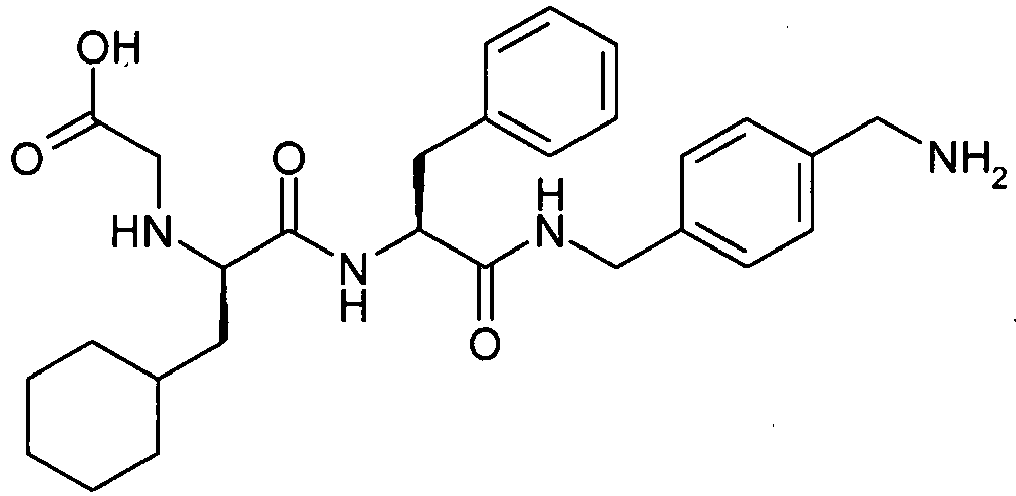
- 4-Aminomethylbenzonitrile hydrochloride (1.53g, 9.1mmol) was dissolved in CH2Cl2 (100 mL). This solution was cooled to 0°C. (S)-2-tert-Butoxycarbonylamino-3-
phenylpropionic acid 2,5-dioxo-pyrrolidin-1-yl ester (3.00g, 8.3mmol) was added followed triethylamine (2.51g, 25mmol). After 18 hrs at 0°C to room temperature reaction mixture was diluted with chloroform (100 mL) and washed with NaHCO3 (1x30 mL), water (1x30 mL), brine (1x30 mL), dried (Na2SO4) and evaporated in vacuo giving a yellow oil. The residue was crystallised from EtOAc/Pet. Ether (60-80°C) to give a white solid identified as [(S)-1-(4-cyano-benzylcarbamoyl)-2-phenyl-ethyl]-carbamic acid tert-butyl ester (2.71g, 7.1mmol, 86%).
[M+H]+ = 380.13 - [(S)-1-(4-Cyano-benzylcarbamoyl)-2-phenyl-ethyl]-carbamic acid tert-butyl ester (2.71g, 7.1mmol) was treated with 4M HCl/dioxan (150 mL). After one hour at room temperature the solvent was removed to give a white solid identified as (S)-2-amino-N-(4-cyano-benzyl)-3-phenyl-propionamide hydrochloride (2.24g, 7.1mmol, 99%).
[M+H]+ =280.14 - (S)-2-Amino-N-(4-cyano-benzyl)-3-phenyl-propionamide hydrochloride (500mg, 1.58mmol) was dissolved in CH2Cl2 (30 mL) and DMF (3 mL). This solution was cooled to 0°C. Boc-DCha-OH (473mg, 1.74mmol) was added followed by HOBt (257mg, 1.74mmol) and triethylamine (481mg, 4.75mmol). Water soluble carbodiimide (339mg, 1.74mmol) was then added. After 18 hrs at 0°C to room temperature reaction mixture was diluted with chloroform (100 mL) and washed with NaHCO3 (1x30 mL), water (1x30 mL), brine (1x30 mL), dried (Na2SO4) and evaporated in vacuo giving a yellow oil. The residue was purified by flash chromatography (silica), eluent 60% cyclohexane, 40% EtOAc, fractions combined and evaporated in vacuo to give a foamy white solid identified as {(R)-1-[(S)-1-(4-cyano-benzylcarbamoyl)-2-phenyl-ethylcarbamoyl]-2-cyclohexyl-ethyl}-carbamic acid tert-butyl ester (799mg, 1.50mmol, 95%).
[M+H]+ = 533.18 - {(R)-1-[(S)-1-(4-Cyano-benzylcarbamoyl)-2-phenyl-ethylcarbamoyl]-2-cyclohexyl-ethyl}-carbamic acid tert-butyl ester (799mg, 1.5mmol) was treated with 4M HCl/dioxan (50 mL). After one hour at room temperature the solvent was removed to give a white solid identified as (R)-2-amino-N-[(S)-1-(4-cyano-benzylcarbamoyl)-2-phenyl-ethyl]-3-cyclohexyl-propionamide hydrochloride (703mg, 1.5mmol, 100%).
[M+H]+ = 433.06 - (R)-2-Amino-N-[(S)-1-(4-cyano-benzylcarbamoyl)-2-phenyl-ethyl]-3-cyclohexyl-propionamide hydrochloride (290mg, 0.62mmol) was dissolved in acetonitrile (10 mL). tert-Butylbromoacetate (144mg, 0.74mmol) was added followed diisopropylethylamine (160mg, 1.24mmol). The reaction mixture was stirred at 60°C for 2 days after which time it was diluted with chloroform (100 mL), washed with water (1x30 mL), brine (1x30 mL), dried (Na2SO4) and evaporated in vacuo giving a yellow oil. The residue was purified by flash chromatography (silica), eluent 25%Pet. Ether (60-80°C), 75% EtOAc, fractions combined and evaporated in vacuo to give a colourless oil identified as {(R)-1-[(S)-1-(4-cyano-benzylcarbamoyl)-2-phenyl-ethylcarbamoyl]-2-cyclohexyl-ethylamino}-acetic acid tert-butyl ester (240mg, 0.44mmol, 71%).
[M+H]+ = 547.30. - {(R)-1-[(S)-1-(4-Cyano-benzylcarbamoyl)-2-phenyl-ethylcarbamoyl]-2-cyclohexyl-ethylamino}-acetic acid tert-butyl ester (240mg, 0.44mmol) was dissolved in methanol (25 mL). This solution was cooled to 0°C. Nickel (II) chloride hexahydrate (10.4mg, 0.44mmol) and di-tertbutyl dicarbonate (192mg, 0.88mmol) were added followed by sodium borohydride (116mg, 3.1mmol) portionwise. The reaction mixture was stirred at 0°C to room temp for 3 days. The MeOH was removed by evaporation. The residue was dissolved in CHCl3 (70 mL), washed with sat NaHCO3 (1x30 mL), water (1x30 mL), brine (1x30 mL), dried (Na2SO4) and evaporated in vacuo to give a yellow oil. Purified by flash chromatography, eluant 40% Pet. Ether (60-80°C), 60% EtOAc to give white solid identified as ((R)-1-{(S)-1-[4-(tert-butoxycarbonylamino-methyl)-benzylcarbamoyl]-2-phenyl-ethylcarbamoyl}-2-cyclohexyl-ethylamino)-acetic acid tert-butyl ester (65mg, 0.10mmol, 23%).
[M+H]+ = 651.44. - ((R)-1-{(S)-1-[4-(tert-Butoxycarbonylamino-methyl)-benzylcarbamoyl]-2-phenyl-ethylcarbamoyl}-2-cyclohexyl-ethylamino)-acetic acid tert-butyl ester (65mg, 0.1mmol) was treated with trifluoroacetic acid (4 mL) and CH2Cl2 (2 mL). After one hour at room temp the solvent was evaporated in vacuo. The residue was purified by Prep HPLC (Sunfire prep C18 OBD column. 19x250mm, 10µ). 10 to 90% 0.1%·TFA/MeCN into 0.1% TFA/H2O over 35 min at 20 mL/min. Fractions combined and freeze dried to give a white solid identified as {(R)-1-[(S)-1-(4-aminomethyl-benzylcarbamoyl)-2-phenyl-ethylcarbamoyl]-2-cyclohexyl-ethylamino}-acetic acid ditrifluoroacetate (46mg, 0.064mmol, 64%).
[M+H]+ = 495.28
1H NMR: (CD3OD) 0.78-0.98 (2H, m), 1.10-1.25 (4H, m), 1.53-1.70 (7H, m), 2.97 (1H, dd, J=14.0, 10.5Hz), 3.25 (1H, dd, J=14.1, 5.2Hz), 3.74 (2H, s), 4.01 (1H, dd, J=8.1, 6.1Hz), 4.15 (2H, s), 4.47 (2H, s), 4.76 (1H, dd, J=10.5, 5.2Hz), 7.28-7.38 (7H, m), 7.45 (2H, d, J= 8.2Hz), 8.83 (1H, t, J= 5.9Hz). - Compounds in Tables 1 to 5 were synthesised as described for Examples 1 to 4 (above) and 199 to 201 (below).
Table 1 
Ex. No. R1 R2 R3 R4 Aryl R6 R7 R8 m/z 5 H H 
H phenyl H H H 475.3 6 H H 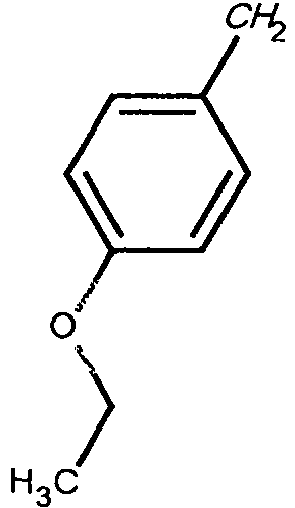
H phenyl H H F 493.3 7 CH3CH2CO H 
H phenyl H H F 549.3 8 H H 
H phenyl H H H 315.2 9 CH3 CH3 
H phenyl H H H 465.3 10 CH3CH2CO H 
H phenyl H H H 493.2 11 CH3SO2 H 
H phenyl H H H 515.2 12 CH3CH2CO H 
H phenyl H Cl H 565.1 13 CH3 CH3 
H phenyl H H H 503.2 14 H H 
H 
H H H 543.2 and 545.2 15 PhSO2 H 
H phenyl H H H 615.2 16 CH3CH2CO H 
H 
H H H 599.1 and 601.2 17 HOOCCH2 H 
H phenyl H H H 533.2 18 H H 
H 
H H H 567.1 and 569.1 19 CH3CH2CO H 
H 
H H H 623.2 and 625.2 20 H H 
H 
H H H 505.2 and 507.2 21 CH3CH2CO H 
H 
H H H 561.2 and 563.2 22 PhCO H CH3 H phenyl H H H 459.2 23 CH3CH2CO H 
H phenyl H H Cl 565.1 24 CH3CH2CO H 
H phenyl CH3 H H 545.3 25 H H 
CH 3 phenyl H H H 489.2 26 CH3CH2CO H 
CH 3 phenyl H H H 545.2 27 CH3 H 
H phenyl H H H 489.3 28 HOOCCH2 H (CH3)2CHCH2 H phenyl H H H 455.3 29 HOOCCH2 CH3 
H phenyl H H H 509.3 30 HOOCCH2 H 
CH 3 phenyl H H H 509.3 31 CH3CH2CO CH3 
H phenyl H H H 545.3 32 CH3CH2CO H 
CH 3 phenyl H H F 563.3 33 CH3 H 
H phenyl H H H 451.4 34 HOOCCH2 H 
CH 3 phenyl H H F 527.3 35 n-Pr H 
CH 3 phenyl H H H 531.4 36 HOOCCH2 H 
H phenyl CH3 H H 509.3 37 n-Pr H 
H phenyl H H H 479.4 38 PhCO H 
CH 3 phenyl H H H 593.3 39 CH3CO H 
CH 3 phenyl H H H 531.3 40 CH3 H 
H phenyl H H F 469.3 41 CH3 H 
H 
H H F 537.2 and 539.2 42 HOOCCH2 CH3 
H phenyl H H F 527.3 43 HOOCCH2 CH3 
H 
H H F 595.3 and 597.3 44 (CH3)2CHCO H 
CH 3 phenyl H H H 559.3 45 n-Pr CH3 
H phenyl H H H 493.4 46 CH3OCOCH2 H 
H phenyl H H H 509.3 47 CH3OCOCH2 CH3 
H phenyl H H H 523.3 48 NH2COCH2 CH3 
H phenyl H H H 508.3 49 HOCH2CH2 CH3 
H phenyl H H H 495.4 50 NH2COCH2 H 
H phenyl H H H 494.3 51 HOCH2CH2 H 
H phenyl H H H 481.3 52 H H 
H phenyl H H H 519.3 53 n-Pr n-Pr 
H phenyl H H H 521.3 54 1-NaphCO H 
H phenyl H H H 629.3 55 4-Cl-PhCO H 
H phenyl H H H 613.3 56 4-CF3-PhCO H 
H phenyl H H H 647.3 57 4-Ph-PhCO H 
H phenyl H H H 655.3 58 2,4-diCl-PhCO H 
H phenyl H H H 647.3 59 3,4-diF-PhCO H 
H phenyl H H H 615.3 Table 2 
Example No. * & R1 R2 R4 R5 m/z 60 separated but not confirmed R H H H OH 491.2 61 R H H H OH 491.2 62 separated but not confirmed R CH3CH2CO H H OH 547.2 63 R CH3CH2CO H H OH 547.3 64 separated but not confirmed R CH3CH2CO H CH3CH2 H 559.3 65 R CH3CH2CO H CH3CH2 H 559.3 66 S S CH3CH2CO CH3 H H 545.3 Table 3 Example No m/z 67 
557.17 Table 4 
Example No R1 R3 R4 R8 R9 m/z 68 
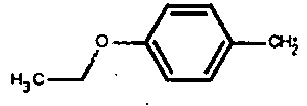
H H 
607.99 69 
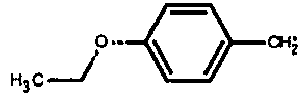
H H 
594.04 70 

H H 
580.19 71 

H H 
580.18 72 

H H 
585.15 73 

H H 
585.15 74 

H H 
542.95 75 

H H 
585 76 

H H 
572.99 77 

H H 
560.28 78 

H H 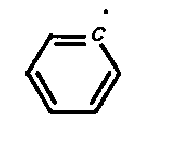
602.26 79 

H H 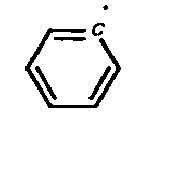
570.13 80 

H H 
663.12 81 

H H 
580.18 82 

H H 
597.2 83 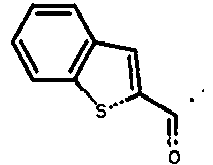

H H 
635.14 84 

H H 
649.13 85 

H H 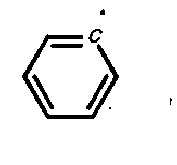
594.10 86 

H H 
607.18 87 

H H 
621.2 88 

H H 
613.1 89 

H H 
613.1 90 

H H 
647.1 91 

H H 
637.21 92 

H H 
594.12 93 

H H 
647.05 94 

H H 
647.05 95 

H H 
610.11 96 

H H 
605.17 97 

H H 
650.16 98 

H H 
636.16 99 

H H 
597.14 100 

H H 
629.15 101 

H H 
686.14 102 

H H 
628.1 103 

H H 
636.1 104 

H H 
594.04 105 

H H 
594.06 106 

H H 
648.09 107 

H H 
648.07 108 

H H 
633.87 109 

H H 
585.12 110 

H H 
649.92 (M+Na) 111 

H H 
613.95 112 

H H 
599.92 113 

H H 
597.75 114 

H H 
644.13 115 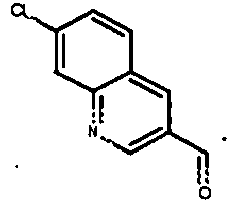

H H 
664.06 116 

H H 
618.97 117 

H H 
600.06 118 

H H 
569.04 119 
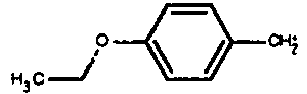
H H 
599.04 120 

H H 
610.01 121 

H H 
610.06 122 

H H 
615.05 123 

H H 
610.07 124 

H H 
582.06 125 

H H 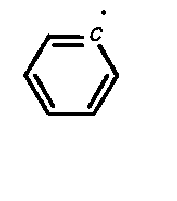
600.57 126 
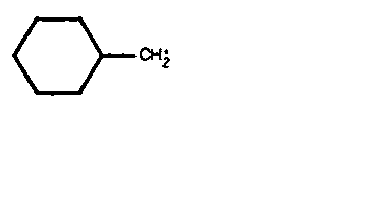
H H 
541.21 127 

H H 
569.11 128 

H H 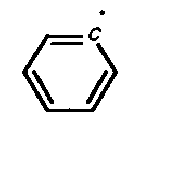
675.1 129 

H H 
551.15 130 

H H 
659.12 131 

H H 
594.05 132 

H H 
642.12 133 

H H 
501.21 134 

H H 
709.12 135 

H H 
548.94 136 

H H 
659.12 137 

H H 
566.09 138 

H H 
565.1 139 

H H 
535.11 140 

H H 
580.06 141 

H H 
647.04 and 649.06 142 
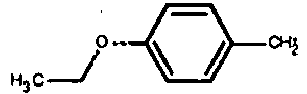
H H 
612.94 143 

H H 
596.93 144 

H H 
646.96 145 

H H 
580.13 146 

H H 
608.97 147 

H H 
579.95 148 

H H 
646.97 149 

H H 
618.93 (M+Na) 150 

H H 
606.88 (M+Na) 151 
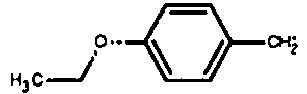
H H 
584.98 152 

H H 
586.03 153 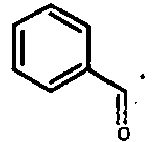

H H 
635.05 154 

H F 
596.93 155 

H Cl 
612.92 156 

H CF3 
646.9 157 

H H 
586.26 158 

H H 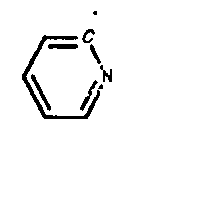
610.02 159 

H Cl 
614.29 160 

H H 
610.35 161 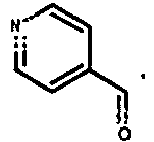

H H 
616.03 162 

H H 
585.98 163 

H H 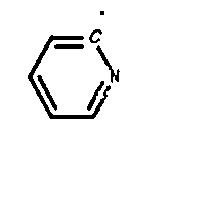
614.05 164 

H H 
616.05 165 

H H 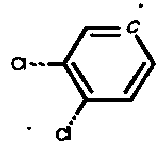
648.04 and 650.04 166 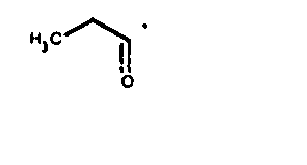

H H 
532.04 167 

H F 
598.03 168 

H F 
598.04 169 

H H 
653.00 and 654.99 170 

H H 
532.04 171 

H H 
648.02 and 650.04 172 

H H 
653.02 173 
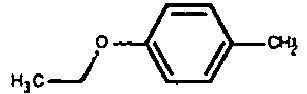
H H 
614.30 174 

H H 
571.02 175 

H H 
620.26 176 

H H 
641.37 (M+Na) 177 

H H 
569.48 178 

H H 
636.36 179 

H H 
642.38 180 

H H 
597.35 181 

H H 
600.32 182 

H Me 
593.29 183 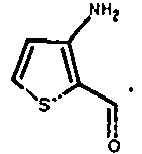

H H 
607.26 184 

H H 
625.22 185 

H H 
600.32 186 

H H 
638.19 187 

H H 
588.09 188 

H H 
698.15 189 

H H 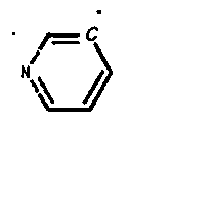
594.02 190 

H H 
594.07 191 

H H 
596.18 192 

H Me 
594.05 193 

H H 
648.16 194 

H H 
656.47 195 
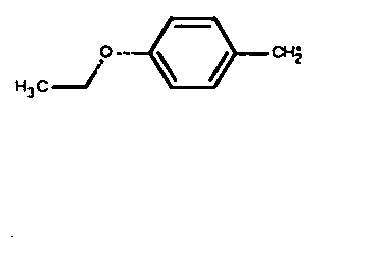
H H 
605.52 196 

Me H 
633.18 Table 5 
Example No. R1 m/z 197 
594.48 198 
635.06 Table 6 Example No Name 5 (R)-2-Amino-N-[(S)-1-(4-aminomethyl-benzylcarbamoyl)-2-phenyl-ethyl]-3-(4-ethoxy-phenyl)-propionamide 6 (R)-2-Amino-N-[(S)-1-(4-aminomethyl-3-fluoro-benzylcarbamoyl)-2-phenyl-ethyl]-3-(4-ethoxy-phenyl)-propionamide 7 (S)-N-(4-Aminomethyl-3-fluoro-benzyl)-2-[(R)-3-(4-ethoxy-phenyl)-2-propionylamino-propionylamino]-3-phenyl-propionamide 8 (R)-2-Amino-N-[(S)-1-(4-aminomethyl-benzylcarbamoyl)-2-phenyl-ethyl]-3-cyclohexyl-propionamide 9 (R)-N-[(S)-1-(4-Aminomethyl-benzylcarbamoyl)-2-phenyl-ethyl]-3-cyclohexyl-2-dimethylamino-propionamide 10 (S)-N-(4-Aminomethyl-benzyl)-2-((R)-3-cyclohexyl-2-propionylamino-propionylamino)-3-phenyl-propionamide 11 (R)-N-[(S)-1-(4-Aminomethyl-benzylcarbamoyl)-2-phenyl-ethyl]-3-cyclohexyl-2-methanesulfonylamino-propionamide 12 (S)-N-(4-Aminomethyl-2-chloro-benzyl)-2-[(R)-3-(4-ethoxy-phenyl)-2-propionylamino-propionylamino]-3-phenyl-propionamide 13 (R)-N-[(S)-1-(4-Aminomethyl-benzylcarbamoyl)-2-phenyl-ethyl]-2-dimethylamino-3-(4-ethoxy-phenyl)-propionamide 14 (R)-2-Amino-N-[(S)-1-(4-aminomethyl-benzylcarbamoyl)-2-(3,4-dichloro-phenyl)-ethyl]-3-(4-ethoxy-phenyl)-propionamide 15 (R)-N-[(S)-1-(4-Aminomethyl-benzylcarbamoyl)-2-phenyl-ethyl]-2-benzenesulfonylamino-3-(4-ethoxy-phenyl)-propionamide 16 (S)-N-(4-Aminomethyl-benzyl)-3-(3,4-dichloro-phenyl)-2-[(R)-3-(4-ethoxy-phenyl)-2-propionylamino-propionylamino]-propionamide 17 [(R)-1-[(S)-1-(4-Aminomethyl-benzylcarbamoyl)-2-phenyl-ethylcarbamoyl]-2-(4-ethoxy-phenyl)-ethylamino]-acetic acid 18 (R)-2-Amino-N-[(S)-1-(4-aminomethyl-benzylcarbamoyl)-2-(3,4-dichloro-phenyl)-ethyl]-3-(4-trifluoromethyl-phenyl)-propionamide 19 ((R)-N-[(S)-1-(4-Aminomethyl-benzylcarbamoyl)-2-(3,4-dichloro-phenyl)-ethyl]-2-propionylamino-3-(4-trifluoromethyl-phenyl)-propionamide 20 (R)-2-Amino-N-[(S)-1-(4-aminomethyl-benzylcarbamoyl)-2-(3,4-dichloro-phenyl)-ethyl]-3-cyclohexyl-propionamide 21 (R)-N-[(S)-1-(4-Aminomethyl-benzylcarbamoyl)-2-(3,4-dichloro-phenyl)-ethyl]-3-cyclohexyl-2-propionylamino-propionamide 22 N-{(R)-1-[(S)-1-(4-Aminomethyl-benzylcarbamoyl)-2-phenyl-ethylcarbamoyl]-ethyl}-benzamide 23 (S)-N-(4-Aminomethyl-3-chloro-benzyl)-2-[(R)-3-(4-ethoxy-phenyl)-2-propionylamino-propionylamino]-3-phenyl-propionamide 24 (S)-N-(4-Aminomethyl-benzyl)-2-[(R)-3-(4-ethoxy-phenyl)-2-propionylamino-propionylamino]-N-methyl-3-phenyl-propionamide 25 (R)-2-Amino-N-[(S)-1-(4-aminomethyl-benzylcarbamoyl)-2-phenyl-ethyl]-3-(4-ethoxy-phenyl)-N-methyl-propionamide 26 (S)-N-(4-Aminomethyl-benzyl)-2-{[(R)-3-(4-ethoxy-phenyl)-2-propionylamino-propionyl]-methyl-amino}-3-phenyl-propionamide 27 (R)-N-[(S)-1-(4-Aminomethyl-benzylcarbamoyl)-2-phenyl-ethyl]-3-(4-ethoxy-phenyl)-2-methylamino-propionamide 28 {(R)-1-[(S)-1-(4-Aminomethyl-benzylcarbamoyl)-2-phenyl-ethylcarbamoyl]-3-methyl-butylamino}-acetic acid 29 ({(R)-1-[(S)-1-(4-Aminomethyl-benzylcarbamoyl)-2-phenyl-ethylcarbamoyl]-2-cyclohexyl-ethyl} -methyl-amino)-acetic acid 30 ((R)-1-{[(S)-1-(4-Aminomethyl-benzylcarbamoyl)-2-phenyl-ethyl]-methyl-carbamoyl}-2-cyclohexyl-ethylamino)-acetic acid 31 (S)-N-(4-Aminomethyl-benzyl)-2-[(R)-3-(4-ethoxy-phenyl)-2-(methyl-propionyl-amino)-propionylamino]-3-phenyl-propionamide 32 (S)-N-(4-Aminomethyl-3-fluoro-benzyl)-2-{[(R)-3-(4-ethoxy-phenyl)-2-propionylamino-propionyl]-methyl-amino}-3-phenyl-propionamide 33 (R)-N-[(S)-1-(4-Aminomethyl-benzylcarbamoyl)-2-phenyl-ethyl]-3-cyclohexyl-2-methylamino-propionamide 34 ((R)-1-{[(S)-1-(4-Aminomethyl-3-fluoro-benzylcarbamoyl)-2-phenyl-ethyl]-methyl-carbamoyl}-2-cyclohexyl-ethylamino)-acetic acid 35 (R)-N-[(S)-1-(4-Aminomethyl-benzylcarbamoyl)-2-phenyl-ethyl]-3-(4-ethoxy-phenyl)-N-methyl-2-propylamino-propionamide 36 ((R)-1-{(S)-1-[(4-Aminomethyl-benzyl)-methyl-carbamoyl]-2-phenyl-ethylcarbamoyl}-2-cyclohexyl-ethylamino)-acetic acid 37 (R)-N-[(S)-1-(4-Aminomethyl-benzylcarbamoyl)-2-phenyl-ethyl]-3-cyclohexyl-2-propylamino-propionamide 38 N-[(R)-1-{[(S)-1-(4-Aminomethyl-benzylcarbamoyl)-2-phenyl-ethyl]-methyl-carbamoyl}-2-(4-ethoxy-phenyl)-ethyl]-benzamide 39 (R)-2-Acetylamino-N-[(S)-1-(4-aminomethyl-benzylcarbamoyl)-2-phenyl-ethyl]-3-(4-ethoxy-phenyl)-N-methyl-propionamide 40 (R)-N-[(S)- 1-(4-Aminomethyl-3-fluoro-benzylcarbamoyl)-2-phenyl-ethyl]-3-cyclohexyl-2-methylamino-propionamide 41 (R)-N-[(S)-1-(4-Aminomethyl-3-fluoro-benzylcarbamoyl)-2-(3,4-dichloro-phenyl)-ethyl]-3-cyclohexyl-2-methylamino-propionamide 42 ({(R)-1-[(S)-1-(4-Aminomethyl-3-fluoro-benzylcarbamoyl)-2-phenyl-ethylcarbamoyl]-2-cyclohexyl-ethyl}-methyl-amino)-acetic acid 43 ({(R)-1-[(S)-1-(4-Aminomethyl-3-fluoro-benzylcarbamoyl)-2-(3,4-dichlorophenyl)-ethylcarbamoyl]-2-cyclohexyl-ethyl}-methyl-amino)-acetic acid 44 N-[(R)-1-{[(S)-1-(4-Aminomethyl-benzylcarbamoyl)-2-phenyl-ethyl]-methyl-carbamoyl}-2-(4-ethoxy-phenyl)-ethyl]-isobutyramide 45 (R)-N-[(S)-1-(4-Aminomethyl-benzylcarbamoyl)-2-phenyl-ethyl]-3-cyclohexyl-2-(methyl-propyl-amino)-propionamide 46 {(R)-1-[(S)-1-(-4-Aminomethyl-benzylcarbamoyl)-2-phenyl-ethylcarbamoyl]-2-cyclohexyl-ethylamino}-acetic acid methyl ester 47 {(R)-1-[(S)-1-(4-Aminomethyl-benzylcarbamoyl)-2-phenyl-ethylcarbamoyl]-2-cyclohexyl-ethylamino}-acetic acid methyl ester 48 (R)-N-[(S)-1-(4-Aminomethyl-benzylcarbamoyl)-2-phenyl-ethyl]-2-(carbamoylmethyl-methyl-amino)-3-cyclohexyl-propionamide 49 (R)-N-[(S)-1-(4-Aminomethyl-benzylcarbamoyl)-2-phenyl-ethyl]-3-cyclohexyl-2-[(2-hydroxy-ethyl)-methyl-amino]-propionamide 50 (R)-N-[(S)-1-(4-Aminomethyl-benzylcarbamoyl)-2-phenyl-ethyl]-2-(carbamoylmethyl-amino)-3-cyclohexyl-propionamide 51 (R)-N-[(S)-1-(4-Aminomethyl-benzylcarbamoyl)-2-phenyl-ethyl]-3-cyclohexyl-2-(2-hydroxy-ethylamino)-propionamide 52 (R)-2-Amino-N-[(S)-1-(4-aminomethyl-benzylcarbamoyl)-2-phenyl-ethyl]-3,3-dicyclohexyl-propionamide 53 (R)-N-[(S)-1-(4-Aminomethyl-benzylcarbamoyl)-2-phenyl-ethyl]-3-cyclohexyl-2-dipropylamino-propionamide 54 Naphthalene-1-carboxylic acid [(R)-1-[(S)-1-(4-aminomethyl-benzylcarbamoyl)-2-phenyl-ethylcarbamoyl]-2-(4-ethoxy-phenyl)-ethyl]-amide 55 N-[(R)-1-[(S)-1-(4-Aminomethyl-benzylcarbamoyl)-2-phenyl-ethylcarbamoyl]-2-(4-ethoxy-phenyl)-ethyl]-4-chloro-benzamide 56 N-[(R)-1-[(S)-1-(4-Aminomethyl-benzylcarbamoyl)-2-phenyl-ethylcarbamoyl]-2-(4-ethoxy-phenyl)-ethyl]-4-trifluoromethyl-benzamide 57 Biphenyl-4-carboxylic acid [(R)-1-[(S)-1-(4-aminomethyl-benzylcarbamoyl)-2-phenyl-ethylcarbamoyl]-2-(4-ethoxy-phenyl)-ethyl]-amide 58 N-[(R)-1-[(S)-1-(4-Aminomethyl-benzylcarbamoyl)-2-phenyl-ethylcarbamoyl)-2-(4-ethoxy-phenyl)-ethyl]-2,4-dichloro-benzamide 59 N-[(R)- -[(S)-1-(4-Aminomethyl-benzylcarbamoyl)-2-phenyl-ethylcarbamoyl]-2-(4-ethoxy-phenyl)-ethyl]-3,4-difluoro-benzamide 60 (R)-2-Amino-N-[(1R,2S)-1-(4-aminomethyl-benzylcarbamoyl)-2-hydroxy-2-phenyl-ethyl]-3-(4-ethoxy-phenyl)-propionamide 61 (R)-2-Amino-N-[(1S,2S)-1-(4-aminomethyl-benzylcarbamoyl)-2-hydroxy-2-phenyl-ethyl]-3-(4-ethoxy-phenyl)-propionamide 62 (2R,3S)-N-(4-Aminomethyl-benzyl)-2-[(R)-3-(4-ethoxy-phenyl)-2-propionylamino-propionylamino]-3-hydroxy-3-phenyl-propionamide 63 (2S,3S)-N-(4-Aminomethyl-benzyl)-2-[(R)-3-(4-ethoxy-phenyl)-2-propionylamino-propionylamino]-3-hydroxy-3-phenyl-propionamide 64 (R)-N-(4-Aminomethyl-benzyl)-2-{[(R)-3-(4-ethoxy-phenyl)-2-propionylamino-propionyl]-ethyl-amino}-3-phenyl-propionamide 65 (S)-N-(4-Aminomethyl-benzyl)-2-{[(R)-3-(4-ethoxy-phenyl)-2-propionylamino-propionyl]-ethyl-amino}-3-phenyl-propionamide 66 (S)-N-(4-Aminomethyl-benzyl)-2-[(S)-3-(4-ethoxy-phenyl)-2-(methyl-propionyl-amino)-propionylamino]-3-phenyl-propionamide 67 (2S,3R)-1-[(R)-3-(4-Ethoxy-phenyl)-2-propionylamino-propionyl]-3-pheny - pyrrolidine-2-carboxylic acid 4-aminomethyl-benzylamide 68 (R)-N-[(S)-1-(4-Aminomethyl-benzylcarbamoyl)-2-phenyl-ethyl]-2-(3-benzyl-ureido) -3-(4-ethoxy-phenyl)-propionamide 69 (R)-N-[(S)-1-(4-Aminomethyl-benzylcarbamoyl)-2-phenyl-ethyl]-3-(4-ethoxy-phenyl)-2-(3-phenyl-ureido)-propionamide 70 N-[(R)-1-[(S)-1-(4-Aminomethyl-benzylcarbamoyl)-2-phenyl-ethylcarbamoyl]-2- (4-ethoxy-phenyl)-ethyl]-nicotinamide 71 N-[(R)-1-[(S)-1-(4-Aminomethyl-benzylcarbamoyl)-2-phenyl-ethylcarbamoyl]-2- (4-ethoxy-phenyl)-ethyl]-isonicotinamide 72 Thiophene-3-carboxylic acid-[(R)-1-[(S)-1-(4-aminomethyl-benzylcarbamoyl)-2-phenyl-ethylcarbamoyl]-2-(4-ethoxy-phenyl)-ethyl]-amide 73 Thiophene-2-carboxylic acid [(R)-1-[(S)-1-(4-aminomethyl-benzylcarbamoyl)-2-phenyl-ethylcarbamoyl]-2-(4-ethoxy-phenyl)-ethyl]-amide 74 Cyclopropanecarboxylic acid [(R)-1-[(S)-1-(4-aminomethyl-benzylcarbamoyl)-2-phenyl-ethylcarbamoyl]-2-(4-ethoxy-phenyl)-ethyl]-amide 75 Cyclohexanecarboxylic acid [(R)-1-[(S)-1-(4-aminomethyl-benzylcarbamoyl)-2-phenyl-ethylcarbamoyl]-2-(4-ethoxy-phenyl)-ethyl]-amide 76 Hexanoic acid [(R)-1-[(S)-1-(4-aminomethyl-benzylcarbamoyl)-2-phenyl-ethylcarbamoyl]-2-(4-ethoxy-phenyl)-ethyl]-amide 77 (R)-N-[(S)-1-(4-Aminomethyl-benzylcarbamoyl)-2-phenyl-ethyl]-3-(4-ethoxy-phenyl)-2-(3-isopropyl-ureido)-propionamide 78 (R)-N-[(S)-1-(4-Aminomethyl-benzylcarbamoyl)-2-phenyl-ethyl]-3-(4-ethoxy-phenyl)-2-(3-hexyl-ureido)-propionamide 79 Isoxazole-5-carboxylic acid [(R)-1-[(S)-1-(4-aminomethyl-benzylcarbamoyl)-2-phenyl-ethylcarbamoyl]-2-(4-ethoxy-phenyl)-ethyl]-amide 80 N-[(R)-1-[(S)-1-(4-Aminomethyl-benzylcarbamoyl)-2-phenyl-ethylcarbamoyl]-2-(4-ethoxy-phenyl)-ethyl]-4-trifluoromethoxy-benzamide 81 Pyridine-2-carboxylic acid [(R)-1-[(S)-1-(4-aminomethyl-benzylcarbamoyl)-2-phenyl-ethylcarbamoyl]-2-(4-ethoxy-phenyl)-ethyl]-amide 82 2,5-Dimethyl-2H-pyrazole-3-carboxylic acid [(R)-1-[(S)-1-(4-aminomethyl-benzylcarbamoyl)-2-phenyl-ethylcarbamoyl] -2-(4-ethoxy-phenyl)-ethyl]-amide 83 Benzo[b]thiophene-2-carboxylic acid [(R)-1-[(S)-1-(4-aminomethyl-benzylcarbamoyl)-2-phenyl-ethylcarbamoyl] -2-(4-ethoxy-phenyl)-ethyl]-amide 84 (R)-N-[(S)-1-(4-Aminomethyl-benzylcarbamoyl)-2-phenyl-ethyl]-2-(4-chloro-benzenesulfonylamino)-3-(4-ethoxy-phenyl)-propionamide 85 (S)-N-(4-Aminomethyl-benzyl)-2-[(R)-3-(4-ethoxy-phenyl)-2-phenylacetylamino-propionylamino]-3-phenyl-propionamide 86 (S)-N-(4-Aminomethyl-benzyl)-2-[(R)-3-(4-ethoxy-phenyl)-2-(3-phenyl-propionylamino)-propionylamino]-3-phenyl-propionamide 87 N-[(R)-1-[(S)-1-(4-Aminomethyl-benzylcarbamoyl)-2-phenyl-ethylcarbamoyl]-2-(4-ethoxy-phenyl)-ethyl]-4-phenyl-butyramide 88 N-[(R)-1-[(S)-1-(4-Aminomethyl-benzylcarbamoyl)-2-phenyl-ethylcarbamoyl]-2-(4-ethoxy-phenyl)-ethyl]-3-chloro-benzamide 89 N-[(R)-1-[(S)-1-(4-Aminomethyl-benzylcarbamoyl)-2-phenyl-ethylcarbamoyl]-2-(4-ethoxy-phenyl)-ethyl]-2-chloro-benzamide 90 N-[(R)-1-[(S)-1-(4-Aminomethyl-benzylcarbamoyl)-2-phenyl-ethylcarbamoyl]-2-(4-ethoxy-phenyl)-ethyl]-3-trifluoromethyl-benzamide 91 Adamantane-1-carboxylic acid [(R)-1-[(S)-1-(4-aminomethyl-benzylcarbamoyl)-2-phenyl-ethylcarbamoyl]-2-(4-ethoxy-phenyl)-ethyl]-amide 92 N-[(R)-1-[(S)-1-(4-Aminomethyl-benzylcarbamoyl)-2-phenyl-ethylcarbamoyl]-2-(4-ethoxy-phenyl)-ethyl]-4-methyl-benzamide 93 N-[(R)-1-[(S)-1-(4-Aminomethyl-benzylcarbamoyl)-2-phenyl-ethylcarbamoyl]-2-(4-ethoxy-phenyl)-ethyl]-3,4-dichloro-benzamide 94 N-[(R)-1-[(S)-1-(4-Aminomethyl-benzylcarbamoyl)-2-phenyl-ethylcarbamoy]-2-(4-ethoxy-phenyl)-ethyl]-3,5-dichloro-benzamide 95 N-[(R)-1-[(S)-1-(4-Aminomethyl-benzylcarbamoyl)-2-phenyl-ethylcarbamoyl]-2-(4-ethoxy-phenyl)-ethyl]-4-methoxy-benzamide 96 (E)-N-[(R)-1-[(S)-1-(4-Aminomethyl-benzylcarbamoyl)-2-phenyl-ethylcarbamoyl]-2-(4-ethoxy-phenyl)-ethyl]-3-phenyl-acrylamide 97 (S)-N-(4-Aminomethyl-benzyl)-2-[(R)-3-(4-ethoxy-phenyl)-2-(2-phenylacetylamino-acetylamino)-propionylamino]-3-phenyl-propionamide 98 N- {[(R)-1-[(S)-1-(4-Aminomethyl-benzylcarbamoyl)-2-phenyl-ethylcarbamoyl]-2-(4-ethoxy-phenyl)-ethylcarbamoyl]-methyl}-benzamide 99 N-[(R)-1-[(S)-1-(4-Aminomethyl-benzylcarbamoyl)-2-phenyl-ethylcarbamoyl]-2-(4-ethoxy-phenyl)-ethyl]-4-fluoro-benzamide 100 (R)-N-[(S)-1-(4-Aminomethyl-benzylcarbamoyl)-2-phenyl-ethyl]-3-(4-ethoxyphenyl)-2-phenylmethanesulfonylamino-propionamide 101 (S)-N-(4-Aminomethyl-benzyl)-2-{(R)-3-(4-ethoxy-phenyl)-2-[2-(toluene-4-sulfonylamino)-acetylamino]-propionylamino}-3-phenyl-propionamide 102 (R)-N-[(S)-1-(4-Aminomethyl-benzylcarbamoyl)-2-phenyl-ethyl]-2-[3-(4-chloro-phenyl)-ureido]-3-(4-ethoxy-phenyl)-propionamide 103 (R)-N-[(S)-1-(4-Aminomethyl-benzylcarbamoyl)-2-phenyl-ethyl]-2-(3-benzyl-3-ethyl-ureido)-3-(4-ethoxy-phenyl)-propionamide 104 N-[(R)-1-[(S)-1-(4-Aminomethyl-benzylcarbamoyl)-2-phenyl-ethylcarbamoyl]-2-(4-ethoxy-phenyl)-ethyl]-6-methyl-nicotinamide 105 N-[(R)-1-[(S)-1-(4-Aminomethyl-benzylcarbamoyl)-2-phenyl-ethylcarbamoyl]-2-(4-ethoxy-phenyl)-ethyl]-2-methyl-nicotinamide 106 N-[(R)-1-[(S)-1-(4-Aminomethyl-benzylcarbamoyl)-2-phenyl-ethylcarbamoyl]-2-(4-ethoxy-phenyl)-ethyl]-2,6-dichloro-nicotinamide 107 N-[(R)-1-[(S)-1-(4-Aminomethyl-benzylcarbamoyl)-2-phenyl-ethylcarbamoyl]-2-(4-ethoxy-phenyl)-ethyl]-5,6-dichloro-nicotinamide 108 N-[(R)-1-[(S)-1-(4-Aminomethyl-benzylcarbamoyl)-2-phenyl-ethylcarbamoyl]-2-(4-ethoxy-phenyl)-ethyl]-2,3,6-trifluoro-isonicotinamide 109 N-[(R)-1-[(S)-1-(4-Aminomethyl-benzylcarbamoyl)-2-phenyl-ethylcarbamoyl]-2-(4-ethoxy-phenyl)-ethyl]-3,3,3-trifluoro-propionamide 110 N-[(R)-1-[(S)-1-(4-Aminomethyl-benzylcarbamoyl)-2-phenyl-ethylcarbamoyl]-2-(4-ethoxy-phenyl)-ethyl]-2-chloro-6-methyl-isonicotinamide 111 2,4-Dimethyl-thiazole-5-carboxylic acid [(R)-1-[(S)-1-(4-aminomethyl-benzylcarbamoyl)-2-phenyl-ethylcarbamoyl]-2-(4-ethoxy-phenyl)-ethyl]-amide 112 2-Methyl-thiazole-5-carboxylic acid [(R)-1-[(S)-1-(4-aminomethyl-benzylcarbamoyl)-2-phenyl-ethylcarbamoyl]-2-(4-ethoxy-phenyl)-ethyl]-amide 113 2,5-Dimethyl-oxazole-4-carboxylic acid [(R)-1-[(S)-1-(4-aminomethyl-benzylcarbamoyl)-2-phenyl-ethylcarbamoyl]-2-(4-ethoxy-phenyl)-ethyl]-amide 114 2-Methyl-quinoline-6-carboxylic acid [(R)-1-[(S)-1-(4-aminomethyl-benzylcarbamoyl)-2-phenyl-ethylcarbamoyl]-2-(4-ethoxy-phenyl)-ethyl]-amide 115 7-Chloro-quinoline-3-carboxylic acid [(R)-1-[(S)-1-(4-aminomethyl-benzylcarbamoyl)-2-phenyl-ethylcarbamoyl]-2-(4-ethoxy-phenyl)-ethyl]-amide 116 3-Chloro-thiophene-2-carboxylic acid [(R)-1-[(S)-1-(4-aminomethyl-benzylcarbamoyl)-2-phenyl-ethylcarbamoyl]-2-(4-ethoxy-phenyl)-ethyl]-amide 117 4-Methyl-thiazole-5-carboxylic acid[(R)-1-[(S)-1-(4-aminomethyl-benzylcarbamoyl)-2-phenyl-ethylcarbamoyl]-2-(4-ethoxy-phenyl)-ethyl]-amide 118 Furan-2-carboxylic acid [(R)-1-[(S)-1-(4-aminomethyl-benzylcarbamoyl)-2-phenyl-ethylcarbamoyl]-2-(4-ethoxy-phenyl)-ethyl]-amide 119 3-Methyl-thiophene-2-carboxylic acid [(R)-1-[(S)-1-(4-aminomethyl-benzylcarbamoyl)-2-phenyl-ethylcarbamoyl]-2-(4-ethoxy-phenyl)-ethyl]-amide 120 6-Methoxy-pyridine-2-carboxylic acid [(R)-1-[(S)-1-(4-aminomethyl-benzylcarbamoyl)-2-phenyl-ethylcarbamoyl]-2-(4-ethoxy-phenyl)-ethyl]-amide 121 N-[(R)-1-[(S)-1-(4-Aminomethyl-benzylcarbamoyl)-2-phenyl-ethylcarbamoyl]-2-(4-ethoxy-phenyl)-ethyl]-5-methoxy-nicotinamide 122 3-Methoxy-thiophene-2-carboxylic acid [(R)-1-[(S)-1-(4-aminomethyl-benzylcarbamoyl)-2-phenyl-ethylcarbamoyl]-2-(4-ethoxy-phenyl)-ethyl]-amide 123 N-[(R)-1-[(S)-1-(4-Aminomethyl-benzylcarbamoyl)-2-phenyl-ethylcarbamoyl]-2-(4-ethoxy-phenyl)-ethyl]-2-methoxy-isonicotinamide 124 3-Methyl-1H-pyrrole-2-carboxylic acid [(R)-1-[(S)-1-(4-aminomethyl-benzylcarbamoyl)-2-phenyl-ethylcarbamoyl]-2-(4-ethoxy-phenyl)-ethyl]-amide 125 3-Amino-thiophene-2-carboxylic acid [(R)-1-[(S)-1-(4-aminomethyl-benzylcarbamoyl)-2-phenyl-ethylcarbamoyl]-2-(4-ethoxy-phenyl)-ethyl]-amide 126 N- {(R)-1-[(S)-1-(4-Aminomethyl-benzylcarbamoyl)-2-phenyl-ethylcarbamoyl]-2-cyclohexyl-ethyl}-benzamide 127 N-[(R)-1-[(S)-1-(4-Aminomethyl-benzylcarbamoyl)-2-phenyl-ethylcarbamoyl]-2-(4-chloro-phenyl)-ethyl]-benzamide 128 N-{(R)-1-[(S)-1-(4-Aminomethyl-benzylcarbamoyl)-2-phenyl-ethylcarbamoyl]-2-[4-(4-chloro-benzyloxy)-phenyl]-ethyl}-benzamide 129 N-[(R)-1-[(S)-1-(4-Aminomethyl-benzylcarbamoyl)-2-phenyl-ethylcarbamoyl]-2-(4-hydroxy-phenyl)-ethyl]-benzamide 130 N-{(R)-1-[(S)-1-(4-Aminomethyl-benzylcarbamoyl)-2-phenyl-ethylcarbamoyl]-2-[4-(4-fluoro-benzyloxy)-phenyl]-ethyl}-benzamide 131 N-[(R)-1-[(S)-1-(4-Aminomethyl-benzylcarbamoyl)-2-phenyl-ethylcarbamoyl]-2-(4-propoxy-phenyl)-ethyl]-benzamide 132 N-[(R)-1-[(S)-1-(4-Aminomethyl-benzylcarbamoyl)-2-phenyl-ethylcarbamoyl]-2-(4-benzyloxy-phenyl)-ethyl]-benzamide 133 N- {(R)-1-[(S)-1-(4-Aminomethyl-benzylcarbamoyl)-2-phenyl-ethylcarbamoyl]-3-methyl-butyl}-benzamide 134 N-{(R)-1-[(S)-1-(4-Aminomethyl-benzylcarbamoyl)-2-phenyl-ethylcarbamoyl]-2-[4-(2,6-dichloro-benzyloxy)-phenyl]-ethyl}-benzamide 135 N-{(R)-1-[(S)-1-(4-Aminomethyl-benzylcarbamoyl)-2-phenyl-ethylcarbamoyl]-2-p-tolyl-ethyl}-benzamide 136 N-{(R)-1-[(S)-1-(4-Aminomethyl-benzylcarbamoyl)-2-phenyl-ethylcarbamoyl]-2-[4-(3-fluoro-benzyloxy)-phenyl]-ethyl}-benzamide 137 N-[(R)-1-[(S)-1-(4-Aminomethyl-benzylcarbamoyl)-2-phenyl-ethylcarbamoyl]-2-(6-methoxy-pyridin-3-yl)-ethyl]-benzamide 138 N-[(R)-1-[(S)-1-(4-Aminomethyl-benzylcarbamoyl)-2-phenyl-ethylcarbamoyl]-2-(4-methoxy-phenyl)-ethyl]-benzamide 139 N- {(R)-1-[(S)-1-(4-Aminomethyl-benzylcarbamoyl)-2-phenyl-ethylcarbamoyl]-2-phenyl-ethyl}-benzamide 140 N-[(R)-1-[(S)-1-(4-Aminomethyl-benzylcarbamoyl)-2-pyridin-2-yl-ethylcarbamoyl]-2-(4-ethoxy-phenyl)-ethyl]-benzamide 141 N-[(R)-1-[(S)-1-(4-Aminomethyl-benzylcarbamoyl)-2-(3,4-dichloro-phenyl)-ethylcarbamoyl]-2-(4-ethoxy-phenyl)-ethyl]-benzamide 142 N-[(R)-1-[(S)-1-(4-Aminomethyl-benzylcarbamoyl)-2-(4-chloro-phenyl)-ethylcarbamoyl]-2-(4-ethoxy-phenyl)-ethyl]-benzamide 143 N-[(R)-1-[(S)-1-(4-Aminomethyl-benzylcarbamoyl)-2-(4-fluoro-phenyl)-ethylcarbamoyl]-2-(4-ethoxy-phenyl)-ethyl]-benzamide 144 N-[(R)-1-[(S)-1-(4-Aminomethyl-benzylcarbamoyl)-2-(3-trifluoromethyl-phenyl)-ethylcarbamoyl]-2-(4-ethoxy-phenyl)-ethyl]-benzamide 145 N-[(R)-1-[(S)-1-(4-Aminomethyl-benzylcarbamoyl)-2-pyridin-3-yl-ethylcarbamoyl]-2-(4-ethoxy-phenyl)-ethyl]-benzamide 146 N-[(R)-1-[(S)-1-(4-Aminomethyl-benzylcarbamoyl)-2-(4-methoxy-phenyl)-ethylcarbamoyl]-2-(4-ethoxy-phenyl)-ethyl]-benzamide 147 N-[(R)-1-[(S)-1-(4-Aminomethyl-benzylcarbamoyl)-2-pyridin-4-yl-ethylcarbamoyl]-2-(4-ethoxy-phenyl)-ethyl]-benzamide 148 N-[(R)-1-[(S)-1-(4-Aminomethyl-benzylcarbamoyl)-2-(4-trifluoromethyl-phenyl)-ethylcarbamoyl]-2-(4-ethoxy-phenyl)-ethyl]-benzamide 149 N-[(R)-1-[(S)-1-(4-Aminomethyl-benzylcarbamoyl)-2-(3-fluoro-phenyl)-ethylcarbamoyl]-2-(4-ethoxy-phenyl)-ethyl]-benzamide 150 N-[(R)-1-[(S)-1-(4-Aminomethyl-benzylcarbamoyl)-2-thiophen-2-yl-ethylcarbamoyl]-2-(4-ethoxy-phenyl)-ethyl]-benzamide 151 N-[(R)-1-[(S)-l-(4-Aminomethyl-benzylcarbamoyl)-2-thiophen-3-yl-ethylcarbamoyl-2-(4-ethoxy-phenyl)-ethyl]-benzamide 152 N-[(R)-1-[(S)-1-(4-Aminomethyl-benzylcarbamoyl)-2-thiazol-4-yl-ethylcarbamoyl]-2-(4-ethoxy-phenyl)-ethyl]-benzamide 153 N-[(R)-1-[(S)-1-(4-Aminomethyl-benzylcarbamoyl)-2-benzo[b]thiophen-3-yl-ethylcarbamoyl]-2-(4-ethoxy-phenyl)-ethyl]-benzamide 154 N-[(R)-1-[(S)-1-(4-Aminomethyl-3-fluoro-benzylcarbamoyl)-2-phenyl-ethylcarbamoyl]-2-(4-ethoxy-phenyl)-ethyl]-benzamide 155 N-[(R)-1-[(S)-1-(4-Aminomethyl-3-chloro-benzylcarbamoyl)-2-phenyl-ethylcarbamoyl]-2-(4-ethoxy-phenyl)-ethyl]-benzamide 156 N-[(R)-1-[(S)-1-(4-Aminomethyl-3-trifluoromethyl-benzylcarbamoyl)-2-phenyl-ethylcarbamoyl]-2-(4-ethoxy-phenyl)-ethyl]-benzamide 157 Pyridine-2-carboxylic acid [(R)-1-[(S)-1-(4-aminomethyl-benzylcarbamoyl)-2-thiophen-2-yl-ethylcarbamoyl]-2-(4-ethoxy-phenyl)-ethyl]-amide 158 N-[(R)-1-[(S)-1-(4-Aminomethyl-benzylcarbamoyl)-2-pyridin-2-yl-ethylcarbamoyl]-2-(4-ethoxy-phenyl)-ethyl]-4-methoxy-benzamide 159 Pyridine-2-carboxylic acid [(R)-1-[(S)-1-(4-aminomethyl-3-chloro-benzylcarbamoyl)-2-phenyl-ethylcarbamoyl]-2-(4-ethoxy-phenyl)-ethyl]-amide 160 N-[(R)-1-[(S)-1-(4-Aminomethyl-benzylcarbamoyl)-2-pyridin-3-yl-ethylcarbamoyl]-2-(4-ethoxy-phenyl)-ethyl]-4-methoxy-benzamide 161 N-[(R)-1-[(S)-1-(4-Aminomethyl-benzylcarbamoyl)-2-(3,4-difluoro-phenyl)-ethylcarbamoyl]-2-(4-ethoxy-phenyl)-ethyl]-isonicotinamide 162 Thiophene-2-carboxylic acid [(R)-1-[(S)-1-(4-aminomethyl-benzylcarbamoyl)-2-pyridin-3-yl-ethylcarbamoyl]-2-(4-ethoxy-phenyl)-ethyl]-amide 163 N-[(R)-1-[(S)-1-(4-Aminomethyl-benzylcarbamoyl)-2-pyridin-2-yl-ethylcarbamoyl]-2-(4-ethoxy-phenyl)-ethyl]-4-chloro-benzamide 164 N-[(R)-1-[(S)-1-(4-Aminomethyl-benzylcarbamoyl)-2-pyridin-2-yl-ethylcarbamoyl]-2-(4-ethoxy-phenyl)-ethyl]-4-methyl-benzamide 165 Pyridine-2-carboxylic acid [(R)-1-[(S)-1-(4-aminomethyl-benzylcarbamoyl)-2-(3,4-dichloro-phenyl)-ethylcarbamoyl]-2-(4-ethoxy-phenyl)-ethyl]-amide 166 (R)-N-[(S)-1-(4-Aminomethyl-benzylcarbamoyl)-2-pyridin-2-yl-ethyl]-3-(4-ethoxy-phenyl)-2-propionylamino-propionamide 167 N-[(R)-1-[(S)-1-(4-Aminomethyl-3-fluoro-benzylcarbamoyl)-2-phenyl-ethylcarbamoyl]-2-(4-ethoxy-phenyl)-ethyl]-isonicotinamide 168 Pyridine-2-carboxylic acid [(R)-1-[(S)-1-(4-aminomethyl-3-fluoro-benzylcarbamoyl)-2-phenyl-ethylcarbamoyl]-2-(4-ethoxy-phenyl)-ethyl]-amide 169 Thiophene-2-carboxylic acid [(R)-1-[(S)-1-(4-aminomethyl-benzylcarbamoyl)-2-(3,4-dichloro-phenyl)-ethylcarbamoyl]-2-(4-ethoxy-phenyl)-ethyl]-amide 170 (R)-N-[(S)-1-(4-Aminomethyl-benzylcarbamoyl)-2-pyridin-3-yl-ethyl]-3-(4-ethoxy-phenyl)-2-propionylamino-propionamide 171 N-[(R)-1-[(S)-1-(4-Aminomethyl-benzylcarbamoyl)-2-(3,4-dichloro-phenyl)-ethylcarbamoyl]-2-(4-ethoxy-phenyl)-ethyl]-isonicotinamide 172 N-[(R)-1-[(S)-1-(4-Aminomethyl-benzylcarbamoyl)-2-(3,4-dichloro-phenyl)-ethylcarbamoyl]-2-(4-ethoxy-phenyl)-ethyl]-3,3,3-trifluoro-propionamide 173 N-[(R)-1-[(S)-1-(4-Aminomethyl-benzylcarbamoyl)-2-pyridin-3-yl-ethylcarbamoyl]-2-(4-ethoxy-phenyl)-ethyl]-4-chloro-benzamide 174 Isoxazole-5-carboxylic acid [(R)-1-[(S)-1-(4-aminomethyl-benzylcarbamoyl)-2-pyridin-3-yl-ethylcarbamoyl]-2-(4-ethoxy-phenyl)-ethyl]-amide 175 3-Chloro-thiophene-2-carboxylic acid [(R)-1-[(S)-1-(4-aminomethyl-benzylcarbamoyl)-2-pyridin-3-yl-ethylcarbamoyl]-2-(4-ethoxy-phenyl)-ethyl]-amide 176 N-[(R)-1-[(S)-1-(4-Aminomethyl-benzylcarbamoyl)-2-(1H-indol-3-yl)-ethylcarbamoyl]-2-(4-ethoxy-phenyl)-ethyl]-benzamide 177 N-[(R)-1-[(S)-1-(4-Aminomethyl-benzylcarbamoyl)-2-(1H-imidazol-4-yl)-ethylcarbamoyl]-2-(4-ethoxy-phenyl)-ethyl]-benzamide 178 N-[(R)-1-[(S)-1-(4-Aminomethyl-benzylcarbamoyl)-2-benzo[b]thiophen-3-yl-ethylcarbamoyl]-2-(4-ethoxy-phenyl)-ethyl]-isonicotinamide 179 3-Acetylamino-thiophene-2-carboxylic acid-[(R)-1-[(S)-1-(4-aminomethyl-benzylcarbamoyl)-2-phenyl-ethylcarbamoyl]-2-(4-ethoxy-phenyl)-ethyl]-amide 180 N-[(R)-1-[(S)-1-(4-Aminomethyl-benzylcarbamoyl)-2-(2-fluoro-phenyl)-ethylcarbamoyl]-2-(4-ethoxy-phenyl)-ethyl]-benzamide 181 3-Methyl-thiophene-2-carboxylic acid [(R)-1-[(S)-1-(4-aminomethyl-benzylcarbamoyl)-2-pyridin-3-yl-ethylcarbamoyl]-2-(4-ethoxy-phenyl)-ethyl]-amide 182 N-[(R)-1-[(S)-1-(4-Aminomethyl-3-methyl-benzylcarbamoyl)-2-phenyl-ethylcarbamoyl]-2-(4-ethoxy-phenyl)-ethyl]-benzamide 183 3-Amino-thiophene-2-carboxylic acid [(R)-1-[(S)-1-(4-aminomethyl-benzylcarbamoyl)-2-thiazol-4-yl-ethylcarbamoyl]-2-(4-ethoxy-phenyl)-ethyl]-amide 184 3-Chloro-thiophene-2-carboxylic acid [(R)-1-[(S)-1-(4-aminomethyl-benzylcarbamoyl)-2-thiazol-4-yl-ethylcarbamoyl]-2-(4-ethoxy-phenyl)-ethyl]-amide 185 N-[(R)-1-[(S)-1-(4-Aminomethyl-benzylcarbamoyl)-2-thiazol-4-yl-ethylcarbamoyl]-2-(4-ethoxy-phenyl)-ethyl]-4-methyl-benzamide 186 3-Methyl-1H-pyrrole-2-carboxylic acid [(R)-1-[(S)-1-(4-aminomethyl-benzylcarbamoyl)-2-benzo[b]thiophen-3-yl-ethylcarbamoyl]-2-(4-ethoxy-phenyl)-ethyl]-amide 187 3-Amino-thiophene-2-carboxylic acid [(R)-1-[(S)-1-(4-aminomethyl-benzylcarbamoyl)-2-thiazol-4-yl-ethylcarbamoyl]-2-(4-ethoxy-phenyl)-ethyl]-amide 188 3-Acetylamino-thiophene-2-carboxylic acid [(R)-1-[(S)-1-(4-aminomethyl-benzylcarbamoyl)-2-benzo[b]thiophen-3-yl-ethylcarbamoyl]-2-(4-ethoxy-phenyl)-ethyl]-amide 189 N-[(R)-1-[(S)-1-(4-Aminomethyl-benzylcarbamoyl)-2-pyridin-3-yl-ethylcarbamoyl]-2-(4-ethoxy-phenyl)-ethyl]-3-methyl-benzamide 190 N-[(R)-1-[(S)-1-(4-Aminomethyl-benzylcarbamoyl)-2-pyridin-3-yl-ethylcarbamoyl]-2-(4-ethoxy-phenyl)-ethyl]-2-methyl-benzamide 191 3,5-Dimethyl-1H-pyrrole-2-carboxylic acid [(R)-1-[(S)-1-(4-aminomethyl-benzylcarbamoyl)-2-phenyl-ethylcarbamoyl]-2-(4-ethoxy-phenyl)-ethyl]-amide 192 N-[(R)-1-[(S)-1-(4-Aminomethyl-3-methyl-benzylcarbamoyl)-2-pyridin-3-yl-ethylcarbamoyl]-2-(4-ethoxy-phenyl)-ethyl]-benzamide 193 3-Acetylamino-thiophene-2-carboxylic acid [(R)-1-[(S)-1-(4-aminomethyl -benzylcarbamoyl)-2-thiophen-3-yl-ethylcarbamoyl]-2-(4-ethoxy-phenyl)-ethyl]-amide 194 3-Amino-thiophene-2-carboxylic acid [(R)-1-[(S)-1-(4-aminomethyl-benzylcarbamoyl)-2-benzo[b]thiophen-3-yl-ethylcarbamoyl]-2-(4-ethoxyphenyl)-ethyl]-amide 195 3-Acetylamino-thiophene-2-carboxylic acid [(R)-1-[(S)-1-(4-aminomethyl-benzylcarbamoyl)-2-benzo[b]thiophen-3-yl-ethylcarbamoyl]-2-(4-ethoxy-phenyl)-ethyl]-amide 196 3-Chloro-thiophene-2-carboxylic acid [(R)-1-{[(S)-1-(4-aminomethyl-benzylcarbamoyl)-2-phenyl-ethyl]-methyl-carbamoyl]-2-(4-ethoxy-phenyl)-ethyl]-amide 197 N-[(R)-1-[(1S,2R)-1-(4-Aminomethyl-benzylcarbamoyl)-2-hydroxy-2-phenyl-ethylcarbamoyl]-2-(4-ethoxy-phenyl)-ethyl]-benzamide 198 3-Chloro-thiophene-2-carboxylic acid [(R)-1-[(1S,2R)-1-(4-aminomethyl-benzylcarbamoyl)-2-hydroxy-2-phenyl-ethylcarbamoyl]-2-(4-ethoxy-phenyl)-ethyl]-amide Table 7 NMR data of examples Example No Solvent NMR (ppm) 5 CD3OD δ 1.42 (3H, t, J=7.0Hz), 2.80-2.91 (2H, m), 2.94-2.99 (1H, m), 3.08-3.13 (1H, m), 3.96-4.10 (3H, m), 4.14 (2H, s), 4.31-4.36 (1H, m), 4.47-4.52 (1H, m), 4.66-4.70 (1H, m), 6.88 (2H, d, J=8.6Hz), 7.02 (2H, d, J=8.6Hz), 7.25-7.40 (7H, m), 7.42 (2H, d, J= 8.1Hz), 8.73-8.76(1H, m) 6 CD3OD δ1.42 (3H, t, J=7.0Hz), 2.80-2.89 (2H, m), 2.95-3.00 (1H, m), 3.08-3.13 (1H, m), 4.03-4.13 (3H, m), 4.21 (2H, s), 4.32-4.38 (1H, m), 4.46-4.51 (1H, m), 4.65-4.69 (1H, m), 6.88 (2H, d, J=8.6Hz), 7.03 (2H, d, J= 8.6Hz), 7.05-7.09 (2H, m), 7.26-7.37 (5H, m), 7.41-7.47 (1H, m), 8.78-8.80 (1H, m) 7 CD3OD δ 1.02 (3H, t, J=7.7Hz), 1.42 (3H, t, J=7.0Hz), 2.13-2.21 (2H, m), 2.71-2.77 (1H, m), 2.81-2.92 (3H, m), 3.12-3.16 (1H, m), 4.05 (2H, q, J=6.9Hz), 4.13 (2H, s), 4.37-4.50 (3H, m), 4.57-4.69 (1H, m), 6.82 (2H, d, J=8.6Hz), 7.05 (2H, d, J= 8.6Hz), 7.17-7.27 (4H, m), 7.30-7.35 (3H, m), 7.46-7.49 (1H, m) 8 CD3OD δ 0.82-0.94 (2H, m), 1.19-1.28 (4H, m), 1.42-1.48 (2H, m), 1.64-1.71 (5H, m), 2.92-2.98 (1H, m), 3.23-3.28 (1H, m), 3.88 (1H, q, J=7.6Hz), 4.15 (2H, s), 4.39 (1H, d, J=15.3Hz), 4.52 (1H, d, J=15.3Hz), 4.76-4.79 (1H, m), 7.33-7.37 (7H, m), 7.44 (2H, d, J= 8.1Hz) 9 CD3OD δ 0.84-1.03 (4H, m), 1.13-1.23 (2H, m), 1.52-1.77 (7H, m), 2.93 (6H, s), 2.96-3.02 (1H, m), 3.20-3.30 (1H, m), 3.81 (1H, q, J=3.9Hz), 4.15 (2H, s), 4.47 (2H, q, J=15.4Hz), 4.76 (1H, dd, J=5.3, 10.5Hz), 7.29-7.40 (7H, m), 7.45 (2H, d, J= 8.2Hz) 10 CD3OD δ 0.84-0.92 (2H, m), 1.03 (3H, t, J=7.7Hz), 1.11-1.20 (4H, m), 1.35-1.39 (2H, m), 1.64-1.67 (5H, m), 2.15-2.26 (2H, m), 2.87-2.93 (1H, m), 3.39-3.42 (1H, m), 4.14 (2H, s), 4.21-4.26 (1H, m), 4.41-4.42 (1H, m), 4.44-4.57 (1H, m), 4.69-4.75 (1H, m), 7.27-7.44 (9H, m), 8.08(1H, d, J=5.8Hz), 8.49 (1H, d, J= 8.3Hz), 8.63-8.70 (1H, m) 11 CD3OD δ 0.85-0.95 (2H, m), 1.21-1.40 (6H, m), 1.70-1.79 (5H, m), 2.85 (3H, s), 2.95 (1H, dd, J=10.0, 14.0Hz), 3.29 (1H, dd, J=5.5, 14.0Hz), 3.98 (1H, dd, J= 5.6, 8.8Hz), 4.14 (2H, s), 4.43 (2H, s), 4.71 (1H, dd, J=5.4, 10.0Hz), 7.27-7.35 (7H, m), 7.42 (2H, d, J= 8.1Hz) 12 CD3OD δ 1.04 (3H, t, J=7.5Hz), 1.40 (3H, t, J=7.0Hz), 2.15-2.23 (2H, m), 2.74-2.90 (3H, m), 2.97-3.21(2H, m), 3.98-4.13 (2H, m), 4.14 (2H, s), 4.35-4.58 (3H, m), 4.61-4.68 (1H, m), 6.82 (2H, d, J=8.6Hz), 7.04-7.08 (1H, m), 7.12-7.42 (9H, m), 7.55 (1H, d, J= 1.6Hz) 13 CD3OD δ 1.42 (3H, t, J=7.0Hz), 2.61-2.66 (1H, m), 2.83-2.88 (1H, m), 3.00 (6H, s), 3.02-3.08 (1H, m), 3.29 (1H, dd, J= 12.9, 4.9Hz), 3.98-4.06 (3H, m), 4.14 (2H, s), 4.19-4.21 (1H, m), 4.33-4.45 (2H, m), 6.87 (2H, d, J=8.6Hz), 6.89-7.05 (2H, m), 7.12 (2H, d, J= 8.6Hz), 7.22-7.27 (5H, m), 7.40 (2H, d, J= 8.2Hz), 8.61-8.64 (1H, m) 14 CD3OD δ 1.42 (3H, t, J=7.0Hz), 2.82-2.92 (2H, m), 3.03-3.09 (2H, m), 4.04-4.13 (3H, m), 4.15 (2H, s), 4.30-4.35 (1H, m), 4.48-4.53 (1H, m), 4.65-4.69 (1H, m), 6.87-6.91 (2H, m), 7.02-7.06 (2H, m), 7.15 (1H, dd, J=8.3, 2.0Hz), 7.29 (2H, d, J= 8.1Hz), 7.43-7.46 (4H, m), 8.74 (1H, t, J= 5.8Hz) 15 CD3OD δ 1.42 (3H, t, J=7.0Hz), 2.54-2.60 (1H, m), 2.67-2.72 (1H, m), 2.78-2.83 (1H, m), 3.06-3.11 (1H, m), 3.91-3.95 (1H, m), 3.98-4.04 (2H, m), 4.14 (2H, s), 4.36-4.49 (2H, m), 4.54-4.58 (1H, m), 6.69-6.72 (2H, m), 6.91 (2H, d, J= 8.6Hz), 7.19-7.21 (2H, m), 7.24-7.32 (5H, m), 7.41-7.45 (4H, m), 7.55-7.59 (1H, m), 7.64-7.66 (2H, m). 16 CD3OD δ 1.03 (3H, t, J=7.6Hz), 1.42 (3H, t, J=7.0Hz), 2.14-2.24 (2H, m), 2.75-2.94 (3H, m), 3.07-3.12 (1H, m), 4.04 (2H, q, J=7.0Hz), 4.14 (2H, s), 4.36-4.51 (3H, m), 4.61-4.65 (1H, m), 6.81-6.84 (2H, m), 7.03-7.09 (3H, m), 7.33 (2H, d, J= 8.1Hz), 7.38-7.43 (4H, m) 17 CD3OD δ 1.17 (3H, t, J=7.0Hz), 2.49-2.54 (1H, m), 2.74-2.83 (3H, m), 3.32 (2H, s), 3.81 (2H, q, J=7.0Hz), 3.88 (2H, s), 3.90-3.94 (1H, m), 4.08-4.21 (2H, m), 4.30-4.34 (1H, m), 6.60-6.65 (2H, m), 6.77-6.82 (2H, m), 6.94-6.96 (2H, m), 7.01-7.11 (5H, m), 7.17 (2H, d, J= 8.2Hz), 8.43 (1H, t, J= 6.0Hz) 18 CD3OD δ 2.82-2.88 (1H, m), 3.02-3.09 (2H, m), 3.20-3.26 (1H, m), 4.15 (2H, s), 4.21-4.34 (2H, m), 4.49-4.54 (1H, m), 4.68-4.72 (1H, m), 7.19 (1H, dd, J=8.2, 2.0Hz), 7.29 (2H, d, J=8.1Hz), 7.34 (2H, d, J=8.0Hz), 7.43-7.48 (4H, m), 7.68 (2H, d, J=8.2Hz), 8.76 (1H, t, J=5.8Hz) 19 CD3OD δ 1.02 (3H, t, J=7.6Hz), 2.19 (2H, q, J=7.6Hz), 2.86-2.94 (2H, m), 3.06-3.16 (2H, m), 4.14 (2H, s), 4.37-4.50 (2H, m), 4.61-4.70 (2H, m), 7.13 (1H, dd, J= 8.3, 2.0Hz), 7.32-7.37 (4H, m), 7.42-7.45 (4H, m), 7.60 (2H, d, J=8.2Hz) 20 CD3OD δ 0.82-0.99 (2H, m), 1.15-1.30 (4H, m), 1.44-1.54 (2H, m), 1.62-1.73 (5H, m), 2.91-2.97 (1H, m), 3.22-3.27 (1H, m), 3.90 (1H, t, J=7.1Hz), 4.16 (2H, s), 4.38-4.55 (2H, m), 4.77-4.81 (1H, m), 7.26 (1H, dd, J=8.2, 2.0Hz), 7.37 (2H, d, J=8.1Hz), 7.43-7.52 (4H, m) 21 CD3OD δ 0.85-0.94 (2H, m), 1.02-1.22 (7H, m), 1.34-1.42 (2H, m), 1.62-1.69 (5H, m), 2.16-2.27 (2H, m), 2.85-2.92 (1H, m), 3.39-3.44 (1H, m), 4.14 (2H, s), 4.18-4.24 (1H, m), 4.40-4.45 (1H, m), 4.53-4.58 (1H, m), 4.73-4.79 (1H, m), 7.24 (1H, dd, J=8.2, 2.0Hz), 7.38-7.51 (6H, m), 8.11 (1H, d, J=5.6Hz), 8.59 (1H, d, J=8.5Hz), 8.69 (1H, t, J=6.0Hz) 22 CD3OD δ 1.30 (3H, d, J=7.1 Hz), 2.92-2.98 (1 H, m), 3.40 (1H, d, J=4.9Hz), 4.09 (2H, s), 4.41-4.48 (2H, m), 4.54-4.60 (1H, m), 4.68-4.74 (1H, m), 7.24-7.34 (5H, m), 7.38 (4H, s), 7.43-7.49 (2H, m), 7.56-7.60 (1H, m), 7.80-7.82 (2H, m), 8.51 (1H, d, J=8.2Hz), 8.56 (1H, d, J=5.3Hz), 8.66 (1H, t, J=6.0Hz) 23 CD3OD δ 1.03 (3H, t, J=7.6Hz), 1.42 (3H, t, J=7.0Hz), 2.16-2.22 (2H, m), 2.73-2.93 (3H, m), 3.11-3.16 (1H, m), 4.05 (2H, q, J=6.9Hz),), 4.28 (2H, s), 4.37-4.48 (3H, m), 4.60-4.64 (1H, m), 6.82 (2H, d, J=8.6Hz), 7.05 (2H, d, J= 8.7Hz), 7.17 (2H, t, J=6.6Hz), 7.29-7.33 (4H, m), 7.46 (2H, dd, J=9.6,1.4Hz) 24 CD3OD δ 1.08 (3H, t, J=7.7Hz), 1.38-1.42 (3H, m), 2.18-2.25 (2H, m), 2.71-3.07 (7H, m), 4.00-4.07 (2H, m), 4.14 (2H, s), 4.54-4.58 (2H, m), 4.62-4.66 (1H, m), 5.09-5.15 (1H, m), 6.83-6.88 (2H, m), 7.08-7.21 (4H, m), 7.26-7.38 (4H, m), 7.42 (2H, d, J= 8.1Hz), 8.29 (1H, d, J= 7.8Hz), 8.35 (1H, d, J= 8.3Hz) 25 CD3OD δ 1.41 (3H, t, J= 7.0Hz), 2.56-2.68 (2H, m), 2.94-2.98 (1H, m), 3.01 (3H, s), 3.39-3.41 (1H, m), 4.05 (2H, q, J= 7.0Hz), 4.14 (2H, s), 4.33-4.38 (1H, m), 4.49-4.55 (2H, m), 5.52-5.56 (1H, m), 6.86-6.89 (2H, m), 7.02 (2H, d, J= 8.6Hz), 7.28-7.39 (7H, m), 7.43 (2H, d, J= 8.1Hz), 8.53 (1H, t, J= 5.8Hz) 26 CD3OD δ 1.05 (3H, t, J= 7.6Hz), 1.39 (3H, t, J= 7.0Hz), 2.15-2.23 (2H, m), 2.51-2.63 (2H, m), 2.83-2.90 (1H, m), 2.96 (3H, s), 3.39-3.41 (1H, m), 4.01 (2H, q, J= 7.0Hz), 4.13 (2H, s), 4.38-4.50 (2H, m), 4.83-4.87 (1H, m), 5.47-5.51 (1H, m), 6.78-6.82 (2H, m), 7.01 (2H, d, J= 8.6Hz), 7.22-7.40 (7H, m), 7.43 (2H, d, J= 8.1 Hz), 8.19 (1H, d, J= 6.8Hz), 8.34 (1H, t, J= 6.0Hz) 27 CD3OD δ 1.42 (3H, t, J= 7.0Hz), 2.66 (3H, s), 2.78-2.90 (1H, m), 3.01-3.15 (3H, m), 4.02-4.10 (3H, m), 4.14 (2H, s), 4.34-4.47 (2H, m), 4.59-4.70 (1H, m), 6.83-6.88 (2H, m), 6.97-7.02 (2H, m), 7.20-7.22 (2H, m), 7.26-7.34 (5H, m), 7.42 (2H, d, J= 8.1Hz), 8.69 (1H, t, J= 5.8Hz) 28 CD3OD δ 0.81-0.83 (6H, m), 1.10-1.18 (1H, m), 1.48-1.55 (1H, m), 1.58-1.65 (1H, m), 2.92-2.98 (1H, m), 3.25-3.30 (1H, m), 3.75 (2H, s), 3.92-3.96 (1H, m), 4.15 (2H, s), 4.48-4.53 (2H, m), 4.75-4.79 (1H, m), 7.27-7.40 (7H, m), 7.46 (2H, d, J= 8.2Hz), 8.83 (1H, t, J= 5.9Hz) 29 CD3OD δ 0.70-1.03 (6H, m), 1.37-1.69 (7H, m), 2.81-2.87 (4H, m), 3.06-3.11 (1H, m), 3.72-3.96 (3H, m), 3.99 (2H, s), 4.26-4.37 (2H, m), 4.58-4.62 (1H, m), 7.13-7.24 (7H, m), 7.30 (2H, d, J= 8.1Hz), 8.72 (1H, t, J= 5.9Hz) 30 CD3OD δ 0.75-0.93 (3H, m), 1.20-1.31 (5H, m), 1.54-1.81 (5H, m), 3.02 (3H, s), 3.08-3.17 (1H, m), 3.43-3.48 (1H, m), 3.81 (2H, s), 4.15 (2H, s), 4.45-4.53 (3H, m), 5.65-5.71 (1H, m), 7.27-7.39 (5H, m), 7.41 (2H, d, J= 8.1Hz), 7.48 (2H, d, J= 8.2Hz), 8.67 (1H, t, J= 5.9Hz) 31 CD3OD δ 0.67-0.71 and 0.77-0.80 (3H, m), 1.19-1.24 (3H, m), 1.99-2.11 (2H, m), 2.65-2.83 (5H, m), 2.91-3.09 (2H, m), 3.81-3.88 (2H, m), 3.95 (2H, s), 4.17-4.32 (2H, m), 4.43-4.54 (1H, m), 4.77-4.82 (1H, m), 6.62-6.69 (2H, m), 6.90-6.94 (2H, m), 6.98-7.20 (7H, m), 7.21-7.26 (2H, m), 7.69 (1H, d, J= 7.9Hz), 8.26-8.29 and 8.40-8.43 (1H, m) 32 CD3OD δ 1.02-1.10 (3H, m), 1.40 (3H, t, J= 7.0Hz), 2.11-2.24 (2H, m), 2.51-2.63 (2H, m), 2.82-2.90 (1H, m), 2.95 (3H, s), 3.36-3.41 (1H, m), 3.98-4.03 (2H, m), 4.20 (2H, s), 4.38-4.51 (2H, m), 4.85 (1H, t, J= 7.3Hz), 5.46-5.50 (1H, m), 6.77-6.85 (2H, m), 7.00-7.08 (2H, m), 7.11-7.18 (2H, m), 7.21-7.36 (5H, m), 7.42-7.48 (1H, m), 8.43 (1H, t, J= 6.1Hz) 33 CD3OD δ 0.63-0.80 (2H, m), 0.87-1.08 (4H, m), 1.32-1.54 (7H, m), 2.50 (3H, s), 2.79-2.85 (1H, m), 3.08-3.13 (1H, m), 3.66-3.70 (1H, m), 3.99 (2H, s), 4.27-4.36 (2H, m), 4.59-4.65 (1H, m), 7.13-7.24 (7H, m), 7.30 (2H, d, J= 8.2Hz), 8.71 (1H, t, J= 5.9Hz), 8.80 (1H, d, J= 7.6Hz) 34 CD3OD δ 0.75-0.91 (3H, m), 1.20-1.33 (5H, m), 1.55 (1H, d, J= 12.3Hz), 1.62-1.71 (3H, m), 1.80 (1H, d, J= 12.5Hz), 3.02 (3H, s), 3.08-3.18 (1H, m), 3.45-3.50 (1H, m), 3.83-3.87 (2H, m), 4.23 (2H, s), 4.46-4.52 (3H, m), 5.66-5.72 (1H, m), 7.21-7.41 (7H, m), 7.52 (1H, t, J= 7.8Hz), 8.77 (1H, t, J= 6.0Hz) 35 CD3OD δ 0.83 (3H, t, J= 7.4Hz), 1.24-1.30 (3H, m), 1.51-1.62 (2H, m), 2.64 (3H, s), 2.65-2.89 (5H, m), 3.09-3.14 (1H, m), 3.85-3.96 (2H, m), 3.98 (2H, s), 4.16-4.22 (1H, m), 4.28-4.37 (1H, m), 4.47-4.50 (1H, m), 5.29 (1H, t, J= 8.1Hz), 6.67-6.75 (2H, m), 6.87-6.90 (2H, m), 7.09 (2H, d, J= 8.2Hz), 7.15-7.29 (7H, m), 8.42 (1H, t, J= 6.0Hz) 36 CD3OD δ 1.15-1.30 (6H, m), 1.52-1.76 (7H, m), 2.89-3.02 (4H, m), 3.10-3.19 (1H, m), 3.73-3.80 (2H, m), 3.99-4.05 (1H, m), 4.12-4.14 (2H, m), 4.48-4.59 (1H, m), 4.71-4.80 (1H, m), 5.08-5.16 (1H, m), 7.19-7.49 (9H, m) 37 CD3OD δ 0.62-1.08 (9H, m), 1.34-1.66 (9H, m), 2.71-2.86 (3H, m), 3.07-3.11 (1H, m), 3.69-3.73 (1H, m), 4.00 (2H, s), 4.27-4.37 (2H, m), 4.59-4.63 (1H, m), 7.13-7.27 (7H, m), 7.30 (2H, d, J= 8.1Hz), 8.68 (1H, t, J= 5.9Hz) 38 CD3OD δ 1.39 (3H, t, J= 7.0Hz), 2.66-2.71 (1H, m), 2.79-2.94 (2H, m), 3.01 (3H, s), 3.38-3.43 (1H, m), 3.97-4.03 (2H, m), 4.07-4.14 (2H, m), 4.40-4.50 (2H, m), 5.03-5.09 (1H, m), 5.52-5.56 (1H, m), 6.78-6.86 (2H, m), 7.05-7.18 (2H, m), 7.20-7.71 (12H, m), 7.73-7.81 (2H, m), 8.37 (1H, t, J= 6.0Hz), 8.58 (1H, d, J= 6.7Hz) 39 CD3OD δ 1.39 (3H, t, J= 7.0Hz), 1.93 (3H, s), 2.50-2.63 (2H, m), 2.81-2.90 (1H, m), 2.95 (3H, s), 3.34-3.41 (1H, m), 3.95-4.05 (2H, m), 4.13 (2H, s), 4.33-4.51 (2H, m), 4.82-4.89( 1H, m), 5.46-5.50 (1H, m), 6.78-6.85 (2H, m), 7.00-7.05 (2H, m), 7.09-7.36 (7H, m), 7.39-7.43 (2H, m), 8.29 (1H, t, J= 6.0Hz) 40 CD3OD δ 0.61-0.81 (2H, m), 0.88-1.05 (4H, m), 1.34-1.54 (7H, m), 2.51 (3H, s), 2.80-2.86 (1H, m), 3.08-3.13 (1H, m), 3.67-3.70 (1H, m), 4.07 (2H, s), 4.27-4.37 (2H, m), 4.59-4.63 (1H, m), 6.99-7.04 (2H, m), 7.13-7.24 (5H, m), 7.34 (1H, t, J= 7.9Hz), 8.73 (1H, t, J= 6.0Hz) 41 CD3OD δ 0.73-1.25 (6H, m), 1.50-1.69 (7H, m), 2.67 (3H, s), 2.94-3.00 (1H, m), 3.24-3.29 (1H, m), 3.81-3.85 (1H, m), 4.23 (2H, s), 4.44-4.54 (2H, m), 4.76-4.80 (1H, m), 7.18-7.23 (2H, m), 7.31 (1H, dd, J= 8.3, 2.0 Hz), 7.45-7.56 (3H, m), 8.91 (1H, t, J= 5.9Hz), 8.97 (1H, d, J= 7.7Hz) 42 CD3OD δ 0.83-1.19 (6H, m), 1.53-1.85 (7H, m), 2.94-3.08 (4H, m), 3.21-3.26 (1H, m), 3.87-4.08 (3H, m), 4.22 (2H, s), 4.38-4.55 (2H, m), 4.72-4.76 (1H, m), 7.18-7.22 (2H, m), 7.28-7.39 (5H, m), 7.47-7.51 (1H, m), 8.93 (1H, t, J= 6.0Hz), 9.05 (1H, d, J= 7.2Hz) 43 CD3OD δ 0.78-0.97 (4H, m), 1.03-1.20 (2H, m), 1.47-1.50 (1H, m), 1.54-1.63 (5H, m), 1.75-1.82 (1H, m), 2.92-2.95 (1H, m), 2.98 (3H, s), 3.19-3.24 (1H, m), 3.98-4.13 (3H, m), 4.19 (2H, s), 4.38-4.52 (2H, m), 4.70-4.74 (1H, m), 7.17-7.20 (2H, m), 7.27 (1H, dd, J= 8.3, 2.0 Hz), 7.37-7.52 (3H, m), 8.92 (1H, t, J= 5.9Hz), 9.08 (1H, d, J= 7.3Hz) 44 CD3OD δ 1.01-1.05 (6H, m), 1.40 (3H, t, J=7.0Hz), 2.36-2.62 (3H, m), 2.85-2.91 (1H, m), 2.96 (3H, s), 3.37-3.42 (1H, ,m), 3.98-4.04 (2H, m), 4.13 (2H, s), 4.39-4.50 (2H, m), 4.82-4.86 (1H, ,m), 5.48-5.52 (1H, m), 6.77-6.85 (2H, m), 6.99-7.04 (2H, m), 7.22-7.36 (7H, m), 7.39-7.44 (2H, m), 8.37 (1H, t, J= 6.0Hz) 45 CD3OD δ 0.71-1.03 (9H, m), 1.36-1.63 (9H, m), 2.75 (3H, s), 2.81-3.11 (4H, m), 3.71-3.74 (1H, m), 4.00 (2H, s), 4.31-4.33 (2H, m), 4.59-4.63 (1H, m), 7.14-7.24 (7H, m), 7.30 (2H, d, J= 8.2Hz), 8.71 (1H, t, J= 5.8Hz) 46 CD3OD δ 0.78-0.97 (2H, m), 1.09-1.25 (4H, m), 1.54-1.69 (7H, m), 2.93-2.99 (1H, m), 3.24-3.29 (1H, m), 3.87 (3H, s), 3.94 (2H, d, J= 2.5Hz), 3.99-4.04 (1H, m), 4.15 (2H, s), 4.43-4.53 (2H, m), 4.73-4.77 (1H, m), 7.25-7.38 (7H, m), 7.46 (2H, d, J= 8.1Hz), 8.83 (1H, t, J= 5.9Hz) 47 CD3OD δ 0.72-1.14 (6H, m), 1.40-1.73 (7H, m), 2.85-2.91 (4H, m), 3.11-3.16 (1H, m), 3.77 (3H, s), 3.93-3.96 (1H, m), 4.04 (2H, s), 4.07-4.18 (2H, m), 4.36 (2H, s), 4.63-4.67 (1H, m), 7.17-7.27 (7H, m), 7.35 (2H, d, J= 8.1Hz), 8.73 (1H, t, J= 5.9Hz), 8.92 (1H, d, J=7.3Hz) 48 CD3OD δ 0.87-1.17 (6H, m), 1.54-1.79 (7H, m), 2.89 (3H, s), 2.95-3.02 (1H, m), 3.21-3.27 (1H, m), 3.79-3.99 (3H, m), 4.15 (2H, s), 4.47 (2H, s), 4.74-4.78 (1H, m), 7.29-7.39 (7H, m), 7.46 (2H, d, J= 8.1Hz), 8.84 (1H, t, J= 5.8Hz) 49 CD3OD δ 0.75-1.08 (6H, m), 1.41-1.76 (7H, m), 2.85-2.91 (4H, m), 3.11-3.36 (3H, m), 3.78-3.90 (3H, m), 4.04 (2H, s), 4.31-4.41 (2H, m), 4.63-4.67 (1H, m), 7.18-7.29 (7H, m), 7.35 (2H, d, J= 8.2Hz), 8.76(1H, t, J= 5.9Hz) 52 CD3OD δ, 0.74-0.88 (4H 0.78-2.10 (23H, m), 2.92-3.08 (1H, m), 3.12-3.30 (1H, m), 4.07 (1H, d, 4.2Hz), 4.15 (2H, s), 4.42 (1H, dd, J=15.3, 5.5Hz), 4.52 (1H, dd, J=15.3, 6.0Hz), 4.66 (1H, dd, J=10.2, 5.2Hz), 7.20-7.48 (9H, m), 8.87 (1H, t, J=6.0Hz) 53 CD3OD δ 0.83-1.19 (12H, m), 1.50 (1H, d, J=12.2 Hz), 1.60-1.79 (10H, m), 2.98 (1H, dd, J=10.6, 14.2 Hz), 3.14-3.28 (5H, m), 3.91 (1H, dd, J=3.4, 11.7 Hz), 4.15 (2H, s), 4.47-4.49 (2H, m), 4.77 (1H, dd, J=5.2, 10.5 Hz), H, s7.36-7.41(6H (7H, m), 7.45 (2H, d, J=8.1 Hz), 8.89-8.92 (1H, m) 54 CD3OD δ 1.44 (3H, t, J= 7.0 Hz), 2.81-2.87 (1H, m), 2.95-3.02 (2H, m), 3.19-3.24 (1H, m), 4.03-4.09 (4H, m), 4.46 (2H, d, J = 6.0 Hz), 4.84-4.89 (1H, m), 6.88 (2H, d, J = 8.5 Hz), 7.04 (2H, d, J = 8.5 Hz), 7.17-7.51 (13H, m), 7.85 (1H, d, J= 8.5 Hz), 7.93 (1H, d, J= 8.5 Hz), 7.90 and 8.00 (total 1H, each dd, J= each 7.2 Hz), 8.43 (1H, d, J= 8.1 Hz), 8.63 (1H, t, J= 5.9 Hz), 8.75 (1H, t, J= 7.0 Hz) 55 CD3OD δ 1.25 (3H, t, J= 7.0 Hz), 2.77-2.83 (H3H, m), 2.96-3.02 (1H, m), 3.85-3.97 (4H, m), 4.22-4.26 (1H, m), 4.27-4.39 (1H, m), 4.48-4.54 (2H, m), 6.66-6.68 (2H, m), 6.94 (2H, d, J = 8.6 Hz), 7.01-7.03 (2H, m), 7.11-7.29 (9H, m), 7.31 (1H, d, J= 1.8 Hz), 7.53 (1H,d, J= 8.6 Hz), 8.22 (1H, d, J= 8.0 Hz), 8.36-8.44 (2H, m) 56 CD3OD δ 1.25 (3H, t, J= 7.0 Hz), 2.75-2.83 (4H, m), 2.87-2.99 (1H, m), 3.85-3.89 (2H, m), 3.97 (2H, s), 4.22-4.39 (2H, m), 4.53-4.57 (H1H, m), 6.67 (2H, d, J = 8.5 Hz), 6.95 (2H, d, J = 8.5 Hz), 7.02-7.04 (2H, m), 7.11-7.22 (7H, m), 7.60 (2H, d, J= 8.3 Hz), 7.71 (2H, d, J= 8.2 Hz), 8.25 (1H, d, J= 8.0 Hz), 8.42 (1H, t, J= 5.8 Hz) 57 CD3OD δ 1.41 (3H, t, J= 7.0 Hz), 2.91-3.04 (4H, m), 3.15-3.20 (1H, m), 4.01-4.07 (4H, m), 4.40 (1H, d, J= 15.4 Hz), 4.53 (1H, d, J= 15.4 Hz), 4.67-4.71 (2H, m), 6.84 (2H, d, J = 8.7 Hz), 7.11 (2H, d, J = 8.6 Hz), 7.19-7.24 (2H, m), 7.27-7.37 (9H, m), 7.44-7.54 (2H, m), 7.70-7.73 (4H, m), 7.80-7.82 (1H, m) 58 CD3OD δ 1.42 (3H, t, J= 7.0 Hz), 2.80-2.98 (4H, m), 3.02-3.06 (1H, m), 4.05 (2H, d, J = 7.0 Hz), 4.12 (2H, s), 4.39-4.46 (2H, m), 4.68-4.76 (2H, m), 6.85 (2H, d, J = 8.6 Hz), 7.12 (2H, d, J = 8.6 Hz), 7.20-7.22 (2H, m), 7.26-7.32 (6H, m), 7.39-7.41 (3H, m), 7.54 (1H, d, J = 1.9 Hz), 8.54 (1H, t, J = 5.9 Hz) 59 CD3OD δ 1.25 (3H, t, J= 7.0 Hz), 2.77-2.81 (4H, m), 2.97-3.02 (1H, m), 3.87 (2H, q, J = 7.0 Hz), 3.93 (2H, s), 4.26-4.30 (1H, m), 4.35-4.40 (1H, m), 4.48-4.55 (2H, m), 6.68 (2H, d, J = 8.6 Hz), 6.94 (2H, d, J = 8.6 Hz), 7.01-7.03 (2H, m), 7.09-7.22 (8H, m), 7.42-7.45 (2H, m), 8.22 (1H, d, J= 8.1 Hz), 8.41 (1H, t, J= 5.8 Hz) 60 CD3OD δ 1.23 (3H, t, J= 7.0Hz), 2.81-2.87 (1H, m), 3.01-3.06 (1H, m), 3.85-3.91 (2H, m), 3.94 (2H, s), 3.96-4.04 (2H, m), 4.18-4.24 (1H, m), 4.53 (1H, d, J= 7.0Hz), 4.84 (1H, d, J= 7.1Hz), 6.70-6.74 (2H, m), 6.88 (2H, d, J= 8.0Hz), 7.01-7.04 (2H, m), 7.13-7.23 (5H, m), 7.27-7.31 (2H, m) 61 CD3OD δ 1.43 (3H, t, J= 7.0Hz), 2.68-2.74 (1H, m), 2.98-3.03 (1H, m), 4.06 (2H, q, J= 7.0Hz), 4.14 (2H, s), 4.21-4.24 (1H, m), 4.42-4.50 (2H, m), 4.75 (1H, d, J= 4.4Hz), 5.28 (1H, d, J= 4.4Hz), 6.85-6.89 (2H, m), 6.97-7.00 (2H, m), 7.30-7.35 (4H, m), 7.38-7.43 (3H, m), 7.5 (2H, d, J= 7.3Hz) 62 CD3OD δ 0.93 (3H, t, J= 7.7Hz), 1.25 (3H, t, J= 7.0Hz), 2.01-2.11 (2H, m), 2.60-2.66 (1H, m), 2.79-2.84 (1H, m), 3.86 (2H, q, J= 7.0Hz), 3.99 (2H, s), 4.22-4.32 (2H, m), 4.41-4.43 (1H, m), 4.46 (1H, d, J= 4.0Hz), 5.13 (1H, d, J= 4.0Hz), 6.64-6.67 (2H, m), 6.91-6.95 (2H, m), 7.14-7.33 (9H, m) 63 CD3OD δ 1.00 (3H, t, J= 7.6Hz), 1.43 (3H, t, J= 7.0Hz), 2.13-2.19 (2H, ,m), 2.61-2.66 (1H, m), 2.78-2.83 (1H, m), 4.04 (2H, q, J=7.0Hz), 4.14 (2H, s), 4.45-4.65 (4H, m), 5.37 (1H, d, J= 3.0Hz), 6.77-6.81 (2H, m), 7.01 (2H, d, J= 8.6Hz), 7.28-7.45 (9H, ,m), 8.00 (1H, d, J= 6.9Hz), 8.23 (1H, d, J= 8.4Hz), 8.51 (1H, t, J= 6.0Hz) 64 CD3OD δ 0.98 (3H, t, J= 7.2Hz), 1.06-1.13 (3H, m), 1.40 (3H, t, J= 7.0Hz), 2.19-2.24 (2H, m), 2.71-2.82 (2H, ,m), 2.98-3.05 (1H, m), 3.14-3.22 (1H, m), 3.29-3.35 (1H, ,m), 3.51-3.60 (1H, m), 3.98-4.04 (2H, m), 4.13 (2H, s), 4.35-4.48 (2H, m), 4.78-4.89 (1H, m), 5.12-5.21 (1H, m), 6.79-6.83 (2H, m), 7.07-7.16 (2H, m), 7.26-7.38 (7H, m), 7.41 (2H, d, J= 8.1Hz), 8.21 (1H, t, J= 6.1 Hz) 65 CD3OD δ 0.96-1.10 (6H, m), 1.33-1.44 (3H, m), 2.10-2.27 and 2.41-2.46 (total 3H, m), 2.74-2.97 (2H, m), 3.12-3.23 (1H, m), 3.28-3.34 (1H, m), 3.41-3.50 (1H, m), 3.92-4.08 (2H, m), 4.12 (2H, s), 4.34-4.50 (2H, m), 4.60-4.64 and 4.78-4.82 (1H, m), 4.94-4.98 and 5.08-5.12(total 1H, m), 6.80-6.89 (2H, m), 7.09-7.42 (11H, m), 8.11 (1H, t, J=6.0 Hz), 8.20 (1H, d, J=6.5 Hz), 8.45 (1H, d, J=7.2 Hz), 8.77 (1H, t, J=5.8 Hz) 66 CD3OD δ 0.82-0.86 and 0.96-1.00 (total 3H, m), 1.38-1.43 (3H, m), 2.18-2.30 (2H, m), 2.63 (3H, s), 2.84-3.02 (2H, m), 3.11-3.28 (2H, m), 3.99-4.06 (2H, m), 4.15 (2H, s), 4.39-4.51 (2H, m), 4.64-4.79 (1H, m), 5.22-5.26 (1H, m), 6.81-6.87 (2H, m), 7.09-7.13 (2H, m), 7.22-7.37 (7H, m), 7.42-7.46 (2H, m), 7.76 (1H, d, J= 7.9Hz), 8.45-8.47 and 8.59-8.62 (total 1H, m) 67 CD3OD δ 1.00 (3H, t, J=7.7Hz), 1.44 (3H, t, J=7.0Hz), 1.64-1.72 (1H, m), 2.08-2.31 (3H, m), 2.98-3.09 (2H, m), 3.30-3.36 (1H, m), 3.39-3.44 (1H, m), 3.91-3.97 (1H, m), 4.03-4.07 (2H, m), 4.14 (2H, s), 4.10-4.16 (1H, m), 4.31-4.34 (1H, m), 4.37 (1H, d, J=4.9Hz), 4.51-4.57 (1H, m), 4.82-4.86 (1H, m), H, s6.91-6.97 (4H, m), 7.25-7.36 (7H, m), 7.42 (2H, d, J=8.2Hz), 8.35-8.50 (1H, m) 68 d6-DMSO δ: 1.29 (3H, t, J = 7.0Hz), 2.43 (1H, dd, J = 13.7, 8.0Hz), 2.63 (1H, dd, J = 13.8, 4.7Hz), 2.77 (1H, dd, J = 13.6, 10.4Hz), 3.06 (1H, dd, J = 13.7, 4.4Hz), 3.91-3.96 (4H, m), 4.07 (1H, dd, J = 15.4, 5.8Hz), 4.15 (1H, dd, J = 15.4, 6.0Hz), 4.23-4.26 (2H, m), 4.32-4.37 (1H, m), 4.44-4.50 (1H, m), 6.09 (1H, d, J = 7.7Hz), 6.58 (1H, t, J = 6.0Hz)), 6.67 (2H, d, J = 8.7Hz), 6.76 (2H, d, J = 8.6Hz), 7.08-7.38 (11H, m), 7.45 (2H, d, J = 7.5Hz), 8.28 (3H, br s), 8.48 (1H, d, J = 8.5Hz), 8.62 (1H, t, J = 6.0Hz). 69 d6-DMSO δ: 1.28 (3H, t, J = 7.0Hz), 2.47-2.50 (1H, m), 2.67 (1H, dd, J = 13.9, 4.6Hz), 2.79 (1H, dd, J = 13.6, 10.5Hz), 3.07 (1H, dd, J = 13.7, 4.3Hz), 3.90-3.97 (4H, m), 4.23-4.33 (2H, m), 4.43-4.53 (2H, m), 6.24 (1H, d, J = 7.7Hz), 6.66 (2H, d, J = 8.7Hz), 6.72 (2H, d, J = 8.7Hz), 6.86 (1H, t, J = 7.4Hz), 7.13-7.32 (11H, m), 7.36 (2H, d, J = 8.1Hz), 8.23 (2H, br s), 8.58-8.63 (2H, m), 8.77 (1H, s). 70 d6-DMSO δ: 1.26 (3H, t, J = 7.0Hz), 2.66 (1H, dd, J = 13.5, 10.6Hz), 2.73 (1H, dd, J = 13.8, 4.0Hz), 2.82 (1H, dd, J = 13.5, 10.2Hz), 3.05 (1H, dd, J = 13.6, 4.9Hz), 3.89-4.01 (4H, m), 4.27 (1H, dd, J = 15.4, 5.8Hz), 4.34 (1H, dd, J = 15.4, 6.1Hz), 4.55-4.68 (2H, m), 6.75 (2H, d, J = 8.6Hz), 7.07-7.32 (8H, m), 7.39 (2H, d, J = 8.1Hz), 7.73 (1H, dd, J = 7.9, 5.2Hz), 8.13-8.59 (4H, m), 8.63 (2H, m), 8.81 (1H, dd, J = 5.1, 1.3Hz), 8.99-9.01 (2H, m). 71 d6-DMSO δ: 1.26 (3H, t, J = 6.9Hz), 2.64 (1H, dd, J = 13.5, 10.8Hz), 2.72 (1H, dd, J = 13.6, 3.8Hz), 2.82 (1H, dd, J = 13.5, 10.2Hz), 3.05 (1H, dd, J = 13.6, 4.7Hz), 3.80-4.01 (4H, m), 4.27 (1H, dd, J = 15.4, 5.8Hz), 4.34 (1H, dd, J = 15.4, 6.0Hz), 4.58-4.68 (2H, m), 6.75 (2H, d, J = 8.6Hz), 7.14 (2H, d, J = 8.7Hz), 7.17-7.27 (6H, m), 7.38 (2H, d, J = 8.1Hz), 7.85 (2H, d, J = 5.9Hz), 8.14-8.50 (3H, m), 8.64 (1H, d, J = 6.2Hz), 8.67 (1H, d, J = 8.6Hz), 8.80 (2H, d, J = 6.0Hz), 9.03 (1H, d, J = 8.3Hz). 72 d6-DMSO δ: 1.26 (3H, t, J = 7.0Hz), 2.62-2.64 (2H, m), 2.81 (1H, dd, J = 13.6, 10.0Hz), 3.03 (1H, dd, J = 13.4, 4.5Hz), 3.92 (2H, q, J = 7.0Hz), 3.96 (2H, s), 4.25-4.35 (2H, m), 4.54-4.61 (2H, m), 6.74 (2H, d, J = 8.6Hz), 7.13 (2H, d, J = 8.7Hz), 7.16-7.25 (7H, m), 7.35 (2H, d, J = 8.1Hz), 7.43 (1H, dd, J = 5.0, 1.3Hz), 7.53 (1H, dd, J = 5.0, 3.0Hz), 8.11 (1H, dd, J = 2.8, 1.0), 8.20 (2H, br s), 8.33 (1H, d, J = 8.2Hz), 8.54 (1H, d, J = 8.7Hz), 8.60 (1H, t, J = 6.0Hz). 73 d6-DMSO δ: 1.26 (3H, t, J = 7.0Hz), 2.48-2.68 (2H, m), 2.81 (1H, dd, J = 13.6, 10.1Hz), 3.03 (1H, dd, J = 13.6, 4.7Hz), 3.89-3.96 (4H, m), 4.24-4.34 (2H, m), 4.53-4.62 (2H, m), 6.74 (2H, d, J = 8.6Hz), 7.10-7.27 (9H, m), 7.37 (2H, d, J = 8.1Hz)), 7.71 (1H, dd, J = 4.9, 0.9Hz), 7.82 (1H, dd, J = 3.6, 2.8Hz),8.20 (3H, br s), 8.56 (2H, dd, J = 10.5, 9.1Hz), 8.62 (1H, t, J = 6.0Hz). 74 d6-DMSO δ: 0.48-0.57(4H,m), 1.29(3H,t,J= 7.0Hz), 1.56-1.62(1H,m), 2.43-2.49(1H,m), 2.54-2.59(1H,m), 2.73-2.79(1H,m), 3.00-3.05(1H,m), 3.92-3.97(4H,m), 4.20-4.33(2H,m), 4.38-4.43(1H,m), 4.47-4.53(1H,m), 6.73(2H,d,J= 8.6Hz), 6.98(2H,d,J= 8.6Hz), 7.16-7.26(7H,m), 7.38(2H,d,J= 8.1Hz), 8.23(1H,d,J= 7.7Hz), 8.28(2H,s), 8.48(1H,d,J= 8.6Hz), 8.54(1H,t,J =6.0Hz). 75 d6-DMSO δ: 0.96-1.15(5H,m), 1.20(3H,t,J= 7.0Hz), 1.36-1.55(5H,m), 1.96-2.01(1H,m), 2.34-2.41(1H,m), 2.51-2.56(1H,m), 2.67-2.73(1H,m), 2.92-2.97(1H,m), 3.86(2H,q,J= 7.0Hz), 3.90(2H,s), 4.15-4.24(2H,m), 4.27-4.32(1H,m), 4.41-4.47(1H,m), 6.64(2H,d,J= 8.6Hz), 6.88(2H,d,J= 8.6Hz), 7.08-7.18(7H,m), 7.30(2H,d,J= 8.1Hz), 7.66(1H,d,J= 8.0Hz), 8.17(2H,s), 8.29(1H,d,J= 8.5Hz), 8.51(1H,t,J =6.0Hz). 76 d6-DMSO δ: 0.78(3H,t,J= 7.3Hz), 0.99-1.05(2H,m), 1.12-1.21(2H,m), 1.26-1.36(5H,m), 1.91-2.03(2H,m), 2.38-2.44(1H,m), 2.56-2.61(1H,m), 2.74-2.80(1H,m), 2.99-3.04(1H,m), 3.93(2H,q,J= 7.0Hz), 3.97(2H,s), 4.23-4.33(2H,m), 4.39-4.44(1H,m), 4.50-4.56(1H,m), 6.72(2H,d,J= 8.6Hz), 6.98(2H,d,J= 8.6Hz), 7.15-7.26(7H,m), 7.38(2H,d,J= 8.1Hz), 7.88(1H,d,J= 8.0Hz), 8.22(2H,s), 8.42(1H,d,J= 8.6Hz), 8.58(1H,t,J =6.0Hz). 77 d6-DMSO δ: 0.93 (3H, d, J = 4.2Hz), 0.95 (3H, d, J = 4.1Hz), 1.28 (3H, t, J = 7.0Hz), 2.41 (1H, dd, J = 13.7, 8.0Hz), 2.58 (1H, dd, J = 13.8, 4.7Hz), 2.77 (1H, dd, J = 13.6, 10.5Hz)), 3.06 (1H, dd, J = 13.7, 4.2Hz), 3.50-3.58 (1H, m), 3.70-4.01 (4H, m), 4.25-4.30 (3H, m), 4.41-4.47 (1H, m), 5.82 (1H, d, J = 7.6Hz), 5.99 (1H, d, J = 7.6Hz), 6.67 (2H, d, J = 8.6Hz), 6.76 (2H, d, J = 8.6Hz), 7.16-7.26 (7H, m), 7.39 (2H, d, J = 8.1 Hz), 8.37 (2H, br s), 8.46 (1H, d, J = 8.5Hz), 8.65 (1H, t, J = 6.0Hz). 78 d6-DMSO δ: 0.83 (3H, t, J = 7.0Hz), 1.16-1.30 (11H, m), 2.41 (1H, dd, J = 13.8, 8.0Hz), 2.59 (1H, dd, J = 13.6, 4.6Hz), 2.77 (1H, dd, J = 13.7, 10.5Hz), 2.83-2.90 (2H, m), 3.05 (1H, dd, J = 13.7, 4.2Hz), 3.93 (2H, q, J = 7.0Hz), 3.95 (2H, m), 4.26-4.32 (3H, m), 4.42-4.46 (1H, m), 5.91 (1H, d, J = 7.6Hz), 6.09 (1H, t, J = 5.6Hz), 6.67 (2H, d, J = 8.7Hz), 6.76 (2H, d, J = 8.6Hz), 7.16-7.26 (7H, m), 7.39 (2H, d, J = 8.1Hz), 8.35 (2H, br s), 8.45 (1H, d, J = 8.5Hz), 8.65 (1H, t, J = 6.0Hz). 79 d6-DMSO δ: 1.34(3H,t,J= 7.0Hz), 2.65-2.79(2H,m), 2.85-2.91 (1H,m), 3.09-3.13(1H,m), 3.99(2H,q,J= 7.0Hz), 4.04(2H,s), 4.32-4.42(2H,m), 4.65-4.73(2H,m), 6.80(2H,d,J= 8.6Hz), 7.15(2H,d,J= 1.9Hz)), 7.16(1H,s), 7.22-7.34(7H,m), 7.44(2H,d,J= 8.1Hz), 8.29(2H,s), 8.68-8.72(2H,m), 8.77(1H,d,J= 1.8Hz), 8.96(1H,d,J = 8.6Hz). 80 d6-DMSO δ: 1.26(3H,t,J= 7.0Hz), 2.61-2.72(2H,m), 2.79-2.84(1H,m), 3.02-3.07(1H,m), 3.92(2H,q,J= 7.0Hz), 3.96(2H,s), 4.25-4.37(2H,m), 4.56-4.63(2H,m), 6.75(2H,d,J= 8.6Hz), 7.14(2H,d,J= 8.6Hz), 7.16-7.25(7H,m), 7.37(2H,d,J= 8.1Hz), 7.42(2H,d,J= 8.2Hz), 7.85-7.88(2H,m), 8.21(2H,s), 8.56-8.64(3H,m). 81 d6-DMSO δ: 1.25 (3H, t, J = 7.0Hz), 2.68 (1H, m), 2.78-2.85 (2H, m), 3.06 (1H, dd, J = 13.6, 4.4Hz), 3.86-4.01 (4H, m), 4.28 (2H, d, J = 6.0Hz), 4.50-4.56 (1H, m), 4.74-4.79 (1H, m), 6.59 (2H, d, J = 8.7Hz), 6.65 (2H, d, J = 8.8Hz), 7.17-7.38 (8H, m), 7.59-7.61 (1H, m), 7.96-7.99 (2H, m), 8.33 (3H, br s), 8.48 (1H, d, J = 8.2Hz), 8.61 (1H, dt, J = 4.7, 1.2Hz), 8.66 (1H, t, J = 6.0Hz), 8.71 (1H, d, J = 8.5Hz). 82 d6-DMSO δ: 1.27 (3H, t, J = 6.9Hz), 2.13 (3H, s), 2.57-2.69 (2H, m), 2.82 (1H, dd, J = 13.6, 10.0Hz), 3.05 (1H, dd, J = 13.6, 4.7Hz), 3.78 (3H, s), 3.91 (2H, q, J = 7.0Hz), 3.92-3.99 (2H, m), 4.25-4.36 (2H, m), 4.50-4.62 (2H, m), 6.63 (1H, s), 6.74 (2H, d, J = 8.6Hz), 7.11 (2H, d, J = 8.7Hz), 7.17-7.25 (7H, m), 7.37 (2H, d, J = 8.2Hz), 8.25 (2H, br s), 8.35 (1H, d, J = 8.4Hz), 8.55 (1H, d, J = 8.6Hz), 8.60 (1H, t, J = 6.0Hz). 83 d6-DMSO δ: 1.25 (3H, t, J = 7.0Hz), 2.61-2.70 (2H, m), 2.82 (1H, dd, J = 13.5, 10.1Hz), 3.05 (1H, dd, J = 13.6, 4.7Hz), 3.91 (2H, q, J = 7.0Hz), 3.94 (2H, s), 4.25-4.35 (2H, m), 4.58-4.64 (2H, m), 6.75 (2H, d, J = 8.6Hz), 7.14-7.25 (9H, m), 7.38 (2H, d, J = 8.2Hz), 7.42-7.45 (2H, m), 7.93-7.99 (2H, m), 8.18 (1H, s), 8.27 (2H, br s), 8.63-8.67 (2H, m), 8.84 (1H, d, J = 8.4Hz). 84 d6-DMSO δ: 1.31(3H,t,J= 7.0Hz), 2.21-2.27(1H,m), 2.35-2.39(1H,m), 2.67-2.72(1H,m), 2.90-2.95(1H,m), 3.94(2H,q,J= 7.0Hz), 3.99(3H,s), 4.22-4.27(1H,m), 4.38-4.44(1H,m), 4.49-4.55(1H,m), 6.63(2H,d,J= 8.6Hz), 6.93(2H,d,J= 8.6Hz), 7.13-7.25(7H,m), 7.31-7.34(2H,m), 7.38-7.42(4H,m), 8.10(1H,s), 8.20(2H,s), 8.48(1H,d,J= 8.8Hz), 8.56(1H,t,J = 6.0Hz). 85 d6-DMSO δ: 1.30 (3H, t, J= 6.96Hz), 2.38-2.42 (1H, m), 2.58-2.62 (1H, m), 2.73-2.79 (1H,m), 2.99-3.03 (1H,m), 3.91-3.95 (4H, m), 4.24-4.25 (2H, m), 4.41-4.46 (1H,m), 4.51-4.57 (1H,m), 6.67 (2H, d, J= 8.69Hz), 6.89 (2H, d, J= 8.64Hz), 7.07 (2H, d, J= 1.8Hz), 7.17-7.25 (10H,m), 7.37 (2H, t, J= 8.08Hz), 8.14 (1H, t, J= 8.12Hz), 8.26 (3H,s, br), 8.49 (1H, d, J = 8.57Hz), 8.56-8.59 (1H, m). 86 d6-DMSO δ: 1.28 (3H, t, J= 6.92Hz), 2.26-2.35 (2H, m), 2.39-2.45 (1H, m), 2.49 (2H, s), 2.56-2.65 (2H,m), 2.74-2.80 (1H, m), 3.00-3.05 (1H, m), 3.93-3.96 (3H, m), 4.25-4.32 (2H, m), 4.41-4.46 (1H,m), 4.49-4.55 (1H, m), 6.70 (2H, d, J= 8.48Hz), 6.92 (2H, d, J= 8.48Hz), 7.08 (2H, d, J= 7.16Hz), 7.18-7.24 (10H, m), 7.38 (2H, t, J= 8.0Hz), 8.00 (1H, d, J= 8.00Hz), 8.28 (3H,s, br), 8.46 (1H, d, J = 8.48Hz), 8.57 (1H, t, J= 5.92Hz). 87 d6-DMSO δ: 1.28 (3H, t, J= 6.92Hz), 1.51-1.58 (2H, m), 1.73-1.86 (2H, m), 2.39-2.45 (2H, m), 2.49 (2H, s), 2.56-2.65 (2H, m), 2.95-3.03 (1H, m), 3.86-3.97 (4H, m), 4.29-4.34 (3H, m), 4.47-4.53 (1H, m), 6.66 (2H, d, J= 8.21Hz), 6.96 (2H, d, J= 8.17Hz), 7.17-7.34 (10H, m), 7.36-7.40 (2H, m), 8.02-8.11 (1H, m), 8.26 (3H,s, br), 8.34-8.56 (2H, m). 88 d6-DMSO δ: 1.33 (3H,t,J= 6.93Hz), 2.71-2.75 (2H, m), 2.86-2.92 (1H, m), 3.09-3.14 (1H,m), 3.98-4.03 (4H, m), 4.32-4.43 (2H, m), 4.63-4.69 (2H,m), 6.82 (2H, d, J= 8.52Hz), 7.21 (2H, d, J= 8.68Hz), 7.27-7.31 (7H,m), 7.44 (2H, d, J = 8.07Hz), 7.51-7.54 (1H,m), 7.63-7.65 (1H,m), 7.77 (1H, d, J= 7.84Hz), 7.86 (1H, d, J= 1.68Hz), 8.35 (3H,s, br), 8.63-8.74 (3H, m). 89 d6-DMSO δ: 1.29 (3H, t, J= 6.88Hz), 2.52-2.58 (1H, m), 2.71-2.79 (1H, m), 2.81-2.84 (1H, m), 3.02-3.07 (1H,m), 3.95-3.98 (4H, m), 4.24-4.36 (2H, m), 4.58-4.63 (2H,m), 6.76 (2H, d, J= 8.56Hz), 7.08 (2H, d, J= 8.56Hz), 7.14-7.25 (9H, m), 7.33-7.43 (4H,m), 8.285 (3H,s, br), 8.47 (2H, t, J= 7.84Hz), 8.62 (1H, t, J= 5.764Hz). 90 d6-DMSO δ: 1.26 (3H,t,J= 6.89Hz), 2.61-2.74 (2H, m), 2.79-2.85 (1H, m), 3.02-3.07 (1H, m), 3.91-3.96 (4H, m), 4.25-4.36 (2H, m), 4.58-4.67 (2H,m), 6.74 (2H, d, J= 8.56Hz), 7.15-7.24 (9H, m), 7.37 (2H, d, J= 8.12Hz), 7.68 (1H, t, J= 7.80Hz), 7.87 (1H, d, J= 7.89Hz), 8.03 (1H, d, J= 7.89Hz), 8.09 (1H, s) 8.28 (3H,s, br), 8.48=8.65 (2H, m), 8.82 (1H, d, J= 8.28Hz). 91 d6-DMSO δ: 1.27 (3H, t, J= 6.88Hz), 1.55-1.61 (11H, m), 1.89 (2H, s), 2.49 (2H, s), 2.62-2.72 (2H, m), 2.79-2.84 (1H, m), 3.01-3.05 (1H,m), 3.91-3.96 (4H, m), 4.23-4.39 (3H, m), 4.49-4.54 (1H,m), 6.69 (2H, d, J= 8.36Hz), 6.88 (2H, d, J= 8.37Hz), 7.19-7.25 (8H, m), 7.39 (2H, d, J = 7.84Hz), 8.32-8.38 (3H,m), 8.65-8.68 (1H, m). 92 d6-DMSO δ: 1.26 (3H, t, J= 6.93Hz), 2.32 (3H, s), 2.67 (2H,d, J = 7.20Hz), 2.78-2.84 (1H,m), 3.02-3.07 (1H,m), 3.91-3.97 (4H, m), 4.27-4.36 (2H, m), 4.57-4.60 (2H,m), 6.73 (2H, d, J= 8.57Hz), 7.12 (2H, d, J= 8.57Hz), 7.21-7.24 (9H,m), 7.36 (2H, t, J= 8.08Hz), 7.65 (2H, t, J= 8.17Hz), 8.25 (3H,s, br), 8.37 (1H, d, J = 8.08Hz), 8.54 (1H, d, J= 8.60Hz), 8.59-8.62 (1H, m). 93 d6-DMSO δ: 1.33 (3H,t,J= 6.97Hz), 2.67-2.79 (2H,m), 2.86-2.91 (1H,m), 3.093-3.14 (1H, m), 3.98-4.04 (4H, m), 4.32-4.44 (2H, m), 4.63-4.70 (2H, m), 6.81 (2H, d, J= 8.57Hz), 7.21 (2H, d, J= 8.60Hz), 7.27-7.32 (8H,m), 7.44 (2H, t, J= 8.08Hz), 7.79 (2H, s), 8.06 (1H, s), 8.38 (3H,s, br), 8.63-8.70 (1H, m), 8.83 (1H, d, J= 8.28Hz). 94 d6-DMSO δ: 1.26 (3H, t, J= 6.93Hz), 2.61-2.71 (2H, m), 2.71-2.84 (1H, m), 3.02-3.06 (1H, m), 3.92-3.96 (4H, m), 4.25-4.35 (2H, m), 4.57-4.64 (2H, m), 6.75 (2H, d, J= 8.64Hz), 7.14 (2H, d, J= 8.56Hz), 7.21-7.25 (8H,m), 7.36 (2H, d, J = 8.08Hz), 7.76-7.79 (3H,m), 8.24 (3H,s, br), 8.59 (1H, t, J = 6.32Hz), 8.78 (1H, d, J= 8.24Hz). 95 d6-DMSO δ: 1.26 (3H, t, J= 6.97Hz), 2.65-2.69 (2H, m), 2.79-2.84 (1H, m), 3.03-3.07 (1H, m), 3.797 (3H, s), 3.91-3.95 (4H, m), 4.25-4.34 (2H, m), 4.53-4.59 (2H,m), 6.73 (2H, d, J= 8.57Hz), 6.95 (2H, d, J= 8.88Hz), 7.13 (2H, d, J= 8.64Hz), 7.18-7.24 (7H,m), 7.37 (2H, d, J= 8.12H), 7.74 (2H, t, J= 8.85Hz), 8.29 (3H,s, br), 8.34 (1H, d, J = 8.60Hz), 8.54 (1H, d, J= 8.60Hz), 8.61 (1H, t, J= 5.96Hz). 96 d6-DMSO δ: 1.27 (3H, t, J= 6.92Hz), 2.61-2.66 (2H, m), 2.76-2.82 (1H, m), 3.01-3.06 (1H, m), 3.90-3.95 (4H, m), 4.28-4.31 (2H, m), 4.52-4.62 (2H, m), 6.67-6.73 (3H, m), 6.97 (2H, d, J= 8.53Hz), 7.18-7.27 (10H, m), 7.35-7.41 (3H, m), 7.50 (2H, d, J= 6.73Hz), 8.21 (4H, d, J= 8.00Hz), 8.59 (2H, t, J = 7.24Hz).. 97 d6-DMSO δ: 1.28 (3H, t, J= 6.88Hz), 2.40-2.46 (1H, m), 2.59-2.64 (1H, m), 2.73-2.79 (1H,m), 2.98-3.03 (1H,m), 3.43 (2H, s), 3.51-3.57 (1H,m), 3.67-3.73 (1H, m), 3.92-3.97 (4H, m), 4.24-4.33 (2H, m), 4.43-4.54 (2H,m), 6.68 (2H, d, J= 8.56Hz), 6.88 (2H, d, J= 8.57Hz), 7.20-7.26 (12H, m), 7.37 (2H, d, J = 8.08Hz), 7.96 (1H, d, J= 8.21Hz), 8.20-8.27 (4H, m), 8.47 (1H, d, J = 8.50Hz), 8.57 (1H, t, J= 5.97Hz). 98 d6-DMSO δ: 1.27 (3H, t, J= 6.93Hz), 2.47-2.49 (1H, m), 2.62-2.66 (1H, m), 2.76-2.82 (1H, m), 3.01-3.06 (1H, m), 3.72-3.77 (1H, m), 3.85-3.91 (3H, m), 3.94-3.98 (2H, m), 4.26-4.30 (2H, m), 4.44-4.54 (2H,m), 6.61 (2H, d, J= 8.64Hz), 6.83 (2H, d, J= 8.60Hz), 7.18 (2H, d, J= 8.05Hz), 7.26-7.27 (5H,m), 7.36 (2H, d, J= 8.12Hz), 7.46 (2H, d, J= 7.68Hz), 7.51-7.55 (1H,m), 7.84 (2H, t, J= 7.126Hz), 7.92 (1H, d, J= 8.08Hz), 8.30 (3H,s, br), 8.50 (1H, d, J = 8.53Hz), 8.57 (1H, t, J= 5.93Hz), 8.73 (1H, t, J = 5.84). 99 . d6-DMSO δ: 1.26 (3H, t, J= 6.93Hz), 2.65-2.67 (2H, m), 2.78-2.84 (1H, m), 3.03-3.07 (1H, m), 3.91-3.96 (4H, m), 4.25-4.36 (2H, m), 4.55-4.61 (2H, m), 6.74 (2H, d, J= 8.60Hz), 7.14 (2H, d, J= 8.64Hz), 7.21-7.28 (9H,m), 7.36 (2H, d, J = 8.12Hz), 7.80-7.83 (2H, m), 8.23 (3H,s, br), 8.53-8.583 (3H, m). 100 d6-DMSO δ: 1.36(3H,t,J= 7.0Hz), 2.50-2.56(1H,m), 2.59-2.63(1H,m), 2.82-2.88(1H,m), 3.02-3.07(1H,m), 3.79-3.85(1H,m), 3,97(2H,s), 4.03(2H,q,J= 7.0Hz), 4.16-4.21(2H,m), 4.32(2H,d,J= 5.8Hz), 4.63-4.69(1H,m), 6.87(2H,d,J= 8.6Hz), 7.15(2H,d,J= 8.6Hz), 7.20-7.35(14H,m), 7.47-7.57(1H,m), 7.73-7.81(2H,m), 8.61-8.66(2H,m). 101 d6-DMSO δ: 1.28 (3H, t, J= 6.92Hz), 2.36 (3H, s), 2.38-2.42 (1H, m), 2.56-2.60 (1H, m), 2.73-2.78 (1H, m), 2.98-3.03 (1H, m), 3.23-3.28 (1H, m), 3.92-3.98 (4H, m), 4.27-4.32 (2H, m), 4.41-4.46 (1H, m), 4.49-4.55 (1H, m), 6.66 (2H, d, J= 8.61 Hz), 6.79 (2H, d, J= 8.60Hz), 7.20 (2H, d, J= 6.21 Hz), 7.26-7.29 (6H,m), 7.32-7.40 (4H,m), 7.62 (2H, d, J= 8.28Hz), 7..80-7.88 (2H, m), 8.29 (3H,s, br), 8.52 (1H, d, J = 8.52Hz), 8.59-8.62 (1H, m). 102 d6-DMSO δ: 1.27(3H,t,J= 7.0Hz), 2.42-2.47(1H,m), 2.64-2.69(1H,m), 2.75-2.81(1H,m), 3.04-3.08(1H,m), 3.92(2H,q,J= 7.0Hz), 3.96(2H,s), 4.28(2H,d,J= 5.8Hz), 4.43-4.53(2H,m), 6.23(1H,d,J= 7.7Hz), 6.65(4H,s), 7.17-7.23(5H,m), 7.26-7.36(8H,m), 8.19(2H,s), 8.63-8.65(2H,m),8.91(1H,s). 103 d6-DMSO δ: 1.26 (3H, t, J= 6.93Hz), 1.31-1.43 (7H, m), 2.68 (2H, d, J= 7.47Hz), 2.79-2.84 (1H, m), 3.02-3.07 (1H, m), 3.90-3.95 (2H, m), 4.06 (2H, d, J= 6.40Hz), 4.25-4.32 (2H, m), 4.56-4.63 (2H,m), 6.75 (2H, d, J= 8.52Hz), 7.13-7.22 (12H, m), 7.32-7.35 (1H, m), 7.40-7.43 (2H, m), 7.59-7.63 (1H, m), 7.74 (2H, d, J = 7.90Hz), 8.45-8.52 (3H, m). 104 d6-DMSO δ:1.26 (3H,t,J= 6.93Hz), 2.65-2.75 (2H, m + 3H, s), 2.82-2.86 (1H, m), 3.04-3.08 (1H,m), 3.91-3.96 (4H, m), 4.24-4.36 (2H, m), 4.57-4.69 (2H,m), 6.73 (2H, d, J= 8.52Hz), 7.14 (2H, d, J= 8.68Hz), 7.17-7.24 (6H,m), 7.39 (2H, d, J = 8.07Hz), 7.79 (1H, d, J= 7.84Hz), 8.44 (3H,s, br), 8.49-8.52 (1H, m), 8.65-8.69 (2H, m), 9.00 (1H, d, J= 1.68Hz), 9.14 (1H, d, J= 1.68Hz). 105 d6-DMSO δ: 1.29 (3H,t,J= 6.93Hz), 2.42 (3H, s), 2.75-2.86 (3H, m), 3.05-3.09 (1H,m), 3.95-3.97 (4H, m), 4.25-4.37 (2H, m), 4.61-4.74 (2H,m), 6.78 (2H, d, J= 8.52Hz), 7.09 (2H, d, J= 8.68Hz), 7.21-7.27 (6H,m), 7.40 (2H, d, J = 8.07Hz), 7.76-7.80 (1H, m), 8.07-8.13 (1H, m), 8.42 (3H,s, br), 8.67-8.73 (3H, m), 8.94 (1H, d, J= 1.68Hz). 106 d6-DMSO δ: 1.13 (3H,t,J= 6.93Hz), 2.70-2.84 (3H, m), 3.01-3.06 (1H,m), 3.95-3.98 (4H, m), 4.24-4.36 (2H, m), 4.59-4.69 (2H,m), 6.76 (2H, d, J= 8.52Hz), 7.04 (2H, d, J= 8.68Hz), 7.16-7.26 (6H,m), 7.38 (2H, d, J = 8.07Hz), 7.61 (2H, s), 8.33 (3H,s, br), 8.58-8.60 (1H, m), 8.64-8.67 (1H, m), 8.78 (1H, d, J= 1.68Hz). 107 d6-DMSO δ: 1.24 (3H,t,J= 6.93Hz), 2.56-2.62 (1H, m), 2.69-2.73 (1H, m), 2.78-2.84 (1H, m), 3.02-3.07 (1H,m), 3.89-3.95 (4H, m), 4.24-4.37 (2H, m), 4.58-4.67 (2H,m), 6.75 (2H, d, J= 8.52Hz), 7.13 (2H, d, J= 8.68Hz), 7.16-7.25 (8H, m), 7.36 (2H, d, J = 8.07Hz), 8.26 (3H,s, br), 8.59-8.64 (1H, m), 8.65 (1H, d, J= 1.68Hz), 8.94 (1H, d, J= 1.68Hz). 108 d6-DMSO δ: 1.28 (3H,t,J= 6.93Hz), 2.69-2.82 (2H, m), 3.02-3.09 (2H,m), 3.92-3.98 (4H, m), 4.26-4.33 (2H, m), 4.59-4.62 (2H,m), 6.74 (2H, d, J= 8.52Hz), 6.98 (2H, d, J= 8.68Hz), 7.23-7.29 (7H, m), 7.37-7.40 (2H, m), 8.05 (1H,s, br), 8.23 (3H,s, br), 8.65-8.69 (1H, m), 8.85 (1H,d,J= 1.68Hz). 109 d6-DMSO δ: 1.28 (3H,t,J= 6.93Hz), 2.36-2.40 (1H, m), 2.59-2.63 (1H, m), 2.73-2.79 (1H, m), 3.00-3.03 (1H, m), 3.19-3.27 (1H, m), 3.91-3.97 (4H, m), 4.28-4.36 (2H, m), 4.52-4.54 (2H,m), 6.68 (2H, d, J= 8.52Hz), 6.84 (2H, d, J= 8.68Hz), 7.19-7.24 (7H,m), 7.38 (2H, d, J = 8.07Hz), 8.35 (3H,s, br), 8.59-8.63 (2H, m). 110 d6-DMSO δ: 1.26 (3H, t, J= 6.93Hz), 2.47 (3H, s), 2.49-2.50 (1H, m), 2.59-2.63 (1H, m), 2.69-2.74 (1H, m), 3.02-3 .07 (1H,m), 3.91-3.95 (4H, m), 4.28-4.37 (2H, m), 4.57-4.66 (2H,m), 4.79-4.80 (2H,m), 6.74 (2H, d, J= 8.52Hz), 7.14 (2H, d, J= 8.68Hz), 7.16-7.23 (6H, m), 7.38 (2H, d, J = 8.07Hz), 7.55 (2H, d, J= 7.84Hz), 8.40 (2H,s, br), 8.63-8.67 (1H, m), 8.91 (1H, d, J= 1.68Hz). 111 d6-DMSO δ: 1.27 (3H, t, J= 6.93Hz), 2.30 (3H, s), 2.59 (3H, s), 2.61-2.72 (2H, m), 2.79-2.84 (1H, m), 3.04-3.09 (1H,m), 3.91-3.96 (4H, m), 4.29-4.35 (2H, m), 4.50-4.60 (2H, m), 6.73 (2H, d, J= 8.52Hz), 7.03 (2H, d, J= 8.68Hz), 7.15-7.27 (7H, m), 7.39 (2H, d, J = 8.07Hz), 8.07 (1H, d, J= 7.84Hz), 8.42 (2H,s, br), 8.62-8.66 (2H, m). 112 d6-DMSO δ: 1.26 (3H, t, J= 6.93Hz), 2.66 (3H, s), 2.77-2.84 (3H, m), 3.03-3.08 (1H, m), 3.87-3.97 (4H, m), 4.28 (2H, d), 4.49-4.55 (1H, m), 4.70-4.75 (1H, m), 6.61 (2H, d, J= 8.52Hz), 6.67 (2H, d, J= 8.68Hz), 7.19-7.30 (7H, m), 7.38 (2H, d, J = 8.07Hz), 7.89 (1H, d, J= 7.84Hz), 8.06 (1H, s), 8.41 (2H,s, br), 8.65-8.70 (2H, m). 113 d6-DMSO δ: 1.27 (3H, t, J= 6.93Hz), 2.36 (3H, s), 2.45 (3H, s), 2.63-2.68 (1H, m), 2.75-2.84 (2H, m), 3.04-3.08 (1H,m), 3.88-3.96 (4H, m), 4.29 (2H, d), 4.48-4.54 (1H, m), 4.64-4.69 (1H, m), 6.62 (2H, d, J= 8.52Hz), 6.65 (2H, d, J= 8.68Hz), 7.17-7.24 (6H, m), 7.39 (2H, d, J = 8.07Hz), 7.54 (1H, d, J= 7.84Hz), 8.40 (3H,s, br), 8.64-8.66 (2H, m). 114 d6-DMSO δ: 1.26 (3H, t, J= 7.07Hz), 2.09 (3H, s), 2.67-2.77 (2H, m), 2.78-2.88 (1H, m), 3.05-3.09 (1H, m), 3.92-3.97 (4H, m), 4.31-4.40 (2H, m), 4.59-4.63 (1H, m), 4.64-4.74 (1H, m), 6.77 (2H, d, J= 8.34Hz), 7.17-7.29 (10H, m), 7.39 (2H, d, J = 8.36Hz), 7.87 (1H, d, J= 8.55Hz), 8.26-8.36 (4H, m), 8.62 (1H, s), 8.68-8.71 (2H, m), 8.88-8.95 (1H, m). 115 d6-DMSO δ: 1.26 (3H, t, J= 6.36Hz), 2.66-2.87 (3H, m), 3.05-3.10 (1H,m), 3.92-3.97 (4H, m), 4.31-4.38 (2H, m), 4.38-4.40 (2H, m), 4.59-4.63 (1H,m), 4.69-4.75 (1H,m), 6.77 (2H, d, J= 7.95Hz), 7.14 (2H, d, J= 7.95Hz), 7.16-7.23 (6H, m), 7.38 (2H, d, J = 7.82Hz), 7.55 (2H, d, J= 7.95Hz), 7.74 (1H, d, J= 11.13Hz), 8.40 (3H,s, br), 8.63-8.67 (1H, m), 8.91 (1H, d, J= 2.69Hz), 9.05 (1H, J = 8.68Hz), 9.20 (1H, d, J = 2.2Hz). 116 d6-DMSO δ: 1.28(3H, t, J= 6.57Hz), 2.61-2.67 (1H, m), 2.79-2.85 (2H, m), 3.08-3.12 (1H,m), 3.92-3.98 (4H, m), 4.31 (2H, d, J = 6.57Hz), 4.53-4.58 (1H,m), 4.67-4.71 (1H, m), 6.66 (2H, d, J= 8.09Hz), 6.74 (2H, d, J= 8.23Hz), 7.14 (1H, d, J= 5.47Hz), 7.22-7.25 (2H, m), 7.30-7.35 (4H, m),7.39 (2H, d, J = 8.09Hz), 7.82 (1H, d, J= 7.66Hz), 7.86 (1H, d, J= 5.47Hz), 8.35 (3H,s, br), 8.69(1H, t, J = 6.57Hz), 8.76 (1H, d, J= 8.21 Hz). 117 d6-DMSO δ: 1.28 (3H, t, J = 7.0 Hz), 2.38 (3H, s), 2.62 (1H, d, J = 10.3 Hz), 2.70 (1H, dd, J = 14.3 Hz, 4.2 Hz), 2.82 (1H, dd, J = 13.5 Hz, 10.1 Hz), 3.07 (1H, dd, J = 13.6 Hz, 4.5 Hz), 3.95 (2H, q, J = 7.0 Hz), 3.98 (2H, d, J = 4.8 Hz), 4.26 - 4.37 (2H, m), 4.52 - 4.62 (2H, m), 6.75 (2H, d, J = 8.7 Hz), 7.07 (2H, d, J = 8.6 Hz), 7.18 - 7.12 (1H, m), 7.23 - 7.28 (6H, m), 7.38 (2H, d, J = 8.1 Hz), 8.21 (1H, d, J = 8.3 Hz), 8.26 (2H, br.s), 8.62 (2H, d, J = 7.6 Hz), 9.01 (1H, s) 118 d6-DMSO δ: 1.27 (3H, t, J = 7.0 Hz), 2.64 - 2.67 (2H, m), 2.81 (1H, dd, J = 13.5 Hz, 10.1 Hz), 3.04 (1H, dd, J = 13.5, 4.6 Hz), 3.93 (2H, q, J = 7.0 Hz), 3.97 (2H, d, J = 5.4 Hz), 4.30 (2H, dd, J = 5.5 Hz, 3.5 Hz), 4.54 - 4.63 (2H, m), 6.60 (1H, dd, J = 3.5 Hz, 1.9 Hz), 6.7 (2H, d, J = 8.6 Hz), 7.01 (2H, d, J = 8.6 Hz), 7.11 (1H, d, J = 3.5 Hz), 7.16 - 7.28 (7H, m), 7.38 (2H, d, J = 8.1 Hz), 7.81 (1H, d, J = 1.1 Hz), 8.18 (1H, d, J = 8.4 Hz), 8.28 (2H, br.s), 8.60 (1H, d, J = 8.6 Hz), 8.64 (1H, t, J = 6.0 Hz) 119 d6-DMSO δ: 1.28 (3H, t, J = 6.9 Hz), 2.22 (3H, s), 2.65 (1H, dd, J = 13.6 Hz, 9.3 Hz), 2.72 (1H, dd, J = 13.8 Hz, 4.2 Hz), 2.82 (1H, dd, J = 13.5 Hz, 10.2 Hz), 3.08 (1H, dd, J = 13.5 Hz, 4.5 Hz), 3.94 (2H, q, J = 7.0 Hz), 3.98 (2H, br.s), 4.31 (2H, d, J = 5.8 Hz), 4.52 - 4.59 (2H, m), 6.73 (2H, d, J = 8.6 Hz), 6.91 (1H, d, J = 5.0 Hz), 6.98 (2H, d, J = 8.6 Hz), 7.18 - 7.21 (1H, m), 7.23 - 7.30 (6H, m), 7.38 (2H, d, J = 7.9 Hz), 7.55 (1H, d, J = 5.0 Hz), 7.72 (1H, d, J = 7.8 Hz), 8.23 (2H, br.s), 8.62 (2H, d, J = 9.6 Hz) 120 d6-DMSO δ: 1.27(3H,t,J= 7.0Hz), 2.70-2.75(1H,m), 2.80-2.86(2H,m), 3.07-3.11(1H,m), 3.88(3H,s), 3.92(2H,q,J= 6.9Hz), 3.97(2H,q,J= 5.7Hz), 4.31(2H,d,J= 6.1Hz), 4.52-4.58(1H,m), 4.67-4.72(1H,m), 6.65(2H,d,J= 8.6Hz), 6.76(2H,d,J= 8.4Hz), 7.02-7.04(1H,m), 7.21-7.34(7H,m), 7.37(2H,d,J= 8.1Hz), 7.53-7.55(1H,m), 7.85-7.88(1H,m), 8.23(2H,s), 8.27(1H,d,J= 8.1Hz), 8.67(1H,t,J= 5.9Hz), 8.71(1H,d,J= 8.4Hz). 121 d6-DMSO δ: 1.28(3H,t,J= 6.9Hz), 2.66-2.75(2H,m), 2.80-2.86(1H,m), 3.03-3.08(1H,m), 3.87(3H,s), 3.91-4.00(4H,m), 4.30-4.38(2H,m), 4.59-4.68(2H,m), 6.77(2H,d,J= 8.6Hz), 7.16(1H,s), 7.18-7.21(2H,m), 7.23-7.27(6H,m), 7.38(2H,d,J= 8.2Hz), 7.70(1H,t,J= 4.2Hz), 8.24(2H,s), 8.44(1H,d,J= 2.9Hz), 8.51(1H,d,J= 1.6Hz),, 8.62-8.64(2H,m), 8.79(1H,d,J=8.4Hz). 122 d6-DMSO δ: 1.29(3H,t,J= 7.0Hz), 2.56-2.62(1H,m), 2.73-2.84(2H,m), 3.07-3.11(1H,m), 3.89(3H,s), 3.94(2H,q,J= 7.0Hz), 3.98(2H,s), 4.30(2H,d,J= 6.0Hz), 4..49-4.55(1H,m), 4.65-4.70(1H,m), 6.67(4H,s), 7.11(1H,d,J= 5.4Hz), 7.20-7.25(3H,m), 7.29-7.35(4H,m), 7.37(2H,d,J= 8.1Hz), 7.47(1H,d,J= 7.4Hz), 7.72(1H,d,J= 5.5Hz), 8.18(2H,s), 8.63(1H,t,J= 6.0Hz), 8.67(1H,d,J= 8.5Hz). 123 d6-DMSO δ: 1.28(3H,t,J= 7.0Hz), 2.58-2.70(2H,m), 2.79-2.85(1H,m), 3.03-3.08(1H,m), 3.87(3H,s), 3.93(2H,q,J= 7.0Hz), 3.99(2H,q,J= 5.5Hz), 4.26-4.38(2H,m), 4.59-4.65(2H,m), 6.76(2H,d,J= 8.6Hz), 7.08(1H,s), 7.15(2H,d,J= 8.3Hz), 7.18-7.27(8H,m), 7.36(2H,d,J= 8.0Hz), 8.19(2H,s), 8.25(1H,d,J= 5.2Hz), 8.59-8.62(2H,m), 8.72(1H,d,J= 8.1Hz). 124 d6-DMSO δ: 1.28(3H, t, J= 6.84Hz), 2.13 (3H, s), 2.56-2.59 (1H, m), 2.69-2.74 (1H, m), 2.78-2.84 (1H, m), 3.05-3.10 (1H,m), 3.91-4.00 (4H, m), 4.30 (2H, d, J = 5.82Hz), 4.52-4.64 (2H,m), 5.91 (1H, s) 6.71 (2H, d, J= 8.66Hz), 6.77 (1H, t, J= 2.36Hz), 6.92 (2H, d, J= 7.78Hz), 7.18-7.28 (8H, m), 7.34 (2H, d, J = 8.49Hz), 8.09 (3H,s, br), 8.60-8.64(2H, m). 125 d6-DMSO δ: 1.28 (3H, t, J = 7.0 Hz), 2.67 - 2.69 (2H, m), 2.82 (1H, dd, J = 13.5 Hz, 10.0 Hz), 3.05 (1H, dd, J = 13.6 Hz, 6.4 Hz), 3.93 (2H, q, J = 7.0 Hz), 3.97 (2H, d, J = 5.6 Hz), 4.31 (2H, d, J = 5.8 Hz), 4.47 - 4.57 (2H, m), 6.57 (1H, d, J = 5.4 Hz), 6.71 (2H, d, J = 8.6 Hz), 6.97 (2H, d, J = 8.6 Hz), 7.18 - 7.27 (10H m), 7.38 (2H, d, J = 6.0 Hz), 7.40 (1H, d, J = 3.1 Hz), 8.28 (2H, br.s), 8.51 (1H, d, J = 8.5 Hz), 8.61 (1H, t, J = 6.0 Hz) 126 d6-DMSO δ: 0.80-0.85(2H,m), 1.02-1.12(4H,m), 1.22-1.32(1H,m), 1.41-1.48(1H,m), 1.53-1.62(5H,m), 2.76-2.82(1H,m), 3.09-3.13(1H,m), 3.95(2H,s), 4.28-4.35(2H,m), 4.37-4.43(1H,m), 4.46-4.52(1H,m), 7.15-7.27(7H,m), 7.34-7.37(2H,m), 7.39-7.46(2H,m), 7.48-7.54(1H,m), 7.80-7.83(2H,m), 8.21(2H,s), 8.51(2H,d,J= 7.8Hz), 8.59(1H,t,J= 6.1 Hz). 127 d6-DMSO δ: 2.62-2.69 (2H, m), 2.71-2.77 (1H, m), 2.96-3.01(1H, m), 3.87 (2H, d, J= 4.56Hz), 4.22-4.25 (2H, m), 4.49-4.61 (2H,m), 7.10-7.22 (10H, m), 7.30-7.36 (4H, m), 7.40-7.48 (1H, m), 7.67 (2H, d, J = 6.61Hz), 8.30 (3H,s, br), 8.47 (1H, d, J= 8.82Hz), 8.56-8.62 (2H, m). 128 d6-DMSO δ: 2.70 (2H, d, J = 7.21Hz), 2.78-2.85 (1H, m), 3.03-3.07 (1H, m), 3.95 (2H, d, J= 8.78Hz), 4.27-4.36 (2H, m), 4.55-4.63 (2H,m), 6.84 (2H, d, J=8.52Hz), 7.05-7.29 (12H, m), 7.37-7.44 (6H, m), 7.74 (2H, d, J= 7.52Hz), 8.34 (3H,s, br), 8.50 (1H, d, J= 7.57Hz), 8.58 (1H, d, J= 8.77Hz), 8.63-8.66 (2H, m). 129 d6-DMSO δ: 2.61-2.63 (2H, m), 2.70-2.77 (1H, m), 2.95-3.00 (1H, m), 3.88 (2H, d, J= 6.26Hz), 4.18-4.29 (2H, m), 4.47-4.54 (2H,m), 4.91 (1H, s), 6.76 (2H, d, J= 8.18Hz), 7.07-7.18 (9H, m), 7.26-7.36 (4H, m), 7.66-7.68 (2H, m), 8.24 (3H,s, br), 8.42 (1H, d, J= 8.17Hz), 8.50 (1H, d, J= 8.02Hz), 8.53-8.58 (1H, m). 130 d6-DMSO δ: 2.65 (2H, d, J = 5.97Hz), 2.79-2.85 (1H, m), 3.03-3.06 (1H, m), 3.95 (2H, s), 4.31 (2H, s), 4.55 (2H, s, br), 6.58 (2H, d, J= 7.55Hz), 7.01 (2H, d, J= 7.12Hz), 7.18-7.24 (10H, m), 7.37-7.50 (7H, m), 7.74 (2H, d, J= 7.10Hz), 8.32 (3H,s, br), 8.46 (1H, d, J= 9.60Hz), 8.53 (1H, d, J= 9.60Hz), 8.61 (1H, s). 131 d6-DMSO δ: 1.43 (3H, t, J= 6.97Hz), 2.88 (2H, d, J= 6.67Hz), 2.95-3.06 (2H, m), 3.14-3.23 (2H, m), 4.06-4.12 (2H, m), 4.39-4.49 (2H, m), 4.75-4.78 (2H, m), 6.91 (2H, d, J= 8.95Hz), 7.31 (2H, m), 7.37-7.46 (9H, m), 7.54-7.67 (5H, m), 7.89-7.98 (2H, m), 8.46 (2H, s, br), 8.65-8.81 (3H, m). 132 d6-DMSO 8: 2.68 (2H, d, J = 7.36Hz), 2.79-2.98 (1H, m), 3.03-3.06 (1H, m), 3.96 (2H, s), 4.21-4.32 (2H, m), 4.59-4.61 (2H,m), 5.00 (2H, s), 6.84 (2H, d, J= 8.15Hz), 7.14-7.24 (12H, m), 7.35-7.40 (5H, m), 7.67-7.76 (2H, m), 7.82-7.88 (2H, m), 8.24(1H,s, br), 8.47-8.64 (4H, m). 133 d6-DMSO δ: 0.81(3H,d,J= 6.3Hz), 0.87(3H,d,J= 6.3Hz), 1.27-1.39(2H,m), 1.45-1.52(1H,m), 2.81-2.87(1H,m), 3.20-3.24(1H,m), 4.02(2H,s), 4.35-4.44(3H,m), 4.52-4.58(1H,m), 7.22-7.35(7H,m), 7.43(2H,d,J= 8.1Hz), 7.48-7.52(2H,m), 7.58-7.64(1H,m), 7.87-7.89(2H,m), 8.30(2H,s), 8.59-8.69(3H,m). 134 d6-DMSO δ: 2.70 (2H, d, J = 7.36Hz), 2.78-2.84 (1H, m), 3.03-3.06 (1H, m), 3.97 (2H, s), 4.11-4.34 (2H, m), 4.59-4.63 (2H,m), 5:14 (2H, s), 6.90 (2H, d, J= 8.21Hz), 7.11-7.30 (11H, m), 7.36-7.54 (5H, m), 7.67-7.75 (2H, m), 7.80-7.88 (2H, m), 8.47-8.58 (4H, m). 135 d6-DMSO δ: 2.20 (3H, s), 2.71 (2H, d, J = 7.81Hz), 2.79-2.85 (1H, m), 3.03-3.07(1H,m), 3.93-3.96 (2H, m), 4.25-4.36 (2H, m), 4.55-4.65 (2H,m), 7.00 (2H, d, J= 9.01Hz), 7.12 (2H, d, J= 7.78Hz), 7.18 (2H, d, J= 7.79Hz), 7.22-7.24 (4H, m), 7.38 (2H, d, J= 6.49Hz), 7.42 (2H, d, J= 7.79Hz), 7.48-7.50 (1H, m), 7.74-7.76 (2H,m), 8.33 (3H,s, br), 8.51 (1H, d, J= 7.79Hz), 8.58 (1H, d, J= 7.79Hz), 8.62-8.65 (1H, m). 136 d6-DMSO δ: 2.70 (2H, d, J = 7.28Hz), 2.74-2.85 (1H, m), 3.04-3.08 (1H, m), 3.95 (2H, s), 4.27-4.36 (2H, m), 4.58-4.62 (2H,m), 5.03 (2H, s), 6.85 (2H, d, J= 8.21Hz), 7.15-7.24 (11H, m), 7.37-7.52 (5H, m), 7.56-7.61 (1H, m), 7.75 (2H, d, J = 8.22Hz), 8.34 (3H, s, br), 8.50(1H, d, J= 7.02Hz), 8.58(1H, d, J= 9.38Hz), 8.62-8.65 (1H, m). 137 d6-DMSO δ: 2.66-2.69 (2H, m), 2.81 (1H, dd, J = 13.5, 10.0Hz), 3.05 (1H, dd, J = 13.6, 4.7Hz), 3.69 (2H, s), 3.77 (3H, s), 4.23-4.33 (2H, m), 4.58-4.67 (2H, m), 6.68 (1H, d, J = 8.5Hz), 7.07-7.25 (11H, m), 7.43 (2H, t, J = 7.3Hz), 7.49-7.55 (2H, m), 7.75 (2H, d, J = 7.2Hz), 8.00 (1H, d, J = 1.8Hz),8.49-8.57 (3H, m). 138 d6-DMSO δ: 2.69-2.71 (1H, m), 2.79-2.85 (1H, m), 3.03-3.07(1H,m), 3.67 (3H, s), 3.96 (2H, s), 4.26-4.32 (2H, m), 4.55-4.63 (2H,m), 6.76 (2H, d, J= 8.52Hz), 7.14-7.25 (9H, m), 7.36-7.44 (4H, m), 7.48-7.52 (1H,m), 7.74-7.76 (2H,m), 8.29 (3H,s, br), 8.56 (1H, d, J= 1.68Hz), 8.613-8.64 (2H, m). 139 d6-DMSO δ: 2.82-2.85 (3H, m), 3.03-3.08 (1H,m), 3.93-3.98 (2H, m), 4.26-4.31 (2H, m), 4.56-4.69 (2H,m), 7.11-7.26 (12H, m), 7.37-7.43 (4H, m), 7.48-7.51 (1H,m), 7.73-7.75 (2H,m), 8.32 (3H,s, br), 8.53-8.65 (2H, m). 140 d6-DMSO δ: 1.09 (3H, t, J = 7.0Hz), 2.50-2.66 (2H, m), 3.05 (1H, dd, J = 13.4, 10.4Hz), 3.26-3.32 (1H, m), 3.45-3.54 (2H, m), 3.74 (2H, q, J = 7.0Hz), 4.09-4.15 (2H, m), 4.33-4.38 (1H, m), 4.65-4.71 (1H, m), 6.57 (2H, d, J = 8.6Hz), 7.00 (2H, d, J = 8.5Hz), 7.09 (2H, d, J = 8.0Hz), 7.16-7.35 (5H, m), 7.53-7.58 (4H, m), 7.95-8.20 (3H, br m), 8.48-8.56 (3H, m), 8.64 (1H, d, J = 8.5Hz). 141 d6-DMSO δ: 1.26(3H,t,J= 7.0Hz), 2.65-2.84(3H,m), 3.03-3.08(1H,m), 3.92(2H,q,J= 7.0Hz), 3.96(2H,s), 4.27-4.35(2H,m), 4.57-4.63(2H,m), 6.75(2H,d,J= 8.7Hz), 7.16(2H,d,J= 8.6Hz), 7.23(1H,dd,J= 8.3,1.7Hz), 7.27(2H,d,J= 8.1Hz), 7.37-7.51(6H,m), 7.55(1H,d,J=1.8Hz), 7.73-7.75(2H,m), 8.24(2H,s), 8.50(1H,d,J= 8.1Hz), 8.67-8.71 (2H,m). 142 d6-DMSO δ: 1.26(3H,t,J= 6.9Hz), 2.67-2.83(3H,m), 3.01-3.05(1H,m), 3.89-3.95(4H,m), 4.27-4.35(2H,m), 4.53-4.63(2H,m), 6.75(2H,d,J= 8.5Hz), 7.14(2H,d,J= 8.5Hz), 7.20-7.26(5H,m), 7.37-7.44(4H,m), 7.50(1H,t,J= 7.3Hz), 7.66-7.72(1H,m), 7.75(2H,d,J= 7.4Hz), 8.31(2H,s), 8.53(1H,d,J= 8.1Hz), 8.62(1H,d,J= 8.7Hz), 8.69(1H,t,J= 5.9Hz). 143 d6-DMSO δ: 1.26 (3H, t, J= 6.93Hz), 2.70 (2H, d, J= 7.52Hz), 2.89-2.95 (1H, m), 3.12-3.17 (1H, m), 3.89-3.94 (2H, m), 3.95 (2H, s), 4.31 (2H, d, , J= 5.38Hz), 4.56-4.66 (2H,m), 6.74 (2H, d, J= 8.52Hz), 7.12 (2H, d, J= 6.93Hz), 7.26 (2H, d, J= 9.72Hz), 7.38-7.44 (5H, m), 7.50-7.54 (3H, m), 7.75 (2H, d, J = 8.31Hz), 8.34 (3H, s, br), 8.51 (1H, d, J= 8.32Hz), 8.62 (1H, d, J= 8.32Hz), 8.68-8.71 (1H, m). 144 d6-DMSO δ: 1.26 (3H, t, J= 6.93Hz), 2.65 (2H, d, J= 6.98Hz), 2.89-2.95 (1H, m), 3.16-3.21 (1H, m), 3.91-3.96 (2H, m), 4.32 (2H, J= 5.82Hz), 4.57-4.66 (2H, m), 6.73 (2H, d, J= 8.54Hz), 7.13 (2H, d, J= 9.08Hz), 7.27 (2H, d, J= 8.01Hz), 7.39-7.44 (8H, m), 7.50-7.57 (1H, m), 7.68-7.71 (1H, m), 7.73-7.75 (2H, m), 8.44-8.50 (4H, m), 8.72-8.76 (2H, m). 145 d6-DMSO δ: 1.26 (3H, t, J = 7.0Hz), 2.64 (2H, d, J = 7.2Hz), 2.82 (1H, dd, J = 13.5, 10.3Hz), 3.07 (1H, dd, J = 13.6, 4.2Hz), 3.81 (2H, s), 3.92 (2H, q, J = 7.0Hz), 4.26-4.35 (2H, m), 4.55-4.65 (2H, m), 5.70-6.60 (2H, br s), 6.75 (2H, d, J = 8.6Hz), 7.14-7.34 (7H, m), 7.39-7.51 (3H, m), 7.62 (1H, d, J = 7.7Hz), 7.73 (2H, d, J = 7.2Hz), 8.39 (1H, dd, J = 4.8, 1.4Hz), 8.46 (1H, d, J = 1.6Hz), 8.52 (1H, d, J = 8.0Hz), 8.62 (1H, t, J = 6.0Hz), 8.68 (1H, d, J = 8.8Hz). 146 d6-DMSO δ: 1.26(3H,t,J= 7.0Hz), 2.69-2.77(3H,m), 2.94-2.99(1H,m), 3.65(3H,s), 3.92(2H,q,J= 7.0Hz), 3.96(2H,s), 4.25-4.35(2H,m), 4.49-4.54(1H,m), 4.57-4.63(1H,m), 6.75(4H,dd,J= 8.6,1.7Hz), 7.13-7.18(4H,m), 7.25(2H,d,J= 8.1Hz), 7.36(2H,d,J= 8.1Hz), 7.40-7.44(2H,m),7.48-7.52(1H,m), 7.72-7.75(2H,m), 8.19(2H,s), 8.48-8.53(2H,m), 8.62(1H,t,J= 6.0Hz). 147 d6-DMSO δ: 1.26 (3H, t, J = 7.0 Hz), 2.69 (2H, d, J = 7.2 Hz), 2.83 (1H, dd J = 13.6, 10.0 Hz), 3.06 (1H, dd, J = 13.7,4.5 Hz), 3.87 (2H,s), 3.92 (2H, q, J = 7.0 Hz), 4.26-4.31(2H, m), 4.55-4.60 (1H, m), 4.62-4.67 (1H, m), 6.51-6.79 (1H, m), 6.75 (2H, d, J = 8.6Hz), 7.13-7.19 (3H, m), 7.20-7.22 (4H, m), 7.31 (1H, d, J = 8.1Hz), 7.40-7.44 (3H, m), 7.45-7.52 (1H, m), 7.71-7.75 (2H, m), 8.36-8.39 (2H, m), 8.50-8.61 (3H, m). 148 d6-DMSO δ: 1.26 (3H, t, J= 6.93Hz), 2.70 (2H, d, J= 7.09Hz), 2.89-2.95 (1H, m), 3.12-3.17 (1H, m), 3.89-3.94 (2H, m), 3.95 (2H, s), 4.31-4.32 (2H, m), 4.56-4.66 (2H,m), 6.74 (2H, d, J= 7.19Hz), 7.12 (2H, d, J= 8.40Hz), 7.26 (2H, d, J= 8.40Hz), 7.38-7.44 (5H, m), 7.50-7.54 (3H, m), 7.74-7.76 (2H, m), 8.35 (3H, s, br), 8.51 (1H, d, J= 7.2Hz), 8.62 (1H, d, J= 8.40Hz), 8.68-8.71 (1H, m). 149 d6-DMSO δ: 1.26 (3H, t, J= 6.93Hz), 2.67-2.69 (2H, m), 2.81-2.87 (1H, m), 3.06-3.10 (1H,m), 3.59 (2H, s, br), 3.89-3.98 (4H, m), 4.22-4.33 (2H, m), 4.57-4.62 (2H,m), 6.74 (2H, d, J= 8.52Hz), 7.13-7.16 (7H, m), 7.22-7.27 (2H,m), 7.35-7.41 (3H,m), 7.43-7.51 (1H, m), 7.72-7.81 (2H,m), 8.29-8.32 (1H,m), 8.48-8.53 (1H, m), 8.54-8.64 (1H, m). 150 d6-DMSO δ: 1.28 (3H, t, J = 7.0 Hz), 2.80 - 2.87 (2H, m), 3.07 (1H, dd, J = 14.7, 9.4 Hz), 3.27 (2H, dd, J = 14.8, 4.3 Hz), 3.32 (2H, br.s), 3.69 (1H, s), 3.94 (2H, q, J = 6.9 Hz), 4.27 - 4.30 (2H, m), 4.53 - 4.58 (1H, m), 4.60 - 4.66 (1H, m), 6.78 (2H, d, J = 8.6 Hz), 6.86 - 6.90 (2H, m), 7.12 - 7.24 (6H, m), 7.31 (1H, d, J = 5.0 Hz), 7.42 (2H, t, J = 7.4 Hz), 7.50 (1H, q, J = 7.3 Hz), 7.73 (2H, d, J = 7.1 Hz), 8.51 (1H, t, J = 5.5 Hz), 8.57 (2H, m) 151 d6-DMSO δ: 1.28 (3H, t, J = 6.9 Hz), 2.77 (2H, br.s), 2.89 (1H, dd, J = 14.1, 9.8 Hz), 3.07 (1H, dd, J = 14.1, 4.4 Hz), 3.33 (3H, br.s), 3.65 (1H, br.s), 3.94 (2H, q, J = 6.9 Hz), 4.28 (2H, t, J = 5.8 Hz), 4.52 - 4.58 (1H, m), 4.60 - 4.65 (1H, m), 6.78 (2H, d, J = 8.5 Hz), 6.98 (1H, d, J = 4.6 Hz), 7.15 (3H, br.s), 7.18 - 7.23 (4H, m), 7.38 - 7.41 (1H, m), 7.44 (2H, d, J = 7.6 Hz), 7.51 (1H, t, J = 7.2 Hz), 7.75 (2H, d, J = 7.2 Hz), 8.50 (1H, br.s), 8.57 (2H, d, J = 6.2 Hz) 152 d6-DMSO δ: 1.28 (3H, t, J = 7.0 Hz), 2.67 (1H, t, J = 1.6 Hz), 2.77 (1H, d, J = 7.3 Hz), 3.06 (1H, dd, J = 14.5 Hz, 9.7 Hz), 3.23 (1H, dd, J = 14.6 Hz, 4.7 Hz), 3.94 (2H, q, J = 7.0 Hz), 3.96 - 3.99 (2H, m), 4.31 (2H, t, J = 5.7 Hz), 4.58 (1H, q, J = 7.5 Hz), 4.70 (1H, td, J = 9.1 Hz, 4.6 Hz), 6.77 (2H, d, J = 8.6 Hz), 7.16 (2H, d, J = 8.6 Hz), 7.23 (2H, d, J = 8.1 Hz), 7.26 (1H, d, J = 1.5 Hz), 7.33 (2H, d, J = 8.2 Hz), 7.43 (2H, t, J = 7.5 Hz), 7.52 (1H, t, J = 7.4 Hz), 7.42 (2H, d, J = 7.1 Hz), 8.05 (2H, br.s), 8.55 (2H, d, J = 7.6 Hz), 8.59 (1H, d, J = 8.6 Hz), 8.95 (1H, d, J = 1.8 Hz) 153 d6-DMSO δ: 1.27 (3H, t, J = 7.0 Hz), 2.66 - 2.72 (3H, m), 3.10 (1H, dd, J = 14.4 Hz, 9.8 Hz), 3.91 (2H, q, J = 7.0 Hz), 3.98 (2H, d, J = 5.2 Hz), 4.33 (2H, qd, J = 14.5 Hz, 6.0 Hz), 4.61 (1H, td, J = 8.7 Hz, 4.9 Hz), 4.72 (1H, td, J = 9.1 Hz, 4.7 Hz), 6.71 (2H, d, J = 8.6 Hz), 7.12 (2H, d, J = 8.6 Hz), 7.26 (2H, d, J = 8.2 Hz), 7.35 (3H, d, J = 7.7 Hz), 7.38 - 7.40 (2H, m), 7.42 (2H, d, J = 7.8 Hz), 7.49 (1H, d, J = 7.4 Hz), 7.73 (2H, d, J = 7.2 Hz), 7.97 (2H, d, J = 8.0 Hz), 8.06 (2H, br.s), 8.45 (1H, d, J = 7.8 Hz), 8.66 - 8.72 (2H, m) 154 d6-DMSO δ: 1.26(3H,t,J= 7.0Hz), 2.70(2H,d,J= 7.3Hz), 2.79-2.85(1H,m), 3.03-3.08(1H,m), 3.94(2H,q,J= 7.0Hz), 4.00(2H,s), 4.27-4.39(2H,m), 4.54-4.62(2H,m), 6.75(2H,d,J= 8.6Hz), 7.07-7.25(9H,m), 7.41-7.52(4H,m), 7.70-7.74(2H,m), 8.26(2H,s), 8.49(1H,d,J= 8.1Hz), 8.58(1H,d,J= 8.6Hz), 8.66(1H,t,J=6.0Hz). 155 d6-DMSO δ: 1.26(3H,t,J= 6.9Hz), 2.72(2H,d,J= 7.2Hz), 2.80-2.86(1H,m), 3.03-3.08(1H,m), 3.92(2H,q,J= 6.9Hz), 4.06(2H,s), 4.26-4.37(2H,m), 4.53-4.62(2H,m), 6.74(2H,d,J= 8.5Hz), 7.13(2H,d,J= 8.5Hz), 7.15-7.23(6H,m), 7.38-7.43(3H,m), 7.48-7.53(2H,m), 7.75(2H,d,J= 7.3Hz), 8.49(2H,s), 8.52(1H,d,J= 8.2Hz), 8.59(1H,d,J= 8.5Hz), 8.71 (1H,t,J= 5.9Hz). 156 d6-DMSO δ: 1.26(3H,t,J= 7.0Hz), 2.70(2H,d,J= 7.2Hz), 2.79-2.85(1H,m), 3.03-3.07(1H,m), 3.92(2H,q,J= 7.0Hz), 4.11(2H,s), 4.33-4.46(2H,m), 4.54-4.62(2H,m), 6.74(2H,d,J= 8.6Hz), 7.12(2H,d,J= 8.6Hz), 7.16-7.25(7H,m), 7.39-7.43(2H,m), 7.47-7.56(2H,m), 7.67-7.74(4H,m), 8.48(1H,d,J= 8.0Hz), 8.59(1H,d,J= 8.5Hz), 8.75(1H,t,J= 6.0Hz). 157 d6-DMSO δ: 1.27(3H,t,J= 7.0Hz), 2.81-2.86(1H,m), 2.93-2.97(1H,m), 3.06-3.12(1H,m), 3.24-3.29(1H,m), 3.90-3.99(4H,m), 4.30(2H,d,J= 5.8Hz), 4.50-4.56(2H,m), 4.78-4.83(2H,m), 6.69(2H,d,J= 8.6Hz), 6.86(2H,d,J= 8.6Hz), 6.91-6.94(2H,m), 7.23(2H,d,J= 8.1Hz), 7.35-7.38(3H,m), 7.60-7.63(1H,m), 7.96-8.00(2H,m), 8.20(2H,s), 8.56(1H,d,J= 8.3Hz), 8.63(1H,d,J= 4.8Hz), 8.67(1 H,d,J= 6.0Hz), 8.74(1H,d,J= 8.3Hz). 158 d6-DMSO δ: 1.28 (3H, t, J = 6.9 Hz), 2.74 (2H, d, J = 7.2 Hz), 3.02 (2H, dd, J = 13.9 Hz, 9.4 Hz), 3.18 (1H, d, J = 13.9 Hz, 4.6 Hz), 3.66 (1H, s), 3.80 (3H, s), 3.93 (2H, q, J = 6.9 Hz), 4.27 (2H, d, J = 6.0 Hz), 4.52 (1H, q, J = 7.4 Hz), 4.73 - 4.79 (1H, m), 6.74 (2H, d, J = 8.6 Hz), 6.96 (2H, d, J = 8.8 Hz), 7.09 (2H, d, J = 8.2 Hz), 7.13 (2H, d, J =8.6 Hz), 7.17 - 7.21 (3H, m), 7.34 (1H, d, J = 7.8 Hz), 7.63 (1H, td, J = 7.6 Hz, 1.7 Hz), 7.7 (2H, d, J = 8.8 Hz), 8:36 (1H, d, J = 4.0 Hz), 8.41 (2H, d, J = 6.6 Hz), 8.60(1H,d,J=8.4Hz) 159 d6-DMSO δ: 1.27(3H,t,J= 7.0Hz), 2.68-2.74(1H,m), 2.82-2.88(2H,m), 3.05-3.10(1H,m), 3.90(2H,q,J= 7.0Hz), 4.06(2H,q,J= 5.7Hz), 4.31(2H,d,J= 5.9Hz), 4.50-4.55(1H,m), 4.76-4.81(1H,m), 6.59-6.65(4H,m), 7.19-7.23(2H,m), 7.28(2H,t,J= 7.4Hz), 7.33(2H,d,J= 7.2Hz), 7.37(1H,d,J= 1.0Hz), 7.50(1H,d,J= 8.0Hz), 7.59-7.63(1H,m), 7.98-8.02(2H,m), 8.38(2H,s), 8.51(1H,d,J= 8.2Hz), 8.61(1H,d,J= 4.7Hz), 8.71-8.74(2H,m). 160 d6-DMSO δ: 1.28 (3H, t, J = 7.66Hz), 2.70 (2H, d, J = 7.60Hz), 2.94-3.00 (1H, m), 3.21-3.24 (1H, m), 3.80 (3H, s), 3.92-4.00 (4H, m), 4.33 (2H, d, J= 6.69Hz), 4.52 (1H, q, J = 7.45Hz), 4.66-4.69 (2H, m), 6.75 (2H, d, J = 7.79Hz), 6.96 (2H, d, J = 8.68Hz), 7.17 (2H, d, J = 8.45Hz), 7.27 (2H, d, J = 7.82Hz), 7.38 (2H, d, J = 7.82Hz), 7.67 (1H, s, br), 7.74 (1H, d, J = 9.03Hz), 8.11 (1H, s, br), 8.22 (2H, s, br), 8.45 (1H, d, J = 8.34Hz), 8.68-8.69 (4H, m). 161 d6-DMSO δ: 1.28 (3H, t, J= 6.94Hz), 2.62-2.84 (3H, m), 2.96-3.07 (1H, m), 3.90-4.02 (4H, m), 4.32 (2H, d, J= 5.8Hz), 4.60-4.67 (2H, m), 6.77(2H, d, J = 8.88Hz), 7.16 - 7.22 (1H, m), 7.26 (2H, d, J= 8.32Hz), 7.29-7.35(5H, m), 7.36 (2H, d, J= 8.32Hz), 7.64 (1H, d, J= 6.53Hz), 8.08 (3H,s, br), 8.58-8.71(3H, m), 8.82 (1H, d, J= 7.71Hz). 162 d6-DMSO δ: 1.27 (3H, t, J = 7.0 Hz), 2.61 (2H, dd, J = 14.0 Hz, 4.3 Hz), 2.86 (1H, dd, J = 13.7 Hz, 10.3 Hz), 3.10 (1H, dd, J = 13.7 Hz, 4.5 Hz), 3.93 (2H, q, J = 7.0 Hz), 3.98 - 4.00 (2H, m), 4.3 (2H, d, J = 5.8 Hz), 4.56 (1H, td, J = 9.0 Hz, 5.0 Hz), 4.66 (1H, td, J = 9.0 Hz, 4.8 Hz), 6.75 (2H, d, J = 8.6 Hz), 7.12 (1H, dd J = 4.9, 3.7 Hz), 7.16 (2H, d, J = 8.6 Hz), 7.26 (2H, d, J = 8.3 Hz), 7.36 (3H, d, J = 8.1 Hz), 7.72 (1H, dd, J = 5.0 Hz, 0.7 Hz), 7.76 (1H, br.s), 7.81 (1H, d, J = 3.2 Hz), 8.07 (2H, br.s), 8.47 - 8.55 (3H, m), 8.64 (2H, t, J = 9.0 Hz) 163 d6-DMSO δ: 1.28 (3H, t, J = 7.0 Hz), 2.67 - 2.75 (2H, m), 3.03 (2H, dd, J = 13.8 Hz, 9.5 Hz), 3.21 (2H, dd, J = 14.0 Hz, 4.7 Hz), 3.93 (2H, q, J = 7.0 Hz), 3.99 (2H, q, J = 5.8 Hz), 4.20 - 4.40 (3H, m), 4.53 - 4.58 (1H, m), 4.77 - 4.83 (1H, m), 6.75 (2H, d, J = 8.6 Hz), 7.14 (2H, d, J = 8.6 Hz), 7.23 (2H, d, J = 8.1Hz), 7.34 (2H, d, J = 8.2 Hz), 7.52 (2H, d, J =8.6 Hz), 7.76 (2H, d, J = 8.6 Hz), 8.07 (2H, br.s), 8.44 (1H, d, J = 4.5 Hz), 8.53 (1H, br.s), 8.66 (2H, d, J = 7.6 Hz) 164 d6-DMSO δ: 1.28 (3H, t, J = 7.0 Hz), 2.34 (3H, s), 2.74 (2H, d, J = 8.2 Hz), 3.05 (1H, dd, J = 13.9, 9.5 Hz), 3.23 (1H, dd, J = 14.0, 4.7 Hz), 3.93 (2H, q, J = 7.0 Hz), 3.99 (2H, q, J = 5.8 Hz), 4.26 - 4.36 (2H, m), 4.54 (1H, dd, J = 14.5, 7.7 Hz), 4.79 (1H, td, J = 8.9 Hz, 4.8 Hz), 6.75 (2H, d, J = 8.6 Hz), 7.13 (2H, d, J = 8.6 Hz), 7.24 (4H, d, J = 8.0 Hz), 7.30 (1H, br.s), 7.34 (3H, d, J = 8.0 Hz), 7.66 (2H, d, J = 8.1 Hz), 7.76 (1H, br.s), 8.09 (2H, br.s), 8.45 (2H, t, J = 6.0 Hz), 8.54 (1H, t, J = 6.0 Hz), 8.64 (1H, d, J = 8.3 Hz) 165 d6-DMSO δ: 1.28(3H,t,J= 6.9Hz), 2.71-2.92(3H,m), 3.06-3.10(1H,m), 3.92(2H,q,J= 6.9Hz), 3.96-4.01 (2H,m), 4.31(2H,d,J= 5.8Hz), 4.53-4.59(1H,m), 4.75-4.80(1H,m), 6.57-6.72(4H,m), 7.27(2H,d,J= 8.0Hz), 7.30-7.33(1H,m), 7.37(2H,d,J= 8.0Hz), 7.55(1H,d,J= 8.2Hz), 7.59-7.63(1H,m), 7.64(1H,s), 7.98-8.01(2H,m), 8.13(2H,s), 8.47(1H,d,J= 8.2Hz), 8.62(1H,d,J=4.7Hz), 8.65-8.67(1H,m), 8.77(1H,d,J= 8.2Hz). 166 d6-DMSO δ: 0.85 (3H, t, J = 7.6 Hz), 1.30 (3H, t, J = 7.0 Hz), 2.02 (2H, q, J = 7.6 Hz), 2.63 - 2.68 (1H, m), 2.99 (2H, dd, J = 14.0 Hz, 9.6 Hz), 3.20 (1H, dd, J = 13.9, 4.8 Hz), 3.95 (2H, q, J = 7.0 Hz), 4.00 (2H, q, J = 6.0 Hz), 4.28 (2H, t, J = 7.2 Hz), 4.32 - 4.35 (1H, m), 4.74 (1H, td, J = 8.9 Hz, 4.8 Hz), 6.73 (2H, d, J = 8.6 Hz), 7.00 (2H, d, J = 8.6 Hz), 7.23 (2H, d, J = 8.1 Hz), 7.29 (2H, d, J = 7.24 Hz), 7.36 (2H, d, J = 8.12 Hz), 7.74 (1H, br.s), 7.97 (1H, d, J = 5.2 Hz), 8.08 (2H, br.s), 8.51 (3H, d, J = 4.2 Hz) 167 d6-DMSO δ: 1.27(3H,t,J= 6.9Hz), 2.65-2.89(3H,m), 3.05-3.10(1H,m), 3.93(2H,q,J= 6.9Hz), 4.00(2H,q,J= 5.4Hz), 4.27-4.40(2H,m), 4.58-4.70(2H,m), 6.76(2H,d,J= 8.5Hz), 7.08(1H,s), 7.11(1H,d,J= 2.8Hz), 7.16-7.29(7H,m), 7.51(1H,t,J= 8.0Hz), 7.95(2H,s), 8.47(2H,s), 8.72-8.78(2H,m), 8.87(2H,s), 9.19(1H,d,J= 7.7Hz). 168 d6-DMSO δ: 1.27(3H,t,J= 7.0Hz), 2.69-2.74(1H,m), 2.82-2.93(2H,m), 3.05-3.10(1H,m), 3.90(2H,q,J= 7.0Hz), 4.01(2H,q,J= 5.7Hz), 4.32(2H,d,J= 6.0Hz), 4.51-4.56(1H,m), 4.76-4.79(1H,m), 6.60-6.67(3H,m), 7.06-7.09(2H,m), 7.18-7.22(2H,m), 7.28(2H,t,J= 7.4Hz), 7.33(2H,d,J= 3.8Hz), 7.46(1H,t,J= 7.8Hz), 7.59-7.63(1H,m), 7.96-7.99(2H,m), 8.31(2H,s), 8.50(1H,d,J= 8.2Hz), 8.60-8.62(1H,m), 8.71-8.74(2H,m). 169 d6-DMSO δ: 1.26-1.30(3H,m), 2.60-2.84(3H,m), 3.03-3.07(1H,m), 3.93(2H,q,J= 7.0Hz), 4.00(2H,q,J= 5.4Hz), 4.32(2H,d,J= 5.8Hz), 4.56-4.66(2H,m), 6.76(2H,d,J= 8.6Hz), 7.11-7.13(1H,m), 7.16(2H,d,J= 8.5Hz), 7.23(1H,dd,J= 8.3,1.8Hz), 7.28(2H,d,J= 8.0Hz), 7.38(2H,d,J= 8.0Hz), 7.48(1H,d,J= 8.2Hz) 7.55(1H,d,J=1.7Hz), 7.73(1H,dd,J= 5.0,0.7Hz), 7.81(1H,d,J= 3.2Hz), 8.17(2H,s), 8.53(1H,d,J= 8.3Hz), 8.63-8.66(2H,m). 170 d6-DMSO δ: 0.84 (3H, t, J = 7.6 Hz), 1.30 (3H, t, J = 7.0 Hz), 2.00 (2H, q, J = 7.6 Hz), 2.43 - 2.47 (1H, m), 2.61 (1H, dd, J = 13.7 Hz, 4.8 Hz), 2.94 (1H, dd, J = 13.6 Hz, 10.2 Hz), 3.20 (1H, dd, J = 13.8 Hz, 4.4 Hz), 3.97 (2H, q, J = 7.0 Hz), 3.99 (2H, q, J = 5.5 Hz), 4.30 (2H, d, J = 5.6 Hz), 4.35 (1H, td, J = 8.4, 5.2 Hz), 4.62 (1H, td, J = 9.3, 4.6 Hz), 6.73 (2H, d, J = 8.6 Hz), 7.02 (2H, d, J = 8.6 Hz), 7.26 (2H, d, J = 8.0 Hz), 7.40 (2H, d, J = 8.1 Hz), 7.71 (1H, br.s), 8.00 (1H, d, J = 7.6 Hz), 8.12 (1H, d, J = 6.4 Hz), 8.27 (2H, br.s), 8.58 (1H, d, J = 8.4 Hz), 8.65 (1H, br.s), 8.66 (2H, br.s) 171 d6-DMSO δ: 1.28(3H,t,J= 7.0Hz), 2.62-2.68(1H,m), 2.75-2.85(2H,m), 3.03-3.08(1H,m), 3.94(2H,q,J= 7.0Hz), 3.97-4.02(2H,m), 4.28-4.38(2H,m), 4.63-4.67(2H,m), 6.77(2H,d,J= 8.6Hz), 7.17(2H,d,J= 8.5Hz), 7.22-7.25(1H,m), 7.28(2H,d,J= 8.1Hz), 7.38(2H,d,J= 8.0Hz), 7.50(1H,d,J= 8.2Hz), 7.55(1H,d,J= 1.4Hz)), 7.65(2H,d,J= 5.8Hz), 7.71-7.78(1H,m), 8.12(2H,s), 8.62-8.73(3H,m), 8.81(1H,d,J= 8.4Hz). 173 d6-DMSO δ: 1.28 (3H, t, J = 6.82Hz), 2.61-2.71 (2H, m), 2.85-2.91 (1H, m), 3.02-3.14 (1H, m), 3.93-4.01 (4H, m), 4.32-4.34 (2H, m), 4.56-4.69 (2H, m), 6.76 (2H, d, J = 8.67Hz), 7.16 (2H, d, J = 8.67Hz), 7.26 (2H, d, J = 8.67Hz), 7.36 (2H, d, J = 7.51Hz), 7.40-7.47 (1H, m), 7.51 (2H, d, J = 8.48Hz), 7.56 (1H, d, J = 7.51Hz), 7.76 (2H, d, J = 8.09Hz), 8.12 (2H, s, br), 8.48-8.58 (2H, m), 8.62-8.68(3H, m). 174 d6-DMSO δ: 1.28(3H, t, J= 7.05Hz), 2.65-2.71 (1H, m), 2.79-2.82 (1H, m), 3.04-3.07 (1H, m), 3.28-3.31 (1H,m), 3.91-3.99 (4H, m), 4.31 (2H, s), 4.58-4.60 (1H,m), 4.74-4.75 (1H,m), 6.75 (2H, d, J= 8.13Hz), 7.14 (2H, d, J= 9.73Hz), 7.27 (2H, d, J= 8.41Hz), 7.41 (2H, d, J = 8.41Hz), 7.85-7.88 (1H, m),8.34-8.42 (4H, m), 8.72-8.83 (5H, m), 9.08 (1H, d, J= 8.41Hz). 175 d6-DMSO δ: 1.29 (3H, t, J = 6.75 Hz), 2.61-2.64 (1H, m), 2.78-2.83 (1H, m), 2.87-2.93 (1H, m), 3.14-3.19 (1H, m), 3.92-4.00 (4H, m), 4.32 (2H, d, J = 5.78Hz), 4.60-4.65 (2H, m), 6.71 (2H, d, J = 8.18 Hz), 6.87 (2H, d J = 8.56 Hz), 7.14 (1H, d, J = 5.45 Hz), 7.26 (2H, d, J = 8.56 Hz), 7.37 (2H, d, J = 7.78 Hz), 7.49-7.52 (1H, m), 7.83-7.90 (2H, m), 8.10 (3H, s, br), 8.54 (1H, d, J = 4.69Hz), 8.60 - 8.66 (2H, m), 8.77 (1H, d, J = 8.63 Hz). 176 d6-DMSO δ: 1.27 (3H, t, J = 7.0 Hz), 2.66 - 2.77 (2H, m), 2.98 (1H, dd, J = 14.5 Hz, 9.6 Hz), 3.19 (1H, dd, J = 14.5 Hz, 4.6 Hz), 3.91 (2H, q, J = 7.0 Hz), 3.98 (2H, q, J = 5.7 Hz), 4.32 (2H, d, J = 5.9 Hz), 4.62 (2H, qd, J = 9.3 Hz, 4.6 Hz), 6.69 (2H, d, J = 8.6 Hz), 6.99 (1H, t, J = 6.9 Hz), 7.08 (3H, d, J = 8.7 Hz), 7.16 (1H, d, J = 2.1 Hz), 7.26 (2H, d, J = 8.0 Hz), 7.33 (3H, dd, J = 8.0 Hz, 6.1 Hz), 7.42 (2H, t, J = 7.5 Hz), 7.51 (1H, t, J = 7.4 Hz), 7.66 (1H, d, J = 7.8 Hz), 7.73 (2H, d, J = 7.2 Hz), 8.06 (2H, br.s), 8.39 (1H, d, J = 7.8 Hz), 8.52 (1H, d, J = 6.5 Hz), 8.61 (1H, t, J = 4.9 Hz), 10.82 (1H, br.s) 177 d6-DMSO δ: 1.28 (3H, t, J = 7.0 Hz), 2.32 - 2.34 (1H, m), 2.66 (2H, t, J = 1.7 Hz), 2.85 (1H, d, J = 7.44 Hz), 2.91 - 3.03 (1H, m), 3.17 (1H, dd, J = 15.2 Hz, 5.0 Hz), 3.94 (2H, q, J = 7.0 Hz), 3.98 - 4.00 (1H, br.m), 4.20 (1H, d, J = 6.2 Hz), 4.55 (1H, q, J = 7.4 Hz), 4.62 - 4.68 (1H, m), 6.78 (2H, d, J = 8.5 Hz), 7.19 (2H, d, J = 8.5 Hz), 7.28 (2H, d, J = 8.4 Hz), 7.34-7.38 (2H, m), 7.44 (2H, q, J = 8.0 Hz), 7.51 - 7.56 (1H, m), 7.72 - 7.78 (2H, m), 8.08 (2H, br.s), 8.52 (1H, t, J = 6.6 Hz), 8.59 - 8.66 (2H, m), 8.97 (1H, br.s), 14.02 (1H, br.s), 14.18 (1H, br.s) 178 d6-DMSO δ: 1.28 (3H, t, J = 7.0 Hz), 2.66 (1H, d, J = 11.0 Hz), 2.73 (1H, dd, J = 13.5, 3.6 Hz), 3.10 (1H, dd, J = 14.4, 9.8 Hz), 3.29 (1H, d, J = 4.9 Hz), 3.66 (2H, s), 3.92 (2H, q, J = 7.0 Hz), 4.30 (2H, qd, J = 15.2, 5.7 Hz), 4.66 (1H, td, J = 9.1, 4.4 Hz), 4.75 (1H, td, J = 9.0, 5.0 Hz), 6.73 (2H, d, J = 8.6 Hz), 7.14 (5H, dd, J = 8.3, 5.1 Hz), 7.22 (2H, d, J = 8.1 Hz), 7.35 - 7.44 (4H, m), 7.61 (2H, dd, J = 4.5, 1.5 Hz), 7.97 (2H, t, J = 9.4 Hz), 8.62 (1H, br, s), 8.67 (2H, dd, J = 4.5, 1.5 Hz), 8.71 (1H, br,s), 8.80 (1H, br,s) 179 d6-DMSO δ: 1.28 (3H, t, J = 7.0 Hz), 2.02 (3H, s), 2.68 - 2.74 (2H, m), 2.83 (1H, dd, J = 13.6, 10.0 Hz), 3.05 (1H, dd, J = 13.5, 4.6 Hz), 3.93 (2H, q, J = 7.0 Hz), 3.98 (2H, d, J = 5.8 Hz), 4.32 (2H, qd, J = 15.3, 6.0 Hz), 4.55-4.64 (2H, m), 6.73 (2H, d, J = 8.5 Hz), 7.06 (2H, d, J = 8.5 Hz), 7.19-7.27 (7H, m), 7.38 (2H, d, J = 8.1 Hz), 7.69 (1H, d, J = 5.4 Hz), 7.85 (1H, d, J = 5.4 Hz), 8.11 (1H, d, J = 8.1 Hz), 8.22 (2H, br.s), 8.58 (1H, d, J = 8.5 Hz), 8.65 (1H, t, J = 5.7 Hz), 10.70 (1H, s) 180 d6-DMSO δ: 1.27 (3H, t, J= 7.09Hz), 2.72-2.74 (2H, m), 2.84-2.90 (1H, m), 3.09-3.16 (1H,m), 3.59 (2H, s, br), 3.91-3.98 (4H, m), 4.29-4.33 (2H, m), 4.57-4.67 (2H,m), 6.76 (2H, d, J= 8.79Hz), 7.01-7.16 (7H, m), 7.22-7.27 (2H,m), 7.35-7.41 (3H,m), 7.43-7.51 (1H, m), 7.76 (2H, d, J = 7.19Hz), 8.37 (3H, s, br), 8.57 (1H, d, J = 7.97Hz), 8.64-8.69 (1H, m). 181 d6-DMSO δ: 1.30 (3H, t, J = 7.21 Hz), 2.22 (3H, s), 2.56-2.78 (2H, m), 2.96-3.08 (1H, m), 3.23-3.28 (1H, m), 3.95-4.00 (4H, m), 4.32 (2H, d, J = 5.60Hz), 4.49-4.54 (1H, m), 4.66-4.72 (1H, m), 6.76 (2H, d, J = 8.32 Hz), 6.91 (1H, d J = 5.14 Hz), 7.05 (2H, d, J = 8.69Hz), 7.27 (2H, d, J = 7.90 Hz), 7.39 (2H, d, J = 8.30 Hz), 7.56 (1H, d, J = 5.14Hz), 7.72 (1H, s, br), 7.88 (1H, d, J = 7.61?Hz), 8.16 (1H, d, J = 7.61Hz), 8.27 (3H, s, br), 8.67 - 8.74 (3H, m). 182 d6-DMSO δ: 1.28(3H,t,J= 7.0Hz), 2.29(3H,s), 2.69(2H,d,J= 7.2Hz), 2.80-2.86(1H,m), 3.04-3.09(1H,m), 3.91-3.97(4H,m), 4.24-4.34(2H,m), 4.56-4.63(2H,m), 6.76(2H,d,J= 8.7Hz), 7.08-7.31(10H,m), 7.41-7.45(2H,m), 7.50-7.53(1H,m), 7.74-7.76(2H,m), 8.15(2H,s), 8.48(1H,d,J= 8.0Hz), 8.57-8.61(2H,m) 183 d6-DMSO δ: 1.28 (3H, t, J = 7.0 Hz), 2.76 (2H, d, J = 5.8 Hz), 3.06 (2H, dd, J = 14.5, 9.5 Hz), 3.22 (1H, dd, J = 14.5, 4.5 Hz), 3.94 (2H, q, J = 7.0 Hz), 3.98 (1H, d, J = 5.7 Hz), 4.29 (2H, d, J = 6.0 Hz), 4.44 - 4.50 (1H, m), 4.65 (1H, td, J = 8.8, 4.9 Hz), 6.33 (2H, br.s), 6.55 (1H, d, J = 5.3 Hz), 6.74 (2H, d, J = 8.6 Hz), 7.04 (2H, d, J = 8.5 Hz), 7.22 (2H, d, J = 8.0 Hz), 7.27 (1H, d, J = 1.4 Hz), 7.29 (1H, s), 7.34 (2H, d, J = 8.0 Hz), 7.39 (1H, d, J = 5.4 Hz), 8.07 (2H, br.s), 8.52 (1H, s), 8.53 (1H, s), 8.97 (1H, d, J = 1.8 Hz) 184 d6-DMSO δ: 1.28 (3H, t, J = 7.0 Hz), 1.35 (1H, s), 1.89 (3H, s), 2.72 (1H, dd, J = 14.7, 7.9 Hz), 2.86 (1H, dd, J = 13.7, 4.7 Hz), 3.05 (1H, dd, J = 14.4, 9.8 Hz), 3.24 (1H, dd, J = 14.7, 4.6 Hz), 3.67 (2H, s), 3.94 (2H, q, J = 7.0 Hz), 4.25 (2H, d, J = 5.2 Hz), 4.65-4.70 (2H, m), 6.72 (2H, d, J = 8.6 Hz), 6.88 (2H, d, J = 8.7 Hz), 7.11 (2H, d, J = 7.9 Hz), 7.14 (1H, d, J = 5.2 Hz), 7.22 (2H, d, J = 7.8 Hz), 7.34 (1H, d, J = 1.7 Hz), 7.85 (1H, d, J = 5.2 Hz), 7.89 (2H, d, J = 7.5 Hz), 8.51 (1H, t, J = 6.0 Hz), 8.68 (1H, d, J = 8.6 Hz), 9.04 (1H, d, J = 1.9 Hz) 185 d6-DMSO δ:1.28(3H,t,J= 6.9Hz), 2.34(3H,s), 2.77(2H,d,J= 7.3Hz), 3.05(1H,dd,J=14.6,9.6Hz), 3.22(1H,dd,J=14.6,4.7Hz), 3.93(2H,q,J=7.0Hz), 3.97(2H,m), 4.3(2H,dd,J=5.0,4.9Hz), 4.56(1H,dd,J=14.8,7.6), 4.66-4.71(1H,m), 6.76(2H,d,J= 8.7Hz), 7.15(2H,d,J=8.6Hz), 7.22-7.26(4H,m), 7.34(2H,d,J=8.2Hz), 7.66(2H,d,J=8.2Hz), 8.08(3H,br s), 8.47(1H,d,J=7.8Hz), 8.54(1H,d,J=6.0), 8.58(1H,d,J= 8.3Hz), 8.95(1H,d,J=2.0Hz). 186 d6-DMSO δ: 1.26 (3H, t, J = 7.0 Hz), 2.12 (3H, s), 2.26-2.67 (1H, m), 2.74 (1H, dd, J = 13.7, 4.7 Hz), 3.09 (1H, dd, J = 14.5, 10.1 Hz), 3.35 (1H, d, J = 5.6 Hz), 3.65 (2H, s), 3.89 (2H, q, J =7.0 Hz), 4.27 (2H, d, J = 6.0 Hz), 4.64 (2H, dd, J = 7.5, 4.7 Hz), 5.90 (1H, br.s), 6.59 (2H, d, J = 8.6 Hz), 6.76 (1H, t, J = 2.5 Hz), 6.86 (2H, d, J = 8.5 Hz), 7.13 (2H, d, J = 7.3 Hz), 7.20 (2H, d, J = 8.1 Hz), 7.24 (1H, br.s), 7.36-7.45 (3H, m). 7.97 (2H, d, J = 8.2 Hz), 8.64 (1H, br.s), 8.68 (1H, d, J = 7.2 Hz), 11.12 (1H, br.s) 187 d6-DMSO δ: 1.29 (3H, t, J = 7.0 Hz), 2.14 (3H, s), 2.66 (1H, dd, J = 13.1, 9.0 Hz), 2.78 (1H, dd, J = 13.7, 4.5 Hz), 2.86 (1H, dd, J = 14.2, 10.0 Hz), 3.07 (1H, dd, J = 14.2, 4.4 Hz), 3.66 (2H, s), 3.95 (2H, q, J = 7.0 Hz), 4.26 (2H, d, J = 4.6 Hz), 4.51 (1H, td, J = 9.0, 4.8 Hz), 4.61-4.67 (1H, m), 5.91 (1H, s), 6.75 (2H, d, J = 8.6 Hz), 6.77 (1H, d, J = 2.7 Hz), 7.02 (3H, d, J = 8.5 Hz), 7.12 (2H, d, J = 7.6 Hz), 7.15 (2H, br.s), 7.21 (2H, d, J = 8.3 Hz), 7.29 (1H, d, J = 7.4 Hz), 7.42 (1H, dd, J = 4.8, 2.9 Hz), 8.32 (1H, s), 8.49 (1H, br.s), 8.57 (1H, d, J = 7.0 Hz), 11.11 (1H, s) 188 d6-DMSO δ: 1.26 (3H, t, J = 7.0 Hz), 2.01 (3H, s), 2.08 (1H, s), 2.66-2.72 (1H, m), 2.76-2.80 (1H, m), 3.12 (1H, dd, J = 14.4, 9.6), 3.67 (1H, s), 3.90 (2H, q, J = 7.0 Hz), 4.10 (1H, dd, J = 17.3, 6.1 Hz), 4.28-4.31 (2H, m), 4.35 (1H, dd, J = 13.5, 6.8 Hz), 4.59 (1H, br.s), 4.71-4.76 (1H, m), 6.66 (2H, d, J = 8.6 Hz), 7.02 (2H, d, J = 8.5 Hz), 7.14 (3H, d, J = 7.6 Hz), 7.22 (1H, d, J = 8.2 Hz), 7.31-7.42 (4H, m), 7.67 (1H, d, J = 5.2 Hz), 7.84 (1H, d, J = 5.4 Hz), 7.97 (2H, dd, J = 12.2, 8.0 Hz), 8.05 (br.s, 1H), 8.60 (2H, br.d, J = 7.1 Hz), 10.66 (1H, br.s) 189 d6-DMSO δ: 1.28 (3H, t, J = 6.70Hz), 2.33 (3H, s), 2.69 (2H, d, J = 7.51Hz), 2.91-2.99 (1H, m), 3.13-3.18 (1H, m), 3.92-4.00 (4H, m), 4.33 (2H, d, J = 5.94Hz), 4.52-4.61 (1H, m), 4.63-4.69 (1H, m), 6.76 (2H, d, J = 8.67Hz), 7.15 (2H, d, J = 7.86Hz), 7.27 (2H, d, J = 8.096Hz), 7.31 (2H, d, J= 6.36Hz), 7.36 (2H, d, J = 7.51Hz), 7.47-7.53 (1H, m), 7.56 (1H, d, J = 7.51Hz), 7.87 (1H, d, J = 7.341Hz), 8.11 (3H, s, br), 8.45 (1H, d, J = 7.86Hz), 8.53 (2H, d, J = 4.72Hz), 8.57-8.65(2H, m). 190 d6-DMSO δ: 1.31 (3H, t, J = 6.88Hz), 2.08 (3H, s), 2.70-2.71 (1H, m), 2.74-2.75 (1H, m), 2.88-2.94 (1H, m), 3.13-3.18 (1H, m), 3.90-4.01 (4H, m), 4.33 (2H, d, J = 6.21?Hz), 4.57-4.62 (1H, m), 4.66-4.71 (1H, m), 6.80 (2H, d, J = 8.06Hz), 7.09-7.11 (5H, m), 7.14-7.31 (2H, m), 7.36 (2H, d, J = 8.056Hz), 7.45-7.48 (1H, m), 7.84 (1H, d, J = 7.051Hz), 8.11 (3H, s, br), 8.34 (1H, d, J = 8.06Hz), 8.52-8.53(1H, m), 8.56 (1H, d, J = 5.021Hz), 8.63-8.65(2H, m). 191 d6-DMSO δ: 1.29 (3H, t, J= 6.84Hz), 2.07 (3H, s), 2.14 (3H, s), 2.53-2.59 (1H, m), 2.69-2.74 (1H, m), 2.77-2.83 (1H, m), 3.05-3.09 (1H,m), 3.91-4.01 (4H, m), 4.30 (2H, d, J = 5.98Hz), 4.51-4.65 (2H, m), 5.63 (1H, d, J = 1.50Hz) 6.71 (2H, d, J= 8.88Hz), 6.90 (2H, t, J= 8.88Hz), 7.04 (1H, d, J= 8.17Hz), 7.18-7.28 (8H, m), 7.34 (2H, d, J = 7.35Hz), 8.10 (2H, s, br), 8.57-8.64(2H, m). 192 d6-DMSO δ: 1.28 (3H, t, J= 6.82Hz), 2.30 (3H,s), 2.71-2.74 (2H, m), 2.80-2.86(1H,m), 3.04-3.09(1H,m), 3.91-3.95 (4H,m), 4.25-4.30 (2H,m), 4.54-4.59(1H,m), 4.69-4.74 (1H,m), 6.76 (2H, d, J= 7.887Hz), 7.08-7.31(10H, m), 7.41-7.45(2H,m), 7.50-7.53(1H,m), 7.74-7.76(2H,m), 8.31-8.39 (3H, m), 8.63(1H, d, J= 7.88Hz), 8.75-8.78(3H,m). 193 d6-DMSO δ: 1.27 (3H, t, J = 7.0 Hz), 2.01 (3H, s), 2.32-2.34 (1H, m), 2.67 (1H, t, J = 1.7 Hz), 2.76-2.78 (2H, m), 2.88 (2H, dd, J = 14.1, 9.6 Hz), 3.04 (2H, dd, J = 14.2, 4.6 Hz), 3.67 (1H, s), 3.93 (2H, q, J = 7.0 Hz), 4.28 (2H, t, J = 6.4 Hz), 4.56-4.62 (2H, m), 6.75 (2H, d, J = 8.6 Hz), 6.99 (1H, d, J = 5.8 Hz), 7.12 (3H, t, J = 8.3Hz), 7.15 (1H, d, J = 3.5 Hz), 7.22 (2H, d, J = 8.0 Hz), 7.39 (1H, dd, J = 4.8, 3.0 Hz), 7.69 (1H, d, J = 5.4 Hz), 7.85 (1H, d, J = 5.4 Hz), 8.15 (1H, d, J = 8.3 Hz), 8.50 (2H, t, J = 8.0 Hz), 10.69 (1H, br.s) 194 d6-DMSO (DMSO) δ: 1.27 (3H, t, J = 7.0 Hz), 7.00 (2H, d, J = 7.0 Hz), 3.10 (2H, dd, J = 14.5, 10.0 Hz), 3.90 (2H, q, J= 7.0 Hz), 4.00 (2H, q, J = 5.5 Hz), 4.33 (2H, d, J = 6.1 Hz), 4.52 (1H, q, J = 6.6 Hz), 4.67 (1H, td, J = 9.6 Hz, 4.1 Hz), 6.35 (1H, br.s), 6.56 (1H, d, J = 5.4 Hz), 6.61 (2H, d, J = 8.6 Hz), 6.91 (2H, d, J = 8.6 Hz), 7.14 (1H, d, J = 7.7 Hz), 7.26 (2H, d, J = 7.5 Hz), 7.36 (2H, d, J = 8.1 Hz), 7.38 (2H, d, J = 5.3 Hz), 7.46-7.41 (3H, m), 7.98 (2H, d, J = 8.8 Hz), 8.06 (2H, br.s), 8.60 (1H, d, J = 8.12 Hz), 8.70 (1H, br.s) 195 d6-DMSO δ: 1.28 (3H, t, J = 7.0 Hz), 2.76 (2H, d, J = 5.8 Hz), 3.06 (2H, dd, J = 14.5, 9.5 Hz), 3.22 (1H, dd, J = 14.5, 4.5 Hz), 3.94 (2H, q, J = 7.0 Hz), 3.98 (1H, d, J = 5.7 Hz), 4.29 (2H, d, J = 6.0 Hz), 4.44 - 4.50 (1H, m), 4.65 (1H, td, J = 8.8, 4.9 Hz), 6.33 (2H, br.s), 6.55 (1H, d, J = 5.3 Hz), 6.74 (2H, d, J = 8.6 Hz), 7.04 (2H, d, J = 8.5 Hz), 7.22 (2H, d, J = 8.0 Hz), 7.27 (1H, d, J = 1.4 Hz), 7.29 (1H, s), 7.34 (2H, d, J = 8.0 Hz), 7.39 (1H, d, J = 5.4 Hz), 8.07 (2H, br.s), 8.52 (1H, s), 8.53 (1H, s), 8.97 (1H,d,J=1.8Hz) 196 d6-DMSO δ: 1.29(3H, t, J= 6.91 Hz), 2.42-2.46 (1H, m), 2.76-3.00 (3H, m), 3.05 (3H, s), 3.27-3.31 (1H,m), 3.93-4.00 (4H, m), 4.29 (2H, d, J = 6.28Hz), 4.89-4.99 (1H, m), 5.34-5.38 (1H, m), 6.67 (2H, d, J= 8.78Hz), 6.74 (2H, d, J= 8.21Hz), 6.98-7.01 (1H, m), 7.14 (1H, d, J= 5.67Hz), 7.19-7.38 (7H, m), 7.86 (1H, d, J= 5.67Hz), 7.88 (1H, d, J= 7.09Hz), 8.09 (3H,s, br), 8.41-8.48 (1H, m). 197 d6-DMSO δ: 1.28 (3H, t, J= 7.15Hz), 2.72-2.74 (2H, m), 3.92-3.99 (4H, m), 4.36 (2H, d, J = 6.40Hz), 4.47-4.50 (1 H, m), 4.67-4.73 (1H, m), 5.22 (1H, s, br), 5.83 (1H, s, br), 6.76 (2H, d, J= 8.51Hz), 7.17-7.30 (6H, m), 7.37-7.45 (5H, m), 7.52-7.53 (1H, m), 8.30 (4H,s, br), 8.38-8.44 (2H, m), 8.60 (1H, d, J = 7.64Hz). 198 d6-DMSO δ: 1.28(3H, t, J= 6.70Hz), 2.61-2.64 (1H, m), 2.79-2.83 (1H, m), , 3.91-4.00 (4H, m), 4.34-4.36 (2H, m), 4.45-4.48 (1H, m), 4.82-4.85 (1H, m), 5.26-5.28 (1H, m), 5.85-5.86 (1H, m), 6.54 (1H,s, br), 6.65 (2H, d, J= 8.21Hz), 6.71 (2H, d, J= 8.213Hz), 7.13 (1H, d, J= 5.47Hz), 7.23-7.36 (4H, m), 7.49 (2H, d, J = 7.11Hz), 7.82-7.86 (3H, m), 8.07 (3H,s, br), 8.36(1H, t, J = 5.81Hz), 8.53 (1H, d, J= 8.92Hz). -

- tert-Butyl 4-(Aminomethyl)benzylcarbamate (7.5g, 31.74mmol) was dissolved in dichloromethane (250mL). This solution was cooled to 0°C and triethylamine (9.63g, 93.2mmol) was added followed by carbonic
acid benzyl ester 2,5-dioxo-pyrrolidin-1-yl ester (9.5g, 38.09mmol). The reaction mixture was stirred at 0°C to room temperature for 18 hours and diluted with CHCl3 (200mL) the filtrate was washed with 0.3M KHSO4 (1x50mL), sat. NaHCO3 (1x50mL), water (1x50mL), brine (1x50mL), dried (Na2SO4) and evaporated in vacuo to give a white solid. The solid were triturated with EtOAc/Pet Ether 60-80°Cto give a white solid identified as [4-(tert-butoxycarbonylamino-methyl)-benzyl]-carbamic acid benzyl ester (11.3g, 30.5mmol, 96%).
[M+H]+ = 392.98 (M+ Na) - [4-(tert-Butoxycarbonylamino-methyl)-benzyl]-carbamic acid benzyl ester (10.8g, 29.15mmol) was dissolved in 4M HCl in dioxan (400mL). After one hour at room temperature the solvent was removed in vacuo. The residue was slurried with acetone and the solid was filtered off to give a white solid identified as (4-aminomethyl-benzyl)-carbamic acid benzyl ester hydrochloride (11.9g, 30.135mmol, 99%).
[M+H]+ = 359.15 - (S)-2-tert-Butoxycarbonylamino-3-pyridin-3-yl-propionic acid (2.12g, 7.96mmol) was dissolved in CH2Cl2(100mL), HBTU (3.29g, 8.68mmol) and triethylamine (2.20g, 21.71mmol) were added. After 20 mins at room temperature the reaction mixture was cooled to 0°C and (4-aminomethyl-benzyl)-carbamic acid benzyl ester hydrochloride (1.96g, 7.24mmol) was added. After 2 hours at 0°C the reaction mixture was diluted with CHCl3 (200mL), this solution was washed with 0.3M KHSO4 (1x50mL), sat NaHCO3 (1x50mL), water (1x50mL), brine (1x50mL), dried (Na2SO4 and evaporated in vacuo to give a white solid. The solid was triturated with EtOAc/Pet Ether 60-80°C to give a white solid identified as {(S)-1-[4-(benzyloxycarbonylamino-methyl)-benzylcarbamoyl]-2-pyridin-3-yl-ethyl}-carbamic acid tert-butylester (2.53g, 4.88mmol, 67%).
[M+H]+ = 519.16 - {(S)-1-[4-(Benzyloxycarbonylamino-methyl)-benzylcarbamoyl]-2-pyridin-3-yl-ethyl}-carbamic acid tert-butylester (2.52g, 4.89mmol) was treated with 4M HCl/dioxan (50 mL). After one hour at room temperature the solvent was removed to give a white solid identified as {4-[((S)-2-amino-3-pyridin-3-yl-propionylamino)-methyl]-benzyl}-carbamic acid benzyl ester dihydrochloride (2.31g, 4.71mmol, 97%).
[M+H]+ = 419.18
1H NMR: (d6-DMSO) δ: 9.38 (1H, t, J = 5.7Hz), 8.87 (1H, s), 8.81 (1H, d, J = 5.4Hz), 8.42-8.49 (2H, br s), 8.41 (1H, d, J = 8.0Hz), 7.93 (1H, dd, J = 7.9, 5.8Hz), 7.87 (1H, t, J = 6.2Hz), 7.28-7.38 (4H, m), 7.16-7.25 (4H, m), 5.03 (2H, s), 4.22-4.43 (4H, m), 4.18 (2H, d, J = 6.1Hz), 3.39 (1H, dd, J = 14, 5.6Hz), 3.26 (1H, dd, J = 14.0, 8.2Hz). - (R)-2-Benzyloxycarbonylamino-3-(4-ethoxy-phenyl)-propionic acid (870mg, 2.80mmol) was dissolved in CH2Cl2(100mL), HBTU (1.21g, 3.20mmol) and triethylamine (1.35g, 13.33mmol) were added. After 20 mins at room temperature the reaction mixture was cooled to 0°C and {4-[((S)-2-amino-3-pyridin-3-yl-propionylamino)-methyl]-benzyl}-carbamic acid benzyl ester dihydrochloride (1.31g, 2.67mmol) was added. After 2 hours at 0°C the reaction mixture was diluted with CHCl3 (200mL), this solution was washed with 0.3M KHSO4 (1x50mL), sat NaHCO3 (1x50mL), water (1x50mL), brine (1x54mL), dried (Na2SO4) and evaporated in vacuo to give a white solid. The solid was triturated with EtOAc/Pet Ether 60-80°C to give a white solid identified as [(R)-1-{(S)-1-[4-(benzyloxycarbonylamino-methyl)-benzylcarbamoyl]-2-pyridin-3-yl-ethylcarbamoyl}-2-(4-ethoxy-phenyl)-ethyl]-carbamic acid tert-butyl ester (2.40g, 1.70mmol, 90%).
[M+H]+ = 710.18 - [(R)-1-{(S)-1-[4-(Benzyloxycarbonylamino-methyl)-benzylcarbamoyl]-2-pyridin-3-yl-ethylcarbamoyl}-2-(4-ethoxy-phenyl)-ethyl]-carbamic acid tert-butyl ester (1.70, 2.42mmol) was treated with 4M HCl/dioxan (100 mL). After one hour at room temperature the solvent was removed to give a white solid identified as [4-({(S)-2-[(R)-2-amino-3-(4-ethoxy-phenyl)-propionylamino]-3-pyridin-3-yl-propionylamino]-methyl)-benzyl]-carbamic acid benzyl ester dihydrochloride (1.50g, 2.32mmol, 97%).
[M+H]+ = 609.99
1H NMR: (d6-DMSO) δ: 9.29 (1H, d, J = 8.4Hz), 8.96 (1H, t, J = 5.8Hz), 8.83 (1H, s), 8.77 (1H, d, J = 5.4Hz), 8.39 (1H, d, J = 8.2Hz), 8.28-7.98 (2H, br s), 7.92 (1H, dd, J = 8.0, 5.7Hz), 7.86 (1H, t, J = 6.2Hz), 7.28-7.38 (4H, m), 7.11-7.20 (4H, m), 6.95 (2H, d, J = 8.6Hz), 6.79 (2H, d, J = 8.6Hz), 5.02 (2H, s), 4.68-4.75 (1H, m), 4.23-4.25 (2H, m), 4.16 (2H, d, J = 6.1Hz), 3.83-4.13 (4H, m), 3.22 (1H, dd, J = 14.0, 4.4Hz), 3.03 (1H, dd, J = 13.7, 9.7Hz), 2.84 (1H, dd, J = 14.0, 5.9Hz), 2.63 (1H, dd, J = 13.8, 6.1 Hz), 1.29 (3H, t, J = 7.0Hz). - [4-({(S)-2-[(R)-2-Amino-3-(4-ethoxy-phenyl)-propionylamino]-3-pyridin-3-yl-propionylamino}-methyl)-benzyl]-carbamic acid benzyl ester dihydrochloride (150mg, 0.23mol) was dissolved in dichloromethane (50 mL), this solution was cooled to 0°C. Triethylamine (70mg, 0.70mmol) was added followed by p-toluoyl chloride (39mg, 0.26mmol). After 18 hrs at 0°C to room temperature the reaction mixture was diluted with CHCl3 (50 mL), this solution was washed with sat. NaHCO3 (1x20 mL), water (1x20 mL), brine (1x20 mL), dried (Na2SO4) and evaporated in vacuo. The residue was purified by flash chromatography (silica),
eluent 2% MeOH, 98% CHCl3, fractions combined and evaporated in vacuo to give a colourless oil identified as [4-({(S)-2-[(R)-3-(4-ethoxy-phenyl)-2-(4-methyl-benzoylamino)-propionylamino]-3-pyridin-3-yl-propionylamino}-methyl)-benzyl]-carbamic acid benzyl ester (130mg, 0.18mmol, 77%).
[M+H]+ = 728.14 - [4-({(S)-2-[(R)-3-(4-ethoxy-pheriyl)-2-(4-methyl-benzoylamino)-propionylamino]-3-pyridin-3-yl-propionylamino}-methyl)-benzyl]-carbamic acid benzyl ester (98mg, 0.13mmol) was dissolved in methanol (100mL), 1M hydrochloric acid (0.263m, 0.263mmol) was added and the reaction mixture was hydrogenated over 10% Pd/C (50mg) at atmospheric pressure for 2 hours after which time the catalyst was filtered off and washed with methanol (100mL), the combined filtrates were evaporated in vacuo to give a white solid which was recrystallised from ethanol to give a white solid identified as N-[(R)-1-[(S)-1-(4-aminomethyl-benzylcarbamoyl)-2-pyridin-3-yl-ethylcarbamoyl]-2-(4-ethoxy-phenyl)-ethyl]-4-methyl-benzamide dihydrochloride.
Yield = 340mg, 0.498mmol, 57%
[M+H]+ = 593.99
1H NMR: (d6-DMSO) δ: 1.28 (3H, t, J = 7.05Hz), 2.34 (3H, s), 2.72 (2H, d, J = 8.16Hz), 3.01-3.06 (1H, m), 3.25-3.28 (1H, m), 3.91-3.98 (4H, m), 4.32-4.38 (2H, m), 4.54-4.57 (1H, m), 4.70-4.73 (1H, m), 6.75 (2H, d, J = 6.83Hz), 7.18 (2H, d, J = 8.56Hz), 7.24 (2H, d, J = 7.56Hz), 7.25-7.27 (1H, m), 7.28 (2H, d, J= 6.78Hz), 7.39 (2H, d, J = 7.51Hz), 7.67 (1 H, d, J 7.51Hz), 7.76 (1H, s, br), 8.22 (1H, d, J = 7.56Hz), 8.33 (3H, s, br), 8.71-8.77(4H, m). -

- tert-Butyl 4-(Aminomethyl)benzylcarbamate (7.5g, 31.74mmol) was dissolved in dichloromethane (250mL). This solution was cooled to 0°C and triethylamine (9.63g, 93.2mmol) was added followed by
carbonic acid 2,5-dioxo-pyrrolidin-I-yl ester 9H-fluoren-9-ylmethyl ester (12.85g, 38.09mmol). The reaction mixture was stirred at 0°C to room temperature for 3 hours and diluted with CHCl3 (200mL) the filtrate was washed with 0.3M KHSO4 (1x50mL), sat. NaHCO3 (1x50mL), water (1x50mL), brine (1x50mL), dried (Na2SO4) and evaporated in vacuo to give a white solid. The solid was triturated with EtOAc/Pet Ether 60-80°C to give a white solid identified as [4-(tert-butoxycarbonylamino-methyl)-benzyl]-carbamic acid 9H-fluoren-9-ylmethyl ester (13.96g, 30.44mmol, 96%).
[M+H]+ = 359.14 (M-Boc) - [4-(tert-Butoxycarbonylamino-methyl)-benzyl]-carbamic acid 9H-fluoren-9-ylmethyl ester (13.9g, 31.41mmol) was dissolved in 4M HCl in dioxan (400mL). After one hour at room temperature the solvent was removed in vacuo. The residue was triturated with acetone, the solid was filtered off to give a white solid identified as (4-aminomethyl-benzyl)-carbamic acid 9H-fluoren-9-ylmethyl ester hydrochloride ( 11.9g, 30.135mmol, 99%)
[M+H]+ = 359.15 - (S)-2-tert-Butoxycarbonylamino-3-(3,4-difluoro-phenyl)-propionic acid (2.1g, 6.96mmol) was dissolved in CH2Cl2(250mL) and DMF(25mL). This solution was cooled to 0°C. (4-Aminomethyl-benzyl)-carbamic acid 9H-fluoren-9-ylmethyl ester hydrochloride (2.5g, 6.33mmol) was added followed by HOBt (940mg, 6.96mmol) and triethylamine (1.92g, 18.99mmol). Water soluble carbodiimide (1.45g, 7.6mmol) was then added. After 18 hours at 0°C to room temperature reaction mixture was diluted with chloroform (400mL) washed with 0.3MKHSO4 (1x30mL), NaHCO3 (1x30mL), water (1x30mL), brine (1x30mL) and evaporated in vacuo giving a white solid. The residue was triturated with ethyl acetate/pet ether 60-80°C to give a white solid identified as ((S)-2-(3,4-difluoro-phenyl)-]-{4-[(9H-fluoren-9-ylmethoxycarbonylamino)-methyl]-benzylcarbamoyl}-ethyl)-carbamic acid tert-butyl ester (2.60g, 4.05mmol, 64%).
[M+H]+ = 641.9, 664.07 (M+Na) - ((S)-2-(3,4-Difluoro-phenyl)-1-{4-[(9H-fluoren-9-ylmethoxycarbonylamino)-methyl]-benzylcarbamoyl}-ethyl)-carbamic acid tert-butyl ester (2.5g, 3.90mmol) was dissolved in 4M HCl in dioxan (150mL). After one hour at room temperature the solvent was removed in vacuo to give a white solid identified as (4-{[(S)-2-amino-3-(3,4-difluoro-phenyl)-propionylamino]-methyl}-benzyl)-carbamic acid 9H-fluoren-9-ylmethyl ester hydrochloride (2.25g, 3.89mmol, 100%).
[M+H]+ = 542.12 - (R)-2-tert-Butoxycarbonylamino-3-(4-ethoxy-phenyl)-propionic acid (895mg, 2.90mmol) was dissolved in CH2Cl2(250mL) and DMF(25mL). This solution was cooled to 0°C. (4-{[(S)-2-Amino-3-(3,4-difluoro-phenyl)-propionylamino]-methyl}-benzyl)-carbamic acid 9H-fluoren-9-ylmethyl ester hydrochloride (1.5g, 2.63mmol) was added followed by HOBt (391mg, 2.90mmol) and triethylamine (800mg, 7.89mmol). Water soluble carbodiimide (605mg, 3.16mmol) was then added. After 18 hours at 0°C to room temperature reaction mixture was diluted with chloroform (200mL) washed with 0.3MKHSO4 (1x30mL), NaHCO3 (1x30mL), water (1x30mL), brine (1x30mL) and evaporated in vacuo giving a white solid. The residue was triturated with ethyl acetate/pet ether 60-80°C to give a white solid identified [(R)-1-((S)-2-(3,4-difluoro-phenyl)-1-{4-[(9H-fluoren-9-ylmethoxycarbonylamino)-methyl]-benzylcarbamoyl}-ethylcarbamoyl)-2-(4-ethoxy-phenyl)-ethyl]-carbamic acid tert-butyl ester (2.1g, 2.52mmol, 96%).
[M+H]+ = 733.15 (M-Boc) - [(R)-1-((S)-2-(3,4-Difluoro-phenyl)-1-{4-[(9H-fluoren-9-ylmethoxycarbonylamino)-methyl]-benzylcarbamoyl}-ethylcarbamoyl)-2-(4-ethoxy-phenyl)-ethyl]-carbamic acid tert-butyl ester (2.1g, 2.52mmol) was dissolved in 4M HCl in dioxan (150mL). After one hour at room temperature the solvent was removed in vacuo and the residue triturated with acetone to give a white solid identified as (4-{[(S)-2-[(R)-2-amino-3-(4-ethoxy-phenyl)-propionylamino]-3-(3,4-difluoro-phenyl)-propionylamino]-methyl}-benzyl)-carbamic acid 9H-fluoren-9-ylmethyl ester hydrochloride (1.9g, 2.47mmol, 98%).
[M+H]+ = 73.12 - (4-{[(S)-2-[(R)-2-Amino-3-(4-ethoxy-phenyl)-propionylamino]-3-(3,4-difluoro-phenyl)-propionylamino]-methyl}-benzyl)-carbamic acid 9H-fluoren-9-ylmethyl ester hydrochloride (410mg, 0.53mmol) was dissolved in dichloromethane (50mL). This solution was cooled to 0°C and triethylamine (162mg, 1.60mmol) was added followed by benzoyl chloride (82mg, 0.59mmol). The reaction mixture was stirred at 0°C to room temperature for 3 hours and diluted with CHCl3 (100mL) the filtrate was washed with 0.3M KHSO4 (1x30mL), sat. NaHCO3 (1x30mL), water (1x30mL), brine (1x30mL), dried (Na2SO4) and evaporated in vacuo to give a white solid. The solid were triturated with hot ethanol, the cooled suspension was filtered to give a white solid identified as (4-{[(S)-2-[(R)-2-benzoylamino-3-(4-ethoxy-phenyl)-propionylamino]-3-(3,4-difluoro-phenyl)-propionylamino]-methyl}-benzyl)-carbamic acid 9H-fluoren-9-ylmethyl ester (240mg, 0.34mmol, 99%).
[M+H]+ = 697.18 - (4-{[(S)-2-[(R)-2-Benzoylamino-3-(4-ethoxy-phenyl)-propionylamino]-3-(3,4-difluoro-phenyl)-propionylamino]-methyl}-benzyl)-carbamic acid 9H-fluoren-9-ylmethyl ester (180mg, 0.215mmol) was dissolved in diethylamine/THF (1:1, 100mL) the reaction mixture was stirred at room temperature for 3 hours after which time the solvent was removed in vacuo and the residue was triturated with ethyl acetate/pet ether 60-80°C to give a white solid identified which was treated with 4M HCl in dioxan (20mL), the solvent was removed in vacuo and the residue recrystallised from EtOH to give a white solid identified as N-[(R)-1-[(S)-1-(4-aminomethyl-benzylcarbamoyl)-2-(3,4-difluoro-phenyl)-ethylcarbamoyl]-2-(4-ethoxy-phenyl)-ethyl]-benzamide hydrochloride (62mg, 0.095mmol, 44%).
[M+H]+ = 614.68
1H NMR: (d6-DMSO) δ: 1.26(3H, t, J= 6.79Hz), 2.65-2.84(3H, m), 3.03-3.08(1H, m), 3.92(2H, q, J= 6.11Hz), 3.96(2H, s), 4.27-4.35(2H,m), 4.57-4.63(2H, m), 6.75(2H, d, J= 8.03Hz), 7.16(2H, d, J= 8.76Hz), 7.23-7.25(1H, m), 7.26-7.27(2H, m), 7.37-7.51(6H, m), 7.43(1H, d, J= 7.3Hz), 7.73-7.75(2H, m), 8.24 (2H, s), 8.50(1H, d, J= 7.40Hz), 8.67-8.71(2H, m). -

- (R)-2-Benzyloxycarbonylamino-3-(4-hydroxy-phenyl)-propionic acid (1.0g, 3.17mmol) was dissolved in THF (70mL), 2,22-trifluoroethyl trifluoromethanesulfonate (883mg, 3.81mmol) and cesium carbonate (3.1g, 9.51mmol) were added. The reaction mixture was stirred at 65°C for 18 hours after which time the solvent was removed in vacuo and the residue taken up in EtOAc (100mls), this solution was washed with 1M HCl (1x30mL), water (1x30mL), brine (1x30mL), dried (Na2SO4) and evaporated in vacuo. The residue was purified by flash chromatography (silica),
eluent 1% AcOH, 5%MeOH, 94% CHCl3, fractions combined and evaporated in vacuo to give a colourless oil identified as (R,S)-2-benzyloxycarbonylamino-3-[4-(2,2,2-trifluoro-ethoxy)-phenyl]-propionic acid (380mg, 0.96mmol, 30%).
[M+H]+ = 395.11 - (R,S)-2-Benzyloxycarbonylamino-3-[4-(2,2,2-trifluoro-ethoxy)-phenyl]-propionic acid (200mg, 0.50mmol) was dissolved in CH2Cl2(50mL) and DMF(2.5mL). This solution was cooled to 0°C. {4-[((S)-2-amino-3-phenyl-propionylamino)-methyl]-benzyl}-carbamic acid tert-butyl ester (231mg, 0.60mmol) was added followed by HOBt (75mg, 0.55mmol) and triethylamine (153mg, 1.51mmol). Water soluble carbodiimide (116mg, 0.60mmol) was then added. After 18 hours at 0°C to room temperature reaction mixture was diluted with chloroform (400mL) washed with 0.3M KHSO4 (1x30mL), NaHCO3 (1x30mL), water (1x30mL), brine (1x30mL), dried (Na2SO4) and evaporated in vacuo giving a yellow oil. The residue was purified by flash chromatography (silica),
eluent 3%MeOH, 97% CHCl3, fractions combined and evaporated in vacuo to give a white solid identified as {(R,S)-1-{(S)-1-[4-(tert-butoxycarbonylamino-methyl)-benzylcarbamoyl]-2-phenyl-ethylcarbamoyl}-2-[4-(2,2,2-trifluoro-ethoxy)-phenyl]-ethyl}-carbamic acid benzyl ester (350mg, 0.46mmol, 92%).
[M+H]+ = 663.43 (M-Boc), 785.44 (M+Na) - {(R,S)-1-{(S)-1-[4-(tert-butoxycarbonylamino-methyl)-benzylcarbamoyl]-2-phenyl-ethylcarbamoyl}-2-[4-(2,2,2-trifluoro-ethoxy)-phenyl]-ethyl}-carbamic acid benzyl ester (350mg, 0.46mmol) was dissolved in methanol (100mL) This solution was hydrogenated over 10% Pd/C (50mg) at atmospheric for 2 hours after which time the catalyst was filtered off and washed with methanol (100mls), the combined filtrates were evaporated in vacuo to give a white solid identified as {4-[((S)-2-{(R,S)-2-amino-3-[4-(2,2,2-trifluoro-ethoxy)-phenyl]-propionylamino}-3-phenyl-propionylamino)-methyl]-benzyl}-carbamic acid tert-butyl ester (270mg, 0.43mmol, 94%).
[M+H]+ = 629.40 - {4-[((S)-2-{(R,S)-2-Amino-3-[4-(2,2,2-trifluoro-ethoxy)-phenyl]-propionylamino}-3-phenyl-propionylamino)-methyl]-benzyl}-carbamic acid tert-butyl ester (250mg, 0.40mmol) was dissolved in dichloromethane (50mL). This solution was cooled to 0°C and triethylamine (121mg, 1.19mmol) was added followed by benzoyl chloride (61mg, 0.44mmol). The reaction mixture was stirred at 0°C to room temperature for 18 hours and diluted with CHCl3 (100mls) the filtrate was washed with 0.3M KHSO4 (1x30mL), sat. NaHCO3 (1x30mL), water (1x30mL), brine (1x30mL), dried (Na2SO4) and evaporated in vacuo to give a white solid. The solid was triturated with ethyl acetate/pet ether 60-80°C to give a white solid identified as {4-[((S)-2-{(R,S)-2-benzoylamino-3-[4-(2,2,2-trifluoro-ethoxy)-phenyl]-propionylamino}-3-phenyl-propionylamino)-methyl]-benzyl}-carbamic acid tert-butyl ester (190mg, 0.26mmol, 65%).
[M+H]+ = 733.357, 755.49 (M+Na) - {4-[((S)-2-{(R,S)-2-Benzoylamino-3-[4-(2,2,2-trifluoro-ethoxy)-phenyl]-propionylamino}-3-phenyl-propionylamino)-methyl]-benzyl}-carbamic acid tert-butyl ester (190mg, 0.26mmol) was treated with 4M HCl/dioxan (50 mL). After one hour at room temperature the solvent was removed. The residue was purified by Prep HPLC (Sunfire prep C18 OBD column. 19x250mm, 10µ). 10 to 90% 0.1 % TFA/MeCN into 0.1%TFA/H2O over 35 min at 20ml/min. Fractions were combined and freeze dried to give a white solid identified N-{(R,S)-1-[(S)-1-(4-aminomethyl-benzylcarbamoyl)-2-phenyl-ethylcarbamoyl]-2-[4-(2,2,2-trifluoro-ethoxy)-phenyl]-ethyl}-benzamide ditrifluoroacetate (56mg, 0.075mmol, 29%).
[M+H]+ = 632.51
1H NMR (d6-DMSO) δ: 2.68 (1H, d, J = 7.44Hz), 2.82-3.08 (5H, m), 3.98 (2H, d, J= 5.92Hz), 4.31-4.34 (2H, m), 4.60-4.70 (4H, m), 6.90-6.94 (2H, m), 7.16-7.28 (6H, m), 7.34-7.37 (2H, m), 7.43-7.52 (3H, m), 7.74-7.79 (2H, m), 8.09 (3H, s, br), 8.47 (1H, d, J= 8.45Hz), 8.58-8.62 (2H, m). - The solubility was determined turbidimetrically using standard published methods (Lipinski et.al. Advanced Drug Delivery Reviews 23 (1997) 3-25). A 10mM compound stock was prepared in DMSO, which was added to 25mM pH 7.0 sodium phosphate buffer to produce concentrations ranging from 12 to 235µM. After shaking for approximately 30 seconds the reduction in light transmission of these samples, at 650nm, was measured (Molecular Devices Spectromax UV/visible spectrophotometer). A second measurement was taken at approximately 30 seconds later. Absorbance of greater than 0.005 is taken to indicate that some precipitation of compound has occurred and therefore the compound is not soluble at that concentration.
- Data acquired from these determinations are shown in Table 8 below:
Table 8 Example No solubility in PO4buffer (µM) Example No solubility in PO4buffer (µM) Example No solubility in PO4buffer (µM) 1 235 26 235 51 235 2 235 27 235 52 235 3 12 29 235 53 235 4 235 30 235 54 12 5 235 31 235 55 36 6 235 32 235 56 36 8 235 33 235 57 36 9 235 34 235 58 36 10 235 35 235 59 36 11 235 36 235 61 235 12 235 37 235 63 235 14 235 38 235 64 235 15 235 39 235 67 235 17 235 40 235 18 235 41 235 20 235 42 235 21 12 43 235 24 235 44 235 25 235 45 235 - The thermodynamic solubility of compound was determined in Ammonium Phosphate Buffer (pH7.4, 290mOsm). Compounds were made up at a nominal concentration of 1 mg/mL, vortexed then placed on a shaker for 1h, 37°C at approximately 950 rpm. Following incubation samples were transferred to eppendorf tubes and centrifuged at 15,000 g (r.c.f.) for 10 minutes at 37°C. The concentration of compound in the supernatant was determined by LC-MS/MS analysis using a calibration line prepared from a DMSO stock.
Data acquired from these determinations are shown in Table 9 below:Table 9 Example No Solubility in PO4 buffer (µ/ml) 3 10 38 14.55 54 0.8 55 1.5 56 0.9 58 4.1 59 7.7 70 11.53 71 22.1 72 6.9 73 5.1 75 1.06 79 2.4 81 1.3 84 0.5 88 0.2 92 0.2 93 0.01 95 2.05 99 2.88 116 1.39 119 1.61 124 64.45 125 43.60 131 0.56 140 79.63 141 0.15 143 2.86 145 68.91 150 0.12 151 4.31 152 122.19 153 0.19 154 3.14 155 0.44 157 4.77 158 70.56 159 1.15 160 20.4 162 69.69 173 2.38 174 232.69 175 23.4 176 2.28 178 1.54 179 17.72 181 61.65 199 15.88 200 0.22 - The ability of the compounds of formula (I) to inhibit plasma kallikrein may be determined using the following biological assay:
- Plasma kallikrein inhibitory activity in vitro was determined using standard published methods (see e.g. Johansen et al., Int. J. Tiss. Reac. 1986, 8, 185; Shori et al., Biochem. Pharmacol., 1992, 43, 1209; Stürzebecher et al., Biol. Chem. Hoppe-Seyler, 1992, 373, 1025). Human plasma kallikrein (Protogen) was incubated at 37°C with the fluorogenic substrate H-DPro-Phe-Arg-AFC and various concentrations of the test compound. Residual enzyme activity (initial rate of reaction) was determined by measuring the change in optical absorbance at 410nm and the IC50 value for the test compound was determined.
- Data acquired from this assay are shown in Tables 10 and 11 below:
Table 10 Example No IC50 (human PKal) µM Example No IC50 (human PKal) µM Example No IC50 (human PKal) µM 1 0.089 24 0.45 47 2.1 2 0.82 25 0.34 48 4.7 3 0.022 26 0.081 49 2.2 4 0.23 27 1.3 50 4.3 5 0.46 28 8.9 51 1.0 6 1.0 29 0.30 52 0.86 7 0.074 30 0.58 53 0.65 8 0.74 31 4.3 54 0.083 9 2.0 32 0.20 55 0.031 10 7.2 33 1.1 56 0.50 11 1.7 34 1.4 57 10 12 0.29 35 2.0 58 0.17 13 10 36 8.2 59 0.078 14 0.40 37 0.91 60 10 15 0.47 38 0.047 61 0.22 16 0.053 39 0.31 62 10 17 5.8 40 1.8 63 0.052 18 8.8 41 1.3 64 3.4 19 10 42 0.53 65 10 20 0.73 43 1.3 66 10 21 5.1 44 0.18 67 1.6 22 10 45 0.79 23 0.031 46 1.2 Table 11 Example No IC50 (human PKal)(µM) 68 0.861 69 0.621 70 0.126 71 0.077 72 0.046 73 0.025 74 0.545 75 0.270 76 0.452 77 1.959 78 10.000 79 0.038 80 0.398 81 0.040 82 0.539 83 0.254 84 0.219 85 0.485 86 0.423 87 0.755 88 0.090 89 0.099 90 0.276 91 2.083 92 0.032 93 0.175 94 1.080 95 0.046 96 0.764 97 0.241 98 0.576 99 0.095 100 0.474 101 1.113 102 10.000 103 10.000 104 0.159 105 0.185 106 0.256 107 0.133 108 0.232 109 0.155 110 0.598 111 0.058 112 0.298 113 0.455 114 0.427 115 0.417 116 0.018 117 0.048 118 0.061 119 0.015 120 0.540 121 0.310 122 0.519 123 0.214 124 0.020 125 0.010 126 4.013 127 0.521 128 2.009 129 10.000 130 2.491 131 0.040 132 1.209 133 10.000 134 10.000 135 0.424 136 1.017 137 7.540 138 0.310 139 1.141 140 0.045 141 0.055 142 0.096 143 0.083 144 0.340 145 0.025 146 0.232 147 0.284 148 0.934 149 0.091 150 0.051 151 0.009 152 0.023 153 0.010 154 0.021 155 0.022 156 1.083 157 0.036 158 0.047 159 0.015 160 0.010 161 0.049 162 0.010 163 0.064 164 0.050 165 0.070 166 0.262 167 0.080 168 0.076 169 0.044 170 0.051 171 0.123 172 0.881 173 0.213 174 0.045 175 0.003 176 0.028 177 0.457 178 0.042 179 0.022 180 0.073 181 0.010 182 0.015 183 0.016 184 0.010 185 0.049 186 0.014 187 0.007 188 0.036 189 0.023 190 0.028 191 0.020 192 0.012 193 0.025 194 0.013 195 0.014 196 0.032 197 0.012 198 0.007 199 0.010 200 0.045 201 0.012 - Selected compounds were further screened for inhibitory activity against the related enzyme KLK1. The ability of the compounds of formula (I) to inhibit KLK1 may be determined using the following biological assay:
- KLK1 inhibitory activity in vitro was determined using standard published methods (see e.g. Johansen et al., Int. J. Tiss. Reac. 1986, 8, 185; Shori et al., Biochem. Pharmacol., 1992, 43, 1209; Stürzebecher et al., Biol. Chem. Hoppe-Seyler, 1992, 373, 1025). Human KLK1 (Callbiochem) was incubated at 37°C with the fluorogenic substrate H-DVal-Leu-Arg-AFC and various concentrations of the test compound. Residual enzyme activity (initial rate of reaction) was determined by measuring the change in optical absorbance at 410nm and the IC50 value for the test compound was determined.
- Data acquired from this assay are shown in Tables 12 and 13 below:
Table 12 Example No IC50 (human KLK1) µM Example No IC50 (human KLK1) µM Example No IC50 (human KLK1) µM 1 >1 24 >10 42 >10 3 >10 25 6.3 43 >10 4 >10 26 >10 44 >10 5 0.16 27 4.0 45 >10 6 >1 28 >10 46 >10 7 >1 29 >10 47 >10 8 >1 30 >10 48 >10 9 >1 31 9.6 49 >10 14 3.7 32 >10 50 5 15 2.2 33 >10 51 >10 16 4.9 34 7.7 52 9.5 17 >10 35 >10 53 >10 18 1.6 36 >10 66 8.4 19 >10 37 >10 67 >10 20 3.7 38 >10 21 10 39 >10 22 9.6 40 >10 23 5.6 41 2.5 Table 13 Example No IC50 (human KLK1) (µM) 68 >10 69 >10 70 7.5 71 >10 72 9.1 73 9.3 74 >10 75 >10 76 3.6 77 >10 78 >10 79 8.6 80 >10 81 >10 82 >10 83 >10 84 1.2 85 2.9 86 >10 87 3.4 88 >10 89 3.7 90 >10 91 >10 92 >10 93 >10 94 >10 95 >10 96 >10 97 4.7 98 5.1 99 >10 100 2.9 101 >10 102 9.0 103 >10 104 >10 105 >10 106 8.4 107 7.5 108 >10 109 >10 110 >10 111 >10 112 >10 113 >10 114 >10 115 9.0 116 6.3 117 6.1 118 >10 119 6.1 120 >10 121 >10 122 4.8 123 >10 124 8.4 125 7.0 126 >10 127 >10 128 >10 129 >10 130 >10 131 9.5 132 >10 133 >10 134 >10 135 >10 136 >10 137 >10 138 >10 139 >10 140 >10 141 >10 142 >10 143 >10 144 >10 145 >10 146 >10 147 >10 148 >10 149 >10 150 >10 151 >10 152 >10 153 >10 154 >10 155 >10 156 >10 157 >10 158 >10 159 >10 160 >10 161 6.9 162 >10 163 >10 164 >10 165 >10 166 >10 167 >10 168 >10 169 9.9 170 >10 171 9.4 172 >10 173 >10 174 >10 175 >10 176 >10 177 >10 178 >10 179 7.2 180 >10 181 >10 182 >10 183 >10 184 >10 185 >10 186 3.8 187 >10 188 >10 189 >10 190 >10 191 >10 192 >10 193 >10 194 7.1 195 >10 196 9.9 197 >10 198 9.1 199 >10 200 7.6 201 >10 - Selected compounds were further screened for inhibitory activity against the related enzymes plasmin, thrombin, trypsin, Factor Xa and Factor XIIa. The ability of the compounds of formula (I) to these enzymes may be determined using the following biological assays:
- Human serine protease enzymes plasmin, thrombin, trypsin, Factor Xa and Factor XIIa were assayed for enzymatic activity using an appropriate fluorogenic substrate. Protease activity was measured by monitoring the accumulation of liberated fluorescence from the substrate over 5 minutes. The linear rate of fluorescence increase per minute was expressed as percentage (%) activity. The Km for the cleavage of each substrate was determined by standard transformation of the Michaelis-Menten equation. The compound inhibitor assays were performed at substrate Km concentration and activities were calculated as the concentration of inhibitor giving 50% inhibition (IC50) of the uninhibited enzyme activity (100%).
Data acquired from these assays are shown in Table 14 below:Table 14 (Selectivity data) Example No IC50 (µM) Thrombin Trypsin Plasmin Factor Xa 3 >40 10.8 3.5 >10 Table 15 (Selectivity data: Factor XIIa) Example No IC50 (Factor XIIa) (µM) 3 >10 85 >10 91 >10 92 >10 93 >10 94 >10 95 >10 96 >10 157 >10 182 >10 183 >10 184 >10 185 >10 186 >10 187 >10 188 >10 189 >10 190 >10 191 >10 192 >10 193 >10 194 >10 195 >10 196 >10 197 >10 198 >10 199 >10 201 >10 - The activity of Example 3 has been established using this in vivo model in the rat. Rats received an intravitreal injection (5µL) of phosphate buffered saline (PBS), CH-3457 (a plasma kallikrein inhibitor positive control) (10µM) or Example 3 (1µM) at
time 0. After 30mins, a second intravitreal injection (5µL) of PBS or CA-I (200ng/eye) was given. After 15 minutes, 10% sodium fluorescein was infused and retinal vascular permeability (RVP) was measured by vitreous fluorophotometry 75 minutes following the initial IVT injections. Data for Example 3 are presented inFigure 1 , in which the lower dashed line indicates basal RVP following PBS/PBS and upper dashed line indicates maximal stimulation. Intravitreal injection of 1µM Example 3 alone had no effect upon basal RVP compared to PBS alone (3.29±0.21 vs. 3.64±0.48). Intravitreal injection of Example 3 reduced RVP (stimulated by CA-I injection) by 53±21%. - A pharmacokinetic study of Example 3 was performed to assess the ocular and systemic pharmacokinetics following a single IVT dose in pigmented (Dutch-belted) rabbits. Six rabbits per dose level were given a single, bilateral, IVT injection of 50µL of a 4.2 µg/mL (210ng per eye) Example 3 formulated in phosphate buffered saline. One rabbit was euthanized at each time point (4, 8, 24, 48, 96 and 168 hours after IVT administration) and ocular tissue concentrations of Example 3 in the vitreous, retina/choroid and aqueous humour were measured. Serial blood samples were collected in surviving rabbits.
Ocular tissue concentration data are presented inFigure 2 , in which the solid line for each ocular tissue concentration is the average of the left and right eye of each rabbit. The decline in ocular tissue concentrations of Example 3 was minimal over 7 days. Plasma concentrations of Example 3 following IVT administration were below 1 ng/mL at all time points.
Claims (15)
- A compound of formula I
 R1 is selected from H, alkyl, -COalkyl, -COaryl, -COheteroaryl, -CO2alkyl, -(CH2)aOH, -(CH2)bCOOR10, -(CH2)cCONH2, -SO2alkyl, -SO2aryl, -SO2(CH2)hR13, -CO(CH2)iR14, -COcycloalkyl, -COCH=CHR15, -CO(CH2)jNHCO(CH2)kR16 and -CONR17R18; R2 is selected from H and alkyl;R3 is selected from H, alkyl, -(CH2)daryl, -(CH2)eheteroaryl, -(CH2)fcycloalkyl, -(CH2)gheterocycloalkyl, -CH(cycloalkyl)2, -CH(heterocycloalkyl)2 and -(CH2)laryl-O-(CH2)m-aryl;R4 and R6 are independently selected from H and alkyl;R5 is selected from H, alkyl, alkoxy and OH;or R4 and R5, together with the atoms to which they are attached, may join to form a 5- or 6-memebered azacycloalkyl structure;R7 and R8 are independently selected from H, alkyl, alkoxy, CN, halo and CF3;R9 is aryl or heteroaryl;R10 is H or alkyl;a, b, c, d, e, f, g, h, i, j, l and m are independently 1, 2 or 3;k is 0, 1, 2 or 3;*1 and *2 denote chiral centres;alkyl is a linear saturated hydrocarbon having up to 10 carbon atoms (C1-C10) or a branched saturated hydrocarbon of between 3 and 10 carbon atoms (C3-C10); alkyl may optionally be substituted with 1 or 2 substituents independently selected from (C3-C10)cycloalkyl, (C1-C6)alkoxy, OH, CN, CF3, COOR11, fluoro and NR11R12;cycloalkyl is a mono- or bi-cyclic saturated hydrocarbon of between 3 and 10 carbon atoms;cycloalkyl may optionally be fused to an aryl group; or cycloalkyl is adamantyl;heterocycloalkyl is a C-linked or N-linked 3 to 10 membered saturated, mono- or bi-cyclic ring, wherein said heterocycloalkyl ring contains, where possible, 1, 2 or 3 heteroatoms independently selected from N, NR11 and O;alkoxy is a linear O-linked hydrocarbon of between 1 and 6 carbon atoms (C1-C6) or a branched O-linked hydrocarbon of between 3 and 6 carbon atoms (C3-C6); alkoxy may optionally be substituted with 1 or 2 substituents independently selected from (C3-C10)cycloalkyl, OH, CN, CF3, COOR11, fluoro and NR11R12;aryl is phenyl, biphenyl or naphthyl; aryl may be optionally substituted with up to 5 substituents independently selected from alkyl, alkoxy, OH, halo, CN, COOR11, CF3 and NR11R12;heteroaryl is a 5, 6, 9 or 10 membered mono- or bi-cyclic aromatic ring, containing, where possible, 1, 2 or 3 ring members independently selected from N, NR11, S and O; heteroaryl may be optionally substituted with 1, 2 or 3 substituents independently selected from alkyl, alkoxy, OH, halo, CN, COOR11, CF3, NR11R12 and NHR19;R11 and R12 are independently selected from H and alkyl;R13 is aryl or heteroaryl;R14 is aryl, heteroaryl, cycloalkyl or heterocycloalkyl;R15 is H, alkyl, aryl, heteroaryl, cycloalkyl or heterocycloalkyl;R16 is H, aryl or heteroaryl;R17 is H, alkyl, aryl, heteroaryl or heterocycloalkyl;R18 is -(CH2)mR21, where m is 0, 1, 2 or 3 and R21 is H, aryl or heteroaryl;R19 -COalkyl, -COaryl or -COheteroaryl;and tautomers, stereoisomers (including enantiomers, diastereoisomers and racemic and scalemic mixtures thereof), pharmaceutically acceptable salts and solvates thereof.
 - A compound as claimed in claim 1, wherein R9 is selected from phenyl and naphthyl, wherein phenyl may be optionally substituted with up to 3 substituents independently selected from alkyl, alkoxy, OH, halo, CN, COOR11, CF3 and NR11R12.
- A compound as claimed in claim 1 or claim 2, wherein R9 is selected from phenyl, 1-naphthalene, 2,4-dichlorophenyl, 3,4-dichlorophenyl, 3,4-difluorophenyl, 4-chlorophenyl, 4-trifluoromethylphenyl and 4-ethoxyphenyl.
- A compound as claimed in any one of claims 1 to 3, wherein R1 is selected from H, - COaryl, -COalkyl, -CH2COOH, -SO2Ph and -SO2CH3.
- A compound as claimed in any one of claims 1 to 4, wherein R3 is selected from:

- A compound as claimed in any one of claims 1 to 5, wherein R4 and R6 are selected from H and CH3.
- A compound as claimed in any one of claims 1 to 6, wherein the stereochemical configuration about chiral centre *1 is R.
- A compound as claimed in any one of claims 1 to 7, wherein the stereochemical configuration about chiral centre *2 is S.
- A compound as claimed in any one of claims 1 to 8, wherein a is 2 and b, c, d, e, f, g, h, j, I and m are 1.
- A compound as claimed in claim 1, selected from(S)-N-(4-Aminomethyl-benzyl)-2-[(R)-3-(4-ethoxy-phenyl)-2-propionylamino-propionylamino]-3-phenyl-propionamide;N-[(R)-1-[(S)-1-(4-Ammomethyl-benzylcarbamoyl)-2-phenyl-ethylcarbamoyl]-2-(4-ethoxy-phenyl)-ethyl]-benzamide;{(R)-1-[(S)-1-(4-Aminomethyl-benzylcarbamoyl)-2-phenyl-ethylcarbamoyl]-2-cyclohexyl-ethylamino}-acetic acid;(S)-N-(4-Aminomethyl-3-fluoro-benzyl)-2-[(R)-3-(4-ethoxy-phenyl)-2-propionylamino-propionylamino]-3-phenyl-propionamide;(S)-N-(4-Aminomethyl-2-chloro-benzyl)-2-[(R)-3-(4-ethoxy-phenyl)-2-propionylamino-propionylamino]-3-phenyl-propionamide;(S)-N-(4-Aminomethyl-benzyl)-3-(3,4-dichloro-phenyl)-2-[(R)-3-(4-ethoxy-phenyl)-2-propionylamino-propionylamino]-propionamide;(S)-N-(4-Aminomethyl-3-chloro-benzyl)-2-[(R)-3-(4-ethoxy-phenyl)-2-propionylamino-propionylamino]-3-phenyl-propionamide;(S)-N-(4-Aminomethyl-benzyl)-2-{[(R)-3-(4-ethoxy-phenyl)-2-propionylamino-propionyl]-methyl-amino}-3-phenyl-propionamide;({(R)-1-[(S)-1-(4-Aminomethyl-benzylcarbamoyl)-2-phenyl-ethylcarbamoyl]-2-cyclohexyl-ethyl} -methyl-amino)-acetic acid;(S)-N-(4-Aminomethyl-3-fluoro-benzyl)-2-{[(R)-3-(4-ethoxy-phenyl)-2-propionylamino-propionyl]-methyl-amino}-3-phenyl-propionamide;N-[(R)-1-{[(S)-1-(4-Aminomethyl-benzylcarbamoyl)-2-phenyl-ethyl]-methyl-carbamoyl}-2-(4-ethoxy-phenyl)-ethyl]-benzamide;N-[(R)-1-{[(S)-1-(4-Aminomethyl-benzylcarbamoyl)-2-phenyl-ethyl]-methyl-carbamoyl}-2-(4-ethoxy-phenyl)-ethyl]-isobutyramide;Naphthalene-1-carboxylic acid [(R)-1-[(S)-1-(4-aminomethyl-benzylcarbamoyl)-2-phenyl-ethylcarbamoyl]-2-(4-ethoxy-phenyl)-ethyl]-amide;N-[(R)-1-[(S)-1-(4-Aminomethyl-benzylcarbamoyl)-2-phenyl-ethylcarbamoyl]-2-(4-ethoxyphenyl)-ethyl]-4-chloro-benzamide;N-[(R)-1-[(S)-1-(4-Aminomethyl-benzylcarbamoyl)-2-phenyl-ethylcarbamoyl]-2-(4-ethoxy-phenyl)-ethyl]-2,4-dichloro-benzamide;N-[(R)-1-[(S)-1-(4-Aminomethyl-benzylcarbamoyl)-2-phenyl-ethylcarbamoyl]-2-(4-ethoxy-phenyl)-ethyl]-3,4-difluoro-benzamide;(R)-2-Amino-N-[(1S,2S)-1-(4-aminomethyl-benzylcarbamoyl)-2-hydroxy-2-phenyl-ethyl]-3-(4-ethoxy-phenyl)-propionamide;N-[(R)-1-[(S)-1-(4-Aminomethyl-benzylcarbamoyl)-2-phenyl-ethylcarbamoyl]-2-(4-ethoxy-phenyl)-ethyl]-nicotinamide;(2S,3S)-N-(4-Aminomethyl-benzyl)-2-[(R)-3-(4-ethoxy-phenyl)-2-propionylamino-propionylamino]-3-hydroxy-3-phenyl-propionamide;N-[(R)-1-[(S)-1-(4-Aminomethyl-benzylcarbamoyl)-2-phenyl-ethylcarbamoyl]-2-(4-ethoxy-phenyl)-ethyl]-isonicotinamide;Thiophene-3-carboxylic acid-[(R)-1-[(S)-1-(4-aminomethyl-benzylcarbamoyl)- 2-phenyl-ethylcarbamoyl]-2-(4-ethoxy-phenyl)-ethyl]-amide;Thiophene-2-carboxylic acid [(R)-1-[(S)-1-(4-aminomethyl-benzylcarbamoyl)-2-phenyl-ethylcarbamoyl]-2-(4-ethoxy-phenyl)-ethyl]-amide;Cyclohexanecarboxylic acid [(R)-1-[(S)-1-(4-aminomethyl-benzylcarbamoyl)-2-phenyl-ethylcarbamoyl]-2-(4-ethoxy-phenyl)-ethyl]-amide;Isoxazole-5-carboxylic acid [(R)-1-[(S)-1-(4-aminomethyl-benzylcarbamoyl)-2-phenyl-ethylcarbamoyl]-2-(4-ethoxy-phenyl)-ethyl]-amide;Pyridine-2-carboxylic acid [(R)-1-[(S)-1-(4-aminomethyl-benzylcarbamoyl)-2- phenyl-ethylcarbamoyl]-2-(4-ethoxy-phenyl)-ethyl]-amide;Benzo[b]thiophene-2-carboxylic acid[(R)-1-[(S)-1-(4-ammomethyl-benzylcarbamoyl)-2-phenyl-ethylcarbamoyl] -2-(4-ethoxy-phenyl)-ethyl]-amide;(R)-N-[(S)-1-(4-Aminomethyl-benzylcarbamoyl)-2-phenyl-ethyl]-2-(4-chloro-benzenesulfonylamino)-3-(4-ethoxy-phenyl)-propionamide;N-[(R)-1-[(S)-1-(4-Aminomethyl-benzylcarbamoyl)-2-phenyl-ethylcarbamoyl]-2-(4-ethoxy-phenyl)-ethyl]-3-chloro-benzamide;N-[(R)-1-[(S)-1-(4-Aminomethyl-benzylcarbamoyl)-2-phenyl-ethylcarbamoyl]-2-(4-ethoxy-phenyl)-ethyl]-2-chloro-benzamideN-[(R)-1-[(S)-1-(4-Aminomethyl-benzylcarbamoyl)-2-phenyl-ethylcarbamoyl]-2-(4-ethoxyphenyl)-ethyl]-3-trifluoromethyl-benzamide;N-[(R)-1-[(S)-1-(4-Amínomethyl-benzylcarbamoyl)-2-phenyl-ethylcarbamoyl]-2-(4-ethoxy-phenyl)-ethyl]-4-methyl-benzamide;N-[(R)-1-[(S)-1-(4-Aminomethyl-benzylcarbamoyl)-2-phenyl-ethylcarbamoyl]-2-(4-ethoxy-phenyl)-ethyl]-3,4-dichloro-benzamide;N-[(R)-1-[(S)-1-(4-Aminomethyl-benzylcarbamoyl)-2-phenyl-ethylcarbamoyl]-2-(4-ethoxy-phenyl)-ethyl]-4-methoxy-benzamide;(S)-N-(4-Aminomethyl-benzyl)-2-[(R)-3-(4-ethoxy-phenyl)-2-(2-phenylacetylamino-acetylamino)-propionylamino]-3-phenyl-propionamide;N-[(R)-1-[(S)-1-(4-Aminomethyl-benzylcarbamoyl)-2-phenyl-ethylcarbamoyl]-2-(4-ethoxyphenyl)-ethyl]-4-fluoro-benzamide;N-[(R)-1-[(S)-1-(4-Aminomethyl-benzylcarbamoyl)-2-phenyl-ethylcarbamoyl]-2-(4-ethoxy-phenyl)-ethyl]-6-methyl-nicotinamide;N-[(R)-1-[(S)-1-(4-Aminomethyl-benzylcarbamoyl)-2-phenyl-ethylcarbamoyl]-2-(4-ethoxyphenyl)-ethyl]-2-methyl-nicotinamide;N-[(R)-1-[(S)-1-(4-Aminomethyl-benzylcarbamoyl)-2-phenyl-ethylcarbamoyl]-2-(4-ethoxyphenyl)-ethyl]-2,6-dichloro-nicotinamide;N-[(R)-1-[(S)-1-(4-Aminomethyl-benzylcarbamoyl)-2-phenyl-ethylcarbamoyl]-2-(4-ethoxyphenyl)-ethyl]-5,6-dichloro-nicotinamide;N-[(R)-1-[(S)-1-(4-Aminomethyl-benzylcarbamoyl)-2-phenyl-ethylcarbamoyl]-2-(4-ethoxy-phenyl)-ethyl]-2,3,6-trifluoro-isonicotinamide;N-[(R)-1-[(S)-1-(4-Aminomethyl-benzylcarbamoyl)-2-phenyl-ethylcarbamoyl]-2-(4-ethoxyphenyl)-ethyl]-3,3,3-trifluoro-propionamide;2,4-Dimethyl-thiazole-5-carboxylic acid [(R)-1-[(S)-1-(4-aminomethyl-benzylcarbamoyl)-2-phenyl-ethylcarbamoyl]-2-(4-ethoxy-phenyl)-ethyl]-amide;2-Methyl-thiazole-5-carboxylic acid [(R)-1-[(S)-1-(4-aminomethyl-benzylcarbamoyl)-2-phenyl-ethylcarbamoyl]-2-(4-ethoxy-phenyl)-ethyl]-amide;3-Chloro-thiophene-2-carboxylic acid [(R)-1-[(S)-1-(4-aminomethyl-benzylcarbamoyl)-2-phenyl-ethylcarbamoyl]-2-(4-ethoxy-phenyl)-ethyl]-amide;4-Methyl-thiazole-5-carboxylic acid[(R)-1-[(S)-1-(4-aminomethyl-benzylcarbamoyl)-2-phenyl-ethylcarbamoyl]-2-(4-ethoxy-phenyl)-ethyl]-amide;Furan-2-carboxylic acid [(R)-1-[(S)-1-(4-aminomethyl-benzylcarbamoyl)-2-phenyl-ethylcarbamoyl]-2-(4-ethoxy-phenyl)-ethyl]-amide;3-Methyl-thiophene-2-carboxylic acid [(R)-1-[(S)-1-(4-aminomethyl-benzylcarbamoyl)-2-phenyl-ethylcarbamoyl]-2-(4-ethoxy-phenyl)-ethyl]-amide;N-[(R)-1-[(S)-1-(4-Aminomethyl-benzylcarbamoyl)-2-phenyl-ethylcarbamoyl]-2-(4-ethoxy-phenyl)-ethyl]-2-methoxy-isonicotinamide;3-Methyl-1H-pyrrole-2-carboxylic acid [(R)-1-[(S)-1-(4-aminomethyl-benzylcarbamoyl)-2-phenyl-ethylcarbamoyl]-2-(4-ethoxy-phenyl)-ethyl]-amide;3-Amino-thiophene-2-carboxylic acid [(R)-1-[(S)-1-(4-ammomethyl-benzylcarbamoyl)-2-phenyl-ethylcarbamoyl]-2-(4-ethoxy-phenyl)-ethyl]-amide;N-[(R)-1-[(S)-1-(4-Aminomethyl-benzylcarbamoyl)-2-phenyl-ethylcarbamoyl]-2-(4-propoxy-phenyl)-ethyl]-benzamide;N-[(R)-1-[(S)-1-(4-Aminomethyl-benzylcarbamoyl)-2-pyridin-2-yl-ethylcarbamoyl]-2-(4-ethoxy-phenyl)-ethyl]-benzamide;N-[(R)-1-[(S)-1-(4-Aminomethyl-benzylcarbamoyl)-2-(3,4-dichloro-phenyl)-ethylcarbamoyl]-2-(4-ethoxy-phenyl)-ethyl]-benzamide;N-[(R)-1-[(S)-1-(4-Aminomethyl-benzylcarbamoyl)-2-(4-chloro-phenyl)-ethylcarbamoyl]-2-(4-ethoxy-phenyl)-ethyl]-benzamide;N-[(R)-1-[(S)-1-(4-Aminomethyl-benzylcarbamoyl)-2-(4-fluoro-phenyl)-ethylcarbamoyl]-2-(4-ethoxy-phenyl)-ethyl]-benzamide;N-[(R)-1-[(S)-1-(4-Aminomethyl-benzylcarbamoyl)-2-pyridin-3-yl-ethylcarbamoyl]-2-(4-ethoxy-phenyl)-ethyl]-benzamide;N-[(R)-1-[(S)-1-(4-Aminomethyl-benzylcarbamoyl)-2-(4-methoxy-phenyl)-ethylcarbamoyl]-2-(4-ethoxy-phenyl)-ethyl]-benzamide;N-[(R)-1-[(S)-1-(4-Aminomethyl-benzylcarbamoyl)-2-pyridin-4-yl-ethylcarbamoyl]-2-(4-ethoxy-phenyl)-ethyl]-benzamide;N-[(R)-1-[(S)-1-(4-Aminomethyl-benzylcarbamoyl)-2-(3-fluoro-phenyl)-ethylcarbamoyl]-2-(4-ethoxy-phenyl)-ethyl]-benzamide;N-[(R)-1-[(S)-1-(4-Aminomethyl-benzylcarbamoyl)-2-thiophen-2-yl-ethylcarbamoyl]-2-(4-ethoxy-phenyl)-ethyl]-benzamide;N-[(R)-1-[(S)-1-(4-Aminomethyl-benzylcarbamoyl)-2-thiophen-3-yl-ethylcarbamoyl-2-(4-ethoxy-phenyl)-ethyl]-benzamide;N-[(R)-1-[(S)-1-(4-Aminomethyl-benzylcarbamoyl)-2-thiazol-4-yl-ethylcarbamoyl]-2-(4-ethoxy-phenyl)-ethyl]-benzamide;N-[(R)-1-[(S)-1-(4-Aminomethyl-benzylcarbamoyl)-2-benzo[b]thiophen-3-yl-ethylcarbamoyl]-2-(4-ethoxy-phenyl)-ethyl]-benzamide;N-[(R)-1-[(S)-1-(4-Aminomethyl-3-fluoro-benzylcarbamoyl)-2-phenyl-ethylcarbamoyl]-2-(4-ethoxy-phenyl)-ethyl]-benzamide;N-[(R)-1-[(S)-1-(4-Aminomethyl-3-chloro-benzylcarbamoyl)-2-phenyl-ethylcarbamoyl]-2-(4-ethoxy-phenyl)-ethyl]-benzamide;Pyridine-2-carboxylic acid [(R)-1-[(S)-1-(4-aminomethyl-benzylcarbamoyl)-2-thiophen-2-yl-ethylcarbamoyl]-2-(4-ethoxy-phenyl)-ethyl]-amide;N-[(R)-1-[(S)-1-(4-Aminomethyl-benzylcarbamoyl)-2-pyridin-2-yl-ethylcarbamoyl]-2-(4-ethoxy-phenyl)-ethyl]-4-methoxy-benzamide;Pyridine-2-carboxylic acid [(R)-1-[(S)-1-(4-aminomethyl-3-chloro-benzylcarbamoyl)-2-phenyl-ethylcarbamoyl]-2-(4-ethoxy-phenyl)-ethyl]-amide;N-[(R)-1-[(S)-1-(4-Aminomethyl-benzylcarbamoyl)-2-pyridin-3-yl-ethylcarbamoyl]-2-(4-ethoxy-phenyl)-ethyl]-4-methoxy-benzamide;N-[(R)-1-[(S)-1-(4-Aminomethyl-benzylcarbamoyl)-2-(3,4-difluoro-phenyl)-ethylcarbamoyl]-2-(4-ethoxy-phenyl)-ethyl]-isonicotinamide;Thiophene-2-carboxylic acid [(R)-1-[(S)-1-(4-aminomethyl-benzylcarbamoyl)-2-pyridin-3-yl-ethylcarbamoyl]-2-(4-ethoxy-phenyl)-ethyl]-amide;N-[(R)-1-[(S)-1-(4-Aminomethyl-benzylcarbamoyl)-2-pyridin-2-yl-ethylcarbamoyl]-2-(4-ethoxy-phenyl)-ethyl]-4-chloro-benzamide;N-[(R)-1-[(S)-1-(4-Aminomethyl-benzylcarbamoyl)-2-pyridin-2-yl-ethylcarbamoyl]-2-(4-ethoxy-phenyl)-ethyl]-4-methyl-benzamide;Pyridine-2-carboxylic acid [(R)-1-[(S)-1-(4-aminomethyl-benzylcarbamoyl)-2-(3,4-dichlorophenyl)-ethylcarbamoyl]-2-(4-ethoxy-phenyl)-ethyl]-amide;(R)-N-[(S)-1-(4-Aminomethyl-benzylcarbamoyl)-2-pyridin-2-yl-ethyl]-3-(4-ethoxy-phenyl)-2-propionylamino-propionamide;N-[(R)-1-[(S)-1-(4-Aminomethyl-3-fluoro-benzylcarbamoyl)-2-phenyl-ethylcarbamoyl]-2-(4-ethoxy-phenyl)-ethyl]-isonicotinamide;Pyridine-2-carboxylic acid [(R)-1-[(S)-1-(4-aminomethyl-3-fluoro-benzylcarbamoyl)-2-phenyl-ethylcarbamoyl)-2-(4-ethoxy-phenyl)-ethyl]-amide;Thiophene-2-carboxylic acid [(R)-1-[(S)-1-(4-aminomethyl-benzylcarbamoyl)-2-(3,4-dichlorophenyl)-ethylcarbamoyl]-2-(4-ethoxy-phenyl)-ethyl]-amide;(R)-N-[(S)-1-(4-Aminomethyl-benzylcarbamoyl)-2-pyridin-3-yl-ethyl]-3-(4-ethoxy-phenyl)-2-propionylamino-propionamide;N-[(R)-1-[(S)-1-(4-Aminomethyl-benzylcarbamoyl)-2-(3,4-dichloro-phenyl)-ethylcarbamoyl]-2-(4-ethoxy-phenyl)-ethyl]-isonicotinamide;N-[(R)-1-[(S)-1-(4-Aminomethyl-benzylcarbamoyl)-2-(3,4-dichloro-phenyl)-ethylcarbamoyl]-2-(4-ethoxy-phenyl)-ethyl]-3,3,3-trifluoro-propionamide;N-[(R)-1-[(S)-1-(4-Aminomethyl-benzylcarbamoyl)-2-pyridin-3-yl-ethylcarbamoyl]-2-(4-ethoxy-phenyl)-ethyl]-4-chloro-benzamide;Isoxazole-5-carboxylic acid [(R)-1-[(S)-1-(4-aminomethyl-benzylcarbamoyl)-2-pyridin-3-yl-ethylcarbamoyl]-2-(4-ethoxy-phenyl)-ethyl]-amide;N-[(R)-1-[(S)-1-(4-Aminomethyl-benzylcarbamoyl)-2-pyridin-3-yl-ethylcarbamoyl]-2-(4-ethoxy-phenyl)-ethyl]-4-methyl-benzamide;N-[(R)-1-[(S)-1-(4-Aminomethyl-benzylcarbamoyl)-2-(3,4-difluoro-phenyl)-ethylcarbamoyl]-2-(4-ethoxy-phenyl)-ethyl]-benzamide;3-Chloro-thiophene-2-carboxylic acid [(R)-1-[(S)-1-(4-aminomethyl-benzylcarbamoyl)-2-pyridin-3-yl-ethylcarbamoyl]-2-(4-ethoxy-phenyl)-ethyl]-amide;N-[(R)-1-[(S)-1-(4-Aminomethyl-benzylcarbamoyl)-2-(1H-indol-3-yl)-ethylcarbamoyl]-2-(4-ethoxy-phenyl)-ethyl]-benzamide;N-[(R)-1-[(S)-1-(4-Aminomethyl-benzylcarbamoyl)-2-benzo[b]thiophen-3-yl-ethylcarbamoyl]-2-(4-ethoxy-phenyl)-ethyl]-isonicotinamide;3-Acetylamino-thiophene-2-carboxylic acid-[(R)-1-[(S)-1-(4-ammomethyl-benzylcarbamoyl)-2-phenyl-ethylcarbamoyl]-2-(4-ethoxy-phenyl)-ethyl]-amide;N-[(R)-1-[(S)-1-(4-Aminomethyl-benzylcarbamoyl)-2-(2-fluoro-phenyl)-ethylcarbamoyl]-2-(4-ethoxy-phenyl)-ethyl]-benzamide;3-Methyl-thiophene-2-carboxylic acid [(R)-1-[(S)-1-(4-aminomethyl-benzylcarbamoyl)-2-pyridin-3-yl-ethylcarbamoyl]-2-(4-ethoxy-phenyl)-ethyl]-amide;N-[(R)-1-[(S)-1-(4-Aminomethyl-3-methyl-benzylcarbamoyl)-2-phenyl-ethylcarbamoyl]-2-(4-ethoxy-phenyl)-ethyl]-benzamide;3-Amino-thiophene-2-carboxylic acid [(R)-1-[(S)-1-(4-aminomethyl-benzylcarbamoyl)-2-thiazol-4-yl-ethylcarbamoyl]-2-(4-ethoxy-phenyl)-ethyl]-amide;3-Chloro-thiophene-2-carboxylic acid [(R)-1-[(S)-1-(4-aminomethyl-benzylcarbamoyl)-2-thiazol-4-yl-ethylcarbamoyl]-2-(4-ethoxy-phenyl)-ethyl]-amide;N-[(R)-1-[(S)-1-(4-Aminomethyl-benzylcarbamoyl)-2-thiazol-4-yl-ethylcarbamoyl]-2-(4-ethoxy-phenyl)-ethyl]-4-methyl-benzamide;3-Methyl-1H-pyrrole-2-carboxylic acid [(R)-1-[(S)-1-(4-aminomethyl-benzylcarbamoyl)-2-benzo[b]thiophen-3-yl-ethylcarbamoyl]-2-(4-ethoxy-phenyl)-ethyl]-amide;3-Amino-thiophene-2-carboxylic acid [(R)-1-[(S)-1-(4-aminomethyl-benzylcarbamoyl)-2-thiazol-4-yl-ethylcarbamoyl]-2-(4-ethoxy-phenyl)-ethyl]-amide;3-Acetylamino-thiophene-2-carboxylic acid [(R)-1-[(S)-1-(4-aminomethyl-benzylcarbamoyl)-2-benzo[b]thiophen-3-yl-ethylcarbamoyl]-2-(4-ethoxy-phenyl)-ethyl]-amide;N-[(R)-1-[(S)-1-(4-Aminomethyl-benzylcarbamoyl)-2-pyridin-3-yl-ethylcarbamoyl]-2-(4-ethoxy-phenyl)-ethyl]-3-methyl-benzamide;N-[(R)-1-[(S)-1-(4-Aminomethyl-benzylcarbamoyl)-2-pyridin-3-yl-ethylcarbamoyl]-2-(4-ethoxy-phenyl)-ethyl]-2-methyl-benzamide;3,5-Dimethyl-1H-pyrrole-2-carboxylic acid [(R)-1-[(S)-1-(4-aminomethyl-benzylcarbamoyl)-2-phenyl-ethylcarbamoyl]-2-(4-ethoxy-phenyl)-ethyl]-amide;N-[(R)-1-[(S)-1-(4-Aminomethyl-3-methyl-benzylcarbamoyl)-2-pyridin-3-yl-ethylcarbamoyl]-2-(4-ethoxy-phenyl)-ethyl]-benzamide;3-Acetylamino-thiophene-2-carboxylic acid [(R)-1-[(S)-1-(4-aminomethyl-benzylcarbamoyl)-2-thiophen-3-yl-ethylcarbamoyl]-2-(4-ethoxy-phenyl)-ethyl]-amide;3-Amino-thiophene-2-carboxylic acid [(R)-1-[(S)-1-(4-aminomethyl-benzylcarbamoyl)-2-benzo[b]thiophen-3-yl-ethylcarbamoyl]-2-(4-ethoxy-phenyl)-ethyl]-amide;3-Acetylamino-thiophene-2-carboxylic acid [(R)-1-[(S)-1-(4-aminomethyl-benzylcarbamoyl)-2-benzo[b]thiophen-3-yl-ethylcarbamoyl]-2-(4-ethoxy-phenyl)-ethyl]-amide;3-Chloro-thiophene-2-carboxylic acid [(R)-1-{[(S)-1-(4-aminomethyl-benzylcarbamoyl)-2-phenyl-ethyl]-methyl-carbamoyl}-2-(4-ethoxy-phenyl)-ethyl]-amide;N-[(R)-1-[(1S,2R)-1-(4-Aminomethyl-benzylcarbamoyl)-2-hydroxy-2-phenyl-ethylcarbamoyl]-2-(4-ethoxy-phenyl)-ethyl]-benzamide;3-Chloro-thiophene-2-carboxylic acid [(R)-1-[(1S,2R)-1-(4-aminomethyl-benzylcarbamoyl)-2-hydroxy-2-phenyl-ethylcarbamoyl]-2-(4-ethoxy-phenyl)-ethyl]-amide;N-{(R,S)-1-[(S)-1-(4-Aminomethyl-benzylcarbamoyl)-2-phenyl-ethylcarbamoyl]-2-[4-(2,2,2-trifluoro-ethoxy)-phenyl]-ethyl}-benzamide;and pharmaceutically acceptable salts and solvates thereof.
- A compound as claimed in claim 1, selected fromN-[(R)-1-[(S)-1-(4-Aminomethyl-benzylcarbamoyl)-2-phenyl-ethylcarbamoyl]-2-(4-ethoxyphenyl)-ethyl]-benzamide;Naphthalene-1-carboxylic acid [(R)-1-[(S)-1-(4-aminomethyl-benzylcarbamoyl)-2-phenyl-ethylcarbamoyl]-2-(4-ethoxy-phenyl)-ethyl]-amide;N-[(R)-1-[(S)-1-(4-Aminomethyl-benzylcarbamoyl)-2-phenyl-ethylcarbamoyl]-2-(4-ethoxyphenyl)-ethyl]-4-chloro-benzamide;N-[(R)-1-[(S)-1-(4-Aminomethyl-benzylcarbamoyl)-2-phenyl-ethylcarbamoyl]-2-(4-ethoxy-phenyl)-ethyl]-2,4-dichloro-benzamide;N-[(R)-1-[(S)-1-(4-Aminomethyl-benzylcarbamoyl)-2-phenyl-ethylcarbamoyl]-2-(4-ethoxy-phenyl)-ethyl]-nicotinamide;N-[(R)-1-[(S)-1-(4-Aminomethyl-benzylcarbamoyl)-2-phenyl-ethylcarbamoyl]-2-(4-ethoxy-phenyl)-ethyl]-3,4-difluoro-benzamide;N-[(R)-1-[(S)-1-(4-Aminomethyl-benzylcarbamoyl)-2-phenyl-ethylcarbamoyl]-2- (4-ethoxy-phenyl)-ethyl]-isonicotinamide;Thiophene-3-carboxylic acid-[(R)-1-[(S)-1-(4-aminomethyl-benzylcarbamoyl)- 2-phenyl-ethylcarbamoyl]-2-(4-ethoxy-phenyl)-ethyl]-amide;Thiophene-2-carboxylic acid [(R)-1-[(S)-1-(4-aminomethyl-benzylcarbamoyl)-2-phenyl-ethylcarbamoyl]-2-(4-ethoxy-phenyl)-ethyl]-amide;Cyclohexanecarboxylic acid [(R)-1-[(S)-1-(4-aminomethyl-benzylcarbamoyl)-2-phenyl-ethylcarbamoyl]-2-(4-ethoxy-phenyl)-ethyl]-amide;Isoxazole-5-carboxylic acid [(R)-1-[(S)-1-(4-aminomethyl-benzylcarbamoyl)-2-phenyl-ethylcarbamoyl]-2-(4-ethoxy-phenyl)-ethyl]-amide;Pyridine-2-carboxylic acid [(R)-1-[(S)-1-(4-aminomethyl-benzylcarbamoyl)-2- phenyl-ethylcarbamoyl]-2-(4-ethoxy-phenyl)-ethyl]-amide;(R)-N-[(S)-1-(4-Aminomethyl-benzylcarbamoyl)-2-phenyl-ethyl]-2-(4-chlorobenzenesulfonylamino)-3-(4-ethoxy-phenyl)-propionamide;N-[(R)-1-[(S)-1-(4-Aminomethyl-benzylcarbamoyl)-2-phenyl-ethylcarbamoyl]-2-(4-ethoxy-phenyl)-ethyl]-4-methyl-benzamide;N-[(R)-1-[(S)-1-(4-Aminomethyl-benzylcarbamoyl)-2-phenyl-ethylcarbamoyl]-2-(4-ethoxy-phenyl)-ethyl]-3,4-dichloro-benzamide;N-[(R)-1-[(S)-1-(4-Aminomethyl-benzylcarbamoyl)-2-phenyl-ethylcarbamoyl]-2-(4-ethoxyphenyl)-ethyl]-3-chloro-benzamide;N-[(R)-1-[(S)-1-(4-Aminomethyl-benzylcarbamoyl)-2-phenyl-ethylcarbamoyl]-2-(4-ethoxy-phenyl)-ethyl]-4-methoxy-benzamide;N-[(R)-1-[(S)-1-(4-Aminomethyl-benzylcarbamoyl)-2-phenyl-ethylcarbamoyl]-2-(4-ethoxy-phenyl)-ethyl]-4-fluoro-benzamide;3-Methyl-thiophene-2-carboxylic acid [(R)-]-1-[(S)-1-(4-aminomethyl-benzylcarbamoyl)-2-phenyl-ethylcarbamoyl]-2-(4-ethoxy-phenyl)-ethyl]-amide;3-Methyl-1H-pyrrole-2-carboxylic acid [(R)-1-[(S)-1-(4-aminomethyl-benzylcarbamoyl)-2-phenyl-ethylcarbamoyl]-2-(4-ethoxy-phenyl)-ethyl]-amide;3-Amino-thiophene-2-carboxylic acid [(R)-1-[(S)-1-(4-aminomethyl-benzylcarbamoyl)-2-phenyl-ethylcarbamoyl]-2-(4-ethoxy-phenyl)-ethyl]-amide;N-[(R)-1-[(S)-1-(4-Aminomethyl-benzylcarbamoyl)-2-phenyl-ethylcarbamoyl]-2-(4-propoxyphenyl)-ethyl]-benzamide;N-[(R)-1-[(S)-1-(4-Aminomethyl-benzylcarbamoyl)-2-pyridin-2-yl-ethylcarbamoyl]-2-(4-ethoxy-phenyl)-ethyl]-benzamide;N-[(R)-1-[(S)-1-(4-Aminomethyl-benzylcarbamoyl)-2-(3,4-dichloro-phenyl)-ethylcarbamoyl]-2-(4-ethoxy-phenyl)-ethyl]-benzamide;N-[(R)-1-[(S)-1-(4-Aminomethyl-benzylcarbamoyl)-2-(4-fluoro-phenyl)-ethylcarbamoyl]-2-(4-ethoxy-phenyl)-ethyl]-benzamide;N-[(R)-1-[(S)-1-(4-Aminomethyl-benzylcarbamoyl)-2-pyridin-3-yl-ethylcarbamoyl]-2-(4-ethoxy-phenyl)-ethyl]-benzamide;N-[(R)-1-[(S)-1-(4-Aminomethyl-benzylcarbamoyl)-2-thiophen-2-yl-ethylcarbamoyl]-2-(4-ethoxy-phenyl)-ethyl]-benzamide;N-[(R)-1-[(S)-1-(4-Ammomethyl-benzylcarbamoyl)-2-thiophen-3-yl-ethylcarbamoyl-2-(4-ethoxy-phenyl)-ethyl]-benzamide;N-[(R)-1-[(S)-1-(4-Aminomethyl-benzylcarbamoyl)-2-benzo[b]thiophen-3-yl-ethylcarbamoyl]-2-(4-ethoxy-phenyl)-ethyl]-benzamide;N-[(R)-1-[(S)-1-(4-Aminomethyl-3-fluoro-benzylcarbamoyl)-2-phenyl-ethylcarbamoyl]-2-(4-ethoxy-phenyl)-ethyl]-benzamide;N-[(R)-1-[(S)-1-(4-Aminomethyl-3-chloro-benzylcarbamoyl)-2-phenyl-ethylcarbamoyl]-2-(4-ethoxy-phenyl)-ethyl]-benzamide;Pyridine-2-carboxylic acid [(R)-1-[(S)-1-(4-aminomethyl-benzylcarbamoyl)-2-thiophen-2-yl-ethylcarbamoyl]-2-(4-ethoxy-phenyl)-ethyl]-amide;N-[(R)-1-[(S)-1-(4-Aminomethyl-benzylcarbamoyl)-2-pyridin-2-yl-ethylcarbamoyl]-2-(4-ethoxy-phenyl)-ethyl]-4-methoxy-benzamide;Pyridine-2-carboxylic acid [(R)-1-[(S)-1-(4-aminomethyl-3-chloro-benzylcarbamoyl)-2-phenyl-ethylcarbamoyl]-2-(4-ethoxy-phenyl)-ethyl]-amide;N-[(R)-1-[(S)-1-(4-Aminomethyl-benzylcarbamoyl)-2-pyridin-3-yl-ethylcarbamoyl]-2-(4-ethoxy-phenyl)-ethyl]-4-methoxy-benzamide;Thiophene-2-carboxylic acid [(R)-1-[(S)-1-(4-aminomethyl-benzylcarbamoyl)-2-pyridin-3-yl-ethylcarbamoyl]-2-(4-ethoxy-phenyl)-ethyl]-amide;N-[(R)-1-[(S)-1-(4-Aminomethyl-benzylcarbamoyl)-2-pyridin-3-yl-ethylcarbamoyl]-2-(4-ethoxy-phenyl)-ethyl]-4-methyl-benzamide;N-[(R)-1-[(S)-1-(4-Aminomethyl-benzylcarbamoyl)-2-(3,4-difluoro-phenyl)-ethylcarbamoyl]-2-(4-ethoxy-phenyl)-ethyl]-benzamide;3-Chloro-thiophene-2-carboxylic acid [(R)-1-[(S)-11-(4-aminomethyl-benzylcarbamoyl)-2-phenyl-ethylcarbamoyl]-2-(4-ethoxy-phenyl)-ethyl]-amide;3-Chloro-thiophene-2-carboxylic acid [(R)-1-[(S)-1-(4-aminomethyl-benzylcarbamoyl)-2-pyridin-3-yl-ethylcarbamoyl]-2-(4-ethoxy-phenyl)-ethyl]-amide;N-[(R)-1-[(S)-1-(4-Aminomethyl-benzylcarbamoyl)-2-(1H-indol-3-yl)-ethylcarbamoyl]-2-(4-ethoxy-phenyl)-ethyl]-benzamide;N-[(R)-1-[(S)-1-(4-Aminomethyl-benzylcarbamoyl)-2-benzo[b]thiophen-3-yl-ethylcarbamoyl]-2-(4-ethoxy-phenyl)-ethyl]-isonicotinamide;3-Acetylamino-thiophene-2-carboxylic acid-[(R)-1-[(S)-1-(4-aminomethyl-benzylcarbamoyl)-2-phenyl-ethylcarbamoyl]-2-(4-ethoxy-phenyl)-ethyl]-amide;3-Methyl-thiophene-2-carboxylic acid [(R)-1-[(S)-1(4-aminomethyl-benzylcarbamoyl)-2-pyridin-3-yl-ethylcarbamoyl]-2-(4-ethoxy-phenyl)-ethyl]-amide;and pharmaceutically acceptable salts and solvates thereof.
- A pharmaceutical composition comprising a compound as claimed in any one of claims 1 to 11 and a pharmaceutically acceptable carrier, diluent or excipient.
- A compound as claimed in any one of claims 1 to 11 for use in medicine.
- A compound as claimed in any one of claims 1 to 11 for use in a method of treatment of a disease or condition in which plasma kallikrein activity is implicated, wherein the disease or condition in which plasma kallikrein activity is implicated is selected from impaired visual acuity, diabetic retinopathy, diabetic macular oedema, hereditary angioedema, diabetes, pancreatitis, cerebral haemorrhage, nephropathy, cardiomyopathy, neuropathy, inflammatory bowel disease, arthritis, inflammation, septic shock, hypotension, cancer, adult respiratory distress syndrome, disseminated intravascular coagulation, cardiopulmonary bypass surgery and bleeding from post operative surgery.
- A compound for use as claimed in claim 14, wherein the disease or condition in which plasma kallikrein activity is implicated is retinal vascular permeability associated with diabetic retinopathy and diabetic macular oedema.
Priority Applications (6)
| Application Number | Priority Date | Filing Date | Title |
|---|---|---|---|
| PL12735610T PL2729443T6 (en) | 2011-07-07 | 2012-07-06 | Benzylamine derivatives as inhibitors of plasma kallikrein |
| SI201230437T SI2729443T1 (en) | 2011-07-07 | 2012-07-06 | Benzylamine derivatives as inhibitors of plasma kallikrein |
| HRP20160101TT HRP20160101T4 (en) | 2011-07-07 | 2012-07-06 | Benzylamine derivatives as inhibitors of plasma kallikrein |
| MEP-2016-6A ME02308B (en) | 2011-07-07 | 2012-07-06 | Benzylamine derivatives as inhibitors of plasma kallikrein |
| RS20160011A RS54509B2 (en) | 2011-07-07 | 2012-07-06 | Benzylamine derivatives as inhibitors of plasma kallikrein |
| CY20161100135T CY1117200T1 (en) | 2011-07-07 | 2016-02-17 | Benzylamine derivatives as suspensions |
Applications Claiming Priority (3)
| Application Number | Priority Date | Filing Date | Title |
|---|---|---|---|
| US201161505305P | 2011-07-07 | 2011-07-07 | |
| GB1111682.9A GB2494851A (en) | 2011-07-07 | 2011-07-07 | Plasma kallikrein inhibitors |
| PCT/GB2012/051588 WO2013005045A1 (en) | 2011-07-07 | 2012-07-06 | Benzylamine derivatives as inhibitors of plasma kallikrein |
Publications (3)
| Publication Number | Publication Date |
|---|---|
| EP2729443A1 EP2729443A1 (en) | 2014-05-14 |
| EP2729443B1 true EP2729443B1 (en) | 2015-11-25 |
| EP2729443B3 EP2729443B3 (en) | 2020-02-12 |
Family
ID=44544412
Family Applications (1)
| Application Number | Title | Priority Date | Filing Date |
|---|---|---|---|
| EP12735610.3A Active EP2729443B3 (en) | 2011-07-07 | 2012-07-06 | Benzylamine derivatives as inhibitors of plasma kallikrein |
Country Status (32)
| Country | Link |
|---|---|
| US (2) | US9051249B2 (en) |
| EP (1) | EP2729443B3 (en) |
| JP (1) | JP5921679B2 (en) |
| KR (1) | KR101999195B1 (en) |
| CN (1) | CN103687846B (en) |
| AR (1) | AR087102A1 (en) |
| AU (1) | AU2012280064B2 (en) |
| BR (1) | BR112014000240B1 (en) |
| CA (1) | CA2841042C (en) |
| CL (1) | CL2014000032A1 (en) |
| CO (1) | CO6940413A2 (en) |
| CY (1) | CY1117200T1 (en) |
| DK (1) | DK2729443T6 (en) |
| ES (1) | ES2560612T7 (en) |
| GB (1) | GB2494851A (en) |
| HR (1) | HRP20160101T4 (en) |
| HU (1) | HUE027482T2 (en) |
| IL (1) | IL230332A (en) |
| ME (1) | ME02308B (en) |
| MX (1) | MX343740B (en) |
| MY (1) | MY185103A (en) |
| PH (1) | PH12013502677A1 (en) |
| PL (1) | PL2729443T6 (en) |
| PT (1) | PT2729443E (en) |
| RS (1) | RS54509B2 (en) |
| RU (1) | RU2607045C2 (en) |
| SI (1) | SI2729443T1 (en) |
| SM (1) | SMT201600020B (en) |
| TW (1) | TWI537238B (en) |
| UA (1) | UA115427C2 (en) |
| WO (1) | WO2013005045A1 (en) |
| ZA (1) | ZA201400682B (en) |
Families Citing this family (40)
| Publication number | Priority date | Publication date | Assignee | Title |
|---|---|---|---|---|
| PT2770989T (en) | 2011-10-26 | 2018-12-04 | Allergan Inc | Amide derivatives of n-urea substituted amino acids as formyl peptide receptor like-1 (fprl-1) receptor modulators |
| GB201212081D0 (en) | 2012-07-06 | 2012-08-22 | Kalvista Pharmaceuticals Ltd | New polymorph |
| GB2510407A (en) | 2013-02-04 | 2014-08-06 | Kalvista Pharmaceuticals Ltd | Aqueous suspensions of kallikrein inhibitors for parenteral administration |
| TWI636047B (en) | 2013-08-14 | 2018-09-21 | 英商卡爾維斯塔製藥有限公司 | Heterocyclic derivatives |
| WO2015106200A2 (en) * | 2014-01-10 | 2015-07-16 | Cornell University | Dipeptides as inhibitors of human immunoproteasomes |
| US11202817B2 (en) | 2014-08-18 | 2021-12-21 | Cornell University | Dipeptidomimetics as inhibitors of human immunoproteasomes |
| GB201421085D0 (en) | 2014-11-27 | 2015-01-14 | Kalvista Pharmaceuticals Ltd | New enzyme inhibitors |
| GB201421083D0 (en) | 2014-11-27 | 2015-01-14 | Kalvista Pharmaceuticals Ltd | Enzyme inhibitors |
| EP3362754B1 (en) | 2015-10-15 | 2021-12-22 | Cornell University | Proteasome inhibitors and uses thereof |
| WO2017207983A1 (en) | 2016-05-31 | 2017-12-07 | Kalvista Pharmaceuticals Limited | Pyrazole derivatives as plasma kallikrein inhibitors |
| GB201609603D0 (en) | 2016-06-01 | 2016-07-13 | Kalvista Pharmaceuticals Ltd | Polymorphs of N-[(6-cyano-2-fluoro-3-methoxyphenyl)Methyl]-3-(methoxymethyl)-1-({4-[(2-ox opyridin-1-YL)Methyl]phenyl}methyl)pyrazole-4-carboxamide |
| GB201609607D0 (en) | 2016-06-01 | 2016-07-13 | Kalvista Pharmaceuticals Ltd | Polymorphs of N-(3-Fluoro-4-methoxypyridin-2-yl)methyl)-3-(methoxymethyl)-1-({4-((2-oxopy ridin-1-yl)methyl)phenyl}methyl)pyrazole-4-carboxamide and salts |
| GB201713660D0 (en) * | 2017-08-25 | 2017-10-11 | Kalvista Pharmaceuticals Ltd | Pharmaceutical compositions |
| US11203613B2 (en) | 2017-10-11 | 2021-12-21 | Cornell University | Peptidomimetic proteasome inhibitors |
| GB201719881D0 (en) | 2017-11-29 | 2018-01-10 | Kalvista Pharmaceuticals Ltd | Solid forms of plasma kallikrein inhibitor and salts thereof |
| JP7078722B2 (en) | 2017-11-29 | 2022-05-31 | カルビスタ・ファーマシューティカルズ・リミテッド | Dosage form containing plasma kallikrein inhibitor |
| WO2019178129A1 (en) | 2018-03-13 | 2019-09-19 | Shire Human Genetic Therapies, Inc. | Substituted imidazopyridines as inhibitors of plasma kallikrein and uses thereof |
| CN111217670B (en) * | 2018-11-25 | 2021-04-09 | 中国科学院大连化学物理研究所 | Method for catalytically reducing carbonyl in compound into methylene |
| CN113474318A (en) * | 2019-04-22 | 2021-10-01 | 南京明德新药研发有限公司 | Bicycloalkanes as plasma kallikrein inhibitors |
| GB201910116D0 (en) | 2019-07-15 | 2019-08-28 | Kalvista Pharmaceuticals Ltd | Treatments of hereditary angioedema |
| GB201910125D0 (en) | 2019-07-15 | 2019-08-28 | Kalvista Pharmaceuticals Ltd | Treatments of angioedema |
| WO2021028645A1 (en) | 2019-08-09 | 2021-02-18 | Kalvista Pharmaceuticals Limited | Plasma kallikrein inhibitors |
| PH12022550124A1 (en) * | 2019-08-21 | 2022-11-14 | Kalvista Pharmaceuticals Ltd | Enzyme inhibitors |
| US11370803B2 (en) | 2019-09-18 | 2022-06-28 | Takeda Pharmaceutical Company Limited | Heteroaryl plasma kallikrein inhibitors |
| PT4031547T (en) | 2019-09-18 | 2024-08-27 | Takeda Pharmaceuticals Co | Plasma kallikrein inhibitors and uses thereof |
| GB201918994D0 (en) | 2019-12-20 | 2020-02-05 | Kalvista Pharmaceuticals Ltd | Treatments of diabetic macular edema and impaired visual acuity |
| GB2591730A (en) | 2019-12-09 | 2021-08-11 | Kalvista Pharmaceuticals Ltd | New polymorphs |
| EP4116299A4 (en) | 2020-03-04 | 2024-03-27 | Medshine Discovery Inc. | HETEROCYCLIC COMPOUND |
| WO2021198534A1 (en) | 2020-04-04 | 2021-10-07 | Oxurion NV | Plasma kallikrein inhibitors for use in the treatment of coronaviral disease |
| WO2022079446A1 (en) | 2020-10-15 | 2022-04-21 | Kalvista Pharmaceuticals Limited | Treatments of angioedema |
| EP4232031A1 (en) | 2020-10-23 | 2023-08-30 | Kalvista Pharmaceuticals Limited | Treatments of angioedema |
| US20240122909A1 (en) | 2021-02-09 | 2024-04-18 | Kalvista Pharmaceuticals Limited | Treatments of hereditary angioedema |
| WO2023002219A1 (en) | 2021-07-23 | 2023-01-26 | Kalvista Pharmaceuticals Limited | Treatments of hereditary angioedema |
| WO2023144030A1 (en) | 2022-01-31 | 2023-08-03 | Oxurion NV | Plasma kallikrein inhibitor therapy for anti-vegf sensitization |
| WO2023148016A1 (en) | 2022-02-04 | 2023-08-10 | Oxurion NV | Biomarker for plasma kallikrein inhibitor therapy response |
| CA3255900A1 (en) | 2022-04-27 | 2023-11-02 | Kalvista Pharmaceuticals Limited | Formulations of a plasma kallikrein inhibitor |
| EP4673437A1 (en) | 2023-02-27 | 2026-01-07 | Kalvista Pharmaceuticals Limited | New solid form of a plasma kallikrein inhibitor |
| WO2025153806A1 (en) | 2024-01-15 | 2025-07-24 | Kalvista Pharmaceuticals Limited | Methods for determining amidolytic activity |
| WO2025172692A1 (en) | 2024-02-13 | 2025-08-21 | Kalvista Pharmaceuticals Limited | Oral sebetralstat for the treatment of an attack of hereditary angioedema |
| WO2025172693A1 (en) | 2024-02-13 | 2025-08-21 | Kalvista Pharmaceuticals Limited | Oral sebetralstat for the treatment of an attack of hereditary angioedema |
Family Cites Families (22)
| Publication number | Priority date | Publication date | Assignee | Title |
|---|---|---|---|---|
| US5187157A (en) | 1987-06-05 | 1993-02-16 | Du Pont Merck Pharmaceutical Company | Peptide boronic acid inhibitors of trypsin-like proteases |
| GB9019558D0 (en) | 1990-09-07 | 1990-10-24 | Szelke Michael | Enzyme inhibitors |
| SE9301911D0 (en) | 1993-06-03 | 1993-06-03 | Ab Astra | NEW PEPTIDE DERIVATIVES |
| US5589467A (en) | 1993-09-17 | 1996-12-31 | Novo Nordisk A/S | 2,5',N6-trisubstituted adenosine derivatives |
| ZA951617B (en) * | 1994-03-04 | 1997-02-27 | Lilly Co Eli | Antithrombotic agents. |
| US5914319A (en) * | 1995-02-27 | 1999-06-22 | Eli Lilly And Company | Antithrombotic agents |
| JPH11503161A (en) * | 1995-04-04 | 1999-03-23 | メルク エンド カンパニー インコーポレーテッド | Thrombin inhibitor |
| EP1364960A4 (en) * | 2001-02-02 | 2005-05-18 | Chugai Pharmaceutical Co Ltd | PEPTIDE DERIVATIVES |
| GB0205527D0 (en) * | 2002-03-08 | 2002-04-24 | Ferring Bv | Inhibitors |
| DE10301300B4 (en) * | 2003-01-15 | 2009-07-16 | Curacyte Chemistry Gmbh | Use of acylated 4-amidino- and 4-guanidinobenzylamines for the inhibition of plasma kallikrein |
| NZ592039A (en) | 2003-08-27 | 2013-03-28 | Ophthotech Corp | Combination therapy for the treatment of ocular neovascular disorders |
| ES2365815T3 (en) * | 2005-12-14 | 2011-10-11 | Bristol-Myers Squibb Company | ANALOGS OF ARILPROPIONAMIDA, ARILACRILAMIDA, ARILPROPINAMIDA OR ARILMETILUREA AS INHIBITORS OF THE XIA FACTOR. |
| JP5322935B2 (en) | 2006-07-31 | 2013-10-23 | アクティベサイト ファーマシューティカルズ インコーポレイティッド | Inhibitors of plasma kallikrein |
| DE102006050672A1 (en) * | 2006-10-24 | 2008-04-30 | Curacyte Discovery Gmbh | New glycylglycine derivatives with a benzylsulfonylamido group and an amidino-organylamido group at the opposite chain ends, used in drugs for reducing loss of blood, e.g. in operations |
| EP2152664B1 (en) * | 2007-06-13 | 2014-09-03 | Bristol-Myers Squibb Company | Dipeptide analogs as coagulation factor inhibitors |
| EP2265601B1 (en) | 2008-03-13 | 2012-02-01 | Bristol-Myers Squibb Company | Pyridazine derivatives as factor xia inhibitors |
| CA2783801A1 (en) | 2009-12-18 | 2011-06-23 | Activesite Pharmaceuticals, Inc. | Prodrugs of inhibitors of plasma kallikrein |
| AU2011210802B2 (en) * | 2010-01-28 | 2014-10-16 | The Medicines Company (Leipzig) Gmbh | Trypsin-like serine protease inhibitors, and their preparation and use |
| JP2013121919A (en) | 2010-03-25 | 2013-06-20 | Astellas Pharma Inc | Plasma kallikrein inhibitor |
| WO2012004678A2 (en) | 2010-07-07 | 2012-01-12 | The Medicines Company (Leipzig) Gmbh | Serine protease inhibitors |
| US9290485B2 (en) | 2010-08-04 | 2016-03-22 | Novartis Ag | N-((6-amino-pyridin-3-yl)methyl)-heteroaryl-carboxamides |
| WO2012142308A1 (en) | 2011-04-13 | 2012-10-18 | Activesite Pharmaceuticals, Inc. | Prodrugs of inhibitors of plasma kallikrein |
-
2011
- 2011-07-07 GB GB1111682.9A patent/GB2494851A/en not_active Withdrawn
-
2012
- 2012-07-06 MY MYPI2013702586A patent/MY185103A/en unknown
- 2012-07-06 ME MEP-2016-6A patent/ME02308B/en unknown
- 2012-07-06 MX MX2014000073A patent/MX343740B/en active IP Right Grant
- 2012-07-06 JP JP2014517952A patent/JP5921679B2/en not_active Expired - Fee Related
- 2012-07-06 HR HRP20160101TT patent/HRP20160101T4/en unknown
- 2012-07-06 ES ES12735610T patent/ES2560612T7/en active Active
- 2012-07-06 RS RS20160011A patent/RS54509B2/en unknown
- 2012-07-06 UA UAA201401160A patent/UA115427C2/en unknown
- 2012-07-06 AR ARP120102479A patent/AR087102A1/en active IP Right Grant
- 2012-07-06 EP EP12735610.3A patent/EP2729443B3/en active Active
- 2012-07-06 TW TW101124538A patent/TWI537238B/en not_active IP Right Cessation
- 2012-07-06 DK DK12735610.3T patent/DK2729443T6/en active
- 2012-07-06 CN CN201280033711.8A patent/CN103687846B/en not_active Expired - Fee Related
- 2012-07-06 BR BR112014000240-1A patent/BR112014000240B1/en not_active IP Right Cessation
- 2012-07-06 US US14/131,351 patent/US9051249B2/en active Active
- 2012-07-06 PL PL12735610T patent/PL2729443T6/en unknown
- 2012-07-06 PT PT127356103T patent/PT2729443E/en unknown
- 2012-07-06 PH PH1/2013/502677A patent/PH12013502677A1/en unknown
- 2012-07-06 HU HUE12735610A patent/HUE027482T2/en unknown
- 2012-07-06 SI SI201230437T patent/SI2729443T1/en unknown
- 2012-07-06 WO PCT/GB2012/051588 patent/WO2013005045A1/en not_active Ceased
- 2012-07-06 AU AU2012280064A patent/AU2012280064B2/en not_active Ceased
- 2012-07-06 CA CA2841042A patent/CA2841042C/en active Active
- 2012-07-06 KR KR1020147003202A patent/KR101999195B1/en not_active Expired - Fee Related
- 2012-07-06 RU RU2014104226A patent/RU2607045C2/en active
-
2014
- 2014-01-06 IL IL230332A patent/IL230332A/en active IP Right Grant
- 2014-01-07 CL CL2014000032A patent/CL2014000032A1/en unknown
- 2014-01-28 ZA ZA2014/00682A patent/ZA201400682B/en unknown
- 2014-02-07 CO CO14026538A patent/CO6940413A2/en active IP Right Grant
-
2015
- 2015-04-15 US US14/687,127 patent/US9234000B2/en not_active Expired - Fee Related
-
2016
- 2016-01-20 SM SM201600020T patent/SMT201600020B/en unknown
- 2016-02-17 CY CY20161100135T patent/CY1117200T1/en unknown
Also Published As
Similar Documents
| Publication | Publication Date | Title |
|---|---|---|
| EP2729443B3 (en) | Benzylamine derivatives as inhibitors of plasma kallikrein | |
| EP2943483B1 (en) | Benzylamine derivatives | |
| EP3224256B1 (en) | N-((het)arylmethyl)-heteroaryl-carboxamides compounds as plasma kallikrein inhibitors, | |
| GB2510407A (en) | Aqueous suspensions of kallikrein inhibitors for parenteral administration | |
| RU2672582C2 (en) | Bicyclic inhibitors | |
| HK1197055B (en) | Benzylamine derivatives as inhibitors of plasma kallikrein | |
| NZ620271B2 (en) | Benzylamine derivatives as inhibitors of plasma kallikrein | |
| HK40077719A (en) | N-((het)arylmethyl)-heteroaryl-carboxamides compounds as plasma kallikrein inhibitors | |
| HK40016863B (en) | N-((het)arylmethyl)-heteroaryl-carboxamides compounds as plasma kallikrein inhibitors | |
| HK40016863A (en) | N-((het)arylmethyl)-heteroaryl-carboxamides compounds as plasma kallikrein inhibitors | |
| HK40013206A (en) | N-((het)arylmethyl)-heteroaryl-carboxamides compounds as plasma kallikrein inhibitors | |
| HK40013206B (en) | N-((het)arylmethyl)-heteroaryl-carboxamides compounds as plasma kallikrein inhibitors | |
| HK1216099B (en) | Benzylamine derivatives | |
| HK1216099A1 (en) | Benzylamine derivative | |
| HK1244268B (en) | N-((het)arylmethyl)-heteroaryl-carboxamides compounds as plasma kallikrein inhibitors |
Legal Events
| Date | Code | Title | Description |
|---|---|---|---|
| PUAI | Public reference made under article 153(3) epc to a published international application that has entered the european phase |
Free format text: ORIGINAL CODE: 0009012 |
|
| 17P | Request for examination filed |
Effective date: 20140205 |
|
| AK | Designated contracting states |
Kind code of ref document: A1 Designated state(s): AL AT BE BG CH CY CZ DE DK EE ES FI FR GB GR HR HU IE IS IT LI LT LU LV MC MK MT NL NO PL PT RO RS SE SI SK SM TR |
|
| AX | Request for extension of the european patent |
Extension state: BA ME |
|
| REG | Reference to a national code |
Ref country code: HK Ref legal event code: DE Ref document number: 1197055 Country of ref document: HK |
|
| GRAP | Despatch of communication of intention to grant a patent |
Free format text: ORIGINAL CODE: EPIDOSNIGR1 |
|
| INTG | Intention to grant announced |
Effective date: 20150601 |
|
| GRAS | Grant fee paid |
Free format text: ORIGINAL CODE: EPIDOSNIGR3 |
|
| GRAA | (expected) grant |
Free format text: ORIGINAL CODE: 0009210 |
|
| AK | Designated contracting states |
Kind code of ref document: B1 Designated state(s): AL AT BE BG CH CY CZ DE DK EE ES FI FR GB GR HR HU IE IS IT LI LT LU LV MC MK MT NL NO PL PT RO RS SE SI SK SM TR |
|
| AX | Request for extension of the european patent |
Extension state: BA ME |
|
| REG | Reference to a national code |
Ref country code: GB Ref legal event code: FG4D |
|
| REG | Reference to a national code |
Ref country code: CH Ref legal event code: EP |
|
| REG | Reference to a national code |
Ref country code: AT Ref legal event code: REF Ref document number: 762508 Country of ref document: AT Kind code of ref document: T Effective date: 20151215 |
|
| REG | Reference to a national code |
Ref country code: IE Ref legal event code: FG4D |
|
| REG | Reference to a national code |
Ref country code: CH Ref legal event code: NV Representative=s name: E. BLUM AND CO. AG PATENT- UND MARKENANWAELTE , CH |
|
| REG | Reference to a national code |
Ref country code: DK Ref legal event code: T3 Effective date: 20151221 |
|
| REG | Reference to a national code |
Ref country code: DE Ref legal event code: R096 Ref document number: 602012012657 Country of ref document: DE |
|
| REG | Reference to a national code |
Ref country code: HR Ref legal event code: TUEP Ref document number: P20160101 Country of ref document: HR |
|
| REG | Reference to a national code |
Ref country code: RO Ref legal event code: EPE |
|
| REG | Reference to a national code |
Ref country code: ES Ref legal event code: FG2A Ref document number: 2560612 Country of ref document: ES Kind code of ref document: T3 Effective date: 20160222 |
|
| REG | Reference to a national code |
Ref country code: HR Ref legal event code: T1PR Ref document number: P20160101 Country of ref document: HR |
|
| REG | Reference to a national code |
Ref country code: SE Ref legal event code: TRGR |
|
| REG | Reference to a national code |
Ref country code: NL Ref legal event code: FP |
|
| REG | Reference to a national code |
Ref country code: NO Ref legal event code: T2 Effective date: 20151125 |
|
| REG | Reference to a national code |
Ref country code: PT Ref legal event code: SC4A Free format text: AVAILABILITY OF NATIONAL TRANSLATION Effective date: 20160223 |
|
| REG | Reference to a national code |
Ref country code: EE Ref legal event code: FG4A Ref document number: E011612 Country of ref document: EE Effective date: 20160218 |
|
| PG25 | Lapsed in a contracting state [announced via postgrant information from national office to epo] |
Ref country code: LV Free format text: LAPSE BECAUSE OF FAILURE TO SUBMIT A TRANSLATION OF THE DESCRIPTION OR TO PAY THE FEE WITHIN THE PRESCRIBED TIME-LIMIT Effective date: 20151125 |
|
| REG | Reference to a national code |
Ref country code: FR Ref legal event code: PLFP Year of fee payment: 5 |
|
| REG | Reference to a national code |
Ref country code: GR Ref legal event code: EP Ref document number: 20160400343 Country of ref document: GR Effective date: 20160414 |
|
| REG | Reference to a national code |
Ref country code: SK Ref legal event code: T3 Ref document number: E 20709 Country of ref document: SK |
|
| REG | Reference to a national code |
Ref country code: DE Ref legal event code: R097 Ref document number: 602012012657 Country of ref document: DE |
|
| PLBE | No opposition filed within time limit |
Free format text: ORIGINAL CODE: 0009261 |
|
| 26N | No opposition filed |
Effective date: 20160826 |
|
| REG | Reference to a national code |
Ref country code: HK Ref legal event code: GR Ref document number: 1197055 Country of ref document: HK |
|
| REG | Reference to a national code |
Ref country code: HU Ref legal event code: AG4A Ref document number: E027482 Country of ref document: HU |
|
| REG | Reference to a national code |
Ref country code: FR Ref legal event code: PLFP Year of fee payment: 6 |
|
| REG | Reference to a national code |
Ref country code: AT Ref legal event code: UEP Ref document number: 762508 Country of ref document: AT Kind code of ref document: T Effective date: 20151125 |
|
| REG | Reference to a national code |
Ref country code: FR Ref legal event code: PLFP Year of fee payment: 7 |
|
| REG | Reference to a national code |
Ref country code: HR Ref legal event code: ODRP Ref document number: P20160101 Country of ref document: HR Payment date: 20190613 Year of fee payment: 8 |
|
| REG | Reference to a national code |
Ref country code: DE Ref legal event code: R055 Ref document number: 602012012657 Country of ref document: DE |
|
| PLCP | Request for limitation filed |
Free format text: ORIGINAL CODE: EPIDOSNLIM1 |
|
| PLCQ | Request for limitation of patent found admissible |
Free format text: ORIGINAL CODE: 0009231 |
|
| LIM1 | Request for limitation found admissible |
Free format text: SEQUENCE NO: 1; FILED AFTER OPPOSITION PERIOD Filing date: 20190712 Effective date: 20190712 |
|
| PLCR | Communication despatched that request for limitation of patent was allowed |
Free format text: ORIGINAL CODE: 0009245 |
|
| REG | Reference to a national code |
Ref country code: DE Ref legal event code: R056 Ref document number: 602012012657 Country of ref document: DE |
|
| PLCN | Payment of fee for limitation of patent |
Free format text: ORIGINAL CODE: EPIDOSNRAL3 |
|
| PUAM | (expected) publication of b3 document |
Free format text: ORIGINAL CODE: 0009410 |
|
| STAA | Information on the status of an ep patent application or granted ep patent |
Free format text: STATUS: THE PATENT HAS BEEN LIMITED |
|
| REG | Reference to a national code |
Ref country code: CH Ref legal event code: AELM |
|
| REG | Reference to a national code |
Ref country code: NO Ref legal event code: LC4 Effective date: 20151125 |
|
| REG | Reference to a national code |
Ref country code: HR Ref legal event code: T4IZ Ref document number: P20160101 Country of ref document: HR |
|
| REG | Reference to a national code |
Ref country code: NL Ref legal event code: FP |
|
| REG | Reference to a national code |
Ref country code: SK Ref legal event code: T5 Ref document number: E 20709 Country of ref document: SK |
|
| REG | Reference to a national code |
Ref country code: SE Ref legal event code: REB3 Effective date: 20200212 |
|
| REG | Reference to a national code |
Ref country code: EE Ref legal event code: LD4A Ref document number: E011612 Country of ref document: EE |
|
| REG | Reference to a national code |
Ref country code: GR Ref legal event code: EP Ref document number: 20200401135 Country of ref document: GR Effective date: 20200615 |
|
| REG | Reference to a national code |
Ref country code: HR Ref legal event code: ODRP Ref document number: P20160101 Country of ref document: HR Payment date: 20200619 Year of fee payment: 9 |
|
| REG | Reference to a national code |
Ref country code: HR Ref legal event code: ODRP Ref document number: P20160101 Country of ref document: HR Payment date: 20210705 Year of fee payment: 10 |
|
| PGFP | Annual fee paid to national office [announced via postgrant information from national office to epo] |
Ref country code: SM Payment date: 20220630 Year of fee payment: 11 Ref country code: SK Payment date: 20220614 Year of fee payment: 11 Ref country code: SE Payment date: 20220615 Year of fee payment: 11 Ref country code: RS Payment date: 20220609 Year of fee payment: 11 Ref country code: RO Payment date: 20220621 Year of fee payment: 11 Ref country code: PT Payment date: 20220625 Year of fee payment: 11 Ref country code: NL Payment date: 20220615 Year of fee payment: 11 Ref country code: MC Payment date: 20220628 Year of fee payment: 11 Ref country code: LU Payment date: 20220627 Year of fee payment: 11 Ref country code: IT Payment date: 20220613 Year of fee payment: 11 Ref country code: IE Payment date: 20220609 Year of fee payment: 11 Ref country code: GB Payment date: 20220606 Year of fee payment: 11 Ref country code: EE Payment date: 20220607 Year of fee payment: 11 Ref country code: CZ Payment date: 20220616 Year of fee payment: 11 Ref country code: BG Payment date: 20220615 Year of fee payment: 11 |
|
| REG | Reference to a national code |
Ref country code: HR Ref legal event code: ODRP Ref document number: P20160101 Country of ref document: HR Payment date: 20220705 Year of fee payment: 11 |
|
| PGFP | Annual fee paid to national office [announced via postgrant information from national office to epo] |
Ref country code: PL Payment date: 20220608 Year of fee payment: 11 Ref country code: LV Payment date: 20220607 Year of fee payment: 11 Ref country code: GR Payment date: 20220622 Year of fee payment: 11 Ref country code: BE Payment date: 20220615 Year of fee payment: 11 |
|
| PGFP | Annual fee paid to national office [announced via postgrant information from national office to epo] |
Ref country code: IS Payment date: 20220609 Year of fee payment: 11 Ref country code: FR Payment date: 20220609 Year of fee payment: 11 |
|
| PGFP | Annual fee paid to national office [announced via postgrant information from national office to epo] |
Ref country code: TR Payment date: 20220705 Year of fee payment: 11 Ref country code: NO Payment date: 20220708 Year of fee payment: 11 Ref country code: LT Payment date: 20220701 Year of fee payment: 11 Ref country code: HR Payment date: 20220705 Year of fee payment: 11 Ref country code: FI Payment date: 20220712 Year of fee payment: 11 Ref country code: ES Payment date: 20220803 Year of fee payment: 11 Ref country code: DK Payment date: 20220714 Year of fee payment: 11 Ref country code: DE Payment date: 20220531 Year of fee payment: 11 Ref country code: CY Payment date: 20220607 Year of fee payment: 11 Ref country code: AT Payment date: 20220627 Year of fee payment: 11 |
|
| PGFP | Annual fee paid to national office [announced via postgrant information from national office to epo] |
Ref country code: SI Payment date: 20220615 Year of fee payment: 11 Ref country code: HU Payment date: 20220619 Year of fee payment: 11 |
|
| PGFP | Annual fee paid to national office [announced via postgrant information from national office to epo] |
Ref country code: CH Payment date: 20220801 Year of fee payment: 11 |
|
| PGFP | Annual fee paid to national office [announced via postgrant information from national office to epo] |
Ref country code: MT Payment date: 20220728 Year of fee payment: 11 Ref country code: MK Payment date: 20220608 Year of fee payment: 11 Ref country code: AL Payment date: 20220713 Year of fee payment: 11 |
|
| P01 | Opt-out of the competence of the unified patent court (upc) registered |
Effective date: 20230511 |
|
| REG | Reference to a national code |
Ref country code: HR Ref legal event code: PBON Ref document number: P20160101 Country of ref document: HR Effective date: 20230706 |
|
| PG25 | Lapsed in a contracting state [announced via postgrant information from national office to epo] |
Ref country code: CZ Free format text: LAPSE BECAUSE OF NON-PAYMENT OF DUE FEES Effective date: 20230706 |
|
| REG | Reference to a national code |
Ref country code: DE Ref legal event code: R119 Ref document number: 602012012657 Country of ref document: DE |
|
| REG | Reference to a national code |
Ref country code: LT Ref legal event code: MM4D Effective date: 20230706 |
|
| REG | Reference to a national code |
Ref country code: EE Ref legal event code: MM4A Ref document number: E011612 Country of ref document: EE Effective date: 20230731 |
|
| REG | Reference to a national code |
Ref country code: NO Ref legal event code: MMEP Ref country code: DK Ref legal event code: EBP Effective date: 20230731 |
|
| PG25 | Lapsed in a contracting state [announced via postgrant information from national office to epo] |
Ref country code: MC Free format text: LAPSE BECAUSE OF NON-PAYMENT OF DUE FEES Effective date: 20230731 |
|
| REG | Reference to a national code |
Ref country code: SK Ref legal event code: MM4A Ref document number: E 20709 Country of ref document: SK Effective date: 20230706 |
|
| PG25 | Lapsed in a contracting state [announced via postgrant information from national office to epo] |
Ref country code: MC Free format text: LAPSE BECAUSE OF NON-PAYMENT OF DUE FEES Effective date: 20230731 |
|
| REG | Reference to a national code |
Ref country code: CH Ref legal event code: PL |
|
| REG | Reference to a national code |
Ref country code: SE Ref legal event code: EUG |
|
| REG | Reference to a national code |
Ref country code: NL Ref legal event code: MM Effective date: 20230801 |
|
| REG | Reference to a national code |
Ref country code: AT Ref legal event code: MM01 Ref document number: 762508 Country of ref document: AT Kind code of ref document: T Effective date: 20230706 |
|
| REG | Reference to a national code |
Ref country code: BE Ref legal event code: MM Effective date: 20230731 |
|
| PG25 | Lapsed in a contracting state [announced via postgrant information from national office to epo] |
Ref country code: LU Free format text: LAPSE BECAUSE OF NON-PAYMENT OF DUE FEES Effective date: 20230706 |
|
| GBPC | Gb: european patent ceased through non-payment of renewal fee |
Effective date: 20230706 |
|
| PG25 | Lapsed in a contracting state [announced via postgrant information from national office to epo] |
Ref country code: LU Free format text: LAPSE BECAUSE OF NON-PAYMENT OF DUE FEES Effective date: 20230706 |
|
| PG25 | Lapsed in a contracting state [announced via postgrant information from national office to epo] |
Ref country code: GR Free format text: LAPSE BECAUSE OF NON-PAYMENT OF DUE FEES Effective date: 20240207 |
|
| PG25 | Lapsed in a contracting state [announced via postgrant information from national office to epo] |
Ref country code: LT Free format text: LAPSE BECAUSE OF NON-PAYMENT OF DUE FEES Effective date: 20230706 |
|
| PG25 | Lapsed in a contracting state [announced via postgrant information from national office to epo] |
Ref country code: NL Free format text: LAPSE BECAUSE OF NON-PAYMENT OF DUE FEES Effective date: 20230801 |
|
| PG25 | Lapsed in a contracting state [announced via postgrant information from national office to epo] |
Ref country code: AT Free format text: LAPSE BECAUSE OF NON-PAYMENT OF DUE FEES Effective date: 20230706 |
|
| REG | Reference to a national code |
Ref country code: IE Ref legal event code: MM4A |
|
| PG25 | Lapsed in a contracting state [announced via postgrant information from national office to epo] |
Ref country code: SM Free format text: LAPSE BECAUSE OF NON-PAYMENT OF DUE FEES Effective date: 20240215 Ref country code: RO Free format text: LAPSE BECAUSE OF NON-PAYMENT OF DUE FEES Effective date: 20230706 Ref country code: NL Free format text: LAPSE BECAUSE OF NON-PAYMENT OF DUE FEES Effective date: 20230801 Ref country code: LT Free format text: LAPSE BECAUSE OF NON-PAYMENT OF DUE FEES Effective date: 20230706 Ref country code: HU Free format text: LAPSE BECAUSE OF NON-PAYMENT OF DUE FEES Effective date: 20230707 Ref country code: GR Free format text: LAPSE BECAUSE OF NON-PAYMENT OF DUE FEES Effective date: 20240207 Ref country code: FI Free format text: LAPSE BECAUSE OF NON-PAYMENT OF DUE FEES Effective date: 20230706 Ref country code: EE Free format text: LAPSE BECAUSE OF NON-PAYMENT OF DUE FEES Effective date: 20230731 Ref country code: DE Free format text: LAPSE BECAUSE OF NON-PAYMENT OF DUE FEES Effective date: 20240201 Ref country code: CY Free format text: LAPSE BECAUSE OF NON-PAYMENT OF DUE FEES Effective date: 20230706 Ref country code: BG Free format text: LAPSE BECAUSE OF NON-PAYMENT OF DUE FEES Effective date: 20240131 Ref country code: AT Free format text: LAPSE BECAUSE OF NON-PAYMENT OF DUE FEES Effective date: 20230706 Ref country code: CH Free format text: LAPSE BECAUSE OF NON-PAYMENT OF DUE FEES Effective date: 20230731 Ref country code: PT Free format text: LAPSE BECAUSE OF NON-PAYMENT OF DUE FEES Effective date: 20240108 Ref country code: GB Free format text: LAPSE BECAUSE OF NON-PAYMENT OF DUE FEES Effective date: 20230706 Ref country code: SK Free format text: LAPSE BECAUSE OF NON-PAYMENT OF DUE FEES Effective date: 20230706 |
|
| PG25 | Lapsed in a contracting state [announced via postgrant information from national office to epo] |
Ref country code: SI Free format text: LAPSE BECAUSE OF NON-PAYMENT OF DUE FEES Effective date: 20230707 |
|
| PG25 | Lapsed in a contracting state [announced via postgrant information from national office to epo] |
Ref country code: SI Free format text: LAPSE BECAUSE OF NON-PAYMENT OF DUE FEES Effective date: 20230707 Ref country code: SE Free format text: LAPSE BECAUSE OF NON-PAYMENT OF DUE FEES Effective date: 20230707 Ref country code: RS Free format text: LAPSE BECAUSE OF NON-PAYMENT OF DUE FEES Effective date: 20230706 Ref country code: NO Free format text: LAPSE BECAUSE OF NON-PAYMENT OF DUE FEES Effective date: 20230731 Ref country code: LV Free format text: LAPSE BECAUSE OF NON-PAYMENT OF DUE FEES Effective date: 20230706 Ref country code: HR Free format text: LAPSE BECAUSE OF NON-PAYMENT OF DUE FEES Effective date: 20230706 Ref country code: FR Free format text: LAPSE BECAUSE OF NON-PAYMENT OF DUE FEES Effective date: 20230731 Ref country code: BE Free format text: LAPSE BECAUSE OF NON-PAYMENT OF DUE FEES Effective date: 20230731 |
|
| REG | Reference to a national code |
Ref country code: SI Ref legal event code: KO00 Effective date: 20240423 |
|
| PG25 | Lapsed in a contracting state [announced via postgrant information from national office to epo] |
Ref country code: IE Free format text: LAPSE BECAUSE OF NON-PAYMENT OF DUE FEES Effective date: 20230706 |
|
| PG25 | Lapsed in a contracting state [announced via postgrant information from national office to epo] |
Ref country code: DK Free format text: LAPSE BECAUSE OF NON-PAYMENT OF DUE FEES Effective date: 20230731 |
|
| PG25 | Lapsed in a contracting state [announced via postgrant information from national office to epo] |
Ref country code: IT Free format text: LAPSE BECAUSE OF NON-PAYMENT OF DUE FEES Effective date: 20230706 Ref country code: IE Free format text: LAPSE BECAUSE OF NON-PAYMENT OF DUE FEES Effective date: 20230706 Ref country code: DK Free format text: LAPSE BECAUSE OF NON-PAYMENT OF DUE FEES Effective date: 20230731 |
|
| REG | Reference to a national code |
Ref country code: ES Ref legal event code: FD2A Effective date: 20240826 |
|
| PG25 | Lapsed in a contracting state [announced via postgrant information from national office to epo] |
Ref country code: ES Free format text: LAPSE BECAUSE OF NON-PAYMENT OF DUE FEES Effective date: 20230707 |
|
| PG25 | Lapsed in a contracting state [announced via postgrant information from national office to epo] |
Ref country code: PL Free format text: LAPSE BECAUSE OF NON-PAYMENT OF DUE FEES Effective date: 20230706 |
|
| PG25 | Lapsed in a contracting state [announced via postgrant information from national office to epo] |
Ref country code: PL Free format text: LAPSE BECAUSE OF NON-PAYMENT OF DUE FEES Effective date: 20230706 Ref country code: ES Free format text: LAPSE BECAUSE OF NON-PAYMENT OF DUE FEES Effective date: 20230707 |
|
| REG | Reference to a national code |
Ref country code: AT Ref legal event code: UEP Ref document number: 762508 Country of ref document: AT Kind code of ref document: T Effective date: 20200212 |
|
| PG25 | Lapsed in a contracting state [announced via postgrant information from national office to epo] |
Ref country code: IS Free format text: LAPSE BECAUSE OF NON-PAYMENT OF DUE FEES Effective date: 20240205 |