EP2728651A1 - Positive electrode for rechargeable lithium battery and rechargeable lithium battery including same - Google Patents
Positive electrode for rechargeable lithium battery and rechargeable lithium battery including same Download PDFInfo
- Publication number
- EP2728651A1 EP2728651A1 EP13186426.6A EP13186426A EP2728651A1 EP 2728651 A1 EP2728651 A1 EP 2728651A1 EP 13186426 A EP13186426 A EP 13186426A EP 2728651 A1 EP2728651 A1 EP 2728651A1
- Authority
- EP
- European Patent Office
- Prior art keywords
- active material
- positive
- active mass
- positive active
- layer
- Prior art date
- Legal status (The legal status is an assumption and is not a legal conclusion. Google has not performed a legal analysis and makes no representation as to the accuracy of the status listed.)
- Granted
Links
Images

Classifications
-
- H—ELECTRICITY
- H01—ELECTRIC ELEMENTS
- H01M—PROCESSES OR MEANS, e.g. BATTERIES, FOR THE DIRECT CONVERSION OF CHEMICAL ENERGY INTO ELECTRICAL ENERGY
- H01M4/00—Electrodes
- H01M4/02—Electrodes composed of, or comprising, active material
-
- H—ELECTRICITY
- H01—ELECTRIC ELEMENTS
- H01M—PROCESSES OR MEANS, e.g. BATTERIES, FOR THE DIRECT CONVERSION OF CHEMICAL ENERGY INTO ELECTRICAL ENERGY
- H01M4/00—Electrodes
- H01M4/02—Electrodes composed of, or comprising, active material
- H01M4/13—Electrodes for accumulators with non-aqueous electrolyte, e.g. for lithium-accumulators; Processes of manufacture thereof
- H01M4/131—Electrodes based on mixed oxides or hydroxides, or on mixtures of oxides or hydroxides, e.g. LiCoOx
-
- H—ELECTRICITY
- H01—ELECTRIC ELEMENTS
- H01M—PROCESSES OR MEANS, e.g. BATTERIES, FOR THE DIRECT CONVERSION OF CHEMICAL ENERGY INTO ELECTRICAL ENERGY
- H01M4/00—Electrodes
- H01M4/02—Electrodes composed of, or comprising, active material
- H01M4/36—Selection of substances as active materials, active masses, active liquids
-
- H—ELECTRICITY
- H01—ELECTRIC ELEMENTS
- H01M—PROCESSES OR MEANS, e.g. BATTERIES, FOR THE DIRECT CONVERSION OF CHEMICAL ENERGY INTO ELECTRICAL ENERGY
- H01M10/00—Secondary cells; Manufacture thereof
- H01M10/05—Accumulators with non-aqueous electrolyte
- H01M10/052—Li-accumulators
-
- H—ELECTRICITY
- H01—ELECTRIC ELEMENTS
- H01M—PROCESSES OR MEANS, e.g. BATTERIES, FOR THE DIRECT CONVERSION OF CHEMICAL ENERGY INTO ELECTRICAL ENERGY
- H01M10/00—Secondary cells; Manufacture thereof
- H01M10/05—Accumulators with non-aqueous electrolyte
- H01M10/052—Li-accumulators
- H01M10/0525—Rocking-chair batteries, i.e. batteries with lithium insertion or intercalation in both electrodes; Lithium-ion batteries
-
- H—ELECTRICITY
- H01—ELECTRIC ELEMENTS
- H01M—PROCESSES OR MEANS, e.g. BATTERIES, FOR THE DIRECT CONVERSION OF CHEMICAL ENERGY INTO ELECTRICAL ENERGY
- H01M4/00—Electrodes
- H01M4/02—Electrodes composed of, or comprising, active material
- H01M4/13—Electrodes for accumulators with non-aqueous electrolyte, e.g. for lithium-accumulators; Processes of manufacture thereof
-
- H—ELECTRICITY
- H01—ELECTRIC ELEMENTS
- H01M—PROCESSES OR MEANS, e.g. BATTERIES, FOR THE DIRECT CONVERSION OF CHEMICAL ENERGY INTO ELECTRICAL ENERGY
- H01M4/00—Electrodes
- H01M4/02—Electrodes composed of, or comprising, active material
- H01M4/13—Electrodes for accumulators with non-aqueous electrolyte, e.g. for lithium-accumulators; Processes of manufacture thereof
- H01M4/136—Electrodes based on inorganic compounds other than oxides or hydroxides, e.g. sulfides, selenides, tellurides, halogenides or LiCoFy
-
- H—ELECTRICITY
- H01—ELECTRIC ELEMENTS
- H01M—PROCESSES OR MEANS, e.g. BATTERIES, FOR THE DIRECT CONVERSION OF CHEMICAL ENERGY INTO ELECTRICAL ENERGY
- H01M4/00—Electrodes
- H01M4/02—Electrodes composed of, or comprising, active material
- H01M4/13—Electrodes for accumulators with non-aqueous electrolyte, e.g. for lithium-accumulators; Processes of manufacture thereof
- H01M4/139—Processes of manufacture
- H01M4/1391—Processes of manufacture of electrodes based on mixed oxides or hydroxides, or on mixtures of oxides or hydroxides, e.g. LiCoOx
-
- H—ELECTRICITY
- H01—ELECTRIC ELEMENTS
- H01M—PROCESSES OR MEANS, e.g. BATTERIES, FOR THE DIRECT CONVERSION OF CHEMICAL ENERGY INTO ELECTRICAL ENERGY
- H01M4/00—Electrodes
- H01M4/02—Electrodes composed of, or comprising, active material
- H01M4/14—Electrodes for lead-acid accumulators
- H01M4/16—Processes of manufacture
- H01M4/20—Processes of manufacture of pasted electrodes
-
- H—ELECTRICITY
- H01—ELECTRIC ELEMENTS
- H01M—PROCESSES OR MEANS, e.g. BATTERIES, FOR THE DIRECT CONVERSION OF CHEMICAL ENERGY INTO ELECTRICAL ENERGY
- H01M4/00—Electrodes
- H01M4/02—Electrodes composed of, or comprising, active material
- H01M4/62—Selection of inactive substances as ingredients for active masses, e.g. binders, fillers
-
- H—ELECTRICITY
- H01—ELECTRIC ELEMENTS
- H01M—PROCESSES OR MEANS, e.g. BATTERIES, FOR THE DIRECT CONVERSION OF CHEMICAL ENERGY INTO ELECTRICAL ENERGY
- H01M4/00—Electrodes
- H01M4/02—Electrodes composed of, or comprising, active material
- H01M4/62—Selection of inactive substances as ingredients for active masses, e.g. binders, fillers
- H01M4/624—Electric conductive fillers
-
- H—ELECTRICITY
- H01—ELECTRIC ELEMENTS
- H01M—PROCESSES OR MEANS, e.g. BATTERIES, FOR THE DIRECT CONVERSION OF CHEMICAL ENERGY INTO ELECTRICAL ENERGY
- H01M4/00—Electrodes
- H01M4/02—Electrodes composed of, or comprising, active material
- H01M4/62—Selection of inactive substances as ingredients for active masses, e.g. binders, fillers
- H01M4/624—Electric conductive fillers
- H01M4/625—Carbon or graphite
-
- H—ELECTRICITY
- H01—ELECTRIC ELEMENTS
- H01M—PROCESSES OR MEANS, e.g. BATTERIES, FOR THE DIRECT CONVERSION OF CHEMICAL ENERGY INTO ELECTRICAL ENERGY
- H01M4/00—Electrodes
- H01M4/02—Electrodes composed of, or comprising, active material
- H01M2004/021—Physical characteristics, e.g. porosity, surface area
-
- H—ELECTRICITY
- H01—ELECTRIC ELEMENTS
- H01M—PROCESSES OR MEANS, e.g. BATTERIES, FOR THE DIRECT CONVERSION OF CHEMICAL ENERGY INTO ELECTRICAL ENERGY
- H01M10/00—Secondary cells; Manufacture thereof
- H01M10/42—Methods or arrangements for servicing or maintenance of secondary cells or secondary half-cells
- H01M2010/4292—Aspects relating to capacity ratio of electrodes/electrolyte or anode/cathode
-
- H—ELECTRICITY
- H01—ELECTRIC ELEMENTS
- H01M—PROCESSES OR MEANS, e.g. BATTERIES, FOR THE DIRECT CONVERSION OF CHEMICAL ENERGY INTO ELECTRICAL ENERGY
- H01M4/00—Electrodes
- H01M4/02—Electrodes composed of, or comprising, active material
- H01M4/04—Processes of manufacture in general
- H01M4/0402—Methods of deposition of the material
- H01M4/0404—Methods of deposition of the material by coating on electrode collectors
-
- H—ELECTRICITY
- H01—ELECTRIC ELEMENTS
- H01M—PROCESSES OR MEANS, e.g. BATTERIES, FOR THE DIRECT CONVERSION OF CHEMICAL ENERGY INTO ELECTRICAL ENERGY
- H01M4/00—Electrodes
- H01M4/02—Electrodes composed of, or comprising, active material
- H01M4/04—Processes of manufacture in general
- H01M4/043—Processes of manufacture in general involving compressing or compaction
-
- H—ELECTRICITY
- H01—ELECTRIC ELEMENTS
- H01M—PROCESSES OR MEANS, e.g. BATTERIES, FOR THE DIRECT CONVERSION OF CHEMICAL ENERGY INTO ELECTRICAL ENERGY
- H01M4/00—Electrodes
- H01M4/02—Electrodes composed of, or comprising, active material
- H01M4/13—Electrodes for accumulators with non-aqueous electrolyte, e.g. for lithium-accumulators; Processes of manufacture thereof
- H01M4/139—Processes of manufacture
- H01M4/1397—Processes of manufacture of electrodes based on inorganic compounds other than oxides or hydroxides, e.g. sulfides, selenides, tellurides, halogenides or LiCoFy
-
- H—ELECTRICITY
- H01—ELECTRIC ELEMENTS
- H01M—PROCESSES OR MEANS, e.g. BATTERIES, FOR THE DIRECT CONVERSION OF CHEMICAL ENERGY INTO ELECTRICAL ENERGY
- H01M4/00—Electrodes
- H01M4/02—Electrodes composed of, or comprising, active material
- H01M4/36—Selection of substances as active materials, active masses, active liquids
- H01M4/48—Selection of substances as active materials, active masses, active liquids of inorganic oxides or hydroxides
- H01M4/52—Selection of substances as active materials, active masses, active liquids of inorganic oxides or hydroxides of nickel, cobalt or iron
- H01M4/525—Selection of substances as active materials, active masses, active liquids of inorganic oxides or hydroxides of nickel, cobalt or iron of mixed oxides or hydroxides containing iron, cobalt or nickel for inserting or intercalating light metals, e.g. LiNiO2, LiCoO2 or LiCoOxFy
-
- H—ELECTRICITY
- H01—ELECTRIC ELEMENTS
- H01M—PROCESSES OR MEANS, e.g. BATTERIES, FOR THE DIRECT CONVERSION OF CHEMICAL ENERGY INTO ELECTRICAL ENERGY
- H01M4/00—Electrodes
- H01M4/02—Electrodes composed of, or comprising, active material
- H01M4/36—Selection of substances as active materials, active masses, active liquids
- H01M4/58—Selection of substances as active materials, active masses, active liquids of inorganic compounds other than oxides or hydroxides, e.g. sulfides, selenides, tellurides, halogenides or LiCoFy; of polyanionic structures, e.g. phosphates, silicates or borates
- H01M4/5825—Oxygenated metallic salts or polyanionic structures, e.g. borates, phosphates, silicates, olivines
-
- H—ELECTRICITY
- H01—ELECTRIC ELEMENTS
- H01M—PROCESSES OR MEANS, e.g. BATTERIES, FOR THE DIRECT CONVERSION OF CHEMICAL ENERGY INTO ELECTRICAL ENERGY
- H01M4/00—Electrodes
- H01M4/02—Electrodes composed of, or comprising, active material
- H01M4/62—Selection of inactive substances as ingredients for active masses, e.g. binders, fillers
- H01M4/621—Binders
- H01M4/622—Binders being polymers
-
- H—ELECTRICITY
- H01—ELECTRIC ELEMENTS
- H01M—PROCESSES OR MEANS, e.g. BATTERIES, FOR THE DIRECT CONVERSION OF CHEMICAL ENERGY INTO ELECTRICAL ENERGY
- H01M4/00—Electrodes
- H01M4/02—Electrodes composed of, or comprising, active material
- H01M4/62—Selection of inactive substances as ingredients for active masses, e.g. binders, fillers
- H01M4/621—Binders
- H01M4/622—Binders being polymers
- H01M4/623—Binders being polymers fluorinated polymers
-
- H—ELECTRICITY
- H01—ELECTRIC ELEMENTS
- H01M—PROCESSES OR MEANS, e.g. BATTERIES, FOR THE DIRECT CONVERSION OF CHEMICAL ENERGY INTO ELECTRICAL ENERGY
- H01M4/00—Electrodes
- H01M4/02—Electrodes composed of, or comprising, active material
- H01M4/64—Carriers or collectors
- H01M4/66—Selection of materials
- H01M4/661—Metal or alloys, e.g. alloy coatings
-
- Y—GENERAL TAGGING OF NEW TECHNOLOGICAL DEVELOPMENTS; GENERAL TAGGING OF CROSS-SECTIONAL TECHNOLOGIES SPANNING OVER SEVERAL SECTIONS OF THE IPC; TECHNICAL SUBJECTS COVERED BY FORMER USPC CROSS-REFERENCE ART COLLECTIONS [XRACs] AND DIGESTS
- Y02—TECHNOLOGIES OR APPLICATIONS FOR MITIGATION OR ADAPTATION AGAINST CLIMATE CHANGE
- Y02E—REDUCTION OF GREENHOUSE GAS [GHG] EMISSIONS, RELATED TO ENERGY GENERATION, TRANSMISSION OR DISTRIBUTION
- Y02E60/00—Enabling technologies; Technologies with a potential or indirect contribution to GHG emissions mitigation
- Y02E60/10—Energy storage using batteries
-
- Y—GENERAL TAGGING OF NEW TECHNOLOGICAL DEVELOPMENTS; GENERAL TAGGING OF CROSS-SECTIONAL TECHNOLOGIES SPANNING OVER SEVERAL SECTIONS OF THE IPC; TECHNICAL SUBJECTS COVERED BY FORMER USPC CROSS-REFERENCE ART COLLECTIONS [XRACs] AND DIGESTS
- Y02—TECHNOLOGIES OR APPLICATIONS FOR MITIGATION OR ADAPTATION AGAINST CLIMATE CHANGE
- Y02P—CLIMATE CHANGE MITIGATION TECHNOLOGIES IN THE PRODUCTION OR PROCESSING OF GOODS
- Y02P70/00—Climate change mitigation technologies in the production process for final industrial or consumer products
- Y02P70/50—Manufacturing or production processes characterised by the final manufactured product
Definitions
- the present invention relates to a positive electrode for a rechargeable lithium battery and a rechargeable lithium battery including the same.
- Rechargeable lithium batteries include a negative electrode, a positive electrode, and an electrolyte, and generate electrical energy by oxidation and reduction reactions when lithium ions are intercalated/deintercalated in the positive electrode and negative electrode.
- Such rechargeable lithium batteries use a lithium metal, a carbon-based material, Si, and the like for a negative active material.
- metal chalcogenide compounds being capable of intercalating and deintercalating lithium ions, and for example, composite metal oxide such as LiCoO 2 , LiMn 2 O 4 , LiNiO 2 , LiNi 1-x Co x O 2 (0 ⁇ x ⁇ 1), LiMnO 2 , and the like have been used.
- An exemplary embodiment of the present invention provides a positive electrode for a rechargeable lithium battery exhibiting good high rate characteristics and cycle-life characteristics.
- Another embodiment of the present invention provides a rechargeable lithium battery including the positive electrode.
- a positive electrode for a rechargeable lithium battery including a current collector; and a positive active mass layer formed on the current collector.
- the positive active mass layer includes a positive active material, active carbon, a conductive material, and a binder, wherein a ratio of the positive active mass density of the positive active mass layer and a thickness of the positive active mass layer fulfills the condition: 0.02 ⁇ active mass density o ⁇ f t ⁇ h ⁇ e active mass layer g / c ⁇ c / thickness o ⁇ f t ⁇ h ⁇ e active mass layer ⁇ ⁇ m ⁇ 0.3.
- the ratio of the active mass density of the active mass layer (g/cc)/ thickness ( ⁇ m) of the active mass layer may be 0.025 to 0.3. In another embodiment, the ratio of the active mass density of the active mass layer (g/cc)/ thickness ( ⁇ m) of the active mass layer may be 0.025 to 0.2.
- the active mass density of the active mass layer may be 1.5 g/cc to 4 g/cc.
- the thickness of the active mass layer may be 10 ⁇ m to 200 ⁇ m, in another embodiment, 30 ⁇ m to 200 ⁇ m.
- a rechargeable lithium battery including the positive electrode, a negative electrode including a negative active material; and an electrolyte including an organic solvent and a lithium salt.
- the positive active material is a composite oxide of lithium and at least one of cobalt, manganese and nickel.
- a total amount of the positive active material and active carbon may be 85 wt% to 98 wt% based on the total weight of the positive active material layer.
- a mixing ratio of the positive active material and the active carbon may be 80 : 20 to 90 : 10 weight ratio.
- an amount of the binder is 1 wt% to 10 wt% based on the total weight of the positive active material layer.
- the binder may be at least one compound selected from the group comprising polyvinyl alcohol, carboxylmethyl cellulose, hydroxypropyl cellulose, diacetyl cellulose, polyvinyl chloride, carboxylated polyvinyl chloride, polyvinyl fluoride, an ethylene oxide-containing polymer, polyvinylpyrrolidone, polyurethane, polytetrafluoroethylene, polyvinylidene fluoride, polyethylene, polypropylene, a styrene-butadiene rubber, an acrylated styrene-butadiene rubber, an epoxy resin and nylon.
- an amount of the conductive material is 1 wt% to 10 wt% based on the total weight of the positive active material layer.
- the conductive material may be at least one compound selected from the group comprising a carbon-based material, a metal-based material and a conductive polymer.
- the current collector may be made of Al.
- the positive electrode of the embodiment exhibits rapid input and output characteristics at high rates, and may provide rechargeable lithium batteries exhibiting excellent cycle-life characteristics.
- a positive electrode includes a current collector, and a positive active mass layer formed on the current collector.
- the positive active mass layer includes a positive active material, active carbon, a conductive material and a binder.
- the active mass generally refers to a mixture of an active material, a conductive material, and a binder, and in the present invention, the active mass refers to a mixture of the positive active material, the active carbon, the conductive material, and the binder.
- the active mass density of the positive active mass layer (g/cc) and the thickness ( ⁇ m) is satisfied by the condition of Equation 1. 0.02 ⁇ active mass density of the active mass layer g / cc / thickness of the active mass layer ⁇ m ⁇ 0.3
- the ratio of the active mass density of the active mass layer and the thickness ( ⁇ m) of the active mass layer may be 0.025 to 0.3. In another embodiment, the ratio of the active mass density of the active mass layer and the thickness ( ⁇ m) of the active mass layer may be 0.025 to 0.2.
- a rechargeable lithium battery exhibiting very rapid input and output characteristics at high rates and desired capacity may be provided.
- the active mass density of the active mass layer may be 1.5g/cc to 4g/cc.
- the active mass density of the active mass layer falls into the above range, it may provide a battery exhibiting improved capacity.
- the thickness of the active mass layer may be 10 ⁇ m to 200 ⁇ m, and in another embodiment, the thickness may be 30 ⁇ m to 200 ⁇ m.
- the thickness of the active mass layer is included in the above range, it is more desirable in that it may provide a battery having the suitable battery capacity and rapid input and output characteristics.
- the present invention suitably controls the active mass density and the thickness of the active mass layer, and controls the active mass density and the thickness of the active mass layer in the condition of Equation 1, in order to improve the capacity and input and output characteristics at high rates.
- the positive electrode for a rechargeable lithium battery having the component according to one embodiment may be effectively used for ISG (idle stop and go) among the batteries in vehicles that are used to increase gas mileage and reduce CO 2 output.
- the general batteries for ISG are those that which stop start-up when the car is stopped, and start the car when needed, and the batteries require very rapid reaction speed since the starting of the car is only occurs for a short time. Furthermore, the battery is required to generally maintain the full-charge state while driving, and requires good power characteristics at a low temperature.
- the positive electrode according to the present invention includes an active mass together with the positive active material in the positive active mass layer so that the advantages of the rechargeable lithium battery and the advantages of the super capacity are both obtained, thereby providing batteries exhibiting rapid input and output current characteristics and long cycle-life characteristics. Furthermore, since the active mass density and the thickness of the positive active mass layer are satisfied by the condition of Equation 1, it may exhibit rapid input and output characteristics at high rates and high capacity.
- the positive active material may include a compound that reversibly intercalates and deintercalates lithium (a lithiated intercalation compound).
- a composite oxide of at least one of cobalt, manganese, nickel, or a combination thereof, and lithium may be used.
- Exemplary may be compounds represented by the following formulae:
- A is selected from Ni, Co, Mn, and a combination thereof;
- X is selected from Al, Ni, Co, Mn, Cr, Fe, Mg, Sr, V, a rare earth element, and a combination thereof;
- D is selected from O, F, S, P, and a combination thereof;
- E is selected from Co, Mn, and a combination thereof;
- T is selected from F, S, P, and a combination thereof;
- G is selected from Al, Cr, Mn, Fe, Mg, La, Ce, Sr, V, and a combination thereof;
- Q is selected from Ti, Mo, Mn, and a combination thereof;
- the compounds may have a coating layer on the surface, or may be mixed with another compound having a coating layer.
- the coating layer may include at least one coating element compound selected from the group consisting of an oxide of a coating element, a hydroxide of a coating element, an oxyhydroxide of a coating element, an oxycarbonate of a coating element, and a hydroxyl carbonate of a coating element.
- the compound for the coating layer may be amorphous or crystalline.
- the coating element included in the coating layer may include Mg, Al, Co, K, Na, Ca, Si, Ti, V, Sn, Ge, Ga, B, As, Zr, or a mixture thereof.
- the coating layer may be disposed in a method having no adverse influence on properties of a positive active material by using these elements in the compound.
- the method may include any coating method such as spray coating, dipping, and the like, but is not illustrated in more detail since it is well-known to those who work in the related field.
- the total amount of the positive active material and active carbon may be included in a ratio of 85 wt% to 98 wt% based on the total weight of the positive active material layer.
- the mixing ratio of the positive active material and the active carbon may be 80 : 20 to 95 : 5 in weight ratio in 85 wt% to 98 wt% of the total amount of the positive active material and active carbon.
- the binder and conductive material may be respectively included in an amount ranging from 1 wt% to 10 wt% based on the total weight of the positive active material layer.
- the binder improves binding properties of the positive active material particles to each other and to a current collector.
- binder examples include polyvinyl alcohol, carboxylmethyl cellulose, hydroxypropyl cellulose, diacetyl cellulose, polyvinyl chloride, carboxylated polyvinyl chloride, polyvinyl fluoride, an ethylene oxide-containing polymer, polyvinylpyrrolidone, polyurethane, polytetrafluoroethylene, polyvinylidene fluoride, polyethylene, polypropylene, a styrene-butadiene rubber, an acrylated styrene-butadiene rubber, an epoxy resin, and nylon.
- the conductive material provides an electrode with conductivity. Any electrically conductive material may be used as the conductive material unless it causes a chemical change.
- the conductive material examples include a carbon-based material such as natural graphite, artificial graphite, carbon black, acetylene black, ketjen black, a carbon fiber, and the like; a metal-based material such as metal powder or metal fiber including copper, nickel, aluminum, silver, and the like; a conductive polymer such as a polyphenylene derivative; or a mixture thereof.
- the current collector may be Al.
- the positive electrode may be fabricated by mixing the positive active material, the conductive material, and the binder in a solvent to prepare an active material composition, and coating the active material composition on the current collector.
- the solvent may be N-methyl pyrrolidone.
- a rechargeable lithium battery including the positive electrode, a negative electrode including a negative active material and an electrolyte.
- the rechargeable lithium battery may include a separator between the positive electrode and the negative electrode, and may also include a battery case. That is, a rechargeable lithium battery according to one embodiment includes the positive electrode, the separator, the negative electrode, and the electrolyte positioned in the battery case.
- the positive electrode, the separator and the negative electrode may be spiral-wound (winding) to form a jellyroll shape, and the volume of thereof (volume of the positive electrode, the separator, and the negative electrode) may be 80 volume% to 100 volume% based on the total volume of the battery case, that is, the packing ratio may be 80 volume% to 100 volume%.
- the total volume of the battery case refers to that before assembling the battery, or the total volume of the battery case that is increased due to the initial charge and discharge (e.g., the volume may be increased to about 105 volume% based on 100 volume% of the initial volume of the battery case).
- the packing ratio falls into the above range, it is available to fabricate batteries with optimum capacity, and it may be effectively suppress the shaking of the jellyroll in the battery case, so that the modification of the jellyroll may not occur, thereby preventing deterioration of the battery performance.
- the negative electrode includes a current collector and a negative active mass layer, i.e., a negative active material layer, disposed on the current collector, and the negative active material layer includes a negative active material.
- the negative active material includes a material that reversibly intercalates/deintercalates lithium ions, a lithium metal, a lithium metal alloy, a material being capable of doping/dedoping lithium, or a transition metal oxide.
- the material that can reversibly intercalate/deintercalate lithium ions includes a carbon material.
- the carbon material may be any carbon-based negative active material that is generally used in a lithium ion rechargeable battery. Examples of the carbon material include crystalline carbon, amorphous carbon, and mixtures thereof.
- the crystalline carbon may be non-shaped, or sheet-, flake-, spherical-, or fiber-shaped natural graphite or artificial graphite.
- the amorphous carbon may be a soft carbon, a hard carbon, a mesophase pitch carbonization product, fired coke, and the like.
- the lithium metal alloy examples include lithium and an element selected from Na, K, Rb, Cs, Fr, Be, Mg, Ca, Sr, Si, Sb, Pb, In, Zn, Ba, Ra, Ge, Al, and Sn.
- the material being capable of doping/dedoping lithium may include Si, a Si-C composite, SiO x (0 ⁇ x ⁇ 2), a Si-Q alloy (wherein Q is an element selected from an alkali metal, an alkaline-earth metal, a Group 13 element, a Group 14 element, a Group 15 element, a Group 16 element, a transition element, a rare earth element, and a combination thereof, and is not Si), Sn, SnO 2 , a Sn-R alloy (wherein R is an element selected from an alkali metal, an alkaline-earth metal, a Group 13 element, a Group 14 element, a Group 15 element, a Group 16 element, a transition element, a rare earth element, and a combination thereof
- the elements Q and R may be selected from Mg, Ca, Sr, Ba, Ra, Sc, Y, Ti, Zr, Hf, Rf, V, Nb, Ta, Db, Cr, Mo, W, Sg, Tc, Re, Bh, Fe, Pb, Ru, Os, Hs, Rh,
- the transition metal oxide includes vanadium oxide, lithium vanadium oxide, and the like.
- the negative active material may be included in an amount of 95 wt% to 99 wt% based on the total weight of the negative active material layer.
- the negative active material layer may include a binder, and optionally a conductive material.
- the negative active material layer may include 1 wt% to 5 wt% of a binder based on the total weight of the negative active material layer.
- the negative active material layer includes 90 wt% to 98 wt% of the negative active material, 1 wt% to 5 wt% of the binder, and 1 wt% to 5 wt% of the conductive material.
- the binder improves binding properties of negative active material particles with one another and with the current collector.
- the binder includes a non-water-soluble binder, a water-soluble binder, or a combination thereof.
- the non-water-soluble binder includes polyvinylchloride, carboxylated polyvinylchloride, polyvinyl fluoride, an ethylene oxide-containing polymer, polyvinylpyrrolidone, polyurethane, polytetrafluoroethylene, polyvinylidene fluoride, polyethylene, polypropylene, polyamideimide, polyimide, or a combination thereof.
- the water-soluble binder includes a styrene-butadiene rubber, an acrylated styrene-butadiene rubber, polyvinyl alcohol, sodium polyacrylate, a copolymer of propylene and a C2 to C8 olefin, a copolymer of (meth)acrylic acid and (meth)acrylic acid alkyl ester, or a combination thereof.
- a cellulose-based compound may be further used to provide viscosity.
- the cellulose-based compound includes one or more of carboxylmethyl cellulose, hydroxypropylmethyl cellulose, methyl cellulose, or alkali metal salts thereof.
- the alkali metal may be Na, K, or Li.
- the cellulose-based compound may be included in an amount of 0.1 to 3 parts by weight based on 100 parts by weight of the negative active material.
- the conductive material is included to provide electrode conductivity. Any electrically conductive material may be used as a conductive material unless it causes a chemical change. Examples of the conductive material include carbon-based materials such as natural graphite, artificial graphite, carbon black, acetylene black, ketjen black, carbon fibers, and the like; metal-based materials of metal powder or metal fiber including copper, nickel, aluminum, silver, and the like; conductive polymers such as polyphenylene derivatives; or a mixture thereof.
- the current collector may include one selected from a copper foil, a nickel foil, a stainless steel foil, a titanium foil, a nickel foam, a copper foam, a polymer substrate coated with a conductive metal, and a combination thereof.
- the negative electrode may be fabricated by mixing the negative active material, the binder, and optionally the conductive material to prepare an active material composition and coating the composition on a current collector.
- the electrode-manufacturing method is well known and thus is not described in detail in the present specification.
- the solvent may include N-methylpyrrolidone and the like.
- the negative active material composition may use water as a solvent.
- the electrolyte includes an organic solvent and a lithium salt.
- the organic solvent serves as a medium for transmitting ions taking part in the electrochemical reaction of a battery.
- the organic solvent may include a carbonate-based, ester-based, ether-based, ketone-based, alcohol-based, or aprotic solvent.
- the carbonate-based solvent may include dimethyl carbonate (DMC), diethyl carbonate (DEC), dipropyl carbonate (DPC), methylpropyl carbonate (MPC), ethylpropyl carbonate (EPC), methylethyl carbonate (MEC), ethylene carbonate (EC), propylene carbonate (PC), butylene carbonate (BC), and the like.
- the ester-based solvent may include methyl acetate, ethyl acetate, n-propyl acetate, methylpropionate, ethylpropionate, ⁇ -butyrolactone, decanolide, valerolactone, mevalonolactone, caprolactone and the like.
- the ether-based solvent includes dibutyl ether, tetraglyme, diglyme, dimethoxyethane, 2-methyltetrahydrofuran, tetrahydrofuran, or the like, and the ketone-based solvent includes cyclohexanone, or the like.
- the alcohol-based solvent include ethyl alcohol, isopropyl alcohol, and the like
- the aprotic solvent include nitriles such as R-CN (wherein R is a C2 to C20 linear, branched, or cyclic hydrocarbon group, or includes a double bond, an aromatic ring, or an ether bond), amides such as dimethylformamide, dioxolanes such as 1,3-dioxolane, sulfolanes, or the like.
- the organic solvent may be used singularly or in a mixture.
- the mixture ratio can be controlled in accordance with desirable battery performance.
- the carbonate-based solvent may be used by mixing a cyclic carbonate and a linear carbonate.
- the cyclic carbonate and the linear carbonate are mixed together in the volume ratio of 1:1 to 1:9. Within this range, performance of the electrolyte may be improved.
- the organic electrolyte may be further prepared by mixing a carbonate-based solvent with an aromatic hydrocarbon-based solvent.
- the carbonate-based and the aromatic hydrocarbon-based solvents may be mixed together in a volume ratio ranging from 1:1 to 30:1.
- the aromatic hydrocarbon-based organic solvent may be represented by the following Chemical Formula 1.
- R 1 to R 6 are each independently selected from hydrogen, a halogen, a C1 to C10 alkyl group, a C1 to C10 haloalkyl group, and a combination thereof.
- the aromatic hydrocarbon-based organic solvent may include benzene, fluorobenzene, 1,2-difluorobenzene, 1,3-difluorobenzene, 1,4-difluorobenzene, 1,2,3-trifluorobenzene, 1,2,4-trifluorobenzene, chlorobenzene, 1,2-dichlorobenzene, 1,3-dichlorobenzene, 1,4-dichlorobenzene, 1,2,3-trichlorobenzene, 1,2,4-trichlorobenzene, iodobenzene, 1,2-diiodobenzene, 1,3-diiodobenzene, 1,4-diiodobenzene, 1,2,3-triiodobenzene, 1,2,4-triiodobenzene, toluene, fluorotoluene, 2,3-difluorotoluene, 2,4-difluoroto
- R 7 and R 8 are independently selected from hydrogen, a halogen, a cyano group (CN), a nitro group (NO 2 ), and a C1 to C5 fluoroalkyl group, provided that at least one of R 7 and R 8 is selected from a halogen, a cyano group (CN), a nitro group (NO 2 ), and a C1 to C5 fluoroalkyl group.
- Examples of the ethylene carbonate-based compound include difluoro ethylene carbonate, chloroethylene carbonate, dichloroethylene carbonate, bromoethylene carbonate, dibromoethylene carbonate, nitroethylene carbonate, cyanoethylene carbonate, fluoroethylene carbonate, and the like.
- the amount of the vinylene carbonate or the ethylene carbonate-based compound used to improve cycle life may be adjusted within an appropriate range.
- the electrolyte may be a borate-based compound as an additive for improving the power characteristics.
- the borate-based compound may be tris(trimethylsilyl) borate (TMSB), etc..
- TMSB tris(trimethylsilyl) borate
- the used amount of the borate-based compound may be suitably controlled.
- the lithium salt is dissolved in an organic solvent, supplies lithium ions in a battery, operates a basic operation of the rechargeable lithium battery, and improves lithium ion transportation between positive and negative electrodes therein.
- the lithium salt include LiPF 6 , LiBF 4 , LiSbF 6 , LiAsF 6 , LiN(SO 2 C 2 F 5 ) 2 , Li(CF 3 SO 2 ) 2 N, LiN(SO 3 C 2 F 5 ) 2 , LiC 4 FgSO 3 , LiClO 4 , LiAlO 2 , LiAlCl 4 , LiN(C x F 2x+1 SO 2 )(C y F 2y+1 SO 2 )(where x and y are natural numbers and an integer of 1 to 20), LiCl, Lil, LiB(C 2 O 4 ) 2 (lithium bis(oxalato) borate, LiBOB), or a combination thereof, as a supporting electrolytic salt.
- the lithium salt may be used in a concentration
- the separator may include polyethylene, polypropylene, polyvinylidene fluoride, or a multilayer of two or more layers thereof, and it may also include a mixed multilayer such as a polyethylene/polypropylene 2-layered separator, a polyethylene/polypropylene/polyethylene 3-layered separator, a polypropylene/polyethylene/polypropylene 3-layered separator, or the like.
- FIG. 1 is a schematic view showing the representative structure of a rechargeable lithium battery according to one embodiment.
- the rechargeable lithium battery 1 includes a positive electrode 2, a negative electrode 4, and a separator 3 interposed between the positive electrode 2 and negative electrode 4, an electrolyte immersed therein, a battery case 5, and a sealing member 6 sealing the battery case 5.
- the positive active material slurry was coated on an Al foil with a thickness of 15 ⁇ m, dried at 100 °C, and then pressed to fabricate a positive electrode with an active mass layer (positive active material layer) having an active mass density of 2.6 g/cc.
- the thickness of the active mass layer was 35 ⁇ m.
- the ratio of the active mass density of the active mass layer/the thickness was about 0.074.
- the negative active material slurry was coated on a Cu foil with a thickness of 10 ⁇ m, dried at 100 °C, and then pressed to fabricate a negative electrode with an active mass layer (negative active material layer) having an active mass density of about 1 g/cc, and having a loading level (L/L) of about 4.95g/cm 2 .
- a separator was inserted between the positive and negative electrodes, and the resultant was wound in the form of a cylinder type, to produce a jellyroll shape.
- As the separator a 3-layer film of polyethylene/polypropylene/polyethylene having a thickness of 25 ⁇ m was used.
- the obtained jellyroll was put into an 18650-size battery case, and 50g of an electrolyte was injected therein, to fabricate a rechargeable lithium cell.
- an electrolyte one in which 0.5 wt% of tris(trimethylsilyl) borate was added to 1.15 M LiPF 6 dissolved in a mixed solution of ethylene carbonate, ethylmethyl carbonate, and dimethyl carbonate (2:4:4 volume ratio) was used.
- the volume of the jellyroll (positive electrode, negative electrode and separator) was set to about 92 volume% to about 94 volume% based on the total of 100 volume% of the battery case.
- the positive active material slurry was coated on an Al foil with a thickness of 15 ⁇ m, dried at 100 °C, and then pressed to fabricate a positive electrode with an active mass layer (positive active material layer) having an active mass density of 2.4 g/cc.
- the thickness of the active mass layer was 40 ⁇ m.
- the ratio of the active mass density of the active mass layer/the thickness was about 0.06.
- the negative active material slurry was coated on a Cu foil with a thickness of 10 ⁇ m, dried at 100 °C, and then pressed to fabricate a negative electrode with an active mass layer (negative active material layer) having an active mass density of about 1 g/cc, and having a loading level (L/L) of about 4.95g/ cm 2 .
- a separator was inserted between the positive and negative electrodes, and the resultant was wound in the form of a cylinder type, to produce a jellyroll shape.
- As the separator a 3-layer film of polyethylene/polypropylene/polyethylene having a thickness of 25 ⁇ m was used.
- the obtained jellyroll was put into an 18650-size battery case, and 50g of an electrolyte was injected therein, to fabricate a rechargeable lithium cell.
- an electrolyte one in which 0.5 wt% of tris(trimethylsilyl) borate was added to 1.15 M LiPF 6 dissolved in a mixed solution of ethylene carbonate, ethylmethyl carbonate, and dimethyl carbonate (2:4:4 volume ratio) was used.
- the volume of the jellyroll (positive electrode, negative electrode and separator) was set to about 92 volume% to about 94 volume% based on the total of 100 volume% of the battery case.
- the positive active material slurry was coated on an Al foil with a thickness of 15 ⁇ m, dried at 100 °C, and then pressed to fabricate a positive electrode with an active mass layer (positive active material layer) having an active mass density of 1.9 g/cc.
- the thickness of the active mass layer was 45 ⁇ m.
- the ratio of the active mass density of the active mass layer/the thickness was about 0.042.
- the negative active material slurry was coated on a Cu foil with a thickness of 10 ⁇ m, dried at 100 °C, and then pressed to fabricate a negative electrode with an active mass layer (negative active material layer) having an active mass density of about 1 g/cc, and having a loading level (L/L) of about 5.94g/ cm 2 .
- a separator was inserted between the positive and negative electrodes, and the resultant was wound in the form of a cylinder type, to produce a jellyroll shape.
- As the separator a 3-layer film of polyethylene/polypropylene/polyethylene having a thickness of 25 ⁇ m was used.
- the obtained jellyroll was put into an 18650-size battery case, and 50g of an electrolyte was injected therein, to fabricate a rechargeable lithium cell.
- an electrolyte one in which 0.5 wt% of tris(trimethylsilyl) borate was added to 1.15 M LiPF 6 dissolved in a mixed solution of ethylene carbonate, ethylmethyl carbonate, and dimethyl carbonate (2:4:4 volume ratio) was used.
- the volume of the jellyroll (positive electrode, negative electrode and separator) was set to about 92 volume% to about 94 volume% based on the total of 100 volume% of the battery case.
- a rechargeable lithium cell was fabricated by the same procedure as in Example 1, except that the positive active material slurry produced in Example 1 was coated on an Al foil with a thickness of 15 ⁇ m, dried, and then pressed to fabricate a positive electrode with an active mass layer (positive active material layer) having an active mass density of 2.6 g/cc and a thickness of the active mass layer of 200 ⁇ m.
- the ratio of the active mass of the active mass layer/ thickness of the active mass layer was about 0.013.
- a rechargeable lithium cell was fabricated by the same procedure as in Example 1, except that the positive active material slurry produced in Example 3 was coated on an Al foil with a thickness of 15 ⁇ m, dried, and then pressed to fabricate a positive electrode with an active mass layer (positive active material layer) having an active mass density of 1.9 g/cc and a thickness of the active mass layer of 107 ⁇ m.
- the ratio of the active mass density of the active mass layer/ thickness of the active mass layer was about 0.018.
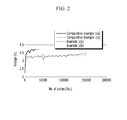
- Example 1 Two cells of each of Example 1 and Comparative Example 1 were charged and discharged at 30C for 150,000 cycles, and the results are shown in FIG. 2 as indicated in Example 1(a), Example 1(b), Comparative Example 1(a) and Comparative Example 1(b).
Landscapes
- Chemical & Material Sciences (AREA)
- Chemical Kinetics & Catalysis (AREA)
- Electrochemistry (AREA)
- General Chemical & Material Sciences (AREA)
- Engineering & Computer Science (AREA)
- Materials Engineering (AREA)
- Manufacturing & Machinery (AREA)
- Inorganic Chemistry (AREA)
- Secondary Cells (AREA)
- Battery Electrode And Active Subsutance (AREA)
- Electric Double-Layer Capacitors Or The Like (AREA)
Abstract

Description
- The present invention relates to a positive electrode for a rechargeable lithium battery and a rechargeable lithium battery including the same.
- In recent times, due to reductions in size and weight of portable electronic equipments, and popularization of portable electronic devices, researches on rechargeable lithium batteries having high energy density for power source of portable electronic devices has been actively undertaken.
- Rechargeable lithium batteries include a negative electrode, a positive electrode, and an electrolyte, and generate electrical energy by oxidation and reduction reactions when lithium ions are intercalated/deintercalated in the positive electrode and negative electrode.
- Such rechargeable lithium batteries use a lithium metal, a carbon-based material, Si, and the like for a negative active material.
- For a positive active material of rechargeable lithium batteries, metal chalcogenide compounds being capable of intercalating and deintercalating lithium ions, and for example, composite metal oxide such as LiCoO2, LiMn2O4, LiNiO2, LiNi1-xCoxO2 (0<x<1), LiMnO2, and the like have been used.
- Recently, rechargeable lithium batteries having high power characteristics have been actively investigated in order to use them as batteries for vehicles.
- An exemplary embodiment of the present invention provides a positive electrode for a rechargeable lithium battery exhibiting good high rate characteristics and cycle-life characteristics.
- Another embodiment of the present invention provides a rechargeable lithium battery including the positive electrode.
- According to the embodiment, a positive electrode for a rechargeable lithium battery is provided, including a current collector; and a positive active mass layer formed on the current collector. The positive active mass layer includes a positive active material, active carbon, a conductive material, and a binder, wherein a ratio of the positive active mass density of the positive active mass layer and a thickness of the positive active mass layer fulfills the condition:

- The ratio of the active mass density of the active mass layer (g/cc)/ thickness (µm) of the active mass layer may be 0.025 to 0.3. In another embodiment, the ratio of the active mass density of the active mass layer (g/cc)/ thickness (µm) of the active mass layer may be 0.025 to 0.2.
- The active mass density of the active mass layer may be 1.5 g/cc to 4 g/cc. The thickness of the active mass layer may be 10 µm to 200 µm, in another embodiment, 30 µm to 200 µm.
- According to another embodiment, a rechargeable lithium battery is provided, including the positive electrode, a negative electrode including a negative active material; and an electrolyte including an organic solvent and a lithium salt.
- Preferably, the positive active material is a composite oxide of lithium and at least one of cobalt, manganese and nickel.
- A total amount of the positive active material and active carbon may be 85 wt% to 98 wt% based on the total weight of the positive active material layer. A mixing ratio of the positive active material and the active carbon may be 80 : 20 to 90 : 10 weight ratio.
- According to another preferred embodiment, an amount of the binder is 1 wt% to 10 wt% based on the total weight of the positive active material layer. The binder may be at least one compound selected from the group comprising polyvinyl alcohol, carboxylmethyl cellulose, hydroxypropyl cellulose, diacetyl cellulose, polyvinyl chloride, carboxylated polyvinyl chloride, polyvinyl fluoride, an ethylene oxide-containing polymer, polyvinylpyrrolidone, polyurethane, polytetrafluoroethylene, polyvinylidene fluoride, polyethylene, polypropylene, a styrene-butadiene rubber, an acrylated styrene-butadiene rubber, an epoxy resin and nylon.
- Preferably, an amount of the conductive material is 1 wt% to 10 wt% based on the total weight of the positive active material layer. The conductive material may be at least one compound selected from the group comprising a carbon-based material, a metal-based material and a conductive polymer.
- The current collector may be made of Al.
- The positive electrode of the embodiment exhibits rapid input and output characteristics at high rates, and may provide rechargeable lithium batteries exhibiting excellent cycle-life characteristics.
-
-
FIG. 1 is a schematic view showing a structure of rechargeable lithium battery cell according to one embodiment. -
FIG. 2 is a graph showing voltage results according to cycles of the rechargeable lithium cells of Example 1 and Comparative Example 1. - Exemplary embodiments of this disclosure will hereinafter be described in detail. A positive electrode includes a current collector, and a positive active mass layer formed on the current collector. The positive active mass layer includes a positive active material, active carbon, a conductive material and a binder. In the rechargeable lithium battery, the active mass generally refers to a mixture of an active material, a conductive material, and a binder, and in the present invention, the active mass refers to a mixture of the positive active material, the active carbon, the conductive material, and the binder.
- The active mass density of the positive active mass layer (g/cc) and the thickness (µm) is satisfied by the condition of
Equation 1.
- The ratio of the active mass density of the active mass layer and the thickness (µm) of the active mass layer may be 0.025 to 0.3. In another embodiment, the ratio of the active mass density of the active mass layer and the thickness (µm) of the active mass layer may be 0.025 to 0.2.
- When the ratio of the active mass density of the positive active mass layer and the thickness of the positive active mass layer fall into the condition of
Equation 1, a rechargeable lithium battery exhibiting very rapid input and output characteristics at high rates and desired capacity may be provided. - In the embodiment of the present invention, the active mass density of the active mass layer may be 1.5g/cc to 4g/cc. When the active mass density of the active mass layer falls into the above range, it may provide a battery exhibiting improved capacity.
- Furthermore, the thickness of the active mass layer may be 10 µm to 200 µm, and in another embodiment, the thickness may be 30 µm to 200 µm. When the thickness of the active mass layer is included in the above range, it is more desirable in that it may provide a battery having the suitable battery capacity and rapid input and output characteristics.
- As a result, it is desirable that when the active mass density and the thickness of the active mass layer satisfy the condition of
Equation 1, they are included in the above ranges. - Generally, as the active mass density in the positive active mass increases, the capacity increases, but extremely high density may not be suitable. In particular, increases in a loading level (amount of a positive active material per unit area) may causes deterioration of the output characteristics. Furthermore, as the thickness of the active mass layer decreases, the input and output characteristics at high rates may be improved, but extremely low thickness causes capacity fading. Thus, the present invention suitably controls the active mass density and the thickness of the active mass layer, and controls the active mass density and the thickness of the active mass layer in the condition of
Equation 1, in order to improve the capacity and input and output characteristics at high rates. - The positive electrode for a rechargeable lithium battery having the component according to one embodiment may be effectively used for ISG (idle stop and go) among the batteries in vehicles that are used to increase gas mileage and reduce CO2 output. The general batteries for ISG are those that which stop start-up when the car is stopped, and start the car when needed, and the batteries require very rapid reaction speed since the starting of the car is only occurs for a short time. Furthermore, the battery is required to generally maintain the full-charge state while driving, and requires good power characteristics at a low temperature.
- The positive electrode according to the present invention includes an active mass together with the positive active material in the positive active mass layer so that the advantages of the rechargeable lithium battery and the advantages of the super capacity are both obtained, thereby providing batteries exhibiting rapid input and output current characteristics and long cycle-life characteristics. Furthermore, since the active mass density and the thickness of the positive active mass layer are satisfied by the condition of
Equation 1, it may exhibit rapid input and output characteristics at high rates and high capacity. - The positive active material may include a compound that reversibly intercalates and deintercalates lithium (a lithiated intercalation compound). Specifically, a composite oxide of at least one of cobalt, manganese, nickel, or a combination thereof, and lithium may be used. Exemplary may be compounds represented by the following formulae:
- LiaA1-bXbD2 (0-90 ≤ a ≤1.8, 0 ≤ b ≤0.5); LiaA1-bXbO2-cDc (0.90 ≤ a ≤ 1.8, 0 ≤ b ≤ 0.5, 0 ≤ c ≤ 0.05); LiaE1-bXbO2-cDc (0.90 ≤ a ≤ 1.8, 0 ≤ b ≤ 0.5, 0 ≤ c ≤ 0.05); LiaE2-bXbO4-cDc (0.90 ≤ a ≤ 1.8, 0 ≤ b ≤ 0.5, 0 ≤ c ≤ 0.05); LiaNi1-b-cCobXcDα (0.90 ≤ a ≤1.8, 0 ≤ b ≤ 0.5, 0 ≤ c ≤ 0.5, 0 < α ≤ 2); LiaNi1-b-cCobXcO2-αTα (0.90 ≤ a ≤ 1.8, 0 ≤ b ≤ 0.5, 0 ≤ c ≤ 0.05, 0 < α < 2); LiaNi1-b-cCobXcO2-αT2 (0.90 ≤ a ≤ 1.8, 0 ≤ b ≤ 0.5, 0 ≤ c ≤ 0.05, 0 < α < 2); LiaNi1-b-cMnbXcDa (0.90 ≤ a ≤ 1.8, 0 ≤ b ≤ 0.5, 0 ≤ c ≤ 0.05, 0 < α ≤ 2); LiaNi1-b-cMnbXcO2-αTα (0.90 ≤ a ≤ 1.8, 0 ≤ b ≤0.5, 0 ≤ c ≤ 0.05, 0 < α < 2); LiaNi1-b-cMnbXcO2-αT2 (0.90 ≤ a ≤ 1.8, 0 ≤ b ≤ 0.5, 0 ≤ c ≤ 0.05, 0 < α < 2); LiaNibEcGdO2 (0.90 ≤ a ≤ 1.8, 0 ≤ b ≤ 0.9, 0 ≤ c ≤ 0.5, 0.001 ≤ d ≤ 0.1); LiaNibCocMndGeO2 (0.90 ≤ a ≤ 1.8, 0 ≤ b ≤ 0.9, 0 ≤ c ≤ 0.5, 0 ≤ d ≤ 0.5, 0.001 ≤ e ≤ 0.1); LiaNiGbO2 (0.90 ≤ a ≤ 1.8, 0.001 ≤ b ≤ 0.1) LiaCoGbO2 (0.90 ≤ a ≤ 1.8, 0.001 ≤ b ≤ 0.1); LiaMn1-bGbO2 (0.90 ≤ a ≤ 1.8, 0.001 ≤ b ≤ 0.1); LiaMn2GbO4 (0.90 ≤ a ≤ 1.8, 0.001 ≤ b ≤ 0.1); LiaMn1-gGgPO4 (0.90 ≤ a ≤ 1.8, 0 ≤ g ≤ 0.5); QO2; QS2; LiQS2; V2O5; LiV2O5; LiZO2; LiNiVO4; Li(3-f)J2(PO4)3 (0 ≤ f ≤ 2); Li(3-f)Fe2(PO4)3 (0 ≤ f ≤ 2); and LiaFePO4 (0.90 ≤ a ≤ 1.8)
- In the above formulae, A is selected from Ni, Co, Mn, and a combination thereof; X is selected from Al, Ni, Co, Mn, Cr, Fe, Mg, Sr, V, a rare earth element, and a combination thereof; D is selected from O, F, S, P, and a combination thereof; E is selected from Co, Mn, and a combination thereof; T is selected from F, S, P, and a combination thereof; G is selected from Al, Cr, Mn, Fe, Mg, La, Ce, Sr, V, and a combination thereof; Q is selected from Ti, Mo, Mn, and a combination thereof; Z is selected from Cr, V, Fe, Sc, Y, and a combination thereof; and J is selected from V, Cr, Mn, Co, Ni, Cu, and a combination thereof.
- The compounds may have a coating layer on the surface, or may be mixed with another compound having a coating layer. The coating layer may include at least one coating element compound selected from the group consisting of an oxide of a coating element, a hydroxide of a coating element, an oxyhydroxide of a coating element, an oxycarbonate of a coating element, and a hydroxyl carbonate of a coating element. The compound for the coating layer may be amorphous or crystalline. The coating element included in the coating layer may include Mg, Al, Co, K, Na, Ca, Si, Ti, V, Sn, Ge, Ga, B, As, Zr, or a mixture thereof. The coating layer may be disposed in a method having no adverse influence on properties of a positive active material by using these elements in the compound. For example, the method may include any coating method such as spray coating, dipping, and the like, but is not illustrated in more detail since it is well-known to those who work in the related field.
- In the positive active mass layer, the total amount of the positive active material and active carbon may be included in a ratio of 85 wt% to 98 wt% based on the total weight of the positive active material layer. In the positive active mass layer, the mixing ratio of the positive active material and the active carbon may be 80 : 20 to 95 : 5 in weight ratio in 85 wt% to 98 wt% of the total amount of the positive active material and active carbon.
- Furthermore, the binder and conductive material may be respectively included in an amount ranging from 1 wt% to 10 wt% based on the total weight of the positive active material layer. The binder improves binding properties of the positive active material particles to each other and to a current collector. Examples of the binder include polyvinyl alcohol, carboxylmethyl cellulose, hydroxypropyl cellulose, diacetyl cellulose, polyvinyl chloride, carboxylated polyvinyl chloride, polyvinyl fluoride, an ethylene oxide-containing polymer, polyvinylpyrrolidone, polyurethane, polytetrafluoroethylene, polyvinylidene fluoride, polyethylene, polypropylene, a styrene-butadiene rubber, an acrylated styrene-butadiene rubber, an epoxy resin, and nylon. The conductive material provides an electrode with conductivity. Any electrically conductive material may be used as the conductive material unless it causes a chemical change. Examples of the conductive material include a carbon-based material such as natural graphite, artificial graphite, carbon black, acetylene black, ketjen black, a carbon fiber, and the like; a metal-based material such as metal powder or metal fiber including copper, nickel, aluminum, silver, and the like; a conductive polymer such as a polyphenylene derivative; or a mixture thereof.
- The current collector may be Al.
- The positive electrode may be fabricated by mixing the positive active material, the conductive material, and the binder in a solvent to prepare an active material composition, and coating the active material composition on the current collector. The solvent may be N-methyl pyrrolidone.
- Another embodiment of the present invention provides a rechargeable lithium battery including the positive electrode, a negative electrode including a negative active material and an electrolyte. The rechargeable lithium battery may include a separator between the positive electrode and the negative electrode, and may also include a battery case. That is, a rechargeable lithium battery according to one embodiment includes the positive electrode, the separator, the negative electrode, and the electrolyte positioned in the battery case.
- At this time, the positive electrode, the separator and the negative electrode may be spiral-wound (winding) to form a jellyroll shape, and the volume of thereof (volume of the positive electrode, the separator, and the negative electrode) may be 80 volume% to 100 volume% based on the total volume of the battery case, that is, the packing ratio may be 80 volume% to 100 volume%. In the specification, the total volume of the battery case refers to that before assembling the battery, or the total volume of the battery case that is increased due to the initial charge and discharge (e.g., the volume may be increased to about 105 volume% based on 100 volume% of the initial volume of the battery case).
- When the packing ratio falls into the above range, it is available to fabricate batteries with optimum capacity, and it may be effectively suppress the shaking of the jellyroll in the battery case, so that the modification of the jellyroll may not occur, thereby preventing deterioration of the battery performance.
- The negative electrode includes a current collector and a negative active mass layer, i.e., a negative active material layer, disposed on the current collector, and the negative active material layer includes a negative active material.
- The negative active material includes a material that reversibly intercalates/deintercalates lithium ions, a lithium metal, a lithium metal alloy, a material being capable of doping/dedoping lithium, or a transition metal oxide.
- The material that can reversibly intercalate/deintercalate lithium ions includes a carbon material. The carbon material may be any carbon-based negative active material that is generally used in a lithium ion rechargeable battery. Examples of the carbon material include crystalline carbon, amorphous carbon, and mixtures thereof. The crystalline carbon may be non-shaped, or sheet-, flake-, spherical-, or fiber-shaped natural graphite or artificial graphite. The amorphous carbon may be a soft carbon, a hard carbon, a mesophase pitch carbonization product, fired coke, and the like.
- Examples of the lithium metal alloy include lithium and an element selected from Na, K, Rb, Cs, Fr, Be, Mg, Ca, Sr, Si, Sb, Pb, In, Zn, Ba, Ra, Ge, Al, and Sn. The material being capable of doping/dedoping lithium may include Si, a Si-C composite, SiOx (0 < x < 2), a Si-Q alloy (wherein Q is an element selected from an alkali metal, an alkaline-earth metal, a Group 13 element, a Group 14 element, a Group 15 element, a Group 16 element, a transition element, a rare earth element, and a combination thereof, and is not Si), Sn, SnO2, a Sn-R alloy (wherein R is an element selected from an alkali metal, an alkaline-earth metal, a Group 13 element, a Group 14 element, a Group 15 element, a Group 16 element, a transition element, a rare earth element, and a combination thereof, and is not Sn), and the like. At least one of these materials may be mixed with SiO2. The elements Q and R may be selected from Mg, Ca, Sr, Ba, Ra, Sc, Y, Ti, Zr, Hf, Rf, V, Nb, Ta, Db, Cr, Mo, W, Sg, Tc, Re, Bh, Fe, Pb, Ru, Os, Hs, Rh,
- Ir, Pd, Pt, Cu, Ag, Au, Zn, Cd, B, Al, Ga, Sn, In, TI, Ge, P, As, Sb, Bi, S, Se, Te, Po, and a combination thereof.
- The transition metal oxide includes vanadium oxide, lithium vanadium oxide, and the like.
- In the negative active material layer, the negative active material may be included in an amount of 95 wt% to 99 wt% based on the total weight of the negative active material layer.
- The negative active material layer may include a binder, and optionally a conductive material. The negative active material layer may include 1 wt% to 5 wt% of a binder based on the total weight of the negative active material layer. When the negative active material layer includes a conductive material, the negative active material layer includes 90 wt% to 98 wt% of the negative active material, 1 wt% to 5 wt% of the binder, and 1 wt% to 5 wt% of the conductive material.
- The binder improves binding properties of negative active material particles with one another and with the current collector. The binder includes a non-water-soluble binder, a water-soluble binder, or a combination thereof.
- The non-water-soluble binder includes polyvinylchloride, carboxylated polyvinylchloride, polyvinyl fluoride, an ethylene oxide-containing polymer, polyvinylpyrrolidone, polyurethane, polytetrafluoroethylene, polyvinylidene fluoride, polyethylene, polypropylene, polyamideimide, polyimide, or a combination thereof.
- The water-soluble binder includes a styrene-butadiene rubber, an acrylated styrene-butadiene rubber, polyvinyl alcohol, sodium polyacrylate, a copolymer of propylene and a C2 to C8 olefin, a copolymer of (meth)acrylic acid and (meth)acrylic acid alkyl ester, or a combination thereof.
- When the water-soluble binder is used as a negative electrode binder, a cellulose-based compound may be further used to provide viscosity. The cellulose-based compound includes one or more of carboxylmethyl cellulose, hydroxypropylmethyl cellulose, methyl cellulose, or alkali metal salts thereof. The alkali metal may be Na, K, or Li. The cellulose-based compound may be included in an amount of 0.1 to 3 parts by weight based on 100 parts by weight of the negative active material.
- The conductive material is included to provide electrode conductivity. Any electrically conductive material may be used as a conductive material unless it causes a chemical change. Examples of the conductive material include carbon-based materials such as natural graphite, artificial graphite, carbon black, acetylene black, ketjen black, carbon fibers, and the like; metal-based materials of metal powder or metal fiber including copper, nickel, aluminum, silver, and the like; conductive polymers such as polyphenylene derivatives; or a mixture thereof.
- The current collector may include one selected from a copper foil, a nickel foil, a stainless steel foil, a titanium foil, a nickel foam, a copper foam, a polymer substrate coated with a conductive metal, and a combination thereof.
- The negative electrode may be fabricated by mixing the negative active material, the binder, and optionally the conductive material to prepare an active material composition and coating the composition on a current collector. The electrode-manufacturing method is well known and thus is not described in detail in the present specification. The solvent may include N-methylpyrrolidone and the like. When the negative electrode includes a water-soluble binder, the negative active material composition may use water as a solvent.
- The electrolyte includes an organic solvent and a lithium salt.
- The organic solvent serves as a medium for transmitting ions taking part in the electrochemical reaction of a battery.
- The organic solvent may include a carbonate-based, ester-based, ether-based, ketone-based, alcohol-based, or aprotic solvent. The carbonate-based solvent may include dimethyl carbonate (DMC), diethyl carbonate (DEC), dipropyl carbonate (DPC), methylpropyl carbonate (MPC), ethylpropyl carbonate (EPC), methylethyl carbonate (MEC), ethylene carbonate (EC), propylene carbonate (PC), butylene carbonate (BC), and the like. The ester-based solvent may include methyl acetate, ethyl acetate, n-propyl acetate, methylpropionate, ethylpropionate, γ-butyrolactone, decanolide, valerolactone, mevalonolactone, caprolactone and the like. The ether-based solvent includes dibutyl ether, tetraglyme, diglyme, dimethoxyethane, 2-methyltetrahydrofuran, tetrahydrofuran, or the like, and the ketone-based solvent includes cyclohexanone, or the like. The alcohol-based solvent include ethyl alcohol, isopropyl alcohol, and the like, and the aprotic solvent include nitriles such as R-CN (wherein R is a C2 to C20 linear, branched, or cyclic hydrocarbon group, or includes a double bond, an aromatic ring, or an ether bond), amides such as dimethylformamide, dioxolanes such as 1,3-dioxolane, sulfolanes, or the like.
- The organic solvent may be used singularly or in a mixture. When the organic solvent is used in a mixture, the mixture ratio can be controlled in accordance with desirable battery performance.
- The carbonate-based solvent may be used by mixing a cyclic carbonate and a linear carbonate. The cyclic carbonate and the linear carbonate are mixed together in the volume ratio of 1:1 to 1:9. Within this range, performance of the electrolyte may be improved.
- The organic electrolyte may be further prepared by mixing a carbonate-based solvent with an aromatic hydrocarbon-based solvent. The carbonate-based and the aromatic hydrocarbon-based solvents may be mixed together in a volume ratio ranging from 1:1 to 30:1.
- The aromatic hydrocarbon-based organic solvent may be represented by the following
Chemical Formula 1.
- In
Chemical Formula 1, R1 to R6 are each independently selected from hydrogen, a halogen, a C1 to C10 alkyl group, a C1 to C10 haloalkyl group, and a combination thereof. - The aromatic hydrocarbon-based organic solvent may include benzene, fluorobenzene, 1,2-difluorobenzene, 1,3-difluorobenzene, 1,4-difluorobenzene, 1,2,3-trifluorobenzene, 1,2,4-trifluorobenzene, chlorobenzene, 1,2-dichlorobenzene, 1,3-dichlorobenzene, 1,4-dichlorobenzene, 1,2,3-trichlorobenzene, 1,2,4-trichlorobenzene, iodobenzene, 1,2-diiodobenzene, 1,3-diiodobenzene, 1,4-diiodobenzene, 1,2,3-triiodobenzene, 1,2,4-triiodobenzene, toluene, fluorotoluene, 2,3-difluorotoluene, 2,4-difluorotoluene, 2,5-difluorotoluene, 2,3,4-trifluorotoluene, 2,3,5-trifluorotoluene, chlorotoluene, 2,3-dichlorotoluene, 2,4-dichlorotoluene, 2,5-dichlorotoluene, 2,3,4-trichlorotoluene, 2,3,5-trichlorotoluene, iodotoluene, 2,3-diiodotoluene, 2,4-diiodotoluene, 2,5-diiodotoluene, 2,3,4-triiodotoluene, 2,3,5-triiodotoluene, xylene, and a combination thereof. The non-aqueous electrolyte may further include vinylene carbonate, or an ethylene carbonate-based compound represented by the following
Chemical Formula 2 to improve cycle-life.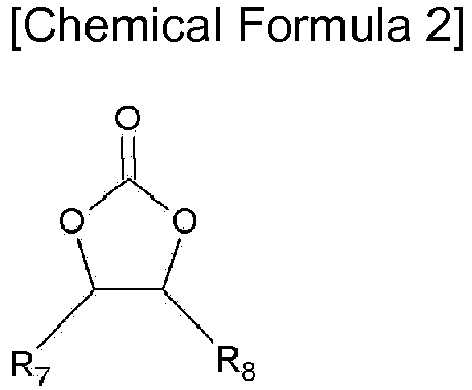
- In
Chemical Formula 2, R7 and R8 are independently selected from hydrogen, a halogen, a cyano group (CN), a nitro group (NO2), and a C1 to C5 fluoroalkyl group, provided that at least one of R7 and R8 is selected from a halogen, a cyano group (CN), a nitro group (NO2), and a C1 to C5 fluoroalkyl group. - Examples of the ethylene carbonate-based compound include difluoro ethylene carbonate, chloroethylene carbonate, dichloroethylene carbonate, bromoethylene carbonate, dibromoethylene carbonate, nitroethylene carbonate, cyanoethylene carbonate, fluoroethylene carbonate, and the like. The amount of the vinylene carbonate or the ethylene carbonate-based compound used to improve cycle life may be adjusted within an appropriate range.
- The electrolyte may be a borate-based compound as an additive for improving the power characteristics. The borate-based compound may be tris(trimethylsilyl) borate (TMSB), etc.. The used amount of the borate-based compound may be suitably controlled.
- The lithium salt is dissolved in an organic solvent, supplies lithium ions in a battery, operates a basic operation of the rechargeable lithium battery, and improves lithium ion transportation between positive and negative electrodes therein. Examples of the lithium salt include LiPF6, LiBF4, LiSbF6, LiAsF6, LiN(SO2C2F5)2, Li(CF3SO2)2N, LiN(SO3C2F5)2, LiC4FgSO3, LiClO4, LiAlO2, LiAlCl4, LiN(CxF2x+1SO2)(CyF2y+1SO2)(where x and y are natural numbers and an integer of 1 to 20), LiCl, Lil, LiB(C2O4)2 (lithium bis(oxalato) borate, LiBOB), or a combination thereof, as a supporting electrolytic salt. The lithium salt may be used in a concentration ranging from 0.1 M to 2.0 M. When the lithium salt is included in the above concentration range, an electrolyte may have excellent performance and lithium ion mobility due to optimal electrolyte conductivity and viscosity.
- The separator may include polyethylene, polypropylene, polyvinylidene fluoride, or a multilayer of two or more layers thereof, and it may also include a mixed multilayer such as a polyethylene/polypropylene 2-layered separator, a polyethylene/polypropylene/polyethylene 3-layered separator, a polypropylene/polyethylene/polypropylene 3-layered separator, or the like.
-
FIG. 1 is a schematic view showing the representative structure of a rechargeable lithium battery according to one embodiment. As shown inFIG. 1 , therechargeable lithium battery 1 includes apositive electrode 2, anegative electrode 4, and aseparator 3 interposed between thepositive electrode 2 andnegative electrode 4, an electrolyte immersed therein, abattery case 5, and a sealing member 6 sealing thebattery case 5. - The following examples illustrate the present invention in more detail.
- 85 wt% of LiCoO2, 5 wt% of active carbon, 4 wt% of denka black, 6 wt% of polyvinylidene fluoride (product name: Solef 6020, manufacturer: Solvay) were mixed in an N-methyl pyrrolidone solvent to prepare a positive active material slurry.
- The positive active material slurry was coated on an Al foil with a thickness of 15 µm, dried at 100 °C, and then pressed to fabricate a positive electrode with an active mass layer (positive active material layer) having an active mass density of 2.6 g/cc. The thickness of the active mass layer was 35 µm. Thus, the ratio of the active mass density of the active mass layer/the thickness was about 0.074.
- 92 wt% of soft carbon, 5 wt% of denka black, and 3 wt% of a mixture of styrene-butyrene rubber and carboxymethyl cellulose (2 : 1 weight ratio) were mixed in a water solvent to prepare a negative active material slurry.
- The negative active material slurry was coated on a Cu foil with a thickness of 10 µm, dried at 100 °C, and then pressed to fabricate a negative electrode with an active mass layer (negative active material layer) having an active mass density of about 1 g/cc, and having a loading level (L/L) of about 4.95g/cm2.
- A separator was inserted between the positive and negative electrodes, and the resultant was wound in the form of a cylinder type, to produce a jellyroll shape. As the separator, a 3-layer film of polyethylene/polypropylene/polyethylene having a thickness of 25 µm was used.
- The obtained jellyroll was put into an 18650-size battery case, and 50g of an electrolyte was injected therein, to fabricate a rechargeable lithium cell. As the electrolyte, one in which 0.5 wt% of tris(trimethylsilyl) borate was added to 1.15 M LiPF6 dissolved in a mixed solution of ethylene carbonate, ethylmethyl carbonate, and dimethyl carbonate (2:4:4 volume ratio) was used. At this time, the volume of the jellyroll (positive electrode, negative electrode and separator) was set to about 92 volume% to about 94 volume% based on the total of 100 volume% of the battery case.
- 85 wt% of LiNi1/3CO1/3Mn1/3O2, 5 wt% of active carbon, 4 wt% of denka black, 6 wt% of polyvinylidene fluoride (product name: Solef 6020, manufacturer: Solvay) were mixed in an N-methyl pyrrolidone solvent to prepare a positive active material slurry.
- The positive active material slurry was coated on an Al foil with a thickness of 15 µm, dried at 100 °C, and then pressed to fabricate a positive electrode with an active mass layer (positive active material layer) having an active mass density of 2.4 g/cc. The thickness of the active mass layer was 40 µm. Thus, the ratio of the active mass density of the active mass layer/the thickness was about 0.06.
- 92 wt% of soft carbon, 5 wt% of denka black, and 3 wt% of a mixture of styrene-butyrene rubber and carboxymethyl cellulose (2 : 1 weight ratio) were mixed in a water solvent to prepare a negative active material slurry.
- The negative active material slurry was coated on a Cu foil with a thickness of 10 µm, dried at 100 °C, and then pressed to fabricate a negative electrode with an active mass layer (negative active material layer) having an active mass density of about 1 g/cc, and having a loading level (L/L) of about 4.95g/ cm2.
- A separator was inserted between the positive and negative electrodes, and the resultant was wound in the form of a cylinder type, to produce a jellyroll shape. As the separator, a 3-layer film of polyethylene/polypropylene/polyethylene having a thickness of 25 µm was used.
- The obtained jellyroll was put into an 18650-size battery case, and 50g of an electrolyte was injected therein, to fabricate a rechargeable lithium cell. As the electrolyte, one in which 0.5 wt% of tris(trimethylsilyl) borate was added to 1.15 M LiPF6 dissolved in a mixed solution of ethylene carbonate, ethylmethyl carbonate, and dimethyl carbonate (2:4:4 volume ratio) was used. At this time, the volume of the jellyroll (positive electrode, negative electrode and separator) was set to about 92 volume% to about 94 volume% based on the total of 100 volume% of the battery case.
- 85 wt% of LiFePO4, 5 wt% of active carbon, 4 wt% of denka black, 6 wt% of polyvinylidene fluoride (product name: Solef 6020, manufacturer: Solvay) were mixed in an N-methyl pyrrolidone solvent to prepare a positive active material slurry.
- The positive active material slurry was coated on an Al foil with a thickness of 15 µm, dried at 100 °C, and then pressed to fabricate a positive electrode with an active mass layer (positive active material layer) having an active mass density of 1.9 g/cc. The thickness of the active mass layer was 45 µm. Thus, the ratio of the active mass density of the active mass layer/the thickness was about 0.042.
- 92 wt% of soft carbon, 5 wt% of denka black, and 3 wt% of a mixture of styrene-butyrene rubber and carboxymethyl cellulose (2 : 1 weight ratio) were mixed in a water solvent to prepare a negative active material slurry.
- The negative active material slurry was coated on a Cu foil with a thickness of 10 µm, dried at 100 °C, and then pressed to fabricate a negative electrode with an active mass layer (negative active material layer) having an active mass density of about 1 g/cc, and having a loading level (L/L) of about 5.94g/ cm2.
- A separator was inserted between the positive and negative electrodes, and the resultant was wound in the form of a cylinder type, to produce a jellyroll shape. As the separator, a 3-layer film of polyethylene/polypropylene/polyethylene having a thickness of 25 µm was used.
- The obtained jellyroll was put into an 18650-size battery case, and 50g of an electrolyte was injected therein, to fabricate a rechargeable lithium cell. As the electrolyte, one in which 0.5 wt% of tris(trimethylsilyl) borate was added to 1.15 M LiPF6 dissolved in a mixed solution of ethylene carbonate, ethylmethyl carbonate, and dimethyl carbonate (2:4:4 volume ratio) was used. At this time, the volume of the jellyroll (positive electrode, negative electrode and separator) was set to about 92 volume% to about 94 volume% based on the total of 100 volume% of the battery case.
- A rechargeable lithium cell was fabricated by the same procedure as in Example 1, except that the positive active material slurry produced in Example 1 was coated on an Al foil with a thickness of 15 µm, dried, and then pressed to fabricate a positive electrode with an active mass layer (positive active material layer) having an active mass density of 2.6 g/cc and a thickness of the active mass layer of 200 µm. In the positive electrode, the ratio of the active mass of the active mass layer/ thickness of the active mass layer was about 0.013.
- A rechargeable lithium cell was fabricated by the same procedure as in Example 1, except that the positive active material slurry produced in Example 3 was coated on an Al foil with a thickness of 15 µm, dried, and then pressed to fabricate a positive electrode with an active mass layer (positive active material layer) having an active mass density of 1.9 g/cc and a thickness of the active mass layer of 107 µm. In the positive electrode, the ratio of the active mass density of the active mass layer/ thickness of the active mass layer was about 0.018.
- Two cells of each of Example 1 and Comparative Example 1 were charged and discharged at 30C for 150,000 cycles, and the results are shown in
FIG. 2 as indicated in Example 1(a), Example 1(b), Comparative Example 1(a) and Comparative Example 1(b). - While charging at high rates, a voltage reaching 4.2 V indicates the stop of the cycle-life, where the charge and the discharge do not occur. As shown in
FIG. 2 , the rechargeable lithium cells according to Examples 1 did not reached 4.2 V even though the charge and discharge were performed for 150,000 cycles, so it can be shown from the result that the cycle-life may be better maintained. However, the cells according to Comparative Example 1 reached 4.2 V at the 30,000th charge and discharge cycle so that the cycle-life of the cell was stopped at 30,000 cycles. Thus, the rechargeable lithium cells according to Example 1 exhibited surprisingly improved cycle-life characteristics, compared to the cells according to Comparative Example 1. - Two cells in each of Examples 1 to 3 and Comparative Example 2 were charged and discharged while the C-rate was varied, i.e., charged and discharged at 1C, 10C, 30C, and 50C, once at the C-rate. The discharge capacity was measured and the results are shown in Table 1. Furthermore, the charge capacity was measured and the results are shown in Table 2. Furthermore, the ratios of the discharge capacity at 50C to the discharge capacity at 1C are shown in Table 1, and the ratios of the charge capacity at 50C to the charge capacity at 1C are shown in Table 2.
Table 1 Discharge 1C[Ah] 10C[Ah] 30C[Ah] 50C[Ah] 50C/1C(%) Example 1 4.1 3.9 3.8 3.7 92 Example 1 4.1 3.9 3.8 3.7 92 Example 2 4.0 3.8 3.7 3.6 91 Example 2 4.0 3.8 3.7 3.6 91 Example 3 3.2 3.1 2.9 2.8 87 Example 3 3.2 3.1 2.9 2.8 87 Comparative Example 2 3.9 3.1 2.6 1.4 37 Comparative Example 2 3.9 3.1 2.6 1.4 38 Table 2 Charge 1C[Ah] 10C[Ah] 30C[Ah] 50C[Ah] 50C/1C(%) Example 1 4.0 3.7 3.3 2.9 72 Example 1 4.0 3.7 3.3 2.9 72 Example 2 3.9 3.7 3.4 3.1 80 Example 2 3.9 3.7 3.4 3.1 80 Example 3 3.2 3.0 2.8 2.6 80 Example 3 3.2 3.0 2.8 2.6 81 Comparative Example 2 3.8 2.9 2.4 1.4 37 Comparative Example 2 3.8 2.9 2.4 1.4 37 - As shown in Tables 1 and 2, the rechargeable lithium cells according to Examples 1 to 3 exhibited good charge and discharge characteristics at high rates, compared to that according to Comparative Example 2.
Claims (15)
- A positive electrode (2) for a rechargeable lithium battery (1) comprising:a current collector; anda positive active mass layer formed on the current collector, the positive active mass layer including or consisting of a positive active material, active carbon, a conductive material, and a binder, wherein a ratio of the active mass density of the positive active mass layer and a thickness of the positive active mass layer fulfills the condition:0.02 ≤ active mass density of the active mass layer (g/cc)/ thickness of the active mass layer (µm) ≤ 0.3.
- The positive electrode of claim 1, wherein the ratio of the active mass density of the active mass layer (g/cc)/ thickness (µm) of the active mass layer is 0.025 to 0.3.
- The positive electrode of claim 2, wherein the ratio of the active mass density of the active mass layer (g/cc)/ thickness (µm) of the active mass layer is 0.025 to 0.2.
- The positive active material of one of the preceding claims, wherein the active mass density of the active mass layer is 1.5 g/cc to 4 g/cc.
- The positive active material of one of the preceding claims, wherein the thickness of the active mass layer is 10 µm to 200 µm.
- The positive active material of claim 5, wherein the thickness of the active mass layer is 30 µm to 200 µm.
- The positive active material of one of the preceding claims, wherein the positive active material is a composite oxide of lithium and at least one of cobalt, manganese and nickel.
- The positive active material of one of the preceding claims, wherein a total amount of the positive active material and active carbon is 85 wt% to 98 wt% based on the total weight of the positive active material layer.
- The positive active material of claim 8, wherein a mixing ratio of the positive active material and the active carbon is 80 : 20 to 95 : 5 weight ratio.
- The positive active material of one of the preceding claims, wherein an amount of the binder is 1 wt% to 10 wt% based on the total weight of the positive active material layer.
- The positive active material of one of the preceding claims, wherein the binder is at least one compound selected from the group comprising polyvinyl alcohol, carboxylmethyl cellulose, hydroxypropyl cellulose, diacetyl cellulose, polyvinyl chloride, carboxylated polyvinyl chloride, polyvinyl fluoride, an ethylene oxide-containing polymer, polyvinylpyrrolidone, polyurethane, polytetrafluoroethylene, polyvinylidene fluoride, polyethylene, polypropylene, a styrene-butadiene rubber, an acrylated styrene-butadiene rubber, an epoxy resin and nylon.
- The positive active material of one of the preceding claims, wherein an amount of the conductive material is 1 wt% to 10 wt% based on the total weight of the positive active material layer.
- The positive active material of one of the preceding claims, wherein the conductive material is at least one compound selected from the group comprising a carbon-based material, a metal-based material and a conductive polymer.
- The positive active material of one of the preceding claims, wherein the current collector is made of Al.
- A rechargeable lithium battery including the positive electrode according to one of the preceding claims, a negative electrode including a negative active material; and an electrolyte including an organic solvent and a lithium salt.
Applications Claiming Priority (2)
| Application Number | Priority Date | Filing Date | Title |
|---|---|---|---|
| US201261721353P | 2012-11-01 | 2012-11-01 | |
| US14/024,545 US20140120410A1 (en) | 2012-11-01 | 2013-09-11 | Positive electrode for rechargeable lithium battery and rechargeable lithium battery including same |
Publications (2)
| Publication Number | Publication Date |
|---|---|
| EP2728651A1 true EP2728651A1 (en) | 2014-05-07 |
| EP2728651B1 EP2728651B1 (en) | 2018-02-28 |
Family
ID=49237111
Family Applications (1)
| Application Number | Title | Priority Date | Filing Date |
|---|---|---|---|
| EP13186426.6A Active EP2728651B1 (en) | 2012-11-01 | 2013-09-27 | Positive electrode for rechargeable lithium battery and rechargeable lithium battery including same |
Country Status (5)
| Country | Link |
|---|---|
| US (1) | US20140120410A1 (en) |
| EP (1) | EP2728651B1 (en) |
| JP (1) | JP2014093295A (en) |
| KR (1) | KR20140055979A (en) |
| CN (1) | CN103811716A (en) |
Cited By (2)
| Publication number | Priority date | Publication date | Assignee | Title |
|---|---|---|---|---|
| EP2950368A1 (en) * | 2014-05-26 | 2015-12-02 | GS Yuasa International Ltd. | Energy storage device, energy storage apparatus, vehicle, and method for using energy storage device |
| EP3163654A1 (en) * | 2015-10-26 | 2017-05-03 | Samsung SDI Co., Ltd. | Rechargeable lithium battery |
Families Citing this family (4)
| Publication number | Priority date | Publication date | Assignee | Title |
|---|---|---|---|---|
| KR102272269B1 (en) * | 2016-10-10 | 2021-07-02 | 삼성에스디아이 주식회사 | Positive electrode for rechargeable lithium battery and rechargeable lithium battery including same |
| CN108807848B (en) | 2018-05-11 | 2019-10-08 | 宁德时代新能源科技股份有限公司 | Negative electrode plate and secondary battery containing same |
| KR102103765B1 (en) * | 2018-05-16 | 2020-04-28 | 일진머티리얼즈 주식회사 | Electrolytic Copper Foil and secondary battery using thereof |
| KR102621697B1 (en) * | 2018-08-16 | 2024-01-04 | 현대자동차주식회사 | A binder solution for all solid state battery, electrode slurry comprising the same and a method of preparing all solid state battery using the same |
Citations (4)
| Publication number | Priority date | Publication date | Assignee | Title |
|---|---|---|---|---|
| JP2004296431A (en) * | 2003-03-07 | 2004-10-21 | Denso Corp | Electrode for lithium secondary battery and lithium secondary battery |
| US20060269802A1 (en) * | 2005-05-24 | 2006-11-30 | Takahiro Yamaki | Electric energy storage device |
| JP2007103069A (en) * | 2005-09-30 | 2007-04-19 | Denso Corp | ELECTRODE FOR LITHIUM SECONDARY BATTERY, ITS MANUFACTURING METHOD, AND LITHIUM SECONDARY BATTERY |
| US20080020280A1 (en) * | 2006-07-18 | 2008-01-24 | Nissan Motor Co., Ltd. | Positive electrode for non-aqueous electrolytic secondary battery, and method for producing the positive electrode |
Family Cites Families (10)
| Publication number | Priority date | Publication date | Assignee | Title |
|---|---|---|---|---|
| CA2207801C (en) * | 1996-06-19 | 2004-03-30 | Hideki Kaido | Nonaqueous electrolyte battery |
| KR100436712B1 (en) * | 2001-12-19 | 2004-06-22 | 삼성에스디아이 주식회사 | Cathode electrode, method for manufacturing the same, and lithium battery containing the same |
| JP2005203131A (en) * | 2004-01-13 | 2005-07-28 | Hitachi Ltd | Energy device |
| JP5070753B2 (en) * | 2005-12-13 | 2012-11-14 | ソニー株式会社 | battery |
| CN100583541C (en) * | 2005-12-13 | 2010-01-20 | 索尼株式会社 | Battery |
| JP2008034215A (en) * | 2006-07-28 | 2008-02-14 | Hitachi Ltd | Positive electrode for lithium secondary battery, method for producing the same, and lithium secondary battery |
| JP2008112594A (en) * | 2006-10-30 | 2008-05-15 | Hitachi Vehicle Energy Ltd | Lithium secondary battery |
| WO2008056908A1 (en) * | 2006-11-06 | 2008-05-15 | Lg Chem, Ltd. | Secondary battery having improved safety by deformation of electrode assembly-receiving portion in case |
| JP2010267878A (en) * | 2009-05-15 | 2010-11-25 | Asahi Kasei Corp | Non-aqueous lithium storage element |
| KR101155915B1 (en) * | 2010-09-13 | 2012-06-20 | 삼성에스디아이 주식회사 | Lithium secondary battery including same |
-
2013
- 2013-09-11 US US14/024,545 patent/US20140120410A1/en not_active Abandoned
- 2013-09-27 EP EP13186426.6A patent/EP2728651B1/en active Active
- 2013-09-27 KR KR1020130115487A patent/KR20140055979A/en not_active Ceased
- 2013-10-16 JP JP2013215365A patent/JP2014093295A/en active Pending
- 2013-10-25 CN CN201310512309.4A patent/CN103811716A/en active Pending
Patent Citations (4)
| Publication number | Priority date | Publication date | Assignee | Title |
|---|---|---|---|---|
| JP2004296431A (en) * | 2003-03-07 | 2004-10-21 | Denso Corp | Electrode for lithium secondary battery and lithium secondary battery |
| US20060269802A1 (en) * | 2005-05-24 | 2006-11-30 | Takahiro Yamaki | Electric energy storage device |
| JP2007103069A (en) * | 2005-09-30 | 2007-04-19 | Denso Corp | ELECTRODE FOR LITHIUM SECONDARY BATTERY, ITS MANUFACTURING METHOD, AND LITHIUM SECONDARY BATTERY |
| US20080020280A1 (en) * | 2006-07-18 | 2008-01-24 | Nissan Motor Co., Ltd. | Positive electrode for non-aqueous electrolytic secondary battery, and method for producing the positive electrode |
Cited By (4)
| Publication number | Priority date | Publication date | Assignee | Title |
|---|---|---|---|---|
| EP2950368A1 (en) * | 2014-05-26 | 2015-12-02 | GS Yuasa International Ltd. | Energy storage device, energy storage apparatus, vehicle, and method for using energy storage device |
| US9705119B2 (en) | 2014-05-26 | 2017-07-11 | Gs Yuasa International Ltd. | Energy storage device, energy storage apparatus, vehicle, and method for using energy storage device |
| EP3163654A1 (en) * | 2015-10-26 | 2017-05-03 | Samsung SDI Co., Ltd. | Rechargeable lithium battery |
| US11289733B2 (en) | 2015-10-26 | 2022-03-29 | Samsung Sdi Co., Ltd. | Rechargeable lithium battery |
Also Published As
| Publication number | Publication date |
|---|---|
| US20140120410A1 (en) | 2014-05-01 |
| JP2014093295A (en) | 2014-05-19 |
| CN103811716A (en) | 2014-05-21 |
| EP2728651B1 (en) | 2018-02-28 |
| KR20140055979A (en) | 2014-05-09 |
Similar Documents
| Publication | Publication Date | Title |
|---|---|---|
| KR101649133B1 (en) | Electrode for lithium rechargeable battery, and lithium rechargeable battery including the same | |
| KR101711981B1 (en) | Non-aqueous electrolyte for rechargeable lithium battery and rechargeable lithium battery including same | |
| EP1962364B1 (en) | Rechargeable lithium battery | |
| KR101733737B1 (en) | Electrolyte for rechargeable lithium battery, and rechargeable lithium battery including the same | |
| EP2615680A1 (en) | Rechargeable lithium battery | |
| US9318746B2 (en) | Positive electrode having current collector with carbon layer for rechargeable lithium battery and rechargeable lithium battery including same | |
| KR101788561B1 (en) | Positive active material for rechargeable lithium battery, method of preparing the same, and rechargeable lithium battery including the same | |
| KR102217753B1 (en) | Positive active material for rechargeable lithium battery, method of preparing the same, and rechargeable lithium battery including the same | |
| US20140212745A1 (en) | Positive active material for lithium secondary battery and lithium secondary battery | |
| EP2704244B1 (en) | Electrolyte for rechargeable lithium battery and rechargeable lithium battery including the same | |
| US9005815B2 (en) | Negative active material for rechargeable lithium battery, method of preparing same, and rechargeable lithium battery | |
| EP3163654B1 (en) | Rechargeable lithium battery | |
| KR20170103505A (en) | Positive active material for rechargeable lithium battery, method of preparing the same, and rechargeable lithium battery including the same | |
| EP2728651B1 (en) | Positive electrode for rechargeable lithium battery and rechargeable lithium battery including same | |
| EP2660905B1 (en) | Positive active material for rechargeable lithium battery and rechargeable lithium battery | |
| KR20150087457A (en) | Electrolyte and rechargeable lithium battery including the same | |
| KR100814885B1 (en) | Lithium secondary battery | |
| KR102296816B1 (en) | Electrolyte and rechargeable lithium battery including the same | |
| US20130209895A1 (en) | Rechargeable lithium battery | |
| KR20160094894A (en) | Positive active material for rechargeable lithium battery, method of preparing the same, and rechargeable lithium battery including the same |
Legal Events
| Date | Code | Title | Description |
|---|---|---|---|
| PUAI | Public reference made under article 153(3) epc to a published international application that has entered the european phase |
Free format text: ORIGINAL CODE: 0009012 |
|
| 17P | Request for examination filed |
Effective date: 20130927 |
|
| AK | Designated contracting states |
Kind code of ref document: A1 Designated state(s): AL AT BE BG CH CY CZ DE DK EE ES FI FR GB GR HR HU IE IS IT LI LT LU LV MC MK MT NL NO PL PT RO RS SE SI SK SM TR |
|
| AX | Request for extension of the european patent |
Extension state: BA ME |
|
| 17P | Request for examination filed |
Effective date: 20141105 |
|
| RBV | Designated contracting states (corrected) |
Designated state(s): AL AT BE BG CH CY CZ DE DK EE ES FI FR GB GR HR HU IE IS IT LI LT LU LV MC MK MT NL NO PL PT RO RS SE SI SK SM TR |
|
| 17Q | First examination report despatched |
Effective date: 20150107 |
|
| STAA | Information on the status of an ep patent application or granted ep patent |
Free format text: STATUS: EXAMINATION IS IN PROGRESS |
|
| GRAP | Despatch of communication of intention to grant a patent |
Free format text: ORIGINAL CODE: EPIDOSNIGR1 |
|
| STAA | Information on the status of an ep patent application or granted ep patent |
Free format text: STATUS: GRANT OF PATENT IS INTENDED |
|
| RIC1 | Information provided on ipc code assigned before grant |
Ipc: H01M 4/02 20060101AFI20170921BHEP Ipc: H01M 4/62 20060101ALI20170921BHEP Ipc: H01M 4/136 20100101ALI20170921BHEP Ipc: H01M 4/1397 20100101ALN20170921BHEP Ipc: H01M 10/0525 20100101ALN20170921BHEP Ipc: H01M 4/58 20100101ALN20170921BHEP Ipc: H01M 4/66 20060101ALN20170921BHEP Ipc: H01M 4/1391 20100101ALN20170921BHEP Ipc: H01M 10/42 20060101ALN20170921BHEP Ipc: H01M 4/131 20100101ALI20170921BHEP Ipc: H01M 4/525 20100101ALN20170921BHEP Ipc: H01M 4/04 20060101ALN20170921BHEP |
|
| RIC1 | Information provided on ipc code assigned before grant |
Ipc: H01M 4/04 20060101ALN20170925BHEP Ipc: H01M 4/131 20100101ALI20170925BHEP Ipc: H01M 10/42 20060101ALN20170925BHEP Ipc: H01M 4/136 20100101ALI20170925BHEP Ipc: H01M 4/1391 20100101ALN20170925BHEP Ipc: H01M 4/1397 20100101ALN20170925BHEP Ipc: H01M 4/66 20060101ALN20170925BHEP Ipc: H01M 4/62 20060101ALI20170925BHEP Ipc: H01M 4/58 20100101ALN20170925BHEP Ipc: H01M 10/0525 20100101ALN20170925BHEP Ipc: H01M 4/02 20060101AFI20170925BHEP Ipc: H01M 4/525 20100101ALN20170925BHEP |
|
| INTG | Intention to grant announced |
Effective date: 20171011 |
|
| GRAS | Grant fee paid |
Free format text: ORIGINAL CODE: EPIDOSNIGR3 |
|
| GRAA | (expected) grant |
Free format text: ORIGINAL CODE: 0009210 |
|
| STAA | Information on the status of an ep patent application or granted ep patent |
Free format text: STATUS: THE PATENT HAS BEEN GRANTED |
|
| AK | Designated contracting states |
Kind code of ref document: B1 Designated state(s): AL AT BE BG CH CY CZ DE DK EE ES FI FR GB GR HR HU IE IS IT LI LT LU LV MC MK MT NL NO PL PT RO RS SE SI SK SM TR |
|
| REG | Reference to a national code |
Ref country code: GB Ref legal event code: FG4D Ref country code: CH Ref legal event code: EP |
|
| REG | Reference to a national code |
Ref country code: AT Ref legal event code: REF Ref document number: 975052 Country of ref document: AT Kind code of ref document: T Effective date: 20180315 |
|
| REG | Reference to a national code |
Ref country code: IE Ref legal event code: FG4D |
|
| REG | Reference to a national code |
Ref country code: DE Ref legal event code: R096 Ref document number: 602013033641 Country of ref document: DE |
|
| REG | Reference to a national code |
Ref country code: NL Ref legal event code: MP Effective date: 20180228 |
|
| REG | Reference to a national code |
Ref country code: LT Ref legal event code: MG4D |
|
| REG | Reference to a national code |
Ref country code: AT Ref legal event code: MK05 Ref document number: 975052 Country of ref document: AT Kind code of ref document: T Effective date: 20180228 |
|
| PG25 | Lapsed in a contracting state [announced via postgrant information from national office to epo] |
Ref country code: LT Free format text: LAPSE BECAUSE OF FAILURE TO SUBMIT A TRANSLATION OF THE DESCRIPTION OR TO PAY THE FEE WITHIN THE PRESCRIBED TIME-LIMIT Effective date: 20180228 Ref country code: CY Free format text: LAPSE BECAUSE OF FAILURE TO SUBMIT A TRANSLATION OF THE DESCRIPTION OR TO PAY THE FEE WITHIN THE PRESCRIBED TIME-LIMIT Effective date: 20180228 Ref country code: NL Free format text: LAPSE BECAUSE OF FAILURE TO SUBMIT A TRANSLATION OF THE DESCRIPTION OR TO PAY THE FEE WITHIN THE PRESCRIBED TIME-LIMIT Effective date: 20180228 Ref country code: ES Free format text: LAPSE BECAUSE OF FAILURE TO SUBMIT A TRANSLATION OF THE DESCRIPTION OR TO PAY THE FEE WITHIN THE PRESCRIBED TIME-LIMIT Effective date: 20180228 Ref country code: HR Free format text: LAPSE BECAUSE OF FAILURE TO SUBMIT A TRANSLATION OF THE DESCRIPTION OR TO PAY THE FEE WITHIN THE PRESCRIBED TIME-LIMIT Effective date: 20180228 Ref country code: NO Free format text: LAPSE BECAUSE OF FAILURE TO SUBMIT A TRANSLATION OF THE DESCRIPTION OR TO PAY THE FEE WITHIN THE PRESCRIBED TIME-LIMIT Effective date: 20180528 Ref country code: FI Free format text: LAPSE BECAUSE OF FAILURE TO SUBMIT A TRANSLATION OF THE DESCRIPTION OR TO PAY THE FEE WITHIN THE PRESCRIBED TIME-LIMIT Effective date: 20180228 |
|
| REG | Reference to a national code |
Ref country code: FR Ref legal event code: PLFP Year of fee payment: 6 |
|
| PG25 | Lapsed in a contracting state [announced via postgrant information from national office to epo] |
Ref country code: GR Free format text: LAPSE BECAUSE OF FAILURE TO SUBMIT A TRANSLATION OF THE DESCRIPTION OR TO PAY THE FEE WITHIN THE PRESCRIBED TIME-LIMIT Effective date: 20180529 Ref country code: BG Free format text: LAPSE BECAUSE OF FAILURE TO SUBMIT A TRANSLATION OF THE DESCRIPTION OR TO PAY THE FEE WITHIN THE PRESCRIBED TIME-LIMIT Effective date: 20180528 Ref country code: AT Free format text: LAPSE BECAUSE OF FAILURE TO SUBMIT A TRANSLATION OF THE DESCRIPTION OR TO PAY THE FEE WITHIN THE PRESCRIBED TIME-LIMIT Effective date: 20180228 Ref country code: RS Free format text: LAPSE BECAUSE OF FAILURE TO SUBMIT A TRANSLATION OF THE DESCRIPTION OR TO PAY THE FEE WITHIN THE PRESCRIBED TIME-LIMIT Effective date: 20180228 Ref country code: LV Free format text: LAPSE BECAUSE OF FAILURE TO SUBMIT A TRANSLATION OF THE DESCRIPTION OR TO PAY THE FEE WITHIN THE PRESCRIBED TIME-LIMIT Effective date: 20180228 Ref country code: SE Free format text: LAPSE BECAUSE OF FAILURE TO SUBMIT A TRANSLATION OF THE DESCRIPTION OR TO PAY THE FEE WITHIN THE PRESCRIBED TIME-LIMIT Effective date: 20180228 |
|
| PG25 | Lapsed in a contracting state [announced via postgrant information from national office to epo] |
Ref country code: PL Free format text: LAPSE BECAUSE OF FAILURE TO SUBMIT A TRANSLATION OF THE DESCRIPTION OR TO PAY THE FEE WITHIN THE PRESCRIBED TIME-LIMIT Effective date: 20180228 Ref country code: RO Free format text: LAPSE BECAUSE OF FAILURE TO SUBMIT A TRANSLATION OF THE DESCRIPTION OR TO PAY THE FEE WITHIN THE PRESCRIBED TIME-LIMIT Effective date: 20180228 Ref country code: AL Free format text: LAPSE BECAUSE OF FAILURE TO SUBMIT A TRANSLATION OF THE DESCRIPTION OR TO PAY THE FEE WITHIN THE PRESCRIBED TIME-LIMIT Effective date: 20180228 Ref country code: IT Free format text: LAPSE BECAUSE OF FAILURE TO SUBMIT A TRANSLATION OF THE DESCRIPTION OR TO PAY THE FEE WITHIN THE PRESCRIBED TIME-LIMIT Effective date: 20180228 Ref country code: EE Free format text: LAPSE BECAUSE OF FAILURE TO SUBMIT A TRANSLATION OF THE DESCRIPTION OR TO PAY THE FEE WITHIN THE PRESCRIBED TIME-LIMIT Effective date: 20180228 |
|
| REG | Reference to a national code |
Ref country code: DE Ref legal event code: R097 Ref document number: 602013033641 Country of ref document: DE |
|
| PG25 | Lapsed in a contracting state [announced via postgrant information from national office to epo] |
Ref country code: CZ Free format text: LAPSE BECAUSE OF FAILURE TO SUBMIT A TRANSLATION OF THE DESCRIPTION OR TO PAY THE FEE WITHIN THE PRESCRIBED TIME-LIMIT Effective date: 20180228 Ref country code: SM Free format text: LAPSE BECAUSE OF FAILURE TO SUBMIT A TRANSLATION OF THE DESCRIPTION OR TO PAY THE FEE WITHIN THE PRESCRIBED TIME-LIMIT Effective date: 20180228 Ref country code: DK Free format text: LAPSE BECAUSE OF FAILURE TO SUBMIT A TRANSLATION OF THE DESCRIPTION OR TO PAY THE FEE WITHIN THE PRESCRIBED TIME-LIMIT Effective date: 20180228 Ref country code: SK Free format text: LAPSE BECAUSE OF FAILURE TO SUBMIT A TRANSLATION OF THE DESCRIPTION OR TO PAY THE FEE WITHIN THE PRESCRIBED TIME-LIMIT Effective date: 20180228 |
|
| PLBE | No opposition filed within time limit |
Free format text: ORIGINAL CODE: 0009261 |
|
| STAA | Information on the status of an ep patent application or granted ep patent |
Free format text: STATUS: NO OPPOSITION FILED WITHIN TIME LIMIT |
|
| 26N | No opposition filed |
Effective date: 20181129 |
|
| PG25 | Lapsed in a contracting state [announced via postgrant information from national office to epo] |
Ref country code: SI Free format text: LAPSE BECAUSE OF FAILURE TO SUBMIT A TRANSLATION OF THE DESCRIPTION OR TO PAY THE FEE WITHIN THE PRESCRIBED TIME-LIMIT Effective date: 20180228 |
|
| PG25 | Lapsed in a contracting state [announced via postgrant information from national office to epo] |
Ref country code: MC Free format text: LAPSE BECAUSE OF FAILURE TO SUBMIT A TRANSLATION OF THE DESCRIPTION OR TO PAY THE FEE WITHIN THE PRESCRIBED TIME-LIMIT Effective date: 20180228 |
|
| REG | Reference to a national code |
Ref country code: CH Ref legal event code: PL |
|
| REG | Reference to a national code |
Ref country code: BE Ref legal event code: MM Effective date: 20180930 |
|
| REG | Reference to a national code |
Ref country code: IE Ref legal event code: MM4A |
|
| PG25 | Lapsed in a contracting state [announced via postgrant information from national office to epo] |
Ref country code: LU Free format text: LAPSE BECAUSE OF NON-PAYMENT OF DUE FEES Effective date: 20180927 |
|
| PG25 | Lapsed in a contracting state [announced via postgrant information from national office to epo] |
Ref country code: IE Free format text: LAPSE BECAUSE OF NON-PAYMENT OF DUE FEES Effective date: 20180927 |
|
| PG25 | Lapsed in a contracting state [announced via postgrant information from national office to epo] |
Ref country code: BE Free format text: LAPSE BECAUSE OF NON-PAYMENT OF DUE FEES Effective date: 20180930 Ref country code: CH Free format text: LAPSE BECAUSE OF NON-PAYMENT OF DUE FEES Effective date: 20180930 Ref country code: LI Free format text: LAPSE BECAUSE OF NON-PAYMENT OF DUE FEES Effective date: 20180930 |
|
| PG25 | Lapsed in a contracting state [announced via postgrant information from national office to epo] |
Ref country code: MT Free format text: LAPSE BECAUSE OF NON-PAYMENT OF DUE FEES Effective date: 20180927 |
|
| PG25 | Lapsed in a contracting state [announced via postgrant information from national office to epo] |
Ref country code: TR Free format text: LAPSE BECAUSE OF FAILURE TO SUBMIT A TRANSLATION OF THE DESCRIPTION OR TO PAY THE FEE WITHIN THE PRESCRIBED TIME-LIMIT Effective date: 20180228 |
|
| PG25 | Lapsed in a contracting state [announced via postgrant information from national office to epo] |
Ref country code: HU Free format text: LAPSE BECAUSE OF FAILURE TO SUBMIT A TRANSLATION OF THE DESCRIPTION OR TO PAY THE FEE WITHIN THE PRESCRIBED TIME-LIMIT; INVALID AB INITIO Effective date: 20130927 Ref country code: PT Free format text: LAPSE BECAUSE OF FAILURE TO SUBMIT A TRANSLATION OF THE DESCRIPTION OR TO PAY THE FEE WITHIN THE PRESCRIBED TIME-LIMIT Effective date: 20180228 |
|
| PG25 | Lapsed in a contracting state [announced via postgrant information from national office to epo] |
Ref country code: MK Free format text: LAPSE BECAUSE OF NON-PAYMENT OF DUE FEES Effective date: 20180228 |
|
| PG25 | Lapsed in a contracting state [announced via postgrant information from national office to epo] |
Ref country code: IS Free format text: LAPSE BECAUSE OF FAILURE TO SUBMIT A TRANSLATION OF THE DESCRIPTION OR TO PAY THE FEE WITHIN THE PRESCRIBED TIME-LIMIT Effective date: 20180628 |
|
| P01 | Opt-out of the competence of the unified patent court (upc) registered |
Effective date: 20230528 |
|
| PGFP | Annual fee paid to national office [announced via postgrant information from national office to epo] |
Ref country code: DE Payment date: 20250902 Year of fee payment: 13 |
|
| PGFP | Annual fee paid to national office [announced via postgrant information from national office to epo] |
Ref country code: GB Payment date: 20250904 Year of fee payment: 13 |
|
| PGFP | Annual fee paid to national office [announced via postgrant information from national office to epo] |
Ref country code: FR Payment date: 20250908 Year of fee payment: 13 |